A875M-A - Motherboard ECS - Free user manual and instructions
Find the device manual for free A875M-A ECS in PDF.


User questions about A875M-A ECS
0 question about this device. Answer the ones you know or ask your own.
Ask a new question about this device
Download the instructions for your Motherboard in PDF format for free! Find your manual A875M-A - ECS and take your electronic device back in hand. On this page are published all the documents necessary for the use of your device. A875M-A by ECS.
USER MANUAL A875M-A ECS
This publication, including all photographs, illustrations and software, is protected under international copyright laws, with all rights reserved. Neither this manual, nor any of the material contained herein, may be reproduced without written consent of the author.
Version 1.0
◆▲◆○◆
The information in this document is subject to change without notice. The manufacturer makes no representations or warranties with respect to the contents hereof and specifically disclaims any implied warranties of merchantability or fitness for any particular purpose. The manufacturer reserves the right to revise this publication and to make changes from time to time in the content hereof without obligation of the manufacturer to notify any person of such revision or changes.
\*□○□□□□□□
Microsoft, MS-DOS and Windows are registered trademarks of Microsoft Corp.
AMD, Phenom, Athlon, Sempron and Duron are registered trademarks of AMD Corporation.
Other product names used in this manual are the properties of their respective owners and are acknowledged.
This equipment has been tested and found to comply with the limits for a Class B digital device, pursuant to Part 15 of the FCC Rules. These limits are designed to provide reasonable protection against harmful interference in a residential installation. This equipment generates, uses, and can radiate radio frequency energy and, if not installed and used in accordance with the instructions, may cause harmful interference to radio communications. However, there is no guarantee that interference will not occur in a particular installation. If this equipment does cause harmful interference to radio or television reception, which can be determined by turning the equipment off and on, the user is encouraged to try to correct the interference by one or more of the following measures:
- Reorient or relocate the receiving antenna.
- Increase the separation between the equipment and the receiver.
- Connect the equipment onto an outlet on a circuit different from that to which the receiver is connected.
- Consult the dealer or an experienced radio/TV technician for help.
Shielded interconnect cables and a shielded AC power cable must be employed with this equipment to ensure compliance with the pertinent RF emission limits governing this device. Changes or modifications not expressly approved by the system's manufacturer could void the user's authority to operate the equipment.

This device complies with part 15 of the FCC rules. Operation is subject to the following conditions:
• This device may not cause harmful interference, and
- This device must accept any interference received, including interference that may cause undesired operation.

This class B digital apparatus meets all requirements of the Canadian Interference-causing Equipment Regulations.
The manual consists of the following:
Chapter 1 Describes features of the motherboard.
Introducing the Motherboard Go to → page 1
Chapter 2 Describes installation of motherboard components.
Installing the Motherboard Go to → page 7
Chapter 3 Provides information on using the BIOS Setup Utility.
Using BIOS Go to → page 25
Chapter 4 Describes the motherboard software
Using the Motherboard Software Go to → page 45
Chapter 5 Provides information about SATA RAID Setting Up AMD SP850 RAID Setup
Configuration Go to page 49
Chatper 6 Describes the eJIFFY setting up
Setting Up eJIFFY Go to → page 57
Chapter 7 Provides basic troubleshooting tips
Trouble Shooting Go to → page 67
Preface i
+ * □ △ ▶
Introducing the Motherboard 1
Introduction....1
Features....2
Motherboard Components....4
* * * □ ▼ * □ ✦
Installing the Motherboard 7
Safety Precautions....7
Choosing a Computer Case....7
Installing the Motherboard in a Case....7
Checking Jumper Settings....8
Setting Jumpers....8
Checking Jumper Settings....9
Jumper Settings....9
Installing Hardware....10
Installing the Processor....10
Installing Memory Modules....11
Expansion Slots....15
Connecting Optional Devices....17
Installing a SATA Hard Drive....19
Connecting I/O Devices....20
Connecting Case Components....21
Front Panel Header....24
×
Using BIOS 25
About the Setup Utility....25
The Standard Configuration....25
Entering the Setup Utility....25
Resetting the Default CMOS Values....26
Using BIOS....27
Standard CMOS Setup....28
Advanced Setup....30
Advanced Chipset Setup....32
Integrated Peripherals....32
Power Management Setup....33
PCI/PnP Setup....34
PC Health Status....35
M.I.B. III (MB Intelligent Bios)....38
Load Default Settings....40
Load Non Disk....40
Supervisor Password....42
User Password....43
Save & Exit Setup 43
Exit Without Saving....43
Updating the BIOS....44
+ * * □ ▼ □ √
√× √×
Using the Motherboard Software 45
About the Software DVD-ROM/CD-ROM....45
Auto-installing under Windows XP/Vista/7....45
Running Setup....46
Manual Installation....48
Utility Software Reference....48
* * * □ ▼ □ ×
√+√+
Setting Up AMD SB850 RAID Configuration 49
Setting Up a Bootable RAID Array....49
◆◆◆□▼◆□×
XX XX
Setting Up eJIFFY 57
Introduction....57
Installation and BIOS Setup....58
Entering eJIFFY....61
Features Icons....62
Usage FAQ....63
×
xx xx
Trouble Shooting 67
Start up problems during assembly....67
Start up problems after prolong use....68
Maintenance and care tips....68
Basic Troubleshooting Flowchart....69
Introduction
Thank you for choosing the A875M-A motherboard. This motherboard is a high performance, enhanced function motherboard that supports socket for AMD Phenom™ II/Athlon™ II/Sempron™ processors (socket AM3) for high-end business or personal desktop markets.
The motherboard incorporates the AMD 870 Northbridge (NB) and SB850 Southbridge (SB) chipsets. The Northbridge supports the HyperTransport™ 3.0 interface. The memory controller supports DDR3 memory DIMM frequencies of 1600(OC)/1333/1066/800 ^1 . It supports four DDR3 slots with maximum memory size of 32 GB ^2 . One PCI Express x16 slot, intended for Graphics Interface, is fully compliant to the PCI Express Gen2 (version 2.0). In addition, two PCI Express x1 slots are supported.
The SB850 Southbridge supports three PCI slots which are PCI v2.3 compliant. It integrates USB 2.0 interface, supporting up to fourteen functional ports (eight USB ports and three USB 2.0 headers support additional six USB ports). The Southbridge integrates a Serial ATA host controller, supporting five SATA ports with maximum transfer rate up to 6.0 Gb/s each and one eSATA port with maximum transfer rate up to 3.0 Gb/s.
There is an advanced full set of I/O ports in the rear panel, including PS/2 mouse and keyboard connectors, one serial port, one eSATA port, eight USB ports, one LAN port and audio jacks for microphone, line-in and 6/8-ch line-out.

*1. Due to the limitation of AMD CPU spec, please refer to Memory QVL for more information.
*2. Due to the DRAM maximum size (4 GB per dimm) at present, the memory maximum size we have tested is 16 GB.
Feature
Processor
This motherboard uses a socket AM3 that carries the following features:
- Accommodates AMD Phenom™ II/Athlon™ II/Sempron™ processors (socket AM3)
• Supports HyperTransport ^TM (HT) 3.0 interface speeds
HyperTransport™ Technology is a point-to-point link between two devices, it enables integrated circuits to exchange information at much higher speeds than currently available interconnect technologies.
Chipset
The AMD 870 Northbridge (NB) and SB850 Southbridge (SB) chipsets are based on an innovative and scalable architecture with proven reliability and performance.
AMD 870
(NB)
- Supports one x16 PCI Express (PCI-E) link for graphics.
- Supports 16-bit up/down HyperTransport(HT)3.0 interface.
• Fully supports ACPI states S1, S3, S4 and S5
• Supports ATI HyperMemory*.
Note: Includes dedicated and shared memory. The amount of HyperMemory available is determined by various factors. For details, please consult your AMD CSS representative.
- Supports 16-bit up/down HyperTransport (HT) 3.0 interface up to 5.2 GT/s.
SB850 (SB)
• Compliant with PCI 2.3 specification at 33 MHz
• Supports five Serial ATA devices which speeds up to 6.0 Gb/s
• Supports one External Serial ATA device which speed up to 3.0Gb/s
- Integrated USB 2.0 Host Controller supporting up to fourteen USB 2.0 ports
• Supports integrated RAID 0, RAID 1, RAID 5, and RAID 10 functionality across all 5 ports (RAID 10 requires use of 4 or more SATA ports, and RAID 5 requires use of 3 or more SATA ports)
Memory
• Supports DDR3 1600 (OC)/1333/1066/800 SDRAM with Dual-channel architecture
• Accommodates four unbuffered DIMMs
- Up to 8 GB per DIMM with maximum memory size up to 32 GB
Audio (Optional)
• 7.1+2 Channel High Definition Audio Codec
• Meets Microsoft WLP 3.10 Vista premium and mobile PCs audio requirements
• All DACs support 44.1k/48k/96k/192kHz sample rate
- Software selectable 2.5V/3.2V/4.0V VREFOUT
- Direct Sound 3D TM compatible
• Power Support: Digital: 3.3V; Analog: 5.0V
• 5.1 Channel High Definition Audio Codec
• ADCs support 44.1k/48k/96kHz sample rate
- Meets Microsoft WLP 3.10 Vista premium and mobile PCs audio requirements
- Direct Sound 3D TM compatible
Onboard LAN
• Supports PCI Express TM 1.1
- Integrated 10/100/1000 transceiver
- Wake-on-LAN and remote wake-up support
Expansion Options
The motherboard comes with the following expansion options:
• One PCI Express x16 slot for Graphics Interface
- Two PCI Express x1 slots
• Three 32-bit PCI v2.3 compliant slots
- Five 7-pin SATA connectors
Integrated I/O
- Two PS/2 ports for mouse and keyboard connectors
- One eSATA port
- One serial port
- Eight USB ports
- One LAN port
• Audio jacks for microphone, line-in and 6/8-ch line-out
BIOS Firmware
The motherboard uses AMI BIOS that enables users to configure many system features including the following:
• Power management
- Wake-up alarms
- CPU parameters
• CPU and memory timing
The firmware can also be used to set parameters for different processor clock speeds.

-
Some hardware specifications and software items are subject to change without prior notice.
-
Due to chipset limitation, we recommend that motherboard be operated in the ambiance between 0 and 50^ .
■□※◆※■※☆□※□○□※
Specifications
| CPU | • AMD Phenom ^TM II/Athlon ^TM II/Sempron ^TM processors (socket AM3)• Supports “Hyper-Threading” technology CPU |
| Chipset | • NB: AMD 870 SB: SB850 |
| Memory | • Dual-channel DDR3 memory architecture• 4 x 240-pin DDR3 DIMM sockets support up to 32 GB• Supports DDR3 1600 (OC)/1333/1066/800 SDRAM |
| Expansion Slots | • 1 x PCI Express Gen2 x16 slot• 2 x PCI Express Gen2 x1 slots• 3 x PCI slots |
| Storage | • Supported by AMD SB850 Express Chipset• 5 x Serial ATA 6.0 Gb/s Host Controllers• 1 x eSATA 3.0 Gb/s• Supports RAID 0, 1, 5 and 10 |
| Audio | • ALC892 6-Channel / ALC662 6-Channel (Optional) |
| LAN | • Realtek 8111E PCIE GigaLAN Controller |
| Rear Panel I/O | • 1 x PS/2 Keyboard & Mouse connectors• 1 x Serial port• 1 x eSATA port• 8 x USB ports• 1 x RJ45 LAN connector• 1 x Audio port (Line in, microphone in, 6/8-ch line out) |
| Internal I/O Connectors & Headers | • 1 x 24-pin ATX Power Supply connector• 1 x 8-pin ATA connector• 5 x Serial ATA connectors• 3 x USB 2.0 headers support additional 6 USB ports• 1 x Front panel header• 1 x CLR_CMOS jumper• 1 x SPDIF out header• 1 x Front panel audio header• 1 x Speaker header• CPU_FAN/SYS_FAN/PWR_FAN connectors |
| System BIOS | • AMI BIOS with 8Mb SPI ROM• Supports Plug and Play 1.0A, APM 1.2, Multi Boot, DMI• Supports ACPI revision 1.0 specification |
| Form Factor | • ATX Size, 305mm x 210mm |
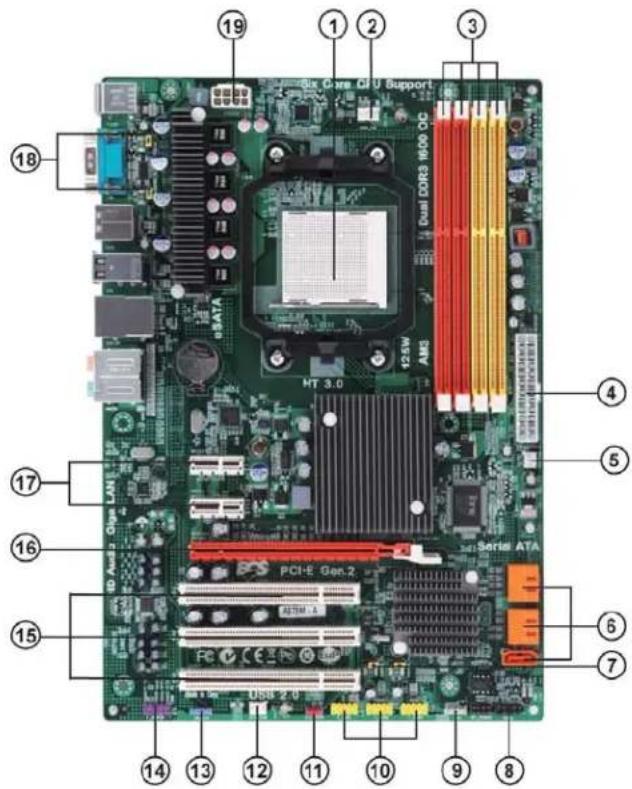
Motherboard Components
text_image
Core CPU Support Dual DCR3 4000 OC 125W AMS MT 3.0 PCI-E Gen.2 Series ATA USB 2.0 19 18 17 16 15 14 13 12 11 10 9 8
The above image is for reference only; please take the actual motherboard for detailed parts.
Table of Motherboard Components
| LABEL COMPONENTS | |
| 1. CPU Socket | Socket for AMD PhenomTM II/AthlonTM II/SempronTM processors (socket AM3) |
| 2. CPU_FAN | CPU cooling fan connector |
| 3. DDR3_1~4 | 240-pin DDR3 SDRAM slots |
| 4. ATX_POWER | Standard 24-pin ATX power connector |
| 5. PWR_FAN | Power cooling fan connector |
| 6. SATA1~5 | Serial ATA connectors |
| 7. USBPWR_F1~2 | Front panel USB power select jumpers |
| 8. F_PANEL | Front panel switch/LED header |
| 9. SPK | Speaker header |
| 10. F_USB1~4 | Front Panel USB headers |
| 11. CLR_CMOS | Clear CMOS jumper |
| 12. SYS_FAN | System cooling fan connector |
| 13. SPDIFO | SPDIF out header |
| 14. F_AUDIO | Front panel audio header |
| 15. PCI1~3 | 32-bit add-on card slots |
| 16. PCIEX16 | PCI Express x16 slot for graphics interface |
| 17. PCIE1~2 | PCI Express x1 slots |
| 18. USBPWR_R1~2 | Rear USB/PS2 power select jumpers |
| 19. ATX12V 8-pin + | 12V power connector |
This concludes Chapter 1. The next chapter explains how to install the motherboard.
Safety Precautions
- Follow these safety precautions when installing the motherboard
- Wear a grounding strap attached to a grounded device to avoid damage from static electricity
- Discharge static electricity by touching the metal case of a safely grounded object before working on the motherboard
- Leave components in the static-proof bags they came in
- Hold all circuit boards by the edges. Do not bend circuit boards
Choosing a Computer Case
There are many types of computer cases on the market. The motherboard complies with the specifications for the ATX system case. Some features on the motherboard are implemented by cabling connectors on the motherboard to indicators and switches on the system case. Make sure that your case supports all the features required. Make sure that your case has sufficient power and space for all drives that you intend to install.
Most cases have a choice of I/O templates in the rear panel. Make sure that the I/O template in the case matches the I/O ports installed on the rear edge of the motherboard.
This motherboard carries an ATX form factor of 305 X 210 mm. Choose a case that accommodates this form factor.
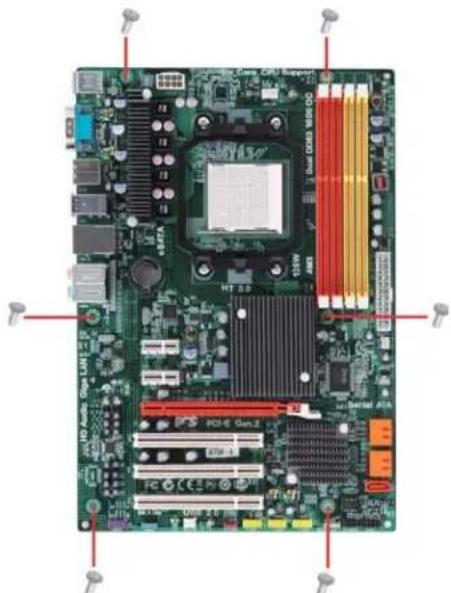
Installing the Motherboard in a Case
Refer to the following illustration and instructions for installing the motherboard in a case.
Most system cases have mounting brackets installed in the case, which correspond the holes in the motherboard. Place the motherboard over the mounting brackets and secure the motherboard onto the mounting brackets with screws.
Ensure that your case has an I/O template that supports the I/O ports and expansion slots on your motherboard.
x
natural_image
Close-up of a computer motherboard with visible CPU socket, RAM slots, and heatsink (no text or symbols)
Do not over-tighten the screws as this can stress the motherboard.
Checking Jumper Settings
This section explains how to set jumpers for correct configuration of the motherboard.
Setting Jumpers
Use the motherboard jumpers to set system configuration options. Jumpers with more than one pin are numbered. When setting the jumpers, ensure that the jumper caps are placed on the correct pins.
The illustrations show a 2-pin jumper. When the jumper cap is placed on both pins, the jumper is SHORT. If you remove the jumper cap, or place the jumper cap on just one pin, the jumper is OPEN.
This illustration shows a 3-pin jumper. Pins 1 and 2 are SHORT.

SHORT

OPEN

Checking Jumper Settings
The following illustration shows the location of the motherboard jumpers. Pin 1 is labeled.

text_image
USBPWR_R1 USBPWR_R2 CLR_CMOS USBPWR_F1 USBPWR_F2Jumper Settings
| Jumper Type Description | Setting (default) | |||
| CLR_CMOS | 3-pin | Clear CMOS | 1-2: NORMAL2-3: CLEARBefore clearing the CMOS, make sure to turn off the system. |  CLR_CMOS CLR_CMOS |
| USBPWR_R1~2 | 3-pin | Rear USB PS/2Power Select Jumper | 1-2: VCC2-3: 5VSB | [0394]USBPWR_R1~2 |
| USBPWR_F1~2 | 3-pin | Front PanelUSB PowerSelect Jumper | 1-2: VCC2-3: 5VSB |  USBPWR_F1~2 USBPWR_F1~2 |

- To avoid the system instability after clearing CMOS, we recommend users to enter the main BIOS setting page to "Load Default Settings" and then "Save & Exit Setup".
- Make sure the power supply provides enough 5VSB voltage before selecting the 5VSB function.
- It is required that users place the USBPWR_R1\~2 & USBPWR_F1\~2 cap onto 2-3 pin rather than 1-2 pin as default if you want to wake up the computer by USB/PS2 KB/Mouse.
Installing Hardware
Installing the Processor

Caution: When installing a CPU heatsink and cooling fan make sure that you DO NOT scratch the motherboard or any of the surface-mount resistors with the clip of the cooling fan. If the clip of the cooling fan scrapes across the motherboard, you may cause serious damage to the motherboard or its components.
On most motherboards, there are small surface-mount resistors near the processor socket, which may be damaged if the cooling fan is carelessly installed.
Avoid using cooling fans with sharp edges on the fan casing and the clips. Also, install the cooling fan in a well-lit work area so that you can clearly see the motherboard and processor socket.
Before installing the Processor
This motherboard automatically determines the CPU clock frequency and system bus frequency for the processor. You may be able to change these settings by making changes to jumpers on the motherboard, or changing the settings in the system Setup Utility. We strongly recommend that you do not over-clock processors or other components to run faster than their rated speed.

Warning:
-
Over-clocking components can adversely affect the reliability of the system and introduce errors into your system. Over-clocking can permanently damage the motherboard by generating excess heat in components that are run beyond the rated limits.
-
Always remove the AC power by unplugging the power cord from the power outlet before installing or removing the motherboard or other hardware components.
This motherboard has a socket AM3 processor socket. When choosing a processor, consider the performance requirements of the system. Performance is based on the processor design, the clock speed and system bus frequency of the processor, and the quantity of internal cache memory and external cache memory.
Fail-Safe Procedures for Over-clocking
When end-users encounter failure after attempting over-clocking, please take the following steps to recover from it.
- Shut down the computer.
- Press and hold the "Page Up Key (PgUp)" of the keyboard, and then boot the PC up.
- Two seconds after the PC boots up, release the "Page Up Key (PgUp)".
- The BIOS returns to the default setting by itself.
CPU Installation Procedure
The following illustration shows CPU installation components.
1 Install your CPU. Pull up the lever away from the socket and lift up to 90-degree angle.
2 Locate the CPU cut edge (the corner with the pin hold noticeably missing). Align and insert the CPU correctly.
3 Press the lever down and apply thermal grease on top of the CPU.
4 Put the CPU Fan down on the retention module and snap the four retention legs of the cooling fan into place.
5 Flip the levers over to lock the heat sink in place and connect the CPU cooling Fan power cable to the CPUFAN connector. This completes the installation.
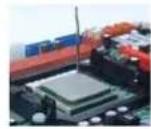


To achieve better airflow rates and heat dissipation, we suggest that you use a high quality fan with 4800 rpm at least. CPU fan and heatsink installation procedures may vary with the type of CPU fan/heatsink supplied. The form and size of fan/heatsink may also vary.
Installing Memory Modules
This motherboard accommodates four memory modules. It can support four 240-pin DDR3 1600(OC)/1333/1066/800. The total memory capacity is 32 GB.
DDR3 SDRAM memory module table
| Memory module Memory Bus | |||
| DDR3 800 | 400 | MHz | |
| DDR3 1066 | 533 | MHz | |
| DDR3 1333 | 667 | MHz | |
| DDR3 1600(OC) | 800 MHz | ||
You must install at least one module in any of the four slots. Each module can be installed with 8 GB of memory.

Do not remove any memory module from its antistatic packaging until you are ready to install it on the motherboard. Handle the modules only by their edges. Do not touch the components or metal parts. Always wear a grounding strap when you handle the modules.
Installation Procedure
Refer to the following to install the memory modules.
1 This motherboard supports unbuffered DDR3 SDRAM only.
2 Push the latches on each side of the DIMM slot down.
3 Align the memory module with the slot. The DIMM slots are keyed with notches and the DIMMs are keyed with cutouts so that they can only be installed correctly.
4 Check that the cutouts on the DIMM module edge connector match the notches in the DIMM slot.
5 Install the DIMM module into the slot and press it firmly down until it seats correctly. The slot latches are levered upwards and latch on to the edges of the DIMM.
6 Install any remaining DIMM modules.

natural_image
Close-up of a hand placing a green RAM module into a computer motherboard with an orange rack (no visible text or symbols)
For best performance and compatibility, we recommend that users install DIMMs in the sequence of DIMM3, DIMM4, DIMM1 and DIMM2.
Recommend configuration for best performance and compatibility
| Number of DIMMs | DIMM 1 | DIMM 2 | DIMM 3 | DIMM 4 | AM3 | |
| 1 | Single Channel | |||||
| 2 | Dual Channel | |||||
| 3 | Dual Channel | |||||
| 4 | Dual Channel |
☐ : operation with normal performance
: operation with the best performance
Table A: DDR3 (memory module) QVL (Qualified Vendor List)
The following DDR3 memory modules have been tested and qualified for use with this motherboard.
| DDR3 800 | ||||||
| NO. | Vendor Module Part Number IC Brand | C Chip Number SS/DS | Size | |||
| 1 | Qimonda | IMSH51U03A1F1C-08E | Qimonda IDSH51-03A1F1C-08E | 512 MB | ||
| DDR3 1066 | ||||||
| NO. | Vendor Module Part Number IC Brand | C Chip Number SS/DS | Size | |||
| 1 | Elixir M2Y2G64CB8HC9N-BE DS | 2GB | ||||
| 2 | Elixir | M2Y2G64CB8HC5N-BE | elixir | N2CB1G80CN-BE | DS | 2GB |
| 3 | Bpida | PC3-8500U-7-00-AP | Elpida | J53088ASE-AC-E | SS | 512MB |
| 4 | Hynix | HYMT112U64ZNF8-G8 AA | Hynix | HY5TQ1G831ZNFP-G8 | SS | 1GB |
| 5 | Hynix | HMT112U6AFP8C-G7ND AA | Hynix | H5TQ1G83AFP G7C | SS | 1GB |
| 6 | Hynix | HYMT125U64ZNF8-G8 AA | Hynix | HY5TQ1G831ZN FP-G8 | DS | 2GB |
| 7 | Hynix | HMT125U6AFP8C-G7ND AA | Hynix | H5TQ1G83AFP G7C | DS | 2GB |
| 8 | Kingston | KVR1066D3N7 | Elpida | J5308BASE-AE-E 07500W220 | DS | 1GB |
| 9 | Micron | MT8JTF12864AY-1G1D1 | Micron | 7UD22D9JNL | SS | 1GB |
| 10 | Micron | MT8JTF12864AY-1G1D1 | Micron | 8TD22 D9JNL | SS | 1GB |
| 11 | Micron | MT16JTF25664AY-1G1D1 | Micron | 7UD22D9JNL | DS | 2GB |
| 12 | Micron | MT16JTF25664AY-1G1D1 | Micron | 8WD22 D9JNL | DS | 2GB |
| 13 | Micron | MT16JTF25664AZ-1G1F1 | Micron | 9EF22 D9KPV | DS | 2GB |
| 14 | Micron | MT8JTF12864AZ-1G1F1 | Micron | 9NF22 D9KPT | SS | 1GB |
| 15 | Ramexel | RMR1810NA48E7F-1066-LF | NANYA N | T5CB128H8AN-DE | SS | 1GB |
| 16 | Samsung | M378B2873DZ1-CF8 | SEC | HCF8 K4B1G0846D | SS | 1GB |
| 17 | Samsung | M378B5673DZ1-CF8 | SEC | K4B1G0846D HCF8 | DS | 2GB |
| 18 | Kingston | KVR1066D3N7/512 | Epida | J5308BASE-AE-E 07340W065 | SS | 512MB |
| 19 | Qimonda | MSH1GU03A1F1C-10F | Qimonda | DSH1G-03A1F1C-10F FSS15085 | SS | 1GB |
| 20 | Qimonda | MSH1GU03A1F1C-10G Qimonda | IDSH1G-03A1F1C-10G FSS14526 SS | 1GB | ||
| 21 | Qimonda | MSH2GU13A1F1C-10F | Qimonda | DSH1G-03A1F1C-10F FSS15085 | DS | 2GB |
| 22 | Qimonda | MSH2GU13A1F1C-10G Qimonda | IDSH1G-03A1F1C-10G FSS13467 DS | 2GB | ||
| 23 | Hynix | HYMT112U64ZNF8-G8 AA | Hynix | HY5TQ1G831ZN FP-G8 | SS | 1GB |
| 24 | Samsung | M378B2873EH1-CF8 SEC HCF8K4B1G0846E SS | 1GB | |||
| 25 | Samsung | M378B5673DZ1-CF8 | SEC | K4B1G0846D HCF8 DS | 2GB | |
| 26 | Aeneon | AEH760UD00-10FA98X | Aeneon | AEH93R10F 0737 | SS | 1GB |
| 27 | Bpida | EBJ10UEBBDF0-AE-F | Elpida | J1108BDSE-DJ-F | SS | 1GB |
| 28 | Bpida | EBJ21UEBBDF0-AE-F | Elpida | J1108BDSE-DJ-F | DS | 2GB |
| 29 | Nanya | M2Y2G64TU8HD5B-BD | elixir | N2CB1G80AN-CG | DS | 2GB |
| DDR3 1333 | |||||||
| NO. | Vendor Module Part Number IC Brand | C Chip Number SS/DS Size | |||||
| 1 | A-DATA | AD3U1333B1G9-B | Hynix | H5TQ1G83BFR | SS | 1GB | |
| 2 | A-DATA | AD3U1333B2G9-B | Hynix | H5TQ1G83BFR | DS | 2GB | |
| 3 | Apacer | 78.A1GC6.9L1 | Apacer | AM5D5808ADWSBG | DS | 2GB | |
| 4 | Elixir | M2F2G64CB8HA4N-CG | Elixir | N2CB1G80AN-CG 0903 | DS | 2GB | |
| 5 | Elixir | M2Y2G64CB8HC9N-CG DS 2GB | |||||
| 6 | Hynix | HMT112U6AFP8C-H9N0 AA | Hynix | H5TQ1G83AFP H9C | SS | 1GB | |
| 7 | Hynix | HMT125U6AFP8C-H9N0 AA | Hynix | H5TQ1G83AFP H9C | DS | 2GB | |
| 8 | G.SKILL | F3-10666CL9D-4GBRL | DS | 2GB | |||
| 9 | G.SKILL | F3-10666CL8D-4GBECO 1.35V | DS | 2GB | |||
| 10 | G.SKILL | F3-10666CL9D-4GBNQ | DS | 2GB | |||
DDR3 1333
| NO. | Vendor Module Part Number IC Brand IC Chip Number SS/DS Size | |||||
| 11 | Kingston KVR1333D3N9 Elpida J1108BASE-DJ-E SS 1GB | |||||
| 12 | Kingston KVR1333D3N9 Elpida J1108BABG-DJ-E DS 2GB | |||||
| 13 | Kingston KVR1333D3N9/4G Hynix Hynix/H5TQ2G83AFR DS 4GB | |||||
| 14 | KingMax FLFD45F-B8KG9 NAES KingMax KFB8FNGXF-ANX-15A SS 1GB | |||||
| 15 | KingMax FLFE85F-B8KG9 NEES KingMax KFB8FNGXF-ANX-15A DS 2GB | |||||
| 16 | Nanya NT2GC64B8HAONF-CG Elixir N2CB1G80AN-CG DS 2GB | |||||
| 17 | Micron MT8JTF12864AY-1G4D1 Micron 8UD22 D9JNM SS 1GB | |||||
| 18 | Micron MT16JTF25664AY-1G4D1 Micron 8WD22 D9JNM DS 2GB | |||||
| 19 | Micron MT8JTF12864AZ-1G4F1 Micron 9MF22 D9KPT SS 1GB | |||||
| 20 | PSC AL7F8G73D-DG1 PSC A3P1GF3DGF SS 1GB | |||||
| 21 | PSC AL8F8G73D-DG1 PSC A3P1GF3DGF DS 2GB | |||||
| 22 | Ramaxel RMR1810KD48E7F-1333 SEC K4B1G0846D SS 1GB | |||||
| 23 | Ramaxel RMR186EA48D8F-1333 ELPLDA J1108BASE-DJ-E DS 2GB | |||||
| 24 | Samsung M378B2873DZ1-CH9 SEC K4B1G0846D SS 1GB | |||||
| 25 | Samsung M378B2873EH1-CH9 SEC K4B1G0846E HCH9 SS 1GB | |||||
| 26 | Samsung M378B5673EH1-CH9 SEC K4B1G0846E HCH9 DS 2GB | |||||
| 27 | Samsung M378B2873FHS-CH9 SEC K4B1G0846F SS 1GB | |||||
| 28 | Samsung M378B5673FHO-CH9 SEC K4B1G0846F DS 2GB | |||||
| 29 | Samsung M378B5273CHO-CH9 SEC K4B2G0846C DS 4GB | |||||
| 30 | Silicon SP001GBLTU133S01 Nanya NT5CB128MBAN-CG SS 1GB | |||||
| 31 | Silicon SP002GBLTU133S01 Nanya NT5CB128MBAN-CG DS 2GB | |||||
| 32 | Aeneon AXH760UD00-13GA98X SS | |||||
| 33 | KingsMax FLFD45F-B8KG9 NAUS KingsMax KFB8FNGXF-ANX-15U SS 1GB | |||||
| 34 | KingsMax FLFE85F-B8KG9 NEUS KingsMax KFB8FNGXF-ANX-15U DS 2GB | |||||
| 35 | Kingston KVR1333D3N9 Kingston 128X8DDR3 SL0931 DS 2GB | |||||
| 36 | Kingston KVR1333D3N9K2/2G Elpida J1108BASE-DJ-E SS 1GB | |||||
| 37 | Kingston KVR1333D3N9/2G Qimonda IDSH1G-03A1F1C-13H DS | |||||
| 38 | Elxir M2Y1G64CB88A5N-CG Elxir N2CB1G80AN-CG SS 1GB | |||||
| 39 | Elxir M2Y2G64CB8HA5N-CG Elxir N2CB1G80AN-CG DS 2GB | |||||
| 40 | Nanya NT1G064B88A0NF-CG Nanya NT5CB128MBAN-CG SS 1GB | |||||
| 41 | Qimonda IMSH1GU13A1F1C-13H Qimonda 0734 IDSH51-03A1F1D DS 1GB | |||||
| 42 | Qimonda IMSH2GU13A1F1C-13H Qimonda DSH1G-03A1F1C-13H FS DS 2GB | |||||
| 43 | Unifosa GU502203EP0201 Elpida J1108BDBG-DJ-F SS | |||||
| 44 | Unifosa GU512303EP0202 Elpida J1108BDBG-DJ-F DS 2GB | |||||
| 45 | Ramaxel RMR1810E7F-1333 Elpida J1108BDBG-DJ-F SS 1GB | |||||
| 46 | Elpida EBJ10UE8BDFO-DJ-F Elpida J1108BDSE-DJ-F SS 1GB | |||||
| 47 | Elpida EBJ21UE8BDFO-DJ-F Elpida J1108BDSE-DJ-F DS 2GB | |||||
| 48 | A-data Game Dragon 8-8-8-24 DS 2GB | |||||
DDR3 1600
| NO. | Vendor Module Part Number | IC Brand IC Chip | Number SS/DS | Size | ||
| 1 | A-DATA | High Speed Dragon | DS | 2GB | ||
| 2 | A-DATA | AX3U1600GB2G9-AG () | DS 2GB | |||
| 3 | Elixir | M2Y2G64CB8HA9N-DG | DS | 2GB | ||
| 4 | G.SKILL | F3-12800CL9D-4GBNQ | DS | 2GB | ||
| 5 | G.SKILL | F3-12800CL9D-4GBECO 1.35V | DS | 2GB | ||
| 6 | G.SKILL | F3-12800CL7D-4GBECO 1.35V | DS | 2GB | ||
| 7 | G.SKILL | F3-12800CL9D-4GBRL | DS | 2GB | ||
| 8 | KingsMax | FLGD45F-B8KG9 NEES | KingsMax | KFB8FNGXF-ANX-12A | SS | 1GB |
| 9 | KingsMax | FLGE85F-B8KG9 NEES | KingsMax | KFB8FNGXF-ANX-12A | DS | 2GB |
2GB
1GB
1GB
Expansion Slots
Installing Add-on Cards
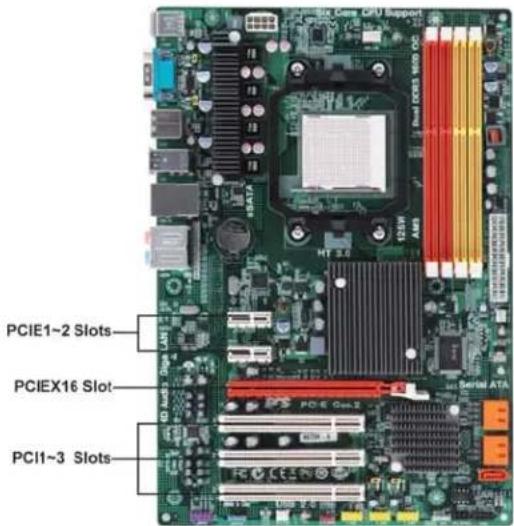
The slots on this motherboard are designed to hold expansion cards and connect them to the system bus. Expansion slots are a means of adding or enhancing the motherboard's features and capabilities. With these efficient facilities, you can increase the motherboard's capabilities by adding hardware that performs tasks that are not part of the basic system.
text_image
PCIE1~2 Slots PCIEX16 Slot PCI1~3 SlotsPCIE1\~2 Slots
The PCI Express x1 slots are fully compliant to the PCI Express Gen2 (version 2.0).
PCIEX16 Slot
The PCI Express x16 slot is used to install an external PCI Express graphics card that is fully compliant to the PCI Express Gen2 (version 2.0).
PCI1\~3 Slots
This motherboard is equipped with three standard PCI slots. PCI stands for Peripheral Component Interconnect and is a bus standard for expansion cards, which for the most part, is a supplement of the older ISA bus standard. The PCI slots on this board are PCI v2.3 compliant.

Before installing an add-on card, check the documentation for the card carefully. If the card is not Plug and Play, you may have to manually configure the card before installation.
*
Follow these instructions to install an add-on card:
1 Remove a blanking plate from the system case corresponding to the slot you are going to use.
2 Install the edge connector of the add-on card into the expansion slot. Ensure that the edge connector is correctly seated in the slot.
3 Secure the metal bracket of the card to the system case with a screw.

natural_image
Close-up of a red printed circuit board with visible components and connectors (no readable text or symbols)* For reference only

For some add-on cards, for example graphics adapters and network adapters, you have to install drivers and software before you can begin using the add-on card.
Connecting Optional Devices
Refer to the following for information on connecting the motherboard's optional devices:

text_image
CPU Core CPU Support RAM Cells 9.0 PCI-5 Gen2 F_AUDIO SPDIFO F_USB1 F_USB2 F_USB3 SATA4/5 SATA2/3 SATA1SATA1\~5: Serial ATA connectors
These connectors are used to support the new Serial ATA devices for the highest data transfer rates (6.0 Gb/s), simpler disk drive cabling and easier PC assembly. It eliminates limitations of the current Parallel ATA interface. But maintains register compatibility and software compatibility with Parallel ATA.
| Pin Signal Name | Pin | Signal Name |
| 1 Ground 2TX+ | ||
| 3 TX-4Ground | ||
| 5 RX-6RX+ | ||
| 7 Ground - - |
SPDIFO: SPDIF out header
This is an optional header that provides an S/PDIF (Sony/Philips Digital Interface) output to digital multimedia device through optical fiber or coaxial connector.
| Pin | Signal Name | Function |
| 1 | SPDIF | SPDIF digital output |
| 2 | +5VA | 5V analog Power |
| 3 | Key | No pin |
| 4 | GND | Ground |
The motherboard has eight USB ports installed on the rear edge I/O port array. Additionally, some computer cases have USB ports at the front of the case. If you have this kind of case, use auxiliary USB connector to connect the front-mounted ports to the motherboard.
| Pin Signal Name | Function |
| 1 USBPWR Front Panel | USB Power |
| 2 USBPWR Front Panel | USB Power |
| 3 USB_FP_P0- USB Port 0 Negative Signal | |
| 4 USB_FP_P1- USB Port 1 Negative Signal | |
| 5 USB_FP_P0+ USB Port 0 Positive Signal | |
| 6 USB_FP_P1+ USB Port 1 Positive Signal | |
| 7 GND Ground | |
| 8 GND Ground | |
| 9 Key No pin | |
| 10 GND Ground | |

Please make sure that the USB cable has the same pin assignment as indicated above. A different pin assignment may cause damage or system hang-up.
F AUDIO: Front Panel Audio header
This header allows the user to install auxiliary front-oriented microphone and line-out ports for easier access.
| Pin Signal Name Pin Signal Name | |||
| 1 PORT 1L 2 AUD_GND | |||
| 3 | PORT 1R | 4 | PRESENCE# |
| 5 | PORT 2R | 6 | SENSE1_RETURN |
| 7 | SENSE_SEND | 8 | KEY |
| 9 | PORT 2L | 10 | SENSE2_RETURN |
Installing a SATA Hard Drive
This section describes how to install a SATA hard drive.
About SATA Connectors
Your motherboard features five SATA connectors supporting a total of five drives. SATA refers to Serial ATA (Advanced Technology Attachment) is the standard interface for the IDE hard drives which are currently used in most PCs. These connectors are well designed and will only fit in one orientation. Locate the SATA connectors on the motherboard and follow the illustration below to install the SATA hard drives.
Installing Serial ATA Hard Drives
To install the Serial ATA (SATA) hard drives, use the SATA cable that supports the Serial ATA protocol. This SATA cable comes with an SATA power cable. You can connect either end of the SATA cable to the SATA hard drive or the connector on the motherboard.

SATA cable (optional)
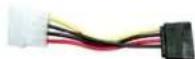
SATA power cable (optional)
Refer to the illustration below for proper installation:
1 Attach either cable end to the connector on the motherboard.
2 Attach the other cable end to the SATA hard drive.
3 Attach the SATA power cable to the SATA hard drive and connect the other end to the power supply.
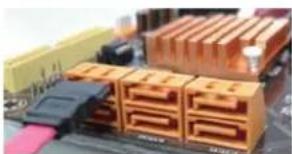
natural_image
Close-up of electronic circuit board components including orange and yellow modules (no visible text or symbols)
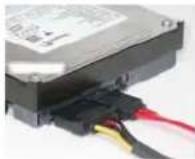

This motherboard supports the "Hot-Plug" function.
Connecting I/O Devices
The backplane of the motherboard has the following I/O ports:

text_image
PS2 mouse PS2 keyboard Serial port(COM) ESATA port USB ports LAN port A B D E F CPS2 Mouse Use the upper PS/2 port to connect a PS/2 pointing device.
PS2 Keyboard Use the lower PS/2 port to connect a PS/2 keyboard.
Serial Port (COM) Use the COM port to connect serial devices such as mouse or fax/modems.
ESATA port Use this port to connect to external SATA boxes or Serial ATA port multipliers.
USB Ports Use the USB ports to connect USB devices.
LAN Port Connect an RJ-45 jack to the LAN port to connect your computer to the network.
Audio Ports
This motherboard may adopt 8-channel audio ports that correspond to the A,B, C, and E port respectively. In addition, all of the 3 ports, B, C, and E provide users with both right & left channels individually. Users please refer to the following note for specific port function definition.
| A: Center & Woofer | D: Line-in |
| B: Back Surround | E: Front Out |
| C: Side Surround | F: Mic_in Rear |
The above port definition can be changed to audio input or audio output by changing the driver utility setting.
Connecting Case Components
After you have installed the motherboard into a case, you can begin connecting the motherboard components. Refer to the following:
1 Connect the CPU cooling fan cable to CPU_FAN.
2 Connect the standard power supply connector to ATX_POWER.
3 Connect the case speaker cable to SPK.
4 Connect the case switches and indicator LEDs to the PANEL.
5 Connect the system cooling fan connector to SYS_FAN.
6 Connect the auxiliary case power supply connector to ATX12V.
7 Connect the power cooling fan connector to PWR_FAN.
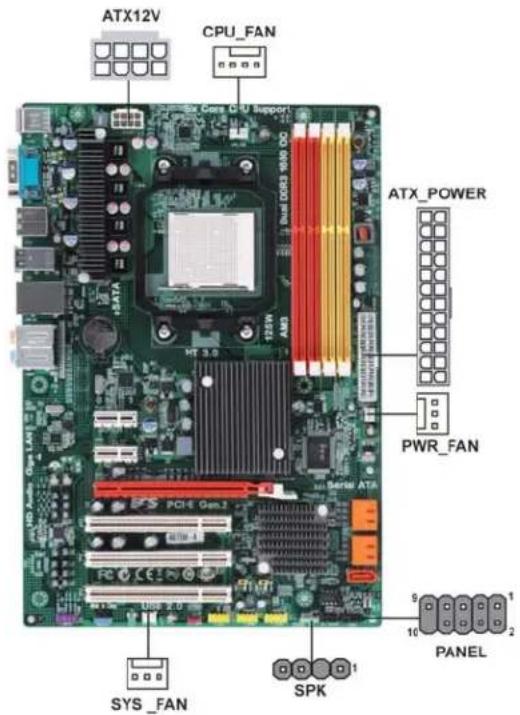
text_image
ATX12V CPU_FAN ATX_POWER PWR_FAN SYS_FAN SPK PANEL 9 1 10 2
Connecting 24-pin power cable
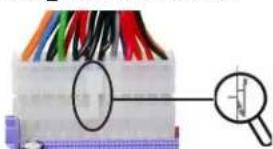
Users please note that the 24-pin power cable can be connected to the ATX_POWER connector.
natural_image
Close-up of a cable connector with colored wires and a magnified inset showing a magnifying glass (no text or symbols)With ATX v2.x power supply, users please note that when installing 24-pin power cable, the latches of power cable and the ATX_POWER match perfectly.
24-pin power cable
Connecting 8/4-pin power cable
Users please note that the 8-pin and 4-pin power cables can both be connected to the ATX12V connector.

8-pin power cable
When installing 8-pin power cable, the latches of power cable and the ATX12V connector match perfectly.

4-pin power cable
When installing 4-pin power cable, the latch falls on the left side of the ATX12V connector.
CPU_FAN: Cooling FAN Power Connector
| Pin | Signal Name | Function |
| 1 | GND System Ground | |
| 2 | +12V Power +12V | |
| 3 | Sense Sensor | |
| 4 | PWM CPU FAN control |

Users please note that the fan connector supports the CPU cooling fan of 1.1A\~2.2A (26.4W max.) at +12V.
ATX_POWER: ATX 24-pin Power Connector
| Pin | Signal Name | Pin | Signal Name |
| 1 +3.3V 13 +3.3V | |||
| 2 +3.3V 14 -12V | |||
| 3 Ground 15 COM | |||
| 4 +5V 16 PS_ON | |||
| 5 Ground 17 COM | |||
| 6 +5V 18 COM | |||
| 7 Ground 19 COM | |||
| 8 PWRGD 20 -5V | |||
| 9 +5VSB 21 +5V | |||
| 10 +12V 22 +5V | |||
| 11 +12V | 23 | +5V | |
| 12 +3.3V 24 COM |
SYS_FAN/PWR_FAN: FAN Power Connectors
| Pin Signal Name Function | ||
| 1 GND System Ground | ||
| 2 | +12V Power +12V | |
| 3 | Sense | Sensor |
SPK: Internal speaker
| Pin Signal Name |
| 1 VCC |
| 2 NC |
| 3 Ground |
| 4 Signal |
ATX12V: ATX 12V Power Connector
| Pin | Signal Name | Pin | Signal Name |
| 1 | Ground | 5 +12V | |
| 2 | Ground | 6 +12V | |
| 3 | Ground | 7 +12V | |
| 4 | Ground | 8 +12V |
Front Panel Header
The front panel header (F_PANEL) provides a standard set of switch and LED headers commonly found on ATX or Micro ATX cases. Refer to the table below for information:

F_PANEL
| Pin Signal Function Pin Signal Function | |
| 1 HD_LED_P Hard disk LED (+) | 2 FP PWR/SLP *MSG LED (+) |
| 3 HD_LED_N Hard disk LED (-) | 4 FP PWR/SLP *MSG LED (-) |
| 5 RST_SW_N Reset Switch (-) | 6 PWR_SW_P Power Switch (+) |
| 7 RST_SW_P Reset Switch (+) | 8 PWR_SW_N Power Switch (-) |
| 9 RSVD Reserved | 10 Key No pin |
* MSG LED (dual color or single color)
Hard Drive Activity LED
Connecting pins 1 and 3 to a front panel mounted LED provides visual indication that data is being read from or written to the hard drive. For the LED to function properly, an IDE drive should be connected to the onboard IDE interface. The LED will also show activity for devices connected to the SCSI (hard drive activity LED) connector.
Power/Sleep/Message waiting LED
Connecting pins 2 and 4 to a single or dual-color, front panel mounted LED provides power on/off, sleep, and message waiting indication.
Reset Switch
Supporting the reset function requires connecting pin 5 and 7 to a momentary-contact switch that is normally open. When the switch is closed, the board resets and runs POST.
Power Switch
Supporting the power on/off function requires connecting pins 6 and 8 to a momentary-contact switch that is normally open. The switch should maintain contact for at least 50 ms to signal the power supply to switch on or off. The time requirement is due to internal de-bounce circuitry. After receiving a power on/off signal, at least two seconds elapses before the power supply recognizes another on/off signal.
This concludes Chapter 2. The next chapter covers the BIOS.
Chapter 3
Using BIOS
About the Setup Utility
The computer uses the latest "American Megatrends Inc." BIOS with support for Windows Plug and Play. The CMOS chip on the motherboard contains the ROM setup instructions for configuring the motherboard BIOS.
The BIOS (Basic Input and Output System) Setup Utility displays the system's configuration status and provides you with options to set system parameters. The parameters are stored in battery-backed-up CMOS RAM that saves this information when the power is turned off. When the system is turned back on, the system is configured with the values you stored in CMOS.
The BIOS Setup Utility enables you to configure:
- Hard drives, diskette drives and peripherals
• Video display type and display options - Password protection from unauthorized use
• Power Management features
The settings made in the Setup Utility affect how the computer performs. Before using the Setup Utility, ensure that you understand the Setup Utility options.
This chapter provides explanations for Setup Utility options.
The Standard Configuration
A standard configuration has already been set in the Setup Utility. However, we recommend that you read this chapter in case you need to make any changes in the future.
This Setup Utility should be used:
- when changing the system configuration
- when a configuration error is detected and you are prompted to make changes to the Setup Utility
- when trying to resolve IRQ conflicts
- when making changes to the Power Management configuration
- when changing the password or making other changes to the Security Setup
Entering the Setup Utility
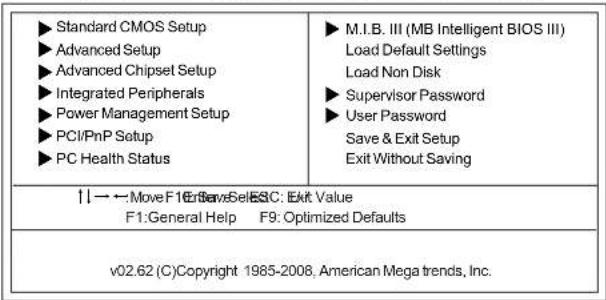
When you power on the system, BIOS enters the Power-On Self Test (POST) routines. POST is a series of built-in diagnostics performed by the BIOS. After the POST routines are completed, the following message appears:
Press DEL to enter SETUP
Press the delete key to access the BIOS Setup Utility.
CMOS Setup Utility -- Copyright (C) 1985-2005, American Megatrends, Inc.
text_image
► Standard CMOS Setup ► Advanced Setup ► Advanced Chipset Setup ► Integrated Peripherals ► Power Management Setup ► PCI/PnP Setup ► PC Health Status ► M.I.B. III (MB Intelligent BIOS III) Load Default Settings Load Non Disk ► Supervisor Password ► User Password Save & Exit Setup Exit Without Saving || | ← Move F1&E#eS#ESC: Exit Value F1:General Help F9: Optimized Defaults v02.62 (C)Copyright 1985-2008, American Mega trends, Inc.Resetting the Default CMOS Values
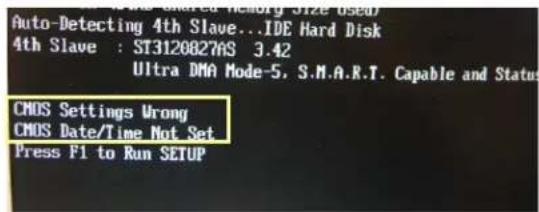
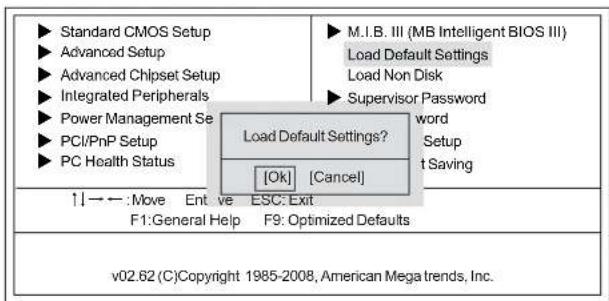
When powering on for the first time, the POST screen may show a "CMOS Settings Wrong" message. This standard message will appear following a clear CMOS data at factory by the manufacturer. You simply need to Load Default Settings to reset the default CMOS values.
Note: Changes to system hardware such as different CPU, memories, etc. may also trigger this message.
text_image
Auto-Detecting 4th Slave...IDE Hard Disk 4th Slave : ST3120827AS 3.42 Ultra DMA Mode-5, S.M.A.R.T. Capable and Status CHOS Settings Wrong CHOS Date/Time Not Set Press F1 to Run SETUPCMOS Setup Utility – Copyright (C) 1985-2005, American Megatrends, Inc.
text_image
Standard CMOS Setup Advanced Setup Advanced Chipset Setup Integrated Peripherals Power Management Se PCI/PnP Setup PC Health Status M.I.B. III (MB Intelligent BIOS III) Load Default Settings Load Non Disk Supervisor Password word Setup t Saving Load Default Settings? [Ok] [Cancel] 1 | → ← :Move Ent ve ESC: Exit F1:General Help F9: Optimized Defaults v02.62 (C)Copyright 1985-2008, American Mega trends, Inc.Using BIOS
When you start the Setup Utility, the main menu appears. The main menu of the Setup Utility displays a list of the options that are available. A highlight indicates which option is currently selected. Use the cursor arrow keys to move the highlight to other options. When an option is highlighted, execute the option by pressing
Some options lead to pop-up dialog boxes that prompt you to verify that you wish to execute that option. Other options lead to dialog boxes that prompt you for information.
Some options (marked with a triangle ▶) lead to submenus that enable you to change the values for the option. Use the cursor arrow keys to scroll through the items in the submenu.
In this manual, default values are enclosed in parenthesis. Submenu items are denoted by a triangle ▶.

The default BIOS setting for this motherboard applies for most conditions with optimum performance. It is not suggested to change the default values in the BIOS setup and the manufacture takes no responsibility to any damage caused by changing the BIOS settings.
BIOS Navigation Keys
The BIOS navigation keys are listed below:
| KEY FUNCTION | |
| ESC Exis the current menu | |
| 1. ↔ | Scrolls through the items on a menu |
| +/- Modifies the selected field's values | |
| Enter Select | |
| F9 Load a default optimized setting | |
| F10 Saves the current configuration and exits setup | |
| F1 Displays a screen that describes all key functions | |

For the purpose of better product maintenance, the manufacture reserves the right to change the BIOS items presented in this manual. The BIOS setup screens shown in this chapter are for reference only and may differ from the actual BIOS. Please visit the manufacture's website for updated manual.
Standard CMOS Setup
This option displays basic information about your system.
CMOS Setup Utility -- Copyright (C) 1985-2005, American Megatrends, Inc.
Standard CMOS Setup
| DateThu 02/11/2010Time00:33:51▶ SATA 1 ATAPI CDROM▶ SATA 2 Hard Disk▶ SATA 3 Not Detected▶ SATA 4NotDetected▶ SATA 5 NotDetected▶ eSATA NotDetectedIDE BusMaster Enabled | Help Item |
| User [Enter], [TAB] or [SHIFT-TAB] to select a field.Use [+] or [-] to configure system Date. |
↑↓→←:Move Enter:Select +/-:Value F10:Save ESC:Exit F1:General Help F9:Optimized Defaults
Date & Time
The Date and Time items show the current date and time on the computer. If you are running a Windows OS, these items are automatically updated whenever you make changes to the Windows Date and Time Properties utility.
▶SATA1\~5, eSATA
This motherboard supports five SATA channels and each channel allows one SATA device to be installed.
CMOS Setup Utility - Copyright (C) 1985-2005, American Megatrends, Inc. SATA1
| SATA1Device: ATAPI CDROMType AutoLBA/Large Mode AutoBlock (Multi-Sector Transfer) AutoPIO Mode AutoDMA Mode AutoS.M.A.R.T.32Bit Data TransferEnabled | Help ItemSelect the type of the device connected to the system. |
↑↓→←:Move Enter:Select +/-:Value F10:Save ESC:Exit F1:General Help F9:Optimized Defaults
Type (Auto)
Use this item to configure the type of the IDE device that you specify. If the feature is enabled, it will enhance hard disk performance by reading or writing more data during each transfer.
LBA/Large Mode (Auto)
Use this item to set the LBA/Large mode to enhance hard disk performance by optimizing the area the hard disk is visited each time.
Block (Multi-Sector Transfer) (Auto)
If the feature is enabled, it will enhance hard disk performance by reading or writing more data during each transfer.
PIO Mode (Auto)
Use this item to set the PIO mode to enhance hard disk performance by optimizing the hard disk timing.
DMA Mode (Auto)
DMA capability allows users to improve the transfer-speed and data-integrity for compatible IDE devices.
S.M.A.R.T. (Auto)
The S.M.A.R.T. (Self-Monitoring, Analysis and Reporting Technology) system is a diagnostics technology that monitors and predicts device performance. S.M.A.R.T. software resides on both the disk drive and the host computer.
32Bit Data Transfer (Enabled)
Use this item to enable or disable 32Bit Data Transfer.
Press
IDE BusMaster (Enabled)
This item enables or disables the DMA under DOS mode. We recommend you to leave this item at the default value.
Press
Advanced Setup
This page sets up more advanced information about your system. Handle this page with caution. Any changes can affect the operation of your computer.
CMOS Setup Utility - Copyright (C) 1985-2005, American Megatrends, Inc. Advanced Setup
| Help Item | |
| AMD C&Q AutoCore Performance Boost AutoEnhanced Halt (C1E) DisabledQuick Power on Self Test EnabledBoot Up Numlock Status OnAPIC Mode Enabled1st Boot Device Hard Drive2nd Boot Device CD/DVD3rd Boot Device Removable Dev.►Hard Disk Drivers Press Enter►CD/DVD Drivers Press EnterBoot Other Device YesECS eJIFFY Function Disabled | Enable/Disable Secure Virtual Machine Mode (SUM) |
↑↓→←:Move Enter: Select F10: Save ESC: Exit+/-: Value F1:General Help F9:Optimized Defaults
AMD C&Q (Auto)
This item helps the system to lower the frequency when CPU idles. When the frequency decreases, the temperature will drop automatically as well.
Core Performance Boost(Auto)
This item only shown when use Phenom II X6 processor. The function is to auto switch the active CPU cores to enhance CPU frequency.
Enhanced Halt (C1E) (Disabled)
This item enables or disables enhanced halt.
Quick Power on Self Test (Enabled)
Enable this item to shorten the power on testing (POST) and have your system start up faster. You might like to enable this item after you are confident that your system hardware is operating smoothly.
Boot Up Numlock Status (On)
This item defines if the keyboard Num Lock key is active when your system is started.
APIC Mode (Enabled)
This item allows you to enable or disable the APC1 (Advanced Programmable Interrupt Controller) mode. APIC provides symmetric multi-processing (SMP) for systems, allowing support for up to 60 processors.
1st/2nd3rd Boot Device (Hard Drive/CD/DVD/Removable Dev.)
Use this item to determine the device order the computer used to look for an operating system to load at start-up time. The devices showed here will be different depending on the exact devices installed on your motherboard.
▶Hard Disk Drives (Press Enter)
Scroll to this item and press
CMOS Setup Utility - Copyright (C) 1985-2005, American Megatrends, Inc. Hard Disk Drives
| Hard Disk Drives | Help Item |
| 1st Drive WDC WD0000AADS-00L5 | Specifies the boot sequence from the available devices. |
↑↓→←:Move Enter:Select +/-; Value F10: Save ESC: Exit F1: General Help F9: Load Default Settings
▶CD/DVD Drivers (Press Enter)
Scroll to this item and press
CMOS Setup Utility - Copyright (C) 1985-2005, American Megatrends, Inc. CD/DVD Drivers Drives
| CD/DVD Drivers | Help Item |
| 1st Drive ASUS DRW-24B1ST | Specifies the boot sequence from the available devices. |
↑↓→←:Move Enter:Select +/-:Value F10:Save ESC:Exit F1:General Help F9:Load Default Settings
Press
Boot Other Device (Yes)
When enabled, the system searches all other possible locations for an operating system if it fails to find one in the devices specified under the First, Second and Third boot devices.
ECS eJIFFY Function (Disabled)
Use this item to enable or disable the ECS eJIFFY Function. eJIFFY is ECS unique software program for the quick access to the internet without entering O.S. Please refer to Chapter 6 to know more about eJIFFY.
Press
Advanced Chipset Setup
This page sets up more advanced information about your system. Handle this page with caution. Any changes can affect the operation of your computer.
CMOS Setup Utility - Copyright (C) 1985-2005, American Megatrends, Inc. Advanced Chipset Setup
| Memory Remap Feature Enabled DCT Ungaged Mode Always | Help Item |
| Enable Memory Remapping Around Memory Hole |
↑↓→←:Move Enter:Select F10: Save ESC: Exit+/-: Value F1:General Help F9:Optimized Defaults
Memory Remap Feature (Enabled)
This item allows users to enable or disable memory hole remapping.
DCT Unganged Mode (Always)
This item is used to select the DCT mode (DRAM Controller mode).
Press
Integrated Peripherals
This page sets up some parameters for peripheral devices connected to the system.
CMOS Setup Utility - Copyright (C) 1985-2005, American Megatrends, Inc. Integrated Peripherals
| SATA Configuration IDE Onboard SATA Mode Enabled Onboard AUDIO Function Enabled Onboard LAN Function Enabled Onboard LAN Boot ROM Disabled Serial Port1 Address 3F8/IRQ4 USB Functions Enabled Legacy USB Support Enabled | Help Item |
| Options Disabled Enabled |
↑↓→←:Move Enter:Select +/-:Value F10:Save ESC:Exit F1:General Help F9:Optimized Defaults
SATA Configuration (IDE)
Use this item to show the Serial ATA Configuration options: Disabled, Compatible, Enhanced.
Onboard SATA Mode (Enabled)
Use this item to enable or disable the onboard SATA mode.
Onboard AUDIO Function (Enabled)
Use this item to enable or disable the onboard Audio function.
Onboard LAN Function (Enabled)
Use this item to enable or disable the onboard LAN function.
Onboard LAN Boot ROM (Disabled)
Use this item to enable or disable the booting from the onboard LAN or a network add-in card with a remote boot ROM installed.
Serial Port1 Address (3F8/IRQ4)
Use this item to enable or disable the onboard COM1 serial port, and to assign a port address.
USB Functions (Enabled)
Use this item to enable or disable the USB function.
Legacy USB Support (Enabled)
Use this item to enable or disable support for legacy USB devices. Setting to Auto allows the system to detect the presence of USB device at startup. If detected, the USB controller legacy mode is enabled. If no USB device is detected, the legacy USB support is disabled.
Press
Power Management Setup
This page sets up some parameters for system power management operation.
CMOS Setup Utility - Copyright (C) 1985-2005, American Megatrends, Inc. Power Management Setup
| ACPI Suspend Type S3 PWRON After PWR-Fail Power Off Resume By RING Disabled Resume By PCI/PCI-E/Lan PME Disabled Resume By USB (S3) Disabled Resume By PS2 KB (S3) Disabled Resume By PS2 MS (S3) Disabled | Help Item |
| Select the ACPI state used for System Suspend. |
↑↓→←:Move
Enter: Select
F10: Save
ESC: Exit+/-/: Value
F1:General Help
F9: Optimized Defaults
ACPI Suspend Type (S3)
Use this item to define how your system suspends. In the default, S3, the suspend mode is a suspend to RAM, i.e., the system shuts down with the exception of a refresh current to the system memory.
PWRON After PWR-Fail (Power Off)
This item enables your computer to automatically restart or return to its operating status.
Resume By RING (Disabled)
The system can be turned off with a software command. If you enable this item, the system can automatically resume if there is an incoming call on the Modem. You must use an ATX power supply in order to use this feature.
Resume By PCI/PCI-E/Lan PME (Disabled)
The system can be turned off with a software command. If you enable this item, the system can automatically resume if there is an incoming call on the PCI Modem or PCI LAN card. You must use an ATX power supply in order to use this feature. Use this item to do wake-up action if inserting the PCI card.
Resume By USB (S3) (Disabled)
This item allows you to enable/disable the USB device wakeup function from S3 mode.
Resume By PS2 KB (S3) (Disabled)
This item enables or disables you to allow keyboard activity to awaken the system from power saving mode.
Resume By PS2 MS (S3) (Disabled)
This item enables or disables you to allow mouse activity to awaken the system from power saving mode.
Press
PCI / PnP Setup
This page sets up some parameters for devices installed on the PCI bus and those utilizing the system plug and play capability.
CMOS Setup Utility - Copyright (C) 1985-2005, American Megatrends, Inc.
PCI/PnP Setup
| Init Dis[lay First PCI | Help Item |
| Options | |
| PCI Express PCI |
↑↓→←:Move Enter:Select F10: Save ESC: Exit+/-/: Value
F1: General Help F9: Optimized Defaults
Init Display First (PCI)
Use this item to select which graphics controller to use as the primary boot devices.
Press
PC Health Status
On motherboards support hardware monitoring, this item lets you monitor the parameters for critical voltages, temperatures and fan speeds.
CMOS Setup Utility - Copyright (C) 1985-2005, American Megatrends, Inc.
PC Health Status
| --System Hardware Monitor=- ►Smart Fan Function Press Enter Shutdown Temperature (CPU) Disabled CPU Tcontrol: 40°C/104°F NB Temperature: 45°C/113°F | Help Item |
| CPU Fan Speed: 1051 RPM CPU Vcore: 1.344 V VDIMM: 1.656 V NB Voltage: 1.344 V HT Voltage: 1.200 V |
↑↓→←:Move Enter:Select
F1: General Help
F10: Save ESC: Exit+/-/: Value
F9: Optimized Defaults
▶ Smart Fan Function
Scroll to this item and press
CMOS Setup Utility - Copyright (C) 1985-2005, American Megatrends, Inc.
Smart Fan Function
| CPU SMART Fan Control Enabled SMART Fan Mode Normal SMART Fan start PWM value 154 SMART Fan start TEMP (℃) 27 DeltaT1 +3 SMART Fan Slope PWM value 3 PWM value/℃ CPU Fan Full Limit Temp 60°C | Help Item |
| Options | |
| Disabled Enabled |
↑↓→←:Move Enter:Select
F1: General Help
F10: Save
ESC: Exit+/-/: Value
F9: Optimized Defaults
CPU SMART FAN Control (Enabled)
This item allows you to enable/disable the control of the system fan speed by changing the fan voltage.
SMART Fan Mode (Normal)
This item allows you to select the fan mode (Normal, Quiet, Silent, or Manual) for a better operation environment. If you choose Normal mode, the fan speed will be auto adjusted depending on the CPU temperature. If you choose Quite mode, the fan speed will be auto minimized for quiet environment. If you choose Silent mode, the fan speed will be auto restricted to make system more quietly. If you choose Manual mode, the fan speed will be adjust depending on users' parameters.
CMOS Setup Utility - Copyright (C) 1985-2005, American Megatrends, Inc. Smart Fan Function
| CPU SMART Fan Control EnabledSMART Fan Mode QuietSMART Fan start PWM value 144SMART Fan start TEMP (°C) 52DeltaT1 +3SMART Fan Slope PWM value 8 PWM value/°CCPU Fan Full Limit Temp 65°C | Help Item |
| Normal: auto ajusts depending on the CPU temperature.Quiet: auto minimizes fan speed for quiet environment operation. |
↑↓→←:Move Enter:Select
F1: General Help
F10: Save
ESC: Exit+/-/: Value
F9: Default settings
CMOS Setup Utility - Copyright (C) 1985-2005, American Megatrends, Inc. Smart Fan Function
| CPU SMART Fan Control EnabledSMART Fan Mode SilentSMART Fan start PWM value 130SMART Fan start TEMP (°C) 60DeltaT1 +3SMART Fan Slope PWM value 8 PWM value/°CCPU Fan Full Limit Temp 68°C | Help Item |
| Normal: auto ajusts depending on the CPU temperature.Quiet: auto minimizes fan speed for quiet environment operation. |
↑↓→←:Move Enter:Select
F1: General Help
F10: Save
ESC: Exit+/-/: Value
F9: Default settings
CMOS Setup Utility - Copyright (C) 1985-2005, American Megatrends, Inc. Smart Fan Function
| CPU SMART Fan Control EnabledSmart Fan Mode ManualSMART Fan start PWM value 5SMART Fan start TEMP (°C) 52DeltaT1 +3SMART Fan Slope PWM value 8 PWM value/°CCPU Fan Full Limit Temp 68 °C | Help Item |
| Normal: auto ajusts depending on the CPU temperature.Quiet: auto minimizes fan speed for quiet environment operation. |
↑↓→←:Move Enter:Select
F1: General Help
F10: Save
ESC: Exit+/-/: Value
F9: Default settings
SMART Fan start PWM value (154)
This item is used to set the start PWM value of the smart fan.
SMART Fan start TEMP (°C) (27)
This item is used to set the start temperature of the smart fan.
DeltaT1 (+3)
This item specifies the range that controls CPU temperature and keeps it from going so high or so low when smart fan works.
SMART Fan Slope PWM value (3 PWM value/°C)
This item is used to set the Slope Select PWM of the smart fan.
CPU Fan Full Limit Temp (60°C)
This item is used to set the limit temperature of the smart fan.
Press
Shutdown Temperature (CPU) (Disabled)
Enable you to set the maximum temperature the CPU can reach before powering down.
System Component Characteristics
These items display the monitoring of the overall inboard hardware health events, such as CPU & NB temperature, CPU & NB & HT voltage, CPU fan speed,...etc.
- CPU Temperature
- NB Temperature
- CPU Fan Speed
- CPU Vcore
•VDIMM - NB Voltage
- HT Voltage
Press
M.I.B. III (MB Intelligent BIOS III)
This page enables you to set the clock speed and system bus for your system. The clock speed and system bus are determined by the kind of processor you have installed in your system.
CMOS Setup Utility - Copyright (C) 1985-2005, American Megatrends, Inc. M.I.B.III (MB Intelligent BIOS III)

text_image
▶ Memory Configuration Press Enter HT Frequency Auto CPU/HT Reference Clock (MHz) 200 Auto Detect DIMM/PCI CIK Enabled Spread Spectrum Enabled CPU Voltage Disabled DIMM Voltage Disabled NB Voltage Disabled HT Voltage Disabled AMD Phenom (tm) II X2 240 Processor Speed : 2000MHz, NB CIk: 2000MHz CPU Vcore : 1.200 V VDIMM : 1.596 V NB Voltage : 1.344 V HT Voltage : 1.200 Help Item↑↓→←:Move Enter:Select F1:General Help
F10: Save ESC: Exit+/-/: Value
zed Defaults
▶ Memory Configuration
Scroll to this item and press
CMOS Setup Utility - Copyright (C) 1985-2005, American Megatrends, Inc. Memory Configuration
| Memory Configuration | Help Item |
| Options | |
| DRAM Frequency Auto DRAM Timing Mode Auto Bank Interleaving Auto Channel Interleaving XOR of Address bits | Auto Limit Manual |
| Memory CLK : N/A, 533 MHz CAS Latency (Tcl) : N/A, 8 Clk RAS/CAS Delay (Trcd) : N/A, 8 Clk Row Precharge Time (Trp) : N/A, 8 Clk Min Active RAS (Tras) : N/A, 20 Clk RAS/RAS Delay (Trrd) : N/A, 4 Clk Row Cycle (Trc) : N/A, .27 Clk |
1↓→←: Move Enter: Select +/-: Value F10: Save ECS: Exit F1: General help F9: Optimized Defaults
DRAM Frequency (Auto)
This item enables users to adjust the DRAM frequency. The default setting is auto and we recommend users leave the setting unchanged. Modify it at will may cause the system to be unstable.
DRAM Timing Mode (Auto)
This item enables you to specify the DRAM timing mode to be configured automatically or manually.
Bank Interleaving (Auto)
This item is used to set the bank interleaving.
Channel Interleaving (XOR of Address bits)
This item is used to set the channel interleaving.
Memory CLK (N/A, 533MHz)
This item is used to set the memory clock mode.
CAS Latency (Tcl) (N/A, 8Clk)
This item controls the timing delay (inclockcycles) before the DRAM starts a read command after receiving it.
RAS/CAS Delay (Trcd) (N/A, 8Clk)
This is the amount of time a CAS is performed after a RAS. The lower the better, but some DRAM does not support low figures.
Row Precharge Time (Trp) (N/A, 8Clk)
This item specifies the Row precharge to Active or Auto-Refresh of the same bank.
Min Active RAS (Tras) (N/A, 20 CLK)
This item determines the time RAS takes to read from and write to a memory cell.
RAS/RAS Delay (Trrd) (N/A, 4 CLK)
This item specifies the active-to-active delay of different banks.
Row Cycle (Trc) (N/A, 27 CLK)
Use this item to specify the Row Cycle Time.
Press
HT Frequency (Auto)
This item enables users to adjust the HIT frequency. The default setting is auto and we recommend users leave the setting unchanged. Modify it at will may cause the system to be unstable.
CPU/HT Reference Clock (MHz) (200)
Use this item to set the CPU/HT Reference Clock through clock gen.
Auto Detect DIMM/PCI Clk (Enabled)
When this item is enabled, BIOS will disable the clock signal of free DIMM/PCI slots.
Spread Spectrum (Spread All Clocks)
If you enable spread spectrum, it can significantly reduce the EMI (Electro-Magnetic Interference) generated by the system.
CPU Voltage (Disabled)
This item allows user to adjust CPU voltage when enabled.
DIMM Voltage (Disabled)
This item allows user to adjust DIMM voltage when enabled.
NB Voltage (Disabled)
This item allows user to adjust NB voltage when enabled.
HT Voltage (Disabled)
This item allows user to adjust HT voltage when enabled.
AMD Phenom (tm) II X2 240 Processor Speed (2000MHz)
This is display-only field and displays the information of the CPU installed in your computer.
NB CIk (2000MHz)
This item shows the frequency of Northbridge clock.
CPU Vcore (1.200V)
This item displays the current CPU voltage.
VDIMM (1.596V)
This item displays the current DIMM voltage.
NB Voltage (1.344V)
This item displays the current NB voltage.
HT Voltage (1.200V)
This item displays the current IIT voltage.
Press
Load Default Settings
This option opens a dialog box to ask if you are sure to install optimized defaults or not. You select [OK], and then press
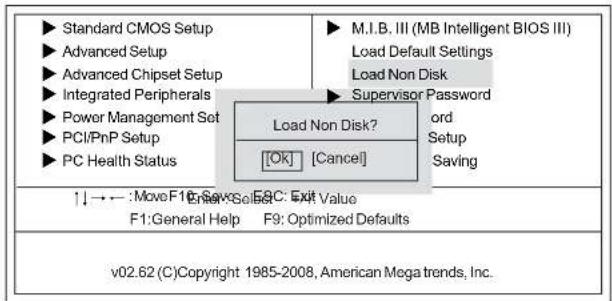
Load Non Disk
- The default value of the item "Onboard I/AN Boot ROM" is "Disabled" accordingly since the item "Load Non Disk" is set to "Disabled".
CMOS Setup Utility - Copyright (C) 1985-2005, American Megatrends, Inc.
Integrated Peripherals
| Onboard SATA Mode EnabledSATA Configuration IDEOnboard AUDIO Function EnabledOnboard LAN Function EnabledOnboard LAN Boot ROM DisabledSerial Port1 Address 3F8/IRQ4USB Functions EnabledLegacy USB Support Enabled | Help Item |
| OptionsDisabledEnabled |
↑↓→←:Move Enter:Select +/-:Value F10:Save ESC:Exit
F1: General Help F9: Optimized Defaults
Using BIOS
- You may highlight this option and press
to Enable it.
CMOS Setup Utility – Copyright (C) 1985-2005, American Megatrends, Inc.
text_image
Standard CMOS Setup Advanced Setup Advanced Chipset Setup Integrated Peripherals Power Management Set PCI/PnP Setup PC Health Status M.I.B. III (MB Intelligent BIOS III) Load Default Settings Load Non Disk Supervisor Password ord Setup Saving Load Non Disk? [OK] [Cancel] ↑↓→← :Move F1: Save, Select EQC: Exit Value F1:General Help F9:Optimized Defaults v02.62 (C)Copyright 1985-2008, American Mega trends, Inc.-
Reboot.
-
Then the default value of the item "Onboard LAN Boot ROM" changed to "Enabled".
CMOS Setup Utility - Copyright (C) 1985-2005, American Megatrends, Inc. Integrated Peripherals

text_image
Onboard SATA Mode Enabled SATA Configuration IDE Onboard AUDIO Function Enabled Onboard LAN Function Enabled Onboard LAN Boot ROM Disabled Serial Port1 Address 3F8/IRQ4 USB Functions Enabled Legacy USB Support Enabled Help Item Options Disabled Enabled↑↓---:Move Enter: Select +/-: Value F10: Save ESC: Exit F1:General Help F9:Optimized Defaults
- And the default value of the item "1st Boot Device" changed to "Realtek Boot Agent" (LAN Boot First) automatically. It is convenient for users to boot from LAN or handle when there is no disk.
CMOS Setup Utility - Copyright (C) 1985-2005, American Megatrends, Inc. Advanced Setup

text_image
CPU Virtualization Enabled AMD C&Q Auto Enhanced Halt (C1E) Disabled Quick Power on Self Test Enabled Boot Up Numlock Status On APIC Mode Enabled 1st Boot Device Hard Drive 2nd Boot Device CD/DVD 3rd Boot Device Removable Dev. ►Hard Disk Drivers Press Enter ►CD/DVD Drivers Press Enter Boot Other Device Yes ECS eJIFFY Function Disabled Help Item Enable/Disable Secure Virtual Machine Mode (SUM)↑↓→←:Move Enter: Select +/-: Value F10: Save ESC: Exit F1:General Help F9:Optimized Defaults
Press
Supervisor Password
This page helps you install or change a password.
CMOS Setup Utility - Copyright (C) 1985-2005, American Megatrends, Inc. Supervisor Password
| Supervisor Password :Not Installed Change Supervisor Password Press Enter | Help item |
| Install or Change the password. |
↑↓→←:Move Enter: Select F10: Save ESC: Exit+/-: Value F1:General Help F9:Optimized Defaults
Supervisor Password (Not Installed)
This item indicates whether a supervisor password has been set. If the password has been installed, Installed displays. If not, Not Installed displays.
Change Supervisor Password (Press Enter)
You can select this option and press
Press
User Password
This page helps you install or change a password.
CMOS Setup Utility - Copyright (C) 1985-2005, American Megatrends, Inc. User Password
| User Password : Not Installed | Help item |
↑↓→←:Move Enter:Select F10: Save ESC: Exit+/-: Value F1:General Help F9:Optimized Defaults
User Password (Not Installed)
This item indicates whether a user password has been set. If the password has been installed, Installed displays. If not, Not Installed displays.
Press
Save & Exit Setup
Highlight this item and press
Exit Without Saving
Highlight this item and press

If you have made settings that you do not want to save, use the "Exit Without Saving" item and select [OK] to discard any changes you have made.
Updating the BIOS
You can download and install updated BIOS for this motherboard from the manufacturer's Web site. New BIOS provides support for new peripherals, improvements in performance, or fixes for known bugs. Install new BIOS as follows:
1 If your motherboard has a BIOS protection jumper, change the setting to allow BIOS flashing.
2 If your motherboard has an item called Firmware Write Protect in Advanced BIOS features, disable it. (Firmware Write Protect prevents BIOS from being overwritten.)
3 Prepare a bootable device or create a bootable system disk. (Refer to Windows online help for information on creating a bootable system disk.)
4 Download the Flash Utility and new BIOS file from the manufacturer's Web site. Copy these files to the bootable device.
5 Turn off your computer and insert the bootable device in your computer. (You might need to run the Setup Utility and change the boot priority items on the Advanced BIOS Features Setup page, to force your computer to boot from the bootable device first.)
6 At the C:\ or A:\ prompt, type the Flash Utility program name and the file name of the new BIOS and then press
7 When the installation is complete, remove the bootable device from the computer and restart your computer. If your motherboard has a Flash BIOS jumper, reset the jumper to protect the newly installed BIOS from being overwritten. The computer will restart automatically.
This concludes Chapter 3. Refer to the next chapter for information on the software supplied with the motherboard.
About the Software DVD-ROM/CD-ROM
The support software DVD-ROM/CD-ROM that is included in the motherboard package contains all the drivers and utility programs needed to properly run the bundled products. Below you can find a brief description of each software program, and the location for your motherboard version. More information on some programs is available in a README file, located in the same directory as the software. Before installing any software, always inspect the folder for files named README.TXT or something similar. These files may contain important information that is not included in this manual.

-
Never try to install all software from folder that is not specified for use with your motherboard.
-
The notice of Intel HD Audio Installation (optional): The Intel High Definition audio functionality unexpectedly quits working in Windows Server 2003 Service Pack 1 or Windows XP Professional x64 Edition. Users need to download and install the update packages from the Microsoft Download Center "before" installing HD audio driver bundled in the driver disk. Please log on to http://support.microsoft.com/default.aspx?scid=kb;en-us;901105#appliesto for more information.
Auto-installing under Windows XP/Vista/7
The Auto-install DVD-ROM/CD-ROM makes it easy for you to install the drivers and software for your motherboard.

If the Auto-install DVD-ROM/CD-ROM does not work on your system, you can still install drivers through the file manager for your OS (for example, Windows Explorer). Refer to the Utility Folder Installation Notes later in this chapter.
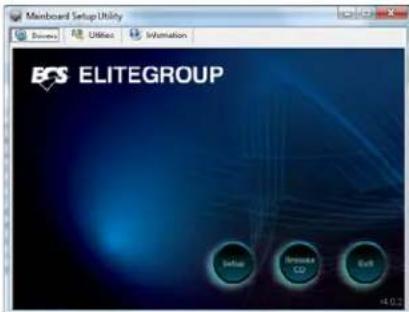
The support software DVD-ROM/CD-ROM disc loads automatically under Windows XP/Vista/7. When you insert the DVD-ROM/CD-ROM disc in the DVD-ROM/CD-ROM drive, the autorun feature will automatically bring up the install screen. The screen has three buttons on it, Setup, Browse CD and Exit.
text_image
Mainboard Setup Utility BOS Utilities Information BCS ELITEGROUP Setup Remove/CD Exit 14.0.2* For reference only

If the opening screen does not appear; double-click the file "setup.exe" in the root directory.

Drivers Tab
| Setup | Click the Setup button to run the software installation program.Select from the menu which software you want to install. |
| Browse CD | The Browse CD button is the standard Windows command that allows you to open Windows Explorer and show the contents of the support disk.Before installing the software from Windows Explorer, look for a file named README.TXT or something similar. This file may contain important information to help you install the software correctly.Some software is installed in separate folders for different operating systems.In installing the software, execute a file named SETUP.EXE by double-clicking the file and then following the instructions on the screen. |
| Exit | The EXIT button closes the Auto Setup window. |
Utilities Tab
Lists the software utilities that are available on the disk.
Information Tab
Displays the path for all software and drivers available on the disk.
Running Setup
Follow these instructions to install device drivers and software for the motherboard:
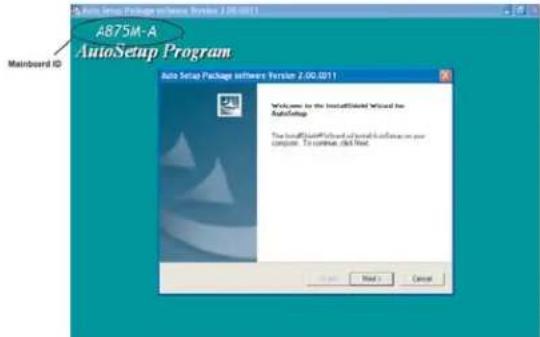
- Click Setup. The installation program begins:
text_image
Auto Setup Package software Version 2.00.0311 Mainboard ID A875M-A AutoSetup Program Auto Setup Package software Version 2.00.0311 WELCOME TO THE INSTALLMENT Wizarded the AutoSetup The Installment Wizarded to install a software on your computer. To continue, click Next. OK Cancel
The following screens are examples only. The screens and driver lists will be different according to the motherboard you are installing.
The motherboard identification is located in the upper left-hand corner.

- Click Next. The following screen appears:

text_image
Auto Setup Package software Version 2.00.0018 Select Features Choose the features Setup will install. Select the features you want to install, clear the features you do not want to install. IDE 36175K Device 62540K Resolution ATI Software Package Version 8.082.041130a Release Date: 20/05/01/04 Space Required: C: 90715 K Space Available: C: 6621104 K OK Next > Cancel-
Check the box next to the items you want to install. The default options are recommended.
-
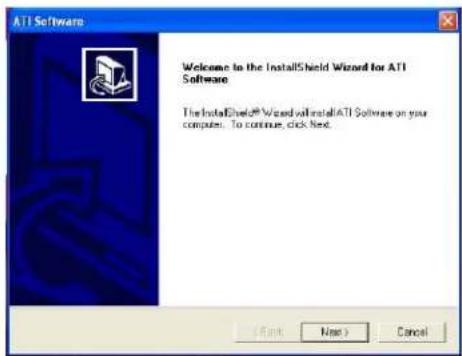
Click Next run the Installation Wizard. An item installation screen appears:
text_image
ATI Software Welcome to the InstallShield Wizard for ATI Software The InstallShield® Wizard will install ATI Software on your computer. To continue, click Next. Finish Next > Cancel- Follow the instructions on the screen to install the items.

Drivers and software are automatically installed in sequence. Follow the onscreen instructions, confirm commands and allow the computer to restart a few times to complete the installation.

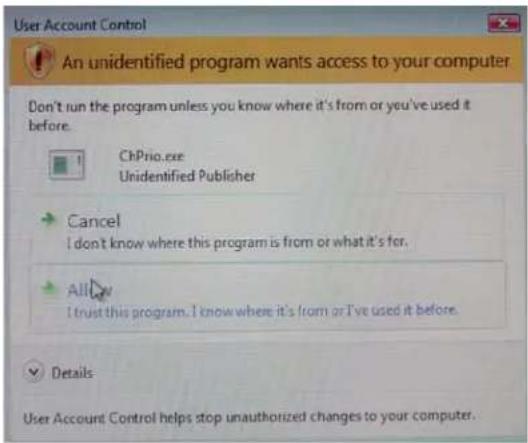
Windows Vista/7 will appear below UAC (User Account Control) message after the system restart. You must select "Allow" to install the next driver. Continue this process to complete the drivers installation.
text_image
User Account Control An unidentified program wants access to your computer Don't run the program unless you know where it's from or you've used it before. ChPrio.exe Unidentified Publisher Cancel I don't know where this program is from or what it's for. All I trust this program. I know where it's from or I've used it before. Details User Account Control helps stop unauthorized changes to your computer.Manual Installation
Insert the disk in the DVD-ROM/CD-ROM drive and locate the PATH.DOC file in the root directory. This file contains the information needed to locate the drivers for your motherboard.
Look for the chipset and motherboard model; then browse to the directory and path to begin installing the drivers. Most drivers have a setup program (SETUP.EXE) that automatically detects your operating system before installation. Other drivers have the setup program located in the operating system subfolder.
If the driver you want to install does not have a setup program, browse to the operating system subfolder and locate the readme text file (README.TXT or README.DOC) for information on installing the driver or software for your operating system.
Utility Software Reference
All the utility software available from this page is Windows compliant. They are provided only for the convenience of the customer. The following software is furnished under license and may only be used or copied in accordance with the terms of the license.

These software(s) are subject to change at anytime without prior notice. Please refer to the support disk for available software.
Setting Up a bootable RAID Array
This section explains how to configure a bootable AMD RAID array.
Setting Up the BIOS
1 Start your computer, then press Delete to enter the BIOS setup. The BIOS CMOS Setup Utility screen appears.

text_image
CNO3 Setup Utility - Copyright © 1985-2007, American Repatrembs, Inc. ► Standard CNO3 Setup ► Advanced Setup ► Advanced Chipset Setup ► Integrated Peripherals ► Power Management Setup ► PCI/PoP Setup ► PCI Health Status ► M.I. I. II ON Intelligent Risk Load Default Settings ► Supervisor Password ► User Password Save & Exit Setup Exit Without Saving 14--Mouse Enter:Select +/-Value F10:Save ESC-Exit F1:General Help F9:Default settings v02.61 © Copyright 1985-2007, American Repatrembs, Inc.Figure 1.1 BIOS CMOS Setup Utility Main Screen
2 Use the arrow keys to select Integrated Peripherals (see Figure 1.1), then press Enter.
The Integrated Peripherals screen (or a screen similar to it) appears.

text_image
CNOS Setup Utility - Copyright CO 1985-2007, American Antenna Integrated Peripherals Onboard IIE Controller Onboard SXTN Mode SXTN Configuration Onboard AMDD Function Onboard LVM Function Onboard LVM Next RVM Serial Porti Address USB Functions Legacy USB Support Enabled Enabled IIE Enabled Enabled Enabled SPB/1804 Options IIE RIP AICI T6--Move Enter Select +/-Value P10-Save EX-Exit P1 General Help P3 Default settings Only Time Options IIE RIP AICIFigure 1.2 Integrated Peripherals Screen
3 Use the arrow keys to select the SATA Configuration (see Figure 1.2) and globally set SATA Configuration to RAID.
X
4 Press F10 to save the configuration and exit.
The PC reboots.
5 Enter the RAID BIOS Setup by pressing Ctrl-F when prompted, and proceed to set up the AMD RAID BIOS as described in the next section.
Configuring the AMD RAID BIOS
The AMD RAID BIOS set up lets you choose the RAID type and which hard drives you want to make part of the array.
Entering the RAID BIOS Setup:
1 Wait until you see the RAID software prompting you to press Ctrl-F.
The RAID prompt appears as part of the system POST and boot process prior to loading of the OS. You have a few seconds to press Ctrl-F before the screen disappears.
2 Press Ctrl-F.
The Main Menu screen appears (Figure 1.3).
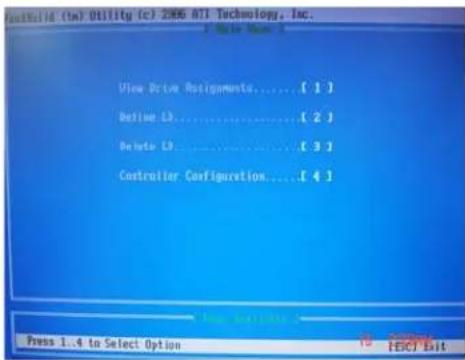
text_image
Build (tm) Utility (c) 2006 ATI Technology, Inc. View Drive Assignments....[1] Define L0....[2] Delete L0....[3] Controller Configuration....[4]Figure 1.3 Main Menu
3 Select [2], then select LD 1 in the following page.
The Define LD Menu screen appears (Figure 1.4).

text_image
Strive Block: 04 KB Cognitive Boundary: 08 Channel ID Drive Model Capacity (MD) Assignment 3 Mos WDC MD3288AUS-22B4 328873 4 Mos WDC MD158AUS-22NC01 168RMZ Ttl Up Lil Now [ESC] Exit [Space] Change Option [Ctrl-V] SaveFigure 1.4 Define LD Menu
Using the Define a New Array Screen
If necessary, press the tab key to move from field to field until the appropriate field is highlighted.
• Selecting the RAID Mode
By default, this is set to Mirroring. To change to a different RAID mode, press the spacebar until the mode that you want appears in the RAID Mode box—RAID0/1/10/JBOD.
Note: Not all RAID levels are supported on all platforms.
• Selecting the Stripe Block Size
Stripe block size is given in kilobytes, and affects how data is arranged on the disk. It is recommended to leave this value at the default Optimal, which is 64KB, but the values can be 64 KB and 128 KB. When choose RAID 1, the Stripe block size is unchangable.
Assigning the Disks
- Select the Assignment to Y to designate a free disk to be used as a RAID array disk.
Figure 1.5 illustrates the Define a New Array screen after two disks have been assigned as RAID 0 array disks.

text_image
FileBuild (ta) Utility (c) 2006 RT Technology, Inc. L3 No BRID Mode Total Dev 10: 1 Build U 2 Stripe Block: 64 KB Fast Init: OFF Cigabyte Boundary: ON Cache Mode: MrileThru Channel ID Brion Mode Capacity (MB) Assignment 1 Plus ABC W15800A15-22B4 320073 Y 2 Plus ABC W168015-22BCR1 150042 5.0 I/O By LOD New ESC1 Exit Special Change Option ESC-V3 SaveFigure 1.5 FastBuild Utility—Array Disks Assigned
- Press Ctrl-Y to save the configuration and exit.
The Define LD Menu screen appears (Figure 1.6).
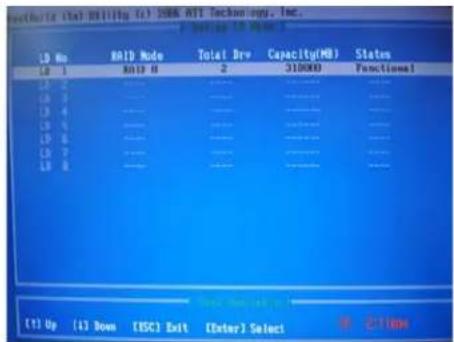
text_image
10 No 10 1 10 2 10 3 10 4 10 5 10 6 10 7 10 8 GRID Mode GRID H Total Drive 2 Capacity(MB) 310000 Status Functional (1) Up (1) Down (ESC) Exit (Enter) Select 2/1/lowFigure 1.6 Define LD Menu
- Press ESC to exit.
The Main Menu screen appears (Figure 1.7).
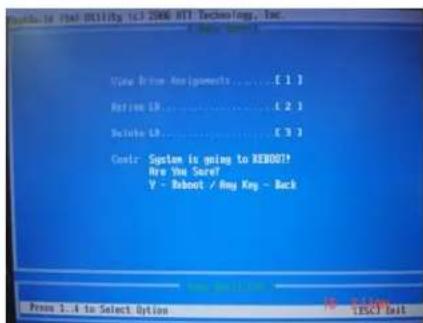
text_image
[Use Driver Assignments .... £ 1 ] [Reserve LB.... (2) ] [Reserve LB.... (3) ] Center System is going to REBOOT? Are You Sure? Y - Reboot / Any Key - BackFigure 1.7 Main Menu
4 Press Y to reboot.
The following screen appears (Figure 1.8).
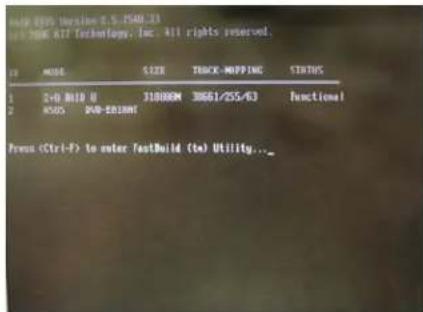
text_image
1 2 3 4 5 6 7 8 9 10 11 12 13 14 15 16 17 18 19 20 21 22 23 24 25 26 27 28 29 30 31 32 33 34 35 36 37 38 39 40 41 42 43 44 45 46 47 48 49 50 51 52 53 54 55 56 57 58 59 60 61 62 63 64 65 66 67 68 69 70 71 72 73 74 75 76 77 78 79 80 81 82 83 84 85 86 87 88 89 90 91 92 93 94 95 96 97 98 99 100Figure 1.8
Installing the RAID Drivers
Your system may come with a Windows install CD that already includes AMD RAID drivers. If so, then this section is not relevant.
If that is not the case (or you are trying to install a new version of Windows), then you will need an AMD RAID driver F6 install floppy. Check to see if one came with your system. If not, you can create one by downloading the appropriate driver package and following the steps in this section.
1 Copy all files in "...RAID\ATT\SB750\Floppy\Win3264" to a floppy disk.
2 After you complete the RAID BIOS setup, boot from the Windows CD. The Windows Setup program starts.

text_image
Press 16 if you need to install a third party DOS or HLL driver...Figure 1.9
3 Press F6 and wait a few moments for the Windows Setup screen to appear.
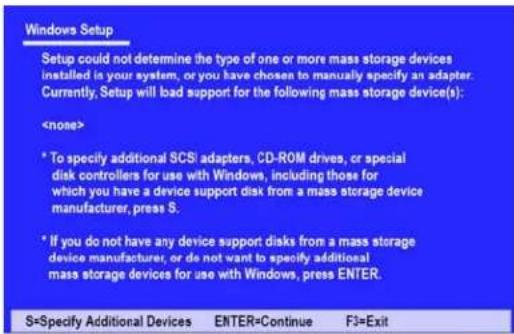
text_image
Windows Setup Setup could not determine the type of one or more mass storage devices installed in your system, or you have chosen to manually specify an adapter. Currently, Setup will bad support for the following mass storage device(s):Figure 1.10 Windows Setup—Specify Devices
4 Specify the AMD drivers.
a Insert the floppy that has the RAID driver, press S, then press Enter.
The following Windows Setup screen appears:
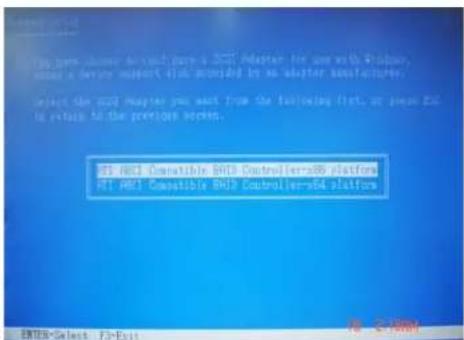
text_image
Hi-Fi3 Compatible DOS Controller+84 platforms Hi-Fi3 Compatible DOS Controller+84 platformsFigure 1.11 Windows Setup—Selected SCSI Adapter
b Select "ATI AHCI Compatible RAID Controller-x86 platform" and press Enter for 32-bit OS or Select "ATI AHCI Compatible RAID Controller-x64 platform" and press Enter for 64-bit OS.
The following Windows Setup screen appears listing both drivers:

text_image
You will load support for the following mine storage credentials: VII HMSC Compatible DOS Controller vdb platform. • To specify additional HSCI adapters, (AD-BDM) drives, or special film control(s) are for use with Windows, including those for which you have a service support disk from a mine storage device manufacturer, press 3. • If you do not have any device support disks from a mine storage device manufacturer, or do not want to specify additional mine storage devices for use with Windows, press ENTER.Figure 1.12 Windows Setup—AMD drives listed
5 Press Enter to continue with Windows XP Installation.
Be sure to leave the floppy disk inserted in the floppy drive until the blue screen portion of Windows XP installation is completed, then take out the floppy.
6 Follow the instructions on how to install Windows XP.
After Windows XP is completely installed, it is recommended that you install the ForceWare software in order to access the FastBuild RAID Management tool.
Note: Each time you add a new hard drive to a RAID array, the RAID driver will have to be installed under Windows once for that hard drive. After that, the driver will not have to be installed.
×*
★*O□
◆◆◆□▼◆□×
米米米米
Introduction
eJIFFY is a fast boot program under Linux. Instead of waiting Windows O.S to start execution, eJIFFY is ready to provide users the instant enjoyment on web browsing, photo review and online chat just within several seconds after boot up.

text_image
eJIFFY 601843 B X P S O E USA Thu Oct 29 1:27 PMNote: eJIFFY is ECS optional feature utility corresponding to the DVD activation and BIOS setup. Please check the hard copy user's guide or product color-box to see if the model has embedded eJIFFY feature. (eJIFFY icon on color-box)

Version: 5.0
Installation and BIOS Setup
DVD Activation
Finish the DVD utility setup, and then set the BIOS to complete eJIFFY activation.
- Insert ECS software utility DVD and enter below "Utilities" screen. Click eJIFFY
feature item to install.

text_image
Mainboard Setup Utility Drivers Utilise Information Utilities Adobe Reader eJIFFY Select utility & Click to install...- Follow the onscreen instructions to finish eJIFFY setup.
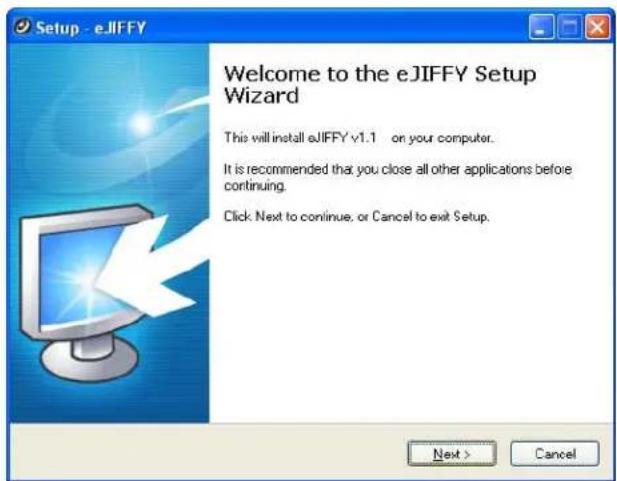
text_image
Setup - eJIFFY Welcome to the eJIFFY Setup Wizard This will install eJIFFY v1.1 on your computer. It is recommended that you close all other applications before continuing. Click: Next to continue, or Cancel to exit Setup. Next > Cancel- After setting up eJIFFY under Windows, you can switch eJIFFY display/keyboard language from English to your local language. The changes will be applied after rebooting.

text_image
eJIFFY Configuration eJIFFY ELITEGROUP Language English(US) English(US) Keyboard Arabic Deutsch German English(UK) English(UK) English(US) English(US) Español Spanish Français French Nduy Hebrew Indonesia Indonesian Italiano Italian 日本語 Japanese 한국어 Korean Nederlandse Dutch Polska Poish Português Portuguese Русский Russian 1yy Thai Türkçe Turkish Українська Ukrainian Viêt Vietnamese 简体中文 Chinese(Simplified) 繁體中文 Chinese(Traditional)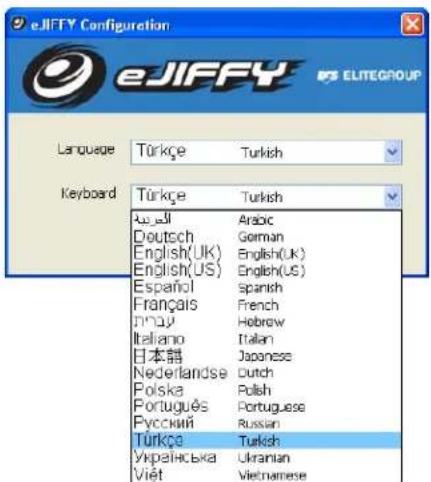
text_image
eJIFFY Configuration eJIFFY ELITEGROUP Language Türkçe Turkish Keyboard Türkçe Turkish Kuwill Arabic Deutsch German English(UK) English(UK) English(US) English(US) Español Spanish Français French Inay Hebrew Italiano Italian 日本語 Japanese Nederlandse Dutch Polska Polish Português Portuguese Русский Russian Türkçe Turkish Українська Ukrainian Viêt VietnameseNote: The keyboard language selection list offers several more regional keyboard setups to switch with the default English typing. Please refer to the usage FAQ for more tips.
x
- Restart your computer after eJIFFY installation. Press
or click the BIOS Setup button on the post screen to enter the BIOS setup page after boot up.
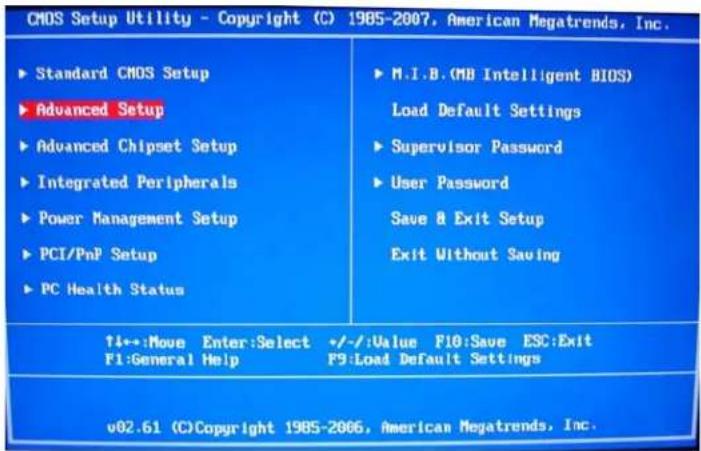
text_image
CMOS Setup Utility - Copyright (C) 1985-2007, American Megatrends, Inc. ► Standard CMOS Setup ► Advanced Setup ► Advanced Chipset Setup ► Integrated Peripherals ► Power Management Setup ► PCI/PnP Setup ► PC Health Status ► M.I.B. (MB Intelligent BIOS) Load Default Settings ► Supervisor Password ► User Password Save & Exit Setup Exit Without Saving ↑↓←→:Move Enter:Select +/-/::Value F10:Save ESC:Exit F1:General Help F9:Load Default Settings v02.61 (C)Copyright 1985-2006, American Megatrends, Inc.- And then enter the Advanced Setup page to enable the item ECS eJIFFY Function. Press F10 to save the configuration and exit. Restart your computer.

text_image
CMOS Setup Utility - Copyright (C) 1985-2007, American Megatrends, Inc. Advanced Setup HT Frequency Auto AMD C8Q Quick Power on Self Test Boot Up Numlock Status LOGO Display APIC Mode 1st Boot Device 2nd Boot Device 3rd Boot Device ► Hard Disk Drives Boot Other Device ECS eJIFFY Function Restore Default Settings Auto Enabled Enabled On Enabled Enabled ARY01 NUIDIA SPAN 1 CD/DVD Removable Dev. Press Enter Yes Enabled No Help Item Options Disabled Enabled T++:Move Enter:Select +/-:Value F10:Save ESC:Exit F1:General Help F9:Load Default SettingsNote: 1. eJIFFY is available in SATA/IDE/AHCI mode. It does not support RAID configuration and the onboard 34-pin floppy drives.
- Please refer to ECS website for new eJIFFY application updates.
Entering eJIFFY
The post screen appears within several seconds after boot up and it has three buttons on it, Operating system, eJIFFY and BIOS Setup.
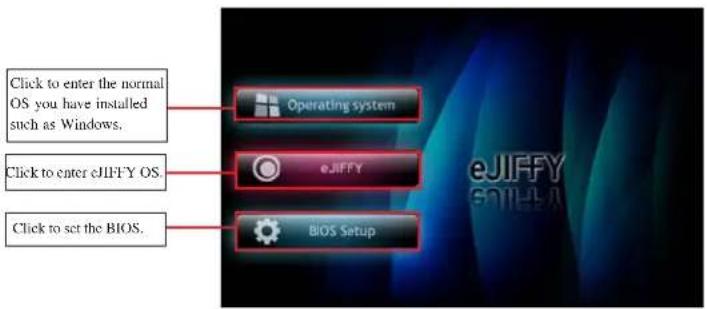
text_image
Click to enter the normal OS you have installed such as Windows. Click to enter eJIFFY OS. Click to set the BIOS. Operating system eJIFFY BIOS SetupIf you click cJIFFY, the following screen will appear. And If you make no choice it will enter the normal OS automatically after ten seconds.

text_image
eJIFFY SOLTA B X R T U S A U S A U S A U S A U S A U S A U S A U S A U S A U S A U S A U S A U S A U S A U S A U S A U S A U S A U S A U S A U S A U S A U S A U S A U S A U S A U S A U S A U S A U S A U S A U S A U S A U S A USA Thu Oct 29 1:27 PMFeature Icons
The following illustration shows the main feature icons that eJIFFY provides on the menu.

text_image
B X P S T Fra Thu Oct 29 1:24 PM
eWeb: Firefox for web browsing/webmail and watching flash video.

ePix: Photo viewing.

ePal: On-line chat tool to use the most popular IMs in the world. (MSN, ICQ, AIM, etc.)

Shows ePal on-line connection status.

Shut Down/Restart: Ends your session and turns off the computer./Ends your session and restart the computer..

Click once to connect the storage disk to your computer. Click for the second time to remove your storage disk safely. (please refer to the / Q for more usage information.)

Shows the network connection status.

Language Control Panel

Switch Keyboard Languages
Usage FAQ

Language Control Panel: Besides setting English as the default interface, eJIFFY offers multi-language displays and keyboard settings for language-switch. Open the language control panel to select a preferable language setting.
Keyboard Language Setup
Step1. Click

to open the language control panel.
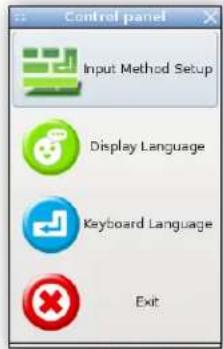
text_image
Control panel Input Method Setup Display Language Keyboard Language ExitStep 2: Click "Keyboard Language" icon

to open the keyboard selection
list, which offers several regional keyboard settings besides default English keyboard. Step 3: Click the selected keyboard language (e.g. French) and press "OK".
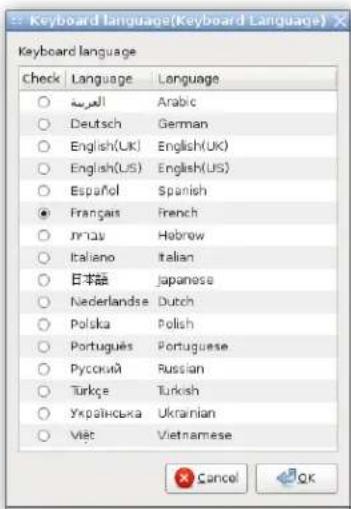
text_image
Keyboard language(Keyboard Language) Check Language Language ○ Arabic ○ Deutsch German ○ English(UK) English(UK) ○ English(US) English(US) ○ Español Spanish ● Français French ○ Hebrew Hebrew ○ Italiano Italian ○ 日本品 Japanese ○ Nederlandse Dutch ○ Polska Polish ○ Português Portuguese ○ Русский Russian ○ Turkçe Turkish ○ Украинька Ukrainian ○ Viêt Vietnamese Cancel OK※※▼▼■※※□※☆◆◆※
Click

to enable all possible language inputs you want to apply, and click
"Apply":
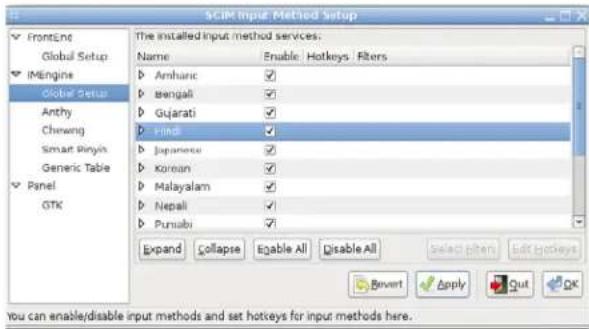
text_image
SCIM Input Method Setup Frontline Global Setup IMEngine Global Setup Anthy Chewing Smart Pinyin Generic Table Panel GTK The installed Input method services: Name Enable Hotkeys Filters Amharic ✓ sengali ✓ Gujarati ✓ Cindi ✓ Japanese ✓ Korean ✓ Malayslam ✓ Nepali ✓ Punabi ✓ Expand Collapse Enable All Disable All Select Plan Edit Hotkeys Envert Apply Out OK You can enable/disable input methods and set hotkeys for input methods here.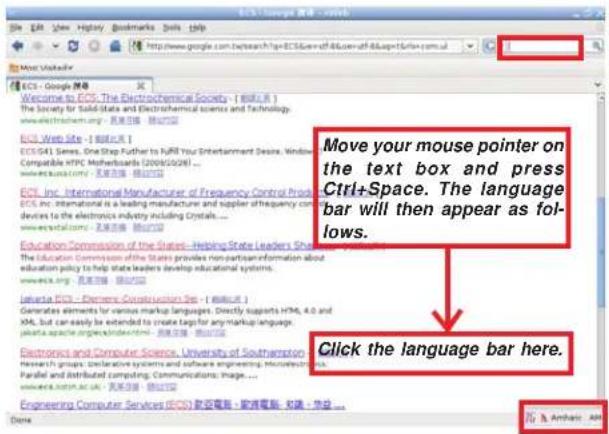
text_image
Move your mouse pointer on the text box and press Ctrl+Space. The language bar will then appear as follows. Click the language bar here.Select your desired language

text_image
Amharic - Amharic Bengali > Gujarati > Hindi > Japanese Korean > Malayalam Nepali > Punjabi > Tamil > Thai Chinese (simplified) > Chinese (traditional) > Other > English/Keyboard* * * * * * * * *
How to change display language?
Open the Language Control Panel and click

to show the display language
list. Check your desired display language. Your selected display language will be applied after rebooting.
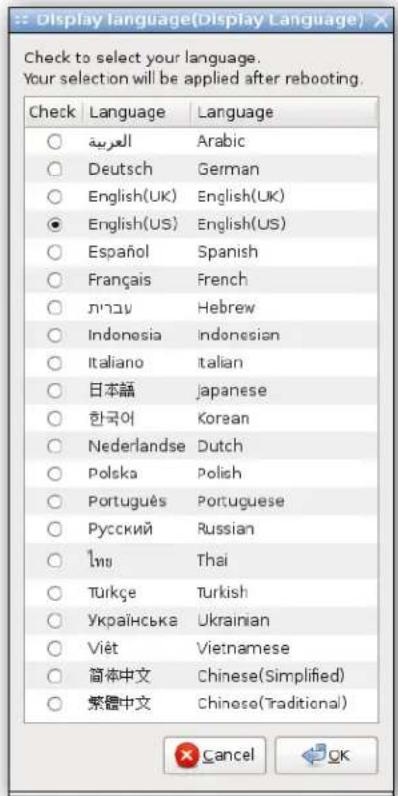
text_image
Check to select your language. Your selection will be applied after rebooting. Check Language Language ○ Arabic ○ Deutsch German ○ English(UK) English(UK) ● English(US) English(US) ○ Español Spanish ○ Français French ○ Ḍπινη Hebrew ○ Indonesia Indonesian ○ Italiano Italian ○ 日本語 Japanese ○ 한국어 Korean ○ Nederlandse Dutch ○ Polska Polish ○ Português Portuguese ○ Русский Russian ○ lǐnǚ Thai ○ Türkçe Turkish ○ Українська Ukrainian ○ Viét Vietnamese ○ 简体中文 Chinese(Simplified) ○ 繁體中文 Chinese(Traditional) Cancel OKNote: Details about eJIFFY please refer to eJIFFY in disk.
xx
***O□
Start up problems during assembly
After assembling the PC for the first time you may experience some start up problems. Before calling for technical support or returning for warranty, this chapter may help to address some of the common questions using some basic troubleshooting tips.
a) System does not power up and the fans are not running.
- Disassemble the PC to remove the VGA adaptor card, DDR memory, LAN, USB and other peripherals including keyboard and mouse. Leave only the motherboard, CPU with CPU cooler and power supply connected. Turn on again to see if the CPU and power supply fans are running.
- Make sure to remove any unused screws or other metal objects such as screwdrivers from the inside PC case. This is to prevent damage from short circuit.
- Check the CPU FAN connector is connected to the motherboard.
- For Intel platforms check the pins on the CPU socket for damage or bent. A bent pin may cause failure to boot and sometimes permanent damage from short circuit.
- Check the 12V power connector is connected to the motherboard.
- Check that the 12V power & ATX connectors are fully inserted into the motherboard connectors. Make sure the latches of the cable and connector are locked into place.
b) Power is on, fans are running but there is no display
- Make sure the monitor is turned on and the monitor cable is properly connected to the PC.
- Check the VGA adapter card (if applicable) is inserted properly.
- Listen for beep sounds. If you are using internal PC speaker make sure it is connected.
a. continuous 3 short beeps : memory not detected
b. 1 long beep and 8 short beeps : VGA not detected
c) The PC suddenly shuts down while booting up.
- The CPU may experience overheating so it will shutdown to protect itself. Ensure the CPU fan is working properly.
- From the BIOS setting, try to disable the Smartfan function to let the fan run at default speed. Doing a Load Optimised Default will also disable the Smartfan.
Start up problems after prolong use
After a prolong period of use your PC may experience start up problems again. This may be caused by breakdown of devices connected to the motherboard such as HDD, CPU fan, etc. The following tips may help to revive the PC or identify the cause of failure.
- Clear the CMOS values using the CLR_CMOS jumper. Refer to CLR_CMOS jumper in Chapter 2 for Checking Jumper Settings in this user manual. When completed, follow up with a Load Optimised Default in the BIOS setup.
- Check the CPU cooler fan for dust. Long term accumulation of dust will reduce its effectiveness to cool the processor. Clean the cooler or replace a new one if necessary.
- Check that the 12V power & ATX connectors are fully inserted into the motherboard connectors. Make sure the latches of the cable and connector are locked into place.
- Remove the hard drive, optical drive or DDR memory to determine which of these component may be at fault.
Maintenance and care tips
Your computer, like any electrical appliance, requires proper care and maintenance. Here are some basic PC care tips to help prolong the life of the motherboard and keep it running as best as it can.
- Keep your computer in a well ventilated area. Leave some space between the PC and the wall for sufficient airflow.
- Keep your computer in a cool dry place. Avoid dusty areas, direct sunlight and areas of high moisture content.
- Routinely clean the CPU cooler fan to remove dust and hair.
- In places of hot and humid weather you should turn on your computer once every other week to circulate the air and prevent damage from humidity.
- Add more memory to your computer if possible. This not only speeds up the system but also reduces the loading of your hard drive to prolong its lifespan.
- If possible, ensure the power cord has an earth ground pin directly from the wall outlet. This will reduce voltage fluctuation that may damage sensitive devices.
Basic Troubleshooting Flowchart

flowchart
graph TD
    A["Power Button is pressed but PC fails to start."] --> B{Check if Power Supply Unit (PSU) is working}
    B -->|No| C{AC power cord is plu ed gg and PSU switch is turned on?}
    B -->|Yes| D{Check if monitor has display}
    D -->|Yes| E{Any Beep sound ?}
    D -->|No| F{Halt at POST screen ?}
    F -->|Yes| G["R CMOLC S and restart. If fail, contact RMA"]
    F -->|No| H{>| Check if monitor has display |
    H -->|Yes| I["Peripheral device issue - HDD problem.<br>- CMOS setup error,<br>dnee to CLRCMOS."]
    H -->|No| J{- If 3 short beeps:
DIMM memory not properly
inserted or memory failure
- If 1 long beep and 8 short beeps:
VGA not detected}
    J --> K["ART THE PC stRe"]
    K --> L{Check if monitor has display}
    L -->|No| M["problem rBoard p --> contact RMA"]
    L -->|Yes| N["OR: System fail to start or unstable after modify BIOS setting."]
    C --> O{Problem with PSU or board?
If board problem --> contact RMA}
    O --> P["Turn on PSU switch or connect to wall socket and restart."]
    C --> Q{AC power cord is plu ed gg and PSU switch is turned on?}
    Q -->|No| R["OR: System fail to start or unstable after modify BIOS setting."]
    Q -->|Yes| S["OR: Problem with PSU or board?<br>If board problem --> contact RMA"]
    R --> T["OR: Turn on PSU switch or connect to wall socket and restart."]
    S --> U["OR: System fail to start or unstable after modify BIOS setting."]
    T --> V["OR: System fail to start or unstable after modify BIOS setting."]
    U --> W["OR: System fail to start or unstable after modify BIOS setting."]
X
★★○□