G41T-M8 - Motherboard ECS - Free user manual and instructions
Find the device manual for free G41T-M8 ECS in PDF.


User questions about G41T-M8 ECS
0 question about this device. Answer the ones you know or ask your own.
Ask a new question about this device
Download the instructions for your Motherboard in PDF format for free! Find your manual G41T-M8 - ECS and take your electronic device back in hand. On this page are published all the documents necessary for the use of your device. G41T-M8 by ECS.
USER MANUAL G41T-M8 ECS
This publication, including all photographs, illustrations and software, is protected under international copyright laws, with all rights reserved. Neither this manual, nor any of the material contained herein, may be reproduced without written consent of the author.
Version 1.0
Disclaimer
The information in this document is subject to change without notice. The manufacturer makes no representations or warranties with respect to the contents hereof and specifically disclaims any implied warranties of merchantability or fitness for any particular purpose. The manufacturer reserves the right to revise this publication and to make changes from time to time in the content hereof without obligation of the manufacturer to notify any person of such revision or changes.
Trademark Recognition
Microsoft, MS-DOS and Windows are registered trademarks of Microsoft Corp.
MMX, Pentium, Pentium-II, Pentium-III, Celeron are registered trademarks of Intel Corporation.
Other product names used in this manual are the properties of their respective owners and are acknowledged.
Federal Communications Commission (FCC)
This equipment has been tested and found to comply with the limits for a Class B digital device, pursuant to Part 15 of the FCC Rules. These limits are designed to provide reasonable protection against harmful interference in a residential installation. This equipment generates, uses, and can radiate radio frequency energy and, if not installed and used in accordance with the instructions, may cause harmful interference to radio communications. However, there is no guarantee that interference will not occur in a particular installation. If this equipment does cause harmful interference to radio or television reception, which can be determined by turning the equipment off and on, the user is encouraged to try to correct the interference by one or more of the following measures:
- Reorient or relocate the receiving antenna
- Increase the separation between the equipment and the receiver
- Connect the equipment onto an outlet on a circuit different from that to which the receiver is connected
- Consult the dealer or an experienced radio/TV technician for help
Shielded interconnect cables and a shielded AC power cable must be employed with this equipment to ensure compliance with the pertinent RF emission limits governing this device. Changes or modifications not expressly approved by the system's manufacturer could void the user's authority to operate the equipment.
Preface
Declaration of Conformity
This device complies with part 15 of the FCC rules. Operation is subject to the following conditions:
• This device may not cause harmful interference, and
- This device must accept any interference received, including interference that may cause undesired operation
Canadian Department of Communications
This class B digital apparatus meets all requirements of the Canadian Interference-causing Equipment Regulations.
The manual consists of the following:
| Chapter 1Introducing the Motherboard | Describes features of the motherboard.Go to page 1 |
| Chapter 2Installing the Motherboard | Describes installation of motherboard components.Go to page 7 |
| Chapter 3Using BIOS | Provides information on using the BIOS Setup Utility.Go to page 27 |
| Chapter 4Using the Motherboard Software | Describes the motherboard software.Go to page 47 |
| Chapter 5Setting Up eJIFFY | Describes the eJIFFY setting upGo to page 55 |
| Chapter 6Troubleshooting | Provides basic troubleshooting TipsGo to page 65 |
Preface
Preface i
Chapter 11
Introducing the Motherboard 1
Introduction....1
Feature....2
Motherboard Components....5
Chapter 2 7
Installing the Motherboard 7
Safety Precautions....7
Choosing a Computer Case....7
Installing the Motherboard in a Case....7
Checking Jumper Settings....8
Setting Jumpers....8
Checking Jumper Settings....9
Jumper Settings....9
Installing Hardware....10
Installing the Processor....10
Installing Memory Modules....12
Expansion Slots....15
Connecting Optional Devices....17
Installing a Hard Disk Drive/CD-ROM/SATA Hard Drive..19
Connecting I/O Devices....21
Connecting Case Components....22
Front Panel Header....25
Chapter 3 27
Using BIOS 27
About the Setup Utility....27
The Standard Configuration....27
Entering the Setup Utility....27
Resetting the Default CMOS Values....28
Using BIOS....29
Standard CMOS Setup....30
Advanced Setup....32
Advanced Chipset Setup....34
Integrated Peripherals....35
Power Management Setup....36
PCI/PnP Setup....38
PC Health Status....38
Frequency/Voltage Control....43
Load Default Settings....44
Supervisor Password....44
User Password....45
Save & Exit Setup....45
Exit Without Saving....45
Updating the BIOS....46
Chapter 4 47 47
Using the Motherboard Software 47
About the Software DVD-ROM/CD-ROM....47
Auto-installing under Windows XP/Vista/7....47
Running Setup....48
Manual Installation....50
Utility Software Reference....50
Chapter 5 55 55
Setting Up eJIFFY 55
Introduction....55
Installation and BIOS Setup....56
Entering eJIFFY....59
Features Icons....60
Usage FAQ....61
Chapter 6 65 65
Trouble Shooting 65
Start up problems during assembly....65
Start up problems after prolong use....66
Maintenance and care tips....66
Basic Troubleshooting Flowchart....67
Chapter 1 Introducing the Motherboard
Introduction
Thank you for choosing the G41T-M8 motherboard. This motherboard is a high performance, enhanced function motherboard designed to support the LGA775 socket Intel® Core™ 2 Quad/Core™ 2 Duo/Pentium® Dual-Core/Celeron® processors for high-end business or personal desktop markets.
The motherboard incorporates the Intel ^ G41 Northbridge (NB) and Intel ^ ICH7 Southbridge (SB) chipsets. The Northbridge supports a Front Side Bus (FSB) frequency of 1333/1066/800 MHz using a scalable FSB Vcc_CPU. The memory controller supports DDR2 memory D1MM frequencies of 800/667. It supports two DDR2 sockets with up to maximum memory of 8 GB. DDR2 Maximum memory bandwidth of 12.8 GB/s in dual-channel symmetric mode assuming DDR2 800 MHz. High resolution graphics via one PCI Express slot, intended for Graphics Interface, is fully compliant to the PCI Express Gen 1.
The ICH7 Southbridge supports one PCI slot which is PCI v2.3 compliant. In addition, two PCI Express x1 slots are supported, fully compliant to the PCI Express Base Specification revision 1.0a. It implements an EHCI compliant interface that provides 480 Mb/s bandwidth for eight USB 2.0 ports (four USB ports and two USB 2.0 headers support additional four USB ports). One onboard IDE connector supports two IDE devices in Ultra ATA100/66/33 mode. The Southbridge integrates a Serial ATA host controller, supporting four SATA ports with maximum transfer rate up to 3.0 Gb/s each.
The motherboard is equipped with advanced full set of I/O ports in the rear panel, including PS/2 mouse and keyboard connectors, one HDMI port, one VGA port, LPT, four USB ports, one LAN port, and audio jacks for microphone, line-in and line-out.
Feature
Processor
The motherboard uses an LGA775 type of Intel ^ Core ^TM 2 Quad/Core ^TM 2 Duo/Pentium ^ Dual-Core/Celeron ^ processors that carries the following features:
- Intel ^ Core ^TM 2 Quad/Core ^TM 2 Duo/Pentium ^ Dual-Core/Celeron ^ processors
• Supports a system bus (FSB) of 1333/1066/800 MHz - Supports "Hyper-Threading" technology CPU
“Hyper-Threading” technology enables the operating system into thinking it’s hooked up to two processors, allowing two threads to be run in parallel, both on separate “logical” processors within the same physical processor.

This board supports CPU up to 95W TDP.
Chipset
The Intel ^® G41 Northbridge (NB) and Intel ^® ICH7 Southbridge (SB) chipsets are based on an innovative and scalable architecture with proven reliability and performance.
G41 (NB)
• Supports 36-bit host bus addressing, allowing the CPU to access the entire 64 GB of the memory address space
- 2 GB/s point-to-point Direct Media Interface (DMI) to ICH7 (1 GB/s each direction)
• Supports 2-GB, 1-Gb, 512 Mb DDR2 DRAM technologies for x8 and x16 devices
- One, 16-lane (x16) PCI Express port intended for external device attach, fully compatible to the PCI Express Gen 1
- An integrated graphics device (IGD) delivering cost competitive 3D, 2D and video capabilities
- Microsoft DX10 and 128MB share memory are supported
ICH7 (SB)
- Enhanced DMA Controller, interrupt controller, and timer functions
- Compliant with PCI Express Base Specification, Revision 1.0a
- Compliant with PCI v2.3 specification
- Integrated SATA 3.0 Gb/s Host Controller
- Integrated USB 2.0 Host Controller supporting up to eight USB 2.0 ports
- Integrated IDE controller supports Ultra ATA 100/66/33
Memory
• Supports DDR2 800/667 DDR2 SDRAM with Dual-channel architecture
- Accommodates two unbuffered DIMMs
- 2 x 240-pin DDR2 DIMM sockets support up to 8 GB
Introducing the Motherboard
Onboard LAN (optional)
• PCI Express base 1.1 compliant
• Integrated PHY for 10/100/1000 Mbps
- IEEE 802.3x compliant flow control support
• IEEE 802.3ab Auto-Negotiation support
• IEEE 802.3ab PHY compliance and compatibility
• PCI Express base 1.1 compliant
• Integrated PHY for 10/100 Mbps
- IEEE 802.3x compliant flow control support
• IEEE 802.3ab Auto-Negotiation support
Audio (optional)
This motherboard may support either of the following Audio chipsets:
• 5.1 Channel High Definition Audio Codec
• ADCs support 44.1k/48k/96kHz sample rate
- Meets Microsoft WLP 3.10Vista premium and mobile PCs audio requirements
- Direct Sound 3D ^TM compatible
• 7.1 channel High Definition Audio Codec
- All DACs Support 192k/96k/48k/44.1kHz DAC sample rate
• High-quality analog differential CD input
- Meets Microsoft WHQL/WLP 3.10 audio requirements
- Direct Sound 3D ^TM compatible
Expansion Options
The motherboard comes with the following expansion options:
• One PCI Express slot for Graphic Interface
- Two PCI Express x1 slots
• One 32-bit PCI v2.3 compliant slot
• One IDE connector that supports two IDE devices
- Four 7-pin SATA connectors
Integrated I/O
The motherboard has a full set of I/O ports and connectors:
- Two PS/2 ports for mouse and keyboard
- One parallel port
• One HDMI port
- One VGA port
- Four USB ports
- One LAN port
• Audio jacks for microphone, line-in and line-out
BIOS Firmware
This motherboard uses AMI BIOS that enables users to configure many system features including the following:
• Power management
- Wake-up alarms
- CPU parameters
• CPU and memory timing
The firmware can also be used to set parameters for different processor clock speeds.

- Some hardware specifications and software items are subject to change without prior notice.
- Due to chipset limitation, we recommend that motherboard be operated in the ambiance between 0 and 50°C.
Motherboard Components
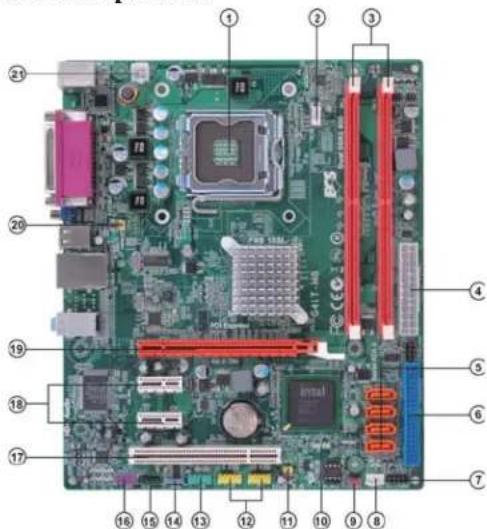
text_image
Labeled diagram of a computer motherboard with numbered components for identificationTable of Motherboard Components
| LABEL COMPONENTS | |
| 1. CPU Socket | LGA775 socket for Intel ^ Core ^TM 2 Quad/Core ^TM 2 Duo/Pentium ^ Dual-core/Celeron ^ processors |
| 2. CPU_FAN CPU cooling fan connector | |
| 3. DDR2_1~2 240-pin DDR2 SDRAM slots | |
| 4. ATX_POWER Standard 24-pin ATX power connector | |
| 5. SATA1~4 Serial ATA connectors | |
| 6. IDE Primary IDE channel | |
| 7. F_PANE1. Front panel switch/LED header | |
| 8. SYS_FAN System cooling fan connector | |
| 9. CLR_CMOS Clear CMOS jumper | |
| 10. SPK Speaker header | |
| 11. USBPWR_F Front panel USB power select jumper | |
| 12. F_USB1~2 Front panel USB headers | |
| 13. COM Onboard serial port header | |
| 14. SPDIFO SPDIF out header | |
| 15. CD_IN Analog audio input header | |
| 16. F_AUDIO | Front panel audio header |
| 17. PCI1 | 32-bit add-on card slot |
| 18. PCI1:1~2 | PCI 1:express x1 slots |
| 19. PCI1:X16 | PCI 1:express x16 graphics card slot |
| 20. USBPWR_R | Rear panel USB PS/2 power select jumper |
| 21. ATX12V 4-pin +12V power connector | |
This concludes Chapter 1. The next chapter explains how to install the motherboard.
Introducing the Motherboard
Memo
Chapter 2 Installing the Motherboard
Safety Precautions
- Follow these safety precautions when installing the motherboard
- Wear a grounding strap attached to a grounded device to avoid damage from static electricity
- Discharge static electricity by touching the metal case of a safely grounded object before working on the motherboard
- Leave components in the static-proof bags they came in
- Hold all circuit boards by the edges. Do not bend circuit boards
Choosing a Computer Case
There are many types of computer cases on the market. The motherboard complies with the specifications for the Micro ATX system case. First, some features on the motherboard are implemented by cabling connectors on the motherboard to indicators and switches on the system case. Make sure that your case supports all the features required. Secondly, this motherboard supports two enhanced IDE drives. Make sure that your case has sufficient power and space for all drives that you intend to install.
Most cases have a choice of I/O templates in the rear panel. Make sure that the I/O template in the case matches the I/O ports installed on the rear edge of the motherboard.
This motherboard carries a Micro ATX form factor of 244 x 204 mm. Choose a case that accommodates this form factor.
Installing the Motherboard in a Case
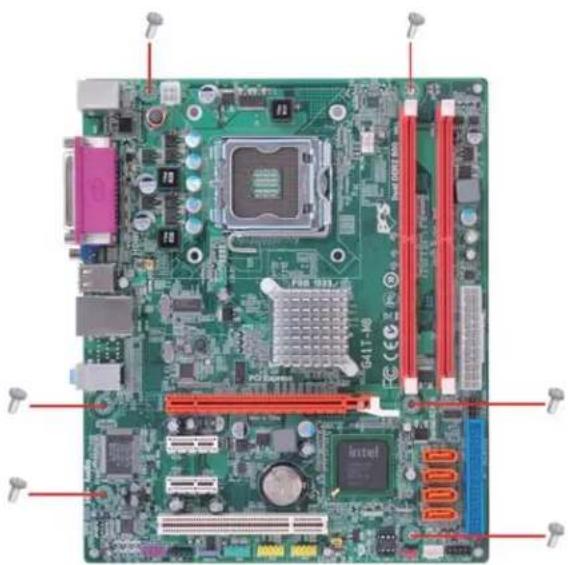
Refer to the following illustration and instructions for installing the motherboard in a case.
Most system cases have mounting brackets installed in the case, which correspond the holes in the motherboard. Place the motherboard over the mounting brackets and secure the motherboard onto the mounting brackets with screws.
Ensure that your case has an I/O template that supports the I/O ports and expansion slots on your motherboard.
natural_image
Green computer motherboard with visible CPU socket, RAM slots, and indicator lights (no text or symbols)
Do not over-tighten the screws as this can stress the motherboard.
Checking Jumper Settings
This section explains how to set jumpers for correct configuration of the motherboard.
Setting Jumpers
Use the motherboard jumpers to set system configuration options. Jumpers with more than one pin are numbered. When setting the jumpers, ensure that the jumper caps are placed on the correct pins.
The illustrations show a 2-pin jumper. When the jumper cap is placed on both pins, the jumper is SHORT. If you remove the jumper cap, or place the jumper cap on just one pin, the jumper is OPEN.
This illustration shows a 3-pin jumper. Pins 1 and 2 are SHORT.

SHORT

OPEN

Installing the Motherboard
Checking Jumper Settings
The following illustration shows the location of the motherboard jumpers. Pin 1 is labeled.
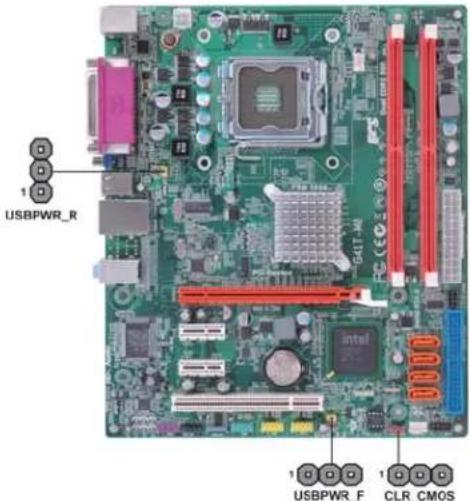
text_image
1 USBPWR_R 1 USBPWR_F 1 CLR_CMOSJumper Settings
| Jumper | Type | Description Setting (default) | ||
| CLR_CMOS | 3-pin | Clear CMOS | 1-2: NORMAL2-3: CLEARBefore clearing the CMOS, make sure to turn off the system. |  |
| USBPWR_F | 3-pin | Front PanelUSB PowerSelect Jumper | 1-2: VCC2-3: 5VSB | 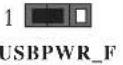 |
| USBPWR_R | 3-pin | Rear USB PS/2Power SelectJumper | 1-2: VCC2-3: 5VSB | 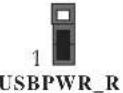 |

- To avoid the system instability after clearing CMOS, we recommend users to enter the main BIOS setting page to "Load Default Settings" and then "Save and Exit Setup".
- Make sure the power supply provides enough 5VSB voltage before selecting the 5VSB function.
- It is required that users place the USBPWR_F & USBPWR_R cap onto 2-3 pin rather than 1-2 pin as default if you want to wake up the computer by USB/PS2 KB/Mouse.
Installing the Motherboard
Installing Hardware
Installing the Processor

Caution: When installing a CPU heatsink and cooling fan make sure that you DO NOT scratch the motherboard or any of the surface-mount resistors with the clip of the cooling fan. If the clip of the cooling fan scrapes across the motherboard, you may cause serious damage to the motherboard or its components.
On most motherboards, there are small surface-mount resistors near the processor socket, which may be damaged if the cooling fan is carelessly installed.
Avoid using cooling fans with sharp edges on the fan casing and the clips. Also, install the cooling fan in a well-lit work area so that you can clearly see the motherboard and processor socket.
Before installing the Processor
This motherboard automatically determines the CPU clock frequency and system bus frequency for the processor. You may be able to change the settings in the system Setup Utility. We strongly recommend that you do not over-clock processors or other components to run faster than their rated speed.

Warning:
-
Over-clocking components can adversely affect the reliability of the system and introduce errors into your system. Over-clocking can permanently damage the motherboard by generating excess heat in components that are run beyond the rated limits.
-
Always remove the AC power by unplugging the power cord from the power outlet before installing or removing the motherboard or other hardware components.
This motherboard has an LGA775 socket. When choosing a processor, consider the performance requirements of the system. Performance is based on the processor design, the clock speed and system bus frequency of the processor, and the quantity of internal cache memory and external cache memory.
CPU Installation Procedure
The following illustration shows CPU installation components.
A. Read and follow the instructions shown on the sticker on the CPU cap.
B. Unload the cap
- Use thumb & forefinger to hold the lifting tab of the cap.
- Lift the cap up and remove the cap completely from the socket.
C. Open the load plate
- Use thumb & forefinger to hold the hook of the lever, pushing down and pulling aside unlock it.
- Lift up the lever.
- Use thumb to open the load plate. Be careful not to touch the contacts.
D. Install the CPU on the socket
- Orientate CPU package to the socket. Make sure you match triangle marker to pin 1 location.
E. Close the load plate
- Slightly push down the load plate onto the tongue side, and hook the lever.
- CPU is locked completely.
F. Apply thermal grease on top of the CPU.
G. Fasten the cooling fan supporting base onto the CPU socket on the motherboard.
H. Make sure the CPU fan is plugged to the CPU fan connector. Please refer to the CPU cooling fan user's manual for more detail installation procedure.
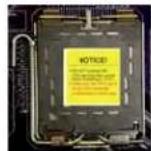


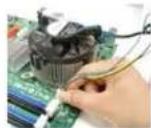

- To achieve better airflow rates and heat dissipation, we suggest that you use a high quality fan with 3800 rpm at least. CPU fan and heatsink installation procedures may vary with the type of CPU fan/heatsink supplied. The form and size of fan/heatsink may also vary.
- DO NOT remove the CPU cap from the socket before installing a CPU.
- Return Material Authorization (RMA) requests will be accepted only if the motherboard comes with the cap on the LGA775 socket.
Installing Memory Modules
This motherboard accommodates two memory modules. It can support two 240-pin DDR2 800/667. The total memory capacity is 8 GB.
DDR2 SDRAM memory module table
| Memory module Memory Bus | |
| DDR2 667 | 333 MHz |
| DDR2 800 | 400 MHz |
You must install at least one module in any of the two slots. The total memory capacity is up to 8 GB.

Do not remove any memory module from its antistatic packaging until you are ready to install it on the motherboard. Handle the modules only by their edges. Do not touch the components or metal parts. Always wear a grounding strap when you handle the modules.
Installation Procedure
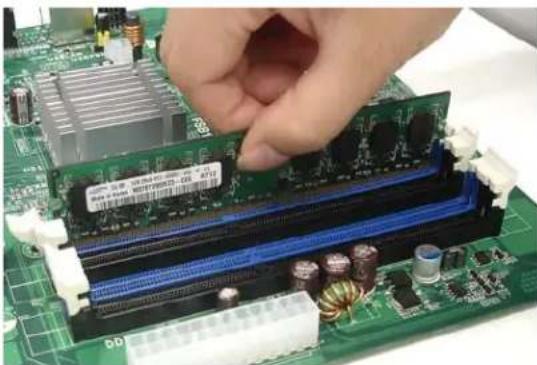
Refer to the following to install the memory modules.
1 This motherboard supports unbuffered DDR2 SDRAM.
2 Push the latches on each side of the DIMM slot down.
3 Align the memory module with the slot. The DIMM slots are keyed with notches and the DIMMs are keyed with cutouts so that they can only be installed correctly.
4 Check that the cutouts on the DIMM module edge connector match the notches in the DIMM slot.
5 Install the DIMM module into the slot and press it firmly down until it seats correctly. The slot latches are levered upwards and latch on to the edges of the DIMM.
6 Install any remaining DIMM modules.
natural_image
Close-up of a hand installing a green computer RAM module on a green circuit board (no visible text or symbols)Installing the Motherboard
Table A: DDR2 (memory module) QVL (Qualified Vendor List)
The following DDR2 800/667 memory modules have been tested and qualified for use with this motherboard.
| Type | Size Vendor Module Name | ||
| DDR2 667 | 512 MB Micron MT4H | TF6464AY-667E1 | |
| 1 GB | Apacer | 78.01G9O.9K5 | |
| AU01GE667C5KBGC | |||
| Corsair V$1GB667D2 | |||
| Kingston KVR667D2N5 | |||
| Micron MT8HTF12864AY-667E1 | |||
| PSC | AL7E8E63B-6E1T | ||
| AL7E8F63J-6E1 | |||
| AL7E8F73C-6E1 | |||
| Samsung GOLD BAR M378T2863DZS 0742 | |||
| 2 GB | Apacer 78.A1G9O.9K4 | ||
| Hynix HYMP125U64AP8-Y5 AB-A 0623 | |||
| Kingston | KVR667D2N5/2G | ||
| LeadMax | PC2-5300U | ||
| PSC AL8E8F73C-6E1 | |||
| Type | Size Vendor Module | Name | |
| DDR2 800 | 1 GB | A-DATA M2 GVD6G3I41P0U1E5E | |
| Apacer | |||
| Geil GEIL MILLENARY | |||
| Hynix HYMP112U64CP8-S6 AB | |||
| KingMax KLDD48F-B8KU5 NGES | |||
| Kingston | |||
| Nanya NT1GT64U88D0BY-AD | |||
| Ramaxel RML1320EH38D7F-800 | |||
| Samsung | |||
| Transcend DIMM 5-5-5 | |||
| Unifosa GU341G0ALEPR6B2C6CE | |||
| 2 GB | A-DATA Red A-DATA M2OMI6H3J4720L1C5Z | ||
| Apacer | |||
| CORSAIR CM2X2048-6400C5 | |||
| Geil Geil Platinum Edition | |||
| Hynix HYMP125U64CP8-S6 AB | |||
| KingMax | |||
| Kingston | |||
| Micron | |||
| Nanya | |||
| PSC | |||
| Samsung | |||
| Unifosa GU342G0ALEPR692C6CE | |||
| 4 GB | Samsung | ||
Expansion Slots
Installing Add-on Cards
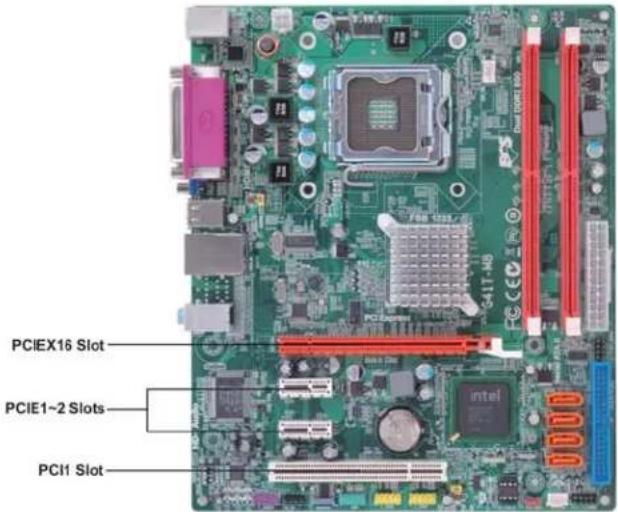
The slots on this motherboard are designed to hold expansion cards and connect them to the system bus. Expansion slots are a means of adding or enhancing the motherboard's features and capabilities. With these efficient facilities, you can increase the motherboard's capabilities by adding hardware that performs tasks that are not part of the basic system.
text_image
PCIEX16 Slot PCIE1~2 Slots PCI1 SlotPCIEX16 Slot The PCI Express slot is used to install an external PCI Express graphics card that is fully compliant to the PCI Express Gen 1.
PCIE1\~2 Slots The PCI Express x1 slots are fully compliant to the PCI Express Base Specification revision 1.0a.
PCI1 Slot
This motherboard is equipped with one standard PCI slot. PCI stands for Peripheral Component Interconnect and is a bus standard for expansion cards, which for the most part, is a supplement of the older ISA bus standard. The PCI slot on this board is PCI v2.3 compliant.

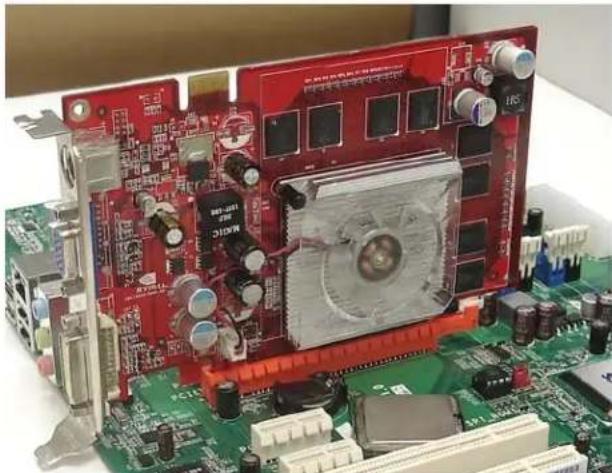
Before installing an add-on card, check the documentation for the card carefully. If the card is not Plug and Play, you may have to manually configure the card before installation.
Follow these instructions to install an add-on card:
1 Remove a blanking plate from the system case corresponding to the slot you are going to use.
2 Install the edge connector of the add-on card into the expansion slot. Ensure that the edge connector is correctly seated in the slot.
3 Secure the metal bracket of the card to the system case with a screw.
natural_image
Close-up of a red computer motherboard with visible CPU socket, RAM slots, and connectors (no readable text or symbols)
- For some add-on cards, for example graphics adapters and network adapters, you have to install drivers and software before you can begin using the add-on card.
- The onboard PCI interface does not support 64-bit SCSI cards.
Connecting Optional Devices
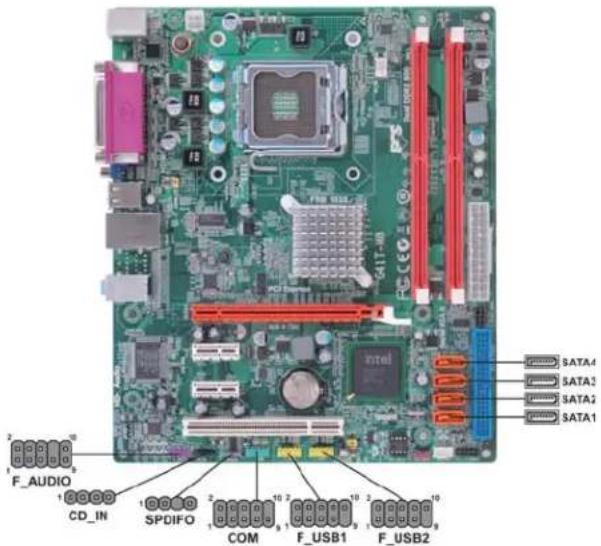
Refer to the following for information on connecting the motherboard's optional devices:
text_image
F_AUDIO CD_IN SPCIFO COM F_USB1 F_USB2 SATA4 SATA2 SATA2 SATA1SATA1\~4: Serial ATA connectors
These connectors are used to support the new Serial ATA devices for the highest data transfer rates (3.0 Gb/s), simpler disk drive cabling and easier PC assembly. It eliminates limitations of the current Parallel ATA interface. But maintains register compatibility and software compatibility with Parallel ATA.
| Pin Signal Name | Pin Signal Name | ||
| 1 Ground 2 TX+ | |||
| 3 TX- 4 Ground | |||
| 5 RX- 6 RX+ | |||
| 7 | Ground | - | - |
F\_AUDIO: Front Panel Audio header for Azalia
This header allows the user to install auxiliary front-oriented microphone and line-out ports for easier access.
| Pin Signal Name Pin Signal Name | |||
| 1 PORT 1L 2 AUD_GND | |||
| 3 PORT 1R 4 PRESENCE# | |||
| 5 PORT 2R 6 SENSE1_RETURN | |||
| 7 SENSE_SEND 8 KEY | |||
| 9 | PORT 2L | 10 | SENSE2_RETURN |
Installing the Motherboard
F\_USB1\~2: Front Panel USB headers
The motherboard has four USB ports installed on the rear edge I/O port array. Additionally, some computer cases have USB ports at the front of the case. If you have this kind of case, use auxiliary USB connector to connect the front-mounted ports to the motherboard.
| Pin | Signal Name | Function |
| 1 | USBPWR Front Panel | USB Power |
| 2 | USBPWR Front Panel | USB Power |
| 3 | USB_FP_P0- USB Port 0 | Negative Signal |
| 4 | USB_FP_P1-USB Port 1 | Negative Signal |
| 5 | USB_FP_P0+ USB Port 0 | Positive Signal |
| 6 | USB_FP_P1+USB Port 1 | Positive Signal |
| 7 | GNDGround | |
| 8 | GND Ground | |
| 9 | Key | No pin |
| 10 | USB_FP_OC0 | Overcurrent signal |

Please make sure that the USB cable has the same pin assignment as indicated above. A different pin assignment may cause damage or system hang-up.
CD\_IN: Analog Audio Input header
| Pin | Signal Name Function |
| 1 CD_L CD In left channel | |
| 2 GND Ground | |
| 3 GND Ground | |
| 4 CD_R CD In right channel | |
SPDIFO: SPDIF out header
This is an optional header that provides an S/PDIF (Sony/Philips Digital Interface) output to digital multimedia device through optical fiber or coaxial connector.
| Pin | Signal Name | Function |
| 1 | SPDIF SPDIF digital output | |
| 2 | +5VA 5V analog Power | |
| 3 | Key No pin | |
| 4 | GND Ground |
COM: Onboard serial port header
Connect a serial port extension bracket to this header to add a second serial port to your system.
| Pin | Signal Name | Function |
| 1 | DCDB Data Carrier Detect | |
| 2 | SINB Serial Input | |
| 3 | SOUTBUART B Serial Output | |
| 4 | DTRBUARTBData TerminalReady | |
| 5 | GND Ground | |
| 6 | DSRB Data Set Ready | |
| 7 | RTSB RART B Request to Send | |
| 8 | CTSB Clear to Send | |
| 9 | RIRingIndicator | |
| 10 | Key | No pin |
Installing a Hard Disk Drive/CD-ROM/SATA Hard Drive
This section describes how to install IDE devices such as a hard disk drive and a CD-ROM drive.
About IDE Devices
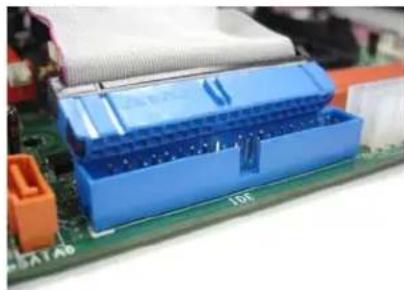
Your motherboard has one IDE channel interface.
IDE: IDE Connector
This motherboard supports four high data transfer SATA ports with each runs up to 3.0 Gb/s. To get better system performance, we recommend users connect the CD-ROM to the IDE channel, and set up the hard drives on the SATA ports.
natural_image
Close-up of a blue internal component mounted on a circuit board with orange connectors (no visible text or symbols)IDE devices enclose jumpers or switches used to set the IDE device as MASTER or SLAVE. Refer to the IDE device user's manual. Installing two IDE devices on one cable, ensure that one device is set to MASTER and the other device is set to SLAVE. The documentation of your IDE device explains how to do this.
Installing the Motherboard
About SATA Connectors
Your motherboard features four SATA connectors supporting a total of four drives. SATA refers to Serial ATA (Advanced Technology Attachment) is the standard interface for the IDE hard drives which are currently used in most PCs. These connectors are well designed and will only fit in one orientation. Locate the SATA connectors on the motherboard and follow the illustration below to install the SATA hard drives.
Installing Serial ATA Hard Drives
To install the Serial ATA (SATA) hard drives, use the SATA cable that supports the Serial ATA protocol. This SATA cable comes with an SATA power cable. You can connect either end of the SATA cable to the SATA hard drive or the connector on the motherboard.

SATA cable (optional)
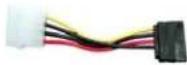
SATA power cable (optional)
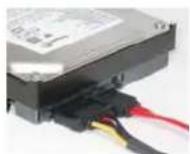
Refer to the illustration below for proper installation:
1 Attach either cable end to the connector on the motherboard.
2 Attach the other cable end to the SATA hard drive.
3 Attach the SATA power cable to the SATA hard drive and connect the other end to the power supply.


This motherboard does not support the "Hot-Plug" function.
Connecting I/O Devices
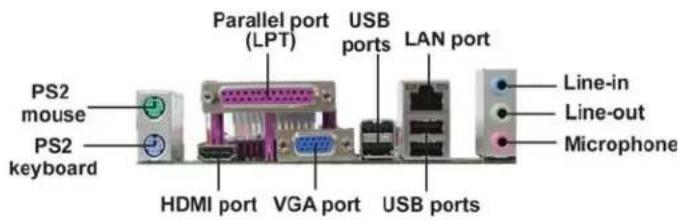
The backplane of the motherboard has the following I/O ports:
text_image
PS2 mouse PS2 keyboard HDMI port VGA port Parallel port (LPT) USB ports LAN port Line-in Line-out MicrophonePS2 Mouse Use the upper PS/2 port to connect a PS/2 pointing device.
PS2 Keyboard Use the lower PS/2 port to connect a PS/2 keyboard.
HDMI Port Connect the HDMI port to the HDMI devices.
Parallel Port Use LPT to connect printers or other parallel communica (LPT) tions devices.
VGA Port Connect your monitor to the VGA port.
LAN Port Connect an RJ-45 jack to the LAN port to connect your computer to the Network.
USB Ports Use the USB ports to connect USB devices.
Audio Ports
Use the three audio ports to connect audio devices. The first jack is for stereo line-in signal. The second jack is for stereo line-out signal. The third jack is for microphone.
Connecting Case Components
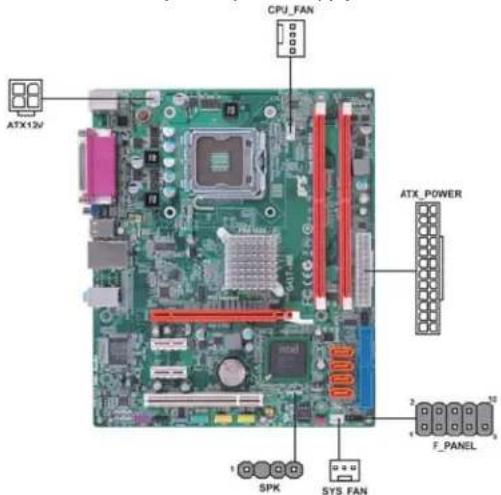
After you have installed the motherboard into a case, you can begin connecting the motherboard components. Refer to the following:
1 Connect the CPU cooling fan cable to CPU_FAN.
2 Connect the standard power supply connector to ATX POWER.
3 Connect the case switches and indicator LEDs to the F PANEL.
4 Connect the system cooling fan connector to SYS_FAN.
5 Connect the case speaker cable to SPK.
6 Connect the auxiliary case power supply connector to ATX12V.
text_image
ATX124 CPU_FAN ATX_POWER SPK SYS_FAN f_PANEL
Connecting 24-pin power cable
The ATX_POWER 24-pin connector allows you to connect to ATX v2.x power supply.
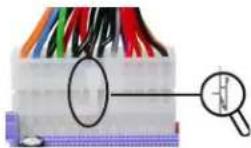
With ATX v2.x power supply, users please note that when installing 24-pin power cable, the latches of power cable and the ATX_POWER match perfectly.
24-pin power cable
Connecting 4-pin power cable
The ATX12V power connector is used to provide power to the CPU.


When installing 4-pin power cable, the latches of power cable and the ATX12V match perfectly.
4-pin power cable
Installing the Motherboard
CPU_FAN: CPU Cooling FAN Power Connector
| Pin Signal Name Function | ||
| 1 | GND System Ground | |
| 2 | +12V Power | +12V |
| 3 | Sense Sensor | |
| 4 | PWM | PWM |

Users please note that the fan connector supports the CPU cooling fan of 1.1A \~ 2.2A (26.4W max) at +12V.
ATX_POWER: ATX 24-pin Power Connector
| Pin | Signal Name | Pin | Signal Name |
| 1 +3.3V 13 +3.3V | |||
| 2 +3.3V 14 -12V | |||
| 3 Ground 15 Ground | |||
| 4 +5V 16 PS_ON | |||
| 5 Ground 17 Ground | |||
| 6 +5V 18 Ground | |||
| 7 Ground 19 Ground | |||
| 8 PWRGD 20 -5V | |||
| 9 | +5VSB | 21 | +5V |
| 10 | +12V | 22 | +5V |
| 11 | +12V | 23 | +5V |
| 12 | +3.3V | 24 | Ground |
SYS_FAN: System Cooling FAN Power Connector
| Pin Signal Name | Function | |
| 1 GND | System Ground | |
| 2 +12V | Power +12V | |
| 3 | Sense | Sensor |
SPK: Internal speaker
| Pin | Signal Name |
| 1 | VCC |
| 2 | Kcy |
| 3 | NC |
| 4 | Signal |
ATX12V: ATX 12V Power Connector
| Pin Signal Name |
| 1 Ground |
| 2 Ground |
| 3 +12V |
| 4 +12V |
Front Panel Header
The front panel header (F_PANEL) provides a standard set of switch and LED headers commonly found on ATX or micro-ATX cases. Refer to the table below for information:
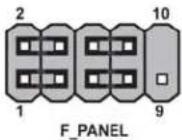
| Pin Signal Function Pin Signal Function | |
| 1 HD_LED_P Hard disk LED (+) 2 FP PWR/SLP*MSG LED (+) | |
| 3 HD_LED_N Hard disk LED (-) | 4 FP PWR/SLP *MSG LED (-) |
| 5 RST_SW_N Reset Switch (-) | 6 PWR_SW_P Power Switch (+) |
| 7 RST_SW_P Reset Switch (+) | 8 PWR_SW_N Power Switch (-) |
| 9 RSVD Reserved | 10 Key No pin |
*MSG LED (dual color or single color)
Hard Drive Activity LED
Connecting pins 1 and 3 to a front panel mounted LED provides visual indication that data is being read from or written to the hard drive. For the LED to function properly, an IDE drive should be connected to the onboard IDE interface. The LED will also show activity for devices connected to the SCSI (hard drive activity LED) connector.
Power/Sleep/Message waiting LED
Connecting pins 2 and 4 to a single or dual-color, front panel mounted LED provides power on/off, sleep, and message waiting indication.
Reset Switch
Supporting the reset function requires connecting pins 5 and 7 to a momentary-contact switch that is normally open. When the switch is closed, the board resets and runs POST.
Power Switch
Supporting the power on/off function requires connecting pins 6 and 8 to a momentary-contact switch that is normally open. The switch should maintain contact for at least 50 ms to signal the power supply to switch on or off. The time requirement is due to internal de-bounce circuitry. After receiving a power on/off signal, at least two seconds elapses before the power supply recognizes another on/off signal.
This concludes Chapter 2. The next chapter covers the BIOS.
Memo
Chapter 3
Using BIOS
About the Setup Utility
The computer uses the latest “American Megatrends Inc.” BIOS with support for Windows Plug and Play. The CMOS chip on the motherboard contains the ROM setup instructions for configuring the motherboard BIOS.
The BIOS (Basic Input and Output System) Setup Utility displays the system's configuration status and provides you with options to set system parameters. The parameters are stored in battery-backed-up CMOS RAM that saves this information when the power is turned off. When the system is turned back on, the system is configured with the values you stored in CMOS.
The BIOS Setup Utility enables you to configure:
- Hard drives, diskette drives and peripherals
• Video display type and display options - Password protection from unauthorized use
• Power Management features
The settings made in the Setup Utility affect how the computer performs. Before using the Setup Utility, ensure that you understand the Setup Utility options.
This chapter provides explanations for Setup Utility options.
The Standard Configuration
A standard configuration has already been set in the Setup Utility. However, we recommend that you read this chapter in case you need to make any changes in the future.
This Setup Utility should be used:
- when changing the system configuration
- when a configuration error is detected and you are prompted to make changes to the Setup Utility
- when trying to resolve IRQ conflicts
- when making changes to the Power Management configuration
- when changing the password or making other changes to the Security Setup
Entering the Setup Utility
When you power on the system, BIOS enters the Power-On Self Test (POST) routines. POST is a series of built-in diagnostics performed by the BIOS. After the POST routines are completed, the following message appears:
Press DEL to enter SETUP
Press the delete key to access the BIOS Setup Utility.
CMOS Setup Utility - Copyright (C) 1985-2005, American Megatrends, Inc.
| ►Standard CMOS Setup►Advanced Setup►Advanced Chipset Setup►Integrated Peripherals►Power Management Setup►PCI/PnP Setup►PC Health Status | ►Frequency/Voltage ControlLoad Default Settings►Supervisor Password►User PasswordSave & Exit SetupExit Without Saving |
| ||—:MoveF16 Save Sell&C: Exit ValueF1:General Help F9: Load Default Settings | |
| v02.63 (C)Copyright 1985-2008, American Megatrends, Inc. | |
Resetting the Default CMOS Values
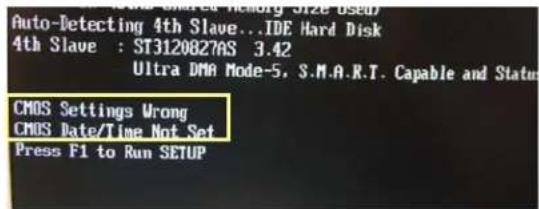
When powering on for the first time, the POST screen may show a "CMOS Settings Wrong" message. This standard message will appear following a clear CMOS data at factory by the manufacturer. You simply need to Load Default Settings to reset the default CMOS values.
Note: Changes to system hardware such as different CPU, memories, etc. may also trigger this message.
text_image
Auto-Detecting 4th Slave...IDE Hard Disk 4th Slave : ST3120827AS 3.42 Ultra DMA Mode-5, S.M.A.R.T. Capable and Status CMOS Settings Wrong CMOS Date/Time Not Set Press F1 to Run SETUP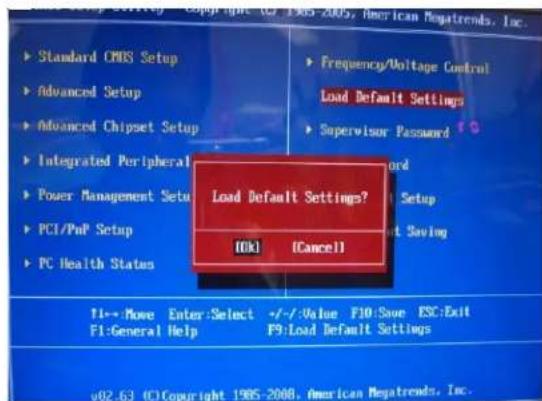
text_image
Standard CMOS Setup Advanced Setup Advanced Chipset Setup Integrated Peripheral Power Management Setu PCI/PnP Setup PC Health States Frequency/Voltage Control Load Default Settings Supervisor Password F0 Load Default Settings? [OK] [Cancel] F1->Move Enter:Select +/-Value F10:Save ESC:Exit F1:General Help F9:Load Default Settings v02.63 ©Copyright 1985-2008, American Negatrends, Inc.Using BIOS
Using BIOS
When you start the Setup Utility, the main menu appears. The main menu of the Setup Utility displays a list of the options that are available. A highlight indicates which option is currently selected. Use the cursor arrow keys to move the highlight to other options. When an option is highlighted, execute the option by pressing
Some options lead to pop-up dialog boxes that prompt you to verify that you wish to execute that option. Other options lead to dialog boxes that prompt you for information.
Some options (marked with a triangle ▶) lead to submenus that enable you to change the values for the option. Use the cursor arrow keys to scroll through the items in the submenu.
In this manual, default values are enclosed in parenthesis. Submenu items are denoted by a triangle ▶.

The default BIOS setting for this motherboard apply for most conditions with optimum performance. We do not suggest users change the default values in the BIOS setup and take no responsibility to any damage caused by changing the BIOS settings.
BIOS Navigation Keys
The BIOS navigation keys are listed below:
| KEY FUNCTION | |
| ESC Exits | the current menu |
| 1|--- | Scrolls through the items on a menu |
| +/-/ Modifies the selected field's values | |
| Enter Select | |
| F9 Loads | an optimized setting for better performance |
| F10 Saves | the current configuration and exits setup |
| F1 Displays | a screen that describes all key functions |

For the purpose of better product maintenance, we reserve the right to change the BIOS items presented in the manual. The BIOS setup screens shown in this chapter are for reference only. Please visit our website for updated manual.
Standard CMOS Setup
This option displays basic information about your system.
CMOS Setup Utility - Copyright (C) 1985-2005, American Megatrends, Inc. Standard CMOS Setup
| Date Fri 09/04/2009Time 00:23:49Primary IDE Master Not DetectedPrimary IDE Slave Not DetectedSATA1 Hard DiskSATA2 Not DetectedSATA3 Not DetectedSATA4 Not DetectedIDE BusMaster Enabled | Help Item |
| Use [ENTER], [TAB] or [SHIFT-TAB] to select a field.Use [+] or [-] to configure system Date. |
↑↓→←:Move Enter:Select +/-: Value F10: Save ESC: Exit F1: General Help F9: Load Default Settings
Date & Time
The Date and Time items show the current date and time on the computer. If you are running a Windows OS, these items are automatically updated whenever you make changes to the Windows Date and Time Properties utility.
▶ Primary IDE Master/Slave; SATA1\~4
Your computer has one IDE channel and each channel can be installed with one or two devices (Master and Slave). In addition, this motherboard supports four SATA channels and each channel allows one SATA device to be installed. Use these items to configure each device on the SATA channel.
CMOS Setup Utility - Copyright (C) 1985-2005, American Megatrends, Inc. Primary IDE Master
| Primary IDE Master | Help Item |
| Device : ATAPI CDROMVendor : DVD-ROM DDU1632LBA Mode : SupportedPIO Mode : 4Async DMA : MultiWord DMA-2Ultra DMA : Ultra DMA-2 | Select the type of device connected to the system. |
| Type AutoPIO Mode AutoDMA Mode Auto |
↑↓→← :Move Enter:Select +/-:Value F10:Save ESC:Exit F1:General Help F9:Load Default Settings
Type (Auto)
Use this item to configure the type of the IDE device that you specify. If the feature is enabled, it will enhance hard disk performance by reading or writing more data during each transfer.
PIO Mode (Auto)
Use this item to set the PIO mode to enhance hard disk performance by optimizing the hard disk timing.
DMA Mode (Auto)
DMA capability allows user to improve the transfer-speed and data-integrity for compatible IDE devices.
Press
IDE BusMaster (Enabled)
This item enables or disables the DMA under DOS mode. We recommend you to leave this item at the default value.
Press
Advanced Setup
This page sets up more advanced information about your system. Handle this page with caution. Any changes can affect the operation of your computer.
CMOS Setup Utility - Copyright (C) 1985-2005, American Megatrends, Inc. Advanced Setup
| Thermal Management Enabled TM Status TM1/TM2 Limit CPUID MaxVal Disabled Enhanced Halt (C1E) Enabled Intel XD Bit Disabled Intel Virtualization Technol Enabled Intel EIST Enabled Quick Power on Self Test Enabled Boot Up Numlock Status On APIC Mode Enabled 1st Boot Device Hard Disk Drive 2nd Boot Device CD/DVD 3rd Boot Device Removable Dev. ▶ Hard Disk Drives Press Enter Boot Other Device Yes ECS eJIFFY Function Disabled | Help Item |
| For the processor its CPUID belows 0F41h. TM2 only can be enable under below setting. 1.Freq.>=3.6GHz FSB800 2.Freq.>=2.8GHz FSB533 |
↑↓→← :Move Enter:Select +/-:Value F10:Save ESC:Exit F1:General Help F9:Load Default Settings
Thermal Management (Enabled)
This item displays CPU's temperature and enables you to set a safe temperature to CPU.
TM Status (TM1/TM2)
This item shows TM function status if CPU can support TM function.
Enhanced Halt (C1E) (Enabled)
This item enables or disables enhanced halt (C1E).
Hardware Virtualization Technology enables processor feature for running multiple simultaneous Virtual Machines allowing specialized software applications to run in full isolation of each other.
Intel EIST (Enabled)
This item allows users to enable or disable the EIST (Enhanced Intel SpeedStep technology).
Quick Power on Self Test (Enabled)
Enable this item to shorten the power on testing (POST) and have your system start up faster. You might like to enable this item after you are confident that your system hardware is operating smoothly.
Boot Up Numlock Status (On)
This item defines if the keyboard Num Lock key is active when your system is started.
APIC Mode (Enabled)
This item allows you to enable or disable the APIC (Advanced Programmable Interrupt Controller) mode. APIC provides symmetric multi-processing (SMP) for systems, allowing support for up to 60 processors.
1st/2nd/3rd Boot Device (Hard Disk Drive/CD/DVD/Removable Dev.)
Use this item to determine the device order the computer used to look for an operating system to load at start-up time. The devices showed here will be different depending on the exact devices installed on your motherboard.
▶Hard Disk Drives (Press Enter)
Scroll to this item and press
CMOS Setup Utility - Copyright (C) 1985-2005, American Megatrends, Inc. Hard Disk Drives
| Hard Disk Drives | Help Item |
| 1st Drive WDC WD4000AAKS-00TM 2nd Drive SD/MMC Card | Specifies the boot sequence from the available devices. |
↑↓→← :Move Enter:Select +/-:Value F10:Save ESC:Exit F1:General Help F9:Load Default Settings
Press
Boot Other Device (Yes)
When enabled, the system searches all other possible locations for an operating system if it fails to find one in the devices specified under the First, Second and Third boot devices.
ECS eJIFFY Function (Disabled)
Use this item to enable or disable the ECS eJIFFY Function. eJIFFY is ECS unique software program for the quick access to the internet without entering O.S. Please refer to Chapter 5 to know more about eJIFFY.
Press
Advanced Chipset Setup
This page sets up more advanced information about your system. Handle this page with caution. Any changes can affect the operation of your computer.
CMOS Setup Utility - Copyright (C) 1985-2005, American Megatrends, Inc. Advanced Chipset Setup
| DRAM Frequency Auto Configure DRAM Timing by SPD Enabled Share Memory Size Enabled, 64MB DVMT Memory 256MB Memory Remap Feature Enabled HPET Enabled | Help Item |
| Options | |
| Auto 667 MHz 800 MHz |
1↓→← :Move Enter:Select +/-:Value F10:Save ESC:Exit F1:General Help F9:Load Default Settings
DRAM Frequency (Auto)
This item enables users to adjust the DRAM frequency. The default setting is auto and we recommend users leave the setting unchanged. Modify it at will may cause the system to be unstable.
Configure DRAM Timing by SPD (Enabled)
When this item is set to enable, the DDR timing is configured using SPD. SPD (Serial Presence Detect) is located on the memory modules, BIOS reads information coded in SPD during system boot up.
Share Memory Size (Enabled, 64MB)
This item lets you allocate a portion of the main memory for the onboard VGA display application.
DVMT Memory (256MB)
When set to Fixed Mode, the graphics driver will reserve a fixed portion of the system memory as graphics memory, according to system and graphics requirements.
Memory Remap Feature (Enabled)
This item allows you to remap the overlapped PCI memory above the total physical memory if you have a 64 bit OS and 8 GB of RAM.
HPET (Enabled)
This item enables or disables HPET (High Precision Event Timer) support.
Press
Integrated Peripherals
This page sets up some parameters for peripheral devices connected to the system.
CMOS Setup Utility - Copyright (C) 1985-2005, American Megatrends, Inc. Integrated Peripherals
| Onboard IDE Controller EnabledOnboard SATA Controller EnhancedOnboard Audio Function EnabledOnboard LAN Function EnabledOnboard LAN Boot ROM DisabledSerial Port1 Address 3F8/IRQ4Parallel Port Address 378Parallel Port Mode ECPECP Mode DMA Channel DMA3Parallel Port IRQ IRQ7USB Functions EnabledLegacy USB Support Enabled | Help Item |
| DISABLED: disables the integrated IDE Controller.ENABLED: enables both Controllers. |
↑↓→← :Move Enter:Select +/-: Value F10: Save ESC: Exit F1: General Help F9: Load Default Settings
Onboard IDE Controller (Enabled)
Use this item to enable or disable the onboard IDE interface.
OnBoard SATA Controller (Enhanced)
This item allows you to enable or disable the onboard SATA controller.
Onboard Audio Function (Enabled)
Use this item to enable or disable the onboard audio device.
Onboard LAN Function (Enabled)
Use this item to enable or disable the onboard LAN function.
Onboard LAN Boot ROM (Disabled)
Use this item to enable or disable the booting from the onboard LAN or a network add-in card with a remote boot ROM installed.
Serial Port1 Address (3F8/IRQ4)
Use this item to enable or disable the onboard COM1 serial port, and to assign a port address.
Parallel Port Address (378)
Use this item to enable or disable the onboard Parallel port, and to assign a port address.
Parallel Port Mode (ECP)
Use this item to select the parallel port mode. You can select Normal (Standard Parallel Port), ECP (Extended Capabilities Port), EPP (Enhanced Parallel Port), or BPP (Bi-Directional Parallel Port).
ECP Mode DMA Channel (DMA3)
Use this item to assign the DMA Channel under ECP Mode function.
Parallel Port IRQ (IRQ7)
Use this item to assign IRQ to the parallel port.
USB Functions (Enabled)
Use this item to enable or disable the USB function.
Legacy USB Support (Enabled)
Use this item to enable or disable support for legacy USB devices.
Press
Power Management Setup
This page sets up some parameters for system power management operation.
CMOS Setup Utility - Copyright (C) 1985-2005, American Megatrends, Inc. Power Management Setup
| ACPI Suspend Type S3 PWRON After PWR-Fail Power Off Resume By RING Disabled Resume By PCI/PCI-E/Lan PME Disabled Resume By USB (S3) Disabled Resume By PS2 KB (S3) Disabled Resume By PS2 MS (S3) Disabled Resume on RTC Alarm Disabled | Help Item |
| Select the ACPI state used for System Suspend. |
|↓→← :Move Enter:Select +/-:Value F10:Save ESC:Exit F1:General Help F9:Load Default Settings
ACPI Suspend Type (S3)
Use this item to define how your system suspends. In the default, S3, the suspend mode is a suspend to RAM, i.e., the system shuts down with the exception of a refresh current to the system memory.
PWRON After PWR-Fail (Power Off)
This item enables your computer to automatically restart or return to its operating status.
Resume By RING (Disabled)
An input signal on the serial Ring Indicator (RI) line (in other words, an incoming call on the modem) awakens the system from a soft off state.
Resume By PCI/PCI-E/Lan PME (Disabled)
These items specify whether the system will be awakened from power saving modes when activity or input signal of the specified hardware peripheral or component is detected.
Resume By USB (S3) (Disabled)
This item allows you to enable/disable the USB device wakeup function from S3/S4 mode.
Resume By PS2 KB (S3) (Disabled)
This item enables or disables you to allow keyboard activity to awaken the system from power saving mode.
Resume By PS2 MS (S3) (Disabled)
This item enables or disables you to allow mouse activity to awaken the system from power saving mode.
Resume on RTC Alarm (Disabled)
The system can be turned off with a software command. If you enable this item, the system can automatically resume at a fixed time based on the system's RTC (realtime clock). Use the items below this one to set the date and time of the wake-up alarm. You must use an ATX power supply in order to use this feature.
Press
PCI/PnP Setup
This page sets up some parameters for devices installed on the PCI bus and those utilizing the system plug and play capability.
CMOS Setup Utility - Copyright (C) 1985-2005, American Megatrends, Inc. PCI/PnP Setup
| Init Display First PCI | Help Item |
| Select which graphics controller to use as the primary boot device. |
↑↓→←:Move Enter:Select +/-:Value F10:Save ESC:Exit F1:General Help F9:Load Default Settings
Init Display First (PCI)
Use this item to select which graphics controller to use as the primary boot devices.
Press
PC Health Status
On motherboards support hardware monitoring, this item lets you monitor the parameters for critical voltages, temperatures and fan speeds.
CMOS Setup Utility - Copyright (C) 1985-2005, American Megatrends, Inc. PC Health Status
| --System Hardware Monitor --►Smart Fan Function Press Enter CPU Fan Speed: 2163 RPM CPU Vcore: 1.072 V VDIMM: 1.856 V VBAT: 3.344 V Case Open Warning Disabled Chassis Opened No -- PECI Mode -- Offset to TCC Activation Temp.: -58 | Help Item |
↑↓→←:Move Enter:Select +/-:Value F10:Save ESC:Exit F1:General Help F9:Load Default Settings
▶Smart Fan Function (Press Enter)
Scroll to this item and press
CMOS Setup Utility - Copyright (C) 1985-2005, American Megatrends, Inc. Smart Fan Function
| Smart Fan Function Enabled SMART Fan Mode SMART Fan start PWM value 28 CPU DeltaT +3 SMART Fan start Offset (-) 32 Fan1 Slope PWM value/1 Unitl 4 Fan1 Full Speed Offset (-) 7 | Normal | Help Item |
| Options | ||
| Normal: auto adjusts depending on the CPU temperature. Quiet: auto minimizes fan speed for quiet environment operation. Silent: auto restricts fan speed to make system more quietly. Manual: the fan adjust depending on user's parameter. |
↑↓→← :Move Enter:Select +/-:Value F10:Save ESC:Exit F1:General Help F9:Load Default Settings
SMART Fan Control (Enabled)
This item allows you to enable/disable the control of the CPU fan speed by changing the fan voltage.
SMART Fan Mode (Normal)
This item allows you to select the fan mode (Normal, Quiet, Silent, or Manual) for a better operation environment. If you choose Normal mode, the fan speed will be auto adjusted depending on the CPU temperature. If you choose Quite mode, the fan speed will be auto minimized for quiet environment. If you choose Silent mode, the fan speed will be auto restricted to make system more quietly. If you choose Manual mode, the fan speed will be adjust depending on users' parameters.
CMOS Setup Utility - Copyright (C) 1985-2005, American Megatrends, Inc. Smart Fan Function
| Smart Fan Function EnabledSMART Fan Mode NormalSMART Fan start PWM value 28CPU DeltaT +3SMART Fan start Offset (-) 32Fan1 Slope PWM value/1 Unitl 4Fan1 Full Speed Offset (-) 7 | Help Item |
| OptionsNormal: auto adjusts depending on the CPU temperature.Quiet: auto minimizes fan speed for quiet environment operation.Silent: auto restricts fan speed to make system more quietly.Manual: the fan adjust depending on user's parameter. |
↑↓→← :Move Enter:Select +/-:Value F10:Save ESC:Exit F1:General Help F9:Load Default Settings
Press
CMOS Setup Utility - Copyright (C) 1985-2005, American Megatrends, Inc. Smart Fan Function
| Smart Fan Function EnabledSmart Fan Mode QuietSMART Fan start PWM value 15CPU DeltaT +3SMART Fan start Offset (-) 29Fan1 Slope PWM value/1 Unit! 5Fan1 Full Speed Offset (-) 7 | Help Item |
| OptionsNormal: auto adjusts depending on the CPU temperature.Quiet: auto minimizes fan speed for quiet environment operation.Silent: auto restricts fan speed to make system more quietly.Manual: the fan adjust depending on user's parameter. |
↑↓→← :Move Enter:Select
F1:General Help
F10: Save ESC: Exit+/-/: Value
F9: Load Default Settings
Press
CMOS Setup Utility - Copyright (C) 1985-2005, American Megatrends, Inc. Smart Fan Function
| Smart Fan Function EnabledSMART Fan Mode SilentSMART Fan start PWM value 5CPU DeltaT +3SMART Fan start TEMP. (-) 26Fan1 Slope PWM value/1 UnitI 6Fan1 Full Speed Offset (-) 6 | Help Item |
| OptionsNormal: auto adjusts depending on the CPU temperature.Quiet: auto minimizes fan speed for quiet environment operation.Silent: auto restricts fan speed to make system more quietly.Manual: the fan adjust depending on user's parameter. |
↑↓→← :Move Enter:Select
F1:General Help
F10: Save ESC: Exit+/-/: Value
F9: Load Default Settings
Press
CMOS Setup Utility - Copyright (C) 1985-2005, American Megatrends, Inc.
Smart Fan Function
| Help Item | |
| OptionsNormal: auto adjusts depending on the CPU temperature.Quiet: auto minimizes fan speed for quiet environment operation.Silent: auto restricts fan speed to make system more quietly.Manual: the fan adjust depending on user's parameter. |
↑↓→←:Move
Enter : Select
F10: Save
ESC: Exit+/-/: Value
F1: General Help
F9: Load Default Settings
Press

ECS supports the latest PECI host technology. While using Core ^TM 2 Quad or Core ^TM 2 Duo CPU which supports PECI, the original images of the BIOS item "PC Health Status" and "Smart FAN Function" will be replaced by PECI mode and negative number. (The max data from PECI is zero.)
CMOS Setup Utility - Copyright (C) 1985-2005, American Megatrends, Inc. PC Health Status
| -= System Hardware Monitor-=►Smart Fan Function Press EnterCPU Fan Speed: 2509 RPMCPU Vcore : 1.068 VVDIMM: 1.824 V-= PECI Mode-=Offset to TCC Activation Temp.: -60. | Help Item |
↑↓→← :Move Enter:Select +/-: Value F10: Save ESC: Exit F1: General Help F9: Load Default Settings
CMOS Setup Utility - Copyright (C) 1985-2005, American Megatrends, Inc. Smart Fan Function
| SMART Fan Control Disabled | Help Item |
| OptionsDisabledEnabled |
↑↓→←:Move Enter:Select +/-:Value F10:Save ESC:Exit F1:General Help F9:Load Default Settings
Press
System Component Characteristics
These items display the monitoring of the overall inboard hardware health events, such as System & CPU temperature, CPU & DIMM voltage, CPU & system fan speed,...etc.
- CPU Fan Speed
- CPU Vcore
- VDIMM
• VBAT
Case Open Warning (Disabled)
This item enables or disables the warning if the case is opened up, and the item below indicates the current status of the case.
Chassis Opened (No)
This item indicates whether the case has been opened.
Press
Frequency/Voltage Control
This page enables you to set the clock speed and system bus for your system. The clock speed and system bus are determined by the kind of processor you have installed in your system.
CMOS Setup Utility - Copyright (C) 1985-2005, American Megatrends, Inc. Frequency/Voltage Control
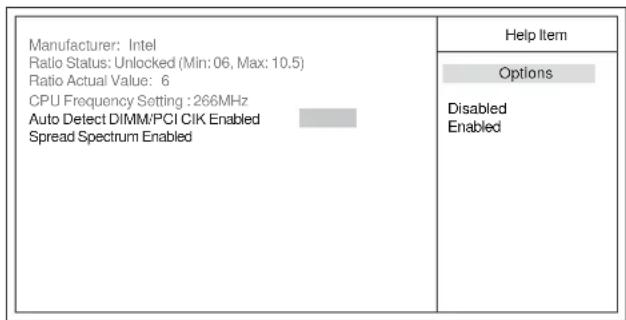
text_image
Manufacturer: Intel Ratio Status: Unlocked (Min: 06, Max: 10.5) Ratio Actual Value: 6 CPU Frequency Setting : 266MHz Auto Detect DIMM/PCI CIK Enabled Spread Spectrum Enabled Help Item Options Disabled Enabled↑↓→← :Move Enter:Select +/-/:Value F10:Save ESC:Exit F1:General Help F9:Load Default Settings
Manufacturer: Intel
This item displays the information of current manufacturer of the CPU installed in your computer.
Ratio Status: Unlocked (Min: 06, Max: 10.5)
This item shows the actual ratio of the CPU installed in your system.
Ratio Actual Value: 6
This item shows the actual ratio of the CPU installed in your system.
CPU Frequency Setting (266MHz)
This item is used to set the CPU Frequency.
Auto Detect DIMM/PCI Clk (Enabled)
When this item is enabled, BIOS will disable the clock signal of free DIMM/PCI slots.
Spread Spectrum (Enabled)
If you enable spread spectrum, it can significantly reduce the EMI (Electro-Magnetic Interference) generated by the system.
Press
Load Default Settings
This option opens a dialog box that lets you install stability-oriented defaults for all appropriate items in the Setup Utility. Select
Supervisor Password
This page helps you install or change a password.
CMOS Setup Utility - Copyright (C) 1985-2005, American Megatrends, Inc.
Supervisor Password
| Supervisor Password : Not Installed Change Supervisor Password Press Enter | Help Item |
| Install or Change the password. |
↑↓→← :Move Enter:Select +/-:Value F10:Save ESC:Exit
F1: General Help
F9: Load Default Settings
Supervisor Password (Not Installed)
This item indicates whether a supervisor password has been set. If the password has been installed, Installed displays. If not, Not Installed displays.
Change Supervisor Password (Press Enter)
You can select this option and press
Press
User Password
This page helps you install or change a password.
CMOS Setup Utility - Copyright (C) 1985-2005, American Megatrends, Inc. User Password
| User Password : Not Installed | Help Item |
1↓→← :Move Enter:Select +/-:Value F10:Save ESC:Exit F1:General Help F9:Load Default Settings
User Password (Not Installed)
This item indicates whether a user password has been set. If the password has been installed, Installed displays. If not, Not Installed displays.
Press
Save & Exit Setup
Highlight this item and press
Exit Without Saving
Highlight this item and press

If you have made settings that you do not want to save, use the "Exit Without Saving" item and select [OK] to discard any changes you have made.
Updating the BIOS
You can download and install updated BIOS for this motherboard from the manufacturer's Web site. New BIOS provides support for new peripherals, improvements in performance, or fixes for known bugs. Install new BIOS as follows:
1 If your motherboard has a BIOS protection jumper, change the setting to allow BIOS flashing.
2 If your motherboard has an item called Firmware Write Protect in Advanced BIOS features, disable it. (Firmware Write Protect prevents BIOS from being overwritten.)
3 Prepare a bootable device or create a bootable system disk. (Refer to Windows online help for information on creating a bootable system disk.)
4 Download the Flash Utility and new BIOS file from the manufacturer's Web site. Copy these files to the bootable device.
5 Turn off your computer and insert the bootable device in your computer. (You might need to run the Setup Utility and change the the boot priority items on the Advanced BIOS Features Setup page, to force your computer to boot from the bootable device first.)
6 At the C:\ or A:\ prompt, type the Flash Utility program name and the file name of the new BIOS and then press
7 When the installation is complete, remove the bootable device from the computer and restart your computer. If your motherboard has a Flash BIOS jumper, reset the jumper to protect the newly installed BIOS from being overwritten. The computer will restart automatically.
This concludes Chapter 3. Refer to the next chapter for information on the software supplied with the motherboard.
Chapter 4 Using the Motherboard Software
About the Software DVD-ROM/CD-ROM
The support software DVD-ROM/CD-ROM that is included in the motherboard package contains all the drivers and utility programs needed to properly run the bundled products. Below you can find a brief description of each software program, and the location for your motherboard version. More information on some programs is available in a README file, located in the same directory as the software. Before installing any software, always inspect the folder for files named README.TXT or something similar. These files may contain important information that is not included in this manual.

-
Never try to install all software from folder that is not specified for use with your motherboard.
-
The notice of Intel HD audio installation (optional): The Intel High Definition audio functionality unexpectedly quits working in Windows Server 2003 Service Pack 1 or Windows XP Professional x64 Edition. Users need to download and install the update packages from the Microsoft Download Center "before" installing HD audio driver bundled in the Driver disk. Please log on to http://support.microsoft.com/default.aspx?scid=kb;enus:901105#appliesto for more information.
Auto-installing under Windows XP/Vista/7
The Auto-install DVD-ROM/CD-ROM makes it easy for you to install the drivers and software for your motherboard.

If the Auto-install DVD-ROM/CD-ROM does not work on your system, you can still install drivers through the file manager for your OS (for example, Windows Explorer). Refer to the Utility Folder Installation Notes later in this chapter.
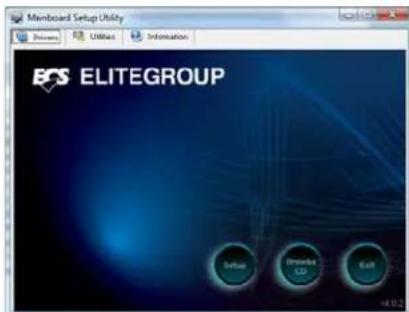
The support software DVD-ROM/CD-ROM disc loads automatically under Windows XP/Vista/7. When you insert the DVD-ROM/CD-ROM disc in the DVD-ROM/CD-ROM drive, the autorun feature will automatically bring up the install screen. The screen has three buttons on it, Setup, Browse CD and Exit.
text_image
Memboard Setup Utility Process Utilities Information BFS ELITEGROUP Setup Downloads CD Exit +0.2
If the opening screen does not appear; double-click the file "setup.exe" in the root directory.
Using the Motherboard Software
Drivers Tab
| Setup | Click the Setup button to run the software installation program.Select from the menu which software you want to install. |
| Browse CD | The Browse CD button is the standard Windows command that allows you to open Windows Explorer and show the contents of the support disk.Before installing the software from Windows Explorer, look for a file named README.TXT or something similar. This file may contain important information to help you install the software correctly.Some software is installed in separate folders for different operating systems, such as Windows XP/Vista/7. Always go to the correct folder for the kind of OS you are using.In install the software, execute a file named SETUP.EXE by double-clicking the file and then following the instructions on the screen. |
| Exit | The Exit button closes the Auto Setup window. |
Utilities Tab
Lists the software utilities that are available on the disk.
Informatin Tab
Displays the path for all software and drivers available on the disk.
Running Setup
Follow these instructions to install device drivers and software for the motherboard:
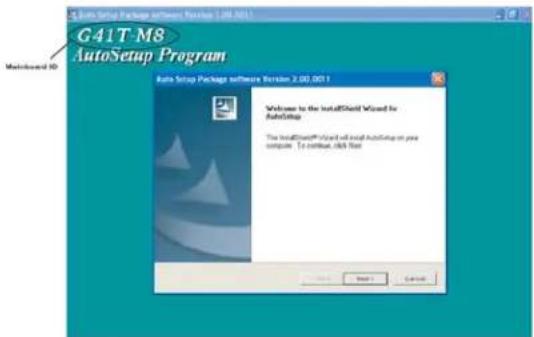
- Click Setup. The installation program begins:
text_image
Auto Setup Package software Version 2.00.001 G41T-M8 AutoSetup Program Auto Setup Package software Version 2.00.001 Welcome to the InstallShield Wizard for AutoSetup The InstallShield Wizard will not install AutoSetup on your computer. To continue, click Next Next > Cancel
The following screens are examples only. The screens and driver lists will be different according to the motherboard you are installing.
The motherboard identification is located in the upper left-hand corner.
Using the Motherboard Software
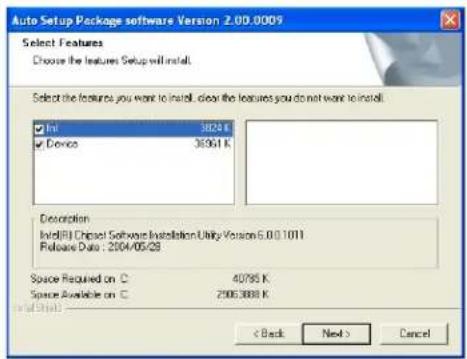
- Click Next. The following screen appears:
text_image
Auto Setup Package software Version 2.00.0009 Select Features Choose the features Setup will install. Select the features you want to install, clear the features you do not want to install. ✓ Init 3824 K ✓ Device 36961 K Description Init(RU Chipset Software Installation Utility Version 6.00.1011 Release Date : 2004/05/28 Space Required on C: 40795 K Space Available on C: 29063888 K Initial Settings < Back Next > Cancel-
Check the box next to the items you want to install. The default options are recommended.
-
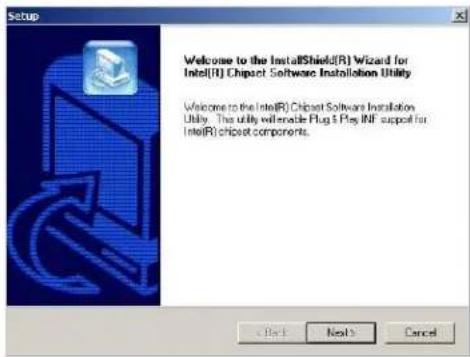
Click Next run the Installation Wizard. An item installation screen appears:
text_image
Setup Welcome to the InstallShield(R) Wizard for Intel(R) Chipset Software Installation Utility Welcome to the Intel(R) Chipset Software Installation Utility. This utility will enable Plug & Play INF support for Intel(R) chipset components. < Back Next > Cancel- Follow the instructions on the screen to install the items.

Drivers and software are automatically installed in sequence. Follow the onscreen instructions, confirm commands and allow the computer to restart a few times to complete the installation.

Windows Vista/7 will appear below UAC (User Account Control) message after the system restart. You must select "Allow" to install the next driver. Continue this process to complete the drivers installation.

text_image
User Account Control An unidentified program wants access to your computer Don't run the program unless you know where it's from or you've used it before. ChPrio.exe Unidentified Publisher Cancel I don't know where this program is from or what it's for. All I trust this program. I know where it's from or I've used it before. Details User Account Control helps stop unauthorized changes to your computer.Manual Installation
Insert the disk in the DVD-ROM/CD-ROM drive and locate the PATH.DOC file in the root directory. This file contains the information needed to locate the drivers for your motherboard.
Look for the chipset and motherboard model; then browse to the directory and path to begin installing the drivers. Most drivers have a setup program (SETUP.EXE) that automatically detects your operating system before installation. Other drivers have the setup program located in the operating system subfolder.
If the driver you want to install does not have a setup program, browse to the operating system subfolder and locate the readme text file (README.TXT or README.DOC) for information on installing the driver or software for your operating system.
Utility Software Reference
All the utility software available from this page is Windows compliant. They are provided only for the convenience of the customer. The following software is furnished under license and may only be used or copied in accordance with the terms of the license.

These software(s) are subject to change at anytime without prior notice. Please refer to the support disk for available software.
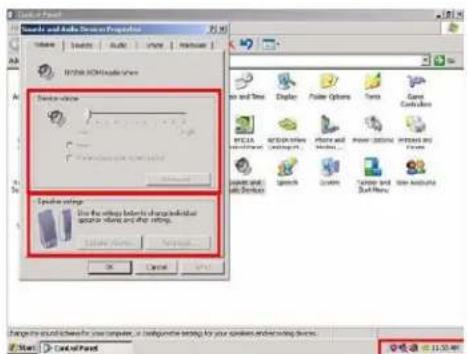
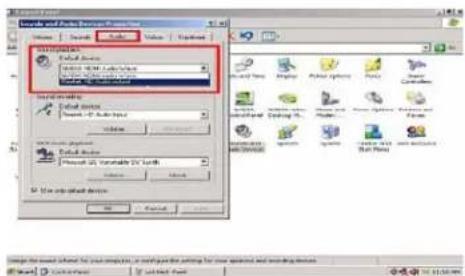
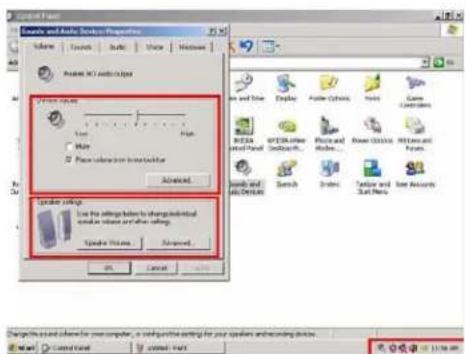
HDMI Audio setting SOP
OS: XP system
- Control Panel-->Sound and Audio Device Properties
text_image
Windows 800 System Device selection Options for the settings below to change individual system size and size settings. Options for the settings below to change individual system size and size settings.- a. Audio--> Sound playback--> Default device--> HD Auido Output
b. Audio--> Sound playback--> Default device--> HDMI Auido Output
text_image
Sound and Audio Devices Options Details Audio Value Updated Sound and Audio Devices Audio Device Audio Device Audio Device Audio Device Audio Device Audio Device Audio Device Audio Device Audio Device Audio Device Audio Device Audio Device Audio Device Audio Device Audio Device Audio Device Audio Device Audio Device Audio Device Audio Device Audio Device Audio Device Audio Device Audio Device Audio Device Audio Device Audio Device Audio Device Audio Device Audio Device Audio Device Audio Device Audio Device Audio Device- a. User Playback Audio speaker function working
b. User Playback HDMI speaker function working
text_image
Create and Audio Settings Properties Volume Search Audio View Windows Mac OS X Audio System Create settings Use the settings below to change additional audio or video and audio settings. Update Settings... Advanced... Save and Time Display Faster Options Print Game Controls WERTON MOSO Power Power Options RPTs and Play Tools and Start Files Send and Add Options Switch Delete Texter and Start Files Change and mode for your computer, a suitable setting for your system and recording device.Using the Motherboard Software
OS: Vista system
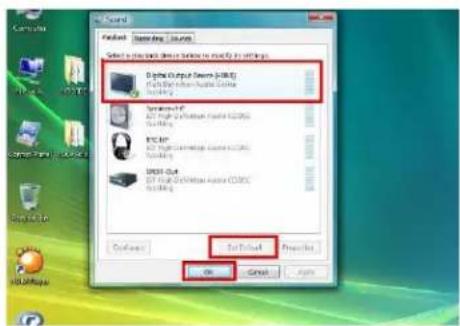
Control Panel--> Soundback--> Sound--> Digital Output Device (HDMI) --> Set Default

text_image
Current Panel 3 Start Menu Current Start Menu Current Panel 3 Current Panel 3 Current Panel 3 Current Panel 3 Current Panel 3 Current Panel 3 Current Panel 3 Current Panel 3 Current Panel 3 Current Panel 3 Current Panel 3 Current Panel 3 Current Panel 3 Current Panel 3 Current Panel 3 Current Panel 3 Current Panel 3 Current Panel 3 Current Panel 3 Current Panel 3 Current Panel 2 Current Panel 2 Current Panel 2 Current Panel 2 Current Panel 2 Current Panel 2 Current Panel 2 Current Panel 2 Current Panel 2 Current Panel 2 Current Panel 2 Current Panel 2 Current Panel 2 Current Panel 2 Current Panel 2 Current Panel 2 Current Panel 2 Current Panel 2 Current Panel 2 Current Panel 2 Current Panel 1 Current Panel 1 Current Panel 1 Current Panel 1 Current Panel 1 Current Panel 1 Current Panel 1 Current Panel 1 Current Panel 1 Current Panel 1 Current Panel 1 Current Panel 1 Current Panel 1 Current Panel 1 Current Panel 1 Current Panel 1 Current Panel 1 Current Panel 1 Current Panel 1 Current Panel 1 Current Panel 0 Current Panel 0 Current Panel 0 Current Panel 0 Current Panel 0 Current Panel 0 Current Panel 0 Current Panel 0 Current Panel 0 Current Panel 0 Current Panel 0 Current Panel 0 Current Panel 0 Current Panel 0 Current Panel 0 Current Panel 0 Current Panel 0 Current Panel 0 Current Panel 0 Current Panel 0 Current Panel 1 Current Panel 1 Current Panel 1 Current Panel 1 Current Panel 1 Current Panel 1 Current Panel 1 Current Panel 1 Current Panel 1 Current Panel 1 Current Panel 1 Current Panel 1 Current Panel 1 Current Panel 1 Current Panel 1 Current Panel 1 Current Panel 1 Current Panel 1 Current Panel 1 Current Panel 2 Current Panel 2 Current Panel 2 Current Panel 2 Current Panel 2 Current Panel 2 Current Panel 2 Current Panel 2 Current Panel 2 Current Panel 2 Current Panel 2 Current Panel 2 Current Panel 2 Current Panel 2 Current Panel 2 Current Panel 2 Current Panel 2 Current Panel 2- Volume --> Playback

text_image
Open VisUAL Master Microsoft Excel Recording Excel BOOKS- Digital Output Device (HDMI) --> Set Default --> OK
User HDMI Playback function working
text_image
Digital Output Server (USB) C:\Users\Windows\Apache\OSI\My 安装程序 C:\Users\Windows\Apache\OSI\My 网络 USB/CPU C:\Users\Windows\Apache\OSI\My 安装程序 C:\Users\Windows\Apache\OSI\My 安装程序 C:\Users\Windows\Apache\OSI\My 安装程序 C:\Users\Windows\Apache\OSI\My 安装程序 C:\Users\Windows\Apache\OSI\My 安装程序 C:\Users\Windows\Apache\OSI\My 安装程序 C:\Users\Windows\Apache\OSI\My 安装程序 C:\iTunes4 C:\Users\Windows\Apache\OSI\My 安装程序 C:\iTunes4 C:\Users\Windows\Apache\OSI\MyUsing the Motherboard Software
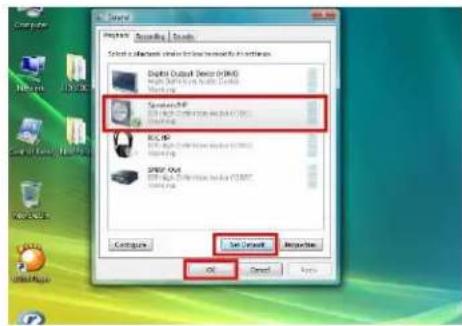
- Speaker --> Set Default --> OK
User Speaker Palyback function working
This concludes chapter 4.
Memo
Chapter 5
Setting Up eJIFFY
Introduction
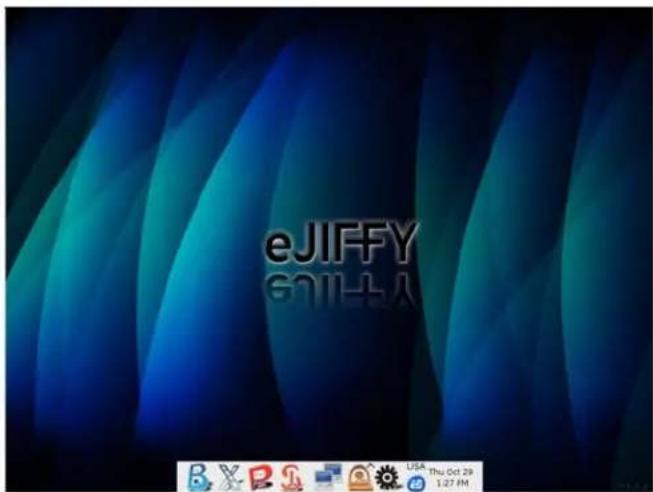
eJIFFY is a fast boot program under Linux. Instead of waiting Windows O.S to start execution, eJIFFY is ready to provide users the instant enjoyment on web browsing, photo review and online chat just within several seconds after boot up.
text_image
eJIFFY 601843 B X P S O E USA Thu Oct 29 1:27 PMNote: eJIFFY is ECS optional feature utility corresponding to the DVD activation and BIOS setup. Please check the hard copy user's guide or product color-box to see if the model has embedded eJIFFY feature. (eJIFFY icon on color-box)

Version: 5.0
Installation and BIOS Setup
DVD Activation
Finish the DVD utility setup, and then set the BIOS to complete eJIFFY activation.
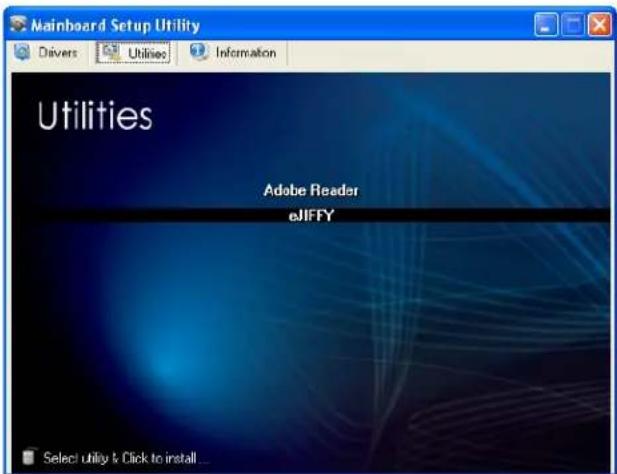
- Insert ECS software utility DVD and enter below "Utilities" screen. Click eJIFFY
feature item to install.
text_image
Mainboard Setup Utility Drivers Utilisec Information Utilities Adobe Reader eJIFFY Select utility & Click to install...- Follow the onscreen instructions to finish eJIFFY setup.
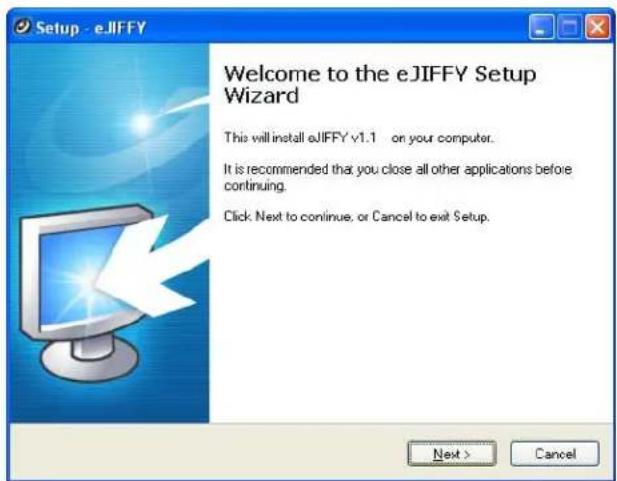
text_image
Setup - eJIFFY Welcome to the eJIFFY Setup Wizard This will install eJIFFY v1.1 on your computer. It is recommended that you close all other applications before continuing. Click: Next to continue, or Cancel to exit Setup. Next > CancelSetting Up eJIFFY
- After setting up eJIFFY under Windows, you can switch eJIFFY display/keyboard language from English to your local language. The changes will be applied after rebooting.

text_image
eJIFFY Configuration eJIFFY ELITEGROUP Language English(US) English(US) Keyboard Arabic Deutsch German English(UK) English(UK) English(US) English(US) Español Spanish Français French Nduy Hebrew Indonesia Indonesian Italiano Italian 日本語 Japanese 한국어 Korean Nederlandse Dutch Polska Poish Português Portuguese Русский Russian 1yy Thai Türkçe Turkish Українська Ukrainian Viêt Vietnamese 简体中文 Chinese(Simplified) 繁體中文 Chinese(Traditional)
text_image
eJIFFY Configuration eJIFFY ELITEGROUP Language Türkçe Turkish Keyboard Türkçe Turkish A...all Arabic Deutsch German English(UK) English(UK) English(US) English(US) Español Spanish Français French Philv Hebrew Italiano Italian 日本語 Japanese Nederlandse Dutch Polska Polish Português Portuguese Русский Russian Türkçe Turkish Українська Ukrainian Viêt VietnameseNote: The keyboard language selection list offers several more regional keyboard setups to switch with the default English typing. Please refer to the usage FAQ for more tips.
- Restart your computer after eJIFFY installation. Press
or click the BIOS Setup button on the post screen to enter the BIOS setup page after boot up.
| CMOS Setup Utility - Copyright (C) 1985-2007, American Megatrends, Inc. | |
| ►Standard CMOS Setup ►Advanced Setup ►Advanced Chipset Setup ►Integrated Peripherals ►Power Management Setup ►PCI/PnP Setup ►PC Health Status | ►M.I.B.(MB Intelligent BIOS) Load Default Settings ►Supervisor Password ►User Password Save & Exit Setup Exit Without Saving |
| ↑↓←→:Move Enter:Select +/-/::Value F10:Save ESC:Exit F1:General Help F9:Load Default Settings | |
| v02.61 (C)Copyright 1985-2006, American Megatrends, Inc. | |
- And then enter the Advanced Setup page to enable the item ECS eJIFFY Function. Press F10 to save the configuration and exit. Restart your computer.
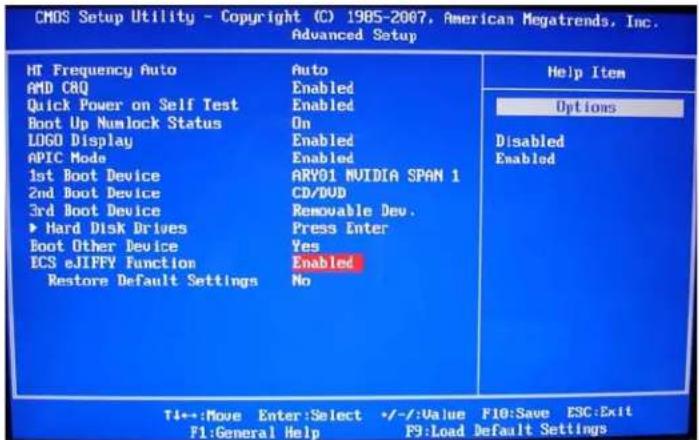
text_image
CMOS Setup Utility - Copyright (C) 1985-2007, American Megatrends, Inc. Advanced Setup HT Frequency Auto AMD C8Q Quick Power on Self Test Boot Up Numlock Status LOGO Display APIC Mode 1st Boot Device 2nd Boot Device 3rd Boot Device ► Hard Disk Drives Boot Other Device ECS eJIFFY Function Restore Default Settings Auto Enabled Enabled On Enabled Enabled ARY01 NVIDIA SPAN 1 CD/DVD Removable Dev. Press Enter Yes Enabled No Help Item Options Disabled Enabled TI++:Move Enter:Select +/-:Value F10:Save ESC:Exit F1:General Help F9:Load Default SettingsNote: 1. eJIFFY is available in SATA/IDE/AHCI mode. It does not support RAID configuration and the onboard 34-pin floppy drives.
- Please refer to ECS website for new eJIFFY application updates.
Entering eJIFFY
The post screen appears within several seconds after boot up and it has three buttons on it, Operating system, eJIFFY and BIOS Setup.
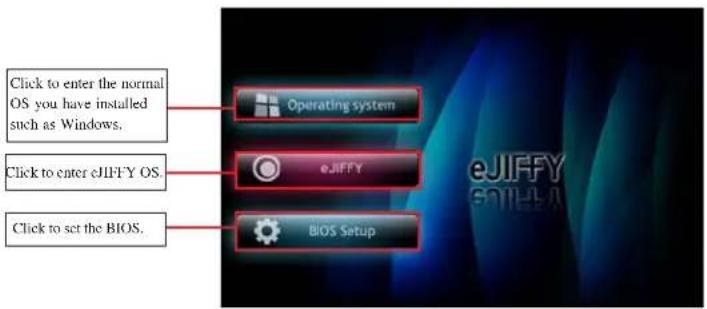
text_image
Click to enter the normal OS you have installed such as Windows. Click to enter eJIFFY OS. Click to set the BIOS. Operating system eJIFFY BIOS SetupIf you click cJIFFY, the following screen will appear. And If you make no choice it will enter the normal OS automatically after ten seconds.

text_image
eJIFFY SOLTA B X R T U S A U S A U S A U S A U S A U S A U S A U S A U S A U S A U S A U S A U S A U S A U S A U S A U S A U S A U S A U S A U S A U S A U S A U S A U S A U S A U S A U S A U S A U S A U S A U S A U S A U S A USA Thu Oct 29 1:27 PMFeature Icons
The following illustration shows the main feature icons that eJIFFY provides on the menu.

text_image
B X P S T Fra Thu Oct 29 1:24 PM
eWeb: Firefox for web browsing/webmail and watching flash video.

ePix: Photo viewing.

ePal: On-line chat tool to use the most popular IMs in the world. (MSN, ICQ, AIM, etc.)

Shows ePal on-line connection status.

Shut Down/Restart: Ends your session and turns off the computer./Ends your session and restart the computer..

Click once to connect the storage disk to your computer. Click for the second time to remove your storage disk safely. (please refer to the / Q for more usage information.)

Shows the network connection status.

Language Control Panel

Switch Keyboard Languages
Usage FAQ

Language Control Panel: Besides setting English as the default interface, eJIFFY offers multi-language displays and keyboard settings for language-switch. Open the language control panel to select a preferable language setting.
Keyboard Language Setup
Step1. Click

to open the language control panel.
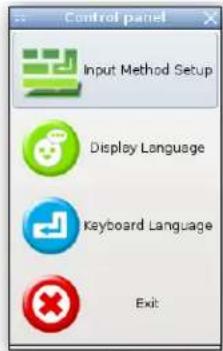
text_image
Control panel Input Method Setup Display Language Keyboard Language Exit:Step 2: Click "Keyboard Language" icon

to open the keyboard selection
list, which offers several regional keyboard settings besides default English keyboard. Step 3: Click the selected keyboard language (e.g. French) and press "OK".

text_image
Keyboard language(Keyboard Language) Keyboard language Check Language Language ○ العربية Arabic ○ Deutsch German ○ English(UK) English(UK) ○ English(US) English(US) ○ Español Spanish ● Français French ○ Jin'au Habrow ○ ItalianoITALIAN ○ 日本語 Japanese ○ Nederlandse Dutch ○ Polska Polish ○ Português Portuguese ○ Rysokniş Russian ○ Turkçe Turkish ○(Yukrainksya) Ukrainian ○ Viett Vietnamese Cancel OKSetting Up eJIFFY
Click

to enable all possible language inputs you want to apply, and click
"Apply":

text_image
SCIM Input Method Setup Frontline Global Setup IMEngine Global Setup Anthy Chewing Smart Pinyin Generic Table Panel GTK The installed input method services: Name Enable Hotkeys Filters Amharic ✓ sengali ✓ Gujarati ✓ Cindi ✓ Japanese ✓ Korean ✓ Malayslam ✓ Nepali ✓ Punabi ✓ Expand Collapse Enable All Disable All Select Plan Edit Options Envert Apply Out OK You can enable/disable input methods and set hotkeys for input methods here.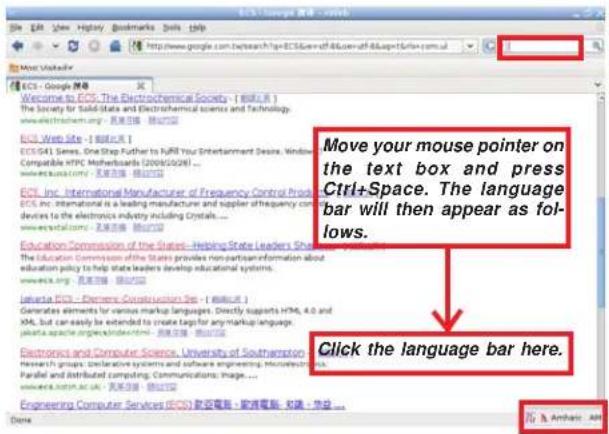
text_image
Move your mouse pointer on the text box and press Ctrl+Space. The language bar will then appear as follows. Click the language bar here.Select your desired language

text_image
Amharic - Amharic Bengali Gujarati Hindi Japanese Korean Malayalam Nepali Punjabi Tamil Thai Chinese (simplified) Chinese (traditional) Other English/KeyboardSetting Up eJIFFY
How to change display language?
Open the Language Control Panel and click

to show the display language
list. Check your desired display language. Your selected display language will be applied after rebooting.

text_image
Check to select your language. Your selection will be applied after rebooting. Check Language Language ○ Arabic ○ Deutsch German ○ English(UK) English(UK) ● English(US) English(US) ○ Español Spanish ○ Français French ○ Ḍπινη Hebrew ○ Indonesia Indonesian ○ Italiano Italian ○ 日本語 Japanese ○ 한국어 Korean ○ Nederlandse Dutch ○ Polska Polish ○ Português Portuguese ○ Русский Russian ○ lǐnǚ Thai ○ Türkçe Turkish ○ Українська Ukrainian ○ Viét Vietnamese ○ 简体中文 Chinese(Simplified) ○ 繁體中文 Chinese(Traditional) Cancel OKNote: Details about eJIFFY please refer to eJIFFY in disk.
Memo
Chapter 6 Trouble Shooting
Start up problems during assembly
After assembling the PC for the first time you may experience some start up problems. Before calling for technical support or returning for warranty, this chapter may help to address some of the common questions using some basic troubleshooting tips.
a) System does not power up and the fans are not running.
- Disassemble the PC to remove the VGA adaptor card, DDR memory, LAN, USB and other peripherals including keyboard and mouse. Leave only the motherboard, CPU with CPU cooler and power supply connected. Turn on again to see if the CPU and power supply fans are running.
- Make sure to remove any unused screws or other metal objects such as screwdrivers from the inside PC case. This is to prevent damage from short circuit.
- Check the CPU FAN connector is connected to the motherboard.
- For Intel platforms check the pins on the CPU socket for damage or bent. A bent pin may cause failure to boot and sometimes permanent damage from short circuit.
- Check the 12V power connector is connected to the motherboard.
- Check that the 12V power & ATX connectors are fully inserted into the motherboard connectors. Make sure the latches of the cable and connector are locked into place.
b) Power is on, fans are running but there is no display
- Make sure the monitor is turned on and the monitor cable is properly connected to the PC.
- Check the VGA adapter card (if applicable) is inserted properly.
- Listen for beep sounds. If you are using internal PC speaker make sure it is connected.
a. continuous 3 short beeps : memory not detected
b. 1 long beep and 8 short beeps : VGA not detected
c) The PC suddenly shuts down while booting up.
- The CPU may experience overheating so it will shutdown to protect itself. Ensure the CPU fan is working properly.
- From the BIOS setting, try to disable the Smartfan function to let the fan run at default speed. Doing a Load Optimised Default will also disable the Smartfan.
Start up problems after prolong use
After a prolong period of use your PC may experience start up problems again. This may be caused by breakdown of devices connected to the motherboard such as HDD, CPU fan, etc. The following tips may help to revive the PC or identify the cause of failure.
- Clear the CMOS values using the CLR_CMOS jumper. Refer to CLR_CMOS jumper in Chapter 2 for Checking Jumper Settings in this user manual. When completed, follow up with a Load Optimised Default in the BIOS setup.
- Check the CPU cooler fan for dust. Long term accumulation of dust will reduce its effectiveness to cool the processor. Clean the cooler or replace a new one if necessary.
- Check that the 12V power & ATX connectors are fully inserted into the motherboard connectors. Make sure the latches of the cable and connector are locked into place.
- Remove the hard drive, optical drive or DDR memory to determine which of these component may be at fault.
Maintenance and care tips
Your computer, like any electrical appliance, requires proper care and maintenance. Here are some basic PC care tips to help prolong the life of the motherboard and keep it running as best as it can.
- Keep your computer in a well ventilated area. Leave some space between the PC and the wall for sufficient airflow.
- Keep your computer in a cool dry place. Avoid dusty areas, direct sunlight and areas of high moisture content.
- Routinely clean the CPU cooler fan to remove dust and hair.
- In places of hot and humid weather you should turn on your computer once every other week to circulate the air and prevent damage from humidity.
- Add more memory to your computer if possible. This not only speeds up the system but also reduces the loading of your hard drive to prolong its lifespan.
- If possible, ensure the power cord has an earth ground pin directly from the wall outlet. This will reduce voltage fluctuation that may damage sensitive devices.
Basic Troubleshooting Flowchart
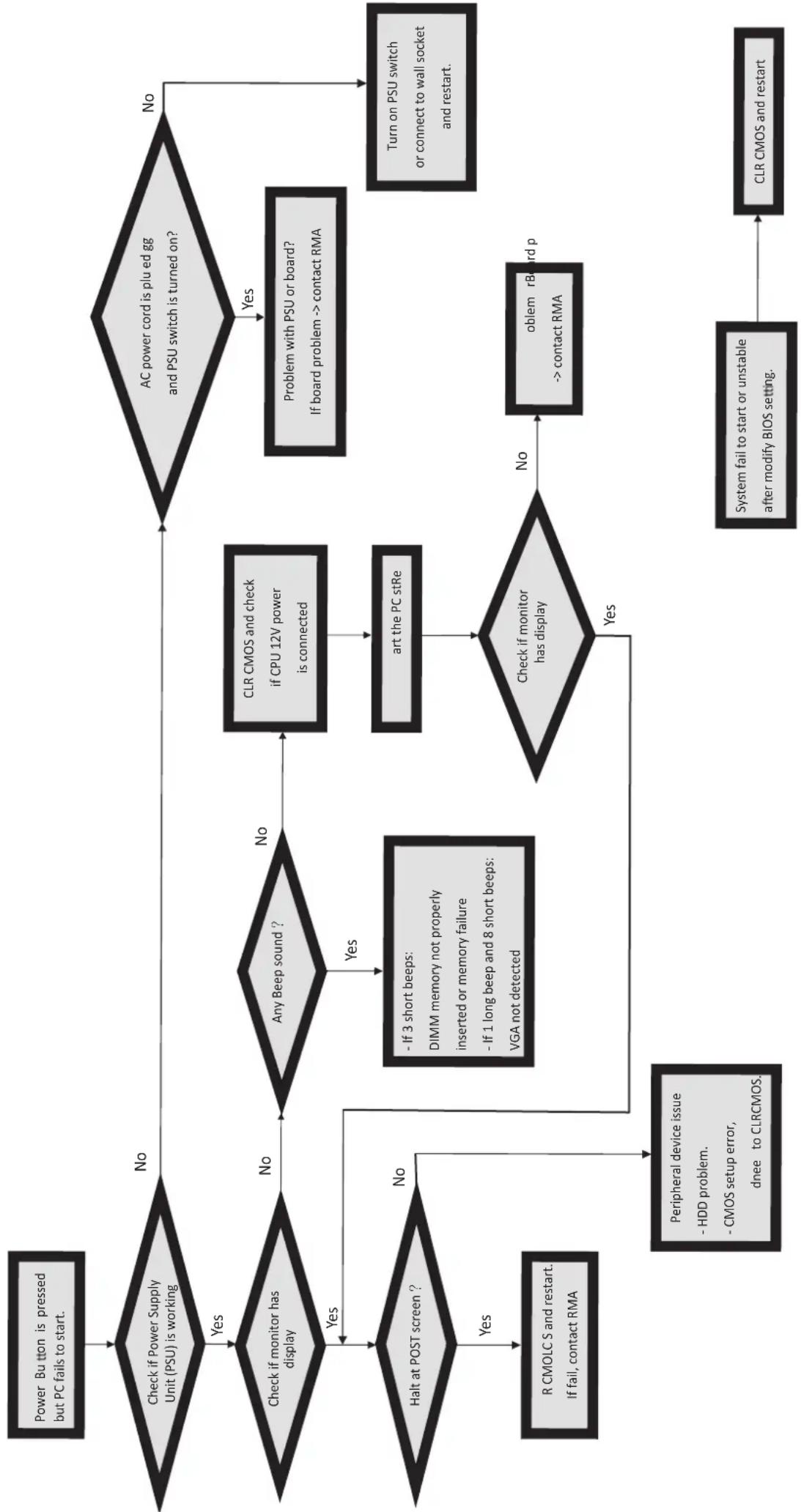
flowchart
graph TD
    A["Power Button is pressed but PC fails to start."] --> B{Check if Power Supply Unit (PSU) is working}
    B -->|No| C{AC power cord is plu ed gg and PSU switch is turned on?}
    B -->|Yes| D{Check if monitor has display}
    D -->|Yes| E{Any Beep sound ?}
    D -->|No| F{Halt at POST screen ?}
    F -->|Yes| G["R CMOLC S and restart. If fail, contact RMA"]
    F -->|No| H{>| Check if monitor has display |
    H -->|Yes| I["Peripheral device issue - HDD problem.<br>- CMOS setup error,<br>dnee to CLRCMOS."]
    H -->|No| J{- If 3 short beeps:
DIMM memory not properly
inserted or memory failure
- If 1 long beep and 8 short beeps:
VGA not detected}
    J --> K["ART THE PC stRe"]
    K --> L{Check if monitor has display}
    L -->|No| M["problem rBoard p --> contact RMA"]
    L -->|Yes| N["OR: System fail to start or unstable after modify BIOS setting."]
    C --> O{Problem with PSU or board?
If board problem --> contact RMA}
    O --> P["Turn on PSU switch or connect to wall socket and restart."]
    C --> Q{AC power cord is plu ed gg and PSU switch is turned on?}
    Q -->|No| R["OR: System fail to start or unstable after modify BIOS setting."]
    Q -->|Yes| S["OR: Problem with PSU or board?<br>If board problem --> contact RMA"]
    R --> T["OR: System fail to start or unstable after modify BIOS setting."]
    T --> U["OR: System fail to start or unstable after modify BIOS setting."]
Memo