A75iCafe - Motherboard ASROCK - Free user manual and instructions
Find the device manual for free A75iCafe ASROCK in PDF.


User questions about A75iCafe ASROCK
0 question about this device. Answer the ones you know or ask your own.
Ask a new question about this device
Download the instructions for your Motherboard in PDF format for free! Find your manual A75iCafe - ASROCK and take your electronic device back in hand. On this page are published all the documents necessary for the use of your device. A75iCafe by ASROCK.
USER MANUAL A75iCafe ASROCK
Copyright©2012 ASRock INC. All rights reserved.
Copyright Notice:
No part of this manual may be reproduced, transcribed, transmitted, or translated in any language, in any form or by any means, except duplication of documentation by the purchaser for backup purpose, without written consent of ASRock Inc.
Products and corporate names appearing in this manual may or may not be registered trademarks or copyrights of their respective companies, and are used only for identification or explanation and to the owners' benefit, without intent to infringe.
Disclaimer:
Specifications and information contained in this manual are furnished for informational use only and subject to change without notice, and should not be constructed as a commitment by ASRock. ASRock assumes no responsibility for any errors or omissions that may appear in this manual.
With respect to the contents of this manual, ASRock does not provide warranty of any kind, either expressed or implied, including but not limited to the implied warranties or conditions of merchantability or fitness for a particular purpose.
In no event shall ASRock, its directors, officers, employees, or agents be liable for any indirect, special, incidental, or consequential damages (including damages for loss of profits, loss of business, loss of data, interruption of business and the like), even if ASRock has been advised of the possibility of such damages arising from any defect or error in the manual or product.

This device complies with Part 15 of the FCC Rules. Operation is subject to the following two conditions:
(1) this device may not cause harmful interference, and
(2) this device must accept any interference received, including interference that may cause undesired operation.
CALIFORNIA, USA ONLY
The Lithium battery adopted on this motherboard contains Perchlorate, a toxic substance controlled in Perchlorate Best Management Practices (BMP) regulations passed by the California Legislature. When you discard the Lithium battery in California, USA, please follow the related regulations in advance.
"Perchlorate Material-special handling may apply, see
www.dtsc.ca.gov/hazardouswaste/perchlorate"
ASRock Website: http://www.asrock.com
Contents
1. Introduction ...... 5
1.1 Package Contents .... 5
1.2 Specifications 6
1.3 Motherboard Layout 12
1.4 I/O Panel 13
2. Installation 14
Pre-installation Precautions 14
2.1 CPU Installation 15
2.2 Installation of CPU Fan and Heatsink 15
2.3 Installation of Memory Modules (DIMM) 16
2.4 Expansion Slots (PCI and PCI Express Slots) 17
2.5 CrossFireX ^TM and Quad CrossFireX ^TM Operation Guide ..... 18
2.6 Dual Graphics Operation Guide 22
2.7 Dual Monitor and Surround Display Features 24
2.8 ASRock Smart Remote Installation Guide 27
2.9 Jumpers Setup 29
2.10 Onboard Headers and Connectors 30
2.11 Serial ATA3 (SATA3) Hard Disks Installation 35
2.12 Hot Plug and Hot Swap Functions for SATA3 HDDs 35
2.13 SATA / SATA2 / SATA3 HDD Hot Plug and Hot Swap Feature and Operation Operation Guide 36
2.14 Driver Installation Guide 38
2.15 Installing Windows ^ 7 / 7 64-bit / Vista ^TM / Vista ^TM 64-bit / XP / XP 64-bit With RAID Functions .... 38
2.15.1 Installing Windows ^ XP / XP 64-bit With RAID Functions .... 38
2.15.2 Installing Windows ^® 7 / 7 64-bit / Vista ^TM / Vista ^TM 64-bit With RAID Functions .... 39
2.16 Installing Windows ^ 7 / 7 64-bit / Vista ^TM / Vista ^TM 64-bit / XP / XP 64-bit Without RAID Functions .... 40
2.16.1 Installing Windows ^ XP / XP 64-bit Without RAID Functions .... 40
2.16.2 Installing Windows ^® 7 / 7 64-bit / Vista ^TM / Vista ^TM 64-bit Without RAID Functions .... 41
3. UEFI SETUP UTILITY 42
3.1 Introduction 42
3.1.1 UEFI Menu Bar 42
3.1.2 Navigation Keys 43
3.2 Main Screen 43
3.3 OC Tweaker Screen 44
3.4 Advanced Screen 48
3.4.1 CPU Configuration 49
3.4.2 North Bridge Configuration 50
3.4.3 South Bridge Configuration 51
3.4.4 Storage Configuration 52
3.4.5 Super IO Configuration 53
3.4.6 ACPI Configuration 54
3.4.7 USB Configuration 56
3.5 Hardware Health Event Monitoring Screen 57
3.6 Boot Screen 58
3.7 Security Screen 59
3.8 Exit Screen 60
4. Software Support 61
4.1 Install Operating System 61
4.2 Support CD Information 61
4.2.1 Running Support CD 61
4.2.2 Drivers Menu 61
4.2.3 Utilities Menu 61
4.2.4 Contact Information 61
1. Introduction
Thank you for purchasing ASRock A75iCafe motherboard, a reliable motherboard produced under ASRock's consistently stringent quality control. It delivers excellent performance with robust design conforming to ASRock's commitment to quality and endurance.
In this manual, chapter 1 and 2 contain introduction of the motherboard and step-by-step guide to the hardware installation. Chapter 3 and 4 contain the configuration guide to BIOS setup and information of the Support CD.

Because the motherboard specifications and the BIOS software might be updated, the content of this manual will be subject to change without notice. In case any modifications of this manual occur, the updated version will be available on ASRock website without further notice. You may find the latest VGA cards and CPU support lists on ASRock website as well. ASRock website http://www.asrock.com
If you require technical support related to this motherboard, please visit our website for specific information about the model you are using. www.asrock.com/support/index.asp
1.1 Package Contents
ASRock A75iCafe Motherboard
(ATX Form Factor: 12.0-in x 7.2-in, 30.5 cm x 18.3 cm)
ASRock A75iCafe Quick Installation Guide
ASRock A75iCafe Support CD
2 x Serial ATA (SATA) Data Cables (Optional)
1 x I/O Panel Shield

ASRock Reminds You...
To get better performance in Windows ^® 7/764-bit/Vista ^TM /Vista ^TM 64 bit, it is recommended to set the BIOS option in Storage Configuration to AHCI mode. For the BIOS setup, please refer to the "User Manual" in our support CD for details.
1.2 Specifications
| Platform - ATX Form Factor: 12.0-in x 7.2-in, 30.5 cm x 18.3 cm- All Solid Capacitor design | |
| CPU - Support for Socket FM1 100W processors- 4 + 1 Power Phase Design-Supports AMD's Cool 'n' Quiet TM Technology- UMI-Link GEN2 | |
| Chipset - AMD A75 FCH (Hudson-D3) | |
| Memory - Dual Channel DDR3 Memory Technology (see CAUTION 1)- 2 x DDR3 DIMM slots-Support DDR3 2400+(OC)/2133(OC)/1866/1600/1333/1066/800 non-ECC, un-buffered memory (see CAUTION 2)- Max. capacity of system memory: 16GB (see CAUTION 3) | |
| Expansion Slot - 2 x PCI Express 2.0 x16 slots(PCIE2 @ x16 mode; PCIE5 @ x4 mode)- 3 x PCI Express 2.0 x1 slots- 2 x PCI slots-Supports AMD Quad CrossFireXTM, CrossFireXTM and Dual Graphics | |
| Graphics - AMD Radeon HD 65XX/64XX graphics-DirectX 11, Pixel Shader 5.0-Max. shared memory 512MB (see CAUTION 4)- Dual VGA Output: support D-Sub and DVI-D ports by independent display controllers-Supports Dual-link DVI with max. resolution up to 2560x1600 @ 75Hz-Supports D-Sub with max. resolution up to 1920x1600 @ 60Hz-Supports AMD Steady VideotM: New video post processing capability for automatic jitter reduction on home/online video-Supports HDCP function with DVI port-Supports Full HD 1080p Blu-ray (BD) / HD-DVD playback with DVI port | |
| Audio - 5.1 CH HD Audio (Realtek ALC662 Audio Codec) | |
| LAN - PCIE x1 Gigabit LAN 10/100/1000 Mb/s- Realtek RTL8111E-Supports Wake-On-LAN-Supports LAN Cable Detection-Supports Energy Efficient Ethernet 802.3az | |
| - Supports PXE | |
| Rear Panel I/O I/O Panel- 1 x PS/2 Mouse Port- 1 x PS/2 Keyboard Port- 1 x D-Sub Port- 1 x DVI-D Port- 4 x Ready-to-Use USB 2.0 Ports- 2 x Ready-to-Use USB 3.0 Ports- 1 x RJ-45 LAN Port with LED (ACT/LINK LED and SPEED LED)- HD Audio Jack: Line in/Front Speaker/Microphone | |
| SATA3 - 6 x SATA3 6.0 Gb/s connectors, support RAID (RAID 0, RAID 1 and RAID 10), NCQ, AHCI and “Hot Plug” functions | |
| USB 3.0 - 2 x Rear USB 3.0 ports, support USB 1.0/2.0/3.0 up to 5Gb/s- 1 x Front USB 3.0 header (supports 2 USB 3.0 ports), supports USB 1.0/2.0/3.0 up to 5Gb/s | |
| Connector - 6 x SATA3 6.0 Gb/s connectors- 1 x IR header- 1 x COM port header- 1 x HDMI_SPDIF header- 1 x Power LED header- 1 x CPU Fan connector (4-pin)- 2 x Chassis Fan connectors (2 x 4-pin)- 24 pin ATX power connector- 8 pin 12V power connector- Front panel audio connector- 2 x USB 2.0 headers (support 4 USB 2.0 ports)- 1 x USB 3.0 header (supports 2 USB 3.0 ports) | |
| BIOS Feature - 32Mb AMI UEFI Legal BIOS with GUI support- Supports “Plug and Play”- ACPI 1.1 Compliance Wake Up Events- Supports jumperfree- SMBIOS 2.3.1 Support- DRAM, VDDP, VDDR, SB Voltage Multi-adjustment | |
| Support CD - Drivers, Utilities, AntiVirus Software (Trial Version), CyberLink MediaEspresso 6.5 Trial | |
| Unique Feature- ASRock Instant Boot- ASRock Instant Flash (see CAUTION 6) | - ASRock Extreme Tuning Utility (AXTU) (see CAUTION 5) |
| - ASRock APP Charger (see CAUTION 7)- ASRock XFast USB (see CAUTION 8)- ASRock XFast LAN (see CAUTION 9)- ASRock XFast RAM (see CAUTION 10)- Hybrid Booster:- ASRock U-COP (see CAUTION 11) | |
| Hardware - CPU Temperature SensingMonitor - Chassis Temperature Sensing- CPU/Chassis Fan Tachometer- CPU Quiet Fan- CPU/Chassis Fan Multi-Speed Control- Voltage Monitoring: +12V, +5V, +3.3V, Vcore | |
| OS - Microsoft® Windows® 7 / 7 64-bit / VistaTM / VistaTM 64-bit / XP SP3 / XP 64-bit compliant (see CAUTION 12) | |
| Certifications - FCC, CE, WHQL- ErP/EuP Ready (ErP/EuP ready power supply is required)(see CAUTION 13) | |
* For detailed product information, please visit our website: http://www.asrock.com
WARNING
Please realize that there is a certain risk involved with overclocking, including adjusting the setting in the BIOS, applying Untied Overclocking Technology, or using the third-party overclocking tools. Overclocking may affect your system stability, or even cause damage to the components and devices of your system. It should be done at your own risk and expense. We are not responsible for possible damage caused by overclocking.
CAUTION!
-
This motherboard supports Dual Channel Memory Technology. Before you implement Dual Channel Memory Technology, make sure to read the installation guide of memory modules on page 16 for proper installation.
-
Whether 2400/2133/1866/1600MHz memory speed is supported depends on the CPU you adopt. If you want to adopt DDR3 2400/2133/1866/1600 memory module on this motherboard, please refer to the memory support list on our website for the compatible memory modules.
ASRock website http://www.asrock.com
-
Due to the operating system limitation, the actual memory size may be less than 4GB for the reservation for system usage under Windows ^ 7 / Vista ^TM / XP. For Windows ^ 64-bit OS with 64-bit CPU, there is no such limitation. You can use ASRock XFast RAM to utilize the memory that Windows ^ cannot use.
-
The maximum shared memory size is defined by the chipset vendor and is subject to change. Please check AMD website for the latest information.
-
ASRock Extreme Tuning Utility (AXTU) is an all-in-one tool to ne-tune different system functions in a user-friendly interface, which is including Hardware Monitor, Fan Control, Overclocking, OC DNA and IES. In Hardware Monitor, it shows the major readings of your system. In Fan Control, it shows the fan speed and temperature for you to adjust. In Overclocking, you are allowed to overclock CPU frequency for optimal system performance. In OC DNA, you can save your OC settings as a profile and share with your friends. Your friends then can load the OC profile to their own system to get the same OC settings. In IES (Intelligent Energy Saver), the voltage regulator can reduce the number of output phases to improve efficiency when the CPU cores are idle without sacrificing computing performance. Please visit our website for the operation procedures of ASRock Extreme Tuning Utility (AXTU).
ASRock website: http://www.asrock.com
-
ASRock Instant Flash is a BIOS flash utility embedded in Flash ROM. This convenient BIOS update tool allows you to update system BIOS without entering operating systems first like MS-DOS or Windows ^ . With this utility, you can press
key during the POST or press key to BIOS setup menu to access ASRock Instant Flash. Just launch this tool and save the new BIOS file to your USB flash drive, floppy disk or hard drive, then you can update your BIOS only in a few clicks without preparing an additional floppy diskette or other complicated flash utility. Please be noted that the USB flash drive or hard drive must use FAT32/16/12 file system. -
If you desire a faster, less restricted way of charging your Apple devices, such as iPhone/iPod/iPad Touch, ASRock has prepared a wonderful solution for you - ASRock APP Charger. Simply installing the APP Charger driver, it makes your iPhone charged much quickly from your computer and up to 40% faster than before. ASRock APP Charger allows you to quickly charge many Apple devices simultaneously and even supports continuous charging when your PC enters into Standby mode (S1), Suspend to RAM (S3), hibernation mode (S4) or power off (S5). With APP Charger driver installed, you can easily enjoy the marvelous charging experience than ever.
ASRock website: http://www.asrock.com/Feature/AppCharger/index.asp
-
ASRock XFast USB can boost USB storage device performance. The performance may depend on the property of the device.
-
ASRock XFast LAN provides a faster internet access, which includes below benefits. LAN Application Prioritization: You can configure your application priority ideally and/or add new programs. Lower Latency in Game: After setting online game priority higher, it can lower the latency in game. Traffic Shaping: You can watch Youtube HD video and download files simultaneously. Real-Time Analysis of Your Data: With the status window, you can easily recognize which data streams you are currently transferring.
-
ASRock XFast RAM is a new function that is included into ASRock Extreme Tuning Utility (AXTU). It fully utilizes the memory space that cannot be used under Windows® OS 32-bit CPU. ASRock XFast RAM shortens the loading time of previously visited websites, making web surfing faster than ever. And it also boosts the speed of Adobe Photoshop 5 times faster. Another advantage of ASRock XFast RAM is that it reduces the frequency of accessing your SSDs or HDDs in order to extend their lifespan.
-
While CPU overheat is detected, the system will automatically shutdown. Before you resume the system, please check if the CPU fan on the motherboard functions properly and unplug the power cord, then plug it back again. To improve heat dissipation, remember to spray thermal grease between the CPU and the heatsink when you install the PC system.
-
ASRock XFast RAM is not supported by Microsoft Windows® XP / XP 64-bit.
-
EuP, stands for Energy Using Product, was a provision regulated by European Union to define the power consumption for the completed system. According to EuP, the total AC power of the completed system shall be under 1.00W in off mode condition. To meet EuP standard, an EuP ready motherboard and an EuP ready power supply are required. According to Intel's suggestion, the EuP ready power supply must meet the standard of 5v standby power efficiency is higher than 50% under 100 mA current consumption. For EuP ready power supply selection, we recommend you checking with the power supply manufacturer for more details.
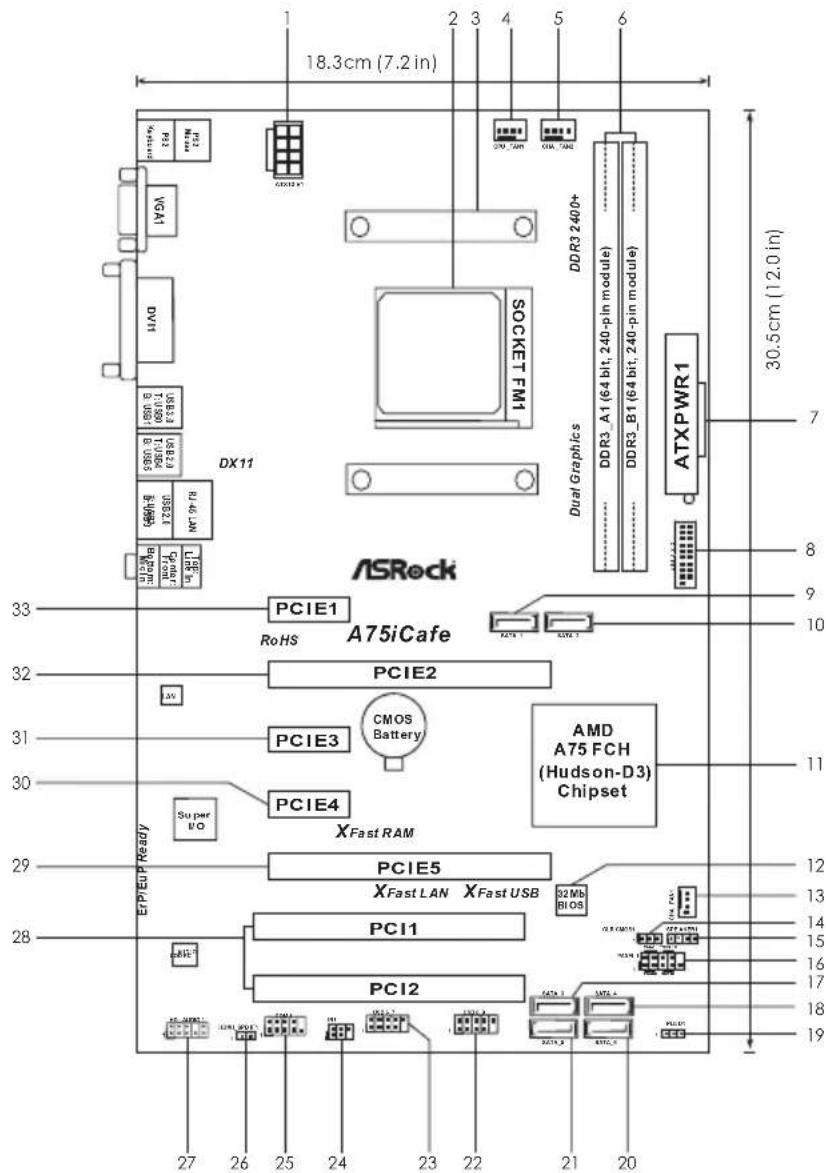
1.3 Motherboard Layout
text_image
18.3cm (7.2 in) 30.5cm (12.0 in) 1 2 3 4 5 6 7 8 9 10 11 12 13 14 15 16 17 18 19 DX11 PCIE1 RoHS ASRock A75iCafe PCIE2 CMOS Battery PCIE3 PCIE4 XFast RAM PCIE5 XFast LAN XFast USB PCI1 PCI2 Dual Graphics DDR3 240+ DDR3_A1 (64 bit, 240-pin module) DDR3_B1 (64 bit, 240-pin module) ATXPWR1 AMD A75 FCH (Hudson-D3) Chipset1 ATX 12V Power Connector (ATX12V1) 17 SATA3 Connector (SATA_3)
2 CPU Socket 18 SATA3 Connector (SATA_4)
3 CPU Heatsink Retention Module 19 Power LED Header (PLED1)
4 CPU Fan Connector (CPU_FAN1) 20 SATA3 Connector (SATA_6)
5 Chassis Fan Connector (CHA_FAN2) 21 SATA3 Connector (SATA_5)
6 2 x 240-pin DDR3 DIMM Slots 22 USB 2.0 Header (USB8_9)
(Dual Channel: DDR3_A1, DDR3_B1) 23 USB 2.0 Header (USB6_7)
7 ATX Power Connector (ATXPWR1) 24 Infrared Module Header (IR1)
8 USB 3.0 Header (USB3_2_3) 25 COM Port Header (COM1)
9 SATA3 Connector (SATA_1) 26 HDMI_SPDIF Header (HDMI_SPDIF1)
10 SATA3 Connector (SATA_2) 27 Front Panel Audio Header (HD_AUDIO1)
11 Southbridge Controller 28 PCI Slots (PCI1-2)
12 SPI Flash Memory (32Mb) 29 PCI Express 2.0 x16 Slot (PCIE5)
13 Chassis Fan Connector (CHA_FAN1) 30 PCI Express 2.0 x1 Slot (PCIE4)
14 Clear CMOS Jumper (CLRCMOS1) 31 PCI Express 2.0 x1 Slot (PCIE3)
15 Chassis Speaker Header (SPEAKER 1) 32 PCI Express 2.0 x16 Slot (PCIE2)
16 System Panel Header (PANEL1) 33 PCI Express 2.0 x1 Slot (PCIE1)
1.4 I/O Panel

text_image
1 11 10 9 8 7 6 2 3 4 51 PS/2 Mouse Port (Green) 7 USB 2.0 Ports (USB45)
* 2 LAN RJ-45 Port 8 USB 3.0 Ports (USB01)
3 Line In (Light Blue)
** 4 Front Speaker (Lime)
5 Microphone (Pink)
6 USB 2.0 Ports (USB23)
9 DVI-D Port
10 D-Sub Port
11 PS/2 Keyboard Port (Purple)
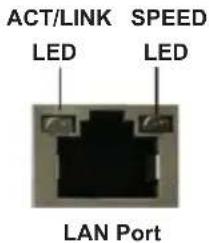
* There are two LED next to the LAN port. Please refer to the table below for the LAN port LED indications.
LAN Port LED Indications
| Status | Description |
| Off | No Link |
| Blinking | Data Activity |
| On | Link Gr |
SPEED LED
| Status | Description |
| Off | 10Mbps connection |
| Orange | 100Mbps connection |
| en 1Gbps connection | |
text_image
ACT/LINK LED SPEED LED LAN Port** To enable Multi-Streaming function, you need to connect a front panel audio cable to the front panel audio header. Please refer to below steps for the software setting of Multi-Streaming.
For Windows ^® XP:
After restarting your computer, you will find "Mixer" tool on your system. Please select "MixerToolBox", click "Enable playback multi-streaming", and click "ok". Choose "2CH" or

"4CH" and then you are allowed to select "Realtek HDA Primary output" to use Rear Speaker and Front Speaker, or select "Realtek HDA Audio 2nd output" to use front panel audio. Then reboot your system.
For Windows ^® 7 / Vista ^TM :
After restarting your computer, please double-click "Realtek HD Audio Manager" on the system tray. Set "Speaker Configuration" to "Quadraphonic" or "Stereo". Click "Device advanced settings", choose "Make front and rear output devices playbacks two different audio streams simultaneously", and click "ok". Then reboot your system.
2. Installation\_
This is an ATX form factor (12.0-in x 7.2-in, 30.5 cm x 18.3 cm) motherboard.
Before you install the motherboard, study the configuration of your chassis to ensure that the motherboard fits into it.
Pre-installation Precautions
Take note of the following precautions before you install motherboard components or change any motherboard settings.
Before you install or remove any component, ensure that the power is switched off or the power cord is detached from the power supply. Failure to do so may cause severe damage to the motherboard, peripherals, and/or components.
- Unplug the power cord from the wall socket before touching any component.
- To avoid damaging the motherboard components due to static electricity, NEVER place your motherboard directly on the carpet or the like. Also remember to use a grounded wrist strap or touch a safety grounded object before you handle components.
- Hold components by the edges and do not touch the ICs.
- Whenever you uninstall any component, place it on a grounded anti-static pad or in the bag that comes with the component.
- When placing screws into the screw holes to secure the motherboard to the chassis, please do not over-tighten the screws! Doing so may damage the motherboard.
2.1 CPU Installation
Step 1. Unlock the socket by lifting the lever up to a 90^ angle.
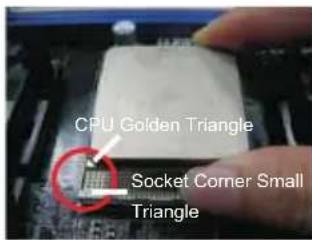
Step 2. Position the CPU directly above the socket such that the CPU corner with the golden triangle matches the socket corner with a small triangle.
Step 3. Carefully insert the CPU into the socket until it fits in place.

The CPU fits only in one correct orientation. DO NOT force the CPU into the socket to avoid bending of the pins.
Step 4. When the CPU is in place, press it firmly on the socket while you push down the socket lever to secure the CPU. The lever clicks on the side tab to indicate that it is locked.
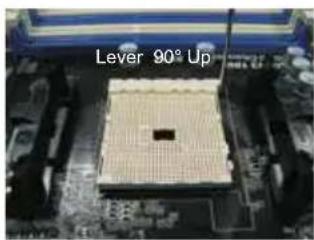
text_image
Lever 90° UpSTEP 1:
Lift Up The Socket Lever
text_image
CPU Golden Triangle Socket Corner Small TriangleSTEP 2 / STEP 3:
Match The CPU Golden Triangle
To The Socket Corner Small
Triangle

natural_image
Close-up of a CPU socket on a motherboard (no visible text or symbols)STEP 4:
Push Down And Lock
The Socket Lever
2.2 Installation of CPU Fan and Heatsink
After you install the CPU into this motherboard, it is necessary to install a larger heatsink and cooling fan to dissipate heat. You also need to spray thermal grease between the CPU and the heatsink to improve heat dissipation. Make sure that the CPU and the heatsink are securely fastened and in good contact with each other. Then connect the CPU fan to the CPU FAN connector (CPU_FAN1, see Page 12, No. 4). For proper installation, please kindly refer to the instruction manuals of the CPU fan and the heatsink.
2.3 Installation of Memory Modules (DIMM)
This motherboard provides two 240-pin DDR3 (Double Data Rate 3) DIMM slots, and supports Dual Channel Memory Technology. For dual channel configuration, you always need to install two identical (the same brand, speed, size and chip-type) memory modules in the DDR3 DIMM slots to activate Dual Channel Memory Technology. Otherwise, it will operate at single channel mode.
- It is not allowed to install a DDR or DDR2 memory module into DDR3 slot; otherwise, this motherboard and DIMM may be damaged.
- If you install only one memory module or two non-identical memory modules, it is unable to activate the Dual Channel Memory Technology.
Installing a DIMM

Please make sure to disconnect power supply before adding or removing DIMMs or the system components.
Step 1. Unlock a DIMM slot by pressing the retaining clips outward.
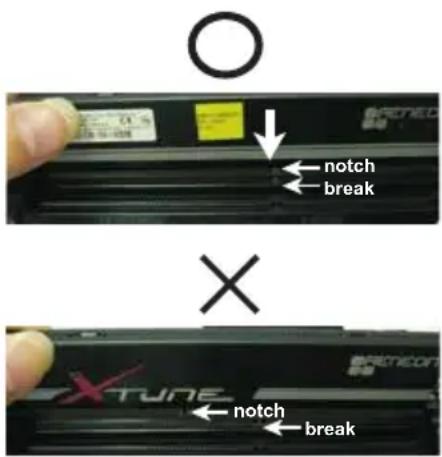
Step 2. Align a DIMM on the slot such that the notch on the DIMM matches the break on the slot.
text_image
O BRETEC ↓ notch ← break X TUNE ↓ notch ← break
The DIMM only fits in one correct orientation. It will cause permanent damage to the motherboard and the DIMM if you force the DIMM into the slot at incorrect orientation.
Step 3. Firmly insert the DIMM into the slot until the retaining clips at both ends fully snap back in place and the DIMM is properly seated.
2.4 Expansion Slots (PCI and PCI Express Slots)
There are 2 PCI slots and 5 PCI Express slots on this motherboard.
PCI Slots: PCI slots are used to install expansion cards that have the 32-bit PCI interface.
PCIE Slots:
PCIE1 / PCIE3 / PCIE4 (PCIE x1 slot) is used for PCI Express cards with x1 lane width cards, such as Gigabit LAN card and SATA2 card.
PCIE2 (PCIE x16 slot) is used for PCI Express x16 lane width graphics cards, or used to install PCI Express graphics cards to support
CrossFireX ^TM function.
PCIE5 (PCIE x16 slot) is used for PCI Express x4 lane width cards, or used to install PCI Express graphics cards to support CrossFireX ^TM function.

- In single VGA card mode, it is recommended to install a PCI Express x16 graphics card on PCIE2 slot.
- In CrossFireX ^TM mode, please install PCI Express x16 graphics cards on PCIE2 and PCIE5 slots. Therefore, PCIE2 slot will work at x16 bandwidth while PCIE5 slot will work at x4 bandwidth.
Installing an expansion card
Step 1. Before installing the expansion card, please make sure that the power supply is switched off or the power cord is unplugged. Please read the documentation of the expansion card and make necessary hardware settings for the card before you start the installation.
Step 2. Remove the system unit cover (if your motherboard is already installed in a chassis).
Step 3. Remove the bracket facing the slot that you intend to use. Keep the screws for later use.
Step 4. Align the card connector with the slot and press firmly until the card is completely seated on the slot.
Step 5. Fasten the card to the chassis with screws.
Step 6. Replace the system cover.
2.5 CrossFireX™ and Quad CrossFireX™ Operation Guide
This motherboard supports CrossFireX ^TM and Quad CrossFireX ^TM feature. CrossFireX ^TM technology offers the most advantageous means available of combining multiple high performance Graphics Processing Units (GPU) in a single PC. Combining a range of different operating modes with intelligent software design and an innovative interconnect mechanism, CrossFireX ^TM enables the highest possible level of performance and image quality in any 3D application. Currently CrossFireX ^TM feature is supported with Windows ^® XP with Service Pack 2 / Vista ^TM / 7 OS. Quad CrossFireX ^TM feature are supported with Windows ^® Vista ^TM / 7 OS only. Please check AMD website for AMD CrossFireX ^TM driver updates.

-
If a customer incorrectly configures their system they will not see the performance benefits of CrossFireX ^TM . All three CrossFireX ^TM components, a CrossFireX ^TM Ready graphics card, a CrossFireX ^TM Ready motherboard and a CrossFireX ^TM Edition co-processor graphics card, must be installed correctly to benefit from the CrossFireX ^TM multi-GPU platform.
-
If you pair a 12-pipe CrossFireX™ Edition card with a 16-pipe card, both cards will operate as 12-pipe cards while in CrossFireX™ mode.
2.5.1 Graphics Card Setup

CrossFireX ^TM cards may require different methods to enable CrossFireX ^TM feature. For other CrossFireX ^TM cards that AMD has released or will release in the future, please refer to AMD graphics card manuals for detailed installation guide.
Step 1. Insert one Radeon graphics card into PCIE2 slot and the other Radeon graphics card to PCIE5 slot. Make sure that the cards are properly seated on the slots.

natural_image
Disassembled computer motherboard with cooling fans and heatsink (no visible text or labels)Step 2. Connect two Radeon graphics cards by installing CrossFire Bridge on CrossFire Bridge Interconnects on the top of Radeon graphics cards. (CrossFire Bridge is provided with the graphics card you purchase, not bundled with this motherboard. Please refer to your graphics card vendor for details.)

Step 3. Connect the DVI monitor cable to the DVI connector on the Radeon graphics card on PCIE2 slot. (You may use the DVI to D-Sub adapter to convert the DVI connector to D-Sub interface, and then connect the D-Sub monitor cable to the DVI to D-Sub adapter.)
2.5.2 Driver Installation and Setup
Step 1. Power on your computer and boot into OS.
Step 2. Remove the AMD driver if you have any VGA driver installed in your system.
The Catalyst Uninstaller is an optional download. We recommend using this utility to uninstall any previously installed Catalyst drivers prior to installation. Please check AMD website for AMD driver updates.
Step 3. Install the required drivers to your system.
For Windows ^® XP OS:
A. AMD recommends Windows
^® XP Service Pack 2 or higher to be
installed (If you have Windows ^® XP Service Pack 2 or higher installed in your system, there is no need to download it again):
http://www.microsoft.com/windowsxp/sp2/default.mspx
B. You must have Microsoft .NET Framework installed prior to
downloading and installing the CATALYST Control Center. Please check Microsoft website for details.
For Windows ^® 7 / Vista ^TM OS:
Install the CATALYST Control Center. Please check AMD website for details.
Step 4. Restart your computer.
Step 5. Install the VGA card drivers to your system, and restart your computer.
Then you will find "ATI Catalyst Control Center" on your Windows ^® taskbar.

text_image
10:54 AMATI Catalyst Control Center
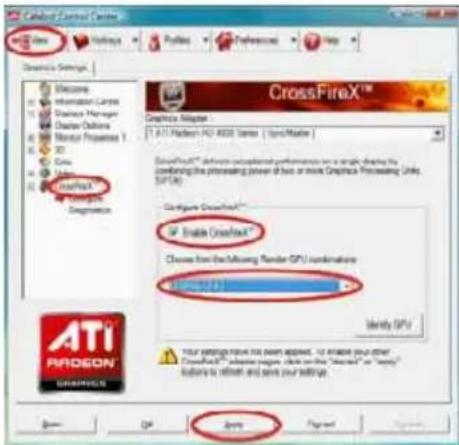
Step 6. Double-click "ATI Catalyst Control Center". Click "View", select "CrossFireX™", and then check the item "Enable CrossFireX™". Select "2 GPUs" and click "Apply" (if you install two Radeon graphics cards).
text_image
Windows Hotkey Profiles Preferences Help Access Settings Welcome Information Paths Service Manager Diplin Database Monitor Process 1 Auto Mouse Crisplift® Designers Diagnosis CrossFireX™ Graphics Adapter [ ATI Radeon HD 8000 Series | TopMaster ] グンゴル™ defines exceptional performance on a single channel by combining the processing power of bus or mode Graphics Processing Units (SPG) Configure CrossFireX™ Enable CrossFireX® Closes from the Missing Render GPs/ Restrictions Windows® Modify GPs ATI PADEON™ GRAMPHYS Your settings have not been approved, to allow your own CrossFireX™ options to create a new "Spectrum" or "App" button to refresh and save our settings. OK Cancel Finish Preview Help
Although you have selected the option "Enable CrossFire™", the Cross-FireX™ function may not work actually. Your computer will automatically reboot. After restarting your computer, please confirm whether the option "Enable CrossFire™" in "ATI Catalyst Control Center" is selected or not; if not, please select it again, and then you are able to enjoy the benefit of CrossFireX™ feature.
Step 7. You can freely enjoy the benefit of CrossFireX ^TM or Quad CrossFireX ^TM feature.
* CrossFireX™ appearing here is a registered trademark of AMD Technologies Inc., and is used only for identification or explanation and to the owners' benefit, without intent to infringe.
* For further information of AMD CrossFireX™ technology, please check AMD website for updates and details.
2.6 AMD Dual Graphics Operation Guide
This motherboard supports AMD Dual Graphics feature. AMD Dual Graphics brings multi-GPU performance capabilities by enabling an AMD A75 FCH (Hudson-D3) integrated graphics processor and a discrete graphics processor to operate simultaneously with combined output to a single display for blisteringly-fast frame rates. Currently, AMD Dual Graphics Technology is only supported with Windows ^® 7 OS, and is not available with Windows ^® Vista ^TM / XP OS.
What does an AMD Dual Graphics system include?
An AMD Dual Graphics system includes an AMD Radeon HD 65XX/64XX graphics processor and a motherboard based on an AMD A75 FCH (Hudson-D3) integrated chipset, all operating in a Windows ^® 7 environment. Please refer to below PCI
Express graphics card support list for AMD Dual Graphics. For the future update of more compatible PCI Express graphics cards, please visit AMD website for further information.
| Chipset Model | Driver | ||
| AMD RADEON HD6670 AS | US DIS-PCIE2.1-ASUS-HDMI-EAH6670-DI-1GD3/1G-DDR3 | 8.881 | |
| AMD RADEON HD6570 MSI | DIS-PCIE2.1-MSI-HDMI-R6570-MD1GD3-LP/1G-DDR3 | 8.881 | |
| AMD RADEON HD6450 MSI | DIS-PCIE2.1-MSI-HDMI-R6450-MD1GD3-LP/1G-DDR3 | 8.881 | |
Enjoy the benefit of AMD Dual Graphics
Step 1. Please keep the default UEFI setting of "Dual Graphics" option on [Auto].
Step 2. Install one AMD RADEON HD6670 / 6570 / 6450 PCI Express graphics card to PCIE2 slot (black).
Step 3. Connect the monitor cable to the onboard VGA port. Please be noted that the current VGA driver / VBIOS can allow Dual Graphics output from onboard display only. For any future update, please refer to our website for further information.
Step 4. Boot into OS. Please remove the AMD driver if you have any VGA driver installed in your system.
Step 5. Install the onboard VGA driver from our support CD to your system for both the onboard VGA and the discrete graphics card.
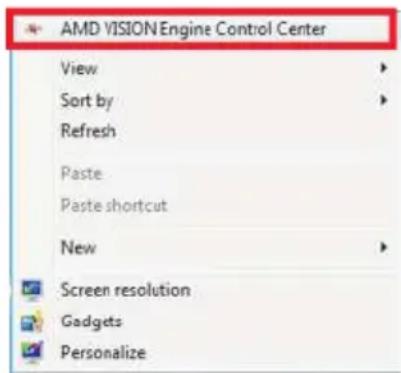
Step 6. Restart your computer. Right-click the desktop. Click “AMD VISION Engine Control Center” to enter AMD VISION Engine Control Center.
text_image
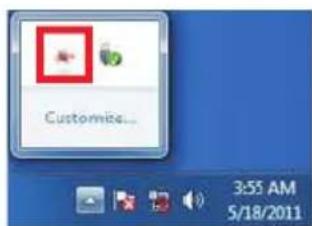
AMD VISION Engine Control Center View Sort by Refresh Paste Paste shortcut New Screen resolution Gadgets PersonalizeStep 7. You can also click "AMD VISION Engine Control Center" on your Windows ^® taskbar to enter AMD VISION Engine Control Center.
text_image
Customie... 3:55 AM 5/18/2011AMD VISION Engine Control Center
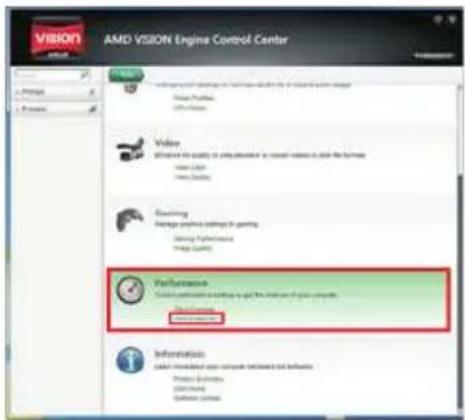
Step 8. In AMD VISION Engine Control Center, please choose "Performance". Click "AMD CrossFire™".
text_image
VISION AVOCOL AMD VISION Engine Control Center Preview Video Video Puzzle Image Video Video Volume Volume Volume Volume Volume Volume Volume Volume Volume Volume Volume Volume Volume Volume Volume Volume Volume Volume Volume Volume Volume Volume Volume Volume Volume Volume Volume Volume Volume Volume Volume Volume Volume Volume Volume Volume Volume Volume Volume Volume Volume Volume Volume Volume Volume Volume Volume Volume Volume Volume Performance Performance in the video games that include the video games of your computer. Media: 10000000000000000000000000000000000000000000000000000000000000000000000000000000000000000000000000000 Informational Informational video computer version and softwareStep 9. Click "Enable CrossFire TM" and click "Apply" to save your change.

text_image
AMD VISION Engine Control Center Advanced Create file AMD CreateFile® Advanced CreateFile® enables multiple progress to process a key for improving performance quality and performance. Advanced CreateFile® is based on AMD CreateFile® technology and then the following using AMD CreateFile® settings. CloseUp® Setup CloseUp®: 100% or more advanced performance and image updates by confirming the performance level of Advanced CreateFile®. Processing your OFF: Keep a search tool to access all CreateUp® features. CloseUp® Setup CloseUp®: 100% or more advanced performance and image updates by confirming the performance level of Advanced CreateFile®. CloseUp® Setup CloseUp®: 100% or more advanced performance and image updates by confirming the performance level of Advanced CreateFile®. CloseUp® Setup CloseUp®: 100% or more advanced performance and image updates by confirming the performance level of Advanced CreateFile®. CloseUp® Setup CloseUp®: 100% or more advanced performance and image updates by confirming the performance level of Advanced CreateFile®. CloseUp™ Setup CloseUp™: 100% or more advanced performance and image updates by confirming the performance level of Advanced CreateFile®. CloseUp™ Setup CloseUp™: 100% or more advanced performance and image updates by confirming the performance level of Advanced CreateFile®. CloseUp™ Setup CloseUp™: 100% or more advanced performance and image updates by confirming the performance level of Advanced CreateFile®.Step 10. Reboot your system. Then you can freely enjoy the benefit of Dual Graphics feature.
* Dual Graphics appearing here is a registered trademark of AMD Technologies Inc., and is used only for identification or explanation and to the owners' benefit, without intent to infringe.
* For further information of AMD Dual Graphics technology, please check AMD website for up dates and details.
2.7 Dual Monitor and Surround Display Features
Dual Monitor Feature
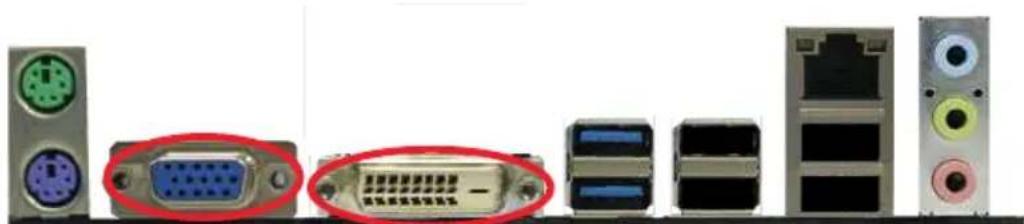
This motherboard supports dual monitor feature. With the internal VGA output support (D-Sub and DVI-D), you can easily enjoy the benefits of dual monitor feature without installing any add-on VGA card to this motherboard. This motherboard also provides independent display controllers for D-Sub and DVI-D to support dual VGA output so that D-sub and DVI-D can drive same or different display contents. To enable dual monitor feature, please follow the below steps:
- Connect D-Sub monitor cable to D-Sub port on the I/O panel, or connect DVI-D monitor cable to DVI-D port on the I/O panel.
natural_image
Row of electronic device ports and connectors, including a VGA, Ethernet, and audio jack (no visible text or labels)DVI-D portD-Sub port
- If you have installed onboard VGA driver from our support CD to your system already, you can freely enjoy the benefits of dual monitor function after your system boots. If you haven't installed onboard VGA driver yet, please install onboard VGA driver from our support CD to your system and restart your computer.
Surround Display Feature
This motherboard supports surround display upgrade. With the internal VGA output support (D-Sub and DVI-D) and external add-on PCI Express VGA cards, you can easily enjoy the benefits of surround display feature.
Please refer to the following steps to set up a surround display environment:
- Install the PCI Express VGA cards on PCIE2 and PCIE5 slots. Please refer to page 17 for proper expansion card installation procedures for details.
- Connect D-Sub monitor cable to D-Sub port on the I/O panel, or connect DVI-D monitor cable to DVI-D port on the I/O panel. Then connect other monitor cables to the corresponding connectors of the add-on PCI Express VGA cards on PCIE2 and PCIE5 slots.
- Boot your system. Press
or to enter UEFI setup. Enter "Share Memory" option to adjust the memory capability to [32MB], [64MB], [128MB], [256MB] or [512MB] to enable the function of D-sub. Please make sure that the value you select is less than the total capability of the system memory. If you do not adjust the UEFI setup, the default value of "Share Memory", [Auto], will disable D-Sub function when the add-on VGA card is inserted to this motherboard. - Install the onboard VGA driver and the add-on PCI Express VGA card driver to your system. If you have installed the drivers already, there is no need to install them again.
- Set up a multi-monitor display.
For Windows ^® XP / XP 64-bit OS:
Right click the desktop, choose "Properties", and select the "Settings" tab so that you can adjust the parameters of the multi-monitor according to the steps below.
A. Click the "Identify" button to display a large number on each monitor.
B. Right-click the display icon in the Display Properties dialog that you wish to be your primary monitor, and then select "Primary". When you use multiple monitors with your card, one monitor will always be Primary, and all additional monitors will be designated as Secondary.
C. Select the display icon identified by the number 2.
D. Click "Extend my Windows desktop onto this monitor".
E. Right-click the display icon and select "Attached", if necessary.
F. Set the "Screen Resolution" and "Color Quality" as appropriate for the second monitor. Click "Apply" or "OK" to apply these new values.
G. Repeat steps C through E for the display icon identified by the number one to six.
For Windows ^® 7 / 7 64-bit / Vista ^TM / Vista ^TM 64-bit OS:
Right click the desktop, choose "Personalize", and select the "Display Settings" tab so that you can adjust the parameters of the multi-monitor according to the steps below.
A. Click the number "2" icon.
B. Click the items "This is my main monitor" and "Extend the desktop onto this monitor".
C. Click "OK" to save your change.
D. Repeat steps A through C for the display icon identified by the number three to six.
- Use Surround Display. Click and drag the display icons to positions representing the physical setup of your monitors that you would like to use. The placement of display icons determines how you move items from one monitor to another.
HDCP Function
HDCP function is supported on this motherboard. To use HDCP function with this motherboard, you need to adopt the monitor that supports HDCP function as well. Therefore, you can enjoy the superior display quality with high-definition HDCP encryption contents. Please refer to below instruction for more details about HDCP function.
What is HDCP?
HDCP stands for High-Bandwidth Digital Content Protection, a specification developed by Intel ^® for protecting digital entertainment content that uses the DVI interface. HDCP is a copy protection scheme to eliminate the possibility of intercepting digital data midstream between the video source, or transmitter - such as a computer, DVD player or set-top box - and the digital display, or receiver - such as a monitor, television or projector. In other words, HDCP specification is designed to protect the integrity of content as it is being transmitted.
Products compatible with the HDCP scheme such as DVD players, satellite and cable HDTV set-top-boxes, as well as few entertainment PCs requires a secure connection to a compliant display. Due to the increase in manufacturers employing HDCP in their equipment, it is highly recommended that the HDTV or LCD monitor you purchase is compatible.
2.8 ASRock Smart Remote Installation Guide
ASRock Smart Remote is only used for ASRock motherboard with CIR header. Please refer to below procedures for the quick installation and usage of ASRock Smart Remote.
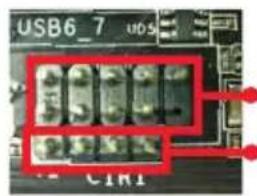
Step1. Find the CIR header located next to the USB 2.0 header on ASRock motherboard.
natural_image
Close-up of an electronic circuit board with labeled pins and components (no readable text or symbols)USB 2.0 header (9-pin, black)
CIR header (4-pin, gray)
Step2. Connect the front USB cable to the USB 2.0 header (as below, pin 1-5) and the CIR header. Please make sure the wire assignments and the pin assignments are matched correctly.

text_image
USB_PWR P- P+ GND DUMMY USB6 7 u6 1 2 3 4 5 CIR1 GND IRTX IRRX ATX+5VSB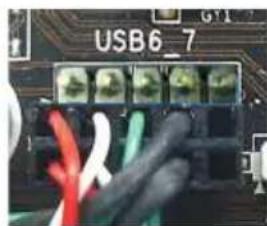
natural_image
Close-up of a USB6_7 circuit board with visible traces and connectors (no readable text or symbols)Step3. Install Multi-Angle CIR Receiver to the front USB port.
Step4. Boot up your system. Press to enter BIOS Setup Utility. Make sure the option "CIR Controller" is setting at [Enabled]. (Advanced -> Super IO Configuration -> CIR Controller -> [Enabled])

If you cannot find this option, please shut down your system and install Multi-Angle CIR Receiver to the other front USB port then try again.
Step5. Enter Windows. Execute ASRock support CD and install CIR Driver. (It is listed at the bottom of driver list.)

text_image
ers in different angles3 CIR sensors in different angles

- Only one of the front USB port can support CIR function. When the CIR function is enabled, the other port will remain USB function.
- Multi-Angle CIR Receiver is used for front USB only. Please do not use the rear USB bracket to connect it on the rear panel. Multi-Angle CIR Receiver can receive the multi-direction infrared signals (top, down and front), which is compatible with most of the chassis on the market.
- The Multi-Angle CIR Receiver does not support Hot-Plug function. Please install it before you boot the system.
2.9 Jumpers Setup
The illustration shows how jumpers are setup. When the jumper cap is placed on pins, the jumper is "Short". If no jumper cap is placed on pins, the jumper is "Open". The illustration shows a 3-pin jumper whose pin1 and pin2 are "Short" when jumper cap is placed on these 2 pins.

text_image
Short Open 1 2 3Jumper Setting Description
Clear CMOS Jumper
(CLRCMOS1)
(see p.12, No. 14)


Clear CMOSDefault
Note: CLRCMOS1 allows you to clear the data in CMOS. To clear and reset the system parameters to default setup, please turn off the computer and unplug the power cord from the power supply. After waiting for 15 seconds, use a jumper cap to short pin2 and pin3 on CLRCMOS1 for 5 seconds. However, please do not clear the CMOS right after you update the BIOS. If you need to clear the CMOS when you just finish updating the BIOS, you must boot up the system first, and then shut it down before you do the clear-CMOS action. Please be noted that the password, date, time, user default profile, 1394 GUID and MAC address will be cleared only if the CMOS battery is removed.
2.10 Onboard Headers and Connectors

Onboard headers and connectors are NOT jumpers. Do NOT place jumper caps over these headers and connectors. Placing jumper caps over the headers and connectors will cause permanent damage of the motherboard!
Serial ATA2 Connectors These six Serial ATA3
(SATA_1: see p.12, No. 9) (SATA3) connectors support
(SATA_2: see p.12, No. 10) SATA data cables for internal
(SATA_3: see p.12, No. 17) storage devices. The current
(SATA_4: see p.12, No. 18) SATA3 interface allows up to
(SATA_5: see p.12, No. 21) 6.0 Gb/s data transfer rate _4
(SATA_6: see p.12, No. 20)
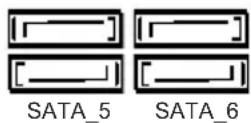
Serial ATA (SATA) Either end of the SATA data
Data Cable
(Optional)
connector on this motherboard.
cable can be connected to the SATA3 hard disk or the SATA3
USB 2.0 Headers Besides four default USB 2.0
(9-pin USB6_7) ports on the I/O panel, there
(see p.12 No. 23) are two USB 2.0 headers on
this motherboard. Each USB 2:0
header can support two USB
2.0 ports.
(9-pin USB8_9)
(see p.12 No. 22)

text_image
USB_PWR P-9 P+9 GND DUMMY 1 P-8 P+8 GND USB_PWRUSB 3.0 Header Besides two default USB 3.0 (19-pin USB3_2_3) ports on the I/O panel, there is (see p.12 No. 8) one USB 3.0 header on this motherboard. This USB 3.0 header can support two USB 3.0 ports.

text_image
the 10 panel, there is 3.0 header on this 3.0 USB IntA_P2_D- GND IntA_P2_SSTX+ GND IntA_P2_SSTX- Vbus Vous IntA_P1_SSTX- GND IntA_P1_SSTX+ GND IntA_P1_D- IDInfrared Module Header This header supports an
(5-pin IR1) optional wireless transmitting
(see p.12 No. 24) and receiving infrared module.

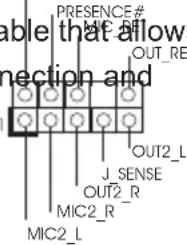
Front Panel Audio Header This is an interface for the front
(9-pin HD_AUDIO1) panel audio cable that allows
(see p.12 No. 27) convenient connection and
control of audio devices.
text_image
PRESENCE# OUT_RE J_SENSE OUT2_R MIC2_R MIC2_L
- High Definition Audio supports Jack Sensing, but the panel wire on the chassis must support HDA to function correctly. Please follow the instruction in our manual and chassis manual to install your system.
- If you use AC'97 audio panel, please install it to the front panel audio header as below:
A. Connect Mic_IN (MIC) to MIC2_L.
B. Connect Audio_R (RIN) to OUT2_R and Audio_L (LIN) to OUT2_L.
C. Connect Ground (GND) to Ground (GND).
D. MIC_RET and OUT_RET are for HD audio panel only. You don't need to connect them for AC'97 audio panel.
E. To activate the front mic.
For Windows ^ XP / XP 64-bit OS:
Select "Mixer". Select "Recorder". Then click "FrontMic".
For Windows ^ 7 / 7 64-bit / Vista ^TM / Vista ^TM 64-bit OS:
Go to the "FrontMic" Tab in the Realtek Control panel. Adjust "Recording Volume".
System Panel Header This header accommodates
(9-pin PANEL1) several system front pane
(see p.12 No. 16) functions.
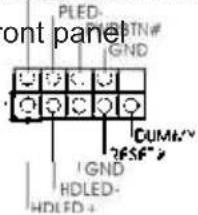
text_image
ONT panel PLED- HIBTN# GND CUMA-V 26SF* 1GND HDLED- HDLED+
Connect the power switch, reset switch and system status indicator on the chassis to this header according to the pin assignments below. Note the positive and negative pins before connecting the cables.
PWRBTN (Power Switch):
Connect to the power switch on the chassis front panel. You may configure the way to turn off your system using the power switch.
RESET (Reset Switch):
Connect to the reset switch on the chassis front panel. Press the reset switch to restart the computer if the computer freezes and fails to perform a normal restart.
PLED (System Power LED):
Connect to the power status indicator on the chassis front panel. The LED is on when the system is operating. The LED keeps blinking when the sys-tem is in S1 sleep state. The LED is off when the system is in S3/S4 sleep state or powered off (S5).
HDLED (Hard Drive Activity LED):
Connect to the hard drive activity LED on the chassis front panel. The LED is on when the hard drive is reading or writing data.
The front panel design may differ by chassis. A front panel module mainly consists of power switch, reset switch, power LED, hard drive activity LED, speaker and etc. When connecting your chassis front panel module to this header, make sure the wire assignments and the pin assign-ments are matched correctly.
Chassis Speaker Header Please connect the chassis
(4-pin SPEAKER 1) speaker to this header
(see p.12 No. 15)
15v DUMM
Power LED Header Please connect the chassis
(3-pin PLED1) power LED to this header to
(see p.12 No. 19) indicate system power status.
The LED is on when the system
is operating. The LED keeps
blinking in S1 state. The LED is
off in S3/S4 state or S5 state
(power off).
Chassis Fan Connectors
Please connect the fan cables
(4-pin CHA_FAN1)
to the fan
connectors and
(see p.12 No. 13)

ground pin.
(4-pin CHA_FAN2)
(see p.12 No. 5)
CHA_FAN_SPEED
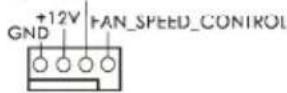
CPU Fan Connectors Please connect the CPU fan
(4-pin CPU_FAN1) cable to the connector and
(see p.12 No. 4) match the black wire to the
ground pin.


Though this motherboard provides 4-Pin CPU fan (Quiet Fan) support, the 3-Pin CPU fan still can work successfully even without the fan speed control function. If you plan to connect the 3-Pin CPU fan to the CPU fan connector on this motherboard, please connect it to Pin 1-3.
Pin 1-3 Connected
3-Pin Fan Installation

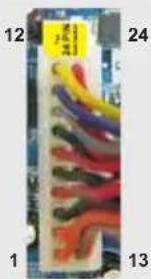
ATX Power Connector Please connect an ATX power
(24-pin ATXPWR1) supply to this connector.
(see p.12 No. 7)


Though this motherboard provides 24-pin ATX power connector, it can still work if you adopt a traditional 20-pin ATX power supply. To use the 20-pin ATX power supply, please plug your power supply along with Pin 1 and Pin 13.
20-Pin ATX Power Supply Installation
natural_image
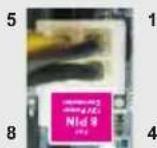
Close-up of a multicolored cable or wire connector with numbered labels (1, 12, 24, 13) and no visible text or symbols on the main body.ATX 12V Power Connector Please connect an ATX 12V
(8-pin ATX12V1) power supply to this connector.
(see p.12 No. 1)
8 4

Though this motherboard provides 8-pin ATX 12V power connector, it can still work
if you adopt a traditional 4-pin ATX 12V power supply. To use the 4-pin ATX power supply, please plug your power supply along with Pin 1 and Pin 5.
4-Pin ATX 12V Power Supply Installation
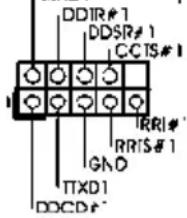
Serial port Header
(9-pin COM1)
(see p.12 No.25)
This COM1 header supports a
text_image
DDIR#1 DDSR#1 CCTS# RRI# RRIS#1 GND TTXD1 DDCD#serial port module.
HDMI_SPDIF Header HDMI_SPDIF header, providing
(2-pin HDMI_SPDIF1) SPDIF audio output to HDMI
(see p.12 No. 26) VGA card, allows the system to
connect HDMI Digital TV/
projector/LCD devices. Please
connect the HDMI_SPDIF
connector of HDMI VGA card to
this header.
2.11 Serial ATA3 (SATA3) Hard Disks Installation
This motherboard adopts AMD A75 FCH (Hudson-D3) chipset that supports Serial ATA3 (SATA3) hard disks and RAID (RAID 0, RAID 1 and RAID 10) functions. You may install SATA3 hard disks on this motherboard for internal storage devices. This section will guide you to install the SATA3 hard disks.
STEP 1: Install the SATA3 hard disks into the drive bays of your chassis.
STEP 2: Connect the SATA power cable to the SATA3 hard disk.
STEP 3: Connect one end of the SATA data cable to the motherboard's SATA3 connector.
STEP 4: Connect the other end of the SATA data cable to the SATA3 hard disk.
2.12 Hot Plug and Hot Swap Functions for SATA3 HDDs
This motherboard supports Hot Plug and Hot Swap functions for SATA3 in RAID / AHCI mode. AMD A75 FCH (Hudson-D3) chipset provides hardware support for Advanced Host controller Interface (AHCI), a new programming interface for SATA host controllers developed thru a joint industry effort.

NOTE
What is Hot Plug Function?
If the SATA3 HDDs are NOT set for RAID configuration, it is called "Hot Plug" for the action to insert and remove the SATA3 HDDs while the system is still power-on and in working condition.
However, please note that it cannot perform Hot Plug if the OS has been installed into the SATA3 HDD.
What is Hot Swap Function?
If SATA3 HDDs are built as RAID 1 then it is called "Hot Swap" for the action to insert and remove the SATA3 HDDs while the system is still power-on and in working condition.
2.13 SATA3 HDD Hot Plug Feature and Operation Guide
This motherboard supports Hot Plug feature for SATA3 HDD in RAID / AHCI mode. Please read below operation guide of Hot Plug feature carefully. Before you process the SATA3 HDD Hot Plug, please check below cable accessories from the motherboard gift box pack.
A. 7-pin SATA data cable
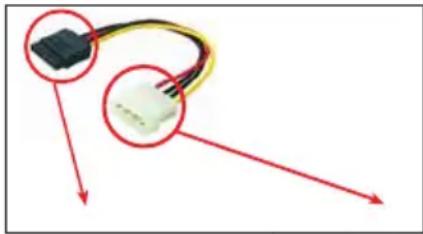
B. SATA power cable with SATA 15-pin power connector interface
A. SATA data cable (Red)

natural_image
Simple diagram of a red cable with two connectors and a directional arrow (no text or symbols)SATA 7-pin connector
B. SATA power cable
natural_image
Close-up of a black connector with yellow cable and white terminal, shown with red arrows pointing to its ends (no text or symbols)The SATA 15-pin power connector (Black) connect to SATA3 HDD
1x4-pin conventional power connector (White) connect to power supply
Caution
- Without SATA 15-pin power connector interface, the SATA3 Hot Plug cannot be processed.
- Even some SATA3 HDDs provide both SATA 15-pin power connector and IDE 1x4-pin conventional power connector interfaces, the IDE 1x4-pin conventional power connector interface is definitely not able to support Hot Plug and will cause the HDD damage and data loss.
Points of attention, before you process the Hot Plug:
- Below operation procedure is designed only for our motherboard, which supports SATA3 HDD Hot Plug.
* The SATA3 Hot Plug feature might not be supported by the chipset because of its limitation, the SATA3 Hot Plug support information of our motherboard is indicated in the product spec on our website: www.asrock.com
- Make sure your SATA3 HDD can support Hot Plug function from your dealer or HDD user manual. The SATA3 HDD, which cannot support Hot Plug function, will be damaged under the Hot Plug operation.
- Please make sure the SATA3 driver is installed into system properly. The latest SATA3 driver is available on our support website: www.asrock.com
- Make sure to use the SATA power cable & data cable, which are from our motherboard package.
- Please follow below instructions step by step to reduce the risk of HDD crash or data loss.
How to Hot Plug a SATA3 HDD:
Points of attention, before you process the Hot Plug:
Please do follow below instruction sequence to process the Hot Plug, improper procedure will cause the SATA3 HDD damage and data loss.
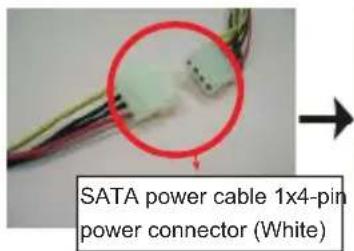
Step 1 Please connect SATA power cable 1x4-pin end (White) to the power supply 1x4-pin cable.
Step 2 Connect SATA data cable to the motherboard's SATAII / SATA3 connector.
text_image
SATA power cable 1x4-pin power connector (White)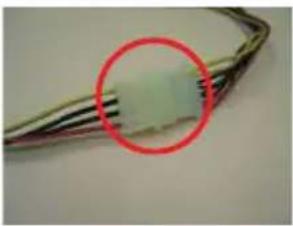
natural_image
Close-up of a thin, wire-wrapped electronic component with a red circle highlighting a small white component (no text or symbols visible)
natural_image
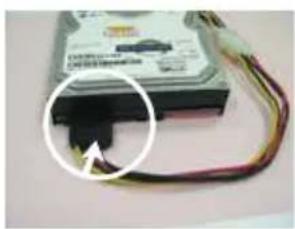
Close-up of a computer motherboard with visible circuitry and a magnified inset showing a red component (no text or symbols)Step 3 Connect SATA 15-pin power cable connector (Black) end to SATA3 HDD.
Step 4 Connect SATA data cable to the SATA3 HDD.
natural_image
Close-up of a hard disk drive with cable and connector, no visible text or symbols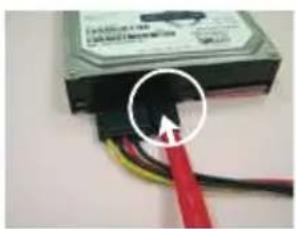
natural_image
Close-up of a hard disk drive with a red cable and black wires inserted, showing a circular arrow pointing to the component (no text or symbols visible)How to Hot Unplug a SATA3 HDD:
Points of attention, before you process the Hot Unplug:
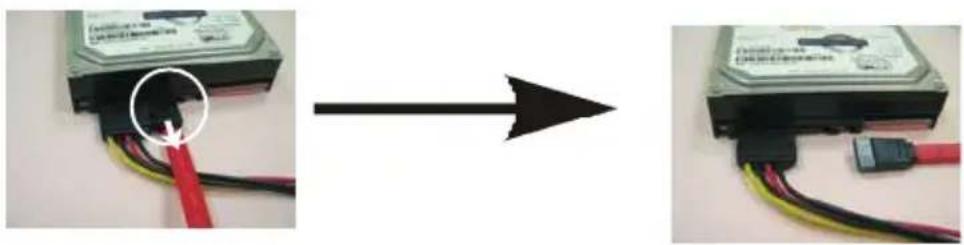
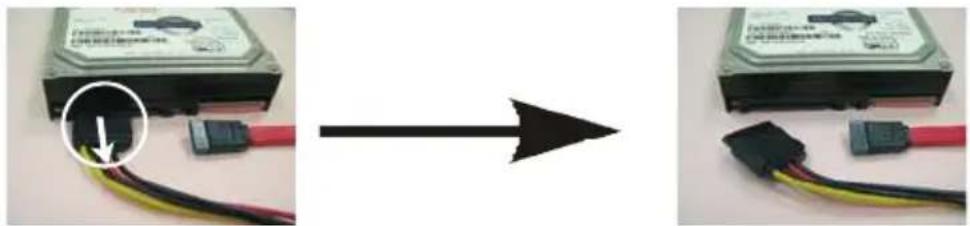
Please do follow below instruction sequence to process the Hot Unplug, improper procedure will cause the SATA3 HDD damage and data loss.
Step 1 Unplug SATA data cable from SATA3 HDD side.
natural_image
Two views of a hard disk drive with cable and red wires, showing a close-up of the internal cable (no text or symbols visible)Step 2 Unplug SATA 15-pin power cable connector (Black) from SATA3 HDD side.
natural_image
Two photos showing a hard disk connected to a cable with a black connector, one with a white arrow pointing to its connector (no text or symbols visible)2.14 Driver Installation Guide
To install the drivers to your system, please insert the support CD to your optical drive first. Then, the drivers compatible to your system can be auto-detected and listed on the support CD driver page. Please follow the order from up to bottom side to install those required drivers. Therefore, the drivers you install can work properly.
2.15 Installing Windows ^® 7 / 7 64-bit / Vista ^TM / Vista ^TM 64-bit / XP / XP 64-bit With RAID Functions
If you want to install Windows ^® 7 / 7 64-bit / Vista ^TM / Vista ^TM 64-bit / XP / XP 64-bit on a RAID disk composed of 2 or more SATA3 HDDs with RAID functions, please follow below procedures according to the OS you install.
2.15.1 Installing Windows ^® XP / XP 64-bit With RAID Functions
If you want to install Windows XP / XP 64-bit on a RAID disk composed of 2 or more SATA3 HDDs with RAID functions, please follow below steps.
STEP 1: Set up UEFI.
A. Enter UEFI SETUP UTILITY Advanced screen Storage Configuration.
B. Set the "SATA Mode" option to [RAID].
STEP 2: Make a SATA3 Driver Diskette. (Please use an USB floppy or a floppy disk.)
A. Insert the ASRock Support CD into your optical drive to boot your system.
B. During POST at the beginning of system boot-up, press
C. When you see the message on the screen, "Generate Serial ATA driver diskette [YN]?", press
D. Then you will see these messages,
Please insert a diskette into the floppy drive.
WARNING! Formatting the floppy diskette will
lose ALL data in it!
Start to format and copy files [YN]?
Please insert a floppy diskette into the floppy drive, and press any key.
E. The system will start to format the floppy diskette and copy SATA3 drivers into the floppy diskette.
STEP 3: Use "RAID Installation Guide" to set RAID configuration.
Before you start to configure RAID function, you need to check the RAID installation guide in the Support CD for proper configuration. Please refer to the BIOS RAID installation guide part of the document in the following path in the Support CD:
.. \ RAID Installation Guide
STEP 4: Install Windows ^® XP / XP 64-bit OS on your system.
After step 1, 2, 3, you can start to install Windows XP / XP 64-bit OS on your system. At the beginning of Windows ^ setup, press F6 to install a third-party RAID driver. When prompted, insert the SATA3 driver diskette containing the AMD RAID driver. After reading the floppy disk, the driver will be presented. Select the driver to install according to the OS you install.
2.15.2 Installing Windows ^® 7 / 7 64-bit / Vista ^TM / Vista ^TM 64-bit With RAID Functions
If you want to install Windows ^® 7 / 7 64-bit / Vista ^TM / Vista ^TM 64-bit on a RAID disk composed of 2 or more SATA3 HDDs with RAID functions, please follow below steps.
STEP 1: Set up UEFI.
A. Enter UEFI SETUP UTILITY Advanced screen Storage
Configuration.
B. Set the "SATA Mode" option to [RAID].
STEP 2: Use "RAID Installation Guide" to set RAID configuration.
Before you start to configure RAID function, you need to check the RAID installation guide in the Support CD for proper configuration. Please refer to the BIOS RAID installation guide part of the document in the following path in the Support CD:
.. \ RAID Installation Guide
STEP 3: Make a SATA3 Driver Diskette.
Make a SATA3 driver diskette by following section 2.15.1 step 2 on page 38.
STEP 4: Install Windows ^® 7 / 7 64-bit / Vista ^TM / Vista ^TM 64-bit OS on your system.
2.16 Installing Windows ^® 7 / 7 64-bit / Vista ^TM / Vista ^TM 64-bit / XP / XP 64-bit Without RAID Functions
If you want to install Windows ^® 7 / 7 64-bit / Vista ^TM / Vista ^TM 64-bit / XP / XP 64-bit OS on your SATA3 HDDs without RAID functions, please follow below procedures according to the OS you install.
2.16.1 Installing Windows ^® XP / XP 64-bit Without RAID Functions
If you want to install Windows ^® XP / XP 64-bit on your SATA3 HDDs without RAID functions, please follow below steps.
Using SATA3 HDDs with NCQ and Hot Plug functions (AHCI mode)
STEP 1: Set up UEFI.
A. Enter UEFI SETUP UTILITY Advanced screen Storage Configuration.
B. Set the "SATA Mode" option to [AHCI].
STEP 2: Make a SATA3 Driver Diskette.
Make a SATA3 driver diskette by following section 2.15.1 step 2 on page 38.
STEP 3: Install Windows ^® XP / XP 64-bit OS on your system.
You can start to install Windows ^® XP / XP 64-bit OS on your system. At the beginning of Windows ^® setup, press F6 to install a third-party AHCI driver. When prompted, insert the SATA3 driver diskette containing the AMD AHCI driver. After reading the floppy disk, the driver will be presented. Select the driver to install according to the OS you install.
Using SATA3 HDDs without NCQ and Hot Plug functions (IDE mode)
STEP 1: Set up UEFI.
A. Enter UEFI SETUP UTILITY Advanced screen Storage Configuration.
B. Set the "SATA Mode" option to [IDE].
STEP 2: Install Windows ^® XP / XP 64-bit OS on your system.
2.16.2 Installing Windows ^® 7 / 7 64-bit / Vista ^TM / Vista ^TM 64-bit Without RAID Functions
If you want to install Windows ^® 7/764-bit/Vista ^TM /Vista ^TM 64-bit on your SATA3 HDDs without RAID functions, please follow below steps.
Using SATA3 HDDs with NCQ and Hot Plug functions (AHCI mode)
STEP 1: Set up UEFI.
A. Enter UEFI SETUP UTILITY Advanced screen Storage Configuration.
B. Set the "SATA Mode" option to [AHCI].
STEP 2: Install Windows ^® 7 / 7 64-bit / Vista ^TM / Vista ^TM 64-bit OS on your system.
Using SATA3 HDDs without NCQ and Hot Plug functions (IDE mode)
STEP 1: Set up UEFI.
A. Enter UEFI SETUP UTILITY Advanced screen Storage Configuration.
B. Set the "SATA Mode" option to [IDE].
STEP 2: Install Windows ^® 7 / 7 64-bit / Vista ^TM / Vista ^TM 64-bit OS on your system.
3. UEFI SETUP UTILITY
3.1 Introduction
This section explains how to use the UEFI SETUP UTILITY to configure your system. The SPI Memory on the motherboard stores the UEFI SETUP UTILITY. You may run the UEFI SETUP UTILITY when you start up the computer. Please press during the Power-On-Self-Test (POST) to enter the UEFI SETUP UTILITY, otherwise, POST will continue with its test routines.
If you wish to enter the UEFI SETUP UTILITY after POST, restart the system by pressing

Because the UEFI software is constantly being updated, the following UEFI setup screens and descriptions are for reference purpose only, and they may not exactly match what you see on your screen.
3.1.1 UEFI Menu Bar
The top of the screen has a menu bar with the following selections:
Main To set up the system time/date information
OC Tweaker To set up overclocking features
Advanced To set up the advanced UEFI features
H/W Monitor To display current hardware status
Boot To set up the default system device to locate and load the Operating System
Security To set up the security features
Exit To exit the current screen or the UEFI SETUP UTILITY
Use <←> key or <→ key to choose among the selections on the menu bar, and then press
3.1.2 Navigation Keys
Please check the following table for the function description of each navigation key.
Navigation Key(s) Function Description
| ← / Moves cursor left or right to select Screens | |
| ↑ / ↓ Moves cursor up or down to select items | |
| + / - To change option for the selected items | |
| Switch to next function | |
| To bring up the selected screen | |
| Go to the previous page | |
| Go to the next page | |
| Go to the top of the screen | |
| Go to the bottom of the screen | |
| To display the General Help Screen | |
| Discard changes and exit the UEFI SETUP UTILITY | |
| Load optimal default values for all the settings | |
| Save changes and exit the UEFI SETUP UTILITY | |
| Print screen | |
| Jump to the Exit Screen or exit the current screen | |
3.2 Main Screen
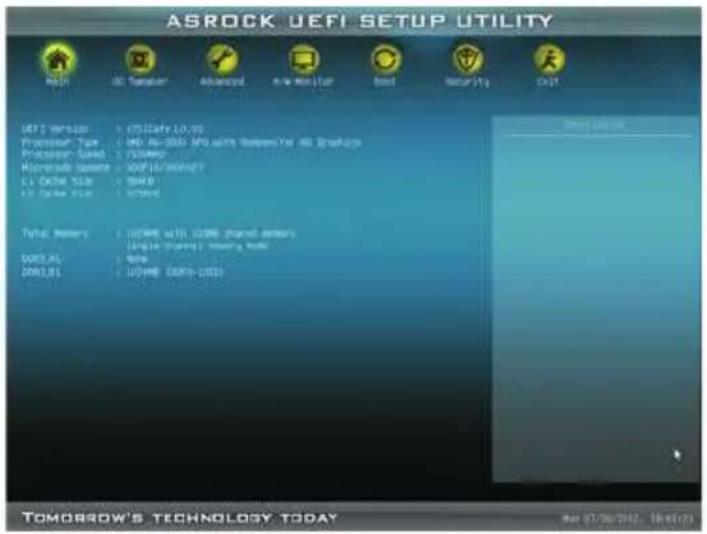
When you enter the UEFI SETUP UTILITY, the Main screen will appear and display the system overview.
text_image
ASROCK UEFI SETUP UTILITY No. 01 AC Transfer Advanced New Monitor Read Security Exit UEFI Version ISO/Case:10.00 Processor Type HD: HL-2000, MPD with Windows/O盘 HD Storage Processor Speed 100MHz Microsoft Access 300MHz/800MHz LC ODM File 80MHz LP ODM File Total Memory 100MHz with 100MHz shared access Single Channel: Opening Mode DDR5.NL Note DDR1.RS 100MHz DDR5.DOS TOMORROW'S TECHNOLOGY TODAY Date: 07/26/2012 - 18/01/213.3 OC Tweaker Screen
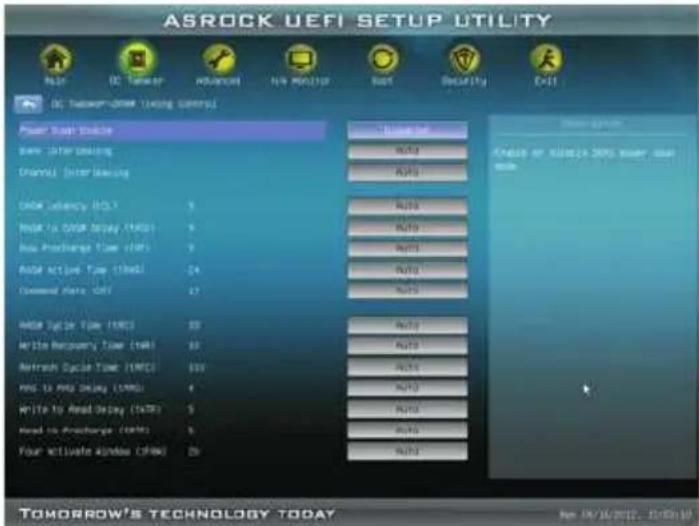
In the OC Tweaker screen, you can set up overclocking features.

text_image
ASROCK UEFI SETUP UTILITY MAIN OFF TOLER Advanced AVR Mon/Lip Reset Security Exit CC 30 Power AC 100kW Off Configuration Operative Mode Auto Rated Electrue Auto Processor: Minimum/Maxing 1700 Hz Processor: Maximum Voltage 1.400V Multiplier Voltage Change Auto OPX Engine Color Auto Driver Configuration DCR Frequency 20Hz-2300 Auto Power Timing Control Voltage Control VDDV Voltage 1.600V Auto APU PCE Voltage 100V Auto TOMORROW'S TECHNOLOGY TODAYEZ OC Mode
You can use this option to load EZ overclocking setting. Please note that overclosing may cause damage to your components and motherboard. It should be done at your own risk and expense.
CPU Configuration
Overclock Mode
Use this to select Overclock Mode. Configuration options: [Auto] and [Manual]. The default value is [Auto].
Spread Spectrum
This item should always be [Auto] for better system stability.
AMD Turbo Core Technology
This item appears only when the processor you adopt supports this feature. Use this to select enable or disable AMD Turbo Core Technology. The default value is [Enabled].
Processor Maximum Frequency
It will display Processor Maximum Frequency for reference.
Processor Maximum Voltage
It will display Processor Maximum Voltage for reference.
Multiplier/Voltage Change
This item is set to [Auto] by default. If it is set to [Manual], you may adjust the value of Processor Frequency and Processor Voltage. However, it is recommended to keep the default value for system stability.
CPU Frequency Multiplier
For safety and system stability, it is not recommended to adjust the value of this item.
CPU Voltage
It allows you to adjust the value of CPU voltage. However, for safety and system stability, it is not recommended to adjust the value of this item.
GFX Engine Clock
Use this to adjust graphics engine clock. The default value is [Auto].
DRAM Configuration
DRAM Frequency
If [Auto] is selected, the motherboard will detect the memory module(s) inserted and assigns appropriate frequency automatically.
DRAM Timing Control
text_image
ASROCK UEFI SETUP UTILITY Auto (C) Tension AVANCE N/A MOUNT Reset Security Exit (C) Tension/Order (using Control) Power Stack Enable New: Interlocking Channel: Interlocking DCM Delay (DC) Max to Open Supply (MAX) Max to Release Time (RT) Max Active Time (RT) Command Data Left Max Cycle Time (RC) Write Recovery Time (WR) Refresh Cycle Time (RC) Max to Max Delay (RWD) Write to Head Delay (TATR) Head to Release Time (RTS) Four Activate Window (FWE) Volume Set Auto Auto Auto Auto Auto Auto Auto Auto Auto Auto Auto Auto Auto Auto Auto Auto Auto Auto Auto Auto Auto Auto Auto Auto Auto Auto Auto Auto Auto Auto Auto Auto Auto Auto Auto Auto Auto Auto Auto Auto Auto Auto Auto Auto Auto Auto Auto Auto Auto Auto AUTO AUTO AUTO AUTO AUTO AUTO AUTO AUTO AUTO AUTO AUTO AUTO AUTO AUTO AUTO AUTO AUTO AUTO AUTO AUTO AUTO AUTOPower Down Enable
Use this item to enable or disable DDR power down mode.
Bank Interleaving
Interleaving allows memory accesses to be spread out over banks on the same node, or across nodes, decreasing access contention.
Channel Interleaving
It allows you to enable Channel Memory Interleaving. Configuration options: [Disabled], [Auto]. The default value is [Auto].
CAS# Latency (tCL)
Use this item to change CAS# Latency (tCL) Auto/Manual setting. The default is [Auto].
RAS# to CAS# Delay (tRCD)
Use this item to change RAS# to CAS# Delay (tRCD) Auto/Manual setting. The default is [Auto].
Row Precharge Time (tRP)
Use this item to change Row Precharge Time (tRP) Auto/Manual setting.
The default is [Auto].
RAS# Active Time (tRAS)
Use this item to change RAS# Active Time (tRAS) Auto/Manual setting.
The default is [Auto].
Command Rate (CR)
Use this item to change Command Rate (CR) Auto/Manual setting. Min:
1T. Max: 2T. The default is [Auto].
RAS# Cycle Time (tRC)
Use this item to change RAS# Cycle Time (tRC) Auto/Manual setting. The default is [Auto].
Write Recovery Time (tWR)
Use this item to change Write Recovery Time (tWR) Auto/Manual setting.
The default is [Auto].
Refresh Cyle Time (tRFC)
Use this item to change Refresh Cyle Time (tRFC) Auto/Manual setting.
The default is [Auto].
RAS to RAS Delay (tRRD)
Use this item to change RAS to RAS Delay (tRRD) Auto/Manual setting.
The default is [Auto].
Write to Read Delay (tWTR)
Use this item to change Write to Read Delay (tWTR) Auto/Manual setting.
The default is [Auto].
Read to Precharge (tRTP)
Use this item to change Read to Precharge (tRTP) Auto/Manual setting.
The default is [Auto].
Four Activate Window (tFAW)
Use this item to change Four Activate Window (tFAW) Auto/Manual
setting. The default is [Auto].
Voltage Control
VCCM Voltage
Use this to select VCCM Voltage. The default value is [Auto].
APU PCIE Voltage
Use this to select APU PCIE Voltage. The default value is [Auto].
CPU Load-Line Calibration
CPU Load-Line Calibration helps prevent CPU voltage droop when the
system is under heavy load.
SB Voltage
Use this to select SB Voltage. The default value is [Auto].
Would you like to save current setting user defaults?
In this option, you are allowed to load and save three user defaults according to your own requirements.
3.4 Advanced Screen
In this section, you may set the configurations for the following items: CPU Configuration, North Bridge Configuration, South Bridge Configuration, Storage Configuration, Super IO Configuration, ACPI Configuration, and USB Configuration.

text_image
ASROCK UEFI SETUP UTILITY Main OC TUBIKAT ADAMTOR NEW MONITOR Boot Security Exit My Configuration APTS - VR Edge Control Unit South Bridge Control Unit Manage Configuration Base - 2D Control Unit KPS Configuration USB Control Unit ERP Server Options Others Flash Store Setup 2000 configuration software TOMORROW'S TECHNOLOGY TODAY
Setting wrong values in this section may cause the system to malfunction.
Instant Flash
Instant Flash is a UEFI flash utility embedded in Flash ROM. This convenient UEFI update tool allows you to update system UEFI without entering operating systems first like MS-DOS or Windows ^® Just launch this tool and save the new UEFI file to your USB flash drive, floppy disk or hard drive, then you can update your UEFI only in a few clicks without preparing an additional floppy diskette or other complicated flash utility. Please be noted that the USB flash drive or hard drive must use FAT32/16/12 file system. If you execute Instant Flash utility, the utility will show the UEFI files and their respective information. Select the proper UEFI file to update your UEFI, and reboot your system after UEFI update process completes.
3.4.1 CPU Configuration

text_image
ASROCK UEFI SETUP UTILITY Home E:\Tanner ADWARD MAX MOUNT Ext Security Exit Advanced CPU 2017/04/05 Core (A) Mode C++afe Prox Mode (Off) 1*Out DVA DW Protocol: Status Active Available Used Enabled Help New user Microsoft Azure City 2017 Tomorrow's Technology Today http://8/2012, 03:00:19Core C6 Mode
Use this item to enable or disable Core C6 mode. The default value is [Enabled].
Cstate Pmin Mode
Use this item to enable or disable Cstate Pmin mode. The default value is [Disabled].
Cool 'n' Quiet
Use this item to enable or disable AMD's Cool 'n' Quiet ^TM technology. The default value is [Enabled]. Configuration options: [Enabled] and [Disabled]. If you install Windows ^ 7 / Vista ^TM and want to enable this function, please set this item to [Enabled]. Please note that enabling this function may reduce CPU voltage and memory frequency, and lead to system stability or compatibility issue with some memory modules or power supplies. Please set this item to [Disable] if above issue occurs.
SVM
When this option is set to [Enabled], a VMM (Virtual Machine Architecture) can utilize the additional hardware capabilities provided by AMD-V. The default value is [Enabled]. Configuration options: [Enabled] and [Disabled].
CPU Thermal Throttle
Use this item to enable CPU internal thermal control mechanism to keep the CPU from overheated. The default value is [Auto].
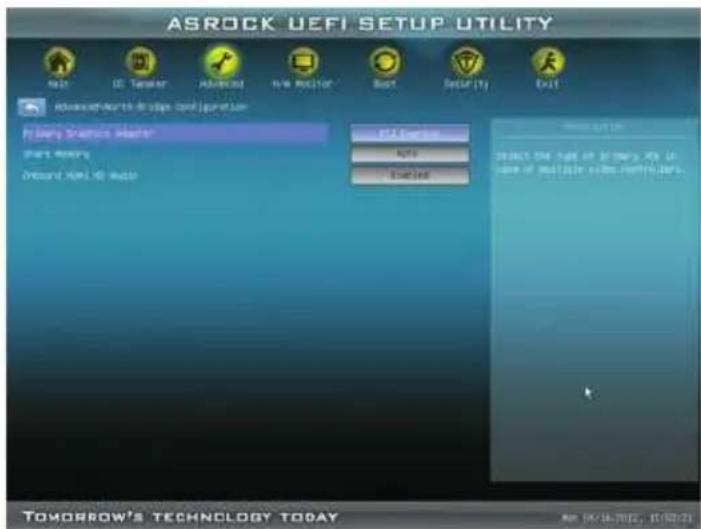
3.4.2 North Bridge Configuration
text_image
ASROCK UEFI SETUP UTILITY Help IC Tension Advanced N/W Monitor Boot Security Exit Advanced-Martha Bridge Control Panel PLSary Graphics Manager Start Memory Onboard HAML® Audio EPA Control... NPS Enabled PROCT THE NAME OF THIS WORK IN USE OF MULTIPLE COLDERS COMPONENTS. TOMORROW'S TECHNOLOGY TODAYPrimary Graphics Adapter
This item will switch the PCI Bus scanning order while searching for video card. It allows you to select the type of Primary VGA in case of multiple video controllers. The default value of this feature is [PCI Express]. Configuration options: [Onboard], [PCI] and [PCI Express].
Share Memory
This allows you to set the share memory feature. The default value is [Auto]. Configuration options: [Auto], [32MB], [64MB], [128MB], [256MB] and [512MB].
Onboard HDMI HD Audio
This allows you to enable or disable the "Onboard HDMI HD Audio" feature.
Dual Graphics
This item appears only when you install AMD RADEON HD6670 / 6570 / 6450 graphics card on this motherboard. Use this to enable or disable Dual Graphics feature. If you enable this option, you can choose onboard VGA or PCIE card VGA at will. If you select [Auto], Dual Graphics function will be automatically enabled when you install AMD RADEON HD6670 / 6570 / 6450 graphics card. The default value is [Auto].
3.4.3 South Bridge Configuration

text_image
ASROCK UEFI SETUP UTILITY Main PC Tension Advanced Air Navigator Back Security Exit www.ewisouth.ripee.com setup on Shield HD Audio High Fens: Shield LIM Book view: L25 Record HD Audio Auto Auto Dissolved Auto Record HD Audio Tomorrow's Technology Today Sun 04/16/2022, 17:30:24Onboard HD Audio
Select [Auto], [Enabled] or [Disabled] for the onboard HD Audio feature. If you select [Auto], the onboard HD Audio will be disabled when PCI Sound Card is plugged.
Front Panel
Select [Auto] or [Disabled] for the onboard HD Audio Front Panel.
Onboard LAN
This allows you to enable or disable the onboard LAN feature.
Good Night LED
Enable this option to turn off Power LED when the system is power on. The keyboard LED will also be turned off in S1, S3 and S4 state. The default value is [Auto].
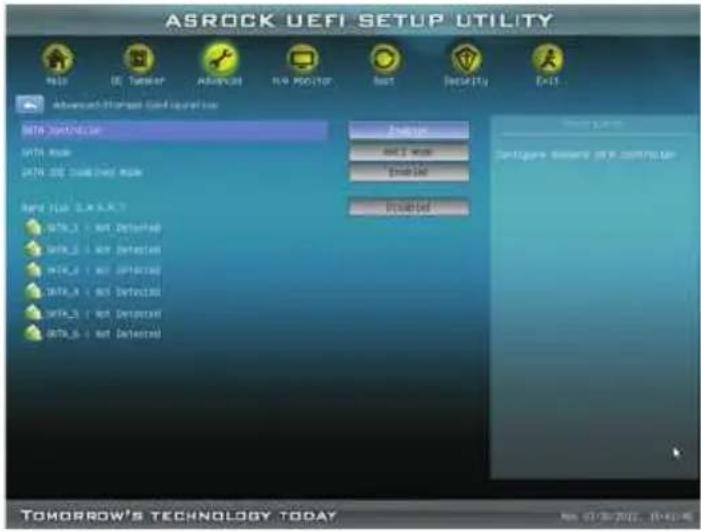
3.4.4 Storage Configuration
text_image
ASROCK UEFI SETUP UTILITY Help IE Turkier Adversal NIP RODDER Best Security Exit Advanced Hardware Setup Utility SATA Control User SATA Mode SATA CC Combined Mode Hand Use & S.A.R.Y. SATA_1 - Not Detected SATA_2 - Not Detected SATA_3 - Not Detected SATA_4 - Not Detected SATA_5 - Not Detected SATA_6 - Not Detected Options NOT OK Enabled Enabled Configure software for configuration Tomorrow's Technology Today No. 01/08/2012, 0:41:46SATA Controller
Use this item to enable or disable the "SATA Controller" feature.
SATA Mode
Use this item to adjust SATA Mode. The default value of this option is [AHCI Mode]. Configuration options: [AHCI Mode], [RAID Mode] and [IDE Mode].

If you set this item to RAID mode, it is suggested to install SATA ODD driver on SATA_5 and SATA_6 ports.
SATA IDE Combined Mode
This item is for SATA_5 and SATA_6 ports. Use this item to enable or disable SATA IDE combined mode. The default value is [Enabled].

If you want to build RAID on SATA_5 and SATA_6 ports, please disable this item.
Hard Disk S.M.A.R.T.
Use this item to enable or disable the S.M.A.R.T. (Self-Monitoring, Analysis, and Reporting Technology) feature. Configuration options: [Disabled], [Enabled].
3.4.5 Super IO Configuration

text_image
ASROCK UEFI SETUP UTILITY Power DC Turnover ADAMSOL N/A Monitor Boot Security Exit Advanced Super - $0 cont upgrade kit Server Port Server Port Address Inflow Port System SPR/CPB Desktop A System UEFI to Design $0.10000000000000000000000000000000000000000000000000000000000000000000000000000000000000000000000000000 TOMORROW'S TECHNOLOGY TODAY File: 14/16/2012, 2/13/19Serial Port
Use this item to enable or disable the onboard serial port.
Serial Port Address
Use this item to set the address for the onboard serial port.
Configuration options: [3F8 / IRQ4] and [3E8 / IRQ4].
Infrared Port
Use this item to enable or disable the onboard infrared port.
Infrared Port Address
Use this item to set the address for the onboard infrared port.
Conf i guration options: [2F8 / IRQ3] and [2E8 / IRQ3].
3.4.6 ACPI Configuration
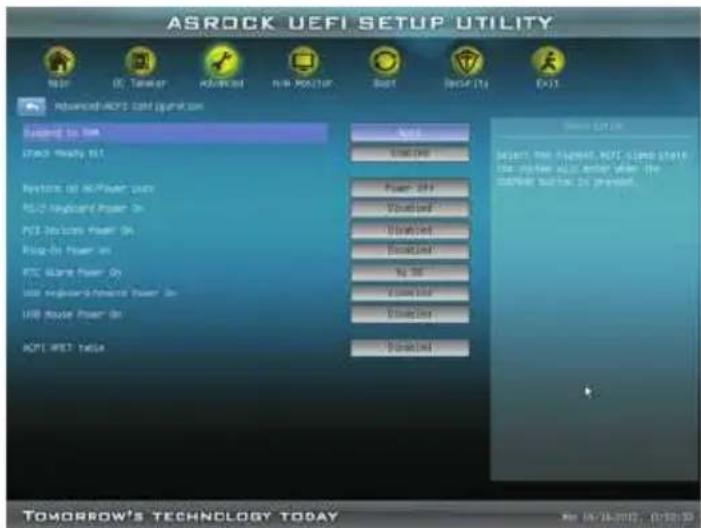
text_image
ASROCK UEFI SETUP UTILITY Need OK Tension Advanced N/A Support Best Default OUT Advanced AOCI Card operation Support to set ACO3 Ready bit Systems of AC/Power users AC/O keyboard Power On PC3 Devices Power On Rics-On Power On RTC Slave Power On USB Interface Power On USB Route Power On ACI1 WST TMSA Add USB Only Power Off View List View List View List No Use View List View List Show List Show List Show List Show List Show List Show List Show List Show List Show List Show List Show List Show List Show List Show List Show List Show List Show List Show List Show List Show List Show List Show List Show List Show List Show List Show List Show List Show List Show List Show List Show List Show List Show List Show LUTS Project the Advanced AOCI design staff for the power also enter when the software has been approved. TOMORROW'S TECHNOLOGY TODAYSuspend to RAM
Use this item to select whether to auto-detect or disable the Suspend-to-RAM feature. Select [Auto] will enable this feature if the OS supports it.
Check Ready Bit
Use this item to enable or disable the feature Check Ready Bit.
Restore on AC/Power Loss
This allows you to set the power state after an unexpected AC/power loss. If [Power Off] is selected, the AC/power remains off when the power recovers. If [Power On] is selected, the AC/power resumes and the system starts to boot up when the power recovers.
PS/2 Keyboard Power On
Use this item to enable or disable PS/2 keyboard to turn on the system from the power-soft-off mode.
PCI Devices Power On
Use this item to enable or disable PCI devices to turn on the system from the power-soft-off mode.
Ring-In Power On
Use this item to enable or disable Ring-In signals to turn on the system from the power-soft-off mode.
RTC Alarm Power On
Use this item to enable or disable RTC (Real Time Clock) to power on the system.
USB Keyboard/Remote Power On
Use this item to enable or disable USB Keyboard/Remote to power on the system.
USB Mouse Power On
Use this item to enable or disable USB Mouse to power on the system.
ACPI HPET table
Use this item to enable or disable ACPI HPET Table. The default value is [Enabled]. Please set this option to [Enabled] if you plan to use this motherboard to submit Windows® Vista™ certification.
3.4.7 USB Configuration
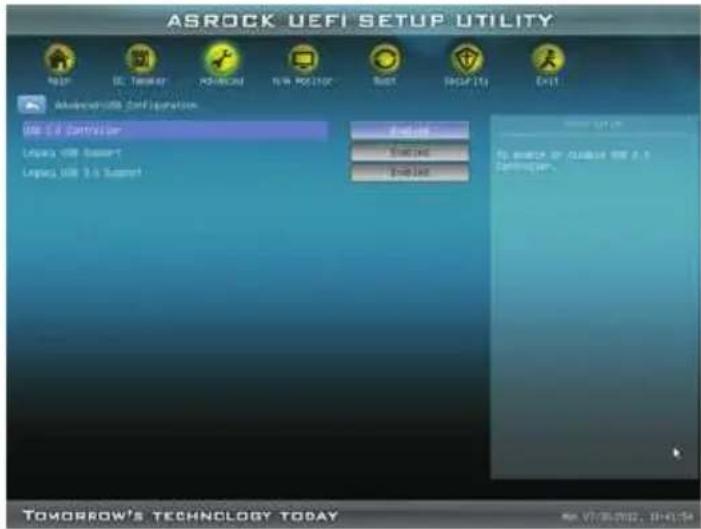
text_image
ASROCK UEFI SETUP UTILITY Origin IC Transfer ADJACUAY NIR POSITION Busit Safety Exit Adlerschmidt Configuration USB 1.0 Controller Legacy USB Support Legacy USB 3.0 Support 关闭 Switch Enabled TO MOURB'S TECHNOLOGY TODAYUSB 2.0 Controller
Use this item to enable or disable the use of USB 2.0 controller.
Legacy USB Support
Use this option to select legacy support for USB devices. There are four configuration options: [Enabled], [Auto], [Disabled] and [UEFI Setup Only]. The default value is [Enabled]. Please refer to below descriptions for the details of these four options:
[Enabled] - Enables support for legacy USB.
[Auto] - Enables legacy support if USB devices are connected.
[Disabled] - USB devices are not allowed to use under legacy OS and UEFI setup when [Disabled] is selected. If you have USB compatibility issue, it is recommended to select [Disabled] to enter OS.
[UEFI Setup Only] - USB devices are allowed to use only under UEFI setup and Windows / Linux OS.
Legacy USB 3.0 Support
Use this option to enable or disable legacy support for USB 3.0 devices. The default value is [Enabled].
3.5 Hardware Health Event Monitoring Screen
In this section, it allows you to monitor the status of the hardware on your system, including the parameters of the CPU temperature, motherboard temperature, CPU fan speed, chassis fan speed, and the critical voltage.
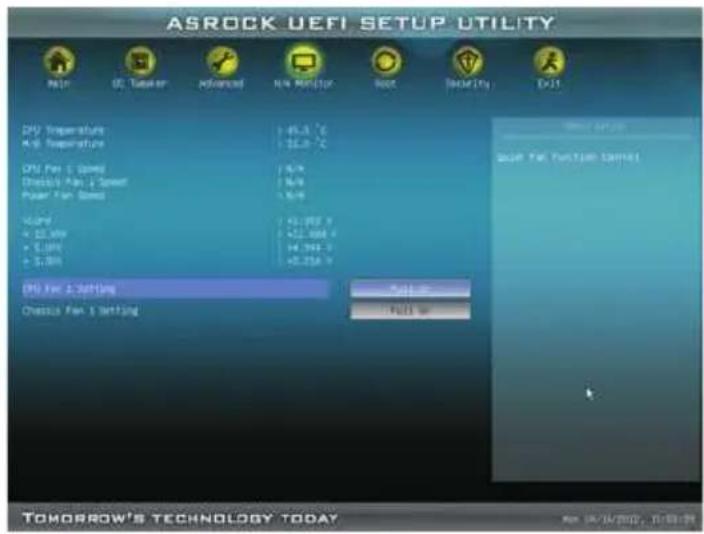
text_image
ASROCK UEFI SETUP UTILITY Power C2 Tuning Advanced N/A Renter Reset Security Outs CPU Temperature +45.0 °C A/B Temperature +32.0 °C CPU Fan 1 (Speed) +6.9 Device Fan 2 (Speed) +6.9 Polar Fan (Speed) +6.9 Vamp +0.258 V +0.258 V +0.258 V +0.258 V CPU Fan 2 (Setting) Device Fan 1 (Setting) Add to Add to TOMORROW'S TECHNOLOGY TODAYCPU Fan 1 Setting
This allows you to set the CPU fan 1 speed. Configuration options: [Full On] and [Automatic Mode]. The default is value [Full On].
Chassis Fan 1 Setting
This allows you to set the chassis fan 1 speed. Configuration options: [Full On], [Manual Mode] and [Automatic Mode]. The default is value [Full On].
Chassis Fan 2 Setting
This allows you to set chassis fan 2 speed. Configuration options: [Level 1] to [Level 4]. The default is value [Level 4].
3.6 Boot Screen
In this section, it will display the available devices on your system for you to configure the boot settings and the boot priority.

text_image
ASROCK UEFI SETUP UTILITY Main Off Target Maintenance N/A Monitor Best Security Exit Root Unit Properties List Root Unit No. 41 USTO, R200000000000000000000000000000000000000000000000000000000000000000000000000000000000000000000 Initial Features: Connect SendTo: Max-Box PCT Load Security Full Screen List ADDR ROM Display Root from Windows Low Root Feature Guard Root Feature Guard Count 1 No Legacy RM Executive Enabled Exceptional Enabled 3 TOMORROW'S TECHNOLOGY TODAY Sun 14/16/2022, 25/25/21Setup Prompt Timeout
This shows the number of seconds to wait for setup activation key. 65535(0xFFFF) means indefinite waiting.
Bootup Num-Lock
If this item is set to [On], it will automatically activate the Numeric Lock function after boot-up.
PCI ROM Priority
In case of multiple Option ROMs (Legacy and EFI Compatible), specifies what PCI Option ROM to launch. Configuration options: [Legacy ROM] and [EFI Compatible ROM]. The default vale is [Legacy ROM].
Full Screen Logo
Use this item to enable or disable OEM Logo. The default value is [Enabled].
AddOn ROM Display
Use this option to adjust AddOn ROM Display. If you enable the option "Full Screen Logo" but you want to see the AddOn ROM information when the system boots, please select [Enabled]. Configuration options: [Enabled] and [Disabled]. The default value is [Enabled].
Boot From Onboard LAN
Use this item to enable or disable the Boot From Onboard LAN feature.
Boot Failure Guard
Enable or disable the feature of Boot Failure Guard.
Boot Failure Guard Count
Enable or disable the feature of Boot Failure Guard Count.
3.7 Security Screen
In this section, you may set or change the supervisor/user password for the system. For the user password, you may also clear it.

text_image
ASROCK UEFI SETUP UTILITY Main DC Tension Advanced N/A Renter Set Security Exit Subcarrier Forward Net Forward N/A Renter Subcarrier Forward Net Forward Description Default or change the Factors TOMORROW'S TECHNOLOGY TODAY3.8 Exit Screen

text_image
ASROCK UEFI SETUP UTILITY Option DO Number RISenberg NVR Monitor Boot Security Next New Charges and Suit Existing Charges and Suit Existing Charges New USB Technologies Next Step: This is the second step for Change: This is not to be used for this program. TOMORROW'S TECHNOLOGY TODAYSave Changes and Exit
When you select this option, it will pop-out the following message, "Save configuration changes and exit setup?" Select [OK] to save the changes and exit the UEFI SETUP UTILITY.
Discard Changes and Exit
When you select this option, it will pop-out the following message, "Discard changes and exit setup?" Select [OK] to exit the UEFI SETUP UTILITY without saving any changes.
Discard Changes
When you select this option, it will pop-out the following message, "Discard changes?" Select [OK] to discard all changes.
Load UEFI Defaults
Load UEFI default values for all the setup questions. F9 key can be used for this operation.
4. Software Support
4.1 Install Operating System
This motherboard supports various Microsoft Windows® operating systems: 7 / 7 64-bit / Vista™ / Vista™ 64-bit / XP SP3 / XP 64-bit. Because motherboard settings and hardware options vary, use the setup procedures in this chapter for general reference only. Refer to your OS documentation for more information.
4.2 Support CD Information
The Support CD that came with the motherboard contains necessary drivers and useful utilities that enhance the motherboard features.
4.2.1 Running The Support CD
To begin using the support CD, insert the CD into your CD-ROM drive. The CD automatically displays the Main Menu if "AUTORUN" is enabled in your computer. If the Main Menu did not appear automatically, locate and double click on the file "ASSETUP.EXE" from the BIN folder in the Support CD to display the menus.
4.2.2 Drivers Menu
The Drivers Menu shows the available devices drivers if the system detects the installed devices. Please install the necessary drivers to activate the devices.
4.2.3 Utilities Menu
The Utilities Menu shows the applications software that the motherboard supports. Click on a specific item then follow the installation wizard to install it.
4.2.4 Contact Information
If you need to contact ASRock or want to know more about ASRock, welcome to visit ASRock's website at http://www.asrock.com; or you may contact your dealer for further information.
Installing OS on a HDD Larger Than 2TB in AHCI Mode
This motherboard is adopting UEFI BIOS that allows Windows ^ OS to be installed on a large size HDD (>2TB). Please follow below procedure to install the operating system.
- Please make sure to use Windows® Vista™ 64-bit (with SP1 or above) or Windows® 7 64-bit.
- Press
or at system POST. Set AHCI Mode in UEFI Setup Utility > Advanced > Storage Configuration > SATA Mode. - Choose the item "UEFI:xxx" to boot in UEFI Setup Utility > Boot > Boot Option #1. ("xxx" is the device which contains your Windows® installation files. Normally it is an optical drive.) You can also press
to launch boot menu at system POST and choose the item "UEFI:xxx" to boot. - Start Windows ^® installation.
Installing OS on a HDD Larger Than 2TB in RAID Mode
This motherboard is adopting UEFI BIOS that allows Windows ^ OS to be installed on a large size HDD (>2TB). Please follow below procedure to install the operating system.
- Please make sure to use Windows® Vista™ 64-bit (with SP1 or above) or Windows® 7 64-bit.
- Press
or at system POST. Set RAID Mode in UEFI Setup Utility > Advanced > Storage Configuration > SATA Mode. - Choose onboard RAID 3TB+ unlocker > UEFI Mode For GPT partition. Press
to save the change and exit. - Press
to enter Boot Manual. Choose UEFI : Built - in EFI Shell.

text_image
Please select boot device SATA: PIONEER DVD-ROM DVD-230P UEFI: PIONEER DVD-ROM DVD-230P UEFI: Built-in EFI Shell Configuration Boot Default- Key in drvcfg, for example you will see below:
Drv[4E] Ctrl[B5] Lang[eng]
![ASROCK A75iCafe - Drv[4E] Ctrl[B5] Lang[eng] - 1](/content/2026/06/1209498/images/89e1f81f91038c630c0b21eb4938dc9af2454897f9fda02540f8f70e82e67e86.jpg)
text_image
PCI Stress version: 2.10 (4680) Device Setup: 1.1.2 Device Mapping Table File: (Acct)(PMP003.0)/Pct(11.0)/Bcs(Pun0_Lund)/HD(Part1.Sig0E0B015-TXD1-4C72-BND-11) (Bacct)(PMP003.0)/Pct(11.0)/Bcs(Pun0_Lund)/HD(Part1.Sig0E0B015-TXD1-4C72-BND-11) File: (Acct)(PMP003.0)/Pct(11.0)/Bcs(Pun0_Lund)/HD(Part1.Sig0E0B015-TXD1-4C72-BND-11) (Bacct)(PMP003.0)/Pct(11.0)/Bcs(Pun0_Lund)/HD(Part1.Sig0E0B015-TX95-4CDD-5D2-1TC2 File: (Acct)(PMP003.0)/Pct(11.0)/Bcs(Pun0_Lund)/HD(Part1.Sig0E0B015-E22E-4L1D-BFF2-5665 (Bacct)(PMP003.0)/Pct(11.0)/Bcs(Pun0_Lund)/HD(Part1.Sig0E0B015-E22E-4L1D-BFF2-5665 File: (Acct)(PMP003.0)/Pct(11.0)/Bcs(Pun0_Lund)/HD(Part1.Sig0E0B015-E22E-4L1D-BFF2-5665 File: (Acct)(PMP003.0)/Pct(11.0)/Bcs(Pun0_Lund)/HD(Part1.Sig0E0B014-TXD1-4C72-BND-11) (Bacct)(PMP003.0)/Pct(11.0)/Bcs(Pun0_Lund)/HD(Part1.Sig0E0B014-TXD1-4C72-BND-11) File: (Acct)(PMP003.0)/Pct(11.0)/Bcs(Pun0_Lund)/HD(Part1.Sig0E0B014-TXD1-4C72-BND-11) (Bacct)(PMP003.0)/Pct(11.0)/Bcs(Pun0_Lund)/HD(Part1.Sig0E0B014-TX95-4CDD-5D2-1TC2 File: (Acct)(PMP003.0)/Pct(11.0)/Bcs(Pun0_Lund)/HD(Part1.Sig0E0B014-TX95-4CDD-5D2-1TC2 File: (Acct)(PMP003.0)/Pct(11.0)/Bcs(Pun0_Lund)/HD(Part1.Sig0E0B014-E22E-4L1D-BFF2-5665 File: (Acct)(PMP003.0)/Pct(11.0)/Bcs(Pun0_Lund)/HD(Part1.Sig0E0B014-E22E-4L1D-BFF2-5665 File: (Acct)(PMP003.0)/Pct(11.0)/Bcs(Pun0_Lund)/HD(Part1.Sig0S75A3-E22E-4L1D-BFF2-5665 File: (Acct)(PMP003.0)/Pct(11.0)/Bcs(Pun0_Lund)/HD(Part1.SigS75A3-E22E-4L1D-BFF2-5665 File: (Acct)(PMP003.0)/Pct(11.0)/Bcs(Pun0_Lund)/HD(Part1.SigS75A3-E22E-4L1D-BFF2-5665 File: (Acct)(PMP003.0)/Pct(9.9) /USB(N, 6)- Key in dh [Drv number], for example: key in dh 4E.
![ASROCK A75iCafe - Drv[4E] Ctrl[B5] Lang[eng] - 2](/content/2026/06/1209498/images/b73e18ff789bb4af0c20c8d00846209666333cd75c432311c33aaa309d7e4675.jpg)
text_image
Press ESC in : seconds to skip startup.nsh, any other key shell> dvcf Configurable Components Dry[4E] Ctrl[85] Lang[eng] Shell> dh 4E Handle 4E (01797018) Image (178B240) File:PromiseRaidX64 ParentHandle...: 1001F18 SystemTable...: 6FB72F18 DeviceHandle...: 1008A98 FilePath.....: C468B3B2-4550-4909-AD57-249614183F4A PdbFileName...: F:\edx104\SamplePlatform\X64\uefi\X6 ImageBase.....: 17FA000 - 181B580 ImageSize.....: 21580 CodeType.....: BS_code DataType.....: BS_data DriverBinding (1819720) ComponentName2 (1819750) Configuration (18197A8) 4CBM2451-C207-4058-3614-99EA13251341 (017BEF28)- And then key in drvcfg -s [Drv number] [Ctrl number] to enter Raid Utility. For example: key in drvcfg -s 4E B5.
![ASROCK A75iCafe - Drv[4E] Ctrl[B5] Lang[eng] - 3](/content/2026/06/1209498/images/6b6bc2419fc3937ccf290b43364012be9135128f32db10c0939acf3bfeceeaba.jpg)
text_image
Press ESC in a sector to ship startup.hsh. Any other Shell> drvcf& Configurable Components Drv(4E) Ctrl(85) Lang(eng) Shell> dh 4E Handle 4E (01797018) Image (178B240) File:PromiseRaidX64 ParentHandle...: 1001F18 SystemTable...: 6FB72F18 DeviceHandle...: 1008A9B FilePath.....: C468B3B2-4550-4909-AD57-2496141B3F PdbFileName...: F:\edk104\Sample\Platform\X64\uef1 ImageBase.....: 17FA000 - 181B580 ImageSize.....: 21580 CodeType.....: BS_code DataType.....: BS_data DriverBinding (1819729) ComponentName2 (1819750) Configuration (18197A8) 4CEA2451-CZ07-405B-9634-99EA13251341 (0178EF28) Shell> drvcfg -3 4E RS- Choose Logical Drive Main Menu to set up Raid Drive.
![ASROCK A75iCafe - Drv[4E] Ctrl[B5] Lang[eng] - 4](/content/2026/06/1209498/images/75bd23ac18a364ccf84b925908ab1dc60e6694fd71a3e0070e1e9247ccbba9d9.jpg)
text_image
+ Main Menu + Driver Information Menu + Physical Device Main Menu + Logical Drive Main Menu + Controller Information Menu- Choose Logical Drive Create Menu to create a Raid Drive.
![ASROCK A75iCafe - Drv[4E] Ctrl[B5] Lang[eng] - 5](/content/2026/06/1209498/images/9a1cb426691f997c47613632cfebfa1e6266af41899bc0347a1b784ce9ed2f35.jpg)
text_image
+ Logical Drive Main Menu + Logical Drive List Menu + Logical Drive Create Menu + Logical Drive Delete Menu- Choose Usable Physical Drive List to select Raid HDD.
![ASROCK A75iCafe - Drv[4E] Ctrl[B5] Lang[eng] - 6](/content/2026/06/1209498/images/0a4cc3f34f4abe5006faf9e3b14473b12836694472edfb64f36840f924f4c485.jpg)
text_image
+ Logical Drive Create Menu - Usible Physical Drive List + Basic Setting - Raid Mode :- Press Space on keyboard to toggle checkbox.
![ASROCK A75iCafe - Drv[4E] Ctrl[B5] Lang[eng] - 7](/content/2026/06/1209498/images/8300076a2f54d70b5966a206a73456f9b684328215a544d9af36ad8d424b609a.jpg)
text_image
• Clinical Drive Cramble HRCU - Segment ST31000240SV | 1000.13 GB - Segment ST31000240SV | 1000.13 GB - Hitachi HDT721010SLA350 | 1000.13 GB- Choose Ld Size setting, and key in the Raid size.
![ASROCK A75iCafe - Drv[4E] Ctrl[B5] Lang[eng] - 8](/content/2026/06/1209498/images/7c5ee8135b93526d4cd2543e65bff78b24134721cf9028ccb2a47fef1a7aa551.jpg)
text_image
• Logical Drive Create Reid • Usable Physical Drive List • Basic Setting - Raid Mode :- After set up Raid size, please click Start to Create.
![ASROCK A75iCafe - Drv[4E] Ctrl[B5] Lang[eng] - 9](/content/2026/06/1209498/images/946d0ce809eaf3125a9323aa02062f510012caed2be0510b03f84ea11b71d295.jpg)
text_image
• Logical Drive Create Here + Usable Physical Drive List + Basic Setting - Raid Mode :-
Press
to exit Utility. -
During reboot, please press
to enter Boot Manual. Choose UEFI: SCSI CD/DVD Drive.
![ASROCK A75iCafe - Drv[4E] Ctrl[B5] Lang[eng] - 10](/content/2026/06/1209498/images/48d40c8c6508686529068acf054f0f657634c219e1fbd65ba1f0ac140e44ad5c.jpg)
text_image
Please select boot device USB : KingstonDT 101 II 1.00 UEFI: KingstonDT 101 II 1.00 Windows Boot Manager UEFI: SCSI CD/DVD Drive Configuration Boot Default* This option only shows on Windows ^® 7 64-bit and Vista ^TM 64-bit OS.
- Follow Windows® Installation Guide to install OS.
If you install Windows ^® 7 64-bit / Vista ^TM 64-bit in a large hard disk (ex. Disk volume >2TB), it may take more time to boot into Windows ^® or install driver/utilities. If you encounter this problem, you will need to following instructions to fix this problem.
Windows® Vista™ 64-bit:
Microsoft ^® does not provide hotfix for this problem. Below steps are Microsoft ^® suggested solution:
A. Disable System Restore.
a. Type "systempropertiesprotection" in the Start Menu. Then press "Enter".

text_image
Programs systempropertiesprotection QQQ Documents Pictures Music Games Recent Items Computer Network Connect To ControlPanel Default Programs Help and Support Search Everywhere Search the Internet systempropertiesprotectionb. De-select Local Disks for System Restore. Then Click "Turn System Restore Off" to confirm. Then Press "Ok".
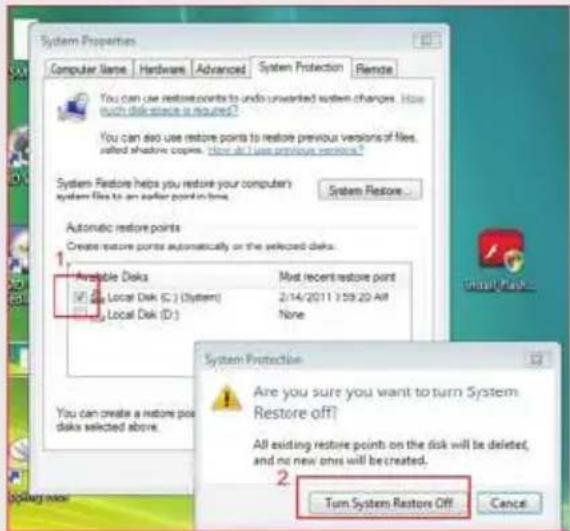
text_image
System Properties Computer Name Hardware Advanced System Protection Remote You can use restore points to undo unwanted system changes. How such disk space is required? You can also use restore points to restore previous versions of files. valued shadowing copies. How do it use previous resources? System Restore helps you restore your computer's system files to an earlier point in time. Automatic restore points Create restore points automatically on the selected disks. Available Disk Local Disk (C:) (System) Local Disk (D:) Most recent restore point 2/14/2011 359.20 All None System Protective Are you sure you want to turn System Restore off! All existing restore points on the disk will be deleted, and no new ones will be created. 2 Turn System Restore Off CancelB. Disable "Volume Shadow Copy" service.
a. Type "computer management" in the Start Menu, then press "Enter".

text_image
Programs Computer Management QQQ Documents Pictures Music Games Recent Items Computer Network Connect To Control Panel Default Programs Help and Support Search Everywhere Search the Internet computer managementb. Go to "Services and Applications>Services"; Then double click "Volume Shadow Copy".

text_image
Computer Management File Edit Tools Help Computer Management Local System Tools Task Scheduler Shared Folder Local Standard Groups Reliability and Performance Service Manager Storage Disk Management Services and Applications Services 1 Services Volume Shadow Copy Buy the service Used the service Descriptions: Managers and implementable Volume Shadow Copy sets for backup and other services. If this service is shopped, window chips will be as原始为 backup with the backup may fail if the services are doubled, any services that apply? Implied as it is not able to show. Name Description Status Startup Type Log On Smart Card Personal Pro... Without Pro... Manual Local1 MAPP Copy Master class Manual Local1 Software Learning Inhibits the... Started Automatic Name USB (Server) Advanced Start Manual Local1 SuperFAC Maintenance, Start, Automatic Local1 System Event Notification... Microsoft, Start, Automatic Local1 TextPC Input Service Inhibits Task... Started Automatic Local1 Tank Scheduler Inhibits a vs. Start, Automatic Local1 TCSOP Audio HDging Provide data... Continue Data... Manual Nonea Telephone Services Update Time... Manual Local1 Terminal Services Chat... Terminal As... Manual Local1 Terminal Services Share... Update time... Manual Local1 Pharma Provides us... Start, Automatic Local1 Print Ordering Server Provides us... Manual Local1 SPD Dept Services Inhibits etc... Automatic (C)... Manual Local1 OPB Device Host Inhibits Office... Manual Local1 Our Profile Service This service... Start, Automatic Local1 MLKeredia digital notes... Start, Automatic Local1 Store Card Broadcasts on Manual Local1 Volume Shadow Copy Manager etc... Start, Manual Local1 Wall Load Including Work... Start, Automatic Local1 Windows Audio Manager inc... Start, Automatic Local1 Windows Audio Instances Manager inc... Start, Automatic Local1 Windows Pitch Controller PLC... Manual Local1 Windows Cardspace Security inc... Manual Local1 Windows Color System The WebPro... Manual Local1 Windows Connect Now: Left as a Reg. Manual Local1c. Set "Startup type" to "Disable" then Click "OK".
text_image
Volume Shadow Copy Properties (Local Computer) General Log On Recovery Dependencies Service name: VSS Display name: Volume Shadow Copy Description: Managees and implements Volume Shadow Copies Used for backup and other purposes. If this service Path to executable C:\Windows\system12\ways.exe Startup type Disabled Help me configure service startup options. Service status: Stopped Start Skip Pause Renurse You can specify the start parameters that apply when you start the service from here. Start parameters: OK Cancel ApplyC. Reboot your system.
D. After reboot, please start to install motherboard drivers and utilities.
Windows ^® 7 64-bit:
A. Please request the hotfix KB2505454 thru this link: http://support.microsoft.com/kb/2505454/
B. After installing Windows ^® 7 64-bit, install the hotfix kb2505454.
(This may take long time; >30 mins.)
C. Reboot your system. (It may take about 5 mins to boot.)
D. The Windows ^® will install this hotfix then reboot by itself.
E. Please start to install motherboard drivers and utilities.
- Finish.