
TAR1200S - Coffee maker Technika - Free user manual and instructions
Find the device manual for free TAR1200S Technika in PDF.


| Product Type | Wall-Mounted Ducted Rangehood |
| Brand | Technika |
| Model | TAR1200S |
| Installation Type | Ducted |
| Electrical Connection | 3-pin plug, 10A, Class I (earth required) |
| Supply Cord | Replaceable by qualified person |
| Fan Speeds | Low, Medium, High |
| Controls | Push buttons (Low, Mid, High, Light, Timer) |
| Timer | 5-minute auto shut-off |
| Lighting | LED lamps (replaceable, plug-in) |
| Filter Type | Aluminum grease filters |
| Filter Cleaning | Every 2 months; hand wash or dishwasher safe |
| Minimum Clearance to Cooktop | 1200 mm |
| Material | Stainless steel |
| Safety Features | High temperature safety device, thermal cut-off |
| Intended Use | Indoor or undercover alfresco |
| Warranty | Void if not installed in sheltered area |
| Disposal | Recycle as electronic waste per local regulations |
Frequently Asked Questions - TAR1200S Technika
User questions about TAR1200S Technika
0 question about this device. Answer the ones you know or ask your own.
Ask a new question about this device
Download the instructions for your Coffee maker in PDF format for free! Find your manual TAR1200S - Technika and take your electronic device back in hand. On this page are published all the documents necessary for the use of your device. TAR1200S by Technika.
USER MANUAL TAR1200S Technika
pie
Instructions for Use AlfrescInstructions for Use and Installation Alfresco Rangehood
TAR1200S
Contents
For Your Safety
Safety Precautions 4
Before Connecting 4
Warnings 5
Use and Care
Use and Care 7
Controls 7
Cleaning your Rangehood 8
Troubleshooting 9
Disposal 9
Installation
Electrical Connection 10
Instructions for Installation .... 11
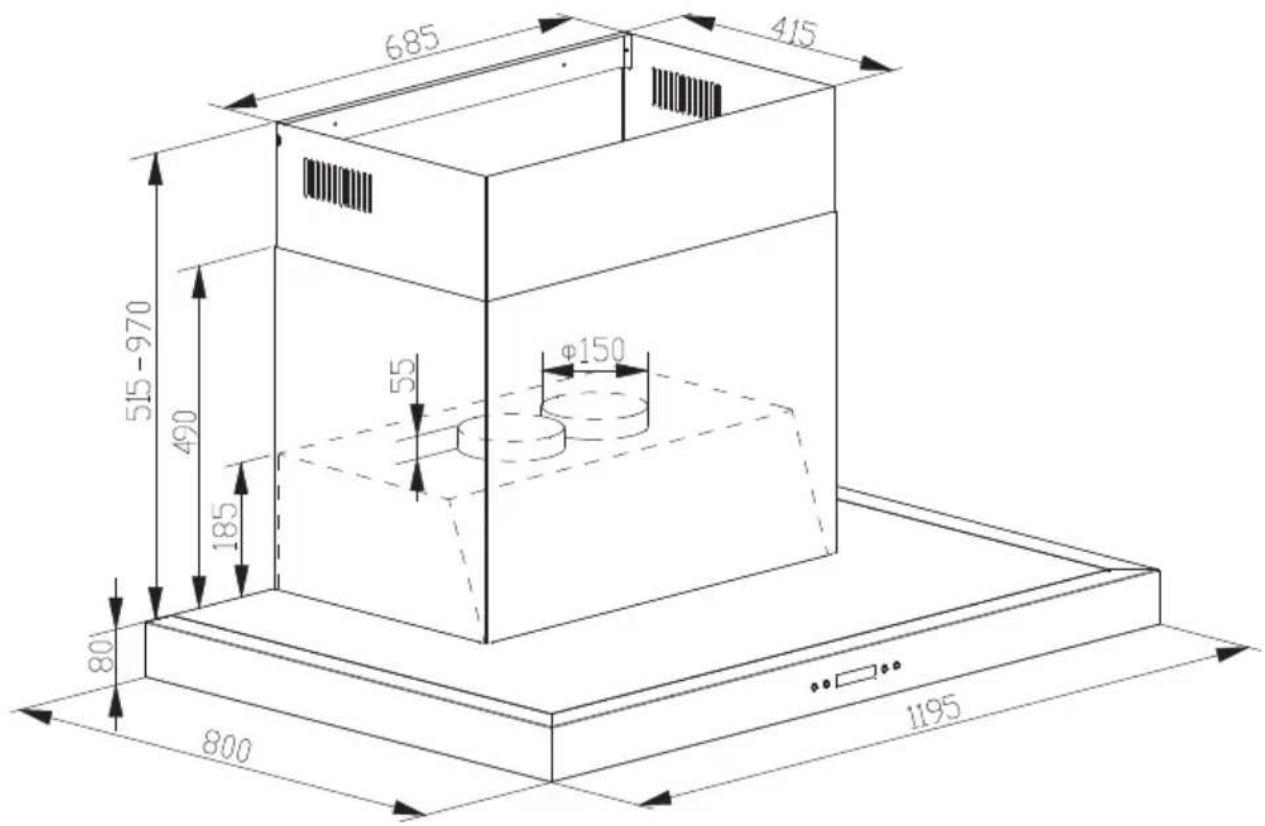
Dimensions....14
For Your Safety
Carefully read the following important information regarding installation safety and maintenance. Keep this information booklet accessible for future reference.
The appliance has been designed for use in a Ducted installation, see diagram below:

natural_image
Pure mechanical diagram showing fluid flow paths with arrows and dashed lines, no text or symbols presentSafety Precautions
Take care when the Range Hood is operating simultaneously with an open fireplace or burner that depend on natural ventilation as the Range Hood removes air from the room, which a burner or fireplace may need for combustion.
Provide adequate ventilation for safe operation of the Range Hood. Follow any local laws that apply to external air evacuation.
Before connecting to the electricity network:
Look at the data plate (located inside the appliance) to ascertain that the voltage and power correspond to the available power supply and the power outlet is suitable. If in doubt ask a qualified electrician.
If the appliance is used intensively for a long period of time, you may need to opening a window to improve airflow.

WARNINGS!
- Do not check the status of the filters while the Range Hood is operating.
- Do not touch bulbs or adjacent areas, during or straight after use.
- CAUTION: Accessible parts may become hot when used with cooking appliances.
- Do not flambé under the Range Hood.
- Avoid free flame, as it is damaging to the filters and can cause fire hazard.
- Constantly check food frying, overheated oil may become a fire hazard.
- Disconnect the electrical plug prior to any maintenance.
- This appliance is not intended for use by persons (including children) with reduced physical, sensory or mental capabilities, or lack of experience and knowledge, unless they have been given supervision or instruction concerning use of the appliance by a person responsible for their safety.
- Children should be supervised to ensure that they do not play with the appliance.
- There shall be adequate ventilation in the room when the Range Hood is used at the same time as appliances burning gas or other fuels.
- There is a fire risk if cleaning is not carried out in accordance with the instructions.
- WARNING: DO NOT penetrate any screws into the range hood as this may result in electrical hazards.
- WARNING: Failure to install the screws or fixing device in accordance with these instructions may result in electrical hazards.

WARNINGS!
- If the supply cord is damaged, it must be replaced by the manufacturer, its service agent or similarly qualified persons in order to avoid a hazard.
- The air must not be discharged into a flue that is used for exhausting fumes from appliances burning gas or other fuels.
- The minimum distance between the cooktop hob and the lowest part of the range hood shall be at least 120cm. If the instructions for installation of the gas hob specify a greater distance, this has to be taken into account.
- Regulation concerning the discharge of air has to be fulfilled.
THE MANUFACTURER DECLINES ALL RESPONSIBILITY FOR DAMAGES CAUSED BY BREACHING THE ABOVE WARNINGS.
Use and Care
It is recommended to start the Range Hood prior to commencing to cook and leave the Range Hood in operation for 15 minutes after cooking is finished in order to completely eliminate cooking vapours and odours.
To ensure the Range Hood continues to operate effectively, regular maintenance and cleaning is required. Clean the fan and other surfaces of the Range Hood regularly using a cloth moistened with warm water or non abrasive liquid detergent.
Lights
LED lamps are a spare part and are not repairable. However LED lamps can be easily removed and replacements installed, note plug and socket connection. Please contact Technika spare parts department for replacements.
Controls
The control panel has five functions as shown below.


Low Mid High Light Timer
Power on: After you have connected the cooker hood to the mains supply the backlight will turn on. The backlight will turn off after 5 seconds without any operation and hood will enter stand-by mode.
Push the low button, indicated by a fan with 3 blades, and the motor will run at a low speed. An indicator light will also illuminate. Push it again and the motor will stop.
Push the medium button, indicated by a fan with 4 blades and the motor will run at a medium speed. An indicator light will also illuminate. Push it again and the motor will stop.
Push the high button, indicated by a fan with 5 blades and the motor will run at a high speed. An indicator light will also illuminate. Push it again and the motor will stop.
Press the Light button once; lights will come on. Press the button again and the lights will turn off.
Whilst the cooker hood is in use, if you press the timer button once the hood will run for 5 minutes and then cut off.
Use and Care
Cleaning your rangehood
The proper function of the rangehood requires regular maintenance operations.
The anti-grease filters capture the grease particles suspended in the air, and are therefore subject to clogging according to the frequency of the use of the appliance.
In order to prevent fire hazard, it is recommendable to clean the filter at a minimum of every 2 months by carrying out the following instructions:
- Remove the filters from the cooker hood and wash them in a solution of water and neutral liquid detergent, leaving to soak.
- Rinse thoroughly with warm water and leave to dry.
- The filters may also be washed in the dishwasher.
The aluminum panels may alter in color after several washes. This is not cause for customer complaint nor replacement of panels.
Clean the fan and other surfaces of the cooker hood regularly using a cloth moistened with denatured alcohol or non abrasive liquid detergent.
Keep motor and other parts free from water as this will cause damage to the appliance.
Stainless steel care
Stainless steel gets its protective coating from the chromium oxidizing in the air to form a protective surface of chromium oxide. This can be attacked by different substances, such as salt water or sea air. The stainless steel will start to show pit marks which are referred to in the industry as tea staining. This will happen to marine grade stainless steel type 316 in the same way it will happen to stainless steel type 304, it will just take longer to occur.
The way to overcome this is to clean the stainless steel with warm soapy water and then polish it with a cloth so that the chromium will oxidize again.
When exposed to sea water or sea side conditions this is only a stop gap measure as the attack will start again. With stainless steel rangehoods exposed in Alfresco areas we recommend spraying the hood with vegetable oil and rubbing it all over the rangehood, if it is going to be unused over a period of time.
Troubleshooting
| Problem | Possible reason | Solution |
| Hood doesn’t work | No electricity supply | Check the plug is connected |
| Check that the main switch/circuit breaker/safety switch is turned on | ||
| Poor airflow | Aluminum grease filters clogged | Clean the filters and replace when dry |
| Motor running but no air flow | Butterfly valve jammed | Contact service department |
| Motor turns off after a few minutes | High temperature safety device activated | The kitchen is not sufficiently ventilated |
| The hood is installed too near to the cooktop | Refer to installation instructions for correct clearances | |
| Oil dripping onto stove | Aluminum grease filter saturated | Wash the aluminum grease filters |
| Whirring sound | Something in contact with fan blade | Contact service department |
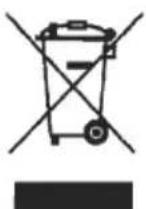
Disposal
By ensuring this product is disposed of correctly, you will help prevent potential negative consequences for the environment and human health, which could otherwise be caused by inappropriate waste handling of this product.
The symbol on the product indicates that this product may not be treated as household waste. Instead it shall be handed over to the applicable collection point for the recycling of electrical and electronic equipment.
Disposal must be carried out in accordance with local environmental regulations for waste disposal.
For more detailed information about treatment, recovery and recycling of this product, please contact your local city council office.
Installation
Assembly and electrical connections must be carried out by authorised personnel.
Electrical Connection
The Range Hood is fitted with a power cord and 3 pin plug. Install the Range Hood so that the plug is easily accessible. Plug the 3-pin plug into a properly earthed, 10A general purpose power outlet.
If the supply cord is damaged, it must be replaced by the manufacturer or its service agent or a similarly qualified person in order to avoid a hazard.
The appliance has been manufactured as a class I, therefore earth cable is necessary.
The connection to the mains is carried out as follow:
| IEC227 | North America | |
| L = Live | Brown | Black |
| N = Neutral | Blue | White |
| E = Earth | Green/Yellow | Green |
If not provided, connect a plug for the electrical load indicated on the description label. Where a plug is provided, the cooker hood must be installed so that the plug is easily accessible after installation.
An omnipolar switch with a minimum aperture of 3mm between contacts, in line with the electrical load and local standards, must be placed between the appliance and the network in the case of direct connection to the electrical network.
Instructions for Installation
To be installed in an undercover alfresco area and/or indoor kitchen only. If the unit is not adequately covered or sheltered from the outside elements the warranty will be null and void.
Ensure that the fixings used for this range hood are suitable.
Check the area where the range hood is to be fitted, to ensure that it is structurally sound and will support the weight of the appliance.
Install Range Hoods in accordance with the manufacturer's instructions. A minimum clearance of 1200mm is required from the top of the cooking surface to the underside of the rangehood.
- Refer to the notes and required clearances above.
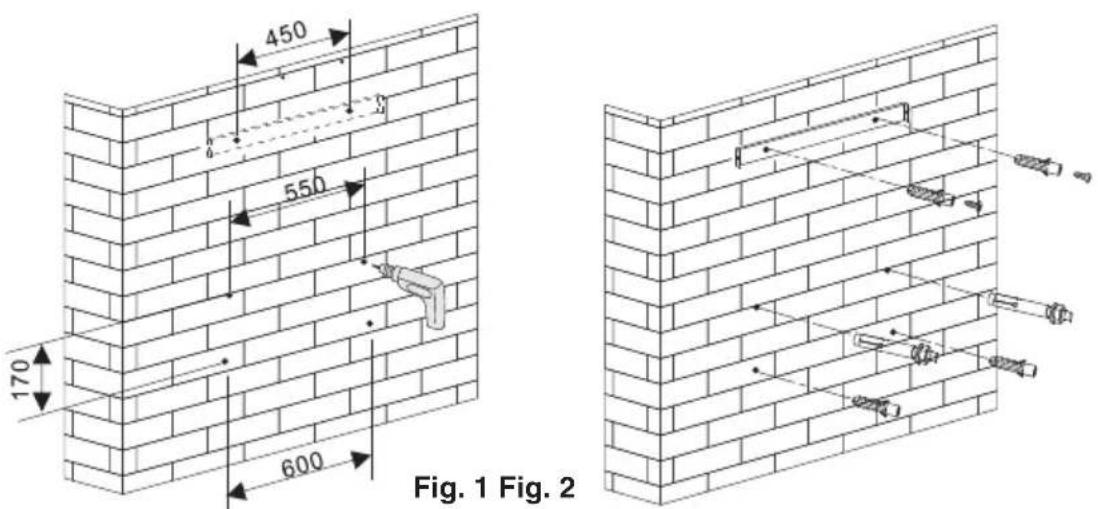
- After deciding the installation height of the hood, drill 6 holes according to figure 1. Please note: The top holes are for the flue cover bracket. The bracket determines the height of the flue cover.
3a. For Masonry walls, install appropriate plugs into the 2 bracket holes and 2 safety holes (top and bottom) and appropriate masonry anchors into the 2 key holes (middle holes). Fix the flue cover bracket onto the wall with 2 screws. See figure 2.
3b. For Timber walls, install appropriate screws into the 2 key holes (middle holes). Fix the flue cover bracket onto the wall with 2 screws. See figure 2.
Installation
Instructions for Installation (cont.)
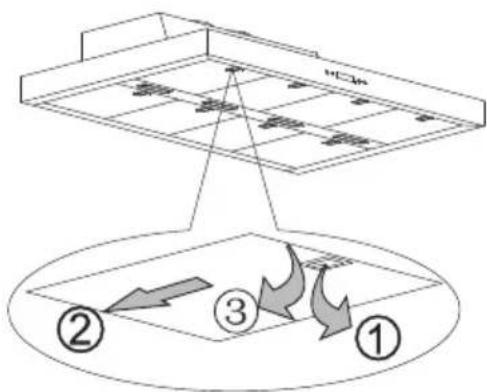
- Remove the 8 filters. See figure 3.
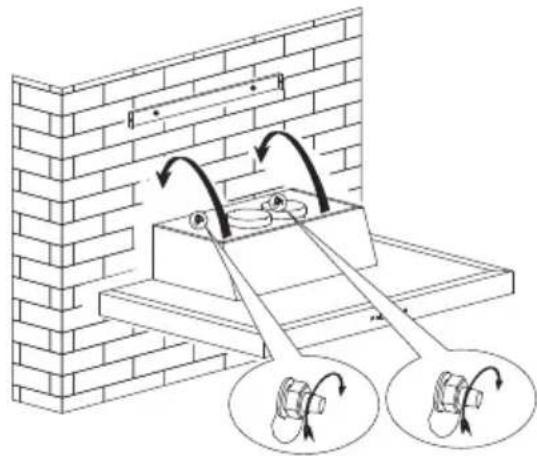
- Hang the hood on the two Masonry anchors / Screws and make sure rangehood is level. See figure 4.
flowchart
graph TD
    A["Initial Setup"] --> B["Intermediate Processing"]
    B --> C["Final Output"]
    subgraph Stage 1
        D["①"] --> E["②"]
        F["③"] --> G["③"]
    end
    subgraph Stage 2
        H["②"] --> I["③"]
    end
Fig. 3 Fig. 4
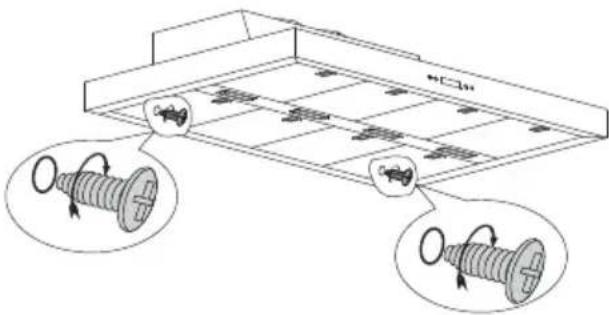
- Install 2 screws through the back of the hood. See figure 5.
- Install flue/ductwork and make sure it is pulled taut with no creases to maximise airflow. See figure 6.
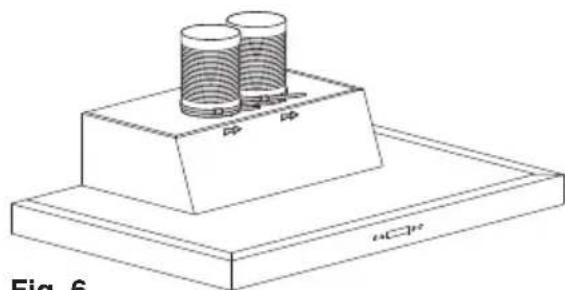
natural_image
Isometric diagram of a mechanical setup with two cylindrical components mounted on a base plate (no text or symbols)Fig. 6
Installation
Instructions for Installation (cont.)
- Slide the inner flue cover into the outer flue cover. Take them together and put them on the top of the hood. See figure 7.
- Slide the inner flue cover upwards, then connect the inner flue cover to the bracket with 2 ST 4 x 8 screws. See figure 8.

Fig. 7 Fig. 8
WARNING: DO NOT penetrate any screws into the range hood as this may result in electrical hazards.
WARNING: Failure to install the screws or fixing device in accordance with these instructions may result in electrical hazards.
If a connection flue/ductwork composed of two parts is used, the upper part must be placed outside the lower part.
Exhaust air must not be discharged into a flue/ductwork which is used for exhausting fumes from appliances burning gas or other fuels. Installation must comply with any local regulations concerning the discharge of exhaust air.
Before proceeding with the assembly, remove the anti-grease filter so that the unit is easier to handle. Prepare the hole in the ceiling or wall for the evacuation of the air.
READ THE INSTRUCTION BOOKLET BEFORE INSTALLING AND USING THE APPLIANCE.
The manufacturer will not be responsible for any damage to property or to persons caused by incorrect installation or improper use of the appliance.
The manufacturer is not responsible for any inaccuracies, due to printing or transcription errors, contained in this handout. In addition, the appearance of the figures reported is also purely indicative.
The manufacturer reserves the right to make changes to its products when considered necessary and useful, without affecting the essential safety and operating characteristics.
Technika constantly seeks ways to improve the specifications and designs of their products.
Whilst every effort is made to produce up to date literature, this document should not be regarded as an infallible guide.
Actual product only should be used to derive cut out sizes.
All Technika Appliances must be installed by a qualified person/s with adherence to the relevant electrical, plumbing and gas codes, with compliance being issued as required by state or national legislation.
Additionally all Technika Upright cookers must have chains installed correctly in adherence to the relevant gas and plumbing codes by a Licenced installer.
For maximum effectiveness and efficiency all rangehoods should be installed with the use of ductwork, by a licenced installer with adherence to the relevant state and national building codes and regulations.
All Technika appliances are for Domestic use only, and must be installed by a licenced installer into Domestic Applications only, without exception and to the required Authorities guidelines. Any installation outside of this will VOID warranty.
TECHNIKA
TOMORROWS TECHNOLOGY TODAY
TECHNIKA PTY LTD ACN 069 686 326
77 FILLO DRIVE SOMERTON VIC 3062
General : 1800 649 969 - Service : 1800 333 244
Technika After Sales Service - P.O. Box 543 SOMERTON VIC 3061
- Instructions for Use and Installation Alfresco Rangehood
- Contents
- For Your Safety
- Use and Care
- Installation
- Safety Precautions
- Before connecting to the electricity network:
- WARNINGS!
- Lights
- Controls
- Cleaning your rangehood
- Stainless steel care
- Disposal
- Electrical Connection
- Instructions for Installation
- Instructions for Installation (cont.)
- READ THE INSTRUCTION BOOKLET BEFORE INSTALLING AND USING THE APPLIANCE.
Brand : Technika
Model : TAR1200S
Category : Coffee maker