WA 7760 W - Washing machine BAUKNECHT - Free user manual and instructions
Find the device manual for free WA 7760 W BAUKNECHT in PDF.


| Product Type | Freestanding Washing Machine |
| Loading Type | Front-loading |
| Dimensions (H x W x D) | 85 cm x 60 cm x 60 cm |
| Weight | 70 kg |
| Power Supply | 230 V / 50 Hz, 10 A |
| Maximum Power Consumption | 2000 W |
| Capacity | 7 kg |
| Maximum Spin Speed | 1200 rpm |
| Wash Programs | Cotton, Synthetics, Delicates, Wool, Quick Wash, Eco, Rinse & Spin |
| Energy Efficiency Class | A+++ |
| Water Consumption per Cycle | 49 L (approx) |
| Noise Level (Wash/Spin) | 56 dB / 76 dB |
| Safety Features | Child Lock, Overload Protection, Leak Protection |
| Maintenance | Clean detergent drawer, drain filter, drum clean cycle recommended |
| Spare Parts Availability | Common parts (door seal, pump, belt, control board) available |
| Brand | Bauknecht |
| Model | WA 7760 W |
Frequently Asked Questions - WA 7760 W BAUKNECHT
User questions about WA 7760 W BAUKNECHT
0 question about this device. Answer the ones you know or ask your own.
Ask a new question about this device
Download the instructions for your Washing machine in PDF format for free! Find your manual WA 7760 W - BAUKNECHT and take your electronic device back in hand. On this page are published all the documents necessary for the use of your device. WA 7760 W by BAUKNECHT.
USER MANUAL WA 7760 W BAUKNECHT
YOUR ELECTRONIC WASHING MACHINE GB
This washing machine is equipped with all-electronic control, which opens up a host of possibilities for you. Amongst others, these include: precise determination of load, Dynamic-Sense Technology, imbalance detection and correction system, fast programme changing, accurate programme sequence indicator, start delay, soaking, safety feature “intelligent (anti-flood) Water Stop system”.
- The load determining facility evaluates the laundry load at the start of the wash cycle and optimises the washing procedure accordingly. The machine adapts automatically to the prevailing circumstances: if you are washing a minimum load, the programme carries out only two rinse cycles during the cotton and synthetics programmes, while keeping the rinse results very good. You save on water, energy and time as a result.
- Thanks to its Dynamic-Sense Technology the appliance adapts optimally to the prevailing circumstances, achieving favourable consumption figures even in the case of small loads. Water supply temperature and pressure, quantity of water and degree of loading, are the parameters taken into account. The programme duration is influenced by these factors. This is checked and updated at particular stages of the programme. Consequently, the programme duration can vary by up to 60 minutes.
- The imbalance detection and correction system protects your washing machine if the imbalance is too great on initiating a spin cycle. This may occur with a badly distributed load or in the case of single large laundry item. The laundry is re-distributed and the spin speed is not increased until satisfactory laundry distribution has been achieved.
- If you happen to have selected the wrong programme, you can quickly change programme at any time, without needing to add new detergent. Select the desired programme and start the appliance. The new program resumes the wash programme at the same stage at which the preceding one was interrupted.
- The accurate sequence indicator shows what stage of the programme has been reached by LED indicators coming on: after starting the programme, the programme sequence indicator moves from left to right passing through "Wash", "Rinse", "Spin". Once the current stage of the programme has been completed that LED indicator goes out.
The washing process is subdivided into three phases which corresponds to the three wash LEDs:
- Enzyme phase: at low temperature, organic soiling such as e.g. blood, milk and egg are dissolved.
- Heating-up phase: the water is heated up to the selected washing temperature.
- Washing phase: the laundry is washed and, if the temperature is raised, whitened.
- Using the “Start Delay” option (if present) you can select the programme start time from 1 to 19 hours in advance. You can set the programme start time so that the laundry will be completed by a particular time, thus allowing you to take advantage of favourable lower electricity tariffs at night.
- In order to soak particularly heavily soiled colourfast laundry, select the “Coloured” programme and, once the water has been fed in, press the “Start/Pause” button. The programme is interrupted and you can leave the laundry to soak as long as you want.
You can continue the programme by pressing the "Start/Pause" button once again.
- Depending on the washing machine type, it may be equipped with the anti-flood safety feature "intelligent Water Stop system": Even while switched off your washing machine is able to detect water leakage and brings this to your attention with an audible alarm.
LAUNDRY CARE LABELS
WASH
95 Resistant cotton
60 Synthetics
40 Delicates
The figures correspond to the maximum permitted washing temperatures.
Hand-washed items
Do not wash
Chlorine bleaching possible
Chlorine bleaching not possible
A Dry Cleanable
Not dry cleanable
DRY
Dry at normal temperature
Dry at a lower temperature
Do not dry in tumble dryer
IRON
Hot iron
Use medium hot iron
Do not use hot iron
Do not iron
QUICK REFERENCE GUIDE GB
natural_image
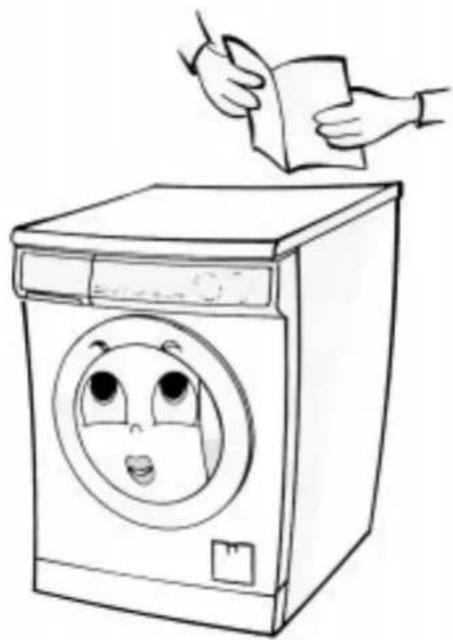
Simple line drawing of a washing machine with a face emoji and hands cleaning it (no text or symbols)BEFORE USING THE APPLIANCE FOR THE FIRST TIME:
- FOLLOW THE "INSTALLATION INSTRUCTIONS".
- REMOVE THE TRANSIT BOLTS BEFORE USING THE APPLIANCE.
-
First wash cycle without laundry:
-
Turn on the tap.
- Close the appliance door.
- Pour a small amount of detergent (about 30 ml) into the detergent dispenser
- Select a short program (see programme chart).
- The "Power On" indication shows that the machine is switched on.
- The pilot lamp of the "Start/Pause" button flashes. Press the "Start/Pause" button.
This initial cycle serves to eliminate any water remaining after your appliance was tested at the factory.
NORMAL DAILY USE:
- Turn on the tap.
- Sort the wash according to fabric type and colour and load the appliance.
- Close the door.
- Put in detergent and any additives required into the dispenser.
- Select the programme, the temperature and any special options required.
- The pilot lamp of the "Start/Pause" button flashes. Press the "Start/Pause" button.
IMPORTANT:
During the first 15 minutes of the "Cotton", "Coulored cotton" and "Synthetics" programmes the door can be opened for adding laundry ("Door Free" indicator). This is not possible if "Rapid" is selected.
| GB | CONTENTS |
| YOUR ELECTRONIC WASHING MACHINE | PAGE 21 |
| LAUNDRY CARE LABELS | PAGE 22 |
| APPLIANCE AND ACCESSORIES | PAGE 25 |
| CHILD SAFETY | PAGE 25 |
| PROTECTING THE ENVIRONMENT | PAGE 26 |
| SAFETY INSTRUCTIONS | PAGE 26 |
| TRANSPORT / HANDLING | PAGE 26 |
| PREPARING THE WASH | PAGE 27 |
| DETERGENT AND ADDITIVES | PAGE 28 |
| DYEING AND BLEACHING | PAGE 29 |
| PROGRAMME SELECTION / PROGRAMME START | PAGE 29 |
| START DELAY | PAGE 29 |
| DOOR LOCK / PROGRAMME END | PAGE 30 |
| CHANGING / INTERRUPTING / CLEARING PROGRAMME | PAGE 30 |
| REMOVING THE FILTER / DRAINING RESIDUAL WATER | PAGE 30 |
| CARE AND MAINTENANCE | PAGE 32 |
| TROUBLESHOOTING GUIDE | PAGE 33 |
| AFTER-SALES SERVICE | PAGE 35 |
| INSTALLATION INSTRUCTIONS | PAGE 35 |
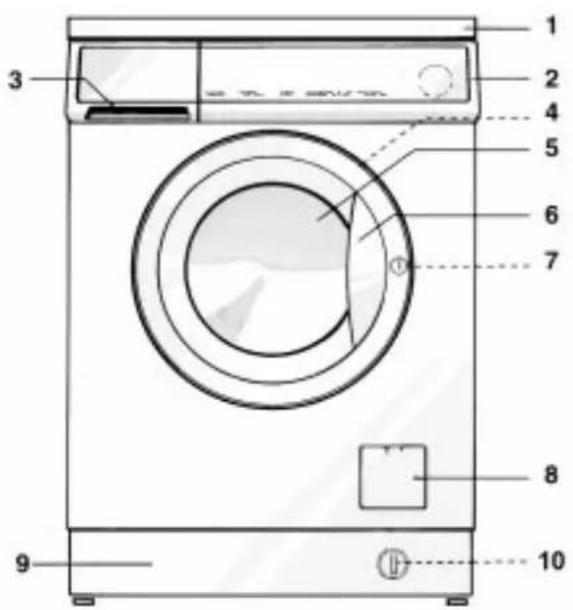
APPLIANCE AND ACCESSORIES
text_image
Diagram of a front-loading washing machine with numbered parts for identification- Worktop
- Control panel
- Detergent dispenser
- After-Sales Service sticker (on the back side of the door)
- Door
- Door handle
- To open the door press the button on the inside of the handle and pull
- Close the door by pushing it firmly (the lock will click into place)
- Child safety (inside door)
- Filter (behind cover)
- Plinth
- Residual water drain (behind the plinth)
CHILD SAFETY
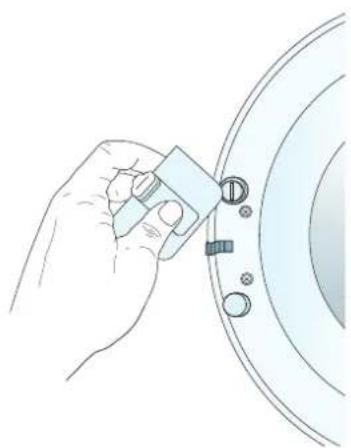
To protect the appliance from improper use, turn the plastic screw on the interior of the door using a coin or the thick rounded plastic projection on the coloured insert from the detergent dispenser.
- Slot vertical: safety position, i.e. the door will not lock.
- Slot horizontal: normal position, i.e. the door can be locked again.
natural_image
Hand holding a small component next to a circular component with bolt holes (no text or symbols visible)PROTECTING THE ENVIRONMENT
PACKING
- The packing material is 100% recyclable (marked with the recycling symbol ⚠ Adhere to local regulations when disposing of packaging material.
- The packaging material (plastic bags, polystyrene parts, etc.) is potentially dangerous and must be kept out of reach of children.
PRODUCT
- The appliance is made from recyclable materials and must be scrapped in accordance with local waste disposal regulations.
- Before scrapping, cut off the power cable so the appliance cannot be connected to the mains.
ENVIRONMENTAL TIPS
- Do not exceed the detergent dosages indicated in the Manufacturer's instructions.
- The Eco Flap - a special system in the outlet will prevent detergent loss from the drum to avoid detergent loss into the environment.
- Remove detergent from compartment if you intend scrapping your appliance.
MAXIMISE THE LOAD SIZE
- Achieve the best use of energy, water, detergent and time by using the recommended maximum load size.
DO YOU NEED TO PREWASH?
- Use "Prewash" for heavily soiled laundry only! Save detergent, time, water and between 5 to 15% energy consumption by not selecting "Prewash" for slight to normally soiled laundry.
IS A HOT WASH REQUIRED?
- Pretreat stains with stain remover or soak dried in stains in water before washing to reduce the necessity of a hot wash program.
- Save up to 50% energy by using a 60°C instead of a 90°C wash programme or a 40°C instead of a 60°C wash programme.
BEFORE USING A DRYING PROGRAMME
- Save energy and time by selecting a high spin speed to reduce the water content in laundry before using a drying programme (for machines with adjustable spin speed).
SAFETY INSTRUCTIONS
- Use the appliance only for domestic washing and for its intended application.
- Ensure the installation of electrical and water connections have been made in accordance with the Manufacturer's instructions and in observance of local safety regulations (refer to "Installation Instructions").
- Before cleaning or maintaining the appliance, switch it off and unplug it.
- When the appliance is not in use unplug it and turn off the tap.
• Do not attempt to force the door open.
- Do not allow children to play with the appliance or enter the drum. Do not rest any weight on the door.
- Packing materials can be dangerous for children: keep all packing materials (plastic bags, polystyrene, etc.) well out of their reach.
- The appliance conforms to European safety regulations and to Directive n. 93/68/EEC and standard 93/68/EC.
TRANSPORT / HANDLING
- Unplug the appliance.
- Turn off the tap.
-
Remove the water supply and drain hose.
-
Eliminate all water from the hoses and from the appliance (see "Removing the Filter / Draining Residual Water").
-
Fit the transit bolts (obligatory) (see "Installation Instructions").
PREPARING THE WASH
- Sort the laundry according to...
- Type of fabric / care label symbol
Cottons, mixed fibres, easy care/synthetics, wool, handwashed items.
• Colour
Separate whites and coloureds. Wash new coloured items separately.
- Size
Wash items of different sizes in the same load to improve washing efficiency and distribute the load more evenly inside the drum.
- Fabric delicacy
Wash delicate articles separately: use a special programme for Pure New Wool curtains and other delicates. Always remove curtain glides or wash curtains with the glides inside a cotton bag.
Use the special program for handwash fabrics.
Wash stockings, belts and other small items or articles with hooks (e.g. bras) in special cotton bags for washing machines or in zipped pillow cases.
- Empty pockets
Coins, safety pins and similar can damage your laundry and the appliance drum and tub.
- Fasteners
Close zips and fasten buttons or hooks; loose belts or ribbons should be tied together.
STAIN REMOVAL
• Blood, milk, egg and other organic substances are generally removed by the enzyme phase of the programme.
• To remove red wine, coffee, tea, grass and fruit stains etc. add a stain removing agent in detergent dispenser compartment [28]
• Particularly stubborn stains should be treated before the wash.
LOADING THE LAUNDRY
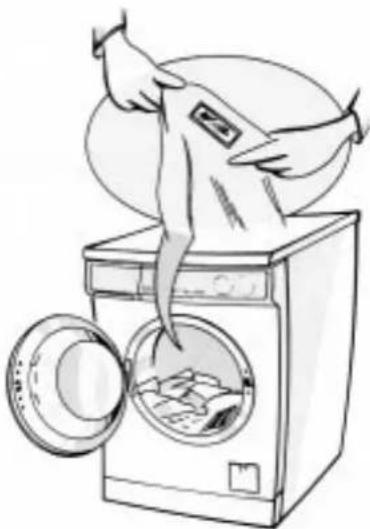
- Open the door.
- Unfold the laundry and place it loosely in the drum.
- Close the door.
RECOMMENDED LOADS
See separate programme chart.
N.B. Overloading will result in unsatisfactory washing results and creased laundry.
natural_image
Line drawing of a hand washing clothes into a washing machine with a lid open (no text or symbols)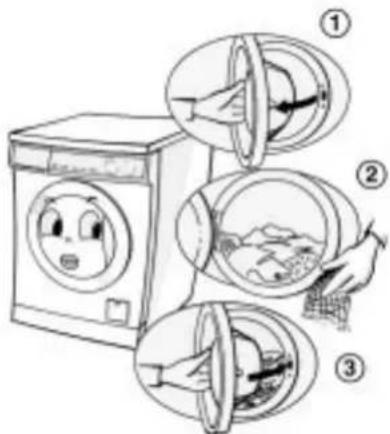
text_image
Illustration showing three steps of washing machine operation: first with a smiling face, second with a hand holding a bag, and third with hands cleaning the interior.DETERGENT AND ADDITIVES
CHOOSING THE RIGHT DETERGENT
The type of detergent depends on:
- type of fabric (cottons, easy care/synthetics, delicate items, wool).
Note: use only specific detergents for wool.
• colour:
- washing temperature;
• degree and type of soiling.
Notes:
- Whitish residues on dark fabrics are caused by insoluble detergents components used in modern phosphate-free powder detergents. If you notice this problem, shake or brush the affected items or use a liquid detergent.
- Keep detergents and additives in a dry place and out of reach of children.
• Use only detergents and additives specifically produced for domestic washing machines. - If you use descaling agents, dyes or bleaches, make sure they are suitable for washing machine use. Descaler could contain components that can attack parts of your washing machine.
- Do not use solvents (turpentine, benzine, etc.).
Do not machine wash fabrics that have been treated with solvents or flammable liquids.
DOSAGE
Follow the instructions on the detergent pack in relation to:
• the degree and type of soiling;
• the size of the load;
- full load: follow the detergent Manufacturer's instructions;
- half load: 3/4 the amount used for a full load;
- minimum load (about 1 kg): half the amount used for a full load;
• water hardness in your area (ask for information from your water company): soft water requires less detergent than hard water.
Notes:
- Too much detergent can result in excess foam formation, which reduces washing efficiency. If the appliance detects excessive foam it may prevent spinning.
- The laundry will become grey if you use too little detergent. Too little detergent will also lead to increased scale deposits on the heating element and drum.
WATER HARDNESS
| Water hardness area | Characteristics | German scale °dH | French scale °fH | Clarke scale °eH |
| 1 | soft | 0-7 | 0-12 | 0-9 |
| 2 | average | 7-14 | 12-25 | 9-17 |
| 3 | hard | 14-21 | 25-37 | 17-26 |
| 4 | very hard | over 21 | over 37 | over 26 |
Adjust the water hardness level pointer in the detergent dispenser in accordance with the hardness of the water in your area. Move the pointer sideways to the required position.
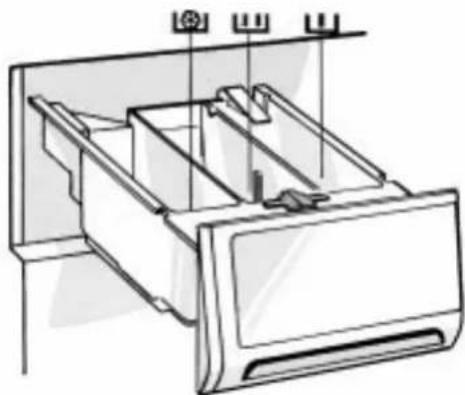
FILLING THE DETERGENT AND ADDITIVES
- Pull out the detergent dispenser completely, until the limit.
- Add the detergent:
• Programme with pre and main wash
- Main wash programme without prewash When using liquid detergent, remove the coloured insert and fit it in compartment. The graduate scale on the insert makes dosing easier.
- Fabric softeners (no more "MAX" mark)
- Stain remover agents
• Water softeners (water hardness 4)
• Starch (dissolved in water) - Close the detergent dispenser completely.
natural_image
Technical line drawing of a refrigerator drawer with internal compartments and mounting feet (no text or labels)DETERGENT AND ADDITIVES
Notes:
- You can use liquid detergent in the "Prewash" phase for programmes with this option. In this case use only powder detergents for the main wash.
-
If the "Start Delay" option is used, put liquid detergent into the drum with a detergent ball.
-
When using concentrated fabric softeners, add water in the detergent dispenser up to "MAX" level mark.
- To prevent dispensing problems when using highly concentrated powder and liquid detergents, use the special detergent ball supplied with the detergent and place it inside the drum.
DYEING AND BLEACHING
Dyeing: Usual products consist of dye colour, fixing agent and salt. Pour the dye colour, the fixing agent and then the salt directly into the empty drum. Fill in the laundry only afterwards.
- Use exclusively dyes and bleaches recommended for washing machines.
- Follow the Manufacturer's instructions.
- Plastic and rubber parts of the machine may be stained by dyes or bleaches.
PROGRAMME SELECTION / PROGRAMME START
See also separate programme overview.
- Set Programme Selector to the desired programme. The indicator above the "Start/Pause" button flashes and the programme duration is shown on the display (if available).
- Select additional options, if desired, pressing the corresponding button.
The indicator for the option is lit up.
N.B. An audible tone is sounded if the combination of programme and additional option does not make sense. Unsuitable combinations of additional options are deselected automatically. -
By a further pressing of the button the additional option can be turned off again.
-
The Final Spin Speed is related to the selected programme and is shown by means of the indicator lamp.
- The Final Spin Speed can be altered by pressing the "Spin" button.
- In some programmes the maximum final spin speed is limited to go easy on your laundry items. Selection of a higher spin speed is not possible.
- If "0" is selected, the laundry is not spun following the final rinse cycle. The water is simply pumped out. Intermediate spinning is carried out at reduced speed.
- Press the "Start/Pause" button to start the program.
START DELAY
(If available)
- Select the program and temperature, any additional options and the spin speed.
-
Press the "Start Delay" button. The associated lamp comes on and the indicator above the "Start/Pause" button flashes. Either keep the start delay button pressed or else press it repeatedly until the desired number of hours is reached. If the maximum number of hours is reached for the delayed start, further pressing of the button starts the counter at zero again.
-
Press the "Start/Pause" button in order to start the program.
- The start delay hours can be corrected even after the "Start/Pause" button has been pressed. Again here either keep the "Start Delay" button pressed or else press it repeatedly until the desired number of hours is reached. Once the display has counted down to "00" the selected programme is started.
- Cancelling the start delay: If, in fact, no start delay was actually desired turn the programme selector switch and then set it to the desired position. The remaining time of the selected programme is displayed and the indicator above the "Start/Pause" button flashes. The programme can now be started immediately by pressing this button.
- If the programme is changed after the start delay, the start delay option is cleared and the remaining time is displayed. The indicator above the "Start/Pause" button flashes. The programme is not started.
Note: With liquid detergent, a dosing aid placed directly in the drum should be used if a start delay has been selected.
DOOR LOCK / PROGRAMME END
DOOR LOCK
The door locks automatically after the programme starts until the end of the programme.
The "Door free" indicator goes out.
Exception: In the programmes Cotton and Synthetics and during the prewash for these programmes, the door can be opened in order to add further items during the first 15 minutes after the start of the programme. This is not possible if "Rapid Wash" is selected.
If the programme selector is moved to the “○” position or if the electricity supply is interrupted, then after approximately two minutes the door is released.
PROGRAMME END
The programme end is indicated by:
- The “Door Free” indicator coming on and the remaining time indicator (if available) showing “0:00”,
• An audible tone is sounded three times, - The programme sequence indicators are all off.
CHANGING / INTERRUPTING / CLEARING PROGRAMME
CHANGING PROGRAMME OR OPTIONS
- Set programme selector knob to new programme. Reselect additional options and spin speed if appropriate. The indicator light above the "Start/Pause" button will blink.
Note: The options "Start delay" and "Prewash" cannot be reselected when the programme is changed.
- Press the "Start/Pause" button. The new programme will continue in the same programme section during which the current programme was interrupted.
Note: Do not add more detergent for this programme.
PROGRAMME INTERRUPTION / PAUSE
To interrupt the running programme for a certain period and continue it at a later time:
- Press the "Start/Pause" button. The indicator flashes.
- Following the desired pause press the "Start/Pause" button once again.
CANCELLING THE PROGRAMME
If the current programme is to be terminated prematurely and cancelled, the water must be pumped out first before the door can be opened:
- Set the programme selector to programme setting "Drain". The indicator above the "Start/Pause" button flashes. The spin indicator shows "0" and the remaining time indicator (if available) shows "0:02" minutes.
- Press the "Start/Pause" button in order to start the "Drain" programme.
REMOVING THE FILTER / DRAINING RESIDUAL WATER
WHEN SHOULD I REMOVE THE FILTER?
Check the filter two or three times a year and clean it if necessary.
- Check the filter if the appliance is not draining properly or if it fails to perform spin cycles.
- Remove the filter if the pump is blocked by an object (buttons, coins, safety pins, etc.).
IMPORTANT: Make sure the water has had time to cool before draining the appliance.
REMOVING THE FILTER / DRAINING RESIDUAL WATER
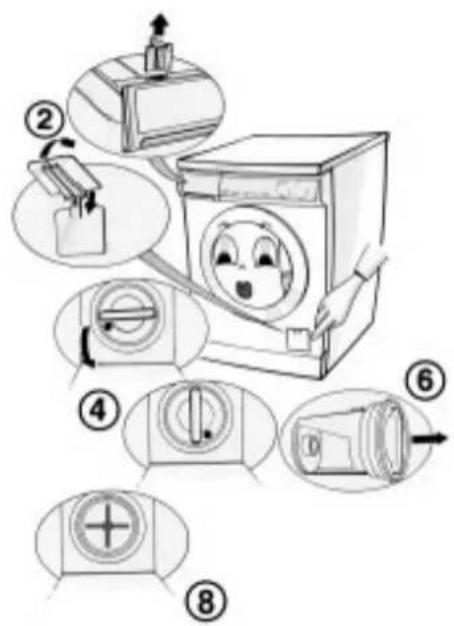
REMOVING THE FILTER
-
Switch off the appliance (set the programme selector to and unplug it).
-
Remove the coloured insert from the detergent dispenser and use it to open the filter cover.
-
Place a bowl beneath the filter.
-
Turn the filter slowly anti-clockwise until the grip is vertical; do not extract filter as yet.
-
Wait until all the water has drained out.
-
Now unscrew the filter completely and extract it.
-
Remove any foreign material from the filter.
-
Make sure the pump impeller is not obstructed.
-
Insert the filter and screw it fully down in a clockwise direction (until the grip is horizontal).
-
Close the cover.
-
Pour 0.5 l of water into the detergent dispenser to reactivate the "Eco System".
-
Connect the appliance to the electrical outlet.
-
Select a programme and start it.
WHEN SHOULD I DRAIN RESIDUAL WATER?
• Before transporting (moving) the machine.
- If the appliance is installed in a room subject to sub-zero temperatures. It is best in this case to drain the machine after every wash.
DRAINING RESIDUAL WATER
The residual water drain hose is accommodated behind the appliance plinth.
Before draining residual water unplug the machine.
- Remove carefully the plinth using the thin rounded projection of the coloured insert from the detergent drawer.
- Grip the cap and pull it out. Remove the cap from the end of the tube.
- Allow all the water to flow into a flat bowl, then refit the cap and stow the drain tube back in its compartment.
- Before using the machine again, pour about 1 litre of water into the detergent dispenser to reactivate the "Eco System".
text_image
Diagram illustrating the step-by-step installation of a washing machine, showing steps from opening to closing.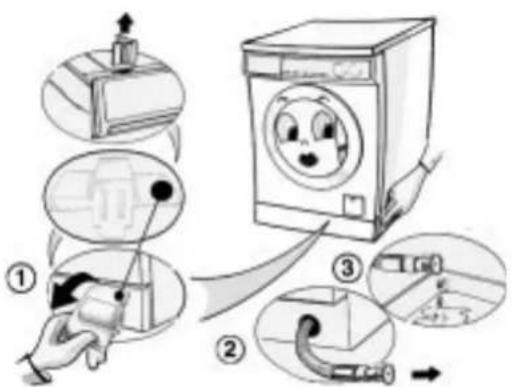
text_image
Illustration showing a person using a washing machine to interact with a device, with numbered steps and instructions in Chinese.CARE AND MAINTENANCE
APPLIANCE EXTERIOR AND CONTROL PANEL
- Clean using normal household cleaner (do not use abrasive products).
• Dry with a soft cloth.
DETERGENT DISPENSER
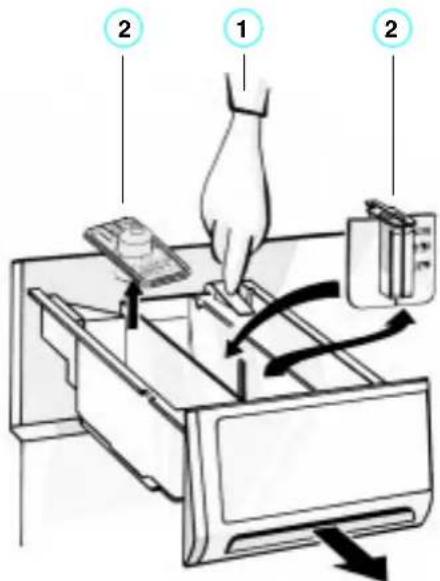
- Disengage the detergent dispenser by pressing the release lever in the prewash compartment and extract it.
- Remove the inserts (the siphon from the softener compartment and the insert for liquid detergents).
- Wash all the parts under running water.
- Replace the parts and refit the detergent dispenser. Push the siphon firmly into place.
DOOR SEAL
- Clean with a damp cloth when necessary.
- Periodically check the fold of the seal for foreign objects.
WATER HOSE MESH FILTERS
• Check and clean periodically.
For machines with a straight water supply hose (see figure)
- Turn off the tap.
- Unscrew the hose from the tap.
- Clean the internal strainer.
- Screw the supply hose back onto the tap.
- Unscrew the hose from the machine.
- Remove the filter from the washing machine with pliers and clean it.
- Replace the filter and screw the hose connection back on to the machine.
- Turn on the tap and ensure that the connection is completely water-tight.
For machines with Water stop hose (see figure)
- Turn off the tap.
- Unscrew the hose from the tap.
- Clean the strainer.
- Screw the water stop hose back onto the tap.
- Turn on the tap and ensure that the connection is completely water-tight.
FILTER
Check and clean the filter two or three times a year (see "Removing the Filter / Draining Residual Water").
text_image
Diagram showing a hand pressing down on a refrigerator drawer with labeled parts 1 and 2, indicating mechanical or electrical components.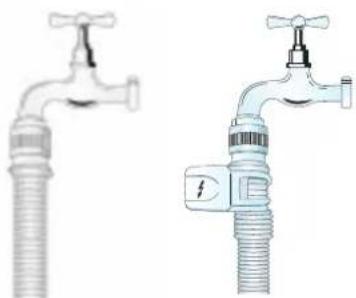
natural_image
Illustration of two different types of plumbing fittings (no text or symbols present)Straight hose Water Stop hose
TROUBLESHOOTING GUIDE
This washing machine is equipped with automatic safety functions which detect and diagnose faults at an early stage and react appropriately.
Often, however, the faults detected are small enough to be solved in a matter of minutes.
For example:
The appliance will not start, no lamp lights up.
Check whether:
• the appliance is plugged in;
- the wall socket is functioning correctly (use a table lamp or similar).
The appliance will not start, but the "Start/Pause" lamp is flashing.
Check whether:
• the appliance door is properly closed (child safety);
- a programme has been selected and the programme is started;
• the water tap is open.
The appliance stops during the programme.
Check whether:
- the "Rinse Hold" lamp is flashing, terminate this option by pressing the button again;
- another programme has been selected. Reselect the desired programme and press the "Start/Pause" button;
- “Start/Pause” lamp is flashing. Press “Start/Pause” button;
- the door was opened and the "Start/Pause" lamp is flashing. Press it again;
- Safety system of the appliance was activated. See fault description table.
Detergent and additive product residues in dispenser at end of wash.
Check whether:
- the siphon is correctly installed and clean (see "Care and Maintenance");
- enough water is being supplied. The mesh filters could be clogged (see "Care and Maintenance" / "Water Hose Mesh Filters").
The appliance vibrates during the spin cycle.
Check whether:
- the appliance is level and solidly installed on all four feet (see "Installation Instructions");
- the transit bolts have been removed. The transit bolts must be removed before the appliance can be used (see "Installation Instructions").
Final spin results are poor:
The appliance has an imbalance detection and correction system. If individual heavy articles are loaded (bathmat, bathrobe, etc.) this system may reduce the spin speed automatically to protect the appliance or even interrupt the spin cycle altogether, if the imbalance is too great even after several spin starts.
- If the laundry is still too wet at the end of the cycle, add smaller articles of laundry to balance the load and repeat the spin cycle.
- Excessive foam formation may prevent spinning. Ensure correct amount of detergent is used.
TROUBLESHOOTING GUIDE
What should I do when the automatic safety system detects a malfunction?
The programme is interrupted, an audible tone sound and various indicators (if available) point to the source of the fault.
Fault description table
| Small lamp lights up | Digital display Audi | ble tone Fault description | |
| “Water tap” “H” and “F” 30 sec “Water | inlet fault” | ||
| - “P” and “F” 30 sec | “Draining fault” | ||
| - | “F4” to “F16” | 30 sec | “Electrical components fault” |
| “Water Stop” “A” and “F” 30 sec | “Water Stop fault” | ||
a. Water inlet fault (no or insufficient water supply)
The "Water tap" indicator is on or the display alternately shows "H" and "F" and an audible tone sounds. Switch off the appliance by turning the programme selector to the ○ position and unplug it.
Check wheter:
- the water tap is completely open, and the water supply pressure is sufficient;
• the water inlet hose is kinked; - the mesh filters are clogged (see "Care and Maintenance" / "Water Hose Mesh Filters");
• the water inlet hose is frozen; - the appliance has a safety hose and the safety valve has opened (red indicator in the safety valve inspection window); In this case replace with a new safety hose.
Connect the appliance to the electrical outlet. Reselect the desired programme and press the "Start/Pause" button again to continue with the programme (do not add detergent for this programme).
b. Draining out fault
The display alternately shows "P" and "F" and an audible tone sounds. Switch off the appliance by turning the programme selector to the position and unplug it.
Check whether:
- the drain hose is kinked (see "Installation instructions");
- the pump / filter are blocked (see "Removing the Filter / Draining Residual Water").
IMPORTANT: before draining, allow the wash water to cool down.
• the drain hose is frozen.
Connect the appliance to the electrical outlet. Reselect the desired programme and press the "Start/Pause" button again to continue with the programme (do not add detergent for this programme).
If the fault re-occurs, contact After-Sales Service (see "After-Sales Service").
c. Electrical module fault
The “Spin Speed” indicator and the “Start Delay” option are flashing and an audible tone sounds. The display shows “F4” to “F16”.
- Switch off the appliance. Select a programme and press the "Start/Pause" button once again.
The programme will continue. - If the fault re-occurs, contact After Sales Service (See "After-Sales Service").
d. Water Stop fault
An audible tone sounds. The light of the Water Stop indication is on.
The display alternately shows "A" and "F". Switch off the appliance by turning the programme selector to the position, unplug the appliance and make sure that the water tap is closed.
The "Water Stop" may have been triggered by:
- Too much foam.
- A leak in the inlet hose or in the appliance.
Tilt the appliance forwards carefully to allow the collected water to flow out.
Then:
- Connect the appliance to the electrical outlet.
- Open water supply to machine (if "Start/Pause" button is not pressed, but machine begins to fill, close water supply and call After-Sales Service).
- Reselect the desired programme and press the "Start/Pause" button (there is no need to add additional detergent). The programme will continue.
If the faults occurs again, call After-Sales Service with details about the fault (see "After-Sales Service").
Fault "Water Stop" when the programme selector is on the position.
The appliance identifies a water leakage even when the power is off.
An audible tone sounds. The display alternately shows "A" and "F".
- The water leakage can be caused by a leak in the inlet hose or in the appliance. Unplug the appliance and make sure that the water tap is closed, lean the appliance over onto its front side to allow the collected water to flow out.
Call After-Sales Service with details about the fault (see "After-Sales Service").
AFTER-SALES SERVICE
Before contacting After-Sales Service:
- Try to remedy the problem yourself (see "Troubleshooting Guide").
- Restart the programme to check whether the problem has solved itself.
- If the machine continues to function incorrectly, call After-Sales Service.
Specify:
• The nature of the problem.
• The exact model of the appliance.
- The service code (number after the word SERVICE).
SERVICE
0000 000 00000
The After-Sales Service sticker is on the inside of the door.
- Your full address.
- Your telephone number and area code. After-Sales Service phone numbers and addresses are given on the guarantee card. Alternatively, consult the dealer where you purchased the appliance.
INSTALLATION INSTRUCTIONS
TRANSIT BOLTS
The appliance is fitted with transit bolts to prevent internal damage during transport.
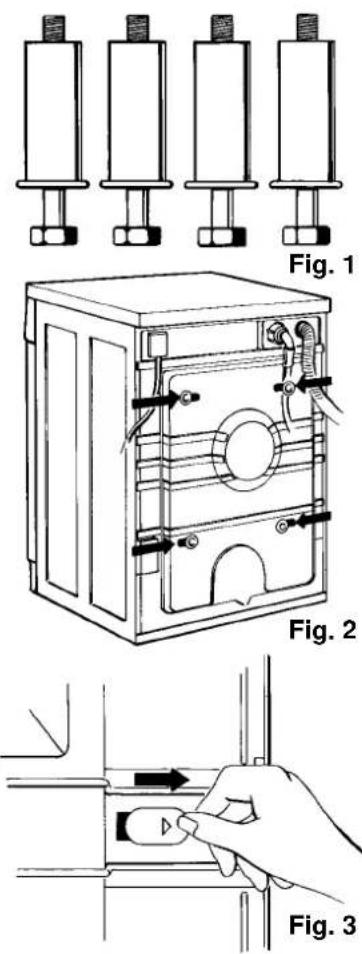
Before using the machine you must remove the transit bolts (Fig. 1).
- Slacken the four bolts with the spanner supplied (Fig. 2).
- Unscrew the bolts by hand.
- Holding the bolt head, pull each bolt through the wide part of the holes.
- Close the holes with the plastic covers supplied; insert the covers in the wide part of the hole and slide them toward the narrow part until they click into place (Fig. 3).
- Keep the transit bolts for future use.
Important
Whenever the appliance is transported, the transit bolts must be refitted.
Pry up the plastic covers with a screwdriver, slide them in the opposite direction to the arrow and remove. Insert the transit bolts, performing the steps for removal in reverse order.
INSTALLATION INSTRUCTIONS
INSTALLATION
• Install the appliance on a solid and level floor surface, preferably in a corner of the room.
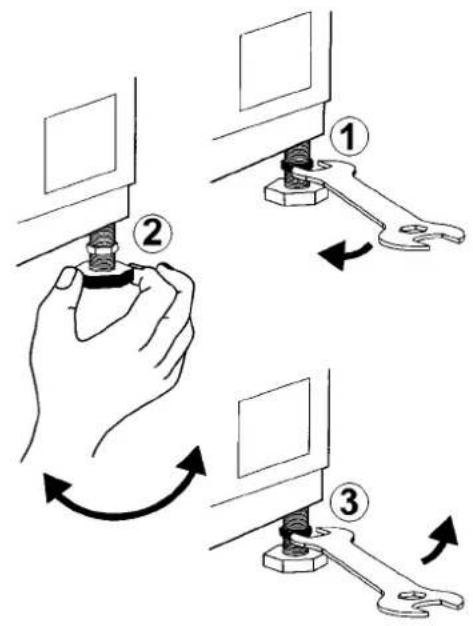
- Make sure that all four feet are stable and resting on the floor and then check that the appliance is perfectly level (use a spirit level).
- If the floor is uneven, adjust the levelling feet as required (do not insert pieces of wood etc. under the feet):
- Slacken the locknut using the spanner supplied.
- Adjust the height of the foot, turning it by hand.
- Tighten the locknut by turning it anti-clockwise towards the appliance casing.
- If the appliance is to be installed on a wooden floor, distribute the weight by placing it on a 60 x 60 cm sheet of plywood at least 3 cm in thickness. Secure the plywood sheet to the floor.
WORKTOP / COVER PANEL
The appliance must only be installed beneath a continuous fitted kitchen worktop.
If the appliance will be built under it is mandatory to use the cover panel UBS. This can be obtained from specialist shops or from After-Sales Service.
- Unplug the appliance.
- Unscrew the worktop fixing screws from the rear of the appliance.
- Slide the worktop fully backward and lift it upwards to remove. Install the cover panel following the relative instructions.
- Refit the fixing screws and tighten them.
BUILD-UNDER OPENING DIMENSIONS
Width 600 mm
Height 825 mm
Depth 600 mm
WARNING:
Only plug the appliance into the mains power socket after you have fitted the cover panel or the appliance worktop.
text_image
Diagram illustrating three-step mechanical assembly steps with labeled components and directional arrows indicating motion.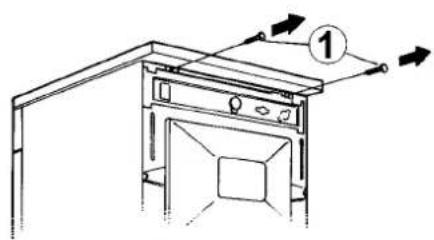
natural_image
Technical line drawing of a door opening with directional arrows indicating airflow or movement (no text or symbols)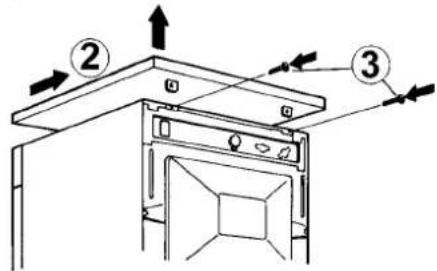
text_image
Diagram showing a door opening with labeled parts and directional arrows indicating movement or assembly.INSTALLATION INSTRUCTIONS
WATER SUPPLY
• Water supply: cold water only
• Tap: 3/4" threaded hose connection
• Pressure: 100-1000 kPa (1-10 bar).
WATER INLET HOSE
- Carefully screw the hose connection onto the tap preferably by hand. Make sure there are no kinks in the hose.
-
Check water-tightness of tap and appliance connections by turning the tap completely on.
-
If the hose is too short, replace it with a suitable length of pressure resistant hose (1000 kPa min, EN 50084 approved type).
• Periodically check the hose for brittleness and cracks and replace if necessary. - The appliance can be connected without an anti-backpressure valve.
• Install the appliance in accordance with regulations of your local water company.
WATER STOP (depends on model)
- Screw the threaded connector with the filter inserted onto the tap. Open the water tap fully and check the water-tightness of the connection point.
- The appliance must not be connected to the mixing tap of a non-pressurized water heater.
- The inlet hose and the plastic enclosure at the tap connection contain electrical components.
N.B. Do not cut the hose and do not immerse the plastic enclosure in water.
• If the flexible hose is damaged, unplug the appliance from the mains immediately.
- If the hose is too short, replace it with a 3 m Water Stop hose (available from After-Sales Service or from your dealer). This operation must be carried out exclusively by a licensed electrician.
DRAINING
• Connecting the water drain hose.
Connect the drain hose to the siphon or hook it over the edge of a sink by means of the "U" bend (see figure).
The drain hose should not be hooked onto small washbasins.
Max. drain height: 1.25 m
If you need to add an extension, use a flexible hose of the same type and secure the union with screw-on hose clips.
Max. drain hose length: 2.50 m
Important:
Make sure there are no kinks in the hose. Secure the hose so that it cannot fall down while the appliance is running.
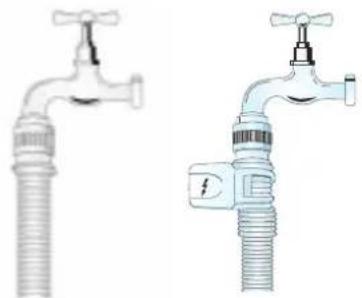
natural_image
Illustration of two different types of plumbing fittings: a standard tap and a coiled valve (no text or symbols present)Straight hose Water Stop hose
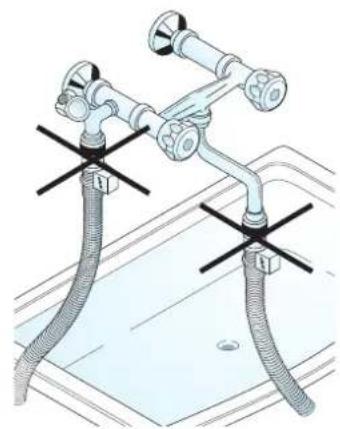
natural_image
Diagram of a bathroom sink with two hoses and a showerhead, no text or symbols present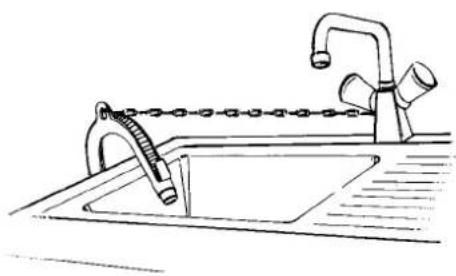
natural_image
Line drawing of a kitchen sink with faucet and chain-link chains (no text or symbols)INSTALLATION INSTRUCTIONS
ELECTRICAL CONNECTIONS
- Electrical connections must be made in accordance with local regulations.
- The appliance must be connected to the mains exclusively by means of a socket with an earth connection in accordance with established regulations. The appliance must be earthed by law. The manufacturer declines all liability for damage to property or injury to persons or animals deriving either directly or indirectly from failure to observe the above directions.
- Voltage, power consumption and electrical protection data are supplied on the inside of the appliance door.
- The electrical power cable must be replaced, if necessary, exclusively by original power cable by authorised After-Sales Service.
- The appliance conforms to European safety regulations, EC directive 93/68/EEC and standard 93/68/EC.
- Do not use extension leads or multi sockets.
- Access to the mains plug or to disconnection from mains supply via a double-pole switch must be ensured at all times following the installation.