Dominion PX3-5176R - Inverter Raritan - Free user manual and instructions
Find the device manual for free Dominion PX3-5176R Raritan in PDF.


User questions about Dominion PX3-5176R Raritan
0 question about this device. Answer the ones you know or ask your own.
Ask a new question about this device
Download the instructions for your Inverter in PDF format for free! Find your manual Dominion PX3-5176R - Raritan and take your electronic device back in hand. On this page are published all the documents necessary for the use of your device. Dominion PX3-5176R by Raritan.
USER MANUAL Dominion PX3-5176R Raritan
PX3-3000/4000/5000 Series
User Guide
Release 3.1
Copyright © 2015 Raritan, Inc.
PX3-0D-v3.1-E
May 2015
255-80-0035-00
Safety Guidelines
WARNING! Read and understand all sections in this guide before installing or operating this product.
WARNING! Connect this product to an AC power source whose voltage is within the range specified on the product's nameplate. Operating this product outside the nameplate voltage range may result in electric shock, fire, personal injury and death.
WARNING! Connect this product to an AC power source that is current limited by a suitably rated fuse or circuit breaker in accordance with national and local electrical codes. Operating this product without proper current limiting may result in electric shock, fire, personal injury and death.
WARNING! Connect this product to a protective earth ground. Never use a "ground lift adaptor" between the product's plug and the wall receptacle. Failure to connect to a protective earth ground may result in electric shock, fire, personal injury and death.
WARNING! This product contains no user serviceable parts. Do not open, alter or disassemble this product. All servicing must be performed by qualified personnel. Disconnect power before servicing this product. Failure to comply with this warning may result in electric shock, personal injury and death.
WARNING! Use this product in a dry location. Failure to use this product in a dry location may result in electric shock, personal injury and death.
WARNING! Do not rely on this product's receptacle lamps, receptacle relay switches or any other receptacle power on/off indicator to determine whether power is being supplied to a receptacle. Unplug a device connected to this product before performing repair, maintenance or service on the device. Failure to unplug a device before servicing it may result in electric shock, fire, personal injury and death.
WARNING! Only use this product to power information technology equipment that has a UL/IEC 60950-1 or equivalent rating. Attempting to power non-rated devices may result in electric shock, fire, personal injury and death.
WARNING! Do not use a Raritan product containing outlet relays to power large inductive loads such as motors or compressors. Attempting to power a large inductive load may result in damage to the relay.
WARNING! Do not use this product to power critical patient care equipment, fire or smoke alarm systems. Use of this product to power such equipment may result in personal injury and death.
WARNING! If this product is a model that requires assembly of its line cord or plug, all such assembly must be performed by a licensed electrician and the line cord or plugs used must be suitably rated based on the product's nameplate ratings and national and local electrical codes. Assembly by unlicensed electricians or failure to use suitably rated line cords or plugs may result in electric shock, fire, personal injury or death.
WARNING! This product contains a chemical known to the State of California to cause cancer, birth defects, or other reproductive harm.
Safety Instructions
- Installation of this product should only be performed by a person who has knowledge and experience with electric power.
- Make sure the line cord is disconnected from power before physically mounting or moving the location of this product.
- This product is designed to be used within an electronic equipment rack. The metal case of this product is electrically bonded to the line cord ground wire. A threaded grounding point on the case may be used as an additional means of protectively grounding this product and the rack.
- Examine the branch circuit receptacle that will supply electric power to this product. Make sure the receptacle's power lines, neutral and protective earth ground pins are wired correctly and are the correct voltage and phase. Make sure the branch circuit receptacle is protected by a suitably rated fuse or circuit breaker.
- If the product is a model that contains receptacles that can be switched on/off, electric power may still be present at a receptacle even when it is switched off.
This document contains proprietary information that is protected by copyright. All rights reserved. No part of this document may be photocopied, reproduced, or translated into another language without express prior written consent of Raritan, Inc.
© Copyright 2015 Raritan, Inc. All third-party software and hardware mentioned in this document are registered trademarks or trademarks of and are the property of their respective holders.
FCC Information
This equipment has been tested and found to comply with the limits for a Class A digital device, pursuant to Part 15 of the FCC Rules. These limits are designed to provide reasonable protection against harmful interference in a commercial installation. This equipment generates, uses, and can radiate radio frequency energy and if not installed and used in accordance with the instructions, may cause harmful interference to radio communications. Operation of this equipment in a residential environment may cause harmful interference.
VCCI Information (Japan)
Raritan is not responsible for damage to this product resulting from accident, disaster, misuse, abuse, non-Raritan modification of the product, or other events outside of Raritan's reasonable control or not arising under normal operating conditions.
If a power cable is included with this product, it must be used exclusively for this product.

text_image
CE cUL us 1F61 LISTED I.T.E.Warning
This is a class A product. In a domestic environment this product may cause radio interference in which case the user may be required to take adequate measures.
CAUTION:


To reduce the risk of shock — Use indoors only in a dry location. No user serviceable parts inside. Refer servicing to qualified personnel. For use with IT equipment only. Disconnect power before servicing.

SecureLock™
Contents
Safety Guidelines ii
Safety Instructions iii
Applicable Models xvii
What's New in the PX User Guide xix
Chapter 1 Introduction 1
Product Models 1
Package Contents....1
Zero U Products....1
1U Products 2
2U Products 2
Chapter 2 Rack-Mounting the PDU 3
Rackmount Safety Guidelines .... 3
Circuit Breaker Orientation Limitation 3
Mounting Zero U Models Using L-Brackets 4
Mounting Zero U Models Using Button Mount....5
Mounting Zero U Models Using Claw-Foot Brackets....7
Mounting Zero U Models Using Two Rear Buttons 8
Mounting 1U or 2U Models....9
Chapter 3 Installation and Configuration 11
Before You Begin....11
Unpacking the Product and Components....11
Preparing the Installation Site....11
Checking the Branch Circuit Rating....12
Contents
Filling Out the Equipment Setup Worksheet 12
Installing Cable Retention Clips on the Inlet (Optional)....12
Connecting a Locking Line Cord....14
Disconnecting a Locking Line Cord....15
Connecting the PDU to a Power Source 16
Configuring the PX....16
Connecting the PX to a Computer....18
Installing the USB-to-Serial Driver (Optional)....19
Connecting the PX to Your Network....20
Initial Network Configuration via CLI 22
Cascading the PX via USB 28
Installing Cable Retention Clips on Outlets (Optional) 31
Chapter 4 Connecting External Equipment (Optional) 33
Connecting Environmental Sensor Packages 33
DPX Sensor Packages 34
DPX2 Sensor Packages 38
DX Sensor Packages 40
Before Connecting Equipment to Feature Port (PX3 Phase I Models) 42
Connecting the Asset Management Sensor 43
Combining Asset Sensors 44
Connecting Asset Sensors to the PX 46
Connecting Blade Extension Strips 48
Connecting Composite Asset Sensors (AMS-Mx-Z) 51
Connecting a Logitech Webcam....53
Connecting a GSM Modem 54
Connecting an Analog Modem 54
Connecting an External Beeper....55
Connecting a Schroff LHX/SHX Heat Exchanger 55
Chapter 5 Using the PDU 56
Panel Components 56
Inlet 57
Outlets 58
Connection Ports 59
Dot-Matrix LCD Display 61
Reset Button 85
Circuit Breakers 86
Resetting the Button-Type Circuit Breaker 86
Resetting the Handle-Type Circuit Breaker....87
Fuse 88
Fuse Replacement on Zero U Models....88
Fuse Replacement on 1U Models 89
Contents
Beeper 91
Replaceable Controller 91
Chapter 6 Using the Web Interface 93
Supported Web Browsers....93
Logging in to the Web Interface....94
Login 94
Changing Your Password 96
Remembering User Names and Passwords 96
Logout....97
Introduction to the Web Interface....98
Menus 99
PX Explorer Pane 99
Setup Button....102
Status Bar 102
Add Page Icon 103
Logout Button 104
Data Pane 104
More Information 104
Viewing the Dashboard....109
Alerted Sensors 109
Alarms List 110
Device Management....111
Displaying PDU Information 112
Naming the PDU....117
Modifying the Network Configuration....117
Modifying Network Service Settings 127
Setting the Date and Time....134
Setting the LCD Display's Default View....138
Setting Default Measurement Units....138
Configuring the Feature Port 139
Configuring the Serial Port 141
Setting the Cascading Mode 142
Setting Data Logging 147
Configuring SMTP Settings 148
Configuring Data Push Settings 149
Specifying the Device Altitude 150
Rebooting the PX Device 151
Resetting All Active Energy Readings....151
Monitoring Total Active Energy or Power 152
Checking the Internal Beeper State 153
Setting the EnergyWise Configuration 153
User Management 154
Creating a User Profile 154
Modifying a User Profile 158
Deleting a User Profile....158
Changing the User List View 159
Setting Up Your Preferred Measurement Units 159
Contents
Setting Up Roles 160
Creating a Role....160
Modifying a Role....161
Deleting a Role 162
Changing the Role List View 163
Access Security Control....163
Forcing HTTPS Encryption....163
Configuring the Firewall....163
Setting Up User Login Controls 170
Setting Up Role-Based Access Control Rules 174
Setting Up a TLS Certificate 178
Certificate Signing Request....179
Creating a Self-Signed Certificate 181
Installing Existing Key and Certificate Files....183
Downloading Key and Certificate Files....183
Setting Up External Authentication....184
Gathering the External Authentication Information....184
Adding Authentication Servers 186
Sorting the Access Order 190
Testing the Server Connection....190
Editing Authentication Server Settings....191
Deleting Authentication Server Settings....191
Disabling External Authentication....191
Enabling External and Local Authentication Services....192
Outlet Management 192
PX3 Latching Relay Behavior....192
Naming Outlets....194
Outlet Monitoring 194
Outlet Switching....196
Setting the Default Outlet State 199
Changing the Cycling Power-Off Period....201
Setting the Initialization Delay 203
Setting the Inrush Guard Delay 204
Setting the Outlet Power-On Sequence 205
Setting the Outlet-Specific Power-On Delay 206
Setting Non-Critical Outlets and Load Shedding Mode....206
Resetting Outlet Active Energy Readings 209
Enabling Front Panel Outlet Switching....210
Inlet and Overcurrent Protector Management 210
Naming the Inlet 211
Naming Overcurrent Protectors....211
Monitoring the Inlet 211
Monitoring Overcurrent Protectors 212
Resetting Inlet Active Energy Readings 213
Disabling an Inlet (for Multi-Inlet PDUs) 214
Setting Power Thresholds....215
Setting an Outlet's Thresholds ......215
Bulk Configuration for Outlet Thresholds 216
Setting Inlet Thresholds 218
Setting an Overcurrent Protector's Thresholds 218
Bulk Configuration for Overcurrent Protector Thresholds 219
Setting Thresholds for Total Active Energy or Power....220
Contents
Event Rules and Actions....222
Components of an Event Rule....222
Creating an Event Rule 222
Sample Event Rules 262
A Note about Infinite Loop 265
Modifying an Event Rule....266
Modifying an Action 268
Deleting an Event Rule or Action....268
A Note about Untriggered Rules....269
Managing Event Logging 269
Viewing the Local Event Log 269
Viewing the Wireless LAN Diagnostic Log 270
Viewing Connected Users 271
Monitoring Server Accessibility 272
Adding IT Devices for Ping Monitoring 273
Editing Ping Monitoring Settings....276
Deleting Ping Monitoring Settings 276
Checking Server Monitoring States....276
Environmental Sensors and Actuators 277
Identifying Environmental Sensors and Actuators....278
Managing Environmental Sensors or Actuators 281
Configuring Environmental Sensors or Actuators 283
Viewing Sensor or Actuator Data 289
Unmanaging Environmental Sensors or Actuators 293
Disabling the Automatic Management Function....294
Controlling Actuators 294
Enabling the Front Panel Actuator Control....295
Asset Management....295
Configuring the Asset Sensor....295
Setting Asset Sensor LED Colors....297
Configuring a Specific Rack Unit 297
Expanding a Blade Extension Strip 298
Displaying the Asset Sensor Information 299
Bulk Configuration....300
Saving the PX Configuration 301
Copying the PX Configuration 302
Backup and Restore of PX Device Settings 303
Webcam Management....304
Configuring Webcams 304
Adjusting Image Properties 305
Viewing Webcam Snapshots or Videos 306
Sending Snapshots or Videos in an Email or Instant Message 308
Snapshot Storage 310
Network Diagnostics 313
Pinging a Host 313
Tracing the Network Route....313
Listing TCP Connections 314
Downloading Diagnostic Information 314
Managing the Schroff LHX/SHX Heat Exchanger 315
Enabling and Disabling Schroff LHX/SHX Heat Exchanger Support 316
Configuring the LHX/SHX Device....316
Monitoring the LHX/SHX Device 319
Contents
Turning the LHX/SHX On or Off 322
Requesting Maximum Cooling for an SHX-30....323
Firmware Upgrade 323
Updating the PX Firmware 324
Viewing Firmware Update History 326
Full Disaster Recovery 327
Updating the Asset Sensor Firmware....327
Accessing the Help 327
Retrieving Software Packages Information 327
Browsing through the Online Help....328
Chapter 7 Using SNMP 330
Enabling SNMP....330
Configuring Users for Encrypted SNMP v3 331
Configuring SNMP Notifications 332
SNMPv2c Notifications 333
SNMPv3 Notifications....334
SNMP Gets and Sets....336
The PX MIB 337
Retrieving Energy Usage....339
A Note about Enabling Thresholds....340
Chapter 8 Using the Command Line Interface 341
About the Interface....341
Logging in to CLI....342
With HyperTerminal 342
With SSH or Telnet....343
With an Analog Modem 344
Different CLI Modes and Prompts 345
Closing a Local Connection....345
Help Command....346
Querying Available Parameters for a Command 347
Showing Information 347
Network Configuration 348
PDU Configuration....350
Outlet Information 351
Inlet Information 352
Overcurrent Protector Information 353
Date and Time Settings 354
Default Measurement Units 354
Environmental Sensor Information 355
Environmental Sensor Package Information 357
Actuator Information 358
Outlet Sensor Threshold Information 359
Outlet Pole Sensor Threshold Information 360
Inlet Sensor Threshold Information 361
Inlet Pole Sensor Threshold Information 362
Contents
Overcurrent Protector Sensor Threshold Information 363
Environmental Sensor Threshold Information 364
Environmental Sensor Default Thresholds 365
Security Settings....366
Existing User Profiles 367
Existing Roles 368
Load Shedding Settings 368
Serial Port Settings....369
EnergyWise Settings 369
USB-Cascading Configuration Information 369
Asset Sensor Settings 369
Rack Unit Settings of an Asset Sensor 370
Blade Extension Strip Settings 371
Event Log....372
Wireless LAN Diagnostic Log 373
Server Reachability Information 373
Command History 375
History Buffer Length 375
Reliability Data 375
Reliability Error Log 375
Examples 376
Clearing Information....378
Clearing Event Log 378
Configuring the PX Device and Network 379
Entering Configuration Mode....379
Quitting Configuration Mode 379
PDU Configuration Commands 380
Network Configuration Commands....388
Time Configuration Commands....412
Security Configuration Commands....415
Outlet Configuration Commands 435
Inlet Configuration Commands 437
Overcurrent Protector Configuration Commands 439
User Configuration Commands 439
Role Configuration Commands 452
Environmental Sensor Configuration Commands 457
Configuring Environmental Sensors' Default Thresholds 462
Sensor Threshold Configuration Commands 464
Actuator Configuration Commands 475
Server Reachability Configuration Commands 476
EnergyWise Configuration Commands 480
USB-Cascading Configuration Commands 482
Asset Management Commands 482
Serial Port Configuration Commands 489
Setting the History Buffer Length....490
Multi-Command Syntax 491
Load Shedding Configuration Commands....492
Enabling or Disabling Load Shedding 493
Power Control Operations 494
Turning On the Outlet(s) 494
Turning Off the Outlet(s)....495
Power Cycling the Outlet(s)....496
Contents
Canceling the Power-On Process 497
Example - Power Cycling Specific Outlets 497
Checking the Accessibility of NTP Servers 498
Actuator Control Operations 498
Switching On an Actuator 499
Switching Off an Actuator 499
Example - Turning On a Specific Actuator 500
Unblocking a User....500
Resetting the PX....500
Restarting the PDU....501
Resetting Active Energy Readings....501
Resetting to Factory Defaults 502
Network Troubleshooting....502
Entering Diagnostic Mode 502
Quitting Diagnostic Mode 503
Diagnostic Commands 503
Retrieving Previous Commands ....505
Automatically Completing a Command....505
Logging out of CLI....506
Chapter 9 In-Line Monitors 507
Overview 507
Safety Instructions ....507
Flexible Cord Installation Instructions....508
Flexible Cord Selection....508
Plug Selection....509
Receptacle Selection....509
Derating a Raritan Product....509
Wiring of 3-Phase In-Line Monitors....510
In-Line Monitor Unused Channels 510
Step by Step Flexible Cord Installation 510
In-Line Monitor's Web Interface 516
Dashboard Page....517
Outlet Page....517
Appendix A Specifications 519
Maximum Ambient Operating Temperature 519
Serial RS-232 Port Pinouts 519
Sensor RJ-45 Port Pinouts 519
Feature RJ-45 Port Pinouts 520
Appendix B Equipment Setup Worksheet 522
Appendix C Bulk Configuration or Firmware Upgrade via DHCP/TFTP 526
Bulk Configuration/Upgrade Procedure 526
TFTP Requirements....527
DHCP IPv4 Configuration in Windows....528
DHCP IPv6 Configuration in Windows....538
DHCP IPv4 Configuration in Linux....545
DHCP IPv6 Configuration in Linux....547
Appendix D Resetting to Factory Defaults 549
Using the Reset Button....549
Using the CLI Command 550
Appendix E Available SCP Commands 552
Firmware Update via SCP 552
Bulk Configuration via SCP 553
Backup and Restore via SCP 554
Appendix F PX3 Phase I LCD Display 556
Overview of the Character LCD Display 556
Control Buttons 557
Operating the Character LCD Display 558
Outlet Information 558
Inlet Information....560
Overcurrent Protector Information....561
IP Address 562
MAC Address....563
Outlet Switching....564
Environmental Sensor Information 566
Asset Sensor Information 568
USB-Cascaded Device's Position 569
Appendix G PX Models with Residual Current Monitoring 571
RCM Current Sensor 571
RCM State Sensor....572
Compliance with IEC 62020 573
RCM Self-Test 574
Web Interface Operations for RCM 574
Checking RCM State and Current 574
Setting RCM Current Thresholds 576
Scheduling RCM Self-Test 576
Disabling or Enabling Front Panel RCM Self-Test 577
Front Panel Operations for RCM 577
LCD Message for RCM Critical State 577
Checking RCM States on Phase II Models 579
Displaying the RCM Current 580
Running RCM Self-Test....581
RCM SNMP Operations....583
RCM Trap 583
RCM Residual Current and State Objects....583
Setting RCM Thresholds 584
Running RCM Self-Test....584
CLI Operations for RCM 584
Showing Residual Current Monitor Information....584
Setting RCM Current Thresholds 585
Setting Front Panel RCM Self-Test 586
Running RCM Self-Test....586
Appendix H LDAP Configuration Illustration 587
Step A. Determine User Accounts and Groups 587
Step B. Configure User Groups on the AD Server 588
Step C. Configure LDAP Authentication on the PX Device 589
Step D. Configure User Groups on the PX Device....591
Appendix I RADIUS Configuration Illustration 595
Microsoft Network Policy Server....595
Step A: Add Your PX as a RADIUS Client 596
Step B: Configure Connection Request Policies....599
Step C: Configure a Vendor-Specific Attribute....614
AD-Related Configuration....616
Non-Windows RADIUS Server 619
Dictionary File 619
Format of the "string" 620
Appendix J Integration 622
Power IQ Configuration 622
Adding PDUs to Power IQ Management....623
Dominion KX II Configuration 625
Configuring Rack PDU (Power Strip) Targets 625
Dominion KSX II or SX Configuration 630
Dominion KSX II 630
Dominion SX....635
dcTrack 638
dcTrack Overview 639
Adding the PX to dcTrack Management....639
Appendix K Additional PX Information 641
MAC Address....641
Locking Outlets and Cords 641
SecureLock™ Outlets and Cords 642
Button-Type Locking Outlets 643
Unbalanced Current Calculation....644
Altitude Correction Factors 645
Data for BTU Calculation....646
Raritan Training Website 646
Truncated Data in the Web Interface....647
Reserving IP Addresses in Windows DHCP Servers 647
Sensor Threshold Settings 648
Thresholds and Sensor States 649
"To Assert" and Assertion Timeout....651
"To De-assert" and Deassertion Hysteresis 653
Ways to Probe Existing User Profiles....655
Index 657
Applicable Models
This online help is applicable to the following PDUs (n indicated below represents a number).
- PX3-3nnn series
- PX3-4nnn series
- PX3-5nnn series
In this Online Help, PX3-3nnn is called PX3-3000, PX3-4nnn is called PX3-4000, and PX3-5nnn is called PX3-5000 for convenience.
Note: For information on other PX2 or PX3 models, see their respective online help on the Raritan website's Support page (http://www.raritan.com/support/).
▶ PX models comparison in brief:
| Features | Inlet power measurement | Outlet power measurement | Outlet switching | Load shedding |
| PX2-1000 | ||||
| PX3-1000 | ||||
| PX2-2000 | ||||
| PX3-2000 | ||||
| PX2-3000 | ||||
| PX3-3000 | ||||
| PX2-4000 | ||||
| PX3-4000 | ||||
| PX2-5000 | ||||
| PX3-5000 |
▶ Comparison between PX2 and PX3 series:
| Features Front panel display | Outlet latching relays | Number of USB-A ports | SENSOR port type | Replaceable controller | |
| PX2 series | LED display | 1 | RJ-12 | ||
| PX3 phase I series | Character LCD display |  | 2 | RJ-4 5 | [847T] |
| PX3 phase II series | Dot-matrix LCD display |  | 2 | RJ-4 5 |  |
* Only PX3 models with outlet switching (phase I and phase II models) have outlet latching relays.
** Only PX3 "Zero U" phase II models have the replaceable controller.
*** PX3 phase I models do NOT support a replaceable controller.
What's New in the PX User Guide
Important: Raritan disables SSL 3.0 and uses TLS for releases 3.0.4, 3.0.20 and later releases due to published security vulnerabilities in SSL 3.0. Make sure your network infrastructure, such as LDAP and mail services, uses TLS rather than SSL 3.0.
The following sections have changed or information has been added to the PX Online Help based on enhancements and changes to the equipment and/or user documentation.
USB Wireless LAN Adapters (on page 21)
Cascading the PX via USB (on page 28)
DPX2 Sensor Packages (on page 38)
DX Sensor Packages (on page 40)
Connecting a DPX2 Sensor Package to DX (on page 41)
Connecting Blade Extension Strips (on page 48)
Connecting Composite Asset Sensors (AMS-Mx-Z) (on page 51)
Daisy-Chain Limitations of Composite Asset Sensors (on page 52)
Connecting a Logitech Webcam (on page 53)
Panel Components (on page 56)
Automatic and Manual Modes (on page 62)
Main Menu (on page 63)
PDU (on page 67)
Inlet (on page 68)
Device Info (on page 81)
Alarms List (on page 110)
Wireless Network Settings (on page 119)
Setting the LCD Display's Default View (on page 138)
Configuring SMTP Settings (on page 148)
Configuring Data Push Settings (on page 149)
Monitoring Total Active Energy or Power (on page 152)
Setting Up a TLS Certificate (on page 178)
Setting Up External Authentication (on page 184)
Adding LDAP Server Settings (on page 186)
Marking All Outlets (on page 207)
Activating or Deactivating the Load Shedding Mode (on page 208)
Setting Thresholds for Total Active Energy or Power (on page 220)
Creating Actions (on page 223)
Alarm (on page 226)
Push Out Sensor Readings (on page 229)
Send EMail (on page 231)
Syslog Message (on page 234)
Change Load Shedding State (on page 237)
Internal Beeper (on page 239)
Creating Rules (on page 243)
Scheduling an Action (on page 248)
Default Log Messages (on page 250)
Email and SMS Message Placeholders (on page 259)
Viewing the Local Event Log (on page 269)
Viewing the Wireless LAN Diagnostic Log (on page 270)
Environmental Sensors and Actuators (on page 277)
Managing Environmental Sensors or Actuators (on page 281)
Configuring Environmental Sensors or Actuators (on page 283)
Changing Default Thresholds (on page 287)
Saving the PX Configuration (on page 301)
Configuring Webcams (on page 304)
Adjusting Image Properties (on page 305)
Viewing Webcam Snapshots or Videos (on page 306)
Sending Snapshots or Videos in an Email or Instant Message (on page 308)
Managing the Snapshots Saved to PX (on page 311)
Using the Command Line Interface (on page 341)
Bulk Configuration or Firmware Upgrade via DHCP/TFTP (on page 526)
Available SCP Commands (on page 552)
Front Panel Operations for RCM (on page 577)
LCD Message for RCM Critical State (on page 577)
Checking RCM States on Phase II Models (on page 579)
Displaying the RCM Current (on page 580)
Running RCM Self-Test (on page 581)
Setting RCM Current Thresholds (on page 585)
Running RCM Self-Test (on page 586)
RADIUS Configuration Illustration (on page 595)
Adding the PX to dcTrack Management (on page 639)
Ways to Probe Existing User Profiles (on page 655)
Please see the Release Notes for a more detailed explanation of the changes applied to this version of PX.
Chapter 1 Introduction
Raritan PX is an intelligent power distribution unit (PDU) that allows you to reboot remote servers and other network devices and/or to monitor power in the data center.
The intended use of the Raritan PX is distribution of power to information technology equipment such as computers and communication equipment where such equipment is typically mounted in an equipment rack located in an information technology equipment room.
Raritan offers different types of PX units -- some are outlet-switching capable, and some are not. With the outlet-switching function, you can recover systems remotely in the event of system failure and/or system lockup, eliminate the need to perform manual intervention or dispatch field personnel, reduce downtime and mean time to repair, and increase productivity.
In This Chapter
Product Models....1
Package Contents ....1
Product Models
The PX comes in several models that are built to stock and can be obtained almost immediately. Raritan also offers custom models that are built to order and can only be obtained on request.
Download the PX Data Sheet from Raritan's website, visit the Product Selector page (http://www.findmypdu.com/) on Raritan's website, or contact your local reseller for a list of available models.
Package Contents
The following sub-topics describe the equipment and other material included in the product package.
Zero U Products
- The PX device
- Screws, brackets and/or buttons for Zero U
- A null-modem cable with DB9 connectors on both ends (Raritan number: 254-01-0006-00) (optional)
- Cable retention clips for the inlet (for some models only)
- Cable retention clips for outlets (for some models only)
1U Products
- The PX device
• 1U bracket pack and screws - A null-modem cable with DB9 connectors on both ends (Raritan number: 254-01-0006-00) (optional)
- Cable retention clips for the inlet (for some models only)
2U Products
- The PX device
• 2U bracket pack and screws - A null-modem cable with DB9 connectors on both ends (Raritan number: 254-01-0006-00) (optional)
- Cable retention clips for the inlet (for some models only)
Chapter 2 Rack-Mounting the PDU
This chapter describes how to rack mount a PX device. Only the most common rackmount method is displayed. Follow the procedure suitable for your model.
In This Chapter
Rackmount Safety Guidelines ....3
Circuit Breaker Orientation Limitation....3
Mounting Zero U Models Using L-Brackets....4
Mounting Zero U Models Using Button Mount 5
Mounting Zero U Models Using Claw-Foot Brackets 7
Mounting Zero U Models Using Two Rear Buttons....8
Mounting 1U or 2U Models....9
Rackmount Safety Guidelines
In Raritan products which require rack mounting, follow these precautions:
- Operation temperature in a closed rack environment may be greater than room temperature. Do not exceed the rated maximum ambient temperature of the Power Distribution Units. See Specifications (on page 519) in the Online Help.
■ Ensure sufficient airflow through the rack environment.
- Mount equipment in the rack carefully to avoid uneven mechanical loading.
- Connect equipment to the supply circuit carefully to avoid overloading circuits.
■ Ground all equipment properly, especially supply connections, to the branch circuit.
Circuit Breaker Orientation Limitation
Usually a PDU can be mounted in any orientation. However, when mounting a PDU with circuit breakers, you must obey these rules:
- Circuit breakers CANNOT face down. For example, do not horizontally mount a Zero U PDU with circuit breakers on the ceiling.
- If a rack is subject to shock in environments such as boats or airplanes, the PDU CANNOT be mounted upside down. If installed upside down, shock stress reduces the trip point by 10%.
Note: If normally the line cord is down, upside down means the line cord is up.
Mounting Zero U Models Using L-Brackets
If your PDU has circuit breakers implemented, read Circuit Breaker Orientation Limitation (on page 3) before mounting it.

natural_image
Technical line drawing of two vertical structural components with mounting holes and spring connectors (no text or symbols)To mount Zero U models using L-brackets:
-
Align the baseplates on the rear of the PX device.
-
Secure the baseplates in place. Use the included L-shaped hex key to loosen the hex socket screws until the baseplate is "slightly" fastened.
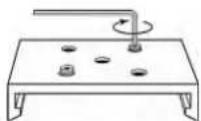
-
Align the L-brackets with the baseplates so that the five screw-holes on the baseplates line up through the L-bracket's slots. The rackmount side of brackets should face either the left or right side of the PX device.
-
Fasten the brackets in place with at least three screws (one through each slot). Use additional screws as desired.
Chapter 2: Rack-Mounting the PDU

natural_image
Technical line drawing of a mechanical support structure with three mounting holes and a flat plate (no text or symbols)- Using rack screws, fasten the PX device to the rack through the L-brackets.
Mounting Zero U Models Using Button Mount
If your PDU has circuit breakers implemented, read Circuit Breaker Orientation Limitation (on page 3) before mounting it.

natural_image
Technical line drawing of two vertical rectangular components with mounting holes, no text or symbols presentTo mount Zero-U models using button mount:
-
Align the baseplates on the rear of the PX device. Leave at least 24 inches between the baseplates for stability.
-
Make the baseplates grasp the PX device lightly. Use the included L-shaped hex key to loosen the hex socket screws until the baseplate is "slightly" fastened.
-
Screw each mounting button in the center of each baseplate. The recommended torque for the button is 1.96 N·m (20 kgf·cm).
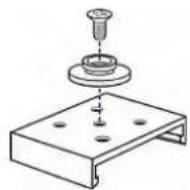
-
Align the large mounting buttons with the mounting holes in the cabinet, fixing one in place and adjusting the other.
-
Loosen the hex socket screws until the mounting buttons are secured in their position.
-
Ensure that both buttons can engage their mounting holes simultaneously.
-
Press the PX device forward, pushing the mounting buttons through the mounting holes, then letting the device drop about 5/8". This secures the PX device in place and completes the installation.
Mounting Zero U Models Using Claw-Foot Brackets
If your PDU has circuit breakers implemented, read Circuit Breaker Orientation Limitation (on page 3) before mounting it.

natural_image
Pure electrical circuit lines without any symbols
natural_image
Technical line drawing of a vertical metal frame with mounting flanges (no text or symbols)To mount Zero U models using claw-foot brackets:
- Align the baseplates on the rear of the PX device.
- Secure the baseplates in place. Use the included L-shaped hex key to loosen the hex socket screws until the baseplate is "slightly" fastened.
- Align the claw-foot brackets with the baseplates so that the five screw-holes on the baseplates line up through the bracket's slots. The rackmount side of brackets should face either the left or right side of the PX device.
- Fasten the brackets in place with at least three screws (one through each slot). Use additional screws as desired.

natural_image
Technical line drawing of a mechanical assembly with three pins inserted into a bracket (no text or symbols)- Using rack screws, fasten the PX device to the rack through the claw-foot brackets.
Mounting Zero U Models Using Two Rear Buttons
The following describes how to mount a PDU using two buttons only. If your PDU has circuit breakers implemented, read Circuit Breaker Orientation Limitation (on page 3) before mounting it.

natural_image
Pure vertical panel diagram without any text, numbers, or symbolsTo mount Zero U models using two buttons:
- Turn to the rear of the PDU.
-
Locate two screw holes on the rear panel: one near the bottom and the other near the top (the side of cable gland).
-
Screw a button in the screw hole near the bottom. The recommended torque for the button is 1.96 N·m (20 kgf·cm).

natural_image
Simple line drawing of a mechanical component with a cylindrical part inserted into a rectangular block (no text or symbols)-
Screw a button in the screw hole near the top. The recommended torque for the button is 1.96 N·m (20 kgf·cm).
-
Ensure that the two buttons can engage their mounting holes in the rack or cabinet simultaneously.
-
Press the PX device forward, pushing the mounting buttons through the mounting holes, then letting the device drop slightly. This secures the PX device in place and completes the installation.
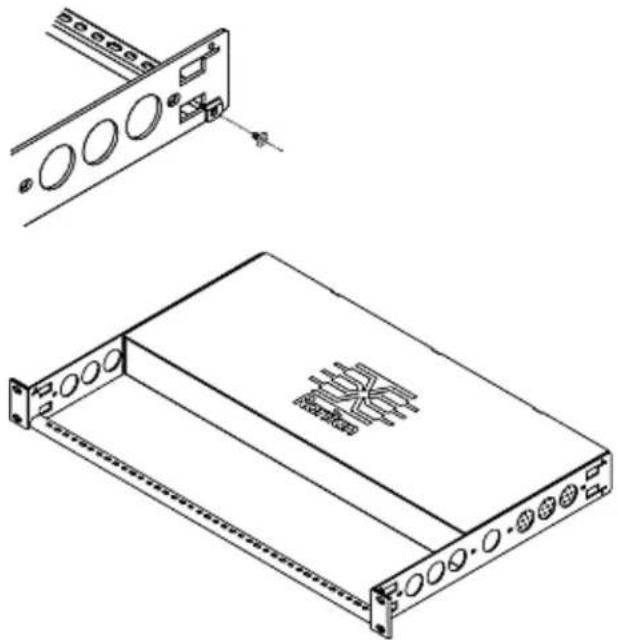
Mounting 1U or 2U Models
Using the appropriate brackets and tools, fasten the 1U or 2U PX device to the rack or cabinet.
▶ To mount the PX device:
- Attach a rackmount bracket to both sides of the PX with the provided screws.
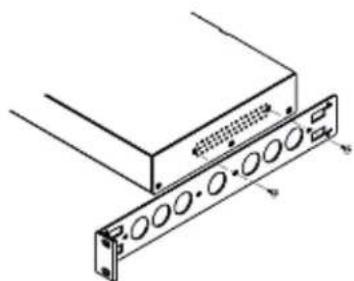
natural_image
Technical line drawing of a device with a rectangular block and a rectangular base with circular components (no text or symbols)- Insert the cable-support bar into rackmount brackets.
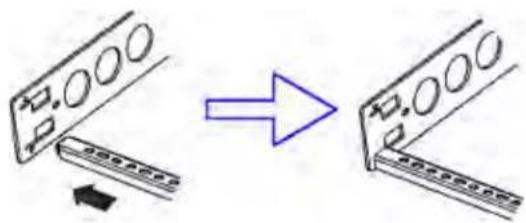
natural_image
Diagram showing a device transitioning from a rectangular panel to a rectangular frame with circular cutouts, indicating a process or transformation (no text or symbols present)- Secure with the provided end cap screws.
natural_image
Technical line drawing of a server rack with mounting holes and internal components (no text or symbols)- Fasten the rackmount brackets' ears to the rack using your own fasteners.
Chapter 3 Installation and Configuration
This chapter explains how to install a PX device and configure it for network connectivity.
In This Chapter
Before You Begin 11
Installing Cable Retention Clips on the Inlet (Optional)....12
Connecting a Locking Line Cord ....14
Connecting the PDU to a Power Source....16
Configuring the PX 16
Cascading the PX via USB....28
Installing Cable Retention Clips on Outlets (Optional)....31
Before You Begin
Before beginning the installation, perform the following activities:
- Unpack the product and components
• Prepare the installation site - Check the branch circuit rating
• Fill out the equipment setup worksheet
Unpacking the Product and Components
- Remove the PX device and other equipment from the box in which they were shipped. See Package Contents (on page 1) for a complete list of the contents of the box.
- Compare the serial number of the equipment with the number on the packing slip located on the outside of the box and make sure they match.
- Inspect the equipment carefully. If any of the equipment is damaged or missing, contact Raritan's Technical Support Department for assistance.
- Verify that all circuit breakers on the PX device are set to ON. If not, turn them ON.
Or make sure that all fuses are inserted and seated properly. If there are any fuse covers, ensure that they are closed.
Note: Not all PX devices have overcurrent protection mechanisms.
Preparing the Installation Site
- Make sure the installation area is clean and free of extreme temperatures and humidity.
Note: If necessary, contact Raritan Technical Support for the maximum operating temperature for your model. See Maximum Ambient Operating Temperature (on page 519).
- Allow sufficient space around the PX device for cabling and outlet connections.
- Review Safety Instructions (on page iii) listed in this online help.
Checking the Branch Circuit Rating
The rating of the branch circuit supplying power to the PDU shall be in accordance with national and local electrical codes.
Filling Out the Equipment Setup Worksheet
An Equipment Setup Worksheet is provided in this online help. See Equipment Setup Worksheet (on page 522). Use this worksheet to record the model, serial number, and use of each IT device connected to the PDU.
As you add and remove devices, keep the worksheet up-to-date.
Installing Cable Retention Clips on the Inlet (Optional)
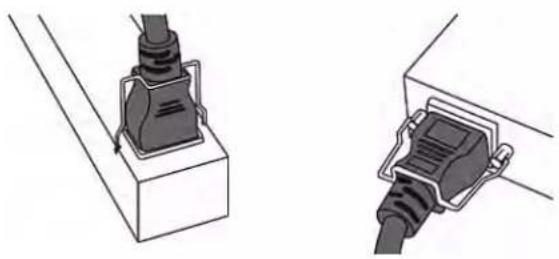
If your PX device is designed to use a cable retention clip, install the clip before connecting a power cord. A cable retention clip prevents the connected power cord from coming loose or falling off.
The use of cable retention clips is highly recommended for regions with high seismic activities, and environments where shocks and vibrations are expected.

To install and use a cable retention clip on the inlet:
- Locate two tiny holes adjacent to the inlet.
- Install the cable retention clip by inserting two ends of the clip into the tiny holes.
Zero U models 1U/2U models

natural_image
Two technical diagrams showing mechanical components with blue arrows indicating direction (no text or symbols)- Connect the power cord to the inlet, and press the clip toward the power cord until it holds the cord firmly.
Zero U models 1U/2U models
natural_image
Two technical illustrations of electrical connectors, one with a cable and the other with a plug (no text or symbols)Connecting a Locking Line Cord
If your PDU is a PX3 Phase II model, it is shipped with either of the following locking line cords.
- A line cord with locking clips: A locking inlet on the PDU is required for this cord.
- A line cord with slide release buttons: This line cord automatically locks after being connected to the inlet. A locking inlet is not required for this cord.
A locking inlet and/or locking line cord ensure that the line cord is securely fastened to the inlet.
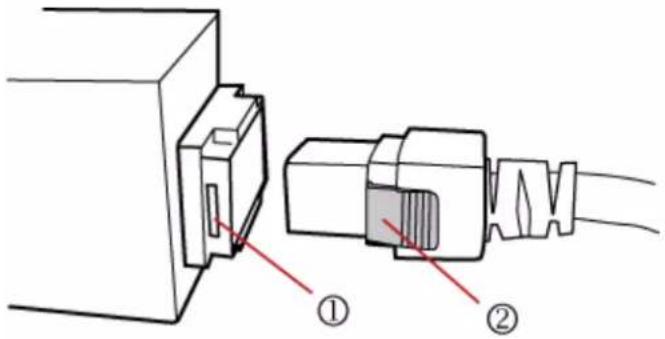
To connect a cord with locking clips:
Make sure the line cord's locking clips fit into the locking holes at two sides of the inlet when plugging the cord's connector into the PDU's locking inlet.
text_image
Diagram showing two connected electrical connectors with labeled parts, including a connector labeled ① and a secondary connector labeled ②.Number Item
1 Locking holes on the inlet
2 Locking clips of the line cord
To connect a cord with slide release buttons:
Simply plug the cord's connector into the PDU's inlet.

natural_image
Diagram of a connector with a red pin inserted into a cable, showing internal components and wiring (no text or symbols)Number Item
1 Slide release buttons
For information on removing the locking line cord, see Disconnecting a Locking Line Cord (on page 15).
Disconnecting a Locking Line Cord
The ways to disconnect a locking line cord vary according to the cord type.
To disconnect a line cord with locking clips:
Press both locking clips of the line cord while unplugging the cord.
Tip: You can slightly move the line cord's plug horizontally while pulling it out to facilitate the disconnection process.

natural_image
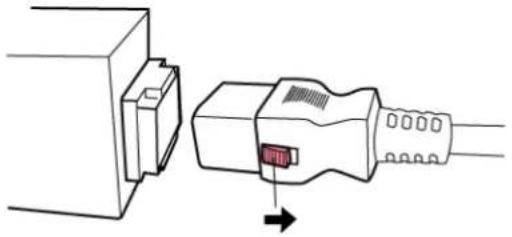
Illustration of a hand inserting a USB into a connector block (no text or symbols)To disconnect a line cord with slide release buttons:
Push both slide release buttons toward the cord while unplugging this cord.
natural_image
Diagram of a cable connector with a red switch and arrow indicating connection (no text or symbols)Connecting the PDU to a Power Source
- Verify that all circuit breakers on the PX device are set to ON. If not, turn them ON.
Or make sure that all fuses are inserted and seated properly. If there are any fuse covers, ensure that they are closed.
Note: Not all PX devices have overcurrent protection mechanisms. - Connect each PX to an appropriately rated branch circuit. See the label or nameplate affixed to your PX for appropriate input ratings or range of ratings.
Note: When a PX device powers up, it proceeds with the power-on self test and software loading for a few moments. At this time, the outlet LEDs cycle through different colors. Note that outlet LEDs are only available on some PDU models. - When the software has completed loading, the outlet LEDs show a steady color and the front panel display illuminates.
Configuring the PX
There are two ways to initially configure a PX device:
- Connect the PX device to a TCP/IP network that supports DHCP, and use the IPv4 address and web browser to configure the PX. You can use the PX device's LCD display to retrieve the IPv4 address.
For PX3 Phase II models, see Device Info (on page 81). For PX3 Phase I models, see IP Address (on page 562).
To use the web interface, see Using the Web Interface (on page 93).
A Category 5e/6 UTP cable is required for a wired network connection.
- Connect the PX device to a computer to configure it, using a serial RS-232 or USB cable.
The computer must have a communications program such as HyperTerminal or PuTTY.
For an RS-232 connection, you need a null-modem cable with DB9 connectors on both ends (Raritan part number: 254-01-0006-00).
Tip: An additional way to initially configure multiple PX devices is to use the TFTP server over a DHCP network. This method helps you save a lot of time when there are a large number of PX devices to configure. For details, see Bulk Configuration or Firmware Upgrade via DHCP/TFTP (on page 526).
Connecting the PX to a Computer
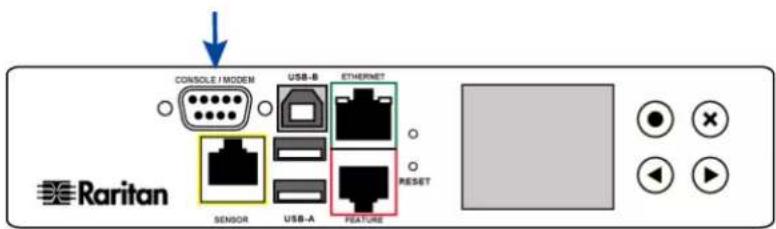
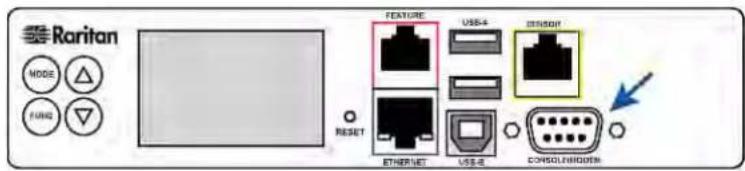
To configure the PX using a computer, it must be connected to the computer with an RS-232 serial interface.
PX3 Phase II models (zero U):
text_image
CONSOLE / MODEM USB-B ETHERNET RESET SENSOR USB-A FEATURE RaritanPX3 Phase I models (zero U):
text_image
Raritan MODE FING RESET FEATURE USB-4 SENSOR ETHERLET USB-2 CONSOLIDATORIf your computer does not have a serial RS-232 port, use a regular USB cable to connect the PX to the computer for initial configuration. The PX device can emulate a serial port after the USB-to-serial driver is properly installed in the Windows® operating system.
Note: Not all serial-to-USB converters work properly with the PX device so this section does not introduce the use of such converters.
Connect the PX to a computer for initial configuration by following either of the procedures below.
To make a serial RS-232 connection:
- Connect one end of the null-modem cable to the male RS-232 port labeled CONSOLE / MODEM on the PX, and the other end to the serial port (COM) on a computer.
To make a USB connection:
-
A USB-to-serial driver is required in Windows ^® . Install this driver before connecting the USB cable. See Installing the USB-to-Serial Driver (Optional) (on page 19).
-
Connect a USB cable between the PX appliance's USB-B port and the computer's USB-A port.
Note: If you plan to use this cable connection to log in to the command line interface, leave the cable connected after the configuration is complete.
Installing the USB-to-Serial Driver (Optional)
The PX can emulate a USB-to-serial converter over a USB connection. A USB-to-serial driver named "Dominion PX Serial Console" is required for Microsoft® Windows® operating systems.
Download the USB Driver file, which contains the dominion-serial.inf, dominion-serial.cat and dominion-serial-setup-
Note:
There are two ways to install this driver: automatic and manual installation. Automatic driver installation is highly recommended.
Note: This file is downloaded from the Raritan PX2 Support Files page (https://www.raritan.com/support/product/px2/px2-support-files).
▶ Automatic driver installation in Windows ^® :
- Make sure the PX is NOT connected to the computer via a USB cable.
- Run dominion-serial-setup-
.exe on the computer and follow online instructions to install the driver.
Note: If any Windows security warning appears, accept it to continue the installation.
- Connect the PX to the computer via a USB cable. The driver is automatically installed.
▶ Manual driver installation in Windows ®:
- Make sure the PX has been connected to the computer via a USB cable.
- The computer detects the new device and the "Found New Hardware Wizard" dialog appears. If this dialog does not appear, choose Control Panel > System > Hardware > Device Manager, right-click the OUTLET 1, Serial Console, and choose Update Driver.
- Select the option of driver installation from a specific location, and then specify the location where both dominion-serial.inf and dominion-serial.cat are stored.
Note: If any Windows security warning appears, accept it to continue the installation.
- Wait until the installation is complete.
Note: If the PX enters the disaster recovery mode when the USB serial driver is not installed yet, it may be shown as a 'GPS camera' in the Device Manager on the computer connected to it.
In Linux:
No additional drivers are required, but you must provide the name of the tty device, which can be found in the output of the "dmesg" after connecting the PX to the computer. Usually the tty device is "/dev/ttyACM#" or "/dev/ttyUSB#," where # is an integer number.
For example, if you are using the kermit terminal program, and the tty device is "/dev/ttyACM0," perform the following commands:
set line /dev/ttyACM0
Connect
Connecting the PX to Your Network
To use the web interface to administer the PX, you must connect the PX to your local area network (LAN). The PX can be connected to a wired or wireless network.
Note: If your PDU will be used as a master device in the USB-cascading configuration where the bridging mode applies, make a wired connection. See Cascading the PX via USB (on page 28).
To make a wired connection:
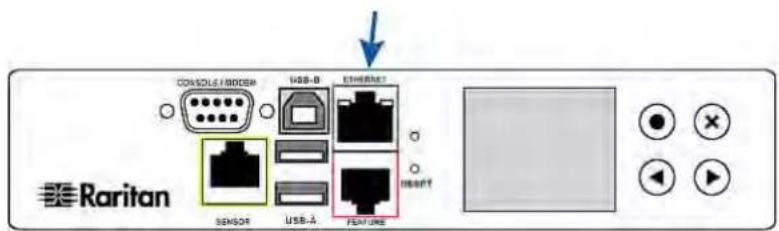
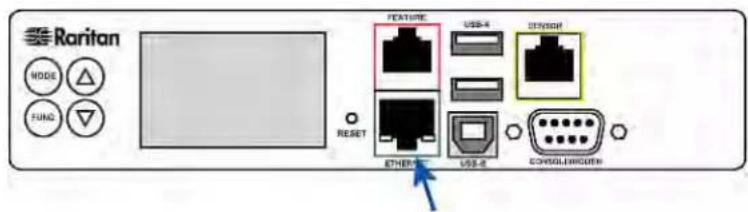
- Connect a standard network patch cable to the ETHERNET port on the PX.
- Connect the other end of the cable to your LAN.
Below indicates the ETHERNET port on Zero U models:
PX3 Phase II models:
text_image
CONSOLE / BROWN USB-B ETHERSET SENSOR USB-A FEATURE RaritanPX3 Phase I models:
text_image
Raritan NODE FUND RESET FEATURE USB-4 SENSOR ETHER- USB-2 COMMANDHODENWarning: Accidentally plugging an RS-232 RJ-45 connector into the ETHERNET port can cause permanent damages to the Ethernet hardware.
To make a wireless connection:
Do one of the following:
- Plug a supported USB wireless LAN adapter into the USB-A port on your PX.
- Connect a USB docking station to the USB-A port on the PX and plug the supported USB wireless LAN adapter into the appropriate USB port on the docking station.
See USB Wireless LAN Adapters (on page 21) for a list of supported wireless LAN adapters.
USB Wireless LAN Adapters
The following table lists USB wireless LAN adapters that the PX supports.
| Wi-Fi LAN adapter Supported 802.11 protocols | |
| Proxim Orinoco 8494 A/B/G | |
| Zyxel NWD271N B/G | |
| Edimax EW-7722UnD | A/B/G/N |
Wi-Fi LAN adapter Supported 802.11 protocols
Note: To use the Edimax EW-7722UnD or Raritan USB WIFI wireless LAN adapter to connect to an 802.11n wireless network, the handshake timeout setting must be changed to 500 or greater, or the wireless connection will fail.
Supported Wireless LAN Configuration
If wireless networking is preferred, ensure that the wireless LAN configuration of your PX matches the access point. The following is the wireless LAN configuration that the PX supports.
■ Network type: 802.11 A/B/G/N
■ Protocol: WPA2 (RSN)
■ Key management: WPA-PSK, or WPA-EAP with PEAP and MSCHAPv2 authentication
■ Encryption: CCMP (AES)
Important: Raritan only supports specific wireless LAN adapters. Supported 802.11 network protocols vary according to the wireless LAN adapter being used with the PX. See USB Wireless LAN Adapters (on page 21).
Initial Network Configuration via CLI
After the PX is connected to your network, you must provide it with an IP address and some additional networking information.
This section describes the initial configuration via a serial RS-232 or USB connection.
▶ To configure the PX device:
- On the computer connected to the PX, open a communications program such as HyperTerminal or PuTTY.
- Select the appropriate COM port, and set the following port settings:
- Bits per second = 115200 (115.2Kbps)
- Data bits = 8
- Stop bits = 1
- Parity = None
■ Flow control = None
Tip: For a USB connection, you can determine the COM port by choosing Control Panel > System > Hardware > Device Manager, and locating the "Dominion PX2 Serial Console" under the Ports group.
- In the communications program, press Enter to send a carriage return to the PX.
- The PX prompts you to log in. Both user name and password are case sensitive.
a. Username: admin
b. Password: raritan (or a new password if you have changed it).
- If prompted to change the default password, follow onscreen instructions to type your new password.
- The # prompt appears.
- Type config and press Enter.
- To configure network settings, type appropriate commands and press Enter. All commands are case sensitive.
a. To set the networking mode, type this command:
network mode
where
b. For the wired network mode, you may configure the LAN interface settings. In most scenarios, the default setting (auto) works well and should not be changed unless required.
| To set Use this command | |
| LAN interface speed | network interface LANInterfaceSpeed |
| = auto, 10Mbps, or 100Mbps. | |
| LAN interface duplex mode | network interface LANInterfaceDuplexMode |
| = half, full or auto. | |
Tip: You can combine multiple commands to configure multiple parameters at a time. For example, network interface LANInterfaceSpeed
c. For the wireless network mode, you must configure the Service Set Identifier (SSID) parameter.
| To set Use this command | |
| SSID | network wireless SSID=SSID string |
If necessary, configure more wireless parameters shown in the following table.
| To set Use this command | |
| BSSID | network wireless BSSID=AP MAC address or none |
| Authentication method | network wireless authMethod=psk or eap |
| PSK | network wireless PSK=PSK string |
| EAP outer authentication | network wirelesseapOuterAuthentication=PEAP |
| EAP inner authentication | network wirelesseapInnerAuthentication=MSCHAPv2 |
| EAP identity | network wireless eapIdentity=your user name for EAP authentication |
| EAP passord | network wireless eapPasswordWhen prompted to enter the password for EAP authentication, type the password. |
| EAP CA certificate | network wirelesseapCACertificateWhen prompted to enter the CA certificate, open the certificate with a text editor, copy and paste the content into the communications program. |
The content to be copied from the CA certificate does NOT include the first line containing "BEGIN CERTIFICATE" and the final line containing "END CERTIFICATE." If a certificate is installed, configure the following:
| Whether to Use this command | |
| Verify the certificate | network wireless enableCertVerification |
| = true or false | |
| Accept an expired or not valid certificate | network wireless allowOffTimeRangeCerts |
| = true or false | |
| Make the connection successful by ignoring the "incorrect" system time | network wireless allowConnectionWithIncorrectClock |
| = true or false | |
d. To determine which IP protocol (IPv4 or IPv6) is enabled and which IP address (IPv4 or IPv6) returned by the DNS server is used, configure the following parameters.
| To set Use this command | |
| IP protocol | network ip proto |
| = v4Only, v6Only or both | |
| IP address returned by the DNS server | network ipdnsResolverPreference<resolver><resolver>= preferV4 or preferV6 |
e. After enabling the IPv4 or IPv6 protocol in the earlier step, configure the IPv4 or IPv6 network parameters.
| To set Use this command | |
| IPv4configuration method | network ipv4ipConfigurationMode= dhcp (default) or static |
| IPv6configuration method | network ipv6ipConfigurationMode= automatic (default) or static |
- Configure the preferred host name for the IPv4 DHCP or IPv6 automatic configuration.
Note: The
| To set Use this command | |
| Preferred host name (optional) | networkpreferredHostName= preferred host name |
Tip: To override the DHCP-assigned DNS servers with those you specify manually, type this command:
network
where
- For static IP configuration, configure these parameters.
| To set Use this command | |
| Static IPv4 or IPv6 address | networkipAddress= static IP address |
| IPv4 subnet mask | network ipv4 subnetMask= subnet mask |
| IPv4 or IPv6 gateway | networkgateway= gateway's IP address |
| IPv4 or IPv6 primary DNS server | networkprimaryDNSServer= IP address of the primary DNS server |
| IPv4 or IPv6 secondary DNS server (optional) | networksecondaryDNSServer= IP address of the secondary DNS server |
- To quit the configuration mode, type either of the following commands, and press Enter.
| Command Description | |
| apply | Save all configuration changes and exit. |
| cancel | Abort all configuration changes and exit. |
The # prompt appears, indicating that you have quit the configuration mode.
- To verify whether all settings are correct, type the following commands one by one.
| Command Description | |
| show network | Show network parameters. |
| show network ip all | Show all IP configuration parameters. |
| show network wireless details | Show all wireless parameters. |
Tip: You can type "shownetwork wireless" to display a shortened version of wireless settings.
- If all are correct, type exit to log out of the PX. If any are incorrect, repeat Steps 7 to 10 to change network settings.
The IP address configured may take seconds to take effect.
Cascading the PX via USB
Up to eight (8) Raritan devices are supported as part of a daisy chain. This daisy chain feature permits multiple PX devices to be cascaded using USB cables, sharing the Ethernet connectivity accordingly. Different models can be cascaded as long as they are running a supported firmware.
The first device in the chain is the master device and all the other are slave devices. All devices in the chain are accessible over the network, with the bridging or port forwarding cascading mode activated on the master device. See Setting the Cascading Mode (on page 142).
Only the master device is connected to the LAN. The LAN connection method varies based on the cascading mode.
• The bridging mode supports the wired networking only.
- The port forwarding mode supports both the wired and wireless networking.
For more information on the USB-cascading configuration, see the USB-Cascading Solution Guide, which is available from Raritan website's PX2 Support Files page (https://www.raritan.com/support/product/px2/px2-support-files).
To cascade the PX devices via USB:
- Verify that the PDUs to be cascaded are running the following firmware versions by choosing Maintenance > Device Information in the web interface or using the "show pdu" command in the command line interface. If not, upgrade these devices. See Updating the PX Firmware (on page 324).
■ PX2 series: version 2.3.1 or later
■ PX3 series: version 2.5.10 or later
Note: Port forwarding mode over wireless LAN is supported as of release 3.1.0. You must upgrade all devices in the chain to version 3.1.0 or later if wireless networking is preferred.
- Select one of the devices as the master device.
- When the port forwarding mode over wireless LAN is intended, a Raritan product with two USB-A ports must be the master device, such as PX3 or PX3TS.
-
Connect the master device to the LAN via:
-
A standard network patch cable (CAT5e or higher) if the bridging mode is intended.
- A standard network patch cable or a Raritan USB WIFI wireless LAN adapter if the port forwarding mode is intended.
For information on the Raritan USB WIFI adapter, see USB Wireless LAN Adapters (on page 21).
- Connect the USB-A port of the master device to the USB-B port of an additional PX via a USB cable. This additional device is Slave 1.
- Connect Slave 1's USB-A port to the USB-B port of an additional PX via a USB cable. The second additional device is Slave 2.
- Repeat the above step to connect more slave devices. You may connect up to 7 slave devices.
Do not connect any slave device to the LAN, that is, no connection of any standard network patch cable or USB wireless LAN adapter to the slave devices.
- Log in to the master device to configure the cascading mode for this USB-cascading configuration. See Setting the Cascading Mode (on page 142) or Configuring the Cascading Mode (on page 482).
- Configure the master and/or each slave device's networking settings.
- Bridging mode: Configure each cascaded device's network settings respectively.
- Port forwarding mode: Only the mater device's network settings must be configured.
Chapter 3: Installation and Configuration

flowchart
graph TD
    A["LAN"] --> B["1"]
    B --> C["2"]
    C --> D["3"]
    D --> E["4"]
    B --> F["USB-A"]
    C --> G["USB-B"]
    D --> H["USB-A"]
    E --> I["USB-B"]
| Number Device role | |
| 1 | Master device |
| 2 | Slave 1 |
| 3 | Slave 2 |
| 4 | Slave 3 |
Note: To remotely identify the master and slave devices and their positions in the USB-cascading configuration, see Identifying Cascaded Devices (on page 113).
Tip: The USB-cascading configuration can be a combination of diverse Raritan products that support the USB-cascading feature, including PX2, PX3, PX3TS, EMX and BCM. For details, see the USB-Cascading Solution Guide, which is available on the PX2 web page (http://www.raritan.com/support/product/px2/).
Installing Cable Retention Clips on Outlets (Optional)
If your PX device is designed to use a cable retention clip, install the clip before connecting a power cord. A cable retention clip prevents the connected power cord from coming loose or falling off.
The use of cable retention clips is highly recommended for regions with high seismic activities, and environments where shocks and vibrations are expected.
These optional clips come in various sizes to accommodate diverse power cords used on IT equipment, which are connected to C13 or C19 outlets. You can request a cable retention kit containing different sizes of clips from you reseller. Make sure you use a clip that fits the power cord snugly to facilitate the installation or removal operation (for servicing).

Note: Some NEMA sockets on PSE-certified PDUs for Japan have integral locking capability and do not need cable retention clips. See Locking Outlets and Cords (on page 641).
To install and use a cable retention clip on the outlet:
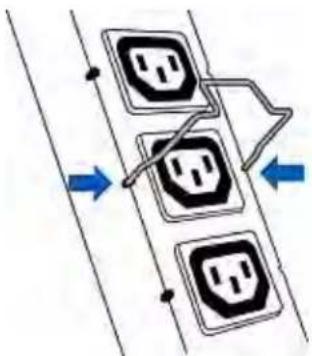
- Locate two tiny holes at two sides of an outlet.
- Install the cable retention clip by inserting two ends of the clip into the tiny holes.
flowchart
graph TD
    A["Switch 1"] --> B["Switch 2"]
    C["Switch 3"] --> D["Switch 4"]
    style A fill:#f9f,stroke:#333
    style B fill:#ccf,stroke:#333
    style C fill:#cfc,stroke:#333
    style D fill:#fcc,stroke:#333
- Plug the power cord into the outlet, and press the clip toward the power cord until it holds the cord firmly. The clip's central part holding the plug should face downwards toward the ground, like an inverted "U". This allows gravity to keep the clip in place.

natural_image
Diagram of a plug inserted into three outlets with a black cable, showing wiring connections (no text or symbols)- Repeat the same steps to install clips and power cords on the other outlets.
Chapter 4 Connecting External Equipment (Optional)
More features are available in addition to remotely monitoring and managing the PX if you connect Raritan's or third-party external equipment to your PX.
In This Chapter
Connecting Environmental Sensor Packages ....33
Before Connecting Equipment to Feature Port (PX3 Phase I Models) ...42
Connecting the Asset Management Sensor....43
Connecting a Logitech Webcam ....53
Connecting a GSM Modem....54
Connecting an Analog Modem....54
Connecting an External Beeper 55
Connecting a Schroff LHX/SHX Heat Exchanger ....55
Connecting Environmental Sensor Packages
The PX supports all types of Raritan environmental sensor packages, including DPX, DPX2 and DX series. For detailed information on each sensor package, refer to the Environmental Sensors Guide or Online Help on Raritan website's PX2 Support Files page (https://www.raritan.com/support/product/px2/px2-support-files).
The PX supports a maximum of 32 managed sensors or actuators.
For information on connecting DPX packages, see DPX Sensor Packages (on page 34).
For information on connecting DPX2 packages, see DPX2 Sensor Packages (on page 38).
For information on connecting DX packages, see DX Sensor Packages (on page 40).
DPX Sensor Packages
Most DPX sensor packages come with a factory-installed sensor cable, whose sensor connector is RJ-12.
The supported maximum distance is 98 feet (30 m). See Supported Maximum DPX Sensor Distances (on page 37) for further illustrations.
To directly connect a DPX with a factory-installed sensor cable:
An RJ-12 to RJ-45 adapter is required to connect a DPX sensor package to the PX3.
a. Connect the adapter's RJ-12 connector to the DPX sensor cable.
b. Connect the adapter's RJ-45 connector to the RJ-45 SENSOR port of the PX3.
To directly connect a differential air pressure sensor:
- Connect a Raritan-provided phone cable to the IN port of a differential air pressure sensor.
- Get an RJ-12 to RJ-45 adapter. Connect the adapter's RJ-12 connector to the other end of the phone cable.
- Connect this adapter's RJ-45 connector to the RJ-45 SENSOR port on the PX3.
Note: You can cascade multiple differential air pressure sensors using Raritan-provided phone cables. For details, refer to the Environmental Sensors Guide or Online Help on Raritan website's PX2 Support Files page
(https://www.raritan.com/support/product/px2/px2-support-files). When cascading air pressure sensors, remember that a SENSOR port supports a maximum of 32 sensors.

text_image
① The PX device ② Raritan differential air pressure sensors ③ RJ-12 to RJ-45 adapterUsing an Optional PX Sensor Hub
A Raritan sensor hub increases the number of connected DPX environmental sensors per SENSOR port. Make sure the total number of sensors connected to a SENSOR port does not exceed 32.
This hub supports DPX sensor packages only. Do NOT connect DPX2 or DX sensor packages to the hub.
To connect DPX sensor packages via an optional sensor hub:
- Connect a Raritan sensor hub to the PX device.
a. Plug one end of the Raritan-provided phone cable (4-wire, 6-pin, RJ-12) into the IN port (Port 1) of the hub.
b. Get an RJ-12 to RJ-45 adapter. Connect this adapter's RJ-12 connector to the other end of the phone cable.
c. Connect this adapter's RJ-45 connector to the PDU's RJ-45 SENSOR port.
- Connect DPX sensor packages to any of the four OUT ports on the hub.
Raritan sensor hubs CANNOT be cascaded so at most one sensor hub can be connected to each SENSOR port on the PX device. This diagram illustrates a configuration with a sensor hub connected.
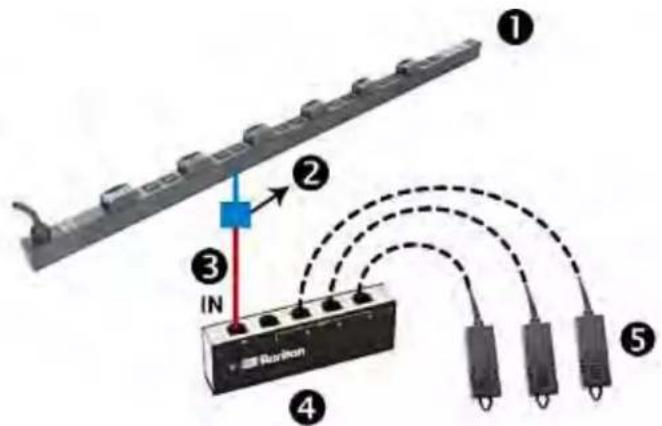
text_image
Diagram showing a rack-mounted device connected to a Burchon module via multiple wires, with numbered annotations and a red indicator labeled 'IN'.| 1 | The PX device |
| 2 | RJ-12 to RJ-45 adapter |
| 3 | Raritan-provided phone cable |
| 4 | Raritan sensor hub |
| 5 | DPX sensor packages |
Using a Raritan Y Cable
A Raritan Y cable doubles the number of connected environmental sensors per SENSOR port.
It supports DPX sensor packages only. Do NOT connect DPX2 or DX sensor packages.
To connect DPX sensor packages via a Raritan Y cable:
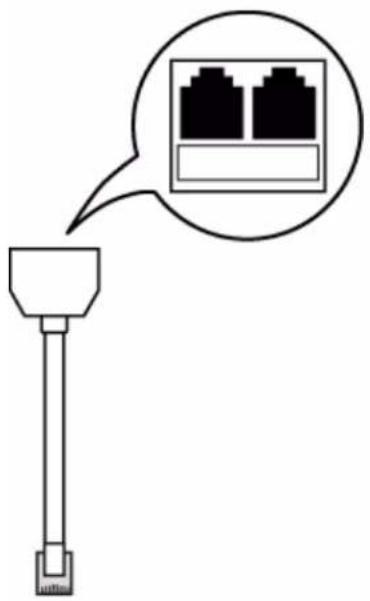
- Use an RJ-12 to RJ-45 adapter to connect the Y cable to the PX3.
a. Connect the adapter's RJ-12 connector to the Y cable.
b. Connect the adapter's RJ-45 connector to the RJ-45 SENSOR port on the PX3.
- A Y cable has two RJ-12 sensor ports. Connect DPX sensor packages to the Y cable's sensor ports.
natural_image
Diagram of a USB port with two Ethernet ports shown as icons, no text or labels present- Repeat the above steps if there are additional SENSOR ports on your PX.
Supported Maximum DPX Sensor Distances
A maximum connection distance of 98' (30 m) is supported when connecting the following DPX sensor packages to the PX. This maximum includes the 16' (5 m) sensor cable length:
- DPX-CC2-TR
- DPX-T1
- DPX-T3H1
- DPX-AF1
- DPX-T1DP1
The following configurations were tested when connecting DPX sensor packages to a PX via a sensor hub:
| PX | → 16' (5 m)cable | → 1 sensor hub | → 16' (5 m)cable | → Up to 4DPX-T3H1sensors |
| PX | → 50' (15 m)cable | → 1 sensor hub | → 16' (5 m)cable | → Up to 4DPX-T3H1sensors |
| PX | → 82' (25 m)cable | → 1 sensor hub | → 16' (5 m)cable | → Up to 4DPX-T3H1sensors |
DPX2 Sensor Packages
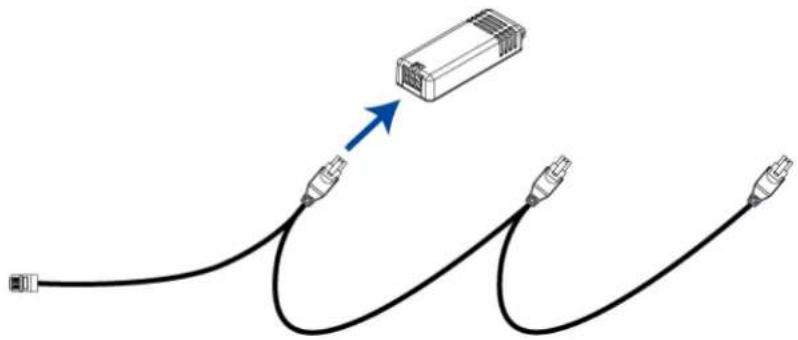
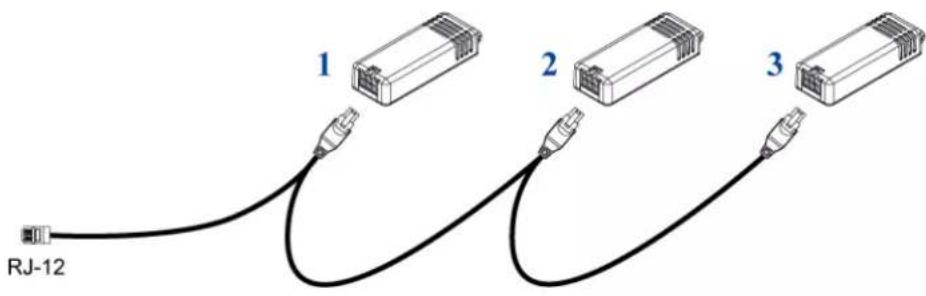
A DPX2 sensor cable is shipped with a DPX2 sensor package. This cable is made up of one RJ-12 connector and one to three head connectors. You need to manually connect DPX2 sensors to the sensor cable.
For more information on DPX2 sensor packages, access the Environmental Sensors Guide or Online Help on Raritan website's PX2 Support Files page
(https://www.raritan.com/support/product/px2/px2-support-files).

text_image
Diagram showing two types of Ethernet cable connections with labeled parts 1 and 2Item
1
DPX2 sensor
2
DPX2 sensor cable with one RJ-12 connector and three head connectors
The following procedure illustrates a DPX2 sensor cable with three head connectors. Your sensor cable may have fewer head connectors.
Warning: If there are free head connectors between a DPX2 sensor cable's RJ-12 connector and the final attached DPX2 sensor, the sensors following the free head connector(s) on the same cable do NOT work properly. Therefore, always occupy all head connectors prior to the final sensor with a DPX2 sensor.
To connect a DPX2 sensor package to the PX:
- Connect a DPX2 sensor to the first head connector of the DPX2 sensor cable.
natural_image
Diagram of a USB cable with connector, showing a connector connected to three Ethernet cables (no text or symbols present)- Connect remaining DPX2 sensors to the second and then the third head connector.
text_image
RJ-12 1 2 3Tip: If the number of sensors you are connecting is less than the number of head connectors on your sensor cable, connect them to the first one or first two head connectors to ensure that there are NO free head connectors prior to the final DPX2 sensor attached.
- Use an RJ-12 to RJ-45 adapter to connect a DPX2 sensor package to the PX3.
a. Connect the adapter's RJ-12 connector to the DPX2 sensor cable.
b. Connect the adapter's RJ-45 connector to the RJ-45 SENSOR port of the PX3.
DX Sensor Packages
Most DX sensor packages contain terminals for connecting detectors or actuators. For information on connecting actuators or detectors to DX terminals, access the Environmental Sensors Guide or Online Help on Raritan website's PX2 Support Files page (https://www.raritan.com/support/product/px2/px2-support-files).
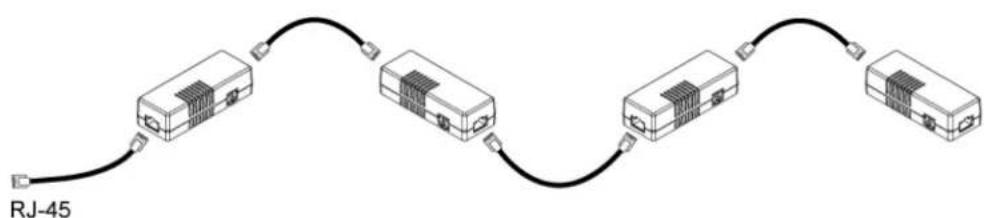
You can cascade up to 12 DX sensor packages.
When cascading DX, remember that the PX only supports a maximum of 32 sensors or actuators.
If there are more than 32 sensors and/or actuators connected, every sensor and/or actuator after the 32nd one is ignored by PX.
For example, if you cascade 12 DX packages, and each package contains 3 functions (a function is a sensor or actuator), PX ignores the last 4 functions because the total 36 (12*3=36) exceeds 32 by 4.
Tip: To manage the last 4 functions, you can release 4 sensors or actuators that have been under management, and then manually bring the last 4 functions into management. See Unmanaging Environmental Sensors or Actuators (on page 293) and Managing Environmental Sensors or Actuators (on page 281).

text_image
Technical diagram of an electronic device with numbered components and labeled partsNumbers Components
1
RJ-45 ports, each of which is located on either end of a DX sensor package.
2
RJ-12 port, which is reserved for future use and is now hidden.
3
Removable rackmount brackets.
Connect DX sensor packages to the PX:
-
Connect a standard network patch cable (CAT5e or higher) to either RJ-45 port on a DX sensor package.
-
If you want to cascade DX packages, get an additional standard network patch cable (CAT5e or higher) and then:
a. Plug one end of the cable into the remaining RJ-45 port on the prior DX package.
b. Plug the other end into either RJ-45 port on an additional DX package.
Repeat the same steps to cascade more DX packages.
Exception: You CANNOT cascade DX-PD2C5 sensor packages. A PX device supports only one DX-PD2C5.
natural_image
Diagram of four connected electrical connectors with cable routing (no text or symbols)- Connect the first DX sensor package to the PX3 by plugging its sensor cable connector into the RJ-45 SENSOR port of the PX3.
- If needed, connect a DPX2 sensor package to the end of the DX chain. See Connecting a DPX2 Sensor Package to DX (on page 41).
Warning: The PX3 does NOT support simultaneous connection of both DX-PD2C5 and asset management sensor(s) so do NOT connect both of them to the PX3 device.
Connecting a DPX2 Sensor Package to DX
You can connect only one DPX2 sensor package to the "end" of a DX sensor chain. Simply plug the RJ-12 connector of the DPX2 sensor cable into the RJ-45 port of the final DX in the chain.
The maximum number of DX sensor packages in the chain must be less than 12 when a DPX2 sensor package is involved.
When connecting a DPX2 sensor package containing three DPX2 sensors:
A maximum of nine (9) DX sensor packages can be cascaded because 12-3=9.

flowchart
graph LR
    DX["DX"] --> 9["9"]
    9 --> DPX2["DPX2"]
    style 9 fill:#f9f,stroke:#333
    style DPX2 fill:#ccf,stroke:#333
When connecting a DPX2 sensor package containing two DPX2 sensors:
A maximum of ten (10) DX sensor packages can be cascaded because 12-2=10.

text_image
DX 10 DPX2When connecting a DPX2 sensor package containing one DPX2 sensor:
A maximum of eleven (11) DX sensor packages can be cascaded because 12-1=11.

flowchart
graph LR
    DX["DX"] -->|11| DPX2["DPX2"]
    DPX2 -->|Data Line| DX
    style DX fill:#f9f,stroke:#333
    style DPX2 fill:#ccf,stroke:#333
Before Connecting Equipment to Feature Port (PX3 Phase I Models)
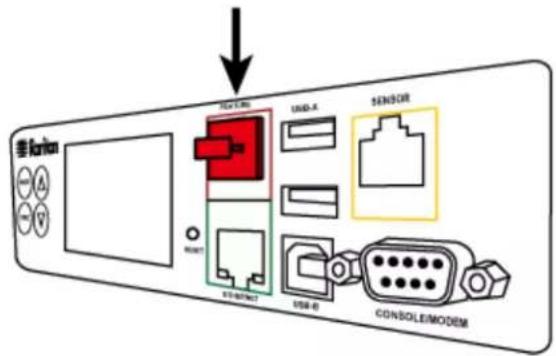
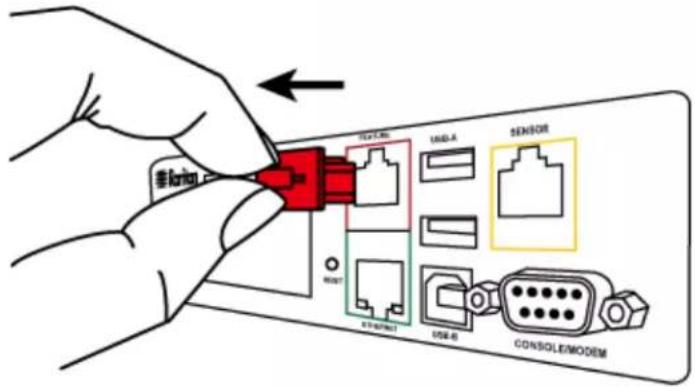
PX3 Phase I models have a cap plugged into the FEATURE port when shipping out of the factory. The cap is intended to protect the port from connecting to inappropriate equipment. Remove this cap prior to connecting any equipment to this port.
Note that PX3 Phase II models do NOT have this cap plugged.
To remove the RJ-45 cap from the FEATURE port:
- Locate the FEATURE port where the cap is installed.
The diagram illustrates a PX3 Zero U (Phase I) model.
text_image
NSK USB-A SENSOR VDD-80767 USB-B CONSOLEMODEM- Remove the cap.
text_image
GPIO USB-A SENSOR USB-B CONSOLE/MODEMConnecting the Asset Management Sensor
You can remotely track the locations of up to 64 IT devices in the rack by connecting an asset management sensor (asset sensor) to the PX after IT devices are tagged electronically.
To use the asset management feature, you need the following items:
- Raritan asset sensors: An asset sensor transmits the asset management tag's ID and positioning information to the PX.
- Raritan asset tags: An asset tag is adhered to an IT device. The asset tag uses an electronic ID to identify and locate the device.
Warning: The PX3 does NOT support simultaneous connection of both DX-PD2C5 and asset management sensor(s) so do NOT connect both of them to the PX3 device.
Combining Asset Sensors
Each tag port on the asset sensor corresponds to a rack unit and can be used to locate IT devices on a specific rack (or cabinet).
For each rack, you can attach asset sensors up to 64U long, consisting of one MASTER and multiple SLAVE asset sensors.
The difference between the master and slave asset sensors is that the master asset sensor has an RJ-45 connector while the slave does not.
The following diagram illustrates some asset sensors. Note that Raritan provides more types of asset sensors than the diagram.
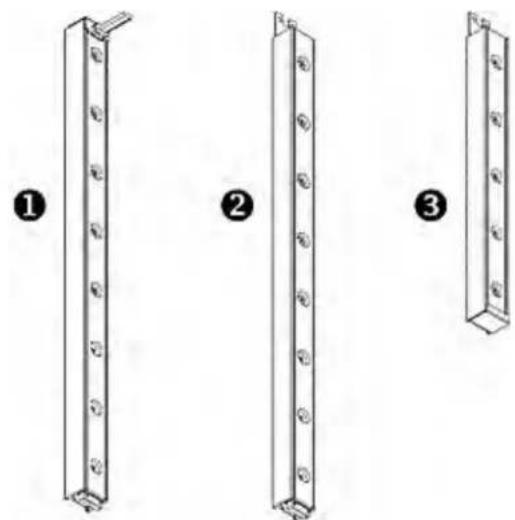
natural_image
Three technical diagrams showing structural components with mounting holes, labeled 1, 2, and 3 (no text or symbols on the components themselves)| 1 | 8U MASTER asset sensor with 8 tag ports |
| 2 | 8U SLAVE asset sensor with 8 tag ports |
| 3 | 5U "ending" SLAVE asset sensor with 5 tag ports |
Note: Unlike regular slave asset sensors, which have one DIN connector respectively on either end, the ending slave asset sensor has one DIN connector on only one end. An ending asset sensor is installed at the end of the asset sensor assembly.
To assemble asset sensors:
- Connect a MASTER asset sensor to an 8U SLAVE asset sensor.
- Plug the white male DIN connector of the slave asset sensor into the white female DIN connector of the master asset sensor.
- Make sure that the U-shaped sheet metal adjacent to the male DIN connector is inserted into the rear slot of the master asset sensor. Screw up the U-shaped sheet metal to reinforce the connection.

text_image
Diagram showing a device with a speech bubble and directional arrow, likely illustrating a process or system change.- Connect another 8U slave asset sensor to the one being attached to the master asset sensor in the same manner as Step 1.
-
Repeat the above step to connect more slave asset sensors. The length of the asset sensor assembly can be up to 64U.
-
The final asset sensor can be 8U or 5U, depending on the actual height of your rack.
-
Connect the "ending" asset sensor as the final one in the assembly.
-
Vertically attach the asset sensor assembly to the rack, next to the IT equipment, making each tag port horizontally align with a rack unit. The asset sensors are automatically attracted to the rack because of magnetic stripes on the back.
Note: The asset sensor is implemented with a tilt sensor so it can be mounted upside down.
Connecting Asset Sensors to the PX
You need both asset sensors and asset tags for tracking IT devices.
Asset tags provide an ID number for each IT device. The asset tags are adhered to an IT device at one end and plugged in to an asset management sensor at the other.
The asset sensor is connected to a PX, and the asset tag transmits the ID and positioning information to the asset sensor.
The following diagram illustrates an asset tag.
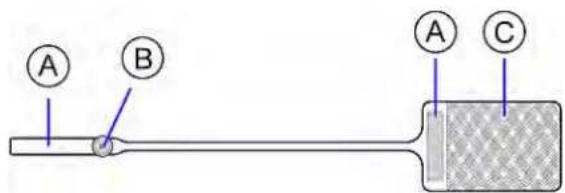
text_image
A B A C| A | Barcode (ID number), which is available on either end of the asset tag |
| B | Tag connector |
| C | Adhesive area with the tape |
Note: The barcode of each asset tag is unique and is displayed in the PX device's web interface so it can easily be identified.
To connect asset sensors to the PX device:
- Affix the adhesive end of an asset tag to each IT device through the tag's tape.
- Plug the connector on the other end of each asset tag into the corresponding tag port on the asset sensor.
- Connect the asset sensor assembly on the rack to the PX device, using a standard network patch cable (CAT5e/6).
a. Connect one end of the cable to the RJ-45 connector on the MASTER asset sensor.
b. Connect the other end of the cable to the FEATURE port on the PX device.
The PX device supplies power to the asset sensor assembly through the network cable. All LEDs on the asset sensor assembly may cycle through different colors during the power-on process if the asset sensor's firmware is being upgraded by the PX device. After the power-on or firmware upgrade process completes, the LEDs show solid colors. Note that the LED color of the tag ports with asset tags connected will be different from the LED color of the tag ports without asset tags connected.

flowchart
graph TD
    A["Component A"] -->|3| B["Component B"]
    B -->|2| C["Component C"]
    C -->|1| D["Component D"]
    style A fill:#f9f,stroke:#333
    style B fill:#ccf,stroke:#333
    style C fill:#cfc,stroke:#333
    style D fill:#fcc,stroke:#333
| Letter Item | |
| A | The PX device |
| B | Asset sensors |
| C | Asset tags |
| D | IT devices, such as servers |
Note: The PX cannot detect how many rack units the connected asset sensor(s) has. You must provide the information to it manually. See Configuring the Asset Sensor in PX2 (see "Configuring the Asset Sensor" on page 295).
Connecting Blade Extension Strips
For blade servers, which are contained in a single chassis, you can use a blade extension strip to track individual blade servers.
Raritan's blade extension strip functions similar to a Raritan asset sensor but requires a tag connector cable for connecting to a tag port on the regular or composite asset sensor. The blade extension strip contains 4 to 16 tag ports, depending on which model you purchased.
The following diagrams illustrate a tag connector cable and a blade extension strip with 16 tag ports.
Tag connector cable
| A | Barcode (ID number) for the tag connector cable |
| B | Tag connector |
| C | Cable connector for connecting the blade extension strip |
Note: A tag connector cable has a unique barcode, which is displayed in the PX device's web interface for identifying each blade extension strip where it is connected.
Blade extension strip
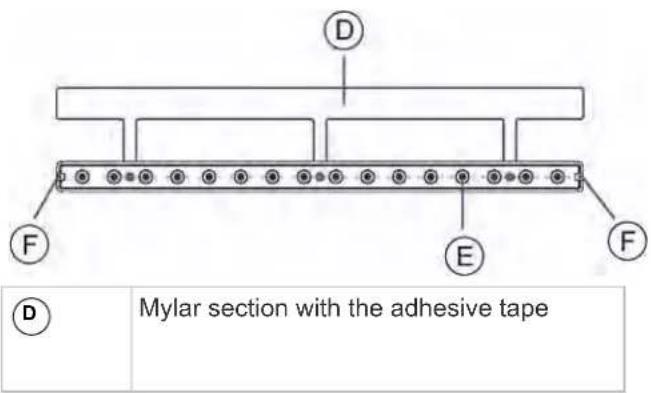
text_image
D F E F D Mylar section with the adhesive tapeChapter 4: Connecting External Equipment (Optional)
| E | Tag ports |
| F | Cable socket(s) for connecting the tag connector cable |
Note: Each tag port on the blade extension strip is labeled a number, which is displayed as the slot number in the PX device's web interface.
▶ To install a blade extension strip:
- Connect the tag connector cable to the blade extension strip.
- Plug the cable's connector into the socket at either end of the blade extension strip.

natural_image
Pure electrical circuit lines without any symbols- Move the blade extension strip toward the bottom of the blade chassis until its mylar section is fully under the chassis, and verify that the blade extension strip does not fall off easily. If necessary, you may use the adhesive tape in the back of the mylar section to help fix the strip in place.
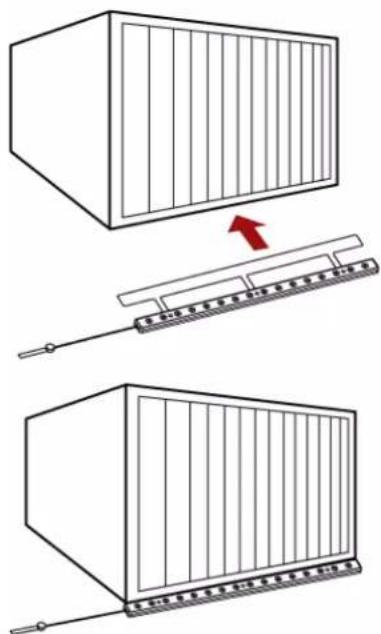
text_image
Diagram illustrating a mechanical assembly process with labeled components and directional arrow- Connect one end of an asset tag to a blade server and connect the other end to the blade extension strip.
a. Affix the adhesive part of the asset tag to one side of a blade server through the tag's tape.
b. Plug the tag connector of the asset tag into the tag port on the blade extension strip.
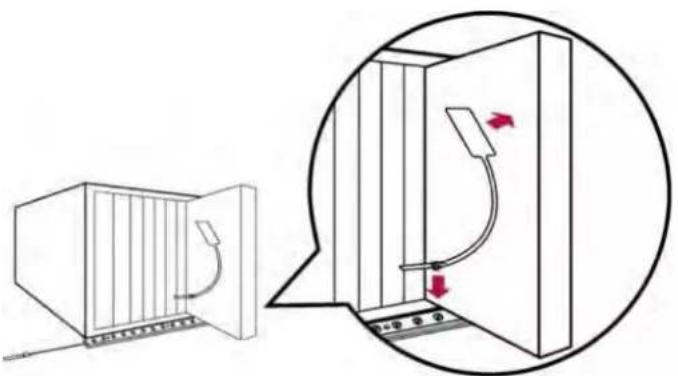
text_image
Diagram showing a door opening and a close-up of the door with directional arrows indicating movement or force.- Repeat the above step until all blade servers in the chassis are connected to the blade extension strip via asset tags.
- Plug the tag connector of the blade extension strip into the closest tag port of the regular or composite asset sensor on the rack.

natural_image
Diagram of a rectangular device with curved internal components and a red arrow indicating left motion (no text or symbols)- Repeat the above steps to connect additional blade extension strips and asset tags. Up to 128 asset tags on blade extension strips are supported per FEATURE port.
Note: If you need to temporarily disconnect the blade extension strip from the asset sensor, wait at least 1 second before re-connecting it back, or the PX device may not detect it.
Connecting Composite Asset Sensors (AMS-Mx-Z)
A composite asset sensor is named AMS-Mx-Z, where x is a number, such as AMS-M2-Z or AMS-M3-Z. It is a type of asset sensor that functions the same as regular MASTER asset sensors except for the following differences:
• It has two RJ-45 connectors.
• Multiple composite asset sensors can be daisy chained.
- A composite asset sensor contains less tag ports than regular asset sensors.
For example, AMS-M2-Z contains two tag ports and AMS-M3-Z contains three tag ports only.
The composite asset sensor is especially useful for tracking large devices such as SAN boxes in the cabinet.
The following diagram illustrates AMS-M3-Z.

text_image
Diagram showing two connected electrical components labeled A and B, with connection points and wiring connections.| A | Two RJ-45 connectors |
| B | Tag ports |
To connect composite asset sensors to the PX device:
- Connect a composite asset sensor to the PX device via a standard network patch cable (CAT5e or higher).
a. Connect one end of the cable to the RJ-45 port labeled "Input" on the composite asset sensor.
b. Connect the other end of the cable to the FEATURE port on the PX device.
-
Affix an asset tag to the IT device. Then connect this asset tag to the composite asset sensor by plugging the tag connector into the tag port on the composite asset sensor. See Connecting Asset Sensors to the PX (on page 46) for details.
-
If necessary, daisy chain the same type of composite asset sensors to track more IT devices.
a. Get a standard network patch cable that is within 2 meters.
b. Connect one end of the network cable to the RJ-45 connector labeled "Output" on the previous composite asset sensor.
c. Connect the other end of the cable to the RJ-45 connector labeled "Input" on the subsequent composite asset sensor.
d. Repeat the above steps to connect more composite asset sensors. See Daisy-Chain Limitations of Composite Asset Sensors (on page 52) for the maximum number of composite asset sensors supported per chain.
e. It is highly recommended using the cable ties to help hold the weight of all connecting cables.
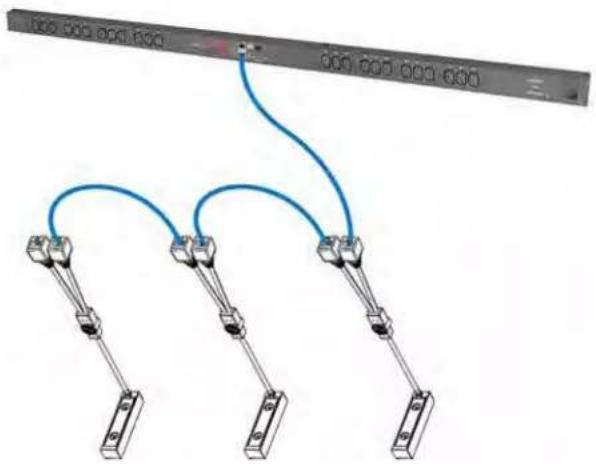
natural_image
Diagram of three connected mechanical components with blue cables, no text or symbols present- Repeat Step 2 to connect IT devices to the other composite asset sensors in the chain.
Important: Do NOT mix AMS-M2-Z and AMS-M3-Z in a chain.
Daisy-Chain Limitations of Composite Asset Sensors
There are some limitations when daisy chaining composite asset sensors -- AMS-Mx-Z, where x is a number.
- The maximum cable length between composite asset sensors is 2 meters.
- The maximum number of composite asset sensors that can be daisy chained vary according to the Raritan device.
Raritan devices Maximum sensors per chain
EMX2-111, Up to 4 composite asset sensors
Chapter 4: Connecting External Equipment (Optional)
| Raritan devices Maximum sensors per chain | |
| PX2 PDUs | are supported. |
| BCM | |
| EMX2-888, PX3 PDUs, PX3TS transfer switches | Up to 6 composite asset sensors are supported. |
Important: Do NOT mix different types of composite asset sensors in a chain. For example, all in the chain are AMS-M2-Z or all are AMS-M3-Z.
Connecting a Logitech Webcam
Connect webcams to PX in order to view video or snapshots of the webcam's surrounding area.
The following UVC-compliant webcams are supported:
- Logitech ^ Webcam ^ Pro 9000, Model 960-000048
• Logitech QuickCam Deluxe for Notebooks, Model 960-000043 - Logitech QuickCam Communicate MP, Model 960-000240
• Logitech C200, C210, C270 and C920
Other UVC-compliant webcams may work. However, Raritan has neither tested them nor claimed that they will work properly. More information about the scores of UVC-compliant webcams can be found at
http://www.ideasonboard.org/uvc (http://www.ideasonboard.org/uvc).
The PX supports up to two webcams. After connecting a webcam, you can retrieve visual information from anywhere through the PX web interface. If your webcam supports audio, audio is available with videos.
For more information on the Logitech webcam, see the user documentation accompanying it.
To connect a webcam:
- Connect the webcam to the USB-A port on the PX device. The PX automatically detects the webcam.
- Position the webcam properly.
Important: If a USB hub is used to connect the webcam, make sure it is a "powered" hub.
Snapshots or videos captured by the webcam are immediately displayed in the PX web interface after the connection is complete. See Viewing Webcam Snapshots or Videos (on page 306).
Connecting a GSM Modem
A Cinterion® MC52iT or MC55iT GSM modem can be connected to the PX in order to send SMS messages containing event information. See Creating Actions (on page 223) for more information on SMS messages.
Note: PX cannot receive SMS messages.
To connect the GSM modem:
- Connect the GSM modem to the DB9 serial port on the PX.
- Configure the GSM modem as needed. See the supporting GSM modem help for information on configuring the GSM modem.
- Configure the GSM modem settings in PX.
a. Click Device Settings > Serial Port Settings. The Serial Port Configuration dialog opens.
b. If needed, enter the GSM modem SIM PIN.
Connecting an Analog Modem
The PX supports remote dial-in communications to access the CLI through an analog modem. This dial-in feature provides an additional alternative to access the PX when the LAN access is not available. To dial in to the PX, the remote computer must have a modem connected and dial the correct phone number.
Below are the analog modems that the PX supports for sure:
• NETCOMM IG6000 Industrial Grade SmartModem
• US Robotics 56K modem
The PX may also support other analog modems which Raritan did not test.
Note that the PX does NOT support dial-out or dial-back operations via the modem.
To connect an analog modem:
-
Plug a telephone cord into the phone jack of the supported modem.
-
Plug the modem's RS-232 cable into the serial port labeled CONSOLE / MODEM on the PX.
You need to enable the modem dial-in support to take advantage of this feature, see Configuring the Serial Port (on page 141).
Connecting an External Beeper
The PX supports the use of an external beeper for audio alarms. After having an external beeper connected, you can create event rules for the PX to switch on or off the external beeper when specific events occur. See Creating an Event Rule (on page 222).
To connect an external beeper:
- Connect a standard network patch cable to the FEATURE port of the PX.
- Plug the other end of the cable into the external beeper's RJ-45 socket.
The beeper can be located at a distance up to 330 feet (100 m) away from the PX.
Connecting a Schroff LHX/SHX Heat Exchanger
Note: Only the PDUs whose model names begin with PX2 or PX3 support the LHX/SHX heat exchangers.
To remotely monitor and administer the Schroff ^® LHX-20, LHX-40 and SHX-30 heat exchangers through the PX device, you must establish a connection between the heat exchanger and the PX device.
For more information on the LHX/SHX heat exchanger, see the user documentation accompanying that product.
To establish a connection between the PDU and LHX/SHX heat exchanger, an RJ-45 to RS-232 adapter cable provided by Schroff is required.
To connect an LHX or SHX heat exchanger:
-
Plug the RS-232 DB9 end of the adapter cable into the RS-232 port on the Schroff LHX/SHX heat exchanger.
-
Plug the RJ-45 end of the cable into the port labeled FEATURE on your PX device.
See Managing the Schroff LHX/SHX Heat Exchanger (on page 315) for enabling the support of the LHX/SHX heat exchanger.
Chapter 5 Using the PDU
This chapter explains how to use the PX device. It describes the LEDs and ports on the PDU, and explains how to use the front panel display. It also explains how the overcurrent protector works and when the beeper sounds.
In This Chapter
Panel Components....56
Circuit Breakers 86
Fuse....88
Beeper 91
Replaceable Controller 91
Panel Components
The PX comes in Zero U, 1U, and 2U sizes. All types of models come with the following components on the outer panels.
- Inlet
- Outlets
- Connection ports
- Dot-matrix LCD display (PX3 phase II models)
Note: PX3 phase I models contain a character LCD display instead of a dot-matrix LCD display. For information on the character LCD display, see PX3 Phase I LCD Display (on page 556).
- Reset button
Connection ports, LCD display and reset button are located on a replaceable controller of the PX3 phase II model. See Replaceable Controller (on page 91).
Note: An older PX3 phase I model does not support a replaceable controller.
Inlet
Most of PX3 PDUs are shipped with a locking line cord, which is ready to be plugged into the PDU's inlet and an appropriate receptacle for electricity reception. Such devices cannot be rewired by the user.
A locking line cord helps secure the cord connection. For details, see Connecting a Locking Line Cord (on page 14).
Connect each PX to an appropriately rated branch circuit. See the label or nameplate affixed to your PX for appropriate input ratings or range of ratings.
There is no power switch on the PX device. To power cycle the PDU, unplug it from the branch circuit, wait 10 seconds and then plug it back in.
Besides, a PX3 "Zero U" model supports a relocatable inlet. See Zero U Models' Relocatable Inlet (on page 57).
Zero U Models' Relocatable Inlet
You can easily change the inlet's location from the side to the top or from the top to the side on a Zero U model.
Note: A PX3 phase I model does not support a relocatable inlet at the time of writing, but may support it later.
To change a PX3 inlet's position:
- Power OFF the PDU.
- Remove the screws at two sides of the inlet to uninstall the inlet module.
- Re-install the inlet module in a manner that the inlet is located at the desired position.
Inlet on the side Inlet on the top
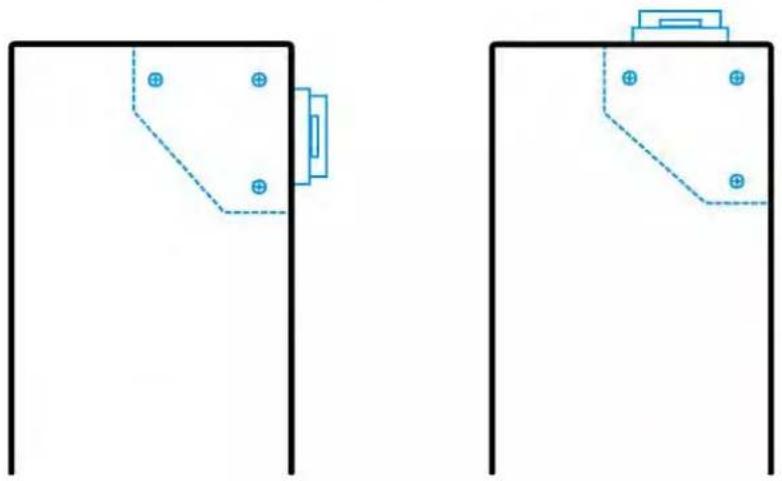
natural_image
Pure architectural line drawing of two identical corner structures with dashed lines and circular markers, no text or symbols present.Outlets
The total number of outlets varies from model to model.
PX3-3000 Series
These models are NOT outlet-switching capable so all outlets are always in the ON state.
Outlet LEDs are not available.
PX3-4000 Series
These PDUs are NOT outlet-switching capable models so all outlets are always in the ON state.
A small LED adjacent to each outlet indicates the outlet state. Outlet LEDs always light red, indicating that the outlet power is ON.
PX3-5000 Series
These models are outlet-switching capable. A small LED adjacent to each outlet indicates the outlet or PDU state. The PDU is shipped from the factory with all outlets turned ON. The table below explains how to interpret different outlet LED states.
| LED state Outlet status What it means | ||
| Not lit Powered OFF | The outlet is not connected to power, or the control | |
Chapter 5: Using the PDU
| LED state Outlet status What it means | ||
| circuitry's power supply is broken. | ||
| Red ON and LIVE | LIVE power. The outlet is on and power is available. | |
| Red flashing ON and LIVE | The current flowing through the outlet is greater than the upper warning (non-critical) threshold. | |
| Green OFF and LIVE | The outlet is turned off and power is available when the outlet is turned on. | |
| Green flashing OFF and NOT LIVE | The outlet is turned off and power is not available because the circuit breaker has tripped. | |
| Red and Green flashing alternatively | ON and NOT LIVE | The outlet is turned on but power is not available because a circuit breaker has tripped. |
| Cycling through Red, Green and Yellow | n/a | The PX device has just been plugged in and its management software is loading. LED color cycling does not interrupt power to outlets. It is an indication of firmware loading. |
Note: When a PX device powers up, it proceeds with the power-on self test and software loading for a few moments. At this time, the outlet LEDs cycle through different colors. When the software has completed loading, the outlet LEDs show a steady color and the front panel display illuminates.
Connection Ports
Depending on the model you purchased, the total number of ports available varies.
Zero U Connection Ports
For most of PX3 series Zero U models, there are 7 ports on the front panel. The PX3 PDU has two USB-A ports.
- PX3 Phase II models:
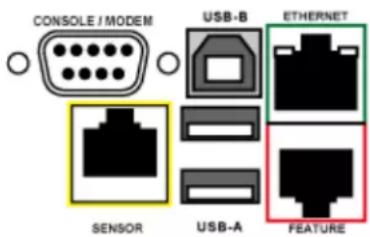
text_image
CONSOLE / MODEM USB-B ETHERNET SENSOR USB-A FEATURE- PX3 Phase I models:
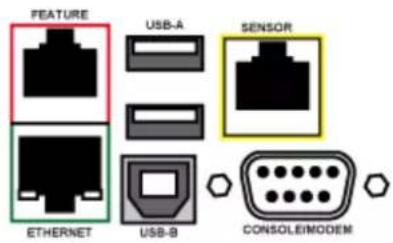
text_image
FEATURE USB-A SENSOR ETHERNET USB-B CONSOLE/MODEM1U and 2U Port Locations
The difference between Zero U, 1U and 2U models is that Zero U models have all the connection ports located on the front panel while 1U and 2U models have the ports located respectively on the front and back panels.
Connection Port Functions
The table below explains the function of each port.
| Port Used for... | |
| USB-B Establishing | a USB connection between a computer and the PX device.This port can be used for disaster recovery of the PX device. ContactRaritan Technical Support for instructions. |
| USB-A Connecting | a USB device, such as a Logitech® webcam.This is a "host" port, which is powered, per USB 2.0 specifications. |
| FEATURE Connection to some Raritan access products (such as Dominion KX II) through the use of a power CIM, OR --Connection to a Schroff® LHX-20, SHX-30 or LHX-40 device through an RJ-45 to RS-232 cable provided by Schroff, OR --Connection to an external beeper with the RJ-45 socket, OR --Connection to a Raritan asset management sensor, which allows you to track the locations of IT devices on the rack.SeeConnecting External Equipment (Optional) (on page 33).Warning: This is not an RS-232 port so do NOT plug in an RS-232 device, or damages can be caused to the device. | |
| CONSOLE/MODEM | Establishing a serial connection between a computer and the PX device:This is a standard DTE RS-232 port. You can use a null-modem cable with two DB9 connectors on both ends to connect the PX device to the computer. |
Port Used for...
*SENSOR Connection to Raritan's environmental sensor packages.
A sensor hub is required if you want to connect more than one DPX sensor package.
ETHERNET Connecting the PX device to your company's network:
Connect a standard Cat5e/6 UTP cable to this port and connect the other end to your network. This connection is necessary to administer or access the PX device remotely using the web interface.
There are two small LEDs adjacent to the port:
- Green indicates a physical link and activity.
- Yellow indicates communications at 10/100 BaseT speeds.
For a USB-cascading configuration in the bridging mode, the wired network connection is a must for the master PX. See Cascading the PX via USB (on page 28) for details.
Note: Connection to this port is not required if connection to a wireless network is preferred.
* The SENSOR port on a PX3 PDU is RJ-45.
Dot-Matrix LCD Display
The following diagram shows the dot-matrix LCD display panel on a Zero U PX3 Phase II model.
natural_image
Plain gray square with no text, symbols, or markings


You can use the LCD display to view the PX information and even switch an outlet. It consists of:
- A dot-matrix LCD display
- Four control buttons
Note: All dot-matrix LCD display diagrams illustrated in the online help are for Zero U models. Your dot-matrix LCD display may look slightly different if it is on a 1U or 2U model.
Automatic and Manual Modes
After powering on or resetting the PX, the front panel LCD display first shows the Raritan logo and company name, and then enters the automatic mode.
▶ Automatic mode:
In this mode, the LCD display cycles through the inlet information.
If overcurrent protectors are available on your PX, the display cycles through both the inlet and overcurrent protector information.
Note: You can make a PX with overcurrent protectors only show the inlet information in the automatic mode. See Setting the LCD Display's Default View (on page 138).
▶ Manual mode:
To view more information or control the outlets if your PX supports the outlet-switching function, you have to enter the manual mode.
To enter the manual mode, press ⬙ or ✗ in the automatic mode. A Main Menu then appears. See Main Menu (on page 63).
To return from the manual mode to the automatic mode, press ✗ once or several times.
Operating the Dot-Matrix LCD Display
Enter the manual mode when you want to operate the dot-matrix LCD display. You can use the dot-matrix LCD display to:
- Show information of the PDU, built-in components, or connected peripheral devices
• Control outlets if your model supports outlet-switching
On a Zero U model, the dot-matrix LCD display can automatically adjust its content's orientation after detecting the direction in which the PX is installed. To keep the content's orientation unchanged permanently, you can set the display orientation using the command line interface. See Changing the LCD Display Orientation (on page 387).
1U and 2U models do NOT adjust the display's content orientation.
Main Menu
After pressing ⬙ or ✗ to enter the manual mode, the Main Menu appears. Depending on the model you purchased, the Main Menu contains 6 to 9 menu commands.
Control buttons that can be used and the system time are shown at the bottom of the LCD display.
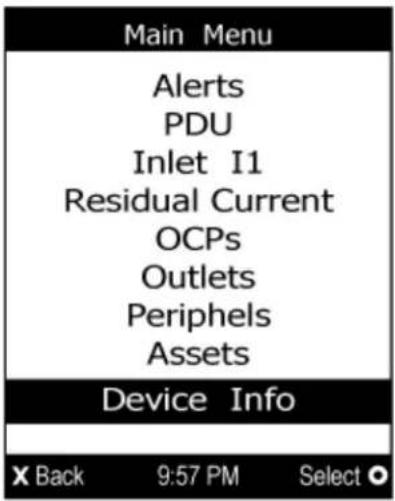
text_image
Main Menu Alerts PDU Inlet I1 Residual Current OCPs Outlets Periphels Assets Device Info X Back 9:57 PM Select ○| Menu command Function | |
| Alerts | Indicates alerted sensors, if any. See Alerts (on page 65). |
| PDU | Shows the internal beeper's state, and, if it is on, the reason for turning on.If your PX has multiple inlets, this menu item also shows the total active power and total active energy.See PDU (on page 67). |
| Inlet I1 | Shows the inlet I1's information. See Inlet (on page 68). |
| Residual Current | Available only on PX models with residual current monitoring. See Front Panel Operations for RCM (on page 577). |
| OCPs | Shows a list of overcurrent protector information. See OCPs (on page 70).Only PX models with overcurrent protectors have this menu item. |
| Outlets | Shows each outlet's information.In addition, if your PX supports the outlet-switching function, you can turn on, off or power cycle an outlet.See Outlets (on page 71). |
| Peripherals | Shows the information of connected Raritan environmental sensors or actuators, such as the temperature sensor.You can even turn on or off a connected actuator with this command.See Peripherals (on page 75). |
| Assets | Shows the asset management information if Raritan asset management equipment is connected to your PX. See Assets (on page 79). |
| Device Info | Shows the PX device's information, such as IP and MAC address. See Device Info (on page 81). |
Note: To return to the automatic mode, press ✗. See Automatic and Manual Modes (on page 62).
Control Buttons
Use the control buttons to navigate to the menu in the manual mode.
| Button Function Description | ||
 | Up Move the selection up, or go to the previous page. | |
 | Down Move the selection down, or go to the next page. | |
 | OK Confirm the selection. | |
 | Back | Return to the prior screen or the Main Menu in the manual mode.Return to the automatic mode from the manual mode when the Main Menu is being displayed. |
Alerts
The "Alerts" menu command shows a list of the following alerted sensors, including both internal and external sensors.
- Any sensor that enters the warning or critical range if the thresholds have been enabled
■ Discrete (on/off) sensors that enter the alarmed state - Any tripped circuit breakers or blown fuses
Tip: The same information is available in the PX web interface's Dashboard. See Alerted Sensors (on page 109).
If there are no alerted sensors, the LCD display shows the message "No alerts."
▶ To view alerted sensors:
-
Press ▲ or ▼ to select "Alerts" in the Main Menu, and press ●.
-
If any sensor has entered an alarmed, warning or critical state, a list similar to the following is displayed. Alerted sensors are highlighted in either red or yellow. See The Yellow- or Red-Highlighted Sensors (on page 105) for color meanings.
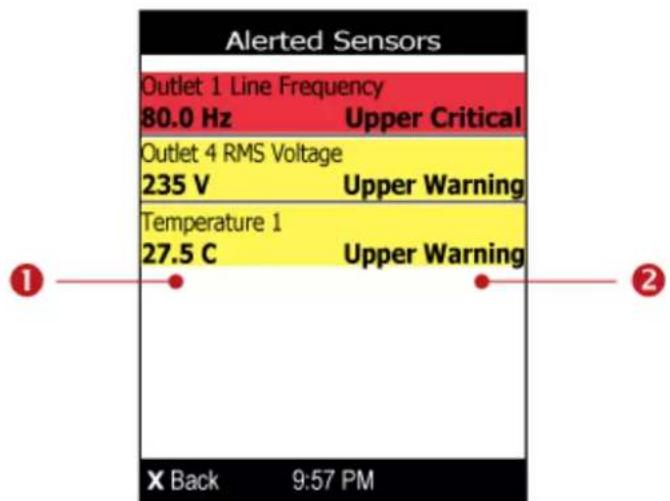
text_image
Alerted Sensors Outlet 1 Line Frequency 80.0 Hz Upper Critical Outlet 4 RMS Voltage 235 V Upper Warning Temperature 1 27.5 C Upper Warning X Back 9:57 PM| Number | Description |
| 1 | Sensor names.For a numeric sensor, its reading is displayed right below the sensor name.For a discrete sensor, no reading is displayed. |
| 2 | Sensor states as listed below. For further information, seeStates of Managed Sensors(on page 290).AlarmedLower Critical = below lower criticalLower Warning = below lower warningUpper Warning = above upper warningUpper Critical = above upper criticalOpen (for overcurrent protectors) |
- If there are more alerted sensors than those shown on a page, press
or ▲ to view additional pages. When there are multiple pages, page numbers are indicated in the top-right corner of the display.
- To return to the Main Menu, press ✗.
PDU
Depending on the model you purchased, the "PDU" menu command may contain one or all of the following information.
Internal beeper states - On or Off
Total active power of the PX - available on a multi-inlet model only
Total active energy of the PX - available on a multi-inlet model only
Tip: The internal beeper state information is also available in the PX web interface. See Checking the Internal Beeper State (on page 153).
To view PDU information:
-
Press ▲ or ▼ to select "PDU" in the Main Menu, and press ●.
-
The internal beeper state is shown: Active or Off.
For the Active state, the reason of turning on the beeper is indicated below the beeper state.

text_image
Beeper Info Beeper State Active Activation Reason Overcurrent protector tripped X Back 9:57 PM- If your PX has more than one inlet, press ▲ or ▼ to show the information of total active power (W) and total active energy (Wh).

text_image
PDU Sensors 2/2 Active Power 1613 W Active Energy 378562 Wh X Back 9:57 PM- To return to the Main Menu, press ✗.
Inlet
An inlet's information is separated into two pages. Page numbers are indicated in the top-right corner of the LCD display.
To show the inlet information:
-
Press ▲ or ▼ to select "Inlet I1" in the Main Menu, and press ●.
-
The first page shows the inlet's active power (W), apparent power (VA), power factor (PF), and active energy (Wh) from top to down.
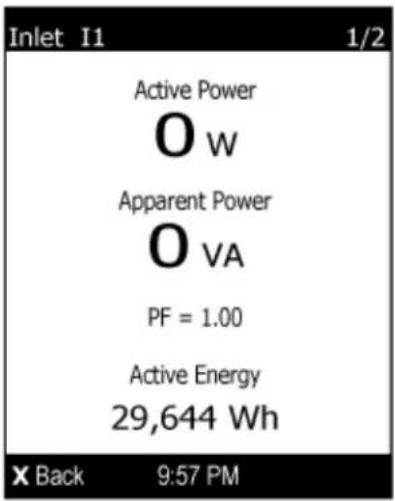
text_image
Inlet I1 1/2 Active Power O W Apparent Power O VA PF = 1.00 Active Energy 29,644 Wh X Back 9:57 PM- To go to the next page, press

- For a single-phase model, the second page shows the inlet's voltage (V), frequency (Hz) and current (A) from top to down.
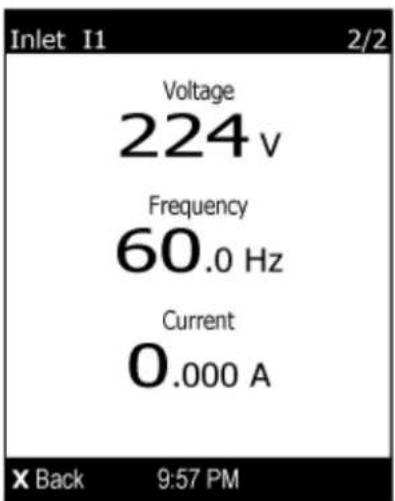
text_image
Inlet I1 2/2 Voltage 224 v Frequency 60.0 Hz Current 0.000 A X Back 9:57 PM- For a three-phase model, the next several pages respectively show the current value of each line, unbalanced current's percentage, line frequency, and voltage value of each line.
- To return to the Main Menu, press

OCPs
If your model has more overcurrent protectors (OCPs) than the LCD display can show at a time, a page number appears in the top-right corner of the display. Otherwise, no page numbers are available.
To show the overcurrent protector information:
- Press ▲ or ▼ to select "OCPs" in the Main Menu, and press

- The LCD display shows a list of overcurrent protectors similar to the following diagram.
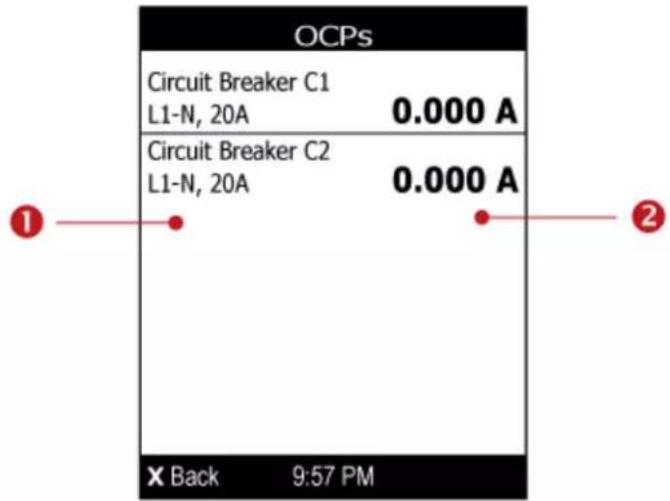
text_image
OCPs Circuit Breaker C1 L1-N, 20A 0.000 A Circuit Breaker C2 L1-N, 20A 0.000 A X Back 9:57 PM| Number | Description |
| 1 | Overcurrent protector names.Associated lines and rated current are displayed below each overcurrent protector's name. |
| 2 | Current reading of the corresponding overcurrent protector. |
- If the desired overcurrent protector is not visible, press ▲ or ▼
to scroll up or down.
Note: If any circuit breaker trips, the list of overcurrent protectors looks slightly different from the above diagram. The tripped one will show "open" instead of a current reading.
Outlets
With the front panel display, you can do the following for outlets:
• Show each outlet's information.
- Turn on, off or power cycle an individual outlet if your PX is outlet-switching capable. To do this, you must first enable the front panel outlet control function. See Enabling Front Panel Outlet Switching (on page 210).
Showing an Outlet's Information
Multiple outlet information can be displayed on the LCD display. Page numbers are indicated in the top-right corner of the LCD display.
Control buttons that can be used and the system time are shown at the bottom of the LCD display.
To show an outlet's information:
-
Press ▲ or ▼ to select "Outlets" in the Main Menu, and press ●.
-
The LCD display shows a list of outlets with their receptacle types, current values (A), and power states which are indicated by the colors of circles.
-
A red circle indicates that this outlet is powered on.
- A green circle indicates that this outlet is powered off. If so, the word "Off" replaces the current value.

text_image
Outlets Outlet 1 NEMA 5-20R 0.000 A Outlet 2 NEMA 5-20R 0.000 A Outlet 3 NEMA 5-20R 0.000 A Outlet 4 NEMA 5-20R 0.000 A X Back 9:57 PM Details- Press ▲ or ▼ to select an outlet, and press .
- If the desired outlet is not visible, press or down. - or to scroll up
- The LCD display shows the selected outlet's power state, active power (W), apparent power (VA), power factor (PF) and active energy (Wh) from top to down.
Note: In the following diagrams, N represents the selected outlet's number.

text_image
Outlet N 1/2 Status ● On Active Power 0 W Apparent Power 0 VA PF = 1.00 Active Energy 4,500 Wh X Back 9:57 PM Switch ●- To go to the next page which shows the outlet's voltage (V), frequency (Hz) and current (A), press ▲ or ▼

text_image
Outlet N 2/2 Voltage (L1-N) 224 v Frequency 60.0 Hz Current 0.000 A X Back 9:57 PM Switch ○- To return to the Main Menu, press Menu is shown.
several times until the Main
Power Control
This section applies to outlet-switching capable models only.
The front panel outlet control must be enabled for performing this power control function. The default is to disable this function. See Enabling Front Panel Outlet Switching (on page 210).
Available options for power control vary based on the power state of the selected outlet. For an outlet which has been turned on, the 'Switch On' option is unavailable. For an outlet which has been turned off, the "Switch Off" option is unavailable.
Control buttons that can be used and the system time are shown at the bottom of the LCD display.
▶ To power on, off or cycle an outlet using the LCD display:
- Press ▲ or ▼ to select "Outlets" in the Main Menu, and press

-
The LCD display shows a list of outlets with their receptacle types, current values (A), and power states which are indicated by the colors of circles.
-
A red circle indicates that this outlet is powered on.
- A green circle indicates that this outlet is powered off. If so, the word "Off" replaces the current value.
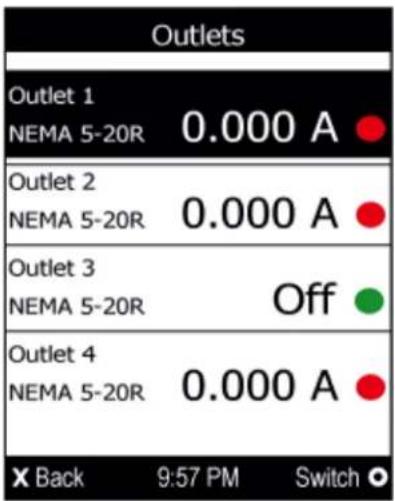
text_image
Outlets Outlet 1 NEMA 5-20R 0.000 A Outlet 2 NEMA 5-20R 0.000 A Outlet 3 NEMA 5-20R Off Outlet 4 NEMA 5-20R 0.000 A X Back 9:57 PM Switch- Press ▲ or ▼ to select an outlet, and press .
If the desired outlet is not visible, press ▲ or ▼ to scroll up or down.
- The LCD display shows the selected outlet's information. For details, see Showing an Outlet's Information (on page 71).
Note: In the following diagrams, N represents the selected outlet's number.
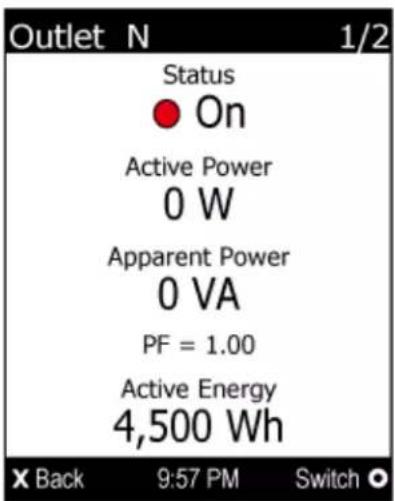
text_image
Outlet N 1/2 Status ● On Active Power 0 W Apparent Power 0 VA PF = 1.00 Active Energy 4,500 Wh X Back 9:57 PM Switch ●- Press ⬙ to go to the power control page. A submenu similar to the following diagram appears.
Note: The submenu is not available when the front panel outlet control is disabled, and a message ""Front-panel outlet control is disabled" is displayed.
- When the selected outlet has been turned off, 'Switch On' replaces the option of 'Switch Off'.
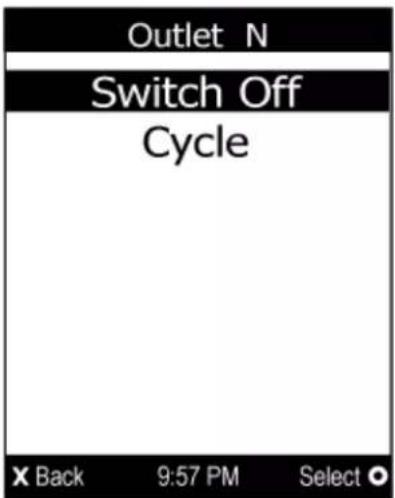
text_image
Outlet N Switch Off Cycle X Back 9:57 PM Select ○-
Press ▲ or ▼ to select the desired option, and press ●.
-
Switch Off: Turn off the outlet.
■ Switch On: Turn on the outlet.
- Cycle: Power cycle the outlet. The outlet is turned off and then on.
- A confirmation message appears. Press ▲ or ▼ to select Yes
or No, and then press
■ Yes: Confirm the operation.
■ No: Abort the operation.
-
Verify that the selected outlet is switched on or off, depending on the option you selected in the above step.
-
Check the outlet state shown on the LCD display. See step 4.
-
Check the outlet LED. A green LED indicates that the outlet is turned off, and a red LED indicates that the outlet is turned on.
-
To return to the Main Menu, press ✗ several times until the Main Menu is shown.
Peripherals
If there are no Raritan environmental sensor packages connected to your PX, the LCD display shows the message "No managed devices" for the "Peripherals" menu command.
If any connected sensor is highlighted in red or yellow, that sensor has entered an alarmed, warning or critical state. See The Yellow- or Red-Highlighted Sensors (on page 105) for color meanings.
If you have enabled the front panel actuator control function, you can switch on or off a connected actuator using the LCD display. See Enabling the Front Panel Actuator Control (on page 295).
Control buttons that can be used and the system time are shown at the bottom of the LCD display.
To show environmental sensor or actuator information:
-
Press ▲ or ▼ to select "Peripherals" in the Main Menu, and press ●.
-
The display shows a list of environmental sensors similar to the following diagram.
- If the desired sensor or actuator is not visible, press ▲ or ▼ to scroll up or down. Page numbers are indicated in the top-right corner of the LCD display.
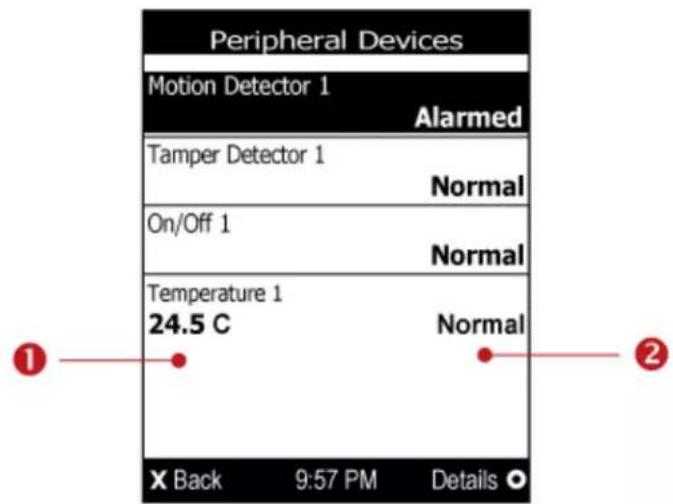
text_image
Peripheral Devices Motion Detector 1 Alarmed Tamper Detector 1 Normal On/Off 1 Normal Temperature 1 24.5 C Normal X Back 9:57 PM Details| Number | Description |
| 1 | Sensor or actuator names.For a numeric sensor, its reading is displayed right below the sensor name.For a discrete sensor, no reading is displayed. |
| 2 | Sensor or actuator states as listed below. For further information, seeStates of Managed Sensors(on page 290) andStates of Managed Actuators(on page 293).n/a = unavailableNormalAlarmedLower Critical = below lower criticalLower Warning = below lower warningUpper Warning = above upper warningUpper Critical = above upper criticalOnOff |
- To view an environmental sensor or actuator's detailed information,
press ▲ or ▼ to select that sensor, and press . A screen similar to the following is shown.
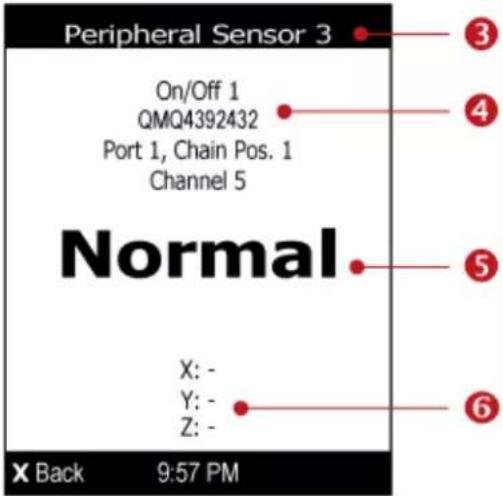
text_image
Peripheral Sensor 3 On/Off 1 QMQ4392432 Port 1, Chain Pos. 1 Channel 5 Normal X: - Y: - Z: - X Back 9:57 PM| Number | Description |
| 3 | The ID number assigned to this sensor or actuator.▪ A sensor is shows as "Peripheral Sensor x," where x is the ID number.▪ An actuator is shown as "Peripheral Actuator x," where x is the ID number. |
| 4 | Three pieces of sensor or actuator information are listed from top to down.▪ Sensor or actuator name▪ Serial number▪ Chain position, which involves the following information:Port:is the number of the sensor port where this sensor or actuator is connected.Chain Pos.:is the sensor or actuator's position in a sensor daisy chain.Note: Only DX and DPX2 sensor packages provide the chain position information.▪ If this sensor or actuator is on a sensor package with multiple channels, such as DX-D2C6, its channel number is indicated as "Channel x", where x is a number. |
| 5 | Depending on the sensor type, any of the following information is displayed:▪ State of a discrete (on/off) sensor: Normal or Alarmed.▪ State of an actuator: On or Off.▪ Reading of a numeric sensor. |
Number Description

X, Y, and Z coordinates which you specify for this sensor or actuator. See Configuring Environmental Sensors or Actuators (on page 283).
- Press ✗ to return to the sensor list.
- To return to the Main Menu, press ✗.
▶ To switch on or off an actuator:
- Follow the above steps 1 to 3 to select the desired actuator.

text_image
Peripheral Actuator 6 Powered Dry Contact 1 QU74592507 Port 1, Chain Pos. 1 Channel 1 Off X: - Y: - Z: - X Back 9:57 PM Switch ○- Press ⬙ to turn on or off the actuator. A confirmation message similar to the following is shown.
Note: If you have not enabled the front panel actuator control function, a message "Front-panel actuator control is disabled" is shown instead of the confirmation message.

text_image
Peripheral Actuator 6 Do you really want to switch on Powered Dry Contact 1? Yes No X Back 9:57 PM- Press ▲ or ▼ to select Yes or No, and then press . ●
■ Yes: Confirm the operation.
■ No: Abort the operation.
- Verify that the actuator status shown on the LCD display has been changed.
Assets
If there are no Raritan asset management sensors connected, the LCD display shows the message "Asset strip not connected" for the "Assets" menu command.
After connecting asset sensors, only the information of the rack units where asset tags have been detected are shown on the LCD display.
▶ To show asset sensor information:
-
Press ▲ or ▼ to select "Assets" in the Main Menu, and press ●.
-
The LCD display shows a list of rack unit numbers as well as their information similar to the following diagram.
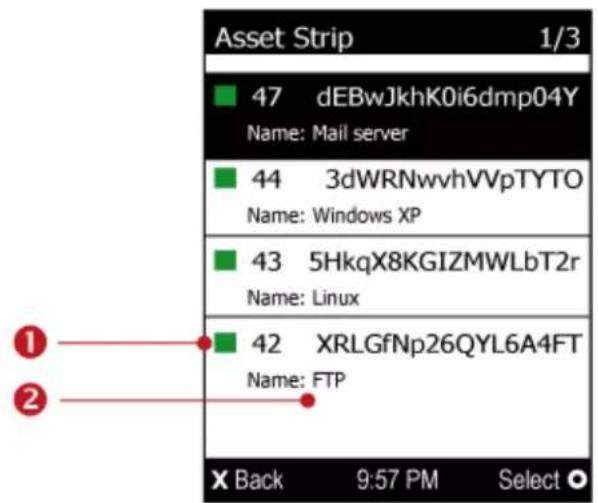
text_image
Asset Strip 1/3 47 dEBwJkhK0i6dmp04Y Name: Mail server 44 3dWRNwwhVVpTYTO Name: Windows XP 43 5HkqX8KGIZMWLbT2r Name: Linux 42 XRLGfNp26QYL6A4FT Name: FTP X Back 9:57 PM Select ●| Number | Description |
| 1 | Three pieces of information are displayed from left to right.▪ A color box: This represents the asset sensor's LED color when an asset tag is detected. The default is green. You can customize the color. SeeSetting Asset Sensor LED Colors(on page 297).▪ Rack unit number: The numerical order can be either ascending or descending, depending on the numbering mode you set. SeeConfiguring the Asset Sensor(on page 295).▪ The connected asset tag's ID number (barcode) |
| 2 | The asset tag's name if you have specified one. This field does not show up if no name is available. |
- If the desired rack unit is not visible, press ▲ or ▼ to scroll up or down. Page numbers are indicated in the top-right corner of the LCD display.
Device Info
The display shows the PX device's information, network and IPv4 settings through various pages. Page numbers are indicated in the top-right corner of the LCD display.
To show the device information:
- Press ▲ or ▼ to select "Device Info" in the Main Menu, and press ●.
- The display shows device information similar to the following diagram.

text_image
Device Info 1/4 my PX 3.0.0.5-41346 PX3-5496V QQK4423456 200-240V 50/60Hz 24A 4.8-5.8VA ① ② ③ X Back 9:57 PM| Number | Description |
| 1 | The PX device's name. |
| 2 | Firmware version, model name and serial number. |
| 3 | Device ratings, including rated voltage, frequency, current and power. |
- To go to the next page which shows the networking mode and
USB-cascading status, press ▼.

text_image
Network Interface 2/4 Wired 00:00:50:08:8C:69 Cascading Mode: Bridging Cascade Position: 0 (Master) Slave Connected: no X Back 9:57 PM| Number | Description |
| 4 | Networking information, including:Network mode: Wired or Wireless.MAC address of the PX.If the networking mode is wireless, the following additional information is available:- SSID- MAC address of the access point being used |
| 5 | USB-cascading status, including:Cascading mode: Bridging or Port Forwarding. SeeSetting the Cascading Mode(on page 142).Cascade position: The position information is available only when the PX is in a USB-cascading configuration. The information comprises a number and a noun enclosed in parentheses:- The number represents the device's position. For example, 0 represents the master device, 1 represents Slave 1, 2 represents Slave 2, and so on.- The noun in parentheses indicates whether it is a master or slave device.Slave connected: Indicates whether the presence of a slave device is detected on the USB-A port - yes or no. |
- To go to the next page which shows IPv4 settings, press


text_image
IPv4 Settings 3/4 DHCP IP: 192.168.84.53 Netmask: 255.255.255.0 Gateway: 192.168.84.254 DNS Servers: 192.168.80.19 192.168.80.253 X Back 9:57 PM| Number | Description |
| 6 | IPv4 network information, including:Network configuration: DHCP or Static. Static represents Static IP.IP address.Netmask.Gateway. |
| 7 | DNS server addresses, including the primary and secondary ones. |
If you do not enable IPv4 settings, a message is displayed to indicate IPv4 is disabled.
- To show IPv6 settings, press ⬇. If IPv6 settings have been enabled, the following IPv6 information is available:
■ Network configuration: Automatic or Static.
IP address(es).
■ DNS server address(es).
If you do not enable IPv6 settings, the following message is displayed instead.

text_image
IPv6 Settings 4/4 IPv6 networking is disabled X Back 9:57 PM- To return to the Main Menu, press

Showing the Firmware Upgrade Progress
When upgrading the PX, the firmware upgrade progress will be displayed as a percentage on the LCD display, similar to the following diagram.

text_image
Firmware Update Firmware update in progress Updating main controller Please do not power off the device while the update is in progress! 38% X Back 9:57 PMIn the end, a message appears, indicating whether the firmware upgrade is successful or fails.
Reset Button
The reset button is located inside the small hole near the display panel on the PDU.
The PX device can be reset to its factory default values using this button when a serial connection is available. See Resetting to Factory Defaults (on page 549).
Without the serial connection, pressing this reset button restarts the PX device's software without any loss of power to outlets.
The following images illustrate the locations of the reset button on Zero U models only.
PX3 phase II models:

text_image
CONSOLE / MEDIUM USB-B ETHERNET SENSOR USB-A FEATURES RaritanPX3 phase I models:
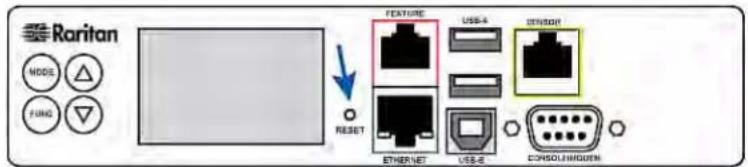
text_image
Raritan NODE FUNG RESET FEATURE USB-4 SENSOR ETHERNET USB-8 CONSOLINKROOMCircuit Breakers
PX models rated over 20A (North American) or 16A (international) contain overcurrent protectors for outlets, which are usually branch circuit breakers. These circuit breakers automatically trip (disconnect power) when the current flowing through the circuit breaker exceeds its rating.
If a circuit breaker switches off power:
- A PX3 phase I model's LCD display shows CbE, which means "circuit breaker error." See Overcurrent Protector Information (on page 561).
- A PX3 phase II model's LCD display shows open. To find which circuit breaker is open (trips), select Alerts or OCPs in the Main Menu. See Operating the Dot-Matrix LCD Display (on page 62).
When a circuit breaker trips, power flow ceases to all outlets connected to it. You must manually reset the circuit breaker so that affected outlets can resume normal operation.
Depending on the model you purchased, the circuit breaker may use a button- or handle-reset mechanism.
Resetting the Button-Type Circuit Breaker
Your button-type circuit breakers may look slightly different from the images shown in this section, but the reset procedure remains the same.
To reset the button-type breakers:
- Locate the breaker whose ON button is up, indicating that the breaker has tripped.

text_image
ON 1 20 OFF- Examine your PX and the connected equipment to remove or resolve the cause that results in the overload or short circuit. This step is required, or you cannot proceed with the next step.
- Press the ON button until it is completely down.

text_image
ON 20 OFFResetting the Handle-Type Circuit Breaker
Your handle-type circuit breakers may look slightly different from the images shown in this section, but the reset procedure remains the same.
To reset the handle-type breakers:
- Lift the hinged cover over the breaker.
- Check if the colorful rectangle or triangle below the operating handle is GREEN, indicating that the breaker has tripped.
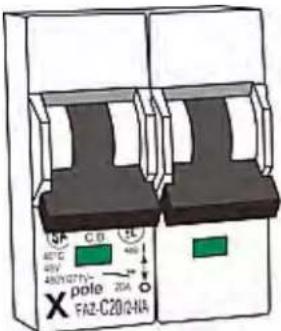
text_image
40°C 40V 48N/27N- polo FAZ-C2010-NA- Examine your PX and the connected equipment to remove or resolve the cause that results in the overload or short circuit. This step is required, or you cannot proceed with the next step.
- Pull up the operating handle until the colorful rectangle or triangle turns RED.
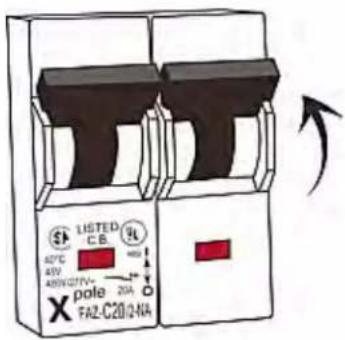
text_image
LISTED C.B. 40°C 45V 48W/27V~ pale FA2-C20-2-NAFuse
Some PX devices may be implemented with fuses instead of circuit breakers. A fuse blows to protect associated outlets if it detects the overload.
If your PDU uses fuses, you must replace it with a new one when it blows or malfunctions. The rating of the new fuse must be the same as the original one.

Use of inappropriately rated fuse results in damage to the PDU and connected equipment, electric shock, fire, personal injury or death.
Depending on the design of your PDU, the fuse replacement methods differ.
Fuse Replacement on Zero U Models
This section only applies to a Zero U PDU with "replaceable" fuses.
To replace a fuse on the Zero U model:
- Lift the hinged cover over the fuse.

natural_image
Close-up of a black electronic device with a red arrow indicating motion or change (no visible text or symbols)- Verify the new fuse's rating against the rating specified in the fuse holder's cover.

natural_image
Close-up of a black electronic device with a red circular annotation highlighting a component (no visible text or symbols)- Push the cover of the fuse holder to expose the fuse.

natural_image
Close-up of a black electronic device rear panel with a magnified inset showing internal components and a red arrow indicating rotation (no text or symbols)- Take the fuse out of the holder.
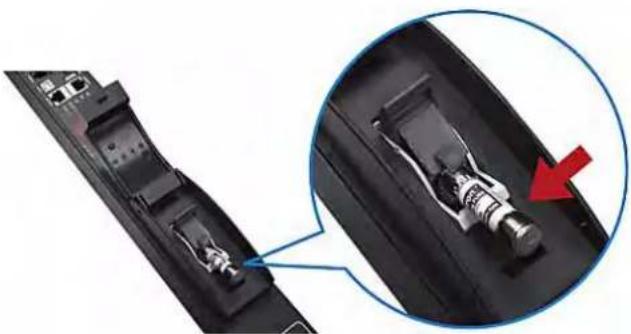
natural_image
Close-up of a black electronic device showing internal components and a magnified view of a connector detail (no text or symbols visible)- Insert a new fuse into the holder. There is no orientation limit for fuse insertion.
- Close the fuse holder and the hinged cover in a reverse order.
Fuse Replacement on 1U Models
On the 1U model, a fuse is installed in a fuse knob, which fits into the PDU's fuse carrier.

text_image
n 12 11 #2| Number | Description |
| 1 | Fuse carrier |
| 2 | Fuse knob where a fuse is installed |
To replace a fuse on the 1U PDUs:
-
Disconnect the PDU's power cord from the power source.
-
Remove the desired fuse from the PDU's fuse carrier using a flat screwdriver.
a. Rotate the fuse knob counterclockwise until its slot is inclined to 45 degrees.
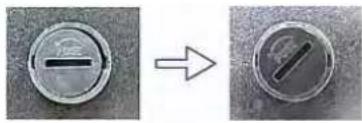
natural_image
Two circular metallic objects with internal markings, one showing a left-side slot and the other a right-side slot (no text or symbols)b. Take this knob out of the fuse carrier.
- Remove the original fuse from this knob, and insert either end of a new one into the knob. Make sure the new fuse's rating is the same as the original one.
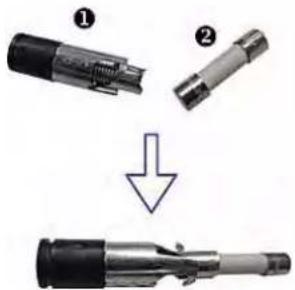
natural_image
Three views of a mechanical connector showing internal structure and assembly (no text or symbols)| Number | Description |
| 1 | Fuse knob |
| 2 | Fuse |
- Install this knob along with the new fuse into the fuse carrier using a flat screwdriver.
a. Have this knob's slot inclined 45 degrees when inserting the knob into the fuse carrier.
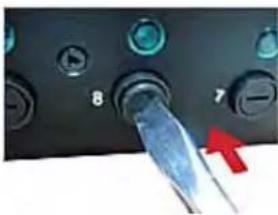
natural_image
Close-up of a black handheld device with control buttons and a blue tool tip, showing no readable text or symbols.b. Gently push this knob into the fuse carrier and then rotate it clockwise until its slot is horizontal.
- Verify whether this knob's head is aligned with the fuse carrier. If its head is higher or lower than the fuse carrier, re-install it.
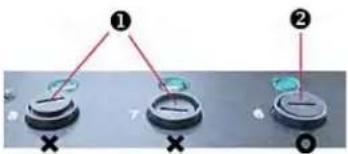
text_image
Diagram showing three labeled buttons (①, ②, ③) with cross symbols and colored indicators on a surfaceNumber Description
1
INAPPROPRIATE installations
2
Appropriate installation
- Connect the PDU's power cord to the power source and verify that the corresponding fuse LED is lit, indicating that the fuse works properly.
Beeper
The PX includes a beeper to issue an audible alarm for an overcurrent protector which is open.
- The beeper sounds an alarm within 3 seconds of a circuit breaker trip.
• The beeper stops as soon as all circuit breakers have been reset.
Tip: You can remotely check this beeper's state via the web interface. See Checking the Internal Beeper State (on page 153).
Replaceable Controller
A PX3 phase II Zero U model provides flexibility for replacement of its controller. The controller, which contains the dot-matrix LCD display and connection ports, is usually located in the middle of the PDU.
If the controller is broken, you can simply send the controller back to Raritan for repair, or purchase a new controller from Raritan.
1U and 2U models do NOT support this feature.
Note: PX3 phase I models do NOT support a replaceable controller.
▶ To replace a PX3 controller:
- Power OFF the PX.
- Loosen the screws at two sides of the PX3 controller, and lift it up.
Note: Loosen the screws instead of removing them.

natural_image
Technical line drawing of a mechanical assembly with no visible text or symbols- Disconnect the PDU's controller cable from the controller.
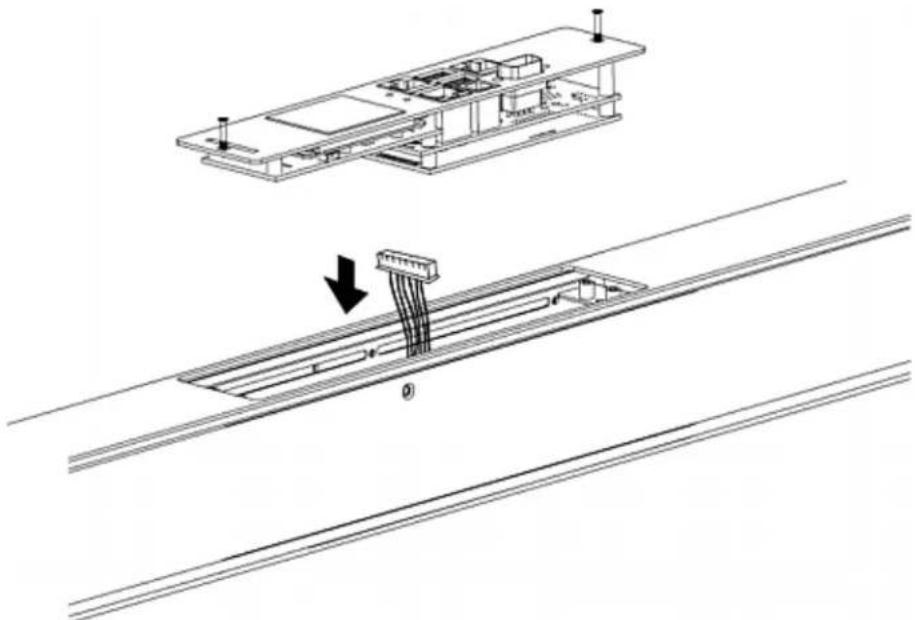
natural_image
Technical line drawing showing a mechanical assembly with an arrow indicating a component or connection (no text or symbols present)- Get a new PX3 controller and install it back into the PDU in the reverse order.
Chapter 6 Using the Web Interface
This chapter explains how to use the web interface to administer a PX.
In This Chapter
Supported Web Browsers....93
Logging in to the Web Interface 94
Logout....97
Introduction to the Web Interface 98
Viewing the Dashboard 109
Device Management....111
User Management....154
Setting Up Roles......160
Access Security Control 163
Setting Up a TLS Certificate....178
Setting Up External Authentication....184
Outlet Management....192
Inlet and Overcurrent Protector Management....210
Setting Power Thresholds 215
Event Rules and Actions 222
Managing Event Logging....269
Viewing Connected Users 271
Monitoring Server Accessibility....272
Environmental Sensors and Actuators 277
Asset Management....295
Bulk Configuration....300
Backup and Restore of PX Device Settings 303
Webcam Management 304
Network Diagnostics....313
Downloading Diagnostic Information....314
Managing the Schroff LHX/SHX Heat Exchanger 315
Firmware Upgrade....323
Accessing the Help....327
Supported Web Browsers
The following web browsers can be used to access the PX web interface:
- Internet Explorer ^® 8, 9, 10 and 11
- Firefox ^® 25 and later
- Safari ^ 5.x (MacOS Lion)
- Google ^ Chrome ^ 32 and later
- Android 4.2 and later
- IOS 7.0
⑨
Logging in to the Web Interface
To log in to the web interface, you must enter a user name and password. The first time you log in to the PX, use the default user name (admin) and password (raritan). You are then prompted to change the password for security purposes.
Exception: If you already changed the password for the admin account, use the new password instead for login, and the PX will NOT prompt you to change the password.
After successfully logging in, you can create user profiles for your other users. These profiles define their login names and passwords. See Creating a User Profile (on page 154).
Login
The web interface allows a maximum of 16 users to log in simultaneously.
You must enable JavaScript in the web browser for proper operation.
▶ To log in to the web interface:
- Open a browser, such as Microsoft Internet Explorer or Mozilla Firefox, and type this URL:
http(s)://
where

text_image
Back Search Favorites Links Address 192.168.84.92 Go- If a security alert message appears, click OK or Yes to accept. The Login page then opens.
- Type your user name in the User Name field, and password in the Password field.

text_image
Login User Name: Password: Login ClearNote: Both the user name and password are case sensitive. If needed, click Clear to clear either the inputs or any error message that appears.
- If a security agreement is displayed on the Login page, accept it. To select the agreement checkbox using the keyboard, press the Space bar.
Note: If you do not accept the security agreement, you cannot log in successfully.
- Click Login or press Enter. The PX page opens.
Note: Depending on your hardware configuration, elements shown on the web interface may appear slightly different from this image.
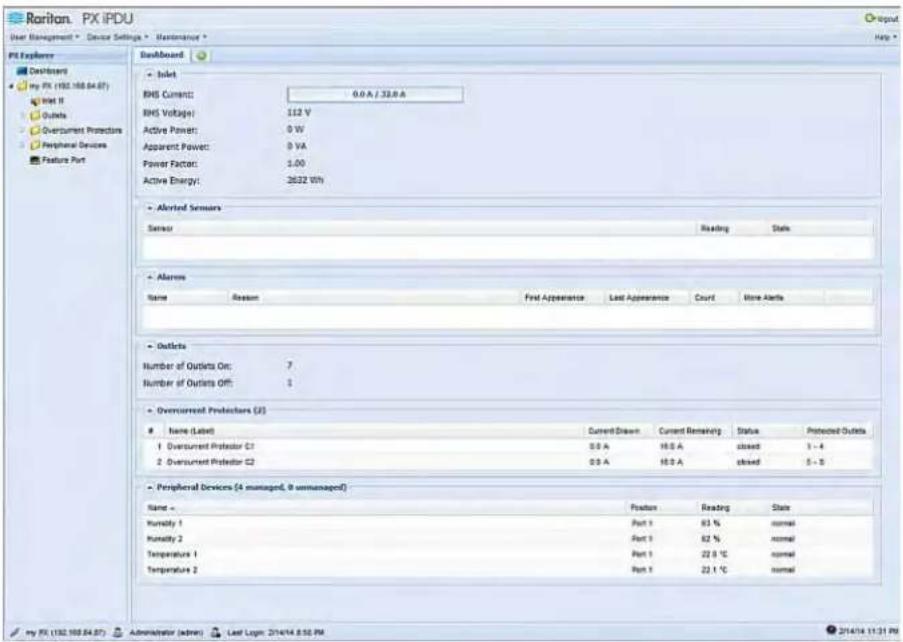
text_image
Raritan. PX IPDU User Management - Device Settings - Maintenance - PI Explorer Dashboard - Alert RHS Current: 0.0 A / 33.0 A RHS Voltage: 112 V Active Power: 0 V Apparent Power: 0 VA Power Factor: 1.00 Active Energy: 2632 Wh - Alerted Sensors Sensor Reading State - Alarms Name Reason First Appearance Last Appearance Count More Alerts - Outlets Number of Outlets On: 7 Number of Outlets Off: 1 - Overcurrent Protectors (2)Name (Label) Current Drawn Current Remaking Status Protected Outlets
1 Overcurrent Protector C1 0.9 A H5.0 A closed 1 - 4 2 Overcurrent Protector C2 0.9 A H5.0 A closed 5 - 5 - Peripheral Devices (4 managed, 8 unmanaged) Name = Provider Reading State Maturity 1 Part 1 83 % normal Maturity 2 Part 1 82 % normal Temperature 1 Part 1 22.9 °C normal Temperature 2 Part 1 22.1 °C normal my FX (132.163.54.57) Last Log: 2014/4.8:50 PM 2014/4.11:31 PMNote: The IP address to access a slave device in the port forwarding mode is a combination of the IP address and the port number. See Port Forwarding Examples (on page 145).
Changing Your Password
Normal users can change their own passwords if they have the Change Own Password permission. See Setting Up Roles (on page 160).
If you are the administrator (admin), the PX web interface automatically prompts you to change the password if this is your first time to log in to the PX. If you have the Administrator Privileges, you can change other users' passwords, as well. See Modifying a User Profile (on page 158).
To change your password:
- Choose User Management > Change Password. The Change User Password dialog appears.
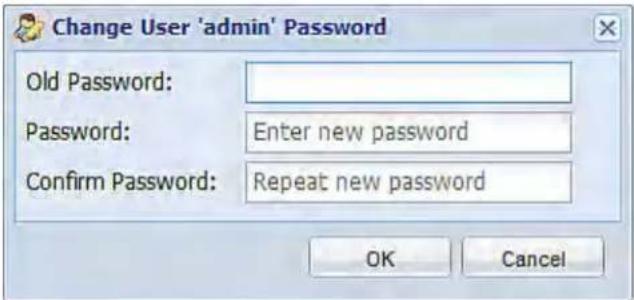
text_image
Change User 'admin' Password Old Password: Password: Enter new password Confirm Password: Repeat new password OK Cancel- Type the current password in the Old Password field.
- Type your new password in the Password and Confirm Password fields. The password can be 4 to 64 characters long. It is case sensitive.
- Click OK.
Remembering User Names and Passwords
As of release 3.0.0, the PX supports the password manager of Microsoft Internet Explorer ^® and Mozilla Firefox ^® .
You can choose to save the user name and password used to log in to the PX when these two browsers ask whether you want to remember them. If yes, next time your user name and password can be automatically completed at login.
For information on how to activate a browser's password manager, see the user documentation accompanying Internet Explorer or Firefox.
The PX does NOT support other browser password managers.
Logout
After finishing your tasks with the PX, you should log out to prevent others from accessing the web interface.
To log out of the web interface:
- Do one of these:
- Click "logout" on the top-right corner of the web interface.
© logout
- Close the web browser by clicking the Close button ( ✗) on the top-right corner of the browser.
- Close the web browser by choosing File > Close, or File > Exit. The command varies according to the version of the browser you use.
-
Choose the Refresh command or click the Refresh button on the web browser.
-
Either the login page opens or the browser is closed, depending on your choice in the previous step.
Introduction to the Web Interface
The web interface provides two panes, a menu bar, a status bar, an Add Page icon, and a logout button throughout every page.

text_image
Raritan. PX IPDU User Management • Device Settings • Maintenance • PX Explorer Dashboard my PX (192.168.84.27) Inlet IT Outlets Overcurrent Protectors Peripheral Devices Feature Port my PX (192.168.84.27) Settings Name: my PX Outlet state on device startup: last known Outlet initialization delay on device startup: 3 s Power off period during power cycle: 10 s Inrush Guard Delay: 200 ms Peripheral Device Z Coordinate Format: Rack Units Peripheral Device Auto Management: enabled Altitude: 0 m Firmware Version: 3.0.8.5-41290 MAC Address: 00:00:50:08:8C:69 Rating: 200-240V, 24A, 4.8-5.8kVA, 50/60Hz Setup Reset All Active Energy Counters Outlet Sequence Outlet sequence: Default Setup Load Shedding Load Shedding: Disabled Non-critical Outlets: 5 and 9 Enable Load Shedding Setup Non-Critical Outlets Internal Buzzer State: Off my PX (192.168.84.27) Administrator (admin) Last Log: 5/7/14 3:54 PM 5/7/14 8:06 PMNumber Web interface element
| 1 | Menus |
| 2 | PX Explorer pane |
| 3 | Setup button* |
| 4 | Status bar |
| 5 | Add Page icon |
| 6 | Logout button |
| 7 | Data pane |
* The Setup button is not available on some pages, such as the Dashboard page.
For detailed information about these web interface elements, see the sections that follow.
Menus
There is a menu bar across the top of the page. You can click any menu to select the desired menu item from the drop-down list.
Four menus are available for managing different tasks or showing information.
- User Management contains menu items for managing user profiles, permissions (roles), and password.
- Device Settings deals with device-related settings, such as the device name, network settings, security settings, and system time.
- Maintenance provides tools that are helpful for maintaining the PX, such as the event log, hardware information, firmware upgrade and so on.
- Help displays information regarding the firmware and all open source packages embedded on the PX. In addition, you can access the online help from this menu.
PX Explorer Pane
The hierarchical tree to the left displays the PX device you are accessing as well as all physical components embedded on or connected to this product, such as inlets, outlets, and environmental sensors. In addition, an icon named Dashboard is available for displaying the PDU summary information.
The tree structure comprises three hierarchical levels.
| First level Second level Third level | ||
| Dashboard | None None | |
| PDU folder* | Inlet I1 None | |
| Outlets folder 1 to n** | ||
| Overcurrent Protectors folder | Circuit breakers - C1 to Cn^** Fuses - F1 to Fn^** | |
| Peripheral Devices folder A list of connected environmental sensors | ||
| First level Second level Third level | ||
| Feature Port folder One of the following is displayed, depending on your configuration:NoneAsset StripPower CIMExternal BeeperLHX-20SHX-30LHX-40 | ||
| Webcam Management folder | SnapshotsWebcam | |
* The folder is named "my PX" by default. The name can be customized.
** n represents the final number of that component.
Note: A Webcam icon appears only when a supported Logitech ^® webcam is connected to the PX. See Connecting a Logitech Webcam (on page 53).
To navigate through the tree:
- To expand any folders, see Expanding the Tree (on page 100).
- To show a ny tree item's data, click on that item. See Add Page Icon (on page 103).
Expanding the Tree
The icons representing all components implemented on or connected to the PX device are expanded by default. If they are hidden, you may expand the tree manually to show all component icons.
To expand the tree:
- By default, the PDU folder has been expanded.
Note: The folder is named "my PX" by default. The name can be customized.
If it is not expanded, click the white arrow ▷prior to the folder icon, or double-click the folder. The arrow then turns into a black, gradient arrow ▲, and icons of components or component groups appear below the PDU folder.
- To expand any component group at the second level, click the white arrow ▷ prior to the folder icon, or double-click the folder.
The arrow then turns into a black, gradient arrow ▲, and icons representing individual components appear below the group folder.
Repeat Step 2 for other component groups you want to expand. The expanded tree looks similar to this image.

text_image
Dashboard my PX (192.168.57.47) Inlet I1 Outlets 1 2 3 4 5 Overcurrent Protectors C1 C2 Peripheral Devices Humidity 1 On/Off 1 Temperature 1 Feature Port Asset Strip (1) Webcam Management Snapshots WebcamCollapsing the Tree
You can collapse the whole tree structure or a specific component group to hide all or partial tree items.
To collapse the whole tree:
- Click the black, gradient arrow ▲ prior to the root folder icon, or double-click the folder.
Note: The folder is named "my PX" by default. The name can be customized.
The arrow then turns into a white arrow ▷ and all items below the folder disappear.
To hide some tree items:
- Click the black, gradient arrow ▲ prior to the component group folder that you want to collapse, or double-click the folder.
The arrow then turns into a white arrow , and all items below the folder disappear.
- Repeat Step 1 for other component groups you want to collapse.
Adjusting the Pane
You can change the width of the pane to make the area larger or smaller.
To adjust the pane's width:
-
Move the mouse pointer to the right border of the Explorer pane.
-
When the mouse pointer turns into a two-way arrow, drag the border horizontally to widen or shrink the pane.
Setup Button
The Setup button is available for most tree items. It triggers a setup dialog where you can change settings for the selected tree item.
Status Bar
The status bar shows five pieces of information.

text_image
① my PX (192.168.84.47) Administrator (admin) Last Login: 7/2/14 12:13 AM 7/2/14 12:53 AM1. Device name:
This is the name assigned to the PX device. The default is "my PX." See Naming the PDU (on page 117).
2. IP address:
The numbers enclosed in parentheses is the IP address assigned to the PX device. See Initial Network Configuration via CLI (on page 22) or Modifying Network Settings (on page 121).
Tip: The presence of the device name and IP address in the status bar indicates the connection to the PX device. If the connection is lost, it shows "disconnected" instead.
3. Login name:
This is the user name you used to log in to the web interface.
4. Last login time:
This shows the date and time this login name was used to log in to this PX device last time.
When the mouse pointer hovers over the last login time, detailed information about the last login is displayed, including the access client and IP address.
For the login via a local connection (serial RS-232 or USB),
There are different types of access clients:
■ Web GUI: Refers to the PX web interface.
- CLI: Refers to the command line interface (CLI).
The information in parentheses following "CLI" indicates how this user is connected to the CLI.
- Serial: Represents the local connection (serial RS-232 or USB).
- SSH: Represents the SSH connection.
- Telnet: Represents the Telnet connection.
5. System date and time:
Current date, year, and time are displayed to the right of the bar. If positioning the mouse pointer over the system date and time, the time zone information is also displayed.
Add Page Icon
The Add Page icon, located on the top of the data pane, lets you open data pages of multiple tree items without overriding any opened page.
▶ To open new data pages:
- Click the Add Page icon page appears.

A new tab along with a blank data
-
Click a tree item whose data page you want to open. The data of the selected tree item is then displayed on the blank page.
-
To open more data pages, repeat the above steps. All tabs representing opened pages are shown across the top of the page.
The following diagram shows a multi-tab example.
Dashboard my PX (192.168.84.68) Inlet I1 Outlets Overcurrent Protectors
- With multiple pages opened, you can take these actions:
- To switch to one of the opened data pages, click the corresponding tab.
If there are too many tabs to be all shown, two arrows (← and →) appear at the left and right borders of the pane. Click either arrow to navigate through all tabs.
- To close any data page, click the Close button ( ✗) on the corresponding tab.
Logout Button
Click the logout button when you want to log out of the web interface.
© logout
Data Pane
The right pane shows the data page of the selected tree item. The data page includes the item's current status, settings and a Setup button (if available).
All tabs above the pane represent the opened data pages. The highlighted tab indicates the current selection.
You can change the width of the pane to make the area larger or smaller.
To adjust the pane's width:
-
Move the mouse pointer to the left border of the right pane.
-
When the mouse pointer turns into a two-way arrow, drag the border horizontally to widen or shrink the pane.
More Information
This section explains additional web interface elements or operations that are useful.
Warning Icon
If the value you entered in a specific field is invalid, a red warning icon appears to the right and the field in question is surrounded by a red frame as shown in this illustration.

When this occurs, position your mouse pointer over the warning icon to view the reason and modify the entered value accordingly.
The Yellow- or Red-Highlighted Sensors
When a numeric sensor's reading crosses any upper or lower threshold, the background color of the whole row turns to yellow or red for alerting users.
For a discrete (on/off) sensor, the row changes the background color when the sensor enters the abnormal state.
If any circuit breaker trips or any fuse blows, the circuit breaker or fuse's row is also highlighted in red.
See the table for the meaning of each color:
Color State
White The background is white in one of the following scenarios:
- For a numeric sensor, no thresholds have been enabled.
- If any thresholds have been enabled for a numeric sensor, the sensor reading falls between the lower and upper warning thresholds.
- For a discrete (on/off) sensor, the sensor state is normal.
- The sensor is unavailable.
Yellow The reading drops below the lower warning threshold or rises above the upper warning threshold.
Red The meaning of the red color varies depending on the sensor type:
- For a numeric sensor, this color indicates the reading drops below the lower critical threshold or rises above the upper critical threshold.
- For a discrete (on/off) sensor, this color indicates the sensor is in the "alarmed" state.
- For an overcurrent protector sensor, it means the circuit breaker has tripped or the fuse has blown.
To find the exact meaning of the alert, read the information shown in the State (or Status) column:
- below lower critical: The numeric sensor's reading drops below the lower critical threshold.
- below lower warning: The numeric sensor's reading drops below the lower warning threshold.
- above upper critical: The numeric sensor's reading reaches or exceeds the upper critical threshold.
- above upper warning: The numeric sensor's reading reaches or exceeds the upper warning threshold.
• alarmed: The discrete sensor is NOT in the normal state. - Open: The circuit breaker has tripped or the fuse has blown.
For information on the thresholds, see Setting Power Thresholds (on page 215) and Configuring Environmental Sensors or Actuators (on page 283).
Changing the View of a List
Some dialogs and data pages contain a list or table, such as the Manage Users dialog shown below. You may change the number of displayed columns or re-sort the list for better viewing the data. Note the column or sorting changes are not saved when quitting the dialog or data page. Next time when the dialog or page re-opens, the list returns to the default view.
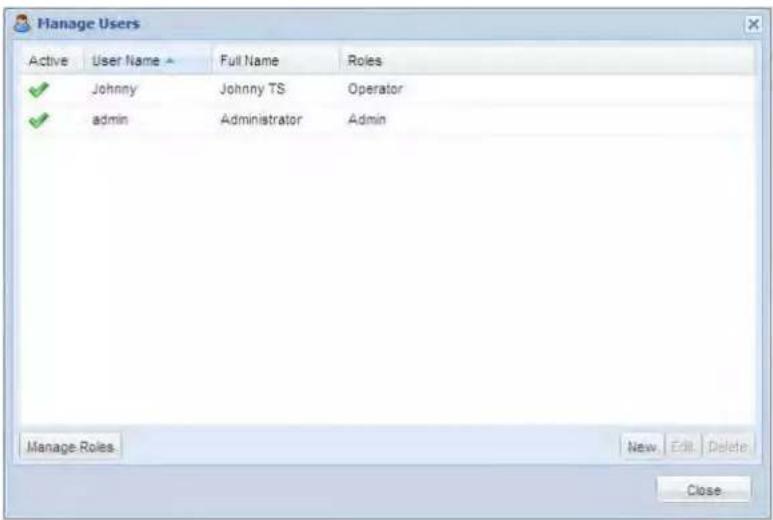
text_image
Manage Users Active User Name Full Name Roles Johnny Johnny TS Operator admin Administrator Admin Manage Roles New Edit Delete CloseNote: Not all dialogs support the sorting or column change functions.
Changing the Column
You can hide some columns of a list or table, or adjust a specific column's width.
▶ To change displayed columns:
- Hover your mouse pointer over any column header. A black triangle
appears to the far right of this column header.
- Click the black triangle, and a drop-down menu appears.
- Point to Columns. A submenu showing all columns appears.
-
Click any column you want to deselect or select.
-
To hide a column, have its checkbox deselected.
- To show a column, have its checkbox selected.
▶ To change the column width:
- Hover the mouse pointer to the right border of the desired column.
- When the mouse pointer turns to a two-way arrow, drag the border horizontally to widen or shrink the column.
Changing the Sorting
By default, a list or table is sorted against the first column in the ascending order. You can re-sort the list in a reverse order or against a different column.
To re-sort the list by doing either of the following:
- Click the column header against which you want to sort the list.
a. The first click sorts the list in the ascending order, indicated by a blue upward-pointing triangle ▲.
b. The second click reverses the sorting to the descending order, indicated by a blue downward-pointing triangle ▼.
- Select a sorting command from the column menu.
a. Hover your mouse pointer over the column header against which
you want to sort the list. A black triangle ▼ appears to the far right of this column header.
b. Click the black triangle, and a drop-down menu appears.
c. Select Sort Ascending or Sort Descending.
The newly selected column header is marked with the upward- or downward-pointing triangle.
Resizing a Dialog
Most dialogs cannot be resized except for a few ones (such as the Event Log dialog), which can be resized to display more information at a time.
To resize a dialog:
- Hover your mouse pointer over any border of the dialog.
- When the mouse pointer turns to a double-headed arrow, drag the border vertically or horizontally to make the dialog bigger or smaller.
Browser-Defined Shortcut Menu
A shortcut menu, which is built in the web browser, may appear when right-clicking anywhere in the PX web interface.
The shortcut menu functions are defined by the browser. For example, the Back command on the Internet Explorer® (IE) shortcut menu works the same as the Back button in the IE browser. Both of these functions take you to the previous page.
For information on each shortcut menu command or item, see the online help or documentation accompanying your web browser.
Below is the illustration of the IE browser's shortcut menu. Available menu commands or items may slightly differ based on your web browser version.
text_image
Back Forward Save Background As... Set as Background Copy Background Set as Desktop Item... Select All Paste Create Shortcut Add to Favorites... View Source Encoding Print Refresh Append to Existing PDF Convert to Adobe PDF Export to Microsoft Excel PropertiesViewing the Dashboard
When you log in to the web interface, the Dashboard page is displayed by default. This page provides an overview of the PX device's status.
The page is divided into various sections according to the component type, such as inlet(s), outlets, circuit breakers and alerted sensors.
Note: If a sensor row is colored, it means the sensor reading already crosses one of the thresholds, the sensor enters an alarmed state, or the overcurrent protector has tripped or blown. See The Yellow- or Red-Highlighted Sensors (on page 105).
After clicking any other icon in the hierarchical tree, the Dashboard page is overridden. To return to the Dashboard page, click the Dashboard icon.
When the Dashboard page is opened, you can do the following to uncover or hide specific data.
To collapse any section:
- Locate the section you want to collapse.
- Click the upward arrow prior to the section title. The data specific to the section is hidden.
To expand a collapsed section:
- Locate the section you want to expand.
- Click the downward arrow ▼ prior to the section title. The data specific to the section appears.
Alerted Sensors
One of the sections on the Dashboard page only displays critical or warning conditions detected by internal or external sensors so that you are alerted to take actions. This section is labeled Alerted Sensors.
The Alerted Sensors section lists any or all of the following:
- Any sensor that enters the warning or critical range if the thresholds have been enabled
- Discrete (on/off) sensors that enter the alarmed state
- Any tripped circuit breakers or blown fuses

text_image
Alerted Sensors Sensor Reading State Inlet II L1-L2 RMS Voltage 427 V above upper warning Temperature 1 20.7 °C below lower warning Temperature 2 20.2 °C below lower warning On/Off 1 alarmedFor the background color meanings in this section, see The Yellow- or Red-Highlighted Sensors (on page 105).
Alarms List
You can create event rules that request users to acknowledge certain alerts, and resend alert notifications if the acknowledgment action is not taken yet. See Creating Actions (on page 223).
If any of these alerts has not been acknowledged since its occurrence, the Alarms section on the dashboard shows this alert until it is acknowledged. All alerts on the Alarms section are highlighted in red.
Below is the illustration of the alarms list.
| Name | Reason | First Appearance | Last Appearance | Count | More Alerts | |
| Alarm - mail | Peripheral device 'Temperature 1' in slot '1' unavailable. | 5/11/13 5:19 AM | 5/11/13 5:19 AM | 1 | 2 more reasons | Details |
| Alarm - SMS message | Peripheral device 'Temperature 2' in slot '3' asserted 'above upper critical' at 77.8 deg F. | 5/11/13 5:36 AM | 5/11/13 5:36 AM | 1 | - | Details |
The following table explains each column of the alarms list.
| Column Description | |
| Name The customized name of the Alarm action. | |
| Reason The first event that triggers the alert. | |
| First Appearance | The date and time when the event indicated in the Reason column occurred for the first time. |
| Last Appearance | The date and time when the event indicated in the Reason column occurred for the last time. |
| Count The number of times the event indicated in the Reason column has occurred. | |
| More Alerts | A dash is displayed when there is only one event triggering this alert.If there are other types of events triggering the same alert, the total number of these additional reasons is displayed. You can double click that alarm to view a list of all events that have occurred. |
Column Description
Details Click "Details" to trigger a dialog showing both the alarm details and the acknowledgment button.
Only users who have the Acknowledge Alarms permission can manually acknowledge an alarm.
To acknowledge an alarm:
- Double-click the alarm that you want to acknowledge, or click Details in the final column. A dialog appears.
- Click Acknowledge Alarm to acknowledge it. That alarm then disappears from the Alarms section.
Tip: When browsing through all events, you can sort the list of all events shown in the dialog by clicking the header row. See Changing the View of a List (on page 106).
Device Management
Using the web interface, you can retrieve basic hardware and software information, give the PX a new device name, set the system date and time, and modify network settings that were entered during the initial configuration process.
Displaying PDU Information
To display information specific to the PX device that you are using, such as inlet or outlet types, trigger the Device Information dialog.
▶ To display PDU-specific information:
- Choose Maintenance > Device Information. The Device Information dialog appears. Information is categorized by type into tabbed sections.

text_image
Device Information Device Information Network Outlets Overcurrent Protectors Controllers Asset Strips Model: PX2-5704U Serial Number: P070154001 Rating: 360-415V, 24A, 15.0-17.3kVA, 50/60Hz Device MAC Address: 00:0d:5d:07:00:c5 Firmware Version: 2.3.0.5-36680 Board ID: POF1050005 Board Revision: 0x21 PDU2-MIB:Download ASSETMANAGEMENT-MIB:download USB Console INF file:download Close- Click a tab to view type-specific information. The number of available tabs varies according to the model you purchased.
| Tab Data | |
| Device Information General PDU information, such as model name, serial number, firmware version, hardware revision, and so on. | |
| Network The PDU specific network information, such as the current networking mode, IPv4 and/or IPv6 addresses and so on.This tab also indicates whether the PDU is part of an USB-cascading configuration. See Identifying Cascaded Devices (on page 113). | |
| Outlets Each outlet's receptacle type, operating voltage and rated current. | |
| Controllers Each outlet controller's serial number, board ID, firmware version and hardware version. | |
| Inlets Each inlet's plug type, rated voltage and | |
| current. | |
| Overcurrent Protectors Each overcurrent protector's type, rated current and the outlets that it protects. | |
| Peripheral Devices Serial numbers, model names and firmware-related information of connected external devices, such as environmental sensors. | |
| Asset Strips Each asset sensor's ID, boot version, application version and protocol version. | |
- Enlarge the dialog if necessary.
- You can re-sort the list. See Changing the Sorting (on page 107).
- Click Close to quit the dialog.
Tip: The firmware version is also available by clicking the PDU folder in the PX Explorer pane.
Identifying Cascaded Devices
This section explains how to identify a cascaded PX in the Device Information dialog.
For information on how to cascade devices using USB cables, see Cascading the PX via USB (on page 28).
Note: For more information on the USB-cascading configuration, see the USB-Cascading Solution Guide, which is available from Raritan website's PX2 Support Files page (https://www.raritan.com/support/product/px2/px2-support-files).
To identify the USB-cascading status of a PX device:
- Choose Maintenance > Device Information. The Device Information dialog appears.
- Select the Network tab and locate the Interface section. The Interface section contains four read-only fields as listed below.
| Fields Description | |
| Networking Mode | Indicates how the PX is connected to the LAN.Wired: The device is connected to the LAN through a standard network cable.Wireless: The device is connected to the LAN through a supported USB wireless LAN adapter. SeeUSB Wireless LAN Adapters(on page 21).XXX (USB): XXX represents Wired or Wireless. The device is connected to the LAN through a USB-cascading configuration. That is, it is a slave device. |
| Cascading Mode | Shows the cascading mode applied. SeeSetting the Cascading Mode(on page 142). |
| Cascade Position | Indicates the position of the PX in the USB-cascading configuration.0 (zero) represents the master device.A non-zero number represents a slave device. 1 is Slave 1, 2 is Slave 2, 3 is Slave 3 and so on.This field is NOT available on a standalone PX. |
| Cascaded Device Connected | Indicates whether the presence of a slave device is detected on the USB-A port.yes: Connection to a slave device is detected.no: NO connection to a slave device is detected. |
Chapter 6: Using the Web Interface
- A master device shows 0 (zero) in the Cascade Position field and yes in the Cascaded Device Connected field.
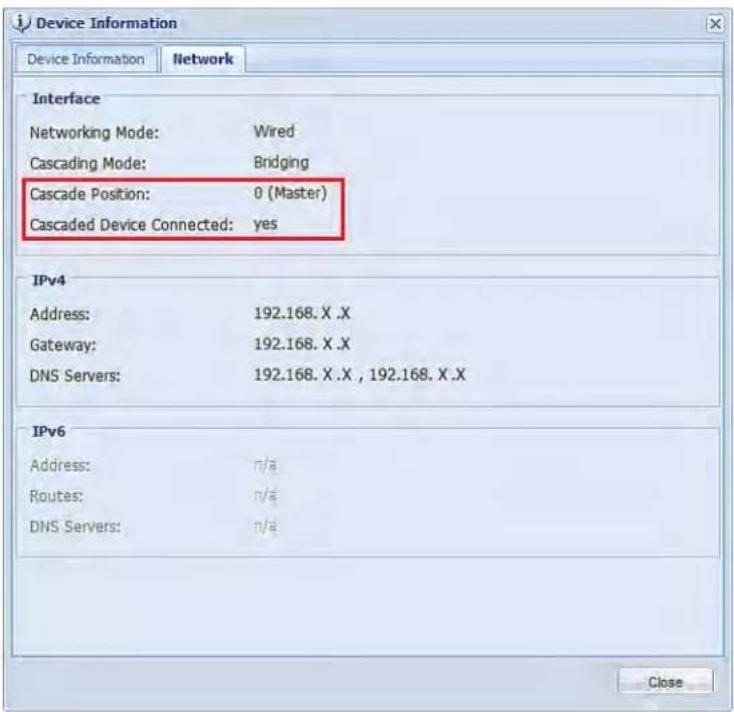
text_image
Device Information Device Information Network Interface Networking Mode: Wired Cascading Mode: Bridging Cascade Position: 0 (Master) Cascaded Device Connected:=yes IPv4 Address: 192.168.X .X Gateway: 192.168.X .X DNS Servers: 192.168.X .X , 192.168.X .X IPv6 Address: n/a Routes: n/a DNS Servers: n/a Close- A slave device in the middle position shows a non-zero number which indicates its exact position in the Cascade Position field and yes in the Cascaded Device Connected field.
The following diagram shows 1, indicating it is the first slave - Slave 1.

text_image
Device Information Device Information Network Interface Networking Mode: Wired (USB) Cascading Mode: Bridging Cascade Position: 1 (Slave 1) Cascaded Device Connected:=yes IPv4 Address: 192.168.X .X Gateway: 192.168.X .X DNS Servers: 192.168.X .X , 192.168.X .X IPv6 Address: n/a Routes: n/a DNS Servers: n/a Close- The final slave device shows a non-zero number which indicates its position in the Cascade Position field and no in the Cascaded Device Connected field.
The following diagram shows 2, indicating it is the second slave - Slave 2. The Cascaded Device Connected field shows no, indicating that it is the final one in the chain.
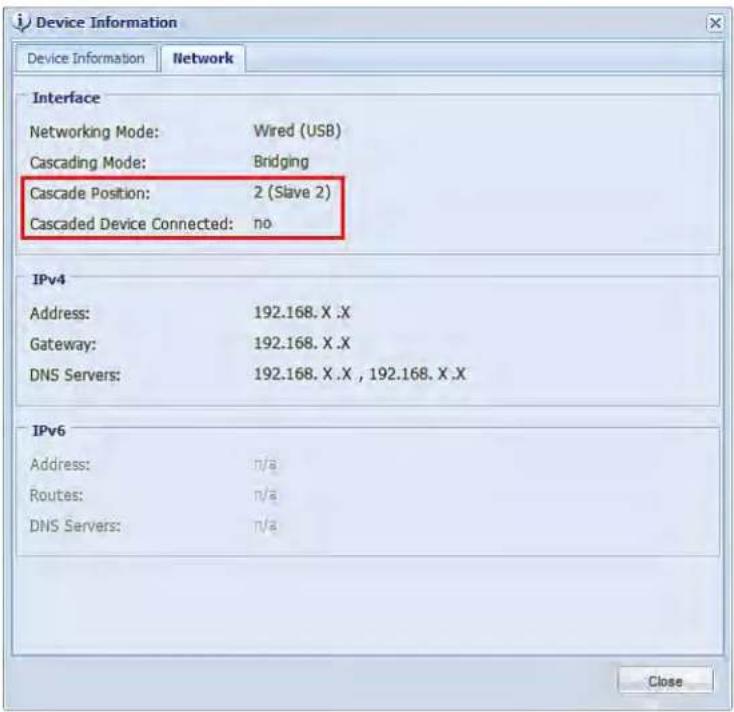
text_image
Device Information Device Information Network Interface Networking Mode: Wired (USB) Cascading Mode: Bridging Cascade Position: 2 (Slave 2) Cascaded Device Connected:=no IPv4 Address: 192.168.X .X Gateway: 192.168.X .X DNS Servers: 192.168.X .X , 192.168.X .X IPv6 Address: n/a Routes: n/a DNS Servers: n/a CloseNaming the PDU
The default name for PX is my PX. You may give it a unique device name.
▶ To change the device name:
- Click the PDU folder in the PX Explorer pane to open the PDU page.
- Click Setup in the Settings section. The Pdu Setup dialog appears.
- Type a new name in the Device Name field.
- Click OK.
Modifying the Network Configuration
The network settings you can change via the web interface include wired, wireless, IPv4 and/or IPv6 settings.
Modifying Network Interface Settings
The PX supports two types of network interfaces: wired and wireless. You should configure the network interface settings according to the networking mode that applies. See Connecting the PX to Your Network (on page 20).
Wired Network Settings
The LAN interface speed and duplex mode were set during the initial configuration process.
By default, the LAN speed and duplex mode are set to "Auto" (automatic), which works in nearly all scenarios. You can change them if there are special local requirements.
To modify the network interface settings:
- Choose Device Settings > Network. The Network Configuration dialog appears.
- The Interface Settings tab should have been selected. If not, click the Interface Settings tab.
- In the Network Interface field, click the drop-down arrow, and select Wired from the list.
-
To change the LAN speed, click the drop-down arrow in the Speed field and select an option from the list.
-
Auto: System determines the optimum LAN speed through auto-negotiation.
-
10 Mbit/s: The LAN speed is always 10 Mbps.
■ 100 Mbit/s: The LAN speed is always 100 Mbps. -
To change the duplex mode, click the drop-down arrow in the Duplex field and select an option from the list.
-
Auto: The PX selects the optimum transmission mode through auto-negotiation.
- Full: Data is transmitted in both directions simultaneously.
-
Half: Data is transmitted in one direction (to or from the PX device) at a time.
-
Click OK.
Tip: You can check the LAN status in the Current State field, including the speed and duplex mode.
Wireless Network Settings
Wireless SSID, PSK and BSSID parameters were set during the installation and configuration process. You can change them via the web interface.
Note for USB-cascading configuration: Port forwarding mode over wireless LAN is supported as of release 3.1.0. You must upgrade all devices in the chain to version 3.1.0 or later if wireless networking is preferred. See Cascading the PX via USB (on page 28).
To modify the wireless interface settings:
- Choose Device Settings > Network. The Network Configuration dialog appears.
- The Interface Settings tab should have been selected. If not, click the Interface Settings tab.
- In the Network Interface field, click the drop-down arrow, and select Wireless from the list.
- Check the Hardware State field to ensure that the PX device has detected a wireless USB LAN adapter. If not, verify whether the USB LAN adapter is firmly connected or whether it is supported. See Connecting the PX to Your Network (on page 20).
- Type the name of the wireless access point (AP) in the SSID field.
- If the BSSID is available, select the Force AP BSSID checkbox, and type the MAC address in the BSSID field.
Note: BSSID refers to the MAC address of an access point in the wireless network.
- In the Authentication field, select an appropriate option from the drop-down list.
Options Description
| No Authentication | Select this option when no authentication data is required. |
PSK A Pre-Shared Key is required for this option.
- In the Pre-Shared Key field, type the PSK string.
Options Description
EAP - PEAP PEAP stands for Protected Extensible Authentication Protocol.
Enter the following authentication data:
-
Inner Authentication: Only Microsoft's Challenge Authentication Protocol Version 2 (MSCHAPv2) is supported, allowing authentication to databases that support MSCHAPv2.
■ Identity: Type your user name.
■ Password: Type your password.
■ CA Certificate: A third-party CA certificate may or may not be needed. If needed, follow the step below. -
When the PEAP authentication requires a CA certificate, do the following:
a. Select the "Enable Verification of TLS Certificate Chain" checkbox for the PX to verify the validity of the TLS certificate that will be installed. For example, the PX will check the certificate's validity period against the system time.
b. Click Browse to select a TLS certificate file. Then you can:
- Click Show to view the certificate's contents.
- Click Remove to delete the installed certificate if it is inappropriate.
c. Select the "Allow expired and not yet valid certificates" checkbox if intending to make the wireless network connection successful even though the installed TLS certificate chain contains any certificate that is outdated or not valid yet.
d. Select the "Allow wireless connection if system clock is incorrect" checkbox to make the wireless network connection successful when the PX system time is earlier than the firmware build before synchronizing with any NTP server. If the system time is incorrect, the installed TLS certificate is considered not valid yet and will cause the wireless network connection to fail while this checkbox is not selected.
The incorrect system time issue may occur when the PX has once been powered off for a long time.
- Click OK.
Modifying Network Settings
The PX was configured for network connectivity during the installation and configuration process. See Configuring the PX (on page 16). If necessary, you can modify any network settings using the web interface.
Selecting the Internet Protocol
The PX device supports two types of Internet protocols -- IPv4 and IPv6. You can enable either or both protocols. After enabling the desired Internet protocol(s), all but not limited to the following protocols will be compliant with the enabled Internet protocol(s):
- LDAP
• NTP - SMTP
- SSH
- Telnet
- FTP
- SSL/TLS
• SNMP - SysLog
To select the appropriate Internet Protocol:
- Choose Device Settings > Network. The Network Configuration dialog appears.
- Click the IP Protocol tab.
-
Select one checkbox according to the Internet protocol(s) you want to enable:
-
IPv4 only: Enables IPv4 only on all interfaces. This is the default.
- IPv6 only: Enables IPv6 only on all interfaces.
-
IPv4 and IPv6: Enables both IPv4 and IPv6 on all interfaces.
-
If you selected the "IPv4 and IPv6" checkbox in the previous step, you must determine which IP address is used when the DNS resolver returns both IPv4 and IPv6 addresses.
-
IPv4 Address: Use the IPv4 addresses returned by the DNS server.
-
IPv6 Address: Use the IPv6 addresses returned by the DNS server.
-
Click OK.
Modifying IPv4 Settings
You must enable the IPv4 protocol before you can modify the IPv4 network settings. See Selecting the Internet Protocol (on page 121).
To modify IPv4 settings:
- Choose Device Settings > Network. The Network Configuration dialog appears.
- Click the IPv4 Settings tab.
- In the IP Auto Configuration field, click the drop-down arrow, and select the desired option from the list.
Option Description
| DHCP | To auto-configure the PX, select DHCP.With DHCP selected, you can enter a preferred DHCP host name, which is optional. Type the host name in the Preferred Hostname field.The host name:Consists of alphanumeric characters and/or hyphensCannot begin or end with a hyphenCannot contain more than 63 charactersCannot contain punctuation marks, spaces, and other symbolsSelect the "Specify DNS server manually" checkbox if necessary. Then type the address of the primary DNS server in the Primary DNS Server field. The secondary DNS server and DNS suffix are optional. |
| Static To manually assign an IP address, select Static, and enter the following information in the corresponding fields:IP addressNetmaskDefault gatewayPrimary DNS serverSecondary DNS server (optional)DNS Suffix (optional)If your local network contains two subnets and IP forwarding has been enabled, you can click Append to add static routes so that your PX can communicate with the other subnet.Each static route requires: | |
Option Description
- Destination: IP address of the other subnet and subnet mask using the format "IP address/subnet mask."
- Next Hop: IP address of the next hop router.
See Static Route Examples (on page 125) for illustrations.
4. Click OK.
Note: The PX supports a maximum of 3 DNS servers. If two IPv4 DNS servers and two IPv6 DNS servers are available, the PX only uses the primary IPv4 and IPv6 DNS servers.
Modifying IPv6 Settings
You must enable the IPv6 protocol before you can modify the IPv6 network settings. See Selecting the Internet Protocol (on page 121).
To modify IPv6 settings:
- Choose Device Settings > Network. The Network Configuration dialog appears.
- Click the IPv6 Settings tab.
- In the IP Auto Configuration field, click the drop-down arrow, and select the desired option from the list.
Option Description
| Automatic | To auto-configure the PX, select Automatic.With this option selected, you can enter a preferred host name, which is optional. Type the host name in the Preferred Hostname field.The host name:Consists of alphanumeric characters and/or hyphensCannot begin or end with a hyphenCannot contain more than 63 charactersCannot contain punctuation marks, spaces, and other symbolsSelect the "Specify DNS server manually" checkbox if necessary. Then type the address of the primary DNS server in the Primary DNS Server field. The secondary DNS server and DNS suffix are optional. |
| Static To manually assign an IP address, select Static, and enter the following information in the corresponding fields: | |
Option Description
IP address
■ Default gateway
■ Primary DNS server
■ Secondary DNS server (optional)
■ DNS Suffix (optional)
If your local network contains two subnets and IP forwarding has been enabled, you can click Append to add static routes so that your PX can communicate with the other subnet. Each static route requires:
- Destination: IP address of the current subnet and prefix length using the format "IP address/prefix."
- Next Hop: IP address of the next hop router.
See Static Route Examples (on page 125) for illustrations.
4. Click OK.
Note: The PX supports a maximum of 3 DNS servers. If two IPv4 DNS servers and two IPv6 DNS servers are available, the PX only uses the primary IPv4 and IPv6 DNS servers.
Static Route Examples
This section has two static route examples: IPv4 and IPv6. Both examples assume that two network interface controllers (NIC) have been installed in one network server, leading to two available subnets, and IP forwarding has been enabled. All of the NICs and PX devices in the examples use static IP addresses.
IPv4 example:
• Your PX: 192.168.100.64
• Two NICs: 192.168.200.75 and 192.168.100.88
• Two networks: 192.168.200.0 and 192.168.100.0
- Subnet mask: 24

flowchart
graph TD
    A["NIC - 1\n192.168.200.75"] --> C["192.168.200.0"]
    B["NIC - 2\n192.168.100.88"] --> D["192.168.100.0"]
    E["Raritan\n192.168.100.64"] --> F["192.168.200.X"]
In this example, NIC-2 (192.168.100.88) is the next hop router for your PX to communicate with any device in the other subnet 192.168.200.0. In the IPv4 "Append new Route" dialog, you should specify:
■ Destination: 192.168.200.0/24
■ Next Hop: 192.168.100.88
IPv6 example:
• Your PX: fd07:2fa:6cff:2405::30
- Two NICs: fd07:2fa:6cff:1111::50 and fd07:2fa:6cff:2405::80
- Two networks: fd07:2fa:6cff:1111::0 and fd07:2fa:6cff:2405::0
- Prefix length: 64

flowchart
graph TD
    A["NIC - 1\nfd07:2fa:6cff:1111::50"] --> D["fd07:2fa:6cff:1111::0"]
    B["NIC - 2\nfd07:2fa:6cff:2405::80"] --> E["fd07:2fa:6cff:2405::0"]
    D --> F["手机图标"]
    E --> G["Raritan\nfd07:2fa:6cff:2405::30"]
fd07:2fa:6cff:1111::X
In this example, NIC-2 (fd07:2fa:6cff:2405::80) is the next hop router for your PX to communicate with any device in the other subnet fd07:2fa:6cff:1111::0. In the IPv6 'Append new Route' dialog, you should specify:
■ Destination: fd07:2fa:6cff:2405::0/64
■ Next Hop: fd07:2fa:6cff:2405::80
Role of a DNS Server
As Internet communications are carried out on the basis of IP addresses, appropriate DNS server settings are required for mapping domain names (host names) to corresponding IP addresses, or the PX may fail to connect to the given host.
Therefore, DNS server settings are important for external authentication. With appropriate DNS settings, the PX can resolve the external authentication server's name to an IP address for establishing a connection. If the SSL/TLS encryption is enabled, the DNS server settings become critical since only fully qualified domain name can be used for specifying the LDAP server.
For information on external authentication, see Setting Up External Authentication (on page 184).
Modifying Network Service Settings
The PX supports these network communication services: HTTPS, HTTP, Telnet and SSH.
HTTPS and HTTP enable the access to the web interface, and Telnet and SSH enable the access to the command line interface. See Using the Command Line Interface (on page 341).
By default, SSH is enabled, Telnet is disabled, and all TCP ports for supported services are set to standard ports. You can change default settings if necessary.
Note: Telnet access is disabled by default because it communicates openly and is thus insecure.
In addition, the PX also supports the SNMP and Modbus/TCP protocols.
Changing HTTP(S) Settings
Important: Raritan disables SSL 3.0 and uses TLS for releases 3.0.4, 3.0.20 and later releases due to published security vulnerabilities in SSL 3.0. Make sure your network infrastructure, such as LDAP and mail services, uses TLS rather than SSL 3.0.
HTTPS uses Transport Layer Security (TLS) technology to encrypt all traffic to and from the PX device so it is a more secure protocol than HTTP.
By default, any access to the PX device via HTTP is automatically redirected to HTTPS. You can disable this redirection if needed.
To change HTTP or HTTPS port settings:
-
Choose Device Settings > Network Services > HTTP. The HTTP Settings dialog appears.
-
To use a different port for HTTP or HTTPS, type a new port number in the corresponding field. Valid range is 1 to 65535.
Warning: Different network services cannot share the same TCP port.
-
Enable or disable either or both ports.
-
To enable or disable the HTTP port, select or deselect the "HTTP access" checkbox.
- To enable or disable the HTTPS port, select or deselect the "HTTPS access" checkbox.
To enable or disable HTTPS redirection:
In the HTTP Settings dialog, the "Enforce use of HTTPS (redirect to HTTPS)" checkbox determines whether the HTTP access to the PX is redirected to HTTPS.
- To enable the redirection, select the checkbox.
- To disable the redirection, deselect the checkbox.
Note: The redirection checkbox is configurable only when both HTTP and HTTPS ports have been enabled.
Changing SSH Settings
You can enable or disable the SSH access to the command line interface, or change the default TCP port for the SSH service. In addition, you can decide to log in using either the password or the public key over the SSH connection.
To change SSH service settings:
-
Choose Device Settings > Network Services > SSH. The SSH Settings dialog appears.
-
To use a different port, type a new port number in the port field. Valid range is 1 to 65535.
-
To enable the SSH application, select the Enable SSH Access checkbox. To disable it, deselect the checkbox.
-
To select a different authentication method, select one of the checkboxes.
-
Password authentication only: Enables the password-based login only.
- Public key authentication only: Enables the public key-based login only.
-
Password and public key authentication: Enables both the password- and public key-based login. This is the default.
-
Click OK.
If the public key authentication is selected, you must type a valid SSH public key for each user profile to log in over the SSH connection. See Creating a User Profile (on page 154).
Changing Telnet Settings
You can enable or disable the Telnet access to the command line interface, or change the default TCP port for the Telnet service.
To change Telnet service settings:
- Choose Device Settings > Network Services > Telnet. The Telnet Settings dialog appears.
- To use a different port, type a new port number in the port field. Valid range is 1 to 65535.
- To enable the Telnet application, select the Enable Telnet Access checkbox. To disable it, deselect the checkbox.
- Click OK.
Configuring SNMP Settings
You can enable or disable SNMP communication between an SNMP manager and the PX device. Enabling SNMP communication allows the manager to retrieve and control the power status of each outlet.
Besides, you may need to configure the SNMP destination(s) if the built-in "System SNMP Notification Rule" is enabled and the SNMP destination has not been set yet. See Event Rules and Actions (on page 222).
▶ To configure SNMP communication:
- Choose Device Settings > Network Services > SNMP. The SNMP Settings dialog appears.

text_image
SNMP Settings General Notifications SNMP v1 / v2c Settings SNMP v1 / v2c: ✓ enable Read Community String: public Write Community String: SNMP v3 Settings SNMP v3: ✓ enable MIB-II System Group sysContact: sysName: sysLocation: Download MIB • OK Cancel-
Select the "enable" checkbox in the "SNMP v1 / v2c" field to enable communication with an SNMP manager using SNMP v1 or v2c protocol.
-
Type the SNMP read-only community string in the Read Community String field. Usually the string is "public."
-
Type the read/write community string in the Write Community String field. Usually the string is "private."
-
Select the "enable" checkbox in the "SNMP v3" field to enable communication with an SNMP manager using SNMP v3 protocol.
Tip: You can permit or disallow a user to access the PX via the SNMP v3 protocol. See Configuring Users for Encrypted SNMP v3 (on page 331).
- Enter the MIB-II system group information, if applicable:
a. sysContact - the contact person in charge of the system being contacted
b. sysName - the name assigned to the system
c. sysLocation - the location of the system
- Select the MIB to be downloaded. The SNMP MIB for your PX is used by the SNMP manager.
Important: You must download the SNMP MIB for your PX to use with your SNMP manager. Click Download MIB in this dialog to download the desired MIB file. For more details, see Downloading SNMP MIB (on page 337).
- Click OK.
To configure SNMP notification destinations:
- Choose Device Settings > Network Services > SNMP. The SNMP Settings dialog appears.
- Click the Notifications tab.
- Select the Enabled checkbox.
- Select an SNMP notification type - SNMP v2c Trap, SNMP v2c Inform, SNMP v3 Trap, and SNMP v3 Inform.
- Specify the SNMP notification destinations by doing the following:
a. Specify the SNMP notification destinations in the Host field(s).
b. Specify a port number for the destination in the Port field(s).
c. Enter necessary information in other fields, such as the community string for SNMP Trap or authentication pass phrase for SNMP Inform. See Send an SNMP Notification (on page 232) for details. - Click OK.
Tip: The SNMP notification destinations can be also set in the Event Rule Settings dialog. See Modifying an Action (on page 268).
Changing Modbus/TCP Settings
You can enable or disable the Modbus/TCP access to the PX or the read-only mode, or change the default TCP port for the Modbus service.
To change the Modbus service settings:
- Choose Device Settings > Network Services > Modbus. The Modbus Settings dialog appears.
- To enable the Modbus access, select the Enable Modbus/TCP Access checkbox. To disable it, deselect the checkbox.
- To use a different port, type a new port number in the port field. Valid range is 1 to 65535.
- To enable the Modbus read-only mode, select the "Enable read-only mode" checkbox. To disable it, deselect the checkbox.
Enabling Service Advertisement
The PX advertises all enabled services that are reachable using the IP network. This feature uses DNS-SD (Domain Name System-Service Discovery) and mDNS (multicast DNS). The advertised services are discovered by clients that have implemented DNS-SD and mDNS.
The advertised services include the following:
- HTTP
- HTTPS
- Telnet
- SSH
- Modbus
- json-rpc
• SNMP
This feature is enabled by default. The service advertisement feature supports both IPv4 and IPv6 protocols.
If you have set a preferred host name for IPv4 and/or IPv6, that host name can be used as the zero configuration .local host name, that is,
Note: For information on configuring IPv4 and/or IPv6 network settings, see Modifying Network Settings (on page 121).
To enable service advertisement:
- Choose Device Settings > Network Services to select the Service Advertisement checkbox.
- Click Yes on the confirmation message to switch to zero configuration advertising. The feature is enabled and the Service Advertisement checkbox is selected in the submenu.
To disable service advertisement:
- Choose Device Settings > Network Services to deselect the Service Advertisement checkbox.
- Click Yes on the confirmation message to switch off the zero configuration advertising. The feature is disabled and the Service Advertisement checkbox is deselected in the submenu.
Setting the Date and Time
Set the internal clock on the PX device manually, or link to a Network Time Protocol (NTP) server and let it set the date and time for the PX.
To set the date and time:
- Choose Device Settings > Date/Time. The Configure Date/Time Settings dialog appears.
- In the Time Zone field, click the drop-down arrow, and select your time zone from the list.
-
If the daylight saving time applies to your time zone, verify the Automatic Daylight Saving Time Adjustment checkbox is selected. If the daylight saving time rules are not available for the selected time zone, the checkbox is not configurable.
-
Choose one of the methods to set the date and time:
-
To customize the date and time, select the User Specified Time radio button, and then enter the date and time in appropriate fields. Use the yyyy-mm-dd format for the date and the hh:mm:ss format for the time.
- To set the date, delete existing numbers in the Date field and type new ones, or click the calendar icon 📋 to select a date.
- The time is measured in 24-hour format so enter 13 for 1:00pm, 14 for 2:00pm, and so on. You can enter the time by deleting existing numbers and typing new ones in the hour, minute and second fields, or clicking the arrows to adjust each number.
- To let an NTP server set the date and time, select the "Synchronize with NTP Server" radio button. There are two ways to assign the NTP servers.
- To use the DHCP-assigned NTP servers, make sure the "Always use the servers below and ignore DHCP-provided servers" checkbox is deselected. This method is usable only when either IPv4 or IPv6 DHCP is enabled.
- To use the NTP servers that are manually specified, select the "Always use the servers below and ignore DHCP-provided servers" checkbox, and specify the primary NTP server in the First Time Server field. A secondary NTP server is optional. You may click Check NTP Servers to verify the validity and accessibility of the specified NTP servers.
Note: If the PX device's IP address is assigned through IPv4 or IPv6 DHCP, the NTP servers can be automatically discovered. When this occurs, the data you entered in the fields of First and Second Time Server will be overridden.
5. Click OK.
The PX follows the NTP server sanity check per the IETF RFC. If your PX has problems synchronizing with a Windows NTP server, see Windows NTP Server Synchronization Solution (on page 137).
Note: If you are using Raritan's Power IQ to manage the PX, you must configure Power IQ and the PX to have the same date/time or NTP settings.
How to Use the Calendar
The calendar icon next to the Date field is a convenient tool to quickly change the year, month and date.
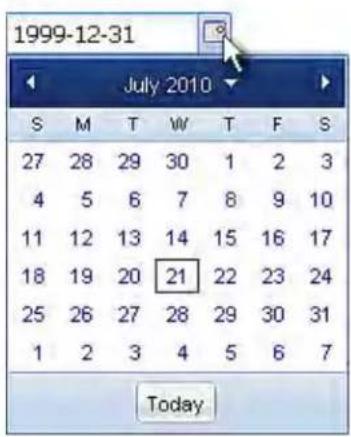
text_image
1999-12-31 July 2010 S M T W T F S 27 28 29 30 1 2 3 4 5 6 7 8 9 10 11 12 13 14 15 16 17 18 19 20 21 22 23 24 25 26 27 28 29 30 31 1 2 3 4 5 6 7 TodayTo select a date using the calendar:
-
To change the year shown in the calendar, do either of the following:
-
Press Ctrl+Up arrow or Ctrl+Down arrow to switch between years.
- Click ▼, which is adjacent to the year, to show a list of years and months. Select the desired year from the list to the right and click OK. If the list does not show the desired year, click ▼ or ▶ to show additional years.

text_image
Jan Jul Feb Aug 2005 2010 Mar Sep 2006 2011 Apr Oct 2007 2012 May Nov 2008 2013 Jun Dec 2009 2014 OK Cancel-
To change the month shown in the calendar, do one of the following:
-
Press Ctrl+Right arrow or Ctrl+Left arrow to switch between months.
- Click ▶ or ▶ on the top of the calendar to switch between months.
-
Click ▼, which is adjacent to the year, to show a list of years and months. Select the desired month from the list to the left and click OK.
-
To select a date, click that date on the calendar.
- Click Today if you want to select today.
Note: On the calendar, the date for today is marked with a red frame.
Windows NTP Server Synchronization Solution
The NTP client on the PX follows the NTP RFC so the PX rejects any NTP servers whose root dispersion is more than one second. An NTP server with a dispersion of more than one second is considered an inaccurate NTP server by the PX.
Note: For information on NTP RFC, visit http://tools.ietf.org/html/rfc4330 http://tools.ietf.org/html/rfc4330 to refer to the section 5.
Windows NTP servers may have a root dispersion of more than one second, and therefore cannot synchronize with the PX. When the NTP synchronization issue occurs, change the dispersion settings to resolve it.
To change the Windows NTP's root dispersion settings:
- Access the registry settings associated with the root dispersion on the Windows NTP server.
HKEY_LOCAL_MACHINE\SYSTEM\CurrentControlSet\Services\W32Time\Config - AnnounceFlags must be set to 0x05 or 0x06.
- 0x05 = 0x01 (Always time server) and 0x04 (Always reliable time server)
- 0x06 = 0x02 (Automatic time server) and 0x04 (Always reliable time server)
Note: Do NOT use 0x08 (Automatic reliable time server) because its dispersion starts at a high value and then gradually decreases to one second or lower.
- LocalClockDispersion must be set to 0.
Setting the LCD Display's Default View
This setting is only available on PX3 phase II models except for PX3-3000 series, which does NOT provide inlet sensor information.
After powering on or resetting a PX, the dot-matrix LCD display enters the automatic mode by default, which cycles through the inlet information and, if available, overcurrent protector information. See Automatic and Manual Modes (on page 62).
If you want your PX which contains overcurrent protectors to cycle through the inlet information only in the default view, change its front panel default view settings.
To set the default view of the LCD display:
- Choose Device Settings > Front Panel Settings. The Front Panel Default View dialog appears.
-
Select the default view you prefer.
-
Automatic mode: The LCD display cycles through both the inlet and overcurrent protector information. This is the default.
-
Inlet overview: The LCD display cycles through the inlet information only.
-
Click OK.
Setting Default Measurement Units
Default measurement units are applied to the PX web and CLI interfaces across all users, including users accessing the device via external authentication servers. Default units apply only when users have not set their own preferred measurement units or the administrator has not changed preferred units for any user.
Note: To set preferred measurement units for your own, see Setting Up Your Preferred Measurement Units (on page 159). If your preferences are different from the default measurement units, your preferences rather than the defaults apply to the PX user interfaces after you log in.
To set up default user preferences:
- Choose User Management > Default User Preferences.
-
Update any of the following as needed:
-
In the Temperature Unit field, select °C (Celsius) or °F (Fahrenheit) as the measurement unit for temperatures.
- In the Length Unit field, select "Meter" or "Feet" as the measurement unit for length or height.
- In the Pressure Unit field, select "Pascal" or "psi" as the measurement unit for pressure.
3. Click OK.
Configuring the Feature Port
The PX device supports connecting one of the following devices to its FEATURE port:
- Raritan Computer Interface Module (CIM) for KVM access. See Dominion KX II Configuration (on page 625).
- Raritan as set management sensors (asset sensors). See Connecting the Asset Management Sensor (on page 43).
- Ra ritan serial access products, including Dominion KSX II or SX. See Dominion KSX II or SX Configuration (on page 630).
- External bee per. See Connecting an External Beeper (on page 55).
- Schroff ^ LHX-20, SHX-30 or LHX-40 heat exchanger. See Connecting a Schroff LHX/SHX Heat Exchanger (on page 55).
By default, the FEATURE port can automatically detect and display the device connected to the FEATURE port. The only exception is the Schroff® LHX/SHX device, which requires enabling the LHX/SHX support before the PX can detect or display it. See Managing the Schroff LHX/SHX Heat Exchanger (on page 315).
You can change the mode applied to the FEATURE port so that the PX web interface only displays the device in the manner you wish.
To configure the FEATURE port:
- Click the Feature Port folder. The Feature Port page opens in the right pane.
-
Select the Port# 1 device on the Feature Port page, and click Setup. The Feature Port Setup dialog appears.
-
Select the desired mode in the Detection Mode field.
-
Auto: The PX automatically detects and displays the device connected to the FEATURE port. This is the default.
- Disabled: The FEATURE port is disabled so the PX does not detect and display the connected device.
- A specific device type: The PX always displays the selected device type no matter which device is connected or whether the selected device is detected or not. After selecting a device type, the Mode column shows "Pinned." Available device types are listed below.
| Device type Description | |
| Asset Strip Raritan asset sensors. | |
| ExternalBeeper | An external beeper with the RJ-45 socket. |
| Power CIM Select this type when connecting one of the followingRaritan products:• Raritan power CIM, D2CIM-PWR. This CIM is used to connect the PX to the Raritan digital KVM switch, Dominion KX II.• Dominion KSX II• Dominion SX | |
| LHX 20 Schroff | ^ LHX-20 heat exchanger.All Schroff ^ SHX/LHX device types are available only after the LHX/SHX support is enabled. SeeEnabling and Disabling Schroff LHX/SHX Heat ExchangerSupport(on page 316). |
| SHX 30 Schroff | ^ SHX-30 heat exchanger. |
| LHX 40 Schroff | ^ LHX-40 heat exchanger. |
- Click OK.
Configuring the Serial Port
You can change the bit-rate of the serial port labeled CONSOLE / MODEM on the PX device. The default bit-rate for both console and modem operation is 115200 bps.
The PX supports the use of one of the following devices via the serial interface:
• A computer or a Raritan's KVM product for console management.
- An analog modem for remote dial-in and access to the CLI.
- A GSM modem for sending out SMS messages to a cellular phone.
Bit-rate adjustment may be necessary. Change the bit-rate before connecting the supported device to the PX through the serial port, or there are communication problems.
Note: The serial port bit-rate change is needed when the PX works in conjunction with Raritan's Dominion LX KVM switch. The Dominion LX only supports 19200 bps for communications over the serial interface.
You can set diverse bit-rate settings for console and modem operations. The PX can detect the type of the connected device, and automatically apply the preset bit-rate.
To change the serial port baud rate settings:
- Choose Device Settings > Serial Port Settings. The Serial Port Configuration dialog appears.
- In the Console Baud Rate field, select the baud rate intended for console management.
Note: For a serial RS-232 or USB connection between a computer and the PX, leave it at the default (115200 bps).
- In the Modem Baud Rate field, select the baud rate used for the modem connected to the PX.
To configure the analog modem settings:
- Click the Analog Modem tab.
- Select the "Answer incoming calls" checkbox to enable the remote access via a modem. Otherwise, deselect this checkbox.
- Specify the number of rings the PX must wait before answering the call. You can either type a value or click the Up/Down arrow keys to adjust the value in the "Number of rings until answering" field.
To configure the GSM modem settings:
- Click the GSM Modem tab.
-
Enter the SIM PIN.
-
Select 'Use custom SMS center number' if a custom SMS will be used.
- Enter the SMS center number in the SMS Center field.
- Click Advanced Information to show information.
- Enter the number of the recipient's phone in the Recipients Phone field, then click Send SMS Test to send a test SMS message.
Setting the Cascading Mode
A maximum of eight PX devices can be cascaded using USB cables and therefore share only one Ethernet connection. See Cascading the PX via USB (on page 28).
The Ethernet sharing mode applied to the USB-cascading configuration is either network bridging or port forwarding. This mode is determined by the master device.
Only the Admin user or a user who has the Administrator Privileges permission can configure the cascading mode.
To apply the "Port Forwarding" cascading mode, all cascaded PX devices must be upgraded to version 2.5.20 or later, or those devices not supporting the "Port Forwarding" mode cannot be accessed over the network. See Updating the PX Firmware (on page 324).
To configure the cascading mode:
- Log in to the master device's web interface.
- Choose Device Settings > USB Cascading. The USB Cascading Configuration dialog appears.
- Verify that the "Position in cascaded chain" field shows 0 (Master), indicating that this PX is the master device.
-
Select the preferred cascading mode in the "Cascading mode" field.
-
Bridging: Each device in the USB-cascading configuration is accessed with a different IP address. This is the default.
- Port Forwarding: Each device in the USB-cascading configuration is accessed with the same IP address with a different port number assigned. The port numbers vary based on the networking protocol and device position in the chain. See Port Number Syntax (on page 143).
Note: If reversing or disconnecting the USB cable from a slave device, causing the slave device to become a master or standalone device, you must plug an Ethernet cable to it to update its USB-cascading status.
-
Click OK.
-
If selecting Port Forwarding, a list of port numbers for diverse networking protocols will be available on the "Protocol to Port Mapping" tab of each cascaded device.
Return to the same dialog and click the "Protocol to Port Mapping" tab to view the master device's port numbers.
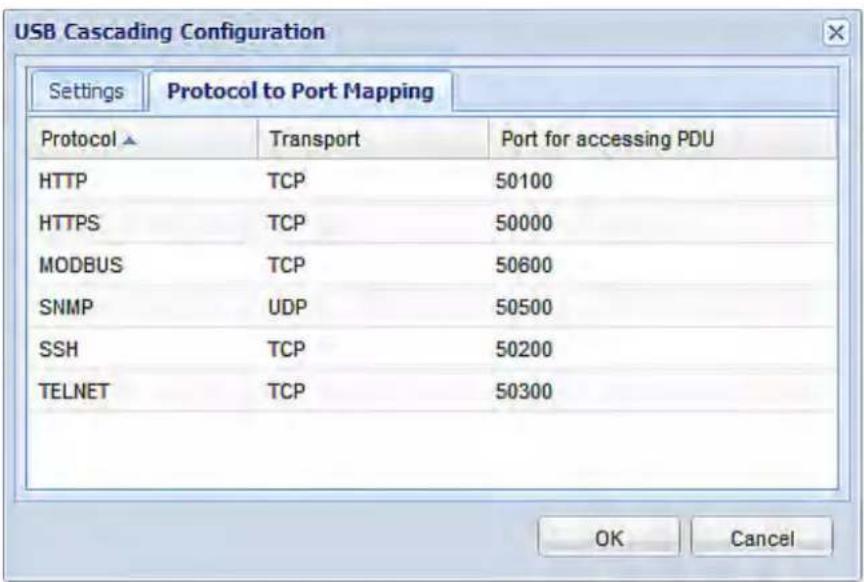
text_image
USB Cascading Configuration Settings Protocol to Port Mapping Protocol ▲ Transport Port for accessing PDU HTTP TCP 50100 HTTPS TCP 50000 MODBUS TCP 50600 SNMP UDP 50500 SSH TCP 50200 TELNET TCP 50300 OK CancelFor information on accessing each cascaded device in the Port Forwarding mode, see Port Forwarding Examples (on page 145).
Port Number Syntax
In the Port Forwarding mode, all devices in the USB-cascading configuration share the same IP address. To access any cascaded device, you must assign an appropriate port number to it.
- Master device: The port number is either 5NNXX or the standard TCP/UDP port.
- Slave device: The port number is 5NNXX.
5NNXX port number syntax:
- NN is a two-digit number representing the network protocol as shown below:
| Protocols NN | |
| HTTPS | 00 |
| HTTP | 01 |
| SSH | 02 |
| TELNET | 03 |
| SNMP | 05 |
| MODBUS | 06 |
- XX is a two-digit number representing the device position as shown below:
| Position XX | |
| Master device 00 | |
| Slave 1 01 | |
| Slave 2 02 | |
| Slave 3 03 | |
| Slave 4 04 | |
| Slave 5 05 | |
| Slave 6 06 | |
| Slave 7 07 |
For example, to access the Slave 4 device via Modbus/TCP, the port number is 50604. See Port Forwarding Examples (on page 145) for further illustrations.
Tip: The full list of each cascaded device's port numbers can be retrieved from the web interface. See Setting the Cascading Mode (on page 142).
▶ Standard TCP/UDP ports:
The master device can be also accessed through standard TCP/UDP ports as listed in the following table.
| Protocols Port Numbers | |
| HTTPS | 443 |
| HTTP | 80 |
| SSH | 22 |
| TELNET | 23 |
| SNMP | 161 |
| MODBUS | 502 |
In the Port Forwarding mode, the PX does NOT allow you to modify the standard TCP/UDP port configuration, including HTTP, HTTPS, SSH, Telnet, SNMP and Modbus/TCP.
Port Forwarding Examples
To access a cascaded device in the Port Forwarding mode, assign a port number to the IP address.
- Master device: Assign proper 5NNXX port numbers or standard TCP/UDP ports. See Port Number Syntax (on page 143) for details.
- Slave device: Assign proper 5NNXX port numbers.
Assumption: The Port Forwarding mode is applied to a USB-cascading configuration comprising three Raritan products. The IP address is 192.168.84.77.
Master device:
Position code for the master device is 00 so each port number is 5NN00 as shown below.
| Protocols Port numbers | |
| HTTPS | 50000 |
| HTTP | 50100 |
| SSH | 50200 |
| TELNET | 50300 |
| SNMP | 50500 |
| MODBUS | 50600 |
Examples using "5NN00" ports:
- To access the master device via HTTPS, the IP address is: https://192.168.84.77:50000/
- To access the master device via HTTP, the IP address is: http://192.168.84.77:50100/
- To access the master device via SSH, the command is: ssh -p 50200 192.168.84.77
Examples using standard TCP/UDP ports:
- To access the master device via HTTPS, the IP address is: https://192.168.84.77:443/
- To access the master device via HTTP, the IP address is: http://192.168.84.77:80/
- To access the master device via SSH, the command is: ssh -p 22 192.168.84.77
▶ Slave 1 device:
Position code for Slave 1 is 01 so each port number is 5NN01 as shown below.
| Protocols Port numbers | |
| HTTPS | 50001 |
| HTTP | 50101 |
| SSH | 50201 |
| TELNET | 50301 |
| SNMP | 50501 |
| MODBUS | 50601 |
Examples:
- To access Slave 1 via HTTPS, the IP address is: https://192.168.84.77:50001/
• To access Slave 1 via HTTP, the IP address is: http://192.168.84.77:50101/ - To access Slave 1 via SSH, the command is: ssh -p 50201 192.168.84.77
▶ Slave 2 device:
Position code for Slave 2 is 02 so each port number is 5NN02 as shown below.
| Protocols Port numbers | |
| HTTPS | 50002 |
| HTTP | 50102 |
| SSH | 50202 |
| TELNET | 50302 |
| SNMP | 50502 |
| MODBUS | 50602 |
Examples:
- To access Slave 2 via HTTPS, the IP address is: https://192.168.84.77:50002/
- To access Slave 2 via HTTP, the IP address is: http://192.168.84.77:50102/
- To access Slave 2 via SSH, the command is: ssh -p 50202 192.168.84.77
Setting Data Logging
The PX can store 120 measurements for each sensor in a memory buffer. This memory buffer is known as the data log. Sensor readings in the data log can be retrieved using SNMP.
You can configure how often measurements are written into the data log using the Measurements Per Log Entry field. Since the PX internal sensors are measured every second, specifying a value of 60, for example, would cause measurements to be written to the data log once every minute. Since there are 120 measurements of storage per sensor, specifying a value of 60 means the log can store the last two hours of measurements before the oldest one in the log gets overwritten.
Whenever measurements are written to the log, three values for each sensor are written: the average, minimum and maximum values. For example, if measurements are written every minute, the average of all measurements that occurred during the preceding 60 seconds along with the minimum and maximum measurement values are written to the log.
Note: The PX device's SNMP agent must be enabled for this feature to work. See Enabling SNMP (on page 330) for more details. In addition, using an NTP time server ensures accurately time-stamped measurements.
Enabling Data Logging
By default, data logging is disabled. Only users having the "Administrator" or "Change Pdu, Inlet, Outlet & Overcurrent Protector Configuration" permissions can enable or disable this feature. See Setting Up Roles (on page 160).
To configure the data logging feature:
- Choose Device Settings > Data Logging. The Data Logging Options dialog appears.
- To enable the data logging feature, select the "enable" checkbox in the Enable Data Logging field.
- Type a number in the Measurements Per Log Entry field. Valid range is from 1 to 600. The default is 60.
- Verify that all sensor logging is enabled. If not, click Enable All to have all sensors selected.
- Click OK.
Important: Although it is possible to selectively enable/disable logging for individual sensors on the PX in Step 4, it is NOT recommended and this capability may be removed in the future.
Configuring SMTP Settings
The PX can be configured to send alerts or event messages to a specific administrator by email. To do this, you have to configure the SMTP settings and enter an IP address for your SMTP server and a sender's email address.
If any email messages fail to be sent successfully, the failure event and reason are available in the event log. See Viewing the Local Event Log (on page 269).
Note: See Event Rules and Actions (on page 222) for information on creating event rules to send email notifications.
To set SMTP server settings:
- Choose Device Settings > SMTP Server. The SMTP Server Settings dialog appears.
- Type the name or IP address of the mail server in the Server Name field.
- Type the port number for the SMTP server in the Port field. The default is 25.
- Type an email address for the sender in the Sender Email Address field.
- Type the number of email retries in the "Number of Sending Retries" field. The default is 2 retries.
- Type the time interval between email retries in the "Time Interval Between Sending Retries (in minutes)" field. The time is measured in minutes. The default is 2 minutes.
- If your SMTP server requires password authentication, do this:
a. Select the Server Requires Authentication checkbox.
b. Type a user name in the User Name field.
c. Type a password in the Password field.
- If your SMTP server supports the Transport Layer Security (TLS), select the "Enable SMTP over TLS (StartTLS)" checkbox. Then do the following:
a. Click Browse to select the TLS CA certificate file. Then you may:
- Click Show to view the installed certificate's contents.
- Click Remove to delete the installed certificate if it is inappropriate.
b. Select or deselect the "Allow expired and not yet valid certificates" checkbox.
- To always send the email messages even though the installed certificate chain contains a certificate that is outdated or not valid yet, select this checkbox.
-
To prevent the email messages from being sent when any certificate in the installed certificate chain is outdated or not valid yet, deselect this checkbox.
-
Now that you have set the SMTP settings, you can test it to ensure it works properly. Do the following:
a. Type the recipient's email address in the Recipient Email Addresses field. Use a comma to separate multiple email addresses.
b. Click Send Test Email.
c. Check if the recipient(s) receives the email successfully.
- Click OK.
Configuring Data Push Settings
If any Raritan asset sensors have been connected to PX, you can push the asset sensor data to a remote server for data synchronization. The data will be sent in JSON format using HTTP POST requests. You need to set up the destination and authentication for data push on the PX.
For instructions on connecting asset sensors, see Connecting the Asset Management Sensor (on page 43).
After configuring the destination and authentication settings, do either or both of the following:
- To perform the data push after the occurrence of a certain event, create the data push action and assign it to an event rule. See Push Out Sensor Readings (on page 229).
- To push the data at a regular interval, schedule the data push action. See Scheduling an Action (on page 248).
To configure data push settings:
- Choose Device Settings > Data Push. The Data Push dialog appears.
- Click New. The Add New Destination dialog appears.
- In the URL field, determine the following information.
- Click the arrow to select http or https.
- Type the URL or host name in the accompanying text box.
-
If the destination server requires authentication, select the "Use authentication" checkbox, and provide the authentication information:
-
In the "User name" field, type the login name.
-
In the Password field, type the login password.
-
In the "Entry type" field, determine the data that will be transmitted.
-
Asset management information: Transmit the information of the specified asset sensor(s), including the general status of the specified sensor(s) and a list of asset tags on blade extension strips if any.
-
Asset management log: Transmit the log of all asset sensors, which is generated when there are changes made to asset tags and asset sensors, including asset tag connection or disconnection events.
-
If "Asset management information" is selected in the above step, specify the asset sensor(s) whose log to send. The PX has only one FEATURE port so only one asset sensor is available.
-
To specify the asset sensor, select it in the Available list box and click (Add) or (Add All).
-
To remove the asset sensor, select it in the Selected list box and click (Remove) or (Remove All).
-
Click OK.
Specifying the Device Altitude
You must specify the PX device's altitude above sea level if a Raritan differential air pressure sensor is attached. This is because the device's altitude is associated with the altitude correction factor. See Altitude Correction Factors (on page 645).
The default altitude measurement unit is meter. You can have the measurement unit vary between meter and foot according to user credentials. See Setting Up Your Preferred Measurement Units (on page 159).
To specify the altitude of the PX device:
- Click the PDU folder.
Note: The folder is named "my PX" by default. The name can be customized.
- Click Setup in the Settings section. The Pdu Setup dialog appears.
-
Type an integer number in the Altitude field. Depending on the measurement unit displayed, the range of valid numbers differs.
-
For meters (m), the value ranges between 0 and 3000.
-
For feet (ft), the value ranges between 0 and 9842.
-
Click OK.
Rebooting the PX Device
You can remotely reboot the PX device via the web interface.
Resetting the PX does not interrupt the operation of connected servers because there is no loss of power to outlets. Outlets that have been powered on prior to the reset remain powered on and outlets that have been powered off remain powered off during and after the reset.
▶ To reboot the device:
- Choose Maintenance > Unit Reset. The Reset Device dialog appears.
text_image
Reset Device Do you really want to reset the device? Yes No- Click Yes to reset the PX.
- A message appears with a countdown timer showing the remaining time of the operation. It takes about one minute to complete.
- When the reset is complete, the Login page opens. Now you can log back in to the PX device.
Note: If you are not redirected to the Login page after the reset is complete, click the underlined text "this link" in the message.
Resetting All Active Energy Readings
An active energy reading is a value of total accumulated energy, which is never reset, even if the power fails or the PX is reset. However, you can manually reset this reading to restart the energy accumulation process.
Only users with the "Admin" role assigned can reset active energy readings.
To reset all active energy readings of the PX:
- Click the PDU folder in the PX Explorer pane to open the PDU page.
Note: The folder is named "my PX" by default. The name can be customized.
- Click Reset All Active Energy Counters in the Settings section.
- Click Yes on the confirmation message. Now all 'Active Energy' readings on the PX are reset to 0 (zero) Wh.
Tip: You can also reset the active energy readings of an individual inlet. See Resetting Inlet Active Energy Readings (on page 213). To reset the active energy readings of specific outlets only, see Resetting Outlet Active Energy Readings (on page 209).
Monitoring Total Active Energy or Power
This section applies only to multi-inlet models, including PX in-line monitors.
A PX device with multiple inlets has two additional sensors for reporting power-related readings at the PDU level: total active energy and total active power.
For a regular PX model with multiple inlets:
• Total active energy = sum of all inlets' active energy values
• Total active power = sum of all inlets' active power values
For an in-line monitor with multiple inlets/outlets:
• Total active energy = sum of all outlets' active energy values
• Total active power = sum of all outlets' active power values
Tip: You can reset the active energy sensor(s) as needed. See Resetting All Active Energy Readings (on page 151).
To view the total active energy and/or power of a multi-inlet PX:
- Click the PDU folder.
Note: The folder is named "my PX" by default. The name can be customized.
- Locate the Power section in the right pane. Both values and states of Active Power and Active Energy are displayed.
| Power | ||
| Type | Value | State |
| Active Power | 0 W | normal |
| Active Energy | 76914 Wh | normal |
Checking the Internal Beeper State
The internal beeper can alert you if any overcurrent protector, including fuses and circuit breakers, has tripped or blown on the PX. See Beeper (on page 91). You can remotely check its state.
To check the PX beeper's state:
- Click the PDU folder.
Note: The folder is named "my PX" by default. The name can be customized.
- Locate the "Internal Beeper" section in the right pane. Either of the following states is displayed.
■ Off: The beeper is turned off.
■ Active: The beeper is turned on. A field titled "Activation reason" appears below the beeper state, indicating why the beeper sounds an alarm.
Tip: To check the internal beeper state via CLI, see PDU Configuration (on page 350).
Setting the EnergyWise Configuration
If a Cisco ^® EnergyWise energy management architecture is implemented in your place, you can enable the Cisco EnergyWise endpoint implemented on the PX device so that this device becomes part of the Cisco EnergyWise domain.
The Cisco EnergyWise feature implemented on the PX is disabled by default.
To set the Cisco EnergyWise configuration:
-
Choose Device Settings > EnergyWise. The EnergyWise Configuration dialog appears.
-
In the Enable EnergyWise field, select the "enable" checkbox to enable the Cisco EnergyWise feature.
-
In the "Domain name" field, type the name of a Cisco EnergyWise domain where the PX belongs. The domain name comprises up to 127 printable ASCII characters.
- Spaces and asterisks are NOT acceptable.
- In the "Domain password" field, type the authentication password (secret) for entering the Cisco EnergyWise domain. The password comprises up to 127 printable ASCII characters.
- Spaces and asterisks are NOT acceptable.
- In the Port field, type a User Datagram Protocol (UDP) port number for communications in the Cisco EnergyWise domain. The port ranges from 1 to 65535. Default is 43440.
- In the "Polling interval" field, type a polling interval to determine how often the PX is queried in the Cisco EnergyWise domain. The polling interval ranges from 30 to 600 seconds. Default is 180 seconds.
7. Click OK.
For PX3-3000, PX3-4000, and PX3-5000 series, the parent/child relationship is formed after the Cisco EnergyWise feature is enabled.
- The PDU becomes a parent domain member.
- All outlets become children of the PDU.
User Management
The PX is shipped with one built-in user profile: admin, which is used for initial login and configuration. This profile has full permissions, and should be reserved for the system administrator. It cannot be deleted and its permissions are not user-configurable except for the SNMP v3 permission.
All users must have a user profile, which specifies a login name and password, and contains additional (optional) information about the user. Every user profile must have at least a role to determine the user's permissions. See Setting Up Roles (on page 160).
Tip: By default, multiple users can log in simultaneously using the same login name.
Creating a User Profile
Creating new users adds a new login to the PX.
To create a user profile:
-
Choose User Management > Users. The Manage Users dialog appears.
-
Click New. The Create New User dialog appears.
-
Type the information about the user in the corresponding fields. Note that User Name, Password and Confirm Password fields are required.
Field Type this...
| User Name The name the user enters to log in to the PX. |
| ▪ The name can be 4 to 32 characters long. |
| Field Type this... | |
| It is case sensitive.Spaces are NOT permitted | |
| Full Name The user's first and last names. | |
| Password, Confirm Password | The password the user enters to log in. Type it first in the Password field and then again in the Confirm Password field.The password can be 4 to 64 characters long.It is case sensitive.Spaces are permitted. |
| Telephone Number A phone number where the user can be reached. | |
| eMail Address An email address where the user can be reached.The email can be up to 64 characters long.It is case sensitive. | |
- Select the Enabled checkbox. This is required so the user can log in to the PX device.
- Select the "Force password change on next login" checkbox if you prefer a password change by the user when the user logs in for the first time after this checkbox is enabled.
- Click the SNMPv3 tab to set the SNMPv3 access permission. The permission is disabled by default.
a. To permit the SNMPv3 access by this user, select the "Enable SNMPv3 access" checkbox. Otherwise, leave the checkbox disabled.
Note: The SNMPv3 protocol must be enabled for SNMPv3 access. See Configuring SNMP Settings (on page 130).
b. Set up SNMPv3 parameters if enabling the SNMPv3 access permission.
Field Description
| Security Level Click the drop-down arrow to select a preferred security level from the list:NoAuthNoPriv: No authentication and no privacy.AuthNoPriv: Authentication and no privacy. |
Field Description
| ▪ AuthPriv: Authentication and privacy. This is the default. | |
| Use Password as Authentication Pass Phrase | This checkbox is configurable only if AuthNoPriv or AuthPriv is selected.When the checkbox is selected, the authentication pass phrase is identical to the user's password.To specify a different authentication pass phrase, disable the checkbox. |
| Authentication Pass Phrase | Type the authentication pass phrase in this field if the "Use Password as Authentication Pass Phrase" checkbox is disabled.The pass phrase must consist of 8 to 32 ASCII printable characters. |
| Confirm Authentication Pass Phrase | Re-type the same authentication pass phrase for confirmation. |
| Use Authentication Pass Phrase as Privacy Pass Phrase | This checkbox is configurable only if AuthPriv is selected.When the checkbox is selected, the privacy pass phrase is identical to the authentication pass phrase. To specify a different privacy pass phrase, disable the checkbox. |
| Privacy Pass Phrase | Type the privacy pass phrase in this field if the "Use Authentication Pass Phrase as Privacy Pass Phrase" checkbox is disabled.The pass phrase must consist of 8 to 32 ASCII printable characters. |
| Confirm Privacy Pass Phrase | Re-type the same privacy pass phrase for confirmation. |
| Authentication Protocol | Click the drop-down arrow and select the desired authentication protocol from the list. Two protocols are available:▪ MD5▪ SHA-1 (default) |
| Privacy Protocol Click the drop-down arrow and select the desired privacy protocol from the list. Two protocols are available:▪ DES (default)▪ AES-128 | |
- Click the SSH tab to enter the public key if the public key authentication for the SSH service is enabled. See Changing SSH Settings (on page 128).
a. Open the SSH public key with a text editor.
b. Copy and paste all contents in the text editor into the Public Key field on the SSH tab.
-
Click the Roles tab to determine the permissions of the user.
-
Select one or multiple roles by selecting corresponding checkboxes.
■ The Admin role provides full permissions.
- The Operator role provides limited permissions for frequently-used functions. See Setting Up Roles (on page 160) for the scope of permissions. This role is selected by default.
- If no roles meet your needs, you can:
- Modify the permissions of an existing role: To modify the permissions of any role, double-click the role or highlight it and then click Edit Role. See Modifying a Role (on page 161).
- Create a new role by clicking the Manage Roles button: See Creating a Role (on page 160).
Note: With multiple roles selected, a user has the union of all roles' permissions.
-
To change any measurement units displayed in the web interface and command line interface for this new user, click the Preferences tab, and do any of the following:
-
In the Temperature Unit field, select °C (Celsius) or °F (Fahrenheit) as the measurement unit for temperatures.
- In the Length Unit field, select "Meter" or "Feet" as the measurement unit for length or height.
- In the Pressure Unit field, select "Pascal" or "psi" as the measurement unit for pressure.
A Pascal is equal to one newton per square meter. Psi stands for pounds per square inch.
Note: The measurement unit change only applies to the web interface and command line interface. Users can change the measurement units at any time by setting up their own user preferences. See Setting Up Your Preferred Measurement Units (on page 159).
Modifying a User Profile
You can change any user profile's information except for the user name.
To modify a user profile:
- Choose User Management > Users. The Manage Users dialog appears.
- Select the user by clicking it.
- Click Edit or double-click the user. The Edit User 'XXX' dialog appears, where XXX is the user name.
- Make all necessary changes to the information shown.
To change the password, type a new password in the Password and Confirm Password fields. If the password field is left blank, the password is not changed.
-
To change the SNMPv3 access permissions, click the SNMPv3 tab and make necessary changes. For details, see Step 6 of Creating a User Profile (on page 154).
-
To change the permissions, click the Roles tab and do one of these:
-
Select or deselect any role's checkbox.
-
To modify the permissions of any role, double-click the role or highlight it and then click Edit Role. See Modifying a Role (on page 161).
-
To change the measurement unit for temperature, length or pressure, click the Preferences tab, and select a different option from the drop-down list.
Note: The measurement unit change only applies to the web interface and command line interface.
- Click OK.
Deleting a User Profile
Delete outdated or redundant user profiles when necessary.
▶ To delete user profiles:
- Choose User Management > Users. The Manage Users dialog appears.
- Select the user you want to delete by clicking it. To make multiple selections, press Ctrl+click or Shift+click to highlight multiple ones.
- Click Delete.
- A message appears, prompting you to confirm the operation. Click Yes to confirm the deletion.
Changing the User List View
You may change the number of displayed columns or re-sort the list for better viewing the data. See Changing the View of a List (on page 106).
Setting Up Your Preferred Measurement Units
The measurement units used in your PX user interfaces can be changed according to your own preferences regardless of the permissions you have.
Tip: Preferences can also be changed by administrators for specific users from the Preferences tab of the Manage Users dialog. See Creating a User Profile (on page 154).
Note: The measurement unit change only applies to the web interface and command line interface. Setting your preferences does not change the default measurement units, which apply to all users before any individual user or the administrator sets preferred measurement units on a per-user basis. See Setting Default Measurement Units (on page 138) for information on changing default measurement units.
To change the measurement units applied to your PX graphical user interfaces:
- Choose User Management > User Preferences. The Setup User Preferences dialog opens.
-
Update any of the following as needed:
-
In the Temperature Unit field, select °C (Celsius) or °F (Fahrenheit) as the measurement unit for temperatures.
- In the Length Unit field, select "Meter" or "Feet" as the measurement unit for length or height.
-
In the Pressure Unit field, select "Pascal" or "psi" as the measurement unit for pressure.
-
Click OK.
Setting Up Roles
A role defines the operations and functions a user is permitted to perform or access. Every user must be assigned at least a role.
The PX is shipped with two built-in roles: Admin and Operator.
- The Admin role provides full permissions. You can neither modify nor delete this role.
- The Operator role provides limited permissions for frequently-used functions. You can modify or delete this role. By default, the Operator role contains these permissions:
- Acknowledge Alarms
- View Event Settings
- View Local Event Log
- Change Pdu, Inlet, Outlet & Overcurrent Protector Configuration
- Change Own Password
- Switch Outlet (all outlets)
Note: PX3-3000 and PX3-4000 series are NOT outlet-switching capable so the "Switch Outlet" permission is not available.
The Operator role is assigned to a newly created user profile by default. See Creating a User Profile (on page 154).
Creating a Role
Create a new role when you need a new combination of permissions.
To create a role:
- Choose User Management > Roles. The Manage Roles dialog appears.
Tip: You can also access the Manage Roles dialog by clicking the Manage Roles button in the Edit User 'XXX' dialog.
- Click New. The Create New Role dialog appears.
- Type the role's name in the Role Name field.
- Type a description for the role in the Description field.
- Click the Privileges tab to assign one or multiple permissions.
a. Click Add. The "Add Privileges to new Role" dialog appears.
b. Select the permission you want from the Privileges list.
c. If the permission you selected contains any argument setting, the Arguments list is shown to the right, such as the Switch Actuator permission. Then select one or multiple arguments.
For example, if the Switch Outlet permission is selected, the Arguments list shows all outlets for you to determine which outlets this role can control. Select the desired outlets' checkboxes or select the checkbox labeled "all" if you want to select all outlets.
d. Click Add to add the selected permission (and arguments if any).
e. Repeat Steps a to d until you add all necessary permissions.
- Click OK.
Now you can assign the new role to any users. See Creating a User Profile (on page 154) or Modifying a User Profile (on page 158).
Modifying a Role
You can change an existing role's settings except for the name.
To modify a role:
- Choose User Management > Roles. The Manage Roles dialog appears.
Tip: You can also access the Manage Roles dialog by clicking the Manage Roles button in the Edit User 'XXX' dialog.
-
Select the role you want to modify by clicking it.
-
Click Edit or double-click the role. The Edit Role 'XXX' dialog appears, where XXX is the role name.
Tip: You can also access the Edit Role 'XXX' dialog by clicking the Edit Role button in the Edit User 'XXX' dialog.
-
Modify the text shown in the Description field if necessary.
-
To change the permissions, click the Privileges tab.
Note: You cannot change the Admin role's permissions.
- To delete any permissions, do this:
a. Select the permission you want to remove by clicking it. To make multiple selections, press Ctrl+click or Shift+click to highlight multiple ones.
b. Click Delete.
- To add any permissions, do this:
a. Click Add. The Add Privileges to Role 'XXX' dialog appears, where XXX is the role name.
b. Select the permission you want from the Privileges list.
c. If the permission you selected contains any argument setting, the Arguments list is shown to the right, such as the Switch Actuator permission. Then select one or multiple arguments.
For example, if the Switch Outlet permission is selected, the Arguments list shows all outlets for you to determine which outlets this role can control. Select the desired outlets' checkboxes or select the checkbox labeled "all" if you want to select all outlets.
d. Click Add to add the selected permission (and arguments if any).
e. Repeat Steps a to d until you add all necessary permissions.
- To change a specific permission's arguments, do this:
a. Select the permission by clicking it.
b. Click Edit. The "Edit arguments of privilege 'XXX'" dialog appears, where XXX is the privilege name.
Note: If the permission you selected does not contain any arguments, the Edit button is disabled.
c. Select the argument you want. You can make multiple selections.
d. Click OK.
- Click OK.
Deleting a Role
You can delete any role other than the Admin role.
To delete a role:
- Choose User Management > Roles. The Manage Roles dialog appears.
Tip: You can also access the Manage Roles dialog by clicking the Manage Roles button in the Edit User 'XXX' dialog.
- Select the role you want to delete by clicking it. To make multiple selections, press Ctrl+click or Shift+click to highlight multiple ones.
- Click Delete.
- A message appears, prompting you to confirm the operation. Click Yes to confirm the deletion.
Changing the Role List View
You may re-sort the list for better viewing the data. See Changing the View of a List (on page 106).
Access Security Control
The PX provides tools to control access. You can enable the internal firewall, create firewall rules, and create login limitations.
Tip: You can also create and install the certificate or set up external authentication servers to control any access. See Setting Up a TLS Certificate (on page 178) and Setting Up External Authentication (on page 184).
Forcing HTTPS Encryption
You can force all accesses to the PX via HTTP to be redirected to HTTPS. See Changing HTTP(S) Settings (on page 127).
Configuring the Firewall
The PX has a firewall that you can configure to prevent specific IP addresses and ranges of IP addresses from accessing the PX device or to prevent them from receiving any data from the PX.
The PX allows you to configure the firewall rules for inbound and outbound traffic respectively. Inbound rules control the data sent to the PX, and outbound rules control the data sent from the PX.
By default the firewall is disabled.
To configure the firewall:
- Enable the firewall. See Enabling the Firewall (on page 164).
- Set the default policy. See Changing the Default Policy (on page 164).
- Create firewa II rules specifying which addresses to accept and which ones to discard. See Creating Firewall Rules (on page 165).
Changes made to firewall rules take effect immediately. Any unauthorized IP activities cease instantly.
Note: The purpose of disabling the firewall by default is to prevent users from accidentally locking themselves out of the device.
Enabling the Firewall
The firewall rules, if any, take effect only after the firewall is enabled.
To enable the PX firewall:
- Choose Device Settings > Security > IP Access Control. The Configure IP Access Control Settings dialog appears.
- To enable the IPv4 firewall, click the IPv4 tab, and select the Enable IPv4 Access Control checkbox.
- To enable the IPv6 firewall, click the IPv6 tab, and select the Enable IPv6 Access Control checkbox.
- Click OK.
Changing the Default Policy
After enabling the firewall, the default policy is to accept traffic from/to all IP addresses. This means only IP addresses discarded by a specific rule will NOT be permitted to access the PX or receive any data from the PX.
You can change the default policy to Drop or Reject, in which case traffic to/from all IP addresses is discarded except the IP addresses accepted by a specific rule.
Default policies for inbound and outbound traffic can be different.
To change the default policy for inbound traffic:
- Choose Device Settings > Security > IP Access Control. The Configure IP Access Control Settings dialog appears.
- To determine the default policy for IPv4 addresses:
a. Click the IPv4 tab if necessary.
b. Ensure the Enable IPv4 Access Control checkbox is selected.
c. Locate the Default Policy field in the Inbound Rules section.
d. The default policy is shown in the Default Policy field. To change it, select a different policy from the drop-down list.
- Accept: Accepts traffic from all IPv4 addresses.
- Drop: Discards traffic from all IPv4 addresses, without sending any failure notification to the source host.
-
Reject: Discards traffic from all IPv4 addresses, and an ICMP message is sent to the source host for failure notification.
-
To determine the default policy for IPv6 addresses:
a. Click the IPv6 tab.
b. Ensure the Enable IPv6 Access Control checkbox is selected.
c. Locate the Default Policy field in the Inbound Rules section.
d. The default policy is shown in the Default Policy field. To change it, select a different policy from the drop-down list.
- Accept: Accepts traffic from all IPv6 addresses.
- Drop: Discards traffic from all IPv6 addresses, without sending any failure notification to the source host.
-
Reject: Discards traffic from all IPv6 addresses, and an ICMP message is sent to the source host for failure notification.
-
Click OK. The new default policy is applied.
To change the default policy for outbound traffic:
Locate the Outbound Rules section on the IPv4 or IPv6 tab and then follow the above procedure to set up its Default Policy field by selecting one of the following options.
- Accept: Permits traffic sent from the PX to all IP addresses.
- Drop: Discards traffic sent from the PX to all IP addresses, without sending any failure notification to the destination host.
- Reject: Discards traffic sent from the PX to all IP addresses, and an ICMP message is sent to the destination host for failure notification.
Creating Firewall Rules
Firewall rules determine whether to accept or discard traffic to/from the PX, based on the IP address of the host sending or receiving the traffic. When creating firewall rules, keep these principles in mind:
- Rule order is important.
When traffic reaches or is sent from the PX device, the rules are executed in numerical order. Only the first rule that matches the IP address determines whether the traffic is accepted or discarded. Any subsequent rules matching the IP address are ignored by the PX.
- Subnet mask is required.
When typing the IP address, you must specify BOTH the address and a subnet mask. For example, to specify a single address in a Class C network, use this format:
$$ x. x. x. x / 2 4 $$
where /24 = a subnet mask of 255.255.255.0.
To specify an entire subnet or range of addresses, change the subnet mask accordingly.
Note: Valid IPv4 addresses range from 0.0.0.0 through 255.255.255.255. Make sure the IPv4 addresses entered are within the scope.
To create firewall rules:
- Choose Device Settings > Security > IP Access Control. The Configure IP Access Control Settings dialog appears.
- Click the IPv4 tab for creating IPv4 firewall rules, or click the IPv6 tab for creating IPv6 firewall rules.
- Ensure the Enable IPv4 Access Control checkbox is selected on the IPv4 tab, or the Enable IPv6 Access Control checkbox is selected on the IPv6 tab.
- To set rules for inbound traffic, go to the Inbound Rules section. To set rules for outbound traffic, go to the Outbound Rules section.
- Create specific rules. See the table for different operations.
Action Procedure
Add a rule to the end of the rules list
- Click Append. The "Append new Rule" dialog appears.
- Type an IP address and subnet mask in the IP/Mask field.
- Select Accept, Drop or Reject from the drop-down list in the Policy field.
- Accept: Accepts traffic from/to the specified IP address(es).
- Drop: Discards traffic from/to the specified IP address(es), without sending any failure notification to the source or destination host.
- Reject: Discards traffic from/to the specified IP address(es), and an ICMP message is sent to the source or destination host for failure notification.
- Click OK.
The system automatically numbers the rule.
| Action Procedure | |
| Insert a rule between two existing rules | Select the rule above which you want to insert a new rule. For example, to insert a rule between rules #3 and #4, select #4.Click Insert. The "Insert new Rule" dialog appears.Type an IP address and subnet mask in the IP/Mask field.Select Accept, Drop or Reject from the drop-down list in the Policy field.Accept: Accepts traffic from/to the specified IP address(es).Drop: Discards traffic from/to the specified IP address(es), without sending any failure notification to the source or destination host.Reject: Discards traffic from/to the specified IP address(es), and an ICMP message is sent to the source or destination host for failure notification.Click OK.The system inserts the rule and automatically renumbers the following rules. |
- When finished, the rules appear in the Configure IP Access Control Settings dialog.
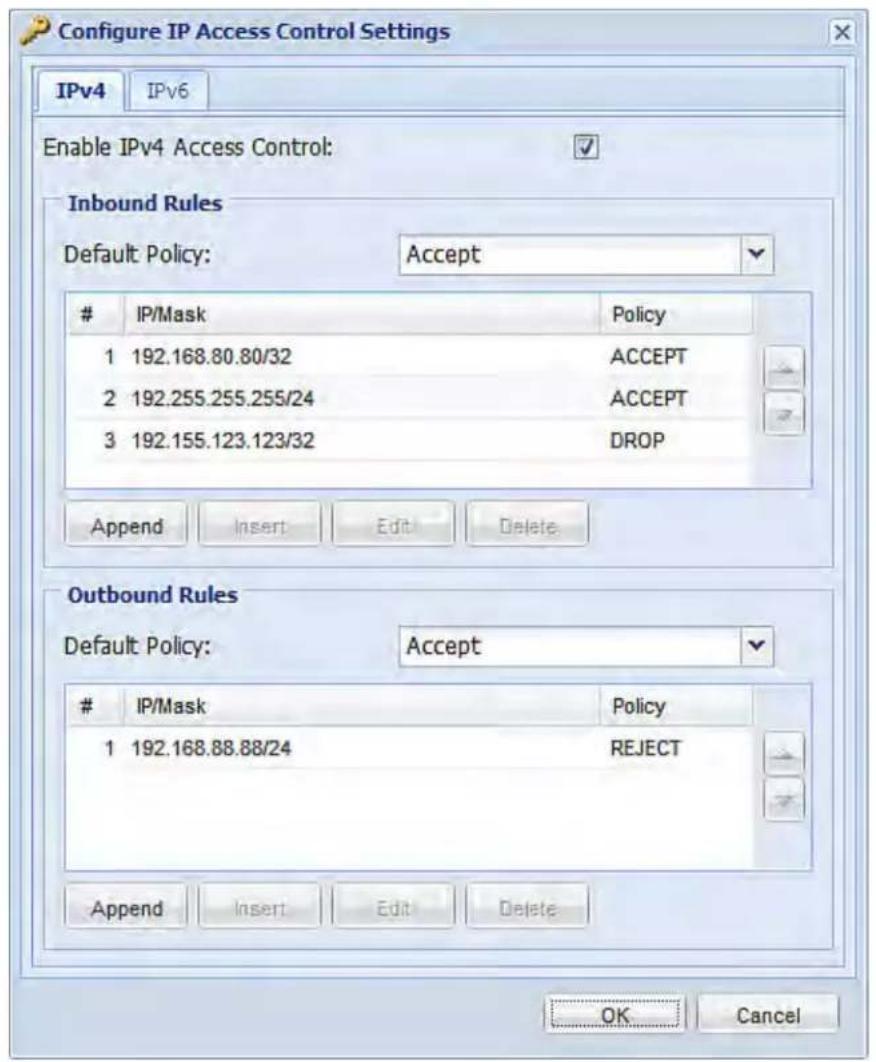
text_image
Configure IP Access Control Settings IPv4 IPv6 Enable IPv4 Access Control: Inbound Rules Default Policy: AcceptIP/Mask Policy
1 192.168.80.80/32 ACCEPT 2 192.255.255.255/24 ACCEPT 3 192.155.123.123/32 DROP Append Insert Edit Delete Outbound Rules Default Policy: AcceptIP/Mask Policy
1 192.168.88.88/24 REJECT Append Insert Edit Delete OK Cancel- Click OK. The rules are applied.
Editing Firewall Rules
When an existing firewall rule requires updates of IP address range and/or policy, modify them accordingly.
To modify a firewall rule:
-
Choose Device Settings > Security > IP Access Control. The Configure IP Access Control Settings dialog appears.
-
To modify the IPv4 firewall rules, click the IPv4 tab. To modify the IPv6 firewall rules, click the IPv6 tab.
- Ensure the Enable IPv4 Access Control checkbox is selected on the IPv4 tab, or the Enable IPv6 Access Control checkbox is selected on the IPv6 tab.
- Select the rule to be modified in the rules list.
- Click Edit or double-click the rule. The Edit Rule dialog appears.
- Make changes to the information shown.
- Click OK.
- Click OK to quit the Configure IP Access Control Settings dialog, or the changes are lost.
Sorting Firewall Rules
The rule order determines which one of the rules matching the same IP address is performed.
To sort the firewall rules:
- Choose Device Settings > Security > IP Access Control. The Configure IP Access Control Settings dialog appears.
- To sort the IPv4 firewall rules, click the IPv4 tab. To sort the IPv6 firewall rules, click the IPv6 tab.
- Ensure the Enable IPv4 Access Control checkbox is selected on the IPv4 tab, or the Enable IPv6 Access Control checkbox is selected on the IPv6 tab.
- Select a specific rule by clicking it.
- Click ▲ or ▼ to move the selected rule up or down until it reaches the desired location.
- Click OK.
Deleting Firewall Rules
When any firewall rules become obsolete or unnecessary, remove them from the rules list.
▶ To delete a firewall rule:
- Choose Device Settings > Security > IP Access Control. The Configure IP Access Control Settings dialog appears.
-
To delete the IPv4 firewall rules, click the IPv4 tab. To delete the IPv6 firewall rules, click the IPv6 tab.
-
Ensure the Enable IPv4 Access Control checkbox is selected on the IPv4 tab, or the Enable IPv6 Access Control checkbox is selected on the IPv6 tab.
- Select the rule that you want to delete. To make multiple selections, press Ctrl+click or Shift+click to highlight multiple ones.
- Click Delete.
- A message appears, prompting you to confirm the operation. Click Yes to remove the selected rule(s) from the rules list.
- Click OK.
Setting Up User Login Controls
You can set up login controls to make it more difficult for hackers to access the PX and the devices connected to it. You can arrange to lock persons out after a specified number of failed logins, limit the number of persons who log in using the same user name at the same time, and force users to create strong passwords.
Enabling User Blocking
User blocking determines how many times a user can attempt to log in to the PX and fail authentication before the user is blocked.
Note that this function applies only to local authentication instead of authentication through external AA servers.
Note: If any user blocking event occurs, you can unblock that user manually by using the "unblock" CLI command via a local connection. See Unblocking a User (on page 500).
▶ To enable user blocking:
- Choose Device Settings > Security > Login Settings. The Login Settings dialog appears.
- Locate the User Blocking section.
- To enable the user blocking feature, select the "Block user on login failure" checkbox.
- Type a number in the "Maximum number of failed logins" field. This is the maximum number of failed logins the user is permitted before the user is blocked from accessing the PX device.
- To determine how long the user's login is blocked, select the desired length of time from the drop-down list in the "Block timeout" field. The following describes available options.
-
Infinite: This option sets no time limit on blocking the login.
-
X min: This type of option sets the time limit to X minutes, where X is a number.
- X h: This type of option sets the time limit to X hours, where X is a number.
■ 1 d: This option sets the time limit to 1 day.
Tip: If the desired time option is not listed, you can manually type the desired time in this field. For example, you can type "4 min" to set the time to 4 minutes.
- Click OK.
Enabling Login Limitations
Login limitations determine whether more than one person can use the same login name at the same time, and how long users are permitted to stay idle before being forced to log out.
▶ To enable login limitations:
- Choose Device Settings > Security > Login Settings. The Login Settings dialog appears.
- Locate the Login Limitations section.
- To prevent more than one person from using the same login at the same time, select the "Prevent concurrent login with same username" checkbox.
- To adjust how long users can remain idle before they are forcibly logged out by the PX, select a time option in the Idle Timeout Period field. The default is 10 minutes.
- X min: This type of option sets the time limit to X minutes, where X is a number.
- X h: This type of option sets the time limit to X hours, where X is a number.
■ 1 d: This option sets the time limit to 1 day.
Tip: If the desired time option is not listed, you can manually type the desired time in this field. For example, you can type "4 min" to set the time to 4 minutes.
- Click OK.
Tip: Keep the idle timeout to 20 minutes or less if possible. This reduces the number of idle sessions connected, and the number of simultaneous commands sent to the PX.
Enabling Strong Passwords
Use of strong passwords makes it more difficult for intruders to crack user passwords and access the PX device. By default, strong passwords should be at least eight characters long and contain upper- and lower-case letters, numbers, and special characters, such as @ or &.
To force users to create strong passwords:
-
Choose Device Settings > Security > Password Policy. The Password Policy dialog appears.
-
Select the Strong Passwords checkbox to activate the strong password feature. The following are the default settings:
Minimum length = 8 characters
Maximum length = 32 characters
At least one lowercase character = Required
At least one uppercase character = Required
At least one numeric character = Required
At least one special character = Required
Number of restricted passwords in history = 5
Note: The maximum password length accepted by the PX is 64 characters.
-
Make necessary changes to the default settings.
-
Click OK.
Enabling Password Aging
Password Aging determines whether users are required to change passwords at regular intervals. The default is to disable this feature.
To force users to change passwords regularly:
-
Choose Device Settings > Security > Password Policy. The Password Policy dialog appears.
-
Select the Password Aging checkbox to enable the password aging feature.
-
To determine how often users are requested to change their passwords, select a number of days in the Password Aging Interval field. Users are required to change their password every time when that number of days has passed.
Tip: If the desired time option is not listed, you can manually type the desired time in this field. For example, you can type "9 d" to set the password aging time to 9 days.
- Click OK.
Enabling and Editing the Security Banner
Use the PX restricted service agreement (security banner) if you want to require users to read and accept a security agreement when they log in to the PX.
A default agreement is provided. You can edit or replace the default text as needed by typing directly in the security dialog or pasting text into it.
A maximum of 10,000 characters can be entered or pasted into the security banner.
If a user declines the agreement, they cannot log in. An event notifying you if a user has accepted or declined the agreement can be created. See Default Log Messages (on page 250)
To enable the service agreement:
- Click Device Services > Security > Restricted Service Agreement Banner. The Restricted Service Agreement Setup dialog opens.
- Select the Enforce Restricted Service Agreement checkbox.
- Edit the text or replace it as needed.
- Click OK.

text_image
Restricted Service Agreement Setup Enforce Restricted Service Agreement Unauthorized access prohibited; all access and activities not explicitly authorized by management are unauthorized. All activitise are monitored and logged. There is no privacy on this system. Unauthorized access and activities or any criminal activity will be reported to appropriate authorities. 9702 characters remaining. OK CancelIf the Restricted Service Agreement feature is enabled, the Restricted Service Agreement is displayed when any user logs in to the PX. Do either of the following, or you cannot successfully log in to the PX:
- In the web interface, select the checkbox labeled "I understand and accept the Restricted Service Agreement."
Tip: To select the agreement checkbox using the keyboard, press the Space bar.
- In the CLI, type y when the confirmation message "I understand and accept the Restricted Service Agreement" is displayed.
Setting Up Role-Based Access Control Rules
Role-based access control rules are similar to firewall rules, except they are applied to members sharing a specific role. This enables you to grant system permissions to a specific role, based on their IP addresses.
To set up role-based access control rules:
- Enable the feature. See Enabling the Feature (on page 174).
- Set the default policy. See Changing the Default Policy (on page 175).
- Create rule s specifying which addresses to accept and which ones to discard when the addresses are associated with a specific role. See Creating Role-Based Access Control Rules (on page 175).
Changes made do not affect users currently logged in until the next login.
Enabling the Feature
You must enable this access control feature before any relevant rule can take effect.
To enable role-based access control rules:
- Choose Device Settings > Security > Role Based Access Control. The Configure Role Based Access Control Settings dialog appears.
- To enable the IPv4 firewall, click the IPv4 tab, and select the "Enable Role Based Access Control for IPv4" checkbox.
- To enable the IPv6 firewall, click the IPv6 tab, and select the "Enable Role Based Access Control for IPv6" checkbox.
- Click OK.
Changing the Default Policy
The default policy is to accept all traffic from all IP addresses regardless of the role applied to the user.
To change the default policy:
-
Choose Device Settings > Security > Role Based Access Control. The Configure Role Based Access Control Settings dialog appears.
-
To determine the default policy for IPv4 addresses:
a. Click the IPv4 tab if necessary.
b. Ensure the "Enable Role Based Access Control for IPv4" checkbox is selected.
c. Select the action you want from the Default Policy drop-down list.
- Allow: Accepts traffic from all IPv4 addresses regardless of the user's role.
- Deny: Drops traffic from all IPv4 addresses regardless of the user's role.
- To determine the default policy for IPv6 addresses:
a. Click the IPv6 tab.
b. Ensure the "Enable Role Based Access Control for IPv6" checkbox is selected.
c. Select the action you want from the Default Policy drop-down list.
- Allow: Accepts traffic from all IPv6 addresses regardless of the user's role.
- Deny: Drops traffic from all IPv6 addresses regardless of the user's role.
- Click OK.
Creating Role-Based Access Control Rules
Role-based access control rules accept or drop traffic, based on the user's role and IP address. Like firewall rules, the order of rules is important, since the rules are executed in numerical order.
To create role-based access control rules:
- Choose Device Settings > Security > Role Based Access Control. The Configure Role Based Access Control Settings dialog appears.
-
Click the IPv4 tab for creating IPv4 firewall rules, or click the IPv6 tab for creating IPv6 firewall rules.
-
Ensure the "Enable Role Based Access Control for IPv4" checkbox is selected on the IPv4 tab, or the "Enable Role Based Access Control for IPv6" checkbox is selected on the IPv6 tab.
-
Create specific rules:
| Action Do this... | |
| Add a rule to the end of the rules list | Click Append. The "Append new Rule" dialog appears.Type a starting IP address in the Starting IP Address field.Type an ending IP address in the Ending IP Address field.Select a role from the drop-down list in the Role field. This rule applies to members of this role only.Select Allow or Deny from the drop-down list in the Policy field.Allow: Accepts traffic from the specified IP address range when the user is a member of the specified roleDeny: Drops traffic from the specified IP address range when the user is a member of the specified roleClick OK.The system automatically numbers the rule. |
| Insert a rule between two existing rules | Select the rule above which you want to insert a new rule. For example, to insert a rule between rules #3 and #4, select #4.Click Insert. The "Insert new Rule" dialog appears.Type a starting IP address in the Starting IP Address field.Type an ending IP address in the Ending IP Address field.Select a role from the drop-down list in the Role field. This rule applies to members of this role only.Select Allow or Deny from the drop-down list in the Policy field.Allow: Accepts traffic from the specified IP address range when the user is a member of the specified roleDeny: Drops traffic from the specified IP address range when the user isa member of the specified |
Action Do this...
role
- Click OK.
The system inserts the rule and automatically renumbers the following rules.
- Click OK.
Editing Role-Based Access Control Rules
You can modify existing rules when these rules do not meet your needs.
To modify a role-based access control rule:
- Choose Device Settings > Security > Role Based Access Control. The Configure Role Based Access Control Settings dialog appears.
- To modify the IPv4 firewall rules, click the IPv4 tab. To modify the IPv6 firewall rules, click the IPv6 tab.
- Ensure the "Enable Role Based Access Control for IPv4" checkbox is selected on the IPv4 tab, or the "Enable Role Based Access Control for IPv6" checkbox is selected on the IPv6 tab.
- Select the rule to be modified in the rules list.
- Click Edit or double-click the rule. The Edit Rule dialog appears.
- Make changes to the information shown.
- Click OK.
Sorting Role-Based Access Control Rules
Similar to firewall rules, the order of role-based access control rules determines which one of the rules matching the IP address and role is performed.
To sort role-based access control rules:
- Choose Device Settings > Security > Role Based Access Control. The Configure Role Based Access Control Settings dialog appears.
- To sort the IPv4 firewall rules, click the IPv4 tab. To sort the IPv6 firewall rules, click the IPv6 tab.
- Ensure the "Enable Role Based Access Control for IPv4" checkbox is selected on the IPv4 tab, or the "Enable Role Based Access Control for IPv6" checkbox is selected on the IPv6 tab.
- Select a specific rule by clicking it.
-
Click ↗ or ▼ to move the selected rule up or down until it reaches the desired location.
-
Click OK.
Deleting Role-Based Access Control Rules
When any access control rule becomes unnecessary or obsolete, remove it.
To delete a role-based access control rule:
- Choose Device Settings > Security > Role Based Access Control. The Configure Role Based Access Control Settings dialog appears.
- To delete the IPv4 firewall rules, click the IPv4 tab. To delete the IPv6 firewall rules, click the IPv6 tab.
- Ensure the "Enable Role Based Access Control for IPv4" checkbox is selected on the IPv4 tab, or the "Enable Role Based Access Control for IPv6" checkbox is selected on the IPv6 tab.
- Select the rule to be deleted in the rules list. To make multiple selections, press Ctrl+click or Shift+click to highlight multiple ones.
- Click Delete.
- A message appears, prompting you to confirm the operation. Click Yes to confirm the deletion.
- Click OK.
Setting Up a TLS Certificate
Important: Raritan disables SSL 3.0 and uses TLS for releases 3.0.4, 3.0.20 and later releases due to published security vulnerabilities in SSL 3.0. Make sure your network infrastructure, such as LDAP and mail services, uses TLS rather than SSL 3.0.
Having an X.509 digital certificate ensures that both parties in an TLS connection are who they say they are.
To obtain a certificate for the PX, create a Certificate Signing Request (CSR) and submit it to a certificate authority (CA). After the CA processes the information in the CSR, it provides you with a certificate, which you must install on the PX device.
Note 1: If you are using a TLS certificate that is part of a chain of certificates, each part of the chain is signed during the validation process.
Note 2: See Forcing HTTPS Encryption (on page 163) for instructions on forcing users to employ TLS when connecting to the PX.
A CSR is not required in either of the following scenarios:
- You decide to generate and use a self-signed certificate on the PX device.
- Appropriate, valid certificate and key files are already available.
Certificate Signing Request
When appropriate certificate and key files for the PX are NOT available, one of the alternatives is to create a CSR and private key on the PX device, and send the CSR to a CA for signing the certificate.
Creating a Certificate Signing Request
Follow this procedure to create the CSR for your PX device.
To create a CSR:
- Choose Device Settings > Security > SSL Certificate. The Manage SSL Certificate dialog appears.
- Click the New SSL Certificate tab.
- Provide the information requested.
■ In the Subject section:
Field Type this information
| Country (ISO Code) | The country where your company is located. Use the standard ISO country code. For a list of ISO codes, visit theISO website(http://www.iso.org/iso/country_codes/iso_3166_code_lists.htm). |
| State or Province | The full name of the state or province where your company is located. |
| Locality | The city where your company is located. |
| Organization | The registered name of your company. |
| Organizational Unit | The name of your department. |
| Field Type this information | |
| Common Name The fully qualified domain name (FQDN) of your PX device. | |
| Email Address An email address where you or another administrative user can be reached. | |
Note: All fields in the Subject section are mandatory, except for the Organization, Organizational Unit and Email Address fields. If you generate a CSR without values entered in the required fields, you cannot obtain third-party certificates.
- In the Key Creation Parameters section:
| Field Do this | |
| Key Length Select the key length (bits) from the drop-down list in this field. A larger key length enhances the security, but slows down the PX device's response. | |
| Self Sign | For requesting a certificate signed by the CA, ensure this checkbox is NOT selected. |
| Challenge Type a password. The password is used to protect the certificate or CSR. This information is optional, and the value should be 4 to 64 characters long.The password is case sensitive, so ensure you capitalize the letters correctly. | |
| Confirm Challenge Type the same password again for confirmation. | |
- Click Create New SSL Key to create both the CSR and private key. This may take several minutes to complete.
- To download the newly-created CSR to your computer, click Download Certificate Signing Request.
a. You are prompted to open or save the file. Click Save to save it onto your computer.
b. After the file is stored on your computer, submit it to a CA to obtain the digital certificate.
c. If intended, click Delete Certificate Signing Request to remove the CSR file permanently from the PX device.
-
To store the newly-created private key on your computer, click Download Key. You are prompted to open or save the file. Click Save to save it onto your computer.
-
Click Close to quit the dialog.
Installing a CA-Signed Certificate
After the CA provides a signed certificate according to the CSR you submitted, you must install it on the PX device.
To install the certificate:
- Choose Device Settings > Security > SSL Certificate. The Manage SSL Certificate dialog appears.
- Click the New SSL Certificate tab.
- In the Certificate File field, click Browse to select the certificate file provided by the CA.
- Click Upload. The certificate is installed on the PX device.
Tip: To verify whether the certificate has been installed successfully, click the Active SSL Certificate tab.
- Click Close to quit the dialog.
Creating a Self-Signed Certificate
When appropriate certificate and key files for the PX device are unavailable, the alternative, other than submitting a CSR to the CA, is to generate a self-signed certificate.
To create and install a self-signed certificate:
- Choose Device Settings > Security > SSL Certificate. The Manage SSL Certificate dialog appears.
- Click the New SSL Certificate tab.
- Provide the information requested.
| Field Type this information | |
| Country (ISO Code) | The country where your company is located. Use the standard ISO country code. For a list of ISO codes, visit theISO website(http://www.iso.org/iso/country_codes/iso_3166_code_lists.htm). |
| State or Province | The full name of the state or province where your company is located. |
| Locality | The city where your company is located. |
| Organization | The registered name of your company. |
| Organizational Unit | The name of your department. |
| Common Name | The fully qualified domain name (FQDN) of your PX device. |
| Email Address | An email address where you or another administrative user can be reached. |
| Key Length Select the key length (bits) from the drop-down list in this field. A larger key length enhances the security, but slows down the PX device's response. | |
| Self Sign | Ensure this checkbox is selected, which indicates that you are creating a self-signed certificate. |
| Validity in days This field appears after the Self Sign checkbox is selected. Type the number of days for which the self-signed certificate will be valid. | |
Note: All fields in the Subject section are mandatory, except for the Organization, Organizational Unit and Email Address fields.
A password is not required for a self-signed certificate so the Challenge and Confirm Challenge fields disappear after the Self Sign checkbox is selected.
- Click Create New SSL Key to create both the self-signed certificate and private key. This may take several minutes to complete.
- You can also do any of the following:
- Click "Install Key and Certificate" to immediately install the self-signed certificate and private key. When any confirmation and security messages appear, click Yes to continue.
Tip: To verify whether the certificate has been installed successfully, click the Active SSL Certificate tab.
- To download the self-signed certificate or private key, click Download Certificate or Download Key. You are prompted to open or save the file. Click Save to save it onto your computer.
-
To remove the self-signed certificate and private key permanently from the PX device, click "Delete Key and Certificate".
-
If you installed the self-signed certificate in Step 5, after the installation completes, the PX device resets and the login page re-opens.
Installing Existing Key and Certificate Files
If the TLS certificate and private key files are already available, you can install them directly without going through the process of creating a CSR or a self-signed certificate.
Note: If you are using a TLS certificate that is part of a chain of certificates, each part of the chain is signed during the validation process.
To install existing key and certificate files:
- Choose Device Settings > Security > SSL Certificate. The Manage SSL Certificate dialog appears.
- Click the New SSL Certificate tab.
- Select the "Upload Key and Certificate" checkbox. The Key File and Certificate File fields appear.
- In the Key File field, click Browse to select the private key file.
- In the Certificate File field, click Browse to select the certificate file.
- Click Upload. The selected files are installed on the PX device.
Tip: To verify whether the certificate has been installed successfully, click the Active SSL Certificate tab.
- Click Close to quit the dialog.
Downloading Key and Certificate Files
You can download the key and certificate files currently installed on the PX device for backup or other operations. For example, you can install the files on a replacement PX device, add the certificate to your browser and so on.
To download the certificate and key files from the PX device:
- Choose Device Settings > Security > SSL Certificate. The Manage SSL Certificate dialog appears.
- The Active SSL Certificate tab should open. If not, click it.
- Click Download Key to download the private key file installed on the PX device. You are prompted to open or save the file. Click Save to save it onto your computer.
- Click Download Certificate to download the certificate file installed on the PX device. You are prompted to open or save the file. Click Save to save it onto your computer.
- Click Close to quit the dialog.
Setting Up External Authentication
For security purposes, users attempting to log in to the PX must be authenticated. The PX supports the access using one of the following authentication mechanisms:
- Local database of user profiles on the PX device
• Lightweight Directory Access Protocol (LDAP) - Remote Access Dial-In User Service (RADIUS) protocol
By default, the PX is configured for local authentication. If you stay with this method, you do not need to do anything other than create user profiles for each authorized user.
If you prefer external authentication, you must provide the PX with information about the external Authentication and Authorization (AA) server.
If both local and external authentication is needed, create user profiles on the PX in addition to providing the external AA server's data.
When configured for external authentication, all PX users must have an account on the external AA server. Local-authentication-only users will have no access to the PX except for the admin, who always can access the PX.
Only users who have the "Change Authentication Settings" permission can set up or modify the authentication settings.
Important: Raritan disables SSL 3.0 and uses TLS for releases 3.0.4, 3.0.20 and later releases due to published security vulnerabilities in SSL 3.0. Make sure your network infrastructure, such as LDAP and mail services, uses TLS rather than SSL 3.0.
Gathering the External Authentication Information
No matter which type of external authentication is preferred, the first step is to gather the data of all external AA servers that you want to use.
Gathering the LDAP Information
It requires knowledge of your LDAP server and directory settings to configure the PX for LDAP authentication. If you are not familiar with the settings, consult your LDAP administrator for help.
To configure LDAP authentication, you need to check:
- The IP address or hostname of the LDAP server
• Whether the Secure LDAP protocol (LDAP over TLS) is being used - If Secure LDAP is in use, consult your LDAP administrator for the CA certificate file.
- The network port used by the LDAP server
- The type of the LDAP server, usually one of the following options:
- OpenLDAP
- If using an OpenLDAP server, consult the LDAP administrator for the Bind Distinguished Name (DN) and password.
■ Microsoft Active Directory ^® (AD)
- If using a Microsoft Active Directory server, consult your AD administrator for the name of the Active Directory Domain.
- Bind Distinguished Name (DN) and password (if anonymous bind is NOT used)
- The Base DN of the server (used for searching for users)
- The login name attribute (or AuthorizationString)
- The user entry object class
- The user search subfilter (or BaseSearch)
Gathering the RADIUS Information
To configure RADIUS authentication, you need to collect the RADIUS information. If you are not familiar with the remote RADIUS information, consult your RADIUS administrator for help.
Below is the RADIUS information to gather:
• The IP address or host name of the RADIUS server
• Authentication protocol used by the RADIUS server
- Shared secret for a secure communication
• UDP authentication port used by the RADIUS server
- UDP accounting port used by the RADIUS server
Adding Authentication Servers
Add all external AA servers that you want to use to the PX. Later you can use the sequence of the server list to control the AA servers' access priority.
Adding LDAP Server Settings
To activate and use external LDAP/LDAPS server authentication, enable LDAP authentication and enter the information you have gathered for any LDAP/LDAPS server.
If the external LDAP/LDAPS server authentication fails, an "Authentication failed" message is displayed. Details regarding the authentication failure are available in the event log. See Viewing the Local Event Log (on page 269).
Note: An LDAPS server refers to a TLS-secured LDAP server.
To add new LDAP/LDAPS server settings:
- Choose Device Settings > Security > Authentication. The Authentication Settings dialog appears.
- Select the LDAP radio button to activate the LDAP/LDAPS authentication.
- Click New to add an LDAP/LDAPS AA server. The "Create new LDAP Server Configuration" dialog appears.
- IP Address / Hostname - Type the IP address or hostname of your LDAP/LDAPS authentication server.
Important: Without the TLS encryption enabled, you can type either the domain name or IP address in this field, but you must type the fully qualified domain name if the TLS encryption is enabled.
- Type of LDAP Server - Choose one of the following options:
OpenLDAP
■ Microsoft Active Directory. Active Directory is an implementation of LDAP/LDAPS directory services by Microsoft for use in Windows environments.
-
LDAP over SSL - Select this checkbox if you would like to use Transport Layer Security (TLS) encryption. TLS is a cryptographic protocol that allows the PX to communicate securely with the LDAPS server.
-
Port - The default Port is 389. Either use the standard LDAP TCP port or specify another port.
-
SSL Port - The default is 636. Either use the default port or specify another port. This field is enabled when the "LDAP over SSL" checkbox is selected.
- Enable verification of LDAP Server Certificate - Select this checkbox if you would like the PX to verify the validity of the selected LDAP server certificate. For example, the PX will check the certificate's validity period against the system time.
-
CA Certificate - Consult your AA server administrator to get the CA certificate file for the LDAPS server. Click Browse to select the TLS CA certificate file.
-
Click Show to view the installed certificate's contents.
-
Click Remove to delete the installed certificate if it is inappropriate.
-
Allow expired and not yet valid certificates - If a certificate has been installed, use this checkbox to determine whether the validity period of the certificate affects the authentication.
-
To always make the authentication succeed regardless of the validity period, select this checkbox.
-
To make the authentication fail when any TLS certificate in the selected certificate chain is outdated or not valid yet, deselect the checkbox.
-
Anonymous Bind - For "OpenLDAP," use this checkbox to enable or disable anonymous bind.
-
To use anonymous bind, select this checkbox.
-
When a Bind DN and password are required to bind to the external LDAP/LDAPS server, deselect this checkbox.
-
Use Bind Credentials - For "Microsoft Active Directory," use this checkbox to enable or disable anonymous bind.
-
To use anonymous bind, deselect this checkbox. By default it is deselected.
-
When a Bind DN and password are required to bind to the external LDAP/LDAPS server, select this checkbox.
-
Bind DN - Specify the DN of the user who is permitted to search the LDAP directory in the defined search base. This information is required only when the Use Bind Credentials checkbox is selected.
-
Bind Password and Confirm Bind Password - Enter the Bind password in the Bind Password field first and then the Confirm Bind Password field. This information is required only when the Use Bind Credentials checkbox is selected.
-
Base DN for Search - Enter the name you want to bind against the LDAP/LDAPS (up to 31 characters), and where in the database to begin searching for the specified Base DN. An example Base Search value might be: cn=Users, dc=raritan, dc=com. Consult your AA server administrator for the appropriate values to enter into these fields.
-
Type the following information in the corresponding fields. LDAP needs this information to verify user names and passwords.
-
Login name attribute (also called AuthorizationString)
■ User entry object class - User search subfilter (also called BaseSearch)
Note: The PX will preoccupy the login name attribute and user entry object class with default values, which should not be changed unless required.
- Active Directory Domain - Type the name of the Active Directory Domain. For example, testradius.com. Consult with your Active Directory Administrator for a specific domain name.
- To verify if the authentication configuration is set correctly, you may click Test Connection to check whether the PX can connect to the remote authentication server successfully.
Tip: You can also do this by using the Test Connection button in the Authentication Settings dialog.
- Click OK. The new LDAP server is listed in the Authentication Settings dialog.
- To add additional LDAP/LDAPS servers, repeat Steps 3 to 20.
- Click OK. The LDAP authentication is now in place.
To duplicate LDAP/LDAPS server settings:
If you have added any LDAP/LDAPS server information to the PX, and the server you are adding shares identical or similar settings with an existing server, the most convenient way is to duplicate that LDAP/LDAPS server's data.
- Repeat Steps 1 to 4 in the above procedure to add the LDAP/LDAPS server you want.
- Select the "Use settings from LDAP Server" checkbox.
- Click the drop-down arrow below the checkbox to select the LDAP/LDAPS server whose settings you want to copy.
- Make necessary changes to the information shown.
- Click OK.
Note: If the PX clock and the LDAP server clock are out of sync, the installed TLS certificates, if any, may be considered expired. To ensure proper synchronization, administrators should configure the PX and the LDAP server to use the same NTP server(s).
Adding RADIUS Server Settings
To activate and use external RADIUS server authentication, enable RADIUS authentication and enter the information you have gathered for any RADIUS server.
To set up RADIUS authentication:
- Choose Device Settings > Security > Authentication. The Authentication Settings dialog appears.
- Select the Radius radio button to enable the RADIUS authentication.
- Click New to add a RADIUS AA server. The "Create new RADIUS Server Configuration" dialog appears.
- Type the IP address or host name of the RADIUS server in the IP Address / Hostname field.
- Select an authentication protocol in the "Type of RADIUS Authentication" field. Your choices include:
■ PAP (Password Authentication Protocol) - CHAP (Challenge Handshake Authentication Protocol)
CHAP is generally considered more secure because the user name and password are encrypted, while in PAP they are transmitted in the clear. - By default, the PX uses the standard RADIUS port 1812 (authentication) and 1813 (accounting). If you prefer to use non-standard ports, change the ports.
- Type the timeout period in seconds in the Timeout field. This sets the maximum amount of time to establish contact with the RADIUS server before timing out. Default is 1 second.
- Type the number of retries permitted in the Retries field. Default is 3.
- Type the shared secret in the Shared Secret and Confirm Shared Secret fields. The shared secret is necessary to protect communication with the RADIUS server.
- To verify if the authentication configuration is set correctly, you may click Test Connection to check whether the PX can connect to the remote authentication server successfully.
Tip: You can also do this by using the Test Connection button in the Authentication Settings dialog.
- Click OK. The new RADIUS server is listed in the Authentication Settings dialog.
- To add additional RADIUS servers, repeat Steps 3 to 11.
- Click OK. RADIUS authentication is now in place.
More Information about AD or RADIUS Configuration
For more information about the LDAP configuration using Microsoft Active Directory, see LDAP Configuration Illustration (on page 587).
For more information on RADIUS configuration, see RADIUS Configuration Illustration (on page 595).
Sorting the Access Order
The order of the authentication server list determines the access priority of remote authentication servers. The PX first tries to access the top server in the list for authentication, then the next one if the access to the first one fails, and so on until the PX device successfully connects to one of the listed servers.
Note: After successfully connecting to one external authentication server, the PX STOPS trying to access the remaining authentication servers in the list regardless of the user authentication result.
To re-sort the authentication server access list:
- Choose Device Settings > Security > Authentication. The Authentication Settings dialog appears.
- Select the remote authentication server whose priority you want to change.
- Click "Move up" or "Move down" until the selected server reaches the desired position in the list.
- Click OK.
Testing the Server Connection
You can test the connection to any external authentication server to verify the server accessibility or the validity of the authentication settings.
To test the connection to an authentication server:
- Choose Device Settings > Security > Authentication. The Authentication Settings dialog appears.
- Select the remote authentication server that you want to test.
- Click Test Connection to start the connection test.
Editing Authentication Server Settings
If the configuration of any external authentication server has been changed, such as the port number, you must modify the authentication settings on the PX device accordingly, or the authentication fails.
To modify the external authentication configuration:
- Choose Device Settings > Security > Authentication. The Authentication Settings dialog appears.
- Select the remote authentication server that you want to edit.
- Click Edit or double-click that server.
- Make necessary changes to the information shown.
- Click OK.
Deleting Authentication Server Settings
You can delete the settings of a specific authentication server when that server is no longer available or used for remote authentication.
To remove one or multiple authentication servers:
- Choose Device Settings > Security > Authentication. The Authentication Settings dialog appears.
- Select the remote authentication server that you want to remove. To make multiple selections, press Ctrl+click or Shift+click to highlight multiple ones.
- Click Delete.
- A message appears, prompting you to confirm the operation. Click Yes to confirm the deletion.
- Click OK.
Disabling External Authentication
When the remote authentication service is disabled, the PX authenticates users against the local database stored on the PX device.
To disable the external authentication service:
- Choose Device Settings > Security > Authentication. The Authentication Settings dialog appears.
- Select the Local Authentication radio button.
- Click OK.
Enabling External and Local Authentication Services
To make authentication function properly all the time - even when external authentication is not available, you can enable both the local and remote authentication services.
When both authentication services are enabled, the PX follows these rules for authentication:
- When any of the remote authentication servers in the access list is accessible, the PX authenticates against the connected authentication server only.
- When the connection to all remote authentication servers fails, the PX allows authentication against the local database.
To enable both authentication services:
- Choose Device Settings > Security > Authentication. The Authentication Settings dialog appears.
- Make sure you have selected one external authentication radio button, such as the LDAP radio button.
- Select the "Use Local Authentication if Remote Authentication service is not available" checkbox.
- Click OK.
Outlet Management
PX allows you to remotely monitor and control outlets and manage outlet settings through the web interface.
Note: To configure power thresholds, see Setting Power Thresholds (on page 215).
PX3 Latching Relay Behavior
PX3 incorporates latching relays in models with outlet switching. Unlike non-latching relays, latching relays do NOT require power to keep their contacts closed.
PX3 outlet switching can be configured to operate as a true latching relay or to simulate a non-latching relay. The operating mode determines the latching relay behavior when PDU power is lost. Regardless of which mode is selected, power is not required to keep relay contacts closed.
Outlet Relay Behavior in Latching and Non-Latching Mode
▶ Non-Latching Mode:
- Relay always opens when power is lost. This insures all relays are open when power is applied to the PDU.
- Always select this mode if the combined in-rush current of the devices connected to the PDU trip circuit breakers when power is applied to the PDU.
- This is the factory default operating mode.
Latching Mode:
- Relay does not open when power is lost.
- This is the preferred operating mode ONLY if you are sure in-rush current does not trip circuit breakers when power is applied to the PDU.
• Power to the outlet is not disrupted if a PDU internal failure occurs. -
In Latching mode, the following features are disabled.
-
PDU-level outlet state on startup: See Setting the PDU-Defined Default State (on page 200).
- Outlet-level outlet state on startup: See Setting the Outlet-Specific Default State (on page 200).
- PDU-level outlet initialization delay on startup: See Setting the Initialization Delay (on page 203).
Setting the Outlet Relay Behavior
- Click the PDU folder.
Note: The folder is named "my PX" by default. The name can be customized.
- Click Setup in the Settings section. The Pdu Setup dialog appears.
- In the "Relay behavior on power loss" field, select Latching or Non-latching.
Note: To change the outlet relay behavior using the CLI command, see Setting the Outlet Relay Behavior (on page 380).
Naming Outlets
You can give each outlet a unique name up to 32 characters long to identify the equipment connected to it. The customized name is followed by the label in parentheses.
Note: In this context, a label is an outlet number, such as 1, 2, 3 and so on.
To name an outlet:
- Expand the Outlets folder in the PX Explorer pane to show all outlets. See Expanding the Tree (on page 100).
- In the PX Explorer pane, click the outlet you want. The page specific to that outlet opens in the right pane.
- Click Setup in the right pane. The setup dialog for the selected outlet appears.
Tip: Another way to trigger the same dialog is to use the Outlets page. Select the Outlets folder, highlight the outlet on the Outlets page and then click Setup at the bottom of the page.
-
Type a name in the Outlet Name field.
-
Click OK.
Outlet Monitoring
The PX Explorer pane provides quick access to the outlet information. The outlet information, such as RMS current, active power, power factor, and so on, is displayed immediately after an outlet icon in the tree is selected.
Note: RMS refers to Root Mean Square, a statistical method for measuring certain types of variables. In this context, it gives the value of current that is equivalent to a DC value.
Monitoring All Outlets
You can view the current status of all outlets at a time.
To monitor all outlets:
- Expand the PDU folder in the PX Explorer pane if necessary. See Expanding the Tree (on page 100).
- Click the Outlets folder, and the Outlets page opens in the right pane, showing all outlets with the following information:
- Outlet number (#)
Chapter 6: Using the Web Interface
- Outlet name
- Outlet status (on/off)
-
Outlet sensor readings:
-
RMS current (A)
- Active power (W)
-
Power factor
-
Non-critical outlet settings (True/False) if the PDU is outlet-switching capable
- Outlet receptacle type
| # | Name (Label) | Status | Current | Active Power | Power Factor | Non Critical | Receptacle Type |
| 1 | Outlet 1 | on | 0.000 A | 0 W | 1.00 | False | IEC 60320 C19 |
| 2 | Outlet 2 | off | 0.000 A | 0 W | 1.00 | True | IEC 60320 C13 |
| 3 | Outlet 3 | on | 0.000 A | 0 W | 1.00 | False | IEC 60320 C13 |
| 4 | Outlet 4 | on | 0.000 A | 0 W | 1.00 | False | IEC 60320 C13 |
| 5 | Outlet 5 | off | 0.000 A | 0 W | 1.00 | False | IEC 60320 C13 |
| 6 | Outlet 6 | on | 0.000 A | 0 W | 1.00 | False | IEC 60320 C13 |
| 7 | Outlet 7 | on | 0.000 A | 0 W | 1.00 | False | IEC 60320 C13 |
| 8 | Outlet 8 | on | 0.000 A | 0 W | 1.00 | False | IEC 60320 C13 |
Note: If a sensor row is colored, it means the sensor reading already crosses one of the thresholds, the sensor enters an alarmed state, or the overcurrent protector has tripped or blown. See The Yellow- or Red-Highlighted Sensors (on page 105).
Monitoring an Outlet
To view a particular outlet's detailed information, follow this procedure.
To monitor an outlet:
-
Expand the Outlets folder in the PX Explorer pane to show all outlets. See Expanding the Tree (on page 100).
-
Click the outlet you want in the PX Explorer pane, and the outlet's details are shown in the right pane, including:
-
Outlet label (number)
- Outlet name
- Outlet status (on/off)
Note: The outlet status is only available on an outlet-switching capable PX device.
- Outlet receptacle type
■ Line pair associated with this outlet
- Overcurrent protector like a circuit breaker that protects this outlet, if available on your model
- Outlet state on device startup
■ Power off period during power cycle
■ Non-critical outlet settings (False/True)
Note: The above three pieces of information are only available on an outlet-switching capable PX device.
- Outlet sensor readings:
- RMS current (A)
- RMS voltage (V)
- Active power (W)
- Apparent power (VA)
- Power factor
- Active energy (Wh)
- Line frequency (Hz), if available on your model
The outlet readings turn to zero if the associated circuit breaker trips or the fuse blows.
Note: If a sensor row is colored, it means the sensor reading already crosses one of the thresholds, the sensor enters an alarmed state, or the overcurrent protector has tripped or blown. See The Yellow- or Red-Highlighted Sensors (on page 105).
Outlet Switching
This section applies to outlet-switching capable models only.
You can change the power status of one or multiple outlets with one click in the web interface. To change the power state, you must have the Switch Outlet permission.
Tip: To switch an outlet using the front panel display, see Power Control (on page 73) for PX3 phase II models or Outlet Switching (on page 564) for PX3 phase I models.
Switching Multiple or All Outlets
This section applies to outlet-switching capable models only.
The power state can be changed regardless of each outlet's current state. That is, you can turn on or off or power cycle the outlets even if they are already in the selected state.
Power cycling the outlet(s) turns the outlet(s) off and then back on.
To turn on or off multiple or all outlets, or cycle their power:
- Expand the PDU folder in the PX Explorer pane if necessary. See Expanding the Tree (on page 100).
Note: The folder is named "my PX" by default. The name can be customized.
-
Click the Outlets folder, and the Outlets page opens in the right pane.
-
Select the outlets whose power states you want to change, and ensure their checkboxes are all selected.
- To select all outlets, select the top checkbox in the header row.
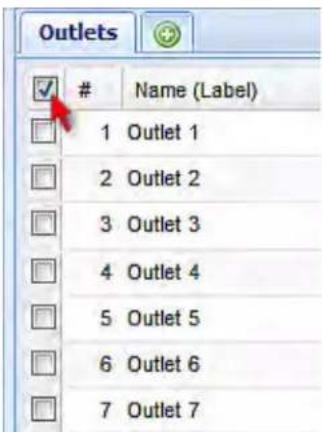
text_image
Outlets ✓ # Name (Label) 1 Outlet 1 2 Outlet 2 3 Outlet 3 4 Outlet 4 5 Outlet 5 6 Outlet 6 7 Outlet 7- To select multiple outlets, click the checkbox of each desired outlet one by one. Or press Shift while clicking on the rows of the first and last outlets to select a range of consecutive outlets.
-
To select a single outlet, select that outlet's checkbox.
-
Click On, Off, or Cycle.
-
A dialog for confirming the operation appears. Click Yes and all outlets switch ON, OFF, or cycle their power.
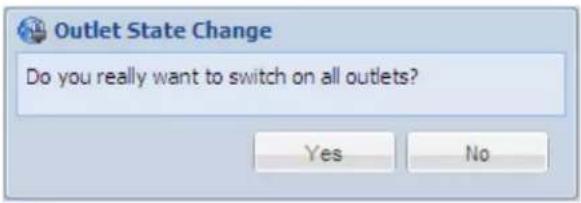
text_image
Outlet State Change Do you really want to switch on all outlets? Yes NoSwitching an Outlet
This section applies to outlet-switching capable models only.
You can turn on or off or power cycle any outlet regardless of the outlet's current state.
Power cycling the outlet(s) turns the outlet(s) off and then back on.
There are different ways to turn an outlet on or off, or cycle its power.
To control an outlet with a particular outlet icon selected:
- Expand the Outlets folder in the PX Explorer pane to show all outlets. See Expanding the Tree (on page 100).
- Click the outlet you want in the PX Explorer pane, and locate the Control section in the right pane.
- Click On, Off, or Cycle.
- A dialog for confirming the operation appears. Click Yes and the outlet switches ON, OFF, or cycles its power.
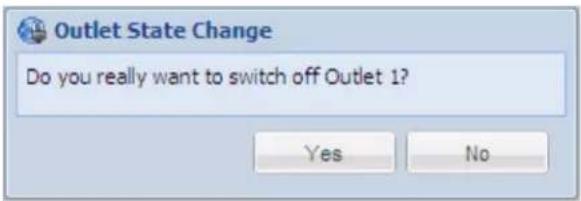
text_image
Outlet State Change Do you really want to switch off Outlet 1? Yes NoTo control an outlet with the Outlets folder icon selected:
- The procedure is similar to the one described in the section titled Switching Multiple or All Outlets (on page 197).
Stopping the Power-On Sequence
This section applies to outlet-switching capable models only.
The PX allows you to stop the outlet power-on sequence while all outlets are being turned on. This function is useful when you have set a certain power-on sequence and certain outlets' power-on delay timing causes it to take a long time to turn on the next outlets, but you do not intend to wait anymore.
To cancel the power-on process:
- Open the Outlets page to turn on ALL outlets. See Switching Multiple or All Outlets (on page 197).
- The Cancel button as shown below appears at the bottom of the Outlets page. The number in parentheses indicates how many outlets are not powered on yet.
Outlet sequence running (7 remaining) Cancel
- Click Cancel to immediately stop the power-on process.
Setting the Default Outlet State
This section applies to outlet-switching capable models only.
Default outlet state determines the initial power state of outlets after the PX device powers up. You can set up the default outlet state for all outlets or for a specific outlet. Note that the value set for an individual outlet always overrides the value set for all outlets.
After removing power from the PDU, you must wait for a minimum of 10 seconds before powering it up again. Otherwise, the default outlet state settings may not work properly.
Setting the PDU-Defined Default State
This section applies to outlet-switching capable models only.
This procedure sets the PDU-defined outlet state, which determines the initial power state of all outlets after powering up the PX device.
Tip: To set a different state on a particular outlet, see Setting the Outlet-Specific Default State (on page 200).
To set the default state for all outlets:
- Click the PDU folder.
Note: The folder is named "my PX" by default. The name can be customized.
- Click Setup in the Settings section. The Pdu Setup dialog appears.
-
In the "Outlet state on device startup" field, click the drop-down arrow and select an option from the list.
-
on: Turns on all outlets when the PX powers up.
- off: Turns off all outlets when the PX powers up.
-
last known: Restores all outlets to their previous power states before the PX was powered off.
-
Click OK.
Setting the Outlet-Specific Default State
This section applies to outlet-switching capable models only.
By default, the power state of each outlet follows the PDU-defined setting. Setting the default state of a particular outlet to a value other than "PDU defined" overrides the PDU-defined setting on that outlet.
To set the default power state for a specific outlet:
- Expand the Outlets folder in the PX Explorer pane to show all outlets. See Expanding the Tree (on page 100).
- In the PX Explorer pane, click the outlet you want. The page specific to that outlet opens in the right pane.
- Click Setup in the right pane. The setup dialog for the selected outlet appears.
Tip: Another way to trigger the same dialog is to use the Outlets page. Select the Outlets folder, highlight the outlet on the Outlets page and then click Setup at the bottom of the page.
-
In the "State on device startup" field, click the drop-down arrow and select an option from the list.
-
on: Turns on this outlet when the PX powers up.
- off: Turns off this outlet when the PX powers up.
- last known: Restores this outlet to the previous power state before the PX was powered off.
- PDU defined: The outlet's default power state is determined according to the PDU-defined state. See Setting the PDU-Defined Default State (on page 200).
Tip: The information in parentheses following the option "PDU defined" indicates the current PDU-defined selection.
- Click OK.
Changing the Cycling Power-Off Period
This section applies to outlet-switching capable models only.
Power cycling the outlet(s) turns the outlet(s) off and then back on. You can adjust the length of the time it takes for the outlets to turn back on after they are switched OFF.
The power-off period during the power cycle can be set for all outlets or for an individual outlet. Note that the value set for an individual outlet always overrides the value set for all outlets.
Changing the PDU-Defined Cycling Power-Off Period
This section applies to outlet-switching capable models only.
The "PDU-defined" power-off period determines how long it takes for ALL outlets to turn on after they are turned OFF during the power cycle. The default PDU-defined power-off period is 10 seconds (10 s).
Note: To set a different power-off period on a particular outlet, see Changing the Outlet-Specific Cycling Power-Off Period (on page 202).
To set the power-off period for all outlets:
- Click the PDU folder.
Note: The folder is named "my PX" by default. The name can be customized.
- Click Setup in the Settings section. The Pdu Setup dialog appears.
- In the "Power off period during power cycle" field, click the drop-down arrow and select an option from the list. Valid range is zero second to one hour.
Time units in the list are explained below:
■ s: second(s)
- min: minute(s)
■ h: hour(s)
You can also type a value if the desired time is not listed. For example, type "15 s" for 15 seconds.
- Click OK.
Tip: When there are a large number of outlets, set the value to a lower number so that you can avoid a long wait before all the outlets are available again.
Changing the Outlet-Specific Cycling Power-Off Period
This section applies to outlet-switching capable models only.
When the power cycling occurs, the default power-off period of each outlet follows the PDU-defined setting. You can adjust the power-off period of a particular outlet so that it is turned back on after a different power-off period.
Setting the power-off period for a particular outlet to a value other than "PDU defined" overrides the PDU-defined setting on that outlet.
To set the power-off period for a specific outlet:
- Expand the Outlets folder in the PX Explorer pane to show all outlets. See Expanding the Tree (on page 100).
- In the PX Explorer pane, click the outlet you want. The page specific to that outlet opens in the right pane.
- Click Setup in the right pane. The setup dialog for the selected outlet appears.
Tip: Another way to trigger the same dialog is to use the Outlets page. Select the Outlets folder, highlight the outlet on the Outlets page and then click Setup at the bottom of the page.
- In the "Power off period during power cycle" field, click the drop-down arrow and select an option from the list. Valid range is zero second to one hour.
Time units in the list are explained below:
■ s: second(s)
- min: minute(s)
■ h: hour(s)
- To make the outlet's power-off period identical to the PDU-defined setting, select the "PDU defined" option. See Changing the PDU-Defined Cycling Power-Off Period (on page 201).
Tip: The information in parentheses following the option "PDU defined" indicates the current PDU-defined selection.
You can also type a value if the desired time is not listed. For example, type "15 s" for 15 seconds.
- Click OK.
Setting the Initialization Delay
This section applies to outlet-switching capable models only.
The outlet initialization delay determines how long the PX device waits before providing power to all outlets during power cycling or after recovering from a temporary power loss. This is useful in cases where power may not initially be stable after being restored, or when UPS batteries may be charging.
To set the initialization delay for all outlets:
- Click the PDU folder.
Note: The folder is named "my PX" by default. The name can be customized.
- Click Setup in the Settings section. The Pdu Setup dialog appears.
- In the "Outlet initialization delay on device startup" field, click the drop-down arrow and select an option from the list. Valid range is 1 second to 1 hour.
Time units in the list are explained below:
■ s: second(s)
- min: minute(s)
■ h: hour(s)
You can also type a value if the desired time is not listed. For example, type "15 s" for 15 seconds.
- Click OK.
Tip: When there are a large number of outlets, set the value to a lower number so that you can avoid a long wait before all the outlets are available again.
Setting the Inrush Guard Delay
This section applies to outlet-switching capable models only.
When electrical devices are turned on, they can initially draw a very large current known as inrush current. Inrush current typically lasts for 20-40 milliseconds. The inrush guard delay feature prevents a circuit breaker trip due to the combined inrush current of many devices turned on at the same time. For example, if the inrush guard delay is set to 100 milliseconds and two or more outlets are turned on at the same time, the PDU will sequentially turn the outlets on with a 100 millisecond delay occurring between each one.
To set the inrush guard delay time:
- Click the PDU folder.
Note: The folder is named "my PX" by default. The name can be customized.
-
Click Setup in the Settings section. The Pdu Setup dialog appears.
-
In the Inrush Guard Delay field, click the drop-down arrow and select an option from the list. Valid range is from 100 milliseconds to 100 seconds.
Time units in the list are explained below:
■ ms: millisecond(s)
■ s: second(s)
You can also type a value if the desired time is not listed. For example, type "15 s" for 15 seconds.
- Click OK.
Setting the Outlet Power-On Sequence
This section applies to outlet-switching capable models only.
By default, the outlets are sequentially powered on in ascending order from outlet 1 to the highest-numbered outlet when turning ON or power cycling all outlets on the PX device. You can change the order in which the outlets power ON. This is useful when there is a specific order in which the connected IT equipment should be powered up.
To set the outlet power-on sequence:
-
Trigger the Outlet Sequence Setup dialog by doing either of the following:
-
Click the Outlets folder, and the Outlets page opens in the right pane. Click Sequence Setup.
- Click the PDU folder, and then the Setup button in the Outlet Sequence section.
Note: The folder is named "my PX" by default. The name can be customized.
The Outlet Sequence Setup dialog appears, with the current power-up sequence indicated by the outlet order in the list.
- To change the priority of an outlet, select it from the list and click one of the following buttons.
■ Moves the outlet to the top of the list, making it the first outlet to receive power.
■ Moves the outlet up one position in the list.
■ : Moves the outlet down one position in the list.
■ Moves the outlet to the bottom of the list, making it the final outlet to receive power.
■: Restores the list to the default power-up sequence, that is, the ascending order.
- Click OK.
Next time when power cycling the PX, it will turn on all outlets based on the new order of the list.
Setting the Outlet-Specific Power-On Delay
This section applies to outlet-switching capable models only.
You can make a power-on delay occur between two outlets that are turned on consecutively when the PX turns on all outlets.
For example, if the power-up sequence is Outlet 1 through Outlet 12, and you want the PX to wait for 5 seconds after turning on Outlet 3 before turning on Outlet 4, assign a delay of 5 seconds on Outlet 3.
To set the outlet-specific power-on delay:
-
Trigger the Outlet Sequence Setup dialog by doing either of the following:
-
Click the Outlets folder, and the Outlets page opens in the right pane. Click Sequence Setup.
- Click the PDU folder, and then the Setup button in the Outlet Sequence section.
Note: The folder is named "my PX" by default. The name can be customized.
- Click the Delay column of the outlet where a delay is intended after this outlet is turned on, delete the existing value and type a new number in seconds. The number can be a decimal number.
- To disable the delay, simply type the number 0 (zero).
- Repeat the above step to change the delay settings of additional outlets.
- Click OK.
Setting Non-Critical Outlets and Load Shedding Mode
This section applies to outlet-switching capable models only.
When a UPS supplying power to the PX switches into battery backup operation, it may be desirable to switch off non-critical outlets to conserve UPS battery life. This feature is known as load shedding.
Activation of load shedding can be accomplished using the web interface, SNMP or CLI, or triggered by the contact closure sensors.
Outlets that are turned off when load shedding is activated are called non-critical. Outlets that are not affected by load shedding are called critical outlets. When load shedding is deactivated, the PX will turn back on all non-critical outlets. By default, all outlets are configured as critical until you configure them otherwise.
Marking All Outlets
This section applies to outlet-switching capable models only.
You can configure all critical and non-critical outlets at a time.
To mark all outlets at a time:
- Click the PDU folder.
Note: The folder is named "my PX" by default. The name can be customized.
- Click Setup in the Load Shedding section. The Load Shedding Setup dialog appears.
Tip: Another way to trigger the same dialog is to use the Outlets page. Select the Outlets folder, and then click the Setup button near the Load Shedding section at the lower left corner of the page.
- To mark an outlet as "non-critical," select it from the "Critical outlets" list box, and click ✿ to move it to the "Non-critical outlets" list box. To make multiple selections, press Ctrl+click or Shift+click to highlight multiple ones.
To move all outlets in the "Critical outlets" list box to the "Non-critical outlets" list box, click 📄.
- To mark an outlet as "critical," select it from the "Non-critical outlets" list box, and click → to move it to the "Critical outlets" list box. To make multiple selections, press Ctrl+click or Shift+click to highlight multiple ones.
To move all outlets in the "Non-critical outlets" list box to the "Critical outlets" list box, click 📄.
- Click OK.
Marking an Outlet
This section applies to outlet-switching capable models only.
You can also choose to mark a specific outlet as a critical or non-critical outlet in its setup dialog.
To mark an outlet:
-
Expand the Outlets folder in the PX Explorer pane to show all outlets. See Expanding the Tree (on page 100).
-
In the PX Explorer pane, click the outlet you want. The page specific to that outlet opens in the right pane.
-
Click Setup in the right pane. The setup dialog for the selected outlet appears.
Tip: Another way to trigger the same dialog is to use the Outlets page. Select the Outlets folder, highlight the outlet on the Outlets page and then click Setup at the bottom of the page.
- In the Non Critical field, select an option from the drop-down list.
■ True: This option marks the outlet as a non-critical outlet.
- False: This option marks the outlet as a critical outlet.
- Click OK.
Activating or Deactivating the Load Shedding Mode
This section applies to outlet-switching capable models only.
When entering the load shedding mode, PX turns OFF all non-critical outlets.
When exiting from the load shedding mode, PX turns ON all non-critical outlets that were ON before entering the load shedding mode.
You can activate or deactivate this mode from the PDU or Outlets page.
To enter or exit from the load shedding mode from the PDU page:
- Click the PDU folder.
Note: The folder is named "my PX" by default. The name can be customized.
- In the Load Shedding section, click Start to enter the load shedding mode or Stop to deactivate the mode.
- You are then prompted to confirm this operation.
If you chose to activate the mode in the previous step, click Yes to turn off all non-critical outlets. If you chose to deactivate the mode, click Yes to turn on all non-critical outlets that were previously ON prior to the load shedding mode.
To enter or exit from the load shedding mode from the Outlets page:
- Expand the PDU folder in the PX Explorer pane if necessary. See Expanding the Tree (on page 100).
-
Click the Outlets folder, and the Outlets page opens in the right pane.
-
To enter the load shedding mode, click Start near the Load Shedding section at the lower left corner of the page. To exit from the load shedding mode, click Stop.
- You are then prompted to confirm this operation.
If you chose to activate the mode in the previous step, click Yes to turn off all non-critical outlets. If you chose to deactivate the mode, click Yes to turn on all non-critical outlets that were previously ON prior to the load shedding mode.
Note: During the load shedding mode, this icon 🙏 appears on all non-critical outlets on the Outlets page, and you CANNOT turn on any of them.
Resetting Outlet Active Energy Readings
You can reset the active energy readings of either one outlet or multiple outlets at a time.
Only users with the "Admin" role assigned can reset active energy readings.
To reset active energy readings of one outlet:
- Expand the Outlets folder in the PX Explorer pane to show all outlets. See Expanding the Tree (on page 100).
- In the PX Explorer pane, select the outlet whose active energy you want to reset.
- Click Reset Active Energy in the Sensors section.
- Click Yes on the confirmation message. The "Active Energy" reading of the selected outlet now shows 0 (zero) Wh.
To reset active energy readings of multiple or all outlets:
- Click the Outlets folder to open the Outlets page.
- On the Outlets page, select the checkboxes of the outlets whose active energy you want to reset.
- To select multiple outlets, click the checkbox of each desired outlet one by one. Or press Shift while clicking on the rows of the first and last outlets to select a range of consecutive outlets.
- To select all outlets, select the top checkbox in the header row.
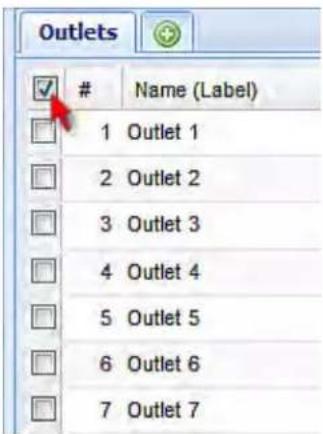
text_image
OutletsName (Label)
1 Outlet 1 2 Outlet 2 3 Outlet 3 4 Outlet 4 5 Outlet 5 6 Outlet 6 7 Outlet 7- Click Reset Active Energy at the bottom of the page.
- Click Yes on the confirmation message. The "Active Energy" readings of all selected outlets are now reset to 0 (zero) Wh.
Enabling Front Panel Outlet Switching
This section applies to outlet-switching capable models only.
You can operate the front panel buttons to switch on or off an outlet. By default, this function is disabled.
To enable the front panel outlet switching function:
- Choose Device Settings > Security > Front Panel Permissions. The Front Panel Permissions dialog appears.
- Select the "Outlet switching" checkbox.
- Click OK.
Inlet and Overcurrent Protector Management
You can name each inlet and overcurrent protector or monitor the inlet status. Or you can reset the inlet's active energy reading.
Note: To configure power thresholds, see Setting Power Thresholds (on page 215).
Naming the Inlet
You can customize the inlet's name for your own purpose. For example, you can name an inlet to identify its power source. The customized name is followed by the label in parentheses.
Note: In this context, the label refers to the inlet number, such as 11.
This function is especially useful if there are multiple inlets on your PX device.
To name the inlet:
- Click Inlet I1 in the PX Explorer pane, and the Inlet I1 page opens in the right pane.
- Click Setup. The Inlet I1 Setup dialog appears.
- Type a new name in the Name field.
- Click OK.
Naming Overcurrent Protectors
You can name each overcurrent protector for easily identifying them. The customized name is followed by the label in parentheses.
Note: In this context, a label is an overcurrent protector number, such as C1 for a circuit breaker or F1 for a fuse.
To name an overcurrent protector:
- Expand the Overcurrent Protectors folder in the PX Explorer pane if needed. See Expanding the Tree (on page 100).
- In the PX Explorer pane, click the desired overcurrent protector. The page specific to that overcurrent protector opens in the right pane.
- Click Setup. The Overcurrent Protector Setup dialog appears.
Tip: You can also trigger the same dialog by selecting the Overcurrent Protectors folder, then selecting an overcurrent protector and clicking Setup on the Overcurrent Protectors page.
-
Type a new name in the Name field.
-
Click OK.
Monitoring the Inlet
You can view the inlet's details, including its:
■ Label (number)
- Customized name
- Inlet sensor readings:
- RMS current per line (A)
- RMS voltage per line pair (V)
- Active power (W)
- Apparent power (VA)
- Power factor
- Active energy (Wh)
- Unbalanced load percentage (for 3-phase models)
- Line frequency (Hz), if available on your PDU
Note: If a sensor row is colored, it means the sensor reading already crosses one of the thresholds or the sensor enters the alarmed state.
See The Yellow- or Red-Highlighted Sensors (on page 105).
There are two ways to access the inlet information.
To get the overview of the inlet status:
-
Click the Dashboard icon in the PX Explorer pane, and the Dashboard page opens in the right pane.
-
Locate the Inlet section on the Dashboard page.
To view the inlet's details:
Click Inlet I1 in the PX Explorer pane, and the Inlet I1 page opens in the right pane.
Monitoring Overcurrent Protectors
Each overcurrent protector on the PX device delivers power to a bank of outlets, and draws power from one or two lines.
You can view the overcurrent protector's details, including its:
- Label (number)
Name
■ Status (closed/open)
Type
■ Lines associated with this overcurrent protector - Outlets protected by this overcurrent protector
■ Sensor readings:
- Current drawn (A)
- Current remaining (A)
Note: If a sensor row is colored, it means the sensor reading already crosses one of the thresholds, the sensor enters an alarmed state, or the overcurrent protector has tripped or blown. See The Yellow- or Red-Highlighted Sensors (on page 105).
You can view the summary of all overcurrent protectors at a time or the status of individual overcurrent protectors.
To view all overcurrent protectors' status:
You can check the status of all overcurrent protector at a time via either the Dashboard or Overcurrent Protectors page.
- Using the Dashboard page:
a. Click the Dashboard icon in the PX Explorer pane, and the Dashboard page opens in the right pane.
b. Locate the Overcurrent Protectors section on the Dashboard page. - Using the Overcurrent Protectors page:
a. Expand the PDU folder in the PX Explorer pane if necessary. See Expanding the Tree (on page 100).
b. Click Overcurrent Protectors in the PX Explorer pane to open the Overcurrent Protectors page.
To view an overcurrent protector's details:
- Expand the Overcurrent Protectors folder in the PX Explorer pane if needed. See Expanding the Tree (on page 100).
- In the PX Explorer pane, click the desired overcurrent protector. The page specific to that overcurrent protector opens in the right pane.
Resetting Inlet Active Energy Readings
You can manually reset the active energy readings of an individual inlet instead of resetting all active energy readings of the PDU. This is especially useful when your PX has more than one inlet.
Only users with the "Admin" role assigned can reset active energy readings.
To reset active energy readings of one inlet:
- If your PX has multiple inlets, expand the Inlet folder in the PX Explorer pane to show all inlets. See Expanding the Tree (on page 100). If your PX has only one inlet, skip this step.
- Select the inl et whose active energy you want to reset.
-
Click Reset Active Energy in the Power section.
-
Click Yes on the confirmation message. The 'Active Energy' reading of the selected inlet now shows 0 (zero) Wh.
Tip: You can reset all active energy readings at a time. See Resetting All Active Energy Readings (on page 151).
Disabling an Inlet (for Multi-Inlet PDUs)
The PX, if it has more than one inlet, enables all inlets by default so that the PX detects and displays all sensors' readings and states, and reports or shows warnings, events or alarm notifications associated with all inlets, outlets and overcurrent protectors (if available).
After disabling an inlet, the following information or feature is no longer available:
- All of the sensor readings, states, warnings, event or alarm notifications associated with the disabled inlet
- All of the sensor readings, states, warnings, event or alarm notifications for the outlets and overcurrent protectors associated with the disabled inlet
- The outlet-switching functionality, if available, for those outlets associated with the disabled inlet
Exception: All active energy sensors continue to accumulate data regardless of whether any inlet has been disabled.
Warning: A disabled inlet, if remaining connected to a power source, continues to receive power from the connected power source and supplies power continuously to the associated outlets and overcurrent protectors.
▶ To disable an inlet:
- Click the Inlets folder in the PX Explorer pane, and the Inlets page opens in the right pane.
- Select the inlet that you want to disable.
- Click Setup.
- Select the "Disable this inlet" checkbox.
-
To disable additional inlets, repeat the above steps.
-
If disabling an inlet will result in all inlets being disabled, a confirmation dialog appears, indicating that all inlets will be disabled. Then click Yes to confirm this operation or No to abort it.
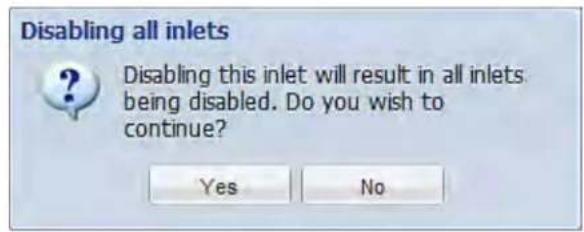
text_image
Disabling all inlets ? Disabling this inlet will result in all inlets being disabled. Do you wish to continue? Yes NoSetting Power Thresholds
Setting and enabling the thresholds causes the PX to generate alert notifications when it detects that any component's power state crosses the thresholds. See The Yellow- or Red-Highlighted Sensors (on page 105).
There are four thresholds for each sensor: Lower Critical, Lower Warning, Upper Warning and Upper Critical.
- Upper and Lower Warning thresholds indicate the sensor reading enters the warning level.
- Upper and Lower Critical thresholds indicate the sensor reading enters the critical level.
To avoid generating a large amount of alert events, you can set the assertion timeout and deassertion hysteresis.
For detailed information, see Sensor Threshold Settings (on page 648).
Note: After setting the thresholds, remember to configure event rules. See Event Rules and Actions (on page 222).
Setting an Outlet's Thresholds
You can set up the thresholds, deassertion hysteresis and assertion timeout for a particular outlet.
The threshold values set for an individual outlet will override the bulk threshold values stored on that outlet. See Bulk Configuration for Outlet Thresholds (on page 216).
To set the thresholds for an outlet:
- Expand the Outlets folder in the PX Explorer pane to show all outlets. See Expanding the Tree (on page 100).
-
In the PX Explorer pane, click the outlet you want. The page specific to that outlet opens in the right pane.
-
Click Setup in the right pane. The setup dialog for the selected outlet appears.
Tip: Another way to trigger the same dialog is to use the Outlets page. Select the Outlets folder, highlight the outlet on the Outlets page and then click Setup at the bottom of the page.
- In the Threshold Configuration table, click the sensor whose thresholds you want to configure.
- Click Edit or double-click the desired sensor. A threshold setup dialog appears.
-
Configure the Lower Critical, Lower Warning, Upper Warning and Upper Critical thresholds respectively.
-
To enable any threshold, select the corresponding checkbox. To disable a threshold, deselect the checkbox.
-
After any threshold is enabled, type an appropriate numeric value in the accompanying text box.
-
To set the deassertion hysteresis, type a numeric value in the Deassertion Hysteresis field. See "To De-assert" and Deassertion Hysteresis (on page 653).
- To set the as section timeout, type a numeric value in the Assertion Timeout (samples) field. See "To Assert" and Assertion Timeout (on page 651).
- Click OK in the threshold setup dialog to retain the changes.
- To set the thresholds for other sensors, repeat Steps 4 to 9.
- Click OK.
Important: The final step is required or the threshold changes are not saved.
Bulk Configuration for Outlet Thresholds
The PX allows you to set the power thresholds for multiple outlets at a time so that you can save time when configuring a number of outlet thresholds.
Note: To set the power thresholds for an individual outlet, you can either follow the instructions below or those described in the section Setting an Outlet's Thresholds (on page 215).
To configure thresholds, deassertion hysteresis and assertion timeout for multiple outlets:
- Expand the PDU folder in the PX Explorer pane if necessary. See Expanding the Tree (on page 100).
Note: The folder is named "my PX" by default. The name can be customized.
- Click the Outlets folder. The Outlets page opens.
- Click Bulk Setup. The Outlet Threshold Bulk Setup dialog appears, with a list of all outlets.
- In the "Show Outlet Sensors of Type" field, select the type of power thresholds you want to configure.
- In the "For Outlets of Receptacle Type" field, select the receptacle type you want to configure.
All outlets of the selected receptacle type are then listed.
- To show all outlets on the PX regardless of receptacle types, select Any.
- Select desired outlets by having their corresponding checkboxes selected.
- To select all outlets in the list, select the checkbox labeled Sensor in the header row, and all checkboxes are selected.
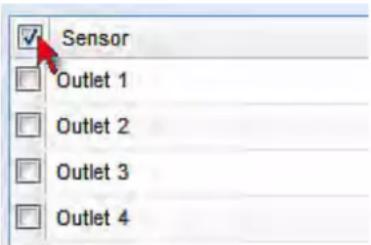
text_image
Sensor Outlet 1 Outlet 2 Outlet 3 Outlet 4- To select partial outlets, select the corresponding checkboxes of those outlets by clicking their checkboxes.
-
To deselect any outlet, just click the checkbox once again.
-
Click Edit Thresholds. The threshold bulk setup dialog appears.
- Configure the Lower Critical, Lower Warning, Upper Warning and Upper Critical thresholds respectively.
- To enable any threshold, select the corresponding checkbox. To disable a threshold, deselect the checkbox.
- After any threshold is enabled, type an appropriate numeric value in the accompanying text box.
- To set the deassertion hysteresis, type a numeric value in the Deassertion Hysteresis field. See "To De-assert" and Deassertion Hysteresis (on page 653).
- To set the assertion timeout, type a numeric value in the Assertion Timeout (samples) field. See "To Assert" and Assertion Timeout (on page 651).
- Click OK.
Setting Inlet Thresholds
You can set the inlet thresholds so that the alerts are generated when the inlet current and/or voltage crosses the thresholds.
▶ To set the inlet thresholds:
- Click Inlet I1 in the PX Explorer pane, and the Inlet I1 page opens in the right pane.
- Click Setup. The Inlet I1 Setup dialog appears.
- In the Threshold Configuration table, click the sensor whose thresholds you want to configure.
- Click Edit or double-click the desired sensor. A threshold setup dialog appears.
- Configure the Lower Critical, Lower Warning, Upper Warning and Upper Critical thresholds respectively.
- To enable any threshold, select the corresponding checkbox. To disable a threshold, deselect the checkbox.
■ After any threshold is enabled, type an appropriate numeric value in the accompanying text box. - To set the deassertion hysteresis, type a numeric value in the Deassertion Hysteresis field. See "To De-assert" and Deassertion Hysteresis (on page 653).
- To set the assertion timeout, type a numeric value in the Assertion Timeout (samples) field. See "To Assert" and Assertion Timeout (on page 651).
- Click OK in the threshold setup dialog to retain the changes.
- To set the thresholds for other sensors, repeat Steps 4 to 8.
- Click OK.
Important: The final step is required or the threshold changes are not saved.
Setting an Overcurrent Protector's Thresholds
Setting the overcurrent protector thresholds enables the PX to generate alerts when any overcurrent protector crosses the thresholds.
To set thresholds for an overcurrent protector:
- Expand the Overcurrent Protectors folder in the PX Explorer pane if needed. See Expanding the Tree (on page 100).
-
In the PX Explorer pane, click the desired overcurrent protector. The page specific to that overcurrent protector opens in the right pane.
-
Click Setup. The Overcurrent Protector Setup dialog appears.
- In the Threshold Configuration table, click the sensor whose thresholds you want to configure.
- Click Edit or double-click the desired sensor. A threshold setup dialog appears.
-
Configure the Lower Critical, Lower Warning, Upper Warning and Upper Critical thresholds respectively.
-
To enable any threshold, select the corresponding checkbox. To disable a threshold, deselect the checkbox.
■ After any threshold is enabled, type an appropriate numeric value in the accompanying text box. -
To set the deassertion hysteresis, type a numeric value in the Deassertion Hysteresis field. See "To De-assert" and Deassertion Hysteresis (on page 653).
- To set the assertion timeout, type a numeric value in the Assertion Timeout (samples) field. See "To Assert" and Assertion Timeout (on page 651).
- Click OK.
Bulk Configuration for Overcurrent Protector Thresholds
The PX allows you to set power thresholds for multiple overcurrent protectors at a time to save your time.
Note: To set the power thresholds for an individual overcurrent protector, you can either follow the instructions below or those described in the section Setting an Overcurrent Protector's Thresholds (on page 218).
To configure thresholds, deassertion hysteresis and assertion timeout for multiple overcurrent protectors:
- Click the Overcurrent Protectors folder in the PX EXplorer pane. The Overcurrent Protectors page opens.
- Click Bulk Setup. The Overcurrent Protector Threshold Bulk Setup dialog appears, with a list of all overcurrent protectors.
- Select desired overcurrent protectors by having their corresponding checkboxes selected.
- To select all overcurrent protectors, select the checkbox labeled Sensor in the header row, and all checkboxes are selected.

text_image
Sensor Overcurrent Protector C1 RMS Current Overcurrent Protector C2 RMS Current- To select partial overcurrent protectors, click the corresponding checkboxes of those overcurrent protectors.
-
To deselect any overcurrent protectors, just click their checkboxes once again.
-
Click Edit Thresholds. The threshold bulk setup dialog appears.
- Configure the Lower Critical, Lower Warning, Upper Warning and Upper Critical thresholds respectively.
- To enable any threshold, select the corresponding checkbox. To disable a threshold, deselect the checkbox.
■ After any threshold is enabled, type an appropriate numeric value in the accompanying text box.
- To set the deassertion hysteresis, type a numeric value in the Deassertion Hysteresis field. See "To De-assert" and Deassertion Hysteresis (on page 653).
- To set the assertion timeout, type a numeric value in the Assertion Timeout (samples) field. See "To Assert" and Assertion Timeout (on page 651).
- Click OK.
Setting Thresholds for Total Active Energy or Power
This section applies only to multi-inlet models, including PX in-line monitors.
Thresholds for total active energy and total active power are disabled by default. You can enable and set them so that you are alerted when the total active energy or total active power hits a certain level.
For a regular PX model with multiple inlets:
• Total active energy = sum of all inlets' active energy values
• Total active power = sum of all inlets' active power values
For an in-line monitor with multiple inlets/outlets:
• Total active energy = sum of all outlets' active energy values
- Total active power = sum of all outlets' active power values
Tip: You can reset the active energy sensor(s) as needed. See Resetting All Active Energy Readings (on page 151).
To set thresholds for total active energy and/or power on a multi-inlet PX:
- Click the PDU folder.
Note: The folder is named "my PX" by default. The name can be customized.
- Click Setup in the Settings section. The Pdu Setup dialog appears.
- In the Threshold Configuration table, click the sensor whose thresholds you want to configure.
- Click Edit or double-click the desired sensor. A threshold setup dialog appears.
- Configure the Lower Critical, Lower Warning, Upper Warning and Upper Critical thresholds respectively.
- To enable any threshold, select the corresponding checkbox. To disable a threshold, deselect the checkbox.
■ After any threshold is enabled, type an appropriate numeric value in the accompanying text box.
- To set the deassertion hysteresis, type a numeric value in the Deassertion Hysteresis field. See "To De-assert" and Deassertion Hysteresis (on page 653).
- To set the assertion timeout, type a numeric value in the Assertion Timeout (samples) field. See "To Assert" and Assertion Timeout (on page 651).
- Click OK.
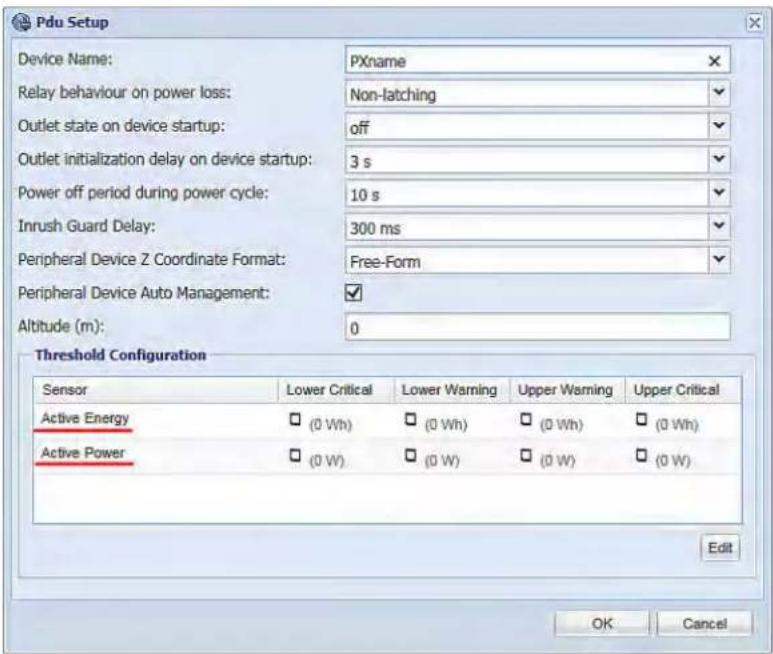
text_image
Pdu Setup Device Name: PXname Relay behaviour on power loss: Non-latching Outlet state on device startup: off Outlet initialization delay on device startup: 3 s Power off period during power cycle: 10 s Inrush Guard Delay: 300 ms Peripheral Device Z Coordinate Format: Free-Form Peripheral Device Auto Management: Altitude (m): 0 Threshold Configuration Sensor Lower Critical Lower Warning Upper Warning Upper Critical Active Energy (0 Wh) (0 Wh) (0 Wh) (0 Wh) Active Power (0 W) (0 W) (0 W) (0 W) Edit OK CancelEvent Rules and Actions
A benefit of the product's intelligence is its ability to notify you of and react to a change in conditions. This event notification or reaction is an "event rule."
The PX is shipped with four built-in event rules, which cannot be deleted.
- System Event Log Rule: This causes ANY event occurred to the PX to be recorded in the internal log. It is enabled by default.
- System SNMP Notification Rule: This causes SNMP traps or informs to be sent to specified IP addresses or hosts when ANY event occurs to the PX. It is disabled by default.
- System Tamper Detection Alarmed: This causes the PX to send alarm notifications if a DX tamper sensor has been connected and the PX detects that the tamper sensor enters the alarmed state.
- System Tamper Detection Unavailable: This causes the PX to sends alarm notifications if a DX tamper sensor has been connected and the PX detects that the communication with the connected tamper sensor is lost.
If these do not satisfy your needs, you can create additional rules to respond to different events. You need the Administrator Privileges to configure event rules.
Note: Internet Explorer ^® 8 (IE8) does not use compiled JAVA script. When using IE8 to create or change event rules, the CPU performance may be degraded, resulting in the appearance of the connection time out message. When this occurs, click Ignore to continue.
Components of an Event Rule
An event rule defines what the PX does in certain situations and is composed of two parts:
- Event: This is the situation where the PX or part of it meets a certain condition. For example, the inlet's voltage exceeds the warning threshold.
- Action: This is the response to the event. For example, the PX notifies the system administrator of the event and records the event in the log.
Creating an Event Rule
The best way to create a new set of event rules in sequence is to:
- Create actions for responding to one or multiple events
- Create rules to determine what actions are taken when these events occur
Creating Actions
The PX comes with three built-in actions:
- System Event Log Action: This action records the selected event in the internal log when the event occurs.
- System SNMP Notification Action: This action sends SNMP notifications to one or multiple IP addresses after the selected event occurs.
- System Tamper Alarm: This action causes the PX to show the alarm for the DX tamper sensor in the Alarms section of the Dashboard until a person acknowledges it. By default, this action has been assigned to the built-in tamper detection event rules. For information on acknowledging an alarm, see Alarms List (on page 110).
Note: No IP addresses are specified in the "System SNMP Notification Action" by default so you must specify IP addresses before applying this action to any event rule.
The built-in actions cannot be deleted.
To create new actions:
- Choose Device Settings > Event Rules. The Event Rule Settings dialog appears.
- Click the Actions tab.
- Click New.
- In the "Action name" field, type a new name for the action. The default name is New Action
, where is a sequential number starting at 1. - In the Action field, click the drop-down arrow and select the desired action:
| Action Function | |
| Execute an action group | Creates a group of actions comprising existing actions. See Action Group (on page 225). |
| Alarm Requires the user to acknowledge the alert when it is generated. If needed, you can have the alert notifications regularly generated until a person takes the acknowledgment action. See Alarm (on page 226). | |
| External beeper Enables or disables the connected external beeper, or causes it to enter an alarm cycle. See External Beeper (on page 227). | |
| Log event message Records the selected events in the internal log. See Log an Event Message (on page 228). | |
| Push out sensor readings | Sends asset management sensor data to a remote server using HTTP POST requests. See Push Out Sensor Readings (on page 229). |
| Request LHX/SHX maximum cooling | Applies the maximum cooling to the LHX/SHX device. See Request LHX/SHX Maximum Cooling (on page 229).This option is available only when the Schroff LHX/SHX support has been enabled. |
| Send snapshots via email | Emails the snapshots captured by a connected Logitech® webcam (if available). See Send a Snapshot via Email (on page 230). |
| Send email Emails a textual message. See Send EMail (on page 231). | |
| Send SNMP notification | Sends SNMP traps or informs to one or multiple SNMP destinations. See Send an SNMP Notification (on page 232). |
| Syslog message Makes the PX automatically forward event messages to the specified syslog server. See Syslog Message (on page 234). | |
| Send sensor report Reports the readings or status of the selected sensors, including internal or external sensors. See Send Sensor Report (on page 236). | |
| Send SMS message Sends a message to a mobile phone. See Send SMS Message (on page 238). | |
| Internal beeper Turns on or off the internal beeper. See Internal Beeper (on page 239). | |
| Switch LHX/SHX Switches on or off the LHX/SHX device. See Switch LHX/SHX (on page 239).This option is available only when the Schroff LHX/SHX support has been enabled. | |
| Record snapshots to webcam storage | Makes a connected webcam start or stop taking snapshots. See Record Snapshots to Webcam Storage (on page 241). |
| Change load shedding state | Enters or quits the load shedding mode. See Change Load Shedding State (on page 237). |
| Switch outlets Switches on, off or cycles the power to the specified outlet(s). See Switch Outlets (on page 240). | |
| Switch peripheral actuator | Switches on or off the mechanism or system connected to the specified actuator. SeeSwitch Peripheral Actuator(on page 241). |
Note: The "Change load shedding state" and "Switch outlets" options are only available for outlet-switching capable models.
- Click OK to save the new action.
Note: If you do not click OK before quitting the current settings page, a message appears. Then click Yes to save the changes, Discard to abort or Cancel to return to the current settings page.
- To create additional actions, repeat the above steps.
- Click Close to quit the dialog.
Action Group
You can create an action group that performs up to 32 actions. After creating such an action group, you can easily assign this set of actions to an event rule rather than selecting all needed actions one by one per rule.
▶ To create an action group:
- Choose Device Settings > Event Rules. The Event Rule Settings dialog appears.
- Click the Actions tab.
- Click New.
- In the "Action name" field, type a new name for the action. The default name is New Action
, where is a sequential number starting at 1. - In the Action field, click the drop-down arrow and select the desired action: Execute an action group.
- To mark an action as part of the action group, select it from the Available Actions list box, and click 🧑 to move it to the Used Actions list box. To make multiple selections, press Ctrl+click or Shift+click to highlight multiple ones.
To move all actions to the Used Actions list box, click 📄. A maximum of 32 actions can be grouped.
- To remove an action from the action group, select it from the Used Actions list box, and click 📋 to move it to the Available Actions list box. To make multiple selections, press Ctrl+click or Shift+click to highlight multiple ones.
To remove all actions, click

- Click OK.
- To create additional action groups, repeat Steps 3 to 8.
Alarm
The Alarm is an action that requires users to acknowledge an alert. This helps ensure that the user is aware of the alert.
If the Alarm action has been included in a specific event rule and no one acknowledges that alert after it occurs, the PX resends or regenerates an alert notification regularly until the alert is acknowledged or it reaches the maximum number of alert notifications.
For information on acknowledging an alarm, see Alarms List (on page 110).
▶ To create an Alarm action:
- Click the Actions tab.
- Click New.
- In the "Action name" field, type a new name for the action. The default name is New Action
, where is a sequential number starting at 1. - In the Action field, click the drop-down arrow and select the desired action: Alarm.
- In the Alarm Notifications list box, specify one or multiple ways to issue the alert notifications.
a. In the Available Actions field, select the method to send alert notifications. Available methods vary, depending on how many notification-based actions have been created.
Notification-based action types include:
■ External beeper
- Syslog message
- Send email
- Send SMS message
- Internal beeper
If no appropriate actions are available, click Create New Notification Action to immediately create them.
b. Click 📋 to add the selected method to the Alarm Notifications list box.
c. Repeat the above steps to add more methods if needed.
- To remove any method from the Alarm Notifications list box, select that method and click [ICON].
- In the Notification Options section, configure the notification-resending or -regenerating feature.
a. To enable the notification-resending feature, select the "Enable re-scheduling of alarm notifications" checkbox. To disable this feature, deselect the checkbox.
b. In the "Period in Minutes" field, specify the time interval (in minutes) at which the alert notification is resent or regenerated regularly. You can either directly type a numeric value or click the Up/Down arrow keys to adjust the time.
c. In the "Max. numbers" field, specify the maximum number of times the alert notification is resent. Values range from 1 to infinite.
- If needed, you can instruct the PX to send the acknowledgment notification after the alarm is acknowledged in the Acknowledgment Notifications list box. (Optional)
a. In the Available Actions field, select the method to send the acknowledge notification. Available methods are identical to those for generating alarm notifications.
b. Click 📋 to add the selected method to the Acknowledgment Notifications list box.
c. Repeat the above steps to add more methods if needed.
- To remove any method from the Acknowledgment
Notifications list box, select that method and click

- Click OK.
External Beeper
If an external beeper is connected to the PX, the PX can change the beeper's behavior or status to respond to a certain event.
To control the connected external beeper:
- Click the Actions tab.
- Click New.
- In the "Action name" field, type a new name for the action. The default name is New Action
, where is a sequential number starting at 1. -
In the Action field, click the drop-down arrow and select the desired action: External beeper.
-
From the Beeper Port drop-down list, select the port where the external beeper is connected. This port is the FEATURE port.
-
From the Beeper Action drop-down list, select an action for the external beeper to carry out.
-
Alarm: Causes the external beeper to sound an alarm cycle every 20 seconds - stays on for 0.7 seconds and then off for 19.3 seconds.
- On: Turns on the external beeper so that it buzzes continuously.
-
Off: Turns off the external beeper so that it stops buzzing.
-
Click OK.
Note: If you create an event rule for the external beeper but disconnect it when an event causes it to beep, the beeper no longer beeps after it is re-connected even though the event triggering the beeping action remains asserted.
Log an Event Message
This option records the selected events in the internal log.
To create a log event message:
- Choose Device Settings > Event Rules. The Event Rules Settings dialog opens.
- Click the Actions tab.
- Click New.
- In the "Action name" field, type a new name for the action. The default name is New Action
, where is a sequential number starting at 1. - In the Action field, click the drop-down arrow and select the desired action: Log event message.
- Click OK.
Push Out Sensor Readings
If you have connected Raritan's asset sensors to the PX, you can configure the PX to push asset sensor data to a remote server after a certain event occurs.
Before creating this action, make sure that you have properly defined the destination servers and the sensor data type in the Data Push dialog. See Configuring Data Push Settings (on page 149).
Tip: To send the asset sensor data at a regular interval, schedule this action. See Scheduling an Action (on page 248). Note that the "Asset management log" is generated only when there are changes made to any asset sensors or asset tags, such as connection or disconnection events.
▶ To push out the sensor data:
-
Choose Device Settings > Event Rules. The Event Rules Settings dialog opens.
-
Click the Actions tab.
-
Click New.
-
In the "Action name" field, type a new name for the action. The default name is New Action
, where is a sequential number starting at 1. -
In the Action field, click the drop-down arrow and select the desired action: Push out sensor readings.
-
Select a server or host which receives the asset sensor data in the Destination field.
- If the desired destination is not available yet, go to the Data Push dialog to enter it. See Configuring Data Push Settings (on page 149).
- Click OK.
Request LHX/SHX Maximum Cooling
If Schroff LHX/SHX Support is enabled, the LHX/SHX-related actions will be available. See Enabling and Disabling Schroff LHX/SHX Heat Exchanger Support (on page 316).
The "Request LHX/SHX Maximum Cooling" action applies the maximum cooling to the SHX-30 device only.
To request maximum cooling for SHX-30:
-
Choose Device Settings > Event Rules. The Event Rules Settings dialog opens.
-
Click the Actions tab.
-
Click New.
-
In the "Action name" field, type a new name for the action. The default name is New Action
, where is a sequential number starting at 1. - In the Action field, click the drop-down arrow and select the desired action: Request LHX/SHX maximum cooling.
- Click OK.
Send a Snapshot via Email
This option notifies one or multiple persons for the selected events by emailing snapshots or videos captured by a connected Logitech ^® webcam.
To create a send snapshot via email action:
- Choose Device Settings > Event Rules. The Event Rules Settings dialog opens.
-
Click the Actions tab.
-
Click New.
-
In the "Action name" field, type a new name for the action. The default name is New Action
, where is a sequential number starting at 1. -
In the Action field, click the drop-down arrow and select the desired action: Send snapshots via email.
-
In the "Recipients email addresses" field, specify the email address(es) of the recipient(s). Use a comma to separate multiple email addresses.
-
To use the SMTP server specified in the SMTP Server Settings dialog, select the Use Default SMTP Server checkbox.
To use a different SMTP server, select the Use Custom SMTP Settings checkbox.
If the SMTP server settings are not configured yet, click Configure. See Configuring SMTP Settings (on page 148) for the information of each field.
-
Select the webcam that is capturing the images you want sent in the email.
-
Use the slide bars to increase or decrease the following:
- Number of Snapshots - the number of snapshots to be included in the sequence of images that are taken when the event occurs. For example, you can specify 10 images be taken once the event triggers the action.
- Snapshots/Mail field - the number of snapshots from the sequence to be sent at one time in the email.
- Number of Snapshots - the number of snapshots to be included in the sequence of images that are taken when the event occurs. For example, you can specify 10 images be taken once the event triggers the action. - Snapshots/Mail field - the number of snapshots from the sequence to be sent at one time in the email.
- "Time before first Snapshot (s):" - the amount of time (in seconds) between when the event is triggered and the webcam begins taking snapshots.
-
"Time between Snapshots (s):" - the amount of time between when each snapshot is taken.
-
Click OK.
Send EMail
You can configure emails to be sent when an event occurs and can customize the message.
Messages consist of a combination of free text and PX placeholders. The placeholders represent information is pulled from the PX and inserted into the message.
For example:
[USERNAME] logged into the device on [TIMESTAMP]
translates to
JQPublic logged into the device on 2012-January-30 21:00
See Email and SMS Message Placeholders (on page 259) for a list and definition of available variables.
▶ To configure sending emails:
- Choose Device Settings > Event Rules. The Event Rules Settings dialog opens.
- Click the Actions tab.
- Click New.
- In the "Action name" field, type a new name for the action. The default name is New Action
, where is a sequential number starting at 1. - In the Action field, click the drop-down arrow and select the desired action: Send email.
- In the "Recipients email addresses" field, specify the email address(es) of the recipient(s). Use a comma to separate multiple email addresses.
- To use the SMTP server specified in the SMTP Server Settings dialog, select the Use Default SMTP Server checkbox.
To use a different SMTP server, select the Use Custom SMTP Settings checkbox.
If the SMTP server settings are not configured yet, click Configure. See Configuring SMTP Settings (on page 148) for the information of each field. Default messages are sent based on the event. See Default Log Messages (on page 250) for a list of default log messages and events that trigger them.
-
If needed, select the Use Custom Log Message checkbox, and then create a custom message up to 1024 characters in the provided field.
-
To start a new line in the text box, press Enter.
-
Click the Information icon ⓘ to open the Event Context Information dialog, which contains a list of placeholders and their definitions. See Email and SMS Message Placeholders (on page 259) for more details.
-
Click OK.
Send an SNMP Notification
This option sends an SNMP notification to one or multiple SNMP destinations.
To configure sending an SNMP notification:
- Choose Device Settings > Event Rules. The Event Rules Settings dialog opens.
- Click the Actions tab.
- Click New.
- In the "Action name" field, type a new name for the action. The default name is New Action
, where is a sequential number starting at 1. - In the Action field, click the drop-down arrow and select the desired action: Send SNMP notification.
- Select the type of SNMP notification. See either procedure below according to your selection.
To send SNMP v2c notifications:
- From the Notification Type drop-down, select SNMPv2c Trap or SNMPv2c Inform.
- For SNMP INFORM communications, leave the resend settings at their default or:
a. In the Timeout (sec) field, enter the interval of time, in seconds, after which a new inform communication is resent if the first is not received. For example, resend a new inform communication once every 3 seconds.
b. In the Number of Retries field, enter the number of times you want to resend the inform communication if it fails. For example, inform communications are resent up to 5 times when the initial communication fails.
-
In the Host fields, enter the IP address of the device(s) you want to access. This is the address to which notifications are sent by the SNMP system agent.
-
In the Port fields, enter the port number used to access the device(s).
-
In the Community fields, enter the SNMP community string to access the device(s). The community is the group representing the PX and all SNMP management stations.
Tip: An SNMP v2c notification action only permits entering a maximum of three SNMP destinations. To assign more than three SNMP destinations to a specific rule, first create several SNMP v2c notification actions, each of which contains completely different SNMP destinations, and then add all of these SNMP v2c notification actions to the same rule.
To send SNMP v3 notifications:
- From the Notification Type drop-down, select SNMPv3 Trap or SNMPv3 Inform.
- For SNMP TRAPs, the engine ID is prepopulated.
- For SNMP INFORM communications, leave the resend settings at their default or:
a. In the Timeout (sec) field, enter the interval of time, in seconds, after which a new inform communication is resent if the first is not received. For example, resend a new inform communication once every 3 seconds.
b. In the Number of Retries field, enter the number of times you want to resend the inform communication if it fails. For example, inform communications are resent up to 5 times when the initial communication fails.
- For both SNMP TRAPS and INFORMS, enter the following as needed and then click OK to apply the settings:
a. Host name
b. Port number
c. User ID needed to access the host
d. Select the host security level
| Security level Description | |
| "noAuthNoPriv" Select this if no authorization or privacy protocols are needed. | |
| "authNoPriv" Select this if authorization is required but no privacy protocols are required.Select the authentication protocol - MD5 or SHAEnter the authentication passphrase and then confirm the authentication passphrase | |
| "authPriv" Select this if authentication and privacy protocols are required.Select the authentication protocol - MD5 or SHAEnter the authentication passphrase and confirm the authentication passphraseSelect the Privacy Protocol - DES or AESEnter the privacy passphrase and then confirm the privacy passphrase |
Syslog Message
Use this action to automatically forward event messages to the specified syslog server. Determine the syslog transmission mechanism you prefer when setting it up - UDP, TCP or TLS over TCP.
The PX may or may not detect the syslog message transmission failure. If yes, it will log this syslog failure as well as the failure reason in the event log. See Viewing the Local Event Log (on page 269).
To configure a syslog message action:
- Choose Device Settings > Event Rules. The Event Rules Settings dialog opens.
- Click the Actions tab.
- Click New.
- In the "Action name" field, type a new name for the action. The default name is New Action
, where is a sequential number starting at 1. -
In the Action field, click the drop-down arrow and select the desired action: Syslog message.
-
In the "Syslog server" field, specify the IP address to which the syslog is forwarded.
- In the Transport Protocol field, select one of the syslog protocols: TCP or UDP. The default is UDP.
| Transport protocol types | Next steps |
| UDP | In the UDP Port field, specify an appropriate port number. Default is 514.Select the "Legacy BSD Syslog Protocol (UDP only)" checkbox if applicable. |
| TCP | If NO TLS certificate is required, type an appropriate port number in the TCP Port field. |
| If a TLS certificate is required, select the "Enable Secure Syslog over TLS" checkbox, and then do the following:a. Specify an appropriate port number in the "TCP Port (TLS)" field. Default is 6514.b. In the CA Certificate field, click Browse to select a TLS certificate. After installing the certificate, you may:Click Show to view its contents.Click Remove to delete it if it is inappropriate.c. Determine whether to select the "Allow expired and not yet valid certificates" checkbox.To always send the event message to the specified syslog server after a TLS certificate has been installed, select this checkbox.To prevent the event message from being sent to the specified syslog server when any TLS certificate in the selected certificate chain is outdated or not valid yet, deselect this checkbox. |
- Click OK.
Send Sensor Report
You may set the PX so that it automatically reports the latest readings or states of one or multiple sensors by sending a message or email or simply recording the report in a log. These sensors can be either internal or environmental sensors as listed below.
- Inlet sensors, including RMS current, RMS voltage, active power, apparent power, power factor and active energy.
- Outlet sensors, including RMS current, RMS voltage, active power, apparent power, power factor, active energy and outlet state (for outlet-switching capable PDUs only).
- Overcurrent protector sensors, including RMS current and tripping state.
- Peripheral device sensors, which can be any Raritan environmental sensor packages connected to the PX, such as temperature or humidity sensors.
▶ To configure a sensor report action:
- Choose Device Settings > Event Rules. The Event Rules Settings dialog opens.
- Click the Actions tab.
- Click New.
- In the "Action name" field, type a new name for the action. The default name is New Action
, where is a sequential number starting at 1. - In the Action field, click the drop-down arrow and select the desired action: Send sensor report.
- In the Destination Actions field, select the method(s) to report sensor readings or states. The number of available methods vary, depending on how many messaging actions have been created.
The messaging action types include:
- Log event message
- Syslog message
- Send email
- Send SMS message
a. If no messaging actions are available, click Create New Destination Action to immediately create them.
b. To select any method, select it in the right list box, and click to move it to the left list box. To make multiple selections, press Ctrl+click or Shift+click to highlight multiple ones.
To select all methods, simply click
c. To delete any method, select it in the left list box, and click to move it back to the right list box. To make multiple selections, press Ctrl+click or Shift+click to highlight multiple ones.
To remove all methods, simply click 🔊.
- In the Available Sensors field, select the desired sensor.
a. Select the sensor type from the field to the left.
b. Select the specific sensor from the field to the right.
c. Click the Add button to add the selected sensor to the Report Sensors list box.
For example, to monitor the current reading of the Inlet 1, select Inlet 1 from the left field, and then select RMS Current from the right field.
- To report additional sensors simultaneously, repeat the above step to add more sensors.
- To remove any sensor from the Report Sensors list box, select it and click the Delete button 📄. To make multiple selections, press Ctrl+click or Shift+click to highlight multiple ones.
-
To immediately send out the sensor report, click Send Report Now. A message appears, indicating whether the sensor report is sent successfully.
-
To save this action, click OK.
Note: When intending to send a sensor report using custom messages, use the placeholder [SENSORREPORT] to report sensor readings. See Email and SMS Message Placeholders (on page 259).
Change Load Shedding State
The "Change load shedding state" action is available only when your PX is able to control outlet power. Use this action to activate or deactivate the load shedding mode for responding to a specific event. See Setting Non-Critical Outlets and Load Shedding Mode (on page 206) for additional information.
To change the load shedding state:
- Click the Actions tab.
- Click New.
- In the "Action name" field, type a new name for the action. The default name is New Action
, where is a sequential number starting at 1. - In the Action field, click the drop-down arrow and select the desired action: Change load shedding state.
-
From the Operation drop-down, select either of the following:
-
Start Load Shedding: Enters the load shedding mode when the specified event occurs.
-
Stop Load Shedding: Quits the load shedding mode when the specified event occurs.
-
Click OK to save the new action.
- Click Close to quit the dialog.
Send SMS Message
You can configure emails to be sent when an event occurs and can customize the message.
Messages consist of a combination of free text and PX placeholders. The placeholders represent information which is pulled from the PX and inserted into the message.
A supported modem, such as the Cinterion ^® GSM MC52i modem, must be plugged in to the PX in order to send SMS messages.
Note: The PX cannot receive SMS messages.
For example:
[USERNAME] logged into the device on [TIMESTAMP]
translates to
JQPublic logged into the device on 2012-January-30 21:00
See Email and SMS Message Placeholders (on page 259) for a list and definition of available variables.
To configure SMS message:
- Choose Device Settings > Event Rules. The Event Rules Settings dialog opens.
- Click the Actions tab.
- Click New.
- In the "Action name" field, type a new name for the action. The default name is New Action
, where is a sequential number starting at 1. - In the Action field, click the drop-down arrow and select the desired action: Send SMS message.
- In the Recipient Phone Number field, specify the phone number of the recipient.
- Select the Use Custom Log Message checkbox, then create a custom message in the provided field.
Click the Information icon to open the Event Context Information dialog, which contains a list of placeholders and their definitions. See Email and SMS Message Placeholders (on page 259) for more details.
Note: Only the 7-bit ASCII charset is supported for SMS messages.
- Click OK.
Internal Beeper
You can have the built-in beeper of the PX turned on or off when a certain event occurs.
To switch the internal beeper:
- Click the Actions tab.
- Click New.
- In the "Action name" field, type a new name for the action. The default name is New Action
, where is a sequential number starting at 1. - In the Action field, click the drop-down arrow and select the desired action: Internal beeper.
-
Select an option from the Operation field.
-
Turn Beeper On: Turns on the internal beeper to make it buzz.
■ Turn Beeper Off: Turns off the internal beeper to make it stop buzzing. -
Click OK.
Switch LHX/SHX
If Schroff LHX/SHX Support is enabled, the LHX/SHX-related actions will be available. See Enabling and Disabling Schroff LHX/SHX Heat Exchanger Support (on page 316).
Use this action to switch the LHX/SHX on or off when, for example, temperature thresholds are reached.
To create a switch LHX/SHX action:
- Choose Device Settings > Event Rules. The Event Rules Settings dialog opens.
- Click the Actions tab.
- Click New.
-
In the "Action name" field, type a new name for the action. The default name is New Action
, where is a sequential number starting at 1. -
In the Action field, click the drop-down arrow and select the desired action: Switch LHX/SHX.
- From the Operation drop-down, select Turn LHX/SHX On or Turn LHX/SHX Off.
-
From the Available LHX/SHXs list box, click on the LHX/SHX to be turned on or off, then click 📄 or 📋 to add to the Switched LHX/SHXs list box. Use 📋 or 📋 to remove the LHX/SHX from the Switched LHXs list box, thereby removing the action.
-
Click OK.
Switch Outlets
The "Switch outlets" action is available only when your PX is outlet-switching capable. This action turns on, off or power cycles a specific outlet.
To switch on, off or power cycle any outlet(s):
- Click the Actions tab.
- Click New.
- In the "Action name" field, type a new name for the action. The default name is New Action
, where is a sequential number starting at 1. -
In the Action field, click the drop-down arrow and select the desired action: Switch outlets.
-
From the Operation drop-down list, select an operation for the selected outlet(s).
-
Turn Outlet On: Turns on the selected outlet(s).
- Turn Outlet Off: Turns off the selected outlet(s).
-
Cycle Outlet: Cycles power to the selected outlet(s).
-
To select the outlet where this action will be applied, select it from the Available Outlets list box and click to move it to the Switched Outlets list box. To make multiple selections, press Ctrl+click or Shift+click to highlight multiple ones.
To move all outlets to the Switched Outlets list box, click
- To remove any outlet from the Switched Outlets list, select it from the Switched Outlets list box and click 📋 to move it to the Available Outlets list box. To make multiple selections, press Ctrl+click or Shift+click to highlight multiple ones.
To remove all outlets, click 🔒.
-
Click OK to save the new action.
-
Click Close to quit the dialog.
Switch Peripheral Actuator
If you have any actuator connected to the PX, you can set up the PX so it automatically turns on or off the system controlled by this actuator when a specific event occurs.
Note: For information on connecting actuators to the PX, see DX Sensor Packages (on page 40).
To switch on or off the system connected to an actuator:
- Click the Actions tab.
- Click New.
- In the "Action name" field, type a new name for the action. The default name is New Action
, where is a sequential number starting at 1. - In the Action field, click the drop-down arrow and select the desired action: Switch peripheral actuator.
-
From the Operation drop-down list, select an operation for the selected actuator.
-
Turn On: Turns on the selected actuator.
-
Turn Off: Turns off the selected actuator.
-
To select the actuator where this action will be applied, select it from the Available Actuators list and click to add it to the Switched Actuators list box. To make multiple selections, press Ctrl+click or Shift+click to highlight multiple ones.
To add all actuators to the Switched Actuators list box, click 📋.
- To remove any actuator from the Switched Actuators list, select it and click → to move it back to the Available Actuators list box. To make multiple selections, press Ctrl+click or Shift+click to highlight multiple ones.
To remove all actuators, click ↩.
- Click OK.
Record Snapshots to Webcam Storage
This option allows you to define an action that starts or stops a specific webcam from taking snapshots.
To configure a record snapshot to webcam storage action:
-
Choose Device Settings > Event Rules. The Event Rules Settings dialog opens.
-
Click the Actions tab.
-
Click New.
-
In the "Action name" field, type a new name for the action. The default name is New Action
, where is a sequential number starting at 1. -
In the Action field, click the drop-down arrow and select the desired action: Record snapshots to webcam storage.
-
Select a webcam from the Webcam drop-down.
-
Selecting the action to perform - Start recording or Stop recording. If "Start recording" is selected, do the following:
a. Use the slide bar to specify the total number of snapshots to be taken when the event occurs. The maximum amount of snapshots that can be stored on the PX is ten (10). If you set it for a number greater than ten and the storage location is on the PX, after the tenth snapshot is taken and stored, the oldest snapshots are overwritten.
Tip: By default, the storage location is on the PX. You can specify a remote server to store the snapshots. See Configuring Webcam Storage (on page 312).
b. In the "Time before first Snapshot (s):" field, use the slide bar to specify the amount of time (in seconds) between when the event is triggered and the webcam begins taking snapshots.
c. In the "Time between Snapshots (s):" field, use the slide bar to specify the amount of time between when each snapshot is taken.
- Click OK.
Creating Rules
After required actions are available, you can create event rules to determine what actions are taken to respond to specific events.
By default, the PX provides the following built-in event rules:
• System Event Log Rule
• System SNMP Notification Rule
• System Tamper Detection Alarmed
- System Tamper Detection Unavailable
If the built-in rules do not satisfy your needs, create new ones.
To create event rules:
- Choose Device Settings > Event Rules. The Event Rule Settings dialog appears.
- On the Rules tab, click New.
- In the "Rule name" field, type a new name for identifying the rule. The default name is New Rule
, where is a sequential number. - Select the Enabled checkbox to activate this event rule.
- Click Event to select an event for which you want to trigger an action. A pull-down menu showing various types of events appears.
- Select the desired event type from the pull-down menu, and if a submenu appears, continue the navigation until the desired event is selected.
Note: To select all items or events listed on the same submenu, select the option enclosed in brackets, such as
- According to the event you selected in the previous step, the "Trigger condition" field containing three radio buttons may or may not appear.
| Event types Radio buttons | |
| Numeric sensor threshold-crossing events, or the occurrence of the selected event -- true or false | Available radio buttons include "Asserted," "Deasserted" and "Both."Asserted: The PX takes the action only when the event occurs. This means the status of the described event transits from FALSE to TRUE.Deasserted: The PX takes the action only when the event condition disappears. This means the status of the described event transits from TRUE to FALSE.Both: The PX takes the action both when the event occurs (asserts) and when the event condition disappears (deasserts). |
| Discrete (on/off) sensor state change | Available radio buttons include "Alarmed/Open/On," "No longer alarmed/Closed/Off" and "Both."Alarmed/Open/On: The PX takes the action only when the chosen sensor enters the alarmed, open or on state.No longer alarmed/Closed/Off: The PX takes the action only when the chosen sensor returns to the normal, closed or off state.Both: The PX takes the action whenever the chosen sensor switches its state. |
| Sensor availability Available radio buttons include "Unavailable," "Available" and "Both."Unavailable: The PX takes the action only when the chosen sensor is NOT detected and becomes unavailable.Available: The PX takes the action only when the chosen sensor is detected and becomes available.Both: The PX takes the action both when the chosen sensor becomes unavailable or available. | |
| Network interface link state | Available radio buttons include "Link state is up," "Link state is down" and "Both." Link state is up: The PX takes the action only when the network link state changes from down to up. Link state is down: The PX takes the action only when the network link state changes from up to down. Both: The PX takes the action whenever the network link state changes. |
| Function enabled or disabled | Available radio buttons include "Enabled," "Disabled" and "Both." Enabled: The PX takes the action only when the chosen function is enabled. Disabled: The PX takes the action only when the chosen function is disabled. Both: The PX takes the action when the chosen function is either enabled or disabled. |
| User logon state Available | Available radio buttons include "Logged in," "Logged out," and "Both." Logged in: The PX takes the action only when the selected user logs in. Logged out: The PX takes the action only when the selected user logs out. Both: The PX takes the action both when the selected user logs in and logs out. |
| Restricted service agreement | Available radio buttons include "Accepted," "Declined," and "Both." Accepted: The PX takes the action only when the specified user accepts the restricted service agreement. Declined: The PX takes the action only when the specified user rejects the restricted service agreement. Both: The PX takes the action both when the specified user accepts or rejects the restricted service agreement |
| Server monitoring event | Available radio buttons include "Monitoring started," "Monitoring stopped," and "Both."▪ Monitoring started: The PX takes the action only when the monitoring of any specified server starts.▪ Monitoring stopped: The PX takes the action only when the monitoring of any specified server stops.▪ Both: The PX takes the action when the monitoring of any specified server starts or stops. |
| Server reachability Available radio buttons include "Unreachable," "Reachable," and "Both."▪ Unreachable: The PX takes the action only when any specified server becomes inaccessible.▪ Reachable: The PX takes the action only when any specified server becomes accessible.▪ Both: The PX takes the action when any specified server becomes either inaccessible or accessible. | |
| Device connection or disconnection, such as a USB-cascaded slave device | Available radio buttons include "Connected," "Disconnected" and "Both."▪ Connected: The PX takes the action only when the selected device is physically connected to it.▪ Disconnected: The PX takes the action only when the selected device is physically disconnected from it.▪ Both: The PX takes the action both when the selected device is physically connected to it and when it is disconnected. |
| Outlet power state change | Available radio buttons include "On," "Off" and "Both."▪ On: The PX takes the action only when the chosen outlet is turned ON.▪ Off: The PX takes the action only when the chosen outlet is turned OFF.▪ Both: The PX takes the action when the chosen outlet is either turned ON or OFF. |
Event types Radio buttons
PDU load shedding Available radio buttons include "Started," "Stopped" and "Both."
- Started: The PX takes the action only when activating the load shedding mode.
- Stopped: The PX takes the action only when deactivating the load shedding mode.
- Both: The PX takes the action whenever the load shedding mode is activated or deactivated.
Note: The outlet power state change and PDU load shedding events are available only for outlet-switching capable models.
-
In the Actions field, select the desired action from the "Available actions" list box, and click 🔒 to move it to the "Selected actions" list box. To make multiple selections, press Ctrl+click or Shift+click to highlight multiple ones.
-
To add all actions, simply click
- If the desired action is not available yet, click Create New Action to immediately create it. Upon complete, the newly-created action is moved to the "Selected actions" list box.

- To remove any action, select it from the "Selected actions" list box, and click 🔒 to move it back to the "Available actions" list box. To make multiple selections, press Ctrl+click or Shift+click to highlight multiple ones.
■ To remove all actions, click

- Click OK to save the new event rule.
Note: If you do not click OK before quitting the current settings page, a message appears. Then click Yes to save the changes, Discard to abort or Cancel to return to the current settings page.
- Repeat Steps 2 to 10 to create additional event rules.
- Click Close to quit the dialog.
Scheduling an Action
An action can be regularly performed at a preset time interval instead of being triggered by a specific event. For example, you can make the PX report the reading or state of a specific environmental sensor regularly by scheduling the "Send Sensor Report" action.
When scheduling an action, make sure you have a minimum of 1-minute buffer time between this action's execution time and creation time. Otherwise, the scheduled action will NOT be performed at the specified time if the buffer time is too short. For example, if you want an action to be performed at 11:00 am, you should finish scheduling this action at 10:59 am or earlier.
▶ To schedule any action(s):
- Choose Device Settings > Event Rules. The Event Rule Settings dialog appears.
- Click the Scheduled Actions tab.
- Click New.
- In the "Timer name" field, type a name for this scheduled action. The default name is New Timer
, where is the sequential number starting at 1. - Make sure the Enabled checkbox is selected, or the PX will not carry out this scheduled action.
- Select the desired time frequency from the Execution Time field and then specify the time interval or a specific date and time in the Time field.
| Time options | Frequency settings |
| Minutes | The frequency in minutes ranges from every minute, every 5 minutes, every 10 minutes and so on until every 30 minutes. |
| Hourly | The hourly option sets the frequency to either of the following:One hour - then set the Minute field to 0 (zero).Between one and two hours, such as one hour and one minute, one hour and thirty minutes, or one hour and 59 minutes. In this case, specify a non-zero number in the Minute field. |
| Daily | You need to specify the time for this daily option. For example, if you specify 13:30 in the Time field, the action is performed at 13:30 every day. |
| Weekly | Both the day and time must be specified for the weekly option. Days range from Sunday to Monday. |
| Monthly | Both the date and time must be specified for the monthly option. The dates range from 1 to 31, and the time is specified in 24-hour format.Note that NOT every month has the date 31, and February in particular does not have the date 30 and probably even 29. Check the calendar when selecting 29, 30 or 31. |
| Yearly | This option requires three settings:Month - January through December.Date - 1 to 31.Time - the value is specified in 24-hour format. |
- In the Actions field, select the desired action from the "Available actions" list box, and click 🔍 to move it to the "Selected actions" list box. To make multiple selections, press Ctrl+click or Shift+click to highlight multiple ones.
■ To add all actions, simply click
- If the desired action is not available yet, click Create New Action to immediately create it. Upon complete, the newly-created action is moved to the "Selected actions" list box. See Creating Actions (on page 223).

When creating new actions from the Scheduled Actions tab, available actions are less than usual because it is meaningless to schedule certain actions like "Alarm," "Log event message," "Send email," "Syslog message" and the like.
- To remove any action, select it from the "Selected actions" list box, and click 🔒 to move it back to the "Available actions" list box. To make multiple selections, press Ctrl+click or Shift+click to highlight multiple ones.
- To remove all actions, click .
- Click OK.
Default Log Messages
Following are default log messages triggered and emailed to specified recipients when PX events occur (are TRUE) or, in some cases, do not occur (are FALSE). See Send EMail (on page 231) for information configuring email messages to be sent when specified events occur.
| Event/Context Default Assertion Message when the Event = TRUE | Default Assertion Message when the Event = FALSE* | |
| Asset Management > State State of asset strip [STRIPID ('[STRIPNAME]') changed to '[STATE]'). | ||
| Asset Management > Rack Unit > * > Tag Connected | Asset tag with ID '[TAGID]' connected at rack unit [RACKUNIT], slot [RACKSLOT] of asset strip [STRIPID ('[STRIPNAME]'). | Asset tag with ID '[TAGID]' disconnected at rack unit [RACKUNIT], slot [RACKSLOT] of asset strip [STRIPID ('[STRIPNAME]'). |
| Asset Management > Rack Unit > * > Blade Extension Connected | Blade extension with ID '[TAGID]' connected at rack unit [RACKUNIT] of asset strip [STRIPID ('[STRIPNAME]'). | Blade extension with ID '[TAGID]' disconnected at rack unit [RACKUNIT] of asset strip [STRIPID ('[STRIPNAME]'). |
| Asset Management > Firmware Update | Firmware update for asset strip [STRIPID ('[STRIPNAME]'): status changed to '[STATE]'). | |
| Asset Management > Device Config Changed | Config parameter '[PARAMETER]' of asset strip [STRIPID ('[STRIPNAME]') changed to '[VALUE]' by user '[USERNAME]'. | |
| Asset Management > Rack Unit Config Changed | Config of rack unit [RACKUNIT] of asset strip [STRIPID ('[STRIPNAME]') changed by user '[USERNAME]' to: LED Operation Mode '[LEDOPMODE]', LED Color '[LEDCOLOR]', LED Mode '[LEDMODE]' | |
| Asset Management > Blade Extension Overflow | Blade extension overflow occurred on strip [STRIPID ('[STRIPNAME]'). | Blade extension overflow cleared for strip [STRIPID ('[STRIPNAME]'). |
| Asset Management > Composite Asset Strip Composition Changed | Composition changed on composite asset strip [STRIPID ('[STRIPNAME]'). | |
Chapter 6: Using the Web Interface
| Event/Context Default Assertion Message when the Event = TRUE | Default Assertion Message when the Event = FALSE* | |
| Card Reader Management > Card inserted | Card Reader with id '[CARDREADERID]' connected. | |
| Card Reader Management > Card Reader attached | Card Reader with id '[CARDREADERID]' disconnected. | |
| Card Reader Management > Card Reader detached | Card of type '[SMARTCARDTYPE]' with ID '[SMARTCARDID]' inserted. | |
| Card Reader Management > Card removed | Card of type '[SMARTCARDTYPE]' with ID '[SMARTCARDID]' removed. | |
| Device > System started System started. | ||
| Device > System reset System reset performed by user '[USERNAME]' from host '[USERIP']. | ||
| Device > Firmware validation failed | Firmware validation failed by user '[USERNAME]' from host '[USERIP']. | |
| Device > Firmware update started | Firmware upgrade started from version '[OLDVERSION]' to version '[VERSION]' by user '[USERNAME]' from host '[USERIP]'. | |
| Device > Firmware update completed | Firmware upgraded successfully from version '[OLDVERSION]' to version '[VERSION]' by user '[USERNAME]' from host '[USERIP]'. | |
| Device > Firmware update failed | Firmware upgrade failed from version '[OLDVERSION]' to version '[VERSION]' by user '[USERNAME]' from host '[USERIP]'. | |
| Device > Device identification changed | Config parameter '[PARAMETER]' changed to '[VALUE]' by user '[USERNAME]' from host '[USERIP]'. | |
| Device > Device settings saved | Device settings saved from host '[USERIP]' | |
| Device > Device settings restored | Device settings restored from host '[USERIP]'. | |
| Device > Data push failed Data push to URL [DATAPUSH_URL] failed. [ERRORDESC]. | ||
| Device > Event log cleared Event log cleared by user '[USERNAME]' from host '[USERIP]'. | ||
| Device > Bulk configuration saved | Bulk configuration saved from host '[USERIP]'. | |
Chapter 6: Using the Web Interface
| Event/Context Default Assertion Message when the Event = TRUE | Default Assertion Message when the Event = FALSE* | |
| Device > Bulk configuration copied | Bulk configuration copied from host '[USERIP]', | |
| Device > Network interface link state is up | The [IFNAME] network interface link is now up. | The [IFNAME] network interface link is now down. |
| Device > Peripheral Device Firmware Update | Firmware update for peripheral device [EXTSENSORSERIAL] from [OLDVERSION] to [VERSION] [SENSORSTATENAME]. | |
| Device > Sending SMTP message failed | Sending SMTP message to '[RECIPIENTS]' using server '[SERVER]' failed. | |
| Device > Sending SNMP inform failed or no response | Sending SNMP inform to manager [SNMPMANAGER]:[SNMPMANAGER PORT] failed or no response. [ERRORDESC]. | |
| Device > Sending Syslog message failed | Sending Syslog message to server [SYSLOGSERVER]:[SYSLOGPORT] ([SYSLOGTRANSPORTPROTO]) failed. [ERRORDESC]. | |
| Device > An LDAP error occurred | An LDAP error occurred: [LDAPERRORDESC]. | |
| Device > An Radius error occurred | An Radius error occurred: [RADIUSERRORDESC]. | |
| Device > Unknown peripheral device attached | An unknown peripheral device with rom code '[ROMCODE]' was attached at position '[PERIPHDEVPOSITION']. | |
| Device > USB slave connected | USB slave connected. USB slave disconnected. | |
| Device > WLAN authentication over TLS with incorrect system clock | Established connection to wireless network '[SSID]' via Access Point with BSSID '[BSSID]' using '[AUTHPROTO]' authentication with incorrect system clock. | |
| Energywise > Enabled User '[USERNAME]' from host '[USERIP]' enabled EnergyWise. | User '[USERNAME]' from host '[USERIP]' disabled EnergyWise. | |
| Peripheral Device Slot > * > Numeric Sensor > Unavailable | Peripheral device '[EXTSENSORNAME]' in slot '[EXTSENSORSLOT]' unavailable. | Peripheral device '[EXTSENSORNAME]' in slot '[EXTSENSORSLOT]' available. |
Chapter 6: Using the Web Interface
| Event/Context Default Assertion Message when the Event = TRUE | Default Assertion Message when the Event = FALSE* | |
| Peripheral Device Slot > * > Numeric Sensor > Above upper critical threshold | Peripheral device '[EXTSENSORNAME]' in slot '[EXTSENSORSLOT]' asserted 'above upper critical' at [READING]. | Peripheral device '[EXTSENSORNAME]' in slot '[EXTSENSORSLOT]' deasserted 'above upper critical' at [READING]. |
| Peripheral Device Slot > * > Numeric Sensor > Above upper warning threshold | Peripheral device '[EXTSENSORNAME]' in slot '[EXTSENSORSLOT]' asserted 'above upper warning' at [READING]. | Peripheral device '[EXTSENSORNAME]' in slot '[EXTSENSORSLOT]' deasserted 'above upper warning' at [READING]. |
| Peripheral Device Slot > * > Numeric Sensor > Below lower warning threshold | Peripheral device '[EXTSENSORNAME]' in slot '[EXTSENSORSLOT]' asserted 'below lower warning' at [READING]. | Peripheral device '[EXTSENSORNAME]' in slot '[EXTSENSORSLOT]' deasserted 'below lower warning' at [READING]. |
| Peripheral Device Slot > * > Numeric Sensor > Below lower critical threshold | Peripheral device '[EXTSENSORNAME]' in slot '[EXTSENSORSLOT]' asserted 'below lower critical' at [READING]. | Peripheral device '[EXTSENSORNAME]' in slot '[EXTSENSORSLOT]' deasserted 'below lower critical' at [READING]. |
| Peripheral Device Slot > * > State Sensor > Unavailable | Peripheral device '[EXTSENSORNAME]' in slot '[EXTSENSORSLOT]' unavailable. | Peripheral device '[EXTSENSORNAME]' in slot '[EXTSENSORSLOT]' available. |
| Peripheral Device Slot > * > State Sensor > Alarmed / Open / On | Peripheral device '[EXTSENSORNAME]' in slot [EXTSENSORSLOT] is [SENSORSTATENAME]. | Peripheral device '[EXTSENSORNAME]' in slot [EXTSENSORSLOT] is [SENSORSTATENAME]. |
| Inlet > * > Enabled Inlet '[INLET]' has been enabled by user '[USERNAME]' from host '[USERIP']. | Inlet '[INLET]' has been disabled by user '[USERNAME]' from host '[USERIP']. | |
| Inlet > * > Sensor > * > Unavailable | Sensor '[INLETSENSOR]' on inlet '[INLET]' unavailable. | Sensor '[INLETSENSOR]' on inlet '[INLET]' available. |
| Inlet > * > Sensor > * > Above upper critical threshold | Sensor '[INLETSENSOR]' on inlet '[INLET]' asserted 'above upper critical'. | Sensor '[INLETSENSOR]' on inlet '[INLET]' deasserted 'above upper critical'. |
| Inlet > * > Sensor > * > Above upper warning threshold | Sensor '[INLETSENSOR]' on inlet '[INLET]' asserted 'above upper warning'. | Sensor '[INLETSENSOR]' on inlet '[INLET]' deasserted 'above upper warning'. |
| Inlet > * > Sensor > * > Below lower warning threshold | Sensor '[INLETSENSOR]' on inlet '[INLET]' asserted 'below lower warning'. | Sensor '[INLETSENSOR]' on inlet '[INLET]' deasserted 'below lower warning'. |
| Inlet > * > Sensor > * > Below | Sensor '[INLETSENSOR]' on inlet | Sensor '[INLETSENSOR]' on inlet |
Chapter 6: Using the Web Interface
| Event/Context Default Assertion Message when the Event = TRUE | Default Assertion Message when the Event = FALSE* | |
| lower critical threshold | '[INLET]' asserted 'below lower critical'. | '[INLET]' deasserted 'below lower critical'. |
| Inlet > * > Sensor > * > Reset Sensor '[INLETSENSOR]' on inlet '[INLET]' has been reset by user '[USERNAME]' from host '[USERIP]'. | ||
| Inlet > * > Pole > * > Sensor > * > Unavailable | Sensor '[POLESENSOR]' on pole '[INLETPOLE]' of inlet '[INLET]' unavailable. | Sensor '[POLESENSOR]' on pole '[INLETPOLE]' of inlet '[INLET]' available. |
| Inlet > * > Pole > * > Sensor > * > Above upper critical threshold | Sensor '[POLESENSOR]' on pole '[INLETPOLE]' of inlet '[INLET]' asserted 'above upper critical'. | Sensor '[POLESENSOR]' on pole '[INLETPOLE]' of inlet '[INLET]' deasserted 'above upper critical'. |
| Inlet > * > Pole > * > Sensor > * > Above upper warning threshold | Sensor '[POLESENSOR]' on pole '[INLETPOLE]' of inlet '[INLET]' asserted 'above upper warning'. | Sensor '[POLESENSOR]' on pole '[INLETPOLE]' of inlet '[INLET]' deasserted 'above upper warning'. |
| Inlet > * > Pole > * > Sensor > * > Below lower warning threshold | Sensor '[POLESENSOR]' on pole '[INLETPOLE]' of inlet '[INLET]' asserted 'below lower warning'. | Sensor '[POLESENSOR]' on pole '[INLETPOLE]' of inlet '[INLET]' deasserted 'below lower warning'. |
| Inlet > * > Pole > * > Sensor > * > Below lower critical threshold | Sensor '[POLESENSOR]' on pole '[INLETPOLE]' of inlet '[INLET]' asserted 'below lower critical'. | Sensor '[POLESENSOR]' on pole '[INLETPOLE]' of inlet '[INLET]' deasserted 'below lower critical'. |
| Modem > Dial-in link established | An incoming call from caller '[CALLERID]' was received. | The incoming call from caller '[CALLERID]' was disconnected: [CALLENDREASON]. |
| Modem > Modem attached A [MODEMTYPE] modem was attached. | ||
| Modem > Modem detached A [MODEMTYPE] modem was removed. | ||
| Outlet > * > Power control > Powered on | Outlet '[OUTLET]' has been powered on by user '[USERNAME]' from host '[USERIP]'. | |
| Outlet > * > Power control > Powered off | Outlet '[OUTLET]' has been powered off by user '[USERNAME]' from host '[USERIP]'. | |
| Outlet > * > Power control > Power cycled | Outlet '[OUTLET]' power cycle initiated by user '[USERNAME]' from host '[USERIP]'. | |
| Outlet > * > Sensor > * > Unavailable | Sensor '[OUTLETSENSOR]' on outlet '[OUTLET]' unavailable. | Sensor '[OUTLETSENSOR]' on outlet '[OUTLET]' available. |
Chapter 6: Using the Web Interface
| Event/Context Default Assertion Message when the Event = TRUE | Default Assertion Message when the Event = FALSE* | |
| Outlet > * > Sensor > * > Above upper critical threshold | Sensor '[OUTLETSENSOR]' on outlet '[OUTLET]' asserted 'above upper critical'. | Sensor '[OUTLETSENSOR]' on outlet '[OUTLET]' deasserted 'above upper critical'. |
| Outlet > * > Sensor > * > Above upper warning threshold | Sensor '[OUTLETSENSOR]' on outlet '[OUTLET]' asserted 'above upper warning'. | Sensor '[OUTLETSENSOR]' on outlet '[OUTLET]' deasserted 'above upper warning'. |
| Outlet > * > Sensor > * > Below lower warning threshold | Sensor '[OUTLETSENSOR]' on outlet '[OUTLET]' asserted 'below lower warning'. | Sensor '[OUTLETSENSOR]' on outlet '[OUTLET]' deasserted 'below lower warning'. |
| Outlet > * > Sensor > * > Below lower critical threshold | Sensor '[OUTLETSENSOR]' on outlet '[OUTLET]' asserted 'below lower critical'. | Sensor '[OUTLETSENSOR]' on outlet '[OUTLET]' deasserted 'below lower critical'. |
| Outlet > * > Sensor > * > Reset | Sensor '[OUTLETSENSOR]' on outlet '[OUTLET]' has been reset by user '[USERNAME]' from host '[USERIP]'. | |
| Outlet > * > Sensor > State > On/Off | Outlet '[OUTLET]' state changed to on. | Outlet '[OUTLET]' state changed to off. |
| Outlet > * > Pole > * > Sensor > Unavailable | Sensor '[POLESENSOR]' on pole '[OUTLETPOLE]' of outlet '[OUTLET]' unavailable. | Sensor '[POLESENSOR]' on pole '[OUTLETPOLE]' of outlet '[OUTLET]' available. |
| Outlet > * > Pole > * > Sensor > Above upper critical threshold | Sensor '[POLESENSOR]' on pole '[OUTLETPOLE]' of outlet '[OUTLET]' asserted 'above upper critical'. | Sensor '[POLESENSOR]' on pole '[OUTLETPOLE]' of outlet '[OUTLET]' deasserted 'above upper critical'. |
| Outlet > * > Pole > * > Sensor > Above upper warning threshold | Sensor '[POLESENSOR]' on pole '[OUTLETPOLE]' of outlet '[OUTLET]' asserted 'above upper warning'. | Sensor '[POLESENSOR]' on pole '[OUTLETPOLE]' of outlet '[OUTLET]' deasserted 'above upper warning'. |
| Outlet > * > Pole > * > Sensor > Below lower warning threshold | Sensor '[POLESENSOR]' on pole '[OUTLETPOLE]' of outlet '[OUTLET]' asserted 'below lower warning'. | Sensor '[POLESENSOR]' on pole '[OUTLETPOLE]' of outlet '[OUTLET]' deasserted 'below lower warning'. |
| Outlet > * > Pole > * > Sensor > Below lower critical threshold | Sensor '[POLESENSOR]' on pole '[OUTLETPOLE]' of outlet '[OUTLET]' asserted 'below lower critical'. | Sensor '[POLESENSOR]' on pole '[OUTLETPOLE]' of outlet '[OUTLET]' deasserted 'below lower critical'. |
| Overcurrent Protector > * > Sensor > * > Unavailable | Sensor '[OCPSENSOR]' on overcurrent protector '[OCP]' unavailable. | Sensor '[OCPSENSOR]' on overcurrent protector '[OCP]' available. |
| Overcurrent Protector > * > Sensor > * > Above upper | Sensor '[OCPSENSOR]' on overcurrent protector '[OCP]' asserted | Sensor '[OCPSENSOR]' on overcurrent protector '[OCP]' |
Chapter 6: Using the Web Interface
| critical threshold | 'above upper critical'. | deasserted 'above upper critical'. |
| Overcurrent Protector > * > Sensor > * > Above upper warning threshold | Sensor '[OCPSENSOR]' on overcurrent protector '[OCP]' asserted 'above upper warning'. | Sensor '[OCPSENSOR]' on overcurrent protector '[OCP]' deasserted 'above upper warning'. |
| Overcurrent Protector > * > Sensor > * > Below lower warning threshold | Sensor '[OCPSENSOR]' on overcurrent protector '[OCP]' asserted 'below lower warning'. | Sensor '[OCPSENSOR]' on overcurrent protector '[OCP]' deasserted 'below lower warning'. |
| Overcurrent Protector > * > Sensor > * > Below lower critical threshold | Sensor '[OCPSENSOR]' on overcurrent protector '[OCP]' asserted 'below lower critical'. | Sensor '[OCPSENSOR]' on overcurrent protector '[OCP]' deasserted 'below lower critical'. |
| Overcurrent Protector > * > Sensor > * > Open/Closed | Sensor '[OCPSENSOR]' on overcurrent protector '[OCP]' is open. | Sensor '[OCPSENSOR]' on overcurrent protector '[OCP]' is closed. |
| PDU > Load Shedding > Started | PX placed in Load Shedding Mode by user '[USERNAME]' from host '[USERIP]'. | PX removed from Load Shedding Mode by user '[USERNAME]' from host '[USERIP]'. |
| Server Monitoring > * > Error Error monitoring server '[MONITOREDHOST)': [ERRORDESC] | ||
| Server Monitoring > * > Monitored | Server '[SERVER]' is now being monitored. | Server '[SERVER]' is no longer being monitored. |
| Server Monitoring > * > Unreachable | Server '[SERVER]' is unreachable. Server '[SERVER]' is reachable. | |
| Server Monitoring > * > Unrecoverable | Connection to server '[MONITOREDHOST]' could not be restored. | |
| User Activity > * > User logon state | User '[USERNAME]' from host '[USERIP]' logged in. | User '[USERNAME]' from host '[USERIP]' logged out. |
| User Activity > * > Authentication failure | Authentication failed for user '[USERNAME]' from host '[USERIP]'. | |
| User Activity > * > User accepted the Restricted Service Agreement | User '[USERNAME]' from host '[USERIP]" accepted the Restricted Service Agreement. | User '[USERNAME]' from host '[USERIP]" declined the Restricted Service Agreement. |
| User Activity > * > User blocked | User '[USERNAME]' from host '[USERIP]' was blocked. | |
| User Activity > * > Session timeout | Session of user '[USERNAME]' from host '[USERIP]' timed out. | |
| User Administration > User added | User '[TARGETUSER]' added by user '[USERNAME]' from host '[USERIP]'. | |
| User Administration > User User | '[TARGETUSER]' modified by user '[USERNAME]' from host |
Chapter 6: Using the Web Interface
| modified | '[USERIP]', | |
| User Administration > User deleted | User '[TARGETUSER]' deleted by user '[USERNAME]' from host '[USERIP]'. | |
| User Administration > Password changed | Password of user '[TARGETUSER]' changed by user '[USERNAME]' from host '[USERIP]'. | |
| User Administration > Password settings changed | Password settings changed by user '[USERNAME]' from host '[USERIP]'. | |
| User Administration > Role added | Role '[TARGETROLE]' added by user '[USERNAME]' from host '[USERIP]'. | |
| User Administration > Role modified | Role '[TARGETROLE]' modified by user '[USERNAME]' from host '[USERIP]'. | |
| User Administration > Role deleted | Role '[TARGETROLE]' deleted by user '[USERNAME]' from host '[USERIP]'. | |
| Webcam Management > Webcam attached | Webcam '[WEBCAMNAME]' ('[WEBCAMUVCID])' added to port '[WEBCAMUSBPORT]'. | |
| Webcam Management > Webcam detached | Webcam '[WEBCAMNAME]' ('[WEBCAMUVCID])' removed from port '[WEBCAMUSBPORT]'. | |
| Webcam Management > Webcam settings changed | Webcam '[WEBCAMNAME]' settings changed by user '[USERNAME]'. | |
| LHX / SHX > Connected LHX has been connected to [PORTTYPE] port [PORTID]. | LHX has been disconnected from [PORTTYPE] port [PORTID]. | |
| LHX / SHX > Operational State | LHX connected to [PORTTYPE] port [PORTID] has been switched on. | LHX connected to [PORTTYPE] port [PORTID] has been switched off. |
| LHX / SHX > Sensor > Unavailable | Sensor '[LHXSENSORID]' on LHX at [PORTTYPE] port '[PORTID]' unavailable. | Sensor '[LHXSENSORID]' on LHX at [PORTTYPE] port '[PORTID]' available. |
| LHX / SHX > Sensor > Above upper critical threshold | Sensor '[LHXSENSORID]' on LHX at [PORTTYPE] port '[PORTID]' asserted 'above upper critical'. | Sensor '[LHXSENSORID]' on LHX at [PORTTYPE] port '[PORTID]' deasserted 'above upper critical'. |
| LHX / SHX > Sensor > Above upper warning threshold | Sensor '[LHXSENSORID]' on LHX at [PORTTYPE] port '[PORTID]' asserted 'above upper warning'. | Sensor '[LHXSENSORID]' on LHX at [PORTTYPE] port '[PORTID]' deasserted 'above upper warning'. |
| LHX / SHX > Sensor > Below lower warning threshold | Sensor '[LHXSENSORID]' on LHX at [PORTTYPE] port '[PORTID]' asserted 'below lower warning'. | Sensor '[LHXSENSORID]' on LHX at [PORTTYPE] port '[PORTID]' deasserted 'below lower warning'. |
Chapter 6: Using the Web Interface
| LHX / SHX > Sensor > Below lower critical threshold | Sensor '[LHXSENSORID]' on LHX at [PORTTYPE] port '[PORTID]' asserted 'below lower critical'. | Sensor '[LHXSENSORID]' on LHX at [PORTTYPE] port '[PORTID]' deasserted 'below lower critical'. |
| LHX / SHX > Base Electronics Failure | The base electronics on LHX at [PORTTYPE] port '[PORTID]' failed. | |
| LHX / SHX > Condenser Pump Failure | The condenser pump on LHX at [PORTTYPE] port '[PORTID]' failed. | The condenser pump on LHX at [PORTTYPE] port '[PORTID]' is back to normal. |
| LHX / SHX > Emergency Cooling | Emergency cooling on LHX at [PORTTYPE] port '[PORTID]' was activated. | Emergency cooling on LHX at [PORTTYPE] port '[PORTID]' was deactivated. |
| LHX / SHX > Maximum cooling request | Maximum cooling was requested for LHX at [PORTTYPE] port '[PORTID]'. | Maximum cooling is not any more requested for LHX at [PORTTYPE] port '[PORTID]'. |
| LHX / SHX > Parameter Data Loss | Data loss in parameter memory was detected on LHX at [PORTTYPE] port '[PORTID]'. | |
| LHX / SHX > ST-Bus Communication Error | An ST-Bus communication error was detected on LHX at [PORTTYPE] port '[PORTID]'. | |
| LHX / SHX > Collective fault A collective fault occurred on LHX at [PORTTYPE] port '[PORTID]'. | ||
| LHX / SHX > Door Contact The door of LHX at [PORTTYPE] port '[PORTID]' was opened. | The door of LHX at [PORTTYPE] port '[PORTID]' was closed. | |
| LHX / SHX > Sensor Failure A sensor failure (broken or short circuit) occurred on LHX at [PORTTYPE] port '[PORTID]' at sensor '[LHXSENSORID]'. | ||
| LHX / SHX > Fan Failure A fan motor failure occurred on LHX at [PORTTYPE] port '[PORTID]' at fan '[LHXFANID]'. | ||
| LHX / SHX > Power Supply Failure | A power supply failure occurred on LHX at [PORTTYPE] port '[PORTID]' at power supply '[LHXPOWERSUPPLYID]'. | |
| LHX / SHX > Threshold Air Inlet | The air inlet temperature threshold on LHX at [PORTTYPE] port '[PORTID]' was crossed. | The air inlet temperature on LHX at [PORTTYPE] port '[PORTID]' is within thresholds. |
| LHX / SHX > Threshold Air Outlet | The air outlet temperature threshold on LHX at [PORTTYPE] port '[PORTID]' was crossed. | The air outlet temperature on LHX at [PORTTYPE] port '[PORTID]' is within thresholds. |
Chapter 6: Using the Web Interface
| LHX / SHX > Threshold Water Inlet | The water inlet temperature threshold on LHX at [PORTTYPE] port '[PORTID]' was crossed. | The water inlet temperature on LHX at [PORTTYPE] port '[PORTID]' is within thresholds. |
| LHX / SHX > Threshold Water Outlet | The water outlet temperature threshold on LHX at [PORTTYPE] port '[PORTID]' was crossed. | The water outlet temperature on LHX at [PORTTYPE] port '[PORTID]' is within thresholds. |
| LHX / SHX > Voltage Low The supply voltage on LHX at [PORTTYPE] port '[PORTID]' is low. | The supply voltage on LHX at [PORTTYPE] port '[PORTID]' is back to normal. | |
| LHX / SHX > Threshold Humidity | The humidity threshold on LHX at [PORTTYPE] port '[PORTID]' was crossed. | The humidity on LHX at [PORTTYPE] port '[PORTID]' is within thresholds. |
| LHX / SHX > External Water Cooling Failure | An external water cooling failure occurred on LHX at [PORTTYPE] port '[PORTID]'. | |
| LHX / SHX > Water Leak Water leakage was detected on LHX at [PORTTYPE] port '[PORTID]'. | ||
*Note: Not set for 'trigger' events.
Email and SMS Message Placeholders
Following are placeholders that can be used in custom event email messages.
Note: Click the Information icon ⓘ to open the Event Context Information dialog, which contains a list of placeholders and their definitions. Then select the desired placeholder, and either double-click it or click the "Paste into Message" button to insert it into the customized message.
| Placeholder Definition | |
| [ACTIVEINLET] The label of the newly activated inlet | |
| [AMSBLADESLOTPOSITION] | The (horizontal) slot position, an action applies to |
| [AMSLEDCOLOR] The RGB LED color | |
| [AMSLEDMODE] The LED indication mode | |
| [AMSLEDOPMODE] The LED operating mode | |
| [AMSNAME] The name of an asset strip | |
| [AMSNUMBER] The numeric ID of an asset strip | |
| [AMSRACKUNITPOSITION] The (vertical) rack unit position, an action applies to | |
| [AMSSTATE] | The human readable state of an asset strip |
| [AMSTAGID] The asset tag ID | |
| [CONFIGPARAM] The name of a configuration parameter | |
| [CONFIGVALUE] The new value of a parameter | |
| [DATETIME] The human readable timestamp of the event occurrence | |
| [DEVICEIP] The IP address of the device, the event occurred on | |
| [DEVICENAME] The name of the device, the event occurred on | |
| [ERRORDESC] The error message | |
| [EVENTRULENAME] The name of the matching event rule | |
| [EXTSENSORNAME] The name of a peripheral device | |
| [EXTSENSORSLOT] The ID of a peripheral device slot | |
| [EXTSENSOR] The peripheral device identifier | |
| [IFNAME] The human readable name of a network interface | |
| [INLETPOLE] The inlet power line identifier | |
| [INLETSENSOR] The inlet sensor name | |
| [INLET] | The power inlet label |
| [ISASSERTED] | Boolean flag whether an event condition was entered (1) or left (0) |
| [LDAPERRORDESC] | An LDAP error occurred |
| [LHXFANID] | The ID of a fan connected to an LHX/SHX |
| [LHXPOWERSUPPLYID] | The ID of an LHX/SHX power supply |
| [LHXSENSORID] The ID of an LHX/SHX sensor probe | |
| [MONITOREDHOST] The name or IP address of a monitored host | |
| [OCPSENSOR] The overcurrent protector sensor name | |
| [OCP] | The overcurrent protector label |
| [OLDVERSION] | The firmware version the device is being upgraded from |
| [OUTLETPOLE] The outlet power line identifier | |
| [OUTLETSENSOR] | The outlet sensor name |
| [OUTLET] | The outlet label |
| [PDUPOLESENSOR] | The sensor name for a certain power line |
| [PDUSENSOR] | The PDU sensor name |
Chapter 6: Using the Web Interface
| Placeholder Definition | |
| [PERIPHDEVPOSITION] The position of an attached peripheral device | |
| [PORTID] The label of the external port, the event triggering device is connected to | |
| [PORTTYPE] The type of the external port (for example, 'feature' or 'auxiliary'), the event triggering device is connected to | |
| [RADIUSERRORDESC] A Radius error occurred | |
| [ROMCODE] The rom code of an attached peripheral device | |
| [SENSORREADINGUNIT] The unit of a sensor reading | |
| [SENSORREADING] The value of a sensor reading | |
| [SENSORREPORT] The formatted sensor report contents | |
| [SENSORSTATENAME] The human readable state of a sensor | |
| [SMTPPRECIPIENTS] The list of recipients, an SMTP message was sent to | |
| [SMTPSERVER] The name or IP address of an SMTP server | |
| [SYSCONTACT] SysContact as configured for SNMP | |
| [SYSLOCATION] SysLocation as configured for SNMP | |
| [SYSNAME] | SysName as configured for SNMP |
| [TIMEREVENTID] | The id of a timer event |
| [TIMESTAMP] | The timestamp of the event occurrence |
| [TRANSFERSWITCHREASON] | The transfer reason |
| [TRANSFERSWITCHSENSOR] | The transfer switch sensor name |
| [TRANSFERSWITCH] | The transfer switch label |
| [UMTARGETROLE] | The name of a user management role, an action was applied on |
| [UMTARGETUSER] The user, an action was triggered for | |
| [USERIP] | The IP address, a user connected from |
| [USERNAME] | The user who triggered an action |
| [VERSION] | The firmware version the device is upgrading to |
Sample Event Rules
Sample PDU-Level Event Rule
In this example, we want the PX to record the firmware upgrade failure in the internal log when it happens. The sample event rule looks like this:
• Event: Device > Firmware update failed
- Actions: System Event Log Action
To create the above event rule:
- Select Event > Device to indicate we are specifying an event at the PDU level.
- Select "Firmware update failed" in the submenu because we want the PX to respond to the event related to firmware upgrade failure.
- Select System Event Log Action as we intend to record the firmware update failure event in the internal log.
Sample Outlet-Level Event Rule
In this example, we want the PX to send SNMP notifications to the SNMP manager for any sensor change event of outlet 3.
Note: The SNMP notifications may be SNMP v2c or SNMP v3 traps or informs, depending on the settings for the System SNMP Notification Action. See Configuring SNMP Notifications (on page 332).
To do that we would set up an event rule like this:
• Event: Outlet > Outlet 3 > Sensor > Any sub-event
- Actions: System SNMP Notification Action
To create the above event rule:
- Select Event > Outlet to indicate we are specifying an event at the outlet level.
- Select "Outlet 3" from the submenu because that is the outlet in question.
- Select "Sensor" to refer to sensor events.
- Select "Any sub-event" because we want to specify all events related to all types of outlet sensors and thresholds, such as current, voltage, upper critical threshold, upper warning threshold, lower critical threshold, lower warning threshold, and so on.
-
Select "System SNMP Notification Action" to send SNMP notifications to respond to the specified event.
Then the SNMP notifications are sent when: -
Any numeric sensor's reading moves past any threshold into the warning or critical range.
- Any sensor reading or state returns to normal.
■ Any sensor becomes unavailable.
■ The active energy sensor is reset. - Any discrete sensor changes its state -- either from normal to alarmed or from alarmed to normal.
For example, when the outlet 3's voltage crosses into the upper warning range, the SNMP notifications are sent, and when the voltage drops below the upper warning threshold, the SNMP notifications are sent again.
Sample Inlet-Level Event Rule
In this example, we want the PX to send SNMP notifications to the SNMP manager for any sensor change event of the Inlet I1.
Note: The SNMP notifications may be SNMP v2c or SNMP v3 traps or informs, depending on the settings for the System SNMP Notification Action. See Configuring SNMP Notifications (on page 332).
The event rule is set like this:
• Event: Inlet > Inlet I1 > Sensor > Any sub-event
- Actions: System SNMP Notification Action
To create the above event rule:
- Select Event > Inlet to indicate we are specifying an event at the inlet level.
- Select "Inlet I1" from the submenu because that is the inlet in question.
- Select "Sensor" to refer to sensor events.
- Select "Any sub-event" because we want to specify all events related to all types of inlet sensors and thresholds, such as current, voltage, upper critical threshold, upper warning threshold, lower critical threshold, lower warning threshold, and so on.
- Select "System SNMP Notification Action" to send SNMP notifications to respond to the specified event.
Then the SNMP notifications are sent when:
- Any numeric sensor's reading moves past any threshold into the warning or critical range.
- Any sensor reading or state returns to normal.
■ Any sensor becomes unavailable.
■ The active energy sensor is reset.
For example, when the Inlet I1's voltage enters the upper warning range, the SNMP notifications are sent, and when the voltage drops below the upper warning threshold, returning to the normal state, the SNMP notifications are sent again.
Sample Environmental-Sensor-Level Event Rule
This section applies to outlet-switching capable models only.
In this example, we want PX to enable the load shedding function when a contact closure sensor enters the alarmed state. This sample event rule requires creating a new action before creating the rule.
Step 1: create a new action for enabling the load shedding mode
- Choose Device Settings > Event Rules. The Event Rule Settings dialog appears.
- Click the Actions tab.
- Click New Action.
- In the Action Name field, type a name to identify this action. In this illustration, type Activate Load Shedding.
- In the Action field, select "Change load shedding state."
- In the Operation field, select Start Load Shedding.
- Click Save to save this action.
After the new action for enabling the load shedding mode is created, you can create an event rule that can trigger the load shedding mode when the contact closure sensor enters the alarmed state. This sample event rule looks like this:
- Event: Peripheral Device Slot > Slot 1 > State Sensor > Alarmed/Open/On
- Trigger condition: Alarmed/Open/On
- Actions: Activate Load Shedding
Step 2: create the contact closure triggered load shedding event rule
- Click the Rules tab.
- Click New Rule.
- In the "Rule name" field, type a name to identify this event rule. In this illustration, type Contact Closure Triggered Load Shedding.
-
Select the Enabled checkbox. Otherwise, the new event rule will not be carried out.
-
Select Events > Peripheral Device Slot to indicate we are specifying an event related to the environmental sensor.
- Select the ID number of the desired contact closure sensor. In this illustration, the ID number of the desired contact closure sensor is 1, so select Slot 1 in the submenu.
- Select State Sensor because the contact closure sensor is a discrete sensor, which indicates the environmental changes through the status changes.
- Select "Alarmed/Open/On" in the submenu since we want the action "Activate Loading Shedding" to be taken when the selected contact closure sensor changes its state related to the "alarmed" state.
- In the "Trigger condition" field, select the Alarmed radio button because we want the PX to respond to the event only when the contact closure sensor enters the Alarm state.
A Note about Infinite Loop
You should avoid building an infinite loop when creating event rules.
The infinite loop refers to a condition where the PX keeps busy because the action or one of the actions taken for a certain event triggers an identical or similar event which will result in an action triggering one event again.
Example 1
This example illustrates an event rule which continuously causes the PX to send out email messages.
| Event selected Action included | |
| Device > Sending SMTP message failed | Send email |
Example 2
This example illustrates an event rule which continuously causes the PX to send out SMTP messages when one of the selected events listed on the Device menu occurs. Note that
| Event selected Action included | |
| Device > Any sub-event Send email |
Example 3
This example illustrates a situation where two event rules combined regarding the outlet state changes causes the PX to continuously power cycle outlets 1 and 2.
| Event selected Action included | |
| Outlet > Outlet 1 > Sensor > State > On/Off | Cycle Outlet 2(Switch Outlets --> Cycle Outlet --> Outlet 2) |
| Outlet > Outlet 2 > Sensor > State > On/Off | Cycle Outlet 1(Switch Outlets --> Cycle Outlet --> Outlet 1) |
Modifying an Event Rule
You can change an event rule's event, action, trigger condition and other settings, if any.
Exception: Events and actions selected in the built-in event rules are not changeable, including System Event Log Rule, System SNMP Notification Rule, System Tamper Detection Alarmed, and System Tamper Detection Unavailable.
▶ To modify an event rule:
- Choose Device Settings > Event Rules. The Event Rule Settings dialog appears.
- On the Rules tab, select the event rule that you want to modify and click Edit, or simply double-click that rule.
- To disable the event rule, deselect the Enabled checkbox.
- To change the event, click the desired tab in the Event field and select a different item from the pull-down menu or submenu.
For example, in a user activity event rule for the "admin" user, you can click the "admin" tab to display a pull-down submenu showing all user names, and then select a different user name or all users (shown as

text_image
Rule name: Example rule Enabled: Event: User Activity admin Authentication failure Actions: Selected actions admin System SNMP Available actions tester John Mary- If the "Trigger condition" field is available, you may select a radio button other than the current selection to change the rule triggering condition.
- To change the action(s), do any of the following in the Actions field:
- To add any action, select it from the "Available actions" list box, and click 🔒. To make multiple selections, press Ctrl+click or Shift+click to highlight multiple ones.
■ To add all actions, click
- To remove any action, select it from the "Selected actions" list box, and click 📍 to move it back to the "Available actions" list box. To make multiple selections, press Ctrl+click or Shift+click to highlight multiple ones.
■ To remove all actions, click
- To create a new action, click Create New Action. The newly created action will be moved to the "Selected actions" list box once it is created. See Creating Actions (on page 223) for information on creating an action.
- Click OK to save the changes.
Note: If you do not click OK before quitting the current settings page, a message appears. Then click Yes to save the changes, Discard to abort or Cancel to return to the current settings page.
- Click Close to quit the dialog.
Modifying an Action
An existing action can be changed so that all event rules where this action is involved change their behavior accordingly.
Exception: The built-in actions "System Event Log Action" and "System Tamper Alarm" are not user-configurable.
To modify an action:
- Choose Device Settings > Event Rules. The Event Rule Settings dialog appears.
- Click the Actions tab.
- Select the action that you want to modify and click Edit, or simply double-click that action.
- Make necessary changes to the information shown.
- Click OK to save the changes.
Note: If you do not click OK before quitting the current settings page, a message appears. Then click Yes to save the changes, Discard to abort or Cancel to return to the current settings page.
- Click Close to quit the dialog.
Deleting an Event Rule or Action
If any event rule or action is obsolete, simply remove it.
Note: You cannot delete the built-in event rules and actions.
To delete an event rule or action:
- Choose Device Settings > Event Rules. The Event Rule Settings dialog appears.
- To delete an event rule:
a. Ensure the Rules tab is selected. If not, click the Rules tab.
b. Select the desired rule from the list. To make multiple selections, press Ctrl+click or Shift+click to highlight multiple ones.
c. Click Delete.
d. Click Yes on the confirmation message.
- To delete an action:
a. Click the Actions tab.
b. Select the desired action from the list. To make multiple selections, press Ctrl+click or Shift+click to highlight multiple ones.
c. Click Delete.
d. Click Yes on the confirmation message.
- Click Close to quit the dialog.
A Note about Untriggered Rules
In some cases, a measurement exceeds a threshold causing the PX to generate an alert. The measurement then returns to a value within the threshold, but the PX does not generate an alert message for the Deassertion event. Such scenarios can occur due to the hysteresis tracking the PX uses. See "To De-assert" and Deassertion Hysteresis (on page 653).
Managing Event Logging
By default, the PX captures certain system events and saves them in a local (internal) event log.
Viewing the Local Event Log
You can view over 2000 historical events that occurred to the PX device in the local event log.
When the log size exceeds 256KB, each new entry overwrites the oldest entry.
▶ To display the local log:
- Choose Maintenance > View Event Log. The Event Log dialog appears.
Each event entry in the local log consists of:
■ Date and time of the event
- Type of the event
■ A description of the event
■ ID number of the event
- The dialog shows the final page by default. You can:
- Switch between different pages by doing one of the following:
- Click ◀ or ▶ to go to the first or final page.
- Click ◀ or ▶ to go to the prior or next page.
- Type a number in the Page text box and press Enter to go to a specific page.
- Select a log entry from the list and click Show Details, or simply double-click the log entry to view detailed information.
Note: Sometimes when the dialog is too narrow, the icon >> takes the place of the Show Details button. In that case, click >> and select Show Details to view details.
- Click ➤ to view the latest events.
- View a specific type of events only by selecting an event type in the Filter Event Class field.
Clearing Event Entries
If it is not necessary to keep existing event history, you can remove all of it from the local log.
▶ To delete all event entries:
- Choose Maintenance > View Event Log. The Event Log dialog appears.
- Click Clear Event Log.
- Click Yes on the confirmation message.
Viewing the Wireless LAN Diagnostic Log
The PX provides a diagnostic log for inspecting connection errors that occurred over the wireless network interface. The information is useful for technical support engineers.
To display the wireless LAN diagnostic log:
- Choose Device Settings > Network. The Network Configuration dialog appears.
- Click Show WLAN Diagnostic Log. The WLAN Diagnostic Log dialog appears.
Each entry in the log consists of the event's:
ID number
- Date and time
■ Description
Note: The Show WLAN Diagnostic Log button is available only when the Network Interface is set to Wireless.
-
The dialog shows the final page by default. You can:
-
Switch between different pages by doing one of the following:
- Click ◀ or ▶ to go to the first or final page.
- Click ◀ or ▶ to go to the prior or next page.
- Type a number in the Page text box and press Enter to go to a specific page.
- Select a log entry from the list and click Show Details, or simply double-click the log entry to view detailed information.
Note: Sometimes when the dialog is too narrow, the icon >> takes the place of the Show Details button. In that case, click >> and select Show Details to view details.
- Click ➤ to view the latest events.
▶ To clear the diagnostic log:
-
Click Clear WLAN Diagnostic Log.
-
Click Yes on the confirmation message.
Viewing Connected Users
You can see which users are connected to the PX device and their status. If you have administrator privileges, you can terminate any user's connection to the PX device.
▶ To view connected users:
- Choose Maintenance > Connected Users. The Connected Users dialog appears, showing a list of connected users with the following information:
| Column Description | |
| User Name The login name used by each connected user. | |
| IP Address The IP address of each user's host.For the login via a local connection (serial RS-232 or USB),is displayed instead of an IP address. | |
| Client Type The interface through which the user is being connected to the PX.Web GUI: Refers to the PX web interface.CLI: Refers to the command line interface (CLI).The information in parentheses following "CLI" indicates how this user is connected to the CLI.Serial: Represents the local connection (serial RS-232 or USB).SSH: Represents the SSH connection.Telnet: Represents the Telnet connection. |
Column Description
Idle Time The length of time for which a user remains idle.
The unit "min" represents minutes.
- To disconnect any user, click the corresponding Disconnect button.
a. A dialog appears, prompting you to confirm the operation.
b. Click Yes to disconnect the user or No to abort the operation. If clicking Yes, the connected user is forced to log out.
-
You may change the sorting order of the list if necessary. See Changing the Sorting (on page 107).
-
Click Close to quit the dialog.
Note: All Live Preview sessions sharing the same URL, including one Primary Standalone Live Preview window and two associated remote sessions, are identified as one single "
Monitoring Server Accessibility
You can monitor whether specific IT devices are alive by having the PX device continuously ping them. An IT device's successful response to the ping commands indicates that the IT device is still alive and can be remotely accessed.
This function is especially useful when you are not located in an area with Internet connectivity.
Adding IT Devices for Ping Monitoring
PX can monitor the accessibility of any type of IT equipment, such as database servers, remote authentication servers, power distribution units (PDUs), and so on.
PX supports monitoring a maximum of 8 devices.
The default ping settings may not be suitable for monitoring devices that require high connection reliability so it is strongly recommended that you should adjust the ping settings to meet your own needs.
Tip: To make the PX automatically log, send notifications or perform other actions for any server accessibility or inaccessibility events, you can create event rules associated with server monitoring. See Event Rules and Actions (on page 222).
To add IT equipment for ping monitoring:
- Choose Device Settings > Server Reachability. The Server Reachability dialog appears.
- Click New. The Add New Server dialog appears.
-
By default, the "Enable ping monitoring for this server" checkbox is selected. If not, select it to enable this feature.
-
Provide the information required.
| Field Description | |
| IP address/hostname | IP address or host name of the IT equipment which you want to monitor. |
| Number of successful pings to enable feature | The number of successful pings required to declare that the monitored equipment is "Reachable." Valid range is 0 to 200. |
| Wait time (in seconds) after successful ping | The wait time before sending the next ping if the previous ping was successfully responded. Valid range is 5 to 600 (seconds). |
| Wait time (in seconds) after unsuccessful ping | The wait time before sending the next ping if the previous ping was not responded. Valid range is 3 to 600 (seconds). |
| Number of consecutive unsuccessful pings for failure | The number of consecutive pings without any response before the monitored equipment is declared "Unreachable." Valid range is 1 to 100. |
| Wait time (in seconds) before resuming pinging after failure | The wait time before the PX resumes pinging after the monitored equipment is declared "Unreachable." Valid range is 1 to 1200 (seconds). |
| Number of consecutive failures before disabling feature (0 = unlimited) | The number of times the monitored equipment is declared "Unreachable" consecutively before the PX disables the ping monitoring feature for it and shows "Waiting for reliable connection." Valid range is 0 to 100. |
- Click OK.
- To add more IT devices, repeat Steps 2 to 5.
- Click Close to quit the dialog.
In the beginning, the status of the monitored equipment shows "Waiting for reliable connection," which means the requested number of consecutive successful or unsuccessful pings has not reached before the PX can declare that the monitored device is reachable or unreachable.
Example: Ping Monitoring and SNMP Notifications
In this illustration, it is assumed that a significant PDU (IP address: 192.168.84.95) shall be monitored by your PX to make sure that PDU is properly operating all the time, and the PX must send out SNMP notifications (trap or inform) if that PDU is declared unreachable due to power or network failure. The prerequisite for this example is that the power source for your PX is different from the power source for that PDU.
This requires two steps: set up the PDU monitoring and create an event rule.
Step 1: Set up the ping monitoring for the target PDU
- Choose Device Settings > Server Reachability. The Server Reachability dialog appears.
- Click New.
- Type 192.168.84.95 in the "IP address/hostname" field.
- Ensure the "Enable ping monitoring for this server" checkbox is selected.
- To make the PX declare the accessibility of the monitored PDU every 15 seconds (3 pings * 5 seconds) when that PDU is accessible, do the following:
a. In the "Number of successful pings to enable feature" field, type 3.
b. In the "Wait time (in seconds) after successful ping" field, type 5.
- To make the PX declare the inaccessibility of the monitored PDU when that PDU becomes inaccessible for around 12 seconds (4 pings * 3 seconds), do the following:
a. In the "Number of consecutive unsuccessful pings for failure" field, type 4.
b. In the "Wait time (in seconds) after unsuccessful ping" field, type 3.
- In the "Wait time (in seconds) before resuming pinging" field, type 60 to make the PX stops pinging the target PDU for 60 seconds (1 minute) after the PDU inaccessibility is declared. After 60 seconds, the PX will re-ping the target PDU.
Step 2: Create an event rule to send SNMP notifications for this PDU
- Choose Device Settings > Event Rules. The Event Rule Settings dialog appears.
- Click New.
- In the "Rule name" field, type "Send SNMP notifications for PDU (192.168.84.95) inaccessibility."
- Select the Enabled checkbox to enable this new rule.
- In the Event field, choose Server Monitoring > 192.168.84.95 > Unreachable.
- In the "Trigger condition" field, select the Unreachable radio button. This makes the PX react only when the target PDU becomes inaccessible.
- Select the System SNMP Notification Action from the "Available actions" list box, and click 🔒 to add it to the "Selected actions" list box.
Note: If you have not configured the System SNMP Notification Action to specify the SNMP destination(s), see Configuring SNMP Notifications (on page 332).
Editing Ping Monitoring Settings
You can edit the ping monitoring settings for any IT device whenever needed.
To modify the ping monitoring settings for an IT device:
- Choose Device Settings > Server Reachability. The Server Reachability dialog appears.
- Select the IT device whose settings you want to modify.
- Click Edit or double-click that IT device. The Edit Server 'XXX' dialog appears, where XXX is the IP address or host name of the IT device.
- Make changes to the information shown.
- Click OK.
Deleting Ping Monitoring Settings
When it is not necessary to monitor the accessibility of any IT device, just remove it.
To delete ping monitoring settings for an IT device:
- Choose Device Settings > Server Reachability. The Server Reachability dialog appears.
- Select the IT device that you want to remove. To make multiple selections, press Ctrl+click or Shift+click to highlight multiple ones.
- Click Delete.
- Click Yes on the confirmation message.
- Click Close to quit the dialog.
Checking Server Monitoring States
Server monitoring results are available in the Server Reachability dialog after specifying IT devices for the PX device to monitor their network accessibility.
To check the server monitoring states and results:
- Choose Device Settings > Server Reachability. The Server Reachability dialog appears.
- The column labeled "Ping Enabled" indicates whether the monitoring for the corresponding IT device is activated or not.
- √: This icon denotes that the monitoring for the corresponding device is enabled.
- : This icon denotes that the monitoring for the corresponding device is disabled.
- The column labeled "Status" indicates the accessibility of each monitored equipment.
| Status Description | |
| Reachable The monitored equipment is accessible. | |
| Unreachable The monitored equipment is inaccessible. | |
| Waiting for reliable connection | The connection between the PX device and the monitored equipment is not reliably established yet. |
-
You may change the sorting order of the list if necessary. Or hide some columns. See Changing the View of a List (on page 106).
-
Click Close to quit the dialo g.
Environmental Sensors and Actuators
The PX can monitor the environmental conditions, such as temperature and humidity, where environmental sensors are placed. If an actuator is connected to the PX, you can use it to control a system or mechanism.
To add environmental sensors and actuators:
- Physically connect environmental sensor packages to the PX device. See Connecting Environmental Sensor Packages (on page 33).
- Log in to the PX web interface. The PX should have detected the connected sensors and actuators, and display them in the web interface.
- Identify each sensor and actuator. See Identifying Environmental Sensors and Actuators (on page 278).
- The PX shou Id automatically manage the detected sensors and actuators. Verify whether detected sensors and actuators are managed. If not, have them managed. See Managing Environmental Sensors or Actuators (on page 281).
- Configure the sensors and actuators. See Configuring Environmental Sensors or Actuators (on page 283). The steps include:
a. Nam e the sensor or actuator.
b. If the connected sensor is a Raritan contact closure sensor, specify an appropriate sensor type.
c. Mark the sensor or actuator's physical location on the rack or in the room.
d. For a numeric sensor, configure the sensor's threshold, hysteresis and assertion timeout settings.
Note: Numeric sensors show both numeric readings and sensor states to indicate environmental or internal conditions while discrete (on/off) sensors show sensor states only to indicate state changes. Only numeric sensors have threshold settings. As for actuators, they are used to control a device or system so they show state changes only.
Identifying Environmental Sensors and Actuators
Raritan has developed three types of environmental sensor packages - DPX, DPX2 and DX series. The ways to identify each type of environmental sensor packages in the web interface are different.
- DPX series: This type of environmental sensor package can be identified through its serial number.
- DPX2 and DX series: This type of environmental sensor package can be identified either through its serial number or through its chain position, which consists of the sensor port and its location in the daisy chain.
See Matching the Serial Number (on page 278) and Matching the Position (on page 279) in the PX Online Help.
Note: For detailed information on each sensor package, refer to the Environmental Sensors Guide or Online Help on Raritan website's PX2 Support Files page (https://www.raritan.com/support/product/px2/px2-support-files).
Matching the Serial Number
A DPX environmental sensor package includes a serial number tag on the sensor cable.

text_image
SN1: AHI8100078 SN2: AHI8100079 RoHS CE SN: AHI8100100 RoHS CEA DPX2 or DX sensor has a serial number tag attached to its rear side.

text_image
Ranitan © 2017 Apple Power (PLC) Ltd. Custom Edition Model 1 01.134642 28888888The serial number for each sensor or actuator appears listed in the web interface after each sensor or actuator is detected by the PX.
To identify each detected environmental sensor or actuator via serial numbers:
- Click Peripheral Devices in the Explorer pane, and the Peripheral Devices page opens in the right pane.
- Match the serial number from the tag to those listed in the sensor table.
| Peripheral Devices | |||||||||
| ID | Name | Position | Serial Number | Type | Channel | Actuator | Reading | State | |
| 1 Temperature 1 | Port 1 | AEI7A00022 | Temperature | 24.2 °C | normal | ||||
| 2 Humidity 1 | Port 1 | AEI7A00022 | Humidity | 60 % | normal | ||||
| 3 Temperature 2 | Port 1 | AEI7A00021 | Temperature | 24.4 °C | normal | ||||
| 4 Humidity 2 | Port 1 | AEI7A00021 | Humidity | 59 % | normal | ||||
| 5 On/Off 1 | Port 1 | PRC0190292 | Contact (On/Off) | 1 | normal | ||||
| 6 On/Off 2 | Port 1 | PRC0190292 | Contact (On/Off) | 2 | normal | ||||
Matching the Position
Both DPX2 and DX sensor packages can be daisy chained. The PX can indicate each sensor or actuator's position by showing the sensor port where the environmental sensor package is connected as well as its sequence in a sensor daisy chain.
To identify an environmental sensor or actuator through its position:
-
Click Peripheral Devices in the Explorer pane, and the Peripheral Devices page opens in the right pane.
-
Locate the Position column, which shows one or two pieces of position information - the sensor port number and, if the sensor package is DPX2 or DX series, the sensor or actuator's location in a chain.
| Peripheral Devices | ||||||||
| ID | Name | Position | Serial Number | Type | Channel | Actuator | Reading | State |
| 1 | Temperature 1 | Port 1 | AEI7A00022 | Temperature | 24.2 °C | normal | ||
| 2 | Humidity 1 | Port 1 | AEI7A00022 | Humidity | 60 % | normal | ||
| 3 | Temperature 2 | Port 1 | AEI7A00021 | Temperature | 24.4 °C | normal | ||
| 4 | Humidity 2 | Port 1 | AEI7A00021 | Humidity | 59 % | normal | ||
| 5 | On/Off 1 | Port 1 | PRC0190292 | Contact (On/Off) | 1 | normal | ||
| 6 | On/Off 2 | Port 1 | PRC0190292 | Contact (On/Off) | 2 | normal | ||
- For DPX sensor series, the PX only displays the sensor port where it is physically connected.
For example, if a DPX environmental sensor package is connected to the SENSOR port numbered 1, its Position column shows "Port 1."
Note: For the PX devices with only one SENSOR port, it always shows "Port 1."
- For DPX2 and DX sensor series, the PX displays the sensor package's position in the chain in addition to the sensor port number.
For example, if a sensor or actuator is located on the second sensor package in the sensor chain connected to the SENSOR port 1, its Position column shows "Port 1, Chain Position 2."
Identifying Sensor or Actuator Channels
A sensor package may have multiple contact closure (CC) or dry contact (DC) channels, such as DX-D2C6 or DX-PD2C5.
When the PX initially detects and automatically manages a sensor package with multiple channels, all channels are assigned with ID numbers in sequence.
If you manually manage these channels by selecting "Automatically assign a sensor number," the PX assigns ID numbers randomly because this option assumes that users do not care about the sequence. In this case, see the Channel column to identify each channel correctly. For example, CC1 or DC1 is Channel 1, CC2 or DC2 is Channel 2, and so on.
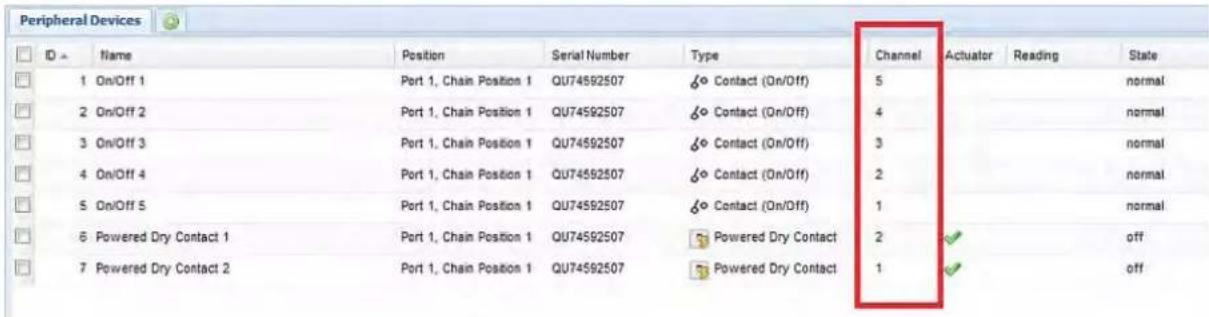
text_image
Peripheral Devices ID Name Position Serial Number Type Channel Actuator Reading State 1 On/Off 1 Port 1, Chain Position 1 QU74592507 Contact (On/Off) 5 normal 2 On/Off 2 Port 1, Chain Position 1 QU74592507 Contact (On/Off) 4 normal 3 On/Off 3 Port 1, Chain Position 1 QU74592507 Contact (On/Off) 3 normal 4 On/Off 4 Port 1, Chain Position 1 QU74592507 Contact (On/Off) 2 normal 5 On/Off 5 Port 1, Chain Position 1 QU74592507 Contact (On/Off) 1 normal 6 Powered Dry Contact 1 Port 1, Chain Position 1 QU74592507 Powered Dry Contact 2 off 7 Powered Dry Contact 2 Port 1, Chain Position 1 QU74592507 Powered Dry Contact 1 offManaging Environmental Sensors or Actuators
The PX starts to retrieve an environmental sensor's reading and/or state and records the state transitions after the environmental sensor is managed. To control an actuator, you also need to have it managed.
The PX device can manage a maximum of 32 environmental sensors or actuators.
When there are less than 32 managed sensors or actuators, the PX automatically brings detected environmental sensors or actuators under management by default. You have to manually manage a sensor or actuator only when it is not under management.
Tip: You can disable the automatic management feature so that newly connected environmental sensors or actuators are NOT brought under management automatically. See Disabling the Automatic Management Function (on page 294).
To manually manage an environmental sensor or actuator:
-
Click Peripheral Devices in the Explorer pane, and the Peripheral Devices page opens in the right pane.
-
Select the checkbox of the desired sensor or actuator on the Peripheral Devices page. To manage multiple ones, select multiple checkboxes.
Note: To identify all detected sensors or actuators, see Identifying Environmental Sensors and Actuators (on page 278).
- Click Manage. If you selected only one sensor or actuator, the "Manage peripheral device
( )" dialog appears, where is the sensor or actuator's serial number and is its type.
Note: For a sensor package with contact closure (CC) or dry contact (DC) channels, a channel number is added to the end of the
- There are two ways to manage a sensor or actuator:
- To manage it by letting the PX assign a number to it, select "Automatically assign a sensor number." This method does not release any managed sensors or actuators.
- To manage it by assigning the number you want to it, select "Manually select a sensor number." Then click the drop-down arrow to select a number.
If the number you selected was already assigned to a sensor or actuator, that sensor or actuator becomes released after losing this ID number.
Tip: The information in parentheses following each ID number indicates whether the number has been assigned to any sensor or actuator. If it has been assigned to a sensor or actuator, it shows its serial number. Otherwise, it shows the word "unused."
The manual assignment method is unavailable if you selected multiple sensors or actuators in Step 2.
-
Click OK. The PX starts to display the managed sensor or actuator's reading and state.
-
To manage additional ones, repeat Steps 2 to 5.
Note: When the total number of managed sensors and actuators reaches the maximum, you CANNOT manage additional sensors or actuators unless you remove or replace any managed ones. To remove a sensor or actuator, see Unmanaging Environmental Sensors or Actuators (on page 293).
▶ Special note for a Raritan humidity sensor:
As of release 3.1.0, a Raritan humidity sensor is able to provide two measurements in the user interface - relative and absolute humidity values.
- A relative humidity value is measured in percentage (%).
- An absolute humidity value is measured in grams per cubic meter (g/m ^3 ).
Relative humidity sensors can be "automatically" managed but absolute humidity sensors CANNOT. You must "manually" manage absolute humidity sensors if absolute humidity measurements are required.
Relative and absolute humidity values of the same humidity sensor share the same serial number and port position as illustrated below.
| 4 | Relative Humidity 1 | Port 1 | AEI7A00022 | Relative Humidity | 66 % | normal |
| 5 | Absolute Humidity 1 | Port 1 | AEI7A00022 | Absolute Humidity | 14.7 g/m3 | normal |
However, relative and absolute values of the same humidity sensor DO NOT share the same ID number. The above diagram shows that the two values have different ID numbers -- one is 4 and the other is 5.
Configuring Environmental Sensors or Actuators
You can change the default name to easily identify the managed sensor or actuator, and describe its location with X, Y and Z coordinates.
To configure environmental sensors or actuators:
- Click Peripheral Devices in the Explorer pane, and the Peripheral Devices page opens in the right pane.
- Select the sensor or actuator that you want to configure.
- Click Setup. The "Setup of peripheral device
( )" dialog appears, where is its serial number and is its type. For example, Setup of peripheral device AEI7A00022 (Temperature).
Tip: You can also trigger the same setup dialog by selecting the desired environmental sensor or actuator icon in the navigation tree and then clicking Setup in the right pane.
-
If the selected environmental sensor is a Raritan contact closure sensor connected with a third-party detector/switch, select the appropriate sensor type in the Binary Sensor Subtype field.
-
Contact: The detector/switch is designed to detect the door lock or door open/closed status.
- Smoke Detection: The detector/switch is designed to detect the appearance of smoke.
- Water Detection: The detector/switch is designed to detect the appearance of water on the floor.
-
Vibration: The detector/switch is designed to detect the vibration in the floor.
-
Type a new name in the Name field.
-
Describe the sensor or actuator's location by assigning alphanumeric values to the X, Y and Z coordinates. See Describing the Sensor or Actuator's Location (on page 286).
Note: When the term "Rack Units" appears inside the parentheses in the Z location field, indicating that the Z coordinate format is set to Rack Units, you must type an integer number.
- If the sensor is the DX-PIR presence detector, a field labeled "Alarmed to Normal Delay" is available. This field determines the wait time before the PX announces that the presence detector returns to the normal state after it is back to normal.
Type both the time and measurement units in this field. For example, type '30 s' for 30 seconds, or '2 min' for 2 minutes.
- If the selected environmental sensor is a numeric sensor, its threshold settings are displayed in the dialog. See Sensor Threshold Settings (on page 648) for detailed information.
There are two types of thresholds: sensor-specific thresholds and default thresholds.
To use the sensor-specific threshold settings, select the Use Sensor Specific Thresholds radio button.
- Click Edit or double-click the threshold setting row to open the threshold setup dialog.
- To enable any threshold, select the corresponding checkbox. To disable a threshold, deselect the checkbox.
■ After any threshold is enabled, type an appropriate numeric value in the accompanying text box. - To set the deassertion hysteresis, type a numeric value in the Deassertion Hysteresis field. See "To De-assert" and Deassertion Hysteresis (on page 653).
- To set the assertion timeout, type a numeric value in the Assertion Timeout (samples) field. See "To Assert" and Assertion Timeout (on page 651).
To use the default threshold settings, select the Use Default Thresholds radio button. To modify the default threshold settings, see Changing Default Thresholds (on page 287).
Note: The Upper Critical and Lower Critical values are points at which the PX considers the operating environment critical and outside the range of the acceptable threshold.
- Click OK.
- Repeat the same steps to configure additional ones.
Tip: You can configure thresholds of multiple sensors at a time as long as these sensors are of the same type. See Setting Thresholds for Multiple Sensors (on page 288).
Setting the Z Coordinate Format
You can use either the number of rack units or a descriptive text to describe the vertical locations (Z coordinates) of environmental sensors and actuators.
To determine the Z coordinate format:
- Click the PDU folder.
Note: The folder is named "my PX" by default. The name can be customized.
- Click Setup in the Settings section. The Pdu Setup dialog appears.
-
In the Peripheral Device Z Coordinate Format field, click the drop-down arrow and select an option from the list.
-
Rack Units: The height of the Z coordinate is measured in standard rack units. When this is selected, you can type a numeric value in the rack unit to describe the Z coordinate of any environmental sensors or actuators.
-
Free-Form: Any alphanumeric string can be used for specifying the Z coordinate.
-
Click OK.
Describing the Sensor or Actuator's Location
Use the X, Y and Z coordinates to describe each sensor or actuator's physical location. You can use these location values to track records of environmental conditions in fixed locations around your IT equipment.
The X, Y and Z values act as additional attributes and are not tied to any specific measurement scheme. If you choose to, you can use non-measurement values. For example:
$$ X = \text { Brown Cabinet Row } $$
$$ Y = \text { Third Rack } $$
$$ Z = \text { Top of Cabinet } $$
Values for the X, Y and Z coordinates may consist of:
- For X and Y: Any combination of alphanumeric characters. The coordinate value can be 0 to 24 characters long.
- For Z when the Z coordinate format is set to Rack Units, any numeric value ranging from 0 to 60.
- For Z when the Z coordinate format is set to Free-Form, any alphanumeric characters from 0 to 24 characters.
Tip: To configure and retrieve these coordinate values over SNMP, see the PX MIB. To configure and retrieve these values over the CLI, see Using the Command Line Interface (on page 341).
Changing Default Thresholds
The default thresholds are the initial threshold values that automatically apply to numeric environmental sensors. These values are configured on a sensor type basis, which include:
• Temperature sensors
• Humidity sensors (both relative and absolute humidity)
• Air pressure sensors
- Air flow sensors
- Vibration sensors
Note that changing the default thresholds re-determine the initial thresholds applying to the environmental sensors that are added or detected later on.
In addition, changing the default thresholds also change the thresholds of those environmental sensors where the default thresholds have been selected as their threshold option. See Configuring Environmental Sensors or Actuators (on page 283).
To change the default threshold settings:
- Click Peripheral Devices in the Explorer pane, and the Peripheral Devices page opens in the right pane.
- Click Default Thresholds Setup on the Peripheral Devices page. A dialog appears, showing a list of all numeric environmental sensor types.
- Select the desired sensor type.
-
Click Edit or double-click that sensor type to adjust its threshold settings, deassertion hysteresis or assertion timeout.
-
To enable any threshold, select the corresponding checkbox. To disable a threshold, deselect the checkbox.
■ After any threshold is enabled, type an appropriate numeric value in the accompanying text box. - To set the deassertion hysteresis, type a numeric value in the Deassertion Hysteresis field. See "To De-assert" and Deassertion Hysteresis (on page 653).
-
To set the as section timeout, type a numeric value in the Assertion Timeout (samples) field. See "To Assert" and Assertion Timeout (on page 651).
-
Repeat the a bove step to modify the threshold settings of other numeric sensor types.
-
Click OK.
Setting Thresholds for Multiple Sensors
You can configure thresholds for multiple environmental sensors of the same type at a time. For example, if you want all temperature sensors to have identical upper and lower thresholds, follow the procedure below to set up all temperature sensors together.
To configure thresholds of multiple environmental sensors:
- Click Peripheral Devices in the Explorer pane, and the Peripheral Devices page opens in the right pane.
- Select the checkboxes of those environmental sensors whose threshold settings should be the same. Make sure the selected sensors belong to the same type.
- To select all those listed on the Peripheral Devices page, simply select the checkbox in the header row.
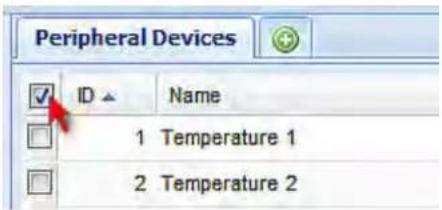
text_image
Peripheral Devices ID ▲ Name 1 Temperature 1 2 Temperature 2- Click Setup. Note that the Setup button is disabled if any of the selected sensors belongs to a different type.
- Configure the thresholds as described in Configuring Environmental Sensors or Actuators (on page 283).
- Click OK.
Viewing Sensor or Actuator Data
Readings and states of the environmental sensors or actuators will display in the web interface after the sensors and actuators are properly connected and managed.
The Dashboard page shows the information of managed environmental sensors and actuators only, while the Peripheral Devices page shows the information of both managed and unmanaged ones.
Both pages indicate an environmental sensor or actuator's position in either of the following manners:
- Port
, where is the number of the SENSOR port on the PDU where a specific environmental sensor package is connected. DPX sensor packages show this information. - Port
, Chain Position
If a sensor row is colored, it means the sensor reading already crosses one of the thresholds, the sensor enters an alarmed state, or the overcurrent protector has tripped or blown. See The Yellow- or Red-Highlighted Sensors (on page 105).
To view managed environmental sensors and actuators only:
- Click the Dashboard icon in the PX Explorer pane, and the Dashboard page opens in the right pane.
- Locate the Peripheral Devices section on the Dashboard page. The section shows:
■ Total number of managed sensors and actuators
■ Total number of unmanaged sensors and actuators
- Information of each managed sensor and actuator, including:
- Name
- Position
- Reading (for numeric sensors)
- State
To view both managed and unmanaged ones:
Click Peripheral Devices in the Explorer pane, and the Peripheral Devices page opens in the right pane.
Detailed information for each connected sensor or actuator is displayed, including:
ID number
Name
■ Position
- Serial number
Type
■ Channel (for a sensor package with contact closure or dry contact channels)
■ Whether the sensor is an 'Actuator' or not (if yes, this icon appears in the Actuator column)
- Reading
State

States of Managed Sensors
An environmental sensor shows the state after being managed.
Available sensor states vary depending on the sensor type -- numeric or discrete sensors. For example, a contact closure sensor is a discrete (on/off) sensor so it switches between three states only -- unavailable, alarmed and normal.
Note: Numeric sensors show both numeric readings and sensor states to indicate environmental or internal conditions while discrete (on/off) sensors show sensor states only to indicate state changes.
| Sensor state Applicable to | ||
| unavailable | All | sensors |
| alarmed | Discrete | sensors |
| normal | All | sensors |
| below lower critical Numeric sensors | ||
| below lower warning Numeric sensors | ||
| above upper warning Numeric sensors | ||
| above upper critical Numeric sensors | ||
"unavailable" State
The unavailable state means the connectivity or communications with the sensor is lost.
The Raritan PX pings all managed sensors at regular intervals in seconds. If it does not detect a particular sensor for three consecutive scans, the unavailable state is displayed for that sensor.
When the communication with a contact closure sensor's processor is lost, all detectors (that is, all switches) connected to the same sensor package show the "unavailable" state.
Note: When the sensor is deemed unavailable, the existing sensor configuration remains unchanged. For example, the ID number assigned to the sensor remains associated with it.
The Raritan PX continues to ping unavailable sensors, and moves out of the unavailable state after detecting the sensor for two consecutive scans.
Connected sensors always show unavailable if they are NOT under management.
For DPX2 or DX sensor packages, all of the connected sensor packages also enter the unavailable states if any of them is upgrading its sensor firmware.
"normal" State
This state indicates the sensor is in the normal state.
For a contact closure sensor, usually this state is the normal state you have set.
- If the normal state is set to Normally Closed, the normal state means the contact closure switch is closed.
- If the normal state is set to Normally Open, the normal state means the contact closure switch is open.
For a Raritan's DPX floor water sensor, the normal state must be set to Normally Closed, which means no water is detected.
Note: See the Environmental Sensors Guide for information on setting the normal state or dip switch. This guide is available on Raritan's PX2 Support Files page
(https://www.raritan.com/support/product/px2/px2-support-files).
This Environmental Sensors Guide applies to PX, BCM and EMX products.
For a numeric sensor, this state means the sensor reading is within the acceptable range as indicated below:
Lower Warning threshold <= Reading < Upper Warning threshold
Note: The symbol <= means smaller than (<) or equal to (=).
"alarmed" State
This state means a discrete (on/off) sensor is in the "abnormal" state.
Usually for a contact closure sensor, the meaning of this state varies based on the sensor's normal state setting.
- If the normal state is set to Normally Closed, the alarmed state means the contact closure switch is open.
- If the normal state is set to Normally Open, the alarmed state means the contact closure switch is closed.
For a Raritan's floor water sensor, the normal state must be set to Normally Closed, which means no water is detected. The alarmed state indicates that the presence of water is detected.
Note: See the Environmental Sensors Guide for information on setting the normal state or dip switch. This guide is available on Raritan's PX2
Support Files page
(https://www.raritan.com/support/product/px2/px2-support-files).
This Environmental Sensors Guide applies to PX, BCM and EMX products.
Tip: A contact closure sensor's LED is lit after entering the alarmed state. Determine which contact closure switch is in the "abnormal" status according to the corresponding LED.
"below lower critical" State
This state means a numeric sensor's reading is below the lower critical threshold as indicated below:
Reading < Lower Critical Threshold
"below lower warning" State
This state means a numeric sensor's reading is below the lower warning threshold as indicated below:
Lower Critical Threshold <= Reading < Lower Warning Threshold
Note: The symbol <= means smaller than (<) or equal to (=).
"above upper warning" State
This state means a numeric sensor's reading is above the upper warning threshold as indicated below:
Upper Warning Threshold <= Reading < Upper Critical Threshold
Note: The symbol <= means smaller than (<) or equal to (=).
"above upper critical" State
This state means a numeric sensor's reading is above the upper critical threshold as indicated below:
Upper Critical Threshold <= Reading
Note: The symbol <= means smaller than (<) or equal to (=).
States of Managed Actuators
DX sensor packages with dry contact channels allow you to connect actuators. An actuator has only three states described below. Note that an actuator is never highlighted in red or yellow regardless of the actuator states.
- Unavailable: The actuator is not managed or the communication with it is lost.
- On: The actuator has been turned on.
• Off: The actuator has been turned off.
Unmanaging Environmental Sensors or Actuators
When it is unnecessary to monitor a particular environmental factor, you can unmanage or release the corresponding environmental sensor so that the PX device stops retrieving the sensor's reading and/or state. This procedure also applies if you want to unmanage an actuator.
To release a managed sensor or actuator:
- Click Peripheral Devices in the Explorer pane, and the Peripheral Devices page opens in the right pane.
- Select the checkbox of the desired sensor or actuator on the Peripheral Devices page. To release multiple ones, select multiple checkboxes.
- To select all those listed on the Peripheral Devices page, simply select the checkbox in the header row.

text_image
Peripheral Devices ID ▲ Name 1 Temperature 1 2 Temperature 23. Click Release.
After a sensor or actuator is removed from management, the ID number assigned to it is released and can be automatically assigned to any newly-detected sensor or actuator.
Disabling the Automatic Management Function
The factory default is to enable the automatic management feature for environmental sensors and actuators. Therefore, when the total number of managed sensors and actuators has not reached 32 yet, the PX automatically brings newly-connected environmental sensors and actuators under management after detecting them.
When this feature is disabled, the PX no longer automatically manages any newly-detected environmental sensors and actuators, and therefore neither ID numbers are assigned nor sensor readings or states are available for newly-added ones.
To disable the automatic management feature:
- Click the PDU folder.
Note: The folder is named "my PX" by default. The name can be customized.
-
Click Setup in the Settings section. The Pdu Setup dialog appears.
-
Deselect the Peripheral Device Auto Management checkbox.
-
Click OK.
Controlling Actuators
If you have any DX sensor packages with actuators connected, which can move or control a mechanism or system, you can remotely turn on or off the actuators to control the connected mechanism or system.
To turn on or off an individual actuator:
- Expand the Peripheral Devices folder. See Expanding the Tree (on page 100).
- Click the desired actuator from the navigation tree. That actuator's page opens in the right pane.
- Click "Switch on" to turn on the actuator, or "Switch off" to turn it off.
To turn on or off multiple actuators:
- Click Peripheral Devices in the Explorer pane, and the Peripheral Devices page opens in the right pane.
- Select the checkboxes of the desired actuators on the Peripheral Devices page.
Tip: An actuator is indicated with the icon √ displayed in the 'Actuator' column.
- Click "Switch on" or "Switch off" to turn on or off the selected actuators. Confirm you want to switch when prompted.
Enabling the Front Panel Actuator Control
This section applies to PX3 phase II models only. A PX3 phase I model does NOT support this feature.
You can operate the front panel buttons to turn on or off a connected actuator. By default, this function is disabled.
For information on controlling the actuators via the front panel display, see Peripherals (on page 75).
To enable the front panel actuator control feature:
- Choose Device Settings > Security > Front Panel Permissions. The Front Panel Permissions dialog appears.
- Select the "Peripheral actuator control" checkbox.
- Click OK.
Asset Management
Configure the asset management settings only when an asset sensor is physically connected to the PX device.
Note: To set up an asset management system, see Connecting the Asset Management Sensor (on page 43).
Configuring the Asset Sensor
The PX cannot detect how many rack units (tag ports) a connected asset management sensor supports, so you must provide this information manually.
When you add an asset management sensor, you name it.
To configure an asset sensor (asset strip):
- If the Feature Port folder is not expanded, expand it to show the device under the Feature Port folder.
- Click the asset sensor in the left pane. The asset sensor's page opens in the right pane.
Note: The asset sensor is named "Asset Strip 1" by default. The name changes after being customized.
Tip: The same asset sensor's page can be also opened by clicking Feature Port in the left pane, and then double-clicking the asset sensor in the right pane.
- Click Setup. The setup dialog for the asset sensor appears.
Tip: You can also trigger the same dialog by clicking Asset Management in the left pane, and then clicking Asset Strip Setup or double-clicking the asset sensor in the right pane.
-
To rename the asset sensor, type a new name in the Name field.
-
In the "Number of Rack Units" field, type the total number of rack units supported by the AMS. Default is 48.
-
Here, rack units are the number of asset management tag ports on the asset management strip. For example, if the AMS has 48 asset management tag ports, it supports up to 48 rack units on a cabinet.
-
Determine how to number all rack units on the asset sensor by selecting an option in the Numbering Mode.
-
Top-Down: The rack units are numbered in the ascending order from the highest to the lowest rack unit.
-
Bottom-Up: The rack units are numbered in the descending order from the highest to the lowest rack unit.
-
In the Numbering Offset field, select the starting number. For example, if you select 3, the first rack unit is numbered 3, the second is numbered 4, the third is numbered 5, and so on until the final number.
-
Indicate how the asset sensor is mounted on the rack in the Orientation field. The rack unit that is most close to the RJ-45 connector of the asset sensor will be marked with the index number 1 in the web interface.
For the latest version of asset sensors with a built-in tilt sensor, it is NOT necessary to configure the orientation setting manually. The PX device can detect the orientation of the asset sensors and automatically configure it.
- Top Connector: This option indicates that the asset sensor is mounted with the RJ-45 connector located on the top.
- Bottom Connector: This option indicates that the asset sensor is mounted with the RJ-45 connector located at the bottom. Click OK.
Setting Asset Sensor LED Colors
Each LED on the asset sensor indicates the presence and absence of a connected asset tag by changing its color. You can configure or change the color settings for all LEDs on the connected asset sensor(s) by following the procedure below.
This feature is accessible only by users with Administrative Privileges.
To configure all LED colors:
- Connect the asset sensor to the PX if it is not already.
- Click on the Feature Ports folder in the navigation tree to expand it.
- Click the desired asset sensor. The page specific to that asset sensor opens in the right pane, showing the asset sensor settings and information of all rack units (tag ports).
Note: You can also access this dialog by double-clicking the asset sensor shown on the Dashboard page.
- Click Setup on the asset sensor page. The setup dialog for that asset sensor appears.
- To change the LED color denoting the absence of a connected tag, either click a color in the color palette or type the hexadecimal RGB value of the color in the "Color without connected Tag" field.
- Click OK.
Tip: To make a specific LED's color settings different from other LEDs, see Configuring a Specific Rack Unit (on page 297).
Configuring a Specific Rack Unit
In the PX web interface, a rack unit refers to a tag port on the asset sensor. You can name a specific rack unit, or change its LED color settings so that this LED behaves differently from others on the same asset sensor.
To configure a specific rack unit:
- If the Feature Port folder is not expanded, expand it to show the device under the Feature Port folder.
- Click the asset sensor in the left pane. The asset sensor's page opens in the right pane.
Note: The asset sensor is named "Asset Strip 1" by default. The name changes after being customized.
Tip: The same asset sensor's page can be also opened by clicking Feature Port in the left pane, and then double-clicking the asset sensor in the right pane.
- Select the rack unit whose LED settings you want to change.
- Click Configure Rack Unit or double-click the selected rack unit. The setup dialog for the selected rack unit appears.
- In the Name field, type a name for identifying this rack unit.
-
Select either Auto or Manual Override as this rack unit's LED mode.
-
Auto (based on Tag): This is the default setting. With this option selected, the LED follows the global LED color settings.
-
Manual Override: This option differentiates this LED's behavior. After selecting this option, you must select an LED mode and/or an LED color for the selected rack unit.
-
LED Mode: Select On to have the LED stay lit, Off to have it stay off, "Slow blinking" to have it blink slowly, or "Fast blinking" to have it blink quickly.
-
LED Color: If you select On, "Slow blinking" or "Fast blinking" in the LED Mode field, select an LED color by either clicking a color in the color palette or typing the hexadecimal RGB value of a color in the accompanying text box.
-
Click OK.
Expanding a Blade Extension Strip
A blade extension strip, like an asset sensor, has multiple tag ports. After connecting it to a specific asset sensor, it is displayed as a folder on that asset sensor's page.
Note: If you need to temporarily disconnect the blade extension strip from the asset sensor, wait at least 1 second before re-connecting it back, or the PX device may not detect it.
To expand a blade extension strip folder:
- Click the desired asset sensor in the left pane. The selected asset sensor's page opens in the right pane.
- Locate the rack unit (tag port) where the blade extension strip is connected.

text_image
Rack Units Rack Unit Index Slot Name Asset / ID 1 1 2 2 00000007CACB 3 3 4 4- Double-click that rack unit or click the white arrow prior to the folder icon. The arrow then turns into a black, gradient arrow and all tag ports of the blade extension strip appear below the folder.
| Rack Units | |||||
| Rack Unit | Index | Slot | Name | Asset / D | |
| III | 1 | 1 | |||
| 4 | 2 | 2 | 00000007CACB | ||
| III | 1 | ||||
| III | 2 | ||||
| III | 3 | ||||
| III | 4 | ||||
| III | 5 | ||||
| III | 6 | ||||
| III | 7 | ||||
| III | 8 | ||||
| III | 9 | ||||
| III | 10 | ||||
| III | 11 | ||||
| III | 12 | ||||
| III | 13 | ||||
| III | 14 | ||||
| III | 15 | ||||
| III | 16 | ||||
| III | 3 | 3 | |||
| III | 4 | 4 | |||
To collapse a blade extension strip:
- Double-click the blade extension strip folder, or click the black, gradient arrow ▲ prior to the folder icon. All tag ports under the folder are hidden.
Displaying the Asset Sensor Information
The hardware and software information of the connected asset sensor is available through the web interface.
To display the asset sensor information:
- Connect the asset sensor to the PX if it is not already.
- Click on the Feature Ports folder in the navigation tree to expand it.
- Click the desired asset sensor. The page specific to that asset sensor opens in the right pane, showing the asset sensor settings and information of all rack units (tag ports).
Note: You can also access this dialog by double-clicking the asset sensor shown on the Dashboard page.
-
Click Extended Device Info, where the asset sensor data is displayed.
-
Click Close to quit the dialog.
Bulk Configuration
The Bulk Configuration feature lets you save the settings of a configured PX device to your PC. You can use this configuration file to copy that configuration to other PX devices of the same model and firmware version.
You must have the administrator privileges to save and copy the PX configurations.

text_image
Bulk Configuration Save Bulk Configuration Download Bulk Configuration Copy Bulk Configuration Bulk Configuration File: Browse... Upload & Restore Bulk Configuration CloseNote: No device-specific data is saved to the Bulk Configuration file, such as environmental sensor or certain network settings. To back up or restore a specific PX device's all settings, use the Backup/Restore feature instead. See Backup and Restore of PX Device Settings (on page 303).
Tip: An additional way to bulk configure multiple PX devices is to use the TFTP server over a DHCP network. This method helps you save a lot of time when there are a large number of PX devices to configure. For details, see Bulk Configuration or Firmware Upgrade via DHCP/TFTP (on page 526).
Saving the PX Configuration
A source device is an already configured PX device that is used to create a configuration file containing the settings that can be shared between PX devices. These settings include user and role configurations, thresholds, event rules, security settings, and so on.
This file does NOT contain device-specific information, including:
- Device name
• System name, system contact and system location
• Network settings (IP address, gateway, netmask and so on) - Device logs
- Outlet names
- Outlet status
• Environmental sensor and actuator names
• States and values of environmental sensors and actuators - TLS certificate
Because the date and time settings are saved in the configuration file, users should exercise caution when distributing the configuration file to the PX devices in a different time zone than the source device.
▶ To save a configuration file:
- Choose Maintenance > Bulk Configuration. The Bulk Configuration dialog appears.
- Click Download Bulk Configuration.
- When the web browser prompts you to open or save the configuration file, click Save. Choose a suitable location and save the configuration file to your PC.
The file is saved in the XML format, and its content is encrypted using the AES-128 encryption algorithm.
Tip: You can also save a configuration file using a Secure Copy (SCP) command. See Bulk Configuration via SCP (on page 553).
Copying the PX Configuration
A target device is the PX device that loads another PX device's configuration file.
Copying a source PX device's configuration to a target device adjusts the target PX device's settings to match those of the source PX device. In order to successfully copy a source PX device's configuration:
- The user must be the Admin user. Or the Admin role is assigned to the user.
- The target PX device must be running the same firmware version as the source PX device.
- The target PX device must be of the same model type as the source PX device.
Bulk configuration is permitted if the differences between the target and source device are only mechanical designs which are indicated in a model name's suffix as listed below. In the following list, n represents a number.
- PDU chassis color, which is indicated as Kn, such as K1 and K601
- Line cord color, which is indicated as Bn, such as B2 and B5
- Line cord length (meters), which is indicated as An, such as A0 and A14
- Line cord length (centimeters), which is indicated as Ln
For example, Raritan's PX2-4724-E2N1K2 and PX2-4724-E2N1K9 share the same specifications, and the only difference is their chassis colors represented by K2 (blue) and K9 (gray).
To copy a PX configuration:
- Log in to the target device's web interface.
- If the target device's firmware version does not match that of the source device, update the target's firmware. See Firmware Upgrade (on page 323).
- Choo se Maintenance > Bulk Configuration. The Bulk Configuration dialog appears.
- In the Copy Bulk Configuration section, click Browse to select the configuration file stored on your PC.
- Click Upload & Restore Bulk Configuration to copy the file.
A message appears, prompting you to confirm the operation and enter the admin password. - Enter the admin password, then click Yes to confirm the operation.
- Wait until the PX device resets and the Login page re-appears, indicating that the configuration copy is complete.
Note: On startup, the PX performs all of its functions, including event rules and logs, based on the new configuration file you have selected instead of the previous configuration prior to the device reset. For example, "Bulk configuration copied" is logged only when the new configuration file contains the "Bulk configuration copied" event rule.
Tip: You can also copy a configuration file using a Secure Copy (SCP) command. See Bulk Configuration via SCP (on page 553).
Backup and Restore of PX Device Settings
Different from the Bulk Configuration file, the backup file contains device-specific data like network settings. To back up or restore PX device settings, you should perform the Backup/Restore feature.
All PX information is captured in the XML backup file except for the device logs and TLS certificate.
Note: To perform the bulk configuration among multiple PX devices, perform the Bulk Configuration feature instead. See Bulk Configuration (on page 300).
To download a backup PX XML file:
- Choose Maintenance > Backup/Restore. The Backup/Restore of Device Settings dialog opens.
- In the Save Device Settings section, click Download Device Settings. Save the file to your computer.
The file is saved in the XML format, and its content is encrypted using the AES-128 encryption algorithm.
To restore the PX using a backup XML file:
- Choose Maintenance > Backup/Restore. The Backup/Restore of Device Settings dialog opens.
- In the Copy Device Settings section, click Browse to locate the file.
- Click Upload & Restore Device Settings to upload the file.
A message appears, prompting you to confirm the operation and enter the admin password. - Enter the admin password, then click Yes to confirm the operation.
- Wait until the PX device resets and the Login page re-appears, indicating that the restore is complete.
Note: On startup, the PX performs all of its functions, including event rules and logs, based on the new configuration file you have selected instead of the previous configuration prior to the device reset. For example, "Bulk configuration copied" is logged only when the new configuration file contains the "Bulk configuration copied" event rule.
Tip: You can also back up and restore a configuration file using a Secure Copy (SCP) command. See Backup and Restore via SCP (on page 554).
Webcam Management
With a Logitech ^® webcam connected to the PX device, you can visually monitor the environment around the PX via snapshots or videos captured by the webcam.
- To view snapshots and videos, you need the permission of either "Change Webcam Configuration" or "View Webcam Snapshots and Configuration."
- To configure webcam settings, you need the "Change Webcam Configuration" permission.
For more information on the Logitech webcam, see the user documentation accompanying it. For information on connecting a webcam to the PX, see Connecting a Logitech Webcam (on page 53).
You can manually store snapshots taken from the webcam onto the PX or a remote server. See Saving Snapshots (on page 310) or Configuring Webcam Storage (on page 312).
Links to snapshots or videos being captured by a webcam can be sent via email or instant message. See Sending Snapshots or Videos in an Email or Instant Message (on page 308).
Events that trigger emails containing snapshots from a webcam can be created. See Creating Actions (on page 223).
Configuring Webcams
Before you can configure a webcam, it must be connected to the PX. See Connecting a Logitech Webcam (on page 53).
To configure a webcam:
- In the navigation tree, click on the Webcam Management folder. The Webcam Management page opens.
- Click on the webcam you want to configure and then click Setup at the bottom right of page. The Webcam Setup dialog opens.
-
Enter a name for the webcam. Up to 64 characters are supported.
-
Type the location information in each location field if needed. Up to 63 characters are supported.
- Select a resolution for the webcam.
- If you connect two webcams to one USB-A port using a powered USB hub, set the resolution to 352x288 or lower for optimal performance.
- Select the webcam mode. This can be changed as needed once the webcam is configured.
a. Video - the webcam is in video mode. Set the Framerate (frames per second) rate.
b. Snapshot - the webcam displays images from the webcam. Set the "Time between Snapshots" rate as measured in seconds.
- Click OK. The image or video from the webcam is now available in the PX once you click on the webcam in the navigation tree.
To edit a webcam configuration:
- In the navigation tree, click on the Webcam Management folder. The Webcam Management page opens.
- Double-click on the webcam you want to edit. The webcam image or video opens in a new tab.
- Click Setup
- Edit the information as needed. Changes to the resolution do not apply to existing, stored images - it applies only to images and videos taken after the resolution is changed.
- Click OK.
Adjusting Image Properties
If any snapshot or video properties, such as the brightness, contrast, saturation, and gain settings, do not satisfy your needs, adjust them.
To adjust the image or video properties:
- Select the webcam shown on the Webcam Management page or in the navigation tree. See Configuring Webcams (on page 304).
- Click Setup or 📋.
- Click the Controls tab.
- Adjust the desired property by adjusting the corresponding slide bar. Or click "Set to webcam defaults" to restore all settings to this webcam's factory defaults.
- Click OK.
Viewing Webcam Snapshots or Videos
You can switch between snapshots or live videos being captured by a webcam.
The snapshot or video is displayed either in the PX web interface or in a Primary Standalone Live Preview window that you open.
You can open a maximum of five Primary Standalone Live Preview windows.
Note: For remote Live Preview sessions, such as those accessed via a link in an email or instant message, a total of up to three (3) simultaneous Live Preview sessions are supported at a time. One (1) from the originator in the PX interface, and up to two (2) remote sessions. See Sending Snapshots or Videos in an Email or Instant Message (on page 308).
To switch between snapshot and video modes:
- Click the desired webcam's icon in the navigation tree.
Snapshots or videos captured by the webcam are displayed in the right pane of the PX web interface once a webcam is selected in the navigation tree.
Snapshots and videos can also be displayed in Live Preview mode in the Primary Standalone Live Preview window by clicking on the Live
Preview icon

Note: All Live Preview sessions sharing the same URL, including one Primary Standalone Live Preview window and two associated remote sessions, are identified as one single "
- By default the PX enters the snapshot mode. Wait around one minute for the snapshot to appear.
In the snapshot mode, three pieces of information are displayed on the top of the image:
- A snapshot mode icon

- The interval time between snapshots (in seconds).
- A time stamp.

Interval 6 s
2/03/15 1:07 AM
The webcam's location information, if available, is displayed in the Location pane of the PX web interface.
- To change any image settings, click Setup
See
Configuring Webcams (on page 304) or Adjusting Image Properties (on page 305). - To save the snap shot being displayed, click the "Store Snapshot to Webcam Storage" icon 📋. See Saving Snapshots (on page 310).

- To switch to the video mod e, click Setup and select Video in the Webcam Mode field.
In the video mode, two pieces of information are displayed on the top of the image:
- A video mode icon

■ The number of frames to take per second (fps).
To change any video settings, click Setup

- To return to the snapshot mode, repeat the above step and select Snapshot.
Sending Snapshots or Videos in an Email or Instant Message
Whenever you open a Primary Standalone Live Preview window, a unique URL is generated for this window session, which permits a link to the snapshot or video being captured.
You are able to email or instant message up to two (2) recipients a link to webcams attached to the PX. Users can then click on the links and view snapshots or videos.
A total of three sessions based on the same URL are supported, including a Primary Standalone Live Preview window of the sender and two remote sessions of the recipients.
Note: All Live Preview sessions sharing the same URL, including one Primary Standalone Live Preview window and two associated remote sessions, are identified as one single "
For explanation of this topic, the message sender is User A and the recipient is User B.
The recipient is able to access the snapshot or video image via the link in any of the following scenarios:
- The snapshot or video remains open in the Primary Standalone Live Preview window in User A's side. If so, even though User A logs out of the PX interface or the login session times out, the link is available.
Or
- At least a remote session based on the same URL remains open. If so, even though User A has closed the Primary Standalone Live Preview window, the link is available.
Or
- Neither the Primary Standalone Live Preview window nor any remote session based on the same URL remains open, but the idle timeout period has not expired yet since the last Live Preview window session was closed. For information on idle timeout, see Enabling Login Limitations (on page 171).
Tip: If the idle timeout has not expired, the
Best Practice
As a best practice, User A should open the snapshot or video using a Primary Standalone Live Preview window and leave that window open at least until User B opens the snapshot or video via the link.
Once User B opens the snapshot or video via the link, User A can close the Primary Standalone Live Preview window.
User B should let User A know that the link has been opened.
To send a snapshot or video link via email or instant message:
-
In the navigation tree, click on the webcam that is capturing the snapshot or video you want to provide a link to other people. The snapshot or video is displayed in Live Preview mode in the right pane.
-
Click on the Live Preview icon [icon] located above the snapshot or video. The snapshot or video opens in a standalone Live Preview window.
-
Copy the URL from the Live Preview window, paste it into the email or instant message application. Leave the Live Preview window open at least until the recipient opens the snapshot or video via the link.
Snapshot Storage
Once a snapshot is taken using the Store Snapshot to Webcam Storage feature, it is stored locally on the PX by default. Up to ten (10) images can be stored on the PX at once.
To save more than 10 snapshots, save the images on a Common Internet File System/Samba.
Note: NFS and FTP are not supported for this release and are disabled on the dialog.
Snapshot files are saved as JPG files. The snapshot file is named based on the number of the snapshot starting from 1. So the first snapshot that is taken is named 1.jpg, the second is 2.jpg and so on.
Unless snapshots are deleted manually, the oldest snapshot is automatically deleted from the device when the number of snapshots exceeds ten. Rebooting the PX deletes all webcam snapshots that are saved on the device.
Saving Snapshots
If it is intended to keep the snapshot being displayed on the webcam, you can manually save it onto the PX. A snapshot is saved as a JPEG file and stored on the Snapshots page.
Warning: The snapshots stored on the PX are cleared when rebooting the PX. Check the importance of the snapshots before performing the reset.
To save the snapshot being displayed:
- In the navigation tree, click on the webcam you want to take a snapshot with. The webcam image is displayed in the right pane.
The webcam must be in snapshot mode in order to take snapshots. If the webcam is in video mode, click Setup in the right pane above the video image to open the Webcam Setup dialog, then select the Snapshot radio button.
- Once the snapshot image being taken by the selected webcam is displayed in the right pane, click the Store Snapshot to Webcam
Storage 📋 icon above the image to take a snapshot. Up to ten (10) snapshots can be stored at once on the device.
- Click on the Snapshots icon in the navigation tree to verify that those snapshots are successfully saved and listed on the Snapshots page.
Tip: To store snapshots on a remote server rather than the PX, see Configuring Webcam Storage (on page 312).
Managing the Snapshots Saved to PX
A maximum of 10 saved snapshots can be stored and displayed on the Snapshots page of the PX.
See Saving Snapshots (on page 310) for instructions on storing snapshots on the PX.
The Snapshots page is categorized into three sections: Storage, Snapshot and Details.
• Storage: shows a list of all saved snapshots.
On the top of the Storage section, the number following "Used" indicates the total of saved snapshots and the number following "Size" indicates maximum number of snapshots allowed in storage.
- Snapshot: displays the image of the snapshot being selected.
- Details: shows the information which had been entered when the snapshot was saved, including resolution and location settings.
Tip: To save more than 10 snapshots, save snapshots onto a remote server. See Configuring Webcam Storage (on page 312).
To view the saved snapshots:
-
In the navigation tree, click Snapshots under the Webcam Management folder. The snapshots are displayed in the right pane in the Storage section of the page.
-
View an individual snapshot by clicking on a snapshot file in the Storage section of the page.
The size of each snapshot file, the date and time each snapshot was taken, and the webcam that took each snapshot, is displayed when viewing snapshots.
Details, such as the webcam location and/or labels, if any, are displayed in the Details section below the snapshot in the right pane. This information is defined when the webcam is initially configured. See Configuring Webcams (on page 304).
- Use the navigation icons to move through each snapshot, or enter a specific page number to jump to that snapshot page.

- Click the Refresh icon 📋 to refresh the page. New snapshots are displayed if they are available.
To delete any snapshot from the storage:
- Delete snapshots by selecting the checkbox next to the snapshot you want to delete, then clicking the Delete icon ✗ at the top of the section. To select and delete all snapshots at once, click the checkbox in the checkbox column header, then click the Delete icon.
To change the sorting or displayed columns of the list:
- You can resort the snapshot list or hide any displayed column in the Storage section. For details, see Changing the View of a List (on page 106).
Configuring Webcam Storage
Once a snapshot is taken using the Store Snapshot to Webcam Storage feature, it is stored locally on the PX by default. Up to ten (10) images can be stored on the PX at once.
To save more than 10 snapshots, save the images on a Common Internet File System/Samba.
Note: NFS and FTP are not supported for this release and are disabled on the dialog.
Snapshot files are saved as JPG files. The snapshot file is named based on the number of the snapshot starting from 1. So the first snapshot that is taken is named 1.jpg, the second is 2.jpg and so on.
Unless snapshots are deleted manually, the oldest snapshot is automatically deleted from the device when the number of snapshots exceeds ten. Rebooting the PX deletes all webcam snapshots that are saved on the device.
To configure another storage location for images:
- In the navigation tree, click Snapshots under the Webcam Management folder. The Snapshots page opens.
- Click on the Setup Storage icon opens. The Storage Setup dialog
- By default, Local, meaning the PX, is the designated default storage.
- Select CIFS/Samba as the storage location.
- Enter the server where to store the images.
- If needed, enter the share drive/folder to store the images in.
-
Enter the username and password needed to access the server where the images are stored.
-
Enter or use the slide bar to set the number of images that can be saved to the storage location.
- Click OK.
Network Diagnostics
The PX provides the following tools in the web interface for diagnosing potential networking issues.
- Ping
- Trace Route
- List TCP Connections
Tip: These network diagnostic tools are also available through CLI. See Network Troubleshooting (on page 502).
Pinging a Host
The Ping tool is useful for checking whether a host is accessible through the network or Internet.
To ping a host:
- Choose Maintenance > Network Diagnostics > Ping. The Ping Network Host dialog appears.
- In the Host Name field, type the name or IP address of the host that you want to check.
- In the Number of Requests field, type a number up to 20 or adjust the value by clicking either arrow. This number determines how many packets are sent for pinging the host.
- Click Run Ping to start pinging the host. A dialog appears, displaying the Ping results.
- Click Close to quit the dialog.
Tracing the Network Route
Trace Route lets you find out the route over the network between two hosts or systems.
▶ To trace the route for a host:
- Choose Maintenance > Network Diagnostics > Trace Route. The "Trace Route to Host" dialog appears.
-
Type the IP address or name of the host whose route you want to check in the Host Name field.
-
In the Timeout (s) field, type a timeout value in seconds to end the trace route operation. Note that if the timeout value is too small, the trace route results may be incomplete.
- To use the Internet Control Message Protocol (ICMP) packets to perform the trace route command, select the Use ICMP Packets checkbox.
- Click Run. A dialog appears, displaying the Trace Route results.
Listing TCP Connections
You can use the "List TCP Connections" to display a list of TCP connections.
To list TCP connections:
- Choose Maintenance > Network Diagnostics > List TCP Connections. The TCP Connections window appears.
- Click Close to quit the dialog.
Downloading Diagnostic Information
Important: This function is for use by Raritan Field Engineers or when you are directed by Raritan Technical Support.
You can download the diagnostic file from the PX device to a client machine. The file is compressed into a .tgz file and should be sent to Raritan Technical Support for interpretation.
This feature is accessible only by users with Administrative Privileges.
▶ To retrieve a diagnostic file:
- Choose Maintenance > Download Diagnostic Information. You are then prompted to save or open the file.
- Click Save to save the file.
- E-mail this file as instructed by Raritan Technical Support.
Managing the Schroff LHX/SHX Heat Exchanger
The PX supports monitoring and administering the Schroff® LHX-20, LHX-40 and SHX-30 heat exchanger if this device is connected to the PX.
From the PX, you can do the following remotely:
• Name a connected LHX/SHX heat exchanger
- Configure the air outlet temperature setpoint
- Configure air outlet temperature thresholds
- Configure air inlet temperature thresholds
- Configure water inlet temperature thresholds
- Configure fan speed thresholds
• Monitor the air inlet temperature
• Monitor the air outlet temperature
- Monitor the fan speed
- Depending on the model, configure the default fan speed to operate from 50% to 90% (the factory default is 80%)
- Depending on the model, request maximum cooling using the fan speed and opening the cold water valve
- Acknowledge alerts remotely (for example, return to normal operation after maximum cooling is requested)
To monitor one LHX/SHX heat exchanger using the PX:
- Physically connect an LHX-20, LHX-40 or SHX-30 heat exchanger to the PX device if it is not already connected. See Connecting a Schroff LHX/SHX Heat Exchanger (on page 55).
- Enable the support of LHX/SHX heat exchanger on the PX. See Enabling and Disabling Schroff LHX/SHX Heat Exchanger Support (on page 316).
- Configure the connected heat exchanger. See Configuring the LHX/SHX Device (on page 316).
-
Now you can remotely monitor or control the connected LHX/SHX heat exchanger via the PX.
-
To monitor the heat exchanger, see Monitoring the LHX/SHX Device (on page 319).
- To control the heat exchanger, see Turning the LHX/SHX On or Off (on page 322).
Enabling and Disabling Schroff LHX/SHX Heat Exchanger Support
By default, Schroff LHX/SHX Heat Exchanger support is disabled. As such, support needs to be enabled before the device appears in the navigation tree or on the dashboard. Additionally, Schroff LHX/SHX Heat Exchanger support must be enabled in order for the LHX-MIB to be accessible through SNMP.
To enable the Schroff LHX/SHX Heat Exchanger:
- Select Device Settings > Features, and then select the Schroff LHX/SHX Support checkbox on the menu.
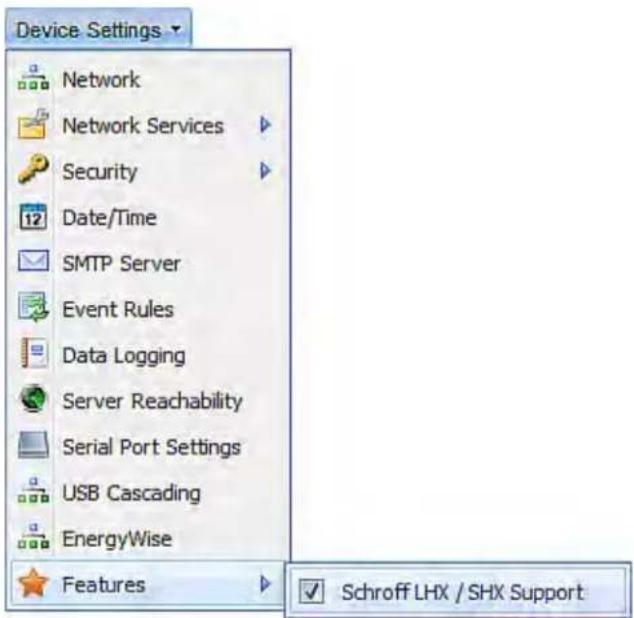
text_image
Device Settings Network Network Services Security Date/Time SMTP Server Event Rules Data Logging Server Reachability Serial Port Settings USB Cascading EnergyWise Features Schroff LHX / SHX Support- Click Yes to confirm.
- Reboot the PX.
Configuring the LHX/SHX Device
After enabling the LHX/SHX support on the PX, the PX should automatically detect the connected LHX/SHX device and display it under the Feature Port folder unless the Feature Port is set to a mode different than the Auto mode. If so, change the Feature Port mode so that the LHX/SHX device is correctly displayed in the web interface. See Configuring the Feature Port (on page 139).
Besides, the PX allows you to set temperature or fan speed thresholds for alerts or to customize the name of the LHX/SHX device for easy identification.
Correctly Displaying the LHX/SHX Device
There are two ways to have the PX show the correct LHX/SHX model in the web interface.
- Auto detection: Set the mode of the Feature Port to Auto to let the PX automatically detect the device type.
- Manual assignment: Set the mode of the Feature Port to either LHX-20, LHX-40 or SHX-30, depending on which LHX/SHX model is physically connected to the PX.
For details on how to change the Feature Port mode, see Configuring the Feature Port (on page 139).
After the correct LHX/SHX device type is detected or assigned, the
LHX/SHX icon 📁 appears below the Feature Port folder.
Note that the device icon changes its image when the device changes its states. See Device States and Icon Variations (on page 320) for details.
Setting Up an LHX/SHX
Once a Schroff LHX/SHX heat exchanger is connected, you can set up the device by giving it a name, and configure its setpoint air outlet and default fan speed.
To set up the LHX/SHX:
- If the Feature Port folder is not expanded, expand it to show the device under the Feature Port folder.
- Click the LHX/SHX heat exchanger in the PX Explorer pane. The page specific to that device opens in the right pane.
- Click Setup in the Settings section of the page. The Setup dialog opens.
- Type a name for the heat exchanger in the Name field. The customized LHX/SHX heat exchanger's name is followed by the device type in parentheses.
- Enter the air outlet's temperature set point in the Setpoint Air Outlet (°C) field.
- Enter the default fan speed in the Default Fan Speed (%) field.
- Click OK.
Configuring Temperature and Fan Thresholds
An LHX/SHX heat exchanger is implemented with various sensors for detecting the air temperature, water temperature, and fan speed. You can set thresholds for these sensors so that the PX alerts you when any sensor readings are getting close to a critical condition. These settings are stored on the PX port where the heat exchanger is connected, and are lost if that heat exchanger is moved to a different port.
To configure the thresholds for a sensor:
- Connect the LHX/SHX heat exchanger to PX if it is not already connected.
- If the Feature Port folder is not expanded, expand it to show the device under the Feature Port folder.
- Click the LHX/SHX heat exchanger in the PX Explorer pane. The page specific to that device opens in the right pane.
- Select the desired sensor in the Sensors table and click Setup Thresholds, or simply double-click that sensor. The setup dialog for the selected sensor appears.

text_image
Setup Sensor 'Temperature CoolingWater' Thresholds Lower Critical (°C): 2.0 Lower Warning (°C): 5.0 Upper Warning (°C): 24.0 Upper Critical (°C): 30.0 Hysteresis (°C): 15.0 OK Cancel-
Adjust the threshold and deassertion hysteresis settings. The Upper Critical and Lower Critical values are points at which the PX considers the operating environment critical and outside the range of the acceptable threshold.
-
To enable any threshold, select the corresponding checkbox. To disable a threshold, deselect the checkbox.
■ After any threshold is enabled, type an appropriate numeric value in the accompanying text box.
- To set the deassertion hysteresis, type a numeric value in the Deassertion Hysteresis field. See "To De-assert" and Deassertion Hysteresis (on page 653).
- To set the assertion timeout, type a numeric value in the Assertion Timeout (samples) field. See "To Assert" and Assertion Timeout (on page 651).
- Click OK.
Monitoring the LHX/SHX Device
The PX web interface lets you monitor the status of the connected LHX/SHX heat exchanger as well as the status of the LHX/SHX built-in sensor.
Viewing the Summary
Both the Dashboard and Feature Port pages display the summary of the connected LHX/SHX heat exchangers, including the heat exchanger's name and status, if the LHX/SHX device is detected or manually assigned to the Feature Port.
If the LHX heat exchanger is highlighted in red in the summary, it indicates that there is LHX/SHX sensor failure on that heat exchanger. View the State column to identify failed sensors.
To view the LHX/SHX summary on the Dashboard page:
- Click the Dashboard icon in the PX Explorer pane, and the Dashboard page opens in the right pane.
- Locate the LHX/SHX Heat Exchanger section.
To view the LHX/SHX summary on the Feature Port page:
Click the Feature Port folder in the PX Explorer pane. The Feature Port page opens in the right pane, showing the connected LHX/SHX device information.
Viewing Details
An LHX/SHX heat exchanger page shows detailed information, including:
• Device information and settings
• The air outlet temperature
• The default fan speed
- Readings and states of all LHX/SHX built-in sensors
- Alerts and errors, such as failed LHX/SHX sensors or emergency cooling activation
• Accumulative operating hours
In addition, SHX-30 models indicate the number of power supplies present and if a condenser pump is present, since those options are supported by the SHX-30.
To view details of a specific LHX/SHX heat exchanger:
- If the Feature Port folder is not expanded, expand it to show the device under the Feature Port folder.
- Click the LHX/SHX icon in the left pane. The LHX/SHX page opens in the right pane.
Tip: The same LHX/SHX page can be also opened by clicking Feature Port in the left pane, and then double-clicking the LHX/SHX in the right pane.
If any LHX/SHX sensor reading reaches or crosses the critical or warning threshold, that sensor reading row is highlighted in red or yellow. See The Yellow- or Red-Highlighted Sensors (on page 105).
Device States and Icon Variations
The PX web interface changes icons to represent different statuses of the connected LHX/SHX heat exchanger.
| Icons Device status | |
| The heat exchanger is turned ON and operating normally. | |
| The heat exchanger is turned OFF. | |
| The heat exchanger is turned ON but enters the critical state because of any LHX/SHX sensor failure. | |
| At least one of the LHX/SHX sensor readings has entered the warning range. | |
| NO LHX/SHX device is detected on the FEATURE port. | |
To identify the cause of the critical state, view one of the following.
- The LHX/SHX Heat Exchanger section of the Dashboard page. See Viewing the Summary (on page 319).
• The Feature Port page. See Viewing the Summary (on page 319). - The Alert States section of the LHX heat exchanger page. See Alert States and LHX Event Log (on page 321).
Alert States and LHX Event Log
Remote Alert Acknowledgment is supported by the LHX-20 and LHX-40. The SHX-30 does not support Remote Alert Acknowledgment.
When an LHX heat exchanger is physically connected to the PX device, a section labeled Alert States appears on its device page. The Alert States section shows information identifying the LHX sensors that currently fail.
Tip: The Dashboard and Feature Port pages also point out failed sensors. See Viewing the Summary (on page 319).
A button labeled Show Event Log is located in the Alert States section. To view LHX events associated with the PX, click this button.
Note: To view the event log for an SHX-30, click Maintenance > View Event Log.
Operating Hours
Operating hours are the accumulative time since the LHX/SHX heat exchanger is first connected to the PX device and turned ON.
The PX web interface displays the operating hours both for the heat exchanger and its fans. Operating hour information is located in the Statistics section of each heat exchanger page.
| Operating Hours (Varistar LHX): | 41 d 16 h |
| Operating Hours (Fan M1): | 0 h |
| Operating Hours (Fan M2): | 4 d 4 h |
| Operating Hours (Fan M3): | 8 d 8 h |
| Operating Hours (Fan M4): | 12 d 12 h |
| Operating Hours (Fan M5): | 16 d 16 h |
| Operating Hours (Fan M6): | 20 d 20 h |
| Operating Hours (Fan M7): | 25 d |
Below are the time units used for operating hours:
• h: hour(s)
• d: day(s)
For example, "3d 5h" means the total operating time is 3 days and 5 hours.
Turning the LHX/SHX On or Off
The PX allows you to remotely turn on or off a connected heat exchanger.
To control the LHX/SHX heat exchanger:
- If the Feature Port folder is not expanded, expand it to show the device under the Feature Port folder.
-
Click the LHX/SHX heat exchanger in the PX Explorer pane. The page specific to that device opens in the right pane.
-
Locate the Information section.
-
To turn off the LHX/SHX heat exchanger, click Switch Off.
-
To turn on the LHX/SHX heat exchanger, click Switch On.
-
If you clicked Switch Off in the previous step, a dialog appears, prompting you to confirm the operation. Click Yes to turn it off or No to abort the operation.
The heat exchanger's icon shown in the web interface changes after being turned on or off. See Device States and Icon Variations (on page 320).
Requesting Maximum Cooling for an SHX-30
PX allows you to remotely activate the Schroff SHX-30's maximum cooling feature. The LHX-20 and LHX-40 do not support remote activation of maximum cooling.
Note: The maximum cooling mode is a feature of the SHX-30, not the PX.
When you click Request Maximum Cooling on the PX remote interface, the SHX-30 enters into emergency cooling mode and runs at its maximum cooling level of 100% in order to cool the device.
When maximum cooling is requested for an SHX-30, the message "Maximum cooling requested" is displayed in the Alerts section of the page.
When you click the Acknowledge Alert Status button, the alert message disappears even if the actual cooling action on the device is still underway.
For additional information on the maximum cooling function, see the SHX-30 documentation.
To request maximum cooling for an SHX-30:
- If the Feature Port folder is not expanded, expand it to show the device under the Feature Port folder.
- Click the LHX/SHX heat exchanger in the PX Explorer pane. The page specific to that device opens in the right pane.
- Click on the desired SHX heat exchanger in the navigation tree. The page specific to that heat exchanger opens in the right pane.
- In the Information section of the page, click Request Maximum Cooling to cool the device. The maximum cooling process begins.
- Click Cancel Maximum Cooling to stop the process (if needed).
Firmware Upgrade
You may upgrade your PX device to benefit from the latest enhancements, improvements and features.
Firmware files are available on Raritan website's Support page (http://www.raritan.com/support/).
Updating the PX Firmware
When performing the firmware upgrade, the PX keeps each outlet's power status unchanged so no server operation is interrupted. Outlets that have been powered on prior to the firmware upgrade remain powered on and outlets that have been powered off remain powered off during and after the firmware upgrade.
You must be the system administrator or log in to the user profile with the Firmware Update permission to update the PX firmware.
If applicable to your model, download the latest firmware file from the Raritan website's Support page (http://www.raritan.com/support/), read the release notes, then start the upgrade. If you have any questions or concerns about the upgrade, contact Raritan Technical Support BEFORE upgrading.
On a multi-inlet PDU (any model with X2 or X3 suffixes), all inlets must be connected to the power source for the PDU to successfully upgrade its firmware.
Warning: Do NOT perform the firmware upgrade over a wireless network connection.
Firmware Update via Web Interface
After downloading the latest firmware, log in to the PX web interface to upgrade the firmware.
Tip 1: Another alternative to update the firmware is via SCP. See Firmware Update via SCP (on page 552).
Tip 2: If you have a large number of PX devices to update and a TFTP server is available, you can choose to perform the firmware upgrade via TFTP in a DHCP network. See Bulk Configuration or Firmware Upgrade via DHCP/TFTP (on page 526).
▶ To update the firmware:
- Choose Maintenance > Update Firmware. The Update Firmware dialog appears.
- In the Firmware File field, click Browse to select an appropriate firmware file.
- Click Upload. A progress bar appears to indicate the upload status.
-
When the upload is complete, version information of both the existing firmware and uploaded firmware is shown, providing you a last chance to terminate the update.
-
To view the certificate of the uploaded firmware, click View Certificate. Optional.
- To proceed with the update, click Update Firmware. The update may take several minutes.
Warning: Do NOT power off the PX during the update.
During the firmware update:
- A progress bar appears in the web interface, indicating the update status.
- The front panel display on the PX shows three digits: 'FuP' or 'FUP.'
Exception: A PX3 Phase II model shows the upgrade progress in percent instead of FUP on its LCD display.
- The outlet LEDs flash when the relay boards are being updated.
Exception: If the firmware update does not include the update of the relay board firmware, outlet LEDs do NOT flash.
- No users can successfully log in to the PX.
-
The user management operation, if any, is forced to suspend.
-
When the update is complete, a message appears, indicating the update is successful.
- The PX resets, and the Login page re-appears. You can now log in and resume your operation.
Note 1: The other logged-in users are also logged out when the firmware update is complete.
Note 2: If you are using the PX with an SNMP manager, download its MIB again after the firmware update to ensure your SNMP manager has the correct MIB for the latest release you are using. See Using SNMP (on page 330) in the online help.
A Note about Firmware Upgrade Time
The PDU firmware upgrade time varies from unit to unit, depending on various external and internal factors.
External factors include, but are not limited to: network throughput, firmware file size, and speed at which the firmware is retrieved from the storage location. Internal factors include: the necessity of upgrading the firmware on the microcontroller and the number of microcontrollers that require upgrade (which depends on the number of outlets). The microcontroller is upgraded only when required. Therefore, the length of firmware upgrade time ranges from approximately 3 minutes (without any microcontroller updated) to almost 7 minutes (with all microcontrollers for 48 outlets updated). Take the above factors into account when estimating the PDU's firmware upgrade time.
The time indicated in this note is for PX web-interface-based upgrades. Upgrades through other management systems, such as Raritan's Power IQ, may take additional time beyond the control of the PDU itself. This note does not address the upgrades using other management systems.
Viewing Firmware Update History
The firmware upgrade history, if available, is permanently stored on the PX device.
This history indicates when a firmware upgrade event occurred, the prior and new versions associated with the firmware upgrade event, and the upgrade result.
To view the firmware update history:
-
Choose Maintenance > View Firmware Update History. The Firmware Update History dialog appears, with the following information displayed.
-
Date and time of the firmware upgrade event
■ Previous firmware version -
Update firmware version
■ Firmware upgrade result -
You may change the number of displayed columns or re-sort the list for better viewing the data.
- To view the details of any firmware upgrade event, select it and click Details, or simply double-click the event. The Firmware Update Details dialog appears, showing detailed information of the selected event.
- Click Close to quit the dialog.
Full Disaster Recovery
If the firmware upgrade fails, causing the PX device to stop working, you can recover it by using a special utility rather than returning the device to Raritan.
Contact Raritan Technical Support for the recovery utility, which works in Windows XP/Vista/7 and Linux. In addition, an appropriate PX firmware file is required in the recovery procedure.
Updating the Asset Sensor Firmware
After connecting the asset sensor to the PX device, it automatically checks its own firmware version against the version of the asset sensor firmware stored in the PX firmware. If two versions are different, the asset sensor automatically starts downloading the new firmware from the PX device to upgrade its own firmware.
During the firmware upgrade, the following events take place:
- The asset sensor is completely lit up, with the blinking LEDs changing the color from red to green.
- A firmware upgrade process is indicated in the PX web interface.
• An SNMP trap is sent to indicate the firmware upgrade event.
Accessing the Help
The Help menu provides:
- Current firmware and software packages information
- A link to the PX help
Retrieving Software Packages Information
You can check the current firmware version and the information of all open source packages embedded in the PX device through the web interface.
To retrieve the embedded software packages information:
- Choose Help > About PX iPDU. The About PX iPDU dialog appears, with a list of open source packages displayed.
- You can click any link in the dialog to access related information or download any software package.
Browsing through the Online Help
The PX Online Help is accessible over the Internet.
To use online help, Active Content must be enabled in your browser. If you are using Internet Explorer 7, you must enable Scriptlets. Consult your browser help for information on enabling these features.
To use the PX online help:
- Choose Help > User Guide. The online help opens in the default web browser.
-
To view the content of any topic, click the topic in the left pane. Then its content is displayed in the right pane.
-
To select a different topic, do any of the following:
-
To view the next topic, click the Next icon
in the toolbar. - To view the previous topic, click the Previous icon
- To view the first topic, click the Home icon


- To expand or collapse a topic that contains sub-topics, do the following:
- To expand any topic, click the white arrow ▷ prior to the topic, or double-click that topic. The arrow turns into a black, gradient arrow ▲, and sub-topics appear below the topic.
- To collapse any expanded topic, click the black, gradient arrow prior to the topic, or double-click the expanded topic. The arrow then turns into a white arrow , and all sub-topics below that topic disappear.
- To search for specific information, type the key word(s) or string(s) in the Search text box, and press Enter or click the Search icon 🔒 to start the search.
- If necessary, select the "Match partial words" checkbox to include information matching part of the words entered in the Search text box.
The search results are displayed in the left pane.
-
To have the left pane show the list of topics, click the Contents tab at the bottom.
-
To show the Index page, click the Index tab.
-
To email any URL link to the currently selected topic to any person, click the "Email this page" icon in the toolbar.
-
To email your comments or suggestions regarding the online help to Raritan, click the "Send feedback" icon 🤨.
Chapter 6: Using the Web Interface
- To print the currently selected topic, click the "Print this page" icon
Chapter 7 Using SNMP
This SNMP section helps you set up the PX for use with an SNMP manager. The PX can be configured to send traps or informs to an SNMP manager, as well as receive GET and SET commands in order to retrieve status and configure some basic settings.
In This Chapter
Enabling SNMP 330
Configuring Users for Encrypted SNMP v3....331
Configuring SNMP Notifications....332
SNMP Gets and Sets 336
Enabling SNMP
By default, SNMP v1/v2c is enabled on the PX so the PX can communicate with an SNMP manager. If you have disabled the SNMP, it must be enabled to communicate with an SNMP manager.
Note that read-only access is enabled and the community string is public.
To enable SNMP:
- Choose Device Settings > Network Services > SNMP. The SNMP Settings dialog appears.

text_image
SNMP Settings General Notifications SNMP v1 / v2c Settings SNMP v1 / v2c: enable Read Community String: pubic Write Community String: SNMP v3 Settings SNMP v3: enable MIB-II System Group sysContact: sysName: sysLocation: Download MIB • OK Cancel-
Select the "enable" checkbox in the "SNMP v1 / v2c" field to enable communication with an SNMP manager using SNMP v1 or v2c protocol.
-
Type the SNMP read-only community string in the Read Community String field. Usually the string is "public."
-
Type the read/write community string in the Write Community String field. Usually the string is "private."
-
Select the "enable" checkbox in the "SNMP v3" field to enable communication with an SNMP manager using SNMP v3 protocol.
Tip: You can permit or disallow a user to access the PX via the SNMP v3 protocol. See Configuring Users for Encrypted SNMP v3 (on page 331).
- Enter the MIB-II system group information, if applicable:
a. sysContact - the contact person in charge of the system being contacted
b. sysName - the name assigned to the system
c. sysLocation - the location of the system
- Select the MIB to be downloaded. The SNMP MIB for your PX is used by the SNMP manager.
Important: You must download the SNMP MIB for your PX to use with your SNMP manager. Click Download MIB in this dialog to download the desired MIB file. For more details, see Downloading SNMP MIB (on page 337).
- Click OK.
Configuring Users for Encrypted SNMP v3
The SNMP v3 protocol allows for encrypted communication. To take advantage of this, users need to have an Authentication Pass Phrase and Privacy Pass Phrase, which act as shared secrets between them and the PX.
To configure users for SNMP v3 encrypted communication:
- Choose User Management > Users. The Manage Users dialog appears.
- Select the user by clicking it.
- Click Edit or double-click the user. The Edit User 'XXX' dialog appears, where XXX is the user name.
-
To change the SNMPv3 access permissions, click the SNMPv3 tab and make necessary changes. For details, see Step 6 of Creating a User Profile (on page 154).
-
Click OK. The user is now set up for encrypted SNMP v3 communication.
Configuring SNMP Notifications
The PX automatically keeps an internal log of events that occur. See Event Rules and Actions (on page 222). These events can also be used to send SNMP v2c or v3 notifications to a third-party destination.
The PX provides you with the ability to create SNMPv2c and SNMPv3 TRAP communications, or SNMPv2c and SNMPv3 INFORM communications.
SNMP TRAP communications capture and send information via SNMP, but no confirmation that the communication between the devices has succeeded is provided by the receiving device.
SNMP INFORM communications capture and send information via SNMP, and an acknowledgment that the communication was received by the receiving device is provided. If the inform communication fails, it is resent. You can define the number of times and the intervals to resend the inform communication, or leave the defaults of five (5) resends in three (3) second intervals.
Note: SNMP INFORM communications may take up slightly more network resources than SNMP TRAP communications since there are additional communications between the devices, and due to additional network traffic created should the initial communication fail and another is sent.
Use SNMP TRAP rules if you do not need confirmation that the communication has succeeded, and if you need to conserve network resources. Use SNMP INFORM communications to ensure more reliable communications, and if network resources can be managed with the potential additional network traffic.
Note: You should update the MIB used by your SNMP manager when updating to a new PX release. This ensures your SNMP manager has the correct MIB for the release you are using. See Downloading SNMP MIB (on page 337).
SNMPv2c Notifications
To configure the PX to send SNMP notifications:
- Choose Device Settings > Network Services > SNMP. The SNMP Settings dialog appears.
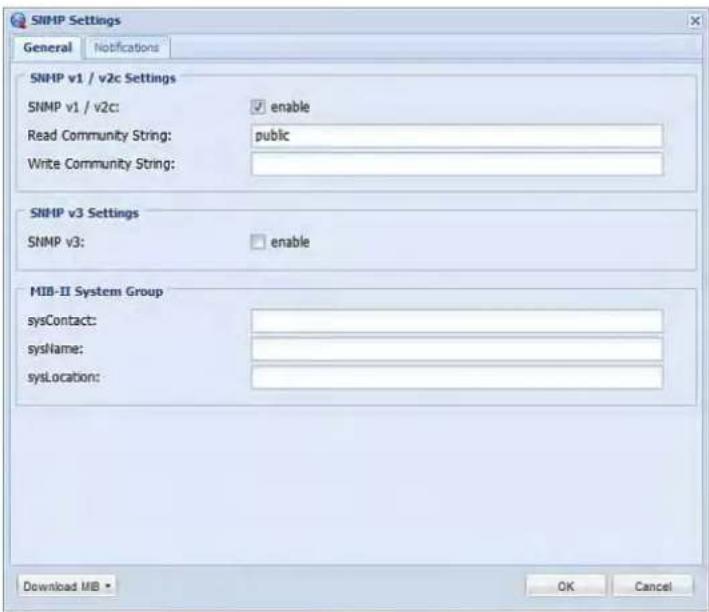
text_image
SNMP Settings General Notifications SNMP v1 / v2c Settings SNMP v1 / v2c: ✓ enable Read Community String: public Write Community String: SNMP v3 Settings SNMP v3: ✓ enable MIB-II System Group sysContact: sysName: sysLocation: Download MIB • OK Cancel- Enter the MIB-II system group information, if applicable:
a. sysContact - the contact person in charge of the system being contacted
b. sysName - the name assigned to the system
c. sysLocation - the location of the system
- Select the MIB to be downloaded. The SNMP MIB for your PX is used by the SNMP manager.
Important: You must download the SNMP MIB for your PX to use with your SNMP manager. Click Download MIB in this dialog to download the desired MIB file. For more details, see Downloading SNMP MIB (on page 337).
- Click OK.
- On the Notifications tab, select the Enable checkbox to enable the SNMP notification feature.
- From the Notification Type drop-down, select the type of SNMP notification.
- For SNMP INFORM communications, leave the resend settings at their default or:
a. In the Timeout (sec) field, enter the interval of time, in seconds, after which a new inform communication is resent if the first is not received. For example, resend a new inform communication once every 3 seconds.
b. In the Number of Retries field, enter the number of times you want to resend the inform communication if it fails. For example, inform communications are resent up to 5 times when the initial communication fails.
8. In the Host fields, enter the IP address of the device(s) you want to access. This is the address to which notifications are sent by the SNMP system agent. You can specify up to 3 SNMP destinations.
9. In the Port fields, enter the port number used to access the device(s).
10. In the Community fields, enter the SNMP community string to access the device(s). The community is the group representing the PX and all SNMP management stations.
11. Click OK.
SNMPv3 Notifications
To configure the PX to send SNMPv3 notifications:
- Choose Device Settings > Network Services > SNMP. The SNMP Settings dialog appears.

text_image
SNMP Settings General Notifications SNMP v1 / v2c Settings SNMP v1 / v2c: enable Read Community String: pubic Write Community String: SNMP v3 Settings SNMP v3: enable MIB-II System Group sysContact: sysName: sysLocation: Download MIB OK Cancel- Enter the MIB-II system group information, if applicable:
a. sysContact - the contact person in charge of the system being contacted
b. sysName - the name assigned to the system
c. sysLocation - the location of the system
- Select the MIB to be downloaded. The SNMP MIB for your PX is used by the SNMP manager.
Important: You must download the SNMP MIB for your PX to use with your SNMP manager. Click Download MIB in this dialog to download the desired MIB file. For more details, see Downloading SNMP MIB (on page 337).
- Click OK.
- On the Notifications tab, select the Enable checkbox to enable the SNMP notification feature.
- From the Notification Type drop-down, select the type of SNMP notification.
- For SNMP TRAPs, the engine ID is prepopulated.
- For SNMP INFORM communications, leave the resend settings at their default or:
a. In the Timeout (sec) field, enter the interval of time, in seconds, after which a new inform communication is resent if the first is not received. For example, resend a new inform communication once every 3 seconds.
b. In the Number of Retries field, enter the number of times you want to resend the inform communication if it fails. For example, inform communications are resent up to 5 times when the initial communication fails.
- For both SNMP TRAPS and INFORMS, enter the following as needed and then click OK to apply the settings:
a. Host name
b. Port number
c. User ID needed to access the host
d. Select the host security level
| Security level Description |
| "noAuthNoPriv" Select this if no authorization or privacy protocols are needed. |
| "authNoPriv" Select this if authorization is required but no privacy protocols are required.Select the authentication protocol - MD5 or SHAEnter the authentication passphrase and then confirm the authentication passphrase |
| "authPriv" Select this if authentication and privacy protocols are required.Select the authentication protocol - MD5 or SHAEnter the authentication passphrase and confirm the authentication passphraseSelect the Privacy Protocol - DES or AESEnter the privacy passphrase and then confirm the privacy passphrase |
SNMP Gets and Sets
In addition to sending traps, the PX is able to receive SNMP get and set requests from third-party SNMP managers.
- Get requests are used to retrieve information about the PX, such as the system location, and the current on a specific outlet.
- Set requests are used to configure a subset of the information, such as the SNMP system name.
Note: The SNMP system name is the PX device name. When you change the SNMP system name, the device name shown in the web interface is also changed.
The PX does NOT support configuring IPv6-related parameters using the SNMP set requests.
Valid objects for these requests are limited to those found in the SNMP MIB-II System Group and the custom PX MIB.
The PX MIB
The SNMP MIB file is required for using your PX device with an SNMP manager. An SNMP MIB file describes the SNMP functions.
Downloading SNMP MIB
The SNMP MIB file for the PX can be easily downloaded from the web interface. There are two ways to download the SNMP MIB file.
To download the file from the SNMP Settings dialog:
- Choose Device Settings > Network Services > SNMP. The SNMP Settings dialog appears.
- Click Download MIB. A submenu of MIB files appears.
-
Select the desired MIB file to download.
-
PDU2-MIB: The SNMP MIB file for PX power management.
-
ASSETMANAGEMENT-MIB: The SNMP MIB file for asset management.
-
Click Save to save the file onto your computer.
To download the file from the Device Information dialog:
- Choose Maintenance > Device Information. The Device Information dialog appears.
-
Click the PDU2-MIB or ASSETMANAGEMENT-MIB link to download the desired SNMP MIB file.
-
PDU2-MIB: The SNMP MIB file for PX power management.
- ASSETMANAGEMENT-MIB: The SNMP MIB file for asset management.
The "USB Console INF file" link lets you download the USB-to-serial driver that may be required only when the PX is connected to a computer via an USB cable for configuration. See Installing the USB-to-Serial Driver (Optional) (on page 19) for details.
- Click Save to save the file onto your computer.
Note: If the LHX/SHX support has been enabled, LHX-MIB is available for download in either dialog.
Layout
Opening the MIB reveals the custom objects that describe the PX system at the unit level as well as at the individual-outlet level.
As standard, these objects are first presented at the beginning of the file, listed under their parent group. The objects then appear again individually, defined and described in detail.

text_image
measurementsGroup OBJECT-GROUP OBJECTS { measurementsUnitSensorIsAvailable, measurementsUnitSensorState, measurementsUnitSensorValue, measurementsUnitSensorTimeStamp, measurementsInletSensorIsAvailable, measurementsInletSensorState, measurementsInletSensorValue, measurementsInletSensorTimeStamp, measurementsInletPoleSensorIsAvailable, measurementsInletPoleSensorState, measurementsInletPoleSensorValue, measurementsInletPoleSensorTimeStamp, measurementsOutletSensorIsAvailable, measurementsOutletSensorState, measurementsOutletSensorValue, measurementsOutletSensorTimeStamp, measurementsOutletPoleSensorIsAvailable, measurementsOutletPoleSensorState, measurementsOutletPoleSensorValue, measurementsOutletPoleSensorTimeStamp, measurementsOverCurrentProtectorSensorIsAvailable, measurementsOverCurrentProtectorSensorState, measurementsOverCurrentProtectorSensorValue, measurementsOverCurrentProtectorSensorTimeStamp, measurementsExternalSensorIsAvailable, measurementsExternalSensorState, measurementsExternalSensorValue, measurementsExternalSensorTimeStamp STATUS current DESCRIPTION "A collection of objects providing the logging capabilities about the pdu."For example, the measurementsGroup group contains objects for sensor readings of PX as a whole. One object listed under this group, measurementsUnitSensorValue, is described later in the MIB as "The sensor value". pduRatedCurrent, part of the configGroup group, describes the PDU current rating.
SNMP Sets and Thresholds
Some objects can be configured from the SNMP manager using SNMP set commands. Objects that can be configured have a MAX-ACCESS level of "read-write" in the MIB.
These objects include threshold objects, which causes the PX to generate a warning and send an SNMP notification when certain parameters are exceeded. See Setting Power Thresholds (on page 215) for a description of how thresholds work.
Note: When configuring the thresholds via SNMP set commands, ensure the value of upper critical threshold is higher than that of upper warning threshold.
Configuring NTP Server Settings
Using SNMP, you can change the following NTP server-related settings:
- Enable or disable synchronizing the PDU's date and time with NTP servers.
- Enable or disable the use of DHCP-assigned NTP servers if synchronization with NTP servers is enabled.
- Manually assign the primary NTP server if the use of DHCP-assigned NTP servers is disabled.
- Manually assign the secondary NTP server (optional).
Tip: To specify the time zone, use the CLI or web interface instead. For the CLI, see Setting the Time Zone (on page 414). For the web interface, see Setting the Date and Time (on page 134).
When using the SNMP SET command to specify or change NTP servers, it is required that both the NTP server's address type and address be set in the command line simultaneously.
For example, the SNMP command to change the primary NTP server's address from IPv4 (192.168.84.84) to host name looks similar to the following:
snmpset -v2c -c private 192.168.84.84 firstNTPServerAddressType = dns firstNTPServerAddress = "angu.pep.com"
Retrieving Energy Usage
You can discover how much energy an IT device consumes by retrieving the Active Energy for the outlet this IT device is plugged into. The Active Energy values are included in the outletSensorMeasurementsTable, along with other outlet sensor readings.
A Note about Enabling Thresholds
When enabling previously disabled thresholds via SNMP, make sure you set a correct value for all thresholds that are supposed to be enabled prior to actually enabling them. Otherwise, you may get an error message.
Chapter 8 Using the Command Line Interface
This section explains how to use the command line interface (CLI) to administer a PX device.
In This Chapter
About the Interface ....341
Logging in to CLI 342
Help Command....346
Querying Available Parameters for a Command....347
Showing Information....347
Clearing Information 378
Configuring the PX Device and Network....379
Load Shedding Configuration Commands ....492
Power Control Operations 494
Checking the Accessibility of NTP Servers 498
Actuator Control Operations....498
Unblocking a User 500
Resetting the PX....500
Network Troubleshooting....502
Retrieving Previous Commands....505
Automatically Completing a Command ....505
Logging out of CLI 506
About the Interface
The PX provides a command line interface that enables data center administrators to perform some basic management tasks.
Using this interface, you can do the following:
- Reset the PX device
- Display the PX and network information, such as the device name, firmware version, IP address, and so on
- Configure the PX and network settings
- Troubleshoot network problems
You can access the interface over a local connection using a terminal emulation program such as HyperTerminal, or via a Telnet or SSH client such as PuTTY.
Note: Telnet access is disabled by default because it communicates openly and is thus insecure. To enable Telnet, see Modifying Network Service Settings (on page 127).
Logging in to CLI
Logging in via HyperTerminal over a local connection is a little different than logging in using SSH or Telnet.
If a security login agreement has been enabled, you must accept the agreement in order to complete the login. Users are authenticated first and the security banner is checked afterwards.
With HyperTerminal
You can use any terminal emulation programs for local access to the command line interface.
This section illustrates HyperTerminal, which is part of Windows operating systems prior to Windows Vista.
To log in using HyperTerminal:
- Connect your computer to the PX via a local connection.
- Launch HyperTerminal on your computer and open a console window. When the window first opens, it is blank.
Make sure the COM port settings use this configuration:
- Bits per second = 115200 (115.2Kbps)
- Data bits = 8
- Stop bits = 1
- Parity = None
■ Flow control = None
Tip: For a USB connection, you can determine the COM port by choosing Control Panel > System > Hardware > Device Manager, and locating the "OUTLET 1, Serial Console" under the Ports group.
- In the communications program, press Enter to send a carriage return to the PX. The Username prompt appears.
Username: _
- Type a name and press Enter. The name is case sensitive. Then you are prompted to enter a password.
Username: admin Password: _
- Type a password and press Enter. The password is case sensitive.
After properly entering the password, the # or > system prompt appears. See Different CLI Modes and Prompts (on page 345) in the online help for more information.
Tip: The "Last Login" information, including the date and time, is also displayed if the same user profile was used to log in to this product's web interface or CLI.
- You are now logged in to the command line interface and can begin administering the PX.
With SSH or Telnet
You can remotely log in to the command line interface (CLI) using an SSH or Telnet client, such as PuTTY.
Note: PuTTY is a free program you can download from the Internet. See PuTTY's documentation for details on configuration.
To log in using SSH or Telnet:
- Ensure SSH or Telnet has been enabled. See Modifying Network Service Settings (on page 127) in the online help.
- Launch an SSH or Telnet client and open a console window. A login prompt appears.
login as:

- Type a name and press Enter. The name is case sensitive.
Note: If using the SSH client, the name must NOT exceed 25 characters. Otherwise, the login fails.
Then you are prompted to enter a password.
login as: admin admin@192.168.84.88's password:
- Type a password and press Enter. The password is case sensitive.
- After properly entering the password, the # or > system prompt appears. See Different CLI Modes and Prompts (on page 345) in the online help for more information.
Tip: The "Last Login" information, including the date and time, is also displayed if the same user profile was used to log in to this product's web interface or CLI.
- You are now logged in to the command line interface and can begin administering the PX.
With an Analog Modem
The PX supports remote access to the CLI via a connected analog modem. This feature is especially useful when the LAN access is not available.
To connect to the PX via the modem:
- Make sure the PX has an analog modem connected. See Connecting an Analog Modem (on page 54).
- Make sure the computer you are using has an appropriate modem connected.
- Launch a terminal emulation program, and configure its baud rate settings according to the baud rate set for the analog modem connected to the PX. See Configuring the Serial Port (on page 141).
- Type the following AT command to make a connection with the PX.
ATD
- The CLI login prompt appears after the connection is established successfully. Then type the user name and password to log in to the CLI.
To disconnect from the PX:
- Return to the modem's command mode using the escape code +++.
- After the OK prompt appears, type the following AT command to disconnect from the PX.
ATH
Different CLI Modes and Prompts
Depending on the login name you use and the mode you enter, the system prompt in the CLI varies.
- User Mode: When you log in as a normal user, who may not have full permissions to configure the PX device, the > prompt appears.
- Administrator Mode: When you log in as an administrator, who has full permissions to configure the PX device, the # prompt appears.
- Configuration Mode: You can enter the configuration mode from the administrator or user mode. In this mode, the prompt changes to config:# or config:> and you can change PX device and network configurations. See Entering Configuration Mode (on page 379).
- Diag nostic Mode: You can enter the diagnostic mode from the administrator or user mode. In this mode, the prompt changes to diag:# or diag:> and you can perform the network troubleshooting commands, such as the ping command. See Entering Diagnostic Mode (on page 502).
Closing a Local Connection
Close the window or terminal emulation program when you finish accessing a PX device over the local connection.
When accessing or upgrading multiple PX devices, do not transfer the local connection cable from one device to another without closing the local connection window first.
Help Command
The help (?) command shows a list of main CLI commands available for the current mode. This is helpful when you are not familiar with CLI commands.
▶ Help command under the administrator mode:
# ?
▶ Help command under the configuration mode:
config:# ?
▶ Help command under the diagnostic mode:
diag:# ?
Press Enter after typing the help command, and a list of main commands for the current mode is displayed.
Tip: You can check what parameters are available for a specific CLI command by adding the help command to the end of the queried command. See Querying Available Parameters for a Command (on page 347).
Querying Available Parameters for a Command
If you are not sure what commands or parameters are available for a particular type of CLI command or its syntax, you can have the CLI show them by adding a space and the help command (?) to the end of that command. A list of available parameters and their descriptions will be displayed.
The following shows a few query examples.
To query available parameters for the "show" command:
show ?
To query available parameters for the "show user" command:
show user ?
To query available network configuration parameters:
config:#network?
To query available role configuration parameters:
config:#role?
To query available parameters for the "role create" command:
config:# role create ?
Showing Information
You can use the show commands to view current settings or the status of the PX device or part of it, such as the IP address, networking mode, firmware version, states or readings of internal or external sensors, user profiles, and so on.
Some "show" commands have two formats: one with the parameter "details" and the other without. The difference is that the command without the parameter "details" displays a shortened version of information while the other displays in-depth information.
After typing a "show" command, press Enter to execute it.
Note: Depending on your login name, the # prompt may be replaced by the > prompt. See Different CLI Modes and Prompts (on page 345).
Network Configuration
This command shows all network configuration, such as the IP address, networking mode, and MAC address.
# show network
IP Configuration
This command shows the IP-related configuration only, such as IPv4 and IPv6 configuration, address(es), gateway, and subnet mask.
# show network ip
Variables:
-
| Option Description | |
| all This options shows both IPv4 and IPv6 settings. | |
| v4 This option shows the IPv4 settings only. | |
| v6 This option shows the IPv6 settings only. |
LAN Interface Settings
This command shows the LAN interface information only, including LAN interface speed, duplex mode, current LAN interface status and LAN interface MAC address.
# show network interface
Networking Mode
This command shows whether the current networking mode is wired or wireless.
# show network mode
Note: If the PX is a slave device connected to the LAN via the master PX device, the show network mode command displays wired(USB) instead of wired.
Wireless Configuration
This command only shows the wireless configuration of the PX device, such as the SSID parameter.
# show network wireless
To show detailed information, add the parameter "details" to the end of the command.
# show network wireless details
Network Service Settings
This command shows the network service settings only, including the Telnet setting, TCP ports for HTTP, HTTPS, SSH and Modbus/TCP services, and SNMP settings.
# show network services
Variables:
-
| Option Description | |
| all Displays the settings of all network services,including HTTP, HTTPS, Telnet, SSH and SNMP. | |
| Tip: You can also type the command without adding this option "all" to get the same data. | |
| http Only displays the TCP port for the HTTP service. | |
| https Only displays the TCP port for the HTTPS service. | |
| telnet Only displays the settings of the Telnet service. | |
| ssh Only displays the settings of the SSH service. | |
| snmp Only displays the SNMP settings. | |
| modbus Only displays the settings of the Modbus/TCP service. | |
| zeroconfig Only displays the settings of the zero configuration advertising. | |
PDU Configuration
This command shows the PDU configuration, such as the device name, firmware version and model type.
# show pdu
To show detailed information, add the parameter "details" to the end of the command.
# show pdu details
Outlet Information
This command syntax shows the outlet information.
<h1 id="show-outlets-n">show outlets <n></h1>
To show detailed information, add the parameter "details" to the end of the command.
<h1 id="show-outlets-n-details">show outlets <n> details</h1>
Variables:
-
| Option Description | |
| all Displays the information for all outlets. | |
| Tip: You can also type the command without adding this option "all" to get the same data. | |
| A specific outlet number | Displays the information for the specified outlet only. |
Displayed information:
- Without the parameter "details," only the outlet name and state are displayed.
- With the parameter "details," more outlet information is displayed in addition to the state, such as rated current, voltage, active power, active energy, and outlet settings.
Inlet Information
This command syntax shows the inlet information.
<h1 id="show-inlets-n">show inlets <n></h1>
To show detailed information, add the parameter "details" to the end of the command.
<h1 id="show-inlets-n-details">show inlets <n> details</h1>
Variables:
-
| Option Description | |
| all Displays the information for all inlets. | |
| Tip: You can also type the command without adding this option "all" to get the same data. | |
| A specific inlet number | Displays the information for the specified inlet only.An inlet number needs to be specified only when there are more than 1 inlet on your PDU. |
Displayed information:
- Without the parameter "details," only the inlet's name and RMS current are displayed.
- With the parameter "details," more inlet information is displayed in addition to the inlet name and RMS current, such as the inlet's RMS voltage, active power and active energy.
Overcurrent Protector Information
This command is only available for models with overcurrent protectors for protecting outlets.
This command syntax shows the overcurrent protector information, such as a circuit breaker or a fuse.
<h1 id="show-ocp-n">show ocp <n></h1>
To show detailed information, add the parameter "details" to the end of the command.
<h1 id="show-ocp-n-details">show ocp <n> details</h1>
Variables:
-
| Option Description | |
| all Displays the information for all overcurrent protectors. | |
| A specific overcurrent protector number | Displays the information for the specified overcurrent protector only. |
Displayed information:
- Without the parameter "details," only the overcurrent protector status and name are displayed.
- With the parameter "details," more overcurrent protector information is displayed in addition to status, such as the rating and RMS current value.
Date and Time Settings
This command shows the current date and time settings on the PX device.
# show time
To show detailed information, add the parameter "details" to the end of the command.
# show time details
Default Measurement Units
This command shows the default measurement units applied to the PX web and CLI interfaces across all users, especially those users authenticated through remote authentication servers.
# show user defaultPreferences
Note: If a user has set his/her own preferred measurement units or the administrator has changed any user's preferred units, the web and CLI interfaces show the preferred measurement units for that user instead of the default ones after that user logs in to the PX. See Existing User Profiles (on page 367) for the preferred measurement units for a specific user.
Environmental Sensor Information
This command syntax shows the environmental sensor's information.
<h1 id="show-externalsensors-n">show externalsensors <n></h1>
To show detailed information, add the parameter "details" to the end of the command.
<h1 id="show-externalsensors-n-details">show externalsensors <n> details</h1>
External sensor 3 ('Temperature 1')
Sensor type: Temperature
Reading: 31.8 deg C (normal)
Serial number: AEI0950133
Description: Not configured
Location: X Not configured
Y Not configured
Z Not configured
Position: Port 1
Using default thresholds: yes
Variables:
-
| Option Description | |
| all Displays the information of all environmental sensors. | |
| A specific environmental sensor number* | Displays the information for the specified environmental sensor only. |
* The environmental sensor number is the ID number assigned to the sensor, which can be found on the Peripheral Devices page of the PX web interface.
Displayed information:
- Without the parameter "details," only the sensor ID, sensor type and reading are displayed.
Note: A discrete (on/off) sensor displays the sensor state instead of the numeric reading.
- With the parameter "details," more information is displayed in addition to the ID number and sensor reading, such as the serial number, sensor position, and X, Y, and Z coordinates.
Note: DPX sensor packages do not provide chain position information..
Environmental Sensor Package Information
Different from the "show externalsensors" commands, which show the reading, status and configuration of an individual environmental sensor, the following command shows the information of all connected environmental sensor packages, each of which may contain more than one sensor or actuator.
# show peripheralDevicePackages
Information similar to the following is displayed. An environmental sensor package is a peripheral device package.
Peripheral Device Package 1
Serial Number: AEI7A00022
Package Type: DPX-T1H1
Position: Port 1
Package State: operational
Firmware Version: Not available
Peripheral Device Package 2
Serial Number: AEI7A00021
Package Type: DPX-T3H1
Position: Port 1
Package State: operational
Firmware Version: Not available
Actuator Information
This command syntax shows an actuator's information.
<h1 id="show-actuators-n">show actuators <n></h1>
To show detailed information, add the parameter "details" to the end of the command.
<h1 id="show-actuators-n-details">show actuators <n> details</h1>
Variables:
-
| Option Description | |
| all Displays the information for all actuators. | |
| A specific actuator number* | Displays the information for the specified actuator only. |
* The actuator number is the ID number assigned to the actuator. The ID number can be found using the PX web interface or CLI. It is an integer starting at 1.
Displayed information:
- Without the parameter "details," only the actuator ID, type and state are displayed.
- With the parameter "details," more information is displayed in addition to the ID number and actuator state, such as the serial number and X, Y, and Z coordinates.
Outlet Sensor Threshold Information
This command syntax shows the specified outlet sensor's threshold-related information.
<h1 id="show-sensor-outlet-n-sensor-type">show sensor outlet <n> <sensor type></h1>
To show detailed information, add the parameter "details" to the end of the command.
<h1 id="show-sensor-outlet-n-sensor-type-details">show sensor outlet <n> <sensor type> details</h1>
Variables:
is the number of the outlet whose sensors you want to query. is one of the following sensor types:
| Sensor type Description | |||
| current | Current | sensor | |
| voltage | Voltage | sensor | |
| activePower | Active | power | sensor |
| apparentPower Apparent power sensor | |||
| powerFactor Power factor sensor | |||
| activeEnergy Active energy sensor | |||
| lineFrequency Line frequency sensor | |||
Displayed information:
- Without the parameter "details," only the sensor reading, state, threshold, deassertion hysteresis and assertion timeout settings of the specified outlet sensor are displayed.
- With the parameter "details," more sensor information is displayed, including resolution and range.
- If the requested sensor type is not supported, the "Sensor is not available" message is displayed.
Outlet Pole Sensor Threshold Information
This command is available for an in-line monitor only, including PX2-3000 and PX3-3000 series.
This command syntax shows the specified outlet pole sensor's threshold-related information.
# show sensor outletpole To show detailed information, add the parameter "details" to the end of the command. # show sensor outletpole is the label of the outlet pole whose sensors you want to query. - This command is NOT available for an in-line monitor (PX3-3000 series). This command syntax shows the specified inlet sensor's threshold-related information. # show sensor inlet To show detailed information, add the parameter "details" to the end of the command. # show sensor inlet Sensor type Description This command is only available for a three-phase PDU except for an in-line monitor (PX3-3000 series). This command syntax shows the specified inlet pole sensor's threshold-related information. # show sensor inletpole To show detailed information, add the parameter "details" to the end of the command. # show sensor inletpole is the label of the inlet pole whose sensors you want to query. - This command is only available for models with overcurrent protectors for protecting outlets. This command syntax shows the specified overcurrent protector sensor's threshold-related information. # show sensor ocp To show detailed information, add the parameter "details" to the end of the command. # show sensor ocp Sensor type Description This command syntax shows the specified environmental sensor's threshold-related information. To show detailed information, add the parameter "details" to the end of the command. External sensor 3 (Temperature): Reading: 31.8 deg C State: normal Active Thresholds: Sensor specific thresholds Default Thresholds for Temperature sensors: Lower critical threshold: 10.0 deg C Lower warning threshold: 15.0 deg C Upper warning threshold: 30.0 deg C Upper critical threshold: 35.0 deg C Deassertion hysteresis: 1.0 deg C Assertion timeout: 0 samples Sensor Specific Thresholds: Lower critical threshold: 8.0 deg C Lower warning threshold: 13.0 deg C Upper warning threshold: 28.0 deg C Upper critical threshold: 33.0 deg C Deassertion hysteresis: 1.0 deg C Assertion timeout: 0 samples - Note: For a discrete (on/off) sensor, the threshold-related and accuracy-related data is NOT available. This command syntax shows a certain sensor type's default thresholds, which are the initial thresholds applying to the specified type of sensor. # show defaultThresholds To show detailed information, add the parameter "details" to the end of the command. # show defaultThresholds - This command shows the security settings of the PX. # show security To show detailed information, add the parameter "details" to the end of the command. # show security details This command shows the data of one or all existing user profiles. To show detailed information, add the parameter "details" to the end of the command. - This command shows the data of one or all existing roles. - Displayed information: - Role settings are displayed, including the role description and privileges. This section applies to outlet-switching capable models only. This command shows the load shedding settings. Displayed information: - The load shedding state is displayed along with non-critical outlets. Note: The load shedding mode is associated with critical and non-critical outlets. To specify critical and non-critical outlets through CLI, see Specifying Non-Critical Outlets (on page 384). This command shows the baud rate setting of the serial port labeled CONSOLE / MODEM on the PX device. # show serial This command shows the PX device's current configuration for Cisco® EnergyWise. # show energywise This command shows the USB-cascading configuration, such as the cascading mode and device position. # show cascading To show detailed information, add the parameter "details" to the end of the command. # show cascading details This command shows the asset sensor settings, such as the total number of rack units (tag ports), asset sensor state, numbering mode, orientation, available tags and LED color settings. # show assetStrip - all Displays all asset sensor information. Tip: You can also type the command without adding this option "all" to get the same data. Option Description For the Raritan asset sensor, a rack unit refers to a tag port. This command shows the settings of a specific rack unit or all rack units on an asset sensor, such as a rack unit's LED color and LED mode. # show rackUnit Option Description This command shows the information of a blade extension strip, including the total number of tag ports, and if available, the ID (barcode) number of any connected tag. Option Description The command used to show the event log begins with show eventlog. You can add either the limit or class parameters or both to show specific events. ▶ Show the last 30 entries: # show eventlog ▶ Show a specific number of last entries in the event log: # show eventlog limit ▶ Show a specific type of events only: # show eventlog class Show a specific number of last entries associated with a specific type of events only: # show eventlog limit - - Note: You can ignore the powerLogic event type in the CLI because the PX does not support it. This command shows the diagnostic log for the wireless LAN connection. # show wlanlog This command shows all server reachability information with a list of monitored servers and status. # show serverReachability To show the server reachability information for a certain IT device only, use the following command. # show serverReachability server To show detailed information, add the parameter "details" to the end of the command. # show serverReachability server - You can find each IT device's sequence number using the CLI command of show serverReachability as illustrated below. # IP address Enabled Status 1 192.168.84.126 Yes Waiting for reliable connection
2 www.raritan.com Yes Waiting for reliable connection This command syntax shows the command history for current connection session. # show history Displayed information: - A list of commands that were previously entered in the current session is displayed. This command syntax shows the length of the history buffer for storing history commands. # show history bufferlength Displayed information: - The current history buffer length is displayed. This command shows the reliability data. # show reliability data This command shows the reliability error log. # show reliability errorlog - This section provides examples of the show command. The diagram shows the output of the show security command. # show security IPv4 access control: Disabled IPv6 access control: Disabled Role based access control for IPv4: Disabled Role based access control for IPv6: Disabled Password aging: Disabled Prevent concurrent user login: No Strong passwords: Disabled Enforce HTTPS for web access: Yes Restricted Service Agreement: disabled More information is displayed when typing the show security details command. # show security details IPv4 access control: Disabled IPv6 access control: Disabled Role based access control for IPv4: Disabled Role based access control for IPv6: Disabled Password aging: Disabled Prevent concurrent user login: No Maximum number of failed logins: 3
User block time: 10 minutes User idle timeout: 1440 minutes Strong passwords: Disabled Enforce HTTPS for web access: Yes Restricted Service Agreement: disabled Restricted Service Agreement Banner Content: Unauthorized access prohibited; all access and activities not explicitly authorized by management are unauthorized. All activities are monitored and logged. The re is no privacy on this system. Unauthorized access and activities or any criminal activity will be reported to appropriate authorities. The diagram shows the output of the show pdu command. # show pdu PDU 'my PX' Model: PX3-XXXX Firmware Version: 2.X.0.5-40956 More information is displayed when typing the show pdu details command. Displayed information varies depending on the model you purchased. # show pdu details PDU 'my PX Model: PX3-XXXX Firmware Version: 2.X.0.5-40956 Serial Number: QGZ3792136 Board Revision: 0x01 Voltage rating: 200-240V Current rating: 16A Frequency rating: 50/60Hz Power rating: 3.2-3.8kVA Sensor data retrieval: Enabled Measurements per log entry: 60 External sensor Z coordinate format: Rack units Device altitude: 0 m You can use the clear commands to remove unnecessary data from the PX. After typing a "clear" command, press Enter to execute it. Note: Depending on your login name, the # prompt may be replaced by the > prompt. See Different CLI Modes and Prompts (on page 345). This command removes all data from the event log. # clear eventlog -- OR -- # clear eventlog /y If you entered the command without "/y," a message appears, prompting you to confirm the operation. Type y to clear the event log or n to abort the operation. If you type y, a message "Event log was cleared successfully" is displayed after all data in the event log is deleted. To configure the PX device or network settings through the CLI, it is highly recommended to log in as the administrator so that you have full permissions. To configure any settings, enter the configuration mode. Configuration commands are case sensitive so ensure you capitalize them correctly. Configuration commands function in configuration mode only. Note: If you enter configuration mode from user mode, you may have limited permissions to make configuration changes. See Different CLI Modes and Prompts (on page 345). Type config and press Enter. The config:# prompt appears, indicating that you have entered configuration mode. config:# _ Important: To apply new configuration settings, you must issue the "apply" command before closing the terminal emulation program. Closing the program does not save any configuration changes. See Quitting Configuration Mode (on page 379). Both of "apply" and "cancel" commands let you quit the configuration mode. The difference is that "apply" saves all changes you made in the configuration mode while "cancel" aborts all changes. config:# apply -- OR -- config:# cancel The # or > prompt appears after pressing Enter, indicating that you have entered the administrator or user mode. See Different CLI Modes and Prompts (on page 345). A PDU configuration command begins with pdu. You can use the PDU configuration commands to change the settings that apply to the whole PX device. This command changes the PX device's name. config:# pdu name " - This section applies to outlet-switching capable models only. This command syntax determines the relay behavior of all outlets on a PX model. config:# pdu relayBehaviorOnPowerLoss - Note: For more information on the outlet relay behavior, see PX3 Latching Relay Behavior (on page 192). This section applies to outlet-switching capable models only. This command sets the outlet power-on sequence when the PDU powers up. config:# pdu outletSequence - Note: Power-on sequencing is disabled in the latching mode. See PX3 Latching Relay Behavior (on page 192). This section applies to outlet-switching capable models only. This command sets the delays (in seconds) for outlets when turning on all outlets in sequence. config:# pdu outletSequenceDelay Separate outlet numbers and their delay settings with a colon. Outlets followed by delays are separated with a semicolon. Note: Power-on sequencing is disabled in the latching mode. See PX3 Latching Relay Behavior (on page 192). This section applies to outlet-switching capable models only. This command determines the initial power condition of all outlets after powering up the PDU. config:# pdu outletStateOnDeviceStartup - Note: This feature does NOT take effect and cannot be configured on a PX3 device after the outlet relay is set to the "Latching" mode. See Setting the Outlet Relay Behavior (on page 193). This section applies to outlet-switching capable models only. This command sets the power-off period of the power cycling operation for all outlets. config:# pdu cyclingPowerOffPeriod - This section applies to outlet-switching capable models only. This command sets the inrush guard delay. config:# pdu inrushGuardDelay - This section applies to outlet-switching capable models only. This command determines the outlet initialization delay timing on device startup. See Setting the Initialization Delay (on page 203) for information on outlet initialization delay. config:# pdu outletInitializationDelayOnDeviceStartup Variables: - Note: This feature does NOT take effect and cannot be configured on a PX3 device after the outlet relay is set to the "Latching" mode. See Setting the Outlet Relay Behavior (on page 193). This section applies to outlet-switching capable models only. This command determines critical and non-critical outlets. It is associated with the load shedding mode. See Setting Non-Critical Outlets and Load Shedding Mode (on page 206). config:# pdu nonCriticalOutlets Separate outlet numbers and their settings with a colon. Separate each "false" and "true" setting with a semicolon. - Use a dash for a range of consecutive outlets. For example, 3-8 represents outlets 3 to 8. - Use a dash for a range of consecutive outlets. For example, 3-8 represents outlets 3 to 8. This command enables or disables the data logging feature. config:# pdu dataRetrieval - For more information, see Setting Data Logging (on page 147). This command defines the number of measurements accumulated per log entry. config:# pdu measurementsPerLogEntry - For more information, see Setting Data Logging (on page 147). This command specifies your PX device's altitude above sea level (in meters). You must specify the PX device's altitude above sea level if a Raritan differential air pressure sensor is attached. This is because the device's altitude is associated with the altitude correction factor. See Altitude Correction Factors (on page 645). config:#pdu deviceAltitude Variables: - This command enables or disables the use of rack units for specifying the height (Z coordinate) of environmental sensors. config:# pdu externalSensorsZCoordinateFormat Variables: - Note: After determining the format for the Z coordinate, you can set a value for it. See Setting the Z Coordinate (on page 460). This command enables or disables the Peripheral Device Auto Management feature. config:# pdu peripheralDeviceAutoManagement - For more information, see Disabling the Automatic Management Function (on page 294). This command syntax determines the orientation of the contents shown on the LCD display of a PX3 phase II Zero U PDU. config:# pdu displayOrientation - Note that this command is NOT applicable to a non-Zero U PDU. This section illustrates several PDU configuration examples. The following command assigns the name "my px12" to the PDU. config:# pdu name "my px12" The following command causes a 10-outlet PDU to first power on the 8th to 6th outlets and then the rest of outlets in the ascending order after the PDU powers up. config:# pdu outletSequence 8-6,1-5,9,10 The following command determines that the outlet 1's delay is 2.5 seconds, outlet 2's delay is 3 seconds, and the delay for outlets 3 through 5 is 10 seconds. config:#pdu outletSequenceDelay 1:2.5;2:3;3-5:10 The following command sets outlets 1, 2, 3, 7, and 9 to be critical outlets, and 4, 5, 6, 8, 10, 11 and 12 to be non-critical outlets on a 12-outlet PX. config:# pdu nonCriticalOutlets 1-3,7,9:false;4-6,8,10-12:true A network configuration command begins with network. A number of network settings can be changed through the CLI, such as the IP address, transmission speed, duplex mode, and so on. If your PX device is implemented with both wired and wireless networking mechanisms, you must determine which mechanism is enabled for network connectivity before further configuring networking parameters. This command enables the wired or wireless networking mode. config:#network mode - wired Enables the wired networking mode. wireless Enables the wireless networking mode. Note: If you enable the wireless networking mode, and the PX does not detect any wireless USB LAN adapter or the connected wireless USB LAN adapter is not supported, the message "Supported Wireless device not found" is displayed. By default, only the IPv4 protocol is enabled. You can enable both the IPv4 and IPv6 protocols, or only the IPv6 protocol for your PX device. An IP protocol configuration command begins with network ip. This command determines which IP protocol is enabled on the PX. config:# network ip proto - v4Only Enables IPv4 only on all interfaces. This is the default. This command determines which IP address is used when the DNS server returns both of IPv4 and IPv6 addresses. You need to configure this setting only after both IPv4 and IPv6 protocols are enabled on the PX. config:# network ip dnsResolverPreference - You must configure wireless parameters, including Service Set Identifier (SSID), authentication method, Pre-Shared Key (PSK), and Basic Service Set Identifier (BSSID) after the wireless networking mode is enabled. A wireless configuration command begins with network wireless. Note: If current networking mode is not wireless, the SSID, PSK and BSSID values are not applied until the networking mode is changed to "wireless." In addition, a message appears, indicating that the active network interface is not wireless. This command specifies the SSID string. config:# network wireless SSID - This command sets the wireless authentication method to either PSK or Extensible Authentication Protocol (EAP). config:# network wireless authMethod - Method Description If the Pre-Shared Key (PSK) authentication method is selected, you must assign a PSK passphrase by using this command. config:# network wireless PSK - When the wireless authentication method is set to EAP, you must configure EAP authentication parameters, including outer authentication, inner authentication, EAP identity, password, and CA certificate. ▶ Determine the outer authentication protocol: config:# network wireless allowConnectionWithIncorrectClock Option Description - Option Description - Option Description This section provides a CA certificate example only. Your CA certificate contents should be different from the contents displayed in this example. --- BEGIN CERTIFICATE ---
MIICjTCCAfigAwIBAgIEMaYgRzALBgkqhkiG9w0BAQQwRTELMAkGA1UEBhMCVVMxNjA0BgNVBAoTLU5hdGlvbmFsIEFlcm9uYXV0aWNzIGFuZCBTcGFjZSBBZG1pbmlzdHJhdGlvbjAmFxE5NjA1MjgxMzQ5MDUrMDgwMBcROTgwNTI4MTM0OTA1KzA4MDAwZzELMAkGA1UEBhMCVVMxNjA0BgNVBAoTLU5hdGlvbmFsIEFlcm9uYXV0aWNzIGFuZCBTcGFjZSBBZG1pbmlzdHJhdGlvbjEgMAkGA1UEBRMCMTYwEwYDVQQDEwxTdGV2ZSBTY2hvY2gwWDALBgkqhkiG9w0BAQEDSQAwRgJBALrAwyYdgxmzNP/ts0Uyf6BpmiJYktU/w4NG67ULaN4B5CnEz7k57s9o3YY3LecETgQ5iQHmkwlYDTL2fTgVfw0CAQOjgaswgagwZAYDVR0ZAQH/BFowWDBWMFQxCzAJBgNVBAYTAIVTMTYwNAYDVQQKEy1OYXRpb25hbCBBZXJvbmF1dGljcyBhbmQgU3BhY2UgQWRtaW5pc3RyYXRpb24xDTALBgNVBAMTBENSTDEwFwYDVR0BAQH/BA0wC4AJODMyOTcwODEwMBgGA1UdAgQRMA8ECTgzMjk3MDgyM4ACBSAwDQYDVR0KBAYwBAMCBkAwCwYJKoZIhvcNAQEEA4GBAH2y1VCEw/A4zaXzSYZJTTUi3uawbbFiS2yxHvgf28+8Js0OHXk1H1w2d6qOHH21X82tZXd/0JtG0g1T9usFFBDvYK8O0ebgz/P5ELJnBL2+atObEuJy1ZZ0pBDWINR3WkDNLCGiTkCKp0F5EWIrVDwh54NNevkCQRZita+z4IBO
--- END CERTIFICATE --- MIICjTCCAfigAwIBAgIEMaYgRzALBgkqhkiG9w0BAQQwRTELMAkGA1UEBhMCVVMxNjA0BgNVBAoTLU5hdGlvbmFsIEFlcm9uYXV0aW NzIGFuZCBTcGFjZSBBZG1pbmlzdHJhdGlvbjAmFxE5NjA1MjgxM zQ5MDUrMDgwMBcROTgwNTI4MTM0OTA1KzA4MDAwZzELMAkGA1UE BhMCVVMxNjA0BgNVBAoTLU5hdGlvbmFsIEFlcm9uYXV0aWNzIGF uZCBTcGFjZSBBZG1pbmlzdHJhdGlvbjEgMAkGA1UEBRMCMTYwEw YDVQQDEwxTdGV2ZSBTY2hvY2gwWDALBgkqhkiG9w0BAQEDSQAwR gJBALrAwyYdgxmzNP/tsOUyf6BpmiJYktU/w4NG67ULaN4B5CnE z7k57s9o3YY3LecETgQ5iQHmkwlYDTL2fTgVfw0CAQOjgaswgag wZAYDVR0ZAQH/BFowWDBWMFQxCzAJBgNVBAYTA1VTMTYWNAYDVQ QKEy1OYXRpbb25hbCBBZXJvbmF1dGljcyBhbmQgU3BhY2UgQWRta W5pc3RyYXRpbb24xDTALBgNVBAMTBENSTDEwFwYDVR0BAQH/BA0w C4AJODMyOTcwODEwMBgGA1UdAgQRMA8ECTgzMjk3MDgyM4ACBSA wDQYDVR0KBAYwBAMCBkAwCwYJKoZIhvcNAQEEA4GBAH2y1VCEw/ A4zaXzSYZJTTUi3uawbbFiS2yxHvgf28+8Js0OHXk1H1w2d6qOH H21X82tZXd/0JtG0g1T9usFFBDvYK8O0ebgz/P5ELJnBL2+atOb EuJy1ZZ0pBDWINR3WkDNLCGiTkCKp0F5EWIrVDwh54NNevkCQRZ ita+z4IBO config:# This command specifies the BSSID. config:# network wireless BSSID - An IPv4 configuration command begins with network ipv4. Configuration commands are case sensitive so ensure you capitalize them correctly. This command determines the IP configuration mode. config:# network ipv4 ipConfigurationMode - After selecting DHCP as the IPv4 configuration mode, you can specify the preferred host name, which is optional. The following is the command: config:# network ipv4 preferredHostName - After selecting the static IP configuration mode, you can use this command to assign a permanent IP address to the PX device. config:# network ipv4 ipAddress - After selecting the static IP configuration mode, you can use this command to define the subnet mask. config:# network ipv4 subnetMask - After selecting the static IP configuration mode, you can use this command to specify the gateway. config:# network ipv4 gateway - After selecting the static IP configuration mode, use this command to specify the primary DNS server. If you have selected the DHCP configuration mode, you still can manually specify DNS servers with this command and then override the DHCP-assigned DNS servers. See Overriding the IPv4 DHCP-Assigned DNS Server (on page 398). config:# network ipv4 primaryDNSServer - After selecting the static IP configuration mode, you can use this command to specify the secondary DNS server. If you have selected the DHCP configuration mode, you still can manually specify DNS servers with this command and then override the DHCP-assigned DNS servers. See Overriding the IPv4 DHCP-Assigned DNS Server (on page 398). config:# network ipv4 secondaryDNSServer - Note: The PX supports a maximum of 3 DNS servers. If two IPv4 DNS servers and two IPv6 DNS servers are available, the PX only uses the primary IPv4 and IPv6 DNS servers. After specifying the primary/secondary DNS server, you can use this command to override the DHCP-assigned DNS server with the one you specified. config:# network ipv4 overrideDNS - If the IPv4 network mode is set to static IP and your local network contains two subnets, you can configure static routes to enable or disable communications between the PX and devices in the other subnet. These commands are prefixed with network ipv4 staticRoutes. config:# network ipv4 staticRoutes add config:# network ipv4 staticRoutes delete config:# network ipv4 staticRoutes modify An IPv6 configuration command begins with network ipv6. Configuration commands are case sensitive so ensure you capitalize them correctly. This command determines the IP configuration mode. config:# network ipv6 ipConfigurationMode - Mode Description After selecting DHCP as the IPv6 configuration mode, you can specify the preferred host name, which is optional. The following is the command: config:# network ipv6 preferredHostName - After selecting the static IP configuration mode, you can use this command to assign a permanent IP address to the PX device. config:# network ipv6 ipAddress - After selecting the static IP configuration mode, you can use this command to specify the gateway. config:# network ipv6 gateway - After selecting the static IP configuration mode, use this command to specify the primary DNS server. If you have selected the automatic configuration mode, you still can manually specify DNS servers with this command and then override the DHCP-assigned DNS servers. See Overriding the IPv6 DHCP-Assigned DNS Server (on page 402). config:# network ipv6 primaryDNSServer - After selecting the static IP configuration mode, you can use this command to specify the secondary DNS server. If you have selected the automatic configuration mode, you still can manually specify DNS servers with this command and then override the DHCP-assigned DNS servers. See Overriding the IPv6 DHCP-Assigned DNS Server (on page 402). config:# network ipv6 secondaryDNSServer - Note: The PX supports a maximum of 3 DNS servers. If two IPv4 DNS servers and two IPv6 DNS servers are available, the PX only uses the primary IPv4 and IPv6 DNS servers. After specifying the primary/secondary DNS server, you can use this command to override the DHCP-assigned DNS server with the one you specified. config:# network ipv6 overrideDNS - If the IPv6 network mode is set to static IP and your local network contains two subnets, you can configure static routes to enable or disable communications between the PX and devices in the other subnet. These commands are prefixed with network ipv6 staticRoutes. config:# network ipv6 staticRoutes add config:# network ipv6 staticRoutes delete config:# network ipv6 staticRoutes modify A LAN interface configuration command begins with network interface. This command determines the LAN interface speed. config:# network interface LANInterfaceSpeed - This command determines the LAN interface duplex mode. config:# network interface LANInterfaceDuplexMode - A network service command begins with network services. The commands used to configure the HTTP port settings begin with network services http. config:# network services http port config:# network services http enabled The commands used to configure the HTTPS port settings begin with network services https. config:# network services https port config:# network services https enabled Option Description You can enable or disable the Telnet service, or change its TCP port using the CLI commands. A Telnet command begins with network services telnet. This command enables or disables the Telnet service. config:# network services telnet enabled - Option Description false The Telnet service is disabled. This command changes the Telnet port. config:# network services telnet port Variables: - You can enable or disable the SSH service, or change its TCP port using the CLI commands. An SSH command begins with network services ssh. This command enables or disables the SSH service. config:# network services ssh enabled Variables: - true The SSH service is enabled. false The SSH service is disabled. This command changes the SSH port. config:# network services ssh port Variables: - You can enable or disable the SNMP v1/v2c or v3 agent, configure the read and write community strings, or set the MIB-II parameters, such as sysContact, using the CLI commands. An SNMP command begins with network services snmp. This command enables or disables the SNMP v1/v2c protocol. config:# network services snmp v1/v2c - Option Description This command enables or disables the SNMP v3 protocol. config:# network services snmp v3 - Option Description This command sets the SNMP read-only community string. config:# network services snmp readCommunity This command sets the SNMP read/write community string. config:# network services snmp writeCommunity This command sets the SNMP MIB-II sysContact value. config:# network services snmp sysContact - This command sets the SNMP MIB-II sysName value. config:# network services snmp sysName - This command sets the SNMP MIB-II sysLocation value. config:# network services snmp sysLocation You can enable or disable the Modbus agent, configure its read-only capability, or change its TCP port. A Modbus command begins with network services modbus. This command enables or disables the Modbus protocol. config:# network services modbus enabled - Option Description This command enables or disables the read-only mode for the Modbus agent. config:# network services modbus readonly - Option Description This command changes the Modbus port. config:# network services modbus port - This command enables or disables the zero configuration protocol, which enables advertising or auto discovery of network services. See Enabling Service Advertisement (on page 133) for details. config:# network services zeroconfig enabled - This section illustrates several network configuration examples. The following command enables the wired networking mode. config:# network mode wired The following command determines that both IPv4 and IPv6 protocols are enabled. config:# network ip proto both The following command sets the wireless authentication method to PSK. config:# network wireless authMethod PSK The following command enables the Static IP configuration mode. config:# network ipv4 ipConfigurationMode static A time configuration command begins with time. This command determines the method to configure the system date and time. config:# time method - A time configuration command that is used to set the NTP parameters begins with time ntp. This command specifies the primary time server if synchronization with the NTP server is enabled. - The This command specifies the primary time server if synchronization with the NTP server is enabled. - The This command determines whether the customized NTP server settings override the DHCP-specified NTP servers. - In addition to the web interface, the CLI also provides a list of time zones for you to configure the date and time for your PX device. config:#time zone After a list of time zones is displayed, you can either type the index number of the desired time zone or simply press Enter to cancel this setting. config:# time zone This command determines whether the daylight savings time is applied to the time settings. config:# time autoDST - This section illustrates several time configuration examples. The following command sets the date and time settings by using the NTP servers. config:# time method ntp The following command sets the primary time server to 192.168.80.66. config:# time ntp firstServer 192.168.80.66 A security configuration command begins with security. You can manage firewall control features through the CLI. The firewall control lets you set up rules that permit or disallow access to the PX device from a specific or a range of IP addresses. There are different commands for modifying firewall control parameters. config:# security ipAccessControl ipv4 enabled ▶ Determine the default IPv4 firewall control policy for inbound traffic: config:# security ipAccessControl ipv4 defaultPolicyIn ▶ Determine the default IPv4 firewall control policy for outbound traffic: Chapter 8: Using the Command Line Interface config:# security ipAccessControl ipv4 defaultPolicyOut config:# security ipAccessControl ipv6 enabled ▶ Determine the default IPv6 firewall control policy for inbound traffic: config:# security ipAccessControl ipv6 defaultPolicyIn ▶ Determine the default IPv6 firewall control policy for outbound traffic: config:# security ipAccessControl ipv6 defaultPolicyOut - Option Description - Option Description Tip: You can combine both commands to modify all firewall control parameters at a time. See Multi-Command Syntax (on page 491). Chapter 8: Using the Command Line Interface You can add, delete or modify firewall rules using the CLI commands. Depending on where you want to add a new firewall rule in the list, the command for adding a rule varies. - IPv4 commands Add a new rule to the bottom of the IPv4 rules list: config:# security ipAccessControl ipv4 rule add Add a new IPv4 rule by inserting it above or below a specific rule: - IPv6 commands Add a new rule to the bottom of the IPv6 rules list: config:# security ipAccessControl ipv6 rule add Add a new IPv6 rule by inserting it above or below a specific rule: config:# security ipAccessControl ipv6 rule add - Direction Description Policy Description - Option Description - Depending on what to modify in an existing rule, the command varies. Chapter 8: Using the Command Line Interface ▶ Modify an IPv4 rule's policy:
config:# security ipAccessControl ipv4 rule modify ▶ Modify all contents of an existing IPv4 rule:
config:# security ipAccessControl ipv4 rule modify • IPv6 commands ▶ Modify an IPv6 rule's IP address and/or prefix length:
config:# security ipAccessControl ipv6 rule modify ▶ Modify an IPv6 rule's policy:
config:# security ipAccessControl ipv6 rule modify ▶ Modify all contents of an IPv6 existing rule:
config:# security ipAccessControl ipv6 rule modify - The following commands remove a specific IPv4 or IPv6 rule from the list. config:# security ipAccessControl ipv4 rule delete config:# security ipAccessControl ipv6 rule delete - - The CLI command used to set the Restricted Service Agreement feature begins with security restrictedServiceAgreement, This command activates or deactivates the Restricted Service Agreement. config:# security restrictedServiceAgreement enabled - If the Restricted Service Agreement feature is enabled, the Restricted Service Agreement is displayed when any user logs in to the PX. Do either of the following, or you cannot successfully log in to the PX: - In the web interface, select the checkbox labeled "I understand and accept the Restricted Service Agreement." Tip: To select the agreement checkbox using the keyboard, press the Space bar. - In the CLI, type y when the confirmation message "I understand and accept the Restricted Service Agreement" is displayed. This command allows you to create or modify contents of the Restricted Service Agreement. config:# security restrictedServiceAgreement bannerContent After performing the above command, do the following: Type the text comprising up to 10,000 ASCII characters when the CLI prompts you to enter the content. To end the content: a. Press Enter. b. Type --END-- to indicate the end of the content. If the content is successfully entered, the CLI displays this message "Successfully entered Restricted Service Agreement" followed by the total number of entered characters in parentheses. Note: The new content of Restricted Service Agreement is saved only after typing the apply command. See Quitting Configuration Mode (on page 379). The following example illustrates how to specify the content of the Restricted Service Agreement. Type the following command and press Enter to start entering the content.
config:# security restrictedServiceAgreement bannerContent Type the following content when the CLI prompts you to enter the content. IMPORTANT!! You are accessing a PDU. If you are not the system administrator, do NOT power off or power cycle any outlet without the permission of the system administrator. --END-- The login limitation feature controls login-related limitations, such as password aging, simultaneous logins using the same user name, and the idle time permitted before forcing a user to log out. A login limitation command begins with security loginLimits. You can combine multiple commands to modify various login limitation parameters at a time. See Multi-Command Syntax (on page 491). This command enables or disables the single login feature, which controls whether multiple logins using the same login name simultaneously is permitted. config:# security loginLimits singleLogin - enable Enables the single login feature. disable Disables the single login feature. This command enables or disables the password aging feature, which controls whether the password should be changed at a regular interval: config:# security loginLimits passwordAging - enable Enables the password aging feature. disable Disables the password aging feature. This command determines how often the password should be changed. config:# security loginLimits passwordAgingInterval - This command determines how long a user can remain idle before that user is forced to log out of the PX web interface or CLI. config:# security loginLimits idleTimeout - There are different commands for changing different user blocking parameters. These commands begin with security userBlocking. You can combine multiple commands to modify the user blocking parameters at a time. See Multi-Command Syntax (on page 491). ▶ Determine the maximum number of failed logins before blocking a user: config:# security userBlocking maximumNumberOfFailedLogins ▶ Determine how long a user is blocked: config:# security userBlocking blockTime The strong password commands determine whether a strong password is required for login, and what a strong password should contain at least. A strong password command begins with security strongPasswords. You can combine multiple strong password commands to modify different parameters at a time. See Multi-Command Syntax (on page 491). This command enables or disables the strong password feature. config:# security strongPasswords enabled - This command determines the minimum length of the password. config:# security strongPasswords minimumLength - This command determines the maximum length of the password. config:# security strongPasswords maximumLength - This command determines whether a strong password includes at least a lowercase character. config:# security strongPasswords enforceAtLeastOneLowerCaseCharacter - enable At least one lowercase character is required. disable No lowercase character is required. This command determines whether a strong password includes at least a uppercase character. config:# security strongPasswords enforceAtLeastOneUpperCaseCharacter - enable At least one uppercase character is required. disable No uppercase character is required. This command determines whether a strong password includes at least a numeric character. config:# security strongPasswords enforceAtLeastOneNumericCharacter - enable At least one numeric character is required. disable No numeric character is required. This command determines whether a strong password includes at least a special character. config:# security strongPasswords enforceAtLeastOneSpecialCharacter - enable At least one special character is required. disable No special character is required. This command determines the number of previous passwords that CANNOT be repeated when changing the password. config:# security strongPasswords passwordHistoryDepth - In addition to firewall access control based on IP addresses, you can configure other access control rules that are based on both IP addresses and users' roles. There are different commands for modifying role-based access control parameters. config:# security roleBasedAccessControl ipv4 enabled ▶ Determine the IPv4 role-based access control policy: config:# security roleBasedAccessControl ipv4 defaultPolicy config:# security roleBasedAccessControl ipv6 enabled ▶ Determine the IPv6 role-based access control policy: config:# security roleBasedAccessControl ipv6 defaultPolicy - Option Description - Policy Description Tip: You can combine both commands to modify all role-based access control parameters at a time. See Multi-Command Syntax (on page 491). You can add, delete or modify role-based access control rules. Depending on where you want to add a new rule in the list, the command syntax for adding a rule varies. - IPv4 commands Add a new rule to the bottom of the IPv4 rules list: config:# security roleBasedAccessControl ipv4 rule add Add a new IPv4 rule by inserting it above or below a specific rule: config:# security roleBasedAccessControl ipv4 rule add - IPv6 commands ▶ Add a new rule to the bottom of the IPv6 rules list: config:# security roleBasedAccessControl ipv6 rule add ▶ Add a new IPv6 rule by inserting it above or below a specific rule: config:# security roleBasedAccessControl ipv6 rule add Policy Description - Option Description - Depending on what to modify in an existing rule, the command syntax varies. - IPv4 commands Modify a rule's IPv4 address range: config:# security roleBasedAccessControl ipv4 rule modify Modify an IPv4 rule's role: Chapter 8: Using the Command Line Interface config:# security roleBasedAccessControl ipv4 rule modify Modify an IPv4 rule's policy: config:# security roleBasedAccessControl ipv4 rule modify Modify all contents of an existing IPv4 rule: config:# security roleBasedAccessControl ipv4 rule modify - IPv6 commands Modify a rule's IPv6 address range: config:# security roleBasedAccessControl ipv6 rule modify Modify an IPv6 rule's role: config:# security roleBasedAccessControl ipv6 rule modify Modify an IPv6 rule's policy: config:# security roleBasedAccessControl ipv6 rule modify Modify all contents of an existing IPv6 rule: config:# security roleBasedAccessControl ipv6 rule modify These commands remove a specific rule from the list. config:# security roleBasedAccessControl ipv4 rule delete config:# security roleBasedAccessControl ipv6 rule delete - This section applies to outlet-switching capable models only. The following CLI commands control whether you can turn on or off an outlet by operating the front panel display. config:# security frontPanelPermissions add switchOutlet config:# security frontPanelPermissions remove switchOutlet This section applies to PX3 phase II models only. A PX3 phase I model does NOT support this feature. The following CLI commands control whether you can turn on or off a connected actuator by operating the front panel LCD display. config:# security frontPanelPermissions add switchActuator config:# security frontPanelPermissions remove switchActuator Tip: If your PDU supports multiple front panel permissions, you can combine them into one command by adding a semicolon (;) between different permissions. For example, the following CLI command enables both front panel actuator control and outlet switching functions simultaneously.
security frontPanelPermissions add
switchActuator; switchOutlet This section illustrates several security configuration examples. The following command sets up two parameters of the IPv4 access control feature. config:# security ipAccessControl ipv4 enabled true defaultPolicyIn accept defaultPolicyOut accept The following command adds a new IPv4 access control rule and specifies its location in the list. config:# security ipAccessControl ipv4 rule add 192.168.84.123/24 accept insertAbove 5 The following command sets up two user blocking parameters. Chapter 8: Using the Command Line Interface config:# security userBlocking maximumNumberOfFailedLogins 5 blockTime 30 The following command creates a newIPv4 role-based access control rule and specifies its location in the list. config:# security roleBasedAccessControl ipv4 rule add 192.168.78.50 192.168.90.100 admin deny insertAbove 3 An outlet configuration command begins with outlet. Such a command allows you to configure an individual outlet. This command names an outlet. config:# outlet This section applies to outlet-switching capable models only. This command determines the initial power condition of an outlet after the PX powers up. config:# outlet Note: Setting the outlet's default state to an option other than pduDefined overrides the PDU-defined default state on that outlet. See Setting the PDU-Defined Default Outlet State (on page 382). This section applies to outlet-switching capable models only. This command determines the power-off period of the power cycling operation for a specific outlet. config:# outlet Note: This setting overrides the PDU-defined cycling power-off period on a particular outlet. See Setting the PDU-Defined Cycling Power-Off Period (on page 383). The following command assigns the name "Win XP" to outlet 8. config:# outlet 8 name "Win XP" An inlet configuration command begins with inlet. You can configure an inlet by using the inlet configuration command. This command syntax names an inlet. config:# inlet Enabling or disabling an inlet takes effect on a multi-inlet PDU only. This command enables or disables an inlet. config:# inlet Option Description Note: If performing this command causes all inlets to be disabled, a warning message appears, prompting you to confirm. When this occurs, press y to confirm or n to cancel the operation. The following command assigns the name "AC source" to the inlet 1. If your PX device contains multiple inlets, this command names the 1st inlet. config:# inlet 1 name "AC source" An overcurrent protector configuration command begins with ocp. The command configures an individual circuit breaker or fuse which protects outlets. This command names a circuit breaker or a fuse which protects outlets on your PX. config:# ocp The command assigns the name "Email servers CB" to the overcurrent protector labeled 2. config:# ocp 2 name "Email servers CB" Most user configuration commands begin with user except for the password change command. This command creates a new user profile. config:# user create After performing the user creation command, the PX prompts you to assign a password to the newly-created user. Then: Option Description - A user profile contains various parameters that you can modify. Tip: You can combine all commands to modify the parameters of a specific user profile at a time. See Multi-Command Syntax (on page 491). This command allows you to change an existing user's password if you have the Administrator Privileges. config:#user modify After performing the above command, PX prompts you to enter a new password. Then: Variables: - The following procedure illustrates how to change the password of the user "May." config:# user modify May password You can change a user's personal data, including the user's full name, telephone number, and email address. Various commands can be combined to modify the parameters of a specific user profile at a time. See Multi-Command Syntax (on page 491). This command enables or disables a user profile. A user can log in to the PX device only after that user's user profile is enabled. config:#user modify true Enables the specified user profile. false Disables the specified user profile. This command determines whether the password change is forced when a user logs in to the specified user profile next time. config:# user modify true A password change is forced on the user's next login. false No password change is forced on the user's next login. There are different commands to modify the SNMPv3 parameters of a specific user profile. You can combine all of the following commands to modify the SNMPv3 parameters at a time. See Multi-Command Syntax (on page 491). config:# user modify Option Description config:# user modify Option Description Chapter 8: Using the Command Line Interface config:# user modify config:# user modify config:# user modify Option Description config:# user modify config:# user modify Option Description config:# user modify Option Description This command changes the role(s) of a specific user. config:#user modify You can change the measurement units displayed for temperatures, length, and pressure for a specific user profile. Different measurement unit commands can be combined so that you can set all measurement units at a time. To combine all commands, see Multi-Command Syntax (on page 491). Note: The measurement unit change only applies to the web interface and command line interface. Tip: To set the default measurement units applied to the PX user interfaces for all users via CLI, see Setting Up User Preferences (Units of Measure) (see "Setting Default Measurement Units" on page 450). config:# user modify Option Description config:# user modify config:# user modify This command changes the role(s) of a specific user. config:#user modify After performing the above command, you are prompted to enter the SSH public key. You can either enter the new SSH public key or simply press Enter without entering any SSH public key to remove the existing SSH public key. The following procedure illustrates how to change the SSH public key for the user "assistant." This command deletes an existing user profile. config:#user delete Every user can change their own password via this command if they have the Change Own Password privilege. Note that this command does not begin with user. config:# password After performing this command, the PX prompts you to enter both current and new passwords respectively. Important: After the password is changed successfully, the new password is effective immediately no matter you type the command "apply" or not to save the changes. This procedure changes your own password: config:# password Current password: Enter new password: Re-type new password: Default measurement units, including temperature, length, and pressure units, apply to the PX user interfaces across all users except for those whose preferred measurement units are set differently by themselves or the administrator. Diverse measurement unit commands can be combined so that you can set all default measurement units at a time. To combine all commands, see Multi-Command Syntax (on page 491). Note: The measurement unit change only applies to the web interface and command line interface. Tip: To change the preferred measurement units displayed in the PX user interfaces for a specific user via CLI, see Changing Measurement Units (on page 447). config:# user defaultpreferences preferredTemperatureUnit • C This option displays the temperature in Celsius. F This option displays the temperature in Fahrenheit. ▶ Set the default length unit: Chapter 8: Using the Command Line Interface config:# user defaultpreferences preferredLengthUnit - meter This option displays the length or height in meters. feet This option displays the length or height in feet. config:# user defaultpreferences preferredPressureUnit - pascal This option displays the pressure value in Pascals (Pa). psi This option displays the pressure value in psi. This section illustrates several user configuration examples. The following command creates a new user profile and sets two parameters for the new user. config:#user create May enable admin The following command assigns two roles to the user "May." config:#user modify May roles admin, tester - The user May has the union of all privileges of "admin" and "tester." The following command sets all default measurement units at a time. config:# user defaultpreferences preferredTemperatureUnit F preferredLengthUnit feet preferredPressureUnit psi A role configuration command begins with role. This command creates a new role, with a list of semicolon-separated privileges assigned to the role. config:# role create If a specific privilege contains any arguments, that privilege should be followed by a colon and the argument(s). Chapter 8: Using the Command Line Interface This table lists all privileges. Note that available privileges vary according to the model you purchased. For example, a PDU without the outlet switching function does not have the privilege "switchOutlet." Alarms Privileges Setti Configura * The "switchOutlet" privilege requires an argument that is separated with a colon. The argument could be: switchActuator:3 - A list of comma-separated ID numbers of different actuators. For example: switchActuator:1,3,6 Note: The ID number of each actuator is shown in the PX web interface. It is an integer between 1 and 32. You can modify diverse parameters of an existing role, including its privileges. config:# role modify config:# role modify If a specific privilege contains any arguments, add a colon and the argument(s) after that privilege. If a specific privilege contains any arguments, add a colon and the argument(s) after that privilege. Note: When removing privileges from a role, make sure the specified privileges and arguments (if any) exactly match those assigned to the role. Otherwise, the command fails to remove specified privileges that are not available. This command deletes an existing role. config:# role delete The following command creates a new role and assigns privileges to the role. config:# role create tester firmwareUpdate;viewEventSetup An environmental sensor configuration command begins with externalsensor. You can configure the name and location parameters of an individual environmental sensor. Note: To configure an actuator, see Actuator Configuration Commands (on page 475). This command names an environmental sensor. config:# externalsensor Note: To name an actuator, see Actuator Configuration Commands (on page 475). Raritan's contact closure sensor (DPX-CC2-TR) supports the connection of diverse third-party or Raritan's detectors/switches. You must specify the type of connected detector/switch for proper operation. Use this command when you need to specify the sensor type. config:# externalsensor vibration The connected detector/switch is for detection of the vibration. This command specifies the X coordinate of an environmental sensor. config:# externalsensor This command specifies the Y coordinate of an environmental sensor. config:#externalsensor This command specifies the Z coordinate of an environmental sensor. config:# externalsensor Note: To specify the Z coordinate using the rack units, see Setting the Z Coordinate Format for Environmental Sensors (on page 386). This command provides a description for a specific environmental sensor. config:# externalsensor This command determines whether default thresholds, including the deassertion hysteresis and assertion timeout, are applied to a specific environmental sensor. config:# externalsensor This command determines the value of the Alarmed to Normal Delay setting for a DX-PIR presence detector. config:#externalsensor This section illustrates several environmental sensor configuration examples. The following command assigns the name "Cabinet humidity" to the environmental sensor with the ID number 4. config:#externalsensor4name"Cabinethumidity" The following command sets the environmental sensor #1 to use the default thresholds, including the deassertion hysteresis and assertion timeout, as its threshold settings. config:#externalsensor1useDefaultThresholdstrue You can set the default values of upper and lower thresholds, deassertion hysteresis and assertion timeout on a sensor type basis, including temperature, humidity, air pressure and air flow sensors. The default thresholds automatically apply to all environmental sensors that are newly detected or added. A default threshold configuration command begins with defaultThresholds. You can configure various default threshold settings for the same sensor type at a time by combining multiple commands. See Multi-Command Syntax (on page 491). ▶ Set the Default Upper Critical Threshold for a specific sensor type: config:# defaultThresholds ▶ Set the Default Upper Warning Threshold for a specific sensor type: config:# defaultThresholds ▶ Set the Default Lower Critical Threshold for a specific sensor type: config:# defaultThresholds ▶ Set the Default Lower Warning Threshold for a specific sensor type: Chapter 8: Using the Command Line Interface config:# defaultThresholds ▶ Set the Default Deassertion Hysteresis for a specific sensor type: config:# defaultThresholds Set the Default Assertion Timeout for a specific sensor type: config:# defaultThresholds - - It is assumed that your preferred measurement unit for temperature is set to degrees Celsius. Then the following command sets the default Upper Warning threshold to 20^ C and Upper Critical threshold to 24^ C for all temperature sensors. config:#defaultThresholds temperature upperWarning 20 upperCritical 24 A sensor configuration command begins with sensor. You can use the commands to configure the threshold, hysteresis and assertion timeout values for any sensor associated with the following items: It is permitted to assign a new value to the threshold at any time regardless of whether the threshold has been enabled. A sensor configuration command for outlets begins with sensor outlet. You can configure various outlet sensor threshold settings at a time by combining multiple commands. See Multi-Command Syntax (on page 491). Set the Upper Critical threshold for an outlet sensor: config:# sensor outlet Set the Upper Warning threshold for an outlet sensor: config:# sensor outlet Set the Lower Critical threshold for an outlet sensor: Chapter 8: Using the Command Line Interface config:# sensor outlet Set the Lower Warning threshold for an outlet sensor: config:# sensor outlet Set the deassertion hysteresis for an outlet sensor: config:# sensor outlet Set the assertion timeout for an outlet sensor: config:# sensor outlet Variables: Note: If the requested sensor type is not supported, the "Sensor is not available" message is displayed. - Option Description Option Description A sensor configuration command for inlets begins with sensor inlet. You can configure various inlet sensor threshold settings at a time by combining multiple commands. See Multi-Command Syntax (on page 491). Set the Upper Critical threshold for an inlet sensor: config:# sensor inlet Set the Upper Warning threshold for an inlet sensor: config:# sensor inlet Set the Lower Critical threshold for an inlet sensor: config:# sensor inlet Set the Lower Warning threshold for an inlet sensor: config:# sensor inlet Set the deassertion hysteresis for an inlet sensor: Chapter 8: Using the Command Line Interface config:# sensor inlet config:# sensor inlet Note: If the requested sensor type is not supported, the "Sensor is not available" message is displayed. - A sensor configuration command for inlet poles begins with sensor inletpole. This type of command is available on a three-phase PDU only. You can configure various inlet pole sensor threshold settings at a time by combining multiple commands. See Multi-Command Syntax (on page 491). Set the Upper Critical Threshold for an Inlet Pole: config:# sensor inletpole ▶ Set the Upper Warning Threshold for an Inlet Pole: config:# sensor inletpole ▶ Set the Lower Critical Threshold for an Inlet Pole: config:# sensor inletpole ▶ Set the Lower Warning Threshold for an Inlet Pole: config:# sensor inletpole Set the Inlet Pole's Deassertion Hysteresis: config:# sensor inletpole ▶ Set the Inlet Pole's Assertion Timeout: is the label of the inlet pole that you want to configure. - Note: If the requested sensor type is not supported, the "Sensor is not available" message is displayed. - A sensor configuration command for overcurrent protectors begins with sensor ocp. You can configure various overcurrent protector threshold settings at a time by combining multiple commands. See Multi-Command Syntax (on page 491). Set the Upper Critical threshold for an overcurrent protector: config:# sensor ocp ▶ Set the Upper Warning threshold for an overcurrent protector: config:# sensor ocp Set the Lower Critical threshold for an overcurrent protector: config:# sensor ocp Set the Lower Warning threshold for an overcurrent protector: config:# sensor ocp Set the deassertion hysteresis for an overcurrent protector: config:# sensor ocp Set the assertion timeout for an overcurrent protector: config:# sensor ocp Sensor type Description Note: If the requested sensor type is not supported, the "Sensor is not available" message is displayed. - Option Description A sensor threshold configuration command for environmental sensors begins with sensor externalsensor. You can configure various environmental sensor threshold settings at a time by combining multiple commands. See Multi-Command Syntax (on page 491). Set the Upper Critical threshold for an environmental sensor: config:# sensor externalsensor ▶ Set the Upper Warning threshold for an environmental sensor: Chapter 8: Using the Command Line Interface config:# sensor externalsensor ▶ Set the Lower Critical threshold for an environmental sensor: config:# sensor externalsensor Set the Lower Warning threshold for an environmental sensor: config:# sensor externalsensor Set the deassertion hysteresis for an environmental sensor: config:# sensor externalsensor Set the assertion timeout for an environmental sensor: config:# sensor externalsensor Note: If the specified sensor type does not match the type of the specified environmental sensor, this error message appears: "Specified sensor type 'XXX' does not match the sensor's type ( - Option Description Option Description This section illustrates several environmental sensor threshold configuration examples. The following command sets both the Upper Warning and Lower Warning thresholds for the inlet 1 RMS current. config:# sensor inlet 1 current upperWarning 20 lowerWarning 12 The following command sets the Upper Critical threshold of the environmental "temperature" sensor with the ID number 2 to 40 degrees Celsius. It also enables the upper critical threshold if this threshold has not been enabled yet. config:# sensor externalsensor 2 temperature upperCritical 40 The following command sets both the Upper Critical and Upper Warning thresholds for the 2nd overcurrent protector. config:# sensor ocp 2 current upperWarning enable upperCritical 16 An actuator configuration command begins with actuator. You can configure the name and location parameters of an individual actuator. You can configure various parameters for one actuator at a time. See Multi-Command Syntax (on page 491). Change the name: Set the X coordinate: Set the Y coordinate: Set the Z coordinate: Modify the actuator's description: Type Description Note: To specify the Z coordinate using the rack units, see Setting the Z Coordinate Format for Environmental Sensors (on page 386). - The following command assigns the name "Door lock" to the actuator whose ID number is 9. config:# actuator 9 name "Door lock" You can use the CLI to add or delete an IT device, such as a server, from the server reachability list, or modify the settings for a monitored IT device. A server reachability configuration command begins with serverReachability. This command adds a new IT device to the server reachability list. Option Description This command removes a monitored IT device from the server reachability list. config:# serverReachability delete - You can find each IT device's sequence number using the CLI command of show serverReachability as illustrated below. # IP address Enabled Status 1 192.168.84.126 Yes Waiting for reliable connection
2 www.raritan.com Yes Waiting for reliable connection The command to modify a monitored IT device's settings begins with serverReachability modify. You can modify various settings for a monitored device at a time. See Multi-Command Syntax (on page 491). Modify a device's IP address or host name: Chapter 8: Using the Command Line Interface config:# serverReachability modify Option Description The following command modifies several ping monitoring settings for the second server in the server reachability list. config:# serverReachability modify 2 numberOfSuccessfulPingsToEnable 10
numberOfUnsuccessfulPingsForFailure 8
waitTimeAfterSuccessfulPing 30 An EnergyWise configuration command begins with energywise. This command syntax determines whether the Cisco® EnergyWise endpoint implemented on the PX device is enabled. config:# energywise enabled - true The Cisco EnergyWise feature is enabled. false The Cisco EnergyWise feature is disabled. This command syntax specifies to which Cisco® EnergyWise domain the PX device belongs. config:# energywise domain - This command syntax specifies the password (secret) to enter the Cisco® EnergyWise domain. config:# energywise secret - This command syntax specifies the UDP port for communications in the Cisco® EnergyWise domain. config:# energywise port - This command syntax determines the polling interval at which the Cisco® EnergyWise domain queries the PX device. config:# energywise polling - The following command sets up two Cisco® EnergyWise-related features. config:# energywise enabled true port 10288 A USB-cascading configuration command begins with cascading. You can set the cascading mode on the master device. Note: You CANNOT change the cascading mode on slave devices. This command determines the cascading mode. config:# cascading mode - You can use the CLI commands to change the settings of the connected asset sensor (if any) or the settings of LEDs on the asset sensor. An asset sensor management configuration command begins with assetStrip. This command syntax names or changes the name of an asset sensor connected to the PX device. config:# assetStrip This command syntax specifies the total number of rack units on an asset sensor connected to the PX device. config:# assetStrip Note: For the Raritan asset sensor, a rack unit refers to a tag port. This command syntax specifies the numbering mode of rack units on the asset sensors connected to the PX device. The numbering mode changes the rack unit numbers. config:# assetStrip Mode Description This command syntax specifies the starting number of rack units on the asset sensors connected to the PX device. config:# assetStrip This command syntax specifies the orientation of the asset sensors connected to the PX device. Usually you do not need to perform this command unless your asset sensors do NOT come with the tilt sensor, causing the PX unable to detect the asset sensors' orientation. config:# assetStrip This command syntax sets the LED color for all rack units on the asset sensor #1 to indicate the presence of a connected asset tag. config:# assetStrip - This command syntax sets the LED color for all rack units on the connected asset sensor(s) to indicate the absence of a connected asset tag. config:# assetStrip - For the Raritan asset sensor, a rack unit refers to a tag port. A rack unit configuration command begins with rackUnit. This command syntax assigns or changes the name of the specified rack unit on the specified asset sensor. config:# rackUnit This command syntax determines whether a specific rack unit on the specified asset sensor follows the global LED color settings. config:# rackUnit Mode Description This command syntax sets the LED color for a specific rack unit on the specified asset sensor. You need to set a rack unit's LED color only when the LED operation mode of this rack unit has been set to "manual." Note: A rack unit's LED color setting overrides the global LED color setting on it. See Setting LED Colors for Connected Tags (on page 485) and Setting LED Colors for Disconnected Tags (on page 486). This command syntax sets the LED mode for a specific rack unit on the specified asset sensor. You need to set a rack unit's LED mode only when the LED operation mode of this rack unit has been set to "manual." Mode Description blinkFast This mode has the LED blink quickly. This section illustrates several asset management examples. This command syntax sets the LED color for all rack units on the asset sensor #1 to BLACK (that is, 000000) to indicate the absence of a connected asset tag. config:# assetStrip 1 LEDColorForDisconnectedTags #000000 Note: Black color causes the LEDs to stay off. The following command assigns the name "Linux server" to the rack unit whose index number is 25 on the asset sensor#1. config:# rackUnit 1 25 name "Linux server" A serial port configuration command begins with serial. The following command syntax sets the CONSOLE baud rate (bps) of the serial port labeled CONSOLE / MODEM on the PX device. Change the CONSOLE baud rate before connecting it to any Raritan device, such as Raritan's P2CIM-SER, through the serial port, or there are communications errors. If you change the baud rate dynamically after the connection has been made, you must reset the PX or power cycle the connected Raritan device for proper communications. config:# serial baudRate - Note: The serial port bit-rate change is needed when the PX works in conjunction with Raritan's Dominion LX KVM switch. The Dominion LX only supports 19200 bps for communications over the serial interface. The following command sets the baud rate of the PX device's serial port to 9600 bps. config:# serial baudRate 9600 This command syntax sets the history buffer length, which determines the amount of history commands that can be retained in the buffer. The default length is 25. config:# history length - To shorten the configuration time, you can combine various configuration commands in one command to perform all of them at a time. All combined commands must belong to the same configuration type, such as commands prefixed with network, user modify, sensor externalsensor and so on. A multi-command syntax looks like this: The following multi-command syntax configures IPv4 address, subnet mask and gateway for the network connectivity simultaneously. config:# network ipv4 ipAddress 192.168.84.225 subnetMask 255.255.255.0 gateway 192.168.84.0 • The IP address is set to 192.168.84.225. The following multi-command syntax simultaneously configures Upper Critical and Upper Warning thresholds for the RMS current of the 2nd overcurrent protector. config:# sensor ocp 2 current upperCritical disable upperWarning 15 This multi-command syntax configures both SSID and PSK parameters simultaneously for the wireless feature. config:# network wireless SSID myssid PSK encryp_key The following multi-command syntax configures Upper Critical, Upper Warning and Lower Warning thresholds for the outlet 5 RMS current simultaneously. config:# sensor outlet 5 current upperCritical disable upperWarning enable lowerWarning 1.0 • The Upper Critical threshold of outlet 5 RMS current is disabled. This section applies to outlet-switching capable models only. A load shedding configuration command begins with loadshedding. Unlike other CLI configuration commands, the load shedding configuration command is performed in the administrator mode rather than the configuration mode. See Different CLI Modes and Prompts (on page 345). This section applies to outlet-switching capable models only. This command determines whether to enter or exit from the load shedding mode. # loadshedding After performing the above command, PX prompts you to confirm the operation. Press y to confirm or n to abort the operation. To skip the confirmation step, you can add the "/y" parameter to the end of the command so that the operation is executed immediately. # loadshedding - start Enter the load shedding mode. stop Quit the load shedding mode. The following command has the PX enter the load shedding mode. config:# loadshedding start This section applies to outlet-switching capable models only. Outlets on the PX device can be turned on or off or power cycled through the CLI. Besides, you can cancel the power-on process while the PX is powering on ALL outlets. You must perform this operation in the administrator mode. See Different CLI Modes and Prompts (on page 345). This section applies to outlet-switching capable models only. This command turns on one or multiple outlets. # power outlets To quicken the operation, you can add the parameter "/y" to the end of the command, which confirms the operation. # power outlets - If you entered the command without "/y", a message appears, prompting you to confirm the operation. Then: ■ Type y to confirm the operation, OR This section applies to outlet-switching capable models only. This command turns off one or multiple outlets. # power outlets To quicken the operation, you can add the parameter "/y" to the end of the command, which confirms the operation. # power outlets - If you entered the command without "/y", a message appears, prompting you to confirm the operation. Then: ■ Type y to confirm the operation, OR ■ Type n to abort the operation This section applies to outlet-switching capable models only. This command power cycles one or multiple outlets. # power outlets To quicken the operation, you can add the parameter "/y" to the end of the command, which confirms the operation. # power outlets If you entered the command without "/y", a message appears, prompting you to confirm the operation. Then: ■ Type y to confirm the operation, OR This section applies to outlet-switching capable models only. After issuing the command to power on ALL outlets, you can use the following command to stop the power-on process. # power cancelSequence To quicken the operation, you can add the parameter "/y" to the end of the command, which confirms the operation. # power cancelSequence /y The following command power cycles these outlets: 2, 6, 7, 8, 10, 13, 14, 15 and 16. # power outlets 2,6-8,10,13-16 cycle This command verifies the accessibility of NTP servers specified manually on your PX and then shows the result. For instructions on specifying NTP servers via CLI, see Setting NTP Parameters (on page 412). To perform this command successfully, you must: This command is available either in the administrator/user mode or in the configuration mode. See Different CLI Modes and Prompts (on page 345). In the administrator/user mode: # check ntp In the configuration mode: config# check ntp An actuator, which is connected to a dry contact signal channel of a DX sensor, can control a mechanism or system. You can switch on or off that mechanism or system through the actuator control command in the CLI. Perform these commands in the administrator or user mode. See Different CLI Modes and Prompts (on page 345). This command syntax turns on one actuator. To quicken the operation, you can add the parameter "/y" to the end of the command, which confirms the operation. - The ID number is available in the PX web interface or using the show command in the CLI. It is an integer between 1 and 32. If you entered the command without "/y", a message appears, prompting you to confirm the operation. Then: ■ Type y to confirm the operation, OR This command syntax turns off one actuator. To quicken the operation, you can add the parameter "/y" to the end of the command, which confirms the operation. - The ID number is available in the PX web interface or using the show command in the CLI. It is an integer between 1 and 32. If you entered the command without "/y", a message appears, prompting you to confirm the operation. Then: ■ Type y to confirm the operation, OR The following command turns on the actuator whose ID number is 8. # control actuator 8 on If any user is blocked from accessing the PX, you can unblock them at the local console. You can reset the PX device to factory defaults or simply restart it using the CLI commands. This command restarts the PX device. It is not a factory default reset. If you entered the command without "/y" in Step 2, a message appears prompting you to confirm the operation. Type y to confirm the reset. Wait until the Username prompt appears, indicating the reset is complete. Note: If you are performing this command over a USB connection, re-connect the USB cable after the reset is completed, or the CLI communications are lost. You can reset either one active energy sensor or all active energy sensors at a time to restart the energy accumulation process. Only users with the "Admin" role assigned can reset active energy readings. # reset activeEnergy outlet If you entered the command without "/y", a message appears prompting you to confirm the operation. Type y to confirm the reset or n to abort it. The following commands restore all settings of the PX device to factory defaults. Username: factorydefaults See Using the CLI Command (on page 550) for details. The PX provides 4 diagnostic commands for troubleshooting network problems: nslookup, netstat, ping, and traceroute. The diagnostic commands function as corresponding Linux commands and can get corresponding Linux outputs. Diagnostic commands function in the diagnostic mode only. diag> exit The # or > prompt appears after pressing Enter, indicating that you have entered the administrator or user mode. See Different CLI Modes and Prompts (on page 345). The diagnostic command syntax varies from command to command. This command syntax queries Internet domain name server (DNS) information of a network host. diag> nslookup - This command syntax displays network connections and/or status of ports. diag> netstat - This ping command sends the ICMP ECHO_REQUEST message to a network host for checking its network connectivity. If the output shows the host is responding properly, the network connectivity is good. If not, either the host is shut down or it is not being properly connected to the network. diag> ping - - You can include any or all of additional options listed below in the ping command. The command looks like the following when it includes all options: diag> ping This command syntax traces the network route between your PX device and a network host. diag> traceroute Variables: - The following command checks the network connectivity of the host 192.168.84.222 by sending the ICMP ECHO_REQUEST message to the host for 5 times. diag> ping 192.168.84.222 count 5 If you would like to retrieve any command that was previously typed in the same connection session, press the Up arrow (↑) on the keyboard until the desired command is displayed. A CLI command always consists of several words. You can easily enter a command by typing first word(s) or letter(s) and then pressing Tab or Ctrl+i instead of typing the whole command word by word. Type the first word and the first letter of the second word of the "reset factorydefaults" command, that is, reset f. Then press Tab or Ctrl+i to complete the second word. Type the first word and initial letters of the second word of the "security enforceHttpsForWebAccess" command, that is, security enf. Then press Tab or Ctrl+i to complete the second word. After completing your tasks using the CLI, always log out of the CLI to prevent others from accessing the CLI. The model name of a PX in-line monitor follows this format: PX3-3nnn, where n is a number, such as PX3-3411. Unlike most of PX devices, each inlet of an in-line monitor is connected to an outlet only, so an inlet's rating is the same as an outlet's rating. Overview....507 Safety Instructions....507 Flexible Cord Installation Instructions....508 In-Line Monitor's Web Interface....516 An in-line monitor is implemented with the same number of inlets and outlets. An inlet is connected to a power source for receiving electricity, such as electric distribution panels or branch circuit receptacles. An outlet is connected to a device that draws power, such as a cooling or IT device. Inlets are located at the side labeled Line, and outlets are located at the side labeled Load. Examine the branch circuit receptacle that will supply electric power to this product. Make sure the receptacle's power lines, neutral and protective earth ground pins are wired correctly and are the correct voltage and phase. Make sure the branch circuit receptacle is protected by a suitably rated fuse or circuit breaker. If the product is a model that contains receptacles that can be switched on/off, electric power may still be present at a receptacle even when it is switched off. The following instructions are for Raritan products manufactured to accept user-installed flexible cords. These products are visually identified by the cable gland used to hold the flexible cord. Important: Complete and the most updated instructions on installing a flexible cord on Raritan PDUs are included in the Raritan PX Power Cord Installation Guide, which is available on the Raritan website at this URL: http://www.raritan.com/support/product/px2/px2-support-files. If a plug is to be attached to the flexible cord, the plug's rated ampacity is chosen as follows: For Raritan in-line monitors, any receptacle fitted to the outlet flexible cord must have identical ratings as the plug attached to the inlet flexible cord. Lower rated plugs, receptacles and flexible cords may be connected to a Raritan product. This results in a derated (reduced) ampacity rating for the product. In the United States, as specified in UL 60950-1, the derated ampacity is 80% of the plug's rated ampacity. For example, a 30A plug would result in a derated ampacity of 24A. For in-line monitors, the receptacles used must have the same voltage and ampacity rating as the plug chosen in step 1. The flexible cord must have a rated ampacity greater than or equal to the derated ampacity. Since the new flexible cord may be smaller diameter, a check must be performed to insure the cable gland nut, when tightened, will securely hold the flexible cord so that it cannot be twisted, pulled or pushed in the cable gland. A sealing ring, for small diameter flexible cords, may have been included with the Raritan product, or one can be requested from Raritan, to reduce the inside diameter of the cable gland. 3-phase in-line monitors contain 4-pole wiring terminal blocks (L1, L2, L3, N) to monitor 5-wire (4P+PE) 3-phase wye connections. Delta wired 4-wire (3P+PE) 3-phase connections are also permitted (no wire connected to the terminal block neutral "N"). No additional hardware or firmware configuration is required to specify whether the connection is 5-wire wye or 4-wire delta. It is not necessary to wire up all channels of multi-channel in-line monitors. The inlet and outlet openings of unused channels must be completely closed off. "Goof plugs" for this purpose may be a good choice if they are available in your country or region. The following items are required to complete the installation: One-channel in-line monitor Zero U PDU Make sure to locate the ground wire mounting stud(s). There is a separate ground wire mounting stud for each terminal block. Each flexible cord MUST have its green (or green/yellow) ground wire bonded to a ground wire mounting stud. For in-line monitors, make sure to identify the inlet terminal blocks (rear of monitor) and outlet terminal blocks (front of monitor). Each inlet terminal block has a corresponding outlet terminal block. 1 Inlets (labeled LINE) 2 Outlets (labeled LOAD) Strip off the outer jacket of the flexible cord and remove any jute, paper or other fillers. Use the following to help determine how much jacket to remove: In the finished assembly, the outer jacket should protrude inside the Raritan product. In the finished assembly, if the flexible cord slips in the cable gland placing a strain on the cord's wires, the ground wire must be the last wire to take the strain. Crimp an insulated ring terminal onto each wire. A non-insulated ring terminal may be used for the ground wire. Inspect each crimp to insure it is secure and verify no exposed wire protrudes from the rear of an insulated ring terminal. Temporarily hand tighten the gland nut and verify the cord cannot be twisted or pushed or pulled in the gland. Do not proceed if hand tightening results in a loose cord. In some models, especially in-line monitors, the flexible cord's diameter may be too small for the cable gland. A sealing ring for smaller diameter line cords may have been included with the Raritan product, or can be requested from Raritan, to reduce the inside diameter of the cable gland. a. Place the lock washer on the stud. d. Check the ground wire connection. It should be secure and not move or rotate. Make sure each ring terminal is firmly fastened and cannot be twisted by hand. Use the following guidelines to help terminal block wiring. - In single-phase Raritan products with world-wide ratings, the terminals are labeled L1 and L2. L1 is the phase wire. L2 is either the neutral (120/230V installations) or another phase wire (208V installations). In all 3-phase products, L1 is phase A, L2 is phase B, L3 is phase C and N is neutral. - If your PDU is inlet metered, such as PDU models PX2-1nnn and PX2-2nnn (where n is a number), you must pass each line cord wire through the correct CT in the correct direction. Each CT is labeled and contains a direction arrow. Push the ring terminal end of the line cord through the CT in the direction indicated by the arrow. For example, push the L1 line cord wire through the CT labeled L1 and then connect it to the L1 terminal block. - For Raritan in-line monitors, where there is a one to one correspondence between plug and receptacle, maintain the same wire colors for inlet and outlet flexible cords. Note: The cable gland size is marked on the cable gland body. After tightening, examine the flexible cord and cable gland for the following: - Make sure you can see a few remaining threads between the cable gland body and cable gland nut. The gland nut must not bottom out on the gland body. ■ Make sure the flexible cord does not move in the cable gland when it is twisted, pushed or pulled. Re-install the PDU wiring access panel or in-line monitor cover plate. This completes internal wiring of the Raritan product. For in-line monitors, fasten the receptacles to the outlet flexible cords following the manufacturer's instructions. Complete the wiring of the inlet flexible cord by performing one of these steps: Assemble the plug following the manufacturer's instructions. An in-line monitor's web interface is similar to a regular PX model's web interface. See Using the Web Interface (on page 93) for login instructions and additional information. After login, the web interface displays the Dashboard page by default. An inline monitor's Dashboard page looks slightly different from a regular PX device's Dashboard page. The power status of the outlet on a three-phase Y-wired inline monitor is displayed on this page, including: Note: Depending on your model, elements shown on the same page may appear slightly different from this image. An inline monitor's Outlet page displays more information than a regular PX device's Outlet page, including: Note: Depending on your model, elements shown on the same page may appear slightly different from this image. Maximum Ambient Operating Temperature 519 Serial RS-232 Port Pinouts....519 Sensor RJ-45 Port Pinouts....519 Feature RJ-45 Port Pinouts....520 The maximum ambient operating temperature (TMA) for PX varies from 50 to 60 degrees Celsius, depending on the model and certification standard (CE or UL). If necessary, contact Raritan Technical Support for this information for your model. RJ-45 Pin/signal definition Note: A maximum of 500mA power is permitted for both pin 1 and pin 2 altogether. RJ-45 Pin/signal definition Appendix A: Specifications RJ-45 Pin/signal definition PX Series Model PX Series Serial Number Appendix B: Equipment Setup Worksheet Appendix B: Equipment Setup Worksheet Appendix B: Equipment Setup Worksheet Types of adapters Types of cables Name of software program If a TFTP server is available, you can use it and appropriate configuration files to perform any or all of the following tasks for a large number of PX devices in the same network. This feature is drastically useful if you have hundreds or even thousands of PX devices to configure or upgrade. Warning: The feature of bulk configuration or firmware upgrade via DHCP/TFTP only works on standalone PX devices directly connected to the network. This feature does NOT work for slave devices in the USB-cascading configuration. Bulk Configuration/Upgrade Procedure ....526 The DHCP/TFTP feature is supported as of release 3.1.0 so make sure that all PX devices which you want to configure or upgrade are running firmware version 3.1.0 or later. If not, upgrade them first. Create configuration files specific to your PX models and firmware versions. You must contact Raritan Technical Support to properly prepare these files, which include some or all of the following: fwupdate.cfg (always required) Contact information of worldwide Raritan Technical Support is available on the Raritan website's Support page (http://www.raritan.com/support/). Note: Supported syntax of "fwupdate.cfg" and "config.txt" may vary based on different firmware versions. If you have existing configuration files, it is suggested to double check with Raritan Technical Support for the correctness of these files prior to using this feature. Click one or more of the following links for detailed DHCP configuration instructions, based on your system and the IP address type. DHCP IPv6 Configuration in Linux (on page 547) Verify that all of the desired PX devices use DHCP as the IP configuration method and have been directly connected to the network. DHCP will execute the "fwupdate.cfg" commands once for IPv4 and once for IPv6 respectively if both IPv4 and IPv6 settings are configured properly in DHCP. To perform bulk configuration or firmware upgrade successfully, your TFTP server must meet the following requirements: - The server is able to work with both IPv4 and IPv6. In Linux, remove any IPv4 or IPv6 flags from /etc/xinetd.d/tftp. Note: DHCP will execute the "fwupdate.cfg" commands once for IPv4 and once for IPv6 respectively if both IPv4 and IPv6 settings are configured properly in DHCP. - All required configuration files are available in the TFTP root directory. See Bulk Configuration/Upgrade Procedure (on page 526). If you are going to upload any PX diagnostic file or create a log file in the TFTP server, the first of the following requirements is also required. - The TFTP server supports the write operation, including file creation and upload. In Linux, provide the option "-c" for write support. - Required for uploading the diagnostic file only - the timeout for file upload is set to one minute or larger. For those PX devices using IPv4 addresses, follow this procedure to configure your DHCP server. The following illustration is based on Microsoft® Windows Server 2012 system. a. Right-click the IPv4 node in DHCP to select Define Vendor Classes. c. Specify a unique name for this vendor class and type the binary codes of "Raritan PDU 1.0" in the New Class dialog. The vendor class is named "Raritan PDU" in this illustration. a. Right-click the IPv4 node in DHCP to select Set Predefined Options. b. Select DHCP Standard Options in the "Option class" field, and Vendor Class Identifier in the "Option name" field. Leave the String field blank. a. Select Raritan PDU in the "Option class" field. b. Click Add to add the first option. Type "pdu-tftp-server" in the Name field, select IP Address as the data type, and type 1 in the Code field. c. Click Add to add the second option. Type "pdu-update-control-file" in the Name field, select String as the data type, and type 2 in the Code field. d. Click Add to add the third one. Type "pdu-update-magic" in the Name field, select String as the data type, and type 3 in the Code field. a. Right-click the Policies node under IPv4 to select New Policy. The policy is named "PDU" in this illustration. c. Click Add to add a new condition. d. Select the vendor class "Raritan PDU" in the Value field, click Add and then Ok. e. Click Next. f. Select DHCP Standard Options in the "Vendor class" field, select "060 Vendor Class Identifier" from the Available Options list, and type "Raritan PDU 1.0" in the "String value" field. g. Select the "Raritan PDU" in the "Vendor class" field, select "001 pdu-tftp-server" from the Available Options list, and type your TFTP server's IPv4 address in the "IP address" field. h. Select "002 pdu-update-control-file" from the Available Options list, and type the filename "fwupdate.cfg" in the "String value" field. i. Select "003 pdu-update-magic" from the Available Options list, and type any string in the "String value" field. This third option/code is the magic cookie to prevent the fwupdate.cfg commands from being executed repeatedly. It does NOT matter whether the IPv4 magic cookie is identical to or different from the IPv6 magic cookie. The magic cookie is a string comprising numerical and/or alphabetical digits in any format. In the following illustration diagram, it is a combination of a date and a serial number. Important: The magic cookie is transmitted to and stored in PX at the time of executing the "fwupdate.cfg" commands. The DHCP/TFTP operation is triggered only when there is a mismatch between the magic cookie in DHCP and the one stored in PX. Therefore, you must modify the magic cookie's value in DHCP when intending to execute the "fwupdate.cfg" commands next time. For those PX devices using IPv6 addresses, follow this procedure to configure your DHCP server. The following illustration is based on Microsoft® Windows Server 2012 system. Appendix C: Bulk Configuration or Firmware Upgrade via DHCP/TFTP a. Right-click the IPv6 node in DHCP to select Define Vendor Classes. c. Specify a unique name for the vendor class, type "13742" in the "Vendor ID (IANA)" field, and type the binary codes of "Raritan PDU 1.0" in the New Class dialog. The vendor class is named "Raritan PDU 1.0" in this illustration. a. Right-click the IPv6 node in DHCP to select Set Predefined Options. b. Select Raritan PDU 1.0 in the "Option class" field. c. Click Add to add the first option. Type "pdu-tftp-server" in the Name field, select IP Address as the data type, and type 1 in the Code field. d. Click Add to add the second option. Type "pdu-update-control-file" in the Name field, select String as the data type, and type 2 in the Code field. e. Click Add to add the third one. Type "pdu-update-magic" in the Name field, select String as the data type, and type 3 in the Code field. a. Right-click the Server Options node under IPv6 to select Configure Options. Appendix C: Bulk Configuration or Firmware Upgrade via DHCP/TFTP c. Select "Raritan PDU 1.0" in the "Vendor class" field, select "00001 pdu-tftp-server" from the Available Options list, and type your TFTP server's IPv6 address in the "IPv6 address" field. d. Select "00002 pdu-update-control-file" from the Available Options list, and type the filename "fwupdate.cfg" in the "String value" field. e. Select "00003 pdu-update-magic" from the Available Options list, and type any string in the "String value" field. This third option/code is the magic cookie to prevent the fwupdate.cfg commands from being executed repeatedly. It does NOT matter whether the IPv6 magic cookie is identical to or different from the IPv4 magic cookie. The magic cookie is a string comprising numerical and/or alphabetical digits in any format. In the following illustration diagram, it is a combination of a date and a serial number. Important: The magic cookie is transmitted to and stored in PX at the time of executing the "fwupdate.cfg" commands. The DHCP/TFTP operation is triggered only when there is a mismatch between the magic cookie in DHCP and the one stored in PX. Therefore, you must modify the magic cookie's value in DHCP when intending to execute the "fwupdate.cfg" commands next time. Modify the "dhcpd.conf" file for IPv4 settings when your DHCP server is running Linux. Locate and open the "dhcpd.conf" file of the DHCP server. The PX will provide the following value of the vendor-class-identifier option (option 60). ■ vendor-class-identifier = "Raritan PDU 1.0" Configure the same option in DHCP accordingly. The PX accepts the configuration or firmware upgrade only when this value in DHCP matches. "vendor-encapsulated-options" (option 43). This third option/code is the magic cookie to prevent the fwupdate.cfg commands from being executed repeatedly. It does NOT matter whether the IPv4 magic cookie is identical to or different from the IPv6 magic cookie. The magic cookie is a string comprising numerical and/or alphabetical digits in any format. In the following illustration diagram, it is a combination of a date and a serial number. Important: The magic cookie is transmitted to and stored in PX at the time of executing the "fwupdate.cfg" commands. The DHCP/TFTP operation is triggered only when there is a mismatch between the magic cookie in DHCP and the one stored in PX. Therefore, you must modify the magic cookie's value in DHCP when intending to execute the "fwupdate.cfg" commands next time. IPv4 illustration example in dhcpd.conf: Modify the "dhcpd6.conf" file for IPv6 settings when your DHCP server is running Linux. ■ 13742 (Raritan's IANA number) - code 1 (pdu-tftp-server) = the TFTP server's IPv6 address This third option/code is the magic cookie to prevent the fwupdate.cfg commands from being executed repeatedly. It does NOT matter whether the IPv6 magic cookie is identical to or different from the IPv4 magic cookie. The magic cookie is a string comprising numerical and/or alphabetical digits in any format. In the following illustration diagram, it is a combination of a date and a serial number. Important: The magic cookie is transmitted to and stored in PX at the time of executing the "fwupdate.cfg" commands. The DHCP/TFTP operation is triggered only when there is a mismatch between the magic cookie in DHCP and the one stored in PX. Therefore, you must modify the magic cookie's value in DHCP when intending to execute the "fwupdate.cfg" commands next time. IPv6 illustration example in dhcpd6.conf: You can use either the reset button or the command line interface (CLI) to reset the PX. Important: Exercise caution before resetting the PX to its factory defaults. This erases existing information and customized settings, such as user profiles, threshold values, and so on. Only active energy data and firmware upgrade history are retained. Using the Reset Button....549 Using the CLI Command 550 An RS-232 serial connection to a computer is required for using the reset button. PX3 Phase II models: PX3 Phase I models: Note: HyperTerminal is available on Windows operating systems prior to Windows Vista. For Windows Vista or later versions, you may use PuTTY, which is a free program you can download from the Internet. See PuTTY's documentation for details on configuration. The Command Line Interface (CLI) provides a reset command for restoring the PX to factory defaults. For information on CLI, see Using the Command Line Interface (on page 341). Connect to the PX device. See Logging in to CLI (on page 342) or Connecting the PX to a Computer (on page 18). Launch a terminal emulation program such as HyperTerminal, Kermit, or PuTTY, and open a window on the PX. For information on the serial port configuration, see Step 2 of Initial Network Configuration via CLI (on page 22). Log in to the CLI by typing the user name "admin" and its password. After the # system prompt appears, type either of the following commands and press Enter. If you entered the command without "/y" in Step 4, a message appears prompting you to confirm the operation. Type y to confirm the reset. Wait until the Username prompt appears, indicating the reset is complete. The PX provides an easier way to reset the product to factory defaults in the CLI prior to login. Username: factorydefaults You can perform a Secure Copy (SCP) command to update the PX firmware, do bulk configuration, or back up and restore the configuration. Firmware Update via SCP....552 Bulk Configuration via SCP 553 Backup and Restore via SCP 554 Same as any PX firmware update, all user management operations are suspended and all login attempts fail during the SCP firmware update. For details, see Firmware Update via Web Interface (on page 324). Warning: Do NOT perform the firmware upgrade over a wireless network connection. scp When the system prompts you to enter the password for the specified user profile, type it and press Enter. Starting firmware update. The connection will be closed now. scp pdu-px2-030000-41270.bin admin@192.168.87.50:/fwupdate Tip: The PSCP works in a similar way to the SCP so the PSCP syntax is similar. pscp Like performing bulk configuration via the web interface, there are two steps with the bulk configuration using the SCP commands: a. Save a configuration from a source PX. For detailed information on the bulk configuration requirements, see Bulk Configuration (on page 300). scp Type the password when the system prompts you to type it. The system saves the configuration from the PX to a file named "bulk_config.xml." scp bulk_config.xml Type the password when the system prompts you to type it. The system copies the configuration included in the file "bulk_config.xml" to another PX, and displays the following message.
Starting restore operation. The connection will be closed now. - Copy operation's example: scp bulk_config.xml
admin@192.168.87.47:/bulk_restore Tip: The PSCP works in a similar way to the SCP so its syntax is similar.
Save operation -- pscp To back up ALL settings of a PX, including device-specific settings, you should perform the backup operation instead of the bulk configuration. You can restore all settings to previous ones after a backup file is available. scp Type the password when the system prompts you to type it. The system saves the settings from the PX to a file named "backup_settings.xml." scp backup_settings.xml Type the password when the system prompts you to type it. Starting restore operation. The connection will be closed now. - Settings restoration example: scp backup_settings.xml
admin@192.168.87.50:/settings_restore Tip: The PSCP works in a similar way to the SCP so its syntax is similar. Backup operation -- pscp The following diagram shows the character LCD display panel on a Zero U PX3 Phase I model. The LCD display can show the reading or status of different components on the PX, or the PX's MAC address and IP address. It consists of: • A character LCD display Overview of the Character LCD Display 556 Control Buttons 557 Operating the Character LCD Display 558 Different types of information are shown in different sections of the character LCD display. The diagram indicates the sections. The selected mode and target, such as INLET 1, OUTLET 1, SENSOR 1, SENSOR 2, and so on. Note: During the firmware upgrade, some PX models may show bx in the section 1 to indicate the relay or meter board numbered x is being updated. There are four control buttons. Up and Down buttons for selecting a specific target, which can be an inlet, outlet, overcurrent protector, environmental sensor or a device setting Inlet mode See Overview of the Character LCD Display (on page 556) for details. - FUNC (Function) button for switching between different data of the selected target, such as the current, voltage or power readings of a particular outlet After powering on or resetting this product, the LCD display panel shows the current reading of OUTLET 1 by default before you select a different target. The Outlet mode is displayed as "OUTLET" on the LCD display. By default the PX displays the current reading of OUTLET 1. Below illustrates the outlet information shown on the LCD display. Section Example information Press the FUNC button to switch between voltage, active power and current readings of the selected target. A is displayed for the current reading. A means Amp. If the word "ALARM" appears below the reading, it means the currently displayed reading already reaches or crosses the upper or lower thresholds. When the desired line is being displayed, press the FUNC button to switch between voltage, active power and current readings of this particular line. A is displayed for the current reading. A means Amp. W is displayed for the power reading. W means Watt. To show the unbalanced load and active power of this 3-phase outlet, do the following: a. Switch to the current reading of L1. - Unbalanced load - % is displayed for the unbalanced current value. ■ Active power - W is displayed for the power reading. W means Watt. The Inlet mode is displayed as "INLET" on the LCD display. Below illustrates the inlet information shown on the LCD display. Press the FUNC button to switch between voltage, active power and current readings of the selected target. A is displayed for the current reading. A means Amp. If the word "ALARM" appears below the reading, it means the currently displayed reading already reaches or crosses the upper or lower thresholds. Switch to the current reading of any inlet line. Press the Up or Down button until "W" or "%" is displayed to the right of the LCD display. Make sure NONE of the inlet's line number is displayed at the bottom of the display. - Unbalanced load - % is displayed for the unbalanced current value. ■ Active power - W is displayed for the power reading. W means Watt. The Overcurrent Protector mode is displayed as either "CB" or "FUSE" on the LCD display, which varies according to the type of overcurrent protector implemented on your PX. CB refers to the circuit breaker and FUSE refers to the fuse. Below illustrates an overcurrent protector's information. Press the MODE button until the word "CB" or "FUSE" is displayed. In the Overcurrent Protector mode, press the Up or Down button until the desired overcurrent protector's number is displayed at the top of the LCD display. Check the reading and the text shown below the reading: CLOSE or OPEN. - CLOSE: The selected circuit breaker is closed, or the selected fuse is normal. - OPEN: The selected circuit breaker is open, or the selected fuse has burned out. When this occurs, the term CbE is displayed in place of the reading and a blinking word "ALARM" appears next to the word OPEN. The IP address is available in the Device mode, which is indicated by the alphabet 'd' shown at the top of the LCD display. Note that the LCD display only shows the IPv4 address (if available). Below illustrates the IP address information shown on the LCD display. If you connect your PX to the wireless network, a Wi-Fi icon is displayed at the bottom-right corner. For example, if the IPv4 address is 192.168.84.4, the LCD display cycles through it as shown below: $$
1 9 2 \dashrightarrow 1 6 8 \dashrightarrow 8 4 \dashrightarrow 4
$$ This product's MAC address is retrievable by operating the LCD display. Below illustrates the MAC address information shown on the LCD display. The LCD display is showing "03," which is part of the MAC address. For example, if the MAC address is 00:0d:5d:03:5E:1A, the LCD display shows the following information one after another: M 00 --> M:0d --> M:5d --> M:03 --> M:5E --> M:1A Note that 'M' is NOT followed by the colon symbol when showing the first two digits of the MAC address. This section applies to outlet-switching capable models only. You can turn on or off any outlet using the LCD display in the outlet switching mode. To do this, you must first enable the front panel outlet control function. See Enabling Front Panel Outlet Switching (on page 210). - When outlet 1 has been powered on, the word 'on' is displayed as shown below. - When outlet 1 has been powered off, the word "oFF" is displayed instead. To cancel the outlet switching operation, press the FUNC button again. To turn off the outlet, press the Down button. The "oF?" confirmation message displays. Note: If you press a different button in this step, for example, pressed the Down button in step 4 but the Up button in step 5, the outlet switching operation is not confirmed and the LCD display will return to the messages in step 3. ■ on: The outlet has been turned on. The environmental sensor mode is displayed as "SENSOR" on the LCD display. Basic information about a specific environmental sensor is available through the LCD display, including the sensor's reading or state, X, Y, Z coordinates or its serial number. Below illustrates the environmental sensor information shown on the LCD display. For a numeric sensor's reading, the appropriate measurement unit is displayed to the right of the reading. - % is displayed for a humidity sensor. ■ is displayed for a temperature sensor. For a discrete sensor, either of the following states is displayed. ■ nor: The sensor is in the normal state. For a dry contact signal actuator (DX series), either of the following states is displayed. For a hall effect sensor (DX series), either of the following states is displayed. CLo: The door is closed. oPn: The door is open. Note: Numeric sensors show both numeric readings and sensor states to indicate environmental or internal conditions while discrete (on/off) sensors show sensor states only to indicate state changes. Press the FUNC button to show the sensor's port position. There are two types of information. P:n (where n is the SENSOR port's number): This information indicates the SENSOR port number. C:x (where x is the sensor's position in a sensor chain): This information indicates the sensor's position in a chain. This information is available for DPX2 and DX sensors only. The LCD display will cycle between the port information (P:n) and chain position information (C:x). Press the FUNC button to display the X, Y and Z coordinates of the sensor respectively. X coordinate is shown as "x:XX," where XX are the first two numeric digits entered for the X coordinate in the web interface. If one or both of the first two digits for a specific coordinate are alphabetical characters, one or two dashes (-) are displayed in place of the alphabetical characters. For example, if the serial number is AE17A00022, the LCD display shows the following information one after another: $$
s: A E \dashrightarrow s: 1 7 \dashrightarrow s: A 0 \dashrightarrow s: 0 0 \dashrightarrow s: 2 2
$$ If there is any asset sensor connected to the PX, you can enter the Asset Sensor mode to show the asset tag state of each rack unit on the asset sensor. For the Raritan asset sensor, a rack unit refers to a tag port. When there are no asset sensors connected, this mode is not available. Below illustrates the asset sensor information shown on the LCD display. By default the PX selects the asset sensor connected to the first FEATURE port so it shows "1" at the top. Because the PX has only one FEATURE port, "1" is the only option. Press the FUNC button. When a blinking double-arrow symbol ◇ appears to the left of the LCD display, press the Up or Down button to select the desired rack unit on the asset sensor. The rack unit number appears in the middle of the LCD display. Note: Press and hold the Up or Down button for at least two (2) seconds to quickly move through several items at once. A cascaded device's position is available on the character LCD display. Use the MODE button to switch between different modes. When in device mode, a small "d" is displayed in the upper left corner. For more information on the USB-cascading configuration, see Cascading the PX via USB (on page 28). Below illustrates a slave device's position shown on the LCD display. Section Example information For a master device, a word "MASTER" is displayed on the LCD display instead of the word "SLAVE." Note 1: For a standalone PX, its position is the number 0, but the word "MASTER" is NOT shown on the LCD display. Note 2: If reversing or disconnecting the USB cable from a slave device, causing the slave device to become a master or standalone device, you must plug an Ethernet cable to it to update its USB-cascading status. PX models with residual current monitoring (RCM) detect and report residual current - abnormal flow of current into the protective earth conductor. Residual current is a safety issue since electrocution is possible if the rack or any device within it is touched. Warning: PX RCM cannot disconnect power to stop residual current flow. Devices like RCD and GFI disconnect power when residual current is detected, but the PX with RCM are NOT RCD or GFI protected devices. RCM Current Sensor....571 RCM State Sensor....572 Compliance with IEC 62020....573 RCM Self-Test....574 Web Interface Operations for RCM....574 Front Panel Operations for RCM....577 RCM SNMP Operations ....583 CLI Operations for RCM....584 The RCM current sensor detects current imbalance which indicates current is flowing to ground. The sensor cannot determine the exact location. It just reports the sum of all residual current in the PDU and devices plugged into it. Most equipment leaks a small amount of current and the UL/IEC 60950-1 standard for IT equipment permits up to 3mA. The RCM reports the sum so if twenty plugged-in devices - each leaking 1mA, the RCM sensor reports 20mA. The RCM state sensor reports events based on residual current thresholds or RCM self-test failure. Note: The factory default is to disable the Warning state. To define and enable this state, see Setting RCM Current Thresholds (on page 576). IEC 62020 is an international standard for Residual Current Monitors. All PX with RCM are IEC 62020 compliant. IEC 62020 uses the term rated residual operating current (IΔn) to specify residual current, equal to or above which causes an alarm. IEC 62020 recommends preferred values 6mA, 10mA, 30mA, 100mA, 300mA and 500mA. In the PX with RCM, IΔn is specified using the Critical Rated Residual Operating Current threshold. Note: The PX triggers events when residual current values are above (but not equal to) thresholds. For example, you would set the critical threshold to 29mA to specify the IEC 62020 IΔn of 30mA. IEC 62020 uses the term residual non-operating current (IΔno) to specify residual current, below which does not cause an alarm. IEC 62020 specifies IΔno be no higher than 0.5 IΔn. In PX with RCM, IΔno is set using the RCM Deassertion Hysteresis and this value must be no higher than 0.5 the RCM critical threshold. PX with RCM allows you to establish an optional WARNING state, which is not part of the IEC 62020 specification. PX RCM remains IEC 62020 compliant when the RCM deassertion hysteresis is configured properly. IEC 62020 specification PX with RCM characteristics IEC 62020 specification PX with RCM characteristics PX with RCM have a built-in self-test feature that performs these functions: Note: If self-test fails, the FAILURE state persists until another self-test runs and passes. The RCM is a PX inlet sensor. To view, configure or run self-test, click the Inlet icon in the PX Explorer pane. A section titled 'Residual Current Monitor' is available on the Inlet page, showing both the present RCM state and residual current. Click Inlet I1 in the PX Explorer pane, and the Inlet I1 page opens in the right pane. Locate the Residual Current Monitor section on the Inlet I1 page. - RCM State: There are five states - Normal, Warning, Critical, Self-test active and Failure. See RCM State Sensor (on page 572) for information on these states. Appendix G: PX Models with Residual Current Monitoring - Residual Operating Current: The magnitude of residual current detected. Note: To determine the RCM's normal, warning and critical levels, configure the RCM current thresholds. See Setting RCM Current Thresholds (on page 576). When a PX device's RCM enters the Critical state, the PX beeps and this alarm is displayed in the Alerted Sensors section of the Dashboard page. The RCM current thresholds define the critical, warning and normal range of residual current. To configure the RCM current thresholds and run self-test: You can have the PX run RCM self-test automatically at a regular time interval or on a specific date and time. See Scheduling an Action (on page 248) for the procedure and select "Start residual current monitor self test" to create the scheduled RCM self-test action. You can enable or disable the function of performing the RCM self-test by operating the front panel buttons. By default, this function is enabled. Do either of the following: To disable this function, deselect the "Perform RCM self-test" checkbox. To enable this function, select the "Perform RCM self-test" checkbox. Click OK. The front panel LCD display shows an alarm message when the RCM enters the critical state. Besides, you can operate the LCD display to check the RCM status. Depending on the PX3 model you purchased, the front panel operation instructions for RCM vary. PX3 phase II models use a dot-matrix LCD display, and PX3 phase I models use a character LCD display. In the RCM critical state, the PDU beeps and the LCD display indicates the RCM critical state. The RCM alarm messages displayed on PX3 phase I and phase II models are different because of the LCD display difference. The RCM alarm information continues to display as long as RCM is in a critical state. ■ RCM State: Critical. ■ Residual Current: Residual current value in Amps. If your PX has more than one inlet, only the inlet which has the RCM alarm enters the critical state. The following RCM alarm messages are displayed one by one only after the RCM enters the Critical state. rCA --> rCA --> Residual current value (mA) The diagram below illustrates the RCM alarm on the character LCD display. Unlike PX3 phase I models, which show RCM information on the LCD display only when there is an RCM critical alarm, PX3 phase II models allow you to retrieve RCM information from the LCD display even though there is no RCM alarm. Press ▲ or ▼ to select "Residual Current", and press . The LCD display shows two types of information for Inlet 1. ■ RCM state: Normal or Warning. If your PX has more than one inlet, a list of inlets is displayed, along with each inlet's RCM state and reading. Depending on the PX3 model you purchased, the procedures to retrieve RCM readings using the LCD display are different. The RCM reading of each inlet is shown along with the RCM status of each inlet. See Checking RCM States on Phase II Models (on page 579). Depending on the type of your PX, the procedure to display the residual current slightly differs. Single-phase PDU: Press the Up or Down button until the word "LEAK" displays. Below illustrates the residual current information shown on the LCD display. Section Example information You can perform the RCM self-test by operating the front panel buttons. To disable or enable this front panel function, see Disabling or Enabling Front Panel RCM Self-Test (on page 577). By default, this function is enabled. Follow the RCM self-test procedures below according to your model type. ■ If your PDU has multiple inlets, press or select the desired inlet and press Ⓞ. A confirmation message displays. By default, Yes is selected. To execute the RCM self-test, press - Press - Press select No and then press . - To perform RCM self-test for additional inlets, press to select a different inlet and repeat the same steps. - To return to the Main Menu, press ✗. ■ PAS: Self-test passed. Below illustrates the RCM self-test mode. Section Example information Make sure you have the correct version of SNMP MIB. The PX supports the RCM feature as of firmware version 2.5.20. See Downloading SNMP MIB (on page 337) for details. An InletSensorStateChange trap is sent when the RCM state sensor changes. InletSensorStateChange is the generic trap sent for all inlet sensors. The specific trap for RCM has the object typeOfSensor set to 27. Included with the trap are measurementsInletSensorValue (the residual current value) and measurementsInletSensorState (the RCM state that caused the trap). The inletSensorMeasurementsTable contains entries for RCM residual current and states. Use index sensorType = 26 to retrieve the row for residual current.
Column measurementsInletSensorValue contains the residual current. Use index sensorType = 27 to retrieve the row for RCM state. Column measurementsInletSensorState contains the RCM state enumeration value. The inletSensorConfigurationTable contains a row for configuring RCM thresholds. Use index sensorType = 26 to reference the row. Columns inletSensorUpperWarningThreshold, inletSensorUpperCriticalThreshold and inletSensorHysteresis set values for RCM warning, critical and deassertion hysteresis respectively. Note: The PX triggers events when residual current values are above (but not equal to) thresholds. For example, you would set the critical threshold to 29mA to specify the IEC 62020 IΔn of 30mA. See Compliance with IEC 62020 (on page 573). To initiate RCM self-test using SNMP, set column rcmState to value 29 in table rcmSelfTestTable. For information on using the CLI, see Using the Command Line Interface (on page 341). This command syntax shows the residual current monitoring (RCM) information, which is only available on the models with RCM. The information displayed include the RCM current, state and thresholds. # show residualCurrentMonitor - Warning Rated Residual Operating Current is the upper warning threshold of the PX RCM sensor, and Critical Rated Residual Operating Current is the upper critical threshold of the RCM sensor. These thresholds are set in the configuration mode. See Entering Configuration Mode (on page 379). Note: A residual current sensor's LOWER warning and LOWER critical thresholds do NOT affect the operations of the RCM state sensor so you can ignore them. config:# residualCurrentMonitor Note: The PX triggers events when residual current values are above (but not equal to) thresholds. For example, you would set the critical threshold to 29mA to specify the IEC 62020 IΔn of 30mA. See Compliance with IEC 62020 (on page 573). config:# residualCurrentMonitor config:# residualCurrentMonitor Option Description Option Description You can enable or disable the front panel RCM self-test function via CLI in addition to the web interface. # security frontPanelPermissions add rcmSelfTest # security frontPanelPermissions remove rcmSelfTest You can perform RCM self-test for a specific inlet via CLI. After the self-test finishes, the test result is shown: pass or fail. # rcm selfTest inlet - This section provides an LDAP example for illustrating the configuration procedure using Microsoft Active Directory® (AD). To configure LDAP authentication, four main steps are required: a. Determine user accounts and groups intended for the PX Important: Raritan disables SSL 3.0 and uses TLS for releases 3.0.4, 3.0.20 and later releases due to published security vulnerabilities in SSL 3.0. Make sure your network infrastructure, such as LDAP and mail services, uses TLS rather than SSL 3.0. Step A. Determine User Accounts and Groups....587 Determine the user accounts and groups that are authenticated for accessing the PX. In this example, we will create two user groups with different permissions. Each group will consist of two user accounts available on the AD server. You must create the groups for the PX on the AD server, and then make appropriate users members of these groups. In this illustration, we assume: • The groups for the PX are named PX_Admin and PX_User. Note: See the documentation or online help accompanying Microsoft AD for detailed instructions. You must enable and set up LDAP authentication properly on the PX device to use external authentication. In the illustration, we assume: Click New to add an LDAP/LDAPS AA server. The "Create new LDAP Server Configuration" dialog appears. Provide the PX with the information about the AD server. ■ IP Address / Hostname - Type the domain name techadssl.com or IP address 192.168.56.3. Important: Without the TLS encryption enabled, you can type either the domain name or IP address in this field, but you must type the fully qualified domain name if the TLS encryption is enabled. Bind DN, Bind Password and Confirm Bind Password -- Skip the three fields because anonymous bind is used. Base DN for Search - Type dc=techadssl, dc=com as the starting point where your search begins on the AD server. Note: If the PX clock and the LDAP server clock are out of sync, the installed TLS certificates, if any, may be considered expired. To ensure proper synchronization, administrators should configure the PX and the LDAP server to use the same NTP server(s). A role on the PX device determines the system and outlet permissions. You must create the roles whose names are identical to the user groups created for the PX on the AD server or authorization will fail. Therefore, we will create the roles named PX_User and PX_Admin on the PDU. In this illustration, we assume: Tip: You can also access the Manage Roles dialog by clicking the Manage Roles button in the Edit User 'XXX' dialog. a. Click Add. The "Add Privileges to new Role" dialog appears. d. Repeat Steps a to c to add all permissions beginning with "View." To create the PX_Admin role with full permissions assigned: Click New. The Create New Role dialog appears. Type PX_Admin in the Role Name field. Type a description for the PX_Admin role in the Description field. In this example, we type "The role includes all privileges" to describe the role. Click the Privileges tab to select the Administrator permission. The Administrator permission allows users to configure or change all PX settings. a. Click Add. The "Add Privileges to new Role" dialog appears. b. Select the permission named Administrator Privileges from the Privileges list. c. Click Add. This section provides illustrations for configuring RADIUS authentication. One illustration is based on the Microsoft® Network Policy Server (NPS), and the other is based on a non-Windows RADIUS server, such as FreeRADIUS. The following steps are required for any RADIUS authentication: Microsoft Network Policy Server....595 Non-Windows RADIUS Server 619 In this Microsoft NPS illustration, we assume that the NPS is running on the Windows 2008 system. Three major steps are required for configuring Windows 2008 NPS: a. Add your PX device to NPS as a RADIUS client Some configuration associated with Microsoft Active Directory (AD) is also required for RADIUS authentication. See AD-Related Configuration (on page 616). The RADIUS implementation on a PX follows the standard RADIUS Internet Engineering Task Force (IETF) specification so you must select "RADIUS Standard" as its vendor name when configuring the NPS server. In this illustration, we assume: • IP address of your PX: 192.168.56.29 Verify the authentication and accounting port numbers shown in the properties dialog are the same as those specified on your PX. In this example, they are 1812 and 1813. Then close this dialog. a. Verify the "Enable this RADIUS client" checkbox is selected. f. Type the shared secret in the "Shared secret" and "Confirm shared secret" fields. The shared secret must be the same as the one specified on your PX. You need to configure the following for connection request policies: a. IP address or host name of the PX b. Connection request forwarding method In the following illustration, we assume: - You can leave the "Type of network access server" field to the default -- Unspecified. Note: Connection Request Forwarding options must match your environment. When the system prompts you to select the authentication method, select the following two options: Override network policy authentication settings Note: If your PX uses PAP, then select "PAP." Configure one or more authentication methods required authentication, you must configure an EAP type. If you d Protected EAP. √ Overide network policy authentication settings These authentication settings are used rather than the constraints and authe connections with NAP, you must configure PEAP authentication here. EAP types are negotiated between NPS and the client in the order in which Add... Edr. Remove ☐ Microsoft Encrypted Authentication version 2 (MS-CHAP-v2) User can change password after it has expired Microsoft Encrypted Authentication (MS-CHAP) User can change password after it has expired ☑ Encrypted authentication (CHAP) Unencrypted authentication (PAP, SPAP) ☐ Allow clients to connect without negotiating an authentication method Admin inside the curved brackets {} is the existing role on the PX. It is recommended to use the Admin role to test this configuration. The role name is case sensitive. You must specify a vendor-specific attribute (VSA) for Raritan on Windows 2008 NPS. Raritan's vendor code is 13742. In the following illustration, we assume: - There are three roles available on your PX: Admin, User, and SystemTester. Appendix I: RADIUS Configuration Illustration a. Type 26 in the "Vendor-assigned attribute number" field. Note that different roles must be separated with a space. When RADIUS authentication is intended, make sure you also configure the following settings related to Microsoft Active Directory (AD): The NPS server is registered in AD only when NPS is configured for the FIRST time and user accounts are created in AD. If CHAP authentication is used, you must enable the following feature for user accounts created in AD: - Store password using reversible encryption Important: Reset the user password if the password is set before you enable the "Store password using reversible encryption" feature. To grant PX users remote access permission: Open the properties dialog of the user whom you want to grant the access permission. Click the Dial-in tab and select the "Allow access" checkbox. To enable reversible encryption for CHAP authentication: Open the properties dialog of the user that you want to configure. Click the Account tab and select the "Store password using reversible encryption" checkbox. For a non-Windows RADIUS server, such as FreeRADIUS, a vendor-specific dictionary file is required. Create a vendor-specific dictionary file for Raritan and add the following information to it. Raritan's vendor code is 13742. Note that "string" in the above contents must be replaced by Raritan:G{roles}, where "roles" are one or multiple roles to which the user belongs. For more details, see Format of the "string" (on page 620). The format of string in the dictionary file is: Raritan:G{roles} "roles" inside the curved brackets {} are role names, which comprise one or multiple roles to which the user belongs. Multiple role names are separated with a space. If the user has three roles -- Admin, User and SystemTester, then type: Raritan:G{Admin User SystemTester} Appendix I: RADIUS Configuration Illustration Therefore, in Raritan's dictionary file, the attribute line is like the following: ATTRIBUTE Raritan-Vendor-Specific 26 Raritan:G{Admin User SystemTester} The PX device can work with certain Raritan products to provide diverse power solutions. Power IQ Configuration 622 Dominion KX II Configuration 625 Dominion KSX II or SX Configuration....630 dcTrack....638 Raritan's Power IQ is a software application that collects and manages the data from different PDUs installed in your server room or data center. With this software, you can: For more information on Power IQ, see either of the following available on Raritan's website: Note: Power IQ supports the port forwarding mode comprising 2 PDUs as of release 4.3.0. For more information on the USB-cascading configuration, see the USB-Cascading Solution Guide, which is available from Raritan website's PX2 Support Files page (https://www.raritan.com/support/product/px2/px2-support-files). Once Power IQ is configured, add Raritan PX or other PDUs to its management. Power IQ can then gather data from these PDUs. If you're adding a PDU that uses a custom dynamic plugin, see Adding PDUs with Custom Dynamic Plugins. You can also add PDUs to Power IQ by uploading a CSV file containing the information. See Adding PDUs in Bulk with CSV Files in the Power IQ User Guide. Note: If the PDU is not in this type of configuration, leave the Proxy Index field blank. If the PDU is a Raritan PX, enter a valid Username and Password for the PDU in the PDU Administrative Credentials section. Re-enter the password in the Password Confirm field. Select the SNMP Version. For SNMP version 1/2c PDUs, enter an SNMP Community String that has at least READ permissions to this PDU. This enables polling the PDU for data. Enter an SNMP community string that has both READ and WRITE permissions to the PDU to enable power control, outlet naming, sensor naming, and buffered data retrieval. For SNMP version 3 PDUs, enter the Username and select an Authorization Level. The authorization levels are: noAuthNoPriv - No Authentication Passkey, No Encoding Passkey a. Depending on the Authorization Level selected, you must enter additional credentials for Authorization and Privacy. Note: You must enable the SNMP agent on all PDUs added to Power IQ. Note: PDU discovery is complete once the PDU model type is determined. SNMP fields such as contact or location values are not determined until this device is polled for the first time. Once added, the PDU appears in the PDU list. Power IQ begins polling the PDU for sensor data. You can configure how often Power IQ polls PDU. See Configuring Polling Intervals in the Power IQ User Guide. Raritan PX2, PX3 or PX3TS series can be connected to the Raritan's Dominion KX II device (a digital KVM switch) to provide one more alternative of power management. Note that this integration requires the following firmware versions: • Dominion KX II -- 2.4 or later Dominion KX II integration requires D2CIM-PWR and straight CAT5 cable. For more information on Dominion KX II, see either of the following: The KX II allows you to connect rack PDUs (power strips) to KX II ports. KX II rack PDU configuration is done from the KX II Port Configuration page. Note: Raritan recommends no more than eight (8) rack PDUs (power strips) be connected to a KX II at once since performance may be affected. Rack PDUs are connected to the KX II using the D2CIM-PWR CIM. Connect the rack PDU to an AC power source. Power on the device. Note: PX rack PDUs (power strips) can be named in the PX as well as in KX II and LX. Once a Raritan remote rack PDU is connected to the KX II or LX, it will appear on the Port Configuration page. Click on the power port name on that page to access it. The Type and the Name fields are prepopulated. Note: The (CIM) Type cannot be changed. The following information is displayed for each outlet on the rack PDU: [Outlet] Number, Name, and Port Association. Use this page to name the rack PDU and its outlets. Names can be up to 32 alphanumeric characters and can include special characters. Note: When a rack PDU is associated with a target server (port), the outlet name is replaced by the target server name, even if you assigned another name to the outlet. Note: CommandCenter Secure Gateway does not recognize rack PDU names containing spaces. Enter the Name of the rack PDU (if needed). Change the [Outlet] Name if desired. (Outlet names default to the outlet #.) Click OK. Home > Device Settings > Port Configuration > Port Type: PowerStrip Name: PowerStrip-PCR8 Humber Hame Port Association Dominion-Port7 OK Cancel The Port page opens when you click on a port on the Port Configuration page. From this page, you can make power associations, change the port name to something more descriptive, and update target server settings if you are using the D2CIM-VUSB CIM. The (CIM) Type and the (Port) Name fields are prepopulated; note that the CIM type cannot be changed. A server can have up to four power plugs and you can associate a different rack PDU (power strip) with each. From this page, you can define those associations so that you can power on, power off, and power cycle the server from the Port Access page. To use this feature, you will need: Note: When a rack PDU is associated to a target server (port), the outlet name is replaced by the target server name (even if you assigned another name to the outlet). Removing Power Associations When disconnecting target servers and/or rack PDUs from the device, all power associations should first be deleted. When a target has been associated with a rack PDU and the target is removed from the device, the power association remains. When this occurs, you are not able to access the Port Configuration for that disconnected target server in Device Settings so that the power association can be properly remove. Finally, associate the active target to the correct power port. Raritan PX2, PX3 and PX3TS series support the integration with Raritan's Dominion KSX II or SX serial access products. Different cables are needed when connecting to different Raritan access products. Note: To only access the CLI of the PX via the SX, you can treat the PX as a serial device by connecting to the PDU's serial port instead of the FEATURE port. For more information on either Raritan serial access product, see either of the following: After connecting a Dominion KSX II to the Raritan PDU, you can monitor the PDU and even control its outlets if the PDU is an outlet-switching capable model. The KSX II allows you to control Raritan PX and RPC series rack PDU (power strip) outlets. Once a PX or RPC series is setup and then attached to the KSX II, the rack PDU and its outlets can be controlled from the Powerstrip page in the KSX II interface. This page is accessed by clicking on the Power menu at the top of the page. The Powerstrip page will display rack PDUs attached to the KSX II for which the user has been granted appropriate port access permissions. Note: For information on setting up a PX, see the Raritan PX Online Help. From the Powerstrip page, you are able to turn the outlets on and off, as well as cycle their power. You are also able to view the following power strip and outlet information: • Powerstrip Device Information: ■ Model - Outlet Display Information: Initially, when you open the Powerstrip page, the power strips that are currently connected to the KSX II are displayed in the Powerstrip drop-down. Additionally, information relating to the currently selected power strip is displayed. If no power strips are connected to the KSX II, a message stating "No powerstrips found" will be displayed in the Powerstrip Device section of the page. Home > Powerstrip Operation completed successfully. Powerstrip Device Powerstrip: rk-power ▼ Refresh Name: Model Temperature: CurrentAmps: MaxAmps: Voltage: PowerInWatt: PowerInVA: rk-power PCR8 29°C 0A 0A 118V 3W 0VA The Port Configuration page displays a list of the KSX II ports. Ports connected to KVM target servers (blades and standard servers) and rack PDUs (power strips) are displayed in blue, and can be edited. If a KSX II port has no CIM connected or is connected to a CIM with no name, a default port name of Dominion_ is assigned to the port. Dominion_ is the device model and Port# is the number of the KSX II physical port. is assigned, where Port# is the number of the KSX II physical port. This page is initially displayed in port number order, but can be sorted on any of the fields by clicking on the column heading. Note: Do not use apostrophes for the Port (CIM) Name. - Port Type: ■ DCIM - Dominion CIM Click the Port Name for the port you want to edit. For KVM ports, the Port page for KVM and blade chassis ports is opened. Port Configuration By connecting to a Dominion SX device, you can associate one or more outlets on a PX device to specific Dominion SX ports. Choose Setup > Power Strip Configuration. Click Add. The Power Strip Configuration screen appears. Outlet 19: The power operation has been sent. The system shall reflect successful operations shortly. dcTrack® is a Raritan product that allows you to manage the data center. You can use dcTrack to: • Record and manage the data center infrastructure and assets For more information on dcTrack, see the online help accessible from the dcTrack application, or User/Administrator Guide for dcTrack. dcTrack ^® is a powerful and intelligent data center management and automation application. dcTrack has been designed by data center and IT professionals to provide broad and deep visibility into the data center. It empowers data center managers to plan for growth and change by optimizing their current operations, assets, and infrastructure. With dcTrack, you can view everything in the data center from servers, blades, virtual servers and applications to data networks, IP addressing space and cabling. dcTrack also allows you to track real-time power consumption and manage raised floor space and rack elevations. Use dcTrack to build your floor map data center map directly in the application, or import an existing floor map into the dcTrack. Further, dcTrack allows you to import AutoCAD ^® 2012 (and earlier) objects to build a data center map. If you currently maintain data center information in spreadsheet format, that data can be imported into dcTrack using the Import wizard. Isolate potential problems with end-to-end power and data circuits by visually tracing them. This allows you to identify all intermediate circuit points and locate problems. By using dcTrack's workflow and change management feature, data center managers are better able to enforce best practices across the enterprise and meet ITIL framework guidelines. You can also opt to skip the Change Control workflow process and work in Request Bypass so requests are processed immediately. dcTrack® can be used as a standalone product or integrated with Raritan's Power IQ http://www.raritan.com/products/dcim-software/power-iq ^® for power and environmental monitoring. The PX is categorized as a power item in dcTrack. dcTrack offers an import wizard for conveniently adding the PX as well as other IT equipment to dcTrack for management. You can import either all devices in a cabinet or all devices in a data center into dcTrack. For detailed instructions, see the section titled Import Cabinets with the Import Wizard or Import Items with the Import Wizard in the dcTrack Administrator Guide. Appendix J: Integration MAC Address 641 Locking Outlets and Cords 641 Unbalanced Current Calculation 644 Altitude Correction Factors....645 Data for BTU Calculation....646 Raritan Training Website 646 Truncated Data in the Web Interface 647 Reserving IP Addresses in Windows DHCP Servers....647 Sensor Threshold Settings 648 Ways to Probe Existing User Profiles....655 A label is affixed to the PX, showing both the serial number and MAC address. If necessary, you can find its IP address through the MAC address by using commonly-used network tools. Contact your LAN administrator for assistance. In addition to the cable retention clips, Raritan also provides other approaches to secure the connection of the power cords from your IT equipment to the Raritan PDUs, including: Note that NOT all Raritan PDUs are implemented with any of the above locking outlets. SecureLock ^™ is an innovative mechanism designed by Raritan, which securely holds C14 or C20 plugs that are plugged into Raritan PDUs in place. This method requires the following two components: A Latches on the SecureLock " cord's plug Only specific PDUs are implemented with the SecureLock™ mechanism. If your PDU does not have this design, do NOT use the SecureLock™ cords with it. Tip: The SecureLock ^™ outlets can accept regular power cords for power distribution but the SecureLock ^™ mechanism does not take effect. Verify that the SecureLock ^™ cord you purchased meets your needs. The cords' female socket matches the power socket type (C14 or C20) on your IT equipment. The cord's male plug matches the outlet type (C13 or C19) on your PDU. Connect the SecureLock ^™ cord between the IT equipment and your PDU. Plug the female socket end of the cord into the power socket of the desired IT equipment. A button-type locking outlet has a button on it. Such outlets do not require any special power cords to achieve the locking purpose. All you need to do is simply plug a regular power cord into the locking outlet and the outlet automatically locks the cord. Unbalanced current information is available on 3-phase models only. This section explains how the PX calculates the unbalanced current percentage. • Each line's current: • Average current: (5.5+5.2+4.0)/3=4.9 amps If a Raritan differential air pressure sensor is attached to your device, the altitude you enter for the device can serve as an altitude correction factor. That is, the reading of the differential air pressure sensor will be multiplied by the correction factor to get a correct reading. This table shows the relationship between different altitudes and correction factors. The heat generated by the PX device differs according to the model you purchased. To calculate the heat (BTU/hr), use the following power data according to your model type in the BTU calculation formula. Raritan offers free training materials for various Raritan products on the Raritan training website http://www.raritantraining.com. The Raritan products introduced on this website include the intelligent PDU, dcTrack®, Power IQ, KVM, EMX, BCM and CommandCenter Secure Gateway (CC-SG). Raritan would update the training materials irregularly according to the latest development of Raritan products. To get access to these training materials or courses, you need to apply for a username and password through the Raritan training website. After you are verified, you can access the Raritan training website anytime. Having access to the training website could be helpful for learning or getting some ideas regarding Raritan products and making correct decisions on purchasing them. For example, you can take the dcTrack video training before implementing or using it. Some fields of the PX web interface can accommodate data entry up to 256 characters. When the data entered is too long, it may be truncated due to some or all of the following factors: Current web browser technology cannot break or wrap these fields with long inputs. The solution for this issue includes: - Use of other interfaces, such as the CLI or SNMP, to view the data in these fields The PX uses its serial number as the client identifier in the DHCP request. Therefore, to successfully reserve an IP address for the PX in a Windows ^® DHCP server, use the PX device's serial number as the unique ID instead of the MAC address. Convert the serial number into ASCII codes for the IP address reservation entry. For example, if the PX device's serial number is PEG1A00003, use the serial number's ASCII codes "50 45 47 31 41 30 30 30 30 33" as the unique ID. This section explains the thresholds settings in a threshold setup dialog for a numeric internal or external sensor. A numeric sensor has four threshold settings: Lower Critical, Lower Warning, Upper Warning and Upper Critical. The threshold settings determine how many sensor states are available for a certain sensor and the range of each sensor state. The diagram below shows how each threshold relates to each state. The more thresholds are enabled for a sensor, the more sensor states are available for it. The "normal" state is always available regardless of whether any threshold is enabled. For example: - When a sensor only has the Upper Critical threshold enabled, it has two sensor states: normal and above upper critical. Both states of "above upper warning" and "below lower warning" are warning states to call for users' attention. Both states of "above upper critical" and "below lower critical" are critical states that require users to immediately handle. The value of each enabled threshold determines the reading range of each available sensor state. For details, see: • "above upper critical" State (on page 293) If multiple sensor states are available for a specific sensor, the PX asserts a state for it whenever a bad state change occurs. To assert a state is to announce a "worse" new state. Below are bad state changes that cause the PX to assert. In the threshold setup dialog, the Assertion Timeout field impacts the "assertion" action. It determines how long a sensor must be in the "worse" new state before the PX turns on the "assertion" action. If that sensor changes its state again within the specified wait time, the PX does NOT assert the worse state. To disable the assertion timeout, set it to 0 (zero). Note: For most sensors, the measurement unit in the "Assertion Timeout" field is sample. Because the PX measures each sensor every second, timing of a sample is equal to a second. If you have created an event rule that instructs the PX to send notifications for assertion events, setting the "Assertion Timeout" is helpful for eliminating a number of notifications that you may receive in case the sensor's reading fluctuates around a certain threshold. When a temperature sensor's reading exceeds 25 degrees Celsius, moving from the "normal" range to the "above upper warning" range, the PX does NOT immediately announce this warning state. Instead it waits for 5 seconds, and then does either of the following: After the PX asserts a worse state for a sensor, it may de-assert the same state later on. To de-assert a state is to announce the end of the previously asserted worse state. Below are good state changes that cause the PX to de-assert the previous state. In the threshold settings dialog, the Deassertion Hysteresis field determines a new level to turn on the "deassertion" action. This function is similar to a thermostat, which instructs the air conditioner to turn on the cooling system when the temperature exceeds a pre-determined level. "Deassertion Hysteresis" instructs the PX to de-assert the worse state for a sensor only when that sensor's reading hits the pre-determined "deassertion" level. For upper thresholds, this "deassertion" level is a decrease against each threshold. For lower thresholds, this level is an increase to each threshold. The value of the decrease or increase is exactly the hysteresis value. For example: If Deassertion Hysteresis = 2, • Upper Critical = 33, so its "deassertion" level = 33 - 2 = 31. To use each threshold as the "deassertion" level instead of determining a new level, set the Deassertion Hysteresis to 0 (zero). If you have created an event rule that instructs the PX to send notifications for deassertion events, setting the "Deassertion Hysteresis" is helpful for eliminating a number of notifications that you may receive in case a sensor's reading fluctuates around a certain threshold. Deassertion Hysteresis Example for Temperature Sensors Assumption: When the PX detects that a temperature sensor's reading drops below 20 degrees Celsius, moving from the "above upper warning" range to the "normal" range, either of the following may occur: This section indicates available ways to query existing user accounts on the PX. 1U and 2U Port Locations • 60 1U Products • 2 2U Products • 2 A Note about Enabling Thresholds • 340 A Note about Firmware Upgrade Time • 326 A Note about Infinite Loop • 266 A Note about Untriggered Rules • 270 About the Interface • 341 Access Security Control • 163 Accessing the Help • 327 Action Group • 224, 226 Activating or Deactivating the Load Shedding Mode • xx, 208 Actuator Configuration Commands • 457, 458, 475 Actuator Control Operations • 498 Actuator Information • 358 Add Page Icon • 100, 104 Adding a Firewall Rule • 417 Adding a Monitored Device • 476 Adding a Role-Based Access Control Rule • 429 Adding Authentication Servers • 186 Adding IT Devices for Ping Monitoring • 274 Adding LDAP Server Settings • xx, 186 Adding PDUs to Power IQ Management • 623 Adding RADIUS Server Settings • 189, 595 Adding the PX to dcTrack Management • xxi, 639 Additional PX Information • 641 Adjusting Image Properties • xx, 305, 307 Adjusting the Pane · 102 AD-Related Configuration • 595, 616 Alarm • xx, 224, 227 Alarms List • xix, 111, 224, 227 Alert States and LHX Event Log • 321 Alerted Sensors • 65, 110 Alerts • 64, 65 All Privileges • 447, 453, 456 Altitude Correction Factors • 150, 386, 645 Applicable Models • xvii Assertion Timeout Example for Temperature Sensors • 652 Asset Management • 295 Asset Management Commands • 482 Asset Sensor Information • 568 Asset Sensor Management • 483 Asset Sensor Settings • 369 Assets · 64, 79 Associating Outlets with Target Servers on KX II and LX • 628 Automatic and Manual Modes • xix, 62, 64, 138 Automatically Completing a Command • 505 Available SCP Commands • xxi, 552 Backup and Restore of PX Device Settings • 300, 303 Backup and Restore via SCP • 304, 554 Beeper • 91, 153 Before Connecting Equipment to Feature Port (PX3 Phase I Models) • 42 Before You Begin • 11 Blade Extension Strip Settings • 371 Browser-Defined Shortcut Menu • 109 Browsing through the Online Help • 328 Bulk Configuration • 300, 303, 553 Bulk Configuration for Outlet Thresholds • 215, 216 Bulk Configuration for Overcurrent Protector Thresholds • 219 Bulk Configuration or Firmware Upgrade via DHCP/TFTP • xx, 17, 300, 324, 526 Bulk Configuration via SCP • 301, 303, 553 Bulk Configuration/Upgrade Procedure • 526, 528 Button-Type Locking Outlets • 643 Canceling the Power-On Process • 497 Cascading the PX via USB • xix, 20, 28, 61, 114, 120, 142, 558, 560, 561, 562, 563, 566, 568, 569 Certificate Signing Request • 179 Change Load Shedding State • xx, 225, 238 Changing a User's Password • 441 Changing an Outlet's Default State • 436 Changing Default Thresholds · xx, 285, 287 Changing HTTP(S) Settings • 128, 163 Changing Measurement Units • 447, 450 Changing Modbus/TCP Settings • 132 Changing SSH Settings • 129, 157 Changing Telnet Settings • 130 Changing the Column • 108 Changing the Cycling Power-Off Period • 201 Changing the Default Policy • 163, 164, 174, 175 Changing the Inlet Name • 438 Changing the LAN Duplex Mode • 404 Changing the LAN Interface Speed • 404 Changing the LCD Display Orientation • 62, 387 Changing the Modbus Configuration • 410 Changing the Modbus Port • 411 Changing the Outlet Name • 435 Changing the Outlet-Specific Cycling Power-Off Period • 201, 202 Changing the Overcurrent Protector Name • 439 Changing the PDU Name • 380 Changing the PDU-Defined Cycling Power-Off Period • 201, 203 Changing the Role List View • 163 Changing the Role(s) • 447 Changing the Sensor Description • 460 Changing the Sensor Name • 458 Changing the Sorting • 108, 114, 273 Changing the SSH Configuration • 407 Changing the SSH Port • 407 Changing the SSH Public Key • 448 Changing the Telnet Configuration • 406 Changing the Telnet Port • 407 Changing the UDP Port • 481 Changing the User List View • 159 Changing the View of a List • 107, 112, 159, 163, 278, 312 Changing Your Own Password • 449 Changing Your Password • 96 Checking Power Strip Status • 638 Checking RCM State and Current • 574 Checking RCM States on Phase II Models •
xxi, 579, 580 Checking Server Monitoring States • 277 Checking the Accessibility of NTP Servers • 498 Checking the Branch Circuit Rating • 12 Checking the Internal Beeper State • 67, 91, 153 Circuit Breaker Orientation Limitation · 4, 6, 7, 8 Circuit Breakers • 86 Clearing Event Entries • 271 Clearing Event Log • 378 Clearing Information • 378 CLI Operations for RCM • 584 Closing a Local Connection • 345 Collapsing the Tree • 102 Combining Asset Sensors • 44 Command History • 375 Commands for Environmental Sensors • 471 Commands for Inlet Pole Sensors • 468 Commands for Inlet Sensors • 466 Commands for Outlet Sensors • 464 Commands for Overcurrent Protector Sensors
• 470 Compliance with IEC 62020 • 573, 584, 585 Components of an Event Rule · 223 Configuring a PX on Dominion SX • 635 Configuring a Specific Rack Unit · 297 Configuring Data Push Settings • xix, 149, 230 Configuring Environmental Sensors' Default Thresholds • 462 Configuring Environmental Sensors or Actuators • xx, 78, 107, 278, 283, 287, 288 Configuring IP Protocol Settings • 389 Configuring IPv4 Parameters • 395 Configuring IPv6 Parameters • 399 Configuring KSX II Ports • 632 Configuring NTP Server Settings • 340 Configuring Rack PDU (Power Strip) Targets • 625 Configuring SMTP Settings • xix, 148, 231, 233 Configuring SNMP Notifications • 263, 264, 276, 333 Configuring SNMP Settings • 131, 155 Configuring Temperature and Fan Thresholds
• 318 Configuring the Asset Sensor • 47, 80, 295 Configuring the Cascading Mode • 29, 482 Configuring the Feature Port • 139, 316, 317 Configuring the Firewall • 163 Configuring the LHX/SHX Device • 315, 316 Configuring the PX • 16, 122 Configuring the PX Device and Network • 379 Configuring the Serial Port • 55, 141, 344 Configuring Users for Encrypted SNMP v3 • 131, 331, 332 Configuring Webcam Storage • 243, 304, 311, 312 Configuring Webcams • xx, 304, 305, 307, 311 Connecting a DPX2 Sensor Package to DX • xix, 41 Connecting a GSM Modem • 54 Connecting a Locking Line Cord • 14, 57 Connecting a Logitech Webcam • xix, 53, 100, 304 Connecting a Rack PDU • 625 Connecting a Schroff LHX/SHX Heat Exchanger • 55, 139, 315 Connecting an Analog Modem • 54, 344 Connecting an External Beeper • 55, 139 Connecting Asset Sensors to the PX • 46, 51 Connecting Blade Extension Strips • xix, 48 Connecting Composite Asset Sensors (AMS-Mx-Z) • xix, 51 Connecting Environmental Sensor Packages • 33, 278 Connecting External Equipment (Optional) • 33, 60 Connecting the Asset Management Sensor • 43, 139, 149, 295 Connecting the PDU to a Power Source • 16 Connecting the PX to a Computer • 18, 549, 550 Connecting the PX to Your Network • 20, 119, 120 Connection Port Functions • 60 Connection Ports • 59 Control Buttons • 65, 557 Controlling Actuators • 294 Copying the PX Configuration • 302 Correctly Displaying the LHX/SHX Device • 317 Creating a Certificate Signing Request • 179 Creating a Role • 157, 160, 452, 595 Creating a Self-Signed Certificate • 181 Creating a User Profile • 94, 130, 154, 158, 159, 160, 161, 332, 440 Creating Actions • xx, 54, 111, 224, 250, 268, 304 Creating an Event Rule • 55, 223 Creating Firewall Rules • 163, 165 Creating Role-Based Access Control Rules • 174, 175 Creating Rules · xx, 244 Daisy-Chain Limitations of Composite Asset Sensors • xix, 52 Dashboard Page • 517 Data for BTU Calculation • 646 Data Pane • 105 Date and Time Settings • 354 dcTrack • 638 dcTrack Overview • 639 Deassertion Hysteresis Example for Temperature Sensors • 654 Default Log Messages • xx, 173, 233, 251 Default Measurement Units • 354 Deleting a Firewall Rule • 420 Deleting a Monitored Device • 477 Deleting a Role • 162, 457 Deleting a Role-Based Access Control Rule • 432 Deleting a User Profile • 158, 449 Deleting an Event Rule or Action • 269 Deleting Authentication Server Settings · 191 Deleting Firewall Rules • 169 Deleting Ping Monitoring Settings • 277 Deleting Role-Based Access Control Rules • 178 Derating a Raritan Product • 509 Describing the Sensor or Actuator's Location • 284, 286 Determining the Time Setup Method • 412 Device Info • xix, 16, 64, 81 Device Management • 112 Device States and Icon Variations • 317, 320, 322 DHCP IPv4 Configuration in Linux • 527, 545 DHCP IPv4 Configuration in Windows • 527, 528 DHCP IPv6 Configuration in Linux • 527, 547 DHCP IPv6 Configuration in Windows • 527, 538 Diagnostic Commands • 503 Dictionary File • 619 Different CLI Modes and Prompts • 343, 345, 347, 378, 379, 380, 492, 494, 498, 503 Disabling an Inlet (for Multi-Inlet PDUs) • 214 Disabling External Authentication • 191 Disabling or Enabling Front Panel RCM
Self-Test • 577, 581 Disabling the Automatic Management Function • 282, 294, 387 Disconnecting a Locking Line Cord • 15 Displaying PDU Information • 113 Displaying the Asset Sensor Information • 299 Displaying the RCM Current • xxi, 580 Dominion KSX II • 630 Dominion KSX II or SX Configuration • 139, 630 Dominion KX II Configuration • 139, 625 Dominion SX • 635 Dot-Matrix LCD Display • 61 Downloading Diagnostic Information • 314 Downloading Key and Certificate Files • 183 Downloading SNMP MIB • 132, 332, 333, 334, 336, 338, 583 DPX Sensor Packages • 33, 34 DPX2 Sensor Packages • xix, 33, 38 DX Sensor Packages • xix, 33, 40, 242 EAP CA Certificate Example • 392, 394 Editing Authentication Server Settings • 191 Editing Firewall Rules • 168 Editing Ping Monitoring Settings • 276 Editing Role-Based Access Control Rules • 177 Email and SMS Message Placeholders • xx, 232, 233, 238, 239, 240, 260 Enabling and Disabling Schroff LHX/SHX Heat Exchanger Support • 140, 230, 240, 315, 316 Enabling and Editing the Security Banner • 173 Enabling Data Logging · 147 Enabling External and Local Authentication Services • 192 Enabling Front Panel Outlet Switching • 71, 73, 210, 564 Enabling IPv4 or IPv6 • 389 Enabling Login Limitations • 171, 309 Enabling or Disabling a User Profile • 443 Enabling or Disabling an Inlet (for Multi-Inlet PDUs) • 438 Enabling or Disabling Data Logging • 385 Enabling or Disabling EnergyWise • 480 Enabling or Disabling Front Panel Actuator Control • 433 Enabling or Disabling Front Panel Outlet Switching • 433 Enabling or Disabling Load Shedding • 493 Enabling or Disabling Modbus • 410 Enabling or Disabling Peripheral Device Auto Management • 387 Enabling or Disabling SNMP v1/v2c • 408 Enabling or Disabling SNMP v3 • 408 Enabling or Disabling SSH • 407 Enabling or Disabling Strong Passwords • 425 Enabling or Disabling Telnet • 406 Enabling or Disabling the Read-Only Mode • 410 Enabling or Disabling the Restricted Service Agreement • 421 Enabling or Disabling the Service Advertisement • 411 Enabling Password Aging • 172 Enabling Service Advertisement • 133, 411 Enabling SNMP • 147, 331 Enabling Strong Passwords • 172 Enabling the Feature • 174 Enabling the Firewall • 163, 164 Enabling the Front Panel Actuator Control • 75, 295 Enabling User Blocking • 170 EnergyWise Configuration Commands · 480 EnergyWise Settings • 369 Entering Configuration Mode • 345, 379, 394, 441, 449, 585 Entering Diagnostic Mode • 345, 502 Environmental Sensor Configuration Commands • 457 Environmental Sensor Default Thresholds • 365 Environmental Sensor Information • 355, 566 Environmental Sensor Package Information • 357 Environmental Sensor Threshold Information • 364 Environmental Sensors and Actuators • xx, 278 Equipment Setup Worksheet • 12, 522 Event Log • 372 Event Rules and Actions • 131, 148, 215, 223, 274, 333 Example • 414, 422, 441, 449, 490, 493 Ping Monitoring and SNMP Notifications • 275 Example - Actuator Naming • 476 Example - Creating a Role • 457 Example - Default Upper Thresholds for Temperature • 464 Example - Inlet Naming • 439 Example - OCP Naming · 439 Example - Outlet Naming • 437 Example - Ping Command • 505 Example - Power Cycling Specific Outlets • 497 Example - Server Settings Changed • 479 Example - Setting Up EnergyWise • 482 Example - Turning On a Specific Actuator • 500 Example 1·266 Example 1 - Asset Sensor LED Colors for Disconnected Tags • 489 Example 1 - Basic Security Information • 376 Example 1 - Combination of IP, Subnet Mask and Gateway Parameters • 491 Example 1 - Creating a User Profile • 451 Example 1 - Environmental Sensor Naming • 462 Example 1 - IPv4 Firewall Control Configuration • 434 Example 1 - Networking Mode • 411 Example 1 - PDU Naming • 388 Example 1 - Time Setup Method • 415 Example 1 - Upper Critical Threshold for a Temperature Sensor • 473 Example 2·266 Example 2 - Adding an IPv4 Firewall Rule • 434 Example 2 - Combination of Upper Critical and Upper Warning Settings • 491 Example 2 - Enabling Both IP Protocols • 411 Example 2 - In-Depth Security Information • 377 Example 2 - Modifying a User's Roles • 452 Example 2 - Outlet Sequence • 388 Example 2 - Primary NTP Server • 415 Example 2 - Rack Unit Naming • 489 Example 2 - Sensor Threshold Selection • 462 Example 2 - Warning Thresholds for Inlet Sensors • 473 Example 3 · 267 Example 3 - Basic PDU Information • 377 Example 3 - Combination of SSID and PSK Parameters • 492 Example 3 - Default Measurement Units • 452 Example 3 - Outlet Sequence Delay • 388 Example 3 - Upper Thresholds for Overcurrent Protector Sensors • 473 Example 3 - User Blocking • 434 Example 3 - Wireless Authentication Method • 412 Example 4 - Adding an IPv4 Role-based Access Control Rule • 435 Example 4 - Combination of Upper Critical, Upper Warning and Lower Warning Settings • 492 Example 4 - In-Depth PDU Information • 378 Example 4 - Non-Critical Outlets • 388 Example 4 - Static IPv4 Configuration • 412 Examples • 376, 388, 411, 414, 433, 451, 461, 473, 489 Existing Roles • 368 Existing User Profiles • 354, 367 Expanding a Blade Extension Strip • 298 Expanding the Tree • 100, 194, 195, 197, 198, 200, 202, 207, 208, 209, 211, 213, 215, 216, 218, 294 External Beeper • 224, 228 Feature RJ-45 Port Pinouts • 520 Filling Out the Equipment Setup Worksheet • 12 Firewall Control • 415 Firmware Update via SCP · 324, 552 Firmware Update via Web Interface • 324, 552 Firmware Upgrade • 302, 323 Flexible Cord Installation Instructions • 508 Flexible Cord Selection • 508 Forcing a Password Change • 443 Forcing HTTPS Encryption • 163, 179 Format of the · 620 Front Panel Operations for RCM • xxi, 64, 577 Full Disaster Recovery • 327 Fuse · 88 Fuse Replacement on 1U Models • 89 Fuse Replacement on Zero U Models • 88 Gathering the External Authentication Information • 184 Gathering the LDAP Information • 185 Gathering the RADIUS Information • 185 Help Command • 346 History Buffer Length • 375 How to Use the Calendar • 135 Identifying Cascaded Devices • 30, 113, 114 Identifying Environmental Sensors and Actuators • 278, 279, 282 Identifying Sensor or Actuator Channels • 281 Idle Timeout • 424 Initial Network Configuration via CLI • 22, 103, 549, 550 Inlet • xix, 57, 64, 68 Inlet and Overcurrent Protector Management • 210 Inlet Configuration Commands • 437 Inlet Information • 352, 560 Inlet Pole Sensor Threshold Information • 362 Inlet Sensor Threshold Information • 361 In-Line Monitor Unused Channels • 510 In-Line Monitors • 507 In-Line Monitor's Web Interface • 516 Installation and Configuration • 11 Installing a CA-Signed Certificate • 181 Installing Cable Retention Clips on Outlets (Optional) • 31 Installing Cable Retention Clips on the Inlet (Optional) • 12 Installing Existing Key and Certificate Files • 183 Installing the USB-to-Serial Driver (Optional) • 18, 19, 338 Integration • 622 Internal Beeper • xx, 225, 240 Introduction • 1 Introduction to the Web Interface • 98 IP Address • 16, 562 IP Configuration • 348 LAN Interface Settings • 348 Layout • 339 LCD Message for RCM Critical State • xxi, 577 LDAP Configuration Illustration • 190, 587 Listing TCP Connections • 314 Load Shedding Configuration Commands • 492 Load Shedding Settings • 368 Locking Outlets and Cords • 31, 641 Log an Event Message • 225, 229 Logging in to CLI • 342, 550 Logging in to the Web Interface • 94 Logging out of CLI • 506 Login • 94 Login Limitation • 422 Logout • 97 Logout Button • 104 Lowercase Character Requirement • 426 MAC Address • 563, 641 Main Menu • xix, 62, 63, 579, 581 Managing Environmental Sensors or Actuators
• xx, 40, 278, 282 Managing Event Logging • 270 Managing Firewall Rules • 417 Managing Role-Based Access Control Rules • 429 Managing the Schroff LHX/SHX Heat Exchanger • 55, 139, 315 Managing the Snapshots Saved to PX • xx, 311 Marking All Outlets • xx, 207 Marking an Outlet • 207 Matching the Position • 279, 280 Matching the Serial Number • 279 Maximum Ambient Operating Temperature • 12,519 Maximum Password History • 427 Maximum Password Length • 425 Menus • 99 Microsoft Network Policy Server • 595 Minimum Password Length • 425 Modifying a Firewall Rule • 418 Modifying a Monitored Device's Settings • 477 Modifying a Role • 157, 158, 161, 455 Modifying a Role-Based Access Control Rule • 430 Modifying a User Profile • 96, 158, 161, 440 Modifying a User's Personal Data • 442 Modifying an Action • 132, 269 Modifying an Event Rule • 267 Modifying Firewall Control Parameters • 415 Modifying IPv4 Settings • 123 Modifying IPv6 Settings • 124 Modifying Network Interface Settings • 119 Modifying Network Service Settings • 128, 341, 343 Modifying Network Settings • 103, 122, 133, 589 Modifying Role-Based Access Control Parameters • 428 Modifying SNMPv3 Settings • 444 Modifying the Network Configuration • 118 Monitoring All Outlets • 194 Monitoring an Outlet • 195 Monitoring Overcurrent Protectors • 212 Monitoring Server Accessibility • 273 Monitoring the Inlet • 211 Monitoring the LHX/SHX Device • 315, 319 Monitoring Total Active Energy or Power • xix, 152 More Information • 105 More Information about AD or RADIUS Configuration • 190 Mounting 1U or 2U Models • 9 Mounting Zero U Models Using Button Mount • 6 Mounting Zero U Models Using Claw-Foot Brackets • 7 Mounting Zero U Models Using L-Brackets • 4 Mounting Zero U Models Using Two Rear Buttons • 8 Multi-Command Syntax • 416, 422, 424, 425, 429, 440, 442, 444, 447, 450, 462, 464, 466, 468, 470, 471, 475, 477, 491 Naming a Rack Unit • 486 Naming an Asset Sensor • 483 Naming Outlets • 194 Naming Overcurrent Protectors • 211 Naming the Inlet • 211 Naming the PDU · 103, 118 Naming the Rack PDU in the KX II or LX (Port Page for Power Strips) • 626 Network Configuration • 348 Network Configuration Commands • 388 Network Diagnostics • 313 Network Service Settings • 349 Network Troubleshooting • 313, 502 Networking Mode • 349 Non-Windows RADIUS Server • 595, 619 Numeric Character Requirement • 426 OCPs · 64, 70 Operating Hours • 321 Operating the Character LCD Display • 558 Operating the Dot-Matrix LCD Display • 62, 86 Outlet Configuration Commands • 435 Outlet Information • 351, 558 Outlet Management • 192 Outlet Monitoring • 194 Outlet Page • 517 Outlet Pole Sensor Threshold Information • 360 Outlet Relay Behavior in Latching and Non-Latching Mode • 193 Outlet Sensor Threshold Information • 359 Outlet Switching • 196, 564 Outlets • 58, 64, 71 Overcurrent Protector Configuration Commands • 439 Overcurrent Protector Information • 86, 353, 561 Overcurrent Protector Sensor Threshold Information • 363 Overriding DHCP-Assigned NTP Servers • 413, 498 Overriding the IPv4 DHCP-Assigned DNS Server • 397, 398 Overriding the IPv6 DHCP-Assigned DNS Server • 401, 402 Overview · 507, 630 Overview of the Character LCD Display • 556, 558 Package Contents • 1, 11 Panel Components • xix, 56 Password Aging • 423 Password Aging Interval • 423 PDU · xix, 64, 67 PDU Configuration • 153, 350 PDU Configuration Commands • 380 Peripherals · 64, 75, 295 Pinging a Host • 313 Plug Selection • 509 Port Forwarding Examples • 96, 143, 144, 145 Port Number Syntax • 142, 143, 145 Power Control • 73, 196, 634, 637 Power Control Operations • 494 Power Cycling the Outlet(s) • 496 Power IQ Configuration • 622 Preparing the Installation Site • 12 Product Models • 1 Push Out Sensor Readings • xx, 149, 225, 230 PX Explorer Pane • 99 PX Models with Residual Current Monitoring • 571 PX3 Latching Relay Behavior • 192, 380, 381, 382 PX3 Phase I LCD Display • 56, 556 PX3-3000 Series • 58 PX3-4000 Series • 58 PX3-5000 Series • 58 Querying Available Parameters for a Command • 346, 347 Querying DNS Servers • 503 Quitting Configuration Mode • 379, 422 Quitting Diagnostic Mode • 503 Rack Unit Configuration • 486 Rack Unit Settings of an Asset Sensor • 370 Rackmount Safety Guidelines • 3 Rack-Mounting the PDU • 3 RADIUS Configuration Illustration • xxi, 190, 595 Raritan Training Website • 646 RCM Critical State Alarm • 575 RCM Current Sensor • 571 RCM Residual Current and State Objects • 583 RCM Self-Test · 574 RCM SNMP Operations • 583 RCM State Sensor • 572, 574 RCM Trap · 583 Rebooting the PX Device • 151 Receptacle Selection • 509 Record Snapshots to Webcam Storage • 225, 243 Reliability Data · 375 Reliability Error Log • 375 Remembering User Names and Passwords • 96 Replaceable Controller • 56, 91 Request LHX/SHX Maximum Cooling • 225, 230 Requesting Maximum Cooling for an SHX-30 • 323 Reserving IP Addresses in Windows DHCP Servers • 647 Reset Button • 85 Resetting Active Energy Readings • 501 Resetting All Active Energy Readings • 151, 152, 214, 221 Resetting Inlet Active Energy Readings • 152, 213 Resetting Outlet Active Energy Readings • 152, 209 Resetting the Button-Type Circuit Breaker • 86 Resetting the Handle-Type Circuit Breaker • 87 Resetting the PX · 500 Resetting to Factory Defaults • 85, 502, 549 Resizing a Dialog • 109 Restarting the PDU • 501 Restricted Service Agreement • 421 Retrieving Energy Usage • 340 Retrieving Previous Commands • 505 Retrieving Software Packages Information • 327 Role Configuration Commands • 452 Role of a DNS Server • 128, 589 Role-Based Access Control • 427 Running RCM Self-Test • xxi, 578, 581, 584, 586 Safety Guidelines • ii Safety Instructions • iii, 12, 507 Sample Environmental-Sensor-Level Event Rule • 265 Sample Event Rules • 263 Sample Inlet-Level Event Rule • 264 Sample Outlet-Level Event Rule • 263 Sample PDU-Level Event Rule • 263 Saving Snapshots • 304, 307, 310, 311 Saving the PX Configuration • xx, 301 Scheduling an Action • xx, 149, 230, 249, 576 Scheduling RCM Self-Test • 576 SecureLock™ Outlets and Cords • 642 Security Configuration Commands • 415 Security Settings • 366 Selecting IPv4 or IPv6 Addresses • 390 Selecting the Internet Protocol • 122, 123, 124 Send a Snapshot via Email • 225, 231 Send an SNMP Notification • 132, 225, 233 Send EMail · xx, 225, 232, 251 Send Sensor Report • 225, 237 Send SMS Message • 225, 239 Sending Snapshots or Videos in an Email or Instant Message • xx, 273, 304, 306, 308 Sensor RJ-45 Port Pinouts • 519 Sensor Threshold Configuration Commands • 464 Sensor Threshold Settings • 215, 284, 648 Serial Port Configuration Commands • 489 Serial Port Settings • 369 Serial RS-232 Port Pinouts • 519 Server Reachability Configuration Commands
• 476 Server Reachability Information • 373 Server Reachability Information for a Specific Server • 374 Setting an LED Color for a Rack Unit • 487, 488 Setting an LED Mode for a Rack Unit • 487, 488 Setting an Outlet's Cycling Power-Off Period • 437 Setting an Outlet's Thresholds • 215, 216 Setting an Overcurrent Protector's Thresholds
• 218, 219 Setting Asset Sensor LED Colors • 80, 297 Setting Data Logging • 147, 385 Setting Data Logging Measurements Per Entry
• 385 Setting Default Measurement Units • 138, 159, 447, 450 Setting EAP Parameters • 392 Setting Front Panel RCM Self-Test • 586 Setting Inlet Thresholds • 218 Setting IPv4 Static Routes • 399 Setting IPv6 Static Routes • 403 Setting LAN Interface Parameters • 403 Setting LED Colors for Connected Tags • 485, 487, 488 Setting LED Colors for Disconnected Tags • 486, 487, 488 Setting Network Service Parameters • 404 Setting Non-Critical Outlets and Load Shedding Mode • 206, 238, 384 Setting NTP Parameters • 412, 498 Setting Power Thresholds • 107, 192, 210, 215, 339 Setting RCM Current Thresholds • xxi, 572, 575, 576, 585 Setting RCM Thresholds • 584 Setting the Alarmed to Normal Delay for DX-PIR • 461 Setting the Authentication Method • 391 Setting the Automatic Daylight Savings Time • 414 Setting the BSSID • 395 Setting the Cascading Mode • 28, 29, 82, 115, 142, 144 Setting the Date and Time • 134, 340 Setting the Default Outlet State • 199 Setting the EnergyWise Configuration • 153 Setting the History Buffer Length • 490 Setting the HTTP Port • 405 Setting the HTTPS Port • 406 Setting the Initialization Delay • 193, 203, 384 Setting the Inrush Guard Delay • 204 Setting the Inrush Guard Delay Time • 383 Setting the IPv4 Address • 396 Setting the IPv4 Configuration Mode • 396 Setting the IPv4 Gateway • 397 Setting the IPv4 Preferred Host Name • 396 Setting the IPv4 Primary DNS Server • 397 Setting the IPv4 Secondary DNS Server • 398 Setting the IPv4 Subnet Mask • 397 Setting the IPv6 Address • 401 Setting the IPv6 Configuration Mode • 400 Setting the IPv6 Gateway • 401 Setting the IPv6 Preferred Host Name • 400 Setting the IPv6 Primary DNS Server • 401 Setting the IPv6 Secondary DNS Server • 402 Setting the LCD Display's Default View • xix, 62, 138 Setting the LED Operation Mode · 487 Setting the Networking Mode • 389 Setting the Outlet Initialization Delay • 384 Setting the Outlet Power-On Sequence • 205, 381 Setting the Outlet Power-On Sequence Delay
• 381 Setting the Outlet Relay Behavior • 193, 380, 383, 384 Setting the Outlet-Specific Default State • 193, 200 Setting the Outlet-Specific Power-On Delay • 206 Setting the PDU-Defined Cycling Power-Off Period • 383, 437 Setting the PDU-Defined Default Outlet State • 382, 436 Setting the PDU-Defined Default State • 193, 200, 201 Setting the Polling Interval • 481 Setting the PSK · 391 Setting the Serial Port Baud Rate • 490 Setting the SNMP Configuration • 408 Setting the SNMP Read Community • 409 Setting the SNMP Write Community • 409 Setting the SSID • 391 Setting the sysContact Value • 409 Setting the sysLocation Value • 409 Setting the sysName Value • 409 Setting the Time Zone • 340, 414 Setting the X Coordinate • 459 Setting the Y Coordinate • 459 Setting the Z Coordinate • 386, 460 Setting the Z Coordinate Format • 285 Setting the Z Coordinate Format for Environmental Sensors • 386, 460, 476 Setting Thresholds for Multiple Sensors • 285, 288 Setting Thresholds for Total Active Energy or Power • xx, 221 Setting Up a TLS Certificate • xix, 163, 178 Setting Up an LHX/SHX • 317 Setting Up External Authentication • xix, 128, 163, 184 Setting Up Role-Based Access Control Rules • 174 Setting Up Roles · 96, 147, 154, 157, 160 Setting Up User Login Controls • 170 Setting Up Your Preferred Measurement Units
• 138, 150, 157, 159 Setting Wireless Parameters • 390 Setup Button · 102 Showing an Outlet's Information • 71, 74 Showing Information • 347 Showing Network Connections • 503 Showing Residual Current Monitor Information
• 584 Showing the Firmware Upgrade Progress • 84 Single Login Limitation • 423 Snapshot Storage • 310 SNMP Gets and Sets • 337 SNMP Sets and Thresholds • 339 SNMPv2c Notifications • 334 SNMPv3 Notifications • 335 Sorting Firewall Rules • 169 Sorting Role-Based Access Control Rules • 177 Sorting the Access Order • 190 Special Character Requirement • 427 Specifications • 3, 519 Specifying Non-Critical Outlets • 368, 384 Specifying the Agreement Contents • 421 Specifying the Asset Sensor Orientation • 485 Specifying the CC Sensor Type • 458 Specifying the Device Altitude · 150, 386 Specifying the EnergyWise Domain • 480 Specifying the EnergyWise Secret • 481 Specifying the Number of Rack Units • 483 Specifying the Primary NTP Server • 413 Specifying the Rack Unit Numbering Mode • 484 Specifying the Rack Unit Numbering Offset • 484 Specifying the Secondary NTP Server • 413 States of Managed Actuators • 76, 293 States of Managed Sensors • 66, 76, 290 Static Route Examples • 123, 124, 126 Status Bar • 102 Step A Add Your PX as a RADIUS Client • 596 Step A. Determine User Accounts and Groups
• 587 Step B Configure Connection Request Policies • 599 Step B. Configure User Groups on the AD Server • 588 Step by Step Flexible Cord Installation • 510 Step C Configure a Vendor-Specific Attribute • 614 Step C. Configure LDAP Authentication on the PX Device • 589 Step D. Configure User Groups on the PX Device • 591 Stopping the Power-On Sequence • 199 Strong Passwords • 425 Supported Maximum DPX Sensor Distances • 34, 37 Supported Web Browsers • 94 Supported Wireless LAN Configuration • 22 Switch LHX/SHX • 225, 240 Switch Outlets • 226, 241 Switch Peripheral Actuator • 226, 242 Switching an Outlet • 198 Switching Multiple or All Outlets • 197, 198, 199 Switching Off an Actuator • 499 Switching On an Actuator • 499 Syslog Message • xx, 225, 235 Testing the Network Connectivity • 504 Testing the Server Connection • 190 TFTP Requirements • 527 The PX MIB • 338 The Yellow- or Red-Highlighted Sensors • 66, 75, 106, 110, 111, 195, 196, 212, 213, 215, 289, 320 Thresholds and Sensor States • 649 Time Configuration Commands • 412 Tracing the Network Route • 313 Tracing the Route • 505 Truncated Data in the Web Interface • 647 Turning Off the Outlet(s) • 495 Turning On the Outlet(s) • 494 Turning the LHX/SHX On or Off • 315, 322 Unbalanced Current Calculation • 644 Unblocking a User • 170, 500 Unmanaging Environmental Sensors or Actuators • 40, 283, 293 Unpacking the Product and Components • 11 Updating the Asset Sensor Firmware • 327 Updating the PX Firmware • 28, 142, 324 Uppercase Character Requirement • 426 USB Wireless LAN Adapters • xix, 21, 22, 29, 115 USB-Cascaded Device's Position • 569 USB-Cascading Configuration Commands • 482 USB-Cascading Configuration Information • 369 User Blocking • 424 User Configuration Commands • 439 User Management • 154 Using a Raritan Y Cable • 36 Using an Optional PX Sensor Hub • 35 Using Default Thresholds • 461 Using SNMP • 325, 330 Using the CLI Command • 502, 550 Using the Command Line Interface • xx, 128, 286, 341, 550, 584 Using the PDU · 56 Using the Reset Button · 549 Using the Web Interface • 16, 93, 516 Viewing Connected Users • 272, 306, 308 Viewing Details • 320 Viewing Firmware Update History • 326 Viewing Sensor or Actuator Data • 289 Viewing the Dashboard • 110 Viewing the Local Event Log • xx, 148, 186, 235, 270 Viewing the Summary • 319, 321 Viewing the Wireless LAN Diagnostic Log • xx, 271 Viewing Webcam Snapshots or Videos • xx, 54, 306 Warning Icon • 105 Ways to Probe Existing User Profiles • xxi, 655 Web Interface Operations for RCM • 574 Webcam Management • 304 What's New in the PX User Guide • xix Windows NTP Server Synchronization Solution • 135, 137 Wired Network Settings • 119 Wireless Configuration • 349 Wireless LAN Diagnostic Log • 373 Wireless Network Settings • xix, 120 Wiring of 3-Phase In-Line Monitors • 508, 510 With an Analog Modem • 344 With HyperTerminal · 342, 500 With SSH or Telnet • 343 Zero U Connection Ports • 59 Zero U Models' Relocatable Inlet • 57 Zero U Products • 1 Monday - Friday 8 a.m. - 6 p.m. ET Phone: 800-724-8090 or 732-764-8886 For CommandCenter NOC: Press 6, then Press 1 For CommandCenter Secure Gateway: Press 6, then Press 2 Fax: 732-764-8887 Email for CommandCenter NOC: tech-ccnoc@raritan.com Email for all other products: tech@raritan.com Monday - Friday 9 a.m. - 6 p.m. local time Phone: +86-10-88091890 Monday - Friday 9 a.m. - 6 p.m. local time Phone: +86-21-5425-2499 Monday - Friday 9 a.m. - 6 p.m. local time Phone: +86-20-8755-5561 Monday - Friday 9 a.m. - 6 p.m. local time Phone: +91-124-410-7881 Monday - Friday 9:30 a.m. - 5:30 p.m. local time Phone: +81-3-5795-3170 Email: support.japan@raritan.com Monday - Friday 8:30 a.m. - 5 p.m. GMT+1 CET Phone: +31-10-2844040 Email: tech.europe@raritan.com Monday - Friday 8:30 a.m. to 5 p.m. GMT Phone +44(0)20-7090-1390 Monday - Friday 8:30 a.m. - 5 p.m. GMT+1 CET Phone: +33-1-47-56-20-39 Monday - Friday 8:30 a.m. - 5:30 p.m. GMT+1 CET Phone: +49-20-17-47-98-0 Email: rg-support@raritan.com Monday - Friday 9:00 a.m. - 6 p.m. local time Phone: +61-3-9866-6887 Monday - Friday 9 a.m. - 6 p.m. GMT -5 Standard -4 Daylight Phone: +886-2-8919-1333 Email: support.apac@raritan.comVariables:
Pole Label Current sensor Voltage sensor 1 L1 L1 L1 - L2 2 L2 L2 L2 - L3 3 L3 L3 L3 - L1 Sensor type Description current Current sensor voltage Voltage sensor activePower Active power sensor apparentPower Apparent power sensor powerFactor Power factor sensor activeEnergy Active energy sensor Displayed information:
Inlet Sensor Threshold Information
Variables:
current Current sensor voltage Voltage sensor activePower Active power sensor apparentPower Apparent power sensor powerFactor Power factor sensor activeEnergy Active energy sensor unbalancedCurrent Unbalanced load sensor lineFrequency Line frequency sensor Displayed information:
Inlet Pole Sensor Threshold Information
Variables:
Pole Label Current sensor Voltage sensor 1 L1 L1 L1 - L2 2 L2 L2 L2 - L3 3 L3 L3 L3 - L1 Sensor type Description current Current sensor voltage Voltage sensor activePower Active power sensor Sensor type Description apparentPower Apparent power sensor powerFactor Power factor sensor activeEnergy Active energy sensor Displayed information:
Overcurrent Protector Sensor Threshold Information
Variables:
current Current sensor Displayed information:
Environmental Sensor Threshold Information
<h1 id="show-sensor-externalsensor-n">show sensor externalsensor <n></h1>
<h1 id="show-sensor-externalsensor-n-details">show sensor externalsensor <n> details</h1>
Variables:
Displayed information:
Environmental Sensor Default Thresholds
Variables:
Sensor types Description absoluteHumidity Absolute humidity sensors relativeHumidity Relative humidity sensors temperature Temperature sensors airPressure Air pressure sensors airFlow Air flow sensors vibration Vibration sensors all All of the above numeric sensors Tip: You can also type the command without adding this option "all" to get the same data. Displayed information:
Security Settings
Displayed information:
Existing User Profiles
<h1 id="show-user-user_name">show user <user_name></h1>
<h1 id="show-user-user_name-details">show user <user_name> details</h1>
Variables:
Option Description all This option shows all existing user profiles. a specific user's name This option shows the profile of the specified user only. Displayed information:
Existing Roles
<h1 id="show-roles-role_name">show roles <role_name></h1>
Variables:
Option Description all This option shows all existing roles. a specific role's name This option shows the data of the specified role only. Load Shedding Settings
<h1 id="show-loadshedding">show loadshedding</h1>
Serial Port Settings
EnergyWise Settings
USB-Cascading Configuration Information
Asset Sensor Settings
Variables:
Option Description
A specific asset sensor number Displays the settings of the asset sensor connected to the specified FEATURE port number. For the PX device with only one FEATURE port, the valid number is always 1. Rack Unit Settings of an Asset Sensor
Variables:
all Displays the settings of all rack units on the specified asset sensor. A specific number Displays the settings of the specified rack unit on the specified asset sensor.Use the index number to specify the rack unit. The index number of each rack unit is available on the Asset Strip page of the web interface. Blade Extension Strip Settings
<h1 id="show-bladeslot-n-rack_unit-blade_slot">show bladeSlot <n> <rack_unit> <blade_slot></h1>
Variables:
all Displays the information of all tag ports on the specified blade extension strip connected to a particular rack unit. A specific number Displays the information of the specified tag port on the blade extension strip connected to a particular rack unit.The number of each tag port on the blade extension strip is available on the Asset Strip page. Event Log
Variables:
Option Description all Displays all entries in the event log. An integer number Displays the specified number of last entries in the event log. The number ranges between 1 to 10,000. Event type Description all All events. device Device-related events, such as system starting or firmware upgrade event. userAdministration User management events, such as a new user profile or a new role. userActivity User activities, such as login or logou pdu Displays PDU-related events, such as entry or exit of the load shedding mode. sensor Internal or external sensor events, such as state changes of any sensors. serverMonitor Server-monitoring records, such as a server being declared reachable or unreachable. energywise Cisco EnergyWise-related events, such as enabling the support of the EnergyWise function. assetManagement Raritan asset management events, such as asset tag connections or disconnections. lhx Schroff® LHX/SHX heat exchanger events. modem Modem-related events. timerEvent Scheduled action events. webcam Events for webcam management, if available. cardReader Events for card reader management, if available. Wireless LAN Diagnostic Log
Server Reachability Information
Server Reachability Information for a Specific Server
Variables:
Displayed information:
Command History
History Buffer Length
Reliability Data
Reliability Error Log
Variables:
Option Description 0 Displays all entries in the reliability error log. A specific integer number Displays the specified number of last entries in the reliability error log. Examples
Example 1 - Basic Security Information
Example 2 - In-Depth Security Information
Example 3 - Basic PDU Information
Example 4 - In-Depth PDU Information
Clearing Information
Clearing Event Log
Configuring the PX Device and Network
Entering Configuration Mode
To enter configuration mode:
Quitting Configuration Mode
To quit the configuration mode, use either command:
PDU Configuration Commands
Changing the PDU Name
Variables:
Setting the Outlet Relay Behavior
Variables:
Setting the Outlet Power-On Sequence
Variables:
Option Description default All outlets are switched ON in the ASCENDING order (from outlet 1 to the final outlet) when the PX device powers up. A comma-separated list of outlet numbers All outlets are switched ON in the order you specify using the comma-separated list.The list must include all outlets on the PDU. Setting the Outlet Power-On Sequence Delay
Variables:
Setting the PDU-Defined Default Outlet State
Variables:
Option Description off Switches OFF all outlets when the PX device powers up. on Switches ON all outlets when the PX device powers up. lastKnownState Restores all outlets to the previous status before powering down the PX device when the PDU powers up again. Setting the PDU-Defined Cycling Power-Off Period
Variables:
Setting the Inrush Guard Delay Time
Variables:
Setting the Outlet Initialization Delay
Specifying Non-Critical Outlets
Variables:
Enabling or Disabling Data Logging
Variables:
Option Description enable Enables the data logging feature. disable Disables the data logging feature. Setting Data Logging Measurements Per Entry
Variables:
Specifying the Device Altitude
Setting the Z Coordinate Format for Environmental Sensors
Option Description rackUnits The height of the Z coordinate is measured in standard rack units. When this is selected, you can type a numeric value in the rack unit to describe the Z coordinate of any environmental sensors or actuators. freeForm Any alphanumeric string can be used for specifying the Z coordinate. Enabling or Disabling Peripheral Device Auto Management
Variables:
Option Description enable Enables the automatic management feature for environmental sensors. disable Disables the automatic management feature for environmental sensors. Changing the LCD Display Orientation
Variables:
Option Description automatic The direction of the contents shown on the LCD display is determined depending on the PDU's orientation detected by the built-in tilt sensor. flipped The contents shown on the LCD display always stay in the opposite direction regardless of the PDU's orientation. normal The contents shown on the LCD display always stay in the normal direction regardless of the PDU's orientation. Examples
Example 1 - PDU Naming
Example 2 - Outlet Sequence
Example 3 - Outlet Sequence Delay
Example 4 - Non-Critical Outlets
Network Configuration Commands
Setting the Networking Mode
Variables:
Mode Description
Configuring IP Protocol Settings
Enabling IPv4 or IPv6
Variables:
Mode Description
Mode Description v6Only Enables IPv6 only on all interfaces. both Enables both IPv4 and IPv6 on all interfaces. Selecting IPv4 or IPv6 Addresses
Variables:
Option Description preferV4 Use the IPv4 addresses returned by the DNS server. preferV6 Use the IPv6 addresses returned by the DNS server. Setting Wireless Parameters
Setting the SSID
Variables:
Setting the Authentication Method
Variables:
PSK The wireless authentication method is set to PSK. EAP The wireless authentication method is set to EAP. Setting the PSK
Variables:
Setting EAP Parameters
config:# network wireless eapOuterAuthentication
▶ Determine the inner authentication protocol:
config:# network wireless eapInnerAuthentication
▶ Set the EAP identity:
config:# network wireless eapIdentity
▶ Set the EAP password:
config:# network wireless eapPassword
After performing the above command, the PX prompts you to enter the password. Then type the password and press Enter.
▶ Provide a CA TLS certificate:
config:# network wireless eapCACertificate
After performing the above command, the system prompts you to enter the CA certificate's contents. For details, see EAP CA Certificate Example (on page 394).
▶ Enable or disable verification of the TLS certificate chain:
config:# network wireless enableCertVerification
▶ Allow expired and not yet valid TLS certificates:
config:# network wireless allowOffTimeRangeCerts
▶ Allow wireless network connection with incorrect system time:Variables:
true Enables the verification of the TLS certificate chain. false Disables the verification of the TLS certificate chain. true Always make the wireless network connection successful even though the TLS certificate chain contains any certificate which is outdated or not valid yet. false The wireless network connection is NOT successfully established when the TLS certificate chain contains any certificate which is outdated or not valid yet. true Make the wireless network connection successful when the PX system time is earlier than the firmware build before synchronizing with the NTP server, causing the TLS certificate to become invalid. false The wireless network connection is NOT successfully established when the PX finds that the TLS certificate is not valid due to incorrect system time. EAP CA Certificate Example
▶ To provide a CA certificate:
Setting the BSSID
Variables:
Configuring IPv4 Parameters
Setting the IPv4 Configuration Mode
Variables:
Mode Description dhcp The IPv4 configuration mode is set to DHCP. static The IPv4 configuration mode is set to static IP address. Setting the IPv4 Preferred Host Name
Variables:
Setting the IPv4 Address
Variables:
Setting the IPv4 Subnet Mask
Variables:
Setting the IPv4 Gateway
Variables:
Setting the IPv4 Primary DNS Server
Variables:
Setting the IPv4 Secondary DNS Server
Variables:
Overriding the IPv4 DHCP-Assigned DNS Server
Variables:
Option Description enable This option overrides the DHCP-assigned DNS server with the primary/secondary DNS server you assign. disable This option resumes using the DHCP-assigned DNS server. Setting IPv4 Static Routes
▶ Add a static route:
▶ Delete an existing static route:
Modify an existing static route:
Variables:
Configuring IPv6 Parameters
Setting the IPv6 Configuration Mode
Variables:
automatic The IPv6 configuration mode is set to automatic. static The IPv6 configuration mode is set to static IP address. Setting the IPv6 Preferred Host Name
Variables:
Setting the IPv6 Address
Variables:
Setting the IPv6 Gateway
Variables:
Setting the IPv6 Primary DNS Server
Variables:
Setting the IPv6 Secondary DNS Server
Variables:
Overriding the IPv6 DHCP-Assigned DNS Server
Variables:
Option Description enable This option overrides the DHCP-assigned DNS server with the primary/secondary DNS server you assign. disable This option resumes using the DHCP-assigned DNS server. Setting IPv6 Static Routes
▶ Add a static route:
▶ Delete a static route
Modify an existing static route:
Variables:
Setting LAN Interface Parameters
Changing the LAN Interface Speed
Variables:
Option Description auto System determines through auto-negotiation. the optimum LAN speed 10Mbps The LAN speed is always 10 Mbps. 100Mbps The LAN speed is always 100 Mbps. Changing the LAN Duplex Mode
Variables:
Option Description auto The PX selects the optimum transmission mode through auto-negotiation. half Half duplex:Data is transmitted in one direction (to or from the PX device) at a time. full Full duplex:Data is transmitted in both directions simultaneously. Setting Network Service Parameters
Setting the HTTP Port
▶ Change the HTTP port:
▶ Enable or disable the HTTP port:
Variables:
Option Description true The HTTP port is enabled. false The HTTP port is disabled. Setting the HTTPS Port
Change the HTTPS port:
▶ Enable or disable the HTTPS access:
Variables:
true Forces any access to the PX via HTTP to be redirected to HTTPS. false No HTTP access is redirected to HTTPS. Changing the Telnet Configuration
Enabling or Disabling Telnet
Variables:
true The Telnet service is enabled. Option Description
Changing the Telnet Port
Changing the SSH Configuration
Enabling or Disabling SSH
Option Description
Changing the SSH Port
Setting the SNMP Configuration
Enabling or Disabling SNMP v1/v2c
Variables:
enable The SNMP v1/v2c protocol is enabled. disable The SNMP v1/v2c protocol is disabled Enabling or Disabling SNMP v3
Variables:
enable The SNMP v3 protocol is enabled. disable The SNMP v3 protocol is disabled. Setting the SNMP Read Community
Variables:
Setting the SNMP Write Community
Variables:
Setting the sysContact Value
Variables:
Setting the sysName Value
Variables:
Setting the sysLocation Value
Variables:
Changing the Modbus Configuration
Enabling or Disabling Modbus
Variables:
true The Modbus agent is enabled. false The Modbus agent is disabled. Enabling or Disabling the Read-Only Mode
Variables:
true The read-only mode is enabled. false The read-only mode is disabled. Changing the Modbus Port
Variables:
Enabling or Disabling the Service Advertisement
Variables:
Option Description true The zero configuration protocol is enabled. false The zero configuration protocol is disabled. Examples
Example 1 - Networking Mode
Example 2 - Enabling Both IP Protocols
Example 3 - Wireless Authentication Method
Example 4 - Static IPv4 Configuration
Time Configuration Commands
Determining the Time Setup Method
Variables:
Mode Description manual The date and time settings are customized. ntp The date and time settings synchronize with a specified NTP server. Setting NTP Parameters
Specifying the Primary NTP Server
config:# time ntp firstServer <first_server>
Variables:
Specifying the Secondary NTP Server
config:# time ntp secondServer <second_server>
Variables:
Overriding DHCP-Assigned NTP Servers
config:# time ntp overrideDHCPProvidedServer <option>
Variables:
Mode Description true Customized NTP server settings override the DHCP-specified NTP servers. false Customized NTP server settings do NOT override the DHCP-specified NTP servers. Setting the Time Zone
Example
To set the time zone:
Setting the Automatic Daylight Savings Time
Variables:
Mode Description enable Daylight savings time is enabled. disable Daylight savings time is disabled. Examples
Example 1 - Time Setup Method
Example 2 - Primary NTP Server
Security Configuration Commands
Firewall Control
Modifying Firewall Control Parameters
▶ Enable or disable the IPv4 firewall control feature:
▶ Enable or disable the IPv6 firewall control feature:Variables:
true Enables the IP access control feature. false Disables the IP access control feature. accept Accepts traffic from all IP addresses. drop Discards traffic from all IP addresses, without sending any failure notification to the source host. reject Discards traffic from all IP addresses, and an ICMP message is sent to the source host for failure notification. Managing Firewall Rules
Adding a Firewall Rule
config:# security ipAcces sControl ipv4 rule add <direction> <ip_mask> <policy> <insert <rule_number>
-- OR --
config:# security ipAccessControl ipv4 rule add <direction> <insert> <rule_number> <ip_mask> <policy>
config:# security ipAccessControl ipv6 rule add <direction><ip_mask><policy><insert>
    <rule_number>
    -- OR --
Variables:
in Inbound traffic. out Outbound traffic.
accept Accepts traffic from/to the specified IP address(es). drop Discards traffic from/to the specified IP address(es), without sending any failure notification to the source or destination host. reject Discards traffic from/to the specified IP address(es), and an ICMP message is sent to the source or destination host for failure notification. insertAbove Inserts the new rule above the specified rule number. Then:new rule's number = the specified rule number insertBelow Inserts the new rule below the specified rule number. Then:new rule's number = the specified rule number + 1 Modifying a Firewall Rule
Modify an IPv4 rule's IP address and/or subnet mask:
config:# security ipAccessControl ipv4 rule modify Variables:
Direction Description in Inbound traffic. out Outbound traffic.
Option Description accept Accepts traffic from/to the specified IP address(es). drop Discards traffic from/to the specified IP address(es), without sending any failure notification to the source or destination host. reject Discards traffic from/to the specified IP address(es), and an ICMP message is sent to the source or destination host for failure notification. Deleting a Firewall Rule
IPv4 commands
IPv6 commands
Variables:
Direction Description in Inbound traffic. out Outbound traffic. Restricted Service Agreement
Enabling or Disabling the Restricted Service Agreement
Variables:
Option Description true Enables the Restricted Service Agreement feature. false Disables the Restricted Service Agreement feature. Specifying the Agreement Contents
c. Press Enter again.Example
Login Limitation
Single Login Limitation
Variables:
Option Description
Password Aging
Variables:
Option Description
Password Aging Interval
Variables:
Idle Timeout
Variables:
User Blocking
Variables:
Strong Passwords
Enabling or Disabling Strong Passwords
Variables:
Option Description true Enables the strong password feature. false Disables the strong password feature. Minimum Password Length
Variables:
Maximum Password Length
Variables:
Lowercase Character Requirement
Variables:
Option Description
Uppercase Character Requirement
Variables:
Option Description
Numeric Character Requirement
Variables:
Option Description
Option Description
Special Character Requirement
Variables:
Option Description
Maximum Password History
Variables:
Role-Based Access Control
Modifying Role-Based Access Control Parameters
▶ Enable or disable the IPv4 role-based access control feature:
▶ Enable or disable the IPv6 role-based access control feature:Variables:
true Enables the role-based access control feature. false Disables the role-based access control feature. allow Accepts traffic from all IP addresses regardless of the user's role. deny Drops traffic from all IP addresses regardless of the user's role. Managing Role-Based Access Control Rules
Adding a Role-Based Access Control Rule
Variables:
allow Accepts traffic from the specified IP addressrange when the user is a member of the specified role deny Drops traffic from the specified IP address rangewhen the user is a member of the specified role insertAbove Inserts the new rule above the specified rule number. Then: new rule's number = the specified rule number insertBelow Inserts the new rule below the specified rule number. Then: new rule's number = the specified rule number + 1 Modifying a Role-Based Access Control Rule
Variables:
Policy Description allow Accepts traffic from the specified IP address range when the user is a member of the specified role deny Drops traffic from the specified IP address range when the user is a member of the specified role Deleting a Role-Based Access Control Rule
IPv4 commands
IPv6 commands
Variables:
Enabling or Disabling Front Panel Outlet Switching
To enable the front panel outlet control feature:
To disable the front panel outlet control feature:
Enabling or Disabling Front Panel Actuator Control
To enable the front panel actuator control feature:
To disable the front panel actuator control feature:
Examples
Example 1 - IPv4 Firewall Control Configuration
Results:
Example 2 - Adding an IPv4 Firewall Rule
Results:
Example 3 - User Blocking
Results:
Example 4 - Adding an IPv4 Role-based Access Control Rule
Results:
Outlet Configuration Commands
Changing the Outlet Name
Variables:
Changing an Outlet's Default State
Variables:
Option Description off Turn off the outlet. on Turn on the outlet. lastKnownState Restore the outlet to the state prior to last PDU power down. pduDefined PDU-defined setting. Setting an Outlet's Cycling Power-Off Period
Variables:
Example - Outlet Naming
Inlet Configuration Commands
Changing the Inlet Name
Variables:
Enabling or Disabling an Inlet (for Multi-Inlet PDUs)
Variables:
true The specified inlet is enabled. false The specified inlet is disabled Example - Inlet Naming
Overcurrent Protector Configuration Commands
Changing the Overcurrent Protector Name
Variables:
Example - OCP Naming
User Configuration Commands
Creating a User Profile
Variables:
enable Enables the newly-created user profile. disable Disables the newly-created user profile Modifying a User Profile
Changing a User's Password
Example
Modifying a User's Personal Data
Change a user's full name:
config:# user modify <name> hullName "<full_name>"
Change a user's telephone number:
config:# user modify <name> telephoneNumber "<phone_number>"
Change a user's email address:
config:# user modify <name> eMailAddress <email_address>
Variables:
Enabling or Disabling a User Profile
Variables:
Option Description
Forcing a Password Change
Variables:
Option Description
Modifying SNMPv3 Settings
▶ Enable or disable the SNMP v3 access to PX for the specified user:
Variables:
enable Enables the SNMP v3 access permission for the specified user. disable Disables the SNMP v3 access permission for the specified user. ▶ Determine the security level:
Variables:
noAuthNoPriv No authentication and no privacy. authNoPriv Authentication and no privacy. authPriv Authentication and privacy. ▶ Determine whether the authentication passphrase is identical to the password:
Variables:
Option Description true Authentication password. passphrase is identical to the false Authentication password. passphrase is different from the ▶ Determine the authentication passphrase:
Variables:
▶ Determine whether the privacy passphrase is identical to the authentication passphrase:
Variables:
true Privacy passphrase is identical to the authentication passphrase. false Privacy passphrase is different from the authentication passphrase. ▶ Determine the privacy passphrase:
Variables:
▶ Determine the authentication protocol:
Variables:
MD5 MD5 authentication protocol is applied. SHA-1 SHA-1 authentication protocol is applied. ▶ Determine the privacy protocol:
Variables:
DES DES privacy protocol is applied. AES-128 AES-128 privacy protocol is applied. Changing the Role(s)
Variables:
Changing Measurement Units
▶ Set the preferred temperature unit:
Variables:
• C This option displays the temperature in Celsius. F This option displays the temperature in Fahrenheit. ▶ Set the preferred length unit:
Variables:
Option Description
meter This option displays the length or height in meters.
feet This option displays the length or height in feet.
▶ Set the preferred pressure unit:
Variables:
Option Description
pascal This option displays the pressure value in Pascals (Pa).
psi This option displays the pressure value in psi.
Changing the SSH Public Key
Example
config:#user modify assistant sshPublicKey Deleting a User Profile
Changing Your Own Password
Example
Setting Default Measurement Units
▶ Set the default temperature unit:
Variables:
Option Description
Variables:
Option Description
▶ Set the default pressure unit:
Variables:
Option Description
Examples
Example 1 - Creating a User Profile
Results:
Example 2 - Modifying a User's Roles
Results:
Example 3 - Default Measurement Units
Results:
Role Configuration Commands
Creating a Role
config:# role create <name> <privilege1>:<argument1>,<argument2>...;
    <privilege2>:<argument1>,<argument2>...;
    <privilege3>:<argument1>,<argument2>...;
    ...
Variables:
All Privileges
Privilege Description acknowledgeAlarms Acknowledge adminPrivilege Administrator changeAssetStripConfiguration Change Asset Strip Configuration changeAuthSettings Change Authentication Settings changeDataTimeSettings Change Date/Time changeExternalSensorsConfiguration Change Peripheral Device Configuration changeLhxConfiguration Change LHX changeModemConfiguration Change Modem Configuration changeNetworkSettings Change Network Settings changePassword Change Own Password changePduConfiguration Change Pdu, Inlet, Outlet & Overcurrent Protector Configuration changeStsConfiguration Change STS Configuration changeSecuritySettings Change Security Settings Privilege Description changeSnmpSettings Change SNMP Settings changeUserSettings Change Local User Management changeWebcamSettings Change Webcam Configuration clearLog Clear Local Event Log firmwareUpdate Firmware performReset Reset (Warm Start) switchOutlet* Switch switchActuator** Switch Actuator viewEventSetup View Event Settings viewLog View Local Event Log viewSecuritySettings View Security Settings viewSnmpSettings View SNMP viewUserSettings View Local User Management viewWebcamSettings View Webcam Snapshots and Configuration
- All outlets, that is,
switchOutlet:all
- An outlet number. For example:
switchOutlet:1
switchOutlet:2
switchOutlet:3
- A list of comma-separated outlets. For example: switchOutlet:1,3,5,7,8,9
** The "switchActuator" privilege requires an argument that is separated with a colon. The argument could be:
- All actuators, that is,
switchActuator:all
- An actuator's ID number. For example:
switchActuator:1
switchActuator:2Modifying a Role
Modify a role's description:
Variables:
▶ Add more privileges to a specific role:
config:# role modify <name> addPrivileges
    <privilege1>:<argument1>,<argument2>...;
    <privilege2>:<argument1>,<argument2>...;
    <privilege3>:<argument1>,<argument2>...;
    ...
Variables:
Remove specific privileges from a role:
config:# role modify <name> removePrivileges
    <privilege1>; <privilege2>; <privilege3>...
config:# role modify <name> removePrivileges
    <privilege1>:<argument1>,<argument2>...;
    <privilege2>:<argument1>,<argument2>...;
    <privilege3>:<argument1>,<argument2>...;
    ...
Variables:
Deleting a Role
Example - Creating a Role
Results:
Environmental Sensor Configuration Commands
Changing the Sensor Name
Variables:
Specifying the CC Sensor Type
Variables:
Type Description contact The connected detector/switch is for detection of door lock or door closed/open status. smokeDetection The connected detector/switch is for detection of the smoke presence. waterDetection The connected detector/switch is for detection of the water presence. Type Description
Setting the X Coordinate
Variables:
Setting the Y Coordinate
Variables:
Setting the Z Coordinate
Variables:
Type Description Free formis a string comprising up to 24 ASCII printable characters, and it must be enclosed in quotes. Rack unitsis an integer number in rack units. Changing the Sensor Description
Variables:
Using Default Thresholds
Variables:
Option Description true Default thresholds are selected as the threshold option for the specified sensor. false Sensor-specific thresholds are selected as the threshold option for the specified sensor. Setting the Alarmed to Normal Delay for DX-PIR
Variables:
Examples
Example 1 - Environmental Sensor Naming
Example 2 - Sensor Threshold Selection
Configuring Environmental Sensors' Default Thresholds
Variables:
Sensor types Description absoluteHumidity Absolute humidity sensors relativeHumidity Relative humidity sensors temperature Temperature sensors airPressure Air pressure sensors airFlow Air flow sensors vibration Vibration sensors Sensor types Measurement units absoluteHumidity g/m^3 (that is, g/m 3) relativeHumidity % temperature Degrees Celsius (°C) or Fahrenheit (°F) depending on your measurement unit settings. airPressure Pascal (Pa) or psi, depending on your measurement unit settings. airFlow m/s vibration g
Example - Default Upper Thresholds for Temperature
Sensor Threshold Configuration Commands
Inlets
■ Overcurrent protectors
■ Environmental sensorsCommands for Outlet Sensors
Sensor type Description current Current sensor voltage Voltage sensor activePower Active power sensor apparentPower Apparent power sensor powerFactor Power factor sensor activeEnergy Active energy sensor lineFrequency Line frequency sensor enable Enables the specified threshold for a specific outlet sensor. disable Disables the specified threshold for a specific outlet sensor. A numeric value Sets a value for the specified threshold of a specific outlet sensor and enables this threshold at the same time.
Commands for Inlet Sensors
▶ Set the assertion timeout for an inlet sensor:
Variables:
Sensor type Description current Current sensor peakCurrent Peak current sensor voltage Voltage sensor activePower Active power sensor apparentPower Apparent power sensor powerFactor Power factor sensor activeEnergy Active energy sensor unbalancedCurrent Unbalanced load sensor lineFrequency Line frequency sensor residualCurrent Residual current sensor phaseAngle Inlet phase angle sensor Option Description enable Enables the specified threshold for a specific inlet sensor. disable Disables the specified threshold for a specific inlet sensor. A numeric value Sets a value for the specified threshold of a specific inlet sensor and enables this threshold at the same time.
Commands for Inlet Pole Sensors
Variables:
Pole Label Current sensor Voltage sensor 1 L1 L1 L1 - L2 2 L2 L2 L2 - L3 3 L3 L3 L3 - L1 Sensor type Description current Current sensor voltage Voltage sensor activePower Active power sensor apparentPower Apparent power sensor powerFactor Power factor sensor activeEnergy Active energy sensor unbalancedCurrent Unbalanced load sensor Option Description enable Enables the specified threshold for the specified inlet pole sensor. disable Disables the specified threshold for the specified inlet pole sensor. A numeric value Sets a value for the specified threshold of the specified inlet pole sensor and enables this threshold at the same time.
Commands for Overcurrent Protector Sensors
Variables:
current Current sensor enable Enables the specified threshold for the overcurrent protector sensor. disable Disables the specified threshold for the overcurrent protector sensor. A numeric value Sets a value for the specified threshold of the overcurrent protector sensor and enables this threshold at the same time.
Commands for Environmental Sensors
Variables:
enable Enables the specified threshold for a specific environmental sensor. disable Disables the specified threshold for a specific environmental sensor. A numeric value Sets a value for the specified threshold of a specific environmental sensor and enables this threshold at the same time.
Examples
Example 2 - Warning Thresholds for Inlet Sensors
Results:
Example 1 - Upper Critical Threshold for a Temperature Sensor
Example 3 - Upper Thresholds for Overcurrent Protector Sensors
Results:
Actuator Configuration Commands
config:# actuator <n> name "<name>"
config:# actuator <n> xlabel "<coordinate>"
config:# actuator <n> ylabel "<coordinate>"
config:# actuator <n> zlabel "<z_label>"
config:# actuator <n> description "<description>"
Variables:
Free form <coordinate> is a string comprising up to 24 ASCII printable characters, and it must be enclosed in quotes. Rack units <coordinate> is an integer number in rack units. Example - Actuator Naming
Server Reachability Configuration Commands
Adding a Monitored Device
config:# serverReachability add <IP_host> <enable> <succ_ping> <fail_ping> <succ_wait> <fail_wait> <resume> <disable_count>
Variables:
true Enables the ping monitoring feature for the newly added device. false Disables the ping monitoring feature for the newly added device.
Deleting a Monitored Device
Variables:
Modifying a Monitored Device's Settings
config:# serverReachability modify <n> ipAddress <IP_host>

▶ Enable or disable the ping monitoring feature for the device:
config:# serverReachability modify <n> pingMonitoringEnabled <option>

▶ Modify the number of successful pings for declaring "Reachable":
config:# serverReachability modify <n> numberOfSuccessfulPingsToEnable <succ_number>

▶ Modify the number of unsuccessful pings for declaring "Unreachable":
config:# serverReachability modify <n> numberOfUnsuccessfulPingsForFailure <fail_number>

▶ Modify the wait time after a successful ping:
config:# serverReachability modify <n> waitTimeAfterSuccessfulPing <succ_wait>

▶ Modify the wait time after a unsuccessful ping:
config:# serverReachability modify <n> waitTimeAfterUnsuccessfulPing <fail_wait>

▶ Modify the wait time before resuming pinging after declaring "Unreachable":
config:# serverReachability modify <n> waitTimeBeforeResumingPinging <resume>

▶ Modify the number of consecutive "Unreachable" declarations before disabling the ping monitoring feature:
Variables:
true Enables the ping monitoring feature for the monitored device. false Disables the ping monitoring feature for the monitored device.
Example - Server Settings Changed
EnergyWise Configuration Commands
Enabling or Disabling EnergyWise
Variables:
Option Description
Specifying the EnergyWise Domain
Variables:
Specifying the EnergyWise Secret
Variables:
Changing the UDP Port
Variables:
Setting the Polling Interval
Variables:
Example - Setting Up EnergyWise
Results:
• The UDP port is set to 10288.USB-Cascading Configuration Commands
Configuring the Cascading Mode
Variables:
Mode Description bridging The network bridging mode, where each cascaded device is assigned a unique IP address. portForwarding The port forwarding mode, where every cascaded device in the chain shares the same IP address, with diverse port numbers assigned. Asset Management Commands
Asset Sensor Management
Naming an Asset Sensor
Variables:
Specifying the Number of Rack Units
Variables:
Specifying the Rack Unit Numbering Mode
Variables:
topDown The rack units are numbered in the ascending order from the highest to the lowest rack unit. bottomUp The rack units are numbered in the descending order from the highest to the lowest rack unit. Specifying the Rack Unit Numbering Offset
Variables:
Specifying the Asset Sensor Orientation
Variables:
Orientation Description topConnector This option indicates that the asset sensor is mounted with the RJ-45 connector located on the top. bottomConnector This option indicates that the asset sensor is mounted with the RJ-45 connector located at the bottom. Setting LED Colors for Connected Tags
Variables:
Setting LED Colors for Disconnected Tags
Variables:
Rack Unit Configuration
Naming a Rack Unit
Variables:
Setting the LED Operation Mode
Variables:
automatic This option makes the LED of the specified rack unit follow the global LED color settings. See Setting LED Colors for Connected Tags (on page 485) and Setting LED Colors for Disconnected Tags (on page 486).This is the default. manual This option enables selection of a different LED color and LED mode for the specified rack unit.When this option is selected, see Setting an LED Color for a Rack Unit (on page 488) and Setting an LED Mode for a Rack Unit (on page 488) to set different LED settings. Setting an LED Color for a Rack Unit
config:# rackUnit <n> <rack_unit> LEDColor <color>
Variables:
Setting an LED Mode for a Rack Unit
config:# rackUnit <n> <rack_unit> LEDMode <mode>
Variables:
on This mode has the LED stay lit permanently. off This mode has the LED stay off permanently blinkSlow This mode has the LED blink slowly. Mode Description
Examples
Example 1 - Asset Sensor LED Colors for Disconnected Tags
Example 2 - Rack Unit Naming
Serial Port Configuration Commands
Setting the Serial Port Baud Rate
Variables:
Example
Setting the History Buffer Length
Variables:
Multi-Command Syntax
Example 1 - Combination of IP, Subnet Mask and Gateway Parameters
Results:
- The subnet mask is set to 255.255.255.0.
• The gateway is set to 192.168.84.0.Example 2 - Combination of Upper Critical and Upper Warning Settings
Results:
Example 3 - Combination of SSID and PSK Parameters
Results:
Example 4 - Combination of Upper Critical, Upper Warning and Lower Warning Settings
Results:
• The Upper Warning threshold of outlet 5 RMS current is enabled.
- The Lower Warning threshold of outlet 5 RMS current is set to 1.0A and enabled at the same time.Load Shedding Configuration Commands
Enabling or Disabling Load Shedding
Variables:
Option Description
Example
Power Control Operations
Turning On the Outlet(s)
Variables:
Option Description all Switches ON all outlets. A specific outlet number Switches ON the specified outlet. A comma-separated list of outlets Switches ON multiple, inconsecutive or consecutive outlets.For example, to specify 7 outlets -- 2, 4, 9, 11, 12, 13 and 15, type outlets 2, 4, 9, 11-13, 15. A range of outlets with an en dash in between Switches ON multiple, consecutive outlets.For example, to specify 6 consecutive outlets -- 3, 4, 5, 6, 7, 8, type outlets 3-8.
■ Type n to abort the operationTurning Off the Outlet(s)
Variables:
Option Description all Switches OFF all outlets. A specific outlet number Switches OFF the specified outlet. A comma-separated list of outlets Switches OFF multiple, inconsecutive or consecutive outlets.For example, to specify 7 outlets -- 2, 4, 9, 11, 12, 13 and 15, type outlets 2, 4, 9, 11-13, 15. A range of outlets with an en dash in between Switches OFF multiple, consecutive outlets.For example, to specify 6 consecutive outlets -- 3, 4, 5, 6, 7, 8, type outlets 3-8. Power Cycling the Outlet(s)
Variables:
Option Description all Power cycles all outlets. A specific outlet number Power cycles the specified outlet. A comma-separated list of outlets Power cycles multiple, inconsecutive or consecutive outlets.For example, to specify 7 outlets -- 2, 4, 9, 11, 12, 13 and 15, type outlets 2, 4, 9, 11-13, 15. A range of outlets with an en dash in between Power cycles multiple, consecutive outlets.For example, to specify 6 consecutive outlets -- 3, 4, 5, 6, 7, 8, type outlets 3-8.
- Type n to abort the operationCanceling the Power-On Process
Example - Power Cycling Specific Outlets
Checking the Accessibility of NTP Servers
Actuator Control Operations
Switching On an Actuator
<h1 id="control-actuator-n-on">control actuator <n> on</h1>
<h1 id="control-actuator-n-on-y">control actuator <n> on /y</h1>
Variables:
■ Type n to abort the operationSwitching Off an Actuator
<h1 id="control-actuator-n-off">control actuator <n> off</h1>
<h1 id="control-actuator-n-off-y">control actuator <n> off /y</h1>
Variables:
- Type n to abort the operationExample - Turning On a Specific Actuator
Unblocking a User
To unblock a user:
Username: unblock
Username to unblock: Resetting the PX
Restarting the PDU
To restart the PX device:
<h1 id="reset-unit">reset unit</h1>
-- OR --
<h1 id="reset-unit-y">reset unit /y</h1>
Resetting Active Energy Readings
To reset all active energy readings of the PX:
<h1 id="reset-activeenergy-pdu">reset activeEnergy pdu</h1>
-- OR --
<h1 id="reset-activeenergy-pdu-y">reset activeEnergy pdu /y</h1>
To reset one inlet's active energy readings:
<h1 id="reset-activeenergy-inlet-n">reset activeEnergy inlet <n></h1>
-- OR --
<h1 id="reset-activeenergy-inlet-n-y">reset activeEnergy inlet <n> /y</h1>
To reset one outlet's active energy readings:
<h1 id="reset-activeenergy-outlet-outlet_n">reset activeEnergy outlet <outlet_n></h1>
-- OR --
Variables:
Resetting to Factory Defaults
To reset PX settings after login, use either command:
<h1 id="reset-factorydefaults">reset factorydefaults</h1>
-- OR --
<h1 id="reset-factorydefaults-y">reset factorydefaults /y</h1>
To reset PX settings before login:
Network Troubleshooting
Entering Diagnostic Mode
▶ To enter the diagnostic mode:
Quitting Diagnostic Mode
To quit the diagnostic mode, use this command:
Diagnostic Commands
Querying DNS Servers
Variables:
Showing Network Connections
Variables:
Option Description ports Shows TCP/UDP ports. connections Shows network connections. Testing the Network Connectivity
Variables:
Options:
Options Description count Determines the number of messages to be sent. is an integer number between 1 and 100. size Determines the packet size. is an integer number in bytes between 1 and 65468. timeout Determines the waiting period before timeout. is an integer number in seconds ranging from 1 to 600. Tracing the Route
Example - Ping Command
Retrieving Previous Commands
Automatically Completing a Command
To have a command completed automatically:
Example 1:
Example 2:
Logging out of CLI
To log out of the CLI:
Chapter 9 In-Line Monitors
In This Chapter
Overview
Safety Instructions
Flexible Cord Installation Instructions

natural_image
Close-up of a black electronic device with a knob and red arrows pointing to ports, shown above a separate panel with labeled buttons (no readable text or symbols)
Flexible Cord Selection
Plug Selection
Receptacle Selection
Derating a Raritan Product
Derating guidelines:
- In other geographic locations, subject to local regulatory agency approval, the derated ampacity is the plug's rated ampacity. For example, using a 16A plug would result in a derated ampacity of 16A.
natural_image
Diagram showing two mechanical components: a threaded connector and a hexagonal nut, both with directional arrows indicating assembly or connection (no text or symbols present)
Wiring of 3-Phase In-Line Monitors
In-Line Monitor Unused Channels
Step by Step Flexible Cord Installation
▶ To install a flexible cord:
natural_image
Technical line drawing of a mechanical assembly with labeled components (no text or symbols)
natural_image
Mechanical component with a black sensor mounted on a black plate, showing a red upward arrow (no text or symbols)
natural_image
Interior view of a computer case with a red circular button and internal components (no visible text or symbols)
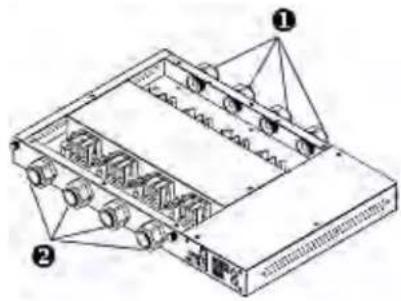
text_image
Technical diagram of a mechanical or electronic device with labeled components and numbered parts
Number Description
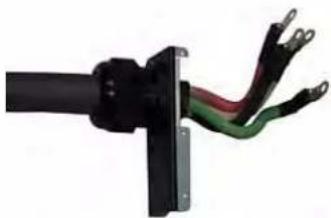
natural_image
Close-up of a black electrical cable with multiple wires and wires exposed (no text or symbols visible)
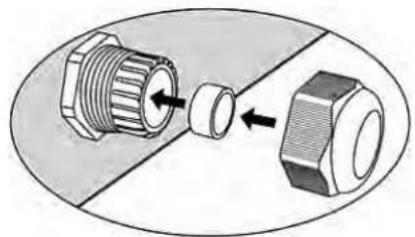
natural_image
Diagram showing two mechanical components with arrows indicating assembly or connection (no text or symbols present)
b. Place the ground wire ring terminal on the stud.
c. Place the nut on the stud and tighten with a torque wrench. The appropriate torque settings vary according to the nut size.Nut size Torque setting (N·m) Tolerance M3 0.49 10% M4 1.27 8% M5 1.96 5% M6 2.94 3.5% M8 4.9 2% 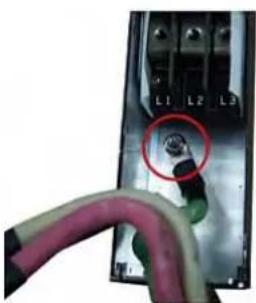
text_image
L1 L2 L3
Screw size Torque setting (N·m) Tolerance M3 0.49 10% M4 1.27 8% M5 1.96 5% M6 2.94 3.5% M8 4.9 2% 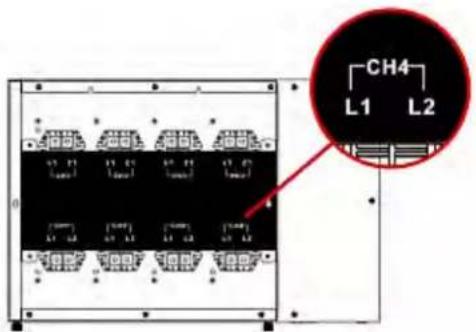
text_image
CH4
L1 L2

text_image
Terminal
block
Cable gland size Torque setting (N·m) M12x1.5 0.7 to 0.9 M16x1.5 2.0 to 3.0 M20x1.5 2.7 to 4.0 M25x1.5 5.0 to 7.5 M32x1.5 7.5 to 10.0 M40x1.5 7.5 to 10.0 M50x1.5 7.5 to 10.0 M63x1.5 7.5 to 10.0
In-Line Monitor's Web Interface
Dashboard Page
• Voltage of L1-L2, L2-L3, and L3-L1
• Active power 
text_image
Rx102.168.54.100
User Management - Device Settings - Maintenance -
Px Explorer
Dashboard
- Ialet/Outlet
# L1 Current L2 Current L3 Current L4-L2 Voltage L5-L3 Voltage L6-L1 Voltage Active Power Apparent Power Power Facts
- Alerted Sensors
Sensor Reading State
Alarms
Name Reason First Appearance Last Appearance Number Same Alerts
Peripheral Devices (8 managed, 9 unmanaged)
Name - Position Reading State
my PX (192.168.54.100) Administrator (admin) Last Log: 3/1/12 7.51 PM
SND: 7.52 PW
Outlet Page
Current per line (for a three-phase model)
• Voltage per outlet
Voltage per line (for a three-phase model)
• Power-related readings per outlet
Power-related readings per line (for a three-phase model)
• Threshold settings per outlet
Threshold settings per line (for a three-phase model)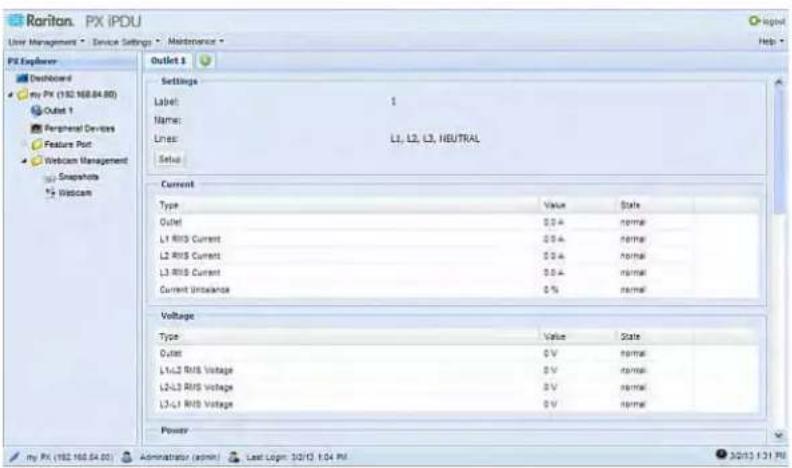
text_image
Rx101 PX IPDU
User Management - Device Settings - Maintenance -
Help -
PX Explorer
Dashboard
my PX (192.168.84.80)
Outlet 1
Peripheral Devices
Feature Port
Webcam Management
Snapshots
Webcam
Outlet 1
Settings
Label: 1
Name:
Line: L1, L2, L3, NEUTRAL
Setup
Current
Type Value State
Outlet 0.0 A normal
L1 RMS Current 0.0 A normal
L2 RMS Current 0.0 A normal
L3 RMS Current 0.0 A normal
Current Inovaance 0 % normal
Voltage
Type Value State
Outlet 0 V normal
L1,L2 RMS Voltage 0 V normal
L2,L3 RMS Voltage 0 V normal
L3,L4 RMS Voltage 0 V normal
Power
My PX (192.168.84.80) Administrator (ppm) Last Log: 1/3/13 1:04 PM 3/2/13 1:31 PM
Appendix A Specifications
In This Chapter
Maximum Ambient Operating Temperature
Specification Measure Max Ambient Temperature 50 to 60 degrees Celsius Serial RS-232 Port Pinouts
RS-232 Pin/signal definition Pin No. Signal Direction Description 1 DCD Input Data 2 RxD Input Receive data (data in) 3 TxD Output Transmit data 4 DTR Output Data terminal ready 5 GND — Signal ground 6 DSR Input Data set ready 7 RTS Output Request to send 8 CTS Input Clear to send 9 RI Input Ring indicator Sensor RJ-45 Port Pinouts
Pin No. Signal Direction Description 1 +12V — Power (fuse) protected) 2 +12V — Power (fuse) protected) 3 GND — Signal Ground 4 RS485_DP bi-directional Data Positive of the RS-485 bus 5 RS485_DN bi-directional Data Negative of the RS-485 bus 6 GND — Signal Ground 7 1-wire — Used for Feature Port 8 GND — Signal Ground Feature RJ-45 Port Pinouts
Pin No. Signal Direction Description 1 DTR Output Reserved 2 GND — Signal Ground 3 +5V — Power for CIM(200mA, fuse protected)Warning: Pin 3 is onlyintended for use withRaritan devices. 4 TxD Output Transmit Data (Data out) 5 RxD Input Receive Data (Data in) 6 +12V — Warning: Pin 6 is onlyintended for use withRaritan devices. DoNOT connect. Pin No. Signal Direction Description 7 GND — Signal Ground 8 DCD Input Reserved Appendix B Equipment Setup Worksheet
OUTLET 1 OUTLET 2 OUTLET 3 MODEL MODEL MODEL SERIAL NUMBER SERIAL NUMBER SERIAL NUMBER USE USE USE OUTLET 4 OUTLET 5 OUTLET 6 MODEL MODEL MODEL SERIAL NUMBER SERIAL NUMBER SERIAL NUMBER USE USE USE OUTLET 7 OUTLET 8 OUTLET 9 MODEL MODEL MODEL SERIAL NUMBER SERIAL NUMBER SERIAL NUMBER USE USE USE OUTLET 10 OUTLET 11 OUTLET 12 MODEL MODEL MODEL SERIAL NUMBER SERIAL NUMBER SERIAL NUMBER USE USE USE OUTLET 13 OUTLET 14 OUTLET 15 MODEL MODEL MODEL SERIAL NUMBER SERIAL NUMBER SERIAL NUMBER USE USE USE OUTLET 16 OUTLET 17 OUTLET 18 MODEL MODEL MODEL SERIAL NUMBER SERIAL NUMBER SERIAL NUMBER USE USE USE OUTLET 19 OUTLET 20 OUTLET 21 MODEL MODEL MODEL SERIAL NUMBER SERIAL NUMBER SERIAL NUMBER USE USE USE OUTLET 22 OUTLET 23 OUTLET 24 MODEL MODEL MODEL SERIAL NUMBER SERIAL NUMBER SERIAL NUMBER USE USE USE Appendix C Bulk Configuration or Firmware Upgrade via DHCP/TFTP
In This Chapter
TFTP Requirements....527
DHCP IPv4 Configuration in Windows 528
DHCP IPv6 Configuration in Windows 538
DHCP IPv4 Configuration in Linux 545
DHCP IPv6 Configuration in Linux 547Bulk Configuration/Upgrade Procedure
Steps of using DHCP/TFTP for bulk configuration/upgrade:
■ devicelist.csv
TFTP Requirements
DHCP IPv4 Configuration in Windows
▶ Required Windows IPv4 settings in DHCP:
b. Click Add to add a new vendor class.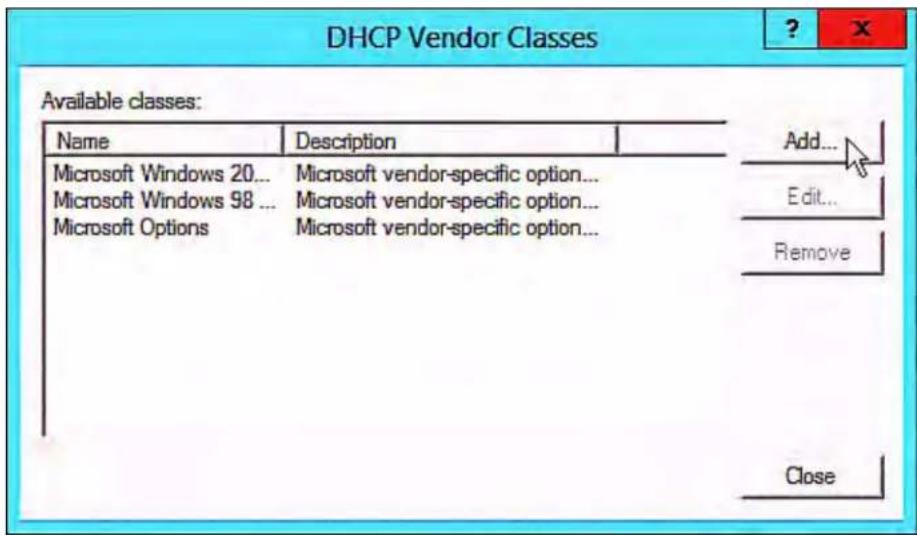
text_image
DHCP Vendor Classes
Available classes:
Name Description
Microsoft Windows 20... Microsoft vendor-specific option...
Microsoft Windows 98 ... Microsoft vendor-specific option...
Microsoft Options Microsoft vendor-specific option...
Add...
Edit...
Remove
Close

text_image
New Class
Display name:
Raritan PDU
Description:
Raritan PDU
ID: Binary: ASCII:
0000 52 61 72 69 74 61 6E 20 Raritan
0008 50 44 55 20 31 2E 30 PDU 1.0
OK Cancel

text_image
Predefined Options and Values
Option class: DHCP Standard Options
Option name: 060 Vendor Class Identifier
046 WINS/NBT Node Type
047 NetBIOS Scope ID
048 X Window System Font
049 X Window System Display
Description: 060 Vendor Class Identifier
064 NIS÷ Domain Name
065 NIS÷ Servers
Value
String:
OK Cancel
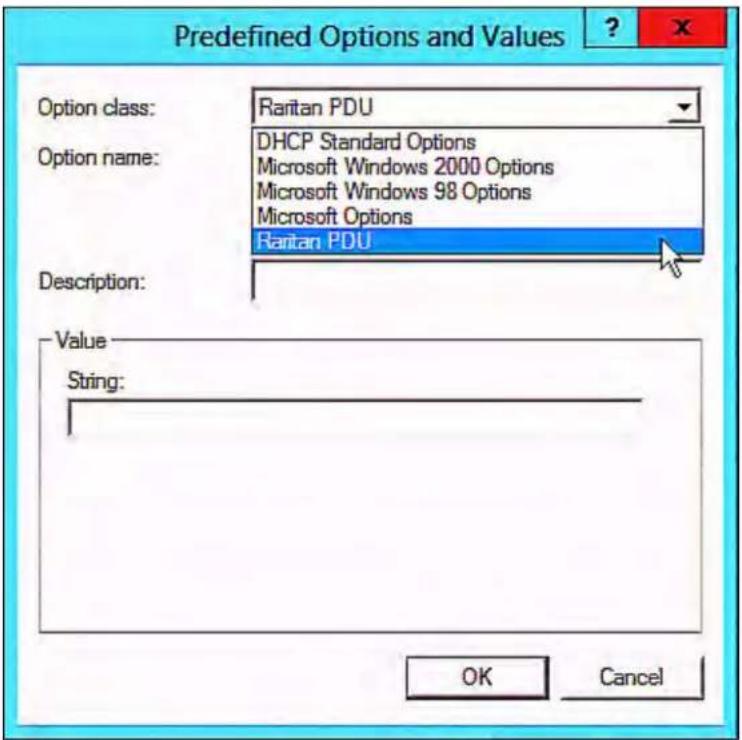
text_image
Predefined Options and Values
Option class: Rantan PDU
Option name: DHCP Standard Options
Microsoft Windows 2000 Options
Microsoft Windows 98 Options
Microsoft Options
Rantan PDU
Description:
Value
String:
OK Cancel
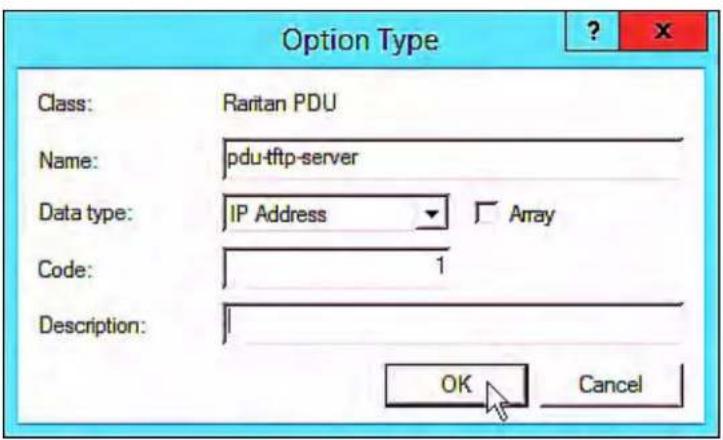
text_image
Option Type
Class: Raritan PDU
Name: pdu-tftp-server
Data type: IP Address ▼ Array
Code: 1
Description:
OK Cancel

text_image
Option Type
Class: Raritan PDU
Name: pdu-update-control-file
Data type: String Array
Code: 2
Description:
OK Cancel
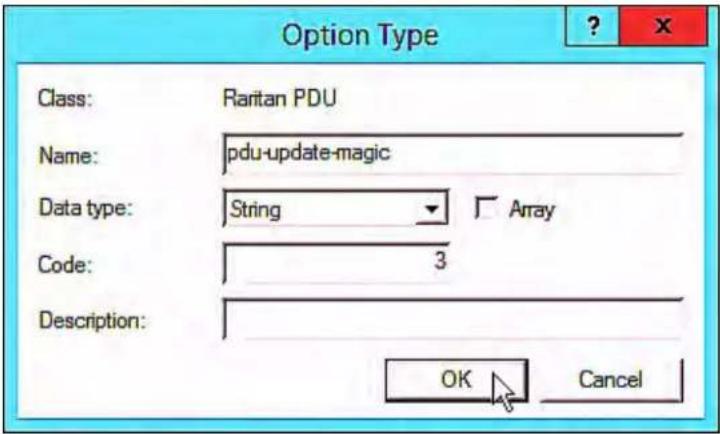
text_image
Option Type
Class: Raritan PDU
Name: pdu-update-magic
Data type: String Array
Code: 3
Description:
OK Cancel
b. Specify a policy name, and click Next.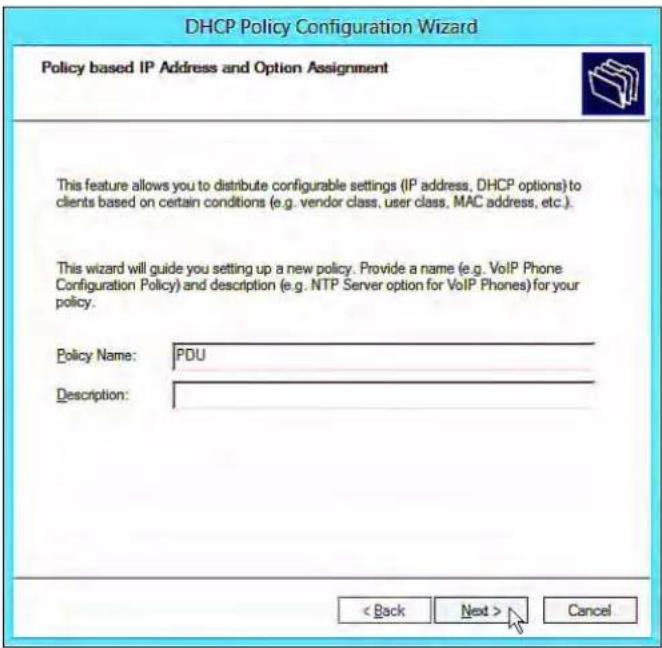
text_image
DHCP Policy Configuration Wizard
Policy based IP Address and Option Assignment
This feature allows you to distribute configurable settings (IP address, DHCP options) to clients based on certain conditions (e.g. vendor class, user class, MAC address, etc.).
This wizard will guide you setting up a new policy. Provide a name (e.g. VoIP Phone Configuration Policy) and description (e.g. NTP Server option for VoIP Phones) for your policy.
Policy Name: PDU
Description:
< Back Next > Cancel
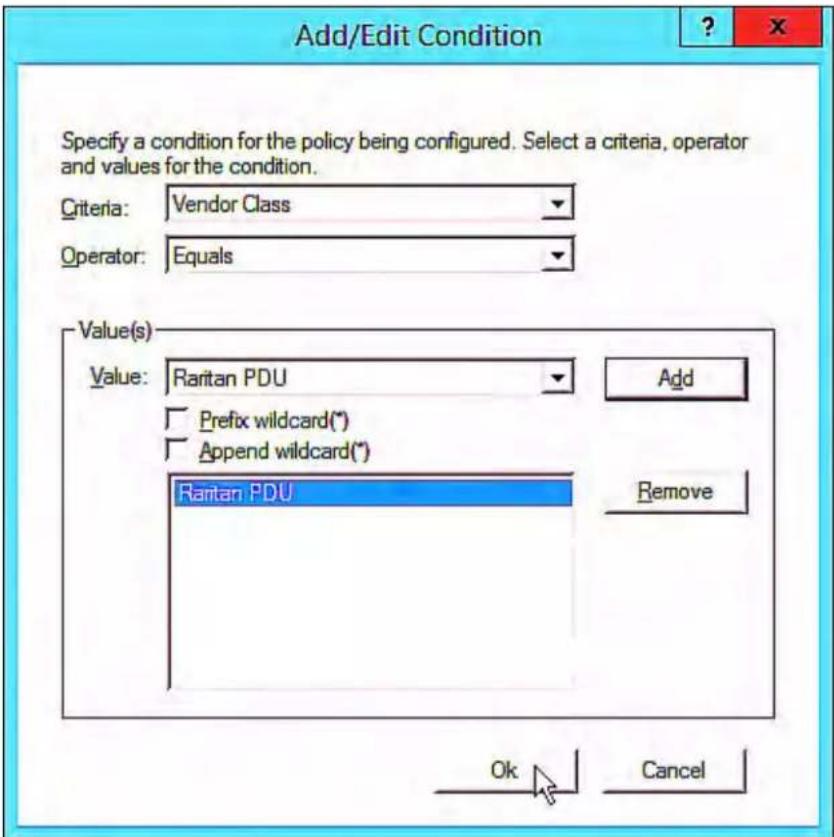
text_image
Add/Edit Condition
Specify a condition for the policy being configured. Select a criteria, operator
and values for the condition.
Criteria: Vendor Class
Operator: Equals
Value(s)
Value: Raritan PDU Add
Prefix wildcard(*)
Append wildcard(*)
Raritan PDU Remove
Ok Cancel

text_image
DHCP Policy Configuration Wizard
Configure settings for the policy
If the conditions specified in the policy match a client request, the settings will be applied.
Vendor class: DHCP Standard Options
Available Options Description
□ 049 X Window System Display Array of X Windows Display M#
✓ 060 Vendor Class Identifier
□ 064 NIS÷ Domain Name The name of the client's NIS+
< III >
Data entry
String value:
Raritan PDU 1.0
< Back Next > Cancel

text_image
DHCP Policy Configuration Wizard
Configure settings for the policy
If the conditions specified in the policy match a client request, the settings will be applied.
Vendor class: Raritan PDU
Available Options Description
✓ 001 pdu-tftp-server
☐ 002 pdu-update-control-file
☐ 003 pdu-update-magic
Data entry
IP address: 192 . 168 . 85 . 93
< Back Next > Cancel
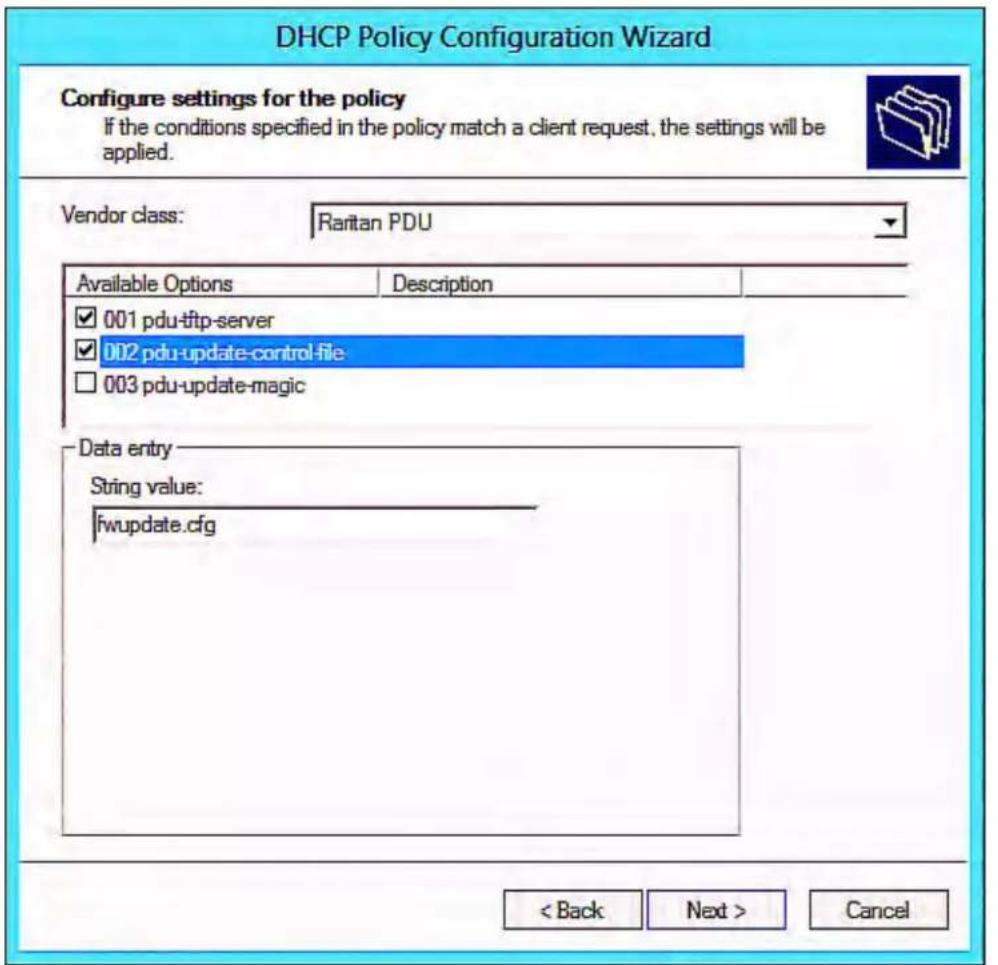
text_image
DHCP Policy Configuration Wizard
Configure settings for the policy
If the conditions specified in the policy match a client request, the settings will be applied.
Vendor class: Raritan PDU
Available Options Description
✓ 001 pdu-tftp-server
✓ 002 pdu-update-control-file
□ 003 pdu-update-magic
Data entry
String value:
fwupdate.cfg
< Back Next > Cancel

text_image
DHCP Policy Configuration Wizard
Configure settings for the policy
If the conditions specified in the policy match a client request, the settings will be applied.
Vendor class: Raritan PDU
Available Options Description
✓ 001 pdu-tftp-server
✓ 002 pdu-update-control-file
✓ 003 pdu-update-magic
Data entry
String value:
20150427-0001
< Back Next > Cancel
DHCP IPv6 Configuration in Windows
▶ Required Windows IPv6 settings in DHCP:
b. Click Add to add a new vendor class.
text_image
DHCP Vendor Classes
Available classes:
Name Description
Microsoft Windows Opt... Microsoft vendor-specific option...
Add...
Edit...
Remove
Close

text_image
New Class
Display name:
Raritan PDU 1.0
Description:
Raritan PDU 1.0
Vendor ID (IANA):
13742
ID: Binary: ASCII:
0000 52 61 72 69 74 61 6E 20 Raritan
0008 50 44 55 20 31 2E 30 PDU 1.0
OK Cancel
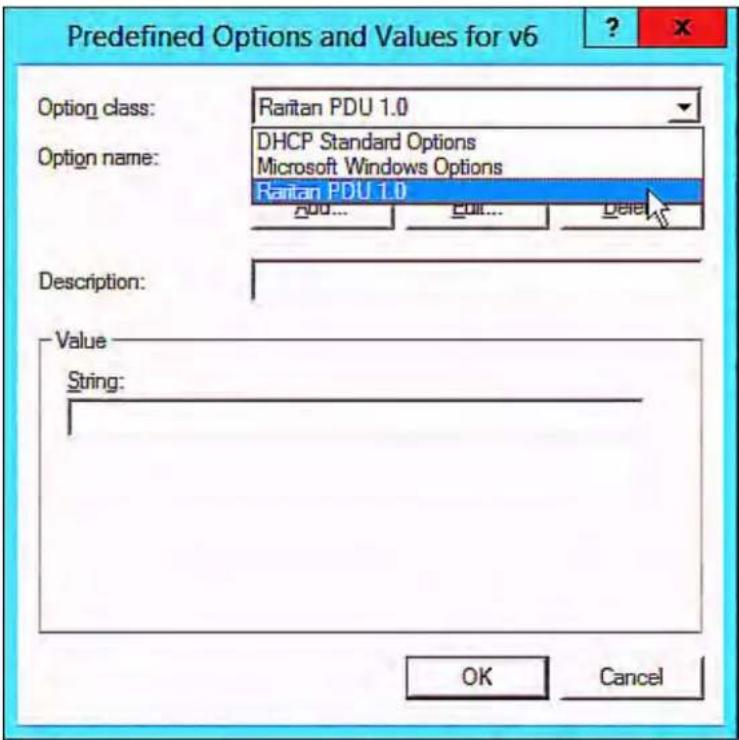
text_image
Predefined Options and Values for v6
Option class: Raritan PDU 1.0
Option name: DHCP Standard Options
Microsoft Windows Options
Raritan PDU 1.0
Add...
Edit...
Delete
Description:
Value
String:
OK Cancel
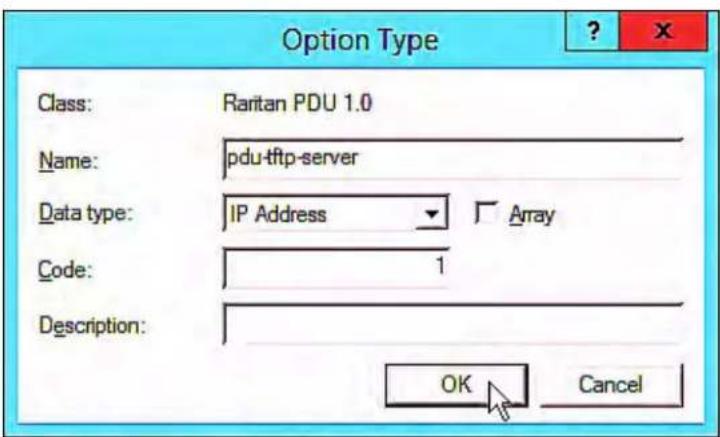
text_image
Option Type
Class: Raritan PDU 1.0
Name: pdu-tftp-server
Data type: IP Address □ Array
Code: 1
Description:
OK Cancel
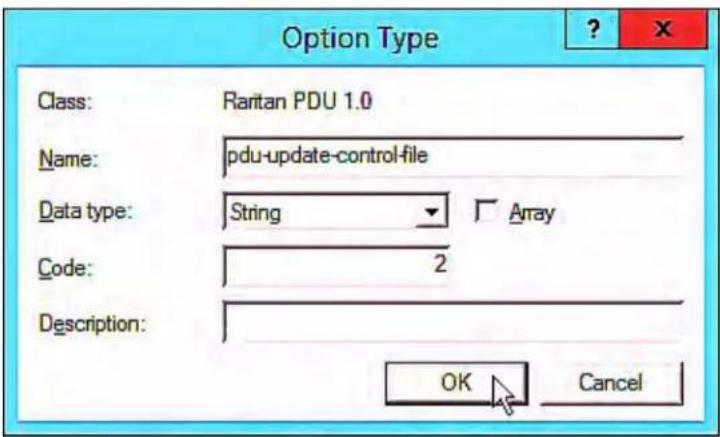
text_image
Option Type
Class: Raritan PDU 1.0
Name: pdu-update-control-file
Data type: String Array
Code: 2
Description:
OK Cancel
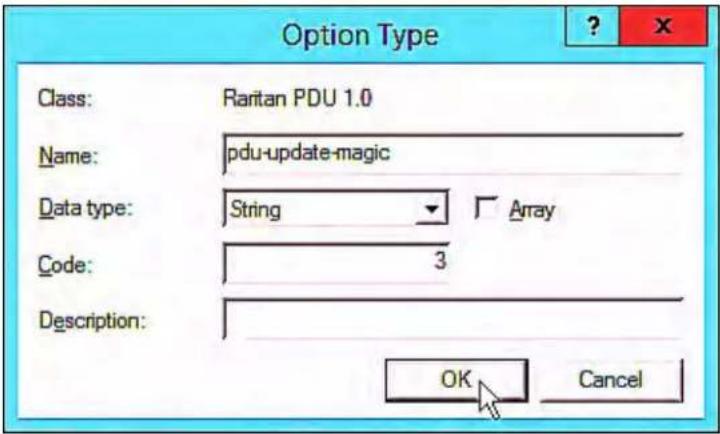
text_image
Option Type
Class: Raritan PDU 1.0
Name: pdu-update-magic
Data type: String Array
Code: 3
Description:
OK Cancel
b. Click the Advanced tab.
text_image
Server Options
General Advanced
Vendor class: Raritan PDU 1.0
User class: Default User Class
Available Options Description
✓ 00001 pdu-tftp-server
☐ 00002 pdu-update-control-file
☐ 00003.pdu-update-magic
< III >
Data entry
IPv6 address:
fd07:2fa:6cff:1010::200
OK Cancel Apply

text_image
Server Options
General Advanced
Vendor class: Raritan PDU 1.0
User class: Default User Class
Available Options Description
✓ 00001 pdu-tftp-server
✓ 00002 pdu-update-control-file
✓ 00002.pdu-update-magia
< III >
Data entry
String value:
fwupdate.cfg
OK Cancel Apply
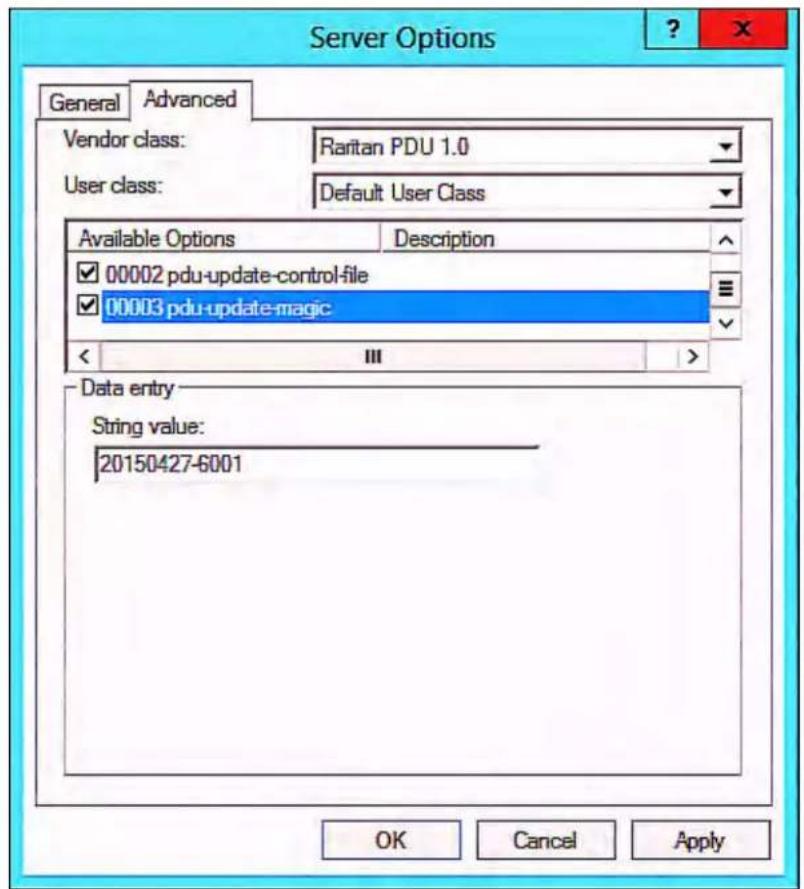
text_image
Server Options
General Advanced
Vendor class: Raritan PDU 1.0
User class: Default User Class
Available Options Description
✓ 00002 pdu-update-control-file
✓ 00003 pdu-update-magic
Data entry
String value:
20150427-6001
OK Cancel Apply
DHCP IPv4 Configuration in Linux
▶ Required Linux IPv4 settings in DHCP:
3. Set the following three sub-options in the
■ code 3 (pdu-update-magic) = any string[...]
set vendor-string = option vendor-class-identifier;
option space RARITAN code width 1 length width 1 hash size 3;
option RARITAN.pdu-tftp-server code 1 = ip-address;
option RARITAN.pdu-update-control-file code 2 = text;
option RARITAN.pdu-update-magic code 3 = text;
class "raritan" {
match if option vendor-class-identifier = "Raritan PDU 1.0";
vendor-option-space RARITAN;
option RARITAN.pdu-tftp-server 192.168.1.7;
option RARITAN.pdu-update-control-file "fwupdate.cfg";
option RARITAN.pdu-update-magic "20150123-0001";
option vendor-class-identifier "Raritan PDU 1.0";
}
[...]
DHCP IPv6 Configuration in Linux
▶ Required Linux IPv6 settings in DHCP:
- Raritan PDU 1.0
■ 15 (the length of the above string "Raritan PDU 1.0")
■ code 3 (pdu-update-magic) = any string[...]
option space RARITAN code width 2 length width 2 hash size 3;
option RARITAN.pdu-tftp-server code 1 = ip6-address;
option RARITAN.pdu-update-control-file code 2 = text;
option RARITAN.pdu-update-magic code 3 = text;
option vsio.RARITAN code 13742 = encapsulate RARITAN;
[...]
subnet6 xxxx {
[...]
option RARITAN.pdu-tftp-server 1::2;
option RARITAN.pdu-update-control-file "fwupdate.cfg";
option RARITAN.pdu-update-magic "20150123-0001";
[...]
}
Appendix D Resetting to Factory Defaults
In This Chapter
Using the Reset Button
To reset to factory defaults using the reset button:
These diagrams show the reset button on Zero U models.
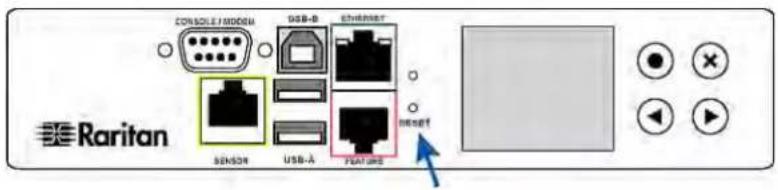
text_image
CONSOLE / MODEM
USB-B
Ethernet
SENSOR
USB-Å
FEATURES
Raritan
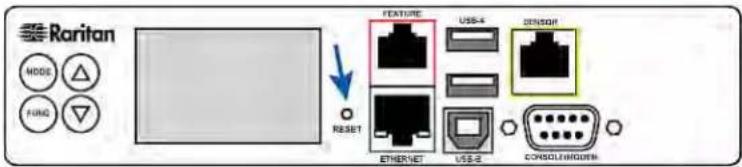
text_image
Raritan
MODE
FUND
RESET
FEATURE
USB-4
SENSOR
ETHERNET
USB-2
CONSOLIDATED
Using the CLI Command
To reset to factory defaults after logging in to the CLI:
<h1 id="reset-factorydefaults-2">reset factorydefaults</h1>
-- OR --
<h1 id="reset-factorydefaults-y-2">reset factorydefaults /y</h1>
To reset to factory defaults without logging in to the CLI:
Appendix E Available SCP Commands
In This Chapter
Firmware Update via SCP
To update the firmware using the SCP command:
SCP command example:
Bulk Configuration via SCP
b. Copy the configuration file to one or multiple destination PX.To save the configuration using the SCP command:
To copy the configuration using the SCP command:
SCP command examples:
scp admin@192.168.87.50:/bulk_config.xmlBackup and Restore via SCP
To back up the settings using the SCP command:
To restore the settings using the SCP command:
SCP command examples:
scp admin@192.168.87.50:/backup_settings.xmlAppendix F PX3 Phase I LCD Display

text_image
MODE △
FUNC ▽
- Control buttonsIn This Chapter
Overview of the Character LCD Display

text_image
Diagram of a rectangular box with five numbered points and dashed internal lines, likely illustrating a geometric or spatial relationship.
Section Information shown

Section Information shown 2 The following information is displayed:Readings, data or state of the selected target.During the firmware upgrade, 'FUP' is displayed. 3 Two types of information may be displayed:The 'ALARM' status of the selected component.The selected inlet line number if your PX is a 3-phase model. 4 The measurement unit of the displayed data. 5 This section indicates:The Asset Sensor mode if an asset sensor has been connected to the PX.The device's USB-cascading state - MASTER or SLAVE. If it is a standalone device, neither MASTER nor SLAVE is displayed. Control Buttons

• MODE button for switching between various modes, including:Operating the Character LCD Display
Outlet Information

text_image
1 OUTLET 3 MASTER
2 2.00 A
2 4
1 The selected target is OUTLET 3. 2 This outlet's current reading is 2 amps. 3 The word "MASTER" indicates the PX is the master device in a USB-cascading configuration. SeeCascading the PX via USB(on page 28).For a standalone PX, this word is NOT displayed. 4 The measurement unit is A (Amp), indicating that the reading is the RMS current. To display a single-phase outlet's information:
To display a 3-phase outlet's information
b. Press the Down button until '%' or 'W' is displayed to the right of the display. Make sure NONE of the lines (L1, L2, L3, L1-L2, L2-L3 or L3-L1) is displayed at the bottom of the display.Inlet Information
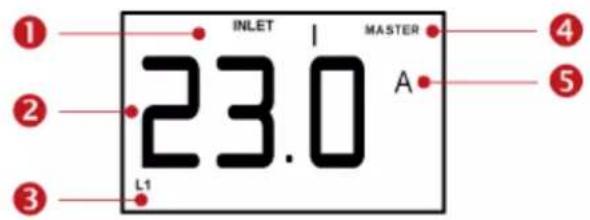
text_image
INLET
MASTER
23.0
A
L1
①
②
③
④
⑤
Section Example information 1 The selected target is INLET 1. 2 This inlet's L1 current reading is 23 amps. 3 The selected inlet line is L1. 4 The word "MASTER" indicates the PX is the master device in a USB-cascading configuration. SeeCascading the PX via USB(on page 28).For a standalone PX, this word is NOT displayed. 5 The measurement unit is A (ampere). To display an inlet's information:
To display the unbalanced load and active power of a 3-phase inlet:
Overcurrent Protector Information
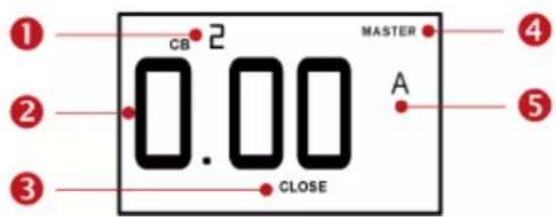
text_image
① CB 2 MASTER
② 0.00 A
③ CLOSE
④
⑤
Section Example information 1 The selected target is the second circuit breaker (CB 2). 2 This circuit breaker's current reading is 0 amps. 3 The word "CLOSE" indicates that the state of the selected circuit breaker is closed. 4 The word "MASTER" indicates the PX is the master device in a USB-cascading configuration. See Cascading the PX via USB (on page 28).For a standalone PX, this word is NOT displayed. 5 The measurement unit is A (Amp), indicating that the reading is the current. To display the overcurrent protector information:
IP Address

text_image
1
2
3
d
4
MASTER
192
Section Example information 1 "d" means the LCD display has entered the Device mode. 2 The LCD display is showing 192, which is one of the IP address octets. It will cycle through four octets of the IP address. 3 "i4" indicates that the IP address shown on the LCD display is an IPv4 address. 4 The word "MASTER" indicates the PX is the master device in a USB-cascading configuration. See Cascading the PX via USB (on page 28).For a standalone PX, this word is NOT displayed. 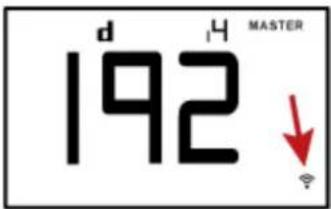
text_image
d 4 MASTER
192 ↓
▶ To retrieve the IP address:
MAC Address
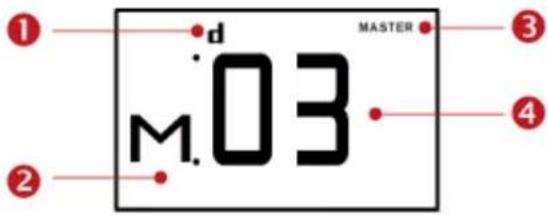
text_image
1
d
MASTER
M.03
2
3
4
Section Example information 1 "d" means the LCD display has entered the Device mode. 2 "M" indicates that the displayed information is the MAC address. 3 The word "MASTER" indicates the PX is the master device in a USB-cascading configuration. See Cascading the PX via USB (on page 28).For a standalone PX, this word is NOT displayed. Section Example information

▶ To display the MAC address:
Outlet Switching
To turn on or off an outlet:

text_image
OUTLET |
ON

text_image
OUTLET X
^ ON

text_image
OUTLET X
✓ OF

text_image
OUTLET X
onP

text_image
OUTLET x
oFP
- oFF: The outlet has been turned off.
Environmental Sensor Information
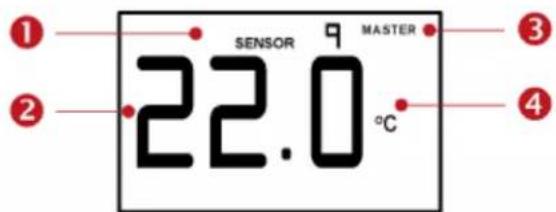
text_image
1
SENSOR 9 MASTER
22.0 °C
2
3
4
Number Example information 1 The selected target is the environmental sensor whose ID number is 9 (SENSOR 9). 2 The selected environmental sensor's reading is 22 °C. 3 The word "MASTER" indicates the PX is the master device in a USB-cascading configuration. See Cascading the PX via USB (on page 28).For a standalone PX, this word is NOT displayed. 4 The measurement unit is °C (degrees in Celsius). ▶ To display the environmental sensor information:
■ m/s is displayed for an air flow sensor.
- Pa is displayed for an air pressure sensor.
- ALA (accompanied with the word "ALARM" below it): The sensor is in the alarmed state.
■ Off: The actuator is turned off.
Asset Sensor Information

text_image
1
2
3
30
MASTER
ASSET
4
5
Section Example information 1 "1" refers to the asset sensor connected to the first FEATURE port. 2 This symbol ◇ indicates that you can switch between diverse rack units now by pressing the Up or Down button. 3 "30" indicates that the selected target is the 30th rack unit. 4 The word "MASTER" indicates the PX is the master device in a USB-cascading configuration. See Cascading the PX via USB (on page 28). For a standalone PX, this word is NOT displayed. 5 "ASSET" means that the LCD display enters the Asset Sensor mode. To display the asset management information:
USB-Cascaded Device's Position
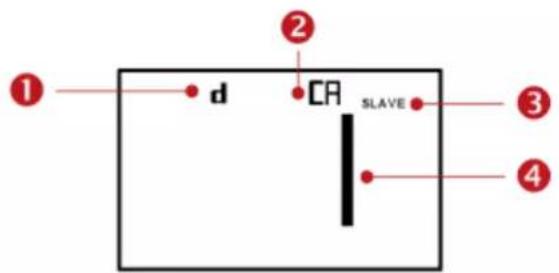
text_image
①
d
②
CR
SLAVE
③
④
1 "d" means the LCD display has entered the Device mode. 2 "CA" indicates that the USB-cascading information is being displayed. 3 "SLAVE" indicates that this PX is a slave device. 4 The number 1 means the device position is Slave 1. To retrieve the device's USB-cascading position information:
Number Device position 0 Master device 1 Slave 1 2 Slave 2 3 Slave 3 4 Slave 4 5 Slave 5 6 Slave 6 7 Slave 7 Appendix G PX Models with Residual Current Monitoring
In This Chapter
RCM Current Sensor
RCM State Sensor
RCM state Description Normal Residual current is within normal range. Warning Residual current is above warning level. Critical Residual current is above critical level. In addition to an event, the CRITICAL state causes the PX front panel to display a special error message. Self-test active RCM diagnostics are running. Failure RCM current sensor has malfunctioned. Contact Raritan Technical Support. Compliance with IEC 62020
Method of operation Dependent on line voltage. RCM only functions if line voltage is present. Type of installation PX with flexible line cords and plugs are for mobile installation and corded connection. Current paths 1-phase PX are two current paths RCM.3-phase 3W+PE are three current paths RCM.3-phase 4W+PE are four current paths RCM. Ability to adjust residual operating current Adjustable. Adjustable time delay Non-adjustable time delay. Protection against external influence Enclosed-type RCM. Method of mounting Panel board type RCM. Method of connection Not associated with mechanical mounting. Connection of load conductors Monitored line is directly connected. Fault indicating means Visual, with other output signals. Ability to directly discriminate Directionally non-discriminating. Rated residual operating current 0.5A (highest value). Residual currents with direct current components Type A. RCM Self-Test
Web Interface Operations for RCM
Checking RCM State and Current
To check RCM state and current on the Inlet page:

text_image
Residual Current Monitor
RCM State: Normal
Residual Operating Current: 0.000 A
Self test Setup
RCM Critical State Alarm

text_image
Alerted Sensors
Sensor Reading State
Inlet 11 Residual Current 0.165 A above upper critical
Inlet 11 Residual Current Monitor Status Critical
Number Description 1 The magnitude of residual current reported by the RCM current sensor. 2 Critical state reported by the RCM state sensor. Setting RCM Current Thresholds

text_image
User Management
Device Settings
Maintenance
PX Explorer
Dashboard
my PX (192.168.84.8)
Inlet I1
Outlets
Peripheral Devices
Feature Port
Inlet I1
Settings
Label: I1
Name:
Setup
Residual Current Monitor
RCM State: Normal
Residual Operating Current: 0.000 A
Self test Setup
Residual Current Monitor Setup
Critical Rated Residual Operating Current (mA): 30
Warning Rated Residual Operating Current (mA): 0
Deassertion Hysteresis (mA): 15
Saving this dialog will update the thresholds of the residual current sensor.
OK Cancel
Scheduling RCM Self-Test
Disabling or Enabling Front Panel RCM Self-Test
To disable or enable the front panel RCM self-test:
Front Panel Operations for RCM
LCD Message for RCM Critical State
▶ RCM alarm information on PX3 phase II models:

text_image
RCM Inlet I1
RCM State
Critical
Residual Current
0.162 A
9:57 PM Self-test
▶ RCM alarm information on PX3 phase I models:

text_image
rCA
INLET
LEAK
ALARM
Checking RCM States on Phase II Models
To check RCM information on PX3 phase II LCD display:
- RCM reading: Residual current value in Amps.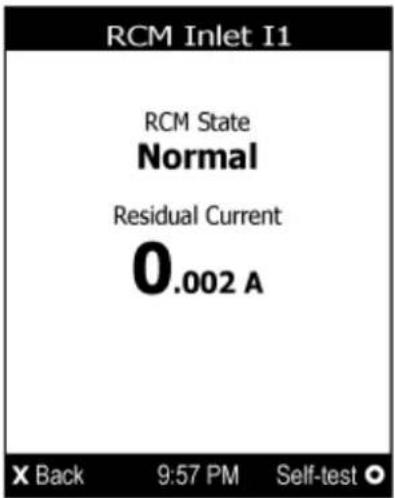
text_image
RCM Inlet I1
RCM State
Normal
Residual Current
0.002 A
X Back 9:57 PM Self-test ○
Displaying the RCM Current
PX3 phase II models:
PX3 phase I models:
■ 3-phase PDU: Press the Up button until the word "LEAK" displays.
text_image
INLET
LEAK
A
m
1
2
3
4
5
1 The inlet containing RCM sensor is INLET 1. 2 This residual current is 0 mA. 3 ALARM always displays for residual current sensor. 4 LEAK always displays for residual current sensor. 5 Measurement units are mA. Running RCM Self-Test
PX3 phase II models:


text_image
RCM Inlet I1
Execute
self-test?
Yes
No
X Back 9:57 PM Self-test ●

text_image
RCM Inlet I1
Self-test passed
Press OK to continue
X Back 9:57 PM

PX3 phase I models:
■ FAL: Self-test failed (the PX also beeps).
text_image
INLET
SLF
LEAK
ALARM
1 The inlet containing RCM sensor is INLET 1. 2 The LCD alternates between "SLF" and "tSt" to indicate that this is self-test mode. 3 ALARM always displays for residual current sensor. 4 LEAK always displays for residual current sensor. RCM SNMP Operations
RCM Trap
RCM Residual Current and State Objects
Setting RCM Thresholds
Running RCM Self-Test
CLI Operations for RCM
Showing Residual Current Monitor Information
Variables:
Option Description all Displays the RCM information of all inlets. Tip: You can also type the command without adding this option "all" to get the same data. A specific inlet number Displays the RCM information of the specified inlet only.An inlet number needs to be specified only when there are more than 1 inlet on your PDU. Setting RCM Current Thresholds
To configure the RCM's Critical level:
To configure the RCM's Warning level:
To configure the RCM's deassertion hysteresis:
Variables:
enable Enables the specified RCM current threshold for the specified inlet. disable Disables the specified RCM current threshold for the specified inlet. A numeric value Sets a value for the specified RCM current threshold of the specified inlet and enables this threshold simultaneously. Note that this value is measured in A, not mA. Therefore, to set the value to 6mA, type 0.006.
Setting Front Panel RCM Self-Test
To enable the front panel RCM self-test:
To disable the front panel RCM self-test:
Running RCM Self-Test
▶ To perform RCM self-test:
Variables:
Appendix H LDAP Configuration Illustration
b. Create user groups for the PX on the AD server
c. Configure LDAP authentication on the PX device
d. Configure roles on the PX deviceIn This Chapter
Step B. Configure User Groups on the AD Server....588
Step C. Configure LDAP Authentication on the PX Device....589
Step D. Configure User Groups on the PX Device ....591Step A. Determine User Accounts and Groups
User groups User accounts (members) usera PX_User pxuser2 userb PX_Admin pxuser Group permissions:
Step B. Configure User Groups on the AD Server
- User accounts pxuser, pxuser2, usera and userb already exist on the AD server.To configure the user groups on the AD server:

text_image
PX_Admin Properties
General Members Member Of Managed By
Members:
Name Active Directory Folder
pxuser techadssl.com/Users
userb techadssl.com/ServicesApps/raritan

text_image
PX_User Properties
General Members Member Of Managed By
Members:
Name Active Directory Folder
pxuser2 techadssl.com/Users
usera techadssl.com/ServicesApps/raritan
Step C. Configure LDAP Authentication on the PX Device
• The AD server uses the default TCP port 389. To configure LDAP authentication:
■ Port - Ensure the field is set to 389.
■ Active Directory Domain - Type techadssl.com.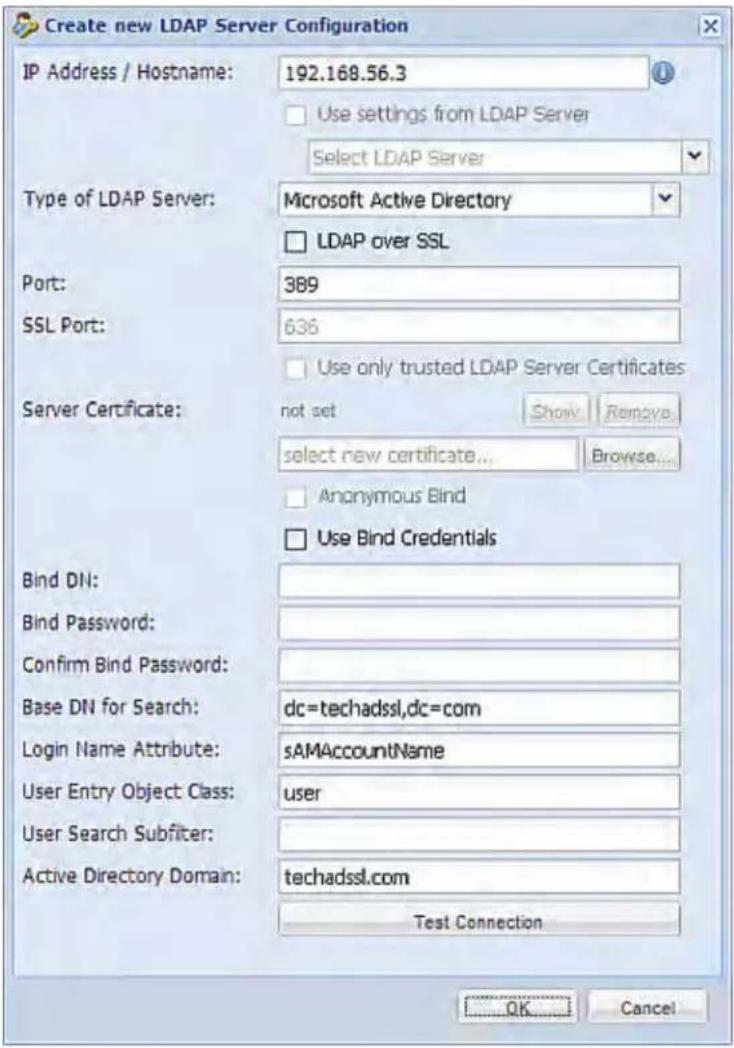
text_image
Create new LDAP Server Configuration
IP Address / Hostname: 192.168.56.3
Use settings from LDAP Server
Select LDAP Server
Type of LDAP Server: Microsoft Active Directory
LDAP over SSL
Port: 389
SSL Port: 636
Use only trusted LDAP Server Certificates
Server Certificate: not set Show Remove
select new certificate... Browse...
Anonymous Bind
Use Bind Credentials
Bind DI:
Bind Password:
Confirm Bind Password:
Base DN for Search: dc=techadssl,dc=com
Login Name Attribute: sAMAccountName
User Entry Object Class: user
User Search Subfilter:
Active Directory Domain: techadssl.com
Test Connection
OK Cancel
Step D. Configure User Groups on the PX Device
To create the PX\_User role with appropriate permissions assigned:
b. Select a permission beginning with the word "View" from the Privileges list, such as View Event Settings.
c. Click Add.
text_image
Create New Role
Settings Privileges
Privilege ▲ Arguments
View Data Logging Settings
View Event Settings
View Local Event Log
View Local User Management
View SNMP Settings
View Security Settings
View Webcam Images and Configur
Add Edit Delete
OK Cancel
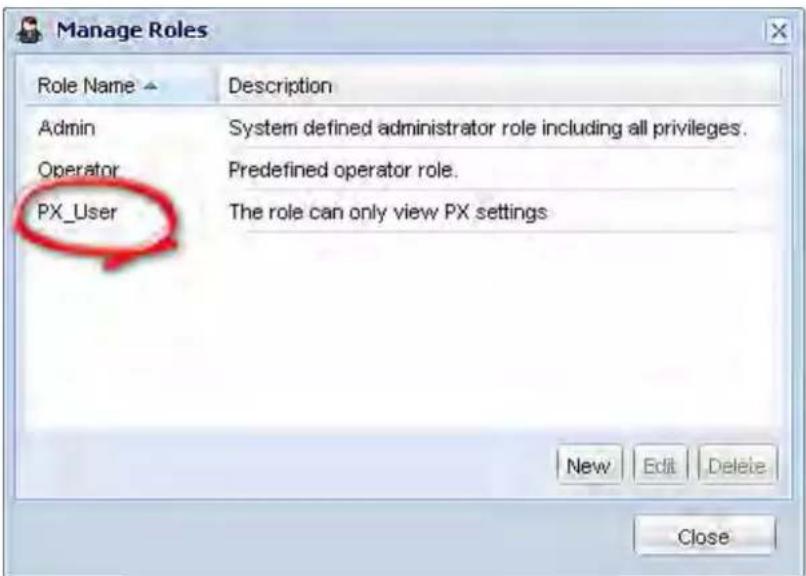
text_image
Manage Roles
Role Name ▲ Description
Admin System defined administrator role including all privileges.
Operator Predefined operator role.
PX_User The role can only view PX settings
New Edit Delete
Close

text_image
Create New Role
Settings Privileges
Privilege ▲ Arguments
Administrator Privileges
Add Edit Delete
OK Cancel
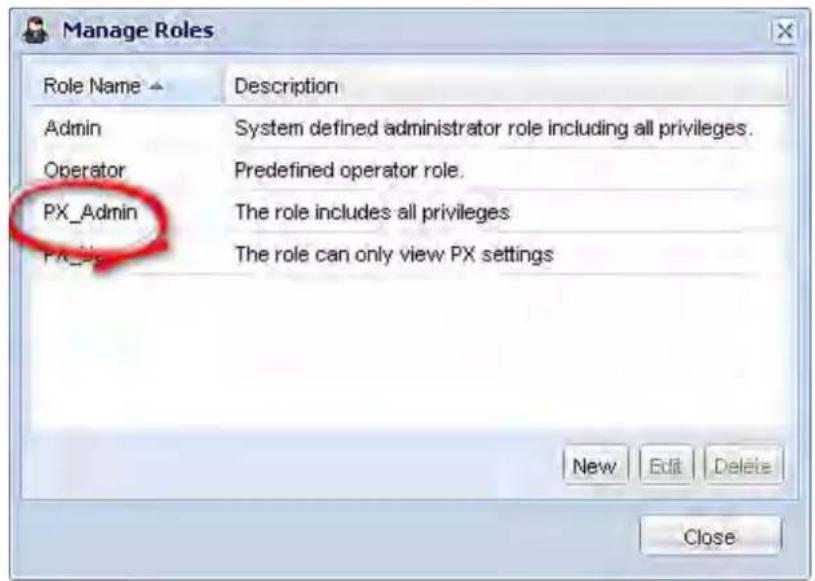
text_image
Manage Roles
Role Name ▲ Description
Admin System defined administrator role including all privileges.
Operator Predefined operator role.
PX_Admin The role includes all privileges
PX_Admin The role can only view PX settings
New Edit Delete
Close
Appendix I RADIUS Configuration Illustration
In This Chapter
Microsoft Network Policy Server
b. Configure connection request policies on NPS
c. Configure a vendor-specific attribute on NPSStep A: Add Your PX as a RADIUS Client
• RADIUS authentication port specified for PX: 1812
• RADIUS accounting port specified for PX: 1813To add your PX to the RADIUS NPS:
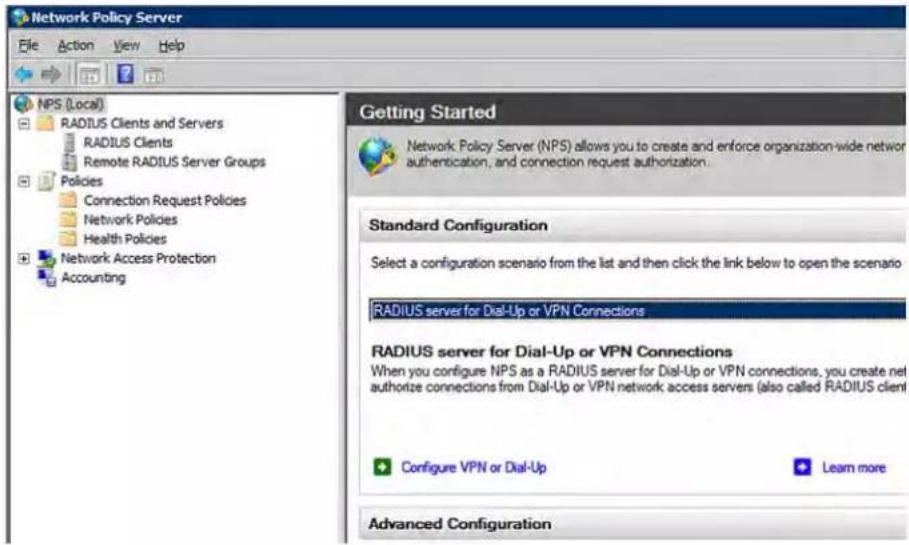
text_image
Network Policy Server
File Action View Help
NPS (Local)
RADIUS Clients and Servers
RADIUS Clients
Remote RADIUS Server Groups
Policies
Connection Request Policies
Network Policies
Health Policies
Network Access Protection
Accounting
Getting Started
Network Policy Server (NPS) allows you to create and enforce organization-wide network authentication, and connection request authorization.
Standard Configuration
Select a configuration scenario from the list and then click the link below to open the scenario
RADIUS server for Dial-Up or VPN Connections
RADIUS server for Dial-Up or VPN Connections
When you configure NPS as a RADIUS server for Dial-Up or VPN connections, you create net authorize connections from Dial-Up or VPN network access servers (also called RADIUS client)
Configure VPN or Dial-Up Learn more
Advanced Configuration
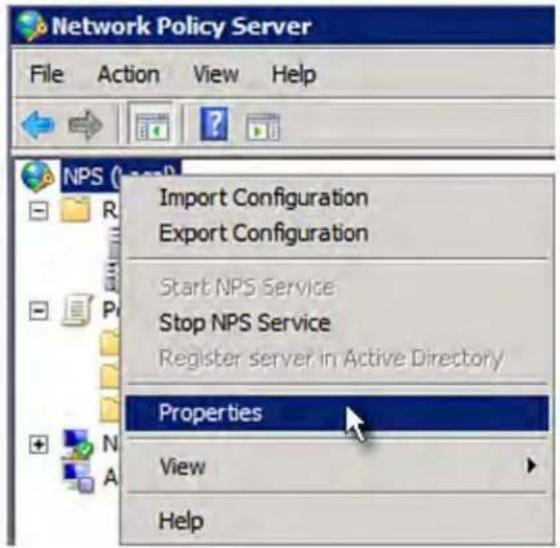
text_image
Network Policy Server
File Action View Help
Import Configuration
Export Configuration
Start NPS Service
Stop NPS Service
Register server in Active Directory
Properties
View
Help
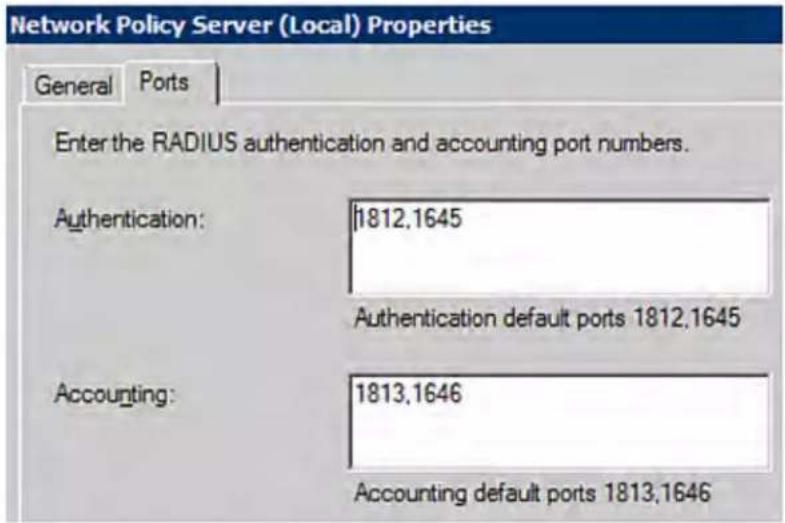
text_image
Network Policy Server (Local) Properties
General Ports
Enter the RADIUS authentication and accounting port numbers.
Authentication: 1812.1645
Authentication default ports 1812.1645
Accounting: 1813.1646
Accounting default ports 1813.1646
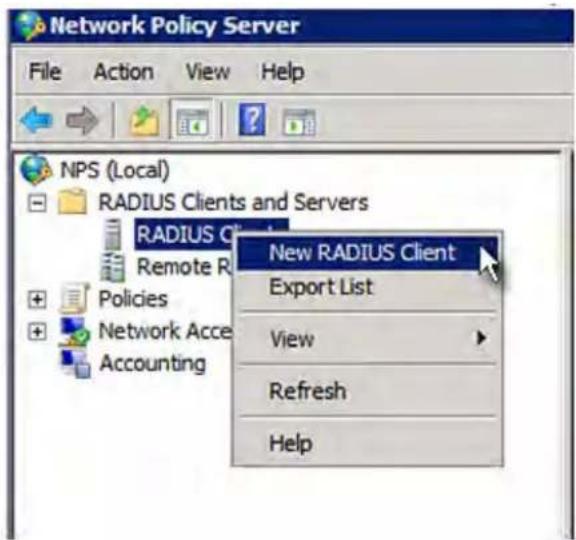
text_image
Network Policy Server
File Action View Help
NPS (Local)
RADIUS Clients and Servers
RADIUS Client
Remote R
Policies
Network Acce
Accounting
New RADIUS Client
Export List
View
Refresh
Help
b. Type a name for identifying your PX in the "Friendly name" field.
c. Type 192.168.56.29 in the "Address (IP or DNS)" field.
d. Select RADIUS Standard in the "Vendor name" field.
e. Select the Manual radio button.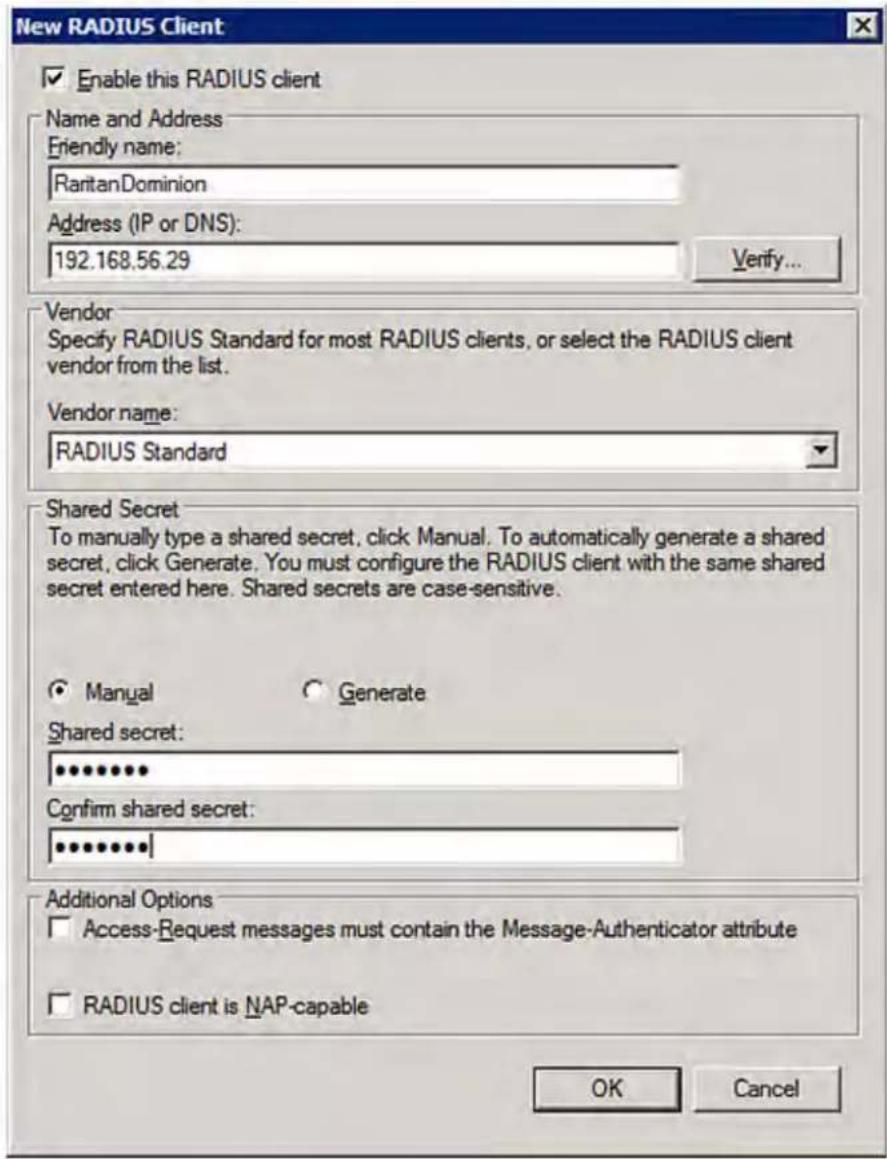
text_image
New RADIUS Client
Enable this RADIUS client
Name and Address
Friendly name:
RaritanDominion
Address (IP or DNS):
192.168.56.29
Verify...
Vendor
Specify RADIUS Standard for most RADIUS clients, or select the RADIUS client
vendor from the list.
Vendor name:
RADIUS Standard
Shared Secret
To manually type a shared secret, click Manual. To automatically generate a shared
secret, click Generate. You must configure the RADIUS client with the same shared
secret entered here. Shared secrets are case-sensitive.
Manual
Generate
Shared secret:
************
Confirm shared secret:
************
Additional Options
Access-Request messages must contain the Message-Authenticator attribute
RADIUS client is NAP-capable
OK Cancel
Step B: Configure Connection Request Policies
c. Authentication method(s)
d. Standard RADIUS attributes
• IP address of your PX: 192.168.56.29
• RADIUS protocol selected on your PX: CHAP
• Existing role of your PX: AdminTo configure connection request policies:

text_image
Network Policy Server
File Action View Help
NPS (Local)
RADIUS Clients and Servers
RADIUS Clients
Remote RADIUS Server Groups
Policies
Connection Request Policies
Network Policies
Health Policies
Network Access Protection
Accounting
Getting Started
Network Policy Server (NPS) allows you to create and enforce organization-wide network authentication, and connection request authorization.
Standard Configuration
Select a configuration scenario from the list and then click the link below to open the scenario
RADIUS server for Dial-Up or VPN Connections
RADIUS server for Dial-Up or VPN Connections
When you configure NPS as a RADIUS server for Dial-Up or VPN connections, you create net authorize connections from Dial-Up or VPN network access servers (also called RADIUS client
Configure VPN or Dial-Up Learn more
Advanced Configuration
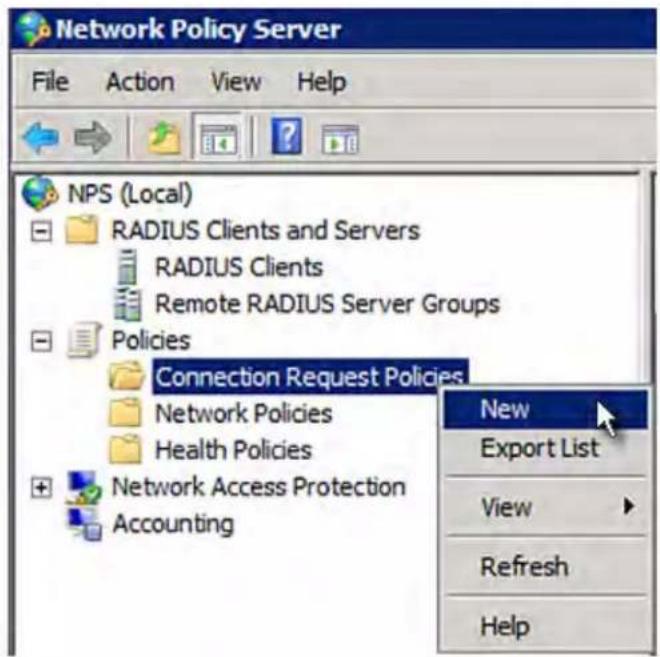
text_image
Network Policy Server
File Action View Help
NPS (Local)
RADIUS Clients and Servers
RADIUS Clients
Remote RADIUS Server Groups
Policies
Connection Request Policies
Network Policies
Health Policies
Network Access Protection
Accounting
New
Export List
View
Refresh
Help

text_image
New Connection Request Policy
Specify Connection Request Policy Nam
You can specify a name for your connection request policy and I applied.
Policy name:
RantanDominionPolicy
Network connection method
Select the type of network access server that sends the connection request to NPS. type or Vendor specific.
● Type of network access server:
Unspecified
○ Vendor specific:
10
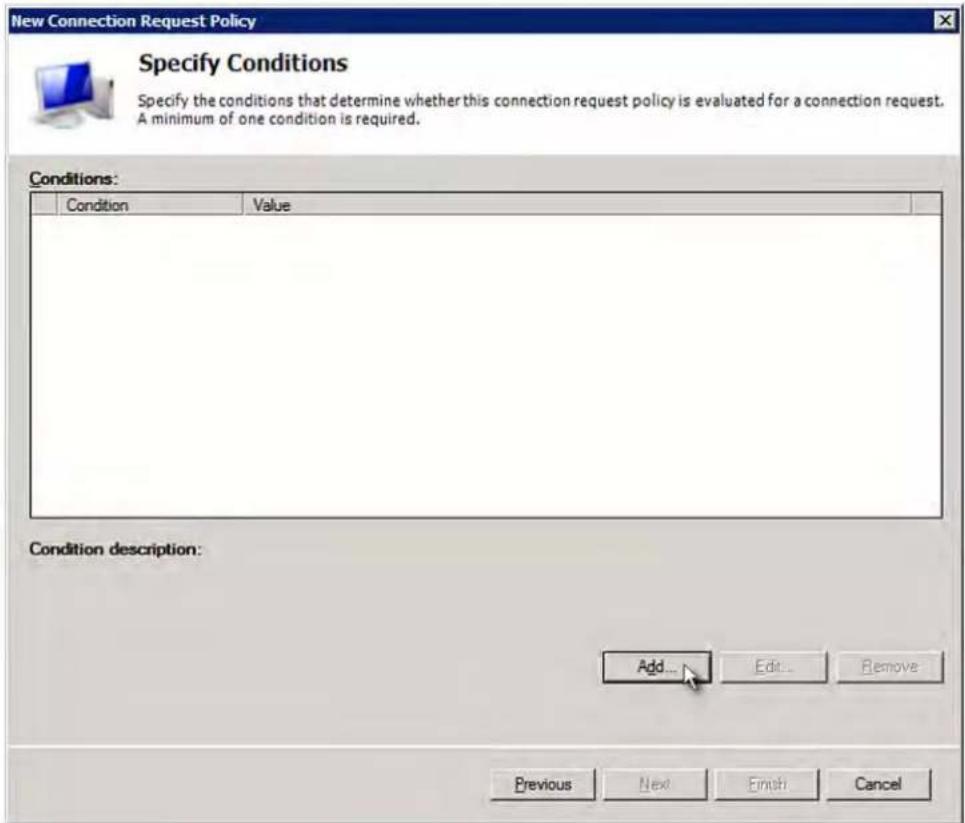
text_image
New Connection Request Policy
Specify Conditions
Specify the conditions that determine whether this connection request policy is evaluated for a connection request.
A minimum of one condition is required.
Conditions:
Condition Value
Condition description:
Add Edit Remove
Previous Next Finish Cancel
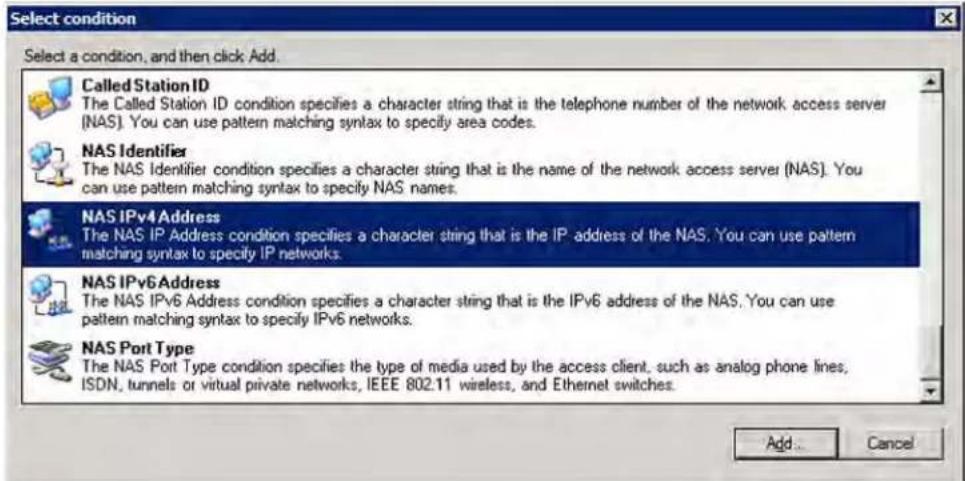
text_image
Select condition
Select a condition, and then click Add.
Called Station ID
The Called Station ID condition specifies a character string that is the telephone number of the network access server (NAS). You can use pattern matching syntax to specify area codes.
NAS Identifier
The NAS Identifier condition specifies a character string that is the name of the network access server (NAS). You can use pattern matching syntax to specify NAS names.
NAS IPv4Address
The NAS IP Address condition specifies a character string that is the IP address of the NAS. You can use pattern matching syntax to specify IP networks.
NAS IPv6Address
The NAS IPv6 Address condition specifies a character string that is the IPv6 address of the NAS. You can use pattern matching syntax to specify IPv6 networks.
NAS Port Type
The NAS Port Type condition specifies the type of media used by the access client, such as analog phone lines, ISDN, tunnels or virtual private networks, IEEE 802:11 wireless, and Ethernet switches.
Add...
Cancel

text_image
NAS IPv4 Address
Specify the IPv4 address of the network access server sending the access
request message. You can use pattern matching syntax.
192.168.56.29
OK Cancel
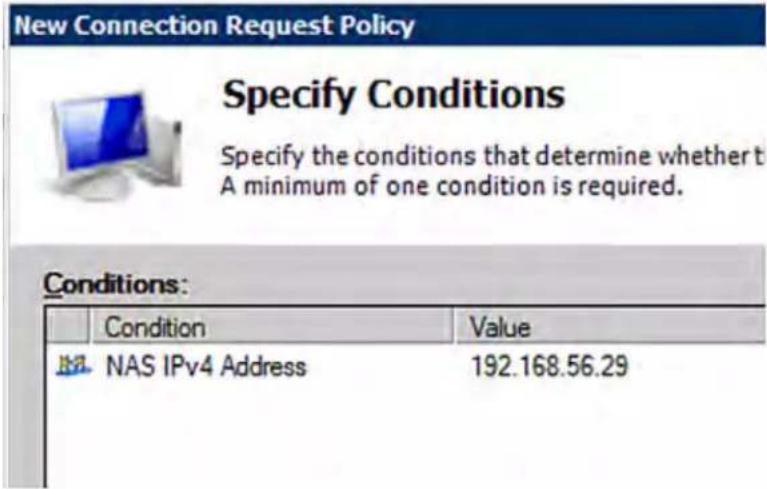
text_image
New Connection Request Policy
Specify Conditions
Specify the conditions that determine whether t
A minimum of one condition is required.
Conditions:
Condition Value
NAS IPv4 Address 192.168.56.29

text_image
New Connection Request Policy
Specify Connection Request Forwarding
The connection request can be authenticated by the local server or it can be forwarded to RADIUS servers in a remote RADIUS server group.
If the policy conditions match the connection request, these settings are applied.
Settings:
Forwarding Connection Request
Specify whether connection requests are processed locally, are forwarded to remote RADIUS servers for authentication, or are accepted without authentication.
● Authenticate requests on this server
○ Forward requests to the following remote RADIUS server group for authentication:
(not configured)
○ Accept users without validating credentials
Previous Next Finish Cancel
New Connection Request Policy

Specify Authentication Methods
EAP Types:
Less secure authentication methods:
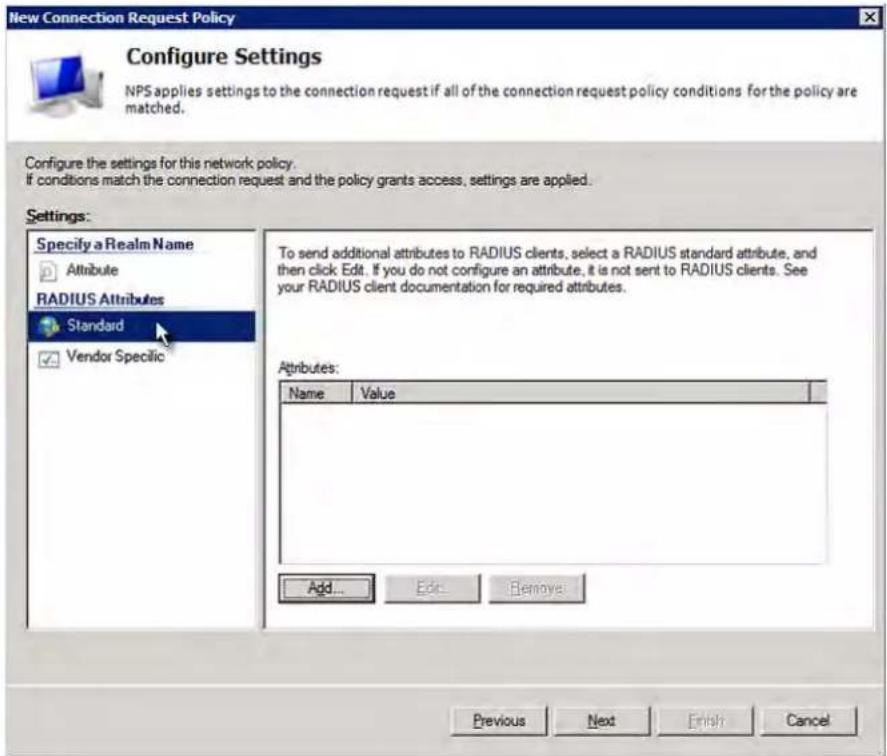
text_image
New Connection Request Policy
Configure Settings
NPS applies settings to the connection request if all of the connection request policy conditions for the policy are matched.
Configure the settings for this network policy.
If conditions match the connection request and the policy grants access, settings are applied.
Settings:
Specify a Realm Name
Attribute
RADIUS Attributes
Standard
Vendor Specific
To send additional attributes to RADIUS clients, select a RADIUS standard attribute, and then click Edit. If you do not configure an attribute, it is not sent to RADIUS clients. See your RADIUS client documentation for required attributes.
Attributes:
Name Value
Add... Edit... Remove
Previous Next Finish Cancel

text_image
Add Standard RADIUS Attribute
To add an attribute to the settings, select the attribute, and then click Add.
To add a custom or predefined Vendor Specific attribute, close this dialog and select Vendor Specific, and then click Add.
Access type:
All
Attributes:
Name
Acct-Interim-Interval
Callback-Id
Callback-Number
Class
Filter-Id
Framed-AppleTalk-Link
Framed-AppleTalk-Network
Description:
Specifies the name of filter list for the user requesting authentication.
Add... Close
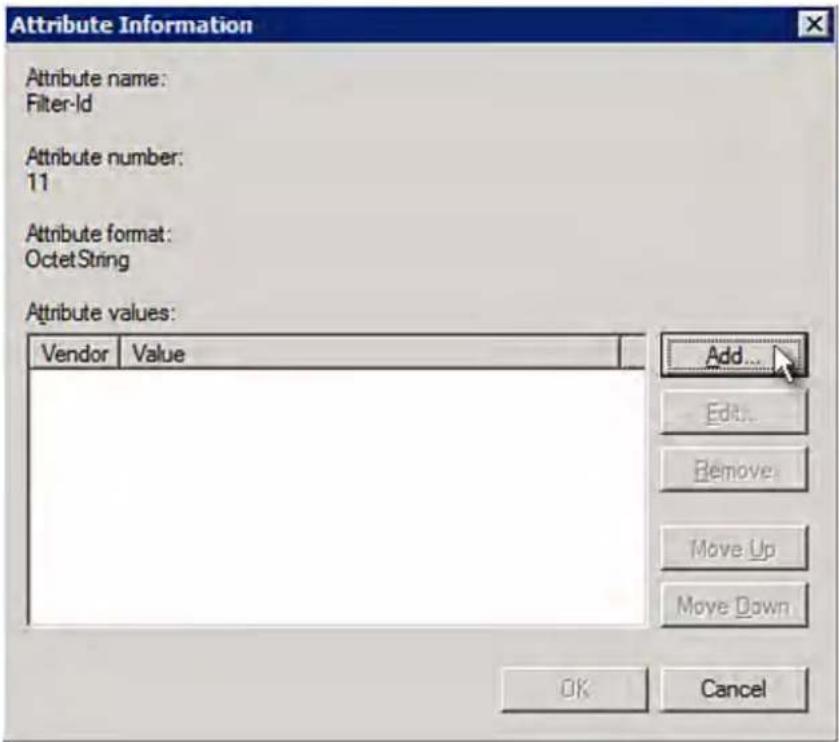
text_image
Attribute Information
Attribute name:
Filter-Id
Attribute number:
11
Attribute format:
Octet String
Attribute values:
Vendor Value Add...
Edit...
Remove
Move Up
Move Down
OK Cancel
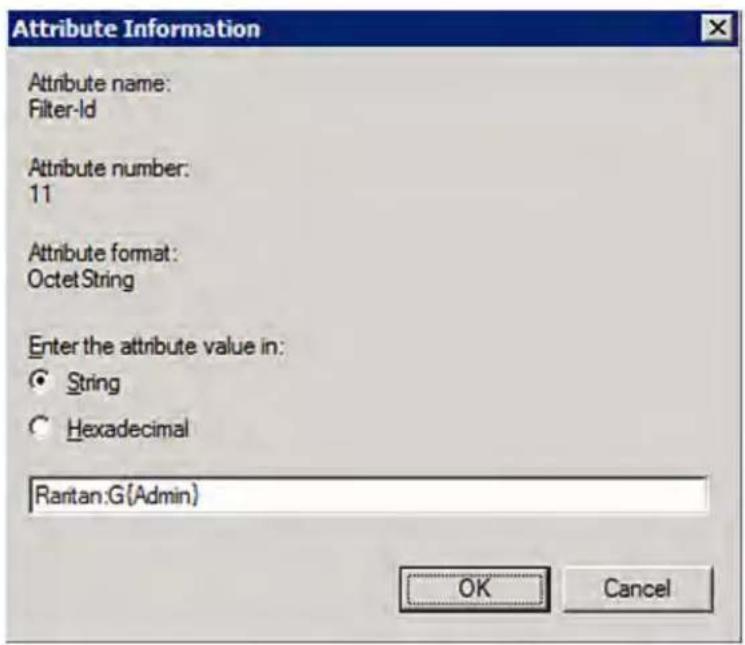
text_image
Attribute Information
Attribute name:
Filter-Id
Attribute number:
11
Attribute format:
Octet String
Enter the attribute value in:
● String
○ Hexadecimal
Rantan:G(Admin)
OK Cancel
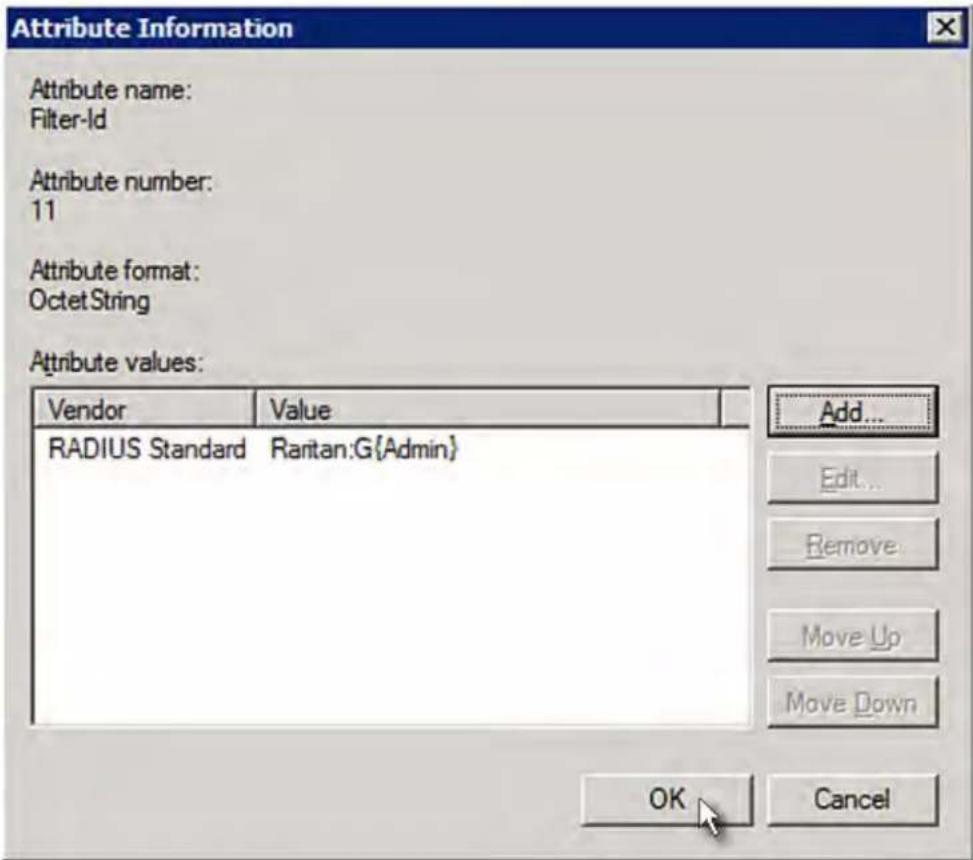
text_image
Attribute Information
Attribute name:
Filter-Id
Attribute number:
11
Attribute format:
OctetString
Attribute values:
Vendor Value
RADIUS Standard Rantan:G{Admin}
Add...
Edit...
Remove
Move Up
Move Down
OK Cancel

text_image
New Connection Request Policy
Configure Settings
NPS applies settings to the connection request if all of the connect
matched.
Configure the settings for this network policy.
If conditions match the connection request and the policy grants access, settings are a
Settings:
Specify a Realm Name
Attribute
RADIUS Attributes
Standard
Vendor Specific
To send additional attributes to RADIUS clien
then click Edit. If you do not configure an attr
your RADIUS client documentation for require
Attributes:
Name Value
Filter-Id Rantan:G{Admin}
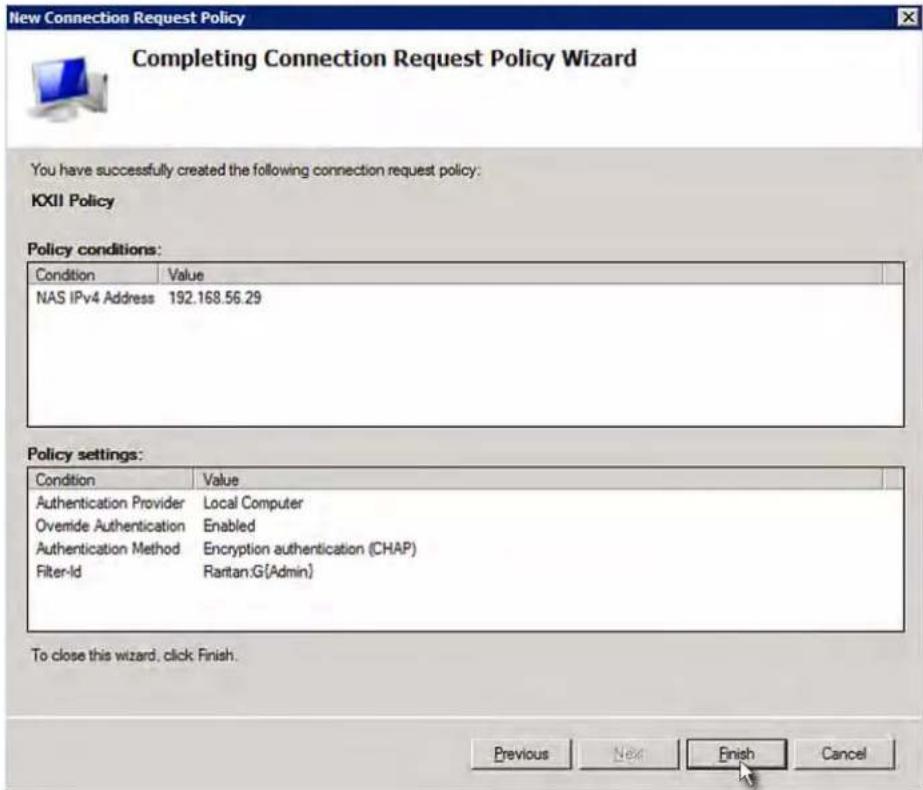
text_image
New Connection Request Policy
Completing Connection Request Policy Wizard
You have successfully created the following connection request policy:
KXII Policy
Policy conditions:
Condition Value
NAS IPv4 Address 192.168.56.29
Policy settings:
Condition Value
Authentication Provider Local Computer
Overnide Authentication Enabled
Authentication Method Encryption authentication (CHAP)
Filter-Id Rartan:G(Admin)
To close this wizard, click Finish.
Previous Next Finish Cancel
Step C: Configure a Vendor-Specific Attribute
To configure VSA:

text_image
Network Policy Server
File Action View Help
NPS (Local)
RADIUS Clients and Servers
RADIUS Clients
Remote RADIUS Server Groups
Policies
Connection Request Policies
Network Policies
Health Policies
Network Access Protection
Accounting
Getting Started
Network Policy Server (NPS) allows you to create and enforce organization-wide network authentication, and connection request authorization.
Standard Configuration
Select a configuration scenario from the list and then click the link below to open the scenario
RADIUS server for Dial-Up or VPN Connections
RADIUS server for Dial-Up or VPN Connections
When you configure NPS as a RADIUS server for Dial-Up or VPN connections, you create net authorize connections from Dial-Up or VPN network access servers (also called RADIUS client)
Configure VPN or Dial-Up Learn more
Advanced Configuration
b. Select String in the "Attribute format" field.
c. Type Raritan:G{Admin User SystemTester} in the "Attribute value" field. In this example, three roles are specified inside the curved brackets {} -- Admin, User and SystemTester.

text_image
Network Policy Server
File Action View Help
NPS (Local)
RADIUS Clients and Servers
Policies
Connection Request Polio
Network Policies
Health Policies
Network Access Protection
Accounting
Connection request
VPN or 802.1X, you
Policy Name
DPX2-VendorSpecific
DPX2-VendorSpecific Pro
Overview Conditions S
Configure the settings for I
if conditions and constraint
Settings:
Required Authenical
Methods
Authentication Met
Forwarding Connecti
Request
Authentication
Accounting
Specify a Realn Nam
Attribute
RADIUS Attributes
Standard
Vendor Specific
Attribute Information
Attribute name:
Vendor-Specific
Attribute number:
26
Attribute format:
OctetString
Attribute values:
Vendor Value Add...
Vendor Code: 13742 Rantan G(Admin) Filt
Vendor-Specific Atte
Configure VSA (RFC Compliant)
Attribute name:
Vendor Specific
Specify network acce
Select from list:
String
Enter Vendor Code
Attribute value:
Rantan G(Admin User PXTester)
Specify whether the a
vendor specific attribu
Yes. It conforms
No. It does not conform
Configure Attribute...
OK Cancel
Added to remote RADIUS servers.
tribute, and
clients. See
AD-Related Configuration
To register NPS:

text_image
Network Policy Server
File Action View Help
Import Configuration
Export Configuration
Start NPS Service
Stop NPS Service
Register server in Active Directory
Properties
View
Help
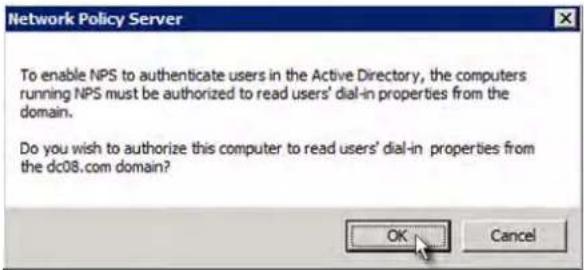
text_image
Network Policy Server
To enable NPS to authenticate users in the Active Directory, the computers running NPS must be authorized to read users' dial-in properties from the domain.
Do you wish to authorize this computer to read users' dial-in properties from the dc08.com domain?
OK Cancel
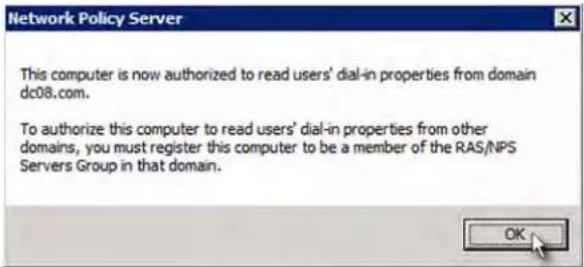
text_image
Network Policy Server
This computer is now authorized to read users' dial-in properties from domain dc08.com.
To authorize this computer to read users' dial-in properties from other domains, you must register this computer to be a member of the RAS/NPS Servers Group in that domain.
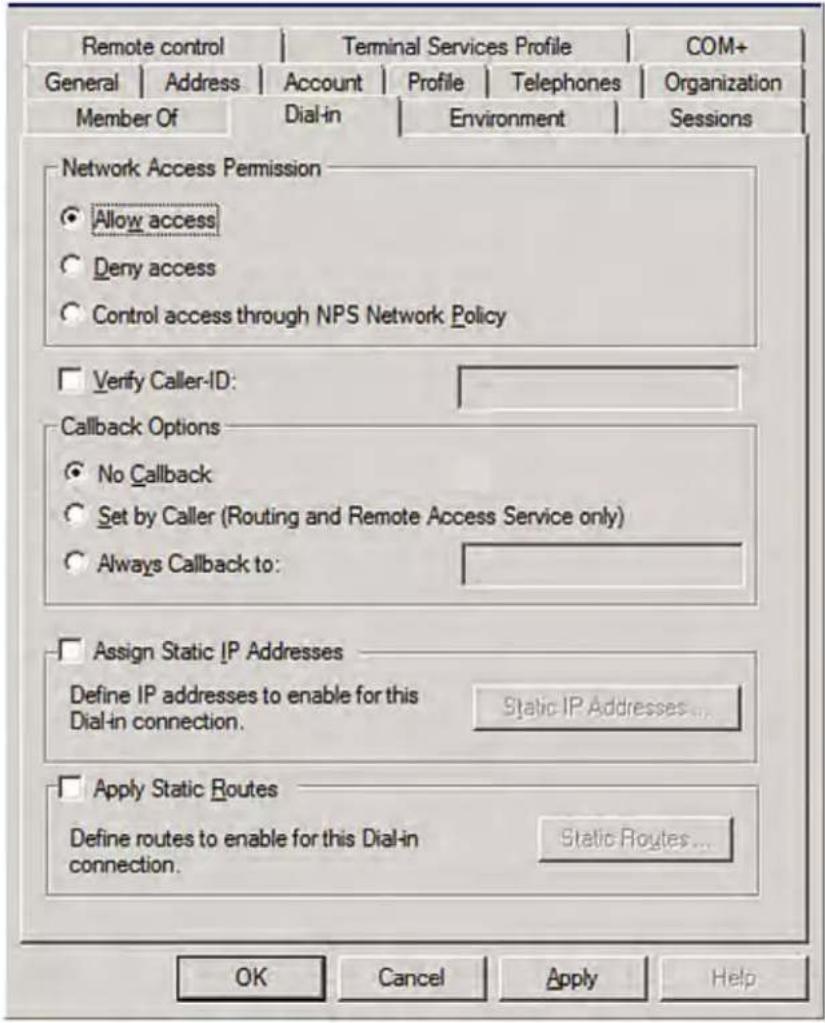
text_image
Remote control
Terminal Services Profile
COM+
General | Address | Account | Profile | Telephones | Organization
Member Of | Dial-in | Environment | Sessions
Network Access Permission
Allow access
Deny access
Control access through NPS Network Policy
Verify Caller-ID:
Callback Options
No Callback
Set by Caller (Routing and Remote Access Service only)
Always Callback to:
Assign Static IP Addresses
Define IP addresses to enable for this
Dial-in connection.
Static IP Addresses...
Apply Static Routes
Define routes to enable for this Dial-in
connection.
Static Routes...
OK Cancel Apply Help

text_image
Member Of
Dial-in
Environment
Sessions
Remote control
Terminal Services Profile
COM+
General | Address | Account | Profile | Telephones | Organization
User logon name:
User logon name (pre-Windows 2000):
DC08\
Administrator
Logon Hours...
Log On To...
Unlock account
Account options:
User must change password at next logon
User cannot change password
Password never expires
Store password using reversible encryption
Account expires
Never
End of: Saturday May 23, 2009
OK Cancel Apply Help
Non-Windows RADIUS Server
Dictionary File
<h1 id="text">-*- text -*-</h1>
#
<h1 id="dictionaryraritan">dictionary.raritan</h1>
#
#
<h1 id="version-id">Version: Id</h1>
#
VENDOR    Raritan    13742
#
<h1 id="standard-attribute">Standard attribute</h1>
#
BEGIN-VENDOR    Raritan
ATTRIBUTE    Raritan-Vendor-Specific    26    string
END-VENDOR    Raritan
Format of the "string"
Example:
Appendix J Integration
In This Chapter
Power IQ Configuration
• Name outlets on different PDUs
Adding PDUs to Power IQ Management
To add PDUs to Power IQ management:
You can also specify branch circuit monitors using the Proxy Index field. See Adding Veris Branch Circuit Monitors with Acquisuite.
b. Authorization Protocol: Select MD5 or SHA.
c. Enter the PDU's Authorization Passkey, then re-enter the passkey in the Authorization Passkey Confirm field.
d. Privacy Protocol: Select DES or AES.
e. Enter the PDU's Privacy Passkey, then re-enter the passkey in the Privacy Passkey Confirm field.
Dominion KX II Configuration
- PX2 series -- 2.2 or later
• PX3 series -- 2.5.10 or later
• PX3TS series -- 2.6.1 or later
Configuring Rack PDU (Power Strip) Targets
Connecting a Rack PDU
To connect the rack PDU:
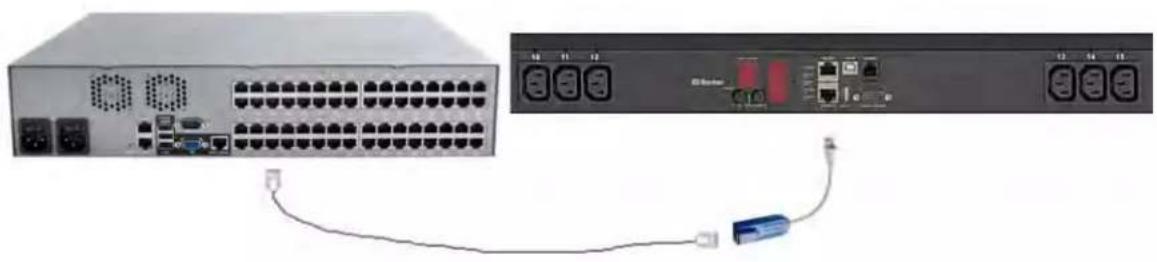
natural_image
Front view of a network switch device connected to a cable via a USB cable (no visible text or labels)
Naming the Rack PDU in the KX II or LX (Port Page for Power Strips)
To name the rack PDU and outlets:
Port 17
Outlets
1 Dominion-Port1(1) 2 Outlet 2 3 Outlet 3 4 Outlet 4 5 Outlet 5 6 Outlet 6 7 Outlet 7 8 Outlet 8 Associating Outlets with Target Servers on KX II and LX
• Power CIMs (D2CIM-PWR)To make power associations (associate rack PDU outlets to KVM target servers):
▶ To change the port name:
To remove a rack PDU association:
To remove a rack PDU association if the rack PDU has been removed from the target:
Dominion KSX II or SX Configuration
Dominion KSX II
Overview
NameAppendix J: Integration
- Temperature
- Current Amps
■ Maximum Amps
- Voltage
■ Power in Watts
■ Power in Volts Ampere
■ State - On or Off status of the outlet
■ Control - Turn outlets on or off, or cycle their power Name State Control Associations Outlet 1 on On Off Cycle Dominion_Port9 Outlet 2 on On Off Cycle Outlet 3 on On Off Cycle Outlet 4 on On Off Cycle Outlet 5 on On Off Cycle Dominion_Port2 Outlet 6 on On Off Cycle Outlet 7 on On Off Cycle Outlet 8 on On Off Cycle Configuring KSX II Ports
To access a port configuration:
■ Port Name - The name assigned to the port
- TierDevice - Tier device
- Not Available - No CIM connected
■ PCIM - Paragon CIM
■ PowerStrip (rack PDU) - Power strip connected
- Dual - VM - Virtual media CIM (D2CIM-VUSB and D2CIM-DVUSB)
- Blade Chassis - Blade chassis and the blades associated with that chassis (displayed in a hierarchical order)
■ KVM Switch - Generic KVM Switch connection
■ DVM-DP - Display Port
■ DVM-HDMI - HDMI CIM
■ DVM-DVI - DVI CIM
▲ No. Name Type 1 KX-local Not Available 2 Dominion_KSX2_Port2 Not Available 3 KX8-Local Not Available 4 Dominion_KSX2_Port4 Not Available 5 Blade_Chassis_Port3 Not Available 6 Dominion_KSX2_Port6 Not Available 7 Dominion_KSX2_Port7 Not Available 8 Dominion_KSX2_Port8 Not Available 9 Serial Port 1 Serial 10 Serial Port 2 Serial 11 Serial Port 3 Serial 12 Serial Port 4 Serial 13 Serial Port 5 Serial 14 Serial Port 6 Serial 15 Serial Port 7 Serial 16 Serial Port 8 Serial 17 Power Port 1 PowerStrip 18 Power Port 2 PowerStrip Power Control
To turn an outlet on:
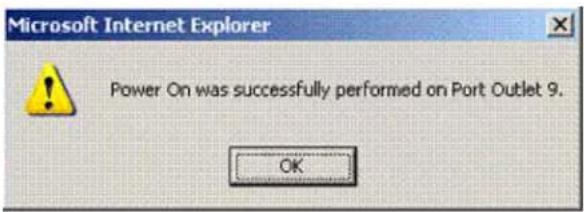
text_image
Microsoft Internet Explorer
Power On was successfully performed on Port Outlet 9.
OK
To turn an outlet off:
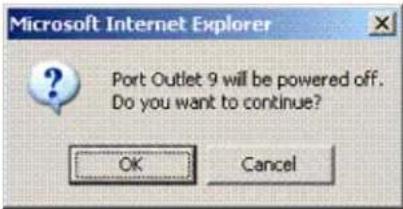
text_image
Microsoft Internet Explorer
Port Outlet 9 will be powered off.
Do you want to continue?
OK Cancel
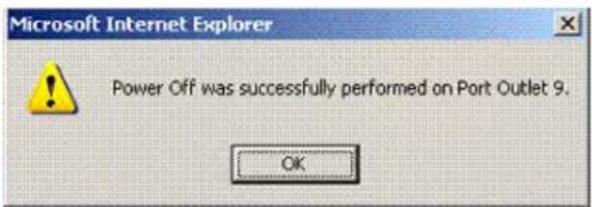
text_image
Microsoft Internet Explorer
Power Off was successfully performed on Port Outlet 9.
OK
To cycle the power of an outlet:
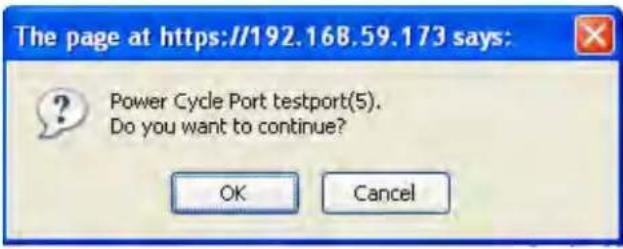
text_image
The page at https://192.168.59.173 says:
Power Cycle Port testport(5).
Do you want to continue?
OK Cancel
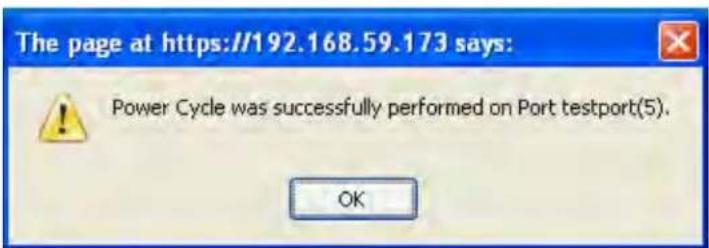
text_image
The page at https://192.168.59.173 says:
Power Cycle was successfully performed on Port testport(5).
OK
Dominion SX
Configuring a PX on Dominion SX
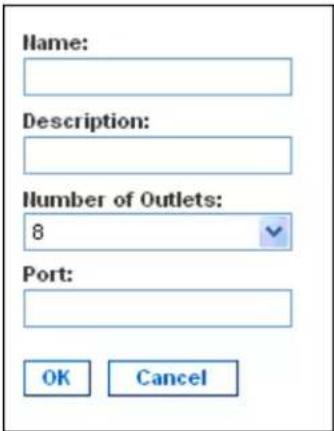
text_image
Name:
Description:
Number of Outlets:
8
Port:
OK Cancel
Power Control
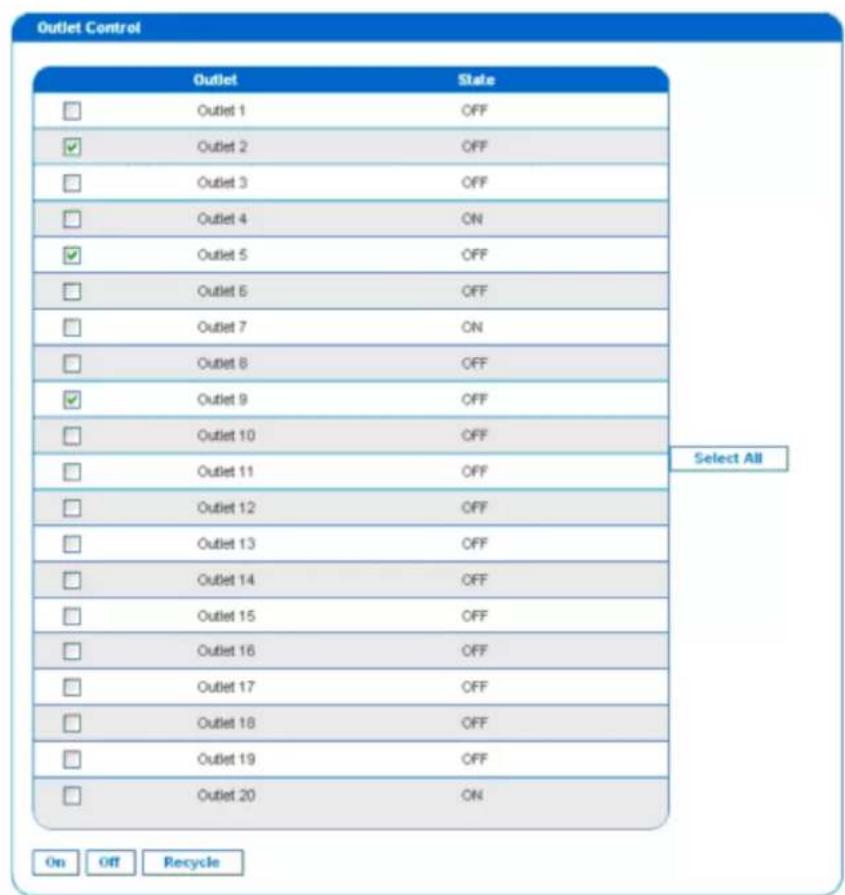
text_image
Outlet Control
Outlet State
□ Outlet 1 OFF
✓ Outlet 2 OFF
□ Outlet 3 OFF
□ Outlet 4 ON
✓ Outlet 5 OFF
□ Outlet 6 OFF
□ Outlet 7 ON
□ Outlet 8 OFF
✓ Outlet 9 OFF
□ Outlet 10 OFF
□ Outlet 11 OFF
□ Outlet 12 OFF
□ Outlet 13 OFF
□ Outlet 14 OFF
□ Outlet 15 OFF
□ Outlet 16 OFF
□ Outlet 17 OFF
□ Outlet 18 OFF
□ Outlet 19 OFF
□ Outlet 20 ON
Select All
On Off Recycle
Checking Power Strip Status
DPX Status:
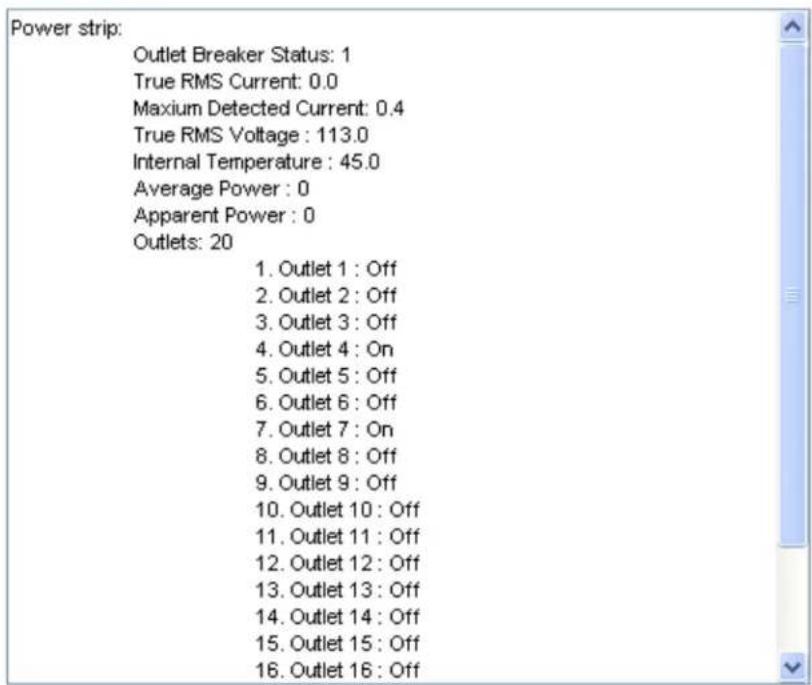
text_image
Power strip:
Outlet Breaker Status: 1
True RMS Current: 0.0
Maxium Detected Current: 0.4
True RMS Voltage : 113.0
Internal Temperature : 45.0
Average Power : 0
Apparent Power : 0
Outlets: 20
1. Outlet 1 : Off
2. Outlet 2 : Off
3. Outlet 3 : Off
4. Outlet 4 : On
5. Outlet 5 : Off
6. Outlet 6 : Off
7. Outlet 7 : On
8. Outlet 8 : Off
9. Outlet 9 : Off
10. Outlet 10 : Off
11. Outlet 11 : Off
12. Outlet 12 : Off
13. Outlet 13 : Off
14. Outlet 14 : Off
15. Outlet 15 : Off
16. Outlet 16 : Off
dcTrack
• Monitor the electrical consumption of the data center
- Track environmental factors in the data center, such as temperature and humidity
- Optimize the data center growthdcTrack Overview
Adding the PX to dcTrack Management
To import data into dcTrack:
Appendix K Additional PX Information
In This Chapter
MAC Address
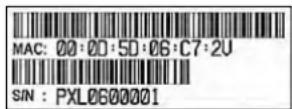
Locking Outlets and Cords
SecureLock™ Outlets and Cords

natural_image
Diagram of a plug connector with labeled terminals A (no text or symbols beyond labels)
Item Description
To lock a power cord using the SecureLock™ mechanism:
To remove a SecureLock ^TM power cord from the PDU:

natural_image
Illustration of a plug inserted into a socket with red arrows indicating direction (no text or symbols)
Button-Type Locking Outlets
To remove a power cord from the locking outlet:

natural_image
Simple diagram of a plug socket with a red pushpin and blue arrow pointing to it (no text or symbols)

natural_image
Simple diagram of a padlock with a blue arrow pointing to its left side (no text or symbols)
Unbalanced Current Calculation
Calculation:
Average current = (L1+L2+L3) / 3
L1 current unbalance = (L1 - average current) / average current
L2 current unbalance = (L2 - average current) / average current
L3 current unbalance = (L3 - average current) / average current
Maximum (|L1 current unbalance|, |L2 current unbalance|, |L3 current unbalance|)
Unbalanced load percent = 100 * maximum current unbalance
Example:
L1 = 5.5 amps
L2 = 5.2 amps
L3 = 4.0 amps
• L1 current unbalance: (5.5 - 4.9) / 4.9 = 0.1224
• L2 current unbalance: (5.2 - 4.9) / 4.9 = 0.0612
• L3 current unbalance: (4.0 - 4.9) / 4.9 = -0.1837
• Maximum current unbalance:
Maximum (|0.1224|, |0.0612|, |-0.1837|) = 0.1837
- Current unbalance converted to a percentage: 100 * (0.1837) = 18%Altitude Correction Factors
Altitude (meters) Altitude (feet) Correction factor 0 0 0.95 250 820 0.98 425 1394 1.00 500 1640 1.01 740 2428 1.04 1500 4921 1.15 2250 7382 1.26 3000 9842 1.38 Data for BTU Calculation
Model name Maximum power (Watt) PX2-1000 5 PX3-1000 PX2-2000 20 PX3-2000 PX2-3000 24 PX3-3000 PX2-4000 24 PX3-4000 PX2-5000 24 PX3-5000 Raritan Training Website
Truncated Data in the Web Interface
• Size of different characters
Reserving IP Addresses in Windows DHCP Servers
Sensor Threshold Settings

text_image
Setup Sensor XXX
Lower Critical: ✓
Lower Warning: ✓
Upper Warning: ✓
Upper Critical: ✓
Deassertion Hysteresis:
Assertion Timeout:
OK Cancel
Thresholds and Sensor States
above upper critical Upper Critical above upper warning Upper Warning normal Lower Warning below lower warning Lower Critical below lower critical Available sensor states:
Range of each available sensor state:
- "above up per warning" State (on page 292)
• "below lower critical" State (on page 292)
• "below lower warning" State (on page 292)"To Assert" and Assertion Timeout
▶ Assert a state:

flowchart
graph TD
    A["above upper critical"] --> B["above upper warning"]
    B --> C["normal"]
    C --> D["below lower warning"]
    D --> E["below lower critical"]
▶ Assertion Timeout:
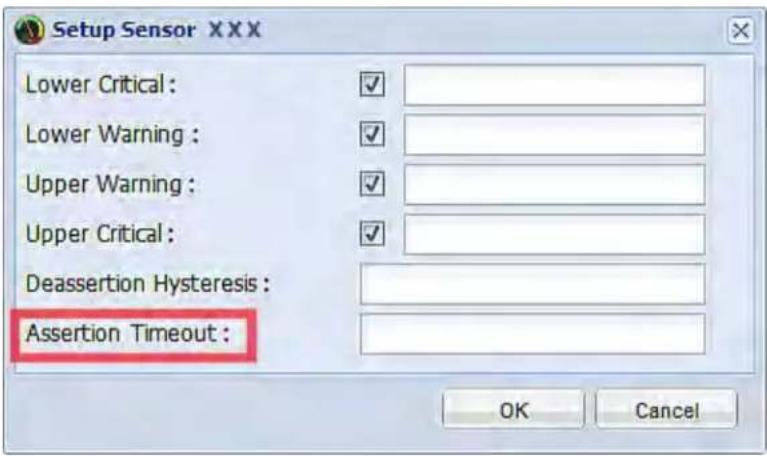
text_image
Setup Sensor XXX
Lower Critical: ✓
Lower Warning: ✓
Upper Warning: ✓
Upper Critical: ✓
Deassertion Hysteresis:
Assertion Timeout:
OK Cancel
How "Assertion Timeout" is helpful:
Assertion Timeout Example for Temperature Sensors
Assumption:
Upper Warning threshold is enabled.
Upper Warning = 25 (degrees Celsius)
Assertion Timeout = 5 samples (that is, 5 seconds)
"To De-assert" and Deassertion Hysteresis
To de-assert a state:

flowchart
graph TD
    A["above upper critical"] --> B["1"]
    B --> C["above upper warning"]
    C --> D["2"]
    D --> E["normal"]
    E --> F["3"]
    F --> G["below lower warning"]
    G --> H["4"]
    H --> I["below lower critical"]
▶ Deassertion Hysteresis:

text_image
Setup Sensor XXX
Lower Critical: ✓
Lower Warning: ✓
Upper Warning: ✓
Upper Critical: ✓
Deassertion Hysteresis:
Assertion Timeout:
OK Cancel
• Upper Warning = 25, so its "deassertion" level = 25 - 2 = 23.
• Lower Critical = 10, so its "deassertion" level = 10 + 2 = 12.
- Lower Warning = 18, so its "deassertion" level = 18 + 2 = 20.How "Deassertion Hysteresis" is helpful:
Upper Warning threshold is enabled.
Upper Warning = 20 (degrees Celsius)
Deassertion Hysteresis = 3 (degrees Celsius)
"Deassertion" level = 20-3 = 17 (degrees Celsius)
Ways to Probe Existing User Profiles
Index
1
2
A
B
C
Index
Index
D
Index
E
Index
F
G
H
|
Index
L
M
Index
N
O
P
Index
Q
R
S
Index
Index
T
Index
U
V
W
Z
Raritan.
U.S./Canada/Latin America
China
Beijing
Shanghai
GuangZhou
India
Japan
Europe
Europe
United Kingdom
France
Germany
Melbourne, Australia
Taiwan