ZWC 7050 W - Washing machine Zanussi-Electrolux - Free user manual and instructions
Find the device manual for free ZWC 7050 W Zanussi-Electrolux in PDF.


User questions about ZWC 7050 W Zanussi-Electrolux
0 question about this device. Answer the ones you know or ask your own.
Ask a new question about this device
Download the instructions for your Washing machine in PDF format for free! Find your manual ZWC 7050 W - Zanussi-Electrolux and take your electronic device back in hand. On this page are published all the documents necessary for the use of your device. ZWC 7050 W by Zanussi-Electrolux.
USER MANUAL ZWC 7050 W Zanussi-Electrolux
natural_image
Line drawing of a washing machine with front panel and side panel (no text or symbols)Thank you for selecting our appliance
We wish you lots of enjoyment with your new appliance and we hope that you will consider our brand again when purchasing household appliances.
Please read this user manual carefully and keep it throughout the product life cycle as a reference document. The user manual should be passed on to any future owner of the appliance.
The following symbols are used in this manual:

Important information concerning your personal safety and information on how to avoid damaging the appliance.

General information and tips

Environmental information
Content
Safety information - - - - - - - - - - - - - - - - - - - - 3
Description of the appliance - - - - - - - - - - - 5
Detergent dispenser drawer - - - - - - - - - - - 5
Control panel 6
Functions 7
Programme table - - - - - - - - - - - - - - - - - - - - - - - - - - - - - - - - 9
Programme information - - - - - - - - - - - - 11
Washing Hints - - - - - - - - - - - - - - - - - - - - 12
Before the first use 14
Operating Sequence 15
Care and cleaning - - - - - - - - - - - - - - - - - - - 18
What to do if... - - - - - - - - - - - - - - - - - 20
Technical data- - - - - - - - - - - - - - - - - - 23
Consumption values 23
Installation instruction - - - - - - - - - - - - - 24
Environmental concerns - - - - - - - - - - 27
Safety information
In the interest of your safety and to ensure the correct use, before installing and first using the appliance, read this user manual carefully, including its hints and warnings. To avoid unnecessary mistakes and accidents, it is important to ensure that all people using the appliance are thoroughly familiar with its operation and safety features. Save these instructions and make sure that they remain with the appliance if it is moved or sold, so that everyone using it through its life will be properly informed on appliance use and safety.
General safety
- It is dangerous to alter the specifications or attempt to modify this product in any way.
●During high temperature wash programmes the door glass may get hot. Do not touch it!
●Make sure that small pets do not climb into the drum. To avoid this, please check into the drum before using.
●Any objects such as coins, safety pins, nails, screws, stones or any other hard, sharp material can cause extensive damage and must not be placed into the machine. - Only use the advised quantities of fabric softener and detergent. Damage to the fabric can ensue if you over-fill. Refer to the manufacturer's recommendations of quantities.
●Wash small items such as socks, laces, washable belts etc in a washing bag or pillow case as it is possible for such items to slip down between the tub and the inner drum. - Do not use your washing machine to wash articles with whalebones, material without hems or torn material.
●Always unplug the appliance and turn off the water supply after use, clean and maintenance.
●Under no circumstances should you attempt to repair the machine yourself. Repairs carried out by inexperienced persons may cause injury or serious malfunctioning. Contact your local Service Centre. Always insist on genuine spare parts.
Installation
●This appliance is heavy. Care should be taken when moving it.
- When unpacking the appliance, check that it is not damaged. If in doubt, do not use it and contact the Service Centre.
●All packing and transit bolts must be removed before use. Serious damage can occur to the product and to property if this is not adhered to. See relevant section in the user manual.
●After having installed the appliance, check that it is not standing on the inlet and drain hose and the worktop is not pressing the electrical supply cable.
- If the machine is situated on a carpeted floor, please adjust the feet in order to allow air to circulate freely
●Always be sure, that there is no water leakage from hoses and their connections after the installation.
- If the appliance is installed in a location subject to frost, please read the «dangers of freezing» chapter.
●Any plumbing work required to install this appliance should be carried out by a qualified plumber or competent person.
●Any electrical work required to install this appliance should be carried out by a qualified electrician or competent person.
Use
●This appliance is designed for domestic use. It must not be used for purposes other than those for which it was designed.
- Only wash fabrics which are designed to be machine washed. Follow the instructions on each garment label.
- Do not overload the appliance. See the relevant section in the user manual.
●Before washing, ensure that all pockets are empty and buttons and zips are fastened. Avoid washing frayed or torn articles and treat stains such as paint, ink, rust, and grass before washing. Underwired bras must NOT be machine washed.
●Garments which have been in contact with volatile petroleum products should not be machine washed. If volatile cleaning fluids are used, care should be taken to ensure that the fluid is removed from the garment before placing in the machine.
- Never pull the power supply cable to remove the plug from the socket; always take hold of the plug itself.
●Never use the washing machine if the power supply cable, the control panel, the working surface or the base are damaged so that the inside of the washing machine is accessible.
Child safety
●This appliance is not intended for use by person (including children) with reduced physical sensory or mental capabilities or lack of experience and knowledge unless they have been given supervision or instruction concerning use of the appliance by a person responsible for their safety.
- The packaging components (e.g. plastic film, polystyrene) can be dangerous to children - danger of suffocation! Keep them out of children's reach
- Keep all detergents in a safe place out of children's reach.
●Make sure that children or pets do not climb into the drum. To avoid this the machine incorporates special feature.
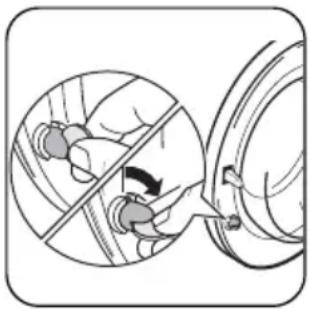
natural_image
Illustration of a hand adjusting a mechanical component with a circular cross-section view (no text or symbols)To activate this device, rotate the button (without pressing it) inside the door clockwise until the groove is horizontal. If necessary use a coin.
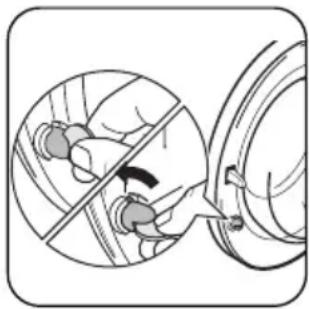
natural_image
Illustration of a hand adjusting a mechanical component with a circular inset showing internal components (no text or symbols)To disable this device and restore the possibility of closing the door, rotate the button anticlockwise until the groove is vertical.
Description of the appliance
1 Detergent dispenser drawer
2 Control panel
3 Door opening handle
4 Drain pump
5 Adjustable feet
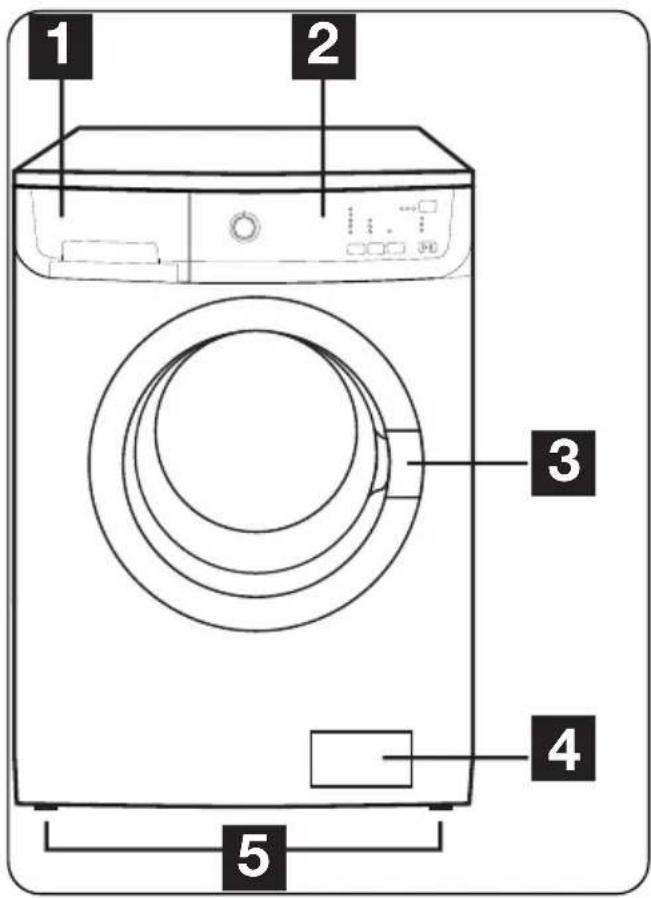
Detergent dispenser drawer
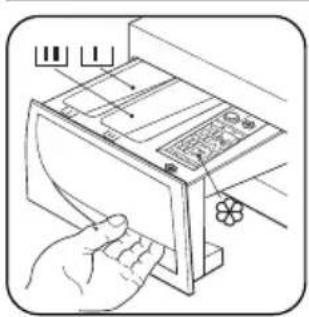
natural_image
Illustration of a hand inserting a device into a computer monitor (no text or symbols visible)Prewash
Wash
Fabric Softener
Control panel
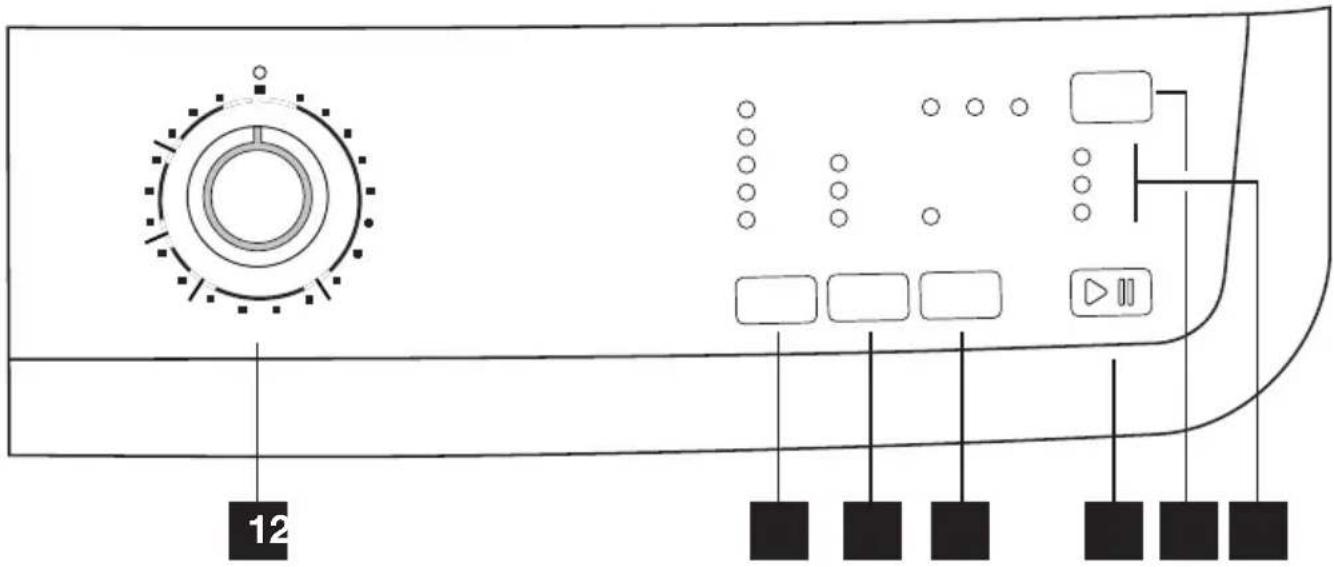
IMPORTANT
Henceforth, the programme selector dial, the dispaly and the different buttons will be indicated in all the book with the relevant numbers given in this table:
Symbols:
Cottons, Cottons Eco, Synthetics, Delicates, Wool, Handwash, Rinses, Drain, Spin, □ Rinse Hold, No Spin, Extra Rinse, Delay Start Start Pause, Fuctioning, Door Lock, End-of Cycle
| 1 | Programme selector dial and On/Off switch | ●The programme selector dial allows to select a programme and/or to switch the machine on/off «O». It can be turned either clockwise or anticlockwise. After having selected the programme, the green light of the button 5 starts blinking. |
| 2 | Spin reduction buttonRinse Hold optionNo Spin option | ●Press this button repeatedly to change the spin speed, if you want your laundry to be spun at a speed different from the one proposed by the washing machine or to select «Rinse Hold» or «No Spin» option.●The relevant light will light up. |
| 3 | Option buttonPrewash optionDaily optionSuper Quick option | ●Press this button to select one of the provided options.●The relevant light will light up. |
| 4 | Extra rinse button | ●By means of this button, the machine performs some additional rinses. |
| 5 | Start/Pause button | ●This button allows to start the selected programme; the corresponding green pilot light stops blinking.●This button interrupts also a programme which is running, the corresponding green pilot light starts blinking. |
| 6 | Delay Start button | ●This button allows to delay the starting of the washing programme. |
| 7 | Indicator pilot lights | ●These pilot lights indicate if the appliance is operating, the door can be opened or not and the end of the washing cycle. |
Functions
Rinse Hold (Button 2)
By selecting this option the water of the last rinse is not emptied out to prevent the fabrics from creasing. When the programme has finished, the pilot light 7.1 and the pilot light of button 5 is off, the pilot light 7.1 remains lit and the door is blocked to indicate that the water must be emptied out.
To empty the water out please read chapter «At the end of the programme».
No Spin (Button 2)
This option eliminates all the spin phases and increases the number of rinses in some programmes.
Super Quick (Button 3)
A very short cycle for very slightly items that have been used or worn for a short time
Daily (Button 3)
Select this option to wash normally soiled cotton, synthetics or delicate items. The
washing duration is reduced.
Prewash (Button 3)
Select this option if you wish your laundry to be prewashed at 30^ C before the main wash. The prewash ends with a short spin in programmes for Cotton and Synthetic fabrics, whereas in the programmes for Delicate fabrics the water is only drained.
Extra Rinse (Button 4)
The machine performs some additional rinses during the washing cycle. This option is recommended for people who are allergic to detergents, and in areas where the water is very soft.
Delay Start (Button 6)
By pressing this button it is possible to delay the
starting of the washing programme by 3, 6 and 9 hours.
Indicator pilot lights (7)
O 7.1
O 7.2
O 7.3
After having pressed the button 5, the
FUNCTIONING pilot light (7.1) comes on.
When the pilot light 7.1 comes on this means that the machine is operating.
The DOOR pilot light (7.2) illuminates when the programme starts and indicates if the door can be opened:
●light on: the door cannot be opened.
●light off: the door can be opened.
When the programme has finished the END CYCLE pilot light (7.3) comes on.
Programme table
| Programme/ Temperature | Type of laundry Options | Description of programme | |
| COTTONS90° - Cold | White and coloured cotton (normally soiled cotton items) | Spin Red., No Spin, Rinse Hold, Super Quick*, Daily, Prewash, Extra Rinse | Main washRinsesLong spin at the max speedMax. load kg 5* Red. load kg 2,5 |
| COTTONS ECO60° - 40° | White and coloured cotton economy, lightly-heavy soiled items, shirts, underwear | Spin Red., No Spin, Rinse Hold, Prewash, Extra Rinse | Main washRinsesLong spin at the max speedMax. load kg 5 |
| SYNTHETICS60° - Cold | Synthetic or mixed fabrics | Spin Red., No Spin, Rinse Hold, Super Quick*, Daily, Prewash, Extra Rinse | Main washRinsesShort spinMax. load kg 2,5* Red. load kg 1,5 |
| DELICATES40° - 30° | Delicate items | Spin Red., No Spin, Rinse Hold, Super Quick*, Daily, Prewash, Extra Rinse | Main washRinsesShort spinMax. load kg 2,5* Red. load kg 1,5 |
| WOOL40° - 30° | Programme for wool «Pure new wool, non-shrink, machine washable» label | Spin Red., No Spin, Rinse Hold | Main wash rinsesShort spinMax. load kg 1 |
| HANDWASH30° - Cold | Special programme for hand washing fabrics | Spin Red., No Spin, Rinse Hold | Main wash rinsesShort spinMax. load kg 1 |
* If you select the Super Quick option by pressing the button 3, we recommend you, to reduce the maximum load as indicated. (Red. load = reduced load). Full loading is possible however with somewhat reduced cleaning results.
Programme table - Special programmes
| Programme/Temperature | Type of laundry Options | Description of programme | |
| RINSES | Separate rinses cycle with softener, if needed, for hand washed cotton items | Spin Red., No Spin, Rinse Hold, Extra Rinse | RinsesLong spin at the max speedMax. load kg 5 |
| DRAIN | For emptying out the water in programmes which stop with water in the tub | Draining of water | |
| SPIN | Long spin at max speed for handwashed cotton items or for emptying out the water in the tub | Spin Red.* | Drain and long spin Max. load kg 5 |
| O Cancelling / Switching off of the machine | To interrupt a running programme, to cancel an incorrect option selection or to switch the machine off | ||
* The spin speed can be reduced accordingly with the type of fabrics to be spun.
Programme information
| ECONOMY (ECO) | These programmes can be selected for slightly or normally soiled cotton items. The temperature will decrease and the washing time will be extended. This allows to obtain a good washing efficiency by saving energy. |
| WOOL AND HANDWASH | Washing programme for machine washable wool as well as for hand washable woollens and delicate fabrics with the “hand washing” care symbol |
| RINSES | With this separate programme it is possible to rinse and spin cotton garments which have been washed by hand.The machine performs 3 rinses, followed by a final spin at maximum speed. The spin speed can be reduced by depressing button 2 |
| DRAIN | For emptying out the water of the last rinse in cotton programmes with the «Rinse hold» option Turn first the programme selector dial to «O», then select programme DRAIN and depress the button 5. |
| SPIN | Separate spin for cotton items washed by hand or at the end of a programme which stops with water left in the tub («Rinse hold» option).According to the type of fabric, it is possible to choose a different speed by means of the relevant button from one proposed by the machine. |
Washing hints
Sorting the laundry
Follow the wash code symbols on each garment label and the manufacturer's washing instructions. Sort the laundry as follows: whites, coloureds, synthetics, delicates, woollens.
Temperatures
| 90° or 95° | for normally soiled white cottons and linen (e.g. tea cloths, towels, tablecloths, sheets...) |
| 50°/60° | for normally soiled, colour fast garments (e.g. shirts, night dresses, pyjamas....) in linen, cotton or synthetic fibres and for lightly soiled white cotton (e.g. underwear). |
| Cold-30°-40° | for delicate items (e.g. net curtains), mixed laundry including synthetic fibres and woollens bearing the label «pure new wool, machine washable, non-shrink». |
Before loading the laundry
Never wash whites and coloureds together. Whites may lose their «whiteness» in the wash.
New coloured items may run in the first wash; they should therefore be washed separately the first time.
Make sure that no metal objects are left in the laundry (e.g. hair clips, safety pins, pins). Button up pillowcases, close zip fasteners, hooks and poppers. Tie any belts or long tapes.
Remove persistent stains before washing.
Rub particularly soiled areas with a special detergent or detergent paste.
Treat curtains with special care. Remove hooks or tie them up in a bag or net.
Maximum loads
Recommended loads are indicated in the programme charts.
General rules:
Cotton, linen: drum full but not too tightly packed;
Synthetics: drum no more than half full;
Delicate fabrics and woollens: drum no more than one third full.
Washing a maximum load makes the most efficient use of water and energy.
For heavily soiled laundry, reduce the load size.
Laundry weights
The following weights are indicative:
| 1200 gbathrobe | |
| 100 gnapkin | |
| 700 gquilt cover | |
| 500 gsheet | |
| 200 gpillow case | |
| 250 gtablecloth | |
| 200 gtowelling tc | |
| 100 gtea cloth | |
| 200 gnight dress | |
| 100 gladies' brief | |
| 600 gman's work | |
| 200 gman's shirt | |
| 500 gman's pyja | |
| 100 gblouse | |
| 100 gmen's unde |
Removing stains
Stubborn stains may not be removed by just water and detergent. It is therefore advisable to treat them prior to washing.
Blood: treat fresh stains with cold water. For dried stains, soak overnight in water with a special detergent then rub in the soap and water.
Oil based paint: moisten with benzine stain remover, lay the garment on a soft cloth and dab the stain; treat several times.
Dried grease stains: moisten with turpentine, lay the garment on a soft surface and dab the stain with the fingertips and a cotton cloth.
Rust: oxalic acid dissolved in hot water or a rust removing product used cold. Be careful with rust stains which are not recent since the cellulose structure will already have been damaged and the fabric tends to hole.
Mould stains: treat with bleach, rinse well (whites and fast coloureds only).
Grass: soap lightly and treat with bleach (whites and fast coloureds only).
Ball point pen and glue: moisten with acetone (*), lay the garment on a soft cloth and dab the stain.
Lipstick: moisten with acetone as above, then treat stains with methylated spirits. Remove any residual marks from white fabrics with bleach.
Red wine: soak in water and detergent, rinse and treat with acetic or citric acid, then rinse. Treat any residual marks with bleach.
Ink: depending on the type of ink, moisten the fabric first with acetone (*), then with acetic acid; treat any residual marks on white fabrics with bleach and then rinse thoroughly.
Tar stains: first treat with stain remover, methylated spirits or benzine, then rub with detergent paste.
(*) do not use acetone on artificial silk.
Detergents and additives
Good washing results also depend on the choice of detergent and use of the correct quantities to avoid waste and protect the environment. Although biodegradable, detergents contain substances which, in large quantities, can upset the delicate balance of nature.
The choice of detergent will depend on the type of fabric (delicates, woollens, cottons, etc.), the colour, washing temperature and degree of soiling.
All commonly available washing machine detergents may be used in this appliance:
- powder detergents for all types of fabric,
- powder detergents for delicate fabrics (60°C max) and woollens,
- liquid detergents, preferably for low temperature wash programmes (60°C max) for all types of fabric, or special for woollens only.
The detergent and any additives must be placed in the appropriate compartments of the dispenser drawer before starting the wash programme.
If using concentrated powder or liquid detergents, a programme without prewash must be selected.
The washing machine incorporates a recirculation system which allows an optimal use of the concentrated detergent.
Pour liquid detergent into the dispenser drawer compartment marked just before starting the programme.
Any fabric softener or starching additives must be poured into the compartment marked before starting the wash programme.
Follow the product manufacturer's recommendations on quantities to use and do not exceed the «MAX» mark in the detergent dispenser drawer.
Quantity of detergent to be used
The type and quantity of detergent will depend on the type of fabric, load size, degree of soiling and hardness of the water used.
Water hardness is classified in so-called «degrees» of hardness. Information on hardness of the water in your area can be obtained from the relevant water supply company, or from your local authority.
Follow the product manufacturers' instructions on quantities to use.
Degrees of water hardness
Follow the product manufacturers' instructions on quantities to use.
Use less detergent if:
- you are washing a small load,
●the laundry is lightly soiled,
●large amounts of foam form during washing.
| Level | Characteristic | Degrees | |
| German °dH | French °T.H. | ||
| 1 0-7 | 0-15soft | ||
| 2 8-14 | 16-25medium | ||
| 3 15-21 | 26-37hard | ||
| 4 > 21 | >37very hard | ||
Before the first use

WARNING!
Ensure that the electrical and water connections comply with the installation instructions.
IMPORTANT!
Remove the polystyrene block and any material from the drum.
IMPORTANT!
We recommend you to pour 2 litres of water into the main wash compartment of the detergent drawer in order to activate the ECO valve. Than run a cotton cycle at 90 or 95°C, without any laundry in the machine, to remove any manufacturing residue from the drum and tub. Pour 1/2 a measure of detergent into the main wash compartment of the detergent drawer and start the machine.
Operating sequence
natural_image
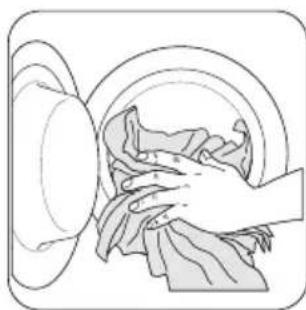
Illustration of a hand washing clothes from a circular basin (no text or symbols)- Load the laundry Open the door by carefully pulling the door handle outwards. Place the laundry in the drum, one item at a time, shaking them out as much as
possible. Close the door.
2. Measure out the detergent and the fabric softener
natural_image
Line drawing of a hand inserting a small object into a drawer (no text or symbols)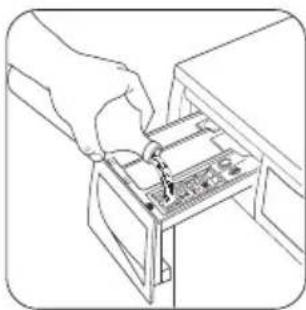
natural_image
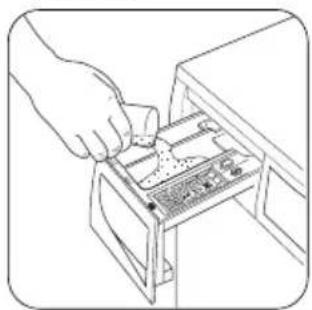
Line drawing of a hand using a tool to press or install electronic components on a device (no text or symbols visible)Pull out the dispenser drawer until it stops. Measure out the amount of detergent required, pour it into the main wash compartment and, if you wish to carry out a programme with the prewash phase, pour it into the compartment marked If required, pour fabric softener into the compartment marked (the amount used must not exceed the «MAX» mark in the drawer). Close the drawer gently.
Select the required programme by means of the programme selector dial (1)
You can choose the right programme for any type of laundry following the descriptions on the washing programme tables (see «Programme table»). Turn the programme selector dial to the required programme. It can be turned either clockwise or anticlockwise. The green light of button 5 starts blinking.
On position «O» the programme is reset and the machine is switched OFF.
For the description of each washing programmes of the selector dial, consult the chapter «Programme table».
At the end of the programme the selector dial must be turned to position «O», to switch the machine off.
WARNING!
If you turn the programme selector dial to another programme when the machine is working, the red pilot light of button 5 will blink 3 times to indicate a wrong selection. The machine will not perform the new selected programme.
Select the spin speed, the Rinse Hold or the No Spin option by pressing button 2
When the required programme has been selected, your appliance automatically proposes the maximum spin speed provided for that programme.
Press button 2 repeatedly to change the spin speed, if you want your laundry to be spun at a speed different from the one proposed by the washing machine. The relevant light will light up.
Select the desired option by means of buttons 3 and 4
Depending on the programme, different functions can be combined. These must be selected after choosing the desired programme and before depressing the button 5.
When these buttons are pressed, the corresponding pilot lights come on. When they are pressed again, the pilot lights go out.
For the compatibility of the options with the washing programmes, refer to the section «Programme table».
IMPORTANT!
If an option which is not compatible with the set wash programme is selected, the red light of the button 5 flashes for 3 times.
Select the delayed start by pressing the button 6
Before you start the programme, if you wish to delay the start, press the button 6 repeatedly, to select the desired delay.
You must select this option after you have set the programme and before you press the button 5.
You can cancel the delay time at any moment, before you press button 5. If you have already pressed it, and you wish to cancel the delay time, proceed as follows:
- set the washing machine to PAUSE by pressing button 5;
- press the button 6 once. The light relevant to the selected delay goes off.
- press button 5 again to start the programme.
IMPORTANT!
- The selected delay can be modified only after you have turned the programme selector dial to the «○» position and after you have selected the programme again.
- The door will be locked throughout the delay time. If you need to open the door, you must first set the washing machine to PAUSE by pressing button 5 and wait some minutes till the pilot light 7.2 goes off. After you have closed the door, press the button 5 again.
Note!
The Delay Start cannot be selected with «Drain» programme.
Start the programme by pressing button 5
To start the selected programme, press this button; the corresponding green pilot light stops blinking.
The pilot light 7.1 is on to indicate that the appliance starts operating.
The pilot light 7.2 is on to indicate the door is locked.
If you have chosen a delayed start, the machine will begin the countdown.
Altering an option or a running programme
It is possible to change some options before the programme carries it out.
Before you make any change, you must pause the washing machine by pressing button 5.
Changing a running programme is possible only by resetting it. Turn the programme selector dial to «O» and then to the new programme position. Start the new programme by depressing button 5 again.
The washing water in the tub will not empty out.
Interrupting a programme
Depress the button 5 to interrupt a programme which is running, the corresponding light starts blinking. Press the button again to restart the programme.
Cancelling a programme
Turn the selector dial to «O» to cancel a programme which is running. Now you can select a new programme.
Opening the door after the programme has started
First set the machine to pause by pressing the button 5.
If the pilot light 7.2 goes off, the door can be opened. If it does not switch off, this means that the machine is already heating, that the water level is above the bottom edge of the door. In this cases the door cannot be opened. If you cannot open the door but you need to
open it you have to switch the machine off by turning the selector dial to «O». After few minutes the door can be opened (Pay attention to the water level and temperature!).
After closing the door, it is necessary to set the programme and the options again and then to press button 5.
At the end of the programme
The machine stops automatically, the pilot light of button 5, the pilot lights 7.1 and 7.2 go off and the pilot light 7.3 goes on.
If a programme or an option that ends with water still in the tub has been selected, the pilot light 7.2 remains lit, the pilot light of button 5 goes off and the door remains locked to indicate that the water must be emptied out before opening the door.
To empty out the water:
- turn the programme selector dial to «O»
- select the «Draining» or «Spinning» programme
3.reduce the spin speed, if needed, by means of the button 2
4.press button 5 - when the programme has finished the pilot light 7.2 goes off and the door can be opened.
At the end of the cycle, turn the programme selector dial to «O» to switch the machine off. Remove the laundry from the drum and carefully check that the drum is empty. If you do not intend to carry out another wash, close the water tap.
Leave the door open to prevent the formation of mildew and unpleasant smells.
Care and cleaning
IMPORTANT!
You must DISCONNECT the appliance from the electricity supply, before you can carry out any cleaning or maintenance work.
Descaling
The water we use normally contains lime. It is a good idea to periodically use a water softening powder in the machine. Do this separately from any laundry washing, and according to the softening powder manufacturer's instructions. This will help to prevent the formation of lime deposits.
Maintenance Wash
With the use of low temperature washes it is possible to get a build up of residues inside the drum.
We recommend that a maintenance wash be performed on a regular basis.
To run a maintenance wash:
●The drum should be empty of laundry.
- Select the hottest cotton wash programme.
- Use a normal measure of detergent, must be a powder with biological properties.
External cleaning
Clean the exterior cabinet of the appliance with soap and water only, and then dry thoroughly.
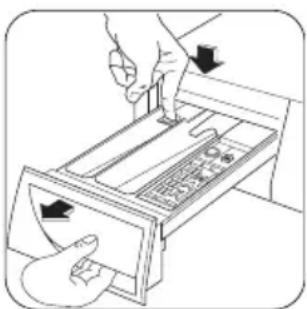
Cleaning the dispenser drawer
The washing powder and additive dispenser drawer should be cleaned regularly.
natural_image
Illustration of hands using a computer to press or install a device (no text or symbols visible)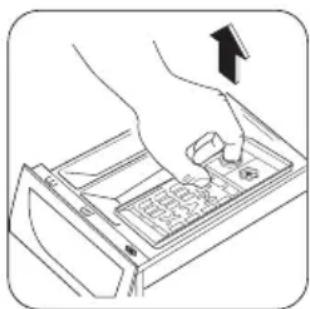
natural_image
Line drawing of a hand pressing down on a mechanical component with an arrow indicating motion (no text or symbols)To aid cleaning, the top part of the additive compartment should be removed.
Remove the drawer by pressing the catch downwards and by pulling it out. Flush it out under a tap, to remove any traces of accumulated powder.
Cleaning the drawer recess
natural_image
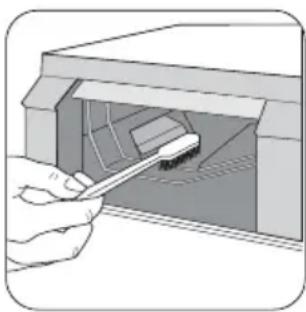
Illustration of a hand using a tool to clean or store floor tiles (no text or symbols visible)Having removed the drawer, use a small brush to clean the recess, ensuring that all washing powder residue is removed from the upper and lower
part of the recess.
Replace the drawer and run the rinse programme without any clothes in the drum.
Cleaning the pump
The pump should be inspected if
●the machine does not empty and/or spin
●the machine makes an unusual noise during draining due to objects such as safety pins, coins etc. blocking the pump.
Proceed as follows:
- Disconnect the appliance.
- If necessary wait until the water has cooled down.
natural_image
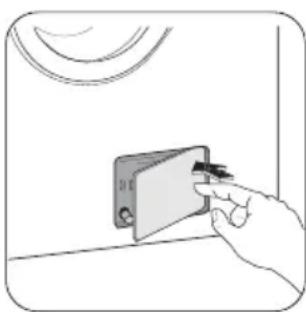
Illustration of a hand inserting a card into a device (no text or symbols visible)- Open the pump door.
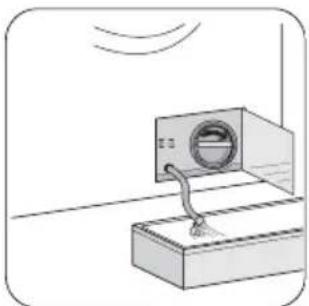
●Place a container close to the pump to collect any spillage.
●Pull out the emergency emptying hose, place it in the
container and remove its cap.
- When no more water comes out, unscrew the pump cover and remove it. Always keep a rag nearby to dry up spillage of water when removing the cover.
natural_image
Simple line drawing of a washing machine with a curved tube inserted into a base (no text or symbols)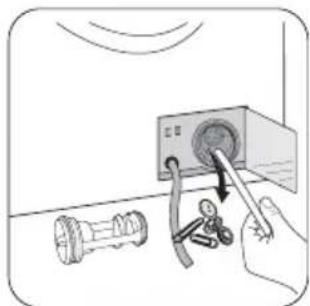
natural_image
Illustration of a hand using a tool to adjust or install a device with a bulb (no text or symbols visible)- Remove any objects from the pump impeller by rotating it.
- Put the cap back on the emergency emptying hose and place the latter back in its seat.
natural_image
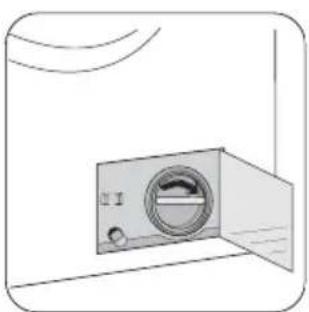
Simple line drawing of a vintage-style washing machine with no text or symbols●Screw the pump cover fully in.
- Close the pump door.
WARNING!
When the appliance is in use and depending on the programme selected there can be hot water in the pump.
Never remove the pump cover during a wash cycle, always wait until the appliance has finished the cycle, and is empty. When replacing the cover, ensure it is securely retightened so as to stop leaks and young children being able to remove it.
Cleaning the water inlet filter
If your water is very hard or contains traces of lime deposit, the water inlet filter may become clogged. It is therefore a good idea to clean it from time to time.
natural_image
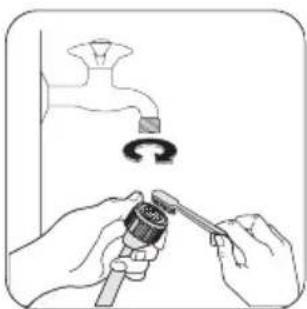
Illustration of hands using a tool to adjust or install a wall-mounted device (no text or symbols present)Turn off the water tap. Unscrew the water inlet hose. Clean the filter using a hard bristle brush.
Tighten up the inlet hose.
The dangers of freezing
If the machine is exposed to temperatures below 0^ C, certain precautions should be taken.
- Turn off the water tap.
•Unscrew the inlet hose. - Place the end of the emergency emptying hose and that of the inlet hose in a bowl placed on the floor and let water drain out.
- Screw the water inlet hose back on and reposition the emergency emptying hose after having put the cap on again.
- When you intend to start the machine up again, make sure that the room temperature is above 0^ .
IMPORTANT!
Every time you drain the water through the emergency emptying hose you must pour 2 litres of water into the main wash compartment of the detergent drawer and then run the drain programme. This will activate the ECO VALVE device avoiding that part of the detergent remains unused at next washing.
Emergency emptying out
If the water is not discharged, proceed as follows to empty out the machine:
- pull out the plug from the power socket;
- close the water tap;
- if necessary, wait until the water has cooled down;
- open the pump door;
- place a bowl on the floor and place the end of the emergency emptying hose into the bowl. Remove its cap. The water should drain by gravity into the bowl. When the bowl is full, put the cap back on the hose. Empty the bowl. Repeat the procedure until water stops flowing out;
- clean the pump if necessary as previously described;
- replace the emergency emptying hose in its seat after having plugged it;
- screw the pump cover again and close the door.
What to do if...
IMPORTANT!
Certain problems are due to lack of simple maintenance or oversights, which can be solved easily without calling out an engineer. Before contacting your local Service Centre, please carry out the checks listed below.
During machine operation it is possible that the red pilot light of button 5 blinks to indicate that the machine is not working.
Once the problem has been eliminated, press the button 5 to restart the programme. If after all checks, the problem persists, contact your local Service Centre.
| Malfunction Possible Cause / Solution | |
| The washing machine does not start: | The door has not been closed. (The red pilot light of the button 5 blinks)Close firmly the door.The plug is not properly inserted in the power socket.Insert the plug into the power socket.There is no power at the socket.Please check your domestic electrical installation.The main fuse or the fuse in the plug has blown.Replace the fuse.The selector dial is not correctly positioned and the button 5 has not been depressed.Please turn the selector dial and press the button 5 again.The button 6 has been selected.If the laundry are to be washed immediately, cancel the delay start. |
| The machine does not fill: | The water tap is closed. (The red pilot light of the button 5 blinks)Open the water tap.The inlet hose is squashed or kinked. (The red pilot light of the button 5 blinks)Check the inlet hose connection.The filter in the inlet hose is blocked. (The red pilot light of the button 5 blinks)Clean the water inlet hose filter.The door is not properly closed. (The red pilot light of the button 5 blinks)Close firmly the door. |
Malfunction Possible Cause / Solution
| The machine fills then empties immediately: | The end of the drain hose is too low. Refer to relevant paragraph in «water drainage» section. |
| The machine does not empty and/or does not spin: | The drain hose is squashed or kinked. (The red pilot light of the button 5 blinks)Check the drain hose connection.The drain pump is clogged. (The red pilot light of the button 5 blinks)Clean the drain pump.The option «Rinse hold» or «No spin» has been selected.Select the Drain or Spin programmesThe laundry is not evenly distributed in the drum.Redistribute the laundry. |
| There is water on the floor: | Too much detergent or unsuitable detergent (creates too much foam) has been used.Reduce the detergent quantity or use another one.Check whether there are any leaks from one of the inlet hose fittings. It is not always easy to see this as the water runs down the hose; check to see if it is damp.Check the water inlet hose connection.The inlet hose is damaged.Change it with a new one.The cap on the emergency emptying hose has not been replaced after cleaning the pump.Put the cap back on the emergency emptying and place the latter back in its seat. |
| Unsatisfactory washing results: | Too little detergent or unsuitable detergent has been used.Increase the detergent quantity or use another one.Stubborn stains have not been treated prior to washing.Use commercial products to treat the stubborn stains.The correct temperature was not selected.Check if you have selected the correct temperature.Excessive laundry load.Introduce into the drum less laundry. |
| Malfunction Possible Cause / Solution | |
| The door will not open: | The programme is still running.·Wait the end of washing cycle.The door lock has not been released.·Wait until the pilot light 7.2 has gone out.There is water in the drum.·Select drain or spin programme to empty out the water. |
| The machine vibrates or is noisy: | The transit bolts and packing have not been removed.·Check the correct installation of the appliance.The support feet have not been adjusted.·Check the correct levelling of the appliance.The laundry is not evenly distributed in the drum.·Redistribute the laundry.Maybe there is very little laundry in the drum.·Load more laundry. |
| Spinning starts late or the machine does not spin: | The electronic unbalance detection device has cut in because the laundry is not evenly distributed in the drum. The laundry is redistributed by reverse rotation of the drum. This may happen several times before the unbalance disappears and normal spinning can resume. If, after 10 minutes, the laundry is still not evenly distributed in the drum, the machine will not spin. In this case, redistribute the load manually and select the spin programme.·Redistribute the laundry. |
| No water is visible in the drum | Machines based on modern technology operate very economically using very little water without affecting performance. |
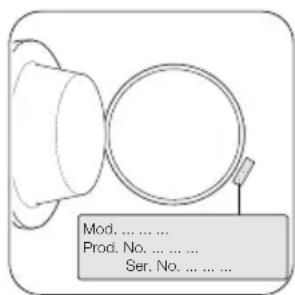
If you are unable to identify or solve the problem, contact our service centre. Before telephoning, make a note of the model, serial number and purchase date of your machine: the Service Centre will require this information.
Technical data
| Dimensions Width 60 cm | ||
| Height | 85 cm | |
| Depth (including the porthole) | 54 cm | |
| Electrical connection Voltage - Overall power - Fuse | Power supply | |
| Voltage/frequency | 220-230V/50 Hz | |
| Total power absorbed | 2200 W | |
| Minimum fuse protection | 10 A | |
| Water supply pressure Minimum 0,05 MPa | ||
| Maximum Load 5 kg | Cotton | |
| Spin Speed | Maximum | 600 rpm (ZWC 6050 W)700 rpm (ZWC 7050 W) |
Consumption values
| Programme | Water consumption (in litres) | Energy consumption (in kWh) | Programme duration (in minutes) |
| Cottons 90°C | 58 | 1,9 | 135 |
| Cottons 60°C | 54 | 1,2 | 115 |
| (*) Cottons Eco 60°C | 49 | 0,85 | 130 |
| Synthetics 60°C | 45 | 0,75 | 85 |
| Delicates 40°C | 57 | 0,5 | 65 |
| Handwash 40° | 53 | 0,4 | 55 |

Infos
The consumption data shown on this chart is to be considered purely indicative, as it may vary depending on the quantity and type of laundry, on the inlet water temperature and on the ambient temperature.
(*) The «Cottons Eco AA» at 60° with a load of 5 kg is the reference programme for the data entered in the energy label, in compliance with EEC 92/75 standards.
Installation instruction
Unpacking
All transit bolts and packing must be removed before using the appliance.
You are advised to keep all transit devices so that they can be refitted if the machine ever has to be transported again.
natural_image
Illustration of a hand using a tool to adjust or install a mechanical component (no text or symbols visible)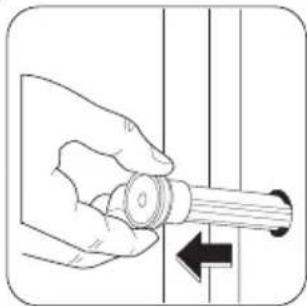
natural_image
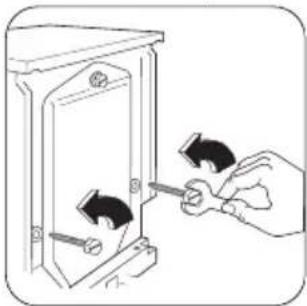
Illustration of a hand holding a cylindrical object with a directional arrow indicating movement (no text or symbols)- Using a spanner, unscrew and remove the two rear bottom screws. Slide out the two plastic pins.
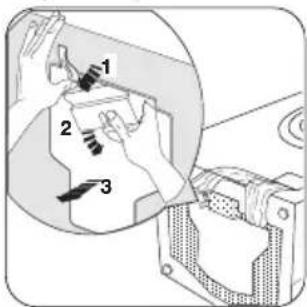
- Lay the machine on its back, taking care not to squash the hoses. This can be avoided by placing one of the corner packing pieces between the machine and the floor.
- Remove the polystyrene block from the bottom of the machine. Unscrew and remove the four feet. Release the two plastic bags.
natural_image
Line drawing of a mechanical device with a tool inserted into a housing (no text or symbols)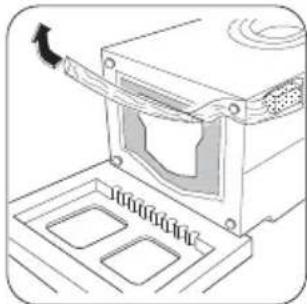
natural_image
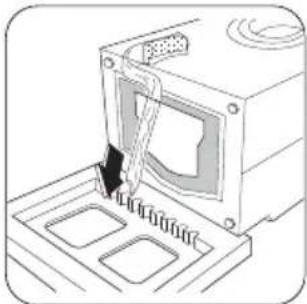
Technical line drawing of a mechanical device with mounting holes and a curved component (no text or symbols)- Very carefully slide out the left polythene bag, removing it towards the right and then downwards.
- Very carefully slide out the right polythene bag, removing it towards the left and then upwards.
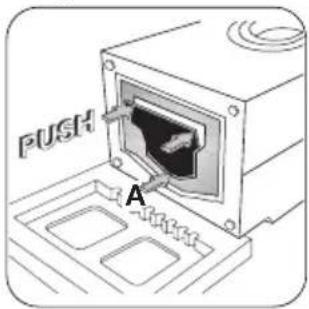
- Carry out the bottom cover placed into the drum of your appliance, lay its hook as the arrow «A» indicates and push the top of the cover to seal it closed.
IMPORTANT!
You can find more detailed instructions regarding the bottom cover assembling in its relative bag.
natural_image
Illustration of a hand using a tool to adjust or install a door panel (no text or symbols visible)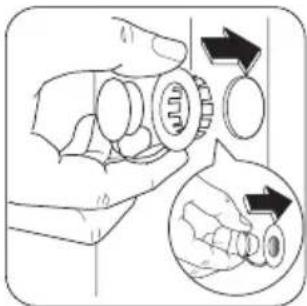
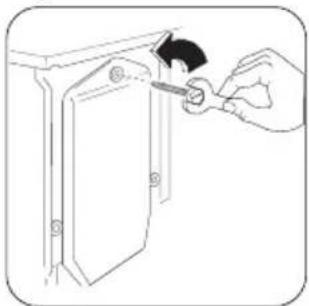
- Set the machine upright and remove the remaining rear screw. Slide out the relevant pin.
- Plug all the holes with the plugs which you will find in the envelope containing the instruction booklet.
Positioning
Install the machine on a flat hard floor. Make sure that air circulation around the machine is not impeded by carpets, rugs etc. Check that
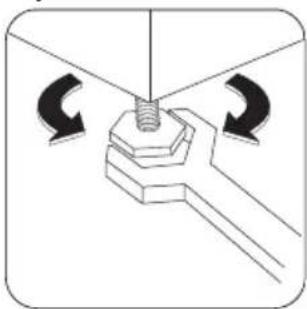
the machine does not touch the wall or other kitchen units. Level the washing machine by raising or lowering the feet. The feet may be tight to adjust as they incorporate a self locking nut, but the machine MUST be level and stable.
Any necessary adjustment can be made with a spanner.
Accurate levelling prevents vibration, noise and displacement of the machine during operation.
Never place cardboard, wood or similar materials under the machine to compensate for any unevenness in the floor.
natural_image
Diagram of a mechanical assembly with arrows indicating rotational direction (no text or symbols)If necessary, check the setting with a spirit level.
Water inlet
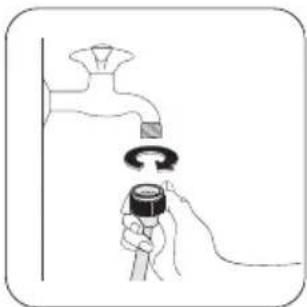
Connect the water inlet hose supplied with the appliance to a tap with a 3/4" thread.
Do not use already employed inlet hoses.
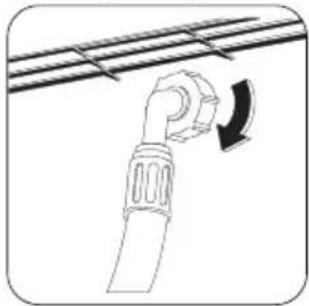
The other end of the inlet hose which connects to the machine can be turned in any direction. Simply loosen the fitting, rotate the hose and retighten the fitting, making sure there are no water leaks.
natural_image
Illustration of a hand holding a small object with a circular arrow indicating rotation (no text or symbols)The inlet hose must not be lengthened. If it is too short and you do not wish to move the tap, you will have to purchase a new, longer hose specially designed for this type of use.
natural_image
Diagram of a hand holding a tool with a curved arrow indicating rotation (no text or symbols)Water drainage
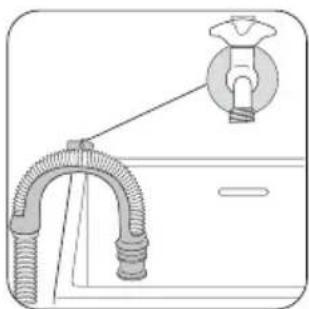
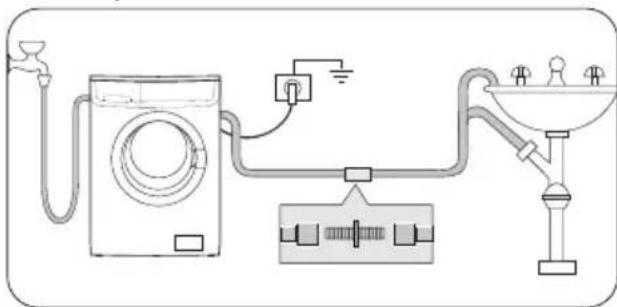
The end of the drain hose can be positioned in three ways:
natural_image
Diagram of a U-shaped pipe connection with a magnified inset showing a valve or connector (no text or symbols)Hooked over the edge of a sink using the plastic hose guide supplied with the machine. In this case, make sure the end cannot come unhooked when the
machine is emptying. This could be done by tying it to the tap with a piece of string or attaching it to the wall.
natural_image
Diagram of a household air conditioner system with fan, washing machine, and condenser (no text or labels)In a sink drain pipe branch. This branch must be above the trap so that the bend is at least 60 cm above the ground.
Directly into a drain pipe at a height of not less than 60 cm and not more than 90 cm. The end of the drain hose must always be ventilated, i.e. the inside diameter of the drain pipe must be larger than the outside diameter of the drain hose.
The drain hose must not be kinked.
For a correct functioning of the machine the drain hose must remain hooked on the proper support piece situated on the top part of the back side of the appliance.
The drain hose may be extended to a maximum of 4 metres. An additional drain hose and joining piece is available from your local Service Centre.
Electrical connection
Information on the electrical connection is given on the rating plate on the inner edge of the appliance door and in the chapter «Technical Data».

WARNING!
Check that your domestic electrical installation can take the maximum load required, also taking into account any other appliances in use.
Connect the machine to an earthed socket.
The appliance is supplied with a 13amp plug fitted. In the event of having to change the fuse in the plug supplied, a 13amp ASTA approved (BS1363/A) fuse must be used.
Should the plug need to be replaced for any reason, proceed as described below.
The wires in the mains lead are coloured in accordance with the following code:
Green and Yellow ....- Earth
Blue ...... - Neutral
Brown......- Live
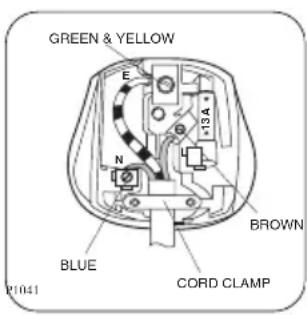
The wire coloured green and yellow must be connected to the terminal marked with the letter «E» or by the earth symbol of coloured green and yellow.
The wire coloured blue must be connected to the terminal marked «N» or coloured black.
The wire coloured brown must be connected to the terminal marked «L» or coloured red.
Upon completion there must be no cut, or stray strands of wire present and the cord clamp must be secure over the outer sheath.

WARNING!
A cut off plug inserted into a 13 amp socket is a serious safety (shock) hazard.
Ensure that the cut off plug is disposed of safely. Should the appliance power supply cable need to be replaced, this MUST be carried out by our Service Force Centre.

WARNING!
Should the appliance power supply cable need to be replaced, this MUST be carried out by our Service Centre.
Please ensure that when the appliance is installed the power supply cable is easily accessible.
Environmental concerns
Packaging materials
The materials marked with the symbol are recyclable.
PE<=polyethylene
PS<=polystyrene
PP<=polypropylene
This means that they can be recycled by disposing of them properly in appropriate collection containers.
Old machine
Use authorised disposal sites for your old appliance. Help to keep your country tidy!
The symbol on the product or on its packaging indicates that this product may not be treated as household waste. Instead it shall be handed over to the applicable collection point for the recycling of electrical and electronic equipment. By ensuring this product is disposed of correctly, you will help prevent potential negative consequences for the environment and human health, which could otherwise be caused by inappropriate waste handling of this product. For more detailed information about recycling of this product, please contact your local city office, your household waste disposal service or the shop where you purchased the product.
Ecological hints
To save water, energy and to help protect the environment, we recommend that you follow these tips:
- Normally soiled laundry may be washed without prewashing in order to save detergent, water and time (the environment is protected too!).
●The machine works more economically if it is fully loaded.
- With adequate pre-treatment, stains and limited soiling can be removed; the laundry can then be washed at a lower temperature.
●Measure out detergent according to the water hardness, the degree of soiling and the quantity of laundry being washed.
www.electrolux.com