
ZHT610W3 - Range hood ZANUSSI - Free user manual and instructions
Find the device manual for free ZHT610W3 ZANUSSI in PDF.


| Product Type | Range Hood |
| Brand | Zanussi |
| Model | ZHT610W3 |
| Mounting Type | Wall-mounted (under cabinet or directly on wall) |
| Width | 600 mm (approx) |
| Depth | 500 mm (approx) |
| Height | 150 mm (approx) |
| Net Weight | 10 kg (approx) |
| Electrical Supply | 220-240 V, 50 Hz (double-insulated, no earthing required) |
| Motor Power | 200 W (approx) |
| Lighting | 4 or 2 x 40 W incandescent bulbs (replaceable) |
| Total Power Consumption | 280-360 W (approx) |
| Airflow Modes | Extraction (ducting) or Recirculation (charcoal filter) |
| Fan Speeds | 3 (Low, Medium, High) |
| Control Type | Manual switches (2 or 3 switches depending on model) |
| Grease Filters | Synthetic (disposable) and Metal (washable) options |
| Charcoal Filter | Optional for recirculation mode, replaceable |
| Minimum Distance to Hob | 65 cm |
| Duct Diameter | 100 mm or 120 mm |
| Safety Features | Double insulation, safety square included for installation |
| Installation Kit | Screws, plugs, brackets, safety square included |
| Compliance | CE marked; complies with EEC Directives |
Frequently Asked Questions - ZHT610W3 ZANUSSI
User questions about ZHT610W3 ZANUSSI
0 question about this device. Answer the ones you know or ask your own.
Ask a new question about this device
Download the instructions for your Range hood in PDF format for free! Find your manual ZHT610W3 - ZANUSSI and take your electronic device back in hand. On this page are published all the documents necessary for the use of your device. ZHT610W3 by ZANUSSI.
USER MANUAL ZHT610W3 ZANUSSI
Fixing with screws 4
Fixing with brackets 5
Wall unit installation 5
Connecting suction or filter hoods 6
Electrical connection and working test 6
USE 7
SAFETY WARNINGS....7
Instruction for Use 7
MAINTENANCE 8
Synthetic grease filters 8
Metal grease filters 8
Charcoal filters 8
Lighting 9
Cleaning 9
INSTALLATION
This hood has been designed to be wall-mounted above a cooking hole. It can be installed under a wall unit or directly onto a wall. It can work either by ducting system (external discharge) or filter (internal recirculation).
SAFETY WARNINGS
- Before starting the installation, consideration should be given to the difficulties to be found during installation. The installation work must be undertaken by a qualified and competent person in conformity to the rules concerning the evacuation of contaminated air. The manufacturer disclaims all liability for any damage or injury caused as a result of not following the instructions for installation contained in the following text.
- When used in the extraction mode, the cooker hood ducting must not be connected to a flue which is used for exhausting fumes from appliances supplied with energy other than electric, such as a central heating flue or water heating flue.
- When installed, the hood must be positioned at least 65 cm above the hotplate.
- If the room where the cooker hood is to be used contains a fuel burning appliance such as a central heating boiler then this must be of the room sealed or balanced flue type. If other types of flue or appliance are fitted, ensure that there is an adequate supply of air into the room. When the cooker hood is used in conjunction with appliances supplied with energy other than electric, the negative pressure in the room must not exceed 0.04 mbar to prevent fumes being drawn back into the room by the cooker hood.
Wall installation
The hood can be supplied with two different fixing kits: a) screws, plugs and safety square. b) screws, plugs and metal brackets.
Fixing with screws
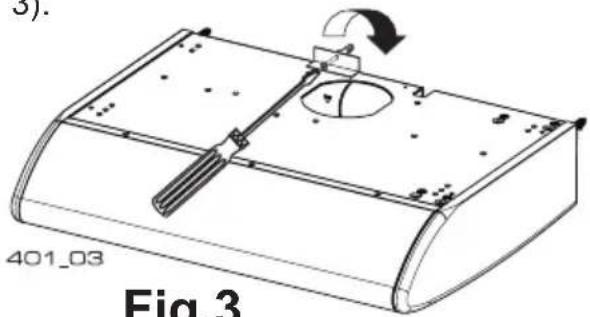
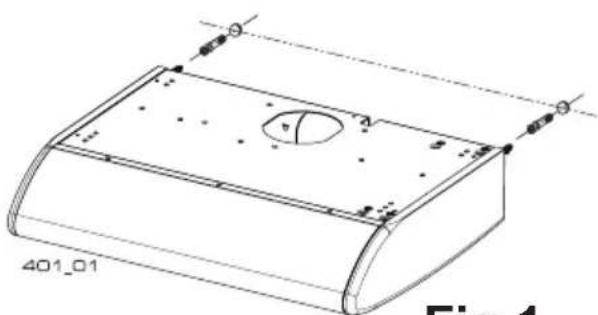
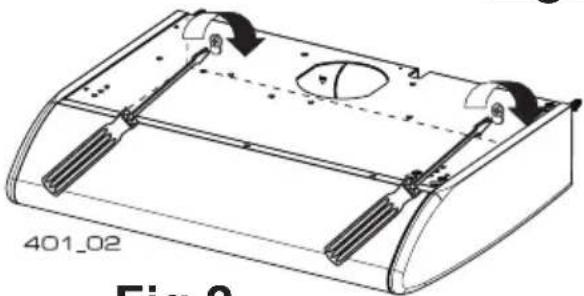
Using the cardboard template, mark and drill the holes on the wall (2 holes ∅ 8 mm see instructions on the template), insert the plugs in the holes, tighten both 4,2 x 44,4 screws (supplied) leaving about 5 mm unscrewed, hook the hood onto the screws (fig.1) and secure tightly from inside (fig.2). Mount the safety square (supplied) above the hood (fig. 3).
natural_image
Technical line drawing of a mechanical device with a lever and circular component, labeled Fig. 3 (no text or symbols on the diagram itself)Fig.3
natural_image
Technical line drawing of a curved mechanical component with mounting holes and a central circular feature (no text or symbols)Fig.1
natural_image
Technical line drawing of a mechanical housing component with internal components and directional arrows (no text or symbols)Fig.2
Fixing with bracketets
- Using the ecard board template, mark and drit drill the holes on the wall (4 holes ∅ 8 mm see instructions on the template).
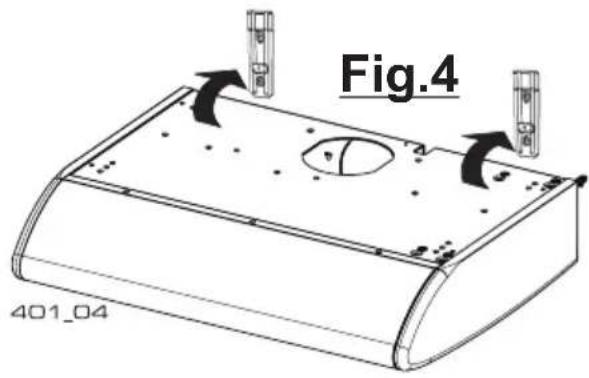
- Fix the metal brackets with screws and plugs (supplied), hook the hood onto the brackets (fig.4).
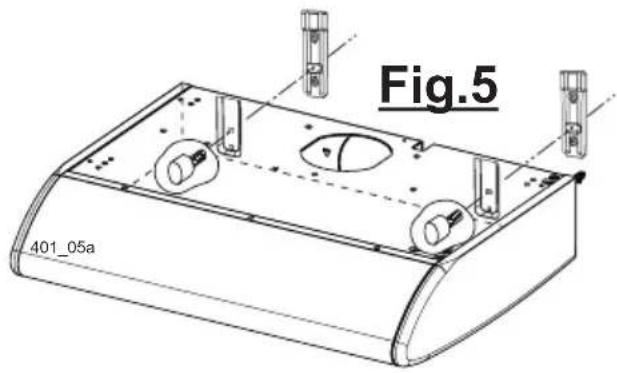
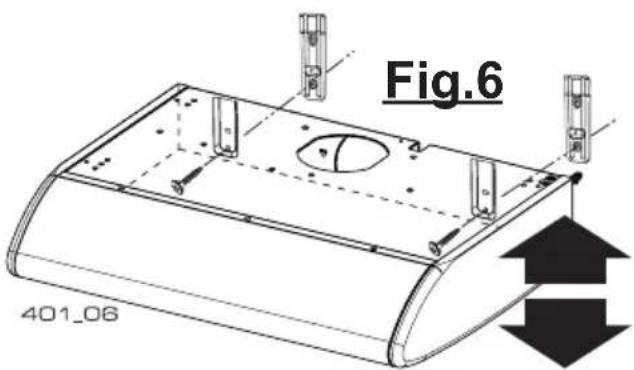
• Fix the hood with two knobs (supplied)(fig.5). - Make sure the hood is level and, if necessary, adjust by acting upon the adjustment screws (fig.6).
Wall unit installation
• Using the cardboard template.
- Mark and drill the bottom of the wall unit,(see instructions on the template).
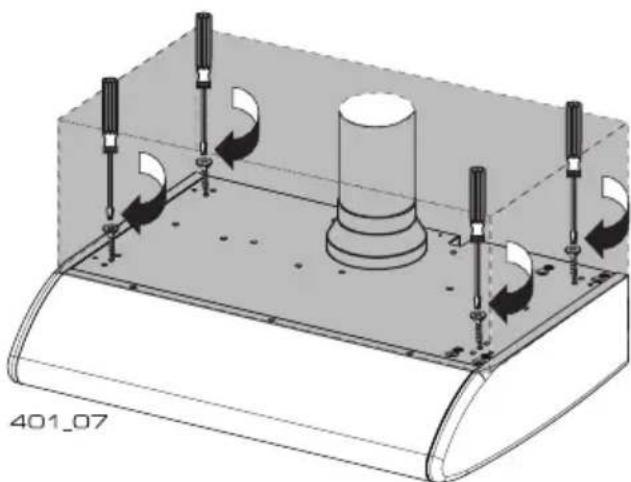
- Fasten the hood from inside the unit using four screws 4,2 x 44,4 (supplied)(fig.7).
- For suction hoods, the wall unit must be drilled to allow for the air discharge duct.
- Filter hoods do not require this type of drilling operation since the air is recycled into the room through vents situated on the front of the hood.
natural_image
3D technical diagram of a mechanical assembly with mounting base and cylindrical component, no visible text or symbolsFig.7
Connecting suction or filterhodds
Connecting suction hoods
(Air is discharged into the atmosphere)
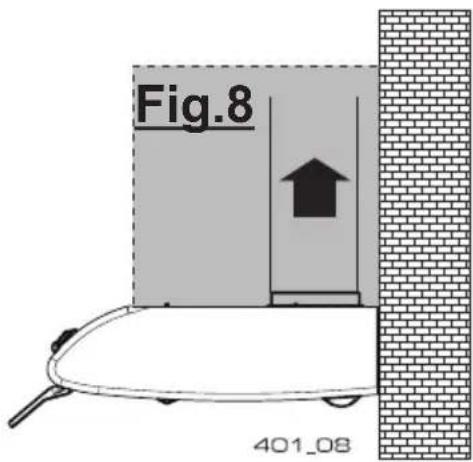
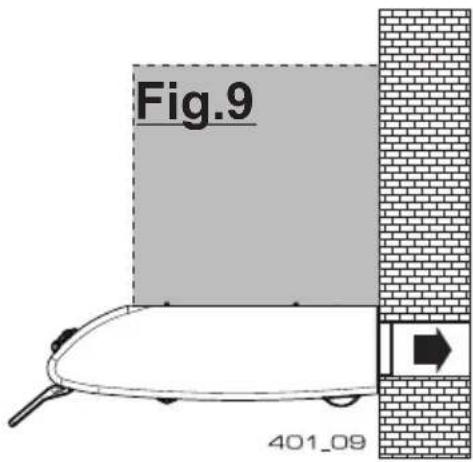
- The hood comes with two air outlets, a plastic cover fitted in the rear hole and a flange to be fitted according to the solution chosen: top discharge (fig.8), rear discharge (fig.9).
- In case of installation with rear discharge, fit the plastic cover in the top hole and the flange in the rear hole.
- Using a pipe ∅ 100 o 120 mm, connect the air discharge flange to the external discharge duct.
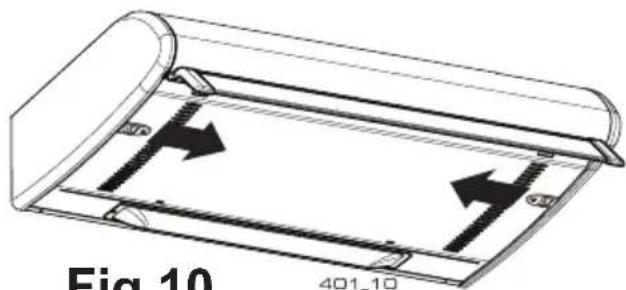
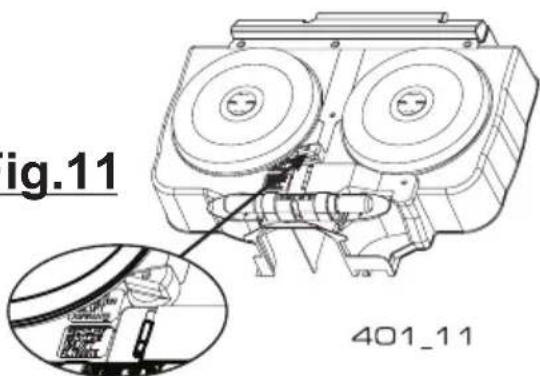
- Open the grid panel by pressing inwards on the knobs (fig.10), check that the lever (hood with one motor) or the handle (hood with two motors) points to the ducting mode position (fig.11).
- Remove the charcoal filter, if any, by turning the handle anti-clockwise.
Connecting filter hoods
(Air is filtered and recirculated inside the room)
- Open the grid panel.
- Check that the lever (hood with one motor) or the handle (hood with two motors) points to the filter mode position (fig.11)
- Insert the charcoal filter.
Electrical connection and working test
- Before connecting to the mains supply ensure that the mains voltage corresponds with the voltage on the rating plate inside the hood.
- Connect the cooker hood to the mains via a bipolar switch which has 3mm clearance between the contacts.
- The device does not require earthing, as it is double-insulated.
- Once the electrical connection has been completed, check that the worktop illumination, motor and speeds work properly.
natural_image
Technical diagram of a mechanical component with directional arrows indicating movement (no text or symbols)Fig.10
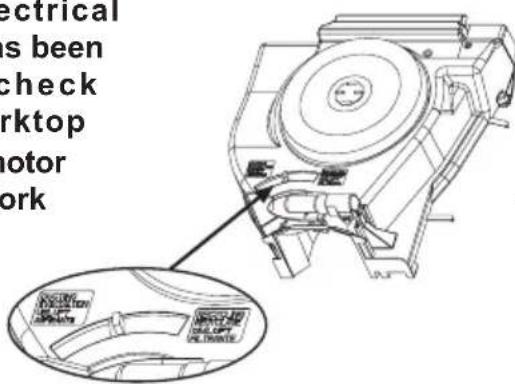
Fig.11
USE
SAFETY WARNINGS
- Before connecting to the mains supply ensure that the mains voltage corresponds with the voltage on the heating plate inside the hood.
- The grease filters and the charcoal filters should be cleaned or replaced as recommended by the manufacturer or more frequently if the hood is used consistently (more than 4 hours per day).
- When using a gas hob in connection with the cooker hood never leave the burners of the hob uncovered while the hood is in use or when the pans have been removed. Switch off the gas before removing the pan or for just short periods and never leave the hob unattended.
• Always ensure that the appliance is kept at the correct intensity to prevent the flame from licking round from the bottom of the pan; this will save energy and will avoid a dangerous concentration of heat.
- Always ensure that the appliance is used in accordance with the manufacturer's instructions for the removal of contaminated odours during cooking.
Instruction for Use
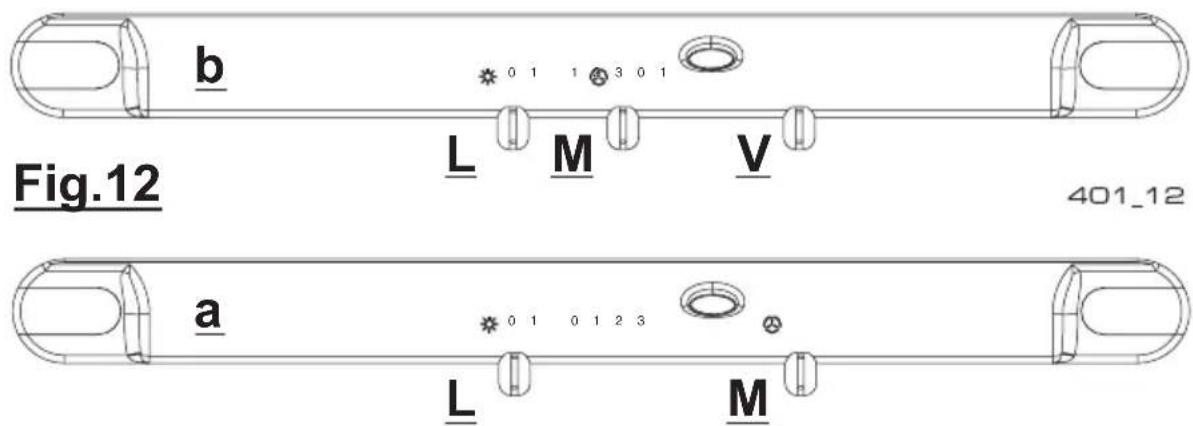
Control panel (3 switches) (fig. 12a)
SWITCH L = controls the worktop illumination
SWITCH M = switches the motor on or off
SWITCH V = controls the fan speed
Control panel (2 switches) (fig. 12b)
SWITCH L = controls the worktop illumination
SWITCH M = controls the power to the motor and the fan speed
Working speeds:
Position 1 = low speed, should be selected when simmering or using only one pan: the noise level is kept to the minimum.
Position 2 = medium speed, should be selected for normal cooking. This speed offers the best ratio between air capacity and noise level.
Position 3 = top speed, should be selected when frying or cooking food with strong odours, even for a long period.
MAINTENANCE
Regular maintenance will ensure good performance and extend the working life of the hood. Special attention should be taken to the grease filters and, for the filter hoods only, to the charcoal filters.
Synthetic grease filters
1 - They cannot be washed and should be replaced every two months on average. If the filter is equipped with chemical indicators of saturation, replace it when the visible red-coloured dots show all over the surface.
2 - Replacement
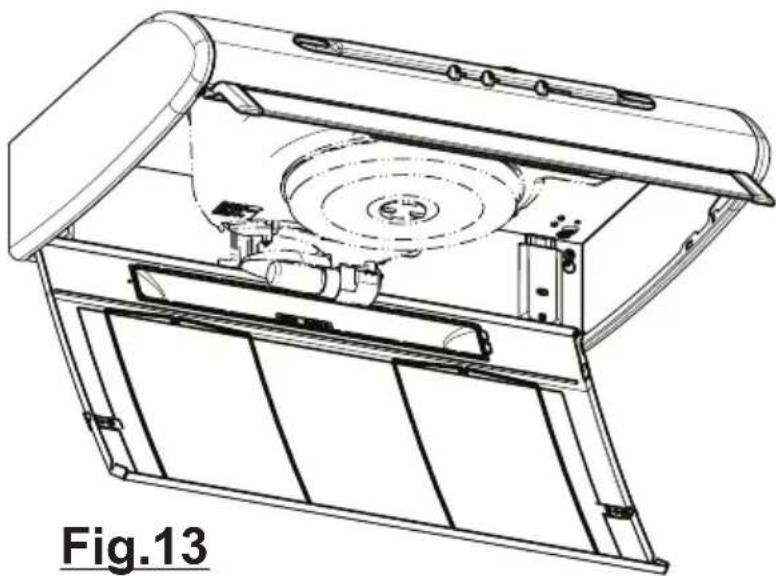
Open the grid panel, remove the steel-wire clips and replace the grease filter (fig. 13). Close the grid panel.
natural_image
Technical line drawing of a mechanical device with internal components and mounting bracket (no text or symbols)Metal grease
filters
1 - Cleaning
These filters need to be washed with ordinary household detergent every 2 months maximum. Thanks to their reduced dimensions, they can also be washed in the dishwasher.
2 - Removing the filter
Open the grid panel, remove the steel wire clips and the grease filter (fig. 13). Make sure that the filter is dry before replacing it, close the grid panel.
WARNING : Respect replacement and maintenance schedules recommended in order to avoid fire hazards caused by over-saturated filters.
Charcoal filters
1 - How they work
Charcoal filters can absorb smells and odours until they are saturated. They cannot be washed or recycled and so they should be replaced at least every 4 months or more frequently if the hood is heavily used.
2 - Replacement:
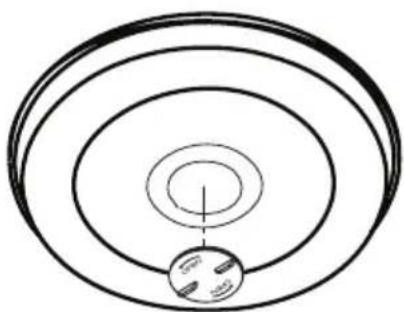
Open the grid panel, replace the charcoal filter by turning the locking handle anti-clockwise for removing and clockwise for replacing (fig. 14). Close the grid panel.
natural_image
Diagram of concentric circles with a central vertical line and a small sphere at the bottom (no text or symbols)Fig.14
Lighting
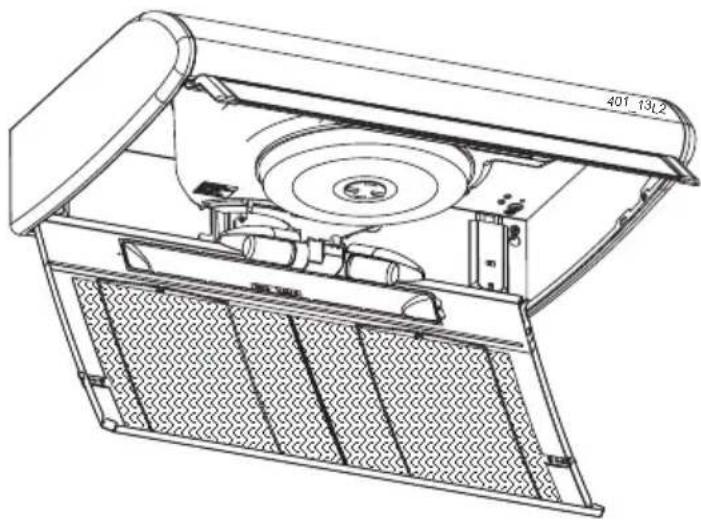
It is composed of four or two 404W W lamps which can be reeasbed by removing the grid panel (Fig.15).
If the lights fail to function, check that they are fully screwed into place. If they have blown, they should be replaced with similar lamps having the same voltage and power.
Cleaning
When cleaning the hood:
- Never use a wet cloth or sponge, or running water.
- Never use thinners or products containing alcohol, as they might damage the paintwork.
- Never use abrasive cleaning materials, in particular when cleaning stainless steel surfaces.
It is recommended to use a damp cloth and mild liquid household cleaner.
natural_image
Technical line drawing of a mechanical device with internal components and ventilation slots (no text or symbols)Fig.15
CE
This appliance complies with European regulations on low voltages, EEC Directive 73/23 on electrical safety, and with the following European regulations: EEC Directive 89/336 on electromagnetic compatibility and EEC Directive 93/68 on EC marking.
- USE 7
- MAINTENANCE 8
- INSTALLATION
- SAFETY WARNINGS
- Wall installation
- Fixing with screws
- Fixing with bracketets
- Wall unit installation
- Connecting suction or filterhodds
- Connecting suction hoods
- Connecting filter hoods
- Electrical connection and working test
- USE
- Instruction for Use
- Working speeds:
- MAINTENANCE
- Synthetic grease filters
- Metal grease
- filters
- Charcoal filters
- Lighting
- Cleaning
- CE
Brand : ZANUSSI
Model : ZHT610W3
Category : Range hood