BFS54SCDF - Oven BELLING - Free user manual and instructions
Find the device manual for free BFS54SCDF BELLING in PDF.


User questions about BFS54SCDF BELLING
0 question about this device. Answer the ones you know or ask your own.
Ask a new question about this device
Download the instructions for your Oven in PDF format for free! Find your manual BFS54SCDF - BELLING and take your electronic device back in hand. On this page are published all the documents necessary for the use of your device. BFS54SCDF by BELLING.
USER MANUAL BFS54SCDF BELLING
Freestanding Single Door Oven with Gas Cooktop
INSTRUCTION MANUAL
PLEASE READ THE INSTRUCTION MANUAL CAREFULLY BEFORE USING THE UNIT.
- PRODUCT INSTALLER DETAILS 3
- WARNINGS AND PRECAUTIONS
a. IMPORTANT INFORMATION / CONDITIONS OF USE 5
b. OTHER IMPORTANT SAFETY INFORMATION 6
c. WARNINGS FOR USE OF OVEN, AND APPLIANCE HOB 6
d. DISPOSAL OF PACKAGING 6
e. INSTALLATION, CLEANING AND SERVICING 7
- OPERATION
a. PRODUCT DESCRIPTION 8
b. FRONT CONTROL PANELS 9
c. PREPARING YOUR PRODUCT FOR THE FIRST TIME 9
d. OVEN SAFETY WARNINGS 10
e. OVEN FUNCTIONS 11
f. OVEN TEMPERATURE 13
g. USING THE PROGRAMMABLE CLOCK 13
h. COOKING GUIDE 15
i. USING THE HOTPLATES 16
- FITTING OVEN ACCESSORIES AND CLEANING 17
- HINTS AND TIPS / SOLVING PROBLEMS 20
- INSTALLATION 22
- TECHNICAL SPECIFICATIONS 30
- WARRANTY 32
For future reference we suggest that you staple a copy of your purchase receipt here and complete the below so the information is always at hand.
Product Details
Model number: ____
Description:
Serial number: ____
(Located on the product rating label)
Purchase Details
Date of purchase: ____
Place of purchase: ____
Store name: ____
Address:
Telephone: ____
Invoice / receipt number: ____
Installation Details
Electrical date of installation: ____
Electrician Installers Details: Company / Installers Name:
Licence Number:
Telephone Number:
Gas date of installation: ____
Gas installers details: Company / Installers Name:
Licence Number:
Telephone Number:
Plumbing date of installation:
Plumbers installers details: Company / Installers Name: ____
Licence Number:
Telephone Number:
Dear Customer,
Congratulations on the purchase of your new product from Belling.
We recommend you please take some time to read the instruction manual thoroughly to familiarise yourself with the functionality and operations to ensure optimum performance of your new appliance.
After reading the manual, please store it in a safe and accessible location for future reference.
Installation
The installation of your new appliance must be carried out by a qualified installer / technician in accordance to local regulations.
Please ensure all packaging materials are disposed of correctly.
Customer Care
Our Customer Care centre is available should you wish to learn more about your appliance in relation to how to use it to its best potential, or tips on cleaning as well as available accessories. For further details please contact our Customer Care Team
Australia
1800 444 357 or email customercare@hapl.com.au
Thank you
Regards,
Belling Australia
IMPORTANT INFORMATION
CONDITIONS OF USE
This appliance is intended to be used for domestic use, not commercial use.
SAFETY PRECAUTIONS
- This appliance is not intended for use by persons (including children) with reduced physical, sensory or mental capabilities, or lack of experience and knowledge, unless they have been given supervision or instruction concerning use of the appliance by a person responsible for their safety.
Warning – ensure that no downward pressure is applied to the oven door when open. in particular, do not allow a child to climb on to open oven door.
Warning - accessible parts can become hot during use, especially the oven door. to avoid burns, young children must be kept away.
- Young children should be supervised to ensure they do not play with this appliance.
- During use this appliance becomes hot. Care should be taken to avoid touching hot external and internal surfaces when in use. Use oven gloves.
• Install cooker, shelving and fittings in accordance with this Manual.
- Ensure all specified vents, openings and airspaces are not blocked.
- To ensure your safety all electric appliance should only be installed or service by qualified staff. If the supply cord is damaged, it must be replaced a service agent or similarly qualified person in order to avoid a hazard.
- To ensure your safety all electric appliance should only be installed or service by qualified staff. If the supply cord is damaged, it must be replaced by the manufacture, its service agent or similarly qualified staff in order to avoid a hazard.
- Do not spray aerosols in the vicinity of this appliance while it is in operation.
- Do not store flammable materials in the appliance or near this appliance.
- Do not modify this appliance.
- Appliance must be installed according to current laws and regulations by qualified tradesmen/Installers
The Manufacturers and Importers/Distributors and Retailers shall not be liable to any legal liability, personal injury and property damage due to incorrect operation or incorrect Installation.
OTHER IMPORTANT SAFETY INFORMATION
DO NOT USE OR STORE FLAMMABLE MATERIALS IN THE APPLIANCE STORAGE DRAWER OR NEAR THIS APPLIANCE.
DO NOT SPRAY AEROSOLS IN THE VICINITY OF THIS APPLIANCE WHILE IT IS IN OPERATION.
DO NOT USE THIS APPLIANCE AS A SPACE HEATER.
DO NOT MODIFY THIS APPLIANCE.
DO NOT PLACE ARTICLES ON OR AGAINST THIS APPLIANCE.
Warnings for use of grill, oven, and appliance hob
Oven warnings
- DO NOT push down or apply any weight on open oven door.
- DO NOT place dishes on open door of oven.
- DO NOT line oven with foil or place anything on the bottom of the oven while baking to avoid permanent damage, as trapped heat will crack or craze the enamel floor of the oven cavity liner.
- Use of olive oil and other poly-unsaturated oils (vegetable oils) when roasting uncovered food causes deposits inside the oven which are very difficult to remove.
Hotplate warnings
- Do not allow pots to boil dry, as damage to hotplate may result.
- Do not operate burners without a pot, fry pan etc.
- Do not allow cookware to overhang hob onto adjacent bench tops, this will cause scorching to the bench top surface.
- Ensure burner caps and crowns are in their correct position to avoid damage to these parts.
CAUTION: If this cooking range is to be connected to a new or upgraded electrical installation, then it must be connected to the supply by a supply cord fitted with;
- an appropriately rated plug that is compatible with the socket-outlet fitted to the final sub-circuit in the fixed wiring that supplies this cooking range; or
- an appropriately rated installation mal connector that is compatible with the installation female connector fitted to the final sub-circuit in the fixed wiring that supplies this cooking range.
Disposal of your old machine
This symbol on the product or on its packaging indicates that this product should not be treated as household waste. Instead it should be handed over to the applicable collection point for the recycling of electrical and electronic equipment.
By ensuring this product is disposed of correctly, you will help prevent potential negative consequences for the environment and human health, which could otherwise be caused by inappropriate waste handling of this product.
For more detailed information about recycling of this product, please contact your local city office, your household waste disposal service or the retailer who you purchased this product from.
Installation, Cleaning and Servicing
- An authorized person must install this appliance. (Certificate of Compliance to be retained).
- Before using the appliance, ensure that all packing materials are removed from the appliance.
- In order to avoid any potential hazard, the Installation Instructions must be followed.
- In order to avoid accidental tipping of the appliance (for example, by a child climbing onto the open oven door), the anti tilt plate must be installed.
- Where the appliance is installed next to cabinets, the cabinet material must be capable of withstanding 85°C.
- Only authorized personnel should carry out servicing (Certificate of Compliance to be retained).
• Always ensure the appliance is switched off before cleaning. - Do not use caustic soda- based cleaners.
- Do not use steam cleaners, as this may cause moisture build up.
• Always clean the appliance immediately after any food spillage.
• To be serviced only by an authorized person. - Appliances requiring connection to 220-240V and must be earthed.
- Gas models are NOT APPROVED for installation in marine craft, caravans or mobile homes.
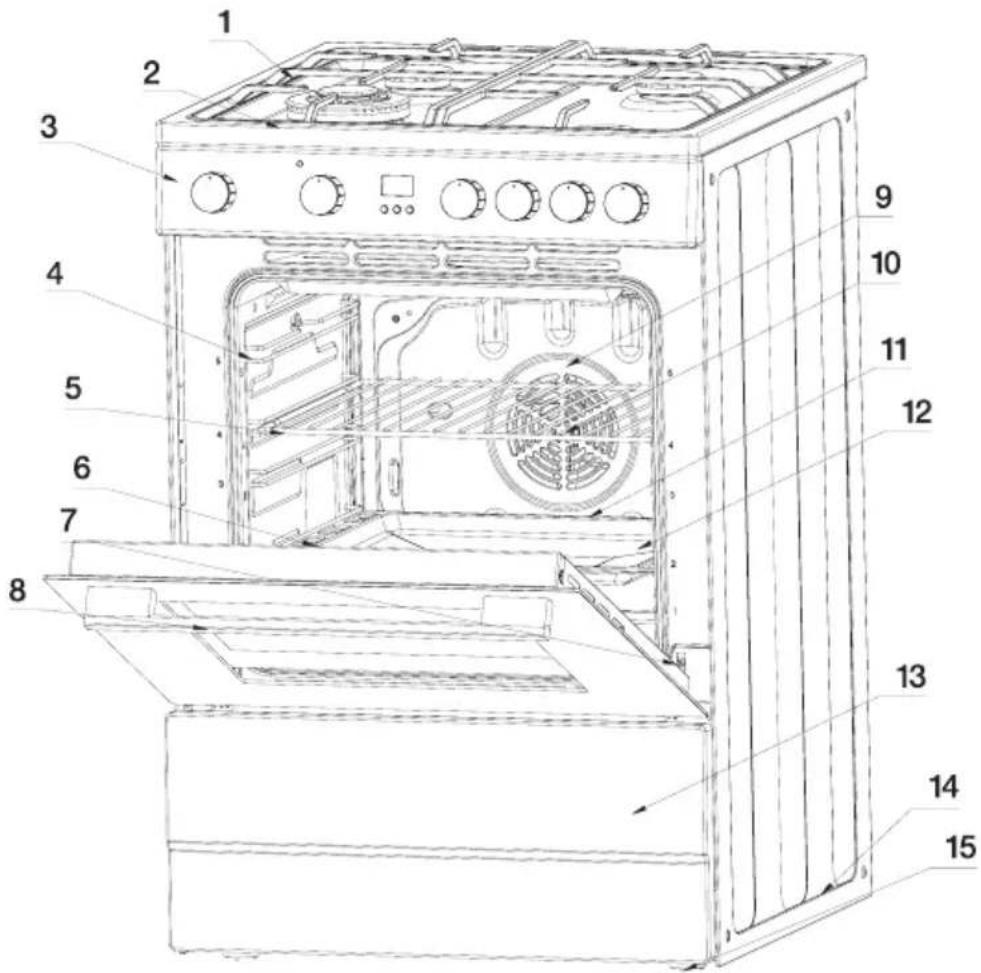
Product Description
text_image
Technical diagram of an oven with numbered parts for identification- Hotplate burners with removable caps x 4
- Cast Iron Trivets
- Control Panel
- Guide Bracket
- Shelf
- Baking Tray
- Hinge
- Oven Door
-
Oven Element (hidden under floor - conventional models only)
-
Oven Element (fan forced models only)
- Fan & Element Cover (fan forced models only)
- Door Seal
- Drawer Panel
- Anti-Tilt Panel
- Anti-Slip Feet
Front Control Panels
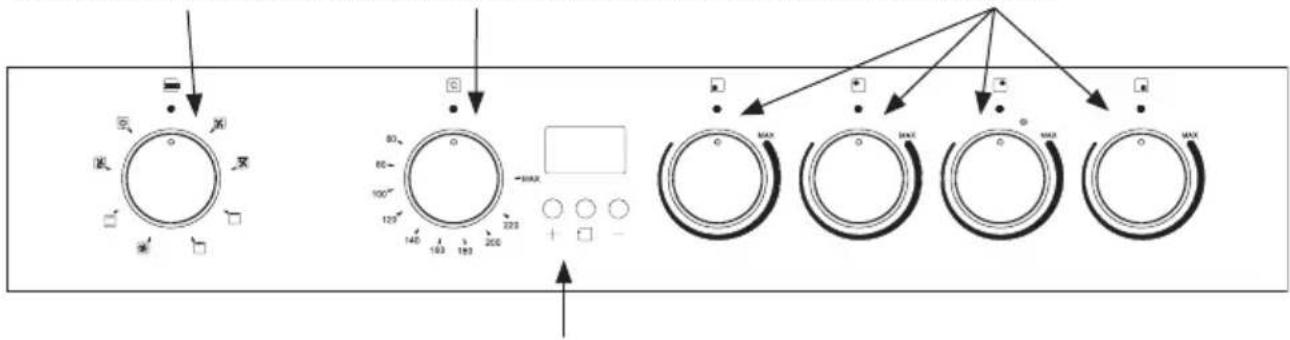
- Function switch control knob 2. Oven temperature control knob 3. Gas control knobs
text_image
Diagram showing rotary dial settings with labeled indicators and numeric values, likely from a control or industrial machine interface.-
3 button programmable timer
-
Function switch control knob
a. Sets the desired oven function - Oven temperature control knob
a. Sets oven temperature - Gas control knobs
a. ignites gas and adjusts individual temperature - 3 button programmable timer
a. Sets the clock
Preparing your product for the first time
- Please wipe out the oven interior prior to operation with warm soapy water and polish dry with a soft clean cloth.
- New appliances can have an odor during first operation. It is recommended to 'run in' your oven before you cook for the first time. Run the oven at 180°C for 2-4 hours and ensure that the room is well ventilated.
- Please install oven furniture as outlined in the "Fitting Oven Accessories and Cleaning" section.
- Set the time on your oven in order for your oven to work.
text_image
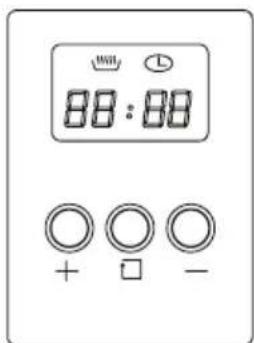
88:88 + □ -- Your Belling oven is fitted with a 3 button programmable timer, you must set the time of day before you can operate your appliance.
- After the appliance has been electrically connected "00.00" will be displayed and the "L" will flash.
- To set the time of day, press the “−” or “+” buttons. 15 seconds after the last change, the “L” will disappear, confirming the time has been set.
Note: The clock has a 24-hour display
Preparing your product for the first time
Oven shelf positions
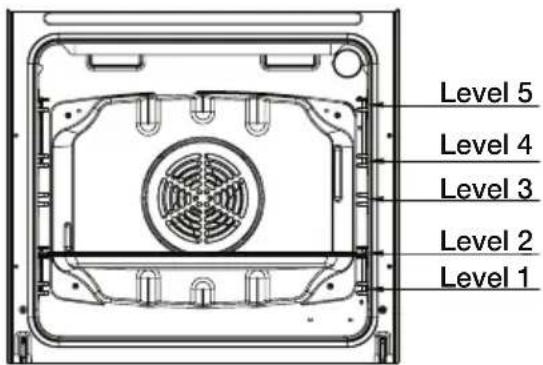
- The main oven has 5 shelf positions to choose from. Position 1 is the position at the bottom of the oven and position 5 is located at the highest point of the oven.
- The 5 position side rack system can house both the standard oven shelves and baking tray.
text_image
Level 5 Level 4 Level 3 Level 2 Level 1Fitting oven shelves
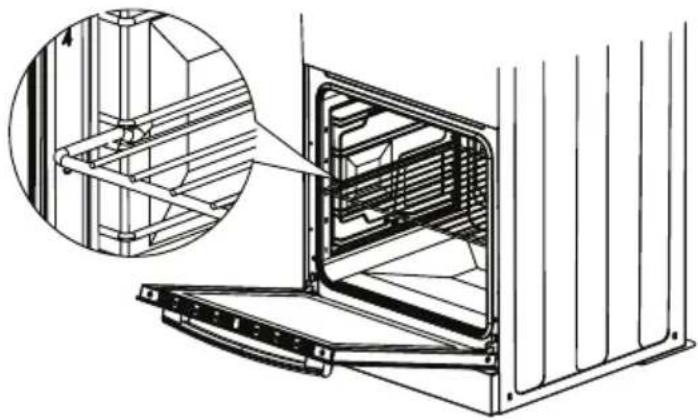
- Ensure shelf orientation is correct (refer picture).
- The shelf has a safety bar fitted to reduce the risk of dishes sliding off the shelf, this is the rear of the shelf.
- Slide into oven at an angle until raised back of shelf is past the stop on side runners.
- Lower front of shelf and push in until stop is reached.
Note: The top ledge is not a shelf position
natural_image
Technical line drawing of an oven with a close-up inset showing internal structure (no text or symbols)Oven Safety Warnings
- Always follow the instructions for putting the shelves and side racks into the oven, to avoid accidents.
- Do not line the oven with foil, it will damage the enamel.
- Do not place cookwares or anything else on the bottom of conventional oven model as trapped heat will damage the oven.
- Do not touch the hot surfaces or heating elements inside the oven.
- Do not use the oven door as a shelf.
- Do not push down on the open oven door.
- Do not place shelves on top of upper most shelf runner as there are no stops for shelf withdrawal.
Using the Oven of your Electric Cooker
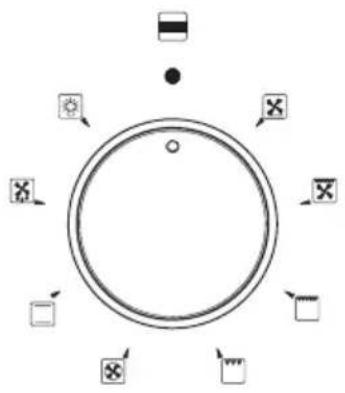
Set: 1) Oven Function 2) Temperature
flowchart
graph TD
    A["Top Symbol"] --> B["Circle"]
    C["Bottom Symbol"] --> B
    D["Arrow 1"] --> B
    E["Arrow 2"] --> B
    F["Arrow 3"] --> B
    G["Arrow 4"] --> B
    H["Arrow 5"] --> B
    I["Arrow 6"] --> B
    J["Arrow 7"] --> B
    K["Arrow 8"] --> B
    L["Arrow 9"] --> B
    M["Arrow 10"] --> B
    N["Arrow 11"] --> B
    O["Arrow 12"] --> B
    P["Arrow 13"] --> B
    Q["Arrow 14"] --> B
    R["Arrow 15"] --> B
    S["Arrow 16"] --> B
    T["Arrow 17"] --> B
    U["Arrow 18"] --> B
    V["Arrow 19"] --> B
    W["Arrow 20"] --> B
text_image
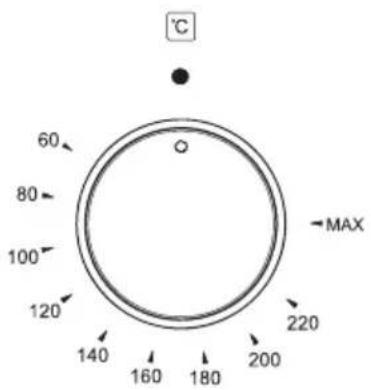
60 80 100 120 140 160 180 200 220 MAX
Oven Light
Turns on only the oven light, the light remains on for all other functions.

Defrost
The fan starts operating. To use this function, take your frozen food and place it in the oven on a shelf on the third slot from the bottom. It is recommended that you place an oven tray under the defrosting food to catch the melting ice. This function will not cook or bake your food, it will only help to defrost it.

Conventional Oven
The lower heating elements and upper heating elements will start operating. This function emits heat, ensuring even cooking of the lower and upper food. This is ideal for making pastries, cakes, baked pasta and lasagne. It is best to cook on one shelf at a time with this function. It is recommended to pre-heat the oven for approximately 10 minutes.

Fan Forced
The ring heating element and fan will start operating. This function evenly disperses the heat in the oven. All foods on racks will be cooked evenly. It is recommended to pre-heat the oven for approximately 10 minutes.

Single Grill
The grill heating element will start operating. This function is ideal for grilling and toasting foods, use the upper shelves of the oven. Lightly brush the wire grid with oil to stop foods sticking and place foods in the centre of the grid. Always place a tray underneath to catch any drips of oil and fat. It is recommended to pre-heat the oven for approximately 10 minutes.
When grilling, the oven door must be closed and the oven temperature should be set to 190-200°C.

Dual Grill
The grill heating element and upper heating elements will start operating. This function is ideal for faster grilling and for covering a larger surface area, such as grilling meats. Use the upper shelves of the oven. Lightly brush the wire grid with oil to stop foods sticking. Always place a tray underneath to catch any drips of oil and fat. It is recommended to pre-heat the oven for approximately 10 minutes.
When grilling, the oven door must be closed and the oven temperature should be set to 190-200°C.

Fan Grill
The grill heating element, upper heating elements and fan will start operating. This function is ideal for faster grilling of thicker foods and for covering a larger surface area. The fan will ensure even cooking. Use the upper shelves of the oven and place foods in the centre of the grid. Lightly brush the wire grid with oil to stop foods sticking. Always place a tray underneath to catch any drips of oil and fat. It is recommended to pre-heat the oven for approximately 10 minutes.
When grilling, the oven door must be closed and the oven temperature should be set to 190-200°C.

Base Heat with Fan (Pizza)
The ring heating element, lower heating elements and fan will start operating. This function is ideal for baking food evenly, such as pizza, in a short time. While the fan evenly disperses the heat of the oven, the lower heating element ensures the cooking and crisping of the base of the food.
Oven Temperature (Thermostat) Knob
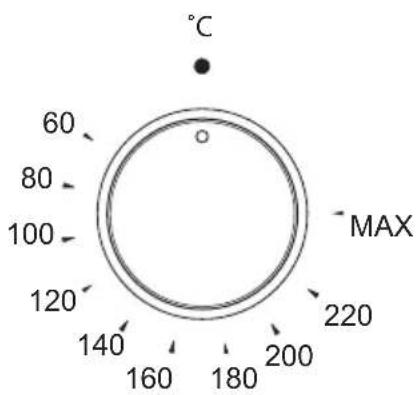
- Selection of cooking temperature is carried out by turning the knob anti-clockwise to the required temperature, between 60°C to MAX.
- If the appliance is electric the "oven indicator lamp" will come on when the oven is heating up. When it goes out it means that it reaches the required temperature. The oven indicator lamp going 'on & off' during use is then normal. This means that oven temperature is being constantly maintained at the selected level.
text_image
°C 60 80 100 120 140 160 180 200 220 MAXUsing the Programmable Clock
text_image
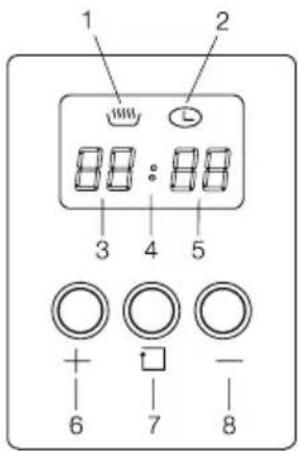
1 2 3 4 5 6 7 81 Heating indication
2 Clock indication
3 Hour indication
4 Second indication
5 Minute indication
6 Up
7 Set
8 Down
Starting-up procedure
After power on, the screen will display "00: 00" and "L" clock indicator will be on.
Time of day setting procedure
NOTE: Digital clock is displayed in 24 hour format
When “L” clock indicator and hour indication are flashing, press “+” up key or “-” down key to select a number value from (0-23) for the hour time, then press “↑” set key to change to the minute setting. Whilst flashing press ‘+’ up key or ‘-’ down key to select a number value from (0-59) for the minute time. The “L” clock indicator will remain flashing for 15 seconds once the time is set and neither of the “+” up key or “-” down keys and pressed again whilst flashing.
Duration timer setting procedure
Press "☐" selection button 3 times until "###" heating indicator is flashing, then press "+" up key or the "-" down key to select the cooking duration time in hours. Then press the "☐" selection button to enter the cooking duration time in minutes setting. The "###" heating indicator will remain flashing for 15 seconds once the cooking duration time is set and neither of the "+" up key or "-" down keys are pressed again whilst flashing.
Alternatively press the “☐” selection button and the oven will start cooking immediately. If duration timer setting does need to exceed 59 minutes then initially the “☐” selection button should be pressed 4 times instead of 3 to bypass the hour duration selection.
Audible 'End of Cooking' buzzer
The buzzer will sound for up 60 seconds at the end of the cooking time duration that has been set has been reached. The "00:00" display and " heating indication will flash for this period unless the " ↑ " selection button is pressed. The clock will return to the time of day display when either of the above tow actions occur.
Remarks
- If you press “ + ” up key or “ - ” down key for more than 3 seconds, the value will change quickly.
- When setting the Time of Day or Duration Timer the “ : ” does not blink although will blink when in either either normal Time of Day mode or Duration Timer is displayed.
Cooking Guide
| Dishes | Fan-forced Conventional | |||||
| Thermostat (°C) | Shelf Position | Cook Time (min) | Thermostat (°C) | Shelf Position | Cook Time (min) | |
| Layered Pastry | 170 – 190 1, 2 or 3 35 – 45 | 170 – 190 1 or 2 35 – 45 | ||||
| Cake | 150 – 170 1, 2 or 3 30 – 40 | 170 – 190 1 or 2 30 – 40 | ||||
| Cookie | 150 – 170 1, 2 or 3 25 – 35 | 170 – 190 1 or 2 30 – 40 | ||||
| Grilled Meatballs | ||||||
| Watery Food | 175 – 200 2 40 – 50 175 – 200 2 40 – 50 | |||||
| Chicken | 200 1 or 2 45 – 60 | |||||
| Two-tray Cake | 160 – 180 1 or 4 30 – 40 | |||||
| Two-tray Pastry | 170 – 190 1 or 4 35 – 45 | |||||
| Dishes | Intensive Bake Grill | |||||
| Thermostat (°C) | Shelf Position | Cook Time (min) | Thermostat (°C) | Shelf Position | Cook Time (min) | |
| Layered Pastry | 170 – 190 1 or 2 25 – 35 | |||||
| Cake | 150 – 170 1, 2 or 3 25 – 35 | |||||
| Cookie | 150 – 170 1, 2 or 3 25 – 35 | |||||
| Grilled Meatballs | 200 4 10 – 15 | |||||
| Watery Food | 175 – 200 2 40 – 50 | |||||
| Chicken | 200 1 or 2 200 Cook with | skewer | 50 – 60 | |||
| Two-tray Cake | 200 3 or 4 15 – 25 | |||||
| Two-tray Pastry | 200 4 15 – 25 | |||||
Using the hotplates of your cooker
The hot control knobs
The symbols on the control knobs mean the following
- No gas flow

Maximum gas flow

Minimum gas flow
NOTE: All operating positions must be set between the maximum and minimum flow settings, and never between the maximum setting and the closed position.
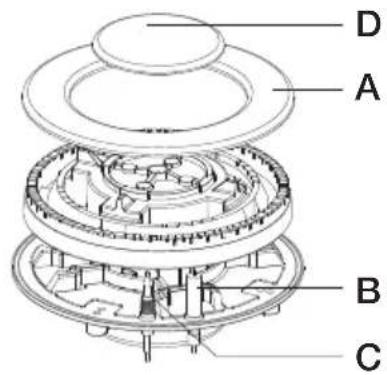
Gas Burner
A-Bumer cap
B-Lighting plug
C-Thermocouple
D-Wok burner cap
Hotplate Ignition
To light these hotplates:
-
Choose the hotplate you want to use.
-
Press and turn the hotplate burner control knob to "☐".
-
Hold the control knob down to release the spark and light the gas flame.
Hotplate Configuration
- Triple Ring Bumer
i. Ideal for wok cooking and large pans
ii. Used for fast heating
- Auxiliary Burner
i. Best suited for small saucepans and pans
ii. Simmering
3.Semi-Rapid
i. Mid sized pans and saucepans
To conserve gas, place the pan centrally over the burner and adjust the flame so that it does not go past the edges of the cookware.
text_image
D A B C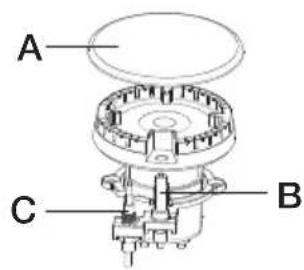
text_image
A C B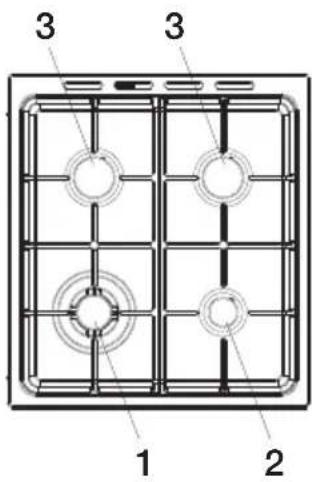
text_image
3 3 1 2Safety Warning Regarding Cleaning
• Always make sure that the cooker is turned off before cleaning.
• Always clean cooker immediately after use.
- Do not use steam cleaners. These may cause moisture build-up.
- Do not use caustic- based cleaners. These will damage aluminums parts, and remove enamel gloss.
Cleaning the Enamel
- Keep enamel clean by wiping it with a soft cloth dipped in warm soapy water.
- Rub difficult stains with a nylon scourer or creamed powder cleanser.
- Do not use abrasive cleaners, dry powder cleaners, steel wool or wax polishes.
- If you use an oven cleaner, then follow the instructions on the product carefully.
Cleaning the Control Panel
• Make sure control knobs are in off position.
- Clean the control panel by wiping it with a soft cloth dipped in warm soapy water and squeezed dry.
Cleaning the Gas Hob
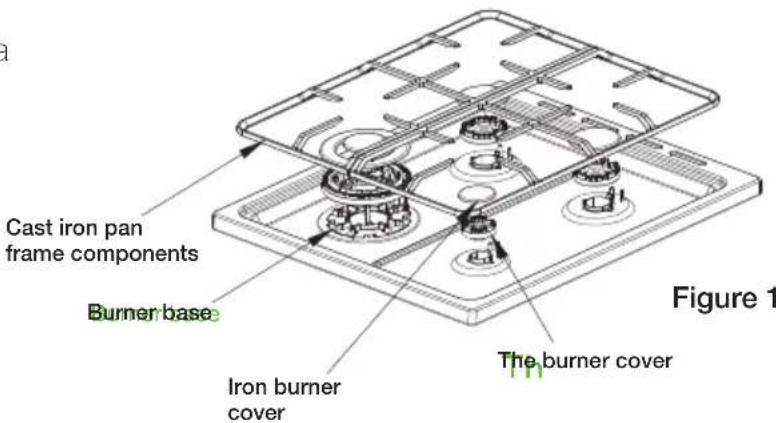
Removing the Trivets
- The trivets locate in the recessed area of the hob.
• They can be removed for cleaning by carefully lifting them from the hob. - Clean by washing in warm soapy water. Dry thoroughly.
• Take care when replacing the trivets as dropping them onto the hob may damage the enameled surface.
text_image
Cast iron pan frame components Burner base Iron burner cover The burner cover Figure 1Cleaning the Gas Hob (cont.)
Removing the burners
- The burner caps and crowns are removable for cleaning.
- Flame port blockage should be removed by means of a match stick or brush.
- If the caps, crowns and cups are heavily soiled, use a non-abrasive cleaning compound.
- Do not clean them with abrasive or caustic type cleaners, or put in a dishwasher as they will be damaged.
text_image
Flame Port Spark Plug Hole Burner Crown Thermocouple Lighting plug Burner Cup Figure 2Refitting the Burner Crowns and Caps
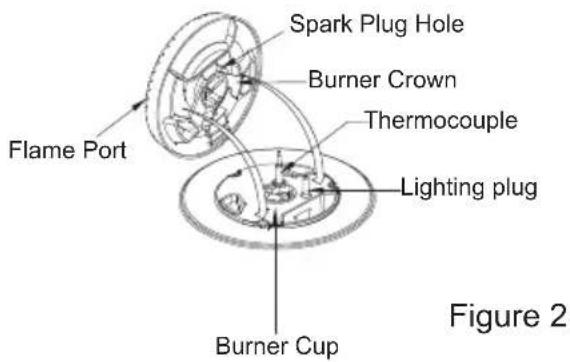
- The burner crown must be fitted correctly into the burner cup or damage will occur during operation.
- To do this, ensure that the 2 ribs on either side of the spark plug hole are positioned into the 2 slots on the burner cup. (See figure 2).
- The burner cap is simply positioned over the top of the burner crown.
Note: When the burner is correctly fitted it will sit level on the hob. If ignition is difficult or fails after cleaning, then either burner parts are not dry or parts have not been positioned correctly.
Cleaning the Oven
- Open the door fully.
- Remove oven shelves and side racks.
- Clean in hot soapy water.
Cleaning the oven door / How to remove the oven doors
For a more thorough clean, you can remove and disassemble the oven door. Proceed as follows:
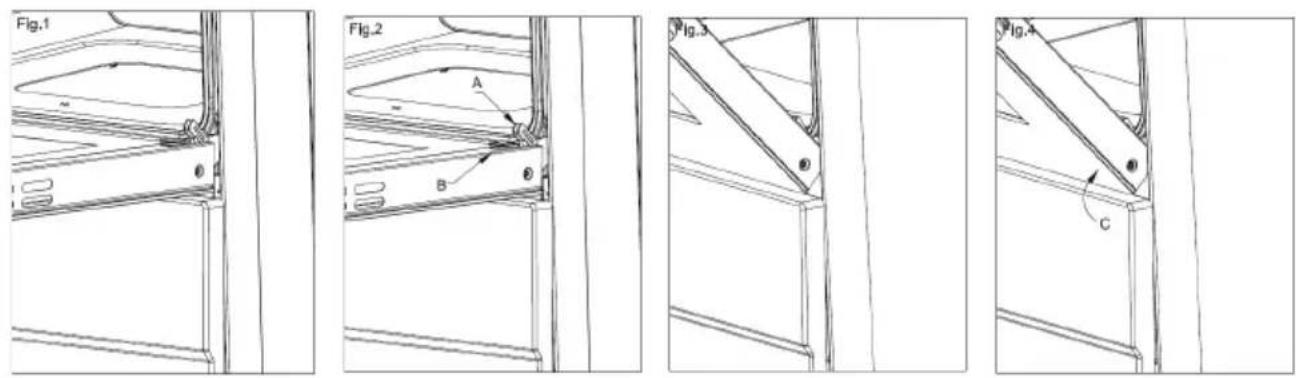
Oven door structures 1 remove and assemble procedure:
- Open the door to the full extent (fig.1);
- Open the lever A completely on the left and right hinges (fig.2);
- Hold the door as shown in fig.3
- Gently close the door (fig.3) until left and right hinge levers A are hooked to part B of the door (fig.4).
- Withdraw the hinge hooks from their location following arrow C (fig.4);
- Rest the door on a soft surface;
- To replace the door, repeat the above steps in reverse order.
Removing the Inner Pane of Glass
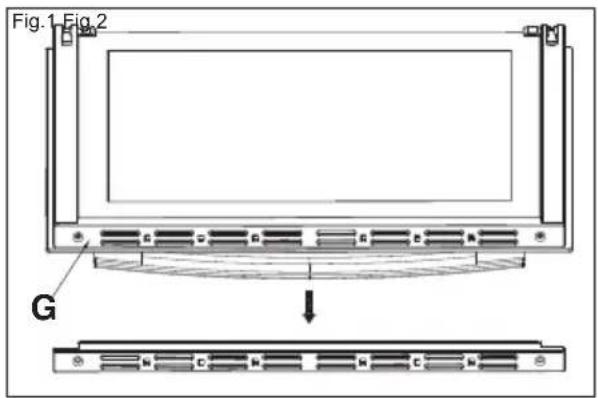
- Double oven door: Remove the seal G by unscrew the no.2 bolts (fig.1)
• Gently pull out the inner pane of glass(fig.2) - Clean the glass with an appropriate cleaner. Dry thoroughly, and place on a soft surface.
- Now you can also clean the inside of the outer glass.
Cleaning the door glass
- Clean the glass door using non-abrasive products or sponges and dry it with a soft cloth.
- Do not use the oven without the inner door glass fitted.
- Do not use harsh abrasive cleaners or sharp metal scrapers to clean the oven door glass since they can scratch the surface, which may result in shattering of the glass.
text_image
Fig.1 Fig.2 G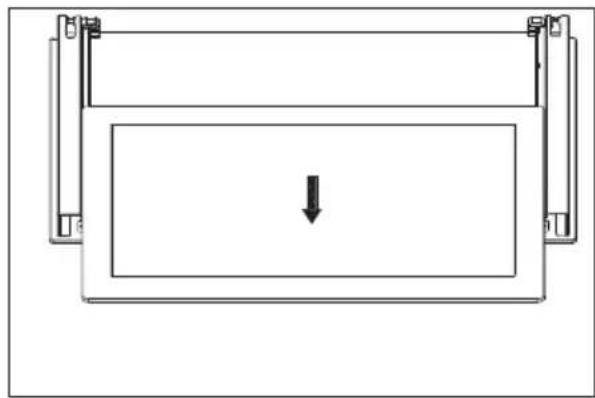
natural_image
Simple line drawing of a rectangular frame with a downward arrow inside, no text or symbols present.Replacing the Oven Lamp
- Disconnect the oven from the power supply at the fuse-box by means of the switch used to connect the appliance to the electrical mains; or unplug the appliance (gas)
- Remove the glass cover of the lamp-holder by rotating anti-clockwise
- Remove the lamp and replace with a lamp resistant to high temperatures (300°C) with the following characteristics:
- Voltage: 220-240V
- Wattage: 25W
- Type: E 14
Replace the glass cover. Reconnect the appliance to the mains power supply.
Solving Problems
If you have a problem with your appliance, check the table below before calling service. You may be able to avoid a service call by and avoid unnecessary inconvenience and expense.
| Problem Possible | causes What to do | |
| No spark obtained when gas burner knob is pushed / turned | Power not turned on Switch on electricity | |
| Household fuse blown Check fuses | ||
| Circuit breaker Tripped Check circuit breaker | ||
| Spark plug is wet or dirty Dry or clean spark plug | ||
| Burner will not light even though spark can be seen/heard | Gas supply valve is turned off Turn on gas supply | |
| Burner crown & cap not positioned correctly Remove parts and refit carefully | ||
| Port blockage in ignition area Make sure that ports and ignition area are clean and dry | ||
| Oven or grill not working | Digital Clock not set properly Refer to digital timer instructions | |
| Power not turned on Switch on electricity | ||
| Household fuse blown Check fuses | ||
| Controls incorrectly set Reset controls | ||
| Circuit breaker tripped Check circuit breaker | ||
| Oven light not working Power not turned on Switch on electricity | ||
| Replace seal or refit it | ||
| Digital timer display flashing | Power failure or interruption Reset time of day | |
| Household fuse blown or power supply is off | Check fuses, power supply | |
| Unit smoking when first used | Protective oils being removed This is normal | |
| Odour on first use of oven | This is normal | |
| Allow 2–4 hours for odour to dissipate (open all windows) | ||
| Oven shelf tight Oven shelf | not inserted correctly, may be upside down or back to front | Remove shelf and insert as per diagram |
| Clock display off Household fuse blown or power supply is off Check fuses, power supply | ||
Note: Only service centers should carry out servicing. Otherwise warranty may be void.
Installing your new cooker
Safety warnings about installation
- The cooker must be installed and serviced only by an authorized person.
- A certificate of compliance must be supplied by Installer and is to be kept by the customer.
- The packing materials must be removed before you install the cooker.
- You must follow the installation instructions in this booklet.
- The surrounding kitchen cabinets must be able to withstand 85°C. We will not accept responsibility for damage caused by installation in to kitchen cabinets which cannot withstand 85°C.
- The appliance must not be installed in a corner. It must be installed at least 100mm from the side wall.
- The flexible pipe for gas models must have sufficient loops so the cooker can be moved for service.
- The vents; openings and air spaces must not be blocked.
- The anti-tilt plate must be installed to avoid accidental tipping.
- The stabilizing bolt must be installed to avoid accidental moving.
- You must not pull the cooker by the door handles.
- Power socket, if provided for gas models, and electricity isolation switch for electric models and gas models without a 20A plug, is to be installed in an accessible position near the cooker (but not behind cooker).
- If the supply cord or cable is damaged, it must be replaced by an approved service agent or a similarly qualified person in order to avoid a hazard.
Unpacking and installation Instructions for Installer
Unpacking
- Please check the product and make sure that there is no damage.
- Read the relevant Installation Sections of this Manual. Ensure understanding.
- Confirm that product is compatible with available electrical/gas supply. Ensure proposed installation position does not conflict with Installation Sections.
- Check the attachment packing in good condition, complete accessories.
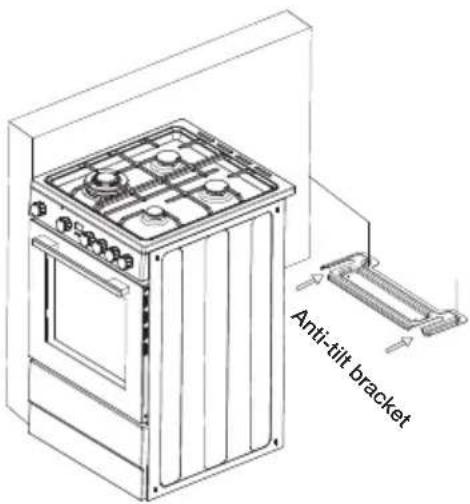
- Use screw driver to remove two fixed Anti-tilt plate screws and plate.
Locating the cooker
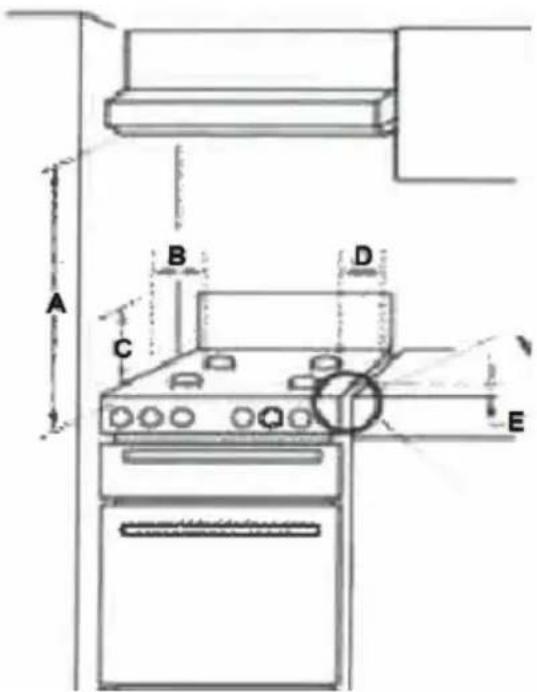
Study the diagrams following to be sure of the dimensions required to locate the cooker safely. Make sure that the top of the cooker is at least 10mm higher than the level of the bench tops. The appliance has been designed to fit in a 550mm wide gap in kitchen cabinets. The cooker may also be installed at the end of a line of benches or with a free space on either side.
Installation Sequence
- Determine position of cooker and ant-tilt plate.
- Securely fix the anti-tilt plate to the floor with appropriate fasteners.
- Fasten the stability bolt bracket to the front frame with the 2 screws supplied.
- Reposition the cooker back into the anti-tilt plate and then mark the position of the stability bolt hole.
- Pull the cooker back out and drill the bolt location hole. Use a 10mm masonry or wood drill. When drilling into concrete ensure a minimum hole depth of 30mm.
- Reposition the cooker back into the anti-tilt plate, aligning the stability bolt bracket with the 10mm drilled hole. Then slide the bolt through the bracket and into the hole.
text_image
Anti-tilt bracket- Connect Electricity supply/gas supply but do not turn on until installation is completed.
- Slide the cooker back into the anti-tilt plate so that rear cover rests against the rear wall. Then check the height and level of the cooker. If required, pull the cooker back out and adjust the leveling feet as required.
Warning for installer
Only a qualified person in compliance with the instructions provided must install the appliance. Manufacturer declines all responsibility for improper installation, which may harm persons and animals and damage property.
Important: The power supply to the appliance must be cut off before any adjustments or maintenance work is done on it; - Air duct is supposed to use in Ventilation.
Assembly
When packaging is removed from product you will notice there are several items nested in the packaging base. The burner crowns, burner caps and trivets can be fitted to the hob.
Note: That Wok trivet is a different size and must be correctly located over Wok burner.
Gas conversion
Your appliance can be converted to Universal LPG by an authorized person. Replace the injectors as per the following injector size table and adjust the minimum flame to approximately 25% of high flame. Check turndown flame for stability and adjust as required. Follow all other instructions within this manual and AS/NZS 5601 as relevant for Universal LPG once converted.
Changing Injectors Hob burners
- Cut off the main gas supply and unplug the appliance from the mains electrical supply.
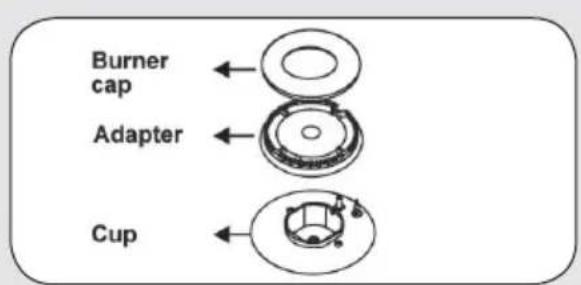
- Remove the burner caps and the adapters.
- Use a 7mm spanner to unscrew the injectors.
- Replace the injector with the ones from the gas conversion kit, with the correct diameters for the type of gas that is going to be used, according to the gas injector table.
text_image
Burner cap Adapter Cup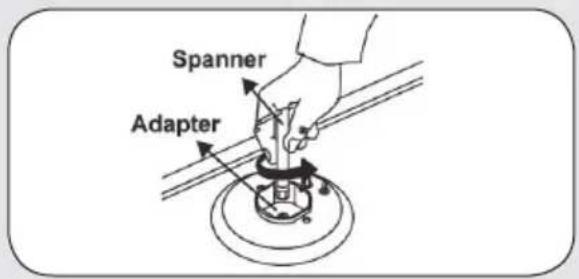
text_image
Spanner AdapterAdjusting the minimum flame position:
First if all, make sure that the appliance is unplugged from the mains electrical supply and that the gas feed is open. The minimum flame position is adjusted with a flat screw located on the valve. For valves with a flame failure safety device, the screw is located on the side of the valve spindle as shown in the figures.
To make adjusting the flame position easier, we recommend that you remove the control panel (and the micro switch if your model has one) during that alteration. The bypass screw must be loosened for conversion from LPG to NG. For conversion from NG to LPG, the bypass screw must be tightened.
Determining the flame position:
To determine the flame position, ignite the burners and leave them on in the minimum position. Remove the knobs because the screws are accessible only when the knobs are removed. With the help of a small screwdriver, fasten or loosen the bypass screw by around 90 degrees. When the flame has a length of at least 4mm, the gas is well distributed. Make sure that the flame does not die out when passing from the maximum position to the minimum position. Create an artificial wind with your hand towards the flame to see if the flames are stable.
Checking gas pressures
The cookers come in gas types: Natural gas and Universal LPG: If the cooker is required to use LPG, a conversion kit is included. Before installation check that the cooker is suitable for the gas supply. To do this check the gas type on the carton sticker or on the data plate behind the bottom of the oven door.
The following shows the supply and operating pressures for various gas supplies.
Operate pressure at appliance test point: 1.00 KPa (Natural gas); 2.75 KPa (Universal LPG) as the following table shows the injector sizes for each burner.
Gas Type: Natural Gas @ 1.00kPa Test Point Pressure
| Burner Injector Size (mm) N.G.C. (MJ/h) | |
| Wok 1.70mm 14.0 | |
| Semi-rapid 1.18mm 6.5 | |
| Auxiliary 0.90mm 4.0 |
ULPG @ 2.75kPa Test Point Pressure
| Burner Injector Size (mm) N.G.C. (MJ/h) | |
| Wok 1.10mm 15.5 | |
| Semi-rapid 0.72mm 7.5 | |
| Auxiliary 0.57mm 4.0 |
Total Gas Consumption:
| Model Natural Gas (MJ/h) ULPG (MJ/h) | |
| Hob Model 31.0 34.5 |
Locating the cooker
This appliance must be installed by an authorised person in accordance with this instruction manual, AS/NZS 5601 - gas installations (installation and pipe sizing), local gas fitting regulations, local electrical regulations, local water regulations, local health regulations, Building Code of Australia and any other government authority.
text_image
A B C D ESide clearances - (Measurements B & C)
Where B, measured from the periphery of the nearest burner to any vertical combustible surface, or vertical combustible surface covered with toughened glass or sheet metal, is less than 200mm, the surface shall be protected to a height of C, of not less than 150mm above the hob for the full dimension (width or depth) of the cooking surface area. Where the gas cooking appliance is fitted with a 'splashback', protection of the rear wall is not required.
Additional requirements for freestanding and elevated gas cooking appliances - (Measurements D & E)
Where D, the distance from the periphery of the nearest burner to a horizontal combustible surface is less than 200mm, then E shall be 10mm or more, or the horizontal surface shall be above the trivet.
Overheat clearances - (Measurement A)
The distance between the highest part of the hob of the gas cooking appliance should be higher than 600mm for a range hood and higher than 750mm for an overhead exhaust fan.
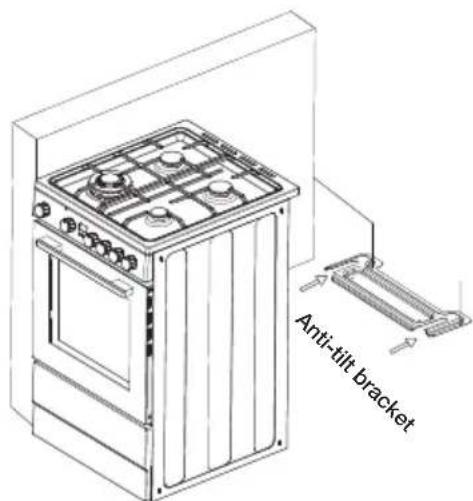
Installation of the anti-tilt plate
Determine position of cooker and anti-tilt plate.
Securely fix the anti-tilt plate to the floor with appropriate fasteners.
Fasten the stability bolt bracket to the front frame with the 2 screws supplied.
Reposition the cooker back into the anti-tilt plate and then mark the position of the stability bolt hole.
Pull the cooker back out and drill the bolt location hole. Use a 10mm masonry or wood drill. When drilling into concrete ensure a minimum hole depth of 30mm.
Reposition the cooker back into the anti-tilt plate, aligning the stability bolt bracket with the 10mm drilled hole. Then slide the bolt through the bracket and into the hole.
Connect electricity supply/gas supply but do not turn on until installation is completed.
text_image
Anti-tilt bracketConnection to the gas supply
- This appliance is suitable for connection with rigid pipe or flexible hose. The isolating manual shut-off valve connection point must be accessible when the appliance is installed
- The flexible hose assembly must be certified to AS/NZS 1869 class B or D, be of appropriate internal diameter for the total gas consumption (10mm), be kept as short as possible (not exceeding 1200mm), must not be in contact with the floor or any hot surface or sharp surface. The hose assembly must not be subject to strain, abrasion, kinking, deformation or contact with any other appliance.
- Gas leakage and operation of the appliance must be tested by the installer before leaving. Check burner flames are blue in colour, stable and completely ignite at both high and low flame settings with no appreciable yellow tipping, carbon deposition, lifting, floating, lighting back or objectionable odour. Test burners individually and in combination, When satisfied with the operation of the cooker, please instruct the user on the correct method of operation.
- Where the data plate is obscured by cabinetry when the cooker is in the installed position, place the supplied duplicate data plate to a suitable adjacent surface or within the instruction manual for future reference.
Gas connection
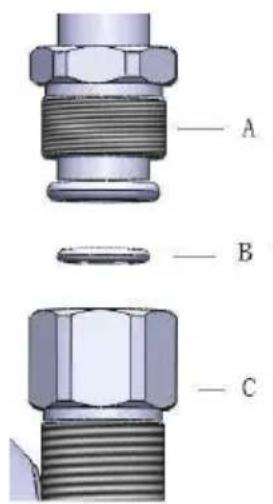
The gas intake connection of the appliance has a "male thread."
When making the connection, take care not to apply stresses of any kind to the appliance.
Read these points before connecting to the gas supply;
- The gas connection point is a 1/2" BSP external thread located at the rear of of the appliance (50mm from the edge).
- Ensure installation allows withdrawal of the appliance
• The appliance regulator provided must be orientated correctly
• The arrow showing the direction of the flow must be pointed correctly - The regulator has a 1/2"BSP internal thread at inlet and outlet
Gas leakage and operation of the appliance must be tested by the installer before leaving. Check burner flames are blue in colour, stable and completely ignite at both high and low flame settings with no appreciable yellow tipping, carbon deposition, lifting, floating, lighting back or objectionable odour. Test burners individually and in combination, When satisfied with the operation of the cooker, please instruct the user on the correct method of operation.
text_image
A B CA. Inlet pipe joint
B. Gasket
C. Stable union
Natural Gas (the appliance test point is located at the regulator)
The supplied regulator must be fitted to the appliance inlet connection. Gas pressure must be adjusted to 1.0 kPa when approximately 50% of the burners are on high flame.
Universal LPG (the appliance test point is located at the injector)
Gas pressure must be checked to confirm the appliance operating pressure is 2.75kPa, the appliance test point is the Semi-Rapid burner injector as shown.
- Disconnect power.
- Light the auxiliary burner and set to high flame. Ensure all other burners are off.
- Zero manometer, then apply flexible tubing to seal over the Semi-Rapid burner injector, hold securely in place and check the gas pressure by pressing the
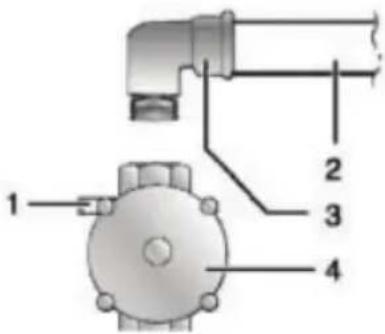
text_image
1 2 3 41 Test Point location
2 Gas inlet pipe
3 Elbow
4 Regulator
Patent 2015101170. For enquires contact Gas Approval Consulting Pty Ltd
Glen Dimplex Australia licence 043 for AGA 8792 G
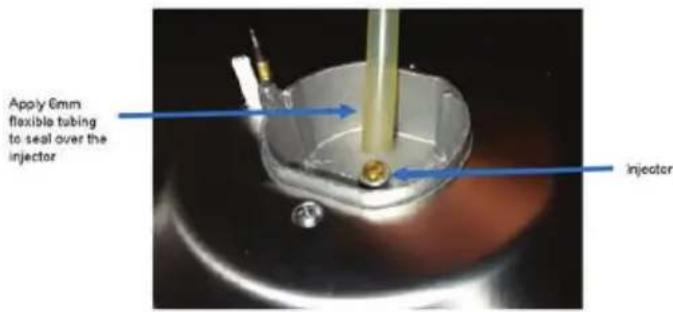
text_image
Apply 6mm flexible tubing to seal over the injector Injector-
If the pressure is 2.75 kPa, reassemble the burner and perform the final checks as per this instruction manual.
-
If the pressure is not 2.75 kPa, disconnect the appliance and check/adjust/ replace the LPG cylinder regulator(s) as appropriate in accordance with AS/NZS 5601.
The Cooker must be installed and maintained by a suitably qualified gas registered technician in accordance with current safety legislation.

WARNING: Do not use a naked flame to check for gas leaks.
Testing the operation of the gas cooker
NOTE: You must test the cooker after installation, before you hand it over to the customer. You must have a manometer and a connecting tube.
Checking gas supply
- Check the manometer zero point is correct.
- Connect the manometer to the cooker pressure test point. This is located on the regulator or LPG inlet fitting.
- Turn on the gas supply and the electricity (if applicable) and try to ignite the gas.
NOTE: It will take additional time to light the gas for the first time as air needs to be purged from the pipes.
- Check the operating pressure for the particular gas type (see table).
For LPG Cookers
Adjust the regulator if necessary (this may be remote from the cooker)
For natural gas cookers
- Check the manometer zero point is correct.
- Connect the manometer to the cooker pressure test point. This is located on the regulator or LPG inlet fitting.
- Turn on the gas supply and the electricity (if applicable) and try to ignite the gas.
NOTE: It will take additional time to light the gas for the first time as air needs to be purged from the pipes.
- Check the operating pressure for the particular gas type (see table).
Checking the Function of the Regulator
With the appliance operating check the outlet pressure:
- When all burners of the appliance are operating at maximum,
- When the smallest burner of the appliance is operating at minimum.
Under these conditions the outlet pressure should not vary from the nominal outlet pressure of 1.0kPa by more than ±20% of the nominal outlet pressure (±0.20kPa for Natural Gas).
If the regulator appears to not be performing satisfactorily then check the following points.
- If the outlet pressure is consistently too low then the inlet pressure may be too low and adjustment of an upstream regulator may be needed, or an upstream regulator or valve with insufficient flow capacity may be present in the gas supply line. If this is suspected then it may be necessary to repeat the checks whilst measuring both the inlet and outlet pressure to determine if the inlet pressure is in the range 1.13 – 5kPa.
- Check that the regulator has been fitted to the gas supply line in the correct orientation, the arrow on the base of the body indicates the direction of gas flow. Once these checks have been completed, if the regulator still fails to perform in a satisfactory manner it should be replaced.
Testing the cooker features
Observe the flame appearance on each burner. If it is much smaller or larger than expected, then the injector size needs checking.
When maximum flame appearance is correct, then check the turn-down setting on each burner. If the settings appear to be incorrect, proceed as follows:
- Adjust the bypass screw mounted on the body of each hotplate control cock. This is accessible when the control knob and the control panel are removed.
- Check the ignition on all burners both separately and in combination.
- Check the operation of the electrical components, if applicable.
- If you are satisfied that the cooker is operating correctly, then turn it off and show the customer how to use it.
Make sure you ask the customer to operate the clock and controls.
Note: If the cooker cannot be adjusted to perform correctly, then inform the customer of the problem and put a warning notice on the cooker. If the problem is dangerous, then disconnect the cooker. If there is a fault, then the customer should be advised to contact the manufacturer's local service organization or the retailer.
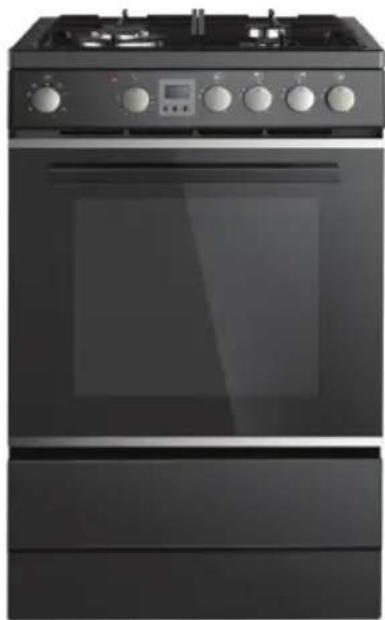
natural_image
Exterior view of a modern kitchen oven with control knobs and front panel (no visible text or symbols)| Model | BFS54SCDF |
| Oven capacity (L) | 70L |
| Voltage (V) | 240V |
| Frequency (Hz) | 50Hz |
| Circuit breaker (A) | 16A |
| Oven power (W) | 2570W |
| Hobs power (W) | NG:8.61KW LPG:9.58KW |
| Product dimension (mm) | 538 x 600 x 900 |
| Package size (mm) | 588 x 714 x 952 |
| Gross/net weight (kg) | 56kg/50.5kg |
Annual service by an authorised person is recommended, or if any of the following conditions are noticed; incomplete ignition, appreciable yellow tipping, carbon deposition, lifting, floating, lighting back or objectionable odour.
Contact:
Glen Dimplex Australia
Telephone: 1300 556 816
Email: sales@glendimplex.com.au
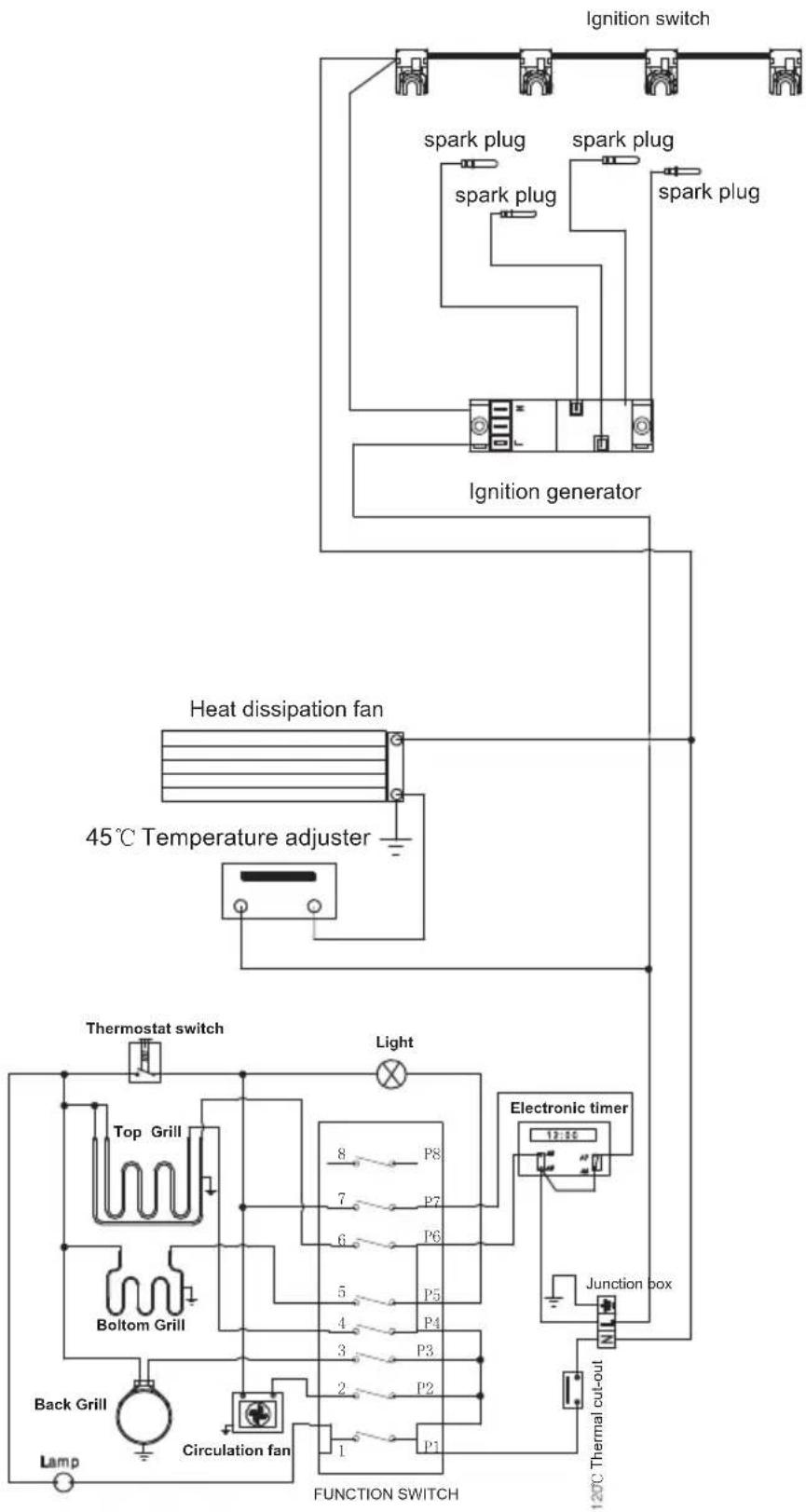
flowchart
graph TD
    A["Ignition generator"] --> B["Ignition switch"]
    B --> C["Spark plug"]
    C --> D["Spark plug"]
    D --> E["Ignition generator"]
    F["Heat dissipation fan"] --> G["45°C Temperature adjuster"]
    G --> H["Thermostat switch"]
    H --> I["Top Grill"]
    I --> J["Bottom Grill"]
    J --> K["Back Grill"]
    K --> L["Lamp"]
    L --> M["Circulation fan"]
    M --> N["FUNCTION SWITCH"]
    N --> O["Electronic timer"]
    O --> P["Junction box"]
    P --> Q["120°C Thermal cut-out"]
    style A fill:#f9f,stroke:#333
    style B fill:#ccf,stroke:#333
    style C fill:#cfc,stroke:#333
    style D fill:#fcc,stroke:#333
    style E fill:#cff,stroke:#333
    style F fill:#ffc,stroke:#333
    style G fill:#cfc,stroke:#333
    style H fill:#fcc,stroke:#333
    style I fill:#ffc,stroke:#333
    style J fill:#cfc,stroke:#333
    style K fill:#fcc,stroke:#333
    style L fill:#fff,stroke:#333
    style M fill:#fff,stroke:#333
    style N fill:#fff,stroke:#333
    style O fill:#fff,stroke:#333
    style P fill:#fff,stroke:#333
    style Q fill:#fff,stroke:#333
    style R fill:#fff,stroke:#333
    style S fill:#fff,stroke:#333
    style T fill:#fff,stroke:#333
    style U fill:#fff,stroke:#333
    style V fill:#fff,stroke:#333
    style W fill:#fff,stroke:#333
    style X fill:#fff,stroke:#333
    style Y fill:#fff,stroke:#333
    style Z fill:#fff,stroke:#333
Congratulations on your new purchase and thank you for choosing Belling.
Our dedication to quality and reliability allows us to cover Belling cooking appliances under a domestic warranty for 3 years that includes all parts and labour for even more peace of mind.
Registering your Belling product online takes only minutes. You can also read important warranty information, our FAQs for troubleshooting and other useful information.
We are here to provide service and support regarding your Belling products. For queries please contact customer care on 1 800 444 357 or email customercare@hapl.com.au
To register your product for warranty please go to www.belling.com.au/warranty
Glen Dimplex Australia Pty Ltd
1340 Ferntree Gully Road,
Scoresby 3179, Victoria
Australia
Ph: 1300 556 816
Fax: 1800 058 900
sales@glendimplex.com.au