Vaio VGC-JS155 - Desktop computer SONY - Free user manual and instructions
Find the device manual for free Vaio VGC-JS155 SONY in PDF.


User questions about Vaio VGC-JS155 SONY
0 question about this device. Answer the ones you know or ask your own.
Ask a new question about this device
Download the instructions for your Desktop computer in PDF format for free! Find your manual Vaio VGC-JS155 - SONY and take your electronic device back in hand. On this page are published all the documents necessary for the use of your device. Vaio VGC-JS155 by SONY.
USER MANUAL Vaio VGC-JS155 SONY
Ergonomic Considerations....11
Getting Started....13
Locating Controls and Ports....14
About the Indicator Lights ....18
Setting Up Your Computer....19
Shutting Down Your Computer Safely 22
Using Your VAIO Computer....23
Using the Keyboard ....24
Using the Built-in MOTION EYE Camera....27
Using the Optical Disc Drive ....30
Using the Memory Stick....38
Using the SD Memory Card....44
Using the Internet....47
Using Wireless LAN (WLAN) 48
Using the Bluetooth Function....55
VAIO

Using Peripheral Devices....61
Connecting External Speakers ....62
Connecting a Universal Serial Bus (USB) Device....64
Connecting a Printer 66
Connecting an i.LINK Device 67
Connecting to a Network (LAN) 69
Customizing Your VAIO Computer 70
Setting the Password 71
Setting Up Your Computer with VAIO Control Center....76
Using the Power Saving Mode....77
Upgrading Your VAIO Computer....79
Adding and Removing Memory....80
Precautions 86
Handling the LCD Screen 87
Using the Power Source 88
Handling Your Computer ....89
Handling the Built-in MOTION EYE Camera....91
Handling Floppy Disks 92
Handling Discs 93
Using Headphones 94
Handling the Memory Stick 95
Handling the Hard Disk....96
Updating Your Computer 97
VAIO

Troubleshooting 98
Computer 99
System Security 104
Built-in MOTION EYE Camera....105
Networking 108
Bluetooth Technology 111
Optical Discs 115
Display 119
Printing....120
Microphone 121
Mouse 122
Speakers....123
Keyboard....125
Floppy Disks 126
Audio/Video....127
Memory Stick 130
Peripherals....131
Support Options 132
Sony Support Information 133
e-Support 134
Trademarks....136
Before Use
Congratulations on your purchase of this Sony VAIO ^® computer, and welcome to the on-screen User Guide. Sony has combined leading-edge technology in audio, video, computing, and communications to provide state-of-the-art personal computing experience.
! External views illustrated in this manual may look slightly different from those of your computer.
Notice
© 2008 Sony Corporation. All rights reserved.
This manual and the software described herein, in whole or in part, may not be reproduced, translated, or reduced to any machine-readable form without prior written approval.
Sony Corporation provides no warranty with regard to this manual, the software, or other information contained herein and hereby expressly disclaims any implied warranties or merchantability or fitness for any particular purpose with regard to this manual, the software, or such other information. In no event shall Sony Corporation be liable for any incidental, consequential, or special damages, whether based on tort, contract, or otherwise, arising out of or in connection with this manual, the software, or other information contained herein or the use thereof.
In the manual, the ^TM or marks are not specified.
Sony Corporation reserves the right to make any modification to this manual or the information contained herein at any time without notice. The software described herein is governed by the terms of a separate user license agreement.
Documentation
Your documentation includes printed information and user guides to read on your VAIO computer.
Printed Documentation
☐ Quick Start Guide — Describes the process from unpacking to starting up your VAIO.
Troubleshooting and Recovery Guide — Contains solutions to problems other than those you encounter during normal operation.
☐ Regulations, Guarantee, EULA and Service Support — Contains Sony guarantee conditions, safety / regulations, modem regulations, wireless LAN regulations, wireless WAN regulations, Bluetooth regulations, end user software license agreement, and Sony support services information.
Non-printed Documentation
☐ User Guide (this manual) — Explains features of your computer. It also includes information about the software programs included with your computer, as well as information on solving common problems. The User Guide is provided in PDF format for easy browsing and printing.
To view this on-screen guide:
1 Double-click the VAIO User Guide icon on the desktop.
2 Open the folder for your language.
3 Select the guide you want to read.

You can manually browse to the user guides by going to Computer > VAIO (C:) (your C drive) > Documentation > Documentation and opening the folder for your language.
To go to web sites described in this manual by clicking their respective URLs beginning with http://, your computer must be connected to the Internet.
Specifications — The online specifications describe the hardware and software configurations of your VAIO computer.
To view the online specifications:
1 Connect to the Internet.
2 Go to the Sony online support web site at http://www.vaio-link.com.

You may have a separate disc that includes documentation for the bundled accessories.
Windows Help and Support
Windows Help and Support is a comprehensive resource for practical advice, tutorials, and demonstrations to help you learn to use your computer.
Use the search feature, index, or table of contents to view all Windows Help resources, including those on the Internet.
To access Windows Help and Support, click Start 📋 and Help and Support. Or go to Windows Help and Support by pressing and holding the Microsoft Windows key and pressing the F1 key.
VAIO
Further Sources
Consult the help files included with the software you are using for detailed information on features and troubleshooting.
☐Go to http://www.club-vaio.com to find online tutorials about your favorite VAIO software.
Ergonomic Considerations
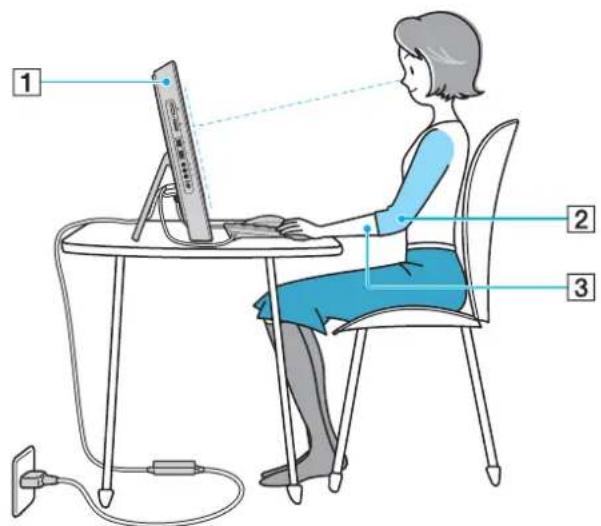
Whenever possible, you should attempt to take account of the following ergonomic considerations:
text_image
Illustration of a person using a computer with labeled parts including head, arm, and cable, showing a posture setup.☐ Position of your computer – Place the display directly in front of you (1). Keep your forearms horizontal (2), with your wrists in a neutral, comfortable position (3) while using the keyboard, pointing device, or external mouse. Let your upper arms hang naturally at your sides. Take frequent breaks while using your computer. Excessive use of the computer may strain eyes, muscles, or tendons.
☐ Furniture and posture – Sit in a chair with good back support. Adjust the level of the chair so your feet are flat on the floor. A footrest may make you more comfortable. Sit in a relaxed, upright posture and avoid slouching forward or leaning far backwards.
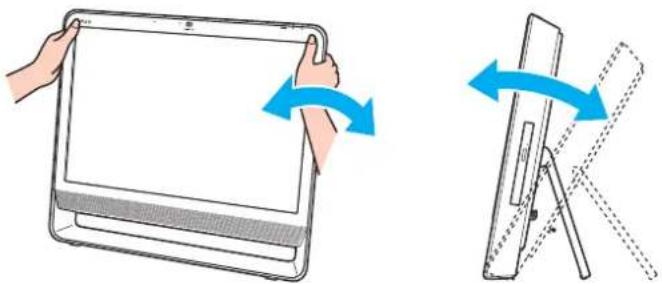
☐ Viewing angle of the display – Use the display's tilting feature to find the best position. You can reduce eye strain and muscle fatigue by adjusting the tilt of the display to the proper position. Adjust the brightness level of the display as well.
natural_image
Illustration showing a hand holding a tablet and a slide with an arrow indicating rotation (no text or symbols)! While adjusting the viewing angle, do not exert excessive pressure on your computer to eliminate a risk of mechanical damage.
☐ Lighting – Choose a location where windows and lights do not cause glare and reflection on the display. Use indirect lighting to avoid bright spots on the display. Proper lighting adds to your comfort and work efficiency.
☐ Ventilation – Make sure you leave at least 10 cm of space behind and at least 20 cm of space on each side of the main unit.
VAIO
13
Getting Started
Getting Started
This section describes how to get started using your VAIO computer.
□Locating Controls and Ports (page 14)
☐About the Indicator Lights (page 18)
□Setting Up Your Computer (page 19)
□Shutting Down Your Computer Safely (page 22)
Locating Controls and Ports
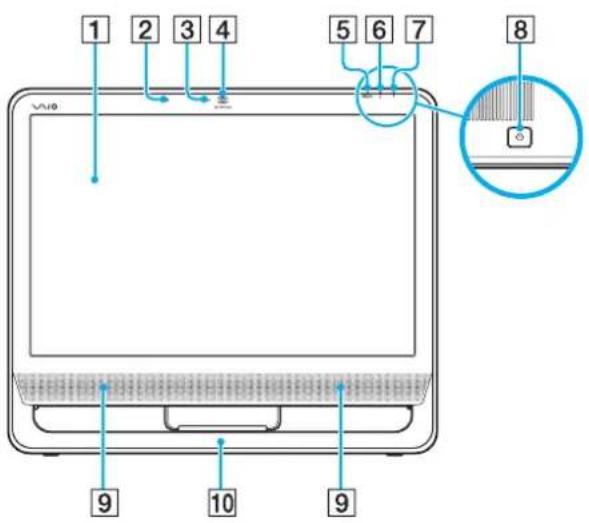
Take a moment to identify the controls and ports shown on the following pages.
Front
text_image
1 2 3 4 5 6 7 8 9 10 91 LCD screen (page 87)
②Built-in microphone (monaural)
③ Built-in MOTION EYE camera indicator (page 18)
4 Built-in MOTION EYE camera (page 27)
5 WIRELESS indicator (page 18)
6 Hard disk drive/Optical disc drive indicator (page 18)
7 Power indicator (page 18)
8 Power button
9 Built-in speakers (stereo)
10 Bottom chassis frame (page 90)
Back
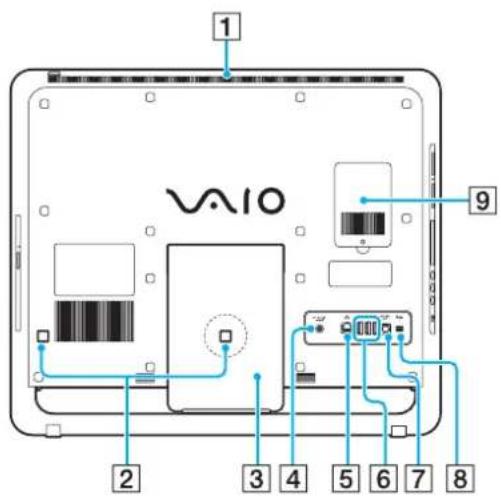
text_image
1 VIAO 2 3 4 5 6 7 8 9! The area around the air vent (1) becomes hot while your computer is on. Be sure to wait until the computer cools down before you touch it.
1 Air vent
2 Cable clamps (page 19), (page 20)
3 Prop-up stand (page 90)
4 DC IN port (page 20)
5 Network (Ethernet) port (page 69)
6 Hi-Speed USB (USB 2.0) ports * (page 64)
7 OPTICAL OUT port (page 62)
(Output Sampling Rate: 44.1 KHz/48.0 KHz/96.0 KHz)
8i.LINK 4-pin (S400) port (page 67)
9 Memory module compartment cover (page 80)
* Support high-/full-/low- speeds.
Right
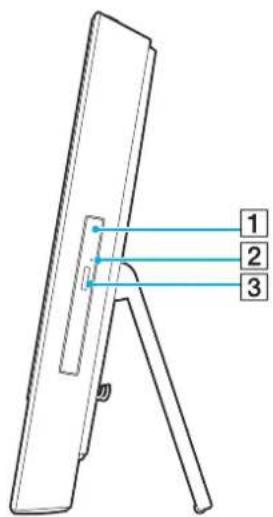
text_image
1 2 31 Optical disc drive (page 30)
2 Manual eject hole (page 115)
3Drive eject button (page 30)
Left

text_image
1 2 3 4 5 6 7 81 Memory Stick slot *1 (page 38)
2 Media Access indicator (page 18)
3 SD memory card slot (page 44)
4 Hi-Speed USB (USB 2.0) ports *2 (page 64)
5Headphones jack (page 62)
6 Microphone jack
Connect an external microphone.
7 Line In jack Connect an external audio device for audio input.
8 WIRELESS switch (page 48)
*1 Your computer supports both standard- and Duo-size Memory Stick. *2 Support high-/full-/low- speeds.
About the Indicator Lights
Your computer is equipped with the following indicator lights:
| Indicator Functions | |
| Power ⏻ | Illuminates in green when the computer is on, illuminates in orange while the computer is in Sleep mode, and turns off when the computer is off. |
| Built-in MOTION EYE camera | Illuminates while the built-in MOTION EYE camera is in use. |
| Media Access | Illuminates when data is read from or written to a memory card. (Do not place the computer into Sleep mode or turn it off when this indicator is lit.) When the indicator is unlit, the memory card is not in use. |
| Hard disk drive/Optical disc drive 📋 | Illuminates when the drive is reading or writing data. Do not place the computer into Sleep mode or turn it off when this indicator is lit. |
| WIRELESS | Illuminates when the WIRELESS switch is turned on, provided that one or more wireless options are enabled in the VAIO Smart Network window. |
Setting Up Your Computer
Connecting the Keyboard and the Mouse
A USB keyboard and a USB mouse are supplied with your computer.
To connect the keyboard and the mouse
1 Plug the keyboard cable (1) and the mouse cable (2) to your desired USB ports (3) on the back of the computer.
2 Route the mouse cable (2) through the cable clamp (4) on the back of your computer.

text_image
Diagram of a computer setup with labeled components including mouse, keyboard, and connected devicesConnecting a Power Source
You need an AC adapter to connect your computer to an AC power source.

Use only the supplied AC adapter for your computer.
To connect the AC adapter
1 Plug one end of the power cord (1) into the AC adapter (3).
2 Plug the other end of the power cord into an AC outlet (2).
3 Plug the AC adapter cable (4) into the DC IN port (5).
4 Route the AC adapter cable through the cable clamp (6).

text_image
6 V10 3 4 3 2 5 DC IN 10.0V +/-+ 1 2! The shape of the DC In plug varies depending on the AC adapter.
To disconnect your computer completely from AC power, unplug the AC adapter when the computer is off. Make sure that the AC outlets are easily accessible.
! If you unplug the AC adapter from your computer while the computer is on or in Sleep mode, you may lose all unsaved data.
Shutting Down Your Computer Safely
To avoid losing unsaved data, be sure to shut down your computer properly, as described below.
To shut down your computer
1 Turn off any peripherals connected to the computer.
2 Click Start, the arrow ▶ next to the Lock button, and then Shut Down.
3 Respond to any prompts warning you to save documents or to consider other users and wait for the computer to turn off automatically.
The power indicator light turns off.
Using Your VAIO Computer
This section describes how to get the most out of using your VAIO computer.
□Using the Keyboard (page 24)
□Using the Built-in MOTION EYE Camera (page 27)
□Using the Optical Disc Drive (page 30)
□Using the Memory Stick (page 38)
□Using the SD Memory Card (page 44)
□Using the Internet (page 47)
□Using Wireless LAN (WLAN) (page 48)
□Using the Bluetooth Function (page 55)
Using the Keyboard
A USB keyboard is supplied with your computer.
The keyboard uses a standard key arrangement with additional keys that perform specific functions.
The VAIO-Link web site (http://www.vaio-link.com) also contains glossary information to help you use the keyboard.
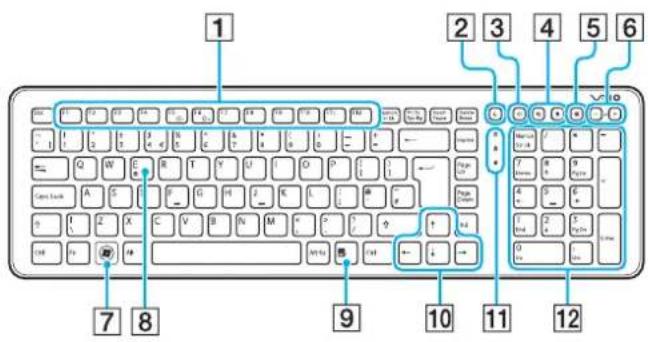
text_image
1 2 3 4 5 6 7 8 9 10 11 12
Illustrated above is the English keyboard as an example.
1 Function keys
Perform certain tasks. The task associated with each function key varies among software applications except the following combinations with the Fn key.
Fn+F5: Decreases lighting intensity of the LCD screen. Fn+F6: Increases lighting intensity of the LCD screen.
2 Sleep button
Provides for the lower level of power consumption. For details on power management, see Using the Power Saving Mode (page 77).
3 S1 button
By default, the S1 button launches the VAIO Guide.

The default S1 button assignment may be different from the above. In such a case, you can change the assignment with the VAIO Control Center. See Setting Up Your Computer with VAIO Control Center (page 76) and find out more in its help file.
4 Zoom buttons
Changes the view size of your screen.
Press 🔒 to make the screen view look smaller and further away (zoom out).
Press ⊕ to make the screen view look bigger and closer (zoom in).
See the help file included with the VAIO Control Center for more information.
5 Muting button
Turns the volume on and off.
6 Volume control buttons
Increase (+) or decrease (-) the volume.
7 Windows key
Displays the Start menu.
⑧ E key
Ejects the optical disc drive tray when used in combination with the Fn key.
⑨ Applications key
Displays a shortcut menu in certain software applications.
10 Directional arrow keys Move the pointer on the computer screen.
11 Indicator lights ☑ (Num Lk): Turns on while in the Num Lock state. ☑ (Caps Lock): Turns on while in the Caps Lock state. ☑ (Scr Lk): Turns on while in the Scroll Lock state.
12 Numeric keypad Use the numeric keypad to type numbers or to perform basic math calculations.
Using the Built-in MOTION EYE Camera
Your computer is equipped with a built-in MOTION EYE camera.
The built-in MOTION EYE camera adds video functionality to instant messaging software and video editing software and enables you to capture still images and movies with the preinstalled image capture software.
Turning on the computer activates the built-in MOTION EYE camera. Video conference is possible with the appropriate software.
Note that launching or exiting your instant messaging or video editing software does not activate or deactivate the built-in MOTION EYE camera, respectively.
The built-in MOTION EYE camera cannot be shared by more than one software application. If another software application is using the camera, exit the application before using the built-in MOTION EYE camera with your desired application.
! The viewer window may show some noise, for example horizontal streaks, if you view a rapid-moving object. This is normal and does not indicate a malfunction.
You cannot operate the built-in MOTION EYE camera with the Microsoft Windows Movie Maker software.
Capturing Still Images
To capture a still image
1 Click Start, All Programs, ArcSoft WebCam Companion 2, and WebCam Companion 2 to launch the WebCam Companion 2.
2 Click the Capture icon in the main window.
3 Frame your subject in the viewfinder.
4 Click the Capture button below the displayed image.
The current image in the viewfinder is captured and its thumbnail image is added as a the thumbnail in the left pane of the main window.

When capturing an image in a dark place, click the WebCam Settings icon after step 2 and select the low light or low light compensation option in the properties window.
The WebCam Companion 2 provides many more features. See the help file included with the software for more information.
Capturing Movies
To capture a movie
1 Click Start, All Programs, ArcSoft WebCam Companion 2, and WebCam Companion 2 to launch the WebCam Companion 2.
2 Click the Record icon in the main window.
3 Frame your subject in the viewfinder.
4 Click the Record Video button below the displayed image to start movie recording.
5 When finished, click the Record Video button once again to stop movie recording. The first scene of the captured movie is added as a thumbnail in the left pane of the main window.
When capturing a movie in a dark place, click the WebCam Settings icon after step 2 and select the low light or low light compensation option in the properties window.
The WebCam Companion 2 provides many more features. See the help file included with the software for more information.
Using the Optical Disc Drive
Your computer is equipped with an optical disc drive.
To insert a disc
1 Turn on the computer.
2 Press the drive eject button (1) or the Fn+E keys to open the drive. The tray slides out.
3 Hold the back of the tray with one hand, place a disc in the middle of the tray with the label side facing toward you, and gently push it toward the tray until the disc clicks into place.
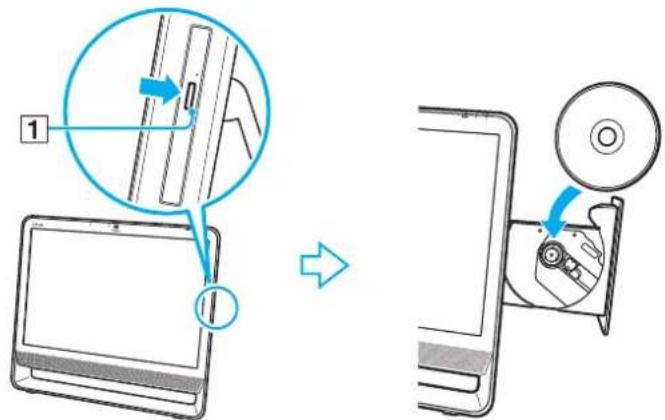
text_image
Diagram illustrating the process of inserting a CD into a device, showing step 1 and transformation from device to screen.Do not exert pressure on the drive tray. Be sure to hold the back of the drive tray when placing/removing a disc onto/from the tray.
4 Close the tray by pushing it in gently.
Do not remove the optical disc when your computer is in Sleep mode. Doing so may cause the computer to malfunction.
If you plan to use an external optical disc drive, connect the drive before you launch any preinstalled disc operation program.
Reading and Writing Optical Discs
Your computer plays and records CDs, DVDs, and Blu-ray Disc ^™ media, depending on the model you purchased. Check your specifications for the type of optical disc drive installed on your model.
Use the table below to see which types of media your optical disc drive supports.
PR: playable and recordable
P: playable but not recordable
-: not playable or recordable
| CD-ROM | Video CD | Music CD | CD Extra | CD-R/RW | DVD-ROM | DVD-Video | BD-ROM | DVD-R/RW | DVD+R/RW | DVD+R DL | DVD-R DL | DVD-RAM | BD-R*9/ RE*10 | |
| DVD±RW/ ±R DL/RAM | P | P | P | P | P | R | P | PR*IP*2 | PR | PR*5 | PR*6 | PR*3*4 | - | |
| Blu-ray Disc Combo | P | P | P | P | PR*8 | P | P | P | PR*1*2 | PR | PR*5 | PR*6 | PR*3*4 | P*11*12 |
| Blu-ray Disc P | P P P | PR*8 | P | P | P | PR*1*2 | PR | PR*5 | PR*6 | PR*3*4 | PR*7*11*12 |
^1 Supports writing data to DVD-R discs compliant with DVD-R for General Version 2.0/2.1.
^2 Supports writing data to DVD-RW discs compliant with DVD-RW Version 1.1/1.2.
*3 The DVD±RW/RAM disc drive on your computer does not support the DVD-RAM cartridge. Use non-cartridge discs or discs with a removable cartridge.
^4 Writing data to single-sided DVD-RAM discs (2.6 GB) compliant with DVD-RAM Version 1.0 is not supported. DVD-RAM Version 2.2/12X-SPEED DVD-RAM Revision 5.0 disc is not supported.
^5 Writing data to DVD+R DL (Double Layer) discs is available only on discs supporting DVD+R DL (Double Layer) recording.
^6 Writing data to DVD-R DL (Dual Layer) discs is available only on discs supporting DVD-R DL (Dual Layer) recording.
^7 Supports writing data to BD-R Version 1.1 discs (single-layer discs with the capacity of 25 GB, dual-layer discs with the capacity of 50 GB) and BD-RE Version 2.1 discs (single-layer discs with the capacity of 25 GB, dual-layer discs with the capacity of 50 GB).
^8 Writing data to Ultra Speed CD-RW discs is not supported on the models with certain types of the Blu-ray Disc drive.
^9 BD-R stands for Blu-ray Disc-Recordable in Version 1.1 format.
^*10 BD-RE stands for Blu-ray Disc-Rewritable in Version 2.1 format.
^11 The Blu-ray Disc drive on your computer does not support BD-RE Disc media in Version 1.0 format and Blu-ray Disc media with a cartridge.
^12 Playback of BD-R LTH TYPE media is supported only on the models with the Blu-ray Disc drive.
This product is designed to play back discs that conform to the Compact Disc Digital Audio standard specifications (CD Standard). A DualDisc is a two-sided disc product with a DVD recorded layer on one side and a digital audio layer on the other side. Be aware that the audio side (non-DVD side) of a DualDisc may not play on this product because it does not conform to the CD Standard.
When you buy pre-recorded or blank discs for use with your VAIO computer, be sure to read the notices on the disc package carefully to check both playback and recording compatibility with your computer's optical disc drives. Sony does NOT guarantee the compatibility of VAIO optical disc drives with discs that are not compliant with the official "CD," "DVD," or "Blu-ray Disc" standard. USING NON-COMPLIANT DISCS CAN CAUSE FATAL DAMAGE TO YOUR VAIO PC OR CREATE SOFTWARE CONFLICTS AND CAUSE SYSTEM HANGING.
For inquiries about disc formats, contact the individual publisher of the pre-recorded disc or the manufacturer of the recordable disc.

8 cm disc writing is not supported.

To play copyright protected Blu-ray Disc media continuously, you need to update the AACS key. Note that the AACS key update requires Internet access.
As with other optical media devices, circumstances may limit compatibility or prevent Blu-ray Disc media playback. VAIO computers may not support movie playback on packaged media recorded in AVC or VC1 format at high bit rates.
Region settings are required for some contents on DVDs and BD-ROM Disc media. If the region setting on the optical disc drive does not match the region coding on the disc, playback is not possible.
Some contents may restrict video output to standard definition or prohibit analog video output. It is strongly recommended that a digital HDCP-compliant environment be implemented for optimum compatibility and viewing quality.
Notes on writing data to a disc
☐ Only use circular discs. Do not use discs in any other shape (star, heart, card, etc.), as this may damage the optical disc drive.
☐ Do not strike or shake your computer while the optical disc drive is writing data to a disc.
☐ Do not use memory-resident utility software while the optical disc drive is writing data to a disc. This may cause your computer to malfunction.
☐ Do not plug or unplug the AC adapter while the optical disc drive is writing data to a disc.
Notes on playing discs
To achieve optimum performance when playing discs, you should follow these recommendations.
☐ Some CD players and computer optical disc drives may not be able to play audio CDs created with the CD-R or CD-RW media.
☐ Some DVD players and computer optical disc drives may not be able to play DVDs created with the DVD+R DL, DVD-R DL, DVD+R, DVD+RW, DVD-R, DVD-RW, or DVD-RAM media.
☐ Do not place your computer into the power saving mode while your computer is playing a disc.
☐ Region code indicators are labeled on the discs or packages to indicate in which region and on what type of player you can play the disc. Unless the region code indicates "2" (Europe belongs to region "2") or "all" (this means that you can play this disc in most regions of the world), you cannot play the disc on your computer.
! If you change the region code while the WinDVD or WinDVD BD software is running, restart the software or eject the disc and re-insert it to make the new setting effective.
☐ Do not try to change the region code settings of the drive. Any difficulties caused by changing the region code settings of the drive are not covered by the warranty.
Playing CDs
To play an audio CD
1 Insert a disc into the optical disc drive.
2 If nothing appears on the desktop, click Start, All Programs, and the desired CD software to play the CD. If the Audio CD window appears, click to select an option.
Copying Files to CDs
To copy files to a disc
1 Insert a disc into the optical disc drive.
If the AutoPlay window appears, click Burn files to disc and follow the on-screen instructions until the empty disc folder appears.
2 Open the folder that contains the file(s) you want to copy and drag them to the empty disc folder.
3 Close the disc folder.
Playing DVDs
To play a DVD
1 Close all running software applications.
2 Insert a DVD into the optical disc drive.
3 If nothing appears on the desktop, click Start, All Programs, and the desired DVD software to play the DVD.
For instructions on how to use the software, see the help file included with your DVD software.
Copying Files to DVDs
To copy files to a disc
1 Close all running software applications.
2 Insert a disc into the optical disc drive.
3 If nothing appears on the desktop, click Start, All Programs, and the desired DVD burning software to copy files to the disc.
For instructions on how to use the software, see the help file included with your DVD burning software.
Using the Memory Stick
Memory Stick is a compact, portable, and versatile IC recording media especially designed for exchanging and sharing digital data with compatible products, such as digital cameras, mobile phones, and other devices. Because it is removable, it can be used for external data storage.
Before You Use the Memory Stick
The Memory Stick slot on your computer can accommodate both standard- and Duo-size media and supports Memory Stick PRO and Memory Stick PRO-HG Duo formats with high speed data transfer and large data capacity capabilities.

You can insert a Duo-size Memory Stick directly into the Memory Stick slot without using a Memory Stick Duo adaptor.

Before using a Memory Stick Micro (M2), be sure to insert it into an M2 Standard-size adaptor or M2 Duo adaptor. If you insert the media directly into the Memory Stick slot without the adaptor, you may not be able to remove it from the slot.
For the latest information about the Memory Stick, visit the Memory Stick web site at http://www.memorystick.com/en/.

Your computer has been tested and found compatible with Sony branded Memory Stick with capacity of up to 16 GB that are available as of May 2008. However, not all Memory Stick that meet the same specifications as the compatible media are guaranteed of compatibility.
Inserting a Memory Stick with multiple conversion adapters is not guaranteed of compatibility.
MagicGate is the general name of the copyright protection technology developed by Sony. Use a Memory Stick with the MagicGate logo to use this feature.
Except for your personal use, it is against the copyright law to use any audio and/or image data you recorded without prior consent from the respective copyright holders. Accordingly, the Memory Stick with such copyrighted data can be used only within the law.
The Memory Stick slot on your computer does not support 8-bit parallel data transfer (high speed data transfer).
The Memory Stick Micro in an M2 Duo adaptor may not operate properly if it is additionally inserted into a Memory Stick Duo adaptor.
Inserting a Memory Stick
To insert a Memory Stick
1 Locate the Memory Stick slot (page 17).
2 Hold the Memory Stick with the arrow pointing toward the slot.
3 Carefully slide the Memory Stick into the slot until it clicks into place.
The Memory Stick is automatically detected by your system and the contents on the Memory Stick are displayed. If nothing appears on the desktop, click Start, Computer, and double-click the Memory Stick icon.

text_image
Diagram showing a device with labeled components and a blue arrow pointing to a screen interface element.! Be sure to hold the Memory Stick with the arrow pointing in the correct direction as you insert it into the slot. To avoid damaging your computer or the Memory Stick, do not force the Memory Stick into the slot if you cannot insert it smoothly.
Do not insert more than one Memory Stick into the slot. Improper insertion of the media may damage both your computer and the media.
To view the contents on the Memory Stick
1 Click Start and Computer to open the Computer window.
2 Double-click the Memory Stick icon to view the list of data files saved in the Memory Stick.
To format a Memory Stick
The Memory Stick has been formatted in the factory default setting and is ready for use.
If you want to reformat the media with your computer, follow these steps.
! Be sure to use the device that is designed to format the media and supports the Memory Stick when formatting the media.
Formatting the Memory Stick erases the entire data on the media. Before formatting the media, make sure that it does not contain your valuable data.
Do not remove the Memory Stick from the slot while formatting. This could cause a malfunction.
1 Carefully slide the Memory Stick into the slot until it clicks into place.
2 Click Start and Computer to open the Computer window.
3 Right-click the Memory Stick icon and select Format.
4 Click Restore device defaults.
! The size of the allocation unit and file system may change.
Do not select NTFS from the File system drop-down list as it may cause a malfunction.
The formatting process will be completed more quickly if you select Quick Format in Format options.
VAIO
42
Using Your VAIO Computer
5 Click Start.
6 Follow the on-screen instructions.
! It may take time to format the Memory Stick depending on the media type.
Removing a Memory Stick
! Do not remove the Memory Stick while the Media Access indicator light is lit. If you do, you may lose data. Large volumes of data may take time to load, so make sure the indicator is unlit before removing the Memory Stick.
To remove a Memory Stick
1 Check that the Media Access indicator light is unlit.
2 Push in the Memory Stick toward the computer and release. The Memory Stick ejects.
3 Pull the Memory Stick out of the slot.
! Always remove the Memory Stick gently, or it may pop out unexpectedly.
Using the SD Memory Card
Your computer is equipped with an SD memory card slot. You can use this slot to transfer data among digital cameras, camcorders, music players, and other audio/video devices.
Before You Use the SD Memory Card
The SD memory card slot on your computer supports the following memory cards:
□SD memory card
□SDHC memory card
□MultiMediaCard (MMC)
For the latest information on compatible memory cards, see Sony Support Information (page 133) to visit the appropriate support web site.
Your computer has been tested and found compatible only with major memory cards available as of May 2008. However, not all memory cards that meet the same specifications as the compatible media are guaranteed of compatibility.
Always insert the correct memory card into the SD memory card slot.
SD memory cards with capacity of up to 2 GB and SDHC memory cards with capacity of up to 32 GB have been tested and found compatible with your computer.
The SD memory card slot on your computer does not support the high-speed data transfer feature of the SD memory card and the SDHC memory card.
Do not attempt to insert an SD memory card or SD memory card adapter of a different type into the SD memory card slot. An incompatible memory card or memory card adapter may cause difficulty in removing from the slot and can cause damage to your computer.
Use care when inserting or removing an SD memory card from the SD memory card slot. Do not force the SD memory card in or out of the slot.
Inserting an SD Memory Card
To insert an SD memory card
1 Locate the SD memory card slot (page 17).
2 Hold the SD memory card with the arrow pointing toward the slot.

text_image
SD3 Carefully slide the SD memory card into the slot until it clicks into place. Do not force the card into the slot.
If the SD memory card does not go into the slot easily, remove it gently and verify you are inserting it in the proper direction.
Removing an SD Memory Card
! Do not remove an SD memory card while the Media Access indicator light is lit. If you do, the card or its data may become damaged.
To remove an SD memory card
1 Check that the Media Access indicator light is unlit.
2 Push in the SD memory card toward the computer and release.
The SD memory card ejects.
3 Pull the SD memory card out of the slot.
Using the Internet
To use the Internet, you need to connect an external modem device, for example a USB telephone modem, an xDSL modem, or a cable modem, to your computer. For the detailed instructions on connection setups and modem configuration, see the manual that came with your modem.
Using Wireless LAN (WLAN)
Using the Sony Wireless LAN (WLAN), all your digital devices with built-in WLAN function communicate freely with each other through a network. A WLAN is a network in which a user can connect to a Local Area Network (LAN) through a wireless (radio) connection. This eliminates the need to pull cables or wires through walls and ceilings.
You can communicate without an access point, which means that you can communicate with a limited number of computers (ad-hoc). Or you can communicate through an access point, which allows you to create a full infrastructure network.

In some countries, using WLAN products may be restricted by the local regulations (e.g. limited number of channels). Therefore, before activating the WLAN function, read the wireless LAN regulations guide carefully.
WLAN uses the IEEE 802.11a ^ /b/g standard or the IEEE 802.11n ^ draft standard, which specifies the used technology. The standard includes the encryption methods: Wired Equivalent Privacy (WEP), which is a security protocol, Wi-Fi Protected Access 2 (WPA2), and Wi-Fi Protected Access (WPA). Proposed jointly by the IEEE and Wi-Fi Alliance, both WPA2 and WPA are specifications of standards based on interoperable security enhancements that increase the level of data protection and access control for existing Wi-Fi networks. WPA has been designed to be forward compatible with the IEEE 802.11i specification. It utilizes the enhanced data encryption TKIP (Temporal Key Integrity Protocol) in addition to user authentication using 802.1X and EAP (Extensible Authentication Protocol). Data encryption protects the vulnerable wireless link between clients and access points. Besides that, there are other typical LAN security mechanisms to ensure privacy, such as: password protection, end-to-end encryption, virtual private networks, and authentication. WPA2, the second generation of WPA, provides stronger data protection and network access control and is also designed to secure all versions of 802.11 devices, including 802.11b, 802.11a, 802.11g, and 802.11n draft standard, multi-band and multi-mode. In addition, based on the ratified IEEE 802.11i standard, WPA2 provides government grade security by implementing the National Institute of Standards and Technology (NIST) FIPS 140-2 compliant AES encryption algorithm and 802.1X-based authentication. WPA2 is backward compatible with WPA.
* See the online specifications to find out whether your model supports the IEEE 802.11a standard and/or the IEEE 802.11n draft standard.
The IEEE 802.11b/g standard is a wireless LAN standard, using the 2.4 GHz bandwidth. The IEEE 802.11g standard provides high-speed communications, faster than the IEEE 802.11b standard.
The IEEE 802.11a standard is a wireless LAN standard, using the 5 GHz bandwidth.
The IEEE 802.11n draft standard is a wireless LAN standard, using the 2.4 or 5 GHz bandwidth.
Wireless LAN devices using the 2.4 GHz bandwidth cannot communicate with devices using the 5 GHz bandwidth because the frequencies are different.
The 2.4 GHz bandwidth used by wireless LAN compatible devices is also used by other various devices. Although technologies to minimize interference from other devices that use the same bandwidth are employed on wireless LAN compatible devices, such interference may cause lower communication speed, narrower communication range, or broken wireless connections.
The communication speed varies depending on the distance between communication devices, existence of obstacles between such devices, the device configuration, the radio conditions, and the software in use. In addition, communications may be cut off depending on the radio conditions.
The communication range varies depending on the actual distance between communication devices, existence of obstacles between such devices, the radio conditions, the ambient environment that includes existence of walls and materials of such walls, and the software in use.
Actual communication speed may not be as fast as the one displayed on your computer.
Deploying IEEE 802.11b and IEEE 802.11g products on the same wireless network may reduce the communication speed due to radio interference. Taking this into consideration, the IEEE 802.11g products are designed to reduce the communication speed to ensure communications with IEEE 802.11b products. When the communication speed is not as fast as expected, changing the wireless channel on the access point may increase the communication speed.
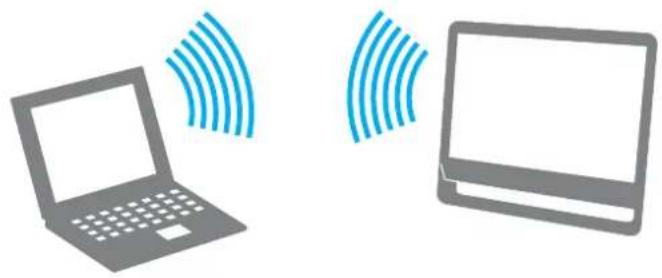
Communicating without an Access Point (Ad-hoc)
An ad-hoc network is a network in which a LAN is created only by the wireless devices themselves, with no other central controller or access point. Each device communicates directly with other devices in the network. You can set up an ad-hoc network easily at home.
natural_image
Illustration of a laptop and a desktop computer with wireless signal waves (no text or symbols)To communicate without an access point (ad-hoc)
You cannot select the 5 GHz bandwidth, which is used for the IEEE 802.11a standard, on ad-hoc networks. The IEEE 802.11n draft standard, using the 2.4 or 5 GHz bandwidth, is not available on ad-hoc networks.
1 Turn on the WIRELESS switch.
2 Click Start, All Programs, and VAIO Control Center.
3 Click Network Connections and VAIO Smart Network.
4 Click Advanced in the right pane.
For information on the VAIO Smart Network software, see the help file included with the software.

5 Click the button next to or above your desired wireless option(s). Make sure the WIRELESS indicator light turns on.
6 Click Start and Control Panel.
7 Click View network status and tasks under Network and Internet.
8 Click Set up a connection or network on the left pane. The Set up a connection or network window appears.
9 Select an option to specify the ad-hoc network settings and click Next.
10 Follow the on-screen instructions.
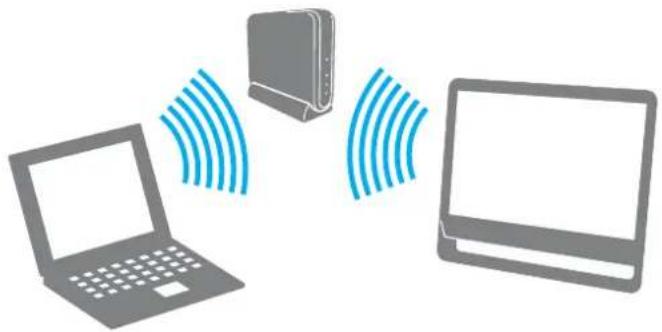
Communicating with an Access Point (Infrastructure)
An infrastructure network is a network that extends an existing wired local network to wireless devices by providing an access point (not supplied). The access point bridges the wireless and wired LAN and acts as a central controller for the wireless LAN network. The access point coordinates transmission and reception from multiple wireless devices within a specific range.
The access point will select which channel to use on an infrastructure network.
! For details on how to select the channel that will be used by the access point, see the manual that came with your access point.
natural_image
Illustration of a laptop, server, and monitor with wireless signal waves (no text or symbols)To connect to a wireless network
1 Make sure an access point is set up. See the manual that came with your access point for more information.
2 Turn on the WIRELESS switch.
3 Click Start, All Programs, and VAIO Control Center.
4 Click Network Connections and VAIO Smart Network.
5 Click Advanced in the right pane.

For information on the VAIO Smart Network software, see the help file included with the software.
6 Click the button next to or above your desired wireless option(s). Make sure the WIRELESS indicator light turns on.
7 Right-click or on the taskbar and select Connect to a network.
8 Select the desired access point and click Connect.

For WPA-PSK or WPA2-PSK authentication, you must enter a passphrase. The passphrase is case sensitive and must be a text string between 8 and 63 characters in length or a hexadecimal string of 64 characters.
Stopping Wireless LAN Communication
To stop wireless LAN communication
Click the button next to or above the WLAN icon in the VAIO Smart Network window.
! Turning off the wireless LAN function while accessing remote documents, files, or resources may result in data loss.
Using the Bluetooth Function
You can establish wireless communication between your computer and other Bluetooth devices such as another computer or a mobile phone. You can transfer data between these devices without cables at a range of up to 10 meters in an open area.
To start Bluetooth communications
1 Turn on the WIRELESS switch.
2 Click Start, All Programs, and VAIO Control Center.
3 Click Network Connections and VAIO Smart Network.
4 Click Advanced in the right pane.

For information on the VAIO Smart Network software, see the help file included with the software.
5 Click the button next to or above the Bluetooth icon in the VAIO Smart Network window. Make sure the WIRELESS indicator light turns on.
Notes on using the Bluetooth function
☐The data transfer rate varies, depending on the following conditions:
☐Obstacles, such as walls, located between devices
☐Distance between devices
Material used in walls
☐Proximity to microwaves and cordless telephones
☐Radio frequency interference and other environmental conditions
□Device configuration
□Type of software application
□Type of operating system
□Use of both wireless LAN and Bluetooth functions at the same time on your computer
☐Size of file being exchanged
Note that large files may occasionally be corrupted during continuous transfer due to limitations of the Bluetooth standard and electromagnetic interference in the environment.
☐ All Bluetooth devices must be certified to make sure that the applicable standard requirements are maintained. Even if standards are met, individual device performance, specifications, and operation procedures can vary. Data exchange may not be possible in all situations.
☐ Video and audio may not be synchronized if you play videos on your computer with audio output from a connected Bluetooth device. This is a frequent occurrence with Bluetooth technology and is not a malfunction.
☐ The 2.4 GHz band, with which Bluetooth devices or wireless LAN devices work, is used by various devices. Bluetooth devices use the technology to minimize the interference from other devices that use the same wave length. Simultaneous use of the Bluetooth function and wireless communication devices, however, may cause radio interference and result in reduced communication speeds and distances than the standard values.

Read the Bluetooth regulations guide before using the Bluetooth function.
☐ The Bluetooth function may not work with other devices, depending on the manufacturer or the software version employed by the manufacturer.
☐ Connecting multiple Bluetooth devices to your computer may cause bandwidth congestion, resulting in poor performance of the devices. This is normal with Bluetooth technology and is not a malfunction.
Bluetooth Security
The Bluetooth wireless technology has an authentication function, which allows you to determine with whom you choose to communicate. With the authentication function, you can prevent any anonymous Bluetooth devices from accessing your computer.
The first time two Bluetooth devices communicate, a common passkey (a password required for authentication) should be determined for both devices to be registered. Once a device is registered, there is no need to re-enter the passkey.

The passkey can be different each time, but must be the same at both ends.
For certain devices, such as a mouse, no passkey can be entered.
Communicating with Another Bluetooth Device
You can connect your computer to a Bluetooth device such as another computer, a mobile phone, a PDA, a headset, a mouse, or a digital camera without the use of any cables.

natural_image
Diagram showing wireless communication between a laptop, mobile phone, remote, and devices (no text or symbols)To communicate with another Bluetooth device
To communicate with another Bluetooth device, you first need to set up the Bluetooth function. For setting up and using the Bluetooth function, search for Bluetooth information using Windows Help and Support. To open Windows Help and Support, click Start and Help and Support.
Stopping Bluetooth Communications
To stop Bluetooth communications
1 Turn off the Bluetooth device that is communicating with your computer.
2 Click the button next to or above the Bluetooth icon in the VAIO Smart Network window.
Using Peripheral Devices
You can add functionality to your VAIO computer by using the various ports on the computer.
□Connecting External Speakers (page 62)
☐ Connecting a Universal Serial Bus (USB) Device (page 64)
□Connecting a Printer (page 66)
□Connecting an i.LINK Device (page 67)
☐Connecting to a Network (LAN) (page 69)
Connecting External Speakers
You can connect external sound output devices (not supplied), such as speakers or headphones, to your computer.
Since your computer is capable of outputting digital signals through the OPTICAL OUT port, you can connect an S/PDIF device such as digital headphones or an AV amplifier to the port and enhance the sound quality of your computer. For more information, see the manual that came with your S/PDIF device.
To hear sound from the S/PDIF device connected to the OPTICAL OUT port, you need to change the sound output device. For the detailed instructions, see How do I change the sound output device? (page 128).
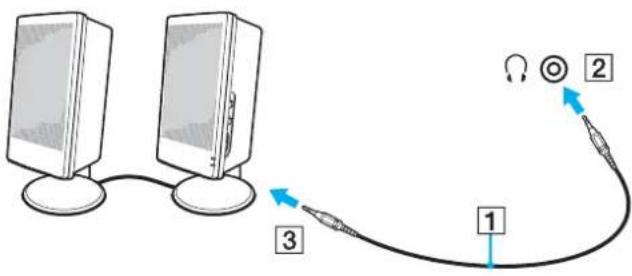
To connect external speakers
1 Plug the speaker cable (1) (not supplied) into the headphones jack (2) ☐.
2 Plug the other end of the speaker cable to the external speaker (3).
3 Turn down the volume of the speakers before you turn them on.
text_image
Diagram showing two computer monitors connected to a cable with labeled points 1 and 2, and a speaker icon indicating connection point 2.
Make sure your speakers are designed for computer use.
!
Do not place floppy disks on the speakers. Their magnetic field may damage the data on the disks.
Connecting a Universal Serial Bus (USB) Device
To protect your computer and/or USB devices from damage, avoid exposing the USB ports to shock or impact when moving the computer with USB devices connected.
Connecting a USB Floppy Disk Drive
You can purchase a USB floppy disk drive and connect it to your computer.
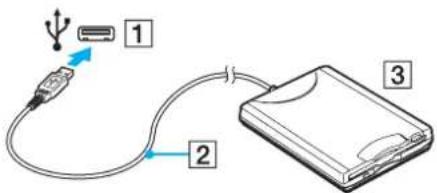
To connect a USB floppy disk drive
1 Choose the USB port (1) you prefer to use.
2 Plug the USB floppy disk drive cable (2) into the USB port.
Your USB floppy disk drive (3) is now ready for use.
text_image
Diagram showing a USB cable connected to a physical drive, labeled with components 1, 2, and 3.When using a USB floppy disk drive, do not apply force to the USB port. This may cause a malfunction.
Disconnecting a USB floppy disk drive
You can disconnect a USB floppy disk drive when your computer is on or off. Disconnecting the drive when the computer is in Sleep mode may cause the computer to malfunction.
To disconnect a USB floppy disk drive

To disconnect a USB floppy disk drive when your computer is off, skip steps 1 to 5.
1 Close all programs accessing the floppy disk drive.
2 Double-click the Safely Remove Hardware icon on the taskbar.
3 Select the floppy disk drive you want to unplug.
4 Click Stop.
5 Follow the on-screen instructions to remove the floppy disk drive.
6 Disconnect the floppy disk drive from the computer.
Connecting a Printer
You can connect a Windows-compatible printer to your computer to print documents.
Connecting a Printer Using the USB Port
You can connect a USB printer compatible with your version of Windows to the computer.
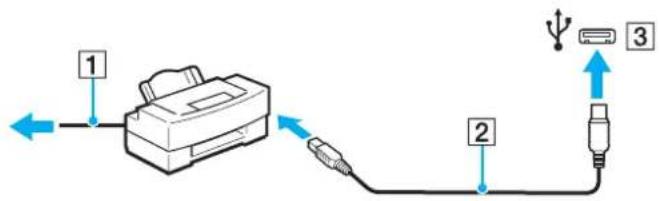
To connect a printer using the USB port
1 Plug the power cord (1) of your printer into an AC outlet.
2 Choose the USB port (3) you prefer to use.
3 Plug one end of a USB printer cable (2) (not supplied) into the USB port and the other end to your printer.
text_image
1 2 3Connecting an i.LINK Device
Notes on connecting i.LINK devices
☐ Your computer is equipped with an i.LINK port, which you can use to connect an i.LINK device, such as a digital video camcorder.
☐ The i.LINK port on your computer does not supply power to external devices that are generally powered through i.LINK ports.
☐ The i.LINK port supports transfer rates up to 400 Mbps. However, the actual transfer rate depends on the transfer rate of the external device.
☐The optional i.LINK cables may not be available in some countries or areas.
☐An i.LINK connection with other compatible devices is not fully guaranteed.
☐ The i.LINK connection may not be available depending on the software applications, operating system, and i.LINK-compatible devices you use. See the manual that came with your software for more information.
☐ Check the working conditions and operating system compatibility of i.LINK-compatible PC peripherals (for example, an HDD or a CD-RW drive) before you connect them to your computer.
Connecting a Digital Video Camcorder
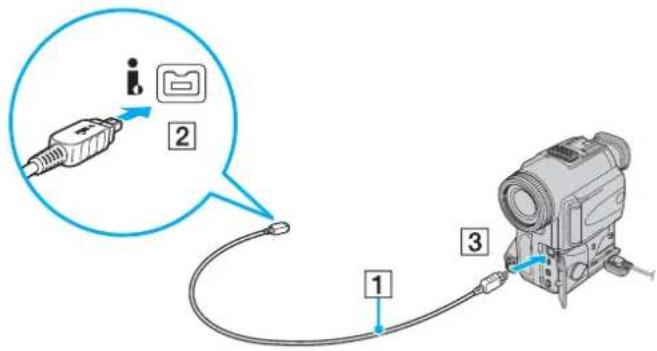
To connect a digital video camcorder
Plug one end of an i.LINK cable (1) (not supplied) into the i.LINK port (2) on the computer and the other end into the DV In/Out port (3) on the digital video camcorder.
text_image
Diagram showing cable connection with labeled components: connector, device, and camera
On Sony digital video cameras, ports labeled DV Out, DV In/Out, or i.LINK are i.LINK-compatible.
The Sony digital video camcorder shown here is an example. Your digital video camcorder may need to be connected differently.
You cannot access the pictures stored on a Memory Stick when using an i.LINK connection.
Connecting to a Network (LAN)
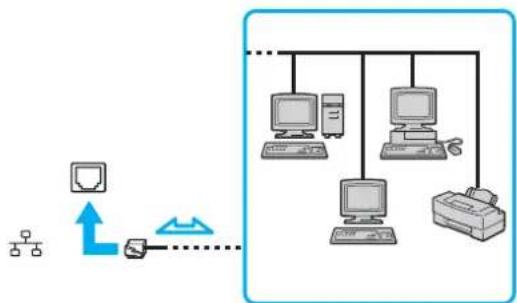
You can connect your computer to 1000BASE-T/100BASE-TX/10BASE-T-type networks with an Ethernet network cable. Connect one end of a network cable (not supplied) to the network (Ethernet) port on the back of the computer and the other end to your network. For detailed settings and devices needed to connect to the network, ask your network administrator.
flowchart
graph TD
    A["Client"] -->|Up/Down| B["Server"]
    B --> C["Desktop Computer"]
    C --> D["Desktop Computer"]
    D --> E["Desktop Printer"]
    E --> F["Desktop Printer"]
    style A fill:#f9f,stroke:#333
    style B fill:#ccf,stroke:#333
    style C fill:#cfc,stroke:#333
    style D fill:#fcc,stroke:#333
    style E fill:#cff,stroke:#333
    style F fill:#ffc,stroke:#333

Your computer can be connected to the network with the default settings.
1
Do not plug a telephone cable into the network (LAN) port on your computer.
If the network (LAN) port is connected to one of the telephone lines mentioned below, high electric current to the port may cause damage, overheating, or fire.
- Home (intercom speakerphone) or business-use telephone lines (multi-line business telephone)
- Public telephone subscriber line
- PBX (private branch exchange)
Do not plug a telephone cable into the network (Ethernet) port.
Customizing Your VAIO Computer
This section briefly describes how to change the main settings of your VAIO computer. Among other things, you will learn how to use and customize the look of your Sony software and utilities.
☐Setting the Password (page 71)
Setting Up Your Computer with VAIO Control Center (page 76)
□Using the Power Saving Mode (page 77)
Setting the Password
Use one of the BIOS functions to set the password.
Once you have set the password, you will be prompted to enter the password after the VAIO logo appears to start your computer. The power-on password allows you to protect your computer from unauthorized access.
Adding the Power-on Password
The power-on password is provided to protect your computer from unauthorized access.
There are two types of the power-on passwords: the machine password and the user password. The machine password is provided for users with administrative rights on the computer to change all the setup options in the BIOS setup screen, as well as to start the computer. The user password is provided for the standard users to allow for changing some of the BIOS setup options, as well as starting the computer. To set the user password, you must first set the machine password.
! Once you have set the power-on password, you cannot start your computer without entering the password. Be sure not to forget the password. Write down your password and keep it safe and private from other people.
If you forget the power-on password and need assistance to reset it, a password reset fee will be charged, and your computer may need to be sent in for service to reset the password.
To add the power-on password (machine password)
1 Turn on the computer.
2 Press the F2 key when the VAIO logo appears.
The BIOS setup screen appears. If not, restart the computer and press the F2 key several times when the VAIO logo appears.
3 Press the ← or → key to select Security to display the Security tab, select Set Machine Password, and then press the Enter key.
4 On the password entry screen, enter the password twice and press the Enter key. The password can be up to 32 alphanumeric characters (including spaces) long.
5 Select Password when Power On under Security and press the Enter key.
6 Change the setting from Disabled to Enabled.
7 Press the or key to select Exit, select Exit Setup, and then press the Enter key. At the confirmation prompt, press the Enter key.
To add the power-on password (user password)
! Make sure you set the machine password before setting the user password.
1 Turn on the computer.
2 Press the F2 key when the VAIO logo appears.
The BIOS setup screen appears. If not, restart the computer and press the F2 key several times when the VAIO logo appears.
3 Enter the machine password and press the Enter key.
4 Press the ← or → key to select Security to display the Security tab, select Set User Password, and then press the Enter key.
5 On the password entry screen, enter the password twice and press the Enter key. The password can be up to 32 alphanumeric characters (including spaces) long.
6 Press the or key to select Exit, select Exit Setup, and then press the Enter key. At the confirmation prompt, press the Enter key.
Changing/Removing the Power-on Password
To change or remove the power-on password (machine password)
1 Turn on the computer.
2 Press the F2 key when the VAIO logo appears.
The BIOS setup screen appears. If not, restart the computer and press the F2 key several times when the VAIO logo appears.
3 Enter the machine password and press the Enter key.
4 Press the ← or → key to select Security to display the Security tab, select Set Machine Password, and then press the Enter key.
5 On the password entry screen, enter the current password once and a new password twice, and then press the Enter key. To remove the password, leave the Enter New Password and Confirm New Password fields blank and press the Enter key.
6 Press the or key to select Exit, select Exit Setup, and then press the Enter key. At the confirmation prompt, press the Enter key.
To change or remove the power-on password (user password)
1 Turn on the computer.
2 Press the F2 key when the VAIO logo appears.
The BIOS setup screen appears. If not, restart the computer and press the F2 key several times when the VAIO logo appears.
3 Enter the user password and press the Enter key.
4 Press the or key to select Security to display the Security tab, select Set User Password, and then press the Enter key.
5 On the password entry screen, enter the current password once and a new password twice, and then press the Enter key. To remove the password, leave the Enter New Password and Confirm New Password fields blank and press the Enter key.
6 Press the or key to select Exit, select Exit Setup, and then press the Enter key. At the confirmation prompt, press the Enter key.
Setting Up Your Computer with VAIO Control Center
The VAIO Control Center utility allows you to access system information and to specify preferences for system behavior.
To use VAIO Control Center
1 Click Start, All Programs, and VAIO Control Center.
2 Select the desired control item and change the settings.
3 Once finished, click OK.
The setting of the desired item has been changed.

For more information about each option, see the help file included with the VAIO Control Center.
Some of the control items will not be visible if you open the VAIO Control Center as a standard user.
Using the Power Saving Mode
In addition to the normal operating mode, which allows you to turn off specific devices, your computer has a distinct power saving mode called Sleep mode.
Using Normal Mode
This is the normal state of the computer when it is in use. The green power indicator light is lit in this mode. To save power while not working, you can turn off a specific device such as the LCD screen or the hard disk drive.
Using Sleep Mode
Sleep mode turns off the LCD screen and places the hard disk drive and the CPU into a low power consumption mode. The orange power indicator light illuminates in this mode.
! Turn off your computer if you do not intend to use it for a long period of time.
To activate Sleep mode
Click Start, the arrow next to the Lock button, and Sleep.
Alternatively, you can press the sleep button on the keyboard to place your computer in Sleep mode. When your computer is in Sleep mode, you cannot insert a disc.
To return to Normal mode
□Press any key on the keyboard.
☐Press the power button on your computer.
! If you press and hold the power button for more than four seconds, your computer will turn off automatically. You will lose all unsaved data.
If the computer is not used for a certain period of time, it will enter Sleep mode. To modify this, you can change the Sleep mode settings.
To change the Sleep mode settings
1 Click Start, Control Panel, Hardware and Sound, and Power Options.
2 Click Change plan settings under the current power plan.
3 Change the time to place the computer into Sleep mode and click Save Changes.
Upgrading Your VAIO Computer
Your VAIO computer and memory modules use high precision components and electronic connectors technology. To avoid invalidation of the warranty during your product warranty period, we recommend that:
☐You should contact your dealer to install a new memory module.
☐ You should not install it yourself, if you are not familiar with upgrading memory on a computer.
☐You should not touch the connectors or open the memory module compartment cover.
For the type of module and the amount of memory installed on your model, see the online specifications.
Contact VAIO-Link if you need assistance.
Adding and Removing Memory
If you want to expand the functionality of your computer, you can increase the amount of memory by installing optional memory modules. Before you upgrade your computer's memory, read the notes and procedures in the following pages.
Notes on adding/removing memory modules
☐ Be careful when changing memory. Improper installation of memory modules may cause damage to your system. This damage may void your manufacturer's warranty.
☐ Only use memory modules that are compatible with your computer. If a memory module is not detected by the computer or the Windows operating system becomes unstable, contact the sales dealer or the manufacturer of your memory module.
☐ Electrostatic discharge (ESD) can damage electronic components. Before touching a memory module, ensure the following:
☐ The procedures described in this document assume user familiarity with the general terminology associated with personal computers and with the safety practice and regulatory compliance requirements for using and modifying electronic equipment.
☐ Turn off your computer and disconnect it from the AC adapter and from any telecommunication links, networks, or modems before you remove any cover or panel from the computer. Failure to do so may result in personal injury or equipment damage.
☐ ESD can damage memory modules and other components. Install the memory module only at an ESD workstation. If such a station is not available, do not work in a carpeted area, and do not handle materials that produce or hold static electricity (cellophane wrappers, for example). Ground yourself by maintaining contact with an unpainted metal portion of the chassis while performing the procedure.
☐ Do not open the memory module package before you are ready to change the module. The package protects the module from ESD.
VAIO
81
Upgrading Your VAIO Computer
☐ Use the special bag supplied with the memory module or wrap the module in aluminum foil to protect it from ESD.
☐ Introducing any liquids, foreign substances, or objects into the memory module slots or other internal components of your computer will result in damage to the computer and any repair costs will not be covered by the warranty.
☐Do not place the memory module in a location subject to:
□Heat sources such as radiators or air ducts
□Direct sunlight
□Excessive dust
□Mechanical vibration or shock
□Strong magnets or speakers that are not magnetically shielded
☐Ambient temperature of more than 35^ C or less than 5^ C
□High humidity
☐ Handle the memory module with care. To avoid injuries to your hands and fingers, do not touch the edges of the components and circuit boards inside your computer.
Removing and Installing a Memory Module
To change or add a memory module
1 Shut down the computer, turn off all peripheral devices, and disconnect the AC adapter and the peripheral devices from the power source.
2 Gently face down your computer on a flat surface and wait about an hour until the computer cools down.
When facing down your computer, be sure to place it on a soft cloth to avoid damage to the LCD screen.
3 Unscrew the screw (1) and remove the memory module compartment cover (2).

text_image
VAIO 2 14 Touch a metal object to discharge static electricity.
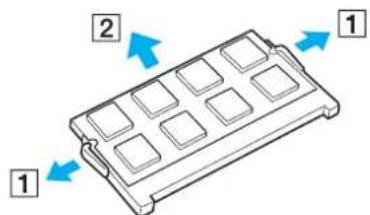
5 Remove the currently installed memory module as follows:
☐Pull the latches in the direction of the arrows (1).
The memory module is released.
☐ Make sure that the memory module tilts up and then pull it out in the direction of the arrow (2).
text_image
Diagram of a 3D tray with labeled directional arrows indicating movement or flow, numbered 1 and 2.6 Remove the new memory module from its packaging.
7 Slide the memory module into the memory module slot and push it in until it clicks into place.

text_image
Diagram illustrating the process of device status change, showing a printer with V70 and a grid device being transferred.! Do not touch any other components on the motherboard.
If you want to install only one memory module, be sure to use the lower slot.
Be sure to insert the connector edge of the memory module into the slot while aligning the notch on the module with the small projection in the open slot. Do not force the memory module into the slot in a wrong orientation, as it may cause damage to the slot and the module.
8 Replace the memory module compartment cover and tighten the screw.
9 Connect the AC adapter and the peripheral devices to the computer, and then plug them to the power source.
10 Turn on all peripheral devices and then the computer.
Viewing the Amount of Memory
To view the amount of memory
1 Turn on the computer.
2 Click Start, All Programs, and VAIO Control Center.
3 Click System Information and System Information.
You can view the amount of system memory in the right pane. If the additional memory does not appear, repeat the installation procedure and restart the computer.
Precautions
This section describes safety guidelines and precautions to help you protect your VAIO computer from potential damage.
□Handling the LCD Screen (page 87)
□Using the Power Source (page 88)
□Handling Your Computer (page 89)
□Handling the Built-in MOTION EYE Camera (page 91)
□Handling Floppy Disks (page 92)
□Handling Discs (page 93)
□Using Headphones (page 94)
□Handling the Memory Stick (page 95)
□Handling the Hard Disk (page 96)
□Updating Your Computer (page 97)
Handling the LCD Screen
☐ Do not leave the LCD screen facing the sun. This could damage the LCD screen. Be careful when using your computer near a window.
☐ Do not scratch the surface of the LCD screen or exert pressure on it. This could cause a malfunction.
☐ Using your computer in low temperature conditions may produce a residual image on the LCD screen. This is not a malfunction. When the computer returns to normal temperature, the screen returns to normal.
☐ A residual image may appear on the LCD screen if the same image is displayed for a long period of time. The residual image disappears after a while. You can use a screen saver to prevent residual images.
☐ The LCD screen becomes warm during operation. This is normal and does not indicate a malfunction.
☐ The LCD screen is manufactured using high-precision technology. You may, however, see tiny black points and/or bright points (red, blue, or green) that continuously appear on the LCD screen. This is a normal result of the manufacturing process and does not indicate a malfunction.
☐ Avoid rubbing the LCD screen. This could damage the screen. Use a soft, dry cloth to wipe the surface of the LCD screen.
☐ Do not change the LCD screen orientation setting in the Tablet PC Settings window even when there are change options available for selection, as this may make your computer unstable. Sony assumes no liability for any malfunctions arising from changes to the settings.
Using the Power Source
☐See the online specifications to check the power operation of your model.
☐ Do not share the AC outlet with other power-consuming equipment, such as a photocopier or a shredder.
☐ You can purchase a power strip with a surge protector. This device helps prevent damage to your computer caused by sudden power surges, in an electrical storm, for example.
☐Do not place heavy objects on the power cord.
☐To disconnect the cord, pull it out by holding the plug. Never pull the cord itself.
☐ Unplug your computer from the AC outlet if you are not planning to use the computer for a long period of time.
☐Make sure that the AC outlet is easily accessible.
☐ Use the AC adapter supplied with your computer or genuine Sony products. Do not use any other AC adapter as it may cause a malfunction.
Handling Your Computer
☐ Clean the cabinet with a soft cloth, which is dry or lightly moistened with a mild detergent solution. Do not use any type of abrasive pad, scouring powder, or solvent such as alcohol or benzine, as these may damage the finish of your computer.
☐ If you drop a solid object or any liquid onto your computer, shut down the computer and then unplug it. You may want to have the computer checked by qualified personnel before operating it again.
☐Do not drop your computer.
☐Do not place your computer in a location subject to:
□Heat sources, such as radiators or air ducts
□Direct sunlight
□Excessive dust
□Moisture or rain
□Mechanical vibration or shock
□Strong magnets or speakers that are not magnetically shielded
☐Ambient temperature of more than 35^ C or less than 5^ C
□High humidity
☐ Do not place electronic equipment near your computer. The electromagnetic field of the equipment may cause the computer to malfunction.
□Use your computer on a solid, stable surface.
☐ Do not place your computer near materials such as curtains or draperies that may block its air vents.
☐ Your computer uses high-frequency radio signals and may cause interference to radio or TV reception. If this occurs, relocate the computer a suitable distance away from the set.
VAIO
90
Precautions
☐ Use only specified peripheral equipment and interface cables. Otherwise, problems may occur.
☐Do not use cut or damaged connection cables.
☐ If your computer is brought directly from a cold location to a warm one, moisture may condense inside the computer. In this case, allow at least one hour before turning on the computer. If any problems occur, unplug the computer and contact VAIO-Link.
☐Make sure you disconnect the AC adapter before cleaning your computer.
☐To avoid losing data when your computer is damaged, back up your data regularly.
☐ Do not grasp the prop-up stand or the bottom chassis frame to lift your computer as the stand or the frame may break and cause the main unit to fall, resulting in damage to the computer or personal injuries.
☐ To lift or move your computer, grasp the main unit on the sides with both hands from behind the computer to avoid any damage to the LCD screen. There is a risk of scratching the LCD screen, for example with your waist belt buckle, if you hold your computer from its front.
Handling the Built-in MOTION EYE Camera
☐ Do not touch the lens protection cover of the built-in MOTION EYE camera, as it may cause scratches on the cover and such scratches will appear on the captured images.
☐ Do not let the direct sunlight get into the lens of the built-in MOTION EYE camera regardless of your computer's power state, as it may cause the camera to malfunction.
☐ The built-in MOTION EYE camera is disabled while videos or still images are imported from an i.LINK-compatible device connected to the i.LINK port.
☐ Clean the lens protection cover of the built-in MOTION EYE camera with a blower brush or a soft brush. If the cover is extremely dirty, wipe it off with a soft dry cloth. Do not rub the cover, as it is sensitive to pressure.
Handling Floppy Disks
☐ Do not open the shutter manually and touch the internal components of the floppy disk.
□Keep floppy disks away from magnets.
□Keep floppy disks away from direct sunlight and other sources of heat.
☐ Keep floppy disks away from any liquid. Do not let them get wet. When you are not using your floppy disk, always remove it from the floppy disk drive and put it in a storage case.
☐ If the floppy disk comes with a label, make sure that the label is properly affixed. If the edge of the label is curled up, the label may stick to the inside of the floppy disk drive and cause a malfunction or damage your floppy disk.
Handling Discs
☐Do not touch the surface of the disc.
☐ Fingerprints and dust on the surface of a disc may cause read errors. Always hold the disc by its edges and central hole, as shown below:

☐ Proper care of the disc is essential to its continuous reliability. Do not use solvents (such as benzine, thinner, alcohol, commercially available cleaners, or anti-static spray) which may cause damage to the disc.
☐ For normal cleaning, hold the disc by its edges and use a soft cloth to wipe the surface from the center out.
☐ If the disc is badly soiled, moisten a soft cloth with water, wring it out well, and use it to wipe the surface of the disc from the center out. Wipe off any remaining moisture with a dry soft cloth.
□ Never affix an adhesive label to a disc. This will affect the use of the disc and may result in an irreparable problem.
VAIO
94
Precautions
Using Headphones
Preventing hearing damage – Avoid using headphones at high volume. Hearing experts advise against continuous, loud and extended play. If you experience a ringing in your ears, reduce the volume or discontinue use.
Handling the Memory Stick
☐Do not touch the Memory Stick connector with your finger or metallic objects.
☐Use only the adhesive label supplied with the Memory Stick as a label.
☐Do not bend, drop, or expose the Memory Stick.
☐Do not disassemble or modify the Memory Stick.
☐Do not let the Memory Stick get wet.
☐Do not use or store the Memory Stick in a location subject to:
□Static electricity
Electrical noise
☐Extremely high temperatures, such as in a car parked in the sun
□Direct sunlight
□High humidity
□Corrosive substances
☐Use the storage case supplied with the Memory Stick.
□Be sure to make a backup copy of your valuable data.
☐ Keep the Memory Stick and the Memory Stick adaptors out of reach of children. There is a risk of swallowing them.
☐ When using the Memory Stick Duo, do not use a fine-tipped pen to write on the label adhered to the Memory Stick Duo. Exerting pressure on the media may damage internal components.
Handling the Hard Disk
The hard disk drive has a high storage density and reads or writes data in a short time. However, it can be easily damaged by mechanical vibration, shock, or dust.
Although the hard disk drive has the internal safety device to prevent losing data due to mechanical vibration, shock or dust, you should be careful when handling your computer.
To avoid damaging your hard disk drive
☐Do not subject your computer to sudden movements.
□Keep your computer away from magnets.
☐ Do not place your computer in a location subject to mechanical vibration or in an unstable position.
☐Do not move your computer while the power is on.
☐ Do not turn off the power or restart your computer while reading or writing data to the hard disk drive.
☐Do not use your computer in a place subject to extreme changes in temperature.

If the hard disk drive is damaged, the data cannot be restored.
Updating Your Computer
Be sure to install the latest updates on your computer with the following software applications so that the computer can run more efficiently.
□Windows Update
Click Start, All Programs, and Windows Update and then follow the on-screen instructions.
□VAIO Update 4
Click Start, All Programs, VAIO Update 4, and VAIO Update Options and then follow the on-screen instructions.
! Your computer must be connected to the Internet before you can receive updates.
Troubleshooting
This section describes how to solve common problems you might encounter when using your VAIO computer. Many problems have simple solutions. Try these suggestions before contacting VAIO-Link.
□Computer (page 99)
□System Security (page 104)
□Built-in MOTION EYE Camera (page 105)
□Networking (page 108)
□Bluetooth Technology (page 111)
☐Optical Discs (page 115)
□Display (page 119)
□Printing (page 120)
□Microphone (page 121)
□Mouse (page 122)
□Speakers (page 123)
☐Keyboard (page 125)
☐Floppy Disks (page 126)
□Audio/Video (page 127)
□Memory Stick (page 130)
☐Peripherals (page 131)
Computer
What should I do if my computer does not start?
☐ Make sure your computer is securely plugged into a power source and turned on and the power indicator light shows the power is on.
☐Make sure the floppy disk drive (if applicable) is empty.
☐ If your computer is plugged into a power strip or an uninterruptible power supply (UPS), make sure the power strip or UPS is plugged into a power source and turned on.
☐Make sure the brightness and contrast controls are adjusted correctly.
☐ Unplug the AC adapter. Wait three to five minutes. Plug the AC adapter again and press the power button to turn on your computer.
☐ Condensation may cause your computer to malfunction. If this occurs, do not use the computer for at least one hour.
☐Remove any extra memory modules you may have installed since purchase.
☐ Check that you are using the supplied Sony AC adapter. For your safety, use only the genuine Sony AC adapter, which is supplied by Sony for your VAIO computer.
☐ Make sure your computer is not in Sleep mode by pressing the power button on the computer or the sleep button on the keyboard. If you press and hold the power button for more than four seconds, your computer will turn off automatically.
What should I do if the green power indicator light turns on but my screen remains blank?
☐ Press the Alt+F4 keys several times to close the application window. An application error may have been occurred.
☐ Press the Ctrl+Alt+Delete keys and click the arrow next to the Shut down button and Restart.
☐ Press and hold the power button for more than four seconds to shut down your computer. Unplug the AC adapter and leave the computer for about five minutes. Then, plug the AC adapter and turn on the computer again.
! Turning off your computer with the power button or the Ctrl+Alt+Delete keys may cause loss of unsaved data.
What should I do if my computer or software stops responding?
☐ If your computer stops responding while a software application is running, press the Alt+F4 keys to close the application window.
☐ If the Alt+F4 keys do not work, click Start, the arrow next to the Lock button, and Shut Down to turn off your computer.
☐ If your computer does not turn off, press the Ctrl+Alt+Delete keys and click the arrow next to the Shut down button and Shut Down.
If the Windows Security window appears, click Shut Down.
! Turning off your computer with the Ctrl+Alt+Delete keys or the power button may cause loss of unsaved data.
☐ If your computer still does not turn off, press and hold the power button until the computer turns off.
□Remove the AC adapter.
□Try reinstalling the software.
☐Contact the software publisher or designated provider for technical support.
Why doesn't my computer enter Sleep mode?
Your computer may become unstable if the operating mode is changed before the computer completely enters Sleep mode.
To restore your computer to normal mode
1 Close all open programs.
2 Click Start, the arrow next to the Lock button, and Restart.
3 If your computer does not restart, press the Ctrl+Alt+Delete keys and click the arrow next to the Shut down button and Restart.
4 If this procedure does not work, press and hold the power button until the computer turns off.
! Turning off your computer with the power button may cause loss of unsaved data.
What should I do if Windows does not start and a message appears, when I start my computer?
If you enter a wrong power-on password three times consecutively, the Enter Onetime Password message appears and Windows will not start. Press and hold the power button for more than four seconds to check that the power indicator light turns off. Wait for 10 or 15 seconds, then restart your computer and enter the correct password. When entering the password, check that the Num lock and Caps lock indicators are unlit. If both or either of the lights is lit, press the Num Lk (or Num Lock) key or the Caps Lock key to turn off the indicator before entering the password.
What should I do if my game software does not work or it keeps crashing?
☐Check the web site of the game if there are any patches or updates to download.
□Make sure you have installed the latest video driver.
☐ On some VAIO models, the graphics memory is shared with the system. The optimal graphic performance in this case is not guaranteed.
What should I do if I cannot remember the power-on password?
If you have forgotten the power-on password, contact VAIO-Link to reset it. A reset fee will be charged.
How can I change the boot device order?
You can use one of the BIOS functions to change the boot device order. Follow these steps:
1 Turn on your computer.
2 Press the F2 key when the VAIO logo appears.
The BIOS setup screen appears. If not, restart the computer and press the F2 key several times when the VAIO logo appears.
3 Press the ← or → key to select Boot.
4 Press the ↑ or ↓ key to select your desired priority under Boot Priority and press the Enter key.
5 Press the ↑ or ↓ key to select the device to which you want to assign the priority and press the Enter key.
6 Press the or key to select Exit, select Exit Setup, and then press the Enter key. At the confirmation prompt, press the Enter key.
Why doesn't my screen turn off after the automatic turn-off time has passed?
The VAIO Original Screen Saver disables the timer setting, which you can select using the Windows power options, for your screen to turn off.
Select a screen saver other than the VAIO Original Screen Saver.
What should I do if I cannot boot my computer from the USB floppy disk drive connected to the computer?
To boot your computer from the USB floppy disk drive, you need to change the boot device.
Turn on your computer and press the F11 key when the VAIO logo appears.
How do I check the volume of the recovery partition?
Your built-in storage device ^* contains the recovery partition where data for the system recovery is stored. To check the volume of the recovery partition, follow these steps:
* See the online specifications to find out about your storage device configuration.
1 Click Start, right-click Computer, and select Manage.
2 Click Disk Management under Storage on the left pane.
The volume of the recovery partition and the total volume of the C drive are displayed in the Disk 0 row on the center pane.
System Security
How can I protect my computer against security threats, such as viruses?
The Microsoft Windows operating system is preinstalled on your computer. The best way to protect your computer against security threats, such as viruses, is to download and install the latest Windows updates regularly.
You can get important Windows updates by doing the following:
! Your computer must be connected to the Internet before you can receive updates.
1 Connect to the Internet.
2 Double-click the Windows Security Alerts icon on the taskbar.
3 Follow the on-screen instructions to set up automatic or scheduled updates.
How do I keep my antivirus software updated?
You can keep the McAfee Internet Security Suite software program current with the latest updates from McAfee, Inc.
To download and install the latest security updates, follow these steps:
1 Click Start, All Programs, McAfee, and McAfee SecurityCenter.
2 Click the button located at the upper left corner of the window to update the software.
3 Follow the on-screen instructions to download updates.
See the help file included with your software program for more information.
Built-in MOTION EYE Camera
Why does the viewer window show no images or poor-quality images?
☐ The built-in MOTION EYE camera cannot be shared by more than one software application. If another software application is using the camera, exit the application before using the built-in MOTION EYE camera.
☐ The video memory of your computer may be insufficient for displaying images from the built-in MOTION EYE camera. Lowering the resolution or reducing the colors of the LCD screen might help.
☐ The viewer window may show some noise, for example horizontal streaks, if you view a rapid-moving object. This is normal and does not indicate a malfunction.
□If the problem persists, restart your computer.
Why are captured images poor in quality?
☐The images captured under the fluorescent light may show reflections of light.
☐A dark portion in captured images may appear as a noise.
☐ If the lens protection cover is dirty, you cannot take a clear shot. Clean the cover. See Handling the Built-in MOTION EYE Camera (page 91).
Why do captured images contain dropped frames and audio interruptions?
☐ The effect settings on your software application may cause dropped frames. See the help file included with your software application for more information.
☐ There may be more software applications running than your computer can handle. Exit the applications that you are not currently using.
☐ The power management function of your computer may be active. Check the CPU performance.
Why do the images captured by the built-in MOTION EYE camera flicker?
This problem occurs when you use the camera under fluorescent lights due to the mismatch between lighting output frequency and shutter speed.
To reduce flicker noise, change the direction of the camera or the brightness of camera images. In some software applications, you can set an appropriate value to one of the camera properties (e.g. light source, flicker, etc.) to eliminate flicker noise.
Why is the video input from the built-in MOTION EYE camera suspended for a few seconds?
The video input may be suspended for a few seconds if:
☐ a shortcut key with the Fn key is used.
□the CPU load increases.
This is normal and does not indicate a malfunction.
Why can't I use the built-in MOTION EYE camera?
☐ The built-in MOTION EYE camera cannot be shared by more than one software application. If another software application is using the camera, exit the application before using the built-in MOTION EYE camera.
☐ If the problem persists, you must reinstall the driver software for the camera. Follow these steps:
1 Click Start, Control Panel, Hardware and Sound, and Device Manager.
2 Double-click Imaging devices.
3 Right-click the device name for your camera and click Update Driver Software.
What should I do if my computer becomes unstable when it enters a power saving mode while the built-in MOTION EYE camera is in use?
☐ Do not place your computer into Sleep mode while you are using the built-in MOTION EYE camera.
☐ If your computer automatically enters Sleep mode, change the corresponding power saving mode setting. To change the setting, see Using the Power Saving Mode (page 77).
Networking
What should I do if my computer cannot connect to a wireless LAN access point?
☐ Connection capability is affected by distance and obstructions. You need to place your computer away from obstructions or move any access point you may be using closer to the computer.
☐ Make sure the WIRELESS switch is on and the WIRELESS indicator light is lit on your computer.
☐Make sure power to the access point is on.
☐Follow these steps to check the settings:
1 Click Start and Control Panel.
2 Click View network status and tasks under Network and Internet.
3 Click Connect to a network to confirm that your access point is selected.
☐Make sure the encryption key is correct.
What should I do if I cannot access the Internet?
☐ Check the access point settings. See the manual that came with your access point for more information.
□Make sure your computer and the access point are connected to one another.
Place your computer away from obstacles or move any access point you may be using closer to the computer.
☐Make sure your computer is properly configured for Internet access.
Why is the data transfer speed slow?
☐ The wireless LAN data transfer speed is affected by distance and obstructions between devices and access points. Other factors include device configurations, radio conditions, and software compatibility. To maximize the data transfer speed, place your computer away from obstacles or move any access point you may be using closer to the computer.
☐ If you are using a wireless LAN access point, the device may be temporarily overloaded depending on how many other devices are communicating via the access point.
☐ If your access point interferes with other access points, change the access point channel. See the manual that came with your access point for more information.
How do I avoid data transfer interruptions?
☐ When your computer is connected to an access point, data transfer interruptions may occur if a large file is exchanged or the computer is placed in close proximity to microwaves and cordless telephones.
□Move your computer closer to the access point.
□Make sure the access point connection is intact.
☐ Change the access point channel. See the manual that came with your access point for more information.
What are channels?
☐ Wireless LAN communication uses divided frequency bands known as channels. Third-party wireless LAN access point channels may be preset to different channels from Sony devices.
☐ If you are using a wireless LAN access point, see connectivity information contained in the manual that came with your access point.
Why does the network connection stop when I change the encryption key?
Two computers with the wireless LAN function may lose a peer-to-peer network connection if the encryption key is changed. You can either change the encryption key back to the original profile or re-enter the key on both computers so the key matches.
How do I display the VAIO Smart Network window?
To display the VAIO Smart Network window on the desktop, follow these steps:
1 Click Start, All Programs, and VAIO Control Center.
2 Click Network Connections and VAIO Smart Network.
3 Click Advanced in the right pane.

For information on the VAIO Smart Network software, see the help file included with the software.
Bluetooth Technology
What should I do if other Bluetooth devices cannot find my computer?
☐Make sure both devices have the Bluetooth function enabled.
☐ If the WIRELESS indicator light is unlit, turn on the WIRELESS switch.
☐ Your computer and the device may be too far apart. Wireless Bluetooth technology works best when the devices are within 10 meters of each other.
Why can't my computer find other Bluetooth devices?
If the connected device is also connected to other devices, it may not appear in the Bluetooth Devices window or you may not be able to communicate with the device.
What should I do if I cannot find the Bluetooth device I want to communicate with?
☐ Check that the Bluetooth function of the device you want to communicate with is on. See the other device's manual for more information.
☐ If the device you want to communicate with is already communicating with another Bluetooth device, it may not be found or it may not be able to communicate with your computer.
☐ To allow other Bluetooth devices to communicate with your computer, follow these steps:
1 Click Start, Control Panel, Hardware and Sound, Bluetooth Devices, and Bluetooth Settings.
2 Click the Options tab and select the Allow Bluetooth devices to find this computer check box.
What should I do if other Bluetooth devices cannot connect to my computer?
□Make sure the other devices are authenticated.
☐ To allow other Bluetooth devices to communicate with your computer, follow these steps:
1 Click Start, Control Panel, Hardware and Sound, Bluetooth Devices, and Bluetooth Settings.
2 Click the Options tab and select the Allow Bluetooth devices to find this computer check box.
☐ The data transfer distance can be shorter than 10 meters depending on existing obstacles between the two devices, on radio wave quality, and on the operating system or the software in use. Move your computer and Bluetooth devices closer to each other.
☐ If the device you want to communicate with is already communicating with another Bluetooth device, it may not be found or it may not be able to communicate with your computer.
☐ Check that the Bluetooth function of the device you want to communicate with is on. See the other device's manual for more information.
Why is my Bluetooth connection slow?
☐ The data transfer speed depends on the obstructions and/or the distance between the two devices, on the radio wave quality, and on the operating system or the software in use. Move Bluetooth devices closer to your computer.
☐ The 2.4 GHz radio frequency used by Bluetooth and wireless LAN devices is also used by other devices. Bluetooth devices incorporate technology that minimizes interference from other devices using the same wavelength, however, communication speed and connection range may be reduced. Interference from other devices may also stop communications altogether.
☐ Connection capability is affected by distance and obstructions. You need to place your computer away from obstacles or move the device to which it is connected closer to the computer.
☐ Identify and remove obstacles between your computer and the device to which it is connected.
Note that large files may occasionally be corrupted during continuous transfer due to limitations of the Bluetooth standard and electromagnetic interference in the environment.
What should I do if my computer becomes unstable when I use a Bluetooth audio device?
Your computer may become unstable if you change a sound output device to a Bluetooth audio device while audio or video playback software is running.
When you listen to playback audio from your Bluetooth audio device, connect the Bluetooth audio device to the computer first and then launch your audio or video playback software.
See the help file for detailed information on connecting the Bluetooth audio device.
Why can't I use the services supported by the connected Bluetooth device?
Connection is only possible for services also supported by the computer with the Bluetooth function. For more details, search for Bluetooth information using Windows Help and Support. To open Windows Help and Support, click Start and Help and Support.
Why can't I use the Bluetooth function when I log onto my computer as a user with a standard user account?
The Bluetooth function may not be available to a user with a standard user account on your computer. Log onto the computer as a user with administrative rights.
Why can't I connect to a Bluetooth device through a Personal Area Network (PAN)?
If the device to which you want to connect does not support Bluetooth communication in Personal Area Network User (PANU) mode, you cannot connect to the device through a PAN.
Why can't I use the Bluetooth devices when I switch users?
If you switch users without logging off your system, the Bluetooth devices will not work. Be sure to log off before switching users. To log off your system, click Start, the arrow next to the Lock button, and Log Off.
Why can't I exchange business card data with a mobile phone?
The business card exchange function is not supported.
Optical Discs
Why does my computer freeze when I try to read a disc?
The disc that your computer is trying to read may be dirty or damaged. Follow these steps:
1 Press the Ctrl+Alt+Delete keys and click the arrow next to the Shut down button and Restart to restart the computer.
2 Remove the disc from the optical disc drive.
3 Check the disc for dirt or damage. If you need to clean the disc, see Handling Discs (page 93) for instructions.
What should I do if the drive tray does not open?
□Make sure your computer is on.
☐ Press the drive eject button or the Fn+E keys.
☐ If the drive eject button or the Fn+E keys do not work, click Start and Computer, right-click the optical disc drive icon, and select Eject.
☐ If none of the above options work, insert a thin, straight object (such as a paper clip) in the manual eject hole on the optical disc drive.
□Try restarting your computer.
What should I do if I cannot play a disc properly on my computer?
☐ Make sure the disc is inserted into the optical disc drive with the label side facing toward you.
☐ Make sure the necessary program(s) is installed according to the manufacturer's instructions.
☐ If a disc is dirty or damaged, your computer will stop responding. Follow these steps:
1 Press the Ctrl+Alt+Delete keys and click the arrow next to the Shut down button and Restart to restart the computer.
2 Remove the disc from the optical disc drive.
3 Check the disc for dirt or damage. If you need to clean the disc, see Handling Discs (page 93) for instructions.
☐If you are playing a disc and cannot hear sound, do any of the following:
☐ The volume may have been turned off by the muting button on the keyboard. Press the button once again.
☐ The volume may have been minimized by the volume down button on the keyboard. Press the volume up button several times or keep pressing the button to turn up the volume loud enough.
☐ Right-click the volume icon on the taskbar and click Open Volume Mixer to check the settings.
☐Check the volume setting in the audio mixer.
☐ If you are using external speakers, check the volume settings on the speakers and the connections between the speakers and your computer.
☐Make sure the correct driver software is installed. Follow these steps:
1 Click Start and Control Panel.
2 Click System and Maintenance.
3 Click System.
4 Click Device Manager on the left pane.
The Device Manager window appears with a listing of your computer's hardware devices.
If an "X" or an exclamation point appears on the listed device, you may need to enable the device or reinstall the drivers.
5 Double-click the optical disc drive device to open a list of the optical disc drives of your computer.
6 Double-click the desired drive.
You can confirm the driver software by selecting the Driver tab, and clicking Driver Details.
7 Click OK to close the window.
☐ Make sure an adhesive label is not affixed to a disc. Adhesive labels can come off while the disc is in the optical disc drive and damage the drive or cause it to malfunction.
☐ If a region code warning appears, the disc may be incompatible with the optical disc drive. Check the package to make sure the region code is compatible with the optical disc drive.
☐ If you notice condensation on your computer, do not use the computer for at least one hour. Condensation can cause the computer to malfunction.
What should I do if I cannot write data to CD media?
☐ Make sure you neither launch any software application nor allow any to launch automatically, not even a screen saver.
□Stop using the keyboard.
☐ If you are using a CD-R/RW disc with an adhesive label affixed, replace it with one with no affixed adhesive label. Using a disc with an affixed adhesive label could cause a write error or other damage.
What should I do if I cannot write data to DVD media?
□Make sure you are using the correct DVD recordable media.
☐ Check which DVD recordable format is compatible with your optical disc drive. Note the possibility that some brands of DVD recordable media do not work.
Display
Why did my screen go blank?
☐ Your computer screen may go blank if the computer enters Sleep mode. If the computer is in Sleep mode, press any key to bring the computer back into Normal mode. See Using the Power Saving Mode (page 77) for more information.
☐ Make sure your computer is securely plugged into a power source and turned on and the power indicator light is lit.
What should I do if my screen is dark?
Press the Fn+F6 keys to brighten your computer screen.
How do I run Windows Aero?
This Q & A entry applies to selected models only.
To run Windows Aero, follow these steps:
1 Click Start and Control Panel.
2 Click Customize colors under Appearance and Personalization.
3 Click Open classic appearance properties for more color options.
4 Select Windows Aero from the Color scheme options on the Appearance tab.
5 Click OK.
For information about the Windows Aero features, such as Windows Flip 3D, see Windows Help and Support.
Printing
What should I do if I cannot print a document?
☐ Make sure your printer is on, and the printer cable is securely connected to the ports on the printer and your computer.
☐ Make sure your printer is compatible with the Windows operating system installed on your computer.
☐ You may need to install the printer driver software before you use your printer. See the manual that came with your printer for more information.
☐ If your printer is not functioning after your computer resumes from Sleep mode, then restart the computer.
☐ If the bidirectional communication functions are provided with your printer, disabling the functions on your computer may enable printing. Follow these steps:
1 Click Start and Control Panel.
2 Click Printer under Hardware and Sound.
3 Right-click the printer icon and select Properties.
4 Click the Ports tab.
5 Click to cancel the Enable bidirectional support check box.
6 Click OK.
This disables the bidirectional communication functions of the printer, such as data transfer, status monitoring, and remote panel.
Microphone
What should I do if my microphone does not work?
☐ If you are using an external microphone, make sure the microphone is turned on and is properly plugged into the microphone jack on your computer.
☐ Your sound input device may have been incorrectly configured. To configure the sound input device, follow these steps:
1 Close all open programs.
2 Click Start and Control Panel.
3 Click Hardware and Sound.
4 Click Manage audio devices under Sound.
5 On the Recording tab, select the desired device for sound input and click Set Default.
How can I prevent microphone feedback?
Microphone feedback occurs when the microphone receives the sound from a sound output device, such as a speaker.
To prevent this problem:
□Keep the microphone away from a sound output device.
☐Turn down the volume of the speakers and the microphone.
Mouse
What should I do if my computer does not recognize my mouse?
Make sure your mouse is securely plugged into the port.
What should I do if the pointer does not move when I use my mouse?
□Make sure another mouse is not connected.
☐ If the pointer does not move while a software application is running, press the Alt+F4 keys to close the application window.
☐ If the Alt+F4 keys do not work, press the Windows key once and then the key several times, select Restart with the or key, and press the Enter key to restart your computer.
☐ If your computer does not restart, press the Ctrl+Alt+Delete keys, select the arrow next to the Shut down button with the ↓ and → keys and then Restart with the ↑ or ↓ key, and press the Enter key to restart your computer.
☐ If this procedure does not work, press and hold the power button until the computer turns off.
! Turning off your computer with the power button may cause loss of unsaved data.
Speakers
What should I do if my external speakers do not work?
☐ If you are using a program that has its own volume control, make sure the volume control is properly set. See the program's help file for more information.
☐ Make sure your speakers are properly connected and the volume is turned up loud enough to hear sound.
☐Make sure your speakers are designed for computer use.
☐If your speakers have a muting button, set the button to off.
☐The muting button on the keyboard may have been pressed. Press the button once again.
☐ The volume may have been turned off with the volume down button on the keyboard. Press the volume up button several times or keep pressing the button to turn up the volume loud enough to hear sound.
☐ If your speakers require external power, make sure the speakers are connected to a power source. See the manual that came with your speakers for more information.
☐Check the Windows volume controls by clicking the volume icon on the taskbar.
☐ Your sound output device may have been incorrectly configured. To configure the sound output device, see How do I change the sound output device? (page 128).
What should I do if I do not hear sound from the built-in speakers?
☐ If you are using a program that has its own volume control, make sure the volume control is properly set. See the program's help file for more information.
☐The muting button on the keyboard may have been pressed. Press the button once again.
☐ The volume may have been minimized by the volume down button on the keyboard. Press the volume up button several times or keep pressing the button to turn up the volume loud enough to hear sound.
☐Check the Windows volume controls by clicking the volume icon on the taskbar.
☐ Your sound output device may have been incorrectly configured. To change the sound output device, see How do I change the sound output device? (page 128).
Keyboard
What should I do if the keyboard configuration is wrong?
The language layout of the keyboard is labeled on the packaging box. If you choose a different regional keyboard when you complete the Windows setup, the key configuration will be mismatched.
To change the keyboard configuration, follow these steps:
1 Click Start and Control Panel.
2 Click Clock, Language, and Region, and click Regional and Language Options.
3 Change the settings as desired.
What should I do if I cannot enter certain characters with the keyboard?
If you cannot use the numeric keypad, the Num Lk key may not be activated. Check if the Num lock indicator light is unlit. If the Num lock indicator is unlit, press the Num Lk key to turn it on before entering numerals.
What should I do if my computer does not recognize my keyboard?
Make sure your keyboard is securely plugged into the port.
Floppy Disks
Why doesn't the Safely Remove Hardware icon appear on the taskbar when the drive is connected?
Your computer does not recognize the floppy disk drive. First, make sure the USB cable is properly connected to the USB port. If you need to secure the connection, wait a few moments for the computer to recognize the drive. If the icon still does not appear, follow these steps:
1 Close all programs that are accessing the floppy disk drive.
2 Wait for the indicator light on the floppy disk drive to turn off.
3 Push the eject button to remove the disk, and disconnect the USB floppy disk drive from your computer.
4 Reconnect the floppy disk drive by plugging the USB cable into the USB port.
5 Restart the computer by clicking Start, the arrow next to the Lock button, and Restart.
What should I do if I cannot write data to a floppy disk?
☐Make sure the floppy disk is properly inserted in the drive.
☐ If the disk is inserted properly and you are still unable to write data to it, the disk may be full or write-protected. You can either use a floppy disk that is not write-protected or disable the write-protect feature.
Audio/Video
What should I do if I cannot use my DV camcorder?
If a message appears stating that the i.LINK device is disconnected or turned off, the i.LINK cable may not be securely plugged into the port on your computer or camcorder. Unplug the cable, and plug it in once again. See Connecting an i.LINK Device (page 67) for more information.

i.LINK is a trademark of Sony Corporation used only to designate that a product contains an IEEE 1394 connection. The procedure to establish an i.LINK connection may vary, depending on a software application, an operating system, and a compatible i.LINK device. Not all products with an i.LINK connection can communicate with each other. See the manual that came with your compatible i.LINK device for more information on operating conditions and proper connection. Before connecting compatible i.LINK PC peripherals to your system, such as a CD-RW or hard disk drive, confirm their operating system compatibility and required operating conditions.
How do I turn off the Windows startup sound?
To turn off the Windows startup sound, follow these steps:
1 Click Start and Control Panel.
2 Click Hardware and Sound.
3 Click Manage audio devices under Sound.
4 On the Sounds tab, click to cancel the Play Windows Startup sound check box.
5 Click OK.
How do I change the sound output device?
If you do not hear sound from the device connected to the OPTICAL OUT port, you need to change the device for sound output.
1 Close all open programs.
2 Click Start and Control Panel.
3 Click Hardware and Sound.
4 Click Manage audio devices under Sound.
5 On the Playback tab, select the desired device for sound output and click Set Default.
What should I do if I do not hear the sound from the device connected to the OPTICAL OUT port?
Once you have connected a device to the OPTICAL OUT port, you need to change the device for sound output if you want to hear sound from the device. For the detailed procedure, see How do I change the sound output device? (page 128).
How do I output the Dolby Digital or DTS sound through an S/PDIF-compatible device?
To output the Dolby Digital or DTS sound from a disc through an S/PDIF-compatible device connected to your computer, follow these steps:
1 Click Start and Control Panel.
2 Click Hardware and Sound.
3 Click Manage audio devices under Sound.
4 On the Playback tab, select the optical out icon and click Properties.
5 Click the Supported Formats tab.
6 Click to select the DTS Audio and Dolby Digital check boxes.
7 Click OK.
! If the Dolby Digital or DTS output is connected to a device that does not support it, the device will not play any sound. In such a case, cancel the DTS Audio and Dolby Digital check boxes.
Memory Stick
What should I do if I cannot use Memory Stick formatted on a VAIO computer on other devices?
You may need to reformat your Memory Stick.
Formatting Memory Stick erases all data, including music data previously saved on it. Before you reformat Memory Stick, back up important data and confirm that the media does not contain files you want to keep.
1 Copy the data from the Memory Stick onto your hard disk drive to save data or images.
2 Format the Memory Stick by following the steps in To format a Memory Stick (page 41).
Why can't I save music files onto my Memory Stick?
Copyright protected music can only be checked out to Memory Stick with the MagicGate logo.
! Use of recorded music requires permission from the copyright holders.
Sony is not responsible for music files that cannot be recorded from a CD or downloaded from other sources.
Can I copy images from a digital camera using Memory Stick?
Yes, and you can view video clips that you have recorded with Memory Stick-compatible digital cameras.
Why can't I write data to Memory Stick?
Some versions of Memory Stick are equipped with an erasure prevention switch to protect data from accidental erasure or overwriting. Make sure the erasure prevention switch is off.
Peripherals
What should I do if I cannot connect a USB device?
☐ If applicable, check the USB device is turned on and using its own power supply. For example, if you are using a digital camera, check if the battery is charged. If you are using a printer, check if the power cable is connected properly to the AC outlet.
☐ Try using another USB port on your computer. The driver could be installed to the specific port you used the first time you connected the device.
☐ See the manual that came with your USB device for more information. You may need to install software before you connect the device.
☐ Try connecting a simple, low-powered device such as a mouse to test if the port is working at all.
☐ USB hubs may prevent a device from working because of a power distribution failure. We recommend you connect the device directly to your computer without a hub.
VAIO
132
Support Options
Support Options
This section contains information on where to go for answers to questions about your VAIO computer.
□Sony Support Information (page 133)
□e-Support (page 134)
Sony Support Information
See the following sources for answers in the sequence listed below.
See Documentation (page 7) for details on the printed and non-printed documentation supplied with your computer, as well as further sources of reference.
☐ Go to the help files that accompany your software for instructions on using the software.
☐ Use the search function in Windows Help and Support by pressing and holding the Microsoft Windows key and pressing the F1 key.
☐ VAIO-Link web site: If you have any problem with the computer, you can access the VAIO-Link web site for troubleshooting. Go to http://www.vaio-link.com.
☐ e-Support: This interactive part of our web site http://www.vaio-link.com allows you to get in contact with our dedicated support team over the Internet. Using a personalized account, you can log your technical queries with ease.
☐ VAIO-Link help lines: Before contacting VAIO-Link by telephone, try to solve the problem by reading the printed and non-printed documentation.
□Visit the other Sony web sites:
☐http://www.club-vaio.com if you want to know more about VAIO and become part of the growing VAIO community.
☐http://www.sonystyle-europe.com for online purchases.
http://www.sony.net for other Sony products.

You need to set up an Internet connection before you can access the online features described here.
e-Support
What is e-Support?
If you have searched our user guides and web site (http://www.vaio-link.com) but have not found an answer to your question or issue, use e-Support to solve it.
Our e-Support Web Portal is an interactive web site on which you can submit any technical query you may have regarding your computer and receive answers from our dedicated support team.
Every submitted query will result in a unique 'case number' to ensure smooth communication between yourself and the e-Support Team.
Who can use e-Support?
All registered VAIO customers are entitled to unlimited access to the VAIO-Link e-Support Web Portal.
How can I access the e-Support portal?
When you register your computer, you will automatically receive an e-mail with the link to the e-Support Web Portal, your Customer ID and a basic explanation within a few hours.
All you need to do is activate your account by clicking on the provided link in the e-mail.
You are now ready to create your first case.
You can access the e-Support Web Portal from any computer with an active Internet connection.
A complete help file is available on the e-Support Web Portal to help you use our e-Support Service.
Can I submit questions in my native language?
Since you are interacting with our e-Support Team through a portal, which connects you directly to our central database, e-Support will only accept and deal with queries submitted in English, French or German.
Can I submit my questions at any time?
Yes, you can submit your questions 24/7, but keep in mind that our e-Support Team can only answer your queries from Monday till Friday between 8 am and 6 pm.
Is there a cost involved for using e-Support?
No, this is a free of charge service offered to all registered VAIO customers.
How do I know when the e-Support Team has handled my query/case?
As soon as your case has been dealt with by our e-Support Team, you will receive an e-mail, notifying you that your case has been updated.
Trademarks
Sony, Battery Checker, Click to Disc, Click to Disc Editor, SonicStage Mastering Studio, VAIO Control Center, VAIO Edit Components, VAIO Media plus, VAIO Movie Story, VAIO MusicBox, VAIO Power Management, VAIO Power Management Viewer, VAIO Update are trademarks or registered trademarks of Sony Corporation.

and "Memory Stick," "Memory Stick Duo," "MagicGate," "OpenMG," "MagicGate Memory Stick,"
"Memory Stick PRO," "Memory Stick PRO-HG," "Memory Stick Micro," "M2," Memory Stick logo, VAIO, and the VAIO logo are trademarks or registered trademarks of Sony Corporation.
Blu-ray Disc ^™ and the Blu-ray Disc logo are trademarks of the Blu-ray Disc Association.
Intel, Pentium, and Intel SpeedStep are trademarks or registered trademarks of Intel Corporation.
Microsoft Windows Vista, Windows Media Center Edition, MS Works, Microsoft Office 2007 Home & Student, Microsoft Office Ready 2007 and the Windows logo are trademarks or registered trademarks of Microsoft Corporation in the U.S. and other countries.
i.LINK is a trademark of Sony used only to designate that a product contains an IEEE 1394 connection.
Roxio Easy Media Creator is a trademark of Sonic Solutions.
WinDVD for VAIO and WinDVD BD for VAIO are trademarks of InterVideo, Inc.
ArcSoft and the ArcSoft logo are registered trademarks of ArcSoft, Inc. ArcSoft WebCam Companion is a trademark of ArcSoft, Inc.
The Bluetooth word mark and logos are owned by the Bluetooth SIG, Inc., and any use of such marks by Sony Corporation is under license. Other trademarks and trade names are those of their respective owners.
Design and specifications are subject to change without notice.
Bluetooth®
SD Logo is a trademark.

SDHC Logo is a trademark.

MultiMediaCard ^™ is a trademark of MultiMediaCard Association.
All other names of systems, products, and services are trademarks of their respective owners. In the manual, the ^TM or ^ marks are not specified.
Specifications are subject to change without notice. All other trademarks are trademarks of their respective owners.
See the online specifications to find out what software is available for your model.
