
D30T - Cordless phone SAGEM - Free user manual and instructions
Find the device manual for free D30T SAGEM in PDF.


| Product type | DECT cordless telephone |
| Brand | SAGEM |
| Model | D30T |
| Handset dimensions | 140 x 51 x 30 mm |
| Handset weight | 143 g |
| Base dimensions | 167 x 113 x 65 mm |
| Base weight | 136 g |
| Power supply | 230 V, 50/60 Hz via mains adapter |
| Battery type | AAA NiMH 1.2 V, 550 mAh (rechargeable) |
| Standby time | 150 hours |
| Talk time | 15 hours |
| Charging time | 12 hours |
| Indoor range | up to 50 m |
| Outdoor range | up to 300 m |
| Directory | 100 entries |
| SMS functions | Send, receive, store (30 messages), 9 personal mailboxes |
| Call functions | Hands-free, call transfer, privacy, call waiting, 3-way conference |
| Additional functions | Alarm, timer, birthdays, room monitoring, keypad lock |
| Security | Base code, keypad lock, emergency number, call restriction, prefix blocking |
| Care and cleaning | Slightly damp cloth; do not use a dry cloth |
| Spare parts and repairability | Replacement batteries available from retailer; mains adapter supplied |
| General information | Frequency band 1.88-1.90 GHz; DECT standard; CE marking |
Frequently Asked Questions - D30T SAGEM
User questions about D30T SAGEM
0 question about this device. Answer the ones you know or ask your own.
Ask a new question about this device
Download the instructions for your Cordless phone in PDF format for free! Find your manual D30T - SAGEM and take your electronic device back in hand. On this page are published all the documents necessary for the use of your device. D30T by SAGEM.
USER MANUAL D30T SAGEM
Thank you for purchasing a SAGEM DECT telephone; we appreciate your trust in us.
This product was manufactured with the utmost care, should you encounter any difficulties during its use, we recommend that you refer to this user guide. You can also find information on the following site:
For your comfort and safety, we ask that you read the following paragraph carefully:
Recommendations and safety instructions

Your DECT telephone must not be installed in a humid room (wash room, bathroom, laundry room, kitchen, etc.) unless it is 1.50m away from a water point, or outside. Your telephone must be operated at temperatures ranging from 5^ to 45^ .

Only use the supplied power adapter, connect it to the base socket according to the installation instructions provided in this booklet and the indications on the identification label affixed to it (voltage, current, electric network frequency). As a safety measure, you can use the power adaptors to cut off the 230V current in case of danger. They must be located near to the device, and must be easily accessible.
This telephone was designed for use on the public switched telephone network (PSTN). In case of a problem you must first contact your reseller. Only use the supplied telephone cord.

For your personal safety, never place your handset on the base without the batteries, or without the battery cover, you could get an electric shock.

To avoid damaging your handset, only use certified rechargeable AAA batteries NiMH 1.2 V 550 mAH, never use non rechargeable batteries. Insert the batteries in the handset battery compartment respecting polarity.

At the end of their useful life, batteries must be disposed of according to the recycling instructions presented in this booklet.

Your DECT telephone has an inside radio range of about 50 metres and up to 300 metres in open space. The immediate presence of metal parts (of a television for example), or of any electric appliance may result in range reduction.

Some sensitive medical equipment and safety equipment may be affected by the radio-frequency transmissions of your telephone. In all cases, we ask that you respect the safety recommendations. In areas where storms are frequent, we recommend that you protect your telephone line using a surge protection device.

This equipment does not function in the case of an electric network shutdown: For the emergency calls, use a self-contained cord telephone.
The CE marking certifies that the product meets the essential requirements of Directive 1999/5/CE of the European Parliament and of the Council pertaining to microwave radio equipment and telecommunication terminal equipment, for the safety and health of users, for electromagnetic interference. Furthermore, it efficiently uses the frequency spectrum attributed to ground and spatial communication to prevent damaging interference.
The declaration of compliance may be looked up on the www.sagem.com site, section "support" or can be obtained from the following address:
SAGEM AUSTRALASIA PTY LTD
ABN:43003099812
Unit 1, 7-9 Orion Road
Lane cove NSW 2066
P.O.Box 4072
Lane Cove 1595
Australia


CONTENTS
Your telephone 5 Call log 30
Unpacking 5 Viewing the received and dialled call log 30
Your base 5 Calling the last number dialled (Redial) 30
Your handset 7 Calling a number listed in the dialled
Connecting the base 8 and received call log 31
Handset set-up 9 Viewing the events log 31
Handset turning on and off 10 Accessories 32
Replacing the batteries 10 Alarm clock 32
Getting started 11 Setting the alarm clock 32
11 Activating or deactivating
Receiving a call 11 the alarm clock 325
uring a call 11 Modifying the alarm clock time 32
Handsfree 11 Changing the alarm clock ring tone 32
Call transfer 12 Timer 33
During a call 12 Changing the programmed time
Accessing the phonebook or call log 13 of the timer 33
Secret mode 13 Changing the timer ring tone 33
14 Displaying or hiding the programmed
communication between two handsets 14 time of the timer 34
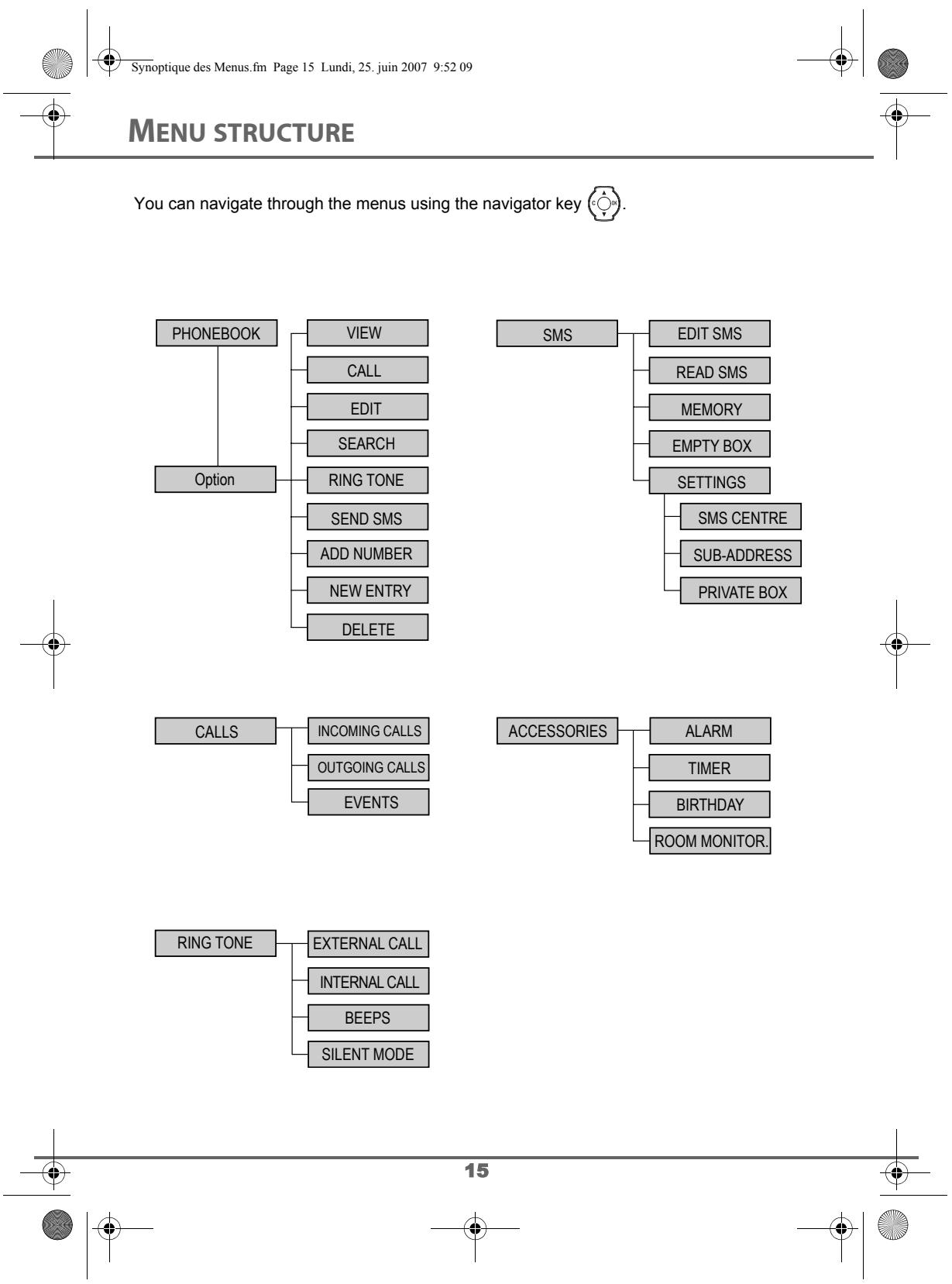
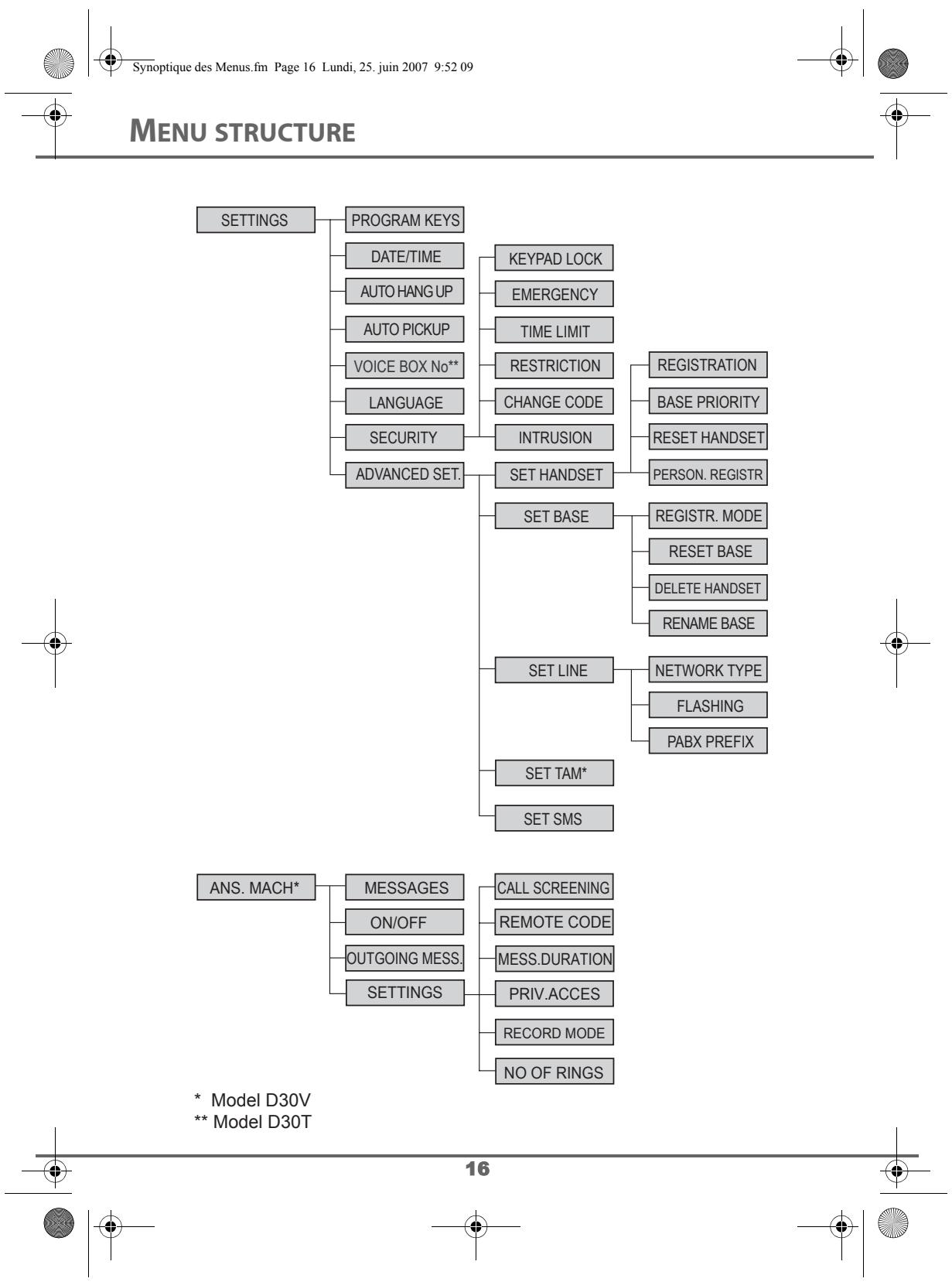
Menu structure 15Birthday alarms 34
Your phonebook 17 Adding a new birthday alarm 34
Viewing the phonebook 17 Viewing a birthday alarm 34
Creating an entry 17 Modifying or deleting a birthday alarm 345
Using a phonebook entry to place a call 18 Monitoring a room 350
18 Ring tones 367
Performing a quick search 18 Changing the ring tones 36
Performing a refined search 19 Activating or deactivating the beeps 36
19 Activating/deactivating the silent mode 37
38
Sending a SMS from phonebook 20 Programming a key 38
SMS service 21 Modifying the date and time 38
Sending a text message 21 Using the auto hang up
Writing a text message 21 and pick up features 38
Sending an SMS 22 Modifying the Voice box number
reading a message 23 (model D30T) 391
Managing read messages 24 Modifying the language 39
Modify the SMS mode 24 Locking/unlocking the keypad 40
Viewing the memory status 25 Programming an emergency number 40
emptying an SMS folder 25 Defining the call time limit 41
SMS settings 26 Defining forbidden prefixes - Call barring 42
Modifying the SMS centre numbers 26 Modifying the base code 42
Choose the SMS transmission centre 26 Authorising listening in 43
Modifying the terminal number 26 Registering a new handset to a base 431
MS boxes 27 Modifying the base preference 44
Sub-Addressing 27 Resetting the handset 44
Creating a personal box 28 Personal registering 45
Viewing a message from a personal box 28 Using a handset to put the base
Modifying or removing a personal box 29 in registration mode 46
Resetting the base 46
De-registering a handset 47


CONTENTS
Renaming the base 47
Modifying the network type 48
Modifying the flash duration (R key) 48
Setting a PABX prefix 49
Answering machine
(Model D30V) 50
Enabling/disabling the answering machine 50
Modifying the OGM 51
Recording a personal outgoing message 51
Using a pre-recorded anonymous OGM 51
Deleting all your personal OGMs 51
Playing messages 52
Playing messages using the base 52
Playing messages using the handset 52
Remote access to answering machine 53
Deleting all the old messages 53
Recording a memo 53
TAM setting (Model D30V) 55
Activating and deactivating call screening 55
Modifying the remote access code 55
Setting the message duration 55
Privileged access 56
Record mode 56
Number of rings 57
Appendix 58
Care and Maintenance 58
Problems 58
Features 59
Environment 60
Packaging 60
Batteries 60
The product 60
Warranty 61



YOUR TELEPHONE
Unpacking
Place the box in front of you, open it and make sure it contains the following items:
one base.
one handset,
- one battery compartment cover,
- one equipped power adapter,
- one telephone line cord,
- three rechargeable batteries,
- this user guide.
In the case of purchasing a duo or trio pack, you will find in addition for each additional
handset:
a handset charger,
- an additional battery flap,
- three additional rechargeable batteries.
In the case of purchasing a single pack, you will find :
- a desk charger fitted with its power supply unit,
one handset, - one battery compartment cover,
- three rechargeable batteries,
this user guide.
Yourbase
It fits well into your family environment.
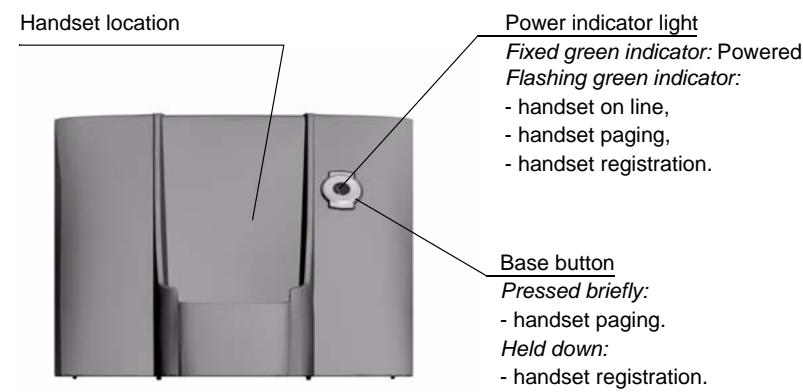
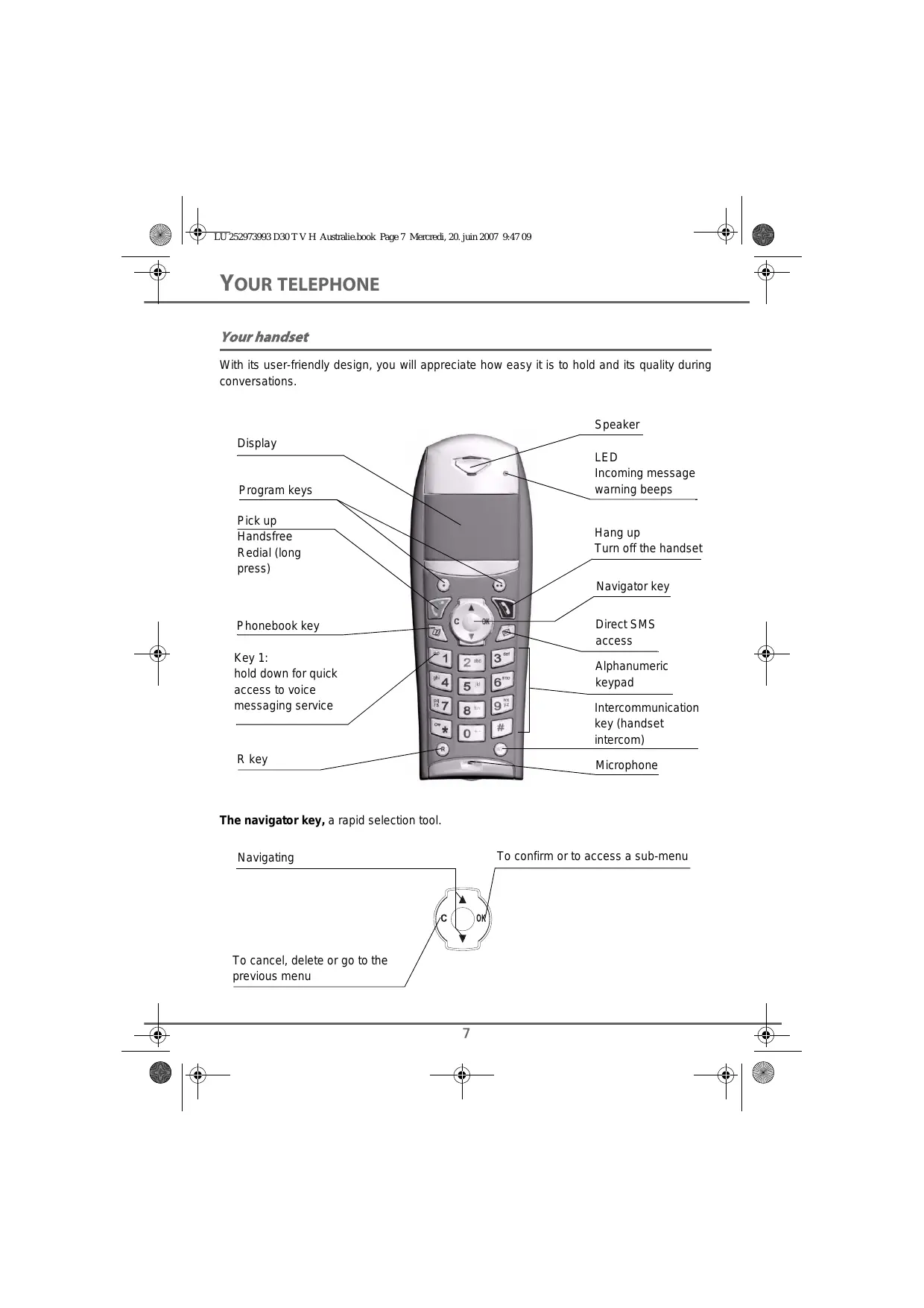
Model without answering machine (D30T):

YOUR TELEPHONE
Model with answering machine (D30V):
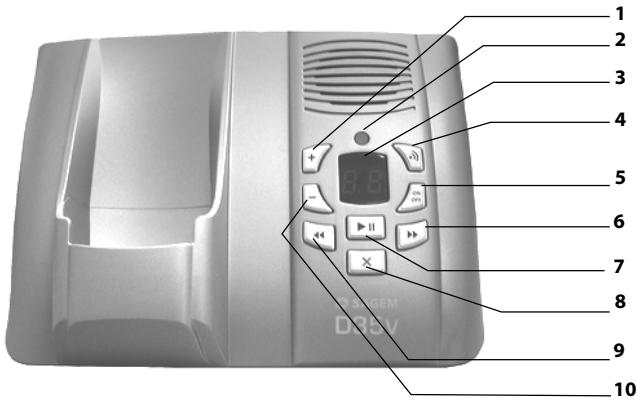
- Increase the volume on the base loudspeaker
- Mains light
Fixed light
- green: On - Answering machine off.
- red: On - Answering machine activated, no message.
Flashing light
- slow red: Messages read.
-
quick red: Flashes at a rate corresponding to the number of unread messages.
-
Display
Answering machine off: nothing is displayed
Simple answering machine: "oo" displayed
Answering machine recorder:
- No new messages: the message read counter is displayed
-
New messages present: the unread message counter flashes
-
Paging / Pairing button:
Press and hold: Pair handsets
Short press: find handsets (Paging)
- ON Simple recorder OFF: press and hold
OFF ON Recorder: short press
ON Recorder ON Simple: short press
ON Simple ON Recorder: short press
- Next message
-
Play messages / Pause during playback
-
Erase a message
Erase a message: Press and hold in playback mode
Erase all messages: Press and hold outside playback mode
- Last message
- Reduce the base loudspeaker volume

YOUR TELEPHONE
Your handset
With its user-friendly design, you will appreciate how easy it is to hold and its quality during conversations.
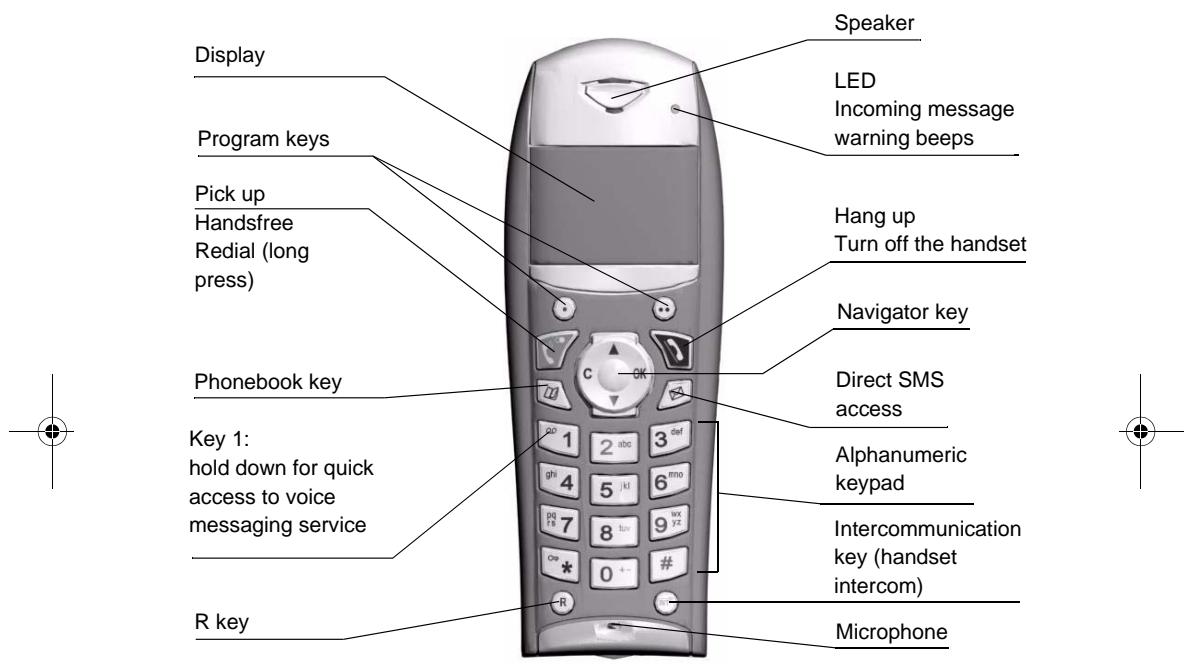
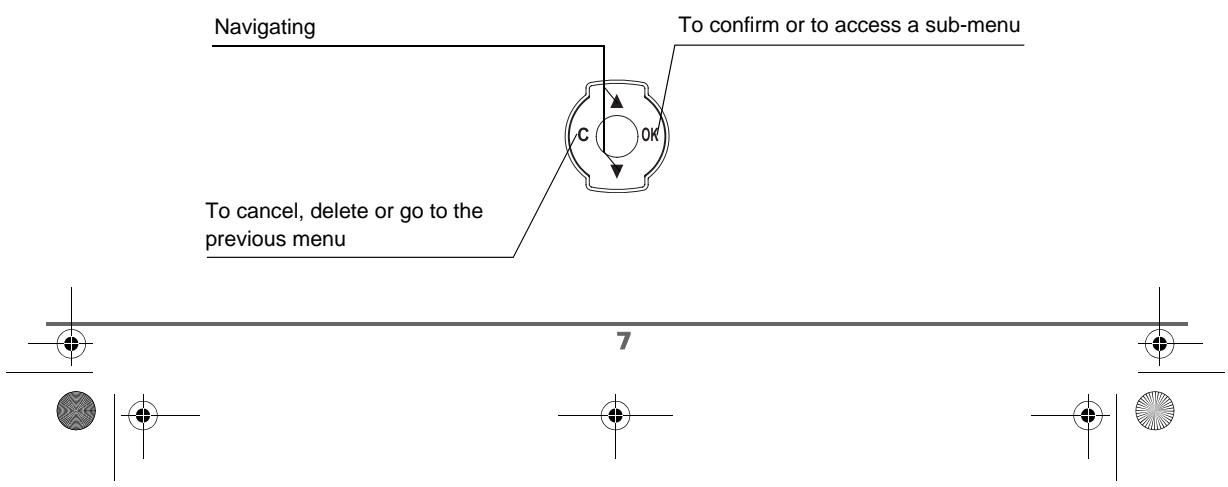
The navigator key, a rapid selection tool.
YOUR TELEPHONE
The visual display of your handset
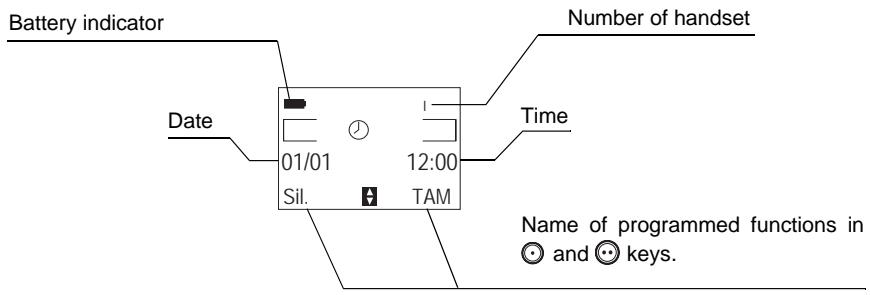

When the battery charge icon is at minimum, your screen will not be lit and the volume level of the hands-free function will be decreased until the battery is recharged.
Connecting the base

Before making any connections, please refer to the safety instructions presented at the beginning of this user guide.
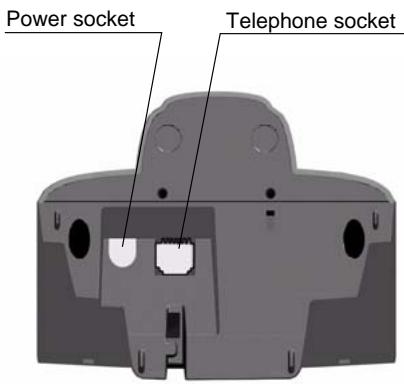
Model without answering machine (D30T):
On the bottom part of the base, click in the telephone jack in its socket (as shown on the drawing) and connect the other end of the lead to the wall telephone socket.
Connect the end of the mains power unit lead to the bottom of the base and the mains power unit to the mains socket. The mains on indicator located on the base comes on green.
Route the wires in the guides and put the base where it should be.

YOUR TELEPHONE
Model with answering machine (D30V):
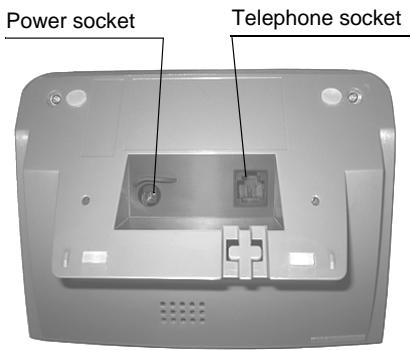
Place the base where it should be located, click in the telephone jack in its socket (as shown on the drawing) and connect the other end of the lead to the wall telephone socket.
Connect the end of the mains power unit lead to the bottom of the base and the mains power unit to the mains socket. The mains on indicator located on the base comes on green.
Route the wires in the guides and put the base where it should be.
Handset set-up
Insert the batteries one after the other in compliance with the battery polarity, as shown on the label in the handset. Place the cover back on the handset by pushing upwards until it is completely closed.
Remove the protective film on the screen, place the handset on the base to fully charge the batteries.
The charging icon appears on the screen, it indicates the charging status. Once the icon is full, your batteries are charged.
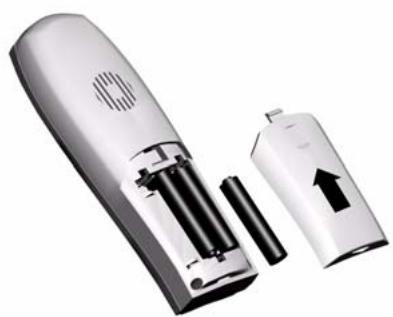

Only use certified rechargeable batteries. For optimal battery charge, leave the handset on the base for at least 12 hours during initial use. During charging, the batteries may heat up, this is quite normal and without risk.

YOUR TELEPHONE
Handset turning on and off
To turn off the handset, hold down the red key. The "POWER OFF" message is displayed on the screen. Your handset is now switched off.
To turn on your handset, hold down the green key. The name SAGEM is displayed on the screen.
Information is displayed on the screen, including the battery charging indicator icon, the handset number (for example 1), the date, the time and the function keys.
Replacing the batteries
Hold down the red key to turn off the handset. Turn it around so that the battery compartment is accessible.
Exert a pressure on the compartment battery and slip the compartment battery downwards.
Remove the old batteries, insert the new batteries one by one in compliance with the polarity of the batteries as shown on the label fixed in the handset.
Place the cover back on the handset by pushing upwards until it is completely closed.
At the end of their useful life, batteries must be disposed of according to the recycling instructions presented in this booklet.

To avoid damaging your handset, only use certified rechargeable AAA batteries NiMH 1.2 V 550 mAH, never use non rechargeable batteries.

GETTING STARTED
GETTING STARTED

Contact your service provider to find out which services are available ( caller display service, SMS, etc.) and the charges involved.
Making a call
Enter the number of your contact using the keypad keys.
If you enter an invalid digit, press C on the navigator key to erase the incorrect digit. Press the green key on your handset to make the call.
You can also make a call by:

- Pressing the green key to access the line.
- Dialling your contact's number.

During communication, you can increase or decrease the audio volume of your handset by pressing the or key on the navigator.
Receiving a call
When you receive a call your telephone rings. If you have subscribed to a "Caller display" service, the caller's information appears on the screen (unless your caller has enabled the anonymous mode), otherwise the "UNKNOWN" screen is displayed.
Pick up by pressing the green key
At the end of the conversation, press the red key
During a call
During a call, numerous options are accessible by pressing Menu
Select the desired option in the following list:
- HANDSFREE: to activate the handset speaker.
- LOUDSPEAK.FR: to activate the base loudspeaker (model D30V).
- CALL TRANSFER: to transfer the call to another handset.
- SECOND CALL: to make a second call.
- PHONEBOOK: to access the phonebook.
- CALLS: to access the call log.
- SECRET: to mute the handset microphone.
Handsfree
While having a conversation with your contact, you can enable the handset loudspeaker. Press Menu
Select HANDSFREE or Base loudsp. (model D30V). Press Activ.
When pressing the green key while engaged in a conversation you automatically activate the handsfree mode of the handset, by pressing it again you deactivate the handsfree mode.
When the battery charge icon is at minimum the hands-free function is turned off until the battery is recharged.



GETTING STARTED
The message HANDSFREE ACTIVATED appears on the screen. Increase or decrease the audio volume using or .
Call transfer
This function is only accessible when two handsets or more are registered to the same base. You can now transfer the call in progress to another hand set.
During communication, press Menu
SelectCALL TRANSFER using or Press Valid.
Select the handset you want to call using or . Press Call .
The handset called rings, once someone picks up transfer the call by pressing the red key
To retake the call before it is picked up by the handset called, press Menu
Select HANGING UP using or . Press Valid.
During a call
During a call, you can receive a second incoming call or place a call to a second contact. You can then switch from one contact to the other, or have a conference (depending on your service provider and subscription).
Receiving a second call whilst on line
During the call, a beep is transmitted to your telephone by your service provider to let you know that you have a second call waiting.
Press ACCEPT to take this new call.
Your other caller is then put on hold and you can talk with your second caller.
Making a second call whilst on line.
During a call, you can put your contact on hold and call a second one by pressing Menu
Select SECOND CALL using or . Press Valid.
Select your contact's telephone number in the phonebook by pressing and press Valid. or dial the number using the keypad and press Call
The second call is then launched, with the first call still on hold.
To alternate from one call to the other
Press Menu
Select SWITCH using or . Press Valid.
The call in progress is put on hold, and you can then take the second call.

GETTING STARTED
To end one of the calls and continue the other one
Press Menu
Select HANGING UP using or . Press Valid.
The call in progress is definitely terminated, and you can then take the second call.
To set up a 3 way-call (the two parties and yourself)
Press Menu
Select 3-PARTY CONF using or . Press Valid.
You can then talk to both parties simultaneously.
To end the 3 way-call, press the red key
Dual incoming call management can also be done via the R key
- Accepting a second incoming call:
R +2
- Making a second call during communication: () + recipient number.
- Alternating from one call to the other: () + 2^**
- Ending a call and switching to the call on hold: + 1 .
- Setting up a 3 way-call: + ^* .
Accessing the phonebook or call log
During a call, you can access your phonebook to look up a telephone number, a name contained in an entry or information on calls stored in your call log.
During a call, press Menu
Select PHONEBOOK or CALLS using or and press Valid.
Return to the communication menu using
Secret mode
You can switch to secret mode at any time during your conversation. Your handset microphone will be switched off and the other person will not be able to hear you.
To activate secret mode:
During a call, press Menu
Select SECRET using or . Press Activ.
The SECRET MODE message will appear on the screen.
To deactivate secret mode:
Press Exit
Your correspondent will be able to hear you again.

You can also choose to deactivate the secret mode by the C key on the navigator panel.

GETTING STARTED
Ending a call
At the end of the conversation, press the red

Communication between two handsets

To communicate between handsets, both handsets must be matched to a single base, and must be within range of the base.
To call another handset, press the key.
Select with the desired handset with the or keys. Press Call .
The handset rings. Pick up on the second handset using the green key
To end the call, press the red key

You can also easily call another handset if you know its number. From the idle screen, enter the number of the handset. Then press the green key

YOUR PHONEBOOK
YOUR PHONEBOOK
You can store 100 phonebook entries in your phonebook.
Each phonebook entry can contain the name of your contact which can be a maximum of 12 characters long (spaces included), your contact's telephone number up to 24 digits and an icon identifying the type of number (work, home, mobile...).
You can associate a unique ring tone to each entry and thus create your own call groups. (To use this service, the caller id service must be activate on your line.)
Viewing the phonebook
On the navigator key (c), press or until the PHONEBOOK screen is displayed, press OK to confirm (you can access the phonebook directly using the key).
The list of phonebook entries organised in alphabetical order appears.

The first time you access your phonebook, only the New element appears in the list.
Select the entry you want to view using or . Once you have selected it, press OK to confirm.

You can call the number that is associated to the entry directly by pressing the green key
Once the entry appears on the screen, press to display all of the available actions that can be executed via the phonebook entry:
- CALL: to call the number associated to the entry.
- EDIT: to edit the entry (name, number, icon).
- SEARCH: to search for another entry.
- RING TONE: to assign a unique ring tone to your handset that will be used each time this number calls you ( caller display service mandatory).
- SEND SMS: to send an SMS to a number associated to the entry.
- ADD NUMBER: to enter a new number for the same name.
- NEW ENTRY: to create a new entry in the phonebook.
- DELETE: to delete the entry from your phonebook.
- VIEW: to view the entry data.
Select the action you wish to perform using
or .Press Valid.
To exit the phonebook, press the red
key
Creating an entry
Alphanumeric keypad key correspondence.
1
A,B,C,a,b,c,2
D,E,F,d,e,f,3
G,H,I,g,h,i,4
J,K,L,j,k,l,5
M,N,O,m,n,o,6
P, Q, R, S, p, q, r, s, 7
T,U,V,t,u,v,8
YOUR PHONEBOOK
W,X,Y,Z,w,x,y,z,9
special characters
space, +, @, -, $, &, %, 0, /
回 #,":!?'()_
To enter text press successively on the desired key until the letter is displayed on the screen.
On the navigator key press or until the PHONEBOOK screen is displayed, press OK to confirm.
Select New. Press Valid.
The name input screen appears.
Using the keypad keys, enter the name of your contact by pressing successively on the corresponding keys. In case of a mistake, press C to erase one character at a time.
Once you are done making your changes, press Valid.
The number input screen appears.
Now, enter the name of your contact using the keypad keys. In case of a mistake, press C to delete one character at a time.
Once you are done making your changes, press Valid.
Select an icon for this number, using or to specify the type of number:

HOME

MOBILE

WORK

FAX
Once the icon is selected, press Valid.
A new entry is created. It appears in the phonebook list. The name of this entry corresponds to the beginning of your contact's name which is preceded by a type icon.
Using a phonebook entry to place a call
On the navigator key ( ) , press or until the PHONEBOOK screen is displayed, press OK to confirm.
The list of alphabetical phonebook entries appears.
Select your contact using or .
Press the green key to make the call.
Your handset displays the number of your contact and dials this number automatically.
Searching for a contact
When referring to your phonebook, you can search for a contact by:
- navigating through the list using , ,
using quick search,
using refined search.
Performing a quick search
Access your phonebook list, press successively on the keypad key which corresponds to the first letter of the name you are searching for so as to make it appear at the top of the screen.
Once the first letter of the name is displayed, wait a moment.

YOUR PHONEBOOK
The phonebook selects the first name in the list that starts with the selected letter.
Press or to select the specific entry that you wish to view or call, press OK to confirm.
Performing a refined search
In the phonebook menu, press Option .
Select SEARCH using or . Press Valid.
Using the keypad, enter the first three letters of the contact you are searching for.
The phonebook positions itself to the entry which comes closest to those two characters.
Press or to select the specific entry that you wish to view or call, press OK to confirm.
Editing an entry
To edit a phonebook entry (change the name, the number and/or the number type icon), enter the phonebook, select the entry you want to edit and confirm using OK to display it on the screen.
Once the entry is displayed on the screen, press Option.
Select EDIT using or . Press Valid.
You enter the name input screen. The cursor is at the end of the name.
The information is accurate. Press Valid.
To correct the name, press C on the navigator key to delete characters. Make your corrections using the keypad keys by pressing successively on the corresponding keys. Once you are finished, press Valid.
You enter the number input screen. The cursor is at the end of the number.
The information is accurate. Press Valid.
To correct the number, press C on the navigator key to delete the numbers. Enter the new number and press Valid.
Select the icon according to the type of number entered using or . Press Valid.
To exit the menu, press the red key

Deleting an entry
To delete an entry, enter the phonebook, select the entry, press Option.
Select DELETE using or . Press Valid.
A confirmation screen asks you if you wish to delete the entry.
If you do not wish to delete the entry, press No.
To delete the entry, press Yes. The entry is deleted from the phonebook.
To exit the menu, press the red key
YOUR PHONEBOOK
Sending a SMS from phonebook
On the navigator key , press or until the PHONEBOOK screen is displayed, press OK to confirm.
Select the contact using , keys or keypad, enter the first three letters of the contact. Press or to select the specific entry then press Option .
Select SEND SMS using or . Press Valid.
A text input screen appears. refer to paragraph Sending a text message, page 21.

SMS SERVICE
You can use your DECT telephone to send, receive and track SMS messages. You can send SMS messages either another fixed SMS-capable telephone or a mobile telephone.
The SMS sending and receiving functions of your telephone are only functional if your service provider offers the corresponding service to its subscribers.

To send and receive SMS text messages, you need the telephone numbers of your Network's SMS Centre.
Sending a text message
On the navigator key, press or until the SMS screen is displayed, press OK to confirm (D can also be used to directly access the SMS menu).
Writing a text message
Once in the SMS menu, press or until the EDIT SMS appears. Press Valid.
Use the , keys to select either Common box or a personal box if one has been created. Press Valid.
The SMS will be sent to the box selected.
If no personal box has been created, only the shared box is displayed on the screen.

To create a personal box, select PERSO BOX MENU and press
Valid. Follow the instructions displayed on the screen. For further details, refer to the paragraph Creating a personal box, page 28.
Enter the code of the box, if you have selected a personal box. Press Valid.
A text input screen appears.
Using the keypad keys, enter the text message by pressing successively on the corresponding keys. The capital letters are accessible by long press on .
Alphanumeric keypad key correspondence depending on the activated mode (capital letters or small letters).
1,#,,,:,?,_
2 a,b,c,2
d,e,f,3
g,h,i,4
5 j,k,l,5
m, n, o, 6
p,q,r,s,7
t,u,v,8
w,x,y,z,9
special characters
① : ②:space,0/,+,@,-,$&, %

SMS SERVICE
To enter text press successively on the desired key until the letter is displayed on the screen.
Making a correction
If you enter the wrong letter, press C on the navigator key to delete one character at a time.
You can also move through the text to delete characters or insert new ones.
Use or to move through the text. Once you have reached the location where you want to insert or delete a character. Press Select
Select INSERT CHAR. or DELETE CHAR. using or , depending on the operation you want to carry out. Press Valid.
Capital letters/Small letters
When writing your message, you can enter capital letters or small letters.
During the SMS input, press Select. Select CAPITAL LETTER or SMALL LETTER. Press Valid.
Special characters
During the writing process, certain special characters are accessible by doing the following.
Press the button, using or and the keypad numbers, select the desired character, use to confirm.
List of special characters:
| . | , | # | ' | " | ( ) | ° | : | ; | - | @ | ü | ? | ||
| i | ! | + | - | * | / | < | = | > | E | $ | £ | ¥ | & % | |
| S | à | ä | à | æ | Ä | A | Æ | é | è | É | i | ñ | Ñ | ö |
| ö | ∅ | Ö | ∅ | ù | ú | Ü | Ç | β | ṭ | Δ | Θ | λ | Ξ | Π |
| Σ | Φ | Ψ | Ω | Λ | { | } | \ | [ | ~ | ] | I |
Sending an SMS
Once you are done writing your text message, press Select to select the type of delivery.
You can choose between the following options:
- SEND: to send a message.
- STORE: to save your text as a draft. It can be sent at a later time. The draft message is archived in the "Draft" box.
- CANCEL: to permanently delete the text message that you just entered.
To transmit message
Select SEND using or . Press Valid.
Enter or search for the receiver's number.
- Enter the number using the keypad. Press Valid.
or
If the receiver is listed in the phonebook as one of your contacts, press (refer to paragraph Searching for a contact, page 18). Press Valid. Your contact's number appears. Press Valid.
A confirmation screen appears. It indicates the type of transmission and the number to which your message will be sent.

SMS SERVICE
If the information is accurate. Press Confirm . A message appears on the screen indicating that the transmission of your SMS is in progress.
- To change the phone number, edit or modify your text message, press Modify. Press Edit .
At the end of the transmission, you can save a copy of your message. It will be stored in the Sent SMS folder.
To save the message, press Yes
If you do not want to save the message, press No.
In the event of a delivery failure
An information screen appears indicating that your service provider was unable to deliver your message.
Press CONT.
Different options come up on the screen:
- SAVE: to save your text in draft form. Once it is saved, you will be able to resolve the potential problems and send your message at a later time without having to enter it again.
- TRY AGAIN: to attempt a new delivery.
- DELETE SMS: to permanently delete your SMS.
- SEE RECEIVER: to check the phone number or send the SMS again.
- EDIT: to change the delivery type and number or your text.
Choose an action using or . Press Valid.
Reading a message
Your telephone has 4 different folders in which your SMS messages are stored.
- NEW: contains the unread messages.
- INBOX: contains the read messages that you have chosen to keep.
- SENT: contains the copies of sent messages that you saved.
- DRAFT: contains the messages that you wrote and that have not been sent out.
On the navigator key, press or until the SMS menu is displayed, press OK to confirm.
Select READ SMS using or . Press Valid.
Select a send box, press Valid.
If no personal box has been created, only the shared box is displayed on the screen.

To create a personal box, select PersoBox Menu and press
Valid. Follow the instructions displayed on the screen. For further details, refer to the paragraph Creating a personal box, page 28.
Enter the code of the box, if you have selected a personal box. Press Valid.
A list of the different folders appears. The number of messages contained in each folder is displayed in brackets.

SMS SERVICE
Using or , select the folder containing the message you would like to view. Press Valid.
The list of messages contained in the folder is then displayed, starting with the most recent message to the oldest one.
The first 4 numbers indicate:
the arrival time (in 12:00 format) for the messages received during the current day,
- the arrival date (in 30/01format) for messages received previously or prior to the current day.
The following characters indicate the sender of the message if he/she is known.
Select the message you would like to view using or , press OK to confirm.
The written message is displayed on the screen.
According to the SMS mode selected, using and or and to scroll the text on the screen.
To return to the beginning of the message press
To return to the list of messages, move to the beginning of the message and press .
Managing read messages
Once the message has been read, press Select and select:
-
REPLY: to write an SMS in response to the message received (the receiver number of the new SMS will automatically be entered).
-
ARCHIVE: to keep this message. It will be stored in the " Inbox" message folder.
- TRANSMIT: to forward this message to a new recipient. You will be able to modify the original message.
- DELETE: to permanently delete this SMS.
- CALL: to call the SMS sender number.
- STORE NUMBER: to save the SMS sender number in your phonebook.
- SMS MODE: Allows to display the message on one or two lines manually or automatic.
Select the desired option using or . Press Valid.
Modify the SMS mode
You can also read your message with different read modes. Three modes are available:
- AUTO SCROLL: automatic scrolling,
- MANUAL SCROLL: manual scrolling,
- 2 LINES: the text is displayed in 2 lines.
To activate one SMS mode, press Select
Select SMS MODE using or . Press Valid.
Select the SMS mode using or . Press Valid.

Viewing the memory status
You can store 30 different SMS messages. These can be indiscriminately distributed between the various folders.
Once the number of stored SMS has reached 30, an information message will indicate that no new messages can be stored.

Once the maximum storage capacity is reached, you cannot receive new SMS. To receive new message, please delete some of the stored messages.
On the navigator key, press or until the SMS screen is displayed, confirm using OK.
Select MEMORY using or . Press Valid.
A screen informs you as to the number of messages contained in each folder (new, inbox, sent and draft). It also indicates the total number of messages stored and the amount of space available.
To exit the memory information screen, press Return
Emptying an SMS folder
This function is used to delete all the messages contained in a folder. To delete the messages one by one refer to paragraph Managing read messages, page 24.

When you empty an SMS folder, all messages linked to a personal box will not be erased.
On the navigator key press or until the SMS screen is displayed, confirm using OK.
Select EMPTY BOX using or . Press Valid.
Select the folder you want to empty by pressing or . Press Valid. to delete all messages in the selected folder.
A delete confirmation screen appears.
- Press No if you do not want to empty the folder.
- Press Yes to empty the folder.
To exit the menu, press the red key


SMS SETTINGS
You can access the SETTINGS menu via the SMS menu or the ADVANCED SET. submenu in the SETTINGS menu.
Modifying the SMS centre numbers
This function is used to modify the SMS centre numbers (depending on the operator). You can enter up to 4 SMS centre numbers to receive and one to send.
By default, the send number is programmed in SMS 2 centre and the reception number in SMS 1 centre.
On the navigator key, press or until the SMS screen is displayed, press OK to confirm.
Select SETTINGS using or . Press Valid.
Select SMS CENTRES using or . Press Valid.
Select the SMS centre you want to enter or modify the number using keys or .
Press Valid.
An information screen gives the number of the SMS centre.
- To change the number, press Edit . Enter the new number in the input screen and press Valid. .
To keep the number, press Confirm
Carry out this operation again for all other SMS centres.
Then define the SMS centre to be used for sending.
Choose the SMS transmission centre
Select SEND CENTRE using keys or . Press Valid.
- To change the send SMS centre, press Edit. Select the required centre using keys and and press Valid.
To keep the current SMS centre, press Confirm
To exit the menu, press the red key

Modifying the terminal number
If you have several SMS-type devices connected to the same telephone line, you must assign a different number ranging from 0 to 9 to each device.
Remember to give your contacts the terminal number on which you would like to receive your messages.
Telephone line
0123456789
Terminal number
MOTHER

FATHER

SISTER

COLLECTIVE


SMS SETTINGS
For example, in the case of an SMS message addressed to the device FATHER your contact will send his SMS to:
01234567892
(Telephone number followed by the terminal number)

If your contact forgets to include the terminal number, the SMS message will be sent to terminal 0 by default. If no device is parameterised with the terminal number 0, the message will be sent to you in the form of a voice message.

If you do not assign a different number to each SMS-type device connected on the same line, you will not be able to receive SMS.
On the navigator key, press or until the SMS screen is displayed, press OK to confirm.
Select SETTINGS using or . Press Valid.
Select SUB-ADDRESS using or . Press Valid.
An information screen shows the current number of the telephone SMS terminal.
To change the number, press Edit. Then select the number using or keys. Press Valid.
To keep the terminal number, press Confirm
To exit the menu, press the red key

SMS boxes
"Personal boxes" allow you to receive personal SMS. These SMS will arrive in the New folder, the box owner will be able to view them by entering the user code that he will have defined when creating his SMS box.
You can create up to 9 "personal boxes" which allow the different users to manage their private SMS (transmission, reception, archive).
Each box is protected by a code and identified by a number representing the corresponding sub-address.
Sub-Addressing
You have 10 sub-addresses (9 personal and 1 collective) assigned to your telephone line (telephone number). You can assign each one of these sub-addresses:
to a terminal (the SMS for this subaddress arrive in the DECT base collective box)
- or to a personal box (the SMS received for this sub-address arrive in the private pass-word protected SMS box)
The sub-address is a number that must be added at the end of your telephone number (11th digit) by those who wish to send you SMS.

If you use the same sub-address twice for the same telephone line, your units may not receive the SMS for this sub-address.

If you do not give a terminal number to each SMS capable device that is connected to the same telephone line, you cannot receive SMS.
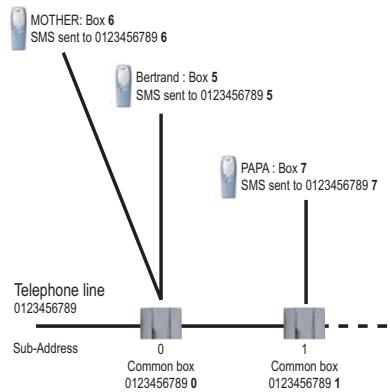
Example:
Creating a personal box
On the navigator key, press or until the SMS screen is displayed, press OK to confirm.
Select SETTINGS using or . Press Valid.
Select PRIVATE BOX using or . Press Valid.
Select NEW using or . Press Valid.
Enter the box name. Press Valid.

If you enter a name that already exists, a message tells you that the name already exists. The box name can have no more than 6 characters.
Enter the code associated to the box. Press Valid.

The user code must contain 4 digits.
Enter the code associated to the box again. Press Valid.
The telephone provides you with a terminal number associated to the box. Press Confirm to keep this terminal number.
Press Edit to change the terminal number. Select one of the terminal numbers available in the list. Press Valid. .
The name is added to the personal box list.
Viewing a message from a personal box
On the navigator key, press or until the SMS screen is displayed, press OK to confirm.
Select READ SMS. Press Valid.
Select the personal box. Press Valid.
Enter the personal box code. Press Valid.
Select the folder NEW or INBOX using or . Press Valid.
Select the message using or . Press Valid.

SMS SETTINGS
The message is displayed on the screen. For details regarding the operations you can perform, refer to paragraph Reading a message, page 23.
Modifying or removing a personal box
On the navigator key, press or until the SMS screen is displayed, press OK to confirm.
Select SETTINGS using or . Press Valid.
Select PRIVATE BOX using or . Press Valid.
Select CANCEL or EDIT using or keys. Press Valid.
Select the name of the personal box you want to modify or delete using or . Press Cancel or Edit depending on the choice made previously.
If an SMS is sent to a personal box not listed on your telephone (or if this box was removed), the SMS will not be delivered.

If you delete a personal box, you must confirm it at the end of the procedure by entering the basic code. All the messages it contains are erased.
CALLLOG
CALLLOG
This menu enables you to view the call or event lists of your telephone.
The dialled call log presents the calls you made.
The received call log presents the calls you received.
The event log groups together all the new events that took place in your absence:
- reception of an SMS,
- new messages on the answering machine (model D30V),
- calls received during your absence,
- operator message service (model D30T).
Viewing the received and dialled call log
On the navigator key

press or
until the CALLS screen is displayed, press OK to confirm.
Choose INCOMING CALLS or OUTGOING
CALLS, using or . Press Valid.
The presentation screen for the last call received or dialled appears.
This screen presents the following information (depending on the service provider and subscription):
the full name of your contact,
the telephone number, date, time and duration of the call.
To view the previous calls, use or . The calls are organised in chronological order, from the most recent call to the oldest call.
By pressing Option, a list of various executable actions appears:
- VIEW: To view the selected call again.
- CALL: To call the number.
- DELETE: To delete the call currently viewed.
- STORE NUMBER: To store the name and number in the phonebook.
- SEND SMS: To send an SMS to your contact.
- DELETE ALL: To delete all calls.
To return to the call view screen, press Return
To exit the menu, press the red key

Calling the last number dialled (Redial)
Your telephone has a shortcut key that can be used to automatically redial the last number dialled.
From the idle screen, press and hold the green key until the Call log screen
appears. Release , the last dialled
number appears. Press the green key again. The number is dialled automatically.

You can view the other dialled calls by pressing or on the navigator







CALLLOG
Calling a number listed in the dialled and received call log
On the navigator key, press or until the CALLS screen is displayed, press OK to confirm.
Select OUTGOING CALLS or INCOMING CALLS, using or . Press Valid.
The presentation screen for the last call received or dialled appears.
Use or to locate the contact you wish to call. The calls are organised in chronological order, from the most recent call to the oldest call.
Once the call is displayed on the screen, press the green key.
The number is dialled automatically.
Viewing the events log
If one or more new events occurred during your absence, the information screen "NEW EVENTS!" appears.
If you do not wish to view the event log at this time, press the red key
- To view the event log, press .

Once the event log has been viewed, the information screen disappears. You can however view it again via the "CALLS" menu.
A summary screen appears. It informs you as to the various events that took place during your absence:
- the new SMS received,
- new messages on the answering machine (model D30V),
the calls received during your absence, - operator message service (model D30T).
Choose the event using or . Press Valid.
The event appears on the screen.
ACCESSORIES
ACCESSORIES
This menu offers you numerous additional functionalities:
- Alarm clock: to use your handset as an alarm clock.
Timer: to remind you of an event (programmed to sound at the end of a few minutes or a few hours).
Birthday: the handset will ring at the set date and time to remind you of the name of the person to whom you would like to wish happy birthday.
Monitoring a room: use a handset to monitor a room.

If the alarm timeout expires (wake up, timer, anniversary and agenda) during a call, the handset will ring at the end of the call.
Alarm clock
The alarm function enables you to activate the handset ringer every day at a set time.
When the alarm is triggered the selected ring tone sounds for 60 seconds through the handset speaker and an alert screen is displayed. To turn off the alarm press any key on the handset.
Setting the alarm clock
On the navigator key, press or until the ACCESSORIES screen is displayed, press OK to confirm.
Select ALARM using or . Press Valid.
An information screen shows the alarm clock status.
- the time at which the handset will ring,
- if the alarm is on or off.
To keep these settings, press Valid.
- To change the alarm time or status (on or off), press Edit.
A list showing the different settings appears.
Activating or deactivating the alarm clock
To activate or deactivate the alarm clock without changing the time.
Select ACTIVATE or DEACTIVATE in the list using or . Press Valid.
The alarm settings information screen appears showing the new status. Press Valid.
Modifying the alarm clock time
Select SET TIME in the list using or . Press Valid.
Enter the time at which you would like the alarm clock to sound. Press Valid.
The activation screen appears. Press Yes to activate the alarm.
Changing the alarm clock ring tone
To modify the alarm clock ring tone, select RING TONE in the alarm clock menu using or . Press Valid.
The list of ring tones appears.

ACCESSORIES
Select the desired ring tone using or .
Press Volume to access the volume setting screen.
Press or to increase or decrease the volume.
Once the volume is set, press Valid.
Press Return
An information screen shows the alarm clock settings, press Valid.
To exit the menu, press the red key
Timer
The timer function activates the handset ringer at a programmed time. You can view the programmed time on the screen.

Incoming calls are displayed directly without interrupting the timer. For access to timer adjustment you must stop it once it is started.
Once the specified time has elapsed, the handset rings for 60 seconds and the alarm screen is activated. Turn off the alarm by pressing Stop. The handset stops ringing.
On the navigator key () , press or until the ACCESSORIES screen is displayed, press OK to confirm.
Select TIMER using or . Press Valid.
To launch the timer without changing the displayed delay, press Start.
To change the programmed time, press Edit
A list showing the different settings appears.
Changing the programmed time of the timer
Select SET DURATION in the list. Press Valid.
Enter the desired time. Press Valid.
Press Return to display the timer activation screen.
The timer activation screen appears with the modification. Press Start to launch the timer.
Changing the timer ring tone
To modify the timer ring tone, select RING TONE using keys or . Press Valid.
The list of ring tones appears, the handset plays the ring tone.
Select the ring tone using keys or . Press Volume to access the volume setting screen.
Press or to increase or decrease the volume. Once the volume is set, press Valid.
Press Return , the timer activation screen appears.
Launch the timer by pressing Start
ACCESSORIES
Displaying or hiding the programmed time of the timer
To display (or hide) the time on the screen during its countdown, select VIEW in the Timer menu using or . Press Valid.
A screen appears indicating if you want to show the timer, press Yes.
Press Return , the timer activation screen appears.
To exit the menu, press the red key
Birthday alarms
You can programme birthday alarms (10 alarms) on your DECT telephone. Your telephone will ring for 60 seconds and an alarm screen will appear to remind you of such events. The alarm screen will remain displayed until one of the keypad keys is pressed.
Adding a new birthday alarm
On the navigator key press or until the ACCESSORIES screen is displayed, press OK to confirm.
Select BIRTHDAY using or . Press Valid.
Select New using or . Press Valid.
Enter the name of the person concerned using the keypad keys. To delete a character, press the C key. Press Valid.
Enter the birth date using the keypad keys. Press Valid.
Enter the alarm activation time. Press Valid.
Viewing a birthday alarm
In the birthday alarm list screen, select the alarm you would like to view using or , and press OK to confirm.
The birthday alarm entry appears on the screen. This entry consists of:
the name of the person concerned,
the birth date,
the time at which you would like to be notified by the alarm.
Modifying or deleting a birthday alarm
In the birthday alarm list screen, select the alarm you wish to edit using or . Press Option .
The following options are available:
- VIEW: to view the alarm data.
- EDIT: to change the alarm name or date.
- DELETE: to remove a birthday or organiser alarm.
- RING TONE: to set the ring tone that will sound when the alarm goes off.
- NEW ENTRY: to set up a new alarm.
To exit the menu, press the red key

ACCESSORIES
Monitoring a room
Two handsets must be registered on the same base to use this function. You can use your handset to monitor a room. This allows you, for example, to monitor a baby's room.
To do so, place one of the handsets in the room to be monitored. This unit will be in "sender" mode.
The other handset will remain with you, it is in "receiver" mode.
On the receiver handset:
On the navigator key, press or until the ACCESSORIES screen is displayed, press OK to confirm.
Select ROOM MONITOR. using or . Press Valid.
Select the sender handset using or . Press Call
The sender handset rings, pick up using the green key
On the transmitter handset:
A screen invites you to activate the monitor mode (sender mode). Press Yes.
Both handsets are now in monitor mode.
- Place the sender handset in the room to be monitored.

The handset in sender mode does not ring to notify you of incoming calls. It can therefore be placed in a room where someone is sleeping.
- Keep the receiver handset with you.
When in monitor mode, the receiver handset can be used to make calls.
To make a call: press Call and dial the number.

To answer a call: press green
key
At the end of the call, the handset will automatically return in monitor mode.
To stop monitoring:
- Press Stop on the transmitter set. The receiver set will automatically return to the standby screen.
- Press Stop on the receiver set and confirm by pressing Yes and Stop on the transmitter handset at the same time.
RING TONES
RING TONES
This menu allows you to modify the ring tones and particularly:
to assign different ring tones for incoming calls outside or intercom (between handsets),
to activate or deactivate tones being sounded when pressing the keypad or when validating the settings information of your handset.
- activate or deactivate silent mode.
Changing the ring tones
This menu enables you to associate a unique ring tone to incoming calls or internal calls (intercom).
On the navigator key () , press or until the RING TONE screen is displayed, press OK to confirm.
Select EXTERNAL CALL or INTERNAL CALL using or . Press Valid.
Select the ring tone of your choice using the or keys then press Volume.
Adjust the ringer volume using or , press Valid.
To exit the menu, press the red key
Activating or deactivating the beeps
On the navigator key, press or until the RING TONE screen is displayed, press OK to confirm.
Select BEEPS using or . Press Valid.
Select the beep type using or . Press Valid.
KEYTONE: the handset beeps when a key is pressed.
BATTERY LOW: the handset beeps when the battery is too low.
CHARGER: the handset beeps when you hang up the handset.
An information screen displays the beep status for the selected item (Active or Inactive).
To change the status, press Edit . The status is modified on the screen. Press Valid.
To keep the status, press Valid.
To exit the menu, press the red key

RING TONES
Activating/deactivating the silent mode
When in silent mode, the telephone ringer and keypad beeps are inhibited.
On the navigator key, press or until the RING TONE screen is displayed, press OK to confirm.
Select SILENT MODE using or . Press Valid.

When you activate the silent mode, your handset is muted for all timer, organiser-type functions...
Press Yes to activate the silent mode.
To exit the menu, press the red key
SETTINGS
SETTINGS
This menu enables you to change or customise the handset and base parameters.
Programming a key
This function enables you to programme the and keys on your handset giving you direct access to certain functions right from the idle screen.
On the navigator key, press or until the SETTINGS screen is displayed, press OK to confirm.
Select PROGRAM KEYS using or . Press Valid.
A screen presents the function currently assigned the key.
To keep the function, press Valid.
To modify the function, press Edit
Choose from the function list the function you want to assign to the key. Press or to select one of the following functions:
SILENCE
- TIMER
NUMBER
- ANSW. MACH.
Press Valid.

With the number function, you associate a telephone number to a program key. You can thus quickly call your contact.
Once the key is programmed, a screen invites you to programme the key .
To modify the function, press Edit
To keep the function, press Valid.
To exit the menu, press the red key

Modifying the date and time
On the navigator key, press or until the SETTINGS screen is displayed, press OK to confirm.
Select DATE/TIME using or . Press Valid.
A screen displays the current date. Enter the date in DD/MM/YY format and press Valid.
A screen displays the current time. Enter the time in HH/ MM format and press Valid.
To exit the menu, press the red key

Using the auto hang up and pick up features
The auto hang up feature enables you to automatically hang up by simply putting the handset back on its base.

If the auto hang up feature is on, communication ends when the handset is put back on its base.
When active, the auto pick up feature enables you to automatically pick up as soon as you remove the handset from its base.

SETTINGS
On the navigator key, press or until the SETTINGS screen is displayed, press OK to confirm.
Select AUTO HANG UP (or AUTO PICKUP) using or . Press Valid.
A screen displays the current status (on or off).
To change the status, press Edit
To keep the status, press Valid.
To exit the menu, press the red key
Modifying the Voice box number (model D30T)
This function enables you to receive calls when absent on a voice messaging service of the switched network.
To indicate that a new message has been received the reception indicator on the handset is lit in red and the new event message is displayed on the screen.

To check your voice messaging service, hold down key.
The number of your voice messaging service is set in the factory. To change this number, proceed as follows:
On the navigator key, press or until the SETTINGS screen is displayed, press OK to confirm.
Select VOICE BOX No using or . Press Valid.
The programmed number is displayed on the screen,
The number is correct, press Valid.
To modify the number, press Edit
Delete the numbers using the navigator C key. Enter the number. Press Valid.
To exit the menu, press the red key
Modifying the language
This function enables you to change the screen display language.
On the navigator key, press or until the SETTINGS screen is displayed, press OK to confirm.
Select LANGUAGE using or . Press Valid.
An information screen presents the current language used.
To keep the setting, press Valid.
To change the setting, press Edit
Choose the desired language from the language list. Press or to select the language. Press Valid.
The screen shows the new language used. Press Valid.
To exit the menu, press the red key

SETTINGS
SECURITY
This menu enables you to change or customise the security parameters of your telephone. You can:
lock the keypad,
programme an emergency number,
- modify the base code,
define the call time limit,
define forbidden prefixes,
- authorise or deny communication to a number of handsets.
Locking/unlocking the keypad

To lock/unlock the keypad, press and hold the keypad key for some time.
You can also lock your keypad via the SECURITY menu.
On the navigator key, press or until the SETTINGS screen is displayed, press OK to confirm.
Select SECURITY using or . Press Valid.
Select KEYPAD LOCK using or . Press Valid.
To lock the keypad, press Yes
A screen indicates that the keypad is locked.
Programming an emergency number
This function allows you to define an emergency number which can be enabled or disabled.
Once it is activated, the emergency number will be automatically dialled when the green

is pressed from the idle screen.
- Once activated, you can however call a different number with pre-dialling by dialling a number and pressing.

The following types of numbers should not be programmed: Fire, emergency and police rescue services...
On the navigator key, press or until the SETTINGS screen is displayed, press OK to confirm.
Select SECURITY using or . Press Valid.
Select EMERGENCY using or . Press Valid.
An information screen displays the current stored emergency number and indicates whether it is enabled or disabled.
To keep the setting, press Valid.
To modify the setting, press Edit
A list of various executable actions appears:
- ACTIVATE: to activate the emergency number.


SETTINGS
- DEACTIVATE: to deactivate the emergency number.
- CHANGE NO: to modify the emergency number.
To modify the emergency number, select CHANGE NO. Press Valid.
Enter the new number using the keypad. You can pick a number from the phonebook.
Press, make your selection and Valid.
The active mode is set automatically.
An information screen presents the new emergency number.
To activate/deactivate the emergency number, select the corresponding option. Press Valid.
To exit the menu, press the red key

The emergency number is automatically activated. The name of the handset displayed on the idle screen becomes EMERGENCY.
Defining the call time limit
You can set your telephone's operating time. Once the call time limit is used up, it is no longer possible to make calls.
To be able to call again, you will have to deactivate the call time limit or set a new limit.

If the time limit ends during a telephone conversation, communication will not be cut off. Once you have hung up, it will not be possible to make a new call. Calls between handsets (internal calls) are not affected by the call time limit.
On the navigator key () , press or until the SETTINGS screen is displayed, press OK to confirm.
Select SECURITY using or . Press Valid.
Select TIME LIMIT using or . Press Valid.
An information screen displays the remaining time limit and its status.
To keep the setting, press Confirm
To modify the setting, press Edit
Enter the base code (default is 0000). Press Valid.
A list of various executable actions appears:
- ACTIVATE:To activate the emergency number.
- DEACTIVATE:To deactivate the emergency number.
- EDIT TIME: To modify the emergency number.
Select EDIT TIME using or . Press Valid.
Enter the new time limit using the keypad (maximum 999 minutes). Press Valid. , the active mode is set automatically.

SETTINGS
Once the modifications have been made, the information screen shows the new call time limit.
To exit the menu, press the red key

Defining forbidden prefixes - Call barring
You can prohibit the use of certain prefixes on your telephone. When a prefix is forbidden, it becomes impossible to call numbers that begin by this prefix.

Depending on the programmed prefixes, certain numbers will no longer be accessible. For example, if you programmed 06 as a forbidden prefix, it will not be possible to call a number that begins by 06.
On the navigator key (c), press or until the SETTINGS screen is displayed, press OK to confirm.
Select SECURITY using or . Press Valid.
Select RESTRICTION using or . Press Valid.
Enter the base code. Press Valid.
The prefix screen appears. Select an empty location (dashes) or a prefix to modify using or . Press Valid.
Enter the prefix using the keypad. Press Valid.

To eliminate a prefix, select it using keys or and press Valid.
When all prefixes are programmed, press Return
A restriction activation screen appears, press Yes to activate restriction.
To exit the menu, press the red key


You can programme up to 5 forbidden prefixes.
Modifying the base code
The base code (0000 being the default setting) is required to access certain security functions. It must be composed of 4 digits.
On the navigator key, press or until the SETTINGS screen is displayed, press OK to confirm.
Select SECURITY using or . Press Valid.
Select CHANGE CODE using or . Press Valid.
Enter the old base code using the keypad (default is 0000). Press Valid.
Enter the new base code using the keypad. Press Valid.
Confirm by entering the new base code again. Press Valid.


To exit the menu, press the red key


Carefully note down the base code number. You will need this code to change certain settings.
Authorising listening in
The intrusion function authorises or prevents a second handset registered on the same base from joining in a current conversation. If the intrusion mode is active, it is then possible to join a conversation in progress using another handset.
On the navigator key ( 0 press OK to confirm.
Select SECURITY using or . Press Valid.
Select INTRUSION using or . Press Valid.
A screen displays the current status (on or off).
To change the status, press Edit
To keep the status, press Valid.
To exit the menu, press the red key
HANDSET SETTINGS
Registering a new handset to a base
To register a new handset to a base you must:
- put the handset in registration mode,
- put the base in registration mode.
Once this is done, the registration (mutual recognition of the base and the new handset) will be done automatically (registration can take a few seconds).

If the code of the base has been modified (different from 0000), the registration will not be possible with this procedure, refer to paragraph Personal registering, page 45.
Take the handset to be registered:
On the navigator key, press or until the SETTINGS screen is displayed, press OK to confirm.
Select ADVANCED SET. using or . Press Valid.
Select SET HANDSET using or . Press Valid.
Select REGISTRATION. Press Valid.
Press Yes to put the handset in registration mode.
The handset enters the registration mode.


SETTINGS
On the base:
Put the base to which you want to register the handset in registration mode:
For the D30T, press on the on the base for a few seconds

button
For the D30V, press on the on the base for a few seconds

button
The new handset and the base are mutually searching for each other. The registration may take several seconds.
Once the handset is registered, the handset automatically exits the registration mode and lets you know the registration is done.

You can also set your base to the registration mode using a handset already registered by selecting the Registration function in the menu SETTINGS/ADVANCED SET/SET BASE.
Modifying the base preference
This function enables you to specify which base will be used by your handset to make calls (if your handset is registered to several bases).
On the navigator key, press or until the SETTINGS screen is displayed, press OK to confirm.
Select ADVANCED SET... Press Valid.
Select SET HANDSET. Press Valid.
Select BASE PRIORITY using or . Press Valid.
An information screen presents the current base preference for your handset.
To keep the preference, press Valid.
To modify the preference, press Edit
A list provides the bases among which you can choose the preferred base to which you want your handset to be registered. With the automatic mode you are not required to specify the preference.
Select the base preference using or . Press Valid.
To exit the menu, press the red key

Resetting the handset
When you reset your handset, all the parameters are reset to their initial value (factory settings) with the exception of the phonebook, alarms (bolidays and organiser) and SMS parameters.

When resetting the handset, the security functions (forbidden prefixes and time limit duration) are not set back to their initial value.
On the navigator key, press or until the SETTINGS screen is displayed, press OK to confirm.
Select ADVANCED SET.. Press Valid.
Select SET HANDSET. Press Valid.
Select RESET HANDSET using or . Press Valid.



SETTINGS
A confirmation screen will prompt you to confirm your request:
To re-initialise your handset, press Yes
If you do not wish to re-initialise your handset, press No.
To exit the menu, press the red key

Personal registering
To register a handset in the following cases:
- the base's code is no longer 0000 (you have customised the code),
you own several bases, - you want to choose a name for your base (name displayed on the welcome screen),
- you want to choose the handset registration number.
On the navigator key, press or until the SETTINGS screen is displayed, press OK to confirm.
Select ADVANCED SET.. Press Valid.
Select SET HANDSET. Press Valid.
Select PERSON. REGISTR using or , Press Valid.
Select the required base number. Press Valid.
Delete the current base name using C key (if necessary).
Enter the new name, press Valid.
Enter the base code. Press Valid.
The handset enters the registration mode, "HANDSET IN REGISTR. MODE" is displayed on the screen.
Put the base to which you want to register the handset in registration mode.
Once the handset is registered, select the required handset number. Press Valid.
On the base:
Put the base to which you want to register the handset in registration mode:
- For the D30T, press on the button on the base for a few seconds.
For the D30V, press on the button on the base for a few seconds.
The green light blinks rapidly, the base is in registration mode.
The new handset and the base are mutually searching for each other. The registration may take several seconds.
Once the handset is registered, the handset automatically exits the registration mode and lets you know the registration is done.

You can also set your base to the registration mode using a handset already registered by selecting the Registration function in the menu SETTINGS/ADVANCED SET/SET BASE.

BASE SETTINGS
Using a handset to put the base in registration mode
This function enables you to put the base in registration mode so you can register a new handset. To do so, the handset to be registered must be in registration mode (refer to paragraph Registering a new handset to a base, page 43).
On the navigator key press or until the SETTINGS screen is displayed, press OK to confirm.
Select ADVANCED SET. using or . Press Valid.
Select SET BASE using or . Press Valid.
Select REGISTR.MODE using or . Press Valid.
A screen prompts you to confirm the setting of the base to the registration mode. Press Yes to enter the registration mode. The indicator light on your base starts to quickly blink green.
Your base will remain in registration mode for about 1 minute.

You can also put the base in registration mode :
For the D30T, press on the
button on the base for a few seconds.
For the D30V, press on the button on the base for a few seconds.
Resetting the base
When you reset your base, all the base parameters are reset to their initial values (factory settings), your SMS are not deleted.
On the navigator key () , press or until the SETTINGS screen is displayed, press OK to confirm.
Select ADVANCED SET.. Press Valid.
Select SET BASE. Press Valid.
Select RESET BASE using or . Press Valid.
A confirmation screen will prompt you to confirm your request:
To reset the base, press Yes
If you do not wish to reset the base, press No.
Enter the base code. Press Valid. The RE-INIT. IN PROCESS message is displayed on the screen.
To exit the menu, press the red key


When resetting the base, the base code becomes 0000 again.
De-registering a handset
This function enables you to de-register a handset from your base. This may be necessary if you have lost a handset or if you already have 6 handsets registered to the same base.
On the navigator key, press or until the SETTINGS screen is displayed, press OK to confirm.
Select ADVANCED SET.. Press Valid.
Select SET BASE. Press Valid.
Select DELETE HANDSET using or . Press Valid.
Select the handset you wish to unregister in the list by pressing or . Press Valid.
A screen prompts you to confirm the unregistration. Press Yes to unregister the handset.
To exit the menu, press the red key
Renaming the base
On the navigator key, press or until the SETTINGS screen is displayed, press OK to confirm.
Select ADVANCED SET.. Press Valid.
Select SET BASE. Press Valid.
Select RENAME BASE using or . Press Valid.
Select the base for which you want to modify the name using or . Press Valid.
Enter the new name using the keypad. Press Valid.
To exit the menu, press the red key



SETTINGS
LINE SETTINGS

Before changing the settings of the telephone line, contact your operator to obtain the parameters for your line.
Modifying the network type
Your DECT telephone can be installed on a public or private network (when using a PABX).
This function enables you to configure your telephone according to the type of network.
On the navigator key, press or until the SETTINGS screen is displayed, press OK to confirm.
Select ADVANCED SET. using or . Press Valid.
Select SET LINE using or . Press Valid.
Select NETWORK TYPE using or . Press Valid.
A screen presents the current status (public or private).
To keep the status, press Valid.
To change the status, press Edit
The status is modified on the screen, press Valid.
To exit the menu, press the red key

Modifying the flash duration (R key)
If you connect your telephone to a private automatic branch exchange or use it in a foreign country, you may need to modify the flash duration in order to use your telephone correctly with regard to the following functionalities: outgoing 2nd call, incoming 2nd call, 3 way calling.
Contact your service provider to obtain the correct flash duration and then modify it by doing the following.
On the navigator key, press or until the SETTINGS screen is displayed, press OK to confirm.
Select ADVANCED SET.. Press Valid.
Select SET LINE. Press Valid.
Select FLASHING using or . Press Valid.
An information screen presents the current flash duration.
To keep the duration, press Confirm
To modify the duration, press Edit
Select the new duration using or . Press Valid.
The screen presents the new flash duration.
To keep the duration, press Confirm
To modify the duration, press Edit
To exit the menu, press the red key



SETTINGS
Setting a PABX prefix
If a private automatic branch exchange is used, you can programme the external call prefix.
With this function you can set the:
- PABX prefix number,
- dialled number length at which point the PABX will be automatically dialled (this length is called "digit before prefix"),
- prefix status (on or off).
On the navigator key, press or until the SETTINGS screen is displayed, press OK to confirm.
Select ADVANCED SET... Press Valid.
Select SET LINE. Press Valid.
Select PABX Prefix using or . Press Valid.
An information screen presents the PABX setting in progress. Press or key.
Press Yes, to modify this setting.
Select the desired option:
- ACTIVATE/DEACTIVATE: to select a status.
- Prefix: to enter the number giving you access to the outside line.
- EDIT LENGTH: to specify the «digits before prefix».
- EXIT PABX: to exit the menu.
To modify the prefix, select PRIX using or , press Valid.
Enter the prefix using the keypad, press Valid.
To modify the digits before prefix, select EDIT LENGTH using or , press Valid.
Enter the digits before prefix using the keypad, press Valid.
To exit the menu, press the red key


ANSWERING MACHINE
ANSWERING MACHINE (MODEL D30V)
Your telephone's answering machine comes with two answering modes:
- Answer only: callers cannot leave you a message and an OGM informs them of your unavailability.
- Answer and record:an OGM invites your callers to leave messages.
The telephone answering machine models also offer the following functionalities:
- Anonymous mode with pre-recorded OGMs.
- Call screening.
- Remote message retrieval.
- VIP access
Enabling/disabling the answering machine
When your answering machine is off, the base indicator is green.
When it is on, the indicator turns red. An icon also appears on the handset display according to the answering machine mode used:
- Answer only

- Answer and record

On the navigator key press or until the ANS. MACH screen is displayed. Press OK to confirm.
Select ON/OFF using or . Press Valid.
A screen displays the current status of the answering machine (answer only, answer and record or off).
To keep the displayed status, press Valid.
To change the status, press Edit
To activate the answer and record mode, select ANS. & RECORD.
- To activate the answer only mode, select ANSWER ONLY.
- To turn off the answering machine, select DEACTIV..
Press Valid.
The OGM that will be used is played. At the end of the playback, confirm the new status of the answering machine by pressing
Valid.

If you have not recorded a personal OGM, the answering machine will automatically use the pre-recorded OGM.
- You may deactivate your answering machine using the keys on the base. To do so, press the
button OFF for a few seconds.
- To activate your answering
machine, pressing the button will switch the answering machine recorder on. Pressing it again will enable you to move from the answering machine recorder to the simple answering machine.



ANSWERING MACHINE
Modifying the OGM

In order to modify an OGM, you must first turn on the answering machine. The OGM that will be modified will be that of the answering machine activated (answer only or answer and record).
Recording a personal outgoing message
On the navigator key ( b) , press or until the ANS. MACH screen is displayed. Press OK to confirm.
Select OUTGOINGMess. using or Press Valid.
Select CHANGE using or . Press Valid.
Press OK to start recording your OGM.
At the sound of the beep transmitted through the handset, start talking in the handset microphone.
To stop recording press End
Your outgoing message is automatically played back.
At the end of the playback, a confirmation screen asks you if you want to keep this new outgoing message. Press Yes to keep your OGM or No to record it again.
Using a pre-recorded anonymous OGM
If you select the anonymous mode, your personal outgoing message will be definitely replaced by the pre-recorded outgoing message. You will however be able to record a new personal outgoing message (see previous paragraph).
On the navigator key, press or until the ANS. MACH screen is displayed. Press OK to confirm.
Select OUTGOING PRESS.. Press Valid.
Select ANONYMOUS using or . Press Valid.
Press Yes to replace your personal outgoing message with the anonymous outgoing message.
The anonymous outgoing message for the answering machine mode used (answer only/answer and record) is automatically played back.
Deleting all your personal OGMs

If you delete all your personal outgoing messages, the answering machine will automatically be deactivated.
On the navigator key ( ) , press or until the ANS. MACH screen is displayed. Press OK to confirm.

ANSWERING MACHINE
Select OUTGOING PRESS.. Press Valid.
Select DELETE ALL using or . Press Valid.
Press Yes to delete all the personal outgoing messages.
Playing messages
When there are messages on your answering machine, the base indicator light blinks. The rhythm of the flash informs you as to the number of messages received (ex.: 4 short flashes correspond to 4 received messages).
The new messages are played back first. Afterwards, the messages that have already been taken are played back in chronological order (from the oldest messages to the most recent messages).
The icon on the handset screen notifies you that there are messages that have not been played.
If you saved one or more played
messages, the icon appears on the welcome screen.
Playing messages using the base
Press the _ button to start the playback.
Your messages are played back through the base loudspeaker.
During playback, you can use the base buttons to execute the following actions:
- Go to the next message:
- Go back to the beginning of the
message:
- Return to the previous message: 44 twice.
- Pause playback: |_|
- Start playback after pause: |_|
- Delete the message being back : long press on .
The answering machine will automatically stop at the end of the last message.
Playing messages using the handset
On the navigator key, press or until the ANS. MACH screen is displayed. Press OK to confirm.
Select MESSAGES using or . Press Valid.
Select PLAY using or . Press Valid.
The messages are played through the handset speaker.
Depending on your service provider and your subscription, the name and number of your contact will be displayed on the screen (except for confidential calls).
During playback, you can use the handset buttons to execute the following actions:
- : delete the message being played.
- : return to the previous message.
- 2: momentarily stop the playback (pause).
- 3: go to the next message.
ANSWERING MACHINE
Remote access to answering machine
You can access your answering machine remotely. This function enables you to retrieve your messages and access your answering machine from any other telephone located outside your home.
To remotely access your answering machine: Dial your telephone number and wait for the answering machine to come on. When your outgoing message is played, press # and enter your remote access code.

The remote access code is 0000 by default. However, it can only be used once it is customised, refer to paragraph Modifying the remote access code, page 55.
A beep will indicate access to the answer machine. Any unread messages will be automatically played back. At the end of playback, a new beep will sound to let you know that the answer machine is ready. You can carry out the following operations:
0 : delete the message being played
1 : go back to the beginning of the message
1 (x2) : previous message
2 : pause/play
3 : next message
5 : message read
7 : Answer machine/ recorder operating
8 : record
9 : answering machine off
Deleting all the old messages

To delete the old messages one message at a time, refer to the previous paragraph and delete the unwanted messages during their play back.
On the navigator key ( c c c) , press or until the ANS. MACH screen is displayed. Press OK to confirm.
Select MESSAGES using or . Press Valid.
Select DELETE OLD using or . Press Valid.
To confirm the deletion of all the old messages, press Yes.
To exit the menu, press the red key
Recording a memo
This function enables you to leave a personal message on your answering machine. Until the time it is played, it will be considered like a new message by the answering machine.
On the navigator key, press or until the ANS. MACH screen is displayed. Press OK to confirm.
Select MESSAGES using or . Press Valid.
ANSWERING MACHINE
Select RECORD MEMO using or . Press Valid.
Press OK to start recording.
At the sound of the beep transmitted through the handset, start talking into the handset microphone.
To stop recording press End
At the end of listen, you come back to the previous menu.
To validate the memo, press Yes
To cancel the memo or restart the recording, press No.
Once validated, your answering machine considers the memo as a new message until it is played.
The message NEW EVENTS is displayed and replace the idle screen.

ANSWERING MACHINE
TAM SETTING (MODEL D30V)
This menu enables you to modify the advanced settings of your answering machine (depending on the model) You can access the TAM setting menu through the Ans. Mach. menu or through the Adv. Settings submenu of the Settings menu.
Activating and deactivating call screening
When activated, the call screening function enables you to listen to the message left by your caller as it is being recorded. You can pick up at any time.
On the navigator key () , press or until the ANS. MACH menu is displayed, press OK to confirm.
Select SETTINGS using or . Press Valid.
SelectCALL SCREENING using or Press Valid.
A screen indicating the function status (on or off) appears.
To keep the current status, press Valid.
To change the status, press Edit then Valid.
To exit the menu, press the red key

Modifying the remote access code
The remote access code enables you to listen to the messages left on your answering machine via another telephone.
On the navigator key, press or until the ANS. MACH menu is displayed, press OK to confirm.
Select SETTINGS using or . Press Valid.
Select REMOTE CODE. Press Valid.
Press Yes to modify the remote access code.
Enter your Base code (default setting is 0000). Press Valid.
Enter the new remote access code (4 digits mandatory). Press Valid.
To exit the menu, press the red key
Setting the message duration
This duration corresponds to the recording time that the caller will have to leave you his message.
On the navigator key, press or until the ANS. MACH menu is displayed, press OK to confirm.
Select SETTINGS using or . Press Valid.
TAM SETTING
Select MESS. DURATION using or . Press Valid.
A screen indicating the maximum authorised recording time for each message appears.
To keep the current duration, press Confirm
To modify the current duration, press Edit
During the duration modification, a list of the message durations appears on the screen.
Select the desired duration using or . Press Valid.
To exit the menu, press the red key
Privileged access
This service enables you to switch off the handset ringer for all incoming calls when you do not want to be disturbed, except for privileged calls.
During the reception of a call, the answering machine will switch on after a certain number of (muted) rings that you will have set and the caller will be able to leave you a message.
You can programme your telephone in such a way that it will only ring when specific callers call. To achieve this, they will need to dial (star) key and a privileged code when they hear the outgoing message. Once the code has been entered, your telephone rings.
On the navigator key, press or until the ANS. MACH menu is displayed, press OK to confirm.
Select SETTINGS using or . Press Valid.
Select PRIV. ACCESS using or . Press Valid.
The following information is displayed on the screen:
the privileged access code,
the service status.
Press Edit to modify the information displayed on the screen.
Enter the privileged access code.

Give the privileged access code to your privileged callers. When calling you, they can dial (star) key and a privileged code when they hear the outgoing message.
Press Confirm
Press Yes to activate the privileged access mode.
To exit the menu, press the red key
Record mode
The record mode enables you to modify the recording time capacity of the answering machine.
Two quality levels are available:
- Superior quality: for a 15 minute high-quality capacity.
- Standard quality: for a 25 minute normal-quality capacity.

Modifying the message recording quality does not affect the quality of the outgoing message.
TAM SETTING
On the navigator key, press or until the ANS. MACH menu is displayed, press OK to confirm.
Select SETTINGS using or . Press Valid.
Select RECORD MODE using or . Press Valid.
Press Edit to modify the recording quality level displayed on the screen. Press Valid.
To exit the menu, press the red key

Number of rings
This parameter enables you to set the number of times your telephone rings before the answering machine answers a call. The number of rings can be set between 2 and 7. You can also select the Time saver mode.
The Time saver mode automatically determines the number of rings based on the number of messages left on the answering machine.
If there are no new messages on the answering machine, the number of rings will be 4, otherwise the number of rings will be 2.
On the navigator key () , press or until the ANS. MACH menu is displayed, press OK to confirm.
Select SETTINGS using or . Press Valid.
Select NO OF RINGS using or . Press Valid.
The programmed number of rings is displayed on the screen.
Press Edit to modify the current number.
In the list, select the desired number of rings (between 2 and 7) using or or the Time saver mode, and press Valid.
To exit the menu, press the red key



Care and Maintenance
Use a slightly damp cloth to wipe the base and handset, do not use a dry cloth as this may cause electrostatic charges.
Problems
Refer to the table presented below in case of an operational malfunction:
| Problems | Remedies |
| The base indicator light is not lit | Make sure that: • the power adapter is properly connected to a power socket. • the power connector is properly plugged into the base. • your fuse and circuit-breaker are in working order and that the power socket is powered. |
| The handset display is blank. | Make sure the batteries are properly installed. Place the handset on the base and fully charge the batteries. To increase the life of your batteries, you can perform this operation about every two months. If these precautionary measures do not resolve this issue, replacement batteries are available through your reseller. As time goes by, you may notice a slight decrease in battery performance. Use your handset until the battery is fully discharged, and then charge it for at least 12 hours. |
| The handset does not ring during an incoming call. | Make sure that the telephone is properly connected and that you have a dial tone. Make sure your telephone is not set to silent mode (see pargraph Settings). |
| No radio link between the handset and base. The network indicator icon flashes. | Make sure the handset is registered by moving closer to the base, if it is registered correctly, the handset screen should display its own handset number. Otherwise, register the handset to the base. See “Registering a new handset to a base”, page 43. |
| You obtain a "busy" dial tone for each dialled number. | Make sure no one else is using another handset (if the intrusion mode is deactivated). Make sure that the dial mode (tone or pulse dialling) is compatible with your telephone line or your automatic branch exchange. Make sure your time limit has not run out (if activated). Make sure you are not on call restriction (if activated) |
| You cannot send or receive SMSs. | Make sure you have subscribed to a caller display service. Find out if the SMS service is in fact activated on your line. Obtain the server numbers from your service provider and make sure they are identical to the numbers on your handset. Have you provided your contacts with the right terminal number? |

FEATURES
| Functions | Default settings | Functions | Default settings |
| SMS | Language | English | |
| SMS sending centre | 01983381 | Security | |
| SMS reception centre | 01983391 | Keypad lock | Off |
| ACCESSORIES | Emergency | Off | |
| Alarm clock | Off | Base code | 0000 |
| Timer | Off | Time limit | Off |
| Room monitor | Off | Restriction | Off |
| RING TONE | Intrusion | Off | |
| Ringer (Ext/Int) | Flute / Mineral | Advanced settings | |
| Silent mode | Off | • Line settings | |
| Beeps | All active | Network type | Public |
| SETTINGS | Flashing | 100 ms | |
| Program keys | Silence / TAM | PABX prefix | Off |
| Date/Time | 00:00 // 01/01/07 | • Base settings | |
| Auto Hang up | On | Base name | BASE 1 |
| Auto Pick up | Off | ||
| Telephone features | |||
| Number of channels | 120 | Autonomy | |
| Radio frequency band | 1,88 - 1,90 GHz | standby time | 150 hours |
| Duplex mode | TDMA | talk time | 15 hours |
| Spacing between | 1,728 MHz | Handset range | |
| Bit rate | 1152 Kbit/s | open space | up to 300 m |
| Modulation | GFSK | inside building | up to 50 m |
| Vocoding | ADPCM | Base dimensions | 167 x 113 x 65 mm |
| Transmitting power | 250 mW | Base weight | 136 g |
| Base operating voltage | 230 V , 50/60 Hz | Handset dimensions | 140 x 51 x 30 mm |
| Charging time | 12 hours | Handset weight | 143 g |
All of this data is provided to you for information purposes only. Sagem Communication reserves the right to make any changes without notice.

ENVIRONMENT
Preservation of the environment is an essential concern of Sagem Communication. The desire of Sagem Communication is to operate systems observing the environment and consequently it has decided to integrate environmental performances in the life cycle of its products, from manufacturing to commissioning, use and elimination.
PACKAGING

The presence of the logo (green dot) means that a contribution is paid to an approved national organisation to improve packaging recovery and recycling infrastructures.
To facilitate recycling, please respect the sorting rules set up locally for this kind of waste.
BATTERIES

If your product contains batteries, they must be disposed of at appropriate collection points.

THE PRODUCT

The crossed-out waste bin stuck on the product or its accessories means that the product belongs to the family of electrical and electronic equipments.
In this respect, the European regulations ask you to dispose of it selectively:
- At sales points in the event of the purchase of similar equipment.
- At the collection points made available to you locally (drop-off centre, selective collection, etc.).
In this way you can participate in the re-use and upgrading of Electrical and Electronic Equipment Waste, which can have an effect on the environment and human health.

Product Warranty
Sagem Guarantees your product for 12 months from date of purchase against any defect in materials or workmanship under conditions of normal use and service and subject to proof of the date of purchase being provided and subject to the conditions specified below.
The benefits conferred by this warranty are in addition to all other rights and remedies in respect of the product that the consumer has under the Trade Practices Act and similar State and Territory laws.
Warranty Service Conditions
Subject to your statutory rights referred to above, Sagem expressly limits its liability with respect to its products to the person who purchases the Product from the Sagem authorised retailer. Subject to your statutory rights referred to above, Sagem expressly limits its liability with respect to its products to whichever is the lowest amount out of:
A. The cost of having the goods repaired;
B. The cost of replacing the goods; or
C. The cost of obtaining equivalent goods.

Subject to your statutory rights referred to above, in the event of the goods requiring service underwarranty, the owner is responsible for the cost of transportation to the authorised service organisation. Whilst in transit the goods are at the owner's risk. Subject to your statutory rights referred to above, should the goods be found to be in sound working order by the authorised service organisation the owner may be charged a service fee.
Subject to your statutory rights referred to above, the goods will not be eligible for service under this warranty if:
A. Proof of date of purchase cannot be provided;
B. The goods are not branded Sagem;
C. The goods have been rented to another person;
D. The defect was caused by an accident, misuse, abuse, improper installation or operation, lack of reasonable care, unauthorised modification, loss of parts, tampering or attempted repair by a person not authorised by Sagem; or
E. The product has been damaged by lightning or a mains power surge.
Do you really need service?
Before calling for service under this warranty have you:
- Checked that all cables are securely connected as detailed in the User Guide?
- Referred to the User Guide to ensure that the features are being used correctly?
- If you are trying to access a network service such as Call Waiting, confirmed with your network provider that you have access to this feature?


IMPORTANT
Please retain this booklet with your sales receipt as proof of the date of purchase.
© COPYRIGHT 2007 Sagem Corporation Limited
This work is copyright. All rights reserved. Other than for purposes and subject to conditions prescribed under the Copyright Act, no part of it may in any form or by any means, mechanical, photocopying, scanning, recording or otherwise) be reproduced, stored in a retrieval system or transmitted without prior permission from Sagem Corporation Limited.
ABN 43003099812
SAGEM is a registered trademark of Sagem Communication (SAFRAN Group).
Copyright © Sagem Communication (SAFRAN Group)
All rights reserved





- Recommendations and safety instructions
- CONTENTS
- Your telephone 5 Call log 30
- Menu structure 15Birthday alarms 34
- Your phonebook 17 Adding a new birthday alarm 34
- Answering machine
- YOUR TELEPHONE
- Unpacking
- Yourbase
- Model with answering machine (D30V):
- Your handset
- Connecting the base
- Model without answering machine (D30T):
- Handset set-up
- Handset turning on and off
- Replacing the batteries
- GETTING STARTED
- Making a call
- Receiving a call
- During a call
- Handsfree
- Call transfer
- Receiving a second call whilst on line
- Accessing the phonebook or call log
- Secret mode
- Ending a call
- Communication between two handsets
- YOUR PHONEBOOK
- Viewing the phonebook
- Creating an entry
- Using a phonebook entry to place a call
- Searching for a contact
- Performing a quick search
- Performing a refined search
- Editing an entry
- Deleting an entry
- Sending a SMS from phonebook
- SMS SERVICE
- Sending a text message
- Writing a text message
- Making a correction
- Capital letters/Small letters
- Special characters
- Sending an SMS
- To transmit message
- In the event of a delivery failure
- Press CONT.
- Reading a message
- Managing read messages
- Modify the SMS mode
- Viewing the memory status
- Emptying an SMS folder
- SMS SETTINGS
- Modifying the SMS centre numbers
- Choose the SMS transmission centre
- Modifying the terminal number
- SMS boxes
- Sub-Addressing
- Creating a personal box
- Viewing a message from a personal box
- Modifying or removing a personal box
- CALLLOG
- Viewing the received and dialled call log
- Calling the last number dialled (Redial)
- Calling a number listed in the dialled and received call log
- Viewing the events log
- ACCESSORIES
- Alarm clock
- Setting the alarm clock
- Activating or deactivating the alarm clock
- Modifying the alarm clock time
- Changing the alarm clock ring tone
- Timer
- Changing the programmed time of the timer
- Changing the timer ring tone
- Displaying or hiding the programmed time of the timer
- Birthday alarms
- Adding a new birthday alarm
- Viewing a birthday alarm
- Modifying or deleting a birthday alarm
- Monitoring a room
- To stop monitoring:
- RING TONES
- Changing the ring tones
- Activating or deactivating the beeps
- Activating/deactivating the silent mode
- SETTINGS
- Programming a key
- Modifying the date and time
- Using the auto hang up and pick up features
- Modifying the Voice box number (model D30T)
- Modifying the language
- SECURITY
- Locking/unlocking the keypad
- Programming an emergency number
- Defining the call time limit
- Defining forbidden prefixes - Call barring
- Modifying the base code
- Authorising listening in
- HANDSET SETTINGS
- Registering a new handset to a base
- On the base:
- Modifying the base preference
- Resetting the handset
- Personal registering
- BASE SETTINGS
- Using a handset to put the base in registration mode
- Resetting the base
- De-registering a handset
- Renaming the base
- LINE SETTINGS
- Modifying the network type
- Modifying the flash duration (R key)
- Setting a PABX prefix
- ANSWERING MACHINE (MODEL D30V)
- Enabling/disabling the answering machine
- Modifying the OGM
- Recording a personal outgoing message
- Using a pre-recorded anonymous OGM
- Deleting all your personal OGMs
- Playing messages
- Playing messages using the base
- Playing messages using the handset
- Remote access to answering machine
- Deleting all the old messages
- Recording a memo
- TAM SETTING (MODEL D30V)
- Activating and deactivating call screening
- Modifying the remote access code
- Setting the message duration
- TAM SETTING
- Privileged access
- Record mode
- Number of rings
- Care and Maintenance
- Problems
- FEATURES
- ENVIRONMENT
- PACKAGING
- BATTERIES
- THE PRODUCT
- Product Warranty
- Warranty Service Conditions
- Do you really need service?
- IMPORTANT
Brand : SAGEM
Model : D30T
Category : Cordless phone