
CARMINAT TOMTOM - Navigation system RENAULT - Free user manual and instructions
Find the device manual for free CARMINAT TOMTOM RENAULT in PDF.



| Product type | GPS navigation system for vehicle |
| Brand | Renault |
| Model | Carminat TomTom |
| Dimensions (approx.) | 12 x 8 x 2 cm |
| Weight (approx.) | 200 g |
| Power supply | 12 V via cigarette lighter socket |
| Screen | Touch color, 4.3 inches (10.9 cm) |
| Mapping | Preloaded Europe, update via TomTom Home |
| Main functions | GPS navigation, voice guidance, points of interest, route calculation with traffic |
| Connectivity | USB, Bluetooth (depending on version) |
| Update | Via TomTom Home software on PC |
| Care and cleaning | Soft dry cloth, avoid abrasive products |
| Safety | Suction cup or dedicated mount, do not obstruct driver's view |
| Spare parts and repairability | Mount, power cable, suction cup available online |
| General information | 60-page user manual, available online |
Frequently Asked Questions - CARMINAT TOMTOM RENAULT
User questions about CARMINAT TOMTOM RENAULT
0 question about this device. Answer the ones you know or ask your own.
Ask a new question about this device
Download the instructions for your Navigation system in PDF format for free! Find your manual CARMINAT TOMTOM - RENAULT and take your electronic device back in hand. On this page are published all the documents necessary for the use of your device. CARMINAT TOMTOM by RENAULT.
USER MANUAL CARMINAT TOMTOM RENAULT
Precautions during use 2 General information 3 General description 3 Introduction to the controls 6 8 SD card: use, initialisation 9 Guided tours 11 Switching on, off 13 Operating principles 14 Volume and voice 16 Reading a map 17 Preparing a route 18 Entering a destination 18 Guidance 22 Find alternative 26 Traffic information 27 Browse map 30 LIVE Services 32 Add and manage favourites 34 Help! 36 Speed camera menu 37 Image viewer 39 Reversing camera 40 System settings 41 Updating the system 47 Remote control: replacing the battery 51 Operating faults 52
PRECAUTIONS DURING USE
It is essential to follow the precautions below when using the system, both in the interest of safety and to prevent material damage. You must always comply with the laws of the country in which you are travelling.

Precautions when operating the system
- Operate the controls and read the information on the screen only when road conditions allow.
- Set the volume to a reasonable level so that outside noise can be heard.
Precautions regarding navigation
- Use of the navigation system does not in any way replace the responsibility or vigilance of the driver when driving the vehicle. Depending on the geographical area, the map on the SD card may not have the latest information on new roads. Be alert. In all cases, Road Traffic Regulations and road signs always take precedence over the directions of the navigation system.
Precautions concerning the equipment
- Do not attempt to dismantle or modify the system, as there is a risk of damage to equipment and fire.
- Contact a representative of the manufacturer in the event of malfunction and for all operations involving disassembly.
- Do not insert foreign objects or a damaged or dirty SD card into the reader.
- Clean your screen with a microfibre cloth or a soft, moistened cloth.
- Use an SD card which is suitable for your navigation system.
The description of the models given in this manual is based on the specifications at the time of writing. This manual covers all existing functions for the models described. Whether or not they are fitted depends on the equipment model, options selected and the country where it is sold. This manual may also contain information about functions to be introduced later in the year.
GENERAL DESCRIPTION (1/3)
The navigation system
The navigation system calculates your position and guides you using data:
- vehicle speed and information from the gyro (measuring the vehicle direction);
- the digital map; the GPS receiver;
- the subscription-only Live Services.
Note: when using the vehicle for the first time, the speed information and the gyro will be undergoing final calibration. It is therefore normal that the system does not provide a very precise location until the vehicle has travelled around fifty kilometres and undertaken about forty pronounced corners.
The GPS receiver
The navigation system uses GPS satellites (Global Positioning System) orbiting around Earth.
The GPS receiver receives signals transmitted from several satellites. The system can then locate the position of the vehicle.
Note: after moving a long distance without driving (ferry, rail freight), the system may take several minutes to adjust before returning to normal operation.
The digital map
The digital map contains the road maps and town maps that the system requires. This is found on the SD card.
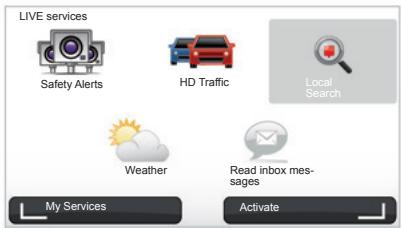
LIVE services
These include road safety alerts, HD Traffic™, local search with TomTom Places™ and the weather. At the end of a three-month trial period, you can extend your subscription online via TomTom HOME™ (please see the "System update" section).
Note: these services require a subscription, and use an inaccessible SIM card integrated into the navigation system.
If these services are available in your country, the Live Services icon will appear on the navigation screen.
Navigation assistance function
The system suggests a route to your chosen destination using:
- its road map (on the SD card);
- the positioning sensors which estimate your location even if the GPS signals are lost;
- information from the traffic information service (depending on country); road safety information (speeding warning, speed limit zone);
- HD Traffic™, from subscription to Live Services.
Finally, it indicates the route to take, step by step, using the display screen and voice messages.
GENERAL DESCRIPTION (2/3)
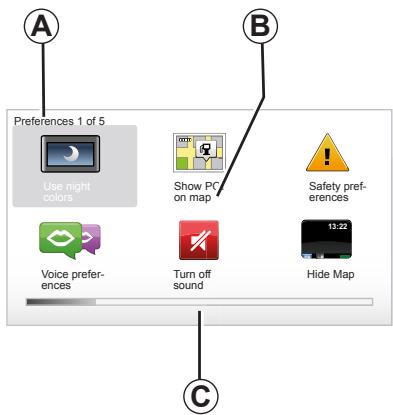
Displays
Menu screen
A Menu name B Name of the function or sub-menu C Menu page scroll bar
Note: a menu may contain several screen pages.
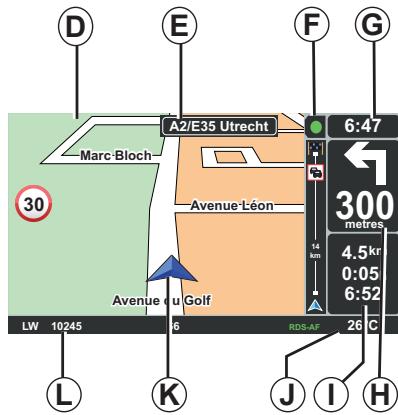
Map screen
D Navigation maps E Indication of the next navigation instruction (road sign) F Traffic information G Clock H Instructions for navigation and distance to next change of direction
Estimation of the distance and time remaining before you reach your destination and the arrival time J Exterior temperature K Current location L Audio information (depending on the vehicle)
Note: you can return to the map screen at any time by pressing the "MAP-2D/3D" button on the remote control or the central control.
If you have just modified a parameter, remember to confirm it using the soft buttons before returning to the map screen.
GENERAL DESCRIPTION (3/3)
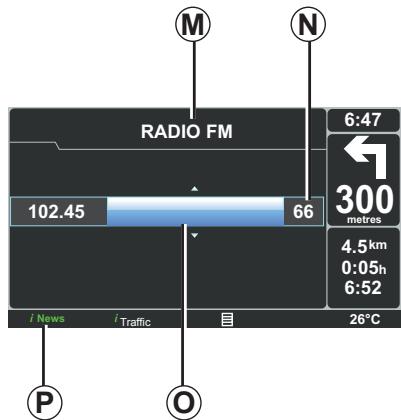
Audio display
When you use your audio system to modify a source or change the audio parameters, the audio information appears in full screen mode.
When the operations are completed, the audio screen closes again, the audio information is displayed on band P and the navigation screen reappears.
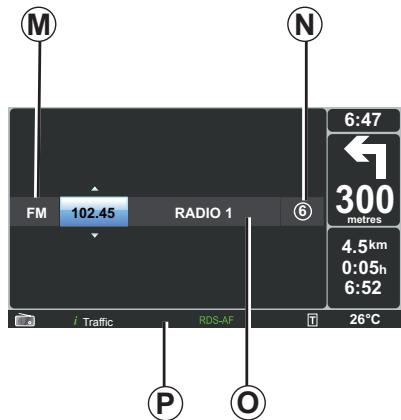
Audio screen
M Source currently in use (Radio, CD, etc.) N Preset station. O Information on the current track or station. P Additional information on radio messages and services (news...) and the CD play mode (Random)
Depending on the vehicle, the radio display appears either on the navigation screen or on the dashboard screen.
For more information, refer to the manual for your audio system.
INTRODUCTION TO THE CONTROLS (1/2)
Central control
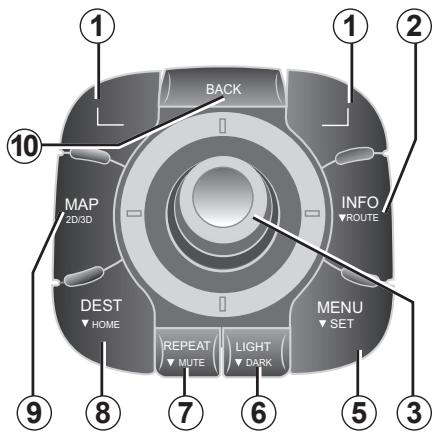
Note: depending on the vehicle, the system has either a central control or a remote control.
| Function | ||
| 1 | Soft buttons | Select and confirm |
| 2 | INFO/ROUTE | Access the Traffic information (short press), accessing the programmed route summary (long press). |
| 3 | Rotary button | Rotate: - move vertically and horizontally through the menus; - modify the scale (ZOOM mode). Shift (up, down, right, left): - move vertically or horizontally through the menus; - move around the map. Press: - confirm; - display the quick menu. |
| 5 | MENU/SET | Access the full navigation system menu (short press)/ the system settings (long press). |
| 6 | LIGHT/DARK | Change the brightness of the screen (short press) or activate the standby screen to hide the map (long press). |
| 7 | REPEAT/MUTE | Repeats the instruction (short press), deactivates the voice guidance (long press). |
| 8 | DEST/HOME | Access the “Navigate to...” menu (short press), navi-gate to your home (long press). |
| 9 | MAP-2D/3D | From a menu: displays the map From the map: switches the map to 2D/3D mode. |
| 10 | BACK | Back to previous screen. |
INTRODUCTION TO THE CONTROLS (2/2)
Remote control
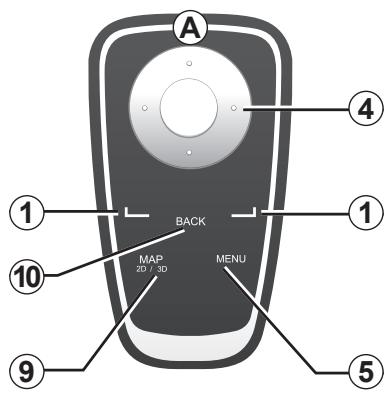
| Function | ||
| 1 | Soft buttons | Select and confirm |
| 4 | Remote control | Shift (up, down, right, left): - move vertically or horizontally through the menu; - move around the map. Press the central button: - confirm; - displays the quick menu. |
| 5 | MENU | Accesses the full navigation system menu. |
| 9 | MAP-2D/3D | From a menu: displays the map From the map: switches the map to 2D/3D mode. |
| 10 | BACK | Back to previous screen. |
Note: to connect your remote control more quickly, press one of the remote control buttons when the system starts, before the legal notices appear.
Note: the remote control unit does not have press and hold functions.
Note: depending on the vehicle, the system has either a central control or a remote control.
Store the remote control in its housing, away from sunlight, to ensure the batteries are not damaged.
LED A on the remote control flashes once your navigation system is connected to it. To replace the batteries, refer to the section entitled "Remote control: batteries".
SWIVEL SCREEN
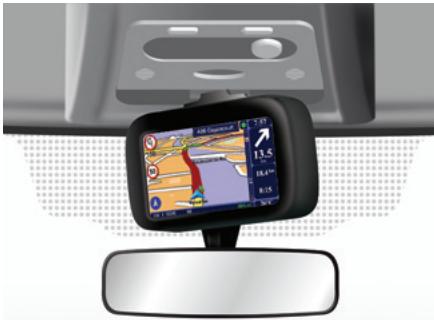
Definition
Depending on the vehicle, your navigation screen can be turned to the left and right to ensure it can be read with the utmost comfort under any circumstances.
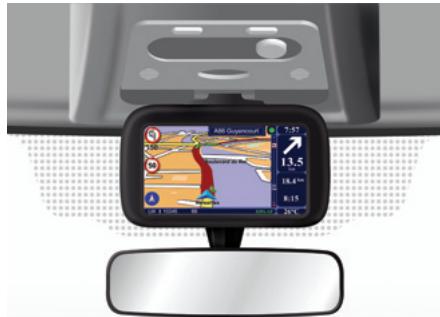
Manipulation
To avoid any mistakes with the vehicle trajectory and/or accidents, it is recommended that the screen is moved when the vehicle is stationary.
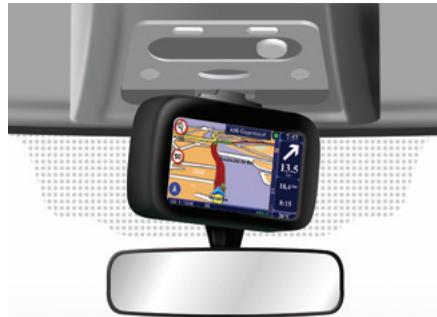
Push the screen on the left or right to swivel it.
SD CARD: USE, INITIALISATION (1/2)
SD card
An SD card is supplied with the navigation system. It includes, among other things, a map of your country or group of countries.
Map and recharging station (for electric vehicles) updates are regularly issued. They are only available for download by inserting your navigation system's SD card into your computer and connecting to the Internet.
Once your new vehicle has been delivered, you will have a maximum of 60 days in which to update the map for free. Once this time has elapsed, you will need to pay for updates.
Only use your SD card for operating and updating your navigation system. Do not insert any other device (camera, portable GPS, etc.), or in another vehicle.
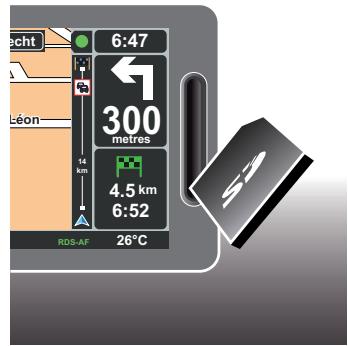
To update your system and your map, refer to the section entitled "System update" in this document.
Remember to back up the data on the SD card regularly. Refer to the section entitled "System update" in your user manual.
Only use an SD card which is compatible with your vehicle's navigation system.
You can also download maps covering more countries than your original map (e.g. Western Europe).
SD CARD: USE, INITIALISATION (2/2)
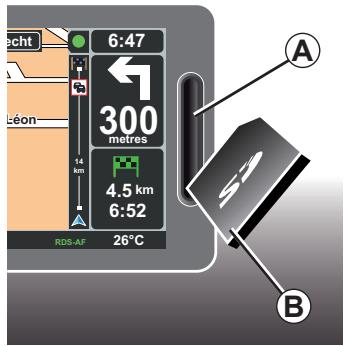
Inserting the SD card
Switch off the ignition to switch off the navigation system and insert the SD card B in slot A.
Note: do not insert the SD card in another vehicle.
The SD card is fragile; do not bend it. Insert it the right way round, as shown in the diagram.
Removing the SD card
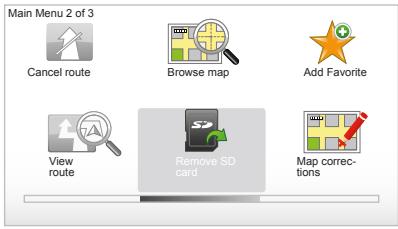
From the main menu, select "Remove SD card", then confirm using the right-hand soft button. A message informs you when you can remove the SD card. To remove the SD card from slot A, press on the card, then release it. The card is released a few millimetres.
Pull the card to remove it completely.
To get up-to-date electric vehicle charging station locations, please log into the TomTom Home site at regular intervals using your SD card from your navigation system.
Main Menu 3 of 3
Map corrections
Photo gallery
Itinerary planning
Prepare route
Status & Information
Help me!
Your navigation system offers you tutorials so that you can quickly become familiar with the different functions.
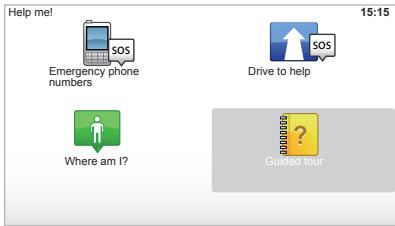
Accessing Guided Tours
To access the Guided Tours:
- from your central control or remote control unit, press the "MENU" button;
- select "Help me!"; from the "Help me!" menu, select "Guided tour"
"Central Control operation" or "Remote control"
This tutorial will teach you to use the central control and the remote control for your navigation system.
"Driving view"
This tutorial will teach you about the different areas of your navigation screen and the best way to use them.
"Menu options"
This tutorial will teach you about the main functions in the various menus.
Guided tours 1 of 2
Central control
Driving view
Menu options
Browse map
Planning preferences
Itinerary planning
"Browse map"
This tutorial teaches you how to use the "Browse map" menu.
"Planning preferences"
This tutorial teaches you how to use the "Planning preferences" menu.
"Itinerary planning"
This tutorial teaches you how to use the "Itinerary planning" menu.
Guided tours 2 of 2

Traffic information

Warnings and notifications

Quick menu

TomTom HOME

LIVE SERVICES

Electric vehicle
"Traffic information"
This tutorial teaches you how to use the "Traffic info" menu.
"Warnings and notifications"
This tutorial teaches you about the different notices and information which appear on the navigation screen.
"Quick menu"
This tutorial teaches you how to use the "Quick menu" menu.
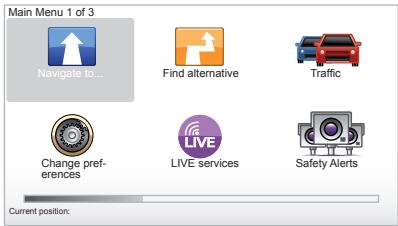
Main Menu 1 of 3

Navigate to...

Find alternative

HD Traffic

Change preferences

LIVE services

Z.E. Services
Current position:
"TomTom HOME"
This tutorial teaches you how to use the "TomTom HOME™" application.
"LIVE services"
This tutorial teaches you how to use the "LIVE services" menu.
This tutorial will teach you about the special features of your Carminat TomTom relating to an electric vehicle.
Z.E. Services

Search by availability
Activate

"Z.E. Services"
This tutorial details the "Z.E. Services". To access the Guided Tours for your Z.E. Services:
- from your central control or remote control unit, press the "MENU" button; select "Z.E. Services";
- from the "Z.E. Services" menu, select "Guided tour"
Please refer to the "Z.E. Services" section in your Driver's Handbook.
SWITCHING ON/OFF
Switching on
The multimedia system switches on automatically when the ignition is switched on.
In other cases, press the On/Off button on your audio system.
Press the On/Off button on your audio system to make the multimedia system run for an extra 20 minutes.
Switching off
With the ignition off, the system is deactivated automatically when the driver's door is opened.
With the ignition on, press the On/Off button on your audio system.
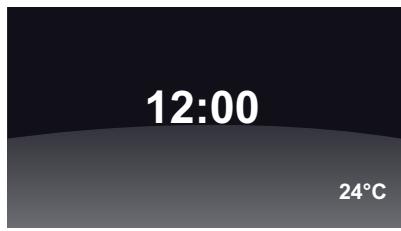
Exterior temperature/clock
With the ignition on, press the On/Off button on your audio system. The system then stops the guidance and displays a simple clock screen (and the temperature, depending on the vehicle).
Hiding the map
(depending on the vehicle)
From the quick menu, the "Hide Map" button switches off the display screen.
Only the map and the instructions are hidden. The audible warnings for cameras and the voice guidance instructions remain active, as does the audio information from the radio.
Press and hold the "LIGHT/DARK" button on your central control.
Pressing any of the keys will switch the screen back on.
Resetting the system
To reset all the system parameters and/or delete all personal data, use the "MENU/SET" button to access the main menu and select "Change preferences" then "Reset factory settings", then follow the instructions on the screen using the soft buttons.
OPERATING PRINCIPLES (1/2)
Central control
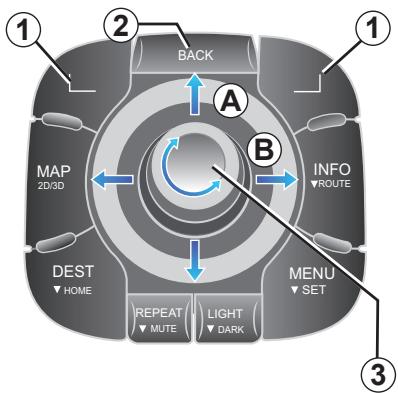
Navigating a menu
Central control
- Turn rotary switch 3 for vertical or horizontal movement (movement A or B); push 3 to move vertically or horizontally (movement A or B).
Remote control
Press buttons 5 to move vertically or horizontally (movement A or B).
Remote control
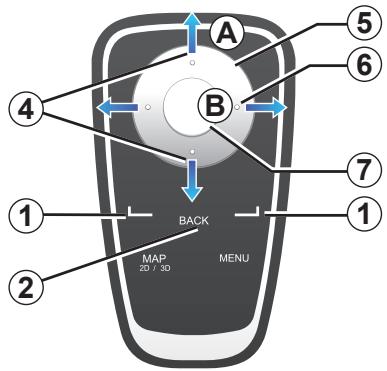
Confirming/cancelling a selection
Always confirm the selection by pressing 3 or 7. To return to the previous menu, press 2.
Special features of the remote control
From the navigation map:
- the left soft button can be used to repeat the voice instruction;
- the right soft button can be used to display the programmed route summary.
Shortcuts
From the navigation map, some buttons on your remote control unit have shortcuts giving direct access to menus and functions.
4 Zoom, 6 Info Menu.
Soft buttons
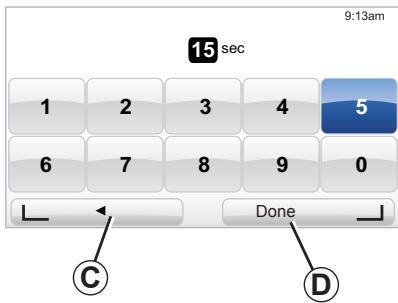
Soft buttons 1 (L and J) are used to select or confirm an action or selection C or D which appears at the bottom of the screen.
Quick menu

Disable voice

Use night colors

Report safety camera

Hide Map

Cancel route

Mark location of map error
Quick menu for vehicles with central control
From the navigation map, you can access the quick menu directly by pressing on the centre button of your central control.
Quick menu

Disable voice

Use night colors

Report safety camera

Hide Map

Brightness preferences

Cancel route
Quick menu for vehicles with remote control
From the navigation map, you can access the quick menu directly by pressing the centre button on your remote control.
Description of the menus
Using these menus, and depending on whether you have a central control or a remote control, you can quickly access the following menus:
- Day/night colours: daytime/night-time display; Report safety camera: reports the presence of a mobile or fixed speed camera;
- Cancel route: stops the guidance in progress;
- Mark location of map error: flags an error on the map;
- Disable/activate voice: switches the guidance instructions on/off;
- Hide map: hides the map;
- Brightness preferences: selects the brightness of your navigation system depending on the brightness of the light outside.
Depending on the country, the system will indicate either warning areas or speed cameras.
Volume
Changing the volume
To change the volume, use the audio system volume control during a voice instruction. If the instruction is too quick, you can repeat it using the "REPEAT/MUTE" button on your central control unit, or use the left soft button on your remote control.
Deactivating the sound
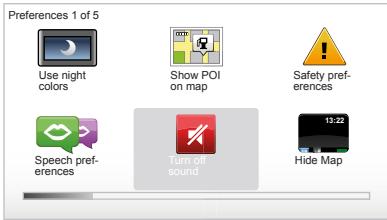
To deactivate sounds, select "Change preferences" from the main menu, then "Turn off sound".
To turn the sound back on, select the "Turn on sound" heading.
Deactivating the voice
From the central control, press "REPEAT/MUTE" (long press) or select the "Change preferences" menu, then "Disable voice".
NB: from the remote control and central control, select "Disable voice" from the quick menu.
Selecting a voice
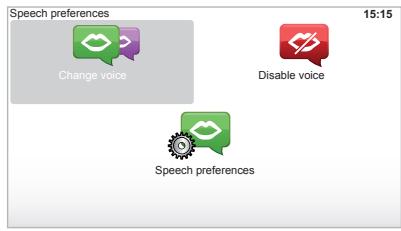
Your system allows you to select either a synthesised or human voice. This voice is used to give the voice instructions. To change the voice used on your navigation system, go to the main menu and select "Change preferences", then "Voice preferences" and "Change voice". Select a voice from the list.
Synthesised voices
Synthesised voices are generated by your navigation system. They give you verbal instructions while you are driving. They can give road directions, (e.g.: turn right), traffic sign information, etc.
Recorded human voices
The human voices are recorded by an actor or actress.
Note: the human voices only give you simplified guidance instructions.
READING A MAP
Map key
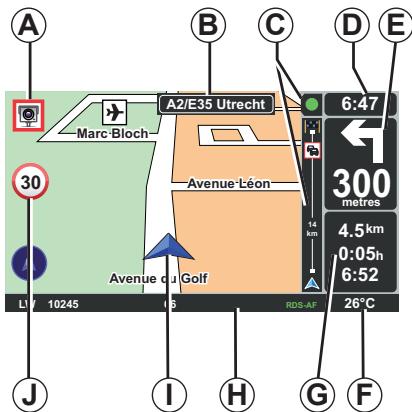
A Warning of the next risk area with the related distance (fixed or mobile safety camera, school, etc.). B Name of the next major road or road sign information, if applicable. C Traffic sidebar: display of incidents on the route, traffic info reception indicator. D Current time. E Distance to and indication of next change of direction. F Exterior temperature (depending on the vehicle).
G Information about your journey, such as remaining distance, journey time and arrival time.
Note: to select what will be shown, select "Change preferences" in the main menu, then "Status bar preferences".
H Audio system information.
I Current location. J Sign giving the speed limit (the speed given depends on the unit chosen).
Note: the sign turns red and flashes if you drive faster than the speed limit.
Colour codes
The roads are displayed differently depending on the type of carriageway. You have the option to change the colours: in the main menu (MENU button), select "Change preferences" then "Change map colors".
Map icons
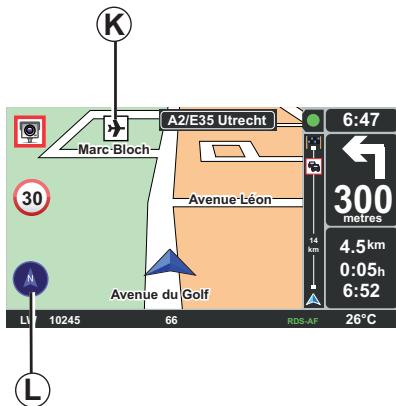
The navigation system uses icons K to display points of interest (POI).
Compass
To display or remove the compass L from the main menu (button "MENU"), select "Change preferences", then "Show compass".
ENTERING A DESTINATION (1/4)
"Navigate to..." menu
Press the "MENU" button to access the "Navigate to..." menu.
The "Navigate to..." menu offers you several ways to enter a destination:
- enter an address from the "Address" section using one of the following methods:
- entering a full address (City and street);
- searching by "Zip Code";
- selecting a "City center";
- selecting a "Crossing or intersection".
- select the "Home";
- select an address from the "Favorite" section;
- select a destination from the locations in the "Recent destination" section;
- select an address from the "Point of Interest" (POI) section;
- select a "Point on map";
- select a "Latitude" or "Longitude".
Entering a "New address"
This item allows you to enter all or part of the address: country, city, street and house number.
Note: only addresses known to the system through the digital map are authorised.
When using for the first time:
- select the destination country.
- enter the name of the required city using cursor 3.
The system may suggest several cities in zone 1, the first line is always highlighted in yellow.
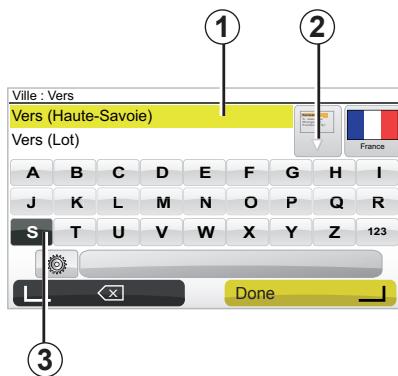
press the "Done" button to confirm the city highlighted in yellow.
- access the full list corresponding to your search by selecting arrow 2 to the right of the list.
- select the desired city and confirm.
- proceed in the same way for "Street" and "No."
Note: the system stores previously entered cities in its memory. You can directly select one of these cities by selecting zone 1.
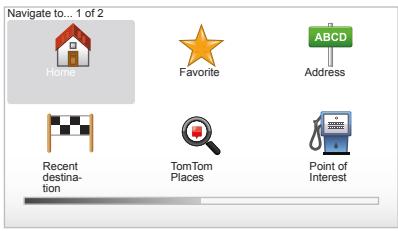
"Home"
This box allows you to navigate to your home and you can activate it from the central control by pressing and holding the "DEST/HOME" button.
To save your home address, refer to the section on "Add and manage favourites" in your manual.
"Favorite"
The "Favorite" section contains the favourite stored destinations and favourites such as your place of work.
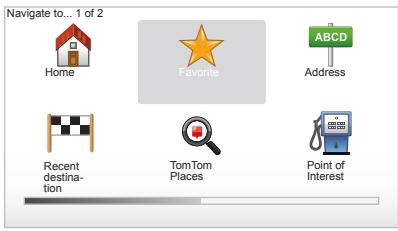
In the main menu, select the heading "Navigate to...". - Select "Favorite" and confirm. - Select the required destination address in the list of stored addresses. - Confirm.
To save a destination as a favourite, refer to the section on "Add and manage favourites" in your manual.
Note: the "Favourite" icon will be greyed out if you do not have any destinations stored.
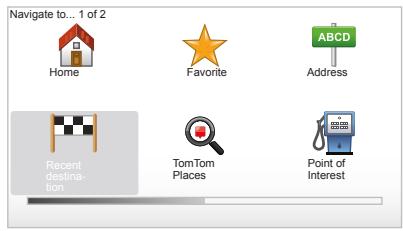
"Recent destination"
This item enables you to select a destination from the list of addresses last used. These are automatically stored. In the main menu, select the heading "Navigate to..." and then "Recent destination".
From the list of stored destinations, select an address then confirm this address as the destination.
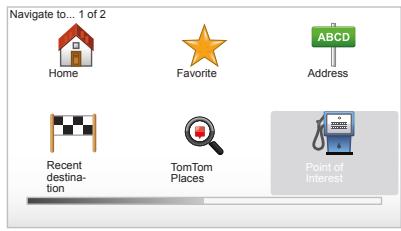
"Point of Interest" (POI)
A point of interest (POI) is a service, establishment or tourist area close to a location (start point, destination city, en route, etc.). POIs are classified in different categories, e.g. restaurants, museums, car parks, etc.
There are several options to find a point of interest:
category, the name of the desired POI.
In the main menu, select the heading "Navigate to..." then "Point of Interest" and confirm.
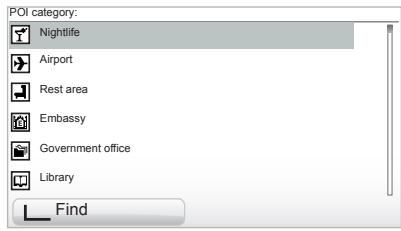
Search by POI name
Enter the name of the POI that you wish to find and the system will automatically search for the point of interest.
Search by POI category
Select your desired category type. Choose the area you require: "POI near you", "POI in city" or "POI near Home". Enter a city name and start the search by selecting "Done".
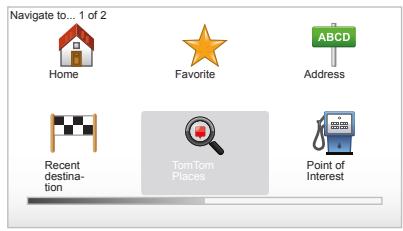
TomTom Places™
This service enables you to quickly search for a Point of Interest using a keyword, and to make that location a destination. It gives you quick access to the TomTom Places™ database, containing the most up-to-date information on companies and services, including their addresses, phone numbers, opening hours, payment methods and more.
Note: this icon is only displayed if you have a subscription in the country where the LIVE Services are available (refer to the section on "LIVE Services").
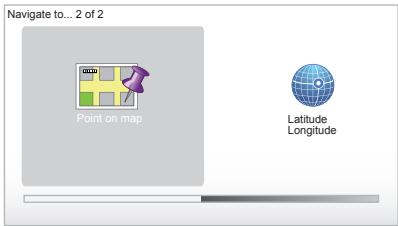
"Point on map"
This function allows you to define a destination from the map. In the main menu, select "Navigate to..." then "Point on map" using the buttons on the remote control or the rotary button on the central control.
From the central control or the remote control, move around the map to position the cursor on your destination, then confirm: the system calculates the route.

"Latitude Longitude"
This function allows you to define a destination using latitude and longitude values.
Confirming the destination
Once the destination information has been entered, the system calculates the route. By default, it is calculated using the fastest route.
Note: the calculation criteria can be modified in the parameters.
At the end of the calculation, the system displays the navigation summary and suggests two options:
- "Details" enables you to see details of the journey in various forms (refer to the information on "Route information" in the "Guidance" section).
- "Done", guidance starts.
Note: if you do not confirm, this page will close after ten seconds and guidance will start automatically.
Note: "IQ RoutesTM" is a function which optimises the journey time using statistical data and allows routes to be calculated according to the average level of traffic for the given day and time.
To activate or deactivate this function, refer to the information on "Planning preferences" in the "System settings" section.
To plan a journey in advance, refer to the section entitled "Entering a destination" in your user manual.
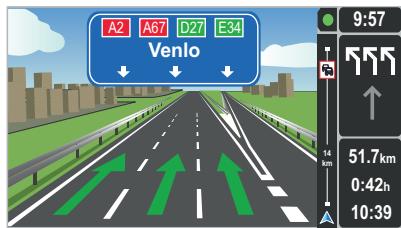
Lane images
When approaching a road change (on major roads), the system may switch to "Show lane images" mode: a 3D image provides a close-up view of the junction with a turn arrow and road signs.
To deactivate the lane guidance, refer to the section on "System settings".
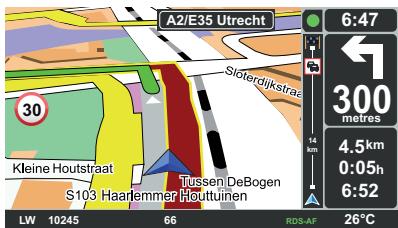
Guidance screens
Intersection map
During guidance, before each change of direction, the system will gradually zoom into the junction.
To deactivate automatic zooming mode, refer to the section entitled "Change preferences".
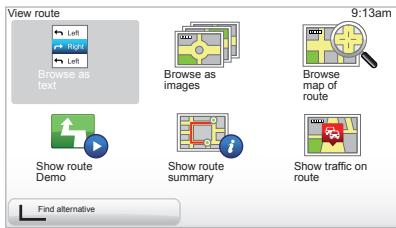
Route information
This function allows you to view your route before guidance begins.
Select "Details" after having entered a destination. Guidance will begin.
Six choices will be given:
- "Browse as text",
- "Browse as images",
- "Browse map of route",
- "Show route Demo",
- "Show route summary",
- "Show traffic on route".
GUIDANCE (2/4)
Note: to change your route (alternative route, adding waypoints, etc.) select "Find alternative" using the left soft button.
"Browse as text"
This function makes it possible to view the route plan.
Several details of the route will appear:
- direction change arrows, road types, road names,
- miles/kilometres before a fork.
"Browse as images"
This function allows you to see changes in direction as images.
"Browse map of route"
This function makes it possible to view the map of the route.
"Show route Demo"
This function makes it possible to view a demonstration of the route. You can select the speed of the demonstration.
"Show route summary"
This function is used to return to the previous screen. The details of the journey time, the miles and the type of journey ("IQ RoutesTM" activated/deactivated) are displayed.
Note: to access this page directly from the navigation map, use the right soft button on the remote control or, from the central control, the "INFO/ROUTE" button.
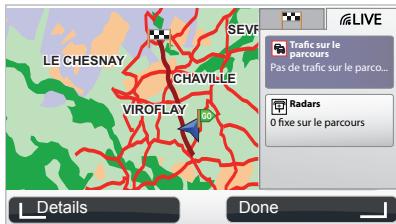
"Show traffic on route"
This function gives you an overview of all the traffic incidents affecting your journey.
Once subscribed, the Live tab allows you to view the details of your journey (delays caused by traffic, fixed and mobile safety cameras).
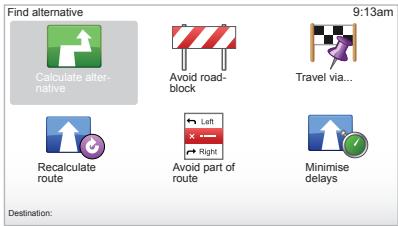
Alter route
To alter your route, from the main menu, select "Find alternative" then one of the following options.
"Calculate alternative"
Select this menu to calculate an alternative to the route already planned. Your system will look for another route from your current location to your destination.
"Avoid roadblock"
Select this menu if you see a roadblock or a line of traffic ahead which was not indicated by the "Traffic info" service. You then have to choose how much of the route ahead you want to avoid. Choose from the different options: Avoid 100m, Avoid 500m, Avoid 2000m, Avoid 5000m. Your system will recalculate your route avoiding the section of the route for the distance you selected.
"Travel via..."
Select this menu to change your route so that it goes via a particular location, perhaps to pick someone up on the way. You choose the location you want to pass through the same way as you choose a destination. So you can select from all the same options: Address, Favorite, Point of Interest and Point on map. Your system will calculate a new route to your destination that passes through the location you chose.
Select this menu to return to the original route.
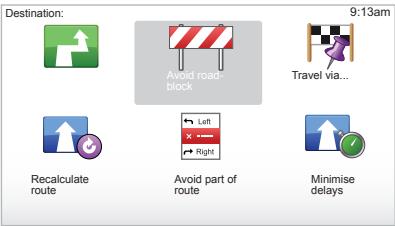
"Avoid part of route"
Select this menu to avoid a part of the route. Use this option if you see that your route includes a road or a junction that you wish to avoid. Then, choose the road that you wish to avoid from the list of roads on your route.
"Minimise delays"
Select this menu for your system to plan your route based on the latest traffic information.
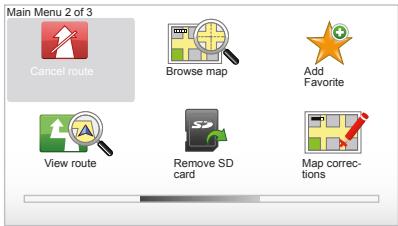
Deactivating guidance
To stop guidance when in progress, in the main menu (MENU/SET button), select "Cancel route" and confirm. To resume guidance, select "Navigate to...", then "Recent destination".
Note: to stop guidance, from the central control or the remote control, press the centre button then "Cancel route".
FIND ALTERNATIVE
Main Menu 1 of 3

Navigate to...

Find alternative

Traffic

Change preferences

LIVE services

Safety Alerts
Current position:
Itinerary with waypoints
To add waypoints to your route, press "MENU/SET" in the main menu, select "Find alternative", "Travel via...", then enter the waypoint address.
Find alternative

Calculate alternative

Avoid roadblock

Travel via...

Show route summary

Avoid part of route

Minimise delays
Current position:
The system calculates the route taking the detour into account.
Note: you can add several waypoints to your route.
Planning a route in advance
You can use your navigation system to plan journeys in advance by selecting both your starting point and your destination. For example, to find out how long a journey is going to take before you start, or to check the route of a journey you are planning.
Travel via.

Home

Favorite

Address

Recent destination

TomTom Places

Point of Interest
To access the menu, from the main menu (MENU/SET button), select "Prepare route".
Select a starting point in the same way as you would select your destination.
Select a destination.
Choose the type of route, then confirm. The system plans the route and allows you to view the details.
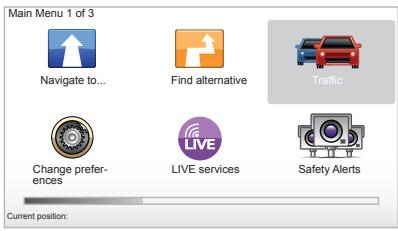
The "Traffic info" service
"Traffic info" is a service available on your navigation system which allows you to receive up-to-date traffic information from the best local sources. The traffic info service uses TMC information transmitted on the FM band. This service flags up events as points on the map and covers major roads. It is updated approximately every 15 minutes.
Note: the menu title is "HD Traffic™" depending on the LIVE Services used.
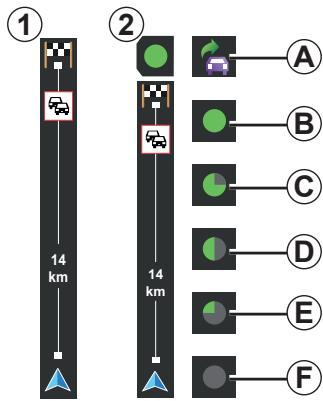
The traffic bar
The side traffic bar displayed in guidance mode, shows the latest traffic information for your route.
Note: the traffic sidebar differs depending on the source used. Bar 1 with the LIVE Services connected.
Bar 2 if the RDS-TMC source is connected.
Note: please see the "LIVE Services" chapter for more information about the "HD Traffic™" service.
Display
The "Traffic info" function
The navigation system indicates traffic incidents:
- by displaying symbols on the map (list of icons at the end of the section); with voice messages.
Depending on the operating status of the "Traffic info" service, the following icons are displayed on the traffic sidebar:
A Your device is searching for an FM station broadcasting traffic information. B Traffic information is up-to-date or being updated. C Traffic information has not been updated for at least 9 minutes. D Traffic information has not been updated for at least 14 minutes. E Traffic information has not been updated for at least 19 minutes. F Traffic information has not been updated for at least 24 minutes.
The availability of the "Traffic Info" service varies according to country.
TRAFFIC INFORMATION (2/3)
Traffic information can include:
- accidents and incidents, traffic volumes, roadworks,
- weather conditions,
- general information,
- lane closures.
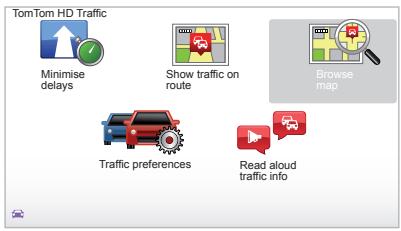
"Traffic info" configuration menu
Manage the "Traffic info" service. To manage the "Traffic info" service, from the main menu ("MENU" button), select "Traffic". The submenus will appear.
"Minimise delays"
Select this option to alter your journey based on the latest traffic information.
"Show traffic on route"
Select this menu to see an overview of all traffic incidents on your route. You can use the left and right buttons on the resulting screen to see more detailed information about each of these incidents.
"Browse map"
This menu enables you to explore the map and keep up-to-date with the traffic situation in your area. To access the map, in the main menu select "Traffic", then "Browse map". The map displays in the last location shown. For information relating to the incidents shown on the map, select the incident using the right and left buttons, then confirm.
Note: to access an area you are searching for more quickly, add it to your favourites (refer to the section entitled "Browse map".)
TRAFFIC INFORMATION (3/3)
"Traffic preferences"
To access this menu, select "Traffic" in the main menu button "MENU/SET", then "Traffic preferences".
The following preferences can be changed:
- Automatically minimise delays after every traffic update. To select your preference, tick the box to the right of your choice using the central confirmation button. Once your choice has been selected, select "Done" with the soft button.
- Beep when traffic situation on route changes. Your device beeps when a new traffic incident occurs on your current route.
Note: by default, the beep is deactivated.
"Read aloud traffic info"
Select this menu for your device to read all traffic incidents aloud on your route.
| Symbol | Meaning |
| Accident | |
| Traffic jams | |
| One or more closed roads | |
| Road closed | |
| Traffic incident | |
| Road works |
| Symbol | Meaning |
| Heavy rain | |
| Snow | |
| Strong wind, storm | |
| Fog | |
| Ice |
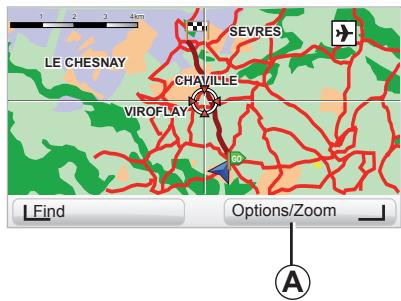
To browse the map, press "MENU/SET in the main menu, select "Browse map" or use one of the direction buttons on the control from the navigation view.
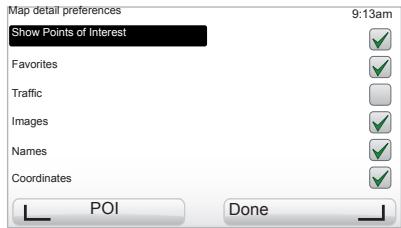
Note: soft button A changes depending on the type of navigation control. If you have a central control, the right soft button accesses the options. If you have a remote control, the right soft button zooms using the up and down keys. In this case, to access the options, press the centre button, then the right soft button.
"Options"
Access the option from the map browser. This menu allows you to select the information that you wish to see on your browser.
To change the display preferences for points of interest (POI), press left soft button (POI).
To confirm your selection, select the right soft button (Done).
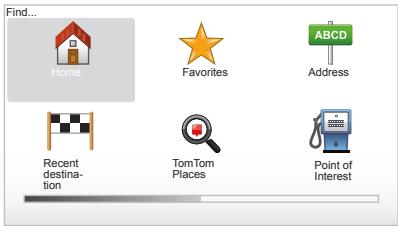
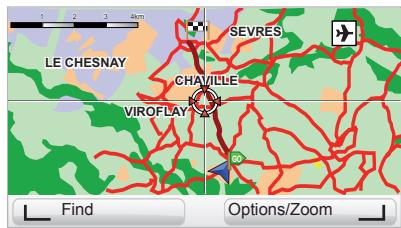
"Find"
You can centre your map on a specific location; press the left soft button (Find) and this menu will allow you to centre:
- your home,
- a favourite,
- an address,
- a recent destination,
- local search with TomTom Places™,
- a point of interest.
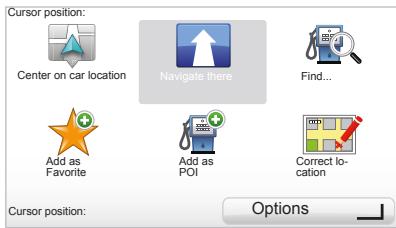
"Cursor position:"
To access the "Cursor position:" from the map browser, press the centre button. This menu enables you to:
centre the map on the vehicle location, - navigate to a point on the map, - search for a point on the map, - add a point on the map to the favourites, - add a point on the map to the POI, - correct the location of your vehicle.
LIVE SERVICES (1/2)
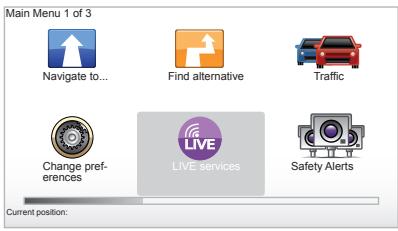
Once you subscribe, LIVE Services will include road safety alerts, HD Traffic™, local search with Google™ and the weather forecast.
Note: the HD Traffic™ service is called "Traffic" if the subscription is not yet activated.
At the end of a three-month trial period, you can extend your subscription online via TomTom HOME™ (please see the "System update" section). When these services are available in your country, the LIVE Services icon will appear activated on the browser screen.
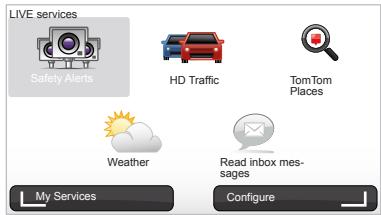
Accessing LIVE Services
To access LIVE Services:
- From your central control or remote control unit, press the "MENU" button;
- Select "LIVE services".
"Safety Alerts"
This service includes the location of mobile safety cameras in real time, accident blackspots, and fixed safety cameras.
The latest fixed camera updates can be downloaded via TomTom HOME™.
"Safety Alerts" shows mobile speed camera alerts as well as fixed speed camera alerts. Information is obtained in real time using information from other TomTom users.
You can deactivate this function by going to the "Safety Alerts" menu in LIVE Services.
Note: Fixed safety cameras are only updated via TomTom HOME™ by connecting the SD card.
Depending on the country, the system will indicate either warning areas or speed cameras.
Requirement for obtaining LIVE Services:
- A current valid subscription is required.
The content of LIVE Services varies according to country.
LIVE SERVICES (2/2)
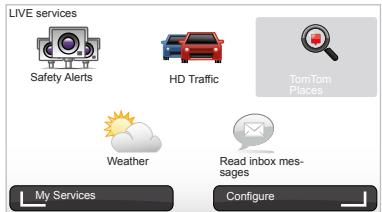
"HD Traffic™"
HD Traffic™ includes an exclusive, high quality traffic information service. This service enables you to:
plan a route which reduces delays caused by road traffic; - know the length of the traffic-induced delays affecting your journey; view the traffic in the area where you are driving.
Contrary to the source TMC, the HD Traffic™ service uses a new traffic information source: drivers' mobile telephones.
This anonymous data means the position, direction and speed of mobile phone users driving on the road network can be pinpointed exactly.
HD Traffic™ indicates the duration and length of events. Covers most of the road network. Updates performed about every 3 minutes.
"TomTom Places™"
This service enables you to quickly search for a Point of Interest using a keyword, and to make that location a destination.
"Weather"
The weather forecast service gives you five-day weather reports for the area of the map where you are located and for the area you are heading to.
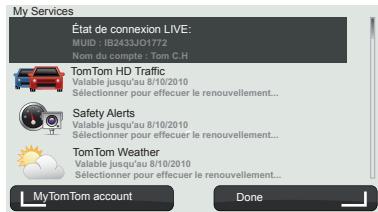
"My Services"
This service allows you to find out when the subscription to the services expires. The subscription to the services can be renewed from the "My Services" screen by selecting one of the services.
An email address will be required to receive the e-mail setting out the details of the subscription.
Note: availability of all LIVE Services will vary depending on the country. To find out more about service availability in your country, please visit www.renault-multimedia.com.
ADD AND MANAGE FAVOURITES (1/2)
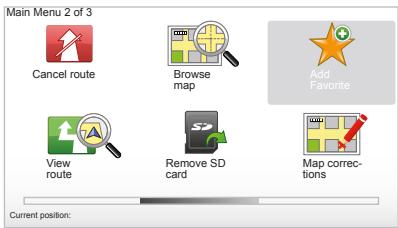
Creating an entry
In the main menu (MENU/SET button), select "Add Favorite".
You can select the location for your Favourite from the following list:
"Home"
You can set your home location as a Favourite.
"Favorite"
Not used
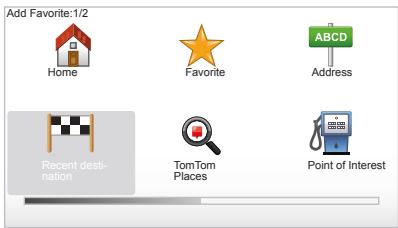
"Address"
When you enter an address, you can choose from four options:
- City center,
- Street and house number, Zip Code,
- Crossing or intersection.
"Recent destination"
Select a favourite location from the list of those you have recently entered as a destination.
Give your Favourite a name that is easy to remember. Your navigation system will always suggest a name, usually the address of the Favourite. To enter a name, just start typing.
"Point on map"
Select the location of your Favourite using the cursor, then select "Done" using the soft button.
"TomTom Places™"
Select a place using TomTom Places™, then select "Done".
"Point of Interest"
You can add a Point of Interest (POI) as a Favourite from the list below:
- POI near you: to search from a list of POIs near your current position.
- POI in city: to choose a POI in a particular town or city. You have to specify a town or city.
- POI near Home: to search from a list of POIs near your Home location. If you are currently navigating to a destination, you can also select from a list of POIs which are on your route or near your destination. Choose one of these options:
- POI along route,
- POI near destination.
ADD AND MANAGE FAVOURITES (2/2)
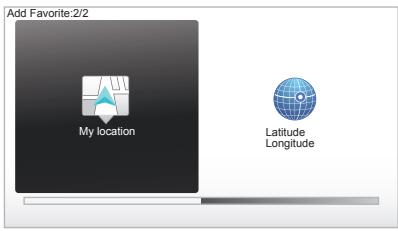
"My location"
If you stop somewhere interesting, you can select this button to create it as a Favourite.
"Latitude Longitude"
Select this button to create a Favourite by entering latitude and longitude values.
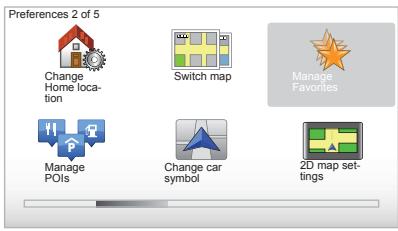
Deleting/renaming a Favourite
- Select the main menu ("MENU/SET" button).
- Select "Change preferences" to display the Preferences menu.
- Scroll through the pages until you reach "Manage Favorites", then select it.
- Select the Favourite you wish to delete or rename.
- Select "Delete item" or "Rename item" using the soft button.
HELP ME!
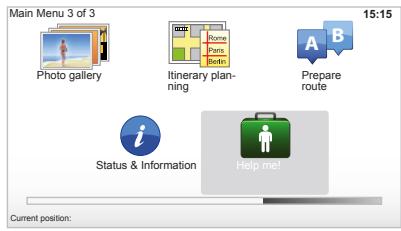
You can use "Help me!" to find and make contact with a service centre. The "Help me!" menu offers: "Emergency phone numbers", "Drive to help", "Where am I?" and "Guided tour".
"Emergency phone numbers"
When you select a service centre, your current location and the phone number of the Point of Interest (PI) are displayed. You can also select this service centre as a destination by pressing the soft button.
The "Emergency phone numbers" menu gives different service centres:
"Emergency services", - "Nearest police station", - "Nearest doctor", - "Nearest hospital", - "Nearest public transport", - "Nearest car repair service", - "Nearest dentist", - "Nearest pharmacy", - "Nearest vet".
"Drive to help"
Use your system to navigate by road to a service centre:
- "Nearest car repair service",
- "Nearest hospital",
- "Nearest doctor",
- "Nearest police station",
- "Nearest pharmacy",
- "Nearest dentist".
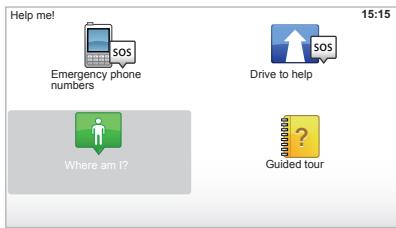
"Where am I?"
Your system shows your current location (address) and gives the GPS coordinates (latitude/longitude).
"Guided tour"
Your system offers you tutorials so that you can quickly become familiar with the different functions.
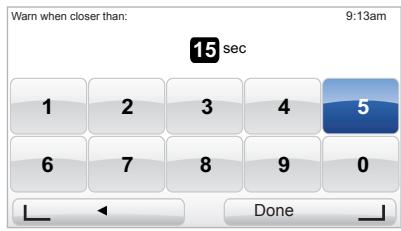
"Warning settings"
This menu is used to delete or modify the warning time before the camera and the sound of the warning.
From the main menu, press "MENU/SET", select "Safety Alerts", then "Warning settings".
To add camera alerts (mobile camera, toll road camera etc.), check the types of camera that you require.
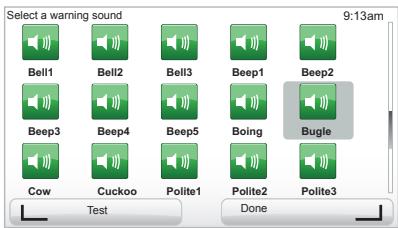
Select the type of camera you want to modify, then the system asks you if you want to delete the warning. Use the soft buttons to confirm yes or no.
If you choose "No", enter the warning time before the camera and "Done" using the soft button.
Select the type of sound that you want to hear to warn you of an upcoming camera. Test the sound using the lefthand soft button and confirm with the right-hand soft button.
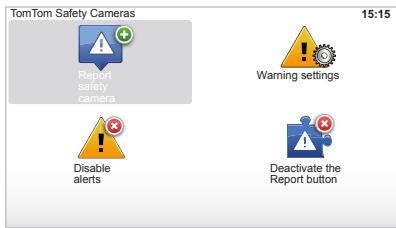
"Disable alerts"
Speed camera warnings can be enabled/disabled. From the main menu, press "MENU/SET", select "Safety Alerts", then "Disable alerts" if warnings are enabled or "Enable alerts" if warnings are disabled.
In certain countries it is illegal to download and activate the speed camera warnings and this could lead to prosecution.
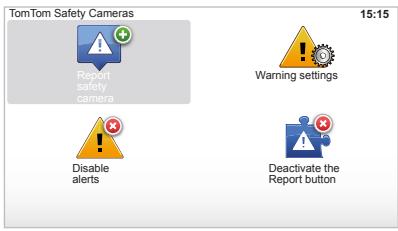
"Report safety camera"
If the navigation system does not indicate that there is a fixed or mobile camera along your journey, you can enter details of this manually.
From the main menu (MENU/SET button), select "Safety Alerts", then "Report safety camera". You can enter a camera more quickly using the quick menu (centre button). The quick menu is displayed. Select "Report safety camera".
Your system will then require you to enter the type of camera (Fixed camera or Mobile camera).
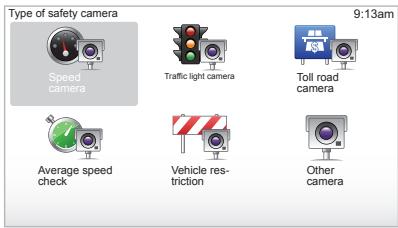
Select the type. The system opens a map page. Using the directional controls, place the red marker on the location of the camera and confirm with the centre button.
So that your system can integrate the cameras entered manually, you must be subscribed to the camera updates in TomTom HOME™. The cameras will be active after the location is confirmed by the TomTom technical department.
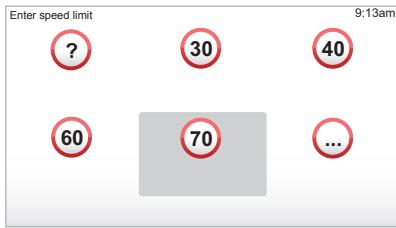
The system will prompt you to confirm the position you have given, using the soft buttons. If you confirm the location, the system asks you for the type of camera.
When you choose "Speed camera", the system will ask you to enter the speed limit. Select the speed and confirm using the central button. To get an updated list of mobile speed cameras, please refer to the "LIVE services" section.
Depending on the country, the system will indicate either warning areas or speed cameras.
IMAGE VIEWER
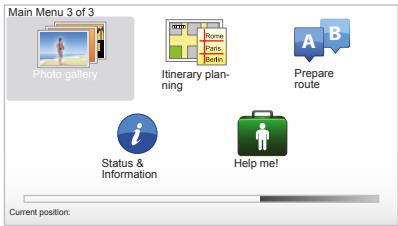
Viewing images
You can use your navigation system to view images.
In the main menu ("MENU/SET" button), select "Photo gallery", the image gallery opens.
Select the image that you wish to view.
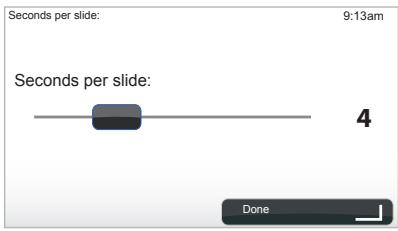
To scroll through the images in slideshow mode, select "Slideshow" using the right soft button. The system asks you how long the photos are to be displayed for, using the directional buttons. If you want a fixed image, move the cursor to the far right.
Finish with the right soft button.
The slideshow starts.
Note: to add/delete images, refer to the section entitled "System update".
Image format read by your system
| BMP | JPG |
| 1-bit,2 colours | Greyscale |
| 4-bit,16 colours | RGB |
| 8-bit,256 colours | |
| 24-bit,16.7 million colours |
REVERSING CAMERA
Operation
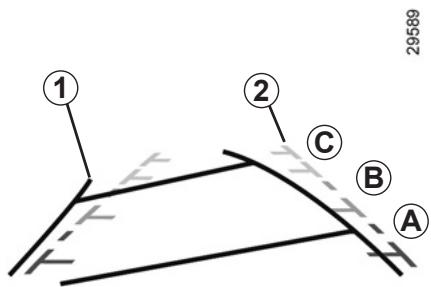
When reversing (and up to approximately 5 seconds after shifting to another gear), a view of the surroundings to the rear of the vehicle is displayed on the instrument panel accompanied by two clearance gauges 1 and 2 (mobile and fixed).
Note: make sure that the reversing camera is not obscured (by dirt, mud, snow, etc.).
Mobile clearance gauge 1
This is shown in blue on the navigation screen. It indicates the vehicle trajectory according to the position of the steering wheel.
Fixed clearance gauge 2
The fixed clearance gauge comprises coloured markers A, B and C indicating the distance behind the vehicle:
- A (red) approximately 50 centimetres from the vehicle;
- B (yellow) approximately 1 metre from the vehicle;
- C (green) approximately 2 to 3 metres from the vehicle;
The screen shows a reverse image. The frames are a representation projected onto flat ground; this information must not be taken into account when superimposed on a vertical object or an object on the ground.
Objects which appear on the edge of the screen may be deformed.
In very bright light (snow, vehicle in sunshine etc.), the camera vision may be adversely affected.
When the tailgate is open or not closed properly, the message "Boot open" is displayed on the instrument panel (risk of incorrect information on-screen).
While your system is being updated, the reversing camera will be temporarily unavailable.
This gauge remains fixed and indicates the vehicle trajectory if the wheels are in line with the vehicle.
This system is initially used with the aid of the gauges (mobile for the trajectory and fixed for the distance), then when the red zone is reached, use the representation of the bumper to stop accurately.

This function is an additional aid. It cannot, therefore, under any circumstances replace the vigilance or the visibility of the driver.
The driver should always pay attention to sudden incidents during driving: always ensure that there are no moving obstacles (such as a child, animal, pram, bicycle, etc.) or small, narrow objects such as stones or posts in your path when manoeuvring.
Main Menu 1 of 3

Navigate to...

Find alternative

Traffic

Change preferences

LIVE services

Safety Alerts
To access the system parameters:
- press the "MENU/SET" button;
- select "Change preferences".
Preferences 1 of 5

Use night
colors

Show POI
on map

Safety prefer
ences

Speech prefer
ences

Turn off sound

Hide Map
Adjusting the display
Brightness settings
Adjust the screen brightness according to the outside light. When the level of light is low, the screen is easier to read if the display is not too bright. From your central control, press the "LIGHT/DARK" button or from the remote control, press the centre button and select "Brightness preferences".
Day/night colour displays
The system automatically switches between day and night modes. If you wish to do this manually, select day colour or night colour from the "Change preferences" menu or from the "Quick menu". When you use manual mode, automatic mode is deactivated. To reactivate it, go to the "Change preferences" menu, select "Brightness preferences" and check "Switch to night view when dark".
"Show POI on map"
Select "Show POI on map", then check it using the centre button. The POI you wish to view appears on the map during navigation.
"Safety preferences"
This menu allows you to activate sound warnings when driving faster than a set speed, or when near places of worship or schools, or to simplify the menus and aid you during your journey. To activate the options, check them, then finish with the centre button.
SYSTEM SETTINGS (2/6)
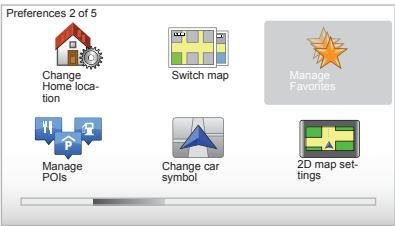
"Change Home location"
This menu allows you to change your home address.
"Switch map"
Use this menu if you are installing several maps on your SD card. To change map, select "Switch map", then the system will ask you to choose the required map.
"Manage POIs"
This menu allows you to add, change or delete POIs or POI categories.
"Change car symbol"
This menu allows you to change the vehicle symbol.
"2D map settings"
This menu allows you to display the navigation map in 2D or 3D.
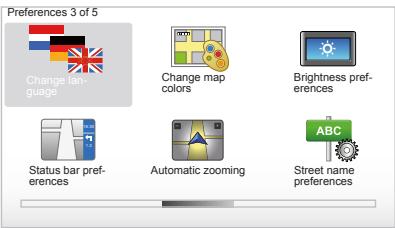
"Change language"
To choose a language, select the required language. The system will then ask you to choose a voice.
Select the required language from the following list:
Afrikaans, Catalan, Czech, Danish, Dutch, UK English, US English, Estonian, Finnish
- Flemish, French
- German, Hungarian, Italian, Latvian, Lithuanian
- Norwegian
- Polish
- Portuguese (Brazil)
- Portuguese (Portugal), Slovakian
- Spanish
- Spanish (Latin America)
- Swiss
- Turkish
- Russian, Malaysian.
To confirm, press the centre button.
"Change map colors"
Select "Change map colors", then choose either day colours or night colours. You can download new colours. To select a downloaded colour, select an additional colour scheme, then the colour required.
"Brightness preferences"
This menu allows you to select the brightness of your navigation system depending on the brightness of the light outside.
"Status bar preferences"
Add to the list of options that you wish to appear on the navigation map status bar.
"Automatic zooming"
Automatic zooming mode allows a gradual zoom when approaching a change in direction.
"Street name preferences"
This menu allows you to display street and house numbers on the map.
Preferences 4 of 5

Set units
Planning preferences

Show lane
image

Start-up preferences

Show compass

Set clock
Set units
Units of distance
Select "miles" or "kilometers", then select "Done" using the soft buttons.
Clock display
Select from the 3 clock display mode options, then select "Done" using the selection buttons to move on to the next step.
Co-ordinates display
Select from the 3 latitude and longitude display options, then select "Done" using the soft buttons to move on to the next step.
Planning preferences
This menu allows you to define your preferences for:
Planning preference type
Select one of the 5 types of planning preferences, then finish with the centre button. The recommended planning preference is "Fastest route".
"IQ RoutesTM"
After having selected the planning criteria, the system lets you activate/deactivate the "IQ RoutesTM" function.
If IQ Routes™ is activated, this function allows routes to be calculated according to the average level of traffic for the given day and time and the best route to be planned according to actual speeds measured on the roads.
Toll road settings
Select your toll road preferences. After having entered a destination, the system asks you if you wish to change this request. Select one of the 3 types of planning preferences, then finish using the right soft button.
Road types
Select your preferences in terms of particular sections of the journey, such as unmade roads and ferry transfers.
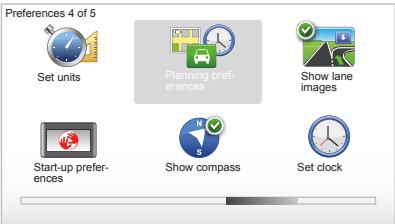
"Show lane images"
When approaching a road change (on major roads), the system may switch to "Show lane images" mode: a 3D image provides a close-up view of the junction with a turn arrow and road signs.
You can deactivate this function by selecting "Hide lane images". To reactivate it, select "Show lane images".
"Start-up preferences"
This menu allows you to change the system start-up and to change the start-up page by customising it with a photo of your choice.
"Enable compass"
This menu allows you to activate or deactivate the compass during navigation.
"Set clock"
When the clocks change in summer or winter, or when you are travelling abroad, you will need to adjust the time on your system.
Select "Set clock"; the system offers you three display modes. Select the desired mode, then "Done" using the soft button. Set the clock, then select "Done".
Clock synchronisation
The synchronisation option allows you to set the time directly using GPS information.
Select this option by pressing the lefthand "Sync" soft button.
SYSTEM SETTINGS (6/6)
Show/hide tips
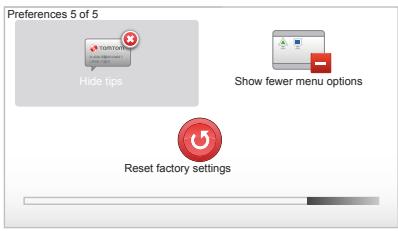
When using your navigation system, the system displays tips helping you to get the best use of the functions. You can deactivate these tips by selecting "Hide tips", and reactivate them by selecting "Show tips".
"Show fewer menu options"
This option enables you to simplify your system's menu, so you can use it more quickly when driving. To reactivate all options, select this icon again.
"Reset factory settings"
Reset factory settings
This menu allows you to delete all information from the system.
Partial reset
This menu allows you to delete all of your personal data (favourites, recent destinations, etc.).
Note: after resetting, the system will restart in English. To change the language, refer to the sections entitled "Change language".
UPDATING THE SYSTEM (1/4)
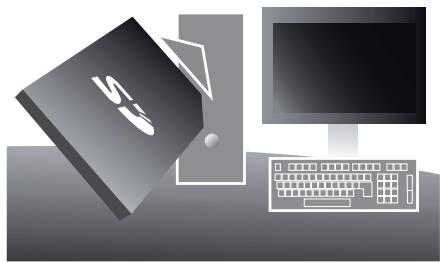
Thanks to the TomTom HOME™ software, installed by inserting your SD card into the SD card reader on a computer that is connected to the Internet, you can:
- update your navigation system and optimize its operation (maps, software, fun voices, etc); save your navigation system data on your computer;
The screens shown in the user manual are not contractual.
- add or delete data;
- customise your system;
- share map corrections with the community (Map ShareTM);
- replace the original maps on your navigator, extending it to new countries (eg. Western Europe);
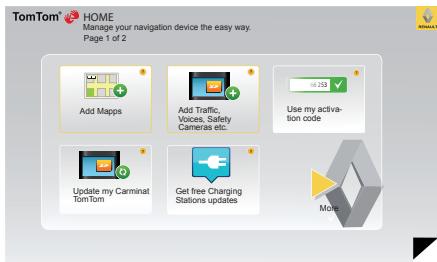
- subscribe to LIVE Services (go to "Add Traffic, Voices, Safety Cameras etc." menu TomTom HOME™ and select "LIVE services");
- or even download the user manual.
- download updated charging stations for your electric vehicle.
The TomTom HOME™ application menus guide you through these operations.
To do this, you must:
- Remove the SD card from your navigation system;
Note: to remove the SD card, please refer to the section on the "SD card: use, initialisation" in your notice, and specifically the information on "Removing the SD card".
- Insert this SD card in your computer's card reader (the computer must already be connected to the internet and an external SD card reader may be required);
- Install the TomTom HOME™ application in a few clicks on your computer by following the instructions shown on the screen.
UPDATING THE SYSTEM (2/4)
Installing the software
Insert the SD card in your computer's SD card reader, while your computer is connected to the internet.
The software installation is launched automatically.
Follow the instructions shown on the screen.
Creating an internet account in TomTom HOME™
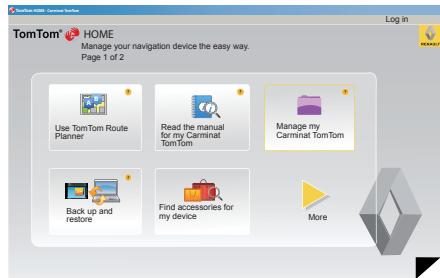
Create your Internet account for TomTom HOME™ by clicking on "Log in" above the RENAULT logo. Your SD card is automatically recognised by the system so that you can get the most from your navigation system.

In certain countries it is illegal to download and activate the camera warning option and this could lead to prosecution.
Latest map guarantee
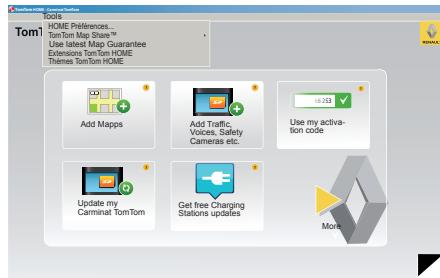
Once your new vehicle has been delivered, you will have a maximum of 60 days in which to update the map for free. Once this time has elapsed, you will need to pay for updates.
Since the road network changes significantly each year, TomTom offers the most accurate and reliable maps on the market.
To check if a more recent map is available:
- click on "Tools";
- then click on "Use latest Map Guarantee".
UPDATING THE SYSTEM (3/4)
Main functions available
Downloading maps
Click on the "Add Maps" icon to access the menu which will allow you to download maps. The downloadable maps are edited regularly.
Subscribing to LIVE Services, downloading points of interest
Click on the "Add Traffic, Voices, Safety Cameras etc." icon to access the menu which will allow you to:
- to subscribe to LIVE Services;
- to download voices to customise your system;
- to download Points of Interest (POI);
- etc.
Updating the recharging stations
Click on the "Update my Carminat TomTom" icon to access the menu to get an up-to-date map of recharging stations suitable for your vehicle.
LIVE Services subscription
Purchase LIVE Services at TomTom HOME™ from a computer connected to the Internet.
In your vehicle, from "LIVE services", go to "My Services" and enter your username and password to use the services.
If you are unable to access the "My Services" menu, activate the network link for your Carminat TomTom by selecting the "Activate" button.
Saving your system data
This menu allows you to save your system data to your computer and to restore it.
We strongly recommend that you save your system data on a very regular basis.
Saving the data allows it to be recovered if, for example, your SD card is lost.
Customising your system
You also have the option to customise your system by installing new points of interest and synthesised voices or even by changing the colour scheme.
Downloading the instructions for your system
By clicking on the "Read the manual for my Carminat TomTom" icon, you will access the full user manual for your system.
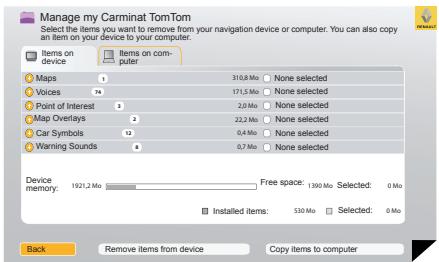
Managing my Carminat TomTom
This menu allows you to check the available space on your system's SD card and is particularly useful when downloading maps which cover several countries (e.g. Western Europe).
The screens shown in the user manual are not contractual.
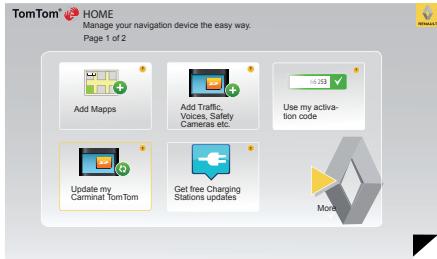
System update
To get the best from your navigation system, we advise you to update it as often as you can.
Map ShareTM
Once your system has been updated, you can share map corrections with the community of system users.
Updates can only be downloaded from the internet.
REMOTE CONTROL: batteries
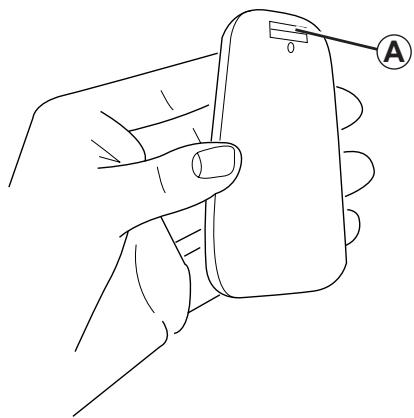
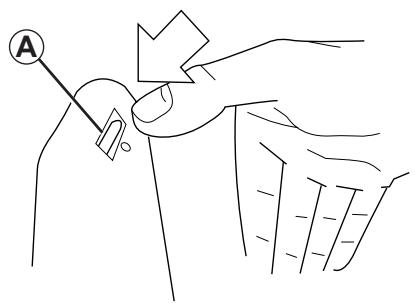
When the LED on the remote control flashes red and a message appears on the screen, change the batteries in your remote control.
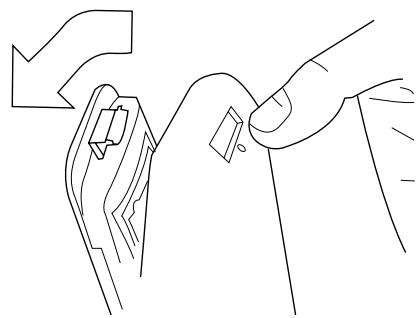
Hold the sides of the remote control and press latch A on the back of the device.
The keypad lifts out from the back of the device.
Note: take care not to drop the keypad.
Place the batteries (type: AAA/LR3/UM4 (1.5V)) in the remote control. Make sure you put the batteries in the correct way round, as shown on the remote control.
Replace the battery cover and press any button to switch on the remote control.
Your remote control connects to your navigation system automatically.
Note: if you do not use the remote control for 20 seconds, it will switch to power saving mode.
If you do not use the remote control for 20 minutes, it switches off completely. Press any button to switch your remote control on.

Do not throw away your used batteries; give them to an organization responsible for collecting and recycling batteries.
OPERATING FAULTS (1/2)
| System | ||
| Description | Causes | Solutions |
| No image is displayed. | The screen is on standby. | Ensure that the screen is not on standby. |
| No sound can be heard. | The volume is set to minimum or the sound has been deactivated. | Increase the volume or activate the sound. |
| No map is displayed. | The SD card is missing or damaged. | Check the SD card is present. |
| Navigation | ||
| Description | Causes | Solutions |
| The location of the vehicle on the screen does not correspond to its actual location. The GPS indicator on the screen stays grey or yellow. | Incorrect positioning of the vehicle caused by GPS reception. | Move the vehicle until reception of the GPS signal is improved. |
| The directions on the screen do not correspond to the actual road. | The SD card is out of date. | Download an update from TomTom HOME. |
| Traffic flow information is not displayed on the screen. | Guidance has not been activated. | Ensure guidance is activated. Select a destination and begin the guidance. |
| Certain items on the menu are not avail-able. | The “Safety preferences” menu is activated. | Deactivate the “Safety preferences” option. |
OPERATING FAULTS (2/2)
| Navigation | ||
| Description | Causes | Solutions |
| Voice guidance is unavailable. | Voice guidance or guidance is deacti- vated. | Increase the volume. Ensure voice guidance is activated. Ensure guidance is activated. |
| The directions of the voice guidance do not correspond to your exact location. | The voice guidance may vary according to the environment. | Drive according to the actual conditions. |
| The suggested route does not start or end at the required destination. | The destination is not yet recognised by the system. | Enter a road near to the required desti-nation. |
| The system calculates a detour automat- ically. | The "Traffic info" service plans an alter- native route. | |
| Poor reception of HD \( Traffic^{TM} \) | The vehicle is in an area that is not cov- ered or you have not subscribed to Live Services. | Move your vehicle. |
ALPHABETICAL INDEX (1/2)
A address. 18 → 21 B Bluetooth® 51 buttons. 14 C clock setting 45 colours 41 compass 17 controls .6-7,14 D destination 19 detailed route. 22 → 25 detour .24-25,27 → 29 F favourite add 34-35 delete 35 Rename 35 G GPS receiver 3 guidance activation. 18 → 22 cancellation 25 guided tours 11-12 IQroute. 44
M map display. 17,30-31 map symbols. 17 scale. 17 MENU. 14-15 N navigation 27-29 navigation system. 2 O operating faults. 52-53 operation. 13 P personal data delete. 47 → 50 save. 47 → 50 points of interest (PI) 20 precautions during use 2 R radars signal 37-38 remote control batteries .51 S screen map 4 menu . 4 monitor . 13 navigation display 22 → 25 SD card. 2-3,9-10 second route. 24 - 25,27 → 29
ALPHABETICAL INDEX (2/2)
settings 37-38,41→46
brightness 41 navigation 28
short menu. 15
slide 39
traffic information 27 to 29
V
voice activate 16,44 deactivate 16,44 volume 16
© RENAULT 2010 - All reproduction, translation and adaptation rights are reserved for all countries. Reproduction or republication in part or whole without the permission of RENAULT is unlawful and could lead to prosecution.
TomTom™ and the TomTom "two hands" logo are among the trademarks or registered trademarks owned by TomTom International B.V.
(www.e-guide.renault.com)
- PRECAUTIONS DURING USE
- PRECAUTIONS WHEN OPERATING THE SYSTEM
- PRECAUTIONS REGARDING NAVIGATION
- PRECAUTIONS CONCERNING THE EQUIPMENT
- GENERAL DESCRIPTION (1/3)
- THE NAVIGATION SYSTEM
- THE GPS RECEIVER
- THE DIGITAL MAP
- LIVE SERVICES
- NAVIGATION ASSISTANCE FUNCTION
- GENERAL DESCRIPTION (2/3)
- DISPLAYS
- MAP SCREEN
- GENERAL DESCRIPTION (3/3)
- AUDIO DISPLAY
- AUDIO SCREEN
- INTRODUCTION TO THE CONTROLS (1/2)
- CENTRAL CONTROL
- INTRODUCTION TO THE CONTROLS (2/2)
- REMOTE CONTROL
- SWIVEL SCREEN
- DEFINITION
- MANIPULATION
- SD CARD: USE, INITIALISATION (1/2)
- SD CARD
- SD CARD: USE, INITIALISATION (2/2)
- INSERTING THE SD CARD
- REMOVING THE SD CARD
- ACCESSING GUIDED TOURS
- CENTRAL CONTROL OPERATION" OR "REMOTE CONTROL
- DRIVING VIEW
- MENU OPTIONS
- BROWSE MAP
- PLANNING PREFERENCES
- ITINERARY PLANNING
- TRAFFIC INFORMATION
- WARNINGS AND NOTIFICATIONS
- QUICK MENU
- TOMTOM HOME
- Z.E. SERVICES
- SWITCHING ON/OFF
- SWITCHING ON
- SWITCHING OFF
- EXTERIOR TEMPERATURE/CLOCK
- HIDING THE MAP
- RESETTING THE SYSTEM
- OPERATING PRINCIPLES (1/2)
- NAVIGATING A MENU
- CONFIRMING/CANCELLING A SELECTION
- SPECIAL FEATURES OF THE REMOTE CONTROL
- SHORTCUTS
- SOFT BUTTONS
- QUICK MENU FOR VEHICLES WITH CENTRAL CONTROL
- QUICK MENU FOR VEHICLES WITH REMOTE CONTROL
- DESCRIPTION OF THE MENUS
- VOLUME
- CHANGING THE VOLUME
- DEACTIVATING THE SOUND
- DEACTIVATING THE VOICE
- SELECTING A VOICE
- SYNTHESISED VOICES
- RECORDED HUMAN VOICES
- READING A MAP
- MAP KEY
- COLOUR CODES
- MAP ICONS
- COMPASS
- ENTERING A DESTINATION (1/4)
- NAVIGATE TO..." MENU
- ENTERING A "NEW ADDRESS
- HOME
- FAVORITE
- RECENT DESTINATION
- POINT OF INTEREST" (POI)
- SEARCH BY POI NAME
- SEARCH BY POI CATEGORY
- TOMTOM PLACES™
- POINT ON MAP
- LATITUDE LONGITUDE
- CONFIRMING THE DESTINATION
- LANE IMAGES
- GUIDANCE SCREENS
- INTERSECTION MAP
- ROUTE INFORMATION
- GUIDANCE (2/4)
- BROWSE AS TEXT
- BROWSE MAP OF ROUTE
- SHOW ROUTE DEMO
- SHOW ROUTE SUMMARY
- SHOW TRAFFIC ON ROUTE
- ALTER ROUTE
- CALCULATE ALTERNATIVE
- AVOID ROADBLOCK
- TRAVEL VIA
- AVOID PART OF ROUTE
- MINIMISE DELAYS
- DEACTIVATING GUIDANCE
- FIND ALTERNATIVE
- ITINERARY WITH WAYPOINTS
- PLANNING A ROUTE IN ADVANCE
- THE "TRAFFIC INFO" SERVICE
- THE TRAFFIC BAR
- DISPLAY
- THE "TRAFFIC INFO" FUNCTION
- TRAFFIC INFORMATION (2/3)
- TRAFFIC INFORMATION CAN INCLUDE
- TRAFFIC INFO" CONFIGURATION MENU
- TRAFFIC INFORMATION (3/3)
- TRAFFIC PREFERENCES
- READ ALOUD TRAFFIC INFO
- OPTIONS
- FIND
- CURSOR POSITION
- LIVE SERVICES (1/2)
- ACCESSING LIVE SERVICES
- SAFETY ALERTS
- LIVE SERVICES (2/2)
- HD TRAFFIC™
- WEATHER
- MY SERVICES
- ADD AND MANAGE FAVOURITES (1/2)
- CREATING AN ENTRY
- ADDRESS
- POINT OF INTEREST
- ADD AND MANAGE FAVOURITES (2/2)
- MY LOCATION
- DELETING/RENAMING A FAVOURITE
- HELP ME
- EMERGENCY PHONE NUMBERS
- DRIVE TO HELP
- WHERE AM I
- GUIDED TOUR
- WARNING SETTINGS
- DISABLE ALERTS
- REPORT SAFETY CAMERA
- IMAGE VIEWER
- VIEWING IMAGES
- IMAGE FORMAT READ BY YOUR SYSTEM
- REVERSING CAMERA
- OPERATION
- MOBILE CLEARANCE GAUGE
- FIXED CLEARANCE GAUGE
- ADJUSTING THE DISPLAY
- BRIGHTNESS SETTINGS
- DAY/NIGHT COLOUR DISPLAYS
- SHOW POI ON MAP
- SAFETY PREFERENCES
- SYSTEM SETTINGS (2/6)
- CHANGE HOME LOCATION
- SWITCH MAP
- MANAGE POIS
- CHANGE CAR SYMBOL
- D MAP SETTINGS
- CHANGE LANGUAGE
- CHANGE MAP COLORS
- BRIGHTNESS PREFERENCES
- STATUS BAR PREFERENCES
- AUTOMATIC ZOOMING
- STREET NAME PREFERENCES
- SET UNITS
- UNITS OF DISTANCE
- CLOCK DISPLAY
- CO-ORDINATES DISPLAY
- PLANNING PREFERENCE TYPE
- IQ ROUTESTM
- TOLL ROAD SETTINGS
- ROAD TYPES
- SHOW LANE IMAGES
- START-UP PREFERENCES
- ENABLE COMPASS
- SET CLOCK
- CLOCK SYNCHRONISATION
- SYSTEM SETTINGS (6/6)
- SHOW/HIDE TIPS
- SHOW FEWER MENU OPTIONS
- RESET FACTORY SETTINGS
- PARTIAL RESET
- UPDATING THE SYSTEM (1/4)
- UPDATING THE SYSTEM (2/4)
- INSTALLING THE SOFTWARE
- CREATING AN INTERNET ACCOUNT IN TOMTOM HOME™
- LATEST MAP GUARANTEE
- UPDATING THE SYSTEM (3/4)
- MAIN FUNCTIONS AVAILABLE
- DOWNLOADING MAPS
- SUBSCRIBING TO LIVE SERVICES, DOWNLOADING POINTS OF INTEREST
- UPDATING THE RECHARGING STATIONS
- LIVE SERVICES SUBSCRIPTION
- SAVING YOUR SYSTEM DATA
- CUSTOMISING YOUR SYSTEM
- DOWNLOADING THE INSTRUCTIONS FOR YOUR SYSTEM
- MANAGING MY CARMINAT TOMTOM
- SYSTEM UPDATE
- MAP SHARETM
- REMOTE CONTROL: BATTERIES
- ALPHABETICAL INDEX (1/2)
- ALPHABETICAL INDEX (2/2)
- V
Brand : RENAULT
Model : CARMINAT TOMTOM
Category : Navigation system