
AV-1364 - Camera AViPAS - Free user manual and instructions
Find the device manual for free AV-1364 AViPAS in PDF.


| Product Type | SDI Auto-Tracking Camera |
| Brand | AViPAS |
| Model | AV-1364 |
| Dimensions (W x H x D) | 254 x 144 x 174 mm |
| Weight | 1.50 kg |
| Power Supply | DC 12V ±10%, 1.5A max |
| Power Consumption | 18W max |
| Sensor (Close-up & Panoramic) | 1/2.8" high quality HD CMOS |
| Effective Pixels (Close-up) | 2.07 MP (1920x1080) |
| Effective Pixels (Panoramic) | 2.10 MP |
| Optical Zoom | 20x (f=4.7~94 mm) |
| Digital Zoom | 10x |
| Video Output Interfaces | 3G-SDI, LAN (100BASE-TX) |
| Video Compression | H.264, H.265 |
| Control Interfaces | RS-232 (8-pin mini-DIN), IP (VISCA over IP) |
| Control Protocols | VISCA, Pelco-D, Pelco-P |
| Pan Range | -170° to +170° |
| Tilt Range | -30° to +90° |
| Pan Speed (Max) | 100°/sec |
| Tilt Speed (Max) | 45°/sec |
| Preset Positions | 255 (10 via remote control) |
| Audio Input | 3.5mm stereo line-in |
| Network Protocols | RTSP, RTMP, ONVIF, GB/T28181 |
| Operating Temperature | -10°C to +50°C |
| Included Accessories | Power adapter, RS-232 cable, Remote controller, User manual, Warranty card |
| Warranty | 1 year |
Frequently Asked Questions - AV-1364 AViPAS
User questions about AV-1364 AViPAS
0 question about this device. Answer the ones you know or ask your own.
Ask a new question about this device
Download the instructions for your Camera in PDF format for free! Find your manual AV-1364 - AViPAS and take your electronic device back in hand. On this page are published all the documents necessary for the use of your device. AV-1364 by AViPAS.
USER MANUAL AV-1364 AViPAS
natural_image
Line drawing of a mechanical device with no visible text or symbolsUser Manual
V1.1
(English)
Please read this user manual
thoroughly before using.
Preface
Thank you for using this SDI Auto-tracking Camera.
This manual introduces the functions, installation process and operation of this camera. Prior to installation and usage, please read the manual thoroughly.
Precautions
This product should only be used under the specified conditions in order to avoid any damage to the camera:
■ Do not subject the camera to rain or moisture.
■ Do not remove the cover. Otherwise, you may risk receiving an electric shock. In case of unintended equipment operation, contact an authorized engineer.
■ Never operate under unspecified temperature, humidity or power input.
■ Please use soft dry cloth to clean the camera. If the camera is very dirty, clean it with diluted neuter detergent; do not use any type of solvents, which may damage the surface.
Note:
This is a class A production. Electromagnetic radiation at certain frequencies may affect the image quality of TV in home environment.


natural_image
Line drawing of an electrical adapter with two labeled components (1 and 2), no text or symbols present.To extend the power cord of this camera, the user is supposed to connect extra length only from terminal 1 (voltage 220V/110V), while terminal 2 (DC12V) should remain the original piece. Otherwise abnormal functions of the equipment will be caused!
Attentions
- Electric safety
Installation and operation must be in accord with electric safety standard.
- Caution to transport
Avoid stress, vibration or soakage during transport, storage and installation.
- Polarity of power supply
The power supply of the product is ±12V , the max electrical current is 2A. Polarity of the power supply plug is shown in the drawing below.

natural_image
Technical line drawing of a mechanical connector or connector (no text or symbols)- Careful of installation
Do not grasp the camera lens when carrying it. Don't rotate camera lens by hand. Mechanical damage may result from doing so.
This series product must be placed on a smooth platform or surface. It cannot be installed slantwise.
If the camera is used with TV or computer, the base can be fixed by four double-sided adhesive trays.
Don't apply in corrosive liquid, gas or solid environment to avoid any cover (organic material) damage.
Make sure no obstacle is in the rotation range.
Never power on before installation is completed.
- Don't disassemble discretionarily.
We are not responsible for any unauthorized modification or dismantling.
- Attention!
Specific frequencies of electromagnetic field may affect camera image!
Contents
1. Fast Installation....1
1.1 Camera Interface Illustration .... 1
1.2 Dimensions....2
1.3 Power On 2
1.4 Video Output....3
1.5 Basic Connection Instructions .... 3
2. Product Overview .... 5
2.1 Product Introduction 5
2.2 Main Features .... 5
2.3 Technical Specifications ....6
2.4 Interface Instructions 7
3. Application Instructions....8
3.1 Remote Control....8
3.2 Menu Settings....11
4. Network Connection....18
4.1 Connecting Mode....18
4.2 IE Log In....20
5. Serial Communication Control ....33
5.1 VISCA Protocol List....33
5.2, Pelco-D Protocol Command List....38
5.3 Pelco-P Protocol Command List....39
6. Camera Maintenance and Troubleshooting 40
6.1 Camera Maintenance 40
6.2 Troubleshooting 40
1. Fast Installation
1.1 Camera Interface Illustration

Figure 1.1 AV-1364 Front View
- Close-up lens
- Panorama lens
- LAN network port for panorama lens
- SDI output 1 (panorama lens)
- SDI output 2 (close-up lens)
- RS232 control port

Figure 1.2 AV-1364 Rear View
- Audio Input port
- LAN network port for close-up lens
- Power supply port (DC 12V)

| NO. | PIN | DEFINITION |
| 1 | DTR | Data Terminal Ready |
| 2 | DSR | Data Set Ready |
| 3 | TXD | Transmit Data |
| 4 | GND | Signal Ground |
| 5 | RXD | Receive Data |
| 6 | GND | Signa Ground |
| 7 | IR OUT | IR Command Signal |
| 8 | NC | No Connection |
Figure 1.3 AV-1364 RS-232 Pin Definition
1.2 Dimensions

1.3 Power On
1) Power on: connect DC12V power supply adapter with NO.9 showed in Figure1.2.
2) Initialization: power on with power indicator light on and remote control receiver light blinking. Camera head moves from bottom left to the central bottom, and then go to HOME position (intermediate position of both horizontal and vertical), while the camera module initializes. When remote control receiver light stops blinking, self-check is finished.
Note: If preset 0 is set, the camera automatically moves to the preset 0 position upon powering on.
1.4 Video Output
AV-1364 has 2 options for video output: LAN, HD-SDI.
1) Video output from LAN.
a. Network cable connection port: AV-1364-No.3(panorama) and No.8(close-up) in Figure 1.2.
b. Webpage Login: open your browser and enter 192.168.5.191(panorama) / 192.168.5.192(close-up) in the address bar (factory default); press Enter to enter the login page; click on the "player is not installed, please download and install!" and follow the installation instructions for installation. Then enter the user name admin and password admin (factory default); press Enter to enter the preview page. Users can perform PTZ control, video recording, playback, configuration and other operations.
2) HD-SDI video output
a. HD-SDI video cable connection: AV-1364-No.4(panorama) and No.5(close-up) in Figure 1.2.
b. Connect the camera and the monitor via SDI video cable; video output will be available after initialization.
1.5 Basic Connection Instructions
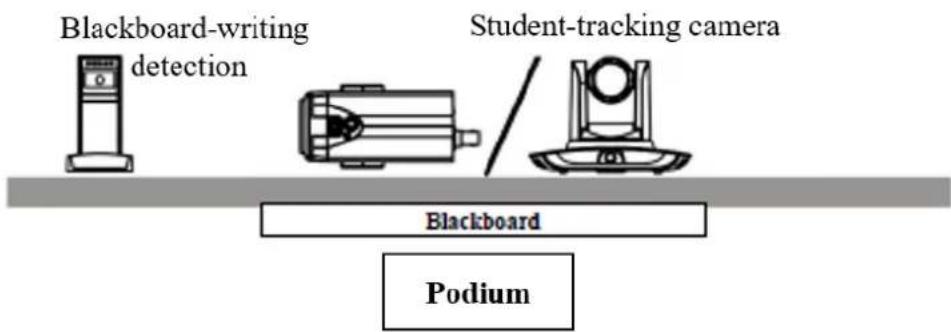
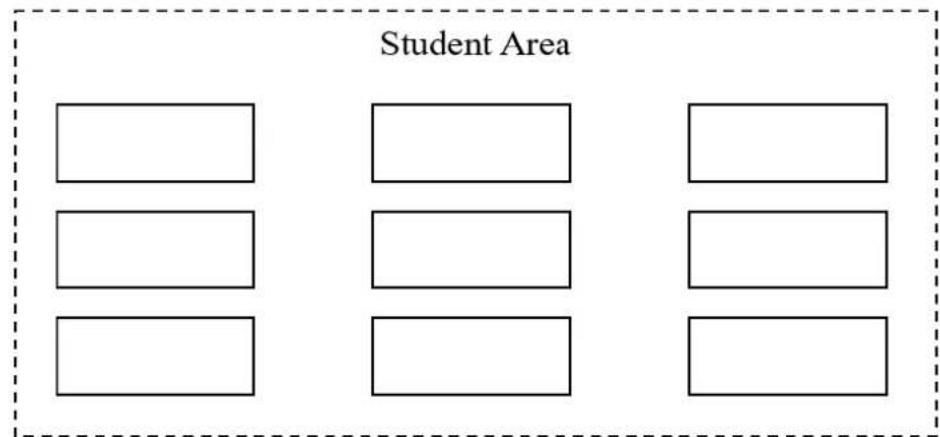
1) System layout:
- Blackboard-writing detection for future development;
- Student-tracking camera for option.

natural_image
Technical line drawing of a mechanical component with cross-sectional view (no text or symbols)Teacher-tracking camera
Teacher-tracking camera is recommended to be installed 6-9ft from ground (panoramic lens to ground); 16-50ft from the blackboard/presentation screen (16-30ft: 4mm panoramic lens is recommended; 30-50ft: 6mm panoramic lens is recommended). Teacher-tracking camera should be installed close to the central axis of the classroom as much as possible to get the best result of video.
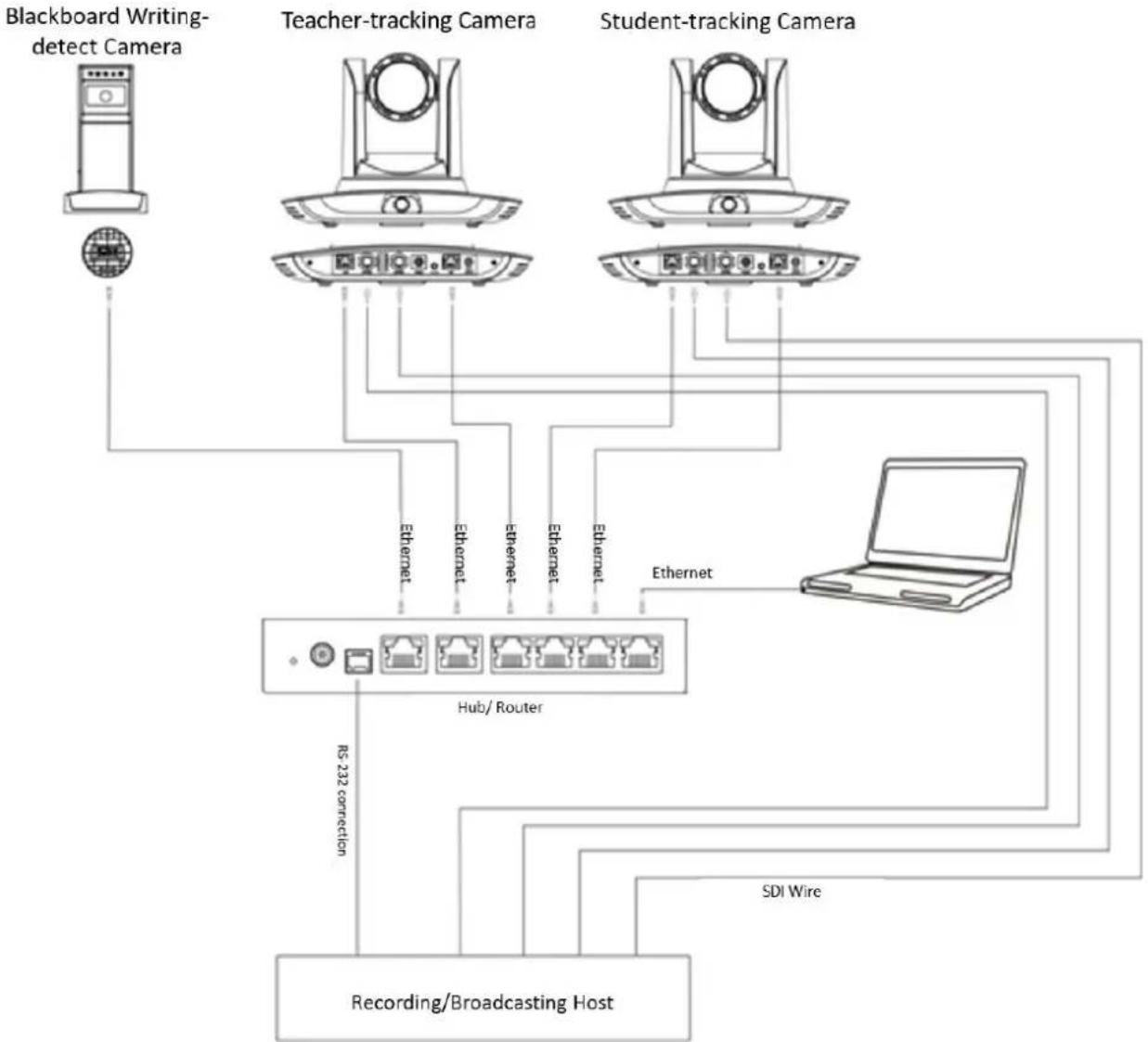
2) System wiring:
The AV-1364 provides a smart solution with only one camera for educational use. Customers can adjust their system accordingly.
flowchart
graph TD
    A["Blackboard Writing-detect Camera"] --> B["Teacher-tracking Camera"]
    A --> C["Student-tracking Camera"]
    B --> D["Database"]
    C --> E["Database"]
    D --> F["Hub/Router"]
    E --> F
    F --> G["Recording/Broadcasting Host"]
    H["SDI Wire"] --> F
    I["Ethernet"] --> F
    J["Ethernet"] --> F
    K["Ethernet"] --> F
    L["Ethernet"] --> F
    M["Ethernet"] --> F
    N["Ethernet"] --> F
    O["Ethernet"] --> F
    P["Ethernet"] --> F
    Q["Ethernet"] --> F
    R["Ethernet"] --> F
    S["Ethernet"] --> F
    T["Ethernet"] --> F
    U["Ethernet"] --> F
    V["Ethernet"] --> F
    W["Ethernet"] --> F
    X["Ethernet"] --> F
    Y["Ethernet"] --> F
    Z["Ethernet"] --> F
    AA["Rs 232 connection"] --> F
    AB["Desktop"] --> AC["Laptop"]
2. Product Overview
2.1 System Introduction
AV-1364 SDI Auto-Tracking Camera is a dedicated smart camera solution in educational information industry. It can be used alone, or be easily integrated into any smart-room system according to user settings. AV-1364 features a built-in high-speed processor and advanced image processing and analysis algorithms, to detect and track target accurately and quickly. It adopts advanced ISP processing technique and algorithms, providing vivid images with balanced brightness, distinct layering, high definition and color reduction. H.264/H.265 encoding supported. It makes video fluent and clear even under less-than-ideal bandwidth conditions. AV-1364 offers flexible functions, autonomous performance, simple use and minimum maintenance.
- Network control interface: control commands will be transmitted via network. It is suitable for all-scenario user settings;
- Recognition algorithm unrelated to location: status detection and recognition of teachers and students adopt unique smart partitioning algorithm to ensure that the result of detection and recognition is unrelated to location;
- 2-way installation: with wall-mount or ceiling-mount, it supports both normal and upside-down installation;
- All-in-one design: the built-in panoramic lens allows perfect combination of panoramic view and close-up;
- Advanced tracking algorithm: it applies advanced human detection algorithms, image processing and analytical algorithms for locking and tracking the target (intelligent image recognition library, scene adaptive algorithm) to achieve stable, fast and accurate target tracking results;
- High immunity from interference: more diversified and flexible recognition shield settings ensure that once tracking target is locked, it will not be affected by other moving objects or projector changes;
- Stable tracking: adjustable movement recognition sensitivity. Can be adjusted so that slight movement of the target such as hand movement will not cause wrong operation of the camera;
- Self-adaptive: the tracking camera zooms according to the distance to target so that the visual image maintains the proper size and scale;
- Super wide dynamic exposure: it prevents the tracking target dimming under strong light sources such as the projector.
2.2 Main Features
2.2.1 Camera performance
• Full-scene solution: scenario demands;
• Full HD image: 1/2.8-inch high quality image sensor, with a maximum resolution 1920x1080;
- Wide-angle lens: 72.5^ wide viewing angle with no distortion;
- Advanced focusing technique: the performance is quickly, accurately and steadily;
- Low noise & SNR: low-noise CMOS ensures super high signal to noise ratio of the video. With advanced 2D and 3D noise reduction technology, noise is reduced and image resolution is guaranteed;
- Super quiet pan-tilt: high-precision stepping motor and motor driven controller ensure the pan-tilt holder operate at low and stable speed without noise.
2.2.2 Network performance
• Audio input interface: supports 16000, 32000, 44100, 48000 sampling rates; AAC, MP3, PCM audio coding;
- Multiple audio/video compression: supports H.264/H.265 video compression; AAC, MP3 and PCM audio compression; supports compression of resolution up to 1920x1080 with frame rate up to 60 fps and 2-channel 1920x1080p with 30 fps compression;
- Multiple network protocol: supports ONVIF, RTSP, RTMP protocols and RTMP push mode; easy to connect to streaming media server (Wowza, FMS, etc.).
2.3 Technical Specifications
| Model | AV-1364 |
| Tracking Camera Parameter | |
| Optical Zoom | 20X, f = 4.7~94mm, F1.6~3.5 |
| Sensor | 1/2.8" high quality HD CMOS sensor |
| Effective Pixel | 16: 9 2.07 megapixel |
| Video Format | 1080P60/50/30/25/59.94/29.97;1080I60/50/59.94;720P60/50/30/25/59.94/29.97 |
| View Angle | 2.9°(tele) ~ 55.4°(wide) |
| Digital Zoom | 10X |
| Minimum Illumination | 0.5Lux (F1.8, AGC ON) |
| DNR | 2D & 3D DNR |
| White Balance | Auto / Manual/ One Push/ 3000K/ 4000K/5000K/6500K |
| Focus | Auto/Manual |
| Aperture | Auto/Manual |
| Electronic Shutter | Auto/Manual |
| BLC | ON/OFF |
| WDR | OFF/ Dynamic level adjustment |
| Video Adjustment | Brightness, Color, Saturation, Contrast, Sharpness, B/W mode, Gamma curve |
| SNR | >55dB |
| Panoramic Camera Parameter | |
| Sensor | 1/2.8" high quality HD CMOS sensor |
| Effective Pixel | 2.10 megapixel |
| Zoom | Manual |
| Output Interface | 3G-SDI, LAN |
| View Angle (D/H/V) | 112°/82°/57.6° |
| Input/Output Interface | |
| Video Interfaces | 3G-SDI, LAN |
| Image Code Stream | Dual stream output |
| Video Compression Format | H.264, H.265 |
| Control Signal Interface | RS-232 |
| Control Protocol | VISCA/ Pelco-D/ Pelco-P; Baud Rate: 115200/9600/4800/2400bps |
| Audio Input Interface | Double track 3.5mm linear input |
| Audio Compression Format | AAC/MP3/PCM Audio compression |
| HD IP Interface | 100M IP port(100BASE-TX), Support Visca protocol control through IP port |
| Network Protocol | RTSP, RTMP, ONVIF, GB/T28181 |
| Power Interface | HEC3800 outlet (DC12V) |
| PTZ Parameter | |
| Pan Rotation | -170°~+170° |
| Tilt Rotation | -30°~+90° |
| Pan Control Speed | 0.1~100°/sec |
| Tilt Control Speed | 0.1~45°/sec |
| Preset Speed | Pan: 100°/sec, Tilt: 45°/sec |
| Preset Number | 255 presets (10 presets by remote controller) |
| Other Parameter | |
| Supply Adapter | Input: AC110~220V Output: DC12V/2.5A |
| Input Voltage | DC12V±10% |
| Input Current | 1.5A(Max) |
| Consumption | 18W (Max) |
| Store Temperature | -10°C~+60°C |
| Store Humidity | 20%~95% |
| Working Temperature | -10°C~+50°C |
| Working Humidity | 20%~80% |
| Dimension | 254mm*144mm*174mm |
| Weight | 1.50KG |
| Remote Operation (IP) | Remote Upgrade, Reboot and Reset |
| Accessory | Power supply, RS232 control cable, Remote controller, Manual, Warranty card |
2.4 Interface Instructions
2.4.1 RS-232 mini-DIN 8-pin port definition

| NO. | Port | Definition |
| 1 | DTR | Data Terminal Ready |
| 2 | DSR | Data Set Ready |
| 3 | TXD | Transmit Data |
| 4 | GND | System Ground |
| 5 | RXD | Receive Data |
| 6 | GND | System Ground |
| 7 | IR OUT | IR Commander Signal |
| 8 | NC | No Connection |
3. Application Instructions
3.1 Remote Control
3.2.1 Key Illustrations
Before using the remote to control AV-1364, the user needs to log in via IP first and turn off the tracking mode (will be instructions in 4. Configuration Tools).
- Standby key
After 3-sec long press, the camera will enter the standby mode. Long press the key again for 3 secs, the camera will initialize again and return back to HOME position (Note: when power-on mode is turned on and Preset 0 is set, if there is no operation after 12 secs, the camera will automatically rotate to the specified preset position).
- Camera address selection
Select the specific camera which the user wants control.
- Number key
Set or run one of the preset positions (0\~9).
• 【\*】 and 【#】 key
Key combination is used to restore the default settings.
- Focus control key
Auto focus: 【AUTO】to enter auto focus mode.
Manual focus: 【MANUAL】 to manually adjust the camera focus by pressing 【FOCUS+】 or 【FOCUS-】.
- Zoom control key
【ZOOM+】: near lens
【ZOOM-】: far lens
- Set or clear preset key:
Set preset position: 【SET PRESET】+ number key (0\~9).
Clear preset position: 【CLEAR PRESET】+ number key (0\~9).
- Pan/tilt control key
Press▲key: up
Press ▼key: down
Press ◀key: left
Press ▼key: right
"HOME" key: return to the center position or enter the submenu.
- BLC control key
【BLC ON/OFF】: turn on or off the back light.
- Menu settings
【MENU】: to open or close the OSD menu.
Enter/exit the OSD menu or return to the previous menu.
- Camera IR remote control address settings
【*】+【#】+【F1】: Camera Address No.1
【*】+【#】+【F2】: Camera Address No. 2
【*】+【#】+【F3】: Camera Address No. 3
【*】+【#】+【F4】: Camera Address No. 4
• Key combination functions
When initialization is complete, the camera can receive and execute IR commands. Press the ON/OFF button on the remote control, the indicator light will be flashing; release the button, the indicator light stops flashing. The user can control the pan/tilt/zoom settings and run preset positions via IR remote control.
Key instructions:
- In the instructions below, "press the key" means a click rather than a long-press. A special note will be given if a long-press for more than 1 sec is required.
- When a key-combination is required, do it in sequence. For example, “【*】+【#】+【F1】” means press “【*】” first and then “【#】” and lastly press “【F1】”.
1) Camera Selection
Select the camera address which the user wants to control.
2) Pan/Tilt Control
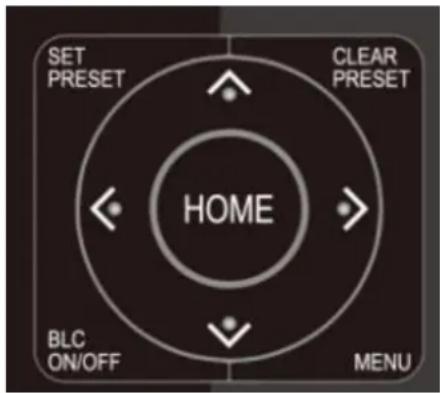
Up: press ▶ Down: press ▲ Left: press ▼ Right: press ▶
Back to center position: press 【HOME】
Press and hold the up/down/left/right key, the pan/tilt will keep running, from slow to fast, until it runs to the endpoint. The pan/tilt running stops as soon as the key is released.
3) Zoom Control

4) Focus Control

5) BLC Settings

6) Presets Setting, Running and Clearing


7) Camera Remote Controller Address Settings

Zoom-in: press 【ZOOM+】key
Zoom-out: press【ZOOM-】key
Press and hold the key, the camera will keep zooming in/out. It stops as soon as the key is released.
Focus (near): press 【FOCUS+】(valid only in manual focus mode)
Focus (far): press【FOCUS-】(valid only in manual focus mode)
Auto focus: support
Manual focus: support
Press and hold the key, the action of focus will keep adjusting. It stops as soon as the key is released.
BLC ON/OFF: support
- Preset setting: to set a preset position, the user should press 【SET PRESET】first, then press the number key 0\~9 to set the corresponding preset.
Note: 10 preset positions are available in total by using the remote control.
- Preset running: press a number key 0\~9 directly to run the corresponding preset position.
Note: action in vain if the selected preset position does not exist.
- Preset clearing: the user can press【CLEAR PRESET】first, then press the number key 0\~9 to clear the corresponding preset.
Note: press【#】three times in succession to clear all the presets.
【*】+【#】+【F1】: Camera Address No.1
【*】+【#】+【F2】:Camera Address No.2
【*】+【#】+【F3】:Camera Address No. 3
In normal working mode, press【MENU】to display the menu. The user can scroll the arrow to point at or highlight the selected item.
![MENU ==================== Language English (Setup) (Camera) (P/T/Z) (Video Format) (Version) (Restore Default) [↑↓]Select [←→]Change Value [Menu]Back [Home]OK](/content/2026/06/1194611/images/7ca907218bf99660503132d3dbac446b8ddddca707811ab78af51b375604ec2b.jpg)
Language: menu language setting, Chinese / English
Setup: system settings
Camera: camera settings
P/T/Z: pan/tilt/zoom settings
Video Format: video output format settings
Version: camera version
3.2.2 System settings
Move the pointer to 【Setup】in the Main Menu, click【Home】to enter System Settings as shown below.
![SETUP --------==----------------=----------------=----------------=----------------=----------------=----------------=----------------=----------------=----------------=----------------=----------------=----------------=----------------=----------------=----------------=----------------=----------------=----------------=----------------=----------------=----------------=----------------=----------------=----------------=----------------=----------------=----------------=----------------=----------------=----------------=----------------=----------------=----------------=----------------=----------------=----------------=----------------=----------------=----------------=----------------=----------------=----------------=----------------=----------------=----------------=----------------=----------------=----------------=----------------=----------------=-----------------------------| Protocol Auto Visca Address 1 Visca Address Fix OFF PELCO-P Address 1 PELCO-D Address 1 Baud rate 9600 [↑↓]Select [←→]Change Value [Menu]Back [Menu]Back](/content/2026/06/1194611/images/43051c4439c3bb9b8e739a453cd352f286b27e4a6f7d9527aaaabac0b8dfb2ba.jpg)
Protocol: VISCA/ Pelco-P/ Pelco-D/ Auto
Visca Address: VISCA=1\~7/ Pelco-P=1\~64/ Pelco-D=1\~64
Visca Address Fix: On/Off
Baud rate: 2400/4800/9600/115200
3.2.3 Camera settings
Move the pointer to the 【Camera】 in the Main Menu, click 【Home】 to enter camera settings menu as shown below.
![CAMERA (Exposure) (Color) (Image) (Focus) (Noise Reduction) Style default [↑↓]Select [←→]Change Value [Menu]Back [Home]OK](/content/2026/06/1194611/images/d26ce03909657d88eb639a4b7e18a745ac22591880cf9254cfb12a54dc8e6de7.jpg)
1) Exposure Settings
Move the pointer to 【Exposure】in the Main Menu, click 【Home】 to enter the Exposure Setting menu as shown below.
EXPOSURE
| Mode | Auto |
| EV | OFF |
| BLC | OFF |
| Flicker | 50Hz |
| G.Limit | 3 |
| DRC | 2 |
| [↑↓]Select | [←→]Change Value |
| [Menu]Back |
Mode: auto/ manual/ shutter priority/ iris priority/ brightness priority.
EV: exposure compensation setting, ON/ OFF (valid in Auto mode)
Compensation Level: -7\~7 (valid when EV is ON)
BLC: ON/OFF (valid in Auto mode)
Flicker: OFF/ 50Hz/ 60Hz (valid in Auto/ Shutter priority/ Brightness priority modes)
G. Limit: gain limit, 0\~15 (valid in Auto/ Shutter priority/ Brightness priority modes)
Shutter Priority: 1/25, 1/30, 1/50, 1/60, 1/90, 1/100, 1/120, 1/180, 1/250, 1/350, 1/500, 1/1000, 1/2000, 1/3000, 1/4000, 1/6000, 1/10000 (valid in Manual/Shutter priority modes)
IRIS Priority: OFF/ F11.0/ F9.6/ F8.0/ F6.8/ F5.6/ F4.8/ F4.0/ F3.4/ F2.8/ F2.4/ F2.0/ F1.8 (valid in Manual/ Iris priority modes)
DRC: dynamic range, 1\~8/ OFF.
2) Color Settings
Move the pointer to 【Color】 in the Main Menu, click 【Home】 to enter the Color Settings menu as shown below.
| COLOR | |
| = = = = = = = = = = = = = = = = = = = = = = = = = = = = = = = = = = = = = = = = = = = = = = = = = = = = = = = = = = = = = = = = = = = = = = = = = = = = = = = = = = = = = = = = = = = = = = = = = = = = = | WB Mode Auto |
| RG Tuning 0 | |
| BG Tuning 0 | |
| Saturation 100% | |
| Hue 7 | |
| AWB Sensitivity Low | |
| [↑↓]Select [←→]Change Value[Menu]Back | |
WB Mode: auto/ 3000K/ 4000K/ 5000K/ 6500K/ manual/ one-key white balance.
RG Tuning: red gain tuning, -10\~10 (valid when white balance mode is Auto)
BG Tuning: blue gain tuning, -10\~10 (valid when white balance mode is Auto)
RG: red gain, 0\~255 (valid when white balance mode is Manual)
BG: blue gain,0\~255 (valid when white balance mode is Manual)
Saturation: 60%/70%/80%/90%/100%/110%/120%/130%/140%/150%/160%/170%/180%/190%/200%
Huc: 0\~14
AWB Sensitivity: high/ medium/ low (valid white balance mode is Auto)
3) Image Settings
Move the pointer to 【Image】in the Main Menu, click 【Home】 to enter the Image settings menu as shown below.
| IMAGE | |
| Brightness | 7 |
| Contrast | 7 |
| Sharpness | 4 |
| Flip-H | OFF |
| Flip-V | OFF |
| B&W-Mode | Color |
| Gamma | Default |
| DZoom | OFF |
| DCI | Close |
| [↑↓]Select | [←→]Change Value |
| [Menu]Back | |
Brightness: 0\~14
Contrast: 0\~14
Sharpness: 0\~15
Flip-H: horizontal flip, On/Off
Flip-V: vertical flip, On/Off
B&W mode: color/ black&white
Gamma: default/ 0.45/ 0.50/ 0.55/ 0.63
DZoom: digital zoom, On/ Off
DCI: dynamic contrast: Off/ 1\~8
4) Focus
Move the pointer to the 【Focus】in the Main Menu, click 【Home】to enter the Focus Settings menu as shown below.

flowchart
graph TD
    A["FOCUS"] --> B["Focus Mode"]
    B --> C["AF-Zone"]
    B --> D["AF-Sensitivity"]
    B --> E["Center"]
    B --> F["Low"]
    B --> G["[↑↓"]Select]
    B --> H["[←→"]Change Value]
    B --> I["[Menu"]Back]
    style A fill:#f9f,stroke:#333
    style B fill:#ccf,stroke:#333
    style C fill:#cfc,stroke:#333
    style D fill:#cfc,stroke:#333
    style E fill:#cfc,stroke:#333
    style F fill:#cfc,stroke:#333
    style G fill:#fcc,stroke:#333
    style H fill:#fcc,stroke:#333
    style I fill:#fcc,stroke:#333
Focus mode: auto/ manual
AF-Zone: up/ center/ low
AF-Sensitivity: high/ medium/ low
5) Noise Reduction
Move the pointer to 【Noise Reduction】in the Main Menu, click 【Home】 to enter the Noise Reduction settings menu as shown below.
![NOISE REDUCTION NR-2D 3 NR-3D 5 Dynamic Hot Pixel OFF [↑↓]Select [←→]Change Value [Menu]Back](/content/2026/06/1194611/images/163a1be0f89972452e969a345f2fca8515096eba035a6f2ccb652645492d2e9b.jpg)
NR-2D: 2D noise reduction, auto/ off/ 1\~7
NR-3D: 3D noise reduction, off/1\~8
Dynamic Hot Pixel: off/ 1\~5
3.2.4 P/T/Z
Move the pointer to 【P/T/Z】 in the Main Menu, click 【Home】 to enter the P/T/Z settings menu as shown below.
![P/T/Z Speed by zoom ON Zoom speed 8 Image Freezing OFF Acc Curve Slow [↑↓]Select [←→]Change Value [Menu]Back](/content/2026/06/1194611/images/ea396f5add4832207ece3f07296902a89f5a9f0b2f9800702e5d89b7c5e11e30.jpg)
Speed by zoom: only effective with remote control, On/Off. Press 【zooming+】, PT running speed decreases proportionally
Zoom speed: set the zoom speed with remote control, 1\~8
Image Freezing: On/Off
Acc curve: accelerating curve, fast/slow
3.2.5 Video Format
Move the pointer to 【Video Format】 in the Menu, click 【Home】 to enter the Video Format menu as shown below.
![VIDEO FORMAT 1080P60 1080P50 1080I60 1080I50 1080P30 1080P25 720P60 720P50 720P30 720P25 1080P59.94 1080I59.94 1080P29.97 720P59.94 720P29.97 [↑↓]Select [Menu]Back [Home]OK](/content/2026/06/1194611/images/832fe979e098fed9560e6c8575319d97b2b9198dd921f62dd5ed30b286236c45.jpg)
Note: Please exit the menu and reboot the camera after modifications. Settings will be saved and recalled upon
powering off/on.
3.2.6 Version
Move the pointer to 【Version】 in the Main Menu, click 【Home】 to enter the Version menu as shown below. Note: version information could be different according to different models and manufacture dates.
VERSION
MCU Version 2.0.0.15 2015-12-18
Camera Version 2.0.0.13 2015-12-18
AF Version 2.0.0.6 2015-12-11
Lens 12X(20X)
[Menu]Back
MCU Version: display MCU version information
Camera Version: display camera version information
AF Version: display the focus version information
Lens: display the lens zoom
Move the pointer to 【Restore Default】 in the Main Menu, click 【Home】 to enter the Restore Default menu as shown below.
RESTORE DEFAULT
Restore Default? NO
[↑ ↓]Select [← →]Change Value
[Menu]Back [Home]OK
Restore Default: YES/NO (color setting and video format cannot be restored to default settings)
Note: if the remote address is not set to 1 but another number: 2, 3, or 4, the corresponding camera address will be restored to 1 when all parameters or system parameters are restored. User should change the remoter address to 1 (【Camera】+【1】).
4. Configuration Tools
4.1 Set IP address of the tracking camera
Connect the camera to a hub via Ethernet cables, then connect the computer.
Open IVESmart configuration tool.

Click Settings -> IP address -> Search successively (Figure 4.1-1), the configuration interface will display all valid devices in the LAN, check the type of device to be configured and click Confirm.
Note: Computer for operating IVESmart tool should be in the same LAN with the camera being configured.
Confirm the wire connections are correct, then click 【search】 on the lower left corner. The corresponding camera will appear in the window with the port number and IP information. Double-click the showing device, IVESmart will automatically configure the information of the corresponding camera. Web login user name and password is administrator (default), can be modified as needed.
After configuration is done, click "OK" in the lower right corner to complete the IP address configuration.

Figure 4.1-1 IP Configuration Interface
4.2 System Configuration
4.2.1 Flowchart of the process

flowchart
graph TD
    A["Stop tracking"] --> B["Set Panoramic & Close-up (Podium) presets"]
    B --> C["Set tracking & shielding areas (Podium)"]
    C --> D["Set tracking parameters"]
    D --> E["Start tracking"]
Podium Position: The “Podium Position” is set to the default start point of tracking. Adjust zoom and focus so that when the teacher is standing at the podium, he/she appear the appropriate size and height in the close-up image. Set the close-up position to be the “Podium Position”. After the camera is powered on, it will automatically turn to the “Podium Position” and start tracking. When the target is lost, the user can set the camera to go back to the “Podium Position” (see "Basic Parameter Settings"). Automatic zoom function of the camera also takes the “Podium Position” as a reference. Please be sure to carefully set the “Podium Position”. The “Podium Position” is recognized as "Preset 1" by the camera.
Panorama Position: The “Panorama Position” is set to the default panoramic preset point. It can also be modified and set to any other preset location. When the target is lost, the user can set the camera to go back to the “Panorama Position” (see "Basic Parameter Settings"). The “Panorama Position” is recognized as "Preset 0" by the camera.
4.2.2 Configuration Interface
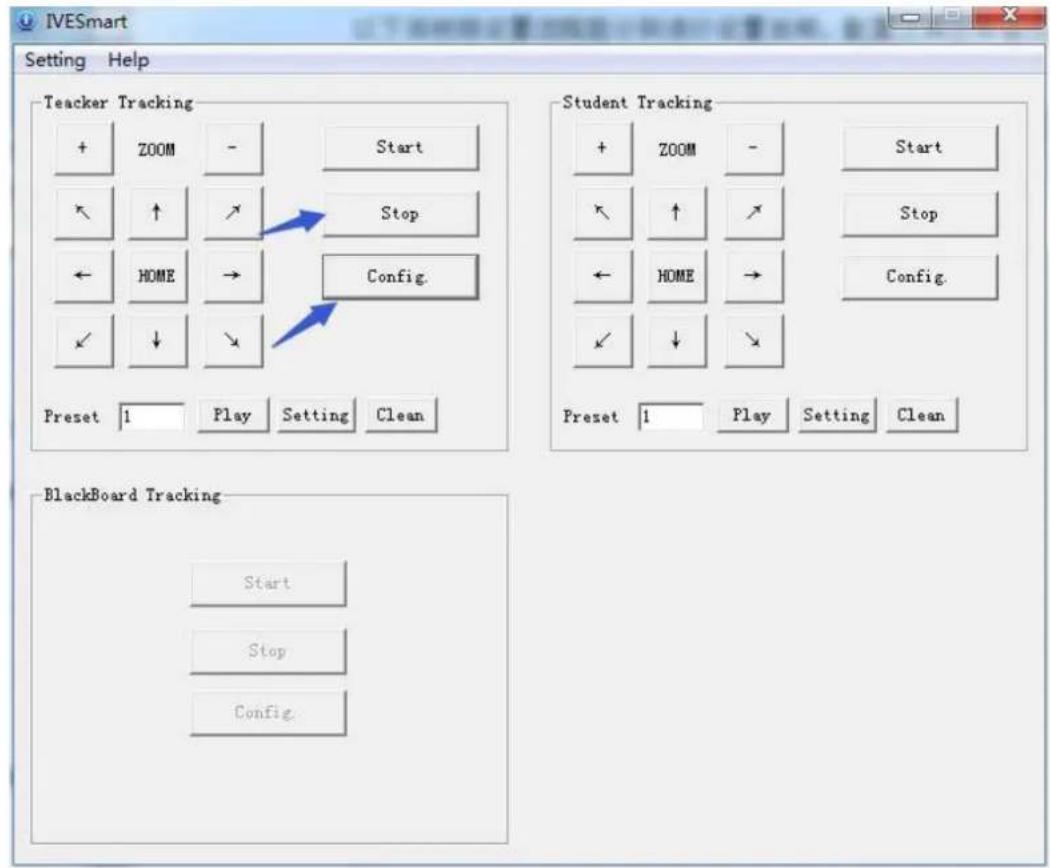
【↑↓←→】PTZ and zoom settings. Click the arrow keys to control the PTZ movement of the tracking camera; Press 【HOME】 and the tracking camera will return to the center position; Click 【+】/【-】to zoom in/out.
【Start】Start tracking. When the camera stops tracking the target, or after configuration, click 【Start】 to start tracking again.
【Stop】Stop tracking. Click 【Stop】to stop tracking the target.
【Config.】Click 【Configure】to enter the configuration interface.

【Preset】Call/ Set/ Clear preset positions.
Click 【Stop】first to exit auto-tracking mode, then click 【Config.】to enter Configuration interface.
4.2.3 Parameter Setup
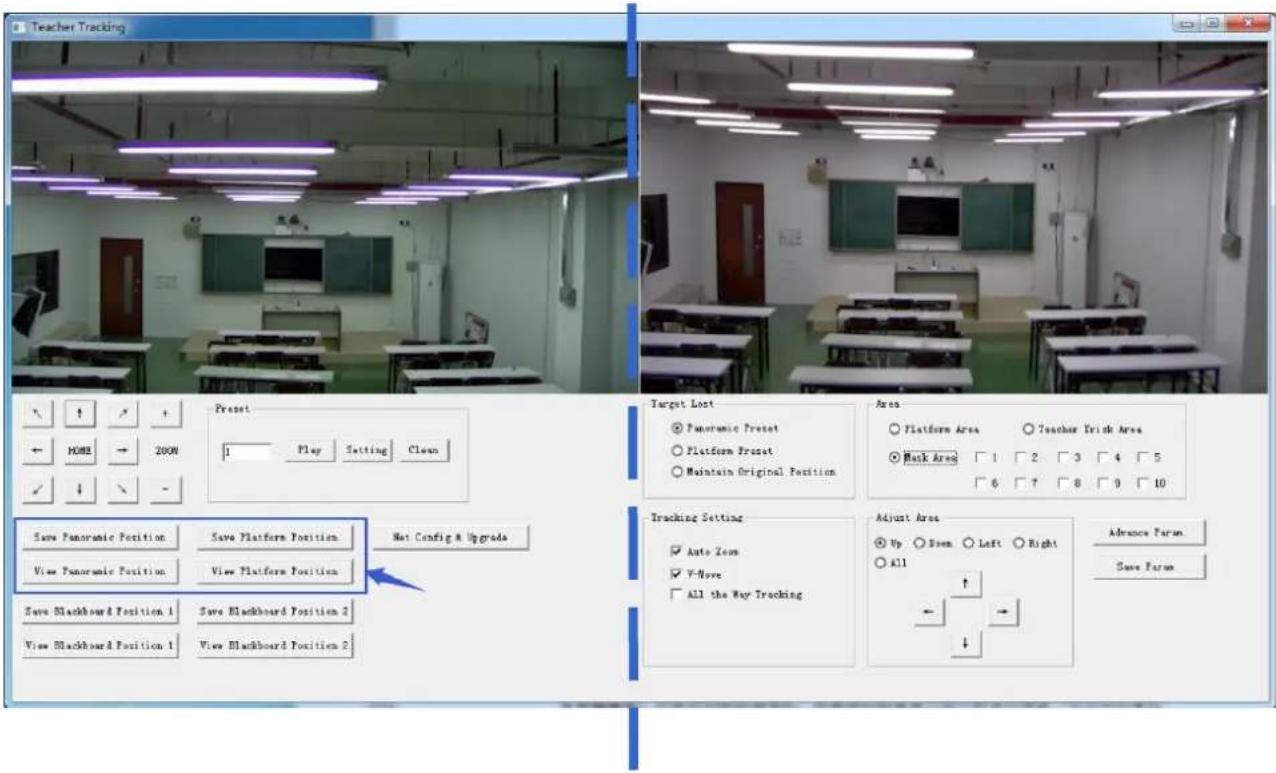
1) Close-up/ Tracking view configuration (the left half of the interface)
In the box indicated by the arrow (see the interface below), there are 4 buttons which are used to set preset positions for both close-up and panoramic view.
Click 【View Platform/Panoramic Position】, then adjust 【↑↓←→】 position and zoom so that the target can be best capture. Click 【Save Platform/Panoramic Position】 to save settings.
Note: Platform refers to the close-up view.
Platform preset: Adjust 【↑↓←→】 and zoom 【+ -】 of the tracking camera to get the desired visual result of camera image (we suggest that the teacher stand in the middle of podium, if any). Click 【Save Platform Position】. Once the auto-tracking mode starts, the size of teacher in Platform preset is used as a reference. When tracking target lost in sight, the close-up image will go back to Platform preset position.
Panoramic preset: Adjust 【↑↓←→】 and zoom 【+ -】 again to capture as much as a panoramic view of the classroom (or any position). When tracking target lost in sight, the close-up image will go back to Panoramic preset position.
Preset for blackboard-writing: for future use.
2) Set Panoramic Area
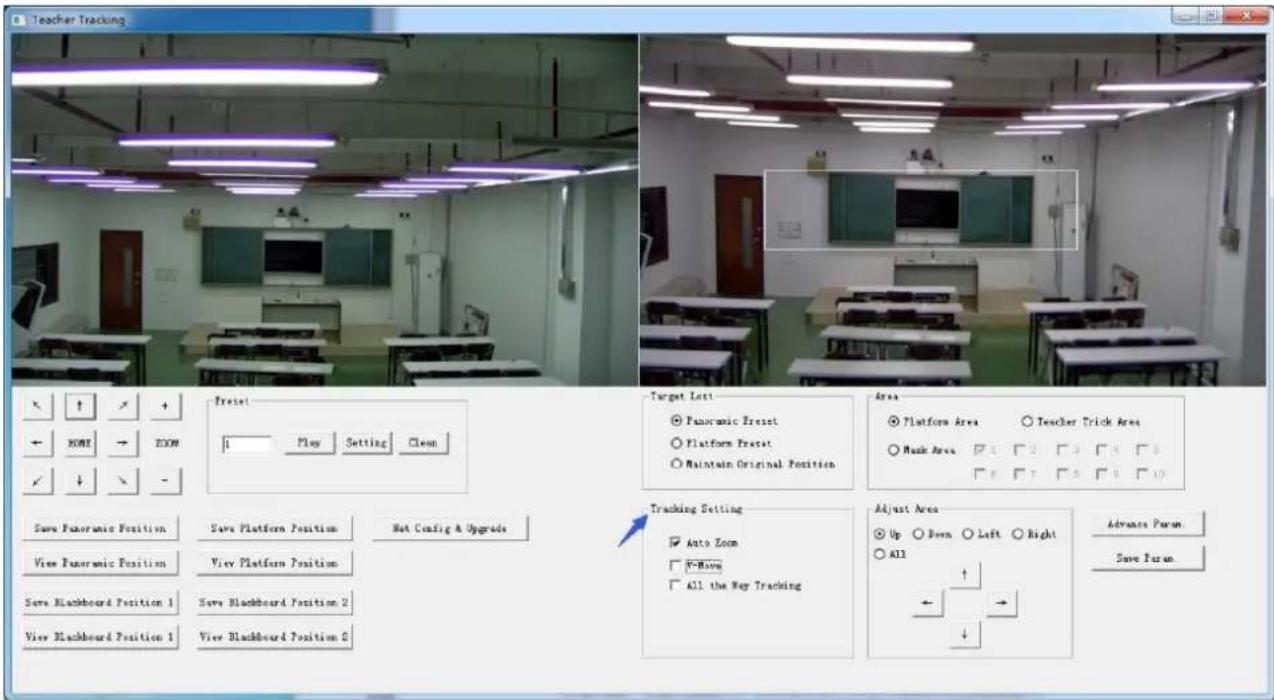
Platform area: It is the area tracked once close-up lens start up tracking. It is blackboard area on platform generally so as to ensure that when teacher is on platform his upper body is displayed within setting area, and it will not exceed lower margin of platform area when students in the first row sit down. See Figure 5.2-3.

Tracking area: Tracking area means scope of tracking teacher. When the tracking target goes out of the tracking area, it will be considered tracking target losing. The tracking area can be set into polygon according to certain environment conditions, or set student area outside of tracking area. See Figure 5.2-4:

Mask area: Mask area is usually the area which may impact result of teacher tracking, such as places which may have dynamic changes such as TV, projector, doors and windows. See Figure 5.2-5:

3. Set tracking parameters
Target lost: when target loses, the close-up lens will return to designated preset position. This preset position can be panoramic preset, platform preset or maintain original position.

Tracking settings:
Auto zoom: In open mode (checked), during tracking, the camera will zoom automatically according to target distance; in off mode (unchecked), during teacher tracking, zoom remains the value set during platform preset.
V-move: In open mode (checked) and during teacher tracking, the camera will adjust its angle of elevation according to height of tracking target; in off mode (unchecked) and during teacher tracking, angle of elevation remains the value set during platform preset. If a teacher will not step down platform in class, we suggest turning off auto zoom and v-move.
Advance parameters:
Action sensitivity: In teacher tracking mode, it is the action range required to trigger tracking camera when the tracking target changes from stationary state to motion state. The higher the action sensitivity, the smaller movement of tracking target that will trigger camera's tracking motion.
H-speed: It means speed of tracking camera for horizontal tracking.
V-speed: It means speed of tracking camera for vertical tracking.
Zoom range: The bigger the range, the higher zoom extent required for camera when tracking target steps down platform.
Lost timeout: It means time required (5s by default) for tracking camera to perform target lost action when target is lost (optional: return to panorama preset, platform preset, or remain original position).
Down platform sensitivity: It is used for determining if teacher steps down platform. The lower the sensitivity, the longer teacher's distance to blackboard it required to trigger teacher down platform action.

For settings of action code, refer to “7 Description of connecting recording and broadcasting host”.
After setting, click Save Parameter. It allows to entering advance parameter settings column to change configuration value to obtain the best result subject to specific scenes and customer demand.
4.2.4 Configuration
Click Configuration to enter the device parameter setting page.
There are options as listed below: local configuration, audio configuration, video configuration, network configuration, PTZ configuration, internet access configuration, system configuration. For detailed description, see the following table.
| Menu | Explanation |
| Local configure | Including video preview mode, record video packing time, record video storage route settings etc. |
| Audio configure | Including audio compressing format, sampling frequency, sampling precision, compressing code rate settings etc. |
| Video configure | Including video encoding, video parameters, character-overlapping, character size, video output setting etc. |
| Network configure | Including basic parameters, Ethernet, DNS, wireless network setting etc. |
| System configure | Including equipment property, system time, user management, version update, Reset, Reboot device settings etc. |
1) Local configuration
Video Preview Mode: user can choose real-time priority or fluency priority. The delay will be smaller when under real time priority mode, and fluency will be better when under fluency priority mode. Setting based on user's need (default value: real time best (1), real time normal (2), fluency normal (3), fluency good (4) and fluency best (5)).
Recording Packing Time (minute): set recording video packing time (default is 3, range from 1\~120 minutes).
Recording/Snapshot File Storage Route: set local recording video/snapshot file storage route (default: D:\MyIPCam).
Click "Save" button to let setting changes take effects.
2) Audio configuration
Switch: choose to enable/disable the audio.
Compressing Format: set audio compressing format, and the device will reboot automatically after changing (default: MP3, other options: PCM, AAC).
Sampling Frequency: set sampling frequency, and the device will reboot automatically after changing (default: 44100, other options: 16000, 32000 and 48000).
Sampling Precision: set sampling precision (default: 16bits).
Compressing Code Rate: set audio compressing code rate (default: 64bits, other options: 32, 48, 96, 128bits).
Note: click “Save”, and it will show the message “Enable has changed. Restart the device to take effect after the success of the save.”. Please reboot the camera for the changes to take effects.
4.2.5 Video configuration
1) Video Encoding
Code Stream: for different video output mode settings, use different streams (main stream, secondary stream) accordingly.
Compression Format: set the video compression format, save and reboot to take effect (main/secondary stream default: H.264, other options: H.265).
Video Size: set video image resolution, save and reboot to take effect (main stream default 1920 * 1080, other options: 1280 * 720; secondary stream default 640*320, other options: 320*180, 1280*720).
Stream Rate Control: set rate control mode, save and reboot to take effect (main/secondary stream default: variable bit rate, other options: fixed rate).
Image Quality: set image quality. Image quality can be changed only when rate control is set to variable bit rate (main stream default: better; secondary stream default: good; other options: best, better, good, bad, worse, worst).
Rate (Kb/s): set the video bit rate (main stream default: 8192Kb/s, other options: 64-20480Kb/s; secondary stream default: 2048Kb/s, other options: 64-8192Kb/s).
Frame Rate (F/S): set the video frame rate (main/secondary stream default: 25F/S; other options for main stream: 5-60F/S; other options for secondary stream: 5-30F/S).
Key Frame Interval: set the key frame interval (main/secondary stream default: 75F, other options for main stream: -300F; other options for secondary stream: 1-150F).
Key Frame Minimum QP: default: 10, other options: 10\~51.
Click "Save". Settings will take effect after the message "saved successfully" shows.
2) Stream Release
Switch: to turn on/off the main/secondary stream.
Protocol: main/secondary stream applies RTMP protocol.
Host Port: server port number (default 1935, other options: 0-65535).
Host Address: server IP addresses (default 192.168.5.11).
Stream Name: choose a different stream name (live/av0, other options: live/av1).
User: set the user name.
Password: set the password.
Click "Save". Settings will take effect after the message "saved successfully" shows.
RTSP obtaining path: rtsp: // device IP address: 554 / live / av0 (av0 main stream; av1 secondary stream).
3) Video Parameters
a. Focus: focus mode, focus range, focus sensitivity can be set.
Focus Mode: set the focus mode (default: auto, other options: manual).
Focus Range: set the focus range (default: middle, other options: upper, lower).
Focus Sensitivity: set the focus sensitivity (default: low, other options: high, medium).
b. Exposure: exposure mode, exposure compensation, back light compensation, anti-flicker, gain limit, DRC, shutter speed, aperture value and brightness can be set.
Exposure Mode: set the exposure mode (default: automatic, other options: manual, shutter priority, aperture priority, brightness priority).
Exposure Compensation: exposure compensation setting is active when it is auto status (default: off).
Exposure Compensation Value: set the exposure compensation value. Valid when it is set for auto (default: -7, other options: -7 \~ 7).
BLC: set back light compensation, valid when it is under auto mode (default: off).
Anti-flicker: set anti-flicker mode, valid when under automatic, aperture or brightness priority mode (default: 50Hz, other options: closed, 60Hz).
Gain Limit: set the gain limits. Auto, active when it is under aperture or brightness priority mode (default: 7, other options: 0-15).
Dynamic Range: set the dynamic range (default: 2, other options: 1-8 and OFF).
Shutter Speed: active when it is under manual or shutter-priority mode (default: 1/90, other options: 1/90, 1/100, 1/1/120/180, 1/250, 1/350, 1/500, 1/725, 1/1000, 1/1500, 1/2000, 1/3000, 1/4000, 1/6000, 1/10000).
Aperture Value: set the aperture value. Active when it is under manual or aperture-priority mode (default: F1.8, other options: closed, F9.6, F8.0, F6.8, F5.6, F4.8, F4.0, F3.4, F2.8, F2.4, F2.0, F1.8).
Brightness: set the brightness value. Active when it is under brightness priority mode (default: 7, other options: 0-23).
c. Color: white balance, saturation, hue, white balance sensitivity, red tuning, blue tuning, red gain and blue gain can be set.
White Balance Mode: set the white balance mode (default: automatic, other options: 3000K, 4000K, 5000K, 6500K, manual, One-push).
Note: click "Correction" button when one-push white balance mode is selected.
Red Tuning: red trimming, only effective when white balance is set AUTO (default: 0, other options: -10\~10).
Blue Tuning: blue trimming, only effective when white balance is set AUTO (default: 0, other options: -10\~10).
Saturation: set the saturation (default: 100%, other options: 60%, 70%, 80%, 90%, 100%, 110%, 120%, 130%, 140%, 150%, 160%, 170%, 180%, 190%, 200%).
Auto White Balance Sensitivity: sensitivity for auto white balance settings (default: low, other options: high, medium).
Hue: set the chrome (default: 7, other options: 0-14).
White Balance Sensitivity: default: low, other options: middle, high.
Red Gain: set the red gain, effective when it is under manual mode (default: 145, other options: 0-255).
Blue Gain: sets the blue gain, effective when it is under manual mode (default: 56, other options: 0-255).
d. Image: brightness, contrast, sharpness, black and white mode, gamma, DCI, horizontal flip, vertical flip and digital zoom can be set.
Brightness: set the brightness value (default: 7, other options: 0-14).
Contrast: set the contrast value (default: 7, other options: 0-14).
Sharpness: set the sharpness value (default: 4, other options: 0-15).
Black and White Mode: set black and white mode (default: color, other options: black/white).
Gamma: gamma value setting (default: 0.45, other options: 0.50, 0.52, 0.55).
Dynamic Contrast: dynamic contrast setting (default: close, other options: 1\~8).
Flip Horizontal: set flip horizontal (default: Off, other options: On).
Flip Vertical: set vertical flip (default: Off, other options: On).
Digital Zoom: digital zoom setting (default: Off, other options: On).
e. Noise Reduction: 2D noise reduction, 3D noise reduction and dynamic dead pixel correction can be set.
2D Noise Reduction: set 2D noise reduction level (default: 3, other options: 1-7 and Off).
3D Noise Reduction: set 3D noise reduction level (default: 3, other options: 1-8 and Off).
Dynamic Dead Pixel Correction: set dynamic dead pixel correction level (default: Off, other options: 1-5).
Note: click “Refresh” for any change of video parameters to take effect.
f. Style: default, standard, clear, bright and soft can be set.
Note: if the above a, b, c, d, e value changes, click "Refresh" to take effect.
4) Character-overlapping
Display Date and Time: set whether or not to display the time and date (default: display).
Display Title: set whether or not to display the title (default: display).
Font Color of Time: set font color of time and date (default: white, other options: black, yellow, red and blue).
Font Color of Title: set font color of title (default: white, other options: black, yellow, red and blue).
Moving Characters: set the display position of moving date, time and title. Click "up, down, left, right" buttons to move to the proper character position.
Title Content: set title content (default: CAMERA1).
Time Content: set time content (default: 1970/01/10 05:36:00).
Click "Save". Settings will take effect after the message "saved successfully" shows.
5) Character Size
Main Stream Character Size: set the character size for main stream display. Device will restart automatically after character size being changed and saved (default: 24, other options: 16).
Secondary Stream Character Size: set the character size for secondary stream display. Device will restart automatically after character size being changed and saved (default: 16, other options: 24).
Click "Save". Settings will take effect after the message "saved successfully" shows.
6) Video Output
Output Format: set the video output format (default: 1080P60, other options: 1080P50, 1080P30, 1080P25, 1080I60, 1080I50, 720P60, 720P50, 720P30, 720P25, 1080P59.94, 1080I59.94, 1080P29.97, 720P59.94, 720P29.97).
Click "Save". Settings will take effect after the message "saved successfully" shows.
4.2.6 Network configuration
1) Network Port
Data Port: set the data port. Device will restart automatically after the port setting being changed (default: 3000, other options: 0-65535).
Web Port: set the web port. Device will restart automatically after the port setting being changed (default: 80, other options: 0-65535).
Onvif Port: set the Onvif port. Device will restart automatically after the port setting being changed (default: 2000, other options: 0-65535).
Soap Port: set the soap port (default: 1936, other options: 0-65535).
RTMP Port: set the RTMP port (default: 1935, other options: 0-65535).
RTSP Port: set the RTSP port. Device will restart automatically after the port setting being changed (default: 554, other options: 0-65535).
Visca Port: set the Visca port. Device will restart automatically after the port setting being changed (default: 3001, other options: 0-65535).
Click "Save". Settings will take effect after the message "saved successfully" shows.
RTMP Obtaining Path: rtmp: // device IP address:1935 / live / av0 (av0 main stream; av1 secondary stream).
2) Ethernet Parameters
DHCP: enable/disable obtaining IP automatically. Save changes and reboot the device for the changes to takes effect (default: OFF).
IP Address: set IP address. Save changes and reboot the device for the changes to takes effect (default: 192.168.5.163). Note: this IP address is the same as the one used for login Web page.
Subnet Mask: set the subnet mask (default: 255.255.5.0).
Default Gateway: set the default gateway (default: 0.0.0.0).
Physical Address: set the physical address (the parameter is read-only and cannot be modified).
Click "Save". Settings will take effect after the message "saved successfully" shows.
Note: need to prevent IP conflicts when modify.
3) DNS Parameters
Preferred DNS Server: set the preferred DNS server (default: 0.0.0.0).
Alternate DNS Server: alternate DNS server settings (default 0.0.0.0).
Click "Save". Settings will take effect after the message "saved successfully" shows.
4) GB28181
Switch: set whether or not open GB28181.
Time Synchronization: set whether or not synchronize time.
Stream Type: stream type setting (default: main stream, other options: secondary stream).
Sign Effective Time (seconds): default: 3600, other options: range: 5-65535.
Heartbeat Time (seconds): default: 60, other options: range: 1-65535.
Register ID: 34020000001320000001
Register User Name: IPC
Register Password: 12345678
Equipment Ownership: users can add their own.
Administrative Regions: users can add their own.
Alarm Zone: users can add their own.
Equipment Installation Address: users can add their own.
Local SIP Port: default: 5060, other options: range: 0-65535.
GB28181 Server Address: IP address of the computer.
Server SIP Port: default: 5060, other options: range: 0-65535.
Server ID: 34020000002000000001
Click "Save". Settings will take effect after the message "saved successfully" shows.
4.2.7 System configuration
1) Device Properties
Device Name: set the device name (default: Camera1, user can add their own).
Device ID: set the device ID (default: 1, read-only).
System Language: set the system language (default: Simplified Chinese, other options: English). Need to re-login after modifying and saving the setting.
Click "Save". Settings will take effect after the message "saved successfully" shows.
2) System Time
Date Format: set the date format (default: YYYY-MM-DD, other options: MM-DD-YYYY, DD-MM-YYYY).
Date Separator: set the date separator (default: '/', other options: '', '-').
Time Zone: set the time zone (default: east eight districts, other options: other time zones).
Time Type: set the time types (default: 24 hours, other options: 12 hours).
NTP Enable: click it to set NTP time.
Update Interval: set the automatic update time interval for NTP server. Valid after changes synchronized with NTP server (default: 1 day, other options: 2-10 days).
NTP Server Address or Domain Name: set NTP server address or domain name (default: time.nits.gov, users can modify on their own).
NTP Server Port: set the NTP server port (effective when NTP Enabled, default 123, users can modify on their own)
Click "Save". Settings will take effect after the message "saved successfully" shows.
Time Setting: set time mode (options: computer time synchronization, NTP server time synchronization, set manually).
Computer Time: set the computer synchronization.
Set the Time Manually: click “Calendar” on the right to set time manually (only effective when time setting is MANUAL).
3) User Management
Select Users: set user type (default: administrator, other options: Common User 1, Common User 2).
User Name: set user name (User Administrator default: admin; Common User1 default: user1; Common User 2 default: user2; user can modify on their own).
Password: set a password (User Administrator default: admin; Common User1 default: user1; Common User 2 default: user2; user can modify on their own).
Password Confirmation: confirm the passwords are input correctly.
Click "Save". Settings will take effect after the message "saved successfully" shows.
Note: please note the case-sensitivity of the user name and password.
If login using a common user's user name and password, then the user does not have configuration privileges, and
can only operate preview, playback, or logoff.
4) Version Upgrade
MCU version V2.0.0.16 2015-12-18
Camera version V2.0.0.16 2015-12-18
Focus version V2.0.0.6 2015-12-11
Version information above is read-only for users. It is consistent with the menu version and cannot be modified.
Different type of the machine has different information.
Update file:
Click "Browse ..." for installation. Select the upgrade file in the pop-up window.
Click "Upgrade", and the upgrade dialog window will appear. Device will reboot automatically after being updated successfully.
Note: make sure the power and network is connected during the process. Or the upgrade will fail.
Note: after version upgrade, please restore default settings according to the following options:
a, Restore default settings through web configuration.
b, Restore default settings through camera menu.
c, Restore default settings using shortcut key combination* # 6 on remote control.
If use option a, the account and passwords will also be restored to default.
5) Restore Factory Settings
Click "Restore Factory Defaults" on the pop-up, and choose "yes". Device will restart automatically and restore factory settings.
6) Reboot
Click "Reboot" on the pop-up, and choose "Yes". Device will restart automatically.
4.2.8 Logout
Click "Logout" on the "Confirmation" pop-up dialog window. Select "Yes" or "No". Choose "Yes" to exit the current page and return to the user login interface.
4.2.9 Wireless Network
If user's equipment has a wireless network module, then "Network Configuration" page will have "Wireless Network" configuration option. Specific configuration is shown as below:
1) Network Settings
Wireless network configuration:
Network Interface Enable: check to set the following items.
DHCP: obtain IP automatically if checked.
IP Address: set wireless WIFI IP (default: 192.168.1.250). If DHCP is checked, IP should be assigned automatically). Note: wireless IP address cannot be in the same segment with wired IP address.
Subnet Mask: set the wireless IP subnet mask (default255.255.255.0).
Default Gateway: set the wireless IP default gateway (default 192.168.1.1).
SSID: user can modify on their own (default: test).
Encryption: password can be set if checked.
Password: password can be changed if checked.
Click "Save". Settings will take effect after the message "saved successfully" shows.
Note: SSID and password should be filled correctly, otherwise the wireless WiFi connection will not be available
after restart.
2) WiFi Hot Link
Click "search" to search for the WIFI hotspot.
Double-click the dialog box after searching WIFI hotspot, then input the WIFI password. It is connected successfully after “successful connect” window shows.
3) Wireless WiFi Login Page
If DHCP is not checked on the configuration page (automatically obtain IP), then open the browser, enter the wireless network IP address in the address bar (default 192.168.1.250), press Enter to login to the construction page; If DHCP is checked, then IP will be obtained automatically. Log in to the specific router or switch's user interface settings to view the allocation of IP address.
5. Serial Communication Control
Under common working conditions, the camera could be controlled through RS232/RS485 interface (VISCA).
RS232C serial parameters are as below:
Baud rate: 2400/4800/9600/115200 bits/sec; Start bit: 1; Data bits: 8; Stop bit: 1; Parity: None.
After powering on, camera first goes to the left, then back to the center position. Initial configuration is complete after the zoom moves to the farthest and then back to the nearest position. If the camera's preset 0 position exists, it will be at 0 preset position after initialization. At this point, user can control the camera by the serial commands.
5.1 VISCA Protocol List
5.1.1 Camera return commands
| Ack/Completion Message | ||
| Command packet | Note | |
| ACK | z0 41 FF | Returned when the command is accepted. |
| Completion | z0 51 FF | Returned when the command has been executed. |
z = camera address + 8
| Error Messages | ||
| Command packet | Note | |
| Syntax Error | z0 60 02 FF | Returned when the command format is different or when a command with illegal parameters is accepted. |
| Command Not Executable | z0 61 41 FF | Returned when a command cannot be executed due to current conditions. For example, when commands indicating controlling focus manually are received during auto focus. |
5.1.2 Camera control commands
| Command | Function | Command packet | Note |
| AddressSet | Broadcast | 88 30 0p FF | p:VISCA Address |
| IF_Clear | Broadcast | 88 01 00 01 FF | I/F Clear |
| CommandCancel | 8x 21 FF | ||
| CAM_Power | On | 8x 01 04 00 02 FF | Power ON/OFF |
| Off | 8x 01 04 00 03 FF | ||
| CAM_Zoom | Stop | 8x 01 04 07 00 FF | |
| Tele(Standard) | 8x 01 04 07 02 FF | ||
| Wide(Standard) | 8x 01 04 07 03 FF | ||
| Tele(Variable) | 8x 01 04 07 2p FF | p = 0(low) - F(high) | |
| Wide(Variable) | 8x 01 04 07 3p FF | ||
| Direct | 8x 01 04 47 0p 0q 0r 0s FF | pqrs: Zoom Position | |
| CAM_Focus | Stop | 8x 01 04 08 00 FF | |
| Far(Standard) | 8x 01 04 08 02 FF | ||
| Near(Standard) | 8x 01 04 08 03 FF | ||
| Far(Variable) | 8x 01 04 08 2p FF | p = 0(low) - F(high) | |
| Near (Variable) | 8x 01 04 08 3p FF | ||
| Direct | 8x 01 04 48 0p 0q 0r 0s FF | pqrs: Focus Position | |
| Auto Focus | 8x 01 04 38 02 FF | ||
| Manual Focus | 8x 01 04 38 03 FF | ||
| CAM_Zoom Focus | Direct | 8x 01 04 47 0p 0q 0r 0s0t 0u 0v 0w FF | pqrs: Zoom Positiontuvw: Focus Position |
| CAM_WB | Auto | 8x 01 04 35 00 FF | |
| 3000K | 8x 01 04 35 01 FF | ||
| 4000k | 8x 01 04 35 02 FF | ||
| One Push mode | 8x 01 04 35 03 FF | ||
| 5000k | 8x 01 04 35 04 FF | ||
| Manual | 8x 01 04 35 05 FF | ||
| 6500k | 8x 01 04 35 06 FF | ||
| CAM_RGain | Reset | 8x 01 04 03 00 FF | Manual Control of R Gain |
| Up | 8x 01 04 03 02 FF | ||
| Down | 8x 01 04 03 03 FF | ||
| Direct | 8x 01 04 43 00 00 0p 0q FF | pq: R Gain | |
| CAM_Bgain | Reset | 8x 01 04 04 00 FF | Manual Control of B Gain |
| Up | 8x 01 04 04 02 FF | ||
| Down | 8x 01 04 04 03 FF | ||
| Direct | 8x 01 04 44 00 00 0p 0q FF | pq: B Gain | |
| CAM_AE | Full Auto | 8x 01 04 39 00 FF | Automatic Exposure mode |
| Manual | 8x 01 04 39 03 FF | Manual Control mode | |
| Shutter priority | 8x 01 04 39 0A FF | Shutter Priority Automatic Exposure mode | |
| Iris priority | 8x 01 04 39 0B FF | Iris Priority Automatic Exposure mode | |
| Bright | 8x 01 04 39 0D FF | Bright mode | |
| CAM_Shutter | Reset | 8x 01 04 0A 00 FF | Shutter Setting |
| Up | 8x 01 04 0A 02 FF | ||
| Down | 8x 01 04 0A 03 FF | ||
| Direct | 8x 01 04 4A 00 00 0p 0q FF | pq: Shutter Position | |
| CAM_Iris | Reset | 8x 01 04 0B 00 FF | Iris Setting |
| Up | 8x 01 04 0B 02 FF | ||
| Down | 8x 01 04 0B 03 FF | ||
| Direct | 8x 01 04 4B 00 00 0p 0q FF | pq: Iris Position | |
| CAM_Gain Limit | Gain Limit | 8x 01 04 2C 0p FF | p: Gain Positon |
| CAM_Bright | ResetUp | 8x 01 04 0D 00 FF8x 01 04 0D 02 FF | Bright Setting |
| Down | 8x 01 04 0D 03 FF | ||
| Direct | 8x 01 04 4D 00 00 0p 0q FF | pq: Bright Position | |
| CAM_ExpCopm | On | 8x 01 04 3E 02 FF | Exposure Compensation ON/OFF |
| Off | 8x 01 04 3E 03 FF | ||
| Reset | 8x 01 04 0E 00 FF | Exposure Compensation Amount Setting | |
| Up | 8x 01 04 0E 02 FF | ||
| Down | 8x 01 04 0E 03 FF | ||
| Direct | 8x 01 04 4E 00 00 0p 0q FF | pq: ExpComp Position | |
| CAM_Back Light | On | 8x 01 04 33 02 FF | Back Light Compensation |
| Off | 8x 01 04 33 03 FF | ||
| CAM_WDRStrength h | Reset | 8x 01 04 21 00 FF | WDR Level Setting |
| Up | 8x 01 04 21 02 FF | ||
| Down | 8x 01 04 21 03 FF | ||
| Direct | 8x 01 04 51 00 00 00 0p FF | p: WDR Level Position | |
| CAM_NR (2D) | 8x 01 04 53 0p FF | P=0-7 0:OFF | |
| CAM_NR (3D) | 8x 01 04 54 0p FF | P=0-8 0:OFF | |
| CAM_Gamma | 8x 01 04 5B 0p FF | p = 0 - 4 0: Default 1: 0.452: 0.50 3: 0.55 4: 0.63 | |
| CAM_Flicker | OFF | 8x 01 04 23 00 FF | OFF |
| 50HZ | 8x 01 04 23 01 FF | 50HZ | |
| 60HZ | 8x 01 04 23 02 FF | 60HZ | |
| CAM_Aperture | Reset | 8x 01 04 02 00 FF | Aperture Control |
| Up | 8x 01 04 02 02 FF | ||
| Down | 8x 01 04 02 03 FF | ||
| Direct | 8x 01 04 42 00 00 0p 0q FF | pq: Aperture Gain | |
| CAM_Memory | Reset | 8x 01 04 3F 00 pq FF | pq: Memory Number(=0~254)Corresponds to 0 to 9 on the Remote Commander |
| Set | 8x 01 04 3F 01 pq FF | ||
| Recall | 8x 01 04 3F 02 pq FF | ||
| CAM_LR_Reverse | On | 8x 01 04 61 02 FF | Image Flip Horizontal ON/OFF |
| Off | 8x 01 04 61 03 FF | ||
| CAM_PictureFlip | On | 8x 01 04 66 02 FF | Image Flip Vertical ON/OFF |
| Off | 8x 01 04 66 03 FF | ||
| CAM_ColorSaturat ion | Direct | 8x 01 04 49 00 00 00 0p FF | P=0-E0:60%1:70%2:80%3:90%4:100%5:110%6:120%7:130%8:140%9:150%10:160%11:160%12:180%13:190%14:200% |
| CAM_IDWrite | 8x 01 04 22 0p 0q 0r 0s FF | pqrs: Camera ID (=0000 to FFFF) | |
| SYS_Menu | ON | 8x 01 04 06 06 02 FF | Turn on the menu screen |
| OFF | 8x 01 04 06 06 03 FF | Turn off the menu screen | |
| IR_Receive | ON | 8x 01 06 08 02 FF | IR (remote commander) receive On/Off |
| OFF | 8x 01 06 08 03 FF | ||
| IR_ReceiveReturn | On | 8x 01 7D 01 03 00 00 FF | IR (remote commander) receive message via the VISCA communication ON/OFF |
| Off | 8x 01 7D 01 13 00 00 FF | ||
| CAM_SettingReset | Reset | 8x 01 04 A0 10 FF | Reset Factory Setting |
| CAM_Brightness | Direct | 8x 01 04 A1 00 00 0p 0q FF | pq: Brightness Position |
| CAM_Contrast | Direct | 8x 01 04 A2 00 00 0p 0q FF | pq: Contrast Position |
| CAM_Flip | OFF | 8x 01 04 A4 00 FF | Single Command for Video Flip |
| Flip-H | 8x 01 04 A4 01 FF | ||
| Flip-V | 8x 01 04 A4 02 FF | ||
| Flip-HV | 8x 01 04 A4 03 FF | ||
| CAM_VideoSystem | Set camera video system | 8x 01 06 35 00 0p FF | P: 0~E Video format0:1080P601:1080P502:1080i603:1080i504:720P605:720P506:1080P30:1080P258:720P309:720P25A: 1080P59.94B: 1080i59.94C: 720P59.94D: 1080P29.97E: 720P29.97 |
| Pan_tiltDrive | Up | 8x 01 06 01 VV WW 03 01 FF | VV: Pan speed 0x01 (low speed) to 0x18 (high speed)WW: Tilt speed 0x01 (low speed) to 0x14 (high speed)YYYY: Pan PositionZZZZ: Tilt Position |
| Down | 8x 01 06 01 VV WW 03 02 FF | ||
| Left | 8x 01 06 01 VV WW 01 03 FF | ||
| Right | 8x 01 06 01 VV WW 02 03 FF | ||
| Upleft | 8x 01 06 01 VV WW 01 01 FF | ||
| Upright | 8x 01 06 01 VV WW 02 01 FF | ||
| DownLeft | 8x 01 06 01 VV WW 01 02 FF | ||
| DownRight | 8x 01 06 01 VV WW 02 02 FF | ||
| Stop | 8x 01 06 01 VV WW 03 03 FF | ||
| AbsolutePosition | 8x 01 06 02 VV WW0Y 0Y 0Y 0Y 0Z 0Z 0Z FF | ||
| RelativePosition | 8x 01 06 03 VV WW0Y 0Y 0Y 0Y 0Z 0Z 0Z FF | ||
| Home | 8x 01 06 04 FF | ||
| Reset | 8x 01 06 05 FF | ||
| Pan-tiltLimitSet | Set | 8x 01 06 07 00 0W0Y 0Y 0Y 0Y 0Z 0Z 0Z FF | W:1 UpRight 0:DownLeftYYYY: Pan Limit Position(TBD)ZZZZ: Tilt Limit Position(TBD) |
| Clear | 8x 01 06 07 01 0W07 0F 0F 0F 07 0F 0F FF |
5.1.3 Inquiry command
| Command | Function | Command packet | Note |
| CAM_PowerInq | 8x 09 04 00 FF | y0 50 02 FF | On |
| y0 50 03 FF | Off(Standby) | ||
| CAM_ZoomPosInq | 8x 09 04 47 FF | y0 50 0p 0q 0r 0s FF | pqrs: Zoom Position |
| CAM_FocusAFModeInq | 8x 09 04 38 FF | y0 50 02 FF | Auto Focus |
| y0 50 03 FF | Manual Focus | ||
| CAM_FocusPosInq | 8x 09 04 48 FF | y0 50 0p 0q 0r 0s FF | pqrs: Focus Position |
| CAM_WBModeInq | 8x 09 04 35 FF | y0 50 00 FF | Auto |
| y0 50 01 FF | 3000K | ||
| y0 50 02 FF | 4000K | ||
| y0 50 03 FF | One Push Mode | ||
| y0 50 04 FF | 5000K | ||
| y0 50 05 FF | Manual | ||
| y0 50 00 FF | 6500K | ||
| CAM_RGainInq | 8x 09 04 43 FF | y0 50 00 00 0p 0q FF | pq: R Gain |
| CAM_BGainInq | 8x 09 04 44 FF | y0 50 00 00 0p 0q FF | pq: B Gain |
| CAM_AEModeInq | 8x 09 04 39 FF | y0 50 00 FF | Full Auto |
| y0 50 03 FF | Manual | ||
| y0 50 0A FF | Shutter priority | ||
| y0 50 0B FF | Iris priority | ||
| y0 50 0D FF | Bright | ||
| CAM_ShutterPosInq | 8x 09 04 4A FF | y0 50 00 00 0p 0q FF | pq: Shutter Position |
| CAM_IrisPosInq | 8x 09 04 4B FF | y0 50 00 00 0p 0q FF | pq: Iris Position |
| CAM_GainLimitInq | 8x 09 04 2C FF | y0 50 0p FF | p: Gain Positon |
| CAM_BrightPosInq | 8x 09 04 4D FF | y0 50 00 00 0p 0q FF | pq: Bright Position |
| CAM_ExpCompModeInq | 8x 09 04 3E FF | y0 50 02 FF | On |
| y0 50 03 FF | Off | ||
| CAM_ExpCompPosInq | 8x 09 04 4E FF | y0 50 00 00 0p 0q FF | pq: ExpComp Position |
| CAM_BacklightModeInq | 8x 09 04 33 FF | y0 50 02 FF | On |
| y0 50 03 FF | Off | ||
| CAM_WDRStrengthInq | 8x 09 04 51 FF | y0 50 00 00 00 0p FF | p: WDR Strength |
| CAM_NRLvel(2D)Inq | 8x 09 04 53 FF | y0 50 0p FF | P: 2DNRLvel |
| CAM_NRLvel(3D)Inq | 8x 09 04 54 FF | y0 50 0p FF | P: 3DNRLvel |
| CAM_FlickerModeInq | 8x 09 04 55 FF | y0 50 0p FF | p: Flicker Settings(0: OFF, 1: 50Hz, 2:60Hz) |
| CAM_ApertureInq | 8x 09 04 42 FF | y0 50 00 00 0p 0q FF | pq: Aperture Gain |
| CAM_PictureEffectModeInq | 8x 09 04 63 FF | y0 50 00 FF | Off |
| y0 50 04 FF | B&W | ||
| CAM_MemoryInq | 8x 09 04 3F FF | y0 50 0p FF | p: Memory number last operated. |
| SYS_MenuModeInq | 8x 09 06 06 FF | y0 50 02 FF | On |
| y0 50 03 FF | Off | ||
| CAM_LR_ReverseInq | 8x 09 04 61 FF | y0 50 02 FF | On |
| y0 50 03 FF | Off | ||
| CAM_PictureFlipInq | 8x 09 04 66 FF | y0 50 02 FF | On |
| y0 50 03 FF | Off | ||
| CAM_ColorSaturatiOnq | 8x 09 04 49 FF | y0 50 00 00 00 0p FF | p: Color Gain setting 0h (60%) to Eh (200%) |
| CAM_IDInq | 8x 09 04 22 FF | y0 50 0p 0q 0r 0s FF | pqrs: Gamma ID |
| IR_ReceiveInq | 8x 09 06 08 FF | y0 50 02 FF | On |
| y0 50 03 FF | Off | ||
| IR_ReceiveReturn | y0 07 7D 01 04 00 FF | Power ON/OFF | |
| y0 07 7D 01 04 07 FF | Zoom tele/wide | ||
| y0 07 7D 01 04 38 FF | AF ON/OFF | ||
| y0 07 7D 01 04 33 FF | Camera _Backlight | ||
| y0 07 7D 01 04 3F FF | Camera _Memory | ||
| y0 07 7D 01 06 01 FF | Pan_titleDriver | ||
| CAM_BrightnessInq | 8x 09 04 A1 FF | y0 50 00 00 0p 0q FF | pq: Brightness Position |
| CAM_ContrastInq | 8x 09 04 A2 FF | y0 50 00 00 0p 0q FF | pq: Contrast Position |
| CAM_FlipInq | 8x 09 04 A4 FF | y0 50 00 FF | Off |
| y0 50 01 FF | Flip-H | ||
| y0 50 02 FF | Flip-V | ||
| y0 50 03 FF | Flip-HV | ||
| CAM_GammaInq | 8x 09 04 5B FF | y0 50 0p FF | p: Gamma setting |
| CAM_VersionInq | 8x 09 00 02 FF | y0 50 ab cdmn pq rs tu vw FF | ab cd : vender ID (0220)mn pq : model ID ST (0951)U3 (3950)rs tu : ARM Versionvw : reserve |
| VideoSystemInq | 8x 09 06 23 FF | y0 50 0p FF | P: 0~E Video format0:1080P601:1080P502:1080i603:1080i504:720P605:720P506:1080P307:1080P258:720P309:720P25A: 1080P59.94B: 1080i59.94C: 720P59.94D: 1080P29.97E: 720P29.97 |
| Pan-tiltMaxSpeedInq | 8x 09 06 11 FF | y0 50 ww zz FF | ww: Pan Max Speed zz: Tilt Max Speed |
| Pan-tiltPosInq | 8x 09 06 12 FF | y0 50 0w 0w 0w 0w0z 0z 0z 0z FF | www: Pan Position zzzz: Tilt Position |
Note: [X] in the above table indicates the camera address to be operated, 【y】=【x+8】.
5.2 Pelco-D Protocol Command List
| Function | Byte1 | Byte2 | Byte3 | Byte4 | Byte5 | Byte6 | Byte7 |
| Up | 0xFF | Address | 0x00 | 0x08 | Pan Speed | Tilt Speed | SUM |
| Down | 0xFF | Address | 0x00 | 0x10 | Pan Speed | Tilt Speed | SUM |
| Left | 0xFF | Address | 0x00 | 0x04 | Pan Speed | Tilt Speed | SUM |
| Right | 0xFF | Address | 0x00 | 0x02 | Pan Speed | Tilt Speed | SUM |
| Upleft | 0xFF | Address | 0x00 | 0x0C | Pan Speed | Tilt Speed | SUM |
| Upright | 0xFF | Address | 0x00 | 0x0A | Pan Speed | Tilt Speed | SUM |
| DownLeft | 0xFF | Address | 0x00 | 0x14 | Pan Speed | Tilt Speed | SUM |
| DownRight | 0xFF | Address | 0x00 | 0x12 | Pan Speed | Tilt Speed | SUM |
| Zoom In | 0xFF | Address | 0x00 | 0x20 | 0x00 | 0x00 | SUM |
| Zoom Out | 0xFF | Address | 0x00 | 0x40 | 0x00 | 0x00 | SUM |
| Focus Far | 0xFF | Address | 0x00 | 0x80 | 0x00 | 0x00 | SUM |
| Focus Near | 0xFF | Address | 0x01 | 0x00 | 0x00 | 0x00 | SUM |
| Stop | 0xFF | Address | 0x00 | 0x00 | 0x00 | 0x00 | SUM |
| Set Preset | 0xFF | Address | 0x00 | 0x03 | 0x00 | Preset ID | SUM |
| Clear Preset | 0xFF | Address | 0x00 | 0x05 | 0x00 | Preset ID | SUM |
| Call Preset | 0xFF | Address | 0x00 | 0x07 | 0x00 | Preset ID | SUM |
| Query Pan Position | 0xFF | Address | 0x00 | 0x51 | 0x00 | 0x00 | SUM |
| Query Pan Position Response | 0xFF | Address | 0x00 | 0x59 | Value High Byte | Value Low Byte | SUM |
| Query Tilt Position | 0xFF | Address | 0x00 | 0x53 | 0x00 | 0x00 | SUM |
| Query Tilt Position Response | 0xFF | Address | 0x00 | 0x5B | Value High Byte | Value Low Byte | SUM |
| Query Zoom Position | 0xFF | Address | 0x00 | 0x55 | 0x00 | 0x00 | SUM |
| Query Zoom Position Response | 0xFF | Address | 0x00 | 0x5D | Value High Byte | Value Low Byte | SUM |
5.3 Pelco-P Protocol Command List
| Function | Byte1 | Byte2 | Byte3 | Byte4 | Byte5 | Byte6 | Byte7 | Byte8 |
| Up | 0xA0 | Address | 0x00 | 0x08 | Pan Speed | Tilt Speed | 0xAF | XOR |
| Down | 0xA0 | Address | 0x00 | 0x10 | Pan Speed | Tilt Speed | 0xAF | XOR |
| Left | 0xA0 | Address | 0x00 | 0x04 | Pan Speed | Tilt Speed | 0xAF | XOR |
| Right | 0xA0 | Address | 0x00 | 0x02 | Pan Speed | Tilt Speed | 0xAF | XOR |
| Upleft | 0xA0 | Address | 0x00 | 0x0C | Pan Speed | Tilt Speed | 0xAF | XOR |
| Upright | 0xA0 | Address | 0x00 | 0x0A | Pan Speed | Tilt Speed | 0xAF | XOR |
| DownLeft | 0xA0 | Address | 0x00 | 0x14 | Pan Speed | Tilt Speed | 0xAF | XOR |
| DownRight | 0xA0 | Address | 0x00 | 0x12 | Pan Speed | Tilt Speed | 0xAF | XOR |
| Zoom In | 0xA0 | Address | 0x00 | 0x20 | 0x00 | 0x00 | 0xAF | XOR |
| Zoom Out | 0xA0 | Address | 0x00 | 0x40 | 0x00 | 0x00 | 0xAF | XOR |
| Stop | 0xA0 | Address | 0x00 | 0x00 | 0x00 | 0x00 | 0xAF | XOR |
| Focus Far | 0xA0 | Address | 0x01 | 0x00 | 0x00 | 0x00 | 0xAF | XOR |
| Focus Near | 0xA0 | Address | 0x02 | 0x00 | 0x00 | 0x00 | 0xAF | XOR |
| Set Preset | 0xA0 | Address | 0x00 | 0x03 | 0x00 | Preset ID | 0xAF | XOR |
| Clear Preset | 0xA0 | Address | 0x00 | 0x05 | 0x00 | Preset ID | 0xAF | XOR |
| Call Preset | 0xA0 | Address | 0x00 | 0x07 | 0x00 | Preset ID | 0xAF | XOR |
| Query Pan Position | 0xA0 | Address | 0x00 | 0x51 | 0x00 | 0x00 | 0xAF | XOR |
| Query Pan Position Response | 0xA0 | Address | 0x00 | 0x59 | Value High Byte | Value Low Byte | 0xAF | XOR |
| Query Tilt Position | 0xA0 | Address | 0x00 | 0x53 | 0x00 | 0x00 | 0xAF | XOR |
| Query Tilt Position Response | 0xA0 | Address | 0x00 | 0x5B | Value High Byte | Value Low Byte | 0xAF | XOR |
| Query Zoom Position | 0xA0 | Address | 0x00 | 0x55 | 0x00 | 0x00 | 0xAF | XOR |
| Query Zoom Position | 0xA0 | Address | 0x00 | 0x5D | Value High Byte | Value Low Byte | 0xAF | XOR |
6. Camera Maintenance and Troubleshooting
6.1 Camera Maintenance
- If the camera will be idle for a long time, please turn off the power switch and disconnect AC power cord from outlet.
- Use soft cloth or tissue to clean the camera (lens cleaning not recommended).
- Use the soft dry cloth to clean the lens. If the camera is very dirty, clean it with diluted neuter detergent. Do not use any type of solvents, which may damage the surface.
6.2 Troubleshooting
1) No Video Output
a. check whether the camera power supply is connected, make sure the voltage is normal, or whether the power indicator is on.
b. whether the machine could do self-check upon starting.
c. check whether the bottom of the DIP switch is set to the normal operating mode (see Table 1.2 and Table 1.3).
d. check whether the video output cable is connected correctly, and the video display is normal.
2) No Image Sometimes
Check whether the video output cable is connected correctly, and the video display is normal under the normal operating mode.
3) Image Dithering When Zoom-in/out
a. check whether the camera's installation position is solid.
b. check whether there is a shaking machine or object near the camera.
4) Remote Control Cannot Work
a. check whether control address is set to 1 (if the machine is set to factory default settings, remote control address needs to be set back to 1).
b. check whether the battery is installed in the remote control, and whether the battery power is high enough.
c. check whether the camera is under the normal working/operating mode (see Table 1.2 and Table 1.3).
d. check whether the menu is closed. Camera control through remote control is only available after exiting the menu. If video is output from LAN, the menu will not show. After 30 sec, camera can be controlled by remote control.
5) Serial Port Does Not Work
a. check whether the camera serial protocol, baud rate, and address are consistent.
b. check whether the control cable is connected properly.
c. check whether the camera working mode is set to the normal operating mode (see Table 1.2 and Table 1.3).
6) Web Pages Cannot Log In
a. check whether the camera is displaying normally.
b. check whether the network cable is connected properly (Ethernet port yellow light flashing indicates normal network cable connection).
c. check whether the proper segment is added to the computer, and is consistent with the IP address of the camera.
d. click "Start" and then "Run". Type in "cmd" and click "OK" to turn on a DOS command window. Enter ping 192.168.5.163., and press Enter to see whether a message shows as follows: Description network connection is normal.
Warranty
Thank you for your interest in the products of AVIPAS Inc.
This Limited Warranty applies to HD Conference Camera purchased from AVIPAS Inc.
This Limited Warranty covers any defect in material and workmanship under normal use within the Warranty Period. AVIPAS Inc. will repair or replace the qualified products at no charge.
AVIPAS Inc. provides a one (1)-year warranty (from the date of purchase) for this HD Conference Camera.
This Limited Warranty does not cover problems including but not limited to: improper handling, malfunction or damage not resulting from defects in material.
To receive warranty service, please contact AVIPAS Inc. first. We will decide whether a repair or replacement is needed and will advise you of the cost of such repair or replacement.
Copyright Notice
All contents of this manual, whose copyright belongs to our Corporation cannot be cloned, copied or translated without the permission of the company. Product specifications and information which were referred to in this document are for reference only. We may alter the content at any time and without prior notice.
Address: 4320 Stevens Creek Blvd. Suite 227
San Jose, CA 95129
Phone: 1-844-228-4727
Fax: (408) 228-8438
Email: info@avipas.com
Website: http://www.avipas.com


- User Manual
- Preface
- Precautions
- Note:
- Attentions
- Contents
- Fast Installation....1
- Product Overview .... 5
- Application Instructions....8
- Network Connection....18
- Serial Communication Control ....33
- Camera Maintenance and Troubleshooting 40
- Fast Installation
- Camera Interface Illustration
- Dimensions
- Power On
- Video Output
- Basic Connection Instructions
- 2) System wiring:
- Product Overview
- System Introduction
- Main Features
- Camera performance
- Network performance
- Interface Instructions
- RS-232 mini-DIN 8-pin port definition
- Application Instructions
- Remote Control
- Key Illustrations
- - Standby key
- - Camera address selection
- - Number key
- • 【\*】 and 【#】 key
- - Focus control key
- - Zoom control key
- - Set or clear preset key:
- - Pan/tilt control key
- - BLC control key
- - Menu settings
- - Camera IR remote control address settings
- • Key combination functions
- Key instructions:
- 1) Camera Selection
- 2) Pan/Tilt Control
- 3) Zoom Control
- BLC ON/OFF: support
- System settings
- Camera settings
- 1) Exposure Settings
- 2) Color Settings
- 3) Image Settings
- 4) Focus
- 5) Noise Reduction
- P/T/Z
- Video Format
- Version
- Configuration Tools
- Set IP address of the tracking camera
- System Configuration
- Flowchart of the process
- Configuration Interface
- Parameter Setup
- 1) Close-up/ Tracking view configuration (the left half of the interface)
- 2) Set Panoramic Area
- Set tracking parameters
- Tracking settings:
- Advance parameters:
- Configuration
- 1) Local configuration
- 2) Audio configuration
- Video configuration
- 1) Video Encoding
- 2) Stream Release
- Network configuration
- 1) Network Port
- 2) Ethernet Parameters
- 3) DNS Parameters
- 4) GB28181
- System configuration
- 1) Device Properties
- 2) System Time
- 3) User Management
- Logout
- Wireless Network
- 2) WiFi Hot Link
- 3) Wireless WiFi Login Page
- Serial Communication Control
- VISCA Protocol List
- Camera return commands
- Camera control commands
- Pelco-D Protocol Command List
- Pelco-P Protocol Command List
- Camera Maintenance and Troubleshooting
- Camera Maintenance
- Troubleshooting
- Warranty
- Copyright Notice
Brand : AViPAS
Model : AV-1364
Category : Camera