KX-FT57E - Fax PANASONIC - Free user manual and instructions
Find the device manual for free KX-FT57E PANASONIC in PDF.


User questions about KX-FT57E PANASONIC
0 question about this device. Answer the ones you know or ask your own.
Ask a new question about this device
Download the instructions for your Fax in PDF format for free! Find your manual KX-FT57E - PANASONIC and take your electronic device back in hand. On this page are published all the documents necessary for the use of your device. KX-FT57E by PANASONIC.
USER MANUAL KX-FT57E PANASONIC
Facsimile with Telephone Answering System
Model No.
KX-FT57E

To get started, please read the Quick Start section (p. 4 – 13).
OPERATING INSTRUCTIONS
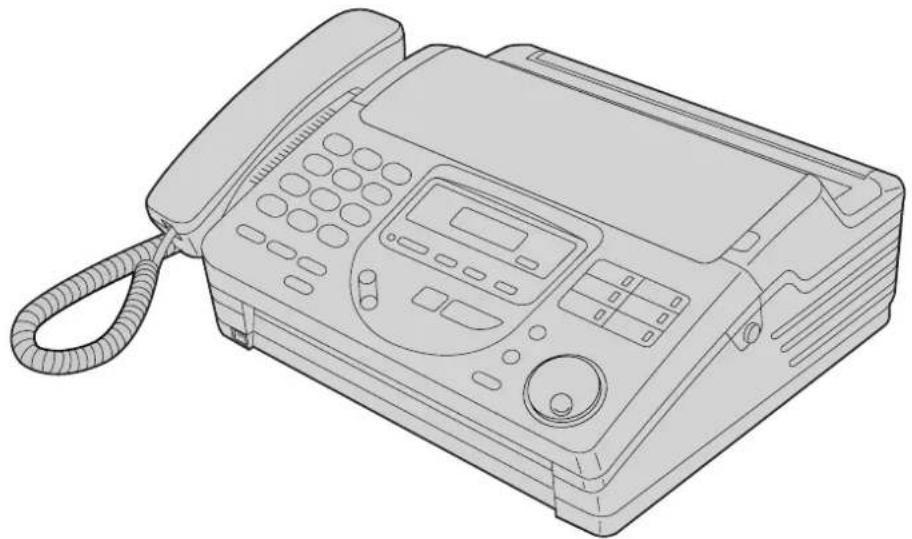
natural_image
Line drawing of a classic office telephone with keypad and cord (no text or symbols)Please read these Operating Instructions before using the unit and save for future reference.
This unit is not designed for making emergency telephone calls when the power fails. Alternative arrangements should be made for access to emergency services.
Thank you for purchasing a Panasonic facsimile.
Welcome to the world of Panasonic facsimiles.
This product combines facsimile, telephone, telephone answering device and copier features, to provide you with more efficient office or home use. By utilising these convenient features, you can maximise the effectiveness of this unit.
For future reference
Date of purchase Serial number
(found on the bottom of the unit)
Dealer's name and address
Dealer's telephone number
Copyright:
This manual is copyrighted by Kyushu Matsushita Electric Co., Ltd. (KME) and its licensee. Under the copyright laws, this manual may not be reproduced in any form, in whole or part, without the prior written consent of KME and its licensee.
© Kyushu Matsushita Electric Co., Ltd. 1999
IMPORTANT
Panasonic
WARRANTY REGISTRATION
PLEASE FAX BACK TO REGISTER FOR YOUR 12 MONTHS WARRANTY
Thank you for purchasing your Panasonic facsimile. By filling in the section below, this will ensure the following:
- We will register your unit on our warranty database. Should you ever require a service call under warranty, your call will be dealt with quickly and efficiently.
- We will send you a reply fax to confirm your registration and the correct operation of your unit.
- If you have any problems, please call us on 08701 580560.
Simply, follow these instructions:
- Please fill in the section below in block capitals and in ink.
Your name
Company name (if applicable)
Your address
The image contains only a single, continuous horizontal line. According to Rule 2 (Stylistic/Background Lines), since there is no actual text or punctuation content present in the source image, the OCR result must ignore it. Therefore, the corrected OCR text is:
[Empty String]
Your postcode
Telephone no. Fax no.
Model no.
Month YearDa
Serial no. Date of purchase
- Fax this form to 08701 583250 and we will fax back to confirm receipt of your details. Please allow 14 working days for this. In addition, we will also send you information of our maintenance contracts.
TERMS AND CONDITIONS
- This warranty is in addition to and does not in any way affect any statutory or other right of consumer purchasers. This warranty relates only to product used within Mainland Great Britain, please refer to your dealer for warranty information relating to use elsewhere within the United Kingdom.
- This product is approved for use only on the United Kingdom's Public Switched Telephone Network and should be used only for normal purposes and in accordance with standard operating instructions.
- You should complete the registration form overleaf and fax or post it to us within 7 days of purchase; failure to do so may result in delays in providing warranty service.
- This warranty covers breakdowns due to design or manufacturing faults; it does not apply to damage, however caused, wear or tear, neglect, incorrect adjustment or repair, or to any items of limited natural life.
- This warranty does not cover consumables i.e., ink films, film refills, ink cartridges, paper and paper trays or any optional accessories which may have been purchased either at the same time, as or subsequent to, the main unit. Such accessories should be returned to the point of purchase if found to be faulty.
- In the event of a failure, please take the following action;
a. Refer to the "Help" section of your instruction manual in order to identify and possibly correct the problem;
b. If the fault cannot be resolved and you require a trained operator, please contact our customer helpline on 08701 580560.
-
In the event the helpline cannot resolve the problem, a like for like exchange fax will be dispatched overnight (if the call is received before 4pm) or, by a mutually convenient arrangement. The helpline operator will give you specific instructions on how the exchange will be executed. Failure to comply with these instructions may result in delay and cost to you.
-
The exchange fax will be delivered in a customised case by courier. It is the customer's responsibility to promptly remove the exchange fax and insert the faulty fax in the case provided for collection, to enable the courier to return it to Panasonic.
-
The exchange fax is to be regarded as a like for like exchange under warranty and the balance of the warranty period will transfer to the exchange unit. The liability of Panasonic under the terms of this warranty is limited to the exchange of the fax, or the repair and return of the original fax (subject to any additional charges, see Condition 4).
-
Where the original fax is found to be faulty as a result of unauthorised repairs or modifications or damage either by accident, misuse or improper installation then Panasonic reserves the right to charge the customer the sum of £50.00 plus Vat, as a contribution towards repair costs.
-
This warranty applies to the original purchaser only and is not transferable.
-
The warranty period applicable to this product shall be 12 months from the date of purchase.
Important safety instructions
When using this unit, basic safety precautions should always be followed to reduce the risk of fire, electric shock, or personal injury.
- Read and understand all instructions.
- Follow all warnings and instructions marked on this unit.
- Unplug this unit from the mains outlets before cleaning. Do not use liquid or aerosol cleaners. Use a damp cloth for cleaning.
-
Do not use this unit near water, for example near a bath tub, wash bowl, kitchen sink, etc.
-
Place the unit securely on a stable surface. Serious damage and/or injury may result if the unit falls.
-
Do not cover slots and openings on the unit. They are provided for ventilation and protection against overheating. Never place the unit near radiators, or in a place where proper ventilation is not provided.
-
Use only the power source marked on the unit. If you are not sure of the type of power supplied to your home, consult your dealer or local power company.
-
This product is supplied with a moulded plug. This plug has three conductors. If the type of moulded plug does not fit your socket contact an electrician to replace your socket. Do not modify the connection this may make the product unsafe.
-
Do not place objects on the power cord. Install the unit where no one can step or trip on the cord.
-
Do not overload mains outlets and extension cords. This can result in the risk of fire or electric shock.
-
Never push any objects through slots in this unit. This may result in the risk of fire or electric shock. Never spill any liquid on the unit.
-
To reduce the risk of electric shock, do not disassemble this product, but take it to a qualified engineer when maintenance or repair work is required. Opening or removing covers may expose you to dangerous voltages or other risks. Incorrect re-assembly could cause an electric shock when the unit is subsequently used.
-
Unplug this unit from the wall outlet and refer servicing to qualified service personnel when the following conditions occur:
A. When the power supply cord or plug is damaged or frayed.
B. If liquid has been spilled into the unit.
C. If the unit has been exposed to rain or water.
D. If the unit does not work normally by following the operating instructions. Adjust only controls covered by the operating instructions. Improper adjustment may require extensive work by a qualified technician.
E. If the unit has been dropped or physically damaged.
F. If the unit exhibits a distinct change in performance.
-
During thunderstorms, avoid using telephones except cordless types. There may be a remote risk of an electric shock from lightning.
-
Do not use this unit to report a gas leak, when in the vicinity of the leak.
SAVE THESE INSTRUCTIONS
INSTALLATION
- Never install telephone wiring during a lightning storm.
- Never install telephone jacks in wet locations unless the jack is specifically designed for wet locations.
- Never touch uninsulated telephone wires or terminals unless the telephone line has been disconnected at the network interface.
- Use caution when installing or modifying telephone lines.
WARNING
- To prevent the risk of fire or electrical shock, do not expose this product to rain or any type of moisture.
OTHER INFORMATION
- Keep the unit away from electrical noise generating devices, such as fluorescent lamps and motors.
- The unit should be kept free from dust, high temperature and vibration.
- The unit should not be exposed to direct sunlight.
- Do not place heavy objects on top of this unit.
- Do not touch the plug with wet hands.
Quick Start
Installing the handset and cradle
1 Connect the handset and handset cord.
2 Open the front lid by pressing the front lid open button.
3 Open the back lid by lifting up the tabs located on both sides.
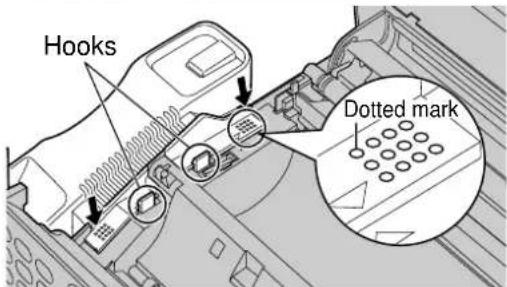
4 Insert the handset cradle by matching the triangles.
5 Press down on the dotted mark on the handset cradle until it clicks into place.
• Make sure the two hooks lock the handset cradle firmly.
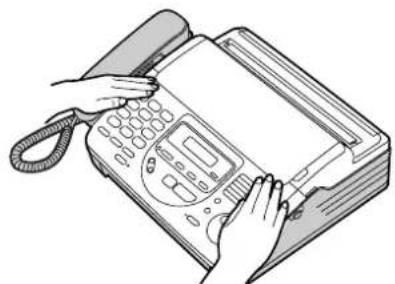
6 Place the handset on the handset cradle and close the lids securely.
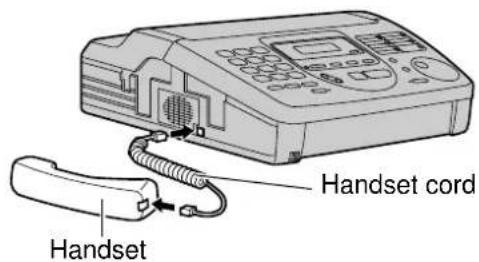
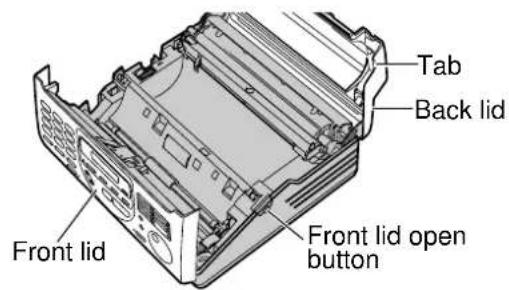
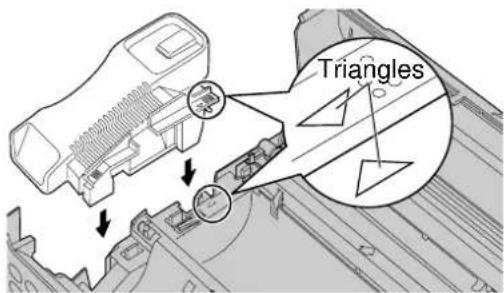
natural_image
Line drawing of hands operating a classic 19th-century office telephone (no text or symbols visible)- For further details, see page 21.
Installing the recording paper
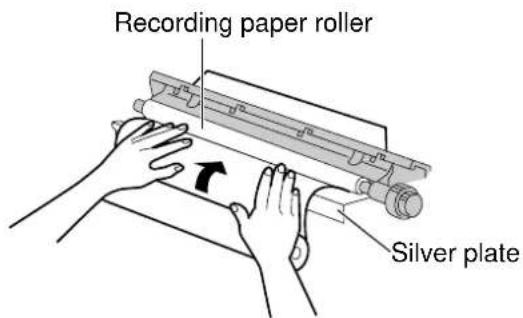
3 Insert the leading edge of the recording paper between the recording paper roller and the silver plate, then pull it a few centimetres out of the unit.
4 Close the back lid securely.
- For further details, see page 22.
Connections
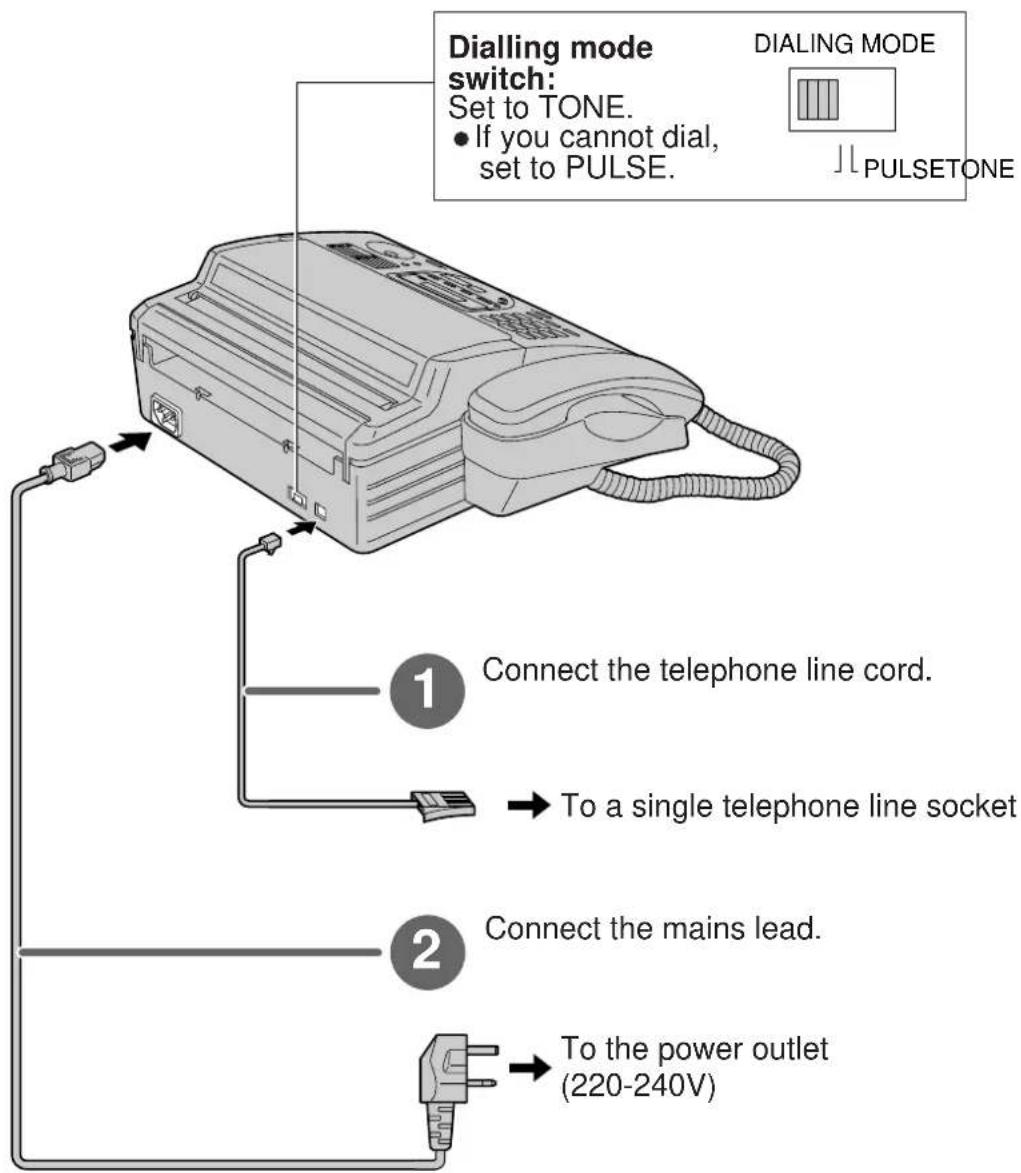
flowchart
graph TD
    A["Dialling mode switch: Set to TONE.<br>• If you cannot dial,<br>set to PULSE."] --> B["To a single telephone line socket"]
    B --> C["Connect the main lead."]
    C --> D["To the power outlet (220-240V)"]
    style A fill:#f9f,stroke:#333
    style B fill:#ccf,stroke:#333
    style C fill:#cfc,stroke:#333
    style D fill:#fcc,stroke:#333
- For further details, see page 23.
Installing the paper stacker
Install the paper stacker.
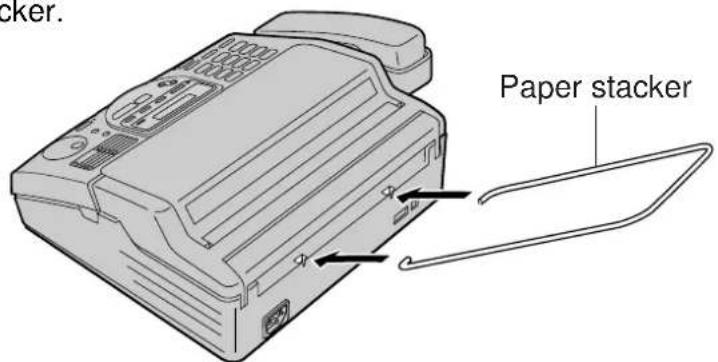
- For further details, see page 24.
Voice calls - making/answering
Voice calls - making
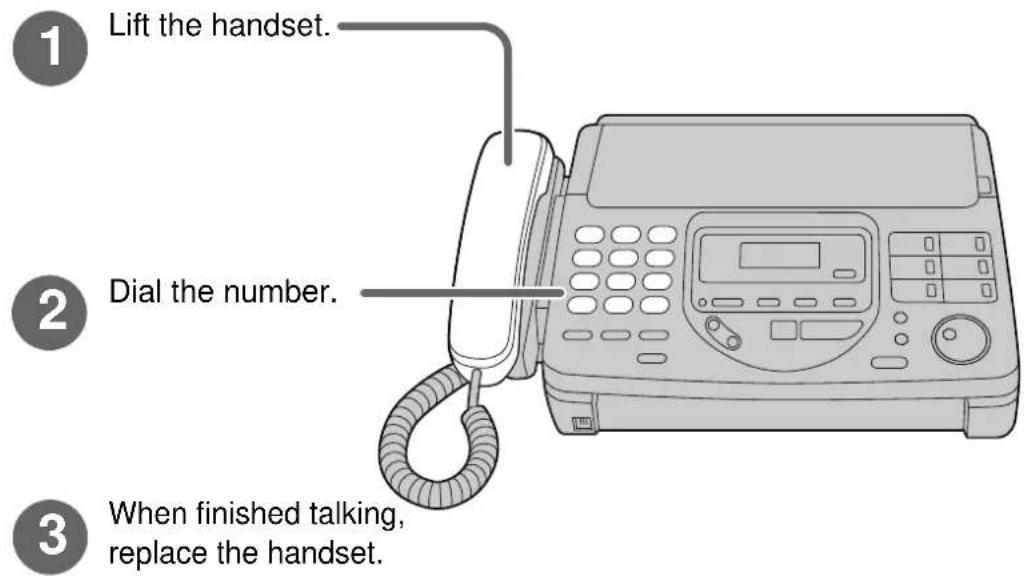
• For further details, see page 30.
• If you are having trouble, see page 82.
Voice calls - answering
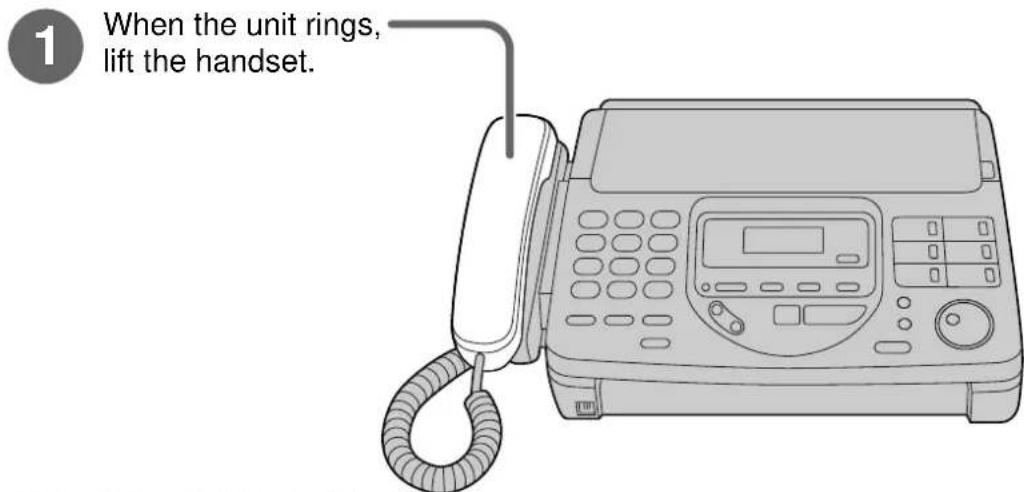
2 When finished talking, replace the handset.
• For further details, see page 31.
• If you are having trouble, see page 82.
Faxes - sending/receiving
Faxes - sending
1 Open the document feeder tray.
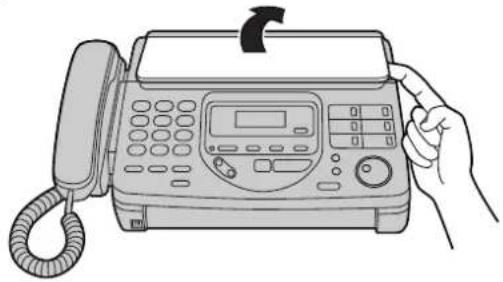
natural_image
Line drawing of a hand holding a landline telephone receiver with a rotary knob (no text or symbols)2 Adjust the width of the document guides to the size of the document.
3 Insert the document until the unit grabs the document and a single beep is heard.
FACE DOWN (up to 15 sheets)
4 Press DIGITAL SP-PHONE.
5 Dial the fax number.
6 When a fax tone is heard, press START/COPY/SET.
• For further details, see page 39.
- If you are having trouble, see page 83.
Faxes - receiving
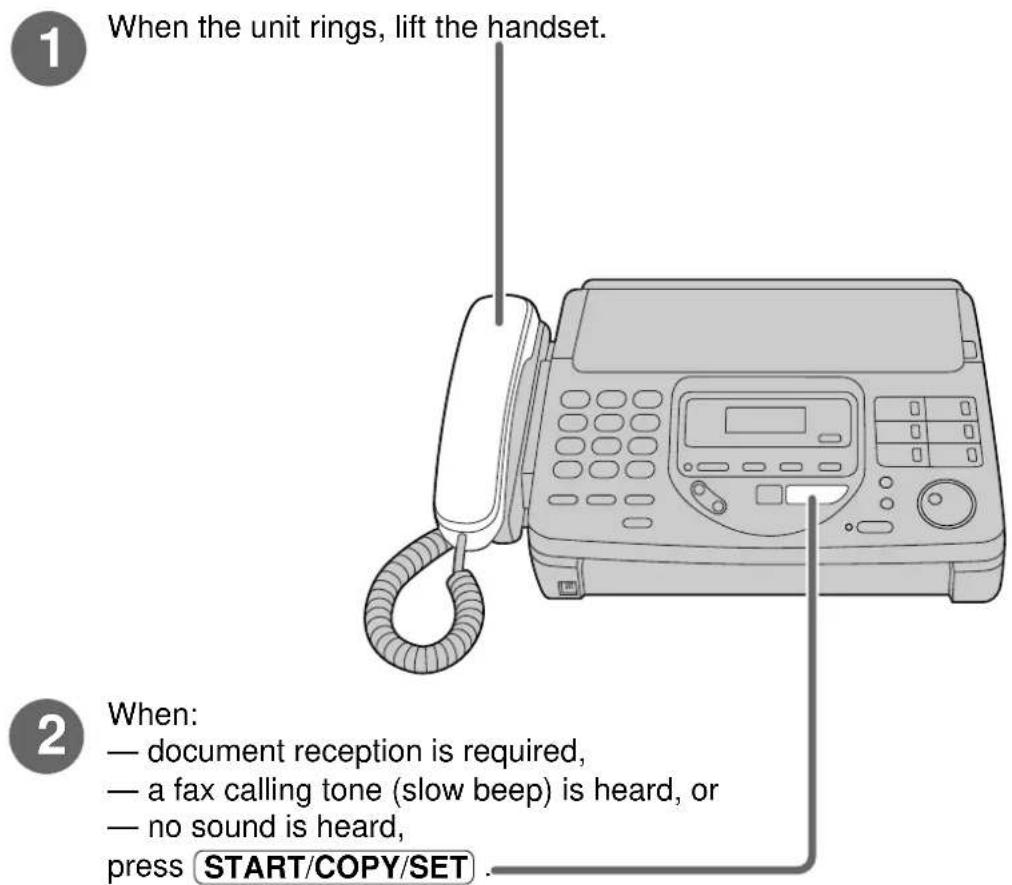
3 Replace the handset.
- For further details, see page 50.
- You can select the way to receive calls according to your needs. See pages 48 and 49.
- If you are having trouble, see page 83.
Copying
1 Open the document feeder tray.
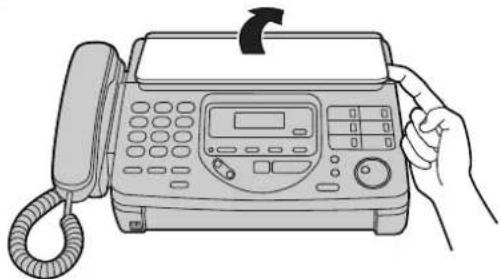
natural_image
Line drawing of a hand holding a landline telephone receiver with a rotary scroll (no text or symbols)2 Adjust the width of the document guides to the size of the document.
3 Insert the document until the unit grabs the document and a single beep is heard.
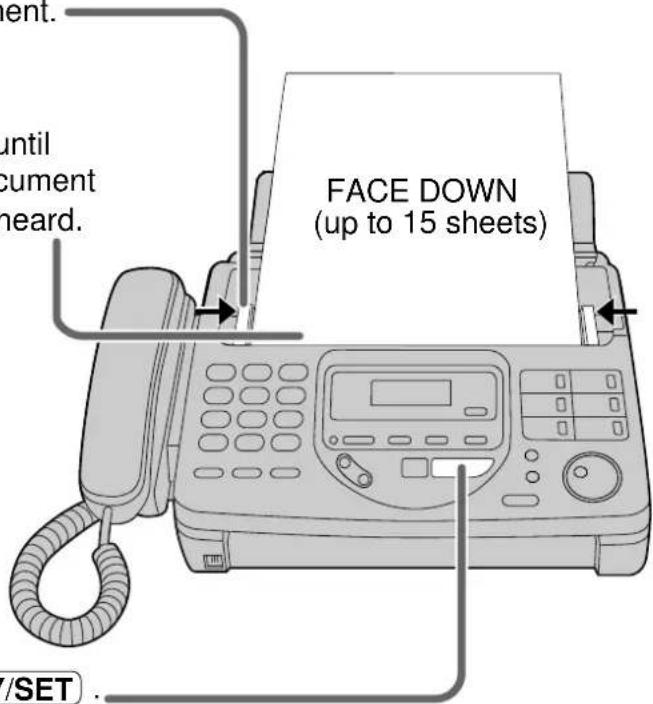
4 Press START/COPY/SET.
- For further details, see page 60.
• If you are having trouble, see page 84.
Operating the answering device
Setting the unit to receive voice and fax messages automatically
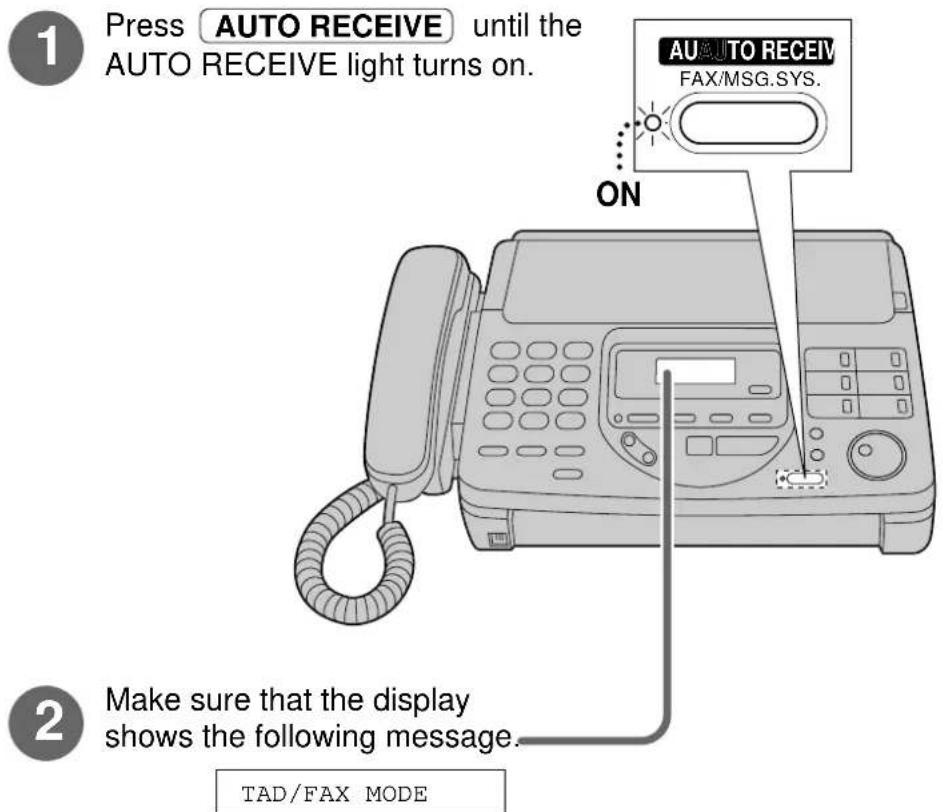
- If the display does not show this message, the setting needs to be changed to the TAD/FAX mode. See page 52.
• For further details, see page 61.
Quick Start
Listening to recorded messages
■ When the PLAY MESSAGES indicator flashes
Press PLAY MESSAGES.
- The new recorded messages will be played.
■ When the PLAY MESSAGES indicator lights
Press PLAY MESSAGES.
• All messages will be played.
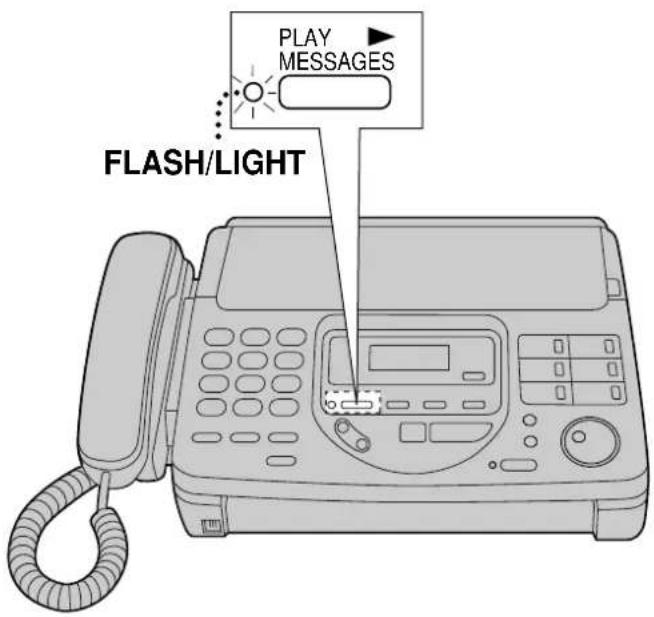
- For further details, see page 66.
Erasing recorded messages
■ Erasing a specific message
Press ERASE while listening to the message you want to erase.
■ Erasing all messages
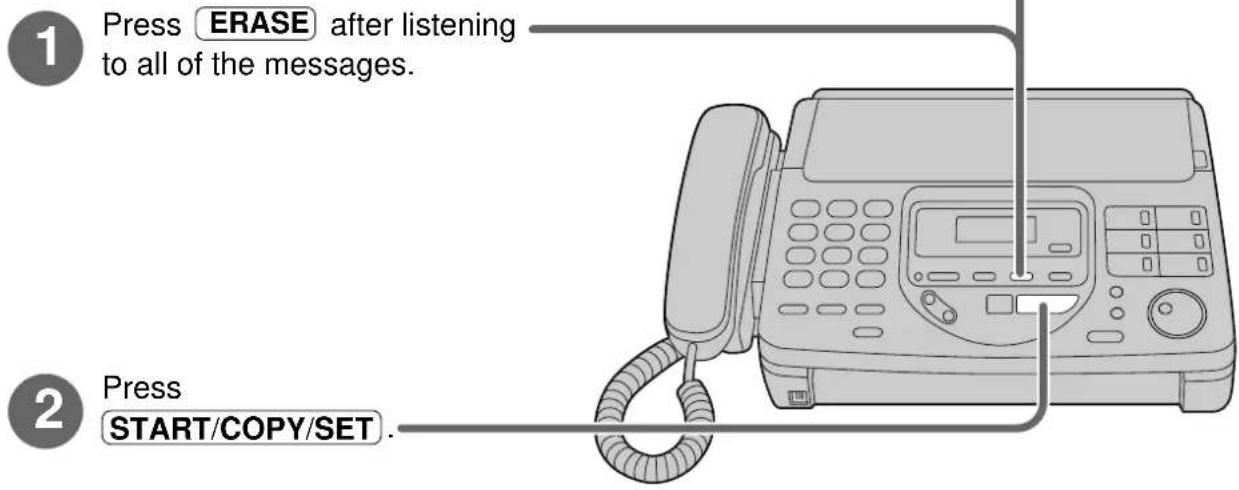

- For further details, see page 66.
Table of Contents
| Initial Preparation | Accessories | Included accessories | 16 |
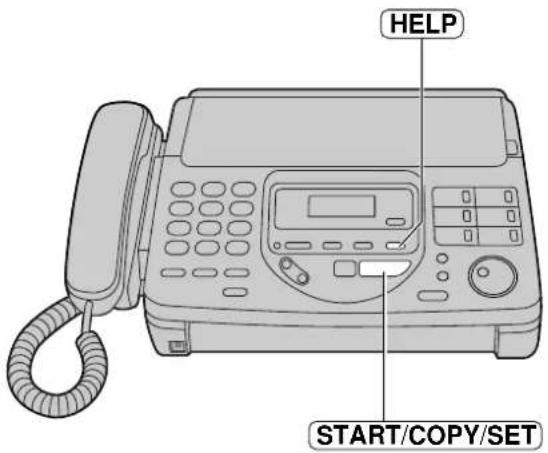
| Help Button | Help function | 17 | |
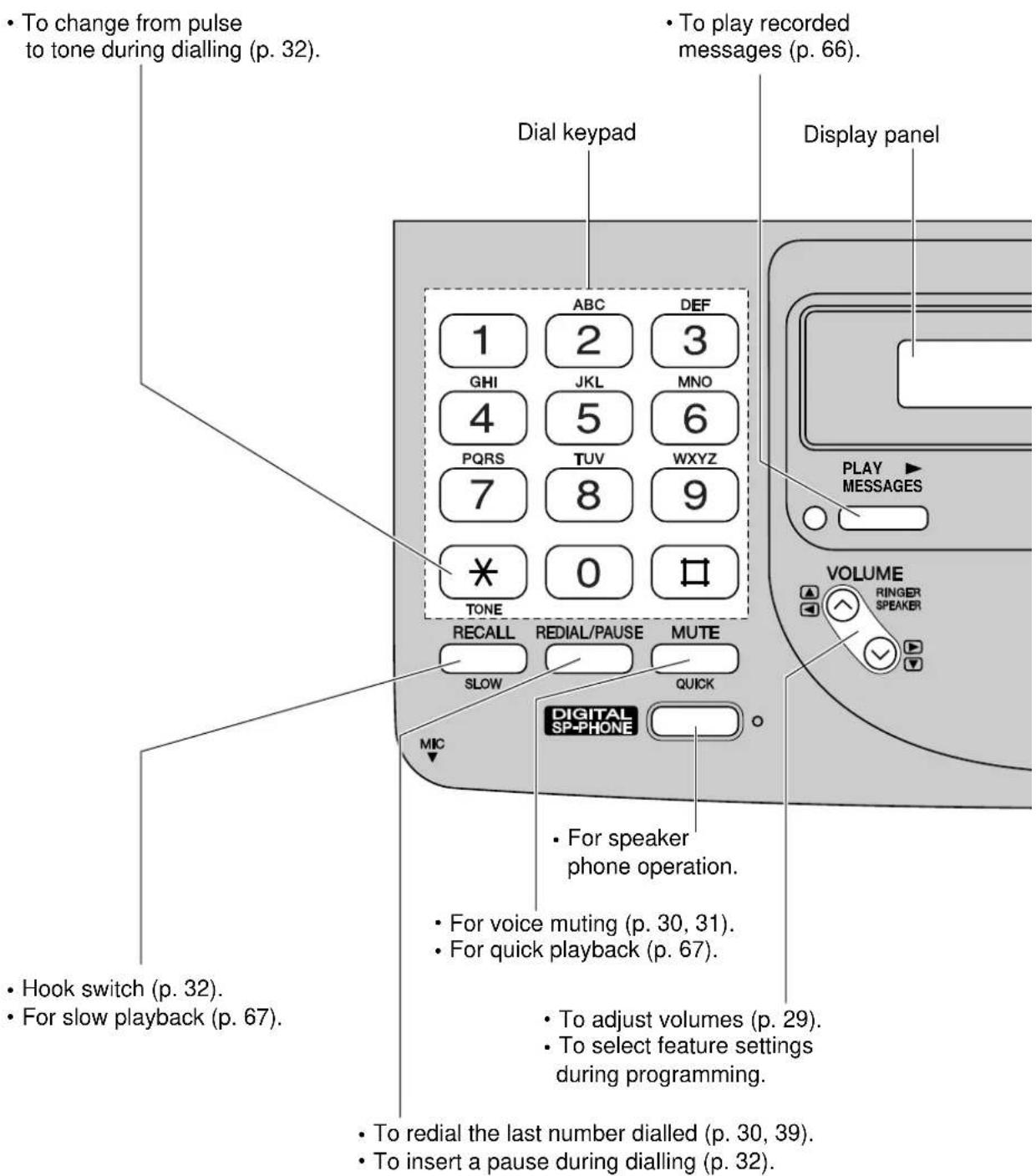
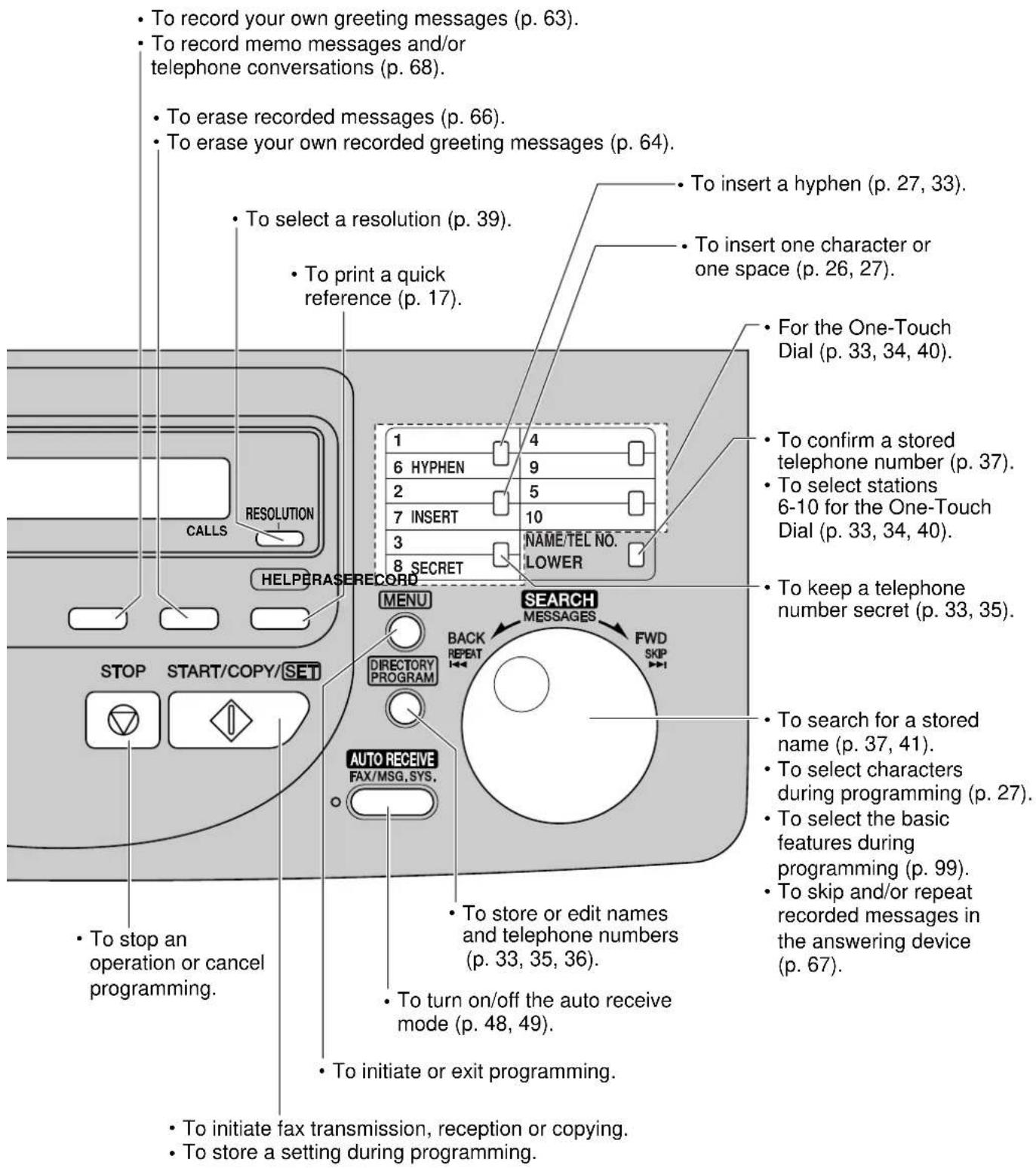
| Finding the Controls | Location | 18 | |
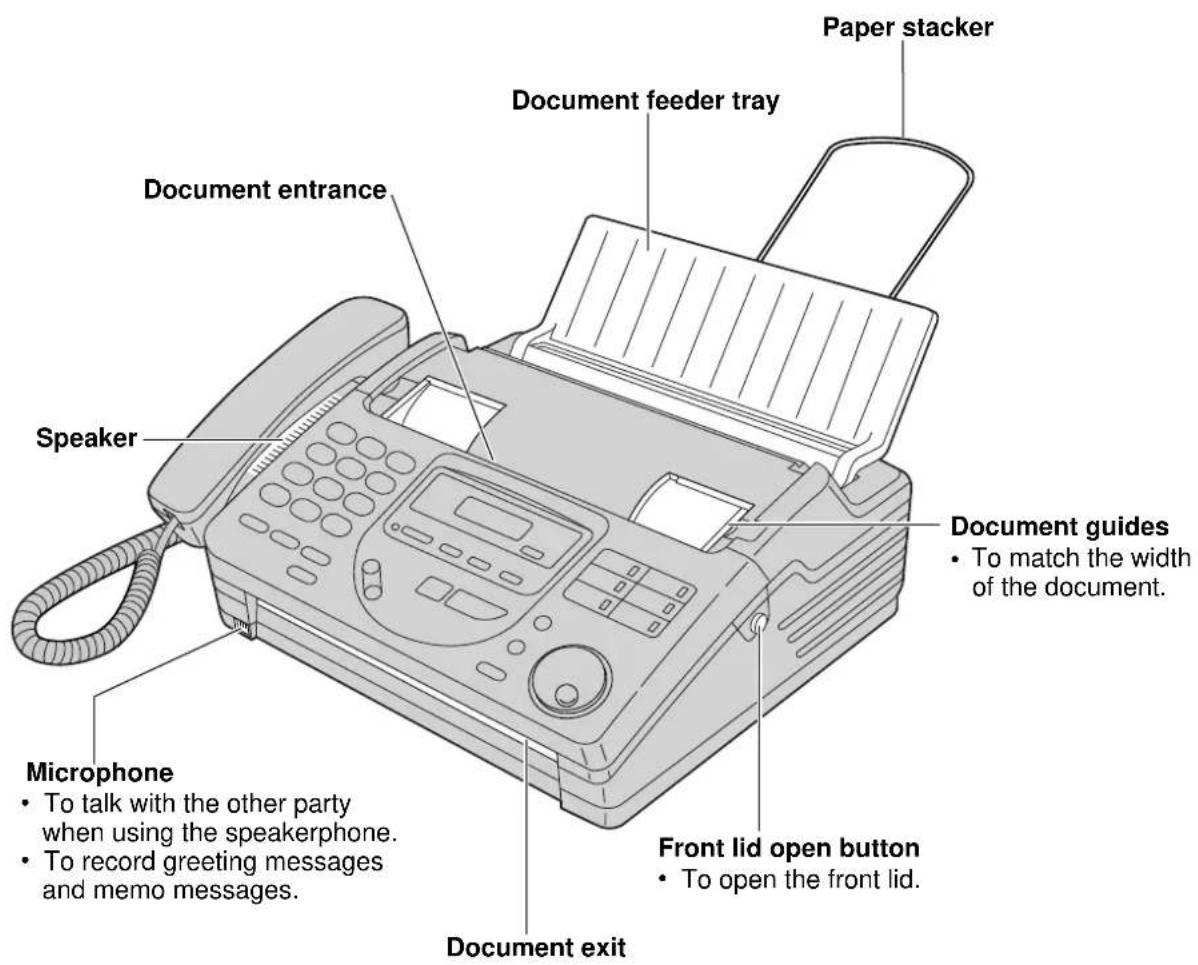
| Overview | 20 | ||
| Setup | Handset and cradle | 21 | |
| Recording paper | 22 | ||
| Connections | 23 | ||
| Paper stacker | 24 | ||
| Date and time, your name and facsimile telephone number | 25 | ||
| Volumes | Adjusting volumes | 29 | |
| Telephone | Making and Answering Calls | Voice calls - making | 30 |
| Voice calls - answering | 31 | ||
| TONE, RECALL and PAUSE buttons | 32 | ||
| One-Touch Dial | Storing names and telephone numbers in the One-Touch Dial | 33 | |
| Making a voice call using the One-Touch Dial | 34 | ||
| EASY DIAL | Storing names and telephone numbers in the EASY DIAL directory | 35 | |
| Making a voice call using the EASY DIAL directory | 37 | ||
| Voice Contact | Talking to the caller after fax transmission or reception | 38 | |
| Fax/Copy | Sending Faxes | Sending a fax manually | 39 |
| Sending a fax using the One-Touch Dial | 40 | ||
| Sending a fax using the EASY DIAL directory | 41 | ||
| Sending a fax by following the voice guide | 42 | ||
| Documents you can send | 42 | ||
| Printing the transmission report | 43 | ||
| Automatic journal report | 44 | ||
| Delayed transmission (sending a fax at a specified time) | 45 | ||
| Transmit polling | |||
| (letting another machine retrieve a fax from your unit) | 46 | ||
| Sending documents overseas | 47 | ||
| Connecting tone | 47 | ||
| Receiving Faxes | Setting the unit to receive calls | 48 | |
| TEL mode (answering all calls manually) | 50 | ||
| Extension telephone | 51 | ||
| Fax activation code | 51 | ||
| FAX ONLY mode (all calls are received as faxes) | 52 | ||
| TEL/FAX mode (receiving voice calls with rings and fax calls without rings when you are near the unit) | 54 | ||
| Receiving polling | |||
| (receiving a fax placed on another party's machine) | 58 | ||
| Friendly reception | 58 | ||
| Pager call - when your unit receives a fax | 59 | ||
| Copying | Making a copy | 60 |
| Answering Device | Setup | TAD/FAX mode (using the built-in answering device and receiving voice and fax calls automatically) . . . . .61 |
| Greeting | Pre-recorded greeting messages . . . . . . . . . . . . . . . . . . . . . . . . . . . . . . . . . . . . . . . . . . . . . . . . . . . . . . . . . . . . . . . . . . . . . . . . . . . . . . . . . . . . . . . . . . . . . . . . . . . . . Recording your own greeting messages . . . . . . . . . . . . . . . . . . . . . . . . . . . . . . . . . . . . . . . . . . . . . . . . . . . . . . . . . . . . . . . . . . . . . . . . . . . . . . . . . . . . . . . . . . . . . . . . . | |
| Checking your own recorded greeting messages . . . . . . . . . . . . . . . . . . . . . . . . . . . . . . . . . . . . . . . . . . . . . . . . . . . . . . . . . . . . . . . . . . . . . . . . . . . . . . . . . . . . . . . . . . . . . . . . . . Erasing your own recorded greeting messages . . . . . . . . . . . . . . . . . . . . . . . . . . . . . . . . . . . . . . . . . . . . . . . . . . . . . . . . . . . . . . . . . . . . . . . . . . . . . . . . . . . . . . . . . . . . . . | ||
| Recording time for the TAD/FAX greeting message . . . . . . . . . . . . . . . . . . . . . . . . . . . . . . . . . . . . . . . . . . . . . . . . . . . . . . . . . . . . . . . . . . . . . . . . . . . . . . . . . . . . . . . . . . . . . . . . . . . | ||
| Playing Messages | Listening to recorded messages. . . . . . . . . . . . . . . . . . . . . . . . . . . . . . . . . . . . . . . . . . . . . . . . . . . . . . . . . . . . . . . . . . . . . . . . . . . . . . . . . . . . . . . . . . . . . . . . . . . . 66 | |
| Erasing recorded messages. . . . . . . . . . . . . . . . . . . . . . . . . . . . . . . . . . . . . . . . . . . . . . . . . . . . . . . . . . . . . . . . . . . . . . . . . . . . Functions while playing a message (repeating, skipping and stopping). . . . . . . . . . . . . . . . . . . . . . . . . . . . . . . . . . . . . . . . . . . . . . . . . . 67 | ||
| Recording | Memo message (leaving a message for others or yourself). 68 Telephone conversation. . . . . . . . . . . . . . . . . . . . . . . . . . . . . . . . . . . . . . . . . . . . . . . . 68 | |
| Remote Operation | Operating from a remote location. . . . . . . . . . . . Setting the remote operation ID. . . . . . . . . . Setting the remote operation ID. . . Setting the remote operation ID. . . Setting the remote operation ID. . . Setting the remote operation ID. . . Setting the remote operation ID. . . Setting the remote operation ID. . . Setting the remote operation ID. . . Setting the remote operation ID. . . Setting the remote operation ID. . . Setting the remote operation ID. . . Setting the remote operation ID. . . Setting the remote operation ID. . . Setting the remote operation ID. . . Setting that the remote operation ID. . . Setting the remote operation ID. . . Setting the remote operation ID. . . Setting the remote operation ID. . . Setting the remote operation ID. . . Setting the remote operation ID. . . Setting the remote operation ID. . . Setting the remote operation ID. . . Setting the remote operation ID. . . Setting the remote operation ID. . . Setting the remote operation ID. . . Setting the remote operation ID. . . Setting the remote operation I. Setting the remote operation ID. Setting the remote operation ID. Setting the remote operation ID. Setting the remote operation ID. Setting the remote operation ID. Setting the remote operation ID. Setting the remote operation ID. Setting the remote operation ID. Setting the remote operation ID. Setting the remote operation ID. Setting the remote operation ID. Setting the remote operation ID. Setting the remote operation ID. Setting the remote operation ID. Setting the remote operation ID. Setting the remote operation ID. Setting the remote operation ID. Setting the 10000000000000000000000000000000000000000000000000000000000000000000000000000000000000000000000000000 10000000000000000000000000000000000000000000000000000000000000000000000000000000000000000000000000 1200000000000000000000000000000000000000000000000000000000000000000000000000000000000000000000000000012000000000000000000000000000000000000000000000000000000000000000000000000000000000000000000000000012222222222222222222222222222222222222222222222222222222222222222222222222222222222222222222222222222 122222222222222222222222222222222222222222222222222222222222222222222222222222222222222222222222222 98 | |
| Options | Transferring recorded messages to another telephone. 74 Ring count in the TAD/FAX mode. 77 Incoming message recording time. 78 Message alert (beeps when a voice message is received). 78 Recording time alert (beeps when memory is almost full). 79 Setting the ICM monitor. 79 | |
| Help | Error Messages | Reports. 80 LCD display. 81 |
| Operations | When a function does not work, check here before requesting help. 82 If a power failure occurs. 84 | |
| Jams | Recording paper jam. 85 Sending document jam. 86 Sending document does not feed, or multi-feeds. 86 | |
| Cleaning | Document feeder. 87 | |
| General Information | Print Reports | Printing the feature settings, telephone numbers, and journal. 88 |
| Display Contrast | LCD display contrast. 89 | |
| Recall Mode | Recall mode. 89 | |
| Original Mode | Original mode. 90 | |
| Fax Voice Guidance | Fax voice guidance. 91 | |
| Handset Switch | Using the unit without handset and cradle. 92 | |
| Reset | Resetting the advanced features. 93 | |
| Specifications | Technical data about this product. 94 | |
| Important Information | Important information. 95 Fitting a plug to the mains lead. 97 | |
| Guarantee | Condition of guarantee. 98 | |
| Features Summary | Summary of user programmable features. 99 | |
| Index | Index. 102 |
Accessories
Included accessories
Mains lead . . . . . . . . 1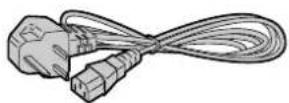 Order No. PJJA160Z Order No. PFJA1022Z Order No. PFJXE0401Z Order No. PFJA1020V Order No. PJJA160Z Order No. PFJA1022Z Order No. PFJXE0401Z Order No. PFJA1020V | Telephone line cord . . . . . . . . . 1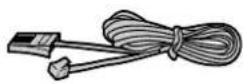 | Handset . . . . . . . . 1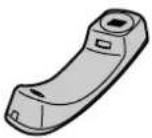 | Handset cord . . . . . . 1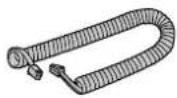 |
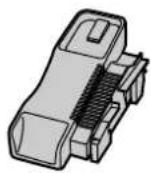 Order No. PFYAF2780E Order No. PQHP10029Z Order No. PFYAF2780E Order No. PQHP10029Z | Recording paper. . . . . 1H | Handset cradle . . . . . 1 PaperstakingInstructions1 . 1 | OperatingInstructions1 . 1 Order No. PFQX1277Z Order No. PFQX1277Z |
- If any items are missing or damaged, check with the place of purchase.
- Save the original carton and packing materials for future shipping and transporting of the unit.
- The order numbers listed above are subject to change without notice.
- For further accessory orders, please contact your local Panasonic authorised dealer.
Help function
You can print a quick reference for assistance as follows.
1 Select which operation you want to print out by pressing KEPtedly.
- Pressing HELPme:
How to program your unit
- HOW TO SET UP
two times:
How to store names in the EASY DIAL directory and how to dial them
2.EASY DIAL
three times:
How to send and receive a fax document
3.FAX OPERATION
four times:
How to set the unit to receive calls
- RECEIVE MODE
five times:
Help with problems operating the answering device
- TAD OPERATION
2 Press START/COPY/SET
PRINTING
Finding the Controls
Location
Finding the Controls
Overview
Handset and cradle
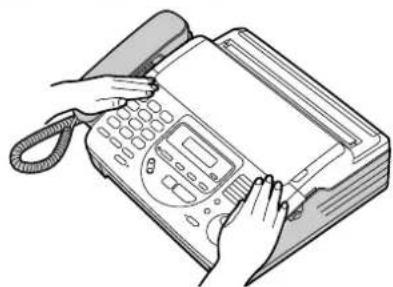
1 Connect the handset and handset cord.
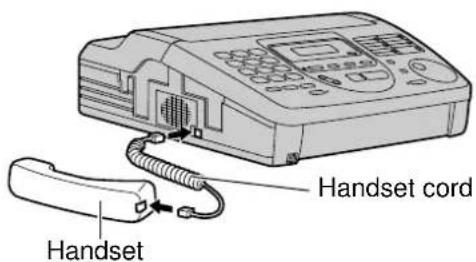
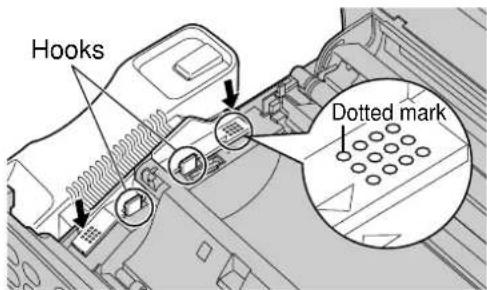
5 Press down on the dotted mark on the handset cradle until it clicks into place.
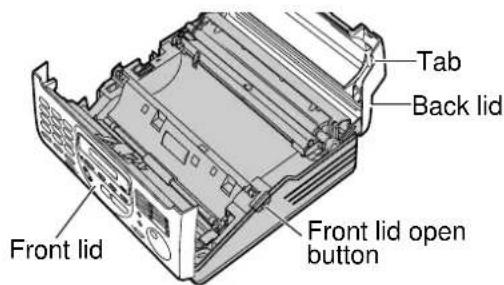
2 Open the front lid by pressing the front lid open button.
3 Open the back lid by lifting up the tabs located on both sides.
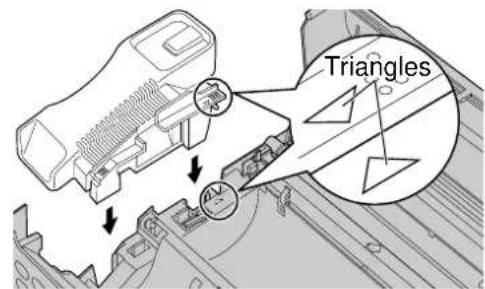
4 Insert the handset cradle by matching the triangles.
- Make sure the two hooks lock the handset cradle firmly.
6 Place the handset on the handset cradle and close the lids securely.
- If the handset cradle is not installed correctly, the unit will show the following message when the power is switched on.
CHECK CRADLE
Check steps 4 and 5 again.
natural_image
Line drawing of hands operating a classic 1980 office calligraphy device (no text or symbols visible)Note:
- To save space or when using the unit mainly for faxes, you can use the DIGITAL SP-PHONE button on the unit without the handset and cradle (p. 92).
Setup
Recording paper
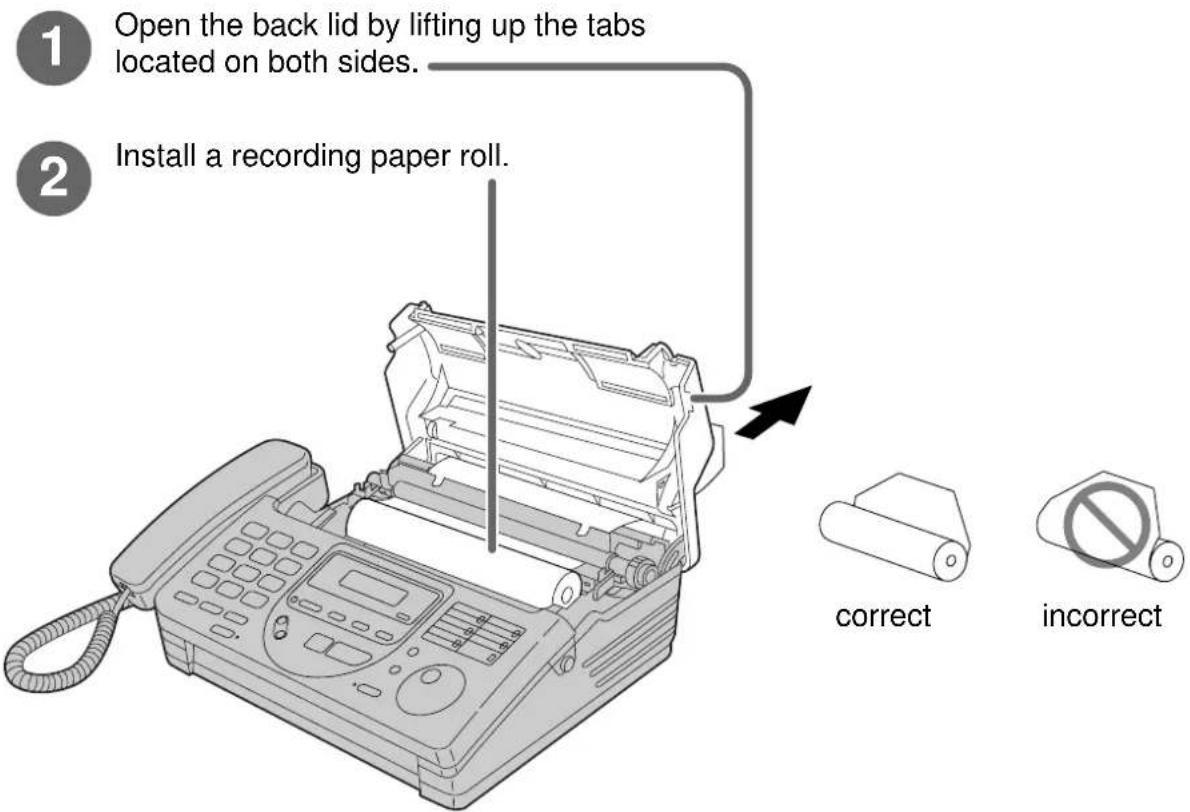
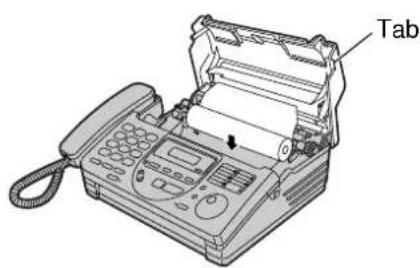
1 Open the back lid by lifting up the tabs located on both sides.
2 Install a recording paper roll.
- Make sure that the shiny side of the paper is facing down.

correct

incorrect
- If the paper is secured with glue or tape, cut approx. 150 mm from the beginning of the roll.
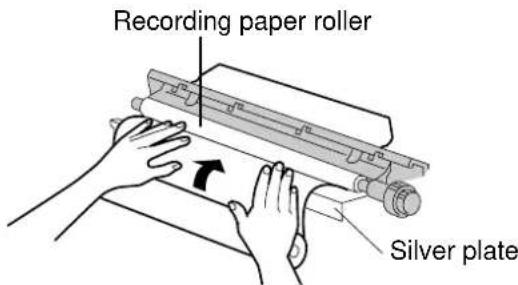
3 Insert the leading edge of the recording paper between the recording paper roller and the silver plate, then pull it a few centimetres out of the unit.
- Make sure that there is no slack in the paper roll.
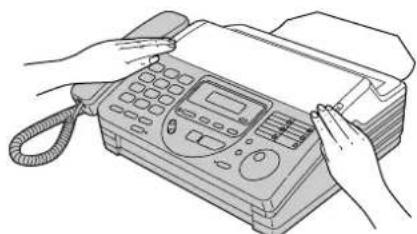
4 Close the back lid by gently pressing down on both ends.
natural_image
Line drawing of hands operating a landline telephone (no text or symbols visible)Note:
- Only use the included roll of paper or specified recording paper, or the print quality may be affected and/or excessive thermal head wear may occur.
Connections
1 Connect the telephone line cord.
2 Connect the mains lead.
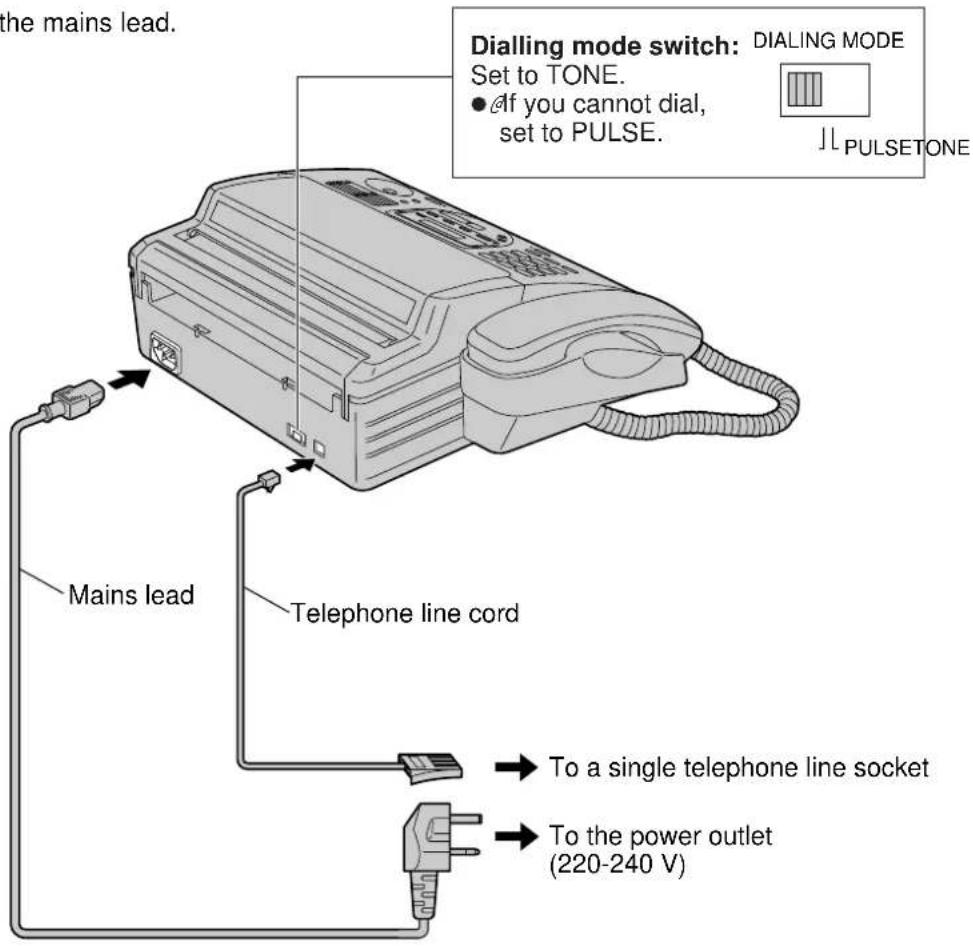
Note:
- When you operate this product, the mains socket outlet should be near the product and easily accessible.
- If a mains power failure occurs, the unit cannot be used.
- Telephone line connection is at TNV (Telecommunication Network Voltage).
Setup
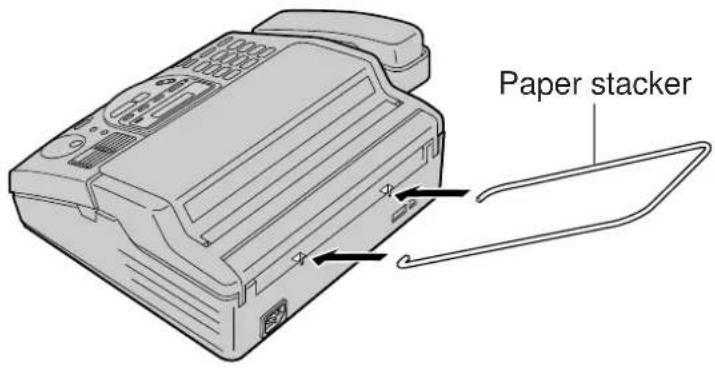
Paper stacker
Install the paper stacker by inserting the hooked ends into the slots of the unit.
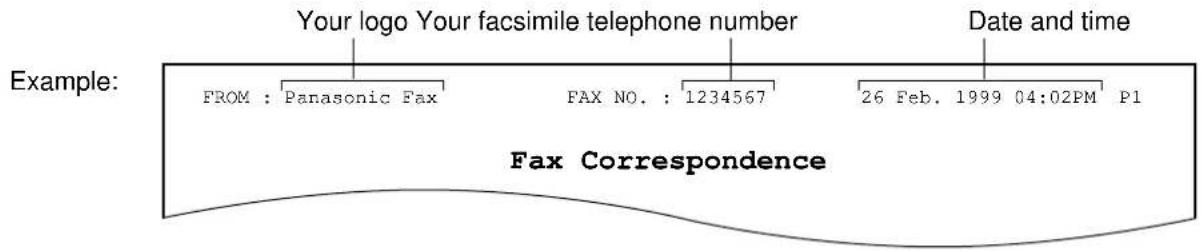
Date and time, your name and facsimile telephone number
You should program the date and time, your logo and your facsimile telephone number. This information will be printed on each page transmitted from your unit.
Setting the date and time
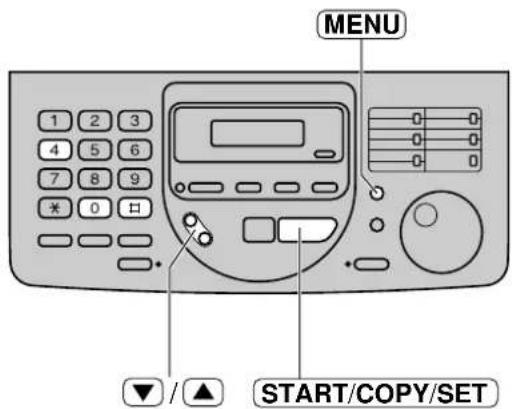
1 Press .MENU
Display: 1.SYSTEM SET UP
2 Press then. 0 1
SET DATE & TIME
3 Press START/COPY/SET
4 Use the dial keypad to enter 2 digits for the correct day/month/year, pressing START/COPY/SET after each 2 digits.
5 Enter the correct hour/minute by selecting 2 digits for each, using the dial keypad in 12 hour clock time. Press ☐ select "AM" or "PM".
Example: 03:15 PM
Press , then 1r50s until "PM" is ✗ displayed.
TIME 03:15PM
6 Press START/COPY/SET.
SETUP ITEM [ ]
7 Press .MENU
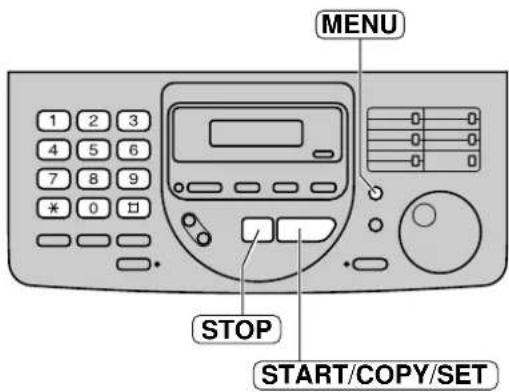
Note:
- The accuracy of the clock is approximately ±60 seconds a month.
To correct a mistake
- If you press STOP programming, the display will return to the previous one.
Setup
Setting your logo
The logo can be your company, division or name.
1 Press MENU
Display:
- SYSTEM SET UP
2 Press □ then . 0 2
YOUR LOGO
3 Press START/COPY/SET
LOGO=
4 Enter your logo, up to 30 characters, using the dial keypad. See next page for details.
Example: Bill
- Press twice.
LOGO=B
Cursor
- Press 84x times.
LOGO=Bi
- Press 5x times.
LOGO=Bil
- Press to move the cursor to the next space and press 5 six times.
LOGO=Bill
5 Press START/COPY/SET
SETUP ITEM [ ]
6 Press MENU
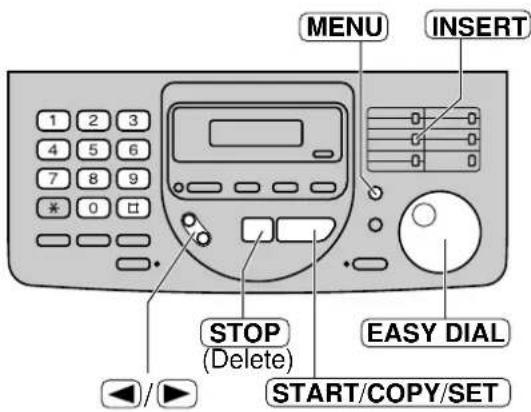
Note:
- You can enter your logo by rotating EASY DIAL (see next page).
To correct a mistake
- Press ⬇ to move the cursor to the incorrect character, and make the correction.
To delete a character
- Move the cursor to the character you want to delete and press STOP
To insert a character
-
Press or to move the cursor to the position to the right of where you want to insert the character.
-
Press to INSERT a space and enter the character.
To select characters with the dial keypad
Pressing the dial keys will select a character as shown below.
| Keys Characters | |
| 1 | 1 [ ] { } + - / = , . _ ` : ; ? | |
| 2 | A B C a b c 2 |
| 3 | D E F d e f 3 |
| 4 | G H l g h i 4 |
| 5 | J K L j k l 5 |
| 6 | M N O m n o 6 |
| 7 | P Q R S p q r s 7 |
| 8 | T U V t u v 8 |
| 9 | W X Y Z w x y z 9 |
| 0 | 0 ( ) < > ! " # $ % & ¥ * @ ^ ' → |
| 1 0 | HYPHEN key (To insert a hyphen.) |
| 2 0 | INSERT key (To insert one character or one space.) |
| STOP | Delete key (To delete a character.) |
| ▲ key (To move the cursor to the left.) | |
| ▶ key (To move the cursor to the right.)To enter another character using the same number key, move the cursor to the next space. | |
Keys Characters
To select characters using the EASY DIAL
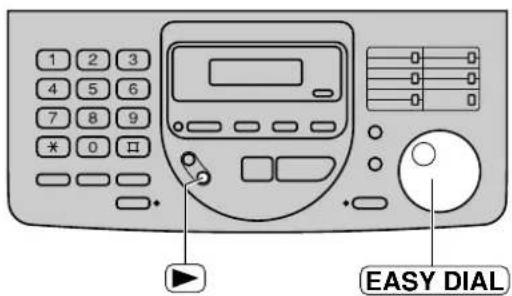
Instead of pressing the dial keys, you can select characters using the EASY DIAL.
- Rotate uEWSyDAtired character is displayed.
- Press to move the cursor to the next space. • The character displayed in step 1 is inserted.
- Return to step 1 to enter the next character.
Display order of characters
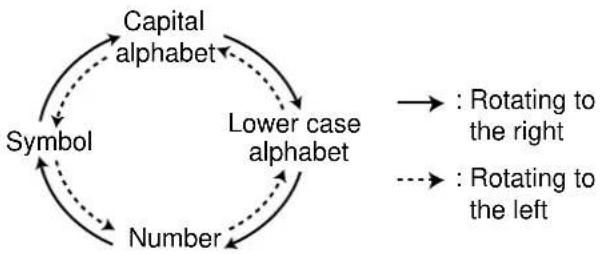
flowchart
graph TD
    A["Symbol"] --> B["Number"]
    B --> C["Lower case alphabet"]
    C --> D["Capital alphabet"]
    D -.-> E[": Rotating to the right"]
    E -.-> F[": Rotating to the left"]
SetupSetup
Setting your facsimile telephone number
1 Press MENU
Display: 1.SYSTEM SET UP
2 Press □ then . 0 3
YOUR TEL NO.
3 Press START/COPY/SET
NO.=
4 Enter your facsimile telephone number up to 20 digits using the dial keypad.
Example: NO.=1234567
5 Press START/COPY/SET
SETUP ITEM [ ]
6 Press MENU
Note:
- You can enter your facsimile telephone number by rotating EASY:DATE, press to move the cursor.
- The button replaces a digit with a “+”, the button with a space.
Example : +234 5678
Press ✱24678□□□
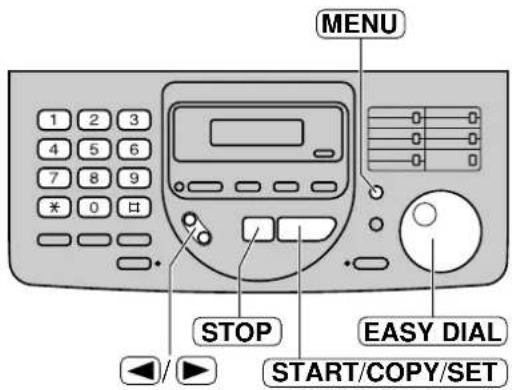
To correct a mistake
- Press 📄 to move the cursor to the incorrect number, and make the correction.
To delete a number
- Move the cursor to the number you want to delete and press STOP.
Adjusting volumes
Ringer volume
4 levels (high/middle/low/off) are available.
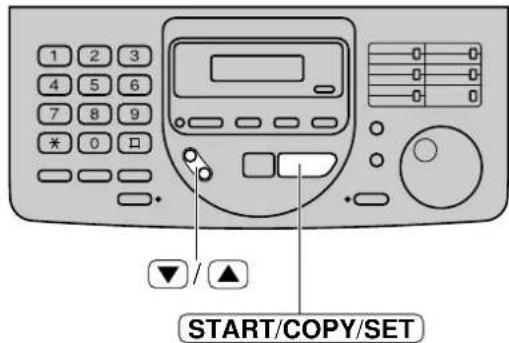
While the unit is idle, press ▼.
■ To turn the ringer off:
- Press repeatedly until the following message is displayed.
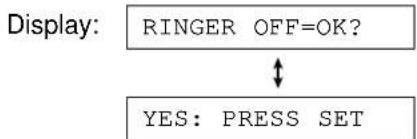
flowchart
graph TD
    A["RINGER OFF=OK?"] --> B{↓}
    B -->|Yes: PRESS SET| C
2. Press START/COPY/SET
• To turn the ringer back on, press ▲
■ While the ringer volume is set to off:
The display will show the following message.
RINGER OFF
When a call is received, the unit will not ring and will display the following.
INCOMING CALL
Speaker volume
8 levels (high to low) are available.
While using the speakerphone,
press ▼.
Fax voice guidance volume
9 levels (high to off) are available.
While listening to the fax voice guidance,
press ▼.
Answering device volume
9 levels (high to off) are available.
While listening to the recorded messages,
press ▼. ▲
Making and Answering Calls
Voice calls - making
1 Press DIGITAL SP-PHONE
Display:
TEL=
2 Dial the telephone number.
Example:
TEL=2345678
• If you misdial, hang up and dial again.
3 When the other party answers, talk into the microphone or handset.
4 When finished talking, press DIGITAL SP-PHONE or replace the handset.
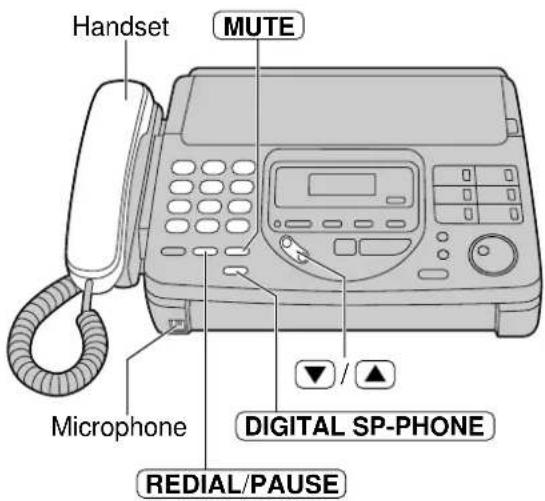
To redial the last number
-
Press o DIGITAL S&P BHONE
-
Press REDIAL/PAUSE.
- If the line is busy when using the DIGITAL SP-PHONE button, the unit will automatically redial the number up to 3 times.
- During redial, the following will be displayed.
Display: WAITING REDIAL
To mute your voice to the other party
- Press dMUTEa telephone conversation.
Display:
- The other party cannot hear you, but you can hear them.
- To resume the conversation, press .MUTE
Hints for the speakerphone operation
- Use the speakerphone in a quiet room.
- If you have difficulty hearing the other party, adjust the volume using ⬇.
- If you and the other party speak at the same time, parts of your conversation will be cut off.
- To switch to the handset, lift the handset. To switch back to the speakerphone, press DIGITAL SP-PHONE.
Voice calls - answering
1 When the unit rings, press DIGITAL SP-PHONE or lift the handset.
2 When finished talking, press DIGITAL SP-PHONE or replace the handset.
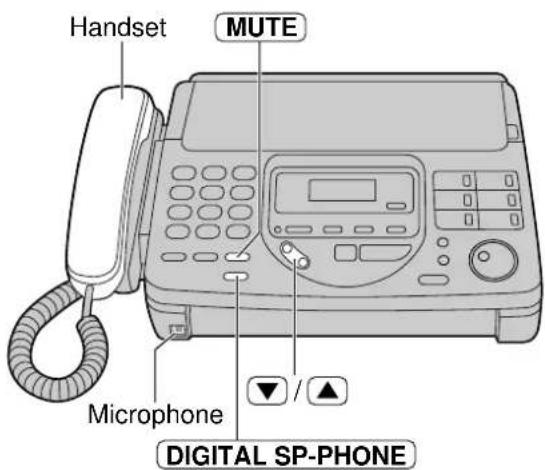
To mute your voice to the other party
- Press dMUTEa telephone conversation.
Display:
- The other party cannot hear you, but you can hear them.
- To resume the conversation, press .MUTE
Hints for the speakerphone operation
- Use the speakerphone in a quiet room.
- If you have difficulty hearing the other party, adjust the volume using ⬇.
- If you and the other party speak at the same time, parts of your conversation will be cut off.
- To switch to the handset, lift the handset. To switch back to the speakerphone, press DIGITAL SP-PHONE.
TONE, RECALL and PAUSE buttons
TONE button
If your line has rotary service, pressing the TONE on allows you to change the dialling mode temporarily into tone. Then you can dial the numbers or codes needed to operate the answering system or to use electronic banking services and other special services.
When you hang up, the dialling mode returns to pulse automatically.
RECALL button (To use the recall feature)
The RECAILs used to access special telephone services (optional) such as call waiting. Contact your telephone company for details.
Example : British Telecom call waiting
- Ensure that you have set to the T-BR (Time Break Recall). See page 89.
- When the call waiting tone is heard during a conversation, press RECALL
-
When the dial tone is heard, dial 2
The first call is put on hold and you can have a conversation with the second party. -
To keep the present call and return to the first call, press RECAIIa . 2
To hang up the first call, press RECALL then dial 0
To hang up the present call and return to the first call, press RECA1a . 1
If your unit is connected to a PBX, pressing 📄EVALyou to access some features of your host PBX such as transferring an extension call.
Entering pauses (For PBX users)
If your unit is connected to a PBX, you need to dial an access number (usually 9) to get an outside line. In this case, inserting a pause between the access number and the phone number is necessary especially when redialling or storing the number into memory.
Pressing REDIAL/FAUSE delay in the dialling sequence.
Example 1:
When your unit is connected to a host exchange, insert a pause to get an outside line.
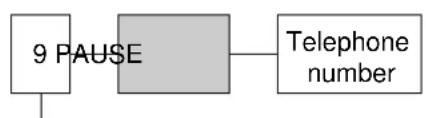
flowchart
graph LR
    A["9 PAUSE"] --> B["Telephone number"]
Line access code
Example 2:
If a transmission error occurs during an overseas transmission, add two pauses at the end of the telephone number.

flowchart
graph LR
    A["International access code"] --> B["Country code"]
    B --> C["Telephone number"]
    C --> D["PAUSE"]
    D --> E["PAUSE"]
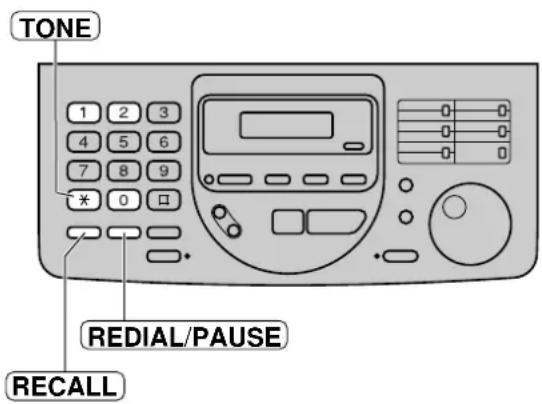
Note:
- TONE, RECALL and PAUSE can be stored into a telephone number in the One-Touch Dial and the EASY DIAL directory.
Storing names and telephone numbers in the One-Touch Dial
The unit's memory allows you to use the One-Touch Dial for rapid access to your most frequently dialled numbers. 10 stations are available.
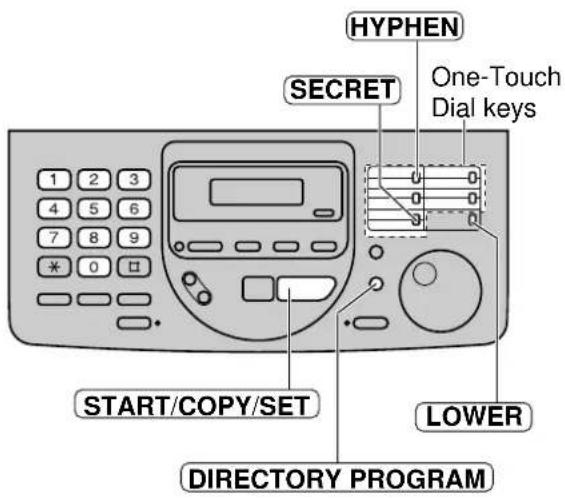
1 Press DIRECTORY PROGRAM
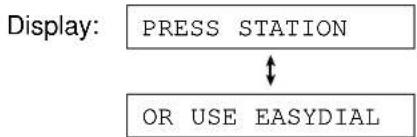
flowchart
graph TD
    A["PRESS STATION"] --> B["OR USE EASYDIAL"]
2 For stations 1–5
Press one of the One-Touch Dial keys.
For stations 6–10
Press LOWER press one of the One-Touch Dial keys.
3 Enter the station name, up to 10 characters, following the instructions on page 27.
Example: NAME=John
4 Press START/COPY/SET
Example:
5 Enter the telephone number, up to 30 digits.
Example:
• If you want to enter a hyphen, press HYPHEN.
6 Press START/COPY/SET
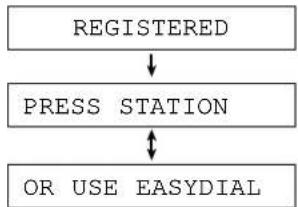
flowchart
graph TD
    A["REGISTERED"] --> B["PRESS STATION"]
    B --> C["OR USE EASYDIAL"]
• To program other stations, repeat steps 2 to 6.
7 Press DIRECTORY PROGRAM program.
Helpful hint:
- You can confirm the stored items on the display (p. 37), or on the telephone number list (p. 88).
Note:
- A hyphen or a space entered in a telephone number counts as two digits.
To keep the telephone number secret
Press SECRETering the telephone number in step 5.
- A secret number cannot be viewed after this is set.
- The telephone number will not appear on the telephone number list.
- Pressing SECRET count as a digit.
To edit a stored station name and number
Enter the desired name in step 3.
Enter the desired number in step 5.
To erase a stored station name and number, see page 36.
One-Touch Dial
Making a voice call using the One-Touch Dial
Before using this feature, program the desired names and telephone numbers into the One-Touch Dial (p. 33).
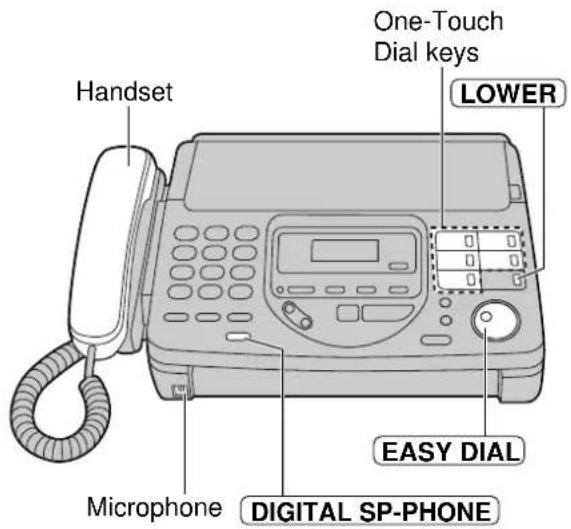
1 Press DIGITAL SP-PHONE
Display: TEL=
- Check that there are no documents in the document feeder tray.
For stations 1–5
Press the desired One-Touch Dial key.
For stations 6–10
Press LOWER press the desired One-Touch Dial key.
Example: TEL=
3 When the other party answers, talk into the microphone or handset.
When finished talking, press
DIGITAL SP-PHONE or replace the handset.
Helpful hints:
- You can confirm the stored items on the display (p. 37), or on the telephone number list (p. 88).
- You can use the EASY DIAL directory to select the station name instead of using the One-Touch Dial keys. Rotate EASY DIAL until the desired name is displayed, then press DIGITAL SP-PHONE handset.
Storing names and telephone numbers in the EASY DIAL directory
For rapid access to frequently dialled numbers, the unit also provides an EASY DIAL directory (up to 60 stations) in addition to the One-Touch Dial.
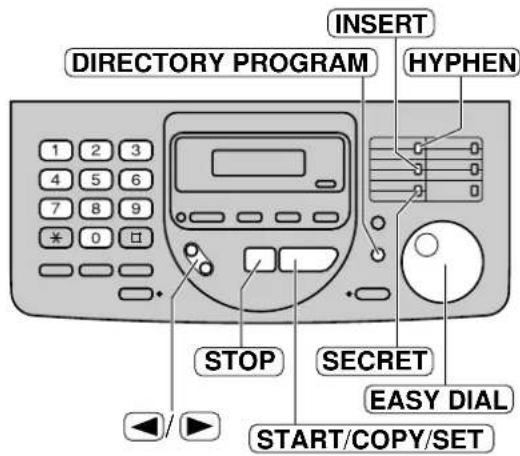
1 Press DIRECTORY PROGRAM
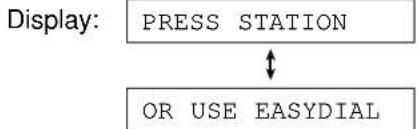
flowchart
graph TD
    A["PRESS STATION"] <--> B["OR USE EASYDIAL"]
2 Rotate EASYNDILOWing is displayed.
NAME=
3 Enter the name, up to 10 characters, following the instructions on page 27.
Example: NAME=Alice
4 Press START/COPY/SET
NO.=
5 Enter the telephone number, up to 30 digits.
Example: NO.=5552233
• If you want to enter a hyphen, press HYPHEN
6 Press START/COPY/SET
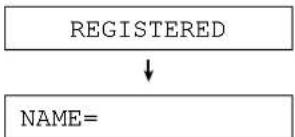
flowchart
graph TD
    A["REGISTERED"] --> B["NAME="]
• To program other items, repeat steps 3 to 6.
7 Press DIRECTORY PROGRAM program.
Note:
- You can confirm the stored items on the display (p. 37) or on the telephone number list (p. 88).
- When the following message is displayed in step 6, you can only store 5 items.
Display: SPACE= 5 DIRS.
- If there is no space to store new stations, the following message is displayed in step 1.
DIRECTORY FULL
Erase unnecessary stations (p. 36).
- The total number of stations available in the EASY DIAL directory and One-Touch Dial combined, is 60.
- A hyphen or a space entered in a telephone number counts as two digits.
To correct a mistake
- Press ⬆ to move the cursor to the incorrect character, then make the correction.
To insert a character or number
- Press ☐ to move the cursor to the position to the right of where you want to insert the character or number.
- Press INSERT to insert a space and enter the character or number.
To delete a character or number
- Move the cursor to the character or number you want to delete and press STOP
To keep the telephone number secret
Press SECRETering the telephone number in step 5.
- A secret number cannot be viewed after this is set.
- The telephone number will not appear on the telephone number list.
- Pressing SECRET count as a digit.
Editing a stored name and number
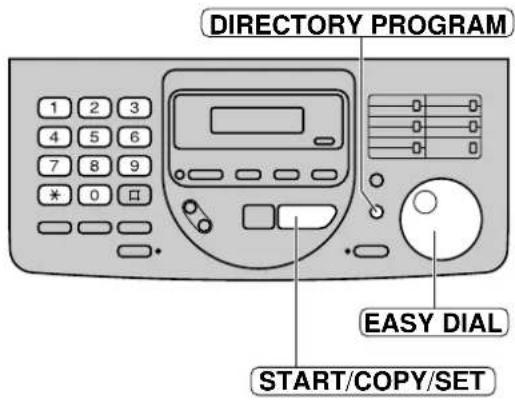
1 Rotate EASYDAds red name is displayed.
Example:
Mary
2 Press DIRECTORY PROGRAM
EDIT= * DELETE=#
3 Press to select "EDIT".
NAME=Mary
- If you do not need to edit the name, go to step 5.
4 Edit the name by following the instructions on page 27.
5 Press START/COPY/SET
Example:
NO.=0123456
- If you do not need to edit the telephone number, go to step 7.
6 Edit the telephone number. For further details, see page 35.
7 Press START/COPY/SET
REGISTERED
Erasing a stored name and number
You can erase a name and number stored in the EASY DIAL directory and the One-Touch Dial.
1 Rotate EASYnDlsired name is displayed.
Example:
Smith
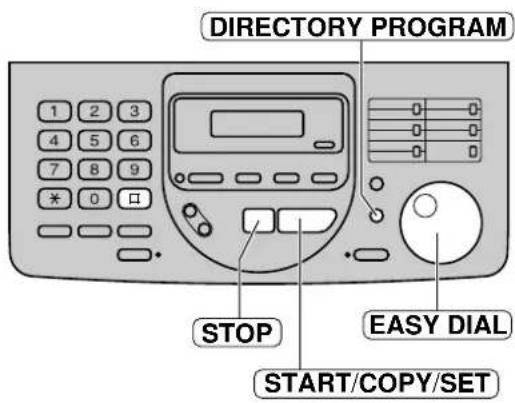
2 Press DIRECTORY PROGRAM
EDIT=* DELETE=#
3 Press to select "DELETE".
DELETE OK?

YES: PRESS SET
- If you do not want to erase the item, press STOP.
4 Press START/COPY/SET
DELETED
- The stored name and number are deleted.
Making a voice call using the EASY DIAL directory
Before using this feature, program the desired names and telephone numbers into the directory (p. 35).
1 Rotate EASHDASired name is displayed.
Example: Lisa
2 Press DIGITAL SP-PHONE
• The unit will start dialling automatically.
DIALING
3 When the other party answers, talk into the microphone or the handset.
TEL=
4 When finished talking, press DIGITAL SP-PHONE or replace the handset.
Helpful hint:
- You can confirm the stored items on the display (see below), or on the telephone number list (p. 88).
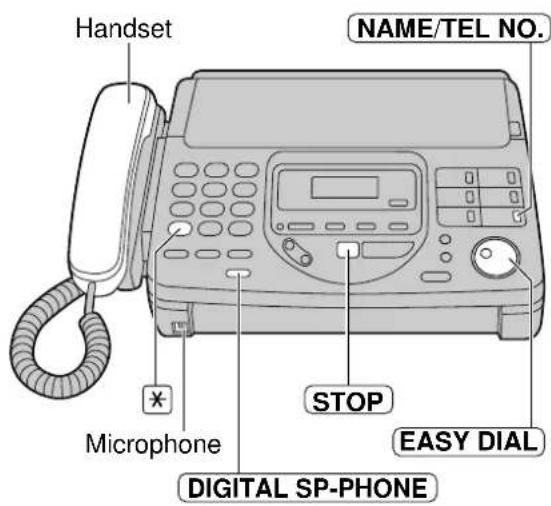
Note:
- If the desired name has not been stored, press STOP and dial the number manually.
To confirm the stored items on the display
- Rotate uEASYeDliared name is displayed.
Example: Kim
- Press .NAME/TEL NO.
4567890
• To stop the operation, press STOP
- Press o DIGITALS/REPHONE and the unit will automatically dial the number.
To search for a name by the initial
Example: If you want to search for the name "Lisa"
- Rotate UENSYDhame is displayed.
Example: Alan
- Press repeatedly until any name with the initial "L" is displayed (see the character table on page 27).
Larry
- Rotate tEASYDIAL until "Lisa" is displayed.
Lisa
• To stop the operation, press STOP
- Press o DIGITALSPEPHONE and the unit will automatically dial the number.
Note:
- If you want to search for symbols (not letters or numbers), press the key in step 2.
Talking to the caller after fax transmission or reception
After sending or receiving a fax, you can talk with the other party during the same call. This will save the added expense and time of making another call.
This feature only works when the other party's fax machine is equipped with a voice contact feature.
Initiating voice contact
1 Press DIGITALNSP-RHONE receiving documents.
Display:
VOICE STANDBY
- Your unit will call the other party with a distinctive ring.
- When the other party answers, your unit will emit a distinctive ring.
2 Press DIGITAL SP-PHONE start talking.
Note:
- If you initiate voice contact during transmission, the unit will call you with a distinctive ring after all of the documents have been transmitted.
- If you initiate voice contact during reception, the unit will call you with a distinctive ring after the current page of the document has been received.
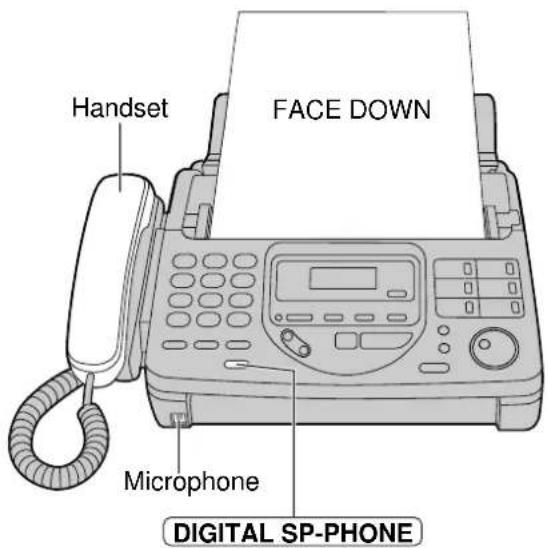
Receiving a request for voice contact
1 If the other party initiates voice contact, your unit will sound a distinctive ring and the following will be displayed.
Display:
PLEASE PICK UP
2 Press DIGITAL SRPHONE within 10 seconds of the distinctive ring to start talking.
Note:
- If you do not answer within 10 seconds of the distinctive ring;
— If in the FAX ONLY, TEL or TEL/FAX mode, the line will be disconnected.
— If in the TAD/FAX mode, your unit will play a greeting message and record an incoming voice message.
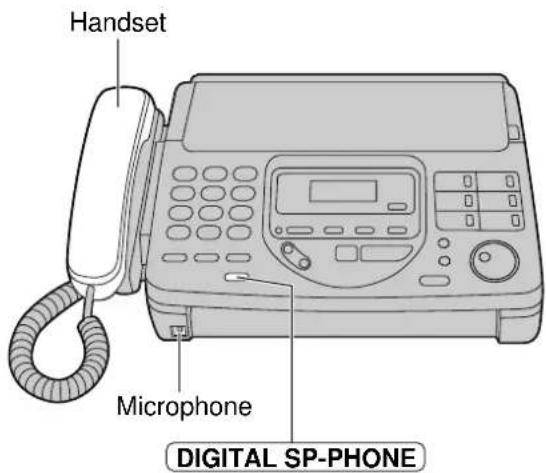
Sending a fax manually
1 Open the document feeder tray.
2 Adjust the width of the document guides to the size of the document.
3 Insert the document (up to 15 pages) FACE DOWN until the unit grabs the document and a single beep is heard.
Display:
STANDARD
4 If necessary, press RESOLUTION select the desired setting (see below).
5 Press DIGITAL SP-PHONE (This step is optional. See note.)
6 Dial the fax number.
Example:
TEL=5678901
7 When a fax tone is heard: Press START/COPY/SET
handset if using it. OR
When the other party answers your call:
Ask them to press their start button. When a fax tone is heard, press your START/COPY/SET
CONNECTING
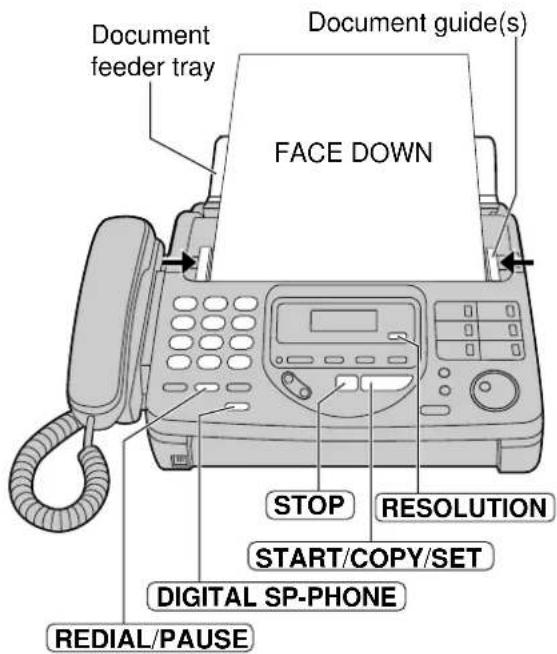
Note:
- If you cannot send a fax, confirm the problem by printing a journal report (p. 88), and try to solve the problem (p. 80).
- Performing step 5 allows you to identify any possible problems in sending a fax. For the parties to whom you have experienced no problem in sending faxes, you can skip step 5. Dial the fax number and press
START/COPY/SET
To feed more than 15 pages at a time
Insert the first 15 pages of the document. Add the extra pages (up to 15) before the last page is fed into the unit.
To redial the last number
Press REDIAL/PAUSE
- If the line is busy, the unit will automatically redial the number up to 3 times.
- During redial, the following will be displayed.
Display:
WAITING REDIAL
• To cancel redialling, press STOP
To stop transmission
Press STOP
To eject the document, press STOP.
To select the resolution
Select the desired resolution according to the type of document.

flowchart
graph TD
    A["STANDARD"] --> B["FINE"]
    B --> C["SUPER FINE"]
    C --> D["HALF TONE"]
For printed or typewritten originals with normal-sized characters.
For originals with small printing.
For originals with minute printing.
For originals containing photographs, shaded drawings, etc.
- Using the fine, super fine or half tone setting will increase the transmission time.
- If the resolution setting is changed during feeding, it will be effective from the next sheet.
- The super fine resolution only works with other compatible fax machines.
Sending a fax using the One-Touch Dial
Before using this feature, program the desired names and telephone numbers into the One-Touch Dial (p. 33).
1 Open the document feeder tray.
2 Adjust the width of the document guides to the size of the document.
3 Insert the document (up to 15 pages) FACE DOWN until the unit grabs the document and a single beep is heard.
Display: STANDARD
4 If necessary, press RESOLUTION select the desired setting (p. 39).
5 For stations 1–5 Press the desired One-Touch Dial key.
For stations 6–10 Press LOWER press the desired One-Touch Dial key.
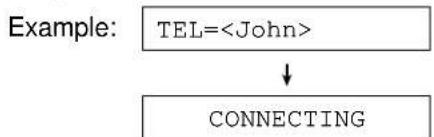
flowchart
graph TD
    A["TEL=<John>"] --> B["CONNECTING"]
• The unit will start transmission.
Helpful hints:
- You can confirm the stored items on the display (p. 37) or on the telephone number list (p. 88).
- You can use the EASY DIAL directory to select the station name instead of using the One-Touch Dial keys. Rotate EASY DIAL until the desired name is displayed, then press START/COPY/SET
- The connecting tone will be heard during dialling to tell you the status of the other party's machine (p. 47).
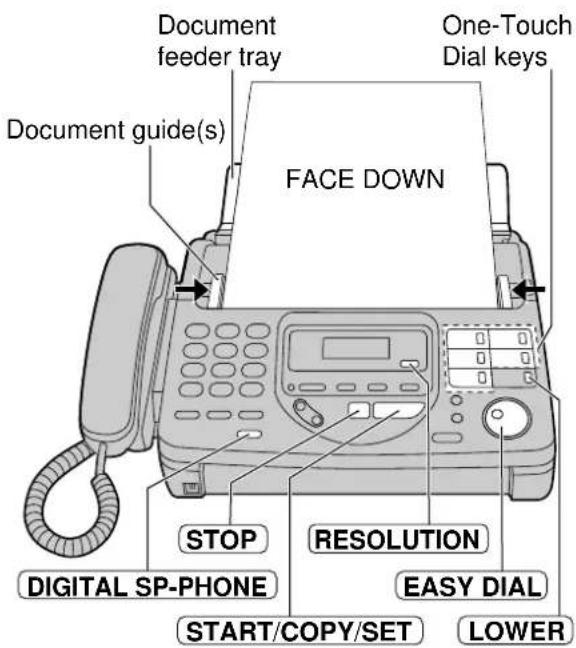
If your unit does not send a fax
Verify that the number dialled is answered by the other party's machine.
-
Press DIGITAL SP-PHONE
-
For stations 1–5 Press the desired One-Touch Dial key.
For stations 6–10 Press LOWER press the desired One-Touch Dial key.
Fax auto redial
If the line is busy or there is no answer, the unit will automatically redial the number up to 3 times.
• This feature is also available for;
— sending a fax using the EASY DIAL directory (p. 41) or One-Touch Dial key (see above).
— delayed transmission (p. 45).
— receive polling (p. 58).
- During redial, the following will be displayed.
Display: WAITING REDIAL
• To cancel redialling, press STOP
Sending a fax using the EASY DIAL directory
Before using this feature, program the desired names and telephone numbers into the directory (p. 35).
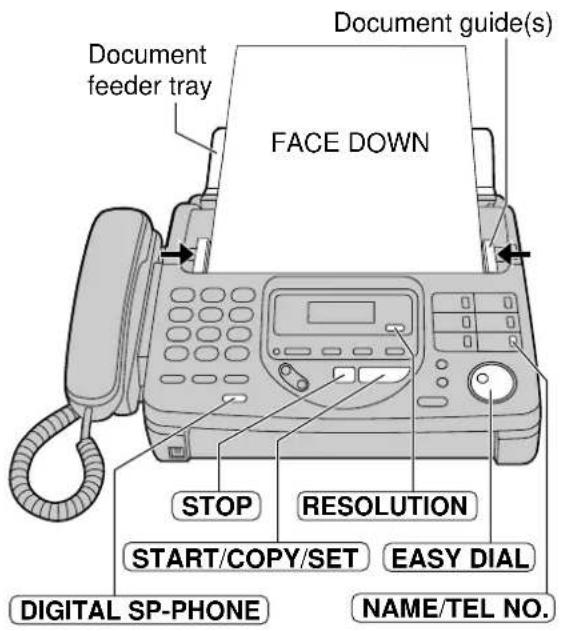
1 Open the document feeder tray.
2 Adjust the width of the document guides to the size of the document.
3 Insert the document (up to 15 pages) FACE DOWN until the unit grabs the document and a single beep is heard.
Display:
STANDARD
4 If necessary, press RESOLUTION select the desired setting (p. 39).
5 Rotate EASYnDlsired name is displayed.
Example:
Alice
• To confirm the number, press NAME/TEL NO.
6 Press START/COPY/SET
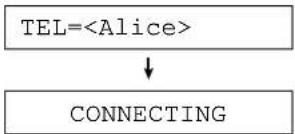
flowchart
graph TD
    A["TEL=<Alice>"] --> B["CONNECTING"]
• The unit will start transmission.
Helpful hints:
- You can confirm the stored items on the display (p. 37) or on the telephone number list (p. 88).
- The connecting tone will be heard during dialling to tell you the status of the other party's machine (p. 47).
Note:
- If the desired name has not been stored, press STOP and dial the number manually.
- For further details about using the EASY DIAL, see page 37.
If your unit does not send a fax
Verify that the number dialled is answered by the other party's machine.
- Rotate EASMeDialired name is displayed.
- Press DIGITAL SP-PHONE
Sending Faxes
Sending a fax by following the voice guide
You can send documents by following the voice guide. After transmission, the voice guide will turn off automatically.
1 Before inserting the document, press MENU times.
Display: 4.SEND GUIDE
2 Press HELP
Voice guide:

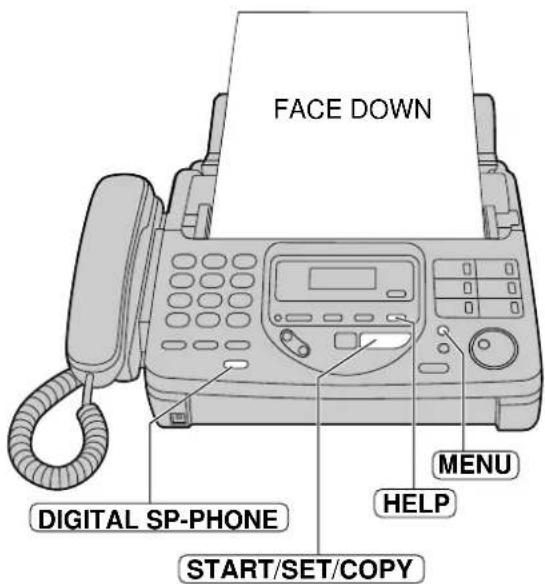
To transmit, insert the document face down until you hear the beep.
3 Insert the document FACE DOWN until the unit grabs the document and a single beep is heard.

Press the speaker phone button, then dial the phone number. When the fax tone is heard, press the start button.
4 Press DIGITAL SP-PHONE
5 Dial the fax number.
6 When a fax tone is heard, press START/COPY/SET.

Start transmission.
Note:
- You can lift the handset instead of pressing DIGITAL SP-PHONE in step 4.
Documents you can send
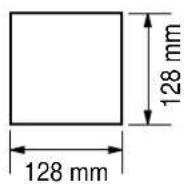
Minimum size
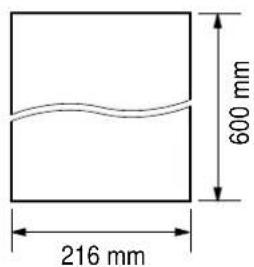
Maximum size
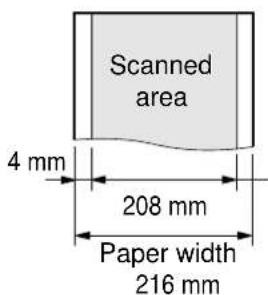
Effective scanning area
Document weight
Single sheet: 45 to 90 ~g / m^2
Multiple sheets: 60 to 80 ~g / m^2
Note:
- Remove clips, staples or other similar fastening objects.
- Check that ink, paste or correction fluid has dried.
- Do not send the following types of documents. Use copies for fax transmission.
— Chemically treated paper such as carbon or carbonless duplicating paper
— Electrostatically charged paper
— Heavily curled, creased or torn paper
— Paper with a coated surface
— Paper with a faint image
— Paper with printing on the opposite side that can be seen through the front (e.g. newspaper)
Printing the transmission report
The transmission report will provide you with a printed record of the fax transmission result.
The following choices are available.
ERROR: The transmission report will print out only when fax transmission fails (pre-selected setting).
ON: The transmission report will always print out, indicating whether fax transmission is successful or not.
OFF: The transmission report will not print.
1 Press MENU
Display:
- SYSTEM SET UP
2 Press ☐ then . ☐ 4
TX-REPORT MODE
3 Press START/COPY/SET
MODE=ERROR

4 Press ▼ to select the desired setting.
5 Press START/COPY/SET
SETUP ITEM [ ]
6 Press MENU
Sample of a transmission report
![[ TRANSMISSION REPORT ] NO. OUSHGE FATHMINDOE PAGESSTART TIME 01 2345678 00'51 SND 20 Jan. 01:18PM 20 Jan. 1999 01:19PM RESULT *CODE 00 COMMUNICATION ERROR (43) Communication message (p. 80) Error code (for service personnel use only)](/content/2026/06/1190726/images/a60909be6d6b65d295fe22f1b59525c2337019e95dbab4600f755bd758ebd5d1.jpg)
Automatic journal report
This feature prints a journal report automatically after every 35 new fax communications.
After printing, only the oldest communication result will be erased when a new communication occurs.
When this feature is deactivated, the unit will store the records of the fax communications, but will not print the journal report automatically.
1 Press MENU
Display: 1.SYSTEM SET UP
2 Press ☐ then . 2 2
AUTO JOURNAL
3 Press START/COPY/SET
MODE=ON ▼▲
4 Press ▼ to select the desired setting.
- If this feature is not required, select "OFF".
5 Press START/COPY/SET
SETUP ITEM [ ]
6 Press MENU
Note:
- You can print a journal report manually (p. 88).
Sample of a journal report
![[ JOURNAL ] 25 Jan. 1999 05:22PM NO. OTHER FACSIMILE START TIME USAGE TIME MODE PAGES RESULT CODE * 01 3332222 21 Jan. 02:14PM 00'45 SND 01 OK 02 9998765 21 Jan. 03:17PM 00'58 RCV 02 OK 03 John 21 Jan. 05:18PM 00'48 RCV 01 OK 04 555556677 22 Jan. 10:35AM 02'45 SND 03 COMMUNICATION ERROR (43) 05 03'50 SND 05 OK RCV 03 OK Communication message (p. 80) Error code (for service personnel use only)](/content/2026/06/1190726/images/0290f6bebf7d7ee7f5d034b99bd4e791cbaf7b521f57fcd22b38b86ec26dd294.jpg)
Delayed transmission
(sending a fax at a specified time)
Using a built-in clock, this unit can send documents automatically at a specified time. This allows you to take advantage of low-cost calling hours offered by your telephone company. The delayed transmission can be reserved to take place up to 24 hours in advance.
1 Insert the document FACE DOWN until a single beep is heard.
Display:
STANDARD
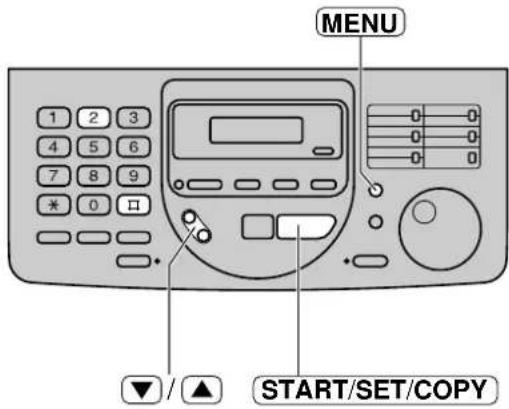
2 Press MENU
1. SYSTEM SET UP
3 Press ② then . ② ⑤
DELAYED SEND
4 Press START/COPY/SET
MODE=OFF
5 Press ▼ to select "ON".
MODE=ON
6 Press START/COPY/SET
NO.=
7 Enter the fax number using the dial keypad.
8 Press START/COPY/SET
TIME=12:00AM
9 Enter the transmission start time using the 12-hour clock. Press ☐ select "AM" or "PM"
Example: 09:30PM
Press , then press until "PM" is displayed.
TIME=09:30PM
10 Press START/COPY/SET
SETUP ITEM [ ]
11 Press MENU
SEND AT 9:30PM


- When the programmed time arrives, the unit will automatically start transmission.
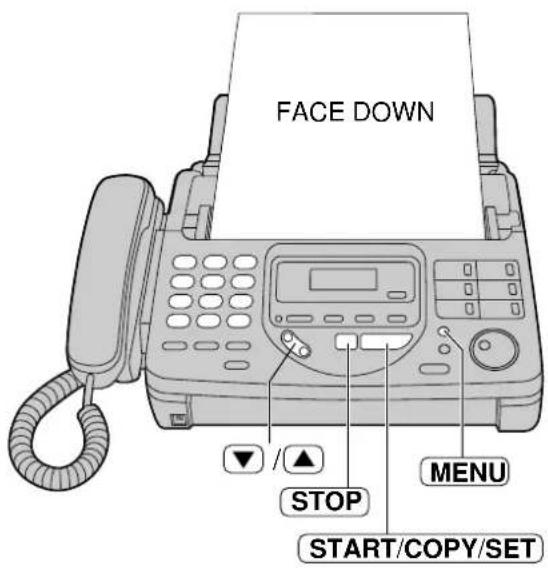
Note:
- You can receive, transmit and copy documents while delayed transmission is set.
- When transmit polling (p. 46) is set to "ON", delayed transmission is not available.
- You can use the One-Touch Dial, but not the EASY DIAL directory, to enter the fax number for this feature.
To cancel the delayed transmission setting
- Press w\$the unit is idle.
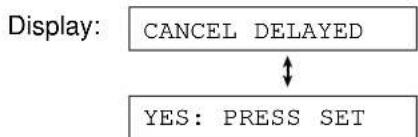
flowchart
graph TD
    A["CANCEL DELAYED"] --> B["YES: PRESS SET"]
    style A fill:#f9f,stroke:#333
    style B fill:#ccf,stroke:#333
- Press .START/COPY/SET
Transmit polling
(letting another machine retrieve a fax from your unit)
This feature allows another person to call your unit to retrieve a document loaded on your unit. This saves you the call charges. This feature will not work when the unit is set to the TEL mode.
1 Insert the document FACE DOWN until a single beep is heard.
Display:
STANDARD
2 Press MENUES.
4.POLLED

YES: PRESS SET
3 Press START/COPY/SET
MODE=OFF

4 Press ▼ to select "ON".
MODE=ON

5 Press START/COPY/SET
POLLED ON
Note:
- The caller pays for the document transmission.
- When delayed transmission (p. 45) is set to "ON", transmit polling is not available.
To cancel the transmit polling setting
- Press with the unit is idle.
Display:
CANCEL POLLED

YES: PRESS SET
- Press .START/COPY/SET
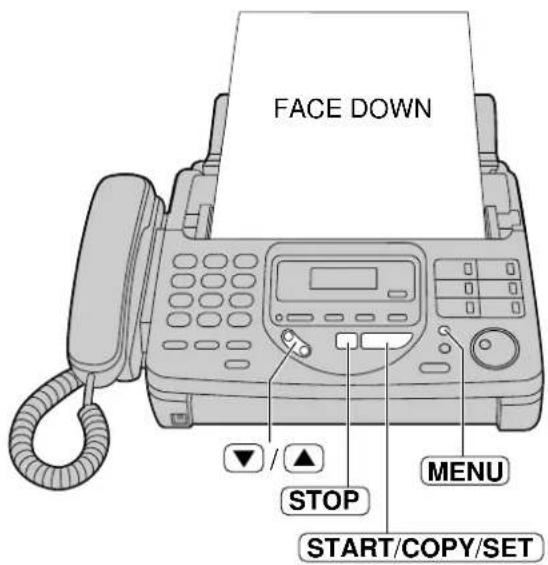
Sending documents overseas
You may experience difficulty when transmitting documents overseas. This feature makes sending documents easier as the transmission speed is slowed down. Before starting transmission, follow the steps below.
![1 Press MENU Display: 1.SYSTEM SET UP 2 Press then . 2 3 OVERSEAS MODE 3 Press START/COPY/SET MODE=OFF ▼▲ 4 Press ▼ to select "ON". MODE=ON ▼▲ • If this feature is not required, select "OFF". 5 Press START/COPY/SET SETUP ITEM [ ] 6 Press MENU](/content/2026/06/1190726/images/ab3ba74c83642885fcdb105237d68e6ed0101a7664c387a0d17aa739e69b638b.jpg)

Note:
• After transmission, this feature will turn off automatically.
- A slower transmission speed will lengthen the call duration. Therefore the calling charge may be higher.
Connecting tone
This feature allows you to hear connecting tones, such as a fax tone, ring back tone or busy tone for several seconds when you send a fax using the One-Touch Dial or EASY DIAL directory. This will tell you the status of the other party's machine.
— Fax tone: The other party's machine is ready for reception.
— Ring back tone: If this tone continues, the other party's machine may not be a facsimile or may have run out of paper. Check with the other party.
— Busy tone: The other party's machine is busy. Let the unit continue redialling or press and stop again later.
This feature is set to "ON" as a pre-selected setting. If this feature is not required, turn it off.
![1 Press MENU Display: 1.SYSTEM SET UP 2 Press then . 7 6 CONNECTING TONE 3 Press START/COPY/SET MODE=ON ▼▲ 4 Press ▼ to select the desired setting. • If this feature is not required, select "OFF". 5 Press START/COPY/SET SETUP ITEM [ ] 6 Press MENU](/content/2026/06/1190726/images/3bba052edde26150c2d9b0dcdf53b64b25a129e7c44a61b0f9162825464d221e.jpg)
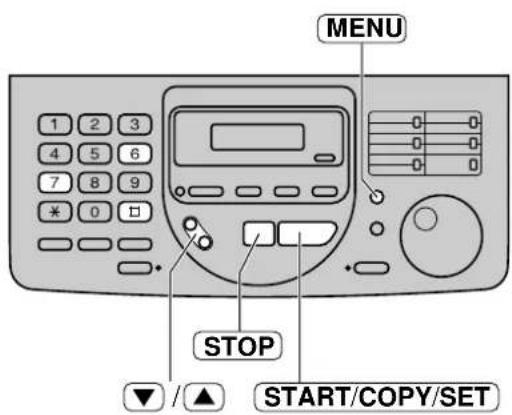
Note:
- The connecting tone volume cannot be adjusted.
Setting the unit to receive calls
This unit has four types of receive modes. Select one of these modes according to your needs.
- Regardless of the mode you select, you can always place calls and send faxes.
MANUAL RECEIVE
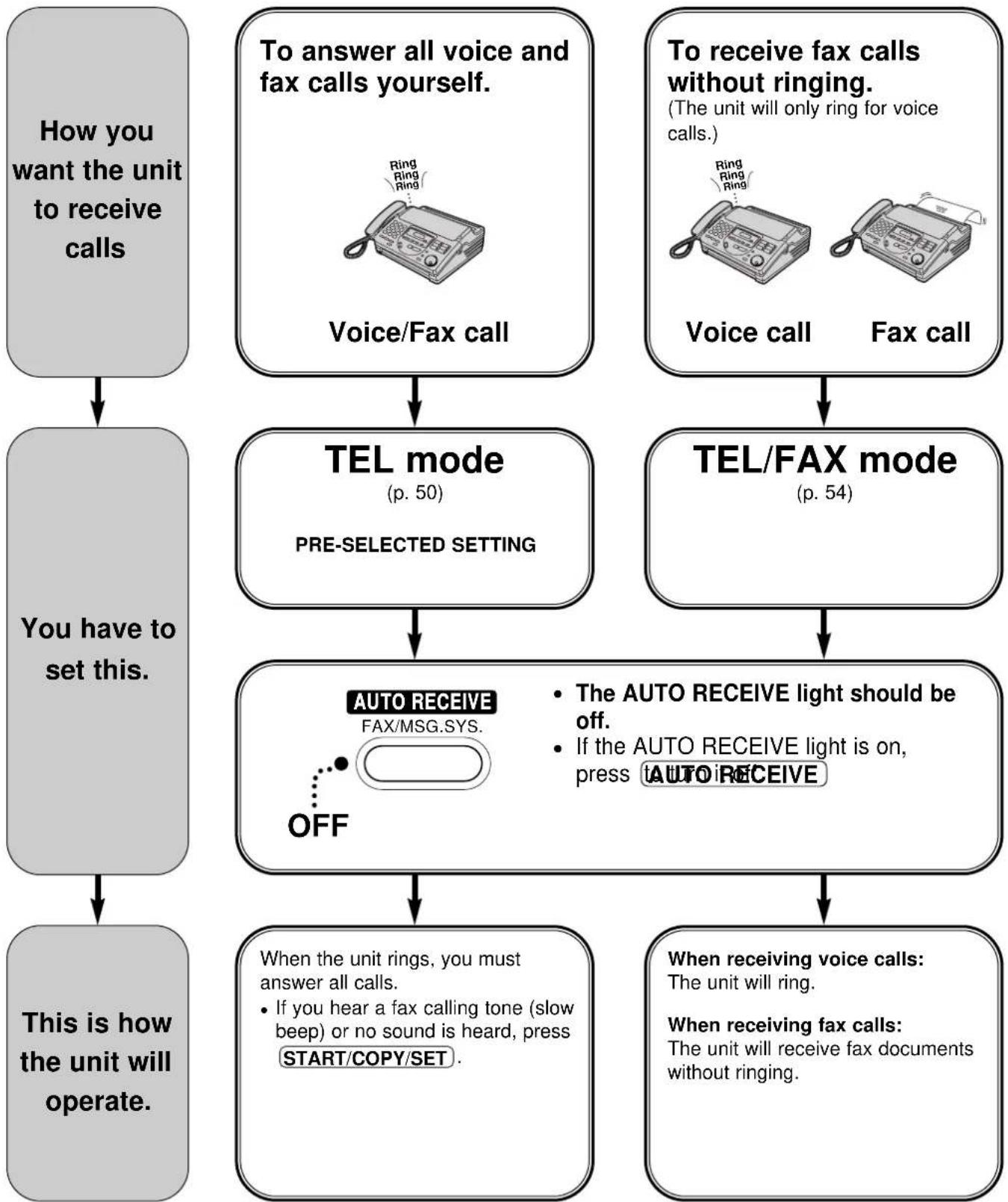
flowchart
graph TD
    A["How you want the unit to receive calls"] --> B["You have to set this."]
    B --> C["This is how the unit will operate."]

    A --> D["To answer all voice and fax calls yourself."]
    D --> E["TEL mode (p. 50)<br>PRE-SELECTED SETTING"]
    E --> F["AUTO RECEIVE<br>FAX/MSG.SYS.<br>OFF"]

    B --> G["To receive fax calls without ringing.<br>(The unit will only ring for voice calls.)"]
    G --> H["TEL/FAX mode (p. 54)"]
    H --> I["When receiving voice calls: The unit will ring.<br>When receiving fax calls: The unit will receive fax documents without ringing."]

    D --> J["Ring Ring Ring"]
    E --> K["Ring Ring Ring"]
    F --> L["The AUTO RECEIVE light should be off.<br>If the AUTO RECEIVE light is on, press AUTO RECEIVE"]
    I --> M["When the unit rings, you must answer all calls.<br>• If you hear a fax calling tone (slow beep) or no sound is heard, press START/COPY/SET."]
AUTO RECEIVE
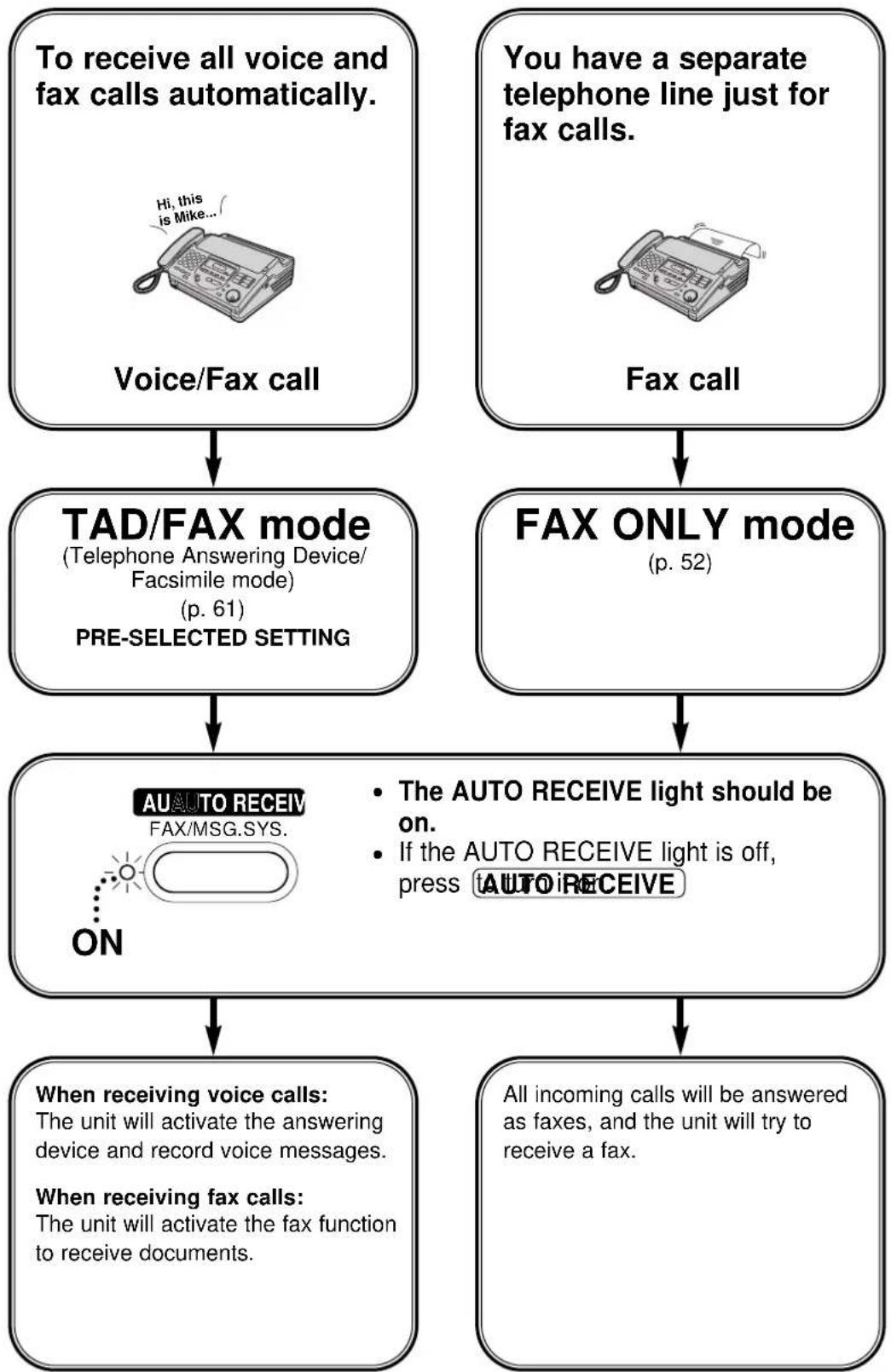
flowchart
graph TD
    A["To receive all voice and fax calls automatically."] --> B["Voice/Fax call"]
    C["You have a separate telephone line just for fax calls."] --> D["Fax call"]
    B --> E["TAD/FAX mode\n(Telephone Answering Device/Facsimile mode)\n(p. 61)\nPRE-SELECTED SETTING"]
    D --> F["FAX ONLY mode\n(p. 52)"]
    E --> G["AUTO RECEIV\nFAX/MSG.SYS."]
    F --> H["• The AUTO RECEIVE light should be on.\n• If the AUTO RECEIVE light is off,\npress AUTO RECEIVE"]
    G --> I["When receiving voice calls:\nThe unit will activate the answering device and record voice messages."]
    H --> J["All incoming calls will be answered as faxes, and the unit will try to receive a fax."]
    I --> K["When receiving fax calls:\nThe unit will activate the fax function to receive documents."]
TEL mode
(answering all calls manually)
If the AUTO RECEIVE light is on, turn it off by pressing AUTO RECEIVE.
Display:
TEL MODE
1 When the unit rings, press DIGITAL SP-PHONE or lift the handset to answer the call.
2 When: — document reception is required, — a fax calling tone (slow beep) is heard, or — no sound is heard,
press START/COPY/SET
CONNECTING
3 Replace the handset, if using it. • The unit will start reception.
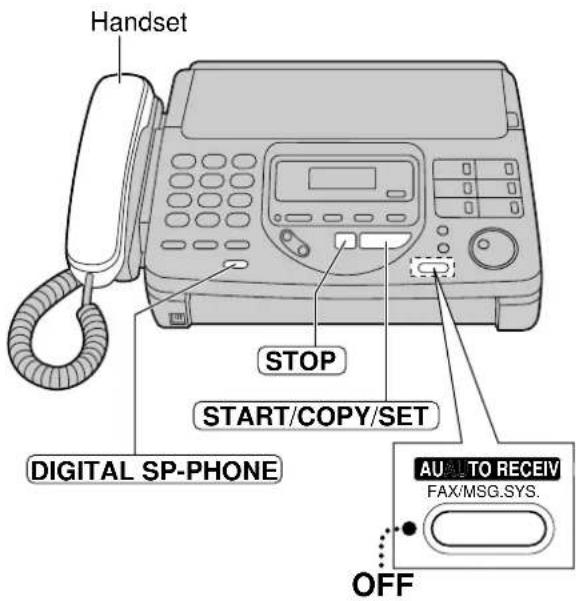
Note:
- If you do not answer the call within 20 rings, the unit will temporarily activate the answering device. The greeting message will be played. If the remote operation ID (p. 70) is entered during the greeting message, the unit will change to the TAD/FAX mode.
To stop receiving the document
Press STOP
Friendly reception feature
When you answer a call and hear a fax calling tone (slow beep), the unit will automatically start receiving.
- If this feature is not required, set to "OFF" (p. 58).
Memory reception
When a printing problem is detected, the unit will temporarily store the received document into memory.
While documents are in memory, the unit will display an error message and the following message alternately.
Display:
FAX IN MEMORY
- Follow the instructions on page 81 to solve the problem and print the stored document.
- For memory capacity, see page 94.
Extension telephone
If you connect an extension telephone to the same line, you can receive fax documents using the extension telephone. You do not have to go to the unit and press START/COPY/SET
Important:
- Use a touch tone telephone as the extension telephone and enter the fax activation code firmly.
1 When the extension telephone rings, lift the handset of the extension telephone.
2 When: — document reception is required, — a fax calling tone (slow beep) is heard, or — no sound is heard, press (pre-selected fax activation code) firmly.
3 Replace the handset. • The unit will start reception.
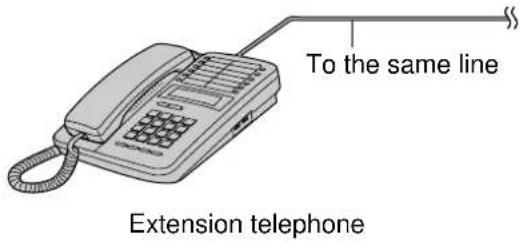
Note:
- You can change the fax activation code (see below).
Fax activation code
The fax activation code is required to receive faxes using an extension telephone (see above).
Important:
- This code should be different from the remote operation ID (p. 70).
1 Press MENU
Display: 1.SYSTEM SET UP
2 Press #then . 4 1
FAX ACTIVATION
3 Press START/COPY/SET
MODE=ON ▼▲
4 Press ▼ to select "ON".
- If this feature is not required, select "OFF".
5 Press START/COPY/SET
CODE= * 9
- The display will show the pre-selected code.
6 Enter the new code number.
- This code can be from 2 to 4 digits in length using 0–9, and *
7 Press START/COPY/SET
SETUP ITEM [ ]
8 Press MENU
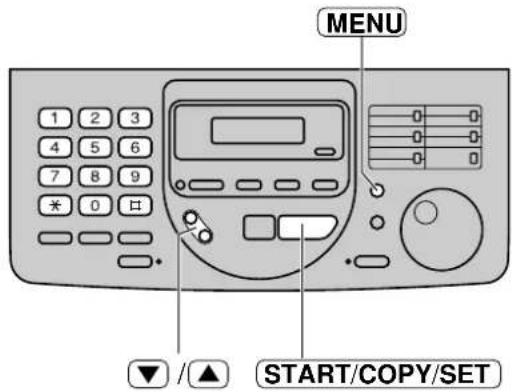
Note:
- If you subscribe to any special telephone company services which require a code, all or part of the fax activation code must be different from the service access code.
- The fax activation code should not be set to "0000".
FAX ONLY mode
(all calls are received as faxes)
Changing the TAD/FAX mode to the FAX ONLY mode
1 Press MENU
Display: 1. SYSTEM SET UP
2 Press □ then . 0 5
AUTO RECEIVE
3 Press START/COPY/SET
MODE=TAD/FAX ▼▲
4 Press ▼ to select "FAX ONLY".
MODE=FAX ONLY ▼▲
5 Press START/COPY/SET
SETUP ITEM [ ]
6 Press MENU
7 If the AUTO RECEIVE light is off, turn it on by pressing AUTO RECEIVE.
FAX ONLY MODE
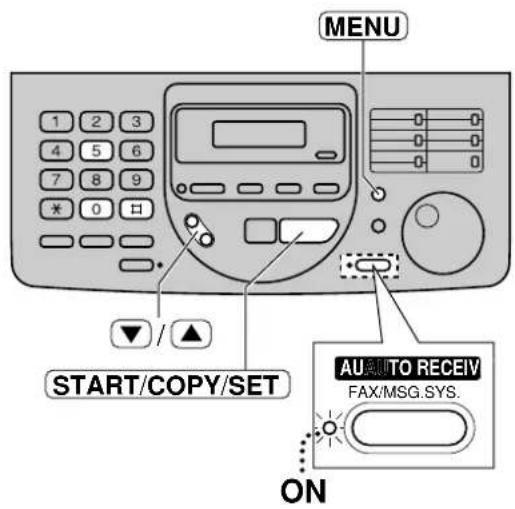
Note:
- The unit will automatically answer all calls and only receive fax documents.
- This mode should not be used with a telephone line which is used for both voice and fax calls. When the unit answers the call, fax communication is attempted with the other fax machine even if someone is trying to call you.
- The number of rings before a call is answered can be changed (p. 53).
- To change to the TAD/FAX mode, select "TAD/FAX" in step 4.
FAX ONLY mode ring count
This setting determines the number of rings before the unit answers a call in the FAX ONLY mode. You can choose from 1 to 4 rings.
Helpful hints:
• To answer a call before the unit does, increase the number of rings.
- If you have difficulty receiving faxes, the other parties may have tried to send faxes before confirming if your unit answered or not. Decrease the number of rings.
![1 Press MENU Display: 1.SYSTEM SET UP 2 Press then . 0 7 FAX RING 3 Press START/COPY/SET RING=2 ▼▲ 4 Press ▼ to select the desired number. 5 Press START/COPY/SET SETUP ITEM [ ] 6 Press MENU](/content/2026/06/1190726/images/07d4212dcab3ca7ea7da05246338fca717fdd2cfb6b751cb4e4539076fdddae1.jpg)
If you have a telephone line just for receiving faxes, we recommend the following setup.
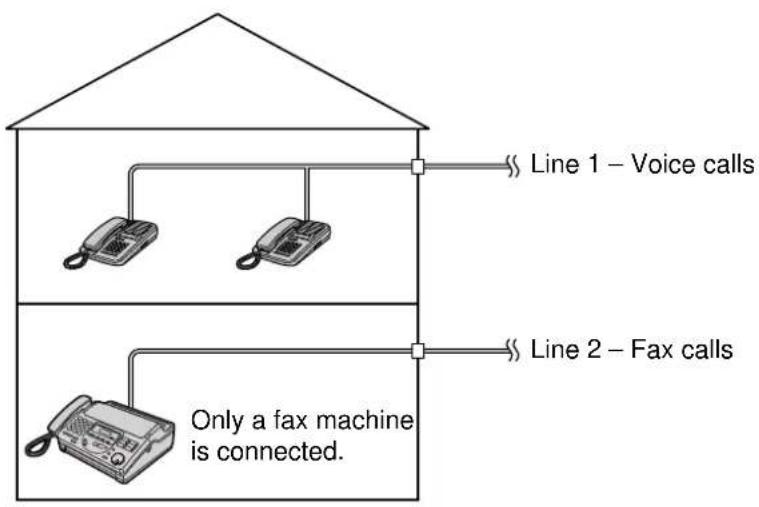
flowchart
graph TD
    A["House with two phones"] --> B["Line 1 – Voice calls"]
    A --> C["Line 2 – Fax calls"]
    D["Only a fax machine is connected."] --> E["Phone"]
Example: One telephone line is used for voice calls and a separate telephone line for faxes. If someone sends a fax to Line 2, the fax machine will ring.
TEL/FAX mode
(receiving voice calls with rings and fax calls without rings when you are near the unit)
Use this mode when you are always near the unit and want the fax machine to detect faxes without ringing. When a call is received, the unit will work as follows. If an extension telephone is connected, see next page.
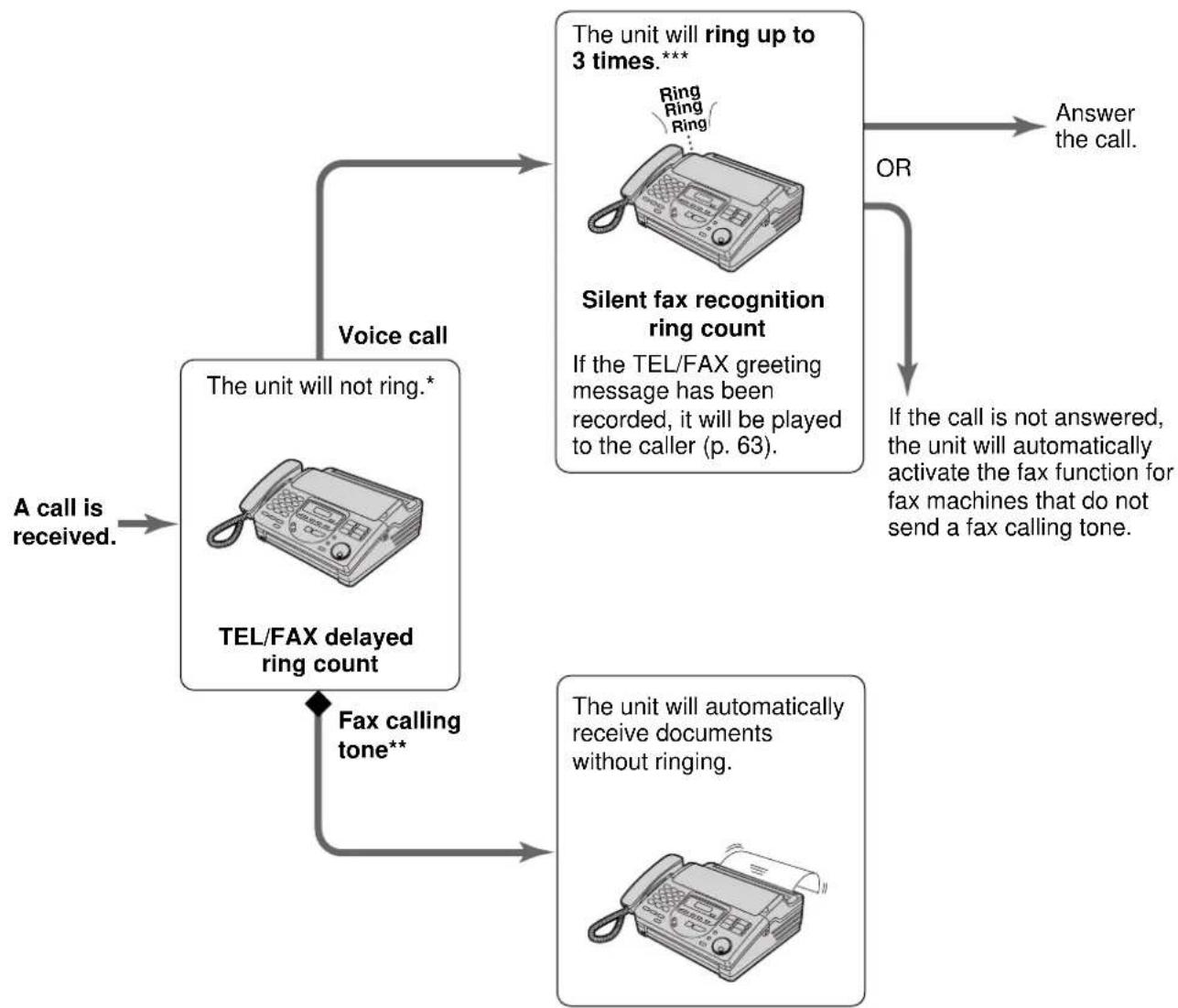
flowchart
graph TD
    A["A call is received."] --> B["Voice call"]
    B --> C["The unit will not ring.*"]
    B --> D["TEL/FAX delayed ring count"]
    D --> E["Fax calling tone**"]
    E --> F["The unit will automatically receive documents without ringing."]
    C --> G["Silent fax recognition ring count"]
    G --> H["The unit will ring up to 3 times.***"]
    H --> I["Answer the call."]
    G --> J["OR"]
    J --> K["If the call is not answered, the unit will automatically activate the fax function for fax machines that do not send a fax calling tone."]
* A telephone fee will be charged to the caller from this point.
** A fax calling tone is automatically generated by the sending fax machine. Some fax machines do not have this capability.
*** While ringing, the unit will emit a different ring back tone to the calling party.
Note:
- The unit will display the following when a call is received.
Display: INCOMING CALL
- Some fax messages that are transmitted manually may not send a fax calling tone. These calls must be received manually.
- You must set the ringer to on (p. 29).
Ring pattern when an extension telephone is connected
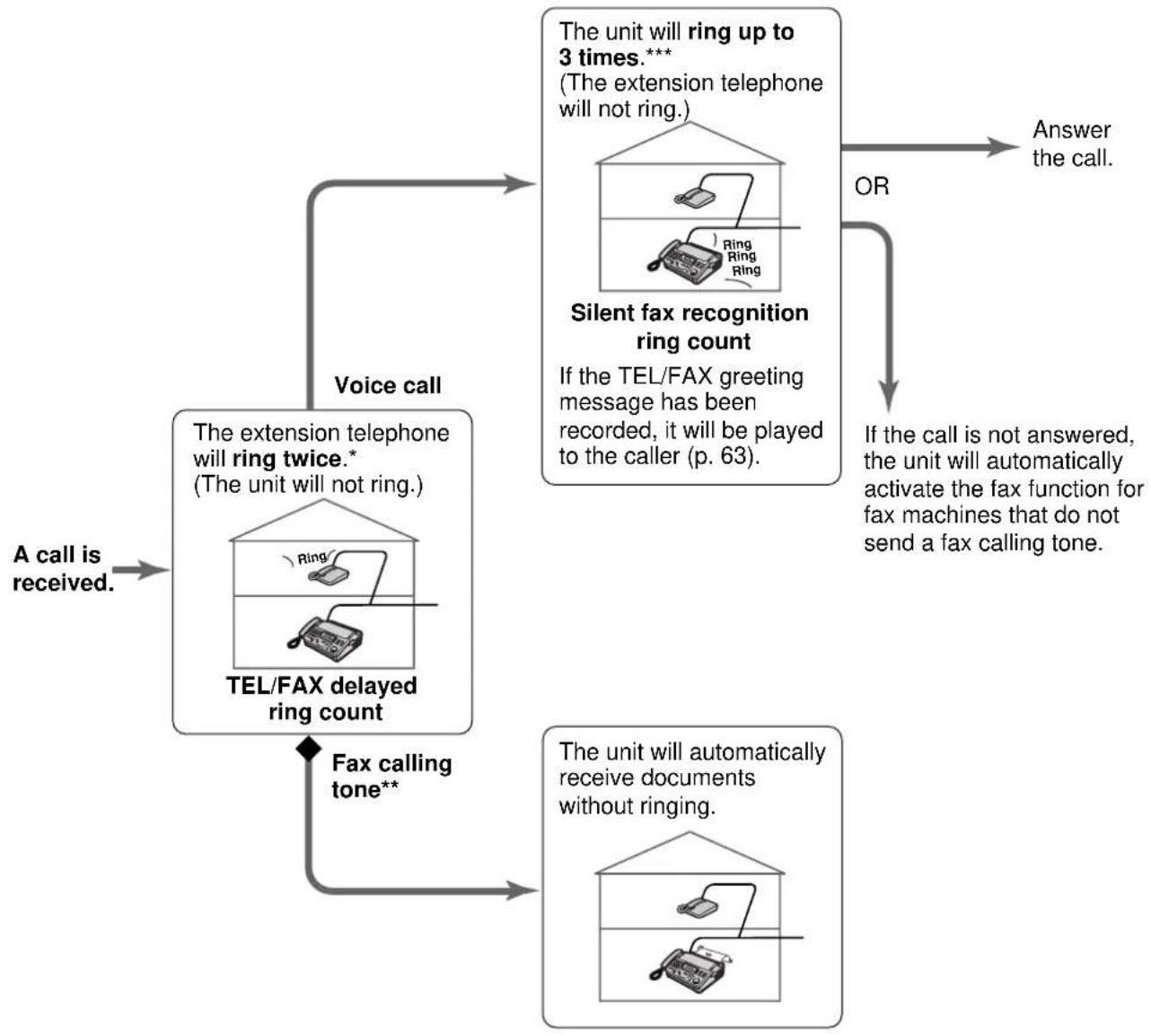
flowchart
graph TD
    A["A call is received."] --> B["Voice call"]
    B --> C["The extension telephone will ring twice.* (The unit will not ring.)"]
    C --> D["TEL/FAX delayed ring count"]
    D --> E["Fax calling tone**"]
    E --> F["The unit will automatically receive documents without ringing."]
    F --> G["Silent fax recognition ring count"]
    G --> H["Answer the call."]
    G --> I["OR"]
    I --> J["If the call is not answered, the unit will automatically activate the fax function for fax machines that do not send a fax calling tone."]
TEL/FAX delayed ring count:
Up to 4 ring signals will be generated before the unit answers, depending on feature setting #09 on page 57. In the TEL/FAX mode, the unit will not generate an audible ring during this time.
Silent fax recognition ring count:
The unit generates audible rings to indicate that it is receiving a voice call. 3 to 9 rings will be generated, depending on feature setting #30 on page 57. This signal will not ring at an extension telephone.
Receiving Faxes
Changing the TEL mode to the TEL/FAX mode
1 Press MENU
Display: 1.SYSTEM SET UP
2 Press □ then . 0 8
MANUAL RECEIVE
3 Press START/COPY/SET
MODE=TEL ▼▲
Press ▼ to select "TEL/FAX".
MODE=TEL/FAX ▼▲
5 Press START/COPY/SET
SETUP ITEM [ ]
6 Press MENU
7 If the AUTO RECEIVE light is on, turn it off by pressing .AUTO RECEIVE
TEL/FAX MODE
Note:
- To return to the TEL mode, select "TEL" in step 4.
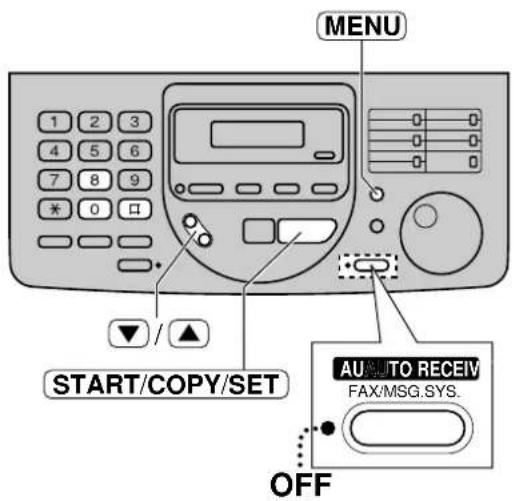
TEL/FAX delayed ring count
This setting determines the number of times the extension telephone rings in the TEL/FAX mode. You can choose from 1 to 4 rings.
If an extension telephone is not connected, this setting does not need to be changed.
![1 Press MENU Display: 1.SYSTEM SET UP 2 Press then . 0 9 TEL/FAX RING 3 Press START/COPY/SET RING=2 ▼▲ 4 Press ▼ to select the desired number. 5 Press START/COPY/SET SETUP ITEM [ ] 6 Press MENU](/content/2026/06/1190726/images/09e11945967825a5173dfb8a62b7096ad8430f802abcb693f87d18dbaac4c2dc.jpg)
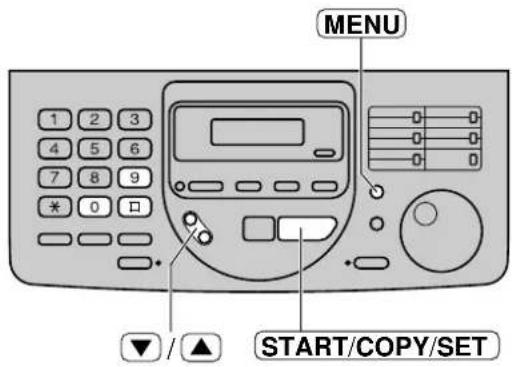
Note:
- If the number of rings is increased, you may not be able to receive documents from some older model fax machines which do not send a fax calling tone.
Silent fax recognition ring count
When the unit detects a voice call in the TEL/FAX mode, it will ring up to 3 times. The number of rings can be changed up to 9.
![1 Press MENU Display: 1.SYSTEM SET UP 2 Press #then . 3 0 SILENT FAX RING 3 Press START/COPY/SET RING=3 ▼▲ 4 Press ▼ to select the desired number. 5 Press START/COPY/SET SETUP ITEM [ ] 6 Press MENU](/content/2026/06/1190726/images/0e2df6e3c2dcd30cd5cbd8c9554d0b44243cbdfb215582f7105ab7faadada226.jpg)
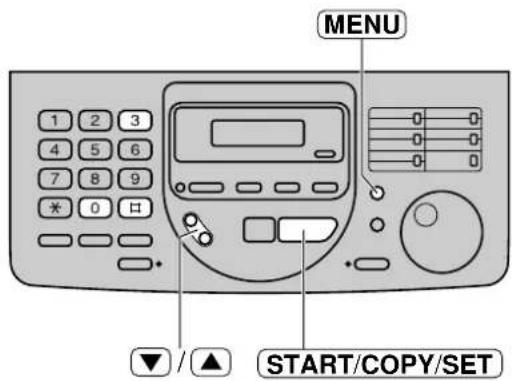
Note:
- If the number of rings is increased, you may not be able to receive documents from some older model fax machines which do not send a fax calling tone.
Receiving polling
(receiving a fax placed on another party's machine)
This feature allows you to retrieve a document from another compatible machine. Therefore, you pay for the call, saving the sending party the call charges.
Make sure that no documents are fed into your unit and that the other party's machine is ready for your call.
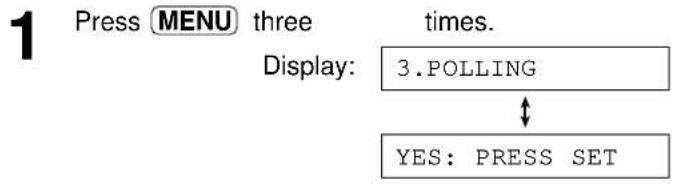
flowchart
graph TD
    A["Press MENU three"] --> B["Display: 3.POLLING"]
    B --> C{↓}
    C --> D["YES: PRESS SET"]



• The unit will start reception.
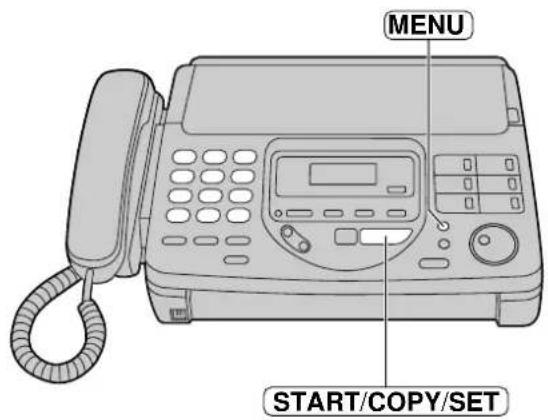
Note:
- You can use the One-Touch Dial, but not the EASY DIAL directory, to enter the fax number for this feature.
Friendly reception
The friendly reception feature allows you to receive fax documents automatically without pressing START/COPY/SET (p. 50).
When this feature is deactivated, you have to press START/COPY/SET to receive fax documents each time you answer a fax call.



4 Press ▼ to select the desired setting. • If this feature is not required, select "OFF".
![5 Press START/COPY/SET . SETUP ITEM [ ]](/content/2026/06/1190726/images/6b30506abd75cefdfcd85e8d63e74965fd8d5d8ad4c2ccdf5de4861e229e1d62.jpg)
6 Press MENU.
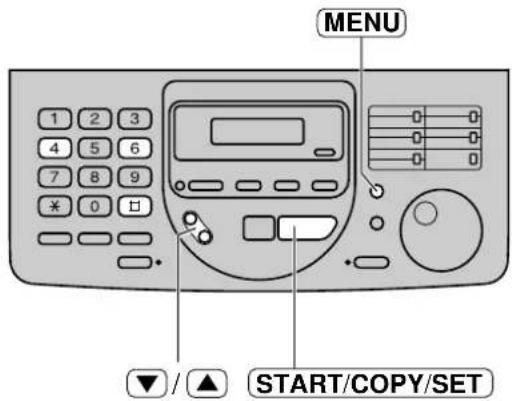
Pager call - when your unit receives a fax
This feature allows your unit to call your pager when your unit receives a fax document.
1 Press MENU
Display:
- SYSTEM SET UP
2 Press then . 7 0
FAX PAGER
3 Press START/COPY/SET
MODE=OFF

4 Press ▼ to select "ON".
MODE=ON

- If this feature is not required, select "OFF".
5 Press START/COPY/SET
NO.=
6 Enter your pager number.
- You can enter a total of 46 digits and/or pauses.
Example:
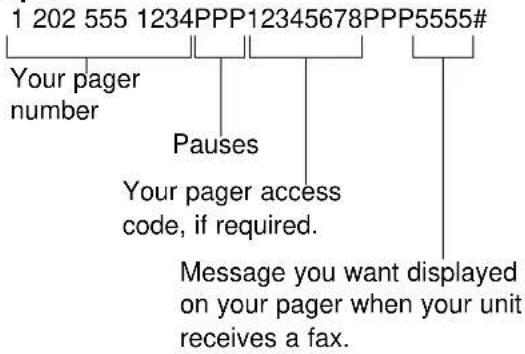
7 Press .START/COPY/SET
SETUP ITEM [ ]
8 Press .MENU
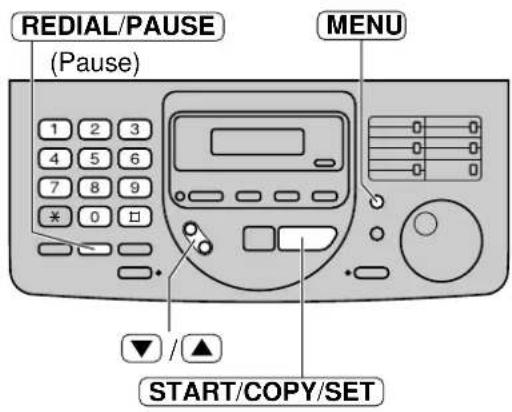
Note:
- Message programming methods may vary depending on the pager company. Contact your pager company for details.
How your unit and pager work
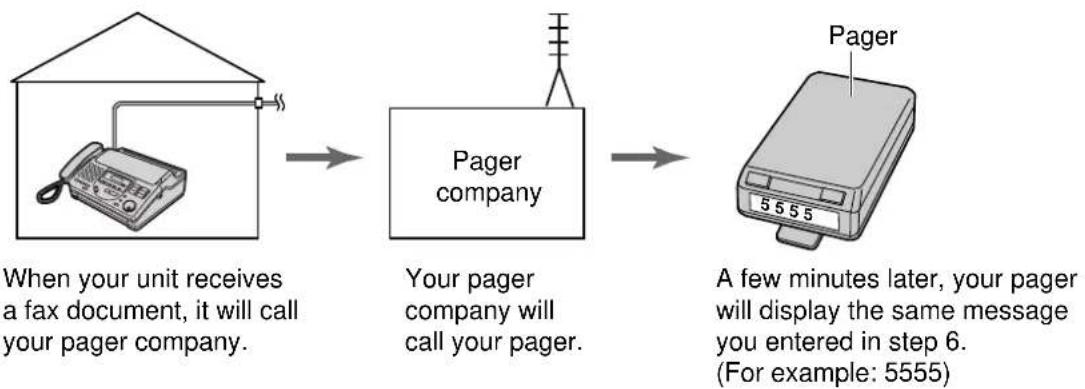
flowchart
graph LR
    A["When your unit receives a fax document, it will call your pager company."] --> B["Pager company"]
    B --> C["A few minutes later, your pager will display the same message you entered in step 6. (For example: 5555)"]
Making a copy
Any transmittable document (p. 42) can be copied.
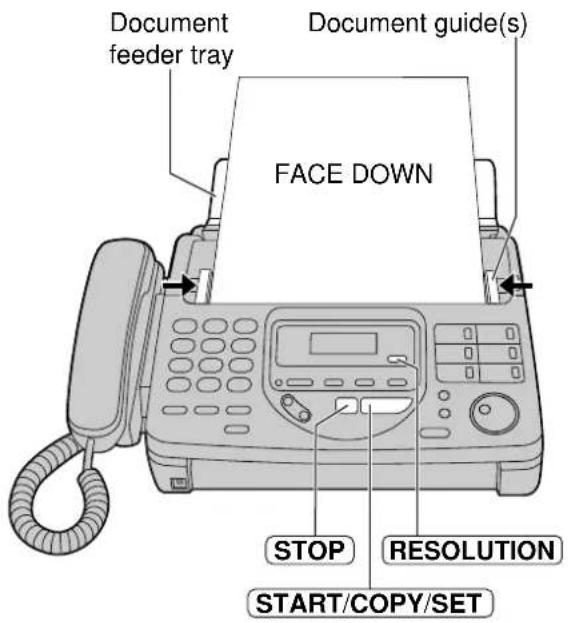
1 Open the document feeder tray.
2 Adjust the width of the document guides to the size of the document.
3 Insert the document (up to 15 pages) FACE DOWN until the unit grabs the document and a single beep is heard.
Display:
STANDARD
• Make sure the handset is on the cradle.
4 If necessary, press RESOLUTION to select the desired setting (p. 39).
5 Press START/COPY/SET
• The unit will start printing.
COPYING
Note:
- If a resolution is not set, FINE resolution will automatically be selected.
- You can make or receive a voice call while making copies.
- When you copy a multiple page document which is longer than A4 size paper (approx. 300 mm), we recommend you insert one page at a time.
To stop copying
Press STOP
To eject the document, press STQRin.
TAD/FAX mode
(using the built-in answering device and receiving voice and fax calls automatically)
When the TAD/FAX mode is set, the unit will work as a fax machine and/or answering device.
If a fax call is detected, the unit will automatically receive faxes.
If a voice call is detected, the answering device will play a greeting message and the caller can leave a voice message.
- You can use either a pre-recorded greeting message (p. 62) or your own greeting message (p. 63).
Setting up the voice message and document reception
1 Select "TAD/FAX" in step 4 of feature setting #05 (p. 52).
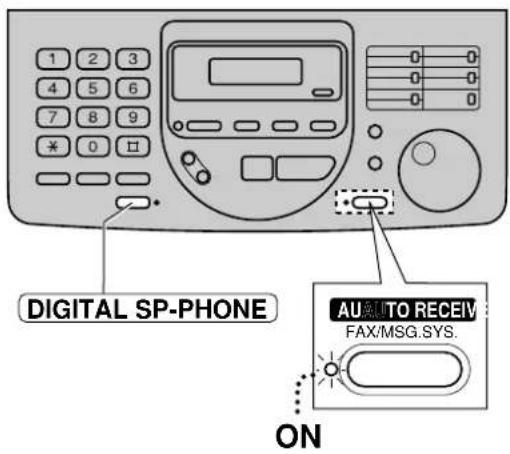
2 If the AUTO RECEIVE light is off, turn it on by pressing .AUTO RECEIVE
- The unit will play the TAD/FAX greeting message and the display will show the following message.
Display: TAD/FAX MODE
- The remaining time for recording incoming messages will be displayed.
Example: TIME = 10m13s
- When the remaining time is low, erase unnecessary messages from memory (p. 66, 72).
Note:
- The total recording time (including greeting messages) is about 18 minutes. If a message is recorded in a noisy room, the recording time may be shortened.
- The recording time for each incoming message can be changed (p. 78).
- When a call is received, the unit will play the TAD/FAX greeting message and the display will show the following message.
TAD ANSWERING
- While an incoming call is being recorded, the other party's voice will be heard through the speaker. If this feature is not required, set the ICM monitor feature to "OFF" (p. 79).
- To answer the call while playing the greeting message or recording a voice message, press DIGITAL SP-PHONE or lift the handset. The answering device will be terminated and you can talk to the other party.
Pre-recorded greeting messages
The unit has pre-recorded greeting messages. One of the following messages will be played to the caller.
■ When the unit is ready to receive voice and fax calls:
Hello! We are unable to answer right now.
To send a fax, please start transmission.
To leave a voice message, please speak after the beep.
Thank you.
■ If you have recorded your own greeting message (see next page):
(Your own TAD/FAX greeting message)
Note:
- If you erase your own greeting message, the pre-recorded greeting message above will be played automatically.
■ If the unit detects a problem:
MEMORY FULL
Hello! We are unable to answer right now.
To send a fax, please start transmission.
To leave a voice message, please try again later.
Thank you.
MEMORY FULL
and
OUT OF PAPER
OR
MEMORY FULL
and
UNIT OVERHEATED
Hello! We are unable to answer right now.
Please try again later.
Thank you.
Note:
• To clear the problem, see page 81.
Recording your own greeting messages
The recording time is limited to 16 seconds for each message. Record your message within 12 seconds for best performance.
Suggested messages
| TAD/FAX greeting message | “This is (your name, business and/or telephone number). We are unable to answer right now. To send a fax, start transmission. To leave a message, speak after the beep. Thank you.” |
| TEL/FAX greeting message | “This is (your name, business and/or telephone number). We are unable to answer right now. Please try again later. Thank you.” |
Note:
- You can choose either 16 seconds or 60 seconds of recording time for the TAD/FAX greeting message (p. 65).
- If you do not record your own TAD/FAX message, the pre-recorded message will be played (p. 62).
1 ■ For the TAD/FAX greeting: Press RECORD

flowchart
graph TD
    A["2. TAD GREETING"] --> B["PRESS START"]
    style A fill:#f9f,stroke:#333
    style B fill:#ccf,stroke:#333
■ For the TEL/FAX greeting:
Press RECORDS.
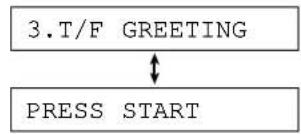
flowchart
graph TD
    A["3.T/F GREETING"] <--> B["PRESS START"]
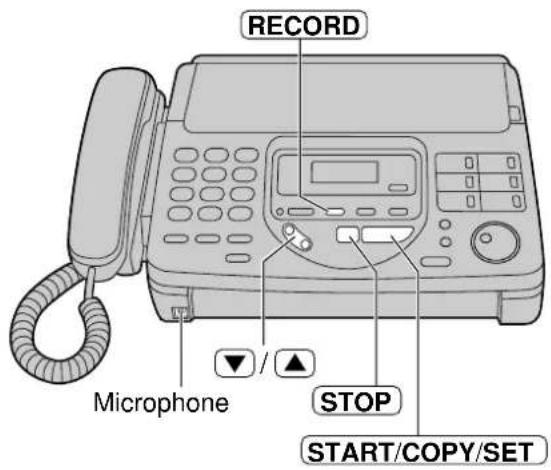
Press START/COPY/SET
- A long beep will sound and the display will show one of the following:
For the TAD/FAX greeting
TAD REC. 16s
For the TEL/FAX greeting
T/F REC. 16s
3 Speak clearly about 20 cm away from the microphone.
- The display will show the remaining recording time.
Example: TAD/FAX greeting
TAD REC. 15s
4 When finished recording, press STOP
- The unit will repeat your message. You can adjust the volume using ▼. ▲
Note:
- If you make a mistake while recording, start again from step 1.
Checking your own recorded greeting messages
To check your TAD/FAX greeting message
— If the AUTO RECEIVE light is off, turn it on by pressing AUTO RECEIVE
— If the AUTO RECEIVE light is on, turn it off once, then on again, by pressing .AUTO RECEIVE
Display:
TAD/FAX MODE
The unit will then play the TAD/FAX greeting message.
- If the display shows "FAX ONLY MODE", set to "TAD/FAX MODE" (p. 52).
To check your TEL/FAX greeting message
— If the AUTO RECEIVE light is on, turn it off by pressing .AUTO RECEIVE
— If the AUTO RECEIVE light is off, turn it on once, then off again, by pressing .AUTO RECEIVE
Display:
TEL/FAX MODE
The unit will then play the TEL/FAX greeting message.
- If the display shows "TEL MODE", set to "TEL/FAX MODE" (p. 56).
Erasing your own recorded greeting messages =
1 ■ For the TAD/FAX greeting: Press (ERASE)
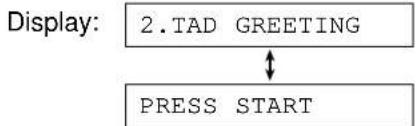
flowchart
graph TD
    A["2. TAD GREETING"] --> B["PRESS START"]
    style A fill:#f9f,stroke:#333
    style B fill:#ccf,stroke:#333
■ For the TEL/FAX greeting:
Press tERASEnes.
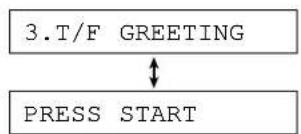
flowchart
graph TD
    A["3.T/F GREETING"] <--> B["PRESS START"]
2 Press START/COPY/SET
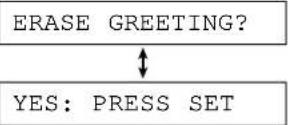
• To stop, press STOP
3 Press START/COPY/SET
GREETING ERASED
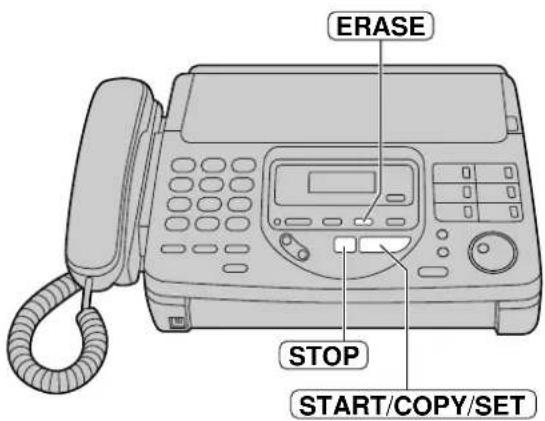
Note:
- If you erase your own TAD/FAX greeting message, the pre-recorded greeting message will be played.
Recording time for the TAD/FAX greeting message
You can choose either 16 seconds or 60 seconds of recording time.
1 Press .MENU
Display: 1.SYSTEM SET UP
2 Press then. 5 4
GREETING TIME
3 Press START/COPY/SET
MODE=16s ▼▲
4 Press ▼ to select the desired setting.
5 Press START/COPY/SET
SETUP ITEM [ ]
6 Press MENU
Note:
- If you change the greeting message time to 60 seconds, we recommend that you tell the caller in your own TAD/FAX greeting message to press * before starting fax transmission.
- If you change the greeting message time to 16 seconds from 60 seconds, your own recorded TAD/FAX greeting message will be deleted and return to the pre-recorded message. If necessary, re-record your own greeting message (p. 63).
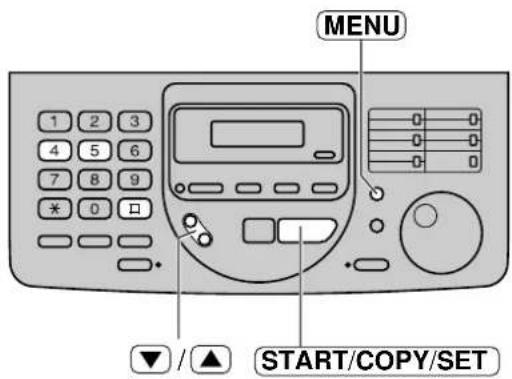
Listening to recorded messages
When the unit has recorded incoming voice messages:
— the PLAY MESSAGES indicator will flash,
— the call counter will show the total number of recorded messages, and
— slow beeps will sound if message alert (p. 78) is set to "ON".
When the PLAY MESSAGES indicator flashes
Press PLAY MESSAGES
- Only the new recorded messages will be played.
When the PLAY MESSAGES indicator lights
Press PLAY MESSAGES
- All messages will be played.
Note:
- During playback, the display shows the recorded order of the messages.
- You can adjust the speaker volume using 📂.
- The number of calls in the call counter will not decrease until you erase the recorded messages.
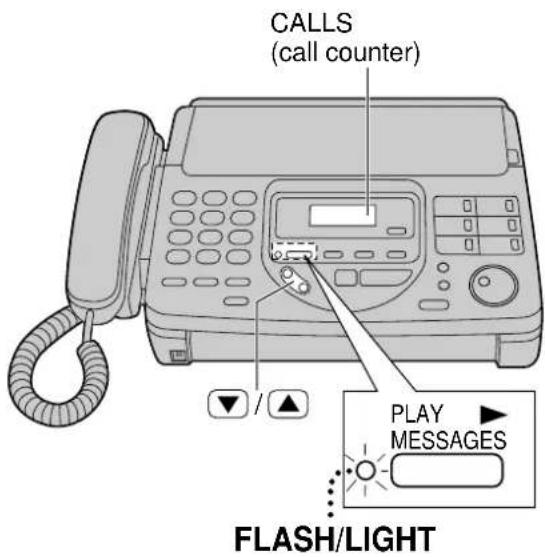
Voice time/day stamp
During playback, a synthesized voice will announce the time and day of the week when each message was recorded.
Erasing recorded messages
Erase unnecessary messages to prevent memory from becoming full.
Erasing a specific message
Press ERASE listening to the message you want to erase.
Erasing all the messages
- Press aERABEening to all of the messages.
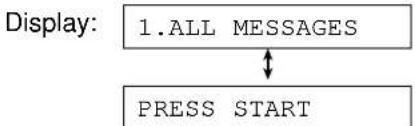
flowchart
graph TD
    A["1.ALL MESSAGES"] --> B["PRESS START"]
- Press .START/COPY/SET
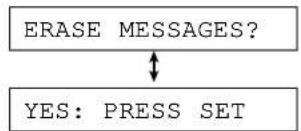
flowchart
graph TD
    A["ERASE MESSAGES?"] --> B{?}
    B --> C["YES: PRESS SET"]
• To stop, press STOP
- Press START/COPY/SET
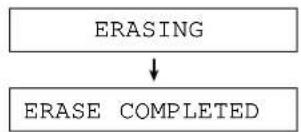
flowchart
graph TD
    A["ERASING"] --> B["ERASE COMPLETED"]
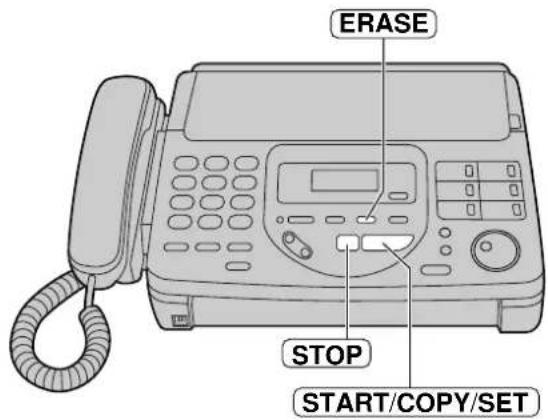
Functions while playing a message (repeating, skipping and stopping)
Repeating a message
Rotate EASYQIAL the left while listening to the message you want to repeat.
- If you rotate MEASYDALonds of the beginning of the message, the previous message will be played.
- To play back a specific message, rotate EASY DIAL to the left until you hear the message you want to repeat.
Skipping a message
Rotate EASYDIAL the right to play the next message.
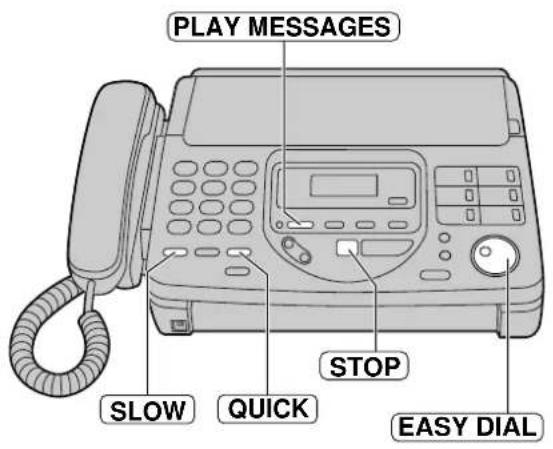
Changing the playback speed
Press tuple messages at one and a half times the original speed.
Press iSlow messages at half the original speed.
- To return to the original speed, press QUICK SLOW again during quick or slow playback.
Stopping playback
Press STOP
- To resume playing the recorded messages, press PLAY MESSAGES within 1 minute.
Memo message
(leaving a message for others or yourself)
To leave a private message for yourself or someone else, you can record a voice memo. This memo can be played back later, either directly or remotely.
1 Press RECORD
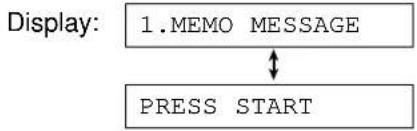
flowchart
graph TD
    A["1.MEMO MESSAGE"] --> B["PRESS START"]
Press START/COPY/SET.
• A long beep will sound.
MEMO RECORDING
3 Speak clearly about 20 cm away from the microphone.
4 When finished, press STOP
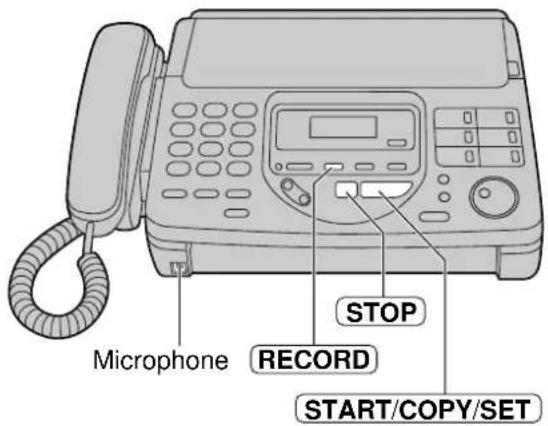
Telephone conversation
You can record a telephone conversation using the handset.
1 During the telephone conversation, press RECORD.
Display: 2WAY RECORDING
2 To stop recording, press STOP place the handset.
Note:
- This feature is not available when using the DIGITAL SP-PHONE button.
- There may be legal restrictions on recording two-way telephone conversations. Inform the other party that the conversation is being recorded.
- A beep sounds every 15 seconds to notify the caller that the conversation is being recorded.
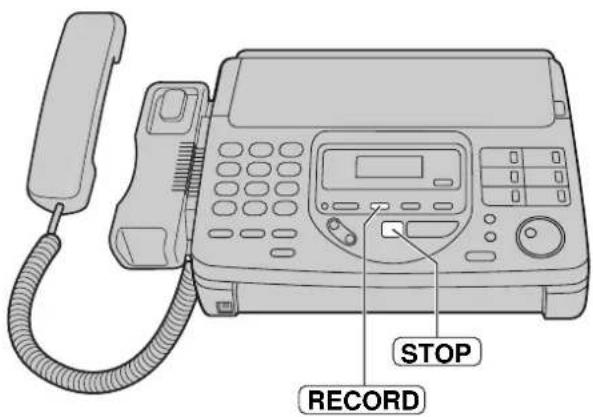
Operating from a remote location
The following operations can be performed from a remote location using a touch tone telephone.
Program the remote operation ID (see next page) and set the unit to the TAD/FAX mode before going out (p. 61).
| Dial Key | Remote command Page | |
| 0 | Skips the greeting message | 73 |
| 1 | Repeats a message | 71 |
| 2 | Skips a message | 71 |
| 4 | New message playback | 71 |
| 5 | All message playback | 71 |
| 7 | Re-records a greeting message | 72 |
| 8 | Continues operation | See note below |
| Dial Key | Remote command Page | |
| 9 | Stops re-recording of a greeting message | 72 |
| *4 | Erases a specific message | 72 |
| *5 | Erases all messages | 72 |
| 60 | Changes to the TEL mode | 73 |
| 61 | Turns message transfer/pager call for incoming messages ON | 73 |
| 62 | Turns message transfer/pager call for incoming messages OFF | 73 |
Note:
- During remote operation, the unit will stop and two beeps will be heard in the following conditions:
— 2 minutes 40 seconds after your unit answered.
— Every 2 minutes 40 seconds after pressing any command key.
To listen to further messages dial within 10 seconds after hearing the two beeps.
Remote operation card
Please cut out and carry this card for assistance when using the remote operation.
Answering Device Remote Operation
-
Call your unit.
-
Enter the remote operation ID □□□ during the greeting message.
- The new recorded messages will be played automatically. OR Wait 4 seconds, and all the recorded messages will be played back.
- Press the remote command key(s) (see reverse side) for further operations.
Notice of Remote Operation
- The remote operation is available only from a touch tone telephone when the unit is in the TAD/FAX mode.
- When the unit is in the TEL mode, call your unit and wait for 20 rings. The answering device will temporarily answer. Enter the remote operation ID during the greeting message. The unit will switch to the TAD/FAX mode.
• To send a document, press ✧ 9. When a fax tone is heard, start transmission. - Press keys firmly.
Remote Operation
Setting the remote operation ID
The remote operation ID is used to access the answering device.
Choose any 3-digit number except a number using digits 0 or 7.
1 Press MENU
Display: 1. SYSTEM SET UP
2 Press #then . 1 1
REMOTE TAD ID
3 Press START/COPY/SET
ID=111
4 Enter the desired number.
5 Press START/COPY/SET
6 Press MENU
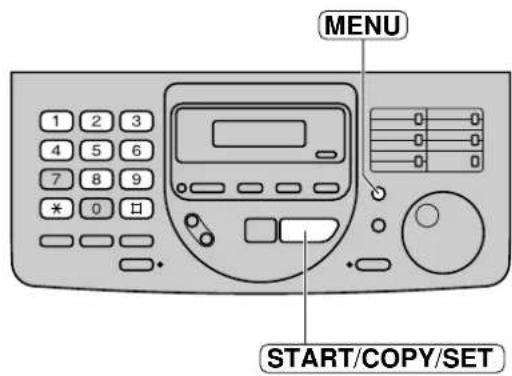
| Key | Remote command |
| 0 | Skips the greeting message |
| 1 | Repeats a message |
| 2 | Skips a message |
| 4 | New message playback |
| 5 | All message playback |
| 7 | Re-records a greeting message |
| 8 | Continues operation |
| Key | Remote command |
| 9 | Stops re-recording of a greeting message |
| *4 | Erases a specific message |
| *5 | Erases all messages |
| 60 | Changes to the TEL mode |
| 61 | Turns message transfer/pager call ON |
| 62 | Turns message transfer/pager call OFF |
From a remote touch tone telephone
Listening to recorded messages
1 Call your unit.
2 Enter the remote operation ID during the TAD/FAX greeting playback.
- The voice guide will tell you the number of new recorded messages and they will be played automatically.
- To repeat the new recorded messages, press 4
- To listen to all of the recorded messages, press 5.
Voice guide example:
3 new messages.
When there are no new recorded messages
The voice guide will be heard.
Press ☑ wait for 4 seconds to listen to all of the recorded messages.
No new messages.
When memory is full
The voice guide will be heard after playing the messages.
Erase some or all of the messages (p. 72).
Sorry, no more memory.
Please erase unnecessary messages.
During playback
Repeating a message
Press to play the current message.
- If you press within 5 seconds of the beginning of a message, the previous message will be played.
Skipping a message
Press .2
Remote Operation
Erasing incoming messages from memory
Erasing a specific message
Press while listening to the message you want to erase.
- A long beep and the voice guide will be heard. The unit will continue with the next message.
Erasing all messages
Press to erase all messages.
- A long beep and the voice guide will be heard.
Other remote operations
Recording a marker message
After playing back the recorded messages, you can leave an additional message.
- Wait for the voice guide to tell you that the remote operation has ended.
- Wait about 10 seconds for the voice guide to prompt you to leave a message.
- Leave a message after the beep.
Re-recording a greeting message
You can change the contents of the greeting message for the TAD/FAX mode.
- Press to start recording.
- A long beep will sound.
- Speak clearly for up to 16 seconds.
- If you pause for over 2 seconds, 6 beeps will sound and the recording will stop. Repeat from step 1 within 10 seconds.
- When finished, press 9
- The new greeting message will be played.
Voice guide example:
The message has been erased.
All messages have been erased.
All messages have been played.
Please leave your name and message after the beep.
Skipping the greeting message
Press ☐ during the greeting message playback.
- The unit will skip the rest of the greeting message.
Turning the message transfer/pager call on or off
You must pre-program a transfer telephone number or a pager number (p. 75) before using this feature.
Press t6 turn the message transfer/pager call ON.
Press 16 to 2n the message transfer/pager call OFF.
- If a transfer telephone number or a pager number is not programmed, you cannot turn this feature ON. The voice guide will prompt you.
Voice guide example:
Message transfer is set. Transfer phone number is 123456789.
or
Pager call is set. Pager number is 120255511234
Message transfer is off.
or
Pager call is off.
Transfer phone number is not set.
or
Pager number is not set.
Changing the receive mode to the TEL mode
Press t6 change the setting of the receive mode from TAD/FAX to TEL.
- You cannot return to the TAD/FAX mode in the same call. To return to the TAD/FAX mode, see below.
Returning the receive mode to the TAD/FAX mode
You can change the setting of the receive mode from TEL to TAD/FAX from a remote location.
- Call your unit and wait for 20 rings.
- The answering device will temporarily answer the line.
- Enter the remote operation ID during the greeting message.
- Your unit will switch to the TAD/FAX mode.
Transferring recorded messages to another telephone
This feature allows your unit to call a designated telephone or pager number each time an incoming voice message is recorded.
You can choose Message transfer or Pager call.
Message transfer: First program the transfer telephone number. When an incoming message is recorded in your unit, the message will be transferred. You can retrieve the message during the same call using the remote operation.
Pager call: First program the pager number. When an incoming call is recorded, your pager will be called. Call your unit and retrieve the message using the remote operation.
- This feature operates in the TAD/FAX mode.
- For details on the remote operation, see page 69.
- Use a touch tone telephone to access your unit.
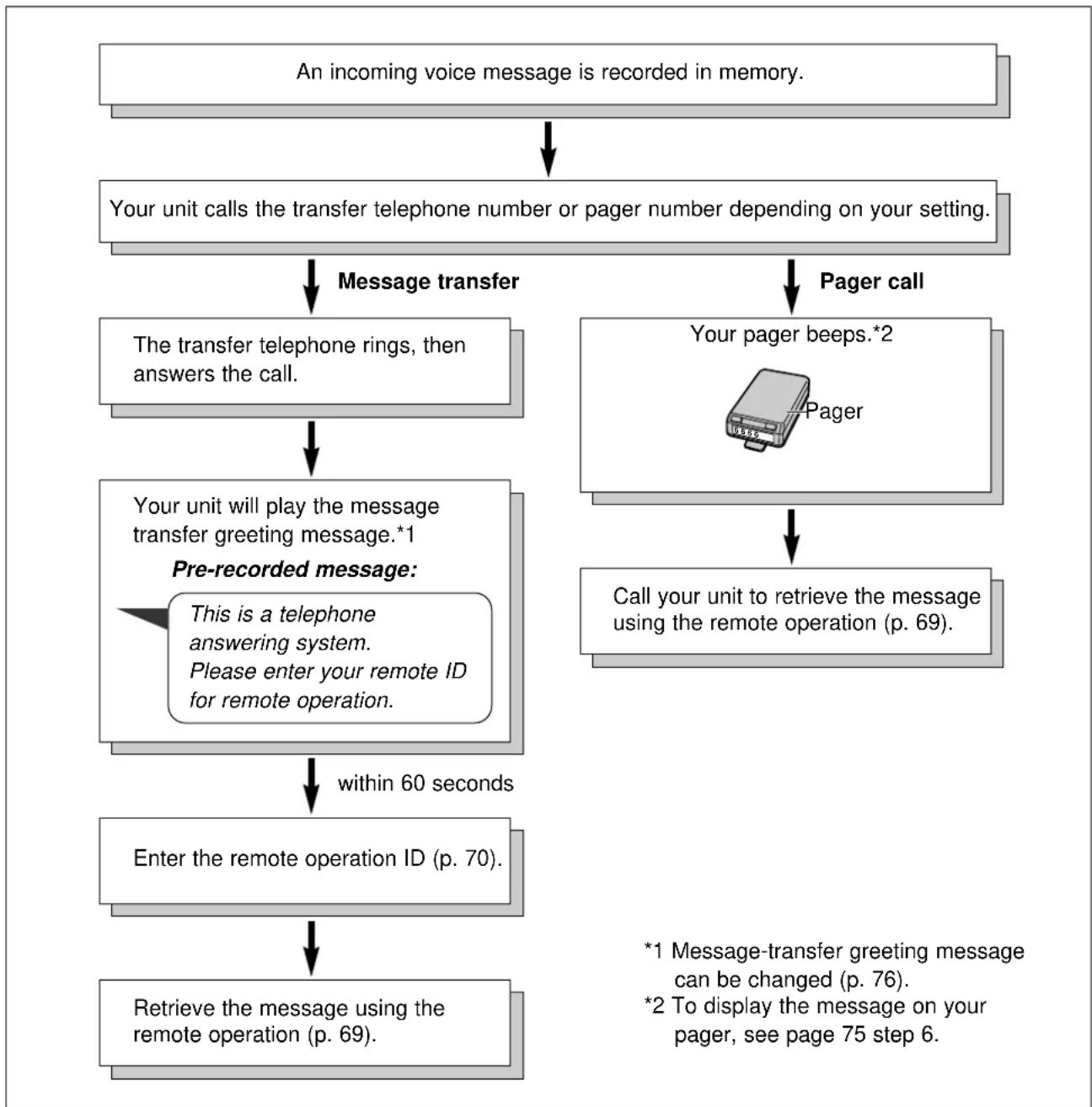
flowchart
graph TD
    A["An incoming voice message is recorded in memory."] --> B["Your unit calls the transfer telephone number or pager number depending on your setting."]
    B --> C["Message transfer"]
    B --> D["Pager call"]
    C --> E["The transfer telephone rings, then answers the call."]
    E --> F["Your unit will play the message transfer greeting message.*1"]
    F --> G["Pre-recorded message: This is a telephone answering system. Please enter your remote ID for remote operation."]
    G --> H["within 60 seconds"]
    H --> I["Enter the remote operation ID (p. 70)."]
    I --> J["Retrieve the message using the remote operation (p. 69)."]
    D --> K["Your pager beeps.*2"]
    K --> L["Call your unit to retrieve the message using the remote operation (p. 69)."]
    style A fill:#f9f,stroke:#333
    style B fill:#ccf,stroke:#333
    style C fill:#cfc,stroke:#333
    style D fill:#fcc,stroke:#333
    style E fill:#ffc,stroke:#333
    style F fill:#cff,stroke:#333
    style G fill:#ffc,stroke:#333
    style H fill:#cfc,stroke:#333
    style I fill:#cfc,stroke:#333
    style J fill:#cfc,stroke:#333
    style K fill:#fcc,stroke:#333
    style L fill:#fcc,stroke:#333
Setting the message transfer/pager call
1 Press MENU
Display: 1. SYSTEM SET UP
2 Press ☐ then . 6 0
MESSAGE TRANS.
3 Press START/COPY/SET
MODE=OFF ▼▲
4 Press ▼ to select the desired setting.
MESSAGE: transfer incoming messages.
PAGER: calls your pager.
OFF: turns off this feature.
5 Press START/COPY/SET
NO.=
6 If you selected "MESSAGE" in step 4:
Enter the transfer telephone number.
If you selected "PAGER" in step 4:
Enter your pager number.
- You can enter a total of 46 digits and/or pauses.
Example:
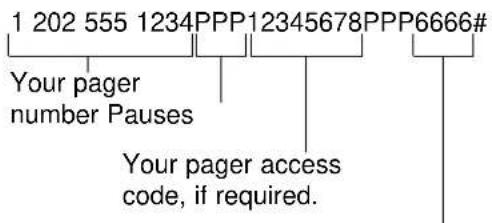
Message you want displayed on your pager when your unit receives a voice call.
7 Press START/COPY/SET
SETUP ITEM [ ]
8 Press MENU
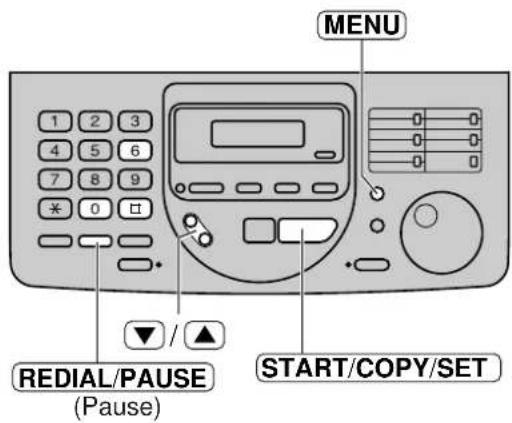
Note:
- This feature can be turned on/off remotely from a touch tone telephone (p. 73).
Recording a message-transfer greeting message
You can record your own greeting message.
The recording time is limited to 16 seconds. Record your message within 12 seconds for best performance.
Suggested message
| Message transfer greeting message | “This is a transferred message from (your name, business and/or telephone number). Please enter your remote ID for the remote operation.” |
Note:
- If you do not record a message, the pre-recorded message will be played (p. 74).
1 Press MENU
Display: 1. SYSTEM SET UP
2 Press #then . 6 1
TRNS-GREETING
3 Press START/COPY/SET
CHECK ▼▲
4 Press ▼ to select "RECORD".
RECORD ▼▲
5 Press START/COPY/SET
TRNS REC. 16s
6 Speak clearly about 20 cm away from the microphone.
- The display will show the remaining recording time.
Example: TRNS REC. 15s
7 When finished recording, press STOP • The unit will repeat your message. You can adjust the volume using ▼
8 To exit the program, press MENU
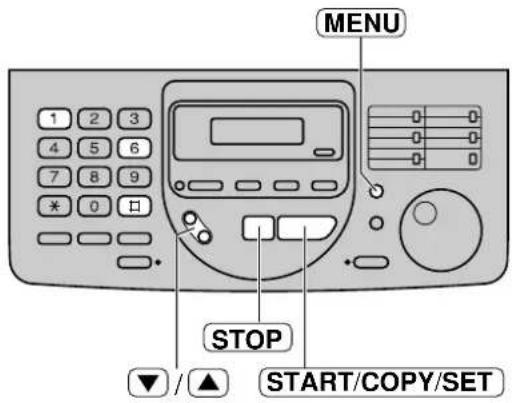
To check your message
-
Press MENU #6 1 START/COPY/SET.
-
Press o▼ to select "CHECK" on the display.
-
Press START/COPY/SET
• The unit will play your message.
- To exit the program, press MENU
To erase your message
-
Press MENU #6 1 START/COPY/SET.
-
Press ▼ to select "ERASE" on the display.
-
Press START/COPY/SET
- Your own message will be erased.
- To exit the program, press .MENU
- The pre-recorded greeting message will be played when transferring a call.
Ring count in the TAD/FAX mode
This feature determines the number of rings before the unit answers a call in the TAD/FAX mode.
You can choose from 1, 2, 3, 4, TOLL SAVER or RINGER OFF.
TOLL SAVER: When you call the unit from a remote location, the number of rings will tell you if there are any new voice messages. If the unit answers on the second ring, there is at least one new recorded message. If the unit answers on the fourth ring, there are no new recorded messages. To save the toll charges for the call, hang up immediately when you hear the third ring. The third ring indicates that there are no new recorded messages.
RINGER OFF: The unit will answer without ringing.
Helpful hints:
• To answer a call before the unit does, increase the number of rings.
- If you have difficulty receiving faxes from machines that have an automatic transmission feature, decrease the number of rings.
1 Press MENU
Display: 1.SYSTEM SET UP
2 Press ☐ then . 0 6
TAD/FAX RING
3 Press START/COPY/SET
RING=2 ▼▲
4 Press ▼ to select the desired setting.
5 Press START/COPY/SET
SETUP ITEM [ ]
6 Press MENU
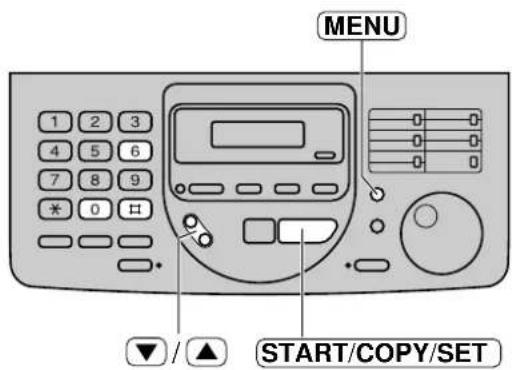
Note:
- Two rings may be referred to as "NORMAL", as it enables the unit to answer incoming calls in a reasonably short time. This position should be selected unless you specifically wish to take advantage of the "toll saver facility".
- Callers generally expect their calls to be answered within 10 seconds and most callers would abandon a call in under 45 seconds if no reply is obtained. This unit will answer incoming calls in under 10 seconds if required.
Incoming message recording time
You can choose from two recording times for incoming messages.
LONG: The unit will record an incoming message of up to 2 minutes 30 seconds (pre-selected setting).
SHORT: The unit will record each incoming message up to 1 minute.
![1 Press MENU Display: 1.SYSTEM SET UP 2 Press #then . 1 0 RECORDING TIME 3 Press START/COPY/SET MODE=LONG ▼▲ 4 Press ▼ to select the desired setting. 5 Press START/COPY/SET SETUP ITEM [ ] 6 Press MENU](/content/2026/06/1190726/images/1b8d38e002ec249387d06e466ba96531c1eb489b2035fa2b175ccb0698757f81.jpg)
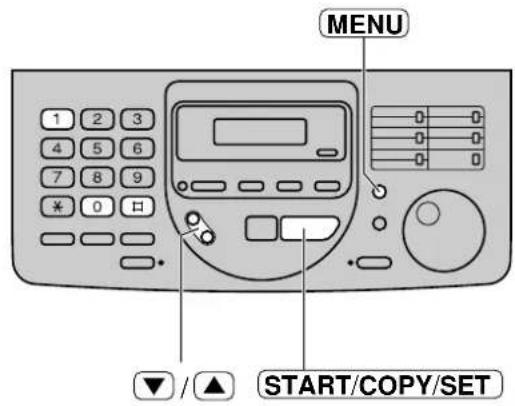
Message alert (beeps when a voice message is received)
When this feature is on, the unit will let you know with slow beeps that a caller's message has been recorded.
![1 Press MENU Display: 1.SYSTEM SET UP 2 Press then . 4 2 MESSAGE ALERT 3 Press START/COPY/SET MODE=OFF ▼▲ 4 Press ▼ to select "ON". MODE=ON ▼▲ • If this feature is not required, select "OFF". 5 Press START/COPY/SET SETUP ITEM [ ] 6 Press MENU](/content/2026/06/1190726/images/741f865765d00fe3651c36c20aaba3b3cff40afea9d10a5304c0f39377605bd0.jpg)
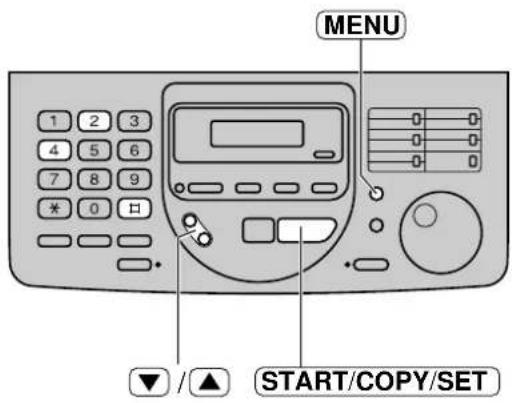
Recording time alert \_\_\_\_ (beeps when memory is almost full)
When there is less than 60 seconds of recording time for incoming messages, the unit will alert the user with slow beeps.
![1 Press MENU Display: 1.SYSTEM SET UP 2 Press then . 4 3 REC. TIME ALERT 3 Press START/COPY/SET MODE=OFF ▼▲ 4 Press to select "ON". MODE=ON ▼▲ • If this feature is not required, select "OFF". 5 Press START/COPY/SET SETUP ITEM [ ] 6 Press MENU](/content/2026/06/1190726/images/155736a4db59a6bb3bd44902c3def3fb7e694a6939abf492cccb212d8c31aa9a.jpg)
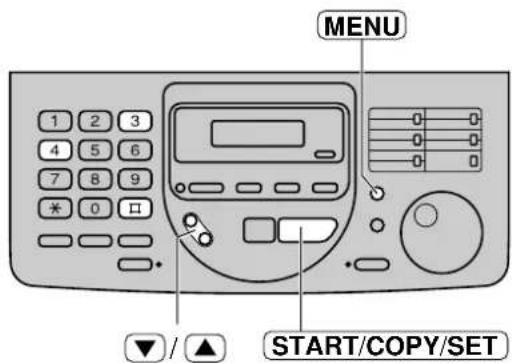
Setting the ICM monitor
When a call is received with the answering device, the incoming messages (ICM) will be heard from the speaker during the call. If you do not want the messages to be heard by other persons who share your unit, set this feature to "OFF".
![1 Press MENU Display: 1.SYSTEM SET UP 2 Press then . 6 7 ICM MONITOR 3 Press START/COPY/SET . MODE=ON ▼▲ 4 Press ▼ to select the desired setting. • If this feature is required, select "OFF". 5 Press START/COPY/SET SETUP ITEM [ ] 6 Press MENU](/content/2026/06/1190726/images/74c905fd21dfb37eafe1a0e088b3daed6dcc5696bc3340731311e346a71081a1.jpg)
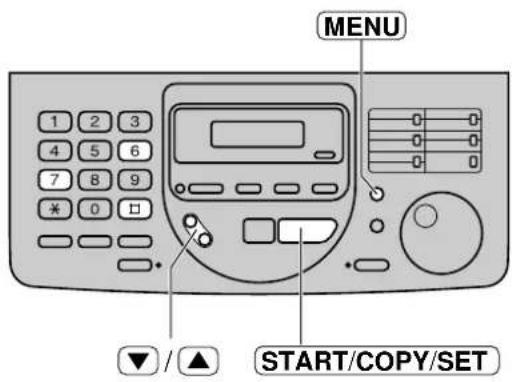
Reports
If your unit cannot send a fax, first check the following items.
- The number you dialled is correct.
- The other party's machine is a facsimile.
If the problem remains, correct it by following the communication message printed on the transmission or journal report (p. 43, 44).
| Communication message | Error code | Cause & Remedy |
| COMMUNICATION ERROR | 41-72 FF | A transmission or reception error occurred. Try again or check with the other party. |
| DOCUMENT JAMMED | — | The document is jammed. Remove the jammed document (p. 86). |
| ERROR-NOT YOUR UNIT | 54, 59 70 | A transmission or reception error occurred because of a problem with the other party's fax machine. Check with the other party. |
| MEMORY FULL | — | The document was not received due to memory being full. |
| NO DOCUMENT | — | The document was not fed into the unit properly. Reinsert the document and try again. |
| OTHER FAX NOT RESPOND | — | The other party's fax machine was busy or ran out of recording paper. Try again.The document was not fed properly. Reinsert the document and try again.The other party's fax machine rings too many times. To send a fax manually, dial the number, confirm the fax tone, and press the START/COPY/SET button.The other party's machine is not a facsimile. Check with the other party.The number you dialled is not in service. |
| PAPER JAMMED | — | The recording paper is jammed. Clear the jammed paper (p. 85). |
| PAPER OUT | — | The unit ran out of recording paper. Install a recording paper roll (p. 22). |
| PRESSED THE STOP KEY | — | The STOP was pressed and fax communication was cancelled. |
| PRINTER OVERHEATED | — | The printer overheated. Let the unit cool down. |
| THE COVER WAS OPENED | — | The cover was opened. Close it and try again. |
| OK | — | Fax communication was successful. |
LCD display
If the unit detects a problem, one or more of the following messages will appear on the display.
| Display message Cause & Remedy | |
| CALL SERVICE | There is something wrong with the unit. Contact our service personnel. |
| CHECK COVER | The cover is open. Close it. |
| CHECK CRADLE | The handset and handset cradle have been removed.— When using the handset and cradle, make sure that the handset is installed correctly (p. 21).— When not using them, set the handset switch to “NO HANDSET” (p. 92). Disconnect and reconnect the power cord. |
| CHECK DOCUMENT | The document is not fed into the unit properly. Reinsert the document. If misfeeding occurs frequently, clean the document feeder rollers (p. 87) and try again. If the problem remains, adjust the feeder pressure (p. 86)Attempted to transmit a document longer than 600 mm. Press the STOP button to remove the document. Divide the document into two or more sheets and try again. |
| CHECK MEMORY | Memory (telephone numbers, parameters etc.) has been erased. Re-program. |
| DIRECTORY FULL | There is no space to store new stations in the EASY DIAL directory. Erase unnecessary stations (p. 36). |
| FAX IN MEMORY | The unit has a document in memory. See the other displayed message instructions to print out the document. |
| MEMORY FULL | There is no room left in memory to record a voice message. Erase some or all of the messages (p. 66, 72).The memory is full of received documents due to a lack of recording paper, recording paper jam etc. Install a new recording paper roll (p. 22), or clear the jammed paper (p. 85). |
| NO RESPONSE | The other party's fax machine is busy or has run out of recording paper. Try again. |
| OUT OF PAPER | The unit has run out of recording paper. Install recording paper (p. 22). |
| PAPER JAMMED | The recording paper is jammed. Clear the jammed paper (p. 85). |
| POLLING ERROR | The other party's fax machine does not have a polling feature. Check with the other party. |
| REDIAL TIME OUT | The other party's fax machine is busy or has run out of recording paper. Try again. |
| REMOVE DOCUMENT | The document is jammed. Remove the jammed document (p. 86). |
| TRANSMIT ERROR | A transmission error occurred. Try again. |
| UNIT OVERHEATED | The unit is too hot. Let the unit cool down. |
Operations
When a function does not work, check here before requesting help
General
| Problem Cause & Remedy | |
| I cannot make and receive calls. | The mains lead or telephone line cord is not connected. Check the connections (p. 23). |
| I cannot make calls. | The dialling mode setting is wrong. Change to “TONE” or “PULSE” (p. 23). |
| The unit does not work. | Disconnect the unit from the telephone line and connect the line to a known working telephone. If the working telephone operates properly, contact our service personnel to have the unit repaired. If the working telephone does not operate properly, contact your telephone company. |
| The unit does not ring. | The ringer volume is off. Adjust it to a suitable level (p. 29). |
| The other party complains they only hear a fax tone and cannot talk. | The FAX ONLY mode is set. Tell them the number is only used for faxes or change to another receive mode (p. 48, 49). |
| The speakerphone is not working. | Use the speakerphone in a quiet room.If you have difficulty hearing the other party, adjust the volume using the ▼ button▲If parts of your conversation are cut off, you and the other party are speaking at the same time. Speak alternately. |
| The REDIALD&USE not function properly. | If this button is pressed during dialling, a pause will be inserted. If pressed immediately after a dial tone is obtained, the last number dialled will be redialled. |
| During programming, I cannot enter the code or ID number. | All or part of their numbers are the same. Change the numbers (p. 51, 70). |
Fax - sending
| Problem Cause & Remedy | |
| I cannot send documents. | The other party's fax machine is busy or has run out of paper. Try again.The other party's machine is not a facsimile. Check with the other party.The other party's fax machine rings too many times. Send the fax manually – dial the number, confirm the fax tone, then press the START/COPY/SET button. |
| The other party complains that letters on their received document are distorted. | If your line has special telephone services such as call waiting, the service may have been activated during fax transmission. Connect the unit to a line that does not have these services.The extension telephone on the same line is off the hook. Hang up the extension telephone and try again. |
| The other party complains that dirty patterns or black lines appear on their received documents. | The glass or rollers are dirty. Clean them (p. 87). |
| I cannot make an international fax call. | Use the overseas transmission mode (p. 47).Add two pauses at the end of the telephone number (p. 32).Dial the number manually. |
Fax – receiving
| Problem Cause & Remedy | |
| I cannot receive documents automatically. | The receive mode is set to the TEL mode. Set to one of the other modes.The time taken to answering the call is too long. Decrease the number of rings (p. 53, 57, 77).The greeting message is too long. Shorten the message (p. 63). |
| The display shows “CONNECTING” but faxes are not received. | The incoming call is not a fax. Change the receive mode to the TEL or TAD/FAX mode. |
| The recording image is faint. | The sender transmitted a faint document. Ask them to transmit a clearer copy of the document. |
| The received document is blank. | The recording paper roll is installed incorrectly. Make sure that the shiny side of the paper is facing down and re-install the paper (p. 22). |
Operations
Receive mode
| Problem Cause & Remedy | |
| I cannot select the desired receive mode. | ·If you want to set the TAD/FAX or FAX ONLY mode:– Select the desired mode using feature #05 (p. 52), and– Press auto/receive TO RECEIVE light.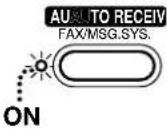 ·If you want to set the TEL or TEL/FAX mode:– Select the desired mode using feature #08 (p. 56), and– Press auto/receive TO RECEIVE light. ·If you want to set the TEL or TEL/FAX mode:– Select the desired mode using feature #08 (p. 56), and– Press auto/receive TO RECEIVE light.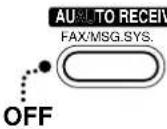 |
Copying
| Problem Cause & Remedy | |
| The unit does not make a copy. | You cannot make a copy while programming. Make a copy after programming or stop programming. |
| A dirty pattern or a black line appears on the copied documents. | The glass or rollers are dirty. Clean them (p. 87). |
| The copied document is blank. | The recording paper roll is installed incorrectly. Make sure that the shiny side of the paper is facing down and re-install the paper (p. 22). |
Answering device
| Problem Cause & Remedy | |
| No voice messages have been recorded in the TAD/FAX mode. | The memory is full. Erase some or all of the messages (p. 66, 72). |
| I cannot retrieve recorded messages from a remote telephone. | Make sure that you use the remote operation ID correctly (p. 70). |
If a power failure occurs
• The unit will not function.
• The memory contents will not be erased.
- Fax transmission and reception will be interrupted.
- If delayed transmission is programmed and the start time has passed during a power failure, transmission will be attempted soon after power is restored.
Recording paper jam
If the unit does not eject any recording paper during reception or copying, the recording paper has jammed. Remove the jammed paper.
1 Open the back lid by lifting up the tabs located on both sides.
2 Press the green lever to release the paper cutter.
2 Pull up the transparent guide.
- If the transparent guide is not pulled up, press the green lever again.
4 Remove the jammed recording paper.
5 Cut off the wrinkled portion.
6 Replace the transparent guide and install the recording paper.
• Make sure that the shiny side of the paper is facing down.

correct

incorrect
7 Insert the leading edge of the paper between the recording paper roller and the silver plate.
- Make sure that there is no slack in the paper roll.
8 Close the back lid securely by gently pressing down on both ends.
- A message will be printed on the recording paper.
- If the recording paper is set to the wrong side, the message will not be printed. Install the paper correctly.
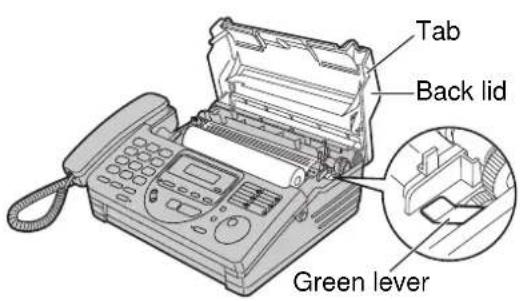
Transparent guide
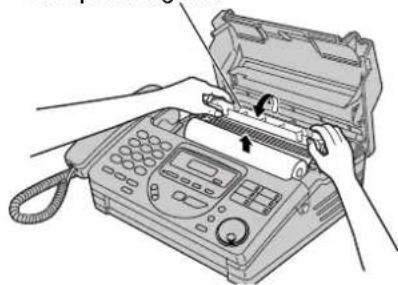
natural_image
Illustration of hands operating a lathe machine with a paper roll, no text or symbols present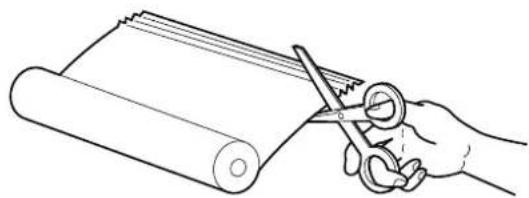
natural_image
Line drawing of a hand cutting a rolled document with scissors (no text or symbols)Recording paper roller
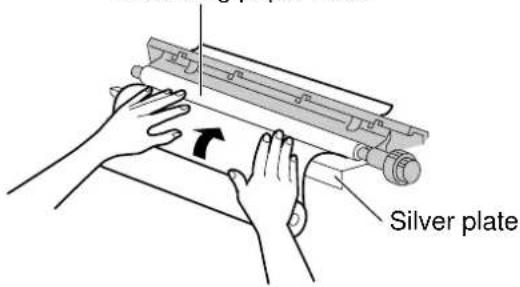
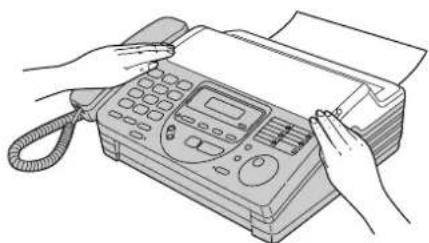
natural_image
Line drawing of hands operating a landline telephone with a paper sheet (no text or symbols visible)Sending document jam
If the unit does not release the document during feeding, remove the jammed document.
1 Open the front lid by pressing the front lid open button.
2 Carefully remove the jammed document.
3 Close the front lid securely by pressing down on both ends.
Note:
- Do not forcibly pull out the jammed paper before opening the cover.
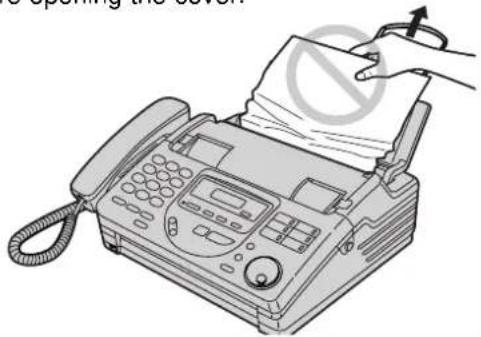
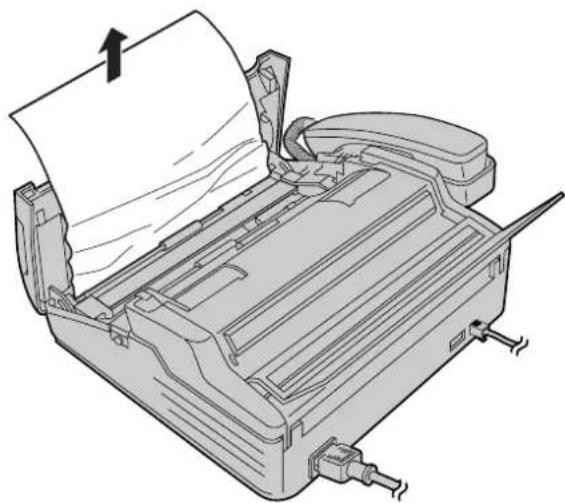
natural_image
Technical line drawing of a printer or printer with paper spread and internal structure (no text or symbols)Sending document does not feed, or multi-feeds
If no feeding or multiple feeding occurs frequently, adjust the feeder pressure.
1 Open the front lid by pressing the front lid open button.
2 Shift the position of the lever using an instrument with a pointed end, like a paper clip.
Position A: When documents do not feed.
Position B: Standard position (pre-selected)
Position C: When documents multiple feed.
3 Close the front lid securely by pressing down on both ends.
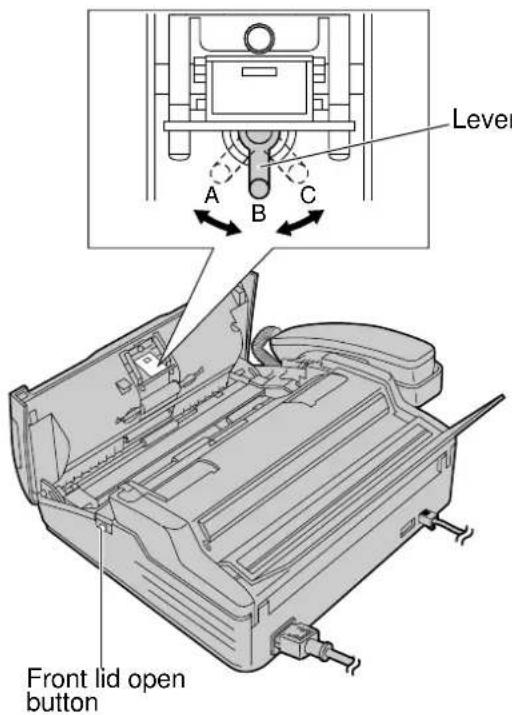
Document feeder
If misfeeding frequently occurs or if dirty patterns or black bands appear on a copied or transmitted document, clean the document feeder.
1 Disconnect the mains lead and the telephone line cord.
2 Open the front lid by pressing the front lid open button.
3 Clean the document feeder rollers, sub roller and rubber flap with a cloth moistened with isopropyl rubbing alcohol, and let all parts dry thoroughly.
4 Clean the white plate and glass with a soft dry cloth.
5 Close the front lid securely by pressing down on both ends.
6 Connect the mains lead and the telephone line cord.
Caution:
- Do not use paper products, such as paper towels or tissues, to clean the inside of the unit.
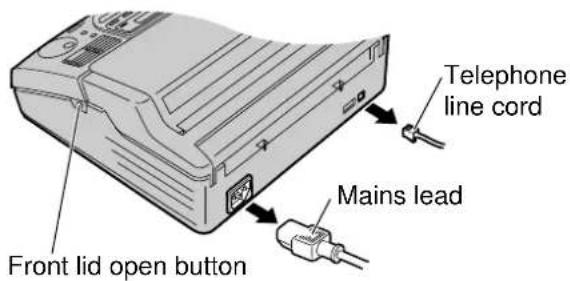
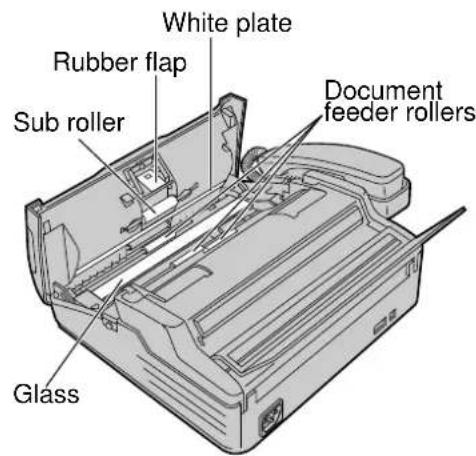
Print Reports
Printing the feature settings, telephone numbers, and journal
You can print out the following report and lists.
Basic feature list: provides you with the current settings of the basic programming features (p. 99).
Advanced feature list: provides you with the current settings of the advanced programming features (p. 100, 101).
Telephone number list: provides you with names and telephone numbers which are stored in the One-Touch Dial keys and the EASY DIAL directory. The telephone number codes are as shown below.
P: A pause has been entered.
F: A recall has been entered.
[ ]: A secret telephone number has been entered. (The telephone number is not printed.)
Journal report: keeps record of fax transmissions and receptions. This report will be printed automatically after every 35 fax communications (p. 44).
1 Press MENU
Display: 2.PRINT LIST
2 For the basic feature list, press ☐then . 1
BASIC LIST
For the advanced feature list, press 📋 then . 2
ADVANCED LIST
For the telephone number list, press ,then . 3
TEL NO. LIST
For the journal report, press #then . 4
JOURNAL REPORT
3 Press START/COPYSET
PRINTING
• To stop printing, press STOP
• After printing, the following will be displayed.
PRINT ITEM [ ]
4 Press MENU
Note:
- In step 2, you can select the desired item by rotating EASY DIAL.
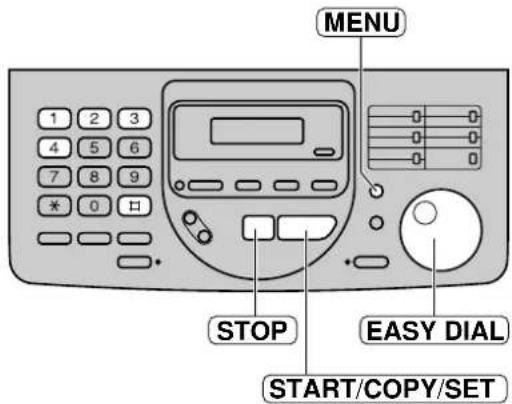
LCD display contrast
Use this feature to adjust the display contrast.
NORMAL: (Pre-selected setting)
LIGHT: Used when the display contrast is too dark.
DARKER: Used when the display contrast is too light.
![1 Press MENU Display: 1.SYSTEM SET UP 2 Press then . 3 9 LCD CONTRAST 3 Press START/COPY/SET MODE=NORMAL ▼▲ 4 Press ▼ to select the desired setting. 5 Press START/COPY/SET SETUP ITEM [ ] 6 Press MENU](/content/2026/06/1190726/images/de1178897119560b217284631f461f54ead92f6968698180e8decec0f96d45a5.jpg)
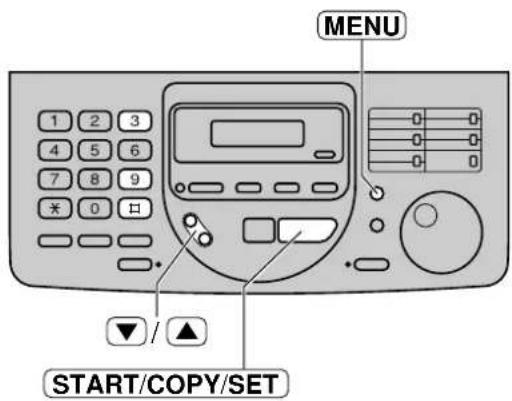
Recall mode
When this unit is used as an extension of a PABX (Private Automatic Branch Exchange), the RECALL button will allow access to PABX functions such as call transfer and hold.
Depending on your PABX, select one of the following:
T-BR: Time Break Recall (pre-selected setting)
E-RE: Earth Recall
- For British Telecom "Star Services", set to Time Break Recall.
- If you are not sure of which setting to use, consult the supplier of the PABX.
![1 Press MENU Display: 1.SYSTEM SET UP 2 Press then . 3 5 RECALL MODE 3 Press START/COPY/SET MODE=T_BR ▼▲ 4 Press ▼ to select the desired setting. 5 Press START/COPY/SET SETUP ITEM [ ] 6 Press MENU](/content/2026/06/1190726/images/013bfacab1249f70dfce221d2bb2039c7b129f8e2857e877af32334c892539f6.jpg)
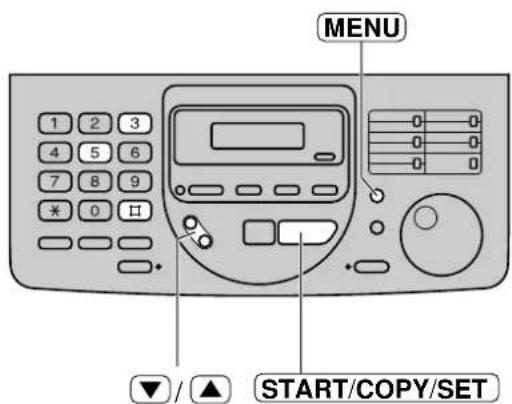
Original Mode
Original mode
Use this feature when you need to transmit or copy a document with faint or dark writing.
The following choices are available:
NORMAL: Used for a document with normal writing (Pre-selected setting).
LIGHT: Used for a document with faint writing.
DARKER: Used for a document with dark writing.
Set this feature before starting transmission or copying.
1
Press MENU
Display:
- SYSTEM SET UP
2
Press □ then . 5 8
ORIGINAL
3
Press START/COPY/SET
MODE=NORMAL

4
Press ☑ to select the desired setting.
5
Press START/COPY/SET
SETUP ITEM [ ]
6
Press MENU
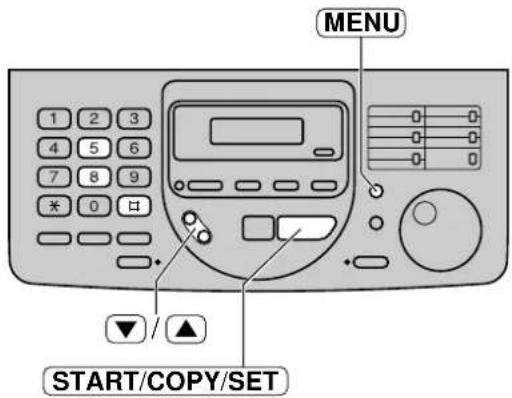
Note:
- This feature will return to the normal mode after transmission or copying is completed.
- These settings are available in the standard, fine and super fine resolutions.
Fax voice guidance
You will hear the following voice guidance if this feature is set to on.
Fax transmission start:
Start transmission.
Fax transmission result:
Transmission is complete. Transmission has failed. Transmission has been interrupted.
Fax reception start:
Start reception.
Fax reception result:
Reception is complete.
Reception has failed.
Reception has been interrupted.
If friendly reception (p. 50, 58) is activated, the following messages will also be heard.
Please hang up the handset for reception. Start reception.
The following choices are available.
ON: The voice guidance will be heard after every transaction (pre-selected setting).
OFF: The voice guidance will not be heard.
ERROR: The voice guidance will be heard only when fax transmission or reception fails.
1 Press MENU
Display: 1.SYSTEM SET UP
2 Press ☐ then . 4 7
FAX GUIDANCE
3 Press START/COPY/SET
MODE=ON ▼▲
4 Press ▼ to select the desired setting.
5 Press START/COPY/SET
SETUP ITEM [ ]
6 Press MENU
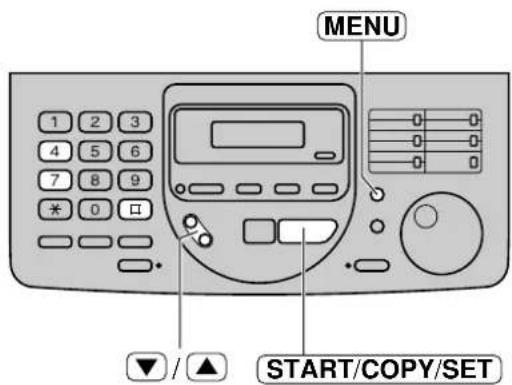
Using the unit without handset and cradle
To save space or to use the unit mainly for faxes, you can use the unit without the handset and cradle. Set the handset switch setting to "NO HANDSET" and remove the handset and cradle.
Setting the handset switch
USE HANDSET: When using the handset and handset cradle (pre-selected setting).
NO HANDSET: When not using the handset and handset cradle.
![1 Press MENU Display: 1.SYSTEM SET UP 2 Press #then . 8 9 HANDSET SWITCH 3 Press START/COPY/SET USE HANDSET ▼▲ 4 Press ▼ to select "NO HANDSET". NO HANDSET ▼▲ 5 Press START/COPY/SET SETUP ITEM [ ] 6 Press MENU](/content/2026/06/1190726/images/189da6b9e711a5f2d758f24c6cffae8cf166cdba5f003ebbb9e84b0a33dc4221.jpg)
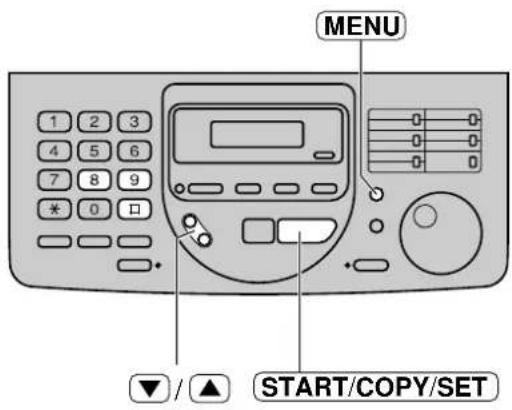
Removing the handset cradle
1 Open the front lid and back lid.
2 While pulling back the hooks as shown, lift up the handset cradle.
3 Close the lids securely.
4 Remove the handset and handset cord.
5 Disconnect and connect the mains lead again.
Note:
- If an alarm sounds and the following message is displayed, make sure the handset switch setting is set to "NO HANDSET".
CHECK CRADLE
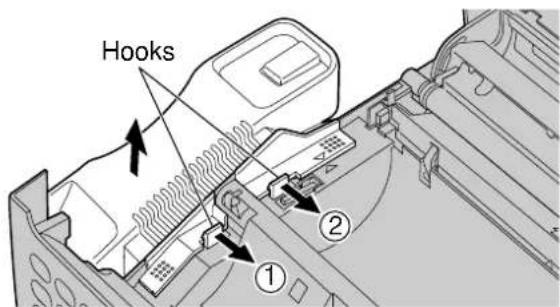
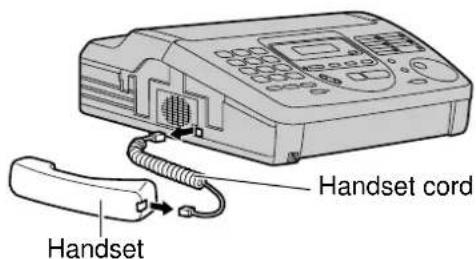
Resetting the advanced features
Use this feature to return the advanced features (p. 100–101) to their pre-selected settings.
![1 Press MENU Display: 1.SYSTEM SET UP 2 Press #then . 8 0 SET DEFAULT 3 Press START/COPY/SET RESET=NO ▼▲ 4 Press o▼ to select "YES". RESET=YES ▼▲ 5 Press START/COPY/SET RESET OK? • If this feature is not required, press STOP 6 Press START/COPY/SET on. RESET COMPLETED ↓ SETUP ITEM [ ] 7 Press MENU](/content/2026/06/1190726/images/f7091131bf4948c6e230055fab53f3433cfc715aa99bb554e0c43389b01c8714.jpg)
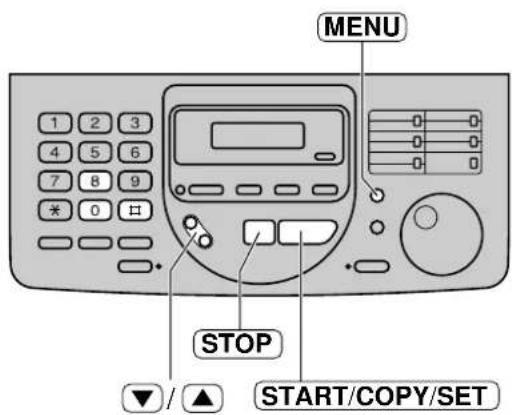
Technical data about this product
Applicable Lines: Public Switched Telephone Network
Document Size: Max. 216 mm in width
Max. 600 mm in length
Effective Scanning Width: 208 mm
Printing Paper Size: 210 mm · max. 50 m roll
Effective Printing Width: 208 mm
Transmission Time*: Approx. 15 s/page (Original mode)
Approx. 30 s/page (G3 Normal mode)
Scanning Density: Horizontal: 8 pels/mm
Vertical: 3.85 lines/mm —Standard mode
7.7 lines/mm —Fine/Half tone mode
15.4 lines/mm —Super fine mode
Halftone Level: 64-level
Scanner Type: CCD image sensor
Printer Type: Thermal Printing
Data Compression System: Modified Huffman (MH), Modified READ (MR)
Modem Speed: 9,600 / 7,200 / 4,800 / 2,400 bps; Automatic Fallback
Operating Environment: 5 – 35 °C, 45 – 85 % RH (Relative Humidity)
Mass (Weight): Approx. 3.7 kg
Power Consumption: Standby: Approx. 6.5 W
Transmission: Approx. 16 W
Reception: Approx. 23 W (When receiving the CCITT No.1 Test Chart)
Copy: Approx. 32 W (When copying the CCITT No.1 Test Chart)
Maximum: Approx. 120 W
Power Supply: 220 - 240 V AC, 50 Hz
Memory Capacity**: Voice memory: Approx. 18 minutes of recording time including the greeting message***
Fax memory: Approx. 13 pages of memory reception
(Based on the CCITT of No. 1 Test Chart in standard resolution.)
* Transmission speed depends upon the contents of the pages, resolution, telephone line conditions and capability of the other party's machine.
The 15 second speed is based upon the CCITT No. 1 Test Chart on the condition that memory transmission is performed.
** If both fax documents and voice messages are recorded in memory, the corresponding capacities above will be shortened.
*** Recording time may be reduced by the calling party's background noise.
CCITT No. 1 Test Chart
Note:
- Any details given in these instructions are subject to change without notice.
- The pictures and illustrations in these instructions may vary slightly from the actual product.
Important information
APPROVED for connection to telecommunication systems specified in the instructions for use subject to the conditions set out in them.
609752
The connection to the telecommunication systems must not be hard wired and must be unplugged before the earth is disconnected.
Method of connection
This apparatus is connected to the exchange line or PABX/PMBX extension by the new standard British Telecom plug and socket. Arrangements for provision of this type of termination can be made through the nearest British Telecom Sales Office.
This apparatus may be connected to the following types of installation. This apparatus has been approved for use under the following conditions;
a) For connection to the public switched telephone network (PSTN) and compatible (Private Branch Exchange), which use loop disconnect signalling and DTMF signalling. (Please consult your supplier for an up to date list of compatible PBX's).
b) The apparatus can be used on extension sockets connected to a direct exchange line (D.E.L.).
c) This apparatus is suitable for connection to the telecommunication system directly or via compatible private branch exchange as an extension.
The supplier of the apparatus should be consulted for an up to date list of PBX's with which the apparatus is compatible.
It cannot be guaranteed that the apparatus will operate under all possible conditions of connection to compatible PBX's.
- This apparatus is suitable for connection to a PBX with or without initial proceed indication.
- This apparatus is suitable for connection to a PBX with or without secondary proceed indication.
Any cases of difficulty should be referred in the first instance to the supplier of the apparatus.
d) The apparatus must not be connected in the following manner:
-As an extension to a pay phone
-As a party line with shared service
This apparatus has been approved for the use of the following facilities:
Integrated Telephone System
1) Simple telephone facility
2) Auto-calling
3) Last number redial
4) PBX time break: Selectable time break/earth recall for PBX.
5) Loop disconnect signalling
6) DTMF signalling
7) Speaker-phone
Answering and Recording System
1) 2-step caller's recording time: LONG/SHORT
2) Monitoring a telephone call
3) Remote turning on the TAD/FAX mode
4) Auto disconnect
Facsimile System
1) MODEM facility
Any other usage will invalidate the approval of the apparatus if as a result, it then ceases to conform to the standards against which approval was granted.
Important Information
Important information (cont.)
Ringer Equivalence Number (REN)
This relates to the performance of the apparatus when used in combination with other items of apparatus. It enables the calculation of the maximum number of items of apparatus that may be connected simultaneously to the line by summing the REN values of each item. A BT supplied instrument has a REN value of 1 unless otherwise marked. A maximum REN value of 4 should not be exceeded. The REN value of this apparatus is 1.0.
The approval of this apparatus for connection to the telecommunication systems is invalidated if the apparatus is subject to any modification in any material way not authorised by BABT or it is used with or connected to internal software that has not been formally accepted by BABT.
All apparatus connected to the facsimile machine and thereby connected directly or indirectly to telecommunication systems must be approved apparatus as defined in Section 22 of the British Telecommunication Act 1984.
999 or 112 can be dialled on the apparatus for the purposes of making outgoing calls to the BT Emergency (999 or 112) Service.
NOTES:
- If you experience any problems with the normal use of your apparatus, you should unplug it from the telephone outlet and connect a known working telephone in its place. If the known working telephone still gives problems, then please contact the customer service department of your PSTN operator (e.g. BT etc.). If it operates properly, then the problems are likely to be a fault in your apparatus. In this case, consult your supplier for advice.
- Your PSTN operator may charge you if they attend a service call that is not due to apparatus supplied by them.
Fitting a plug to the mains lead
This appliance is supplied with a moulded three pin mains plug for your safety and convenience.
A 5 amp fuse is fitted in this plug.
Should the fuse need to be replaced please ensure that the replacement fuse has a rating of 5 amps and that it is approved by ASTA or BSI to BS1362.
Check for ASTA mark on the BSI mark

on the body of the fuse.
If the plug contains a removable fuse cover you must ensure that it is refitted when the fuse is replaced.
If you lose the fuse cover the plug must not be used until a replacement cover is obtained.
A replacement fuse cover can be purchased from your local Panasonic dealer.
IF THE FITTED MOULDED PLUG IS UNSUITABLE FOR THE SOCKET OUTLET IN YOUR HOME THEN THE FUSE SHOULD BE REMOVED AND THE PLUG CUT OFF AND DISPOSED OF SAFELY.
THERE IS A DANGER OF SEVERE ELECTRICAL SHOCK IF THE CUT OFF PLUG IS INSERTED INTO ANY 13 AMP SOCKET.
If a new plug is to be fitted please observe the wiring code as shown below.
If in any doubt please consult a qualified electrician.
WARNING: THIS APPLIANCE MUST BE EARTHED.
IMPORTANT:
The wires in this mains lead are coloured in accordance with the following code:
Green-and-Yellow: Earth
Blue: Neutral
Brown: Live
As the colours of the wire in the mains lead of this appliance may not correspond with the coloured markings identifying the terminals in your plug, proceed as follows.
The wire which is coloured GREEN-AND-YELLOW must be connected to the terminal in the plug which is marked with the letter E or by the Earth symbol or coloured GREEN or GREEN-AND-YELLOW.
The wire which is coloured BLUE must be connected to the terminal in the plug which is marked with the letter N or coloured BLACK.
The wire which is coloured BROWN must be connected to the terminal in the plug which is marked with letter L or coloured RED.
How to replace the fuse: Open the fuse compartment with a screwdriver and replace the fuse and fuse cover.
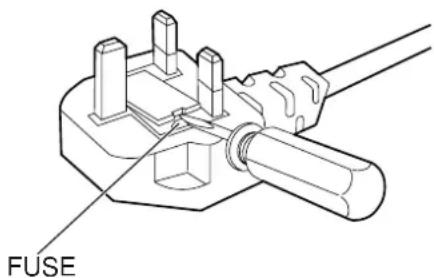
Guarantee
Condition of guarantee
This guarantee is in addition to and does not in any way affect any statutory or other rights of consumer purchasers. If within the applicable guarantee period, the appliance proves to be defective by reason of faulty design, workmanship or materials, we undertake subject to the following conditions to have the defective appliance (or any part or parts thereof) repaired or replaced free of charge.
- The appliance shall have been purchased and used solely within the UK and in accordance with standard operating instructions and the technical and/or Safety Standards required in the UK.
- The purchaser will within 7 days of purchase complete the included warranty registration form (folded inside front cover) and fax it to us for registration. Failure to return such a form could result in delay in providing the guarantee service.
- The appliance should be returned together with this guarantee and proof of date of purchase promptly on being found defective at the purchaser's risk and expense to the authorized dealer from whom the appliance was purchased or to the nearest authorized dealer. All enquiries must be through such dealers.
- This guarantee shall not apply to damage caused through fire, accident, lightning, misuse, wear and tear, neglect, incorrect adjustment or repair, to damage caused through installation, adaption, modification or use in an improper manner or inconsistent with the technical and/or safety standards required in the country where this appliance is used, or to damage occurred during transit to or from the purchaser.
- If at any time during the guarantee period any part or parts of the appliance are replaced with a part or parts not supplied or approved by us or of an objective quality safe and suitable for the appliance, or the appliance has been dismantled or repaired by any person not authorised by us, we shall have the right to terminate this guarantee in whole or in part immediately without further notice.
- The purchaser's sole and exclusive remedy under this guarantee against us is for the repair or replacement of the appliance or any defective part or parts and no other remedy, including, but not limited to, incidental or consequential damage or loss of whatsoever nature shall be available to the purchaser.
- This guarantee shall not apply to cassette tapes, batteries and any other items of limited nature life.
- Our decision on all matters relating to complaints shall be final. Any appliance or defective part which has been replaced shall become our property.
- The guarantee period applicable to this product shall be 12 months from the date of purchase.
Please keep these Operating Instructions with your receipt.
Panasonic Business Systems U.K.
| Receipt No. ____ | Date of Purchase. ____ |
| Model No. KX-FT57E____ | Serial No. ____ |
Summary of user programmable features
Basic features
| Code | Feature & Display Available settings Meaning | Page | ||
| #01 | Setting the date and timeSET DATE & TIME | (2 digits for each entry) | dd/mm/yy hh:mm 25 | |
| #02 | Setting your logoYOUR LOGO | (Up to 30 characters) | 26 | |
| #03 | Setting your facsimile telephone numberYOUR TEL NO. | (Up to 20 digits) 28 | ||
| #04 | Printing the transmission reportTX-REPORT MODE | ERROR | If transmission fails | 43 |
| ON | Activate | |||
| OFF | Deactivate | |||
| #05 | Changing the AUTO RECEIVE settingAUTO RECEIVE | TAD/FAX | Telephone Answering Device/Facsimile mode | 52 |
| FAX ONLY | Facsimile only mode | |||
| #06 | Setting the ring count in the TAD/FAX modeTAD/FAX RING | 1, 2, 3, 4 | 1 to 4 rings | 77 |
| TOLL SAVER | Saves you the charges for the call. | |||
| RINGER OFF | Does not ring. | |||
| #07 | Setting the ring count in the FAX ONLY modeFAX RING | 1, 2, 3, 4 1 to 4 rings | 53 | |
| #08 | Changing the MANUAL RECEIVE settingMANUAL RECEIVE | TEL | Telephone mode | 56 |
| TEL/FAX | Telephone/Facsimile mode | |||
| #09 | Setting the TEL/FAX delayed ring countTEL/FAX RING | 1, 2, 3, 4 1 to 4 rings | 57 | |
| #10 | Setting the caller's recording timeRECORDING TIME | LONG | 2 minutes 30 seconds | 78 |
| SHORT | 1 minute | |||
| #11 | Setting the remote operation IDREMOTE TAD ID | ID=111 | Any 3-digit number except a number using digits 0 or 7 | 70 |
(The pre-selected setting is in bold type.)
Note:
- You can display basic features in the order above by rotating EASYDIA entering the code number (#01, #02, etc.).
Advanced features
| Code | Feature & Display Available settings Meaning | Page | ||
| #22 | Setting the journal report to print automaticallyAUTO JOURNAL | ON | Activate | 44 |
| OFF | Deactivate | |||
| #23 | Sending documents overseasOVERSEAS MODE | ON | Activate | 47 |
| OFF | Deactivate | |||
| #25 | Sending a fax at a specified timeDELAYED SEND | ON | Activate | 45 |
| OFF | Deactivate | |||
| #30 | Setting the silent fax recognition ring countSILENT FAX RING | 3, 4, 5, 6, 7, 8, 9 3 to | 9 rings 57 | |
| #35 | Setting the recall modeRECALL MODE | T-BR | Time Break Recall | 89 |
| E-RE | Earth Recall | |||
| #39 | Changing the LCD display contrastLCD CONTRAST | NORMAL | Normal contrast | 89 |
| LIGHT | Lighter contrast | |||
| DARKER | Darker contrast | |||
| #41 | Changing the fax activation codeFAX ACTIVATION | ON / CODE= 9 | Activate | 51 |
| OFF | Deactivate | |||
| #42 | Setting the message alertMESSAGE ALERT | ON | Activate | 78 |
| OFF | Deactivate | |||
| #43 | Setting the recording time alertREC. TIME ALERT | ON | Activate | 79 |
| OFF | Deactivate | |||
| #46 | Setting the friendly receptionFRIENDLY RCV | ON | Activate | 58 |
| OFF | Deactivate | |||
| #47 | Setting the fax voice guidanceFAX GUIDANCE | ON | Activate | 91 |
| OFF | Deactivate | |||
| ERROR | If transaction fails | |||
| #54 | Setting the recording time for the TAD/FAX greeting messageGREETING TIME | 16s | 16 seconds | 65 |
| 60s | 60 seconds | |||
| #58 | Setting the original modeORIGINAL | NORMAL | For normal writing | 90 |
| LIGHT | For faint writing | |||
| DARKER | For dark writing | |||
| #60 | Setting the message transfer/pager callMESSAGE TRANS. | MESSAGE | Transfers incoming messages | 75 |
| PAGER | Calls your pager | |||
| OFF | Deactivate | |||
| #61 | Recording the message transfer greeting messageTRNS-GREETING | CHECK | Checks the greeting message | 76 |
| RECORD | Records the greeting message | |||
| ERASE | Erases the greeting message | |||
| #67 | Setting the incoming message monitorICM MONITOR | ON | Activate | 79 |
| OFF | Deactivate | |||
| #70 | Signalling your pager when your unit receives a faxFAX PAGER | ON | Activate | 59 |
| OFF | Deactivate | |||
| #76 | Setting the connecting toneCONNECTING TONE | ON | Activate | 47 |
| OFF | Deactivate | |||
| #80 | Resetting the advanced featuresSET DEFAULT | YES | Reset | 93 |
| NO | Will not reset | |||
| #89 | Setting the handset switchHANDSET SWITCH | USE HANDSET | Using the handset and cradle | 92 |
| NO HANDSET | Not using the handset and cradle | |||
(The pre-selected setting is in bold type.)
A Accessories 16
Advanced features .....100, 101
(Resetting)....93
Alert (Message) 78
(Recording time) .....79
Answering device volume .....29
AUTO RECEIVE Mode .....49
AUTO RECEIVE setting .....48, 49, 52, 56
B Basic features .....99
C Call counter .....66
Caller's recording time ....78
Character table 27
Cleaning 87
Communication messages .....80
Connecting tone 47
Connections 6,23
Copy 10,60
D Date and time .....25
Delayed transmission .....45
Dialling mode .....6, 23
DIGITAL SP-PHONE operation .....30, 31
Directory feature .....35, 37, 41
Display contrast .....89
Document feeder cleaning .....87
Document jam 86
Document size .....42, 94
E EASY DIAL
(Making a voice call) .....37
(Repeating the recorded messages) . .67
(Selecting characters) .....27
(Sending faxes) .....41
(Skipping the recorded messages) . . .67
(Storing) 35
Editing
(EASY DIAL) 36
(One-Touch Dial) 33
ERASE button .....64, 66
Erasing
(EASY DIAL) 36
(One-Touch Dial) .....36
(Own greeting message) .....64
(Recorded message) .....13, 66
Error messages 80, 81
Extension telephone .....51,55
F Facsimile telephone number .....28
Fax activation code .....51
Fax auto redial .....40
FAX ONLY mode .....49, 52, 53
FAX ONLY ring count ....53
Fax pager ....59
Fax voice guidance
(Setting) 91
(Volume) 29
(Sending a fax) 42
Features summary .....99-101
Feeder
(Cleaning) 87
(Jam) 86
(Pressure) 86
Friendly reception .....50, 58, 91
G Greeting message
(Checking) 64
(Message transfer) .....74
(Suggested message) .....63
(TAD/FAX) 62, 63
(TEL/FAX) .....54, 55, 63
H Handset cradle
(Installing) 4,21
(Removing) 92
Handset switch .....92
HELP function .....17
Hyphen key 27
I ICM monitor 79
INSERT key .....26, 27
J Jam 85,86
Journal auto print 44
Journal report 44, 88
L LCD contrast....89
LCD display (Error messages) .....81
List
(Advanced feature) .....88
(Basic feature) 88
(Journal report) .....44, 88
(Telephone number)....88
(Transmission) 43
Location panel .....18, 19
Logo 26
M MANUAL RECEIVE Mode .....48
Memory reception .....50
Message alert....78
Message transfer 74
Mute .30, 31
N NAME/TEL NO. key .....37
One-Touch Dial
(Making a voice call) .....34
(Sending faxes) 40
(Storing)....33
Original mode .....90
Overseas transmission mode .....47
Overview 20
P Pager call ....59
Paper jam....85
Paper stacker .....24
Pause 32
PLAYMESSAGESindicator....66
Polling (Receiving)....58
(Transmitting)....46
Power failure .84
Power supply/cord . . . . . . . . . . . . . . . . . . . . . . . . . . . . . . . . . . . . . . . . . . . . . . . 23, 94
Pre-recorded message (Message transfer)....74
(TAD/FAX) 63
(TEL/FAX) 63
Printing paper size .....94
Printing reports 88
Problem solving 82-84
Programmable features ..... 99–101
PULSE dialling .....23
Q Quick playback 67
R RECALL button .....32
Recall mode 89
Receiving (Fax) 9,50
(Setting) 48, 49
(Voice contact) .....38
Recording (Greeting message) ....63
(Memo message)....68
(Telephone conversation) .....68
Recording paper (Installing) .....16, 22 (Jam) .....85
Recording time alert .....79
Recording time for TAD/FAX greeting message 65
Redial 30, 39, 40
Remote operation ID ....70
Report (Advanced feature setting) .....88
(Basic feature) .....88
(Journal) 44, 88
(Telephone numbers) .....88
(Transmission) 43
Reset 93
RESOLUTION button 39
Ring count (FAX ONLY)....53
(TAD/FAX) 77
(TEL/FAX) 57
Ringer volume .....29
S SECRET key 35
Sending (EASY DIAL) 41
(Manually) 8,39
(One-Touch Dial) 40
(Overseas)....47
Sending document (Does not feed or multi-feeds) .....86
Sending jam 86
Set default 93
Silent fax recognition ring .....57
Slow playback 67
Speaker volume .....29
Specifications 94
Storing (EASY DIAL) 35
(One-Touch Dial) 33
T TAD/FAX mode .....49
TAD/FAX ring count 77
TEL/FAX delayed ring count .....57
TEL/FAX mode 48,54
TEL mode 48,50
Toll saver 77
TONE dialling .....23, 32
Tone (Connecting) .....47
Transmission (EASY DIAL) 41
(Manually) 8,39
(One-Touch Dial) 40
(Overseas) 47
Transmittable document .....42
Two way recording 68
V Voice call
(Answering) 31
(EASY DIAL) 37
(Making) 30
(One-Touch Dial) 34
Voice contact ....38
Voice time/day stamp 66
Volume 29

73/23/EEC
89/336/EEC
92/31/EEC
93/68/EEC
Panasonic Business Systems U.K.
Panasonic House, Willoughby Road, Bracknell,
Berkshire, RG12 8FP