
PDWMG46 - Wireless system Pyle - Free user manual and instructions
Find the device manual for free PDWMG46 Pyle in PDF.


| Product Type | Wireless Guitar/Bass System |
| Brand | Pyle |
| Model | PDWMG46 |
| RF Carrier Frequency Range | 640 MHz to 698 MHz |
| Effective Range | Up to 50 m (150 ft) under optimal conditions |
| Modulation Type | FM |
| Audio Frequency Response | 50 Hz to 15,000 Hz ±3 dB |
| Total Harmonic Distortion (THD) | Typically 1% |
| Signal-to-Noise Ratio (S/N) | Typically 103 dB(A) |
| Transmitter Power Supply | 1 x 1.5V AAA battery (included) |
| Transmitter Current Consumption | 80 mA |
| Transmitter Dimensions (L x W) | 3 x 1 inches |
| Receiver Power Supply | 9V DC 150 mA AC adapter (included) or 2 x 1.5V AA batteries |
| Receiver Dimensions (L x W x H) | 5.1 x 3.1 x 1.4 inches |
| Receiver Output Connector | 1/4" phone jack (unbalanced, high Z) |
| Transmitter Input Connector | 6.35 mm audio plug (flex jack swivel) |
| Special Features | PLL-synthesized control circuit, mobile frequency compression/expanding, image frequency filters, triple noise filters, gain control, mute switch, low battery indicators |
| Included Accessories | Receiver, transmitter, audio cable, AC adapter, 2 x AA batteries, 1 x AAA battery, user manual |
| Cleaning and Maintenance | Wipe with a dry cloth; avoid moisture and extreme temperatures |
| Compliance | FCC, CE (frequency dependent on country) |
Frequently Asked Questions - PDWMG46 Pyle
User questions about PDWMG46 Pyle
0 question about this device. Answer the ones you know or ask your own.
Ask a new question about this device
Download the instructions for your Wireless system in PDF format for free! Find your manual PDWMG46 - Pyle and take your electronic device back in hand. On this page are published all the documents necessary for the use of your device. PDWMG46 by Pyle.
USER MANUAL PDWMG46 Pyle
SYSTEM FEATURES....2
RECEIVER FEATURES....3
TRANSMITTER FEATURES....4
SYSTEM CONNECTON....4
SPECIFICATION....5
SYSTEM COMPOSITION
Receiver....1
Transmitter....1
Audio cable 1
AC power adapter of special receiver....1
Battery 1.5V AA....2
Battery 1.5V AAA....1
User manual....1
Thank you for purchasing our product, please read this instruction manual carefully so that you will understand how to operate the unit that you purchased correctly. Please keep and store this instruction booklet in a safe place after reading it for future reference. This series of professional microphone system uses a super steady PLL-synthesized control circuit that matches a high efficient, low consumption discharging technique. We also apply an independently developed mobile frequency compression and expanding circuit that is chain linked with image frequency filters and three time checked noise filters in the receiving unit. Every unit must pass strict tests and quality control by the manufacturer.
1. SYSTEM FEATURES
Flex jack swivel jack plug matching every guitar output.
Extended frequency response optimized for guitar and bass
No cable or separate body pack to hassle with
Input gain control for compatibility with all instrument pickups
Wide frequency response and dynamic range for true hard-wired sound.
The guitar bug system is probably the easiest way to turn a guitar, bass or probable keyboard into a wireless instrument.
The flex jack swivel jack plug will mate with any type of output jack and is spring loaded to hold the securely against the instrument.
In addition, the is so small it is almost invisible and won't be in your way while playing. Since it sits right on top of the
Instrument's output jack, the noiseless on/mute-off switch and gain control are always within easy reach.
Receiver is designed for use with compact effects pedals
It features a 1/4 " output jack, peak LED and a volume control.
You can use two pieces of 1.5 volt batteries or AC adapter
AC adapter to power the receiver.
2、RECEIVER FEATURES
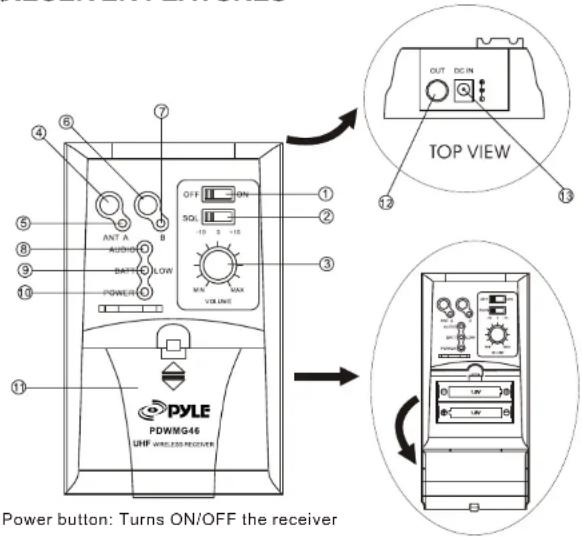
- Power button: Turns ON/OFF the receiver
- Squelch control button.
- Volume Control: Rotate the knob to increase or decrease the volume of the receiver output.
- Antenna "A": Supply the RF for receiver
- Antenna indicator "A".
- Antenna"B":Supply the RF for receiver
- Antenna indicator "B"
- Audio indicator: The green light of the AF signal indicator glows according to the volume of the microphone when talk or sing to transmitter
- Low battery indicator: This light glows when there is less of useful operating time, allowing battery to be changed before power is depleted. (Use 1.5VAA BATTERY)
- Power on indicator: This light glows when the receiver is plugged into an electrical outlet and switch is pushed, it indicates that the receiver is on.
11.Battery cover: Open the cover and set 2X1.5VAA)Alkaline batteries.
12.1/4" phone jack audio output connector (Unbalanced high Z): An unbalanced audio cable with 1/4" phone plug(such as standard guitar cable) can be used between this connector to your amplifier input
13. Power input connector: Connect the AC adapter to this jack and then plug into an AC electrical outlet. (Please use supplied AC adapter)
- TRANSMITTER FEATURES

- Power and audio mute switch: push the switch to "ON" position, the indicator shines for a moment. Pushed the switch to the middle of
"ON""OFF" position, allows muting the microphone audio, avoiding
the "thump" noise that can occur when turning the microphone audio.
it is recessed to prevent it from being accidentally turned off. - Gain control switch: Adjust audio level, for fitting all kinds of signal input, it is on the "L" position in the factory.
3.Antenna:Supply the RF for transmitter
4..6.35mm audio plug.
5.Low battery indicator: This light glows when there is less of useful
operating time, allowing battery to be changed before power is depleted.
(Use 1.5V AAA battery)
6.Battery cover:Open the cover and set 1 XAAA(1.5V)Alkaline battery.
4、SYSTEM CONNECTION
flowchart
graph TD
    A["Music Player"] --> B["Switch"]
    B --> C["Audio Generator"]
    C --> D["Audio System"]
    D --> E["Audio Receiver"]
    E --> F["Audio Display"]
    style A fill:#f9f,stroke:#333
    style F fill:#bbf,stroke:#333
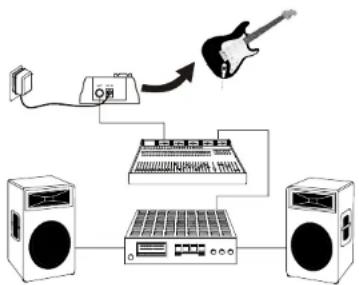
- Connect the supplied AC power adapter into the DC INPUT connector in the back of the receiver, plug the adapter into a wall socket
- Connect the receiver's audio output to the mixer's input by 6.35mm audio cable
- Pushed the receiver's power switch to "ON" position, the power indicator will glows.
- Slide the transmitter's power switch to "ON" position, the indicator shines for a moment, at that time, the receiver's signal light will glow.
- Adjust receiver volume knob, and the volume adjustment of mixer or amplifier to get a suitable volume.
- When the performance is over, turn off the sound system and slide the transmitter 's POWER/OFF switch to the "OFF" position to conserve battery power.
5.SPECIFICATIONS
NOTE: For a list of compatible frequencies that are usable in your area, refer to the supplied frequency supplement.
1.RF Carrier Frequency Range
640MHz to 698MHz (Available frequencies depend on the applicable regulations in the country where the system is used).
-
Effectiver Range
50m(150ft)Under optimal conditions
NOTE: Actual working range depends on RFsignal absorption, reflection, and interference from objects and environment. -
Audio Frequency Response
Typically 50Hz to 15,000Hz ±3dB
NOTE:System response is depend on the using accessory of microphone
-
Modulation: FM
-
Audio bandwidth: 40Hz to 20kHz
-
THD: typ. 1%
7.S/N ratio:typ. 103dB(A)
-
Power requirements: 9V DC 150mA
-
Transmitter current: 80mA
-
Receiver power supply: 2X 1.5V AA size battery
-
Transmitter power supply: 1 X 1.5V AAA size battery
-
Dimensions : Receiver: 5.1" X 3.1" X 1.4" inches Transmitter: 3" X 1" inches
Brand : Pyle
Model : PDWMG46
Category : Wireless system