Medalist Pro ST34520WC - Hard Drive SEAGATE - Free user manual and instructions
Find the device manual for free Medalist Pro ST34520WC SEAGATE in PDF.


User questions about Medalist Pro ST34520WC SEAGATE
0 question about this device. Answer the ones you know or ask your own.
Ask a new question about this device
Download the instructions for your Hard Drive in PDF format for free! Find your manual Medalist Pro ST34520WC - SEAGATE and take your electronic device back in hand. On this page are published all the documents necessary for the use of your device. Medalist Pro ST34520WC by SEAGATE.
USER MANUAL Medalist Pro ST34520WC SEAGATE
© 1997-1999 Seagate Technology, Inc. All rights reserved
Publication number: 32661-001, Rev. D
February 1999
Seagate, Seagate Technology, and the Seagate logo are registered trademarks of Seagate Technology, Inc. Medalist, SeaFAX, SeaFONE, SeaBOARD, and SeaTDD are either trademarks or registered trademarks of Seagate Technology, Inc. or one of its subsidiaries. All other trademarks or registered trademarks are the property of their respective owners.
Seagate reserves the right to change, without notice, product offerings or specifications. No part of this publication may be reproduced in any form without written permission of Seagate Technology, Inc.
Revision status summary sheet
Revision Date Writer/Engineer Sheets Affected
A 04/17/98 D. Ashby/B. Betancourt 1/1, v thru viii, 1 thru 86.
B 05/27/98 D. Ashby/B. Betancourt 13, 14, and 27.
C 07/02/98 D. Ashby/B. Betancourt 10, 22, 73, and 74.
D 02/08/99 D. Ashby/B. Betancourt 1, 5-7, 10, 11, 13, 15, 16, 19, 22, 23, 28,
29, 31-33, 36, 38-40, 44, 47, 50-55, 57-61,
63, 64, 67, 69, and 70-74.
Notice.
This manual is volume 1 of a two-volume document with the SCSI interface information in the Volume 2 SCSI Interface Product Manual, part number 77738479.
If you need the SCSI interface information, order the volume 2 SCSI Interface Product Manual, part number 77738479.
Contents
1.0 Scope....1
2.0 Applicable standards and reference documentation....3
2.1 Standards....3
2.1.1 Electromagnetic compatibility 3
2.1.2 Electromagnetic susceptibility....3
2.2 Electromagnetic compliance 3
2.3 Reference documents 4
3.0 General description....5
3.1 Standard features....7
3.2 Media characteristics 7
3.3 Performance....7
3.4 Reliability 7
3.5 Unformatted and formatted capacities 8
3.6 Programmable drive capacity....8
3.7 Factory installed accessories 8
3.8 Options (factory installed)....8
3.9 Accessories (user installed) 8
4.0 Performance characteristics 9
4.1 Internal drive characteristics (transparent to user) 9
4.2 SCSI seek performance characteristics (visible to user) 9
4.2.1 Access time 9
4.2.2 Format command execution time (minutes) 10
4.2.3 Generalized performance characteristics 10
4.3 Start/stop time 11
4.4 Prefetch/multi-segmented cache control 11
4.5 Cache operation....11
4.5.1 Caching write data 12
4.5.2 Prefetch operation 12
5.0 Reliability specifications 13
5.1 Error rates 13
5.1.1 Environmental interference.... 13
5.1.2 Read errors.... 13
5.1.3 Write errors....13
5.1.4 Seek errors....14
5.2 Reliability and service....14
5.2.1 Mean time between failure 14
5.2.2 Preventive maintenance....14
5.2.3 Service life 14
5.2.4 Service philosophy 14
5.2.5 Service tools 14
5.2.6 Hot plugging Medalist Pro disc drives....15
5.2.7 S.M.A.R.T. 15
5.2.8 Product warranty....16
6.0 Physical/electrical specifications 19
6.1 AC power requirements 19
6.2 DC power requirements....19
6.2.1 Conducted noise immunity 20
6.2.2 Power sequencing 20
6.2.3 12 V - Current profile 21
6.3 Power dissipation....22
6.4 Environmental limits 22
6.4.1 Temperature....22
6.4.2 Relative humidity 24
6.4.3 Effective altitude (sea level)....24
6.4.4 Shock and vibration....24
6.4.5 Air cleanliness 26
6.4.6 Acoustics 26
6.4.7 Electromagnetic susceptibility .....26
6.5 Mechanical specifications .....27
7.0 Defect and error management ....31
7.1 Drive internal defects and errors....31
7.2 SCSI systems errors .....31
8.0 Installation ....33
8.1 Drive ID/option select header 33
8.1.1 Notes for Figures 9, 10, 11, 12, 13, and 14. .....38
8.1.2 Function description....40
8.2 Drive orientation 41
8.3 Cooling 41
8.3.1 Air flow....41
8.4 Drive mounting 42
8.5 Grounding 42
9.0 Interface requirements....43
9.1 General description....43
9.2 SCSI interface messages supported....43
9.3 SCSI interface commands supported ..... 44
9.3.1 Inquiry Vital Product data....47
9.3.2 Mode Sense data....49
9.4 SCSI bus conditions and miscellaneous features supported .....53
9.5 Synchronous data transfer ..... 54
9.5.1 Synchronous data transfer periods supported....54
9.5.2 REQ/ACK offset....54
9.6 Physical interface ....55
9.6.1 DC cable and connector ....55
9.6.2 SCSI interface physical description .....58
9.6.3 SCSI interface cable requirements .....58
9.6.4 Mating connectors....59
9.7 Electrical description ....70
9.7.1 Single-ended drivers/receivers .....70
9.7.2 Multimode—SE or LVD alternative .....71
9.8 Terminator requirements....73
9.9 Terminator power 74
10.0 Seagate Technology support services....77
Appendix A. Sense keys and additional sense codes supported .....81
List of Figures
Figure 1. Medalist Pro family drive .... 1
Figure 2. Medalist Pro family drive (50-pin I/O connector version) 6
Figure 3a. Typical Medalist Pro family drive +12 V current profile 21
Figure 3b. Typical Medalist Pro family drive +5 V current profile 21
Figure 4. Locations of printed circuit board (PCB) components listed in Table 3 ..... 23
Figure 5. Recommended mounting 25
Figure 6. Mounting configuration dimensions for "N" models ..... 27
Figure 7. Mounting configuration dimensions for "W" and "LW" models ..... 28
Figure 8. Mounting configuration dimensions for "WC" and "LC" models ..... 29
Figure 9. Medalist Pro family drive ID select header for "N" models....34
Figure 10. Medalist Pro family drive ID select for "W," "WC," "LW," and "LC" models ..... 35
Figure 11. Medalist Pro family drive ID select header J1-auxiliary for "W" and "LW" models (J1-Auxiliary Pins 1A - 12A) 36
Figure 12. Medalist Pro family drive option select header for "N" and "W" models ..... 37
Figure 13. Medalist Pro family drive option select header for "WC" models ..... 37
Figure 14. Medalist Pro family drive option select header for models "LW" and "LC". . . . . . . . . . . . . . . . . . . . . . . . . . . . . . . . . . . . . . . . . . . . . . . . . . . . 38
Figure 15. Air flow (suggested) 41
Figure 16. Physical interface for "N" model drives....56
Figure 17. Physical interface for "W" and "LW" model drives ..... 57
Figure 18. Physical interface for "WC" and "LC" model drives 57
Figure 19. SCSI daisy-chain interface cabling for "N" and "W" model drives ..... 61
Figure 20. Nonshielded 50 pin SCSI device connector used on "N" model drives ..... 62
Figure 21. Non-shielded 68 pin SCSI device connector used on "W" and "LW" model drives ..... 63
Figure 22. Non-shielded 80 pin SCSI "SCA-2" connector, used on "WC" and "LC" model drives.....64
Figure 23. Single-ended transmitters and receivers ..... 71
Figure 24. LVD output signals....72
Figure 25. Typical SE-LVD alternative transmitter receiver circuits 73
1.0 Scope
This manual describes the Seagate Technology®, Inc. Medalist Pro™ disc drives.
Medalist Pro drives support the small computer system interface (SCSI) as described in the ANSI SCSI, SCSI-2, and SCSI-3 (Fast-20 and Fast-40) interface specifications to the extent described in this manual. The SCSI Interface Product Manual (part number 77738479) describes general SCSI interface characteristics of this and other families of Seagate drives.
From this point on in this product manual the reference to Medalist Pro models is referred to as “the drive” (unless references to individual models are necessary).
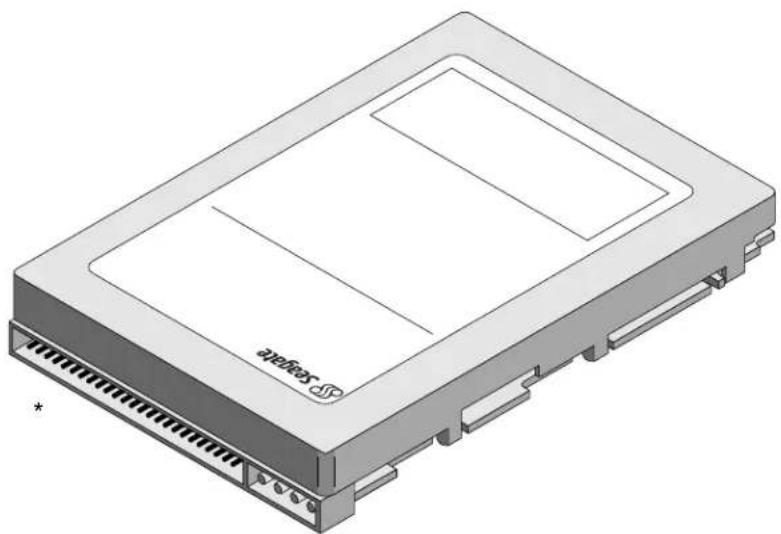
natural_image
Isometric technical drawing of a device housing with ventilation slots and a labeled 'Sevate' component (no text or symbols beyond label)*Model "N" version with 50-pin SCSI I/O connector
Figure 1. Medalist Pro family drive
2.0 Applicable standards and reference documentation
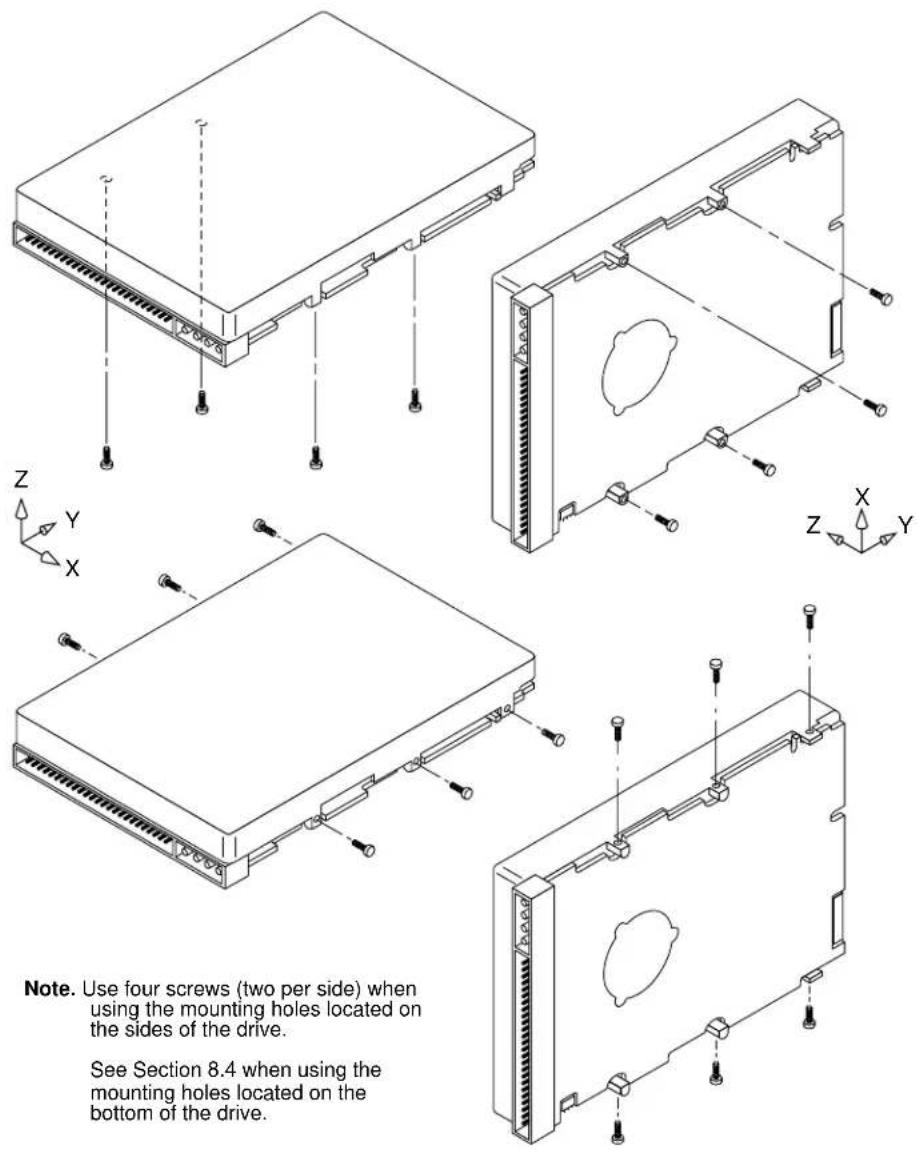
The drive has been developed as a system peripheral to the highest standards of design and construction. The drive depends upon its host equipment to provide adequate power and environment in order to achieve optimum performance and compliance with applicable industry and governmental regulations. Special attention must be given in the areas of safety, power distribution, shielding, audible noise control, and temperature regulation. In particular, the drive must be securely mounted in order to guarantee the specified performance characteristics. Mounting by bottom holes must meet the requirements of Section 8.4.
2.1 Standards
Medalist Pro family drives comply with Seagate standards as noted in the appropriate sections of this manual and the Seagate SCSI Interface Product Manual, part number 77738479 (Vol. 2).
Medalist Pro disc drives are UL recognized components per UL1950, CSA certified to CSA C22.2 No. 950-M89, and VDE certified to VDE 0805 and EN60950.
2.1.1 Electromagnetic compatibility
The drive, as delivered, is designed for system integration and installation into a suitable enclosure prior to use. As such the drive is supplied as a subassembly and is not subject to Subpart B of Part 15 of the FCC Rules and Regulations nor the Radio Interference Regulations of the Canadian Department of Communications.
The design characteristics of the drive serve to minimize radiation when installed in an enclosure that provides reasonable shielding. As such, the drive is capable of meeting the Class B limits of the FCC Rules and Regulations of the Canadian Department of Communications when properly packaged. However, it is the user's responsibility to assure that the drive meets the appropriate EMI requirements in their system. Shielded I/O cables may be required if the enclosure does not provide adequate shielding. If the I/O cables are external to the enclosure, shielded cables should be used, with the shields grounded to the enclosure and to the host controller.
2.1.2 Electromagnetic susceptibility
As a component assembly, the drive is not required to meet any susceptibility performance requirements. It is the responsibility of those integrating the drive within their systems to perform those tests required and design their system to ensure that equipment operating in the same system as the drive or external to the system does not adversely affect the performance of the drive. See Section 5.1.1 and Table 2a, DC power requirements.
2.2 Electromagnetic compliance
Seagate uses an independent laboratory to confirm compliance to the directives/standard(s) for CE Marking and C-Tick Marking. The drive was tested in a representative system for typical applications. The selected system represents the most popular characteristics for test platforms. The system configurations include:
• 486, Pentium, and PowerPC microprocessors
• 3.5-inch floppy disc drive
- Keyboard
- Monitor/display
- Printer
- External modem
- Mouse
Although the test system with this Seagate model complies to the directives/standard(s), we cannot guarantee that all systems will comply. The computer manufacturer or system integrator shall confirm EMC compliance and provide CE Marking and C-Tick Marking for their product.
Electromagnetic compliance for the European Union
If this model has the CE Marking it complies with the European Union requirements of the Electromagnetic Compatibility Directive 89/336/EEC of 03 May 1989 as amended by Directive 92/31/EEC of 28 April 1992 and Directive 93/68/EEC of 22 July 1993.
Australian C-Tick
If this model has the C-Tick Marking it complies with the Australia/New Zealand Standard AS/NZS3548 1995 and meets the Electromagnetic Compatibility (EMC) Framework requirements of Australia's Spectrum Management Agency (SMA).
2.3 Reference documents
Medalist Pro Installation Guide, Seagate P/N 32663-001
SCSI Interface Product Manual, Seagate P/N 77738479
ANSI Small Computer System Interface (SCSI): ANSI3.131-1986 (X3T9/84.40 Rev. 1B), (X3T9.2/82-2 Rev. 17B), X3T9.2/86-109 Revision 10H (SCSI-2), X3T9.2/91/010 Rev. 10 (SCSI-3) parallel interface, X3T9.2-184 Rev. 4 (SCSI-3) and ANSI SCSI-3 Fast-20, X3T10/1071D
Package Test Specification, Seagate P/N 30190-001 (under 100 lb.)
Package Test Specification, Seagate P/N 30191-001 (over 100 lb.)
Specification, Acoustic Test Requirements, Seagate P/N 30553-001
In case of conflict between this document and any referenced document, this document takes precedence.
3.0 General description
Medalist Pro drives combine magnetoresistive (MR) heads, partial response/maximum likelihood (PRML) read channel electronics, embedded servo technology, and a SCSI-3 (Fast-20 and Fast-40) interface to provide high performance, high capacity data storage for a variety of systems including high-end desktop systems, workstations, and entry level servers.
Fast-20 and Fast-40 (also known as Ultra SCSI and Ultra-2 SCSI) are negotiated transfer rates. These transfer rates will occur only if your host adapter also supports Fast-20 and Fast-40 data transfer rates. This drive also operates at SCSI-2/SCSI-3 data transfer rates for backward compatibility with non-Fast-20/Fast-40 capable SCSI host adapters.
Table 1 lists the features that differentiate the various Medalist Pro SCSI-3 Fast-20 and Fast-40 models.
Table 1: Drive model number vs. I/O features
| Model number | Number of heads I/O circuit type | Number of I/O connector pins | Number of I/O data bus bits |
| ST39140N 8 single-ended 50 8 | |||
| ST39140W 8 single-ended 68 16 | |||
| ST39140LW 8 multimode (SE/LVD) [1] 68 16 | |||
| ST39140WC | 8 single-ended 80 16 | ||
| ST39140LC | 8 multimode (SE/LVD) [1] 80 16 | ||
| ST36530N 8 single-ended 50 8 | |||
| ST36530W 8 single ended | 68 16 | ||
| ST36530WC | 8 single-ended 80 16 | ||
| ST34520N 8 single-ended 50 8 | |||
| ST34520W 8 single-ended 68 16 | |||
| ST34520LW 8 multimode (SE/LVD) [1] 68 16 | |||
| ST34520WC | 8 single-ended 80 16 | ||
| ST34520LC | 8 multimode (SE/LVD) [1] 80 16 |
Note.
[1] See Section 9.7.2, "Multimode—SE or LVD alternative."
The drive records and recovers data on 3.5-inch (86 mm) non-removeable discs.
The drive supports the Small Computer System Interface (SCSI) as described in the ANSI SCSI-2 and SCSI-3 interface specifications to the extent described in this manual (volume 1), which defines the product performance characteristics of the Medalist Pro family of drives, and the SCSI Interface Product Manual (volume 2), part number 77738479, which describes the general interface characteristics of this and other families of Seagate SCSI drives.
The drive's interface supports multiple initiators, disconnect/reconnect, and automatic features that relieve the host from the necessity of knowing the physical characteristics of the targets (logical block addressing is used).
The head and disc assembly (HDA) is sealed at the factory. Air circulates within the HDA through a non-replaceable filter to maintain a contamination-free HDA environment.
Refer to Figure 2 for an exploded view of the drive. This exploded view is for information only—never disassemble the HDA and do not attempt to service items in the sealed enclosure (heads, media, actuator, etc.) as this requires special facilities. The drive contains no replaceable parts. Opening the HDA voids your warranty.
Medalist Pro drives use a dedicated landing zone at the innermost radius of the media to eliminate the possibility of destroying or degrading data by landing in the data zone. The drive automatically goes to the landing zone when power is removed.
An automatic shipping lock prevents potential damage to the heads and discs that results from movement during shipping and handling. The shipping lock automatically disengages when power is applied to the drive and the head load process begins.
Medalist Pro drives decode track 0 location data from the servo data embedded on each surface to eliminate mechanical transducer adjustments and related reliability concerns.
A high-performance actuator assembly with a low-inertia, balanced, patented, straight-arm design provides excellent performance with minimal power dissipation.
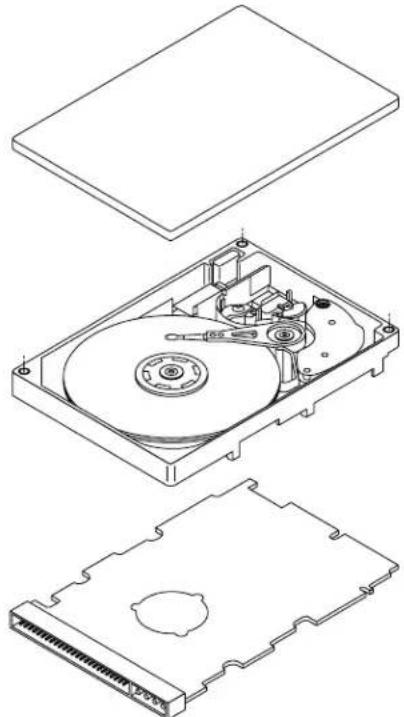
natural_image
Technical line drawing of an internal hard disk drive assembly (no text or labels)Figure 2. Medalist Pro family drive (50-pin I/O connector version)
3.1 Standard features
The Medalist Pro family has the following standard features:
- Integrated SCSI controller
- Single-ended and multimode single-ended/low voltage differential SCSI drivers and receivers
- 8 bit and 16 bit I/O data bus models available
- Asynchronous and synchronous data transfer protocol
- Firmware downloadable via SCSI interface
• Sector size 512 bytes/sector
- Programmable drive capacity
- Flawed sector reallocation at format time
- Programmable auto write and read reallocation
• Reallocation of defects on command (Post format)
• 256-bit Reed-Solomon error correcting code
- Sealed head and disc assembly
- No preventative maintenance or adjustment required
• Dedicated laser textured head landing zone
- Embedded servo data rather than a separate servo data surface
- Self diagnostics performed when power is applied to the drive
• 1:1 Interleave
• Zoned bit recording (ZBR)
• Vertical, horizontal, or top down mounting
• Dynamic spindle brake
- Active IC terminators enabled by jumpers ("N" and "W" models only)
- 512 K byte data buffer
- Hot plug compatibility (Section 9.6.4.3 lists the proper host connector needed) for "WC" and "LC" drives
- SCAM (SCSI Configured Automatically) plug-n-play level 2 compliant, factory set to level 1 (not user selectable)
- Low audible noise for office environment
- Low power consumption
• Audio Visual (A/V) ready
3.2 Media characteristics
The media used on the drive has a diameter of approximately 3.5 inches (86 mm). The aluminum substrate is coated with a thin film magnetic material, overcoated with a proprietary protective layer for improved durability and environmental protection.
3.3 Performance
- Supports industry standard Ultra SCSI interface (also called "Fast-20 SCSI") and Ultra-2 SCSI ("Fast-40")
- Programmable 1 or 3 segment cache buffer
• 7200 RPM spindle. Average latency = 4.17 ms - Command queuing of up to 64 commands
• Background processing of queue - Supports start and stop commands (spindle stops spinning)
3.4 Reliability
• 800,000 hour MTBF
- LSI circuitry
• Balanced low mass rotary voice coil actuator
- Incorporates industry-standard Self-Monitoring, Analysis and Reporting Technology (S.M.A.R.T.)
• 3-year warranty
3.5 Unformatted and formatted capacities
Formatted capacity depends on the number of spare reallocation sectors reserved and the number of bytes per sector. The following table shows the standard OEM model read capacity data. Total LBAs = read capacity data shown below +1.
Formatted
data block size
Model 512 byte/sector User LBAs Sparing
ST39140 9.100 GB 17,783,240 8,033 spares for both P and G lists
ST36530 6.5 GB 12,715,920 8,033 spares for both P and G lists
ST34520 4.55 GB 8,888,924 8,033 spares for both P and G lists
3.6 Programmable drive capacity
Using the Mode Select command, the drive can change its capacity to something less than maximum. See Table 5.2.1-13 in the SCSI Interface Product Manual (part number 77738479). Refer to the Parameter list block descriptor, bytes 1, 2 and 3. A value of zero in bytes 1, 2 and 3 indicates that the drive shall not change the capacity it is currently formatted to have. A number in bytes 1, 2 and 3 that is less than the maximum number of LBAs changes the total drive capacity to the value in the block descriptor bytes 1, 2 and 3. A value greater than the maximum number of LBAs is rounded down to the maximum capacity. Byte 0 is not used as the density code, but as the MSB of number of LBAs.
3.7 Factory installed accessories
The drive ships with a small bag of the two jumper plug types used for the J6, J2, and J1-Aux option select jumper headers.
3.8 Options (factory installed)
All customer requested options are incorporated during production or packaged at the manufacturing facility before shipping. Some of the options available are:
- The capacities shown in Section 3.5. You can order other capacities by selecting a maximum LBA as shown in Section 3.6.
- Single unit shipping pack. The drive normally ships in bulk packaging to provide maximum protection against transit damage. Units shipped individually require additional protection as provided by the single unit shipping pack. Specify this option if you are planning to ship single units to your customers.
- ESD and physical protection is accommodated by a protective plate called SeaShield which attaches to the PCB.
3.9 Accessories (user installed)
No accessories offered.
4.0 Performance characteristics
4.1 Internal drive characteristics (transparent to user)
ST39140 ST36530 ST34520
| Read/Write Heads 8 6 4 | ||||
| Tracks/Surface, Total 9,006 9,006 9,006 Tracks (user accessible) | ||||
| Tracks/Inch 9,570 9,570 9,570 TPI | ||||
| Peak Bits/Inch 1,715.2 1,715.2 1,715.2 | Mbits/in ^2 | |||
| Internal Data Rate | 110-193.88 | 110-193.88 | 110-193.88 | Mbits/sec (variable with zone) |
| Disc Rotational Speed | 7,200 7,200 | 7,200 r/min ( ± 0.05%) | ||
| Average Rotational Latency | 4.17 | 4.17 | 4.17 | msec |
4.2 SCSI seek performance characteristics (visible to user) [6]\*
The values given in Section 4.2.1 apply to all models of the Medalist Pro family unless otherwise specified. Refer to Section and to the SCSI Interface Product Manual (part number 77738479) for additional timing details.
4.2.1 Access time [8]
| Including Controller Overhead (without disconnect) [1] [4] Drive Level | |||||
| Read | Write | ||||
| msec | |||||
| Average | - | Typical | [3] | 9.5 | 10.5 |
| Single Track- | Typical | [3] | 2.5 | 3.5 | |
| Full Stroke | - | Typical | [3] | 21.0 | 23.5 |
*[ ] All notes for Section 4.2 are listed at end of Section 4.2.3.
4.2.2 Format command execution time (minutes) [1]*
| ST39140 ST36530 ST34520 | ||
| Maximum (with verify) 36 24 | 18 | |
| Maximum (no verify) | 18 12 | 9 |
4.2.3 Generalized performance characteristics
| Sector interleave | 1 to 1 |
Data buffer transfer rate to/from disc media (one 512-byte sector):
Min. [4]* 13.7 MByte/sec
Avg. [4] 19.9 MByte/sec
Max. [4] 23.8 MByte/sec
Data buffer transfer rate to/from disc media: (< 1 track):
Min. [4] 10.5 MByte/sec
Avg. [4] 15.2 MByte/sec
Max. [4] 18.3 MByte/sec
SCSI interface data transfer rate (asynchronous) [5]:
Maximum instantaneous 6.0 Mbytes/sec [6]
Maximum average 6.0 Mbytes/sec [7]
Synchronous transfer rate for SCSI-3 Fast-20 (Ultra-1 SCSI):
(8 bit data bus models) 20 Mbytes/sec
(16 bit data bus models) 40 Mbytes/sec
Synchronous transfer rate for SCSI-3 Fast-40 (Ultra-2 SCSI):
(8 bit data bus models) 40 Mbytes/sec
(16 bit data bus models) 80 Mbytes/sec
Synchronous transfer rate for fast SCSI-2: 5 to 10 Mbytes/sec
(8 bit data bus models)
Synchronous transfer rate for fast SCSI-2: 10 to 20 Mbytes/sec
(16 bit data bus models).
Sector Sizes: 512 byte user data blocks
Read/write consecutive sectors on a track Yes
Flaw reallocation performance impact (for flaws reallocated at format time, all P and G list entries will be slipped). No performance hit
Overhead time for head switch (512 byte sectors) in sequential mode 2.5 msec (typical)
Overhead time for one track cylinder seek (cylinder skew) <3.5 msec (typical)
Average rotational latency 4.17 msec
*[] Notes listed at end of Section 4.2.3.
Notes for Section 4.2.
[1] Execution time is measured from receipt of the last Byte of the Command Descriptor Block (CDB) to the request for a Status Byte Transfer to the Initiator (excluding connect/disconnect).
[2] Maximum times are specified over the worst case conditions of temperature, voltage margins and drive orientation. When comparing specified access times, care should be taken to distinguish between typical access times and maximum access times. The best comparison is obtained by system benchmark tests conducted under identical conditions. Maximum times do not include error recovery.
[3] Typical access times are measured under nominal conditions of temperature, voltage, and horizontal orientation as measured on a representative sample of drives.
[4] Assumes no errors and no sector has been relocated.
[5] Rate measured from the start of the first sector transfer to or from the host.
[6] Assumes system ability to support the rates listed and no cable loss.
[7] Simulated.
[8] Access time = controller overhead + average seek time
Access to data = controller overhead + average seek time + latency time
4.3 Start/stop time
After DC power at nominal voltage has been applied, the drive becomes ready within 20 seconds if the Motor Start Option is disabled (i.e. the motor starts as soon as the power has been applied). If a recoverable error condition is detected during the start sequence, the drive executes a recovery procedure which may cause the time to become ready to exceed 20 seconds. During spin up to ready time the drive responds to some commands over the SCSI interface in less than 3 seconds after application of power. Stop time is less than 20 seconds from removal of DC power.
If the Motor Start Option is enabled, the internal controller accepts the commands listed in the SCSI Interface Product Manual less than 3 seconds after DC power has been applied. After the Motor Start Command has been received the drive becomes ready for normal operations within 13 seconds typically (excluding an error recovery procedure). The Motor Start Command can also be used to command the drive to stop the spindle (see SCSI Interface Product Manual, part number 77738479).
There is no power control switch on the drive.
4.4 Prefetch/multi-segmented cache control
The drive provides prefetch (read look-ahead) and multi-segmented cache control algorithms that in many cases can enhance system performance. "Cache" as used herein refers to the drive buffer storage space when it is used in "cache" operations. To select prefetch and cache features the host sends the Mode Select command with the proper values in the applicable bytes in Mode Page 08h (see SCSI Interface Product Manual, part number 77738479). Prefetch and cache operation are independent features from the standpoint that each is enabled and disabled independently via the Mode Select command. However, in actual operation the prefetch feature overlaps cache operation somewhat as is noted in Section 4.5.1 and 4.5.2.
All default cache and prefetch Mode parameter values (Mode Page 08h) for standard OEM versions of this drive family are given in Tables 9, 10, and 11.
4.5 Cache operation
In general, 380 Kbytes of the 512 Kbytes (860.5 Kbytes of 1,024 Kbytes for "LC" and "LW" drives) of physical buffer space in the drive can be used as storage space for cache operations. The buffer contains memory from which data is read and to which data is written. The drive maintains a table of logical block disk medium addresses of the data stored in each segment of the buffer. If cache operation is enabled (RCD bit = 0 in Mode Page 08h, byte 2, bit 0. See SCSI Interface Product Manual (part number 77738479), data requested by the host with a Read command is retrieved from the buffer (if it is there), before any disc access is initiated. If cache operation is not enabled, the buffer (still segmented with required number of segments) is still used, but only as circular buffer segments during disc medium read operations (disregarding Prefetch operation for the moment). That is, the drive does not check in the buffer segments for the requested read data, but goes directly to the medium to retrieve it. The retrieved data merely passes through some buffer segment on the way to the
host. On a cache "miss", all data transfers to the host are in accordance with "buffer-full" ratio rules. On a cache "hit" the drive ignores the "buffer-full" ratio rules. See explanations associated with Mode page 02h (disconnect/reconnect control) in the SCSI Interface Product Manual (part number 77738479).
The following is a simplified description of a read operation with cache operation enabled:
Case A - A Read command is received and the first logical block (LB) is already in cache:
- Drive transfers to the initiator the first LB requested plus all subsequent contiguous LB's that are already in the cache. This data may be in multiple segments.
- When the requested LB is reached that is not in any cache segment, the drive fetches it and any remaining requested LBs from the disc and puts them in a segment of the cache. The drive transfers the remaining requested LBs from the cache to the host in accordance with the disconnect/reconnect specification mentioned above.
- If the prefetch feature is enabled, refer to Section 4.5.2 for operation from this point.
Case B - A Read command requests data, the first LB of which is not in any segment of the cache:
- The drive fetches the requested LBs from the disc and transfers them into a segment, and then the segment to the host.
- If the prefetch feature is enabled, refer to Section 4.5.2 for operation from this point.
4.5.1 Caching write data
Write caching is a write operation by the drive that makes use of a drive buffer storage area where the data to be written to the medium is stored in one buffer segment.
Write caching is enabled independently from read caching. For write caching, the same buffer space and segmentation is used as set up for read functions. The buffer segmentation scheme is set up or changed independently, having nothing to do with whether or not read and write caching is enabled or disabled. When a write command is issued, the cache is first checked to see if any logical blocks that are to be written are already stored in the cache from a previous read or write command. If there are, the respective cache segments are cleared. The new data is cached for subsequent Read commands.
If the number of write data logical blocks exceeds the size of the segment then being written into when the end of the segment is reached, the data is written into the beginning of the same cache segment, overwriting the data that was written there at the beginning of the operation. However, the drive does not overwrite data that has not yet been written to the medium.
Tables 9, 10, and 11 show Mode default settings for the drives.
4.5.2 Prefetch operation
If the Prefetch feature is enabled, data in contiguous logical blocks on the disc immediately beyond that which was requested by a Read command can be retrieved and stored in the buffer for immediate transfer from the buffer to the host on subsequent Read commands that request those logical blocks (this is true even if "cache" operation is disabled). Though the prefetch operation uses the buffer as a "cache", finding the requested data in the buffer is a prefetch "hit", not a "cache" operation "hit". Prefetch is enabled using Mode Select page 08h, byte 12, bit 5 (Disable Read Ahead - DRA bit). DRA bit = 0 enables prefetch. Since data that is prefetched replaces data already in some buffer segment(s), the host can limit the amount of prefetch data to optimize system performance. The max prefetch field (bytes 8 and 9) limits the amount of prefetch. The drive does not use the prefetch "ceiling" field (bytes 10 and 11).
Whenever prefetch (read look-ahead) is enabled (enabled by DRA = 0), it operates under the control of ARLA (Adaptive Read Look-Ahead). If the host uses software interleave, ARLA enables prefetch of contiguous blocks from the disc when it senses that a prefetch "hit" will likely occur, even if two consecutive read operations were not for physically contiguous blocks of data (e.g. "software interleave"). ARLA disables prefetch when it decides that a prefetch "hit" will not likely occur. If the host is not using software interleave, and if two sequential read operations are not for contiguous blocks of data, ARLA disables prefetch, but as long as sequential read operations request contiguous blocks of data, ARLA keeps prefetch enabled.
5.0 Reliability specifications
The following reliability specifications assume correct host/drive operational interface, including all interface timings, power supply voltages, environmental requirements and drive mounting constraints (see Section 8.4).
Seek Errors
Less than 1 in 10^7 seeks
Read Error Rates [1]
Recovered Data
Less than 1 errors in 10^0 bits transferred (default settings)
Unrecovered Data
Less than 1 sector in 10^14 bits transferred (default settings)
Miscorrected Data
Less than 1 sector in 10^21 bits transferred
MTBF 800,000 hours
Service Life 5 years
Preventive Maintenance None required
Note.
[1] Error rate specified with automatic retries and data correction with ECC enabled and all flaws reallocated.
5.1 Error rates
The error rates stated in this specification assume the following:
- The drive is operated per this specification using DC power as defined in this manual (see Section 6.2).
- The drive has been formatted with the SCSI FORMAT commands.
- Errors caused by media defects or host system failures are excluded from error rate computations.
5.1.1 Environmental interference
When evaluating systems operation under conditions of Electromagnetic Interference (EMI), the performance of the drive within the system shall be considered acceptable if the drive does not generate an unrecoverable condition.
An unrecoverable error, or unrecoverable condition, is defined as one that:
- Is not detected and corrected by the drive itself;
- Is not capable of being detected from the error or fault status provided through the drive or SCSI interface; or
- Is not capable of being recovered by normal drive or system recovery procedures without operator intervention.
5.1.2 Read errors
Before determination or measurement of read error rates:
- The data that is to be used for measurement of read error rates must be verified as being written correctly on the media.
- All media defect induced errors must be excluded from error rate calculations.
5.1.3 Write errors
Write errors can occur as a result of media defects, environmental interference, or equipment malfunction. Therefore, write errors are not predictable as a function of the number of bits passed.
If an unrecoverable write error occurs because of an equipment malfunction in the drive, the error is classified as a failure affecting MTBF. Unrecoverable write errors are those which cannot be corrected within two attempts at writing the record with a read verify after each attempt (excluding media defects).
5.1.4 Seek errors
A seek error is defined as a failure of the drive to position the heads to the addressed track. There shall be no more than one recoverable seek errors in 10^7 physical seek operations. After detecting an initial seek error, the drive automatically reseeks to the addressed track up to 3 times. If a reseek is successful, the Extended Sense reports a seek positioning error (15h), no seek complete error (02h), or track follow error (09h), and the sense key reports a recovered error (1h). If all three reseeks fail, a seek positioning error (15h) is reported with a Medium error (3h) or Hardware error (4h) reported in the Sense Key. This is an unrecoverable seek error. Unrecoverable seek errors are classified as failures for MTBF calculations. Refer to Section 5.1.1.2 of the SCSI Interface Product Manual (part number 77738479) for Request Sense information. Appendix A of this manual lists the sense keys and additional sense codes supported by the drives of this manual.
5.2 Reliability and service
You can enhance the reliability of Medalist Pro disc drives by ensuring that the drive receives adequate cooling. Section 6.4.1 provides temperature measurements and other information that may be used to enhance the service life of the drive. Section 8.3.1 provides recommended air-flow information.
5.2.1 Mean time between failure
The production disc drive shall achieve an MTBF of 800,000 hours when operated in an environment that ensures the case temperatures specified in Section 6.4.1 are not exceeded. Short-term excursions up to the specification limits of the operating environment will not affect MTBF performance.
The following expression defines MTBF
MTBF per measurement period = power-on operating hours in the periodNumber of drive failures in the period
Estimated power-on operation hours means power-up hours per disc drive times the total number of disc drives in service. Each disc drive shall have accumulated at least nine months of operation. Data shall be calculated on a rolling average base for a minimum period of six months.
Drive failure means any stoppage or substandard performance caused by drive malfunction.
5.2.2 Preventive maintenance
No routine scheduled preventive maintenance shall be required.
5.2.3 Service life
The drive shall have a useful service life of five years. Depot repair or replacement of major parts is permitted during the lifetime (see Section 5.2.4).
5.2.4 Service philosophy
Special equipment is required to repair the drive HDA. In order to achieve the above service life, repairs must be performed only at a properly equipped and staffed service and repair facility. Troubleshooting and repair of PCBs in the field is not recommended, because of the extensive diagnostic equipment required for effective servicing. Also, there are no spare parts available for this drive. Drive warranty is voided if the HDA is opened.
5.2.5 Service tools
No special tools are required for site installation or recommended for site maintenance. Refer to Section 5.2.4. The depot repair philosophy of the drive precludes the necessity for special tools. Field repair of the drive is not practical since there are no user purchasable parts in the drive.
5.2.6 Hot plugging Medalist Pro disc drives
The ANSI SPI-2 (T10/1142D) document defines the physical requirements for removal and insertion of SCSI devices on the SCSI bus. Four cases are addressed. The cases are differentiated by the state of the SCSI bus when the removal or insertion occurs.
Case 1 All bus devices powered off during removal or insertion
Case 2 RST signal asserted continuously during removal or insertion
Case 3 Current I/O processes not allowed during insertion or removal
Case 4 Current I/O process allowed during insertion or removal, except on the device being changed
Seagate Medalist Pro disc drives support four hot plugging cases. Provision shall be made by the system such that a device being inserted makes power and ground connections prior to the connection of any device signal contact to the bus. A device being removed shall maintain power and ground connections after the disconnection of any device signal contact from the bus (see SFF-8046, SCA-2 specification).
It is the responsibility of the systems integrator to assure that no hazards from temperature, energy, voltage, or ESD potential are presented during the hot connect/disconnect operation.
All I/O processes for the SCSI device being inserted or removed shall be quiescent. All SCSI devices on the bus shall have receivers that conform to the SPI-2 standard.
If the device being hot plugged uses single-ended (SE) drivers and the bus is currently operating in low voltage differential (LVD) mode, then all I/O processes for all devices on the bus must be completed, and the bus qui- esced, before attempting to hot plug. Following the insertion of the newly installed device, the SCSI host adapter must issue a Bus Reset, followed by a synchronous transfer negotiation. Failure to perform the SCSI Bus Reset could result in erroneous bus operations.
The SCSI bus termination and termination power source shall be external to the device being inserted or removed.
End users should not mix devices with high voltage differential (HVD) drivers and receivers and devices with SE, LVD, or multimode drivers and receivers on the same SCSI bus since the common mode voltages in the HVD environment may not be controlled to safe levels for SE and LVD devices (see ANSI SPI-2).
The disc drive spindle must come to a complete stop prior to completely removing the drive from the cabinet chassis. Use of the Stop Spindle command or partial withdrawal of the drive, enough to be disconnected from the power source, prior to removal are methods for insuring that this requirement is met. During drive insertion, care should be taken to avoid exceeding the limits stated in Section 6.4.4, "Shock and vibration," of this manual.
5.2.7 S.M.A.R.T.
S.M.A.R.T. is an acronym for Self-Monitoring Analysis and Reporting Technology. This technology is intended to recognize conditions that indicate imminent drive failure and is designed to provide sufficient warning of a failure to allow you to back up the data before an actual failure occurs.
Note. The drive's firmware will monitor specific attributes for degradation over time but can't predict instantaneous drive failures.
Each monitored attribute has been selected to monitor a specific set of failure conditions in the operating performance of the drive and the thresholds are optimized to minimize “false” and “failed” predictions.
Controlling S.M.A.R.T.
The operating mode of S.M.A.R.T. is controlled by the DEXCPT and PERF bits on the Informational Exceptions Control mode page (1Ch). Use the DEXCPT bit to enable or disable the S.M.A.R.T. feature. Setting the DEX-CPT bit disables all S.M.A.R.T. functions. When enabled, S.M.A.R.T. collects on-line data as the drive performs normal read and write operations. When the PERF bit is set, the drive is considered to be in "On-line Mode Only" and will not perform off-line functions.
You can measure off-line attributes and force the drive to save the data by using the Rezero command. Forcing S.M.A.R.T resets the timer so that the next scheduled interrupt is in two hours.
You can interrogate the drive through the host to determine the time remaining before the next scheduled measurement and data logging process occurs. To accomplish this, issue a Log Sense command to log page 0x3E. This allows you to control when S.M.A.R.T. interruptions occur. Forcing S.M.A.R.T. with the RTZ command resets the timer.
Performance impact
S.M.A.R.T. attribute data is saved to the disc so that the events that caused a predictive failure can be recreated. The drive measures and saves parameters once every two hours subject to an idle period on the interface. The process of measuring off-line attribute data and saving data to the disc is uninterruptable. The maximum on-line only (DESCPT = 0; PERF = 1) processing delay is 60 ms. The maximum fully-enabled (DEX-CPT = 0, PERF = 0) processing delay is 450 ms.
Reporting control
Reporting is controlled in the Informational Exceptions Control mode page (1Ch). Subject to the reporting method, the firmware will issue to the host an 01-5DXX sense code. The error code is preserved through bus resets and power cycles.
Determining rate
S.M.A.R.T. monitors the rate at which errors occur and signals a predictive failure if the rate of degraded errors increases to an unacceptable level. To determine rate, error events are logged and compared to the number of total operations for a given attribute. The interval defines the number of operations over which to measure the rate. The counter that keeps track of the current number of operations is referred to as the Interval Counter.
S.M.A.R.T. measures error rates. All errors for each monitored attribute are recorded. A counter keeps track of the number of errors for the current interval. This counter is referred to as the Failure Counter.
Error rate is the number of errors per operation. The algorithm that S.M.A.R.T. uses to record rates of error is to set thresholds for the number of errors and their interval. If the number of errors exceeds the threshold before the interval expires, the error rate is considered to be unacceptable. If the number of errors does not exceed the threshold before the interval expires, the error rate is considered to be acceptable. In either case, the interval and failure counters are reset and the process starts over.
Predictive failures
S.M.A.R.T. signals predictive failures when the drive is performing unacceptably for a period of time. The firmware keeps a running count of the number of times the error rate for each attribute is unacceptable. To accomplish this, a counter is incremented each time the error rate is unacceptable and decremented (not to exceed zero) whenever the error rate is acceptable. If the counter continually increments such that it reaches the predictive threshold, a predictive failure is signaled. This counter is referred to as the Failure History Counter. There is a separate Failure History Counter for each attribute.
5.2.8 Product warranty
Beginning on the date of shipment to customer and continuing for a period of three years, Seagate warrants that each product (including components and subassemblies) or spare part that fails to function properly under normal use due to defect in materials on workmanship or due to nonconformance to the applicable specifications will be repaired or replaced, at Seagate's option and at no charge to customer, if returned by customer at customer's expense to Seagate's designated facility in accordance with Seagate's Warranty Procedure. Seagate will pay for transporting the repair or replacement item to customer. For more detailed warranty information refer to the Standard terms and conditions of Purchase for Seagate products.
Shipping
When transporting or shipping a drive, a Seagate approved container must be used. Keep your original box. They are easily identified by the Seagate Approved Package label. Shipping a drive in a non-approved container voids the drive warranty.
Seagate repair centers may refuse receipt of components improperly packaged or obviously damaged in transit. Contact your Authorized Seagate Distributor to purchase additional boxes. Seagate recommends shipping by an air-ride carrier experienced in handling computer equipment.
Product repair and return information
Seagate customer service centers are the only facilities authorized to service Seagate drives. Seagate does not sanction any third-party repair facilities. Any unauthorized repair or tampering with the factory seal voids the warranty (see Section 10.0).
6.0 Physical/electrical specifications
This section provides information relating to the physical and electrical characteristics of Medalist Pro drives.
6.1 AC power requirements
None.
6.2 DC power requirements
The voltage and current requirements for a single drive are shown in the following table. Values indicated apply at the drive power connector. The single ended power requirements include the internal disc drive SCSI I/O termination. The table shows current values in Amperes.
Table 2a: DC power requirements for N/W/WC models
| Notes | ST39140 ST36530 | ST34520 | |||||
| N/W/WCSingle-ended | N/W/WCSingle-ended | N/W/WCSingle-ended | |||||
| Voltage +5 V +12 V +5 V +12 V +5 V | +12 V | ||||||
| Regulation | [5] | ±5% | ±5% [2] | ±5% | ±5% [2] | ±5% | ±5% [2] |
| Maximum operating current DC | [1] | 0.55 | 2.4 | 0.55 | 2.4 | 0.55 | 2.4 |
| Average idle current DC | [1] | 0.51 | 0.81 | 0.51 | 0.81 | 0.51 | 0.81 |
| Maximum starting current(peak DC) DC(peak AC) AC | [3][3] | 2.5 | 2.5 | 2.5 | |||
| Delayed motor start (max) DC | [1][4] | 0.51 | 0.13 | 0.51 | 0.13 | 0.51 | 0.13 |
| Peak operating currentTypical DC Maximum DCMaximum (Peak) | [1][6][1] | 0.510.55 | 0.961.17 | 0.510.55 | 0.961.17 | 0.510.55 | 0.961.17 |
Table 2b: DC power requirements for LW/LC models
| Notes | ST39140 ST34520 | ||||
| LW/LCLVD | LW/LCLVD | ||||
| Voltage +5 V +12 V +5 V +12 V | |||||
| Regulation | [5] | ±5% | ±5% [2] | ±5% | ±5% [2] |
| Maximum operating current DC | [1] | 0.81 | 2.4 | 0.81 | 2.4 |
| Average idle current DC | [1] | 0.53 | 0.90 | 0.53 | 0.90 |
| Maximum starting current(peak DC) DC(peak AC) AC | [3][3] | 2.5 | 2.5 | ||
| Delayed motor start (max) DC | [1][4] | 0.51 | 0.16 | 0.51 | 0.16 |
| Peak operating currentTypical DC Maximum DCMaximum (Peak) | [1][6][1] | 0.580.81 | 1.01.53 | 0.580.81 | 1.01.37 |
Notes for Tables 2a and 2b.
[1] Measured with average reading DC ammeter. Instantaneous +12 V current peaks will exceed these values.
[2] A -10% droop is permissible during initial start of spindle, and must return to ±5% before 7,200 rpm is reached. The ±5% must be maintained after the drive signifies that its power-up sequence has been com-
pleted and that the drive is able to accept selection by the host initiator.
[3] See +12 V current profile in Figure 3a.
[4] This condition occurs when the Motor Start Option is enabled and the drive has not yet received a Start Motor command.
[5] See Section 6.2.1 "Conducted Noise Immunity." Specified voltage tolerance is inclusive of ripple, noise, and transient response.
[6] Operating condition is defined as random seek read operations with a block count of 64.
General Notes from Table 2a:
- Minimum current loading for each supply voltage is not less than 4% of the maximum operating current shown.
- The +5 and +12 volt supplies shall employ separate ground returns.
- Where power is provided to multiple drives from a common supply, careful consideration for individual drive power requirements should be noted. Where multiple units are powered on simultaneously, the peak starting current must be available to each device.
6.2.1 Conducted noise immunity
Noise is specified as a periodic and random distribution of frequencies covering a band from DC to 10 mHz. Maximum allowed noise values given below are peak to peak measurements and apply at the drive power connector.
+5 V = 150 mV pp from 0 to 100 kHz and 100 mV pp from 100 kHz to 10 MHz.
+12 V = 150 mV pp from 0 to 100 kHz and 100 mV pp from 100 kHz to 10 MHz.
6.2.2 Power sequencing
The drive does not require power sequencing. The drive protects against inadvertent writing during power-up and down. Daisy-chain operation requires that power be maintained on the terminated drive to ensure proper termination of the peripheral I/O cables. To automatically delay motor start based on the target ID (SCSI ID) enable the Delay Motor Start option and disable the Enable Motor Start option on the J2 connector. See Section 8.1 for pin selection information. To delay the motor until the drive receives a Start Unit command, enable the Enable Motor Start option on the J2 connector.
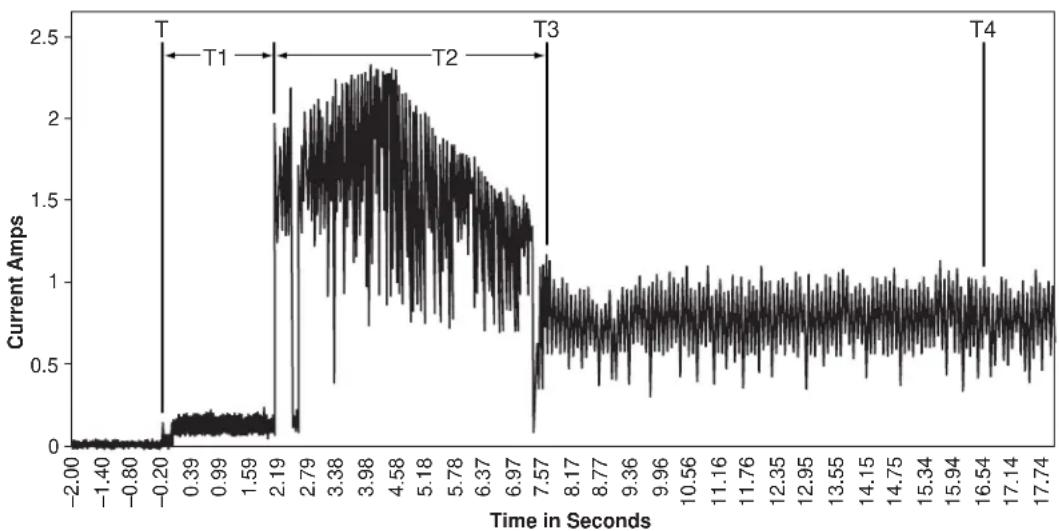
6.2.3 12 V - Current profile
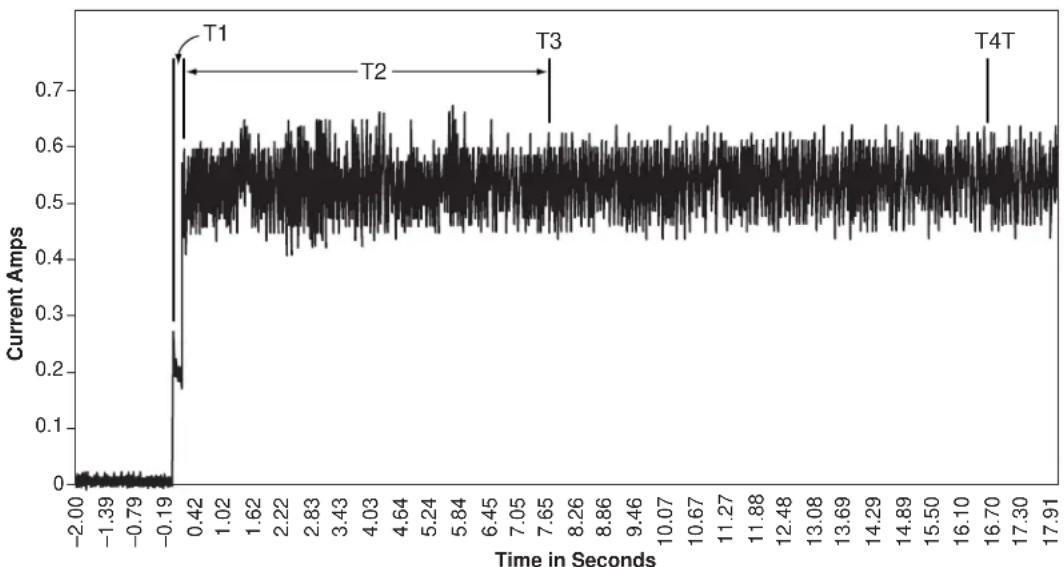
Figure 3a identifies the drive +5 V and +12 V current profile. The current during the various times is as shown:
T - Power is applied to the drive.
T1 - Controller self tests are performed and spindle position sense is performed.
T2 - Spindle begins to accelerate under current limiting after performing drive internal diagnostics. See Note 1 of Table 2.
T3 - The heads move from the landing zone to the data area.
T4 - Drive is ready for reading and writing.
Note. All times and currents are typical. See Table 2a for maximum current requirements.
+12V Start Current
line
| Time in Seconds | Current Amps | | --------------- | ------------ | | -2.00 | 0.0 | | -1.40 | 0.0 | | -0.80 | 0.0 | | -0.20 | 0.0 | | 0.39 | 0.1 | | 0.99 | 0.1 | | 1.59 | 0.1 | | 2.19 | 0.1 | | 2.79 | 2.0 | | 3.38 | 2.2 | | 3.98 | 2.3 | | 4.58 | 2.2 | | 5.18 | 2.1 | | 5.78 | 1.9 | | 6.37 | 1.7 | | 6.97 | 1.5 | | 7.57 | 1.3 | | 8.17 | 1.1 | | 8.77 | 1.0 | | 9.36 | 0.9 | | 9.96 | 0.8 | | 10.56 | 0.7 | | 11.16 | 0.6 | | 11.76 | 0.5 | | 12.35 | 0.4 | | 12.95 | 0.3 | | 13.55 | 0.2 | | 14.15 | 0.1 | | 14.75 | 0.0 | | 15.34 | 0.1 | | 15.94 | 0.2 | | 16.54 | 0.3 | | 17.14 | 0.4 | | 17.74 | 0.5 |Figure 3a. Typical Medalist Pro family drive +12 V current profile
+5V Start Current
line
| Time in Seconds | Current Amps | | --------------- | ------------ | | -2.00 | 0.0 | | -1.39 | 0.0 | | -0.79 | 0.0 | | -0.19 | 0.0 | | 0.42 | 0.7 | | 1.02 | 0.6 | | 1.62 | 0.6 | | 2.22 | 0.6 | | 2.83 | 0.6 | | 3.43 | 0.6 | | 4.03 | 0.6 | | 4.64 | 0.6 | | 5.24 | 0.6 | | 5.84 | 0.6 | | 6.45 | 0.6 | | 7.05 | 0.6 | | 7.65 | 0.6 | | 8.26 | 0.6 | | 8.86 | 0.6 | | 9.46 | 0.6 | | 10.07 | 0.6 | | 10.67 | 0.6 | | 11.27 | 0.6 | | 11.88 | 0.6 | | 12.48 | 0.6 | | 13.08 | 0.6 | | 13.69 | 0.6 | | 14.29 | 0.6 | | 14.89 | 0.6 | | 15.50 | 0.6 | | 16.10 | 0.6 | | 16.70 | 0.6 | | 17.30 | 0.6 | | 17.91 | 0.6 |Figure 3b. Typical Medalist Pro family drive +5 V current profile
6.3 Power dissipation
For drives with single-ended interface circuits, typical operating random read/write power dissipation is 14.1 watts (48.1 BTUs per hour) of DC power average at nominal voltages. Typical power dissipation under idle conditions is 12.3 watts (42.0 BTUs per hour). Standby power is 4.1 watts (14.0 BTUs per hour).
For drives with low voltage differential interface circuits (LVD), typical operating random read/write power dissipation is 14.6 watts (49.8 BTUs per hour) of DC power average at nominal voltages. Typical power dissipation under idle conditions is 13.5 watts (46.0 BTUs per hour). Standby power is 4.5 watts (15.3 BTUs per hour).
6.4 Environmental limits
Temperature and humidity values experienced by the drive must be such that condensation does not occur on any drive part. Altitude and atmospheric pressure specifications are referenced to a standard day at 58.7°F (14.8°C). Maximum Wet Bulb temperature is 82°F (28°C).
6.4.1 Temperature
a. Operating
The drive meets all specifications over a 41^ F to 131^ F ( 5^ C to 55^ C) drive ambient temperature range with a maximum temperature gradient of 36^ F ( 20^ C) per hour. The enclosure for the drive should be designed such that the temperatures at the locations specified in Table 3, column 1 are not exceeded. Air flow may be needed to achieve these temperature values. Operation at case temperatures [3] above these values may adversely affect the drives ability to meet specifications.
The MTBF specification for the drive is based on operating in an environment that ensures that the case temperatures specified in Table 3, column 2 are not exceeded. Occasional excursions to drive ambient temperatures of 131^ F ( 55^ C) or 41^ F ( 5^ C) may occur without impact to specified MTBF. Air flow may be needed to achieve these temperatures. Continual or sustained operation at case temperatures above these values may degrade MTBF.
To confirm that the required cooling for the Medalist Pro electronics and HDA is provided, place the drive in its final mechanical configuration, perform random write/read operations. After the temperatures stabilize, measure the case temperature of the components listed in Table 3.
Operation of the drive at the maximum case temperature is intended for short time periods only. Continuous operation at the elevated temperatures will reduce product reliability.
Table 3: PCB and HDA temperatures
| Items in Figure 4 | Column 1maximum case [3] temperatures operating (55°C ambient) [1] | Column 2maximum allowable case [3] temperature (°C) to meet MTBF spec. |
| U4 | 105°C | 85°C |
| U60 | 100°C | 80°C |
| U80 | 90°C | 70°C |
| U90 | 95°C | 75°C |
| U94 | 80°C | 60°C |
| HDA | 60°C | 50°C |
Note.
[1] The temperatures in Column 1 are calculated and may not reflect actual operating values. Sufficient cooling air may be required to ensure that these values are not exceeded. Large thermal gradients should be avoided.
[2] No point anywhere on the HDA surface should exceed this value.
[3] PCB mounted integrated circuit case.
b. Non-operating
-40^ to 158^ (-40^ to 70^) package ambient with a maximum gradient of 45^ (25^) per hour. This specification assumes that the drive is packaged in the shipping container designed by Seagate for use with drive.
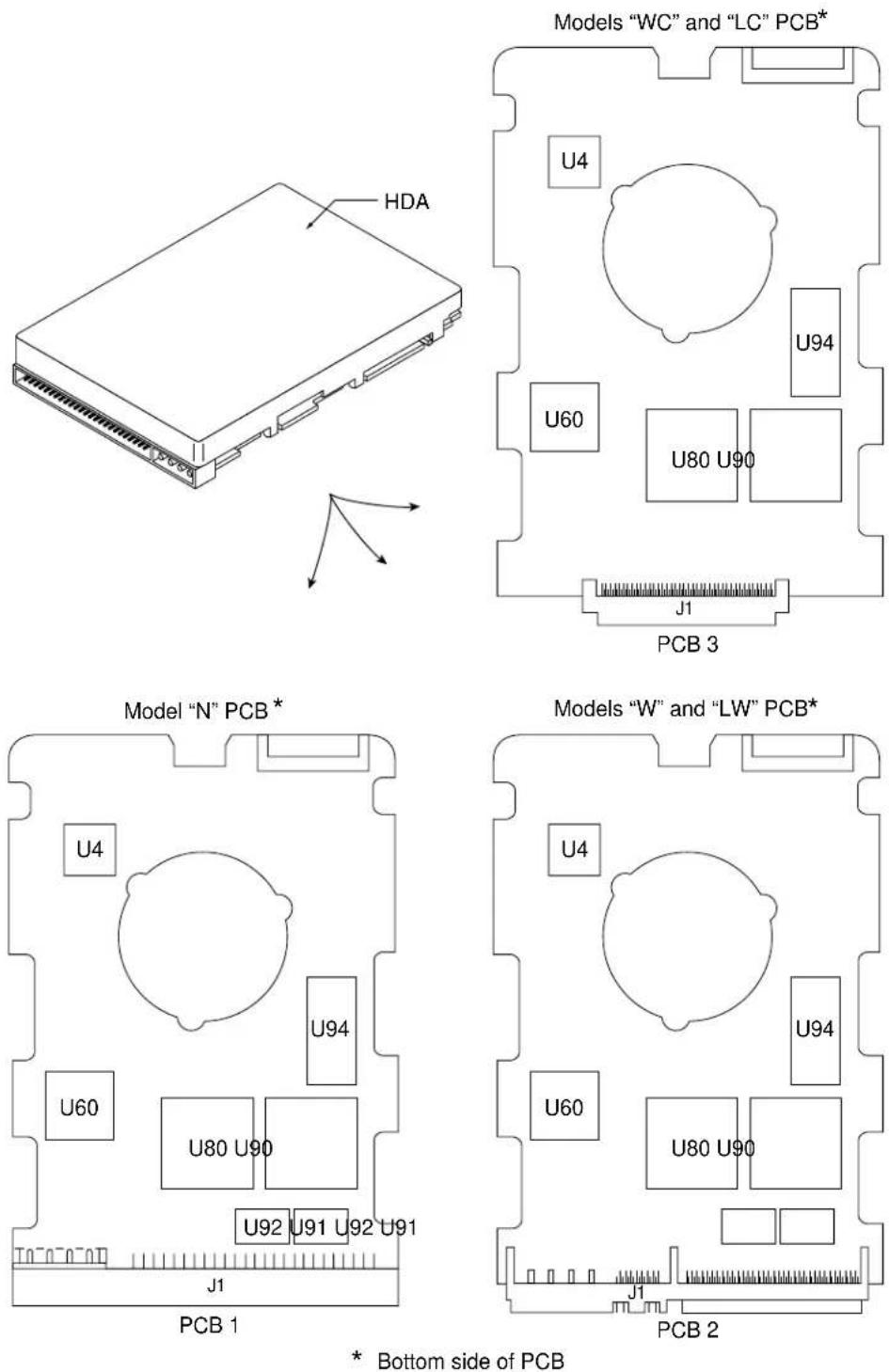
Figure 4. Locations of printed circuit board (PCB) components listed in Table 3
6.4.2 Relative humidity
The values below assume that no condensation on the drive occurs.
a. Operating
8% to 90% relative humidity with a maximum gradient of 30% per hour.
b. Non-operating
5% to 95% relative humidity.
6.4.3 Effective altitude (sea level)
a. Operating
-1,000 to +10,000 feet (-305 to +3,048 meters)
b. Non-operating
-1,000 to +40,000 feet (-305 to +12,210 meters)
6.4.4 Shock and vibration
Shock and vibration limits specified in this document are measured directly on the drive chassis. If the drive is installed in an enclosure to which the stated shock and/or vibration criteria is applied, resonances may occur internally to the enclosure resulting in drive movement in excess of the stated limits. If this situation is apparent, it may be necessary to modify the enclosure to minimize drive movement.
The limits of shock and vibration defined within this document are specified with the drive mounted by any of the four methods shown in Figure 5, and in accordance with the restrictions of Section 8.4. Orientation of the side nearest the LED may be up or down.
6.4.4.1 Shock
a. Operating—normal
The drive, as installed for normal operation, shall operate error free while subjected to intermittent shock not exceeding 10 g at a maximum duration of 11 ms (half sinewave). Shock may be applied in the X, Y, or Z axis.
b. Non-operating
The limits of non-operating shock shall apply to all conditions of handling and transportation. This includes both isolated drives and integrated drives.
The drive subjected to nonrepetitive shock not exceeding 75 g at a maximum duration of 11 ms (half sine-wave) shall not exhibit device damage or performance degradation. Shock may be applied in the X, Y, or Z axis.
Maximum 2 msec rotary shock (half sinewave) 12,000 radians/sec ^4 .
The drive subjected to nonrepetitive shock not exceeding 200 g at a duration of 2 msec (half sinewave) does not exhibit device damage or performance degradation. Shock may be applied in the X, Y, or Z axis.
c. Packaged
Disc drives shipped as loose load (not palletized) general freight will be packaged to withstand drops from heights as defined in the table below. For additional details refer to Seagate specifications 30190-001 (under 100 lbs/45 kg) or 30191-001 (over 100 lbs/45 Kg).
Package size Packaged/product weight Drop height
<600 cu in (<9,800 cu cm) Any 60 in (1524 mm)
600-1800 cu in (9,800-19,700 cu cm) 0-20 lb (0 to 9.1 kg) 48 in (1219 mm)
1800 cu in (>19,700 cu cm) 0-20 lb (0 to 9.1 kg) 42 in (1067 mm)
600 cu in (>9,800 cu cm) 20-40 lb (9.1 to 18.1 kg) 36 in (914 mm)
text_image
Note. Use four screws (two per side) when using the mounting holes located on the sides of the drive. See Section 8.4 when using the mounting holes located on the bottom of the drive.Figure 5. Recommended mounting
6.4.4.2 Vibration
a. Operating - normal
The drive as installed for normal operation, shall comply with the complete specified performance while subjected to continuous vibration not exceeding
5-22 Hz @ 0.020 inch displacement (peak to peak)
22-300 Hz @ 0.5 g acceleration (zero to peak)
Vibration may be applied in the X, Y, or Z axis.
b. Operating - abnormal
22-300 Hz @ TBD g (X, Y, or Z axis)
c. Non-operating
The limits of non-operating vibration shall apply to all conditions of handling and transportation. This includes both isolated drives and integrated drives.
The drive shall not incur physical damage or degraded performance as a result of continuous vibration not exceeding
5-22 Hz @ 0.81 inch displacement
22-350 Hz @ 2.0 g acceleration (zero to peak)
Vibration may be applied in the X, Y, or Z axis.
6.4.5 Air cleanliness
The drive is designed to operate in a typical office environment with minimal environmental control.
6.4.6 Acoustics
Sound power during idle mode shall be 3.9 bels (4.2 max) typical when measured to Seagate's 30553-001 specification.
6.4.7 Electromagnetic susceptibility
See Section 2.1.2.
6.5 Mechanical specifications
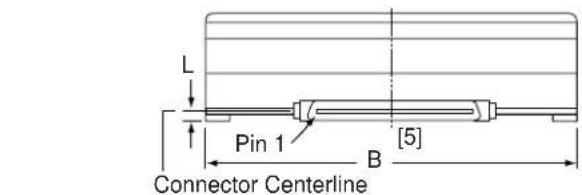
The following nominal dimensions are exclusive of the decorative front panel accessory. However, dimensions of the front panel are shown in figure below. Refer to Figures 6, 7, and 8 for detailed mounting configuration dimensions. See Section 8.4, "Drive mounting."
Height: 1.007 in 26.9 mm
Width: 4.000 in 101.6 mm
Depth: 5.754 in 146.15 mm
Weight: 1.5 pounds 0.68 kilograms
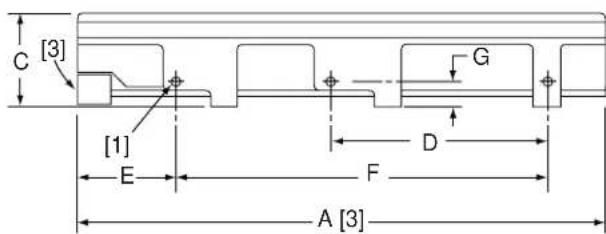
text_image
C [3] [1] E F A [3] G DNotes:
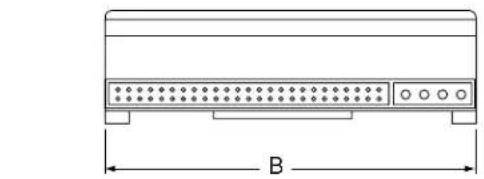
natural_image
Technical line drawing of a server rack with indicator lights and labeled dimension B (no text or symbols beyond label)[1] Mounting holes three on each side, 6-32 UNC. Max screw length into side of drive 0.15 in. (3.81 mm). Screw tightening torque 6.0 in-lb (.675 NM) max with minimum thread engagement of 0.12 in. (3.05 mm).
[2] Mounting holes four on bottom, 6-32 UNC. Max screw length into bottom of drive 0.15 in. (3.81 mm). Screw tightening torque 6.0 in-lb (.675 NM) max with minimum thread engagement of 0.12 in. (3.05 mm).
[3] Power and interface connectors can extend past the "A" dimension by 0.040 in. (1.02 mm).
[4] Centerline of pad for Pin 1 of power connector.
[5] Centerline of pad for Pin 1 of J6.
[6] Centerline of pad for Pin 1 of J2. Dimensions indicated are for reference only.
[7] Dimensions to Pin 1 of each connector are nominal values.
[8] To pin ends on J6. Pin ends on J6 are nominally flush with end of drive.
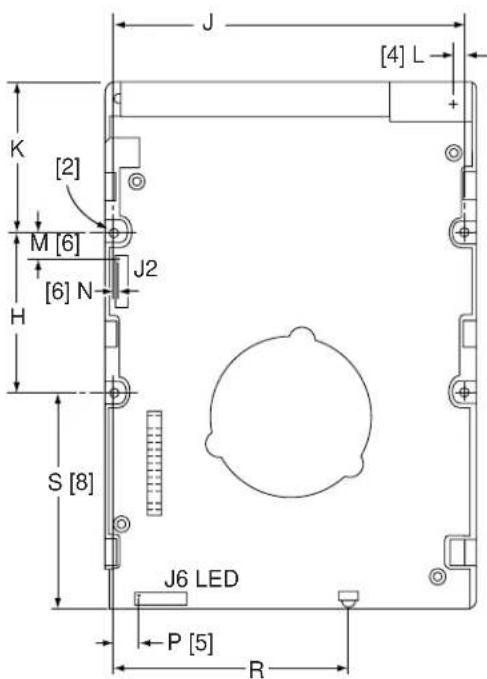
text_image
J [4] L K [2] M [6] [6] N J2 H S [8] J6 LED P [5] R| Inches | Millimeters | |||
| A | 5.754 | ±.026 | 146.15 | ±.66 |
| B | 4.000 | ±.015 | 101.6 | ±.38 |
| C | 1.007 | ±.013 | 25.6 | ±.33 |
| D | 2.362 | ±.010 | 60.00 | ±.25 |
| E | 1.120 | ±.020 | 28.45 | ±.51 |
| F | 4.000 | ±.010 | 101.60 | ±.25 |
| G | .250 | + .010 | 6.35 | + .25 |
| - .005 | - .12 | |||
| H | 1.750 | ±.010 | 44.45 | ±.25 |
| J | 3.750 | ±.010 | 95.25 | ±.25 |
| K | 1.625 | ±.020 | 41.28 | ±.51 |
| L | 0.143 | [7] | 3.63 | [7] |
| M | 0.26 | 6.60 | ||
| N | 0.061 | 1.55 | ||
| P | 0.405 | 10.29 | ||
| R | 2.265 | 57.53 | ||
| S | 2.350 | 59.69 | ||
Figure 6. Mounting configuration dimensions for "N" models
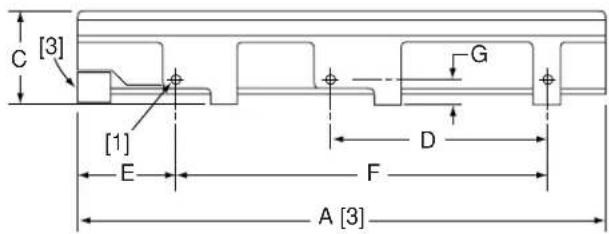
text_image
C [3] [1] E F A [3] D GNotes:
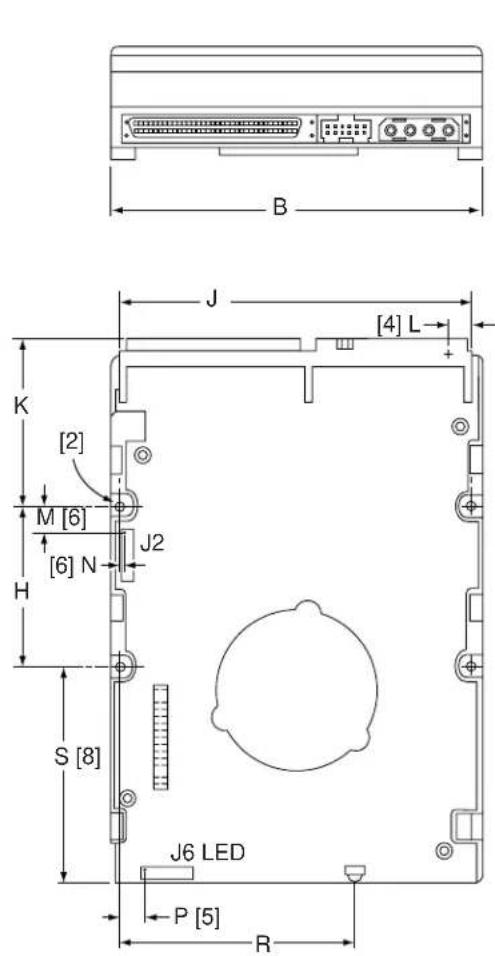
text_image
B J [4] L K [2] M [6] [6] N J2 H S [8] J6 LED P [5] R[1] Mounting holes three on each side, 6-32 UNC. Max screw length into side of drive 0.15 in. (3.81 mm). Screw tightening torque 6.0 in-lb (.675 NM) max with minimum thread engagement of 0.12 in. (3.05 mm).
[2] Mounting holes four on bottom, 6-32 UNC. Max screw length into bottom of drive 0.15 in. (3.81 mm). Screw tightening torque 6.0 in-lb (.675 NM) max with minimum thread engagement of 0.12 in. (3.05 mm).
[3] Power and interface connectors can extend past the "A" dimension by 0.040 in. (1.02 mm).
[4] Centerline of pad for Pin 1 of power connector.
[5] Centerline of pad for Pin 1 of J6.
[6] Centerline of pad for Pin 1 of J2. Dimensions indicated are for reference only.
[7] Dimensions to Pin 1 of each connector are nominal values.
[8] To pin ends on J6. Pin ends on J6 are nominally flush with end of drive.
Dimension Table
| Inches | Millimeters | |||
| A | 5.754 | ±.026 | 146.15 | ±.66 |
| B | 4.000 | ±.015 | 101.6 | ±.38 |
| C | 1.007 | ±.013 | 25.6 | ±.33 |
| D | 2.362 | ±.010 | 60.00 | ±.25 |
| E | 1.120 | ±.020 | 28.45 | ±.51 |
| F | 4.000 | ±.010 | 101.60 | ±.25 |
| G | .250 | + .010 | 6.35 | + .25 |
| - .005 | - .12 | |||
| H | 1.750 | ±.010 | 44.45 | ±.25 |
| J | 3.750 | ±.010 | 95.25 | ±.25 |
| K | 1.625 | ±.020 | 41.28 | ±.51 |
| L | 0.143 | [7] | 3.63 | [7] |
| M | 0.26 | 6.60 | ||
| N | 0.061 | 1.55 | ||
| P | 0.405 | 10.29 | ||
| R | 2.265 | 57.53 | ||
| S | 2.350 | 59.69 | ||
Figure 7. Mounting configuration dimensions for "W" and "LW" models
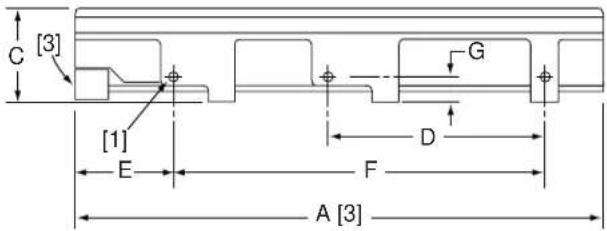
text_image
C [3] [1] E F A [3] G DNotes:
[1] Mounting holes three on each side, 6-32 UNC. Max screw length into side of drive 0.15 in. (3.81 mm). Screw tightening torque 6.0 in-lb (.675 NM) max with minimum thread engagement of 0.12 in. (3.05 mm).
[2] Mounting holes four on bottom, 6-32 UNC. Max screw length into bottom of drive 0.15 in. (3.81 mm). Screw tightening torque 6.0 in-lb (.675 NM) max with minimum thread engagement of 0.12 in. (3.05 mm).
[3] Interface connector is flush with the end of drive within ±0.020 in. (.5 mm). The interface connector location may extend beyond HDA dimension "A" by 0.020 in. (.5 mm).
[4] Connector J1 is centered (side to side) on drive within ±0.020 in (.508 mm).
[5] Dimension "M" is from bottom rear drive mounting holes center(s) to the face of the connector at the center of the drive.
[6] Dimensions "M" and "N" are unique requirements for SCA drives only, required for conformance with latest SFF Spec #8337.
[7] Maximum connector non-perpendicularity to side planes pointed to by X.
[8] Centerline of pad for Pin 1 of J6.
[9] Centerline of pad for Pin 1 of J2. Dimensions indicated are for reference only.
[10] Dimensions to Pin 1 of each connector are nominal values.
[11] To pin ends on J6. Pin ends on J6 are nominally flush with end of drive. Dimensions "K" and "S" may not be exactly the same.
Dimension Table
| Inches | Millimeters | |||
| A | 5.754 ± .026 | 146.15 ± .66 | ||
| B | 4.000 ± .015 | 101.6 ± .38 | ||
| C | 1.007 ± .013 | 25.6 ± .33 | ||
| D | 2.362 ± .010 | 60.00 ± .25 | ||
| E | 1.120 ± .020 | 28.45 ± .51 | ||
| F | 4.000 ± .010 | 101.60 ± .25 | ||
| G | .250 + .010 | 6.35 + .25 | ||
| -.005 | -.12 | |||
| H | 1.750 ± .010 | 44.45 ± .25 | ||
| J | 3.750 ± .010 | 95.25 ± .25 | ||
| K | TBD ± TBD | TBD ± TBD | ||
| L | 0.181 + .015 | 4.597 + .38 | ||
| -.010 | -.25 | |||
| M | 1.62 ± .02 | 41.15 ± .50 | ||
| N | .015 | .38 | ||
| P | .405 | 10.29 | ||
| R | 2.265 | 52.53 | ||
| S | 2.350 | 59.69 | ||
| T | .061 | 1.55 | ||
| U | 0.26 | 6.60 | ||
text_image
L Pin 1 [5] Connector Centerline B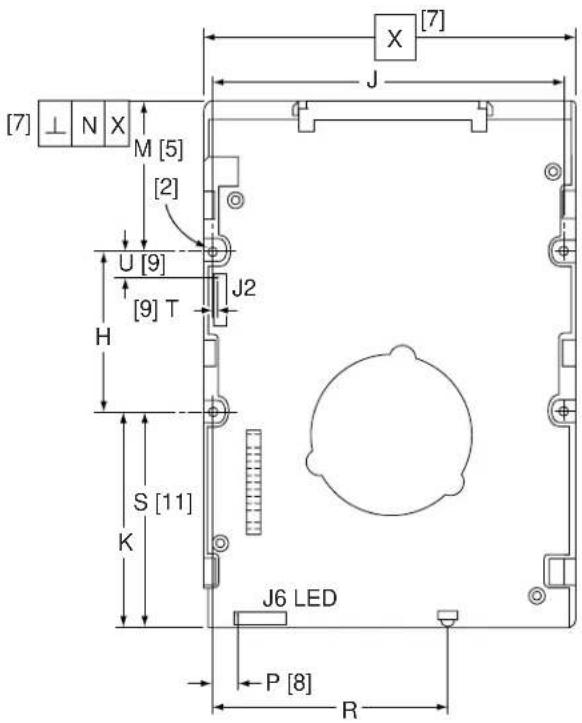
text_image
[7] ⊥ N X M [5] [2] U [9] [9] T J2 H S [11] K J6 LED P [8] R X [7] JFigure 8. Mounting configuration dimensions for "WC" and "LC" models
7.0 Defect and error management
The drive, as delivered, complies with this specification. The read error rate and specified storage capacity are not dependent upon use of defect management routines by the host (initiator).
Defect and error management in the SCSI system involves the drive internal defect/error management and SCSI systems error considerations (errors in communications between Initiator and the drive). Tools for use in designing a defect/error management plan are briefly outlined in this section, with references to other sections where further details are given.
7.1 Drive internal defects and errors
Identified defects are recorded on the drive defects list tracks (referred to as the primary or ETF defect list). These known defects are reallocated during the initial drive format operation at the factory. (See Section 5.2.1.2, "Format Unit command" in the SCSI Interface Product Manual, part number 77738479). Data correction by ECC will be applied to recover data from additional flaws if they occur.
Details of the SCSI commands supported by the drive are described in SCSI Interface Product Manual.
7.2 SCSI systems errors
Information on the reporting of operational errors or faults across the interface is given in the SCSI Interface Product Manual. Message Protocol System is described in the SCSI Interface Product Manual. Several of the messages are used in the SCSI systems error management system. The Request Sense command returns information to the host about numerous kinds of errors or faults. Appendix A of this manual lists the sense keys and additional sense codes supported by the drives of this manual. The Receive Diagnostic Results reports the results of diagnostic operations performed by the drive.
Status returned by the drive to the Initiator is described in the SCSI Interface Product Manual. Status reporting plays a role in the SCSI systems error management and its use in that respect is described in sections where the various commands are discussed.
8.0 Installation
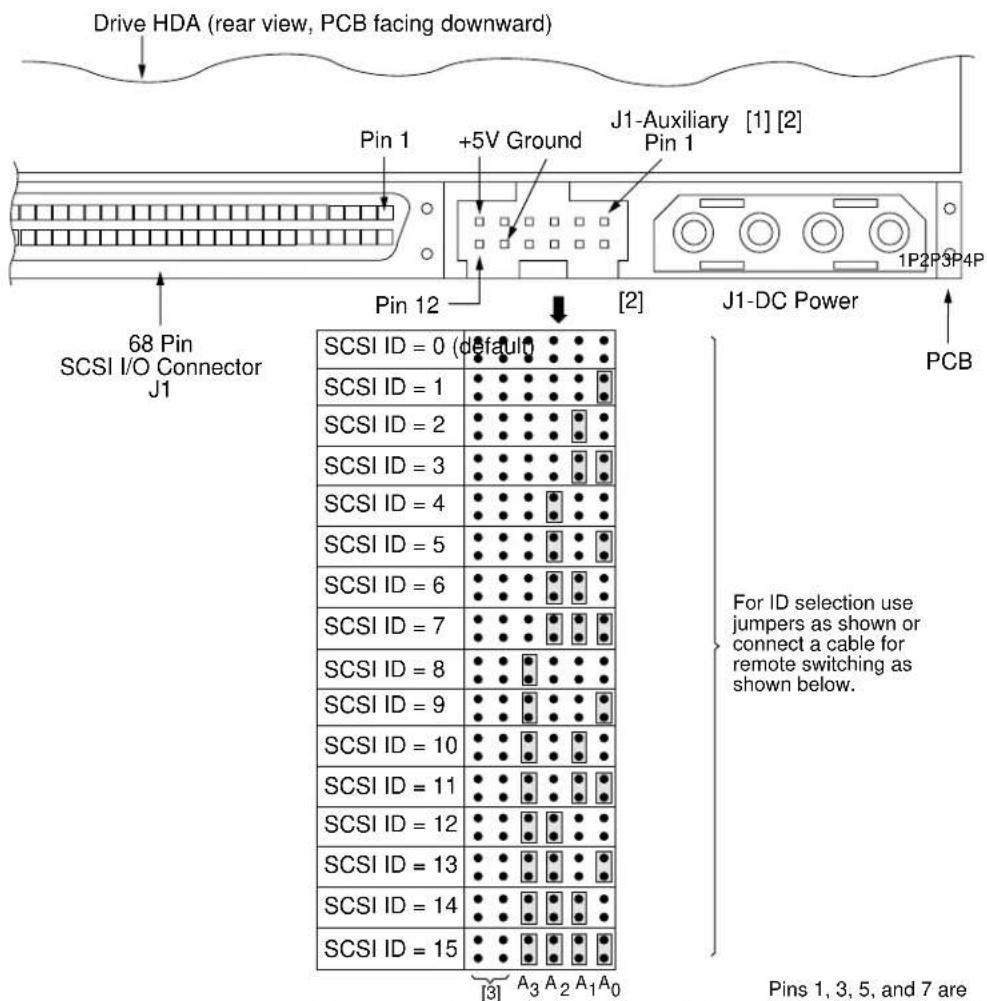
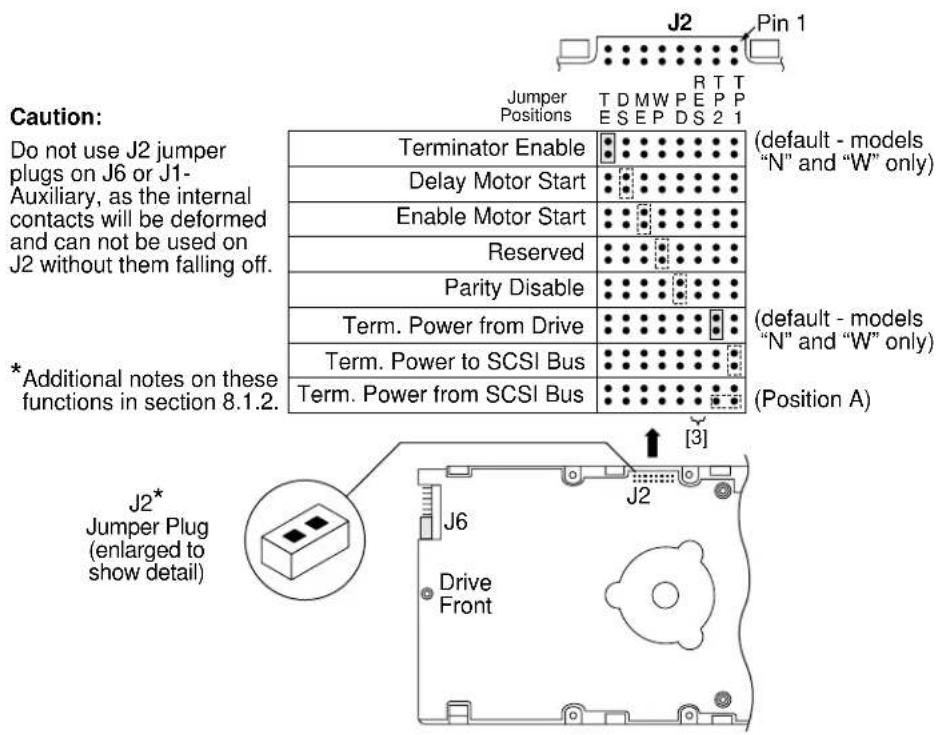
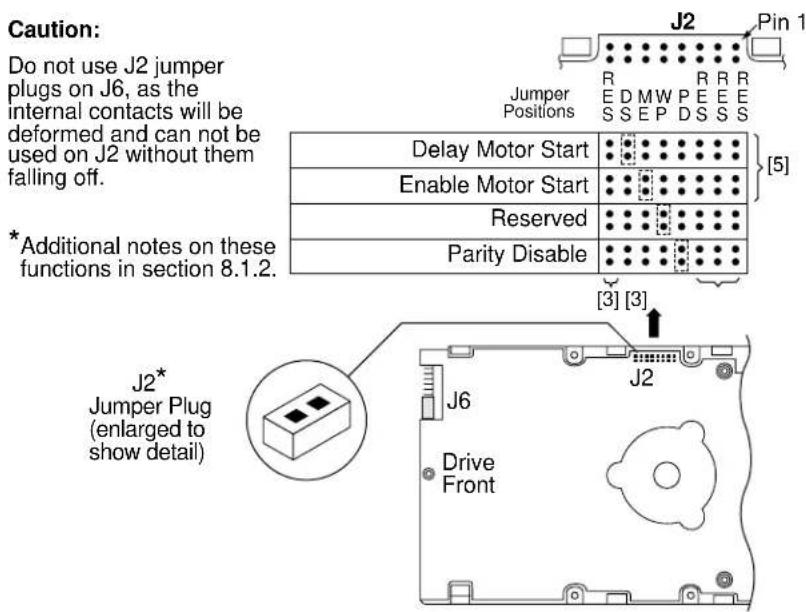
The first thing to do when installing a drive is to set the drive ID (select) on the SCSI bus and set up certain operating options. This is usually done by installing small shorting jumpers on the pins of connector J2 on the PCB (or J1-Auxiliary on the "W" and "LW" models), or via the drive to host I/O signals on "WC" and "LC" models. Some users connect cables to J6 or J1-Auxiliary and perform the set-up using remote switches.
If your system is “SCAM” (SCSI Configured Auto Magically) compliant, the system assigns the drive ID over the interface, so there is no need to be concerned about drive ID. Setting the drive ID jumpers doesn't hurt anything, but is not necessary.
If your system is not "SCAM" compliant you need to set the drive ID using the ID jumpers.
Configure drive options
For option jumper locations and definitions refer to Figures 9, 10, 11, 12, 13, and 14. Drive default mode parameters are not normally needed for installation. Refer to Section 9.3.2 for default mode parameters if they are needed.
- Ensure that the SCSI ID of the drive is not the same as the host adapter. Most host adapters use SCSI ID 7. ID 7 is the highest priority on both 8 and 16 bit data buses.
- If multiple devices are on the bus set the drive SCSI ID to one that is not presently used by other devices on the bus.
- If the drive is the only device on the bus, attach it to the end of the SCSI bus cable. Permanently installed terminators must be enabled on the drive for "N" and "W" models using jumper plug TE if termination is not provided by the host equipment. On "WC," "LC," and "LW" models, external terminators must be provided by the user, systems integrator or host equipment manufacturer.
- If the drive is attached to a bus that contains other devices, and the new drive is not attached to the end of the bus, the Terminator Enable jumper (TE) should be removed from the new drive.
Note. For additional information about terminator requirements, refer to Sections 9.8 and 9.9.
- Set all appropriate option jumpers for desired operation prior to power on. If jumpers are changed after power has been applied, recycle the drive power to make the new settings effective.
- Installation instructions are provided by host system documentation or with any additionally purchased drive installation software. If necessary see Section 10 for Seagate support services telephone numbers.
- Do not remove the manufacturer's installed labels from the drive and do not cover with additional labels, as the manufacturer labels contain information required when servicing the product.
Formatting
- It is not necessary to low level format this drive. The drive is shipped from the factory low level formatted in 512 byte sectors.
- High level format the drive involves assigning one or more partitions or logical drives to the drive volume. Follow the instructions in the system manuals for the system into which the drive is to be installed.
- Systems that have Windows 95 Operating System version 950B (this has FAT 32) or later do not need to partition the drive.
8.1 Drive ID/option select header
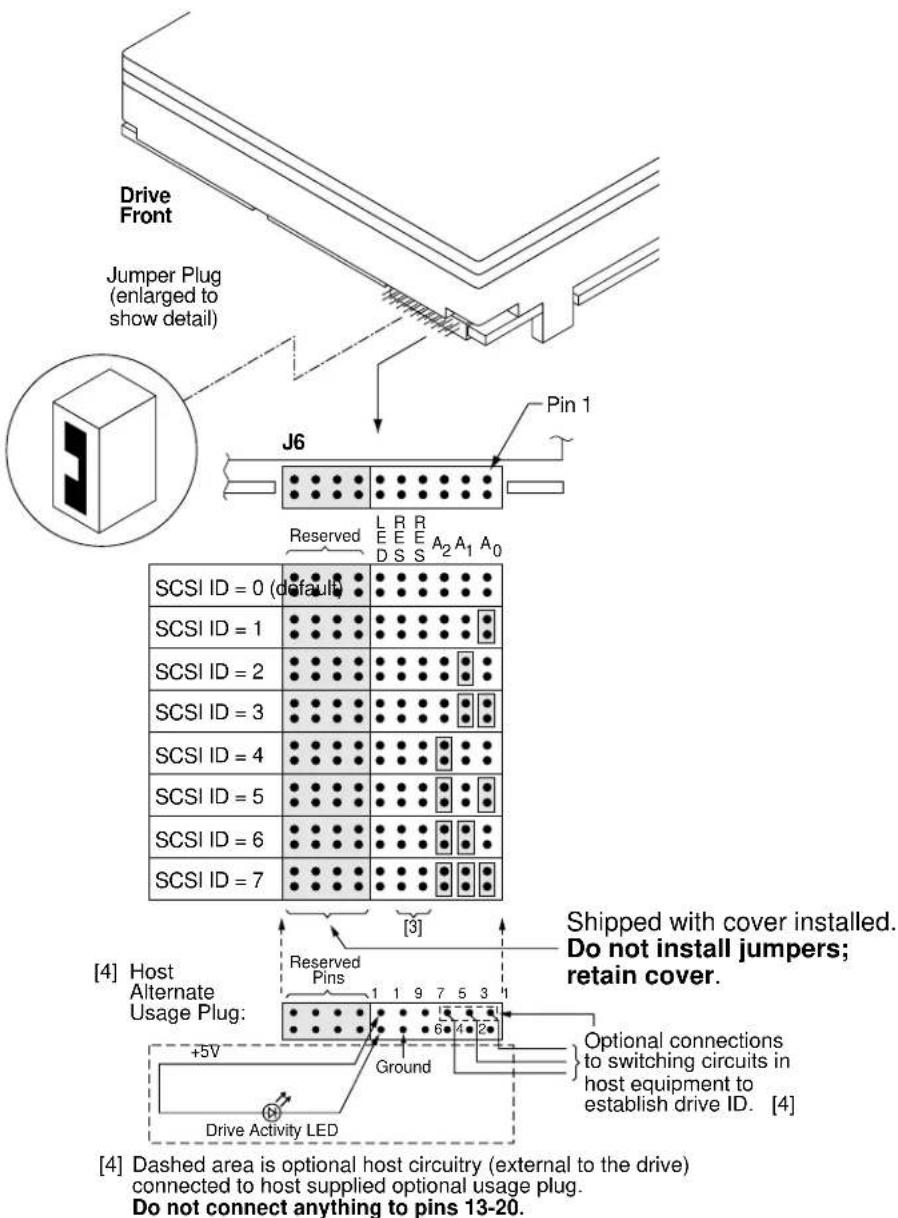
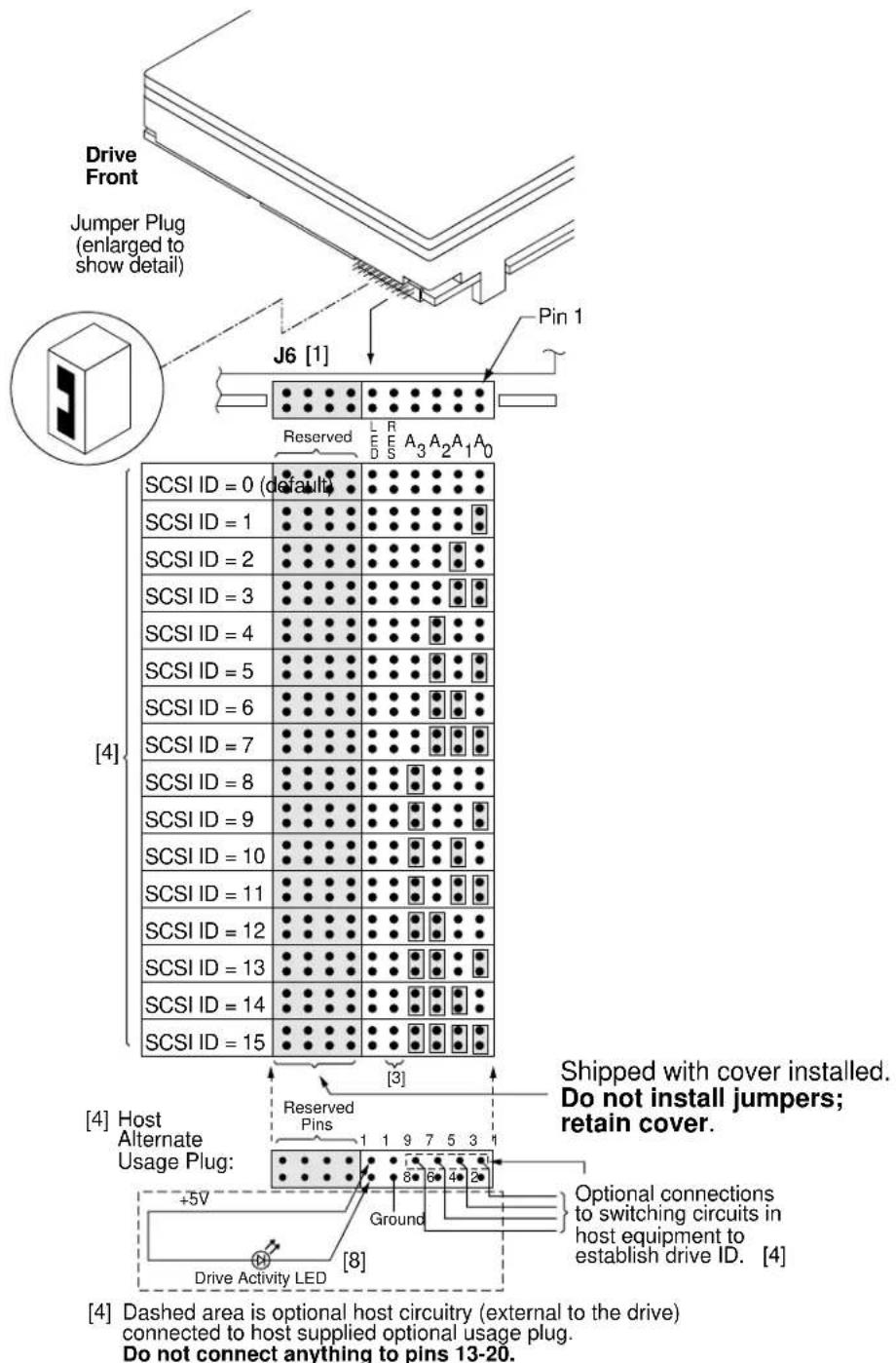
Figures 9 through 11 show views of the drive ID select jumper connectors. Figure 12 shows the option select jumper connector for all models. Figure 10 shows a rear view of model drives for the purpose of showing J1-auxiliary of the drive. Both J1-auxiliary and J6 have pins for selecting drive ID and for connecting the remote LED cable. Only one or the other should be used, although using both at the same time would not damage the drive. The notes following the figures describe the functions of the various jumper positions on the connectors J2, J1-Auxiliary and J6. See your local drive sales representative for suggested part number. A bag containing jumper plugs is shipped with standard OEM drives.
text_image
Drive Front Jumper Plug (enlarged to show detail) Pin 1 J6 Reserved L R R E E E A2 A1 A0 SCSI ID = 0 (default) SCSI ID = 1 SCSI ID = 2 SCSI ID = 3 SCSI ID = 4 SCSI ID = 5 SCSI ID = 6 SCSI ID = 7 [3] Shipped with cover installed. Do not install jumpers; retain cover. [4] Host Alternate Usage Plug: Reserved Pins 1 1 9 7 5 3 Ground +5V Drive Activity LED Optional connections to switching circuits in host equipment to establish drive ID. [4] [4] Dashed area is optional host circuitry (external to the drive) connected to host supplied optional usage plug. Do not connect anything to pins 13-20.Figure 9. Medalist Pro family drive ID select header for "N" models
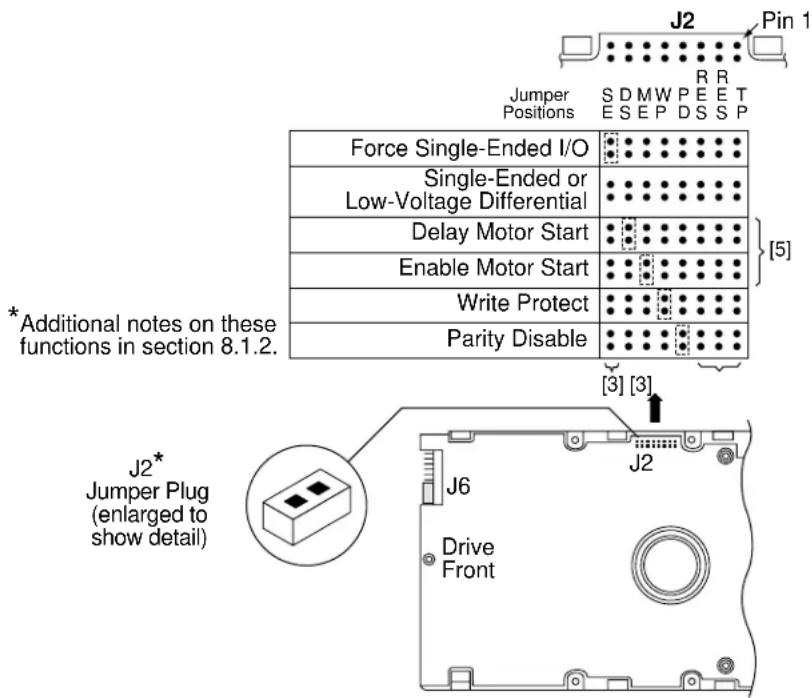
Notes for Figures 9 through 14 are in Section 8.1.1.
text_image
Drive Front Jumper Plug (enlarged to show detail) Pin 1 J6 [1] Reserved [4] SCSI ID = 0 (default) SCSI ID = 1 SCSI ID = 2 SCSI ID = 3 SCSI ID = 4 SCSI ID = 5 SCSI ID = 6 SCSI ID = 7 SCSI ID = 8 SCSI ID = 9 SCSI ID = 10 SCSI ID = 11 SCSI ID = 12 SCSI ID = 13 SCSI ID = 14 SCSI ID = 15 [3] Shipped with cover installed. Do not install jumpers; retain cover. [4] Host Alternate Usage Plug: Reserved Pins 1 1 9 7 5 3 Ground [8] Drive Activity LED [4] Dashed area is optional host circuitry (external to the drive) connected to host supplied optional usage plug. Do not connect anything to pins 13-20.Figure 10. Medalist Pro family drive ID select for "W," "WC," "LW," and "LC" models
text_image
Drive HDA (rear view, PCB facing downward) Pin 1 +5V Ground J1-Auxiliary [1] [2] Pin 12 68 Pin SCSI I/O Connector J1 J1-DC Power PCB SCSI ID = 0 (default) SCSI ID = 1 SCSI ID = 2 SCSI ID = 3 SCSI ID = 4 SCSI ID = 5 SCSI ID = 6 SCSI ID = 7 SCSI ID = 8 SCSI ID = 9 SCSI ID = 10 SCSI ID = 11 SCSI ID = 12 SCSI ID = 13 SCSI ID = 14 SCSI ID = 15 [3] A3 A2 A1 A0 For ID selection use jumpers as shown or connect a cable for remote switching as shown below. Pins 1, 3, 5, and 7 are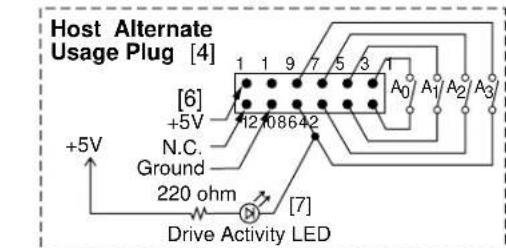
text_image
Host Alternate Usage Plug [4] [6] +5V N.C. Ground 220 ohm Drive Activity LED [7][4] Dashed area is optional host circuitry (external to the drive) connected to host supplied optional usage plug.
Pins 1, 3, 5, and 7 are optional connections to switching circuits in host equipment to establish drive ID. [4]
- Remote Switches
Pins 2, 4, 6, and 8 are normally not grounded. They are driven low (ground) for 250 ms after a Reset or PWR ON to allow drive to read SCSI ID selected. [4]
Figure 11. Medalist Pro family drive ID select header J1-auxiliary for "W" and "LW" models (J1-Auxiliary Pins 1A - 12A)
text_image
J2 Pin 1 Jumper Positions T D M W P E P P E S E P D S 2 1 Caution: Do not use J2 jumper plugs on J6 or J1- Auxiliary, as the internal contacts will be deformed and can not be used on J2 without them falling off. *Additional notes on these functions in section 8.1.2. Terminator Enable delay Motor Start Enable Motor Start Reserved Parity Disable Term. Power from Drive Term. Power to SCSI Bus Term. Power from SCSI Bus (default - models "N" and "W" only) (default - models "N" and "W" only) (Position A) J2* Jumper Plug (enlarged to show detail) Drive FrontFigure 12. Medalist Pro family drive option select header for "N" and "W" models
text_image
Caution: Do not use J2 jumper plugs on J6, as the internal contacts will be deformed and can not be used on J2 without them falling off. * Additional notes on these functions in section 8.1.2. Jumper Positions J2 Pin 1 R E D M W P E E R S S E P D S S Delay Motor Start Enable Motor Start Reserved Parity Disable [5] [3] [3] J2* Jumper Plug (enlarged to show detail) J6 Drive FrontFigure 13. Medalist Pro family drive option select header for "WC" models
text_image
J2 Pin 1 Jumper Positions S D M W P E T E S E P D S S P Force Single-Ended I/O [5] Single-Ended or Low-Voltage Differential Delay Motor Start Enable Motor Start Write Protect Parity Disable * Additional notes on these functions in section 8.1.2. [3] [3] J2* Jumper Plug (enlarged to show detail) Drive FrontFigure 14. Medalist Pro family drive option select header for models "LW" and "LC"
8.1.1 Notes for Figures 9, 10, 11, 12, 13, and 14.
[1] Notes explaining the functions of the various jumpers on jumper header connectors J2, J1-Auxiliary and J6 are given here and in Section 8.1.2. The term "default" means as standard OEM units are configured with a jumper on those positions when shipped from factory. "Off" means no jumper is installed; "On" means a jumper is installed. OFF or ON underlined is factory default condition.
[2] The PCB on "N," "WC," and "LC" model drives does not have connector J1-Auxiliary. The J1-Auxiliary connector signals conform to SFF-8009 Revision 2.0, Unitized Connector for Cabled Drives, signal assignments for auxiliary connectors. See note [4].
[3] Reserved useage. Do not install any jumpers.
[4] Table 4 summarizes the configuration selection possibilities available on the different Medalist Pro model drives.
[5] These signals are also on 80 pin J1. See Table 19.
[6] Voltage supplied by the drive.
[7] J1A Drive Activity LED—with series resistor built-in pin 12, is the open collector driver that drives the external LED minus side low to turn it on. This output is capable of driving >20mA. This is the same signal as on J6 pin 12, except J1A pin 8 goes through a 220 Ohm resistor. Tie the minus side of the external LED to this pin.
[8] J6 Drive Activity LED—without series resistor built-in pin 8, is the open collector driver that drives the external LED minus side low to turn it on. This output is capable of driving >20mA. This is the same signal as on J1A pin 8, except J6 pin 12 does not go through a 220 Ohm resistor. Tie the minus side of the external LED to this pin.
Table 4: Drive configuration selections summary
| Interface type Function | Connector | Applicable figureJ1 | ||||
| N Drive ID X, Y none 9 | ||||||
| N Drive Activity LED | Y [3] | none | 9 | |||
| N Option select | none | X | 12 | |||
| W, LW | Drive ID X, Y X, Y [5] | 10, | 11 [1] | |||
| W, LW | Drive Activity LED | Y [3] | Y [3] | 10, 11 [1] | ||
| W, LW | Option select | X | 12 | |||
| WC, LC | Drive ID | Y[6] | X, Y | none | 10 [4] | |
| WC, LC | Drive Activity LED | Y[2][3] | Y [3] | none | 10 [4] | |
| WC, LC | Option select: | |||||
| Delayed Mtr Start | Y[2] | none | X | 13 | ||
| Enable Mtr Start | Y[2] | none | X | 13 | ||
| Write Protect | none | X | 13 | |||
| Parity Disable | none | X | 13 | |||
| LW, LC | SE (force single-ended) | X | 14 | |||
J6
J1-AUX
J2
("X" means the function selection can be made with jumpers on that connector; "Y" means the signal is available to host through that connector.)
Notes for Table 4 [ ]:
[1] Use either J6 or J1-Aux, but not both.
[2] I/O connector J1 plugs directly into host. No jumper can be installed on J1. The host supplies the logic state of these function signals causing the selection of these functions. See pinout Table 19.
[3] The host can drive a remotely located Drive Activity LED using signal.
[4] Use either J1 or J6, but not both.
[5] The drive reads the ID (asserted low) from J1-Auxiliary pins 1, 3, 5 and 7 for 250 ms after power-on or drive reset. Jumper plugs can be used on J1-Auxiliary pins 1-2, 3-4, 5-6 and 7-8 to set drive ID if desired, but usually a connector/cable is plugged to J1-Auxiliary to run these signals to the host for remote ID selection.
[6] The host selects drive ID through J1.
8.1.2 Function description
J2
Jumper
Installation Jumper Function Description
TE (Applies only to "N" and "W" models)
On With the jumper installed, the On-board (non-removable) terminator circuits are enabled (connected to the I/O lines). Default is jumper installed.
Off Terminator circuits not enabled (not connected to I/O lines).
SE (Applies only to "LW" and "LC" models)
On Forces drive to use single-ended I/O drivers/receivers only.
Off Drive can operate on the interface in low voltage differential mode or single-ended, depending on the voltage state of the I/O "DIFFSENS" line. Default is no jumper on.
DS ME (Applies to all models)
Off Off Spindle starts immediately after power up - Default setting.
Off On Drive spindle does not start until Start Unit command received from host.
On Off Spindle Startup is delayed by SCSI ID times 12 seconds after power is applied, i.e., drive 0 spindle starts immediately when DC power connected, drive 1 starts after 12 second delay, drive 2 starts after 24 second delay, etc.
On On Drive spindle starts when Start Unit command received from host. Delayed start feature is overridden and does not apply when ME jumper is installed.
PD (Applies to all models)
On Parity checking and parity error reporting by the drive is disabled.
Off Drive checks for parity and reports result of parity checking to host. Default is PD jumper not installed.
RES (Applies to all models)
Off Reserved jumper position. Default is no jumper installed.
TP2 TP1 (Does not apply to "WC" models)
Off Off No terminator power is connected to drive terminators or SCSI bus I/O cable*.
On Off Drive supplies its own terminator power only. Jumper on this position is factory default.
Off On Drive supplies power to SCSI bus I/O cable ^* ; none to internal terminators. When drives have differential I/O circuits, a jumper on the TP1 position may be needed to power external terminators (see system documentation).
On On Drive supplies terminator power to itself (internal connection) and to SCSI bus I/O cable*. This is a legal jumper setting.
TP1 and TP2
"Position A" (Applies only to "N" and "W")
On This horizontally positioned jumper across the two TP positions furthest from the PCB edge, connects terminator power from SCSI bus I/O Termpower cable* to the drive's internal terminators (for single-ended I/O only).
Off See above explanations for TP jumpers.
TP (Applies only to "LW" model)
Off No terminator power is connected to SCSI bus I/O cable.* Default is no jumpers on.
On Drive supplies power to SCSI bus I/O cable.* A jumper on the TP1 position may be needed to power external terminators (see Section 9.8 and Figure 10).
*See Figure 12 for pins used for Termpower.
8.2 Drive orientation
The balanced rotary arm actuator design of the drive allows it to be mounted in any orientation. All drive performance characterization, however, has been done with the drive in horizontal (discs level) and vertical (drive on its side) orientations, and these are the two preferred mounting orientations.
8.3 Cooling
Cabinet cooling must be designed by the customer so that the ambient temperature immediately surrounding the drive will not exceed temperature conditions specified in Section 6.4.1, "Temperature." Specific consideration should be given to make sure adequate air circulation is present around the printed circuit board (PCB) to meet the requirements of Section 6.4.1, "Temperature."
8.3.1 Air flow
The rack, cabinet, or drawer environment for the Medalist Pro drive must provide heat removal from the electronics and head and disc assembly (HDA). You should confirm that adequate heat removal is provided using the temperature measurement guidelines described in Section 6.4.1.
Forced air flow may be required to keep temperatures at or below the specified case temperatures of Table 3, Column 2, in which case the drive should be oriented, or air flow directed, so that the least amount of air flow resistance is created while providing air flow to the electronics and HDA. Also, the shortest possible path between the air inlet and exit should be chosen to minimize the travel length of air heated by the drive and other heat sources within the rack, cabinet, or drawer environment.
If forced air is determined to be necessary, possible air-flow patterns are shown in Figure 15. The air-flow patterns are created by one or more fans, either forcing or drawing air as shown in the illustrations. Conduction, convection, or other forced air-flow patterns are acceptable as long as the temperature measurement guidelines of Section 6.4.1 are met.
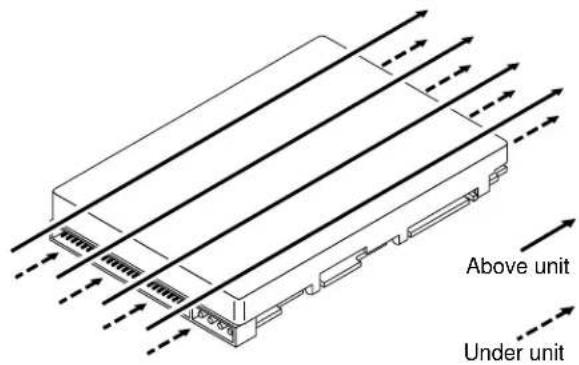
text_image
Above unit Under unitNote. Air flows in the direction shown (front to back) or in reverse direction (back to front)
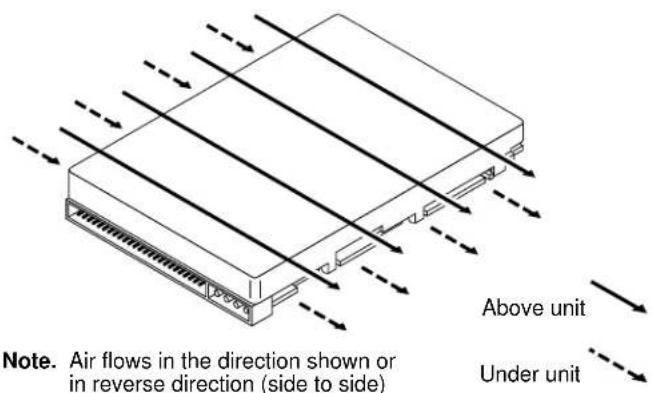
text_image
Note. Air flows in the direction shown or in reverse direction (side to side) Above unit Under unitFigure 15. Air flow (suggested)
8.4 Drive mounting
Refer to Figure 5 on page 25 for an illustration of the recommended mounting orientations
When mounting the drive using the bottom holes (x-y plane in Figure 5) care must be taken to ensure that the drive is not physically distorted due to a stiff non-flat mounting surface. The allowable mounting surface stiffness is 80 lb/in (14.0 N/mm). The following equation and paragraph define the allowable mounting surface stiffness:
$$ K \quad \frac {F}{x} - 8 0 \mathrm{lb/in(14.0N/mm)} = $$
where 'k' represents the mounting surface stiffness (units of lb/in or N/mm), and 'x' represents the out-of-plane mounting surface distortion (units of inches or millimeters). The out-of-plane distortion ('x') is determined by defining a plane with three of the four mounting points fixed and evaluating the out-of-plane deflection of the fourth mounting point when a known force is applied to the fourth point.
Note. Before mounting the drive in any kind of 3.5-inch to 5.25-inch adapter frame, verify with Seagate Technology that the drive can meet the shock and vibration specifications given herein while mounted in such an adapter frame. Adapter frames that are available may not have a mechanical structure capable of mounting the drive so that it can meet the shock and vibration specifications listed in this manual.
8.5 Grounding
Signal ground (PCB) and HDA ground are connected together in the drive and cannot be separated by the user. The equipment in which the drive is mounted is connected directly to the HDA and PCB with no electrically isolating shock mounts. If it is desired for the system chassis to not be connected to the HDA/PCB ground, the systems integrator or user must provide a nonconductive (electrically isolating) method of mounting the drive in the host equipment.
Increased radiated emissions may result if you do not provide the maximum surface area ground connection between system ground and drive ground. This is the system designer's and integrator's responsibility.
9.0 Interface requirements
This section describes Medalist Pro interface requirements.
9.1 General description
This section partially describes the interface requirements as implemented on the drives. The major portion of the interface requirements/implementation is described in the SCSI Interface Product Manual (part number 77738479). This section has tables that give the Medalist Pro family drive's version of the SCSI implementation described in the SCSI Interface Product Manual.
9.2 SCSI interface messages supported
Table 5 lists the messages supported by the SCSI-2 and SCSI-3 modes of the Medalist Pro family drives.
Table 5: SCSI messages supported by Medalist Pro family drives
| Message name Message code | Supported by Medalist Pro | |
| Abort 06h Y | ||
| Abort-tag 0Dh Y | ||
| Bus device reset | 0Ch | Y |
| Clear queue | 0Eh | Y |
| Command complete | 00h Y | |
| Continue I/O process | 12h N | |
| Disconnect | 04h Y | |
| Extended messages | 01h[1] | Y |
| Identify | 80h-FFh | Y |
| Ignore wide residue (two bytes) | 23h Y | |
| Initiate recovery | 0Fh | N |
| Initiator detected error | 05h Y | |
| Linked command complete | 0Ah | N |
| Linked command complete with flag | 0Bh | N |
| Message parity error | 09h Y | |
| Message reject | 07h Y | |
| Modify data pointer | [1] | N |
| No operation | 08h Y | |
| Queue tag messages (two bytes) | ||
| Head of queue tag | 21h Y | |
| Ordered queue tag | 22h Y | |
| Simple queue tag | 20h Y | |
| Release recovery | 10h N | |
| Restore pointers | 03h Y | |
| Save data pointer | 02h Y | |
| Synchronous data transfer req. | [1] | Y |
| Target transfer disable | 13h N | |
| Terminate I/O process | 11h N | |
| Wide data transfer request | [1] | Y [2] |
Notes.
[1] Extended messages (see SCSI Interface Product Manual, part number 77738479).
[2] Not applicable to "N" models.
9.3 SCSI interface commands supported
Table 6 following lists the SCSI interface commands that are supported in the SCSI-2, and SCSI-3 modes of the drive.
Table 6: Commands supported by Medalist Pro family drive
| Command name | Command code | Supported by Medalist Pro |
| Change definition 40h N | ||
| Compare 39h N | ||
| Copy 18h N | ||
| Copy and verify 3Ah N | ||
| Format unit [1] 04h Y | ||
| Block Format N | ||
| Bytes from index | N | |
| Physical sector format | Y | |
| DPRY bit supported | Y | |
| DCRT bit supported | Y | |
| STPF bit supported | Y | |
| IP bit supported (w/o embedded LBA) | Y | |
| DSP bit supported | N | |
| IMMED bit supported | Y | |
| VS (vendor specific) | N | |
| Inquiry | 12h Y | |
| Date code page (C1h) | Y | |
| Device Behavior page (C3h) | Y | |
| Firmware numbers page (C0h) | Y | |
| Implemented operating def page (81h) | Y | |
| Jumper settings page (C2h) | Y | |
| Supported Vital product data page (00h) | Y | |
| Unit serial number page (80h) | Y | |
| Lock-unlock cache | 36h N | |
| Log select | 4Ch | N |
| DU bit | N | |
| DS bit | N | |
| TSD bit | N | |
| ETC bit | N | |
| TMC bit | N | |
| LP bit | N | |
| Log sense | 4Dh | Y |
| Cache statistics page (37h) | Y | |
| Non-medium error page (06h) | Y | |
| Pages supported list (00h) | Y | |
| Power-on time page (3Eh) | Y | |
| Read error counter page (03h) | Y | |
| Verify error counter page (05h) | Y | |
| Write error counter page (02h) | Y | |
| Mode select (same pages as Mode Sense command) | 15h Y [2] | |
| Mode select (10) | 55h Y | |
| Capacity Programming | Y | |
| Mode sense | 1Ah Y [2] | |
| Caching parameters page (08h) | Y | |
| Control mode page (0Ah) Y | ||
| Disconnect/reconnect (02h) (DTDC, DIMM not used) Y | ||
| Error recovery page (01h) Y | ||
| Format page (03h) Y | ||
| Information exceptions control page (1Ch) Y | ||
| Notch and Partition Page (0Ch) N | ||
| Power condition page (1Ah) N | ||
| Rigid disc drive geometry page (04h) Y | ||
| Unit attention page (00h) Y | ||
| Verify error recovery page (07h) Y | ||
| Xor Control page (10h) N | ||
| Mode sense (10) 5Ah Y | ||
| Prefetch | 34h | N |
| Read | 08h | Y |
| Read buffer (modes 0, 2 supported) | 3Ch | Y |
| Read capacity | 25h | Y |
| Read defect data | 37h | Y |
| Read extended | 28h | Y |
| DPO bit supported | Y | |
| FUA bit supported | Y | |
| Read long | 3Eh | Y |
| Reassign blocks | 07h | Y |
| Rebuild | 81h | N |
| Receive diagnostic results | 1Ch | Y |
| Supported diagnostics pages (00h) | Y | |
| Translate page (40h) | Y | |
| Regenerate | 82h | N |
| Release | 17h | Y |
| Release (10) | 57h | Y |
| Request sense | 03h | Y |
| Actual retry count bytes | N | |
| Deferred error supported Y | ||
| Extended sense | Y | |
| Field pointer bytes | Y | |
| Reserve | 16h | Y |
| 3rd party reserve | Y | |
| Extent reservation | N | |
| Reserve (10) | 56h | Y |
| 3rd part reserve | Y | |
| Extent reservation | N | |
| Rezero unit | 01h | Y |
| Search data equal | 31h | N |
| Search data high | 30h | N |
| Search data low | 32h | N |
| Seek | 0Bh | Y |
| Seek extended | 2Bh | Y |
| Send diagnostics | 1Dh | Y |
| Supported diagnostics pages (00h) Y | ||
| Translate page (40h) Y | ||
| Set limits 33h N | ||
| Start unit/stop unit (spindle ceases rotating) (1CH) 1Bh Y | ||
| Synchronize cache 35h Y | ||
| Test unit ready 00h Y | ||
| Verify 2Fh Y | ||
| DPO bit supported | N | |
| BYTCHK bit supported | N | |
| Write | 0Ah | Y |
| Write and verify | 2Eh Y | |
| DPO bit supported | N | |
| BYTCHK bit supported | N | |
| Write buffer (modes 0, 2, supported) | 3Bh | Y |
| Firmware download option (mode 5 supported) [3] | Y | |
| Write extended | 2Ah Y | |
| DPO bit supported | Y | |
| FUA bit support | Y | |
| Write long | 3Fh | Y |
| Write same | 41h Y | |
| XDRead | 52h N | |
| XDWrite | 50h N | |
| XDWrite extended | 80h N | |
| XPWrite | 51h | N |
[1] The drive is factory formatted to 512 bytes per sector, and that is not changeable.
[2] Tables 9, 10, and 11 show how individual bits are set and which are changeable by the host.
[3] WARNING: A power loss during flash programming can result in firmware corruption. This usually makes the drive inoperable.
Table 7 lists the Standard Inquiry command data that the drive should return to the initiator per the format given in the SCSI Interface Manual (part number 77738479), section 5.1.1.3.
Table 7: Medalist Pro family drive Standard Inquiry data
| Bytes Data (HEX) | |||||||||||||||||
| 0-15 00 00 | 02 [02] | ^1 | 8F 00 [00] | ^5 | [1E]^2 | 53 4 | 41 4 | 7 41 5 | 4 45 | 20 VE | NDOR | ID | |||||
| 16-31 | 53 | 54 | [3X] | [3X] | [3X] | [3X] | [3X] | [4E] | [00]^3 | 20 20 | 20 20 | 20 20 | 20 20 | PROD | UCT | D | |
| 32-47 | R# | R# | R# | R# | S# | S# | S# | S# | S# | S# | S# | S# | 00 | 00 | 00 | 00 | |
| 48-63 00 | 00 00 | 00 00 | 00 00 | 00 | 00 00 | 00 00 | 00 00 | 00 00 | 00 | ||||||||
| 64-79 | 00 | 00 | 00 | 00 | 00 | 00 | 00 | 00 | 00 | 00 | 00 | 00 | 00 | 00 | 00 | 00 | |
| 80-95 | 00 | 00 | 00 | 00 | 00 | 00 | 00 | 00 | 00 | 00 | 00 | 00 | 00 | 00 | 00 | 00 | |
| 96-111 | 00 | 43 | 6F | 70 | 79 | 72 | 69 | 67 | 68 | 74 | 20 | 28 | 63 | 29 | 20 | [31] | COPYRIGHT |
| 112-127 | [39] | [39] | [37]^4$ | 20 | 53 | 65 | 61 | 67 | 61 | 74 | 65 | 20 | 41 | 6C | 6C | 20 | NOTICE |
| 128-143 | 72 | 69 | 67 | 68 | 74 | 73 | 20 | 72 | 65 | 73 | 65 | 72 | 76 | 65 | 64 | 20 | |
Notes.
[ ] ^1 01 means response data in SCSI-1 format which this drive does not support. 02 means response data in SCSI-2/SCSI-3 format (default is 02).
[ ] ^2 For “N” models, this value is 12. For “W” and “WC” models, this value is 32.
R# Four ASCII digits representing the last four digits of the product Firmware Release number. This information is also given in the Vital Product Data page C0h, together with servo RAM and ROM release numbers.
S# Eight ASCII digits representing the eight digits of the product serial number.
[ ] ^3 Bytes 18 through 22 reflect the drive's model number in hex values. Bytes 23 and 24 reflect the drive's interface type as follows:
| Model | Inquiry Data Byte 23 | Byte 24 |
| STxxxxxN | STxxxxxN | 4E |
| STxxxxxW | STxxxxxW | 57 |
| STxxxxxWC | STxxxxxWC | 57 |
| STxxxxxLW | STxxxxxLW | 4C |
| STxxxxxLC | STxxxxxLC | 4C |
[ ] ^4 Copyright Year - changes with actual year.
[ ] ^5 For “N” models, this value is 00. For models “W,” “WC,” “LW,” and “LC,” this value is 01.
9.3.1 Inquiry Vital Product data
Instead of the standard Inquiry data shown in Table 7, the initiator can request several Vital Product Data pages by setting the Inquiry command EVPD bit to one. The SCSI Interface Manual (part number 77738479), section 5.1.1.3.1 lists the Vital Product Data pages and describes their formats. A separate Inquiry command must be sent to the drive for each Vital Product Data page the initiator wants the drive to send back.
Table 8 shows the Vital Product Data pages for the drives of this product manual. "Y" means reporting that particular parameter is supported, but it may be different for each drive.
Table 8: Vital product data pages
| Byte Page Supported | ||
| Unit serial number page 80h | ||
| 0 Peripheral qualifier/peripheral device type — | ||
| 1 Page code number 80 | ||
| 2 Reserved 00 | ||
| 3 Page length 08 | ||
| 4-11 Product serial number Y | ||
| Implemented operating definition page 81h | ||
| 0 Peripheral qualifier/peripheral device type — | ||
| 1 Page code number 81 | ||
| 2 Reserved 00 | ||
| 3 Page length 03 | ||
| 4 SAVMP=0, current operating definition Y | ||
| 5 SAVMP=0, default operating definition Y | ||
| 6 SAVMP=0, supported operating definition Y | ||
| 7 SAVMP, supported operating condition N/A | ||
| Firmware numbers page C0h | ||
| 0 Peripheral qualifier/peripheral device type — | ||
| 1 Page code number C0 | ||
| 2 Reserved 00 | ||
| 3 Page length 10 | ||
| 4-7 | Controller firmware number | N/A |
| 4-11 SCSI firmware release number Y | ||
| 8-11 Boot firmware number N/A | ||
| 12-19 | Servo RAM release number | Y |
| 12-15 | Servo firmware number | N/A |
| 20-27 | Servo ROM release number | Y |
| 28-31 | Servo RAM release date | N |
| 32-35 | Servo ROM release date | N |
| Data code page C1h | ||
| 0 Peripheral qualifier/peripheral device type Y | ||
| 1 Page code number C1 | ||
| 2 Reserved 00 | ||
| 3 Page length 03 | ||
| 4 | Year | N |
| 5 | Week | N |
| 4-6 | DCD data, MMDDYY | Y |
| Jumper settings page C2h | ||
| 0 Peripheral qualifier/peripheral device type Y | ||
| 1 Page code number C2 | ||
| 2 Reserved 00 | ||
| 3 Page length 02 | ||
| 4 Motor start, parity enable, SCSI ID — | ||
| 4 Delayed motor start, motor start, write protect, parity enable, SCSI ID | Y | |
| 5 Terminator enable N | ||
9.3.2 Mode Sense data
The Mode Sense command provides a means for the drive to report its operating parameters to the initiator. The drive maintains four sets of Mode parameters, Default values, Saved values, Current values and Changeable values.
Default values are hard coded in the drive firmware that is stored in flash EPROM nonvolatile memory on the drive PCB. Default values can be changed only by downloading a complete set of new firmware into the flash EPROM. An initiator can request and receive from the drive a list of Default values and use those in a Mode Select command to set up new Current and Saved values, where the values are changeable.
Saved values are stored on the disk media using a Mode Select command. Only parameter values that are allowed to be changed can be changed by this method. See “Changeable values” defined below. Parameters in the Saved values list that are not changeable by the Mode Select command get their values from the Default values storage.
Current values are volatile values currently being used by the drive to control its operation. A Mode Select command can be used to change these values (only those that are changeable). Originally, they are installed from Saved or Default values after a power on reset, hard reset, or Bus Device Reset message.
Changeable values form a bit mask, stored in nonvolatile memory, that dictates which of the Current values and Saved values can be changed by a Mode Select command. A "one" allows a change to a corresponding bit; a "zero" allows no change. For example, in Table 9 refer to Mode page 01, in the row entitled "CHG". These are hex numbers representing the changeable values for Mode page 01. Note that bytes 04, 05, 06, and 07 are not changeable, because those fields are all zeros. If some changeable code had a hex value EF, that equates to the binary pattern 1110 1111. If there is a zero in any bit position in the field, it means that bit is not changeable. Bits 7, 6, 5, 3, 2, 1, and 0 are changeable, because those bits are all ones. Bit 4 is not changeable.
Though the drive always reports non-zero values in bytes 00 and 01, those particular bytes are never changeable.
The Changeable values list can only be changed by downloading new firmware into the flash EPROM.
On standard OEM drives the Saved values are taken from the Default values list and stored into the Saved values storage location on the media prior to shipping.
When a drive is powered up, it takes Saved values from the media and stores them to the Current values storage in volatile memory. It is not possible to change the Current values (or the saved values) with a Mode Select command before the drive is up to speed and is “ready.” An attempt to do so results in a “Check Condition” status being returned.
Note. Because there may be several different versions of drive control firmware in the total population of drives in the field, the Mode Sense values given in the following tables may not exactly match those of some drives.
The following tables list the values of the data bytes returned by the drive in response to the Mode Sense command pages. See the SCSI Interface Product Manual.
Definitions: SAV = Saved value
DEF = Default value. Standard drives are shipped configured this way.
CHG = Changeable bits; indicates if current and saved values are changeable.
Table 9: Mode sense data, ST39140 default values (SCSI-2/3 implementation)
| B y t e s | 0 | 0 | 0 1 | 0 | 2 0 | 3 | 0 | 4 0 | 5 | 0 | 6 | 0 | 7 0 | 8 | 0 | 9 | 1 | 0 | 1 | 1 | 1 | 2 | 1 | 3 | 1 | 4 | 1 | 5 | 1 | |||
| Mode Sense Data | ||||||||||||||||||||||||||||||||
| 93 | 00 | 10 | 08 | |||||||||||||||||||||||||||||
| 01 | 0F | 59 | C8 | 00 | 00 | 02 | 00 | |||||||||||||||||||||||||
| Mode Page | <----Mode Page Headers and Parameter Data Bytes----> | |||||||||||||||||||||||||||||||
| 01 SAV | 81 | 0A | C8 | 20 | 79 | 00 | 00 | 00 | 20 | 00 | FF | FF | ||||||||||||||||||||
| 01 DEF | 81 | 0A | C8 | 20 | 79 | 00 | 00 | 00 | 20 | 00 | FF | FF | ||||||||||||||||||||
| 01 CHG | 81 | 0A | FF | FF | 00 | 00 | 00 | 00 | FF | 00 | 00 | 00 | ||||||||||||||||||||
| 02 SAV | 82 | 0E | E0 | E0 | 00 | 00 | 00 | 00 | 00 | 00 | 00 | 00 | 00 | 00 | 00 | 00 | 00 | 00 | 00 | |||||||||||||
| 02 DEF | 82 | 0E | E0 | E0 | 00 | 00 | 00 | 00 | 00 | 00 | 00 | 00 | 00 | 00 | 00 | 00 | 00 | 00 | 00 | |||||||||||||
| 02 CHG | 82 | 0E | FF | FF | 00 | 00 | 00 | 00 | 00 | 00 | 00 | 00 | 00 | 00 | 00 | 00 | 00 | 00 | 00 | |||||||||||||
| 03 SAV | 83 | 16 | 00 | 00 | 1F | 61 | 00 | 00 | 00 | 00 | 00 | F6 | 02 | 00 | 00 | 01 | 00 | 24 | 00 | 34 | 40 | 00 | 00 | 00 | ||||||||
| 03 DEF | 83 | 16 | 00 | 01 | 1F | 61 | 00 | 00 | 00 | 00 | 00 | F6 | 02 | 00 | 00 | 01 | 00 | 24 | 00 | 34 | 40 | 00 | 00 | 00 | ||||||||
| 03 CHG | 83 | 16 | FF | FF | FF | FF | FF | FF | FF | FF | 00 | 00 | 00 | 00 | 00 | 00 | 00 | 00 | 00 | 00 | 00 | 00 | 00 | 00 | ||||||||
| 04 SAV | 84 | 16 | 00 | 23 | 2E | 08 | 00 | 00 | 00 | 00 | 00 | 00 | 00 | 00 | 00 | 00 | 00 | 00 | 00 | 00 | 1C | 20 | 00 | 00 | ||||||||
| 04 DEF | 84 | 16 | 00 | 23 | 2E | 08 | 00 | 00 | 00 | 00 | 00 | 00 | 00 | 00 | 00 | 00 | 00 | 00 | 00 | 00 | 1C | 20 | 00 | 00 | ||||||||
| 04 CHG | 84 | 16 | 00 | 00 | 00 | 00 | 00 | 00 | 00 | 00 | 00 | 00 | 00 | 00 | 00 | 00 | 00 | 00 | 00 | 00 | 00 | 00 | 00 | 00 | ||||||||
| 07 SAV | 87 | 0A | 08 | 20 | 79 | 00 | 00 | 00 | 00 | 00 | FF | FF | ||||||||||||||||||||
| 07 DEF | 87 | 0A | 08 | 20 | 79 | 00 | 00 | 00 | 00 | 00 | FF | FF | ||||||||||||||||||||
| 07 CHG | 87 | 0A | 0F | FF | 00 | 00 | 00 | 00 | 00 | 00 | 00 | 00 | ||||||||||||||||||||
| 08 SAV | 88 | 12 | 94 | 00 | FF | FF | 00 | 00 | FF | FF | FF | FF | 80 | 01[2] | 00 | 00 | 00 | 00 | 00 | 00 | ||||||||||||
| 08 DEF | 88 | 12 | 94 | 00 | FF | FF | 00 | 00 | FF | FF | FF | FF | 80 | 01[2] | 00 | 00 | 00 | 00 | 00 | 00 | ||||||||||||
| 08 CHG | 88 | 12 | 07 | 00 | FF | FF | FF | FF | FF | FF | FF | FF | 20[1] | FF | 00 | 00 | 00 | 00 | 00 | 00 | ||||||||||||
| 0A SAV | 8A | 0A | 00 | 10 | 00 | 00 | 00 | 00 | FF | FF | 00 | 00 | ||||||||||||||||||||
| 0A DEF | 8A | 0A | 00 | 10 | 00 | 00 | 00 | 00 | FF | FF | 00 | 00 | ||||||||||||||||||||
| 0A CHG | 8A | 0A | 00 | F3 | 00 | 00 | 00 | 00 | 00 | 00 | 00 | 00 | ||||||||||||||||||||
| 1C SAV | 9C | 0A | 80 | 00 | 00 | 00 | 00 | 00 | 00 | 00 | 00 | 01 | ||||||||||||||||||||
| 1C DEF | 9C | 0A | 80 | 00 | 00 | 00 | 00 | 00 | 00 | 00 | 00 | 01 | ||||||||||||||||||||
| 1C CHG | 9C | 0A | 8C | 0F | 00 | 00 | 00 | 00 | 00 | 00 | 00 | 00 | ||||||||||||||||||||
| 00 SAV | 80 | 02 | 02 | 00 | ||||||||||||||||||||||||||||
| 00 DEF | 80 | 02 | 02 | 00 | ||||||||||||||||||||||||||||
| 00 CHG | 80 | 02 | 71 | 00 | ||||||||||||||||||||||||||||
[1] Though byte 12, bit 7 (A0) is shown as changeable, the FSW function governed by that bit is not implemented by this drive.
[2] "LW" and "LC" setting is "03."
Table 10: Mode sense data, ST36530 default values
| B y t e s | 0 | 0 | 0 | 1 | 0 | 2 | 0 | 3 | 0 | 4 | 0 | 5 | 0 | 6 | 0 | 7 | 0 | 8 | 0 | 9 | 1 | 0 | 1 | 1 | 1 | 2 | 1 | 3 | 1 | 4 | 1 | 5 | 1 | ||||
| ModeSenseData | |||||||||||||||||||||||||||||||||||||
| 93 | 0 | 10 | 08 | ||||||||||||||||||||||||||||||||||
| 00 | C2 | 07 | 90 | 00 | 00 | 00 | 02 | 00 | |||||||||||||||||||||||||||||
| ModePage | <----Mode Page Headers and Parameter Data Bytes----> | ||||||||||||||||||||||||||||||||||||
| 01 SAV | 81 | 0 | A | C8 | 20 | 79 | 00 | 00 | 00 | 20 | 00 | FF | FF | ||||||||||||||||||||||||
| 01 DEF | 81 | 0A | C8 | 20 | 79 | 00 | 00 | 00 | 00 | 00 | 00 | 20 | 00 | FF | FF | ||||||||||||||||||||||
| 01 CHG 8 | 1 | 0A | FF | FF | 00 | 00 | 00 | 00 | FF | 00 | 00 | 00 | 00 | ||||||||||||||||||||||||
| 02 SAV | 82 | 0E | E0 | E0 | 00 | 00 | 00 | 00 | 00 | 00 | 00 | 00 | 00 | 00 | 00 | 00 | 00 | 00 | 00 | 00 | 00 | 00 | 00 | 00 | 00 | 00 | 00 | 00 | 00 | 00 | 00 | 00 | 00 | 00 | 00 | ||
| 02 DEF | 82 | 0E | E0 | E0 | 00 | 00 | 00 | 00 | 00 | 00 | 00 | 00 | 00 | 00 | 00 | 00 | 00 | 00 | 00 | 00 | 00 | 00 | 00 | 00 | 00 | 00 | 00 | 00 | 00 | 00 | 00 | 00 | 00 | ||||
| 02 CHG | 82 | 0E | FF | FF | 00 | 00 | 00 | 00 | 00 | 00 | 00 | 00 | 00 | 00 | 00 | 00 | 00 | 00 | 00 | 00 | 00 | 00 | 00 | 00 | 00 | 00 | 00 | 00 | 00 | 00 | 00 | 00 | 00 | 00 | 00 | ||
| 03 SAV | 83 | 16 | 00 | 00 | 1F | 61 | 00 | 00 | 00 | 00 | 00 | 00 | 00 | EB | 02 | 00 | 00 | 01 | 00 | 24 | 00 | 34 | 40 | 00 | 00 | 00 | 00 | 34 | 40 | 00 | 00 | 00 | 00 | 00 | 00 | ||
| 03 DEF | 83 | 16 | 00 | 00 | 1F | 61 | 00 | 00 | 00 | 00 | 00 | 00 | 00 | EB | 02 | 00 | 00 | 01 | 00 | 24 | 00 | 34 | 40 | 00 | 00 | 00 | 00 | 34 | 40 | 00 | 00 | 00 | 00 | 1C | 20 | 00 | 00 |
| 03 CHG | 83 | 16 | FF | FF | FF | FF | FF | FF | FF | FF | FF | FF | FF | 00 | 00 | 00 | 00 | 00 | 00 | 00 | 00 | 00 | 00 | 00 | 00 | 00 | 00 | 00 | 00 | 00 | 00 | 00 | 00 | 1C | 20 | 00 | 00 |
| 04 SAV | 84 | 16 | 00 | 23 | 2E | 06 | 00 | 00 | 00 | 00 | 00 | 00 | 00 | 00 | 00 | 00 | 00 | 00 | 00 | 00 | 00 | 00 | 00 | 1C | 20 | 00 | 00 | 00 | 1C | 20 | 00 | 00 | 00 | 1C | 20 | 00 | 00 |
| 04 DEF | 84 | 16 | 00 | 23 | 2E | 06 | 00 | 00 | 00 | 00 | 00 | 00 | 00 | 00 | 00 | 00 | 00 | 00 | 00 | 00 | 00 | 00 | 1C | 20 | 00 | 00 | 00 | 1C | 20 | 00 | 00 | 00 | 1C | 20 | 00 | 00 | |
| 04 CHG | 84 | 16 | 00 | 00 | 00 | 00 | 00 | 00 | 00 | 00 | 00 | 00 | 00 | 00 | 00 | 00 | 00 | 00 | 00 | 00 | 00 | 00 | 00 | 00 | 00 | 00 | 00 | 00 | 00 | 00 | 00 | 00 | 00 | 00 | 00 | 00 | |
| 07 SAV | 87 | 0A | 08 | 20 | 79 | 00 | 00 | 00 | 00 | 00 | FF | FF | |||||||||||||||||||||||||
| 07 DEF 87 | 7 | 0A | 08 | 20 | 79 | 00 | 00 | 00 | 00 | FF | FF | ||||||||||||||||||||||||||
| 07 CHG 87 | 7 | 0A | FF | FF | 00 | 00 | 00 | 00 | FF | FF | FF | ||||||||||||||||||||||||||
| 08 SAV | 88 | 12 | 94 | 00 | FF | FF | FF | FF | FF | FF | FF | FF | FF | FF | FF | 80 | 80 | 01[2] | 00 | 00 | 00 | 00 | 00 | 00 | 00 | 00 | 00 | 00 | 00 | 00 | 00 | 00 | 00 | 00 | 00 | ||
| 08 DEF | 88 | 12 | 94 | 00 | FF | FF | FF | FF | FF | FF | FF | FF | FF | FF | FF | 80 | 80 | 01[2] | 00 | 00 | 00 | 00 | 00 | 00 | 00 | 00 | 00 | 00 | 00 | 00 | 00 | 00 | 00 | 00 | 00 | ||
[1] Though byte 12, bit 7 (A0) is shown as changeable, the FSW function governed by that bit is not implemented by this drive.
[2] "LW" and "LC" setting is "03."
Table 11: Mode sense data, ST34520 default values
| B y t e s | 0 | 0 | 0 1 | 0 | 2 0 | 3 | 0 4 | 0 | 5 0 | 6 | 0 | 7 0 | 8 0 | 9 | 1 | 0 1 | 1 | 1 2 | 1 3 | 1 4 | 1 | 5 1 | |||
| ModeSenseData | |||||||||||||||||||||||||
| 93 00 10 08 | |||||||||||||||||||||||||
| 00 87 A2 5C | 00 00 02 00 | ||||||||||||||||||||||||
| ModePage | <----Mode Page Headers and Parameter Data Bytes----> | ||||||||||||||||||||||||
| 01 SAV | 81 0A C8 20 | 79 00 00 | 00 | 20 00 | FF | FF | |||||||||||||||||||
| 01 DEF | 81 0A | C8 | 20 | 79 | 00 | 00 | 00 | 20 | 00 | FF | FF | ||||||||||||||
| 01 CHG 81 0A | FF | FF 00 | 00 | 00 | 00 FF | 00 | 00 00 | ||||||||||||||||||
| 02 SAV | 82 | 0E | E0 | E0 | 00 | 00 | 00 | 00 | 00 | 00 | 00 | 00 | 00 | 00 | 00 | 00 | |||||||||
| 02 DEF | 82 | 0E | E0 | E0 | 00 | 00 | 00 | 00 | 00 | 00 | 00 | 00 | 00 | 00 | 00 | 00 | |||||||||
| 02 CHG | 82 | 0E | FF | FF | 00 | 00 | 00 | 00 | 00 | 00 | 00 | 00 | 00 | 00 | 00 | 00 | |||||||||
| 03 SAV | 83 | 16 | 00 | 00 | 1F | 61 | 00 | 00 | 00 | 00 | 00 | F6 | 02 | 00 | 00 | 01 | 00 | 24 | 00 | 34 | 40 | 00 | 00 | 00 | |
| 03 DEF | 83 | 16 | 00 | 00 | 1F | 61 | 00 | 00 | 00 | 00 | 00 | F6 | 02 | 00 | 00 | 01 | 00 | 24 | 00 | 34 | 40 | 00 | 00 | 00 | |
| 03 CHG | 83 | 16 | FF | FF | FF | FF | FF | FF | FF | FF | 00 | 00 | 00 | 00 | 00 | 00 | 00 | 00 | 00 | 00 | 00 | 00 | 00 | 00 | |
| 04 SAV | 84 | 16 | 00 | 23 | 2E | 04 | 00 | 00 | 00 | 00 | 00 | 00 | 00 | 00 | 00 | 00 | 00 | 00 | 00 | 00 | 1C | 20 | 00 | 00 | |
| 04 DEF | 84 | 16 | 00 | 23 | 2E | 04 | 00 | 00 | 00 | 00 | 00 | 00 | 00 | 00 | 00 | 00 | 00 | 00 | 00 | 00 | 1C | 20 | 00 | 00 | |
| 04 CHG | 84 | 16 | 00 | 00 | 00 | 00 | 00 | 00 | 00 | 00 | 00 | 00 | 00 | 00 | 00 | 00 | 00 | 00 | 00 | 00 | 00 | 00 | 00 | 00 | |
| 07 SAV | 87 0A 08 20 | 79 00 00 | 00 | 00 00 | FF | FF | |||||||||||||||||||
| 07 DEF | 87 0A 08 20 | 79 00 00 | 00 | 00 00 | FF | FF | |||||||||||||||||||
| 07 CHG 87 0A | 0F FF 00 | 00 00 | 00 | 00 00 | FF | FF | |||||||||||||||||||
| 08 SAV | 88 | 12 | 94 | 00 | FF | FF | 00 | 00 | FF | FF | FF | FF | 80 | 01[2] | 00 | 00 | 00 | 00 | 00 | 00 | |||||
| 08 DEF | 88 | 12 | 94 | 00 | FF | FF | 00 | 00 | FF | FF | FF | FF | 80 | 01[2] | 00 | 00 | 00 | 00 | 00 | 00 | |||||
| 08 CHG 88 12 | 07 00 FF | FF | FF | FF | FF | FF | FF | FF | FF | FF | FF | FF | FF | FF | FF | FF | FF | FF | FF | FF | FF | FF | FF | FF | |
| 0A SAV | 8A 0A 00 10 | F3 00 00 | 00 | FF FF 00 | 00 | ||||||||||||||||||||
| 0A DEF | 8A 0A 00 10 | F3 00 00 | 00 | FF FF 00 | 00 | ||||||||||||||||||||
| 0A CHG | 8A 0A 00 F3 | 00 00 00 | 00 | 00 00 00 | 00 | ||||||||||||||||||||
| 1C SAV | 9C 0A 80 00 | 00 00 00 | 00 | 00 00 00 | 01 | ||||||||||||||||||||
| 1C DEF | 9C 0A 80 00 | 00 00 00 | 00 | 00 00 00 | 01 | ||||||||||||||||||||
| 1C CHG 9C 0A 8C 0F 00 00 00 00 00 00 00 00 00 00 00 00 00 00 00 00 00 00 00 00 00 00 00 00 00 00 00 00 00 00 00 00 00 00 | |||||||||||||||||||||||||
| 00 SAV 80 02 02 00 | |||||||||||||||||||||||||
| 00 DEF | 80 02 02 00 | ||||||||||||||||||||||||
| 00 CHG 80 02 71 00 | |||||||||||||||||||||||||
6 1 7 1 8 1
[1] Though byte 12, bit 7 (A0) is shown as changeable, the FSW function governed by that bit is not implemented by this drive.
[2] "LW" and "LC" setting is "03."
9.4 SCSI bus conditions and miscellaneous features supported
Asynchronous SCSI bus conditions supported by the drive are listed below. These conditions cause the SCSI device to perform certain actions and can alter the SCSI bus phase sequence. Other miscellaneous operating features supported are also listed here. Refer to the SCSI Interface Product Manual (part number 77738479).
Table 12: SCSI bus conditions and other miscellaneous features
| Supported Conditions or feature | |
| Y SCSI-3 SPI compliant | |
| Y SCAM PnP level 2 compliant, factory set to level 1 (not user selectable) | |
| Y (interface only) S.M.A.R.T. (Self-Monitoring Analysis and Reporting Technology) | |
| Y Interface connectors (50, 68, and 80 pins) | |
| Y RPS (Rotational position seek/sort) | |
| Y Ultra SCSI-2, 40/80 Mbytes/sec. | |
| Y Ultra SCSI, 20 Mbytes/sec. | |
| Y Fast SCSI, 10 Mbytes/sec. | |
| Y ASYNC burst rate of 5 Mbytes/sec.—single-ended | |
| Y Sustained transfer rate of 3 Mbytes/sec.—single-ended | |
| Y Command overhead less than 500 USEC, typ. | |
| N Zero latency read | |
| Y Firmware downloadable via SCSI interface | |
| Y Sector size, 512 | |
| N Sector size, 180 to 4,096, even number of bytes | |
| Y Full automatic read and write reallocation | |
| Y Read look ahead crossing cylinder boundaries | |
| N Automatic adaptive cache (customer unique option) | |
| Y Tagged command queuing 64 deep | |
| N Power management, SCSI-3 | |
| Y SCSI ID accessibility to front end (J6) | |
| SCA-2 SCA connector (optional) | |
| N HVD SCSI | |
| Y LVD SCSI (optional) | |
| Y Multi-initiator | |
| N Linked commands—customer unique options | |
| Y Target initiated SDTR | |
| N Relative addressing—customer unique options | |
| N Sparing scheme per track | |
| N Sparing scheme per cylinder | |
| Y Sparing scheme per volume | |
| N Sparing scheme per zone (every 6 cylinders) | |
| Y Hot plugging, with bus active | |
| Jumper required Active termination enabled | |
| Y Active termination disabled via jumper | |
| Y Terminator power from SCSI I/O cable pin 26 | |
| Y Terminator power from drive power connector option | |
| Y Terminator power from SCSI bus pin 26 option | |
| Y Terminator power from drive power connector and to SCSI bus option | |
| Supported | Conditions or feature |
| N TTD/CIOP | |
| Y Embedded servo | |
| Y 512K data buffer | |
| Y Motor start enable | |
| Y Delayed motor start | |
| Y Write protected | |
| Y Immediate status on Format Unit command | |
| Y Format progress indication | |
| N Sync spindles | |
| N Sync spindles—rotational position offset | |
| N Parameter rounding | |
| N (always strict) Strict bit support | |
| N S2 bit | |
| Y (not implemented) Audio video recovery scheme | |
| Y Segmented caching (1 and 3 supported) | |
| Y Good | |
| Y Check Condition | |
| N Condition Met/Good | |
| Y | B u s y |
| N Intermediate/Good | |
| N Intermediate/Condition Met/Good | |
| Y Reservation Conflict | |
| Y Queue Full | |
9.5 Synchronous data transfer
9.5.1 Synchronous data transfer periods supported
Table 13 and Section 9.5.2 list Synchronous Data transfer periods supported by the drive. The data transfer period to be used by the drive and the initiator is established by an exchange of messages during the Message Phase of operation. See the section on message protocol in the SCSI Interface Product Manual, part number 77738479.
Table 13: Synchronous data transfer periods for drive
| M (decimal) | Transfer period(M times 4 nanoseconds) |
| 12 [1] 50 [1] | |
| 25 100 | |
| 50 200 | |
| 10 [2] | 25 [2] |
Note.
[1] Fast-20 SCSI transfer period.
[2] Fast-40 SCSI transfer period.
9.5.2 REQ/ACK offset
The maximum value supported by the Medalist Pro family drives for REQ/ACK offset is 15 (0Fh).
9.6 Physical interface
Figure 16 shows the locations of the drive physical interface components for the N drives. Shown are the locations of the DC power connector, the SCSI interface connector, the I/O line terminators, and the drive select and option select headers.
Details of the physical, electrical and logical characteristics are given in sections following, while the SCSI operational aspects of Seagate drive interfaces are given in the Seagate SCSI Interface Product Manual, part number 77738479.
This section describes the connectors, cables, signals, terminators and bus timing of the DC and SCSI I/O interface. See Section 9.8 and Section 9.9 for additional terminator information.
9.6.1 DC cable and connector
“N,” “W,” and “LW” model drives receive DC power through a 4 pin connector (see Figures 16 and 17 for pin assignments) mounted at the rear of the main PCB. Recommended part numbers of the mating connector are listed below, but equivalent parts may be used.
Type of cable Connector Contacts (20-14 AWG)
14 AWG MP 1-480424-0 AMP 60619-4 (Loose Piece)
AMP 61117-4 (Strip)
"WC" model drives receive power through the 80 pin I/O connector. See Table 19.
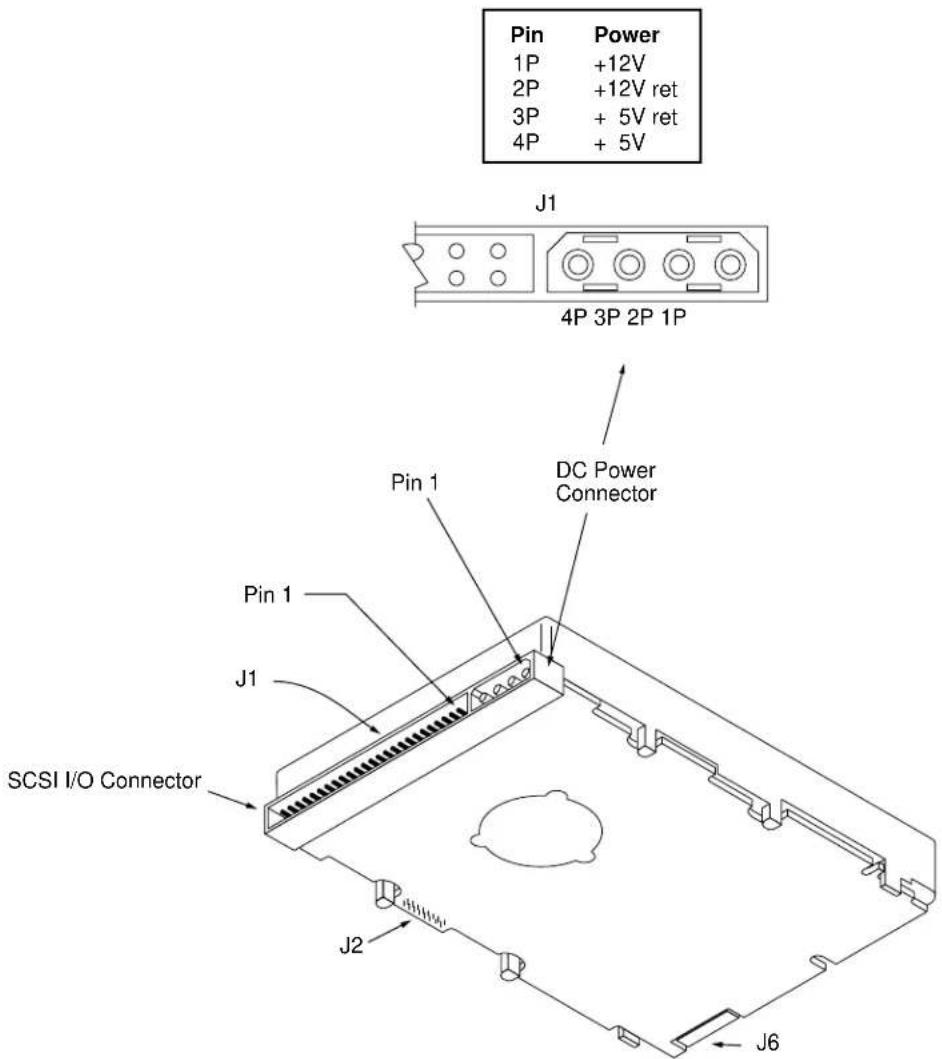
text_image
Pin Power 1P +12V 2P +12V ret 3P + 5V ret 4P + 5V J1 4P 3P 2P 1P Pin 1 DC Power Connector Pin 1 J1 SCSI I/O Connector J2 J6Figure 16. Physical interface for "N" model drives
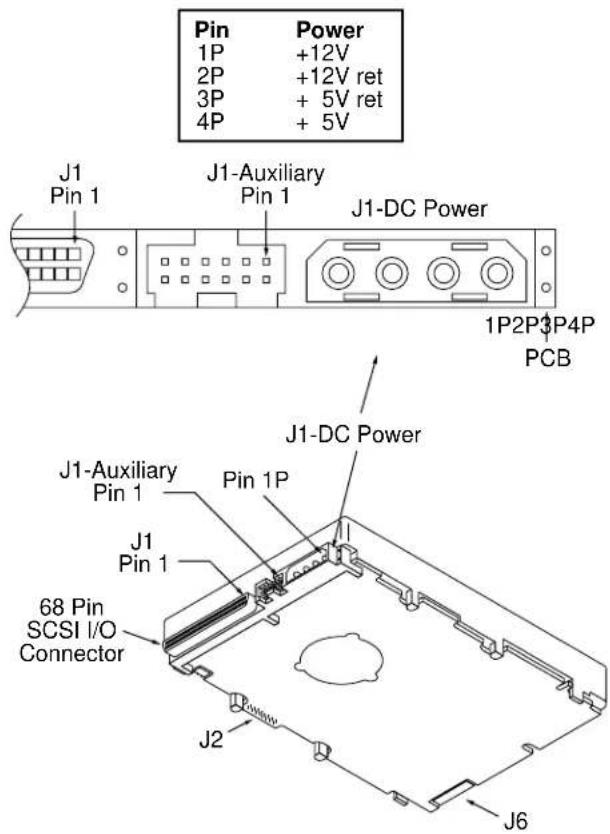
text_image
Pin 1P +12V 2P +12V ret 3P + 5V ret 4P + 5V J1 Pin 1 J1-Auxiliary Pin 1 J1-DC Power 1P2P3P4P PCB J1-DC Power J1-Auxiliary Pin 1 Pin 1P J1 Pin 1 68 Pin SCSI I/O Connector J2 J6Figure 17. Physical interface for "W" and "LW" model drives
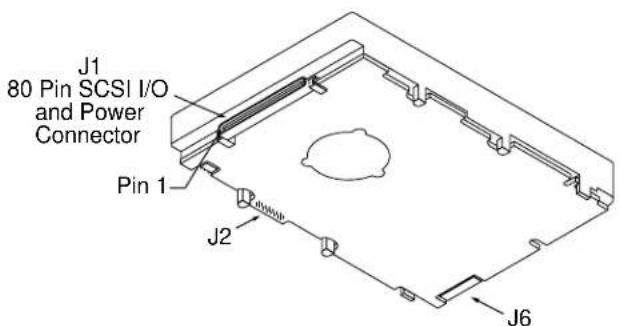
text_image
J1 80 Pin SCSI I/O and Power Connector Pin 1 J2 J6Note: See Table 19 for DC power pin assignments.
Figure 18. Physical interface for "WC" and "LC" model drives
9.6.2 SCSI interface physical description
The drive models described by this product manual support the physical interface requirements of the SCSI-3 Parallel Interface-2 (SPI-2) standards as defined in American National Standard document X3T10/1142D, and operate compatibly at the interface with devices that only support earlier SCSI-2 and SCSI-3 standards. It should be noted that this is only true if the systems engineering has been correctly done, and if earlier SCSI-2 and SCSI-3 devices respond in an acceptable manner (per applicable SCSI Standards) to reject newer SCSI-3 protocol extensions that they don't support.
The family of drives in this manual supports the single-ended and low voltage differential physical interconnects (hereafter referred to as SE and LVD, respectively) as described in the ANSI SPI-2 standard. Drive models whose model numbers end with "N," "W," and "WC" implement SE drivers and receivers. Drive models whose model numbers end with "LC" and "LW" implement driver and receiver circuits that can operate either SE or LVD (but never HVD).
The drives typically operate on a daisy-chain interface in which other SCSI devices are also operating. Devices on the daisy chain must all operate in the same mode, either SE or LVD, but not a mixture of these. On the interface daisy chain, all signals are common between all devices on the chain, or bus, as it is also called. This daisy chain of SCSI devices must be terminated at both ends with the proper impedance in order to operate correctly. Intermediate SCSI devices shall not be terminated. In some cases, the SCSI devices at each end have onboard termination circuits that can be enabled by installation of a jumper plug (TE) on the device. These termination circuits receive power from either a source internal to the device, or from a line in the interface cable specifically powered for that purpose. On SE drive models "N" and "W," terminator power source can be selected using the TP jumpers on the option select header J2. TE is also on the option select header J2 for models "N" and "W." See Section 8.1 for details. Models "WC," "LC," and "LW" have no onboard termination circuits. Some type of external termination circuits must be provided for these drives by the end user or designers of the equipment into which the drives will be integrated. See Standard X3T10/1142D, sections 6.4 and 6.5 for the maximum number of devices that can successfully operate at various interface transfer rates on SE and LVD daisy chains.
“LC” and “WC” model drives plug into PCB or bulkhead connectors in the Host. They may be connected in a daisy-chain by the host backplane wiring or PCB circuit runs that have adequate DC current carrying capacity to support the number of drives plugged into the PCB or bulkhead connectors. A single 80 pin I/O connector cable cannot support the DC current needs of several drives, so no daisy chain cables beyond the bulkhead connectors should be used. A single drive connected via a cable to a host 80 pin I/O connector is not recommended.
Table 14 shows the interface transfer rates supported by the various drive models defined in this manual.
Table 14: Interface transfer rates supported
| Interface type/drive models | Maximum transfer rate | |||||
| Asynchronous | Fast-5 Fast-10 | Fast-20 Fast-40 | ||||
| SE “N,” “W,” “LC,” “LW” yes yes yes no | yes yes yes no | |||||
| LVD | “LC,” “LW” | yes yes yes yes yes | yes | |||
9.6.3 SCSI interface cable requirements
The characteristics of cables used to connect SCSI-3 parallel interface devices are discussed in detail in section 6 of ANSI Standard X3T10/1142D. The cable characteristics that must be considered when interconnecting the drives described in this manual in a SCSI-3 parallel, daisy-chain interconnected system are:
- characteristic impedance (see section 6.1)
- propagation delay (see section 6.1)
• cumulative length (see sections 6.4 and 6.5) - stub length (see sections 6.4 and 6.5)
• device spacing (see sections 6.4 and 6.5)
To minimize discontinuances and signal reflections, cables of different impedances should not be used in the same bus. Implementations may require trade-offs in shielding effectiveness, cable length, number of loads and spacing, transfer rates, and cost to achieve satisfactory system operation. If shielded and unshielded cables are mixed within the same SCSI bus, the effect of impedance mismatch must be carefully considered. Proper impedance matching is especially important in order to maintain adequate margin at FAST-20 and FAST-40 SCSI transfer rates.
For "WC" and "LC" models:
The 80 pin connector option is intended for use on drives that plug directly into a PCB or wall/bracket mounted connector in the host equipment. In such installations, all backplane wiring segments are subject to the electromagnetic concepts presented in Standard X3T10/1142D, section 6. For "WC" and "LC" model drives, installations with connectors on cables are not recommended.
9.6.3.1 Single-ended I/O circuits ("N" and "W" models)
The maximum total cable length allowed with drives having single-ended I/O driver and receiver circuits depends on several factors. Table 15 lists the maximum lengths allowed for different configurations of drive usage. These values are from the ANSI SCSI-3 Fast-20 (also called Ultra SCSI) specification X3T10/1071D. All device I/O lines must have equal to or less than 25 pf capacitance to ground, measured at the beginning of the stub.
Table 15: Cable characteristics for single-ended circuits
| I/O transfer rate | Maximum number of devices on line | Maximum cable length allowed | Transmission line impedance | |
| REQ/ACK Other signals | ||||
| ≤10 M transfers/s 8 | (reg. SCSI bus) 6 meters (1 | 9.7 ft.) 90 ± 6 Ohms 90 ± | 10 Ohms | |
| ≤10 M transfers/s | 16 (wide SCSI bus) | 6 meters (19.7 ft.) 90 ± 6 | Ohms 90 ± 10 Ohms | |
| ≤20 M transfers/s | 4 (reg./wide SCSI bus) | 3 meters (9.8 ft.) | 90 ± 6 Ohms | 90 ± 10 Ohms |
| ≤20 M transfers/s 8 | (reg./wide SCSI bus) 1.5 | 5 meters (4.9 ft.) 90 ± 6 Ohms | 90 ± 10 Ohms | |
A stub length of no more than 0.1 meter (0.33 foot) is allowed off the mainline interconnection with any connected equipment. The stub length is measured from the transceiver to the connection to the mainline SCSI bus.
Single-ended I/O pin assignments are shown in Tables 16, 17, and 19.
9.6.4 Mating connectors
Part numbers for the different type connectors that mate with the various Medalist Pro I/O connectors are given in the following sections.
9.6.4.1 Mating connectors for "N" models
The nonshielded cable connector shall be a 50 conductor connector consisting of two rows of 25 female contacts with adjacent contacts 0.1 inches (2.54 mm) apart.
Recommended mating flat cable connector part numbers are:
| Closed end(for cableends)[1] | 3M-3425-7000 | W/O Strain Relief, No Center Key |
| 3M-3425-7050 | With Strain Relief, No Center Key | |
| Dupont-66900-290 | With Strain Relief, With Center Key | |
| Open end(In daisy chain)[1] | 3M-3425-6000 | W/O Strain Relief, No Center Key |
| 3M-3425-6050 | With Strain Relief, No Center Key | |
| Dupont-66900-250 | With Strain Relief, With Center Key |
[1] See Figure 19.
The drive device connector is a nonshielded 50 conductor connector consisting of two rows of 25 male pins with adjacent pins 0.1 inches (2.54 mm) apart. The connector is keyed (see Figure 20).
Mating panel mount connector: 3M-CHE-2050-J01A10-KLE.
9.6.4.2 Mating connectors for "W" and "LW" models
The nonshielded cable connector shall be a 68 conductor connector consisting of two rows of 34 male contacts with adjacent contacts 0.050 inches (1.27 mm) apart.
Recommended mating flat cable connector part numbers are:
Amp Model 786096-7 Female, 68-pin, panel mount
Amp Model 786090-7 Female, 68-pin, cable mount
Amp Model 749925-5 (0.050 inches (1.27mm, 50 mil) conductor centers, 28 or 30 AWG wire). Use two, 34 conductor, 0.050 inches (1.27 mm, 50 mil) center flat cable with this connector. This type connector can only be used on cable ends. [1]
Amp Model 88-5870-294-5 W/O Strain Relief, 0.025 68es (0.68 mm, 25 mil) conductor centers, 30 AWG wire. Use either on cable ends or in cable middle section for daisy-chain installations [1].
Amp Model 1-480420-0 Power connector 4 circuit housing
Berg 69307-012 12-position, 2 x 6, 2 mm receptacle housing
[1] See Figure 19.
The drive device connector is a nonshielded 68 conductor connector consisting of two rows of 34 female pins with adjacent pins 0.050 inches (1.27 mm) apart. The connector is keyed by means of its shape (see Figure 21).
9.6.4.3 Mating connectors for "WC" and "LC" models
The nonshielded connector shall be an 80 conductor connector consisting of two rows of 40 contacts with adjacent contacts 0.050 inches (1.27 mm) apart. I/O connection using a cable is not recommended. The length and size of the host equipment DC power carrying conductors from the DC power source to the host equipment 80 pin disk drive interface connector(s) should be strictly designed according to proper power transmission design concepts. No possibility for the equipment user to attach an 80 pin cable/connector should be allowed, since the length of the DC power carrying conductors could not be controlled and therefore could become too long for safe power transmission to the drive. Daisy-chain 80 conductor cables should especially not be allowed, since the power-carrying conductors on the 80 conductor interface were not intended to support a series of drives.
Small Form Factor Specification SSF-8046, Rev. 2.7 details mating requirements.
Recommended mating 80-position PCB mount connectors:
Straight-in connector Hot Plug version (with ground guide-pin)
Seagate P/N: 77678703
Amp US P/N: 2-557103-1 787311-1 with polarization
or 94-0680-02-1
Amp US P/N: 2-557103-2 787311-2 without polarization
or 94-0680-02-2
Amp Japan P/N: 5-175475-9
Right-angle to PCB connectors
Seagate P/N: 77678559 Amp US P/N: 2-557101-1 Amp Japan P/N: 5-175474-9
For additional information call Amp. FAX service at 1-800-522-6752.
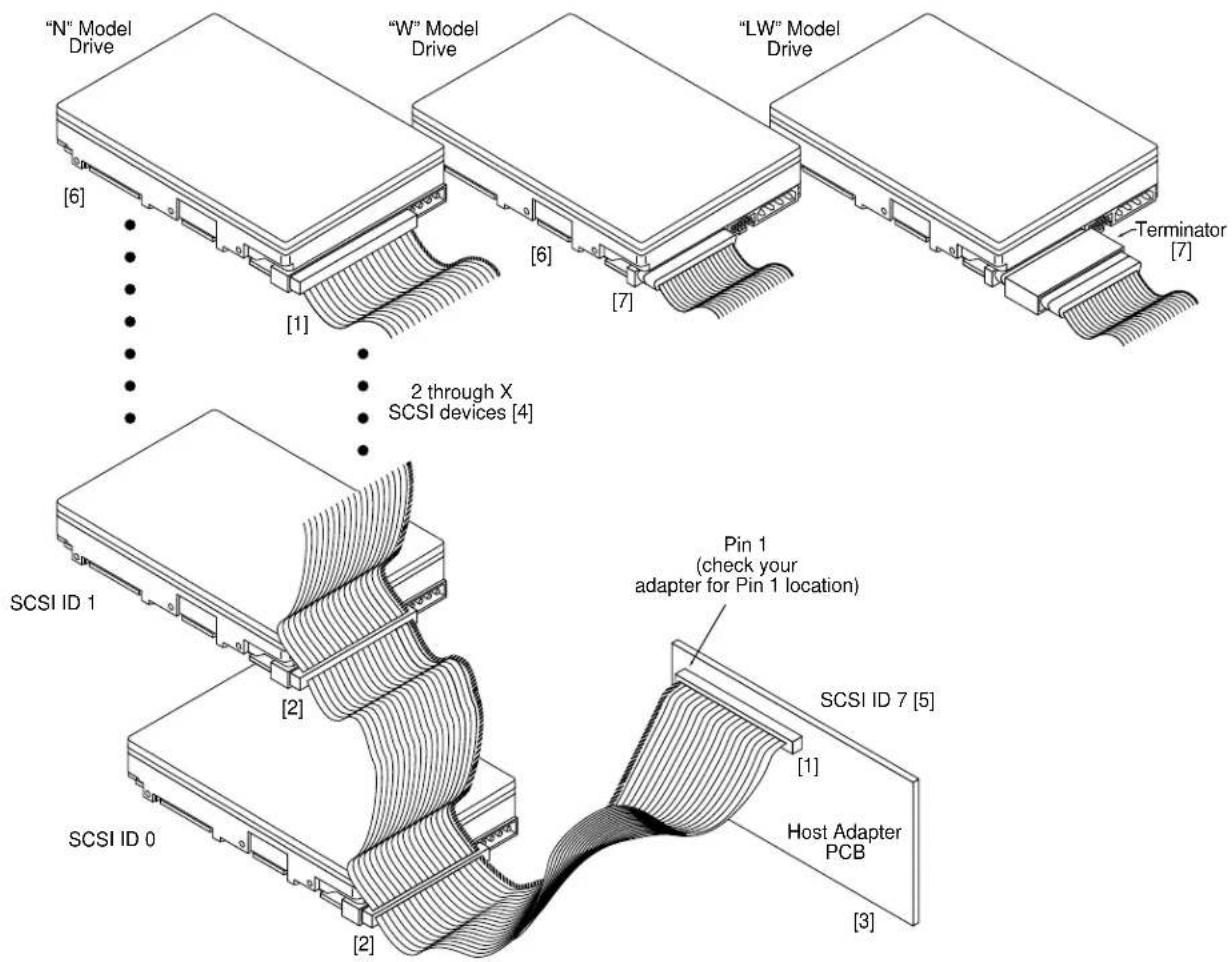
text_image
"N" Model Drive [W" Model Drive "LW" Model Drive [Terminator [7]] [6] [1] [6] [7] 2 through X SCSI devices [4] SCSI ID 1 Pin 1 (check your adapter for Pin 1 location) SCSI ID 0 [2] [1] [3] SCSI ID 7 [5] Host Adapter PCB [2][1] Closed end type 50 pin connector used. Install terminator enable (TE) jumper.
[2] Open end type (in-line application) connector used. Remove terminator enable (TE) jumper.
[3] Host need not be on the end of the daisy chain. Another device can be on the end with the terminator, the host having no terminator.
[4] Total interface cable length must not exceed that specified in Section 9.6.3.1 (including host adapter/initiator). The cable length restriction limits the total number of devices allowed. See Table 15.
[5] SCSI ID7 has highest arbitration priority, ID0 has lowest for "N" models. For "W" models, priority is ID7 to ID0, then ID15 to ID8 (ID 8 very lowest).
[6] Last drive on the daisy chain.
[7] Open-end type 68-pin connector used. On "W" models, install terminator enable (TE) jumper plug. If "LW" model drive is end device on the cable daisy chain, an external terminator is required (not furnished with the drive).
Figure 19. SCSI daisy-chain interface cabling for "N" and "W" model drives
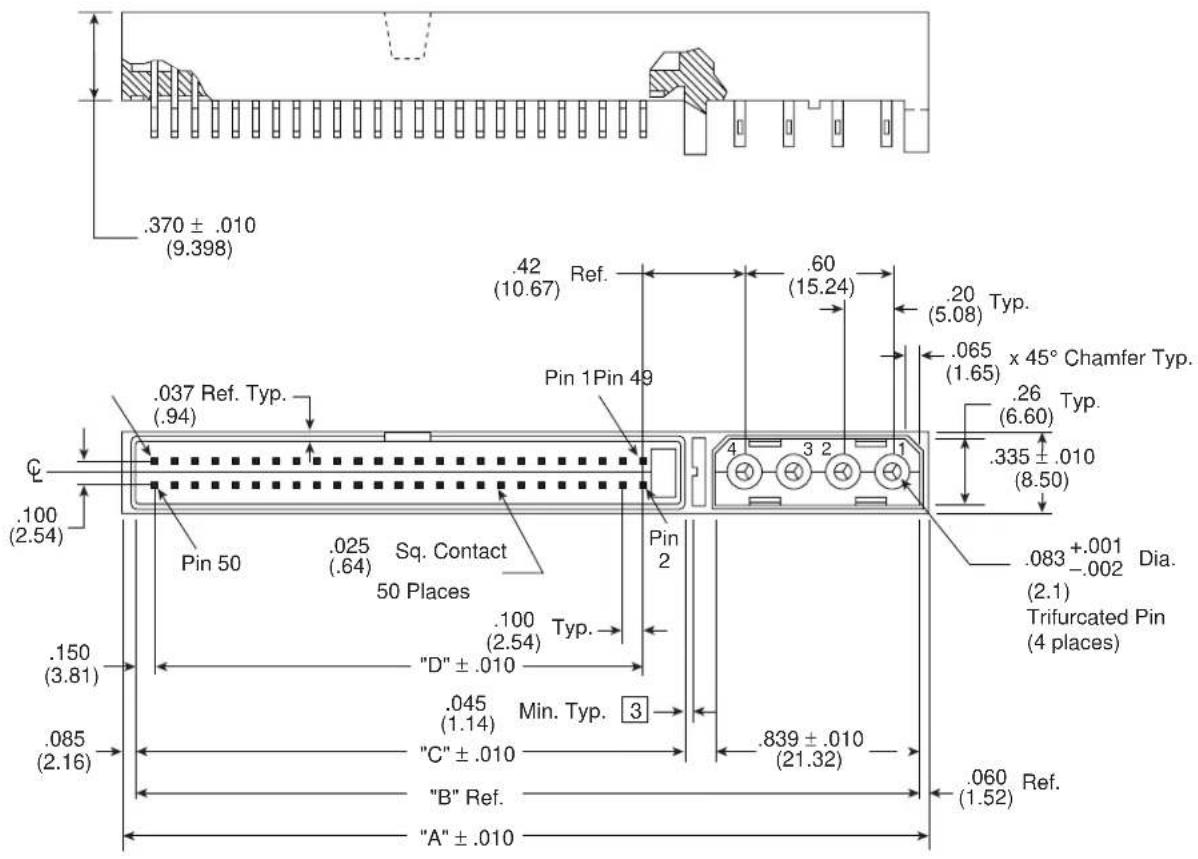
text_image
.370 ± .010 (9.398) .42 Ref. (10.67) .60 (15.24) .20 Typ. (5.08) .065 x 45° Chamfer Typ. (1.65) .26 Typ. (6.60) .335 ± .010 (8.50) .037 Ref. Typ. (.94) Pin 1Pin 49 Pin 2 .100 (2.54) Pin 50 .025 (.64) Sq. Contact 50 Places .100 (2.54) Typ. "D" ± .010 .045 (1.14) Min. Typ. 3 "C" ± .010 .B" Ref. "A" ± .010 .083 +.001 Dia. -.002 (2.1) Trifurcated Pin (4 places) .060 Ref. (1.52)| No. Pos. | "A" | "B" | "C" | "D" |
| 50 | 3.835(97.48) | 3.690(93.72) | 2.700(68.58) | 2.400(60.96) |
Figure 20. Nonshielded 50 pin SCSI device connector used on "N" model drives
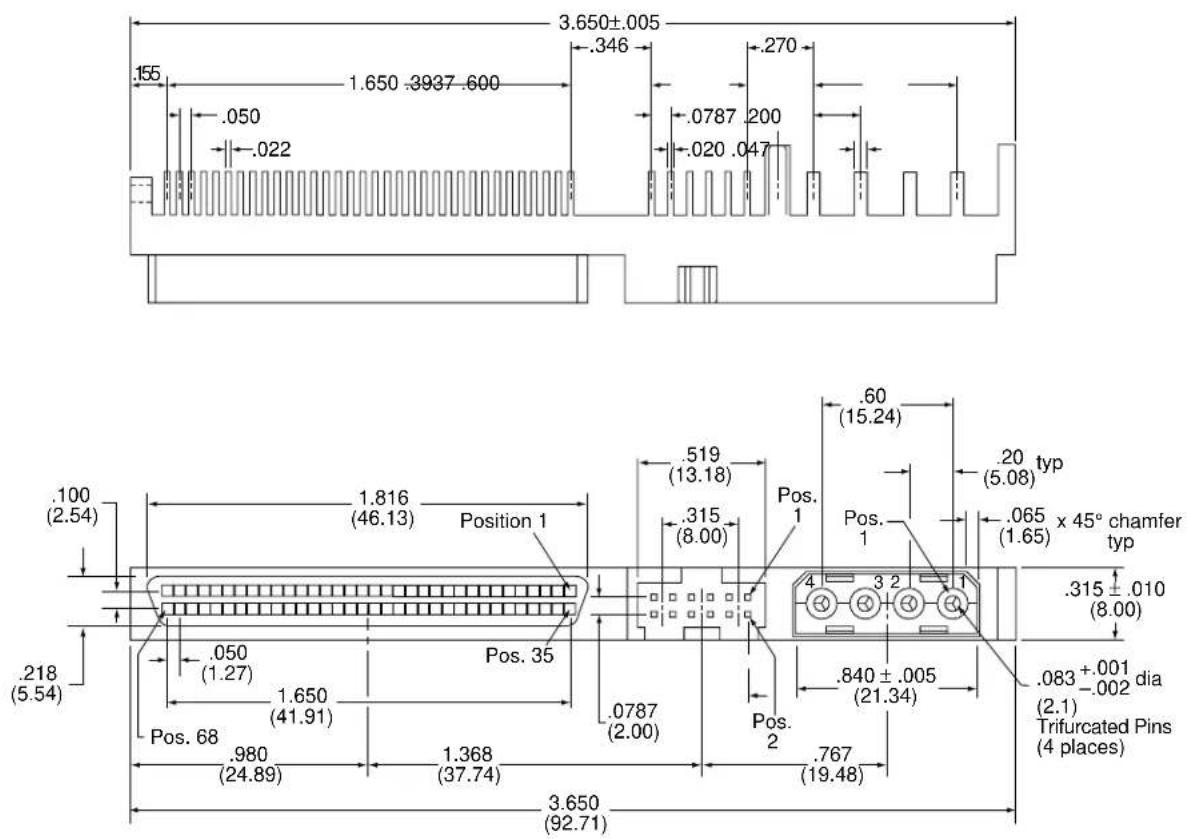
text_image
3.650±.005 .155 1.650 .3937 .600 .050 -.022 .346 .270 .0787 .200 .020 .047 Position 1 .100 (2.54) 1.816 (46.13) Pos. 35 .519 (13.18) .315 (8.00) Pos. 1 .60 (15.24) .20 typ (5.08) .065 x 45° chamfer typ .315 ± .010 (8.00) .218 (5.54) .050 (1.27) 1.650 (41.91) Pos. 68 .980 (24.89) 1.368 (37.74) Pos. 2 .840 ± .005 (21.34) .083 +.001 dia -.002 (2.1) Trifurcated Pins (4 places) 3.650 (92.71)Figure 21. Non-shielded 68 pin SCSI device connector used on "W" and "LW" model drives
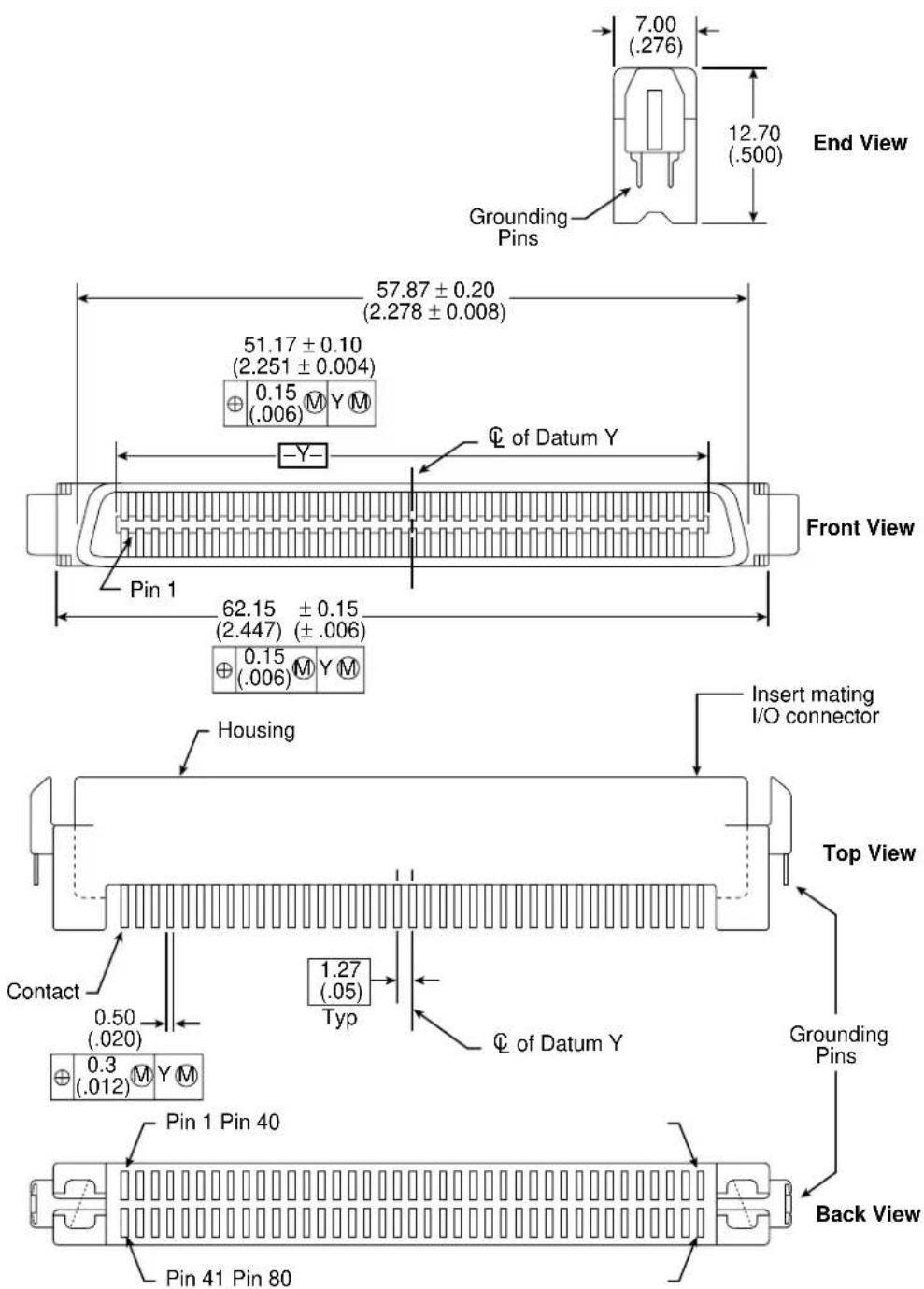
text_image
7.00 (.276) 12.70 (.500) End View Grounding Pins 57.87 ± 0.20 (2.278 ± 0.008) 51.17 ± 0.10 (2.251 ± 0.004) ⊕ 0.15 M Y M (.006) Y- Ø of Datum Y Front View Pin 1 62.15 ± 0.15 (2.447) (± .006) ⊕ 0.15 M Y M Housing Insert mating I/O connector Top View Contact 0.50 (.020) ⊕ 0.3 M Y M 1.27 (.05) Typ Ø of Datum Y Grounding Pins Back View Pin 1 Pin 40 Pin 41 Pin 80Figure 22. Non-shielded 80 pin SCSI "SCA-2" connector, used on "WC" and "LC" model drives
Table 16: Model "N," single ended I/O, 50 conductor, signal/contact assignments
Note. The minus sign next to the signal indicates asserted state is the low voltage of the two levels used for logic signals.
| Signal name [1] | Connector contact number [3] | Cable conductor number [11] | Connector contact number [11] | Signal name [1] | |
| GND 1 1 2 2 –DB0 | |||||
| GND 3 3 4 4 –DB1 | |||||
| GND 5 5 6 6 –DB2 | |||||
| GND 7 7 8 8 –DB3 | |||||
| GND 9 9 10 10 –DB4 | |||||
| G | N | D | 1 1 | 1 | |
| G | N | D | 1 3 | 1 | |
| G | N | D | 1 5 | 1 | |
| G | N | D | 1 7 | 1 | |
| G | N | D | 1 9 | 1 | |
| G | N | D | 2 1 | 2 | |
| G | N | D | 2 3 | 2 | |
| NC [10] | 25* | 25 | 26 26 TERMPWR | ||
| G | N | D | 2 7 | 2 | |
| G | N | D | 2 9 | 2 | |
| GND | 31 | 31 | 32 | 32 | -ATN |
| G | N | D | 3 3 | 3 | |
| G | N | D | 3 5 | 3 | |
| GND | 37 | 37 | 38 | 38 | -ACK |
| G | N | D | 3 9 | 3 | |
| G | N | D | 4 1 | 4 | |
| GND | 43 | 43 | 44 | 44 | -SEL |
| G | N | D | 4 5 | 4 | |
| G | N | D | 4 7 | 4 | |
| GND | 49 | 49 | 50 | 50 | -I/O |
*CAUTION: Connector contact 25 must not be connected to ground at the host end of the cable. If the I/O cable should accidentally be plugged in upside down, terminator power on pin 26 will be shorted to ground.
Notes [ ]: See page following Table 20.
Table 17: "W" models single ended I/O cable 68 conductor signal/contact assignments
Note. The minus sign next to the signal indicates asserted state is the low voltage of the two levels used for logic signals
| Signal name [1] | Connector contact number [3] | Cable conductor number [2] | Connector contact number [3] | Signal name [1] | |
| GND 1 1 2 35 -DB12 | |||||
| GND 2 3 4 36 -DB13 | |||||
| GND 3 5 6 37 -DB14 | |||||
| GND 4 7 8 38 -DB15 | |||||
| GND 5 9 10 39 -DBP1 | |||||
| GND 6 11 12 40 -DB0 | |||||
| GND 7 13 14 41 -DB1 | |||||
| GND 8 15 16 42 -DB2 | |||||
| GND 9 17 18 43 -DB3 | |||||
| GND | 10 | 19 | 20 | 44 | -DB4 |
| GND | 11 | 21 | 22 | 45 | -DB5 |
| GND | 12 | 23 | 24 | 46 | -DB6 |
| GND | 13 | 25 | 26 | 47 | -DB7 |
| GND | 14 | 27 | 28 | 48 | -DBP |
| GND | 15 | 29 | 30 | 49 | GND |
| GND | 16 | 31 | 32 | 50 | GND |
| TermPwr | 17 | 33 | 34 | 51 | TermPwr |
| TermPwr | 18 | 35 | 36 | 52 | TermPwr |
| Reserved | 19 37 38 53 Reserved | ||||
| GND | 20 | 39 | 40 | 54 | GND |
| GND | 21 | 41 | 42 | 55 | -ATN |
| GND | 22 | 43 | 44 | 56 | GND |
| GND | 23 | 45 | 46 | 57 | -BSY |
| GND | 24 | 47 | 48 | 58 | -ACK |
| GND | 25 | 49 | 50 | 59 | -RST |
| GND | 26 | 51 | 52 | 60 | -MSG |
| GND | 27 | 53 | 54 | 61 | -SEL |
| GND | 28 | 55 | 56 | 62 | -C/D |
| GND | 29 | 57 | 58 | 63 | -REQ |
| GND | 30 | 59 | 60 | 64 | -I/O |
| GND | 31 | 61 | 62 | 65 | -DB8 |
| GND | 32 | 63 | 64 | 66 | -DB9 |
| GND | 33 | 65 | 66 | 67 | -DB10 |
| GND | 34 | 67 | 68 | 68 | -DB11 |
Notes [ ]: See page following Table 20.
Table 18: "LW" models differential cable 68 conductor signal/pin assignments (Nonshielded connector)[13]
Note. The minus sign next to the signal indicates asserted state is the low voltage of the two levels used for logic signals.
| Signal name [1] | Connector contact number [3] | Cable conductor number [2] | Connector contact number [3] | Signal name [1] | |
| +DB12 1 1 2 35 -DB12 | |||||
| +DB13 2 3 4 36 -DB13 | |||||
| +DB14 3 5 6 37 -DB14 | |||||
| +DB15 4 7 8 38 -DB15 | |||||
| +DBP1 5 9 10 39 | -DBP1 | ||||
| +DB0 | 6 11 12 40 -DB0 | ||||
| +DB1 | 7 13 14 41 -DB1 | ||||
| +DB2 | 8 15 16 42 -DB2 | ||||
| +DB3 | 9 17 18 43 -DB3 | ||||
| +DB4 | 10 19 20 | 44 -DB4 | |||
| +DB5 | 11 21 22 | 45 -DB5 | |||
| +DB6 | 12 23 24 | 46 -DB6 | |||
| +DB7 | 13 25 26 | 47 -DB7 | |||
| +DBP | 14 27 28 | 48 -DBP | |||
| GND | 15 | 29 | 30 | 49 | GND |
| DIFFSNS [8] | 16 31 32 50 GND | ||||
| TermPwr | 17 | 33 | 34 | 51 | TermPwr |
| TermPwr | 18 | 35 | 36 | 52 | TermPwr |
| Reserved | 19 37 38 | 53 Reserved | |||
| GND | 20 | 39 | 40 | 54 | GND |
| +ATN | 21 | 41 | 42 | 55 | -ATN |
| GND | 22 | 43 | 44 | 56 | GND |
| +BSY | 23 45 46 | 57 -BSY | |||
| +ACK | 24 47 48 | 58 -ACK | |||
| +RST | 25 49 50 | 59 -RST | |||
| +MSG | 26 51 52 | 60 -MSG | |||
| +SEL | 27 53 54 | 61 -SEL | |||
| +C/D | 28 55 56 | 62 -C/D | |||
| +REQ | 29 57 58 | 63 -REQ | |||
| +I/O | 30 59 60 | 64 -I/O | |||
| +DB8 | 31 61 62 | 65 -DB8 | |||
| +DB9 | 32 63 64 | 66 -DB9 | |||
| +DB10 | 33 | 65 | 66 | 67 | -DB10 |
| +DB11 | 34 | 67 | 68 | 68 | -DB11 |
Notes [ ]: See page following Table 20.
Table 19: "WC" models single ended I/O, 80 conductor cable signal/contact assignments
Note. The minus sign next to the signal indicates asserted state is the low voltage of the two levels used for logic signals
| Signal name [1] | Connector contact number [3] | Signal number [3] | Contact name[1] |
| 12 V CHARGE 1 41 | 2 V GND | ||
| 12 V 2 42 12 V GND | |||
| 12 V 3 43 12 V GND | |||
| 12 V 4 44 MATED 1 | |||
| NC [10] 5 45 NC [10] | |||
| NC [10] 6 46 GND [8] | |||
| -DB11 7 47 GND | |||
| -DB10 8 48 GND | |||
| -DB9 9 49 GND | |||
| -DB8 10 50 GND | |||
| -I/O 11 51 GND | |||
| -REQ | 12 52 GND | ||
| -C/D | 13 53 GND | ||
| -SEL | 14 54 GND | ||
| -MSG | 15 55 GND | ||
| -RST | 16 56 GND | ||
| -ACK | 17 57 GND | ||
| -BSY | 18 58 GND | ||
| -ATN | 19 59 GND | ||
| -DBP | 20 60 GND | ||
| -DB7 21 61 GND | |||
| -DB6 22 62 GND | |||
| -DB5 23 63 GND | |||
| -DB4 24 64 GND | |||
| -DB3 25 65 GND | |||
| -DB2 26 66 GND | |||
| -DB1 27 67 GND | |||
| -DB0 28 68 GND | |||
| -DP1 29 69 GND | |||
| -DB15 | 30 | 70 | GND |
| -DB14 | 31 | 71 | GND |
| -DB13 | 32 | 72 | GND |
| -DB12 | 33 | 73 | GND |
| +5 V | 34 | 74 | MATED 2 |
| +5 V | 35 | 75 | 5 V GND |
| +5 V CHARGE | 36 76 5 V GND | ||
| NC [10] 37 77 ACTIVE LED OUT [4] [9] | |||
| RMT-START [5] [9] | 38 | 78 | DLYD-START [6] [9] |
| SCSI ID (0) [7] [9] | 39 79 SCSI ID (1) [7] [9] | ||
| SCSI ID (2) [7] [9] | 40 80 SCSI ID (3) [7] [9] | ||
Notes [ ]: See page following Table 20.
Table 20: "LC" differential models, 80 pin I/O connector pin assignments (nonshielded connector) [13]
| Signal name [1] | Connector contact number [3] | Signal number [3] | Contact name[1] |
| 12 V CHARGE 1 41 | 12 V GND | ||
| 12 V 2 42 12 V GND | |||
| 12 V 3 43 12 V GND | |||
| 12 V 4 44 MATED 1 | |||
| NC [10] 5 45 NC [10] | |||
| NC [10] 6 46 DIFFSNS [8] | |||
| -DB11 7 47 +DB11 | |||
| -DB10 8 48 +DB10 | |||
| -DB9 9 49 +DB9 | |||
| -DB8 10 50 +DB8 | |||
| -I/O 11 51 +I/O | |||
| -REQ | 12 52 +REQ | ||
| -C/D | 13 53 +C/D | ||
| -SEL | 14 54 +SEL | ||
| -MSG | 15 55 +MSG | ||
| -RST | 16 56 +RST | ||
| -ACK | 17 57 +ACK | ||
| -BSY | 18 58 +BSY | ||
| -ATN | 19 59 +ATN | ||
| -DBP | 20 60 +DBP | ||
| -DB7 21 61 +DB7 | |||
| -DB6 22 62 +DB6 | |||
| -DB5 23 63 +DB5 | |||
| -DB4 24 64 +DB4 | |||
| -DB3 25 65 +DB3 | |||
| -DB2 26 66 +DB2 | |||
| -DB1 27 67 +DB1 | |||
| -DB0 28 68 +DB0 | |||
| -DP1 29 69 +DP1 | |||
| -DB15 | 30 | 70 | +DB15 |
| -DB14 | 31 | 71 | +DB14 |
| -DB13 | 32 | 72 | +DB13 |
| -DB12 | 33 | 73 | +DB12 |
| +5 V | 34 | 74 | MATED 2 |
| +5 V | 35 | 75 | 5 V GND |
| +5 V | 36 | 76 | 5 V GND |
| NC [10] 37 77 ACTIVE LED OUT [4] [9] | |||
| RMT-START [5] [9] | 38 | 78 | DLYD-START [6] [9] |
| SCSI ID (0) [7] [9] | 39 79 SCSI ID (1) [7] [9] | ||
| SCSI ID (2) [7] [9] | 40 80 SCSI ID (3) [7] [9] | ||
Notes [ ]: See page following this table.
Notes [ ] for Tables 16 through 20.
[1] See Section 9.7.1 or 9.6.4.2 for detailed electrical characteristics of these signals.
[2] The conductor number refers to the conductor position when using 0.025-inches (0.635 mm) centerline flat ribbon cable. Other cables types may be used to implement equivalent contact assignments.
[3] Connector contacts are on 0.050 inches (1.27 mm) centers.
[4] Front panel LED signal; indicates drive activity for host front panel hard drive activity indicator.
[5] Asserted by host to enable Motor Start option (enables starting motor via SCSI bus command).
[6] Asserted by host to enable Delayed Motor Start option (motor starts at power on or after a delay of 12 seconds times drive ID). This and [3] above are mutually exclusive options.
[7] Binary code on A3, A2, A1 and A0 asserted by host to set up SCSI bus ID in drive.
[8] GND provides a means for differential devices to detect the presence of a single ended device on the bus.
[9] Signals [4] through [7] are used in place of installing jumpers and cables on option select connectors J2 and J6. See Section 8.1.1 notes.
[10] "NC" means no connection.
[11] The conductor number refers to the conductor position (right to left in Figure 19) when using 0.050 inches (1.27 mm) centerline flat ribbon cable. Other cable types may be used to implement equivalent contact assignments.
[12] Connector contacts are on 0.100 inches (2.54 mm) centers.
[13] 8 bit devices which are connected to the 16 data bit differential I/O shall leave the following signals open: - DB12 -DB13 -DB14 -DB15 -DBP1 -DB8 -DB9 -DB10 -DB11, +DB12 +DB13 +DB14 +DB15 +DBP1 +DB8 +DB9 +DB10 +DB11.
8 bit devices which are connected to the 16 data bit single-ended I/O shall have the following signals connected as shown:
to ground: +DB12 +DB13 +DB14 +DB15 +DBP1 +DB8 +DB9 +DB10 +DB11,
open circuit: -DB12 -DB13 -DB14 -DB15 -DBP1 -DB8 -DB9 -DB10 -DB11.
All other signals should be connected as shown.
9.7 Electrical description
"N" and "W" models use single-ended interface signals. These signals must be terminated with 110-ohm active termination circuits at each end of the total cable. Single-ended circuits use open collector or three state drivers. These models can be configured to provide the SCSI termination.
“WC” and “LC” models use the single connection attachment (SCA) connector. This 80-pin connector is designed to plug directly into a back panel or plane. No external cables are required. Active terminators on the back panel must be provided by the user. This connector is not recommended where cabling is required.
“LC” and “LW” models are Multimode drives. That is, their I/O circuits can operate as either single-ended or low voltage differential drivers/receivers (selectable using the I/O “DIFFSENS” line). They require external terminators. See Section 9.7.2 for additional information on these models.
Note. The SCSI protocol chip drives the upper eight data and parity bits of the SCSI bus even when operating in narrow (eight bit) mode. This is normal operation for this chip. If the unused data bit signals are connected to conductors that extend out beyond this drive's SCSI connector, correct termination must be provided for these unused signals at the device/system at each end of the bus onto which this drive is connected. Termination is required to control radiated emissions and conducted noise on other SCSI bus signals.
See ANSI Standard X3T10/1142D for detailed electrical specifications.
9.7.1 Single-ended drivers/receivers
For "N," "W," and "WC" models which use single-ended drivers and receivers, typical circuits are shown in Figure 23. Terminator circuits (Note [1]) are to be enabled only when the disc drive is first or last in the daisy chain.
Transmitter characteristics
Single-ended drives use an ANSI SCSI compatible open collector single-ended driver. This driver is capable of sinking a current of 48 mA with a low level output voltage of 0.4 volt.
Receiver characteristics
Single-ended drives use an ANSI SCSI single-ended receiver with hysteresis gate or equivalent as a line receiver.
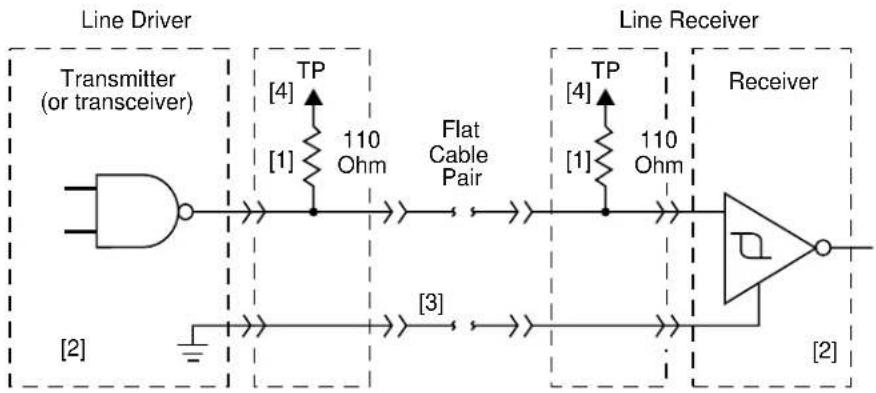
flowchart
graph LR
    A["Transmitter (or transceiver)"] --> B["Line Driver"]
    B --> C["TP [4"]]
    C --> D["110 Ohm"]
    D --> E["Flat Cable Pair"]
    E --> F["Line Receiver"]
    F --> G["TP [4"]]
    G --> H["110 Ohm"]
    H --> I["Receiver"]
    I --> J["Line Receiver"]
    style A fill:#f9f,stroke:#333
    style B fill:#ccf,stroke:#333
    style F fill:#cfc,stroke:#333
    style I fill:#fcc,stroke:#333
Figure 23. Single-ended transmitters and receivers
Notes.
[1] Part of active terminator circuits. Non-removable LSI terminators, enabled in the drive (models "N" and "W" only) with jumper plug TE when it is first or last in the daisy chain. Interface signals levels and logical sense at the drive I/O connector are defined as follows:
Logic level Driver output Receiver input
$$ \begin{array}{l l} \text {NEGATED (0) >} & _ 2. 5 \mathrm{V:} < 5. 2 5 \mathrm{V} > 2. 0 \mathrm{V:} _ {-} < 5. 2 5 \mathrm{V} _ {-} \ \text {ASSERTED (1) < } & _ 0. 4 \mathrm{V:} > 0. 0 \quad \mathrm{V} \quad \leq 0. 8 \mathrm{V:} \geq 0. 0 \mathrm{V} \end{array} $$
The difference in the voltages between input and output signals is due to the losses in the cable.
[2] ANSI SCSI compatible circuits.
[3] Total interface cable length should not exceed that specified in Section 9.6.3.1.
[4] Source of drive terminator power is an active circuit which has an input source voltage selected by jumper plug TP. See Figure 12. Applies to "N" and "W" models.
9.7.2 Multimode—SE or LVD alternative
“LW” and “LC” models have I/O circuits that can operate either in single-ended (SE) or low voltage differential mode (LVD). When the interface “DIFFSNS” line is between 0 V and .6 V, the drive interface circuits operate single-ended and up to and including 20 M transfers/s (Fast-20 or Ultra-1 SCSI). When “DIFFSENS” is between +0.7 V and +1.9 V, the drive interface circuits operate low voltage differential and up to and including 40 M transfers/s or less (Fast-40 or Ultra-2 SCSI). This arrangement is not intended to allow dynamically changing transmission modes, but rather to prevent incompatible devices from attempting to interoperate. Drives must operate only in the mode for which the installation and interface cabling is designed. Multimode I/O circuits used by “LC” and “LW” devices do not operate at high voltage differential levels and should never be exposed to high voltage differential environments unless the common mode voltages in the environment are controlled to safe levels for single-ended and low voltage differential devices (see the ANSI SPI-2 specification X3T10/1142D).
Multimode signals
Multimode circuit SE alternative signal characteristics are the same as described in Section 9.7.1. The SE alternative for these circuits is selected as described above. SE cables and termination must be used.
Multimode circuit LVD alternative signal characteristics are not the same as the differential signals described in Section 9.7.2.1. The Multimode signal lines (either SE or LVD) should be terminated with 110 ohm active terminator circuits at each end of the total cable. Termination of the I/O lines must be provided for by the Host equipment designers or end users.
The SE and differential alternatives are mutually exclusive.
Output characteristics
Each signal ( V_s ) driven by LVD interface drivers shall have the following output characteristics when measured at the disc drive connector:
Steady state Low level output voltage* = -.95 V = < V_s = < -1.55 V (signal negation/logic 0)
Steady state High level output voltage* = -.95 V = < V_s = < 1.55 V (signal assertion/logic 1)
Differential voltage = ±0.6 V minimum with common-mode voltage ranges 0.700 V = < V _cm = < 1.800 V.
*These voltages shall be measured between the output terminal and the SCSI device's logic ground reference.
The output characteristics shall additionally conform to EIA RS-485.
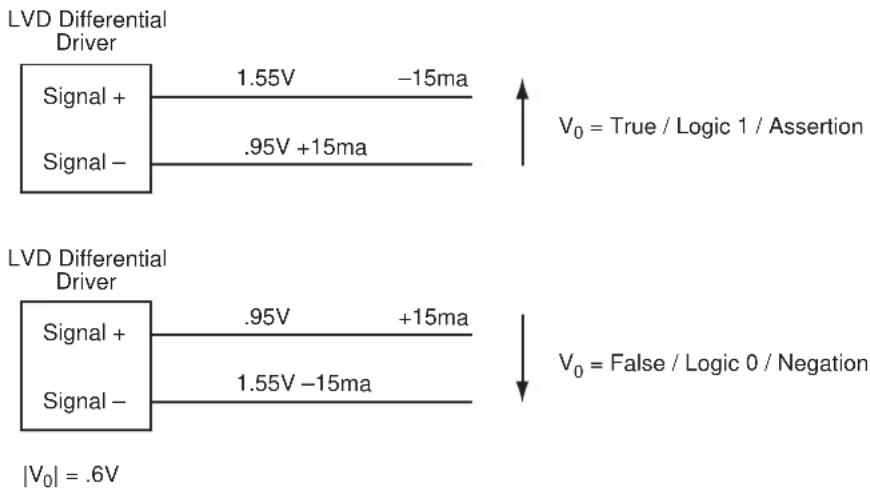
Figure 24. LVD output signals
Input characteristics
Each signal (Vs) received by LVD interface receiver circuits shall have the following input characteristics when measured at the disk drive connector:
Steady state Low level output voltage* = 0.030 V = < V_s = < 3.6 V (signal negation/logic 0)
Steady state High level output voltage* = -3.6 V = < V_s = < -0.030 V (signal assertion/logic 1)
Differential voltage = ±0.30 V minimum with common-mode voltage ranges 0.700 V = < V _cm = < 1.800 V. (X3T10/1142D revision 13, p. 152)
*These voltages shall be measured between the output terminal and the SCSI device's logic ground reference.
This requirement shall be met with the input voltage varying between 0.700 V and 1.8 V, with power on or off, and with the hysteresis equaling TBD mV, minimum.
Input characteristics shall additionally conform to EIA RS-485-983.
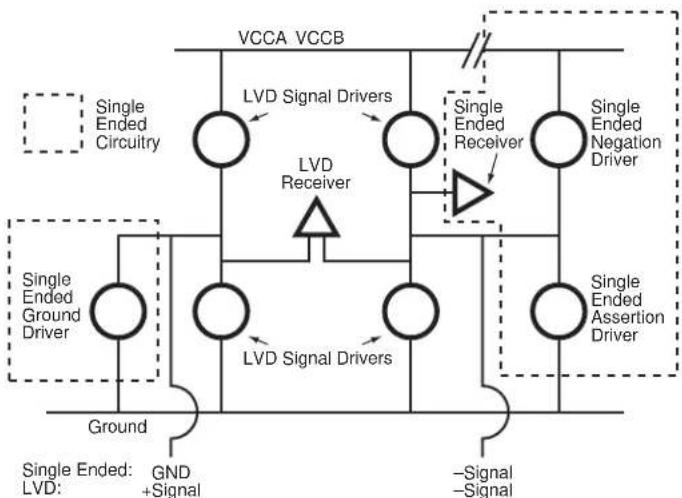
flowchart
graph TD
    A["Single Ended Circuitry"] --> B["LVD Signal Drivers"]
    B --> C["LVD Receiver"]
    C --> D["LVD Signal Drivers"]
    D --> E["Ground"]
    F["VCCA VCCB"] --> G["Single Ended Nogation Driver"]
    G --> H["Single Ended Negation Driver"]
    I["Single Ended Ground Driver"] --> J["Ground"]
    K["Single Ended LVD"] --> L["GND +Signal"]
    M["-Signal -Signal"] --> N["-Signal"]
Figure 25. Typical SE-LVD alternative transmitter receiver circuits
9.8 Terminator requirements
Internal disc drive I/O termination (provided only in model "N" and "W" drives single ended I/O model drives) consists of active circuits in an LSI module that is permanently mounted on the PCB. All single initiator/single target (non-daisy-chain) applications require that the Initiator and disc drive be terminated. Daisy-chain applications require that only the units at each end of the daisy-chain be terminated. All other peripherals on the chain must not be terminated. (See Figure 19).
Note. Remove drive terminator enabling jumper TE where terminators are not required. Removal of terminator power source selection jumper TP (see Figure 7d) does not disconnect the terminator resistors from the circuit.
It is highly recommended that ANSI SCSI-2 Standard's Alternative 2 termination (active termination) be used for applications with single-ended ("N" and "W" models), especially if the bus will be operated at transfer rates above 5 Mbytes/sec. The "N" and "W" models provide on-board active termination that can be disabled by removal of the enable jumper TE (see Figure 7d).
Note. ACTIVE TERMINATORS ARE HIGHLY RECOMMENDED FOR USE IN THE DAISY-CHAIN AS DESCRIBED ABOVE. ACTIVE AND PASSIVE TERMINATORS SHOULD NOT BE MIXED ON THE SAME SCSI BUS.
Drive models "WC," "LW," and "LC" do not have internal terminators available. The user, systems integrator or host equipment manufacturer must provide a terminator arrangement external to the drive. For "LW" models, terminator modules can be purchased that plug between the SCSI I/O cable and the drive I/O connector or on the end of a short I/O cable stub extending past the last cable connector.
Note. The SCSI protocol chip drives the upper eight data and parity bits of the SCSI bus even when operating in narrow (eight bit) mode. This is normal operation for this chip. If the unused data bit signals are connected to conductors that extend out beyond this drive's SCSI connector, correct termination must be provided for these unused signals at the device/system at each end of the bus onto which this drive is connected. Termination is required to control radiated emissions and conducted noise on other SCSI bus signals.
ANSI Standard X3T10/1143D contains additional details about SCSI bus terminator and terminator power requirements.
9.9 Terminator power
“N” and “W” model drives
You can configure terminator power in four different ways. See Section 8.1 for illustrations that show how to place jumpers enabling each of the following terminator power configurations:
- Drive accepts terminator power through SCSI bus pins:
"N" models Pin 26
"W" models Pins 17, 18, 51, and 52
- Drive supplies power to the SCSI bus.
- Drive provides terminator power for optional internal terminator resistors using the drive's power connector.
- Drive provides power to its own terminators and to the SCSI bus terminator power line.
SCSI devices providing terminator power (TERMPWR) must have the following characteristics:
8-bit SCSI V TERM = 4.25 V to 5.25 V
800 mA minimum source drive capability
1.0 A maximum
16-bit SCSI V TERM = 4.25 V to 5.25 V
1,500 mA minimum source drive capability
3.0 A maximum
"WC" and "LC" model drives
These drives cannot furnish terminator power because no conductors in the 80-pin I/O connector are devoted to terminator power.
“LW model drives
You can configure terminator power from the drive to the SCSI bus or have the host adaptor or other device supply terminator power to the external terminator. See Section 8.1 for illustrations that show how to place jumpers for this configuration.
Disc drive SCSI timing
Table 21: Disc drive SCSI timing
| Description | Waveform symbol [1] | Waveform table [1] Typical timing | |
| Target Select Time (no Arbitration) [4] T00 N/A <2 ∝s | |||
| Target Select Time (with Arbitration) [4] T01 4.5-1,2 <2 ∝s | |||
| Target Select to Command T02 4.5-1 3.77 ∝s | |||
| Target Select to MSG Out T03 4.5-2 1.57 ∝s | |||
| Identify MSG to Command | T04 | 4.5-3 | 3.36 ∝s |
| Command to Status | T05 4.5-5 Command Dependent | ||
| Command to Data (para. In) | T06 4.5-9 Command Dependent | ||
| Command to Data (para. Out) | T07 4.5-10 | Command Dependent | |
| Command to Data (Write to Data Buffer) | T08 | 4.5-10 | Command Dependent |
| Command to Disconnect MSG | T09 4.5-6 Command Dependent | ||
| Disconnect MSG to Bus Free | T10 | 4.5-6,14 | 0.52 ∝s |
| Disconnect to Arbitration (for Reselect) This measures disconnected CMD overhead | T11 4.5-6 Command Dependent | ||
| Target win Arbitration (for Reselect) | T12 | 4.5-7 | 3.00 ∝s |
| Arbitration to Reselect | T13 | 4.5-7 | 1.60 ∝s |
| Reselect to Identify MSG In | T14 | 4.5-7 | 1.39 ∝s |
| Reselect Identify MSG to Status | T15 4.5-8 Command Dependent | ||
| Reselect Identify MSG to Data (media) | T16 4.5-11 | Command Dependent | |
| Data to Status | T17 4.5-15 | Command Dependent | |
| Status to Command Complete MSG | T18 | 4.5-5,8,15 | 0.98 ∝s |
| Command Complete MSG to Bus Free | T19 | 4.5-5,8,15 | 0.51 ∝s |
| Data to Save Data Pointer MSG | T20 | 4.5-14 | 4.00 ∝s |
| Save Data Pointer MSG to Disconnect MSG | T21 | 4.5-14 | 0.79 ∝s |
| Command Byte Transfer | T22 | 4.5-4 | 0.04 ∝s |
| Next Command Byte Access: | 4.5-4 | ||
| Next CDB Byte Access (Byte 2 of 6) | T23.6.2 | 4.5-4 | 0.58 ∝s |
| Next CDB Byte Access (Byte 3 of 6) | T23.6.3 | 4.5-4 | 0.12 ∝s |
| Next CDB Byte Access (Byte 4 of 6) | T23.6.4 | 4.5-4 | 0.12 ∝s |
| Next CDB Byte Access (Byte 5 of 6) | T23.6.5 | 4.5-4 | 0.12 ∝s |
| Next CDB Byte Access (Byte 6 of 6) | T23.6.6 | 4.5-4 | 0.12 ∝s |
| Next CDB Byte Access (Byte 2 of 10) | T23.10.2 | 4.5-4 | 0.59 ∝s |
| Next CDB Byte Access (Byte 3 of 10) | T23.10.3 | 4.5-4 | 0.11 ∝s ±1 ∝s |
| Next CDB Byte Access (Byte 4 of 10) | T23.10.4 | 4.5-4 | 0.12 ∝s ±1 ∝s |
| Next CDB Byte Access (Byte 5 of 10) | T23.10.5 | 4.5-4 | 0.11 ∝s ±1 ∝s |
| Next CDB Byte Access (Byte 6 of 10) | T23.10.6 | 4.5-4 | 0.11 ∝s ±1 ∝s |
| Next CDB Byte Access (Byte 7 of 10) | T23.10.7 | 4.5-4 | 0.13 ∝s ±1 ∝s |
| Next CDB Byte Access (Byte 8 of 10) | T23.10.8 | 4.5-4 | 0.12 ∝s ±1 ∝s |
| Next CDB Byte Access (Byte 9 of 10) | T23.10.9 | 4.5-4 | 0.12 ∝s ±1 ∝s |
| Next CDB Byte Access (Byte 10 of 10) | T23.10.10 | 4.5-4 | 0.12 ∝s ±1 ∝s |
| Description | Waveform symbol [1] | Waveform table [1] | Typical timing |
| Data In Byte Transfer (parameter) T24 4.5-12 0.04 ∝s | |||
| Data Out Byte Transfer (parameter) T25 4.5-13 0.04 ∝s | |||
| Next Data In Byte Access (parameter) T26 4.5-12 0.12 ∝s | |||
| Next Data Out Byte Access (parameter) T27 4.5-13 0.12 ∝s | |||
| Data In Byte Transfer (media) [2] T28 4.5-12 0.04 ∝s | |||
| Data Out Byte Transfer (media) [2] T29 4.5-13 0.04 ∝s | |||
| Next Data In Byte access (media [2] T30 4.5-12 0.12 ∝s | |||
| Next Data Out Byte access (media [2] T31 4.5-13 0.12 ∝s | |||
| MSG IN Byte Transfer | T32 | 4.5-5,7,8,14,15 | 0.04 ∝s |
| MSG OUT Byte Transfer | T33 | 4.5-2 | 0.04 ∝s |
| STATUS Byte Transfer | T34 | 4.5-5,8,15 | 0.04 ∝s |
| Synchronous Data Transfer Characteristics: | |||
| Request Signal Transfer Period [3] | - | - | various |
Notes.
[1] See SCSI Interface Product Manual (part number 77738479), Section 4.5
[2] Maximum SCSI asynchronous interface transfer rate is given in Section 4.2.3 of this manual.
[3] Synchronous Transfer Period is determined by negotiations between an Initiator and a Drive. The Drive is capable of setting periods as given in Section 9.5. See also Sections 3.1.5.2 and 3.5.3.2 of the SCSI Interface Product Manual for a description of synchronous data transfer operation.
General timing diagrams for SCSI interface operation are shown in the SCSI Interface Product Manual, Section 4.5. The specific timing values that apply to this drive are listed in Table 18.
10.0 Seagate Technology support services
Online Services
Internet
For online information about Seagate products, visit www.seagate.com or e-mail your disc or tape questions to:
Presales Support:
Disc: http://www.seagate.com/support/email/email_presales.shtml or DiscPresales@Seagate.com
Tape: http://www.seagate.com/support/email/email_tape_presales.shtml or
Tape_Sales_Support@Seagate.com
Technical Support:
Disc: http://www.seagate.com/support/email/email_disc_support.shtml or DiscSupport@Seagate.com
Tape: http://www.seagate.com/support/email/email_tape_support.shtml or TapeSupport@Seagate.com
SeaBOARD ^® is a computer bulletin board system that contains information about Seagate disc and tape drive products and is available 24 hours daily. Set your communications software to eight data bits, no parity and one stop bit (8-N-1). This service is available worldwide.
Automated Services
SeaFONE® (1-800-SEAGATE) is Seagate's toll-free number (1-800-732-4283) to access our automated self-help services. Using a touch-tone phone, you can find answers to service phone numbers, commonly asked questions, troubleshooting tips and specifications for disc drives and tape drives 24 hours daily. International callers can reach this service by dialing +1-405-936-1234.
SeaFAX ^® is Seagate's automated FAX delivery system. Using a touch-tone phone, you can obtain technical support information by return FAX 24 hours daily. This service is available worldwide.
Presales Support
Our Presales Support staff can help you determine which Seagate products are best suited for your specific application or computer system.
Seagate Express
You can purchase select tape products and tape accessories through Seagate Express 24 hours daily by calling 1-800-531-0968 or by faxing your order to: +1-972-481-4812.
Technical Support
If you need help installing your drive, consult your dealer. Dealers are familiar with their unique system configurations and can help you with system conflicts and other technical issues. If you need additional help, you can talk to a Seagate technical support specialist. Before calling, note your system configuration and drive model number (STxxxx).
SeaTDD ^TM (+1-405-936-1687) is a telecommunications device for the deaf (TDD). You can send questions or comments 24 hours daily and exchange messages with a technical support specialist from 8:00 A.M. to 12:15 P.M. and 1:30 P.M. to 6:00 P.M. (central time) Monday through Friday.
Customer Service (CSO)
Warranty Repair
Seagate offers worldwide customer support for Seagate drives. Seagate direct OEM, Distribution and System Integrator customers should contact their Seagate service center representative for warranty information. Other customers should contact their place of purchase.
Authorized Service Centers
If your live outside the U.S., you can contact an Authorized Service Center for service or repair.
USA/Canada/Latin America Support Services
Presales Support
Disc: 1-877-271-3285 or +1-405-936-1210 FAX: +1-405-936-1683
Tape: 1-800-626-6637 or +1-714-641-2500 FAX: +1-714-641-2410
Technical Support (SeaFONE)
1-800-SEAGATE or +1-405-936-1234 (for specific product phone number)
FAX: Disc: +1-405-936-1685; Tape: +1-405-936-1683
SeaFAX 1-800-SEAGATE
SeaTDD +1-405-936-1687
SeaBOARD Disc: +1-405-936-1600; Tape: +1-405-936-1630
Warranty Repair
USA/Canada 1-800-468-3472 FAX: +1-405-949-6740
Latin America +1-405-949-7758 FAX: +1-405-949-6738
Authorized Service Centers
Brazil
MA Informatica +55-21-516-6649 FAX: +55-21-516-5280
Canada
Memofix +1-905-660-4936 FAX: +1-905-660-4951
Adtech +1-905-812-8099 or 1-800-624-9857 FAX: +1-905-812-7807
European Support Services
For European customer support, dial the toll-free number for your specific country for presales support, technical support, SeaFAX and warranty repair.
If your country is not listed here, dial our European call center at +31-20-316-7222 from 8:30 A.M. to 5:00 P.M. (European central time) Monday through Friday. The European call center is located in Amsterdam, The Netherlands.
Call Center
| Austria | 0 800-20 12 90 |
| Belgium | 0 800-74 876 |
| Denmark | 80 88 12 66 |
| France | 0 800-90 90 52 |
| Germany | 0 800-182 6831 |
| Ireland | 1 800-55 21 22 |
| Italy | 1 677 90 695 |
| Netherlands | 0 800-732 4283 |
| Norway | 800-113 91 |
| Poland | 00 800-311 12 |
| Spain | 900-98 31 24 |
| Sweden | 0 207 90 073 |
| Switzerland | 0 800-83 84 11 |
| Turkey | 00 800-31 92 9 |
| United Kingdom | 0 800-783 5177 |
SeaBOARD
Germany +49-89-1409331
Fax Services—All European Countries
Presales/Technical Support/Warranty Repair 31-20-653-3513
Africa/Middle East Support Services
For presales, technical support, warranty repair and FAX services in Africa and the Middle East, dial our European call center at +31-20-316-7222 from 8:30 a.m. to 5:00 p.m. (European central time) Monday through Friday, or send a FAX to +31-20-653-3513. The European call center is located in Amsterdam, The Netherlands.
Asia/Pacific Support Services
Technical Support
Australia +61-2-9725-3366 FAX: +61-2-9725-4052
Hong Kong +852-2368 9918 FAX: +852-2368 7173
Japan — FAX: +81-3-5462-2979
Singapore +65-488-7584 FAX: +65-488-7528
Taiwan +886-2-2514-2237 FAX: +886-2-2715-2923
SeaFAX
Australia +61-2-9756-5170
Warranty Repair
Japan +81-3-5462-2904 FAX: +81-3-5462-2979
Asia/Pacific and Australia +65-485-3595 FAX: +65-488-7503
Appendix A. Sense keys and additional sense codes supported
| Sense key Description Supported | ||
| 0h No sense Y | ||
| 1h Recovered error Y | ||
| 2h Not ready Y | ||
| 3h Media error Y | ||
| 4h Hardware error Y | ||
| 5h Illegal request Y | ||
| 6h Unit attention Y | ||
| 7h Data protect N | ||
| 9h | Firmware error | N |
| Bh | Aborted command | Y |
| Ch | Equal | N |
| Dh | Volume Overflow | N |
| Eh | Miscompare Y |
Additional sense code and qualifier
| Bytes | Description Supported | ||
| 00 | 00 | No additional information | Y |
| 01 | 00 | No index/sector signal | Y |
| 02 | 00 | No seek complete | Y |
| 03 | 00 | Write fault | Y |
| 04 | 00 | Drive not ready, no additional information | Y |
| 04 | 01 | Drive not ready, in spin-up mode | Y |
| 04 | 02 | Drive not ready, waiting for initialization command | Y |
| 04 | 03 | Drive not ready, human intervention required | Y |
| 04 | 04 | Drive not ready, format in process | Y |
| 05 | 00 | No drive response when selected | N |
| 06 | 00 | Track 0 not found | N |
| 07 | 00 | More than one drive selected | N |
| 08 | 00 | Drive communication failure | N |
| 08 | 01 | Drive communication timeout | N |
| 08 | 02 | Drive communication parity error | N |
| 09 | 00 | Track following error | Y |
| 09 | 04 | Head select fault | N |
| 0A | 00 | Error log overrun | N |
| 0C | 00 | Write error | N |
| 0C | 01 | Write error recovered by autoreallocation | N |
| 0C | 02 | Write error, autoreallocation failed | Y |
| 10 | 00 | ID CRC error | N |
| 11 | 00 | Unrecovered read error | Y |
| 11 | 01 | Read retries exhausted | N |
| 11 | 02 | Error too long to correct | N |
| 11 | 04 | Unrecoverable read error, autoreallocation failed | N |
| Sense key | Description | Supported |
| 12 00 No address mark in ID field N | ||
| 13 00 No address mark in data field N | ||
| 14 00 Sector not found Y | ||
| 14 01 No record found N | ||
| 15 00 Seek positioning error Y | ||
| 15 01 Mechanical positioning error N | ||
| 15 02 Positioning error determined by reading media N | ||
| 16 00 Data synchronization mark error Y | ||
| 17 00 Data recovered without ECC or retries Y | ||
| 17 01 Data recovered with retries N | ||
| 17 02 Data recovered with positive head offset N | ||
| 17 03 Data recovered with negative head offset | N | |
| 17 05 Data recovered with previous sector ID | N | |
| 17 06 Data recovered without ECC | N | |
| 18 00 Data recovered with ECC | N | |
| 18 01 Data recovered with ECC and retries | N | |
| 18 02 Data recovered with ECC, retries, and autoreallocation | N | |
| 19 00 Error in defect list | Y | |
| 19 01 Defect list not available | N | |
| 19 02 Error in P-list | N | |
| 19 03 Error in G-list | N | |
| 1A 00 Parameter overrun | Y | |
| 1B 00 Synchronous transfer error | N | |
| 1C 00 Defect list not found | Y | |
| 1C 01 P-list not found | N | |
| 1C 02 G-list not found | N | |
| 1D 00 Compare error with verify | Y | |
| 1E 00 Recovered ID error | N | |
| 20 00 Drive received invalid operation code | Y | |
| 21 00 LDA out of range | Y | |
| 24 00 CDB with invalid bit | Y | |
| 25 00 CDB with invalid LUN | Y | |
| 26 00 CDB with invalid field | Y | |
| 26 01 CDB with unsupported parameter | N | |
| 26 02 CDB with invalid parameter N | ||
| 26 03 CDB with unsupported threshold parameter | N | |
| 27 00 Write protected | Y | |
| 29 00 Power-on or pin 40 bus reset occurred Y | ||
| 2A 00 Parameters changed by another initiator | N | |
| 2A 01 Mode select parameters changed by another initiator | Y | |
| 2A 02 Log parameters changed | Y | |
| 2F 00 Tagged commands cleared by another initiator Y | ||
| 31 00 Format command failed | Y | |
| 32 00 Defect locations not available | Y |
| Sense key | Description | Supported | |
| 37 00 | Rounded parameter error N | ||
| 39 00 | Saved parameters not supported Y | ||
| 3D 00 | Identify message with invalid bits N | ||
| 3F 00 | Target operation command changed N | ||
| 3F 01 | Microcode changed Y | ||
| 3F 02 | SCSI-1/SCSI-2 change N | ||
| 40 00 | Target operating conditions have changed Y | ||
| 40 01 | DRAM parity error detected Y | ||
| 40 93 | Error in write to flash Y | ||
| 42 00 | Power on or self test error | N | |
| 43 00 | Message reject error Y | ||
| 44 00 | Internal controller error | N | |
| 45 00 | Selection or reselection error | N | |
| 47 00 | Bus parity error | Y | |
| 48 00 | Initiator detected error | Y | |
| 49 00 | Initiator received invalid message from drive | Y | |
| 4E | 00 Drive attempted overlapped commands | Y | |
| 5B | 00 Log exception—factory option | N | |
| 5B | 01 Threshold condition met—factory option | Y | |
| 5B | 02 Log counter reached maximum value—factory option | N | |
| 5B | 03 Log list codes all used—factory option | N | |
| 5C 00 | RPL status change, drive lost synchronization | N | |
| 80 00 | General firmware error qualifier | N | |
Index
Symbols
+5 and +12 volt supplies 20
Numerics
50 conductor connector 59
50 pin connector 61, 62
68 conductor connector 60
80 conductor connector 60
80 conductor interface 60
80 pin connector option 59
80 pin I/O connector 58, 68, 69
A
AC power 19
access time 9, 11
accessories 8
acoustics 26
active circuit 73
activity indicator 70
actuator 7, 41
actuator assembly 6
address 11
addressed track 14
air circulation 41
air cleanliness 26
air flow 22, 41
suggested 41
air inlet 41
altitude 24
altitude and atmospheric pressure 22
ambient 23
ambient temperature 22, 41
ANSI SCSI documents 4
ANSI SCSI-3 Fast-20 4
ANSI SPI-2 (T10/1142D) 15
ANSI Standard 58
ANSI3.131-1986 4
arbitration priority 61
asynchronous interface transfer rate 76
audible noise 3, 7
Australia/New Zealand Standard 4
automatic retry 13
automatic shipping lock 6
average idle current 19
average latency 7
average rotational latency 9, 10
B
background processing 7
backward compatibility 5
bits/inch 9
buffer 11, 12
buffer segment 11, 12
buffer segmentation 12
buffer-full 12
buffer-full ratio 12
bulkhead connector 58
bus device reset message 49
bytes per sector 46
C
cabinet cooling 41
cable 55
cable characteristics
single-ended circuits 59
cable length 71
cache 11, 12
cache buffer 7
cache miss 12
cache mode 11
cache operation 11
cache operation hit 12
cache segment 12
caching write data 12
Canadian Department of Communications 3
capacities 8
capacity, drive, programmable 8
case temperature 22
CE Marking 3
changeable bit 50
changeable value 49
check condition 49
class B limit 3
command 11, 44
command descriptor block (CDB) 11
command queuing 7
condensation 22, 24
conducted noise immunity 20
connect/disconnect 11
connector 55
connector contact 70
connector key 59
consecutive read operation 12
contiguous blocks of data 12
continuous vibration 26
controller 11
controller self test 21
cooling 41
cooling air 22
C-Tick Marking 3
current 21, 70
current I/O processes 15
current limiting 21
current profile 21
current requirements 19
current value 49, 50
D
daisy-chain 20, 58, 59, 61, 70, 71, 73
80 conductor 60
data area 21
data correction 13
by ECC 31
data transfer period 54
data transfer protocol 7
data transfer rate 10
DC cable and connector 55
DC current 58
DC power 11, 13, 22, 40, 55
DC power carrying conductor 60
DC power connector 55, 56
DC power requirements 19
DC power source 60
dedicated landing zone 6
default 38, 40
default mode parameter 33
default value 49, 50, 51, 52
defect/error management 31
delayed motor start option 19, 70
delayed start 40
depot repair 14
depot repair philosophy 14
diagnostics 21
differential I/O circuit 40
DIFFSENS 71
dimensions 27
disable read ahead 12
disc access 11
disc drive
termination 73
disc media 10
disc rotational speed 9
disconnect/reconnect 12
control 12
DRA bit 12
drive 26
drive activity 70
drive activity LED 39
drive capacity programmable 8
drive configuration 39
drive default mode parameter 33
drive defects list track 31
drive failure 14
drive firmware 49
drive I/O connector 71
drive ID 33, 39
drive ID select 34, 35, 36
drive ID select jumper connector 33
drive ID/option select header 33
drive insertion 15
drive interface connector 60
drive internal 21
drive internal defects and errors 31
drive malfunction 14
drive mounting 27, 42
constraints 13
drive option select header 37
drive orientation 11, 41
drive power 33
drive reset 39
drive SCSI timing 75
drive select header 55
drive spindle 40
drive transfer 12
drive volume 33
drive warranty 14
dynamic spindle brake 7
E
ECC 13
electrical characteristics 55, 70
electromagnetic compatibility 3
electromagnetic interference (EMI) 13
electromagnetic susceptibility 26
embedded servo 7
EMC compliance 3
EMI requirements 3
environment 41
environmental control 26
environmental interference 13
environmental limits 22
environmental requirements 13
EPROM 49
equipment malfunction 13
error 13
error correcting code 7
error management system 31
error rate 13
error rate calculation 13
ESD 15
ETF defect list 31
European Union requirements 3
EVPD bit 47
execution time 11
extended messages 43
extended sense 14, 31, 81
F
Fast-10 transfer rate 58
Fast-20 1, 5, 10
Fast-20 SCSI 5, 7
FAST-20 transfer rate 59
Fast-20 transfer rate 58
Fast-40 1, 5, 7, 10
FAST-40 transfer rate 59
Fast-40 transfer rate 58
Fast-5 transfer rate 58
fault status 13
FCC rules and regulations 3
field repair 14
firmware 49
flat ribbon cable 70
flaw reallocation 10
format 46
format command 10
format operation 31
format time 10
format unit command 31
formatted 8
formatting 33
front panel 27
front panel LED 70
FSW function 50
G
gradient 23, 24
ground 65
ground return 20
grounding 42
H
hard reset 49
hardware error 14
HDA 5, 14, 22, 41, 42
temperature 22
head and disc assembly. See HDA
heads 21
heat removal 41
heat source 41
high level format 33
high voltage differential 15
host 12, 31, 39, 40, 46, 58, 61, 65
host adapter 33
adapter/initiator 61
host backplane wiring 58
host equipment 42, 59, 60
DC power 60
manufacturer 33
host I/O signal 33
host system 33
host system malfunction 13
host/drive operational interface 13
hot plug 7, 15
humidity 22, 24
HVD 15
|
I/O cable 65
I/O circuits
single-ended 59
I/O connector 39, 58
I/O features 5
I/O line 40
I/O termination 73
identified defect 31
idle condition 22
initiator
termination 73
inquiry command 47
inquiry vital product data 47
installation 33
installation guide 4
installation instructions 33
instantaneous current peak 19
integrated SCSI controller 7
interface cable length 61
interface data 10
interface requirements 43
interface signals
single-ended 70
interface timing 13
Interface transfer rates 58
interleave 7
internal data rate 9
J
J1-auxiliary 33
jumper 8, 33, 38, 39, 40, 70
jumper function description 40
jumper header 38
jumper plug 33
jumper plug TE 71
jumper plug TP 71
jumper plug type 33
L
landing zone 7, 21
LB 12
logical 11
logical block 11, 12
logical characteristics 55
low level format 33
low voltage differential 7, 22
low voltage differential mode 15
LSI module 73
LVD 58, 71, 72
LVD mode 15
M
magnetoresistive heads 5
mating connector 55, 59, 60
mating flat cable connector 59, 60
maximum case temperature 22
maximum current requirements 21
maximum operating current 20
maximum starting current 19
ME jumper 40
mean time between failure. See MTBF
media 7, 49
media defect 13
media defect induced error 13
medium error 14
message protocol 54
message protocol system 31
messages
SCSI interface 43
miscellaneous features 53
mode page 01 49
mode page 08h 11
mode parameter 49
mode select command 11, 49
mode select page 08h 12
mode sense command 49, 50
mode sense data 49, 50, 51, 52
mode sense value 49
model number table 5
motor start command 11
motor start delay option 70
motor start option 11, 20, 70
mounting configuration 27
mounting configuration dimensions 27, 28, 29
mounting constraints 13, 42
mounting point 42
mounting surface 42
mounting surface distortion 42
mounting surface stiffness 42
MR heads 5
MTBF 13, 14, 22
multimode 7
multimode (SE/LVD) 5
multimode drivers 15
multimode receivers 15
multiple segment 12
multi-segmented cache control 11
N
noise 20
audible 3,7
nominal voltage 22
non-operating 24, 25
temperature 23
non-operating vibration 25
nonshielded 50 conductor connector 59
nonshielded 68 conductor connector 60
0
office environment 26
operating 24, 25
operating environment 14
operating option 33
operating parameter 49
operator intervention 13
option jumper 33
option jumper location 33
option select header 55
option select jumper 33
options 8
orientation 11, 24, 41
out-of-plane deflection 42
out-of-plane distortion 42
output voltage 70
overhead time 10
P
package size 24
package test specification 4
packaged 24
parity 40
parity checking 40
parity error 40
partition or logical drive 33
PCB 14, 33, 38, 40, 41, 42, 49, 55, 58,
59, 60
temperature 22
PCB circuit run 58
PD jumper 40
peak bits/inch 9
peak starting current 20
performance characteristics 9
performance degradation 24
peripheral I/O cable 20
physical buffer space 11
physical characteristics 55
physical damage 26
physical interface 55, 56, 57
physically contiguous blocks of data 12
power 20, 21, 40
power connector 19, 20
power control switch 11
power dissipation 22
power distribution 3
power requirements 19
power sequencing 20
power supply voltage 13
power-carrying conductor 60
power-on 33, 39, 70
power-on operating hours 14
power-on reset 49
power-up 20, 40
power-up hours 14
prefetch 11, 12
prefetch (read look-ahead) 11, 12
prefetch ceiling field 12
prefetch data 12
prefetch field 12
prefetch hit 12
prefetch mode 11
prefetch of contiguous blocks 12
prefetch operation 11, 12
prefetch segmented cache control 11
preventive maintenance 13, 14
printed circuit board. See PCB
PRML read channel electronics 5
product data page 47
programmable drive capacity 8
R
radio interference regulations 3
read 11
read caching 12
read command 11, 12
read data 11
read error 13
read error rate 13, 31
read operation 11
read/write head 9
read/write power dissipation 22
ready 49
receive diagnostic results 31
recommended mounting 25
recoverable seek error 14
recovered error 14
reference documents 4
regulation 19
relative humidity 24
reliability 7
reliability and service 14
reliability specifications 13
remote ID selection 39
remote switch 33
repair facility 14
repair information 17
REQ/ACK offset 54
request sense command 31
request sense information 14
reseek 14
resonance 24
retrieved data 11
s
S.M.A.R.T. 7
safe power transmission 60
safety 3
saved value 49, 50
SCA 70
SCAM 7, 33
SCSI
commands 44
format commands 13
interface data transfer rate 10
messages 43
SCSI bus 33
SCSI bus cable 33
SCSI bus condition 53
SCSI bus I/O cable 40
SCSI bus ID 70
SCSI bus phase sequence 53
SCSI bus reset 15
SCSI command 31
SCSI documents 4
SCSI I/O connector 56
SCSI I/O termination 19
SCSI ID 33, 40
SCSI interface 11, 13, 58
SCSI interface cable 58
SCSI interface commands supported 44
SCSI interface connector 55
SCSI interface data 10
SCSI Interface Product Manual 3, 4, 5
SCSI systems error 31
SCSI systems error consideration 31
SCSI systems error management 31
SCSI-3 10
SCSI-3 (Fast-20) interface 5
SCSI-3 Parallel Interface-2 (SPI-2) 58
SE 58, 71
SE drivers 15
Seagate support service 33
sector sizes 10
sector transfer 11
seek error 13, 14
seek positioning error 14
segment 11, 12
Self-Monitoring Analysis and Reporting Technology 15
SE-LVD alternative 73
sense code 14, 31, 81
sense key 14, 31, 81
sequential read operations 12
service
life 13, 14
philosophy 14
tools 14
servo data 6
SFF-8046, SCA-2 specification 15
shielding 3
shipping 16
shipping container 23
shock 24
and vibration 24
shock mount 42
signal ground 42
single connection attachment (SCA) 70
single ended I/O
signal/contact assignment
50 conductor 65
68 conductor 66
80 conductor 68
single unit shipping pack 8
single-ended 7
single-ended drive 70
single-ended drivers 15
single-ended I/O 40
single-ended I/O circuits 59
single-ended interface circuit 22
single-ended interface signals 70
single-ended SCSI driver 7, 70
single-ended SCSI receiver 7, 70, 71
site installation 14
SMART 15
software interleave 12
source voltage 71
spare part 14
spindle 21
spindle startup 40
standard day 22
standards 3
start motor command 20
start unit command 40
start/stop time 11
status 31
stop spindle 11
Stop Spindle command 15
stop time 11
storage capacity 31
straight-in connector 60
supply voltage 20
support services 77, 81
synchronous data transfer 54
synchronous data transfer operation 76
synchronous data transfer period 54
synchronous transfer negotiation 15
synchronous transfer period 76
synchronous transfer rate 10
system chassis 42
system recovery procedures 13
T
TE jumper 58, 73
technical support services 77, 81
temperature 11, 22, 41
ambient 22
case 22
gradient 22
maximum case 22
non-operating 23
PCB and HDA 22
regulation 3
See also cooling
terminated 20
termination 20
active 73
disc drive 73
initiator 73
terminator 33, 40, 61, 71
active 73
passive 73
terminator circuit 40, 70, 71
terminator enable jumper TE 33, 61, 73
terminator power 40, 65, 71, 74
source selection jumper TP 73
terminator requirements 33, 73
termpower 40
TP jumper 40, 58
TP1 position 40
tracks/inch 9
tracks/surface, total 9
transfer period 54
transfer rate 10
typical access time 11
U
Ultra SCSI 5, 7
Ultra SCSI-2 53
Ultra-1 SCSI 10
Ultra-2 SCSI 5, 7
unformatted 8
unrecoverable condition 13
unrecoverable error 13
unrecoverable seek error 14
Unrecoverable write error 13
V
vibration 24, 25, 26
vital product data 47
volatile memory 49
voltage 11, 19
voltage margin 11
W
wall/bracket mounted connector 59
warranty 7, 16
wet bulb temperature 22
write caching 12
write command 12
write data logical block 12
write error 13
unrecoverable 13
write operation 12
x
X3T10/1071 4
X3T10/1142D 58, 59, 70, 71
X3T10/1143D 73
X3T9.2/82-2 4
X3T9.2/86-109 4
X3T9.2/91/010 4
X3T9.2-184 4
X3T9/84.40 4
Z
zoned bit recording (ZBR) 7