 ManualGo.com
VSX-C550 - Audio/Video Receiver PIONEER - Free user manual and instructions
Find the device manual for free VSX-C550 PIONEER in PDF.



Download the instructions for your Audio/Video Receiver in PDF format for free! Find your manual VSX-C550 - PIONEER and take your electronic device back in hand. On this page are published all the documents necessary for the use of your device. VSX-C550 by PIONEER.
USER MANUAL VSX-C550 PIONEER
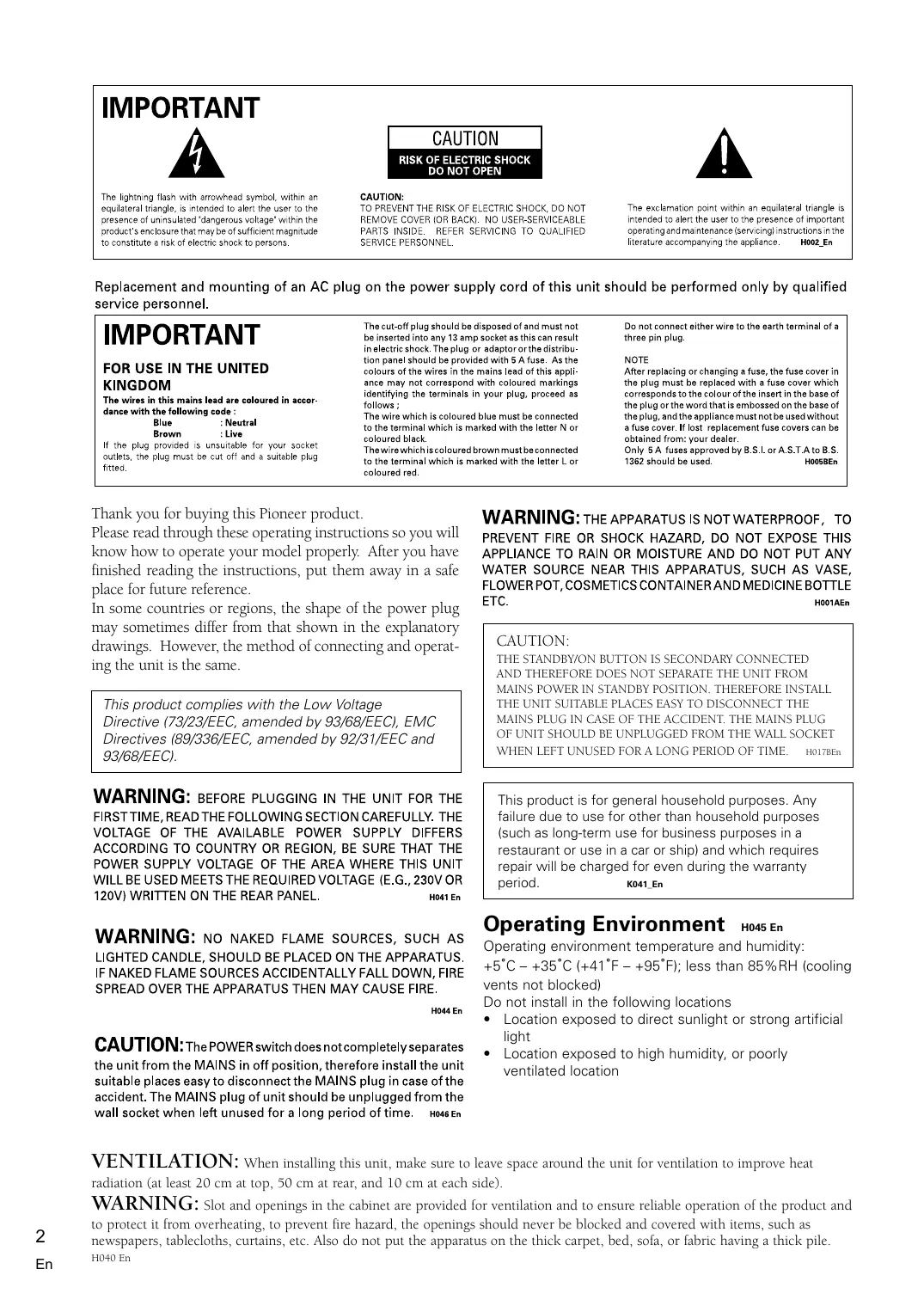
IMPORTANT The lighining flash with arrowihoad symbol, within an qulateral tiangfe, intended Le ar: the user 10 the presence of uninsulated'dangerous volage within the produet's enclosure that may be of sufficiet magnitude 0 consttute & risk of leetri shaëk to persons. CAUTION
{The exclemation paint within an eauilateral Iangle is intended io ler the user to êne presence of Important operatingandmaintenance (sericingl instructions nine Horature accompanying the appliance. Ho02 En service personnel. Replacement and mounting of an AC plug on the power supply cord of this unit should be performed only by qualified IMPORTANT
FOR USE IN THE UNITED
KINGDOM ‘The wires in this mains lead are coloured in accor- dance with the following code Blue Neutral Brown ü 1 the plug prouded s unsuitable far your sacket outets, ine plug must be cut off and à suitsble plug “The eut-off plug should be disposad of and must not be inserted into any 13 amp socket as this can result in electric shock The plug or adaptorarthe distrib ton panel should be provided with 5 À fuse. As the olours of the wires in the mains lead of this appli ance may not correspond with caloured markings identifying the terminals in your plug, proceed as follows “The wire which is coloured blue must be connected 0 the terminal vhieh is marked th the letter N or oloured black. “Thewirewhichiscoloured brownmustbe connected Do not connect either wire 0 {ne sarth terminal of à three pin plug. NOTE After replacing or changing a fuse, the fuse cover in he plug must be replaced with a fuse cover which carresponds to the colour ofthe insert in the base of he plug or the word thatis embossed on the base of he plug, andthe appliance must notbe used without 2 fuse cover. lost replacement fuse covers can be obtained from: your dealer. Only 5 A fuses approved by 8.5.L or AS.TAtOBS. tite coloured red Lo the terminal which is marked with the letter L'or 1262 should be used. HoGBEn Thank you for buying this Pioneer product Please read through these operating instructions so you will know how to operate your model properly. After you have finished reading the instructions, put them away in a safe place for future reference In some countries or regions, the shape of the power plug may sometimes differ from that shown in the explanatory drawings. However, the method of connecting and operat- ing the unit is the same. This product complies with the Low Voltage Directive (73/23/EEC, amended by 9/68/EEC), EMC Directives (89/336/EEC, amended by 92/31/EEC and 93/68/EC)
LIGHTED CANDLE, SHOULD BE PLACED ON THE APPARATUS. IF NAKED FLAME SOURCES ACCIDENTALLY FALL DOWN, FIRE SPREAD OVER THE APPARATUS THEN MAY CAUSE FIRE HOWEn CAUTION: The POWER switch does notcompletelyseparates the unit from the MAINS in off position, therefore install the unit suitable places easy to disconnect the MAINS plug in case ofthe accident. The MAINS plug of unit should be unplugged from the wall socket when left unused for a long period oftime. Husen
WARNING: THE APPARATUS IS NOT WATERPROOF, TO
PREVENT FIRE OR SHOCK HAZARD, DO NOT EXPOSE THIS APPLIANCE TO RAIN OR MOISTURE AND DO NOT PUT ANY WATER SOURCE NEAR THIS APPARATUS, SUCH AS VASE, FLOWER POT, COSMETICS CONTAINER AND MEDICINE BOTTLE ETC. HOONAEn CAUTION THE STANDBY/ON BUTTON IS SECONDARY CONNECTED AND THEREFORE DOES NOT SEPARATE THE UNIT FROM MAINS POWER IN STANDBY POSITION. THEREFORE INSTALL THE UNIT SUITABLE PLACES EASY TO DISCONNECT THE MAINS PLUG IN CASE OF THE ACCIDENT. THE MAINS PLUG OF UNIT SHOULD BE UNPLUGGED FROM THE WALL SOCKET WHEN LEFT UNUSED FOR A LONG PERIOD OF TIME. Hoirer This product is for general household purposes. Any failure due to use for other than household purposes {such as long-term use for business purposes in à restaurant or use in a car or ship) and which requires repair will be charged for even during the warranty period KO41 En Operating Environment Ho4s en Operating environment temperature and humidity: 45°C - +35°C (+41°F - +95°F); less than 85%RH (cooling vents not blocked) Do not install in the following locations + Location exposed to direct sunlight or strong artificial light + Location exposed to high humidity, or poorly ventilated location VENTILATION: When installing this unit, make sure to leave space around the unit for ventilation to improve heat radiation (at least 20 cm at top, 50 cm at rear, and 10 cm at each side) WARNING: slot and openings in the cabinet are provided for ventilation and to ensure reliable operation of the product and to protect it from overheating, to prevent fire hazard, the openings should never be blocked and covered with items, such as newspapers, tablecloths, curtains, etc. Also do not put the apparatus on the thick carpet, bed, sofa, or fabric having a thick pile. H040 En
Features Compatibility with the Home Theater Formats Dolby Digital, DTS Sound Decoders These highly evolved multichannel sound formats are the heart of home theater. They deliver realistic multi- channel sound that can turn any living room into a theater, reproducing all the sound effects of the original movie, The VSX-C550 has the flexibility to decode all these formats Dolby Pro Logic II Decoder The VSX-C550 reproduces this industry-leading format with excellent clarity. With it you can get multichannel surround sound even from two channel and Dolby Surround sources. Home Theater Listening Modes Custom Designed Listening Modes (p.33) These modes enhance the sound of sources from movies and music to TV and video games for a more dramatic effect. These are each designed to accentuate specific sound qualities, giving the listener a wide range of possibilities. VIRTUAL Mode (p.33) This especially designed listening mode uses only two channels but through sound imaging imitates a full surround sound. It allows you to experience surround sound with only two speakers. PHONES SURROUND Mode (p.33) This new headphone mode allows the user to get a surround-like sound while listening on headphones designed to accommodate this technology Sound Modes (p.35) This unit also has especially created Sound Modes that can enhance your listening experience and bring out the best in each soundtrack. Each mode is designed to bring out a specific quality of the soundtrack or balance the sound. The NATURAL corrects the frequencies for small speakers to achieve better theater-like surround sound The MIDNIGHT listening mode allows you to obtain excellent surround sound effects even when listening at low volumes, something that was previously impossible The QUIET mode provides good sound by smoothing out harsh noises in the soundtrack. This is achieved by reducing the bass and treble. The BRIGHT mode flattens out the total frequency output to match the charactersics of the front speakers. The S.BASS mode gives you added bass for that driving punch that really livens up your music or makes a film more realistic Easy-to-use Remote Control This new remote control is extremely convenient to use One button is dedicated to one task in the control of the receiver, eliminating confusing buttons whose purpose are unclear. In addition, this remote can be used to operate a variety of other components simply by recalling the appropriate setup codes Easy Setup for Quick Home Use This receiver features an automatic setup function that senses which speakers you have hooked up and automatically sets the re for proper surround sound. Thus, you can start enjoying home theater immediately after hooking up your speakers and components, without worrying about difficult setup procedures The Energy-saving Design This unit is designed to use less than 1 W of energy when the receiver is in standby mode Manufactured under license from Dolby Labo- ratories. "Dolby", ‘Pro Logic’, and the double- D symbol are trademarks of Dolby Laborato- ries. “DTS" and “DTS Digital Surround” are trademarks of Digital Theater Systems, Inc. TruSurround and the (@>° symbol are trade- marks of SRS Labs, Inc. TruSurround technol- ogy is incorporated under license from SRS Labs, Inc.
Contents Congratulations on buying this fine Pioneer product. Please read through these operating instructions so you will know how to operate your model properly. After you have finished reading the instructions, put them away in a safe place for future reference
Contents 4 07 Quick Start Guide 5 Introductory Information 9 Checking the Supplied Accessories 9 Installing the Receiver 9 Ventilation 9 When Making Cable Connections 9 Loading the Batteries 10 Operating Range of Remote Control Unit 10 Maintenance of External Surfaces 10 Connecting Your Equipment 11 Audio/Video Cords 11 Coaxial Cords/Optical Cables 11 Connecting a DVD Player & TV. 12 Connecting a Digital Tuner/Set Top Box 13 08 Connecting a TV with an Internal Digital Tuner 14 Connecting Video Components 14 Connecting Speakers 16 Hints on Speaker Placement 17 Connecting Antennas 18 Using External Antennas 18 Operating other Pioneer Components with this Units Sensor 19 Plugging in the Receiver 19
Displays & Controls 20 Front Panel 20 Rear Panel 21 Remote Control 22 Basic Playback 24 Checking the Settings on Your DVD (or other) Player 24 Program Format/Speaker Channel Indicators 24 Playing a Source 25 10 Fine Tuning Your Surround Sound 26 Room Setup 26 11 Personalizing Your Surround Sound 27 Setting the Volume Level of Each Channel 32 Playback Modes 33 Listening Modes 33 Selecting a Listening Mode 34 Sound Modes 35 Selecting a Sound Mode 35 Using the Tuner 36 Finding a Station 36 MPX Mode 36 RF ATT Mode 36 Tuning Directly to a Station 37 Memorizing Stations 37 Naming Memorized Stations 38 Recalling Memorized Stations 38 An Introduction to RDS 39 Using the RDS Display 39 Searching for RDS Programs 40 An Introduction to EON 41 The Receiver$ Internal Program Identification Function 41 Using EON 42 Using Other Functions 43 Muting the Sound 43 Using the Headphones 43 Changing the Display Brightness (DIMMER button) 43 Input Signal Select 44 The SLEEP Function 44 Resetting the System 44 Default Settings for the Receiver 45 Controlling the Rest of Your System 46 Changing the Remote Control Mode 46 Recalling Preset Codes 47 Clearing the Preset Codes 48 CD/MD/CD-R/WCR/DVD/LD/DVD recorder/ Cassette Deck Controls 49 Cable TV/Satellite TV/Digital TV/TV Controls
Preset Code List 51 Additional Information 54 Troubleshooting 54 Techno Know How 57 Understanding DVD Packaging 57 Digital Audio Formats 57 Recording Formats 58 Playback Formats 58 Specifications | 59
Quick Start Guide Home Theater: The Basics Most consumers are used to using stereo equipment to listen to music but many people are not used to home theater systems that give you many more options when listening to sounditracks. In fact, home theater is not really compli- cated and this little guide should give you an understanding of basics The main reasons why it seems so difficult is that there are three different factors involved in home theater and each will contribute to what kind of sound you get These factors are
1) The equipment you are using for you home theater set up. Particularly important is the number of speakers you
are using, We call this your speaker configuration. The default settings should be fine in most cases
2) The ‘source’ material you are using, This is the actual product (like a DVD) or broadcast (like cable TV) you are
listening to/watching. We call this the source
3) The last factor is the listening mode you choose on the VSX-C550 receiver. These are
subsequent chapters but most likely the default setting will be fine Let's start with the home theater set up you have in your home xplained below and in Your Home System The heart of your system is the VSX-C550 receiver and it is very flexible in getting you theater-like surround sound You can use this receiver with anywhere from two to five speakers (front lef, front right, center, surround left and right) and a subwoofer to get home theater surround sound. However we recommend you use five speakers. If you only have two speakers choose the Listening mode that offers surround sound for your home setup. Also, a DVD player is essential for home theater and you can also hook up satellite or cable TV tuner to this receiver and get a more home theater like sound from those programs The Source Material DVDs have become the basic source material for home theater because they offer excellent sound and picture quality, allow users to choose the movies they want, and are easy to store, etc. You can also enjoy home theater with other sources, such as digital satellite TV, cable TV and VHS videotapes. The important part here is all these sources have soundtracks recorded on them with various kinds of technology (this is called the sound encoding). Home theater sources are recorded (encoded) with multiple sound channels, that is discrete parts of the overall sound. CDs (which are stereo sources) work the same way but they only have two sound channels, the left channel and the right channel These two channels carry different parts of the soundtrack and mix together when you hear it to make an enjoyable, stereo sound. The same idea applies to home theater sources except home theater sources are recorded with multichannels, that is, more than two channels. For example, Dolby Pro Logic encoding has four channels (front lef, front right, center and a single channel for both surround speakers), Dolby Pro Logic Il, Dolby Digital and DTS encoding usually have six channels (front left, front right, center, surround left and right and a channel that powers the subwoofer). Since the subwoofer channel is only for bass sounds this multichannel set up has been named 5.1 channel sound. These multiple channels are what create a surround sound effect and give you a similar experience of that of a movie theater. It is important you consult the manual that came with your DVD player as well to make sure the player is outputting a surround soundtrack and all the other settings are appropriate for home theater The Listening Modes This receiver has many different listening modes and they are designed to cover all the speaker configurations and types of sources you might be using. In general, if you follow the recommend advice and have five speakers hooked up in most cases the AUTO listening mode is the easiest way to get realistic home theater sound. This is the default setting so you don't have to do anything. Other possibilities (like listening to a stereo CD with all five speakers or, conversely taking a stereo source and it getting multichannel home theater-like sound) are explained in Listening modes (page 33) These are the three basic factors that contribute to your home theater sound. The easiest thing is to hook up five speakers and simply play your DVDs with AUTO mode. This will give you realistic and enjoyable home theater sound
Quick Start Guide No Frills Setup This receiver was designed with the easiest possible setup in mind so if you just want to hook up your equipment and start enjoying quality home theater movies follow the four steps below and use these easy settings on the VSX-C550. In most cases you can leave the receiver in the default settings. Default Settings: + Speaker Setting: Automatically sensed by the receiver + Input Setting: DVD + Signal Select: AUTO + Listening Mode: AUTO + Sound Mode: NATURAL
1) Hook up your DVD player, speakers, subwoofer and TV.
Connect your DVD player to this unit using either the coaxial digital terminal or the optical digital terminals, depending on which type of digital terminal your DVD has. The quality of these two types of connection is the same so its simply a matter of matching like with like, and you don't need to do both. It is easiest, however, if you follow this receivers default settings and connect your DVD player to coaxial terminal. If your DVD player does not have an coaxial terminal, use one of the optical terminal to hook it up to this receiver. (In this case you need to assign the DVD function to that terminal. See p.31 in order to do this.) Follow the diagram below to hook up your DVD player to either the coaxial or optical terminal(s). Then, hook up the speakers you want to use with this receiver. This re can be used with just two speakers but its better to have five speakers to get accurate surround sound. See pages 16-17 for more details on connecting your speakers. Next, hook up your powered subwoofer, if you have one For all speakers make sure to connect the positive (+) and negative (-) terminals on the re and speakers with the same wire (positive to positive, negative to negative). Before hooking up your speakers affix the color-coded sticker with the =: While pressing down appropriate name (for example, the speaker tab push the “FRONT R°) to the speaker wire so Z speaker wire into the you always know which speaker that terminal and release wire is connected 10. speaker terminal tab ns ] re = El] ET | Coaxial cable an Optical cable | (oid separately ; sold separately) — (Gold sepa Audio cord Speaker wire rately, dont (sold separately) (sold separatelÿ) pinch or bend Parate y parately cable sharply)
s CO 0 © DVD Player (DV:550, etc.) FrontR FrontL Center Surround R Surround L @R) [te] (©) (RS) (LS) When you're hooking up your subwoofer make sure its power cord is Powered disconnected. Subwoofer (SW) If you only hook up two speakers set the Listening mode 10 one of the modes for two channel outputs
Quick Start Guide Video cord (sold separately) © ÈS l (&e) E
. DVD Player To wall RER EN (DV-550, ctc.) TV outlet <= Video cord (sold separately) Power cord Lastly, hook up your DVD player to the DVD IN VIDEO and your TV to the MONITOR OUT VIDEO terminals as shown above and plug in the receivers power cord to a power outlet Automatic speaker setup (receiver automatically configures Front, Center, Surround speakers and Subwoofer) Once you have completed the above tasks, the receiver will automatically detect which speakers you have connected and configure your speaker settings according to that. You don't have to do anything. This setup establishes the size and configuration of the speaker system you have connected and is the easy way to setup your speakers for surround sound. If you don't have surround speakers or want to make more exact speaker settings, go to page 27. The Automatic speaker setup will give you acceptable surround sound
2) Turn on the power on the receiver, your DVD player, your powered
subwoofer and TV. + Make sure your TV is set to the receiver. If it is not, check the input jack this receiver is hooked up to on your TV and consult the manual that came with the TV to figure out the proper TV setting +. Confirm that DVD appears in the receivers display, indicating that the receiver is set to the DVD input. If it does not, press the DVD button to set the receiver to DVD input
3) Confirm the settings on your DVD player are correct for the source you
want to play. Make sure your DVD player is outputting a digital signal and choose the soundtrack (Dolby Digital, DTS, etc.) that you want to hear. If you are usure about your DVD players settings, see page 24 for more information and/or consult the manual that came with your DVD player.
4) Play a source (like a DVD) and adjust the volume to your liking.
You are now ready to experience home theater with your new surround sound system.
Quick Start Guide Advanced/Customized Settings If you want to customize your home theater to your environment, equipment or personal tastes, many settings are available. One of the most important advanced settings, called Room Setup, establishes the distances between your speakers and your normal listening position (as well as volume levels, etc.). Making this setting should improve your surround sound. Room Setup is explained on page 26. After that you could go on to fine tune your surround sound for maximum sound quality. These settings start on page 27 The VSX-C550 has many different listening modes to accommodate many different kinds of sources, speaker configurations and sound reproduction. Experiment with these features to figure out what suits your tastes. The listening mode explanations and settings start on page 33. The above is a quick guide to getting you started with your home theater system and a few setup suggestions. It is a good idea, however, to read this manual in its entirety so you understand what you can do with the VSX-C550 and the possibilities of home theater in general. You may find many hints in these explanations that help you get better sound and let you operate all your equipment more effectively.
Introductory Information Checking the Supplied Accessories Please check that you've received the following supplied accessories + AM loop antenna + FMwire antenna + Power cord *_ Dry cell batteries (AA Size / IEC R6P) x2 + Remote control unit + Operating instructions + Speaker cord labels Installing the Receiver + When installing this unit, make sure to put it on a secure and level plane that is stable + Dont place it on the following places: — on a color TV (the screen may distort) — near a cassette deck (or close to a device that gives off a magnetic field) This may interfere with the sound. — in direct sunlight — in damp or wet areas — in extremely hot or cold areas — in places where there is a vibration or other movement — in places that are very dusty — in places that have hot fumes or oils (such as a kitchen) Ventilation + When installing this unit, make sure to leave space around the unit for ventilation to improve heat dispersal (at least 20 em at the top, 50 em at the rear, and 10 cm at each side). If not enough space is provided between the unit and walls or other equipment, heat will build up inside, interfering with performance and/or causing malfunctions. See below for exceptions to this + Ifusing a rack to hold the receiver make sure the back of the rack and the left side are open Also, if you're using a case with glass doors, leave the glass doors open when using the receiver. + Do not place on a thick carpet, bed, sofa or fabric having a thick pile. Do not cover the receiver with fabric or other covering. Anything that blocks ventilation will cause the internal temperature to rise, which may lead to breakdown or fire hazard +. Dont place anything on top of the receiver except for a Pioneer DV-454, 350, 444 or 545 DVD player. If you do place one of these pieces of equipment on top of the receiver be sure to leave the ventilation space over it as prescribed above + The receiver may become hot while in use, please take care around it. When Making Cable Connections Be careful not to arrange cables in a manner that bends the cables over the top of this unit. If the cables are laid on top of the unit, the magnetic field produced by the transformers in this unit may cause a humming noise to come from the speakers Cassette deck placement Depending on where the cassette deck is placed, noise may oceur during playback of your cassette deck which is caused by leakage flux from the transformer in the receiver. If you experience noise, move the cassette deck farther away from the receiver. Storing optical cable When storing optical cable, coil loosely as shown below. The cable may be damaged if bent around sharp comers Le D
Introductory Information Loading the Batteries The remote control operates on two AA batteries (supplied)
CAUTION: Incorrect use of batteries may result in such hazards as leakage and bursting. Observe the following precautions: + Never use new and old batteries together. + Insert the plus and minus sides of the batteries properly according to the marks in the battery case: + Batteries of the same shape may have different voltages. Do not use different batteries together. + When disposing of used batteries, please comply with governmental regulations or environmental public institutions rules that apply in your country or area Operating Range of the Remote Control Unit The remote control may not work properly if + There are obstacles between the remote control and the receiver's remote sensor. + Direct sunlight or fluorescent light is shining onto the remote sensor. + The receiver is located near a device that is emitting infrared rays. + The receiver is operated simultaneously with another infrared remote control unit Maintenance of External Surfaces + Use a polishing cloth or dry cloth to wipe off dust and dirt. If the surfaces are very dirty, wipe with a soft cloth dipped in some neutral cleanser diluted five or six times with water and wrung out well, then wipe again with a dry cloth + Do not use furniture wax or cleaners. Never use thinners, benzine or insecticide sprays or other chemicals on or near this unit since they will corrode the surfaces. + _If you use a chemical-impregnated cleaning cloth, read the instructions carefully before use. These cloths may leave smear marks on half-mirror finish surfaces: if this happens, finish with a dry cloth. + Unplug the unit when cleaning
Connecting Your Equipment Audio/Video Cords Use audio/video cords (not supplied) to make analog audio and video connections Connect red plugs to R (right), white plugs to L (left), and the yellow plugs to VIDEO Be sure to insert completely Coaxial Cords/Optical Cables Commercially available digital audio coaxial cords (standard video cords can also be used) or optical cables (not supplied) are used to connect digital components to this receiver Be sure to insert completely and in the case of the optical cable, right-side up. If it is inserted improperly it can break the shutter on the optical terminal (this won't, however, affect the connection or insertion of an optical cable) Coaxial cord (or standard composite Optical cable video cord)
Connecting Your Equipment Before making or changing the connections, switch off the power and disconnect the power cord from the AC wall outlet. Connecting a DVD Player & TV In order to play PCM/D0 Digital/DTS multichannel soundtracks, you need to make digital audio connections. Connect your DVD player to this unit using either the coaxial digital terminal or the optical digital terminals, depending on which type of terminal your DVD has. The quality of these two types of connection is the same so its simply a matter of matching like with like. It is easiest, however, if you follow this receivers default settings and connect your DVD player to coaxial terminal. If your DVD player does not have an coaxial terminal, use the optical terminal to hook it up to this receiver. In this case you need to assign the DVD function to that terminal. See p.31 in order to do this. Follow the diagram below to hook up your DVD player to either the coaxial or optical terminal(s) Also, connect your TV to this receiver as shown below The basic default settings for the DIGITAL IN terminals are as follows: COAX: DVD; OPT. 1: TV/SAT; OPT. 2: DVR. If you need to use an optical terminal for your DVD use OPT.1. In this case, assign your coaxial terminal to TV/SAT (see p.31 and the optical default settings change to: OPT. 1: DVD; OPT. 2: DVR DVD Player (DV-550, etc.) Optical cable ù Video cord (sold separately) (old separately, | cable (sold don't pinch or separately) bend cable sharply) LA en = Es TER | MN Fr co) Video cord (sold separately) Why you need an analog connection as well as a ë digital one: C +_ If you don't have an digital output on your DVD né M" player you will need to use the analog connection — shown here + If you want to get an audio signal from the VCR out you need an analog connection + If you want to use your DVD player for karaoke you need an analog connection
Connecting Your Equipment Before making or changing the connections, switch off the power and disconnect the power cord from the AC wall outlet Connecting a Digital Tuner/Set Top Box If you have an external digital tuner (like a set top box for satellite or cable TV) you need to connect it to either the optical digital terminals or the coaxial digital terminal in order to play digital cable/satellite broadcasting, The quality of these two types of connection is the same so its simply a matter of matching like with like. It is easiest, however, if you follow this receivers default settings and connect your cable/satellite tuner (or TV/SAT as its called on the remote control) to optical terminal L. If your TV/SAT does not have an optical terminal, use the coaxial terminal to hook it up (consult the DVD hook up information on the previous page). In this case you need to assign the TV/SAT function to that terminal. See p.31 in order to do this. Follow the diagram below to hook up your TV/SAT to either the optical or coaxial terminal. Make sure you use a digital connection as well as an analog one for the audio on the cable/satellite tuner, as pictured below note The basic default settings for the DIGITAL IN terminals are as follows: COAX: DVD; OPT. 1: TV/SAT, OPT. 2: DVR. If you need to use the coaxial terminal for your TV/SAT, then assign the coaxial terminal to TV/SAT. The digital termi- nals settings change to: COAX: TV/SAT, OPT. 1: DVD, OPT. 2: DVR. (see p.31) Optical cable (sold separately, don't pinch or bend cable sharply) Coaxial cable (sold separately) Audio cord (sold separately) Match the shape — of terminal and F T the optical plug | 5 © Ô || dÔ
Digital Set Top Box Why you need an analog connection as well as a digital one: +_If you don't have an digital output on your TV tuner you will need to use an analog connection +_Ifthe program you want to watch isn't output from the digital terminals you need an analog connection. +_ If you want to get a signal from a video deck instead of a TV tuner you need an analog connection.
Connecting Your Equipment Before making or changing the connections, switch off the power and disconnect the power cord from the AC wall outlet. Connecting a TV w h an Internal Digital Tuner If you have an TV with an internal digital tuner follow the directions above for an external digital tuner and in addition hook up your TV, if you have not already done so when you hooked up your DVD player (see the previous page). Make sure you use a digital connection as well as an analog one for the audio, as pictured below: Match the shape of terminal and the optical plug. Optical cable (sold separatelÿ, don't pinch or bend cable Sharply) Coaxial cable (sold separately) Audio cord (sold separately) Connecting Video Components Connect your video components to the terminals as shown below If you have a Digital Video Recorder (a DVR) you need to connect it digitally to either the optical digital terminals or the coaxial digital terminal in order to play and/or record multichannel sound. The quality of these two types of connection is the same so its simply a matter of matching like with like and using the available terminal(s) after you've hooked up your DVD player and cable/satellite/TV tuner. Basically the easiest way to connect a DVR is to follow this receivers default settings and connect your cable/satellite tuner (or TV/SAT as its called on the remote control) and DVR to optical terminals 1 and 2 respectively, and connect the DVD to the coaxial terminal I this isn't possible due to the types of terminals each component is equipped with, then you need to figure out which component will be used for the coaxial terminal and assign it properly (see p. 31). After that follow the optical terminal defaults (as below). If you connected the coaxial terminal to DVD and thus left it on the default DVD setting the optical terminals default settings are:
OPT. 2: DVR If you assigned the coaxial terminal to TV/SAT the optical terminals default settings are OPT. 1: DVD OPT. 2: DVR AI video decks (both DVRs and VCRs) should be hooked up with analog connections as well. If you want to record programs it is necessary to connect to the DVR/VCR IN AUDIO terminals as shown next page
Connecting Your Equipment Audio/video cord (sold separately) Audio/video cord (sold separately) Optical cable (sold separately, don't pinch or bend cable sharply) DVD Recorder (DVR-7000, etc.) You can only record audio signals from video components hooked up with analog connections. If the input component and the receiver are only connected with an digital cable (coaxial or optical), which is for audio, you need to connect analog video and audio cables in order to be able to record video programs with soundtracks Front First, take the cover off the inputs. Place your fingers on either side of the cover and remove it by pulling gently Select the component hooked up to the Front video connections with the FRONT button on the remote control or front panel. Match the shape of terminal and the optical plug
Connecting Your Equipment Before making or changing the connections, switch off the power and disconnect the power cord from the AC wall outlet Connecting Speakers A full complement of five speakers is shown here but, naturally, everyoneS home setup will vary. Simply connect the speakers you have in the manner described below. The receiver will sense which speakers you have hooked up. The receiver will work with just two stereo speakers (called “Front” speakers in the diagram) but we recommend you use five speakers. If you don't hook up surround speakers you need to adjust the Listening mode settings (see p. 33) Make sure you connect the speaker on the right to the right terminal and the speaker on the left to the left terminal Also make sure the positive and negative (+/-) terminals on the receiver match those on the speakers. Note
- U e speakers with a nominal impedance of 6 @ to 16 @ Before hooking up your speakers affix the color-coded stickers with While pressing down the the appropriate names (for example, speaker tab push the FRONT R) to the speaker wire so dd speaker wire into the you always know which speaker terminal and release each wire is connected to > speaker terminal tab Audio cord (sold separately) Speaker wire (sold separately) E » When you're hooking up your ° subwoofer make sure its power cord To o©1 © is disconnected. Powered Front R Front L Center Surround R Surround L Subwoofer (SW) @) & © (RS) (LS) Speaker terminals Use good quality speaker wire to connect the speakers to the receiver. Ÿ € 1 Twist about 10 mm of bare wire strands together 2 Push in the speaker terminal tab and insert the wire 3 Release speaker terminal tab, it should snugly grip the speaker wire PS ® 10 mm Caution: Make sure that all the bare speaker wire is twisted together and inserted fully into the speaker terminal. If any of the bare speaker wire touches the back panel it may cause the power to cut off as a safety measure
Connecting Your Equipment Hints on Speaker Placement Overhead view of speaker set up Speakers are usually designed with a particular place Front ment in mind. Some are designed to be floor standing, Front Left(L) Center (C) Right (R) while others should be placed on stands to sound their Subwoofer best. Some should be placed near a wall; others should [Es] B (| E (sw) be placed away from walls. Follow the guidelines on placement that the speaker manufacturer provided with your particular speakers to get the most out of them. Surround C8 Surround + Place the front left and right speakers at equal Left (LS) Right (RS) distances from the TV. E Listening Position + When placing speakers near the TV, we recommend using magnetically shielded speakers to prevent possible interference, such as discoloration of the picture when the TV is switched on. If you do not have magnetically shielded speakers and notice discoloration of the TV picture, move the speakers farther away from the TV. 3-D view of speaker set up Install the center speaker above or below the TV so that the sound of the center channel is localized at the TV screen CAUTION! If you choose to install the center speaker on top of the TV, be sure to secure it by suitable means to reduce the risk of damage or injury resulting from the speaker falling from the TV in the event of external shocks such as earthquakes. If possible, install the surround speakers slightly above ear level. + Try not to install the surround speakers farther away from the listening position than the front and center speakers. Doing so can weaken the surround sound effect. Install the subwoofer on the same plane as the front speakers To achieve the best possible surround sound, install your speakers as shown on the right. Be sure all speakers are installed securely to prevent accidents and improve sound quality
Connecting Your Equipment Before making or changing the connections, switch off the power and disconnect the power cord from the AC wall outlet Connecting Antennas Connect the AM loop antenna and the FM wire antenna as shown below. To improve reception and sound quality, connect external antennas (see Using External Antennas, below) j 1 voor E our
AM loop antenna Assemble the antenna and connect to the receiver Attach to a wall, etc. (if desired) and face in the direction that gives the best reception Using External Antennas AM Antenna connectors ist the exposed wire strands together push the tab back, insert into the hole and release connector. FM wire antenna Connect the FM wire antenna and fully extend vertically along a window frame or other suitable area To improve FM reception Connect an external FM antenna. PAL connector 75 Q coaxial cable
To improve AM reception Connect a 5-6 m length of vinyl-coated wire to the AM antenna terminal without disconnecting the supplied AM loop antenna For the best possible reception, suspend horizontally outdoors Outdoor antenna Indoor antenna + {Vinyl-coated wire) |
Connecting Your Equipment ‘s Sensor Operating other Pioneer Components with this Uni By connecting a control cord to the CONTROL terminals of the respective equipment, you can control several Pioneer components using one remote sensor. Following the diagram below you will see that one component feeds the CONTROL OUT terminal and on the other end another component is connected to the CONTROL IN terminal. The component that is the end point (the one that has a cord hooked up to its CONTROL OUT only) it is the component whose sensor you will use. Point the remote control at that sensor when you want to operate the any of the equip- ment connected by this system. In the example below you would point the remote control unit towards the remote sensor of the equipment on the left Note + You can also control Pioneer components by pointing the receiver's remote control directly at the component This type of operation does not require control cords. See page 47 for more information To use this kind of remote control you have to hook up a control cord AND the have the component and receiver hooked up with analog RCA audio/video cords as well (see pages 12-15) Components with an CONTROL terminals Components with an CONTROL terminals Point remote control towards remote sensor of component that only has a cord connected to its CONTROL OUT terminal Mono mini plug (optional) Mono mini plug (optional) [o)
Plugging in the Receiver After you have connected all your components, including the speakers, plug the receiver into a wall outlet Power cord CAUTION! Handle the power cord by the plug. Do not pull out the plug by tugging the cord and never touch the power cord when your hands are wet as this could cause a short circuit or electric shock. Do not place the unit or a piece of furni- ture, ete., on the power cord, or pinch the cord © Never make a knot in the cord or tie it with other cords. The power cords should be routed such that they are not likely to be stepped on. A damaged power cord can cause a fire or give you an electrical shock. Check the power cord to wall outlet _ @= once in a while. When you find it damaged, ask your nearest PIONEER authorized service center or your dealer for a replacement Note + The power cord is removable from main unit for storage
| Pioneer (D Ô STANDBY/ON (Main power) button Pressing this button switches the receiver ON from STANDBY mode. RECEIVER © button on the remote control also toggles between ON and STANDBY mode The receiver uses a small amount of electricity (less than 1W) in STANDBY mode @ PHONES jack Use to connect headphones (this switches the speakers off) @® FRONT INPUT You can connect a portable DVD pla camera, video game system, or whatever equipment you would like to have handy, to the FRONT INPUT Crefer to page 15) @ INPUT SIGNAL indicators Indicates the kind of input signal 00 DIGITAL. When a DO DIGITAL source is input this indicator will light DTS: When a DTS source is input this indicator will light @ SURROUND MODE indicators Indicates the SURROUND mode of input signal AUTO Lights when the AUTO mode is selected. This mode automatically selects which kind of signal is being input and plays back in the appropriate mode PHONES/VIRTUAL Lights when the VIRTUAL or PHONES SURROUND mode is selected. The VIRTUAL mode simulates surround sound for two speakers (when headphones are not plugged in, see p.33). The PHONES SUR- ROUND mode simulates surround sound for headphones, when they are plugged in DO PRO LOGIC Il Lights when the DO PRO LOGIC Il mode is selected. This mode automatically plays back in DO PRO LOGIC II (see p.33) r, video ADVANCED: Lights when an ADVANCED mode is selected. These modes playback emphasizing certain characteristics of the sound (see p.33-34) ) SOUND MODE Lights when you have chosen one of the sound
modes to be applied to playback (see p.35) ) Input buttons Use to select the playback source: the possibilities are DVD, TV/SAT, DVR/VCR, FM/AM and FRONT. ) MASTER VOLUME Use to set the overall listening volume
DISPLAY @) TUNER indicators STEREO: Lights when a stereo FM broadcast is being received in auto stereo mode TUNED: Lights when a broadcast is being received. MONO: Lights when the mono mode is set using MPX (on the remote control) RDS: Lights when an RDS broadcast is received. RF ATT: Lights when the RF ATT is on (see p.36) Digital (DIG) & Analog (ANA) indicators Light according to the kind of signal, digital or analog, received (see p.44) 96kHz playback indicator Lights when a 96 kHz source is being played 2 Format indicator Shows which speakers are currently in use based on the listening mode chosen, the source material and
Lu) the type of decoding being used (see p.24) «@ SLEEP indicator Lights when the SLEEP function is set or active (see p.49 OVER indicator Lights when the analog signal is too powerful, causing possible distortion (see p.31)
plays & Controls 4 EON indicators EON lights when it has been set. The dot indicator next to it lights when the station you are currently tuned to caries the EON data service Rear Panel 4 Volume level indicator 4 Character display Shows the current input (DVD, TV/SAT, ete.), listening mode, radio frequency, etc. die TR
TV/SAT IN terminals (connect a TV/SAT set top box here, see page 13) Use these terminals to input a TV/SAT signal (or from another kind of source, if you choose). Make sure to connect to the video terminals and both the analog and optical digital terminals for audio. To be able to play digital surround soundtracks you need to make digital connections. To do this its best to use the optical digital terminal here but you can use the coaxial digital terminal if necessary (in this case you need to assign the terminal to the TV/SAT function See page 31 in order to do this) MONITOR OUT terminals (connect a TV or monitor here, see pages 12,14) Use these terminals to output the signal from the above terminals D, ® or © and FRONT INPUT. These are video jacks. MONITOR 2 outputs the same signal as MONITOR 1 ANTENNA terminals Connect AM or FM antennas here (see page 18). SPEAKERS terminals Use these terminals to connect speakers to the receiver (see page 16) DVR/VCR IN/OUT terminals (connect a DVR or VCR here, see page 14-15) Use the optical digital terminal to connect a DVR out digitally to this receiver. There are also analog terminals to input and output the audio and video signal from a DVR, VCR (or a video camera, etc.) DVD IN terminals (connect a DVD player here, see page 12) Use these terminals to input the signal from a DVD player. Make sure to connect to the video terminals and both the analog and coaxial digital terminals for audio. To be able to play Dolby Digital and other surround soundtracks you need to make digital connections. To do this its best to use the coaxial digital terminal but you can use the OPT 1 digital terminal if necessary (in this case you need to assign the coaxial digital terminal to the TV/SAT function See page 31 in order to do this) SUBWOOFER OUT terminals Use this terminal to connect a powered subwoofer to the receiver (see page 16) CONTROL IN/OUT terminal You can use this jack to hook up other PIONEER equipment, that bears the CONTROL terminal, so that you can control them all with the remote control for this receiver (see page 19) AC IN (Power In) Hook up the power cord to this terminal
Displays & Controls Remote Control AIT the buttons on the remote control are explained here. See pages 49 & 50 for details relating to using the remote control with other components (like your DVD player or TV/SAT tuner). RECENER SG se1ecr
TEDIT MENU Caml ® RECEIVER Ô (Power) button: This switches between STANDBY mode and power ON for this receiver. @) SIGNAL SELECT button (See p.44): Press SIGNAL SELECT repeatedly to select one of the following ANALOG: To select an analog signal. DIGITAL: To select a digital signal. AUTO: This is the default. If there are analog and digital signals input, the receiver automatically selects digital. If only analog is input the receiver will select analog ® Imput/Control Mode Select buttons: Use to put the receiver/remote control in the input mode stated on the button. The FM/AM button puts the receiver in tuner mode if it was in another mode and switches between the FM and the AM band if the receiver was already in tuner mode @ Listening Mode buttons: AUTO button: Use this button for direct decoding of the input signal with no added sound effects. The receiver will automatically detect what kind of signal (stereo, multichannel, etc.) is being input and play accord- ingly. SURROUND button (see page 34): Use this button to choose one of the surround listening modes this receiver is equipped with. ADVANCED button (see page 34): Use this button to choose one of the advanced listening modes this receiver is equipped with. SOUND MODE button (see page 35): Use this button to choose one of the sound modes this receiver is equipped with. ® System setup buttons: SETUP button (see page 27): Use this button to start the receiver setup process which adjusts the settings to your particular system. TEST TONE button (see page 32): Use to sound the TEST TONE when setting the volume level of each channel. CH SELECT button (see page 32, note): Use to select a speaker when setting the volume level of each channel ROOM SETUP button (see page 26): Use to set the distance from your speakers to your normal listening position. +/= buttons (see pages 28-32): Use these buttons when making adjustments to the SETUP, TEST TONE, or CH.SELECT features.
plays & Controls ENTER button: Use this button to enter Room Setup commandés. You can also use this button to exit a SETUP mode
Volume buttons: MASTER VOLUME +/- buttons: Use to set the overall listening volume MUTE button (see page 43): Use to mute the sound or restore the sound if it has been muted. @ TOP MENU button: Use to return to the most basic menu on a DVD player or disc. Also used for some tuner com- mands. ® AUDIO button: Use to switch the audio tracks of a DVD when in DVD mode or to access the EON function when in tuner mode @ Number buttons: Use to enter track number on discs or radio frequencies 4 CHANNEL +/- buttons: Use to select channels on other components such as a DVR or satellite tuner { LED indicator: This indicator flashes when a command is sent from the remote control to the receiver. It also flashes at when teaching the receiver preset codes. 42 SOURCE © (Power) button: Use this button to turn on and off the power of other components. 3 SLEEP button (see page 44): Use to put the receiver in sleep mode and select the amount of time before the receiver turns off % DIMMER button (see page 43): Press to change the display brightness. The DIMMER button allows you to cycle through the four different brightness strengths for the display. MENU button: Use to return to the most basic menu on a DVD player or disc. Also used for some tuner com- mands. GG f [ & ENTER buttons Use these arrow buttons when adjusting the tuner or navigating TV or DVD menus. See these respective sections for more information. @ SUBTITLE button: Use to switch the subtitles on a DVD player or disc. Also used to turn on RF ATT when in tuner mode 4 Component/Tuner/Satellite Tuner/CATV control buttons: The main function of these buttons (B, I, etc.) is to control a component (CD, for example) after you have selected it using the Input/Control Mode Select buttons. The tuner/satellite tuner controls above these buttons can be accessed after you have selected the corresponding Input/ Control Mode Select buttons (TUNER or SAT, etc.). In this case the buttons marked with letters (A, etc.) or EXIT will access preset channels or functions, depending on your particular satellite/ cable TV system SEARCH button: Use when searching for stations in RDS mode CLASS button (page 37-38): Switches between the three banks (classes) of radio station presets. MPX button (page 36): Switches between stereo and mono reception of FM broadcasts. If the signal is weak then switching to mono will improve the sound quality. Also acts as a stop button for CDs, tapes, or DVDs D. ACCESS button (page 37): After pressing, you can access a radio station directly using the number buttons. % ENTER button (page 49-50): It can be used to enter commands for TV, CATV and TUNER. @ TV CONTROL buttons: These controls are for your TV. They are dedi- cated TV controls and will work no matter what mode the remote control is in. They can, however, be set for different TVs. By default they will control the TV. Thus if you only have one TV, assign it to the TV/SAT button (see page 47)
Checking the Settings on Your DVD (or other) Player If you dont set the following two features correctly you may experience problems with your surround sound (for example: no sound whatsoever; the sound is unidimensional or lacks punch: or other problems) 1 Digital output from your DVD player or other component outputting a digital source Set the DVD player so the signals below are output from the optical terminal (if you are unsure how to do this check the manual that came with your DVD player). It may or may not be necessary to set the digital output on other components, like a satellite tuner. Check the manual that came with the component + Dolby Digital + DTS +96 kHz PCM (2 channel stereo) 2 Checking the soundtrack on your disc Choose the surround sound signal (for example, Dolby Digital 5.1 ch or Dolby Surround) that you want to hear from the disc. Check the manual that came with your DVD player for more information. + Depending on your DVD player or source discs you may not be able to output sound from other than digital 2 channel stereo and analog, In this case you need to change the listening mode to SURROUND if you want multichannel surround sound Program Format/Speaker Channel Indicators One very useful feature of this re something like this is the Program Format/Speaker Channel Indicators. This indicator looks The letters The triangular segments and SW (input indicator) (Output indicator) LCR LFE sw LS RS With this indicator you can determine which channels are present in a Dolby Digital or DTS source as well as the speakers that are currently being used. The letters L, C, R, LFE, LS & RS represent the signal being input for each channel respectively, with LFE being the Low Frequency Effects channel which feeds your subwoofer. These letters will only appear if the input is a Dolby Digital or DTS signal The triangular segments and SW represent the output from the receiver. The upper segments represent the front left, center, and front right speakers while the bottom segments represent the surround left and surround right channels. SW represents the subwoofer channel. If you have all of these speakers connected and are using either a multichannel signal (for example, Dolby Digital 5.1 ch or Dolby Surround), or a listening mode to get five channels sound, all five of the segments will light. For stereo signals only the front left, center, and front right speakers segments will light In some cases, depending on the source and listening mode, the output channels may not light up
Basic Playback Playing a Source Here are the basic instructions for playing a dise or videotape (or any other source) with your home theater system. The following pages will tell you about refinements you can make to the sound but the below procedure (with the settings you have already made) should allow you to get enjoyable home theater. © @ee 3 Input buttons 7 MASTER VOLUME
Turn on the power of the playback compo- nent (for example a DVD player), your TV and subwoofer (if you have one). 2 Press RECEIVER Ô to turn the power on. 3 Select the source (like a DVD player) you want to playback using the individual Input buttons on the remote control. 4 Set the signal select to AUTO (if necessary). Make sure the TV is set to this receiver.
If you're not sure which input on your TV this receiver is hooked up to confirm the input jack on the back of the TV and consult the manual that came with your TV to figure out the proper setting, 6 Start playback of the component you selected in step 3. 7 Press MASTER VOLUME (+/-) to adjust the volume level. Note +_ If you want to use analog sources choose analog with the SIGNAL SELECT button (see page 44) + When you're using your TVS internal tuner the TV shouldn't be set to this receiver (step 5 above) + For Karaoke make sure the equipment is hooked up with analog connections and choose analog with the SIGNAL SELECT button (see page 44)
Room Setup This setup establishes the distances from your speakers to your normal listening position. It is important for the receiver to know these distances so it can output proper surround sound. Alternatively, you can make more precise speaker distance settings on page 27-29. You don't have to do both, however There are three choices for speaker distances here. They are marked ‘$’, M'and'L. but they represent the relationship between how far your front speakers and your surround speakers are from your normal listening position, ie. the relationship in distance between the spealkers and your listening position. ‘$ should be used when your surround speakers are nearer your main listening position than your front speakers. ‘M should be used when all your speakers are equidistant from your main listening position. L' should be used when your surround speakers are farther from your main listening position than your front speakers Follow the instructions below to set the room type (surround speakers closer to listening position) M Gpexkers are equidistant 10 listening position) L_ (ont speakers are closer to listening position) L c R sw L c R sw L € B = sin © mi nm = CM EM ë 5 [le = E Rs 1 Press RECEIVER O to turn the power on. 2 Press ROOM SETUP. Cycle through the 'S, ‘M’, or'L settings using the ROOM SETUP button and choose the one that best represents the placement of your speakers around the room. The setting will blink for five seconds. 20UM 3 While the display is blinking press ENTER. The setting is input into the system and the display shows ENTERED. EN! [ni + PC aan Note + These speaker settings will automatically adjust the distance between your listening position and the speakers as well as the output level from each speaker. It is also possible to select these functions manually. To do so see below. For the distance between the listening position and the speakers see pages 27-29; For the output level of each speaker see page
+ The settings made most recently, whether here or manually, on the pages mentioned directly above, will supercede any previous settings + The default setting is M’ T © STANDBY/ON button
Fine Tuning Your Surround Sound g Your Surround This receiver will make the necessary speakers settings automatically so you can use it to get enjoyable sur- round sound without doing anything, but making more exact settings here will give you finer surround sound For better surround sound complete the instructions that follow the speaker settings. Use the first two steps on this page and continue on page 28. In this way you can get maximum performance out of the receiver. You only need to do these settings once (unless you change the placement of your current speaker system or add new speakers, ete.). The following pages offer a more detailed description of the settings available for each mode. The default setting is also shown on each page
1 Press RECEIVER © to turn the power on. 2 Press SETUP. Make the adjustments that match your home setup using the +/- buttons. When finished with one setting continue to cycle through the setting modes using the SETUP button and make adjustments in the same way. For best results, start with Front speakers setting mode and make your initial adjustments in the order described below. The current settings are displayed automatically Front speakers setting mode (page 28) Use to specify the size and configuration of the FRONT speakers you have connected. + Center speaker setting mode (page 28) Use to specify the size and configuration of the CENTER speaker you have connected + Surround speaker setting mode (page 28) Use to specily the size and configuration of the SURROUND speakers you have connected. + Subwoofer setting mode (page 28) Use to set the subwoofer output and determine at which frequency the bass tones will be sent to the subwoofer (if it is on) + _LFE (Low Frequency Effects) attenuator setting mode (page 29) Use to lower the level for the LFE channel (a special bass channel) when the LFE level is so high as to distort. Front speakers distance setting mode (page 29) Use to specify the distance from your listening position to your front speaker. + Center speakers distance setting mode (page 29) Use to specify the distance from your listening position to your center speaker. + Surround speakers distance setting mode (page 30) Use to specify the distance from your listening position to your surround speakers. + Dynamic range control setting mode (page 30) Use to compress the dynamic range of a Dolby Digital soundtrack with this feature (for non-Dolby Digital sounditracks use the MIDNIGHT mode for the same eflect) + Dual mono setting (page 30) Use with soundtracks that have dual mono encoding if you want to isolate one channel to a particular speaker. + Input attenuator setting (page 31) Use to reduce the analog input level coming into the receiver when it is so loud as to make it distort + Coaxial connection setting (page 31) Use to tell the receiver (assign) which component is hooked up the other coaxial digital terminal. 3 Press ENTER to exit the setting mode. Note The setting mode is automatically exited if no operation is performed within 20 seconds
Fine Tuning Your Surround Sound Front speakers setting This settings establishes the size and configuration of the front speakers you have connected more exactly than the automatic setup. Select either Large (L) or Small (S). This will determine if bass sounds are sent by the receiver to the speakers being set Large: If the cone size (diameter) of your speaker(s) is larger than 12 centimeters, set to Large Small: If the cone size (diameter) of your speaker(s) is 12 centimeters or smaller, set to Small. Follow steps 1&2 on page 27 (if necessary). Use the +/- buttons to choose a speaker setting according to the speakers you hooked up. Press SETUP to advance to the next receiver setting mode Press ENTER if you want to exit the setting mode. Center speaker setting This settings establishes the size and configuration of the center speaker you have connected more exactly than the automatic setup. Select either Large (L) or Small (S) This will determine if bass sounds are sent by the receiver to the speaker being set. If no speakers are connected choose “—” Large: If the cone size (diameter) of your speaker(s) is larger than 12 centimeters, set to Large Small: If the cone size (diameter) of your speal centimeters or smaller, set to Small. None (-): Choose this setting if you have no speaker(s) hooked up to this terminal. Sound coming from this channel in the original source will be down-mixed to one er(s) is 12 of the active speakers: Follow steps 1&2 on page 27 (if necessary). Use the +/- buttons to choose a speaker setting according to the speakers you hooked up. Press SETUP to advance to the next receiver setting mode Press ENTER if you want to exit the setting mode. Note + _Ifthe front speakers are set to Small (S) you can't choose Large (L) for the center speaker +_Ifthe center and surround speakers are set to None (-) the listening modes for all the inputs will automatically go into AUTO mode Surround speakers setting This settings establishes the size and configuration of the surround speaker you have connected more exactly than the automatic setup. Select either Large (L) or Small (S) This will determine if bass sounds are sent by the receiver to the speaker being set. If no speakers are connected choose “—” Large: If the cone size (diameter) of your speaker(s) is larger than 12 centimeters, set to Large Small: If the cone size (diameter) of your speaker(s) is 12 centimeters or smaller, set to Small. None (-): Choose this setting if you have no speaker(s) hooked up to this terminal. Sound coming from this channel in the original source will be down-mixed to one of the active speakers Follow steps 1&2 on page 27 (if necessary). Use the +/- buttons to choose a speaker setting according to the speakers you hooked up. Press SETUP to advance to the next receiver setting mode. Press ENTER if you want to exit the setting mode. Note +__Ifthe front speakers are set to Small (8) you can't choose Large (L) for the surround speakers. +_Ifthe center and surround speakers are set to None (-) the listening modes for all the inputs will automatically go into AUTO mode Subwoofer setting The Subwoofer setting divides the high and low sounds Grequencies) between the speakers. Since most smaller speakers can't handle deep bass tones, this setting allows you to send those sounds to the subwoofer instead of the speakers set to Small (S) in your system. Choose the point at which you want the frequency routed to the subwoofer. We recommend setting this to 200 Hz if smaller book- shelf-type speakers are used for your “Small” speakers Also, when a subwoofer is used, you have the option of selecting the PLS setting, which adds extra bass Follow steps 1&2 on page 27 (if necessary). Use the +/- buttons to choose subwoofer setting 100 Hz, 150 Hz, 200 Hz, PLS (plus) — (off). SUBWF 200 Hz Sends bass frequencies below 200 Hz to the subwoofer. SUBWF 150 Hz Sends bass frequencies below 150 Hz to the subwoofer. or-
Fine Tuning Your Surround Sound SUBWF 100 Hz Sends bass frequencies below 100 Hz to the subwoofer. SUBWF PLS Adds extra bass to the soundtrack SUBWE --- Select if you didn't connect a subwoofer. Press SETUP to advance to the next receiver setting mode Press ENTER if you want to exit the setting mode. Note + The Subwoofer setting will appear automatically, depending on whether you have connected a subwoofer or not. + The default setting is “200 Hz” + You can only select PLS when the front speakers are set to Large (L). + _Ifthe all the speakers are set to Large (L) you can only select 100 kHz, PLS or off (-—-) for the Subwoofer. + Setting the front speakers to Small (8) means you will use a subwoofer, thus its setting cannot be turned off. In this case make sure you set the subwoofer and choose its cutoff frequency: +_ There are some cases where no sound will come from the subwoofer even if it is (this depends on the speaker setting, the listening mode and/or the kind of source material). LFE attenuator setting Dolby Digital and DTS audio sources include ultra-low bass tones. Set the LFE attenuator as needed to prevent the ultra-low bass tones from distorting the sound from all the active speakers Follow steps 1&2 on page 27 (if necessary). Use the +/- buttons to choose the attenuation level 0 dB, 10 dB or LFE OFE 0 dB No attenuation 10 dB LFE volume is reduced. LFE OFF LFE channel is off Press SETUP to advance to the next receiver setting mode Press ENTER if you want to exit the setting mode. + The default setting is “O dB” Front speakers distance setting Set the distance from the front speakers to the listening position. Follow steps 1&2 on page 27 (if necessary). Use the +/- buttons to choose the distance of the front speakers from the main listening position (within a range from 0.3 m to 9.0 m). Press SETUP to advance to the next receiver setting mode Press ENTER if you want to exit the setting mode. Note + The default setting is “1.8 m” + One step equals about 0.3 m. +_I{ you do the Room Setup (see page 26) after the settings here, those will take precedence Center speaker distance setting Set the distance from the center speakers to the listening position. Follow steps 1&2 on page 27 (if necessary). Use the +/- buttons to choose the distance of the center speaker from the main listening position (within a range from 0.3 m to 9.0 m). Press SETUP to advance to the next receiver setting mode Press ENTER if you want to exit the setting mode. Note + The default setting is “1.5 m” + One step equals about 0.3 m. + _ When ‘CENTER — is selected in Center speaker setting, the Center speaker distance cannot be set +_ If you do the Room Setup (see page 26) after making the settings here, those will take precedence.
Fine Tuning Your Surround Sound Surround speakers distance setting Set the distance from the surround speakers to the listening position Follow steps 1&2 on page 27 (if necessary). Use the +/- buttons to choose the surround speakers from the main listening position (within a range from 0.3 m to 9.0 m). Press SETUP to advance to the next receiver setting mode Press ENTER if you want to exit the setting mode. + The default setting is ‘1.8 m” + One step equals about 0.3 m. + When “SURR. —” is selected in Surround speakers setting, the Surround speakers distance cannot be set. + _ If you do the Room Setup (see page 26) after the settings here, those will take precedence Dynamic range control setting Dynamic range is the difference between the loudest and softest sounds in any given signal. The dynamic range control helps you playback sounds so the quieter sounds are audible yet the louder sounds don't get distorted. It does this by compressing the dynamic range. When watching a movie at low volume, setting this function enables low level sounds to be heard more easily but you won't be jolted by louder sounds Follow steps 1&2 on page 27 (if necessary). Use the +/- buttons to choose the dynamic range control (OFF MAX, or MID). Dynamic range control is operative only when a Dolby Digital soundtracks with this feature encoded into it is being played back. For other sources use the MIDNIGHT mode (see page 35) to achieve the same effect Press SETUP to advance to the next receiver setting mode Press ENTER if you want to exit the setting mode. Note + The default setting is OFF” + When listening at high volume, set to OFE + For best results at low volumes, set to “MAX” for maximum dynamic range compression + Dynamic range control is expressed as DRC in the display Dual mono setting Dual mono has two different audio channels in it. You can use it to listen to soundtracks that have one language on one channel and a different language on the other. The dual mono setting can only be used when listening to discs that have dual mono software encoded in them, for example some Dolby Digital dises. As of now these are not that widely used. The ch setting plays channel 1 through your center speaker. If you have selected no Center speaker in the speakers setting (or are in a 2 ch listening mode) then you will hear ch1 out of both front speakers. The ch2 setting plays channel 2 through your center speaker. If you have selected no Center speaker in the speakers setting (or are in a 2 ch listening mode) then you will hear channel 2 out of both front speakers. In the L. c1 R. e2 setting the speakers will play the soundtrack independently of each other. The left front speaker will play channel 1 and the right front speaker will play channel 2 Follow steps 1&2 on page 27 (if necessary). Use the +/- buttons to choose the Dual mono setting (ch1, ch2 or L. cl R. c2). Press SETUP to advance to the next receiver setting mode. Press ENTER if you want to exit the setting mode. + The default setting of this feature is “ch1”
Fine Tuning Your Surround Sound Input attenuator setting You can set the input signal to be lowered if it is distorting. This is only possible for analog signals, digital signals can't be attenuated. Follow steps 1&2 on page 27 (if necessary). Use the +/- buttons to set the input attenua- tor ON or OFE Press SETUP to advance to the next rel mode ting Press ENTER if you want to exit the setting mode. Note + The default setting is “OFF” + When the OVER indicator light please put the input attenuator ON + The Input Attenuator is expressed as IN.ATT in the display. Coaxial connection set (assigning the coaxial terminal) This receiver has two different ways you can connect your digital video components (like a DVD player, satellite tuner, or DVR). You can connect them with an optical or coaxial cords (see p.11). The easiest way to hook your equipment is using the default settings of this receiver. In this case, use a coaxial cord to connect your DVD player. If you use the coaxial terminal for your satellite or TV tuner (called TV/SAT on the receiver) you need to assign that component to the remote (that is, tell the remote that you used the coaxial terminal for your TV/SAT). The optical terminals’ default settings will change in accordance with how you assign the coaxial terminal here. See the next heading for more information. Follow steps 1&2 on page 27 (if necessary). Use the +/- buttons to choose the component that you hooked up with coaxial cords. Press SETUP to advance to the next receiver setting mode Press ENTER if you want to exit the setting mode. Optical connection default settings You can connect your digital video components (like a DVD player, satellite tuner, or DVR) with optical or coaxial cords, as explained directly above and on page
11. However, the optical terminals cannot be assigned,
you must follow their default settings in order to match Your equipment to the remote control buttons (and display names, ete.) of this receiver. Thus if you followed the default setting for the coaxial terminal and hooked a DVD up to that terminal the optical terminal default settings are:
OPT. 2: DVR If you assigned your TV/SAT (displayed as SAT) to the coaxial terminal (see “Coaxial connection setting” above and “Connecting Your Equipment” page 12-14) then the defaults for the optical terminals will change Gecause you cannot have one component assigned to two different places). Thus they become: OPT. 1: DVD OPT. 2: DVR Follow the default settings when hooking up equipment to the optical terminals
Fine Tuning Your Surround Sound Setting the Volume Level of Each Channel (adjusting the speaker volume balance) Use to set the relative volume of each channel as you find necessary
L_3,5 1__ CHSELECT button [sil 2 4 — (#/- button) 1 Press RECEIVER O to turn the power on. 2 Press MASTER VOLUME + or - to adjust the volume to an appropriate level. 3 Press TEST TONE to output the test tone. The test tone is output in the following order. FrontL Center FrontR (LD) —+ (C) —+ (R) Subwoofer Surround L Surround R (SW) #— (LS) #— (RS) The test tone sequence corresponds to the speaker settings.
4 Use the + or buttons to adjust speaker levels so that you hear the test tone at the same volume from each speaker when seated in your main listening position. + Ifa speaker is deselected in the center, surround speaker or subwoofer setting mode (see page 28) then no test tone will be output for that speaker. + The channel level range is « 10 dB + Levels can be set for each surround mode 5 Press TEST TONE to turn off the test tone. + Since the subwoofer transmits an ultra-low frequency its sound may seem quieter than it actually is. Be careful not to turn up your subwoofer too much and check the volume with an actual source. + The subwoofer volume is best controlled with the volume control on the powered subwoofer. + The speaker volume can be adjusted without outputting the test tone by pressing CH SELECT and +#/- button. + The default setting is O dB for all channels. +_ If you have adjusted the channel level using the + button, even if the master volume is all the way up you'll never actually get a volume level that is 0 dB Gull volume)
Playback Modes CE Listening Modes Intrinsic to home theater, surround sound delivers a realistic and powerful soundtrack that recreates the movie theater experience. You may need to experiment with these different modes to see which suit your home system and personal tastes, but in general you should listen to movie sources (like DVDs) in one of the listening modes for multichannel outputs: AUTO This mode automatically detects what kind of signal is being input and employs the proper listening mode of the receiver. If you don’t know what kind of signal (stereo, multichannel, etc.) you are using or don't want to bother with switching listening modes, use this feature. This is the basic home theater decoding mode. SURROUND These modes are generally used for two channel sound sources though you can use multichannel sources like Dolby Digital. If you use multichannel sources with these modes you won't be able to select the first three. Try the modes with sources that seem to match the description of the mode below and decide if you like the results. What modes you are able to access in any given situation will depend on the source you are using, the surround settings and other receiver factors (for example, you won't be able to access PHONES SURROUND mode unless you have the headphones plugged). Also, according to the speaker settings you have made and the signal input you may or may not be output from a subwoofer in these modes.
This mode gives 4.1 channel surround sound. Ie is less sensitive to the quality of the source material so it may be useful when PRO LOGIC IT MOVIE/MUSIC do not give good results. O0 PRO LOGIC II MOVIE (MOVIE) This mode gives 5.1 channel surround sound. It is suitable for movies, especially those recorded in Dolby Surround The channel separation and movement of surround effects is comparable to Dolby Digital 5.1 DO PRO LOGIC II MUSIC (MUSIC) This mode gives 5.1 channel surround sound and is suitable for music. The surround effect is more enveloping than PRO LOGIC 11 MOVIE. VIRTUAL (TRUSURROUND VIRTUAL) This mode imitates surround sound with two speakers, The sound will only be heard from two speakers in this mode but the feeling of an all-encompassing surround sound is reproduced PHONES SURROUND When listening with headphones the above mode becomes PHONES SURROUND. Here the effect of overall sur- round sound is reproduced for headphone listening, STEREO Use this mode to listen to conventional stereo sources and retain a stereo sound. Even if a multichannel source is input when you are using this listening mode, you will only hear two channel sound ADVANCED These modes are used to decode all sound sources but each mode emphasizes certain characteristics of the sound. Experiment with the modes and different sound sources to get an effect that suits you. You cannot choose ADVANCED modes when inputting 96 kHz signals. MOVIE This mode simulates the relaxed environment of a medium size movie theater, and is suitable for watching drama. MUSIC This mode simulates the acoustics of a large concert hall and is suitable for music or musical sources
Playback Modes TV SURROUND This mode produces surround sound even for mono or stereo TV sources. It is useful for old movies. À mono TV signal will be able to approximate the effect of overall surround sound GAME Use this mode when playing a video game. It works especially well with sound moving from left to right in such software as racing games, shooting games, and those kind of games with movement in them. VIRTUAL Surround Back (VIRTL SB) This mode is especially designed to simulate surround back channels for sources that don't have them. lt emulates the effect of surround back speakers in your listening space. EXPANDED This mode is especially designed to give sound depth to Dolby Surround sources. The overall effect expands the sound, giving a dynamic and broad sound to these sources while allowing a faithful reproduction of five speaker sound 5-CH STEREO (5 STEREO) This mode is especially designed to give sound depth to Stereo sources, The overall effect builds a dynamic and broad sound space, allowing a reproduction with five speakers. Selecting a Listening Mode Choose a listening mode that suits the soundtrack you are listening to or achieves the effect you want, as explained on the previous page. It will probably be necessary for you to experiment with different modes until you find ones which suit your tastes. 1 Press AUTO, SURROUND or ADVANCED. 2 If you choose one of the latter two, cycle through the modes using the SURROUND or the ADVANCED button and select the one suits the soundtrack you're listening to. Refer to page 33 for more details about each listening mode Note + The default setting is AUTO. With headphones the default setting is STEREO: + You can only select the STEREO or PHONES SUR- ROUND mode when headphones are plugged into the headphone jack + The listening mode you choose with headphones is fully independent of the listening mode with speakers. +_ If you disconnect the headphones while in PHONES SURROUND mode the receiver will return to the listening mode it was in before you selected PHONES SURROUND. + When inputting a 96 kHz PCM signal you can only use STEREO listening modes. + If you are in a different mode than STEREO and then input a 96 kHz PCM signal the receiver will automati- cally switch to AUTO. + Each playback component can be set independently and retains its sound mode when another component is being used + If you did not connect center and surround speakers you can only choose VIRTUAL or STEREO in SURROUND mode
Playback Modes Sound Modes The Sound Modes allow you to add certain sound elements when playing all kinds of sources (two-channel/stereo sources, Dolby Surround sources, Dolby Digital or DTS sources). They can be used in conjunction with the listening modes explained on the previous page NATURAL This mode flattens the total frequency output to make it match the characteristics of the small speakers. When playing a multichannel source using the small speakers this setting corrects the frequency to achieve better theater- like surround sound MIDNIGHT This mode makes the softer sounds more audible and the louder sounds a bit softer so you can hear the entire soundtrack, especially quiet sounds and dialog, with a good surround sound feeling when listening at low volumes QUIET This mode reduces the bass and treble in the signal. I is best used when you feel sounds are too harsh or sharp and would like to smooth them out. BRIGHT This mode is used for 2ch Stereo, and is only audible from the front speakers. It flattens the total frequency output to make it match the characteristics of the front speakers. When playing two channel sources the bass trim often becomes muddy and this mode offers clear, true sound in low and high frequencies. S.BASS This mode increases the bass in the signal and puts the beat of the music or soundtrack in the forefront OFF No sound mode is applied. Selecting a Sound Mode The receiver has three tone effect types that you can add to the Listening mode you are using, 1 Press SOUND MODE. 2 Cycle through the different possibilities using the SOUND MODE button and select the one you want. Refer to above for more details about each sound mode Note + The default setting is NATURAL. + Each playback component can be set independently and retains its sound mode when another component is being used + When you choose VIRTUAL mode (page 33) you can't select a Sound mode When inputting a 96 kHz PCM signal you can't select a Sound mode
Using the Tuner Finding a Sta The following steps show you how to tune in to FM and AM radio broadcasts using the automatic (search) and manual (step) tuning functions. If you already know the exact frequency of the station you want to listen to, see “Tuning Directly to a Station” on page 37. Once you are tuned to a station you can memorize the frequency for recall later—see “Memorizing Stations” on page 37 for more on how to do this. 1,2 — CIRE MPX 1 Press the FM/AM button on the remote control to put it in tuner mode. 2 Press the FM/AM button again to change the band (FM or AM), if necessary. Each press switches the band between FM and AM. 3 Tune to a station using the TUNE + or TUNE - buttons.
Automatic tuning To search for stations in the currently selected band, press and hold either the TUNE + or TUNE - buttons for about a second. The receiver will start searching for the next station, stopping when it has found one Repeat this step to search for other stations. Manual tuning To change the frequency one step at a time, press the TUNE + or TUNE - buttons. High speed tuning Press and hold the TUNE + or TUNE — buttons for high speed tuning, releasing the button once the desired frequency is reached MPX mode If there is interference or noise during a FM radio broadcast, or the radio reception is weak, press the MPX button to switch the receiver into mono reception mode This should improve the sound quality and allow you to enjoy the broadcast RF ATT mode If the radio signal is too strong and/or the sound is distorting press the RF ATT button to attenuate (lower) the radio signal input and reduce the distortion (for FM stations only)
Using the Tuner Tuning Directly to a Station Memorizing Stations Sometimes, you'll already know the frequency of the If you often listen to a particular radio station, it's station you want to listen to. In this case, you can simply convenient to have the receiver store the frequency for enter the frequency directly using the number buttons easy recall whenever you want to listen to that station. on the remote control This saves the effort of manually tuning in each time The receiver can memorize up to 30 stations, stored in three banks, or classes, (A, Band C) of 10 stations each When memorizing FM frequencies, the receiver also stores the MPX setting (auto stereo or mono, see page
36) and the RF ATT setting (see p.36)
Tune to a station you want to memorize. See “Finding a Station” on page 36 and “Tuning Directly to a Station” on this page for more detail on how to do this 2 Press T.EDIT. The display shows a blinking memory class 1 Press the FM/AM button on the remote control to put it in tuner mode. 2 Press the FM/AM button again to change the band (FM or AM), if necessary. Each press switches the band between FM and AM 3 Press D.ACCESS (Direct access). 3 Press CLASS to select one of the three classes. 4 Use the number buttons to enter the fre- quency of the radio station. Example: To tune to 106.00 (FM), press 1 — 0 - 6-0 Repeatedlly pressing this button cycles through the three available classes, À, Band C 4 Press the ST + or ST - buttons (or the number buttons) to select the station FH IDE memory number you want. Pressing these buttons repeatedly cycles through the 10 available station memories in each class Note After choosing the location you want, the preset class and number blink + If you make a mistake while inputting the frequency, press the D.ACCESS button twice to cancel the Press ENTER while the display is blinking to frequency and start again. input your choice.
6 Repeat steps 1 to 4 to memorize up to 30 stations.
Using the Tuner Naming Memorized Sta You can input a name of up to four characters for each preset station in the receivers memory (see the previous page). This name can be anything you choose. For example, you could input "BBC" for that station and when you listen to it the name, rather than the fre- quency number, will appear on your display: ons 1 Press the FM/AM button on the remote control. 2 Press CLASS repeatedly to select the class. Repeatedly pressing this button cycles through the three available classes, A, B and C 3 Press ST + or ST- to select the FM preset channel. 4 Press T.EDIT twice to select the station name mode. GLNAME à 5 Press © (ST +) or (ST -) to choose the first character. Scroll through the letters, numbers and symbols you can input. Stop on the one you want LE = 6 Press ENTER to input the first of the four characters. That character lights steadily in the display and the cursor automatically moves to the next space 7 Enter up to three more characters in the same way. Any time you want to exit the process you can press the T.EDIT button. 8 Press ENTER when you have got the charac- ters you want to enter. 9 Repeat steps 2 to 6 to memorize up to 30 preset broadcast station names. To erase or change the station name Perform the procedures of “Naming Memorized Stations” and enter four spaces to erase the memorized station name When you want to change a memorized station name, input the new station name using the same procedure. Recalling Memorized Stations Having memorized up to 30 stations (see the previous explanation for how to do this), preset stations can be easily recalled 1 — 1 Press the FM/AM button on the remote control. 2 Press CLASS to select the class in which the station is stored. Repeatedly pressing this button cycles through the three available classes, A, Band C. 3 Use the ST + or ST -— buttons (or the number buttons) to select the station memory in which the station is stored. Alternatively, recall the station memory using the number buttons on the remote control Note + Ifthe receiver is left disconnected from the AC power outlet or the power is turned off for more than one month, the station memories will be lost and will have to be reprogrammed
Using the Tuner An Introduction to RDS Radio Data System, or RDS as its usually known, is a system used by FM radio stations to provide listeners with various kinds of information—the name of the station and the kind of show they’re broadcasting, for example. This information shows up as text on the display, and you can switch between the kind of information shown. Although you don't get RDS information from all FM radio stations, you do with most. Probably the best feature of RDS is that you can search automatically by type of program. So, if you felt like listening to jazz, you could search for a station thats broadcasting a show with the program type, "JAZZ." There are around 30 such program types, including various genres of music, news, sport, talk shows, financial information, and so on. The receiver lets you display three different kinds of RDS information: “Radio Text”, “Program Service Name”, and Program Type” Radio Text” (RT) is messages sent by the radio station. These can be anything the broadcaster chooses—a talk radio station might give out it telephone number as RT, for example Program Service Name” (PS) is the name of the radio station “Program Trpe” (PTY) indicates the kind of program currently being broadcast The receiver can search for and display the following program types: NEWS News AFFAIRS Current affairs INFO General information SPORT Sport EDUCATE Educational material DRAMA Radio plays or serials CULTURE National or regional culture, theatre, etc. SCIENCE Science and technology VARIED Usually talk-based material, such as quiz shows or interviews. POPM Pop music ROCK M Rock music M.O.R.M Middle of the road” music also called soft rock LIGHTM Light classical music CLASSICS Serious’ classical music OTHERM Other music not fitting any of the above categories WEATHER Weather FINANCE Stock market reports, commerce, trading, etc: CHILDREN Programs for children SOCIAL A Social affairs RELIGION Programs concerning religion PHONE IN Public expressing their views by phone TRAVEL Holiday-type travel rather than traffic announcements LEISURE Leisure interests and hobbies JAZZ Jazz COUNTRY Country music NATION M Popular music in a language other than English OLDIES Popular music from the "50s and ‘60s FOLKM Folk music DOCUMENT Documentaries In addition, there are two other program types, ALARM, and NO TYPE. ALARM used for exceptional emergency announcements. You can't search for this, but the tuner will switch automatically to this RDS broadcast signal NO TYPE appears when a type cannot be found. Using the RDS display To display the different types of RDS information available (RT, PS and PTY as explained above), press FM/ AM on the remote control and use the DISPLAY button to cycle through the types of RDS information. Each press changes the display as follows
Frequency -@— Note +_Inthe RT mode, if any noise is picked up while displaying the RT scroll, some characters may be displayed incorrectly temporarily: + _Inthe RT, when no RT data is transmitted from the broadcast station, NO RADIO TEXT DATA is dis- played once and after that the PS data is displayed. If you have entered a name for that station it will be displayed + In the PTY mode, there are cases where NO DATA is displayed. In this case the tuner will automatically switch to the PS mode after a few seconds +_ If reception conditions are strong but the RDS data is displayed incorrectly, press RF ATT.
Using the Tuner Searching for RDS Programs One of the most useful features of RDS is the ability to search for a particular kind of radio program. You can search for any of the program types listed on the previous page —these cover all kinds of music, as well as news, weather forecasts, sports programs, and a variety of others. 1 Press the FM/AM button to put the receiver in tuner mode. Press again to select the FM band (if necessary). RDS is only broadcast on FM 2 To select the PTY search mode press the SEARCH button. 3 Use the © (ST +) or <= (ST -) buttons to select the program type you want to hear. 4 Press ENTER to search for the program type. The tuner searches through the FM stations stored in the station memories. If the tuner finds a matching program type, the tuner plays 5 seconds of the station. To listen to that station, press the ENTER button. (The tuner stops searching.) If you don't press the ENTER button during the above mentioned 5 seconds, the tuner resumes the search When the tuner finds a program type you searched for, the frequency display will blink for about 5 seconds and then the display will show FINISH briefly.
TÉNO PTY is displayed it means the tuner couldn't find that program type at the time of the search.
P T # Note + This function searches RDS stations preset in the 30- station memory. If this function is set when no stations have been preset, NO PTY will be displayed If the desired PTY could not be found amongst the RDS stations in memory, the same display appears
Using the Tuner An Introduction to EON EON (Enhanced Other Network information) EON is a function that allows you to set the receiver to switch to a frequency automatically when a program featuring traffic information or news is being broadcast. It cannot be used in areas that EON information is not transmitted and when FM broadcast stations do not transmit PTY data. When the broadcast ends, the tuner returns to the original frequency or function. There are two types of EON you can set the tuner to
1) TA (Traffic Announcement)
This mode will set the tuner to pick up traffic information when it is broadcast
This mode will set the tuner to pick up news when it is broadcast Setting EON allows automated reception of TA/NEWS broadcasts When EON is turned on, the receiver will automatically jump to those EON-linked broadcasts. Even if a receiver function other than the tuner is being used, the receiver function will switch to the FM station automatically when an EON-linked Traffic Information or News program begins. When the program ends, the original function will be restored. The EON function will not operate, however, when the tuner is on AM The Receiver's Internal Program Identification Function PI (Program Identification) This is an identifying marker the tuner automatically attaches to stations stored in your preset memory classes (see p.37). The marker distinguishes between stations which transmit RDS data and those that dont, so that the receiver knows which stations to look at when searching for RDS or EON transmissions. The code is not displayed on the receiver and you don't need to do anything in regards to setting the PI codes PI code registration and erasure The receiver will automatically register a PI code for any station you input into the memory classes (see p.37) which can receive RDS or EON data. If you want to have a station preset in your memory banks but DON'T want the receiver to search this station for RDS information you can erase the PI code and then the receiver will ignore this station when searching for RDS transmissions To erase PI codes, follow this procedure
1. When tuned to the station whose PI code you want to erase press the EON button for two seconds or more
ERASE PI will be displayed
2. Press the ENTER button within 5 seconds.
3 — Press the FM/AM button to put the receiver in FM tuner mode. Tune into an FM station (see p. 36). When an FM station is broadcasting a news of traffic information program, the dot indicator (@) lights in the display to inform you that the currently tuned station carries the EON data service Press the EON button to select the EON mode. There are two EON modes: EON TA and EON NEWS. EON TA will automatically search for traffic reports and EON NEWS will automatically search for news reports among your preset stations. Each press changes the display as follows Le EON TA —» EON NEWS 1 OFF EON mode has been set. If the receiver finds such information in the EON-linked broad- cast, it will automatically jump to it and the EON indicator will blink while receiving the broadcast. The receiver is set to receive EON information even when it is not in tuner mode. If such information is found the receiver will automatically switch into tuner mode to pick up the EON broadcast. When the program ends the receiver will return to the original mode + _ The EON mode is canceled if you switch to AM reception while setting EON. Start once again after you return to FM reception. + Simultaneous requests for Traffic Information (TA) and News programs is not possible + When EON is turned on and a function other than the tuner is selected, the function will switch to the FM station automatically when Traffic Information or News begins. When the program ends, the original function will be restored. + You cannot operate the TEDIT and SEARCH buttons while the EON indicator in the display lights + Functions cannot be changed while the EON indicator in the display blinks (while receiving EON broadcast). If you want to change to a source other than tuner, press the EON button and turn the EON reception off + When EON has been set the EON indicator lights. During reception of news or traffic information broadcast the EON indicator blinks
Using Other Functions Muting the Sound Use this feature to mute the volume. 1 Press the MUTE button on the remote control. No sound will be audible until the MUTE button is pressed again to cancel the muting. Alternatively, you can press the MASTER VOLUME +/- buttons to cancel the muting, Using the Headphones The headphone features are explained here Pioneer © sueevou mous PHONES jack Plug headphones into the PHONES jack on the front of the receiver No sound will be audible from the speakers when headphones are plugged in. Note + When using the headphones you can only select STEREO or PHONES SURROUND listening modes. Changing the Display Brightness (DIMMER button) The display on the receiver has four brightness settings Use the instructions below to adjust the brightness of the display: 1 Use the DIMMER button to cycle through the different display brightness settings. There are four brightness settings, including display off note +_In the off mode all the lights in the display are off except for the master volume indicator, which appears very dimly. + _ If you operate the receiver when the display is in the off or dimmed modes the display will light for about two seconds and then go off again.
Using Other Functions Input Signal Select 1 Use the SLEEP button to cycle through the three sleep time lengths (90 min., 60 min., This button selects the type of input signal, ANALOG, and 30 min.) and set the sleep timer. DIGITAL or AUTO, sent to the receiver. You need to take special care to switch to the appropriate input when SLEEP indicator 2 necessary. For example, the switch would have to be on DIGITAL to hear Dolby Digital or DTS surround sound material but it would have to be on analog to record from the ANALOG out jacks on the receiver. The default setting is AUTO which chooses digital over analog when Note both are available but goes with whatever is available if it is the only choice 90 "à + When the SLEEP timer has been set, or is active, a dot indicator will appear in the display (to the left of the volume indicator) +. Press the SLEEP button once to view how much time is left on the timer before shutdown. Each press after 1 1 that will cycle through the possible SLEEP time lengths Resetting the System 1 Use the SIGNAL SELECT button to cycle Use this feature to reset the system to its factory default through the three input modes. settings. Le SEL. AUTO —# SEL. ANA ] SEL. DIG Note +_Ifthere are no digital inputs (see p.12-15), the 1 1 SIGNAL SELECT will default to AUTO + Set the SIGNAL SELECT to ANALOG if you want to 1 Press the TV/SAT button and the FRONT use the receiver for karaoke: button at the same time for five seconds to return all of the settings to their default mode. The SLEEP Function Note Use this function to listen to the receiver and have itturn + If the receiver is disconnected from a power source off at a specified time without you having to do anything for more than a month, or the main power is turned As is clear from the title this function is useful for off, it will reset to the default settings drifting off to sleep while listening to music. + The above reset doesn't affect the presets that you have programmed into the remote control (see page 46-47) + The receiver resets to STANDBY.
Using Other Functions Default Settings for the Rec All the settings that return to their defaults when you reset the system are listed here (see the previous page “Resetting the System”)
Setting Type Default Settings Page Input DVD page 21 MASTER VOLUME -- - dB (no sound) page 20 Listening mode AUTO (all inputs) page 33 Listening mode (with headphones) STEREO (all inputs) page 33 Sound mode NATURAL page 35 Input signal select AUTO page 44 Speakers (Front, Center, Surround) setting automatically sensed page 28 Subwoofer setting 200 kHz page 28 LFE attenuator 0 dB page 29 Front speakers distance 18m page 29 Center speakers distance 15m page 29 Surround speakers distance 18m page 29 Dynamic range control OFF page 30 Dual mono chl page 30 Input attenuator OFF page 30 Coaxial connect setting DVD (OPT1 TV/SAT) page 31 Setting the volume level of each channel Ode RO de” page 32 Note + The default settings for the remote control to control other components are listed on page 43
Changing the Remote Control Mode The remote control that comes with this receiver is very flexible and can be switched from controlling this receiver to controlling other components, even components not made by Pioneer. You can set up the remote to control so it will be able to control everything in your system and thus you'll only need to use this remote when operating your home theater system The settings to control other components on this remote control are for Pioneer equipment but you can include most other brand makers. You do this by inputting preset codes that have been decided for each brand maker into the remote (see the next page). After these codes are input you'll be able to operate the equipment For this remote, when you press an input button (like DVD) it also changes the remote control from controlling the receiver to controlling DVD functions as well as switching the input to the receiver. Switching the Operation Mode of the Remote Press the button for the piece of equipment you want to control with this remote (for example DVD). Since the buttons have different functions when operating different equipment pages 46 &47 will give you detailed information on what each button does in each operation mode Buttons for Press the button of the component you want to use this remote to controlling other operate. This will both change the input into the receiver and the components remote control operation mode Receiver Control en FS buttons O'e - (© icon — (RE Mode Select [on] The factory settings for all Input/Control Mode Select buttons are buttons ET explained here. AI the settings are all for Pioneer components but ETT you can change this œ nes æ DVD: DVD player Cu +) TV/SAT: TV mens DVR/VCR: DVD recorder s CU FM/AM: the built-in radio tuner FRONT: VCR 9-OPS$| Ga me (For a detailed chart of the factory settings see “Clearing the Preset Codes” on page 48) Buttons for controlling other components lbcecee Dedicated TV = CONTROL buttons — 27 Note + The TV CONTROL buttons are dedicated to controlling the TV. They will always control the TV no matter what operation mode the remote is in. Of course, you need to input the preset code for your TV (if it is not Pioneer- made) in order to control it with this remote. If, however, you input the code for a similar component (like a satellite TV tuner) for a different button (like the TV/SAT button) the TV CONTROL buttons may take on the controls of that component when in that mode (i.e. when you press the TV/SAT button the TV CONTROL buttons might control your satellite TV tuner, not your TV).
Controlling the Rest of Your System Recalling Preset Codes The following steps show you how to recall preset codes for each Input/Control Mode Select button or the TV CONTROL buttons. In the former case, once the preset code is assigned, pressing the button will automatically set the remote to operate the respective component. Note + Refer to “Preset Code List” on pages 51-53 for the components and manufacturers available. You should have no problem controlling a component if you find the manufacturer in this list, but you can only set these codes for the button that is assigned to that component. So, for example, the TV codes can only be set to the TV/SAT button Please note that there are cases where only certain functions may be controllable after assigning the proper preset code, or the codes for the manufacturer in the list will not work for the model that you are using. + Refer to “Controlling the Rest of Your System” on pages 49 & 50 for detailed explanations on how to operate your other components — LED — 29 TV CONTROL se © (power) Pioneer L = 2 1 While pressing the ENTER button press the Input/Control Mode Select button you want to preset. For the TV CONTROL buttons press the TV CONTROL © (Power) button while pressing the ENTER button. The LED lights. To cancel the preset mode at any time Press ENTER The remote control will also return to the previous mode after thirty seconds of inactivity: 2 Use the number buttons to enter the 3 digit setup code (see pages 51-53 for “Preset Code List”). The LED turns off. After a code has been input the power of the compo- nent being input will turn on or off The remote will return to the previous mode after thirty seconds of inactivity. The power of the component being input will only tu on or off if that component is able to be turned on directly by remote control 3 Repeat process to assign preset codes for as many components as you want. Note + You can only input a code for the component type written on each Input/Control Mode Select button + Even if you dont input a preset code for the TV (TV/ SAT Input/Control Mode Select button) you will be able to control your TV using the dedicated TV CONTROL on the remote CAUTION: + You may not be able to use a particular code even if it is listed on pages 51-53 + The remote control buttons will not be able operate other equipment unless preset with the method above
Controlling the Rest of Your System Clearing the Preset Codes Clears all presets, all learned functions and restores the factory presets. 1 While pressing the ENTER button press and hold the 0 button for three seconds. The LED on the remote control blinks three times indicating all the preset codes have been cleared. The remote control will reset as described in the box below. Input/Control | Preset Component Mode Select Code (Manufacturer) button DVD 000 DVD (PIONEER) TV/SAT 600 TV (PIONEER) DVR/WCR 456 DVD Recorder (PIONEER) FRONT 400 VCR (PIONEER)
Controlling the Rest of Your System CD/MD/CD-R/VCR/DVD/LD/DVD recorder/Cassette Deck Controls This remote control can control these components after entering the proper codes or teaching the receiver the commands (see page 47) Use Input/Control Mode Select buttons to put the remote control in the stated mode. Button(s) Function Components CD: - » 1 » SOURCE Ô Press to switch the components between STANDEY and ON. COMD/CDERANCR/DVD/LD/ DVD recorder/Cassette deck 44 Press 10 return to the start of the current track or chapter. Repeated presses CD/MD/CD-R/DVD/LD/ skips to the start of previous tracks or chapter. DVD recorder Play the reverse side of the tape on a reversible deck Cassette deck >> Press to advance to the start of the next track or chapter. Repeated presses CD/MD/CD-R/DVD/LD/ skips to the start of following tracks or chapter DVD recorder Play the forward side of the tape on a reversible deck. Cassette deck
CD/MD/CD-R/VCR/DVD/LD/
u Pause playback or recording DVD recorden/Cassette deck
CD/MD/CD-R/VCR/DVD/LD/
> Hold down for fast forward playback. DVD recorden/Cassette deck
CD/MD/CD-R/VCR/DVD/LD/
<< Hold down for fast reverse playback DVD recorden/Cassette deck
3 CD/MD/CD-R/VCR/DVD/LD/
> Start playback DVD recorder/Cassette deck Stop playback (on some models, pressing this when the disc is already CD/MD/CD-R/VCR/DVD/LD/ stopped will cause the disc tray 10 open) DVD recorder/Cassette deck Number Directly access tracks on à program source CD/MD/CD-R/LD Buttons Directly access chapter on a program source. DVD/DVD recorder Directly select a channel VCR 10 But Select tracks or chapter higher than 10. Press this button and the remaining CD/MD/CD-RWCR/ +0 AUOR number to get the track or chapter (+10 Button + 3= track or chapter 13) DVD/LD/DVD recorder Switches subtiles for DVD or video game control pad. Video game Fu Start recording, To prevent accidental recording, these buttons must be VCR/DVD recorder/ pressed together. MD/CD-R/Cassette deck MENU Displays menus concerning the current DVD or DVR you are using, DVD/DVD recorder TOP MENU Displays the top menu of the current DVD or DVR you are using, DVD/LD/DVD recorder AUDIO Changes the audio track of dises with more than one audio track DVD/LD/DVD recorder SUBTITLE Displays/changes the subuitles on multilingual DVDS DVD/DVD recorder & ie Navigate DVD menus/options, DVD/DVD recorder + Depending on the maker and individual model, there are some buttons that may not be able operate some equipment or may operate it in a different way
Controlling the Rest of Your System Cable TV/Satellite TV/Digital TV/TV Controls This remote control can control these components after entering the proper codes or teaching the receiver the commands (see page 47) Use Input/Control Mode Select buttons to put the remote control in the stated mode. Button(s) Function Components TVO Press to switch the TV or CATV between STANDBY and ON. Cable TV/ Satellite TV/ TV INPUT u Eee RU cale TV TV SELECT Press to switch the TV input Cable TV/ Satellite TV/ TV GANNEL Select channels Cable TV/ Satellite TW/ TV TOLU VOLUME Ajust the TV volume Cable TV/ Satellite TW/ TV MENU Takes you to the TV menu of that system Cable TV Satellite TV V7 } ù Digital TV TOP MENU Takes you to the guide menu of that system Cable TV7 Satellite TV/ TV } Digital TV DISPLAY akes you to the previous channel TV >> A Satellite TV 4 Use to move back à page in the menu Cable TV B/RED ellite TV/ Digital TV >» Use to move forward a page in the menu Cable TV E/BLUE ellite TV/ Digital TV Û] C/GREEN Satellite TV/ Digital TV L D/YELLOW atellite TV/ Digital TV +10 Button Select channnel higher than 10. Press this button and the remaining number to get the track or chapter (+10 Button + 3= track or chapter 13).
Number Use to select a specific TV channel Cable TV/ Satellite TV/ TV Buttons
ad ù Press to select or adjust and navigate items on the menu screen. Cable TV/ Satellite TV/ TV Note + Depending on the maker and individual model, there are some buttons that may not be able operate some equipment or may operate it in a different way
417, 411, 417, 424, 409, 407,
ED Additional Information
Troubleshooting Incorrect operations are often mistaken for trouble and malfunctions. If you think that there is something wrong with this component, check the points below. Sometimes the trouble may lie in another component. Investigate the other components and electrical appliances being used. If the trouble cannot be rectified even after exercising the checks listed below, ask your nearest PIONEER authorized service center or your dealer to carry out repair work Symptom Cause Remedy The power does not turn on. + _ The power plug is disconnected The protection circuit may have been activated Speaker wire may be touching the rear panel Static electricity caused by dry air. Connect the power plug to the wall outlet Disconnect the power plug from the outlet, and insert again. Make sure there are no loose strands of speaker wire touching the rear panel. This could cause the receiver to shut off auto- matically Disconnect the power plug from the outlet, and insert again. AMP ERR blinks in the display and the unit turns off + The receiver has a serious problem. Unplug the receiver from the wall and call a Pioneer-accredited repair center. HEAT UP blinks in the display: +_ The receiver has gotten too hot Allow the receiver to cool down with good ventilation. If problem persists turn off re- ceiver, unplug from wall and allow it to cool down. OVERHEAT blinks in the display and no sound is output +_ The receiver has gotten too hot Turn the receiver off and allow it to cool down with good ventilation. If problem persists turn the volume down THDCT NG blinks in the display and no sound is output + The thermistor (temperature sensor) is out of order. Tum the receiver off, unplug from wall and call a Pioneer-accredited repair center. The unit does not respond when the buttons are pressed. +_Improper connections + Sound is muted The volume is turned down. Make sure the component is connected cor- rectly (refer to pages 12-15) Press MUTE on the remote control Adjust the MASTER VOLUME. No sound is output when the AM/FM is selected +_ incorrect frequency: + The antenna is not connected. Tune in the correct frequency. Connect the antenna (refer to page 18) Considerable noise in radio broadcasts. FM broadcasts + The FM antenna is not fully extended or is poorly positioned. + Weak radio signals Fully extend the FM wire antenna, position for best reception, and secure to a wall Connect an outdoor FM antenna (refer to page 18) AM broadcasts +_ The AM antenna is poorly positioned. + Weak radio signals +_Interference caused by other equipment (fluorescent lamp, motor, etc.) Adjust the direction and position for best reception. Connect an additional internal or external AM antenna (refer to page 18) Turn off the equipment causing the noise or move it away from the receiver Place the antenna farther away from the equipment causing the noise Broadcast stations cannot be selected automatically: + The radio signal is too weak Connect an outdoor antenna (refer to page 18)
ional Information Symptom Cause Remedy No sound from surround or center speakers Surround or center speaker settings are incorrect The surround and/or center levels are turned down. The surround and/or center speakers are disconnected. Refer to speakers setting mode on page 28 to check the speaker settings Turn levels up. Refer to “Setting the Volume Level of Each Channel” on page 32 to check the speaker levels. Connect the speakers (refer to page 16) No sound from subwoofer The subwoofer is disconnected The subwoofers settings are incorrect The subwoofer's levels are too low. The LFE Attenuator is set to OFE Connect the subwoofer (refer 10 page 16). Set the subwoofer (refer to page 28). Set the front speakers to Small (S) (refer to page 28) Reler to “Setting the Volume Level of Each Channel” on page 32 to check the speaker levels. Set the LFE Attenuator to either O dB or 10 dB (refer to page 29) Sound is produced from analog components, but not from digital ones
etc.) Digital connections are incorrect. The digital output ofthe player is turned off The CD-ROM player is outputting a data Stream (not an audio signal) which is in- compatible with this receiver. Digital connections are incorrect. Analog input has been selected The digital input assignment is wrong Make digital connections (refer to page 11-14) Turn on the digital output of the player on (consult the manual that came with the player, if necessary) Use a player that is compatible with this receiver. Make digital connections (refer to page 11-14) Select digital input (refer to page 44) Assign the digital input (refer to page 31) No sound is output or a noise is output when Dolby Digital/DTS software is played back A DVD player not compatible with Dolby Digital/DTS is being used The settings on the DVD player are in- correct and/or the DTS signal output is turned off. The digital output level is turned down on a CD player or other component equipped with digital output level ad- justment capability. (The DTS signal has been altered by the player, and cannot be read.) Make sure your DVD player is compat- ible with Dolby Digital/DTS Make sure the player's settings are correct and/or the DTS signal out is on. Refer to the instruction manual supplied with the DVD player. Set the digital volume level of the player to full, or to the neutral position. When a search is per- formed by a DTS compat- ible CD player during playback, noise is output. The search function performed by the player slightly alters the digital informa- tion, making it unreadable This is not a malfunction, but be sure to turn the volume down to prevent the output of loud noise from your speakers The Dolby/DTS indicator doesn't light when playing Dolby/DTS software. The player is paused The player's sound output settings are wrong, Press play. Set the player correctly (consult the manual that came with the player, if necessary) When playing a 96 kHz/ 24bit disc the sound is too loud. Different dises have different recording levels so some may be louder than oth- ers. Turn the volume down.
Additional Information Symptom Cause Remedy The sound distorts. The analog signal is too strong, Master volume is too loud Turn on input attenuator (see page 30) Turn the volume down You can only hear treble from speakers The front speakers are set to small Set the front speakers to large (refer to page 28) No image is output when an input is selected The video connections are incorrect. The input source is not properly selected The DVDWideo player settings are incor- rect Make sure the video component is con- nected correctly (refer to pages 11 to 14) Make sure the proper component is se- lected by pressing the correct function button (see page 20) Set correctly. Refer to the instruction manual supplied with the DVD/video player. The settings have all been cleared The receiver has been unplugged or the main power turned off for more than a month Set the receiver again (refer to page 26- 30) OVERLOAD blinks in the display and the power turns off automatically. There is a short in your speaker cable The output is too high Fix the short or get new speaker cable Turn the volume down. You can't set the subwoofer frequency route All the speakers are set to either large or NO (ie. no speakers are set to small) Change the speaker settings (refer to page 27-29) The display is dark or off The DIMMER feature is set to dark or off. Press DIMMER on the remote control re- peatedly to select a different brightness. After making an adjust- ment the display goes off The DIMMER feature is set to off. Press DIMMER on the remote control re- peatedly to select a different brightness. The receiver cannot be re- mote controlled The remote control batteries have worn out You are too far away or at a bad angle for operation. There is an obstacle between the receiver and the remote control. Strong light such as fluorescent light The CONTROL terminal has been hooked up Replace the batteries (refer to page 10) Operate within 7 m, 30° of the remote sensor on the front panel (refer to page 10) Remove the obstacle or operate from an- other angle of position. Avoid exposing the remote sensor on the front panel to direct light Disconnect the CONTROL terminal Other components cannot be remote controlled. The proper code hasn't been input into the remote control to control that com- ponent The remote control is in a mode to make some setting or control something on the receiver. Something is plugged into the "CON- TROL IN Terminal " (see page 19) Input the proper code into the remote control (see page 47) Press the button of the component you want to control. Either point remote at the remote sensor of the unit that is plugged into the "Control Terminal in" or unplug the cable from the "CONTROL IN Terminal" and use remote normally The shutter of the optical terminal doesn't close af- ter removing plug The plug was inserted improperly: The terminal is fine but the shutter won't close If the unit does not operate normally due to external effects such as static electricity. Disconnect the power plug from the outlet and insert again to return to normal operating conditions.
Techno Know How Understanding DVD Packaging LANGUAGE | English DVD packaging usually states what sound formats are included on the DVD DOG) mn The diagram here shows what you might see on a typical DVD box. The terms DOC | IST suounn used (Dolby Digital, etc.) are explained in the following sections ETS | Et sx CAPTIONS : SUBTITLES | Captioned Digital Audio Formats Home theater uses various types of methods to encode the sound on to the digital sources and these are known as digital formats. The most common digital formats are explained below Dolby Digital and Dolby Surround 7 Dolby Digital is the most widely used system to record soundtracks on DVDs and other media, It's a sound compression format which records the sound of 6 channels of the theater surround system (Dolby Digital) on a movie film digital track. Of the 6 channels, the subwoofer channel is intended for bass only, and because the frequency range is smaller than a main channel, the overall soundtrack is called 5.1 channels Dolby Digital is the name of the Dolby surround multichannel digital system that was developed after the Dolby Surround System and Dolby Pro Logic Surround System. Dolby Digital is also known as the 5.1 channel system, It is equipped with 5 channels (front left, front right, center, surround left, surround right) in the frequency range from 20 Hz to 20 kHz and an independent Low Frequency Etfect (LFE) channel, The subwoofer channel is also called Low Frequency Effect (LFE) This channel can be used with a powered subwoofer to get strong bass sounds DTS DTS is another widely used system to record soundtracks on DVDs and other media. It has been adopted as a sound recording format in the latest movie theaters since the release of *JURASSIC PARK” in 1993, and has a good reputation for high quality sound and dynamic surround effects In this system, 6 channels of digital sound are recorded on CD-ROM, rather than on the film. DTS adopts a simultaneous playback format. With a low rate of compression of sound signals and a high rate of transmittance, a higher sound quality format is produced. Also, unlike the process of recording digital sounds on film directly, the only components required are a CD-ROM player as might be used with a personal computer and a DTS processor, and therefore less investment is required than with other formats. For this reason, the format is being introduced in more and more movie theaters, and is being adopted in home movie software (DVD, LD) and music software (5.1 channel CD). PCM (Pulse Code Modulation) This is an uncompressed 2 channel stereo format found on most CDs and DATs. PCM can be used as one of the audio recording formats for DVD but as it's only 2 channel stereo. It is sometimes used for DVD audio discs (or DVD-A)
Techno Know How Recording Formats These are the recording formats. Determining what kind of playback format is being employed with any particular recording format depends on three things: 1) how the signal is encoded and transmitted: 2) how the signal is decoded: and 3) how the sound is actually heard through the speakers (where your speaker configuration and the sound mode you choose have a big effect) All the possibilities are listed below 2 Channel Stereo In this format the signal is recorded on two channels (i.e. stereo), left and right. Most music CDs use this format. 2 Channel Surround (Dolby Surround) Used mainly for videotape, this is one of the original home theater formats and can be decoded by this receiver. Because it developed over a time it is the most complicated system explained here. The developers had to solve the problem of how to offer surround sound to the people who had the proper decoder but at the same time deliver 2 channel sound to those without the proper decoder. Thus the Dolby Surround format encodes four channels (left, right, center, surround) into two channels for storage and transmission.
5.1 Channel Surround
This is a format with five channels (front left & right, center, surround left & right) and a channel for bass. (This is called the LFE channel and is usually output from a subwoofer. Since it is only for bass sounds it is thus expressed as .1 of a channel.) With this format you can get movie theater-like, powerful surround sound Playback Formats This receiver is equipped with many different playback formats and this flexibility should allow you to get stereo or surround sound playback (depending on the kind of source you're using) with all speaker configurations. 2 Channel Stereo Playback This is conventional stereo playback from the left and right speakers (called "front" speakers on this receiver) Virtual Surround Playback (PHONES/VIRTUAL indicator lights) With this playback method you can get multichannel-like surround sound even when using just two speakers This is achieved by the Virtual surround listening mode which uses SRS Tru Surround technology: Headphone Surround Playback (PHONES/VIRTUAL indicator lights) With this playback method you can get multichannel-like surround sound like effects even when listening on headphones. This new technology is useful for getting a surround sound feeling even when listening with the privacy of headphones Dolby Pro Logic Dolby Pro Logic Dolby Pro Logic Il is an improved version of Dolby Pro Logic technology with extended matrix decoding technology that can create 5.1 channel sound playback from two channel sources. Dolby Pro Logic II creates basic 5 channel sound by using the innovative "steering logic" circuit. Therefore when listening to typical two-channel sources like CD, the listener can enjoy a richer spatial effect. When using software encoded with Dolby Surround, this decoding system affords the listener an improved surround experience with greater sound detail This unit has a three Dolby Pro Logic Il functions. The first is "MOVIE" (suitable for film soundtracks); "MUSIC" (suitable for music); "Pro Logic Mode" (this mode is less sensitive to the quality of the source material, so may be useful when Movie Mode or Music Mode do not give good results). One can select one of them for playback depending on your soundtrack of choice Multichannel Surround Playback (ADVANCED indicator lights) These are different multichannel playback methods which are each suited to various sources. These modes will give you realistic and powerful surround sound playback for five speakers. Playback (DU PRO LOGIC Il indicator lights)
5 Hz to 100,000 Hz * dB 200 mV/47 kQ Output (Level/Ampedance) VCR OUT 200 mV/2.2 KQ Signal-to-Noise Ratio [DIN (Continuous rated power output/50 mW)] DVD, TV/SAT, DVR/VCR, FRONT 88 dB/64 dB VIDEO Section Input (Sensitivity/Impedance)
Mono:15.2 dBf, IHF (1.6 uV/ 75 Q) 50 dB Quieting Sensitivity Mono: 20.2 dBf Stereo: 41.2 dBf Mono: 76 dB (at 85 dBf) Stereo: 72 dB (at 85 dBf) Signal-to-Noise Ratio Distortion Stereo: 0.6 % (1 kHz) Alternate Channel Selectivity 70 dB (400 kHz) Stereo Separation 40 dB (1 kHz) 30 Hz to 15 kHz (+1dB) 75 Q unbalanced Frequency Response Antenna Input (DIN) AM Tuner Section Frequency Range 531 kHz to 1,602 kHz Sensitivity (IHE Loop antenna) 350 uV/m Selectivity 30 dB Signal-to-Noise Ratio 50 dB Antenna Loop antenna Miscellaneous Power Requirements UK model AC 220 — 230 V, 50/60 Hz European model AC 220 — 230 V, 50/60 Hz Power Consumption 120 W In Standby 0.75 W Dimensions 420 (W) x 65 (H) x 324 (D) mm Weight (without package) 48kg Furnished Parts AM loop antenna 1 FM wire antenna 1 Dry cell batteries (AA size IEC R6P) 2 Remote control unit 1 Power cord 1 Speaker cord labels 1 Operating instructions 1 Note + Specifications and the design are subject to possible modifications without notice, due to improvements. Published by Pioneer Corporation: Copyright © 2002 Pioneer Corporation. Al rights reserved
Surround R Surround L (RS) (LS) Center
Code 414, 408, 47, 416,
407, 408, 454, 417, 406,
417, 449, 408, 417, 417, 442,
411,414 417, 441, 448, 452, 449,451
414, 444 406, 414, 405, 409,
417, 428, 411,448 424, 444
417, 411, 417, 424, 409, 407,