CP2OHAB - Door chime NuTone - Free user manual and instructions
Find the device manual for free CP2OHAB NuTone in PDF.


User questions about CP2OHAB NuTone
0 question about this device. Answer the ones you know or ask your own.
Ask a new question about this device
Download the instructions for your Door chime in PDF format for free! Find your manual CP2OHAB - NuTone and take your electronic device back in hand. On this page are published all the documents necessary for the use of your device. CP2OHAB by NuTone.
USER MANUAL CP2OHAB NuTone
Grandeur By NOSTALGIC WAREHOUSE
For Assistance Call:
1-800-522-7336
8 am - 5 pm, Monday - Friday, MST
Door Hardware Installation Instructions Rosette Passage and Privacy
Carefully unpackage all components and place them within easy reach. Find Figure #1 on Page 4 of these instructions for a listing and drawing of each component. Detach Figure #1 and place beside the components for easy reference. Check your door to see if it has been prepped (pre-drilled) for installing a lock. If your door has already been prepped for installation, start at Step 4. If your door has not been prepped for installation, you will need a #2 Phillips screwdriver, a drill, a 2-1/8" hole saw, a 7/64" drill bit, a 1" drill bit, chisel, pencil, tape and an awl (or nail).
Step 1 Mark the Door
A) Locate the Door Preparation Template that is included with the instructions. Fold the template along the “edge-of-door” line. Important: Before positioning the template, make sure that you are aligning it on the non-hinged edge of the door. Carefully position the template so that the narrow portion of the template wraps around the edge of the door, and the large portion of the template remains on the face of the door, see Figure #2. The centerline indicates the center of where the knob or lever will be located. Slide the template up or down on your door so that the horizontal centerline is located at a height that is both comfortable to use and attractive in appearance. Typically this will be approximately 36”-38” from the floor, see Figure #2. Once you have chosen the height, tape the template to the door.
B) The backset is the distance from the edge of the door to the center of the rosette. Standard backsets are 2-3/8" and 2-3/4". Determine the backset of your latch (Part #5), by checking the marking on the latch itself (if marked, it will say 2-3/8" or 2-3/4"). If the latch is not marked, measure the latch between points A and B to determine the backset, as shown in Figure #2. Once you know your backset, find the point on the template where the centerline crosses the vertical line that corresponds with the correct backset. Using the awl (or nail) mark this point, making sure that it is marked well enough to see on the door once the template is removed.
C) Follow the centerline around the edge of the door and using a pencil, extend the centerline onto the edge of the door. The mark should be parallel to the floor. Once this mark is made, you may remove the template from the door.

text_image
Face of Door Template Edge of Door Centerline Latch Backset Measurement 2-3/8" or 2-3/4"Figure #2
D) Doors vary in thickness depending on the manufacturer. At the edge of the door, measure the thickness of the door. Then, determine the distance to the center to the edge of the door (half the thickness of the door). Using the awl (or nail), mark a point on the edge of the door where the centerline pencil mark (from Step 1C) and the center of the edge of the door meet (half the thickness), see Figure #3.

text_image
For 2-3/8" Backset 3-1/2" 2-3/8" Cross Bore Hole - 2-1/8" Diameter Mark from Step 1B Minimum 5-1/2" to center line of door- knob cross bore hole Edge Bore Hole - 1" Diameter Mark from Step 1D Centerline Mark from Step 1C Door Thickness Faceplate Mortise Area For 2-3/4" BacksetFigure #3
Step 2 Drill the Door
A) Using the 2-1/8" hole saw, drill the cross bore hole centered on the mark made on the face of the door from Step 1B. See Figure #3. Important: To avoid splintering or marring the door, drill from one side of the door until the pilot bit comes through the door. Then finish drilling from the other side of the door, using the hole made by the pilot bit as your guide until the cross bore hole is complete.
B) Using the 1" bit, drill the edge bore hole centered on the mark made on the edge of the door where the centerline and center thickness met from Step 1D, see Figure #3. Important: Make sure that you drill a full 3-1/2" deep, to accommodate the overall length of the 2-3/8" latch. If you are using a 2-3/4" backset latch, then the overall depth must be at least 3-3/4".
Step 3
Mortise for the Faceplate
A) Using Figure #1 for reference, find the faceplate (Part #7). On the edge of the door, center the faceplate over the newly drilled edge bore hole, so that the D-shaped hole in the faceplate is centered over the 1" edge bore hole. Align it so that the edges are parallel to the edges of the door and roughly centered side-to-side. Mark around the faceplate with a pencil and remove from door.
B) Using the chisel, score the outline of the faceplate. Next, chisel away the material within the outline to a depth of 1/8". When you are done, you should be able to insert the latch (part #5), place the faceplate over the latch tongue (Part #5a), and have the faceplate be flush with the edge of the door.
C) Again, using the faceplate as a template and the awl as a marking tool, mark for the two screws holes that will hold the faceplate on the door. Remove the faceplate from the door to avoid marring the finish. Then, drill the two screw holes using a 7/64" drill bit. Make sure the holes are drilled at least 1" deep. Having too small or too shallow of a hole can cause the screws to shear off.
Installing Your Lock
Step 4
Install the Latch
A) Once your door is prepped for installation, you will need a #2 Phillips screwdriver for the installation of your latch.
B) Locate the latch (Part #5) and the anti-rotation block (Part #4). Insert the anti-rotation block in the cross bore hole so that the arrow on the block is pointing toward the edge of the door. Install the latch in the edge bore hole, making sure that it is correctly inserted through the anti-rotation block. When installed correctly, the star-shaped hub in the latch should be centered in the hole of the anti-rotation block, see Figure #4. Privacy function only: The privacy latch must be inserted into the door so that the locking mechanism (threaded privacy pin hole - Part #5b) is facing the inside of the door, see
Figure #1.
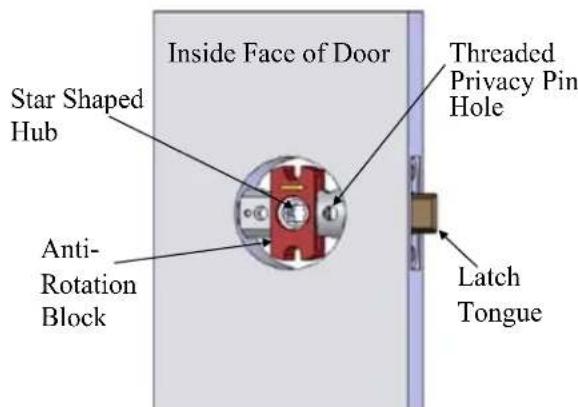
text_image
Inside Face of Door Star Shaped Hub Anti-Rotation Block Threaded Privacy Pin Hole Latch TongueFigure #4
C) Determine which direction the door will swing when it is being opened. Rotate the latch tongue so that the flat edge of the tongue faces toward the direction the door swings when being opened (and the round edge towards the doorjamb). Once oriented correctly, install the faceplate (Part #7) over the latch tongue (Part #5a), locking the latch tongue orientation. Fasten in place using two 1" wood screws (Part #8) Hint: Coating the screw threads with a small amount of soap (liquid or bar soap) will make installation easier.
Step 5
Install the Trim
A) Using Figure #1 for reference, gather together the trim half A (Part #1), trim half B (Part #2), 1-1/2" rosette machine screws (Part #3), and Phillips screwdriver.
B) Find trim half A (Part #1). Place trim half A on the outside of the door, such that the spindle is inserted into the star-shaped hub of the latch and the screw bosses are nested in the top and bottom slots in the anti-rotation block, see Figure #5. Lever designs only: If installing a lever, see Figure #6 for correct orientation of lever on the door. If your lever is oriented incorrectly, move it to the other side of the door so it matches the correct orientation in Figure #6, before proceeding with installation. Privacy function only: Make sure that the privacy hole in the rose is oriented so that it is closest to the edge of the door where the latch tongue sticks out.

text_image
Spindle Screw BossesFigure #5
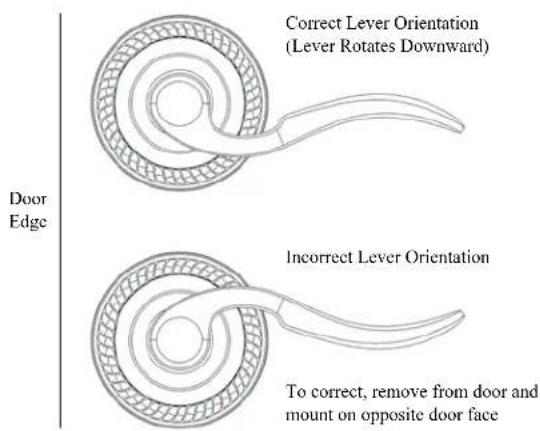
text_image
Correct Lever Orientation (Lever Rotates Downward) Door Edge Incorrect Lever Orientation To correct, remove from door and mount on opposite door faceFigure #6
C) Hold trim half A on the door. Place trim half B (Part #2) on the other side of the door, such that the spindle is inserted into the star-shaped hub of the latch and the screw bosses are nested in the top and bottom slots in the anti-rotation block. Now hold both trim halves in place with one hand. Privacy function only: Make sure that the privacy hole in the rose is oriented so that it is closest to the edge of the door where the latch tongue sticks out.
D) Insert the first 1-1/2" rosette machine screw (Part #3) into the top hole of trim half B and loosely tighten until the screw can hold both halves of the trim on the door. Important: Make sure that the screwdriver is held in a way that it will not scratch the knob/lever or rosette.
E) Insert the second 1-1/2" rosette machine screw into the lower hole and tighten until snug. Tighten down both screws until the rosette is securely attached on the door.
F) Privacy function only: On the interior side of the door, screw in the privacy pin (Part #9) until snug. Do not over-tighten. With the door open, test the privacy lock by pushing the pin in and then trying the knob on the opposite side of the door to see if it is locked. Then turn the knob on the interior side of the door and this will unlock the door.
Step 6
Prepare the Doorjamb and Install the Strike
A) Using Figure #1 for reference, gather together the strike (Part #6), two 1" wood screws (Part #8), a drill, 1" drill bit, awl (or nail), a 7/64" drill bit, a pencil and a chisel.
B) If you are installing a privacy lock, make sure the latch is not locked. Rotate the knob or lever to retract the latch and carefully close the door, making sure that the latch is fully retracted and does not scratch the doorjamb. Slowly release the knob/lever and let the latch tongue extend against the doorjamb.
C) Using the pencil, lightly mark the doorjamb at the level of the top and bottom of the latch tongue (Part #5a). These need to be light marks, so that they can be erased later if needed. Turn the knob/lever again to retract the latch and re-open the door. Now extend the marks so that they are approximately 1/2" from the edge of the door jamb where the door stops when it is closed, See Figure #7.
D) Repeat Step 6B, and verify that the latch tongue is falling between the two marks.
E) Measure the thickness of the door. Take half of the door thickness and measure that same distance from the edge of the doorjamb where the door stops when it is closed. Mark on the doorjamb this distance halfway between the two lines from Step 6C, see Figure #7.

text_image
Door Jamb Door Jamb Stop Lines from Step 6C Mark from Step 6F Half of Door Thickness Chiseled Area for StrikeFigure #7
F) Using the awl, mark where the point that is halfway between the two lines made in Step 6C crosses the line marked in Step 6E.
G) Using a 1" drill bit, drill a hole centered on the mark from Step 6F. Make sure the hole is at least 5/8" deep. Clean out any sawdust from the hole.
H) Using the strike (Part #6) as a template, center the strike over the 1" hole, mark a line around it in pencil and remove from doorjamb.
I) Using the chisel, score the outline of the strike. Next, chisel away the material within the outline to a depth of 1/16". When you are done, you should be able to place the strike in the mortised out area and it should be flush with the doorjamb.
J) Again, using the strike as a template and the awl as a marking tool, mark the two screws holes that will hold the strike on the door. Remove the strike from the doorjamb to avoid marring the finish. Then, drill the two screw holes using a 7/64" drill bit. Make sure the holes are drilled at least 1" deep. Having too small or too shallow a hole can cause the screws to shear off.
K) Fasten the strike in place using two 1" wood screws (Part #8). Hint: Coating the screw threads with a small amount of soap (liquid or bar soap) will make installation easier.
Congratulations! You are now on your way to enriching your life with Grandeur!
Figure #1
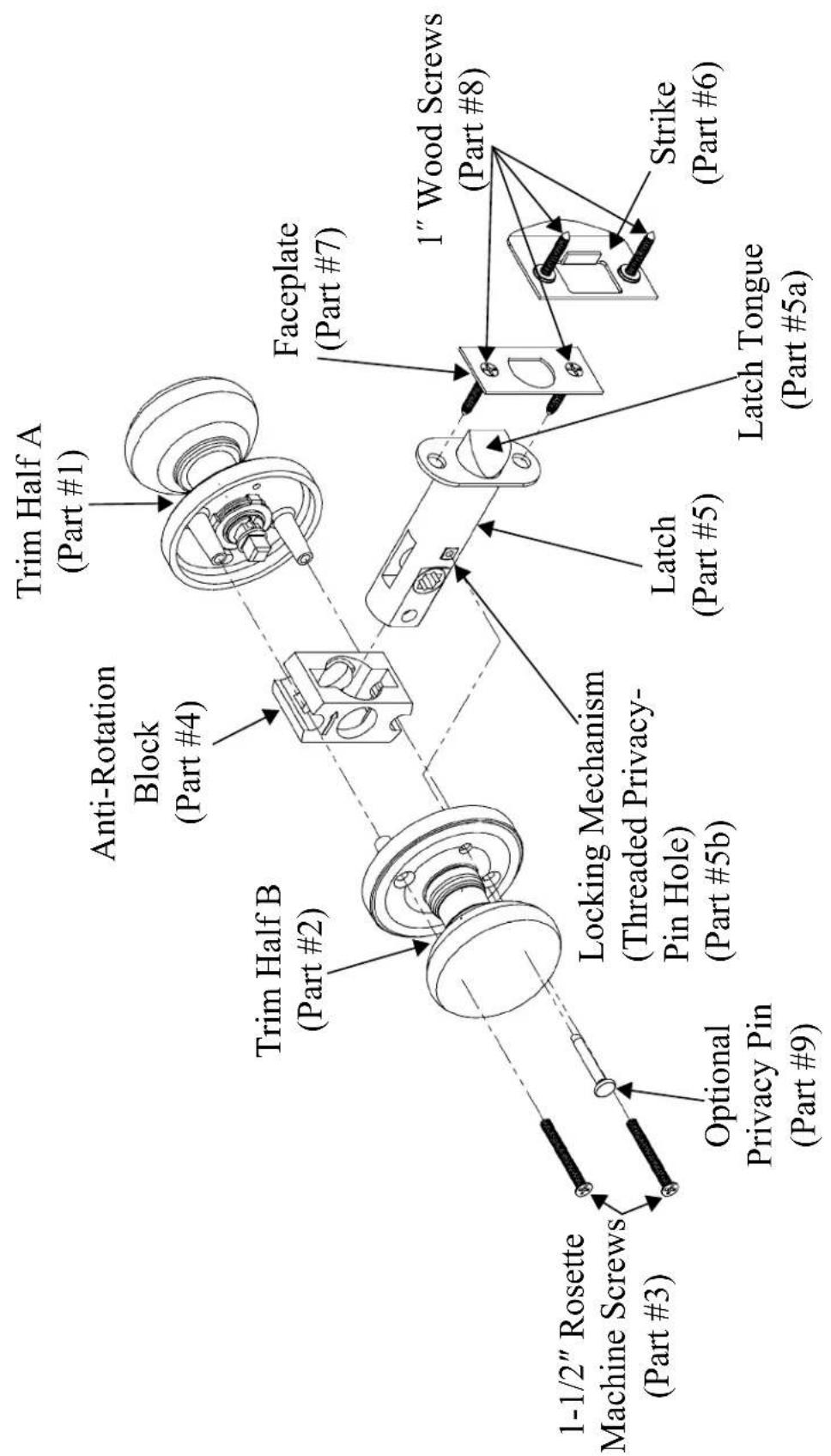
text_image
Trim Half A (Part #1) Anti-Rotation Block (Part #4) Trim Half B (Part #2) Faceplate (Part #7) Locking Mechanism (Threaded Privacy- Pin Hole) (Part #5b) 1-1/2" Rosette Machine Screws (Part #3) Optional Privacy Pin (Part #9) Latch (Part #5) Latch Tongue (Part #5a) 1" Wood Screws (Part #8) Strike (Part #6)Page 4 - PK143