
VP-14XL - AV Transmitter Kramer - Free user manual and instructions
Find the device manual for free VP-14XL Kramer in PDF.


| Product Type | AV Emitter (Transmitter) |
| Brand | Kramer |
| Model | VP-14XL |
| Dimensions (H x W x D) | 1.7 x 19 x 6.3 in (4.3 x 48.3 x 16 cm) |
| Weight | 2.5 kg (5.5 lbs) |
| Power Supply | 100-240V AC, 50/60 Hz, 12V DC adapter included |
| Power Consumption | 10W max |
| Input Ports | 1x HDMI, 1x VGA, 1x Composite, 1x Audio 3.5mm |
| Output Ports | 1x HDMI, 1x RJ-45 (for transmission) |
| Max Resolution | 1920x1200 @ 60Hz (HDMI) |
| Transmission Distance | Up to 100m over CAT6 cable |
| Supported Audio | Stereo analog, embedded HDMI audio |
| Mounting | 19" rack mountable (1U) |
| Operating Temperature | 0°C to 40°C (32°F to 104°F) |
| Storage Temperature | -20°C to 60°C (-4°F to 140°F) |
| Humidity | 10% to 90% non-condensing |
| Maintenance | Clean with dry soft cloth; avoid solvents |
| Safety | Install in well-ventilated area; do not expose to liquids |
| Spare Parts & Repairability | Contact Kramer authorized service center for parts and repairs |
| Warranty | 3 years limited warranty |
| General Information | Professional AV transmitter for extending HDMI and VGA signals over long distances |
Frequently Asked Questions - VP-14XL Kramer
User questions about VP-14XL Kramer
0 question about this device. Answer the ones you know or ask your own.
Ask a new question about this device
Download the instructions for your AV Transmitter in PDF format for free! Find your manual VP-14XL - Kramer and take your electronic device back in hand. On this page are published all the documents necessary for the use of your device. VP-14XL by Kramer.
USER MANUAL VP-14XL Kramer
Kramer Electronics, Ltd.

USER MANUAL
Model:
VP-14xl
RS-232 Port Extender
Contents
1 Introduction 1
2 Getting Started 1
2.1 Quick Start 1
3 Overview 3
4 Defining the VP-14xl RS-232 Port Extender 4
5 Connecting the VP-14xl RS-232 Port Extender 5
6 Setting the DIP-switches on the VP-14xl 6
6.1 Setting the RS-485 Bus Termination 6
6.2 Setting the ADDR DIP-switches 7
6.3 Setting the BAUD DIP-switches 7
6.4 Selecting Hardware/Software Mode 7
6.5 Hardware Mode 8
6.6 Software Mode 8
7 Technical Specifications 8
8 Serial Port Pinouts 9
9 Table of Hex Codes for Serial Communication (Protocol 2000) 9
Figures
Figure 1: VP-14xl RS-232 Port Extender Front and Rear Panels 4
Figure 2: Connecting the VP-14xl RS-232 Port Extender 5
Figure 3: VP-14xl DIP-switches 6
Tables
Table 1: VP-14xl RS-232 Port Extender Front and Rear Panel Features 4
Table 2: VP-14xl DIP-switch Functions 6
Table 3: Hardware Mode Reply Source DIP-switch Setting 7
Table 4: Software Mode RS-485 Machine Number DIP-switch Setting 7
Table 5: Serial Port Baud Rate DIP-switch Setting 7
Table 6: Technical Specifications of the VP-14xl RS-232 Port Extender 8
Table 7: 9-Pin D-sub Serial Port Pinouts 9
Table 8: Protocol Command Definition 9
Table 9: Instruction Codes for the VP-14xl 10
Table 10: Sample VP-14xl Control Commands 10
1 Introduction
Welcome to Kramer Electronics! Since 1981, Kramer Electronics has been providing a world of unique, creative, and affordable solutions to the vast range of problems that confront the video, audio, presentation, and broadcasting professional on a daily basis. In recent years, we have redesigned and upgraded most of our line, making the best even better! Our 1,000-plus different models now appear in 11 groups ^1 that are clearly defined by function.
Congratulations on purchasing your Kramer Tools™ VP-14xl RS-232 Port Extender. This product is ideal for:
- Converting USB and RS-485 interfaces to RS-232 interfaces
• Monitoring several RS-232 controlled machines via one PC port
• Inter-communication between several serially controlled machines
The package includes the following items:
• VP-14xl RS-232 Port Extender
- Mounting bracket
• Power adapter ^2 (5V DC output)
- This user manual ^3
2 Getting Started
We recommend that you:
- Unpack the equipment carefully and save the original box and packaging materials for possible future shipment
• Review the contents of this user manual - Use Kramer high performance high resolution cables ^4
2.1 Quick Start
This quick start chart summarizes the basic setup and operation steps.
Step 1: Connect the input and the outputs - see Section 5

flowchart
graph TD
    A["PC with RS-485 port"] -->|USB| B["Laptop"]
    B --> C["RS-232 Controllable Device"]
    B --> D["RS-232 Controllable Device"]
    B --> E["RS-232 Controllable Device"]
    B --> F["RS-232 Controllable Device"]
    B --> G["RS-485"]
    G --> H["Computer"]
    style A fill:#f9f,stroke:#333
    style B fill:#ccf,stroke:#333
    style C fill:#cff,stroke:#333
    style D fill:#cff,stroke:#333
    style E fill:#cff,stroke:#333
    style F fill:#cff,stroke:#333
    style G fill:#ffc,stroke:#333
Step 2: Set the front panel switches - see Section 6

Step 3: Connect the power adapter
3 Overview
The unique VP-14xl RS-232 Port Extender distributes an incoming RS-232, RS-485 or USB command as transmitted by a touch screen control system, personal computer or other type of control system, to up to three RS-232 ports. This lets you control up to three compatible devices with only one serial port or RS-232 card.
The VP-14xl is specifically designed for use with Kramer switchers and routers, but can be used with any other equipment which employs RS-232.
In particular, the VP-14xl features:
• One RS-232 input port
• One RS-485 input port
• One USB input port
• Three RS-232 output ports
• Operation in either Hardware or Software mode
- DIP-switches to determine the source of the reply command when the VP-14xl is in hardware mode
- DIP-switches to determine the machine number when operating in Software mode and there are multiple VP-14xl units on the RS-485 bus
- DIP-switches to determine the serial port baud rate (see Section 6.3)
In Hardware mode, the:
- VP-14xl routes the reply from the output port defined by the DIP-switches 2, 3 and 4 (see Section 6.2)
• RS-232 data is passed from any input to all outputs
In Software mode, the VP-14xl routes the data and reply based on the Protocol 2000 commands received from the PC or other device connected to any of the inputs (RS-232, RS-485 or USB), see Section 8.
To achieve the best performance, we recommend:
- Connecting only good quality connection cables, thus avoiding interference, deterioration in signal quality due to poor matching, and elevated noise levels (often associated with low quality cables)
- Avoiding interference from neighboring electrical appliances that may adversely influence signal quality and positioning your VP-14xl in a location free from moisture and away from excessive sunlight and dust

Caution: No operator serviceable parts inside the unit
Warning: Use only the Kramer Electronics input power wall adapter that is provided with the unit
Warning: Disconnect the power and unplug the unit from the wall before installing
4 Defining the VP-14xl RS-232 Port Extender
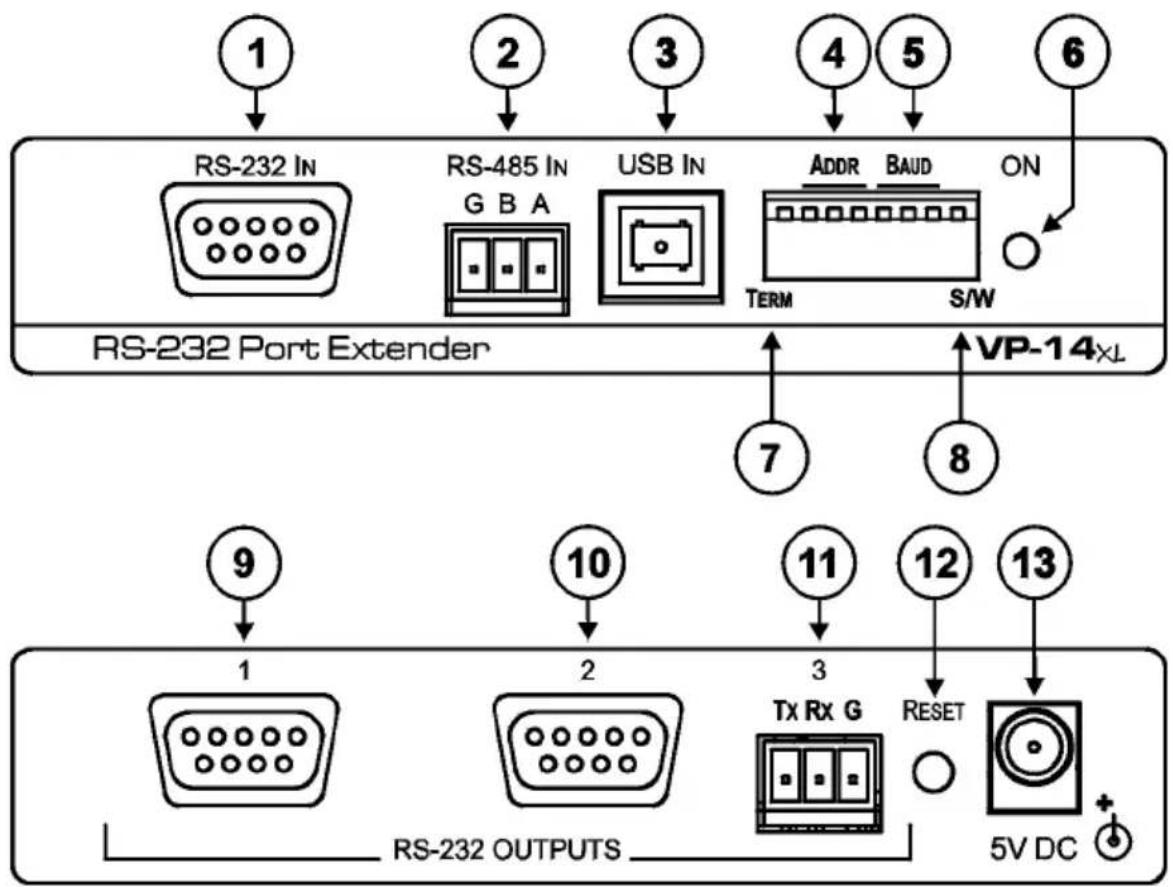
Figure 1 and Table 1 define the front and rear panels of the VP-14xl.
flowchart
graph TD
    A["1"] --> B["RS-232 IN"]
    C["2"] --> D["RS-485 IN G B A"]
    E["3"] --> F["USB IN"]
    G["4"] --> H["ADDR BAUD"]
    I["5"] --> J["ONT"]
    K["6"] --> L["S/W"]
    M["7"] --> N["VP-14XL"]
    O["8"] --> N
    P["9"] --> Q["RS-232 OUTPUTS"]
    R["10"] --> S["TX RX G"]
    T["11"] --> U["RESET"]
    V["12"] --> W["5V DC +"]
    X["13"] --> W
Figure 1: VP-14xl RS-232 Port Extender Front and Rear Panels
Table 1: VP-14xl RS-232 Port Extender Front and Rear Panel Features
| # | Feature Function | |||
| 1 | RS-232 IN 9-pin D-sub (F) Connector | Connect to source computer 1 | ||
| 2 | RS-485 IN 3-pin Removable Terminal Block | Connect to source computer 2. Connect G to the Ground connection, A to the A connection, and B to the B connection | ||
| 3 | USB IN Connector | Connect to source computer 3 | ||
| 4 | ADDR DIP-switches 2, 3 and 4 | Hardware mode: Determines the reply sourceSoftware mode: Determines the machine number (see Section 6.2) | ||
| 5 | BAUD DIP-switches 5, 6 and 7 | Determines the serial port baud rate (see Section 6.2) | ||
| 6 | ON LED | Lights green when the unit is powered on | ||
| 7 | TERM DIP-switch 1 | Sets the RS-485 bus termination (see Section 6.1) | ||
| 8 | S/W DIP-switch 8 | Selects Software or Hardware mode (see Section 6.4) | ||
| 9 | RS-232 OUTPUTS | 1 | 9-pin D-sub (M)Connectors | Connect to destination or switcher 1 (see Section 8) |
| 10 | 2 | Connect to destination or switcher 2 | ||
| 11 | 3 | 3-pin Removable Terminal Block | Connect to destination or switcher 3. Connect TX to RX on the destination, RX to TX, and G to Ground | |
| 12 | RESET Button | Press to initiate startup sequence | ||
| 13 | 5V DC Connector | Connect to the power adapter, center pin positive | ||
5 Connecting the VP-14xl RS-232 Port Extender

flowchart
graph TD
    A["PC with RS-485 port"] -->|USB| B["Laptop"]
    B --> C["RS-232 Controllable Device"]
    B --> D["RS-232 Controllable Device"]
    B --> E["RS-232 Controllable Device"]
    B --> F["RS-232 Controllable Device"]
    B --> G["RS-232 Controllable Device"]
    B --> H["RS-232 Controllable Device"]
    B --> I["RS-232 Controllable Device"]
    B --> J["RS-232 Controllable Device"]
    B --> K["RS-232 Controllable Device"]
Figure 2: Connecting the VP-14xl RS-232 Port Extender
To connect your VP-14xl RS-232 Port Extender, as the example in Figure 2 illustrates ^1 :
- Connect up to three computer sources to the input connectors (for example, 2 PCs and a laptop).
- Connect up to three units to be controlled to the output connectors (for example, Kramer switches).
-
If you are using the RS-485 input, set the RS-485 termination (see Section 6.1).
-
Set the Hardware/Software DIP-switch (see Section 6.4) as follows:
-
In Hardware mode, set the REPLY DIP-switches to determine the unique reply output port (see Section 6.2)
In Software mode, set the machine number (see Section 6.2). -
Set the serial port baud rate (see Section 6.3).
- Select the appropriate machine number (see Section 6.2).
- Connect the 5V DC power adapter to the 5V DC socket and to the mains electricity.
Note: Changing any DIP-switch requires that you either power cycle the VP-14xl or press the Reset button (see Table 1).
6 Setting the DIP-switches on the VP-14xl
Moving a DIP-switch down turns the switch on, moving it up turns the switch off.

Figure 3: VP-14xl DIP-switches
Table 2: VP-14xl DIP-switch Functions
| DIP-switch # Function | |
| 1 RS-485 termination | |
| 2, 3, 4 | In Hardware mode: Sets the reply sourceIn Software mode: Sets the machine number |
| 5, 6, 7 | Sets the serial port baud rate |
| 8 Sets Software/Hardware mode | |
6.1 Setting the RS-485 Bus Termination
DIP-switch 1 sets the RS-485 bus termination. Only the first and last physical device on the RS-485 bus must be terminated, all other devices must be un-terminated.
When the DIP-switch is:
• OFF, the unit is un-terminated (default)
• ON, the unit is terminated
6.2 Setting the ADDR DIP-switches
DIP-switches 2, 3 and 4 set either the reply source (in Hardware mode Table 3) or machine number (in Software mode Table 4).
Table 3: Hardware Mode Reply Source DIP-switch Setting
| Reply Source DIP-switch | |||
| 2 3 | 4 | ||
| Reply is taken from output 1 (default) | ON | OFF | OFF |
| Reply is taken from output 2 | OFF | ON | OFF |
| Reply is taken from output 3 | OFF | OFF | ON |
Note: When there is more than one VP-14xl attached to the RS-485 bus only one unit can have a reply source set, all other units must have DIP-switches 2, 3 and 4 set to OFF.
Table 4: Software Mode RS-485 Machine Number DIP-switch Setting
| Machine Number | DIP-switch | ||
| 2 3 | 4 2 | 3 4 | |
| 1 | OFF | OFF | OFF |
| 2 | ON | OFF | OFF |
| 3 | OFF | ON | OFF |
| 4 | ON | ON | OFF |
| Machine Number | DIP-switch | ||
| 5 | OFF | OFF | ON |
| 6 | ON | OFF | ON |
| 7 | OFF | ON | ON |
| 8 | ON | ON | ON |
When there is more than one VP-14xl attached to the RS-485 bus each unit must have a unique machine number.
6.3 Setting the BAUD DIP-switches
DIP-switches 5, 6 and 7 set the serial port baud rate in both Hardware and Software modes.
Table 5: Serial Port Baud Rate DIP-switch Setting
| Baud Rate | DIP-switch | ||
| 5 | 6 | 7 | |
| 1200 | OFF | OFF | OFF |
| 2400 | ON | OFF | OFF |
| 4800 | OFF | ON | OFF |
| 9600 (default) | ON | ON | OFF |
| Baud Rate | DIP-switch | ||
| 5 | 6 | 7 | |
| 19200 | OFF | OFF | ON |
| 38400 | ON | OFF | ON |
| 57600 | OFF | ON | ON |
| 115200 | ON | ON | ON |
6.4 Selecting Hardware/Software Mode
DIP-switch 8 sets the operating mode to either Hardware or Software mode.
When the DIP-switch is:
• OFF, the unit is set to Hardware mode (default)
• ON, the unit is set to Software mode
6.5 Hardware Mode
In Hardware mode, the:
• RS-232 data is passed from any input to all outputs
- VP-14xl routes the reply from the output port defined by the DIP-switches 2, 3 and 4 (see Section 6.2). For reliable operation, only one port should be defined
6.6 Software Mode
In Software mode, the VP-14xl routes the data and reply based on the Protocol 2000 commands received from the PC or other device connected to any of the inputs (RS-232, RS-485 or USB), see Section 8.
Note: Only one reply port can be opened at a time. It is possible to open multiple direct ports but only one reply port can be open at a time.
This means that if port1 is currently open and you then open port2, the port 1 is automatically closed. If you then open port 1 again, port 2 is automatically closed.
In this way it is possible to close all reply ports, as well as all direct ports.
7 Technical Specifications
Table 6 provides the technical specifications for the VP-14xl RS-232 Port Extender.
Table 6: Technical Specifications ^1 of the VP-14xl RS-232 Port Extender
| INPUT: | 1 RS-232 on 9-pin D-sub (F) connector; 1 RS-485 on 3-pin removable terminal block; 1 USB Type B connector |
| OUTPUTS: | 2 RS-232 on 9-pin D-sub (M) connectors, 1 RS-232 on 3-pin removable terminal block |
| RS-232 COMPLIANCE | 1200 to 115200; 8 data bits, 1 stop bit, no parity |
| OPERATING MODES: | Hardware and Software |
| USB COMPLIANCE: 1.1 | |
| CONTROLS: | DIP-switches |
| POWER SOURCE: | 5V DC, 130mA |
| OPERATING TEMPERATURE: | 0° to +55°C (32° to 131°F) |
| STORAGE TEMPERATURE: | -45° to +72°C (-49° to 162°F) |
| HUMIDITY: | 10% to 90%, RHL non-condensing |
| DIMENSIONS: | 12cm x 6.9cm x 2.4cm (4.7" x 2.7" x 0.96") W, D, H |
| WEIGHT: | 0.3kg. (0.7lbs.) approx. |
| ACCESSORIES: | 5V DC 2A Power supply, mounting bracket |
| OPTIONS: | RK-3T 19" rack adapter |
8 Serial Port Pinouts
Table 7 describes the pinouts of the 9-pin D-sub serial ports.
Table 7: 9-Pin D-sub Serial Port Pinouts
| Pin | Function |
| 2 | Receive |
| 3 | Transmit |
| 5 | Ground |
Note: Flow control signals are not supported.
9 Table of Hex Codes for Serial Communication (Protocol 2000)
The RS-232/RS-485 Protocol 2000 uses four bytes of information as shown in Table 8. The data rate is set by the DIP-switches (see Table 5), with no parity, 8 data bits and 1 stop bit.
Table 8: Protocol Command Definition
| MSB | |||||||
| DESTI-NATION | INSTRUCTION | ||||||
| 0 | D | N5 | N4 | N3 | N2 | N1 | N0 |
| 7 | 6 | 5 | 4 | 3 | 2 | 1 | 0 |
| 1st byte | |||||||
| INPUT | |||||||
| 1 | I6 | I5 | I4 | I3 | I2 | I1 | I0 |
| 7 | 6 | 5 | 4 | 3 | 2 | 1 | 0 |
| 2nd byte | |||||||
| OUTPUT | |||||||
| 1 | O6 | O5 | O4 | O3 | O2 | O1 | O0 |
| 7 | 6 | 5 | 4 | 3 | 2 | 1 | 0 |
| 3rd byte | |||||||
| MACHINE NUMBER | |||||||
| 1 | OVR | X | M4 | M3 | M2 | M1 | M0 |
| 7 6 5 4 3 2 | 1 0 | ||||||
| INPUT | |||||||
| 1 | I6 | I5 | I4 | I3 | I2 | I1 | I0 |
| 7 | 6 | 5 | 4 | 3 | 2 | 1 | 0 |
| OUTPUT | |||||||
| 1 | O6 | O5 | O4 | O3 | O2 | O1 | O0 |
| 7 | 6 | 5 | 4 | 3 | 2 | 1 | 0 |
| MACHINE NUMBER | |||||||
| 1 | OVR | X | M4 | M3 | M2 | M1 | M0 |
| 7 6 5 4 3 2 | 1 0 | ||||||
4th byte
1^st BYTE: Bit 7 - Defined as 0.
D - "DESTINATION": 0 - for sending information to the switchers (from the PC);
1 - for sending to the PC (from the switcher).
N5...N0 - "INSTRUCTION"
The function that is to be performed by the switcher(s) is defined by the INSTRUCTION (6 bits). Similarly, if a function is performed via the machine's keyboard, then these bits are set with the INSTRUCTION NO., which was performed. The instruction codes are defined according to the table below (INSTRUCTION NO. is the value to be set for N5...N0).
2^nd BYTE:
Bit 7 - Defined as 1.
16...10-“INPUT”.
When switching (ie. instruction codes 1 and 2), the INPUT (7 bits) is set as the input number which is to be switched. Similarly, if switching is done via the machine's front-panel, then these bits are set with the INPUT NUMBER which was switched. For other operations, these bits are defined according to the table.
3^rd BYTE:
Bit 7 - Defined as 1.
O6...O0 - "OUTPUT".
When switching (ie. instruction codes 1 and 2), the OUTPUT (7 bits) is set as the output number which is to be switched. Similarly, if switching is done via the machine's front-panel, then these bits are set with the OUTPUT NUMBER which was switched. For other operations, these bits are defined according to the table.
4^th BYTE: Bit 7-Defined as 1.
Bit 5 – Don't care.
OVR - Machine number override.
M4...M0 - MACHINE NUMBER.
Used to address machines in a system via their machine numbers. When several machines are controlled from a single serial port, they are usually configured together with each machine having an individual machine number. If the OVR bit is set, then all machine numbers will accept (implement) the command, and the addressed machine will reply.
For a single machine controlled via the serial port, always set M4...M0 = 1, and make sure that the machine itself is configured as MACHINE NUMBER = 1.
Table 9: Instruction Codes for the VP-14xl
| INSTRUCTION | DEFINITION FOR SPECIFIC INSTRUCTION | NOTE | ||
| # | DESCRIPTION | INPUT | OUTPUT | |
| 2C | CONTROLS THE STATUS OF A PORT | 0-close1-open | Output bit:O0-O5 = output # or 0 for all outputsO6-0 = Tx; 1 = Rx | 1, 2, 4, 5 |
| 2D | READS THE STATUS OF A PORT | 0-open | Output bit:O0-O5 = output #O6-0 = Tx; 1 = Rx | 2, 3, 4, 5 |
Note: All values in the table are hexadecimal, unless otherwise stated.
NOTES on Table 9:
NOTE 1 – When the PC sends this command, if the instruction is valid the unit replies by sending the PC the same 4 bytes that it was sent (except for the first byte where the Destination bit is set high).
NOTE 2 – If O6 = 0 (Tx) – This command defines/reads the definition of the output # (1, 2 or 3) to pass the RS-232/Direct command from any input. In this case the instruction does not modify previously set output numbers, allowing the setting of multiple outputs for the Direct command. If O6 = 1 (Rx), the command defines/reads the definition of the output # (1, 2 or 3) to pass the reply from the output to inputs. In this case, the instruction resets a previously set output number, preventing the setting of multiple outputs for the reply.
NOTE 3 – The reply to this command is as follows: The same command and output codes as were sent are returned, and the input is assigned the value of the parameter that was read. The reply is per the definitions in command 44.
NOTE 4 – At initial power-on or on reception of command 44 or 45, any received bytes are analyzed to see whether it is a command 44 or 45. If not, it is transmitted to the output based on the existing setup. If the analyzed bytes are a command 44 or 45, the unit waits for the other 3 bytes and interprets them as a Protocol 2000 command. The command is executed if relevant to this machine number or discarded if not.
NOTE 5 – This command works only when the unit is configured for Software mode.
Table 10: Sample VP-14xl Control Commands
| Command | Description | Reply |
| 2C 80 80 81 | Close all output ports for direct command | 6C 80 80 81 |
| 2C 80 C0 81 | Close all output ports for reply command | 6C 80 C0 81 |
| 2C 81 82 81 | Open port 2 for direct command | 6C 81 82 81 |
| 2C 81 C1 81 | Open port 1 for reply command | 6C 81 C1 81 |
| 2D 80 81 81 | Check status of port 1 for direct command. Port is closed | 6D 80 81 81 |
| 2D 80 82 81 | Check status of port 2 for direct command. Port is open | 6D 81 82 81 |
| 2D 80 C1 81 | Check status of port 1 for reply command. Port is open | 6D 81 C1 81 |
| 2D 80 C2 81 | Check status of port 2 for reply command. Port is closed | 6D 80 C2 81 |
LIMITED WARRANTY
We warrant this product free from defects in material and workmanship under the following terms.
HOW LONG IS THE WARRANTY
Labor and parts are warranted for seven years from the date of the first customer purchase.
WHO IS PROTECTED?
Only the first purchase customer may enforce this warranty.
WHAT IS COVERED AND WHAT IS NOT COVERED
Except as below, this warranty covers all defects in material or workmanship in this product. The following are no covered by the warranty:
-
Any product which is not distributed by us or which is not purchased from an authorized Kramer dealer. If you are uncertain as to whether a dealer is authorized, please contact Kramer at one of the agents listed in the Web site www.kramerelectronics.com.
-
Any product, on which the serial number has been defaced, modified or removed, or on which the WARRANTY VOID IF TEANTERED restriction does otherwise interfered with.
-
Damage, deterioration or malfunction resulting from:
i) Accident, misuse, abuse, neglect, fire, water, lightning or other acts of nature
ii) Product modification, or failure to follow instructions supplied with the product
iii) Repair or attempted repair by anyone not authorized by Kramer
iv) Any shipment of the product (claims must be presented to the carrier)
v) Removal or installation of the product
vi) Any other cause, which does not relate to a product defect
vii) Cartons, equipment enclosures, cables or accessories used in conjunction with the product
WHAT WE WILL PAY FOR AND WHAT WE WILL NOT PAY FOR
We will pay labor and material expenses for covered items. We will not pay for the following:
-
Removal or installations charges.
-
Costs of initial technical adjustments (set-up), including adjustment of user controls or programming. These costs are the responsibility of the Kramer dealer from whom the product was purchased.
-
Shipping charges.
HOW YOU CAN GET WARRANTY SERVICE
-
To obtain service on you product, you must take or ship it prepaid to any authorized Kramer service center.
-
Whenever warranty service is required, the original dated invoice (or a copy) must be presented as proof of warranty coverage, and should be included in any shipment of the product. Please also include in any mailing a contact name, company, address, and a description of the problem(s).
-
For the name of the nearest Kramer authorized service center, consult your authorized dealer.
LIMITATION OF IMPLIED WARRANTIES
All implied warranties, including warranties of merchantability and fitness for a particular purpose, are limited in duration to the length of this warranty.
EXCLUSION OF DAMAGES
The liability of Kramer for any effective products is limited to the repair or replacement of the product at our option. Kramer shall not be liable for:
-
Damage to other property caused by defects in this product, damages based upon inconvenience, loss of use of the product, loss of time, commercial loss; or:
-
Any other damages, whether incidental, consequential or otherwise. Some countries may not allow limitations on how long an implied warranty lasts and/or do not allow the exclusion or limitation of incidental or consequential damages, so the above limitations and exclusions may not apply to you.
This warranty gives you specific legal rights, and you may also have other rights, which vary from place to place.
NOTE: All products returned to Kramer for service must have prior approval. This may be obtained from your dealer.
This equipment has been tested to determine compliance with the requirements of:
EN-50081: "Electromagnetic compatibility (EMC);
generic emission standard.
Residential, commercial and light industry"
EN-50082: "Electromagnetic compatibility (EMC) generic immunity standard.
Part 1: Residential, commercial and light industry environment".
CFR-47: FCC* Rules and Regulations:
Part 15: "Radio frequency devices
Subpart B Unintentional radiators"
CAUTION!
Servicing the machines can only be done by an authorized Kramer technician. Any user who makes changes or modifications to the unit without the expressed approval of the manufacturer will void user authority to operate the equipment.
Use the supplied DC power supply to feed power to the machine.
Please use recommended interconnection cables to connect the machine to other components.
* FCC and CE approved using STP cable (for twisted pair products)
For the latest information on our products and a list of Kramer distributors visit www.kramerelectronics.com where updates to this user manual may be found.
We welcome your questions, comments, and feedback.

Caution
Safety Warning:
Disconnect the unit from the power supply before opening/servicing.

CE


- Kramer Electronics, Ltd.
- USER MANUAL
- Contents
- Figures
- Tables
- Introduction
- Getting Started
- Quick Start
- Overview
- Defining the VP-14xl RS-232 Port Extender
- Connecting the VP-14xl RS-232 Port Extender
- To connect your VP-14xl RS-232 Port Extender, as the example in Figure 2 illustrates 1 :
- Setting the DIP-switches on the VP-14xl
- Setting the RS-485 Bus Termination
- Setting the ADDR DIP-switches
- Setting the BAUD DIP-switches
- Selecting Hardware/Software Mode
- Hardware Mode
- Software Mode
- Technical Specifications
- Serial Port Pinouts
- Table of Hex Codes for Serial Communication (Protocol 2000)
- O6...O0 - "OUTPUT".
- NOTES on Table 9:
- LIMITED WARRANTY
- HOW LONG IS THE WARRANTY
- WHO IS PROTECTED?
- WHAT IS COVERED AND WHAT IS NOT COVERED
- WHAT WE WILL PAY FOR AND WHAT WE WILL NOT PAY FOR
- HOW YOU CAN GET WARRANTY SERVICE
- LIMITATION OF IMPLIED WARRANTIES
- EXCLUSION OF DAMAGES
- CAUTION!
- Safety Warning:
Brand : Kramer
Model : VP-14XL
Category : AV Transmitter