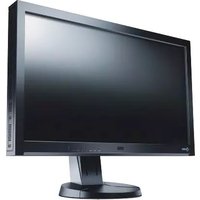
SX2762WH-BK - Monitor EIZO - Free user manual and instructions
Find the device manual for free SX2762WH-BK EIZO in PDF.


| Product Type | 27.0-inch Wide-Format Color LCD Monitor |
| Model Number | SX2762WH-BK |
| Resolution | 2560 x 1440 (recommended) |
| Panel Type | IPS with 178° horizontal and vertical viewing angles |
| Display Colors | Approx. 1073.74 million colors (10-bit input) |
| Pixel Pitch | 0.2331 mm |
| Response Time | Black-white-black: 12 ms; Gray-to-gray: 6 ms |
| Input Connectors | DVI-D (dual link), DisplayPort, Mini DisplayPort |
| USB Hub | 1 upstream, 2 downstream (USB 2.0) |
| Power Consumption | Max 160 W, Standard 64 W, Power saving ≤ 1.0 W |
| Main Power Off | 0 W |
| Dimensions (with stand) | 646 x 425–576.5 x 281.5 mm (25.4 x 16.7–22.7 x 11.1 in) |
| Dimensions (without stand) | 646 x 402 x 92 mm (25.4 x 15.8 x 3.6 in) |
| Weight (with stand) | Approx. 13.6 kg (30.0 lbs) |
| Weight (without stand) | Approx. 9.7 kg (21.8 lbs) |
| Adjustability | Tilt: up 25°, down 0°; Swivel: 172° left/right; Height: 190 mm; Rotation: 90° clockwise |
| FineContrast Modes | User1–3, Paper, Text, Picture, Movie, sRGB |
| Eco Functions | Auto EcoView (ambient light sensor), EcoView Sense (presence sensor), EcoView Index, Eco Timer |
| Accessories Included | Signal cable PP200, Cleaning Kit (ScreenCleaner), EIZO LCD Utility Disk, Setup Guide, User Manual |
| VESA Mount | 100 x 100 mm (optional arm/stand) |
| Operating Temperature | 0°C to 35°C (32°F to 95°F) |
| Cleaning | Use soft cloth; optional ScreenCleaner recommended; avoid alcohol, benzene, thinner |
| Warranty | 5 years (3 years for LCD panel) or 30,000 hours |
Frequently Asked Questions - SX2762WH-BK EIZO
User questions about SX2762WH-BK EIZO
0 question about this device. Answer the ones you know or ask your own.
Ask a new question about this device
Download the instructions for your Monitor in PDF format for free! Find your manual SX2762WH-BK - EIZO and take your electronic device back in hand. On this page are published all the documents necessary for the use of your device. SX2762WH-BK by EIZO.
USER MANUAL SX2762WH-BK EIZO
Please read PRECAUTIONS, this User's Manual, and Setup Guide (separate volume) carefully to familiarize yourself with safe and effective usage.
- Please refer to the Setup Guide for basic information ranging from connection of the monitor to a PC to using the monitor.
- The latest User's Manual is available for download from our web site: http://www.eizo.com
Location of Caution Statement
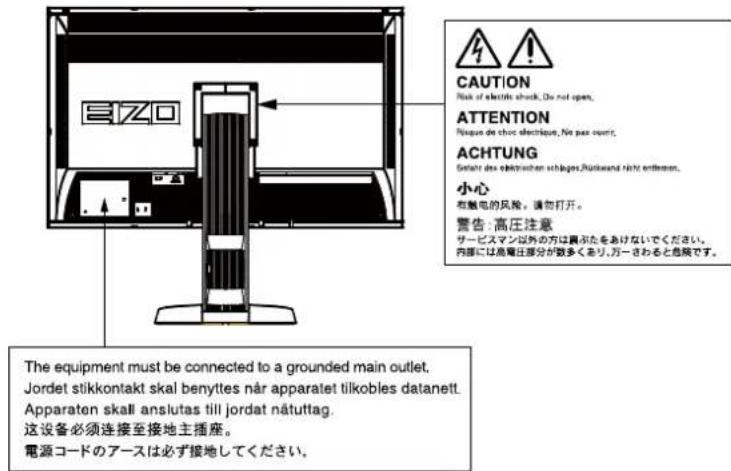
This product has been adjusted specifically for use in the region to which it was originally shipped. If operated outside this region, the product may not perform as stated in the specifications.
No part of this manual may be reproduced, stored in a retrieval system, or transmitted, in any form or by any means, electronic, mechanical, or otherwise, without the prior written permission of EIZO NANAO CORPORATION. EIZO NANAO CORPORATION is under no obligation to hold any submitted material or information confidential unless prior arrangements are made pursuant to EIZO NANAO CORPORATION's receipt of said information. Although every effort has been made to ensure that this manual provides up-to-date information, please note that EIZO monitor specifications are subject to change without notice.
Notice for this monitor
Aside from general purposes like creating documents, viewing multimedia content, this product is also suited to applications such as graphics creation and digital photo processing, where accurate color reproduction is a priority.
This product has been adjusted specifically for use in the region to which it was originally shipped. If the product is used outside the region, it may not operate as specified in the specifications.
This product may not be covered by warranty for uses other than those described in this manual.
The specifications noted in this manual are only applicable when the following are used:
- Power cords provided with the product
- Signal cables specified by us
Only use optional products manufactured or specified by us with this product.
As it takes about 30 minutes for the performance of electrical parts to stabilize, adjust the monitor 30 minutes or more after the monitor power has been turned on.
Monitors should be set to a lower brightness to reduce changes in luminosity caused by long-term use and maintain a stable display.
When the screen image is changed after displaying the same image for extended periods of time, an afterimage may appear. Use the screen saver or power save function to avoid displaying the same image for extended periods of time.
Periodic cleaning is recommended to keep the monitor looking new and to prolong its operation lifetime (refer to “Cleaning” (page 4)).
The LCD panel is manufactured using high-precision technology. Although, missing pixels or lit pixels may appear on the LCD panel, this is not a malfunction. Percentage of effective dots: 99.9994% or higher.
The backlight of the LCD panel has a fixed lifetime. When the screen becomes dark or begins to flicker, please contact your dealer.
Do not press on the panel or edge of the frame strongly, as this may result in display malfunctions, such as interference patterns, etc. If pressure is continually applied to the panel, it may deteriorate or damage your panel. (If the pressure marks remain on the panel, leave the monitor with a black or white screen. The symptom may disappear.)
Do not scratch or press on the panel with any sharp objects, as this may result in damage to the panel. Do not attempt to brush with tissues as this may scratch the panel.
When the monitor is cold and brought into a room or the room temperature goes up quickly, dew condensation may occur on the interior and exterior surfaces of the monitor. In that case, do not turn the monitor on. Instead wait until the dew condensation disappears, otherwise it may cause some damage to the monitor.
Cleaning
Attention
- Chemicals such as alcohol and antiseptic solution may cause gloss variation, tarnishing, and fading of the cabinet or panel, and also quality deterioration of the image.
- Never use any thinner, benzene, wax, and abrasive cleaner, which may damage the cabinet or panel.
Note
- The optional ScreenCleaner is recommended for cleaning the cabinet and panel surface.
If necessary, the stains on the cabinet and panel surface can be removed by moistening part of a soft cloth with water.
To use the monitor comfortably
- An excessively dark or bright screen may affect your eyes. Adjust the brightness of the monitor according to the environmental conditions.
- Staring at the monitor for a long time tires your eyes. Take a 10-minute rest every hour.
CONTENTS
Cover 1
Notice for this monitor .... 3
CONTENTS 5
Chapter 1 Introduction ...... 7
1-1. Features 7
1-2. Controls and Functions 8
1-3. EIZO LCD Utility Disk...... 9
■isk contents and software overview ...... 9
use "ScreenManager Pro for LCD/ EIZO ScreenSlicer" 9
1-4. Basic Operations and Functions ..... 9
Basic Adjustment menu operations ...... 9
Showing Button Guide 10
Functions 11
Chapter 2 Adjusting Screens .... 13
2-1. Compatible Resolutions ......13
Digital Input (DVI-D: Single Link) ......13
Digital Input (DVI-D: Dual Link, DisplayPort, Mini DisplayPort) ....13
2-2. Setting the Resolution .....14
Windows 7 14
Windows Vista 14
Windows XP 14
Mac OS X 14
2-3. Adjusting Color ....15
- select the display mode (FineConstraint mode)....15
perform advanced adjustments ..... 16
Adjustable settings in each mode .....16
adjust brightness "Brightness" 17
adjust contrast "Contrast"......17
adjust color temperature "Temperature" ...18
adjust gamma "Gamma" 18
adjust hue "Hue" 18
adjust color saturation "Saturation" .....19
enable/disable Contrast Enhancer "Contrast Enhancer" 19
enhance outline of image "Outline Enhancer" 19
adjust gain "Gain" 20
adjust six colors "6 Colors" 20
2-4. Selecting Screen Size ....21
change screen size "Screen Size" .....21
2-5. Configuring Moving Image Performance
"Overdrive" 21
2-6. Enabling/Disabling Auto Sharpness
"Auto Sharpness" 22
Chapter 3 Setting Monitor 23
3-1. Enabling/Disabling Mode Selection "Mode Preset" 23
3-2. Setting Language "Language" 23
3-3. Setting Orientation "Orientation" 24
3-4. Changing Adjustment Menu Display Position "Menu Position" 24
3-5. Setting the EIZO Logo Display "Logo" .... 24
3-6. Locking Buttons "Key Lock" 25
3-7. Enabling/Disabling DDC/CI communication 25
3-8. Setting the Input Signals "Signal Selection" 26
connect DVI (Single Link) 26
to connect DVI (Dual Link) 26
connect DVI (Simple display of HDMI signal from digital camera) 27
connect DisplayPort / Mini DisplayPort .... 27
3-9. To Disable Input Signal "Input Skip" ..... 28
3-10. Return To Default Setting.... 28
- reset the color adjustment value "Color Reset" 28
reset all adjustments to the default settings "All Reset" 28
Chapter 4 Power Saving Functions ...... 29
4-1. Setting Power Saving "Power Save" ..... 29
4-2. Setting the power saving mode when a person leaves the monitor "EcoView Sense" 30
4-3. Enabling/Disabling Automatic Brightness Adjustment "Auto EcoView" ..31
4-4. Setting Power Indicator "Power Indicator" 31
4-5. Setting the automatic power off function "Eco Timer" 31
4-6. Displaying the power saving ratio "EcoView Index" 32
Chapter 5 Troubleshooting.... 33
5-1. No picture 33
5-2. Imaging problems ...... 35
5-3. Other problems ...... 36
Chapter 6 Reference ...... 37
6-1. How to Attach the Optional Arm ....37
6-2. Connecting Multiple PCs .... 38 ● switch among input signals .... 39
- set input signal selection "Input Selection" 39
6-3. Making Use of USB (Universal Serial Bus) 40
Required System Environment 40
Connection Procedure
(Setup of USB Function).... 40
6-4. Displaying monitor information .....41
■displaying signal information "Signal Info" ....41
Displaying Monitor Information "Monitor Info" 41
6-5. Specifications 42
6-6. Glossary 44
Appendix 46
Thank you very much for choosing an EIZO color LCD monitor.
1-1. Features
- 27.0" wide format LCD
• Applicable to the resolution of 2560 × 1440 . - IPS panel with 89° horizontal and vertical viewing angles
- Applicable to Displayport / Mini DisplayPort (applicable to 8 bit or 10 bit)
- 3 signal input terminals (DVI-D × 1, DisplayPort × 1, Mini DisplayPort × 1)
- The FineContrast function allows the user to select the display mode optimum to the displayed image.
- The Paper mode reproduces a printed paper effect on the monitor.
See “To select the display mode (FineConstraint mode)” (page 15). - The software “ScreenManager Pro for LCD” to adjust the screen using the mouse and keyboard is included. See “1-3. EIZO LCD Utility Disk” (page 9).
- Supports Color Vision Deficiency Simulation Software "UniColor Pro"
This software can be downloaded from our web site (http://www.eizo.com). - Supports the power management software "EIZO EcoView NET"
For more information, refer to our web site (http://www.eizo.com).
• Power saving function
Suppressing the power consumption * reduces the carbon dioxide emissions. This product is equipped with power saving function.
- Power Consumption when main power switch is Off: 0 W
Equipped with main power switch.
Turning off the main power switch completely shuts off power supply to the monitor while the monitor is not used.
- EcoView Sense function
The sensor on the front side of the monitor detects the movement of a person. When a person moves away from the monitor, it shifts to the power saving mode automatically and does not display the images on the screen. Therefore, the function reduces the power consumption.
See “4-2. Setting the power saving mode when a person leaves the monitor “EcoView Sense”” (page 30).
- Auto EcoView function
The sensor on the front side of the monitor detects the environmental brightness to adjust the screen brightness automatically and comfortably. Excessively high brightness may lead a damage to the natural environment as well as to your eyes. Suppressing the excessively high brightness will be helpful to reduce the power consumption and the damage to your eyes.
See "4-3. Enabling/Disabling Automatic Brightness Adjustment "Auto EcoView" (page 31).
- EcoView Index function
This indicator shows the power saving ratio, power reduction and CO2 reduction as a result of the brightness of the monitor.
You can realize the power consumption reduction by taking consideration in the ratio of power saving.
See “4-6. Displaying the power saving ratio “EcoView Index”” (page 32).
- HDCP (High-bandwidth Digital Content Protection) (DisplayPort / Mini DisplayPort only)
*Reference values:
Maximum power consumption: 160W (Brightness Max., when a USB device is connected, at default settings)
Standard power consumption: 64W (Brightness 120cd/m 2 , when no USB device is connected, at default settings)
Note
- This monitor supports the portrait display. This function allows you to change the orientation of the Adjustment menu when using the monitor screen in vertical display position (see “3-3. Setting Orientation “Orientation”” (page 24)).
- For using the monitor with “Portrait” position, the graphics board supporting portrait display is required. When placing the monitor in a “Portrait” position, settings of your graphics board need to be changed. Refer to the User’s Manual of the graphics board for details.
1-2. Controls and Functions
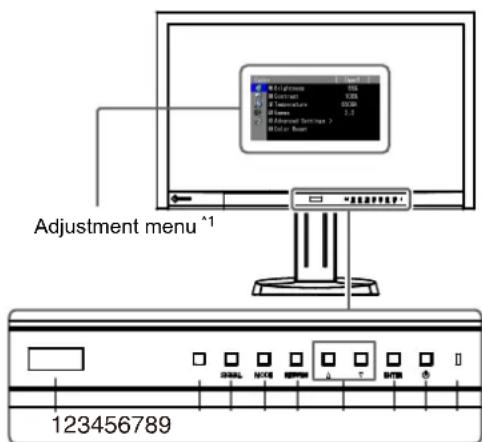
| 1. EcoView Sense sensor | Detects the movement of a person in front of the monitor. EcoView Sense function (page 30). |
| 2. Auto EcoView sensor | Detects ambient brightness. Auto EcoView function (page 31). |
| 3. SIGNAL button | Switches input signals for display (page 39). |
| 4. MODE button | Changes FineContrast mode (page 15). |
| 5. RETURN button | Cancels the setting/adjustment and exits the Adjustment menu. |
| 6. ▲button | • Chooses and increases/decreases adjustment settings for advanced adjustment using the Adjustment menu.• Displays the Brightness menu (page 17). |
| 7. ENTER button | Displays the Adjustment menu, determines an item on the menu screen, and saves values adjusted (page 9). |
| 8. ⏻ button | Turns the power on or off. |
| 9. Power indicator | Indicates the monitor's operation status.Blue: OperatingOrange: Power saving modeOFF: Main power/Power off |
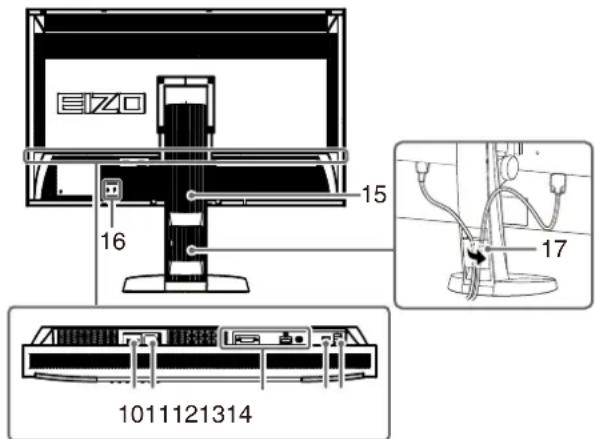
| 10. Main power switch | Turns the main power on or off. |
| 11. Power connector | Connects the power cord. |
| 12. Input signal connector | Left: DVI-D connector / Center: DisplayPort connector / Right: Mini DisplayPort connector |
| 13. USB port (Up) | Connects the USB cable to use the software that needs USB connection, or to use USB hub function (page 40). |
| 14. USB port (Down) | Connects a peripheral USB device. |
| 15. Stand*2 | Used to adjust the height and angle of the monitor screen. |
| 16. Security lock slot | Complies with Kensington's MicroSaver security system. |
| 17. Cable holder | Covers the monitor cables. |
*1 See "1-4. Basic Operations and Functions" (page 9) for how to use.
*2 An optional arm (or an optional stand) can be attached by removing the stand (see “6-1. How to Attach the Optional Arm” (page 37)).
1-3. EIZO LCD Utility Disk
An “EIZO LCD Utility Disk” (CD-ROM) is supplied with this product. The following table shows the disk contents and the overview of the software programs.
● Disk contents and software overview
The disk includes software programs for adjustment, and User's Manual. Refer to Readme.txt file on the disk for software startup procedures or file access procedures.
| Item Overview Windows Macintosh | |||
| Readme.txt file √ √ | |||
| ScreenManager Pro for LCD Software* WindowMovie Checker Software | Software for adjusting the screen using the mouse and keyboard. Connect the monitor to the PC with the supplied USB cable before installation. WindowMovie is a function of “ScreenManager Pro for LCD”. For detailed information on “ScreenManager Pro for LCD”, refer to its User’s Manual on the disk. | √ | - |
| EIZO ScreenSlicer Software that | divides a screen and lays out multiple windows efficiently. | √ | - |
| User’s Manual of this monitor (PDF file) √ √ | |||
● To use “ScreenManager Pro for LCD/EIZO ScreenSlicer”
For the installation and use of “ScreenManager Pro for LCD/EIZO ScreenSlicer”, refer to the respective User’s Manual on the disk.
1-4. Basic Operations and Functions
● Basic Adjustment menu operations
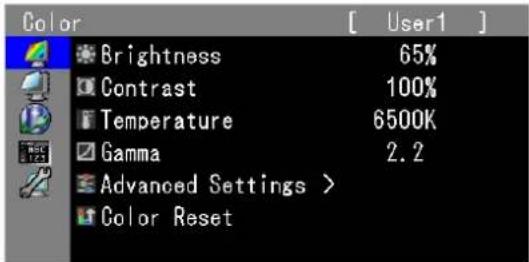
1. Displaying Adjustment Menu
- Press ENTER. The Adjustment menu appears.
![Menu title Item Current mode Color [ User1 ] Brightness 65% Contrast 100% Temperature 6500K Gamma 2.2 Settings Menu Advanced Settings > Color Reset](/content/2026/06/1184195/images/843a9ea3572298f54d6680626beb21add632711fc3c1384669a3d90c3b02f01a.jpg)
2. Adjusting/Setting
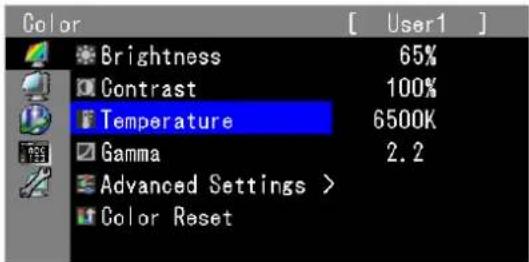
- Choose a menu to adjust/set with ▲ and then press . ENTER
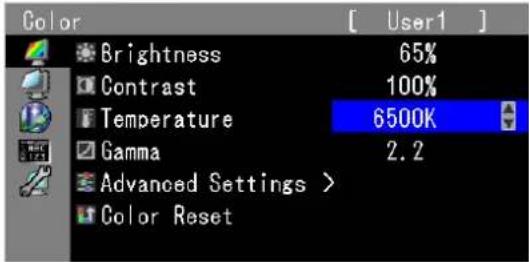
- Choose an item to adjust/set with ▲ and then press . ENTER
- Adjust/set the selected item with ▲ and then press . ENTER
3. Exiting
- Press RETURNS. The Adjustment menu finishes.
● Showing Button Guide
Press the front buttons (except button), the button guide appears above the button.
(When using the monitor with "Portrait" position, the button guide appears next to the button.)
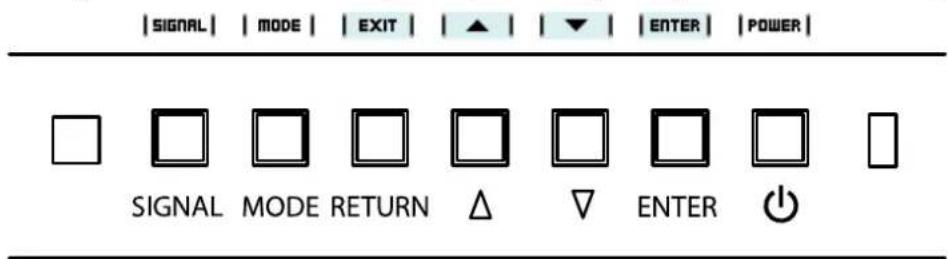
Note
- The button guide will continue to appear while the Adjustment menu or Mode menu is showing.
- The button guide is displayed differently depending on the selected menu or status.
● Functions
The following table shows all the Adjustment menu's adjustment and setting menus.
| Main menu Setting Reference | |||
Color |  | "2-3. Adjusting Color" (page 15) | |
 | |||
 | |||
 | |||
 |  | ||
 | |||
 | |||
 | |||
 | |||
 | |||
| Color Reset | "3-10. Return To Default Setting" (page 28) | ||
| Screen | [330A] | Screen Size | "2-4. Selecting Screen Size" (page 21) |
| [5244] | Overdrive | "2-5. Configuring Moving Image Performance "Overdrive"" (page 21) | |
| [CT77] | Auto Sharpness | "2-6. Enabling/Disabling Auto Sharpness "Auto Sharpness"" (page 22) | |
| Power Manager | [7778] | Power Save | "4-1. Setting Power Saving "Power Save"" (page 29) |
| [0HHW] | EcoView Sense | "4-2. Setting the power saving mode when a person leaves the monitor "EcoView Sense"" (page 30) | |
| [202A] | Auto EcoView | "4-3. Enabling/Disabling Automatic Brightness Adjustment "Auto EcoView"" (page 31) | |
| [TGKS] | Power Indicator | "4-4. Setting Power Indicator "Power Indicator"" (page 31) | |
 | Eco Timer | "4-5. Setting the automatic power off function "Eco Timer"" (page 31) | |
| [OCOT] | EcoView Index | "4-6. Displaying the power saving ratio "EcoView Index"" (page 32) | |
| Menu Settings | [2462] | Language | "3-2. Setting Language "Language"" (page 23) |
| [4430] | Orientation | "3-3. Setting Orientation "Orientation"" (page 24) | |
 | Menu Position | "3-4. Changing Adjustment Menu Display Position "Menu Position"" (page 24) | |
Tools | Input Selection | "To set input signal selection "Input Selection" (page 39) | |
| Input Skip | "3-9. To Disable Input Signal "Input Skip" (page 28) | ||
| Mode Preset | "3-1. Enabling/Disabling Mode Selection "Mode Preset" (page 23) | ||
| Signal Info | "6-4. Displaying monitor information" (page 41) | ||
| Monitor Info | |||
| All Reset | "3-10. Return To Default Setting" (page 28) | ||
* The adjustment/settings available on "Color" depend on the selected mode. (See "2-3. Adjusting Color" (page 15).)
Chapter 2 Adjusting Screens
2-1. Compatible Resolutions
The monitor supports the following resolutions.
● Digital Input (DVI-D: Single Link)
| Resolution Applicable Signals | Vertical Scan Frequency | Dot Clock | ||
| 640 × 480 VGA | 60 Hz | 162 MHz(Max.) | ||
| 720 × 400 VGA | TEXT 70 Hz | |||
| 800 × 600 VESA | 60 Hz | |||
| 1024 × 768 VESA | 60 Hz | |||
| 1280 × 960 VESA | 60 Hz | |||
| 1280 × 1024 VESA | 60 Hz | |||
| 1600 × 1200 VESA | 60 Hz | |||
| 1920 × 1080*1 | 1080p@50 50 Hz | |||
| 1920 × 1080 CEA-861 60 Hz | ||||
| 1920 × 1200 | VESA CVT RB | 60 Hz | ||
| 2560 × 1440*2 | Single Link 10bit | 30 Hz | ||
● Digital Input (DVI-D: Dual Link, DisplayPort, Mini DisplayPort)
| Resolution Applicable Signals | Vertical Scan Frequency | Dot Clock | ||
| 640 × 480 VGA | 60 Hz | 242 MHz(Max.) | ||
| 720 × 400 VGA | TEXT 70 Hz | |||
| 800 × 600 VESA | 60 Hz | |||
| 1024 × 768 VESA | 60 Hz | |||
| 1280 × 960 VESA | 60 Hz | |||
| 1280 × 1024 VESA | 60 Hz | |||
| 1600 × 1200 VESA | 60 Hz | |||
| 1920 × 1080*1 | 1080p@50 50 Hz | |||
| 1920 × 1080 CEA-861 60 Hz | ||||
| 1920 × 1200 | VESA CVT 60 Hz | |||
| 2560 × 1440*3 | Dual Link 60 Hz | |||
A graphics board in conformance with the VESA and CEA-861 standards is required.
*1 For some types of AV device
*2 Supported resolution differs depending on your graphics board.
*3 Recommended resolution
See “3-8. Setting the Input Signals “Signal Selection”” (page 26).
2-2. Setting the Resolution
When you connect the monitor to the PC and find that the resolution is improper, or when you want to change the resolution, follow the procedure below.
● Windows 7
- Right-click the mouse anywhere on the desktop except for icons.
- From the displayed menu, click "Screen resolution".
- On the "Screen Resolution" dialog box, select the monitor.
- Click "Resolution" to select the desired resolution.
- Click the "OK" button.
- When a confirmation dialog box is displayed, click "Keep changes".
● Windows Vista
- Right-click the mouse anywhere on the desktop except for icons.
- From the displayed menu, click "Personalize".
- On the "Personalization" window, click "Display Settings".
- On the “Display Settings” dialog box, select the “Monitor” tab and select desired resolution in the “Resolution” field.
- Click the "OK" button.
- When a confirmation dialog box is displayed, click "Yes".
● Windows XP
- Right-click the mouse anywhere on the desktop except for icons.
- From the displayed menu, click "Properties".
- When the “Display Properties” dialog box is displayed, click the “Settings” tab and select desired resolution for “Screen resolution” under “Display”.
- Click the "OK" button to close the dialog box.
● Mac OS X
- Select "System Preferences" from the Apple menu.
- When the "System Preferences" dialog box is displayed, click "Displays" for "Hardware".
- On the displayed dialog box, select the "Display" tab and select desired resolution in the "Resolutions" field.
- Your selection will be reflected immediately. When you are satisfied with the selected resolution, close the window.
2-3. Adjusting Color
● To select the display mode (FineConstraint mode)
This function allows easy selection of a desired mode according to monitor application.
Display Modes
| Mode Purpose | |
| 1-User1 Select one of these user modes to define a desired set of parameter settings. | |
| 2-User2 | |
| 3-User3 | |
| 4-Paper Produces a printed paper effect by decreasing contrast and color temperature. | |
| 5-Text Suitable for displaying texts for word processing or spreadsheets. | |
| 6-Picture Suitable for displaying images such as photos or picture images. | |
| 7-Movie Suitable for playing back animated images. | |
| 8-sRGB Suitable for color matching with sRGB compatible peripherals. | |
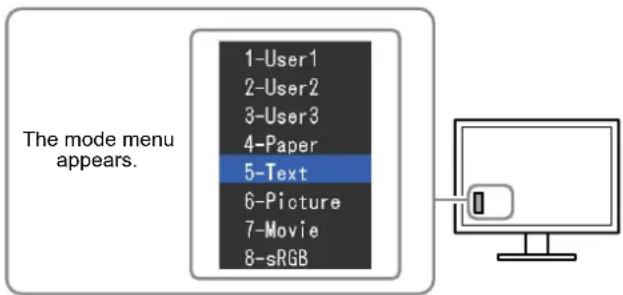
Procedure
- Press MODE.
The mode menu appears at the bottom left of the screen.
- The mode among the list is highlighted in turn each time MODED.
You can switch the mode with ▲ or ▼ while the mode menu is displayed.
![graph LR A["1-User1"] --> B["2-User2"] B --> C["3-User3"] C --> D["4-Paper"] D --> E["5-Text"] E --> F["6-Picture"] F --> G["7-Movie"] G --> H["8-sRGB"]](/content/2026/06/1184195/images/92e1fb83c0a2cf554df6a3726ea23388695704a2df74620f0de70a8fcbf0af05.jpg)
Note
- The Adjustment menu and the Mode menu cannot be displayed at the same time.
- You can disable a specific mode to be selected. For more information, see “3-1. Enabling/Disabling Mode Selection “Mode Preset”” (page 23).
- “ScreenManager Pro for LCD” allows you to select the FineContrast mode automatically according to the application used (see “Chapter 3 Auto FineContrast” in the “ScreenManager Pro for LCD” User’s Manual).
● To perform advanced adjustments
“Color” of the Adjustment menu allows you to configure and save a separate set of color settings for each mode.
Attention
- The monitor will take about 30 minutes before its internal electric components stabilize. Wait 30 minutes or more after turning the monitor power on before starting adjustment.
- The same image may be seen in different colors on multiple monitors due to their monitor-specific characteristics. Make fine color adjustment visually when matching colors on multiple monitors.
Note
- The values shown in “%” or “K” are available only as reference.
- Using the “ScreenManager Pro for LCD” allows you to perform the color adjustment by using the mouse and keyboard of your PC. The adjusted conditions can be stored as the color data to be read in later. (See “Chapter 4 Color Adjustment” in the User’s Manual for “ScreenManager Pro for LCD”).
● Adjustable settings in each mode
The adjustable settings depend on the mode. (You cannot select any non-adjustable or non-settable function.) √: Adjustable -: Not adjustable
| Icon Function | FineContrast mode | ||||||
| 1-User12-User23-User3 | 4-Paper | 5-Text 6-Picture | 7-Movie | 8-sRGB | |||
| Brightness √ √ √ √ √ √ | |||||||
| Contrast √ - √ √ √ - | |||||||
| Temperature √ √ √ √ √ √ | |||||||
| Gamma √ | - | √ | - | - | √ | ||
| Hue √ - √ √ √ - | |||||||
| Saturation √ - √ √ √ - | |||||||
| Contrast Enhancer √ | - | - | √ | √ | - | ||
| Outline Enhancer √ √ √ √ √ | |||||||
| Gain √ | - | - | - | - | - | ||
| 6 Colors √ | - | - | - | - | - | ||
| Color Reset √ √ √ √ √ | |||||||
● To adjust brightness "Brightness"
The screen brightness is adjusted by changing the brightness of the backlight (light source from the LCD back panel).
Adjustable range
0 to 100%
Procedure
- Press ▲ or ▼
The Brightness menu appears.
- Use ▲ or ▼ for adjustment.
- Press ENTER to exit.
Note
- When your feel the image is bright even if the brightness is set to 0% , adjust the contrast.
- Alternatively, you can use "Brightness" under "Color" in the Adjustment menu to adjust it.
● To adjust contrast "Contrast"
The luminance of the screen is adjusted by varying the video signal level.
Adjustable range
0 to 100%
Procedure
- Choose "Color" from the Adjustment menu, and press ENTER.
- Choose "Contrast" from "Color", and press ENTER. "Contrast" appears.
- Use ▲ or ▼ for adjustment.
- Press ENTER to exit.
Note
- In the contrast of 100% , every color gradation is displayed.
- When adjusting the monitor, it is recommended to perform the brightness adjustment which may not lose the gradation characteristics, prior to the contrast adjustment.
- Perform the contrast adjustment in the following cases.
- When you feel the image is too bright even if the brightness is set to 0% (Set the contrast to lower than 100%.)
● To adjust color temperature “Temperature”
The color temperature can be adjusted.
The color temperature is normally used to express the hue of “White” and/or “Black” by a numerical value.
The value is expressed in degrees "K" (Kelvin).
The screen becomes reddish at a low color temperature, and bluish at a high color temperature, like the flame temperature. The gain preset values are set for each color temperature setting value.
Adjustable range
Native, 4000K-10000K (specified every 100K), Standard
Procedure
- Choose "Color" from the Adjustment menu, and press ENTER.
- Choose "Temperature" from "Color", and press ENTER.
- Use ▲ or ▼ for adjustment.
- Press ENTER to exit.
Note
- “Gain” allows you to perform more advanced adjustment (see “To adjust gain “Gain”” (page 20)).
- If you set "Native", the image is displayed in the preset color of the monitor (Gain: 100% for each RGB).
- When gain is changed, the color temperature is changed to "User".
● To adjust gamma "Gamma"
Gamma can be adjusted. The brightness of the monitor varies depending on the input signal, however, the variation rate is not proportional to the input signal. To keep the balance between the input signal and the brightness of the monitor is called as “Gamma correction”.
Adjustable range
1.6 to 2.7
Procedure
- Choose "Color" from the Adjustment menu, and press ENTER.
- Choose "Gamma" from "Color", and press ENTER.
- Use ▲ or ▼ for adjustment.
- Press ENTER to exit.
● To adjust hue "Hue"
This function allows you to adjust the hue.
Adjustable range
-100 to 100
Procedure
- Choose "Color" from the Adjustment menu, and press ENTER.
- Choose "Advanced Settings" from "Color", and press ENTER
- Choose "Hue", and press ENTER.
- Use ▲ or ▼ for adjustment.
- Press ENTER to exit.
Attention
- Using this function may make some color gradations unavailable for display.
● To adjust color saturation “Saturation”
This function allows you to adjust color saturation.
Adjustable range
-100 to 100
Procedure
- Choose "Color" from the Adjustment menu, and press ENTER.
- Choose "Advanced Settings" from "Color", and press ENTER
- Choose "Saturation", and press ENTER.
- Use ▲ or ▼ for adjustment.
- Press ENTER to exit.
Attention
- Using this function may make some color gradations unavailable for display.
- The minimum value (-100) changes the screen to monochrome.
Note
● To enable/disable Contrast Enhancer “Contrast Enhancer”
This feature manages the brightness and gain levels of the backlight to match the image displayed while also improving the sense of contrast of images by correcting gamma values.
Procedure
- Choose "Color" from the Adjustment menu, and press ENTER.
- Choose "Advanced Settings" from "Color", and press ENTER
- Choose "Contrast Enhancer", and press ENTER.
- Select "On" or "Off" with ▲ or ▼
- Press ENTER to exit.
● To enhance outline of image "Outline Enhancer"
OutlineEnhancer functions to emphasize outline of the images by emphasizing the color difference between pixels composing the images. This may improve the texture of the material and its feel of the images. On the contrary, it also functions to reproduce the images smoothly by gradating its outline.
Procedure
- Choose "Color" from the Adjustment menu, and press ENTER.
- Choose "Advanced Settings" from "Color", and press ENTER.
- Choose "Outline Enhancer", and press ENTER.
- Select the display status in the range from -3 to 3 (soft to sharp) with ▲ or ▼ as desired.
- Press ENTER to exit.
● To adjust gain "Gain"
The brightness of each color component red, green, and blue is called “Gain”. You can change the hue of “white” by adjusting gain.
Adjustable range
0 to 100%
Procedure
- Choose "Color" from the Adjustment menu, and press ENTER.
- Choose "Advanced Settings" from "Color", and press ENTER
- Choose "Gain", and press ENTER
- Choose the color to adjust from "Red", "Green", and "Blue", and then press ENTER
- Use ▲ or ▼ for adjustment.
- Press ENTER to exit.
Attention
- Using this function may make some color gradations unavailable for display.
Note
- The value of gain changes with that of color temperature.
- When gain is changed, the color temperature is changed to "User".
● To adjust six colors "6 Colors"
The hue and saturation can be adjusted for each of six colors: Magenta, Red, Yellow, Green, Cyan, and Blue.
Adjustable range
-100 to 100
Procedure
- Choose "Color" from the Adjustment menu, and press ENTER.
- Choose "Advanced Settings" from "Color", and press ENTER.
- Choose "6 Colors", and press ENTER.
- Choose the color for adjustment among "Magenta", "Red", "Yellow", "Green", "Cyan", or "Blue", and press ENTER.
- Select "Hue" or "Saturation", and press ENTER.
- Use ▲ or ▼ for adjustment.
- Press ENTER to exit.
2-4. Selecting Screen Size
● To change screen size "Screen Size"
The image with the resolution other than the recommended resolution is displayed in full screen automatically. You can change the screen size by using the “Screen Size” function from “Screen”.
| Setting Function | |
| Full Displays an image in full screen. Images are distorted in some cases because the vertical rate is not equal to the horizontal rate. | |
| Enlarged Displays an image in full screen. In some cases, a blank horizontal or vertical border appears to equalize the vertical rate and the horizontal rate. | |
| Normal Displays images with the specified resolution. |
Example: Image size 1280 × 1024
Full Enlarged Normal
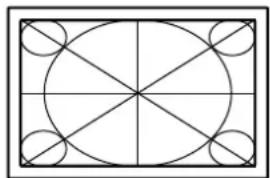
(2560 × 1440) (1800 × 1440)
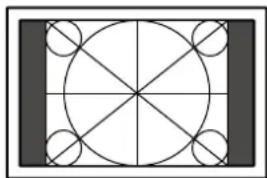
(1280 × 1024)
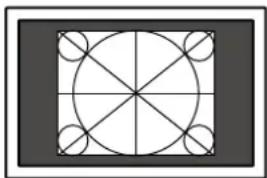
Procedure
- Choose "Screen" from the Adjustment menu, and press ENTER.
- Choose "Screen Size" from "Screen", and press ENTER.
- Select "Full", "Enlarged", or "Normal" with ▲ or ▼.
- Press ENTER to exit.
Attention
- Selecting "Normal" may make some color gradations unavailable for display.
2-5. Configuring Moving Image Performance "Overdrive"
By using the “Overdrive” setting, the extent to which fast moving images produce visible afterimages can be reduced. This setting is set to “On” by default, but while turned “On” noise and afterimages may instead be more noticeable. In such a case, please set the “Overdrive” setting to “Off”.
Procedure
- Choose "Screen" from the Adjustment menu, and press ENTER.
- Choose "Overdrive" from "Screen", and press ENTER.
- Select "On" or "Off" with ▲ or ▼.
- Press ENTER to exit.
2-6. Enabling/Disabling Auto Sharpness “Auto Sharpness”
By enabling Auto Sharpness outlines will be adjusted according to the displayed image which can improve its feel and texture.
Procedure
- Choose "Screen" from the Adjustment menu, and press ENTER.
- Choose "Auto Sharpness" from "Screen", and press ENTER.
- Select "On" or "Off" with ▲ or ▼
- Press ENTER to exit.
Note
- The extent of adjustment depends on the setting value of "Outline Enhancer".
Chapter 3 Setting Monitor
3-1. Enabling/Disabling Mode Selection "Mode Preset"
Allows you to select the specified modes only.
Use this function when all the display modes are not available or when keeping the display mode unchanged.
Procedure
- Choose "Tools" from the Adjustment menu, and press ENTER.
- Choose "Mode Preset" from "Tools", and press ENTER.
- Use ▲ or ▼ to select the mode to change, and press .ENTER
- Select "On" or "Off" with ▲ or ▼
- Press ENTER to exit.
Attention
- You cannot set all the modes disable. Set at least one mode to "On".
3-2. Setting Language "Language"
This function allows you to select a language for the Adjustment menu and messages.
Selectable languages
English/German/French/Spanish/Italian/Swedish/Japanese/Simplified Chinese/Traditional Chinese
Procedure
- Choose "Menu Settings" from the Adjustment menu, and press ENTER.
- Choose "Language" from "Menu Settings", and press ENTER.
- Select a language with ▲ or ▼
- Press ENTER to exit.
3-3. Setting Orientation "Orientation"
This function allows you to change the orientation of the Adjustment menu when using the monitor screen in vertical display position.
Procedure
- Choose "Menu Settings" from the Adjustment menu, and press ENTER.
- Choose "Orientation" from "Menu Settings", and press ENTER
- Select "Landscape" or "Portrait" with ▲ or ▼
- Press ENTER to exit.
- When selecting "Portrait", turn the monitor screen 90° in clockwise direction.
Attention
- Be sure that the cables are correctly connected.
- Be sure to turn the monitor screen after pulling up the screen to the uppermost position of the stand and setting the screen tilted upward.
Note
- For using the monitor with “Portrait” position, the graphics board supporting portrait display is required. When placing the monitor in a “Portrait” position, settings of your graphics board need to be changed. Refer to the User’s Manual of the graphics board for details.
3-4. Changing Adjustment Menu Display Position “Menu Position”
You can change the display position of the Adjustment menu.
Procedure
- Choose "Menu Settings" from the Adjustment menu, and press ENTER.
- Choose "Menu Position" from "Menu Settings", and press ENTER.
- Choose the position with ▲ or ▼
- Press ENTER to exit.
3-5. Setting the EIZO Logo Display "Logo"
This function allows you to display, or not, the EIZO logo.
Procedure
- Press ⏻ to turn off the monitor.
- Holding MODE down, press for at least two seconds to turn on the monitor.
The "Optional Settings" menu appears. - Choose "Logo" from "Optional Settings", and press ENTER
- Select "On" or "Off" with ▲ or ▼ and press .ENTER
- Select "Finish" with ▲ or ▼
- Press ENTER.
The "Optional Settings" menu is closed.
3-6. Locking Buttons "Key Lock"
This function allows you to lock the adjusted/set status to prevent changing them.
Procedure
- Press ⏻ to turn off the monitor.
- Holding MODE down, press for at least two seconds to turn on the monitor.
The "Optional Settings" menu appears. - Choose "Key Lock" from "Optional Settings", and press ENTER
- Choose "Off", "Menu", or "All" with ▲ or ▼ and press .ENTER
| Settings Buttons that can be locked | |
| Off(Default setting) | None (All buttons are enabled) |
| Menu | ENTER button |
| All | All buttons excluding ⏻ |
-
Select "Finish" with ▲ or .▼
-
Press ENTER.
The "Optional Settings" menu is closed.
3-7. Enabling/Disabling DDC/CI communication
This function allows you to enable/disable the DDC/CI communication (see "6-6. Glossary" (page 44)).
Procedure
- Press ⏻ to turn off the monitor.
- Holding MODE down, press for at least two seconds to turn on the monitor.
The "Optional Settings" menu appears. - Choose "DDC/CI" from "Optional Settings", and press ENTER
- Select "On" or "Off" with ▲ or ▼ and press .ENTER
- Select "Finish" with ▲ or ▼
- Press ENTER.
The "Optional Settings" menu is closed.
3-8. Setting the Input Signals "Signal Selection"
Signals can be selected based on your operating environment.
Attention
- The graphics board supporting signal display is required.
- Refer to the User's Manual of the graphics board.
● To connect DVI (Single Link)
Procedure
- Press ⏻ to turn off the monitor.
- Holding MODE down, press for at least two seconds to turn on the monitor.
The "Optional Settings" menu appears. - Choose "Signal Selection" from "Optional Settings", and press ENTER
- Select "DVI" with ▲ or ▼ and press .ENTER
- Select "Signal Format" with ▲ or ▼ and press .ENTER
- Select "Single Link" with ▲ or ▼ and press .ENTER
- Press RETURN twice.
- Select "Finish" with ▲ or ▼
- Press ENTER.
The "Optional Settings" menu is closed.
● To connect DVI (Dual Link)
Procedure
- Press ⏻ to turn off the monitor.
- Holding MODE down, press ④ for at least two seconds to turn on the monitor.
The "Optional Settings" menu appears. - Choose "Signal Selection" from "Optional Settings", and press ENTER
- Select "DVI" with ▲ or ▼ and press .ENTER
- Select "Signal Format" with ▲ or ▼ and press .ENTER
- Select "Dual Link" with ▲ or ▼ and press .ENTER
- Select "Signal Bandwidth" with ▲ or ▼ and press .ENTER
Use ▲ or ▼ to select or just confirm the signal bandwidth setting for the frequency that corresponds to your graphics board.
| Setting | Horizontal scan frequency (kHz) | Vertical scan frequency (Hz) | |
| Normal | 26 to 89 59 to 61 | ||
| Wide | 26 to 89 23.75 to 63 | ||
-
Press ENTER
-
Press RETURN twice.
-
Select "Finish" with ▲ or ▼
-
Press ENTER.
The "Optional Settings" menu is closed.
● To connect DVI (Simple display of HDMI signal from digital camera)
An HDMI signal from a digital camera can be simply displayed by means of connecting this product and the digital camera using a DVI-HDMI converter cable.
Attention
- For displaying the PC signal, "Single Link" or "Dual Link" should be set.
Procedure
- Press ⏻ to turn off the monitor.
- Holding MODE down, press for at least two seconds to turn on the monitor.
The "Optional Settings" menu appears. - Choose "Signal Selection" from "Optional Settings", and press ENTER
- Select "DVI" with ▲ or ▼ and press .ENTER
- Select "Signal Format" with ▲ or ▼ and press .ENTER
- Select "HD Video" with ▲ or ▼ and press .ENTER
- Press RETURN twice.
- Select "Finish" with ▲ or ▼
- Press ENTER.
The "Optional Settings" menu is closed.
● To connect DisplayPort / Mini DisplayPort
Procedure
- Press ⏻ to turn off the monitor.
- Holding MODE down, press ④ for at least two seconds to turn on the monitor.
The "Optional Settings" menu appears. - Choose "Signal Selection" from "Optional Settings", and press ENTER
- Select "DisplayPort" with ▲ or ▼ and press .ENTER
- Select "Signal Bandwidth" with ▲ or ▼ and press .ENTER
Use ▲ or ▼ to select or just confirm the signal bandwidth setting for the frequency that corresponds to your graphics board.
| Setting | Horizontal scan frequency (kHz) | Vertical scan frequency (Hz) |
| Normal 26 to 89 59 to 61 | ||
| Wide 26 to 89 23.75 to 63 |
- Press ENTER
- Press RETURN twice.
- Select "Finish" with ▲ or ▼
- Press ENTER.
The "Optional Settings" menu is closed.
3-9. To Disable Input Signal "Input Skip"
This function allows skipping of the set input signals when the input signals are switched.
When not all the input signals are displayed or when keeping the input signals unchanged, set “Input Skip” to “On” for the signals to be disabled.
Procedure
- Choose "Tools" from the Adjustment menu, and press ENTER.
- Choose "Input Skip" from "Tools", and press ENTER.
- Choose the input signal to set with ▲ or ▼ and press .ENTER
- Select "On" or "Off" with ▲ or ▼
- Press ENTER to exit.
Attention
- You cannot set all the input signals disable. Set at least one input signal to "Off".
- The settings made are applied when the input signals are switched next time.
3-10. Return To Default Setting
There are two different Resets: Color Reset for only resetting the color adjustments to the default settings and All Reset for resetting all settings to the defaults.
Attention
• After resetting, you cannot undo the operation.
Note
- Regarding the default setting, see "Main Default Settings" (page 43).
● To reset the color adjustment value "Color Reset"
This function only resets the color adjustment value for the currently selected mode to the default settings.
Procedure
- Choose "Color" from the Adjustment menu, and press ENTER
- Choose "Color Reset" from "Color", and press ENTER.
- Choose "Execute" with ▲ or ▼
- Press ENTER.
The color adjustments revert to the default settings.
- To reset all adjustments to the default settings "All Reset"
This function resets all adjustments to the default settings (except the “Optional Settings” menu).
Procedure
- Choose "Tools" from the Adjustment menu, and press ENTER.
- Choose "All Reset" from "Tools", and press ENTER.
- Select "Execute" with ▲ or ▼
- Press ENTER.
All settings excluding the “Optional Settings” menu are reset to the default settings.
Chapter 4 Power Saving Functions
4-1. Setting Power Saving "Power Save"
This function allows you to set the monitor into the power saving mode according to the PC status. When the monitor has shifted to the power saving mode, the images on the screen are not displayed.
Attention
- Turning off the main power switch or unplugging the power cord completely shuts off power supply to the monitor.
- Devices connected to the USB upstream port and USB downstream port work when the monitor is in power saving mode or when the power button of the monitor is Off. Therefore, power consumption of the monitor varies with connected devices even in the power saving mode.
- Five seconds before the monitor enters the power saving mode, it displays a preliminary message.
Procedure
- Choose "PowerManager" from the Adjustment menu, and press ENTER.
- Choose "Power Save" from "PowerManager", and press ENTER.
- Select "On" or "Off" with ▲ or ▼
- Press ENTER to exit.
Power Saving System
At DVI signal input
This monitor complies with the "DVI DMPM" standard.
At Displayport / Mini DisplayPort signal input
This monitor complies with the "DisplayPort Standard V1.1a".
The monitor enters the power saving mode after five seconds in connection with the PC setting.
| PC Monitor Power Indicator | ||
| ON Operating Blue | ||
| Power saving mode | Power saving mode | Orange |
4-2. Setting the power saving mode when a person leaves the monitor “EcoView Sense”
The sensor on the front side of the monitor detects the movement of a person by setting a value from “Level-1” to “Level-4” of the EcoView Sense function. When a person moves away from the monitor, it shifts to the power saving mode automatically and does not display the images on the screen to reduce the power consumption. When a person comes near the monitor again, it comes back from the power saving mode and displays the images. The detection level of the EcoView Sense sensor can be changed according to the environment of usage.
Note
- At the time of shifting to power saving mode, the message that indicates shifting is displayed.
Attention
- When the orientation of the Adjustment menu is set to “Portrait” or “Power Save” is set to “Off”, the EcoView Sense is turned off (see “3-3. Setting Orientation “Orientation”” (page 24)).
Procedure
- Choose "PowerManager" from the Adjustment menu, and press ENTER.
- Choose "EcoView Sense" from "PowerManager", and press ENTER.
- Select "Off" and any of "Level-1", "Level-2", "Level-3", or "Level-4" (sensor detection level) with ▲ or ▼
| Level Detection Area Details | ||
| Level-1 120 cm (47.2 inch) or less If the user | r leaves the detection area, the monitor shifts to the power saving mode. Still objects in the detection area will be interpreted as present user. This setting is recommended if the monitor frequently shifts to the power saving, even though a user is in front of the screen. | |
| Level-2 | 90 cm (35.4 inch) or less | |
| Level-3 | Automatic setting (120 cm [47.2 inch] or less) | The detection area is defined automatically by the user's movement. If the user leaves this area, the monitor shifts to the power saving mode. Still objects in the detection area will be ignored. |
| Level-4 | Automatic setting (90 cm [35.4 inch] or less) | |
- Press ENTERto exit.
4-3. Enabling/Disabling Automatic Brightness Adjustment "Auto EcoView"
The sensor on the front side of the monitor detects the environmental brightness to adjust the screen brightness automatically and comfortably by using the Auto EcoView function.
Attention
- Be careful not to block the sensor on the lower side of the monitor when using the Auto EcoView function.
Procedure
- Choose "PowerManager" from the Adjustment menu, and press ENTER.
- Choose "Auto EcoView" from "PowerManager", and press ENTER.
- Select "On" or "Off" with ▲ or ▼
- Press ENTER to exit.
Note
- For this reason, as “Brightness” in the Adjustment menu is changed, the auto adjustment range is also changed.
4-4. Setting Power Indicator "Power Indicator"
The brightness of the power indicator (blue) when the screen is displayed can be adjusted (default setting is set to light up when power is turned on, and brightness is set to 4).
Procedure
- Choose "PowerManager" from the Adjustment menu, and press ENTER.
- Choose "Power Indicator" from "PowerManager", and press ENTER.
- Select the indicator brightness "Off" or in the range from 1 to 7 with ▲ or ▼ as desired.
- Press ENTER to exit.
4-5. Setting the automatic power off function “Eco Timer”
This function allows you to specify whether to turn on/off the monitor automatically after a specified time has elapsed in the power saving mode.
Adjustable range
Off, 0, 1, 2, 3, 4, 5, 10, 15, 20, 25, 30, 45 min, 1, 2, 3, 4, 5 h
Procedure
- Choose "PowerManager" from the Adjustment menu, and press ENTER.
- Choose "Eco Timer" from "PowerManager", and press ENTER.
- Select "Off" or time to turn off the monitor with ▲ or ▼.
- Press ENTER to exit.
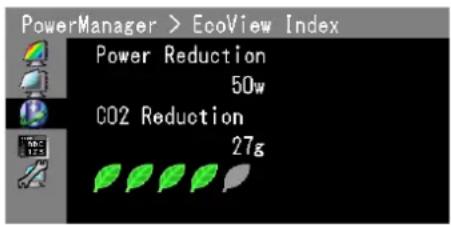
4-6. Displaying the power saving ratio “EcoView Index”
This indicator shows the power saving ratio, power reduction and CO 2 reduction as a result of the brightness of the monitor.
Procedure
- Choose "PowerManager" from the Adjustment menu, and press ENTER.
- Choose "EcoView Index" from "PowerManager", and press ENTER.
The "EcoView Index" appears.
(Example)
Note
Power reduction: the backlight's reduction of power consumption as a result of the adjusted brightness value. CO2 reduction: converted from the "Power reduction" value, this is an estimate of the quantity of CO2 emissions reduced when using the monitor for 1 hour.
The numeric value is a result of a calculation based on a default setting (0.000555 t -CQ/kWh) determined by a Japanese ministerial ordinance (2006, Ministry of Economy, Trade and Industry, Ministry of Environment, civil code article 3) and may differ depending on country and year.
Chapter 5 Troubleshooting
If a problem still remains after applying the suggested remedies, contact your local dealer.
5-1. No picture
| Problem Possible cause and remedy | |
| 1. No picture• Power indicator does not light. | Check whether the power cord is connected properly.Turn off the main power, and then turn it on again a few minutes later.Turn the main power switch on.Press |
| Power indicator is lighting blue. Increase | "Brightness", "Contrast", and/or "Gain" in the Adjustment menu (see "To perform advanced adjustments" (page 16)). |
| Power indicator is lighting orange. | Switch the input signal with SIGNAL.Operate the mouse or keyboard.Check whether the PC is turned on.When the EcoView Sense sensor is set at a value from "Level-1" to "Level-4", the monitor may have shifted to the power saving mode. Come near to the monitor. |
| Power indicator flashes orange and blue. | There is a problem in the device that uses Displayport / Mini DisplayPort connection. Solve the problem, turn off the monitor, and then turn it on again. Refer to the User's Manual of the device that uses Displayport / Mini DisplayPort connection for details. |
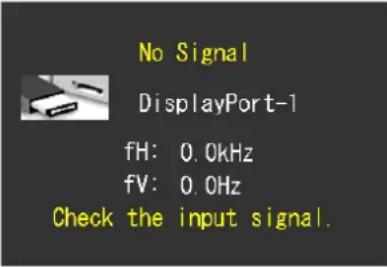
| 2. The message below appears. This message appears when the signal is not input correctly even when the monitor functions properly. | |
| This message appears when no signal is input.Example: | The message shown left may appear, because some PCs do not output the signal soon after power-on.Check whether the PC is turned on.Check whether the signal cable is connected properly.Switch the input signal with SIGNAL. |
 | |
Problem Possible cause and remedy
- The message shows that the input signal is out of the specified frequency range. (Such signal frequency is displayed in magenta.) Example:
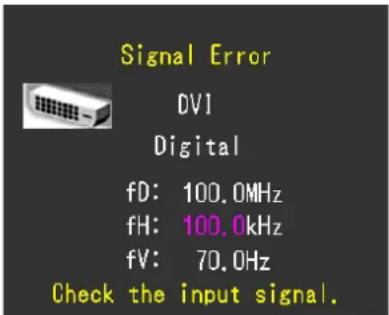
fD: Dot clock
fH: Horizontal scan frequency
fV: Vertical scan frequency
- Check whether the PC is configured to meet the resolution and vertical scan frequency requirements of the monitor (see "2-1. Compatible Resolutions" (page 13)).
- Reboot the PC.
- Select an appropriate display mode using the graphics board's utility. Refer to the User's Manual of the graphics board for details.
5-2. Imaging problems
| Problem Possible cause and remedy | |
| 1. The screen is too bright or too dark. Use | "Brightness" or "Contrast" in the Adjustment menu to adjust it. (The LCD monitor backlight has a limited life span. When the screen becomes dark or begins to flicker, contact your local dealer.)Turn on the "Auto EcoView" function in the Adjustment menu. The monitor detects the environmental brightness to adjust the screen brightness automatically (see "4-3. Enabling/Disabling Automatic Brightness Adjustment "Auto EcoView" (page 31)). |
| 2. Characters are blurred. Check whether the PC is configured to meet the resolution and vertical scan frequency requirements of the monitor (see "2-1. Compatible Resolutions" (page 13)).Use "Outline Enhancer" in the Adjustment menu to adjust it (see "To enhance outline of image "Outline Enhancer" (page 19)). | |
| 3. Afterimages appear. Afterimages are particular to LCD monitors. Avoid displaying the same image for a long time.Use the screen saver or power saving function to avoid displaying the same image for extended periods of time. | |
| 4. Green/red/blue/white dots or defective dots remain on the screen. | This is due to LCD panel characteristics and is not a failure. |
| 5. Interference patterns or pressure marks remain on the screen. | Leave the monitor with a white or black screen. The symptom may disappear. |
| 6. Noise appears on the screen. In the Adjustment menu, set "Overdrive" to "Off"(see "2-5. Configuring Moving Image Performance "Overdrive" (page 21)).When entering the signals of HDCP system, the normal images may not be displayed immediately. | |
| 7. (DisplayPort-1/DisplayPort-2 input) Display position of the windows changes. | When the power is switched on, the position of the window may be changed. This problem can be solved by connecting the USB cable to the monitor and PC.When the signal is switched, the position of the window may be changed. The signal may not be switched even when the hot key that was specified for ScreenManager Pro for LCD is pressed. In both cases, turn on "DisplayPort-1" or "DisplayPort-2" using "Input Skip" in the Adjustment menu, and skip the signals not to be used (see "3-9. To Disable Input Signal "Input Skip" (page 28)). |
5-3. Other problems
| Problem Possible cause and remedy | |
| 1. The adjustment menu does not appear. | Check whether the operation lock function works (see “3-6. Locking Buttons “Key Lock”” (page 25)). |
| 2. No mode menu is displayed. Check whether the operation lock function works (see “3-6. Locking Buttons “Key Lock”” (page 25)). | |
| (When using EcoView Sense)The images remain to be displayed when you move away from the monitor. / The images do not reappear when you come near it. | Check the setting environment of the monitor. Presence Sensor may not work correctly in the following environments.- There is something that reflects the light such as mirror or glass in front of the sensor.- The monitor is located in a place that receives direct sunlight.- There is some infrared device near the monitor.- There is some obstacle in front of the sensor.Check whether any dirt on the sensor. Clean the sensor with a soft cloth.Check whether you are in front of the monitor. The infrared ray is emitted vertically from the sensor to detect a person. |
| 3. The monitor connected with the USB cable is not detected. / USB devices connected to the monitor does not work. | Check whether the USB cable is connected correctly (see “6-3. Making Use of USB (Universal Serial Bus)” (page 40)).Change the USB port to another one. If the PC or peripheral devices works correctly by changing the USB port, contact your local dealer. (Refer to the manual of the PC for details.)Reboot the PC.If the peripheral devices work correctly when the PC and peripheral devices are connected directly, please contact your local dealer.Check whether the PC and OS are USB compliant. (For USB compliance of the respective devices, consult their manufacturers.)Check the PC’s BIOS setting for USB when using Windows. (Refer to the manual of the PC for details.) |
Chapter 6 Reference
6-1. How to Attach the Optional Arm
An optional arm (or an optional stand) can be attached by removing the stand section. Please refer to our web site for the corresponding optional arm (or optional stand). http://www.eizo.com
Attention
- When attaching an arm or stand, follow the instructions of their User's Manual.
- When using another manufacturer's arm or stand, confirm the following in advance and select one conforming to the VESA standard.
- Clearance between the screw holes: 100 mm × 100 mm
- Thickness of plate: 2.6 mm
- Strong enough to support weight of the monitor unit (except the stand) and attachments such as cables.
- Use the screws as described below.
- Screws fixing the stand to the monitor.
- When using an arm or stand, attach it to meet the following tilt angles of the monitor.
- Up 45°, down 45°
- Connect the cables after attaching an arm or stand.
- Do not move the removed stand up and down. Doing so may result in injury or device damage.
- The monitor and arm or stand are heavy. Dropping them may result in injury or equipment damage.
- When setting the monitor to the portrait style, turn the monitor screen 90° in clockwise direction.
Procedure
- Lay the LCD monitor on a soft cloth spread over on a stable surface with the panel surface facing down.
- Remove the stand.
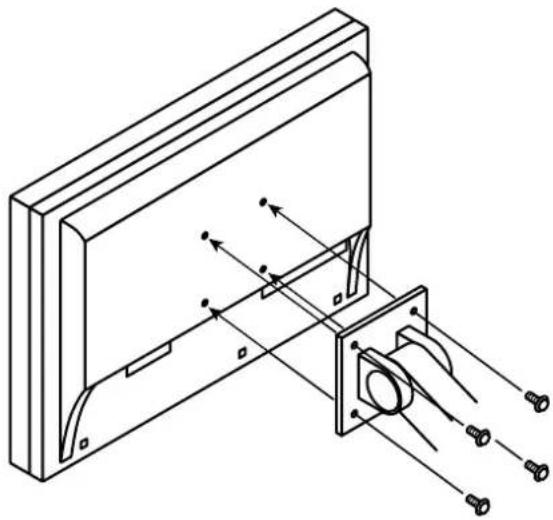
Prepare a screwdriver. Loosen the screws (four) securing the unit and the stand with the screwdriver.
- Attach the arm or stand to the monitor.
Secure the monitor to the arm or stand using the screws specified in the User's Manual of the arm or stand.
6-2. Connecting Multiple PCs
The product has multiple connections to PCs and allows you to switch to one of the connections for display.
Connection examples
![graph TD A["Computer"] --> B["DVI-D connector"] B --> C["DisplayPort connector"] C --> D["Mini DisplayPort connector"] B --> E["Digital (DVI)"] E --> F["Signal cable (supplied DD200-DL)"] F --> G["DVI connector"] G --> H["DisplayPort connector"] H --> I["Mini DisplayPort connector"] B --> J["Digital…](/content/2026/06/1184195/images/288682a9d3e523d4f6bdd5aa8982e0788fbcec42c4d2151d459454bc6f2d5353.jpg)
● To switch among input signals
The input signal switches each time SIGNALled.
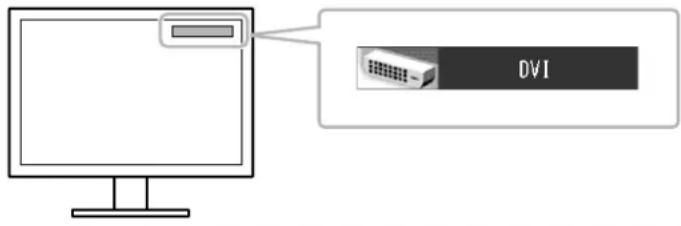
When the signal is switched, the active input port name appears at the top right corner of the screen.
Note
- You can skip a specific input signal. For more information, see“3-9. To Disable Input Signal “Input Skip”” (page 28).
● To set input signal selection "Input Selection"
| Setting Function | |
| Auto The monitor recognizes the connector through which PC signals are input.When a PC is turned off or enters the power saving mode, the monitor automatically displays another signal. | |
| Manual The monitor detects only the PC's signals currently displaying automatically. Select an active input signal with SIGNAL. |
Procedure
- Choose "Tools" from the Adjustment menu, and press ENTER.
- Choose "Input Selection" from "Tools", and press ENTER.
- Select "Auto" or "Manual" with ▲ or ▼
- Press ENTER to exit.
Note
- When “Auto” is selected for “Input Selection”, the monitor’s power saving function works only when all PCs are in the power saving mode.
6-3. Making Use of USB (Universal Serial Bus)
This monitor has a hub compatible with USB. Connected to a PC compatible with USB or another USB hub, this monitor functions as a USB hub allowing connection to peripheral USB devices.
● Required System Environment
- A PC equipped with a USB port or another USB hub connected to a USB compatible PC
- Windows 2000/XP/Vista/7 or Mac OS 9.2.2 and Mac OS X 10.2 or later
- EIZO USB cable (MD-C93)
Attention
- This monitor may not work depending on PC, OS or peripheral devices to be used. For USB compatibility of peripheral devices, contact their manufactures.
- Devices connected to the USB upstream port and USB downstream port work when the monitor is in power saving mode or when the power button of the monitor is Off. Therefore, power consumption of the monitor varies with connected devices even in the power saving mode.
- When the main power switch is Off, device connected to the USB port will not operate.
● Connection Procedure (Setup of USB Function)
- Connect the monitor first to a PC using the signal cable, and run the PC.
-
Connect the supplied USB cable between the USB downstream port of a USB compatible PC (or another USB hub) and the monitor's USB upstream port.
The USB hub function is set up automatically upon connection of the USB cable. -
Connect the peripheral USB device to the USB downstream port of the monitor.
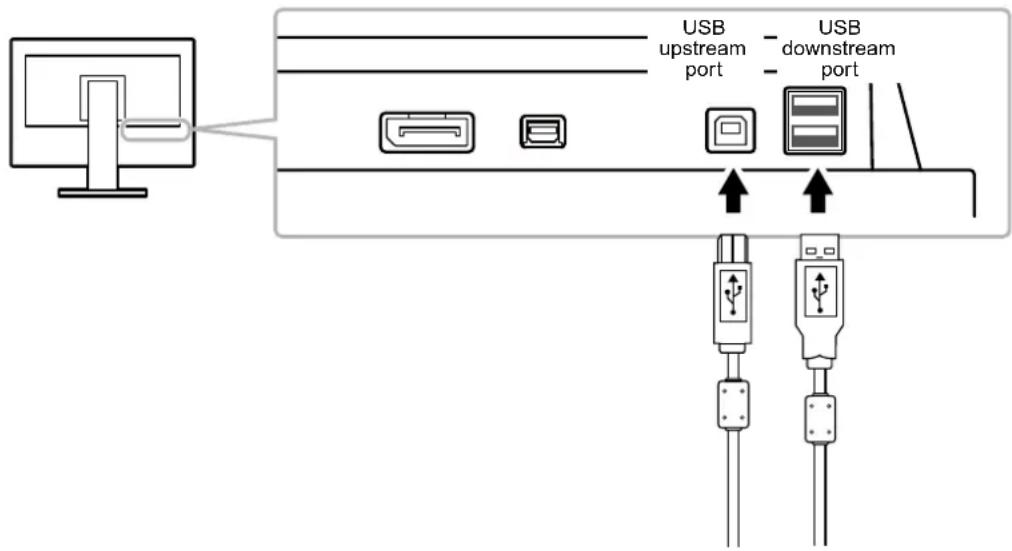
6-4. Displaying monitor information
● Displaying signal information "Signal Info"
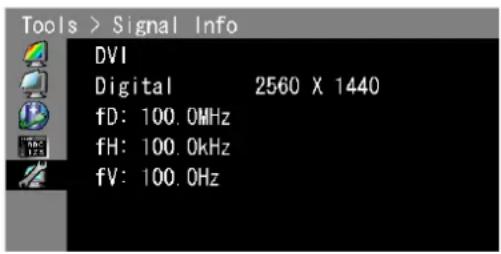
This function displays the information about the current input signals displayed.
Procedure
- Choose "Tools" from the Adjustment menu, and press ENTER.
- Choose "Signal Info" from "Tools", and press ENTER.
The "Signal Info" appears.
(Example)
- Displaying Monitor Information "Monitor Info"
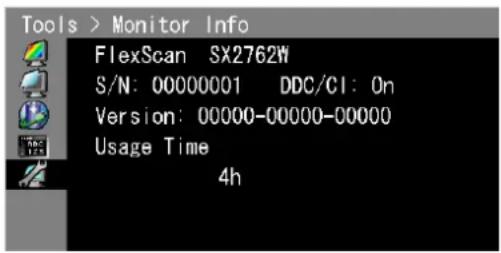
This function displays the information about the monitor.
Procedure
- Choose "Tools" from the Adjustment menu, and press ENTER.
- Choose "Monitor Info" from "Tools", and press ENTER.
The "Monitor Info" appears.
This function displays the model name, serial number, firmware version, and usage time.
Attention
- The usage time is not always “0” when you purchase the monitor due to factory inspection.
6-5. Specifications
| LCD Panel Size | 27.0-inch (680 mm) TFT color LCD | |
| Viewing angles Horizontal 178°, vertical 178° (CR≥10) | ||
| Dot pitch 0.2331 mm | ||
| Response time Black-white-black: Approx. 12 ms | ||
| Gray-to-gray: Approx. 6 ms | ||
| Horizontal scan frequency 26-89 kHz | ||
| Vertical scan frequency 23.75-63 Hz (non-interlace)(VGA TEXT: 69-71 Hz) | ||
| Resolution 2560 dots × 1440 lines | ||
| Max. dot clock 242 MHz | ||
| Max. display color | Approx. 1073.74 million colors (for DisplayPort / Mini DisplayPort 10 bit, DVI 10 bit input) | |
| Display area (H × V) | 596.74 mm × 335.66 mm (23.49 inch × 13.21 inch) | |
| Power supply | 100-120 VAC ±10%, 50/60 Hz 1.6A200-240 VAC ±10%, 50/60 Hz 0.8A | |
| Power consumption | Screen display On | 160 W or less |
| Power saving mode | 1.0 W or less (when only the DVI signal connector is connected, no USB device is connected, and "Input Selection" is set to "Manual") | |
| Power Off | 0.8 W or less (when no USB device is connected) | |
| Main power Off | 0 W | |
| Input signal connectors | DVI-D connector | |
| DisplayPort connector (Standard V1.1a, applicable to HDCP) | ||
| Mini DisplayPort connector (Standard V1.1a, applicable to HDCP) | ||
| Digital Signal (DVI) Transmission System | TMDS (Single Link / Dual Link) | |
| Plug & Play | Digital (DVI-D): VESA DDC 2B / EDID structure 1.3Digital (DisplayPort / Mini DisplayPort): VESA DisplayPort / EDID structure 1.4 | |
| Dimensions(width) × (height)× (depth) | Main unit | 646 mm (25.4 inch) × 425 - 576.5 mm (16.7 - 22.7 inch) × 281.5 mm (11.1 inch) |
| Main unit (without stand) | 646 mm (25.4 inch) × 402 mm (15.8 inch) × 92 mm (3.6 inch) | |
| Mass | Main unit | Approx. 13.6 kg (30 lbs.) |
| Main unit (without stand) | Approx. 9.7 kg (21.8 lbs.) | |
| Movable range | Tilt: Up 25°, down 0° | |
| Swivel: 172° right, 172° left | ||
| Adjustable height: 190 mm (151.5 mm for tilt of 0°) | ||
| Rotation: 90° (clockwise) | ||
| Environmental conditions | Temperature | Operating: 0°C to 35°C (32°F to 95°F) |
| Transportation/Storage: -20°C to 60°C (-4°F to 140°F) | ||
| Humidity | Operating: 20% to 80% R.H. (no condensation) | |
| Transportation/Storage: 10% to 90% R.H. (no condensation) | ||
| Air pressure | Operating: 700 hPa to 1060 hPa | |
| Transportation/Storage: 200 hPa to 1060 hPa | ||
| USB | Standard | USB Specification Revision 2.0 |
| Port | Upstream port x 1, Downstream port × 2 | |
| Communication Speed | 480 Mbps (high), 12 Mbps (full), 1.5 Mbps (low) | |
| Supply current | Downstream: Max. 500mA/1 port | |
Main Default Settings
| FineContrast mode User1 | |
| Screen Size Full | |
| Overdrive On | |
| Power Save On | |
| EcoView Sense Level-3 | |
| Auto EcoView On | |
| Eco Timer Off | |
| Language English | |
| Menu Position Center | |
| Input Selection Manual |
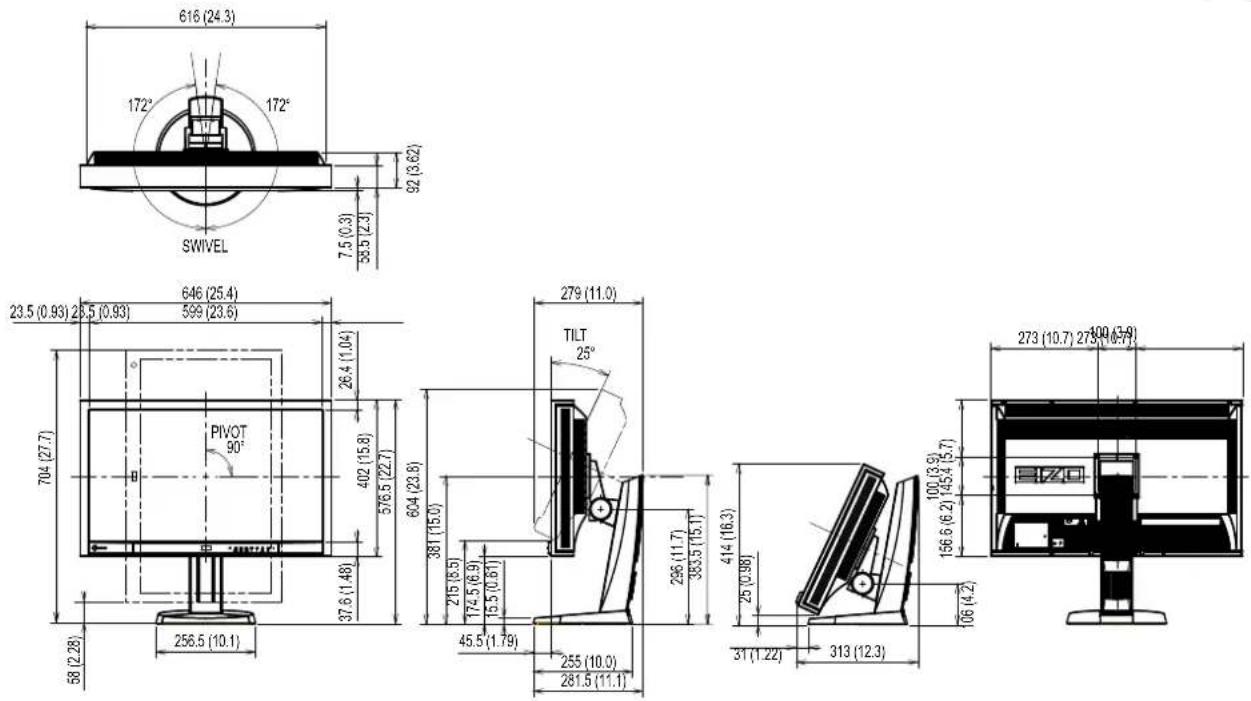
Outside Dimensions
Unit: mm (inch)
Accessories
| Signal cable | PP200 |
| Cleaning Kit | EIZO “ScreenCleaner” |
For the latest information about the accessories, refer to our web site.
http://www.eizo.com
6-6. Glossary
DDC/CI (Display Data Channel / Command Interface)
VESA provides the standardization for the interactive communication of the setting information, etc. between a PC and the monitor.
DisplayPort
DisplayPort is a next-generation digital AV interface that allows connection of the PC, audio, imaging devices, etc. to the monitor. One cable can transfer sound with images.
DVI (Digital Visual Interface)
DVI is a digital interface standard. DVI allows direct transmission of the PC's digital data without loss. This adopts the TMDS transmission system and DVI connectors. There are two types of DVI connectors. One is a DVI-D connector for digital signal input only. The other is a DVI-I connector for both digital and analog signal inputs.
DVI DMPM (DVI Digital Monitor Power Management)
DVI DMPM is a digital interface power saving function. The “Monitor ON (operating mode)” and “Active Off (power saving mode)” are indispensable for DVI DMPM as the monitor’s power mode.
Gain
This is used to adjust each color parameter for red, green and blue. An LCD monitor displays the color by the light passing through the panel color filter. Red, green and blue are the three primary colors. All the colors on the screen are displayed by combining these three colors. The color tone can be changed by adjusting the light intensity (volume) passing through each color's filter.
Gamma
Generally, the monitor brightness varies nonlinearly with the input signal level, which is called “Gamma Characteristic”. A small gamma value produces a low-contrast image, while a large gamma value produces a high-contrast image.
HDCP (High-bandwidth Digital Content Protection)
Digital signal coding system developed to copy-protect the digital contents, such as video, music, etc. This helps to transmit the digital contents safely by coding the digital contents sent via the DVI or HDMI connector on the output side and decoding them on the input side.
Any digital contents cannot be reproduced if both of the equipments on the output and input sides are not applicable to HDCP system.
Overdrive
This technology enhances response speed by increasing the potential difference at the time of motion of liquid-crystal pixels, and it is used for liquid-crystal TV sets and others in general. It provides clear-cut three-dimensional display with little afterimage, by improving response speed of the intermediate graduation range that frequently appears in moving images.
Resolution
The LCD panel consists of numerous pixels of specified size, which are illuminated to form images. This monitor consists of horizontal 2560 pixels and 1440 vertical pixels. At a resolution of 2560 x 1440, all pixels are illuminated as a full screen (1:1).
sRGB (Standard RGB)
International standard for color reproduction and color space among peripheral devices (such as monitors, printers, digital cameras, scanners). As a form of simple color matching for the Internet, colors can be displayed using tones close to those of the transmission and reception devices.
Temperature
Color temperature is a method to measure the white color tone, generally indicated in degrees Kelvin. The screen becomes reddish at a low temperature, and bluish at a high temperature, like the flame temperature.
5000 K: Slightly reddish white
6500 K: White referred to as daylight-balanced color
9300 K: Slightly bluish white
TMDS (Transition Minimized Differential Signaling)
A signal transmission system for digital interface.
Appendix
Trademark
VESA is a registered trademark or a trademark of the Video Electronics Standards Association in the United States and other countries.
Windows, Windows Vista, Windows Media, SQL Server, and Xbox 360 are registered trademarks of Microsoft Corporation in the United States and other countries.
Apple, Mac, Macintosh, iMac, eMac, Mac OS, MacBook, PowerBook, ColorSync, QuickTime, and iBook are registered trademarks of Apple Inc.
Acrobat, Adobe, Adobe AIR, and Photoshop are registered trademarks of Adobe Systems Incorporated in the United States and other countries.
PowerPC is a registered trademark of International Business Machines Corporation.
Pentium is a registered trademark of Intel Corporation in the United States and other countries.
AMD Athlon and AMD Opteron are trademarks of Advanced Micro Devices, Inc.
GRACoL and IDEAlliance are registered trademarks of International Digital Enterprise Alliance.
ColorVision, ColorVision Spyder2 are registered trademarks of DataColor Holding AG.
Spyder3 is a trademark of DataColor Holding AG.
Eye-One, ColorMunki, and X-Rite are registered trademarks or trademarks of X-Rite Incorporated.
TouchWare is a trademark of 3M Touch Systems, Inc.
NextWindow is a registered trademark of NextWindow Ltd.
RealPlayer is a registered trademark of RealNetworks, Inc.
NEC is a registered trademark of NEC Corporation. PC-9801 and PC-9821 are trademarks of NEC Corporation.
PlayStation is a registered trademark of Sony Computer Entertainment Inc.
PSP and PS3 are trademarks of Sony Computer Entertainment Inc.
ENERGY STAR is a registered trademark of the United States Environmental Protection Agency in the United States and other countries.
HDMI, the HDMI logo, and High-Definition Multimedia Interface are trademarks or registered trademarks of HDMI Licensing, LLC in the United States and other countries.
EIZO, the EIZO Logo, ColorEdge, DuraVision, FlexScan, FORIS, RadiForce, RadiCS, RadiNET, Raptor, and ScreenManager are registered trademarks of EIZO NANAO CORPORATION in Japan and other countries.
ColorNavigator, EIZO EasyPIX, EcoView NET, EIZO ScreenSlicer, i • Sound, Screen Administrator, and UniColor Pro are trademarks of EIZO NANAO CORPORATION.
All other company and product names are trademarks or registered trademarks of their respective owners.
License
A round gothic bold bit map font designed by Ricoh is used for the characters displayed on this product.

Congratulations!
The display you have just purchased carries the TCO'03 Displays label. This means that your display is designed, manufactured and tested according to some of the strictest quality and environmental requirements in the world. This makes for a high performance product, designed with the user in focus that also minimizes the Impact on our natural environment.
Some of the features of the TCO'03 Display requirements:
Ergonomics
- Good visual ergonomics and image quality in order to improve the working environment for the user and to reduce sight and strain problems. Important parameters are luminance, contrast, resolution, reflectance, colour rendition and image stability.
Energy
● Energy-saving mode after a certain time - beneficial both for the user and environment
- Electrical safety
Emissions
- Electromagnetic fields
- Noise emissions
Ecology
- The products must be prepared for recycling and the manufacturer must have a certified environmental management system such as EMAS or ISO 14000
- Restrictions on
• chlorinated and brominated flame retardants and polymers
- heavy metals such as cadmium, mercury and lead.
The requirements includes in this label have been developed by TCO Development in co-operation with scientists, experts, users as well as manufacturers all over the world. Since the end of the 1980s TCO has been involved in influencing the development of IT equipment in a more user-friendly direction. Our labeling system with displays in 1992 and is now requested by users and IT-manufacturers all over the world.
For more information, please visit www.tcodevelopment.com
For U.S.A., Canada, etc. (rated 100-120 Vac) Only
FCC Declaration of Conformity
| We, the Responsible Party | EIZO NANAO TECHNOLOGIES INC. |
| 5710 Warland Drive, Cypress, CA 90630 | |
| Phone: (562) 431-5011 | |
| declare that the product | Trade name: EIZO |
| Model: FlexScan SX2762W |
is in conformity with Part 15 of the FCC Rules. Operation of this product is subject to the following two conditions: (1) this device may not cause harmful interference, and (2) this device must accept any interference received, including interference that may cause undesired operation.
This equipment has been tested and found to comply with the limits for a Class B digital device, pursuant to Part 15 of the FCC Rules. These limits are designed to provide reasonable protection against harmful interference in a residential installation. This equipment generates, uses, and can radiate radio frequency energy and, if not installed and used in accordance with the instructions, may cause harmful interference to radio communications. However, there is no guarantee that interference will not occur in a particular installation. If this equipment does cause harmful interference to radio or television reception, which can be determined by turning the equipment off and on, the user is encouraged to try to correct the interference by one or more of the following measures.
* Reorient or relocate the receiving antenna.
* Increase the separation between the equipment and receiver.
* Connect the equipment into an outlet on a circuit different from that to which the receiver is connected.
* Consult the dealer or an experienced radio/TV technician for help.
Changes or modifications not expressly approved by the party responsible for compliance could void the user's authority to operate the equipment.
Note
Use the attached specified cable below or EIZO signal cable with this monitor so as to keep interference within the limits of a Class B digital device.
- AC Cord
- Shielded Signal Cable (Enclosed)
Canadian Notice
This Class B digital apparatus complies with Canadian ICES-003.
EIZO NANAO CORPORATION (hereinafter referred to as "EIZO") and distributors authorized by EIZO (hereinafter referred to as the "Distributors") warrant, subject to and in accordance with the terms of this limited warranty (hereinafter referred to as the "Warranty"), to the original purchaser (hereinafter referred to as the "Original Purchaser") who purchased the product specified in this document (hereinafter referred to as the "Product") from EIZO or Distributors, that EIZO and Distributors shall, at their sole discretion, either repair or replace the Product at no charge if the Original Purchaser becomes aware within the Warranty Period (defined below) that the Product malfunctions or is damaged in the course of normal use of the Product in accordance with the description in the instruction manual attached to the Product (hereinafter referred to as the "User's Manual").
The period of this Warranty is limited to (i) five (5) years from the date of purchase of the Product; or, limited to the expiration of (ii) 30,000 hours of its use of the Product (hereinafter referred to as the "Warranty Period"); provided, however, that the Warranty Period for the LCD panel of the Product is limited to three (3) years from the date of purchase of the Product. EIZO and Distributors shall bear no liability or obligation with regard to the Product in relation to the Original Purchaser or any third parties other than as provided under this Warranty.
EIZO and Distributors will cease to hold or store any parts of the Product upon expiration of seven (7) years after the production of such parts is discontinued. In repairing the monitor, EIZO and Distributors will use renewal parts which comply with our QC standards.
The Warranty is valid only in the countries or territories where the Distributors are located. The Warranty does not restrict any legal rights of the Original Purchaser.
Notwithstanding any other provision of this Warranty, EIZO and Distributors shall have no obligation under this Warranty whatsoever in any of the cases as set forth below:
(a) Any defect of the Product caused by freight damage, modification, alteration, abuse, misuse, accident, incorrect installation, disaster, faulty maintenance and/or improper repair by third party other than EIZO and Distributors;
(b) Any incompatibility of the Product due to possible technical innovations and/or regulations;
(c) Any deterioration of the sensor;
(d) Any deterioration of display performance caused by the deterioration of expendable parts such as the LCD panel and/or backlight, etc. (e.g. changes in brightness, changes in brightness uniformity, changes in color, changes in color uniformity, defects in pixels including burnt pixels, etc.);
(e) Any defect of the Product caused by external equipment;
(f) Any defect of the Product on which the original serial number has been altered or removed;
(g) Any normal deterioration of the product, particularly that of consumables, accessories, and/or attachments (e.g. buttons, rotating parts, cables, User's Manual, etc.); and
(h) Any deformation, discoloration, and/or warp of the exterior of the product including that of the surface of the LCD panel.
To obtain service under the Warranty, the Original Purchaser must deliver the Product, freight prepaid, in its original package or other adequate package affording an equal degree of protection, assuming the risk of damage and/or loss in transit, to the local Distributor. The Original Purchaser must present proof of purchase of the Product and the date of such purchase when requesting services under the Warranty.
The Warranty Period for any replaced and/or repaired product under this Warranty shall expire at the end of the original Warranty Period.
EIZO OR DISTRIBUTORS ARE NOT RESPONSIBLE FOR ANY DAMAGE TO, OR LOSS OF, DATA OR OTHER INFORMATION STORED IN ANY MEDIA OR ANY PART OF ANY PRODUCT RETURNED TO EIZO OR DISTRIBUTORS FOR REPAIR.
EIZO AND DISTRIBUTORS MAKE NO FURTHER WARRANTIES, EXPRESSED OR IMPLIED, WITH RESPECT TO THE PRODUCT AND ITS QUALITY, PERFORMANCE, MERCHANTABILITY OR FITNESS FOR ANY PARTICULAR USE. IN NO EVENT SHALL EIZO OR DISTRIBUTORS BE LIABLE FOR ANY INCIDENTAL, INDIRECT, SPECIAL, CONSEQUENTIAL OR OTHER DAMAGE WHATSOEVER (INCLUDING, WITHOUT LIMITATION, DAMAGES FOR LOSS OF PROFIT, BUSINESS INTERRUPTION, LOSS OF BUSINESS INFORMATION, OR ANY OTHER PECUNIARY LOSS) ARISING OUT OF THE USE OR INABILITY TO USE THE PRODUCT OR IN ANY CONNECTION WITH THE PRODUCT, WHETHER BASED ON CONTRACT, TORT, NEGLIGENCE, STRICT LIABILITY OR OTHERWISE, EVEN IF EIZO OR DISTRIBUTORS HAVE BEEN ADVISED OF THE POSSIBILITY OF SUCH DAMAGES. THIS EXCLUSION ALSO INCLUDES ANY LIABILITY WHICH MAY ARISE OUT OF THIRD PARTY CLAIMS AGAINST THE ORIGINAL PURCHASER. THE ESSENCE OF THIS PROVISION IS TO LIMIT THE POTENTIAL LIABILITY OF EIZO AND DISTRIBUTORS ARISING OUT OF THIS LIMITED WARRANTY AND/OR SALES.
BEGRENZTE GARANTIE
China Measures for RoHS Compliance in ChinaRoHS
关于电子信息产品污染控制标识

- LOCATION OF CAUTION STATEMENT
- NOTICE FOR THIS MONITOR
- CLEANING
- ATTENTION
- NOTE
- TO USE THE MONITOR COMFORTABLY
- CONTENTS
- 1-1. FEATURES
- 1-2. CONTROLS AND FUNCTIONS
- 1-3. EIZO LCD UTILITY DISK
- ● DISK CONTENTS AND SOFTWARE OVERVIEW
- ● TO USE “SCREENMANAGER PRO FOR LCD/EIZO SCREENSLICER
- 1-4. BASIC OPERATIONS AND FUNCTIONS
- ● BASIC ADJUSTMENT MENU OPERATIONS
- DISPLAYING ADJUSTMENT MENU
- ADJUSTING/SETTING
- EXITING
- ● SHOWING BUTTON GUIDE
- ● FUNCTIONS
- CHAPTER 2 ADJUSTING SCREENS
- 2-1. COMPATIBLE RESOLUTIONS
- 2-2. SETTING THE RESOLUTION
- ● WINDOWS 7
- ● WINDOWS VISTA
- ● WINDOWS XP
- ● MAC OS X
- 2-3. ADJUSTING COLOR
- ● TO SELECT THE DISPLAY MODE (FINECONSTRAINT MODE)
- PROCEDURE
- ● TO PERFORM ADVANCED ADJUSTMENTS
- ● ADJUSTABLE SETTINGS IN EACH MODE
- ● TO ADJUST BRIGHTNESS "BRIGHTNESS
- ADJUSTABLE RANGE
- ● TO ADJUST CONTRAST "CONTRAST
- ● TO ADJUST COLOR TEMPERATURE “TEMPERATURE
- ● TO ADJUST GAMMA "GAMMA
- ● TO ADJUST HUE "HUE
- ● TO ADJUST COLOR SATURATION “SATURATION
- ● TO ENABLE/DISABLE CONTRAST ENHANCER “CONTRAST ENHANCER
- ● TO ENHANCE OUTLINE OF IMAGE "OUTLINE ENHANCER
- ● TO ADJUST GAIN "GAIN
- ● TO ADJUST SIX COLORS "6 COLORS
- 2-4. SELECTING SCREEN SIZE
- ● TO CHANGE SCREEN SIZE "SCREEN SIZE
- 2-5. CONFIGURING MOVING IMAGE PERFORMANCE "OVERDRIVE
- 2-6. ENABLING/DISABLING AUTO SHARPNESS “AUTO SHARPNESS
- CHAPTER 3 SETTING MONITOR
- 3-1. ENABLING/DISABLING MODE SELECTION "MODE PRESET
- 3-2. SETTING LANGUAGE "LANGUAGE
- SELECTABLE LANGUAGES
- 3-3. SETTING ORIENTATION "ORIENTATION
- 3-4. CHANGING ADJUSTMENT MENU DISPLAY POSITION “MENU POSITION
- 3-5. SETTING THE EIZO LOGO DISPLAY "LOGO
- 3-6. LOCKING BUTTONS "KEY LOCK
- 3-7. ENABLING/DISABLING DDC/CI COMMUNICATION
- 3-8. SETTING THE INPUT SIGNALS "SIGNAL SELECTION
- ● TO CONNECT DVI (SINGLE LINK)
- ● TO CONNECT DVI (DUAL LINK)
- ● TO CONNECT DVI (SIMPLE DISPLAY OF HDMI SIGNAL FROM DIGITAL CAMERA)
- ● TO CONNECT DISPLAYPORT / MINI DISPLAYPORT
- 3-9. TO DISABLE INPUT SIGNAL "INPUT SKIP
- 3-10. RETURN TO DEFAULT SETTING
- ● TO RESET THE COLOR ADJUSTMENT VALUE "COLOR RESET
- TO RESET ALL ADJUSTMENTS TO THE DEFAULT SETTINGS "ALL RESET
- CHAPTER 4 POWER SAVING FUNCTIONS
- 4-1. SETTING POWER SAVING "POWER SAVE
- POWER SAVING SYSTEM
- AT DVI SIGNAL INPUT
- AT DISPLAYPORT / MINI DISPLAYPORT SIGNAL INPUT
- 4-2. SETTING THE POWER SAVING MODE WHEN A PERSON LEAVES THE MONITOR “ECOVIEW SENSE
- 4-3. ENABLING/DISABLING AUTOMATIC BRIGHTNESS ADJUSTMENT "AUTO ECOVIEW
- 4-4. SETTING POWER INDICATOR "POWER INDICATOR
- 4-5. SETTING THE AUTOMATIC POWER OFF FUNCTION “ECO TIMER
- 4-6. DISPLAYING THE POWER SAVING RATIO “ECOVIEW INDEX
- CHAPTER 5 TROUBLESHOOTING
- 5-1. NO PICTURE
- PROBLEM POSSIBLE CAUSE AND REMEDY
- 5-2. IMAGING PROBLEMS
- 5-3. OTHER PROBLEMS
- CHAPTER 6 REFERENCE
- 6-1. HOW TO ATTACH THE OPTIONAL ARM
- 6-2. CONNECTING MULTIPLE PCS
- ● TO SWITCH AMONG INPUT SIGNALS
- ● TO SET INPUT SIGNAL SELECTION "INPUT SELECTION
- 6-3. MAKING USE OF USB (UNIVERSAL SERIAL BUS)
- ● REQUIRED SYSTEM ENVIRONMENT
- ● CONNECTION PROCEDURE (SETUP OF USB FUNCTION)
- 6-4. DISPLAYING MONITOR INFORMATION
- ● DISPLAYING SIGNAL INFORMATION "SIGNAL INFO
- DISPLAYING MONITOR INFORMATION "MONITOR INFO
- 6-5. SPECIFICATIONS
- MAIN DEFAULT SETTINGS
- OUTSIDE DIMENSIONS
- ACCESSORIES
- 6-6. GLOSSARY
- DDC/CI (DISPLAY DATA CHANNEL / COMMAND INTERFACE)
- DISPLAYPORT
- DVI (DIGITAL VISUAL INTERFACE)
- DVI DMPM (DVI DIGITAL MONITOR POWER MANAGEMENT)
- GAIN
- GAMMA
- HDCP (HIGH-BANDWIDTH DIGITAL CONTENT PROTECTION)
- OVERDRIVE
- RESOLUTION
- SRGB (STANDARD RGB)
- TEMPERATURE
- TMDS (TRANSITION MINIMIZED DIFFERENTIAL SIGNALING)
- APPENDIX
- TRADEMARK
- LICENSE
- CONGRATULATIONS
- ERGONOMICS
- ENERGY
- EMISSIONS
- ECOLOGY
- CANADIAN NOTICE
- BEGRENZTE GARANTIE
- CHINA MEASURES FOR ROHS COMPLIANCE IN CHINAROHS
- 关于电子信息产品污染控制标识
Brand : EIZO
Model : SX2762WH-BK
Category : Monitor