
50-112 - Sewing machine RIKON - Free user manual and instructions
Find the device manual for free 50-112 RIKON in PDF.


| Product Type | Belt and Disc Sander |
| Model Number | 50-112 |
| Motor Power | 1/2 HP |
| Amperage | 4.3 A |
| Voltage | 120V, 60 Hz |
| Belt Size | 4 x 36 inches |
| Belt Speed | 1,900 SFPM |
| Belt Tilt | 0° to 90° |
| Disc Diameter | 6 inches (PSA) |
| Disc Speed | 3,450 RPM |
| Table Size | 9 x 6-1/4 inches |
| Table Tilt | 0° to 45° |
| Miter Gauge | Included |
| Overall Dimensions (H x W x D) | 11 x 21 x 10 inches |
| Base Size | 15-1/4 x 6-5/8 inches |
| Net Weight | 38.5 lbs |
| Shipping Weight | 43 lbs |
| Warranty | 5 Years Limited |
| Grounding | Three-prong plug required; must be grounded |
| Safety Features | Removable safety switch, disc guard, dust collection port |
| Maintenance | Wax table, vacuum dust, oil bearings, replace timing belt as needed |
| Included Accessories | 6" sanding disc, miter gauge, work support, assembly hardware |
Frequently Asked Questions - 50-112 RIKON
User questions about 50-112 RIKON
0 question about this device. Answer the ones you know or ask your own.
Ask a new question about this device
Download the instructions for your Sewing machine in PDF format for free! Find your manual 50-112 - RIKON and take your electronic device back in hand. On this page are published all the documents necessary for the use of your device. 50-112 by RIKON.
USER MANUAL 50-112 RIKON
4" x 36" Belt / 6" Disc Sander

natural_image
Black RIKON industrial machine with handle and control panel (no visible text or symbols on main body)Operator's Manual
Record the serial number and date of purchase in your manual for future reference.
The serial number can be found on the specification label on your machine.
Serial Number: Date of purchase:
For technical support or parts questions, email techsupport@rikontools.com or call toll free at (877)884-5167
Operator Safety: Required Reading
IMPORTANT! Safety is the single most important consideration in the operation of this equipment. The following instructions must be followed at all times.
There are certain applications for which this tool was designed. We strongly recommend that this tool not be modified and/or used for any other application other than that for which it was designed. If you have any questions about its application, do not use the tool until you have contacted us and we have advised you.
General Safety Warnings
KNOW YOUR POWER TOOL. Read the owner's manual carefully. Learn the tool's applications, work capabilities, and its specific potential hazards.
△DANGER | ALWAYS GROUND ALL TOOLS.If your tool is equipped with a three-pronged plug, you must plug it into a three-hole electric receptacle.If you use an adapter to accommodate a two-pronged receptacle, you must attach the adapter plug to a known ground. Never remove the third prong of the plug.ALWAYS AVOID DANGEROUS ENVIRONMENTS.Never use power tools in damp or wet locations. Keep your work area well lighted and clear of clutter. |
△DANGER | ALWAYS REMOVE THE ADJUSTING KEYS AND WRENCHES FROM TOOLS AFTER USE.Form the habit of checking to see that keys and adjusting wrenches are removed from the tool before turning it on.ALWAYS KEEP YOUR WORK AREA CLEAN. Cluttered areas and benches invite accidents. |
△DANGER | ALWAYS KEEP VISITORS AWAY FROM RUNNING MACHINES.All visitors should be kept a safe distance from the work area.ALWAYS MAKE THE WORKSHOP CHILDPROOF.Childproof with padlocks, master switches, or by removing starter keys. |
△DANGER | NEVER OPERATE A TOOL WHILE UNDER THE INFLUENCE OF DRUGS,MEDICATION, OR ALCOHOL. |
△DANGER | ALWAYS WEAR PROPER APPAREL.Never wear loose clothing or jewelry that might get caught in moving parts. Rubber-soled footwear is recommended for the best footing. |
△DANGER | ALWAYS USE SAFETY GLASSES AND WEAR HEARING PROTECTION.Also use a face or dust mask if the cutting operation is dusty. |
△DANGER | NEVER OVERREACH.Keep your proper footing and balance at all times. |
△DANGER | NEVER STAND ON TOOLS.Serious injury could occur if the tool is tipped or if the cutting tool is accidentally |
DANGER

ALWAYS DISCONNECT TOOLS.
Disconnect tools before servicing and when changing accessories such as blades, bits, and cutters.
ALWAYS AVOID ACCIDENTAL STARTING.
Make sure switch is in "OFF" position before plugging in cord.
NEVER LEAVE TOOLS RUNNING UNATTENDED.
DANGER

ALWAYS CHECK FOR DAMAGED PARTS.
Before initial or continual use of the tool, a guard or other part that is damaged should be checked to assure that it will operate properly and perform its intended function. Check for alignment of moving parts, binding of moving parts, breakage of parts, mounting, and any other conditions that may affect its operation. A guard or other damaged parts should immediately be properly repaired or replaced.
Special Safety Rules For Belt & Disc Sanders
- Do not operate this machine until you have read all of the following instructions.
- Do not attempt to operate this machine until it is completely assembled.
- Do not turn ON this machine if any pieces are missing.
-
If you are not familiar with the operation of the machine, obtain assistance from a qualified person.
-
It is highly recommended that this machine be firmly mounted to a flat and secure work surface or stand.
-
Always wear protective eyewear prior to operating this machine.
-
Do not operate this machine if you are under the influence of drugs and/or alcohol.
-
Remove all jewelry prior to operating this machine.
-
Do not wear any gloves while operating this machine.
-
Always make sure the power switch is in the OFF position prior to plugging in the machine.
-
Always make sure the power switch is in the OFF position when doing any assembly or setup operation.
-
Always wear a dust mask and use adequate dust collection and proper ventilation. Use of sanders can produce harmful particles while sanding certain types of woods.
-
The use of any accessories or attachments not recommended may cause injury to you and damage your machine.
-
This machine must be properly grounded.
-
Abrasive discs and belts should be the recommended width and length of the manufacturer.
-
Always keep your face and hands clear of moving parts such as belts and pulleys.
-
Keep power supply cords free of moving parts of the sander. Damaged cords can result in electric shock.
-
Maintain a 1/16" clearance between the sanding disc, sanding belt and tables
-
Always support the workpiece with the table or backstop.
-
Remove material or debris from the work area. Keep work area neat and clean.
-
Keep these instructions for future reference.
SAVE THESE INSTRUCTIONS.
Refer to them often.
California Proposition 65 Warning
WARNING: Some dust created by power sanding, sawing, grinding, drilling, and other construction activities contains chemicals known to the State of California to cause cancer and birth defects or other reproductive harm. Your risk from exposure to these chemicals varies, depending on how often you do this type of work. To reduce your exposure, work in a well-ventilated area and with approved safety equipment, such as dust masks that are specially designed to filter out microscopic particles. For more information go to www.P65Warnings.ca.gov/wood.
Table of Contents
| Safety Warnings | 2-3 |
| Sander Safety Rules | 3 |
| Specifications | 4 |
| Unpacking | 4 |
| Assembly | 5 |
| Mounting Sanding Disc and Guard | 5 |
| Assembling the Work Support Fence | 6 |
| Table Support Assembly | 6 |
| Mounting the Table Assembly | 7 |
| Operation | 7 |
| On/Off Switch | 8 |
| Leveling the Table Assembly | 8 |
| Installing the Sanding Belt | 9 |
| Electrical Requirements | 10 |
| Wiring Diagram | 11 |
| Maintenance | 11-13 |
| Timing Belt Replacement | 13 |
| Trouble Shooting | 13 |
| Parts List/Parts Explosion | 14-15 |
| Parts Explosion | 13 |
| Notes | 14 |
| Notes/Warranty | 15-16 |
Specifications
| Model No. | 50-112 |
| Motor | |
| Horsepower | 1/2 HP |
| Amps | 4.3 |
| Volts | 120V, 60 Hz |
| Belt | |
| Size | 4" x 36" |
| Speed | 1,900 SFPM |
| Tilt | 0° - 90° |
| Disc | |
| Diameter | 6" PSA |
| Speed | 3,450 RPM |
| Table | |
| Size | 9" x 6-1/4" |
| Tilt | 0° - 45° |
| Miter Gauge | Included |
| Miter Gauge Slot | 3/8" x 5/8" |
| Overall | |
| Height | 11" |
| Width | 21" |
| Depth | 10" |
| Base Size | 15-1/4" x 6-5/8" |
| Net Weight | 38.5 lbs |
| Shipping Weight | 43 lbs. |
| Shipping Carton | 22" x 11-1/2" x 12" |
| Warranty | 5 Years |
Unpacking
When unpacking, check to make sure the following parts are included. If any parts are missing or broken, please call RIKON Power Tools at the number on the cover of this manual as soon as possible. Item # Description Qty
| ---- Sander Body 1 | |||
| 35 | Table | 1 | |
| 7 6" Sandpaper Disc 1 | |||
| 33 Table Support | 1 | ||
| 6 Guard, Disc | 1 | ||
| 60 Work Support | 1 | ||
| ---- Miter Gauge | 1 | ||
| ---- Plastic bag contains assembly hardware. | 1 | ||
Assembly
Securing Sander Base Assembly to Workbench
Belt and disc sander must be fastened securely to a firm supporting surface such as a workbench.

- Place sander in operational position on workbench.
- Place a pencil through the holes in the sander base (42) and mark drill holes in workbench.
- Remove sander and drill two 10mm (3/8") dia. holes through the workbench.
- Align sander base over holes and secure using two 5/16" screws and hex. nuts
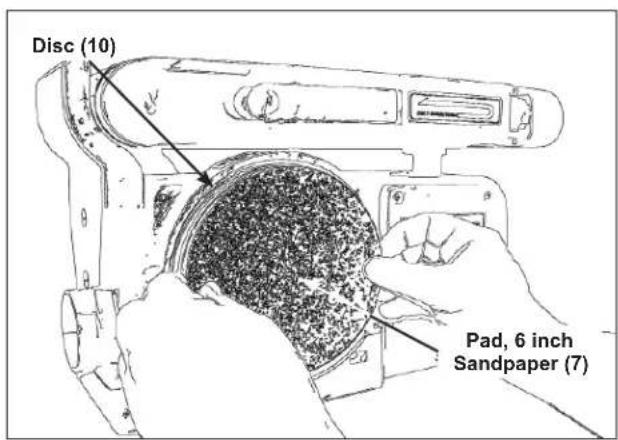
Mounting Sanding Disc and Guard
- Locate sanding disc (7) and peel backing off disc.
- Align perimeter of sanding disc over plate. When aligned, press sandpaper disc firmly onto backing disc.
- Position disc guard (6) onto lower portion of sanding disc so that the mounting holes align.
- Using a Phillips screwdriver, fasten two pan head screws (found in parts bag) over disc guard.

Assembly
Installing Work support
- Place work support (60) over sanding belt as shown in following illustration.
- Place the hex. screw (91) through the flat washer (90) and secure. Do not over tighten.

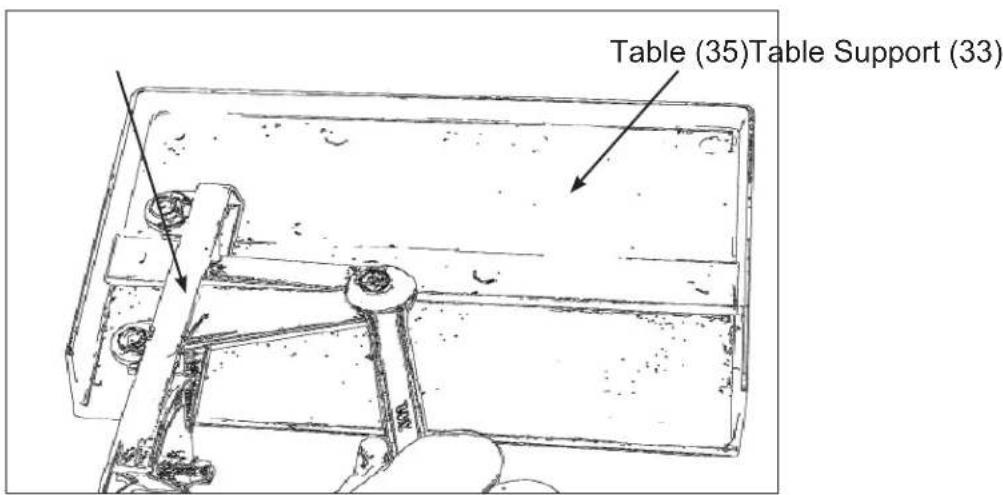
Table Support Assembly
- Locate the table support (33) and hex. screws (31) and washers (32).
- Stand table (35) on its side, aligning holes as shown in below illustration.
- Fasten table support to table. Do not over tighten screws.
Assembly
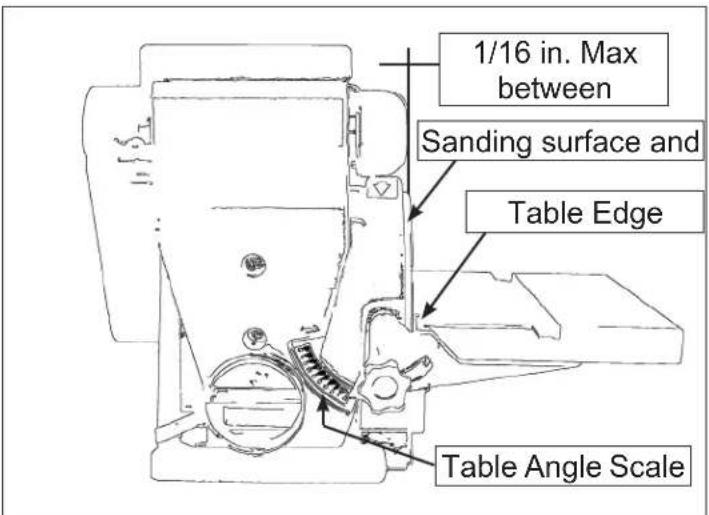
- Position table support (33) in corresponding holes on side of base as shown in below illustration.

- Place washer (32) on knob (34) shaft and insert through slot into threaded holes in base.
- Loosen the three hex. screws (31) and adjust table so that there is a maximum of 1.5mm (1/16") space between the sanding disc and the table. Tighten screws.
Operation
The rocker ON/OFF power switch is located on the front of the sander, and incorporates a removable safety switch.
- Press the side marked ON to turn the sander on.
- Press the side marked OFF to turn the sander off.
In situations where the sander may be left unattended, the operator has the option of removing the center safety portion of the ON/OFF switch to render the sander inoperable. When the operator is ready to use the machine again, the center safety portion of the switch may be reinstalled simply by inserting it into the opening in the switch and pushing it in until it “seats”.
Operation
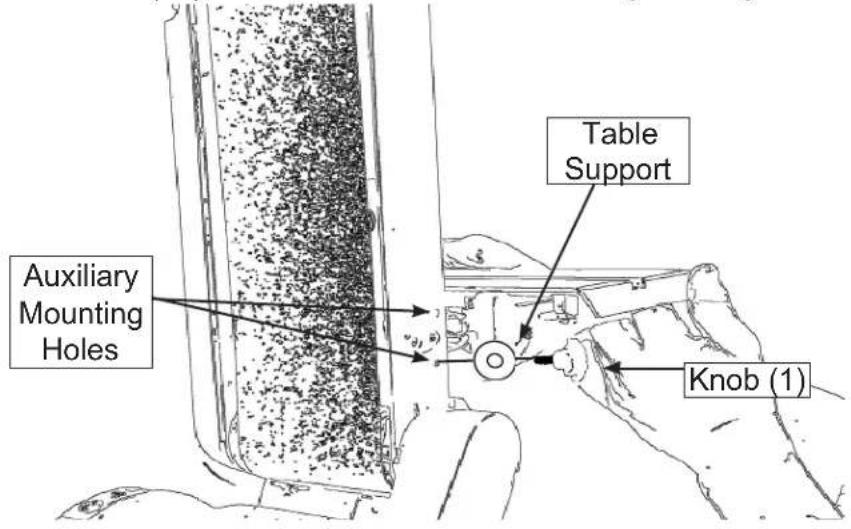
Remounting Table for Vertical Sanding
- Remove backstop lock bolt and remove work support.
- Unscrew knob (34) and remove.
- Pull table support (33) index pin out of mounting hole.
- Loosen hex socket screw (75) and raise sanding bed to the desired sanding position.
- Insert the table index pins into the auxiliary (upper) holes in the sanding bed.
- Tighten hex socket screw (75). Make sure table is not touching sanding belt.
Leveling Table Assembly
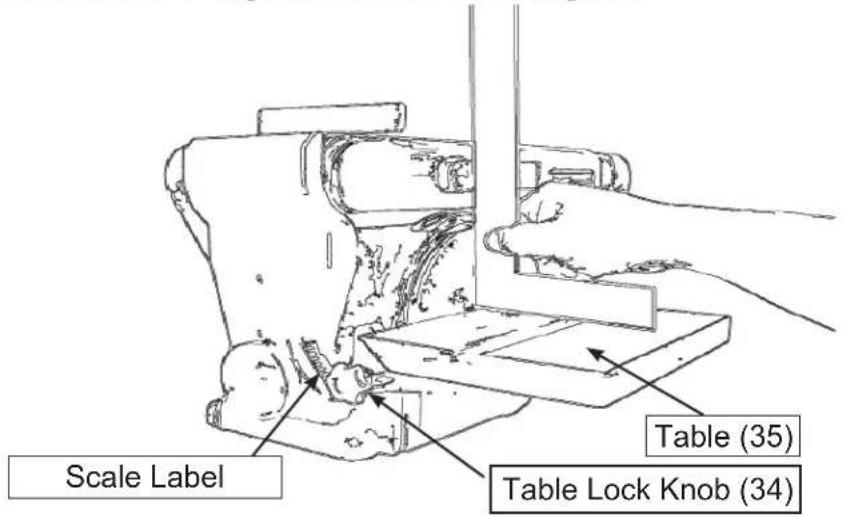
- Place a combination square on the table (35) so that it also touches the sanding pad (7). See below. If the table is 90 degrees to the pad, the square is flush on the pad.
- If the table is not 90 degrees to the with the pad, loosen the table lock knob (34) and tilt the table until the square is flush with the pad
- Retighten the knob to secure the table.
- Attach the scale label to the '0' degrees mark on the dust guard.
Operation
Installing and Adjusting the Sanding Belt
- Turn power switch to the OFF position and disconnect power cord from the main electricity supply.
- Move tension lever (66) to the right to release the sanding belt tension (10).
- Place the sanding belt over the drive and idler drums (13 and 65), making sure that the inside direction arrow points down, towards the drive drum (13) as shown in illustration..
- Centre belt on both drums.
- Slide tension lever (66) to the left to tighten belt tension.
- Tighten hex. socket screw (56) when bed (4) is in desired working position.

natural_image
Line drawing of hands assembling electronic components (no text or symbols)- Reconnect the power cord to the main electricity supply. Turn the no-volt release switch (21) ON, then OFF, while viewing the belt movement. If the belt looks like it was going to slide off either drum, the belt tracking needs to be adjusted (described in the next step).
- If the sanding belt (87) moves towards the sanding pad (7) when turned ON, turn the tracking knob (55) clockwise 14 turn, and test again.
- If the sanding belt moves away from the sanding pad when it was turned ON, turn he tracking knob counterclockwise 14 turn, and test again.
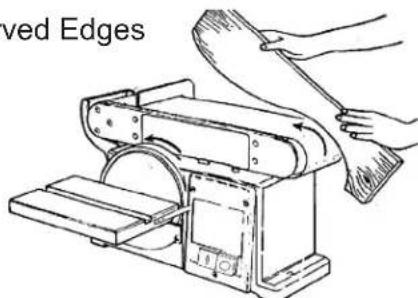
Surface Sanding on Sanding Belt End Sanding on Sanding Belt

natural_image
Line drawing of hands operating a portable electronic device with a door open (no text or symbols)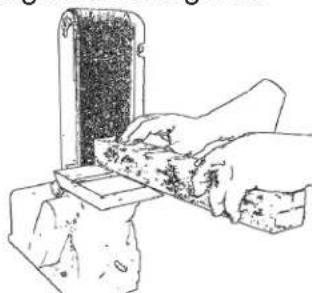
natural_image
Illustration of a hand using a smartphone to press or install a piece of contents (no text or symbols visible)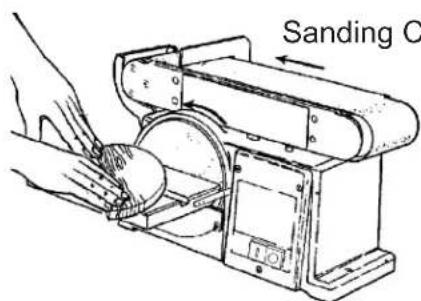
Electrical Requirements
In the event of a malfunction or breakdown, grounding provides a path of least resistance for electric current to reduce the risk of electric shock. This tool is equipped with an electric cord having an equipment-grounding conductor and a grounding plug. The plug must be plugged into a matching outlet that is properly installed and grounded in accordance with all local codes and ordinances.
Do not modify the plug provided. If it will not fit the outlet, have the proper outlet installed by a qualified electrician.
Improper connection of the equipment-grounding conductor can result in a risk of electric shock. The conductor, with insulation having an outer surface that is green with or without yellow stripes, is the equipment-grounding conductor. If repair or replacement of the electric cord or plug is necessary, do not connect the equipment-grounding conductor to a live terminal.
Check with a qualified electrician or service personnel if the grounding instructions are not completely understood, or if in doubt as to whether the tool is properly grounded.
Use only three wire extension cords that have three-prong grounding plugs and three-pole receptacles that accept the tool's plug.*
Repair or replace a damaged or worn cord immediately.
This tool is intended for use on a circuit that has an outlet that looks the one illustrated in Figure A below. The tool has a grounding plug that looks like the grounding plug as illustrated in Figure A below. A temporary adapter, which locks like the adapter as illustrated in Figure B below, may be used to connect this plug to a two-pole receptacle, as shown in Figure B if a properly grounded outlet is not available.** The temporary adapter should only be used until a properly grounded outlet can be installed by a qualified electrician. The green colored rigid ear or tab, extending from the adapter, must be connected to a permanent ground such as a properly grounded outlet box.
* Canadian electrical codes require extension cords to be certified SJT type or better.
** Use of an adapter in Canada is not acceptable.

Fig. A

Fig. B
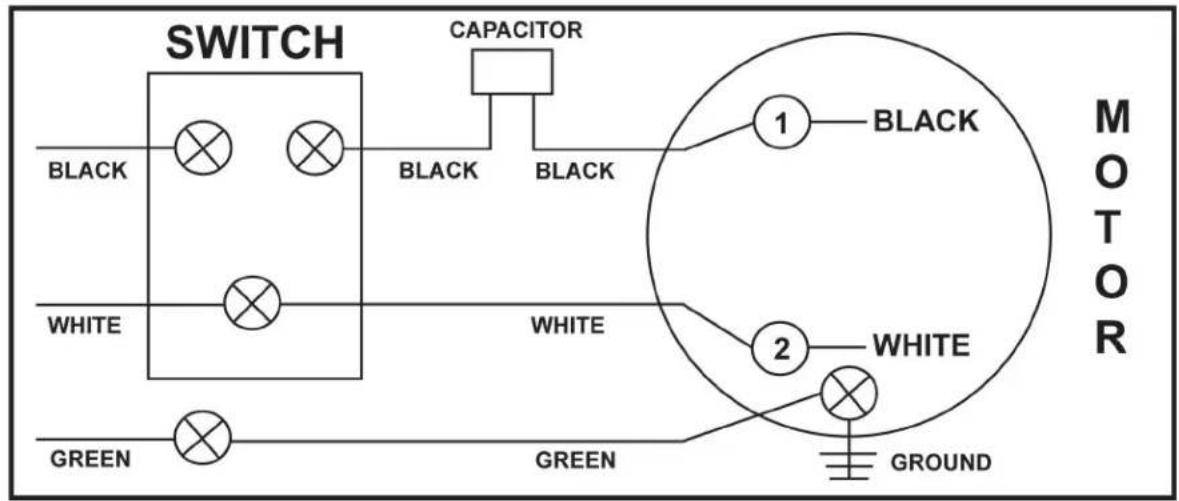
Wiring Diagram
WARNING: This machine must be grounded.
Replacement of the power supply cable should only be done by a qualified electrician.
110 VOLT
Maintenance
Use this section to record maintenance, service and any calls to Technical Support:
Maintenance
- Apply a light coat of wax paste to the worktable to make feeding stock easier.
- Use a vacuum cleaner and brush to clear out dust and debris from sander and motor.

natural_image
Technical line drawing of a mechanical device with no visible text or symbolsTiming Drive Belt Replacement
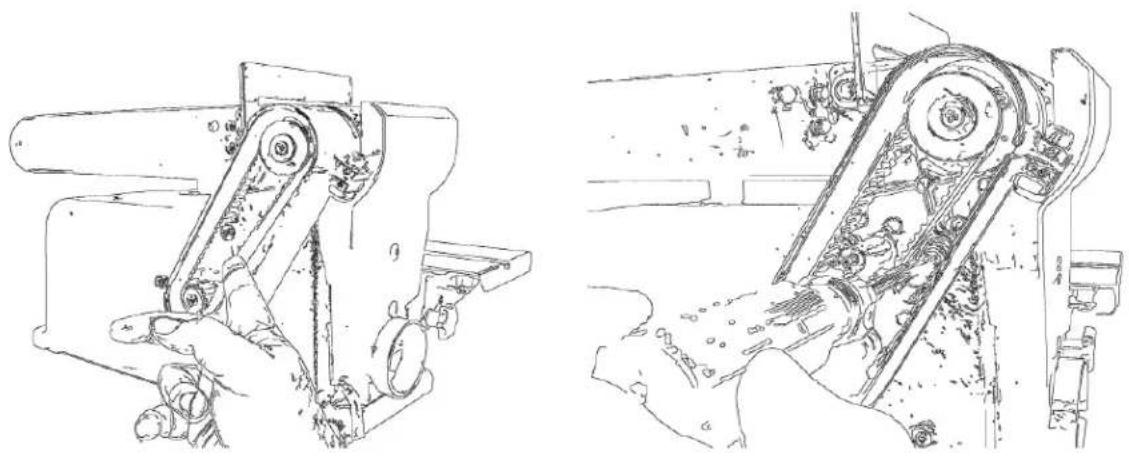
- Using a Phillips screwdriver, remove the screw (66) from belt cover (67), and remove cover.
- Loosen three screws to allow drive pulleys (71 and 78) to move enough to place drive belt (70) around them.
natural_image
Technical line drawings of mechanical components, showing hand operating a lever and wheel assembly (no text or symbols)Maintenance
- Place drive belt around drive pulley (71), then drive pulley (78).
- Tighten the three screws slightly.
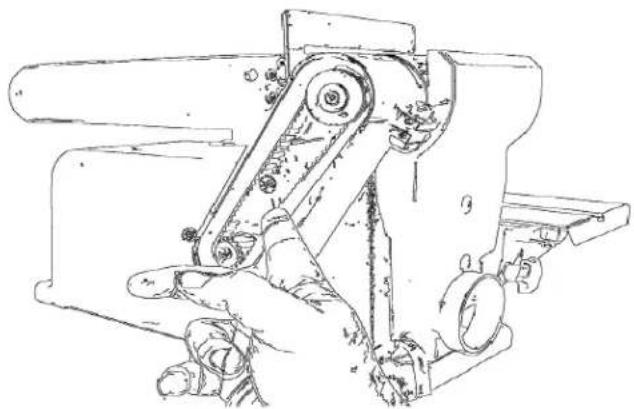
- Adjust tension of drive belt by placing a standard screwdriver in the adjusting hole by pushing up on the screwdriver to apply tension to the drive belt.
- Tighten the three screws again.
- Squeeze the drive belt between two fingers in the centre of the belt. If the belt has been correctly tensioned there should be about 6mm (1/4") of "give".
NOTE: Too much tension on the drive belt can load-down motor and possibly cause damage. If the drive belt is too loose, it may fail prematurely.
- Replace belt cover (67).
natural_image
Technical line drawing of a mechanical device with hands operating it (no text or symbols visible)Troubleshooting
| SYMPTOM PROBABLE CAUSE REMEDY | ||
| Sander does not operate | Not plugged in to power outlet.Power switch defective.Motor or wiring problem. | Plug into power outlet.Replace switch.Have qualified electrician carry out repair. |
| Motor slows when sanding | Timing belt too tightApplying too much pressure on workpiece. | Decrease tension.Apply less pressure to workpiece when sanding. |
| Wood burns while sanding | Sanding disc or belt is loaded with debris. | Clean or replace disc or belt. |
| Sander makes excessive noise | Timing belt too tight.Bearings need oil. | Decrease tensionOil bearings. |
Parts List
| Part No. | Description Part No. | Description | |
| 50-112-1 | Phillips Screw M4X6 | 50-112-46 | Idler Shaft |
| 50-112-2 | Flat Washer D4 | 50-112-47 | Phillips Screw M5X20 |
| 50-112-3 | Base Cover | 50-112-49 | Screw Bushing |
| 50-112-4 | Phillips Screw ST4.2X10 | 50-112-50 | Draw Extend Spring |
| 50-112-5 | Toothed Lock Washer D4 | 50-112-51 | Belt Tension Knob |
| 50-112-6 | Disc Cover | 50-112-52 | Big Flat Washer D5 |
| 50-112-7 | Disc Paper 80# | 50-112-53 | Hex Nut, Type I M6 |
| 50-112-8 | Hex Socet Round Head Screw M6X16 | 50-112-54 | Phillips Screw M5X16 |
| 50-112-9 | Toothed Lock Washer D6 | 50-112-55 | Adjust Knob |
| 50-112-10 | Disc | 50-112-56 | Flat Washer D6 |
| 50-112-11 | Wheel Box | 50-112-57 | Rubber Washer |
| 50-112-12 | Phillips Screw M5X8 | 50-112-58 | Adjust Spring |
| 50-112-13 | Spring Washer D5 | 50-112-59 | Belt Support |
| 50-112-14 | Flat Washer D5 | 50-112-60 | Work Rest |
| 50-112-15 | Toothed Lock Washer D5 | 50-112-61 | Driving Pulley |
| 50-112-17 | Base | 50-112-62 | Hex Flat Lock Washer M8X12 |
| 50-112-18 | Phillips Screw ST4.2X20 | 50-112-63 | Driving Pulley |
| 50-112-19 | Wire Connection Box Cover | 50-112-64 | Bearing Cap |
| 50-112-20 | Phillips Screw ST2.9X28 | 50-112-65 | Support Cover |
| 50-112-21 | Relay | 50-112-66 | Phillips Screw M5X10 |
| 50-112-22 | Wire Connection Box | 50-112-67 | Cog Belt Guard Cover |
| 50-112-23 | Phillips Screw M5X10 | 50-112-68 | Phillips Screw M5X16I |
| 50-112-24 | Electromagnetism Power Switch | 50-112-69 | Special Locked Washer |
| 50-112-25 | Phillips Screw M6X8 | 50-112-70 | Cog Belt |
| 50-112-26 | Spring Washer D6 | 50-112-71 | Driven Pulley |
| 50-112-27 | Hex Nut, Type I M5 | 50-112-72 | Phillips Screw M5X25 |
| 50-112-28 | Capacitor | 50-112-73 | Bearing Base |
| 50-112-29 | Capacitor Support | 50-112-74 | Phillips Screw M6X25 |
| 50-112-30 | Phillips Screw M5X12 | 50-112-75 | Hex Socket Round Head Screw M8X25 |
| 50-112-31 | Hex Bolt M6X12 | 50-112-76 | Cog Belt Guard Cover |
| 50-112-32 | Big Flat Washer D6 | 50-112-77 | Square Nut |
| 50-112-33 | Work Table Support Angle Plate | 50-112-78 | Driving Pulley |
| 50-112-34 | Miter Gauge Knob | 50-112-79 | Phillips Screw M4X6 |
| 50-112-35 | Work Table | 50-112-81 | Motor Assy |
| 50-112-36 | Miter Gauge Bar | 50-112-82 | Cord & Plug |
| 50-112-37 | Point of Miter Gauge | 50-112-83 | Dust Collect |
| 50-112-38 | Miter Gauge of Work Table | 50-112-85 | Support Cushion |
| 50-112-39 | Pulley Guard Plate | 50-112-86 | Belt Frame Support |
| 50-112-40 | Tension Spring | 50-112-87 | Belt #80 |
| 50-112-41 | Bushing | 50-112-88 | Switch Protect Cover |
| 50-112-42 | Belt Tension Support | 50-112-89 | Phillips Screw |
| 50-112-43 | Spring Retaining Ring for Shaft D12 | 50-112-90 | Flat Washer D8 |
| 50-112-44 | Bearing 101Z | 50-112-91 | Hex Socket Round Head Screw M8X16 |
| 50-112-45 | Idler Drum |
Parts Explosion

Notes
Use this section to record maintenance, service and any calls to Technical Support:
RIKON
POWER TOOLS®
5-Year Limited Warranty
RIKON Power Tools Inc. ("Seller") warrants to only the original retail consumer/purchaser of our products that each product be free from defects in materials and workmanship for a period of five (5) years from the date the product was purchased at retail. This warranty may not be transferred.
This warranty does not apply to defects due directly or indirectly to misuse, abuse, negligence, accidents, repairs, alterations, lack of maintenance or normal wear and tear. Under no circumstances will Seller be liable for incidental or consequential damages resulting from defective products. All other warranties, expressed or implied, whether of merchantability, fitness for purpose, or otherwise are expressly disclaimed by Seller. This five-year warranty does not cover products used for commercial, industrial or educational purposes. The warranty term for these claims will be limited to a two-year period.
This limited warranty does not apply to accessory items such as blades, drill bits, sanding discs, grinding wheels, belts, guide bearings and other related items.
Seller shall in no event be liable for death, injuries to persons or property, or for incidental, contingent, special, or consequential damages arising from the use of our products.
To take advantage of this warranty, proof of purchase documentation must be provided which has the date of purchase and an explanation of the complaint.
The Seller reserves the right to effect at any time, without prior notice, those alterations to parts, fittings, and accessory equipment which they may deem necessary for any reason whatsoever.
To register your machine online, visit RIKON at www.rikontools.com/warranty
To take advantage of this warranty, or if you have any questions, please contact us at 877-884-5167 or email warranty@rikontools.com

For more information:
16 Progress Road
Billerica, MA 01821
877-884-5167 / 978-528-5380
techsupport@rikontools.com
- 4" x 36" Belt / 6" Disc Sander
- Operator's Manual
- Operator Safety: Required Reading
- General Safety Warnings
- DANGER
- ALWAYS DISCONNECT TOOLS.
- ALWAYS AVOID ACCIDENTAL STARTING.
- ALWAYS CHECK FOR DAMAGED PARTS.
- Special Safety Rules For Belt & Disc Sanders
- SAVE THESE INSTRUCTIONS.
- Refer to them often.
- California Proposition 65 Warning
- Assembly
- Securing Sander Base Assembly to Workbench
- Mounting Sanding Disc and Guard
- Installing Work support
- Table Support Assembly
- Operation
- Remounting Table for Vertical Sanding
- Leveling Table Assembly
- Installing and Adjusting the Sanding Belt
- Electrical Requirements
- Wiring Diagram
- Maintenance
- Timing Drive Belt Replacement
- Parts List
- Notes
- RIKON
- POWER TOOLS®
- 5-Year Limited Warranty
Brand : RIKON
Model : 50-112
Category : Sewing machine