PT12X-USB - Camera PTZ Optics - Free user manual and instructions
Find the device manual for free PT12X-USB PTZ Optics in PDF.


User questions about PT12X-USB PTZ Optics
0 question about this device. Answer the ones you know or ask your own.
Ask a new question about this device
Download the instructions for your Camera in PDF format for free! Find your manual PT12X-USB - PTZ Optics and take your electronic device back in hand. On this page are published all the documents necessary for the use of your device. PT12X-USB by PTZ Optics.
USER MANUAL PT12X-USB PTZ Optics
PTZOptics 12X USB (GEN-2)
natural_image
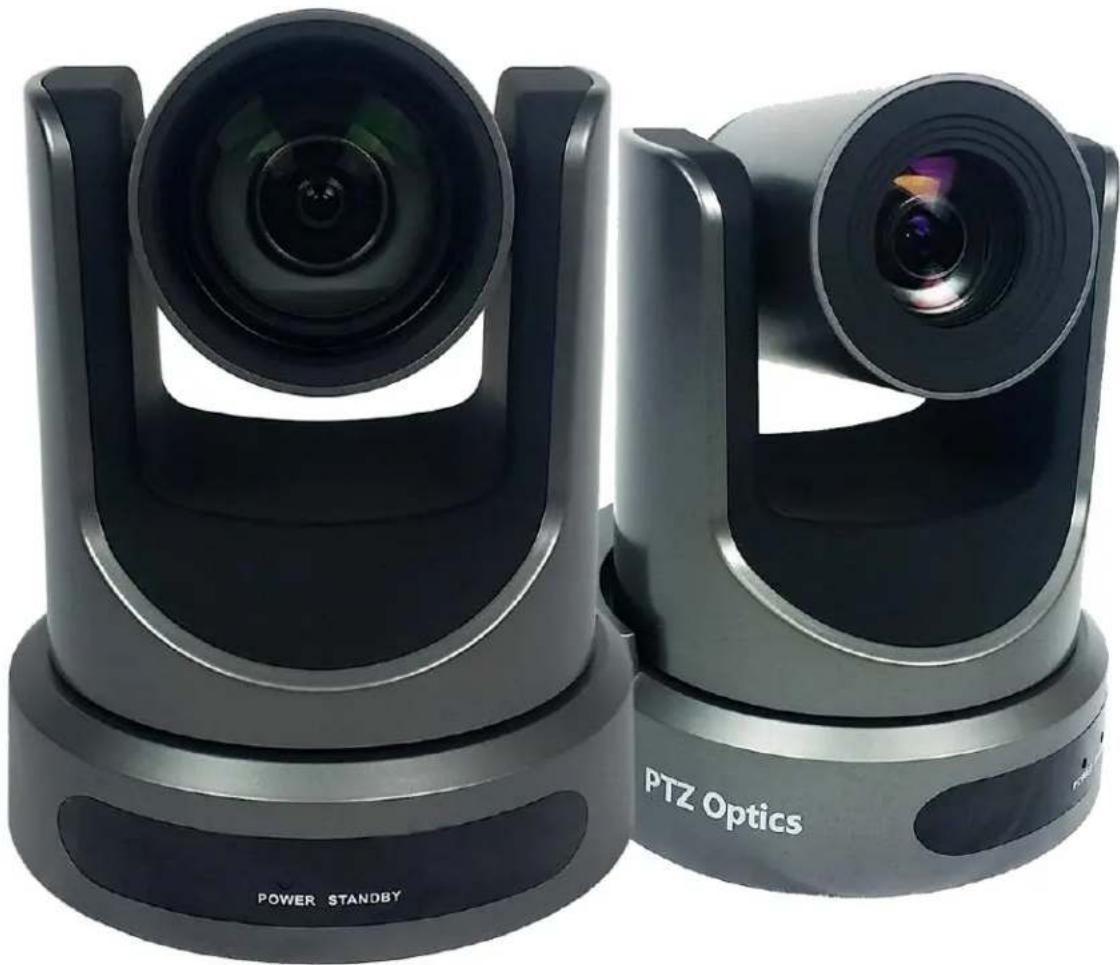
Two PTZ Optics video camera units with lens and control buttons, no visible text or symbols on the devices themselves.User Manual
Model Nos: PT12X-USB-GY-G2 & PT12X-USB-WH-G2
V1.4
(English)
Please check PTZOPTICS.com for the most up to date version of this document
Rev 1.4 7/19
Preface
Thank you for using the USB 3.0 HD Video Conferencing Camera. This manual introduces the function, installation and operation of the HD camera. Prior to installation and usage, please read the manual thoroughly.
Note: Minimum USB 3.0 System Requirements: i3 Quad-Core
(Recommended: i5 Quad Core or better)
Precautions
This product can only be used in the specified conditions in order to avoid any damage to the camera:
- Don't subject the camera to rain or moisture.
- Don't remove the cover. Removal of the cover may result in an electric shock in addition to voiding the warranty. In case of abnormal operation, contact the manufacturer.
- Never operate outside of the specified operating temperature range, humidity, or with any other power supply than the one originally provided with the camera.
- Please use a soft dry cloth to clean the camera. If the camera is very dirty, clean it with diluted neutral detergent; do not use any type of solvents, which may damage the surface.
Note
This is an FCC Class A Digital device. As such, unintentional electromagnetic radiation may affect the image quality of TV in a home environment.
Table of Contents
1 Supplied Accessories 1
2 Notes 1
3 Quick Start 2
4 Features 4
5 Product Specifications 5
6 Main Unit 7
7 IR Remote Controller 8
8 Using the IR Remote Controller 10
9 Dimensional Drawings 13
10 RS-232 Interface 14
11 VISCA Commands 16
12 VISCA over IP Commands 25
13 Menu Setting 32
14 Network Connection 36
15 Photobooth Functionality 53
16 Maintenance and Troubleshooting 55
Supplied Accessories
When you unpack your camera, check that all the supplied accessories are included:
- Camera .... 1
- AC Power Adaptor .... 1
● Power Cord .... 1 - USB 3.0 AB Cable .... 1
● RS232 Cable .... 1 - IR Remote Controller ...... 1
● This User Manual .... 1
Notes
- Electrical Safety
Installation and operation must be in accordance with national and local electric safety standards. Do not use any power supply other than the one originally supplied with this camera.
● Polarity of power supply
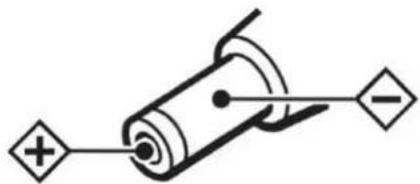
The power supply output for this product is 12VDC with a maximum current supply of 2A. Polarity of the power supply plug is critical and is as follows.
natural_image
Pure electrical circuit lines without any symbols● Handling
■ Avoid any stress, vibration, or moisture during transportation, storage, installation and operation.
■ Do not lift or move the camera by grasping the camera head. Do not turn the camera head by hand. Doing so may result in mechanical damage.
■ Do not expose camera to any corrosive solid, liquid, or gas to avoid damage to the cover which is made of a plastic material.
■ Ensure that there are no obstacles in the tilt or pan ranges of the camera lens.
■ Never power camera on before installation is complete.
- Do not dismantle the camera - The manufacturer is not responsible for any unauthorized modification or dismantling.
Quick Start
Step 1. Please check that all connections are correct before powering on the camera.
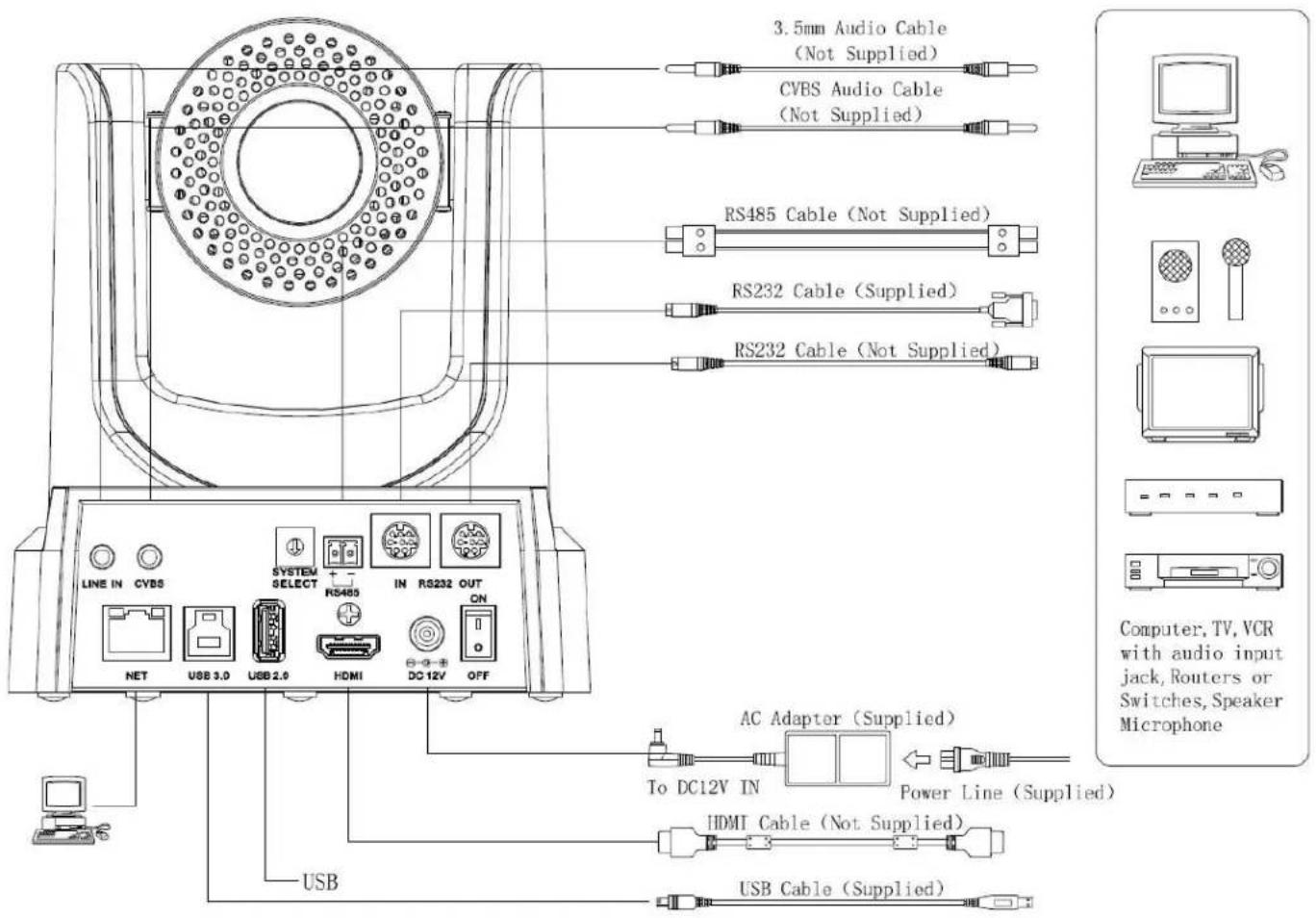
Step 2. Set the system select (rotary) switch for your desired USB and HDMI video output resolution and frame rate.
For many applications, setting 0 (1080p-60) will provide the best overall performance.
For highest possible resolution, use setting 0 (1080p-60) or 6 (1080p-30), however your actual realized frame rate may be limited to a lower value than 30 fps by your software and/or network connection.
NOTE: After changing this dial, you need to restart the camera to see the effect. Turn the camera off.
| VIDEO SYSTEM | |||
| 0 | 1080p60 | 8 | 720p30 |
| 1 | 1080p50 | 9 | 720p25 |
| 2 | 1080i60 | A | - |
| 3 | 1080i50 | B | - |
| 4 | 720p60 | C | - |
| 5 | 720p50 | D | 576i |
| 6 | 1080p30 | E | 480i |
| 7 | 1080p25 | F | - |
CAUTION:
a. After changing the system (rotary) switch, you need to restart the camera to take effect.
Step 3. Press the Switch ON button on the rear of the camera, the power lamp will illuminate.
Step 4. The Pan-Tilt mechanism will rotate the lens to the maximum position of top right after the camera starts, then it will return to the “center”. The process of initialization is now complete. (Note: If the position preset 0 has been stored, the position preset 0 will be called up after initialization in lieu of “center”)
Step 5. (Optional) If you want to restore the factory default settings, press [MENU] button to display the OSD menu. Select the item [MENU] -> [RESTORE DEFAULT] -> [Restore]. Set the value [Yes], press [HOME] button to restore the factory default settings.
![RESTORE DEFAULT ►Restore Yes ◄► Change Value [Home] OK [Menu] Back](/content/2026/06/1175434/images/afd31709b27c707bfd54ba6c143aab6f08b03a4269087380f63c88bc449bb0d2.jpg)
Page 3 of 58
Features
-
Supports UVC compatible USB 3.0 transmission, the highest rate up to 5Gbps, ensuring real-time lossless HD data transmission.
-
Supports simultaneous USB 3.0, HDMI and IP network streaming up to 1080p-60.
-
Supports non-simultaneous CVBS (composite video) output via RCA connector (480i or 576i).
-
Includes Panasonic's high quality, 1/2.7 inch, 2.07 million effective pixels, HD CMOS sensor, which can produce a maximum 1920 x 1080 image with a high quality, maximum output frame rate of 60 fps (frames per second).
-
Ultra-high frame rate 60fps for HDMI and USB and up to 120fps for IP Streaming (120fps at 720p only).
-
Supports IP streaming via RTSP and RTMP and using H.264, H.265 and MJPEG.
-
Microphone & AAC Audio Stream Encoding for IP stream & USB 3.0 - Use a line-level microphone to embed audio. Uses AAC audio encoding for better sound quality and smaller bandwidth usage.
-
Includes an Olympus, high-quality, telephoto lens, supporting 12x optical zoom and optional 16x digital zoom with wide angle 72.5 degree horizontal field of view in widest zoom setting.
-
The high SNR (signal to noise ratio) of the CMOS sensor ( ≥ 55dB), combined with 2D and 3D noise reduction algorithms, effectively reduces noise, even under low illumination conditions.
-
Includes DRC (dynamic range control), allowing for greater image quality and detail across images that are both well-lit and shadowed in the same frame.
-
Includes RS232 and RS485 interfaces for wired remote control. All of the parameters of the camera can be remotely controlled by high-speed communications for joystick and central control system applications.
-
Includes web-based IP remote control interface.
-
Freeze - Allows freezing of video image on all outputs to allow for calling next preset without showing camera motion.
Product Specifications
| ModelType | PT12X-USB-GY-G2 and PT12X-USB-WH-G2 |
| PTZOptics USB 3.0 HD 1080p Color Video Camera (GEN 2) | |
| Features | |
| Video System | 1080p/60, 1080p/50, 1080i/60,1080i/50, 1080p/30, 1080p/25, 720p/60, 720p/50, 720p/30, 720p/25CVBS: 480i, 576i |
| Sensor | Panasonic 1/2.7", CMOS, Total Pixels: 2.12M, Effective Pixels: 2.07M |
| Scanning Mode | Progressive |
| Lens | 12x; f3.5mm - 42.3mm; F1.8 - F2.8 |
| Digital Zoom | 16x |
| Minimal Illumination | 0.5 Lux (@F1.8, AGC ON) |
| Shutter | 1/30s - 1/10000s |
| White Balance | Auto, 3000K/Indoor, 4000K, 5000K/Outdoor, 6500K-1, 6500K-2, 6500K-3, One Push (ok), Manual |
| Backlight Compensation | Yes |
| Digital Noise Reduction | 2D & 3D Digital Noise Reduction |
| Video S/N | ≥55dB |
| Horizontal Angle of View | 6.9° - 72.5° |
| Vertical Angle of View | 3.9° - 44.8° |
| Horizontal Pan Range | ±170° |
| Vertical Tilt Range | -30° to +90° |
| Pan Speed Range | 1.7° - 100°/s |
| Tilt Speed Range | 1.7° - 69.9°/s |
| Ceiling Installation | Yes |
| Image Mirroring | Yes |
| Number of Presets | 255 |
| Preset Accuracy | 0.1° |
| Video coding standards | H.264, H.265, MJPEG |
| Video Freeze | Yes |
| Face Detection | Via Future Firmware Update |
| Local USB 2.0 Storage | Via Future Firmware Update |
| Input/Output | |
| USB Ports | 1x USB 2.0 Type A Female (for future local video file storage) |
| 1x USB 3.0 Type B Female | |
| HD Output | 1x USB 3.0, B-type female |
| 1x HDMI Ver. 1.3 | |

broadcast quality made affordable
| 1x RJ45 IP 10/100/1000 Ethernet Port | |
| SD Output | 1x CVBS: 3.5mm jack, 1Vp-p, 75Ω (requires adapter cable to connect to standard RCA input) |
| Network Interface and Output | 1x RJ45: 10M/100M/1000M Adaptive Ethernet port |
| Audio Input | 1-ch 3.5mm audio interface, LINE IN (embedded on IP Stream & USB 3.0 only) |
| Control Input / Output | 1x RS-232 In: 8pin Mini-DIN, Max Distance: 30mProtocols: VISCA/Pelco-D/Pelco-P |
| 1x RS-232 Out (pass-through): 8pin Mini-DIN, Max Distance: 30mProtocols: VISCA/Pelco-D/Pelco-P | |
| 1x RS-485: 2pin phoenix port, Max Distance: 1500mProtocols: VISCA/Pelco-D/Pelco-P | |
| IP Video Features | |
| Video Compression | H.265/H.264/M-JPEG |
| Video Stream | Main Stream, Sub Stream |
| Main Stream Resolution | 1920x1080, 1280x720, 1024x576 |
| Sub Stream Resolution | 720x576, 720x480, 320x240 |
| Video Bit Rate | 128Kbps ~ 8192Kbps |
| Bit Rate Type | Variable Rate, Fixed Rate |
| Frame Rate | 50Hz: 1fps ~ 50fps, 60Hz: 1fps ~ 60fps |
| Audio Compression | AAC |
| Audio Bit Rate | 96Kbps, 128Kbps, 256Kbps |
| Support Protocols | TCP/IP, HTTP, RTSP, RTMP, DHCP, Multicast, etc. |
| USB Video Features | |
| Operating System | Windows XP, Windows Vista, Windows 7, Windows 8.1, Windows 10, Mac OS X, Linux |
| Color System | YUV 4:2:2 |
| Video Format | USB3.0 - 1080p/60, 1080p/50, 1080p/30, 1080p/25, 720p/60, 720p/50, 720p/30, 720p/25 |
| USB2.0 (through USB3.0 port only) - 960x540p/30, 960x540p/25, 640x360p/60, 640x360p/50, 1280x720p/25 | |
| UVC PTZ Control | Yes (UVC 1.5) |
| General Specifications | |
| Power Connector | JEITA type (DC IN 12V) |
| Input Voltage | 12VDC (10.8 - 13.0V DC) |
| Current Consumption | 1.0A (Max) |
| Operating Temperature | 23°F - 104°F [-5°C - 40°C] |
| Storage Temperature | -4°F - 140°F [-20°C - 60°C] |
| Power Consumption | 12W (Max) |
| Dimensions (w x h x d) | 5.56" x 6.88" (8.0" full vertical tilt) x 5.88" [142mm x 175mm (204mm full vertical tilt) x 150mm |
| Weight | 3.1 lbs. [1.38kg] |
Main Unit
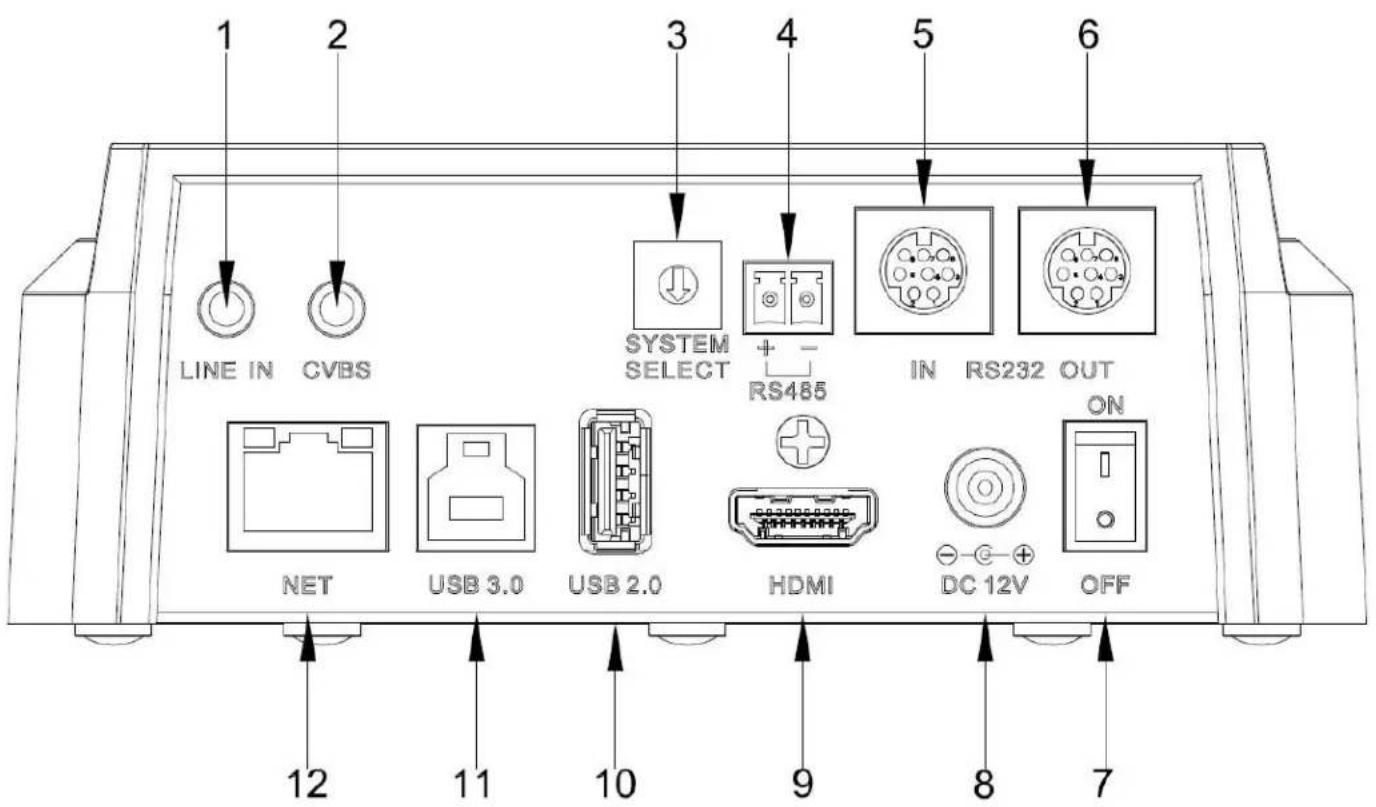
- Audio LINE IN Interface (embeds in IP Stream) 7. Power switch
- CVBS (composite video SD) Interface 8. DC 12V power jack
- System select dial (resolution) 9. HDMI 1.3 (Digital Video Output)
- RS485 jack 10. USB 2.0 (Future - USB Storage)
- RS232 IN jack 11. USB 3.0 (USB Video Output)
- RS232 OUT jack (pass through for daisy chain) 12. Network (IP streaming and control)
IR Remote Controller
1. Standby Button
Press this button to enter standby mode. Press it again to enter normal mode.
NOTE: Power consumption in standby mode is approximately half of the normal mode.
2. Position Buttons
To set preset or call preset.
3. \* Button
For multiple function.
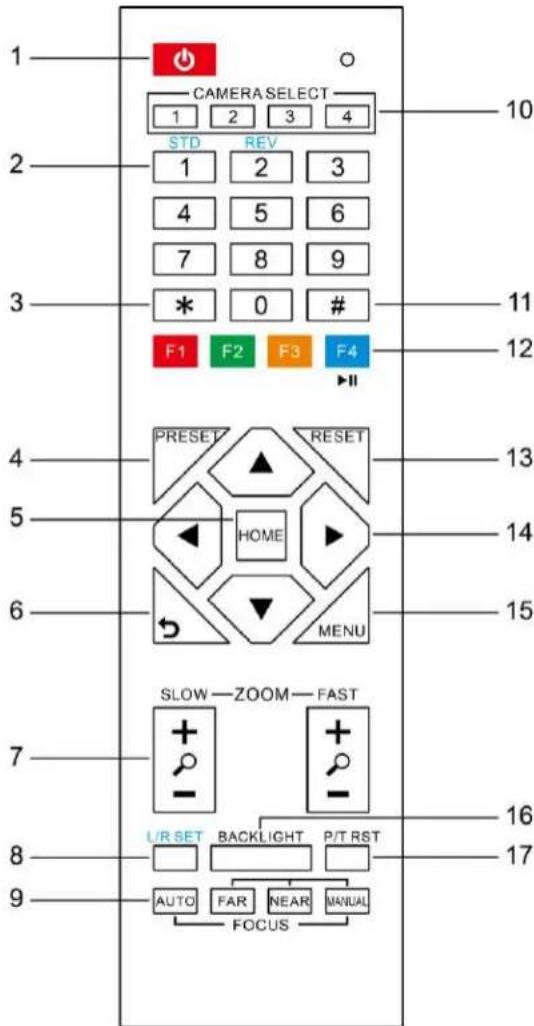
4&13. Set/Clear Preset Buttons
Set preset: Store a preset position
[PRESET] + Numeric button (0-9): Setting a corresponding numeric key preset position
NOTE: Preset 0 - 9 via remote control and the rest from web, keyboard and the serial port.
Clear preset: Erase a preset position [RESET] + Numeric button (0-9), or: [*] + [#] + [RESET]: Erase all presets
5&14. Pan/Tilt Control Buttons
Press the arrow buttons to perform panning and tilting. Press the [HOME] button to face the camera back to front.
6. Return Button
Press the button to back previous menu.
7. Zoom Buttons
Zoom+: Zoom In (Slow and fast speed)
Zoom-: Zoom Out (Slow and fast speed)
8. L/R Set Button
Set the left & right direction of the remote control.
[L/R Set] + [1]: Normal direction.
[L/R Set] + [2]: Left and right direction will be reversed.
9. Focus Buttons
Used for focus adjustment.
Press [AUTO] to adjust the focus on the center of the object automatically.
To adjust the focus manually, press the [MANUAL] button, and adjust it with [Far] (focus on far object) and [Near] (focus on near object).
10. Camera Address Select Buttons
Press the button corresponding to the camera which you want to operate with the remote controller.
11. # Button
For multiple function.
12. Multiple Function Buttons
Function 1. Set camera IR address
Press 3 keys contiguously can set camera IR address as follow:
[*] + [#] + [F1]: Address 1
[*] + [#] + [F2]: Address 2
[*] + [#] + [F3]: Address 3
[*] + [#] + [F4]: Address 4
Function 2. Image freezing function
Press [F4] to start the freeze function. The word "Freeze" displays on the upper left corner. After five seconds, the display disappears automatically (though the freeze feature continues). To cancel the freeze, press the [F4] key the word "Unfreeze" displays on the upper left corner. After five seconds, the display disappears automatically.
15. Menu Setting
Menu button: Press this button to enter or exit the OSD menu.
16. Backlight Button
Backlight button: Press this button to enable the backlight compensation. Press it again to disable the backlight compensation.
NOTE: Effective only in auto exposure mode.
NOTE: If there is a light behind the subject, the subject will appear dark. In this case, press the backlight ON / OFF button. To cancel this function, press the backlight ON / OFF button.
17. P/T RST Button
Press the button to self-calibrate pan and tilt once again.
Shortcuts for some 'Set' Functions
[*] + [#] + [1]: Display OSD menu in English
[*] + [#] + [3]: Display OSD menu in Chinese
[*] + [#] + [4]: Show IP address
[*] + [#] + [6]: Quickly restore the default settings
[*] + [#] + [8]: Show the camera version
[*] + [#] + [9]: Quickly set mount mode (flip / normal)1. Standby Button
Press this button to enter standby mode. Press it again to enter normal mode.
NOTE: Power consumption in standby mode is approximately half of the normal mode.
Using the IR Remote Controller
When the camera is operational, you can use the remote controller to perform panning, tilting, zooming and focusing, as well as store and call back preset positions. Button Instructions:
- In these instructions, 'press the button' means to press and release. A special note will be given if holding a button down for more than one second is required.
-
When a button-combination is required, do it in sequence (not simultaneously). For example, ‘[*] + [#] + [F1]’ means press [*] first and then press [#] and then press [F1].
-
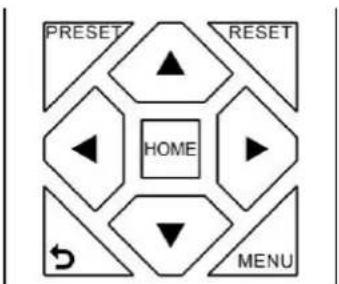
Pan/Tilt Control
flowchart
graph TD
    A["PRESET"] --> B["HOME"]
    C["RESET"] --> B["HOME"]
    D["MENU"] --> B["HOME"]
    B["HOME"] --> E["▲"]
    B["HOME"] --> F["▼"]
    B["HOME"] --> G["▲"]
| Tilt up: | Press [ ] | ▲ |
| Tilt down: | Press [ ] | ▼ |
| Pan left: | Press [ ] | ◀ |
| Pan right: | Press [ ] | ▶ |
Face the camera back to front: Press [HOME]
Press and hold the up/down/left/right buttons, to keep panning or tilting from slow to fast, (until the camera reaches the mechanical limit). The camera stops as soon as the button is released.
- Zoom Control
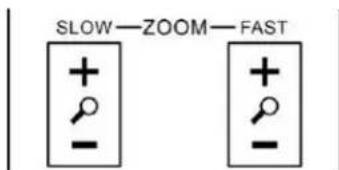
Press and hold the button, to keep zooming in or out (until the lens reaches the mechanical limit). The lens stops as soon as the button is released.
- Focus Control
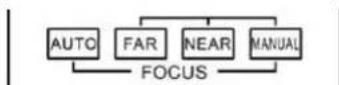
AUTO: Change focus mode to AF, which allows the camera to adjust the focus automatically on the center of the image.
MANUAL: Change focus mode to MF, which allows the user to adjust the focus manually (see FOCUS FAR & FOCUS NEAR).
FOCUS FAR: Press [FAR] button (NOTE: Effective only in MANUAL focus mode)
FOCUS NEAR: Press [NEAR] button (NOTE: Effective only in MANUAL focus mode)
Press and hold the FOCUS [FAR] or FOCUS [NEAR] button, allows for continuous adjustment, stopping as soon as the button is released.
4. BACKLIGHT. L/R SET and P/T RST Controls
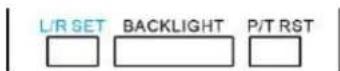
Reverse Pan controls direction: Press and hold [L/R SET] button while pressing [1] aka [STD] button for normal pan controls. Press and hold [L/R SET] button while pressing [2] aka [REV] button for reversed pan controls.
Backlight Compensation Control: Press [BACKLIGHT] button to enable backlight compensation. Press it again to disable backlight compensation. (Note: Backlight is only effective in full auto exposure mode)
Pan Tilt Control Self Calibration: Press [P/T RST] button to recalibrate the Pan and Tilt limits.
5. Standby Control

Press [ ] button to put camera in 'standby' mode. In standby mode the camera will provide no image, respond to no commands and use less than half its normal power. Press [ ] button again to put camera in normal mode.
6. Presets - Setting and Clearing
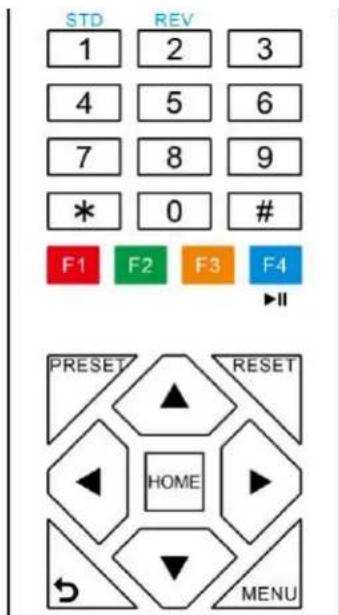
- To store a preset position: The user should manually setup the desired shot using the Pan Tilt and Zoom controls. Press the [PRESET] button first and then press the numeric button [0-9] to which you want to assign the shot. Ten total preset positions (0-9) are available from the IR remote control (255 available via RS232/RS485/IP Interfaces).
- To erase the memory content of a preset position: The user should press the [RESET] button first and then press the numeric button 0-9 associated with that preset.
Note:
Pressing [*] + [#] + [RESET] in sequence will erase all presets in the memory.
7. Recalling Presets
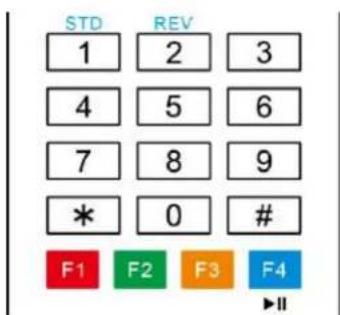
Pressing any of the numeric buttons [0-9] directly will recall a stored preset position and settings.
Note:
No action will be executed if a specific numeric preset position has not yet been saved.
Note:
Presets assigned via the IP interface do not correlate to presets set via the IR remote control.
8. Camera Selection
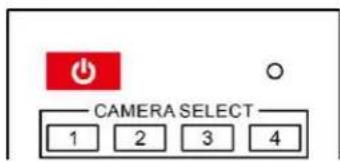
Press the [1-4] button corresponding to the camera with the IR address that you want to operate. This allows for up to 4 cameras to be operated via the same IR remote in the same room.
9. Camera IR Address Set
Press 3 buttons in the sequence shown below to set/change the camera's IR address. This allows up to 4 cameras to be controlled from the same IR remote control. Be sure that only one camera is picking up the IR signal when you perform this function. If multiple cameras receive the command, they will all change to the new address.
Address 1: [*] + [#] + [F1]
Address 2: [*] + [#] + [F2]
Address 3: [*] + [#] + [F3]
Address 4: [*] + [#] + [F4]
10. Image Freeze
Press the [ ] button to freeze or unfreeze the video image. This can be useful while recalling presets to hide camera motion from your viewers.
Dimensional Drawings (mm)
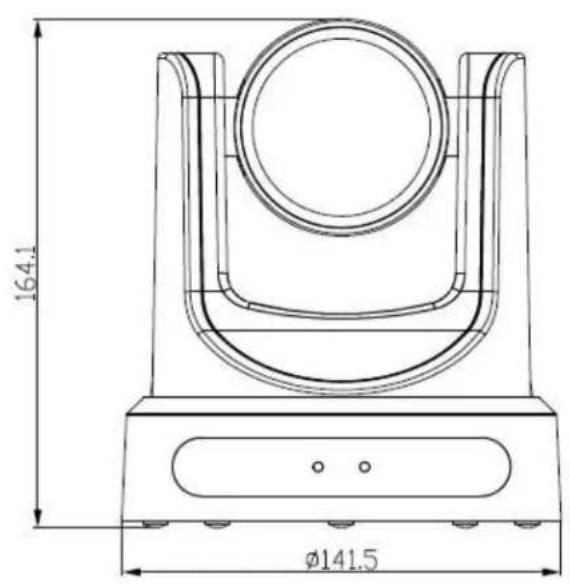
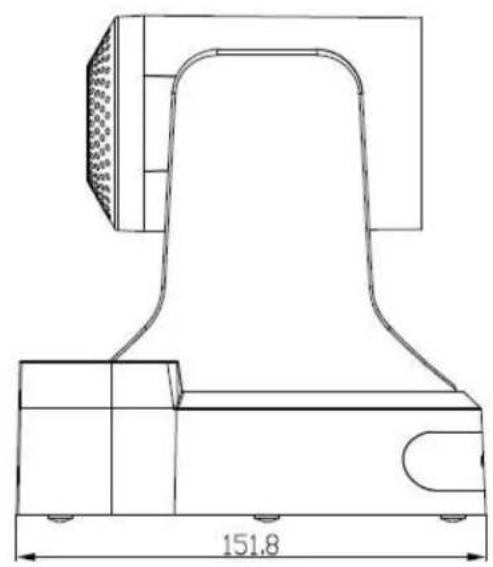
natural_image
Technical line drawing of a mechanical component with dimension标注 (no text or symbols)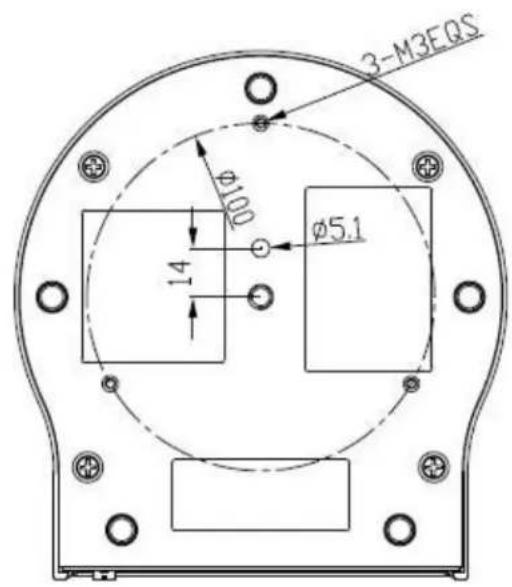
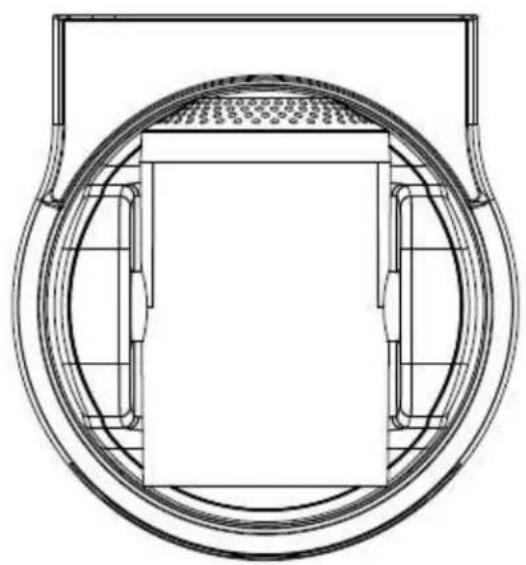
natural_image
Technical line drawing of a circular mechanical component with internal channels and a central rectangular opening (no text or symbols)RS-232 Interface
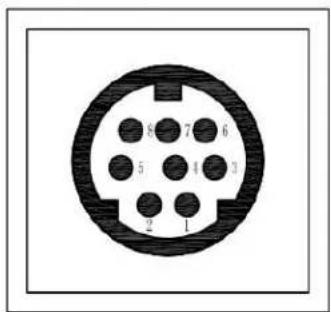
Camera PC/Controller DB-9
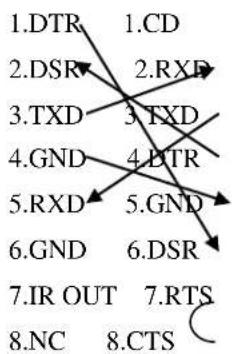
flowchart
graph TD
    A["1.DTR"] --> B["2.DSR"]
    A --> C["3.TXD"]
    A --> D["4.GND"]
    A --> E["5.RXD"]
    A --> F["6.GND"]
    A --> G["7.IR OUT"]
    A --> H["8.NC"]
    A --> I["8.CTS"]
    B --> J["2.RXD"]
    C --> K["3.TXD"]
    D --> L["4.DTR"]
    E --> M["5.GND"]
    F --> N["6.DSR"]
    G --> O["7.RTS"]
    H --> P["8.CTS"]
9.RI
| No. | Function |
| 1 | DTR |
| 2 | DSR |
| 3 | TXD |
| 4 | GND |
| 5 | RXD |
| 6 | GND |
| 7 | IR OUT |
| 8 | NC |
For Control Daisy Chain
1 ^st Camera 2 ^nd Camera Mini DIN
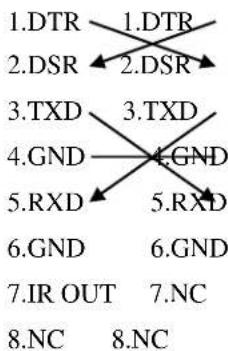
flowchart
graph TD
    A["1.DTR"] --> B["1.DTR"]
    C["2.DSR"] --> D["2.DSR"]
    E["3.TXD"] --> F["3.TXD"]
    G["4.GND"] --> H["4.GND"]
    I["5.RXD"] --> J["5.RXD"]
    K["6.GND"] --> L["6.GND"]
    M["7.IR OUT"] --> N["7.NC"]
    O["8.NC"] --> P["8.NC"]
Serial Communication Control
In default working mode, the camera is able to connect to a VISCA controller with an RS232C serial interface.
RS232 Communication Control
The camera can be controlled via RS232. The parameters of RS232C are as follows:
Baud rate: 2400, 4800 or 9600 bps.
Start bit: 1 bit.
Data bit: 8 bits.
Stop bit: 1 bit.
Parity bit: none.
RS485 Communication Control
The camera can be controlled via RS485, Half-duplex mode, with support for VISCA, Pelco-D or Pelco-P protocol.
The parameters of RS485 are as follows:
Baud rate: 2400, 4800 or 9600 bps.
Start bit: 1 bit.
Data bit: 8 bits.
Stop bit: 1 bit.
Parity bit: none.
When powered on, Pan and Tilt will rotate to the maximum position of top right after the camera powered up. Then it will return to the “center”. The process of initialization is now complete. (Note: If the position preset 0 has been stored, the position preset 0 will be called up after initialization, in lieu of “center”). After initialization is complete, then the user can control the camera with commands in the command list.
VISCA Command List
Part 1: Camera-Issued Messages
| ACK/Completion Message | |||
| Command | Function | Command Packet | Comments |
| ACK/Completion Messages | ACK | z0 4y FF(y: Socket No.) | Returned when the command is accepted. |
| Completion | z0 5y FF(y: Socket No.) | Returned when the command has been executed. | |
z = Camera Address + 8
| Error Messages | |||
| Command | Function | Command Packet | Comments |
| Error Messages | Syntax Error | z0 60 02 FF | Returned when the command format is different or when a command with illegal command parameters is accepted. |
| Command Buffer Full | z0 60 03 FF | Indicates that two sockets are already being used (executing two commands) and the command could not be accepted when received. | |
| Command Canceled | z0 6y 04 FF(y: Socket No.) | Returned when a command which is being executed in a socket specified by the cancel command is canceled. The completion message for the command is not returned. | |
| No Socket | z0 6y 05 FF(y: Socket No.) | Returned when no command is executed in a socket specified by the cancel command, or when an invalid socket number is specified. | |
| Command Not Executable | z0 6y 41 FF(y: Execution command Socket No. Inquiry command: 0) | Returned when a command cannot be executed due to current conditions. For example, when commands controlling the focus manually are received during auto focus. | |
Part 2: Camera Control Commands
| Command | Function | Command Packet | Comments |
| AddressSet | Broadcast | 88 30 01 FF | Address setting |
| IF_Clear | Broadcast | 88 01 00 01 FF | I/F Clear |
| CAM_Power | On | 8x 01 04 00 02 FF | Power ON/OFF |
| Off | 8x 01 04 00 03 FF | ||
| CAM_Zoom | Stop | 8x 01 04 07 00 FF | |
| Tele(Standard) | 8x 01 04 07 02 FF | ||
| Wide(Standard) | 8x 01 04 07 03 FF | ||
| Tele(Variable) | 8x 01 04 07 2p FF | p = 0(low) - 7(high) | |
| Wide(Variable) | 8x 01 04 07 3p FF | ||
| Direct | 8x 01 04 47 0p 0q 0r 0s FF | pqrs: Zoom Position | |
| CAM_Focus | Stop | 8x 01 04 08 00 FF | |
| Far(Standard) | 8x 01 04 08 02 FF | ||
| Near(Standard) | 8x 01 04 08 03 FF | ||
| Far(Variable) | 8x 01 04 08 2p FF | p = 0(low) - 7(high) | |
| Near(Variable) | 8x 01 04 08 3p FF | ||
| Direct | 8x 01 04 48 0p 0q 0r 0s FF | pqrs: Focus Position | |
| Auto Focus | 8x 01 04 38 02 FF | AF On/Off | |
| Manual Focus | 8x 01 04 38 03 FF | ||
| Auto/Manual | 8x 01 04 38 10 FF | ||
| CAM_ZoomFocus | Direct | 8x 01 04 47 0p 0q 0r 0s0t 0u 0v 0w FF | pqrs: Zoom Positiontuvw: Focus Position |
| CAM_WB | Auto | 8x 01 04 35 00 FF | Normal Auto |
| Indoor mode | 8x 01 04 35 01 FF | Indoor mode | |
| Outdoor mode | 8x 01 04 35 02 FF | Outdoor mode | |
| OnePush mode | 8x 01 04 35 03 FF | One Push WB mode | |
| Manual | 8x 01 04 35 05 FF | Manual Control mode | |
| OnePush trigger | 8x 01 04 10 05 FF | One Push WB Trigger | |
| CAM_RGain | Reset | 8x 01 04 03 00 FF | Manual Control of R Gain |
| Up | 8x 01 04 03 02 FF | ||
| Down | 8x 01 04 03 03 FF | ||
| Direct | 8x 01 04 43 00 00 0p 0q FF | pq: R Gain | |
| CAM_Bgain | Reset | 8x 01 04 04 00 FF | Manual Control of B Gain |
| Up | 8x 01 04 04 02 FF | ||
| Down | 8x 01 04 04 03 FF | ||
| Direct | 8x 01 04 44 00 00 0p 0q FF | pq: B Gain |

broadcast quality made affordable
| CAM_AE | Full Auto | 8x 01 04 39 00 FF | Automatic Exposure mode |
| Manual | 8x 01 04 39 03 FF | Manual Control mode | |
| Shutter priority | 8x 01 04 39 0A FF | Shutter Priority Automatic Exposure mode | |
| Iris priority | 8x 01 04 39 0B FF | Iris Priority Automatic Exposure mode | |
| Bright | 8x 01 04 39 0D FF | Bright Mode(Manual control) | |
| CAM_SlowShutter | AutoSlowShutterLimit | 8x 01 04 2A 0p 00 FF | |
| CAM_Iris | Reset | 8x 01 04 0B 00 FF | Iris Setting |
| Up | 8x 01 04 0B 02 FF | ||
| Down | 8x 01 04 0B 03 FF | ||
| Direct | 8x 01 04 4B 00 00 0p 0q FF | pq: Iris Position | |
| CAM_Gain | Reset | 8x 01 04 0C 00 FF | Gain Setting |
| Up | 8x 01 04 0C 02 FF | ||
| Down | 8x 01 04 0C 03 FF | ||
| Direct | 8x 01 04 0C 00 00 0p 0q FF | pq: Gain Position | |
| Gain Limit | 8x 01 04 2C 0p FF | p: Gain Position | |
| CAM_Bright | Reset | 8x 01 04 0D 00 FF | Bright Setting |
| Up | 8x 01 04 0D 02 FF | ||
| Down | 8x 01 04 0D 03 FF | ||
| Direct | 8x 01 04 0D 00 00 0p 0q FF | pq: Bright Position | |
| CAM_ExpComp | On | 8x 01 04 3E 02 FF | Exposure Compensation On/Off |
| Off | 8x 01 04 3E 03 FF | ||
| Reset | 8x 01 04 0E 00 FF | Exposure Compensation Amount Setting | |
| Up | 8x 01 04 0E 02 FF | ||
| Down | 8x 01 04 0E 03 FF | ||
| Direct | 8x 01 04 4E 00 00 0p 0q FF | pq: ExpComp Position | |
| CAM_BackLight | On | 8x 01 04 33 02 FF | Back Light Compensation On/Off |
| Off | 8x 01 04 33 03 FF | ||
| CAM_NR(2D)Mode | Auto | 8x 01 04 50 02 FF | ND2D Auto/Manual |
| Manual | 8x 01 04 50 03 FF | ||
| CAM_NR(2D)Level | - | 8x 01 04 53 0p FF | p: NR Setting (0: Off, level 1 to 5) |
| CAM_NR(3D)Level | - | 8x 01 04 54 0p FF | p: NR Setting (0: Off, level 1 to 8) |
| CAM_Flicker | - | 8x 01 04 23 0p FF | p: Flicker Settings(0: Off, 1: 50Hz, 2: 60Hz) |
| CAM_DHotPixel | - | 8x 01 04 56 0p FF | p: Dynamic Hot Pixel Setting (0: Off, level 1 to 6) |
| CAM_ApertureMode(sharpness) | Auto | 8x 01 04 05 02 FF | Sharpness Auto |
broadcast quality made affordable
| Manual | 8x 01 04 05 02 FF | Sharpness Manual | |
| CAM_Aperture(sharpness) | Reset | 8x 01 04 02 00 FF | Aperture Control |
| Up | 8x 01 04 02 02 FF | ||
| Down | 8x 01 04 02 03 FF | ||
| Direct | 8x 01 04 42 00 00 0p 0q FF | pq: Aperture Gain | |
| CAM_PictureEffect | Off | 8x 01 04 63 00 FF | Picture Effect Setting |
| B&W | 8x 01 04 63 04 FF | ||
| CAM_Memory | Reset | 8x 01 04 3F 00 pp FF | pp: Memory Number(=0 to 127) |
| Set | 8x 01 04 3F 01 pp FF | ||
| Recall | 8x 01 04 3F 02 pp FF | ||
| CAM_LR_Reverse | On | 8x 01 04 61 02 FF | Image Flip Horizontal On/Off |
| Off | 8x 01 04 61 03 FF | ||
| CAM_PictureFlip | On | 8x 01 04 66 02 FF | Image Flip Vertical On/Off |
| Off | 8x 01 04 66 03 FF | ||
| CAM_RegisterValue | - | 8x 01 04 24 mn 0p 0q FF | mm: Register No. (=00-7F)pp: Register Value (=00-7F) |
| CAM_ColorGain | Diret | 8x 01 04 49 00 00 00 0p FF | p: Color Gain setting 0h (60%) to Eh (200%) |
| SYS_Menu | Off | 8x 01 06 06 03 FF | Turns off the menu screen |
| Pan_tiltDrive | Up | 8x 01 06 01 VV WW 03 01 FF | VV: Pan speed 0x01 (low speed) to 0x18 (high speed)WW: Tilt speed 0x01 (low speed) to 0x14 (high speed)YYYY: Pan PositionZZZZ: Tilt Position |
| Down | 8x 01 06 01 VV WW 03 02 FF | ||
| Left | 8x 01 06 01 VV WW 01 03 FF | ||
| Right | 8x 01 06 01 VV WW 02 03 FF | ||
| Uplcft | 8x 01 06 01 VV WW 01 01 FF | ||
| Upright | 8x 01 06 01 VV WW 02 01 FF | ||
| DownLeft | 8x 01 06 01 VV WW 01 02 FF | ||
| DownRight | 8x 01 06 01 VV WW 02 02 FF | ||
| Stop | 8x 01 06 01 VV WW 03 03 FF | ||
| AbsolutePosition | 8x 01 06 02 VV WW0Y 0Y 0Y 0Y 0Z 0Z 0Z 0Z FF | ||
| RelativePosition | 8x 01 06 03 VV WW0Y 0Y 0Y 0Y 0Z 0Z 0Z 0Z FF | ||
| Home | 8x 01 06 04 FF | ||
| Reset | 8x 01 06 05 FF | ||
| Pan_tiltLimitSet | LimitSet | 8x 01 06 07 00 0W0Y 0Y 0Y 0Y 0Z 0Z 0Z 0Z FF | W: 1 UpRight 0: DownLeftYYYY: Pan Limit PositionZZZZ: Tilt Position |
| LimitClear | 8x 01 06 07 01 0W07 0F 0F 0F 07 0F 0F 0F FF |

broadcast quality made affordable
| CAM_AFSensitivity | High | 8x 01 04 58 01 FF | AF Sensitivity High/Normal/Low |
| Normal | 8x 01 04 58 02 FF | ||
| Low | 8x 01 04 58 03 FF | ||
| CAM_SettingReset | Reset | 8x 01 04 A0 10 FF | Reset Factory Setting |
| CAM_Brightness | Direct | 8x 01 04 A1 00 00 0p 0q FF | pq: Brightness Position |
| CAM_Contrast | Direct | 8x 01 04 A2 00 00 0p 0q FF | pq: Contrast Position |
| CAM_Flip | Off | 8x 01 04 A4 00 FF | Single Command For Video Flip |
| Flip-H | 8x 01 04 A4 01 FF | ||
| Flip-V | 8x 01 04 A4 02 FF | ||
| Flip-HV | 8x 01 04 A4 03 FF | ||
| CAM_SettingSave | Save | 8x 01 04 A5 10 FF | Save Current Setting |
| CAM_Iridix | Direct | 8x 01 04 A7 00 00 0p 0q FF | pq: Iridix Position |
| CAM_AWBSensitivity | High | 8x 01 04 A9 00 FF | High |
| Normal | 8x 01 04 A9 01 FF | Normal | |
| Low | 8x 01 04 A9 02 FF | Low | |
| CAM_AFZone | Top | 8x 01 04 AA 00 FF | AF Zone weight select |
| Center | 8x 01 04 AA 01 FF | ||
| Bottom | 8x 01 04 AA 02 FF | ||
| CAM_ColorHue | Direct | 8x 01 04 4F 00 00 00 0p FF | p: Color Hue setting 0h (-14 degrees) to Eh (+14 degrees |
Part 3: Query Commands
| Inquiry Command List | |||
| Command | Command packed | Inquiry Packet | Comments |
| CAM_PowerInq | 8x 09 04 00 FF | y0 50 02 FF | On |
| y0 50 03 FF | Off(Standby) | ||
| y0 50 04 FF | Internal power circuit error | ||
| CAM_ZoomPosInq | 8x 09 04 47 FF | y0 50 0p 0q 0r 0s FF | pqrs: Zoom Position |
| CAM_FocusAFModeInq | 8x 09 04 38 FF | y0 50 02 FF | Auto Focus |
| y0 50 03 FF | Manual Focus | ||
| CAM_FocusPosInq | 8x 09 04 48 FF | y0 50 0p 0q 0r 0s FF | pqrs: Focus Position |
| CAM_WBModeInq | 8x 09 04 35 FF | y0 50 00 FF | Auto |
| y0 50 01 FF | Indoor mode | ||
| y0 50 02 FF | Outdoor mode | ||
| y0 50 03 FF | OnePush mode | ||
| y0 50 05 FF | Manual | ||
| CAM_RGainInq | 8x 09 04 43 FF | y0 50 00 00 0p 0q FF | pq: R Gain |
| CAM_BGainInq | 8x 09 04 44 FF | y0 50 00 00 0p 0q FF | pq: B Gain |
| CAM_AEModeInq | 8x 09 04 39 FF | y0 50 00 FF | Full Auto |
| y0 50 03 FF | Manual | ||
| y0 50 0A FF | Shutter priority | ||
| y0 50 0B FF | Iris priority | ||
| y0 50 0D FF | Bright | ||
| CAM_ShutterPosInq | 8x 09 04 4A FF | y0 50 00 00 0p 0q FF | pq: Shutter Position |
| CAM_IrisPosInq | 8x 09 04 4B FF | y0 50 00 00 0p 0q FF | pq: Iris Position |
| CAM_BrightPosInq | 8x 09 04 4D FF | y0 50 00 00 0p 0q FF | pq: Bright Position |
| CAM_ExpCompModeInq | 8x 09 04 3E FF | y0 50 02 FF | On |
| y0 50 03 FF | Off | ||
| CAM_ExpCompPosInq | 8x 09 04 4E FF | y0 50 00 00 0p 0q FF | pq: ExpComp Position |
| CAM_BacklightModeInq | 8x 09 04 33 FF | y0 50 02 FF | On |
| y0 50 03 FF | Off | ||
| CAM_Nosise2DModeInq | 8x 09 04 50 FF | y0 50 02 FF | Auto Noise 2D |
| y0 50 03 FF | Manual Noise 3D | ||
| CAM_Nosise2DLevel | 8x 09 04 53 FF | y0 50 0p FF | Noise Reduction (2D) p: 0 to 5 |
| CAM_Noise3DLevel | 8x 09 04 54 FF | y0 50 0p FF | Noise Reduction (3D) p: 0 to 8 |
| CAM_FlickerModeInq | 8x 09 04 55 FF | y0 50 0p FF | p: Flicker Settings(0: OFF, 1: 50Hz, 2: 60Hz) |

broadcast quality made affordable
| CAM_ApertureModeInq(Sharpness) | 8x 09 04 05 FF | y0 50 02 FF | Auto Sharpness |
| y0 50 03 FF | Manual Sharpness | ||
| CAM_ApertureInq(Sharpness) | 8x 09 04 42 FF | y0 50 00 00 0p 0q FF | pq: Aperture Gain |
| CAM_PictureEffectModeInq | 8x 09 04 63 FF | y0 50 02 FF | Off |
| y0 50 04 FF | B&W | ||
| CAM_MemoryInq | 8x 09 04 3F FF | y0 50 0p FF | p: Memory number last operated. |
| SYS_MenuModeInq | 8x 09 06 06 FF | y0 50 02 FF | On |
| y0 50 03 FF | Off | ||
| CAM_LR_ReverseInq | 8x 09 04 61 FF | y0 50 02 FF | On |
| y0 50 03 FF | Off | ||
| CAM_PictureFlipInq | 8x 09 04 66 FF | y0 50 02 FF | On |
| y0 50 03 FF | Off | ||
| CAM_RegisterValueInq | 8x 09 04 24 mm FF | y0 50 0p 0p fl | mm: Register No. (00 to FF) pp: Register Value (00 to FF) |
| CAM_ColorGainInq | 8x 09 04 49 FF | y0 50 00 00 00 0p FF | p: Color Gain setting 0h (60%) to Eh (200%) |
| CAM_IDInq | 8x 09 04 22 FF | y0 50 0p 0q 0r 0s FF | pqrs: Camera ID |
| CAM_VersionInq | 8x 09 00 02 FF | y0 50 ab cdmn pq rs tu vw FF | ab: Factory Code(00: VHD, 01:MR, 08:T)cd: Hardware Versionmnpq: ARM Versionrstu: FPGA Versionvw: Camera model01: C Type02: M Type03: S Type |
| VideoSystemInq | 8x 09 06 23 FF | y0 50 00 FF | 1920x1080i60 |
| y0 50 01 FF | 1920x1080p30 | ||
| y0 50 02 FF | 1280x720p60 | ||
| y0 50 04 FF | NTSC | ||
| y0 50 05 FF | NTSC | ||
| y0 50 06 FF | NTSC | ||
| y0 50 07 FF | 1920x1080p60 | ||
| y0 50 08 FF | 1920x1080i50 | ||
| y0 50 09 FF | 1920x1080p25 | ||
| y0 50 0A FF | 1280x720p50 |

broadcast quality made affordable
| y0 50 0C FF | PAL | ||
| y0 50 0D FF | PAL | ||
| y0 50 0E FF | PAL | ||
| IR_Receive | 8x 09 06 08 FF | y0 50 02 FF | On |
| y0 50 03 FF | Off | ||
| Pan-tiltMaxSpeedInq | 8x 09 06 11 FF | y0 50 ww zz FF | ww: Pan Max Speedzz: Tilt Max Speed |
| Pan-tiltPosInq | 8x 09 06 12 FF | y0 50 0w 0w 0w 0w0z 0z 0z 0z FF | www: Pan Positionzzzz: Tilt Position |
| CAM_TypeInq | 8x 09 00 03 FF | y0 50 01 FF | C Type |
| y0 50 02 FF | M Type | ||
| y0 50 03 FF | S Type | ||
| CAM_DateInq | 8x 09 00 04 FF | y0 50 0r ss uu uu vv ww 0D FF | Version dater: Big Version Numbers: LittleVersion Numberuuuu: Yearvv: Monthww: Day |
| CAM_ModeInq | 8x 09 04 A6 FF | y0 50 00 FF | Mode0 |
| y0 50 02 FF | Mode2 | ||
| CAM_GainLimitInq | 8x 09 04 2C FF | y0 50 0q FF | p: Gain Limit |
| CAM_DHotPixelInq | 8x 09 04 56 FF | y0 50 0q FF | p: Dynamic Hot Pixel Setting (0: 0ff, level 1 to 6) |
| CAM_AFSensitivityInq | 8x 09 04 58 FF | y0 50 01 FF | High |
| y0 50 02 FF | Normal | ||
| y0 50 03 FF | Low | ||
| CAM_BrightnessInq | 8x 09 04 A1 FF | y0 50 00 00 0p 0q FF | pq: Brightness Position |
| CAM_ContrastInq | 8x 09 04 A2 FF | y0 50 00 00 0p 0q FF | pq: Contrast Position |
| CAM_FlipInq | 8x 09 04 A4 FF | y0 50 00 FF | Off |
| y0 50 01 FF | Flip-H | ||
| y0 50 02 FF | Flip-V | ||
| y0 50 03 FF | Flip-HV | ||
| CAM_IridixInq | 8x 09 04 A7 FF | y0 50 00 00 0p 0q FF | pq: Iridix Position |
| CAM_AFZone | 8x 09 04 AA FF | y0 50 00 FF | Top |
| y0 50 01 FF | Center | ||
| y0 50 02 FF | Bottom | ||
| CAM_ColorHueInq | 8x 09 04 4F FF | y0 50 00 00 00 0p FF | p: Color Hue setting 0h (-14 degrees) to Eh (+14 degrees |
| CAM_AWBSensitivityInq | 8x 09 04 A9 FF | y0 50 00 FF | High |
| y0 50 01 FF | Normal |
broadcast quality made affordable
| y0 50 02 FF | Low |
| Block Inquiry Command List | |||
| Command | Command packed | Inquiry Packet | Comments |
| CAM_LensBlockInq | 8x 09 7E 7E 00 FF | y0 50 0u 0u 0u 0u 00 00 0v 0v0v 0v 00 0w 00 FF | uuuu: Zoom Positionvvvv: Focus Positionw.bit0: Focus Mode 1: Auto 0: Manual |
| CAM_CameraBlockInq | 8x 09 7E 7E 01 FF | y0 50 0p 0p 0q 0q 0r 0s tt 0u vvww 00 xx 0z FF | pp: R_Gainqq: B_Gainr: WB Modes: Aperturett: AE Modeu.bit2: Back Lightu.bit1: Exposure Comp.vv: Shutter Positionww: Iris Positionxx: Bright Positionz: Exposure Comp. Position |
| CAM_OtherBlockInq | 8x 09 7E 7E 02 FF | y0 50 0p 0q 00 0r 00 00 00 0000 00 00 00 00 FF | p.bit0: Power 1:On, 0:Offq.bit2: LR Reverse 1:On, 0:Offr.bit3~0: Picture Effect Mode |
| CAM_EnlargementBlockInq | 8x 09 7E 7E 03 FF | y0 50 00 00 00 00 00 00 00 0p0q rr 0s 0t 0u FF | p: AF sensitivityq.bit0: Picture flip(1:On, 0:Off)rr.bit6~3: Color Gain(0h(60%) to Eh(200%))s: Flip(0: Off, 1:Flip-H, 2:Flip-V, 3:Flip-HV)t.bit2~0: NR2D Levelu: Gain Limit |
Note:
The [x] in the above table is the camera address, [y] = [x + 8] .
Part 4: VISCA over IP Command List
| Command | Function | Command Packet | Comments |
| CAM_Zoom | Stop | 81 01 04 07 00 FF | |
| Tele (Standard) | 81 01 04 07 02 FF | ||
| Wide (Standard) | 81 01 04 07 03 FF | ||
| Tele (Variable) | 81 01 04 07 2p FF | p = (low) - 7 (high) | |
| Wide (Variable) | 81 01 04 07 3p FF | ||
| Direct | 81 01 04 47 p q r s FF | pqrs: Zoom Position | |
| CAM_Focus | Stop | 81 01 04 08 00 FF | |
| Far (Standard) | 81 01 04 08 02 FF | ||
| Near (Standard) | 81 01 04 08 03 FF | ||
| Far (Variable) | 81 01 04 08 2p FF | p = (low) - 7 (high) | |
| Near (Variable) | 81 01 04 08 3p FF | ||
| Direct | 81 01 04 48 p q r s FF | pqrs: Focus Position | |
| Auto Focus | 81 01 04 38 02 FF | ||
| Manual Focus | 81 01 04 38 03 FF | ||
| Auto/Manual Toggle | 81 01 04 38 10 FF | ||
| Focus Lock | 81 0a 04 68 02 FF | Prevents any other operation or command from adjusting the current focus state | |
| Focus Unlock | 81 0a 04 68 03 FF | ||
| CAM_WB | Auto | 81 01 04 35 00 FF | Normal Auto |
| Indoor Mode | 81 01 04 35 01 FF | Indoor Mode | |
| Outdoor Mode | 81 01 04 35 02 FF | Outdoor Mode | |
| OnePush Mode | 81 01 04 35 03 FF | OnePush WB Mode | |
| Manual | 81 01 04 35 05 FF | Manual Control Mode | |
| OnePush Trigger | 81 01 04 10 05 FF | OnePush WB Trigger | |
| CAM_RGain | Reset | 81 01 04 03 00 FF | Manual Control of R Gain |
| Up | 81 01 04 03 02 FF | ||
| Down | 81 01 04 03 03 FF | ||
| Direct | 81 01 04 43 00 00 p q FF | pq: R Gain | |
| CAM_BGain | Reset | 81 01 04 04 00 FF | Manual Control of B Gain |
| Up | 81 01 04 04 02 FF | ||
| Down | 81 01 04 04 03 FF | ||
| Reset | 81 01 04 44 00 00 p q FF | pq: B Gain | |
| CAM_AE | Full auto | 81 01 04 39 00 FF | Automatic Exposure mode |
| Manual | 81 01 04 39 03 FF | Manual Control mode | |
| Shutter Priority | 81 01 04 39 0A FF | Shutter Priority Automatic Exposure mode | |
| Iris Priority | 81 01 04 39 0B FF | Iris Priority Automatic Exposure mode | |
| Bright | 81 01 04 39 0D FF | Bright Mode (Manual control) |

broadcast quality made affordable
| CAM_Iris | Reset | 81 01 04 0B 00 FF | Iris Setting |
| Up | 81 01 04 0B 02 FF | ||
| Down | 81 01 04 0B 03 FF | ||
| Direct | 81 01 04 4B 00 00 p q FF | pq: Iris Position | |
| CAM_Shutter | Reset | 81 01 04 0A 00 FF | Default Shutter Setting |
| Up | 81 01 04 0A 02 FF | ||
| Down | 81 01 04 0A 03 FF | ||
| Direct | 81 01 04 4A 00 00 p q FF | pq: Shutter Position | |
| CAM_Backlight | On | 81 01 04 33 02 FF | Back Light Compensation On/Off |
| Off | 81 01 04 33 03 FF | ||
| CAM_Flicker | - | 81 01 04 23 0p FF | p: Flicker Settings - (0: Off, 1: 50Hz, 2: 60Hz) |
| CAM_PictureEffect | Off | 81 01 04 63 00 FF | Picture Effect Setting |
| B&W | 81 01 04 63 04 FF | ||
| CAM_Memory | Reset | 81 01 04 3F 00 pp FF | pp: Memory Number(Hex 0,0 - 3,F) |
| Set | 81 01 04 3F 01 pp FF | ||
| Recall | 81 01 04 3F 02 pp FF | ||
| Preset Recall Speed | Preset Speed | 81 01 06 01 p FF | p: is speed grade,the values are (0x1~0x18) |
| CAM_LR_Reverse | On | 81 01 04 61 02 FF | Image Flip Horizontal On/Off |
| Off | 81 01 04 61 03 FF | ||
| CAM_PictureFlip | On | 81 01 04 66 02 FF | Image Flip Vertical On/Off |
| Off | 81 01 04 66 03 FF | ||
| Pan Tilt Drive | Up | 81 01 06 01 VV WW 03 01 FF | VV: Pan Speed 0x01 (Low) to 0x18 (high)WW: Tilt Speed 0x01 (Low) to 0x18 (high) |
| Down | 81 01 06 01 VV WW 03 02 FF | ||
| Left | 81 01 06 01 VV WW 01 03 FF | ||
| Right | 81 01 06 01 VV WW 02 03 FF | ||
| Up Left | 81 01 06 01 VV WW 01 01 FF | ||
| Up Right | 81 01 06 01 VV WW 02 01 FF | ||
| Down Left | 81 01 06 01 VV WW 01 02 FF | ||
| Down right | 81 01 06 01 VV WW 02 02 FF | ||
| Stop | 81 01 06 01 VV WW 03 03 FF | ||
| Absolute Position | 81 01 06 02 VV WW Y Y Y YZZZZFF | YYYY: Pan PositionWWWW: Tilt Position | |
| Relative Position | 81 01 06 03 VV WW Y Y Y YZZZZFF | ||
| Home | 81 01 06 04 FF | ||
| Reset | 81 01 06 05 FF | ||
| CAM_Brightness | Direct | 81 01 04 A1 00 00 0p 0q FF | pq: Brightness Position |
| CAM_Contrast | Direct | 81 01 04 A2 00 00 0p 0q FF | pq: Contrast Position |

broadcast quality made affordable
| CAM-Flip | Off | 81 01 04 A4 00 FF | Single Command For Video Flip |
| Flip-H | 81 01 04 A4 01 FF | ||
| Flip-V | 81 01 04 A4 02 FF | ||
| Flip-HV | 81 01 04 A4 03 FF | ||
| CAM_SettingSave | Save | 81 01 04 A5 10 FF | Save Current Setting |
| CAM_AWBSensitivity | High | 81 01 04 A9 00 FF | High |
| Normal | 81 01 04 A9 01 FF | Normal | |
| Low | 81 01 04 A9 02 FF | Low | |
| CAM_AFZone | Top | 81 01 04 AA 00 FF | AF Zone priority select |
| Center | 81 01 04 AA 01 FF | ||
| Bottom | 81 01 04 AA 02 FF | ||
| CAM_ColorHuc | Direct | 81 01 04 4F 00 00 00 0p FF | p: Color Hue 0h (-14 degrees) to Eh (+14 degrees) |
| OSD_Control | Open/Close | 81 01 04 3F 02 5F FF |
Part 5: VISCA over IP Query Commands
| Command | Command Package | Return Package | Note |
| CAM_ZoomPosInq | 81 09 04 47 FF | 90 50 p q r s FF | pqrs: Zoom Position |
| CAM_FocusAFModeInq | 81 09 04 38 FF | 90 50 02 FF | Auto Focus |
| 90 50 03 FF | Manual Focus | ||
| CAM_FocusPosInq | 81 09 04 48 FF | 90 50 0p 0q 0r 0s FF | pqrs: Focus Position |
| CAM_WBModeInq | 81 09 04 35 FF | 90 50 00 FF | Auto |
| 90 50 01 FF | Indoor Mode | ||
| 90 50 02 FF | Outdoor Mode | ||
| 90 50 03 FF | OnePush Mode | ||
| 90 50 05 FF | Manual | ||
| CAM_RGainInq | 81 09 04 43 FF | 90 50 00 00 0p 0q FF | pq: R Gain |
| CAM_BGainInq | 81 09 04 43 FF | 90 50 00 00 0p 0q FF | pq: R Gain |
| CAM_AEModeInq | 81 09 04 39 FF | 90 50 00 FF | Full Auto |
| 90 50 03 FF | Manual | ||
| 90 50 0A FF | Shutter Priority (SAE) |

broadcast quality made affordable
| 90 50 0B FF | Iris Priority (AAE) | ||
| 90 50 0D FF | Bright | ||
| CAM_ShutterPosInq | 81 09 04 4A FF | 90 50 00 00 0p 0q FF | pq: Shutter Position |
| CAM_IrisPosInq | 81 09 04 4B FF | 90 50 00 00 0p 0q FF | pq: Iris Position |
| CAM_BrightPosInq | 81 09 04 4D FF | 90 50 00 00 0p 0q FF | pq: Bright Position |
| CAM_ExpCompModeInq | 81 09 04 3E FF | 90 50 02 FF | On |
| 90 50 03 FF | Off | ||
| CAM_ExpCompPosInq | 81 09 04 4E FF | 90 50 00 00 0p 0q FF | pq: ExpComp Position |
| CAM_BacklightModeInq | 81 09 04 33 FF | 90 50 02 FF | On |
| 90 50 03 FF | Off | ||
| CAM_Noise2DModeInq | 81 09 04 50 FF | 90 50 02 FF | Auto Noise 2D |
| 90 50 03 FF | Manual Noise 2D | ||
| CAM_Noise2DLevel | 81 09 04 53 FF | 90 50 0p FF | Noise Reduction (2D) p: 0 to 5 |
| CAM_Noise3DLevel | 81 09 04 54 FF | 90 50 0p FF | Noise Reduction (3D) p: 0 to 8 |
| CAM_FlickerModeInq | 81 09 04 55 FF | 90 50 0p FF | p: Flicker Settings(0: OFF, 1: 50Hz, 2: 60Hz) |
| CAM_ApertureModeInq(Sharpness) | 81 09 04 05 FF | 90 50 02 FF | Auto Sharpness |
| 90 50 03 FF | Manual Sharpness | ||
| CAM_ApertureInq | 81 09 04 42 FF | 90 50 00 00 0p 0q FF | pq: Aperture Gain |
| CAM_PictureEffectModeInq | 81 09 04 63 FF | 90 50 02 FF | Off |
| 90 50 04 FF | B&W |
| CAM_LR_ReverseInq | 81 09 04 61 FF | 90 50 02 FF | On |
| 90 50 03 FF | Off | ||
| CAM_PictureFlipInq | 81 09 04 66 FF | 90 50 02 FF | On |
| 90 50 03 FF | Off |

broadcast quality made affordable
| CAM_ColorGainInq | 81 09 04 49 FF | 90 50 00 00 00 0p FF | p: Color Gain setting 0h (60%) to Eh (200%) |
| CAM_PanTiltPosInq | 81 09 06 12 FF | 90 50 0w 0w 0w 0w | www: Pan Position |
| 0z 0z 0z 0z FF | zzzz: Tilt Position | ||
| CAM_GainLimitInq | 81 09 04 2C FF | 90 50 0q FF | p: Gain Limit |
| CAM_BrightnessInq | |||
| CAM_ContrastInq | |||
| CAM_FlipInq | 81 09 04 A4 FF | 90 50 00 FF | Off |
| 90 50 01 FF | Flip-H | ||
| 90 50 02 FF | Flip-V | ||
| 90 50 03 FF | Flip-HV | ||
| CAM_AFZone | 81 09 04 AA FF | 90 50 00 FF | Top |
| 90 50 01 FF | Center | ||
| 90 50 02 FF | Bottom | ||
| CAM_ColorHueInq | 81 09 04 4F FF | 90 50 00 00 00 0p FF | p: Color Hue setting 0h (-14 degrees) to Eh (+14 degrees) |
| CAM_AWBSensitivityInq | 81 09 04 A9 FF | 90 50 00 FF | High |
| 90 50 01 FF | Normal | ||
| 90 50 02 FF | Low |
Part 6: Pelco-D Protocol Command List
| Function | Byte1 | Byte2 | Byte3 | Byte4 | Byte5 | Byte6 | Byte7 |
| Up | 0xFF | Address | 0x00 | 0x08 | Pan Speed | Tilt Speed | SUM |
| Down | 0xFF | Address | 0x00 | 0x10 | Pan Speed | Tilt Speed | SUM |
| Left | 0xFF | Address | 0x00 | 0x04 | Pan Speed | Tilt Speed | SUM |
| Right | 0xFF | Address | 0x00 | 0x02 | Pan Speed | Tilt Speed | SUM |
| Zoom In | 0xFF | Address | 0x00 | 0x20 | 0x00 | 0x00 | SUM |
| Zoom Out | 0xFF | Address | 0x00 | 0x40 | 0x00 | 0x00 | SUM |
| Focus Far | 0xFF | Address | 0x00 | 0x80 | 0x00 | 0x00 | SUM |
| Focus Near | 0xFF | Address | 0x01 | 0x00 | 0x00 | 0x00 | SUM |
| Set Preset | 0xFF | Address | 0x00 | 0x03 | 0x00 | Preset ID | SUM |
| Clear Preset | 0xFF | Address | 0x00 | 0x05 | 0x00 | Preset ID | SUM |
| Call Preset | 0xFF | Address | 0x00 | 0x07 | 0x00 | Preset ID | SUM |
| Auto Focus | 0xFF | Address | 0x00 | 0x2B | 0x00 | 0x01 | SUM |
| Manual Focus | 0xFF | Address | 0x00 | 0x2B | 0x00 | 0x02 | SUM |
| Query Pan Position | 0xFF | Address | 0x00 | 0x51 | 0x00 | 0x00 | SUM |
| Query Pan Position Response | 0xFF | Address | 0x00 | 0x59 | Value High Byte | Value Low Byte | SUM |
| Query Tilt Position | 0xFF | Address | 0x00 | 0x53 | 0x00 | 0x00 | SUM |
| Query Tilt Position Response | 0xFF | Address | 0x00 | 0x5B | Value High Byte | Value Low Byte | SUM |
| Query Zoom Position | 0xFF | Address | 0x00 | 0x55 | 0x00 | 0x00 | SUM |
| Query Zoom Position Response | 0xFF | Address | 0x00 | 0x5D | Value High Byte | Value Low Byte | SUM |
Part 7: Pelco-P Protocol Command List
| Function | Byte1 | Byte2 | Byte3 | Byte4 | Byte5 | Byte6 | Byte7 | Byte8 |
| Up | 0xA0 | Address | 0x00 | 0x08 | Pan Speed | Tilt Speed | 0xAF | XOR |
| Down | 0xA0 | Address | 0x00 | 0x10 | Pan Speed | Tilt Speed | 0xAF | XOR |
| Left | 0xA0 | Address | 0x00 | 0x04 | Pan Speed | Tilt Speed | 0xAF | XOR |
| Right | 0xA0 | Address | 0x00 | 0x02 | Pan Speed | Tilt Speed | 0xAF | XOR |
| Zoom In | 0xA0 | Address | 0x00 | 0x20 | 0x00 | 0x00 | 0xAF | XOR |
| Zoom Out | 0xA0 | Address | 0x00 | 0x40 | 0x00 | 0x00 | 0xAF | XOR |
| Focus Far | 0xA0 | Address | 0x00 | 0x80 | 0x00 | 0x00 | 0xAF | XOR |
| Focus Near | 0xA0 | Address | 0x01 | 0x00 | 0x00 | 0x00 | 0xAF | XOR |
| Set Preset | 0xA0 | Address | 0x00 | 0x03 | 0x00 | Preset ID | 0xAF | XOR |
| Clear Preset | 0xA0 | Address | 0x00 | 0x05 | 0x00 | Preset ID | 0xAF | XOR |
| Call Preset | 0xA0 | Address | 0x00 | 0x07 | 0x00 | Preset ID | 0xAF | XOR |
| Auto Focus | 0xA0 | Address | 0x00 | 0x2B | 0x00 | 0x01 | 0xAF | XOR |
| Manual Focus | 0xA0 | Address | 0x00 | 0x2B | 0x00 | 0x02 | 0xAF | XOR |
| Query Pan Position | 0xA0 | Address | 0x00 | 0x51 | 0x00 | 0x00 | 0xAF | XOR |
| Query Pan Position Response | 0xA0 | Address | 0x00 | 0x59 | Value High Byte | Value Low Byte | 0xAF | XOR |
| Query Tilt Position | 0xA0 | Address | 0x00 | 0x53 | 0x00 | 0x00 | 0xAF | XOR |
| Query Tilt Position Response | 0xA0 | Address | 0x00 | 0x5B | Value High Byte | Value Low Byte | 0xAF | XOR |
| Query Zoom Position | 0xA0 | Address | 0x00 | 0x55 | 0x00 | 0x00 | 0xAF | XOR |
| Query Zoom Position Response | 0xA0 | Address | 0x00 | 0x5D | Value High Byte | Value Low Byte | 0xAF | XOR |
Menu Settings
1. MENU
Press the [MENU] button to display the main menu on the screen. Use the arrow button to move the cursor to the item to be set. Press the [HOME] button to enter the corresponding sub-menu.
MENU
▶ Exposure
Color
Image
P/T/Z
Noise Reduction
Setup
Restore Default
[Home] Enter
[Menu] Exit
2. EXPOSURE
Move the cursor to the Exposure item in the main menu and press [HOME] button. The EXPOSURE menu appears, as shown in the following figure.
EXPOSURE
▶ Mode Auto
ExpCompMode Off
Backlight Off
Gain Limit 3
Anti-Flicker Off
DRC 0
▲▼ Select Item
Change Value
[Menu] Back
Mode: Exposure mode. Optional items: Auto, Manual, SAE, AAE, Bright
ExpCompMode: Exposure compensation mode, Optional items: On, Off (Effective only in Auto mode). ExpComp: Exposure compensation value, Optional items:-7 \~ 7(Effective only when ExpCompMode is On)
Backlight: Set the backlight compensation, Optional items: On, Off (Effective only in Auto mode)
Gain Limit: Maximum gain limit. Optional items: 0 \~ 15 (Effective only in Auto, AAE, Bright modes)
Anti-Flicker: Anti-flicker. Optional items: On, Off, 50Hz, 60Hz (Effective only in Auto, Bright mode)
DRC: Dynamic Range Control Strength, Optional items: 0 \~ 8.
Bright: Intensity control, Optional items: 00\~17.
(Effective only in Bright mode)
Iris: Aperture value. Optional items: F1.8,
F2.0,F2.4,F2.8,F3.4,F4.0,F4.8,F5.6,F6.8,F8.0,F9.6,F11.0,
Close (Effective only in Manual, AAE mode)
Shutter: Shutter value. Optional items: 1/30, 1/60,
1/90,1/100,1/125,1/180,1/250,1/350,1/500,1/725,1/1000,1
/1500, 1/2000, 1/3000, 1/4000, 1/6000, 1/10000 (Effective
only in Manual, SAE mode)
3. COLOR
Move the cursor to the Color item in the main menu and press [HOME] button, COLOR menu appears, as shown in the following figure.
COLOR
▶ WB Mode Auto
RG Tuning 0
BG Tuning +4
Saturation 110%
Hue 7
AWB sens Low
▲▼ Select Item
Change Value
[Menu] Back
WB-Mode: White balance mode. Optional
items: Auto, 3000K/Indoor, 4000K, 5000K/Outdoor,
6500K-1, 6500K-2, 6500K-3, One Push (ok), Manual
RG: Red gain. Optional items: 0\~255 (Effective only in Manual mode)
BG: Blue gain. Optional items: 0\~255
(Effective only in Manual mode)
RG Tuning: Red gain fine-tuning, Optional items: -10 \~
+10 (Effective only in Auto, Indoor,
Outdoor mode)
BG Tuning: Blue gain fine-tuning, Optional
items: -10 \~ +10 (Effective only in Auto, Indoor,
Outdoor mode)
Saturation: Color Saturation. Optional items: 60% \~ 200%.
Hue: Chroma adjustment, Optional items:0 \~ 14
AWB sens: The white balance sensitivity,
Optional items: Low, Middle, High.
4. IMAGE
Move the cursor to the Image item in the main menu and press [HOME] button, IMAGE menu appears, as shown in the following figure.
IMAGE
▶ Luminance 4
Contrast 10
Sharpness 4
Flip-H Off
Flip-V Off
B&W-Mode Off
Gamma Default
Style Bright
LDC Off
▲▼ Select Item
Change Value
[Menu] Back
Luminance: Brightness adjustment. Optional items:
0\~14
Contrast: Contrast adjustment. Optional items: 0 \~ 14
Sharpness: Sharpness adjustment. Optional items: Auto, 0 \~ 15
Flip-H: Image flipped horizontally. Optional items: On, Off
Flip-V: Image Flip Vertical. Optional items: On, Off
B&W-Mode: Image color. Optional items: On, Off
Gamma: Optional items: Default, 0.45, 0.5, 0.56, 0.63
Style: Image presets. Optional items: Soft, Norm, Clarity, Bright
LDC: Lens Distortion Compensation Optional items: Off, On
5. P/T/Z
P/T/Z
▶ SpeedByZoom On
AF-Zone Center
AF-Sense High
L/R Set STD
Image Freeze Off
Fast Zoom Off
▲▼ Select Item
Change Value
[Menu] Back
SpeedByZoom: The depth of field scale switch, Optional items: On, Off
AF-Zone: Auto focusing area, Optional items: Top,
Center, Bottom
AF-Sense: Automatic focusing sensitivity options,
Optional items: Low, Normal, High
L/R Set: Reverse pan controls, Optional items: STD, REV
Image Freeze: Enables image freeze, Optional items: Off, On
Fast Zoom: Enables fast zoom, Optional items: Off, On
6. NOISE REDUCTION
Move the cursor to the Noise Reduction item in the main menu and press [HOME] button, NOISE REDUCTION menu appears, as shown in the following figure.
NOISE REDUCTION
▶ NR2D-Level 3
NR3D-Level 3
D-HotPixel Off
▲▼ Select Item
Change Value
[Menu] Back
NR2D-Level: 2D noise reduction. Optional items: Off, Auto, 1 \~ 5
NR3D-Level: 3D noise reduction. Optional items: Off, 1 \~ 8
D-HotPixel: Dynamic bad points, Optional items: Off, 1 \~ 5
7. SETUP
Move the cursor to the Setup item in the main menu and press [HOME] button, SETUP menu appears, as shown in the following figure.
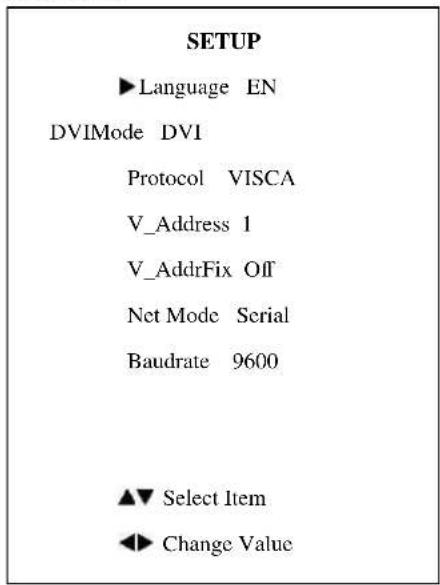
Language: Menu language, Optional items: EN, Chinese, Russian
DVIMode: Digital signal type for HDMI port, Optional items: DVI, HDMI
Protocol: Control protocol type. Optional items: AUTO, VISCA, PELCO-D, PELCO-P
V_Address: VISCA address, Decided according to the argument of Protocol; Optional items: VISCA (1\~7), PELCO-D (0\~254), PELCO-P (0\~31)
P_D_Address: PELCO-D address; Optional items: 0 \~ 254
P_P_Address: PELCO-P address; Optional items: 0 \~ 31
V_AddrFix: Lock IR Address from changing via serial control, Optional items: On, Off (When set to On, 88 30 01 FF Command will not function)
Net Mode: Set the serial port control networking, Optional items: Serial, Paral (parallel)
Baudrate: Serial port baud rate. Optional items: 2400, 4800, 9600
8. RESTORE DEFAULT
Move the cursor to the Restore Default item in the main menu and press [HOME] button, RESTORE DEFAULT menu appears, as shown in the following figure.
![RESTORE DEFAULT ►Restore? No ◄► Change Value [Home] OK 「Menu」 Back](/content/2026/06/1175434/images/9654cb02d52db93b597e0e3edb6cdcfc3960e6f0e5dfd8e59eeedeb5d34edec0.jpg)
Restore: Reset all settings to factory default settings.
Optional items: Yes, No
Note: Press [HOME] button to confirm, All parameters are then restored to default values, including IR Remote address, VISCA Address and Pelco addresses.
9. SAVING
Save: Save setting changes. Optional items: Yes, No
Network Connection
1. Operating Environment
Operating System: Windows 2000/2003/XP/Vista/7/8.1/10
Network Protocol: TCP/IP
Client PC: P4/128M RAM/40G HD/ support for scaled graphics card, support for DirectX8.0 or more advanced version.
2. Equipment Installation
1) Connect camera to your network via a CAT5 or CAT6 patch cable or directly to your PC via a CAT5 or CAT6 crossover cable.
2) Turn on camera power.
3) If successful, the orange network light will illuminate and the green light will start flashing. If unsuccessful, the patch cable is bad, you are using the wrong cable (patch aka "straight-thru" cable for connection through a LAN; crossover for a direct PC connection) or you have connected to an inactive network jack.
3. Network Connection
Connection method between network camera and computer, as in pictures 1.1 and 1.2, below:
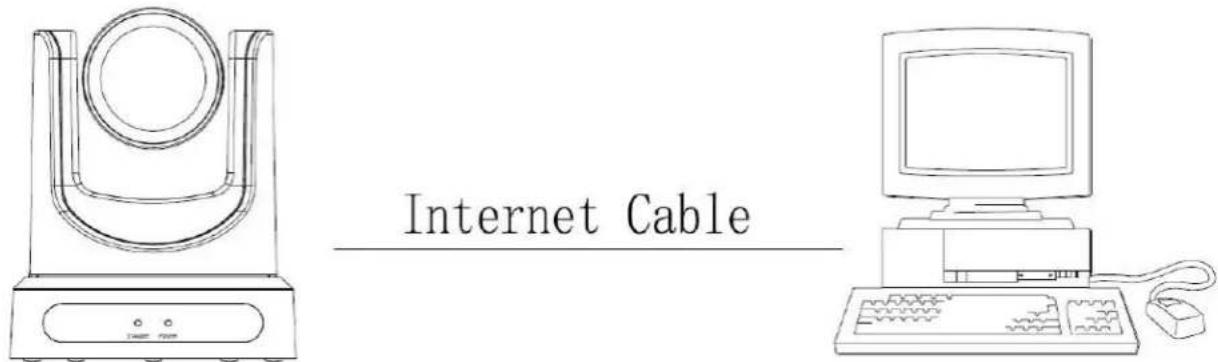
Picture 1.1 Direct connections via "cross-over" network cable
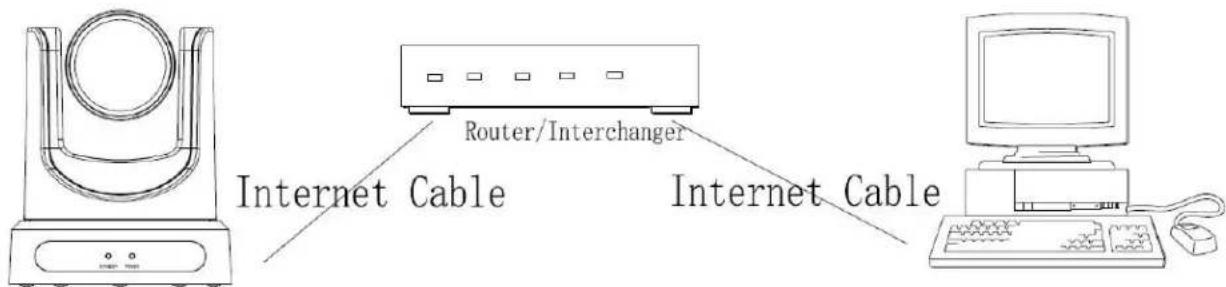
Picture 1.2 Connections to LAN via patch cable to LAN wall jack or LAN switch
Setting up a Network Video Stream with the PTZOptics camera
(Also see information on camera web information in the following section)
- The first thing you are going to want to do to get your camera up and streaming on your network is to connect your camera to power, to an active network port on your network and finally to power the camera on.
- Next, go online and download the IP address setting tool, for Windows Operating Systems, from the PTZOptics Download Page. Once you complete the installation and launch the tool "UPGRADE v2.7C" you should be able to click the "Search" button to locate all of the available PTZOptics cameras on your network.
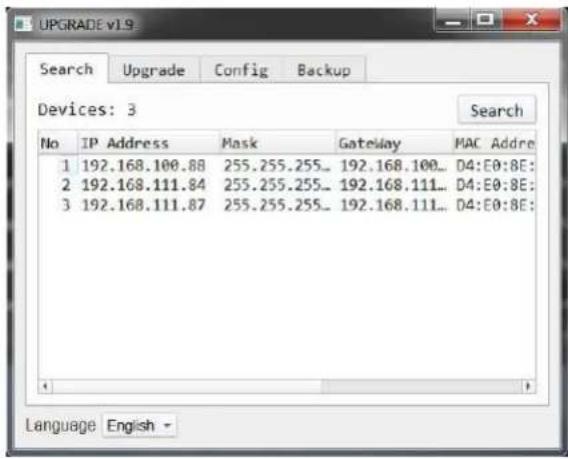
-
The next thing you would want to do is change your cameras IP address to be in the same range as your network. The camera comes with a default static IP address of 192.168.100.88. You will need to update that to be in the same range as your network. If you look at my example above, you can see, from other cameras on my network, that my network is set up to be in the range of 192.168.111.XXX. Please see the "Extras" section at the end of this document for further information on finding your network IP scheme
-
Once you know your IP range you can right click on the camera you wish to change the IP address for and click "config". NOTE: if you need to find the IP range of your network, you can do so by following the guide in the extras section at the end of this document.
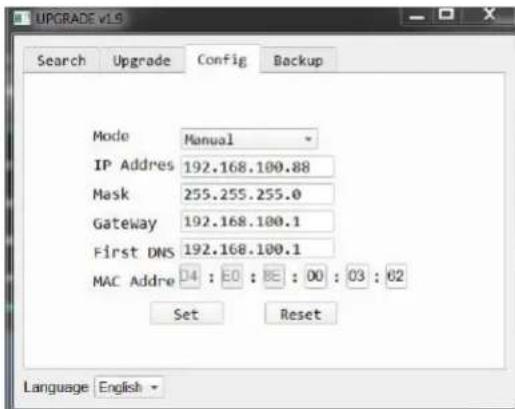
You should now be able to set your cameras IP address to one in the range of your network. You should be able to leave the subnet mask alone, unless you are configuring the camera for use across (example: 192.168.111.1)
(Note that in more complex network environments you may have to request a "STATIC IP" from the IT department to prevent any possible complications on your network in addition to the appropriate Network Mask, Default Gateway and First DNS for that Static IP)
- Now that you have set the Static IP address of your PTZOptics camera, you should be able to pull up the video feed in a web browser. We recommend using Mozilla Firefox ESR. You can view our knowledge base article for setup.
- If you go into the browser mentioned above and type in the Static IP address you assigned to your camera, in step 4, you will be prompted for a Username and Password, both are "admin" by default.
- You may be prompted to download the VLC Player Plugin; be sure to allow for both the Mozilla plugin and the ActiveX plugin if on a PC. If you are on a MAC, you need to move the VLC plugin, once downloaded, into the internet plugins folder. See the images below for further clarification.
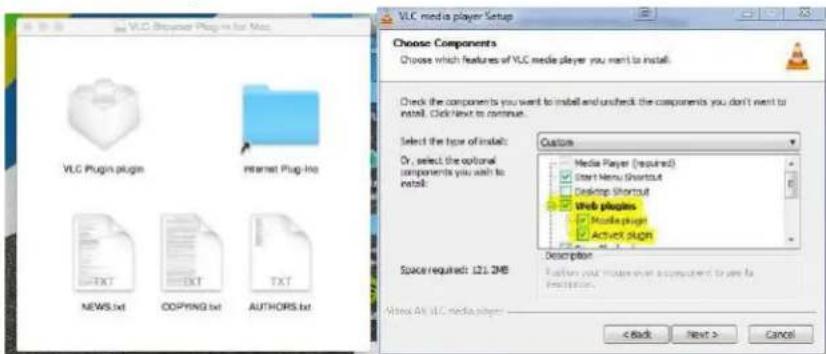
- You should now be able to see the IP interface in the recommended browser with your live camera feed. You should have full PTZ control over your camera using the PTZ controls on the left side. You can adjust many of your cameras settings via the IP interface.
The main thing to note about the IP interface is that all adjustments will occur on the IP stream only. It will not affect the HDMI, SDI or USB connections of the camera. In addition, presets set in the IP interface will not be the same as the IR remote presets and vice-versa.
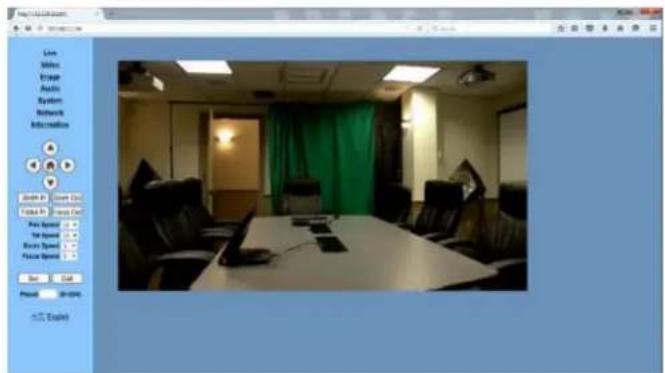
-
You should now be able to receive an RTSP stream from your camera. The following video, https://www.youtube.com/watch?v=hmqI0hjT0UI&feature=youtu.be, shows how to setup an RTSP stream in Wirecast. You'll see how to use ONVIF to easily set up 2 PTZOptics cameras with Wirecast, the ONVIF feature must be enabled in the "Network" settings for ONVIF discovery, in addition to setting up a standard RTSP stream.
-
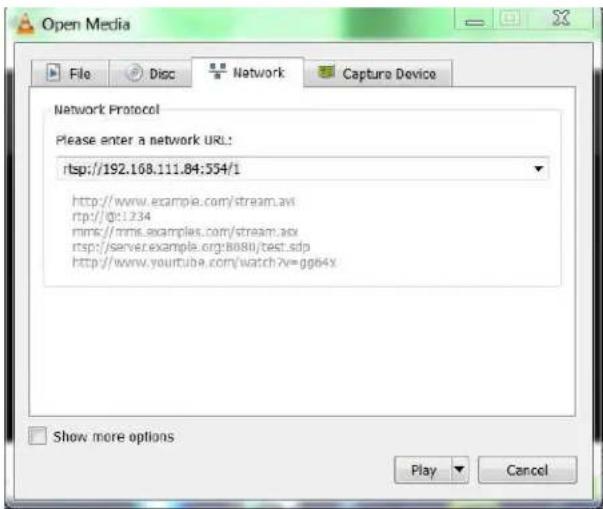
You can test the RTSP stream in VLC media player. Once you install VLC and launch the program you should be able to go to the "Media" drop down menu and then select "Open Network Stream". In the network URL, you should enter "rtsp://
:554/1". In the example below, for a PTZOptics camera with the static IP address of 192.168.111.84, the RTSP stream would accessed by entering rtsp://192.168.111.84:554/1. The "554" part is the port number used by the cameras, and the "1" is the stream number. (There are two RTSP network streams available; one for HD content "1" and one for SD content "2")
EXTRAS
- Discovering your Network IP range. NOTE: Changing your IP address without talking to your network admin could lead to conflicts with your network. If you change your address to one that is already is use it will cause communication problems.
If you need to discover the IP address range of your network you can do so by using command prompt for Windows or Terminal for Macs.
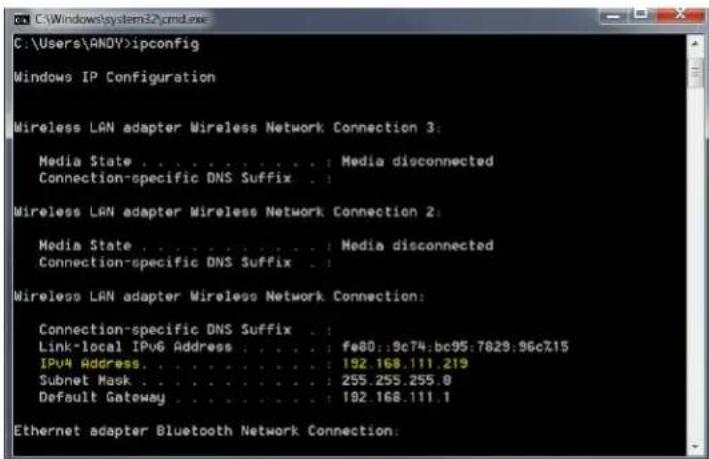
To do this on a PC, you would type "CMD" into your search bar in the Windows menu. You should see a black box pop up with the ability to type in the box.
If you type "ipconfig" and hit "Enter" on your keyboard you will see a bunch of information pop up in your command prompt.
When you see "IPV4 Address" that is your computers IP address on your current network. So you would use the first 3 sets of numbers from this as your IP range.
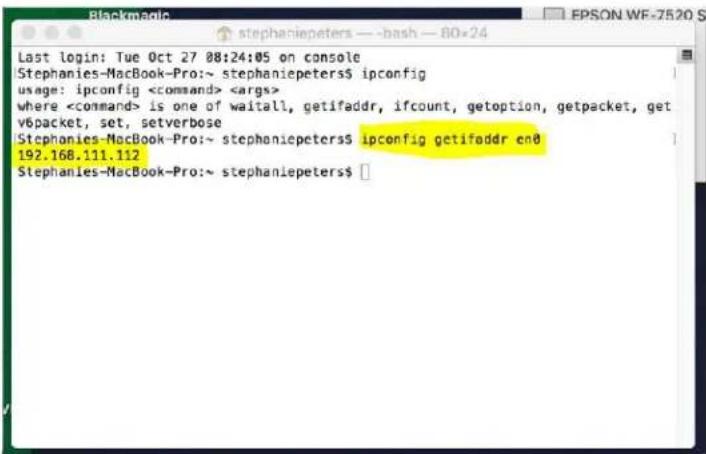
If you need to find the IP range of your MAC computer, you would first open a new finder window and then go to Applications, and then Utilities. You should see the program "Terminal" in that menu, select that program.
Now, you would type in "IP config getifaddr en0" Once you type this string and click "Enter" on your keyboard you will receive back an IP address.
So the IP range of my network, according to my MAC is 192.168.111.xxx, you can use this to figure out the IP range in which your camera needs to be set.
Camera Web Interface
All pages include 2 areas:
On the left is the menu and camera control
On the right is real time monitoring - displaying video image and the Parameter settings
1.2 Video viewing window
Click "Live" in the menu area. The video viewing window will be resized based upon video resolution, the higher the resolution is, the bigger the playing area is. Double click the viewing window and it will show in full-screen. Double click again and it will return to the initial size.
The Status bar in the viewing window is as shown below:

1) Video playback/pause button: controls real-time video. Pause to freeze the image, play to return to live video.
2) Audio control buttons: Mute and Volume controls for audio input on camera, if being used.
3) Full screen button will switch between Full Screen and Windowed view.
1.3 PTZ Control
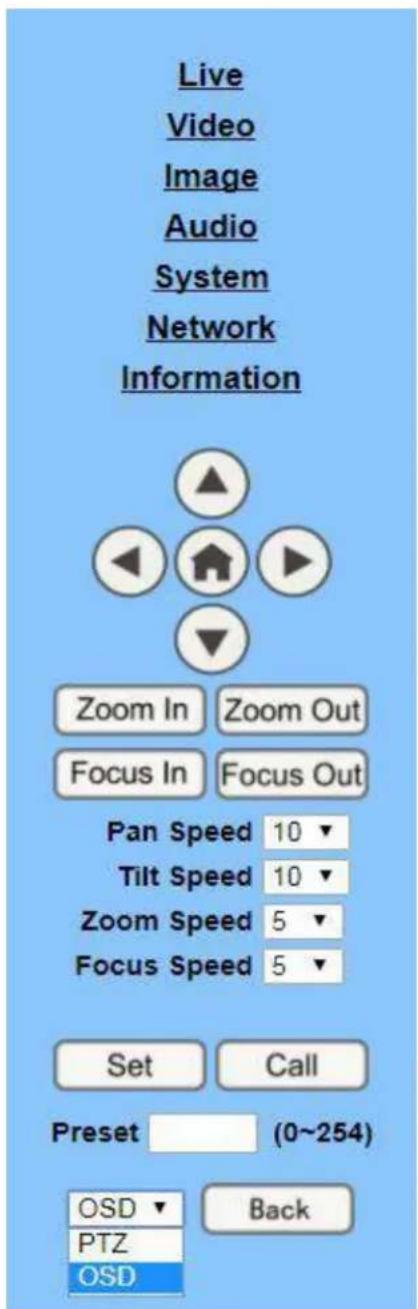
1) Pan and Tilt control: Up, Down, Left and Right arrows and the home button allow you to manual drive the camera to the desired position.
2) Zoom: Zoom in and Zoom out buttons allow for wide or narrow (tele) views of the space.
3) Focus: Focus In and Focus Out buttons allow for fine manual focus adjustment if the camera has any problems autofocusing on a difficult object.
4) PTZ Speeds: Pan speed can be set at any rate between 1 - 24, Tilt speed can be set at any rate between 1 - 20.
Zoom and Focus speeds can be set at any rate between 0 - 7.
5) PTZ Presets: After manually setting up a shot that you would like to return to later, you can save presets for quick recall of these positions. Type a number between 0 and 254 into the Preset box. Click the "Set" button to save the current location with that preset number. Click the "Call" button to cause the camera to return to that position. This enables smooth, quick and convenient control without the need to manually drive the camera.
6) PTZ/OSD dropdown: From the dropdown menu, clicking the OSD option will open the on screen display menu of the camera giving you control from within the IP interface
1.4 Language selection
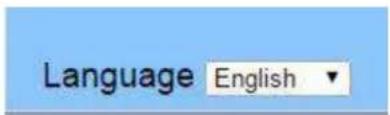
Click either "Russian", "Chinese" or "English" to change the language of the menu.
2 Media
2.1 Video Setup
Click "Video". The streaming parameters may now be set in the right side area. The camera can send 2 simultaneous streams. For example, you can send one stream in HD and one in SD so that both PCs and phones may have their own stream resolution.
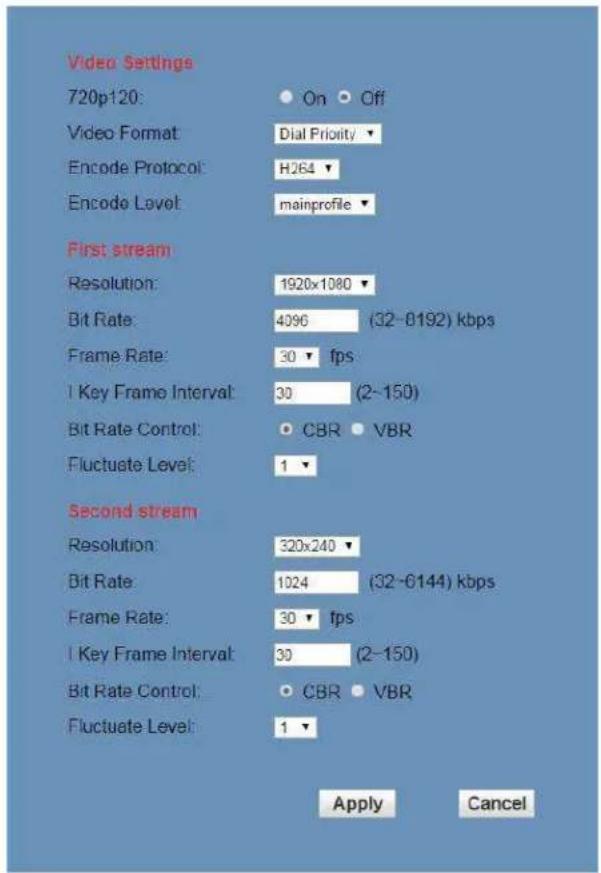
1) Video Settings
720p120
Allows camera to output 720p at 120fps via the IP Streaming output only. Set to 'On' or 'Off'. (Note: Setting to 'On' will override and lockout other video settings).
Video format
Supports 50HZ(PAL) and 60HZ(NTSC) and Dial Priority (see rotary dial on camera) formats.
60Hz is used for North America.
Video Coding
You must select both Encode Protocol and Encode Level for H.264. Camera streaming supports either H.264 - with choice of "baseline", "mainprofile" and "highprofile" formats or H.265 video encoding (Note H.265 will override and lockout some other video settings).
2) First Stream
Resolution
Set the desired video stream resolution. The first stream allows 1920x1080 (1080p), 1280x720 (720p) or 1024x576. The second stream allows 720x576 or 320x240. Higher resolutions will consume more bandwidth.
Bit Rate
Users can assign the bit rate of the stream (from 32 – 8192 kbps for 1^st stream and 32-6144 kbps for 2^nd stream). Higher bit rates will provide for a higher quality image, if your network bandwidth is sufficient to support the rate.
Maximum frame rate:
Users can specify the maximum frame rate (fps or frames per second). Higher frame rates provide smoother video but require higher bit rate settings.
I key frame interval:
Affects the quality of the video compression. This setting defines how many predicted frames will be used for each actual frame (from 2-150). Shorter intervals increase video quality at the cost of requiring higher bit rates in order to look good.
Bit Rate Control method:
Constant bit rate: video encoder will encode at a constant rate as set in bitrate setting
Variable bit rate: video encoder will encode at a variable rate with maximum as set in bit rate setting, allowing for low motion scenes to use less bandwidth.
Fluctuate level
This setting affects how aggressive variable bit rate adjustments will be (1-6). Spikes that are too large may affect video quality. Low levels will not save on as much bandwidth.
3) Second Stream (See parameters above for first stream).
Image Setup
Click "Image". The image parameters may now be set in the right side area.
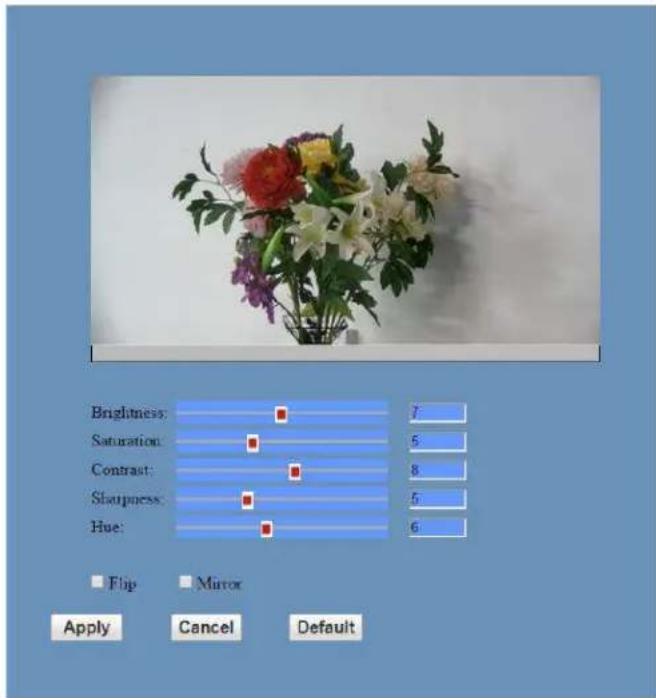
bar
| Feature | Value | |---|---| | Brightness: | 7 | | Saturation: | 5 | | Contrast: | 8 | | Sharpness: | 5 | | Hue: | 6 |Brightness
Image brightness 0-14. Use the slider control. The box on the right shows the corresponding numerical value. The Default setting is 7.
Saturation
Color Saturation 0-14. Use the slider control. The box on the right shows the corresponding numerical value. The Default setting is 5.
Contrast
Contrast 0-14. Use the slider control. The box on the right shows the corresponding numerical value. The Default setting is 8.
Sharpness
Sharpness 0-15. Use the slider control. The box on the right shows the corresponding numerical value. The Default setting is 5.
Hue
Hue 0-14. Use the slider control. The box on the right shows the corresponding numerical value. The Default setting is 6.
Flip & Mirror
Check the "Flip" box to invert the image vertically for a ceiling mount. Check the "Mirror" box to invert the image horizontally. The default setting is unchecked.
Apply, Cancel and Default Buttons
After adjusting the parameters, press the "Apply" button to save settings. Press the "Cancel" button to cancel the adjustment of the parameters. Press the "Default" button to return to the default value.
2.2 Audio Setup
Click "Audio". The audio parameters may now be set in the right side area.
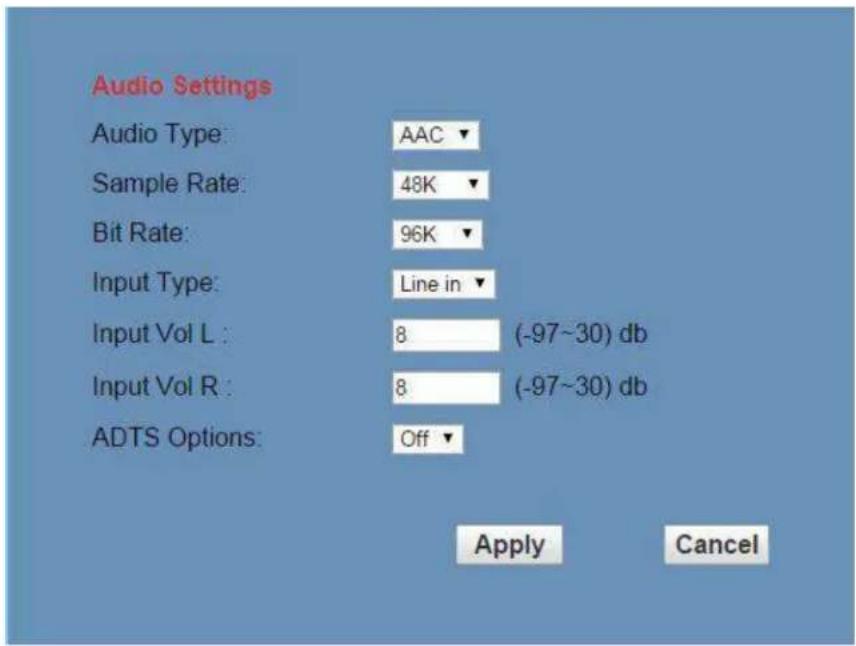
Audio Type: AAC is the only audio format currently supported.
Sample rate: Selectable as either 44.1 K and 48 K.
Bit rate: Selectable among 96k, 128k or 256k
Input Type: Currently Line in only
Input VolL: Sets the volume of the left audio channel (from -97 to +30dB)
Input VolR: Sets the volume of the right audio channel (from -97 to +30dB)
ADTS: Audio Data Transport Stream: Set to 'On' or 'Off (use for MPEG 2 only – may not be applicable on all models)
Apply and Cancel Buttons
After modifying the parameters, press the "Apply" button to save. Press the "Cancel" button to leave settings unchanged.
2.3 System Settings
Click "System". The system parameters may now be set in the right side area.
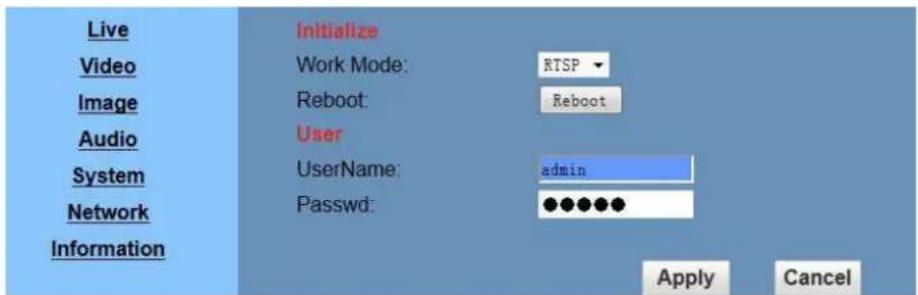
1) Initialize
Work Mode: RTSP (Real Time Streaming Protocol) is the only streaming protocol currently supported.
Reboot: Click the "Reboot" button to initiate a system restart. This is required after changing some settings.
2) User
User and Password: The user can modify the password (letters and Numbers only).
The default settings are UserName: admin and Password: admin
Apply and Cancel Buttons
After modifying the parameters, press the "Apply" button to save. Press the "Cancel" button to leave settings unchanged.
2.4 Network Settings
Click "Network". The network parameters may now be set in the right side area.
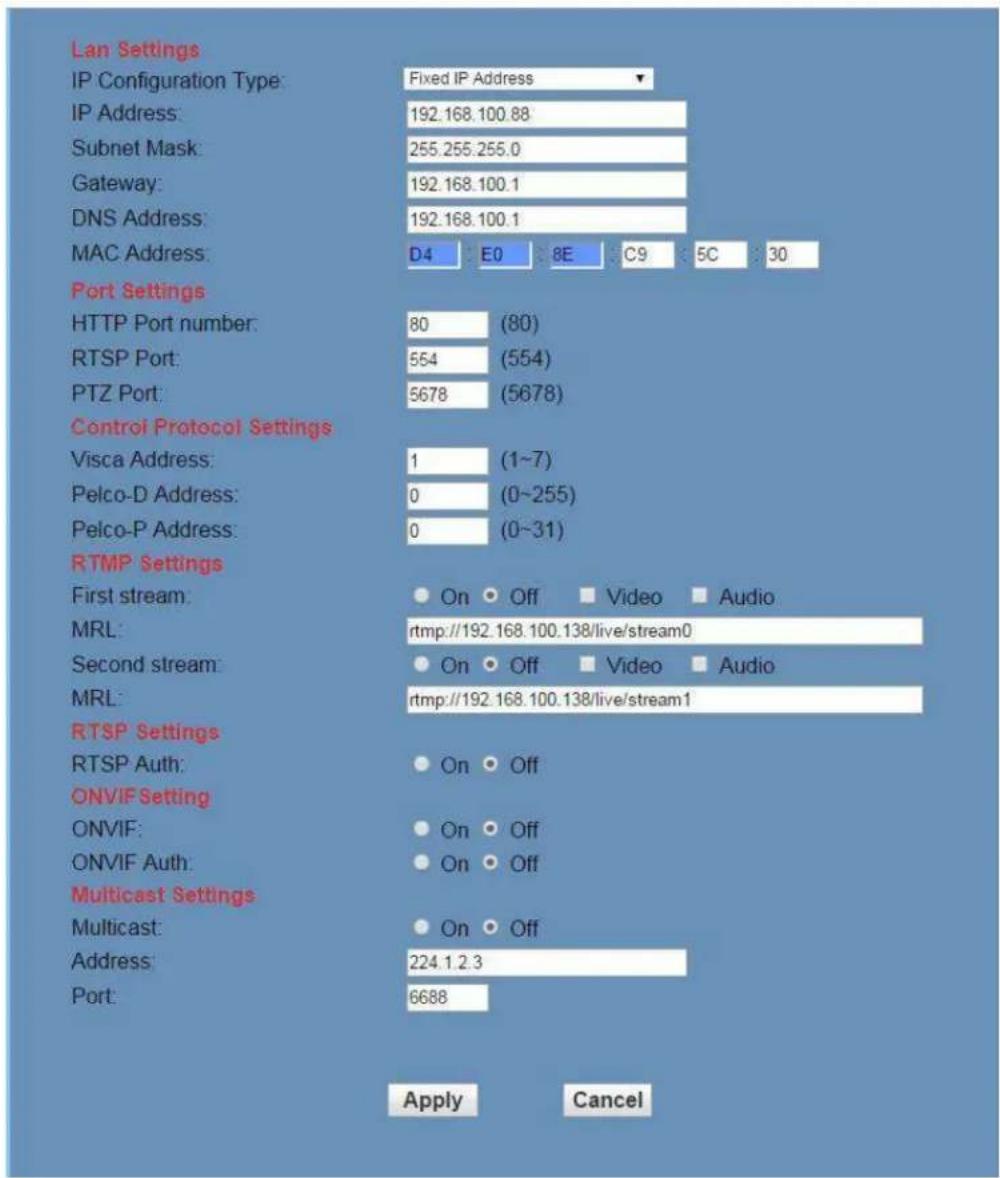
1) LAN Settings
IP settings for the device can be set here using either static (fixed) or DHCP (dynamic) addressing as selected from the drop down list. The Default the IP address of the camera is 192.168.100.88. The MAC address can be modified but should be left as set by the factory. Please note that after changing the IP settings for the camera, you may not be able to reconnect until your PC is set for and connected to the same subnet or visible via proper network routing.
2) Port Settings
While the IP address identifies the device, the camera uses multiple ports.
HTTP Port: This is the port for the web application (the default http port: 80)
RTSP Port: The camera supports the RTSP streaming protocol. The default port: 554.
PTZ Port: Supports camera control via the TCP protocol. The default port: 5678.
3) Control Protocol Settings
Control addresses for VISCA (1-7), Pelco-D (0-254) and Pelco-P (0-31) may be set here.
4) RTMP settings
RTMP streaming may be enabled for 2 separate streams to a streaming server (or servers). Note: A separate streaming server is required for use of RTMP streaming. Set 1^t and 2^nd stream to 'On' or 'Off', check to include video and/or audio and type in the address and port or domain of the streaming server (MRL - Media Resource Locator).
5) RTSP Authorization
Turn authorization 'On' or 'Off' for RTSP streaming.
6) ONVIF Setting
Turn On/Off ONVIF and ONVIF auth.
7) Multicast Setting
Turn Multicast streaming ‘On’ or ‘Off’ (Note: Do not attempt to use Multicast streaming unless your network has been setup and tested to support multicast, e.g. IGMPv3. Significant network performance issues may result otherwise. Also note: The public internet does not support multicast streaming).
Address and Port Settings: enter the multicast address and port to be used.
8) Apply and Cancel Buttons
After modifying the parameters, press the "Apply" button to save. Press the "Cancel" button to leave settings unchanged.
2.5 Device Information
Click "Information"
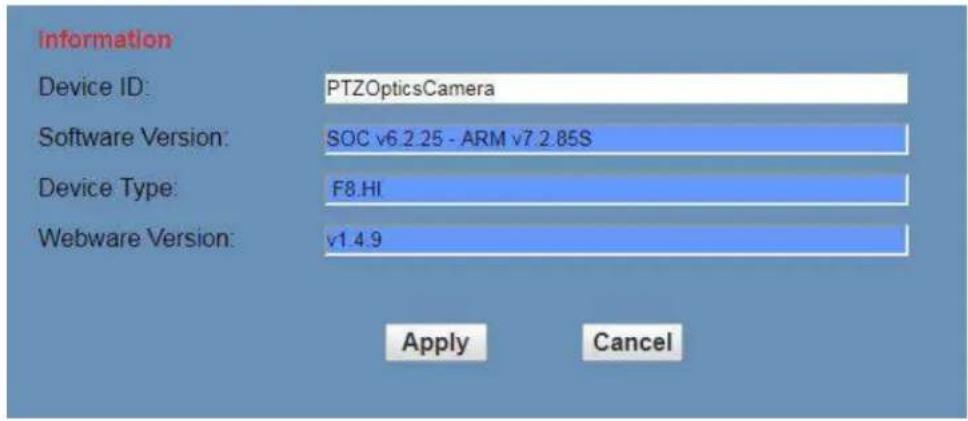
Shows the current device information, as shown below. You may change the device ID as required for your application.
Network Camera Control Protocol
Setup camera for IP (First see "Setting up the Camera's IP" section above)
Control Notes:
PTZ over TCP/UDP
The camera currently supports various PTZ control methods, including RS232, RS485, IR remote control, web interface, HTTP-CGI and TCP/UDP protocol
The camera includes an internal TCP server. The default port number is 5678. When client and server set up a TCP connection, the client sends PTZ command to the internal server and the server will then parse and execute the PTZ commands.
The camera includes an internal UDP server. The default port number is 1259. When client and server set up a UDP connection, the client sends PTZ commands to the internal server and the server will then parse and execute the PTZ commands.
The command format based on VISCA is shown above in the Serial Communication Control Section
HTTP CGI Method: The camera's integrated web server supports HTTP CGI for PTZ Control
Pan and Tilt control URL format as below:
http://[Camera IP]/cgi-bin/ptzctrl.cgi?ptzcmd&[action]&[pan speed]&[tilt speed]
Parameter Descriptions:
[Camera IP]: Camera IP Address;
[Action] Includes: up, down, left, right, ptzstop;
[Pan Speed]: 1(low speed) - 24(high speed);
[Tilt Speed]: 1(low speed) - 20(high speed);
Zoom control URL format as below:
http://[Camera IP]/cgi-bin/ptzctrl.cgi?ptzcmd&[action]&[zoom speed]
Parameter Descriptions:
[Action] Includes: zoomin, zoomout, zoomstop;
[Zoom Speed]: 0(low speed) - 7(high speed);
Focus Control URL format as below:
http://[Camera IP]/cgi-bin/ptzctrl.cgi?ptzcmd&[action]&[focus speed]
Parameter Descriptions:
[Action] Includes: focusin, focusout, focusstop;
[Focus Speed]: 0(low speed) - 7(high speed);
Preset Position Control URL format as below:
http://[Camera IP]/cgi-bin/ptzctrl.cgi?ptzcmd&[action]&[position number]
Parameter Descriptions:
[Action] Includes: posset, poscall:
[Position Number]: 0 - 89, 100 - 254 PTZ on IP Network
PTZ / OSD Menu Access Control URL format as below:
http://[camera ip]/cgi-bin/param.cgi?navigate_mode&[menu]
Parameter Descriptions:
[Menu] Includes: OSD (On Screen Display Menu), PTZ (Pan, Tilt, & Zoom Control)
OSD Menu Navigation Control URL format as below:
http://[camera ip]/cgi-bin/ptzctrl.cgi?ptzcmd&[action]
Parameter Descriptions:
[Action] Includes: up, down, enter, return
Home Position Control URL format:
http://[camera ip]/cgi-bin/ptzctrl.cgi?ptzcmd&home
Photobooth Functionality
Your PTZOptics camera has the ability to quickly, and easily, take a series of four (4) still images or video files that are stored on the camera and made accessible with a standard web browser on the same network. We'll cover how to use this new feature to take still images, videos and how to retrieve them.
Photos
You have two (2) options to initiate a series of four (4) still images being captured...
You can enter the following HTTP string into any web browser on the same network as the camera to initiate a series of four (4) still images.
Take Still Images: http://
In this example the variable “X” is utilized to add additional delay, in seconds, between still images being taken. The variable “X” can have any value from 1 – 9, with the values representing time in seconds.
You can also press the “F1” button on your IR remote to initiate a “quick capture” that has, approximately, a four (4) second delay between four (4) still images being captured.
To retrieve your series of four (4) still images you will need to open a standard web browser with network access to the camera and use the following HTTP strings to retrieve the still image files as desired.
Still Image 1: http://
Still Image 2: http://
Still Image 3: http://
Still Image 4: http://
Videos
You have two (2) options to initiate a series of four (4) videos being captured...
You can enter the following HTTP string into any web browser on the same network as the camera to initiate a series of four (4) video recordings.
Take Video: http://
In this example the variable “X” is utilized to add additional delay, in seconds, between videos being taken. The variable “X” can have any value from 1 – 9 with the values representing time in seconds.
In this example the variable “Y” is utilized to adjust the overall length, in seconds, of each video file. The variable “Y” can have any value from 1 – 10 with the values representing time in seconds.
You can also press the “F2” button on your IR remote to initiate a “quick capture” that has, approximately, a four (4) second delay between four (4) ten (10) second videos being captured.
To retrieve your series of four (4) videos you will need to open a standard web browser with network access to the camera and use the following HTTP strings to retrieve the video files as desired.
Video 1: http://
Video 2: http://
Video 3: http://
Video 4: http://
Video Note: It can take the camera time for the video files to be fully captured and processed; if they are not retrievable please wait an additional 30 – 60 seconds for the process to complete.
USB Control of Camera
Connect a USB 3.0 cable from the camera to a computer's USB3.0 port.
Install the software downloaded from the downloads page at PTZOptics.com
(amcap.exe) amcap.exe and double click the .exe to start the program (there is no installation required). From the Options Menu choose the Video Capture Filter command. Use the camera controls to control the camera. Some early releases of the camera model may not support UVC control (control over USB). Conferencing and other software that has integrated UVC Control functionality will be able to also control the camera via USB.
Maintenance and Troubleshooting
Camera Maintenance
- If the camera will not be used for a long time, please turn off the power switch.
- Use a soft cloth or lotion-free tissue to clean the camera body.
- Use a soft dry lint-free cloth to clean the lens. If the camera is very dirty, clean it with a diluted neutral detergent. Do not use any type of solvent or harsh detergent, which may damage the surface.
Unqualified Applications
- Do not shoot extremely bright objects for a long period of time, such as sunlight, ultra-bright light sources, etc...
- Do not operate in unstable lighting conditions, otherwise the image may flicker.
- Do not operate close to powerful electromagnetic radiation, such as TV or radio transmitters, etc...
Troubleshooting
- No image
-
Check whether the power cord is connected, voltage is OK, POWER lamp is lit.
-
Check whether the camera can "self-test" after startup (camera will do a brief pan-tilt tour and return to the home positon, or if preset 0 is set, the camera will return to the preset 0 position).
-
Check that the signal cable is connected correctly (HDMI or USB3.0 depending upon your application).
-
If HDMI, make sure that the destination device is accessing the HDMI port that you plugged into.
-
If USB, make sure that your operating system has properly recognized the device as a video camera and that you have selected it in your application (e.g. conferencing) software as the active video source.
● Abnormal display of image
- Check setting of rotary dial on rear of camera. Be sure to use a resolution and refresh rate that is supported by your software.
- Image is shaky or vibrating.
-
Check whether camera is mounted solidly or sitting on a steady horizontal and level surface.
-
Check the building and any supporting furniture for vibration. Ceiling mounts are often affected by building vibration more than wall mounts.
-
Any external vibration that is affecting the camera will be more apparent when in tele zoom (zoomed in) settings.
Control
- IR remote controller does not control the camera
-
Does one of the 4 "Camera Select" buttons (top row of remote) light up when you press any button on the remote?
-
If not, change the batteries in the remote.
-
Are the camera and remote set to the same IR address? You can use press [*] + [#] + [1] (3 buttons in sequence) on the remote to set the camera to address 1. Press “Camera Select” 1 on the remote to control the camera.
-
Try removing other sources of IR interference (e.g. sunlight, fluorescent lighting).
- Serial communication does not control the camera
-
Make sure the camera is on and functioning with the IR remote control.
-
Verify that the RS232 cable is connected correctly and using the proper pinout.
-
Verify the communication settings of the control software or device (e.g. joystick).
-
Verify that the communication port on the controlling device is activated (e.g. Com port on PC).
-
Verify that all communication settings in the OSD Setup Menu correlate to the commands being used (e.g. VISCA address).
Important Notes Regarding USB Connectivity:
USB 3.0 ports are backwards compatible with USB 2.0 devices. USB 2.0 ports are not completely forward compatible with USB 3.0 devices (some USB 3.0 devices will connect to USB 2.0 with limited functionality).
External USB hubs should be avoided (i.e. give the camera its own USB port on the device) as they are not well suited to transmitting HD video reliably.
USB extension systems must be fully compatible with the version of USB that you are using and must utilize an external power supply, when required. Caution: Some “compatible” USB 3.0 extenders do not actually have the full 5Gbps bandwidth required for uncompressed HD video – so check bandwidth specs. Always connect the PTZOptics camera directly to the device in order to associate the UVC drivers before attempting to use any extension system.
USB 3.0 power saving settings in the device's operating system should be turned off completely for reliable USB 3.0 camera connectivity.
PTZOptics Cameras
All PTZOptics cameras utilize the UVC (USB Video Class) drivers that are built into Windows, Mac OS and Linux to stream HD video to your device via your device's USB 3.0 port. When your device successfully recognizes the camera, your device will register the PTZOptics as an “imaging device”.
You can see this in your Windows Device Manager program (type “device manager” into the Windows search tool) as shown in the screenshot, below:
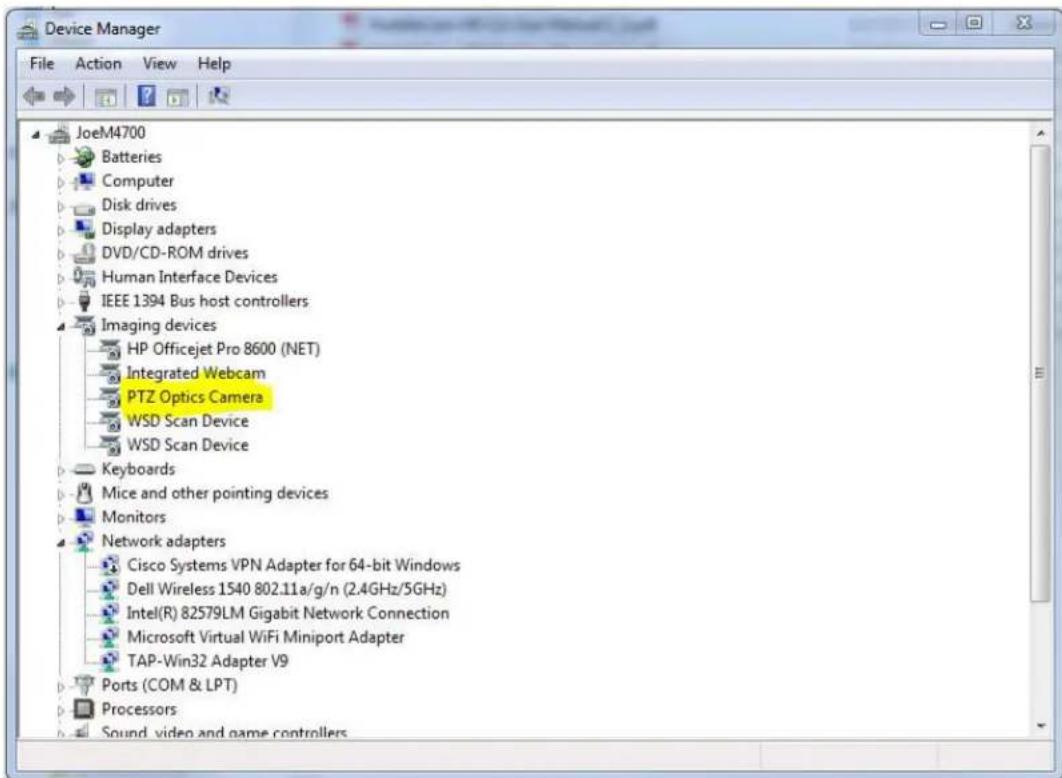
In this example, you can see the PTZOptics model in use connected as a fully functional USB 3.0 device (PTZOptics).
If your device has not connected to or has not recognized the PTZOptics as an imaging device (in which case, you may see a new “unknown device”, “Westbridge” or “CYTFX3” labeled device show up in Device Manager’s “Universal Serial Bus Controllers” section rather than in the “Imaging Devices” section), the PTZOptics will not be available to programs that utilize a camera. In this case, try restarting the device and reconnecting the camera via USB 3.0.
Similarly, you can see a connected device in System Information on a MAC. See screenshot below:
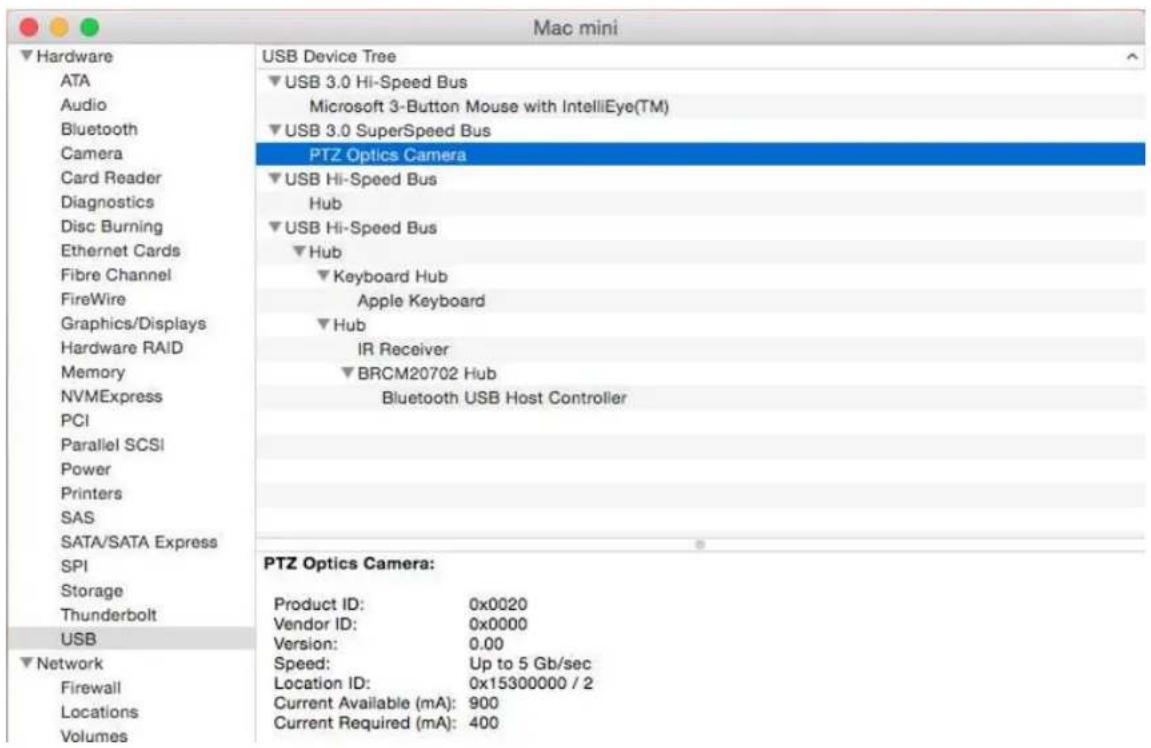
In this example, you can see the PTZOptics model in use connected as a fully functional USB 3.0 device "PTZOptics".
Copyright Notice
The entire contents of this manual, whose copyright belongs to PTZOptics, may not be cloned, copied or translated in any way without the explicit permission of the company. Product specifications and information referred to in this document are for reference only and as such are subject to updating at any time without prior notice.