Bridges 93500-52-731-BA6E - Watch Girard-Perregaux - Free user manual and instructions
Find the device manual for free Bridges 93500-52-731-BA6E Girard-Perregaux in PDF.


User questions about Bridges 93500-52-731-BA6E Girard-Perregaux
0 question about this device. Answer the ones you know or ask your own.
Ask a new question about this device
Download the instructions for your Watch in PDF format for free! Find your manual Bridges 93500-52-731-BA6E - Girard-Perregaux and take your electronic device back in hand. On this page are published all the documents necessary for the use of your device. Bridges 93500-52-731-BA6E by Girard-Perregaux.
USER MANUAL Bridges 93500-52-731-BA6E Girard-Perregaux
This true technical revolution stunned connoisseurs when prototypes of the innovative mechanism were first presented. Based on the ground-breaking prototypes presented in 2008, it has taken five years of research and development to bring this signature movement to fruition. Watchmaking history will be forever marked by this significant achievement in chronometry, paired with the superb balance and singularity of this movement.
The name, in addition to being a nod to one of the Maison's historical figures, Constant Girard-Perregaux, also refers to a holy grail in mechanical watchmaking that has perplexed watchmakers since the dawn of time: the constant force. Keeping true to its innovative vision, the brand decided to try using a quite novel approach to achieve it. The initials "L.M." stand for Luigi Macaluso, who decided to trust and promote this movement, introduced as a working prototype in 2008 and launched now as part of the Girard-Perregaux collection.
The concept presented on that occasion in the form of a functional mechanism was breathtaking, promising and poetic: the design was lightweight and graceful. However, the goal was far from being the result of art for art's sake, this was a new and convincing answer to the age-old preoccupation in watchmaking: the precision and regularity of a mechanical watch.
To get an idea of what is at stake and truly understand the importance of this innovation, it is worth recalling a few basic notions. The heart of a mechanical watch is ruled by the regulating organ, which manages the flow rate of the energy received from the barrel to drive the gear train and the rotation speed of the hands. The classic image is that of a faucet managing the flow of water.
The main factor is not so much the speed of the beats of this heart, the chosen frequency, but their regularity. The dance can be three in a bar or four in a bar, or even a thousand; but the essential thing is that it keeps the beat over time.
All sorts of systems had been dreamed up before the famous Swiss lever escapement was presented in wristwatches, and became more or less standard. Yet it suffers from one drawback: it can only give back the energy it receives from the barrel, which diminishes with time. This energy, which defines its timekeeping accuracy, is too fast to start with, and finishes like a machine running out of steam. A curve, the curse and the bane of watchmakers, illustrates the phenomenon: the curve of the amplitude, or angular displacement of a sprung balance wheel or a pendulum, which lessens towards the end of the run.
The inspiration came from an experiment, which anyone can repeat by holding a business card vertically between thumb and forefinger, bending it to form a C or an open round bracket. If you then apply pressure from the side you will feel resistance until the moment when the card snaps to the other side to mirror its former shape, and close the round bracket. The phenomenon of instability is known as buckling, which is the passage from a state of compression to one of bending. Spring specialists thus speak of buckled blades.
Here, the silicon blade measures one sixth of a hair's thickness and plays the role of a micro-accumulator of energy. This blade is flexed to a point as close as possible to its unstable state, and only needs an infinitesimal quantity of energy – a micro-impulse given by the balance wheel (less perturbing than in a lever escapement) – for it to snap from one state to the other, and in the process, to push the balance wheel forward, compensating for the variable energy of the barrel and liberating the same quantity of energy every time.
Unlike other systems that propose a constant force averaged over time, this is an authentic constant force escapement, as the force is instantaneous and continuous. And indeed, it is quite measurable using laboratory testing methods.
The designers chose a symmetrical double construction. This was not for aesthetic reasons, but to balance the forces at the center of the balance wheel and avoid a concentration of constraints at that point in order to ensure totally unencumbered rotation.
The blade is formed in one piece with the frame which holds it by both ends and plays a decisive role in the very precise locking of the point of contact for the micro-impulse which will make it snap over. The relatively simple principle brings with it the need for absolute precision to put it into practice, which would have been impossible before the use of silicon and the arrival of new part manufacturing techniques, such as deep reactive ion etching (DRIE). The partnership with CSEM in Neuchâtel, Switzerland was decisive. Watchmaking experts and physicists carried out complex calculations to determine the characteristics of the blade, and the many factors governing the buckling point. In the end, the structure of the device incorporating the blade is monolithic. It is held in virtual levitation and undergoes no friction except at the moment of the impulse and the flexing of the blade. The energy of the blade is directly transmitted back to the balance wheel.
Since the blade is the key element of the Constant Escapement, its natural vibration governed the choice of frequency: it will be 3 Hz (21,600 vibrations per hour) for the magic to work. But the future remains open, and tests have already been carried out at other frequencies. In any case, the challenge here is not about high frequencies.
The two escapement wheels look nothing like those found in a lever escapement. They have three teeth for a frequency of 3 Hz, and would need four for 4 Hz. The movement was designed to run for 6 days with a linear power reserve indicator on the dial, demonstrating the efficiency of this escapement in the long run. The energy is supplied by two barrels coupled in parallel (patented design): the cover and the ratchet are a single piece to maximize the thickness available and each drum contains two springs stacked in series. Two other patents have been filed: one for the blade naturally, filed back in 2008, the other for the incorporation of limit stops in a flexible system.
While silicon was the material of choice for its ideal properties in the design and manufacture of the blade, it may be replaced by other materials for escapement wheels, while the movement blanks are in brass coated in black PVD for a contemporary look. The movement's aesthetic is meant to be technical, three-dimensional, but also to give a nod to tradition, with references to the brand's icons such as its famous three Bridges, laid out in a fresh way on its dial side, while on the back there are two arrow bridges.
GIRARD-PERREGAUX CONSTANT ESCAPEMENT L.M. AT A GLANCE
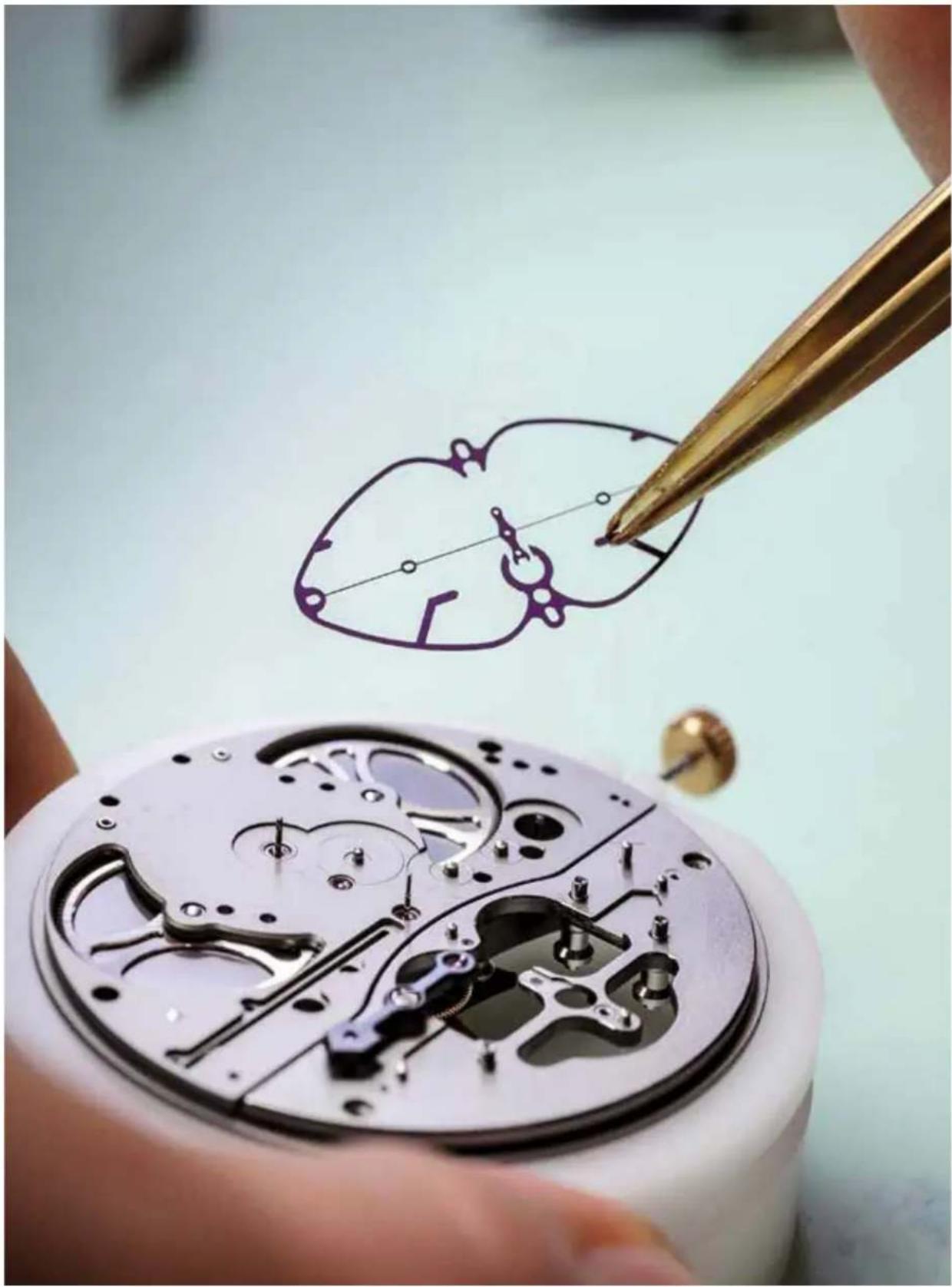
natural_image
Close-up of a hand using tweezers to cut a mechanical component with visible internal structure (no text or symbols)
natural_image
Close-up of a hand using tweezers to work on a mechanical gear assembly (no visible text or symbols)TECHNICAL SPECIFICATIONS
MECHANICAL MANUAL-WINDING MOVEMENT
Diameter 39.20 mm (17 ½")
Height 8.00 mm
Frequency 21,600 Vib/h - (3 Hz)
Jewels 28
Number of components 280
Power reserve 6 days, 2 doubles barrels
Functions hour, minute, central second, linear power reserve indicator
Balance wheel variable inertia, cube with blackor coating, 8 regulating screws
Escapement 14 micron silicon buckled-blade escapement spring
4 suspension springs, escape wheel in pure nickel-phosphore
CASE
Diameter 48.00 mm
Height 14.63 mm
Crystal antireflective sapphire
Case-back antireflective
Water resistance 30 metres (3 ATM)
sapphire crystal, secured by 6 screws
STRAP
Material hand-stitched alligator leather
Buckle folding
INSTRUCTIONS FOR USE
WINDING
This function stores up the power required for your watch to run properly.
USE
2-position crown
-
Manual winding position (crown not pulled-out).
-
Time setting position (crown fully pulled-out).
Manual winding
Your watch requires regular winding to work normally.
To wind, turn your crown anti-clockwise, when it is in position 0).

text_image
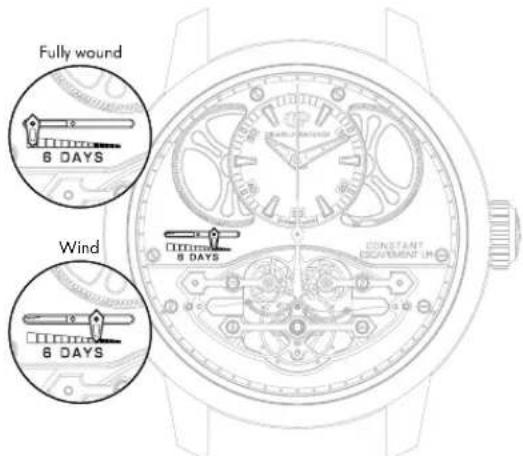
HARLIP BODDAR CLOTHING B. DAYS CONSTANT EQUIPMENT 0The state of the power reserve of your watch is indicated by a small hand moving along a graduated axis. When fully wound your watch has a power reserve of approximately 6 days.
text_image
Fully wound 10 8 DAYS Wind 10 8 DAYS CONSTANT EQUIPMENT UPSETTING THE TIME
-
Pull your crown out to the time setting position 1).
-
Turn your crown to position the hour and minute hands at the selected time. At the time signal, push your crown back to position 0).

text_image
1 10000000000000000000000000000000000000000000000000000000000000000000000000000000000000000000000000000 TOMATO S. DAYS CONSTANT ECAVEMENT U.K. 15 25 35 45 55 65 75 85 95 105 115 125 135 145 155 165 175 185 195 205 215 225 235 245 255 265 275 285 295 305 315 325 335 345 355 365 375 385 395 405 415 425 435 445 455 465 475 485 495 505 515 525 535 545 555 565 575 585 595 605 615 625 635 645 655 665 675 685 695 705 715 725 735 745 755 765 775 785 795 805 815 825 835 845 855 865 875 885 895 905 915 925 935 945 955 965 975 985 995 1 1 1 1 1 1 1 1 1 1 1 1 1 1 1 1 1 1 1 1 1 1 1 1 1 1 1 1 1 1 1 1 1 1 1 1 1 1 1 1 1 1 1 1 1 1 1 1 1 1 1Turning the crown anti-clockwise to set the correct time, might stop your watch. In order to unlock the escapement, please refer to the paragraph "Activation".
Warning: after making any setting, always return the crown to its original position, to preserve the water resistance of your watch and prevent any damage to the mechanism. To do so, press the crown against the case in position 0).
ACTIVATION
The following procedure may be needed to activate your watch, if the movement doesn't start automatically or if it stops.
This is because the escapement may need to be unlocked: rotating your watch allows the escapement to be reactivated and the balance-wheel to oscillate.
USE
-
Hold your watch firmly to avoid any shock.
-
Rotate the case clockwise or counter-clockwise using the dials as a guide.

text_image
THYDIN 0 UAVS CONSTANT EQUIPMENT 1AFUNCTIONS
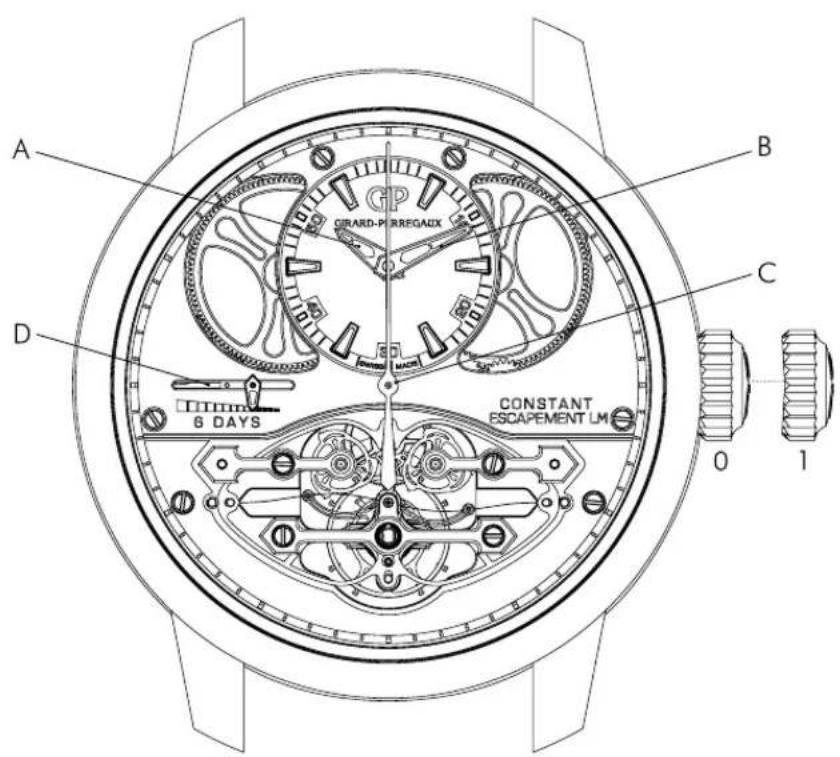
A | Hour
B | Minute
C | Central second
D | Power reserve indicator
text_image
A B C D GIRARD-PARREGAUX 6 DAYS CONSTANT ESCAPEMENT LM 0 1GIRARD-PERREGAUX
1, place Girardet • CH-2301 La Chaux-de-Fonds
T +41 (0)32 911 33 33 • F +41 (0)32 913 04 80
www.girard-perregaux.com