
HDIN 4T613FS-80 - Dishwasher HOOVER - Free user manual and instructions
Find the device manual for free HDIN 4T613FS-80 HOOVER in PDF.


| Product Type | Freestanding Dishwasher |
| Model | HDIN 4T613FS-80 |
| Brand | Hoover |
| Capacity | 13 place settings |
| Dimensions (W x H x D) | 60 x 85 x 60.9 cm |
| Depth with door open | 120 cm |
| Water supply pressure | Min 0.08 – Max 0.8 MPa |
| Electrical supply | 220-240 V, 50/60 Hz, 10 A |
| Number of wash programmes | 12 (including ECO, Rapid, Hygiene+, Steam, etc.) |
| Wi-Fi connectivity | Yes (ONE Fi technology) |
| Automatic door opening | Yes (Open Door option) |
| Extra Dry option | Yes |
| Action Pro function | Yes (Power Wash+ and Soft Programs-) |
| Delay start | 1-23 hours |
| Water softener adjustment | 8 levels (d0-d7) |
| Salt container capacity | 1.5-1.8 kg |
| Rinse aid dosage | 1-6 (recommended position 4) |
| Upper basket adjustment | Yes (2 positions) |
| Third basket | Yes (for cutlery and small items) |
| Cutlery basket | Detachable two-part |
| Filter system | Self-cleaning micro filter |
| Interior material | Stainless steel |
| Safety features | Waterblock/Aquastop, overflow protection |
Frequently Asked Questions - HDIN 4T613FS-80 HOOVER
User questions about HDIN 4T613FS-80 HOOVER
0 question about this device. Answer the ones you know or ask your own.
Ask a new question about this device
Download the instructions for your Dishwasher in PDF format for free! Find your manual HDIN 4T613FS-80 - HOOVER and take your electronic device back in hand. On this page are published all the documents necessary for the use of your device. HDIN 4T613FS-80 by HOOVER.
USER MANUAL HDIN 4T613FS-80 HOOVER
Thank you for choosing a Hoover dish washer. We are confident it will assist you loyally in washing your daily dishes in fu safety.
Carefully read this manual for correct and safe appliance use and for helpful tips of efficient maintenance.

Only use the dish washer after carefully reading these instructions. We recommend you always keep this manual to hand and in good condition for any future owner.
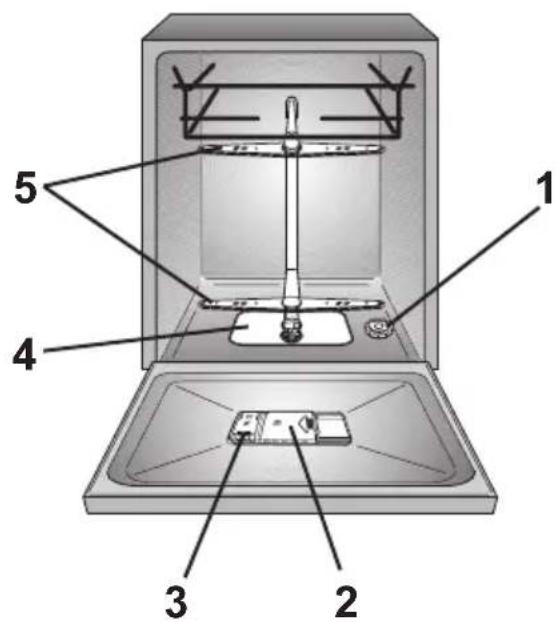
Please check that the appliance is delivered with this instruction manual, the warranty certificate, the service centre address and the energy efficiency label. Each product is identified by a unique 16-digit code, also called the "serial numbe printed on the warranty certificate or on the serial plate found inside the door, on the upper right hand side. This code is a sort of product-specific ID card that yc will need to use to register the product or if you need to contact the Technical Assistance Centre.
Fig. A
Contents
- GENERAL SAFETY RULES
- WATER CONNECTION
- LOADING THE SALT
- ADJUSTING THE UPPER BASKET (SAME MODELS ONLY)
- LOADING DISHES
- INFORMATION FOR TEST LABORATORIES
- LOADING THE DETERGENT
- TYPES OF DETERGENT
- LOADING THE RINSE AID
- CLEANING THE FILTERS
- PRATICAL HINTS
- CLEANING AND MAINTENANCE
13.DESCRIPTION OF THE CONTROL PANEL - TECHNICAL DATA
15.PROGRAMME SELECTION AND SPECIAL FEATURES - ONE FI
- PROGRAMME LEGEND
- WATER SOFTENER UNIT
- THROUBLESHOOTING AND WARRANTY
- ENVIRONMENTAL CONDITIONS
1. GENERAL SAFETY RULES
● This appliances is intended to be used in household and similar applications such as:
- Staff kitchen areas in shops, offices and other working environments;
- Farm houses;
- By clients in hotels, motels and other residential type environments;
- Bed and breakfast type environments.
A different use of this appliance from household environment or from typical housekeeping functions, as commercial use by expert or trained users, is excluded even in the above applications. If the appliance is used in a manner inconsistent with this it may reduce the life of the appliance and may void the manufacturer's warranty. Any damage to the appliance or other damage or loss arising through use that is not consistent with domestic or household use (even if located in a domestic or household environment) shall not be accepted by the manufacturer to the fullest extent permitted by law.
● This appliance can be used by children aged from 8 years and above and persons with reduced physical, sensory or mental
capabilities or lack of experience and knowledge if they have been given supervision or instruction concerning use of the appliance in a safe way and understand the hazards involved. Children shall not play with the appliance. Cleaning and user maintenance shall not be made by children without supervision.
● Children should be supervised to ensure that they do not play with the appliance.
● Children of aged 3 and under should be kept away unless continuously supervised.
- If the supply cord is damaged, it must be replaced by the manufacturer, its service agent or similarly qualified persons in order to avoid a hazard. We recommend using an original component, which can be requested from the Technical Assistance Centre.
- Only use the hose-sets supplied with the appliance for the water supply connection (do not reuse old hose-sets).
● Water pressure must be between 0.05 MPa and 0.8 MPa.
- Make sure carpets or rugs do not obstruct the base or any of the ventilation openings.
- After installation, the appliance must be positioned so that the plug is accessible.

WARNING:
Knives and other utensils with sharp points must be loaded in the basket with their points down or placed in a horizontal position.
- Do not leave the door open in a horizontal position, in order to avoid potential dangers (e.g. tripping).
- For further information on the product or to consult the technical data sheet, please refer to the manufacturer's website.
Electrical connections and safety instructions
- The technical details (supply voltage and power input) are indicated on the product rating plate.
- Make sure that the electrical system is earthed and complies with all applicable laws, and that the socket is compatible with the plug of the appliance.
The manufacturer declines all responsibility for any damage to people or property due to non-earthing of the machine.
- Ensure that the dishwasher does not crush power cables.
- In general it is not advisable to use adaptors, multiple plugs and/or extension cables.
- Before cleaning or maintaining the dishwasher, unplug the appliance and turn off the water supply.
- Do not pull on the power cord or appliance to unplug the machine.
- Do not leave the appliance exposed to the elements (rain, sun, etc.).
- Leaning or sitting on the open door of the dishwasher could cause it to tip over.
-
The dishwasher is designed for normal kitchen utensils. Objects that have been contaminated by petrol, paint, traces of steel or iron, corrosive chemicals, acids or alkalis must not be washed in the dishwasher.
-
If there is a water softening device installed in the home there is no need to add salt to the water softener fitted in the dishwasher.
- If the appliance breaks down or stops working properly, switch it off, turn off the water supply and do not tamper with it. Repair work should only be carried out by an approved service agent and only genuine spare parts should be fitted. Any failure to follow the above advice may have serious consequences for the safety of the appliance.
- If it you need to move the machine after removing the packaging, do not try to lift it by the bottom of the door. Open the door slightly and lift the machine by holding on the top.
By marking this product, we confirm, under our own responsibility, full compliance of this product with all relevant safety, health and environmental requirements under European legislation.
Installation
- Remove all elements of the packaging.

WARNING:
Keep packaging materials away from children.
- Do not install or use the dishwasher if it is damaged.
- Follow the instructions supplied with the product.
2. WATER CONNECTION
The appliance must be connected to the water mains using new hose-sets. The old hose-sets should not be reused.
● The inlet and drain hoses can be directed to left or right.
The dishwasher can be connected to either cold or hot water, as long as it is no hotter than 60°C.
● Water pressure must be between 0,08 MPa and 0,8 MPa.
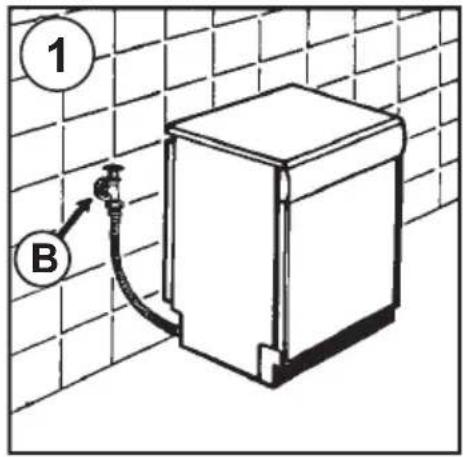
● The inlet hose must be connected to a tap so that the water supply can be cut of when the machine is not in use (fig. 1 B).
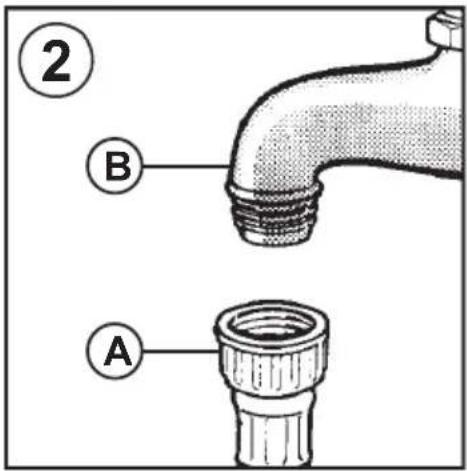
● The dishwasher is fitted with 3/4" threaded connector (fig. 2).
- Connect inlet hose "A" to water tap "B" with a 3/4" attachment making sure that it has been properly tightened.
- If it is necessary, the inlet pipe can be lengthened up to 2.5 m. The extension pipe is available from the After Sales Service Centre.
- If the dishwasher is connected to new pipes or to pipes which have not been inuse for a long time run water through for a few minutes before connecting the inlet hose. In this way no deposits of sand or rust will clog up the water inflow filter.
Hydraulic safety devices
All the dishwashers are equipped with an overflow safety device which, if water exceeds normal levels due to malfunctions, automatically blocks water flow and/or drains excess quantities.
SOME MODELS may include one or more of the following features:
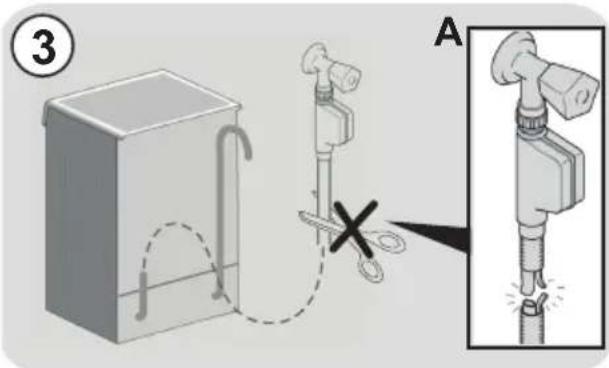
● WATERBLOCK (fig. 3)
The waterblock system has been designed to improve the safety of your appliance. The system prevents flooding which might be caused by a machine malfunction or as a result of a fracture on the rubber pipes and in particular on the water supply pipe.
How it works
A sump located on the base of the appliance collects any possible water leakage and operates a sensor which activates a valve placed under the water tap and blocks air water, even with the tap fully opened. If box "A" containing the electrical parts is damaged, remove the plug from the socke immediately. To ensure perfect operation of the safety system, the hose with box "A" should be connected to the tap as shown in the figure. The water supply hose should not be cut, as it contains live parts. If the hose is not long enough for correct connection, it must be replaced with a longer one. The hose can be obtained from the Technical Assistance Centre.
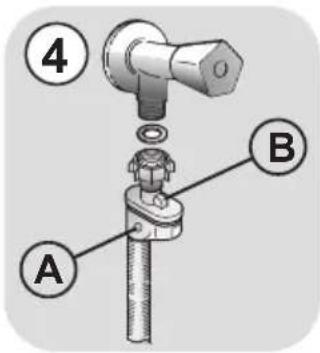
● AQUASTOP (fig. 4):
A device located on the supply tube that stops water flow if the tube deteriorates in this case, a red mark will appear in the window "A" and the tube must be replaced. To unscrew the nut, press the one-way lock device "B".
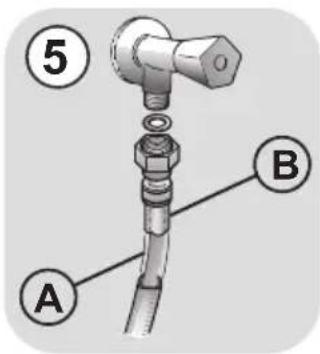
● AQUAPROTECT - SUPPLY TUBE WITH GUARD (fig. 5):
Should water leak from the primary inter-tube "A", the transparent containment sheath "B" will contain water to permit the washing cycle to complete. At the end of the cycle, contact the Customer Service Centre to replace the supply tube.
Connecting the outlet hose
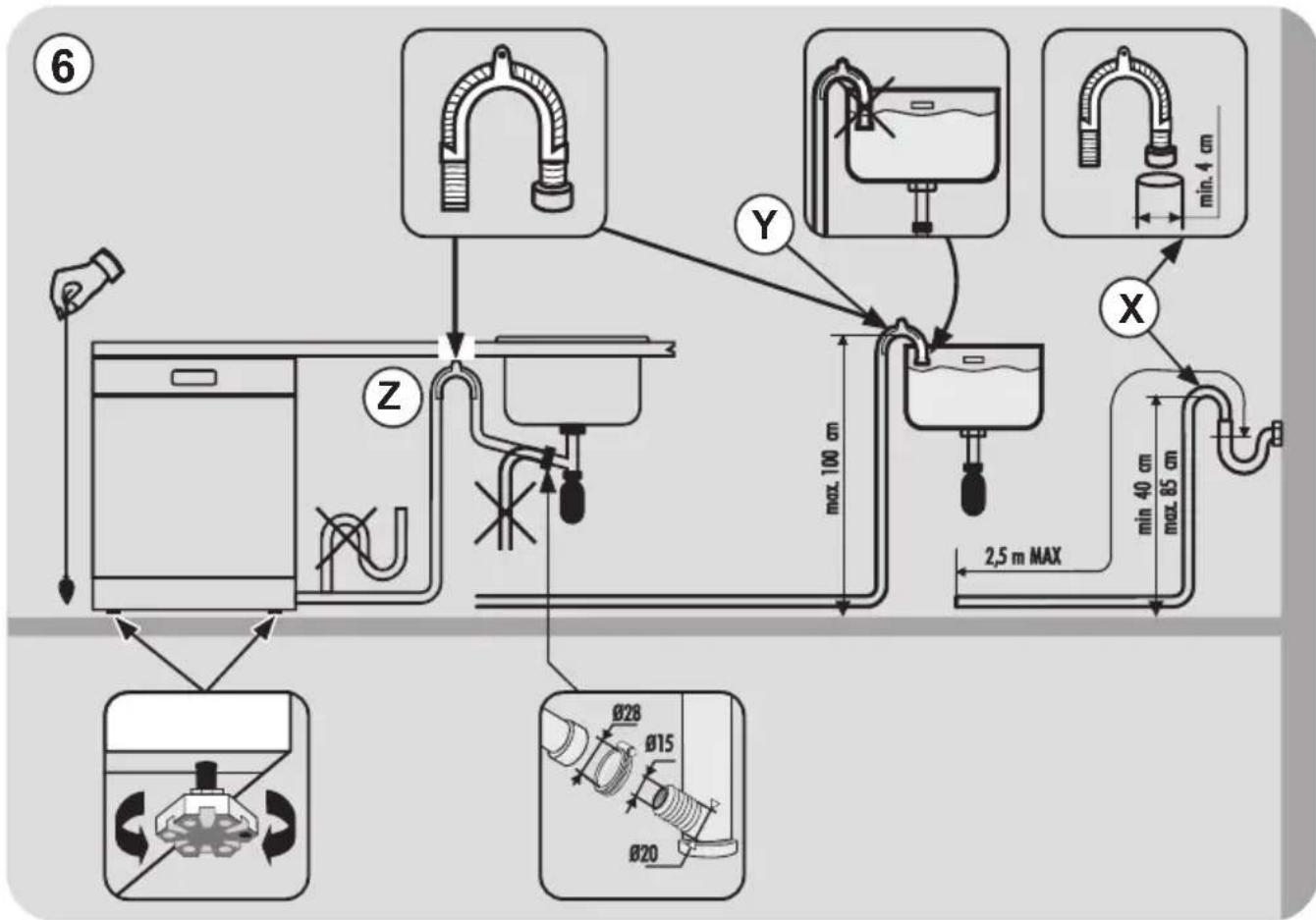
● The outlet hose should discharge into a standpipe, making sure that there are no kinks (fig. 6).
● The standpipe must be at least 40 cm above floor level and it must have an internal diameter of at least 4 cm.
- It is advisable to fit an anti-odour air trap (fig. 6X). If necessary the outlet hose can be extended up to 2,5 m, provided that it is kept at a maximum height of 85 cm above floor level. The extension pipe is available from the After Sales Service Centre.
● The hose can be hooked over the side of the sink, but it must not be immersed water, in order to prevent water from being syphoned back to the machine when this is in operation (fig. 6Y).
- When installing the appliance under a worktop the hose pipe clamp must be attached to the wall in the highest possible position under the worktop (fig. 6Z).
- Check that there are no kinks in the inlet and outlet hoses.
● The appearance of white stains on dishes is generally a warning sign that the salt container needs filling.
- On the bottom of the machine there is a container for the salt for regenerating the softener.
- It is important to use only a salt that is specifically designed for dishwasher. Other types of salt contain small quantities of insoluble particles which over a long period of time may affect and deteriorate the softener performance.
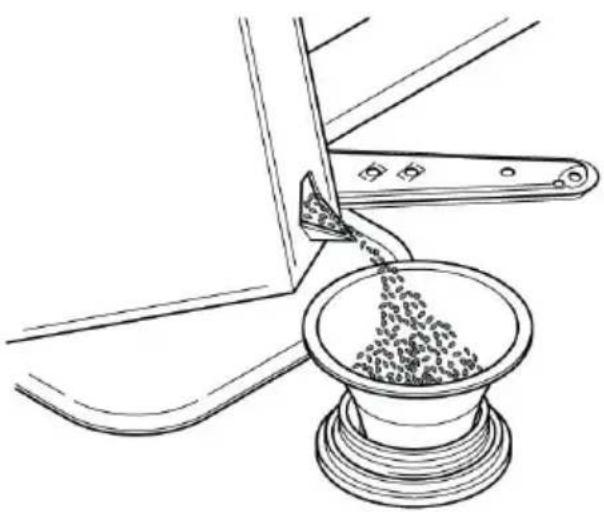
● To add salt, unscrew the cap of the container on the bottom and then refill the container.
● During this operation a little water will overflow; but keep adding salt until the container is full. When the container is full, clean the thread of salt residue and retighten the tap.
● After loading the salt, it is recommended running a complete washing cycle, or COLD RINSE programme.
After loading the salt, YOU MUST run a complete washing cycle, or the PRE-WASH/COLD RINSE/REFRESH programme.
● The salt dispenser has a capacity of between 1.5 and 1.8 kg and, for efficient use of the appliance, it should be refilled from time to time.
(Only for first start up) When the appliance is used for the first time, after completely filling the salt container, it is necessary to add water until the container overflows.
natural_image
Line drawing of a mechanical device pouring granular material into a bowl (no text or symbols)4. ADJUSTING THE UPPER BASKET (SAME MODELS ONLY)
- If 29 cm to 32.5 cm plates are regularly used, load them onto the lower basket after the upper basket has been placed in its upper position, as detailed below (according to the model):
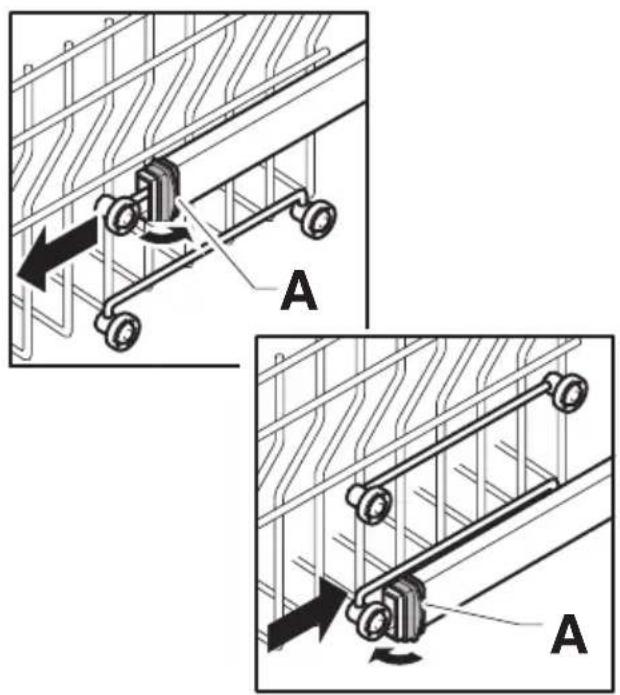
Type "A":
- Turn front blocks "A" outwards;
- Remove the basket and remount it in the upper position;
- Replace blocks "A" in the original position.
Dishes that are greater than 20 cm in diameter can no longer be loaded onto the upper basket, and the mobile supports cannot be used when the basket is in the upper position.
Type "A"
Type "B": (ONLY MODELS WITH EASY CLICK):
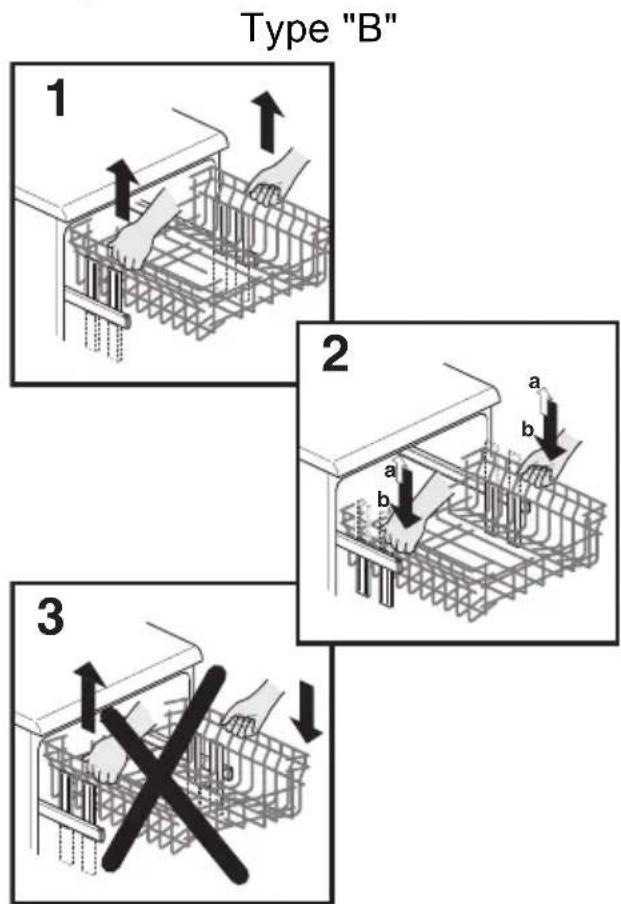
- Remove the upper basket;
- Hold the basket on both sides and lift it upwards (fig. 1).
Dishes that are greater than 20 cm* in diameter can no longer be loaded onto the upper basket, and the mobile supports cannot be used when the basket is in the upper position.
* In models fitted with a third basket, dishes measuring more than 14 cm in diameter can no longer be loaded onto the upper basket.
ADJUSTING THE BASKET TO THE LOWER POSITION:
- Hold the basket on both sides and lift it gently upwards (fig. 1);
- Then slowly release into the correct position (fig. 2).
N.B.: NEVER LIFT OR LOWER THE BASKET FROM ONE SIDE ONLY (fig. 3).
WARNING:
We recommend adjusting the basket before loading the dishes.
5. LOADING DISHES
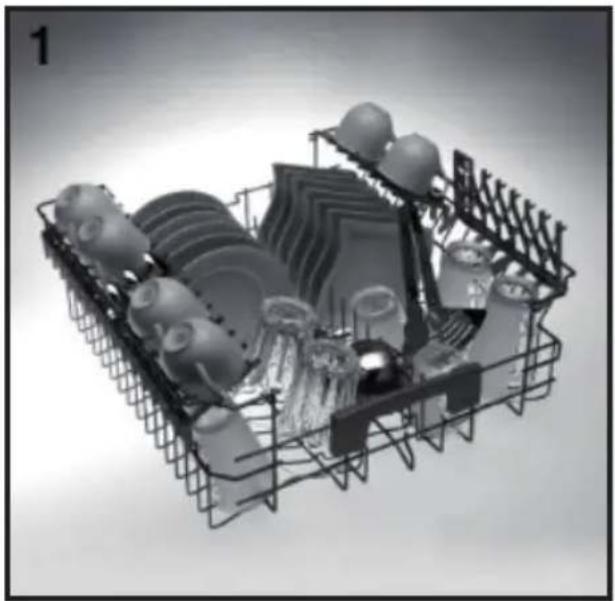
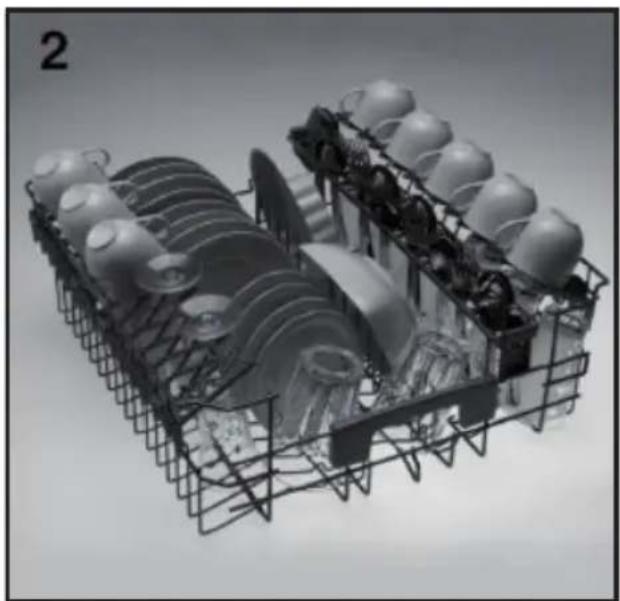
A standard daily load is represented in figs. 1 and 2.
Using the upper basket

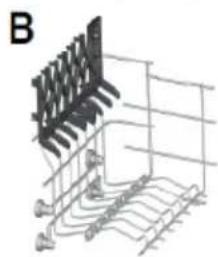
● The upper basket is provided with mobile racks hooked to the sides of the basket, which can be regulated into 4 positions.
Upper basket (fig. 1)
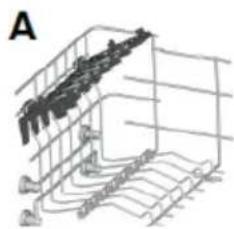
- In the lowered position (A-A1) the racks may be used for such items as: tea and coffee cups, kitchen knives and ladles. Also glasses with stems may be safely hung on the ends of the racks.
natural_image
Technical line drawing of a mechanical assembly or mounting bracket (no text or symbols)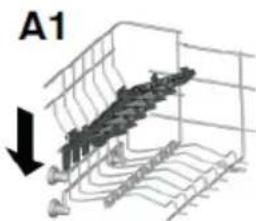
natural_image
Technical line drawing of a mechanical assembly or housing with no visible text or symbols- In the upright position (B-B1) the racks allow you to load dinner plates and soup plates up to a maximum diameter of 19 cm. Plates should be loaded vertically with the underside of the plate towards the back of the dishwasher with a space between each plate to allow water to pass freely.
natural_image
3D rendered mechanical assembly with multiple components and mesh grids (no visible text or symbols)Upper basket (fig. 2)
natural_image
Technical line drawing of a mechanical assembly with no visible text or symbols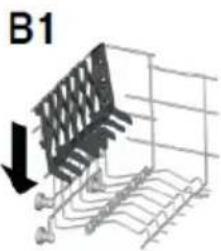
natural_image
Diagram of a mechanical assembly with labeled component B1 and directional arrow (no readable text or symbols)- It is advisable to load large plates slightly tilted towards the front to facilitate the introduction of the basket into the machine.
● The upper basket has been designed to offer maximum flexibility in use and can be loaded with glasses, cups, small plates and small-sized bowls.
natural_image
3D rendering of a multi-tiered industrial machine with multiple circular components and metal frame structure (no visible text or symbols)TOTAL CARE ACCESSORIES (SOME MODELS ONLY)
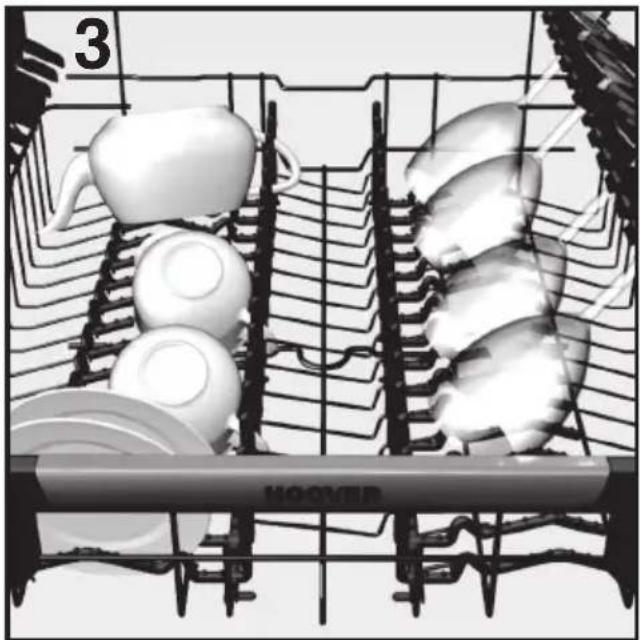
Top basket with Total Care accessories (fig.3) that allow you to place delicate items, such as crystal objects or extremely delicate ceramics, in the safest and most comfortable way possible.
The hooks and specific areas of the basket are made of soft materials, or were designed specifically to handle your most fragile, precious items with the utmost care.
natural_image
Black and white photo of a rack with teapot and basket, no visible text or symbolsThe soft rubber mounts may be removed.
Using the lower basket
- Saucepans, oven dishes, tureens, salad bowls, lids, serving dishes, dinner plates and soup plates can be loaded into the lower basket.
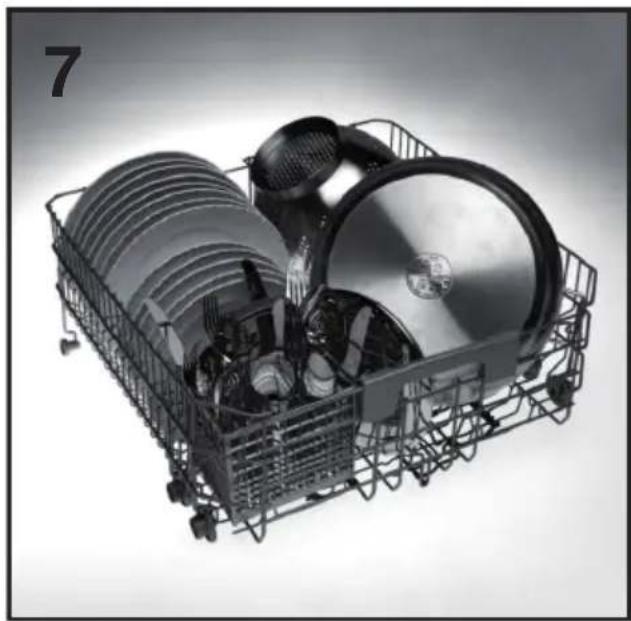
- Place the cutlery in the plastic cutlery holder with the handles pointing upwards and place the cutlery holder on the lower basket (fig. 7) making sure that the cutlery does not get in the way of the rotating arms.
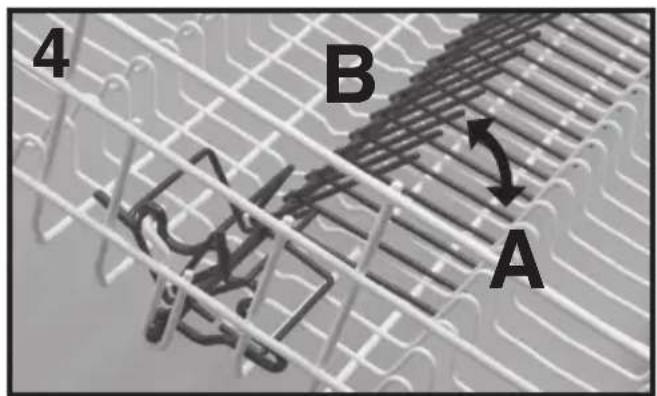
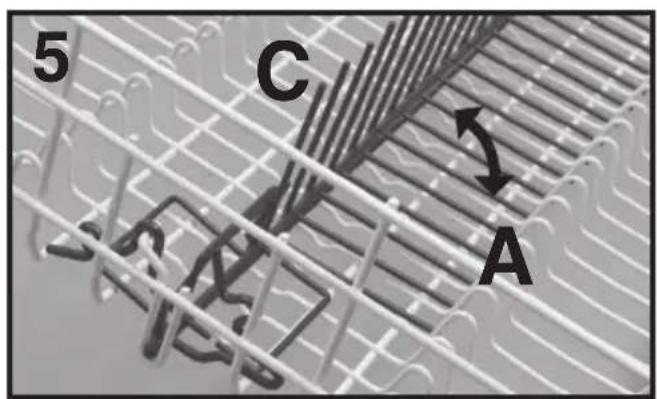
- The lower basket is fitted with a special adjustable central rack (fig. 3 and 4). This permits stable and optimum loading, even when the size and/or shape of the dishes is non-standard.
- POSITION "A": for a standard load, or one that excludes pans, salad bowls and the like.
- POSITION "B": for dishes which, although standard size, have a particular shape (very deep bowls, square dishes or ones without borders etc.).
- POSITION "C": for larger than average flat plates and/or ones with non-standard shapes (square, hexagonal, oval, pizza dishes etc.).
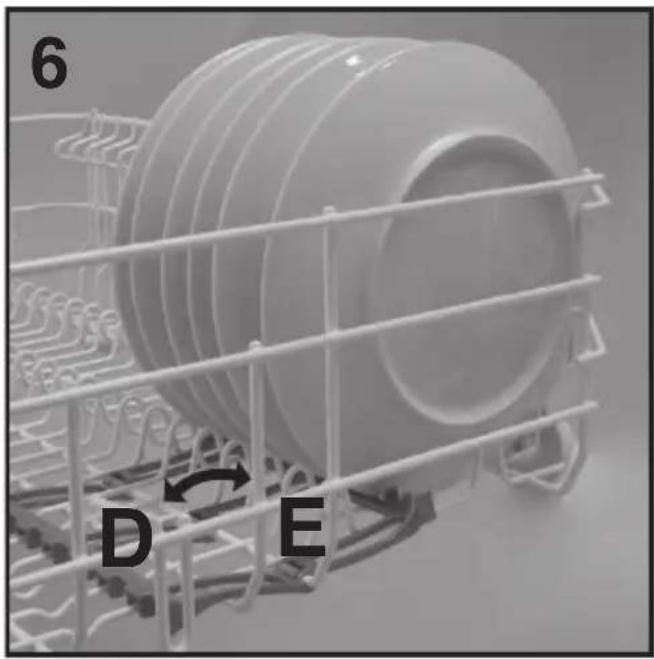
- Smaller plates (used for dessert plates for example), can also be placed into the lower basket as shown in the figure 6, with the support flap placed outwards ("D"). For normal or large plates the flap must be in the position ("E").
Upper basket (fig. 6)
natural_image
3D rendered mechanical component with wire cage and labeled parts (D, E), no readable text or symbols beyond labels
WARNING:
If the small plates are placed in the basket with the support flap in the incorrect position, the plates will interfere with the lower spraying arm preventing it to rotate.
A standard daily load is represented in fig.7.
Lower basket (fig. 7)
natural_image
Black-and-white photo of a multi-compartment cleaning machine with visible disc and mesh casing (no text or symbols)Please load the dishwasher sensibly to ensure the best wash results.
The lower basket has a safety-stop device, for its safe extraction, also especially useful with a full load. For loading salt, cleaning filter and for ordinary maintenance, the complete extraction of the basket is necessary.
EN
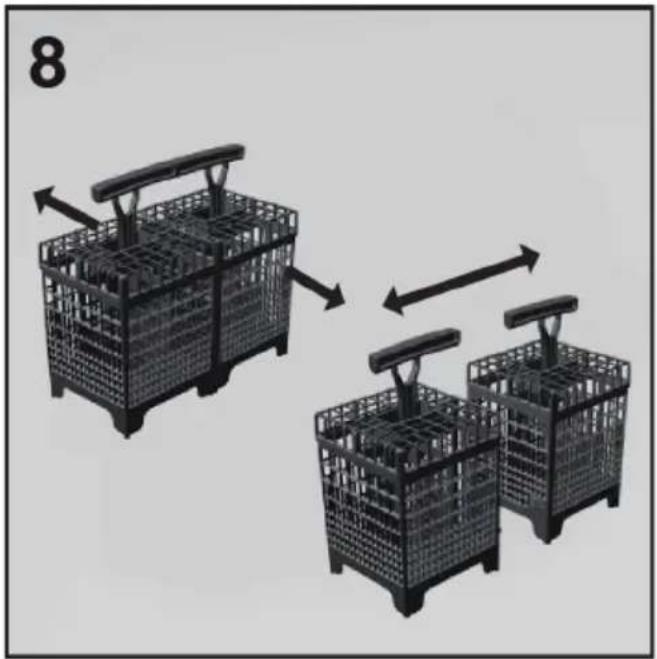
Cutlery basket (fig. 8)
The cutlery basket is made with two detachable parts which will enable various loading options. The two parts can be detached by sliding the left section away from the right section. The top of cutlery basket can be removed, for enable various loading options.
natural_image
Two identical black plastic crates with handles, each carrying a basket and arrows indicating movement or transformation (no text or symbols)Using the third basket
● The third basket has been designed to load items such as utensils of small dimensions or flat and long shaped items. By freeing the lower baskets from these objects, loading big-size items becomes more comfortable and easier, making it possible for instance to load plates and pots in the lower basket.
- The third basket can be loaded with the following items: coffee cups and side plates, fruit or dessert cups, small bowls, saucers, kitchen knives and forks, ladles and large spoons, graters, and accessories for small appliances (e.g. food mixer blades).

WARNING:
The third basket is NOT designed for loading cutlery. The absence of racks for fixing cutlery could involve such items being found in the lower baskets.
- In order to obtain optimum washing results, it is advisable to load items with their underside towards the ceiling of the dishwasher (e.g. small plates and bowls).
● The third basket can be easily extracted from the dishwasher, by removing the front stops at the beginning of basket tracks.
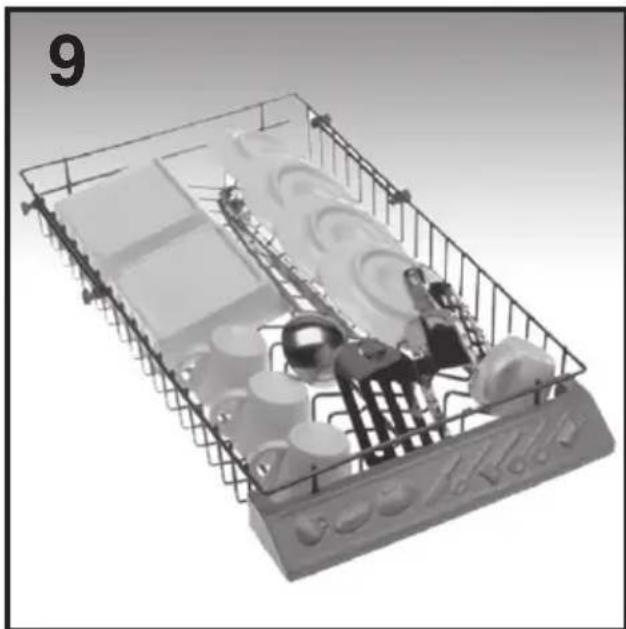
● The third basket has been designed to offer maximum flexibility in use. Due to its partition in three tilted sections and absence of fixed racks, it can be loaded in numerous ways: only coffee cups and side plates; or coffee cups mixed with bowls and utensils; or again with side plates, graters, and spoons.
A standard daily load is represented in fig. 9.
Third basket (fig. 9)
natural_image
3D rendered image of a kitchen sink with cutlery and decorative plates (no text or symbols)6. INFORMATION FOR TEST LABORATORIES
Please ask information required for comparison testing and measuring noise levels, according to EN normative, to the following address:
testinfo-dishwasher@candy.it
In the request, please specify model name and number of the dishwasher (see rating plate).
[Non-Text]
[Non-Text]
[Non-Text]
[Non-Text]
[Non-Text]
[Non-Text]
[Non-Text]
[Non-Text]
[Non-Text]
[Non-Text]
[Non-Text]
[Non-Text]
[Non-Text]
[Non-Text]
In the request, please specify model name and number of the dishwasher (see rating plate).
In the request, please specify model name and number of the dishwasher (see rating plate).
In the request, please specify model name and number of the dishwasher (see rating plate).
In the request, please specify model name and number of the dishwasher (see rating plate).
In the request, please specify model name and number of the dishwasher (see rating plate).
[Non-Text]
[Non-Text]
[Non-Text]
[Non-Text]
[Non-Text]
[Non-Text]
[Non-Text]
[Non-Text]
[Non-Text]
[Non-Text]
[Non-Text]
[Non-Text]
[Non-Text]
[Non-Text]
[Non-Text]
[Non-Text]
7. LOADING THE DETERGENT
(Fig. A "2")
The detergent
It is essential to use a detergent that is specifically designed for dishwashers either in powder, liquid, gel or tablet form.
Unsuitable detergents (like those for washing up by hand) do not contain the proper ingredients for use in a dishwasher, and stop the dishwasher from working correctly.
Filling the detergent container
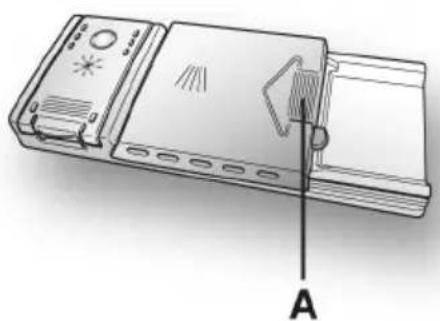
The detergent container is inside the door (fig. A "2"). If the lid of the container is closed, press the button (A) to open. At the end of every wash cycle the lid is always open and ready for the next time the dishwasher is used.
natural_image
Technical line drawing of a device with labeled component A (no text or symbols beyond label)
WARNING!
When loading the lower basket, please ensure that the plates or others do not obstruct the detergent dispenser.
The amount of detergent to be used varies according to how dirty the dishes are and on the type of dishes to be washed. We advise using 20:30 g of detergent in the wash section of detergent compartment (B).
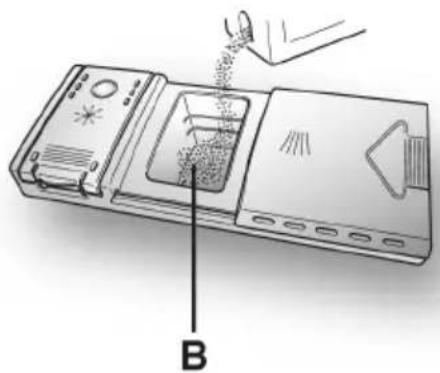

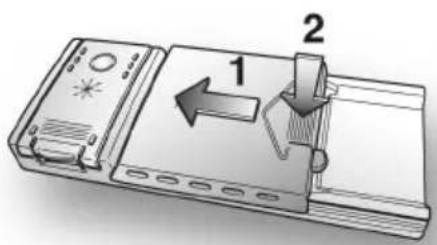
After pouring the detergent into the container, close the lid, firstly pushing (1) and then pressing on it (2) until you hear the click.
Since not all detergents are the same the instructions on the boxes of detergent can vary. We should just like to remind users that too little detergent does not clean the dishes properly whilst too much detergent will not produce better results and is also a waste.
Do not use an excessive amount of detergent and help limit damage to the environment at the same time.
8. TYPES OF DETERGENT
Detergent tablets
Detergent tablets of different manufacturers dissolve at different speeds, for this reason, during short programmes, some detergent tablets may be not fully effective, because they are not completely dissolved. If these products are used, is recommended to choose longer programmes to guarantee the complete use of the detergent.
To get satisfactory washing results, the tablets MUST be placed in the wash section of the detergent container and NOT directly in the tub.
Concentrated detergents
The concentrated detergents, with reduced alkalinity and with natural enzymes, in conjunction with 50°C wash programmes, have a smaller impact on the environment and they protect the dishes and the dishwasher. The 50°C wash programmes purposely exploit the dirt-dissolving properties of the enzymes, allowing therefore, with the use of the concentrated detergents, to achieve the same results of the 65°C programmes but at a lower temperature.
Combined detergents
The detergents that also contain the rinse aid must be placed in the wash section of the detergent container. The rinse aid container must be empty (if it is not empty, set the rinse aid regulator to lowest position before using combined detergents).
"ALL in 1" combined detergents
If you are planning to use "ALL in 1" ("3 in 1 "/ "4 in 1"/ "5 in 1", etc.) combined detergents i.e. those with built in salt and/or rinse agent, we would advise the following:
- read carefully and follow the manufacturer's instructions given on the packaging;
● the effectiveness of detergents containing the built in water softener/salt depends on the hardness of your water supply. Check that the hardness of your water supply is within the effective range given on the detergent packaging.
If when using this type of product, you don't get satisfactory washing results, please contact the detergent manufacturer.
In certain circumstances use of combined detergents can cause:
- limescale deposits on dishes or in the dishwasher;
● a reduction in washing and drying performance.
Any problems which arise as a direct result of the use of these products are not covered by our warranty.
Please note that using the "ALL in 1" combined detergents, the rinse aid and salt indicator lights (only used on selected models) are superfluous, so you must ignore the lights.
If washing and/or drying problems occur, we recommend you return to use traditional separate products (salt, detergent and rinse agent). This will ensure that the water softener in the dishwasher operates correctly.
In this case, we recommends that you:
● refill both the salt and rinse aid container;
● run one normal washing cycle without a load.
Please note that on return to the use of conventional salt, a number of cycles will be required before the system becomes fully efficient again.
9. LOADING THE RINSE AID
(Fig. A "3")
The rinse aid
The rinse aid, which is automatically released during the last rinsing cycle, helps the dishes to dry quickly and prevents spots and stains forming.
Filling the rinse aid container.
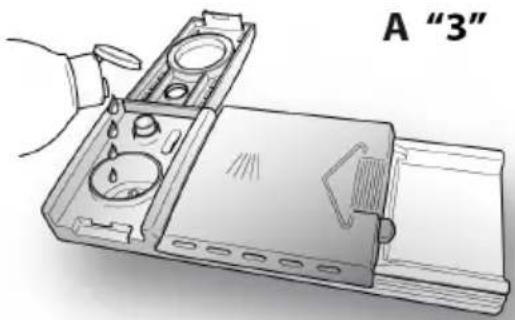
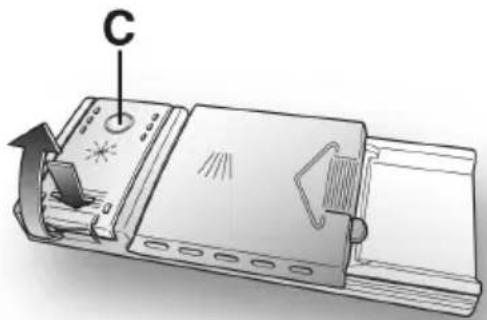
The rinse aid container can be found to the left of the detergent container (fig. A "3"). To open the lid, push the reference mark and, in the same time, pull the tab of opening. It is always advisable to use rinse aid that is specifically designed for dishwasher. Check the rinse aid level through the indicator eye (C) which is located on the dispenser.
FULL

dark
EMPTY

light
Regulating the rinse aid from 1 to 6
The regulator (D) is placed under the lid and can be turned using a coin. The recommended position is 4.
The limestone content of the water considerably affects the formation of limescale and the drying performance.
It is therefore important to regulate the quantity of rinse aid to achieve good washing results.
If, after the wash, streaks occur on the dishes, decrease the amount by one position. If whitish spots occur, increase the amount by one position.
natural_image
Line drawing of a tray device with a handle and control panel, labeled 'A "3" (no text or symbols on the diagram itself)
natural_image
Diagram of a device with labeled component C and directional arrow (no text or symbols beyond label)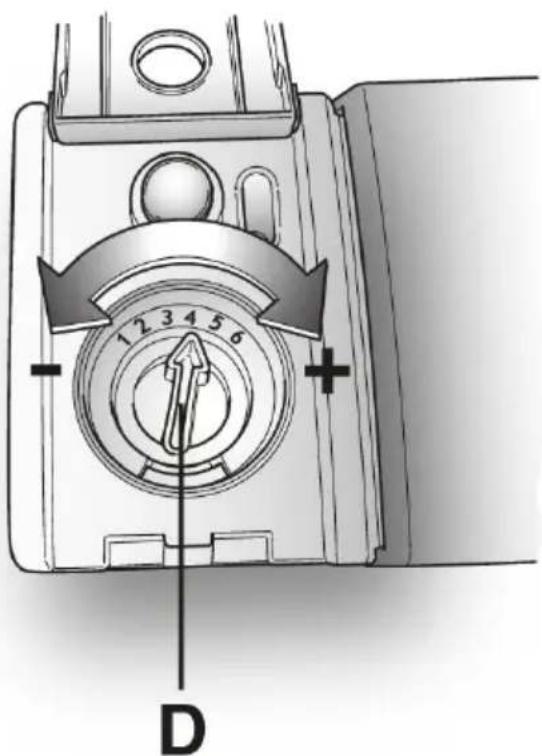
10. CLEANING THE FILTERS
(Fig. A "4")
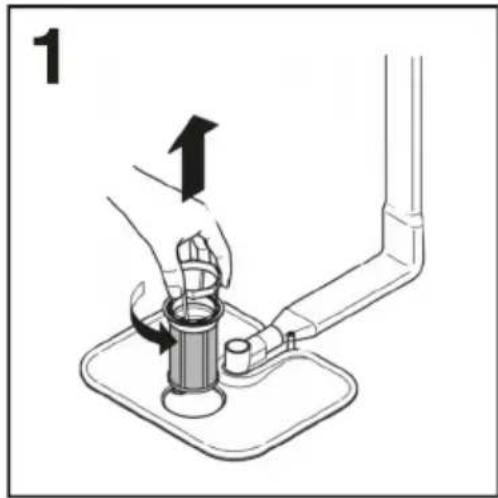
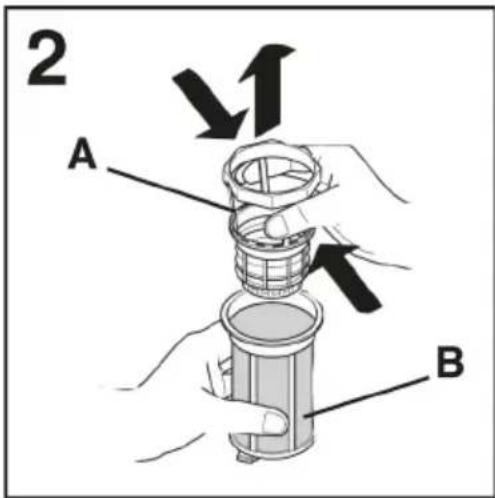
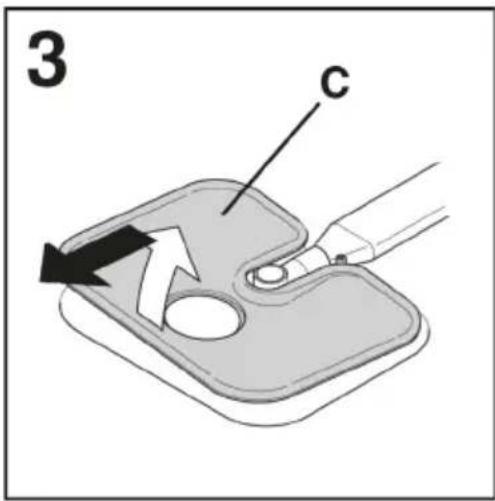
The filter system consists of:
A. A central container that traps the larger particles;
B.A micro filter, located beneath the gauze, that traps the tiniest particles ensuring a perfect rinse;
C. A flat gauze that continuously filters the wash water.
● To achieve excellent results every time, the filters should be checked and cleaned after each wash.
● To remove the filter unit, simply turn the handle anticlockwise (fig. 1).
● For ease of cleaning, the central container is removable (fig. 2).
- Remove the gauze filter (fig.3) and wash the whole unit under a jet of water. If necessary a small brush can be used.
- With the Self-cleaning Micro filter, maintenance is reduced and the filter unit need only be checked every two weeks. Nevertheless, after each wash it is advisable to check that the central container and the gauze filter are not clogged.

WARNING!
After cleaning the filters, make sure that they are correctly reassembled and that the gauze filter is properly positioned at the bottom of the dishwasher. Make sure that the filter is screwed back, clockwise, into the gauze, as poor seating of the filter unit could have an adverse effect on the efficiency of the appliance.
Never use the dishwasher without the filters.
11. PRATICAL HINTS
How to get really good wash results.
- Before placing the dishes in the dishwasher, remove any remaining food (bones, shells, pieces of meat or vegetables, coffee grounds, skin of fruit, cigarette ash, tooth picks etc. to avoid blocking the filters, water outlet and washing arm nozzles.
- Try not to rinse the dishes before loading them into the dishwasher.
- If saucepans and oven dishes are encrusted with the remains of burnt or roast food, it is advisable to leave them to soak before washing.
- Place the dishes face downwards.
- Try to place the dishes in such a way that they are not touching one another. If they are loaded properly you will get better results.
● After loading the dishes check that the washing arms can rotate freely.
● Pans and other dishes that have particularly stubborn food particles or remnants of burnt food should be left to soak in water with dishwasher detergent.
● To wash silver properly:
a) rinse the silver immediately after use, especially if it has been used for mayonnaise, eggs, fish etc.;
b) do not sprinkle detergent onto it;
c) keep it separate from other metals.
How to make savings.
- If you want the dishwasher to give a complete wash, place the dishes in the dishwasher at the end of each meal and if necessary turn on the COLD RINSE cycle
to soften the food remains and remove bigger particles of food from the new load of dishes. When the dishwasher is full start the complete wash cycle programme.
- If the dishes are not very dirty or if the baskets are not very full select an ECONOMY programme, following the instructions in the program list.
What not to wash.
- It should be remembered that not all dishes are suitable for washing in a dishwasher. We advise against using the dishwasher to wash items in thermoplastic, cutlery with wooden or plastic handles, saucepans with wooden handles, items in aluminum, crystal leaded glass unless otherwise stated.
- Certain decorations may fade. It is therefore a good idea before loading the whole batch to wash just one of the items first so as to be sure that others like it will not fade.
- It is a good idea not to put silver cutlery with non-stainless steel handles into the dishwasher as there could be a chemical reaction between them.
When buying new crockery or cutlery always make sure that they are suitable for washing in a dishwasher.
Useful hints
- In order to avoid any dripping from the top rack, remove the lower rack first.
- If the dishes are to be left in the machine for some time, leave the door ajar, to let some air circulate and to improve the drying performance.
12. CLEANING AND MAINTENANCE
(Fig. A "5")
- To clean the dishwasher outside, do not use solvents (degreasing action) neither abrasives, but only a cloth soaked with water.
- The dishwasher does not require special maintenance, because the tank is self-cleaning.
- Regularly wipe the door gasket with a damp cloth to remove any food remains or rinse aid.
- Dishwasher cleaning is recommended, in order to remove limestone deposits or dirt. We suggest you run a washing cycle periodically with specialist dishwasher cleaning products. For all cleaning operations the dishwasher must be empty.
- If, in spite of the routine cleaning of the filters, you notice that the dishes or pans are not properly washed or rinsed, check that all the spray heads on the rotor arms (fig. A “5”) are clear.
If they are blocked, clean them in the following way:
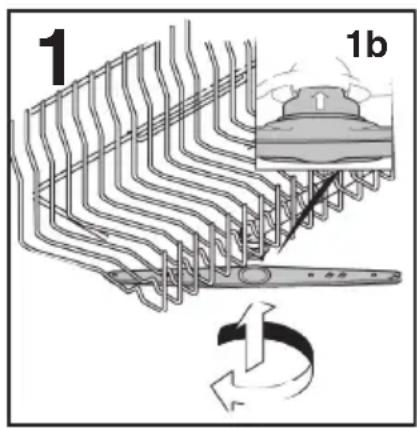
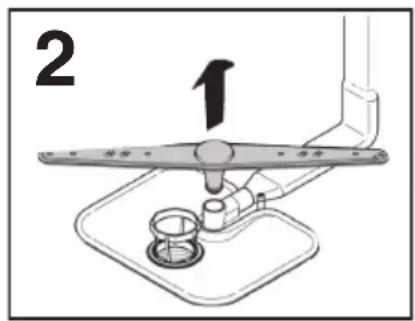
1) to remove the upper rotor arm, turn it until it lines up with the stop marked by the arrow (fig. 1b). Push it upwards (fig. 1) and, keeping it pushed in, unscrew it in a clockwise direction (to reassemble it repeat the same operation, but turn it anticlockwise). The lower rotor arm can be removed simply by pulling it upwards (fig. 2);
2) wash the rotor arms under a jet of water to clear any blockage in the spray heads.
Do not use tools that can deform the spray heads.
3) when you have finished, refit the rotor arms in the same position, remembering to re-align the arrow and screw into position.
- Both the door lining and the tank lining are in stainless steel; however, should spots caused by oxidation occur, this is probably due to a high level of iron salts presents in the water.
● The spots can be removed with a mild abrasive agent; never use chlorine based materials, steel wool, etc.
WHEN CYCLE IS FINISHED.
After every wash it is essential to turn off water supply and to switch off the machine by pressing the On/Off button to the off position.
If the machine is not going to be used for some time, it is advisable to follow these rules:
- do an empty wash with detergent in order to clean the machine of any deposits;
- pull out the electric plug;
-
turn off the water tap;
-
fill the rinse aid container;
- leave the door ajar;
- keep the inside of the machine clean;
- If the machine is left in places where the temperature is below 0^ C any water left inside the pipes may freeze. Wait until the temperature rises above zero and then wait for about 24 hours before.

13. DESCRIPTION OF THE CONTROL PANEL

H "Extra Dry" option button
I "SALT EMPTY" light
L "RINSE AID EMPTY" light
M DIGITAL DISPLAY
N "ACTION PRO" lights
P "OPTION SELECTION" lights
R Programme guide
A ON/OFF" button"
B PROGRAMME SELECTION" button
C DELAY START" button"
D "START"/"RESET" button (start/cancelling programme)
E Wi-Fi light
F "ACTION PRO" button
G "OPEN DOOR" option button
14. TECHNICAL DATA
| DIMENSIONS | ||||
| DATA | FREE-STANDING | HALF INTEGRATED | BUILT-IN | |
| With working top | Without working top | / | / | |
| Width x Height x Depth (cm) | 60x85x60,9 | 59,8x82x58 | 59,8x81,8 ÷ 89,8x57 | 59,8x81,8 ÷ 89,8x55 |
| Depth with door open (cm) | 120 | 117 | 117 | 117 |
| TECHNICAL DATA (See rating plate) | ||||
| Place load (EN 50242) | 13 | 15 | 16 | |
| Capacity with pans and dishes | 8 persons | 9 persons | 9 persons | |
| Water supply pressure (MPa) | Min. 0,08 – Max. 0,8 | |||
| Fuse / Power input / Supply voltage | See rating plate | |||
15. PROGRAMME SELECTION AND SPECIAL FEATURES
"ACTION PRO" button
This button allows you to change the wash intensity, according to how dirty your dishes are, by adjusting the wash time and temperature. The combination of the button with the 4 main wash programmes enables to have 8 additional wash cycles (achieving a total of 12 programmes of washing).
POWER WASH +
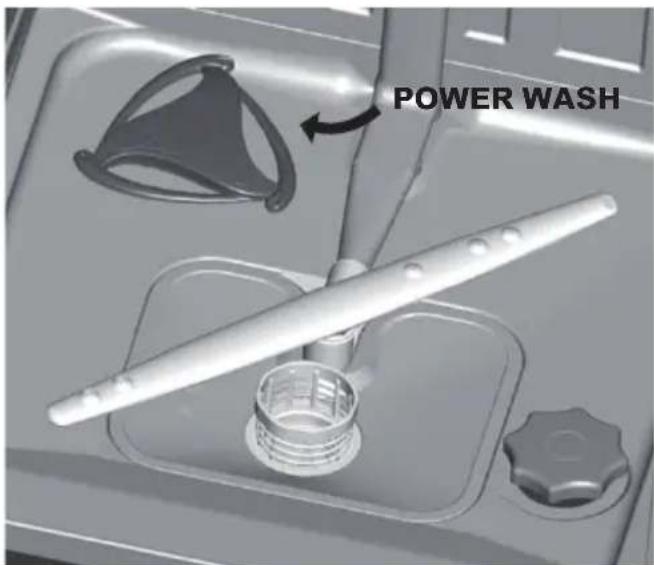
By pressing the "ACTION PRO" button once (indicator light +) the intensity of the wash cycle will be increased and will enable the wash action of the third cleaning arm, positioned at the bottom of the dishwasher ("POWER WASH").
This function allows cleaning of heavily soiled tableware or cookware, by placing them directly in the area of the basket above the "POWER WASH"
SOFT PROGRAMS -
By pressing the "ACTION PRO" button twice (indicator light - ) the intensity of the wash cycle will be decreased, reducing the wash length time.
When the dishwasher is switched or the last used setting will be indicated.
Programme settings
- Open the door and place the dirty dishes inside the appliance.
- Press the "ON/OFF" button. The display will show two lines.
- Choose a programme by pressing the "PROGRAMME SELECTION" button.
- If you wish, press the "ACTION PRO" button.
- If you wish to select an option, press the corresponding button (the indicator light will turn on).
- Press the "START" button. The length of the program will be shown on the display alternating hours with minutes [I.e: 1 h (1 hour) / 25 (25 minutes)].
- When the door is shut, after an audiblesignal has sounded, the programme will start automatically. The display will show the time remaining to the end of the cycle.
"AUTOMATIC" programmes (only for models in which there are).
The dishwasher is equipped with a dirt sensor, able to analyse water murkiness during all "AUTOMATIC" programme phases (see programme list); thanks to this sensor the washing cycle parameters are automatically adapted to the real quantity of dirt on dishes. Thus excellent washing results are guaranteed while optimising water and energy consumption.
"IMPULSE" programmes
The “IMPULSE” programmes use an impulse washing technology, which reduces consumption, noise and increases performances.
The “intermittent” working of the washing pump MUST NOT BE considered a malfunction, it is a characteristic of the impulse washing so must be considered a normal function of the programme.
Programme interruption
Opening the door when a programme is running is not recommended especially during the main wash and final hot rinse phases. However, if the door is opened while a programme is running (for example, to add dishes) the machine stops automatically and the display will flash the remaining time before the end of the cycle. Close the door, without pressing any buttons. The cycle will start from where it left off.
(only for FREESTANDING models) A running program can be interrupted without opening the door by pressing the "ON/OFF" button. In this case, simpl press the "ON/OFF" button again to restart the cycle from where it left off.

WARNING:
If you open the door during the drying cycle, an audible audio signal advises you that the drying cycle has not y finished.
Changing a running programme
Proceed as follows to change or cancel a running program:
- Hold the "RESET" button down for at least 5 seconds. "00" will appear on the display and some audible signals will sound.
● The running programme will be cancelled. The display will show two lines. - At this point a new programme can be set.

WARNING:
Before starting a new programme, you should check that there is still deterger in the dispenser. If necessary, top up the dispenser.
If there is any break in the power supply while the dishwasher is operating, a special memory stores the selected programme and, when the power is restored, it continues where it left off.
Programme operations (only for freestanding models)
Whilst a programme is running, the display shows the time remaining to the end of the cycle, which is automatically updated.
Programme end
A 5 second alarm will sound (if not muted) 3 times at 30 second intervals to signal that the programme has ended.
If the "OPEN DOOR" function is activated, during the drying phase the door will open automatically and yo will have to wait until the indication of the end of cycle before removing the dishes.
Option buttons
"OPEN DOOR" button (AUTOMATIC OPEN DOOR)
This option activates a special device that opens the door a few centimeters during or at the end of the drying cycle (depending on the programme). This ensures the natural and efficient drying of dishes. The duration of the selected cycle will automatically change to allow an optimization of temperatures used during the rinse phase, this allows a significant reduction of energy consumption. The automatic door opening in the last phase of drying enables the air to circulate, removing the risk of bad odours.
This option is automatically activated on the "ECO" programme, it is however possible to disable it. The function "OPEN DOOR" is not available in the programme "RAPID 39"" "RAPID 24"" and "REFRESH".

WARNING:
With this option selected, you must not in any way prevent the door from opening or force it shut, as this will damage the mechanism. Ensure that there is free space in front of the door and before closing wait for the return opening device.
"EXTRA DRY" button
This option allows you to achieve the highest efficiency in drying, increasing the wash water temperature during the last phase of washing cycle.
Salt empty alert
If your dishwasher requires filling with salt, the display will show and flash "SL" when the dishwasher is switched on.
"DELAY START" button
Dishwasher start time can be set with this button, delaying start from 1 to 23 hours. Proceed as follows to set a delayed start:
- Press the "DELAY START" button ("00" will appear on the display).
- Press the button again to increase the delay in hours (each time the button is pressed the delay is increased by 1 hour to a maximum of 23).
- To start the countdown, press the "START" button. The display will show the time remaining to the begin of the programme.
(Only free-standing models) At the end of the countdown, the programme will automatically start and the length of the selected cycle will be shown in the display.
Proceed as follows to cancel a delayed start:
- Hold the "RESET" button down for at least 5 seconds. "00" will appear on the display and some audible signals will sound.
- The delayed start and the selected programme will be cancelled. The display will show two lines.
- At this point, a new programme and option buttons must be set to start a new programme as indicated in the "PROGRAMME SETTINGS" section.
Alarm mute for the PROGRAMME END
The alarm for the programme end may be muted as follows:
The dishwasher must ALWAYS be of before start of this procedure.
- Hold down the "PROGRAMME SELECTION" button and at the same time switch on the dishwasher by pressing the "ON/OFF" button (a brief audible signal will sound).
- Keep the "PROGRAMME SELECTION" button pressed for at least 15 seconds (during this time 2 audible signals will sound).
- Release the button when the second audible signal sounds ("b1" will appear on the display to indicate that the alarm is on).
-
Press the same button again ("b0" will appear on the display to indicate that the alarm is off).
-
Turn off the dishwasher by pressing the "ON/OFF" button to confirm the new setting.
To turn the alarm on again, follow the same procedure.
Memorization of the last program used
The last programme used can be memorized by following the below:
The dishwasher must ALWAYS be of before start of this procedure.
- Hold down the "PROGRAMME SELECTION" button and at the same time switch on the dishwasher by pressing the "ON/OFF" button (a brief audible signal will sound).
- Keep the "PROGRAMME SELECTION" button pressed for at least 30 seconds (during this time, 3 audible signals will sound).
-
Release the button when the THIRD audible signal sounds ("A0" will appear on the display to indicate that the memorization is off).
-
Press the same button again ("A1" will appear on the display to indicate that the memorization is on).
- Turn off the dishwasher by pressing the "ON/OFF" button to confirm the new setting.
To disable the memorization, follow the same procedure.
This dishwasher is equipped with an anti-overflow safety device which will automatically discharge any excess water should a problem occur.

WARNING:
To ensure the correct operation of the anti-overflow safety device, we recommend that the dishwasher is not moved or tilted during operation. If however it is necessary to tilt or move the dishwasher, please ensure that the washing cycle is complete and that there is no remaining water inside the dishwasher.
16. ONE FI
This appliance is equipped with ONE Fi technology that allows you to control it remotely via App, thanks to Wi-Fi function.
Machine enrollment (on App)
- Download the Hoover Wizard App on your device.
The Hoover Wizard App is available for devices running both Android and iOS, both for tablets and for smartphones..
Get all the details of the ONE Fi functions by browsing the App in DEMO mode.
- Open the App, create the user profile and enroll the appliance following the instructions on the device display or the "Quick Guide" attached on the machine.
Enable remote control (via App)
- Want to manage it remotely through the App, firstly you have to load dishes, detergent and close the door. Switch the appliance on, select the "P0" programme and press the START/RESET button; from that moment on you can manage it through the App commands.
WIRELESS PARAMETERS
| Parameter | Specifications |
| Wireless standard | 802.11 b/g/n |
| Frequency range | 2,412 GHz. - 2,484 GHz. |
| Max Trasmit Power | 802.11b (11Mbps) +18,5 ± 2 dBm802.11g (54Mbps) +16 ± 2 dBm802.11n (HT20, MCS7)+14 ± 2 dBm |
| Minimum Receiving Sensitivity | 802.11b (11Mbps) -93 dBm802.11g (54Mbps) -85 dBm802.11n (HT20, MCS7)-82 dBm |
With this the Candy Hoover Group Srl, declares that this appliance marked with CE complies with the essential requirements of the Directive 2014/53/EU. To receive a copy of the declaration of conformity, please contact the manufacturer at: www.candy-group.com
17. PROGRAMME LEGEND


= Is the program which allows you to access the ONE FI functions.
| Programme | Description | ||
| + | POWER WASH | Hygiene + | An antibacterial cycle, intended for washing and sterilising dishes (even heavily stained ones) babies' bottles etc. |
| P1 | BASE PROGR. | STEAM | Cycle with alternated action of water jets and steam. Effective in softening and removing dried up soil and bacteria, with no need to pre-wash pots and dishes. |
| - | SOFT WASH | Total care | Program suitable for washing in a single cycle the most delicate crockery such as glassware and porcelain in Class A of washing.* Suitable for washing dishes up to 8 place settings |
| + | POWER WASH | Family | Intended for everyday dishwashing. Two final rinses ensure a high level of hygiene and cleanliness. |
| P2 | BASE PROGR. | UNIVERSAL | Once a day - for normal soiled pans and any other items that have been left all day for washing. |
| - | SOFT WASH | Daily | Fast cycle, for “normally” dirty dishes - intended for frequent washes and normal loads. |
| + | POWER WASH | Eco Plus | A medium temperature programme, intended for washing pans and dishes that are “normally” dirty, using detergents which contain enzymes. |
| P3 | BASE PROGR. | ECO | Programme for normally soiled tableware (the most efficient in terms of its combined energy and water consumption for that type of tableware).Programme standardised to EN 50242. |
| - | SOFT WASH | Crystals | Suitable for delicate crockery and glassware. Also for less soiled items excluding pans. |
| + | POWER WASH | Rapid 39' | Fast cycle, suitable for daily washing of heavily soiled items straight after a meal (MAX 8 place settings). |
| P4 | BASE PROGR. | RAPID 29' | Quick wash for dishes which are to be washed immediately after the meal. Wash load of 6 persons. |
| - | SOFT WASH | Pre-wash | Short cold pre-wash for items that are stored in the dishwasher until you are ready to wash a full load. |
Programmes with prewash
For wash programmes with prewash, it is advisable to add a second dose of detergent (max.10g) directly in the machine.
| Programme | Detergent for soaking (Prewash) | "IMPULSE" programmes | "POWER WASH" active | Washing temperature (°C) | Average wash duration1 (min.) | Options | ||||
| "START DELAY" Button | "OPEN DOOR" Button | "EXTRA DRY" Button | ||||||||
| + | POWER WASH | Hygiene + | ● | ■ | 75 | 140 | YES | YES | YES | |
| P1 | BASE PROGR. | STEAM | ● | ■ | ■ | 75 | 135 | YES | YES | YES |
| ■ | SOFT WASH | Total care | ● | ■ | ● | 50 | 100 | YES | YES | YES |
| + | POWER WASH | Family | ■ | ■ | 70 | 125 | YES | YES | YES | |
| P2 | BASE PROGR. | UNIVERSAL | ■ | ■ | ■ | 60 | 120 | YES | YES | YES |
| ■ | SOFT WASH | Daily | ● | ■ | ■ | 55 | 80 | YES | YES | YES |
| + | POWER WASH | Eco Plus | ■ | ■ | 55 | 190 | YES | YES | YES | |
| P3 | BASE PROGR. | ECO | ● | ■ | ■ | 45 | 205 | YES | YES | YES |
| ■ | SOFT WASH | Crystals | ■ | ■ | ■ | 45 | 95 | YES | YES | YES |
| + | POWER WASH | Rapid 39' | ● | ■ | 60 | 39 | YES | N/A | N/A | |
| P4 | BASE PROGR. | RAPID 29' | ■ | ■ | ■ | 50 | 29 | YES | N/A | N/A |
| ■ | SOFT WASH | Pre-wash | ■ | ■ | ■ | ■ | 5 | YES | N/A | N/A |
● = Detergent for soaking (Prewash)
■ = "IMPULSE" programmes

= "POWER WASH" active
N/A. = OPTION NOT AVAILABLE
1) With cold water (15°C) – Tolerance ±10%-WITH HOT WATER THE TIME REMAINING UNTIL THE END OF THE PROGRAMME IS AUTOMATICALLY DISPLAYED WHILE THE PROGRAMME IS RUNNING.
*Values are measured in a laboratory according to European Standard EN 50242 (consumption may vary according to conditions of usage).
18. WATER SOFTENER UNIT
Depending on the source of the supply, water contains varying amounts of limestone and minerals which are deposited on the dishes leaving whitish stains and marks. The higher the level of these minerals present in the water, the harder the water is. The dishwasher is fitted with a water softener unit which, through the use of special regenerating salt, supplies softened water for washing the dishes. The degree of hardness of your water can be obtained from your water supply company.
Regulating the water softener
The water softener can treat water with a hardness level of up to 90^ fH (French grading) or 50^ dH (German grading) through 8 settings.
The settings are listed in the table below:
| Level | Water hardness | Use of Regenerating salt | Water softener setting | |
| °FH (Franch) | °dH (German) | |||
| 0 | 0-5 | 0-3 | NO | d0 |
| 1 | 6-10 | 4-6 | YES | d1 |
| 2 | 11-20 | 7-11 | YES | d2 |
| 3 | 21-30 | 12-16 | YES | d3 |
| 4* | 31-40 | 17-22 | YES | d4 |
| 5 | 41-50 | 23-27 | YES | d5 |
| 6 | 51-60 | 28-33 | YES | d6 |
| 7 | 61-90 | 34-50 | YES | d7 |
* The softener unit is set in the factory at level 4 (d4) as this satisfies the requirements of the majority of users.
Regulate the setting of your water softener unit according to the degree of hardness of your water as follows:

The dishwasher must ALWAYS be of before start of this procedure.
- Hold down the "PROGRAMME SELECTION" button and at the same time switch on the dishwasher by pressing the "ON/OFF" button (a brief audible signal will sound).
- Keep the "PROGRAMME SELECTION" button pressed for at least 5 seconds, UNTIL a brief audible signal sounds. The current water softener setting level will be shown on the display.
- Press the same button again to select the required water softener level: each time the button is pressed, the setting will increase by one level. When you have reached "d7", the display will go back to "d0".
- Turn off the dishwasher by pressing the ON/OFF" button to confirm the new setting.

WARNING:
If any problem occurs, turn the dishwasher off by pressing the "ON/OFF" button and start the procedure again from the beginning (STEP 1).
19. THROUBLESHOOTING AND WARRANTY
If you believe the dishwasher is not working correctly, consult the quick guide provided below with some practical tips on how to fix the most common problems. If the malfunction continues or recurs, contact the Technical Assistance Centre.
BUG REPORTS
- Models with a display: errors are reported by a number preceded by the letter "E" (e.g. Error 2 = E2) and a short audio signal.
- Models without a display: errors are reported by the indicator lights flashing on the control panel.
Only models with a display
| Error displayed | Meaning and solutions |
| "CHECK WATER" with a short audio signal (only on some models).E2 (with display) with a short audio signal | The dishwasher does not fill with water |
| Make sure the water supply is open. | |
| Make sure the water supply hose is not bent or crushed. | |
| Make sure the drain pipe is at the proper height (see installation section). | |
| Close the water supply, unscrew the drain pipe from the back of the dishwasher and check that the "sand" filter is not clogged. | |
| E3 (with display) with a short audio signal | The dishwasher does not drain water |
| Make sure the drain pipe isn't bent, trapped or blocked, and the filter is not clogged. | |
| Make sure the siphon is not clogged. | |
| E4 (with display) with a short audio signal | Water leak |
| Make sure the drain pipe isn't bent, trapped or blocked, and the filter is not clogged. | |
| Make sure the siphon is not clogged. | |
| E4-E6-E7-Ef-EL (with display) with a short audio signal | Electronic control fault. |
| Contact the Technical Assistance Centre. | |
| E8-Ei (with display) with a short audio signal | The water heating element is not working correctly or the filter plate is clogged |
| Clean the filter plate. |
Only models without a display
If malfunctions or faults occur when a programme is running, the indicator light that corresponds to the selected cycle will blink rapidly, and an intermittent audio signal will sound. In this case, turn the dishwasher off by pressing the "ON/OFF" button.
After checking to make sure the water supply is open, that the drain pipe is not bent and that the siphon or filters are not clogged, set the selected program again.
This dishwasher is equipped with an overflow safety device that, in the event of problem, automatically discharges any excess water.
Z

WARNING:
To ensure the correct operation of the overflow safety device, we recommend not moving or tilting the dishwasher during operation. Should it be necessary to tilt or move the dishwasher, please ensure that the washing cycle is complete and that no water remains inside the appliance.
Other faults
| FAULTS | CAUSE | SOLUTION |
| 1. No programme works | Plug not connected to wall socket | Connect electric plug |
| O/I button not pressed | Press button | |
| Door is open | Close door | |
| No electricity | Check | |
| 2. Dishwasher does not fill with water | See point 1 | Check |
| The water tap is closed | Open the water tap | |
| The water supply hose is bent | Eliminate the bends in the hose | |
| The filter of the water supply hose is clogged | Clean the filter at the end of the hose | |
| 3. Dishwasher does not discharge water | Filter is dirty | Clean filter |
| Drain pipe is bent | Eliminate the bends in the pipe | |
| The drain pipe extension is not correctly connected | Follow the instructions for connecting the drain pipe carefully | |
| The outlet connection on the wall is pointing downwards not upwards | Call a qualified technician | |
| 4. Dishwasher discharges water continuously | Position of the drain pipe is too low | Lift drain pipe to at least 40 cm above floor level |
| 5. Spray arms are not heard to rotate | Excessive amount of detergent | Reduce amount of detergent Use suitable detergent |
| Item prevents arms from rotating | Check | |
| Filtering plate and filter very dirty | Clean filtering plate and filter | |
| 6. On electronic appliances without a display: one or more indicator lights flashing quickly | Water supply tap turned off | Switch off the appliance. Turn on the tap. Re-set the cycle. |
| 7. Dishes only partially washed | See point 5 | Check |
| Bottom of saucepans have not been washed well | Burnt on food remains must be soaked before putting pans in dishwasher | |
| Edge of saucepans have not been washed well | Reposition saucepans | |
| Spray arms are partially blocked | Remove spray arms by unscrewing ring nuts clockwise and wash under running water | |
| The dishes have not been loaded properly | Do not place the dishes too close together | |
| The end of the drain pipe is immersed in water | The end of the drain pipe must not come into contact with the outflow water | |
| An incorrect amount of detergent has been measured out, or the detergent is old and hard | Increase the measure according to how dirty the dishes are, or change detergent | |
| The cap of the salt container is not closed properly | Choose a more vigorous programme | |
| The wash programme is not thorough enough | Tighten it properly | |
| 8. Detergent not dispensed or partially dispensed | Cutlery, dishes, pans, etc., stop the detergent dispenser from opening | Position dishes so as not to obstruct the dispenser |
| 9. Presence of white spots on dishes | Mains water is too hard | Check salt and rinse aid level and regulate. Should the fault persist, contact the Technical Assistance Centre |
| 10. Noise during wash | The dishes knock against one another | Re-check loading of dishes in the basket |
| The revolving arms knock against the dishes | Re-check loading of dishes in the basket | |
| 11. The dishes are not completely dry | Inadequate air flow | Leave the dishwasher door ajar at the end of the wash program to allow the dishes to dry naturally |
| Rinse aid missing | Fill the rinse aid dispenser |
N.B.: Should any of the above situations result in a bad wash performance or insufficient rinsing, remove dirt deposits from the dishes by hand since the final drying cycle hardens the dirt, making it difficult to remove with a subsequent wash.
If the malfunction continues, contact the Technical Assistance Centre, quoting the model of the dishwasher. This is found on the plate on the upper section of the inside of the dishwasher door, or on the warranty. This information will make it possible to take quicker, more effective action.

Assistance and Warranty
The product is guaranteed under the law, and under the terms and conditions stated on the warranty certificate included with the product. The certificate should be stored and shown to an authorized Technical Assistance Centre case of need, together with the proof of purchase. You can also check the warranty conditions on our website.
For assistance, please fill in the online form or contact us at the number indicated on the support page of our website.
The manufacturer declines all responsibility for any printing errors in this booklet. Moreover, the manufacturer reserves the right to make any changes deemed useful to its products without changing their essential characteristics.
20. ENVIRONMENTAL CONDITIONS
This appliance is marked a cording to the European directive 2012/19/EUon Waste Electrical and Electronic Equipment (WEEE).
WEEE contains both polluting substances (which can cause negative consequences for the environment) and basic components (which can be re-used).
It is important to have WEEE subjected specific treatments, in order to remove and dispose properly all pollutants, and recover and recycle all materials.
Individuals can play an important role in ensuring that WEEE does not become a environmental issue; it is
● WEEE should not be treated as household waste;
- WEEE should be handed over to the relevant collection points managed by the municipality or by registered companies. In many countries, for large WEEE, home collection could be present.
In many countries, when you buy a new appliance, the old one may be returned the retailer who has to collect it free of charge on a one-to-one basis, as long as the equipment is of equivalent type and has the same functions as the supplied equipment.
- Contents
- GENERAL SAFETY RULES
- WARNING:
- Electrical connections and safety instructions
- Installation
- WATER CONNECTION
- Hydraulic safety devices
- ● WATERBLOCK (fig. 3)
- How it works
- ● AQUASTOP (fig. 4):
- ● AQUAPROTECT - SUPPLY TUBE WITH GUARD (fig. 5):
- Connecting the outlet hose
- ADJUSTING THE UPPER BASKET (SAME MODELS ONLY)
- Type "A":
- Type "B": (ONLY MODELS WITH EASY CLICK):
- ADJUSTING THE BASKET TO THE LOWER POSITION:
- N.B.: NEVER LIFT OR LOWER THE BASKET FROM ONE SIDE ONLY (fig. 3).
- LOADING DISHES
- Using the upper basket
- TOTAL CARE ACCESSORIES (SOME MODELS ONLY)
- Using the lower basket
- Upper basket (fig. 6)
- Lower basket (fig. 7)
- Cutlery basket (fig. 8)
- Using the third basket
- INFORMATION FOR TEST LABORATORIES
- testinfo-dishwasher@candy.it
- LOADING THE DETERGENT
- The detergent
- Filling the detergent container
- WARNING!
- TYPES OF DETERGENT
- Detergent tablets
- Concentrated detergents
- Combined detergents
- "ALL in 1" combined detergents
- LOADING THE RINSE AID
- The rinse aid
- Filling the rinse aid container.
- Regulating the rinse aid from 1 to 6
- CLEANING THE FILTERS
- (Fig. A "4")
- PRATICAL HINTS
- How to get really good wash results.
- How to make savings.
- What not to wash.
- Useful hints
- CLEANING AND MAINTENANCE
- (Fig. A "5")
- WHEN CYCLE IS FINISHED.
- DESCRIPTION OF THE CONTROL PANEL
- TECHNICAL DATA
- PROGRAMME SELECTION AND SPECIAL FEATURES
- "ACTION PRO" button
- POWER WASH +
- SOFT PROGRAMS -
- Programme settings
- "AUTOMATIC" programmes (only for models in which there are).
- "IMPULSE" programmes
- Programme interruption
- Changing a running programme
- Programme operations (only for freestanding models)
- Programme end
- Option buttons
- "OPEN DOOR" button (AUTOMATIC OPEN DOOR)
- "EXTRA DRY" button
- Salt empty alert
- "DELAY START" button
- Alarm mute for the PROGRAMME END
- The dishwasher must ALWAYS be of before start of this procedure.
- Memorization of the last program used
- ONE FI
- Machine enrollment (on App)
- Enable remote control (via App)
- PROGRAMME LEGEND
- Programmes with prewash
- WATER SOFTENER UNIT
- Regulating the water softener
- THROUBLESHOOTING AND WARRANTY
- BUG REPORTS
- Only models without a display
- Assistance and Warranty
- ENVIRONMENTAL CONDITIONS
Brand : HOOVER
Model : HDIN 4T613FS-80
Category : Dishwasher