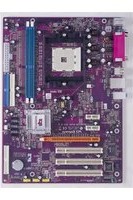
NFORCE4-A754 - Motherboard ECS - Free user manual and instructions
Find the device manual for free NFORCE4-A754 ECS in PDF.


| Product Type | Motherboard |
| Brand | ECS (Elitegroup Computer Systems) |
| Model | NFORCE4-A754 |
| Chipset | NVIDIA nForce4 |
| CPU Socket | Socket 754 |
| Supported CPUs | AMD Athlon 64 / Sempron |
| Memory Type | DDR400 (PC3200) |
| Maximum Memory | 2 GB (2 DIMM slots) |
| Expansion Slots | 1x PCI Express x16, 2x PCI Express x1, 3x PCI |
| Storage Interfaces | 4x SATA 1.5 Gb/s, 2x Ultra DMA 133/100/66 |
| RAID Support | RAID 0, 1, 0+1, 5 (via nForce4) |
| Audio | 6-channel AC'97 audio codec |
| LAN | Gigabit Ethernet (Realtek RTL8110S) |
| USB Ports | 8x USB 2.0 (4 rear, 4 via header) |
| Form Factor | ATX (305 mm x 244 mm) |
| Weight | Approximately 0.8 kg |
| Power Supply | ATX 20+4 pin, 4-pin +12V |
| BIOS | AMI BIOS with PnP, ACPI 2.0 |
| Rear Panel I/O | PS/2 K/B & Mouse, COM, LPT, Audio jacks, 4x USB, RJ45 |
| Special Features | nForce4 SPP/ MCP, ActiveArmor firewall |
Frequently Asked Questions - NFORCE4-A754 ECS
User questions about NFORCE4-A754 ECS
0 question about this device. Answer the ones you know or ask your own.
Ask a new question about this device
Download the instructions for your Motherboard in PDF format for free! Find your manual NFORCE4-A754 - ECS and take your electronic device back in hand. On this page are published all the documents necessary for the use of your device. NFORCE4-A754 by ECS.
USER MANUAL NFORCE4-A754 ECS
The TÜV CERT Certification Body for QM Systems of RWTÜV Systems GmbH
hereby certifies in accordance with TÜV CERT procedure that
ELITEGROUP COMPUTER SYSTEMS CO., LTD. ECS MANUFACTURING (SHENZHEN) CO., LTD. ELITE TECHNOLOGY (SHENZHEN) CO., LTD.
2F, No. 240, Sec. 1, Nel Hu Road, Taipei, Taiwan 114 No. 22, Alley 38, Lane 91, Sec. 1, Nel Hu Road, Taipei, Taiwan 114 No. 20 & No. 26, Free Trade Zone, Shatoujiao, Shenzhen City, GuangDong Province, China
has established and applies a quality system for
Design, Manufacturing and Sales of Mainboards, Personal Computers, Notebooks and Peripheral Cards
An audit was performed, Report No. 2.5-1585/2000
Proof has been furnished that the requirements according to
ISO 9001 : 2000 / EN ISO 9001 : 2000 / JIS Q 9001 : 2000 / ANSI/ASQC Q9001 : 2000
are fulfilled. The certificate is valid until 27 January 2007
Certificate Registration No. 04100 2000 1325
The company has been certified since 2000

Essen, 04.03.2004



ISO14001
CERTIFICATE
Certificate NO.: 05-2001-065
We hereby certify that
ECS Manufacturing(Shenzhen) Co., Ltd
by reason of its
Environmental Management System
has been awarded this certificate for
compliance with the standard
ISO14001:1996
The Environmental Management System
applies in the following area:
The manufacture of Mother Board and Peripheral Card and interrelated management activities of ECS Manufacturing(Shenzhen) Co.,Ltd.
which is located in No.20,Free Trade Zone,Shatuojiao,Shenzhen,P.R.China.
Date of issue: 30th Dec 2001
Date of expiry: 29th Dec 2004
Signed by:

SHENZHEN ENVIRONMENTAL MANAGEMENT SYSTEM CERTIFICATION CENTER
Preface

This publication, including all photographs, illustrations and software, is protected under international copyright laws, with all rights reserved. Neither this manual, nor any of the material contained herein, may be reproduced without written consent of the author.
Version 1.0

The information in this document is subject to change without notice. The manufacturer makes no representations or warranties with respect to the contents hereof and specifically disclaims any implied warranties of merchantability or fitness for any particular purpose. The manufacturer reserves the right to revise this publication and to make changes from time to time in the content hereof without obligation of the manufacturer to notify any person of such revision or changes.

Microsoft, MS-DOS and Windows are registered trademarks of Microsoft Corp.
nVIDIA is a registered trademark of nVIDIA Corporation
Other product names used in this manual are the properties of their respective owners and are acknowledged.

This equipment has been tested and found to comply with the limits for a Class B digital device, pursuant to Part 15 of the FCC Rules. These limits are designed to provide reasonable protection against harmful interference in a residential installation. This equipment generates, uses, and can radiate radio frequency energy and, if not installed and used in accordance with the instructions, may cause harmful interference to radio communications. However, there is no guarantee that interference will not occur in a particular installation. If this equipment does cause harmful interference to radio or television reception, which can be determined by turning the equipment off and on, the user is encouraged to try to correct the interference by one or more of the following measures:
- Reorient or relocate the receiving antenna.
- Increase the separation between the equipment and the receiver.
- Connect the equipment onto an outlet on a circuit different from that to which the receiver is connected.
- Consult the dealer or an experienced radio/TV technician for help.
Shielded interconnect cables and a shielded AC power cable must be employed with this equipment to ensure compliance with the pertinent RF emission limits governing this device. Changes or modifications not expressly approved by the system's manufacturer could void the user's authority to operate the equipment.

This device complies with part 15 of the FCC rules. Operation is subject to the following conditions:
• This device may not cause harmful interference, and
- This device must accept any interference received, including interference that may cause undesired operation.

This class B digital apparatus meets all requirements of the Canadian Interference-causing Equipment Regulations.
The manual consists of the following:
Chapter 1
| Introducing the Motherboard | Describes features of the motherboard. |
| Go to ➔ page 1 | |
| Chapter 2 | Describes installation of motherboard components. |
| Installing the Motherboard | Go to ➔ page 7 |
| Chapter 3 | Provides information on using the BIOS Setup Utility. |
| Using BIOS | Go to ➔ page 25 |
| Chapter 4 | Describes the motherboard software |
| Using the Motherboard Software | Go to ➔ page 45 |
Preface i
◆◆◆□▼◆◆
Introducing the Motherboard 1
Introduction....1
Features....2
Motherboard Components....4
※※□▼※□ ✗
Installing the Motherboard 7
Safety Precautions....7
Choosing a Computer Case....7
Installing the Motherboard in a Case....7
Checking Jumper Settings....8
Setting Jumpers....8
Checking Jumper Settings....9
Jumper Settings....9
Connecting Case Components....10
Front Panel Header....12
Installing Hardware....12
Installing the Processor....13
Installing Memory Modules....14
Installing a Hard Disk Drive/CD-ROM/SATA Hard Drive......17
Installing a Floppy Diskette Drive....19
Installing Add-on Cards....20
Connecting Optional Devices....22
Connecting I/O Devices....24
^ X ^ X
Using BIOS 25
About the Setup Utility....25
The Standard Configuration....25
Entering the Setup Utility....25
Updating the BIOS....27
Using BIOS....27
Standard CMOS Features....28
Advanced BIOS Features....30
Advanced Chipset Features....32
Integrated Peripherals....34
Power Management Setup....38
PNP/PCI Configurations....40
PC Health Status....41
Load Fail-Safe Defaults....42
Load Optimized Defaults....42
Set Supervisor/User Password....42
Save & Exit Setup Option....43
Exit Without Saving....43
+ * * □ ▼ □ √
VX VX
Using the Motherboard Software 45
About the Software CD-ROM....45
Auto-installing under Windows 98/ME/2000/XP....45
Running Setup....46
Manual Installation....48
Utility Software Reference....48
Multi-Language Translation
Introduction
Thank you for choosing the NFORCE4-A754 motherboard. This motherboard is a high performance, enhanced function motherboard that supports Socket 754 AMD Athlon 64 and Sempron CPUs for high-end business or personal desktop markets.
The NFORCE4-A754 motherboard is based on NVIDIA® nForce4-4X media and communications processor (MCP) for best desktop platform solution. "nForce4-4X" is a single-chip, highly integrated, high performance HyperTransport peripheral controller, unmatched by any other single chip-device controller. This motherboard supports up to 2GB of system memory with PC3200/2700/2100/1600 DDR DIMMs, high resolution graphics via an PCI Express x16 slot, Giga LAN, USB 2.0, 6-channel audio, and SATA support with RAID function.
There is an advanced full set of I/O ports in the rear panel, including PS/2 mouse and keyboard connectors, COM1, LPT1, four USB ports, one optional LAN port, and audio jacks for microphone, line-in, and line-out. This motherboard is designed in an ATX form factor using a four-layer printed circuit board and measures 304 mm x 220 mm.
Feature
Processor
This motherboard uses a 754-pin socket that carries the following features:
- Accommodates AMD Athlon 64 and Sempron CPUs
• Supports high-performance HyperTransport CPU interface
TM
HyperTransport Technology is a point-to-point link between two devices, it enables integrated circuits to exchange information at much higher speeds than currently available interconnect technologies.
Chipset
The NVIDIA® nForce4-4X is a single-chip with proven reliability and performance.
- HyperTransport x16 up and down links at up to 1.0 GHz to the AMD Athlon 64 and Sempron CPUs
- PCI 2.3 interface, supporting up to five PCI slots
- Two separate SATA controllers with integrated PHYs, each supporting two drives in master mode
- IEEE 802.3 NVIDIA MAC for 1000BASE-T/100BASE-T/10BASE-T Gigabit/Fsat Ethernet/Ethernet
- USB 2.0 EHCl and USB 1.1 OHCl, supporting up to ten ports
- Fast ATA-133 IDE controller
- AC'97 2.3 interface, supporting S/PDIF pass-through function and standard, enhanced audio functionality
Memory
- Three 184-pin, 2.5V, DDR SDRAM DIMM sockets support up to 2GB
• Support DDR400/333/266/200 unbuffered DDR SDRAM
AC'97 Audio CODEC
• 16-bit Stereo full-duplex CODEC with 48MHz sampling rate
• Compliant with AC'97 2.3 specifications
• Supports double sampling rate (96KHz) of DVD audio playback
- Direct Sound 3D compatible
Onboard LAN (optional)
The onboard LAN provides the following features:
• 10/100/1000BASE-T IEEE 802.3 compliant
- Supports GMII, TBI, reduced pin count GMII (RGMII), reduced pin count TBI (RTBI), and serial GMII (SGMII) interfaces
• IEEE 802.3u compliant Auto-Negotiation
- Prevents outgoing packets with spoofed IP source addresses and provides logging/configuration capabilities
Expansion Options
The motherboard comes with the following expansion options:
• One PCI Express x16 slot
- Two PCI Express x1 slots
• Three 32-bit PCI slots
- Two IDE headers which support four IDE devices
• One floppy disk drive interface
- Four 7-pin SATA connectors
This motherboard supports Ultra DMA bus mastering with transfer rates of 133/100/66 MB/s.
Integrated I/O
The motherboard has a full set of I/O ports and connectors:
- Two PS/2 ports for mouse and keyboard
- One serial port
- One parallel port
- Four USB ports
• One LAN port (optional)
• Audio jacks for microphone, line-in and line-out
BIOS Firmware
The motherboard uses Award BIOS that enables users to configure many system features including the following:
• Power management
- Wake-up alarms
- CPU parameters
• CPU and memory timing
The firmware can also be used to set parameters for different processor clock speeds.

Some hardware specifications and software items are subject to change without prior notice.
Motherboard Components
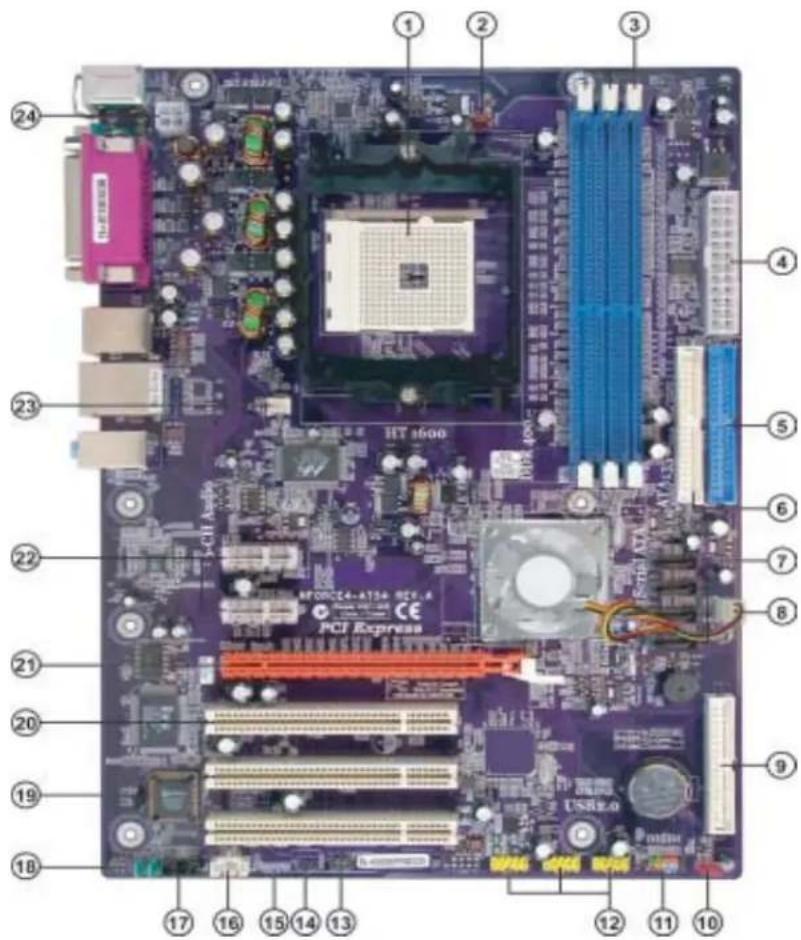
Table of Motherboard Components
| LABEL | COMPONENT |
| 1 CPU Socket Socket 754 for AMD K8 processor | |
| 2 CPUFAN1 CPU cooling fan connector | |
| 3 DIMM1~3 184-pin DDR SDRAM slots | |
| 4 ATX1 Standard 24-pin ATX power connector | |
| 5 IDL2 Secondary IDE connector | |
| 6 IDE1 Primary IDE connector | |
| 7 SATA1~SATA4 Serial ATA connectors | |
| 8 NBFAN1* Northbridge cooling fan connector | |
| 9 FDD1 Floppy disk drive connector | |
| 10 JP1 Clear CMOS jumper | |
| 11 PANEL1 Front Panel switch/LED header | |
| 12 USB3 ~ 5 Front Panel USB headers | |
| 13 IR1 | Infrared header |
| 14 SJ1* Single color 1.1:D header | |
| 15 SPDIFO1 | SPDIF out header |
| 16 AUXIN1* | Auxiliary in header |
| 17 CDIN1 | Analog Audio Input connector |
| 18 AUDIO1 Front panel audio header | |
| 19 JP3 | BIOS flash protect jumper |
| 20 PCI1~3 | 32-bit add-on card slots |
| 21 PCIE1 | PCI Express x16 graphics card slot |
| 22 PCIE2~3 PCI Express x1 slots | |
| 23 CASFAN1 | Case cooling fan connector |
| 24 ATX12V | 4-pin +12V power connector |
“” stands for optional components.
This concludes Chapter 1. The next chapter explains how to install the motherboard.
×
★★O□
Safety Precautions
- Follow these safety precautions when installing the motherboard
- Wear a grounding strap attached to a grounded device to avoid damage from static electricity
- Discharge static electricity by touching the metal case of a safely grounded object before working on the motherboard
- Leave components in the static-proof bags they came in
- Hold all circuit boards by the edges. Do not bend circuit boards
Choosing a Computer Case
There are many types of computer cases on the market. The motherboard complies with the specifications for the ATX system case. First, some features on the motherboard are implemented by cabling connectors on the motherboard to indicators and switches on the system case. Make sure that your case supports all the features required. Secondly, NFORCE4-A754 supports one or two floppy diskette drives and four enhanced IDE drives. Make sure that your case has sufficient power and space for all drives that you intend to install.
Most cases have a choice of I/O templates in the rear panel. Make sure that the I/O template in the case matches the I/O ports installed on the rear edge of the motherboard.
This motherboard carries an ATX form factor of 305 X 220 mm. Choose a case that accommodates this form factor.
Installing the Motherboard in a Case
Refer to the following illustration and instructions for installing the motherboard in a case.
Most system cases have mounting brackets installed in the case, which correspond the holes in the motherboard. Place the motherboard over the mounting brackets and secure the motherboard onto the mounting brackets with screws.
Ensure that your case has an I/O template that supports the I/O ports and expansion slots on your motherboard.

natural_image
Close-up of a purple computer motherboard with visible CPU socket, RAM slots, and indicator lights (no readable text or symbols)
Do not over-tighten the screws as this can stress the motherboard.
Checking Jumper Settings
This section explains how to set jumpers for correct configuration of the motherboard.
Setting Jumpers
Use the motherboard jumpers to set system configuration options. Jumpers with more than one pin are numbered. When setting the jumpers, ensure that the jumper caps are placed on the correct pins.
The illustrations show a 2-pin jumper. When the jumper cap is placed on both pins, the jumper is SHORT. If you remove the jumper cap, or place the jumper cap on just one pin, the jumper is OPEN.
This illustration shows a 3-pin jumper. Pins 1 and 2 are SHORT

SHORT

OPEN
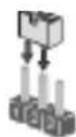
Checking Jumper Settings
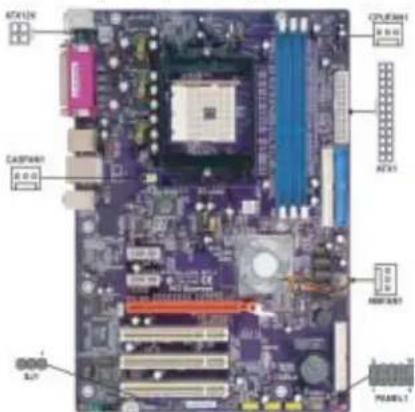
The following illustration shows the location of the motherboard jumpers. Pin 1 is labeled.

natural_image
Close-up of a purple computer motherboard with CPU socket, RAM slots, and JSP1/JP3 connectors (no readable text or symbols beyond component labels)Jumper Settings
| Jumper | Type | Description | Setting (default) | |
| JP1 | 3-pin | CLEAR CMOS 1-2: | NORMAL2-3: CLEARBefore clearing the CMOS, make sure to turn the system off. | JP1 |
| JP3 | 3-pin | BIOS PROTECT | 1-2: DISABLE2-3: ENABLE | JP3 |
Connecting Case Components
After you have installed the motherboard into a case, you can begin connecting the motherboard components. Refer to the following:
1 Connect the CPU cooling fan cable to CPUFAN1.
2 Connect the case cooling fan connector to CASFAN1.
3 Connect the Northbridge cooling fan connector to NBFAN1.
4 Connect the case switches and indicator LEDs to the PANEL1. If there are 3 pins in the case LED cable, connect to SJ1.
5 Connect the standard power supply connector to ATX1.
6 Connect the auxiliary case power supply connector to ATX12V.

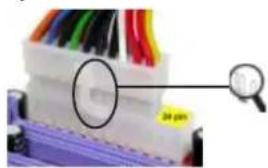
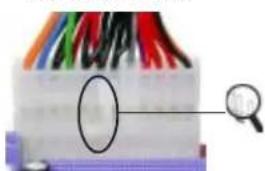
Connecting 20/24-pin power cable
Users please note that the 20-pin and 24-pin power cables can both be connected to the ATX1 connector. With the 20-pin power cable, just align the 20-pin power cable with the pin 1 of the ATX1 connector. However, using 20-pin power cable may cause the system to become unbootable or unstable because of insufficient electricity. A minimum power of 300W is recommended for a fully-configured system.
natural_image
Close-up of a white electronic component with colorful wires and a magnified inset showing a 24 μm measurement (no text or symbols visible)20-pin power cable
Users please note that when installing 20-pin power cable, the latch of power cable falls on the left side of the ATX1 connector latch, just as the picture shows.
natural_image
Close-up of a cable connector with colorful wires and a magnifying glass overlay (no text or symbols visible)Users please note that when installing 24-pin power cable, the latches of power cable and the ATX1 match perfectly.
24-pin power cable
CPUFAN1/CASFAN1/NBFAN1: FAN Power Connectors
| Pin Signal Name | Function |
| 1 GND System Ground | |
| 2 +12V Power +12V | |
| 3 Sense Sensor | |
SJ1: Single-color LED header
| Pin | Signal Name |
| 1 | ACPILED |
| 2 | ACPILED |
| 3 | 5VSB |
ACPI LED function
 | S0 | S1 | S3 | S4/S5 |
| Light | Blinking | Blinking | Dark |
ATX1: ATX 24-pin Power Connector
| Pin | Signal Name | Pin | Signal Name |
| 1 +3.3V 13 +3.3V | |||
| 2 +3.3V 14 -12V | |||
| 3 Ground 15 COM | |||
| 4 +5V 16 PS_ON | |||
| 5 Ground 17 COM | |||
| 6 +5V 18 COM | |||
| 7 Ground 19 COM | |||
| 8 PWRGD 20 -5V | |||
| 9 +5VSB 21 +5V | |||
| 10 | +12V | 22 | +5V |
| 11 | +12V | 23 | +5V |
| 12 | +3.3V | 24 | COM |
ATX12V: ATX 12V Power Connector
| Pin Signal Name | |
| 1 | Ground |
| 2 | Ground |
| 3 | +12V |
| 4 | +12V |
Front Panel Header
The front panel header (PANEL1) provides a standard set of switch and LED headers commonly found on ATX or Micro ATX cases. Refer to the table below for information:
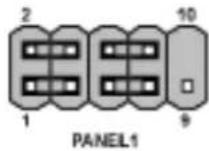
| Pin Signal Name Function Pin Signal Name Function | ||||
| 1HD_LED_P Hard disk LED+ 2FP PWR/SLP *MSG LED+ | ||||
| 3HD_LED_N Hard disk LED- | 4FP PWR/SLP *MSG LED- | |||
| 5RST_SW_N Reset Switch | 6 PWR_SW_P Power Switch | |||
| 7RST_SW_P Reset Switch | 8 PWR_SW_N Power Switch | |||
| 9RSVD Reserved | 10 Key No pin | |||
* MSG LED (dual color or single color)
Hard Drive Activity LED
Connecting pins 1 and 3 to a front panel mounted LED provides visual indication that data is being read from or written to the hard drive. For the LED to function properly, an IDE drive should be connected to the onboard IDE interface. The LED will also show activity for devices connected to the SCSI (hard drive activity LED) connector.
Power/Sleep/Message waiting LED
Connecting pins 2 and 4 to a single or dual-color, front panel mounted LED provides power on/off, sleep, and message waiting indication.
Reset Switch
Supporting the reset function requires connecting pin 5 and 7 to a momentary-contact switch that is normally open. When the switch is closed, the board resets and runs POST.
Power Switch
Supporting the power on/off function requires connecting pins 6 and 8 to a momentary-contact switch that is normally open. The switch should maintain contact for at least 50 ms to signal the power supply to switch on or off. The time requirement is due to internal debounce circuitry. After receiving a power on/off signal, at least two seconds elapses before the power supply recognizes another on/off signal.
Installing Hardware
Installing the Processor

Caution: When installing a CPU heatsink and cooling fan make sure that you DO NOT scratch the motherboard or any of the surface-mount resistors with the clip of the cooling fan. If the clip of the cooling fan scrapes across the motherboard, you may cause serious damage to the motherboard or its components.
On most motherboards, there are small surface-mount resistors near the processor socket, which may be damaged if the cooling fan is carelessly installed.
Avoid using cooling fans with sharp edges on the fan casing and the clips. Also, install the cooling fan in a well-lit work area so that you can clearly see the motherboard and processor socket.
Before installing the Processor
This motherboard automatically determines the CPU clock frequency and system bus frequency for the processor. You may be able to change these settings by making changes to jumpers on the motherboard, or changing the settings in the system Setup Utility. We strongly recommend that you do not over-clock processors or other components to run faster than their rated speed.

Warning: Over-clocking components can adversely affect the reliability of the system and introduce errors into your system. Over-clocking can permanently damage the motherboard by generating excess heat in components that are run beyond the rated limits.
This motherboard has a Socket 754 processor socket. When choosing a processor, consider the performance requirements of the system. Performance is based on the processor design, the clock speed and system bus frequency of the processor, and the quantity of internal cache memory and external cache memory.
CPU Installation Procedure
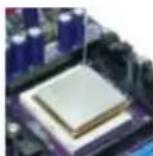
The following illustration shows CPU installation components.
1 Install your CPU. Pull up the lever away from the socket and lift up to 90-degree angle.
2 Locate the CPU cut edge (the corner with the pin hold noticeably missing). Align and insert the CPU correctly.
3 Press the lever down and apply thermal grease on top of the CPU.
4 Put the CPU Fan down on the retention module and snap the four retention legs of the cooling fan into place.
5 Flip the levers over to lock the heat sink in place and connect the CPU cooling Fan power cable to the CPUFAN connector. This completes the installation.
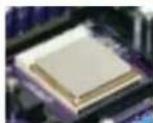
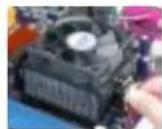

To achieve better airflow rates and heat dissipation, we suggest that you use a high quality fan with 4800 rpm at least. CPU fan and heatsink installation procedures may vary with the type of CPU fan/heatsink supplied. The form and size of fan/heatsink may also vary.
This motherboard accommodates three 184-pin 2.5V unbuffered DIMM and supports DDR400/333/266/200 DDR SDRAM. You must install at least one module in any of the four slots. Each module can be installed with 128 MB to 1 GB of memory; the total memory capacity is 2GB.
DDR SDRAM memory module table
| Memory module Memory Bus | |
| DDR200 100MHz | |
| DDR266 133MHz | |
| DDR333 166MHz | |
| DDR400 200MHz | |

Do not remove any memory module from its antistatic packaging until you are ready to install it on the motherboard. Handle the modules only by their edges. Do not touch the components or metal parts. Always wear a grounding strap when you handle the modules.
Installation Procedure
Refer to the following to install the memory modules.
1 This motherboard supports unbuffered DDR SDRAM only.
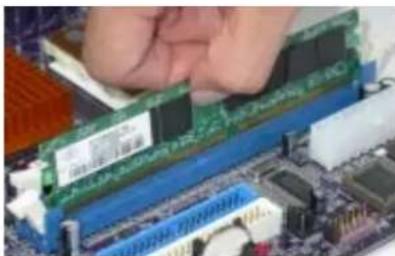
2 Push the latches on each side of the DIMM slot down.
3 Align the memory module with the slot. The DIMM slots are keyed with notches and the DIMMs are keyed with cutouts so that they can only be installed correctly.
4 Check that the cutouts on the DIMM module edge connector match the notches in the DIMM slot.
5 Install the DIMM module into the slot and press it firmly down until it seats correctly. The slot latches are levered upwards and latch on to the edges of the DIMM.
6 Install any remaining DIMM modules.
natural_image
Close-up of hands installing a green RAM module on a computer motherboard (no visible text or symbols)Table A: Unbuffered DIMM Support for 754-pin
| Numbers of DIMMs ^5 | DIMM 1 ^4.1.5 | DIMM 2^2 | DIMM 3^2 | Maximum DRAM Speed | |
| 1T | 2T^3 | ||||
| 1 | single rank | empty | empty | DDR400 | DDR400 |
| 1 | empty | single rank | empty | DDR400 | DDR400 |
| 1 | empty | empty | single rank | DDR400 | DDR400 |
| 1 | double rank | empty | empty | DDR400 | DDR400 |
| 1 | empty | double rank | empty | DDR400 | DDR400 |
| 1 | empty | empty | double rank | DDR400 | DDR400 |
| 2 | single rank | single rank | empty | DDR400 | DDR400 |
| 2 | single rank | double rank | empty | DDR400 | DDR400 |
| 2 | single rank | empty | single rank | DDR400 | DDR400 |
| 2 | single rank | empty | double rank | DDR400 | DDR400 |
| 2 | double rank | single rank | empty | DDR400 | DDR400 |
| 2 | double rank | double rank | empty | DDR333 | DDR333 |
| 2 | double rank | empty | single rank | DDR400 | DDR400 |
| 2 | double rank | empty | double rank | DDR333 | DDR333 |
| 2 | empty | single rank | single rank | DDR333 | DDR400 |
| 2 | empty | single rank | double rank | DDR200 | DDR400 |
| 2 | empty | double rank | single rank | DDR200 | DDR400 |
| 2 | empty | double rank | double rank | DDR200 | DDR333 |
| 3 | single rank | single rank | single rank | DDR333 | DDR400 |
| 3 | single rank | single rank | double rank | DDR200 | DDR333 |
| 3 | single rank | double rank | single rank | DDR200 | DDR333 |
| 3 | single rank | double rank | double rank | DDR200 | DDR333^4 |
| 3 | double rank | single rank | single rank | DDR333 | DDR333 |
| 3 | double rank | single rank | double rank | DDR200 | DDR333^4 |
| 3 | double rank | double rank | single rank | DDR200 | DDR333^4 |
| 3 | double rank | double rank | double rank | DDR200 | DDR333^4 |

1 DIMM 1 connects to command/address pins MEMADDA [13:0], MEMBANKA [1:0], MEMRASA_L, MEMCASA_L, MEMWEA_L, MEMCKEA.
2 DIMM 2 and 3 connect to command/address pins MEMADDB [13:0], MEMBANKB [1:0], MEMRASB_L, MEMCASB_L, MEMWEB_L, MEMCKEB.
3 2T timing is supported in CG and later silicon revisions. Refer to the AMD Athlon™ 64 Processor Power and Thermal Data Sheet, order #30430, for silicon revision determination.
4 The maximum allowable DRAM speed under these high load conditions may be reduced with certain DIMMs due to signal integrity degradation.
5 For systems using a DIMM implementation, refer only to rows in this table where the entry for the column titled DIMM 3 reads 'empty'.
Table A: DDR (memory module) QVL (Qualified Vendor List)
The following DDR400 memory modules have been tested and qualified for use with this motherboard.
| Size | Vendor | Module Name |
| 128MB | NANYA | NT5DS16M16BT-5 |
| 256MB | Infineon | HYB25D256800BT-5B |
| Micron | MT46V32M8-5BC | |
| Micron | MT46V16M8-5 ES | |
| NANYA | NT5DS32M8BT-5T | |
| SAMSUNG | K4H560838D-TCC4 | |
| 512MB | Apacer | A2S56D30ATP |
| Apacer | HYB25D256800BT-5B | |
| Apacer | V58C2256804SAT5 | |
| NANYA | NT5DS32M8BT-5T | |
| SAMSUNG | K4H560838D-TCC4 | |
| SAMSUNG | K4H560838E-TCCC |
Installing a Hard Disk Drive/CD-ROM/SATA Hard Drive
This section describes how to install IDE devices such as a hard disk drive and a CD-ROM drive.
About IDE Devices
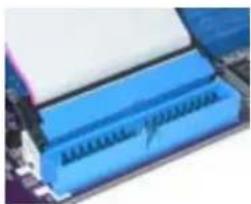
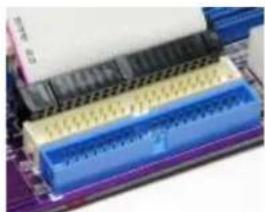
Your motherboard has a primary and secondary IDE channel interface (IDE1 and IDE2). An IDE ribbon cable supporting two IDE devices is bundled with the motherboard.

You must orient the cable connector so that the pin1 (color) edge of the cable corresponds to the pin 1 of the I/O port connector.
IDE1: Primary IDE Connector
The first hard drive should always be connected to IDE1.
natural_image
Close-up of a blue electronic component with a metallic clip, no visible text or symbols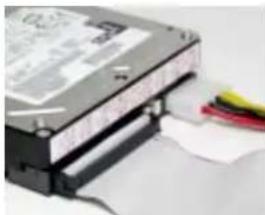
natural_image
Close-up of a black electronic device with attached wires and paper sheets (no visible text or symbols)IDE2: Secondary IDE Connector
The second drive on this controller must be set to slave mode. The configuration is the same as IDE1.
natural_image
Close-up of a computer RAM module with blue and yellow memory chips (no visible text or labels)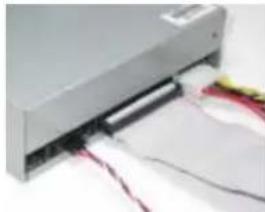
natural_image
Close-up of a printer's front panel with paper sheets and cables (no visible text or symbols)IDE devices enclose jumpers or switches used to set the IDE device as MASTER or SLAVE. Refer to the IDE device user's manual. Installing two IDE devices on one cable, ensure that one device is set to MASTER and the other device is set to SLAVE. The documentation of your IDE device explains how to do this.
About UltraDMA
This motherboard supports UltraDMA 133/100/66. UDMA is a technology that accelerates the performance of devices in the IDE channel. To maximize performance, install IDE devices that support UDMA and use 80-pin IDE cables that support UDMA 133/100/66.
→X
About SATA Connectors
Your motherboard features four SATA connectors supporting a total of four drives. SATA refers to Serial ATA (Advanced Technology Attachment) is the standard interface for the IDE hard drives which are currently used in most PCs. These connectors are well designed and will only fit in one orientation. Locate the SATA connectors on the motherboard (see page 19) and follow the illustration below to install the SATA hard drives.
Installing Serial ATA Hard Drives
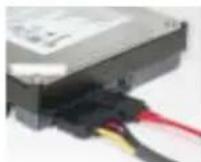
To install the Serial ATA (SATA) hard drives, use the SATA cable that supports the Serial ATA protocol. This SATA cable comes with an SATA power cable. You can connect either end of the SATA cable to the SATA hard drive or the connector on the motherboard.

SATA cable (optional)
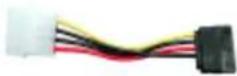
SATA power cable (optional)
Refer to the illustration below for proper installation:
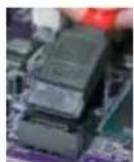
1 Attach either cable end to the connector on the motherboard.
2 Attach the other cable end to the SATA hard drive.
3 Attach the SATA power cable to the SATA hard drive and connect the other end to the power supply.

This motherboard does not support the "Hot-Plug" function.
Installing a Floppy Diskette Drive
The motherboard has a floppy diskette drive (FDD1) interface and ships with a diskette drive ribbon cable that supports one or two floppy diskette drives. You can install a 5.25-inch drive and a 3.5-inch drive with various capacities. The floppy diskette drive cable has one type of connector for a 5.25-inch drive and another type of connector for a 3.5-inch drive.

You must orient the cable connector so that the pin 1 (color) edge of the cable corresponds to the pin 1 of the I/O port connector.
FDD1: Floppy Disk Connector
This connector supports the provided floppy drive ribbon cable. After connecting the single end to the onboard floppy connector, connect the remaining plugs on the other end to the floppy drives correspondingly.

natural_image
Close-up of a computer RAM module with gold contacts and a black top layer, placed on a circuit board (no visible text or symbols)Installing Add-on Cards
The slots on this motherboard are designed to hold expansion cards and connect them to the system bus. Expansion slots are a means of adding or enhancing the motherboard's features and capabilities. With these efficient facilities, you can increase the motherboard's capabilities by adding hardware that performs tasks that are not part of the basic system.
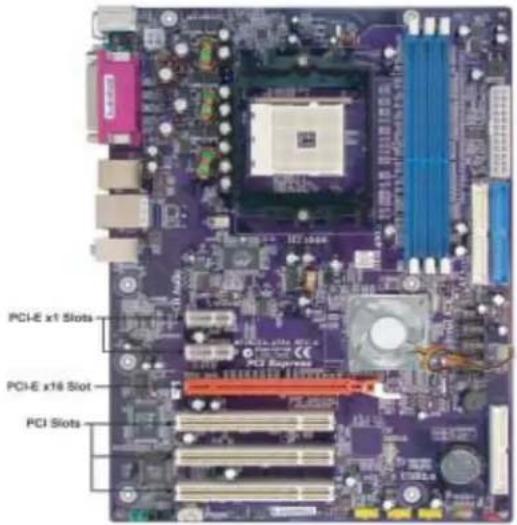
PCIE2\~3 Slots The two PCI Express x1 slots are fully compliant to the PCI Express Base Specification revision 1.0a as well.
PCIE1 Slot The PCI Express x16 slot is used to install an external PCI Express graphics card that is fully compliant to the PCI Express Base Specification revision 1.0a.
PCI1\~3 Slots This motherboard is equipped with three standard PCI slots. PCI stands for Peripheral Component Interconnect and is a bus standard for expansion cards, which for the most part, is a supplement of the older ISA bus standard. The PCI slots on this board are PCI v2.3 compliant.

Before installing an add-on card, check the documentation for the card carefully. If the card is not Plug and Play, you may have to manually configure the card before installation.
动
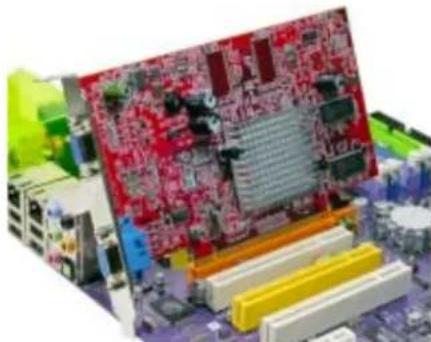
Follow these instructions to install an add-on card:
1 Remove a blanking plate from the system case corresponding to the slot you are going to use.
2 Install the edge connector of the add-on card into the expansion slot. Ensure that the edge connector is correctly seated in the slot.
3 Secure the metal bracket of the card to the system case with a screw.
natural_image
Close-up of a red computer motherboard with visible slots and CPU socket (no text or symbols)
For some add-on cards, for example graphics adapters and network adapters, you have to install drivers and software before you can begin using the add-on card.
Connecting Optional Devices
Refer to the following for information on connecting the motherboard's optional devices:
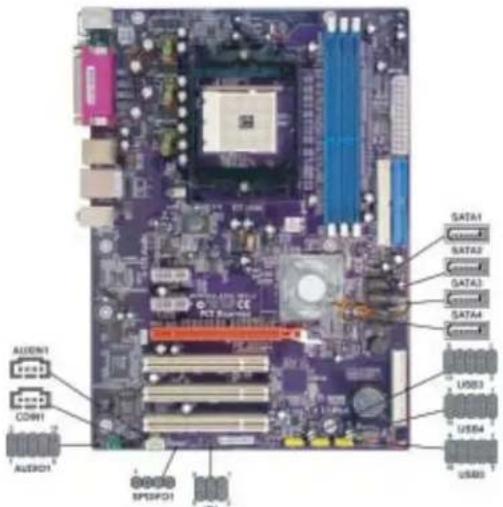
AUDIO1: Front Panel Audio header
This header allows the user to install auxiliary front-oriented microphone and line-out ports for easier access.
| Pin Signal Name Function | ||
| 1 AUD_MIC Front Panel | Microphone input signal | |
| 2 AUD_GND Ground used by Analog Audio Circuits | ||
| 3 AUD_MIC_BIAS Microphone Power | ||
| 4 AUD_VCC Filtered +5V used by Analog Audio Circuits | ||
| 5 AUD_F_R Right Channel audio signal to Front Panel | ||
| 6 | AUD_RET_R | Right Channel Audiosignal to Return from Front Panel |
| 7 REVD Reserved | ||
| 8 Key No Pin | ||
| 9 AUD_F_L Left Channel Audio signal to Front Panel | ||
| 10 | AUD_RET_L | Left Channel Audio signal to Return from Front Panel |
SPDIFO1: SPDIF out header
This is an optional header that provides an S/PDIF (Sony/Philips Digital Interface) output to digital multimedia device through optical fiber or coaxial connector.
| Pin Signal Name Function | ||
| 1 SPDIF SPDIF digital output | ||
| 2 +5VA | 5V | analog Power |
| 3 Key | No pin | |
| 4 GND | Ground | |
SATA1\~SATA4: Serial ATA connectors
These connectors are use to support the new Serial ATA devices for the highest date transfer rates (150 MB/s), simpler disk drive cabling and easier PC assembly. It eliminates limitations of the current Parallel ATA interface. But maintains register compatibility and software compatibility with Parallel ATA.
| Pin Signal Name Pin Signal Name | ||
| Pin Signal Name Function | ||
| 1 Ground 2 TX+ | ||
| 3 TX-4 Ground | ||
| 5 RX-6 RX+ | ||
| 7 Ground - - | ||
USB3\~USB5: Front Panel USB headers
The motherboard has four USB ports installed on the rear edge I/O port array. Additionally, some computer cases have USB ports at the front of the case. If you have this kind of case, use auxiliary USB connector to connect the front-mounted ports to the motherboard.
| Pin Signal Name Function | ||
| 1 USBPWR Front Panel USB Power | ||
| 2 USBPWR Front Panel USB Power | ||
| 3 USB_FP_P0- USB Port 0 Negative Signal | ||
| 4 USB_FP_P1- USB Port 1 Negative Signal | ||
| 5 USB_FP_P0+ USB Port 0 Positive Signal | ||
| 6 USB_FP_P1+ USB Port 1 Positive Signal | ||
| 7 GND Ground | ||
| 8 GND Ground | ||
| 9 Key No pin | ||
| 10 | NC | Not connected |

Please make sure that the USB cable has the same pin assignment as indicated above. A different pin assignment may cause damage or system hang-up.
AUX\_IN: Auxiliary In connector (optional)
This connector is an additional line-in audio connector. It allows you to attach a line-in cable when your rear line-in jack is set as line out port for 4-channel function.
| Pin Signal Name Function | |
| 1 AUX_L | AXU In left channel |
| 2 GND Ground | |
| 3 GND Ground | |
| 4 AUX_R | AXU In right channel |
CDIN1: Analog Audio Input connector
| Pin Signal Name Function | |
| 1 CD in_L | CD In left channel |
| 2 GND | Ground |
| 3 GND | Ground |
| 4 CD in_R | CD In right channel |
Connecting I/O Devices
The backplane of the motherboard has the following I/O ports:
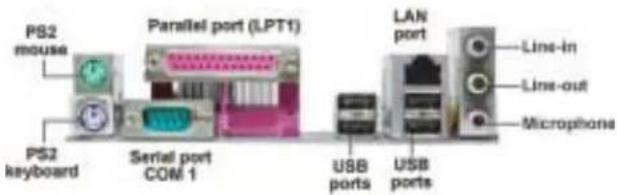
PS2 Mouse Use the upper PS/2 port to connect a PS/2 pointing device.
PS2 Keyboard Use the lower PS/2 port to connect a PS/2 keyboard.
Parallel Port (LPT1) Use LPT1 to connect printers or other parallel communications devices.
Serial Port Use the COM port to connect serial devices such as mice or (COM1) fax/modems. COM1 is identified by the system as COM1/3.
LAN Port Connect an RJ-45 jack to the LAN port to connect your computer (optional) to the Network.
USB Ports Use the USB ports to connect USB devices.
Audio Ports Use the three audio ports to connect audio devices. The first jack is for stereo line-in signal. The second jack is for stereo line-out signal. The third jack is for microphone.
This concludes Chapter 2. The next chapter covers the BIOS.
About the Setup Utility
The computer uses the latest Award BIOS with support for Windows Plug and Play. The CMOS chip on the motherboard contains the ROM setup instructions for configuring the motherboard BIOS.
The BIOS (Basic Input and Output System) Setup Utility displays the system's configuration status and provides you with options to set system parameters. The parameters are stored in battery-backed-up CMOS RAM that saves this information when the power is turned off. When the system is turned back on, the system is configured with the values you stored in CMOS.
The BIOS Setup Utility enables you to configure:
- Hard drives, diskette drives and peripherals
• Video display type and display options - Password protection from unauthorized use
• Power Management features
The settings made in the Setup Utility affect how the computer performs. Before using the Setup Utility, ensure that you understand the Setup Utility options.
This chapter provides explanations for Setup Utility options.
The Standard Configuration
A standard configuration has already been set in the Setup Utility. However, we recommend that you read this chapter in case you need to make any changes in the future.
This Setup Utility should be used:
- when changing the system configuration
- when a configuration error is detected and you are prompted to make changes to the Setup Utility
- when trying to resolve IRQ conflicts
- when making changes to the Power Management configuration
- when changing the password or making other changes to the Security Setup
Entering the Setup Utility
When you power on the system, BIOS enters the Power-On Self Test (POST) routines. POST is a series of built-in diagnostics performed by the BIOS. After the POST routines are completed, the following message appears:
Press DEL to enter SETUP
Pressing the delete key accesses the BIOS Setup Utility:
Phoenix-AwardBIOS CMOS Setup Utility:
| ►Standard CMOS Features►Advanced BIOS Features►Advanced Chipset Features►Integrated Peripherals Set User Password►Power Management Setup Save & Exit Setup►PnP/PCI Configurations Exit Without Saving►PC Health Status | Load PerformanceLoad Optimized DefaultsSet Supervisor Password |
| Esc: Quit ↑↓← ← : Select ItemF10: Save & Exit Setup | |
| Time, Date, Hard Disk Type... | |
BIOS Navigation Keys
The BIOS navigation keys are listed below:
| KEY | FUNCTION |
| ←↑↓→←↑↓ | →Move |
| Enter | Select |
| +/-/PU/PD | Value |
| ESC Exits | the current menu |
| F1 | General Help |
| F2 | Item Help |
| F5 | Previous Values |
| F6 | Fail-Safe Defaults |
| F7 | Optimized Defaults |
| F9 | Mcnu in BIOS |
| F10 | Save |
Updating the BIOS
You can download and install updated BIOS for this motherboard from the manufacturer's Web site. New BIOS provides support for new peripherals, improvements in performance, or fixes for known bugs. Install new BIOS as follows:
1 If your motherboard has a BIOS protection jumper, change the setting to allow BIOS flashing.
2 If your motherboard has an item called Firmware Write Protect in Advanced BIOS features, disable it. (Firmware Write Protect prevents BIOS from being overwritten.
3 Create a bootable system disk. (Refer to Windows online help for information on creating a bootable system disk.)
4 Download the Flash Utility and new BIOS file from the manufacturer's Web site. Copy these files to the system diskette you created in Step 3.
5 Turn off your computer and insert the system diskette in your computer's diskette drive. (You might need to run the Setup Utility and change the boot priority items on the Advanced BIOS Features Setup page, to force your computer to boot from the floppy diskette drive first.)
6 At the A:\ prompt, type the Flash Utility program name and press
7 Type the filename of the new BIOS in the "File Name to Program" text box. Follow the onscreen directions to update the motherboard BIOS.
8 When the installation is complete, remove the floppy diskette from the diskette drive and restart your computer. If your motherboard has a Flash BIOS jumper, reset the jumper to protect the newly installed BIOS from being overwritten.
Using BIOS
When you start the Setup Utility, the main menu appears. The main menu of the Setup Utility displays a list of the options that are available. A highlight indicates which option is currently selected. Use the cursor arrow keys to move the highlight to other options. When an option is highlighted, execute the option by pressing
Some options lead to pop-up dialog boxes that prompt you to verify that you wish to execute that option. Other options lead to dialog boxes that prompt you for information.
Some options (marked with a triangle ▶) lead to submenus that enable you to change the values for the option. Use the cursor arrow keys to scroll through the items in the submenu.
In this manual, default values are enclosed in parenthesis. Submenu items are denoted by a triangle ▶.
Standard CMOS Features
This option displays basic information about your system.
Phoenix-AwardBIOS CMOS Setup Utility Standard CMOS Features
| Date (mm:dd:yy) Wed, Oct. 25 2004Time (hh:mm:ss) 9 : 33 : 26IDE Channel 0 Master [WDC WD800bb-22FJA0]IDE Channel 0 Slave [None]IDE Channel 1 Master [None]IDE Channel 1 Slave [None]IDE Channel 2 Master [None]IDE Channel 3 Master [None]IDE Channel 4 Master [None]IDE Channel 5 Master [None]Drive A [1.44M, 3.5 in.]Floppy 3 Mode Select [Disabled]Video [EGA/VGA]Halt On [All, But Keyboard]Base Memory 640K | Item Help |
| Menu Level ▶Change the day, month, year and century |
1↓→← :Move Enter:Select +/-PU/PD:Value F10:Save ESC:Exit F1:General Help F5:Previous Values F6:Fail-Safe Defaults F7:Optimized Defaults
Date and Time
The Date and Time items show the current date and time on the computer. If you are running a Windows OS, these items are automatically updated whenever you make changes to the Windows Date and Time Properties utility.
▶IDE Devices (None)
Your computer has two IDE channels (Primary and Secondary) and each channel can be installed with one or two devices (Master and Slave). Use these items to configure each device on the IDE channel.
Press
Phoenix-AwardBIOS CMOS Setup Utility IDE Channel 0 Slave
| IDE HDD Auto-Detection [Press Enter]IDE Channel 0 Slave [Auto]Access Mode [Auto]Capacity 0MCylinder 0Head 0Precomp 0Landing Zone 0Sector 0 | Item Help |
| Menu Level ▶▶To auto-detect the HDD's size, head... on this channel |
1↓→←:Move Enter:Select +/-/PU/PD:Value F10:Save ESC:Exit F1:General Help F5:Previous Values F6:Fail-Safe Defaults F7:Optimized Defaults
IDE HDD Auto-Detection
Press

If you are setting up a new hard disk drive that supports LBA mode, more than one line will appear in the parameter box. Choose the line that lists LBA for an LBA drive.
IDE Channel 0/1/2/3/4/5 Master & IDE Channel 0/1 Slave
Leave this item at Auto to enable the system to automatically detect and configure IDE devices on the channel. If it fails to find a device, change the value to Manual and then manually configure the drive by entering the characteristics of the drive in the items described below.

Before attempting to configure a hard disk drive, ensure that you have the configuration information supplied by the manufacturer of your hard drive. Incorrect settings can result in your system not recognizing the installed hard disk.
Access Mode (Auto)
This item defines ways that can be used to access IDE hard disks such as LBA (Large Block Addressing). Leave this value at Auto and the system will automatically decide the fastest way to access the hard disk drive.
Press
Drive A (1.44M, 3.5 in.)
These items define the characteristics of any diskette drive attached to the system. You can connect one or two diskette drives.
Floppy 3 Mode Select (Disabled)
Floppy 3 Mode refers to a 3.5-inch diskette with a capacity of 1.2MB. Floppy 3 mode is sometimes used in Japan.
Video (EGA/VGA)
This item defines the video mode of the system. This motherboard has a built-in VGA graphics system; you must leave this item at the default value.
Halt On (All, But Keyboard)
This item defines the operation of the system POST (Power On Self Test) routine. You can use this item to select which types of errors in the POST are sufficient to halt the system.
Base Memory, Extended Memory, and Total Memory
These items are automatically detected by the system at start up time. These are display-only fields. You cannot make changes to these fields.
Advanced BIOS Features
This option defines advanced information about your system.
Phoenix-AwardBIOS CMOS Setup Utility Advanced BIOS Features
| ► Hard Disk Boot Priority [Press Enter]CPU Internal Cache [Enabled]External Cache [Enabled]Quick Power On Self Test [Enabled]First Boot Device [Floppy]Second Boot Device [Hard Disk]Third Boot Device [CDROM]Boot Other Device [Enabled]Swap Floppy Drive [Disabled]Boot Up Floppy Sock [Disabled]Boot Up NumLock Status [On]Gate A20 Option [Fast]ATA 66/100 IDE Cable Msg. [Enabled]Typematic Rate Setting [Disabled]X Typematic Rate (Chars/Sec0 6X Typematic Delay (Msec) 250Security Option [Setup]APIC Mode [Enabled] | Item Help |
| Menu Level ► |
↑↓→← :Move Enter:Select +/-PU/PD:Value F10:Save ESC:Exit F1:General Help F5:Previous Values F6:Fail-Safe Defaults F7:Optimized Defaults
▶ Hard Disk Boot Priority (Press Enter)
Scroll to this item and press
Phoenix-AwardBIOS CMOS Setup Utility Hard Disk Boot Priority
| 1. Cho M :WDC WD800BB-22F JA0 2. Bootable Add in Cards | Item Help |
| Menu Level ▶▶ Use < ↑ > or < ↓ > to select a device, then press <-> to move it up, or <-> to move it down the list. Press<ESC> to exit this menu. |
↑↓→← :Move PU/PD+/-/:Change Priority F10:Save ESC:Exit
CPU Internal Cache (Enabled)
All processors that can be installed in this motherboard use internal level 1 (L1) cache memory to improve performance. Leave this item at the default value for better performance.
External Cache (Enabled)
Most processors that can be installed in this system use external level 2 (L2) cache memory to improve performance. Leave this item at the default value for better performance.
Quick Power On Self Test (Enabled)
Enable this item to shorten the power on testing (POST) and have your system start up faster. You might like to enable this item after you are confident that your system hardware is operating smoothly.
First/Second/Third Boot Device (Floppy/Hard Disk/CDROM)
Use these three items to select the priority and order of the devices that your system searches for an operating system at start-up time.
Boot Other Device (Enabled)
When enabled, the system searches all other possible locations for an operating system if it fails to find one in the devices specified under the First, Second, and Third boot devices.
Swap Floppy Drive [Disabled]
If you have two floppy diskette drives in your system, this item allows you to swap the assigned drive letters so that drive A becomes drive B, and drive B becomes drive A.
Boot Up Floppy Seek (Disabled)
If this item is enabled, it checks the size of the floppy disk drives at start-up time. You don't need to enable this item unless you have a legacy diskette drive with 360K capacity.
Boot Up NumLock Status (On)
This item defines if the keyboard Num Lock key is active when your system is started.
Gate A20 Option (Fast)
This item defines how the system handles legacy software that was written for an earlier generation of processors. Leave this item at the default value.
ATA 66/100 IDE Cable Msg. (Enabled)
This item enables or disables the display of the ATA 66/100 Cable MSG.
Typematic Rate Setting (Disabled)
If this item is enabled, you can use the following two items to set the typematic rate and the typematic delay settings for your keyboard.
- Typematic Rate (Chars/Sec): Use this item to define how many characters per second are generated by a held-down key.
- Typematic Delay (Msec): Use this item to define how many milliseconds must elapse before a held-down key begins generating repeat characters.
Security Option (Setup)
If you have installed password protection, this item defines if the password is required at system start up, or if it is only required when a user tries to enter the Setup Utility.
APIC Mode (Enabled)
This item allows you to enable or disable the APIC (Advanced Programmable Interrupt Controller) mode. APIC provides symmetric multi-processing (SMP) for systems, allowing support for up to 60 processors.
OS Select For DRAM > 64 MB (Non-OS2)
This item is only required if you have installed more than 64 MB of memory and you are running the OS/2 operating system. Otherwise, leave this item at the default.
Full Screen LOGO Show (Enabled)
Enable or disable the full screen logo during boot-up
Small Logo (EPA) Show (Disabled)
Enables or disables the display of the EPA logo during boot.
Summary Screen Show (Enabled)
This item determines whether the summary system information will be showed during boot-up.
Advanced Chipset Features
These items define critical timing parameters of the motherboard. You should leave the items on this page at their default values unless you are very familiar with the technical specifications of your system hardware. If you change the values incorrectly, you may introduce fatal errors or recurring instability into your system.
Phoenix-AwardBIOS CMOS Setup Utility Advanced Chipset Features
![CPU Frequency [200.0] HT Frequency [4X] HT Width [▼16 ▲16] ►DRAM Configuration [Press Enter] CPU Spread Spectrum [Center Spread] SATA Spread Spectrum [Disabled] PCIE Spread Spectrum [Disabled] CPU Voltage Control [Normal] DIMM Voltage Control [2.63V] System BIOS Cacheable [Disabled] Item Help Menu Level ► DRAM timing and control](/content/2026/06/1148206/images/bead76c019147a8260c4f7f000de6996ec74364b908742e6e0b2dfd885f33fcf.jpg)
↑↓→←:Move Enter:Select +/-PU/PD:Value F10:Save ESC:Exit F1:General Help F5:Previous Values F6:Fail-Safe Defaults F7:Optimized Defaults
CPU Frequency (200.0)
This item enables users to manually over-clock the CPU frequency, ranging from 200.0 to 209.5
HT Frequency (4X)
This item enables users to manually set up the HyperTransport frequency, ranging from Auto, 1x, to 5x.
HT Width (▼ 16 ▲ 16)
This item enables users to manually set up the HyperTransport width, width ranging from 8 down 8 up to 16 down 16 up.
▶DRAM Configuration (Press Enter)
Scroll to this item and press
Phoenix-AwardBIOS CMOS Setup Utility
DRAM Configuration
![Timing Mode [Auto] X Memlock index value (Mhz) 200Mhz X CAS# latency (Tcl) 2.5 X Min RAS# active time (Tras) 8T X RAS# to CAS# delay(Trcd) 4T XRow precharge Time (Trp) 4T Item Help Menu Level ▶▶ Places an artificial memory clock limit on the system. Memory is prevented from running faster than this frequency](/content/2026/06/1148206/images/c525cec0dae53848010df0e1a28d2765e2518610c13c6faa4b0572a43842438d.jpg)
↑↓→← :Move Enter:Select +/-PU/PD:Value F10:Save ESC:Exit F1:General Help
F5:Previous Values F6:Fail-Safe Defaults F7:Optimized Defaults
※▲■米+☆☆米
Timing Mode (Auto)
This item enables you to specify the DRAm timing mode to be configured automatically or manually.
- Memclock index value (Mhz) (200Mhz): When DDR Timing Setting by is set to Manual, use this item to set the DRAM frequency.
- CAS# latency (Tcl) (2.5): This item determines the operation of DDR SDRAM memory CAS (column address strobe). It is recommended that you leave this item at the default value. The 2T setting requires faster memory that secifically supports this mode.
- Min RAS# active time (Tras) (8T): This item specifies the minimum RAS# active time.
- RAS# to CAS# delay (Trcd) (4T): This item specifies the RAS# to CAS# delay to Rd/Wr command to the same bank.
- Row Precharge Time (Trp) (4T): This item specifies the Row precharge to Active or Auto-Refresh of the same bank.
Press
CPU Spread Spectrum (Center Spread)
This item, when enabled, can significantly reduce the EMI (Electromagnetic Interference) generated by the CPU.
SATA Spread Spectrum (Disabled)
This item, when enabled, can significantly reduce the EMI (Electromagnetic Interference) generated by the SATA.
PCIE Spread Spectrum (Disabled)
This item, when enabled, can significantly reduce the EMI (Electromagnetic Interference) generated by the PCIE.
CPU Voltage Control (Normal)
This item enables users to tune up the CPU voltage manually, ranging from Normal, +25mV, +50mV, +75mV, +100mV, +125mV, ... to +375mV.
DIMM Voltage Control (2.63V)
This item enables users to tune up the DDR DIMM voltage manually, ranging from 2.55V, 2.63V, 2.71V, 2.79V, 2.87V, 2.95V, 3.03, to 3.11V.
System BIOS Cacheable (Disabled)
This item enables users to enable or disable the system BIOS cache.
Integrated Peripherals
These options display items that define the operation of peripheral components on the system's input/output ports.
Phoenix-AwardBIOS CMOS Setup Utility Integrated Peripherals
| ▶ IDE Function Setup [Press Enter] ▶ RAID Config [Press Enter] ▶ Onboard Device [Press Enter] ▶ Super IO Device [Press Enter] | Item Help |
| Menu Level ▶▶ |
↑↓→←:Move Enter:Select +/-PU/PD:Value F10:Save ESC:Exit F1:General Help F5:Previous Values F6:Fail-Safe Defaults F7:Optimized Defaults
▶ IDE Function Setup (Press Enter)
Scroll to this item and press
Phoenix-AwardBIOS CMOS Setup Utility IDE Function Setup
| OnChip IDE Channel0 [Enabled] Primary Master PIO [Auto] Primary Slave PIO [Auto] Primary Master UDMA [Auto] Primary Slave UDMA [Auto] OnChip IDE Channel1 [Enabled] Secondary Master PIO [Auto] Secondary Slave PIO [Auto] Secondary Master UDMA [Auto] Secondary Slave UDMA [Auto] IDE DMA transfer access [Enabled] Serial-ATA 1 [Enabled] Serial-ATA 2 [Enabled] IDE Prefetch Mode [Enabled] IDE HDD Block Mode [Enabled] | Item Help |
| Menu Level ▶▶ |
↑↓→← :Move Enter:Select +/-/PU/PD:Value F10:Save ESC:Exit F1:General Help F5:Previous Values F6:Fail-Safe Defaults F7:Optimized Defaults
On-Chip IDE Channel 0/1 (Enabled)
Use these items to enable or disable the PCI IDE channels that are integrated on the motherboard.
Primary/Secondary Master/Slave PIO (Auto)
Each IDE channel supports a master device and a slave device. These four items let you assign the kind of PIO (Programmed Input/Output) was used by the IDE devices. Choose Auto to let the system auto detect which PIO mode is best, or select a PIO mode from 0-4.
Primary/Secondary Master/Slave UltraDMA (Auto)
Each IDE channel supports a master device and a slave device. This motherboard supports UltraDMA technology, which provides faster access to IDE devices.
If you install a device that supports UltraDMA, change the appropriate item on this list to Auto. You may have to install the UltraDMA driver supplied with this motherboard in order to use an UltraDMA device.
IDE DMA transfer access (Enabled)
This item allows you to enable the transfer access of the IDE DMA then burst onto the PCI bus and nonburstable transactions do not.
Serial-ATA 1/2 (Enabled)
This item allows you to enable or disable the onboard SATA 1/2 devices.
IDE Prefetch Mode (Enabled)
The onboard IDE drive interface supports IDE prefetching, for faster drive access. If you install a primary and secondary add-in IDE interface, set this field to Disabled if the interface does not support prefetching.
IDE HDD Block Mode (Enabled)
Block mode is also called block transfer, multiple commands, or multiple sector read/write. If your IDE hard drive supports block mode, select Enabled for automatic detection of the optimal number of block read/write per sector the drive can support.
Press
▶ RAID Config (Press Enter)
Scroll to this item and press
Phoenix-AwardBIOS CMOS Setup Utility RAID Config
| RAID Enable [Disabled] | Item Help |
| x IDE Primary Master RAID Disabled | Menu Level ▶▶ |
| x IDE Primary Slave RAID Disabled | |
| x IDE Secondary Master RAID Disabled | |
| x IDE Secondary Slave RAID Disabled | |
| x SATA 1 Primary RAID Disabled | |
| x SATA 1 Secondary RAID Disabled | |
| x SATA 2 Primary RAID Disabled | |
| x SATA 2 Secondary RAID Disabled |
↑↓→← :Move Enter:Select +/-:PU/PD:Value F10:Save ESC:Exit F1:General Help F5:Previous Values F6:Fail-Safe Defaults F7:Optimized Defaults
RAID Enable (Disabled)
This item allows you to enable or disable the onboard RAID function of RAID function of RAID supporting devices.
- IDE Primary/Secondary Master/Slave RAID (Disabled): These four items enable or disable the IDE Primary/Secondary RAID.
- SATA 1/2 Primary/Secondary RAID (Disabled): These four items enable or disable the SATA 1/2 Primary/Secondary RAID.
Press
▶ Onboard Device (Press Enter)
Scroll to this item and press
Phoenix-AwardBIOS CMOS Setup Utility
Onboard Device
![Init Display First [PCI Slot] OnChip USB [V1.1+V2.0V] USB Keyboard Support [Enabled] USB Mouse Support [Enabled] AC97 Audio [Auto] Onboard PCI 1394 [Enabled] Onboard Giga Lan [Auto] Item Help Menu Level ▶▶](/content/2026/06/1148206/images/06ec865891e58ebf29c079d820c47fc50b48a69ab93acf4a1c7b574e7123dec7.jpg)
1↓→←:Move Enter: Select +/-PU/PD:Value F10:Save ESC:Exit F1:General Help F5:Previous Values F6:Fail-Safe Defaults F7:Optimized Defaults
Init Display First (PCI Slot)
This item allows users to set the initial display device for the system.
Onchip USB (V1.1+V2.0)
This item enables users to enable or disable the onchip USB function, setting it to be USB1.1 or USB2.0 compatible.
USB Keyboard Support (Enabled)
Enables this item if you plan to use a keyboard connected through the USB port in a legacy operating system (such as DOS) that does not support Plug and Play.
USB Mouse Support (Enabled)
Enable this item if you plan to use a mouse connected through the USB port in a legacy operating system (such as DOS) that does not support Plug and Play.
AC' 97 AUDIO (Auto)
Enables and disables the onboard audio chip. Disable this item if you are going to install a PCI audio add-in card.
Onboard PCI 1394 (Enabled)
Enables or disables the onboard IEEE 1394 function.
Onboard Giga LAN (Auto)
Enables or disables the onboard Giga LAN function.
Press
▶ SuperIO Device (Press Enter)
Scroll to this item and press
Phoenix-AwardBIOS CMOS Setup Utility
SuperIO Device
| Onboard FDC Controller [Enabled] Onboard Serial Port 1 [3F8/IRQ4] Onboard Serial Port 2 [2F8/IRQ3] UART Mode Select [IRDA] UR2 Duplex Mode Half Onboard Parallel Port [378/IRQ7] Parallel Port Mode [ECP] ECP Mode Use DMA 3 | Item Help |
| Menu Level ▶▶ |
↑↓→←:Move Enter:Select +/-/PU/PD:Value F10:Save ESC:Exit F1:General Help
F5:Previous Values F6:Fall-Safe Defaults F7:Optimized Defaults
Onboard FDC Controller (Enabled)
This option enables the onboard floppy disk drive controller.
Onboard Serial Port 1 (3F8/IRQ4, 2F8/IRQ3)
This option is used to assign the I/O address and interrupt request (IRQ) for onboard serial port 1/2.
UART Mode Select (IRDA)
This field is available if the Onboard Serial Port 2 field is set to any option but Disabled. UART Mode Select enables you to select the infrared communication protocol-Normal (default), IrDA, or ASKIR.
- UR2 Duplex Mode (Half): This field is available when UART Mode is set to either ASKIR or IrDA. This item enables you to determine the infrared function of the onboard infrared chip. The options are Full and Half (default). Full-duplex means that you can transmit and send information simultaneously. Half-duplex is the transmission of data in both directions, but only one direction at a time.
Onboard Parallel Port (378/IRQ7)
This option is used to assign the I/O address and interrupt request (IRQ) for the onboard parallel port.
Parallel Port Mode (ECP)
Enables you to set the data transfer protocol for your parallel port. There are four options: SPP (Standard Parallel Port), EPP (Enhanced Parallel Port), ECP (Extended Capabilities Port) and ECP+EPP.
SPP allows data output only. Extended Capabilities Port (ECP) and Enhanced Parallel Port (EPP) are bi-directional modes, allowing both data input and output. ECP and EPP modes are only supported with EPP- and ECP-aware peripherals.
- ECP Mode Use DMA (3): When the onboard parallel port is set to ECP mode, the parallel port can use DMA 3 or DMA 1.
Press
Power Management Setup
This option lets you control system power management. The system has various power-saving modes including powering down the hard disk, turning off the video, suspending to RAM, and software power down that allows the system to be automatically resumed by certain events.
Phoenix-AwardBIOS CMOS Setup Utility Power Management Setup
![ACPI Suspend Type [S3(STR)] Video Off Method [DPMS Support] HDD Power Down [Disabled] HDD Down In Suspend [Disabled] Soft-Off by PBTN [Instant-Off] Power On By Button [Disabled] Power On By Mouse [Disabled] Power On By Keyboard [Disabled] X KB Power ON Password Enter X Hot Key Power ON Ctrl-F1 PWRON After PWR-Fail [Off] Resume By PCI PME [Enabled] Resume By Ring [Disabled] Power-On by Alarm [Disabled] X Day of Month Alarm 0 X Time (hh:mm:ss) Alarm 0 : 0 : 0 AMD K8 Cool'n'Quiet control [Auto] Hammer Fid control [StartUp]](/content/2026/06/1148206/images/e4a5a9b59ad76ca3c781d2c79138d8680173e4c450f732b101d25f12b3d881e4.jpg)
↑↓→← :Move Enter:Select +/-PU/PD:Value F10:Save ESC:Exit F1:General Help F5:Previous Values F6:Fail-Safe Defaults F7:Optimized Defaults
ACPI Suspend Type (S3(STR)
Use this item to define how your system suspends. In the default, S3 (STR), the suspend mode is a suspend to RAM, i.e., the system shuts down with the exception of a refresh current to the system memory.
Video Off Method (DPMS Supported)
This item defines how the video is powered down to save power. This item is set to DPMS (Display Power Management Software) by default.
HDD Power Down (Disabled)
The IDE hard drive will spin down if it is not accessed within a specified length of time.
HDD Down In Suspend (Disabled)
This item enables or disables whether the IDE hard drive to be down in suspend mode.
Soft-Off by PBTN (Instant-Off)
Under ACPI (Advanced Configuration and Power management Interface) you can create a software power down. In a software power down, the system can be resumed by Wake Up Alarms. This item lets you install a software power down that is controlled by the power button on your system. If the item is set to Instant-Off, then the power button causes a software power down. If the item is set to Delay 4 Sec. then you have to hold the power button down for four seconds to cause a software power down.
Power On By Button (Enabled)
Enable or disable the function of waking up the system by the power-on button.
Power On By Mouse (Enabled)
Enable or disable the function of waking up the system by the mouse activity.
Power On By Keyboard (Enabled)
Enable or disable the function of waking up the system by the keyboard activity.
- KB Power ON Password (Enter): Use this item to decide whether to enter the password when waking from keyboard.
- Hot Key Power ON (Ctrl+F1): Use this item to allocate the hot key to wake up the system.
PWRON After PWR-Fail (Off)
This item enables your computer to automatically restart or return to its last operating status.
Resume By PCI PME (Enabled)
This item allows users to enable or disable PCI activity to wake up the system from a power saving mode.
Resume By Ring (Disabled)
This item allows users to enable or disable LAN or modem activity to wake up the system from a power saving mode.
Power-On by Alarm (Disabled)
This item allows users to enable or disable the alarm to wake up the system. If set to Enabled, users can specify the specific day of month and the exact time to power up the system.
This item helps the system to lower the frequency when CPU idles. When the frequency decreases, the temperature will drop automatically as well.
Hammer Fid control (StartUp)
This item allows users to set the CPU fid value manually, ranging from x4 to x21.
PNP/PCI Configurations
These options configure how PnP (Plug and Play) and PCI expansion cards operate in your system. Both the ISA and PCI buses on the motherboard use system IRQs (Interrupt ReQuests) and DMAs (Direct Memory Access). You must set up the IRQ and DMA assignments correctly through the PnP/PCI Configurations Setup utility for the motherboard to work properly. Selecting PnP/PCI Configurations on the main program screen displays this menu:
Phoenix-AwardBIOS CMOS Setup Utility PnP/PCI Configurations
| Reset Configuration Data [Disabled]Resources Controlled By [Auto(ESCD)]× IRQ Resources Press EnterPCI/VGA Palette Snoop [Disabled]** PCI Express relative items**Maximum Payload Size [4096] | Item Help |
| Menu Level ▶▶Default is Disabled. Select Enabled to reset Extended System Configuration Data ESCD) when you exit Setup If you have installed a new add-on and the system reconfiguration has caused such a serious conflict that the OS cannot boot |
1↓→←:Move Enter: Select +/-/PU/PD:Value F10:Save ESC:Exit F1:General Help F5:Previous Values F6:Fail-Safe Defaults F7:Optimized Defaults
Reset Configuration Data (Disabled)
If you enable this item and restart the system, any Plug and Play configuration data stored in the BIOS Setup is cleared from memory.
Resources Controlled By Auto (Auto(ESCD))
You should leave this item at the default Auto (ESCD). Under this setting, the system dynamically allocates resources to Plug and Play devices as they are required.
If you cannot get a legacy ISA (Industry Standard Architecture) expansion card to work properly, you might be able to solve the problem by changing this item to Manual, and then opening up the IRQ Resources submenu.
- IRQ Resources [Press Enter]: In the IRQ Resources submenu, if you assign an IRQ to Legacy ISA, then that Interrupt Request Line is reserved for a legacy ISA expansion card. Press
PCI/VGA Palette Snoop (Disabled)
This item is designed to overcome problems that can be caused by some non-standard VGA cards. This board includes a built-in VGA system that does not require palette snooping so you must leave this item disabled.
Maximum Payload Size (4096)
This item specifies the maximum payload size for the PCI Express function.
PC Health Status
On motherboards that support hardware monitoring, this item lets you monitor the parameters for critical voltages, temperatures and fan speeds.
Phoenix-AwardBIOS CMOS Setup Utility PC Health Status
| Shutdown Temperature [Disabled] CPU Vcore Voltage 1.48V Vcc 3.3V 3.31V Vcc 2.5V 2.41V Vcc 1.5V 1.45V Vcc +12V 11.77V Vcc 5V 5.08V Voltage Battery 2.99V System Temperature 38 °C CPU Temperature 53 °C CPUFAN1 Speed 2481 RPM CKFAN1 Speed 6250 RPM CASFAN1 Speed 0 RPM | Item Help |
| Menu Level ▶ |
↑↓→← :Move Enter:Select +/-PU/PD:Value F10:Save ESC:Exit F1:GeneralHelp F5:Previous Values F6:Fail-Safe Defaults F7:Optimized Defaults
Shutdown Temperature (Disabled)
Enables you to set the maximum temperature the system can reach before powering down.
System Component Characteristics
These fields provide you with information about the systems current operating status.
You cannot make changes to these fields.
• CPU Vcore Voltage
- Voltage Battery
- System Temperature
• CPU Temperature
- CPUFAN1 Speed
- CKFAN1 Speed
• CASFAN1 Speed
Load Performance
This option opens a dialog box that lets you install performance defaults for all appropriate items in the Setup Utility: Press

Warning: To load Best Performance settings may make your system become unstable or unbootable.
Load Optimized Defaults
This option opens a dialog box that lets you install optimized defaults for all appropriate items in the Setup Utility. Press
Set Supervisor/User Password
When this function is selected, the following message appears at the center of the screen to assist you in creating a password.
ENTER PASSWORD
Type the password, up to eight characters, and press
To disable password, just press
PASSWORD DISABLED
If you have selected "System" in "Security Option" of "BIOS Features Setup" menu, you will be prompted for the password every time the system reboots or any time you try to enter BIOS Setup.
If you have selected "Setup" at "Security Option" from "BIOS Features Setup" menu, you will be prompted for the password only when you enter BIOS Setup.
Supervisor Password has higher priority than User Password. You can use Supervisor Password when booting the system or entering BIOS Setup to modify all settings. Also you can use User Password when booting the
system or entering BIOS Setup but can not modify any setting if Supervisor Password is enabled.
Save & Exit Setup
Highlight this item and press
Exit Without Saving
Highlight this item and press

If you have made settings that you do not want to save, use the “Exit Without Saving” item and press
This concludes Chapter 3. Refer to the next chapter for information on the software supplied with the motherboard.
√√
★★O□
◆◆◆◆◆◆
*▲■■**★□**□□□□□□□
About the Software CD-ROM
The support software CD-ROM that is included in the motherboard package contains all the drivers and utility programs needed to properly run the bundled products. Below you can find a brief description of each software program, and the location for your motherboard version. More information on some programs is available in a README file, located in the same directory as the software.

Never try to install all software from folfer that is not specified for use with your motherboard.
Before installing any software, always inspect the folder for files named README.TXT, INSTALL.TXT, or something similar. These files may contain important information that is not included in this manual.
Auto-installing under Windows 98/ME/2000/XP
The Auto-install CD-ROM makes it easy for you to install the drivers and software for your motherboard.

If the Auto-install CD-ROM does not work on your system, you can still install drivers through the file manager for your OS (for example, Windows Explorer). Refer to the Utility Folder Installation Notes later in this chapter.
The support software CD-ROM disc loads automatically under Windows 98/ME/2000/XP. When you insert the CD-ROM disc in the CD-ROM drive, the autorun feature will automatically bring up the install screen. The screen has three buttons on it, Setup, Browse CD and Exit.


If the opening screen does not appear; double-click the file "setup.exe" in the root directory.
*▲■■■■■□■■□□■■■■
Setup Tab
| Setup | Click the Setup button to run the software installation program. Select from the menu which software you want to install. |
| Browse CD | The Browse CD button is the standard Windows command that allows you to open Windows Explorer and show the contents of the support CD.Before installing the software from Windows Explorer, look for a file named README.TXT, INSTALL.TXT or something similar. This file may contain important information to help you install the software correctly.Some software is installed in separate folders for different operating systems, such as DOS, WIN NT, or WIN98/95. Always go to the correct folder for the kind of OS you are using.In install the software, execute a file named SETUP.EXE or INSTALL.EXE by double-clicking the file and then following the instructions on the screen. |
| Exit | The EXIT button closes the Auto Setup window. |
Application Tab
Lists the software utilities that are available on the CD.
Read Me Tab
Displays the path for all software and drivers available on the CD.
Running Setup
Follow these instructions to install device drivers and software for the motherboard:
- Click Setup. The installation program begins:
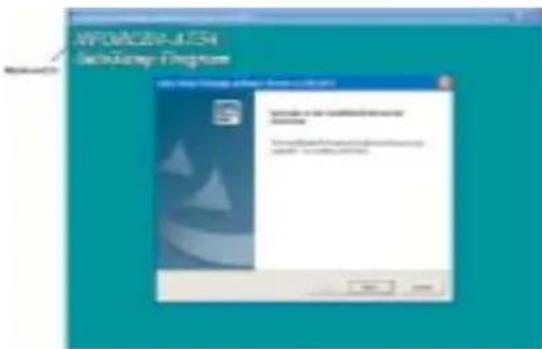

The following screens are examples only. The screens and driver lists will be different according to the motherboard you are installing.
The motherboard identification is located in the upper left-hand corner.
*▲■■★□■□□□□□□□
- Click Next. The following screen appears:
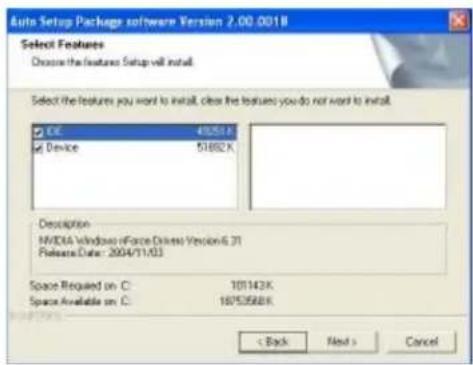
- Check the box next to the items you want to install. The default options are recommended.
- Click Next run the Installation Wizard. An item installation screen appears:
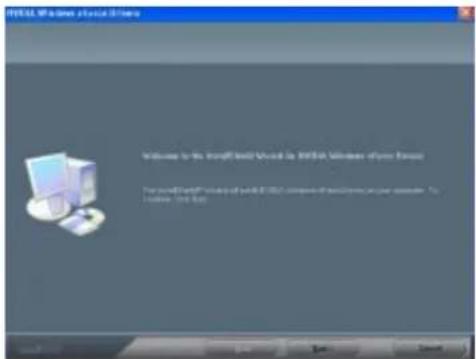
- Follow the instructions on the screen to install the items.
Drivers and software are automatically installed in sequence. Follow the onscreen instructions, confirm commands and allow the computer to restart a few times to complete the installation.
Manual Installation
Insert the CD in the CD-ROM drive and locate the PATH.DOC file in the root directory. This file contains the information needed to locate the drivers for your motherboard.
Look for the chipset and motherboard model; then browse to the directory and path to begin installing the drivers. Most drivers have a setup program (SETUP.EXE) that automatically detects your operating system before installation. Other drivers have the setup program located in the operating system subfolder.
If the driver you want to install does not have a setup program, browse to the operating system subfolder and locate the readme text file (README.TXT or README.DOC) for information on installing the driver or software for your operating system.
Utility Software Reference
All the utility software available from this page is Windows compliant. They are provided only for the convenience of the customer. The following software is furnished under license and may only be used or copied in accordance with the terms of the license.

These software(s) are subject to change at anytime without prior notice. Please refer to the support CD for available software.
AMI/AWARD Flash Memory Utility
This utility lets you erase the system BIOS stored on a Flash Memory chip on the motherboard, and lets you copy an updated version of the BIOS to the chip. Proceed with caution when using this program. If you erase the current BIOS and fail to write a new BIOS, or write a new BIOS that is incorrect, your system will malfunction. Refer to Chapter 3, Using BIOS for more information.
WinFlash Utility
The Award WinFlash utility is a Windows version of the DOS Award BIOS flash writer utility. The utility enables you to flash the system BIOS stored on a Flash Memory chip on the motherboard while in a Windows environment. This utility is currently available for WINXP\ME\2000\98SE. To install the WinFlash utility, run WINFLASH.EXE from the following directory: \UTILITY\WINFLASH 1.51
This concludes Chapter 4. Refer to the next chapter for information about SATA RAID Setup.
Caractéristiques
Processeur
- ISO14001
- CERTIFICATE
- Preface
- Using the Motherboard Software 45
- Introduction
- Feature
- Processor
- Chipset
- Memory
- AC'97 Audio CODEC
- Onboard LAN (optional)
- Expansion Options
- Integrated I/O
- BIOS Firmware
- Safety Precautions
- Choosing a Computer Case
- Installing the Motherboard in a Case
- Checking Jumper Settings
- Setting Jumpers
- Connecting Case Components
- Connecting 20/24-pin power cable
- Front Panel Header
- Hard Drive Activity LED
- Power/Sleep/Message waiting LED
- Reset Switch
- Power Switch
- Installing Hardware
- Installing the Processor
- Before installing the Processor
- CPU Installation Procedure
- DDR SDRAM memory module table
- Installation Procedure
- Installing a Hard Disk Drive/CD-ROM/SATA Hard Drive
- About IDE Devices
- IDE1: Primary IDE Connector
- IDE2: Secondary IDE Connector
- About UltraDMA
- About SATA Connectors
- Installing Serial ATA Hard Drives
- Installing a Floppy Diskette Drive
- FDD1: Floppy Disk Connector
- Installing Add-on Cards
- Connecting Optional Devices
- AUDIO1: Front Panel Audio header
- SPDIFO1: SPDIF out header
- SATA1\~SATA4: Serial ATA connectors
- USB3\~USB5: Front Panel USB headers
- AUX\_IN: Auxiliary In connector (optional)
- CDIN1: Analog Audio Input connector
- Connecting I/O Devices
- About the Setup Utility
- The Standard Configuration
- Entering the Setup Utility
- Press DEL to enter SETUP
- BIOS Navigation Keys
- Updating the BIOS
- Using BIOS
- Standard CMOS Features
- Date and Time
- ▶IDE Devices (None)
- IDE HDD Auto-Detection
- IDE Channel 0/1/2/3/4/5 Master & IDE Channel 0/1 Slave
- Access Mode (Auto)
- Drive A (1.44M, 3.5 in.)
- Floppy 3 Mode Select (Disabled)
- Video (EGA/VGA)
- Halt On (All, But Keyboard)
- Base Memory, Extended Memory, and Total Memory
- Advanced BIOS Features
- ▶ Hard Disk Boot Priority (Press Enter)
- CPU Internal Cache (Enabled)
- External Cache (Enabled)
- Quick Power On Self Test (Enabled)
- First/Second/Third Boot Device (Floppy/Hard Disk/CDROM)
- Boot Other Device (Enabled)
- Swap Floppy Drive [Disabled]
- Boot Up Floppy Seek (Disabled)
- Boot Up NumLock Status (On)
- Gate A20 Option (Fast)
- ATA 66/100 IDE Cable Msg. (Enabled)
- Typematic Rate Setting (Disabled)
- Security Option (Setup)
- APIC Mode (Enabled)
- OS Select For DRAM > 64 MB (Non-OS2)
- Full Screen LOGO Show (Enabled)
- Small Logo (EPA) Show (Disabled)
- Summary Screen Show (Enabled)
- Advanced Chipset Features
- CPU Frequency (200.0)
- HT Frequency (4X)
- HT Width (▼ 16 ▲ 16)
- ▶DRAM Configuration (Press Enter)
- Timing Mode (Auto)
- CPU Spread Spectrum (Center Spread)
- SATA Spread Spectrum (Disabled)
- PCIE Spread Spectrum (Disabled)
- CPU Voltage Control (Normal)
- DIMM Voltage Control (2.63V)
- System BIOS Cacheable (Disabled)
- Integrated Peripherals
- ▶ IDE Function Setup (Press Enter)
- On-Chip IDE Channel 0/1 (Enabled)
- Primary/Secondary Master/Slave PIO (Auto)
- Primary/Secondary Master/Slave UltraDMA (Auto)
- IDE DMA transfer access (Enabled)
- Serial-ATA 1/2 (Enabled)
- IDE Prefetch Mode (Enabled)
- IDE HDD Block Mode (Enabled)
- ▶ RAID Config (Press Enter)
- RAID Enable (Disabled)
- ▶ Onboard Device (Press Enter)
- Init Display First (PCI Slot)
- Onchip USB (V1.1+V2.0)
- USB Keyboard Support (Enabled)
- USB Mouse Support (Enabled)
- AC' 97 AUDIO (Auto)
- Onboard PCI 1394 (Enabled)
- Onboard Giga LAN (Auto)
- ▶ SuperIO Device (Press Enter)
- Onboard FDC Controller (Enabled)
- Onboard Serial Port 1 (3F8/IRQ4, 2F8/IRQ3)
- UART Mode Select (IRDA)
- Onboard Parallel Port (378/IRQ7)
- Parallel Port Mode (ECP)
- Power Management Setup
- ACPI Suspend Type (S3(STR)
- Video Off Method (DPMS Supported)
- HDD Power Down (Disabled)
- HDD Down In Suspend (Disabled)
- Soft-Off by PBTN (Instant-Off)
- Power On By Button (Enabled)
- Power On By Mouse (Enabled)
- Power On By Keyboard (Enabled)
- PWRON After PWR-Fail (Off)
- Resume By PCI PME (Enabled)
- Resume By Ring (Disabled)
- Power-On by Alarm (Disabled)
- Hammer Fid control (StartUp)
- PNP/PCI Configurations
- Reset Configuration Data (Disabled)
- Resources Controlled By Auto (Auto(ESCD))
- PCI/VGA Palette Snoop (Disabled)
- Maximum Payload Size (4096)
- PC Health Status
- Shutdown Temperature (Disabled)
- System Component Characteristics
- Load Performance
- Load Optimized Defaults
- Set Supervisor/User Password
- ENTER PASSWORD
- PASSWORD DISABLED
- Save & Exit Setup
- Exit Without Saving
- About the Software CD-ROM
- Auto-installing under Windows 98/ME/2000/XP
- Application Tab
- Read Me Tab
- Running Setup
- Manual Installation
- Utility Software Reference
- AMI/AWARD Flash Memory Utility
- WinFlash Utility
- Caractéristiques
- Processeur
Brand : ECS
Model : NFORCE4-A754
Category : Motherboard