LM22-F211 - Monitor Dahua Technology - Free user manual and instructions
Find the device manual for free LM22-F211 Dahua Technology in PDF.


User questions about LM22-F211 Dahua Technology
0 question about this device. Answer the ones you know or ask your own.
Ask a new question about this device
Download the instructions for your Monitor in PDF format for free! Find your manual LM22-F211 - Dahua Technology and take your electronic device back in hand. On this page are published all the documents necessary for the use of your device. LM22-F211 by Dahua Technology.
USER MANUAL LM22-F211 Dahua Technology
FOR YOUR SAFETY....2
PRECAUTIONS 4
SPECIAL NOTES ON MONITORS....5
ADJUSTING THE VIEWING ANGLE....8
WALL MOUNTING....9
OPERATING INSTRUCTIONS....10
GENERAL INSTRUCTIONS....10
FRONT PANEL CONTROL....11
HOW TO ADJUST A SETTING.... 12
ADJUSTING THE PICTURE.... 13
PLUG AND PLAY.... 15
TECHNICAL SUPPORT (FAQ)...... 16
ERROR MESSAGE & POSSIBLE SOLUTION.... 17
APPENDIX....18
SPECIFICATIONS.... 18
FACTORY PRESET TIMING TABLE 21
CONNECTOR PIN ASSIGNMENT.... 22
Before operating the monitor, please read this manual thoroughly. This manual should be retained for future reference.
FCC Class B Radio Frequency Interference Statement WARNING: (FOR FCC CERTIFIED MODELS)
NOTE: This equipment has been tested and found to compl with the limits for a Class B digital device, pursuant to Part 15 of the FCC Rules. These limits are designed to provide reasonable protection against harmful interference in a residential installation. This equipment generates, uses and can radiate radio frequency energy, and if not installed and used in accordance with the instructions, may cause harmful interference to radio communications. However, there is no guarantee that interference will not occur in a particular installation. If this equipment does cause harmful interference to radio or television reception, which can be determined by turning the equipment off and on, the user is encouraged to try to correct the interference by one or more of the following measures:
- Reorient or relocate the receiving antenna.
- Increase the separation between the equipment and receiver.
- Connect the equipment into an outlet on a circuit different from that to which the receiver is connected.
- Consult the dealer or an experienced radio/TV technician for help.
This device complies with part 15 of FCC Rules. Operation is subject to the following two conditions: (1) this device may not cause harmful interference, and (2) this device must accept any interference received, including interference that may cause undesired operation.
NOTICE:
- The changes or modifications not expressly approved by the party responsible for compliance could void the user's authority to operate the equipment.
- Shielded interface cables and AC power cord, if any, must be used in order to comply with the emission limits.
- The manufacturer is not responsible for any radio or TV interference caused by unauthorized modification to this equipment. It is the responsibilities of the user to correct such interference.
WARNING:
To prevent fire or shock hazard, do not expose the monitor to rain or moisture.
Dangerously high voltages are present inside the monitor. Do not open the cabinet. Refer servicing to qualified personnel only.
Waste Electrical and Electronic Equipment-WEEE
Disposal of Waste Equipment by Users in Private Household in the European Union. This symbol on the product or on its packaging indicates that this product must not be disposed of with your other household waste. Instead, it is your responsibility to dispose of your waste equipment by handing it over to a designated collection point for the recycling of waste electrical and electronic equipment. The separate collection and recycling of your waste equipment at the time of disposal will help to conserve natural resources and ensure that it is recycled in a manner that protects human health and the environment. For more information about where you can drop off your waste equipment for recycling, please contact your local city office your household waste disposal service or the shop where you purchased the product.
PRECAUTIONS
- Do not use the monitor near water, e.g. near a bathtub, washbowl, kitchen sink, laundry tub, swimming pool or in a wet basement.
- Do not place the monitor on an unstable cart, stand, or table. If the monitor falls, it can injure a person and cause serious damage to the appliance. Use only a cart or stand recommended by the manufacturer or sold with the monitor. If you mount the monitor on a wall or shelf, use a mounting kit approved by the manufacturer and follow the kit instructions.
- Slots and openings in the back and bottom of the cabinet are provided for ventilation. To ensure reliable operation of the monitor and to protect it from overheating, be sure these openings are not blocked or covered. Do not place the monitor on a bed, sofa, rug, or similar surface. Do not place the monitor near or over a radiator or heat register. Do not place the monitor in a bookcase or cabinet unless proper ventilation is provided.
- The monitor should be operated only from the type of power source indicated on the label. If you are not sure of the type of power supplied to your home, consult your dealer or local power company.
- The monitor is equipped with a three-pronged grounded plug, a plug with a third (grounding) pin. This plug will fit only into a grounded power outlet as a safety feature. If your outlet does not accommodate the three-wire plug, have an electrician install the correct outlet, or use an adapter to ground the appliance safely. Do not defeat the safety purpose of the grounded plug.
- Unplug the unit during a lightening storm or when it will not be used for long period of time. This will protect the monitor from damage due to power surges.
- Do not overload power strips and extension cords. Overloading can result in fire or electric shock.
- Never push any object into the slot on the monitor cabinet. It could short circuit parts causing a fire or electric shock. Never spill liquids on the monitor.
- Do not attempt to service the monitor by yourself; opening or removing covers can expose you to dangerous voltages and other hazards. Please refer all servicing to qualified service personnel.
- To ensure satisfactory operation, use the monitor only with UL listed computers which have appropriate configured receptacles marked between 110 - 240V AC, Min. 5A.
- The wall socket shall be installed near the equipment and shall be easily accessible.
SPECIAL NOTES ON MONITORS
The following symptoms are normal with the monitor and do not indicate a problem.
NOTES
- Due to the nature of the fluorescent light, the screen may flicker during initial use. Turn off the Power Switch and then turn it on again to make sure the flicker disappears.
- You may find slightly uneven brightness on the screen depending on the desktop pattern you use.
- The LCD screen has effective pixels of 99.99% or more. It may include blemishes of 0.01% or less such as a missing pixel or a pixel lit all of the time.
- Due to the nature of the LCD screen, an afterimage of the previous screen may remain after switching the image when the same image has been displayed for a long time. The monitor will slowly recover from this.
- When the screen becomes black or flashing, or cannot illuminate any more, contact your dealer or service center to replace parts. Don't repair the screen by yourself!
The product package should include the following items:
- Monitor
2 Owner's Manual - Power Cord
- Base
- VGA Cable
- Stand
INSTALLATION INSTRUCTIO
Attach base:
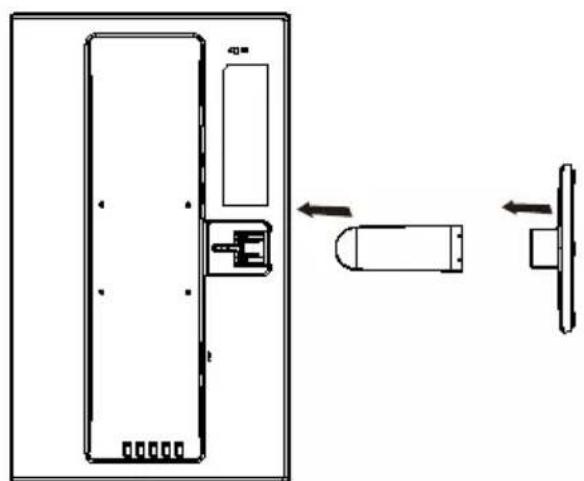
natural_image
Technical line drawing of a door panel with internal components and directional arrows indicating movement (no text or symbols)- Please make sure using the correct power cord in your area.
- This monitor has an external universal power supply that allows operation in either 110/120V AC or 220/240V AC voltage area (No user adjustment is required.)
- Connect the AC-power cord into your monitor's power input socket. The AC-power cord may be connected to either a wall power outlet or the power outlet socket on your PC, depending on the type of power cord supplied with your monitor.
CONTROLS AND CONNECTORS
SIGNAL CABLE
- Connecting the Signal Cable: Connect the 15-pin signal cable to the back of the monitor and the computer's VGA port.
- Connecting the HDMI Cable: Connect the 19-pin HDMI cable to the back of the monitor and the computer's HDMI port (not supplied).
- Connecting the Power Cord: Connect the AC-power cord to the monitor's AC input socket and the wall outlet.
- Caution: If the AC wall outlet is not grounded (with three holes), install the proper grounding adapter (not supplied).
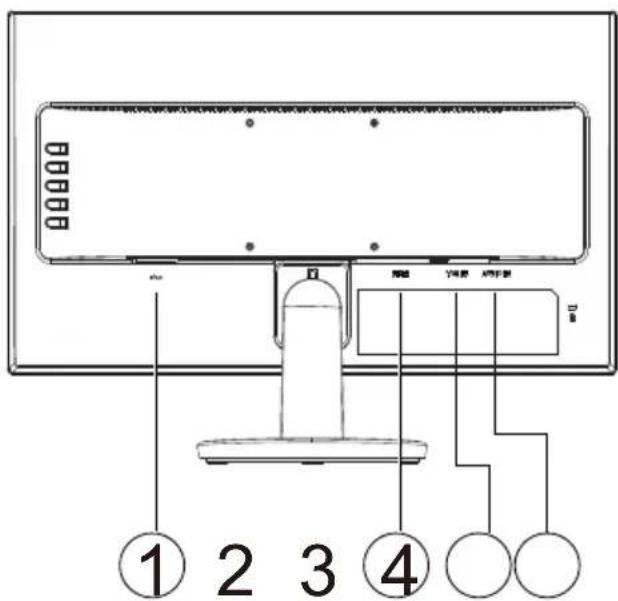
| 1. Power input 2. HDMI Signal input | ||
| 3. D-SUB Signal input 4. Audio input |
ADJUSTING THE VIEWING ANGLE
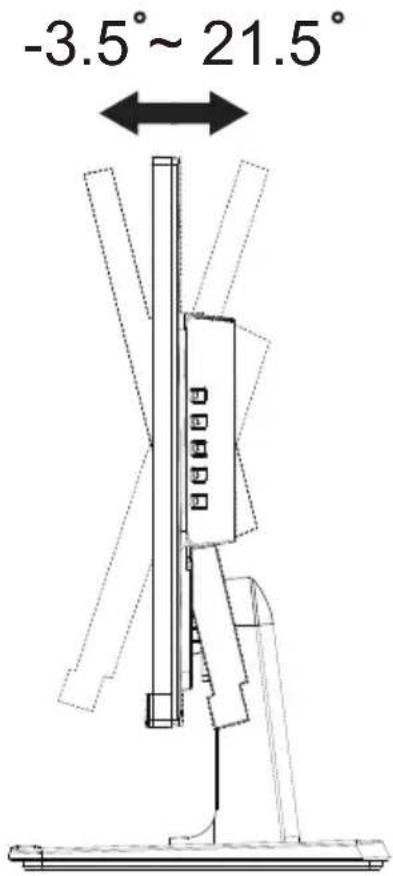
- For optimal viewing, it is recommended to look at the full face of the monitor, then adjust the monitor's angle to your own preference.
- Hold the stand so you do not topple the monitor when you adjust the monitor's angle.
- You are able to adjust the tilted angle from -3.5^ to 21.5^ .
NOTES
- Do not touch the LCD screen when you adjust the angle. It may cause damage or break the LCD screen.
- Careful attention is required not to catch your fingers or hands when you adjust the angle.
WALL MOUNTING
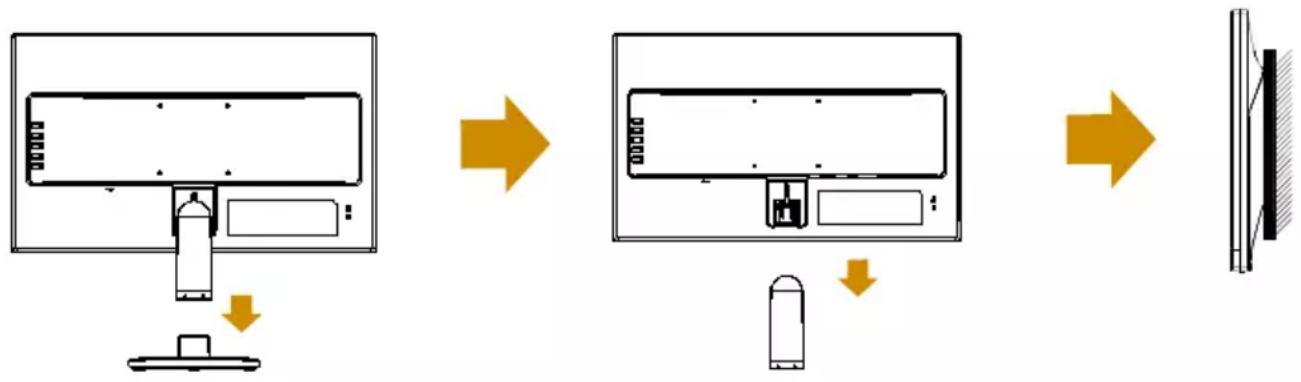
Preparing to install an optional wall mounting arm.
flowchart
graph LR
    A["Top View"] --> B["Downward Arrow"]
    B --> C["Right View"]
    C --> D["Downward Arrow"]
    D --> E["Left View"]
This monitor can be attached to a wall mounting arm you purchase separately. Disconnect power before this procedure. Follow these steps:
- Remove the base.
- Follow the manufacturer's instructions to assemble the wall mounting arm.
- Place the wall mounting arm onto the back of the monitor. Line up the holes of the arm with the holes in the back of the monitor.
- Insert the 4 screws into the holes and tighten.
- Reconnect the cables. Refer to the user's manual that came with the optional wall mounting arm for instructions on attaching it to the wall.
Noted: VESA mounting screw holes are not available for all models, please check with the dealer or official department.
GENERAL INSTRUCTIONS
Press the power button to turn the monitor on or off. The other control buttons are located on the side of the monitor (See Figure 4). By changing these settings, the picture can be adjusted to your personal preferences.
• The power cord should be connected.
- Connect the video cable from the monitor to the video card.
- Press the power button to turn on the monitor. The power indicator will light up.
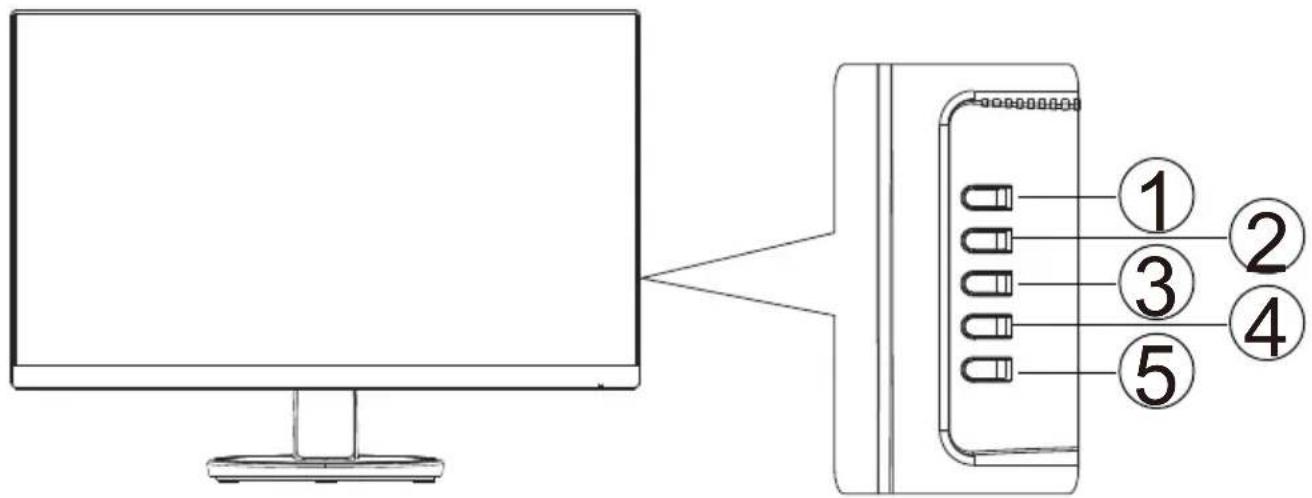
EXTERNAL CONTROLS
| 1. Auto Config / SOURCE / EXIT |
| 2. + / Volume / Audio Source |
| 3. - / ECO |
| 4. MENU / ENTER |
| 5. Power button |
FRONT PANEL CONTROL
- Power Button:
Press to switch the monitor on or off.
• Power Indicator:
Blue — Power On mode.
Blue blinking — Standby mode.
LED off — Off mode.
- MENU / ENTER:
Active OSD menu or function adjust confirm or Exit OSD menu when in Brightness/Contrast OSD status.
• + /Volume/Audio source:
When input source is VGA:
Activates the Volume control when the OSD is OFF, navigate through adjustment icons when OSD is ON, or adjust a function when function is activated.
When input source is HDMI:
Audio source control will be appeared for user to choose the audio source.
• - / ECO:
Activates the ECO function and adjust the Image Ratio when the OSD is OFF, navigate through adjustment icons when OSD is ON, or adjust a function when function is activated.
- Auto Config. button / SOURCE / Exit:
- When OSD menu is off, press 3s to activate the Auto Adjustment function.
The Auto Adjustment function is used to optimized the H.Pos, V.Pos, Clock and Focus. - Press to select input from external sources
- When OSD menu is on, press to exit the OSD menu.
OSD Lock Function: To lock the OSD, press and hold the MENU button while the monitor is off and then press power button to turn the monitor on. To un-lock the OSD, press and hold the MENU button while the monitor is off and then press power button to turn the monitor on.
NOTES
- Do not install the monitor in a location near heat sources such as radiators or air ducts, or in a place subject to direct sunlight, or excessive dust or mechanical vibration or shock.
- Save the original shipping carton and packing materials, as they will come in handy if you ever have to ship your monitor.
- For maximum protection, repackage your monitor as it was originally packed at the factory.
- To keep the monitor looking new, periodically clean it with a soft cloth. Stubborn stains may be removed with a cloth lightly dampened with a mild detergent solution. Never use strong solvents such as thinner, benzene, or abrasive cleaners, since these will damage the cabinet. As a safety precaution, always unplug the monitor before cleaning it.
- Do not scratch the screen with hard things, it may cause permanent damage.
- Don't leak liquid into monitor which will result in the damage of component.
HOW TO ADJUST A SETTING
- Press the MENU-button to display the OSD menu.
- Press + or - to navigate through the menu items. Once the desired item is highlighted, press the MENU-button to enter.
- Press + or - again to navigate through the sub-menu. Once the desired item is highlighted, press MENU-button to activate it.
- Press + or - to adjust the setting.
- To exit and save, press the EXIT-button. If you would like to adjust other settings, please repeat steps 2-4.
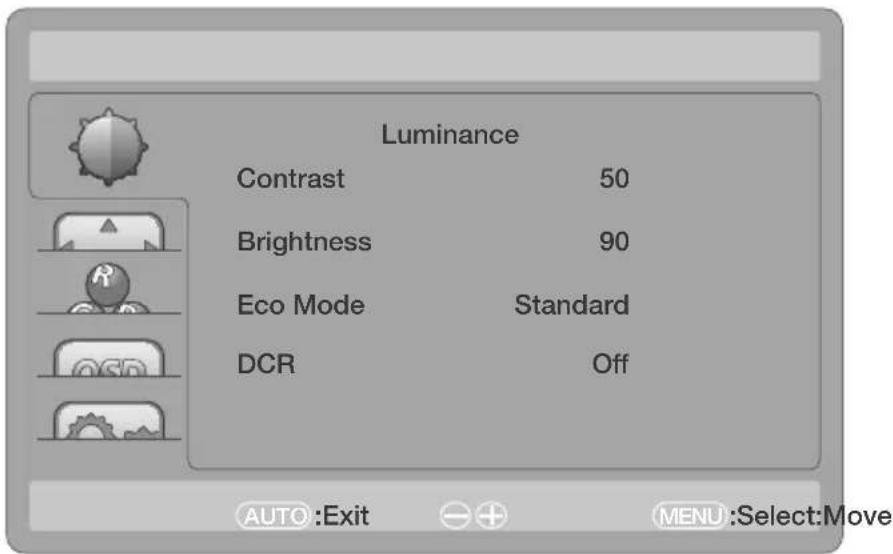
ADJUSTING THE PICTURE
The descriptions for function control:
| Main Menu Item | Main Menu Icon | Sub Menu Item | Sub Menu Description | |
| Luminance |  | Contrast Contrast from Digital-register | ||
| Brightness Backlight Adjustment | ||||
| Eco Mode | Text Text Mode | |||
| Internet Internet Mode | ||||
| Game Game Mode | ||||
| Movie Movie Mode | ||||
| Sports Sports Mode | ||||
| Standard Standard Mode | ||||
| DCR | Off Disable dynamic contrast ratio | |||
| On Enable dynamic contrast ratio | ||||
| Image Setup |  | Clock | Adjust picture Clock to reduce Vertical-Line noise. | |
| Phase | Adjust Picture Phase to reduce Horizontal-Line noise | |||
| H.Position | Adjust the vertical position of the picture. | |||
| V.Position | Adjust the horizontal position of the picture. | |||
| Image Ratio | Wide | Select Image Aspect Ratio | ||
| 4:3 | ||||
| Color Temp. |  | Warm | Recall Warm Color Temperature from EEPROM. | |
| Normal | Recall Normal Color Temperature from EEPROM. | |||
| Cool | Recall Cool Color Temperature from EEPROM. | |||
| User | Red Red Gain from Digital-register | |||
| Green | Green Gain Digital-register. | |||
| Blue Blue Gain from Digital-register | ||||
| sRGB | Recall SRGB Color Temperature from EEPROM. | |||
| OSD Setup |  | H.Position | Adjust the horizontal position of OSD | |
| V.Position | Adjust the vertical position of OSD | |||
| Timeout | Adjust the OSD Timeout | |||
| Language | Select the OSD language | |||
| Extra |  | Input Select | Auto/D-SUB/HDMI | Select input source |
| DDC/CI | On | Select DDC/CI on or off | ||
| Off | ||||
| Reset | Yes | Reset the menu to default. | ||
| No | ||||
| Information | Show the information of the main image source. | |||
PLUG AND PLAY
Plug & Play DDC2B Feature
This monitor is equipped with VESA DDC2B capabilities according to the VESA DDC STANDARD. It allows the monitor to inform the host system of its identity and, depending on the level of DDC used, communicate additional information about its display capabilities.
The DDC2B is a bidirectional data channel based on the I²C protocol. The host can request EDID information over the DDC2B channel.
THIS MONITOR WILL APPEAR TO BE NON-FUNCTIONAL IF THERE IS NO VIDEO INPUT SIGNAL. IN ORDER FOR THIS MONITOR TO OPERATE PROPERLY, THERE MUST BE A VIDEO INPUT SIGNAL.
This monitor meets the Green monitor standards as set by the Video Electronics Standards Association (VESA) and The Swedish Confederation Employees (NUTEK). This feature is designed to conserve electrical energy by reducing power consumption when there is no video-input signal present. When there is no video input signal this monitor, following a time-out period, will automatically switch to an Standby mode. This reduces the monitor's internal power supply consumption. After the video input signal is restored, full power is restored and the display is automatically redrawn. The appearance is similar to a “Screen Saver” feature except the display is completely off. The display is restored by pressing a key on the keyboard, or clicking the mouse.
| Problem & Question Possible Solution | |
| Power LED is not on | ·Check if the Power Switch is in the ON position.·Power Cord should be connected. |
| No Plug & Play | ·Check if the PC system is Plug & Play compatible.·Check if the Video Card is Plug & Play compatible.·Check if the D-15 plug pin of Video Cable is bent. |
| Picture is fuzzy ·Adjust the Contrast and Brightness Controls. | |
| Picture bounces or a wave pattern is present in the picture | ·Move electrical devices that may cause electrical interference. |
| The power LED is ON (Blue) but there's no video or no picture. | ·Computer Power Switch should be in the ON position.·Computer Video Card should be snugly seated in its slot.·Make sure monitor's video cable is properly connected to the computer.·Inspect monitor's video cable and make sure none of the pins are bent.·Make sure computer is operational by hitting the CAPS LOCK key on the keyboard while observing the CAPS LOCK LED. The LED should either turn ON or OFF after hitting the CAPS LOCK key. |
| Missing one of the primary colors (RED, GREEN, or BLUE) | ·Inspect the monitor's video cable and make sure that none of the pins are bent. |
| Screen image is not centered or sized properly. | ·Adjust pixel frequency (CLOCK) and PHASE or press hot-key (AUTO). |
| Picture has color defects (white does not look white) | ·Adjust RGB color or select color temperature. |
| Poor brightness or contrast | ·When the brightness of the screen lowers after being used for a certain period and the function of the display is affected, send it to our authorized service center for repair. |
| Horizontal or vertical disturbances on the screen | ·Use win 95/98/2000/ME/XP shut-down mode Adjust CLOCK and PHASE or perform hot-key (AUTO-key). |
CLOCK (pixel frequency) controls the number of pixels scanned by one horizontal sweep. If the frequency is not correct, the screen shows vertical stripes and the picture has not correct width.
PHASE adjusts the phase of the pixel clock signal. With a wrong phase adjustment the picture has horizontal disturbances in light picture.
For PHASE and CLOCK adjustment use “dot-pattern” or Win 95/98/2000/ME/XP shutdown mode pattern.
ERROR MESSAGE & POSSIBLE SOLUTION
NO SIGNAL
- Check that the signal-cable is properly connected. If the connector is loose, tighten the connector's screws.
- Check the signal-cable's connection pins for damage.
INPUT NOT SUPPORT
Your computer has been set to unsuitable display mode, set the computer to display mode given in the following table on page 21.
SPECIFICATIONS (DHI-LM22-F211)
| LCD Panel | Driving system | 21.5” TFT Color LCD |
| Size | 546.1mm diagonal | |
| Pixel Pitch | 0.24795mm(H) × 0.24795mm(V) | |
| Input | Video | R, G, B Analog Interface |
| HDMI/D-SUB | ||
| Separate Sync. H/V TTL | ||
| H-Frequency 30kHz - V-Frequency | 83kHz | |
| 50-76Hz | ||
| Display Colors 16.7M Colors | ||
| Dot Clock 170MHz | ||
| Max. Resolution 1920 x 1080@60Hz | ||
| Plug & Play | DDC 1/2B/CI or VESA DDC2BTM | |
| Power Consumption | ON Mode | < 26W |
| Standby Mode | < 0.4W | |
| OFF Mode | < 0.3W | |
| Input Connector | D-Sub 15pin | |
| HDMI 19pin | ||
| Input Video Signal | Analog: 0.7Vp-p(standard), 75 OHM, Positive | |
| HDMI | ||
| Maximum Screen Size | Horizontal: 476.064mmVertical: 267.786mm | |
| Power Source 110-240VAC, 50/60Hz | ||
| Environmental Considerations | Operating Temp: 0° to 40°COperating Humidity: 10% to 85%Operating Height: 0-5000mStorage Temp.: -25°C to 55°CStorage Humidity: 5% to 93%Storage Height: 0-12192m | |
| Dimensions | 489.8(W)x366.4(H)x196.8(D)mm | |
| Weight (N.W.): | 3.2kg | |
| External Controls: | Switch | Power button |
| MENU/ENTER | ||
| + / Volume/Audio source | ||
| - / ECO | ||
| Auto Adjust Button / Exit / SOURCE | ||
| Functions | Luminance | |
| Image Setup | ||
| Color Temp | ||
| OSD Setup | ||
| Extra | ||
| Power Consumption (Max) 26W | ||
SPECIFICATIONS (DHI-LM24-F211)
| LCD Panel | Driving system | 23.8” TFT Color LCD |
| Size | 604.5mm diagonal | |
| Pixel Pitch | 0.2745mm(H) × 0.2745mm(V) | |
| Input | Video | R, G, B Analog Interface |
| HDMI/D-SUB | ||
| Separate Sync. H/V TTL | ||
| H-Frequency 30kHz - V-Frequency | 83kHz | |
| 50-76Hz | ||
| Display Colors 16.7M Colors | ||
| Dot Clock 170MHz | ||
| Max. Resolution 1920 x 1080@60Hz | ||
| Plug & Play | DDC 1/2B/CI or VESA DDC2BTM | |
| Power Consumption | ON Mode | < 29W |
| Standby Mode | < 0.4W | |
| OFF Mode | < 0.3W | |
| Input Connector | D-Sub 15pin | |
| HDMI 19pin | ||
| Input Video Signal | Analog: 0.7Vp-p(standard), 75 OHM, Positive | |
| HDMI | ||
| Maximum Screen Size | Horizontal: 527.04mmVertical: 296.46mm | |
| Power Source 110-240VAC, 50/60Hz | ||
| Environmental Considerations | Operating Temp: 0° to 40°COperating Humidity: 10% to 85%Operating Height: 0-5000mStorage Temp.: -25°C to 55°CStorage Humidity: 5% to 93%Storage Height: 0-12192m | |
| Dimensions | 540.6(W)x395.05(H)x196.8(D)mm | |
| Weight (N.W.): | 3.7kg | |
| External Controls: | Switch | Power button |
| MENU/ENTER | ||
| + / Volume/Audio source | ||
| - / ECO | ||
| Auto Adjust Button / Exit / SOURCE | ||
| Functions | Luminance | |
| Image Setup | ||
| Color Temp | ||
| OSD Setup | ||
| Extra | ||
| Power Consumption (Max) 29W | ||
SPECIFICATIONS (DHI-LM27-F211)
| LCD Panel | Driving system | 27” TFT Color LCD |
| Size | 685.8mm diagonal | |
| Pixel Pitch | 0.3114mm(H) × 0.3114mm(V) | |
| Input | Video | R, G, B Analog Interface |
| HDMI/D-SUB | ||
| Separate Sync. H/V TTL | ||
| H-Frequency 30kHz - V-Frequency | 83kHz | |
| 50-76Hz | ||
| Display Colors 16.7M Colors | ||
| Dot Clock 170MHz | ||
| Max. Resolution 1920 x 1080@60Hz | ||
| Plug & Play | DDC 1/2B/CI or VESA DDC2BTM | |
| Power Consumption | ON Mode | < 35W |
| Standby Mode | < 0.4W | |
| OFF Mode | < 0.3W | |
| Input Connector | D-Sub 15pin | |
| HDMI 19pin | ||
| Input Video Signal | Analog: 0.7Vp-p(standard), 75 OHM, Positive | |
| HDMI | ||
| Maximum Screen Size | Horizontal: 597.9mmVertical: 336.3mm | |
| Power Source 110-240VAC, 50/60Hz | ||
| Environmental Considerations | Operating Temp: 0° to 40°COperating Humidity: 10% to 85%Operating Height: 0-5000mStorage Temp.: -25°C to 55°CStorage Humidity: 5% to 93%Storage Height: 0-12192m | |
| Dimensions | 611.9(W)x453.7(H)x230.7(D)mm | |
| Weight (N.W.): | 5.4kg | |
| External Controls: | Switch | Power button |
| MENU/ENTER | ||
| + /Volume/Audio source | ||
| - / ECO | ||
| Auto Adjust Button / Exit / SOURCE | ||
| Functions | Luminance | |
| Image Setup | ||
| Color Temp | ||
| OSD Setup | ||
| Extra | ||
| Power Consumption (Max) 35W | ||
FACTORY PRESET TIMING TABLE
| STANDARD | RESOLUTION | HORIZONTAL FREQUENCY (KHz) | VERTICAL FREQUENCY (Hz) |
| VGA | 640x480@60Hz31.46959.940 | ||
| 640x480@72Hz37.86172.809 | |||
| 640x480@75Hz37.50075.00 | |||
| SVGA | 800x600@60Hz37.87960.317 | ||
| 800x600@72Hz48.07772.188 | |||
| 800x600@75Hz46.87575.000 | |||
| XGA | 1024x768@60Hz48.36360.004 | ||
| 1024x768@70Hz56.47670.069 | |||
| 1024x768@75Hz60.02375.029 | |||
| WSXGA | 1440x900@60Hz55.93559.887 | ||
| 1440x900@75Hz70.63574.984 | |||
| WSXGA+ | 1680x1050@60Hz65.29059.954 | ||
| SXGA | 1280x1024@60Hz69.98160.020 | ||
| 1280x1024@75Hz79.97675.025 | |||
| FULL HD | 1920x1080@60Hz67.50060.000 | ||
| Dos-mode | 720x400@70Hz31.46970.087 | ||
| Mac - mode 640x480@67Hz35.00066.667 | |||
CONNECTOR PIN ASSIGNMENT
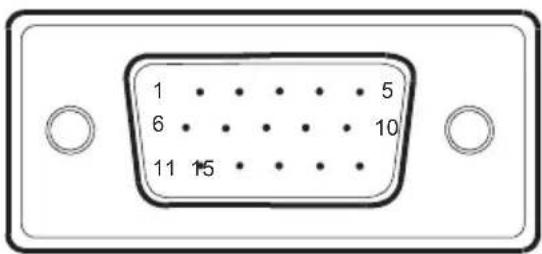
15 - Pin Color Display Signal Cable
| PIN NO. DESCRIPTION PIN NO. DESCRIPTION | |||
| 1. Red 9. +5V | |||
| 2. Green 10. Ground | |||
| 3. Blue 11. Ground | |||
| 4. Ground 12. DDC-Serial Data | |||
| 5. Detect Cable 13. H-Sync | |||
| 6. R-Ground | 14. V-Sync | ||
| 7. G-Ground | 15. DDC-Serial Clock | ||
| 8. B-Ground | |||
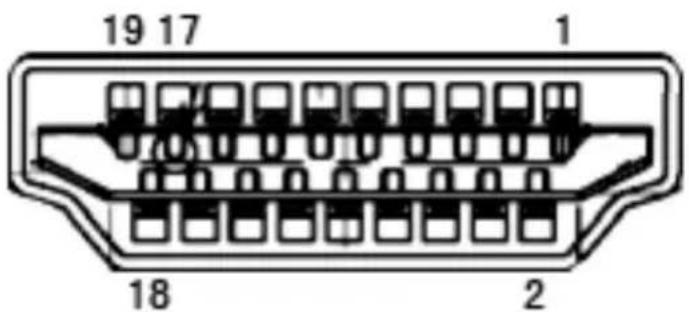
19 - Pin Color Display Signal Cable
| PIN NO. DESCRIPTION PIN NO. DESCRIPTION | |||
| 1. TMDS Data 2+ | 11. TMDS Clock Shield | ||
| 2. TMDS Data 2 Shield 12. TMDS Clock | |||
| 3. TMDS Data 2 | 13. CEC | ||
| 4. TMDS Data 1+ | 14. | Reserved (N.C. on device | |
| 5. TMDS Data 1Shield | 15. SCL | ||
| 6. | TMDS Data 1 | 16. | SDA |
| 7. TMDS Data 0+ | 17. DDC/CEC Ground | ||
| 8. TMDS Data 0 Shield 18. +5V Power | |||
| 9. TMDS Data 0 | 19. Hot Plug Detect | ||
| 10. TMDS Clock + | |||