SC-8 - Subwoofer VELODYNE - Free user manual and instructions
Find the device manual for free SC-8 VELODYNE in PDF.


| Product Type | Powered Subwoofer |
| Brand | Velodyne |
| Model | SC-8 |
| Driver Size | 8 inches |
| Amplifier Power (RMS) | 200 Watts |
| Amplifier Power (Peak) | 400 Watts |
| Frequency Response | 28 Hz – 120 Hz |
| Low-Pass Crossover | 40 – 120 Hz adjustable |
| Phase Control | 0° or 180° switchable |
| Auto Power On/Off | Yes |
| Inputs | RCA line-level, speaker-level (binding posts) |
| Outputs | RCA line-level pass-through |
| Volume Control | Yes, rear panel |
| Enclosure Type | Sealed (acoustic suspension) |
| Dimensions (H x W x D) | 14.25 x 10.5 x 13.5 inches (36.2 x 26.7 x 34.3 cm) |
| Weight | 24 lbs (10.9 kg) |
| Power Supply | 120V / 60 Hz AC (standard US) |
| Power Consumption (Standby) | < 5 Watts |
| Cleaning Instructions | Wipe with dry, soft cloth; do not use liquids or solvents |
| Safety Features | Short-circuit protection, thermal overload protection |
| Spare Parts & Repairability | Contact Velodyne authorized service center; user‑replaceable fuse |
| General Information | Designed for home theater and music; improves low-frequency performance |
Frequently Asked Questions - SC-8 VELODYNE
User questions about SC-8 VELODYNE
0 question about this device. Answer the ones you know or ask your own.
Ask a new question about this device
Download the instructions for your Subwoofer in PDF format for free! Find your manual SC-8 - VELODYNE and take your electronic device back in hand. On this page are published all the documents necessary for the use of your device. SC-8 by VELODYNE.
USER MANUAL SC-8 VELODYNE
SUBCONTRACTOR™ SERIES
AMPLIFIER / SUBWOOFERS
USER'S MANUAL
text_image
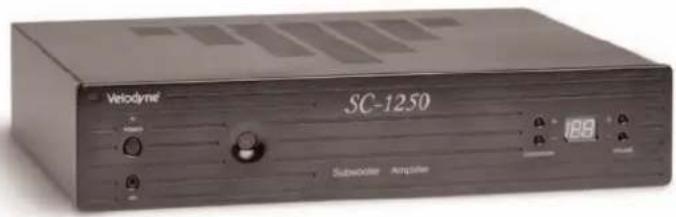
Veodyne SC-1250 Subwoofer Ampster 189SC-1250 Amplifier, SC-8, SC-10, SC-12, SC-15, SC-IW, SC-IF, SC-IC Subwoofers
CAUTION!
IMPORTANT SAFETY INSTRUCTIONS


text_image
CAUTION RISK OF ELECTRIC SHOCK DO NOT OPEN

Caution
To reduce the risk of electric shock, do not remove cover (or back). No user-serviceable parts inside. Refer servicing to qualified service personnel.
The lightning flash with arrowhead symbol is intended to alert the user to the presence of uninsulated "dangerous voltage" within the product's enclosure that may be of sufficient magnitude to constitute a risk of electric shock to persons.
The exclamation point symbol is intended to alert the user to the presence of important operating and maintenance (servicing) instructions in the literature accompanying the subwoofer.
-
Read Instructions — All safety and operating instructions should be read before the product is operated.
-
Retain Instructions — The safety and operating instructions should be retained for future reference.
-
Heed Warnings — All warnings on the product and in the operating instructions should be adhered to.
-
Follow Instructions — All operating and use instructions should be followed.
-
Water and Moisture — The product should not be used near water — for example, near a bathtub, washbowl, kitchen sink, laundry tub, in a wet basement, near a swimming pool or the like.
-
Carts and Stands — The product should be used only with a cart or stand recommended by the manufacturer.
-
Wall or Ceiling Mounting — The product should be mounted to a wall or ceiling only as recommended by the manufacturer.
-
Ventilation — The product should be situated so that its location or position does not interfere with its proper ventilation. For example, the product should not be situated on a bed, sofa, rug, or similar surface that may block the ventilation openings; or placed in a built-in installation such as a bookcase or cabinet that may impede the flow of air through the ventilation openings.
-
Heat — The product should be situated away from heat sources such as radiators, heat registers, stoves, or other products that produce heat.
-
Power Sources — The product should be connected to a power supply only of the type described in the operating instructions or as marked on the product.
-
Grounding or Polarization — This product may be equipped with a polarized alternating-current line plug (a plug having one blade wider than the other). This plug will fit into the power outlet only one way. This is a safety feature. If you are unable to insert the plug fully into the outlet, try reversing the plug. If the plug should still fail to fit, contact your electrician to replace your obsolete outlet. Do not defeat the safety purpose of the polarized plug.
-
Power-Cord Protection — Power-supply cords should be routed so that they are not likely to be walked on or pinched by items placed upon or against them, paying particular attention to cords at plugs, convenience receptacles, and the point at which they exit from the product.
-
Cleaning — The product should be cleaned only as recommended by the manufacturer.
-
Nonuse Periods — The power cord of the product should be unplugged from the outlet when left unused for a long period of time.
-
Object and Liquid Entry — Care should be taken so that objects do not fall and liquids are not spilled onto the enclosure.
-
Damage Requiring Service — The product should be serviced by qualified service personnel when:
a. The power-supply cord or plug has been damaged.
b. Objects have fallen or liquid has been spilled into the product.
c. The product has been exposed to rain.
d. The product does not appear to operate normally or exhibits a marked change in performance.
e. The product has been dropped or damaged.
-
Servicing — The user should not attempt to service the product beyond what is described in the operating instructions. All other servicing should be referred to qualified service personnel.
-
Lightning — For added protection for the product during a lightning storm or when it is left unattended and unused for long periods of time, unplug it from the wall outlet.
-
Overloading — Do not overload wall outlets, extension cords or integral convenience receptacles as this can result in a risk of fire or electric shock.
CAUTION: To prevent electrical shock, match wide blade of plug to wide slot, fully inserted.
ATTENTION!
CONSIGNE DE SÉCURITÉ IMPORTANTES

ATTENTION
- SC-1250 Subwoofer Amplifier .... 1
- SC-8, SC-10, SC-12, SC-15, SC-IW, SC-IF Woofers .....2
Setup Checklist 3
Installation 3
- Front Panel Controls and Displays ....3
- Rear Panel Connections 4
- About Low-Pass Crossovers 10
- A Word About Your Receiver's Crossover and the SC-1250 Crossover .....10
- A Word About Interconnect Cables 10
- A Word About Subwoofer Placement ....11
Selecting the Subwoofer(s) to be Controlled 11
- Using the SC-1250 to Drive Two Subwoofers 12
Usage 12
Restore Defaults 15
Care of Your Amplifier and Subwoofer 15
- Troubleshooting and Service 16
Specifications 17
Appendix A: RS-232 Serial Overview and Commands .....18
CONGRATULATIONS
Congratulations on your purchase of a Velodyne SubContractor Series subwoofer. This system represents the state-of-the-art in low frequency reproduction. Read and follow the instructions below to insure safe and proper system operation.
Warning!
To prevent fire or shock hazard, do not expose this equipment to rain or moisture. To avoid electrical shock, do not open speaker enclosure or amp chassis cover. Please observe all warnings on the equipment itself. There are no user serviceable parts inside. Please refer all service questions to your authorized Velodyne dealer.
Prior to Installation
Please unpack the system carefully. Remove all staples used to seal the carton as they can scratch the chassis. Please save the carton and all packaging materials for future use. Record the serial number in the space provided on the warranty card for future reference.
PRODUCT FEATURES
SC-1250 Subwoofer Amplifier
- Amplifier: 3000 watts dynamic/1250 watts RMS high efficiency, Class D
- DSP-controlled
- 4 selectable presets for customized listening mode
• Automatic 7 band room equalizer (microphone included) - Night-mode setting
- Mute control
- Adjustable (30 to 160 Hz) low-pass crossover (defeatable)
• Line-level (RCA) inputs and outputs - Speaker-level inputs with 5 way binding post connections
- Signal sensing auto turn on/off (defeatable)
• Variable volume control - Selectable phase control (0, 90, 180 or 270 degrees)
• Built-in adjustable digital low-pass crossover with 24 dB/octave slope - Driver Displacement Control software to prevent over excursion and amp clipping
- Blue power indicator LED
• RS-232 Serial Interface - 12 Volt trigger
• Universal remote input jack - Ability to drive up to TWO subwoofers**
SC-8, SC-10, SC-12, SC-15, SC-IW, SC-IF/IC Subwoofers
SC-8:
- 8" (6.5" piston diameter) subwoofer
- 2.5" high-temp voice coil
- Oversized spider for linearity at high excursion
- High-excursion EPDM rubber surround
- 107 ounce magnet/204 ounce motor structure
- Frequency Response: 28 - 120 Hz (+/- 3 dB)
- 8 ohm impedance
SC-10:
- 10" (8" piston diameter) subwoofer
- 3" high temperature inside/outside voice coil
- Oversized spider for linearity at high excursion
- High-excision EPDM rubber surround
- 162 ounce magnet/346 ounce motor structure
- Magnetically shielded for video use
- Frequency Response: 24 - 120Hz (+/- 3 dB)
- 8 ohm impedance
SC-12:
- 12" (9.7" piston diameter) subwoofer
- 3" high temperature inside/outside voice coil
- Oversized spider for linearity at high excursion
- High-excursion EPDM rubber surround
- 162-ounce magnet/346 ounce motor structure
- Magnetically shielded for video use
- Frequency Response: 22 - 120Hz (+/- 3 dB)
- 8 ohm impedance
SC-15:
- 15" (12.7" piston diameter) subwoofer
- 3" high temperature inside/outside voice coil
- Oversized spider for linearity at high excursion
- High-excursion EPDM rubber surround
- 162-ounce magnet/346 ounce motor structure
- Magnetically shielded for video use
- Frequency Response: 22 - 120Hz (+/- 3 dB)
- 8 ohm impedance
SC-IW (In-Wall):
- 4" x 14" rectangular driver (3" x 13.25" piston diameter) with flat Carbon Fibre/Rohacell/Carbon Fiber sandwich diaphragm
- Neodymium magnet structure
- Quad spider configuration with upper/lower spider modules
- High-excision EPDM rubber surround
- 3" high temperature inside/outside voice coil
- Magnetically shielded for video use
- Frequency Response: 22 - 120Hz (+/- 3 dB)
- 8 ohm impedance
SC-IF/SC-IC (In-Floor/In-Ceiling):
- 12" (9.7" piston diameter) subwoofer
- 3" high temperature inside/outside voice coil
- Oversized spider for linearity at high excursion
- High-excursion EPDM rubber surround
- 162 ounce magnet/346 ounce motor structure
- Magnetically shielded for video use
- Frequency Response: 22 - 120Hz (+/- 3 dB)
- 8 ohm impedance
SETUP CHECKLIST
Be sure to do the following to ensure the best performance from your subwoofer(s):
☐ If possible, optimize the placement of the subwoofer(s) in the listening area.
See page 11 of the User's Manual.
☐ Install and wire the subwoofer per the instructions on pages 3 - 9.
☐ Select the proper model per the instructions on page 11.
☐ Be sure the low pass crossover is set correctly. See pages 9 - 10.
☐ Be sure to equalize the subwoofer using the microphone and Auto-EQ feature.
☐ Be sure to set the phase control on the remote. See page 12.
☐ Select the correct preset for the source material. See pages 13 - 14.
Your new Velodyne amplifier provides for a number of installation options. Read all the installation information below in order to determine which installation option is best for your system. Remember to perform all installation procedures with system power turned off.
INSTALLATION
FRONT PANEL CONTROLS AND DISPLAYS
text_image
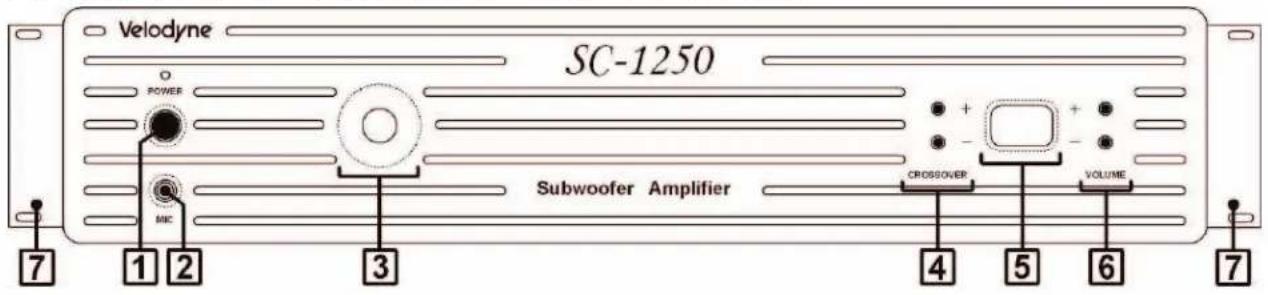
Velodyne SC-1250 POWER MIC Subwoofer Amplifier CROSSOVER VOLUME 7 1 2 3 4 5 6 7Figure 1: Front Panel Connections of the SC-1250.
Following are brief descriptions of the controls described in Figure 1. More detail on these controls can be found in the next section.
(1) Power Switch
This push button style switch is the main on/off for the unit.
(2) Power LED
This LED illuminates when the power is on. Blue is normal operation. It turns amber when the unit is in standby mode or the remote has been used to deactivate the unit. This LED dims when the unit is in night mode.
(3) Mic Input
Connect the supplied microphone for the Auto-EQ feature to this mini-jack.
(4) Remote Eye
This is the eye that receives infrared commands from the supplied remote.
(5) Low-Pass Crossover
Use these up and down buttons to select the high-frequency range at which you wish to cut off the signal to the subwoofer. The frequency is indicated on the LED display briefly, then the display reverts to showing the subwoofer's volume. The slope is fixed at 24 dB/octave. To deactivate the crossover, press BOTH the up and down crossover buttons at the same time – two dashes on the display indicate the crossover is deactivated and the woofer plays all frequencies presented to it. Please see page 9 for a more detailed discussion on crossovers.
(6) LED Numeric Indicator
This LED supplies information on volume, crossover, woofer type, and other information. The light button on the remote deactivates this display. Upon startup, the display shows the model of subwoofer the SC-1250 is controlling, then reverts to the volume indicator.
(7) Volume Control
These buttons allow you to balance the output from the subwoofer to the main speakers in your system. The volume should be set to achieve similar volume level from between both the main speakers and subwoofer. The default volume is 30.
Note: Volume is also controllable by using the supplied remote.
(8) Optional Rack Mount
These detachable ears allow the SC-1250 to be rack mounted.
REAR PANEL CONNECTIONS
text_image
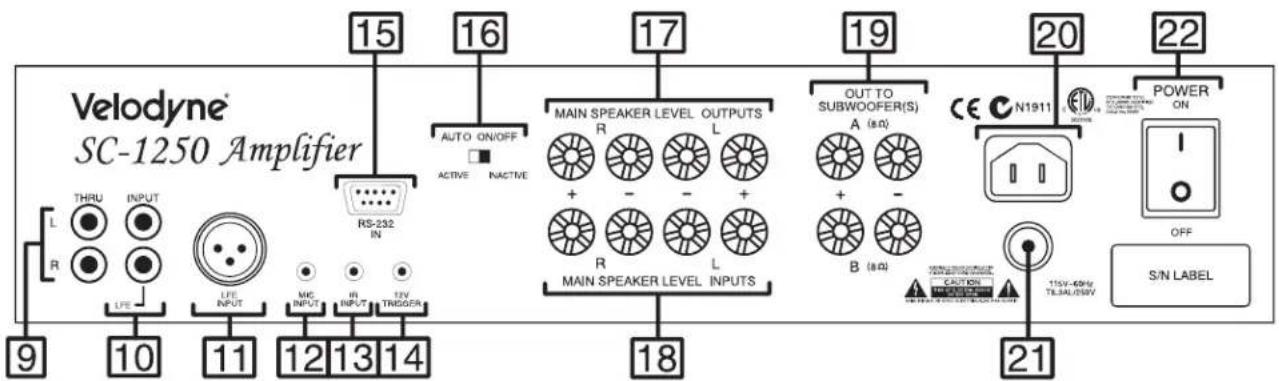
Velodyne® SC-1250 Amplifier 15 16 17 19 20 22 AUTO ON/OFF ACTIVE INACTIVE MAIN SPEAKER LEVEL OUTPUTS R L + - - + R L MAIN SPEAKER LEVEL INPUTS OUT TO SUBWOOFER(S) A (sΩ) + - B (8Ω) N1911 POWER ON OFF S/N LABEL 9 10 11 12 13 14 RS-232 IN LIFE LIFE INPUT MIC INPUT TRIGGER 18Figure 2: Rear Panel Connections of the SC-1250.
(9) Thru Jacks (See Figure 3A)
These RCA connectors are for passing along the same signal that goes into your subwoofer to a second "daisy-chained" subwoofer. The signal from these RCA connectors is the same as the input signal.
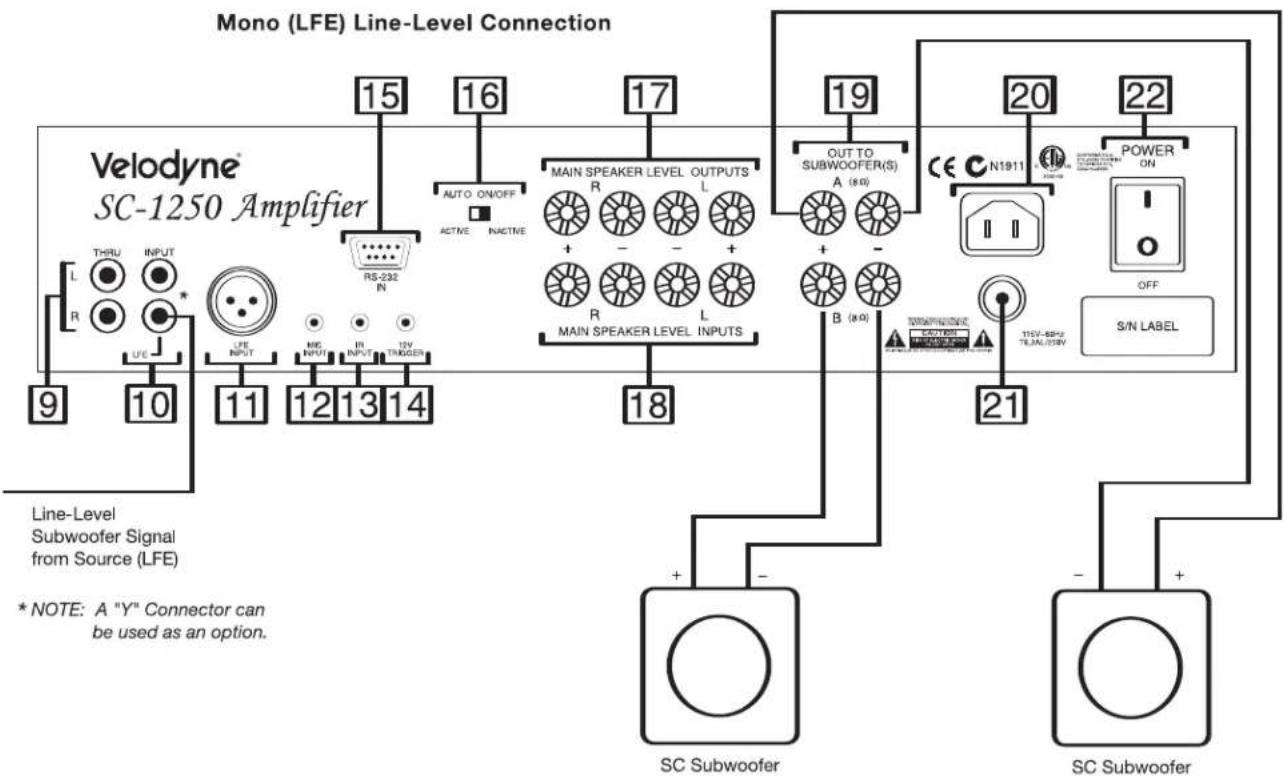
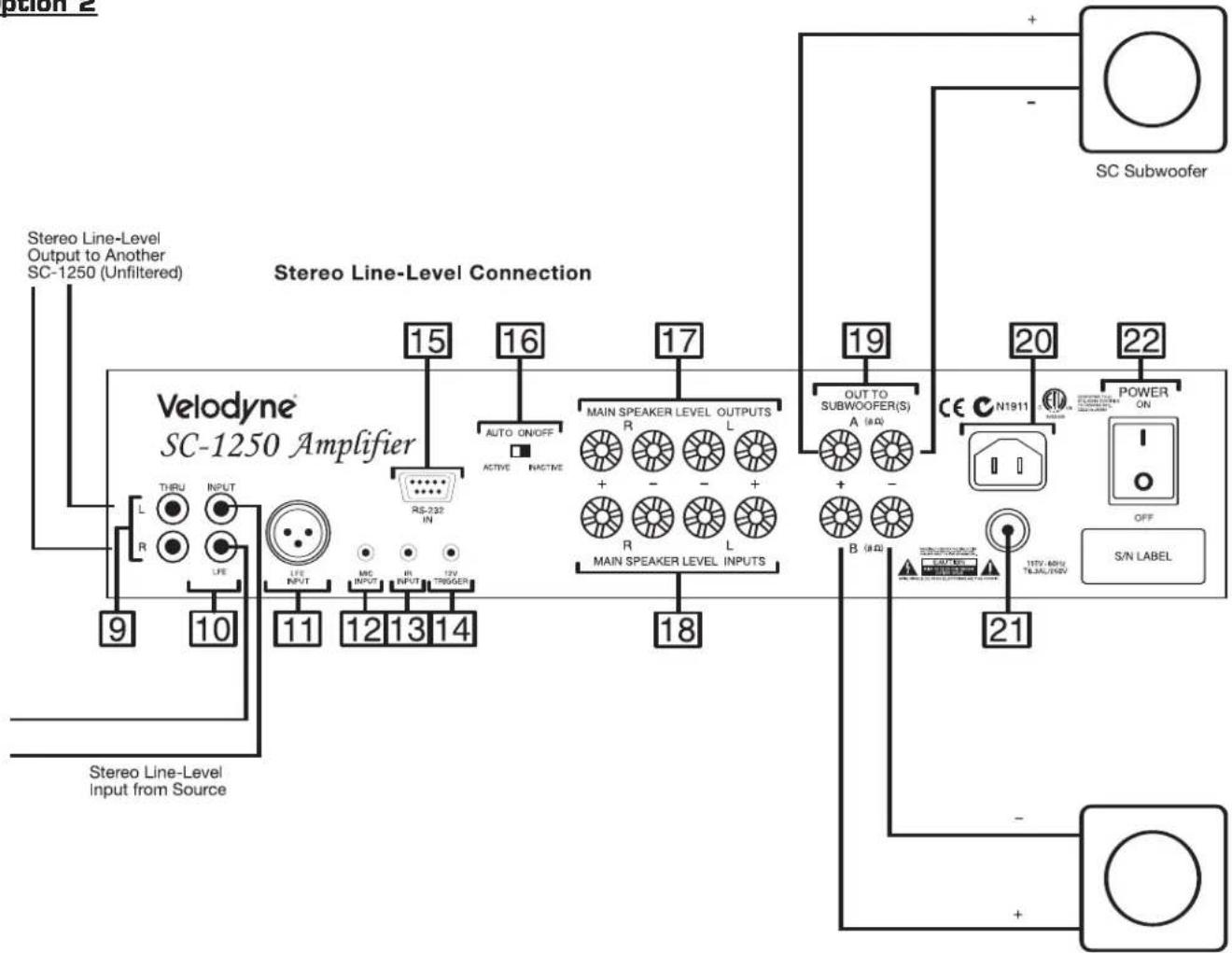
(10) Line Input / LFE Input (See Figure 3A & 3B)
Connect these jacks to the LINE OUT preamp output, LFE output, or subwoofer output jacks of your receiver/processor. If using the LFE output from your receiver or processor, plug the single cable into the jack labeled LFE input or, for more signal, use a "Y" connector and feed the signal into both "R" and "L" inputs.
Option 1
flowchart
graph TD
    A["Line-Level Subwoofer Signal from Source (LFE)"] --> B["Velodyne SC-1250 Amplifier"]
    B --> C["Line-Level Subwoofer"]
    C --> D["SC Subwoofer"]
    C --> E["SC Subwoofer"]
    B --> F["Line-Level Subwoofer Level Outputs"]
    B --> G["Main Speaker Level Inputs"]
    B --> H["Power ON"]
    B --> I["S/N LABEL"]
    style A fill:#f9f,stroke:#333
    style B fill:#ccf,stroke:#333
    style C fill:#cfc,stroke:#333
    style D fill:#fcc,stroke:#333
    style E fill:#fcc,stroke:#333
    style F fill:#ffc,stroke:#333
    style G fill:#ffc,stroke:#333
    style H fill:#ffc,stroke:#333
    style I fill:#ffc,stroke:#333
Figure 3A: Mono (LFE) Line-Level Connection.
Option 2
flowchart
graph TD
    A["Stereo Line-Level Input from Source"] --> B["9"]
    A --> C["10"]
    D["Stereo Line-Level Output to Another SC-1250 (Unfiltered)"] --> E["11"]
    D --> F["12"]
    D --> G["13"]
    D --> H["14"]
    I["Velodyne SC-1250 Amplifier"] --> J["RS-232 IN"]
    J --> K["15"]
    J --> L["16"]
    J --> M["17"]
    J --> N["18"]
    O["SC Subwoofer"] --> P["OUT TO SUBWOOFER(S)"]
    P --> Q["A (a,b)"]
    R["POWER ON"] --> S["N1911"]
    S --> T["+"]
    S --> U["-"]
    V["S/N LABEL"] --> W["21"]
    X["Main Speaker Level Inputs"] --> Y["R"]
    Y --> Z["L"]
    AA["Main Speaker Level Outputs"] --> AB["R"]
    AB --> AC["L"]
    AD["Active/Inactive"] --> AE["AUTO ON/OFF"]
    AF["Main Speaker Level Outputs"] --> AG["R"]
    AH["Main Speaker Level Outputs"] --> AI["L"]
Figure 3B: Stereo Line-Level Connection.
SC Subwoofer
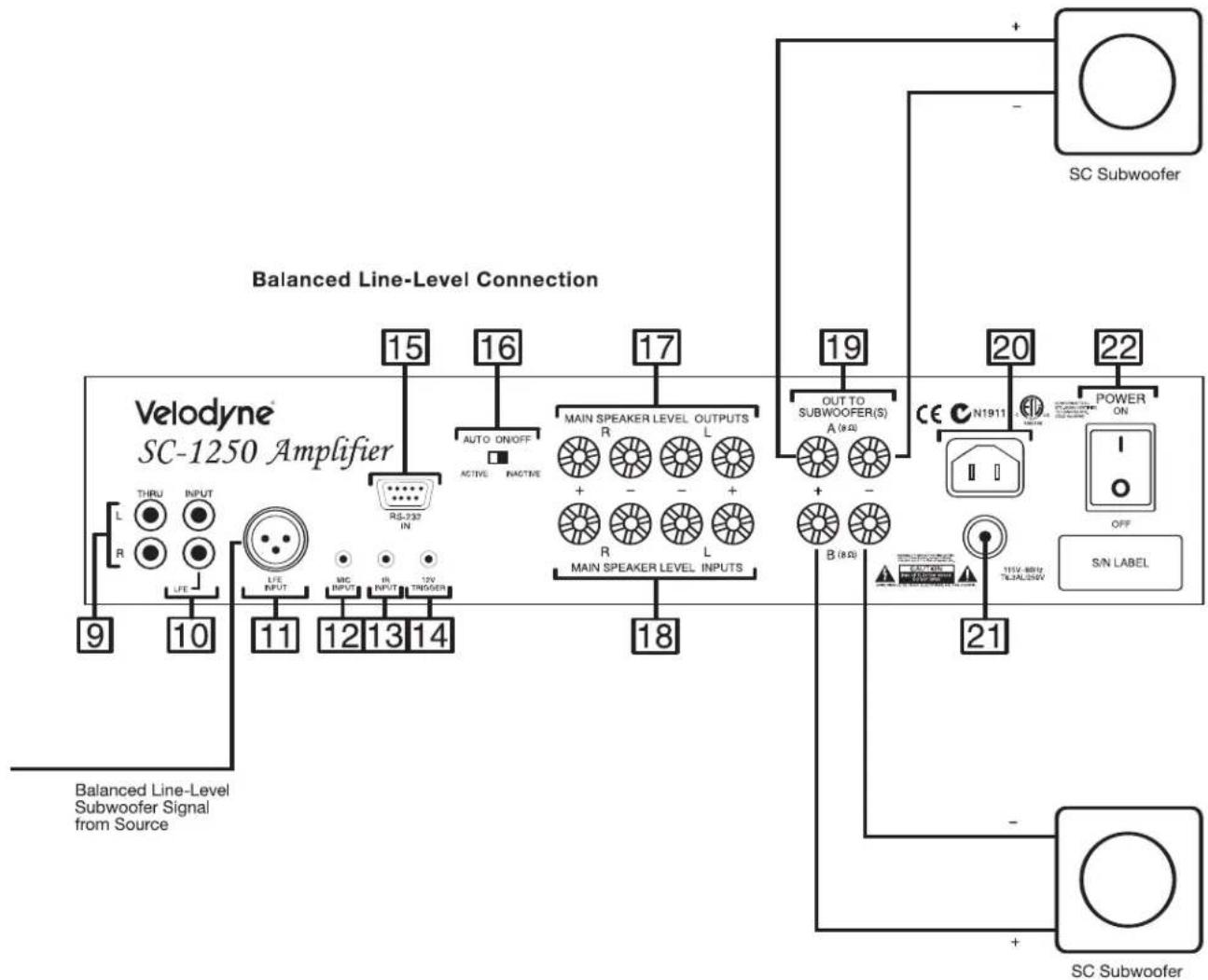
(11) Balanced XLR LFE Input (See Figure 4)
This XLR input jack receives the balanced LFE signal from your receiver or processor.
flowchart
graph TD
    A["Balanced Line-Level Subwoofer Signal from Source"] --> B["Velodyne SC-1250 Amplifier"]
    B --> C["9 L THRU INPUT R"]
    B --> D["10 LIFE INPUT"]
    B --> E["11 LIFE INPUT"]
    B --> F["12 MIC INPUT"]
    B --> G["13 IN INPUT"]
    B --> H["14 12V TRIGGER"]
    B --> I["15 AUTO ON/OFF"]
    B --> J["16 ACTIVE IN/ACTIVE"]
    B --> K["17 MAIN SPEAKER LEVEL OUTPUTS R L + - - +"]
    B --> L["18 MAIN SPEAKER LEVEL INPUTS"]
    B --> M["19 OUT TO SUBWOOFER(S) A (aΩ)"]
    M --> N["20 CE N1911"]
    M --> O["21 POWER ON"]
    M --> P["S/N LABEL"]
    M --> Q["+"]
    M --> R["-"]
    M --> S["+"]
    M --> T["-"]
    M --> U["+"]
    M --> V["+"]
    M --> W["+"]
    M --> X["+"]
    M --> Y["+"]
    M --> Z["+"]
Figure 4: Balanced Line-Level Connection.
(12) Mic Input
Connect the supplied microphone for the Auto-EQ feature to this mini-jack.
(13) IR Input
Connect an IR repeater to this jack for use with universal remote systems.
(14) 12V Trigger
When this mini jack is connected, the unit remains in power-off mode until 12 volts is supplied across the two leads. Polarity is irrelevant.
(15) RS-232 In
Use this port to communicate with a touch panel remote control. See Appendix A for an explanation of the use of the serial port, available commands, and their formats.
(16) Auto ON/OFF Switch
Use this switch to select between auto-on active and auto-on inactive (constant on) operation. For maximum amplifier life, we recommend the Auto ON/OFF "Active" setting.
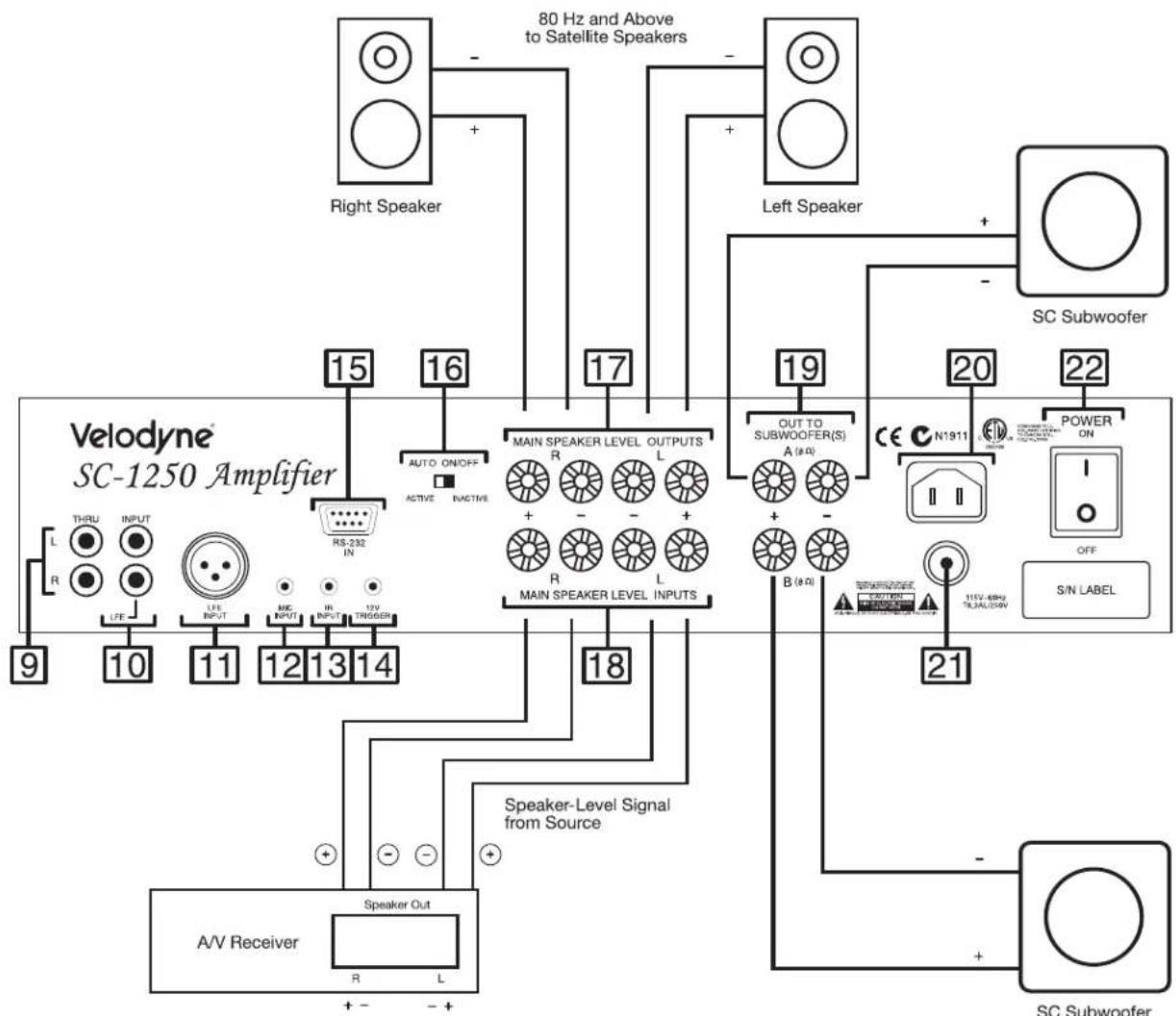
(17) Speaker Level Output Terminals (See Figure 5)
These connections send a crossed-over speaker-level signal to the front speakers. When connected in this fashion, your satellite speakers will be crossed over at 80 Hz. This removes the lower bass frequencies from your satellites, enabling them to do a better job reproducing high frequencies and giving your receiver's amp more headroom (up to 50% more power).
You may also connect your satellites directly to your receiver or amplifier along with the subwoofer if you wish to bypass this crossover.
Speaker-Level Connection
flowchart
graph TD
    A["Velodyne SC-1250 Amplifier"] --> B["Speaker Out"]
    A --> C["Speaker-Level Signal from Source"]
    A --> D["80 Hz and Above to Satellite Speakers"]
    A --> E["Left Speaker"]
    A --> F["Power ON"]
    A --> G["SC Subwoofer"]
    B --> H["A/V Receiver"]
    C --> I["Main Speaker Level Outputs"]
    D --> J["OUT TO SUBWOOFER(S)"]
    E --> K["SC Subwoofer"]
    F --> L["Power ON"]
    G --> M["SC Subwoofer"]
    H --> N["L/R THRU INPUT"]
    H --> O["L/FE INPUT"]
    H --> P["L/FE INPUT"]
    H --> Q["MIC INPUT"]
    H --> R["IN INPUT"]
    H --> S["RS-232 IN"]
    I --> T["R (aΩ)"]
    J --> U["B (aΩ)"]
    K --> V["N1911"]
    L --> W["OFF"]
    M --> X["S/N LABEL"]
    N --> Y["9"]
    O --> Z["10"]
    P --> AA["11"]
    Q --> AB["12"]
    R --> AC["13"]
    S --> AD["14"]
    T --> AE["+"]
    U --> AF["-"]
    V --> AG["+"]
    W --> AH["-"]
    X --> AI["+"]
    Y --> AJ["+"]
    Z --> AK["+"]
    AA --> AL["+"]
    AB --> AM["+"]
    AC --> AN["+"]
    AD --> AO["+"]
    AE --> AP["+"]
    AF --> AQ["+"]
    AG --> AR["+"]
    AH --> AS["+"]
    AI --> AT["+"]
    AJ --> AU["+"]
    AK --> AV["+"]
    AL --> AW["+"]
    AM --> AX["+"]
    AN --> AY["+"]
    AO --> AZ["+"]
    AP --> BA["+"]
    AQ --> BB["+"]
    AR --> BC["+"]
    AS --> BD["+"]
    AT --> BE["+"]
    AU --> BF["+"]
    AV --> BG["+"]
    AW --> BH["+"]
Figure 5: Speaker-Level Connection.
(18) Speaker Level Input Terminals (See Figure 5)
Connect these input terminals to the speaker output terminals of your amplifier or receiver. If you use this method of connection, when you go to the receiver speaker set up menu, make sure you select the "large" speaker option.
(19) Subwoofer Connection Terminals
Connect these output terminals to the subwoofer(s) being controlled by the SC-1250. Only connect ONE subwoofer per red/black pair of subwoofer output terminals - DO NOT connect the subwoofers in a "daisy chain" configuration.
Note: SC series subwoofers are designed so that TWO subwoofers can be driven from a single SC-1250 amplifier. If you are using the SC-1250 to power a non-SC subwoofer, make sure you check the resistance of the subwoofer's voice coil. A SINGLE 4 ohm subwoofer can be driven with the SC-1250, but not TWO 4 ohm woofers. If you attempt to run more than a single 4 ohm subwoofer, internal protection circuitry will activate within the SC-1250.
Caution!!!
To avoid damage to your SC-1250, be sure to maintain correct polarity when making all connections. Red (positive) to red, and black (negative) to black. Be sure that all connections are tight, and that there are no loose strands or frayed wires.
(20) Power Cord Adaptor
Connect the detachable 117V\~60Hz 15A AC power plug to this male interface connection. The detachable cord allows for easy replacement should the original be damaged.
(21) Fuse
If the unit is not functioning, check the fuse. If the fuse is blown, replace with an identically rated fuse. If the fuse blows again, refer the unit for service.
(22) Master Power Switch
Press the POWER switch to the ON position to activate the amplifier. If the unit is to be left unused for an extended period of time, move this switch to the OFF position to prolong the life of the amplifier.
REAR PANEL CONNECTIONS - DETAILED EXPLANATION
The SC-1250 is equipped with both speaker-level and line-level inputs. Use the RCA/Phono type "INPUT" jacks when connecting from a pre-amp, signal processor, or line-level crossover. The "SPEAKER LEVEL INPUT" jacks connect directly to the speaker outputs of an integrated amplifier or receiver. Your amplifier section will notice no additional loading effects when you use these inputs because of their high impedance.
Note: Do not use both the RCA/Phono "INPUT" connections and "SPEAKER LEVEL INPUT" connections simultaneously.
About Low-Pass Crossovers
All of the SC-1250 inputs sum the left and right channels together and the resulting signal is passed through an adjustable low-pass crossover before being amplified. The crossover control allows you to adjust the upper limit of the subwoofer's frequency response from 30 to 160 Hz. The subwoofer's response will begin rolling off above the frequency you set this control to. The slope is 24 dB/octave.
You should set the crossover frequency to obtain a smooth and seamless transition from the subwoofer(s) to the main speakers in your system. If your main speakers are smaller units with limited low frequency output, you may wish to choose a higher frequency (such as 100-120 Hz) than you would with larger speakers which have greater low frequency output. With larger speakers, you might start with this control set lower, such as 80 Hz. The SC-1250 crossover has a default of 80 Hz.
Most receivers and processors provide an option to characterize main speakers as “large” or “small.” This affects the crossover point. We recommend in most cases setting the main speakers to “small,” despite their size and frequency response characteristics. This is because the powerful 1250 watt SC-1250 combined with the SC subwoofer(s) you have acquired are more than likely more suited to low bass reproduction than your amp and main speaker combination. With the burden of low frequency reproduction relieved, your amplifier and main speaker combination will enjoy better performance and about 50% more available headroom, enabling them to more accurately reproduce the rest of the frequency spectrum.
Disabling the Low-Pass Crossover (Subwoofer Direct)
If your receiver/processor provides a crossover to the subwoofer(s), you may want to bypass the SC-1250's low-pass crossover. To do this, depress BOTH the Crossover UP and Crossover DOWN buttons simultaneously. The numeric LED will show - - indicating that the low-pass crossover has been defeated. To reactivate the low-pass crossover, simply push the crossover UP or crossover DOWN buttons.
A Word About Your Receiver's Crossover and the SC-1250 Crossover
Your Velodyne SC-1250 amplifier is designed to operate using the full range audio signal for input when using the built-in crossover. Many home theater processors/receivers (Dolby Digital®, DTS®, THX™) have a “subwoofer out” jack that performs this same function and are designed to be used with a powered subwoofer.
In these installations, you may want to bypass the crossover in either the processor or the Velodyne SC-1250 as described above. However, in some cases you may want to use BOTH crossovers. If you choose to do this you should stagger the frequencies, (i.e., 120 Hz subwoofer, 80 Hz processor) for best results.
Note: If not using an external crossover, you should use the built-in crossover for optimal performance. When using a single RCA sub out from the processor, it does not matter which line level input (L/R) is used.
A Word About Interconnect Cables
When installing your Velodyne SC-1250 using the line-level connections, you should always use high quality shielded interconnect cables. It is recommended that you keep the length of cable as short as possible to avoid any potential external interference problems.
When connecting the SC-1250 to your subwoofer(s), use a quality speaker cable that is at least 14-gauge. Be very careful to avoid any loose or frayed strands that could result in a short, causing a dangerous condition and possible damage to your unit. Cables of extremely large size are typically not required. Extremely large gauge wire may not properly fit in the binding posts, resulting in a poor connection and possible short circuits.
A Word About Subwoofer Placement
Subwoofers operate at extremely low frequencies, which are primarily omni-directional. Keep in mind that frequency response and output level can be drastically influenced by placement, depending on the acoustic properties of the listening room. Typically, the optimum location for a subwoofer is in a front corner of your listening room. This location will usually offer the greatest output levels and optimum low frequency extension. The worst location for a subwoofer is typically far away from any walls, close to the center of your room and near an opening or doorway. Avoid these locations when possible. When using a pair of SC subwoofers in stereo, it is preferable to place each subwoofer by the satellite of the same channel. Typically, a minimum distance of one to two feet from your TV to the subwoofer will be adequate to avoid any magnetic interference.
Remember that the built-in 7 band EQ will help to get the most performance out of your subwoofer no matter where it is placed.
Caution!
This amplifier has electronics built into the cabinet. Do not place the amplifier next to sources of heat such as furnace registers, radiators, etc. Likewise, do not place the amplifier near sources of excessive moisture, such as evaporative coolers, humidifiers, etc. The power cord should be routed in such a way that it will not be walked on, pinched or compressed in any way that could result in damaging the insulation or wire.
SELECTING THE SUBWOOFER(S) TO BE CONTROLLED
Your SC-1250 can control a variety of Velodyne SubContractor Series subwoofers as well as generic passive subwoofers. Special internal software settings are designed to maximize performance and reliability depending on the model of subwoofer being controlled, so it is important to match the SC-1250 amplifier with the subwoofer(s) it is controlling. The SC-1250 comes with a default setting for the SC-10 subwoofer. When the unit is first powered up, the model being controlled is displayed for 2 seconds on the numeric LED before the display reverts to the volume setting. The subwoofer to be controlled is shown as follows:
| Model LED Display | Model | LED Display | |
| SC-8 8 | □ | SC-In-Wall (SC-IW) | 111 |
| SC-10 10 | □ | SC-In-Floor (SC-IF) IF | □ |
| SC-12 12 | □ | SC-In-Ceiling (SC-IC) IC | □ |
| SC-15 15 | □ | Generic Subwoofer** | 69□ |
** - The generic subwoofer setting is for passive subwoofers not on the above list. CAUTION: there is no anti-clipping or anti-distortion protection on this setting.
To change the subwoofer to be controlled, first power down the amplifier using the power switch on the back panel (DO NOT use the power button on the front panel). Then, turn the switch on while depressing any of the buttons on the front panel (crossover up or down, or volume up or down). The unit will show the model it is currently controlling. To change the model, simply push the crossover up or crossover down buttons and the model changes on the LED display. Once the desired model is seen on the LED display, simply release the button. You don't need to do anything else - the model to be controlled is automatically stored in the SC-1250's
memory. To exit model selection mode, use the power switch on the back panel to power down and power up the unit. You should see the model you selected for 2 seconds on the LED display before the display reverts to the volume.
Using the SC-1250 to Drive Two Subwoofers
Once the model selection process is completed, no other adjustments are needed to enable the SC-1250 to drive one or two subwoofers.
USAGE
This section addresses day-to-day usgae of your SC-1250 amplifier.
Remote Control
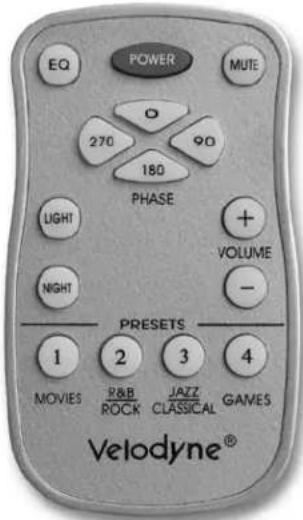
The features of the SC-1250 remote control are listed below.
- POWER — This button forces your SC-1250 unit into standby mode. The power LED turns amber, the numeric LED shuts off, and the amplifier puts out no power. The unit will remain in this mode until the POWER button is pressed again. To fully deactivate (i.e. power down) the unit, press the power switch on the front panel.
Note: The master power switch on rear panel must be on in order for the front power button to function.
- MUTE — This button mutes the subwoofer. The LED on the amplifier will show 00 if the unit is muted. To unmute the subwoofer, press the MUTE button again and the original volume setting shows on the LED.
text_image
EQ POWER MUTE 270 90 180 PHASE LIGHT VOLUME NIGHT - PRESETS 1 2 3 4 MOVIES R&B ROCK JAZZ CLASSICAL GAMES Velodyne®Figure 6: SC-1250 Remote.
- EQ — This button automatically EQs the subwoofer using a 7 band internal graphic equalizer. To use this feature, first plug the supplied microphone into the Mic-In jack on the back panel of the subwoofer and place the mic in your preferred listening position. Then, by pressing EQ on the remote, the subwoofer emits 12 “sweep tones” that cover the frequencies between 20 and 150 Hz. The LED displays “AU” during the Auto-EQ process. After the sweeps are complete, the unit saves its EQ settings and returns to normal operation. To prevent accidental invocation of the EQ feature, you must hold down the EQ button for 2-3 seconds before the EQ sweeps begin.
Note: Each time the EQ feature is utilized, the EQ settings for the SC-1250 are reset. If the microphone is not plugged in, the SC-1250 will emit one or two sweep tones then cease the EQ operation. In this case, the previous EQ settings will be preserved.
- PHASE — These buttons allow you to optimize the subwoofer performance for the location and your listening position. Select the switch position at which you hear the most bass. The LED will show the phase selected by showing "PH" followed by the phase number.
- LIGHT — If you wish, you can deactivate the numeric LED on your SC-1250. To do this, press the LIGHT button on your remote. To reactivate the LED, press the LIGHT button again.
- NIGHT — Night mode limits the maximum output of the subwoofer for late night listening or to be more considerate of close neighbors. Press the night button to turn the night mode feature on or off. Night mode, when active, will reduce the brightness of the blue LED.
• VOLUME CONTROL — This control allows you to balance the output from the subwoofer to the main speakers in your system. This control should be set to achieve similar volume level from between both the main speakers and subwoofer. When pressing volume up or down, the volume level is shown on the numeric LED on the front panel.
Note: The volume can also be adjusted via the volume buttons on the front panel of the amplifier. These buttons have the same effect as pressing the up and down volume buttons on your remote.
- PRESETS — There are 4 presets, consisting of Movies, R&B – Rock, Jazz – Classical, and Games. As a preset is chosen, the preset is shown on the numeric LED as P1 for preset 1, P2 for preset 2, etc. The presets provide the following characteristics for bass reproduction:
Movies: Maximum output and impact for explosions and other action adventure movie content.
R&B – Rock: Provides the driving bass found in today's rock music.
Jazz – Classical: The tightest, cleanest, lowest distortion bass. The flattest frequency response of the four presets.
Games: Maximum loudness available for the impact of video games.
The following table indicates musical style and which preset is recommended for it.
| MUSICAL STYLE SUGGESTED PRESET | |
| Action Adventure Movies | Movies |
| Country - Rock R&B - Rock | |
| Country - Soft Jazz - Classical | |
| Folk Jazz - Classical | |
| Indie Music R&B - Rock | |
| Pop R&B - Rock | |
| Rock R&B - Rock | |
| Alternative Rock Jazz - Classical | |
| Blues Jazz - Classical | |
| Broadway and Vocalists Jazz - Classical | |
| Children's Music Jazz - Classical | |
| Christian and Gospel Jazz - Classical | |
| Classic Rock R&B - Rock | |
| Classical Jazz - Classical | |
| Dance and DJ R&B - Rock | |
| Hard Rock/Heavy Metal | R&B - Rock |
| Latin Music | R&B - Rock |
| Miscellaneous | Jazz - Classical |
| Movies- Non-Action Adventure | Jazz - Classical |
| New Age | Jazz - Classical |
| Opera and Vocal | Jazz - Classical |
| R&B | R&B - Rock |
| Rap and Hip-Hop | R&B - Rock |
| Soundtracks | R&B - Rock or Jazz- Classical |
| Video Games | Games |
Each preset has its own characteristics with respect to subsonic filter, volume differential and a single equalizer (EQ) in order to optimize the listening mode for the preset.
RESTORING DEFAULTS
There is a feature that allows you to restore default settings for your SC-1250. By pressing presets in EXACTLY the following order on the remote, the unit's power light will blink indicating that you have restored defaults.
Preset 1: Movies
Preset 2: R&B - Rock
Preset 3: Jazz - Classical
Preset 4: Games
Preset 4: Games
Preset 3: Jazz - Classical
Preset 2: R&B - Rock
Preset 1: Movies
When you press the presets in the above order, the numeric LED will display "P3" indicating that you have restored defaults. The unit's volume is reset to level 30 out of 80.
CARE OF YOUR AMPLIFIER AND SUBWOOFER
Do not use any harsh detergents or chemicals to clean the SC-1250 chassis or the subwoofer cabinet. Abrasives, detergents, or cleaning solutions will damage the finish on the SC-1250 chassis or the subwoofer cabinet. We recommend using a damp cloth to clean the front, back and sides.
During normal conditions, the amplifier may be left on continuously without any problems. If you plan to leave the unit unused for an extended period of time, we recommend that you turn off the unit by the master power switch on the front panel.
TROUBLESHOOTING AND SERVICE
Before seeking service for your amplifier or subwoofer, please re-check all systems. Following is a simple troubleshooting guide to assist you.
- Verify that the unit is plugged in and power outlet used is active.
- Is the power switch on?
- Is the unit receiving an input signal from your source?
- Have all controls on the amplifier (volume, crossover, phase, etc.) been properly set?
- If the unit has been running at high levels, one of the protection circuits may be engaged. Has the amplifier overheated?
- Has the power button been depressed on the remote?
- Is the remote non-responsive? We recommend replacing the batteries in the remote.
If the protection circuitry is active, the unit may cycle on and off until operating parameters return to normal. Under more serious conditions, the unit may shut off completely. Normal operation should return upon cooling, but you may be required to turn the power off and then on again to reset the unit.
The following conditions require service by a qualified technician:
- The power cord has become damaged
- The unit does not appear to operate normally or exhibits a marked change in performance
- The unit has been exposed to water
- Some part of the chassis or circuitry is physically damaged
Thank You for Purchasing an SC-1250!
| Specifications | SC-8 | SC-10 | SC-12 | SC-15 | SC-18 (IN-Wall) | SC-IF (IN-Floor), SC-IC (IN-Celling) |
| Woofer: | 8" forward firing (6.5" piston diameter) | 10" forward firing (8" piston diameter) | 12" forward firing (9.7" piston diameter) | 15" forward firing (12.7" piston diameter) | 4"x 14" retangular driver (3"x 13.25" piston dimensions) | 12" (9.7" piston diameter) subwoofer |
| Frequency Response: (+/-3 dB) | 28-120HZ | 24-120HZ | 22-120HZ | 22-120HZ | 22-120HZ | 22-120HZ |
| Magnet Structure: | <5% (typical) | <5% (typical) | <5% (typical) | <5% (typical) | <5% (typical) | <5% (typical) |
| Voice Coil | 2.5" Dual Layer Inner/outer wind | 3" Dual Layer inner/inner/outer wind | 3" Dual Layer inner/outer wind | 3" Dual Layer inner/outer wind | 3" Dual Layer inner/outer wind | 3" Dual Layer inner/inner/outer wind |
| Video Shielded: | No | Yes | Yes | Yes | Yes | Yes |
| Dimensions (H/W/D): (Inc. feet & grill) | 10.75" x 10.5" x 9.25" (27.3 x 26.7 x 23.4 cm) | 12.75" x 12.375" x 9.5" (32.4x 31.5 x 24.2 cm) | 15"x 14.5"x 10.25" (38.1 x 66.1 x 26.1 cm) | 18.5"x 18.25"x 13.5" (27.4 x 26.4 x 34 cm) | 27"x 13.90"x 3.70" (68.6 x 35.3 x 9.4 cm) | 9.3"x 14.0"x 26" (23.7 x 36 x 66 cm) |
| Cabinet: | Sealed enclosure | Sealed enclosure | Sealed enclosure | Sealed enclosure | Sealed enclosure | Sealed enclosure |
| Warranty: (parts/labor) | Two years | Two years | Two years | Two years | Two years | Two years |
| Shipping Weight (approx.) : | 26 lbs. (16 kg) | 36 lbs. (21 kg) | 41 lbs. (26 kg) | 55 lbs. (16 kg) | **2 carbons Carbon I: 25 lbs. (11.5 kg) Carbon 2: 25 lbs. (11.5 kg) Total: 50 lbs. (22.7 kg) | 57 lbs. (26 kg) |
The following subwoofers are designed to work with the SC-1250:
| Specification | SC-1250 Amplifier |
| Amplifier (Class D) | 3000 watts Dynamic 1250 watts RMS Power |
| High Pass Crossover: | 80HZ (6 dB/octave) |
| Low Pass Crossover: | 30HZ-160HZ, Defectable, 24 dB/octave slope |
| Inputs: | Line and Speaker Level |
| Outputs: | Line-level, 80 HZ up, speaker level for up to two subworkers |
| Phase: | 0^,90^,180^,270^ |
| Dimensions (H/W/D): (inc. feet & grill) | 4.25" × 17.0 " × 13.0"(10.8 × 43.2 × 33.1 cm)***Allow two extra inches in depth for wire connectors and power cable.***Includes feet. Feet can be removed for rack mount use. Unit is approximately two rack units high. |
| Warranty (parts/labor) | Two years |
| Shipping Weight (approx.x): | 25 lbs. (22.7 kg) |
APPENDIX A: RS-232 SERIAL OVERVIEW AND COMMANDS
Introduction
This document outlines Velodyne's SubContractor (SC) RS-232 protocol specification. This protocol indicates how SC products receive run-time commands from devices such as Creston Universal Remote Controls.
Com Port Setup
Use standard communications settings: Baud Rate: 9600, Data Bits: 8, Parity: None, Stop Bits: 1
SC IN and OUT Port Pin Configuration
SC serial ports use a standard configuration that allows direct connection to a PC via a FEMALE to MALE serial cable. It uses only three pins (Transmit, Receive, Ground).
The pin configurations are:
IN: Pin 2 = Transmit
Pin 3 = Receive
Pin 5 = Ground
OUT: Pin 2 = Receive
Pin 3 = Transmit
Pin 5 = Ground
Runtime Command Format
| Byte Number | Byte Description Notes | |
| O‘#’ | Header Character | |
| 1 to 3 or 4 Command and 3 to 4 ASCII characters see formats below Parameter Data Case sensitive - CAPS ONLY! | ||
| 4 or 5 | ‘$’ | Termination Character (required or command is ignored) |
RS232 Commands
| Activity Command Acceptable Example(s) Comments | ||||
| Format n Values | ||||
| Volume Control #VOnn, 00 - 80 #V025, Sets volume to a value,#VO+, #VO+, increments volume up#VO-, #VO-, or down, or requests#VO?#VO? current volume setting | ||||
| Preset Control | #PSn,#PS? | 1, 2, 3, 4 | #PS1, #PS2,#PS3, #PS4$,#PS? | Activates the indicated preset, or requests the current preset |
| Logo Light Control | #LTn,#LT? | O: Light Off1: Light On | #LTO$LT1LT? | Turns the Logo Light on or off, or requests light state |
| Night Mode Control | #NMn,#NM? | O: Night Mode Off1: Night Mode On | #NMO$NM1NM? | Activates/Deactivates Night Mode, or requests light mode state |
| Mute Control | #MUn,#MU?#MUO | O: Mute Off1: Mute On | #MU1MU? | Mutes/Unmutes the woofer, or requests mute state |
| Power Control | #JUn,#JU? | O: Power Off1: Power On | #JUO$JU1JU? | Powers On/Powers Off the woofer, or requests power state |
OTHER VELODYNE SUBWOOFER PRODUCTS:
| 110V | 230V | ||
| Digital Drive 1812 Signature Edition | MiniVee^TM | Digital Drive 1812 Signature Edition | SMS^TM-1 |
| SMS^TM-1 | SPL-800i | ||
| DD Series | CHT-R Series | ||
| DD-10 | SPL-R Series | CHT-8R | SPL-R Series |
| DD-12 | SPL-800R | CHT-10R | SPL-800R |
| DD-15 | SPL-1000R | CHT-12R | SPL-1000R |
| DD-18 | SPL-1200R | CHT-15R | SPL-1200R |
| SPL-1500R | SPL-1500R | ||
| DLS-R Series | DD Series | ||
| DLS-3500R | VRP Series | DD-10 | |
| DLS-3750R | VRP-1000 | DD-12 | |
| DLS-4000R | VRP-1200 | DD-15 | |
| DLS-5000R | DD-18 | ||
| VX Series | |||
| DPS Series | VX-10 | ||
| DPS-10 | |||
| DPS-12 | |||
LIMITED WARRANTY
VELODYNE ACOUSTICS, Inc. ("VELODYNE") warrants all electronics and powered subwoofers for a period of two years and full range speakers for a period of five years. All VELODYNE products have a warranty from the date of purchase against defects in materials and workmanship subject to the following conditions:
- VELODYNE is not responsible for defects which result from the use of an amplifier or controller other than the one originally supplied with the unit (subwoofer) or defects which result from modifications or repairs made by any component of the system by anyone other than a VELODYNE factory authorized service representative.
- This warranty is void if any repairs or service covered by the terms of this warranty are made to any component of the system by anyone other than a VELODYNE factory authorized service representative.
- VELODYNE is not responsible for damage caused by accidents, abuse, misuse, natural or personal disaster or unauthorized modification. The VELODYNE products are not intended for professional or commercial use and VELODYNE is not responsible for damage resulting from such use.
- The VELODYNE product warranty is limited to units that are purchased from authorized VELODYNE dealers and finalized within authorized dealer locations.
- This warranty is nontransferable under any condition.
TO OBTAIN SERVICE
Information regarding service may be obtained from the dealer from whom you purchased the unit, or by contacting VELODYNE customer service. Warranty service must be performed by a VELODYNE factory authorized service representative within the warranty period set forth above. If VELODYNE determines the unit is defective, VELODYNE will, at VELODYNE's option, repair or replace the product at no charge if the product is forwarded prepaid to a factory authorized service representative. Products forwarded to the factory authorized service representative should be shipped securely and properly packaged, insured and freight prepaid.
Velodyne Acoustics, Inc.
345 Digital Drive
Morgan Hill, CA 95037
408.465.2800 voice
408.779.9227 fax
408.779.9208 service fax
www.velodyne.com
Service E-mail: service@velodyne.com
Product E-mail: help@velodyne.com
Technical E-mail: techhelp@velodyne.com

63-SC1250 RevC OCT 2006