
26AV713B - Television TOSHIBA - Free user manual and instructions
Find the device manual for free 26AV713B TOSHIBA in PDF.


| Product Type | 26-inch LCD Television |
| Brand | Toshiba |
| Model | 26AV713B |
| Screen Size | 26 inches (66 cm) |
| Resolution | 1366 x 768 (HD Ready) |
| Aspect Ratio | 16:9 |
| Contrast Ratio | 3000:1 (dynamic) |
| Brightness | 450 cd/m² |
| Response Time | 8 ms |
| Viewing Angle | 178° horizontal / 178° vertical |
| Tuner | Analog and DVB-T |
| HDMI Inputs | 2 x HDMI |
| Component Video Input | 1 x YPbPr |
| Composite Video Input | 1 x AV (shared with component) |
| VGA Input | 1 x D-Sub 15-pin |
| USB Port | 1 x USB 2.0 (media playback) |
| Audio Output | 1 x 3.5 mm headphone jack, 1 x optical |
| Power Consumption (Typical) | 80 W |
| Standby Power Consumption | < 1 W |
| Weight (without stand) | 6.5 kg |
| Dimensions (W x H x D) without stand | 642 x 430 x 95 mm |
| VESA Mount | 200 x 100 mm |
| Remote Control | Included (model: CT-90328) |
| Energy Efficiency Class | B |
Frequently Asked Questions - 26AV713B TOSHIBA
User questions about 26AV713B TOSHIBA
0 question about this device. Answer the ones you know or ask your own.
Ask a new question about this device
Download the instructions for your Television in PDF format for free! Find your manual 26AV713B - TOSHIBA and take your electronic device back in hand. On this page are published all the documents necessary for the use of your device. 26AV713B by TOSHIBA.
USER MANUAL 26AV713B TOSHIBA
Leading Innovation >>>
natural_image
Black-and-white close-up profile of a human face in profile view, showing detailed eye and nose (no text or symbols)19/22/26/32AV71*B
AV71*B1 and
32/40LV71*B
DIGITAL Series

natural_image
Simple line icon of an open book with a lowercase 'i' inside, no text or symbols present.Contents
Safety Precautions 3
Installation and important information ..... 4
The remote control 6
Inserting batteries and effective range of the remote 7
Connecting external equipment 8
REGZA-LINK Connections 10
Connecting an HDMI ^® or DVI device to the
HDMI input 11
To connect an HDMI device 11
DVI device to the HDMI Input 13
Connecting a computer.... 15
To connect a PC to the HDMI terminal .. 15
Using the controls 17
Switching on 18
Using the remote control 18
Using the side-panel controls .... 18
Tuning the television 19
Initial Setup 19
Setting the programmes 20
Auto Scan 20
Update Scan 21
Single RF Scan 21
Favorite Network Select 21
Analogue Manual Scan 21
Channel Skip 22
Channel Sort 23
Channel Edit 23
Channel Decode 23
Analogue Channel Fine Tune 24
Clean Channel List 24
Common Interface 24
Reset TV 24
Automatic Power Down 24
General controls 25
Selecting programme positions ..... 25
Time Display 25
Stereo and Bilingual transmissions ..... 25
Quick Access Menu 25
Sound controls 25
Volume 25
Balance, Bass, Treble 25
Surround Sound.... 26
Stable Sound® 26
Bass Boost 26
Bass Boost Level 26
Audio Description 26
Visually Impaired 26
Advanced Audio Settings 27
Widescreen viewing 28
Picture controls .... 30
Picture Mode 30
Brightness, Contrast, Colour and Tint .. 30
Sharpness 30
Back Light Adjustment 30
Colour Temperature 30
Cinema Mode 31
DNR 31
MPEG NR 31
CTI 31
Adaptive Luma Control 32
Active Backlight 32
Blue Screen 32
3D Colour Management 32
Base Colour Adjustment 32
HDMI RGB Range 33
H./V. Position 33
VGA 33
Timer control 34
Time Zone 34
Country Region ID 34
Time 34
Sleep Timer 35
Input selection and AV connections ..... 35
Input selection 35
Input signal selection 36
REGZA-LINK Controls 36
Equipment Control.... 36
Input Source Selection 37
Pass-Through Control 37
REGZA-LINK Menus 38
One Touch Play 38
System Standby 38
System Audio Control 38
PC Link 38
Enable REGZA-LINK 38
TV Auto Power On 38
Auto Standby 39
Amplifier Control 39
Speaker Preference 39
Media Player 39
Enter Media Player 39
Photo Multi-View 40
Playing Photo Slideshow 40
Viewing Music Files 41
Playing Music 41
Preference control 42
Analogue Subtitle 42
Digital Subtitle 42
Subtitle Type 42
Audio Languages 42
Audio Channel 43
Auto Format 43
4:3 Stretch 43
Side Panel Adjustment 43
Game Mode 43
Parental control 44
Channel Block 44
Programme Block 44
Input Block 45
Change Password 45
Panel Lock 46
Factory Default 46
Digital on-screen information and
programme guide 46
Information 46
Guide 47
EPG Timer 47
Software upgrade and system
information.... 47
Auto Download...... 47
Auto Install 47
Manual OAD 48
System Information 48
Text services 49
Setting the Language 49
Text Information 49
Control Buttons.... 49
Questions and Answers 50
Specifications and accessories .... 52
License Information used with Toshiba
Televisions 53
Exhibit A 54
Exhibit B 54
Notes 56
Safety Precautions
This equipment has been designed and manufactured to meet international safety standards but, like any electrical equipment, care must be taken to obtain the best results and for safety to be assured. Please read the points below for your own safety. They are of a general nature, intended to help with all electronic consumer products and some points may not apply to the goods you have just purchased.
Air Circulation
Leave more than 10cm clearance around the television to allow adequate ventilation. This will prevent overheating and possible damage to the television. Dusty places should also be avoided.
Heat Damage
Damage may occur if the television is left in direct sunlight or near a heater. Avoid places subject to extremely high temperatures or humidity. Place in a location where the temperature remains between 5^ C ( 41^ F) min. and 35^ C ( 94^ F) max.
Mains Supply
The mains supply required for this equipment is 220-240V \~, 50/60Hz. Never connect to a DC supply or any other power source. DO ensure that the television is not standing on the mains lead. Use only the supplied lead.
DO NOT cut off the mains plug from this equipment, this incorporates a special Radio Interference Filter, the removal of which will impair its performance. In the UK, the fuse fitted in this plug is approved by ASTA or BSI to BS1362.
It should only be replaced by a correctly rated and approved type and the fuse cover must be refitted.
IF IN DOUBT PLEASE CONSULT A COMPETENT ELECTRICIAN.
Do
DO read the operating instructions before you attempt to use the equipment.
DO ensure that all electrical connections (including the mains plug, extension leads and inter-connections between pieces of equipment) are properly made and in accordance with the manufacturers' instructions. Switch off and withdraw the mains plug before making or changing connections.
DO consult your dealer if you are ever in doubt about the installation, operation or safety of your equipment.
DO be careful with glass panels on equipment.
DO NOT REMOVE ANY FIXED COVERS AS THIS WILL EXPOSE DANGEROUS AND 'LIVE' PARTS.
THE MAINS PLUG IS USED AS A DISCONNECTING DEVICE AND THEREFORE SHOULD BE READILY OPERABLE.
Do not
DO NOT obstruct the ventilation openings of the equipment with items such as newspapers, tablecloths, curtains, etc. Overheating will cause damage and shorten the life of the equipment.
DO NOT allow electrical equipment to be exposed to dripping or splashing or objects filled with liquids, such as vases, to be placed on the equipment.
DO NOT place hot objects or naked flame sources, such as lighted candles or nightlights on, or close to equipment. High temperatures can melt plastic and lead to fires.
DO NOT use makeshift stands and NEVER fix legs with wood screws. To ensure complete safety, always fit the manufacturers' approved stand, bracket or legs with the fixings provided according to the instructions.
DO NOT leave equipment switched on when it is unattended, unless it is specifically stated that it is designed for unattended operation or has a standby mode. Switch off by withdrawing the plug, make sure your family know how to do this. Special arrangements may need to be made for people with disabilities.
DO NOT continue to operate the equipment if you are in any doubt about it working normally, or it is damaged in any way – switch off, withdraw the mains plug and consult your dealer.
WARNING – excessive sound pressure from earphones or headphones can cause hearing loss.
ABOVE ALL – NEVER let anyone, especially children, push or hit the screen, push anything into holes, slots or any other openings in the case.
NEVER guess or take chances with electrical equipment of any kind – it is better to be safe than sorry.
Installation and important information
Where to install
Locate the television away from direct sunlight and strong lights, soft, indirect lighting is recommended for comfortable viewing. Use curtains or blinds to prevent direct sunlight falling on the screen.
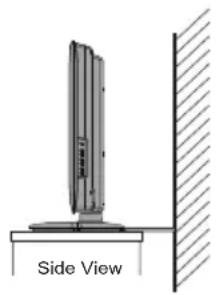
Place the TV set on a stable, level surface that can support the weight of the TV.
As an additional safety measure you can secure the TV to the level surface or a wall, as shown in the illustration, using a sturdy strap.
The LCD display panels are manufactured using an extremely high level of precision technology,
however sometimes some parts of the screen may be missing picture elements or have luminous spots. This is not a sign of a malfunction.
Make sure the television is located in a position where it cannot be pushed or hit by objects, as pressure will break or damage the screen, and that small items cannot be inserted into slots or openings in the case.
Wall mounting of the TV should only be performed by qualified servicing personnel. Use only with the wall mount bracket specified by the manufacturer.
natural_image
Side view diagram of a monitor mounted on a wall, showing no text or symbols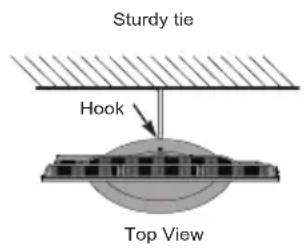
Please take note
EXCLUSION CLAUSE
Toshiba shall under no circumstances be liable for loss and/or damage to the product caused by:
i) fire;
ii) earthquake;
iii) accidental damage;
iv) intentional misuse of the product;
v) use of the product in improper conditions;
vi) loss and/or damage caused to the product whilst in the possession of a third party;
vii) any damage or loss caused as a result of the owner's failure and/or neglect to follow the instructions set out in the owner's manual;
viii) any loss or damage caused directly as a result of misuse or malfunction of the product when used simultaneously with associated equipment;
Furthermore, under no circumstances shall Toshiba be liable for any consequential loss and/or damage including but not limited to the following, loss of profit, interruption of business, the loss of recorded data whether caused during normal operation or misuse of the product.
- The digital reception function of this television is only effective in the countries listed in the "Country" section of the "SETUP" menu. Depending on country/area, some of this television's functions may not be available. Reception of future additional or modified services can not be guaranteed with this television.
- If stationary images generated by 4:3 broadcasts, text services, channel identification logos, computer displays, video games, on-screen menus, etc. are left on the television screen for any length of time they could become conspicuous, it is always advisable to reduce both the brightness and contrast settings.
- Very long, continuous use of the 4:3 picture on a 16:9 screen may result in some retention of the image at the 4:3 outlines, this is not a defect of the LCD TV and is not covered under the manufacturers warranty. Regular use of other size modes (eg: Superlive) and varying the “side panel” brightness (if available on the model) will prevent permanent retention.
| SYMBOL S | SYMBOL DEFINITION |
 | DANGEROUS VOLTAGE: The lightning flash with arrowhead symbol within an equilateral triangle is intended to alert the user to the presence of un-insulated "DANGEROUS VOLTAGE" within the product's enclosure that may be of sufficient magnitude to constitute a risk of electric shock to persons. |
 | INSTRUCTIONS: The exclamation point within on equilateral triangle to alert the user to the presence of important operating and maintenance (servicing) instruction in the literature accompanying the appliance. |
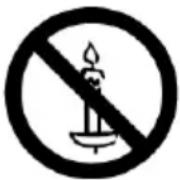 | WARNING: To prevent the spread of fire, keep candles or other open flames away from this product at all times. |
The remote control
Simple at-a-glance reference of your remote control.
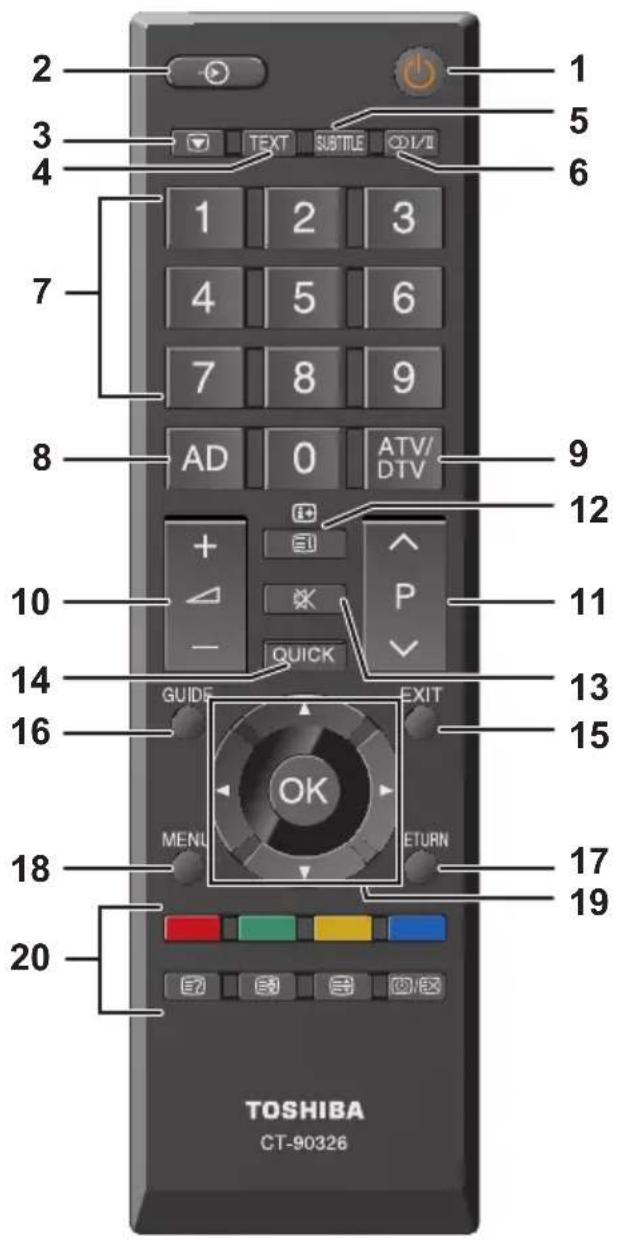
1 For On/Standby mode
2 To select input from external sources
3 Still Picture
4 To call up text services in analogue mode and interactive services in digital mode
5 To turn the subtitle On/Off
6 Stereo/Bilingual transmissions
7 Number buttons
8 Switch the Audio Description On/Off
9 To toggle between ATV and DTV mode
10 To alter the volume
11 To change programme
12 In TV mode: To display on-screen information
In Text mode: To access index page
13 To mute the sound
14 To display Quick access menu
15 To exit menus
16 To display the programme guide
17 To return to the previous level of the on-screen menu
18 To display the on-screen menu
19 ▲, ▼, ◀, ▶: To move up, down, left or right in the on-screen menu
OK: To confirm the selection
20 Colour button: Text control buttons
To reveal concealed text
To hold a wanted page
To enlarge text display size
In normal picture mode: To
display clock on TV screen
In Teletext mode: To toggle
between Teletext and normal
picture mode
Inserting batteries and effective range of the remote
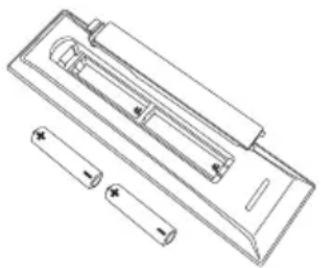
Remove the back cover to reveal the battery compartment and make sure the batteries are inserted the right way round. Suitable battery types for this remote are AAA, IEC R03 1.5V.
natural_image
Technical line drawing of a mechanical component with two cylindrical batteries (no text or symbols)Do not combine a used, old battery with a new one or mix battery types. Remove dead batteries immediately to prevent acid from leaking into the battery compartment. Dispose of them in accordance with instructions on page 56 of this manual. Warning: batteries must not be exposed to excessive heat such as sunshine, fire or the like.
The performance of the remote control will deteriorate beyond a distance of ten metres or outside an angle of 30 degrees from the centre of the television. If the operating range becomes reduced the batteries may need replacing.
Connecting external equipment
Before connecting any external equipment, turn off all main power switches. If there is no switch remove the mains plug from the wall socket.
Connect the power cord into the AC-IN socket found at the back of the TV.
Model 19/22
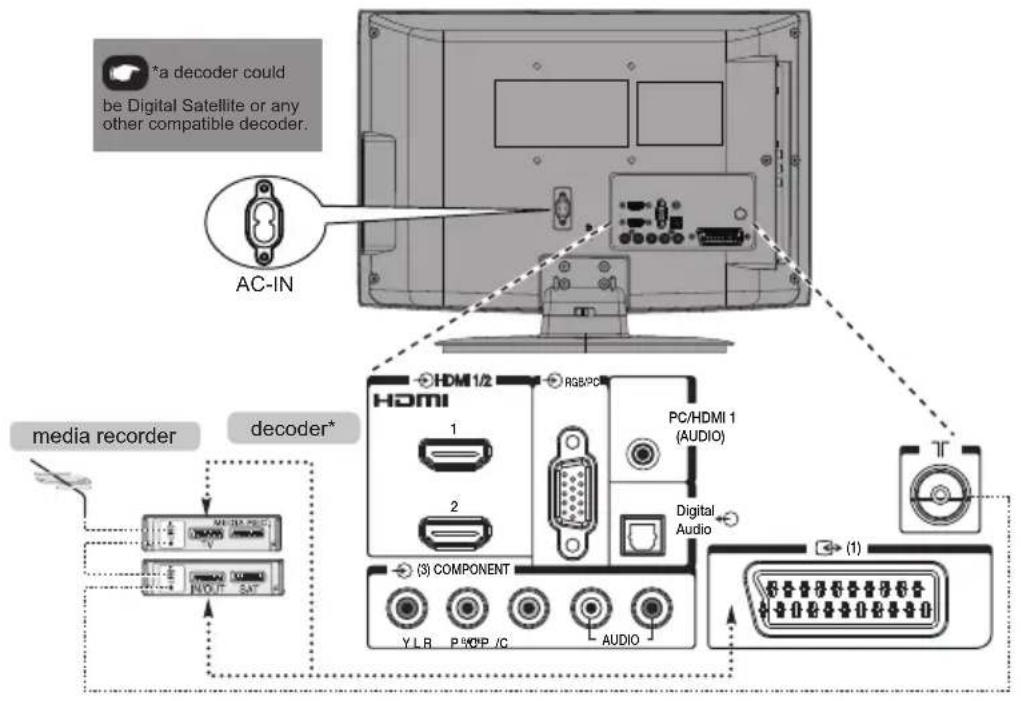
NOTE: SCART can support Canal+ decoder.
Model 26/32/40
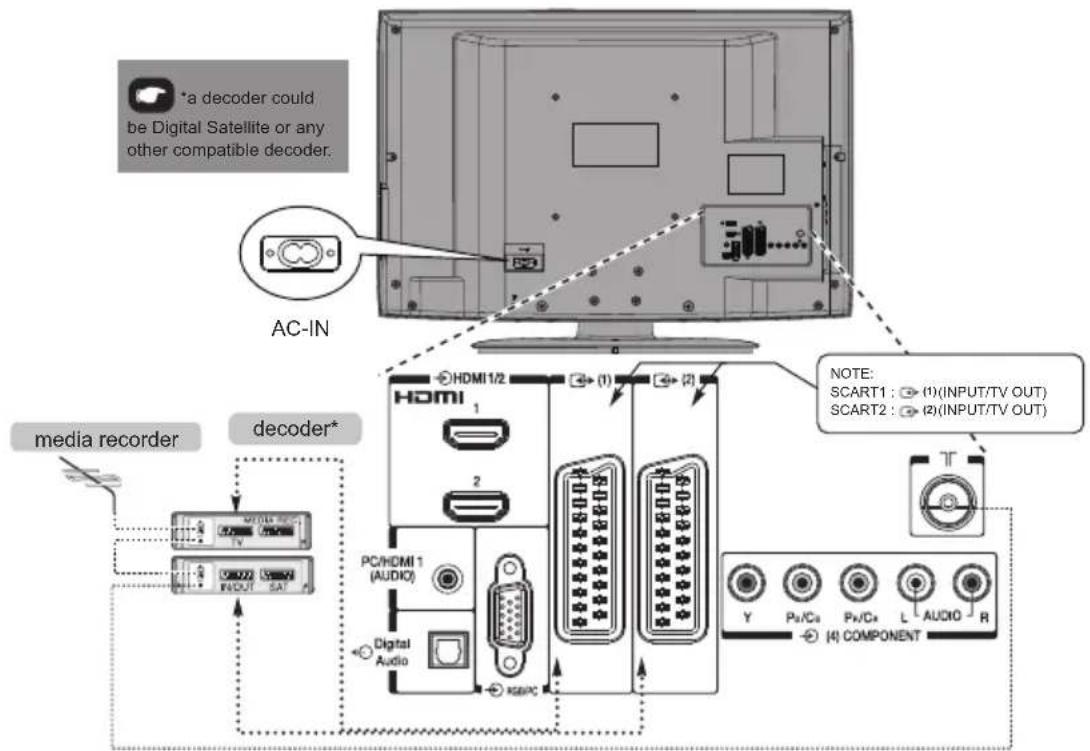
NOTE: SCART1 can support Canal+ decoder.
Aerial cables:
Connect the aerial to the ANT socket on the rear of the television. If you use a decoder and/or a media recorder, it is essential that the aerial cable is connected through the aerial socket on the decoder and/or on the media recorder to the TV.
SCART leads:
Connect the video recorder IN/OUT or decoder TV socket to the television. Connect the media recorder SAT socket to the decoder MEDIA REC. socket.
Before running Auto Scan put your decoder and media recorder to Standby.
The phono sockets alongside the COMPONENT VIDEO INPUT sockets will accept L and R audio signals.
The phono sockets alongside the VIDEO INPUT socket will accept L and R audio signals. These sockets are located on the side of the TV. (See page 17.)
SPDIF (Optical Digital Audio Out) When a digital audio signal is associated with the input selected for viewing, the digital audio will be available on this SPDIF connection to your home theatre system.
HDMI® (High-Definition Multimedia Interface) is for use with a DVD, decoder or electrical equipment with digital audio and video output. It is designed for best performance with 1080p high-definition video signals but will also accept and display VGA, SVGA, XGA, WXGA, SXGA, 480i, 480p, 576i, 576p, and 720p signals.
NOTE: Although this television is able to connect to HDMI equipment it is possible that some equipment may not operate correctly.
REGZA-LINK controls the basic functions of connected audio/video equipment using the television's remote control.
A wide variety of external equipment can be connected to the back of the television, therefore the relevant owner's manuals for all additional equipment must be referred to.
If the television automatically switches over to monitor external equipment, return to normal television by pressing the desired programme position button. To recall external equipment, press to select.
HDMI, the HDMI Logo, and High-Definition Multimedia Interface are trademarks or registered trademarks of HDMI Licensing LLC in the United States and other countries.
REGZA-LINK Connections
The basic functions of connected audio/video equipment can be controlled using the television's remote control if a REGZA-LINK compatible device is connected.
Model 19/22
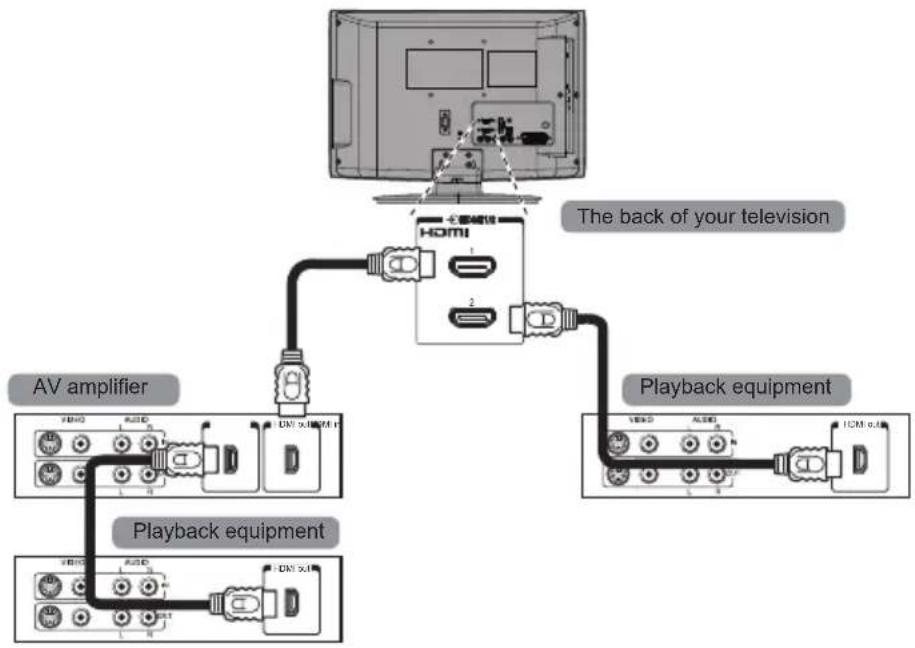
flowchart
graph TD
    A["The back of your television"] --> B["AV amplifier"]
    A --> C["Playback equipment"]
    B --> D["USB"]
    B --> E["AUSB"]
    B --> F["DM port"]
    C --> G["USB"]
    C --> H["AUSB"]
    C --> I["DM port"]
    D --> J["USB"]
    D --> K["AUSB"]
    D --> L["DM port"]
    E --> M["USB"]
    E --> N["AUSB"]
    E --> O["DM port"]
    F --> P["USB"]
    F --> Q["AUSB"]
    F --> R["DM port"]
    G --> S["USB"]
    G --> T["AUSB"]
    G --> U["DM port"]
    H --> V["USB"]
    H --> W["AUSB"]
    H --> X["DM port"]
Model 26/32/40
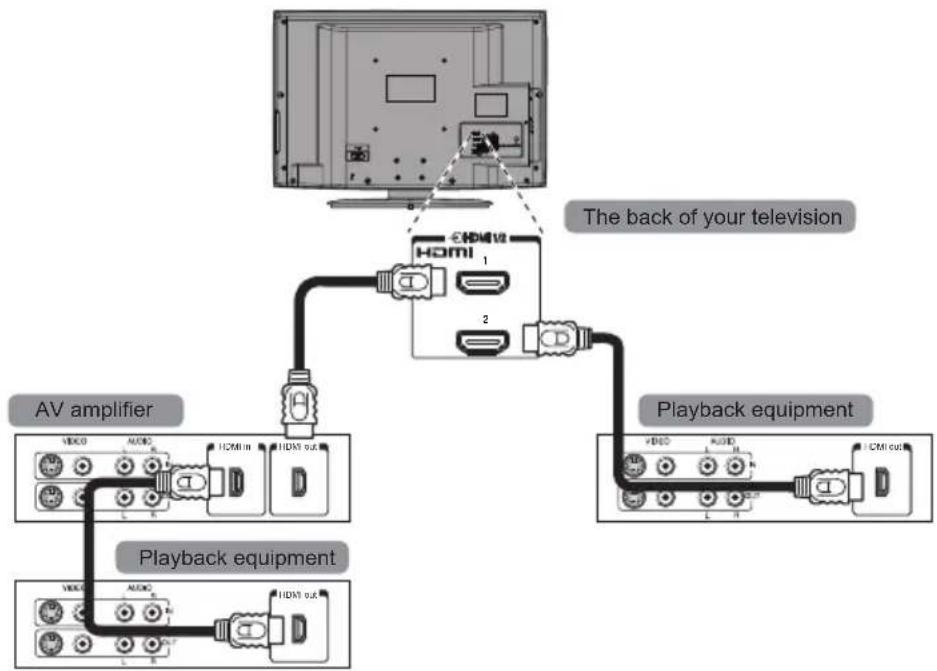
flowchart
graph TD
    A["The back of your television"] --> B["ACI HDMI2"]
    B --> C["ACI HDMI12"]
    C --> D["AV amplifier"]
    C --> E["Playback equipment"]
    D --> F["ACI HDMI12"]
    E --> G["ACI HDMI12"]
    F --> H["ACI HDMI12"]
    G --> I["ACI HDMI12"]
NOTE 1: It is recommended that for correct operation all audio/video devices are connected using HDMI cables branded with the HDMI logo (HDMI). If several devices are connected, the REGZA-LINK feature may not operate properly. After connecting the equipment use the REGZA-LINK menus to setup the desired options. The connected equipment must also be set. For details see the operation manual for each connected device.
NOTE 2: The REGZA-LINK feature uses CEC Technology as regulated by the HDMI standard. This feature is limited to models incorporating Toshiba's REGZA-LINK. However, Toshiba is not liable for those operations. Refer to individual instruction manuals for compatibility information.
Connecting an HDMI or DVI device to the HDMI input
The HDMI input on your television receives digital audio and uncompressed digital video from an HDMI source device, or uncompressed digital video from a DVI (Digital Visual Interface) source device. This input is designed to accept HDCP (High-Bandwidth Digital- Content Protection) programme material in digital form from EIA/CEA-861-D-compliant [1] consumer electronic devices (such as a set-top box or DVD player with HDMI or DVI output). For acceptable video signal formats, see page 16.
NOTE:
- Some early HDMI equipment may not work properly with your latest HDMI TV, due to the adoption of a new standard.
• Supported Audio format: Linear PCM, sampling rate 32/44.1/48kHz.
To connect an HDMI device
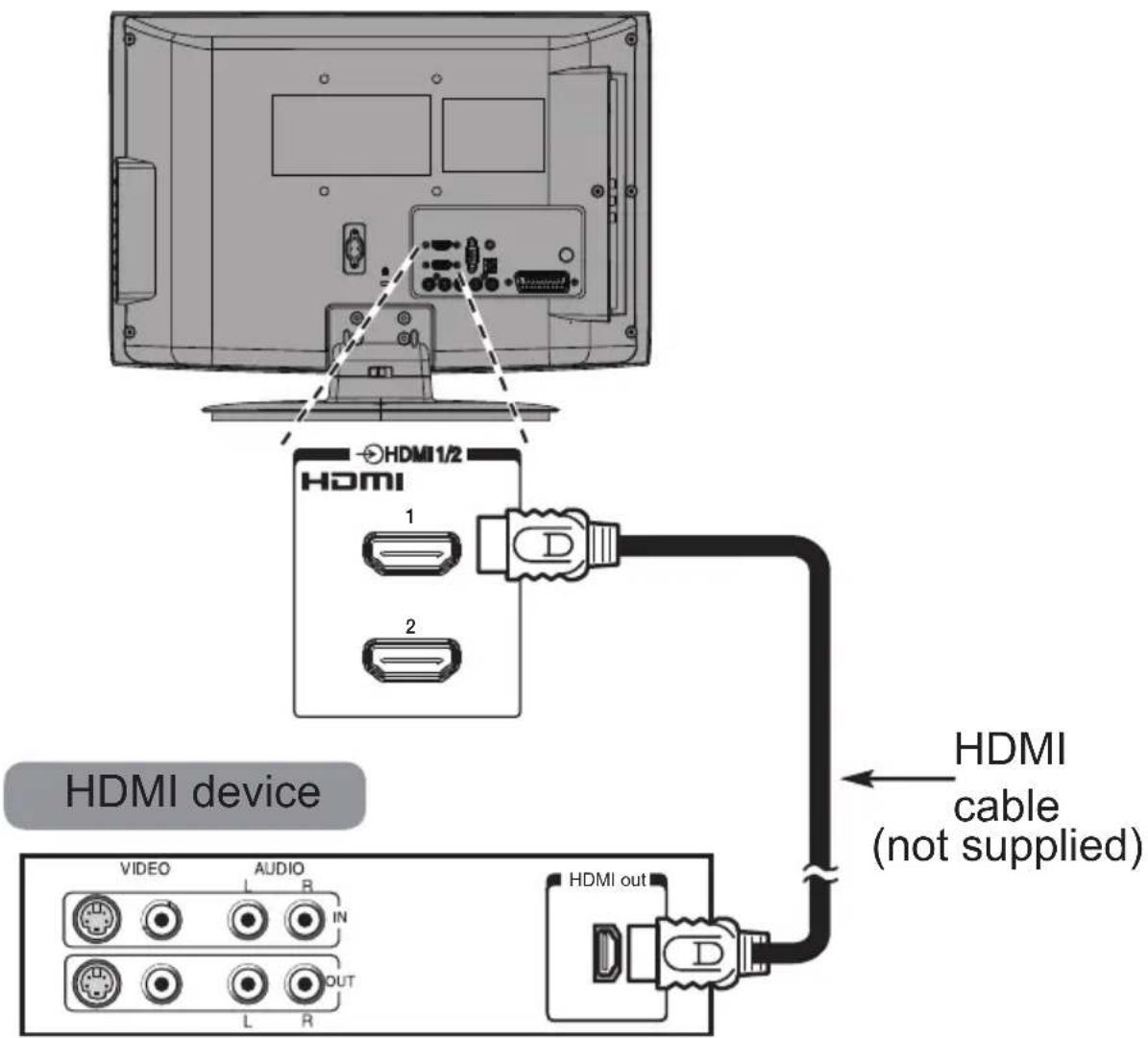
Connect an HDMI cable (type A connector) to the HDMI terminal.
For proper operation, it is recommended that you use an HDMI cable with the HDMI Logo ( )
- HDMI cable transfers both video and audio. Separate analogue audio cables are not required (see illustration).
Model 19/22
Model 26/32/40
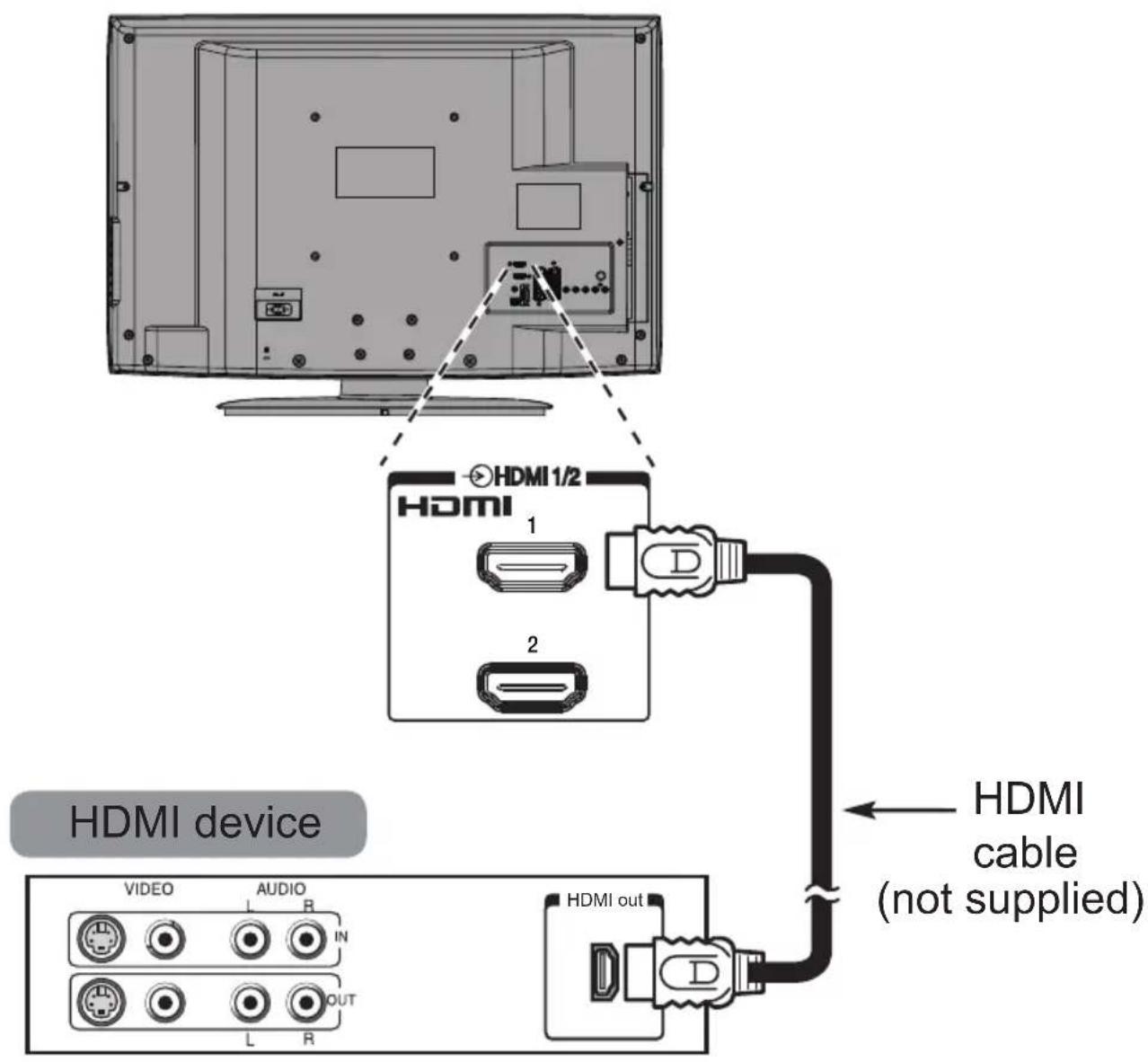
To view the HDMI device video, press ➕ to select the mode.
DVI device to the HDMI Input
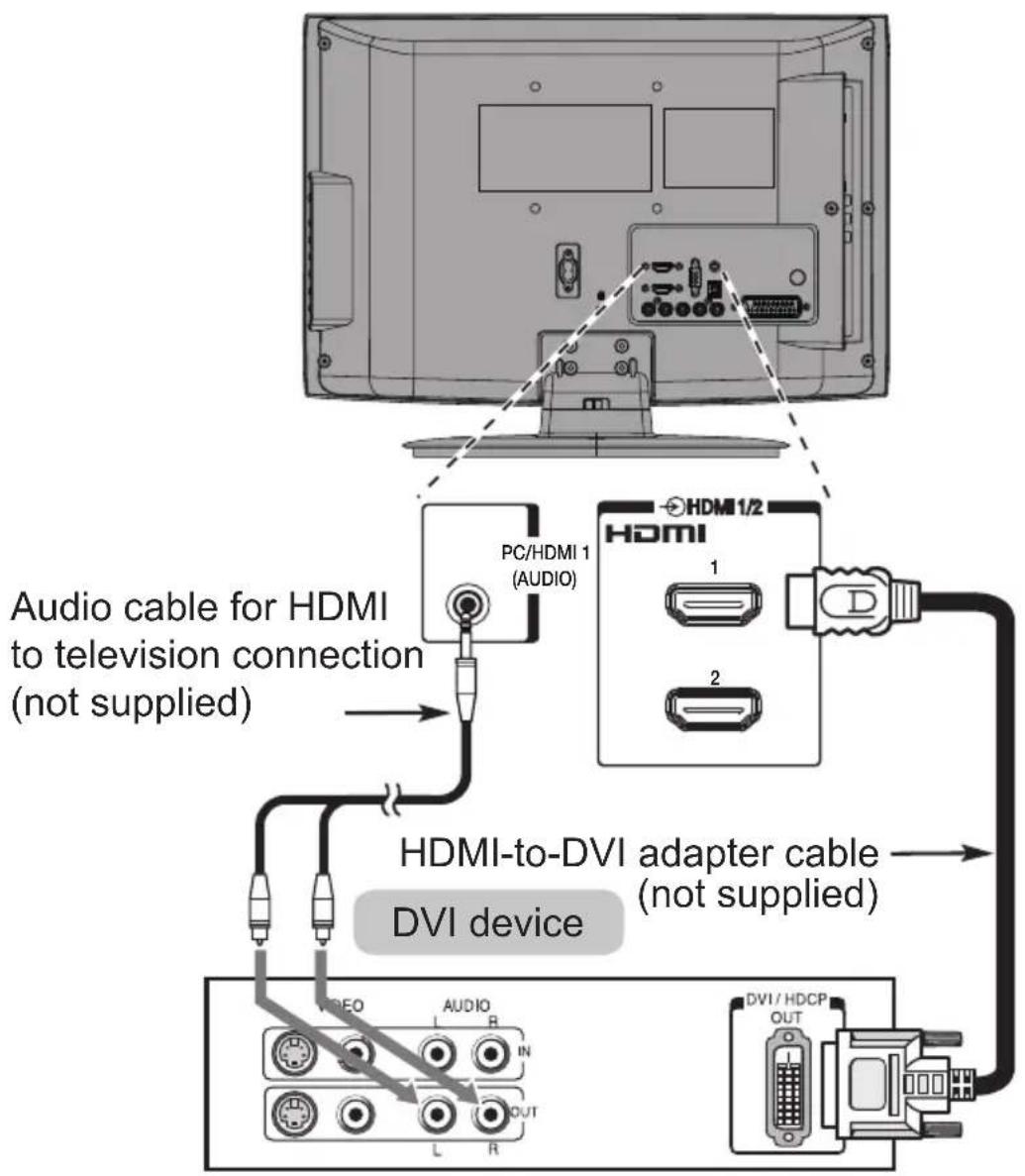
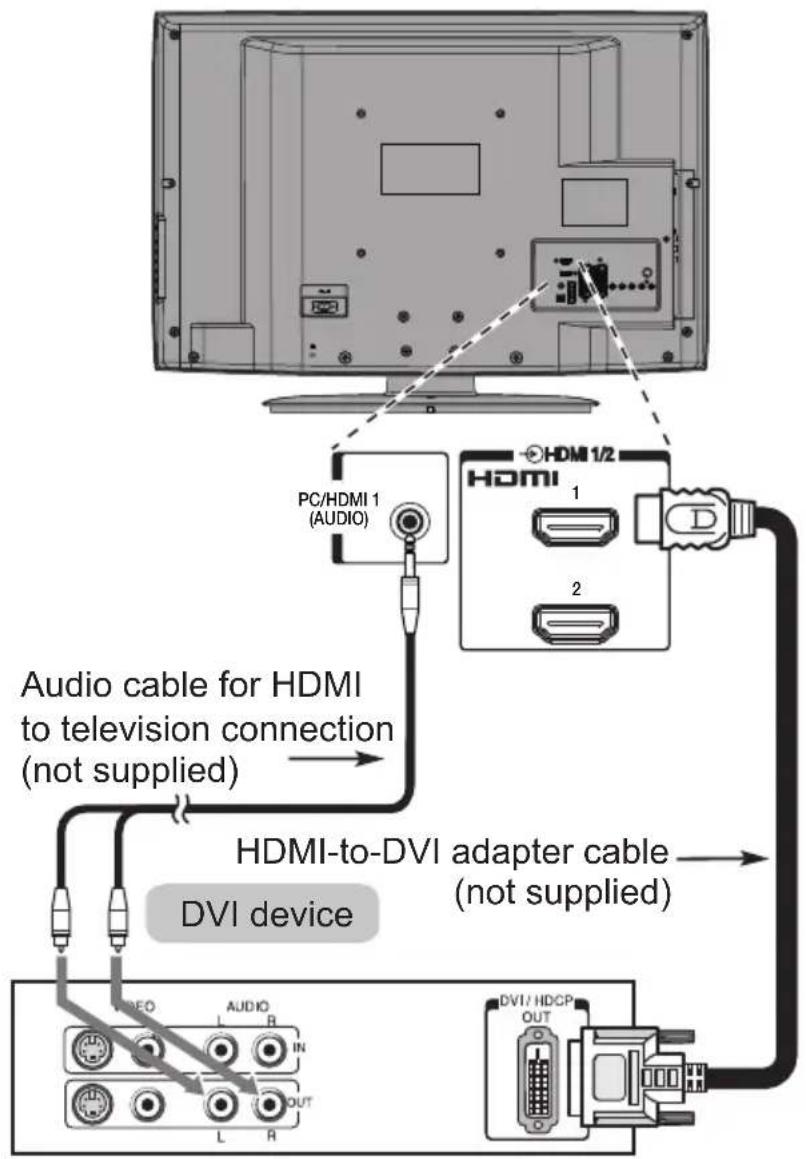
Connect an HDMI-to-DVI adapter cable (HDMI type A connector) to HDMI1 terminal and audio cables to the PC/HDMI1 Audio socket (see illustration).
- The recommended HDMI-to-DVI adapter cable length is 6.6 ft (2m). An HDMI-to-DVI adapter cable transfers video only.
- Separate analogue audio cables are required.
Model 19/22
Model 26/32/40
flowchart
graph TD
    A["Monitor"] --> B["PC/HDMI 1 (AUDIO)"]
    B --> C["HDMI 1/2"]
    C --> D["DVI device"]
    D --> E["HDMI-to-DVI adapter cable (not supplied)"]
    E --> F["DVI/ HDCP OUT"]
NOTE: To ensure that the HDMI or DVI device is reset properly, it is recommended that you follow these procedures:
- When turning on your electronic components, turn on the television first, and then the HDMI or DVI device.
- When turning off your electronic components, turn off the HDMI or DVI device first, and then the television.
[1] EIA/CEA-861-D compliance covers the transmission of uncompressed digital video with high-bandwidth digital content protection, which is being standardized for reception of high-definition video signals. Because this is an evolving technology, it is possible that some devices may not operate properly with the television.
HHDMI, the HDMI Logo, and High-Definition Multimedia Interface are trademarks or registered trademarks of HDMI Licensing LLC in the United States and other countries.
Connecting a computer
With the HDMI connection, you can watch your computer's display on the television and hear the sound from the televisions speakers.
To connect a PC to the HDMI terminal
When connecting a PC to the HDMI terminal on the television, use an HDMI-to-DVI adapter cable and analogue audio cables.
If connecting a PC with an HDMI terminal, use an HDMI cable (type A connector). Separate analogue cables are not necessary (see page 11).
Model 19/22
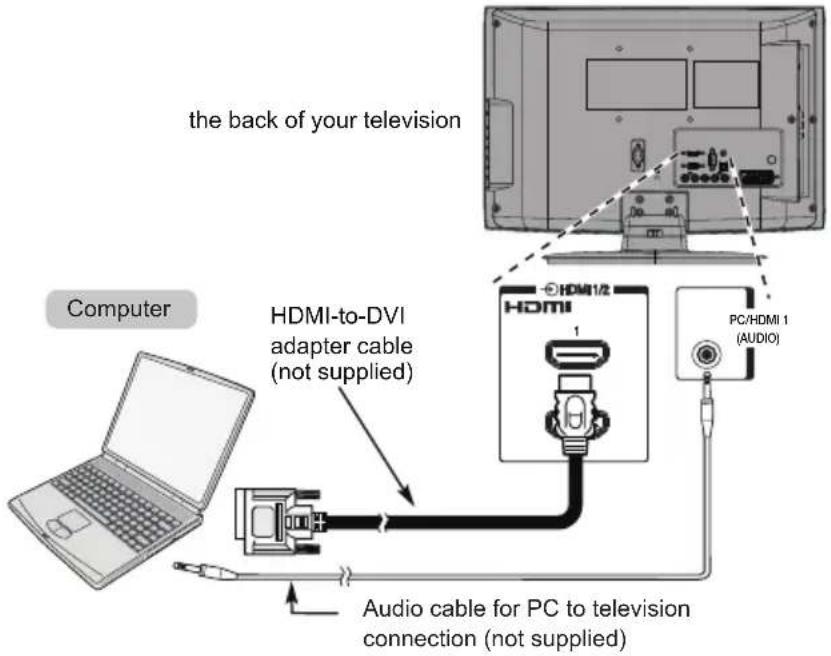
Model 26/32/40
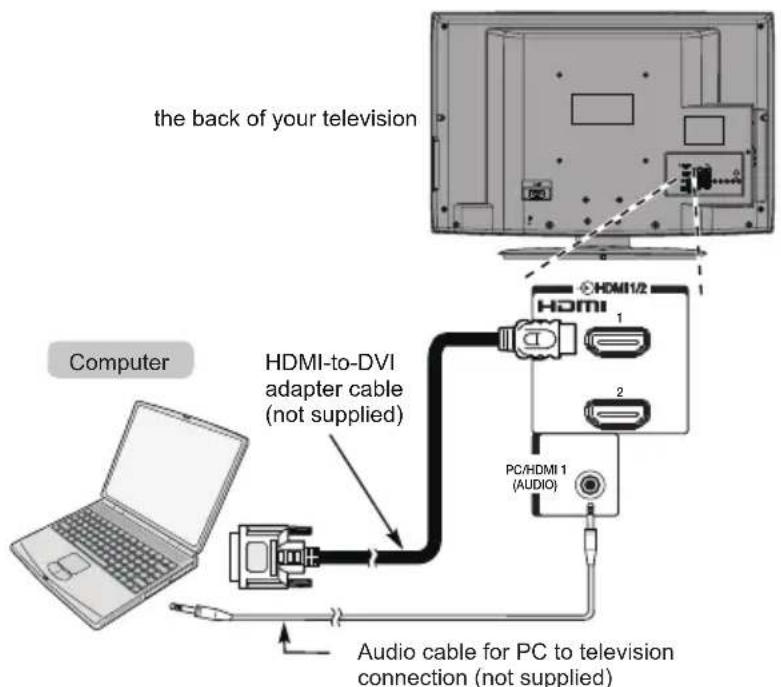
For acceptable PC signal formats, see “Acceptable PC signals through HDMI/D-SUB terminals” on page 16.
Acceptable Video signals through HDMI terminals
| Format Resolution Refresh Rate H. Frequency Pixel Clock | ||||
| VGA 640 x 4 | 80 60.000Hz 31.500k | kHz 25.200MHz | ||
| 59.940Hz 31.469kHz 25.175MHz | ||||
| 72.809Hz 37.861kHz 31.500MHz | ||||
| 75.000Hz 37.500kHz 31.500MHz | ||||
| 480i 720 x 4 | 80 60.000Hz 15.750k | Hz 27.000MHz | ||
| 59.940Hz 15.734kHz 27.000MHz | ||||
| 576i 720 x 5 | 76 50.000Hz 15.625k | Hz 27.000MHz | ||
| 480p 720 x 4 | 80 60.000Hz 31.500k | kHz 27.027MHz | ||
| 59.940Hz 31.469kHz 27.000MHz | ||||
| 576p 720 x 5 | 76 50.000Hz 31.250k | kHz 27.000MHz | ||
| 720p 1280 x | 720 60.000Hz 45.000k | kHz 74.250MHz | ||
| 59.940Hz 44.955kHz 74.176MHz | ||||
| 50.000Hz 37.500kHz 74.250MHz | ||||
| 1080i 1920 x | 1080 60.000Hz 33.7 | 50kHz 74.250MHz | ||
| 59.940Hz 33.716kHz 74.176MHz | ||||
| 50.000Hz 28.125kHz 74.250MHz | ||||
| 1080p 1920 x | 1080 60.000Hz 67.5 | 500kHz 148.500MHz | ||
| 59.940Hz 67.433kHz 148.352MHz | ||||
| 50.000Hz 56.250kHz 148.500MHz | ||||
| 24.000Hz 27.000kHz 74.250MHz | ||||
| 23.976Hz 26.975kHz 74.176MHz | ||||
Acceptable PC signals through HDMI/D-SUB terminals
| Format Resolution Refresh Rate H. Frequency Pixel Clock | ||||
| VGA(for D-Sub only) | 640 x 480 59.94 | 40Hz 31.469kHz 25.175 | MHz | |
| 72.809Hz 37.861 | kHz 31.500MHz | |||
| 75.000Hz 37.500 | kHz 31.500MHz | |||
| SVGA 800 x | 600 56.250Hz 35.156 | kHz 36.000MHz | ||
| 60.317Hz 37.879 | kHz 40.000MHz | |||
| 72.188Hz 48.077 | kHz 50.000MHz | |||
| 75.000Hz 46.875 | kHz 49.500MHz | |||
| XGA 1024 x | 768 60.004Hz | 48.363kHz 65.000 | MHz | |
| 70.069Hz | 56.476kHz | 75.000MHz | ||
| 75.029Hz | 60.023kHz | 78.750MHz | ||
| WXGA 1280 x | 768 59.995Hz | 47.396kHz 68.2 | 50MHz | |
| 59.870Hz | 47.776kHz | 79.500MHz | ||
| 74.893Hz | 60.289kHz | 102.250MHz | ||
| 1360 x 768 60.0 | 15Hz | 47.712kHz 85.500MHz | ||
| SXGA | 1280 x 1024 | 60.020Hz | 63.981kHz | 108.000MHz |
| 75.025Hz | 79.976kHz | 135.000MHz | ||
HDMI, the HDMI Logo, and High-Definition Multimedia Interface are trademarks or registered trademarks of HDMI Licensing LLC in the United States and other countries
NOTE 1: The PC input signals are supported by the "HDMI 1" socket only. The "HDMI 2" and "HDMI 3" ("HDMI 3" is for model 32/40LV71*B only) do not support PC signal.
NOTE 2: Only a supported PC signal will show the correct resolution on the TV display.
Using the controls
Whilst all the necessary adjustments and controls for the television are done using the remote control, the buttons on the television may be used for some functions.
NOTE: COMMON INTERFACE (CI)
The common interface is for a Conditional Access Module (CAM). Contact a service provider for details.
Model 19/22
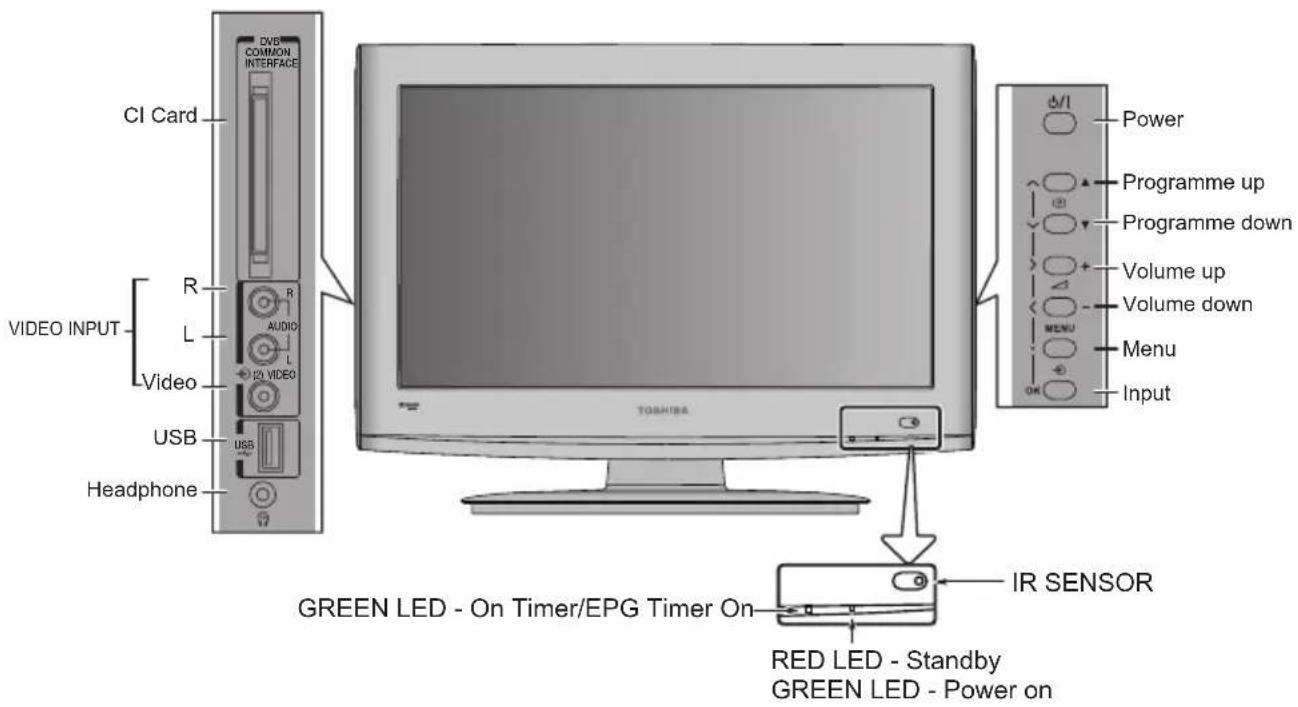
Model 26/32/40
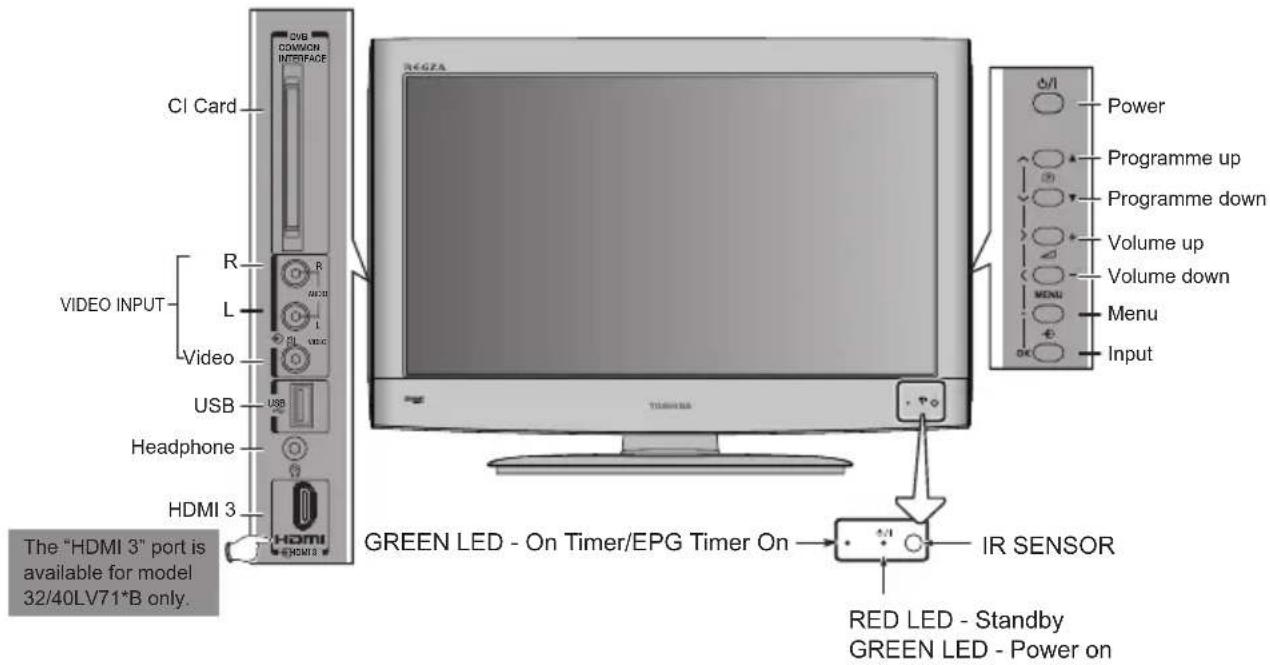
Switching on
Before switching on the television, make sure to connect the aerial cable, and select TV as the input source.
If the RED LED is off, check that the mains plug is connected to the power supply. If the picture does not appear, press on the remote control, it may take a few seconds to appear.
To put the television into Standby mode, press ☐ on the remote control. To view the picture, press ⏻ again. The picture may take a few seconds to appear.
Using the remote control
To set up the television, you need to use the on-screen menus. Press 📞 on the remote control to see the menus.
The on-screen menu appears as a list of five topics. As each symbol is selected by pressing ◀ or ▶ on the navigation ring on the remote control, its respective options will appear below.
To use the options, press ▲ or ▼ on the navigation ring to move up and down through them and use Ⓞ, ◀ or ▶ to select the required choice. Follow the on-screen instructions. The functions of each menu are described in detail throughout the manual.
Using the side-panel controls
To alter the volume, press - ∠.
To alter the programme position press ▲ P ▼.
Press MENU and < , > , ^ or √ to control the sound and picture options. Press MENU to finish.
To select the external input, press -to move through the list until the appropriate input source is selected as described on page 35.
Please always refer to the owner's manual of the equipment to be connected for full details.
Tuning the television
Before switching on the television, put your decoder and media recorder to Standby if they are connected.
Make sure to connect the aerial cable, and select TV as the input source.
To set up the television, press the buttons on the remote control as detailed on page 6.
Initial Setup
1 Connect the television to the main power and press the button. The Initial Setup screen will appear at the first use. Press to start the initial setup.
![Initial Setup Welcome Welcome to the initial setup wizard. Please press [OK] to start the wizard. ▶ Next](/content/2026/06/1146319/images/c99b5efaa8e3fe47868df8a00cb2a3d98a32c9c95a4e2e5cc291980239982350.jpg)
2 Press ▲ or ▼ to select your language, and then press ▶.
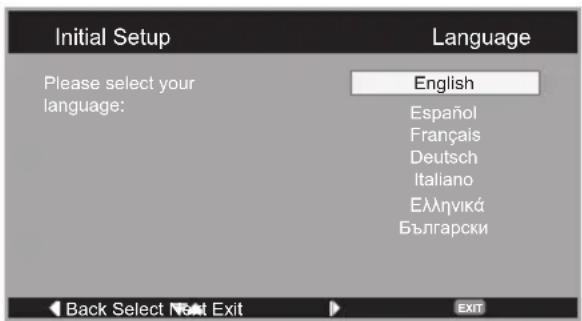
3 Press ▲ or ▼ to select between Home or Store mode (for normal home use, select Home), and then press ▶.
If Home mode is selected, the Standard picture mode will be selected
![Initial Setup To use this TV for displaying in a retail showroom, please select [Store]. [Home] mode is recommended for normal home use. Engrgy Saving Mode Home Store Back Select Next Exit EXIT](/content/2026/06/1146319/images/382963a386d1a47bf976ad1d588a40a3b8e9105ae9ce23fcabf8f43abb621608.jpg)
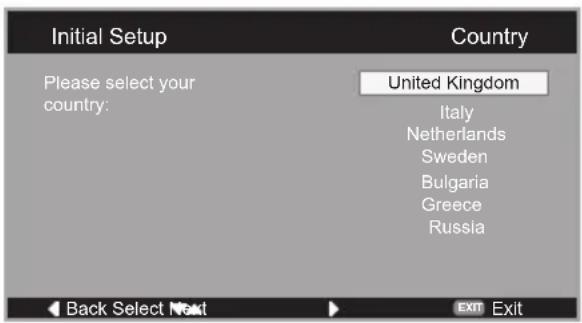
4 Press ▲ or ▼ to select your country and press ▶ to the next step.
5 To start channel scan, press ▶.
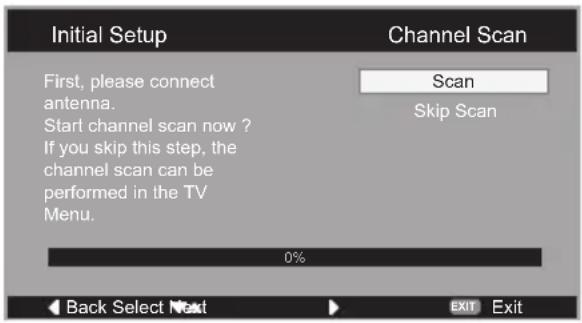
The search will begin for all available stations. The slide bar will move along the line as the search progresses.
6 The initial setup is now complete. Press to exit the wizard.
![Initial Setup Congratulations!! Initial Setup Complete. Please press [OK] to exit the wizard. Back Select Next Exit Complete EXIT](/content/2026/06/1146319/images/e7e018551650b9b1b464bed373f207d7c8af3ff9d55adc13ffd2abc68426d897.jpg)
NOTE 1: If you skip this step, the channel scan can be performed in the TV Menu.
NOTE 2: The time will be set automatically using the broadcaster data but can be advanced or decreased by from -12 to +13 hours using Time Zone in Time Setup. (See page 34)
PLEASE NOTE
The Factory Default menu can also be accessed at any time in the Parental control from the SETUP menu.
Setting the programmes
NOTE: When Channel Block is activated the 4-digit password is needed to enter the Channels submenu under SETUP menu.
Auto Scan
The Auto Scan will completely re-tune the television and can be used to update the channel list.
It is recommended that Auto Scan is run periodically to ensure that all new services are added.
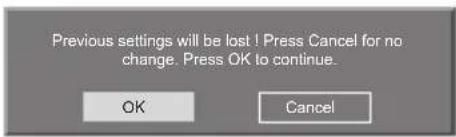
NOTE: All the current programmes and settings i.e. the locked programmes, will be lost.
1 Press MENU and press ◀ or ▶ to select SETUP.
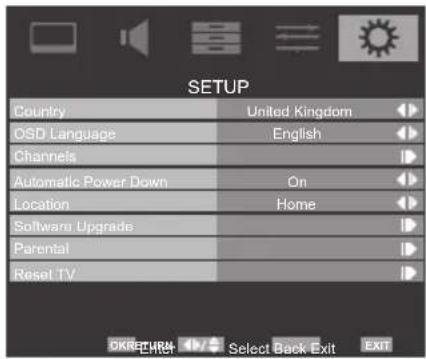
2 Press ▼ to highlight Country and press ◀ or ▶ to select.
NOTE: In order to receive the information from the broadcaster correctly, please set the correct country.
3 Press ▼ to highlight OSD Language and press ◀ or ▶ to select.
4 Press ▼ to highlight Channels and press ▶ or @to enter.
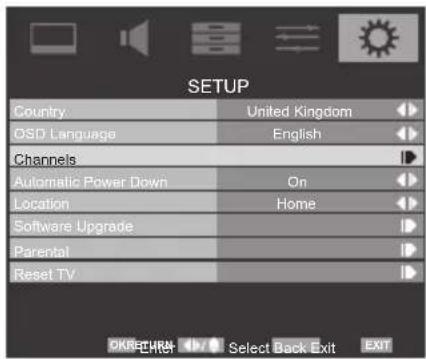
5 Select Auto Scan and press OK
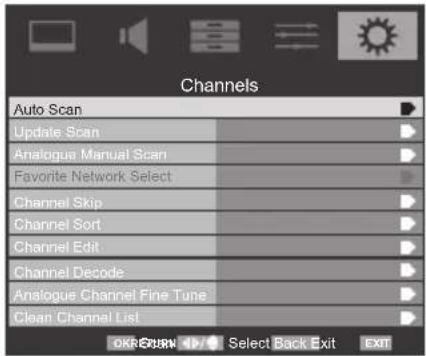
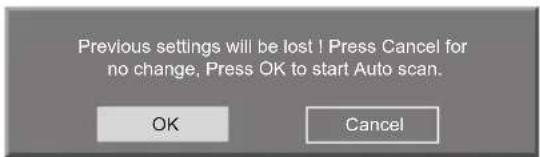
6 Press Cancel for no change, or press to enter Auto start screen.
7 For Country option of Finland, Germany, Switzerland, Norway, Sweden or Others, the Scan Mode option will be available if the Tuner Mode in SETUP menu is set to Cable.
- Scan Mode: The options are Full, Quick, and Advance. The Quick scan is a simplified version of the Full scan designed to complete in less time, and is available for Country option of Finland or Others only.
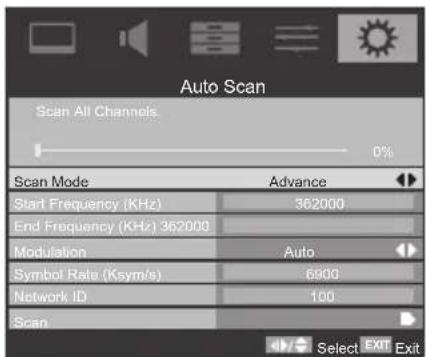
NOTE: The options Start Frequency, End Frequency, Modulation, Symbol Rate, and Network ID is available for Advance mode only.
8 Press ▲ or ▼ to highlight Scan and press ▶ or Ⓞ to start scanning. Press RETURN to cancel, or press EXIT to stop scanning.
Update Scan
Search the new channels that are not in the programme list.
1 Press MENU and press ◀ or ▶ to select SETUP.
2 Press ▼ to highlight Channels and press ▶ or OK
3 Select Update Scan and press to start scanning.
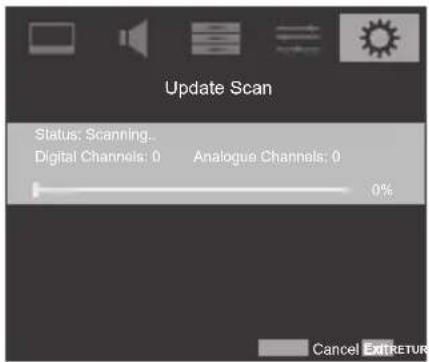
NOTE: This option is available for DVB_T only.
Single RF Scan
Scan single RF channels. You can check the Signal Strength and the Signal Quality.
1 Select Channels from the SETUP menu.
2 Highlight Single RF Scan and press ▶ or OK to enter.
3 Press ◀ and ▶ to select the RF Channel, then press@to start scanning.
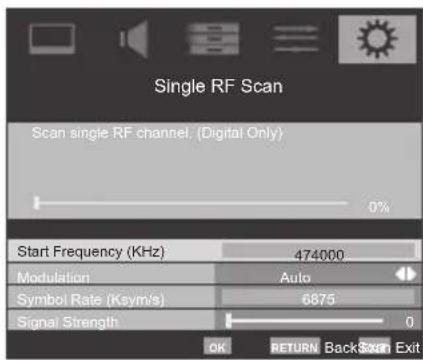
NOTE: This option is available for DVB_C and DVB_T only.
Favorite Network Select
If there are more than two networks detected after running the Auto Scan in Channels menu, you can select the network you prefer.
1 Select Channels from the SETUP menu.
2 Highlight Favorite Network Select and press ▶ or 📷 to enter.
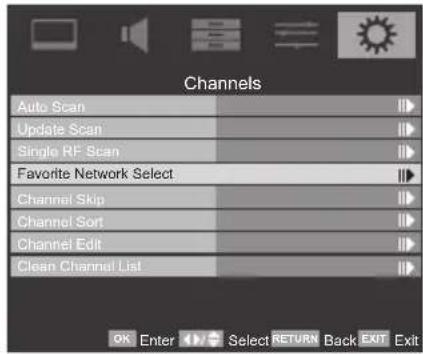
3 Press ▲ or ▼ to select the network you prefer, and then press 📄 to set.
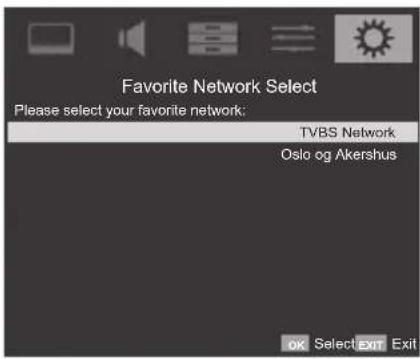
NOTE: This feature is available only for the Country option of Norway, and with DVB_T input source.
Analogue Manual Scan
The television can be tuned-in manually using Analogue Manual Scan. For example: if the television cannot be connected to a media recorder/decoder with a SCART lead or to tune-in a station on another System.
1 Press MENU and press ◀ or ▶ to select SETUP.
2 Press ▼ to highlight Channels and press ▶ or OK
3 Select Analogue Manual Scan and press ▶ or ⓣ to confirm it.
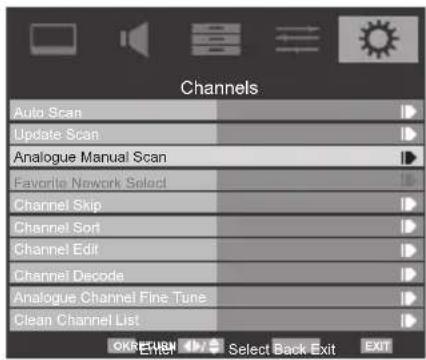
4 Press number buttons 0\~9 to enter the Start Frequency. Press ▲ or ▼ to select Scan Up or Scan Down and press ▶ or OK to start scan. Press 📄 to stop scanning.
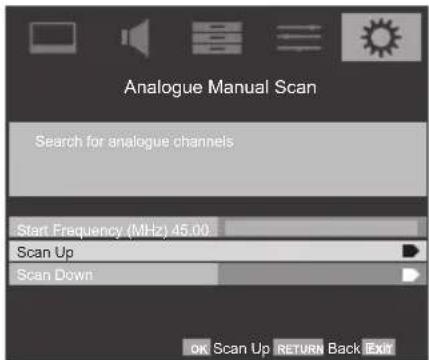
NOTE: This option is available for Analogue TV mode only.
Channel Skip
To prevent certain programmes from being viewed, the programme position can be skipped. The remote control must be removed as the channels will still be available using the number buttons. Programmes can then be watched as normal using the controls on the television, but the television will not show the skipped programme position.
1 In the SETUP menu, press ▼ to highlight Channels and press ▶ or 📞 to enter.
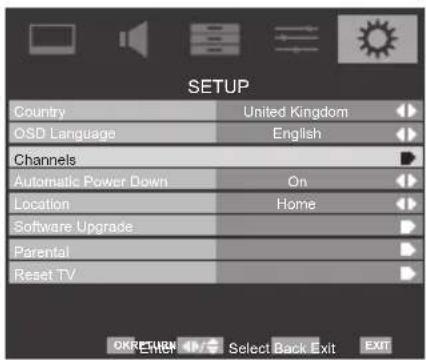
2 Press ▼ to highlight Channel Skip and press ▶ or 📷 to enter.
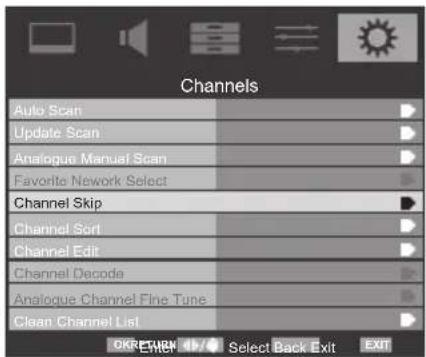
3 Press ▲ or ▼ to select the channels you want to skip, then press 🔒 to set.
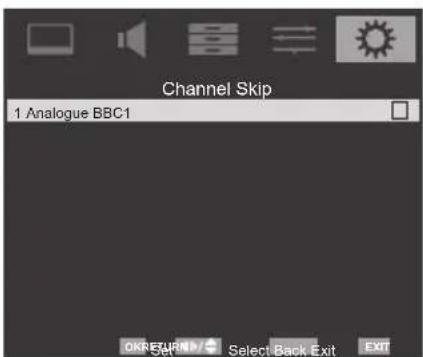
The Skipped programme positions cannot be selected by pressing P and P or by the controls on the television, but can still be accessed by the number buttons on the remote control.
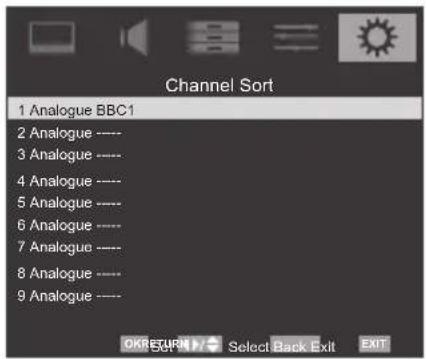
Channel Sort
Change the order of the programme list.
1 Select Channels from the SETUP menu.
2 Highlight Channel Sort and press ▶ or Ⓞ to enter.
3 Press ▲ or ▼ to select the first channel you want for sorting and then press Ⓞ to mark it. Press ▲ or ▼ again to select the second channel and then press Ⓞ to swap their positions.
Channel Edit
Edit the channel number and channel name.
1 Select Channels from the SETUP menu.
2 Highlight Channel Edit and press ▶ or Ⓧ to enter.
3 Press ▲ or ▼ to highlight the channel you want for editing and press OK to enter the "Channel Edit" screen.
4 Edit the Channel Number by pressing the number buttons 0\~9. Edit the Channel Name by pressing the number buttons 0\~9 to enter numbers and letters.
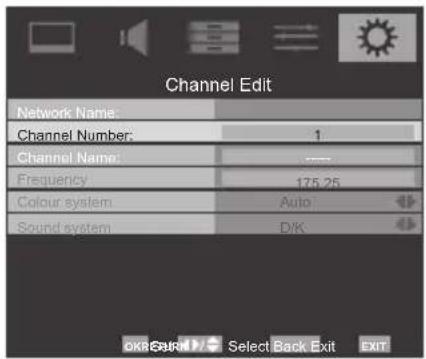
NOTE: The option Frequency, Colour system, and Sound system is available for Analogue TV mode only.
The number buttons on the remote control have the following characters assigned to them. Use the language characters to enter text. Repeatedly pressing the numbered key changes the text character, pressing ◀ deletes the previous text character.
| Number | Character |
| 1 A B | C 1 |
| 2 D E | F 2 |
| 3 G H | I 3 |
| 4 J K | L 4 |
| 5 M N | O 5 |
| 6 P Q | R 6 |
| 7 S T | U 7 |
| 8 V W | X 8 |
| 9 Y Z | 9 |
| 0 + - | . 0 |
Channel Decode
Channel Decode support the Canal+ (paid television channel); however, the channel also broadcast some un-encrypted programmes. These programmes without encryption can be viewed free of charge.
1 Select Channels from the SETUP menu.
2 Highlight Channel Decode and press ▶ or Ⓞ to enter.
3 Press ▲ or ▼ to highlight the channel and press ⓞ to set.
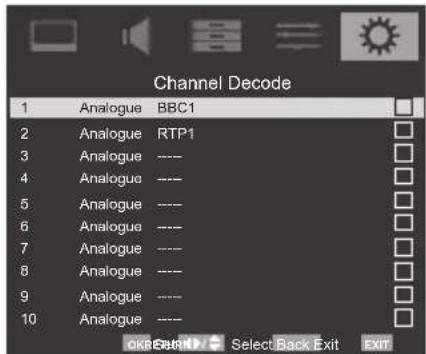
NOTE: This option is available for Analogue TV mode only.
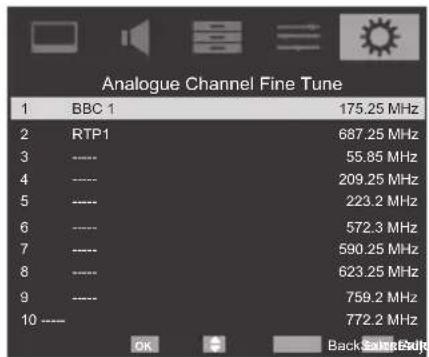
Analogue Channel Fine Tune
When the reception is poor, you can use this function to do the fine tuning.
1 In the SETUP menu, press ▼ to highlight Channels and press ▶ or oto enter.
2 Press ▼ to highlight Analogue Channel Fine Tune and press 🔒 to enter.
3 Highlight and press ⓣ to select the channel.
4 Press ◀ or ▶ to adjust the frequency. Press ◀ to decrease and ▶ to increase the frequency.
Clean Channel List
This feature cleans all the TV channels whilst your channel list is not empty.
1 In the SETUP menu, press ▼ to highlight Channels and press ▶ or 📷 to enter.
2 Press ▼ to highlight Clean Channel List and press ▶ or no enter.
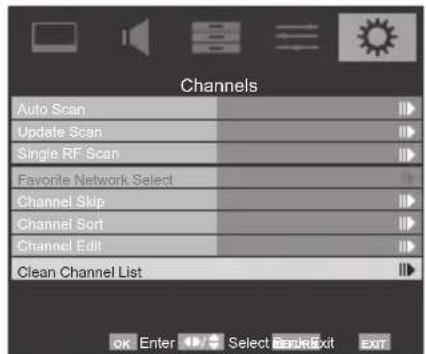
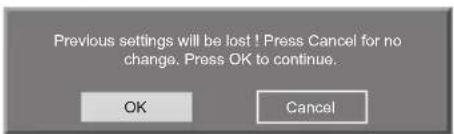
3 The Clean Channel List screen appears. Press to clean now.
Common Interface
This function enables you to watch some pay services (encrypted services). When the module is inserted into the CI slot, you can access the module menu. To purchase a module and smart card, contact your dealer. Common Interface functions may not be possible depending upon the country broadcasting circumstances.
1 Press MENU and press ◀ or ▶ to select APPLICATIONS.
2 Press ▼ to highlight Common Interface and press ▶ or OK
3 Press to select the CI card to view the Module information.
Reset TV
Selecting Reset TV will reset all TV settings to their original factory values, excludes Country, OSD Language, and Channels.
1 In the SETUP menu, press ▼ to highlight Reset TV and press ▶ or into enter.
2 Select OK to confirm or select Cancel to exit.
Automatic Power Down
The TV will automatically turn itself off (standby) after approximately 4 hours, if you do not touch the control buttons on the remote control or on the TV control panel.
1 In the SETUP menu, press ▼ to highlight Automatic Power Down.
2 Press ◀ or ▶ to select On or Off.
General controls
Selecting programme positions
To select a programme position, press the numbered buttons on remote control.
The programme positions can also be selected by pressing P and P.
To display on-screen information, i.e. programme position, input mode, or stereo/mono signal, press iPress it again to cancel.
Time Display
The time display facility allows the current (text service) time to be seen on the television screen.
Press on the remote control whilst watching a normal television broadcast to see the time display from the broadcaster. It will remain on screen for about 5 seconds.
NOTE: This option is available for Analogue TV mode only and may not be available in some cases.
Stereo and Bilingual transmissions
If the stereo or dual language broadcasts are transmitted, the icon 📄Stereo or 🐆Deal will appear on the screen each time the programme positions are changed, and will disappear after a few seconds. If the broadcast is not in stereo, the icon 🐆Mono will appear.
Stereo... Press □ to select Stereo or Mono. Bilingual... Bilingual transmissions are rare. If they are transmitted, the icon □ dual will display. Choose the required programme number. If the □ dual appears, press to select Dual1, Dual2, or Mono.
Quick Access Menu
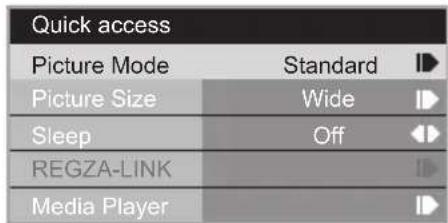
Quick access menu helps you access some options quickly, such as Picture Mode, Picture Size, Sleep, REGZA-LINK, and Media Player. Press QUICK button to display the Quick access menu and press ▲ or ▼ to select the option.
Sound controls
Volume
Volume
Press or to adjust the volume.
Sound Mute
Press ✗ once to turn the sound off, press again to cancel.
Balance, Bass, Treble
1 Press MENU and ◀ or ▶ to select SOUND.
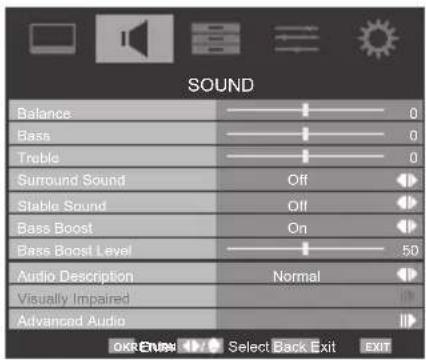
2 Press ▼ to highlight Balance, Bass or Treble. Press ◀ or ▶ to change the setting.
Surround Sound
This function enriches (expanding and deepening) the sound quality.
1 In the SOUND menu, press ▼ to select Surround Sound.
2 Press ◀ or ▶ to switch function On or Off.
Stable Sound®
Stable Sound reduces the volume level differences between channels. It automatically remains on the same volume level when you change channels.
1 In the SOUND menu, press ▼ to select Stable Sound.
2 Press ◀ or ▶ to switch function On or Off.
Bass Boost
Bass Boost enhances the depth of the sound on the TV speakers. The difference will only be noticeable on sound with strong bass.
1 In the SOUND menu, press ▼ to highlight Bass Boost.
2 Press ◀ or ▶ to switch function On or Off.
NOTE: The Surround Sound and Bass Boost functions are available for the sound from the TV's built-in speakers only.
Bass Boost Level
After setting the Bass Boost to On in the SOUND menu, you can adjust its level.
1 In the SOUND menu, press ▼ to highlight Bass Boost Level.
2 Press ◀ or ▶ to change the setting.
Audio Description
Audio Description is an additional narration describing on-screen action, body language, expressions and movements for people with visual disabilities whilst watching the TV. This function enables you to choose the type of narrations.
1 Press MENU and press ◀ or ▶ to select SOUND.
2 Press ▼ to highlight Audio Description and press ◀ or ▶ to select Normal, Hard of Hearing, and Visually Impaired.
NOTE: Press AD button on the remote control to switch the Audio Description On or Off.
Hard of Hearing: This function provides narration to deaf and hard of hearing viewers.
Visually Impaired: This function provides descriptive narration of key visual elements - making television programmes, feature films, home video and other visual media accessible to people who are visually blind or visually impaired.
Visually Impaired
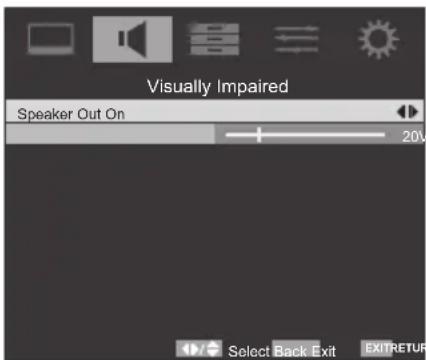
When the Audio Description is set to "Visually Impaired", you can adjust the volume of the Audio Description.
1 Press MENU and press ◀ or ▶ to select SOUND.
2 Press ▼ to highlight Audio Description and use ◀ or ▶ to select Visually Impaired.
3 Press ▼ to highlight Visually Impaired and press ▶ or 📷 to enter.
4 Make sure the Speaker Out option is set to On. Press ▼ to highlight Volume option, and press ◀ or ▶ to adjust the volume.
Advanced Audio Settings
The Advanced Audio settings help to create an enhanced surround sound experience with deep, rich bass from stereo sound sources. Your TV's audio will sound fuller, richer, and wider.
Highlight the Advanced Audio in the SOUND menu and press ▶ or 📄 to enter the Advanced Audio settings.
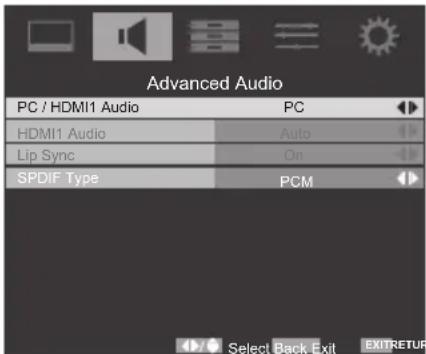
• PC/HDMI1 Audio: Receive sound from a connected PC.
- HDMI1 Audio: If the connected HDMI source does not support digital audio, plug the audio cable into PC/HDMI1 (Audio) on the back of the TV, then use the HDMI1 Audio setting. If the sound is missing, select an alternative setting.
- Lip Sync: Activates an audio/video display timing adjustment that allows HDMI devices to automatically synchronize accurately. Available for HDMI source only.
- SPDIF Type: Sends digital audio signal to the external audio system. The options are PCM, Dolby Digital, or Off.
DOLBY.
DIGITAL PLUS
Manufactured under licence from Dolby Laboratories.
"Dolby" and the double-D symbol are trademarks of Dolby Laboratories.
Widescreen viewing
Depending on the type of broadcast being transmitted, programmes can be viewed in a number of formats.
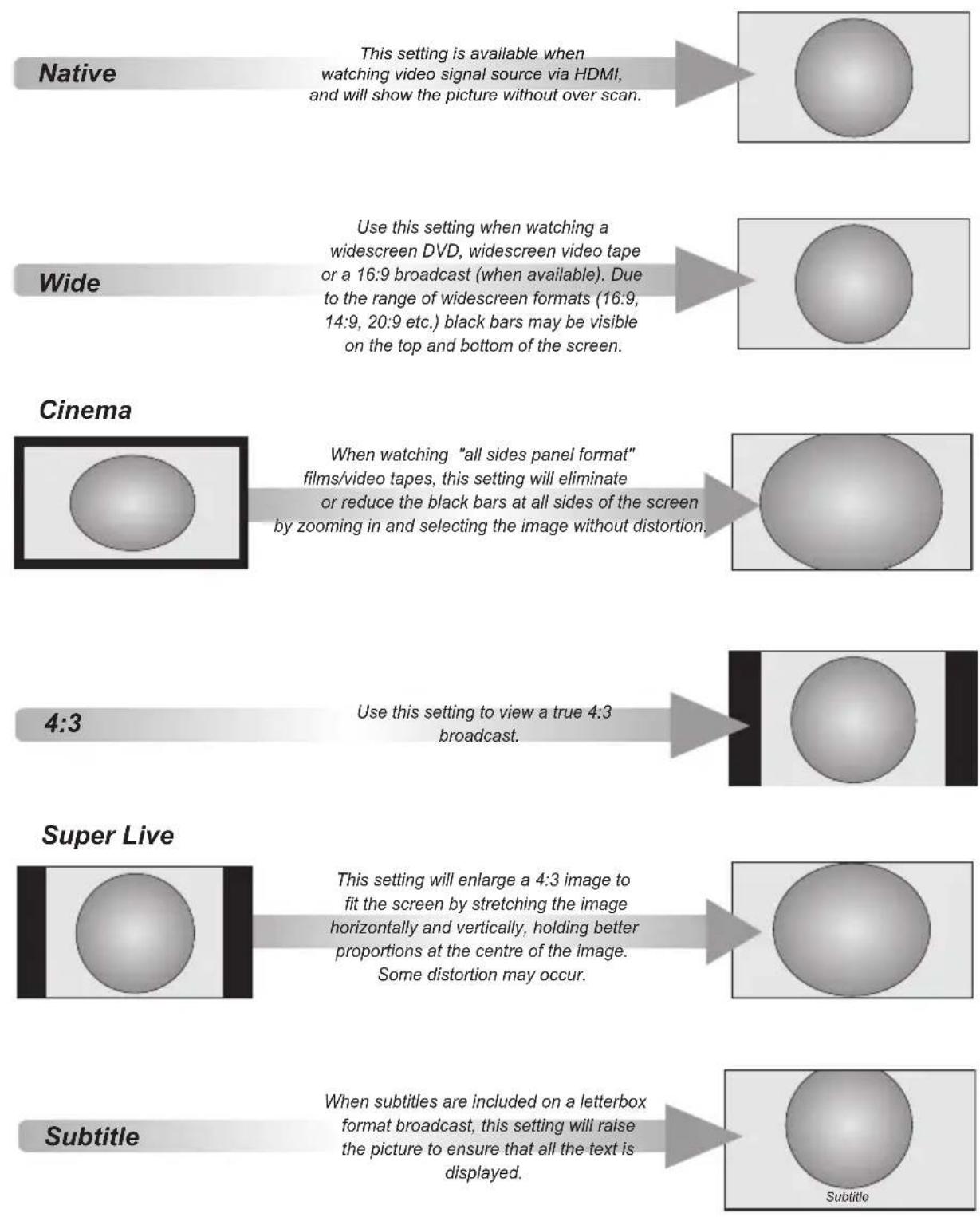
This setting is available when watching video signal source via HDMI, and will show the picture without over scan.
Use this setting when watching a widescreen DVD, widescreen video tape or a 16:9 broadcast (when available). Due to the range of widescreen formats (16:9, 14:9, 20:9 etc.) black bars may be visible on the top and bottom of the screen.
When watching "all sides panel format" films/video tapes, this setting will eliminate or reduce the black bars at all sides of the screen by zooming in and selecting the image without distortion.
Use this setting to view a true 4:3 broadcast.
This setting will enlarge a 4:3 image to fit the screen by stretching the image horizontally and vertically, holding better proportions at the centre of the image. Some distortion may occur.
When subtitles are included on a letterbox format broadcast, this setting will raise the picture to ensure that all the text is displayed.
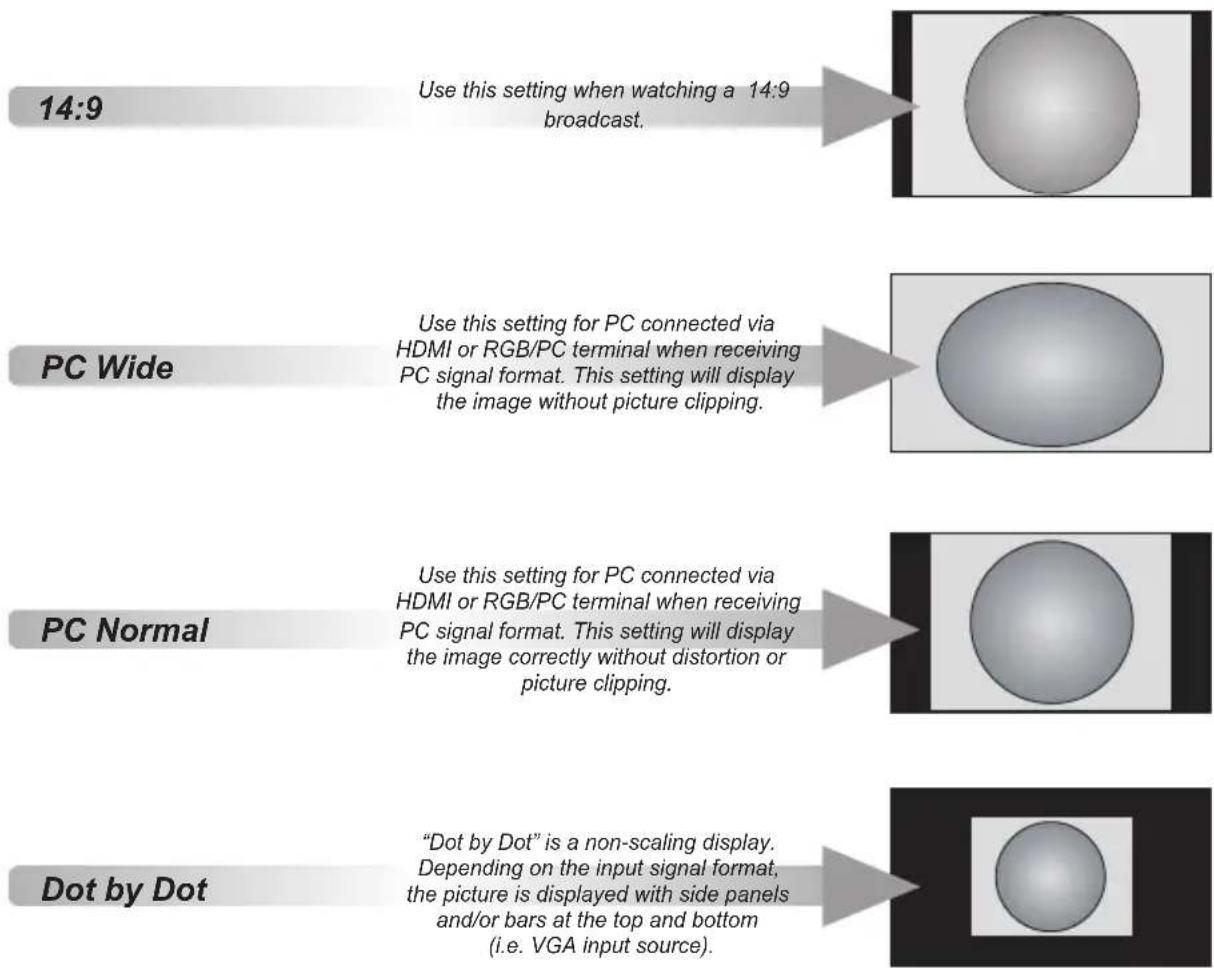
flowchart
graph TD
    A["14:9"] --> B["Use this setting when watching a 14:9 broadcast."]
    C["PC Wide"] --> D["Use this setting for PC connected via HDMI or RGB/PC terminal when receiving PC signal format. This setting will display the image without picture clipping."]
    E["PC Normal"] --> F["Use this setting for PC connected via HDMI or RGB/PC terminal when receiving PC signal format. This setting will display the image correctly without distortion or picture clipping."]
    G["Dot by Dot"] --> H[""Dot by Dot" is a non-scaling display. Depending on the input signal format, the picture is displayed with side panels and/or bars at the top and bottom (i.e. VGA input source)."]
Press QUICK to display the Quick access menu and press ▼ or ▲ to select the Picture Size and press OK Quick access
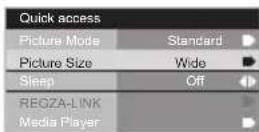
You can choose the picture size from Wide, Cinema, 4:3, Super Live, Subtitle, 14:9, Native, PC Wide, PC Normal, and Dot by Dot.
Using the special functions to change the size of the displayed image (i.e. changing the height/width ratio) for the purposes of public display or commercial gain may infringe on copyright laws.
Available Picture Size
| Screen Mode | SD (up to 480p) HD (up to 1080p) PC Mode | ||
| Wide Yes | Yes No | ||
| 4:3 Yes | Yes No | ||
| Super Live Yes | No No | ||
| Cinema Yes | Yes ( | "No" for model 19/22AV71*B) | No |
| Subtitle | Yes Yes ( | "No" for model 19/22AV71*B) | No |
| 14:9 | Yes | No No | |
| Native | Yes(only in HDMI) | Yes(only in HDMI) | No |
| PC Wide | No | No | Yes ("No" for SXGA 1280x1024) |
| PC Normal | No | No Yes | |
| Dot by Dot | No | No Yes | |
Picture controls
Picture Mode
You can adjust the best picture appearance by selecting the preset value in picture mode based on the programme category.
1 Press MENU and press ◀ or ▶ to select PICTURE.
2 Press ▼ to highlight Picture Mode and press ◀ or ▶ to select Store, Dynamic, Standard, Movie, PC, or User.
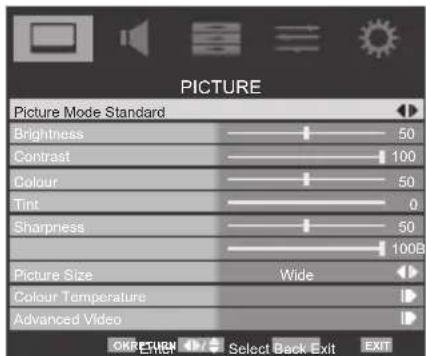
NOTE: The Store mode is available only when the Location in SETUP menu is set to Store.
Brightness, Contrast, Colour and Tint
1 In the PICTURE menu, press ▼ to select Brightness, Contrast, Colour or Tint.
2 Press ◀ or ▶ to adjust your preference.
Sharpness
This function increase or decrease the sharpness of the picture. The picture shows the clear edge when you increase the values.
1 In the PICTURE menu, press ▼ to select Sharpness.
2 Press ◀ or ▶ to adjust your preference.
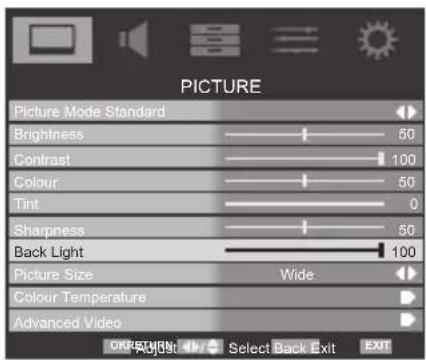
Back Light Adjustment
Adjusting the Back Light can improve the clarity of the screen when viewing.
1 Press MENU and press ◀ or ▶ to select PICTURE.
2 Press ▼ to highlight Back Light and press ◀ or ▶ to adjust.
Colour Temperature
Colour Temperature increases the 'warmth' or 'coolness' of a picture by increasing the red or blue tint.
1 In the PICTURE menu, press ▼ to highlight Colour Temperature and press ▶ or OK to enter.
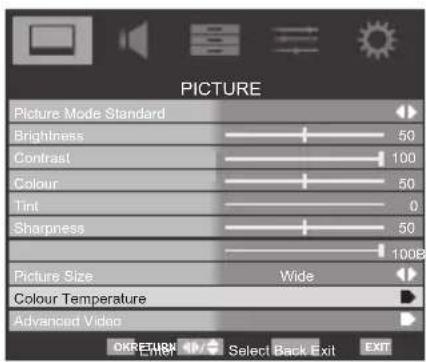
2 Press ◀ or ▶ to select Cool, Medium, Warm or User to suit your preference.
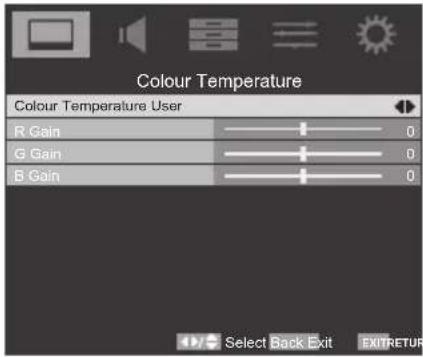
NOTE: R/G/B Gain: Increase or decrease the red/green/blue levels in the picture.
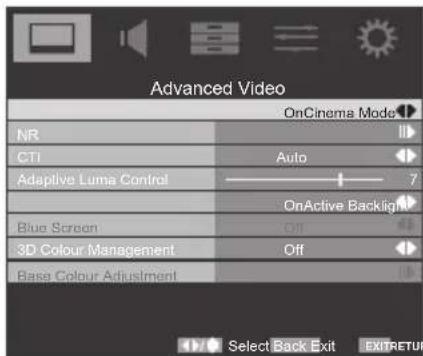
Cinema Mode
The frame rate of a movie film is generally 24 frames a second whereas the movie software such as DVD, etc. that you enjoy watching on television at home is 30 or 25 frames a second. The difference in frame rate may cause flickers whilst viewing the films on television; set the Cinema Mode to convert the signal to reproduce a smooth motion and picture quality.
1 In the PICTURE menu, press ▼ to highlight Advanced Video and press ▶ to enter.
2 Press ▼ to highlight Cinema Mode, and press ◀ or ▶ select from On or Off.
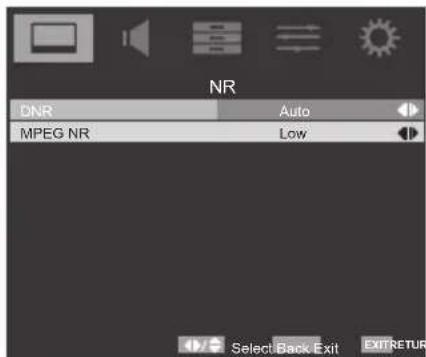
DNR
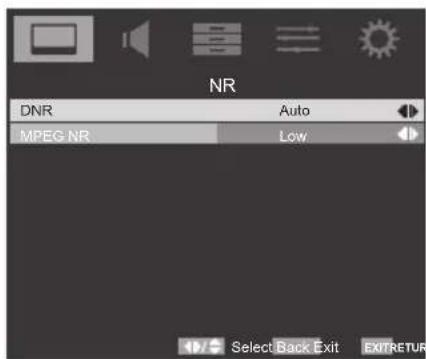
DNR (Digital Noise Reduction) enables you to 'soften' the screen representation of a weak signal to reduce the noise effect.
1 In the PICTURE menu, press ▼ to highlight Advanced Video and press ▶ or OK to enter.
2 Press ▲ or ▼ to highlight NR and press ▶ or ⊗ to enter.
3 Press ▲ or ▼ to highlight DNR and press ◀ or ▶ to select Low, Middle, High, Auto or Off.
MPEG NR
If the receiving signal of MPEG has a grained noise depending on the compression and conversion, the noise may be reduced when using this function.
1 In the PICTURE menu, press ▲ or ▼ to highlight Advanced Video and press ▶ or Ⓞ to enter.
2 Press ▲ or ▼ to highlight NR and press ▶ or ⓣ to enter.
3 Select the MPEG NR and press ◀ or ▶ to select Low, Middle, High, or Off.
CTI
The Colour Transient Improvement (CTI) involves the detection and sharpening of edges around colour objects on the screen.
1 In the PICTURE menu, press ▼ to highlight Advanced Video and press ▶ or OK to enter.
2 Select the CTI, and press ◀ or ▶ to select Auto or Off.
Adaptive Luma Control
Automatically adjusts the brightness and contrast after analyzing the input signal. This function enriches the colours and the depth of the picture.
1 In the PICTURE menu, press ▼ to highlight Advanced Video and press ▶ or 🔒 to enter.
2 Press ▼ to highlight Adaptive Luma Control and press ◀ or ▶ to adjust your preference.
Active Backlight
When Active Backlight control is activated, it will automatically optimise the backlighting levels for dark scenes.
1 In the PICTURE menu, press ▼ to highlight Advanced Video and press ▶ to enter.
2 Press ▼ to highlight Active Backlight and press ◀ or ▶ to select On or Off.
Blue Screen
When Blue Screen is selected, the screen will turn blue and the sound will be muted when no signal is received.
1 In the PICTURE menu, press ▼ to highlight Advanced Video and press ▶ or OK to enter
2 Press ▼ to highlight Blue Screen and press ◀ or ▶ to select On or Off.
3D Colour Management
When 3D Colour Management is selected, it allows the 'Base Colour Adjustment' feature to become available.
1 In the PICTURE menu, press ▲ or ▼ to highlight Advanced Video and press ▶ or Ⓧ to enter.
2 Press ▲ or ▼ to highlight 3D Colour Management.
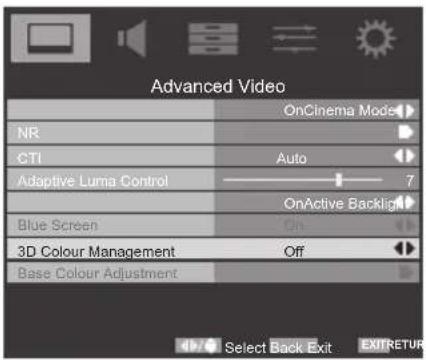
3 Press ◀ or ▶ to select On or Off.
Base Colour Adjustment
The Base Colour Adjustment feature allows the adjustment of individual colours to suit personal preference. This can be useful when using an external source. It only can be adjusted when Colour Management is set to On.
1 Highlight Advanced Video in the PICTURE menu. Press ▲ or ▼ to highlight 3D Colour Management and press ◀ or ▶ to select On.
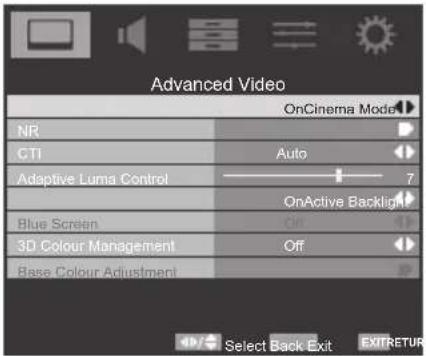
2 Press ▲ or ▼ to highlight Base Colour Adjustment and then press ▶ or OK
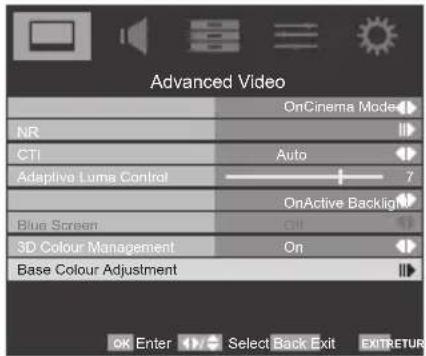
3 Press ▲ or ▼ to select an option, then press Ⓞ to enter the adjustment setting window.
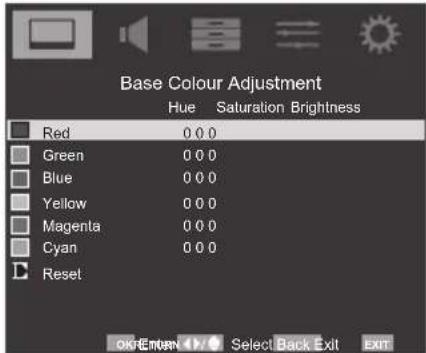
4 Press ◀ or ▶ to select Hue, Saturation, or Brightness, then press ▲ or ▼ to adjust the settings as required.
NOTE: To return to the original factory settings, select Reset and press OK
HDMI RGB Range
Adjusts RGB full range signal automatically. When Limit is selected the RGB signal's output range is 16 to 235. When Full is selected the RGB signal's output range is 0 to 255.
In the PICTURE menu, press ▲ or ▼ to highlight Advanced Video and press ▶ or Ⓞ to enter.
2 Press ▲ or ▼ to highlight HDMI RGB Range and press ◀ or ▶ to select Auto, Full, or Limit.
NOTE: If the HDMI connection is capable of 1080p and/or the television is capable of refresh rates greater than 50Hz or supports Deep Colour, a Category 2 cable will be required. Conventional HDMI/DVI cables may not work properly with this mode.
H./V. Position
Adjust the horizontal and vertical position of the picture.
1 In the PICTURE menu, press ▲ or ▼ to highlight Advanced Video and press ▶ or Ⓞ to enter.
2 Press ▼ to highlight H./V. Position and press ▶ or Ⓞ to enter.
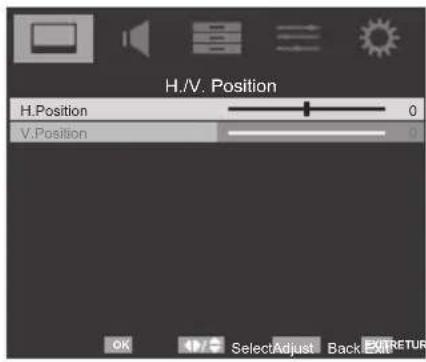
3 Press ▲ or ▼ to select H. Position or V. Position and press ◀ or ▶ to adjust.
NOTE: For PC input, V. Position adjustment is not linear. In another words, when you adjust V. Position, the OSD value will change by 2 or greater value depending TV's calibration process.
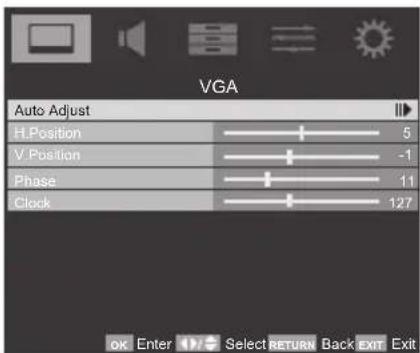
VGA
The VGA adjustment is available only when the input source is PC and your TV is receiving a computer signal.
1 In the PICTURE menu, press ▼ to highlight VGA and press ▶ or 📷 to enter.
2 Select Auto Adjust for automatic adjusting, or press ◀ or ▶ to manually adjust the H.Position, V.Position, Phase, or Clock.
Timer control
Time Zone
When you select a Time Zone, the TV time is set by the time offset information based on Time Zone and GMT (Greenwich Mean Time) which is received with the broadcast signal and the time is set automatically by a digital signal.
1 Highlight the Time Setup in the
APPLICATIONS menu and press ▶ or OK to select Time Zone.
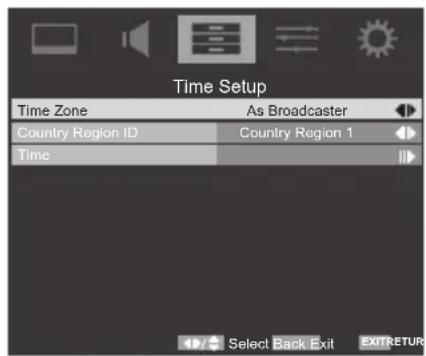
2 Press ◀ or ▶ to select your viewing area or "As Broadcaster".
Country Region ID
This option is only available for Country option of Spain or Portugal and Time Zone is set to As Broadcaster.
Time
The time is set automatically when receiving a digital signal. (You can set the time manually only if the TV has no DTV signal.)
You must set the time correctly before using Power On/Off Timer function.
1 Highlight the Time Setup in the APPLICATIONS menu and press ▶ or Ⓞ to enter.
2 Press ◀ or ▶ to set the Auto Synchronization On/Off.
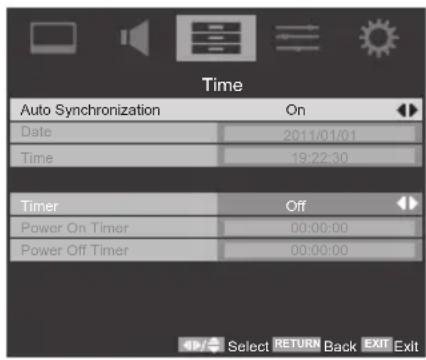
3 If you set the Auto Synchronization Off, you can set the Date and Time manually by pressing ▲, ▼, ◀ and ▶ to select position, and pressing the number buttons 0\~9 to enter the figures.
4 Press ▲, ▼, ◀ and ▶ to select the Power On/Off Timer.
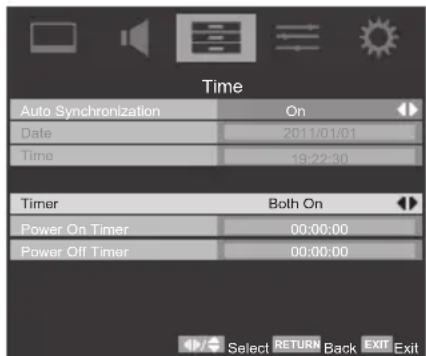
The Power On Timer function switches the TV on automatically at a preset time.
The Power Off Timer function switches the TV off automatically at a preset time.
Sleep Timer
The television can be set to turn itself Off automatically after a preset time.
1 Press ▼ to highlight Sleep Timer in the APPLICATIONS menu.
2 Press ◀ or ▶ to set the timer from Off, 10, 20, 30, 40, 50, 60, 90 or 120 Minutes.
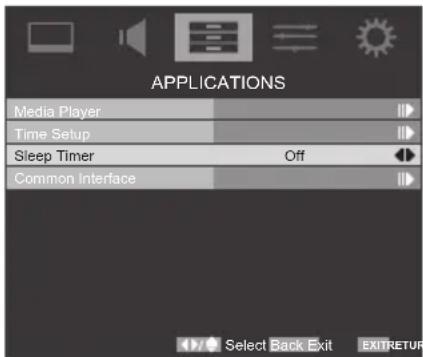
NOTE: To cancel the Sleep Timer, select Off in above setting.
Input selection and AV connections
Defining the INPUT and OUTPUT sockets so that the television recognises connected equipment.
See page 8 for a clear view of the back connection recommendations.
Most media recorders and decoders send a signal through the SCART lead to switch the television to the correct Input socket.
Alternatively press the external source selection button - until the picture from connected equipment is shown.
Input selection
Use the input selection if the television does not switch over automatically.
1 Press ⚡A list will appear on screen showing all stored external equipment. Press ▲ and ▼ to highlight and ⓞ to select.
Model 19/22
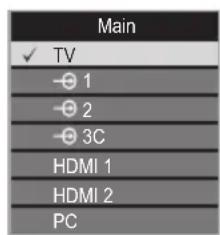
Model 26/32/40
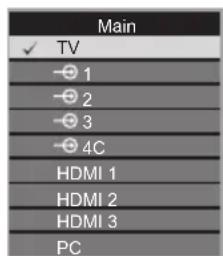
NOTE: The "HDMI 3" port is available for model 32/40LV71*B only.
HDMI ^® displays equipment connected to Input HDMI on the back or side of the television. It is designed for best performance with 1080p high definition signals.
Input signal selection
This specifies the type of signal going into SCART on the back of the television. Please refer to the manufacturers instructions for the connected equipment.
1 In the SETUP menu, press ▼ to highlight SCART, then press ▶ or 🔍 to enter.
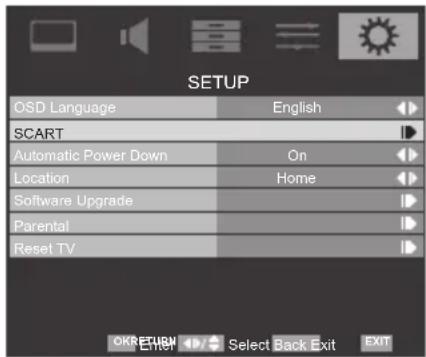
2 Model 19/22: Press ◀ or ▶ to select Auto, Mixed, RGB, Composite, or S-Video.
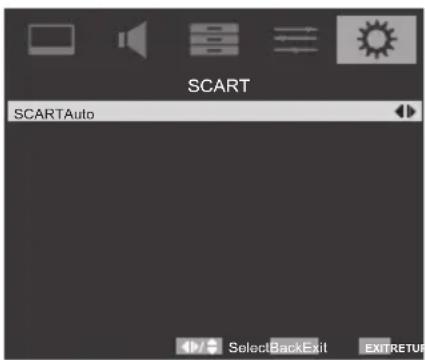
Model 26/32/40:
- Press ▲ or ▼ to select SCART 1 and press ◀ or ▶ to select Auto, Mixed, RGB, Composite, or S-Video.
- Press ▲ or ▼ to select SCRAT 2 and press ◀ or ▶ to select Auto, Composite, or S-Video.
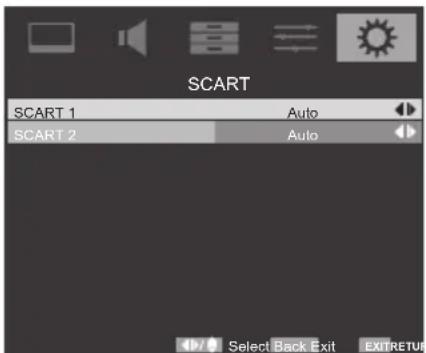
Check the signal output of the DVD or compatible device, please select the correct setting for "SCART input".
REGZA-LINK Controls
This feature uses CEC (Consumer Electronics Control) technology, and allows the control of Toshiba REGZA-LINK compatible equipment from the television's remote control.
NOTE: Not all Toshiba products currently support REGZA-LINK.
Equipment Control
The REGZA-LINK mode on the television's remote control allows the control of connected REGZA-LINK equipment being watched.
To control the REGZA-LINK input source, first select the equipment with REGZA-LINK input source selection, then switch the mode on the remote control to REGZA-LINK and press any buttons.
The available functions are dependent on the equipment connected. Not all the remote control keys may be available. Please refer to the operation manual for each piece of equipment connected.
NOTE: The television features that can be controlled by the connected equipment are: Standby, Volume, Channel, Sound Mute, Display Information, Number Buttons and Previous Programme.
Input Source Selection
When any equipment using CEC technology is connected, the REGZA-LINK icon will appear in the input source list allowing selection of individual devices.
1 Press . A list will appear on screen showing modes and all stored external equipment.
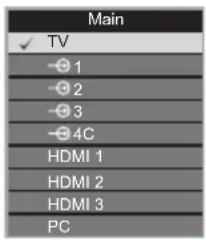
NOTE: The "HDMI 3" port is available for model 32/40LV71*B only.
2 The REGZA-LINK icon appears automatically after detected with REGZA-LINK compatible equipment. Press ▼ to highlight the input source shown with the REGZA-LINK icon.
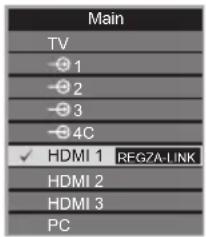
3 Press ▶. A second selection screen will appear showing all connected REGZA-LINK equipment.
4 Press ▲ or ▼ to highlight an input source, and then press ⚫ to select.
NOTE 1: When the television is switched on, it will take a few minutes for the REGZA-LINK icon to appear in the list, when an HDMI cable is removed, it will take a few minutes for the logo to disappear.
NOTE 2: If the HDMI cable from the connected equipment is changed, or HDMI equipment settings are changed, the Enable REGZA-LINK in the REGZA-LINK setup menu may need to be reset to On.
NOTE 3: When the REGZA-LINK input source is selected, some REGZA-LINK equipment may automatically switch on.
The following features are dependent on the connected equipment. For operating information, refer to the operation manual for all connected equipment.
Pass-Through Control
The Pass-Through feature allows you to control the connected REGZA-LINK device by the television's remote control.
1 Press ▲ or ▼ to select REGZA-LINK in the Quick Access Menu, and then press OK. The control panel will appear.
When there are two or more REGZA-LINK devices connected to the television, a device selection menu will appear. Highlight the device you want to control, and then press Ⓞto select.
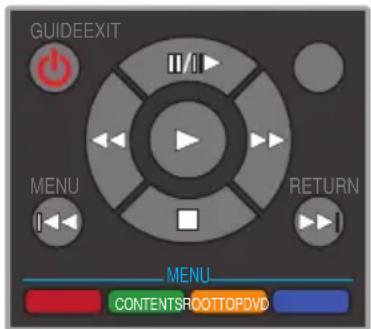
2 Press the key on the television's remote control as guided by the control panel shown.
NOTE: The available functions are dependent on the connected equipment, not all the remote functions may be available. Please refer to the operation manual of the connected equipment.
REGZA-LINK Menus
By activating the Enable REGZA-LINK feature in the REGZA-LINK setup menu, individual REGZA-LINK features can then be activated.
One Touch Play
The function of REGZA-LINK will automatically power on the television that was in standby mode and switch the television's input source to the port connected with the audio/video equipment by powering-on or playing from the audio/video equipment.
NOTE: This feature is dependent on the connected equipment and television setting.
System Standby
This feature automatically switches the connected equipment into standby when the television goes into standby and conversely for the television to switch into standby when connected equipment goes into standby. It is selected in the REGZA-LINK setup menu.
NOTE: This feature is dependent on the connected equipment and television setting.
System Audio Control
Using the Speaker Preference feature allows the televisions remote control to adjust the volume or mute the sound of the speakers connected to the television via an AV amplifier.
Ensure that the connected AV amplifier and REGZA-LINK equipment are selected in the input source selection and that the Speaker Preference is set to Amplifier in the REGZA-LINK setup menu.
NOTE: When the AV Amplifier is switched on, its input source changed or the volume adjusted, the sound will be output from the AV Amplifier's speakers even if TV Speakers has been selected. Turn the television off then on again to output the sound from the TV's speakers.
The full function may not work and is dependent on the Amplifier being used.
PC Link
This feature automatically adjusts the suitable widescreen formats and picture preferences when connected to a REGZA-LINK PC.
NOTE: This feature is dependent on the connected equipment.
Enable REGZA-LINK
When the Enable REGZA-LINK is set to On, it allows the other functions to be enabled.
1 In the PREFERENCES menu, press ▼ to select REGZA-LINK Setup, and then press ▶ or 📄
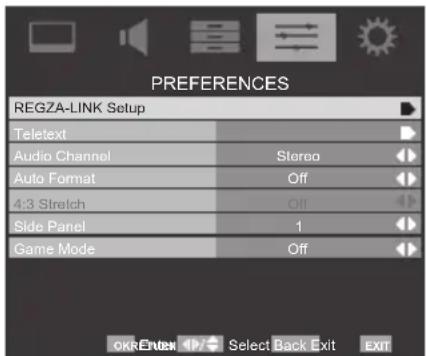
2 Press ▼ to highlight Enable REGZA-LINK, then press ◀ or ▶ to select On or Off.
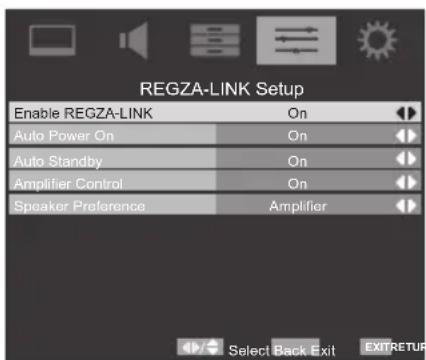
TV Auto Power On
The Auto Power On setting allows the television to be automatically switched On or Off if a REGZA-LINK device is turned On or Off.
1 In the REGZA-LINK Setup menu, press ▼ to highlight Auto Power On.
2 Press ◀ or ▶ to select On or Off.
Auto Standby
When the Auto Standby is enabled, switching off the television will automatically switch off all connected REGZA-LINK equipment.
1 In the REGZA-LINK Setup menu, press ▼ to highlight Auto Standby.
2 Press ◀ or ▶ to select On or Off.
Amplifier Control
When Amplifier Control is enabled REGZA-LINK allows some of the amplifier features to be controlled with the television remote control.
1 In the REGZA-LINK Setup menu, press ▼ to highlight Amplifier Control.
2 Press ◀ or ▶ to select On or Off.
Speaker Preference
This feature allows the audio output preference to be set to the TV speakers or AV amplifier speakers. The AV Amplifier option lets the televisions remote control adjust or mute the volume of the audio.
1 In the REGZA-LINK Setup menu, press ▼ to highlight Speaker Preference.
2 Press ◀ or ▶ to select TV Speakers or Amplifier.
Media Player
Enter Media Player
The Media Player allows the viewing of photos (JPEG files) and music (MP3 files) stored in a USB storage device. (Connectivity is not guaranteed for all devices.)
1 To open Media Player, highlight the Media Player in the APPLICATIONS menu and press ▶ or OK
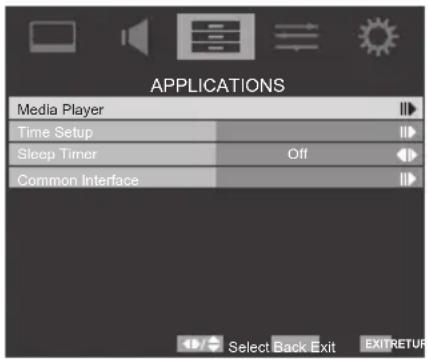
2 Press ▲ or ▼ to highlight Photo or Music, then press ⓧ the Media Player will open. You may also use the Quick Access Menu to enter.
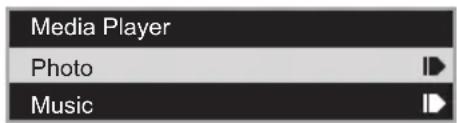
NOTE 1: The Media Player will open even if there are no images on the USB flash drive.
NOTE 2: On-screen menus will not display whilst the Media Player is being used.
NOTE 3: MP3 is the MPEG Layer-3 audio coding technology licensed from Fraunhofer IIS and Thomson.
Photo Multi-View
This view mode allows all the images within a selected folder to be viewed simultaneously, using thumbnail views in a grid. The initial highlighted position will be the top left image within the grid.
1 Open Media Player. Press ▲, ▼, ◀, or ▶ to select a folder then press OK All the images in the folder will appear in the Multi View grid.
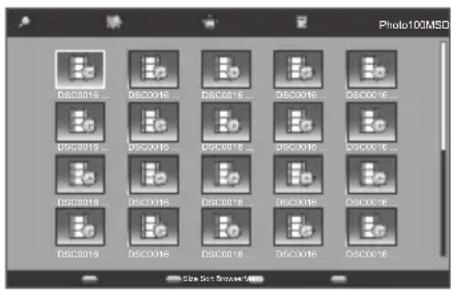
2 Press ▲, ▼, ◀, or ▶ to move through the images. If there are too many images for the screen, pressing ◀ on the top left image will show the previous page moving the highlight to the bottom right image. Alternatively, pressing ▶ on the bottom right image will show the next page moving the highlight to the top left image.
If there is more than one page of images within the folder pressing P and P will move through the pages.
3 Press RETURN to leave the current folder. Press EXIT to return to the last viewed source.
- Menu: Enter menu option. The options are: Sort, Media Type, and Thumbnail Size.
- Size: Decides to show the Multi View by Small, Middle, or Large thumbnail size.
- Sort: Decides to sort the photo files by File Date or Name.
- Browser/Menu: Decides to browse photos by thumbnail or list mode.
Playing Photo Slideshow
This view mode displays all the images in a selected folder as a slideshow, scrolling through them automatically.
1 In the Multi View grid, press ▲, ▼, ◀, or ▶ to highlight an image. Press Ⓧ Slideshow will now display all the images in the selected folder.
2 Pressing P and P will display next or previous images. The images can also be rotated and their information displayed.
3 Press EXIT to return to the last viewed source.
- Menu: Select the playing method. The options are: Pause, Repeat, Shuffle, Duration, Effect, and Show Info.
- Duration/Rotate: Whilst in play mode, press to select the duration to play next one. The options are: Short, Medium, and Long. Whilst in pause mode, press to rotate the still photo.
- Effect: Whilst in play mode, press to select the playing effect. The options are: None, Dissolve, Wipe right, Wipe left, Wipe up, and Wipe down.
- Pause/Play: Press to pause whilst in play mode. Press to play whilst in pause mode
Viewing Music Files
This view mode allows all the music files within a selected folder to be viewed simultaneously, using thumbnail views in a grid. The initial highlighted position will be the top left image within the grid.
1 Open Media Player. Press ▼ to highlight Music.
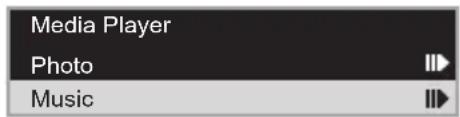
2 In Media Player, press ▲, ▼, ◀, or ▶ to select a folder then press ☑All the music files in the folder will appear in the Multi View grid.
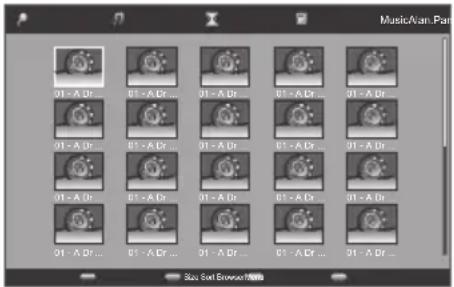
Press ▲, ▼, ◀, or ▶ to move through the music files. If there are too many music files for the screen, pressing ◀ on the top left file will show the previous page moving the highlight to the bottom right file. Alternatively, pressing ▶ on the bottom right file will show the next page moving the highlight to the top left file.
If there is more than one page of images within the folder pressing P and P will move through the pages.
4 Press RETURN to leave the current folder. Press EXIT to return to the last viewed source.
- Menu: Enter menu option. The options are: Sort, Media Type, and Thumbnail Size.
- Size: Decides to show the thumbnail size by Small, Middle, or Large.
- Sort: Decides to sort the music files by Name, Genre, Artist, or Album.
- Browser/Menu: Decides to browse music files by thumbnail or list mode.
Playing Music
The Music feature plays MP3 files stored on a USB storage device.
1 In the Multi View grid, press ▲, ▼, ◀, or ▶ to highlight a music file. Press to start playing all the music files in the selected folder.
2 Press to pause, press it again to play. Press EXIT to return to the last viewed source
NOTE 1: Whilst playing the music files, you may select the playing methods among Repeat, Shuffle, Audio Only, or display the music file Info.
NOTE 2: MP3 is the MPEG Layer-3 audio coding technology licensed from Fraunhofer IIS and Thomson
Preference control
Analogue Subtitle
You can set the subtitle on or off whilst watching TV.
1 Highlight Subtitle in the PREFERENCES menu, and press ▶ or 📷 to enter.
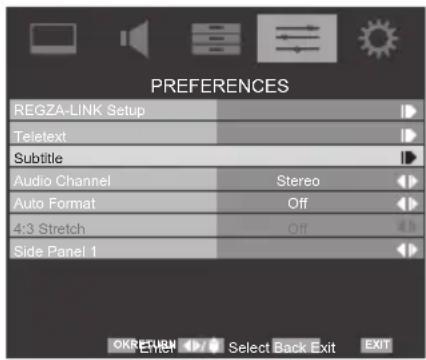
2 Press ▲ or ▼ to select the Analogue Subtitle and press ◀ or ▶ to select On, Mute, or Off.
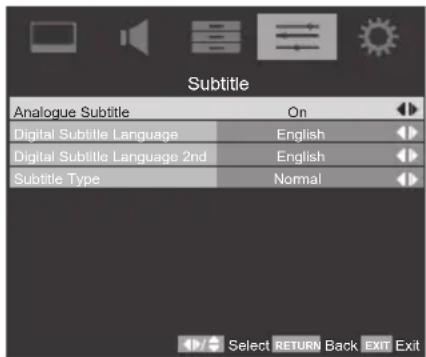
NOTE: When Analogue Subtitle is selected to "Mute", the analogue subtitle will be displayed on the screen but the speaker muted simultaneously.
Digital Subtitle
Use the Digital Subtitle function when two or more subtitle languages are broadcasted. If subtitle data in a selected language is not broadcasted, the default language subtitle will be displayed.
1 Highlight Subtitle in the PREFERENCES menu, and press ▶ or 📷 to enter.
2 Press ▲ or ▼ to select the Digital Subtitle Language or Digital Subtitle Language 2nd and press ◀ or ▶ to select the language.
NOTE: If the language in the Digital Subtitle Language is not available, the Digital Subtitle Language 2nd will be displayed.
Subtitle Type
You can choose the Subtitle Type from Normal or Hearing Impaired. If the "Hearing Impaired" is selected, it provides subtitle services to deaf and hard of hearing viewers with additional descriptions.
1 Highlight Subtitle in the PREFERENCES menu, and press ▶ or OK to enter.
2 Press ▲ or ▼ to select the Subtitle Type and press ◀ or ▶ to select Normal or Hearing Impaired.
Audio Languages
This feature allows a programme or film to be viewed with a choice of soundtrack language, provided they are currently being broadcast.
1 In the PREFERENCES menu, press ▼ to highlight Audio Language or Audio Language 2nd.
2 Press ◀ or ▶ to select an option.
NOTE: The option V.O. is only available when the Country in the SETUP menu is set to France.
Audio Channel
If stereo or dual language broadcasts are transmitted, the word Stereo or Dual will appear on the screen each time the programme positions are changed, and then disappear after a few seconds. If the broadcast is not in stereo, the word Mono will appear.
1 In the PREFERENCES menu, press ▼ to highlight Audio Channel.
2 Press ◀ or ▶ to select Stereo, Dual1, Dual2, or Mono.
Auto Format
When the television receives a true Widescreen picture and Auto Format is On, it will automatically be displayed in Widescreen format, irrespective of the television's previous setting
1 In the PREFERENCES menu, press ▼ to highlight Audio Format.
2 Press ◀ or ▶ to select On or Off.
4:3 Stretch
If the 4:3 stretch is On, the picture size will auto stretch to 4:3 aspect ratio in Widescreen format.
Highlight 4:3 Stretch in the PREFERENCES menu, and press ◀ or ▶ to select On or Off.
NOTE: 4:3 Stretch is only activated when Auto Format is set to On.
Side Panel Adjustment
The Side Panel feature lightens or darkens the band each side of the screen when in 4:3 or 14:9 format. This helps prevent image retention of the band and can also make viewing in bright or dark conditions more comfortable.
1 In the PREFERENCES menu, press ▼ to highlight Side Panel.
2 Press ◀ or ▶ to select 1, 2, or 3.
NOTE: This function is not available in DTV mode.
Game Mode
The Game Mode helps to speed up video response for game application.
1 the PREFERENCES menu, press ▼ to highlight Game Mode.
2 Press ◀ or ▶ to select On or Off.
Parental control
This function blocks channels or programmes that you do not want to or that you do not want your children to watch.
A password is required to access this function. The factory default password is "0000".
NOTE: When Channel Block, Programme Block and Input Block are activated, you will need to enter the 4-digit password before you enter the Channels submenu under the SETUP. After auto scan, all the channel blocks will be cleared.
Channel Block
This function blocks channels that you do not want to or that you do not want your children to watch.
1 Highlight Parental in the SETUP menu, and press ▶ or 📷 to enter.
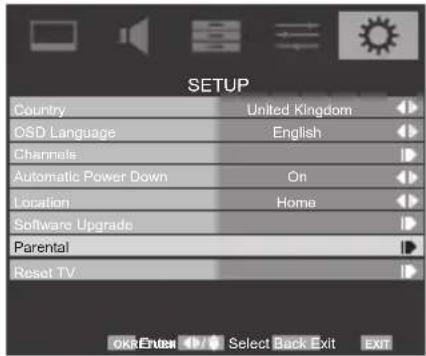
2 Enter the 4-digit password.
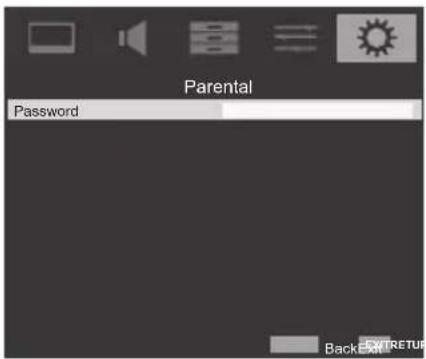
3 Press ▼ to highlight the Channel Block and press ▶ or 📞 to enter.
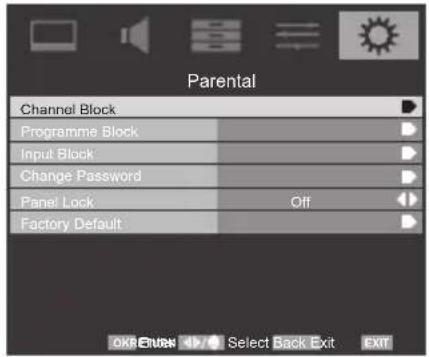
4 Press ▼ to highlight the channels you want to block, then press 🔒 to set.
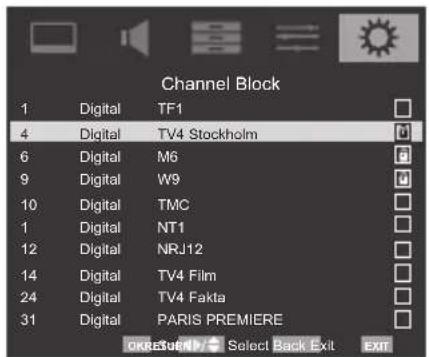
Programme Block
This function prevents children from watching certain TV programmes, according to the rating limit set.
This function operates according to information from the broadcasting station. Therefore if the signal has no information, this function does not operate.
1 Highlight the Parental in the SETUP menu, and press ▶ or 📷 to enter.
2 Enter the 4-digit password.
3 Press ▼ to highlight the Programme Block and press ▶ or info to enter.
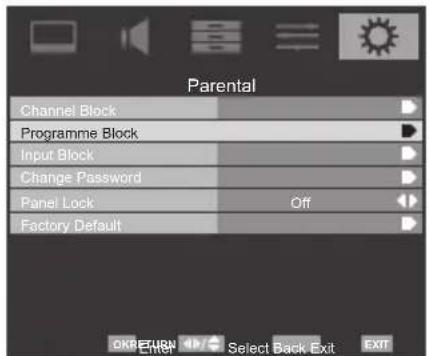
4 Press ◀ or ▶ to set the Age Rating from age 4\~18 or select None to turn this function off.
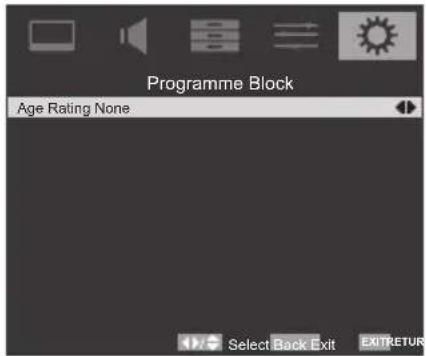
NOTE: This function is available for the programme with Age Rating information.
Input Block
This function can disable the specific external input signals.
1 Highlight Parental in the SETUP menu, and press ▶ or 📷 to enter.
2 Enter the 4-digit password.
3 Press ▼ to highlight the Input Block and press ▶ or to enter.
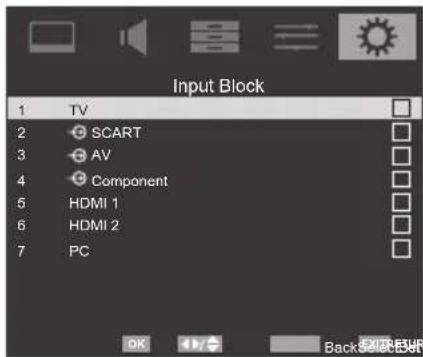
4 Press ▲ or ▼ to highlight the input that you want to disable and press 🔍 to lock.
Model 19/22
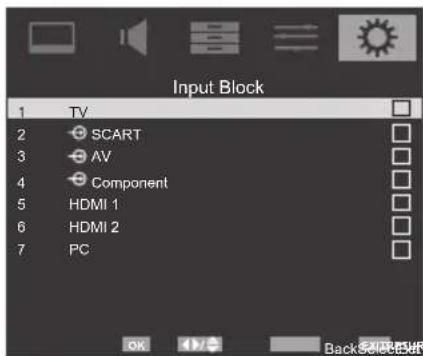
Model 26/32/40
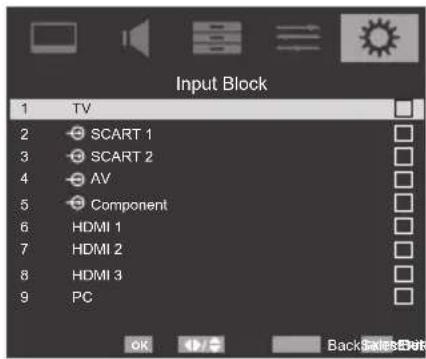
NOTE: The "HDMI 3" port is available for model 32/40LV71*B only.
Change Password
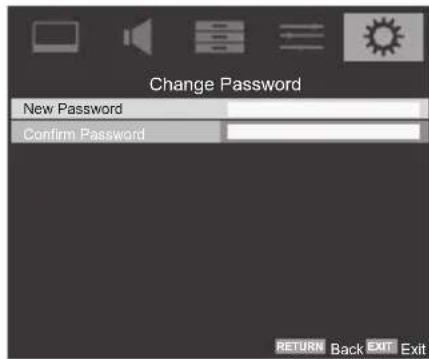
Change the 4-digit parental control password. The default password is 0000.
1 Highlight Parental in the SETUP menu, and press ▶ or Ⓞ to enter.
2 Enter the 4-digit password.
3 Press ▲ or ▼ to highlight the Change Password and press ▶ or ⓣ to enter.
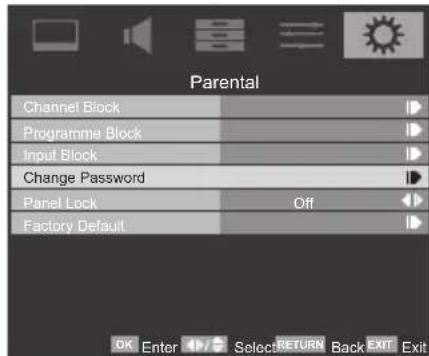
4 Enter the 4-digit new password, and re-enter the new password again to confirm.
Panel Lock
You can lock the control buttons on your TV by using this Panel Lock. When this function enables, the TV can be controlled only by the remote control.
1 Highlight Parental in the SETUP menu, and press ▶ or OK to enter.
2 Enter the 4-digit password.
3 Press ▼ to highlight the Panel Lock and press ◀ or ▶ to switch the function On or Off.
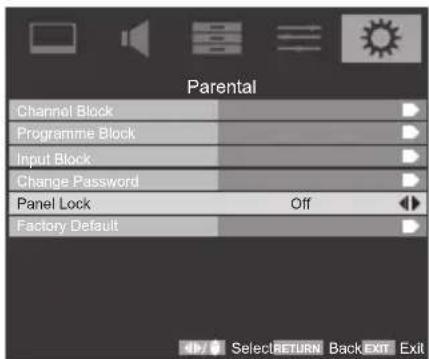
NOTE: When the Panel Lock is set to "On", TV can be turned off by pressing the power keys on the TV or the remote control, but can be turned on only by the remote control.
Factory Default
Selecting Factory Default will reset all TV settings, including stored channels, to their original factory values.
1 Highlight Parental in the SETUP menu, and press ▶ or OK to enter.
2 Enter the 4-digit password.
3 Press ▼ to highlight the Factory Default and press ▶ or OK to select.
Digital on-screen information and programme guide
The on-screen information and programme guide give access to programme details for all available channels.
Information
1 Press ⓘ, the information screen will appear giving details of the programme and event currently being viewed.
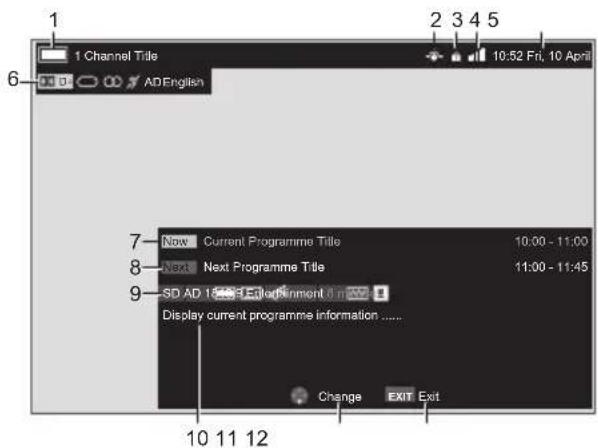
| 1 Service type |
| 2 Skip |
| 3 Channel block |
| 4 Signal strength |
| 5 Current time and date |
| 6 Audio information |
| 7 Current programme and time |
| 8 Next programme and time |
| 9 Event information |
| 10 Current programme information |
| 11 Change between Now and Next programme list |
| 12 Exit the information screen |
2 Press i+ again to close the information screen.
Guide
1 Select the on-screen guide by pressing GUIDE, the guide screen will appear highlighting details of the programme and event currently being viewed. This may take a few moments to appear.
2 Press ◀ or ▶ for information on other events scheduled for the programme selected.
3 For details of other programmes currently available, press ▲ and ▼ to scroll up and down the programme list.
NOTE: For the recording operation to work properly, the media recorder must be set to the same time as the TV. Regarding the process for recording, please refer to the owner's manual of the recording equipment.
EPG Timer
EPG (Electronic Programme Guide) supports 8 sets of timers. You can set or cancel a timer for a selected programme within the guide. When the TV is on and the timer activates, a dialogue box is shown informing you that the programme is about to start. When the TV is in standby mode and the timer activates, the TV will wake up with backlight off, speaker mute on, and change to the channel selected.
You must set the time correctly before using this function. All set timers are cleared when performing a new channel scan.
1 Press button to set/unset Timer in the selected programme.
2 An indicator will be shown in the detail information area when a timer function is set..
3 Press BLUE button to enter the programme timer list page.
NOTE: Time can be set manually in the Menu/Timer/Time OSD menu.
After adjustment, the TV clock may not match the time in the EPG Programme Guide. The EPG Programme Guide time follows the broadcast stream time which can not be adjusted.
Software upgrade and system information
Auto Download
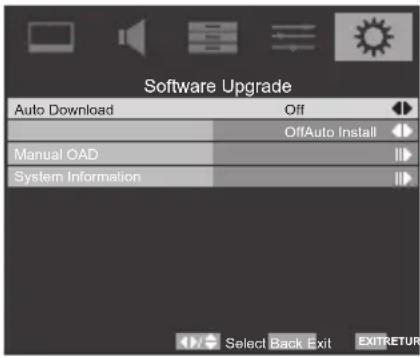
This feature enables your TV to download new software by air automatically.
1 In the SETUP menu, press ▼ to highlight Software Upgrade and press ▶ or 🔒 to enter.
2 Press ▼ to highlight Auto Download.
3 Press ◀ or ▶ to select On or Off.
Auto Install
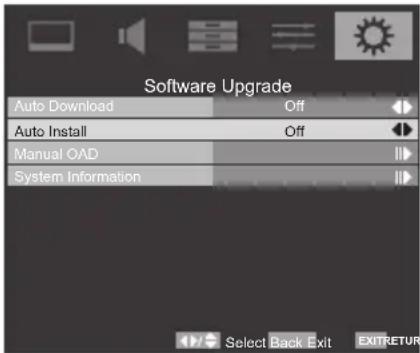
This feature enables your TV to install new software automatically.
1 In the SETUP menu, press ▼ to highlight Software Upgrade and press ▶ or into enter.
2 Press ▼ to highlight Auto Install.
3 Press ◀ or ▶ to select On or Off.
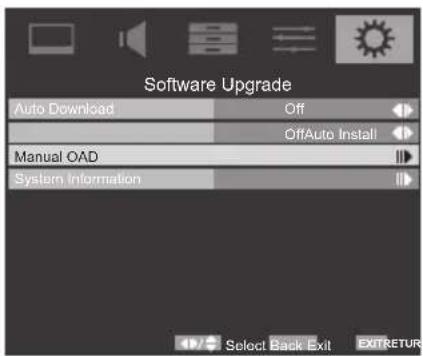
Manual OAD
This feature enables upgrading your TV software by air manually.
1 In the SETUP menu, press ▼ to highlight Software Upgrade and press ▶ or Ⓗ to enter.
2 Press ▼ to highlight Manual OAD and press ▶ or 📷 to enter.
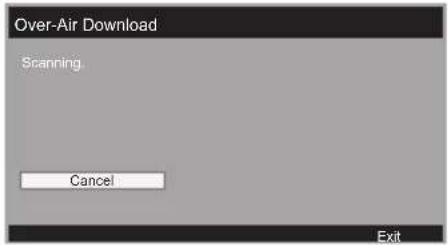
3 The Over-Air Download screen appears. Follow the on-screen instruction to complete the software upgrade.
System Information
This feature can be used to check the version of software currently installed.
1 In the SETUP menu, press ▼ to highlight Software Upgrade and press ▶ or Ⓗ to enter.
2 Press ▼ to highlight System Information.
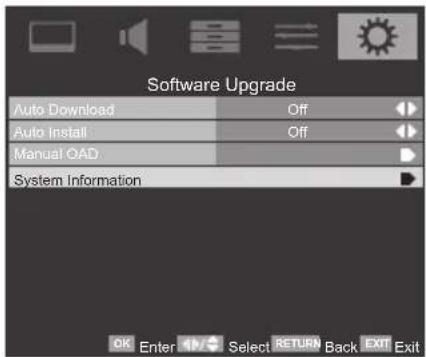
3 Press ▶ or ⓓ to display the system information.
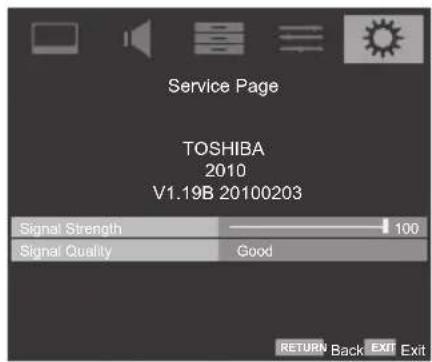
NOTE: In DTV mode, this service page includes additional diagnostic information, such as signal strength, signal quality, centre frequency, modulation, etc.
Text services
This television has a multi-page text memory, which takes a few moments to load.
Setting the Language
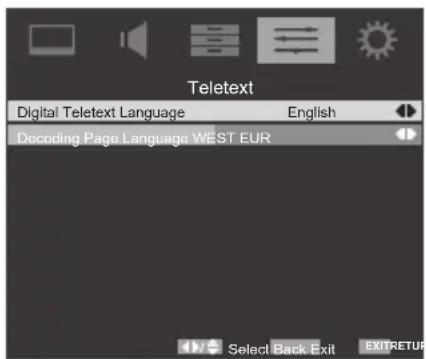
You can set the teletext language.
1 In the PREFERENCES menu, press ▼ to highlight Teletext, then press ▶ or Ⓞ to confirm.
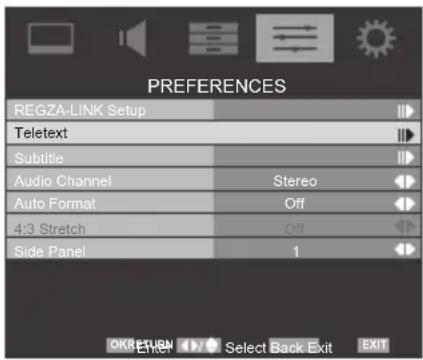
2 Press ▲ and ▼ to select the options, and then press ◀ and ▶ to select the language.
Text Information
The first text page shown will be the index page.
Any text page can be accessed by entering the 3-digit page number using the numbered buttons, pressing the coloured buttons or pressing P to advance to the next page and P to go back to the previous page.
Control Buttons
Below is a guide to the functions of the remote control text buttons.
To display the index/initial page:
Press ☐to access the index/initial page. The one displayed is dependant on the broadcaster.
To reveal concealed text:
To discover the solutions on quiz and joke pages press the E button.
To hold a wanted page:
At times it is convenient to hold a page of text. Press and will appear in the top of the screen. The page will be held on screen until the button is pressed again.
To enlarge the text display size:
Press ☑ once to enlarge the top half of the page, press again to enlarge the bottom half of the page. Press again to revert to normal size.
To toggle between Teletext and normal picture mode:
Enter the page number then press a normal picture will be displayed. The television will indicate when the page is present by displaying the page number at the top of the screen.
Sub page will be automatically displayed.
Questions and Answers
Below are the answers to some of the most common queries.

Why is there no sound or picture?

Check the television is not in standby mode. Check the mains plug and all mains connections.

Why is there incorrect or no sound when in DTV mode?

Press to ensure the hard of hearing option has not been selected.

Why doesn't the video/DVD being played show on screen?

Make sure the VCR or DVD player is connected to the television as shown on page 8, then select the correct input by pressing

Why is there a good video picture but no sound?

Check all lead connections.

Why is there a picture but no sound?

Check the volume has not been turned down or that sound mute has not been selected.

Why is the VCR/DVD picture in black and white?

Check the correct input has been chosen, S-VIDEO or AV. See AV connections on page 34.

What else can cause a poor picture?

Interference or a weak signal. Try a different television station. Analogue Manual Scan may help.

Why doesn't the remote control work?

Check the batteries aren't dead or inserted incorrectly.

Why is there a message permanently on the screen?

Remove it by pressing .i+

Why are there problems with analogue text?

Good performance of text depends on a good strong broadcast signal. This normally requires a roof or loft aerial. If the text is unreadable or garbled, check the aerial. Go to the main index page of the text service and look for the User Guide. This will explain the basic operation of text in some detail.

Why are the four coloured text numbers visible but no text?

Text has been selected whilst viewing an external source i.e. DVD or VCR. No text will appear on screen or a box may appear stating no information is available. Select a broadcasting channel and press 📄 to access.

Why don't the devices connected via HDMI operate properly?

Make sure to use cables with the HDMI logo HDMI (see page 11).
Some early HDMI equipment may not work properly with the latest HDMI TV products, due to new standard adoption.
HDMI, the HDMI Logo, and High-Definition Multimedia Interface are trademarks or registered trademarks of HDMI Licensing LLC in the United States and other countries.

Why when digital subtitles have been selected are they not showing on screen?

Subtitles are not currently being transmitted by the broadcaster.

Why is there no digital text service?

The digital programme being viewed is not broadcasting digital text. Try another digital programme.

What can be done if the user-defined password has been forgotten?

Use the universal password 1276, then change to a new number of your choice.
Q
Why does the TV turn off by itself?
A
After roughly 15 minutes without any input video signal at TV mode, the TV will turn off to save power.
Q
Does this TV support the DPMS?
A
This set is equipped with a function for saving energy which supports the VESA Display Power Management Signaling (DPMS) standard. This means that the monitor must be connected to a computer which supports VESA DPMS. To exit DPMS mode, press button on the remote control to wake up the TV.
Q
Why does some on-screen information appear as strange symbols?
A
Please make sure your "Country" setting is correct.
Q
Why don't the REGZA-LINK devices work?
A
When the connected REGZA-LINK device does not work correctly after you have changed the settings of the device, turn off your television and unplug the power cord, and then plug and turn on again. Unplug the HDMI cable of the REGZA-LINK device and lead again.
Q
Why is the REGZA-LINK logo still showing when the equipment has been disconnected?
A
If the REGZA-LINK device is disconnected, the logo will disappear after approximately one minute.
Specifications and accessories
• This television complies with the specification listed below.
- Design and specifications are subject to change without notice.
DVB-T Broadcast systems/channels Broadcast systems/channels
| UK UHF 21-68 PAL-I UHF UK21-UK69 | 2 carrier system | ||||
| France VHF 05-10 (VHF 01-05) PAL-B/G UHF E21-E69UHF 21-69 VHF E2-E12, S1-S41 | Visible Screen Size(H x V mm)(approx.) | Model | 19 | 409.80 x 230.40 | |
| 22 | 477.42 x 268.42 | ||||
| Germany VHF 05-12 SECAM-L UHF F21-F69UHF 21-69 VHF F1-F10, B-Q | 26 | 575.77 x 323.71 | |||
| 32(32AV71**) | 697.69 x 392.26 | ||||
| Austria VHF 05-12 SECAM-D/K UHF R21-R69UHF 21-69 VHF R1-R12 | 32(32AV71**1) | 697.69 x 392.26 | |||
| 32(32LV71**) | 698.40 x 392.85 | ||||
| 40 | 885.60 x 498.15 | ||||
| Switzerland VHF 05-12UHF 21-69 | Display | 16:9 | |||
| Italia VHF 05-12 (D,E,F,G,H,H1,H2)UHF 21-69 | Sound output(at 10% distortion) | Model 19 | 3.5W + 3.5W | ||
| Spain UHF 21-69 | 22 | 3.5W + 3.5W | |||
| 26 | 5W + 5W | ||||
| Nederlands VHF 05-12UHF 21-69 | 32 | 10W + 10W | |||
| 40 | 10W + 10W | ||||
| Sweden VHF 05-12UHF 21-69 | Power consumption | Model 19 | 40W | ||
| Finland | VHF 05-12 | as specified inEN60065:2002 | 22 | 55W | |
| UHF 21-69 | 26 | 90W | |||
| Greece | VHF 05-12 | 32(32AV71**) | 105W | ||
| UHF 21-69 | 32(32AV71**1) | 115W | |||
Video Input PAL, SECAM, NTSC 3.58/4.43
| External connections | ||||||
| Model 19/22 | Standby (approx.) | Model 19 | 0.5W | |||
| EXT1 | Input | Phono jacks | Y, P_B/C_B, P_R/C_R | 22 | 0.5W | |
| Phono jacks | Audio L + R | 26 | 0.5W | |||
| EXT2 | Input | Phono jack | Video | 32 | 0.5W | |
| Phono jacks | Audio L + R | 40 | 0.5W | |||
| EXT3 | nput/Output | 21-pin SCART | Auto, Mixed, RGB,Composite, S-Video /TV Out | Dimensions(H x W x D mm)(approx.) | Model 19 | 365.8 x 480.5 x 192.8 |
| 22 | 408.7 x 555.3 x 212.0 | |||||
| 26 | 474.6 x 665.4 x 265.2 | |||||
| 32(32AV71**) | 578.2 x 798.9 x 271.4 | |||||
| PC Input | D-sub | RGB | 32(32AV71**1) | 578.2 x 798.9 x 271.4 | ||
| 32(32LV71**) | 578.2 x 798.9 x 271.4 | |||||
| HDMI 1/2 Input | HDMI | ® | 40 | 703.0 x 992.8 x 282.9 | ||
| (Height dimension includes foot stand) | ||||||
| PC/HDMI1 Audio | Phono jacks | Audio L + R | ||||
| Component | Phono jack | Audio L + R | ||||
| Digital Audio | Output (S/PDIF) | Optical | Weight (approx.) | Model 19 | 5.0 kg | |
| Model 26/32/40 | 22 | 5.5 kg | ||||
| EXT1 | Input | Phono jacks | Y, P_B/C_B, P_R/C_R | 26 | 9.0 kg | |
| Phono jacks | Audio L + R | 32(32AV71**) | 12.5 kg | |||
| EXT2 | Input | Phono jack | Video | 32(32AV71**1) | 12.5 kg | |
| Phono jacks | Audio L + R | 32(32LV71**) | 12.5 kg | |||
| EXT3 | Input/Output | 21-pin SCART 1 | Auto, Mixed, RGB,Composite, S-Video /TV Out | 40 | 16.5 kg | |
| (weight includes foot stand) | ||||||
| EXT4 | Input/Output | 21-pin SCART 2 | Auto, Mixed, RGB,Composite, S-Video /TV Out | Headphone socket | R3.5mm stereo | |
| Operating condition | Temperature 5 °C - 35 °C (41 °F - 94 °F) | |||||
| PC Input | D-Sub | RGB | Humidity : 20 - 80% (non-condensing) | |||
| HDMI1/2/3 | Input | HDMI® | ||||
| PC/HDMI1 Audio | 3.5mm | Audio L + R | Accessories | Remote control2 batteries (AAA, IEC R03 1.5V) | ||
| Component | Phono jacks | Audio L + R | Power cordUser Manual | |||
| Digital Audio Output (S/PDIF) | Optical | |||||
USB Port Interface version: USB 2.0
USB Class: Mass Storage
File system: FAT12, FAT16 and FAT32
NOTE: The "HDMI 3" port is available for model 32/40LV71*B only.
License Information used with Toshiba Televisions
The software pre-installed in the TOSHIBA Digital Televisions consists of multiple, independent software components. Each software component is copyrighted by TOSHIBA or a third party.
The TOSHIBA Digital Televisions uses software components that are distributed as freeware under a third-party end-user license agreement or copyright notice (hereinafter referred to as a "EULA"). Some EULAs require that the source code of the applicable component be disclosed as the condition for distributing the software component in executable format.
You can check the software components subject to such EULA requirements on the following Home Page:
URL : http://tesc.toshiba.co.uk/Web/Website.nsf/ContentFrameSet?OpenFrameset
In addition, some of the software components which are used in Toshiba Digital Televisions include the software that are made or developed originally by TOSHIBA. These software and accompanied documents are copyrighted by TOSHIBA, and protected by Copyright Act, an international treaty's articles and other governing laws. The software components which are made or developed originally by TOSHIBA and not subject to EULAs are not a target of source code offering.
The Toshiba warranty provided in respect of the Digital TV is the only warranty provided and no additional warranties are provided in respect of the software components subject to EURAs.
Some of the software components distributed under EULAs are made available for use by the user on the premise that they are not copyrighted or warranted by TOSHIBA or any third party. These software components are licensed to the user free of charge and therefore not covered by any warranty within the scope of the applicable laws. These software components are provided in “as is” condition without any warranty, whether express or implied. “Warranty” here includes, but not limited to, an implied warranty for marketability or fitness for specific uses. All risks associated with the quality or performance of these software components are assumed by the user. TOSHIBA shall not be liable whatsoever for any cost of repair or correction or other incidental expense incurred in connection with a defect found in any of these software components. Unless specified under the applicable laws or in a written agreement, a party who changes or redistributes the software with consent from the copyright holders or based on the aforementioned licenses shall not be held liable whatsoever for any loss arising from the use of or inability to use such software components. The same applies even when the copyright holders or relevant third parties have been informed of the possibility of such loss. “Loss” here includes normal, special, incidental and indirect loss (including, but not limited to, the loss of data or its accuracy; loss incurred by the user or any third party; and interface incompatibility with other software). Please read each EULA for details on the use conditions and items that must be observed regarding these software components.
The table below lists the software components pre-installed in the TOSHIBA Digital Televisions, which are subject to EULAs. The user should read the applicable EULAs carefully before using these software components. The EULAs are exhibited in their original text (English) as exactly written by the respective parties other than TOSHIBA.
| Pre-Installed Software EULA | |
| FreeType Exhibit A | |
| ICU Exhibit B |
Exhibit A
Portions of this software are copyright © <2007> The FreeType Project (www.freetype.org).
All rights reserved
Exhibit B
ICU License - ICU 1.8.1 and later
COPYRIGHT AND PERMISSION NOTICE
Copyright © 1995-2006 International Business Machines Corporation and others
All rights reserved.
Permission is hereby granted, free of charge, to any person obtaining a copy of this software and associated documentation files (the "Software"), to deal in the Software without restriction, including without limitation the rights to use, copy, modify, merge, publish, distribute, and/or sell copies of the Software, and to permit persons to whom the Software is furnished to do so, provided that the above copyright notice(s) and this permission notice appear in all copies of the Software and that both the above copyright notice(s) and this permission notice appear in supporting documentation.
THE SOFTWARE IS PROVIDED "AS IS", WITHOUT WARRANTY OF ANY KIND, EXPRESS OR IMPLIED, INCLUDING BUT NOT LIMITED TO THE WARRANTIES OF MERCHANTABILITY, FITNESS FOR A PARTICULAR PURPOSE AND NONINFRINGEMENT OF THIRD PARTY RIGHTS. IN NO EVENT SHALL THE COPYRIGHT HOLDER OR HOLDERS INCLUDED IN THIS NOTICE BE LIABLE FOR ANY CLAIM, OR ANY SPECIAL INDIRECT OR CONSEQUENTIAL DAMAGES, OR ANY DAMAGES WHATSOEVER RESULTING FROM LOSS OF USE, DATA OR PROFITS, WHETHER IN AN ACTION OF CONTRACT, NEGLIGENCE OR OTHER TORTIOUS ACTION, ARISING OUT OF OR IN CONNECTION WITH THE USE OR PERFORMANCE OF THIS SOFTWARE.
Except as contained in this notice, the name of a copyright holder shall not be used in advertising or otherwise to promote the sale, use or other dealings in this Software without prior written authorization of the copyright holder.
ICU License - ICU 1.8.1 and later
COPYRIGHT AND PERMISSION NOTICE
Copyright © 1995-2006 International Business Machines Corporation and others
All rights reserved.
THE SOFTWARE IS PROVIDED "AS IS", WITHOUT WARRANTY OF ANY KIND, EXPRESS OR IMPLIED, INCLUDING BUT NOT LIMITED TO THE WARRANTIES OF MERCHANTABILITY, FITNESS FOR A PARTICULAR PURPOSE AND NONINFRINGEMENT OF THIRD PARTY RIGHTS. IN NO EVENT SHALL THE COPYRIGHT HOLDER OR HOLDERS INCLUDED IN THIS NOTICE BE LIABLE FOR ANY CLAIM, OR ANY SPECIAL INDIRECT OR CONSEQUENTIAL DAMAGES, OR ANY DAMAGES WHATSOEVER RESULTING FROM LOSS OF USE, DATA OR PROFITS, WHETHER IN AN ACTION OF CONTRACT, NEGLIGENCE OR OTHER TORTIOUS ACTION, ARISING OUT OF OR IN CONNECTION WITH THE USE OR PERFORMANCE OF THIS SOFTWARE.
DVB is a registered trademark of the DVB Project
HDMI, the HDMI Logo, and High-Definition Multimedia Interface are trademarks or registered trademarks of HDMI Licensing LLC in the United States and other countries.

Printed on recycled paper. 100% Chlorine free.
© TOSHIBA Television Central Europe Sp. z o.o.
All rights reserved.
Reproduction in whole or part without written permission is strictly prohibited.
TOSHIBA Television Central Europe Sp. z o.o.
ul. Pokoju 1, Biskupice Podgórne, 55-040 Kobierzyce, Poland
Specification is subject to change without notice
Notes
For your own records
Cleaning the screen and cabinet...
Turn off the power, clean the screen and cabinet with a soft, dry cloth. We recommend that you do not use any proprietary polishes or solvents on the screen or cabinet as this may cause damage.
Disposal...
The following information is only for EU-member states:
Disposal of products The crossed out wheeled dust bin symbol indicates that products must be collected and disposed of separately from household waste. Integrated batteries and accumulators can be disposed of with the product. They will be separated at the recycling centre.
The black bar indicates that the product was placed on the market after August 13, 2005.
By participating in separate collection of products and batteries, you will help to assure the proper disposal of products and batteries and thus help to prevent potential negative consequences for the environment and human health.
For more detailed information about the collection and recycling programmes available in your country, please contact your local city office or the shop where you purchased the product.
Disposal of batteries and/or accumulators.
The crossed out wheeled dust bin symbol indicates that batteries and/or accumulators must be collected and disposed of separately from household waste.
If the battery or accumulator contains more than the specified values of lead (Pb), mercury (Hg), and/or cadmium (Cd) defined in the Battery Directive (2006/66/EC), then the chemical symbols for lead (Pb), mercury (Hg) and/or cadmium (Cd) will appear below the crossed out wheeled dust bin symbol. By participating in separate collection of batteries, you will help to assure the proper disposal of products and batteries and thus help to prevent potential negative consequences for the environment and human health.
For more detailed information about the collection and recycling programmes available in your country, please contact your local city office or the shop where you purchased the product.
- Contents
- Safety Precautions
- Air Circulation
- Heat Damage
- Mains Supply
- Do
- Do not
- Installation and important information
- Where to install
- Please take note
- EXCLUSION CLAUSE
- The remote control
- Inserting batteries and effective range of the remote
- Connecting external equipment
- Aerial cables:
- SCART leads:
- REGZA-LINK Connections
- Connecting an HDMI or DVI device to the HDMI input
- NOTE:
- To connect an HDMI device
- DVI device to the HDMI Input
- Connecting a computer
- To connect a PC to the HDMI terminal
- Using the controls
- Switching on
- Using the remote control
- Using the side-panel controls
- Tuning the television
- Initial Setup
- PLEASE NOTE
- Setting the programmes
- Auto Scan
- Update Scan
- Single RF Scan
- Favorite Network Select
- Analogue Manual Scan
- Channel Skip
- Channel Sort
- Channel Edit
- Channel Decode
- Analogue Channel Fine Tune
- Clean Channel List
- Common Interface
- Reset TV
- Automatic Power Down
- General controls
- Selecting programme positions
- Time Display
- Stereo and Bilingual transmissions
- Quick Access Menu
- Sound controls
- Volume
- Sound Mute
- Balance, Bass, Treble
- Surround Sound
- Stable Sound®
- Bass Boost
- Bass Boost Level
- Audio Description
- Visually Impaired
- Advanced Audio Settings
- DOLBY.
- DIGITAL PLUS
- Widescreen viewing
- Picture controls
- Picture Mode
- Brightness, Contrast, Colour and Tint
- Sharpness
- Back Light Adjustment
- Colour Temperature
- Cinema Mode
- DNR
- MPEG NR
- CTI
- Adaptive Luma Control
- Active Backlight
- Blue Screen
- 3D Colour Management
- Base Colour Adjustment
- HDMI RGB Range
- H./V. Position
- VGA
- Timer control
- Time Zone
- Country Region ID
- Time
- Sleep Timer
- Input selection and AV connections
- Input selection
- Input signal selection
- Model 26/32/40:
- REGZA-LINK Controls
- Equipment Control
- Input Source Selection
- Pass-Through Control
- REGZA-LINK Menus
- One Touch Play
- System Standby
- System Audio Control
- PC Link
- Enable REGZA-LINK
- TV Auto Power On
- Auto Standby
- Amplifier Control
- Speaker Preference
- Media Player
- Enter Media Player
- Photo Multi-View
- Playing Photo Slideshow
- Viewing Music Files
- Playing Music
- Preference control
- Analogue Subtitle
- Digital Subtitle
- Subtitle Type
- Audio Languages
- Audio Channel
- Auto Format
- 4:3 Stretch
- Side Panel Adjustment
- Game Mode
- Parental control
- Channel Block
- Programme Block
- Input Block
- Change Password
- Panel Lock
- Factory Default
- Digital on-screen information and programme guide
- Information
- Guide
- EPG Timer
- Software upgrade and system information
- Auto Download
- Auto Install
- Manual OAD
- System Information
- Text services
- Setting the Language
- Text Information
- Control Buttons
- Questions and Answers
- Q
- A
- Specifications and accessories
- License Information used with Toshiba Televisions
- Exhibit A
- Exhibit B
- DVB is a registered trademark of the DVB Project
- © TOSHIBA Television Central Europe Sp. z o.o.
- TOSHIBA Television Central Europe Sp. z o.o.
- Notes
- For your own records
- Cleaning the screen and cabinet...
- Disposal...
- The following information is only for EU-member states:
- Disposal of batteries and/or accumulators.
Brand : TOSHIBA
Model : 26AV713B
Category : Television