
TAC-8 - Audio/video converter ZOOM - Free user manual and instructions
Find the device manual for free TAC-8 ZOOM in PDF.


| Type de produit | Audio/video converter |
| Brand | Zoom |
| Modèle | TAC-8 |
| Dimensions | 482.6 x 44.5 x 200 mm (19-inch 1U rackmount) |
| Poids | 1.5 kg |
| Alimentation | AC adapter (12V DC, 2A) |
| Inputs | 8x XLR/TRS combo (line/mic), 2x RCA, 1x ADAT optical, 1x USB-C |
| Outputs | 8x TRS balanced, 2x XLR main, 1x ADAT optical, 1x headphone |
| Fonctions principales | Audio interface, ADAT expansion, MIDI I/O, sample rate up to 192 kHz, loopback |
| Entretien et nettoyage | Clean with a soft, dry cloth. Avoid solvents. Keep vents clear. |
| Sécurité | Use only included power supply. Do not expose to moisture. Rack mount securely. |
| Pièces détachées et réparabilité | Contact Zoom support for parts. User-serviceable items: none. |
| Informations générales | Compatible with Windows and macOS. Driver required for ASIO/Core Audio. |
Frequently Asked Questions - TAC-8 ZOOM
User questions about TAC-8 ZOOM
0 question about this device. Answer the ones you know or ask your own.
Ask a new question about this device
Download the instructions for your Audio/video converter in PDF format for free! Find your manual TAC-8 - ZOOM and take your electronic device back in hand. On this page are published all the documents necessary for the use of your device. TAC-8 by ZOOM.
USER MANUAL TAC-8 ZOOM
© 2014 ZOOM CORPORATION
Copying or reprinting this manual in part or in whole without permission is prohibited.
Contents
Introduction 02
Usage and Safety Precautions....03
Names of Parts 04
Basic Connections....06
Installing the Driver 07
Turning the Power On and Off 08
Setting Input and Output Devices.... 10
Playback....11
Recording....12
Using Digital Audio Equipment 14
■ About Digital Audio Clock.... 14
■ Connecting S/PDIF Devices....14
■ Connecting ADAT Optical Devices....16
■ Connecting the WORD CLOCK Connectors .... 18
■ Connecting MIDI Devices....20
Restoring Factory Default Settings 21
Troubleshooting....22
Specifications 23
Introduction
Thank you very much for purchasing a ZOOM TAC-8 Thunderbolt™ Audio Converter.
The TAC-8 has the following features.
18-in/20-out Thunderbolt™ audio converter
The TAC-8 audio converter uses Thunderbolt™, the latest generation of high-speed interface technology. With this, we have realized a system with low latency that was not possible using USB 2.0. Since it supports recording and playback at up to 24-bit/192kHz, it can also be used to play back high-resolution sound sources and deliver them with superior audio quality over the Internet.
Attention to audio performance
An asynchronous transfer system that is not impacted by computer jitter is used. The latest AD/DA converter, which supports 192 kHz, is used. So, the entire system reproduces the original audio faithfully.
Built-in high-performance mic preamps
The high-performance mic preamps are based on those developed for our H Series. Hi-Z input is supported. The gain can be raised by up to 60 dB, and +48V phantom power can be supplied.
Flexible built-in mixer and dedicated TAC-8 MixEfx mixer application
The TAC-8 has a built-in mixer that allows you to freely route up to 20 output channels from among the 18 input channels and 20 computer playback channels. By using the TAC-8 MixEfx application designed for this interface, you can make settings for the built-in mixer and monitoring effects from a computer.
For details about TAC-8 MixEfx, see the ZOOM website (http://www.zoom.co.jp/downloads/).
Please read this manual carefully to fully understand the functions of the TAC-8 so that you can make the most of it for many years.
After reading this manual, please keep it with the warranty in a safe place.
Usage and Safety Precautions
Safety Precautions
In this operation manual, symbols are used to highlight warnings and cautions that you must read to prevent accidents. The meanings of these symbols are as follows.

Something that could cause serious injury or death

Something that could cause injury or damage to the equipment
Other symbols used

An action that is mandatory

An action that is prohibited
⚠ Warning
Alterations
Do not open the case or modify the product.
Operation using an AC adapter
! Never use any AC adapter other than a ZOOM AD-19.
Always hold the AC adapter itself when disconnecting it from an outlet.
Do not do anything that could exceed the ratings of outlets and other electrical wiring equipment or supply power other than AC100V.
Before using the equipment in a foreign country or other region where the electrical voltage differs from AC100V, always consult with a shop that carries ZOOM products and use the appropriate AC adapter.
Caution
Product handling
Do not drop, bump or apply excessive force to the unit.
! Be careful not to allow foreign objects or liquids to enter the unit.
Operating environment
Do not use in extremely high or low temperatures.
Do not use near heaters, stoves and other heat sources.
Do not use in very high humidity or where it could be splashed by water.
Do not use in places with frequent vibrations.
Do not use in places with much dust or sand.
Connection cables and input/output jacks
Always turn the power OFF for all equipment before connecting any cables.
Always disconnect all connection cables and the AC adapter before moving the unit.
Volume
Do not use at a loud volume for a long time.
Usage Precautions
Interference with other electrical equipment
In consideration of safety, the TAC-8 has been designed to minimize its emission of electromagnetic waves and to suppress interference from external electromagnetic waves. However, equipment that is very susceptible to interference or that emits powerful electromagnetic waves could result in interference if placed nearby. If this occurs, place the TAC-8 and the other device farther apart.
With any type of electronic device that uses digital control, including the TAC-8. electromagnetic interference could cause malfunction, corrupt or destroy data and result in other unexpected trouble. Always use caution.
Rack mounting
If you are unable to mount the TAC-8 in the rack you are using, remove the rubber feet from its bottom panel.
Cleaning
Use a soft cloth to clean the exterior of the unit if it becomes dirty. If necessary, use a damp cloth that has been wrung out well to wipe it.
Never use abrasive cleansers, wax or solvents such as alcohol, benzene or paint thinner.
Temperature considerations
Continuous use of this interface for long periods of time, for example, might cause it to become warm. This is normal as long as it does not become too hot to touch.
Breakdown and malfunction
If the TAC-8 should malfunction or operate abnormally, disconnect it immediately. Contact the store where you bought the unit or ZOOM service with the following information: product model, serial number and specific symptoms of breakdown or malfunction, along with your name, address and telephone number.
Copyrights
• Macintosh ^® and Mac OS ^® are trademarks or registered trademarks of Apple Inc.
- Thunderbolt™ and the Thunderbolt™ logo are trademarks of Intel Corporation in the US and other countries.
• ADAT and ADAT Optical are trademarks of inMusic Brands Inc. in the US and other countries.
• MIDI is a registered trademark of the Association of Musical Electronics Industry (AMEI).
- Other product names, registered trademarks and company names in this document are the property of their respective companies.
Note: All trademarks and registered trademarks in this document are for identification purposes only and are not intended to infringe on the copyrights of their respective owners.
Recording for any purpose other than personal use from copyrighted sources, including CDs, records, tapes, live performances, video works and broadcasts, without permission of the copyright holder is prohibited by law. Zoom Corporation will not assume any responsibility related to infringements of copyrights.
Names of Parts
Front Panel
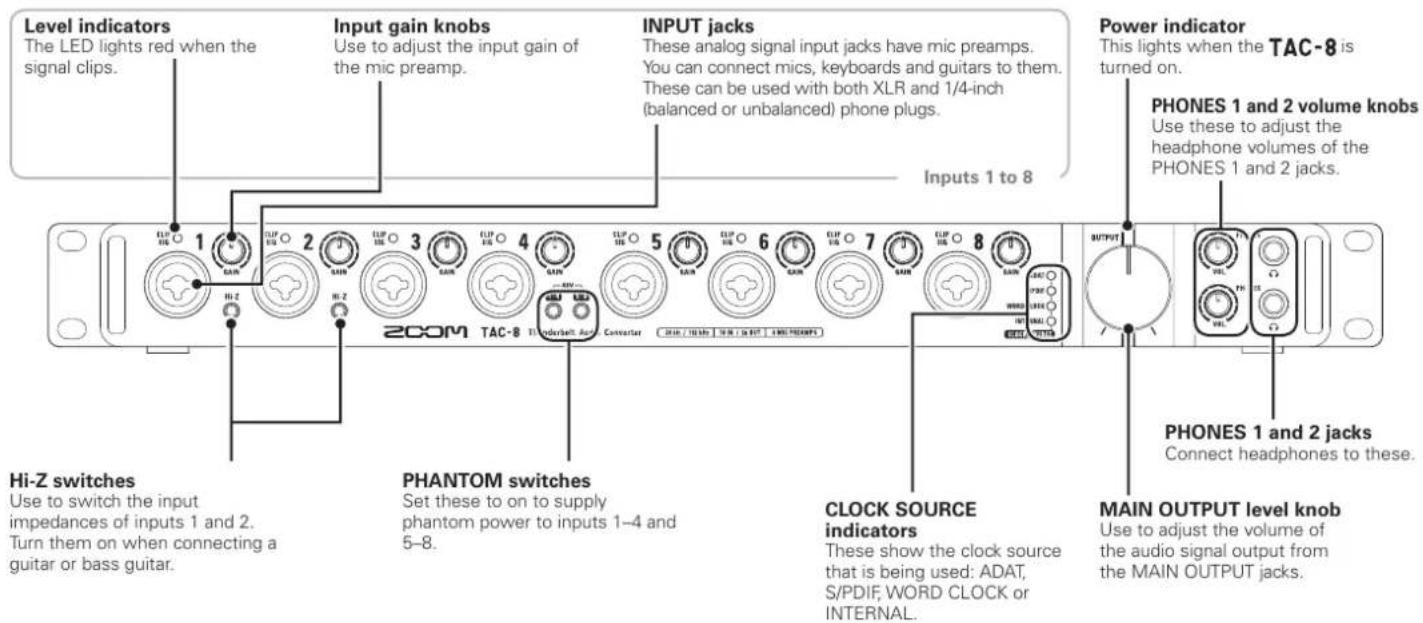
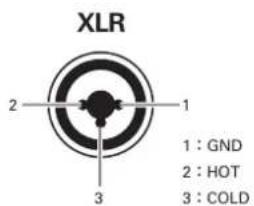
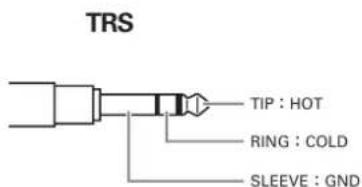
Standalone mode
In standalone mode, the TAC-8 can be used as an eight-channel mic preamp and digital input/output device without being connected to a computer. When used in standalone mode, operation is set in advance using the TAC-8 MixEfx mixer application.
■ Rear Panel
![POWER switch Turns the TAC-8 ON/OFF. DC 12V AC adapter connector Connect the included AC adapter here. MIDI IN/OUT jacks Connect a MIDI keyboard or MIDI controller to the MIDI IN jack. Connected MIDI sound module or other device to the MIDI OUT jack. ADAT OPTICAL IN/OUT jacks Connect optical cables that comply with the ADAT Optical standard. These can send and receive digital audio signals in ADAT, SMUX and SMUX4 formats. Thunderbolt port Connect this to a computer. STAND ALONE switch Use to turn standalone mode on/off. (→P.4) S/PDIF IN/OUT jacks Connect coaxial cables that comply with the S/PDIF standard. Two channels of digital audio signals in S/PDIF format can be sent and received at resolutions up to 24-bit/192kHz . WORD CLOCK IN/OUT connectors Use these to send and receive word clock signals between the [TAC-8] and other devices. MAIN OUTPUT jacks Connect speakers with built-in amplifiers or an amplifier and speaker system. These support balanced output with 1/4-inch phone plugs. LINE OUTPUT jacks Connect monitors for multichannel monitoring or external effects. These support balanced output with 1/4-inch phone plugs. NOTE](/content/2026/06/1146156/images/8dc201e4b0a4283592869309a2c668bd3f8f3a3a9717ff040daf50010271a5a4.jpg)
Sampling rates and inputs/outputs
| Sampling rate | Analog inputs/ outputs | S/PDIF inputs/ outputs | ADAT inputs/ outputs | Total inputs/ outputs |
| 44.1 or 48kHz | 8/10 | 2/2 | 8/8 | 18/20 |
| 88.2 or 96kHz | 8/10 | 2/2 | 4/4 | 14/16 |
| 176.4 or 192kHz | 8/10 | 2/2 | 2/2 | 12/14 |
NOTE
When shipped new from the factory, the AD/DA converter upsampling function is enabled. This will cause operation with a 4x sampling rate when the sampling rate is 44.1 / 48kHz . See the TAC-8 MixEfx Reference Guide to disable it.
Upsampling
When the original sampling rate is 44.1 kHz or 48 kHz, internal processing can allow operation at 176.4 kHz or 192 kHz (enabled when shipped new from the factory). This eliminates aliasing noise from the sound during A/D conversion and makes the sound with D/A conversion even clearer than before.
Basic Connections
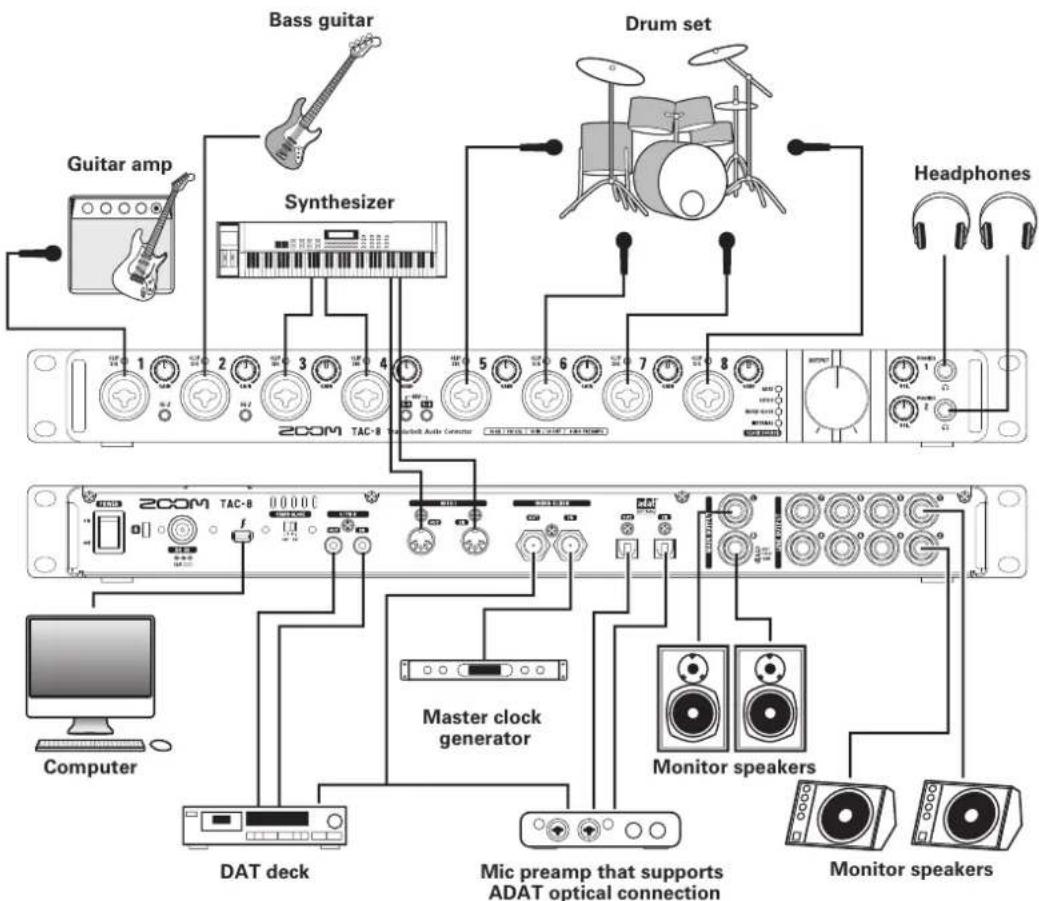
flowchart
graph TD
    A["Computer"] --> B["DAT deck"]
    B --> C["Master clock generator"]
    C --> D["Mic preamp that supports ADAT optical connection"]
    D --> E["Monitor speakers"]
    E --> F["Headphones"]
    G["Guitar amp"] --> H["Bass guitar"]
    I["Synthesizer"] --> J["Drum set"]
    K["200M TAC-8"] --> L["Switchless Audio Connector"]
    M["200M TAC-B"] --> N["Master clock generator"]
    O["200M"] --> P["Monitor speakers"]
    Q["200M"] --> R["Headphones"]
Installing the Driver
NOTE
Do not connect the TAC-8 until installation completes.
- Download the "ZOOM TAC-8 Driver" from http://www.zoom.co.jp/downloads/ to the computer.
NOTE
- You can download the latest "ZOOM TAC-8 Driver" from the above website.
-
The supported operating systems are as follows. Mac OS X 10.8.5 or later
-
Click the "ZOOM TAC-8 Driver.pkg" icon to launch the installer.
Follow the instructions that appear on screen to install the ZOOM TAC-8 Driver.
Turning the Power On and Off
■Turning the Power On
-
Minimize the volume of output devices connected to the TAC-8.
-
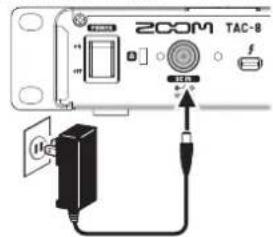
Connect the AD-19 adapter.
- Use STAND ALONE to select the mode.
OFF: Use as an audio interface connected to a computer. → Continue with step 4.
ON: Use as a standalone mic preamp not connected to a computer (standalone mode). → Continue with step 5.
NOTE
Connection to a computer is not possible when the STAND ALONE switch is set to ON.
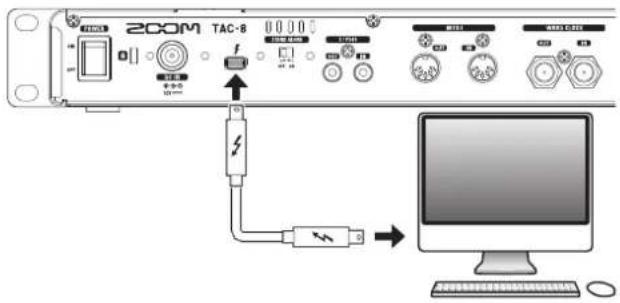
- If OFF was selected in step 3, connect the TAC-8 to the computer using a Thunderbolt™ cable.
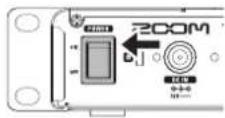
- Set ☐ to ON.
In standalone mode, the unit operates by itself according to the settings made in TAC-8 MixEfx.
NOTE
If the driver is not installed on the connected computer, the TAC-8 will not be recognized. (→P7)
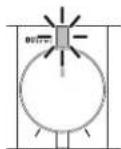
- Confirm that the power indicator is lit.
NOTE
TAC-8 startup and connecting with the computer could take some time and the power indicator might blink. Wait until the indicator stops blinking and stays lit. If it continues to blink even after waiting some time, try turning the power off and on again.
HINT
In standalone mode, the TAC-8 will automatically turn off after 10 hours. If you want it to stay ON all the time, see the TAC-8 MixEfx Reference Guide and set the power management function to OFF.
■Turning the Power Off
- Minimize the volume of devices connected to the TAC-8.
- Turn off connected amps and monitor speakers, for example.
- Set ☐ to OFF.
Setting Input and Output Devices
NOTE
Settings must be made in DAW software to use the TAC-8 with it for recording and playback.
- Open the Sound pane of the System Preferences and set both the Input and Output to "ZOOMTAC-8".
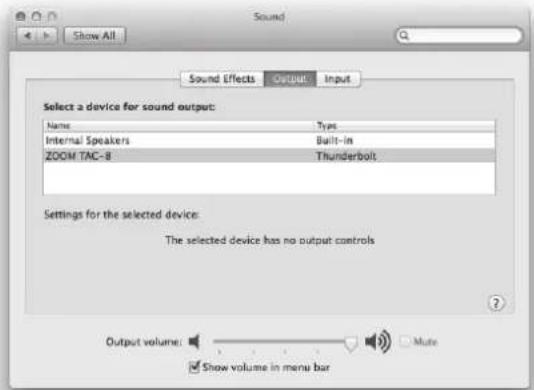
- Select the TAC-8 as the audio input and output device in the DAW software.
The TAC-8 inputs correspond to the ports as follows.
Input device
| Device name | Port name | Corresponding input |
| ZOOM TAC-8 | 1 | INPUT1 |
| 2 | INPUT2 | |
| 3 | INPUT3 | |
| 4 | INPUT4 | |
| 5 | INPUT5 | |
| 6 | INPUT6 | |
| 7 | INPUT7 | |
| 8 | INPUT8 | |
| 9 | S/PDIF L | |
| 10 | S/PDIF R | |
| 11 | ADAT1 | |
| 12 | ADAT2 | |
| 13 | ADAT3 | |
| 14 | ADAT4 | |
| 15 | ADAT5 | |
| 16 | ADAT6 | |
| 17 | ADAT7 | |
| 18 | ADAT8 |
NOTE
You can use TAC-8 MixEfx to route output signals to output jacks freely.
For details, see the TAC-8 MixEfx Reference Guide.
HINT
See the owner's manual for the DAW software that you are using for instructions about how to set the input and output devices.
Adjusting Headphone and Speaker Volume
■ Adjusting Headphone Volume
- Connect headphones to PHONES 1 or PHONES 2.
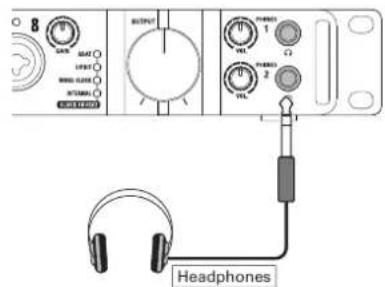
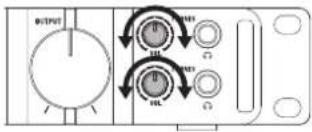
- Turn the Ⓤ for PHONES 1 or PHONES 2 to adjust the headphone volume.
NOTE
- The same signals are output from PHONES 1 as the MAIN OUTPUT jacks.
- For PHONES 2, you can use TAC-8 MixEfx to set the output signal to MAIN OUTPUT or LINE OUTPUT 1/2, 3/4, 5/6 or 7/8. By default, the same signals are output as the MAIN OUTPUT jacks.
For details, see the TAC-8 MixEfx Reference Guide.
■ Adjusting Speaker Volume
- Connect monitor speakers to the MAIN OUTPUT jacks.
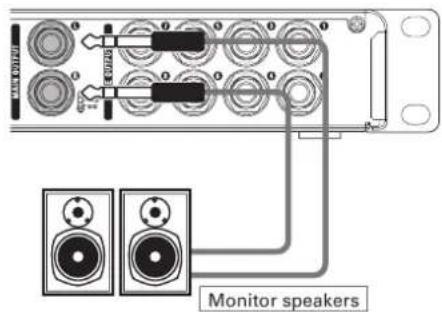
- Turn the ⏻ to adjust the speaker volume.
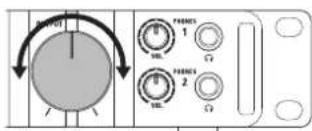
NOTE
The OUTPUT volume only affects the MAIN OUTPUT. Use TAC-8 MixEfx to adjust other output volumes.
For details, see the TAC-8 MixEfx Reference Guide.
Using Instruments and Mics
■ Connecting Instruments
Connect instruments to INPUTS 1 to 8 using TRS/mono phone cables.
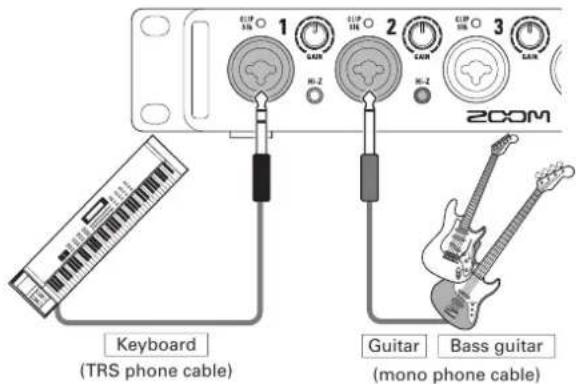
NOTE
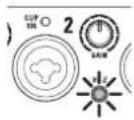
Using the Hi-Z function
- When using a passive guitar or bass guitar, connect it to INPUT 1 or 2, and push that input's ^Hi-Z button so that it lights.
- When connecting a keyboard or other instrument to INPUT 1 or 2, press its ⏻ so that it becomes unlit.
■ Connecting Mics
Using XLR cables, connect mics to INPUTS 1 to 8.
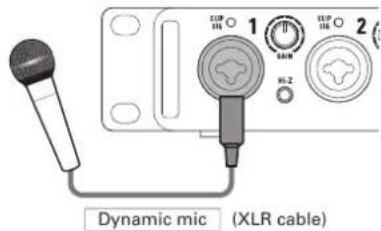
NOTE
Using Phantom Power
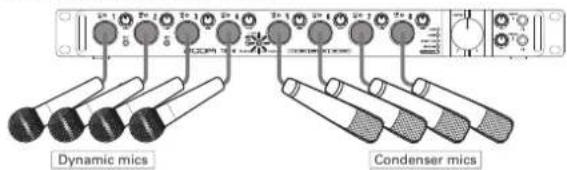
• To use a condenser mic, press 📄 for the connected INPUT so that it lights. Phantom power is supplied when this switch is lit.
- When the corresponding switch is lit, phantom power is supplied to INPUTS 1–4 or INPUTS 5–8 at the same time.
• To use dynamic mics and condenser mics at the same time, consider the use of phantom power when connecting them to the inputs.
■ Adjusting the Input Gain
You can adjust the gain of each INPUT.
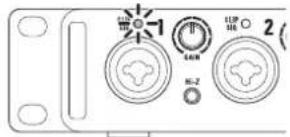
- Check CLIP SIG O to see the status of an input signal.
Lit green: Input signal present.
Lit red: Input signal is clipping.
natural_image
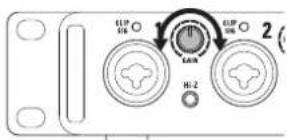
Front view of a control panel with rotary buttons and indicator lights (no readable text or symbols)- Turn 🔒 to adjust the input gain.
HINT
Set it so that the level indicator does not light red.
Using Digital Audio Equipment
■ About Digital Audio Clock
When the TAC-8 is connected to other digital audio equipment, audio clock must be synchronized in order to transfer audio data between them. If they are not synchronized, noise and various other problems will occur.
To synchronize audio clock, one device must operate as the master, which sets the reference clock, and the other must operate as a slave.
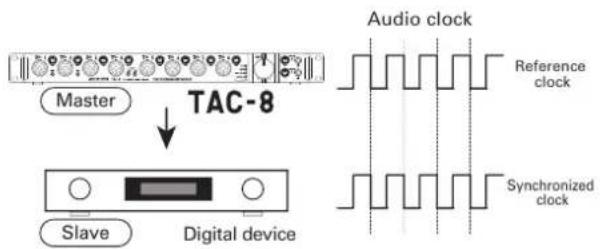
The TAC-8 is operating as the master, and the audio clock of the TAC-8 and the other digital device are synchronized.
■ Connecting S/PDIF Devices
- Minimize the volume of output devices connected to the TAC-8.
HINT
When connected, noise might occur until clock synchronizes.
- Set the same sampling rates for the TAC-8 and the connected device.
NOTE
For instructions about how to change the sampling rate of the TAC-8, see the TAC-8 MixEfx Reference Guide.
▶ Inputting an S/PDIF signal to the TAC-8
3. Use TAC-8 MixEfx to set CLOCK SOURCE to S/PDIF.
The S/PDIF CLOCK SOURCE indicator will blink.
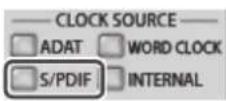
4. Connect the S/PDIF device to the S/PDIF IN.
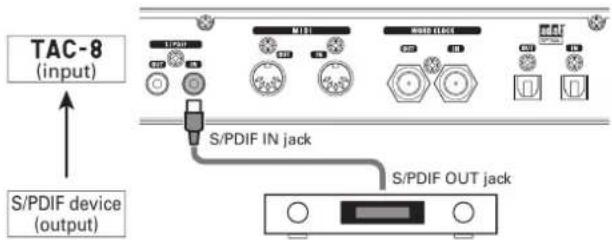
5. The S/PDIF CLOCK SOURCE indicator will light, confirming synchronization.
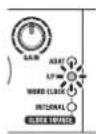
▶ Outputting a S/PDIF signal from the TAC-8
3. Use TAC-8 MixEfx to set CLOCK SOURCE to INTERNAL.
The INTERNAL CLOCK SOURCE indicator will blink.
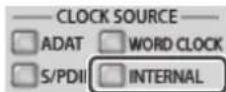
4. Connect the S/PDIF device to the S/PDIF OUT.
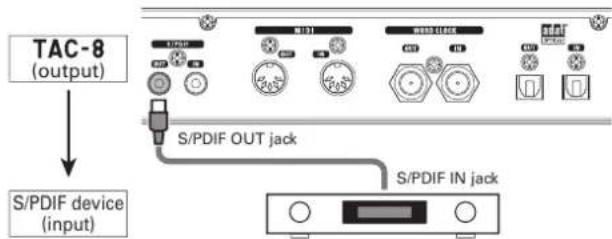
flowchart
graph TD
    A["TAC-8 (output)"] --> B["S/PDIF device (input)"]
    B --> C["S/PDIF OUT jack"]
    B --> D["S/PDIF IN jack"]
NOTE
- To synchronize audio clock, the TAC-8 and the connected device must have the same sampling rate settings.
- When using an S/PDIF device with a word clock function, you can connect the TAC-8 WORD CLOCK OUT connector to the S/PDIF device word clock input connector and synchronize them. (→P18)
- If CLOCK SOURCE is set to S/PDIF, but synchronization with an S/PDIF device is not possible, the CLOCK SOURCE indicator will blink. In this case, the TAC-8 will operate using its internal clock.
Using Digital Audio Equipment (continued)
■ Connecting ADAT Optical Devices
- Minimize the volume of output devices connected to the TAC-8.
HINT
When connected, noise might occur until clock synchronizes.
- Set the same sampling rates for the TAC-8 and the connected device.
NOTE
For instructions about how to change the sampling rate of the TAC-8, see the TAC-8 MixEfx Reference Guide.
▶ Inputting an ADAT optical signal to the TAC-8
- Use TAC-8 MixEfx to set CLOCK SOURCE to ADAT.
The ADAT CLOCK SOURCE indicator will blink.
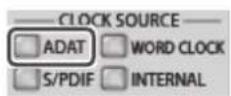
- Connect the ADAT optical device to the ADAT OPTICAL IN.
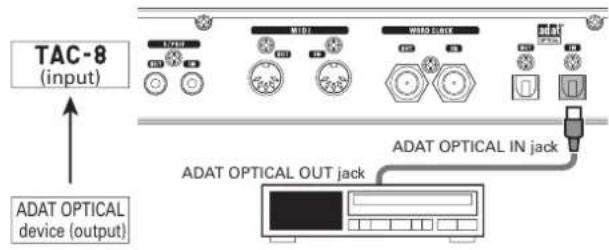
- The ADAT CLOCK SOURCE indicator will light, confirming synchronization.
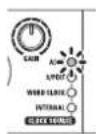
▶ Outputting an ADAT Optical signal from the TAC-8
- Use TAC-8 MixEfx to set CLOCK SOURCE to INTERNAL.
The INTERNAL CLOCK SOURCE indicator will blink.
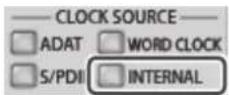
- Connect the ADAT Optical device to the ADAT OPTICAL OUT.
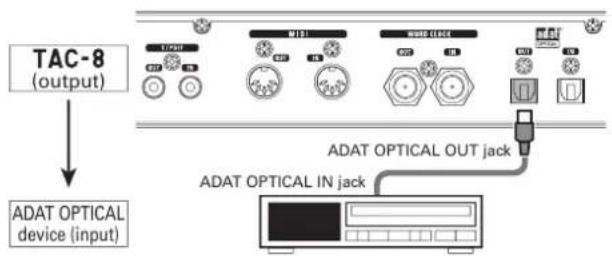
flowchart
graph TD
    A["TAC-8 (output)"] --> B["ADAT OPTICAL device (input)"]
    B --> C["ADAT OPTICAL OUT jack"]
    C --> D["ADAT OPTICAL IN jack"]
NOTE
- To synchronize audio clock, the TAC-8 and the connected device must have the same sampling rate settings.
- When using an ADAT Optical device with a word clock function, you can connect the TAC-8 WORD CLOCK OUT connector to the ADAT Optical device word clock input connector and synchronize them. (→P.18)
- If CLOCK SOURCE is set to ADAT, but synchronization with an ADAT Optical device is not possible, the CLOCK SOURCE indicator will blink. In this case, the TAC-8 will operate using its internal clock.
Using Digital Audio Equipment (continued)
■ Connecting the WORD CLOCK Connectors
Use the WORD CLOCK connectors when you want to synchronize with a master clock generator, for example.
- Minimize the volume of output devices connected to the TAC-8.
HINT
When connected, noise might occur until clock synchronizes.
- Set the same sampling rates for the TAC-8 and the connected device.
NOTE
For instructions about how to change the sampling rate of the TAC-8, see the TAC-8 MixEfx Reference Guide.
▶ Using the connected device as the master clock
- Use TAC-8 MixEfx to set CLOCK SOURCE to WORD CLOCK.
The WORD CLOCK CLOCK SOURCE indicator will blink.
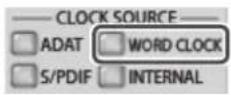
- Connect the other device to the WORD CLOCK IN.
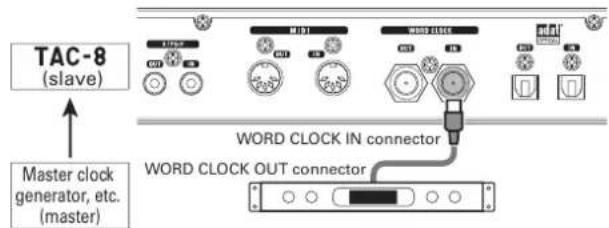
- The WORD CLOCK CLOCK SOURCE indicator will light, confirming synchronization.
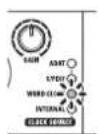
▶ Using the TAC-8 as the master clock
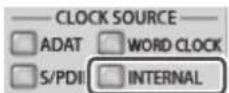
- Use TAC-8 MixEfx to set CLOCK SOURCE to INTERNAL.
The INTERNAL CLOCK SOURCE indicator will blink.
- Connect the other device to the WORD CLOCK OUT.
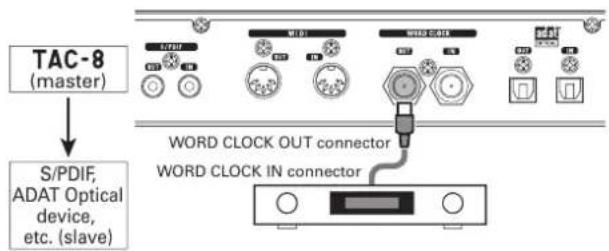
NOTE
- To synchronize audio clock, the TAC-8 and the connected device must have the same sampling rate settings.
- If CLOCK SOURCE is set to WORD CLOCK, but synchronization with the connected device is not possible, the CLOCK SOURCE indicator will blink. In this case, the TAC-8 will operate using its internal clock.
Using Digital Audio Equipment (continued)
■ Connecting MIDI Devices
- Use MIDI cables to connect MIDI devices to the MIDI IN and OUT jacks.
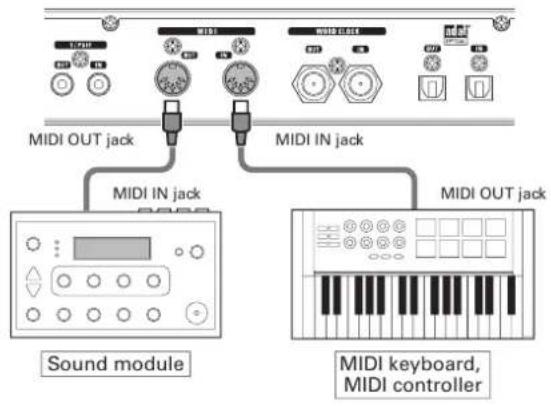
- Select "ZOOM TAC-8 MIDI I/O Port" in the settings of the DAW, for example.
NOTE
"ZOOM TAC-8 Reserved Port" is reserved for use by TAC-8 MixEfx. Using it might cause TAC-8 and TAC-8 MixEfx to not function properly.
Restoring Factory Default Settings
Follow these instructions to initialize settings, restoring them to the factory defaults.
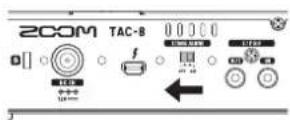
- Set STAND ALONE to OFF.
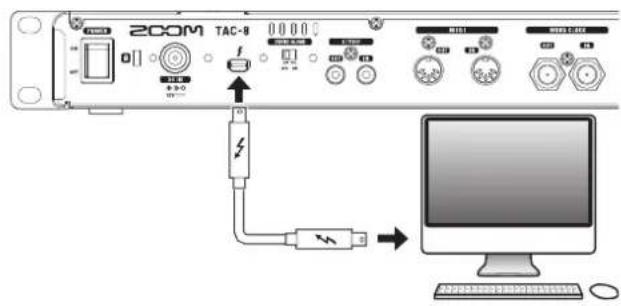
- Connect TAC-8 and the computer.
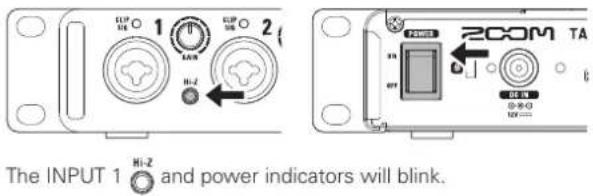
- While pressing INPUT 1 ☐, turn ON.
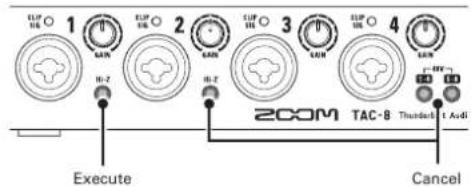
- Initialize the settings.
Execute: Press INPUT 1 Hi-Z. Cancel: Press INPUT 2 or
Troubleshooting
If you think that the TAC-8 is operating strangely, check the following items first.
Cannot select or use the TAC-8 device
- Confirm that the TAC-8 is connected to the computer correctly.
- Confirm that the TAC-8 STAND ALONE switch is set to OFF.
- Quit all the software that is using the TAC-8, and use the POWER switch to turn the TAC-8 off and on again.
- Reinstall the driver.
Playback sound cannot be heard or is quiet
- Check the speaker connections and volume settings on the speakers.
- Adjust the TAC-8 MAIN OUTPUT and/or PHONES 1/2 volume.
- Use TAC-8 MixEfx to check the built-in mixer settings.
- Confirm that the Output of the Sound pane of the System Preferences is set to "ZOOMTAC-8".
Recorded audio is too loud, too quiet or silent
- Adjust the TAC-8 input gain levels
- When using a condenser mic, turn phantom power on.
- Confirm that the Input of the Sound pane of the System Preferences is set to "ZOOMTAC-8".
The sound of the device connected to the input jack is distorted
- Confirm that the level indicators are not lighting red. If they are lighting red, lower the input levels.
Sound skips during playback or recording
- If you can adjust the audio buffer size of the software that you are using, increase the buffer size.
Cannot play or record
- Confirm that the Sound pane of the System Preferences is set to "ZOOMTAC-8".
- Confirm that TAC-8 is set for input and output in the software that you are using.
- Confirm that the TAC-8 is connected to the computer correctly.
- Quit all the software that is using the TAC-8, and disconnect and reconnect the Thunderbolt cable connected to the TAC-8.
Sound skips during digital input or output
- Confirm that the device used for audio clock synchronization is connected correctly.
- If the TAC-8 is the master, confirm that audio clock is synchronized on the connected device.
- If the TAC-8 is the slave, use TAC-8 MixEfx to confirm that the CLOCK SOURCE is set to the connection used for audio clock synchronization.
- If the TAC-8 is the slave, confirm that the CLOCK SOURCE indicator is not blinking.
Specifications
| ANALOG INPUT | INPUT 1-8 | Connectors | XLR/TRS combo jacks(XLR: 2 hot, TRS: TIP hot) |
| Input gain | 0-60 dB (1 dB steps) | ||
| Input impedance | 5 kΩ | ||
| 1 MΩ (When IN1/IN2 Hi-Z on) | |||
| Maximum input level | +13 dBu (XLR at 0 dBFS)+21 dBu (TRS at 0 dBFS) | ||
| Phantom power | +48 V | ||
| ANALOG OUTPUT | MASTER OUTPUT L/R LINE OUTPUT1-8 | Connectors | TRS jacks (balanced) |
| Maximum output level | +14 dBu (at 0 dBFS) | ||
| Output impedance | 150 Ω | ||
| PHONES 1/2 | Connectors | Standard stereo phone jacks20 mW × 2 (into 32 Ω load) | |
| Maximum output level | +10 dBu | ||
| Output impedance | 33 Ω | ||
| DIGITAL IN/OUT | ADAT OPTICAL | Connectors | ADAT lightpipe8 IN/OUT: 44.1 kHz/48 kHz4 IN/OUT: 88.2kHz/96kHz S/MUX compatible2 IN/OUT: 176.4kHz/192kHz S/MUX4 compatible |
| S/PDIF | Connectors | RCA (coaxial) | |
| Supported sampling frequencies | 44.1/48/88.2/96/176.4/192 kHz | ||
| WORD CLOCK | Connectors | BNC | |
| Supported sampling frequencies | 44.1/48/88.2/96/176.4/192 kHz | ||
| Output impedance | 75 Ω | ||
| Frequency characteristics | 44.1 kHz: -1.0 dB, 20 Hz-20 kHz96 kHz: -1.0 dB, 20 Hz-40 kHz192 kHz: -1.0 dB, 20 Hz-60 kHz | ||
| Input conversion noise | Measured EIN: 125 dB (IHF-A)at 60dB, 150Ω input | ||
| Dynamic range | AD: 120 dB typical (IHF-A)DA: 120 dB typical (IHF-A) | ||
| Number of recording and playback channels | Recording: 18 channels (ANALOG: 8, S/PDIF: 2, ADAT Optical: 8)Playback: 20 channels (ANALOG: 10, S/PDIF: 2, ADAT OPTICAL: 8)at 44.1 kHz and 48 kHz | ||
| Recording: 14 channels (ANALOG: 8, S/PDIF: 2, ADAT Optical: 4)Playback: 16 channels (ANALOG: 10, S/PDIF: 2, ADAT OPTICAL: 4)at 88.2 kHz and 96 kHz | |||
| Recording: 12 channels (ANALOG: 8, S/PDIF: 2, ADAT Optical: 2)Playback: 14 channels (ANALOG: 10, S/PDIF: 2, ADAT OPTICAL: 2)at 176.4 kHz and 192 kHz | |||
| Sampling frequencies | 192 kHz, 176.4 kHz, 96 kHz, 88.2 kHz, 48 kHz, 44.1 kHz | ||
| Bit depth | 24-bit | ||
| Interface | ThunderboltTM | ||
| MIDI IN/OUT | 5-pin DIN jacks | ||
| Power supply | AD-19 DC12V 2A AC adapter | ||
| External dimensions | 157.65 mm (D) × 482.6 mm (W) × 46.03 mm (H) | ||
| Weight (main unit only) | 2.01 kg |
Note: 0 dBu = 0.775 Vrms
FCC regulation warning (for U.S.A.)
This equipment has been tested and found to comply with the limits for a Class B digital device, pursuant to Part 15 of the FCC Rules. These limits are designed to provide reasonable protection against harmful interference in a residential installation. This equipment generates, uses, and can radiate radio frequency energy and, if not installed and used in accordance with the instructions, may cause harmful interference to radio communications. However, there is no guarantee that interference will not occur in a particular installation. If this equipment does cause harmful interference to radio or television reception, which can be determined by turning the equipment off and on, the user is encouraged to try to correct the interference by one or more of the following measures:
- Reorient or relocate the receiving antenna.
- Increase the separation between the equipment and receiver.
- Connect the equipment to an outlet on a circuit different from that to which the receiver is connected.
- Consult the dealer or an experienced radio/TV technician for help.
For EU Countries

Declaration of Conformity:
This product complies with the requirements of Low Voltage Directive 2006/95/EC and EMC Directive 2004/108/EC and ErP Directive 2009/125/EC and RoHS Directive 2011/65/EU
Disposal of Old Electrical & Electronic Equipment
(Applicable in European countries with separate collection systems)
This symbol on the product or on its packaging indicates that this product shall not be treated as household waste. Instead it shall be handed over to the applicable collection point for the recycling of electrical and electronic equipment. By ensuring this product is disposed of correctly, you will help prevent potential negative consequences for the environment and human health, which could otherwise be caused by inappropriate waste handling of this product. The recycling of materials will help to conserve natural resources. For more detailed information about recycling of this product, please contact your local city office, your household waste disposal service or the shop where you purchased the product.

ZOOM CORPORATION
4-4-3 Kanda-Surugadai, Chiyoda-ku, Tokyo 101-0062 Japan
http://www.zoom.co.jp
- Contents
- Introduction
- 18-in/20-out Thunderbolt™ audio converter
- Attention to audio performance
- Built-in high-performance mic preamps
- Flexible built-in mixer and dedicated TAC-8 MixEfx mixer application
- Usage and Safety Precautions
- Safety Precautions
- ⚠ Warning
- Alterations
- Operation using an AC adapter
- Caution
- Product handling
- Operating environment
- Connection cables and input/output jacks
- Volume
- Usage Precautions
- Interference with other electrical equipment
- Rack mounting
- Cleaning
- Temperature considerations
- Breakdown and malfunction
- Copyrights
- Names of Parts
- Standalone mode
- NOTE
- Upsampling
- Basic Connections
- Installing the Driver
- Turning the Power On and Off
- ■Turning the Power On
- HINT
- ■Turning the Power Off
- Setting Input and Output Devices
- Adjusting Headphone and Speaker Volume
- ■ Adjusting Headphone Volume
- ■ Adjusting Speaker Volume
- Using Instruments and Mics
- ■ Connecting Instruments
- Using the Hi-Z function
- ■ Connecting Mics
- Using Phantom Power
- ■ Adjusting the Input Gain
- Using Digital Audio Equipment
- ■ About Digital Audio Clock
- ■ Connecting S/PDIF Devices
- ▶ Inputting an S/PDIF signal to the TAC-8
- Use TAC-8 MixEfx to set CLOCK SOURCE to S/PDIF.
- Connect the S/PDIF device to the S/PDIF IN.
- The S/PDIF CLOCK SOURCE indicator will light, confirming synchronization.
- ▶ Outputting a S/PDIF signal from the TAC-8
- Use TAC-8 MixEfx to set CLOCK SOURCE to INTERNAL.
- Connect the S/PDIF device to the S/PDIF OUT.
- Using Digital Audio Equipment (continued)
- ■ Connecting ADAT Optical Devices
- ■ Connecting the WORD CLOCK Connectors
- ■ Connecting MIDI Devices
- Restoring Factory Default Settings
- Troubleshooting
- Cannot select or use the TAC-8 device
- Playback sound cannot be heard or is quiet
- Recorded audio is too loud, too quiet or silent
- The sound of the device connected to the input jack is distorted
- Sound skips during playback or recording
- Cannot play or record
- Sound skips during digital input or output
- FCC regulation warning (for U.S.A.)
- For EU Countries
- Disposal of Old Electrical & Electronic Equipment
- ZOOM CORPORATION
Brand : ZOOM
Model : TAC-8
Category : Audio/video converter