
CDX4952-L - Surveillance VIEWSONIC - Free user manual and instructions
Find the device manual for free CDX4952-L VIEWSONIC in PDF.


| Product Type | Surveillance Camera |
| Resolution | 1920 x 1080 (Full HD) |
| Lens | 4mm fixed lens |
| Field of View | 90° (Horizontal) |
| Night Vision | Up to 30m (IR LEDs) |
| Power Supply | DC 12V, 1A (adapter included) |
| Dimensions | 70mm x 70mm x 120mm (without mount) |
| Weight | 350g (without mount) |
| Connectivity | Ethernet RJ45, Wi-Fi 802.11 b/g/n |
| Storage | microSD slot up to 128GB (not included) |
| Weatherproof Rating | IP66 (outdoor use) |
| Audio | Two-way audio with built-in mic and speaker |
| Motion Detection | Yes, with configurable sensitivity and zones |
| Mobile App | ViewSonic Surveillance App (iOS/Android) |
| Installation | Ceiling mount bracket included |
| Certifications | FCC, CE, RoHS |
| Maintenance & Cleaning | Gently clean the lens and housing with a soft, dry cloth. Do not use abrasive cleaners. |
| Safety | Only use the provided power adapter; avoid exposure to extreme temperatures beyond -20°C to 50°C. |
| Spare Parts & Repairability | Spare parts (lens module, IR board, housing) available via ViewSonic service centers. Professional repair recommended. |
Frequently Asked Questions - CDX4952-L VIEWSONIC
User questions about CDX4952-L VIEWSONIC
0 question about this device. Answer the ones you know or ask your own.
Ask a new question about this device
Download the instructions for your Surveillance in PDF format for free! Find your manual CDX4952-L - VIEWSONIC and take your electronic device back in hand. On this page are published all the documents necessary for the use of your device. CDX4952-L by VIEWSONIC.
USER MANUAL CDX4952-L VIEWSONIC
IMPORTANT: Please read this User Guide to obtain important information on installing and using your product in a safe manner, as well as registering your product for future service. Warranty information contained in this User Guide will describe your limited coverage from ViewSonic Corporation, which is also found on our web site at http://www.viewsonic.com in English, or in specific languages using the Regional selection box in the upper right corner of our website. "Antes de operar su equipo lea cu idadosamente las instrucciones en este manual"
Model No. VS16717
Thank you for choosing ViewSonic
With over 25 years as a world leading provider of visual solutions, ViewSonic is dedicated to exceeding the world's expectations for technological evolution, innovation, and simplicity. At ViewSonic, we believe that our products have the potential to make a positive impact in the world, and we are confident that the ViewSonic product you have chosen will serve you well.
Once again, thank you for choosing ViewSonic !
ViewSonic®

Compliance Information
NOTE: This section addresses all connected requirements and statements regarding regulations. Confirmed corresponding applications shall refer to nameplate labels and relevant markings on unit.
FCC Statement
This device complies with Part 15 of the FCC Rules. Operation is subject to the following two conditions: (1) this device may not cause harmful interference, and (2) this device must accept any interference received, including interference that may cause undesired operation.
NOTE: This equipment has been tested and found to comply with the limits for a Class A/Class B digital device, pursuant to Part 15 of the FCC Rules. These limits are designed to provide reasonable protection against harmful interference when the equipment is operated in a commercial environment. This equipment generates, uses, and can radiate radio frequency energy and, if not installed and used in accordance with the instructions, may cause harmful interference to radio communications. Operation of this equipment in a residential area is likely to cause harmful interference in which case the user will be required to correct the interference at his/her own expense.
- Reorient or relocate the receiving antenna.
- Increase the separation between the equipment and receiver.
- Connect the equipment into an outlet on a circuit different from that to which the receiver is connected.
- Consult the dealer or an experienced radio/TV technician for help.
Warning: To comply with the limits for the Class A/Class B digital device, pursuant to Part 15 of the FCC Rules, this device must be installed in computer equipment certified to comply with the Class A/Class B limits. All cables used to connect the computer and peripherals must be shielded and grounded. Operation with non-certified computers or non-shielded cables may result in interference to radio or television reception. Changes and modifications not expressly approved by the manufacturer could void the user's authority to operate this equipment.
For Canada
CAN ICES-3 (A/B)/NMB-3(A/B)
The mark indicates the requirement NOT to dispose of the equipment as unsorted municipal waste, but use the return and collection systems according to local law.
If the batteries, accumulators and button cells included with this equipment, display the chemical symbol Hg, Cd, or Pb, then it means that the battery has a heavy metal content of more than 0.0005% Mercury or more than, 0.002% Cadmium, or more than 0.004% Lead.


Declaration of RoHS2 Compliance
This product has been designed and manufactured in compliance with Directive 2011/65/EU of the European Parliament and the Council on restriction of the use of certain hazardous substances in electrical and electronic equipment (RoHS2 Directive) and is deemed to comply with the maximum concentration values issued by the European Technical Adaptation Committee (TAC) as shown below:
| Substance | Proposed Maximum Concentration | Actual Concentration |
| Lead (Pb) 0,1% < 0,1% | ||
| Mercury (Hg) 0,1% < 0,1% | ||
| Cadmium (Cd) 0,01% < 0,01% | ||
| Hexavalent Chromium ( Cr^6+ ) 0,1% < 0,1% | ||
| Polybrominated biphenyls (PBB) 0,1% < 0,1% | ||
| Polybrominated diphenyl ethers (PBDE) 0,1% < 0,1% |
Certain components of products as stated above are exempted under the Annex III of the RoHS2 Directives as noted below:
Examples of exempted components are:
- Mercury in cold cathode fluorescent lamps and external electrode fluorescent lamps (CCFL and EEFL) for special purposes not exceeding (per lamp):
(1) Short length ( ≤ 500 mm): maximum 3.5 mg per lamp.
(2) Medium length (>500 mm and ≤1,500 mm): maximum 5 mg per lamp.
(3) Long length (>1,500 mm): maximum 13 mg per lamp.
-
Lead in glass of cathode ray tubes.
-
Lead in glass of fluorescent tubes not exceeding 0.2% by weight.
-
Lead as an alloying element in aluminium containing up to 0.4% lead by weight.
-
Copper alloy containing up to 4% lead by weight.
-
Lead in high melting temperature type solders (i.e. lead-based alloys containing 85% by weight or more lead).
-
Electrical and electronic components containing lead in a glass or ceramic other than dielectric ceramic in capacitors, e.g. piezoelectronic devices, or in a glass or ceramic matrix compound.
Safety Precautions
FOR OPTIMUM PERFORMANCE, PLEASE NOTE THE FOLLOWING WHEN SETTING UP AND USING THE LCD COLOR MONITOR:
- DO NOT REMOVE MONITOR BACK COVER. There are no user serviceable parts inside and opening or removing covers may expose you to dangerous shock hazards or other risks. Refer all servicing to qualified service personnel.
- Do not spill any liquids into the cabinet or use your monitor near water.
- Do not insert objects of any kind into the cabinet slots, as they may touch dangerous voltage points, which can be harmful or fatal or may cause electric shock, fire or equipment failure.
- Do not place any heavy objects on the power cord. Damage to the cord may cause shock or fire.
- Do not place this product on a sloping or unstable cart, stand or table, as the monitor may fall, causing serious damage to the monitor.
- Do not place any objects onto the monitor and do not use the monitor outdoors.
- The inside of the fluorescent tube located within the LCD monitor contains mercury. Please follow the laws or rules of your municipality to dispose of the tube properly.
- Do not bend power cord.
- Do not use monitor in high temperature, humid, dusty, or oily areas.
- If monitor or glass is broken, do not come in contact with the liquid crystal and handle with care.
- Allow adequate ventilation around the monitor, so that heat can properly dissipate. Do not block ventilated openings or place the monitor near a radiator or other heat sources. Do not put anything on top of the monitor.
- The power cable connector is the primary means of detaching the system from the power supply. The monitor should be installed close to a power outlet, which is easily accessible.
- Handle with care when transporting. Save packaging for transporting.
- Please clean the holes of back cabinet to reject dirt and dust at least once a year because of set reliability.
- If using the cooling fan continuously, it's recommended to wipe holes a minimum of once a month.
- When installing the remote control batteries;
- Align the batteries according to the (+) and (-) indications inside the case.
- Align the (-) indication of the battery first inside the case.
CAUTION:
Immediately unplug your monitor from the wall outlet and refer servicing to qualified service personnel under the following conditions:
- When the power supply cord or plug is damaged.
- If liquid has been spilled, or objects have fallen into the monitor.
- If the monitor has been exposed to rain or water.
- If the monitor has been dropped or the cabinet damaged.
- If the monitor does not operate normally by following operating instructions.
Recommended Use
CAUTION:
- For optimum performance, allow 20 minutes for warm-up.
- Rest your eyes periodically by focusing on an object at least 5 feet away. Blink often.
- Position the monitor at a 90° angle to windows and other light sources to minimize glare and reflections.
- Clean the LCD monitor surface with a lint-free, nonabrasive cloth. Avoid using any cleaning solution or glass cleaner!
- Adjust the monitor's brightness, contrast and sharpness controls to enhance readability.
- Avoid displaying fixed patterns on the monitor for long periods of time to avoid image persistence (after image effects).
• Get regular eye checkups.
Ergonomics
To realize the maximum ergonomic benefits, we recommend the following:
- Use the preset Size and Position controls with standard signals.
- Use the preset Color Setting.
- Use non-interlaced signals.
- Do not use primary color blue on a dark background, as it is difficult to see and may produce eye fatigue due to insufficient contrast.
Table Of Contents
1. Unpacking and Installation....1
1.1. Unpacking .... 1
1.2. Package Contents......1
1.3. Installation Notes......1
1.4. Installing and Removing Table Stands (optional)....2
1.5. Installing and Removing OPS module 3
1.6. Mounting on a Wall....4 1.6.1. VESA Grid .... 4
1.7. Mounting in Portrait Position ..... 5
1.8. Operating Instructions of Edge Alignment Kit....5
2. Parts and Functions ...... 6
2.1. Control Panel 6
2.2. Input/Output Terminals 7
2.3. Remote Control 8
2.3.1. General functions ...... 8
2.3.2. Inserting the batteries in the remote control.... 9
2.3.3. Handling the remote control 9
2.3.4. Operating range of the remote control.... 9
3. Connecting External Equipment ..... 10
3.1. Connecting External Equipment (DVD/VCR/VCD) 10
3.1.1. Using COMPONENT video input....10
3.1.2. Using Video Source input. 10
3.1.3. Using HDMI video input....10
3.2. Connecting a PC....11
3.2.1. Using VGA input....11
3.2.2. Using DVI input.....11
3.2.3. Using HDMI input .....11
3.2.4. Using DisplayPort input .... 12
3.3. Connecting Audio Equipment.....12
3.3.1. Connecting external speakers....12
3.3.2. Connecting an external audio device 12
3.4. Connecting Multiple Displays in a Daisy-chain Configuration....13
3.4.1. Display control connection 13
3.4.2. Digital video connection.... 13
3.4.3. Analog video connection .. 14
3.4.4. IR daisy-chain Connection 14
3.5. IR connection 14
3.6. IR Pass-through Connection ..... 15
3.7. Wire-connecting to Network ..... 15
4. Operation....16
4.1. Watch the Connected Video Source....16
4.2. Change Picture Format...... 16
4.3. Choose your Preferred Picture Settings 16
4.4. Choose your Preferred Sound Settings 16
4.5. Play multimedia files via Local Area Network 16
4.5.1. Set up the network..... 16
4.5.2. How to use DLNA-DMP....17
4.5.3. How to use DLNA-DMR from PC....17
4.6. Play multimedia files from USB device....18
4.7.Play options....18
4.7.1. Playing music files......18
4.7.2. Playing movie files.....19
4.7.3. Playing photo files 19
5. Change your settings....20
5.1. Settings 20
5.1.1. Picture 20
5.1.2. Sound 21
5.1.3. Tiling 21
5.1.4. General settings ...... 22
5.2. Network Settings 25
6. USB device compatibility....26
7. Input Mode.....28
8. Cleaning and Troubleshooting......30
8.1. Cleaning 30
8.2. Troubleshooting......31
9. Technical Specifications 32
9.1. CDX4952....32
10. RS232 Protocol 34
10.1. Introduction 34
10.2.Description 34
10.2.1. Hardware specification ..... 34
10.2.2.Communication Setting .... 34
10.2.3. Command Message Reference....34
10.3.Protocol 35
10.3.1. Set-Function Listing......35
10.3.2. Get-Function Listing ..... 39
10.3.3. Remote Control Pass-through mode 44
11. Other Information ...... 47
Customer Support...... 47
Limited Warranty 48
Mexico Limited Warranty 50
Copyright Information
Copyright © ViewSonic Corporation, 2016. All rights reserved.
ViewSonic ^© and the three birds logo are registered trademarks of ViewSonic Corporation.
ENERGY STAR ^® is a registered trademark of the U.S. Environmental Protection Agency (EPA).
As an ENERGY STAR ^® partner, ViewSonic Corporation has determined that this product meets the ENERGY STAR ^® guidelines for energy efficiency.
Disclaimer: ViewSonic Corporation shall not be liable for technical or editorial errors or omissions contained herein; nor for incidental or consequential damages resulting from furnishing this material, or the performance or use of this product.
In the interest of continuing product improvement, ViewSonic Corporation reserves the right to change product specifications without notice. Information in this document may change without notice.
No part of this document may be copied, reproduced, or transmitted by any means, for any purpose without prior written permission from ViewSonic Corporation.
Product Registration
To meet your future needs, and to receive any additional product information as it becomes available, please register your product on the Internet at: www.viewsonic.com.
The ViewSonic® Wizard CD-ROM also provides an opportunity for you to print the registration form, which you may mail or fax to ViewSonic.
For Your Records
Product Name: CDX4952
ViewSonic Commercial Display
Model Number: VS16717
Document Number: CDX4952_UG_ENG Rev. 1A 02-24-17
Serial Number:
Purchase Date:
Product disposal at end of product life
ViewSonic respects the environment and is committed to working and living green. Thank you for being part of Smarter, Greener Computing.
Please visit ViewSonic website to learn more.
USA & Canada: http://www.viewsonic.com/company/green/recycle-program/
Europe: http://www.viewsoniceurope.com/uk/support/recycling-information/
Taiwan: http://recycle.epa.gov.tw/recycle/index2.aspx
1. Unpacking and Installation
1.1. Unpacking
- This product is packed in a carton, together with the standard accessories.
- Any other optional accessories will be packed separately.
- Due to the size and weight of this display it is recommended for two people to move it.
• After opening the carton, ensure that the contents are complete and in good condition.
1.2. Package Contents
Please verify that you received the following items with your package content:
- LCD display
- CD ROM
- Remote control with AAA batteries
• Power cord (1.8 m)
• VGA cable (1.8 m)
• RS232 cable (1.8 m)
• Daisy chain cable (1.8m) - IR sensor cable
- Quick Start Guide
- Edge Alignment Kit-1: 1PCS
- Edge Alignment Kit-2: 2PCS
- Thumb Screw: 8PCS
* The supplied power cord varies depending on destination.

NOTES:
- For all other regions, apply a power cord that conforms to the AC voltage of the power socket and has been approved by and complies with the safety regulations of the particular country.
- You might like to save the package box and packing material for shipping the display.
1.3. Installation Notes
- Due to the high power consumption, always use the plug exclusively designed for this product. If an extended line is required, please consult your service agent.
- The product should be installed on a flat surface to avoid tipping. The distance between the back of the product and the wall should be maintained for proper ventilation. Avoid installing the product in the kitchen, bathroom or any other places with high humidity so as not to shorten the service life of the electronic components.
- The product can normally operate only under 3000m in altitude. In installations at altitudes above 3000m, some abnormalities may be experienced.
1.4. Installing and Removing Table Stands (optional)
To install table stands:
- Ensure your display is powered off.
- Spread a protective sheet on a flat surface.
- Grab the carrying handles and place the display face-down on the protective sheet.
- After inserting the stand in the guide block, tighten the screws on both sides of the display.
NOTE: The longer side of the stand should face the front of the display.
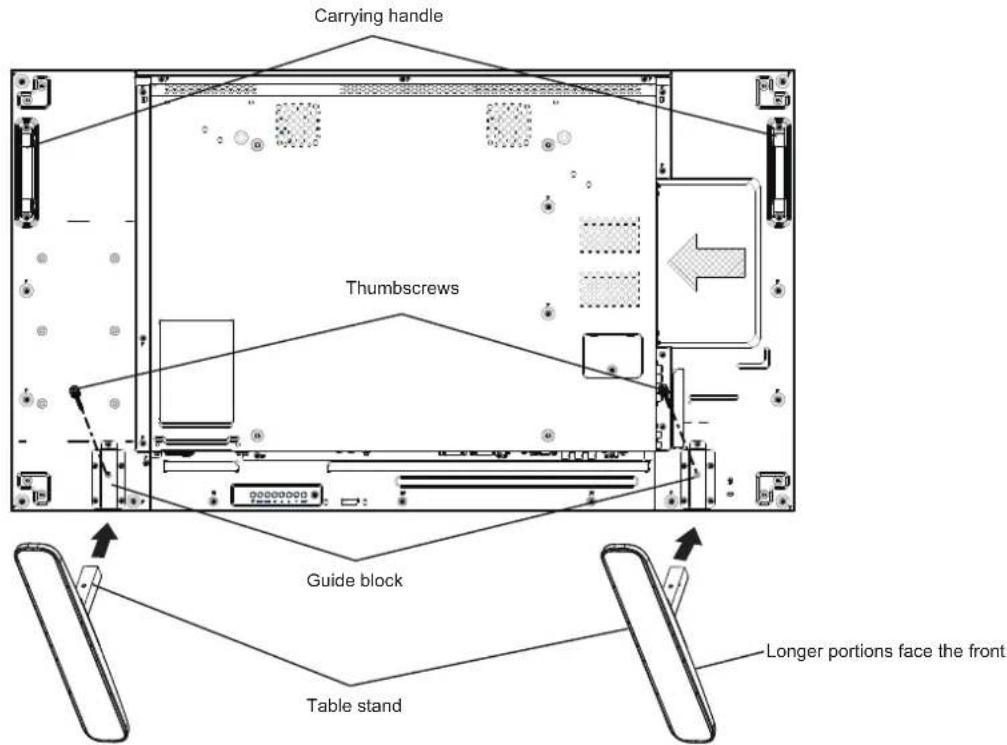
To remove table stands:
- Power off the display.
- Spread a protective sheet on a flat surface.
- Grab the carrying handles and place the display face-down on the protective sheet.
- Remove screws using a screwdriver and place them in a safe place for reuse.
1.5. Installing and Removing OPS module
To install OPS Module:
- Power off the display.
- Remove the cover of OPS after take screw off.
- Insert OPS module and then fix by screw.
NOTE: Keep the OPS cover for future use.
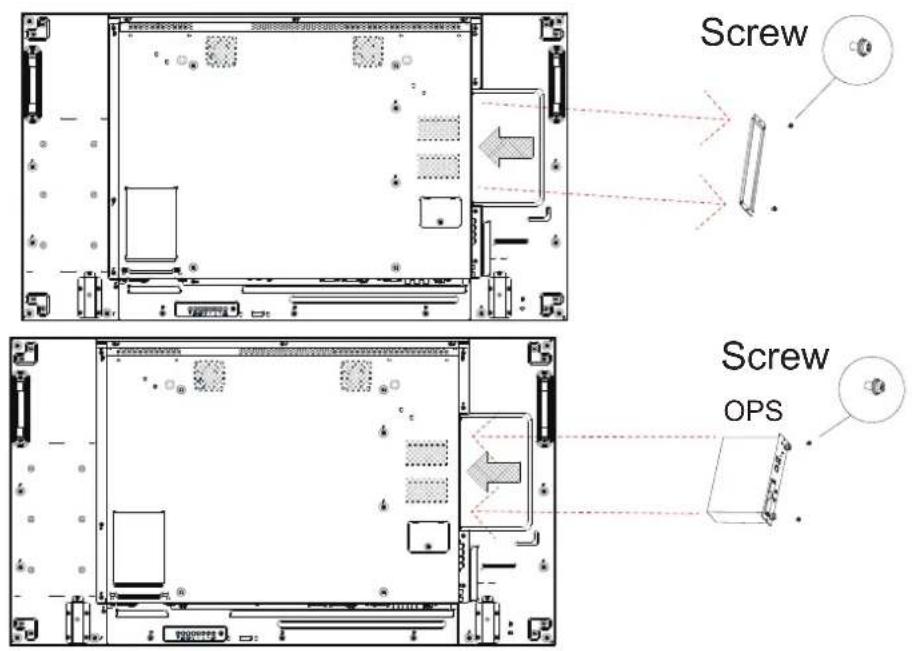
To remove OPS Module:
- Power off the display.
- Remove screw and plug out OPS module.
- Install OPS cover and then fix by screw.
1.6. Mounting on a Wall
To mount this display to a wall, you will have to obtain a standard wall-mounting kit (commercially available). We recommend using a mounting interface that complies with TUV-GS and/or UL1678 standard in North America.
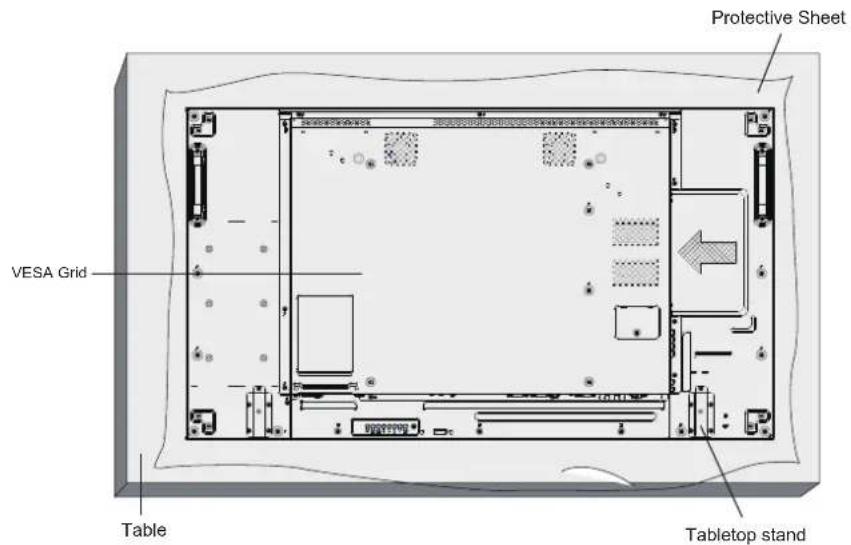
- Lay a protective sheet on a table, which was wrapped around the display when it was packaged, beneath the screen surface so as not to scratch the screen face.
- Ensure you have all accessories for mounting this display (wall mount, ceiling mount, table stand, etc).
- Follow the instructions that come with the base mounting kit. Failure to follow correct mounting procedures could result in damage to the equipment or injury to the user or installer. Product warranty does not cover damage caused by improper installation.
- For the wall-mounting kit, use M6 mounting screws (having a length 10 mm longer than the thickness of the mounting bracket) and tighten them securely.
- Unit without base weight = 21.6 kg. The equipment and its associated mounting means still remain secure during the test. For use only with UL Listed Wall Mount Bracket with minimum weight/load: 87.6 kg.
1.6.1. VESA Grid
CDX4952 400(H) x 400(V) mm
Caution:
To prevent the display from falling:
- For wall or ceiling installation, we recommend installing the display with metal brackets which are commercially available. For detailed installation instructions, refer to the guide received with the respective bracket.
- To lessen the probability of injury and damage resulting from fall of the display in case of earthquake or other natural disaster, be sure to consult the bracket manufacturer for installation location.
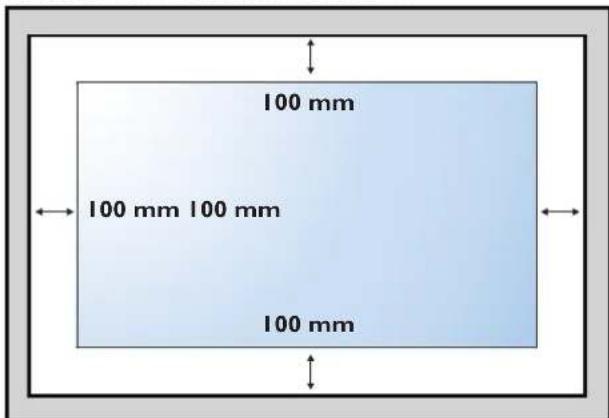
Ventilation Requirements for enclosure locating
To allow heat to disperse, leave space between surrounding objects as shown in the diagram below.
1.7. Mounting in Portrait Position
This display can be installed in por trait position.
- Remove the table stand, if attached.
- Rotate 90 degrees anticlockwise. The terminals logo should be bristling when facing the display at the back.
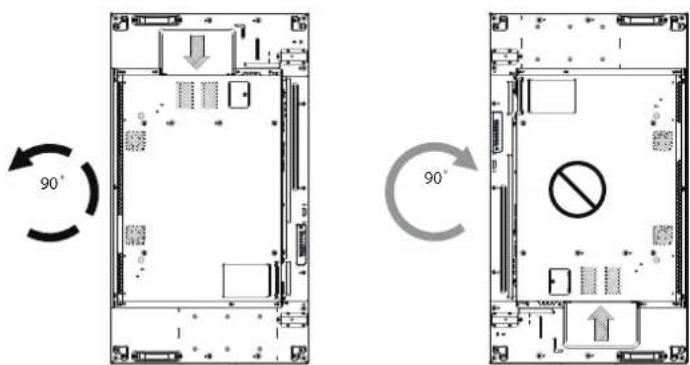
1.8. Operating Instructions of Edge Alignment Kit
- Before install edge alignment kit, displays must be mounted to
• video wall frame correctly.
• Using "Thumb Screw" for easy installing. - Using "Edge Alignment Kit-1" on adjacent four displays.ck.
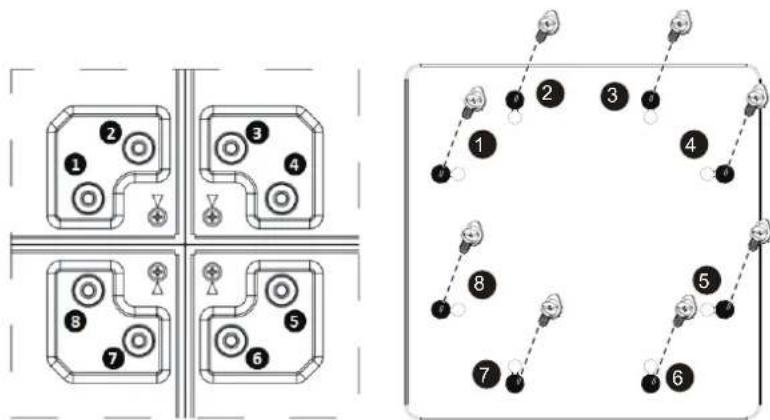
flowchart
graph TD
    subgraph Left
        A1["1"] --> B1["2"]
        A2["3"] --> B2["4"]
        A3["8"] --> B3["5"]
        A4["7"] --> B4["6"]
    end
    subgraph Right
        C1["1"] --> D1["2"]
        C2["3"] --> D2["4"]
        C3["8"] --> D3["5"]
        C4["7"] --> D4["6"]
    end
    style Left fill:#f9f,stroke:#333
    style Right fill:#bbf,stroke:#333
- Using "Edge Alignment Kit-2" on adjacent two displays.
- Install the "Edge Alignment Kit-2" with 2 PCS of M4 screw.
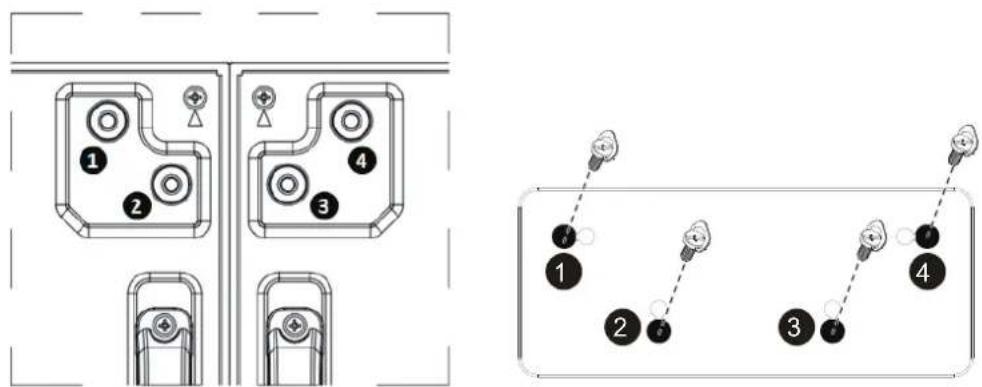
NOTE: When installing the edge alignment kit, please consult a professional technician for proper installation. We accept no liability for installations not performed by a professional technician.
2. Parts and Functions
2.1. Control Panel

① [button
Use this button to turn the display on or put the display to standby.
② [MUTE] button
Switch the audio mute ON/OFF.
③ [INPUT] button
Choose the input source.
- Used as [OK] button in the On-Screen-Display menu.
④ [+button
Increase the adjustment while OSD menu is on, or increase the audio output level while OSD menu is off.
⑤ [+]button
Decrease the adjustment while OSD menu is on, or decrease the audio output level while OSD menu is off.
⑥ [▲button
Move the highlight bar up to adjust the selected item while OSD menu is on.
⑦ [▼button
Move the highlight bar down to adjust the selected item while OSD menu is on.
⑧ [MENU] button
Return to previous menu while OSD menu is on, or to activate the OSD menu when OSD menu is off.
⑨ Remote control sensor and power status indicator
- Receives command signals from the remote control.
-
Indicates the operating status of the display without OPS:
-
Lights green when the display is turned on
- Lights red when the display is in standby mode
- Lights amber when the display enters APM mode
- When {SCHEDULE} is enabled, the light blinks green and red
- If the light blinks red, it indicates that a failure has been detected
- Lights off when the main power of the display is turned off
⑩OPS slot
Expansion slot adapter for Open Pluggable Specification (OPS) card.
2.2. Input/Output Terminals

① AC IN
AC power input from the wall outlet.
② MAIN POWER SWITCH
Switch the main power on/off.
③ IR IN / ④ IR OUT
IR signal input / output for the loop-through function.
NOTE:
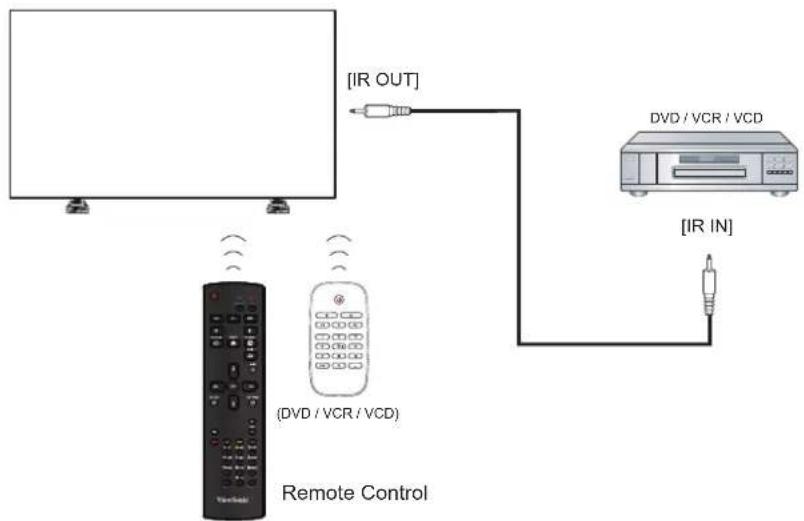
- This display's remote control sensor will stop working if the jack [IR IN] is connected
- To remotely control your A/V device via this display, refer to page 14 for IR Pass Through connection.
⑤ RS232C IN / ⑥ RS232C OUT
RS232C network input / output for the loop-through function.
⑦ RJ-45
LAN control function for the use of remote control signal from control center.
⑧ HDMI IN / ⑨ HDMI2 IN
HDMI video/audio input.
⑩ DVI IN
DVI-D video input.
⑪ DVI OUT / VGA OUT
DVI or VGA video output.
⑫ DisplayPort IN / ⑬ DisplayPort OUT
DisplayPort video input / output.
⑭ VGA IN (D-Sub)
VGA video input.
⑮ COMPONENT IN (BNC)
Component YPbPr video source input.
⑯ Y/CVBS
Video source input.
⑰ PC LINE IN
Audio input for VGA source (3.5mm stereo phone).
⑱ SPEAKER SWITCH
Internal speaker on/off switch.
⑲ AUDIO IN
Audio input from external AV device (RCA).
20 AUDIO OUT
Audio output to external AV device.
②1 USB PORT
Connect your USB storage device.
22 SPEAKERS OUT
Audio output to external speakers.
②3 OPS SLOT
Slot for installing the optional OPS module.
⑳ SECURITY LOCK
Used for security and theft prevention.
2.3. Remote Control
2.3.1. General functions

① [POWER] button
Press to switch on the display from standby mode. Press again to turn it off and back into standby mode.
② [PLAY] button
Control playback of media files.
③ [-SOURCE] button
Press to toggle Video Source Menu. Press [▲] or [▼button to select one of the video sources among Displayport, DVI-D, VGA, HDMI, Component, or Video. Press [OK] button.
④ [MENU] button
Press to turn the OSD menu on/off.
⑤ [▲button
- Press to move the selection up in OSD menu. - Press to increase the value in OSD menu.
⑥ [◀button
Press to move the selection left in OSD menu.
⑦ [OK] button
Press to activate the setting inside the OSD menu.
⑧ [ADJUST] button
Press to run the Auto Adjust function. NOTE: This button is functional for VGA input only.
⑨ [▼button
- Press to move the selection down in OSD menu. - Press to decrease the value in OSD menu.
⑩ [ ◦MUTE button
Press to turn the mute function on/off.
⑪ COLOR buttons
Select tasks or options.
⑫ [NUMERIC] buttons
Enter text for network setting.
⑬ Format button
Press to switch screen aspect ratio.
- For PC signal: FULL, NORMAL, CUSTOM, and REAL. - For Video signal: FULL, NORMAL, DYNAMIC, CUSTOM, and REAL.
⑭ [EXIT] button
Press to turn back to the previous OSD menu.
⑮ [INFO] button
Press to turn on/off the information OSD displayed on the upper right corner of the screen.
⑯ [▶] button
Press to move the selection right in OSD menu.
⑰ [OPTION] button
Access currently available options, picture and sound menus.
⑱ [VOL UP] button
Press to increase the audio output level.
⑲ [VOL DOWN] button
Press to decrease the audio output level.
20 21 [ID SET] button
If a single large- screen matrix (video wall) is created, set ID key to control each dispaly.
ID Remote Control:
You can set the remote control ID when you want to use this remote control on one of several different displays. Press [ID] button. The red LED blinks twice.
-
Press [ID SET] button for more than 1 second to enter the ID ode. The red LED lights up. Press the [ID SET] button again will exit the ID Mode. The red LED lights off. Press the digit number [0] \~ [9] to select the display you want to control. For example: press [0] and [1] for display No.1, press [1] and [1] for display No. 11. The numbers available are from [01] \~[255].
-
Not pressing any button within 10 seconds will exit the ID Mode.
-
If an error pressing of buttons other than the digits occurred, wait 1 second after the red LED lights off and then lights up again, then press the correct digits again.
-
Press [ID ENTER] button to confirm. The red LED blinks twice and then lights off.
NOTE:
- Press [NORMAL] button. The green LED blinks twice, indicating the display is in normal operation. - It is necessary to set up the ID number for each display before selecting its ID number.
2.3.2. Inserting the batteries in the remote control
The remote control is powered by two 1.5V AAA batteries.
To install or replace batteries:
- Press and then slide the cover to open it.
- Align the batteries according to the (+) and (−) indications inside the battery compartment.
- Replace the cover.
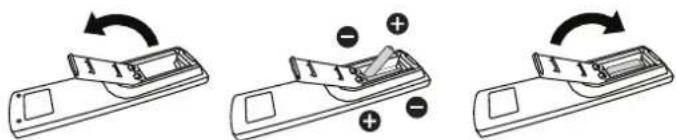
natural_image
Three-step diagram showing a device with rotating buttons and battery polarity (no text or symbols)Caution:
The incorrect use of batteries can result in leaks or bursting. Be sure to follow these instructions:
- Place "AAA" batteries matching the (+) and (−) signs on each battery to the (+) and (−) signs of the battery compartment.
- Do not mix battery types.
- Do not combine new batteries with used ones. It causes shorter life or leakage of batteries.
- Remove the dead batteries immediately to prevent them from liquid leaking in the battery compartment. Don't touch exposed battery acid, as it can damage your skin.
NOTE: If you do not intend to use the remote control for a long period, remove the batteries.
2.3.3. Handling the remote control
- Do not subject to strong shock.
- Do not allow water or other liquid to splash the remote control. If the remote control gets wet, wipe it dry immediately.
- Avoid exposure to heat and steam.
- Other than to install the batteries, do not open the remote control.
2.3.4. Operating range of the remote control
Point the top of the remote control toward the display's remote control sensor when pressing a button.
Use the remote control within the range which is shown in the following table.
| Operation Angle RC operational distance | |
| θ= 00 (for H & V) ≥ 8m | |
| θ= 200 (for H & V) ≥ 5m | |
| θ= 450 (for H only) ≥ 2m | |
NOTE: The remote control may not function properly when the remote control sensor on the display is under direct sunlight or strong illumination, or when there is an obstacle in the path of signal transmission.

3. Connecting External Equipment
3.1. Connecting External Equipment (DVD/VCR/VCD)
3.1.1. Using COMPONENT video input
![Audio Out [ R ] [L ] [AUDIO IN] COMPONENT OUT (YPbPr) DVD / VCR / VCD COMPONENT IN (YPbPr)](/content/2026/05/1143439/images/d98e3344f30f799b26b5c2d560d443a6c0faf3d35a9043496606f10180307aad.jpg)
3.1.2. Using Video Source input
![Y/CVBS Out DVD / VCR / VCD [R] [L] [AUDIO IN] [Y/CVBS IN]](/content/2026/05/1143439/images/df5fe4222a9ef0c370648f01873a36cddcb3b44f57152c65628aedcf0b5d32df.jpg)
3.1.3. Using HDMI video input
![DVD / VCR / VCD HDMI Out [HDMI IN]](/content/2026/05/1143439/images/0b216289cd91b82380bd3e426750b61cd7229ff1928ade045cf20a155f4ffb62.jpg)
3.2. Connecting a PC
3.2.1. Using VGA input
![VGA Out D-Sub 15 pin PC Audio Out VGA IN [VGA AUDIO IN]](/content/2026/05/1143439/images/503c56555ae81e3acf53dbec7b54a0a42b468bfaf4704a41ead3f29485b5296f.jpg)
3.2.2. Using DVI input
![DVI Out PC Audio Out [DVI IN] [VGA AUDIO IN]](/content/2026/05/1143439/images/ca5a5860b4b9e4e410ed606db5516167e70bc51a7ee574eb6262bc067c3b7291.jpg)
3.2.3. Using HDMI input
![HDMI Out [ HDMI IN ] PC](/content/2026/05/1143439/images/84ecf58afd8dde4be039169b93ec6b78c388910e47412d5108a09e17fab0e76b.jpg)
3.2.4. Using DisplayPort input
![DisplayPort Out [DisplayPort IN] PC](/content/2026/05/1143439/images/376d81bafd1109c4177195fd4c45d412c66133d425702baf59c02af66a59262a.jpg)
3.3. Connecting Audio Equipment
3.3.1. Connecting external speakers

3.3.2. Connecting an external audio device
![[AUDIO OUT] Audio In Stereo Amplifier](/content/2026/05/1143439/images/5ff68c4b70873bea430ff8369119b7a37a19a49b8ba90fdd84e4f03c515d9e00.jpg)
3.4. Connecting Multiple Displays in a Daisy-chain Configuration
You can interconnect multiple displays to create a daisy-chain configuration for applications such as a video wall.
3.4.1. Display control connection
Connect the [RS232C OUT] connector of DISPLAY 1 to the [RS232C IN] connector of DISPLAY 2.

flowchart
graph TD
    PC["PC"] -->|[RS-232C]| A["Switch"]
    A --> B["Display 1 DISPLAY 2"]
    B --> C["RS-232C IN"]
    B --> D["RS-232C OUT"]
    C --> E["Switch"]
    D --> F["Switch"]
3.4.2. Digital video connection
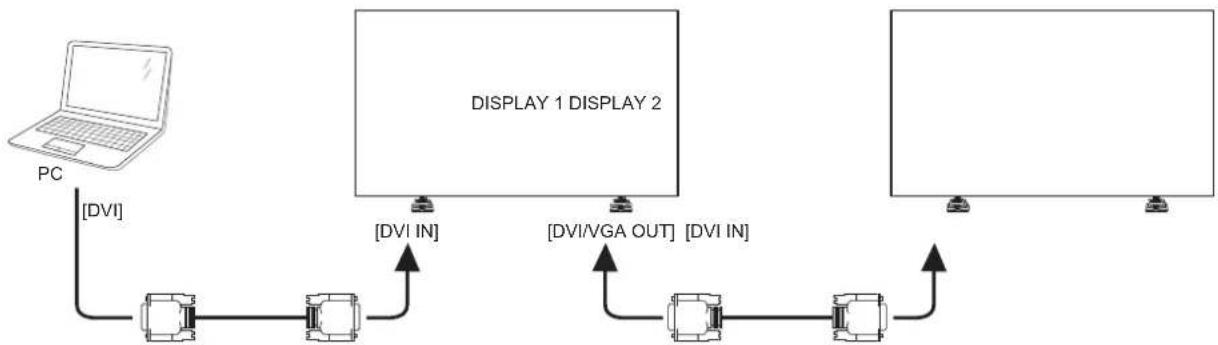
Connect the [DVI OUT / VGA OUT] connector of DISPLAY 1 to the [DVI IN] connector of DISPLAY 2.
flowchart
graph TD
    PC["PC"] -->|DVI| A["Device 1"]
    A -->|DVI IN| B["Display 2"]
    B -->|DVI/VGA OUT| C["Device 3"]
    C -->|DVI IN| D["Device 4"]
    D -->|DVI IN| E["Device 5"]
Connect the [DP OUT] connector of DISPLAY 1 to the [DP IN] connector of DISPLAY 2.

flowchart
graph TD
    A["PC"] -->|DP| B["Display 1"]
    B -->|DP IN| C["Display 2"]
    C -->|DP OUT| D["Display 1"]
    D -->|DP IN| E["Display 2"]
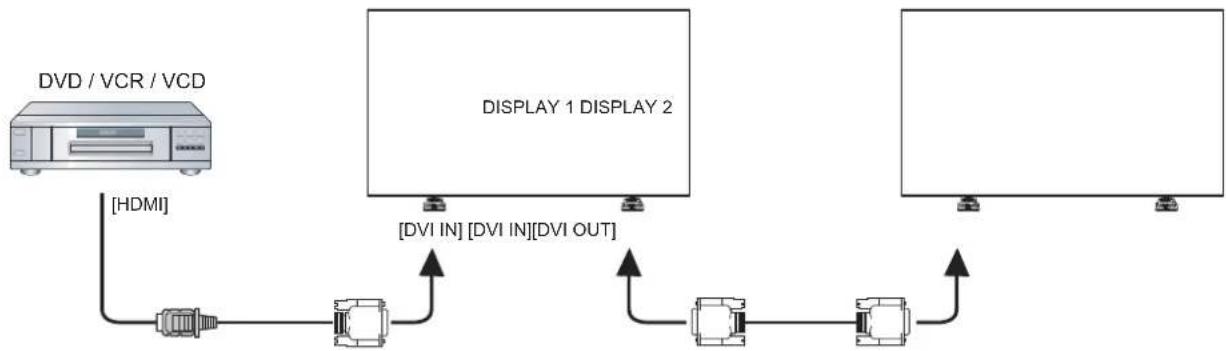
Connect the [DVI OUT] connector of DISPLAY 1 to the [DVI IN] connector of DISPLAY 2.
flowchart
graph LR
    A["DVD / VCR / VCD"] -->|HDMI| B["Device"]
    B --> C["DISPLAY 1 DISPLAY 2"]
    C --> D["Output Device"]
    B -->|DVI IN| E["Device"]
    B -->|DVI IN| F["Device"]
    B -->|DVI OUT| G["Device"]
    C --> H["Output Device"]
3.4.3. Analog video connection
Connect the [DVI OUT / VGA OUT] connector of DISPLAY 1 to the [VGA IN] connector of DISPLAY 2.

flowchart
graph TD
    PC["PC"] -->|VGA| A["Device 1"]
    A -->|DVI/VGA OUT| B["Device 2"]
    B -->|VGA IN| A
    A -->|VGA IN| C["Device 3"]
    C -->|VGA IN| B
3.4.4. IR daisy-chain Connection
Connect [IR Sensor Cable] to DISPLAY 1, and connect the [IR OUT] connector of DISPLAY 1 to the [IR IN] connector of DISPLAY 2.

flowchart
graph TD
    A["IR Sensor Cable"] --> B["DISPLAY 1 DISPLAY 2"]
    B --> C["IR OUT"] --> D["IR IN"]
    D --> E["Display Unit"]
    style A fill:#f9f,stroke:#333
    style B fill:#ccf,stroke:#333
    style C fill:#cfc,stroke:#333
    style D fill:#fcc,stroke:#333
    style E fill:#ffc,stroke:#333
3.5. IR connection
![External IR Receiver [IR IN]](/content/2026/05/1143439/images/78fa26f12b348b3759c7313c60b69f8247cb38e6d18f150511896f031b6eda03.jpg)
NOTE: This display's remote control sensor will stop working if the [IR IN] is connected.
3.6. IR Pass-through Connection
flowchart
graph TD
    A["Remote Control"] --> B["IR OUT"]
    B --> C["DVD / VCR / VCD"]
    C --> D["IR IN"]
3.7. Wire-connecting to Network
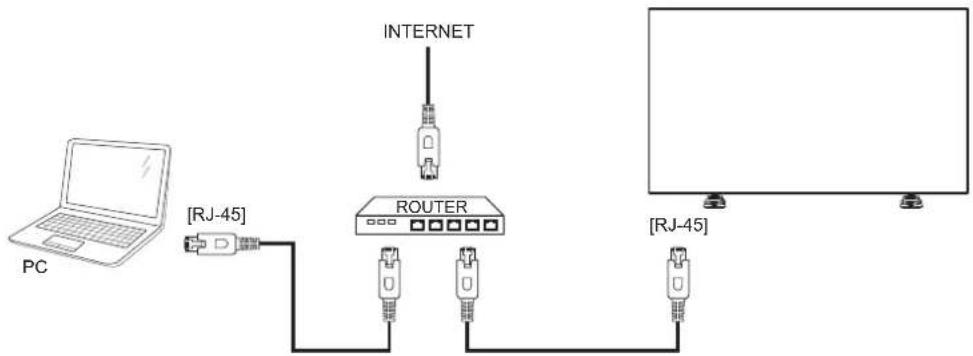
If you connect this display to a home network, you can play photos, music and videos from your computer. See Play multimedia files via Local Area Network (Page 15) for more detail.
flowchart
graph TD
    PC["PC"] -->|[RJ-45]| RJ45["Router"]
    RJ45 -->|INTERNET| Internet
    RJ45 -->|[RJ-45]| Monitor
    RJ45 -->|INTERNET| Monitor
To setup the network:
- Switch on the router and switch on its DHCP setting.
- Connect the router to this display with an Ethernet cable.
- Press [↑] MENU button to display the OSD menu.
- Press | or | button to select the menu item {Network setting}. Press OK button to enter its submenu
- Press ↓, ↑, ←, ← or number button to adjust its value. Press OK button to confirm.
NOTE: Connecting with a shielded CAT-5 Ethernet cable to comply with the EMC directive.
4. Operation
NOTE: The control button described in this section is mainly on the remote control unless specified otherwise.
4.1. Watch the Connected Video Source
See page 9 for external equipments connection.
-
Press [→] SOURCE button.
-
Press [] or [] button to choose a device then press [OK] button.
4.2. Change Picture Format
You can change the picture format to suit the video source. Each video source has its available picture formats.
The available picture formats depend on the video source:
-
Press [FORMAT] button.
-
Press [1] or [7] button to choose a picture format, then press [OK] button.
- {FULL}: Enlarge the picture to fill the screen. Recommended for minimal screen distortion but not for HD or PC.
- {DYNAMIC}: Scale 4:3 format to 16:9. Not recommended for HD or PC.
- {CUSTOM}: Shows wide screen format content unstretched. Not recommended for HD or PC.
- {REAL}: Provide maximum detail for PC. Only available when PC mode is selected in the {Picture} menu.
- {NORMAL}: Display the classic 4:3 format.
4.3. Choose your Preferred Picture Settings
-
While this display is playing video source press [↑↑] ADJUST button.
-
Press [→] or [→] button to choose Picture style, then press [OK] button.
-
Press [i] or [v] button to choose an option, then press [OK] button:
- {Personal}: Apply your personalised picture settings.
- {Vivid}: Rich and dynamic settings, ideal for daytime viewing.
• {Natural}: Natural picture settings.
- {Standard}: Default settings that suit most environments and types of video.
- {Movie}: Ideal settings for movies.
- {Photo}: Ideal settings for photos.
- {Energy saving}: Settings that conserve the most energy.
4.4. Choose your Preferred Sound Settings
-
While this display is playing video source press [III] ADJUST button.
-
Press [−] or [+] button to choose Sound style, then press [OK] button.
-
Press [ɪ] or [ɪ] button to choose an option, then press [OK] button:
- {Personal}: Apply your personalised sound settings.
- {Original}: Settings that suit most environments and types of audio.
- {Movie}: Ideal settings for movies.
- {Music}: Ideal settings for listening to music.
• {Game}: Ideal settings for games.
- {News}: Ideal settings for spoken audio such as the news.
4.5. Play multimedia files via Local Area Network
To play files via Local Area Network, you will need:
- A wired home network, connected with a Universal Plug and Play (uPnP) router.
- Optional: A LAN cable that connects your display to your home network.
• A media server running on your computer.
- Appropriate settings on your computer firewall to allow you to run the media server.
4.5.1. Set up the network
-
Connect your display and the computer to the same home network. See illustration below to connect your display to a network.
-
Switch on your computer and the router.
- Single display setup:
![PC [RJ-45] RIOE E4 [RJ-45]](/content/2026/05/1143439/images/4ca07121f3242c9e8eaa10935acb0b8160c445fcd4eb6ac0e83a6e6dabd3b3e6.jpg)
- Multiple display setup:
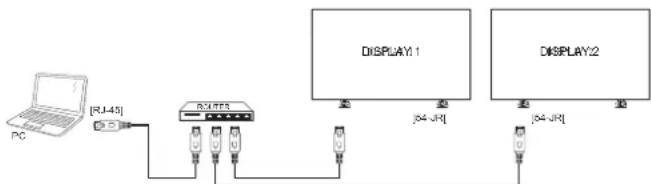
flowchart
graph LR
    PC["PC"] -->|RJ-45| Interface
    Interface -->|34-jr| Display1["DISPLAY 1"]
    Interface -->|34-jr| Display2["DISPLAY 2"]
NOTE: If the apparatus does not return to DLNA mode due to external electrical disturbances (e.g. electrostatic discharge), user inter vention is required.
Set up media sharing
-
Install a media server on your computer to share media files. These are some media servers:
-
For PC: Windows Media Player 11 (or higher) or TVersity.
-
For Mac: Twonky.
-
Switch on media sharing on your computer using the media server. For more information on how to set up the media server refer to the website of the media server.
4.5.2. How to use DLNA-DMP
- Please connect display and your PC to the same router via RJ-45.
- Run windows media player. Set stream handling as public sharing.
Play fles from display
- Press SOURCE button, choose network and press [OK] button.
| USB |
| Network |
| HDMI 1 |
| HDMI 2 |
| Display Port |
| Card OPS |
| DVI-D |
| YPbPr |
| AV |
| VGA |
- Now you can see all the PC's connected to the same router on the screen. Choose the right one.
- Press [] and [+] to choose the director y and files to play.
- You can connect up to 4 displays to the same PC and play same media stream.
We suggest to use DLNA-DMP function via wired network for the sake of higher security and sufficient network bandwidth.
4.5.3. How to use DLNA-DMR from PC
- Press [▲] MENU button, Choose Network Settings and press [OK].
| Picture | View network settings | |
| Sound | Network configuration | |
| Tiling | Static IP configuration | |
| General settings | Digital Media Render... | |
| Network settings | Network name |
- Set DMR as ON.
| PictureSoundTilingGeneral settingsNetwork settings | View network settingsNetwork configurationStatic IP configurationDigital Media Render...Network name | OffOn |
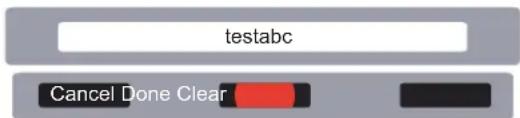
- Set the name of your display.
| PictureSoundTilingGeneral settingsNetwork settings | View network settingsNetwork configurationStatic IP configurationDigital Media Render...Network name |
- Press SOURCE button, choose network and press [OK] button.
- On your PC, go to Network and Sharing Center, and click Choose homegroup and sharing options.
- Check the media formats.Then, click Choose media streaming options.....
-
Go to Advanced sharing settings, and check Turn on network discovery.
-
Now, go to the director y of your media files. Choose the media file by right click. on the submenu from Play To, You can find all displays connected to your network. Choose the display, and click the media file to play.
Play fles
- Press [→] SOURCE button.
- Choose Network, and press [OK] button.
- Choose a file from the content browser, and press [OK] button to start playing.
- Press the [PLAY] buttons on the remote control to control playing.
Tips:
- Choose the top bar to filter your files by type.
- Choose Sort to arrange the files by album name, artist, or other fields.
- To clear the list of offline media servers, press [☐] OPTIONS button. Then, choose Clear offline servers and press [OK] button.
4.6. Play multimedia files from USB device
- Connect your USB device to the USB port on the display.
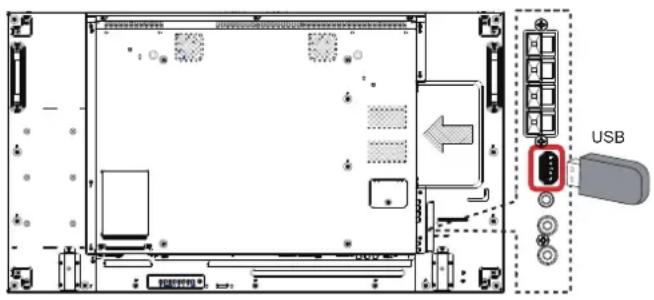
- Press [SOURCE] button, choose USB, and press [OK] button.
| USB |
| Network |
| HDMI 1 |
| HDMI 2 |
| Display Port |
| Card OPS |
| DVI-D |
| YPbPr |
| AV |
| VGA |
-
The connected USB device is detected automatically for all its playable files, which will be automatically sorted into 3 types: Music, Movie, and Photo.
-
Press [→] EXIT button to go up to the top layer in the screen. Press [→] or [→] button to choose the file type. Press [OK] button to enter its play list.
- Choose the file you want. Press [OK] button to start playing.
- Follow the on-screen instruction to control the play option.
- Press [PLAY] buttons (■ II ◀◀ ▶ ▶▶) to control playing.
4.7. Play options
4.7.1. Playing music files
- Choose 📂 Music in the top bar.

-
Choose one music track, and press [OK] button.
-
To play all the tracks in a folder, choose one music file. Then, press [] to Play All.
- To skip to the next or previous track, press [1] or [7] button.
- To pause the track, press [OK] button. Press [OK] button again to resume playback.
- To skip backward or forward 10 seconds, press [→] or [+button.
- To search backward or forward, press [◀◀] or [▶▶utton, press repeatedly to toggle between different speeds.
- To stop the music, press [■] button.
Music options
While you play music, press [☐] OPTIONS button, then press [OK] button to choose an option:
- {Shuffe}: Enable or disable random play of tracks.
- {Repeat}: Choose {Repeat} to play a track or an album repeatedly, or choose {Play once} to play a track once.
NOTE: To view information about a song (for example, title, artist or duration), choose the song, then press [i] INFO button. To hide the information, press [i] INFO button again.
4.7.2. Playing movie files
- Choose ☐ Movie in the top bar.

-
Choose a video, and press [OK] button.
-
To play all the tracks in a folder, choose one music file. Then, press [] to Play All.
- To skip to the next or previous track, press [1] or [7] button.
- To pause the track, press [OK] button. Press [OK] button again to resume playback.
- To skip backward or forward 10 seconds, press [→] or [÷] button.
- To search backward or forward, press [◀◀] or [▶▶button, press repeatedly to toggle between different speeds.
- To stop the music, press [■] button.
Movie options
While playing video, press [☐] OPTIONS button, then press [OK] button to choose an option:
- {Subtitles}: Choose the available subtitle settings.
- {Subtitle Language}: Choose the language for subtitles if available.
- {Shuffe}: Enable or disable random play of video files.
- {Repeat}: Choose {Repeat} to play the video file repeatedly or {Play once} to play the video file once.
- {Status}: To view information about a video (for example, played position, duration, title, or date).
4.7.3. Playing photo files
- Choose 📄 Photo in the top bar.

- Choose a photo thumbnail, then press [OK] button.
Start a slideshow
If there are multiple photos in a folder, choose a photo. Then, press [—] to Play All.
- To skip to the previous or next photo, press [+]or [ ]button and then press [OK] button.
- To stop the slideshow, press [■] button.
Slideshow options
While you play a slideshow, press [☐] OPTIONS button, then press [OK] button to choose an option:
- {Shuffe}: Enable or disable random display of pictures in the slideshow.
- {Repeat}: Choose {Repeat} to watch a slideshow repeatedly or {Play once} to watch once.
- {Slideshow Time}: Choose the displaying time for each photo in the slideshow.
- {Slideshow Transitions}: Choose the transition from one photo to the next.
5. Change your settings
Using the remote control:
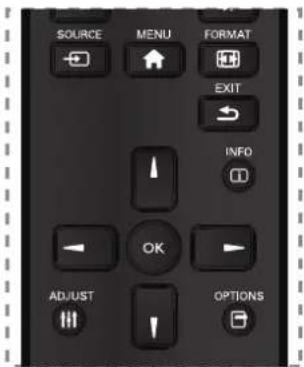
- Press [ ]MENU button to display the OSD menu.
- Press [ ] [ ] [+] or [ ] button to choose Picture, sound, Tiling, General Settings or Network settings. Press [OK] button to enter.
- Press [ ] [ ] [+] or [ ] button to choose its menu item or to adjust its value. Press [OK] button to confirm.
- Press [→] EXIT button to go back to the previous menu layer.
- Press [ ↑] MENU button to exit the OSD menu.
Using the display's control buttons
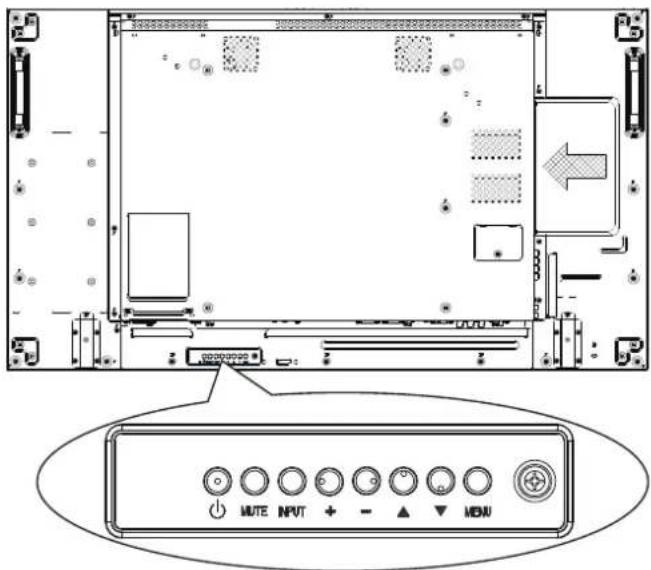
- Press [MENU] button to display the OSD menu.
- Press [▲] [▼] [+] or [-] button to choose menu item or adjust its value.
- Press [INPUT] button to confirm menu selection and enter its submenu.
- Press [MENU] button to exit the OSD menu.
5.1. Settings
5.1.1. Picture
| Picture Sound Tiling General settings Network settings | Picture style Restore style Backlight Colour Sharpness Noise reduction MPEG artifact reducti... Digital Crystal Clear Advanced Game or computer Foramat and edges |
Picture style
Choose a predefined picture setting.
Restore style
Restore the last-selected predefined picture setting.
Backlight
Adjust the brightness of this display's backlight.
Colour
Adjust the colour saturation of the picture.
Sharpness
Adjust the sharpness of the picture.
Noise reduction
Choose the amount of noise reduction for the picture.
MPEG artifact reduction
Smoothen transitions and haziness in the digital picture.
Digital Crystal Clear
Fine-tune each pixel to match surrounding pixels and produce a brilliant, high-definition image.
- {Advanced sharpness}: Enable superior sharpness, especially on lines and contours in the picture.
- {Dynamic contrast}: Dynamically enhance the details in the dark, medium and light areas of the picture.
- {Colour enhancement}: Dynamically enhance the vividness and details of colours.
Advanced
Access advanced settings such as gamma, tint, video contrast and so on.
-
{Gamma}: Adjust the non-linear setting for picture luminance and contrast.
• {Color temp.}: Change the colour balance. -
{Custom tint}: Customise colour balance setting. Only available if {Tint} → {Custom} is chosen.
• {Video contrast}: Adjust video contrast. - {Brightness}: Adjust screen brightness.
• {Hue}: Adjust screen hue. - {Blue Light Filter}: Adjust screen blue light
Game or computer
When viewing content from a connected game console, choose {Game} to apply game settings. When a computer is connected through HDMI, choose {Computer}.
Make sure that {Format and edges} → {Picture format} → {Unscaled} is selected so as to view maximum detail.
Format and edges
- {Picture format}: Change the picture format. See page 16 for the descriptions about Picture format.
5.1.2. Sound
| PictureSoundTilingGeneral settingsNetwork settings | Sound styleRestore styleBassTrebleBalanceSurround modeAudio outAdvanced |
Sound style
Access predefined sound settings.
Restore style
Restore the last-selected predefined sound setting.
Bass
Adjust to increase or decrease lower-pitched sounds.
Treble
Adjust to increase or decrease higher-pitched sounds.
Balance
Adjust to emphasize left or right audio output balance.
Surround mode
Enhance your audio experience.
Audio out
Adjust audio output volume.
Advanced
Access advanced settings to enhance your audio experience.
- {Auto volume leveling}: Enable the reduction of sudden volume changes.
- {Speaker settings}: Turn on or off the internal speakers.
• {Clear sound}: Enhance sound quality.
5.1.3. Tiling
| Picture | Enable | |
| Sound | H monitors | |
| Tiling | V monitors | |
| General settings | Position | |
| Network settings | Frame comp. |
With this function you can create a single large-screen matrix (video wall) that consists of up to 100 sets of this display (up to 10-sets on the vertical and 10-sets on the horizontal sides).
Enable
Choose to {On} or {Off} the Tiling function. If {On}, the display will apply the settings in {H monitors}, {V monitors}, {Position}, and {Frame comp.}.
H monitors
Adjust displays on the horizontal side.
V monitors
Adjust displays on the vertical side.
Position
Adjust the position of this display in the screen matrix.
Example: 2 x 2 screen matrix (4 displays)
H monitors = 2 displays
V monitors = 2 displays
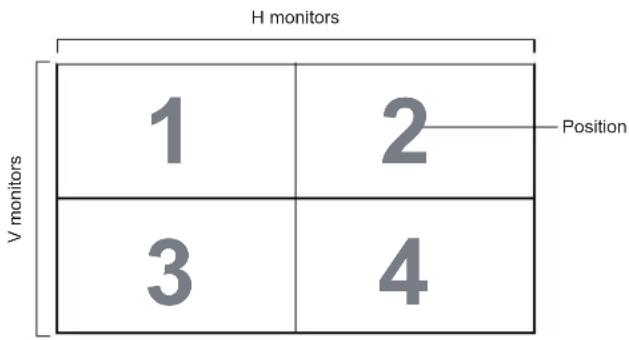
Example: 5 x 5 screen matrix (25 displays)
H monitors = 5 displays
V monitors = 5 displays
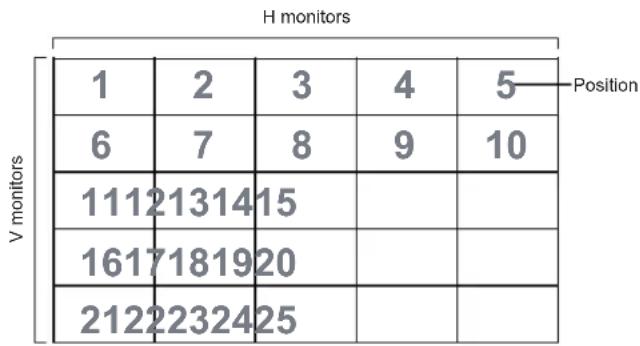
heatmap
H monitors | Position | 1 | 2 | 3 | 4 | 5 | | :--- | :--- | :--- | :--- | :--- | :--- | | H monitors | 6 | 7 | 8 | 9 | 10 | | H monitors | 1112 | 21314 | 15 | | | | H monitors | 1617 | 71819 | 20 | | | | H monitors | 2122 | 22324 | 25 | | | PositionFrame comp.
Choose to turn the frame compensation function on or off. If selected On , the display will adjust the image to compensate for the width of the display bezels in order to accurately display the image.
5.1.4. General settings
| Picture Sound Tiling General settings Network settings | Menu language Monitor ID Eco mode Auto search Clock Scheduling Sleep timer CEC Local KB lock RC lock Pixel shift |
Menu language
Choose language used for OSD menus.
Monitor ID
Adjust the ID number for controlling the display via the RS232C connection. Each display must have a unique ID number when multiple sets of this display are connected. Monitor ID number range is between 1 to 255. The default setting is 1.
Eco mode
Set this display to reduce the power consumption automatically.
Auto search
Choose to let this display detect and display available signal sources automatically.
Clock
Set the current date and time for the display's internal clock.
Scheduling
This function allows you to program up to 7 different scheduled time inter vals for this display to activate.
You can set:
- Which input source the display will use for each scheduled activation period.
- The time for the display to turn on and turn off.
- The days in a week for the display to activate.
NOTES:
- We recommend you to set up current date and time in the {Clock} menu before using this function.
- After changing the {Clock} option in the {General settings} menu, you need to set this {Scheduling} again.
| Picture Sound Tiling General settings Network settings | Menu language Monitor ID Eco mode Auto search Clock Scheduling Sleep timer CEC Local KB lock RC lock Pixel shift |
- There are 7 schedule can be set. Go to Status and choose On.
| Schedule 1 | Status | Off |
| Schedule 2 | Source | On |
| Schedule 3 | On time | |
| Schedule 4 | Off time | |
| Schedule 5 | Repeat modes | |
| Schedule 6 | Playlist setting | |
| Schedule 7 |
- Go to Source and choose input source. If {Source} → {USB} is chosen. You need to set playlist.
| Schedule 1 | Status | USB |
| Schedule 2 | Source | HDMI 1 |
| Schedule 3 | On time | HDMI 2 |
| Schedule 4 | Off time | DisplayPort |
| Schedule 5 | Repeat modes | Card OPS |
| Schedule 6 | Playlist setting | DVI-D |
| Schedule 7 | YPbPr | |
| AV | ||
| VGA |
- Set On time.

- Set Off time.

- Go to Repeat modes and choose.

- If {Source} → {USB} is chosen. Go to Playlist setting.

- Press [ ] [ ] buttons to choose files.
- Press [→] [+] buttons to switch Playlist and File Manager.
- Press [OK] button to set or clear the playlist.
7. To save the playlist, press [] and choose Save list.
![Sort Media Type Recursive Parser Save list [..] Photo Movie.avi Photo1.jpg Photo2.jpg Photo3.jpg Options Exit](/content/2026/05/1143439/images/626dab1ce60af03a47170c425dfbd24d061992cb24a14fe69c6e5bbf0686c946.jpg)
NOTES:
• Each Playlist supports up to 30 files.
- Playlist will not be cleared after {Factory settings}. You have to manually remove the files or delete usb_schedulinglist.txt in the USB.
Sleep timer
Switch off this display after a specified time.
CEC
Connect and control your HDMI-CEC compliant devices through HDMI port to this display with the same remote control.
Auto adjust
Use this function to automatically optimize the display of VGA input image.
NOTE: This item is functional for VGA input only.
Local KB lock
Choose to enable or disable the keyboard (control buttons) function of the display.
- {Unlock}: Enable the keyboard function.
- {Lock all}: Lock all keyboard function.
- {Lock but volume}: Disable all the keyboard function except the [-] and [+] button.
- {Lock but power}: Disable all the keyboard function except the [ ◎] button.
- {Lock all expect volume and power}: Disable all the keyboard function except the [-], [+] and [ ⏻ ] button:
RC lock
Choose to enable or disable the button function of the remote control.
- {Unlock}: Enable the keyboard function.
- {Lock all}: Lock all keyboard function.
- {Lock but volume}: Disable all the keyboard function except the [-] and [+] button.
- {Lock but power}: Disable all the keyboard function except the [⏻] POWER button.
- {Lock all expect volume and power}: Disable all the keyboard function except the [-] [+] and [⏻] POWER button:
NOTE: To disable the lock function from Local KB lock or -RC lock item. 1. ID mode: Press menu 993 keys on the remote control. 2. Normal mode: Press [INFO] key and hold 6 seconds on the remote control.
Pixel shift
For video input sources, you may choose {On} to move the screen image automatically to protect the display from "burn-in" or "after-image" symptoms 30 seconds after not operating the display.
Smart power
Choose a backlight level to optimise dynamic power consumption and picture contrast.
The options are: {Off}, {Standard}, {Best Power}, {Best Picture}.
Wake on Ian
Choose {On} and you can turn on the display by network.
Switch on state
Choose the display status used for the next time you connect the power cord.
- {On} - The display will turn on when the power cord is connected to a wall outlet.
- {Standby} - The display will remain Standby when the power cord is connected to a wall outlet.
- {Last status} - The display will return to the previous power status (on/off/standby) when removing and replacing the power cord.
LED
Choose {Off} to turn off the indicator.
Switch on delay
Adjust the power-on delaying time (in seconds) allows a sequential powering-on for each display by their ID number when multiple displays are connected.
Logo
Chose {Off} and the display will not display the ViewSonic logo when you switch on.
APM
Choose {On}. Then, when no signal, the display will automatically turn off.
Information OSD
When you press [⏻] POWER button to turn on the display from standby mode or change the input signal, the information OSD is displayed on the upper left corner of the screen.
Choose {Off} to turn off this function.
DisplayPort Ver.:
Choose Display Port Version 1.1a or 1.2.
Cooling Fan
Select {On} to turn on the cooling fan all the time. Select {Auto} to turn on/off the cooling fan according to the display's temperature.
NOTES:
- The default {Auto} option will start running the cooling fan if the temperature of 60°C (140°F) is reached.
- A temperature-warning message will be shown on the screen if the temperature reaches 70°C (158°F).
- After the temperature reaches 70°C (158°F), for three successive minutes and a temperature-waning message shown on the screen for 10 seconds, the display power will be shut down automatically while Power LED will be blinking red & green.
Network control port
Choose the RS232 control form Card OPS or embedded RS232 in PD set.
QR code

Factory settings
Reset all your customized settings to the factory defaults.
5.2. Network Settings
- Press [ ]MENU button, choose Network Settings and press [OK] button.
| Picture | View network settings | |
| Sound | Network configuration | |
| Tiling | Static IP configuration | |
| General settings | Digital Media Render... | |
| Network settings | Network name |
View network settings
View connected network status.
Network Configuration
{Network configuration}: Choose how this display should assign addresses to the network resources.
The user can choose {DHCP & Auto IP} (suggested) or {Static IP}.
Static IP Configuration
Define {IP address}, {Netmask}, {Gateway}, {DNS1}, and {DNS2} for this display. If {Network settings} → {Static IP} is chosen.
Digital Media Renderer - DMR
Receive multimedia files from the connected device by your network.
Network name
In the multiple-display connection, you can rename each display for easy identification. Use the on-screen keyboard or the remote control keypad to enter the name.
6. USB device compatibility
USB Video Subtitle Formats (for language subtitles, etc.)
| File Extensions | Container | Video codec | Maximum resolution | Max.Frame Rate (fps) | Max.Bit Rate (Mbps) | Audio codec |
| .mpg.mpeg.vob | PS | MPEG-1 1920x1080 25p, 30p, 50i, 60i 30 | MPEG-1 (L1 & L2),MPEG-1, 2, 2.5 L3,AAC/HE-AAC (v1 & v2),DVD-PCM, AC3 | |||
| MPEG-2 1920x1080 25p, 30p, 50i, 60i 30 | ||||||
| MPEG-4 ASP 1920x1080 25p, 30p, 50i, 60i 30 | ||||||
| H.264 1920x1080 25p, 30p, 50p, 60p, 60i 30 | ||||||
| .ts TS | MPEG-2 1920x1080 25p, 30p, 50i, 60i 30 | MPEG-1 (L1 & L2),MPEG-1, 2, 2.5 L3,AAC/HE-AAC (v1 & v2),AC3, E-AC3,Dolby Pulse | ||||
| MPEG-4 ASP 1920x1080 25p, 30p, 50i, 60i 30 | ||||||
| H.264 1920x1080 25p, 30p, 50p, 60p, 60i 30 | ||||||
| MVC | 1920x1080i@field rate=50, 60Hz1920x1080p@frame rate=24, 25, 30Hz1280x720p@frame rate=50, 60Hz | - | 30 | |||
| .ts.m2ts.mts.mt2 | MaTS TTS | MPEG-2 1920x1080 25p, 30p, 50i, 60i 30 | MPEG-1 (L1 & L2),MPEG-1, 2, 2.5 L3,AAC/HE-AAC (v1 & v2),AC3, E-AC3,Dolby Pulse | |||
| MPEG-4 OSP 1920x1080 25p, 30p, 50i, 60i 30 | ||||||
| H.264 1920x1080 25p, 30p, 50p, 60p, 60i 30 | ||||||
| MVC | 1920X1080i@field rate=50, 60Hz1920x1080p@frame rate=24, 25, 30Hz1280x720p@frame rate=50, 60Hz | - | 30 | |||
| .ts.m2ts.mts | AVCHD | MPEG-2 1920x1080 25p, 30p, 50i, 60i 30 | MPEG-1 (L1 & L2),MPEG-1, 2, 2.5 L3,AAC/HE-AAC (v1 & v2),AC3, E-AC3,Dolby Pulse | |||
| MPEG-4 ASP 1920x1080 25p, 30p, 50i, 60i 30 | ||||||
| H.264 1920x1080 25p, 30p, 50p, 60p, 60i 30 | ||||||
| .ts.m2ts.mts | AVCHD MVC | 1920x1080i@field rate=50, 60Hz1920x1080p@frame rate=24, 25, 30Hz1280x720p@frame rate=50, 60Hz | - | 30 | MPEG-1 (L1 & L2),MPEG-1, 2, 2.5 L3,AAC/HE-AAC (v1 & v2),AC3, E-AC3,Dolby Pulse | |
| .m4v M4V | H.264 1920x1080 | 25p, 30p, 50p, 60i 30 | AAC | |||
| .ism/Manifest.mpd | frag MP4 | H.264 1920x1080 | 25p, 30p, 50p, 60i 30 | AAC/HE-AAC (v1 & v2),AC3, E-AC3, WMAWMA-PRO | ||
| MVC | 1920x1080i@field rate=50, 60Hz1920x1080p@frame rate=24, 25, 30Hz1280x720p@frame rate=50, 60Hz | - | 30 | |||
| .mp4 MP4 | MPEG-4 ASP 1920x1080 25p, 30p, 50i, 60i 30 | AAC/HE-AAC (v1 & v2),AC3, E-AC3, WMAWMA-PRO | ||||
| H.264 1920x1080 | 30 | |||||
| MVC | 1920x1080i@field rate=50, 60Hz1920x1080p@frame rate=24, 25, 30Hz1280x720p@frame rate=50, 60Hz | - | 30 | |||
| WMV9/VC1 | 1920x1080 | 30 | ||||
| .mkv.mk3d | MKV | MPEG-4 ASP 1920x1080 25p, 30p, 50i, 60i 30 | MPEG-1 (L1 & L2), | MPEG-1, 2, 2.5 L3,AAC/HE-AAC (v1 & v2),AC3, E-AC3, WMAWMA-PRO | ||
| H.264 1920x1080 | 30 | |||||
USB Multimedia Formats
| File Extensions | Container Video codec | Maximum resolution | Frequency (kHz) | Max.Bit Rate (Mbps) | Audio codec | |
| .mp3 MP3 - | 48 384 MPEG-1, 2 | 2.5 L3 | ||||
| .wma.asf | WMA(V2 up to V9.2) | -- 48 192 | WMA | |||
| .wma WMA | Pro -- 96 768 WMA | WMA Pro | ||||
| .wav (PC) LPCM | -- 192 768 | LPCM | ||||
| .aif (mac).aiff (mac) | LPCM -- 192 | 768 | LPCM | |||
| .aac.mp4.m4a | AAC -- 48 1024 | AAC, | HE-AAC (v1 & v2) | |||
| .pls.m3u | Playlists | - | - | - | - | - |
| .m4a M4A - | 48 1024 | AAC, HE-AAC (v1 & v2) | ||||
NOTES:
- Sound or video may not work if the contents have a standard bit rate/frame rate above the compatible Frame/sec listed in the table above.
- Video content with a Bit rate or Frame rate larger than the rate specified in the table above can cause choppy video during playback.
7. Input Mode
VGA Resolution:
| Standard Resolution | Active Resolution | Refresh Rate | Pixel Rate Aspect | Ratio Stand for Mode | ||
| H Pixels V Lines | ||||||
| VGA 640 | 480 | 60 Hz 25. | 175 MHz | 4:3 Video | Graphic Array72 Hz 31.5 MI | |
| 75 Hz 31. | 5 MHz | |||||
| WVGA 720 | 400 70 Hz 33.75 MHz | 16:9 | Wide Video Graphic Array | |||
| SVGA | 800 | 600 60 | Hz 40 | MHz | 4:3 | Super VGA |
| 600 75 | Hz 49.5 MHz | |||||
| XGA | 1024 | 768 60 | Hz 65 | MHz | 4:3 | Extended Graphic Array |
| 768 75 | Hz 78.75 MHz | |||||
| WXGA | 1280 | 768 | 60 Hz | 79.5 MHz | 5:3 | Wide XGA |
| WXGA | 1280 | 800 | 60 Hz | 79.5 MHz | 16:10 | Wide XGA |
| SXGA | 1280 | 960 | 60 Hz | 108 MHz | 4:3 | Super XGA |
| SXGA | 1280 | 1024 | 60 Hz | 108 MHz | 5:4 | Super XGA |
| WXGA | 1360 | 768 | 60 Hz | 85.5 MHz | 16:9 | Wide XGA |
| WXGA | 1366 | 768 | 60 Hz | 85.5 MHz | 16:9 | Wide XGA |
| UXGA | 1600 | 1200 | 60 Hz | 162 MHz | 4:3 | Ultra XGA |
| HD1080 | 1920 | 1080 | 60 Hz | 148.5 MHz | 16:9 | HD1080 |
SDTV Resolution:
| Standard Resolution | Active Resolution | Refresh Rate | Pixel Rate Aspect | Ratio Stand for Mode | ||
| H Pixels V Lines | ||||||
| 480i | 720 480 | 29.97 Hz | 13.5 MHz | 4:3 | Modified NTSC Standard | |
| 480p | 59.94 Hz 27 | MHz | ||||
| 576i | 720 576 | 25 Hz | 13.5 MHz | 4:3 | Modified PAL Standard | |
| 576p | 50 Hz | 27 MHz | ||||
HDTV Resolution:
| Standard Resolution | Active Resolution | Refresh Rate | Pixel Rate Aspect | Ratio Stand for Mode | |
| H Pixels V Lines | |||||
| 720p | 1280 | 720 | 50 Hz | 74.25 MHz | 16:9 Normally DVB Mode |
| 60 Hz | |||||
| 1080i | 1920 | 1080 | 25 Hz | 74.25 MHz | 16:9 Normally ATSC Mode |
| 30 Hz | |||||
| 1080p | 1920 | 1080 | 50 Hz | 148.5 MHz | 16:9 Normally ATSC Mode |
| 60 Hz | |||||
| 4K2K^*1,*2,*3 | 3840 | 2160 30 | Hz 262.75 MHz | 16:9 | |
NOTE: Technical specifications are subject to change without notice.
*1: Expanded daisy chain options with DP enables 4K resolution.
4K2K daisy chain limitation applied e.g. compressed images and no support when HDCP (high-bandwidth digital content protection) is utilized
*2: Displayed text may be blurred.
*3: 4K2K timing only support on HDMI and DisplayPort input source. Recommend graphic card for timing 4K2K@30Hz as below. MSI HD7970/ASUS GTX770/Gigabyte GTX980.
- The PC text quality is optimum in HD 1080 mode (1920 x 1080, 60Hz).
- Your PC display screen might appear different depending on the manufacturer (and your particular version of Windows).
- Check your PC instruction book for information about connecting your PC to a display.
- If a vertical and horizontal frequency-select mode exists, select 60Hz (vertical) and 31.5KHz (horizontal). In some cases, abnormal signals (such as stripes) might appear on the screen when the PC power is turned off (or if the PC is disconnected). If so, press the [SOURCE] button to enter the video mode. Also, make sure that the PC is connected.
- When horizontal synchronous signals seem irregular in RGB mode, check PC power saving mode or cable connections.
- The display settings table complies with IBM/VESA standards, and based on the analog input.
- The DVI support mode is regarded to be the same as the PC support mode.
- The best vertical frequency timing for each mode is 60Hz.
8. Cleaning and Troubleshooting
8.1. Cleaning
Caution When Using the Display
- Do not bring your hands, face or objects close to the ventilation holes of the display. The top of the display is usually very hot due to the high temperature of exhaust air being released through the ventilation holes. Burns or personal injuries may occur if any body parts are brought too close. Placing any object near the top of the display could also result in heat related damage to the object as well as the display itself.
- Be sure to disconnect all cables before moving the display. Moving the display with its cables attached may damage the cables and thus cause fire or electric shock.
- Disconnect the power plug from the wall outlet as a safety precaution before carrying out any type of cleaning or maintenance procedure.
Front Panel Cleaning Instructions
- The front of the display has been specially treated. Wipe the surface gently using only a cleaning cloth or a soft, lint-free cloth.
- If the surface becomes dirty, soak a soft, lint-free cloth in a mild detergent solution. Wring the cloth to remove excess liquid. Wipe the surface of the display to remove dirt. Then use a dry cloth of the same type to dry.
- Do not scratch or hit the surface of the panel with fingers or hard objects of any kind.
- Do not use volatile substances such as insert sprays, solvents and thinners.
Cabinet Cleaning Instructions
- If the cabinet becomes dirty, wipe the cabinet with a soft, dry cloth.
- If the cabinet is extremely dirty, soak a lint-free cloth in a mild detergent solution. Wring the cloth to remove as much moisture as possible. Wipe the cabinet. Use another dry cloth to wipe over until the surface is dry.
- Do not allow any water or detergent to come into contact with the surface of the display. If water or moisture gets inside the unit, operating problems, electrical and shock hazards may result.
- Do not scratch or hit the cabinet with fingers or hard objects of any kind.
- Do not use volatile substances such as insert sprays, solvents and thinners on the cabinet.
- Do not place anything made from rubber or PVC near the cabinet for any extended periods of time.
8.2. Troubleshooting
| Symptom Possible Cause Remedy | ||
| No picture is displayed 1. The power cord is disconnected.2. The main power switch on the back of the display is not switched on.3. The selected input has no connection.4. The display is in standby mode. | Plug in the power cord.Make sure the power switch is switched on.Connect a signal connection to the display. | |
| Interference displayed on the display or audible noise is heard | Caused by surrounding electrical appliances or fluorescent lights. | Move the display to another location to see is the interference is reduced. |
| Color is abnormal The signal cable is not connected properly. | Make sure that the signal cable is attached firmly to the back of the display. | |
| Picture is distorted with abnormal patterns | The signal cable is not connected properly.The input signal is beyond the capabilities of the display. | Make sure that the signal cable is attached firmly.Check the video signal source to see if it is beyond the range of the display. Please verify its specifications with this display's specification section. |
| Display image doesn't fill up the full size of the screen | Zoom mode is not correctly set. Use | the Zoom mode or Custom zoom function in the Screen menu to fine tune display geometry and time frequency parameter. |
| Can hear sound, but no picture | Improperly connected source signal cable. | Make sure that both video inputs and sound inputs are correctly connected. |
| Can see picture but no sound is heard | Improperly connected source signal cable.Volume is turned all the way down.[MUTE] is turned on.No external speaker connected. | Make sure that both video inputs and sound inputs are correctly connected.Press [+] or [-] button to hear sound.Switch MUTE off by using the [▶×] button.Connect external speakers and adjust the volume to a suitable level. |
| Some picture elements do not light up | Some pixels of the display may not turn on. | This display is manufactured using an extremely high level of precision technology: however, sometimes some pixels of the display may not display. This is not a malfunction. |
| After-Images can still be seen on the display after the display is powered off.(Examples of still pictures include logos, video games, computer images, and images displayed in 4:3 normal mode) | A still picture is displayed for an over extended period of time | Do not allow a still image to be displayed for an extended period of time as this can cause a permanent after-image to remain on the display. |
9. Technical Specifications
9.1. CDX4952
Display:
| Item Specifications | |
| Screen Size (Active Area) 48.5” (123.2 cm) | LCD |
| Aspect Ratio 16:9 | |
| Number of pixels 1920 (H) x 1080 (V) | |
| Pixel pitch 0.55926 (H) x 0.55926 (V) [mm] | |
| Displayable colors 1.07B colors | |
| Brightness (typical) 450 cd/m | ^2 |
| Contrast ratio (typical) 1300:1 | |
| Viewing angle 178 degrees |
In/Out Terminals:
| Item Specifications | ||
| Speaker Output Internal SpeakersExternal Speakers | 10W (L) + 10W (R) [RMS]/8Ω1 Way 1 Speaker System75dBA | |
| Audio Output 3.5mm phone jack x 1 0.5V | [rms] (Normal) / 2 Channel (L+R) | |
| Audio Input | RCA Jack x 23.5mm phone jack x 1 | 0.5V [rms] (Normal) / 2 Channel (L+R) |
| RS232C | 2.5mm phone jack x 2 | RS232C in/RS232C out |
| RJ-45 | RJ-45 Jack x 1 (8 pin) | 10/100 LAN Port |
| HDMI Input | HDMI Jack x 1(Type A) (18 pin) | Digital RGB: TMDS (Video + Audio)MAX: Video - 720p, 1080p, 1920 x 1080/60 Hz (WUXGA)Audio - 48 KHz/ 2 Channel (L+R)Supports LPCM only |
| DVI-D Input | DVI-D jack | Digital RGB: TMDS (Video) |
| VGA Input | D-Sub Jack x 1(15 pin) | Analog RGB: 0.7V [p-p] (75Ω), H/CS/V: TTL (2.2kΩ),SOG: 1V [p-p] (75Ω)MAX: 720p, 1080p, 1920 x 1080/60 Hz (WUXGA) |
| DVI-I (DVI-D & VGA) Output | DVI-I Jack x 1(29 pin) | Digital RGB: TMDS (Video)Analog RGB: 0.7V [p-p] (75Ω), H/CS/V: TTL (2.2kΩ),SOG: 1V [p-p] (75Ω)MAX: 720p, 1080p, 1920 x 1080/60 Hz (WUXGA) |
| Component Input | BNC Jack x 3 | Y: 1V [p-p] (75Ω), Pb: 0.7V [p-p] (75Ω), Pr: 0.7V [p-p] (75Ω)MAX: 480i, 576i, 480p, 576p, 720p, 1080i, 1080p |
| Video Input | BNC x 1 (Share with Component_Y) | Composite 1V [p-p] (750) |
| Displayport in/out | Displayport Jack x 2(20 pin) | Digital RGB: TMDS (Video + Audio)MAX: Video - 720p, 1080p, 1920 x 1080/60 Hz (WUXGA)Audio - 48 KHz/ 2 Channel (L+R)Supports LPCM only |
| IR Pass Through | 3.5mm jack x 2 | IR in/IR out |
General:
| Item Specifications | |
| Power Supply AC 100 ~ 240V, 50 ~ 60Hz, 3.5A | |
| Power Consumption (Max) 235W | |
| Power Consumption (typ.) 110W | |
| Power Consumption (Standby & Off) <0.5W (RS232 in active) | |
| Dimensions (With Stand) [W x H x D] 1077.6 x 648.7 x 400 mm | |
| Dimensions (Without Stand) [W x H x D] 1077.6 x 607.8 x 93.5 mm (@Wall Mount)/103.8 (@Handle) | |
| Weight (With Stand) 23.9 Kg | |
| Weight (Without Stand) 21.6 Kg | |
| Gross Weight (Without Stand) 34.3 Kg | |
Environmental Condition:
| Item Specifications | ||
| Temperature Operational | ational 5°C~40°C(Landscape), 5°C~35°C (Portrait) | |
| Storage -20 ~ 60°C | ||
| Humidity Operational | al 20 ~ 80% RH (No condensation) | |
| Storage 10 ~ 90% RH (No condensation) | ||
| Altitude | Operational 0 ~ 3,000 m | |
| Storage / Shipment | 0 ~ 9,000 m | |
Internal Speaker:
| Item Specifications | |
| Type | 1 Way 1 Speaker |
| Input | 10 W (RMS) |
| Impedance | 8Ω |
| Output Sound Pressure | 82 dB/W/M |
| Frequency Response | 160 Hz ~ 13 KHz |
10. RS232 Protocol
10.1. Introduction
This document describes the hardware interface spec and software protocols of RS232 interface communication between ViewSonic Commercial TV / Digital Signage and PC or other control unit with RS232 protocol.
The protocol contains three sections command:
- Set-Function
- Get-Function
- Remote control pass-through mode
※ In the document below, "PC" represents all the control units that can send or receive the RS232 protocol command.
10.2. Description
10.2.1. Hardware specification
Viewsonic TV communication port on the rear side:
(1) Connector type: DSUB 9-Pin Male
(2) Pin Assignment
Male DSUB 9-Pin (outside view)
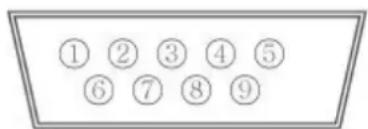
| Pin # Signal Remark | ||
| 1 NC | ||
| 2 RXD Input to Commercial TV or DS | ||
| 3 TXD Output from Commercial TV or DS | ||
| 4 | NC | |
| 5 GND | ||
| 6 NC | ||
| 7 | NC | |
| 8 | NC | |
| 9 | NC | |
| frame GND | ||
* Use of crossover (null modem) cable required for use with PC
[Special case]3.5mm barrel connector
| Pin # Signal Remark | |
| Tip TXD Output from Commercial TV or DS | |
| Ring RXD Input to Commercial TV or DS | |
| Sleeve GND | |
10.2.2. Communication Setting
- Baud Rate Select: 9600bps (fixed)
- Data bits: 8 bits (fixed)
- Parity: None (fixed)
- Stop Bits: 1 (fixed)
10.2.3. Command Message Reference
PC sends to Monitor command packet followed by "CR". Every time PC sends control command to the Monitor, the Monitor shall respond as follows:
- If the message is received correctly it will send “+” (02Bh) followed by “CR” (00Dh)
- If the message is received incorrectly it will send “-” (02Dh) followed by “CR” (00Dh)
10.3. Protocol
10.3.1. Set-Function Listing
The PC can control the TV/DS for specific actions. The Set-Function command allows you to control the TV/DS behavior in a remote site through the RS232 port. The Set-Function packet format consists of 9 bytes.
Set-Function description:
Length: Total Byte of Message excluding "CR".
TV/DS ID Identification for each of TV/DS (01\~98; default is 01)
ID "99" means to apply the set command for all connected displays. Under such circumstances, only ID#1 display has to reply.
The TV/DS ID can be set via the OSD menu for each TV/DS set.
Command Type Identify command type,
"s" (0x73h) : Set Command
“+” (0x2Bh) : Valid command Reply
“-” (0x2Dh) : Invalid command Reply
Command: Function command code: One byte ASCII code.
Value[1\~3]: Three bytes ASCII that defines the value.
CR 0x0D
Set-Function format
Send: (Command Type="s")
NOTE: For VT2405LED-1 and VT3205LED, the set "Power on" command is the exception
Reply: (Command Type="+" or "-"
- The reply for "Power on" command is the exception for VT2405LED-1 and VT3205LED. It's 0x322B0D (2+
). - When PC applies command to all displays (ID=99), only the #1 set needs to reply by the name of ID=1.
Example1: Set Brightness as 76 for TV-02 and this command is valid
Send (Hex Format)
| Name Length ID | Command Type | Command | Value1 Value | Value2 Value3 | CR | ||
| Hex | 0x38 | 0x300x32 | 0x73 0x24 | 0x30 0x37 | 0x36 | 0x0D | _ |
Reply (Hex Format)
| Name Length ID | Command Type | CR | ||
| Hex | 0x34 | 0x300x32 | 0x2B | 0x0D |
Example2: Set Brightness as 176 for TV-02 and this command is NOT valid Send (Hex Format)
| Name Length ID | Command Type | Command | Value1 Value2 Value3 | CR | ||
| Hex | 0x38 | 0x300x32 | 0x73 0x24 | 0x31 0x37 | 0x36 0x0D | _ |
Reply (Hex Format)
| Name Length ID | Command Type | CR | |
| Hex 0x34 | 0x30 0x32 | 0x2D 0x0D | — |
Set function table:
| Set Function Length ID | Command Type | Command Value Range Comments | |||
| Code (ASCII) | Code (Hex) | (Three ASCII bytes) | |||
| Power on/off (standby) | 8 | s | ! | 21 000: STBY001: ON | Controlled power status: ON or Standby |
| Input Select | 8 | s | “ | 22 | 000 : TV001 : AV002 : S-Video003 : YPbPr004 : HDMI014 : HDMI2024 : HDMI3005 : DVI006 : VGA1(PC)016 : VGA2007 : OPS008 : Internal Mem009 : DP |
| Contrast | 8 | s | # | 23 | 000 ~ 100 |
| Brightness | 8 | s | $ | 24 | 000 ~ 100 |
| Sharpness | 8 | s | % | 25 | 000 ~ 100 |
| Color | 8 | s | & | 26 | 000 ~ 100 |
| Tint | 8 | s | ‘ | 27 | 000 ~ 100 |
| Color Mode | 8 | s | ) | 29 | 000 : Normal001 : Warm002 : Cold003 : Personal |
| Bass | 8 | s | . | 2E | 000 ~ 100 |
| Treble | 8 | s | / | 2F | 000 ~ 100 |
| Balance | 8 | s | 0 | 30 | 000 ~ 100 |
| Picture Size | 8 | s | 1 | 31 | 000 : FULL001 : NORMAL002 : CUSTOM003 : DYNAMIC004 : REAL |
| OSD Language | 8 | s | 2 | 32 | 000 : English001 : French002 : Spanish |
| Power Lock | 8 | s | 4 | 34 | 000 : Unlock001 : Lock |
| Volume 8 s 5 35 | 000 ~ 100 | 900 : Volume down (-1)901 : Volume up (+1) | |||||
| Mute 8 s 6 36 000 | OFF | 001: ON (mute) | |||||
| Button Lock 8 s 8 | 38 000 : Unlock | 001 : Lock | |||||
| Menu Lock 8 s > | 3E 000 : Unlock | 001 : Lock | |||||
| Key Pad 8 s A 41 | 000 : UP | 001 : DOWN002 : LEFT003 : RIGHT004 : ENTER005 : INPUT006 : MENU/EXIT | |||||
| Remote Control | 8 s B 42 | 000: Disable | Disable: RCU has no effect on Monotor. | ||||
| 001: Enable | Enabled: RCU controls the Monitor. This is the power up default on the Monitor. | ||||||
| 002: Pass through | Pass through: RCU has no effect on Monitor and all RCU command codes are transmitted to PC via the RS232 port. | ||||||
| Date 8 s V 56 0xx: | Year | 1xx: Month+Day(See example in Note) | For specific models only | ||||
| Tiling-Mode | 8 s P | 50 000: OFF | 001: ON | (for DS) | |||
| Tiling-Compensation | 8 s | Q 51 000: OFF | 001: ON | (for DS)Bezel width compensation | |||
| Tiling-H by V Monitors | 8 s R | 52 01x~09x: H | 0x1~0x9: V | (for DS)1. 2^nd digital for H monitors2. 3^rd digital for V monitors | |||
| Tiling-Position | 8 s S | 53 001~025 | (for D$) | Copy the screen of Position# to identified display | |||
| Time | 8 | s | W | 57 | 0xx: Hour+Min10x: Sec(See example in Note) | For specific models only | |
| Factory reset | 8 s ~ | 7E 0 | Rests | Monitor to | factory setting | ||
NOTE:
1. Behavior at lock modes
| Lock Mode Behavior | |
| Button Lock 1. Lock all button on the front panel and RCU, except for “Power”2. All the SET functions should be workable via RS32, even the ones with according hot key in RCU like Mute,...etc. | |
| MENU Lock 1. Lock “MEN NU’ key of front panel and RCU2. The Factory and Hospitality modes should not be blocked for the model using MENU-combined key to enter these two modes. Alternative approach will be indicated separately if any limitation by model. | |
| POWER Lock 1. Lock “PO WER” key on the front and RCU.2. The SET_POWER on/off should be workable via RS232, but does not mean the POWER lock will be released under this case.3. Can not be unlocked by reset in OSD setting4. Will auto AC power-on in power-lock5. Under power-lock, the set will not enter power saving when no PC signal and neither not turn off when no other video signals after 15min. | |
| Remote control disable Lock the RCU keys, but keep the front panel buttons workable. | |
2. Example for value setting of SET\_TV channel DTV
012-0: 0x 30 31 32
012-1: 0x 30 31 42
1012-2: 0x 41 31 52
1512-3: 0x 46 31 62
3. Tiling definition of H Monitors/ V Monitors/ and Position

heatmap
H MONITORS | Position | V MONITORS | 1 | 2 | 3 | 4 | 5 | | :--- | :--- | :--- | :--- | :--- | :--- | :--- | | V MONITORS | 1 | 2 | 3 | 4 | 5 | Position | | V MONITORS | 6 | 7 | 8 | 9 | 10 | | | V MONITORS | 11 | 12 | 13 | 14 | 15 | | | V MONITORS | 16 | 17 | 18 | 19 | 20 | | | V MONITORS | 21 | 22 | 23 | 24 | 25 | | The image contains a grid of numerical values (1–25) and a label 'Position' in the top right corner. There is no additional data series or trends present.4. Date & Time format definition
| Value 1 Value 2 | Value 3 | ||
| Date | 0: Year | Year code of the first 2 digis | Year code of the last 2 digis |
| 1: Month+Day Month code Day | code | ||
| Time 0: Hour | (24-hr format)+Min Hour code | Minute code | |
| 1: Sec | 0 | Second code |
Hex code (in hex) = Original data (in dec) + 20
| Date & Time | Code (ASCII) | Code (Hex) | Date & Time | Code (ASCII) | Code (Hex) | Date & Time | Code (ASCII) | Code (Hex) | Date & Time | Code (ASCII) | Code (Hex) |
| 0 space 20 16 | 6 36 32 | R 52 48 h | 68 | ||||||||
| 1 ! 21 17 7 37 | 33 S 53 | 49 i 69 | |||||||||
| 2 “ 22 18 8 38 | 34 T 54 | 50 p 70 | |||||||||
| 3 # 23 19 9 39 | 35 U 55 | 51 q 71 | |||||||||
| 4 $ 24 20 @ 40 | 36 V 56 | 52 r 72 | |||||||||
| 5 % 25 21 A 41 | 37 W 57 | 53 | s | 73 | |||||||
| 6 & 26 | 22 B 42 | 38 X 58 | 54 t 74 | ||||||||
| 7 ’ 27 | 23 C 43 | 39 Y 59 | 55 u 75 | ||||||||
| 8 ( 28 24 D 44 | 40 ` 60 | 56 | v | 76 | |||||||
| 9 ) 29 25 E 45 | 41 a 61 | 57 w 77 | |||||||||
| 10 0 30 26 F 46 | 42 b 62 | 58 | x | 78 | |||||||
| 11 | 1 | 31 | 27 | G | 47 | 43 | c | 63 | 59 | y | 79 |
| 12 2 32 28 H 48 | 44 d 64 | ||||||||||
| 13 3 33 29 I 49 | 45 e | 65 | |||||||||
| 14 4 34 30 P 50 | 46 f | 66 | |||||||||
| 15 5 35 31 | Q | 51 47 g | 67 |
Month: 1\~12
Day: 1\~31
Hour: 00\~23
Min:: 00\~59
Sec: 00\~59
5. Set Date & Time example
Date: 2015-1/31
Time: 16:27:59
Send: 0x 38 30 31 73 56 30 40 35 0D (Year "20" "15")
Send: 0x 38 30 31 73 56 31 21 51 0D (Month "1", Day "31")
Send: 0x 38 30 31 73 57 30 36 47 0D (Hour "16", Min "27")
Send: 0x 38 30 31 73 57 31 30 79 0D ("0", Sec "59")
10.3.2.Get-Function Listing
The PC can interrogate the TV/DS for specific information. The Get-Function packet format consists of 9 bytes which is similar to the Set-Function packet structure. Note that the "Value" byte is always = 000
Get-Function description:
Length: Total Byte of Message excluding "CR".
TV/DS ID Identification for each of TV/DS (01\~98; default is 01).
Command Type Identify command type,
"g" (0x67h) : Get Command
“r” (0x72h) : Valid command Reply
“-” (0x2Dh) : Invalid command Reply
Command: Function command code: One byte ASCII code.
Value[1\~3]: Three bytes ASCII that defines the value.
CR 0x0D
Get-Function format
Send: (Command Type="g")
NOTE: "Power STBY status" is the exception for VT2405LED-1 and VT3205LED.
Reply: (Command Type="r" or "-"')
If the Command is valid, Command Type = "r"
NOTE: The reply for "Power STBY status" command is the exception for VT2405LED-1 and V3205LED. It's 0x36 72 6C 30 30 30 0D (6rl000
If the Command is Not valid, Command Type="-"
Example1: Get Brightness from TV-05 and this comm and is valid. The Brightness value is 67. Send (Hex Format)
| Name Length ID | Command Type | Command | Value1 Value | Value2 Value3 | CR | ||
| Hex | 0x38 | 0x300x35 | 0x67 0x6 | 20x30 0x30 | 0x30 | 0x0D | — |
Reply (Hex Format)
| Name Length ID | Command Type | Command | Value1 Value | Value2 Value3 | CR | ||
| Hex | 0x38 | 0x300x35 | 0x72 0x6 | 0x30 0x36 | 0x37 | 0x0D | _ |
Example2: Get Brightness from TV-05, but the Brightness command ID is error and it is NOT in the command table.
Send (Hex Format)
| Name Length ID | Command Type | Command | Value1 Value2 Value3 CR | ||||
| Hex | 0x38 | 0x300x35 | 0x67 0X | D3 0x30 0x30 0x30 0x0D | ____ | ____ | ____ |
Reply (Hex Format)
| Name Length ID | Command Type | CR | ||
| Hex | 0x34 | 0x300x35 | 0x2D 0x0D | _ |
Get function table:
| Get Function Length ID | Command Type | Command Value Range Comments | |||
| Code (ASCII) | Code (Hex) (Three | ASCII bytes) | |||
| Get-Contrast | 8 | g | a | 61 | 000 ~ 100 |
| Get-Brightness | 8 | g | b | 62 | 000 ~ 100 |
| Get-Sharpness | 8 | g | c | 63 | 000 ~ 100 |
| Get-Color | 8 | g | d | 64 | 000 ~ 100 |
| Get-Tint | 8 | g | e | 65 | 000 ~ 100 |
| Get-Volume | 8 | g | f | 66 | 000 ~ 100 |
| Get-Mute | 8 | g | g | 67 | 000: OFF (unmuted)001: ON (muted) |
| Get-Input select | 8 | g | j | 6A | 000~ |
| Get-Power status : ON/STBY | 8 | g | l | 6C | 000: STBY001: ON |
| Get-Remote control | 8 | g | n | 6E | 000 : Disable001 : Enable002 : Pass through |
| Get-Power Lock | 8 | g | o | 6F | 000 : Unlock001 : Lock |
| Get-Button Lock | 8 | g | p | 70 | 000 : Unlock001 : Lock |
| Get-Menu Lock | 8 | g | q | 71 | 000 : Unlock001 : Lock |
| Get-Tiling Mode | 8 | g | v | 76 | 000: OFF001: ON |
| Get-Tiling Compensation | 8 | g | w | 77 | 000: OFF001: ON |
| Get-Tiling H by V monitors | 8 | g | x | 78 | 01x~09x: H monitors0x1~0x9: V monitors |
| Get-Tiling position | 8 | g | y | 79 | 000: OFF001~025 |
| Get-ACK | 8 | g | z | 7A | 000 |
| Get-Thermal 8 g | 0 30 000~ | 100: | 0~+100 deg C-01~-99:-1~-99 deg C | For specific models only | |||
| Get-Power on/off log | 8 g 1 | 31 000 | (See below note) | For specific models only | |||
| Get-Date 8 g 2 32 | 000 | (See the Set-Date command) | For specific models only | ||||
| Get- Time 8 g 3 33 | 000 | (See the Set-Time command) | For specific models only |
NOTE:
- Power on/off log data is replied as 6 sequential strings in following order.
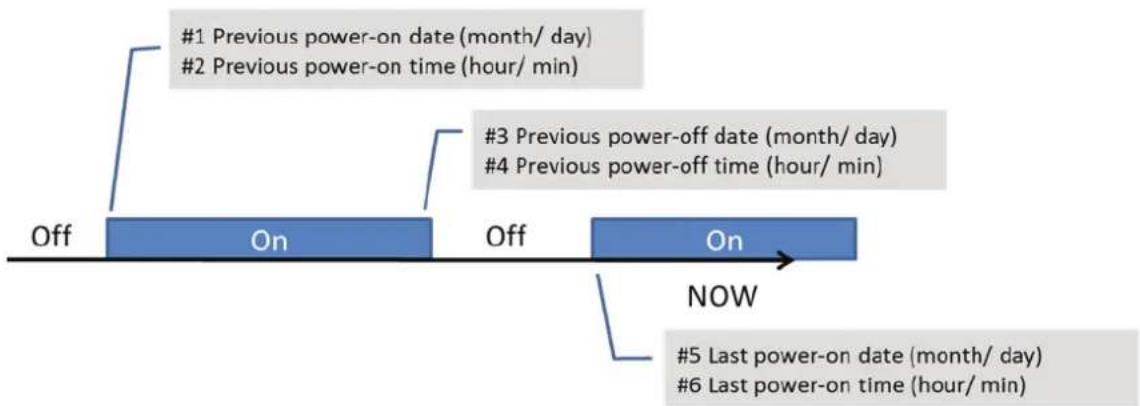
flowchart
graph LR
    A["Off"] --> B["#1 Previous power-on date (month/ day)<br>#2 Previous power-on time (hour/ min)"]
    B --> C["#3 Previous power-off date (month/ day)<br>#4 Previous power-off time (hour/ min)"]
    C --> D["On"]
    D --> E["#5 Last power-on date (month/ day)<br>#6 Last power-on time (hour/ min)"]
    style A fill:#000,stroke:#fff,color:#fff
    style B fill:#000,stroke:#fff,color:#fff
    style C fill:#000,stroke:#fff,color:#fff
    style D fill:#000,stroke:#fff,color:#fff
    style E fill:#000,stroke:#fff,color:#fff
- Time log data definition
| Value 1 Value 2 | Value 3 | |
| On/ Off indicator0: Off1: On | Month code Day code | |
| Hour code Minute code |
Hex code (in hex) = Original data (in dec) + 20
| Date & Time | Code (ASCII) | Code (Hex) | Date & Time | Code (ASCII) | Code (Hex) | Date & Time | Code (ASCII) | Code (Hex) | Date & Time | Code (ASCII) | Code (Hex) |
| 0 space 20 16 | 6 36 32 | R 52 48 h | 68 | ||||||||
| 1 ! 21 17 7 37 | 33 S 53 | 49 i 69 | |||||||||
| 2 “ 22 18 8 38 | 34 T 54 | 50 p 70 | |||||||||
| 3 # 23 19 9 39 | 35 U 55 | 51 q 71 | |||||||||
| 4 $ 24 20 @ 40 | 36 V 56 | 52 r 72 | |||||||||
| 5 % 25 21 A 41 | 37 W 57 | 53 | s | 73 | |||||||
| 6 & 26 | 22 B 42 | 38 X 58 | 54 t 74 | ||||||||
| 7 ’ 27 | 23 C 43 | 39 Y 59 | 55 u 75 | ||||||||
| 8 ( 28 24 D 44 | 40 ` 60 | 56 | v | 76 | |||||||
| 9 ) 29 25 E 45 | 41 a 61 | 57 w 77 | |||||||||
| 10 0 30 26 F 46 | 42 b 62 | 58 | x | 78 | |||||||
| 11 | 1 | 31 | 27 | G | 47 | 43 | c | 63 | 59 | y | 79 |
| 12 2 32 28 H 48 | 44 d 64 | ||||||||||
| 13 3 33 29 I 49 | 45 e | 65 | |||||||||
| 14 4 34 30 P 50 | 46 f | 66 | |||||||||
| 15 5 35 31 | Q | 51 47 g | 67 |
Month: 1\~12
Day: 1\~31
Hour: 00\~23
Min:: 00\~59
3. Get Time log data example
Assumed the power-on/off record of display#01 as below
2014-8/31 08:00 On
2014-8/31 22:00 Off
2014-9/1 10:30 On
2014-9/1 11:00 To send "GET-Time log" command
Send: 0x 38 30 31 67 31 30 30 30 0D
Reply:
1 0x 38 30 31 72 31 31 28 51 0D (On 8/31)
2 0x 38 30 31 72 31 31 28 20 0D (On 08:00)
3 0x 38 30 31 72 31 30 28 51 0D (Off 8/31)
4 0x 38 30 31 72 31 30 42 20 0D (Off 22:00)
5 0x 38 30 31 72 31 31 29 21 0D (On 9/1)
6 0x 38 30 31 72 31 31 30 50 0D (On 10:30)
4. Get Date & Time example
Assumed the current date/time of display#01 as below
Date: 2015-1/31
Time: 16:27:59
Send: 0x 38 30 31 67 32 30 30 30 0D (Get Date)
Reply:
1 0x 38 30 31 72 32 30 40 35 0D (Year "20" "15")
2 0x 38 30 31 72 32 31 21 51 0D (Month "1", Day "31")
Send: 0x 38 30 31 67 33 30 30 30 0D (Get Time)
Reply:
1 0x 38 30 31 72 33 30 36 47 0D (Hour "16", Min "27")
2 0x 38 30 31 72 33 31 30 79 0D ("0", Sec "59")
10.3.3. Remote Control Pass-through mode
When the PC sets the TV/DS to Remote Control Pass through mode, the TV/DS will send a 7-byte packet (followed by "CR") in response to RCU button activation. Note, that in this mode the RCU shall have no effect on the TV/DS function. For example: "Volume+" will not change the volume in the LCD but only sends "Volume+" code to PC over the RS232 port.
IR Pass Through-Function format
Reply: (Command Type="p")
Example1: Remote Control pass-through when "VOL+" key is pressed for TV-05 Send (Hex Format)
| Name Length ID | Command Type | Command Value1 CR | ||
| Hex 0x36 | 0x30 0x35 | 0x70 0x31 | 0x30 0x0D | ____ |
| Key Code (HEX) | |
| 1 | 01 |
| 2 | 02 |
| 3 | 03 |
| 4 | 04 |
| 5 | 05 |
| 6 | 06 |
| 7 | 07 |
| 8 | 08 |
| 9 | 09 |
| 0 | 0A |
| - | 0B |
| RECALL (LAST) 0C | |
| INFO (DISPLAY) 0D | |
| 0E | |
| ASPECT (ZOOM, SIZE) 0F | |
| VOLUME UP (+) 10 | |
| VOLUME DOWN (-) 11 | |
| MUTE 12 | |
| CHANNEL/PAGE UP (+)/ BRIGHTNESS+ | 13 |
| CHANNEL/PAGE DOWN (-)/ BRIGHTNESS- | 14 |
| POWER 15 | |
| SOURCES (INPUTS) 16 | |
| 17 | |
| 18 | |
| SLEEP 19 | |
| MENU 1A | |
| UP | 1B |
| DOWN | 1C |
| LEFT (-) | 1D |
| RIGHT (+) | 1E |
| OK (ENTER, SET) | 1F |
| EXIT | 20 |
| 21 | |
| 22 | |
| 23 | |
| 24 | |
| 25 | |
| 26 | |
| 27 | |
| 28 | |
| 29 | |
| 2A | |
| 2B | |
| RED ■ (F1) | 2C |
| GREEN ■ (F2) | 2D |
| YELLOW ■ (F3) | 2E |
| BLUE ■ (F4) | 2F |
NOTE:
- This IR-pass-through code is different from the RCU key code.
- Special control sequence for POWER key under IR-pass through mode.
2-1. When TV/DS is OFF and receives the IR POWER code: TV/DS will turn itself on, then forward the POWER code to the host via RS232.
2-2. When TV/DS is ON and receives the IR POWER code: TV/DS will forward the POWER code to the host via RS232, then turn off itself.
2-3. When SET-POWER LOCK is enabled, the TV/DS will not respond to POWER key pressing. - The VOLUME UP and VOLUME DOWN code will repeatedly output when you press and hold the keys.
11. Other Information
Customer Support
For technical support or product service, see the table below or contact your reseller.
NOTE: You will need the product serial number.
| Country/Region Website | T = TelephoneC = CHAT ONLINE | ||
| AustraliaNew Zealand | www.viewsonic.com.au | AUS= 1800 880 818NZ= 0800 008 822 | service@au.viewsonic.com |
| Canada www.viewsonic.com T= 1-866-463-4775 | service.ca@viewsonic.com | ||
| Europe www.viewsoniceurope.com www.viewsoniceurope.com/uk/support/call-desk/ | |||
| Hong Kong www.hk.viewsonic.com T= 852 3102 | 2900 service@hk.viewsonic.com | ||
| India www.in.viewsonic.com T= 1800 419 0959 service@in.viewsonic.com | |||
| Korea ap.viewsonic.com/kr/ T= 080 333 2131 | service@kr.viewsonic.com | ||
| Latin America(Argentina) | www.viewsonic.com/la/ | C= http://www.viewsonic.com/la/soporte/servicio-tecnico | soporte@viewsonic.com |
| Latin America(Chile) | www.viewsonic.com/la/ | C= http://www.viewsonic.com/la/soporte/servicio-tecnico | soporte@viewsonic.com |
| Latin America(Columbia) | www.viewsonic.com/la/ | C= http://www.viewsonic.com/la/soporte/servicio-tecnico | soporte@viewsonic.com |
| Latin America(Mexico) | www.viewsonic.com/la/ | C= http://www.viewsonic.com/la/soporte/servicio-tecnico | soporte@viewsonic.com |
| Nexus Hightech Solutions, Cincinnati #40 Desp. 1 Col. De los Deportes Mexico D.F.Tel: 55) 6547-6454 55) 6547-6484Other places please refer to http://www.viewsonic.com/la/soporte/servicio-tecnico#mexico | |||
| Latin America(Peru) | www.viewsonic.com/la/ | C= http://www.viewsonic.com/la/soporte/servicio-tecnico | soporte@viewsonic.com |
| Macau | www.hk.viewsonic.com T= 853 2870 0303 service@hk.viewsonic.com | ||
| Middle East | ap.viewsonic.com/me/ | Contact your reseller | service@ap.viewsonic.com |
| Puerto Rico &Virgin Islands | www.viewsonic.com | T= 1-800-688-6688 (English)C= http://www.viewsonic.com/la/soporte/servicio-tecnico | service.us@viewsonic.comsoporte@viewsonic.com |
| Singapore/Malaysia/Thailand | www.viewsonic.com.sg T= 65 6461 6044 service@sg.viewsonic.com | ||
| South Africa | ap.viewsonic.com/za/ | Contact your reseller | service@ap.viewsonic.com |
| United States www.viewsonic.com T= 1-800-688-6688 service.us@viewsonic.com | |||
Limited Warranty
ViewSonic® LCD Commercial Display
What the warranty covers:
ViewSonic warrants its products to be free from defects in material and workmanship, under normal use, during the warranty period. If a product proves to be defective in material or workmanship during the warranty period, ViewSonic will, at its sole option, repair or replace the product with a like product. Replacement product or parts may include remanufactured or refurbished parts or components.
Who the warranty protects:
This warranty is valid only for the first consumer purchaser.
What the warranty does not cover:
- Any product on which the serial number has been defaced, modified or removed.
- Damage, deterioration or malfunction resulting from:
a. Accident, misuse, neglect, fire, water, lightning, or other acts of nature, unauthorized product modification, or failure to follow instructions supplied with the product.
b. Any damage of the product due to shipment.
c. Removal or installation of the product.
d. Causes external to the product, such as electrical power fluctuations or failure.
e. Use of supplies or parts not meeting ViewSonic's specifications.
f. Normal wear and tear.
g. Any other cause which does not relate to a product defect.
-
Any product exhibiting a condition commonly known as “image burn-in” which results when a static image is displayed on the product for an extended period of time.
-
Removal, installation, one way transportation, insurance, and set-up service charges.
How to get service:
- For information about receiving service under warranty, contact ViewSonic Customer Support (Please refer to Customer Support page). You will need to provide your product's serial number.
- To obtain warranty service, you will be required to provide (a) the original dated sales slip, (b) your name, (c) your address, (d) a description of the problem, and (e) the serial number of the product.
- Take or ship the product freight prepaid in the original container to an authorized ViewSonic service center or ViewSonic.
- For additional information or the name of the nearest ViewSonic service center, contact ViewSonic.
Limitation of implied warranties:
There are no warranties, express or implied, which extend beyond the description contained herein including the implied warranty of merchantability and fitness for a particular purpose.
Exclusion of damages:
ViewSonic's liability is limited to the cost of repair or replacement of the product. ViewSonic shall not be liable for:
-
Damage to other property caused by any defects in the product, damages based upon inconvenience, loss of use of the product, loss of time, loss of profits, loss of business opportunity, loss of goodwill, interference with business relationships, or other commercial loss, even if advised of the possibility of such damages.
-
Any other damages, whether incidental, consequential or otherwise.
-
Any claim against the customer by any other party.
-
Repair or attempted repair by anyone not authorized by ViewSonic.
Effect of state law:
This warranty gives you specific legal rights, and you may also have other rights which vary from state to state. Some states do not allow limitations on implied warranties and/or do not allow the exclusion of incidental or consequential damages, so the above limitations and exclusions may not apply to you.
Sales outside the U.S.A. and Canada:
For warranty information and service on ViewSonic products sold outside of the U.S.A. and Canada, contact ViewSonic or your local ViewSonic dealer.
The warranty period for this product in mainland China (Hong Kong, Macao and Taiwan Excluded) is subject to the terms and conditions of the Maintenance Guarantee Card.
For users in Europe and Russia, full details of warranty provided can be found in www.viewsoniceurope.com under Support/Warranty Information.
Mexico Limited Warranty
ViewSonic® LCD Commercial Display
What the warranty covers:
ViewSonic warrants its products to be free from defects in material and workmanship, under normal use, during the warranty period. If a product proves to be defective in material or workmanship during the warranty period, ViewSonic will, at its sole option, repair or replace the product with a like product. Replacement product or parts may include remanufactured or refurbished parts or components.
Who the warranty protects:
This warranty is valid only for the first consumer purchaser.
What the warranty does not cover:
- Any product on which the serial number has been defaced, modified or removed.
- Damage, deterioration or malfunction resulting from:
a. Accident, misuse, neglect, fire, water, lightning, or other acts of nature, unauthorized product modification, or failure to follow instructions supplied with the product.
b. Any damage of the product due to shipment.
c. Removal or installation of the product.
d. Causes external to the product, such as electrical power fluctuations or failure.
e. Use of supplies or parts not meeting ViewSonic's specifications.
f. Normal wear and tear.
g. Any other cause which does not relate to a product defect.
-
Any product exhibiting a condition commonly known as "image burn-in" which results when a static image is displayed on the product for an extended period of time.
-
Removal, installation, one way transportation, insurance, and set-up service charges.
How to get service:
For information about receiving service under warranty, contact ViewSonic Customer Support (Please refer to the attached Customer Support page). You will need to provide your product's serial number, so please record the product information in the space provided below on your purchase for your future use. Please retain your receipt of proof of purchase to support your warranty claim.
For Your Records
Product Name: ____ Model Number: ____
Document Number: ____ Serial Number: ____
Purchase Date: ____ Extended Warranty Purchase? ____(Y/N)
If so, what date does warranty expire? ____
- To obtain warranty service, you will be required to provide (a) the original dated sales slip, (b) your name, (c) your address, (d) a description of the problem, and (e) the serial number of the product.
- Take or ship the product in the original container packaging to an authorized ViewSonic service center.
- Round trip transportation costs for in-warranty products will be paid by ViewSonic.
Limitation of implied warranties:
There are no warranties, express or implied, which extend beyond the description contained herein including the implied warranty of merchantability and fitness for a particular purpose.
Exclusion of damages:
ViewSonic's liability is limited to the cost of repair or replacement of the product. ViewSonic shall not be liable for:
- Damage to other property caused by any defects in the product, damages based upon inconvenience, loss of use of the product, loss of time, loss of profits, loss of business opportunity, loss of goodwill, interference with business relationships, or other commercial loss, even if advised of the possibility of such damages.
- Any other damages, whether incidental, consequential or otherwise.
- Any claim against the customer by any other party.
- Repair or attempted repair by anyone not authorized by ViewSonic.
4.3: ViewSonic Mexico Limited Warranty
| Contact Information for Sales & Authorized Service (Centro Autorizado de Servicio) within Mexico: | |
| Name, address, of manufacturer and importers:México, Av. de la Palma #8 Piso 2 Despacho 203, Corporativo Interpalmas,Col. San Fernando Huixquilucan, Estado de MéxicoTel: (55) 3605-1099http://www.viewsonic.com/la/soporte/index.htm | |
| NÚMERO GRATIS DE ASISTENCIA TÉCNICA PARA TODO MÉXICO: 001.866.823.2004 | |
| Hermosillo:Distribuciones y Servicios Computacionales SA de CV.Calle Juarez 284 local 2Col. Bugambilas C.P: 83140Tel: 01-66-22-14-9005E-Mail: disc2@hmo.megared.net.mx | Villahermosa:Compumantenimietnos Garantizados, S.A. de C.V.AV. GREGORIO MENDEZ #1504COL, FLORIDA C.P. 86040Tel: 01 (993) 3 52 00 47 / 3522074 / 3 52 20 09E-Mail: compumantenimientos@prodigy.net.mx |
| Puebla, Pue. (Matriz):RENTA Y DATOS, S.A. DE C.V. Domicilio:29 SUR 721 COL. LA PAZ72160 PUEBLA, PUE.Tel: 01(52).222.891.55.77 CON 10 LINEASE-Mail: datos@puebla.megared.net.mx | Veracruz, Ver.:CONEXION Y DESARROLLO, S.A DE C.V.Av. Americas # 419ENTRE PINZÓN Y ALVARADOFracc. Reforma C.P. 91919Tel: 01-22-91-00-31-67E-Mail: gacosta@qplus.com.mx |
| ChihuahuaSoluciones Globales en ComputaciónC. Magisterio # 3321 Col. MagisterialChihuahua, Chih.Tel: 4136954E-Mail: Cefeo@soluglobales.com | CuernavacaCompusupport de Cuernavaca SA de CVFrancisco Leyva # 178 Col. Miguel HidalgoC.P. 62040, Cuernavaca MorelosTel: 01 777 3180579 / 01 777 3124014E-Mail: aquevedo@compusupportcva.com |
| Distrito Federal:QPLUS, S.A. de C.V.Av. Coyoacán 931Col. Del Valle 03100, México, D.F.Tel: 01(52)55-50-00-27-35E-Mail : gacosta@qplus.com.mx | Guadalajara, Jal.:SERVICRECE, S.A. de C.V.Av. Niños Héroes # 2281Col. Arcos Sur, Sector Juárez44170, Guadalajara, JaliscoTel: 01(52)33-36-15-15-43E-Mail: mmiranda@servicrece.com |
| Guerrero AcapulcoGS Computación (Grupo Sesicomp)Progreso #6-A, Colo Centro39300 Acapulco, GuerreroTel: 744-48-32627 | Monterrey:Global Product ServicesMar Caribe # 1987, Esquina con Golfo PésicoFracc. Bernardo Reyes, CP 64280Monterrey N.L. MéxicoTel: 8129-5103E-Mail: aydeem@gps1.com.mx |
| MERIDA:ELECTROSERAv Reforma No. 403Gx39 y 41Mérida, Yucatán, México CP97000Tel: (52) 999-925-1916E-Mail: rrrb@sureste.com | Oaxaca, Oax.:CENTRO DE DISTRIBUCION YSERVICIO, S.A. de C.V.Murguía # 708 P.A., Col. Centro, 68000, OaxacaTel: 01(52)95-15-15-22-22Fax: 01(52)95-15-13-67-00E-Mail. gpotai2001@hotmail.com |
| Tijuana:STDAv Ferrocarril Sonora #3780 L-CCol 20 de NoviembreTijuana, Mexico | FOR USA SUPPORT:ViewSonic Corporation14035 Pipeline Ave. Chino, CA 91710, USATel: 800-688-6688 (English); 866-323-8056 (Spanish);E-Mail: http://www.viewsonic.com |

natural_image
Three colorful bird illustrations perched on a branch against a red background (no text or symbols)ViewSonic®
- Thank you for choosing ViewSonic
- Compliance Information
- FCC Statement
- For Canada
- Declaration of RoHS2 Compliance
- Safety Precautions
- CAUTION:
- Recommended Use
- Ergonomics
- Table Of Contents
- Unpacking and Installation....1
- Parts and Functions ...... 6
- Connecting External Equipment ..... 10
- Operation....16
- Change your settings....20
- USB device compatibility....26
- Input Mode.....28
- Cleaning and Troubleshooting......30
- Technical Specifications 32
- RS232 Protocol 34
- Other Information ...... 47
- Copyright Information
- Product Registration
- For Your Records
- Product disposal at end of product life
- Unpacking and Installation
- Unpacking
- Package Contents
- NOTES:
- Installation Notes
- Installing and Removing Table Stands (optional)
- To install table stands:
- To remove table stands:
- Installing and Removing OPS module
- To install OPS Module:
- To remove OPS Module:
- Mounting on a Wall
- VESA Grid
- Ventilation Requirements for enclosure locating
- Mounting in Portrait Position
- Operating Instructions of Edge Alignment Kit
- Parts and Functions
- Control Panel
- Input/Output Terminals
- NOTE:
- Remote Control
- General functions
- ID Remote Control:
- Inserting the batteries in the remote control
- Handling the remote control
- Operating range of the remote control
- Connecting External Equipment
- Connecting External Equipment (DVD/VCR/VCD)
- Using COMPONENT video input
- Using Video Source input
- Using HDMI video input
- Connecting a PC
- Using VGA input
- Using DVI input
- Using HDMI input
- Using DisplayPort input
- Connecting Audio Equipment
- Connecting external speakers
- Connecting an external audio device
- Connecting Multiple Displays in a Daisy-chain Configuration
- Display control connection
- Digital video connection
- Analog video connection
- IR daisy-chain Connection
- IR connection
- IR Pass-through Connection
- Wire-connecting to Network
- To setup the network:
- Operation
- Watch the Connected Video Source
- Change Picture Format
- Choose your Preferred Picture Settings
- Choose your Preferred Sound Settings
- Play multimedia files via Local Area Network
- Set up the network
- Set up media sharing
- How to use DLNA-DMP
- Play fles from display
- How to use DLNA-DMR from PC
- Play fles
- Tips:
- Play multimedia files from USB device
- Play options
- Playing music files
- Music options
- Playing movie files
- Movie options
- Playing photo files
- Start a slideshow
- Slideshow options
- Change your settings
- Settings
- Picture
- Picture style
- Restore style
- Backlight
- Colour
- Sharpness
- Noise reduction
- MPEG artifact reduction
- Digital Crystal Clear
- Advanced
- Game or computer
- Format and edges
- Sound
- Sound style
- Bass
- Treble
- Balance
- Surround mode
- Audio out
- Tiling
- Enable
- H monitors
- V monitors
- Position
- Example: 2 x 2 screen matrix (4 displays)
- Example: 5 x 5 screen matrix (25 displays)
- Frame comp.
- General settings
- Menu language
- Monitor ID
- Eco mode
- Auto search
- Clock
- Scheduling
- To save the playlist, press [] and choose Save list.
- Sleep timer
- CEC
- Auto adjust
- Local KB lock
- RC lock
- Pixel shift
- Smart power
- Wake on Ian
- Switch on state
- LED
- Switch on delay
- Logo
- APM
- Information OSD
- DisplayPort Ver.:
- Cooling Fan
- Network control port
- QR code
- Factory settings
- Network Settings
- View network settings
- Network Configuration
- Static IP Configuration
- Digital Media Renderer - DMR
- Network name
- USB device compatibility
- Input Mode
- Cleaning and Troubleshooting
- Cleaning
- Caution When Using the Display
- Front Panel Cleaning Instructions
- Cabinet Cleaning Instructions
- Technical Specifications
- CDX4952
- RS232 Protocol
- Introduction
- Description
- Hardware specification
- Communication Setting
- Command Message Reference
- Protocol
- Set-Function Listing
- Set-Function description:
- Set-Function format
- Example1: Set Brightness as 76 for TV-02 and this command is valid
- Behavior at lock modes
- Example for value setting of SET\_TV channel DTV
- Tiling definition of H Monitors/ V Monitors/ and Position
- Date & Time format definition
- Set Date & Time example
- 10.3.2.Get-Function Listing
- Get-Function description:
- Get-Function format
- Reply: (Command Type="r" or "-"')
- Get Time log data example
- 0x 38 30 31 72 31 31 28 51 0D (On 8/31)
- 0x 38 30 31 72 31 31 28 20 0D (On 08:00)
- 0x 38 30 31 72 31 30 28 51 0D (Off 8/31)
- 0x 38 30 31 72 31 30 42 20 0D (Off 22:00)
- 0x 38 30 31 72 31 31 29 21 0D (On 9/1)
- 0x 38 30 31 72 31 31 30 50 0D (On 10:30)
- Get Date & Time example
- 0x 38 30 31 72 32 30 40 35 0D (Year "20" "15")
- 0x 38 30 31 72 32 31 21 51 0D (Month "1", Day "31")
- 0x 38 30 31 72 33 30 36 47 0D (Hour "16", Min "27")
- 0x 38 30 31 72 33 31 30 79 0D ("0", Sec "59")
- Remote Control Pass-through mode
- IR Pass Through-Function format
- Other Information
- Customer Support
- Limited Warranty
- ViewSonic® LCD Commercial Display
- What the warranty covers:
- Who the warranty protects:
- What the warranty does not cover:
- How to get service:
- Limitation of implied warranties:
- Exclusion of damages:
- Effect of state law:
- Sales outside the U.S.A. and Canada:
- Mexico Limited Warranty
Brand : VIEWSONIC
Model : CDX4952-L
Category : Surveillance