E216T5W - Suivi eMachines - Free user manual and instructions
Find the device manual for free E216T5W eMachines in PDF.


| Product Type | Laptop Computer |
| Brand | eMachines |
| Model | E216T5W |
| Display Size | 15.6 inches |
| Dimensions (W x D x H) | 38.0 x 25.0 x 2.5 cm |
| Weight | 2.5 kg |
| Processor | Intel Celeron |
| RAM | 4 GB DDR3 |
| Storage | 500 GB HDD |
| Operating System | Windows 10 Home |
| Power Supply | AC Adapter, 65W |
| Battery Type | Lithium-ion, 6-cell |
| Connectivity | Wi-Fi 802.11 b/g/n, Bluetooth 4.0 |
| Ports | USB 2.0, USB 3.0, HDMI, VGA, Ethernet, Headphone/Mic |
| Primary Functions | Web browsing, document editing, multimedia playback, email |
| Maintenance | Clean with soft dry cloth; avoid liquids |
| Safety Precautions | Keep away from water and heat sources; use only approved charger |
| Spare Parts & Repairability | Battery, charger, keyboard, hard drive replaceable by user |
| Warranty | 1 year limited warranty |
Frequently Asked Questions - E216T5W eMachines
User questions about E216T5W eMachines
0 question about this device. Answer the ones you know or ask your own.
Ask a new question about this device
Download the instructions for your Suivi in PDF format for free! Find your manual E216T5W - eMachines and take your electronic device back in hand. On this page are published all the documents necessary for the use of your device. E216T5W by eMachines.
USER MANUAL E216T5W eMachines
Flat Panel Monitor User Guide
Contents
Using Your eMachines Flat-Panel Monitor .... 1
Unpacking the monitor 2
Connecting the monitor 2
Attaching the base 2
Connecting video and audio inputs 3
Connecting power 3
Adjusting monitor tilt 3
Starting the monitor 4
Adjusting monitor settings 5
Monitor buttons 5
On-screen display options 6
Using the Direct Keys 8
Changing Windows screen settings 10
Video modes 11
Unknown video modes 11
Power management 12
ENERGY STAR 12
Energy declaration 12
Maintaining 13
Troubleshooting 13
No power 13
No picture 13
Display colors are wrong 14
Picture has shadows or "ghosts" 14
Color is not uniform 14
Image is not sized or centered correctly 14
The image remains after switching off the monitor 15
The image is unstable 15
The message "No Input Signal" appears on the screen 15
The monitor has pixels that are always dark or too bright 15
Specifications 16
Safety, Regulatory, and Legal Notices....17
Recycling 19
Contents
Using Your eMachines Flat-Panel Monitor
- Unpacking the monitor
- Connecting the monitor
- Starting the monitor
- Adjusting monitor settings
• Power management - Maintaining
- Troubleshooting
- Specifications
Unpacking the monitor
Your monitor box should contain the following items:
- Base
• This User Guide
• VGA cable - Audio cable
- Power cord
• Monitor (with neck attached)
If you are missing any items, call Customer Care. For telephone numbers, see the label on the back of your monitor.
Connecting the monitor
To set up the monitor, first attach the base, then make your cable connections.
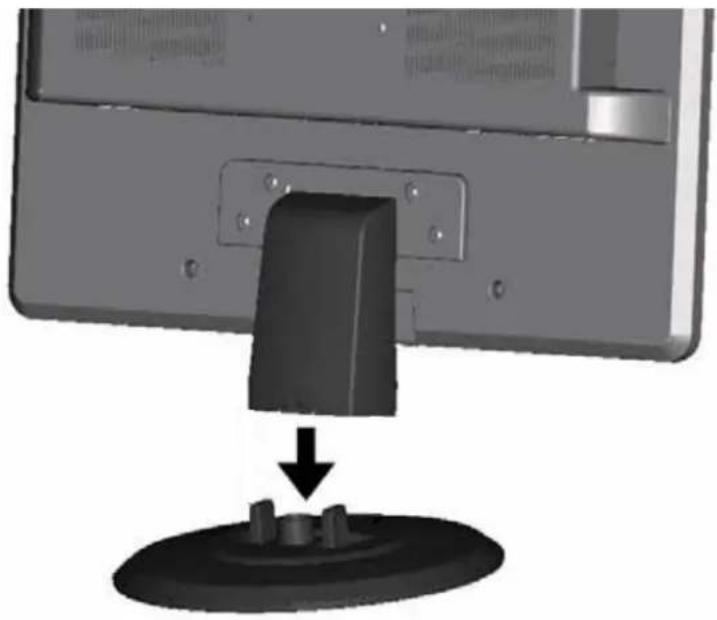
Attaching the base
▶ To attach the base:
- Place the monitor base on a table top, then slide the monitor neck down onto the base until it clicks into place.
natural_image
3D rendering of a computer monitor with a black handle and a circular base, showing a downward arrow indicating a process (no text or symbols present)Connecting video and audio inputs
▶ To connect video and audio inputs to your monitor:
1 Position your computer and the monitor so you can reach the back of each.
2 Connect the VGA video cable to the VGA video connector under the back of the display.
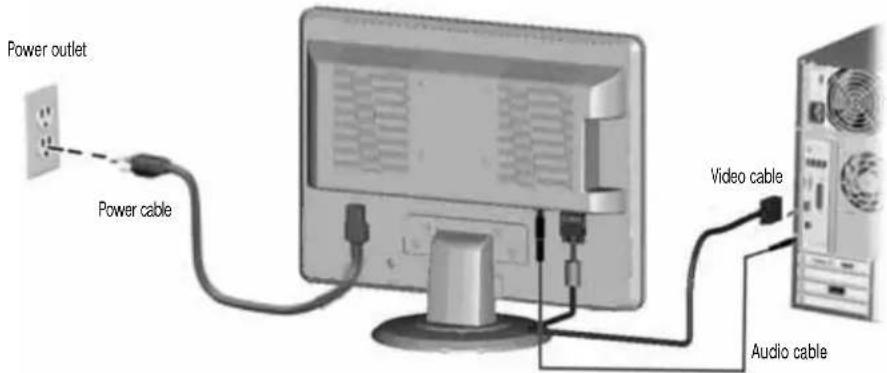
3 Make sure that your computer is turned off, then connect the other end of the video cable to the matching video port on the back of your computer.
4 Connect the speaker (green) cable from the speaker jack on the monitor to your computer's audio out jack.
Connecting power
▶ To connect power:
1 Position your monitor so you can reach the back, then connect the power cord to the power connector under the back of the monitor.
2 Plug the power cord into a correctly grounded power outlet. We recommend using a surge protector to protect your monitor from voltage spikes.
Adjusting monitor tilt
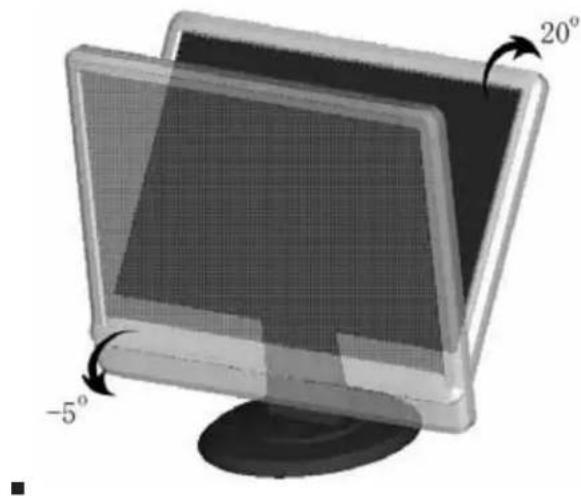
To adjust your monitor's tilt:
- Adjust the tilt of the monitor for your viewing comfort.
natural_image
Illustration of a computer monitor with two 20° and -5° angular annotations (no text or symbols on the screen itself)Ergonomic guidelines
The recommended screen positioning is based upon the following guidelines. These guidelines are based on available scientific literature and published standards.
Screen height
The recommended screen height for displays (except in special circumstances, such as for bifocal use) is that the top of the display should be set at or slightly below (about 1 inch or 25 mm) your eye level while you are sitting in a comfortable working posture. This guideline places the center of the screen at an ideal 15^ to 20^ viewing angle for most desktop displays.
Screen tilt
The screen should be tilted so your line of sight is perpendicular to the screen. This angle creates the most consistent viewing distance when scanning from the top of the screen to the bottom. You may need to adjust lighting to avoid screen glare when the screen is tilted upward.
Screen distance from user
The screen should first be placed at arm's length from the user, then adjusted back and forth to suit individual preference.
Starting the monitor
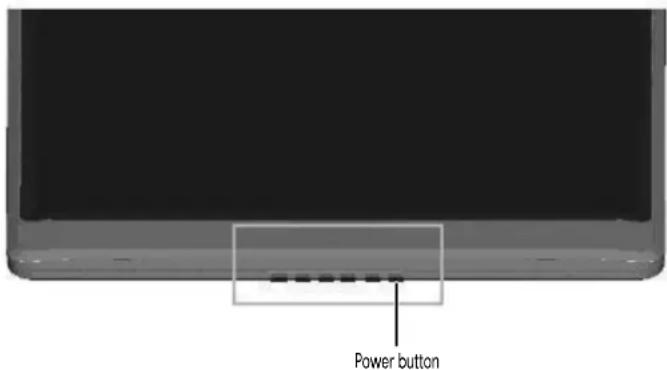
▶ To start the monitor:
1 Press the power button on the front of your monitor. The power LED turns from orange to green.
2 Turn on your computer.
After your computer is running, the power LED (centered above the monitor buttons) should be green. Allow about 10 seconds for the display image to appear. If the power LED is not green or you do not see a display image, check the connections. For more troubleshooting information, see "Troubleshooting" on page 13.
3 Adjust the tilt of the monitor for the best viewing angle.

Important
When adjusting the monitor settings, always press the Auto button before entering the OSD. This will automatically adjust the display image to the ideal settings for the current screen resolution.
4 After you see the Windows desktop, press the Auto button (the second button from the right on the front of the monitor) to automatically adjust your display image to the ideal settings. See "Monitor buttons" on page 5.
5 Use the on-screen display (OSD) to adjust other monitor settings. For more information, see "Adjusting monitor settings" on page 5.

Adjusting monitor settings
Use the monitor controls (located on the monitor itself) and computer controls (accessible through Windows) to adjust the display image. For more information about computer controls, see "Changing Windows screen settings" on page 10.
Monitor buttons
This monitor features an on-screen display (OSD) that lets you adjust contrast, brightness, and other settings for the monitor. The monitor saves changes you make to the settings, even if you turn off the monitor. (The appearance of your monitor may vary from that shown.)
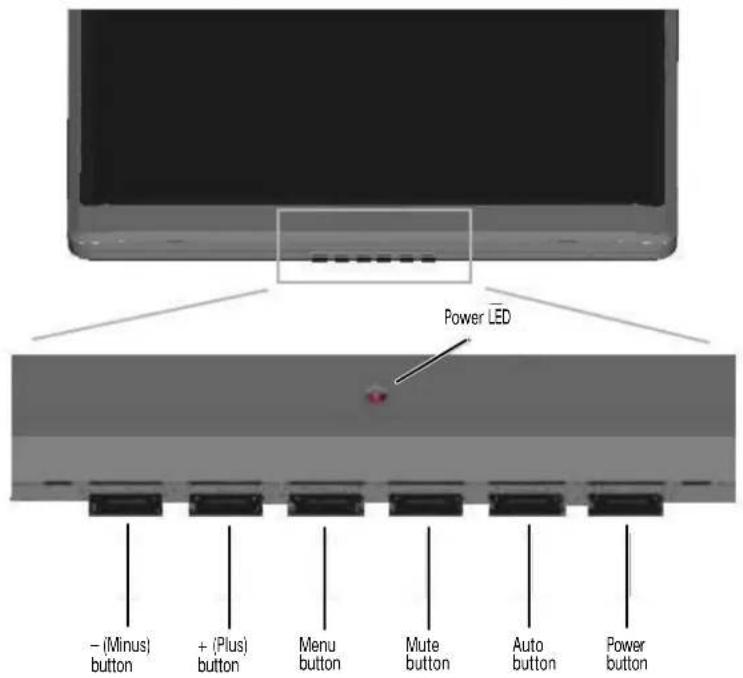
- (Minus) button
OSD active: Press to move to the next menu and decrease setting levels.
OSD inactive: Press to activate the Audio menu.
• + (Plus) button
OSD active: Press to move to the previous menu and increase setting levels.
OSD inactive: Press to activate the Audio menu. - Menu button
Press to open a menu, select an item, or close the menu. - Mute button
Press to mute the sound. Press again to restore the sound. - Auto button
Press to automatically fine-tune the image quality. - Power button
Press to turn the monitor on or off.
• Power LED
Powered on = Green
Power saving mode = Orange
On-screen display options
Adjusting OSD settings
▶ To adjust the OSD settings:
1 Press the Auto button. The display image is automatically adjusted to the ideal settings for your current screen resolution.
2 Press the Menu button. The OSD opens.
3 Press the + or - button to highlight a setting, then press the Menu button to open the selected menu or setting.
4 Press the + or - button to adjust the setting or change the option.
5 Select the EXIT icon, then press the Menu button to return to a top level menu.
6 Select the EXIT icon, then press the Menu button to exit the OSD.
■
OSD menus
OSD Menu Description
Main menu
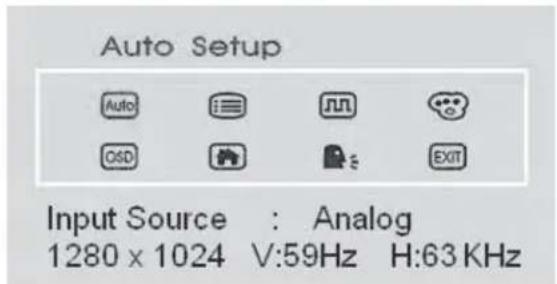
| Auto—Automatically adjusts your monitor to its optimum settings. |
| Management—Opens the Management menu, where you can adjust brightness, contrast, horizontal position, and vertical position. |
| Clock/ Phase—Opens the Clock/ Phase menu, where you can adjust the clock and phase settings of the monitor. |
| Color—Opens the Color menu, where you can adjust color temperature, the sRGB, and custom color. |
| OSD—Opens the OSD menu, where you can set the horizontal and vertical position of the OSD menus. |
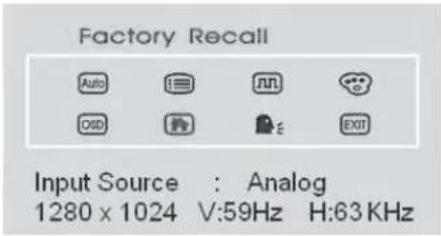
| Factory Recall—Resets the monitor to its factory settings. |
| Language—Opens the Language menu, where you can select the language of the OSD menus. Settings take effect immediately. |
| EXIT—Exits the submenu to a top level menu. Exits the OSD menu system. |
Management menu
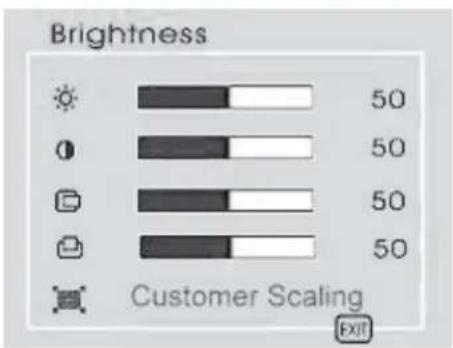
| Brightness—Adjusts the amount of light in the darkest portion of the picture. Use the lowest brightness setting you are comfortable with to maximize the life of the monitor backlights. You may need to readjust brightness after the monitor warms up. | |
| Contrast—Adjusts the level of white between the lightest and darkest portions of an image. | |
| H.Position—Adjusts the horizontal position of the display on the monitor. | |
| V.Position—Adjusts the vertical position of the display on the monitor. | |
| Customer Scaling—Adjusts the aspect ratio of the display. Select Fill to Screen or Fill to Aspect Ratio. | |
| EXIT—Returns to top level menu. |
OSD Menu Description
Clock/ Phase menu
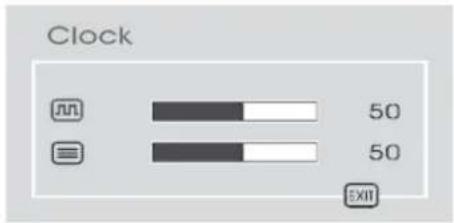
Clock—Minimizes any vertical bars or stripes visible on the screen background. The horizontal screen size will also change. Phase—Minimizes any horizontal distortion and clears or sharpens the displayed characters. EXIT—Returns to top level menu.
Color menu
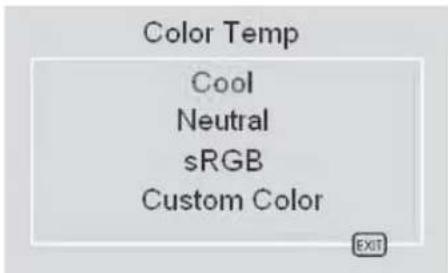
Color Temp—Customizes the color temperature of the display. Select Cool, Neutral, sRGB, and Custom Color. Exit—Returns to top level menu.
Custom Color submenu
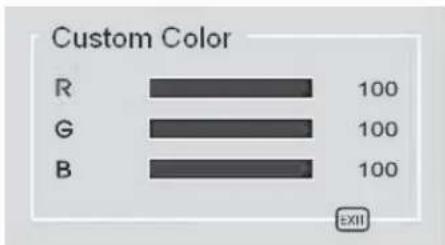
Custom Color—Changes the levels of the three primary colors (red, green, and blue) in the display to help achieve a more natural appearance in graphic images and a closer color match between the display and printer.
OSD Display menu
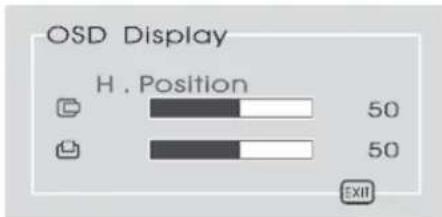
H.Position—Adjusts the horizontal position of the OSD menus on the monitor. V.Position—Adjusts the vertical position of the OSD menus on the monitor. Exit—Returns to top level menu.
| OSD Menu Description | |
| Factory Recall | Press the + or – button to highlight the Factory icon, then press theMenubutton to reset the monitor to factory default settings. |
 | |
| Language menu | Press the + or – button to highlight the OSD menu language of your choice, then press theMenubutton to select it. Settings take effect immediately. |
| LanguageEnglishFrançaisDeutschItalianoEspañol | |
Using the Direct Keys
While the OSD Main Menu is inactive, you can use three direct function keys to change settings.
Auto setup by direct key
Use auto setup whenever you apply a new video mode or change the refresh rate. While auto setup is running, you should have a stable image displayed on the screen. Do not move items around the screen, play games, or view video during auto setup.
After you have executed auto setup for a particular mode, the display will store the new values in its permanent memory.
To use auto setup by direct key:
1 With no OSD menu open, press the Auto button. This starts the auto setup.
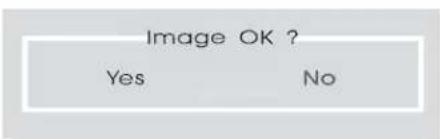
The image will change color and appear to jitter during auto setup. After auto setup is complete, you are asked whether the image is OK.
2 If the image looks correct, choose Yes. The OSD will close automatically.
-OR-
If the image requires further adjustment, choose No. The Phase bar opens to let you adjust the setting manually.
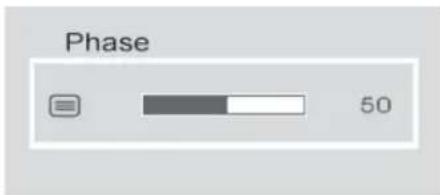
3 Adjust the phase by pressing the + or - buttons. When all text appears well focused and there is no instability in the image, press Menu to end the adjustment and close the OSD menu.
Audio setup by direct key
To adjust the volume by direct key:
1 With no OSD menu open, press the + or - buttons. The Volume bar opens.
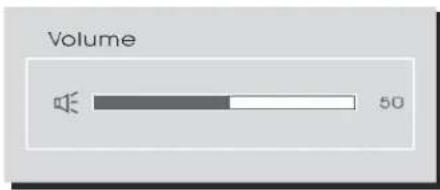
2 Press the + or - buttons one or more times to set the volume to a comfortable level.
Changing Windows screen settings
Color depth and screen resolution are two of the most basic monitor settings you may need to change to suit your needs.
Color depth is the number of colors your computer uses to display images on your monitor. Most images look best displayed with the maximum number of colors available. If the color in your images seems "false" or "jumpy," especially after you have played a game or run a video-intensive program, check the color depth setting and return it to the highest color setting, if necessary.
Screen resolution is the number of pixels (individual colored dots) your computer uses to display images on your monitor. The higher the resolution, the more information and screen components (such as icons and menu bars) can be displayed on the monitor.

Help
For more information about adjusting the screen, click Start, then click Help and Support. Type adjusting monitor settings in the Search Help box, then press ENTER.
To change the color depth and screen resolution in Windows Vista®:
1 Click (Start), Control Panel, then under Appearance and Personalization, click Adjust Screen Resolution. The Display Settings dialog box opens.

Shortcut
You can also right-click on your Windows desktop, then click Personalize.
2 To change the color depth, click the Colors list, then click the color depth you want. Color depth settings:
- Low (8-bit) = 256 colors
• Medium (16-bit) = 65,500 colors
• Highest (32-bit) = 16,700,000 colors
3 To change the screen resolution, drag the Resolution slider to the size you prefer.
4 Click Apply. If the new settings do not look right, click No. If the new settings make the screen illegible and you cannot click No, the settings return to their previous values after several seconds.
5 Click OK, then click Yes to save your changes.
To change the color depth and screen resolution in Windows XP:
1 Click Start, then click Control Panel. The Control Panel opens. If your Control Panel is in Category View, click Appearance and Themes.

Shortcut
You can also right-click on your Windows desktop, then click Properties.
2 Click Display. The Display Properties dialog box opens.
3 Click the Settings tab.
4 To change the color depth, click the arrow button to open the Color quality list, then click the color depth you want.
Color quality settings:
- Low (8-bit) = 256 colors
• Medium (16-bit) = 65,500 colors
• Highest (32-bit) = 16,700,000 colors
5 To change the screen resolution, drag the Screen resolution slider to the size you prefer. The optimum resolution for your display is 1680 × 1050 .
6 Click OK.
■
Video modes
Your monitor supports several video modes. If you do not use the best mode for the monitor, the display image may look slightly “fuzzy.”
| Mode Mode name and resolution | Horizontal frequency (kHz) | Vertical frequency (Hz) | |
| 1 | 640 × 350 | 31.469 | 59.94 |
| 2 640 × 480 37.50 75.00 | |||
| 3 | 720 × 400 | 31.47 | 70.08 |
| 4 800 × 600 37.88 60.32 | |||
| 5 | 800 × 600 | 46.88 | 75.00 |
| 6 832 × 624 49.72 74.55 | |||
| 7 | 1024 × 768 | 48.36 | 60.00 |
| 8 | 1024 × 768 | 60.02 | 75.03 |
| 9 | 1152 × 720 | 44.86 | 60.00 |
| 10 | 1152 × 870 | 68.68 | 75.06 |
| 11 | 1152 × 900 | 61.80 | 65.96 |
| 12 | 1280 × 768 | 47.396 | 60.00 |
| 13 | 1280 × 960 | 60.00 | 60.00 |
| 14 | 1280 × 1024 | 63.98 | 60.02 |
| 15 | 1280 × 1024 | 79.98 | 75.02 |
| 16 | 1440 × 900 | 55.94 | 59.89 |
| 17 | 1600 × 1000 | 61.648 | 60.00 |
| 18 | 1680 × 1050 | 65.29 | 60.00 |
Unknown video modes
Like all other monitors, the LCD monitor is designed to work with standard video modes. However, not all video/graphic cards use only standard display modes. Your LCD monitor uses state-of-the-art technology, which is designed to synchronize to any display mode. We recommend choosing one of the supported modes listed above. If you choose an unknown mode, you will need to manually adjust the clock, phase, and image position. If you must use an unknown mode, you can run Auto Adjust first. If Auto Adjust does not provide adequate image adjustment, then you must manually adjust the clock, phase, horizontal position, and vertical position.
Power management
ENERGY STAR
As an ENERGY STAR® Partner, eMachines has determined that this product meets the ENERGY STAR guidelines for energy efficiency.
This monitor complies with the EPA's International ENERGY STAR Program, which is a program designed to encourage manufacturers of computer equipment to build circuitry into their products to reduce energy consumption during time of non-use.
Energy declaration
When connected to a computer that supports the VESA Display Power Management Signaling (DPMS) Protocol, the monitor can conserve significant energy by reducing power consumption during periods of non-use. When your computer goes into the energy saving mode, the monitor enters the Active Off mode (sleep). In the Active Off mode the Power LED turns orange.
Use these conventions and the power can be reduced to the following levels:
VESA state LED indicator Power consumption
On Green <55 W
Active Off Orange <2 W
To "wake" the monitor when it is in Active Off mode, move the mouse or press any keyboard key. Access the power management options in the Control Panel to change the period of time after which the monitor enters these low power states.
Maintaining
To keep the monitor in optimal working order:
- Do not block the ventilation holes.
- Do not expose the monitor to rain or use near water.
- Keep the monitor away from radiators or heat vents.
- Keep the monitor out of direct sunlight.

Caution
Do not use any type of abrasive pad or glass cleaner. You will permanently scratch the screen.
- To clean the monitor, use a soft cloth slightly moistened with water only. Wipe the cabinet, screen, and controls.
Troubleshooting

Caution
Immediately unplug the monitor from the power outlet and refer servicing to qualified service personnel if any of the following occurs:
• The power supply cord or plug is damaged.
• Liquid has been spilled or objects have fallen into the monitor.
• The monitor has been exposed to rain or water.
• The monitor has been dropped or the cabinet damaged.

Important
Make sure that the monitor has warmed up for approximately 30 minutes before
making any judgments about the picture quality.
If you have problems with the monitor, the information in this troubleshooting section may help you solve them.
No power
No picture
- Make sure that the power cord is connected correctly to both the back of the monitor and the wall outlet. For more information about connecting the power cord, see "Connecting the monitor" on page 2.
- Make sure that the power cord is connected correctly to both the back of the monitor and the wall outlet. For more information about connecting the power cord, see “Connecting the monitor” on page 2.
- Make sure that the video cable is connected securely to the back of the monitor and computer. For more information about connecting the video cable, see “Connecting the monitor” on page 2.
• Make sure that the monitor is turned on. - If you have the monitor connected to your notebook's video port, you have two options:
- If your notebook supports dual displays, you can use both your notebook's display and this monitor in extended desktop multi-monitor mode. See Windows Help to learn how to enable multiple monitors.
- You can also use this monitor as your primary monitor and not use the notebook's screen. Notebook computers typically have an FN key combination that lets you toggle between your notebook's display, an externally attached display, and both at the same time. See your notebook's user guide for more information.
Using Your eMachines Flat-Panel Monitor
- If the power LED is orange:
- Make sure that your computer is turned on.
- Move the mouse or press any key on the keyboard to bring the monitor out of sleep mode.
- Restart your computer with the monitor turned on.
- Make sure that the video cable is not damaged.
- Check the end of the video cable for any pins that might be bent or pushed in.
- Turn off the monitor and unplug the video cable from the back of your computer. Turn the monitor back on and wait for ten seconds. If the monitor is functioning correctly, a “No Signal” message appears. For more information about connecting the video cable, see “Connecting the monitor” on page 2.
Display colors are wrong
- Press the Menu button, then the Auto button to automatically adjust the display image to the ideal settings.
- Restart your computer with the monitor turned on.
- Make sure that the video cable is connected securely to the back of the monitor and your computer. For more information about connecting the video cable, see "Connecting the monitor" on page 2.
- Make sure that the video cable is not damaged.
- Check the end of the video cable for any pins that might be bent or pushed in.
Picture has shadows or "ghosts"
- Press the Menu button, then the Auto button to automatically adjust the display image to the ideal settings.
- Remove any extension cables or switchboxes.
- Make sure that the video cable is connected securely to the back of the monitor and your computer. For more information about connecting the video cable, see “Connecting the monitor” on page 2.
- Make sure that the video cable is not damaged.
- Check the end of the video cable for any pins that might be bent or pushed in.
• Make sure that your monitor connection is using the VGA cable that came with your monitor.
Color is not uniform
- Press the Menu button, then the Auto button to automatically adjust the display image to the ideal settings.
• Make sure that the monitor warms up for at least 30 minutes before making a final judgment about color uniformity or brightness.
Image is not sized or centered correctly
- Press the Menu button, then the Auto button to automatically adjust the display image to the ideal settings.
- Use the position controls to adjust the image. For instructions on how to adjust the display image position, see "Adjusting monitor settings" on page 5.
The image remains after switching off the monitor
- Image persistence is when a "ghost" of an image remains on the screen, even after switching the monitor off. To alleviate image persistence, turn off the monitor for as long as an image was displayed.
If, for example, the image was on the monitor for one hour and a "ghost" remains, you should switch off the monitor for at least one hour to erase the image.
• We recommend the use of a screen saver whenever the screen is idle.
The image is unstable
- Set your computer to a supported video mode, preferably 1680 x 1050 at 60 Hz.
- Try plugging the monitor into a different, earthed (grounded), power outlet, preferably on a different circuit.
- Check the display settings of your computer. Make sure that a supported mode is selected.
- Check the display specifications section for more information.
The message "No Input Signal" appears on the screen
- Make sure that the video cable is correctly plugged into the analog video port on the back of the monitor.
• Make sure that the other end is correctly plugged into the VGA port of your computer.
The monitor has pixels that are always dark or too bright
- This condition is normal and inherent in the TFT technology used in active-matrix LCD screens. eMachines' inspection standards keep these to a minimum. If you feel these pixels are unacceptably numerous or dense on your display, contact eMachines Customer Care to identify whether a repair or replacement is justified based on the number of pixels affected.
Specifications
Specifications are subject to change without notice or obligation. Many products for eMachines are custom engineered by our suppliers to eMachines specifications and may vary from similarly marketed products.
| Panel size | 21.6 inches |
| Panel type | TFT LCD |
| Viewable image size | 21.6-inch diagonal |
| Pixel resolution | 1680 × 1050 (60 Hz) |
| Pixel pitch | 0.0109 × 0.0109 inches (0.27675 mm × 0.27675 mm) |
| Text mode | 720 × 400 |
| Aspect ratio | 16:10 |
| Horizontal frequency | 30 to 81 KHz |
| Vertical refresh rate | 56 to 76 Hz |
| Tilt | -5° to 20° |
| Colors | 16.2 million |
| OSD languages | English, French, Spanish, Italian, Japanese |
| Connections and inputs | Analog (VGA): 15-pin mini d-sub VGAAudio: mini-plugAC power |
| Cables | 15-pin mini d-sub analog VGA (included)Audio cable with mini-plug |
| Audio power output | 2 W/ channel @ PC 1 Vrms |
| Speaker (R/L) | 2 W/ 16 ohm speaker |
| Power consumption | Normal operation: <55 W |
| Power input | 100-240 VAC, 50/ 60 Hz |
| Temperature | Operating: 41° to 104°F (5° to 40°C)Non-operating: -4° to 140°F (-20° to +60°C) |
| Altitude | Operating: 0 to 6561.68 feet (0 to 2000 m)Non-operating: 0 to 40,000 feet (0 to 12192 m) |
| Relative humidity | 20% to 85% (non-condensing) |
| Power management | Energy Star® |
| Certifications | UL, CSA, FCC Class B |
| Dimensions | 17.18 × 20.79 × 8.09 inches (436.6 × 526.8 × 205.5 mm)with basic stand |
| Weight | 14.5 lb (6.6 kg) |
Safety, Regulatory, and Legal Notices
• Important safety information
• Environmental information
• Regulatory compliance statements
- Notices
Important safety information

Warning
Always follow these instructions to help guard against personal injury and damage to your Gateway product.

Warning
Do not use Gateway products in areas classified as hazardous locations. Such areas include patient care areas, dental and dental facilities, oxygen-laden environments, or industrial facilities.
Your Gateway product is designed and tested to meet the latest standards for safety of information technology equipment. However, to ensure safe use of this product, it is important that the safety instructions marked on the product and in the documentation are followed.
Setting up your system
- Read and follow all instructions marked on the product and in the documentation before you operate your system. Retain all safety and operating instructions for future use.
- Do not use this product near water or a heat source such as a radiator.
- Set up the system on a stable work surface.
■ The product should only be operated from the type of power source indicated on the rating label. - If your product has a voltage selector switch, make sure that the switch is in the proper position for your area. The voltage selector switch is set at the factory to the correct voltage.
- Openings in the monitor case are provided for ventilation. Do not block or cover these openings. Make sure you provide adequate space, at least 6 inches (15 cm), around the system for ventilation when you set up your work area. Never insert objects of any kind into the monitor ventilation openings.
Some products are equipped with a three-wire power cord to make sure that the product is properly grounded when in use. The plug on this cord will only fit into a grounding-type outlet. This is a safety feature. If you are unable to insert the plug into an outlet, contact an electrician to install the appropriate outlet.
If you use an extension cord with this system, make sure that the total ampere rating on the products plugged into the extension cord does not exceed the extension cord ampere rating.
Care during use

Warning
To prevent electric shock, never remove the cover. No user serviceable parts inside. Refer servicing to ed service personnel.
- Do not walk on the power cord or allow anything to rest on it.
- Do not spill anything on the system. The best way to avoid spills is to avoid eating and drinking near your system.
- Do not expose the monitor to rain or use near water. If the monitor does get exposed to moisture, unplug it and allow it to dry for 24 hours. Call Gateway Customer Care for advice on whether the monitor is safe to turn back on.
- When the monitor is turned off, a small amount of electrical current still flows through the monitor. To avoid electrical shock, always unplug all power cables and modem cables from the wall outlets before cleaning the system.
■ Unplug the system from the wall outlet and refer servicing to qualified personnel if:
■ The power cord or plug is damaged.
■ Liquid has been spilled into the system.
■ The system does not operate properly when the operating instructions are followed.
■ The system was dropped or the cabinet is damaged.
■ The system performance changes.
Replacement parts and accessories
Use only replacement parts and accessories recommended by Gateway.
Environmental information
Recycling

Mercury Warning
Lamp(s) inside this product contain mercury and must be recycled or disposed of according to local, state, or federal laws.
The product you have purchased contains extracted natural resources that have been used in the manufacturing process. This product may contain substances known to be hazardous to the environment or to human health.
To prevent releases of harmful substances into the environment and to maximize the use of our natural resources, Gateway provides the following information on how you can responsibly recycle or reuse most of the materials in your “end of life” product.
Waste Electrical and Electronic Equipment (commonly known as WEEE) should never be disposed of in the municipal waste stream (residential garbage collection). The “Crossed-Out Waste Bin” label affixed to this product is your reminder to dispose of your “end of life” product properly.
Substances such as glass, plastics, and certain chemical compounds are highly recoverable, recyclable, and reusable. You can do your part for the environment by following these simple steps:

- When your electrical or electronic equipment is no longer useful to you, "take it back" to your local or regional waste collection administration for recycling.
In some cases, your "end of life" product may be "traded in" for credit towards the purchase of new Gateway equipment. Call Gateway to see if this program is available in your area.
If you need further assistance in recycling, reusing, or trading in your "end of life" product, you may contact us at the Customer Care number listed in your product's user guide and we will be glad to help you with your effort.
Finally, we suggest that you practice other environmentally friendly actions by understanding and using the energy-saving features of this product (where applicable), recycling the inner and outer packaging (including shipping containers) this product was delivered in, and by disposing of or recycling used batteries properly.
With your help, we can reduce the amount of natural resources needed to produce electrical and electronic equipment, minimize the use of landfills for the disposal of “end of life” products, and generally improve our quality of life by ensuring that potentially hazardous substances are not released into the environment and are disposed of properly.
For additional recycling information specific to your area, please go to www.gateway.com/ recycle.
Regulatory compliance statements
United States of America
Federal Communications Commission (FCC) Unintentional emitter per FCC Part 15
This device has been tested and found to comply with the limits for a Class B digital device, pursuant to Part 15 of the FCC rules. These limits are designed to provide reasonable protection against harmful interference in a residential installation. This equipment generates, uses, and can radiate radio frequency energy and, if not installed and used in accordance with the instructions, may cause harmful interference to radio or television reception. However, there is no guarantee that interference will not occur in a particular installation. If this equipment does cause interference to radio and television reception, which can be determined by turning the equipment off and on, the user is encouraged to try to correct the interference by one or more of the following measures:
■ Reorient or relocate the receiving antenna
■ Increase the separation between the equipment and receiver
■ Connect the equipment to an outlet on a different circuit from that to which the receiver is connected
- Consult the dealer or an experienced radio/ TV technician for help.
Compliance Accessories: The accessories associated with this equipment are: shielded video cable. These accessories are required to be used in order to ensure compliance with FCC rules.
FCC declaration of conformity
Responsible party:
Gateway, Inc.
7565 Irvine Center Drive
Irvine, CA 92618 USA
This device complies with Part 15 of the FCC Rules. Operation of this device is subject to the following two conditions: (1) this device may not cause harmful interference, and (2) this device must accept any interference received, including interference that may cause undesired operation.

Caution
Changes or modifications not expressly approved by Gateway could void the FCC compliance and negate your authority to operate the product.
California Proposition 65 warning

This product contains chemicals known to the State of California to cause cancer, birth defects, and/or other reproductive harm. For additional information regarding this product warning, go to www.gateway.com/prop65
Canada
Industry Canada (IC) Unintentional emitter per ICES-003
This digital apparatus does not exceed the Class B limits for radio noise emissions from digital apparatus as set out in the radio interference regulations of Industry Canada.
© 2007 Gateway, Inc.
All rights reserved.
Gateway, Inc.
7565 Irvine Center Drive
Irvine, CA 92618 USA
All Rights Reserved
This publication is protected by copyright and all rights are reserved. No part of it may be reproduced or transmitted by any means or in any form, without prior consent in writing from Gateway.
The information in this manual has been carefully checked and is believed to be accurate. However, changes are made periodically. These changes are incorporated in newer publication editions. Gateway may improve and/or change products described in this publication at any time. Due to continuing system improvements, Gateway is not responsible for inaccurate information which may appear in this manual. For the latest product updates, consult the Gateway Web site at www.gateway.com. In no event will Gateway be liable for direct, indirect, special, exemplary, incidental, or consequential damages resulting from any defect or omission in this manual, even if advised of the possibility of such damages.
In the interest of continued product development, Gateway reserves the right to make improvements in this manual and the products it describes at any time, without notices or obligation.
Trademark acknowledgments
Gateway and eMachines are trademarks or registered trademarks of Gateway, Inc. in the United States and other countries. All other brands and product names are trademarks or registered trademarks of their respective companies.
MAN E216T5W USR GDE R1 8/07

8512646