DW244UB - Dishwasher THERMADOR - Free user manual and instructions
Find the device manual for free DW244UB THERMADOR in PDF.


User questions about DW244UB THERMADOR
0 question about this device. Answer the ones you know or ask your own.
Ask a new question about this device
Download the instructions for your Dishwasher in PDF format for free! Find your manual DW244UB - THERMADOR and take your electronic device back in hand. On this page are published all the documents necessary for the use of your device. DW244UB by THERMADOR.
USER MANUAL DW244UB THERMADOR
natural_image
Line drawing of a front-loading kitchen appliance with control panel and buttons (no text or symbols)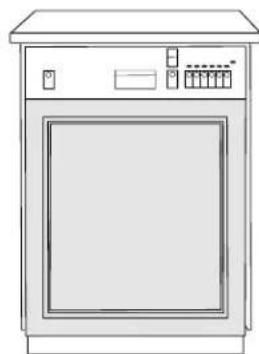
natural_image
Line drawing of a kitchen appliance with front panel, door, and control panel (no text or symbols)for
Thermador® Built-In Dishwashers
Models:
DW 244UB / DW 244UW
DW 245UB / DW 245UW
DW 246UB / DW 246UW / DW 246US
DW I246UB / DW I246UW
Thermador®
CORPORATION
A Special Message to Our Customers
Thank you for buying a Thermador® dishwasher. We recommend that you take the time to read this entire booklet before using your new appliance.
We hope that the information in this manual will help you easily operate and care for your dishwasher for years of satisfaction.
Please contact us if you have any questions or comments. Call 1-800-735-4328, or write to us at:
Customer Support Call Center, Thermador, 5551 McFadden Avenue, Huntington Beach, CA 92649.
Sincerely,
Test Kitchen Consumer Scientists
QUICK REFERENCE INDEX
Important Safety Instructions......2
Grounding Instructions....2
About Your Dishwasher ....3
Getting to Know your Dishwasher ...3
Before Using the First Time......4
Getting Started 4
Dishwasher Safe Items, Table 1 .....5
Preparations for Washing 6
Loading
Single Rack Washing 6
Loading the Top Rack 6
Loading the Lower Rack......7
Unloading 7
Rack Height Adjustment ....8
Extra Tall Items....8
Using the Dispensers
Detergent Use 9
Detergent Dispenser 9
Rinse Aid Indicator 10
Rinse Aid Dispenser 10
Rinse Aid Regulator 10
Cycle Selection 10
Cycle Selection Chart Table 2 ..... 11
Cycle Selection Chart Table 3 ...... 12
Operation
Immediate Start 13
Delayed Start.... 13
To Interrupt or Reset Cycle..... 13
Soil Sensor 13
Care & Cleaning 14
Self-Help, Table 4 15
Service and Repair 16
Warranty 16
IMPORTANT SAFETY INSTRUCTIONS SAVETHESE INSTRUCTIONS
WARNING — When using your dishwasher, basic safety precautions should always be followed to reduce the risk of fire, electric shock, and/or injury to persons, including the following:
- THERMADOR ^® dishwashers are provided with two manuals; one, Installation Instruction Manual and one, Care and Use Manual. Read all instructions before using the dishwasher.
- Use the dishwasher only for its intended function.
-
Use only detergents or wetting agents recommended for use in a dishwasher and keep them out of the reach of children.
-
When loading items to be washed:
a. Locate sharp items so that they are not likely to damage the door seal, and
b. Load sharp knives with the handle up to reduce the risk of cut-type injuries.
-
Do not wash plastic items unless marked "dishwasher safe" or the equivalent. For plastic items not so marked, check the manufacturer's recommendations.
-
Do not operate your dishwasher unless all the enclosure panels are properly in place.
-
Do not tamper with controls.
-
Do not abuse, sit on, or stand on the door or dish rack of the dishwasher.
-
To reduce the risk of injury, do not allow children to play in or on the dishwasher.
-
Under certain conditions, hydrogen gas may be produced in a hot water system that has not been used for two weeks or more. Hydrogen gas is explosive. If the hot water system has not been used for such a period, before using the dishwasher turn on all hot water faucets and let the water flow from each for several minutes. This will release any accumulated hydrogen gas. As the gas is flammable, do not smoke or use an open flame during this time.
-
Remove the door to the washing compartment when removing an old dishwasher from service or discarding.
WARNING — This dishwasher must be grounded in accordance with the National Electrical Code and/or local codes. These must be carefully followed in all cases. See Installation Instructions provided with this dishwasher for complete installation information. Make sure this dishwasher has been properly grounded and installed by a qualified installer before using.
This appliance must be connected to a grounded metal, permanent wiring system; or an equipment grounding conductor must be run with the circuit conductors and connected to the equipment grounding terminal or lead on the dishwasher.
HOUSEHOLD USE ONLY
ABOUT YOUR DISHW ASHER
Congratulations on having selected a Thermador® dishwasher, the choice of those that demand quiet and exceptional cleaning performance from their dishwasher.
The DW 244, DW 245, DW 246 and DW I246 electronic dishwashers offer the following standard features:
• Stainless steel inner liner and inner door
- Multifunctional upper and lower rack
• Exceptionally low water consumption
- Heated water chamber for temperature boosting
- Soil Sensor (except DW244 models)
- Triple filter system
- Four spraying levels
- Rinse agent indicator lamp
• Height adjustable upper rack
(except DW244 models)
GETTING TO KNOW YOUR DISHW ASHER
Figure 1. This illustration calls out features of the dishwasher.
For an explanation of the feature turn to the page indicated.
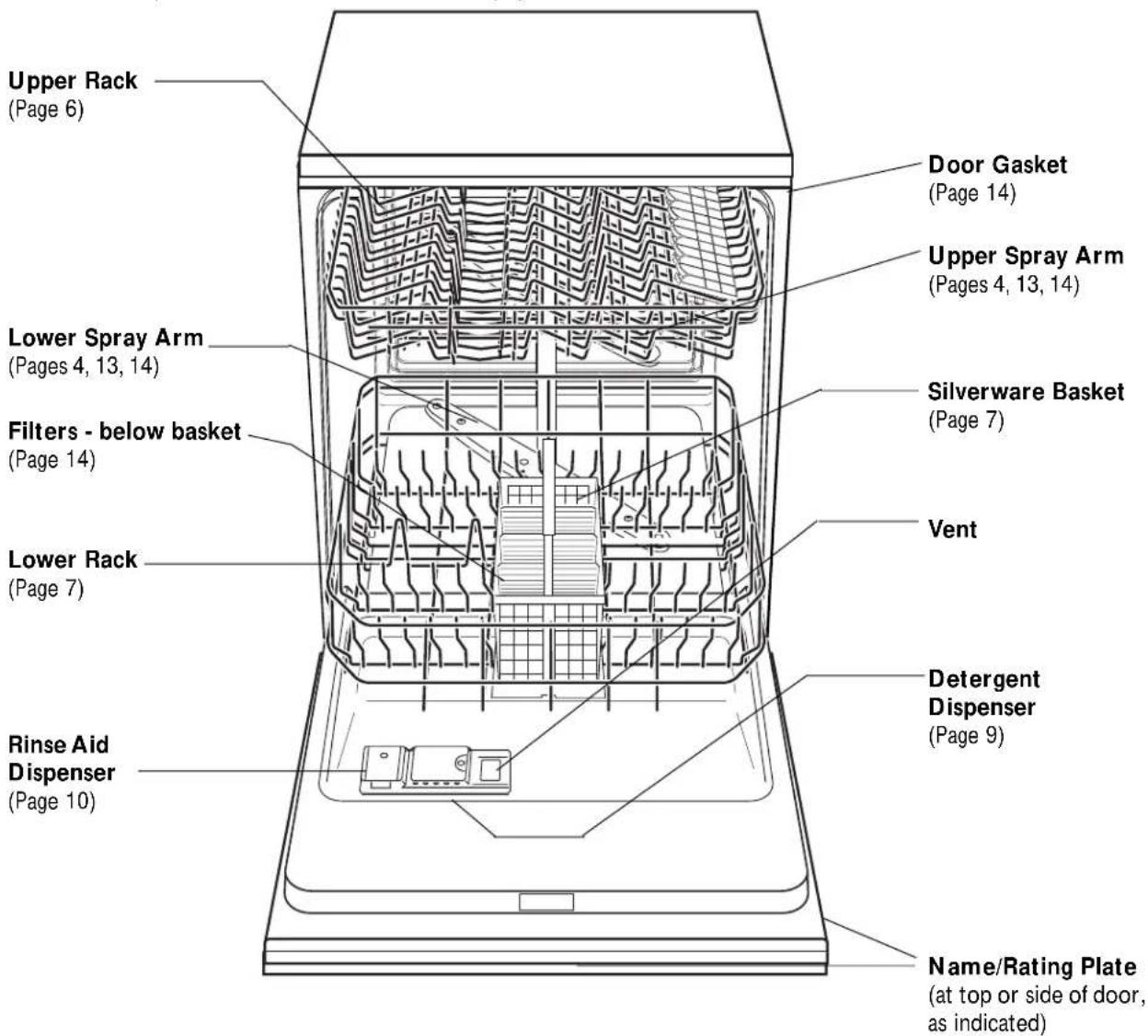
text_image
Upper Rack (Page 6) Door Gasket (Page 14) Upper Spray Arm (Pages 4, 13, 14) Lower Spray Arm (Pages 4, 13, 14) Filters - below basket (Page 14) Silverware Basket (Page 7) Lower Rack (Page 7) Vent Detergent Dispenser (Page 9) Rinse Aid Dispenser (Page 10) Name/Rating Plate (at top or side of door, as indicated)BEFORE USING FOR THE FIRST TIME
Before beginning to use your dishwasher for the first time:
-
Check to make sure that the voltage on which the dishwasher is to operate is the same as shown on the rating plate.
-
Check to make sure that the water valve to the dishwasher is open. The installer may have closed the valve upon completing the installation.
- Thoroughly inspect unit for cosmetic damage. Cosmetic damage must be reported within 5 days
Figure 2. Identifying the controls
Models: DW 246UB / DW 246UW / DW 246US* / DW I246UB / DW I246UW
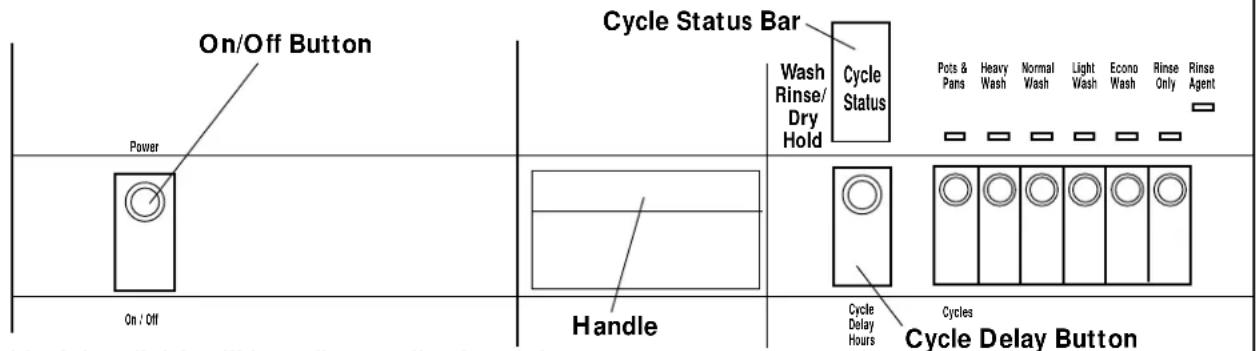
text_image
On/Off Button Power Cycle Status Bar Wash Rinse/ Dry Hold Cycle Status Pots & Pans Heavy Wash Normal Wash Light Econo Rinse Wash Rinse Only Agent On / Off Handle Cycle Delay Hours Cycles Cycle Delay Button*Stainless finish will have flat anodized push-button
Models: DW 245UB / DW 245UW
Cycle Status Bar
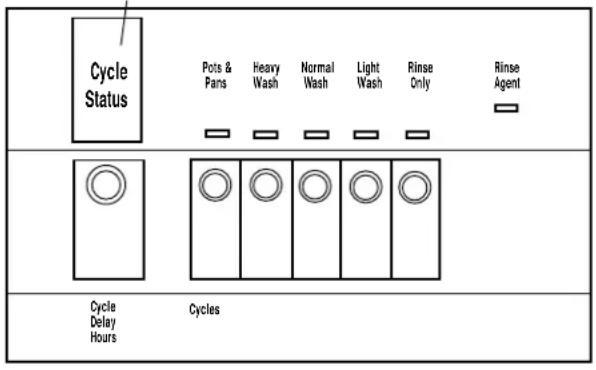
text_image
Cycle Status Pots & Pans Heavy Wash Normal Wash Light Wash Rinse Only Rinse Agent Cycle Delay Hours CyclesModels: DW 244UB / DW 244UW
Cycle Status Bar
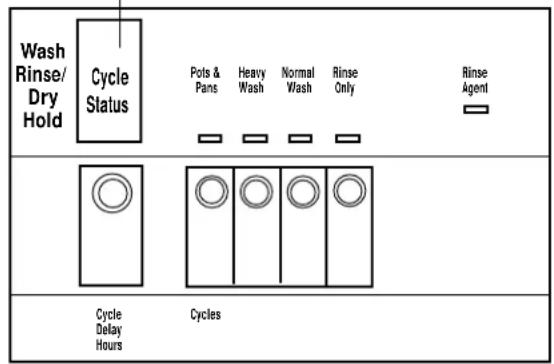
text_image
Wash Rinse/ Dry Hold Cycle Status Pots & Pans Heavy Wash Normal Wash Rinse Only Rinse Agent Cycle Delay Hours CyclesGETTING STARTED
The operation of your Thermador dishwasher is summarized below:
1. Load the dishwasher.
Refer to Table 1 for items suitable for washing in the dishwasher. The dishwasher should be loaded with pots, pans, dishes and silverware according to the instructions provided under the following section titled LOADING.
2. Add detergent and rinse aid.
Detergent must be placed in the detergent dispenser compartment as described in the following section titled DETERGENT USE. The use of a rinse aid such as Jet-Dry® is required to ensure good cleaning and drying results. See section titled RINSE AID DISPENSER.
3. Check motion of wash arms.
The wash arms must be free to move and should not be blocked by any item extending so far above lower rack as to block upper arm or by any items hanging below either the upper or lower rack to obstruct the motion of the wash arms. See following section titled
4. Close the door of the dishwasher.
Make sure that the door is completely closed and latched.
5. Start the dishwasher.
If delayed start is not being selected; depress the on/off button, then select the wash cycle desired, see Table 2, Page 11. Depress the corresponding cycle button, see Figure 2. The light above the button will become illuminated to indicate the selected cycle. The dishwasher will start.
NOTES: a. If you have inadvertently depressed the wrong cycle button, simply depress the button of the desired cycle twice.
b. For information on how to operate the dishwasher using delayed start see subsection DELAYED START in following section titled OPERATION.
- To stop dishwasher, depress the on/off button.
Table 1. Suitable Items for Dishwasher
| MATERIAL DISH | W ASHER COMMENTS USE | AND /OR SPECIAL INSTRUCTIONS |
| ADHESIVE NOT Items joined by adhesives, whether plastic, wood, bone,JOINED ITEMS RECOMMENDED steel, copper or tin, etc. may be loosened. | ||
| ALUMINUM USUALLY SAFE Colored anodized aluminum may fade over time. Minerals in thewater may cause spotting or darkening of aluminum. | ||
| BONE NOT Handles may separate.HANDLED RECOMMENDEDTENSILS | ||
| CHINA &STONE WARE | USUALLY SAFE It is highly recommended however that “on-glaze” (china with decoration on top of glaze), hand painted and gold or platinum trimmed, or antique china or stoneware be hand washed. If there is any doubt,please check with the manufacturer of your set or test by washing one piece with each load for a month and comparing this piece with therest of the set to determine if there has been any fading or discoloration. | |
| CRYSTAL USUALLY SAFE Decorated crystal, those hand painted, “on-glaze” or metal trimmed,may discolor, fade, or spot. It is recommended that these be handwashed. Also, fragile glassware is highly breakable. BE SURE to set thepieces so that they do not topple during washing or shift position orknock against other pieces. | ||
| GLASS | USUALLY SAFE Milk glass may yellow. Some glass may appear hazy. This is referred to asetching when it is permanent. See Page 9, Water Hardness. | |
| NON-STICKCOATINGS | USUALLY SAFE | After the dry cycle, the nonstick coating should be covered with a lightcoating of vegetable oil. |
| IRON | NOT Iron will rust. Wash by hand and dry immediately. | |
| PEWTER | NOT Pewter will tarnish. Wash by hand and dry immediately.RECOMMENDED | |
| PLASTIC | USUALLY SAFE Only wash “dishwasher safe” plastic items. | |
| STAINLESSSTEEL | USUALLY SAFE Do not let stainless steel items contact copper or sterling silver orsilver plate items. | |
| STERLINGSILVER &SILVER PLATE | USUALLY SAFE Do not allow to come in contact with stainless steel or copper items. | |
| TIN | NOT Tin will rust. Wash by hand and dry immediately.RECOMMENDED | |
| WOOD | NOT Wooden bowls, wooden utensils and wood handled utensils can warp,RECOMMENDED crack or lose their finish. | |
| NON-DISHWAREITEMS | NOT The Thermador®dishwasher is only intended for use in cleaningRECOMMENDED standard household dishware items. | |
PREPARATIONS FOR WASHING
Very little preparation is required before placing dishes, pots, pans, etc. into the dishwasher. Some preparation is required:
- Large solid items, such as bones, large seeds, shells, skins, leafy vegetables, meat trimmings etc., should be removed either by scraping into a wastebasket or into your food disposer.
- Large amounts of any type of leftover food should also be scraped into a wastebasket or into your food disposer.
- Pots and pans that have burned-on food, the food is blackened, should be presoaked and scoured. The dishwasher cannot remove burned-on food.
- Do not place the following items in the dishwasher:
toothpicks
small bones and bone slivers
paper products such as paper plates, paper napkins, containers with labels.
plastic bags or plastic packaging material.
In general, try to remove food scraps and place the items to be washed in the dishwasher before the food has had a chance to dry-on. Dried-on food is more difficult to remove and you may find that the DELICATE/ ECONOMY or lighter washing cycles will not provide a satisfactory result when food has dried on.
If there will be an extended period of time before the dishwasher will be run it is recommended that the RINSE & HOLD cycle be used.
Other than the above, no special preparation or pre-rinsing is required for dishes, pots and pans or utensils with normal amounts of food soil.
LOADING
LOADING THETOP RACK
The upper rack of the dishwasher has been designed with flexibility in mind. Glasses, cups, plates, bowls and small pots may be loaded in many different positions to fit your needs.
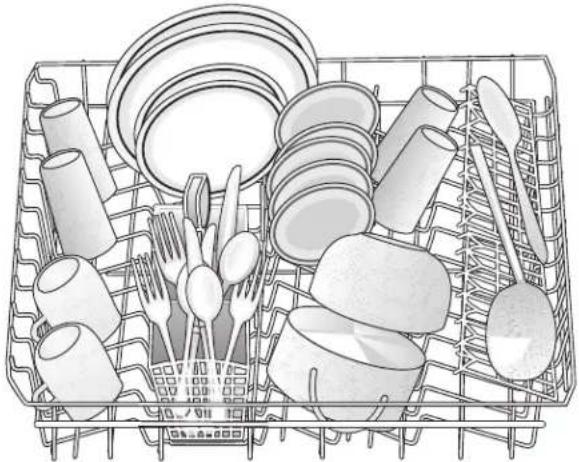
natural_image
Illustration of a grocery basket containing various kitchen utensils and cutlery (no text or labels)Figure 3. Upper Rack with Mixed Load
The upper rack height is adjustable to allow more height for tall items in the upper rack (low level) or for tall items in lower rack (high levels). Refer to Page 8 for changing rack position.
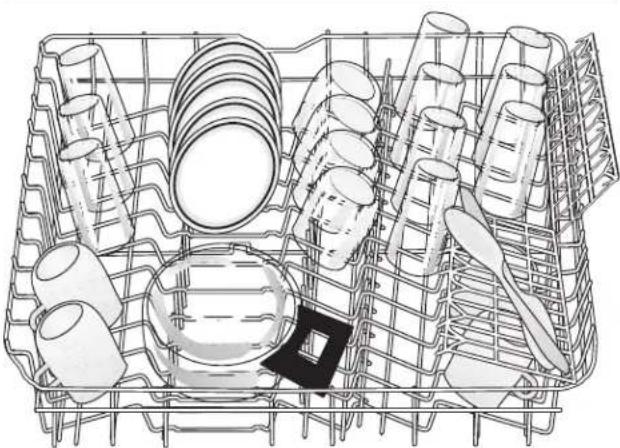
natural_image
Line drawing of a multi-tiered cleaning or painting machine with cylindrical and mechanical components (no text or symbols)Figure 4. Upper Rack Using Flip-Down Shelf
Regular Wash Load
The dishwasher should be loaded so that water can circulate freely and reach every part of every item that is to be cleaned:
- Cups, glasses and containers should be placed in upper rack upside down so that water does not collect in them. Tall narrow vessels, such as a vase or tall glass, should be placed in the lower rack, near the middle, for the best cleaning result.
- The Thermador ^® dishwashers have a special feature incorporated into the flip-down cup shelves on the side of the upper rack, as shown in Figure 4. The ends of these shelves are specially formed to help maintain spacing between stemmed glasses. When in the flipped down position, long-stemmed glasses may be placed in the second row from the edge and placed so their stems rest in the "V" formed ends of the shelves. When the cup shelves are in the up position long stemmed glasses may be placed in the first row with their stems placed to rest between the tooth like projections of the shelves.
- China, crystal and other delicate items must be placed so that they do not touch each other during dishwasher operation. Chipping or other damage may occur.
- At completion of loading of the upper rack check to make sure that nothing is protruding through or hanging beneath the bottom of the rack, which could block the rotation of the spray arm.
LOADING THE LOWER RACK
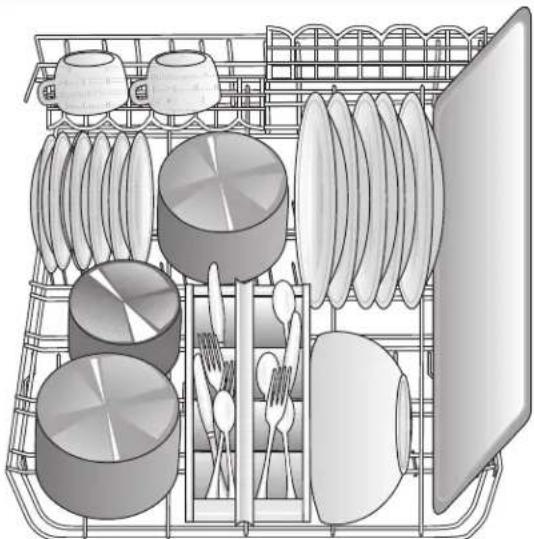
natural_image
Illustration of a kitchen appliance with cutlery and utensils (no text or symbols)Figure 5. Lower Rack with Heavier Soiled Fans
- Large and/or heavily soiled items should be placed in the lower rack of the dishwasher. Heavily soiled pots and pans should be placed face down. See Figures 5 and 6.
text_image
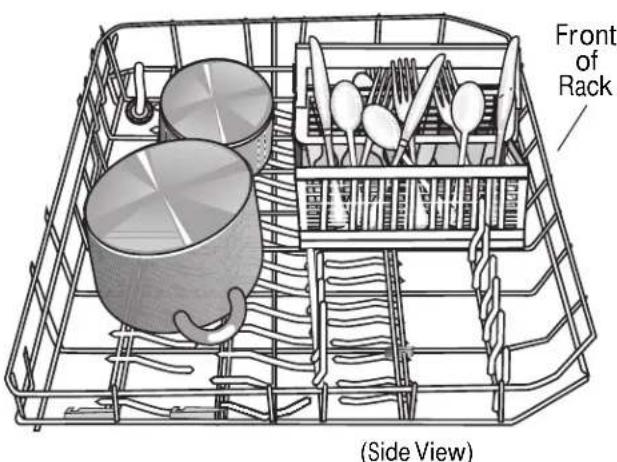
Front of Rack (Side View)Figure 6. Lower Rack with Rear Tines Folded Flat
- If more space is needed for pots and pans, the rear two sets of tines can be folded to the down position, on all models, or the rear three sets of tines, on some models. Figure 6 shows lower basket with rear three sets of tines in the down position to accommodate large pots.
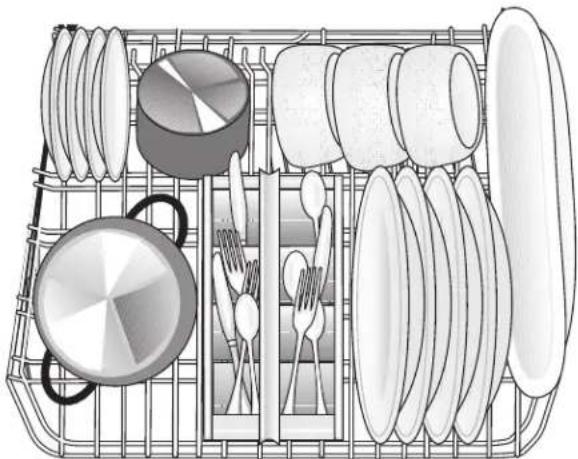
natural_image
Illustration of a grocery basket containing various kitchen utensils and cutlery (no text or labels)Figure 7. Lower Rack with Mixed Load
- Silverware should be mixed when placed in the silverware basket. The purpose of mixing the silverware is to avoid having them nest together, for example if spoons would be placed together they could nest together so that water could not properly circulate across them to clean the surfaces. - Silverware should be placed in the silverware basket with the handles down, with the exception of the knives, which in order to avoid accidentally cutting oneself, should be placed with the handles up.
If you do inadvertently load the silverware basket with the knife blades up, to avoid cutting yourself when unloading, it is recommended that you remove the silverware basket from the dishwasher and tip the contents out onto a cutting board.
UNLOADING
When unloading the dishwasher, always unload the lower rack first and then unload the upper rack. This will minimize the chance of drops from the upper rack falling on the dishes in the lower rack. The silverware basket of the Thermado® dishwasher may be removed for easy unloading.
Also, when unloading, it is recommended that the dishes be allowed to cool before handling. The dishes will cool more quickly if the door is opened slightly.
RACK HEIGHT ADJUSTMENT
(Except DW244)
The upper rack height of the Thermador® dishwasher, except the DW224UB and DW244UW models, is adjustable. There are two positions: the upper and lower roller alignment.
- The upper position is used to provide more room for items to be placed in the lower rack.
- The lower position is used to provide more room for items to be placed in the upper rack.
natural_image
Diagram showing a grid structure with circular elements and an arrow indicating direction (no text or symbols)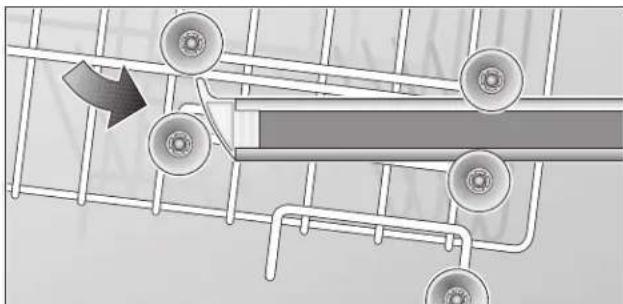
natural_image
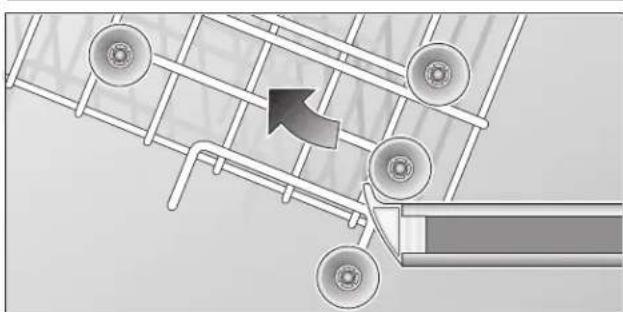
Diagram of a mechanical assembly with pulleys and a rotating shaft (no text or symbols)Figure 8. Top drawing: Upper Rack Removal. Lower drawing: Upper Rack Replacement.
To reposition rack:
a. First empty upper rack and pull rack partially out to point where rack can be lifted upward as shown in upper illustration of Figure 8.
b. Pull the rack forward and then up until rollers are completely free of channels.
c. Reinsert the rack with the other set of rollers on the channel.
Tall Item Sprinkler
If you have extra tall items that cannot fit in the lower rack without interfering with the upper spray arm or without hitting the upper rack, the upper rack may be removed.
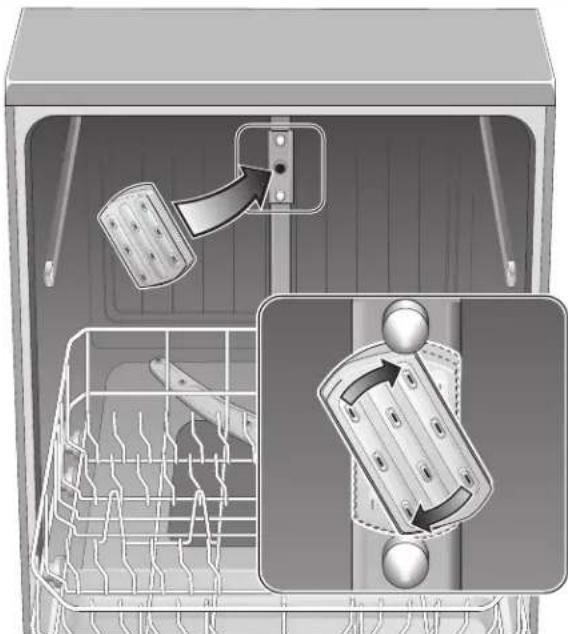
A special "Tall Item Sprinkler" is provided with the dishwasher to allow use of the dishwasher with upper rack removed. See Figure 9.
natural_image
Diagram of a kitchen appliance showing a door lock and battery tray, with an inset close-up of the device's internal mechanism (no text or symbols)Figure 9. Installation of the Tall Item Sprinkler.
To install the tall item sprinklers:
- With upper rack empty, remove it from the dishwasher by pulling the rack partially out to the point where rack can be lifted upward and out to disengage the wheels from the side rails.
- Place the "Tall Item Sprinkler" over the upper rack spray outlet at the back of the dishwasher tub, Figure 9, and turn clockwise to lock sprinkler head in place.

natural_image
Interior view of a kitchen appliance showing a bucket, rack, and metal grilles (no text or symbols visible)Figure 10. Examples of a Mixed Load of Tall Items.
Extra tall items may now be placed in lower rack for washing, as shown in Figure 10. To remove "Tall Item Sprinkler," to again allow use of upper rack, reverse actions used to insert it.
USING THE DISPENSERS
For the best washing result it is important to use the correct amount of detergent and rinse aid.
DETERGENT USE
Use only fresh dishwashing detergent (powder is recommended) manufactured specifically for dishwasher use. Use of other types of detergents will result in excessive suds. Be sure to check the phosphate content of the detergent to be used. Phosphate helps prevent the minerals in hard water from forming a film or spots on dishes. Hard water requires your detergent to work harder. In hard water areas you will find that detergents with high phosphate levels will provide a better result. If the phosphate level is low, below 8.7%, you may have to use extra detergent in hard water areas.
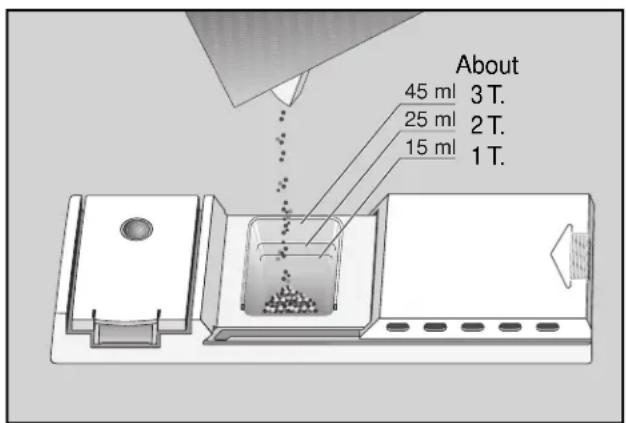
DETERGENT LEVELS
text_image
About 45 ml 3 T. 25 ml 2 T. 15 ml 1 T.Figure 11. Detergent Levels
Be sure to follow the dishwasher detergent manufacturer's instructions when using the detergents. Concentrated detergents usually call for lower usage than do standard detergents.
Note: Do not use detergent when the RINSE ONLY cycle has been selected.
TO OPEN DETERGENT DISPENSER
The detergent dispenser on the Thermador® dishwasher is located on the inside of the door, see Figure 1, Page 3.
text_image
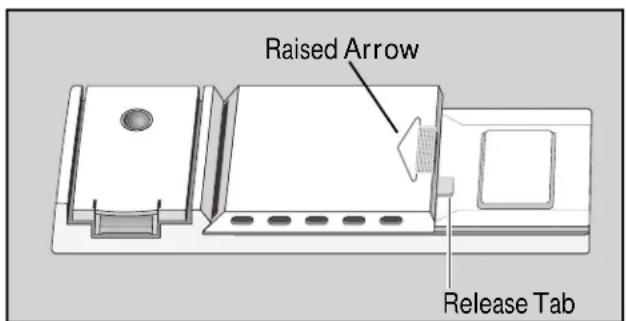
Raised Arrow Release TabFigure 12. Detergent Cover in Closed Position
The detergent dispenser cover may be opened by pulling the release tab, Figure 12, toward you.
Once the cover is open you will see two level marks: "25" and "15". These refer to the volume when filled level in milliliters. Note: 15 milliliters is equivalent to 1 tablespoon. If the detergent dispenser is completely filled it can hold 45 milliliters, or roughly 3 tablespoons.
WATER HARDNESS
The amount of detergent to be used depends on the cycle selected and the water hardness:
- For water of medium hardness and NORMAL WASH cycle it is recommended that the detergent dispenser be filled to the 25 milliliters, about 2 tablespoons.
- With hard water, or with the POTS AND PANS cycle, it is recommended that the detergent dispenser be completely filled, roughly 3 tablespoons. If additional detergent is required it can be placed on the inside of the door, just below the dispenser.
- With soft water the amount of detergent may be reduced. Also, for the LIGHT WASH or ECONO WASH cycles the amount of detergent may be reduced. For the LIGHT WASH or ECONO WASH cycles it is recommended that only the chamber marked "15" be filled with detergent; roughly 1 tablespoon of detergent.
If you have water of medium or higher hardness and the dishes do not come clean, the cause, in the majority of cases, is the use of too little detergent rather than too much. If you have very soft water, or chemically treated soft water special care should be taken to use the minimum amount of detergent. For these situations a high quality, low phosphate detergent is recommended. Too much detergent combined with soft water may cause etching of glassware.
TO CLOSE DETERGENT DISPENSER:
After filling the detergent compartment slide to position shown in Figure 12 and push down on raised arrow on cover. The detergent will be dispensed automatically during the wash portion of the cycle.
If the cover of the detergent dispenser is closing fully but it won't latch this is most likely due to the dishwasher having been stopped in mid cycle. Check the cycle status bar, see Figure 2 (Page 4) to see if cycle has been completed. If the cycle is not complete please refer to section of this manual titled TO INTERRUPT OR RESET CYCLE, Page 13.
RINSE AID INDICATOR
There is a rinse aid indicator light on the right hand side of the front panel of the Thermador® dishwasher, see Figure 1 (Page 3).
text_image
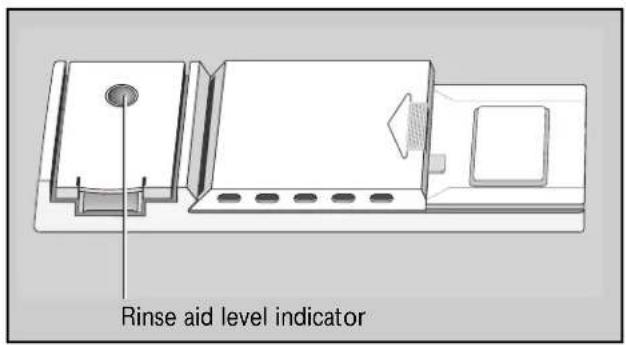
Rinse aid level indicatorFigure 13. Rinse Aid and Detergent Dispenser.
There is also level indicator on the dispenser, see Figure 13. This indicator shows the level of rinse aid that is in the rinse aid reservoir. As received, and when empty the indicator light on the front panel will be illuminated and the level indicator on the dispenser will appear blank. When the rinse aid reservoir is full, the indicator light will not be illuminated and the level indicator on the dispenser will appear dark.
RINSE AID DISPENSER
Rinse aid, or a rinse agent such as Jet-Dry®, is used to diminish water spotting and to provide optimum drying results. It is recommended that a rinse aid be used at all times with the Thermador dishwasher. The rinse aid not only serves to rinse the dishware, but also serves to rinse the tank and inner door of the dishwasher. The tank and inner door will begin to take on a dull, unpolished look, if rinse aid is not used.
natural_image
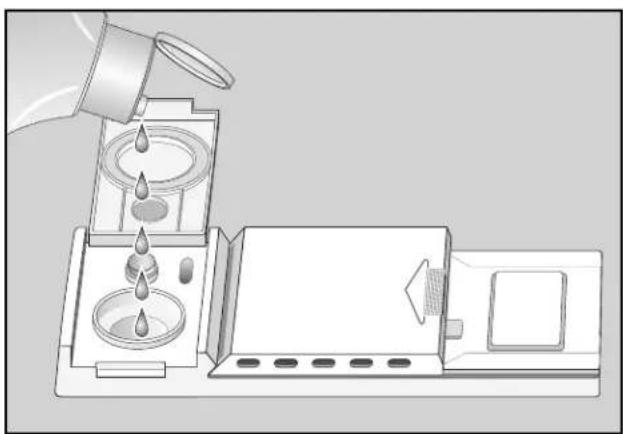
Illustration of a laboratory setup with a funnel pouring liquid into a chamber, no text or symbols presentFigure 14. Filling Rinse Aid Dispenser
The rinse aid dispenser is located next to the detergent dispenser. See Figure 13. Rinse aid is available in liquid or solid form. Do not use the solid type of rinse aid in the Thermador dishwasher.
To fill the rinse aid reservoir (refer to Figure 14):
- Open the dishwasher door fully.
- Open the cover of the rinse aid dispenser.
- Add rinse aid to the reservoir until the clear level indicator turns completely dark. The reservoir is full when the level indicator is dark.
- Close the cover of the rinse aid dispenser. Make sure that it is firmly snapped closed.
RINSE AID DISPENSER REGULATOR
text_image
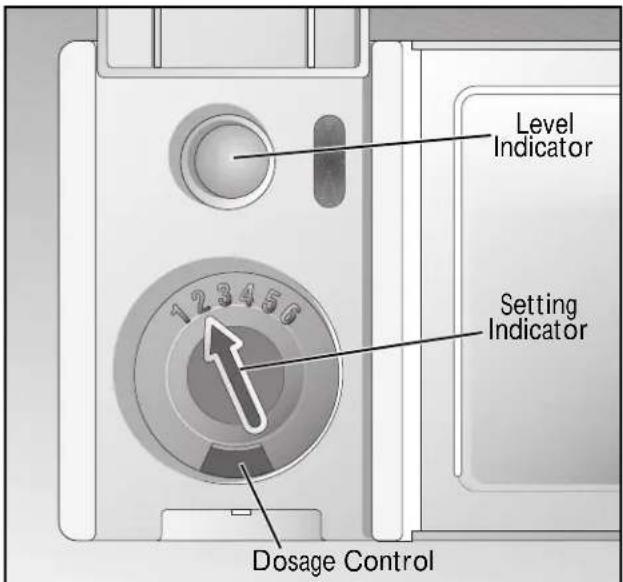
Level Indicator Setting Indicator Dosage ControlFigure 15. Rinse Aid Regulator
The rinse aid reservoir of the Thermador dishwasher is provided with a regulator calibrated from 1 to 6, Figure 15. This regulator controls the amount of rinse aid dispensed. The dishwasher leaves the factory preset to 3- 12 . This has been chosen as the average setting, however:
- if you see streaks, it is recommended that the regulator be turned to a lower number.
- if water spots appear, it is recommended that the regulator be turned to a higher number.
To Adjust Setting:
- Open the cover of the rinse aid dispenser.
- Turn the setting indicator to desired setting, see Figure 15.
CYCLE SELECTION
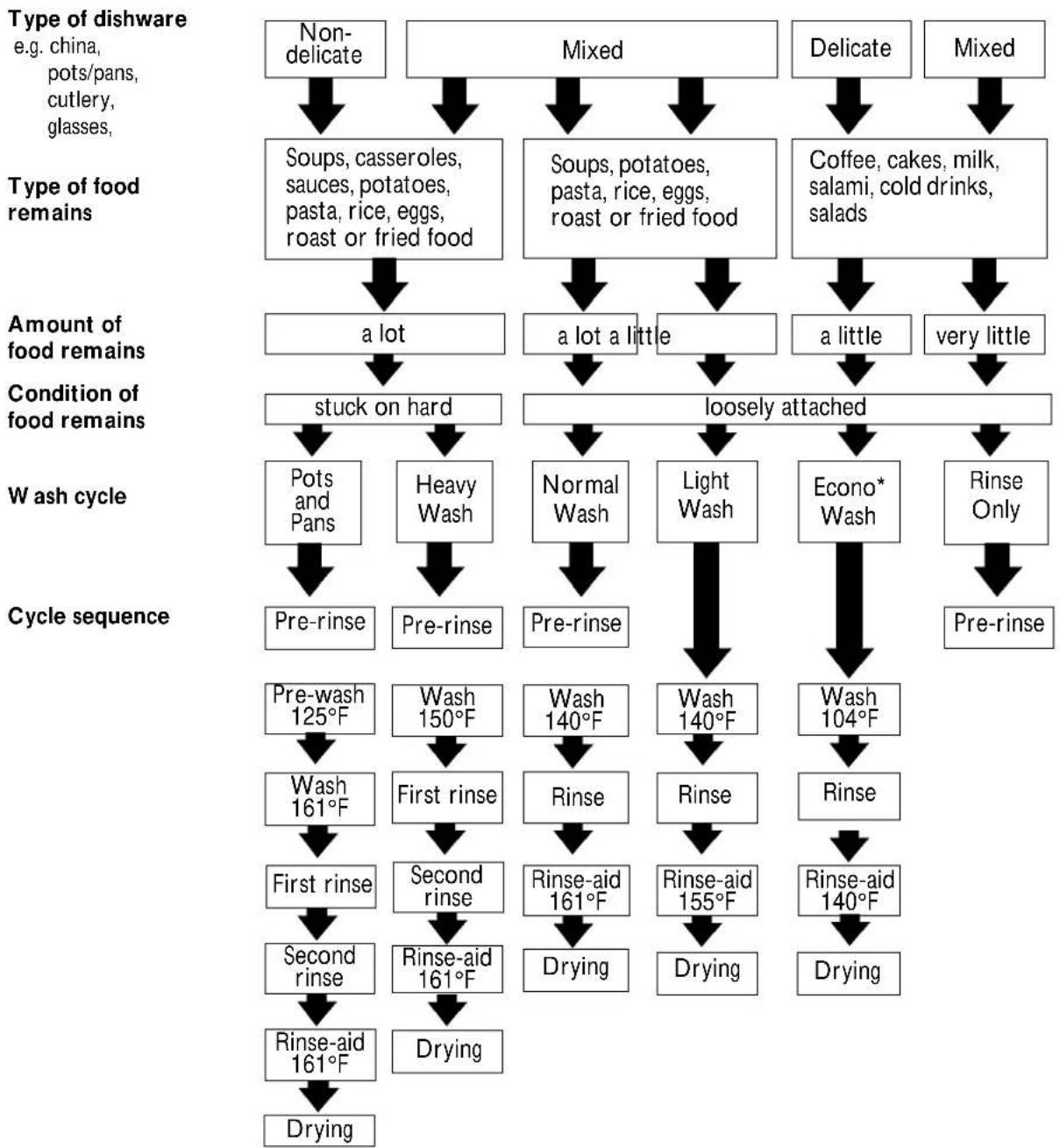
The dishwasher will wash and dry the contents based on cycle selection made. Refer to the CYCLE SELECTION CHART, Tables 2 or 3 (Pages 11-12). The most appropriate cycle for the load to be washed can be selected from one of these tables. Compare the load type and the amount and condition of the food on the items to the chart recommendations.
Table 2.CYCLE SELECTION CHART for DW 245, DW 246* and DW I246* MODELS
flowchart
graph TD
    A["Non-delicate"] --> B["Soups, casseroles, sauces, potatoes, pasta, rice, eggs, roast or fried food"]
    C["Mixed"] --> D["Soups, potatoes, pasta, rice, eggs, roast or fried food"]
    E["Delicate"] --> F["Coffee, cakes, milk, salami, cold drinks, salads"]
    G["Mixed"] --> H["Coffee, cakes, milk, salami, cold drinks, salads"]
    I["Amount of food remains"] --> J["a lot"]
    K["Amount of food remains"] --> L["a lot a little"]
    M["Amount of food remains"] --> N["a little"]
    O["Amount of food remains"] --> P["very little"]
    Q["Condition of food remains"] --> R["stuck on hard"]
    S["Condition of food remains"] --> T["loosely attached"]
    U["Wash cycle"] --> V["Pots and Pans"]
    U --> W["Heavy Wash"]
    U --> X["Pre-rinse"]
    Y["Cycle sequence"] --> Z["Pre-wash 125°F"]
    Y --> AA["Wash 150°F"]
    Y --> AB["First rinse"]
    Y --> AC["Rinse"]
    Y --> AD["Pre-rinse"]
    Y --> AE["Wash 140°F"]
    Y --> AF["Rinse"]
    Y --> AG["Wash 140°F"]
    Y --> AH["Rinse"]
    Y --> AI["Rinse-aid 161°F"]
    Y --> AJ["Drying"]
    Y --> AK["Drying"]
    Y --> AL["Rinse Only"]
    Y --> AM["Rinse 104°F"]
    Y --> AN["Rinse"]
    Y --> AO["Rinse-aid 155°F"]
    Y --> AP["Drying"]
    Y --> AQ["Drying"]
    Y --> AR["Rinse-aid 140°F"]
    Y --> AS["Drying"]
CYCLE DETAILS
Duration in minutes Water consumption in gallons Water consumption in litres
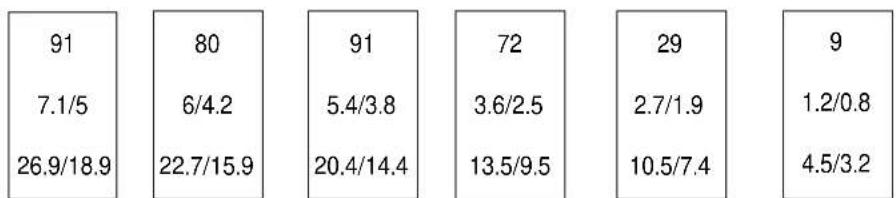
Thermador Soil Sensor will reduce water consumption by approximately 20%, in case of lightly soiled dishes. Shown above are the range of values that may be obtained while running the dishwasher under normal conditions. Actual values may vary. The actual cycle duration, water and energy usage depend upon temperature and amount of soil on dishware.
* Available on 6 program models only.
Table 3. CYCLE SELECTION CHART for DW 244UB or DW 244UW
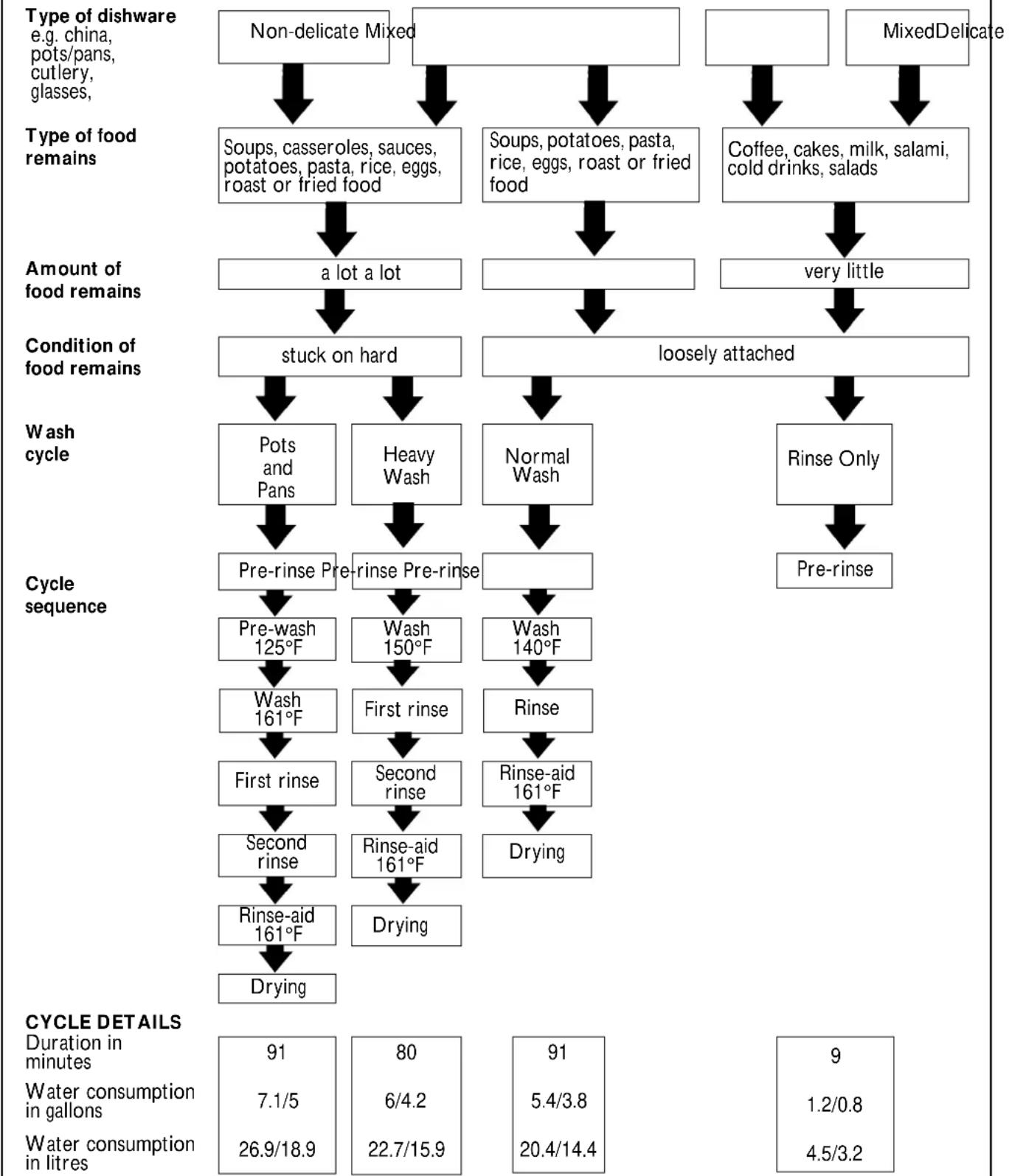
other
| Type of dishware | Source | Value | | --- | --- | --- | | Non-delicate Mixed | Non-delicate Mixed | 91 | | Soups, casseroles, sauces, potatoes, pasta, rice, eggs, roast or fried food | Soups, casseroles, sauces, potatoes, pasta, rice, eggs, roast or fried food | 7.1/5 | | Soups, potatoes, pasta, rice, eggs, roast or fried food | Soups, potatoes, pasta, rice, eggs, roast or fried food | 6/4.2 | | Coffee, cakes, milk, salami, cold drinks, salads | Coffee, cakes, milk, salami, cold drinks, salads | 5.4/3.8 | | Very little | Very little | 20.4/14.4 | | Stuck on hard | Stuck on hard | 26.9/18.9 | | Loosely attached | Loosely attached | 4.5/3.2 | | Pots and Pans | Pots and Pans | - | | Heavy Wash | Heavy Wash | - | | Normal Wash | Normal Wash | - | | Rinse Only | Rinse Only | - | | Pre-rinse Pre-rinse | Pre-rinse Pre-rinse | - | | Pre-wash 125°F | Pre-wash 125°F | - | | Wash 150°F | Wash 150°F | - | | Wash 140°F | Wash 140°F | - | | Wash 161°F | Wash 161°F | - | | First rinse | First rinse | - | | Rinse | Rinse | - | | Second rinse | Second rinse | - | | Rinse-aid 161°F | Rinse-aid 161°F | - | | Drying | Drying | - | | Rinse-aid 161°F | Rinse-aid 161°F | - | | Drying | Drying | - | | Duration in minutes: 91 Water consumption in gallons: 7.1/5 Water consumption in litres: 26.9/18.9 Duration in minutes: 9 Water consumption in gallons: 6/4.2 Water consumption in litres: 5.4/3.8 Water consumption in gallons: 1.2/0.8 Water consumption in litres: 4.5/3.2Thermador Soil Sensor will reduce water consumption by approximately 20%, in case of lightly soiled dishes. Shown above are the range of values that may be obtained while running the dishwasher under normal conditions. Actual values may vary. The actual cycle duration, water and energy usage depend upon temperature and amount of soil on dishware.
OPERATION
Once detergent has been added and before closing the door of the dishwasher check the wash arms to ensure that they are free to move. With the detergent in the dishwasher and arms free to move:
IMMEDIATE START
- Close the door of the dishwasher making sure that door latches closed.
- Depress the on/off switch. The indicator light for the cycle that was last selected will become illuminated.
- Depress the button for the cycle you desire TWO TIMES if different than the illuminated cycle.
- The dishwasher will start automatically and continue to the end of the selected cycle.
- At the end of the cycle the dishwasher will stop and the display will point to "END".
NOTE: Your dishwasher (except DW244) features a new sophisticated sensor technology package, which is designed to constantly scan and measure the conditions inside the appliance.
DELAYED START (except DW244)
The start of the washing cycle can be delayed for up to 9 hours, in 1 hour increments.
- Close the door of the dishwasher making sure that door latches closed.
- Depress the on/off switch. The indicator light for the cycle that was last selected will become illuminated to indicate the dishwasher is on.
- Immediately press the timer button labeled CYCLE DELAY - HOURS. The alphanumeric display will change to "1".
- Press the CYCLE DELAY - HOURS button as many times as necessary until the alphanumeric display shows the number of hours delay desired.
Note: The cycle may be changed at any time during the delay time until the cycle starts.
- The dishwasher will not start until the indicated delay has past.
- At the end of the cycle the dishwasher will stop and the display will point to "END".
TO INTERRUPT OR RESET CYCLE
(except DW244)
To interrupt cycle simply depress the on/off button to stop operation. If you are interrupting the cycle during a wash or rinse cycle please wait until the water noises stop before opening the door. After opening the door leave it ajar for a few minutes. The cycle then may be resumed by closing the door and depressing the on/off button.
As a safety feature the dishwasher will automatically turn itself off whenever the door is unlatched. However, if the door is opened quickly while in a wash or rinse cycle some water may splash out of the dishwasher. For this reason it is recommended that the machine always be switched to off before opening the door.
If you wish to reset the cycle to its beginning after stopping the dishwasher:
- Close the door of the dishwasher. Make sure that the door is completely closed and latched.
- Depress the on/off button, then depress HEAVY WASH button and LIGHTWASH buttons at the same time and hold for approximately 3 seconds. You will see the cycle status bar progress to end. When the drain pump has stopped and the alphanumeric display is at the end the cycle is complete and the dishwasher is reset.
- Depress the on/off button to shut-off the dishwasher.
- The dishwasher is now ready to run your selected wash cycle. Depress the on/off button to restart the dishwasher.
Note: If you wish to change the cycle selection simply depress the button of the cycle desired twice. The light above the cycle will then become illuminated to show it has been selected.
SOIL SENSOR (except DW244)
The Soil Sensor automatically scans the amount of food and fat particles in the water to check how clean or soiled it is. A fresh water refill occurs when needed, but only adds up to a maximum of 7.1 gallons. Soil Sensor will reduce the overall water consumption by about 20% in cases of lightly soiled dishes.
CARE AND CLEANING
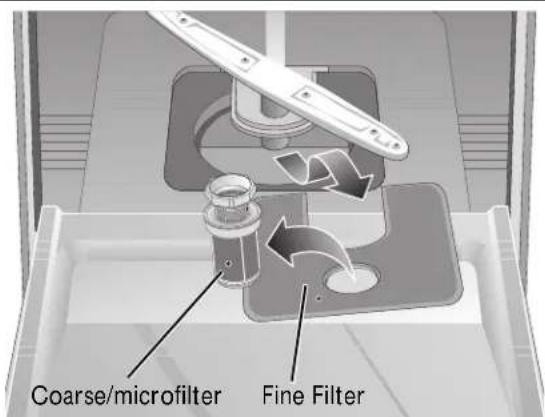
Thermador® dishwashers have a three-stage filter system comprised of: a microfilter, a fine filter and a coarse filter. The microfilter is self-cleaning, but the coarse filter and fine filter will sometimes be found to have collected items, from bones to toothpicks or seeds that have been left on the plates or in the glasses. For this reason the following maintenance should be observed:
text_image
Coarse/microfilter Fine FilterFigure 16. Filter System
Filters
- The filters should be checked on a weekly basis. To remove the filters, turn the knurled ring handle of the coarse/microfilter 14 turn counter-clockwise, see Figure 16, and lift out the coarse/microfilter. After removing the coarse/microfilter the fine filter can also be lifted out for inspection. Examine the filters. If large solids, such as bones, or large seed(s) are present, remove the filters and dispose of the large solids by emptying into a waste basket. If any other items have been trapped by the filters, paper labels for example, these should also be removed while you have the filters out of the dishwasher. These smaller items can usually be flushed out under running water or with a soft brush. Remove any food residue lodged under edge of fine filter and on recessed areas of tank.
After cleaning, reinsert the filters in the dishwasher making sure to press the filters firmly into position, and then turning the knurled ring 14 turn clockwise until locked. Pull gently on the knurled ring to make sure the filters are again locked in place.
Other areas requiring periodic maintenance are the wash arms, the stainless steel tank, inner door and door gasket.
- Wash arms
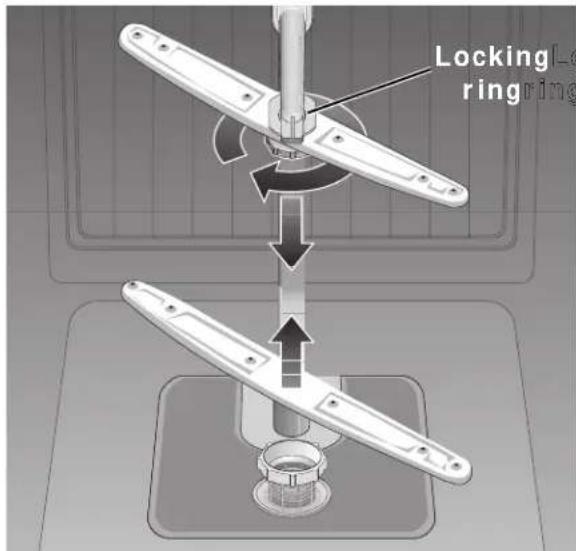
The wash arms should be checked for food particles on a regular basis to assure that the spray orifices are clear and unobstructed. If the wash arms require cleaning they are easily removable:
text_image
Locking ring ringFigure 17. Removable Wash Arms
- The lower wash arm simply snaps into place and can be removed by pulling upwards.
- The upper wash arm is held in position by a locking ring that can be released by turning it approximately 1/8 turn. See Figure 17.
After cleaning, reattach the wash arms by reversing the action used to remove them.
• Stainless Steel Tank and Door
The outer edges of the inside door panel should be cleaned on a regular basis to remove food particles that can gather there from normal loading. If spots begin to appear on the stainless steel door or tank check to make sure that the RINSE AID RESERVOIR has rinse agent in it. Also it is possible that the wash arms are blocked, which prevented the door as well as your dishware from being properly washed and rinsed. Check the wash arms to make sure they are moving freely. If not, clear the obstruction away so that the arms may rotate freely and then rewash the load of dishes in the dishwasher.
Spots that appear on the stainless steel door may be removed by wiping gently with a sponge sprinkled with a stainless steel cleaner. Do not use metal scouring pads to clean the stainless steel surfaces as these can scratch the surface and leave metal fragments that can rust.
- Door Gasket
The door gasket should be cleaned on a regular basis. To remove food particles that can gather from normal loading, clean the door gasket with a damp cloth.
Table 4. SELF-HELP
Dishwashers may exhibit problems that are unrelated to a malfunction of the dishwasher itself. The following table may serve to answer your question about a problem you are having without having to call a serviceman.
| PROBLEM POSSIBLE CAUSE/ACTION | |
| Dishes do not dry Rinse aid dispenser is empty. Fill rinse aid dispenser. RINSE ONLY cycle selected in error. | |
| Indicator light(s) do A fuse may have blown or a circuit breaker tripped. Replace fuse or reset circuit breaker.not come on | |
| Dishwasher does not door of dishwasher not properly closed. Close dishwasher making sure that door latches.start | |
| Dishwasher runs long if the dishwasher completes the cycle, but the run time seem exceptionally long, it is probably time due to cold incoming water. To avoid this problem, it is recommended to turn on the hot waterfaucet at the sink nearest the dishwasher before starting the dishwasher. Run the water until the water is hot. Then turn off the water and start the dishwasher. | |
| Machine cycle does Water line is closed or inlet filter is blocked. Open water valve and/or check inlet filter.not advance to rinse | |
| Water not pumped Kink in drain hose. Filter clogged. Kitchen sink clogged. Check drain hose and fine and from dishwasher coarse filters (see section titled CARE and CLEANING). Check kitchen sink to make sure it is draining well. If problem is kitchen sink not draining you may need a plumber rather than a serviceman for the dishwasher. | |
| Detergent dispenser A program was not completely finished. See directions on Page 13 for resetting cycle.lid will not close | |
| Lower spray arm does not rotate freely | Remove lower spray arm and clean arm and spray arm mounts. |
| White deposits left on dishes | Too little rinse aid. Increase dosage dispensed, Page 10. |
| Streaks on glassware | Too much rinse aid used. Decrease dosage dispensed, Page 10. |
| Rattling noises | Utensils not properly arranged and anchored. Rearrange load. |
| Suds in dishwasher | Incorrect type of detergent used. Use only automatic dishwasher detergents. |
| Unsatisfactory washing results | Incorrect amount of detergent or rinse agent Utensils incorrectly arranged or rack overloaded.Wash arm rotation blocked by utensils.Filters not properly fitted into position.Clogged nozzles in wash arm(s).Unsuitable program selected. |
WARRANTY
FULL ONE YEAR WARRANTY
Covers one year from date of installation, or date of occupancy on a new, or previously unoccupied dwelling. Save your dated receipt or other evidence of installation/occupancy date.
Thermador Will Pay For:
All repair labor and replacement parts found to be defective due to materials and workmanship.
Service must be provided by a Factory Authorized Service Agency, during normal working hours. For a Service Agency nearest you, please call 800/735-4328.
Thermador Will Not Pay For:
-
Service by an unauthorized agency. Damage or repairs due to service by an unauthorized agency or the use of unauthorized parts.
-
Service visits to:
-
Teach you how to use the appliance.
- Correct defects or repairs due to improper installation. You are responsible for providing electrical wiring and other connecting facilities.
- Reset circuit breakers or replace home fuses.
-
Repair damage caused from accident, alteration, misuse, abuse, improper installation or installation not in accordance with local electrical codes or plumbing codes, or improper storage of the appliance.
-
Service labor during limited warranty period.
- Travel fees and associated charges incurred when the product is installed in a location with limited or restricted access. (i.e., airplane flights, ferry charges, isolated geographic regions).
- Repairs due to other than normal home use.
This warranty applies to appliances used in residential applications; it does not cover their use in commercial installations.
The warranty is for products purchased and retained in the 50 states of the U. S. A., the District of Columbia and Canada. Should the appliance be sold by the original purchaser during the warranty period, the new owner continues to be protected until the expiration date of the original purchaser's warranty period. Products for use in Canada must be purchased through the Canadian distribution channel to ensure regulatory compliance.
This warranty gives you specific legal rights. You may also have other rights which vary from state to state.
Thermador wants to ensure that we exceed your expectations of support not only with your current appliance purchase, but well into the future. If an issue arises that is not resolved to your satisfaction, please let us know by calling or writing to us at the telephone number or address shown below.
HOW TO OBTAIN SERVICE
- Contact the Factory Authorized Service Agent in your area
- Contact the Dealership where you purchased the appliance.
- Call the Thermador Customer Support Call Center at 800-735-4328
- Write us at: Thermador, 5551 McFadden Avenue, Huntington Beach CA, 92649
Specifications are for planning purposes only. Refer to installation instructions and consult your countertop supplier prior to making counter opening. Consult with a heating and ventilating engineer for your specific ventilation requirements. We reserve the right to change specifications or design without notice. Some models are certified for use in Canada. Thermador is not responsible for products which are transported from the U.S. for use in Canada. Check with your local Canadian distributor or dealer.
For the most up to date critical installation dimensions by fax, use your fax handset and call (702) 833-3600. Use code #8030
Thermador®
CORPORATION
5551 McFadden Avenue, Huntington Beach, CA 92649
ECO# 91151 • 35-07-002C • ©1998 Thermador Corporation. Litho Date: 8/99