HWU9DD - Network card Hawking Technologies - Free user manual and instructions
Find the device manual for free HWU9DD Hawking Technologies in PDF.


User questions about HWU9DD Hawking Technologies
0 question about this device. Answer the ones you know or ask your own.
Ask a new question about this device
Download the instructions for your Network card in PDF format for free! Find your manual HWU9DD - Hawking Technologies and take your electronic device back in hand. On this page are published all the documents necessary for the use of your device. HWU9DD by Hawking Technologies.
USER MANUAL HWU9DD Hawking Technologies
natural_image
Woman sitting on grass using a laptop while using a white and black device, with a modern digital speaker in the foreground (no visible text or symbols)HI-GAIN™ WIRELESS-G USB DISH ADAPTER
website www.hawkingtech.com e-mail techsupport@hawkingtech.com
© COPYRIGHT 2009 HAWKING TECHNOLOGIES, INC. ALL RIGHTS RESERVED.
USER'S MANUAL▶▶
Limited Warranty
Hawking Technology guarantees that every HWU9DD Hi-Gain™ Wireless-G Network USB Dish Adapter is free from physical defects in material and workmanship under normal use for one (1) year from the date of purchase. If the product proves defective during this one-year warranty period, call Hawking Customer Service in order to obtain a Return Authorization number. Warranty is for repair or replacement only. Hawking Technology does not issue any refunds. BE SURE TO HAVE YOUR PROOF OF PURCHASE. RETURN REQUESTS CAN NOT BE PROCESSED WITHOUT PROOF OF PURCHASE. When returning a product, mark the Return Authorization number clearly on the outside of the package and include your original proof of purchase. For Warranty (RMA) Terms and Conditions, please go to http://www.hawkingtech.com/support/customerservice.php#rma. Standard shipping & handling charges may apply.
IN NO EVENT SHALL HAWKING TECHNOLOGY'S LIABILITY EXCEED THE PRICE PAID FOR THE PRODUCT FROM DIRECT, INDIRECT, SPECIAL, INCIDENTAL OR CONSEQUENTIAL DAMAGES RESULTING FROM THE USE OF THE PRODUCT, IT IS ACCOMPANYING SOFTWARE OR ITS DOCUMENTATION. Hawking Technology makes no warranty or representation, expressed, implied or statutory, with respect to its products or the contents or use of this documentation and all accompanying software, and specifically disclaims its quality, performance, merchantability, or fitness for any particular purpose. Hawking Technology reserves the right to revise or updates its products, software, or documentation without obligation to notify any individual or entity. Please direct all inquiries to: techsupport@hawkingtech.com
Trademarks & Copyright
© Copyright 2009 Hawking Technologies, Inc. All rights reserved. All other brands and product names are trademarks of their respective companies. No part of this publication may be reproduced in any form or by any means or used to make any derivative (such as translation, transformation or adaptation) without the express written consent of the manufacturer as stipulated by the United States Copyright Act of 1976.
Warning Statement:
Federal Communication
Commission Interference Statement
Federal Communications
Commission (FCC) Requirements, Part 15
-
Reorient or relocate the receiving antenna.
-
Increase the separation between the equipment and receiver.
-
Connect the equipment into an outlet on a circuit different from that to which the receiver is connected.
-
Consult the dealer or an experienced radio/TV technician for help. This device complies with Part 15 of the FCC Rules. Operation is subject to the following two conditions:
(1) This device may not cause harmful interference.
(2) This device must accept any interference received, including interference that may cause undesired operation.
FCC Caution:
FCC RF Exposure Statement:
This Transmitter must not be co-located or operating in conjunction with any other antenna or transmitter. This equipment complies with FCC RF radiation exposure limits set forth for an uncontrolled environment. This equipment should be installed and operated with a minimum distance of 20 centimeters between the radiator and your body. Unauthorized antenna, modification, or attachments could damage the transmitter and may violate FCC regulations.
R&TTE Compliance Statement
This equipment complies with all the requirements of DIRECTIVE 1999/5/EC OF THE EUROPEAN PARLIAMENT AND THE COUNCIL of March 9, 1999 on radio equipment and telecommunication terminal Equipment and the mutual recognition of their conformity (R&TTE) The R&TTE Directive repeals and replaces in the directive 98/13/EEC (Telecommunications Terminal Equipment and Satellite Earth Station Equipment) As of April 8, 2000.
Safety
This equipment is designed with the utmost care for the safety of those who install and use it. However, special attention must be paid to the dangers of electric shock and static electricity when working with electrical equipment. All guidelines of this and of the computer manufacture must therefore be allowed at all times to ensure the safe use of the equipment.
EU Countries Intended for Use
The ETSI version of this device is intended for home and office use in Austria, Belgium, Denmark, Finland, France, Germany, Greece, Ireland, Italy, Luxembourg, the Netherlands, Portugal, Spain, Sweden, and the United Kingdom.
The ETSI version of this device is also authorized for use in EFTA member states: Iceland, Liechtenstein, Norway, and Switzerland.
EU Countries not intended for use
None.
Regulatory information/Disclaimers:
Any changes or modifications made to this device that are not expressly approved by the manufacturer may void the user's authority to operate the equipment.
TABLE OF CONTENTS
I. OVERVIEW....5
- FEATURES....5
- PACKAGE CONTENTS....6
- SYSTEM REQUIREMENTS......6
II. FOR WINDOWS USERS....7
- INSTALLATION FOR WINDOWS 7/ VISTA ....7
1.1 Connecting to a Wireless Network (Windows 7)....9
1.2 Connecting to a Wireless Network (Windows Vista)....11
1.3 Using Windows Configuration (Windows Vista / 7)....12
- INSTALLATION (WINDOWS 2000/XP)....14
2.1 Verify installation (Windows 2000/XP)....17
2.2 Network Configuration (Windows 2000/XP)....18
2.3 Connect - Using HWU9DD Wireless Utility....19
- HAWKING WIRELESS UTILITY 21
3.1 Utility Overview....21
3.2 Available Network Tab 22
3.3 General Tab....23
3.4 Profile Tab 24
3.5 Statistics....29
3.6 Wi-Fi Protect Setup (WPS)....30
3.7 NETWORK SECURITY (WEP, WPA...) 32
- UNINSTALLING HAWKING UTILITY/DRIVER....36
III. FOR MAC USERS....37
- INSTALLATION FOR MAC OSX 10.4 OR LATER .... 37
- CONNECTING TO YOUR WIRELESS NETWORK (MAC 10.5 OR LATER) 40
- CONNECTING TO YOUR WIRELESS NETWORK (MAC 10.4\~10.4.9) 42
- HAWKING HWU9DD WIRELESS UTILITY 45
4.1 Available Network....46
4.2 Profiles....47
4.3 Link Status Page....51
4.4 Information....52
- UNINSTALLING HAWKING UTILITY (MAC) 52
IV. APPENDIX A - SPECIFICATIONS....54
V. INDEX 55
VI. PRODUCT SUPPORT INFORMATION .... 58
Note: Manual contents are subject to change without prior notice. Please check the hawking website for the latest information.
I. OVERVIEW
Thank you for purchasing the Hawking HWU9DD Hi-Gain™ Wireless-G USB Dish Adapter. Now you can enjoy the latest Wireless-G technology with excellent speeds, of up to 108Mbps*. Designed with Hi-Gain Dish Technology, the Wireless-G USB Adapter extends your wireless network coverage by up to 300% the range compared to a standard Wireless-G Network. It allows you to connect a notebook or desktop to any wireless network** using the USB port. Now, you can stream HD video, play games online, download music, images and data while maintaining your freedom of mobility.
The HWU9DD is also packed with security applications. For more security-sensitive applications, the HWU9DD supports Hardware-based IEEE 802.11i encryption/decryption engine, including 64-bit/128-bit WEP, and AES. Also, it supports Wi-Fi alliance WPA and WPA2 encryption.
1. Features
■ Work with 802.11b/g/n wireless network devices.
- High-speed transfer data rate - up to 108Mbps.
- High throughput supports multi-media data bandwidth requirement.
■ Support 64/128-bit WEP Data Encryption, WPA, WPA2.
- Automatic fallback increases data security and reliability.
■ Supports the most popular operating system: Windows 2000/XP/Vista/7 and Mac OS 10.4 or later
■ Supports USB 2.0 interface.
* Theoretical wireless signal rate based on IEEE standard of 802.11a, b, g chipset used. Actual throughput may vary. Network conditions and environmental factors lower actual throughput rate.
**Preferably Wireless-G network for maximum through pts.
** *All specifications are subject to change without notice.
2. Package Contents
Before you begin the installation, please check the items of your package. The package should include the following items.
• One HWU9DD Hi-Gain Wireless-G USB Dish Adapter
• One USB cable (1.0 meter \~ 39 inches)
One CD-ROM with User's Manual & Drivers for Windows and Mac
- Quick Installation Guide
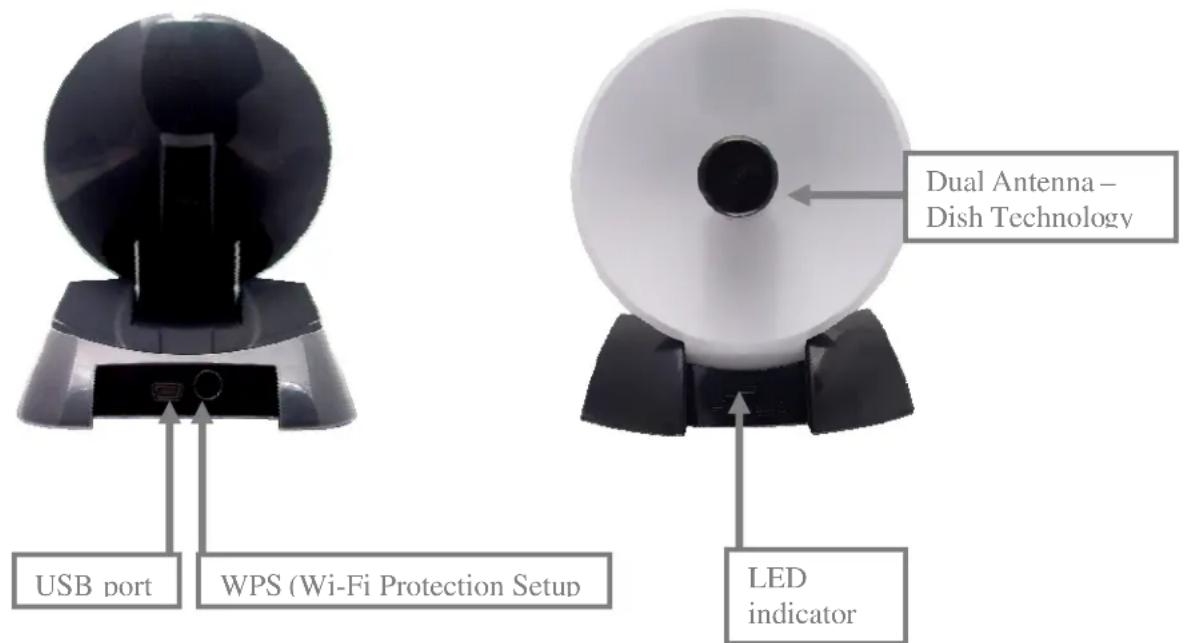
| LED Description | |
| LINK Blinks when active connection is available else remains switched OFF | |
| PWR | Blinks rapidly when data communication in progress else remains switched OFF |
3. System Requirements
To begin using the HWU9DD Dish Adapter, your PC/Notebook must meet the following minimum requirements:
- Operating System – Microsoft Windows 2000/XP/Vista or Mac OS 10.4 or later
- An Available USB Port on your Laptop or Desktop
- 256MB system memory or larger
- 750MHz CPU or higher configuration
II. FOR WINDOWS USERS
1. Installation for Windows 7/ Vista
Important!
(1) If you have installed the Wireless PC Adapter driver & utility before, please uninstall the old version first.
(2) Be sure to save all your work, your system may automatically restart after installation.
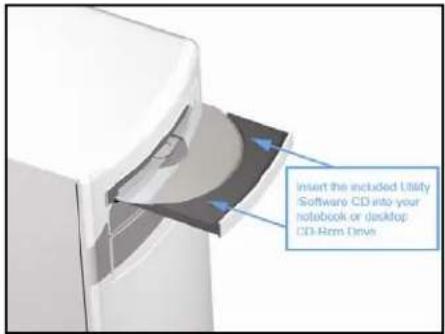
a. Insert the included CD an auto load page will appear instantly on you screen.
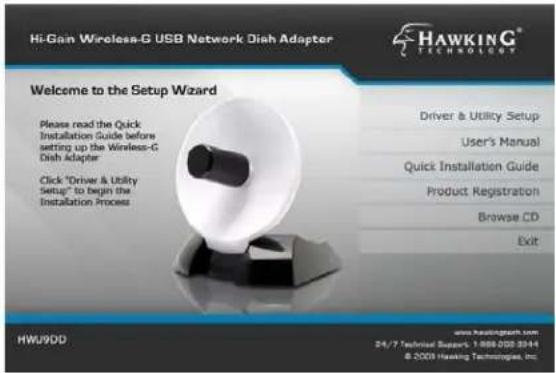
b. Select Driver & Utility Setup
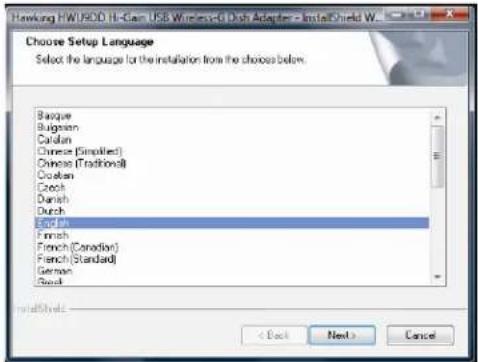
c. Choose a setup language
d. Please wait a while the Wizard prepares for setup. Select "Next" to continue.
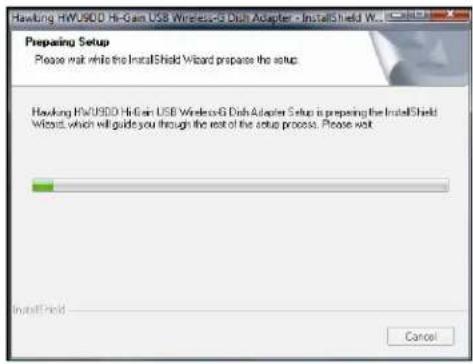
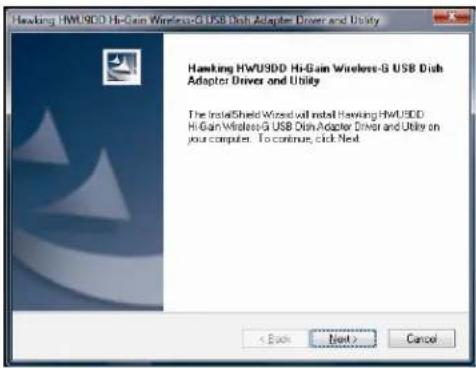
e. Please wait during the setup status screen, then Select "Install" to begin Installation.
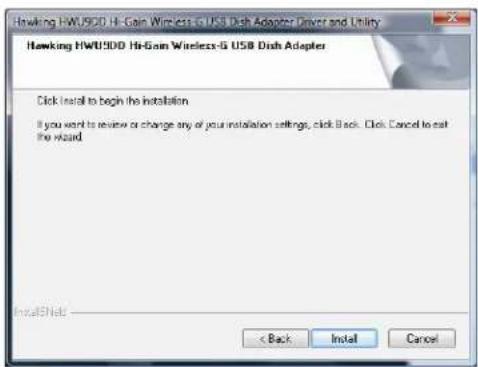
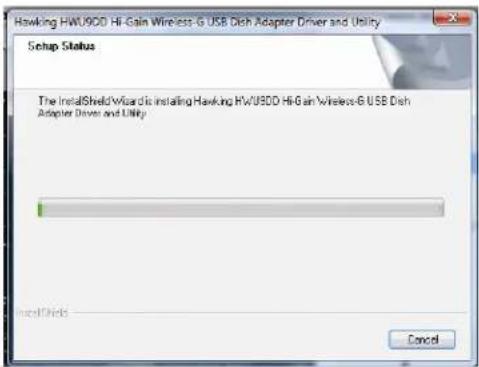
f. Please wait until the Install Wizard completes.

g. Select "Finish."
1.1 Connecting to a Wireless Network (Windows 7)
a. At this point, your system may prompt you to restart your computer. Plug in the HWU9DD to an available USB after computer restarts.
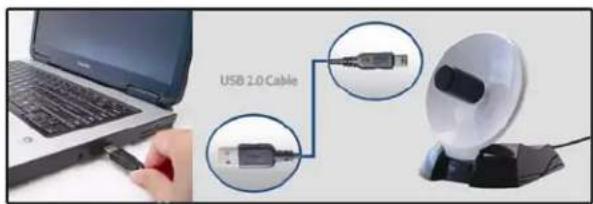
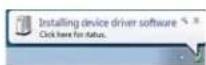
b. Please wait until your system completes with the driver installation.

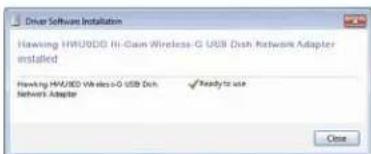
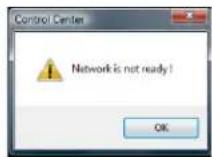
c. When Installation is complete, Control Center will indicate that your network is ready. Select "OK."
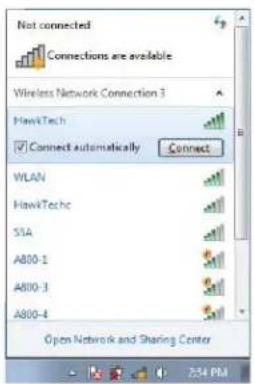
d. The Adapter will automatically search and locate an open network. Select a desired network.
You can locate search for the available network by clicking on the wireless icon on your system tray (bottom-right corner).
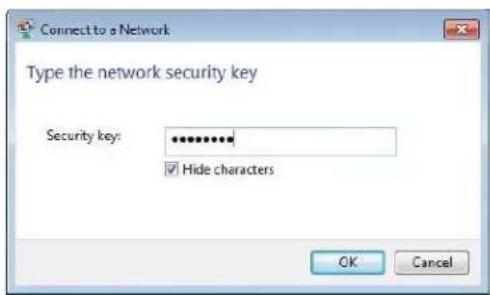
e. If your selected network is encrypted/password protected, please enter the network security key and click "OK". If you don't have the network security key, please contact your network administrator.
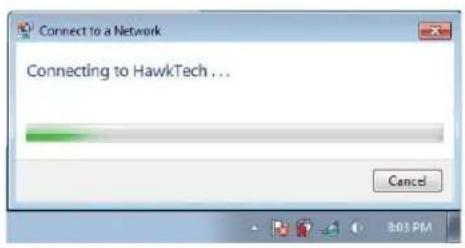
f. Congratulations! you are now successfully connected!
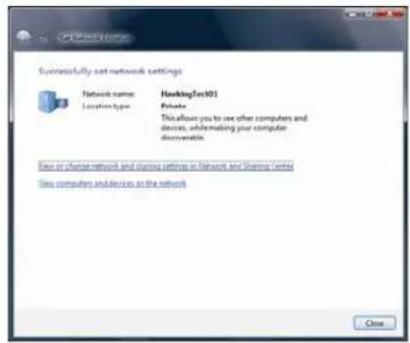
1.2 Connecting to a Wireless Network (Windows Vista)
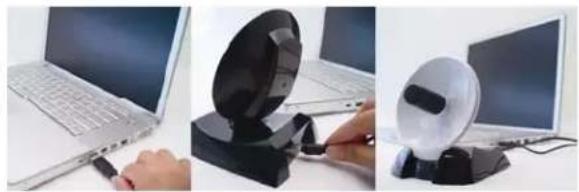
a. At this point, your system may prompt you to restart your computer. Plug in the HWU9DD to an available USB after computer restarts.
natural_image
Three-panel photo showing a laptop, a black-and-white photo of a device with a circular lens, and a white remote control unit on a laptop (no visible text or symbols)b. Your system will automatically search for the installed driver for your HWU9DD adapter and will prompt you when it is ready.

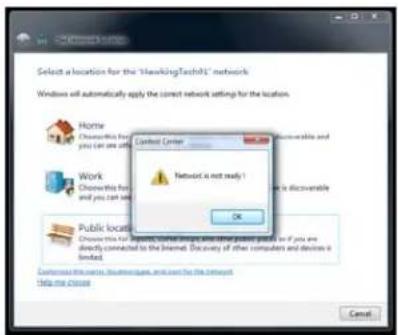
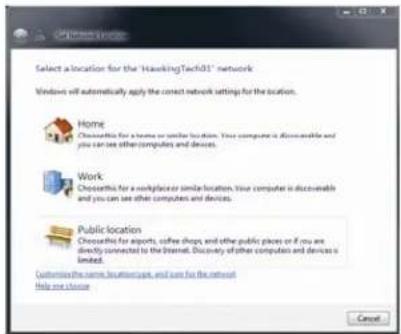
g. Select a location for your network.
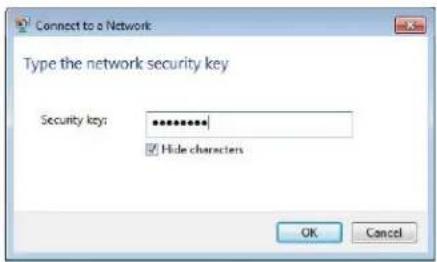
h. If your selected network is encrypted/password protected, please enter the network security key and click "OK". If you don't have the network security key, please contact your network administrator.
i. Congratulations! you are now successfully connected!
1.3 Using Windows Configuration (Windows / 7)
It is recommended that you use the Windows Configuration for the Wireless-GAdapter.
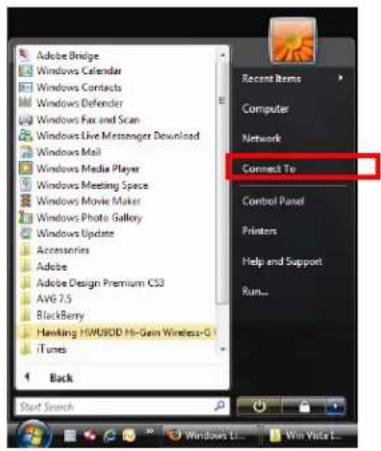
a. To open up the Windows Configuration, go to Start →Connect To
b. Select the Network you wish to connect to. If you are connecting to an unsecure network, go to step c. If you are connecting to a secured network, go to step d.
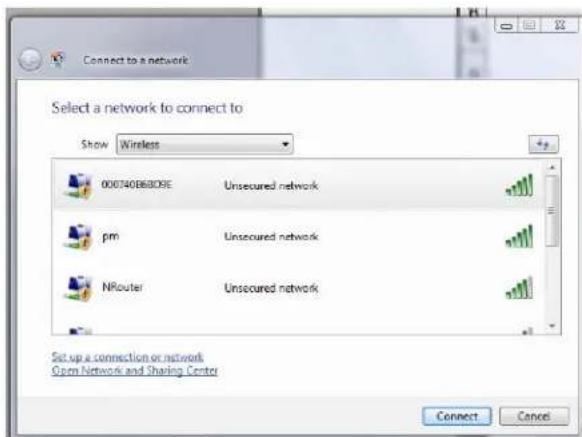
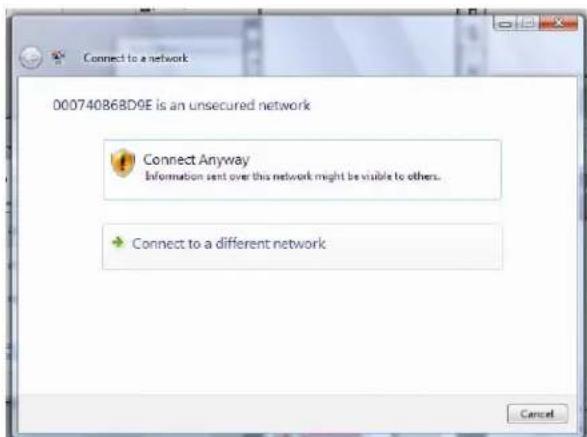
c. If you are connecting to an open network (unsecured network), a warning may appear indicating that the network is an unsecured network. Select Connect Anyway and skip step
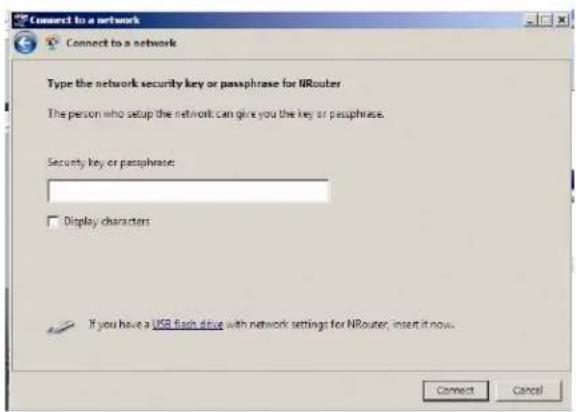
d. If your selected network is a secured (encryption) network, then a window will prompt you to enter security key or passphrase. If you are connecting to a network that is security enabled, but do not have the security key or passphrase, please obtain the passphrase from your Network Administrator.
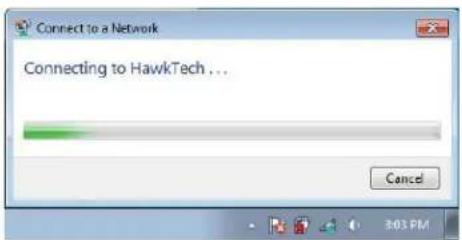
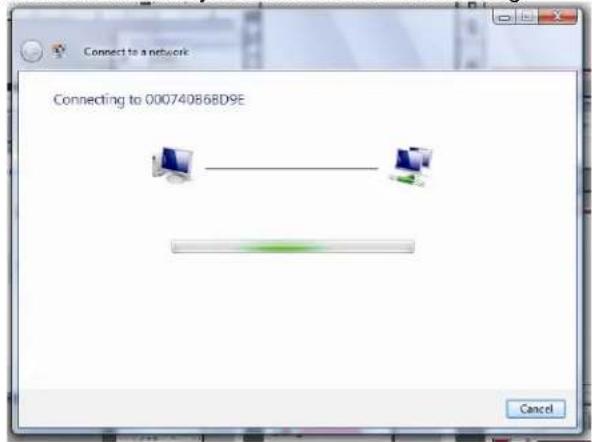
e. Please wait while your HWU9DD is connecting.
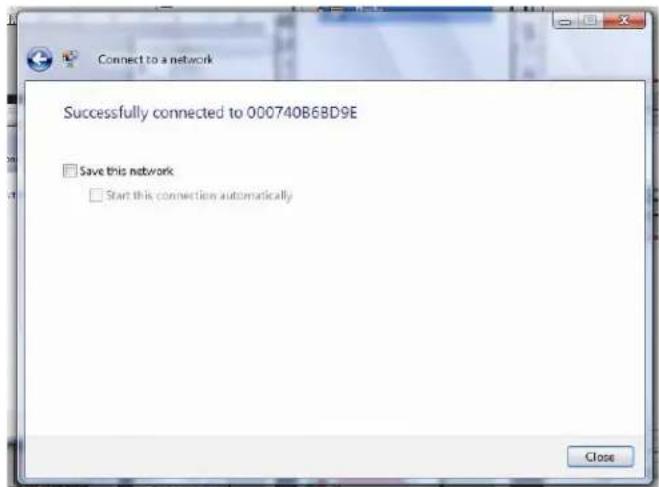
f. The HWU9DD Wireless Dish Adapter is now connected; you may save this network as your preferred network.
2. Installation (Windows 2000/XP)
Important! Please Install the HWU9DD Driver & Utility before connecting the HWU9DD into the USB port on your computer. The HWU9DD Driver & Utility is located on the CD.
The following installation was operated under Windows XP. Procedures are similar for Windows 2000.
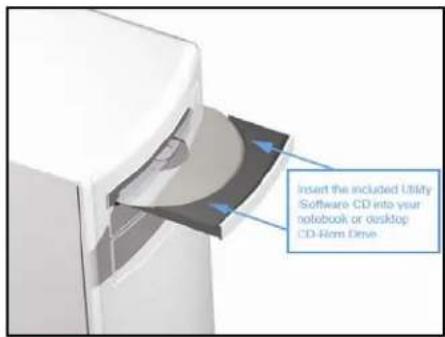
- Insert the support CD into your CD Drive.
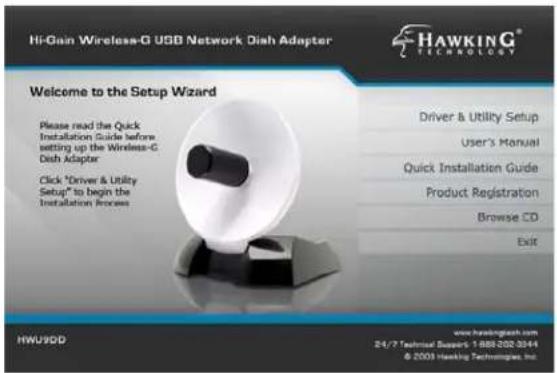
- The CD drive should auto-load the following.
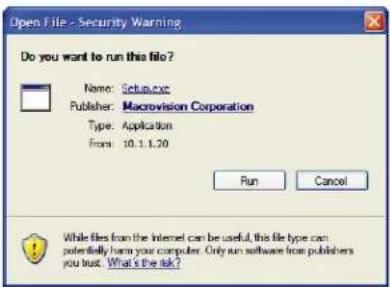
- Open the file and you can briefly see the following. Select Run.
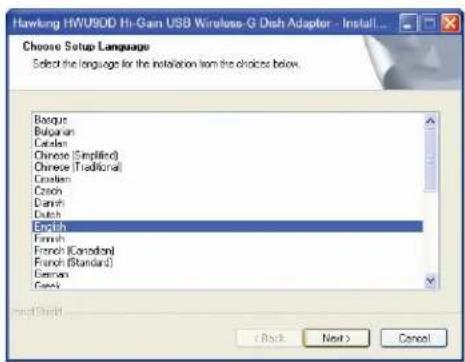
- Select Setup Language and click "Next" and "Next again in the following screen.
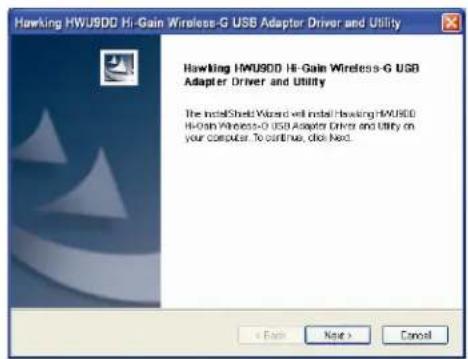
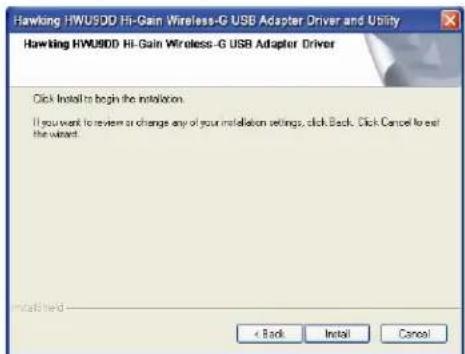
- Now you'll see the following message, please click 'Install' to begin the installation. Wait while your system begins to install.
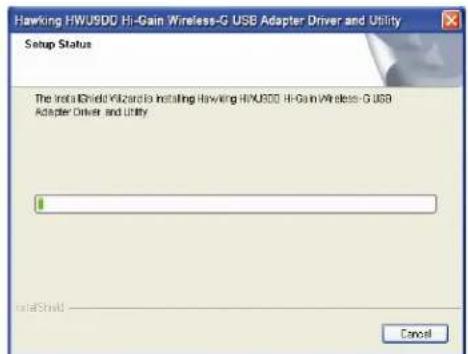
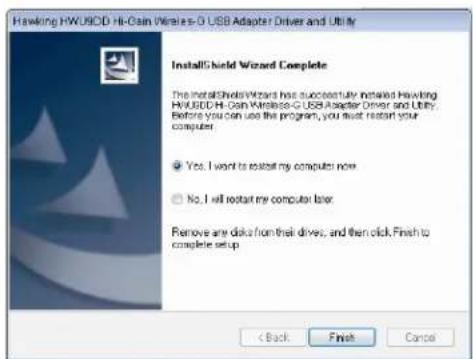
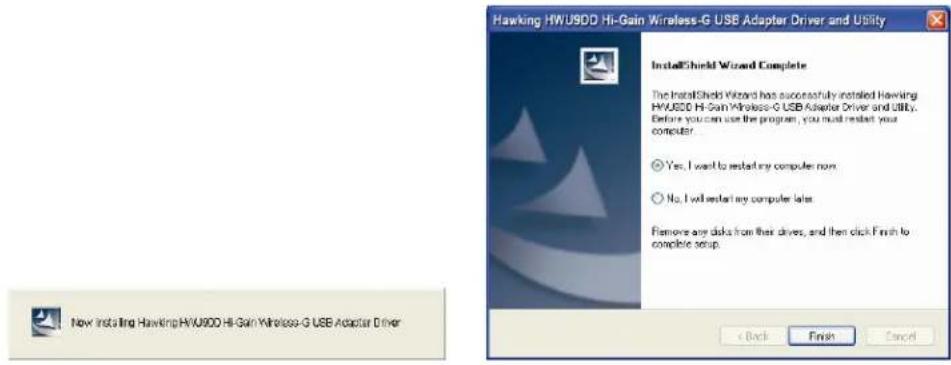
- Select "Yes" to restart your computer, then click "Finish" to complete the driver and utility installation.
- At this point, your system may prompt you to restart your computer. Plug in the HWU9DD to an available USB after computer restarts.
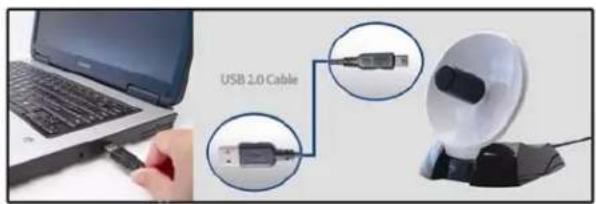
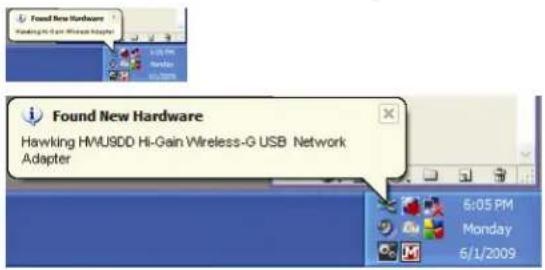
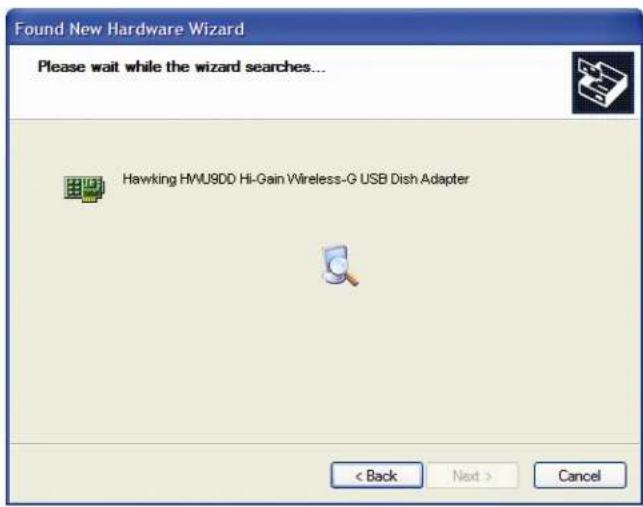
- Your system will recognize the new hardware, HWU9DD adapter. Please wait while it searches for the installed driver and utility.
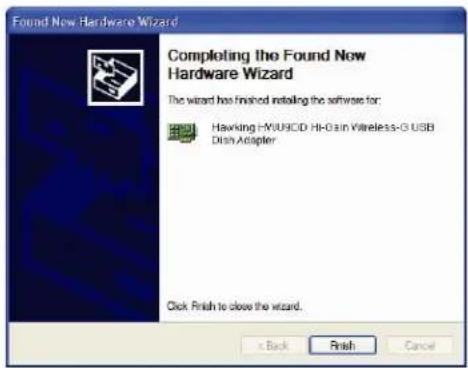
- Finally select "Finish" to complete your hardware installation.
2.1 Verify installation (Windows 2000/XP)
- Open Control Panel → Double-click on System.
- Select Hardware tab→Click on Device Manager.

- Select and double-click on 802.11G USB wireless LAN card.
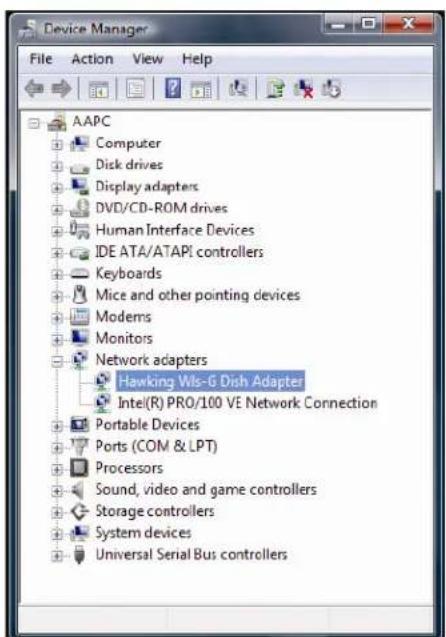
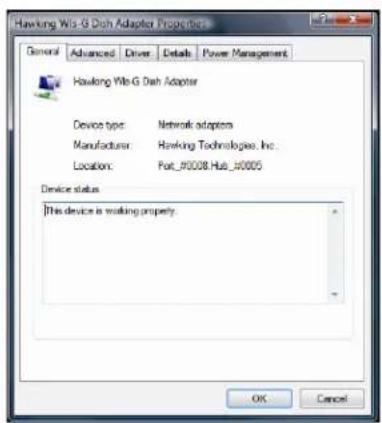
Verify the device status of the 802.11G USB Wireless LAN Card This device is working properly→Click OK
2.2 Network Configuration (Windows 2000/XP)
- Go to Start Menu → Control Panel → Network.
• Right-click on Wireless Network. - Select → Local Area Connection icon → select Properties.
- Select Internet Protocol (TCP/IP) Click Properties.
![Wireless Network Connection 4 Properties General Advanced Connect using: 802.11n USB Wireless LAN Card Configure... This connection uses the following items: ✓ AEGIS Protocol (IEEE 802.1x) v3.5.3.0 ✓ Microsoft TCP/IP version 6 ✓ Internet Protocol [TCP/IP] Install... Uninstall Properties Description Transmission Control Protocol/Internet Protocol. The default wide area network protocol that provides communication across diverse interconnected networks. ✓ Show icon in notification area when connected ✓ Notify me when this connection has limited or no connectivity OK Cancel](/content/2026/05/1141441/images/9b25d62a9dadaf575bb7e26b0e78f342931231e5eead60fcb41828f74442b338.jpg)
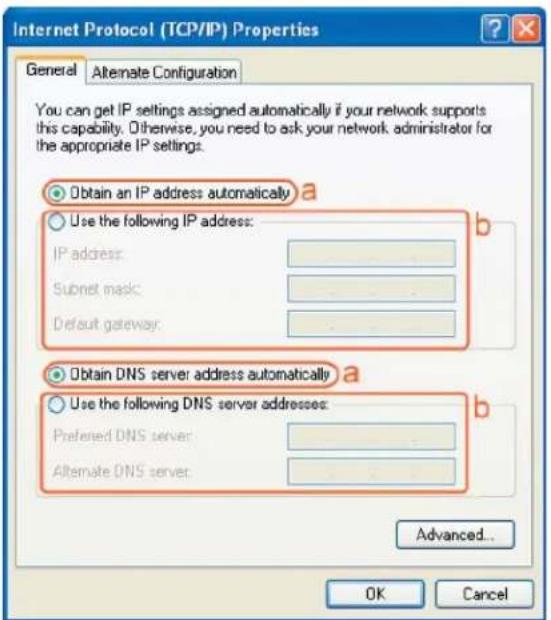
Select the [General] tab. a. If your Wireless Router supports [DHCP] function, please select both [Obtain an IP address automatically] and [Obtain DNS server address automatically]. b. If the router does not support [DHCP] function, you have to configure the IP and DNS settings.
2.3 Connect - Using HWU9DD Wireless Utility
NOTE:
- The HWU9DD Adapter must be connected to your computer at this point.
- Your home/office environment should have a wireless LAN Access Point (AP) that is available for your use.
- You should readily have the (security keys) to connect to those Wireless LAN Access Points (AP)
- Configuration utility will first automatically link with the Wireless AP if there is no security key required. If the connection is successful, a message will appear on taskbar.
-
The HWU9DD Wireless Utility works best with Windows XP and 2000. For Windows 7 and Windows Vista, it is recommended to use the Windows Configuration.
-
Open Up the Hawking Wireless Utility. There are several ways to open up the Hawking Wireless Configuration Utility.
- From your desktop, double click on the desktop shortcut.
- From your system tray < 3:43 PM, double click on the wireless bar icon (Note: the icon may be green if the HWU9DD Adapter is already connected to a wireless network).
- Connected to a Wireless Network or AP:
- Not Connected to a Wireless Network or AP:
- The HWU9DD is disabled
- The HWU9DD is not detected.


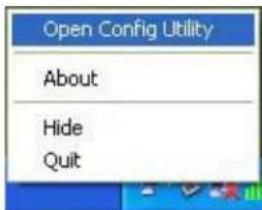
- For more options, right click the wireless icon from the system tray.
- Open Config Utility: Select "Open Config Utility" to open the configuration utility.
- About: Select "About" to show the utility information.
- Hide: Select "Hide" to hide the utility in the system tray.
- Quit : Select "Quit" to quit the utility in the system tray.
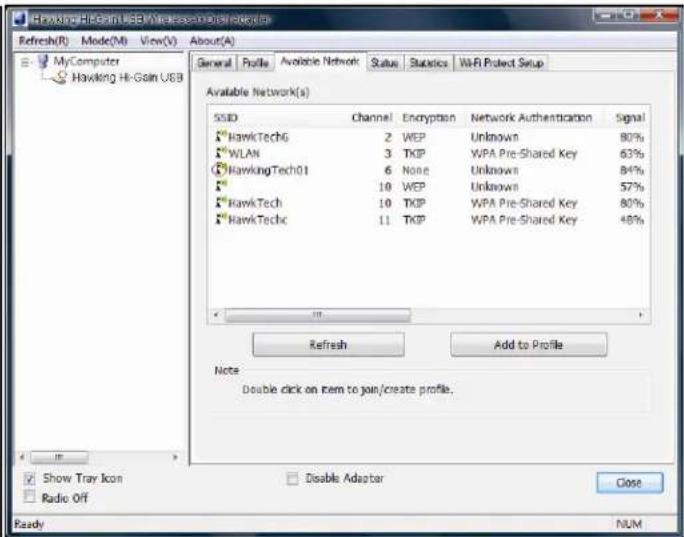
- From the Available network tab, double click on the SSID or Access the SSID and click on Connect.
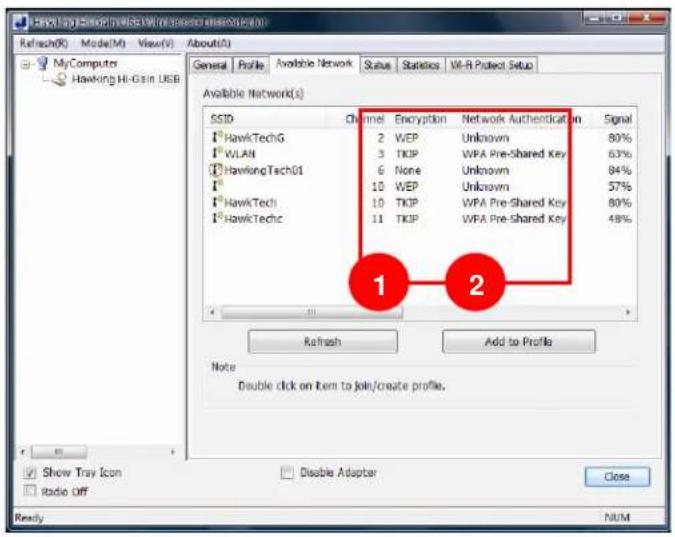
To see a list of available wireless networks, select Available Network tab→ Select Refresh. All detected service set identifiers (SSID) will be listed under SSID column.
Encryption/Security/Authentication:
If the selected SSID is an open network or has no encryption, "none" will be listed under the Encryption column.)
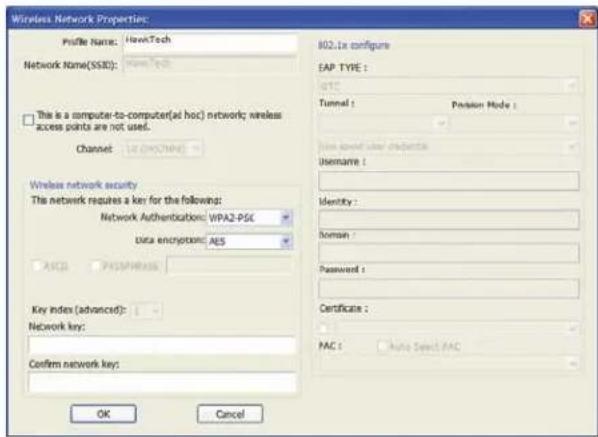
If the selected SSID has encryption (WEP, TKIP, WPA), please enter the password in the network key field and confirm network key fields. If you don't have the password, please contact your network administrator.
When you are successfully connected, a green signal meter will appear in the status bar

When the HWU9DD fails to connect, a red bar signal meter appear in the status

Note: If you mouse over the red bar, it will indicate that the Adapter is disconnected.
3. Hawking Wireless Utility
3.1 Utility Overview
NOTE: The HWU9DD Wireless Utility works best with Windows XP and 2000. For Windows 7 and Windows Vista, it is recommended to use the default Windows Zero Configuration Wireless Utility.
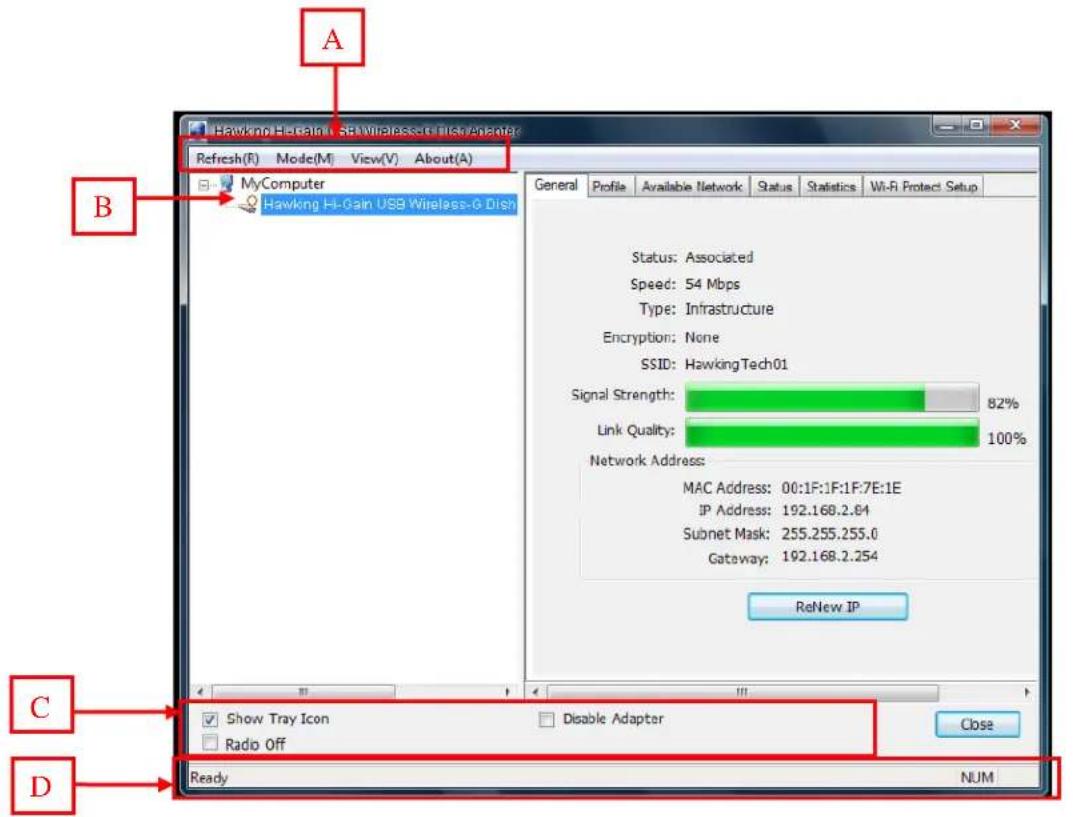
There are several parts to the utility screen. Please refer to the following table for the description.
| PARAMETER | DESCRIPTION |
| A | Refresh - Refresh the list of adapters on your computer: “B” blockMode- There are two modes: Station and Access Point. If “Station” is selected, the adapter works as a standard wireless adapter. If “Access Point” is selected, the adapter will works as a wireless AP.View – Allows for viewing of specific items with your adapter such as the current status.About- To check the version of the software utility, select this item. |
| B | This is a list for you to configure several adapters in your PC from the utility. |
| C | Show Tray Icon – To show the icon in the system tray, select the item.Disable Adapter – This function is for you to disable or enable the adapter.Windows Zero Config – To configure the adapter from Windows XP Zero Configuration, check the item. (Recommended for Vista and Windows 7)Radio Off – This function is for you to turn off or turn on the radio in the adapter. If the radio is turned off, the adapter will not work. |
| D | Status bar that displays the current status of the utility. To close it, please disable the “Status Bar” in the “View” item. |
| E | Utility and Configuration tabs for the HWU9DD Adapters: General, Profiles, Available Network, Status, Statistics, and Wi-Fi Protected Setup. The following section will go over each tab in details |
3.2 Available Network Tab
When you open the Configuration Utility, the utility will do an initial scan of all the networks within your vicinity and automatically connect to the wireless network with the highest signal strength. From the "Available Network" tab, all the networks nearby will be listed. Here you can change the network that you are connected to.
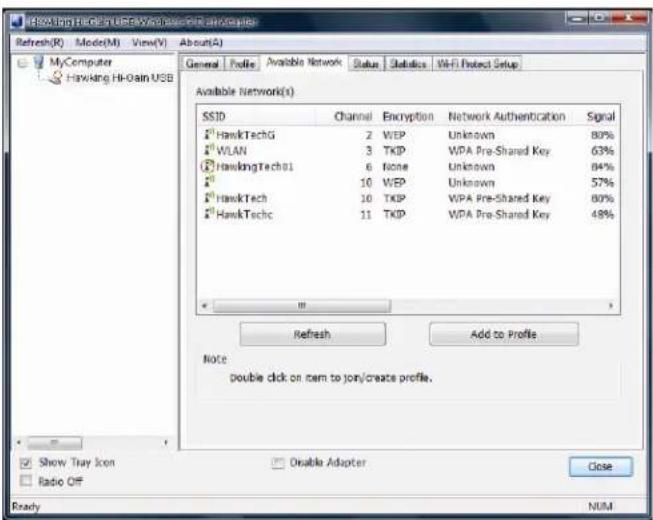
| Parameter | Description |
| Available Network(s) This list shows all information of the available wireless networks within the range of your adapter. The information includes SSID, Channel, Encryption, Network Authentication, Signal and etc. If you want to connect to any network on the list, double-click the selected network. | |
| Refresh Click “Refresh” to update the available networks list. It is recommended that refresh the list while you have changed the connection network. | |
| Add to Profile A profile stores the setting of a network, so that you can connect to the network quickly. To add the selected network to a profile, click this button. | |
3.3 General Tab
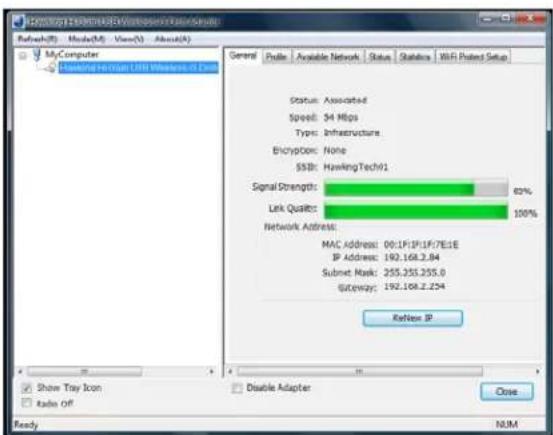
To check the connection status of the adapter, select "General". This screen shows the information of Link Speed, Network Type, Encryption Method, SSID, Signal Strength, Link Quality and Network Address of the adapter.
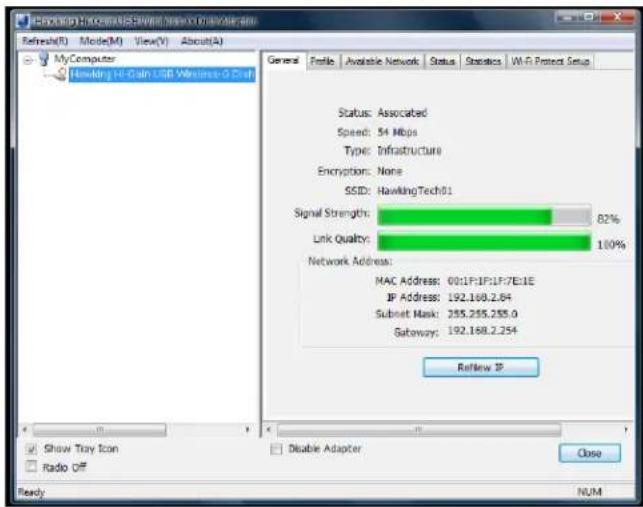
| Parameter | Description |
| Status Shows the connection status of the adapter. | |
| Speed Shows the current speed | |
| Infrastructure – This operation mode requires the presence of an 802.11 Access Point. All communication is done via the Access Point or Router.IBSS – Select this mode if you want to connect to other wireless stations in the Wireless LAN network without through an Access Point or Router.IBSS – Select this mode if you want to connect to other wireless stations in the Wireless LAN network without through an Access Point or Router. | |
| Encryption It displays the encryption setting of the current connection including None, WEP, TKIP or AES. | |
| SSID The SSID (up to 32 printable ASCII characters) is the unique name identified in a WLAN. The ID prevents the unintentional merging of two co-located WLANs. | |
| Signal Strength Indicates the wireless signal strength | |
| Link Quality Indicates the wireless link quality | |
| Network Address It shows the MAC, IP address and other information of the adapter. | |
3.4 Profile Tab
The "Profiles List" lets you manage the networks you connect to frequently. You are able to add/Remove/Edit/Duplicate/Set Default to manage a profile.
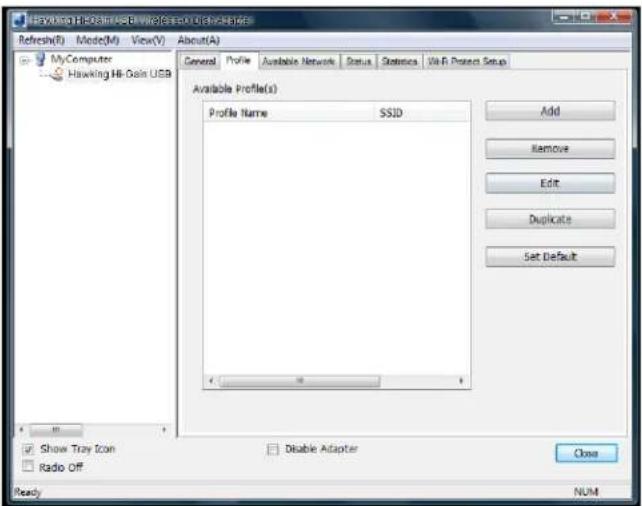
| Parameter | Description |
| Available Profile(s) | This list shows the preferred networks for the wireless connection. You can add, remove, edit, duplicate the preferred networks or set one of the networks as the default connection. |
| Add/ Remove/ Edit Button | Click these buttons to add/ delete/ edit the selected profiles. |
| Duplicate If you | like to build up the new profile with the same settings as the current profile, then you can select this feature. |
| Set Default To | designate a profile as the default network for the connection from the available profiles list, click the button. |
Configure a Network Profile
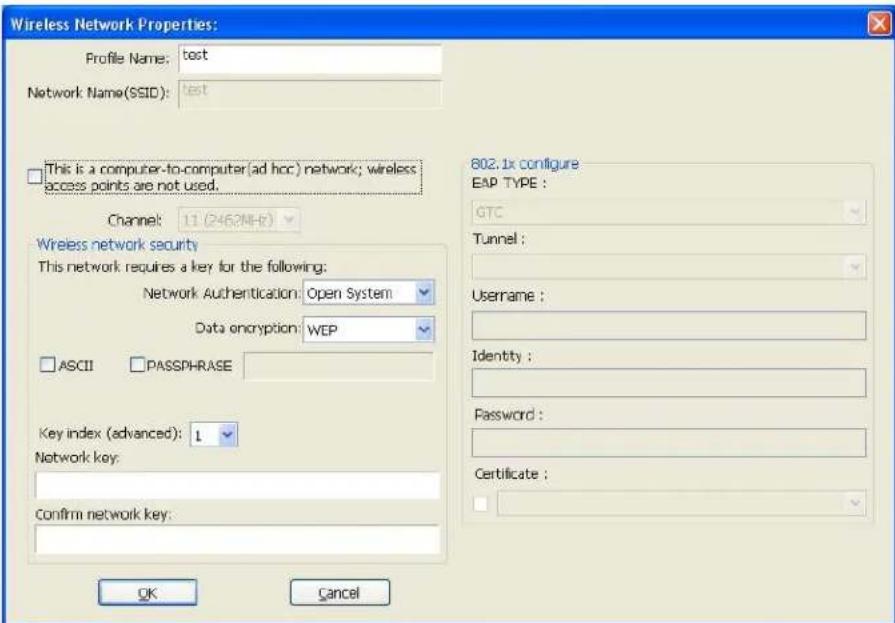
| Parameter | Description |
| Profile Name | Define a recognizable profile name for you to identify the different networks you are saving |
| Network Name (SSID) | The SSID (up to 32 printable ASCII characters) is the unique name for the wireless network you are saving. The ID prevents the unintentional merging of two co-located wireless networks.You may specify a SSID for the adapter and then only the device with the same SSID can interconnect to the adapter. |
| This is a computer-to-computer (ad hoc) network; wireless access points are not used. | There are two kinds of network type described as follows.Infrastructure – This operation mode requires the presence of an 802.11 Access Point. All communication is done via the Access Point or Router.Ad Hoc – Connect directly to another wireless adapter in the Wireless LAN network without going through a router or access point.If this item is selected, the adapter will work in Ad Hoc mode. |
| Channel | This setting is only available for Ad Hoc mode. Select the number of the radio channel used for the ad hoc connection.The channel setting should be the same with the computer you are connecting with. |
| Network Authentication | This setting has to be consistent with the wireless networks that the adapter intends to connect to.Open System – No authentication is needed among the wireless network.Shared Key – Only wireless stations using a shared key (WEP Key identified) are allowed to connect with each other.WPA-PSK – Designed for home and small business users who do not have access to network authentication servers. In this mode, known as Pre-Shared Key, the user manually enters the starting password in their access point or gateway, as well as in each wireless station in the network. WPA-PSK takes over automatically from that point, keeping unauthorized users that don’t have the matching password from joining the network, while encrypting the data traveling between authorized devices.WPA2-PSK – WPA2-PSK is also for home and small business. The difference between WPA-PSK and WPA2-PSK is that WPA2-PSK provides data encryption via the AES. In contrast, WPA-PSK uses Temporal Key Integrity Protocol (TKIP) which is not fully certified. AES is recommended.WPA 802.1X – WPA provides a scheme of mutual authentication using either IEEE 802.1x/Extensible Authentication Protocol (EAP) authentication or pre-shared key (PSK) technology. It provides a high level of assurance to enterprises, small businesses and home users that data will remain protected and that only authorized users may access their networks. For enterprises that have already deployed IEEE 802.1x authentication, WPA offers the advantage of leveraging existing authentication databases and infrastructure.WPA2 802.1X – Like WPA, WPA2 supports IEEE 802.1 x/EAP authentications or PSK technology. It also includes a new advanced encryption mechanism using the Advanced Encryption Standard (AES). AES is required to the corporate user or government users. The difference between WPA and WPA2 is thatWPA2 provides data encryption via the AES. In contrast, WPAuses Temporal Key Integrity Protocol (TKIP).WEP 802.1X – It's a special mode for using IEEE 802.1x/EAP technology for authentication and WEP keys for data encryption. |
| Data Encryption | Disabled – Disable the WEP Data Encryption.WEP – Enable the WEP Data Encryption. When the item is selected, you have to continue setting the WEP Encryption keys.TKIP – TKIP (Temporal Key Integrity Protocol) changes the temporal key every 10,000 packets (a packet is a kind of message transmitted over a network.) This insures much greater security than the standard WEP security. (Note: This mode is not certified. Performance may vary under this setting.)AES – AES has been developed to ensure the highest degree of security and authenticity for digital information and it is the most advanced solution defined by IEEE 802.11i for the security in the wireless network.Note: All devices in the network should use the same encryption method to ensure the communication. |
| ASCII | WEP Key can be ASCII format. Alphanumeric values or signs are allowed to be the WEP key. It is more recognizable for user. |
| PASSPHRASE | It is a text string with a maximum of 32 alphanumeric characters, for example: “Test“. The WEP Key is based upon the Passphrase determined by you. This passphrase may not work with other vendors’ products due to possible incompatibility with other vendors’ passphrase generators. You must use the same passphrase or WEP key settings for all wireless computers within the network. |
| Key Length | When you select the “WEP and “PASSPHRASE” and this function will display in the current status of the utility.The keys are used to encrypt data transmitted in the wireless network. Fill the text box by following the rules below.64-bit – Input 10-digit Hex values as the encryption keys. For example: “0123456aef”.128-bit – Input 26-digit Hex values as the encryption keys. For example: “01234567890123456789abcdef”. |
| Key Index(advanced) | Select one of the four keys to be the data encryption key. |
| Network Key | Please enter network security key here to make sure the password is correct. |
| ConfirmNetwork Key | Please enter network security key here again. |
| EAP Type | GTC – GTC is an authentication protocol which allows the exchange of clear text authentication credentials across the network.TLS – TLS is the most secure of the EAP protocols but not easy to use. It requires that digital certificates be exchanged in the authentication phase. The server presents a certificate to the client. After validating the server's certificate, the client presents a client certificate to the server for validation.LEAP – LEAP is a pre-EAP, Cisco-proprietary protocol, with many of the features of EAP protocols. Cisco controls the ability of other vendors to implement this protocol, so it should be selected for use only when limited vendor choice for client, access-point, and server products is not a concern. When you have set up LEAP authentication, you have to enter the user name and password of your computer.PEAP & TTLS – PEAP and TTLS are similar and easier than TLS in that they specify a stand-alone authentication protocol be used within an encrypted tunnel. TTLS supports any protocol within its tunnel, including CHAP, MSCHAP, MSCHAPv2 and PAP. PEAP specifies that an EAP-compliant authentication protocol must be used; this adaptor supports MD5, TLS, GTC (Generic Token Card) and MSCHAPv2. The client certificate is optional required for the authentication. |
| Tunnel Includes | MD5, GTC, TLS, and MSCHAP-v2. |
| Username The | certificate username in the RADIUS server. |
| Identity | User's identity in the RADIUS server. |
| Password User's | password in the RADIUS server. |
| Certificate Select the | certificate for RADIUS server authentication |
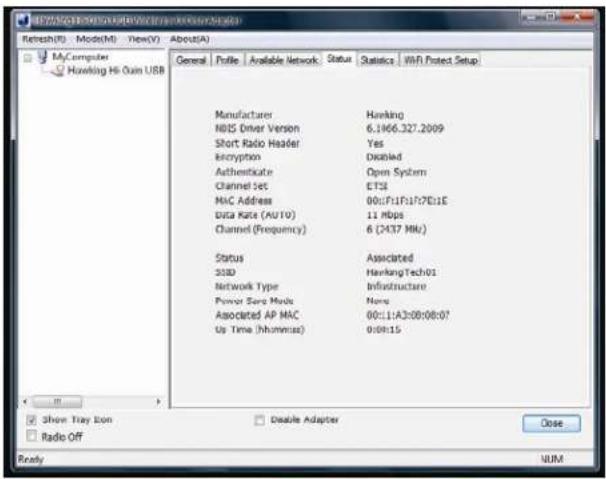
3.5 Status
This screen provides information regarding Hawking Technologies, the driver version, settings of the wireless network the adapter is connected to, the link time and link status.
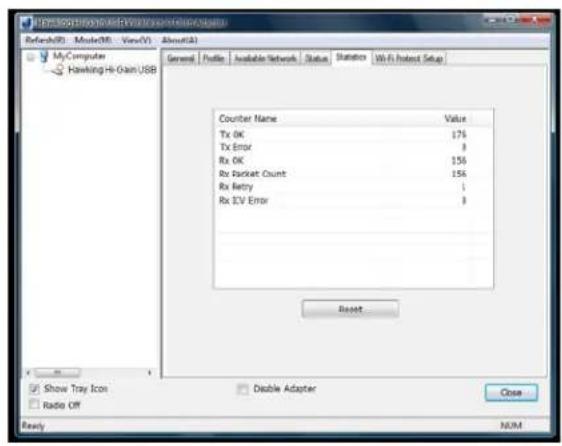
3.6 Statistics
You can get real time information about packet transmissions and receiving statuses during wireless communications. If you want to recount the statistics value, please click "Reset".
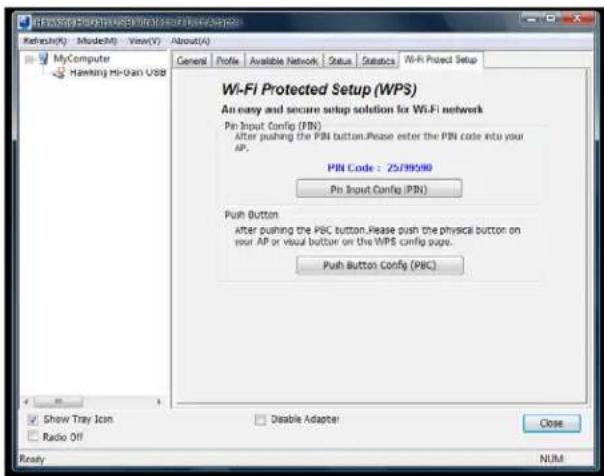
3.7 Wi-Fi Protected Setup (WPS)
Wi-Fi Protected Setup (WPS) is the latest wireless network technology which makes wireless network setup very simple. If you have a WPS-enabled wireless access point, and you want to establish a secure connection to it, you don't have to configure the wireless access point and setup data encryption by yourself. All you have to do is to go to the WPS setup page of this wireless card, click the WPS button, and then press a WPS button or enter a set of 8-digit code on the wireless access point you wish to establish a secure connection.
3.7.1 Pin Input Config (PIN)
-
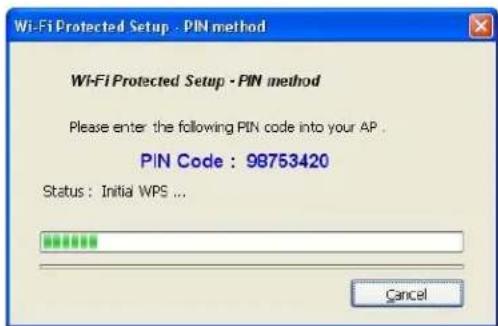
The PIN code of your wireless network card is an eight-digit number located at the upper-right position of configuration utility. Remember it, and input the number to your wireless access point as the WPS PIN code (Please refer to the user manual of your wireless access point for instructions about how to do this)
-
Click 'Pin Input Config (PIN)' button now, and the following message will appear on your computer, click 'Yes' to select a specific wireless access point or click 'No' to start PIN method of WPS.
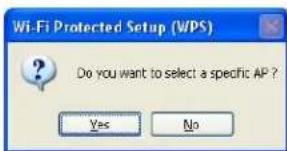
- If you click 'Yes', and the following message will appear on your computer, please select the SSID of wireless access point that you wish to connect and click 'Select'.
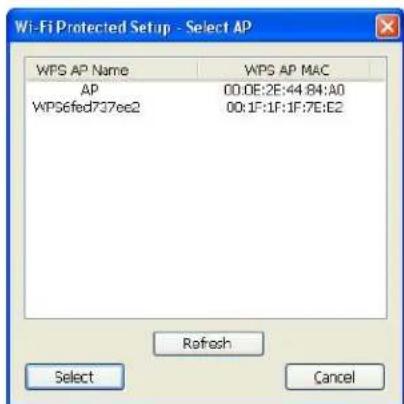
- Please wait while the install procedure is running and wait for few seconds to two minutes. If a wireless access point with correct PIN code is found, you'll be connected to that access point.
3.7.2 Push Button Config (PBC)
- Start PBC pairing procedure at access point side (please refer to the instruction given by your access point's manufacturer), then click 'PBC' button in wireless configuration utility to start to establish wireless connection by WPS. Please be patient (This may require several seconds to one minute to complete).
![Wi-Fi Protected Setup - PBC method WiFi Protected Setup - PBC method If there is more than one AP on the PBC mode, there will be [Session Overlap]. Please using PIN method or wait for a while push the button again. Status : Initial WPS ... Complete : Push Button Config (PBC) Cancel](/content/2026/05/1141441/images/96eedd91ed7c817291a73c1aae1eee5f5f9ead5e88b150bda9b946e9f506c3f0.jpg)
- When the connection between this wireless network card and access point is successfully established by WPS, and the information about access point you connected to will be displayed.
3.8 NETWORK SECURITY (WEP, WPA...)
If your AP/Router has a networking security key, you must enter the same security key and setting. If you do not have the Network Encryption key, please request it from the Network Administrator or the person who set up your wireless network.
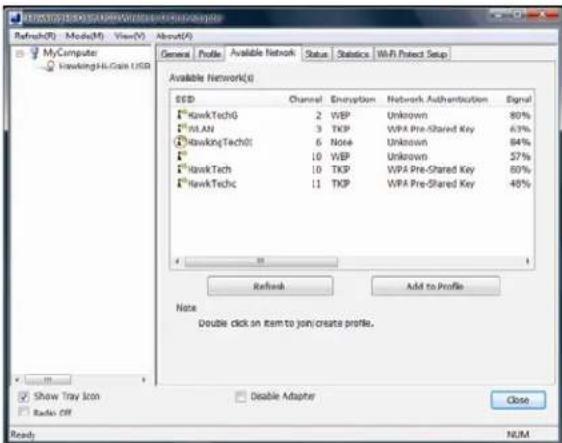
After you obtained the network security information, open up Hawking Wireless Utility. Continue below to set up your Network Security Code.
3.8.1 WEP Setup
If the SSID or Access Point you wish to connect has WEP authentication, select the SSID and click on Connect.
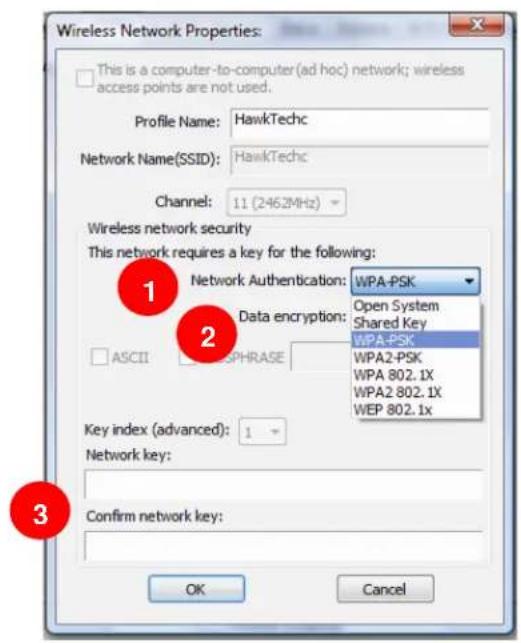
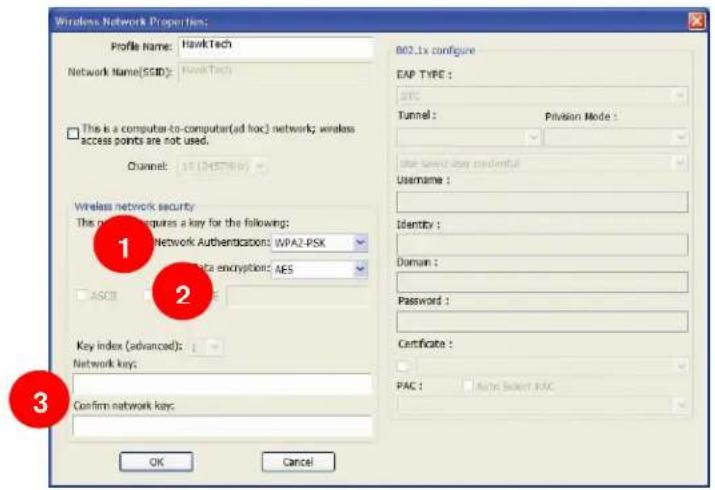
Make sure the 1. Network Authentication and 2. Data encryption matches your selected Network. Finally, enter the 3. Network Key.
Windows
Vista/7
Windows
XP/2000
WEP Setup Instructions:
(All settings should correspond with settings of the wireless AP that you are connecting to.)
a. Network Authentication field: indicates the authentication type of the AP/Router. Please confirm the setting of the AP/Router.
- Open: WEP open system is based on request and grant. It is essentially no authentication.
- Shared: WEP shared key is based on request, challenge, challenge response, grant/deny.
b. Data Encryption field: Select WEP
c. Enter in AP encryption keys (64/128bits) in the box Key1\~Key4. Please accept the auto selected setting of [Hex]/[ASCII].
d. Select the current AP encryption keys from Key1\~Key4.
e. Press [OK] to finish setting.
3.8.2 WPA Setup
WPA encryption type can be divided into WPA-PSK, WPA2-PSK, WPA (also known as WPA-EAP), and WPA2 (also known as WPA2-EAP). All settings should correspond with the wireless AP that you wish to connect to.
Setting the Authentication and Security Page:
a. Network Authentication: Select WPA-PSK or WPA2-PSK (note: your AP must support this function).
b. Data Encryption: Select TKIP ^1 or AES in the drop down menu.(Must Correspond to the Value on your AP)
c. Enter the WAP Preshared Key and click OK.
WPA and WPA2
-
If you wish to connect to an AP with WPA or WPA2 authentication, select the AP or SSID and select Connect. (For example the N Router is being selected, the security settings must correspond to Wireless Access Point)
-
Setting the Authentication and Security Page:
a. Network Authentication: select WPA or WPA2-PSK (AP must support the function).
b. Data Encryption: select TKIP ^1 or AES (Same as AP)
c. If the AP/router has 802.1x setting function, click it for advanced settings. Please consult your network administrator for details or check the user manual of the Wireless Access Point. (See the Screen shot on the next page)
Click OK to finish setting.
4. Uninstalling Hawking Utility/Driver
Select Uninstall option from the start menu.
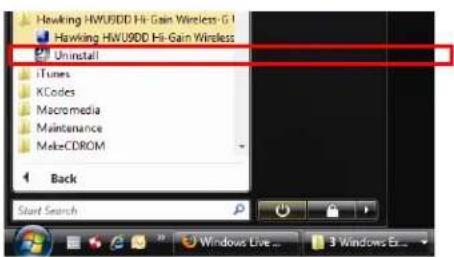
Select "Yes" to remove all its features.
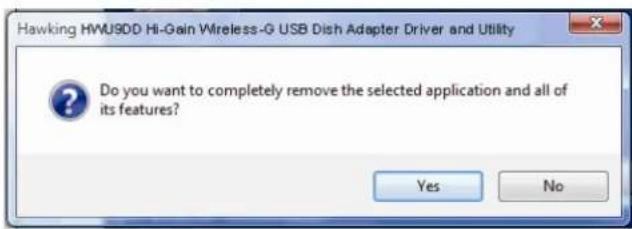
Removing the utility is in progress.

HWU9DD Driver and Utility has finished uninstalling. Select Finish.
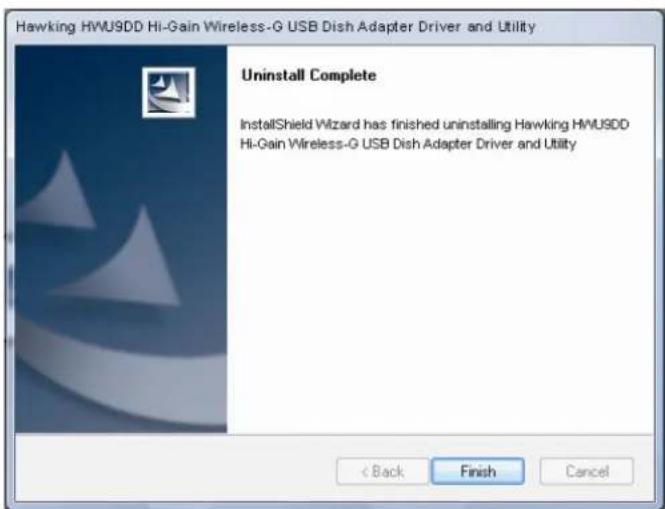
III. FOR MAC USERS
1. Installation for Mac OSX 10.4 or later
IMPORTANT:
- Please do not install the wireless adapter into your Mac desktop or notebook before installing the software program from the CD.
- The following installation was operated under Apple OSX 10.5 Leopard. (Installation Procedures are similar in other OS. However, the installation images and screens may not look the same as the ones in this manual)
-
If you have previously installed other Wireless Adapter Drivers & Utilities, please uninstall the older version first.
-
Power on your Computer and insert the Setup CD into your CD-ROM Drive. A folder should automatically open. If there is no folder opening up automatically, click on the CD icon on your desktop to manually open the folder.
a. Double click the icon in the folder that is titled "CLICK HERE TO START"
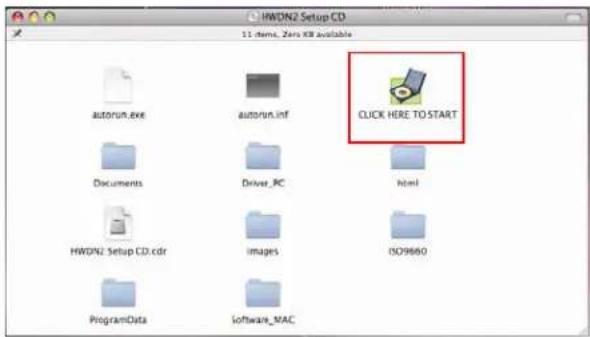
- Please select a Mac OS Setup according to the system you are operating:
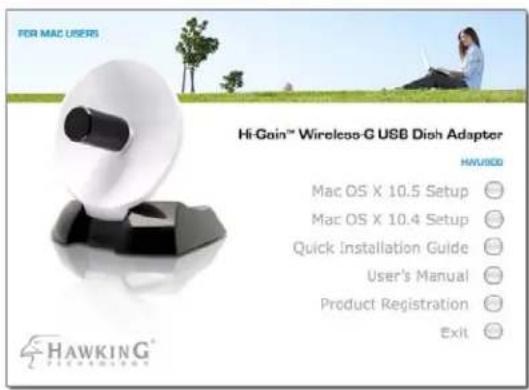
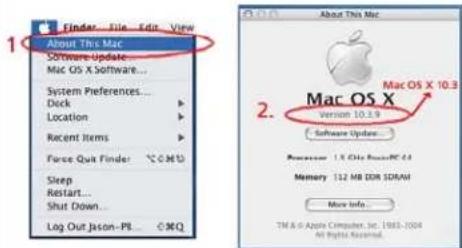
Note: If you are uncertain about which version of the Mac OS X your are using, click on the Apple icon located on the left corner of the menu bar and select "About This Mac." The version number should appear in a pop up window.
Tiger: Mac 10.4 \~10.4.9
Leopard: Mac 10.5 \~10.5.x
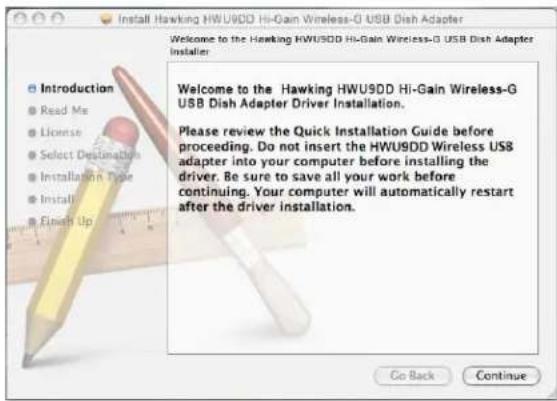
- Welcome to the Hawking HWU9DD Hi-Gain Adapter Driver Installer. Select "Continue".
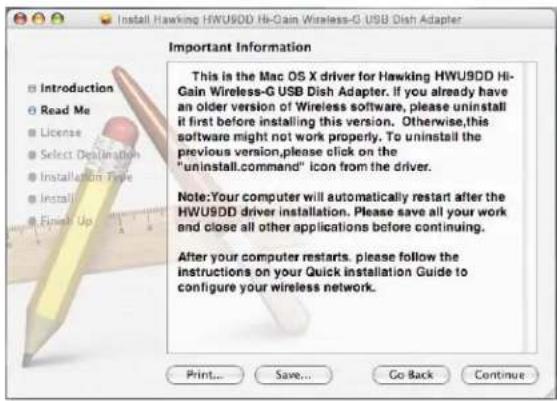
- Read the Important information in the following screen, then "Continue".
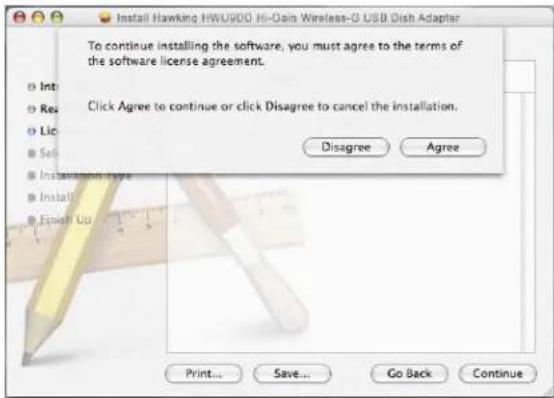
- Software License Agreement: select "Continue".
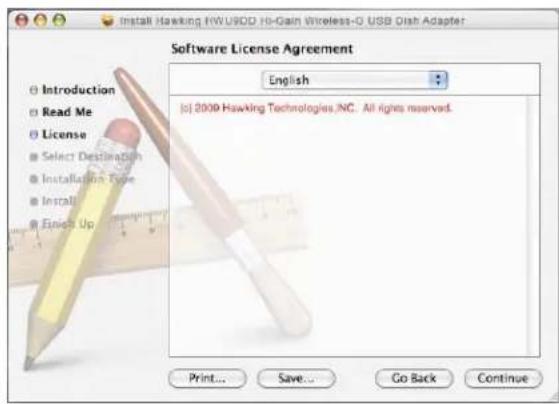
- Click Agree to continue.
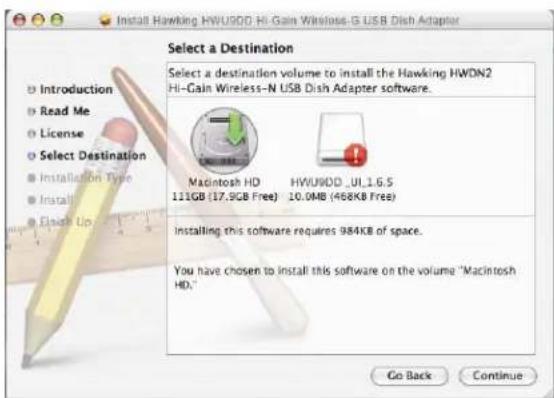
- Select a destination and "Continue".
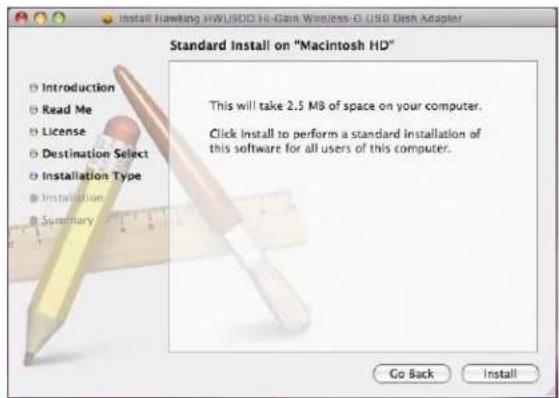
- The driver will take 2.5MB of space on your computer. Click "Install" to continue.
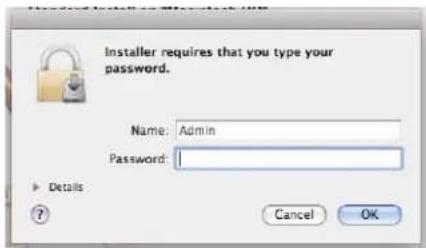
- If your computer is password protected, please enter your password to continue.
- Again, make sure you save all your work, then select "Continue Installation".
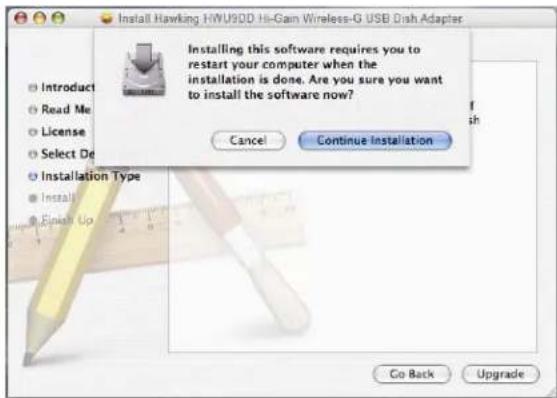
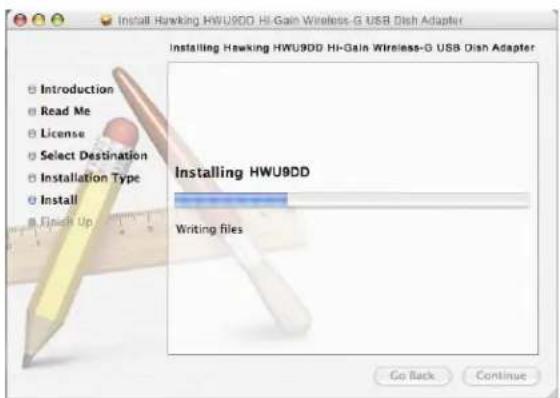
- Please wait while your wizard is installing the HWU9DD Driver.
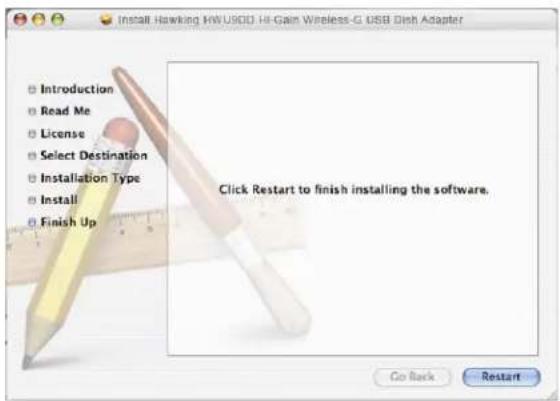
- Finally, select "Restart".
2. Connecting To Your Wireless Network (Mac 10.5 or later)
-
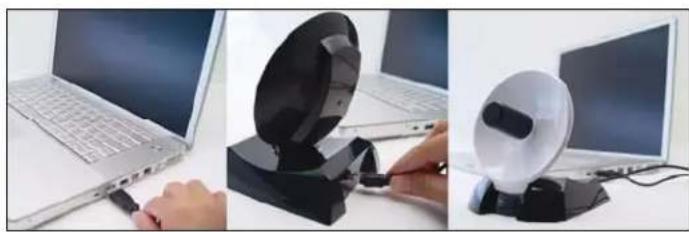
When your computer has successfully restarted. Insert the HWU9DD Hi-Gain Wireless-G USB Dish Adapter into an available USB port on your desktop or notebook computer.
-
Insert the USB dish adapter firmly into the USB port to ensure a proper connection is made.
- When the adapter is inserted carefully lift the antenna unit upright.
natural_image
Three-panel photo showing a laptop with a black circular device being inserted into a black base, next to a white circular device on a stand (no text or symbols visible)NOTE: If your computer or laptop already has a built-in Airport Card, please turn it off by going to the Wireless Icon on the top right corner or your screen and select "TURN OFF AIRPORT."
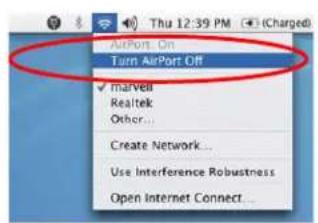
If this is your first time using the Wireless-G USB Dish Adapter on your computer, you will need to enable the HWU9DD in your Network Preference.
- After plugging in the Adapter, the Hawking HWU9DD Wireless Utility will automatically pop up. You will be asked to enable your WLAN card. When a NOTICE comes up, select "OK". Then, select "Network Preferences."
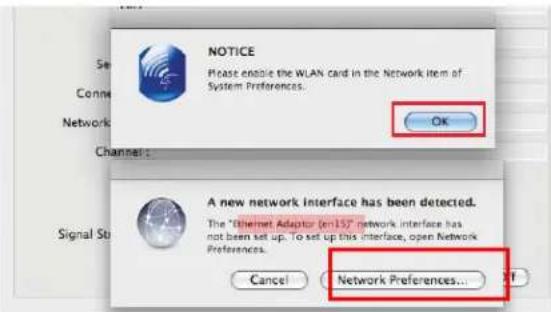
Please note the "Ethernet Adapter (en15)" network interface. You will need to enable this in the Network Preferences. Note: the screen above shows "Ethernet Adapter (en15)" network interface, however it may be vary slightly on your computer.
- Enabling the USB Adapter in your Network Preferences by selecting "Ethernet Adapter (....)", then click "Apply."
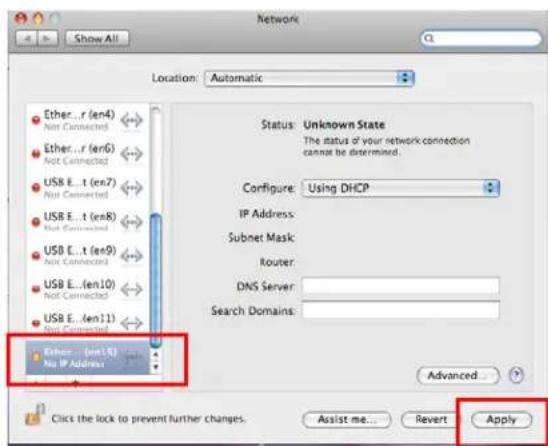
4.
SIDE NOTE: Configure IP Manually vs. Automatic (DHCP)
- If you plan on using a "Static" (Manually entered) IP address for your computer you may do so here by double clicking the "USB Wireless Adapter" selection and selecting TCP/IP.
- If you are using an automatically assigned IP address (MOST NETWORKS) you do not have to worry about this. Simply close the window to proceed.
HOW TO CHANGE YOUR IP ADDRESS TO STATIC MODE
(Change from DHCP to Manual Configuration)
- If your wireless network uses a static IP address or requires manual configuration you may do so by highlighting the USB wireless adapter (Shown above).
- Select "Configure" to enter the configuration menu for the wireless adapter.
- Select the Tab that is named TCP/IP
- Select the menu button for "Configure IPv4" and choose the appropriate selection
- You can manually configure your IP Address, DNS Servers and other information here.
- Please contact a network administrator if you are uncertain of the settings that are required to connect to your network.
- When you have finished select APPLY NOW to continue.
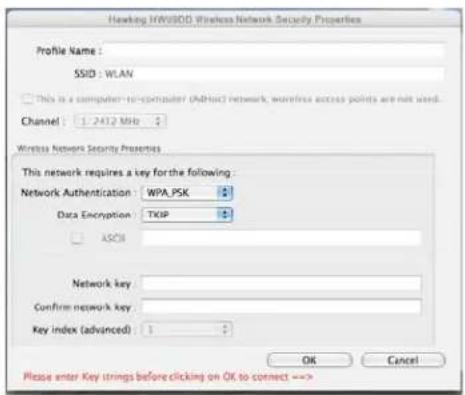
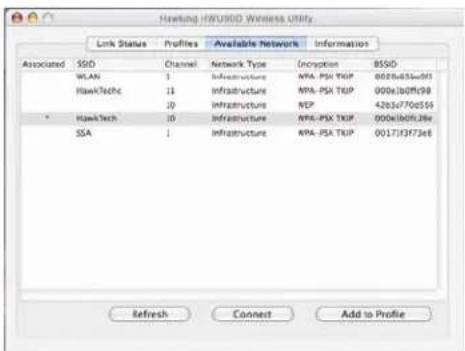
From Hawking HWU9DD Wireless Utility, select "Available Network" tab. Then select your desired Wireless Network (SSID).
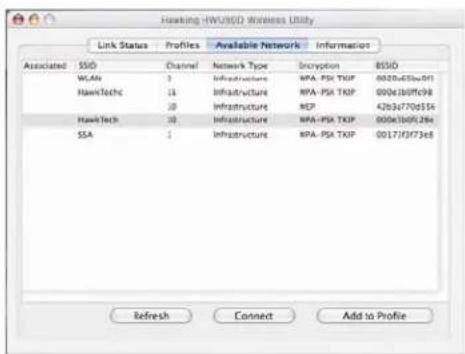
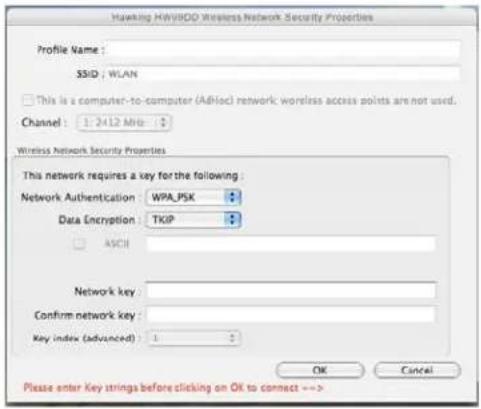
- If your selected network has encryption, please enter the network key and confirm it. If the selected network has encryption, please enter the password and confirm it.
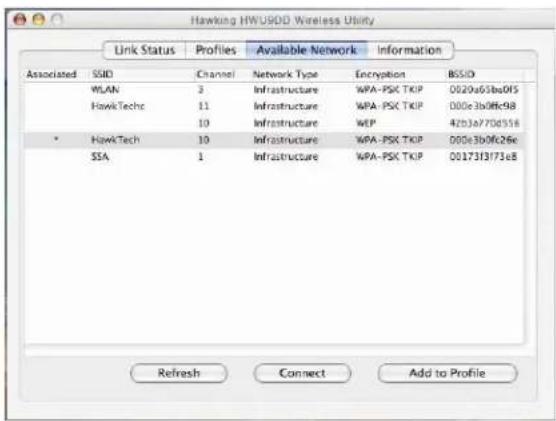
- Congratulations! the asterisk sign (*) next to the selected network indicates that your are connected.
3. Connecting To Your Wireless Network (Mac 10.4\~10.4.9)
-
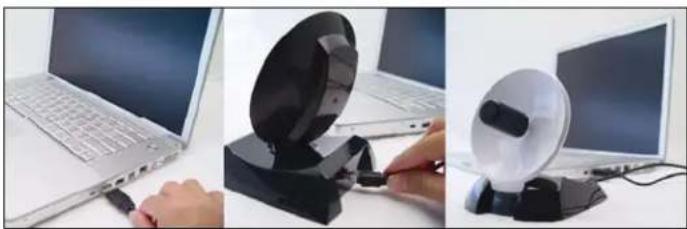
When your computer has successfully restarted. Insert the HWU9DD Hi-Gain Wireless-G USB Dish Adapter into an available USB port on your desktop or notebook computer.
-
Insert the USB dish adapter firmly into the USB port to ensure a proper connection is made.
- When the adapter is inserted carefully lift the antenna unit upright.
natural_image
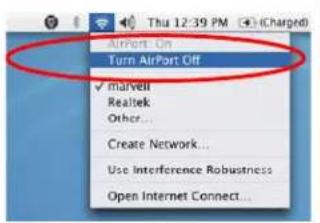
Three-panel photo showing a laptop, a black-and-white device with a circular lens, and a computer monitor (no visible text or symbols)NOTE: If your computer or laptop already has a built-in Airport Card, please turn it off by going to the Wireless Icon on the top right corner or your screen and select "TURN OFF AIRPORT." If this is your first time using the Wireless-G USB Dish Adapter on your computer, you will need to enable the HWU9DD in your Network Preference.
- After plugging in the Adapter, the Hawking HWU9DD Wireless Utility will automatically pop up. You will be asked to enable your WLAN card. When a NOTICE comes up, select "OK".
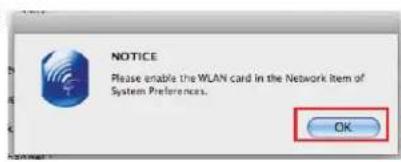
- System Preferences and Network Settings:
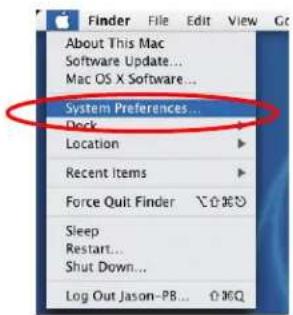
a) Click the APPLE icon on the top left corner of your desktop and open the SYSTEM PREFERENCES menu.
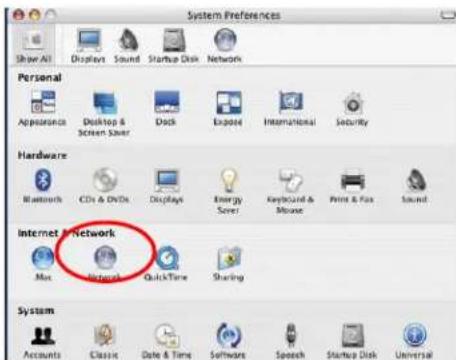
b) If this is your first time using the Wireless-150N USB Dish Adapter on your computer, you will need to enable the device before using the Wireless Utility. In the System Preferences page, locate the NETWORK icon and double click it to access the control panel.
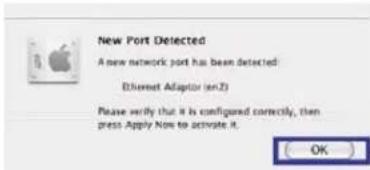
- The new USB wireless adapter will automatically be detected. Click "OK" to continue.
- Click "APPLY NOW" to confirm the selection.
- If you are using an automatically assigned IP address (MOST NETWORKS) you do not have to worry about this. Simply close the window to proceed.
- If you plan on using a "Static" (Manually entered) IP address for your computer you may do so here by double clicking the "USB Wireless Adapter" selection and selecting TCP/IP.
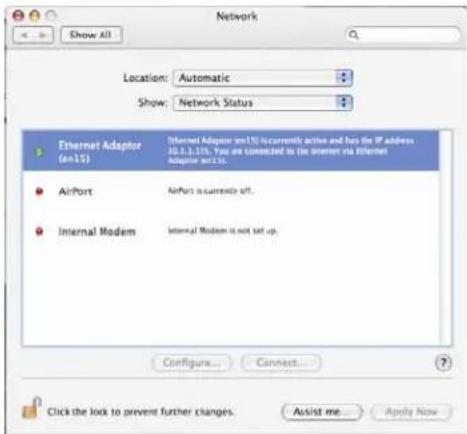
SIDE NOTE: Configure IP Manually vs. Automatic (DHCP)
- If you plan on using a "Static" (Manually entered) IP address for your computer you may do so here by double clicking the "USB Wireless Adapter" selection and selecting TCP/IP.
- If you are using an automatically assigned IP address (MOST NETWORKS) you do not have to worry about this. Simply close the window to proceed.
HOW TO CHANGE YOUR IP ADDRESS TO STATIC MODE
(Change from DHCP to Manual Configuration)
- If your wireless network uses a static IP address or requires manual configuration you may do so by highlighting the USB wireless adapter (Shown above).
- Select "Configure" to enter the configuration menu for the wireless adapter.
- Select the Tab that is named TCP/IP
- Select the menu button for "Configure IPv4" and choose the appropriate selection
- You can manually configure your IP Address, DNS Servers and other information here.
- Please contact a network administrator if you are uncertain of the settings that are required to connect to your network.
-
When you have finished select APPLY NOW to continue.
-
From Hawking HWU9DD Wireless Utility, select "Available Network" tab. Then select your desired Wireless Network (SSID).
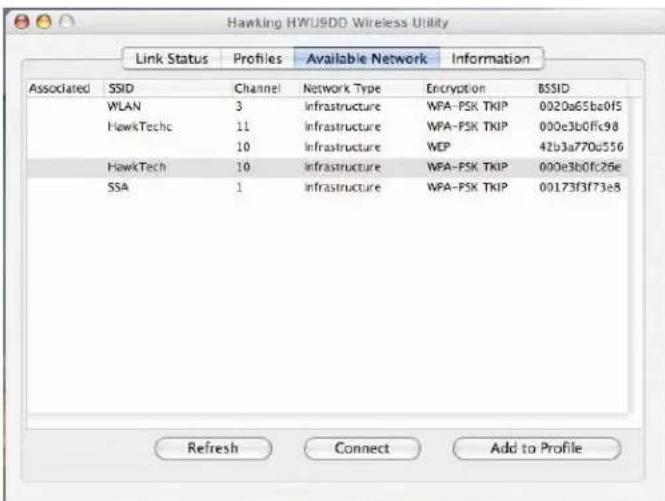
- If your selected network has encryption, please enter the network key and confirm it. If the selected network has encryption, please enter the password and confirm it.
- Congratulations! The asterisk sign (*) next to the selected network indicates that your are connected.
4. Hawking HWU9DD Wireless Utility
The Hawking HWU9DD Wireless Utility is an application that helps you configure the HWU9DDA and monitor the link status and statistics of your wireless connection.

Each time you insert the HWU9DD the Hawking Wireless Utility should automatically load. In the case that it doesn't you may manually load the Utility by using "FINDER" to view your "APPLICATIONS" folder and selecting the Hawking Wireless Utility Icon displayed on the left.
4.1 Available Network
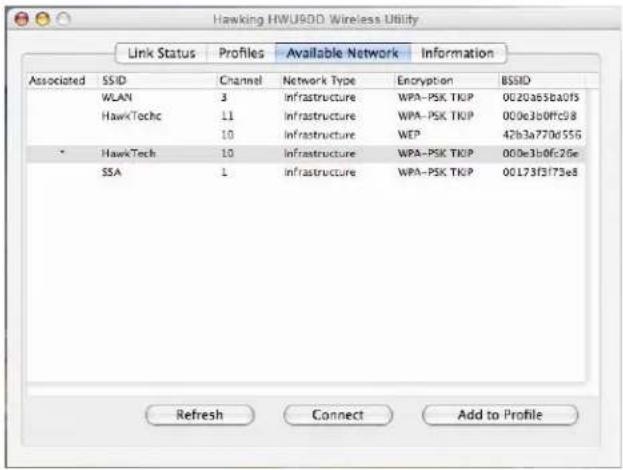
When you open the Wireless Utility, the system will scan all wireless channels to find all access points/stations within the accessible range of your adapter and automatically connect to the wireless device with the highest signal strength. When using the "Available Network" option, all nearby networks will be listed. You can change your connection to another network or you may add one of the networks to your own profile list.
| Parameter | Description |
| Available Network This list shows all available wireless networks within range of your card. It also displays the information of the networks including the SSID, BSSID, Channel, Encryption, Authentication and Network Type. If you want to connect to any networks on the list, double-click the item on the list, and the adapter will automatically connect to the selected network. An asterisk sign (*) in the Associated column shows that you are connected to the corresponding network (SSID). | |
| Refresh Button | Click “Refresh” button to view all the wireless networks nearby. |
| Connect Button | Click “Connect” to connect to the selected network. |
| Add to Profile Button | Add the selected network to Profiles list. |
4.2 Profiles
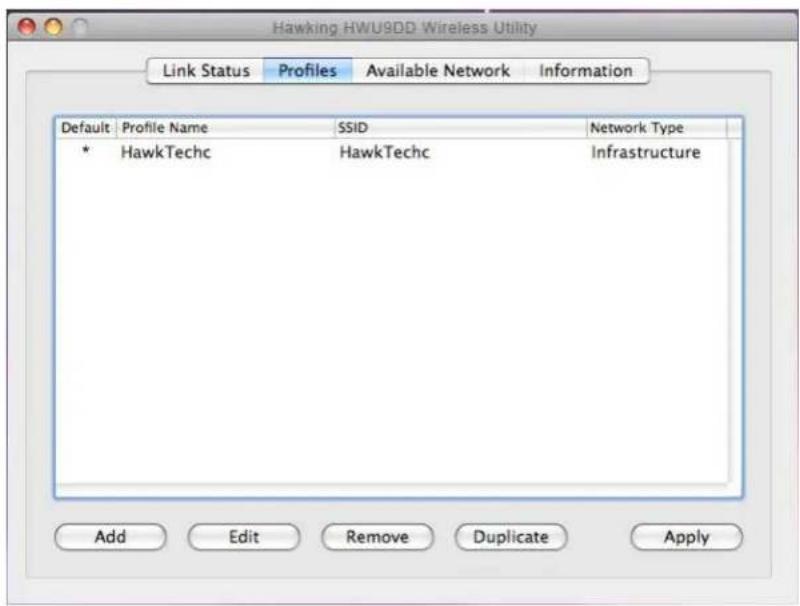
The "Profiles List" is for you to manage the networks you connect to frequently. You are able to Add/Delete/Edit/Activate a profile.
| Parameter | Description |
| Profiles List The profiles list display all the profiles and the relative information including Profile Name, SSID, Channel, etc. | |
| Add/ Edit/Remove/Duplicate Button | Click these buttons to Add/ Edit/Remove/Duplicate the selected profiles. |
| Apply | Click “Apply” to connect to the selected profile. |
4.2.1 Configure the Profile
| Parameter | Description |
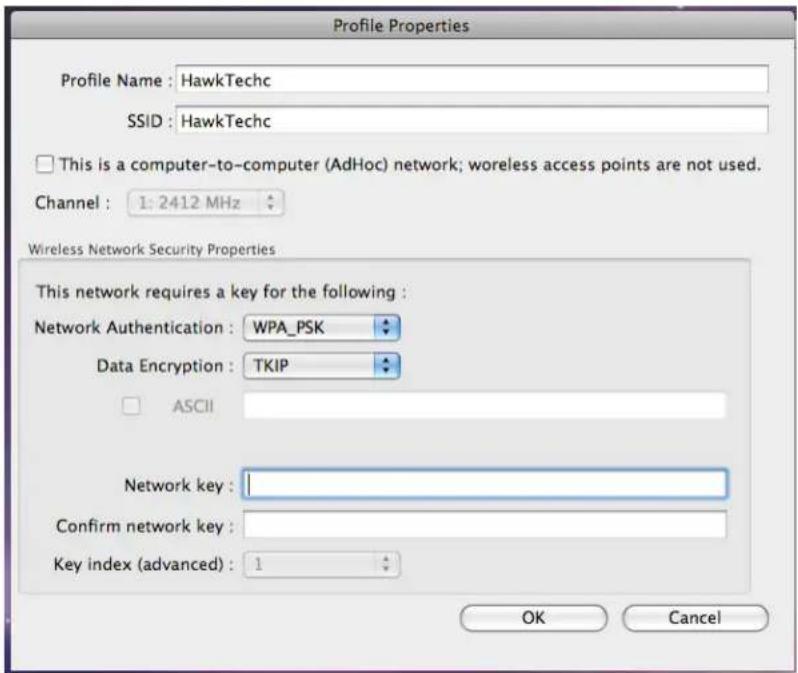
| Profile Name | Define a recognizable profile name for you to identify the different networks |
| Network Name (SSID) | The SSID (up to 32 printable ASCII characters) is the unique name identified in a WLAN. The ID prevents the unintentional merging of two co-located WLANs.You may specify a SSID for the adapter and then only the device with the same SSID can interconnect to the adapter. |
| This is a computer-to-computer (ad hoc) network; wireless access points are not used. | There are two kinds of network type described as follows.Infrastructure – This operation mode requires the presence of an 802.11 Access Point. All communication is done via the Access Point or Router.Ad Hoc – Connect to another wireless adapter in the Wireless LAN network without through an Access Point or Router.If this item is selected, the adapter will work in Ad Hoc mode. |
| Channel | This setting is only available for Ad Hoc mode. Select the number of the radio channel used for the networking. The channel setting should be the same with the network you are connecting to. |
| Network Authentication | This setting has to be consistent with the wireless networks that the adapter intends to connect.Open System – No authentication is needed among the wireless network.Shared Key – Only wireless stations using a shared key (WEP Keyidentified) are allowed to connecting each other.WPA-PSK – It is a special mode designed for home and small business users who do not have access to network authentication servers. In this mode, known as Pre-Shared Key, the user manually enters the starting password in their access point or gateway, as well as in each wireless station in the network. WPA-PSK takes over automatically from that point, keeping unauthorized users that don't have the matching password from joining the network, while encrypting the data traveling between authorized devices.WPA2-PSK – WPA2-PSK is also for home and small business. The difference between WPA-PSK and WPA2-PSK is that WPA2-PSK provides data encryption via the AES. In contrast, WPA-PSK uses Temporal Key Integrity Protocol (TKIP).WPA 802.1X – WPA provides a scheme of mutual authentication using either IEEE 802.1x/Extensible Authentication Protocol (EAP) authentication or pre-shared key (PSK) technology. It provides a high level of assurance to enterprises, small businesses and home users that data will remain protected and that only authorized users may access their networks. For enterprises that have already deployed IEEE 802.1x authentication, WPA offers the advantage of leveraging existing authentication databases and infrastructure.WPA2 802.1X – Like WPA, WPA2 supports IEEE 802.1 x/EAP authentications or PSK technology. It also includes a new advanced encryption mechanism using the Advanced Encryption Standard (AES). AES is required to the corporate user or government users. The difference between WPA and WPA2 is that WPA2 provides data encryption via the AES. In contrast, WPA uses Temporal Key Integrity Protocol (TKIP).WEP 802.1X – It's a special mode for using IEEE 802.1x/EAP technology for authentication and WEP keys for data encryption. |
| Data Encryption | Disabled – Disable the WEP Data Encryption.WEP – Enable the WEP Data Encryption. When the item is selected, you have to continue setting the WEP Encryption keys.TKIP – TKIP (Temporal Key Integrity Protocol) changes the temporal key every 10,000 packets (a packet is a kind of message transmitted over a network.) This insures much greater security than the standard WEP security. (Note: This mode is not certified. Performance may vary under this setting.)AES – AES has been developed to ensure the highest degree of security and authenticity for digital information and it is the most advanced solution defined by IEEE 802.11i for the security in the wireless network.Note: All devices in the network should use the same encryption method to ensure the communication. |
| ASCII | WEP Key can be ASCII format. Alphanumeric values or signs are allowed to be the WEP key. It is more recognizable for user. |
| PASSPHRASE | It is a text string with a maximum of 32 alphanumeric characters, for example: “Test”. The WEP Key is based upon the Passphrase determined by you. This passphrase may not work with other vendors' products due to possible incompatibility with other vendors' passphrase generators. You must use the same passphrase or WEP key settings for all wireless computers within the network. |
| Key Length | When you select the “WEP and “PASSPHRASE” and this function will display in the current status of the utility.The keys are used to encrypt data transmitted in the wireless network.Fill the text box by following the rules below.64-bit – Input 10-digit Hex values as the encryption keys. For example: “0123456aef”.128-bit – Input 26-digit Hex values as the encryption keys. For example: “01234567890123456789abcdef”. |
| Key Index (advanced) Select one of the four keys to be the data encryption key. | |
| Network Key | Please enter network security key here to make sure the password is correct. |
| Confirm Network Key Please enter network security key here again. | |
| EAP Type | GTC – GTC is an authentication protocol which allows the exchange of clear text authentication credentials across the network.TLS – TLS is the most secure of the EAP protocols but not easy to use. It requires that digital certificates be exchanged in the authentication phase. The server presents a certificate to the client. After validating the server's certificate, the client presents a client certificate to the server for validation.LEAP – LEAP is a pre-EAP, Cisco-proprietary protocol, with many of the features of EAP protocols. Cisco controls the ability of other vendors to implement this protocol, so it should be selected for use only when limited vendor choice for client, access-point, and server products is not a concern. When you have set up LEAP authentication, you have to enter the user name and password of your computer.PEAP & TTLS – PEAP and TTLS are similar and easier than TLS in that they specify a stand-alone authentication protocol be used within an encrypted tunnel. TTLS supports any protocol within its tunnel, including CHAP, MSCHAP, MSCHAPv2 and PAP. PEAP specifies that an EAP-compliant authentication protocol must be used; this adaptor supports MD5, TLS, GTC (Generic Token Card) and MSCHAPv2. The client |
certificate is optional required for the authentication.
4.3 Link Status Page

The Link Status page gives you information regarding your current wireless channel, transmit rate (speed) and link/signal quality. You will use this utility to figure out which antenna position results in the best performance and connection.
Obtaining the Strongest Connection
- First you must determine where the location of your Wireless Access Point is within your network.
- Position the directional antenna towards the location of the Access Point.
- While viewing your Link Status utility, rotate the antenna clockwise and counter-clockwise slowly to figure out which position gives you the highest Link Quality and Signal Strength. Once you have determined which position gives you the best signal, leave the antenna in that orientation
4.4 Information
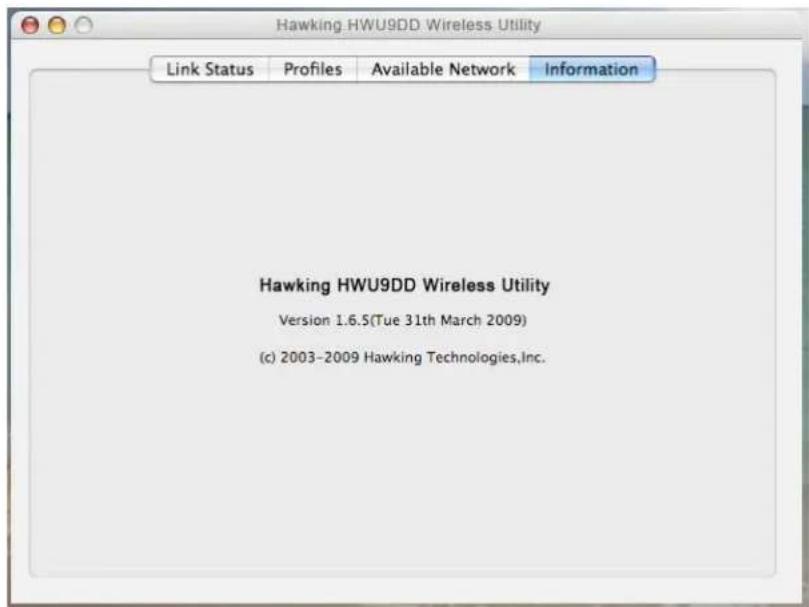
By choosing this option, you can the information about the Driver and Utility.
5. Uninstalling Hawking Utility (Mac)
- Insert the Original Setup CD. Select "Software_MAC" folder.
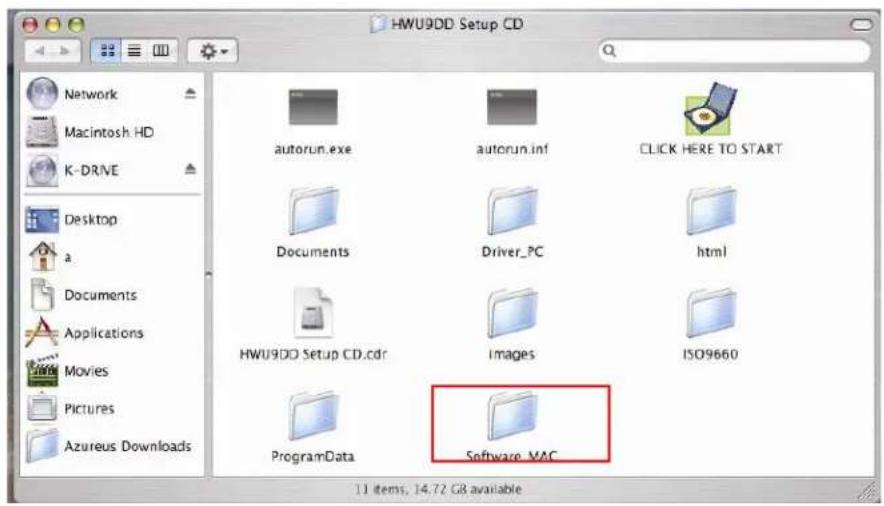
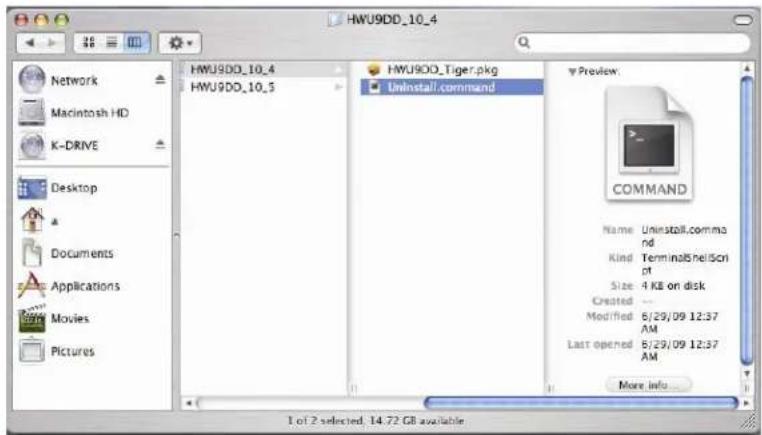
- Select your Mac OS (10.4 or 10.5) and the "Uninstall.command
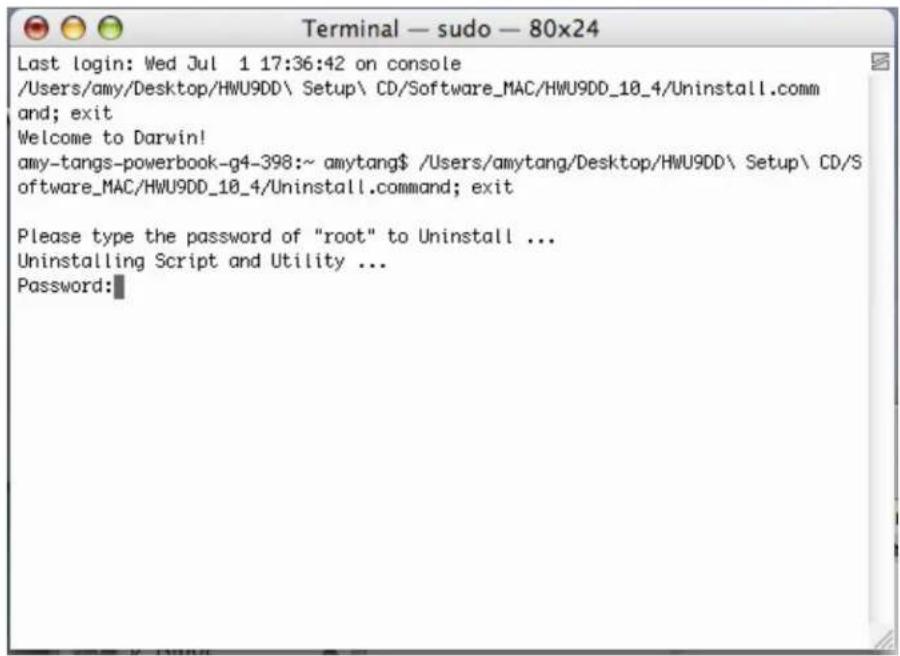
- Click on "Password" and enter the password for your computer, then "enter". If your computer is not password protected, then press enter.
IV. APPENDIX A – SPECIFICATIONS
• Standard: IEEE 802.11b/g/n
- Interface: USB 2.0 Type A
• Frequency Band: 2.4000 \~ 2.4835GHz (Industrial Scientific Medical Band)
- Data Rate:
11b: 1/2/5.5/11Mbps
11g: 6/9/12/24/36/48/54Mbps
11n (20MHz): MCS0-7 (up to 72Mbps)
11n (40MHz): MCS0-7 (up to 150Mbps)
• Security: 64/128-bit WEP Data Encryption, WPA, WPA2
- Antenna: Hi-Gain Dual Antenna – Dish Technology
- Drivers: Windows 2000/XP/Vista or Mac 10.4 or later
• LEDs: Link/Activity
• Transmit Power: 11n: 14±1.5dBm, 11g: 14±1.5dBm, 11b: 17±1.5dBm
• Dimension: 4.17(L) in x 4.9(W) in x 5.14(H) in
• Weight: 137 gram / 4.8 oz
- Temperature: Operating 32\~104°F (0 \~40°C), Storage -13\~149°F (-25\~65°C)
• Humidity: Max. 95% (Non-Condensing)
- Certification: FCC
V. INDEX
This chapter provides solutions to problems usually encountered during the installation and operation of the adapter.
1. What is the IEEE 802.11n standard?
802.11n is an IEEE 802.11 wireless network standard that increases transmission speeds from a traditional 11Mbps (802.11b) to over 100Mbps. Currently, the HWU9DD supports up to 150Mbps.
802.11n can handle legacy 11a, 11b and 11g transmission in a mixed mode or only 11n nodes for maximum performance. It supports the 2.4GHz and 5GHz frequency bands.
The key to the 802.11n standard is the use of multiple antennas, known as MIMO (Multiple input/multiple output). MIMO technology enables two data streams, transmitter and receiver, to be sent simultaneously over longer distances and to improve the overall system performance.
2. What does IEEE 802.11 feature support?
The product supports the following IEEE 802.11 functions:
• CSMA/CA plus Acknowledge Protocol
- Multi-Channel Roaming
• Automatic Rate Selection
- RTS/CTS Feature
- Fragmentation
• Power Management
3. What is Ad-hoc?
An Ad-hoc integrated wireless LAN is a group of computers, each has a Wireless LAN adapter, Connected as an independent wireless LAN. Ad hoc wireless LAN is applicable at a departmental scale for a branch or SOHO operation.
4. What is Infrastructure?
An integrated wireless and wireless and wired LAN is called an Infrastructure configuration. Infrastructure is applicable to enterprise scale for wireless access to central database, or wireless application for mobile workers.
5. What is BSS ID?
A specific Ad hoc LAN is called a Basic Service Set (BSS). Computers in a BSS must be configured with the same BSS ID.
6. What is WEP?
WEP is Wired Equivalent Privacy, a data privacy mechanism based on a 40 bit shared key algorithm, as described in the IEEE 802.11 standard.
7. What is TKIP?
TKIP is a quick-fix method to quickly overcome the inherent weaknesses in WEP security, especially the reuse of encryption keys. TKIP is involved in the IEEE 802.11i WLAN security standard, and the specification might be officially released by early 2003.
8. What is AES?
AES (Advanced Encryption Standard), a chip-based security, has been developed to ensure the highest degree of security and authenticity for digital information, wherever and however communicated or stored, while making more efficient use of hardware and/or software than previous encryption standards. It is also included in IEEE 802.11i standard. Compare with AES, TKIP is a temporary protocol for replacing WEP security until manufacturers implement AES at the hardware level.
9. Can Wireless products support printer sharing?
Wireless products perform the same function as LAN products. Therefore, Wireless products can work with Netware, Windows 2000, or other LAN operating systems to support printer or file sharing.
10. Would the information be intercepted while transmitting on air?
WLAN features two-fold protection in security. On the hardware side, as with Direct Sequence Spread Spectrum technology, it has the inherent security feature of scrambling. On the software side, WLAN series offer the encryption function (WEP) to enhance security and Access Control. Users can set it up depending upon their needs.
11. What is DSSS? What is FHSS? And what are their differences?
Frequency-hopping spread-spectrum (FHSS) uses a narrowband carrier that changes frequency in a pattern that is known to both transmitter and receiver. Properly synchronized, the net effect is to maintain a single logical channel. To an unintended receiver, FHSS appears to be short-duration impulse noise. Direct-sequence spread-spectrum (DSSS) generates a redundant bit pattern for each bit to be transmitted. This bit pattern is called a chip (or chipping code). The longer the chip is, the greater the probability that the original data can be recovered. Even if one or more bits in the chip are damaged during transmission, statistical techniques embedded in the radio can recover the original data without-the need for retransmission. To an unintended receiver, DSSS appears as low power wideband noise and is rejected (ignored) by most narrowband receivers.
12. What is Spread Spectrum?
Spread Spectrum technology is a wideband radio frequency technique developed by the military for use in reliable, secure, mission-critical communication systems. It is designed to trade off bandwidth efficiency for reliability, integrity, and security. In other words, more bandwidth is consumed than in the case of narrowband transmission, but the trade off produces a signal that is, in effect, louder and thus easier to detect, provided that the receiver knows the parameters of the spread-spectrum signal being broadcast. If a receiver is not tuned to the right frequency, a spread –spectrum signal looks like background noise. There are two main alternatives, Direct Sequence Spread Spectrum (DSSS) and Frequency Hopping Spread Spectrum (FHSS).
13. What is Hi-Gain and dBi?
Hi-Gain is Hawking Technologies' high performance wireless distance extending product line. It encompasses a group of products and technologies used to help solve distance issues accompanied with Wi-Fi products. A unit of measurement on antenna strength and power is dBi. The higher the dBi or gain level of an antenna the more powerful it is.
14. What is the difference between directional and omni-directional antennas?
Directional and omni-directional antennas determine the wireless output pattern of antennas. In standard installations it is normally the wireless access point that uses the omni-directional antenna (360 degree wireless output) whiles the clients (desktop or laptops) that use the directional antennas (concentrated narrow wireless signal) to create a stronger link directly to the access point.
15. How do I get an Optimal Wireless Connection with the HWU9DD?
If pointing the antenna directly at the access point is not providing a sufficient signal connection then you can try bouncing the signals off walls. Wireless signals can reflect off walls or through windows to get to their desired location so try different positions to find the best antenna orientation for your network.
VI. PRODUCT SUPPORT INFORMATION
Thank you for choosing Hawking Technologies. Please do not hesitate to contact us if you have any questions regarding the installation of your product. We're here to help you 24 hours a day, 7 days a week!
PHONE SUPPORT
888.202.3344
Toll-Free 24/7 Technical Support Line (US & Canada Only)
WEBSITE SUPPORT
• http://www.hawkingtech.com/support
You'll find: (a) Firmware/Driver updates with the latest features and news on your product (b) Frequently Asked Questions (FAQs) with answers to common asked questions about your product.]
EMAIL SUPPORT
• techsupport@hawkingtech.com
DOCUMENT SUPPORT
• Product User's Manual
(Normally located on the product CD)
You'll find detail install instruction on your product and default user name and password.
RMA (RETURN MERCHANDISE AUTHORIZATION)
- http://www.hawkingtech.com/support/customerservice.php
CUSTOMER SERVICE
- Email: customerservice@hawkingtech.com
• Tel: 949.206.6900 ext:1000
We want to hear from you! We hope you will have a wonderful experience using our hawking product. If there is any concern, please email us at customerservice@hawkingtech.com.