Spectrum Select Flat Bed 2 Burner - Barbecue Outback - Free user manual and instructions
Find the device manual for free Spectrum Select Flat Bed 2 Burner Outback in PDF.


| Product Type | Barbecue |
| Brand | Outback |
| Model | Spectrum Select Flat Bed 2 Burner |
| Fuel Type | LPG (Propane) |
| Number of Burners | 2 |
| Cooking Surface | Flat bed (griddle plate) |
| Material | Stainless steel body, porcelain-coated griddle |
| Ignition Type | Piezo ignition |
| Dimensions (L x W x H) | 1200 mm x 600 mm x 900 mm |
| Cooking Area | 60 cm x 40 cm |
| Net Weight | 30 kg |
| Side Shelves | 2 folding side shelves |
| Temperature Gauge | Built-in dial thermometer in lid |
| Grease Management | Removable grease tray |
| Cleaning | Wipe griddle with warm soapy water; empty grease tray |
| Safety Features | Gas shut-off valve, stable base with locking castors |
| Assembly Required | Yes (tools included) |
| Warranty | 1 year limited warranty |
| Country of Origin | China |
Frequently Asked Questions - Spectrum Select Flat Bed 2 Burner Outback
User questions about Spectrum Select Flat Bed 2 Burner Outback
0 question about this device. Answer the ones you know or ask your own.
Ask a new question about this device
Download the instructions for your Barbecue in PDF format for free! Find your manual Spectrum Select Flat Bed 2 Burner - Outback and take your electronic device back in hand. On this page are published all the documents necessary for the use of your device. Spectrum Select Flat Bed 2 Burner by Outback.
USER MANUAL Spectrum Select Flat Bed 2 Burner Outback
Assembly and Operating Instructions for Outback®
Spectrum Select Flat Bed 2 Burner and Spectrum Select Flat Bed 3 Burner Gas BBQ
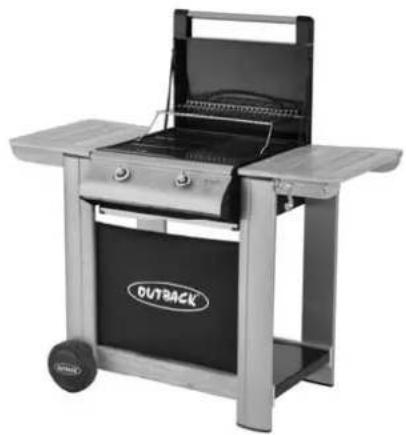
natural_image
Exterior view of a modern outdoor grill with a 'OUTBACK' logo on the back panel (no additional text or symbols visible)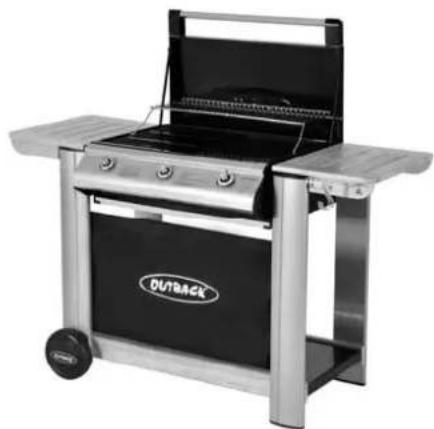
natural_image
Exterior view of a modern outdoor grill with a black and silver body (no visible text or symbols)TRG2301P-3 TRG3301P-3
Photographs are not to scale.
Specifications subject to change
without prior notice.

0359

WARNING
- For outdoor use only. Not for commercial use.
- Read instructions before using the appliance. Failure to follow instructions could result in death, serious bodily injury, and/or property loss.
- Warning: accessible parts may be very hot. Keep young children and pets away.
- Do not move the appliance during use.
- Turn off the gas supply at the gas bottle after use.
- Any modification of the appliance, misuse, or failure to follow the instructions may be dangerous and will invalidate your warranty. This does not affect your statutory rights.
- Retain these instructions for future reference.
- Leak test annually, and whenever the gas bottle is removed or replaced. Check that the hose connections are tight and leak test each time you reconnect the gas bottle.
- For Flare-up control please refer to the 'OPERATION' section of this manual.
FOR YOUR SAFETY
If you smell gas:
- Shut off gas to the appliance.
- Extinguish any open flame.
- Open barbecue lid or hood.
- If odour continues, discontinue use and contact your local dealer.
FOR YOUR SAFETY
- Do not store or use petrol or other flammable vapours or liquids in the vicinity of this or any other appliance.
- A gas bottle not connected for use shall not be stored in the vicinity of this or any other appliance.
| Parts ListQuantities vary according to model purchased. Specifications subject to change without prior notice. For more details on hardware, please see 'Hardware Reference Diagram'. | |||||
| CODE | PART QTY | Outback® Spectrum Select Flat Bed 2 Burner Gas BBQ | Outback® Spectrum Select Flat Bed 3 Burner Gas BBQ | ||
| LID | A1 | Lid (Pre-Assembled to Body) | 1 | √+▲ √+▲ | |
| A2 Lid | Handle 1 | √+▲ √+▲ | |||
| A3 Warming Rack 1 | √▲ √▲ | ||||
| BODY | B1 Cooking Grill 1 | √▲ √▲ | |||
| B2 Cooking Griddle 1 | √▲ | √▲ | |||
| B3 Lava Rock 1 | √▲ √▲ | ||||
| B4 Lava Rock Basket 1 | √▲ √▲ | ||||
| B5 Barbecue Body | 1 | √+▲ √+▲ | |||
| B6 Knob | ★ | 2+ 3+ | |||
| B7 | Control Panel | 1 | √+▲ √+▲ | ||
| B8 Burner | ★ | 2+ 3+ | |||
| B9 Drip Tray | 1 | √▲ √▲ | |||
| B10 | Drip Tray Left Bracket | 1 | √ | √ | |
| B11 | Drip Tray Right Bracket | 1 | √ | √ | |
| B12 | Drip Pan | 1 | √ | √ | |
| B13 | Hose and Regulator Assembly | 1 | √ | √ | |
| TROLLEY | C1 | Left Side Shelf 1 | √ | √ | |
| C2 | Right Side Shelf | 1 | √ | √ | |
| C3 | Left Front Leg | 1 | √ | √ | |
| C4 | Left Rear Leg | 1 | √ | √ | |
| C5 | Right Front Leg | 1 | √ | √ | |
| C6 | Right Rear Leg | 1 | √ | √ | |
| C7 | Screen 1 | √▲ √▲ | |||
| C8 | Front Fixing Support | 1 | √▲ √▲ | ||
| C9 | Trolley Base | 1 | √ | √ | |
| C10 | Rear Fixing Support | 1 | √▲ √▲ | ||
| C11 | Leg Endcap | 6 | √+ | √+ | |
| C12 | Axle | 1 | √ | √ | |
| C13 | Wheel | 2 | √ | √ | |
| C14 | Hubcap | 2 | √ | √ | |
| HARDWARE | D1 | M5x15 Bolt 4 | √ | √ | |
| D2 | Washer | 4 | √ | √ | |
| D3 | M5 Nut 4 | √ | √ | ||
| D4 | M6x145 Bolt | 8 | √ | √ | |
| D5 | Spacer | 8 | √ | √ | |
| D6 | M6x22 Step Bolt 8 | √ | √ | ||
| D7 | M6x25 Bolt 8 | √ | √ | ||
| D8 | 1/4-20UNCx12 Bolt | 2 | √ | √ | |
| D9 | Axle Washer | 2 | √+ | √+ | |
| D10 | Locknut | 2 | √+ | √+ | |
| + Pre-Assembled Component★ Quantity varies according to model purchased▲ Appearance, size, and construction may differ according to model purchased | |||||
Parts Diagrams
Quantities vary according to model purchased. Specifications subject to change without prior notice. For more details on hardware, please see hardware pack page.
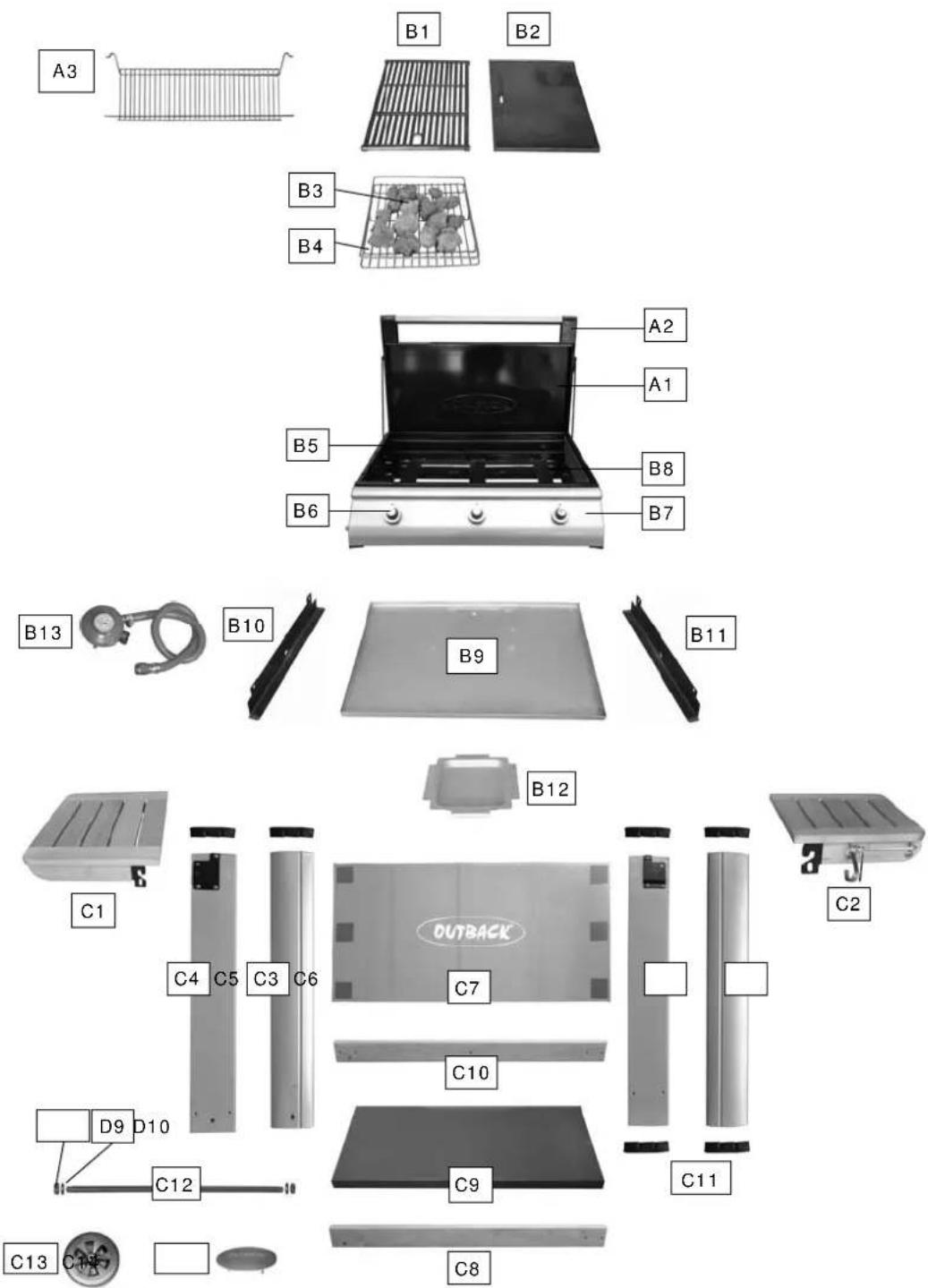
text_image
A3 B1 B2 B3 B4 A2 A1 B5 B8 B6 B7 B13 B10 B9 B11 C1 C4 C5 C3 C6 OUTBACK C7 C10 D9 D10 C12 C9 C11 C13 C14 C8 B12 C2Hardware Reference Diagram
Specifications subject to change without prior notice.

text_image
D4,D5 M6 x 145 Bolt (8pcs) Spacer (8pcs) D1,D2,D3 M5 x 15 Bolt (4pcs) M5 Nut(4pcs) Washer (4pcs) 1/4-20UNC x 12 Bolt (2pcs) D8 D7 M6 x 25 Bolt (8pcs) D6 M6 x 22 Step Bolt (8pcs)Assembly
IMPORTANT!
- TOOLS NEEDED FOR ASSEMBLY: Medium size flat blade or Phillips/Crosspoint screwdriver, adjustable spanner or metric spanner set.
- Remove any internal components or packaging from the barbecue body.
- Whilst every care is taken in the manufacture of this product, care must be taken during assembly in case sharp edges are present.
- Please read the Important Information section carefully before assembly and use of your barbecue.
1
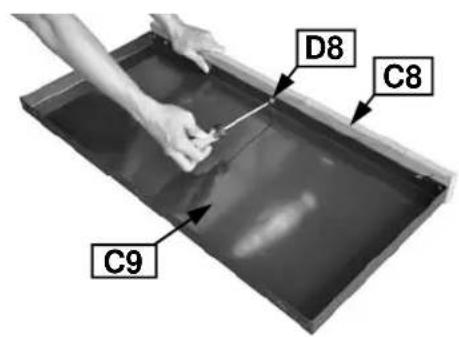
text_image
D8 C8 C9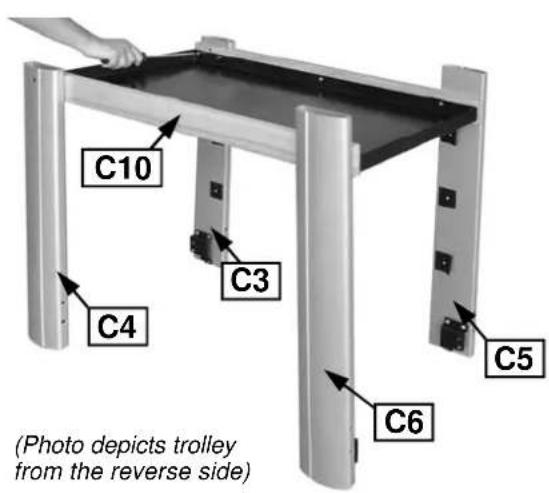
text_image
C10 C3 C4 C5 C6 (Photo depicts trolley from the reverse side)(Photo depicts trolley from the reverse side)
Attach the Front Fixing Support (C8) and Rear Fixing Support (C10) onto the Trolley Base (C9) by aligning corresponding holes and fixing with the 1/4-20UNCx12 Bolts (D8). Then attach the Legs (C3, C4, C5, C6) to the trolley base assembly using the M6x25 Bolts (D7). Ensure that the legs with the Velcro attached to them are at the front of the barbecue, facing inwards.
2
text_image
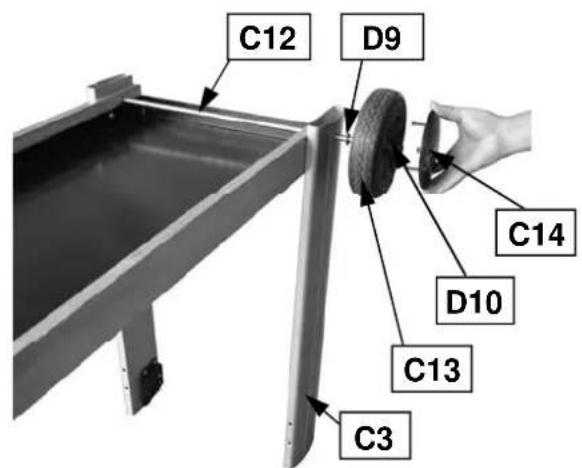
C12 D9 C14 D10 C13 C3Unscrew the Locknuts (D10) from both ends of the Axle (C12) and remove the Axle Washers (D9). Slide the axle through the corresponding holes in the left legs. Place axle washers on each end of the axle. Slide the Wheels (C13) over each end of the axle. Secure the wheels into place with the locknuts. Place the wheel Hubcaps (C14) onto the outsides of the wheels.
3

text_image
C1 C2Install a M6x22 Step Bolts (D6) on each leg, and then attach the Left Side Shelf (C1) and Right Side Shelf (C2) onto left and right legs using the M6x22 step bolts. Hook the side shelves onto the upper step bolts.
4
text_image
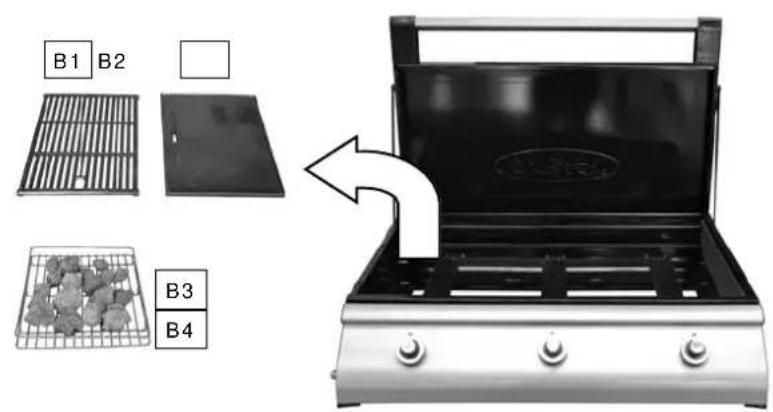
B1 B2 B3 B4Remove all cast iron cooking components, lava rock, drip tray, and any internal packaging from the barbecue body.

text_image
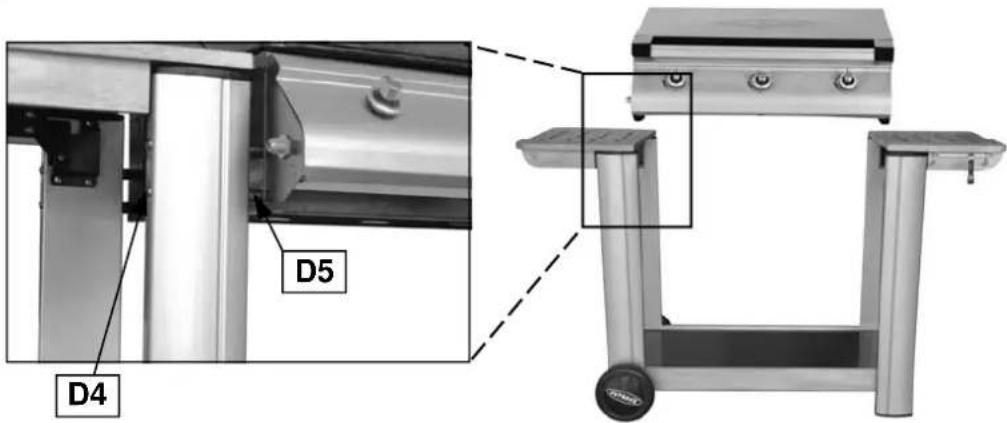
D4 D5Insert M6x145 Bolts (D4) through the trolley legs, the Spacers (D5), and keep the tip of the bolts inside the spacers. While holding the barbecue body into position (2 people required), screw the bolts into the barbecue body as shown.
CAUTION! Care must be taken to ensure the hood or lid does not fall open unexpectedly or becomes damaged when it is set on the ground.
When positioning the body of the barbecue, ensure the control panel is on the same side as the legs with Velcro fastenings.


natural_image
Two-panel image showing a hand inserting a component into a metal frame, labeled D1 and D2 (no text or symbols on the diagram itself)Attach Drip Tray Left Bracket (B10) to barbecue body using M5x15 Bolts (D1), Washers (D2) and M5 Nuts (D3) as shown. Repeat above process for Drip Tray Right Bracket (B11).
NOTE: Ensure that the big tabs of the brakets which stop the drip tray are located at the front of the barbecue.

text_image
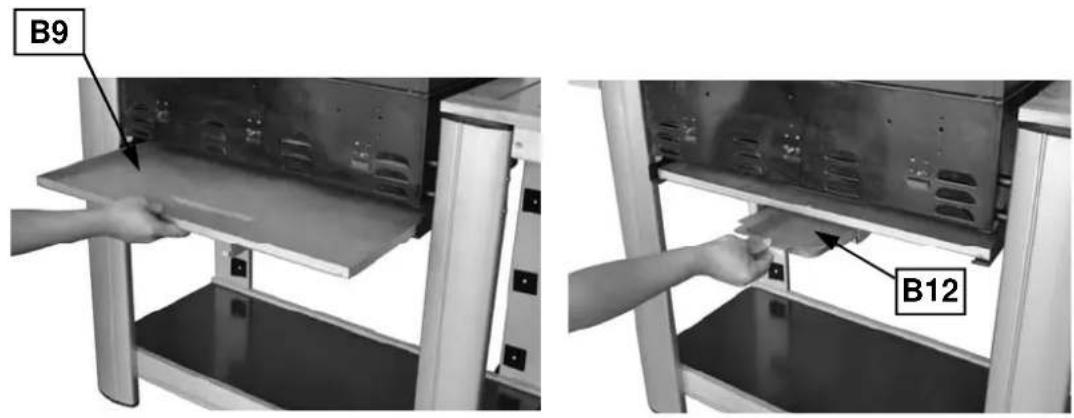
B9 B12Insert the Drip Tray (B9) by sliding it underneath the barbecue body. Insert the Drip Pan(B12) in position.

text_image
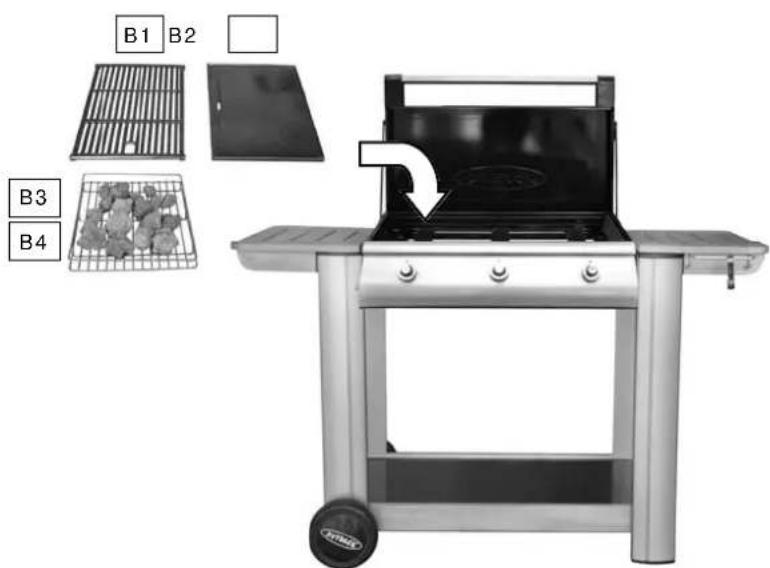
B1 B2 B3 B4Remove the plastic wrap from the Lava Rock (B3) and then place a uniform layer into Lava Rock Basket (B4). Lay the lava rock carefully into the body ensuring it lies level within the body. Lay the cooking grill (B1) and griddle (B2) into place.
2/3 burner model configuration: Left — Cooking Grill, Right — Cooking Griddle
NOTE: Ensure that the lava rock lies directly underneath the grills.
9
(Rear view of the barbecue trolley.)

text_image
C7Attach the screen (C7) to the front left/right legs as shown.
natural_image
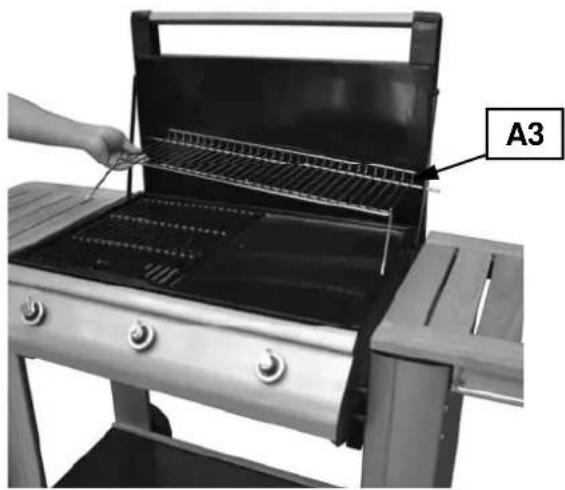
Exterior view of a modern outdoor grill with a hand adjusting the grille (no text or symbols visible)Attach the Warming Rack (A3) to the Lid (A1) and Barbecue Body (B5) as shown. Make sure that the swing legs fix to the body of the barbecue and the shorter fixed legs go through the holes in the lid.
10
natural_image
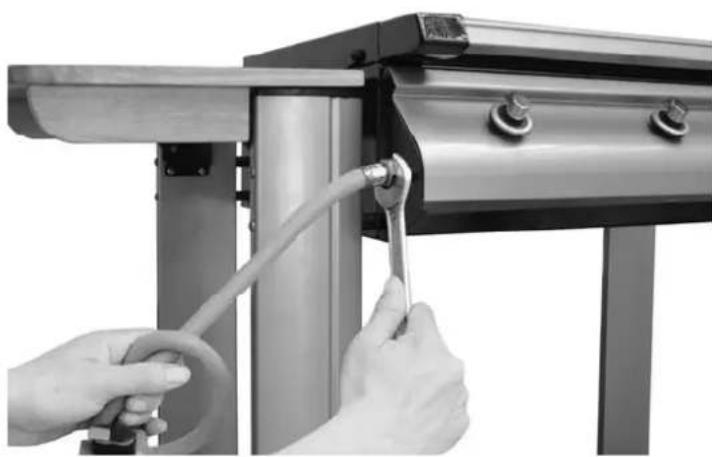
Close-up of hands using a tool to lift a metal mechanical component, no visible text or symbolsConnect the Hose and Regulator Assembly (B13) to the barbecue.
Ensure the mating faces of the connection are clean and not damaged. Do not use any sealing tape, paste, or liquid on the connection. The nut must be tightened with the use of a spanner. Do not use force which may damage the assembly.
11
Leak Test Diagram

natural_image
Exterior view of a portable grill with a gas cylinder and attached stand (no text or symbols visible)ASSEMBLY IS NOW COMPLETE. PROCEED TO THE NEXT PAGE FOR INSTRUCTIONS ON OPERATION AND MAINTENANCE
ALL JOINTS AND CONNECTIONS MUST NOW BE LEAK TESTED BEFORE USING THE BARBECUE.
Leak test annually, and whenever the gas bottle is removed or replaced.
LEAK TESTING
Always perform a leak test in a well-ventilated area.
Step 1 - Confirm all control knobs are in the off position.
Step 2 - Detach the barbecue control panel located across the front of the barbecue body by pulling off the control knobs and removing the control panel retaining screws.
Step 3 - Turn the gas on / open the gas control valve on the gas bottle or regulator.
Step 4 - Check for leaks by brushing a solution of 12 water and 12 liquid detergent / soap over all the gas system joints, including all valve connections, hose connections, and regulator connections.
Step 5 - NEVER USE AN OPEN FLAME to test for leaks at any time.
Step 6 - If bubbles form over any of the joints there is a leak
• Turn off the gas supply at the gas bottle
- Retighten all joints
- Repeat test
- If bubbles form again do not use the barbecue and contact your local Outback distributor for assistance.
Always wipe the mixed solution ( 12 water and 12 liquid detergent / soap) from all joints and connections after leak testing.
Important Information
Please read these instructions carefully before assembly and use of your barbecue.
▲ Retain these instructions for reference.
This product is for outdoor use only. Do not use indoors.
Do not use the barbecue or store gas bottles below ground level. LP gas is heavier than air so if a leak occurs the gas will collect at a low level and could ignite in the presence of a flame or spark.
▲ For use with LPG bottled gas only. suitable regulator must be used for butane, propane or mixes.
▲ Remove plastic wrap from any part before lighting.
Do not use within 1m of any flammable structure or surface. Do not use under any combustible surface.
▲ LP gas bottles should never be placed directly underneath the barbecue.
▲ LP gas bottles should never be stored or used laid on their side, in the horizontal position. A leak would be very serious and liquid could enter the gas line with serious result.
▲ Never store gas bottles indoors.
▲ Open the barbecue hood before lighting.
▲ Once lit, do not move the barbecue until it has completely cooled, after use.
This barbecue must not be left unattended when lit.
The hood or lid handle can become very hot. Grip only the centre of the handle. Always use oven gloves when cooking or carrying out any adjustments to the barbecue.
A Use purpose designed barbecue tools with long, heat resistant handles.
A Use Caution when opening hood or lid, as hot steam inside is released upon opening.
Parts of this barbecue become very hot – care must be taken, especially when children, elderly people, and animals are present.
▲ Turn off the gas supply at the gas bottle after use.
A Never cover a barbecue until it completely cooled.
▲ Use this barbecue only on a stable, flat surface.
▲ Before you use your barbecue, perform a
leak test. This is the only safe and sure way to detect any gas leaking from joints and connections of the barbecue after assembly.
▲ Leak test annually, and whenever the gas bottle is removed or replaced.
ure▲ Do not store flammable materials near this barbecue.
Do not use aerosols near this barbecue.
A Failure to follow the manual's instructions could result in serious injury or damage.
▲ Modification of the barbecue may dangerous, is not permitted and will nullify any warranty.
A If you have any queries regarding these instructions, contact your local dealer.
Gas, Regulator and Hose
This barbecue can use either propane butane or propane-butane mixed LPG (liquid petroleum gas) bottled gas. Propane bottles will supply gas all year round, even on cold winter days. Butane bottles will supply sufficient gas in summer, but it may affect the performance of the barbecue and restrict the heat output available from the burners, particularly once the gas temperature starts to fall below +10°C. A spanner may be required to change gas bottles.
- The hose should hang freely with no bends, twisting, tension, folds, or kinks that could obstruct free flow of gas. Always inspect the hose for cuts, cracks, or excessive wear before use.
- Apart from the connection point, no part of the hose should touch any hot barbecue parts. If the hose shows any sign of damage it must be replaced with a hose suitable for use with LP gas which meets the national standards for the country of use.
- A suitable hose must comply with ISO3821, and the length should not exceed 1.5 metres.
For optimal performance, we suggest to use a 13kg gas bottle. A suitable regulator must comply with EN12864. YOU MUST HAVE THE PROPER REGULATOR AND BOTTLE ORDER FOR THE BARBECUE TO OPERATE SAFELY AND EFFICIENTLY. USE OF AN INCORRECT OR FAULTY REGULATOR IS DANGEROUS AND WILL INVALIDATE ANY WARRANTY. Please consult your local gas dealer for the most suitable gas bottles and
regulators.
Installation
Selecting a Location
This barbecue is for outdoor use only and should be placed in a well-ventilated area, and on a safe and even surface. Never place your barbecue below ground level. Take care to ensure that it is not placed UNDER any combustible surface. The sides of the barbecue should NEVER be closer than 1 metre from any combustible surface, including trees and fences and make sure that there are no heat sources near the barbecue (cigarettes, open flames, spark etc.). Keep this barbecue away from any flammable materials!
Precautions
Do not obstruct any ventilation openings in the barbecue body.
Position the gas bottle on level ground next to the barbecue and safely away from any source of heat.
Should you need to install or change the gas bottle, confirm that the barbecue is switched off, and that there are no sources of ignition (cigarettes, open flame, sparks, etc.) near before proceeding.
Connecting a Gas Hose to the Barbecue
Connect the gas hose to the gas rail inlet on the left hand side of the barbecue. Do overtighten. Do not use any sealing tape, paste or liquid on the connection.
Fixing a Regulator to the Gas Bottle
Confirm all barbecue control knobs are in the off position. Connect the regulator to the gas bottle according to your regulator and bottle dealer's instructions.
H. Operation
▲Warnings
Before proceeding, make certain that you understand the IMPORTANT INFORMATION section of this manual.
▲ Your barbecue is not designed to be used with more than 50% of the cooking area as a solid plate — this includes baking dishes. Full coverage will cause excessive build-up
of heat and damage the barbecue. This is not covered by warranty.
Preparation Before Cooking
To prevent foods from sticking to the cooking surface, please use a long handled brush to apply a light coat of cooking or vegetable oil before each barbecuing session. (Note:
When cooking for the first time, paint colours may change slightly as a result. This is normal and should be expected.) During use, the protective coating may come off the cooking surface. This is normal and is not harmful.
Line the drip pan with aluminium foil. This will make cleanup easy.
Lighting the Barbecue
- Open the barbecue hood or lid before lighting. Never light your barbecue with the hood or lid closed.
- Ensure all knobs are in the off position. Open the gas control valve on the gas bottle or regulator.
- Push the control knob of the burner you wish to light and turn it anti-clockwise until you feel resistance to the turning. Pause 4 seconds, then continue turning the control knob until a click is heard and the burner is lit. Repeat previous step several times until the burner is lit.
- Ignite any of the remaining burners in any order, as needed. Confirm each burner is alight before igniting another burner.
- If burner fails to ignite after following above procedure, turn all the knobs to the off position. Close the gas valve on the gas bottle. Wait 5 minutes. Reattempt all of the above steps. If the barbecue still fails to light, please refer to the manual ignition instructions below.
- After ignition, turn the burners to the high position for 3-5 minutes in order to pre-heat the barbecue. This should be done before each cooking session.
• After completion of preheating, turn all burners to the low position for best cooking results.
Manual lighting instructions
- Open the barbecue hood before lighting. Never light your barbecue with the hood or lid closed.
- Ensure all knobs are in the off position. Open the gas control valve on the gas bottle or regulator.
- Insert lit match through the right match-
lighting hole on the right side of barbecue body and place near rightmost burner porthole.
- Push and turn the rightmost control knob anti-clockwise to the high position, taking care to protect yourself from the flames.
- When the right burner is lit, turn remaining burners on from right to left.
- Confirm that each burner is alight before turning on the next burner.
- If a burner fails to ignite, contact your local dealer for assistance.
- After ignition, turn the burners to the high position for 3-5 minutes in order to pre-heat the barbecue. This should be done before each cooking session.
• After completion of preheating, turn all burners to the low position for best cooking results.
Grill Cooking
The burners heat up the lava rock, underneath the grill, which in turn heats the food on the grill. The natural food juices produced during cooking fall onto the lava rock below and vaporise. The subsequent rising smoke bastes the food, as it travels upwards, imparting that unique barbecued flavour.
Griddle Plate Cooking
The burners heat the griddle plate directly, which then cooks the food on contact. Griddle plates allow for the cooking of smaller items, such as seafood, which could fall through the spaces of a grill. They are also suitable for cooking items that require high-temperature/short-duration cooking, such as vegetables and smaller cuts of fish. Similarly, it can be used in exactly the same way as a griddle in the kitchen, for searing steaks, cooking eggs, etc. Alternatively, it can be used for heating pans or keeping food warm.
Warming Rack
Warming racks are a convenient way to keep cooked food warm or to warm items such as bread rolls. It is advisable to place (particularly fatty foods) to the front of the warming rack to avoid the possibility of juices and fat running down the back of barbecue. Always check that your warming rack is properly fitted before use.
Flare-Up Control \*Very Important\*
Flare-ups occur when meat is barbecued, and its fat and juices fall upon the hot lava rock. Smoke of course helps give food its barbecued the favour, but it is best to avoid excessive flare-up to prevent food being burned. To control flare-ups, it is ABSOLUTELY ESSENTIAL to trim away excess fat from meat and poultry before grilling, use cooking sauces and marinades sparingly and try to avoid very cheap cuts of themeat or meat products as these tend to have a high fat and water content. Also, the burners should always be placed on the low setting during cooking.
When flare-ups do occur, they can usually be extinguished by applying baking soda or salt directly onto the lava rock. Always protect your hands when handling anything near the cooking surface of the barbecue and take care to protect yourself from the flames.
If a fat fire occurs, please see the instructions given below.
Fat Fires
Empty and clean the drip tray and drip pan (and foil liner, if applicable) of food debris after each cooking session. If the barbecue is to be used for large gatherings, it will be necessary to turn off and cool the barbecue every two hours to remove food debris from the drip tray and drip pan (and foil liner, if applicable), and clean it out. The time between cleaning may need to be reduced if very fatty foods or cheap meat products are being cooked. Failure to do this may result in a fat fire, which may cause injury and could seriously damage the barbecue.
In the event of a fat fire:
- If safe to do so, turn all control knobs to the 'off' position.
- Turn off the gas supply at the gas bottle.
- Keep everyone at a safe distance from the barbecue and wait until the fire has burnt out.
- Do not close the hood or lid of the barbecue.
- NEVER DOUSE A BARBECUE WITH WATER. IF AN EXTINGUISHER IS USED, IT SHOULD BE A POWDER TYPE.
• DO NOT REMOVE THE DRIP TRAY. - If the fire does not seem to be abating or appears to be worsening, contact your local Fire Brigade for assistance.
End of Cooking Session
After each cooking session, turn the barbecue burners to the "high" position and burn for 5 minutes. This procedure will burn off cooking residue, thus making cleaning easier. Make
sure the hood or lid is open during this process. Turning Off Your Barbecue
When you have finished using your barbecue, turn all the control valves fully clockwise to the "Off" position, then switch off the gas supply at the bottle.
Wait until the barbecue is sufficiently cool before closing its hood.
Care and Maintenance
Regularly clean your barbecue between uses and especially after extended periods of storage. Ensure the barbecue and its components are sufficiently cool before cleaning. Do not leave the barbecue exposed to outside weather conditions or stored in damp, moist areas.
▲ Never handle hot parts with unprotected hands.
▲ Never douse the barbecue with water when its surfaces are hot.
In order to extend the life and maintain the condition of your barbecue, we strongly recommend that the unit be covered when left outside for any length of time, especially during the winter months. Heavy-duty barbecue covers and other accessories are available from your local stockist.
Even when your barbecue is covered for its protection, it must be inspected on a regular basis as damp or condensation can form which may result in damage to the barbecue. It may be necessary to dry the barbecue and the inside of the cover. It is possible for mould to grow on any fat remaining on parts of the barbecue. This should be cleaned off smooth surfaces with hot soapy water.
Any rust that is found that does not come into contact with the food should be treated with a rust inhibitor and painted with barbecue paint or a heat resistant paint.
A chrome cleaner may be used on chrome parts if required. To prevent rusting, wipe chrome plated warming racks etc. with cooking oil after rinsing and drying.
Cooking Surfaces & Warming Rack
When the barbecue has cooled, clean with hot soapy water. To remove any food residue, use a mild cream cleaner on a non-abrasive pad. Do not use scouring pads or powders as they can permanently damage the finish. Rinse well and dry thoroughly. Due to the weight of the cooking surfaces, we do not recommend cleaning in a dishwasher.
It is quite normal for surface rust to be present on the cooking surface. If rust appears between uses or in storage, clean with a soft brass wire brush. Be careful not to damage the cooking surface, re-oil and cure.
Burner
Provided that they are operating correctly, in normal usage, burning off the residue after cooking will keep the burners clean.
The burners should be removed and cleaned annually, or whenever heavy build-up is found, to ensure that there are no signs of blockage (debris, insects) in either the burner portholes or the primary air inlet of the burners. Use a pipe cleaner to clear obstructions.
When refitting the burners, be careful to check that the neck of the burner fits over the valve outlet.
It is quite normal for surface rust to be present on the burners. If rust appears between uses or in storage, clean with a soft brass wire brush.
Lava Rock
It is not necessary to remove and wash the lava rock in order to keep it clean. Burning off the residue for 3 to 5 minutes after each cooking session should be sufficient. Heavily impregnated lava rock should be turned over so that the dirty side faces the burners in order to burn off any residue. Replacement lava rock is available from your local stockist.
Drip Tray
After every use, empty and clean the drip tray (and foil liner, if applicable) of any fat or food particles, using a plastic or wooden scraper if necessary.
Failure to keep it clean, and excessive build up can result in a fat fire. This can be hazardous and severely damage the barbecue. This is not a fault in the barbecue and is therefore not covered by the terms of the warranty. If required, the tray can be washed in hot soapy water.
Barbecue Body
Regularly remove excess grease or fat from the barbecue body using a cloth wrung out in hot soapy water and dry thoroughly. Excess fat and food debris can be removed from inside the body using a soft plastic or wooden scraper. It is not necessary to remove all the grease from the body. If you need to clean fully, use hot soapy water and a cloth, or nylon-bristled brush only. Do not use abrasives. Remove cooking surfaces and burners before full cleaning. Do not immerse the gas controls or manifold in water. Check burner operation after carefully refitting into body.
Barbecue Hood or Lid
Use a non-abrasive cloth or pad and clean with hot, soapy water. Do not use scouring pads or powders as they can permanently damage the finish.
Trolley
Wipe with a cloth wrung out in hot soapy water and dry.
The wood used in the manufacture of your barbecue is a hardwood suited to outdoor use. Hardwood will naturally weather and change its appearance. It is quite natural for small cracks to appear on the surface of the wood. The wood should be regularly inspected and weathered or damaged surfaces should be sanded and recoated promptly with a hardwood garden furniture varnish or paint, following the manufacturer's instructions for preparation and application.
Fixings
All screws and bolts, etc. should be checked and tightened on a regular basis.
Storage
Ensure the barbecue is properly cooled before covering or storing. Store your barbecue in a cool dry place.
Cover the burners with aluminium foil in order to prevent insects or other debris from collecting in burner holes.
If the barbecue is to be stored indoors, the gas bottle must be disconnected and left outside. The gas bottle should always be stored outside, in a dry, well-ventilated area, away from any sources of heat or ignition. Do not let children tamper with the bottle.
When using the barbecue after extended
periods of storage follow the cleaning procedures.
J. Technical Specifications
| CE Approval | Heat Input | Burners | Injector Size | Gas /Pressure | |
| Outback® Spectrum Select Flat Bed 2 Burner Gas BBQ | 0359 359BR665 | 9.52 kW | 2 | 1.07mm | 28-30 mbar Butane or 37 mbar Propane |
| Outback® Spectrum Select Flat Bed 3 Burner Gas BBQ | 0359 359BR665 | 14.28 kW | 3 | 1.07mm | 28-30 mbar Butane or 37 mbar Propane |
| Gas Consumption: Outback® Spectrum Select Flat Bed 2 Burner Gas BBQ : 693g/hr Outback® Spectrum Select Flat Bed 3 Burner Gas BBQ : 1039g/hr | |||||
| Countries of Use: I_s-(28-30/37) BE, CH, CY, CZ, ES, FR, GB, GR, IE, IT, LT, LU, LV, PT, SK, SI | |||||
Specifications are subject to change without prior notice.
Notes:
Troubleshooting
| Problem | Possible Cause | Solution |
| Burner will not light using the ignition system | LP gas bottle is empty | Replace with full bottle |
| Faulty regulator | Have regulator checked or replaced | |
| Obstructions in burner | Clean burner | |
| Obstructions in gas jets or gas hose | Clean jets and gas hose | |
| Electrode wire is loose or disconnected on electrode | Reconnect wire | |
| Electrode or wire is damaged | Change electrode and wire | |
| Faulty integral ignitor | Change ignitor | |
| Incorrect electrode gap/ Bent collector box | The gas collector box around the electrode needs to be in line with the burner with a gap of 3 to 4mm between the end of the electrode and the tag on the end of the collector box. Realign the collector box as required. | |
| Burner will not light with a match | LP gas bottle is empty | Replace with full bottle |
| Faulty regulator | Have regulator checked or replaced | |
| Obstructions in burner | Clean burner | |
| Obstructions in gas jets or gas hose | Clean jets and gas hose | |
| Low flame or flashback (fire in burner tube—a hissing or roaring noise may be heard) | LP gas bottle too small Use larger bottle | |
| Obstructions in burner | Clean burner | |
| Obstructions in gas jets or gas hose | Clean jets and gas hose | |
| Windy conditions | Use barbecue in a more sheltered position | |
| Gas valve knob difficult to turn | Integral ignition system jammed | Replace gas valve |
| Gas valve jammed | Replace gas valve | |
OUTBACK 10 YEAR WARRANTY
OUTBACK barbecues are warranted to the original purchaser against defects in materials and workmanship. Porcelain coated barbecue bodies, porcelain coated roasting hoods and stainless steel roasting hoods are warranted for a period of ten (10) years from the date of purchase. Stainless steel and cast iron burners are warranted for a period of two (2) years from the date of purchase. OUTBACK will, within this period, supply replacements for defective parts free of charge provided that:
- The product has not been used for trade, professional or hire purposes.
- The product has not been subjected to misuse or neglect, including fat fires and flare ups or use of a faulty or incorrect regulator.
- The product has not sustained damage through foreign objects, substances or accidents.
The care and maintenance instructions given in your Outback manual have been followed.
This warranty is offered as an extra benefit and is in addition to the customers' statutory rights.
Outback does not warranty in any way the gas cylinder.
In the unlikely event that you experience problems with this barbecue, please fill in our warranty form at
http://www.outbackbarbecues.com/warranty-form
and one of our colleagues will be in contact with you.
For reference and correspondence, record your serial number here. (See sticker on side of barbecue body.)
Serial No.
This number may be required when ordering spare parts or accessories. A part reference number may also be required where applicable.