SSDSA2MH120G2K5 - Computer component INTEL - Free user manual and instructions
Find the device manual for free SSDSA2MH120G2K5 INTEL in PDF.


| Product Type | Solid State Drive (SSD) |
| Model | Intel X25-M G2 (SSDSA2MH120G2K5) |
| Capacity | 120 GB |
| Form Factor | 2.5-inch |
| Interface | SATA 3.0 Gb/s (SATA II) |
| NAND Flash Type | Multi-Level Cell (MLC) |
| Sequential Read Speed | Up to 250 MB/s |
| Sequential Write Speed | Up to 70 MB/s |
| Random Read IOPS (4KB) | Up to 35,000 |
| Random Write IOPS (4KB) | Up to 3,300 |
| Dimensions (W x D x H) | 100.2 x 69.85 x 9.5 mm |
| Weight | 78 g |
| Power Consumption (Active) | 0.15 W typical (read/write) |
| Power Consumption (Idle) | 0.06 W |
| Operating Temperature | 0°C to 70°C |
| Storage Temperature | -55°C to 95°C |
| MTBF | 1.2 million hours |
| Endurance (Total Bytes Written) | 20 GB/day for 5 years (36.5 TBW) |
| Security | No hardware encryption; relies on OS-level encryption |
| Maintenance & Cleaning | No regular maintenance required; keep firmware updated via Intel SSD Toolbox |
| Parts & Reparability | No user-serviceable parts; warranty replacement only |
| Warranty | 3 years limited |
Frequently Asked Questions - SSDSA2MH120G2K5 INTEL
User questions about SSDSA2MH120G2K5 INTEL
0 question about this device. Answer the ones you know or ask your own.
Ask a new question about this device
Download the instructions for your Computer component in PDF format for free! Find your manual SSDSA2MH120G2K5 - INTEL and take your electronic device back in hand. On this page are published all the documents necessary for the use of your device. SSDSA2MH120G2K5 by INTEL.
USER MANUAL SSDSA2MH120G2K5 INTEL
Intel® X18-M/ X25-M SATA Solid State Drive - 34 nm Product Line
Model Codes: SSDSA1M080G2XX, SSDSA2M080G2XX, SSDSA2J080G2XX, SSDSA1M160G2XX, SSDSA2M160G2XX Product Codes: SSDSA2MH080G2XX, SSDSA1MH080G2XX, SSDSA2MJ080G2XX, SSDSA2MH160G2XX, SSDSA1MH160G2XX
Product Manual
■ Available in 1.8" and 2.5" Form Factors
■ Capacity: 80 GB and 160 GB
■ Uses Intel NAND flash memory Multi-Level Cell (MLC) components
- Read and Write IOPS Specifications (Iometer* Queue Depth 32) — Random 4 KB Reads: Up to 35 K IOPS — Random 4 KB Writes: 80 GB - Up to 6.6 K IOPS 160 GB - Up to 8.6 K IOPS
- Bandwidth Performance Specifications — Sustained Sequential Read: Up to 250 MB/s — Sustained Sequential Write: — 80 GB - Up to 70 MB/s 160 GB - Up to 100 MB/s
■ Latency Specifications: — Read: 65 μs — Write: 85 μs
- Compatibility — Int ^ SSD ToolBox Intel ^ SSD Optimizer — Int ^ Matrix Storage Manager — SATA Revision 2.6 compliant, compatible with SATA 1.5 Gb/s and 3 Gb/s interface rates — ATA/ATAPI-7 Compliant — SSD Enhanced S.M.A.R.T. ATA feature set — Native Command Queuing (NCQ) command set
■ Certifications and Declarations — UL* — CE* — C - Tick * — B S M I * — K C C * — Microsoft * W H Q L — V C C I * — S A T A - I O *
■ Power Management — 3.3 V (1.8") or 5 V (2.5") SATA Supply Rail — SATA Interface Power Management — OS-Aware Hot Plug/Removal
■ Power Specifications — Active: 150 mW (TYP) (MobileMark* 2007 Workload) — Idle: 75 mW (TYP)
■ Temperature — Operating: 0^ C to 70^ C — Non-Operating: -55^ C to 95^ C
■ Reliability — Read Error Rate (BER): 1 sector per 10^16 bits read — Mean Time Between Failures (MTBF): 1,200,000 hours
■ Shock, Operating and Non-operating: 1,500 G/0.5 msec
■ Vibration — Operating: 2.17 G RMS (5-700 Hz) — Non-operating: 3.13 G RMS (5-800 Hz)
■ Weight — 1.8" 5 mm Form Factor: 35 +/-2 grams — 2.5" 7 mm Form Factor: 76 +/-2 grams — 2.5" 9.5 mm Form Factor: 80 +/-2 grams
■ Product Ecological Compliance — EU RoHS ^* — Halogen-free
■ Data Set Management Command — Trim Attribute
Ordering Information
For ordering information on Intel® Solid State Drives please refer to the Intel® High Performance SATA Solid-State Drives Product Selection Guide.
INFORMATION IN THIS DOCUMENT IS PROVIDED IN CONNECTION WITH INTEL® PRODUCTS. NO LICENSE, EXPRESS OR IMPLIED, BY ESTOPPEL OR OTHERWISE. TO ANY INTELLECTUAL PROPERTY RIGHTS IS GRANTED BY THIS DOCUMENT. EXCEPT AS PROVIDED IN INTEL'S TERMS AND CONDITIONS OF SALE FOR SUCH PRODUCTS, INTEL ASSUMES NO LIABILITY WHATSOEVER, AND INTEL DISCLAIMS ANY EXPRESS OR IMPLIED WARRANTY, RELATING TO SALE AND/OR USE OF INTEL PRODUCTS INCLUDING LIABILITY OR WARRANTIES RELATING TO FITNESS FOR A PARTICULAR PURPOSE, MERCHANTABILITY, OR INFRINGEMENT OF ANY PATENT, COPYRIGHT OR OTHER INTELLECTUAL PROPERTY RIGHT. Intel products are not intended for use in medical, life saving, life sustaining, critical control or safety systems, or in nuclear facility applications.
Intel may make changes to specifications and product descriptions at any time, without notice.
Intel Corporation may have patents or pending patent applications, trademarks, copyrights, or other intellectual property rights that relate to the presented subject matter. The furnishing of documents and other materials and information does not provide any license, express or implied, by estoppel or otherwise, to any such patents, trademarks, copyrights, or other intellectual property rights.
Designers must not rely on the absence or characteristics of any features or instructions marked "reserved" or "undefined." Intel reserves these for future definition and shall have no responsibility whatsoever for conflicts or incompatibilities arising from future changes to them.
This Datasheet as well as the software described in it is furnished under license and may only be used or copied in accordance with the terms of the license. The information in this manual is furnished for informational use only, is subject to change without notice, and should not be construed as a commitment by Intel Corporation. Intel Corporation assumes no responsibility or liability for any errors or inaccuracies that may appear in this document or any software that may be provided in association with this document.
Except as permitted by such license, no part of this document may be reproduced, stored in a retrieval system, or transmitted in any form or by any means without the express written consent of Intel Corporation.
Contact your local Intel sales office or your distributor to obtain the latest specifications and before placing your product order.
Copies of documents which have an order number and are referenced in this document, or other Intel literature may be obtained by calling 1-800-548-4725 or by visiting Intel's website at http://www.intel.com.
Intel and Intel logo are trademarks or registered trademarks of Intel Corporation or its subsidiaries in the United States and other countries.
* Other names and brands may be claimed as the property of others. Copyright © 2009, Intel Corporation. All Rights Reserved.
Contents
1.0 Introduction 5
1.1 Product Overview 5
1.2 Block Diagram....6
1.3 Architecture....6
2.0 Certifications and Declarations 6
3.0 Product Specifications....7
3.1 Capacity 7
3.2 Performance 7
3.3 Electrical Characteristics 8
3.3.1 Supply Voltage....8
3.3.2 Power Consumption 8
3.4 Environmental Conditions 9
3.4.1 Temperature....9
3.4.2 Shock and Vibration....9
3.4.3 Acoustics....9
3.4.4 Electromagnetic Immunity 10
3.5 Reliability 10
3.5.1 Nonrecoverable Read Errors 11
3.5.2 Mean Time Between Failure....11
3.5.3 Power On/Off Cycles 11
3.5.4 Minimum Useful Life....11
3.5.5 Insertion Cycles....11
4.0 Mechanical Information 11
4.1 1.8" 5 mm Intel X18-M SATA SSD....11
4.2 2.5" 7 mm Intel X25-M SATA SSD....13
4.3 2.5" 9.5 mm Intel X25-M SATA SSD....14
5.0 Pin and Signal Descriptions....15
5.1 Pin Locations....15
5.1.1 1.8" Pin Locations....15
5.1.2 2.5" Pin Locations....16
5.2 Signal Description Table 16
5.3 Hot Plug Support 18
6.0 Command Sets....18
6.1 ATA Commands....18
6.1.1 ATA General Feature Command Set....18
6.1.1.1 IDENTIFY DEVICE Data 19
6.1.2 Power Management Command Set....21
6.1.3 Security Mode Feature Set 22
6.1.4 SMART Command Set....22
6.1.5 Host Protected Area Command Set....22
6.1.6 48-Bit Address Command Set....23
6.1.7 Device Configuration Overlay Command Set 23
6.1.8 General Purpose Log Command Set....23
6.2 SATA Commands 23
6.2.1 Software Settings Preservation....24
6.2.2 Native Command Queuing....24
6.2.3 Device Initiated Power Management (DIPM) 24
7.0 References....24
8.0 Additional Product Information....25
9.0 Terms and Acronyms 25
10.0 Revision History....27
1.0 Introduction
The Intel® X18-M/X25-M SATA Solid State Drive (SSD) delivers leading performance in industry standard 1.8" and 2.5" form factors while simultaneously improving system responsiveness for client applications over standard rotating drive media or hard disk drives. By combining Intel's leading 34nm NAND flash memory technology with our innovative high performance controller, Intel delivers its next generation SSD for native Serial Advanced Technology Attachment (SATA) hard disk drive drop-in replacement with enhanced performance, reliability, ruggedness and power savings.
Since there are no rotating platters, moving heads, or fragile actuators, unnecessary delays due to spin-up time or positional seek time that can slow down the storage subsystem significantly, are absent. The Intel X18-M/X25-M SATA SSD enables fast read/write access times and a significant I/O and throughput performance improvement as compared to rotating media or hard disk drives.
This document describes the specifications of our new addition to the Solid State Drive product family: Intel X18-M/X25-M SATA SSD - 34 nm product line in both the 1.8" and 2.5" form factors.
1.1 Product Overview
The Intel X18-M/X25-M SATA SSDs primarily target SATA based client PCs, highly rugged mobile client devices, as well as thin and light, mini/sub-notebooks. Key attributes include high performance, low power, increased system responsiveness, high reliability and enhanced ruggedness as compared to standard mobile SATA hard drives. Intel X18-M/X25-M SATA SSDs are available in 1.8" and 2.5" form factors that are electrically, mechanically, and software compatible with existing 1.8" and 2.5" Serial ATA slots and cables. Our flexible design allows interchangeability with existing mobile hard drives based on the SATA interface standard.
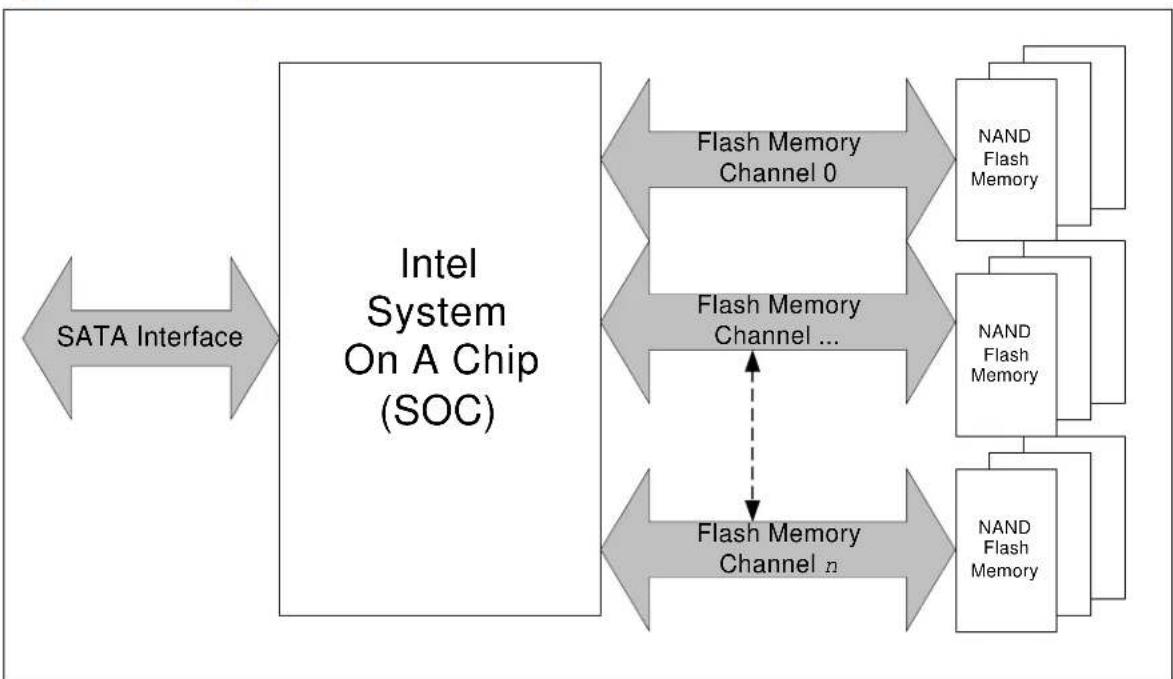
1.2 Block Diagram
Figure 1. Block Diagram
flowchart
graph LR
    A["SATA Interface"] --> B["Intel System On A Chip (SOC)"]
    B --> C["Flash Memory Channel 0"]
    B --> D["Flash Memory Channel ..."]
    B --> E["Flash Memory Channel n"]
    C <--> F["NAND Flash Memory"]
    D <--> G["NAND Flash Memory"]
    E <--> H["NAND Flash Memory"]
    F --> I["Output"]
    G --> I
    H --> I
1.3 Architecture
The Intel X18-M/X25-M SATA SSDs utilize a cost effective System on a Chip (SOC) design to manage a full SATA 3 Gb/s bandwidth with the host while managing multiple flash memory devices on multiple channels internally.
2.0 Certifications and Declarations
Table 1. Device Certifications and Declarations
| Certification Description | |
| CE Compliant | Indicates conformity with the essential health and safety requirements set out in European Directives Low Voltage Directive and EMC Directive. |
| UL Certified Underwriters Laboratories | , Inc. Component Recognition UL60950-1. |
| C-Tick Compliant | Compliance with the Australia/New Zealand Standard AS/NZS3548 and Electromagnetic Compatibility (EMC) Framework requirements of the Australian Communication Authority (ACA). |
| BSMI Compliant | Compliance to the Taiwan EMC standard “Limits and methods of measurement of radio disturbance characteristics of information technology equipment, CNS 13438 Class B.” |
| KCC | Compliance with paragraph 1 of Article 11 of the Electromagnetic Compatibility control Regulation and meet the Electromagnetic Compatibility (EMC) Framework requirements of the Radio Research Laboratory (RRL) Ministry of Information and Communication Republic of Korea. |
| Microsoft WHQL Microsoft Windows Hardware Quality Labs | |
| RoHS Compliant Restriction of Hazardous Substance Directive | |
| VCCI | Voluntary Control Council for Interface to cope with disturbance problems caused by personal computers or facsimile. |
| SATA-IO Indicates certified logo program from Serial ATA International Organization | |
3.0 Product Specifications
3.1 Capacity
Table 2. User Addressable Sectors
| Unformatted Capacity Total User Addressable Sectors in LBA Mode | |
| 80 GB 156,301,488 | |
| 160 GB 312,581,808 | |
Notes:
- 1 GB = 1,000,000,000 Byte. LBA count shown represents total user storage capacity and will remain the same throughout the life of the drive.
- The total usable capacity of the Intel SSD may be less than the total physical capacity of the Intel SSD. This is due to the fact that a small portion of the Intel SSD capacity is used for NAND flash management and maintenance purposes.
3.1 Sector = 512 Byte. - IDEMA LBA standards adopted in calculating the LBA count.
3.2 Performance
Table 3. Maximum Sustained Read and Write Bandwidth
| Access Type | MB/ s |
| Sequential Read | Up to 250 |
| Sequential Write | 80 GB: Up to 70 |
| 160 GB: Up to 100 |
Notes:
- Performance measured using lometer with queue depth equal to 32.
- 1 MB/sec = 1,048,576 bytes/sec was used in measuring sequential performance.
Table 4. Latency Specifications
| Type Average Latency | |
| Read 65 μs (TYP) | |
| Write 85 μs (TYP) | |
| Power On to Ready 1.50 s (TYP) |
Notes:
- Write Cache Enabled.
- Device measured using lometer.
- Power On To Ready time is measured from power rail rising edge to the first DRDY issued from the drive.
- Read/Write latency measured on sequential 4 K transfers with QD=1.
Table 5. Random Read/ Write Input/ Output Operations Per Second
| Access Type IOPS | |
| 4K Read Up to 35,000 | |
| 4K Write | 80GB: Up to 6,600 |
| 160 GB: Up to 8,600 |
Notes:
- Performance measured using lometer with queue depth set to 32.
- Write Cache enabled.
- Measurements are performed on 8 GB of LBA range.
3.3 Electrical Characteristics
3.3.1 Supply Voltage
Table 6. Operating Voltage
| Description | Min | Max | Unit |
| Operating Voltage for 3.3 V (+/- 5%) | 3.14 | 3.47 | V |
| Operating Voltage for 5 V (+/- 5%) | 4.75 | 5.25 | V |
3.3.2 Power Consumption
Table 7. Typical Power Consumption
| Mode | Typ | Unit |
| Active | 150 | mW |
| Idle | 75 | mW |
Note: Active power measured during execution of MobileMark* 2007 with DIPM (Device Initiated Power Management) enabled.
3.4 Environmental Conditions
3.4.1 Temperature
Table 8. Temperature Related Specifications
| Mode Min Typ Max Unit | |||||
| Case Temperature | Operating 0 70 | °C | |||
| Non-Operating -55 | 95 | °C | |||
| Temperature Gradient | Operating | 20 | °C/hr * | ||
| Non-Operating | 30 | °C/hr * | |||
| Humidity | Operating 5 95 | % | |||
| Non-Operating | 5 95 | % | |||
Notes:
-
Temperature measured on the top side of SSD case, centered for width and one inch from SATA connector edge.
-
Temperature gradient measured without condensation.
3.4.2 Shock and Vibration
Table 9. Shock and Vibration Specifications
| Mode | Timing/ Frequency | Max | |
| Shock ^1 | Operating | at 0.5 msec | 1,500 G |
| Non-Operating | at 0.5 msec | 1,500 G | |
| Vibration ^2 | Operating | 5-700 Hz | 2.17 G |
| Non-Operating | 5-800 Hz^3 | 3.13 G |
Notes:
-
Shock specifications assumes that the SSD is mounted securely with the input vibration applied to the drive mounting screws. Stimulus may be applied in the X, Y or Z axis. Shock specification is measured using RMS value.
-
Vibration specifications assumes that the SSD is mounted securely with the input vibration applied to the drive mounting screws. Stimulus may be applied in the X, Y or Z axis. The measured specification is in root mean squared form. Vibration specification is measured using RMS value.
-
Sine wave sweeping 1 oct/min.
3.4.3 Acoustics
The SSD has no moving or noise-emitting parts; therefore, it produces negligible sound (0 dB) in all modes of operation.
3.4.4 Electromagnetic Immunity
Electromagnetic Immunity tests assume the SSD is properly installed in the representative host system. The drive will operate properly without errors or degradation in performance when subjected to radio frequency (RF) environments referenced in the international specifications noted in these following documents:
Table 10. Electromagnetic Immunity and Compliance Specifications
| Title Description | Region for which conformity declared | |
| IEC 60950-1 - 1st Edition Safety of Information Technology Equipment International | ||
| UL/CSA 60950-1 Edition Safety of Information Technology Equipment USA/Canada | ||
| EN 60950-1:2001 Safety of Information Technology Equipment European Union | ||
| cTick | The EMC Framework (Radio Communication Act 1992) | Australia |
| FCC, 47 CFR Part 15 | Radio Frequency Devices - Subpart B - Unintentional Radiators B | USA |
| ICES-003 Issue 4 - February 2004 | Interface-Causing Equipment Standards - Digital Apparatus B | Canada |
| BSMI CNS14348; CNS14266 | Bureau of Standards, Metrology and Inspection, Ministry of Economic Affairs Electromagnetic Compatibility | Taiwan |
| EN 55022 and 55024 | EN 55022:2006 Information Technology Equipment - Radio Disturbance Characteristics B; EN 55024:1998 + A1:2001 + A2:2003 Information Technology Equipment - Immunity Characteristics | European Union |
| CISPR 22:2005 | Information Technology Equipment - Radio Disturbance Characteristics B | International |
| EN61000 | EN61000-3-2 Information Technology Equipment - Harmonics Characteristics; EN61000-3-3 Information Technology Equipment - Flicker Characteristics | European Union |
| VCCI CISPR22 B | Information Technology Equipment - Radio Disturbance Characteristics | Japan |
| KCC | Framework Act on Telecommunications and Radio Waves Act | Korea |
3.5 Reliability
Table 11. Reliability Specifications
| Parameter | Value |
| Nonrecoverable read errors | 1 sector in 10^16 bits read, max |
| Mean Time between Failure (MTBF) | 1,200,000 hours |
| Power On/Off Cycles | 50,000 cycles |
| Minimum Useful Life | 5 years |
| Insertion Cycles | 250 cycles |
Note: Please refer to sections 3.5.1 to 3.5.4 for more details on these reliability specifications.
3.5.1 Nonrecoverable Read Errors
The nonrecoverable read error rate will not exceed one sector in the specified number of bits read. In the extremely unlikely event of a nonrecoverable read error, the drive will report it as a read failure to the host; the sector in error is considered corrupt and is not returned to the host.
3.5.2 Mean Time Between Failure
The Mean Time Between Failure (MTBF) is estimated based on Telcordia methodology and demonstrated through Reliability Demonstration Test (RDT).
3.5.3 Power On/ Off Cycles
Defined as power being removed from the drive, and then restored. Most host systems remove power from the drive when entering suspend and hibernate as well as on a system shutdown.
3.5.4 Minimum Useful Life
The drive will have a minimum of 5 years of useful life under typical client workloads with up to 20 GB of host writes per day.
3.5.5 Insertion Cycles
The drive will support up to 250 insertion/removal cycles on SATA/power cable.
4.0 Mechanical Information
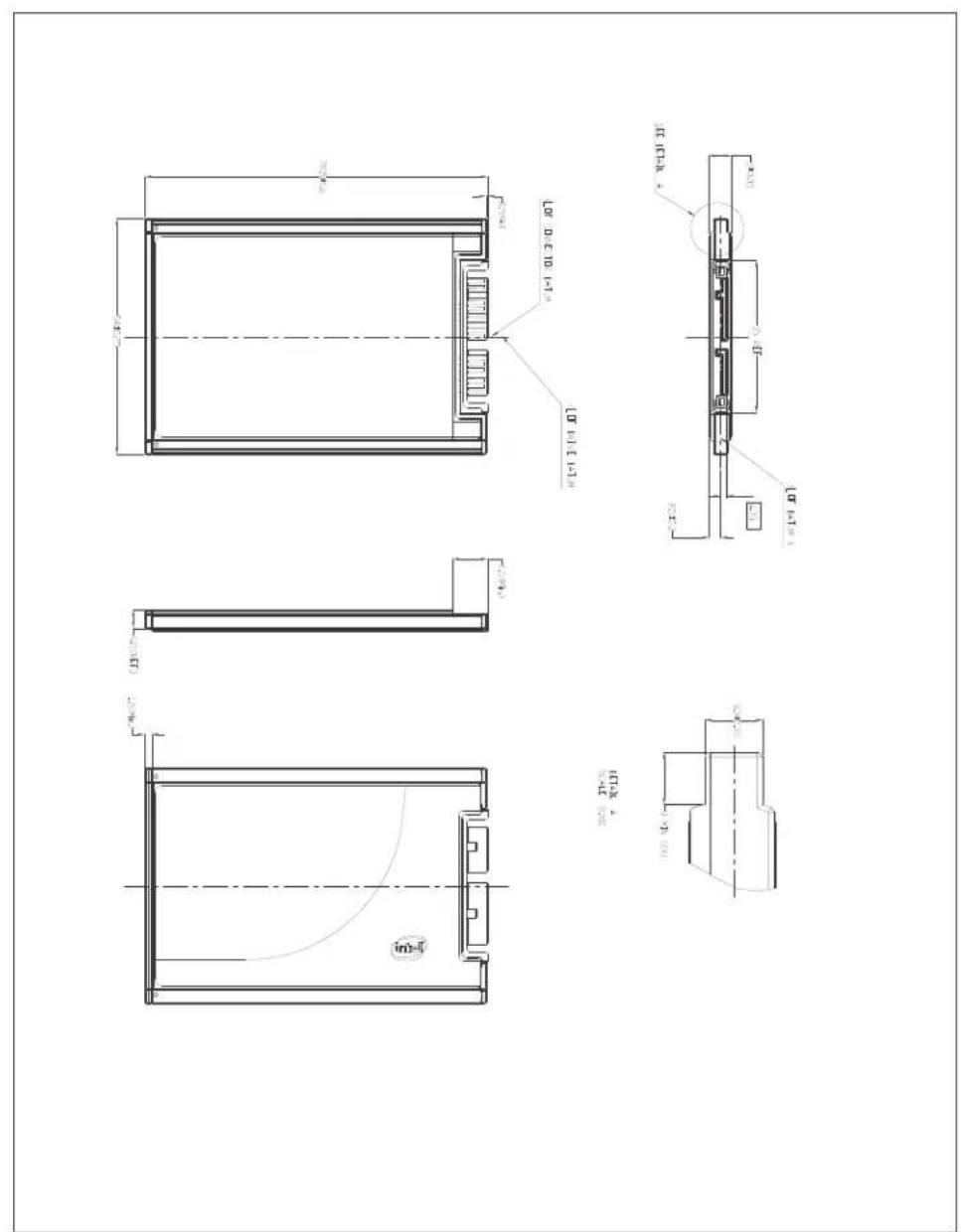
4.1 1.8" 5 mm Intel X18-M SATA SSD
The following figure shows the physical package information for the 5 mm height 1.8" Intel X18-M SATA SSD.
Figure 2. Dimensions for Intel X18-M SATA SSD 1.8" 5 mm Form Factor
Notes:
- Connector Outline: The 1.8" Intel X18-M SATA SSD connector is compliant to the SATA Rev 2.6 specifications.
- Connector Location: The 1.8" Intel X18-M SATA SSD connector is compliant to the micro SATA SFF-8144 specification.
- All dimensions are in millimeters.
4.2 2.5" 7 mm Intel X25-M SATA SSD
The following figure shows the physical package information for the 7 mm height 2.5" Intel X25-M SATA SSD.
Figure 3. Dimensions for Intel X25-M SATA SSD 2.5" 7 mm Form Factor
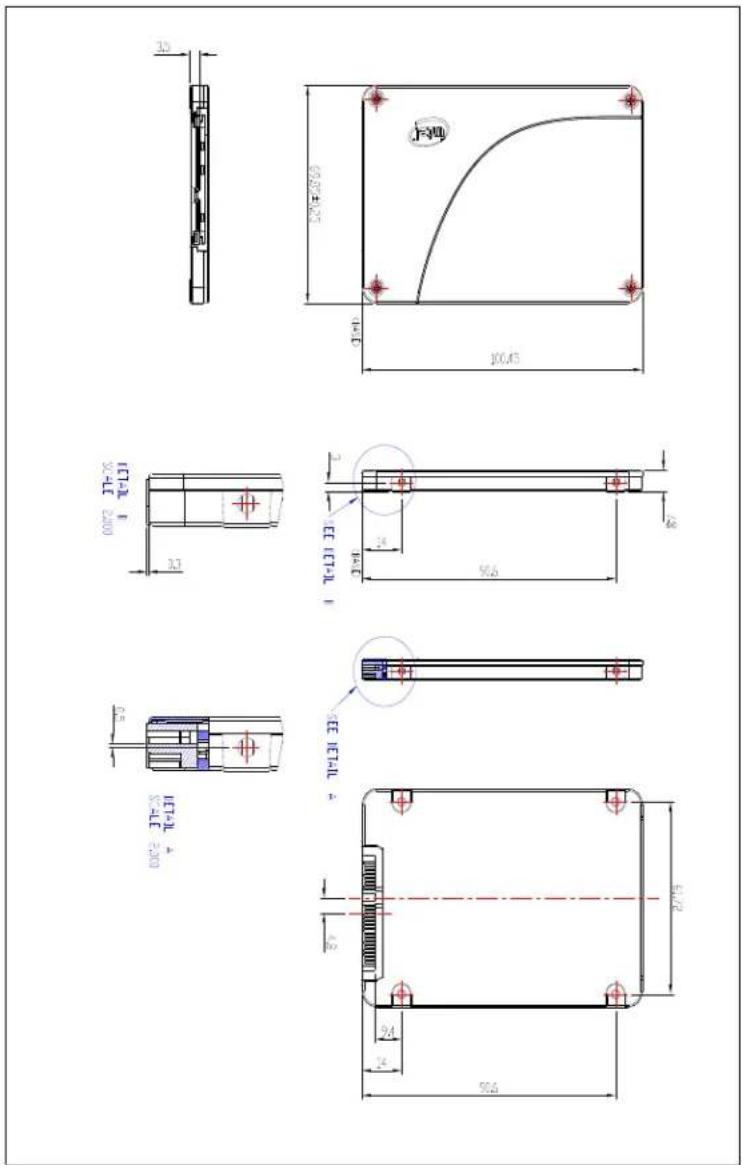
Note: All dimensions are in millimeters.
4.3 2.5" 9.5 mm Intel X25-M SATA SSD
The following figure shows the physical package information for the 9.5 mm height 2.5" Intel X25-M SATA SSD.
Figure 4. Dimensions for Intel X25-M SATA SSD 2.5" 9.5 mm Form Factor
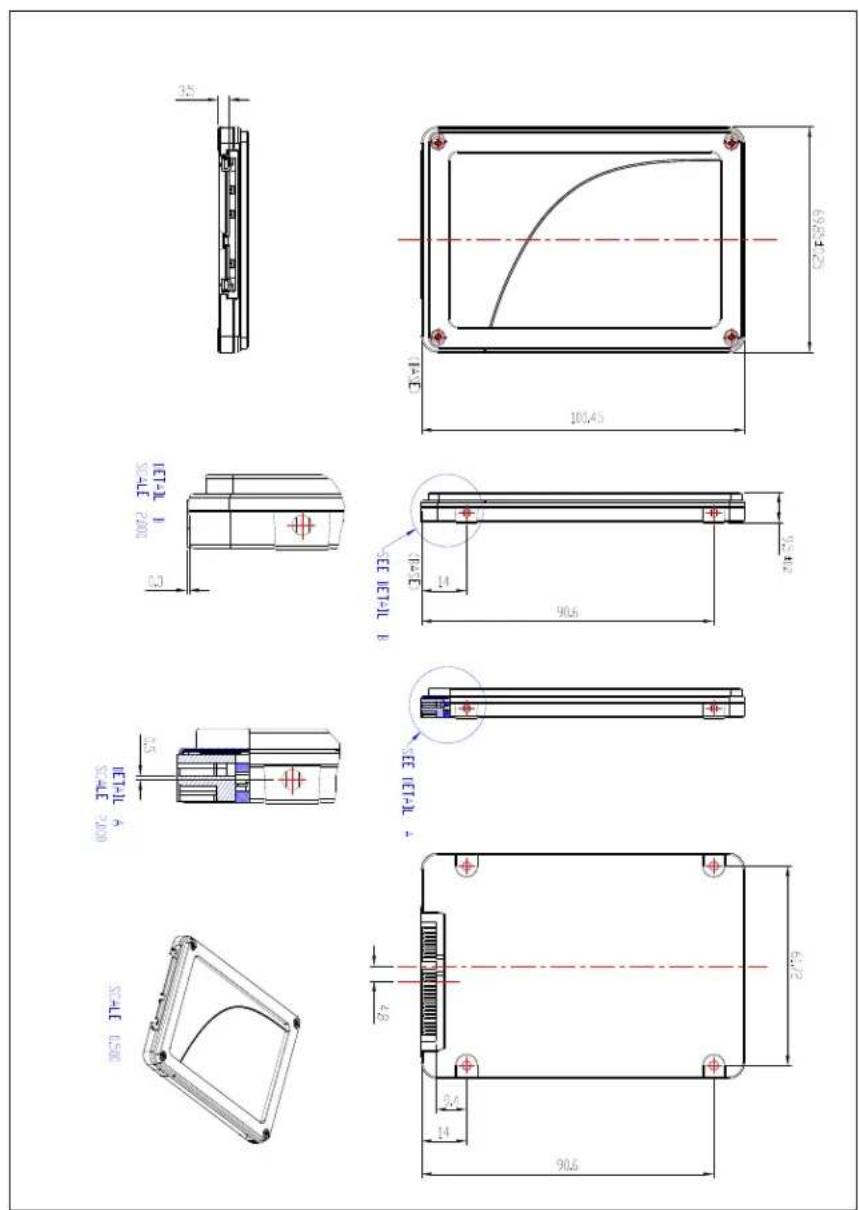
Note: All dimensions are in millimeters.
5.0 Pin and Signal Descriptions
This section identifies the pin locations and signal descriptions of the Intel X18-M/X25-M SATA SSDs.
5.1 Pin Locations
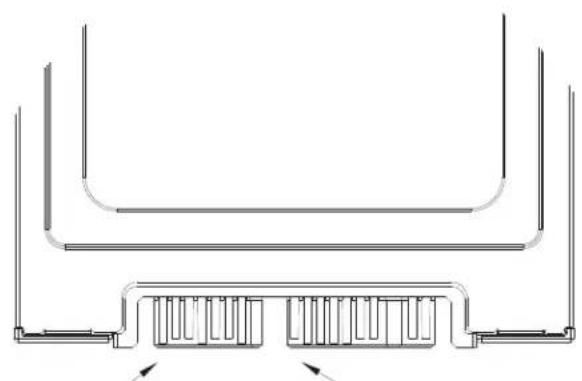
5.1.1 1.8" Pin Locations
Figure 5. Layout of Signal and Power Segment Pins
natural_image
Technical line drawing of a mechanical component or housing assembly (no text or symbols)Signal Segment S1 Power Segment P1
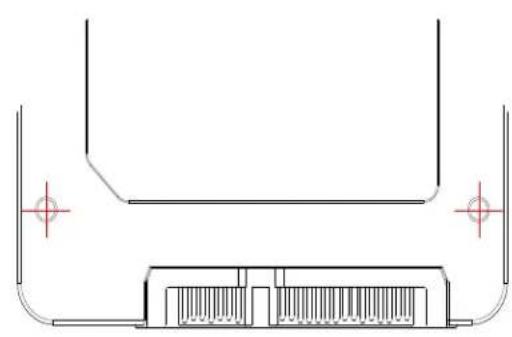
5.1.2 2.5" Pin Locations
Figure 6. Layout of Signal and Power Segment Pins
natural_image
Pure technical line drawing of a mechanical component or housing without any text, numbers, or symbolsNote: 2.5" connector supports in-built latching capability.
5.2 Signal Description Table
Table 12. Serial ATA Connector Pin Signal Definitions for 1.8" and 2.5" Form Factors
| Pin Function Definition | ||
| S1 Ground | st mate | |
| S2 A+ | Differential signal pair A | |
| S3 | A- | |
| S4 Ground | st mate | |
| S5 | B- | Differential signal pair B |
| S6 B+ | ||
| S7 Ground | st mate | |
Note: Key and spacing separate signal and power segments.
Table 13. Serial ATA Power Pin Definitions for 1.8" Form Factor
| Pin | Function | Definition | Mating Order ^1 |
| P1 | V_33 | 3.3 V Power ^2 | 2nd Mate |
| P2 | V_33 | 3.3 V Power, pre-charge ^2 | 2nd Mate |
| P3 | Ground ^3 | 1st Mate | |
| P4 | Ground ^3 | 1st Mate | |
| P5 | V_5 | 5 V Power. Not connected ^4 | 1st Mate |
| Pin Function Definition Mating Order | 1 | ||
| P6 | V_5 | 5 V Power. Not connected4 | 2nd Mate |
| P7 | V_5 | 5V Power, Pre-charge 2nd Mate | |
| Key Key NC NC | |||
| P8 Optional | Manufacturing Test Pin | 5 | 2nd Mate |
| P9 Optional | Manufacturing Test Pin | 5 | 2nd Mate |
Notes:
- All mate sequences assume zero angular offset between connectors.
- P1 and P2 are internally connected to one another within the device.
- Ground connectors P3 and P4 may contact before the other 1st mate pins in both the power and signal connectors to discharge ESD in a suitably configure backplane connector.
- P5 and P6 are not connected internal to the device. The host may put 5V on these pins.
- P8 and P9 should not be connected by the host.
Table 14. Serial ATA Power Pin Definitions for 2.5" Form Factor
| Pin^1 | Function | Definition | Mating Order |
| P1 | Not connected ^2 | (3.3 V Power) | |
| P2 | Not connected ^2 | (3.3 V Power) | |
| P3 | Not connected ^2 | (3.3 V Power. pre-charge) | 2nd Mate |
| P4 | Ground ^3, 4 | 1st Mate | |
| P5 | Ground ^3 | 1st Mate | |
| P6 | Ground ^3 | 1st Mate | |
| P7 | V_5^3, 5 | 5 V Power | 1st Mate |
| P8 | V_5^3, 5 | 5 V Power | 2nd Mate |
| P9 | V_5^3, 5 | 5 V Power | 2nd Mate |
| P10 | Ground ^3 | 1st Mate | |
| P11 | DAS ^6 | Device Activity Signal^6 | 2nd Mate |
| P12 | Ground ^3, 4 | 1st Mate | |
| P13 | V_12^7 | 12 V Power. Not used. | 1st Mate |
| P14 | V_12^7 | 12 V Power. Not used. | 2nd Mate |
| P15 | V_12^7 | 12 V Power. Not used. | 2nd Mate |
Notes:
- All pins are in a single row, with a 1.27 mm (0.050") pitch.
- Pins P1, P2 and P3 are connected together, although they are not connected internally to the device. The host may put 3.3 V on these pins.
- The mating sequence are:
- the ground pins P4-P6, P10, P12 and the 5v power pin P7.
- the signal pins and the rest of the 5V power pins P8-P9.
-
Ground connectors P4 and P12 may contact before the other 1st mate pins in both the power and signal connectors to discharge ESD in a suitably configured backplane connector.
-
Power pins P7, P8, and P9 are internally connected to one another within the device.
- The host may ground P11 if it is not used for Device Activity Signal (DAS).
- Pins P13, P14 and P15 are connected together, although they are not connected internally to the device. The host may put 12 V on these pins.
5.3 Hot Plug Support
Hot Plug insertion and removal are supported in the presence of a proper connector and appropriate operating system (OS) support as described in the SATA 2.6 specification. This product supports Asynchronous Signal Recovery and will issue an unsolicited COMINIT when first mated with a powered connector to guarantee reliable detection by a host system without hardware device detection.
6.0 Command Sets
6.1 ATA Commands
The Intel X18-M/X25-M SATA SSDs support all the mandatory ATA commands defined in the ATA/ATAPI-7 specification.
6.1.1 ATA General Feature Command Set
The Intel X18-M/X25-M SATA SSDs support the ATA General Feature command set (non-PACKET), which consists of
• EXECUTE DEVICE DIAGNOSTIC
- FLUSH CACHE
• IDENTIFY DEVICE
- READ DMA
- READ SECTOR (S)
- READ VERIFY SECTOR(S)
- SEEK
- SET FEATURES
• WRITEDMA
- WRITE SECTOR(S)
- READ MULTIPLE
- SET MULTIPLE MODE
• WRITE MULTIPLE
The Intel X18-M/X25-M SATA SSDs also support the following optional commands:
- READ BUFFER
- WRITE BUFFER
• NOP
• DOWNLOAD MICROCODE
6.1.1.1 IDENTIFY DEVICE Data
The following table details the sector data returned after issuing an IDENTIFY DEVICE command.
Table 15. Returned Sector Data
| Word | F = FixedV = VariableX = Both | Default Value Description | |
| 0 F 00 | 40h General configuration bit-significant information | ||
| 1 X 3FFFh Obsolete - Number of logical cylinders (16,383) | |||
| 2 V C837h Specific configuration | |||
| 3 X 00 | 10h Obsolete - Number of logical heads (16) | ||
| 4-5 X 0h | Retired | ||
| 6 X | 003Fh Obsolete - Number of logical sectors per logical track (63) | ||
| 7-8 V 0h | Reserved for assignment by the CompactFlash Association | ||
| 9 | X | 0h | Retired |
| 10-19 | F Varies Serial number (20 ASCII characters) | ||
| 20-21 | X 0h | Retired | |
| 22 | X 0h | Obsolete | |
| 23-26 | F Varies | Firmware revision (8 ASCII characters) | |
| 27-46 | F Varies | Model number (Intel Solid State Drive) | |
| 47 | F | 8010h | 7:0—Maximum number of sectors transferred per interrupt on MULTIPLE commands |
| 48 | F | 0h | Reserved |
| 49 | F 2F00h Capabilities | ||
| 50 | F | 4000h | Capabilities |
| 51-52 | X 0h | Obsolete | |
| 53 | F | 0007h Words | 88 and 70:64 Valid |
| 54 | X 3FFFh Obsolete - Number of logical cylinders (16,383) | ||
| 55 | X 0010h Obsolete - Number of logical heads (16) | ||
| 56 | X | 003Fh | Obsolete - Number of logical sectors per logical track (63) |
| 57-58 | X | 00FBFC10h | Obsolete |
| 59 | F | 0110h | Number of sectors transferred per interrupt on MULTIPLE commands |
| 60-61 | F | 0950F8B0h(80 GB) | Total number of user addressable sectors |
| 0FFFFFFh(160 GB) | |||
| 62 | X 0h | Obsolete | |
| 63 | F | 0007h Multi-word DMA modes supported/selected | |
| 64 | F | 0003h PIO modes supported | |
| 65 | F | 0078h | Minimum Multiword DMA transfer cycle time per word |
| 66 | F | 0078h | Manufacturer's recommended Multiword DMA transfer cycle time |
| 67 | F | 0078h Minimum PIO transfer cycle time without flow control | |
| 68 | F | 0078h Minimum PIO transfer cycle time with IORDY flow control | |
| 69 | F | 4020h Command and overlap and queuing | |
| Word | F = FixedV = VariableX = Both | Default Value | Description |
| 70 F 0h | Reserved (for future command overlap and queuing) | ||
| 71-74 F 0h | Reserved for the IDENTIFY PACKET DEVICE command. | ||
| 75 F 001 | Fh Queue depth | ||
| 76 F 050 | 06h Serial ATA capabilities | ||
| 77 F 0h | Reserved for future Serial ATA definition | ||
| 78 F 004 | 48h Serial ATA features supported | ||
| 79 V 004 | 40h Serial ATA features enabled | ||
| 80 F 00F | Ch Major Version Number | ||
| 81 F 001 | Ah Minor Version Number | ||
| 82 F 746 | Bh Command set supported. | ||
| 83 F 7D0 | 01h Command sets supported. | ||
| 84 F 615 | 53h Command set/feature supported extension. | ||
| 85 | V | 7469h Command set/feature enabled. | |
| 86 | V | BC01h Command set/feature enabled. | |
| 87 | V | 6163h Command set/feature default. | |
| 88 | V | 407Fh Ultra DMA Modes | |
| 89 F 000 | 01h Time required for security erase unit completion | ||
| 90 F 000 | 01h Time required for Enhanced security erase completion | ||
| 91 V | 0h Current advanced power management value | ||
| 92 V FFEh Master Password Revision Code | |||
| 93 F 0h | Hardware reset result. The contents of bits (12:0) of this word shall change only during the execution of a hardware reset. | ||
| 94 | V | 0h | Vendor's recommended and actual acoustic management value. |
| 95 F 0h | Stream Minimum | Request Size | |
| 96 V | 0h Streaming Transfer Time - DMA | ||
| 97 V | 0h Streaming Access Latency - DMA and PIO | ||
| 98-99 F 0h | Streaming Performance Granularity | ||
| 100-103 | V | 0950F8B0h(80 GB) | Maximum user LBA for 48-bit Address feature set. |
| 12A19EB0h(160 GB) | |||
| 104 | V | 0h Streaming Transfer Time - PIO | |
| 105 | F 0008h | Maximum number of 512-byte blocks of LBA Range Entries per DATA SET MANAGEMENT command | |
| 106 | F 4000h | Physical sector size / logical sector size | |
| 107 | F 0h Inter-seek delay for ISO-7779 acoustic testing in microseconds | ||
| 108-111 | F Varies Unique ID | ||
| 112-115 | F 0h Reserved for world wide name extension to 128 bits | ||
| 116 | V | 0h Reserved for technical report- | |
| 117-118 | F 0h Words per Logical Sector | ||
| 119 F 40 | 1Ch Supported Settings | ||
| 120 F 40 | 1Ch Command Set/Feature Enabled/Supported | ||
| 121-126 F | 0h Reserved | ||
| 127 F 0h | Removable Media Status Notification feature set support | ||
| 128 | V 0021h Security status | ||
| 129-159 | X | 0h | Vendor specific |
| 160 | F | 0h | CompactFlash Association (CFA) power mode 1 |
| 161-168 | X | 0h | Reserved for assignment by the CFA |
| 169 | X 0001h Data set management | trim attribute support | |
| 170-175 | X | 0h | Reserved for assignment by the CFA |
| 176-205 | V | 0h | Current media serial number |
| 206-216 F | 0h Reserved | ||
| 217 F 00 | 001h Nominal Media Rotational | Rate | |
| 218-221 F | 0h Reserved | ||
| 222 F | 101F Reserved | ||
| 223-233 F | 0h Reserved | ||
| 234 | 0001h Reserved | ||
| 235 | 01F0h | Reserved | |
| 236-254 F | 0h Reserved | ||
| 255 | X Varies | Integrity word (Checksum and Signature) | |
Notes:
-
F = Fixed. The content of the word is fixed and does not change. For removable media devices, these values may change when media is removed or changed.
-
V = Variable. The state of at least one bit in a word is variable and may change depending on the state of the device or the commands executed by the device.
-
X = F or V. The content of the word may be fixed or variable.
6.1.2 Power Management Command Set
The Intel X18-M/X25-M SATA SSD supports the Power Management command set, which consists of
- CHECK POWER MODE
• IDLE
• IDLE IMMEDIATE - SLEEP
• STANDBY
• STANDBY IMMEDIATE
6.1.3 Security Mode Feature Set
The Intel X18-M/X25-M SATA SSD supports the Security Mode command set, which consists of
- SECURITY SET PASSWORD
• SECURITY UNLOCK
• SECURITY ERASE PREPARE
• SECURITY ERASE UNIT
• SECURITY FREEZE LOCK
• SECURITY DISABLE PASSWORD
6.1.4 SMART Command Set
The Intel X18-M/X25-M SATA SSDs support the SMART command set, which consists of
• SMART ENABLE OPERATIONS
• SMART DISABLE OPERATIONS
• SMART ENABLE/DISABLE AUTOSAVE
• SMART RETURN STATUS
The Intel X18-M/X25-M SATA SSDs also support the following optional commands:
• SMART EXECUTE OFF-LINE IMMEDIATE
• SMART READ DATA
• SMART READ LOG
• SMART WRITELOG
6.1.5 Data Set Management Command Set
The Intel X25-V SATA SSDs support the Data Set Management command set Trim attribute, which consists of
• DATA SET MANAGEMENT EXT
6.1.5 Host Protected Area Command Set
The Intel X18-M/X25-M SATA SSDs support the Host Protected Area command set, which consists of
- READ NATIVE MAX ADDRESS
- SETMAXADDRESS
- READ NATIVE MAX ADDRESS EXT
- SET MAX ADDRESS EXT
The Intel X18-M/X25-M SATA SSDs also support the following optional commands:
- SETMAXSETPASSWORD
-
SET MAX LOCK
-
SET MAX FREEZE LOCK
- SET MAX UNLOCK
6.1.6 48-Bit Address Command Set
The Intel X18-M/X25-M SATA SSDs support the 48-bit Address command set, which consists of
- FLUSH CACHE EXT
- READ DMA EXT
- READ NATIVE MAX ADDRESS EXT
- READ SECTOR(S) EXT
- READ VERIFY SECTOR(S) EXT
- SET MAX ADDRESS EXT
• WRITEDMAEXT
• WRITE MULTIPLE EXT - WRITE SECTOR(S) EXT
• WRITE UNCORRECTABLE EXT
6.1.7 Device Configuration Overlay Command Set
The Intel X18-M/X25-M SATA SSDs support the Device Configuration Overlay command set, which consists of
• DEVICE CONFIGURATION FREEZE LOCK
• DEVICE CONFIGURATION IDENTITY
• DEVICE CONFIGURATION RESTORE
• DEVICE CONFIGURATION SET
6.1.8 General Purpose Log Command Set
The Intel X18-M/X25-M SATA SSDs support the General Purpose Log command set, which consists of
- READ LOG EXT
• WRITE LOGEXT
6.2 SATA Commands
The SATA 2.6 specification is a super set of the ATA/ATAPI-7 specification with regard to supported commands. The Intel X18-M/X25-M SATA SSDs support the following features that are unique to the SATA specification.
6.2.1 Software Settings Preservation
The Intel X18-M/X25-M SATA SSDs support the SET FEATURES parameter to enable/disable the preservation of software settings.
6.2.2 Native Command Queuing
The Intel X18-M/X25-M SATA SSDs support the Native Command Queuing (NCQ) command set, which includes
- READ FPDMA QUEUED
• WRITE FPDMA QUEUED
Note: With a maximum queue depth equal to 32.
6.2.3 Device Initiated Power Management (DIPM)
The Intel X18-M/X25-M SATA SSDs support the SET FEATURES parameter to enable Device Initiated Power Management.
7.0 References
This document references standards defined by a variety of organizations. Use the following list to identify the location of an organization's standards information.
Table 16. Standards References
| Date or Rev. # | Title Location | |
| June 2009 | Halogen Free(Applies to halogenated flame retardants and PVC in components) | Search for material description datasheet at http://intel.pcnalert.com |
| Dec 2008 VCCI | http://www.vcci.or.jp/vcci_e/general/join/index.html | |
| June 2009 RoHS | Search for material description datasheet at http://intel.pcnalert.com | |
| July 2007 SFF-81 | 44, 1.8" drive form factor http:// | www.sffcommittee.org |
| June 2007 Intel | Rapid Storage Technology http://support.intel.com/support/chipsets/imsm/ | |
| February 2007 | Serial ATA Revision 2.6 | http://www.sata-io.org |
| May 2006 | SFF-8223, 2.5" Drive w/Serial Attachment Connector | http://www.sffcommittee.org |
| May 2005 | SFF-8201, 2.5" drive form factor | http://www.sffcommittee.org |
| April 2004 ATA-6 | spec http://www.t13.org/project/d1410r3b-ATA-ATAPI-6.pdf | |
| April 2004 ATA-7 | Volume 1 | http://www.t13.org/Documents/UploadedDocuments/docs2007/D1532v1r4b-AT_Attachment_with_Packet_Interface-_7_Volume_1.pdf |
| 199519961995199519971994 | International Electrotechnical CommissionEN 610004-2 (Personnel Electrostatic Discharge Immunity)4-3 (Electromagnetic compatibility (EMC))4-4 (Electromagnetic compatibility (EMC))4-5 (Electromagnetic compatibility (EMC))4-6 (Electromagnetic compatibility (EMC))4-11 (Voltage Variations) | http://www.iec.ch |
| 1995 | ENV 50204(Radiated electromagnetic field from digital radio telephones) | http://www.iec.ch |
8.0 Additional Product Information
For detailed information about the Intel X18-M/X25-M SATA SSD - 34 nm devices, please refer to the corresponding documentation.
Table 17. Related Documentation
| Order Number Title Type | ||
| 322319-003US Intel ^® X18-M/X25-M SATA Solid State Drive - 34 nm Sightings Report | ||
| 322395-003US Intel ^® X18-M/X25-M SATA Solid State Drive - 34 nm Errata Report | ||
| 320872-006US Intel ^® High Performance SATA Solid-State Drives Product Selection Guide | ||
9.0 Terms and Acronyms
This document incorporates many industry- and device-specific words. Use the following list to define a variety of terms and acronyms.
Table 18. Glossary of Terms and Acronyms
| Term Definition | |
| ATA Advanced Technology Attachment | |
| ATAPI | Advanced Technology Attachment Packet Interface |
| BER | Bit error rate, or percentage of bits that have errors relative to the total number of bits received |
| BIOS | Basic Input / Output System |
| Chipset | A term used to define a collection of integrated components required to make a PC function. |
| Term | Definition |
| Device Initiated Link Power Management (DIPM) | The ability of the device to request SATA link power state changes. |
| DIPM Device Initiated Power Management (SATA hard disk drive) | |
| DMA Direct Memory Access | |
| DRAM Dynamic Random Access Memory | |
| EXT Extended | |
| FP First Party | |
| GB | Giga-byte defined as 1 × 10^9 bytes. The total usable capacity of the Intel SSD may be less than the total physical capacity of the Intel SSD. This is due to the fact that a small portion of the Intel SSD capacity is used for NAND flash management and maintenance purposes. |
| HCI Host Controller Interface | |
| HCT Hardware Compatibility Test | |
| HDD Hard Disk Drive | |
| Host Initiated Link Power Management | The ability of the host to request SATA link power state changes. |
| Hot Plug | A term used to describe the removal or insertion of a SATA hard drive when the system is powered on. |
| IDEMA International Disk Drive Equipment and Materials Association | |
| IOPS Input/output Operations Per Second | |
| IMSM Intel Matrix Storage Manager | |
| LBA Logical Block Address | |
| LPM | Link Power Management: the ability of the SATA link layer to enter one of two lower power consuming states, partial and slumber |
| MB Mega-bytes defined as 1 × 10 | ^6 bytes |
| MP | Multi-Processor |
| MTBF | Mean time between failure |
| Native Command Queuing (NCQ) | The ability of the SATA hard drive to re-order commands in order to maximize the efficiency of gathering data from the platters. |
| NOP | No Operation |
| NTFS NT File System | |
| OEM Original Equipment Manufacturer | |
| OS | Operating System |
| PIO | Programmable Input/Output |
| Port | The point at which a SATA drive physically connects to the SATA controller. |
| RAID | Redundant Array of Independent Disks |
| RMS | Root Mean Squared |
| RPM | Revolutions Per Minute |
| RTM | Release To Manufacture |
| SATA Serial ATA | |
| SFF | Small Form Factor |
| S.M.A.R.T. | Self-Monitoring, Analysis and Reporting Technology: an open standard for developing hard drives and software systems that automatically monitors a hard drive's health and reports potential problems. |
| SSD | Solid State Drive |
| Term Definition | |
| TBD To Be Determined | |
| VCCI Voluntary Control Council for Interface | |
| WHQL Microsoft* Windows Hardware Quality Labs | |
| Write Cache | A memory device within a hard drive, which is allocated for the temporary storage of data before that data is copied to its permanent storage location. |
10.0 Revision History
| Date Revision Description | ||
| January 2010 005 | Added new | Model and Product code to front page |
| November 2009 004 | Added "prodcut codes" to the front page.Fixed description of word 217 in Table 15 | |
| October 2009 003 | Updated sequential write numbersUpdated Nonrecoverable read errors numberAdded support for DATA SET MANAGEMENT COMMANDRemoved altitude informationMisc document clean up | |
| September 2009 | 002 | Updated ordering information.Removed the "H" from the model numbers on title page to better align with actual product markingsAdded Releated Documentation section |
| July 2009 | 001 Initial release. | |