
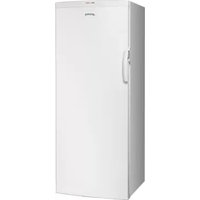
CO230 - Freezer SMEG - Free user manual and instructions
Find the device manual for free CO230 SMEG in PDF.


| Product Type | Freezer |
| Brand | Smeg |
| Model | CO230 |
| Capacity | 230 L |
| Energy Class | A+ |
| Annual Energy Consumption | 250 kWh |
| Dimensions (H x W x D) | 85 x 60 x 60 cm |
| Weight | 40 kg |
| Power Supply | 220-240 V, 50 Hz |
| Power Consumption | 100 W |
| Noise Level | 38 dB(A) |
| Temperature Range | -18 °C (adjustable) |
| Thermostat | Adjustable |
| Fast Freeze Function | Yes |
| Defrost Method | Manual |
| Interior Light | No |
| Door Reversibility | Yes |
| Lock | Yes |
| Climate Class | N-ST |
| Refrigerant | R600a |
| Spare Parts Availability | Yes |
| User Manual | Yes (PDF available) |
Frequently Asked Questions - CO230 SMEG
User questions about CO230 SMEG
0 question about this device. Answer the ones you know or ask your own.
Ask a new question about this device
Download the instructions for your Freezer in PDF format for free! Find your manual CO230 - SMEG and take your electronic device back in hand. On this page are published all the documents necessary for the use of your device. CO230 by SMEG.
USER MANUAL CO230 SMEG
WARNING!
In order to ensure a normal operation of your refrigerating appliance, which uses a completely environmentally friendly refrigerant the R600a (flammable only under certain conditions) you must observe the following rules:
- Do not hinder the free circulation of the air around the appliance.
- Do not use mechanical devices in order to accelerate the defrosting, others than the ones recommended by the manufacturer.
- Do not destroy the refrigerating circuit. Do not use electric appliances inside the food keeping compartment, other than those that might have been recommended by the manufacturer.
ATTENTION!
Advice for recycling of the old appliance /1
Packing Recycling /2
Transport instructions /2
Warnings and special advice /2
Setting up /3
Electric connection /3
Switching off /4
Appliance description /4
Freezer operation /4
Advice for food conservation /5
Defrosting of the appliance /5
Cleaning of the appliance /6
Replacing the interior light bulb /6
Defects finding guide /6
Appliance data sheet /7
FR
Table of contents
2
3
4
5
7
2
3
4
Congratulations for your choice!
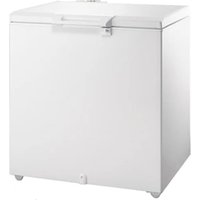
The chest freezer you have purchased is one in the SMEG products range and represents a harmonious joining between the refrigeration technique with the aesthetical outlook. It has a new and attractive design and is built according to the European and national standards which guarantee its operation and safety features. At the same time, the used refrigerant, R600a, is environment-friendly and it does not affect the ozone layer.
In order to use the best your freezer, we advise you to read carefully the information in these user instructions.
Advice for recycling your old appliance
If your newly purchased appliance replaces an older appliance, you must consider a few aspects.
The old appliances are not valueless scrap. Their disposal, while preserving the environment, allows the recovery of important raw materials.
Make your old appliance useless:
- disconnect the appliance from the supply;
- remove the supply cord (cut it);
- remove the eventual locks on the door to avoid the blocking of children inside, while playing, and the endangering of their lives. The refrigerating appliances contain insulating materials and refrigerants which require a proper recycling.
This appliance is not intended for use by person with reduced physical, sensory or mental capabilities or lack of experience and knowledge unless they have been given supervision or instruction concerning use of the appliance by a person responsible for their safety. Children should be supervised to ensure that they do not play with the appliance.
Packing Recycling
WARNING!
Do not allow children to play with the packing or with parts of it. There is the risk of suffocation with parts of corrugated cardboard and with plastic film.
In order to reach you in good condition, the appliance was protected with suitable packaging. All packaging materials are environmentally friendly and recyclable. Please help us recycle the packaging to protect the environment!
IMPORTANT!
Before putting the appliance into operation, read these instructions carefully and completely. They contain important information regarding the installation, use, and maintenance of the appliance.
The manufacturer is not liable if the information in this document is not followed. Keep the instructions in a safe place for easy reference when needed. They may also be useful to another user later.
ATTENTION!
This appliance must be used only for its intended purpose (household use), in suitable areas, away from rain, moisture, or other weather conditions.
Transport instructions
The appliance should be transported, as much as possible, only in an upright position. The packaging must be in perfect condition during transport.
If during transport the appliance was placed horizontally (only according to the markings on the packaging), it is advised that, before putting it into operation, the appliance is left to rest for 12 hours to allow the refrigerating circuit to settle.
Failure to observe these instructions can cause breakdown of the motor-compressor and cancellation of its warranty.
Warnings and general advice
- Do not plug in the appliance if you notice a malfunction.
- Repairs must be carried out only by qualified personnel.
- In the following situations, please unplug the appliance from the mains:
- when you defrost the appliance completely;
- when you clean the appliance.
To unplug the appliance, pull by the plug, not by the cable!
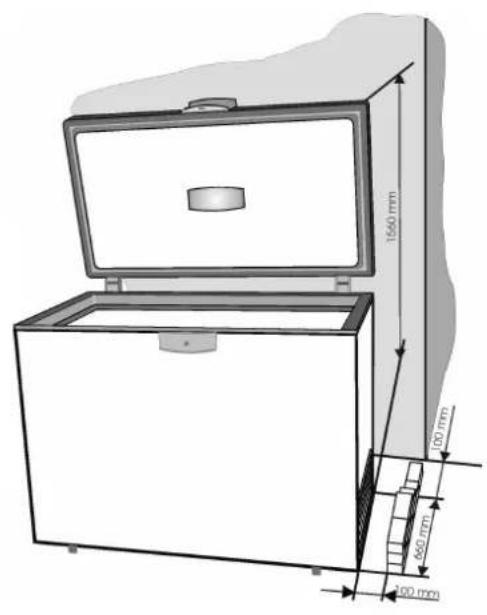
- Ensure the minimum space between the appliance and the wall against which it is placed.
- Do not climb on the appliance.
- Do not allow the children to play or hide inside the appliance.
- Never use electric appliances inside the freezer, for defrosting.
- Do not use the appliance near heating appliances, cookers or other sources of heat and fire.
- Do not leave the freezer door open more than it is necessary to put in or take out the food.
- Do not leave the food in the appliance if it is not working.
- Do not keep inside products containing flammable or explosive gases.
- Do not keep inside fizzy drinks (juice, mineral water, champagne, etc.) in the freezer: the bottle can explode! Do not freeze drinks in plastic bottles.
- Do not eat ice cubes or icecream immediately after having taken them out of the freezer because they may cause "freezer burns".
- Never touch cold metal parts or frozen food with wet hands because your hands can quickly freeze on the very cold surfaces.
- For the protection of the appliance during warehousing and transport, it is provided with spacers between the door and the cabinet (in the front and rear side). These spacers will be removed before putting the appliance into operation.
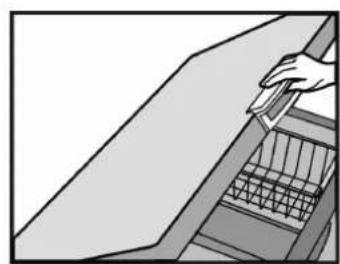
- Excess deposit of ice on the frame and the baskets should be removed regularly with the plastic scraper provided. Do not use any metal parts to remove the ice.
The presence of this ice build-up makes it impossible to close the door correctly.
- If you do not use your appliance for a few days, it is not advisable to switch it off. If you do not use it for a longer period, please proceed as follows:
- Unplug the appliance;
- Empty the freezer;
- Defrost it and clean it;
- Leave the door open to avoid the formation of unpleasant smells.
- The supply cord can be replaced only by an authorised person.
- If your appliance has a lock, keep it locked and store the key in a safe place, out of the reach of children. If you are discarding an appliance with a lock, make sure that it is made ineffective. This is very important so as to avoid children being trapped inside, which may cause their loss of life.
Setting up
This appliance was designed to operate at an ambient temperature between +10°C and +43°C (SN/T class). If the ambient temperature is above +43°C, inside the appliance the temperature can increase.
Set up the appliance far from any source of heat and fire. Placing it in a warm room, the direct exposure to sunbeams or near a heat source (heaters, cookers, ovens), will increase the energy consumption and shorten the product life.
- Please observe the following minimum distances:
- 100 cm from the cookers working with coal or oil;
- 150 cm from the electric and gas cookers.
- Ensure the free circulation of the air around the appliance, by observing the distances shown in Item 2.
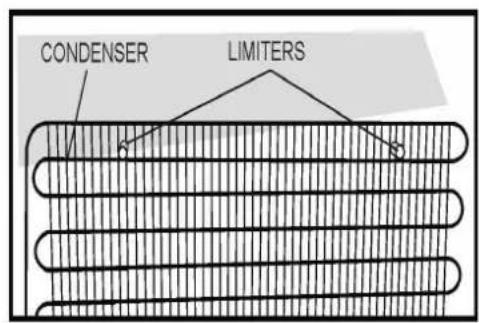
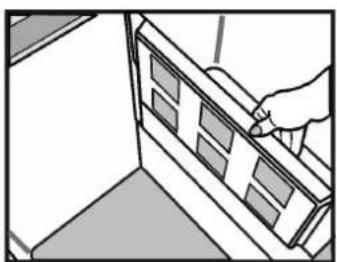
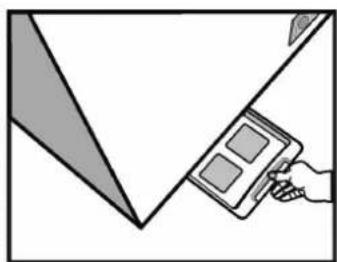
Assemble the supplied spacers on the condenser (at the rear). (Item 3).
Place the appliance on a perfectly level, dry, and well-ventilated surface.
Assemble the supplied accessories.
Electrical connection
Your appliance is designed to operate on a single-phase voltage of 230V/50 Hz. Before plugging in the appliance, ensure that the electrical parameters of your home's mains supply (voltage, current type, frequency) match the operating parameters of the appliance.
- Information regarding the supply voltage and power consumption is provided on the rating label located on the back of the freezer.
- The electrical installation must comply with legal requirements.
- The appliance must be earthed. The manufacturer is not responsible for any damage to persons, animals, or property that may result from failure to observe these conditions.
- The appliance is equipped with a power cord and a plug (European type, rated 10/16A) with a double earthing contact for safety. If the socket does not match the plug type, please have a qualified electrician replace it.
- Do not use extension cords or multiple adapters.
Switching off
The appliance must be able to be switched off by unplugging it or by using a two-pole mains switch installed before the socket.
Operation
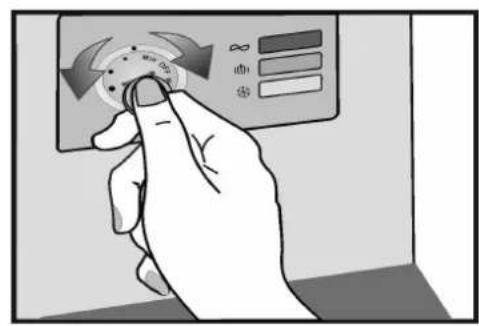
Before first use, clean the interior of the appliance (see the "Cleaning" chapter). After this, plug in the appliance and set the thermostat knob to an average position. The green and red LEDs on the control panel should light up. Allow the appliance to run for about 2 hours without placing food inside. Freezing fresh food is possible after at least 20 hours of operation.
Appliance description
(Item. 1)
- Door handle
- Door
- Lamp housing
- Baskets
- Try
- Lock housing
- Thermostat box
- Spacer for transport
Freezer operation
Temperature adjustment
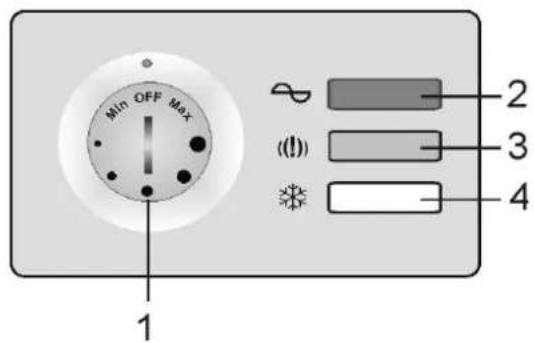
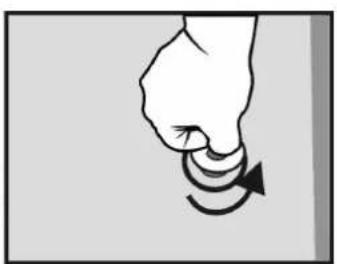
The temperature of the freezer is adjusted by means of the knob assembled on the thermostat (item. 4), position "MAX" being the lowest temperature.
The achieved temperatures can vary according to the conditions of use of the appliance, such as: place of the appliance, ambient temperature, frequency of door opening, extent of filling with food of the freezer. The position of the thermostat knob will change according to these factors. Normally, for an ambient temperature of approx. 32°C, the thermostat will be adjusted on an average position.
The signalling system is placed on the front side of the freezer (Item 5). It includes:
- Thermostat adjustment knob – the inside temperature is adjusted.
- green LED – shows that the appliance is supplied with electric energy.
- red LED – damage – lights if the temperature in the freezer is too high. The LED will operate 15-45 minutes after the putting into operation of the freezer, then it must go off. If the LED goes on during the operation, this means that defects have occurred.
- Orange button—fast freeze – by pushing it the orange led goes on, showing that the appliance entered into the "fast freeze" mode. The exit of this mode is done by pushing the button again, and the orange led goes off.
The three LEDs give information about the mode of operation of the freezer.
Advice for food conservation
The freezer is intended to keep the frozen food for a long time, as well as to freeze fresh food.
One of the main elements for a successful food freezing is the packing.
The main conditions that the packing must fulfill are the following: to be airtight, to be inert towards the packed food, to resist to low temperatures, to be proof to liquids, grease, water vapours, smells, to be able to be washed.
These conditions are fulfilled by the following types of packings: plastic or aluminium film, plastic and aluminium vessels, waxed cardboard glasses or plastic glasses.
IMPORTANT!
- For freezing the fresh food please use the supplied baskets of the appliance.
- Do not place into the freezer a too large quantity of food at a time. The quality of the food is best kept if they are deeply frozen as quickly as possible. This is why it is advisable not to exceed the freezing capacity of the appliance specified in the "Appliance data sheet" (page 7). In order to reduce the freezing time, push the button for „fast freeze”.
- The fresh food must not come into contact with the food already frozen.
- The frozen food you have bought can be placed into the freezer without having to adjust the thermostat.
- If the freezing date is not mentioned on the packing, please take into consideration a period of max. 3 months, as a general guide.
- The food, even partially defrosted, cannot be frozen again; it must be consumed immediately or cooked and then refrozen.
- Carbonated drinks should not be kept in the freezer.
- In case of a power failure, do not open the appliance door. The frozen food will not be affected if the failure lasts less than 67 hours.
DO NOT FORGET!
After 24 hours since the food was placed inside, please cancel the "fast freeze" mode by pressing button 4 again, when the orange LED goes off.
Defrosting the appliance
- We advise you to defrost the freezer at least twice a year or when the ice layer has an excessive thickness.
- Ice build-up is a normal phenomenon.
- The quantity and speed of ice build-up depend on the ambient conditions and on the frequency of door opening.
- We advise you to defrost the appliance when the quantity of frozen food is at its minimum.
- Before defrosting, adjust the thermostat knob to a higher position so that the food stores more cold.
- Unplug the appliance.
- Take out the frozen food, wrap it in several sheets of paper, and put it in the refrigerator or a cool place.
Take the separator panel and put it under the freezer in the direction of the dripping tube.
Take out the obstructing plug. The water that results will be collected in the special tray (separator panel).
After the ice has melted and the water has drained, wipe with a cloth or sponge, then dry thoroughly. Replace the drain plug in its position (item 6).
For faster defrosting, leave the door open.
Do not use sharp metal objects to remove the ice.
Do not use hairdryers or other electric heating appliances for defrosting.
Interior cleaning
Before cleaning, unplug the appliance from the mains.
- It is advisable to clean the appliance when defrosting it.
- Wash the interior with lukewarm water mixed with a mild detergent. Do not use soap, detergent, gasoline, or acetone, as these can leave a strong odor.
- Wipe with a wet sponge and dry with a soft cloth.
During this operation, avoid excess water to prevent it from entering the thermal insulation, which could cause unpleasant odors.
Do not forget to clean the door gasket, especially the bellows ribs, with a clean cloth.
Exterior cleaning
- Clean the exterior of the freezer with a sponge soaked in warm soapy water, wipe with a soft cloth, and dry.
- Clean the exterior parts of the refrigeration circuit (motor-compressor, condenser, connecting tubes) with a soft brush or vacuum cleaner. During this operation, be careful not to distort the tubes or detach the cables.
Do not use scouring or abrasive materials!
After having finished the cleaning, replace the accessories in their places and plug in the appliance.
Replacing the interior light bulb
If the lamp burns out, disconnect the appliance from the mains. Take out the lamp trim. Make sure the lamp is screwed correctly. Plug in the appliance again. If the lamp still does not go on, replace it with another one model E14-15W. Mount back the lamp trim in its place.
Defects finding guide
The appliance does not work.
- There is a power failure. ● The plug of the supply cord is not inserted well into the socket.
- The fuse is blown.
- The thermostat is in „OFF“ position.
The temperatures are not low enough (red LED on).
● The food prevents the door closing. ● The appliance was not placed correctly. - The appliance is placed too close to a heat source. - The thermostat knob is not in the correct position.
Excessive ice build-up
● The door was not closed properly.
The inside lighting does not work
- The lamp is blown. Unplug the appliance from the mains, take out the lamp and replace it with a new one.
The following are not defects
- Possible clicking and cracking sounds coming from the product: circulation of the refrigerant in the system.
Noises during operation
In order to keep the temperature at the value you have adjusted, the compressor of the appliance starts periodically.
The noises which can be heard in such situation are normal.
They are reduced as soon as the appliance reaches the operating temperature.
The humming noise is made by the compressor. It can become a little stronger when the compressor starts.
The bubbling and gurgling noises coming from the refrigerant circulating in the pipes of the appliance are normal operating noises.
Warning!
Never try to repair the appliance or its electric components yourself. Any repair made by an unauthorized person is dangerous for the user and can result in the warranty being voided.
Appliance data sheet
| BRAND SMEG | |
| MODEL CO230 | |
| APPLIANCE TYPE CHEST FREEZER | * * * * |
| Total gross volume (l) 232 | |
| Total useful volume (l) 230 | |
| Freezing capacity (kg/24 h) 12 | |
| Energy efficiency class (1) A+ | |
| Energy consumption (kWh/an) (2) 237 | |
| Autonomy (hours) 67 | |
| Noise (dB (A) re 1 pW) 41 | |
| Ecological refrigerating agent R600a | |
| (1) Energy classes : A . . . G (A = economical . . . G = less economical)(2) The real power consumption depends on the using conditions and on the appliance location. | |
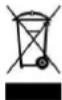
The symbol ■ on the product or on its packaging indicates that this product may not be treated as household waste. Instead, it shall be handed over to the applicable collection point for the recycling of electrical and electronic equipment. By ensuring this product is disposed of correctly, you will help prevent potential negative consequences for the environment and human health, which could otherwise be caused by inappropriate waste handling of this product. For more detailed information about recycling of this product, please contact your local city office, your household waste disposal service, or the shop where you purchased the product.
- WARNING
- ATTENTION
- FR
- TABLE OF CONTENTS
- CONGRATULATIONS FOR YOUR CHOICE
- ADVICE FOR RECYCLING YOUR OLD APPLIANCE
- PACKING RECYCLING
- IMPORTANT
- TRANSPORT INSTRUCTIONS
- WARNINGS AND GENERAL ADVICE
- TO UNPLUG THE APPLIANCE, PULL BY THE PLUG, NOT BY THE CABLE
- SETTING UP
- ELECTRICAL CONNECTION
- SWITCHING OFF
- OPERATION
- APPLIANCE DESCRIPTION
- FREEZER OPERATION
- TEMPERATURE ADJUSTMENT
- ADVICE FOR FOOD CONSERVATION
- DO NOT FORGET
- DEFROSTING THE APPLIANCE
- INTERIOR CLEANING
- EXTERIOR CLEANING
- DO NOT USE SCOURING OR ABRASIVE MATERIALS
- REPLACING THE INTERIOR LIGHT BULB
- DEFECTS FINDING GUIDE
- THE APPLIANCE DOES NOT WORK
- THE TEMPERATURES ARE NOT LOW ENOUGH (RED LED ON)
- EXCESSIVE ICE BUILD-UP
- THE INSIDE LIGHTING DOES NOT WORK
- THE FOLLOWING ARE NOT DEFECTS
- NOISES DURING OPERATION
Brand : SMEG
Model : CO230
Category : Freezer