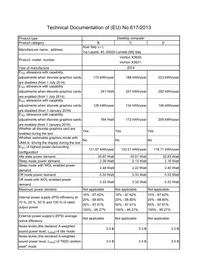
| Product type | Desktop computer |
| Product category | B | C | D |
| Manufacturer name, address | Acer Italy s.r.l., Via Lepetit, 40, 20020 Lainate (MI) Italy |
| Product model number | Veriton X2630; Veriton X2631. |
| Year of manufacture | 2014 |
| ETEC allowance with capability adjustments when discrete graphics cards are disabled (from 1 July 2014) | 172 kWh/year | 188 kWh/year | 223 kWh/year |
| ETEC allowance with capability adjustments when discrete graphics cards are enabled (from 1 July 2014) | 241 Watt | 257 kWh/year | 292 kWh/year |
| ETEC allowance with capability adjustments when discrete graphics cards are disabled (from 1 January 2016) | 126 kWh/year | 134 kWh/year | 146 kWh/year |
| ETEC allowance with capability adjustments when discrete graphics cards are enabled (from 1 January 2016) | 164 Watt | 172 kWh/year | 200 kWh/year |
| Whether all discrete graphics card are enabled during the test | Yes | Yes | Yes |
| Whether switchable graphics mode with UMA is driving the display during the test | No | No | No |
| ETEC of highest power-demanding configuration | 131.97 kWh/year | 133.21 kWh/year | 119.71 kWh/year |
| Idle state power demand | 35.87 Watt | 35.51 Watt | 32.83 Watt |
| Sleep mode power demand | 2.39 Watt | 2.13 Watt | 2.16 Watt |
| Sleep mode with WOL enabled power demand | 2.48 Watt | 2.22 Watt | 2.45 Watt |
| Off mode power demand | 0.33 Watt | 0.33 Watt | 0.33 Watt |
| Off mode with WOL enabled power demand | 0.33 Watt | 0.33 Watt | 0.33 Watt |
| Maximum power demand | Not applicable | Not applicable | Not applicable |
| Internal power supply (IPS) efficiency at 10%, 20%, 50% and 100% of rated output power | 10% - 87.62% | 10% - 87.62% | 10% - 87.62% |
| 20% - 88.80% | 20% - 88.80% | 20% - 88.80% |
| 50% - 87.51% | 50% - 87.51% | 50% - 87.51% |
| 100% - 95.27% | 100% - 95.27% | 100% - 95.27% |
| External power supply's (EPS) average active efficiency | Not applicable | Not applicable | Not applicable |
| Noise levels (the declared A-weighted sound power level, LwAd) of idle mode | 3.3 B | 3.3 B | 3.3 B |
| Noise levels (the declared A-weighted sound power level, LwAd) of "HDD random seek" mode | 3.4 B | 3.4 B | 3.4 B |
| Minimum number of loading cycles that the batteries can withstand | Not applicable | Not applicable | Not applicable |
| Configuration of memory | 2 ~ 16 GB | 2 GB | 4 ~ 16 GB |
| Configuration of internal storage | 1 piece | 1 piece | 1 piece |
| Configuration of discrete television tuner | 0 piece | 0 piece | 0 piece |
| Configuration of discrete audio card | 0 piece | 0 piece | 0 piece |
| Configuration of discrete graphics cards | 1 piece | 1 piece | 1 piece |
| Configuration of discrete graphics cards category | G3 | G3 | G3 |
| The battery in this product cannot be easily replaced by users themselves | Not applicable | Not applicable | Not applicable |
| For products with an integrated display, the total content of mercury is | Not applicable | Not applicable | Not applicable |
| Measurement methodology for ETEC | COMMISSION REGULATION (EU) No 617/2013 of 26 June 2013 implementing Directive 2009/125/EC of the European Parliament and of the Council with regard to ecodesign requirements for computers and computer servers: ANNEX II Ecodesign requirements and timetable: 1.1.1. ETEC formula. |
| Measurement methodology for idle mode | EN 62623:2013 — Desktop and notebook computers — Measurement of energy consumption: 5.2. Test setup; 5.3.5. Measuring short idle mode; 5.7. True RMS watt meter specification; 5.8. True RMS watt meter accuracy; Annex E.2 (informative) ENERGY STAR® V5 compliant testing methodology. |
| Measurement methodology for sleep mode | EN 62623:2013 — Desktop and notebook computers — Measurement of energy consumption 5.2. Test setup; 5.3.3. Measuring sleep mode; 5.4. Test conditions; 5.7. True RMS watt meter specification; 5.8. True RMS watt meter accuracy. |
| Measurement methodology for off mode | EN 62623:2013 — Desktop and notebook computers — Measurement of energy consumption 5.2. Test setup; 5.3.2. Measuring off mode; 5.4. Test conditions; 5.7. True RMS watt meter specification; 5.8. True RMS watt meter accuracy. |
| Measurement methodology for IPS efficiency | Generalized Test Protocol for Calculating the Energy Efficiency of Internal Ac-Dc and Dc-Dc Power Supplies Revision 6.6 (April,2012). |
| Measurement methodology for EPS efficiency | Not applicable |
| Measurement methodology for noise level | ECMA-109 2nd edition (December 1987) Declared NoiseEmission Values of Computer and Business Equipment:4. Determination of the declared noise emission values.ECMA-74 11th edition (December 2010) Measurement ofAirborne Noise emitted by Information Technology andTelecommunications Equipment:5. Installation and operating instructions;6. Method for determination of sound power levels of equipmentin reverberation test rooms;7. Method for determination of sound power levels of equipmentunder essentially free-field conditions over a reflecting plane;Annex C.15 Equipment category: personalcompute rs andworkstations. |
| Measurement methodology for battery loading cycles | Not applicable |
| Sequence of steps for achieving a stable condition with respect to power demand | EN 62623:2013 — Desktop and notebook computers —Measurement of energy consumption:5.2. Test setup;5.3.2. Measuring off mode;5.3.3. Measuring sleep mode;5.3.5. Measuring short idle mode. |
| Description of how sleep mode was selected or programmed | EN 62623:2013 — Desktop and notebook computers —Measurement of energy consumption5.2. Test setup;5.3.3. Measuring sleep mode; |
| Description of how off mode was selected or programmed | EN 62623:2013 — Desktop and notebook computers —Measurement of energy consumption5.2. Test setup;5.3.2. Measuring off mode; |
| Sequence of events required to reach the mode where the equipment automatically changes to sleep mode | ENERGY STAR® Program Requirements Product Specificationfor Computers, Eligibility Criteria Version 6.0, Rev. Oct-2013:1.D.4 Sleep Mode. |
| Sequence of events required to reach the mode where the equipment automatically changes to off mode | Not applicable |
| The length of time after a period of user inactivity in which the computer automatically reaches a power mode that has a lower power demand requirement than sleep mode | 30 minutes |
| The length of time before the display sleep mode is set to activate after user inactivity | 10 minutes |
| User information on the energy-saving potential of power management functionality | http://www.energystar.gov/index.cfm?c=power_mgt.pr_power_mgt_users |
| User information on how to enable the power management functionality | http://www.energystar.gov/index.cfm?c=power_mgt.pr_power_mgt_users |
| Test parameter for ambient temperature | 25 °C |
| Test parameter for test voltage | 230 V |
| Test parameter for frequency | 50 Hz |
| Test parameter for total harmonic distortion of the electricity supply system | 3 % |
| Test parameter for information and documentation on the instrumentation, set-up and circuits used for electrical testing | AC source- Chroma 6530Digital meter- YOKOGAWA WT210 |