
202 Go - Audio Mixer Audibax - Free user manual and instructions
Find the device manual for free 202 Go Audibax in PDF.


| Product Type | Audio Mixer |
| Brand | Audibax |
| Model | 202 Go |
| Channels | 5 (1 mono + 2 stereo) |
| Mono Channel Input | XLR / 1/4" combo (MIC/Line) with gain, 2-band EQ, pan |
| Stereo Channels | 2 × RCA (Line), one with 2-band EQ and balance |
| Phantom Power | +18 V (permanently on XLR) |
| Headset Connection | 3.5 mm jack (headphone + microphone) |
| Outputs | 1 × stereo RCA (Main/Monitor) |
| USB Interface | USB 1.1, 16-bit Delta-Sigma, 44.1/48 kHz |
| Bluetooth | Built-in module for wireless audio sources |
| EQ (Channel 1) | Bass ±15 dB @ 80 Hz, Treble ±15 dB @ 12 kHz |
| EQ (Channel 2/3) | Bass ±15 dB @ 80 Hz, Treble ±15 dB @ 12 kHz |
| Frequency Response | 20 Hz – 22 kHz |
| THD | ≤ 0.05% |
| Signal-to-Noise Ratio | 80 dB (A-weighted) |
| Dimensions (W × H × D) | 100 × 40 × 135 mm |
| Weight | 430 g |
| Power Supply | USB (5 V / 500 mA) via computer or adapter (not included) |
| Current Consumption | ≤ 500 mA |
| Maintenance & Cleaning | Clean with a dry, lint-free cloth. Avoid liquids and solvents. |
| Safety | Indoor use only. Keep away from moisture, heat, and children. Read manual. |
| Spare Parts / Repairability | Contact customer service for spare parts and repairs. |
| General Information | Designed for amplification, mixing, and playback of instruments and microphones. |
Frequently Asked Questions - 202 Go Audibax
User questions about 202 Go Audibax
0 question about this device. Answer the ones you know or ask your own.
Ask a new question about this device
Download the instructions for your Audio Mixer in PDF format for free! Find your manual 202 Go - Audibax and take your electronic device back in hand. On this page are published all the documents necessary for the use of your device. 202 Go by Audibax.
USER MANUAL 202 Go Audibax
8 Protecting the environment

Disposal of the packaging material
For the transport and protective packaging, environmentally friendly materials have been chosen that can be supplied to normal recycling.
Ensure that plastic bags, packaging, etc. are properly disposed of.
Do not just dispose of these materials with your normal household waste, but make sure that they are collected for recycling. Please follow the notes and markings on the packaging.

Disposal of your old device
This product is subject to the European Waste Electrical and Electronic Equipment Directive (WEEE) in its currently valid version. Do not dispose with your normal household waste.
Dispose of this device through an approved waste disposal firm or through your local waste facility. When discarding the device, comply with the rules and regulations that apply in your country. If in doubt, consult your local waste disposal facility.
Proffesional Mixer

202 Go
Please read the manual before using the product
Table of contents
1 General information .... 1
1.1 Further information....1
1.2 Notational conventions.... 1
1.3 Symbols and signal words 2
2 Safety instructions.... 2
3 Features 4
4 Installation and starting up .... 4
5 Connections and controls .... 5
6 Technical specifications .... 7
7 Plug and connection assignment 7
8 Protecting the environment 10
XLR plug (unbalanced)
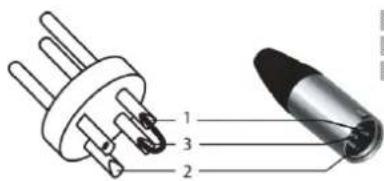
1 Ground, shielding
2 Signal
3 Bridged to pin 1
Three-pole 1/8" mini phone jack (stereo, unbalanced)

1 Signal (left)
2 Signal (right)
3 Ground, shielding
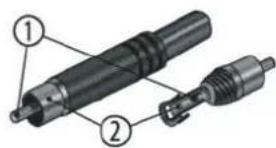
RCA connection
Drawing and table indicate the pin assignment of an RCA plug.
1 Signal
2 Ground, shielding
In a professional environment, therefore, the balanced transmission is preferred, because this enables an undisturbed transmission of signals over long distances. In addition to the conductors 'Ground' and 'Signal', in a balanced transmission a second core is added. This also transfers the signal, but phase-shifted by 180°.
Since the interference affects both cores equally, by subtracting the phase-shifted signals, the interfering signal is completely neutralized. The result is a pure signal without any noise interference.
1/4" TS phone plug (mono, unbalanced)

| 1 | Signal |
| 2 | Ground, shielding |
1/4" TRS phone plug (mono, balanced)

| 1 | Signal (in phase, +) |
| 2 | Signal (out of phase, -) |
| 3 | Ground |
XLR plug (balanced)

| 1 | Ground, shielding |
| 2 | Signal (in phase, +) |
| 3 | Signal (out of phase, -) |
1 General information
This manual contains important instructions for the safe operation of the unit. Read and follow the safety instructions and all other instructions. Keep the manual for future reference. Make sure that it is available to all those using the device. If you sell the unit please make sure that the buyer also receives this manual.
Our products are subject to a process of continuous development. Thus, they are subject to change.
1.1 Further information
On our website () you will find lots of further information and details on the following points:
| Download | This manual is also available as PDF file for you to download. |
| Keyword search | Use the search function in the electronic version to find the topics of interest for you quickly. |
| Online guides | Our online guides provide detailed information on technical basics and terms. |
| Personal consultation | For personal consultation please contact our technical hotline. |
| Service | If you have any problems with the device the customer service will gladly assist you. |
1.2 Notational conventions
This manual uses the following notational conventions:
Letterings
The letterings for connectors and controls are marked by square brackets and italics.
Examples: [VOLUME] control, [Mono] button.
1.3 Symbols and signal words
In this section you will find an overview of the meaning of symbols and signal words that are used in this manual.
| Signal word | Meaning |
| DANGER! | This combination of symbol and signal word indicates an immediate dangerous situation that will result in death or serious injury if it is not avoided. |
| CAUTION! | This combination of symbol and signal word indicates a possible dangerous situation that can result in minor injury if it is not avoided. |
| NOTICE! | This combination of symbol and signal word indicates a possible dangerous situation that can result in material and environmental damage if it is not avoided. |
| Warning signs | Type of danger |
 | Warning – danger zone. |
2 Safety instructions
Intended use
This device is intended to be used for amplification, mixing and playback of signals from musical instruments and microphones. Use the device only as described in this user manual. Any other use or use under other operating conditions is considered to be improper and may result in personal injury or property damage. No liability will be assumed for damages resulting from improper use.
This device may be used only by persons with sufficient physical, sensorial, and intellectual abilities and having corresponding knowledge and experience. Other persons may use this device only if they are supervised or instructed by a person who is responsible for their safety.
6 Technical specifications
| Sensitivity / impedance | Channel 1, XLR | 2 mV / 1.8 kΩ (gain @ max.) |
| Channel 1, 1/4" phone jack | 10 mV / 12 kΩ (line) | |
| Channel 2 | 30 mV / 20 Kω | |
| Output level | Main & monitor | 5.8 V (max.) |
| Frequency response | 20 Hz ~ 22 kHz | |
| THD | ≤ 0.05 % | |
| Signal-to-noise ratio | 80 dB (A-weighted) | |
| EQ | Bass | ± 15 dB / 80 Hz |
| Treble | ± 15 dB / 12 kHz | |
| Impedance headphones output | ≥ 16 Ω | |
| USB interface | USB 1.1 compatible, 16 bit Delta-Sigma Sampling rates: 44.1 kHz, 48 kHz | |
| Phantom voltage | +18 V | |
| Voltage supply | via computer (USB port) or USB mains adaptor 5 V / 500 mA(not supplied) | |
| Dimensions (W × H × D) | 100 × 40 × 135 mm | |
| Weight | 430 g |
7 Plug and connection assignment
Introduction
This chapter will help you select the right cables and plugs to connect your valuable equipment in such a way that a perfect sound experience is ensured.
Please note these advices, because especially in 'Sound & Light' caution is indicated: Even if a plug fits into the socket, an incorrect connection may result in a destroyed power amp, a short circuit or 'just' in poor transmission quality!
Balanced and unbalanced transmission
Unbalanced transmission is mainly used in semi-professional environment and in hifi use. Instrument cables with two conductors (one core plus shielding) are typical representatives of the unbalanced transmission. One conductor is ground and shielding while the signal is trans-mitted through the core.
Unbalanced transmission is susceptible to electromagnetic interference, especially at low levels, such as microphone signals and when using long cables.
| 1 | [USB TO COMPUTER]USB port for connection to a computer for use as an audio interface as well as for power supply |
| 2 | [MONITOR - MIC]To connect the microphone when using a headset, signal processing via channel 1 |
| 3 | [POWER]This LED lights when the device is turned on. |
| 4 | [ON / OFF]On / off switch |
| 5 | [MONITOR - HEADSET]To connect the headphone when using a headset |
| 6 | [2-TK / BT TO]When the switch is pressed, the Bluetooth and 2-TK input signals are assigned to the 'Monitor' output, otherwise to the 'MAIN MIX' output and the USB port |
| 7 | [PAIR]This switch must be pressed to allow the device to pair with Bluetooth sources. The blue LED above the switch indicates the Bluetooth status: 1 × blink per second: Ready to make the connection. 1 × blink per 5 seconds: Connected. 2 × blinks per 5 seconds: Connection interrupted |
| 8 | [MONITOR]Volume control for the Monitor output |
| 9 | [L - CLIP - R]The 'L' or 'R' LED lights up green when a signal is present in the respective bus side. It lights up red when overload occurs in the respective bus side. Then lower the input levels that possibly cause the overload or turn the 'MAIN MIX' control counterclockwise |
| 10 | [MAIN MIX]Volume control for the 'MAIN MIX' output and the USB port |
| 11 | [CH 2/3]Level control for the signals at input 'CH2/3' and at the USB port |
| 12 | [CH1]Level control for the signals at input 'CH1' |
| 13 | [PEAK]This LED lights up on overload in channel 1. If this happens, turn the [GAIN] control counterclockwise until the LED goes out. |
| 14 | [HIGH - LOW - PAN]Tone and pan control for channel 'CH1'. Slide the 'HIGH' control up or down to raise or lower the treble. Slide the 'LOW' control up or down to raise or lower the bass. Slide the 'PAN' control up or down to move the signal source further to the left or right in the stereo panorama. |
| 15 | [HIGH - LOW - BAL]Tone and pan control for channel 'CH2/3'. Slide the 'HIGH' control up or down to raise or lower the treble. Slide the 'LOW' control up or down to raise or lower the bass. Slide the 'BAL' control up or down to increase the loudness of the left or right channel of the signal source. |
| 16 | [GAIN]Control to adjust the sensitivity of the input 'CH1' |
| 17 | [LINE / USB - FROM]When this switch is pressed, the signals present at the USB port will be played, otherwise those at the 'LINE IN' input. |
| 18 | [LINE / USB - TO]When the switch is pressed, the channel signal is present at the 'MONITOR' output, otherwise at the 'MAIN MIX' output. |
| 19 | [CH1 INPUT] |
Safety

DANGER!
Danger for children
Ensure that plastic bags, packaging, etc. are disposed of properly and are not within reach of babies and young children. Choking hazard!
Ensure that children do not detach any small parts (e.g. knobs or the like) from the unit. They could swallow the pieces and choke!
Never let children unattended use electrical devices.

CAUTION!
Possible hearing damage
With loudspeakers or headphones connected, the device can produce volume levels that may cause temporary or permanent hearing impairment.
Do not operate the device permanently at a high volume level. Decrease the volume level immediately if you experience ringing in your ears or hearing impairment.

NOTICE!
Operating conditions
This device has been designed for indoor use only. To prevent damage, never expose the device to any liquid or moisture. Avoid direct sunlight, heavy dirt, and strong vibrations.

NOTICE!
Short-circuit hazard
The phantom power leads to damage to the device if unbalanced XLR cables are connected.
Use only balanced XLR cables.
3 Features
- 5-channel mixer
- 1 × mono channel with XLR / 1/4" combo socket (MIC / Line), gain adjustment, 2-band EQ and pan control
- 1 × stereo channel with RCA sockets (line), 2-band EQ and balance control
- 1 × stereo channel with RCA sockets (line)
• 18 V phantom power permanently present on the XLR input - Headset with headphone and microphone connectable (3.5 mm jack)
- 1 × stereo RCA output
• USB port for use as an audio interface
• Built-in Bluetooth module for wireless sources
• Power supply via USB port
4 Installation and starting up
Unpack and carefully check that there is no transportation damage before using the unit. Keep the equipment packaging. To fully protect the device against vibration, dust and moisture during transportation or storage use the original packaging or your own packaging material suitable for transport or storage, respectively.
Establish all connections as long as the unit is switched off. Use the shortest possible high-quality cables for all connections.
5 Connections and controls

- 8 PROTECTING THE ENVIRONMENT
- DISPOSAL OF THE PACKAGING MATERIAL
- DISPOSAL OF YOUR OLD DEVICE
- PROFFESIONAL MIXER
- TABLE OF CONTENTS
- XLR PLUG (UNBALANCED)
- THREE-POLE 1/8" MINI PHONE JACK (STEREO, UNBALANCED)
- RCA CONNECTION
- 1 GENERAL INFORMATION
- 1.1 FURTHER INFORMATION
- 1.2 NOTATIONAL CONVENTIONS
- LETTERINGS
- 1.3 SYMBOLS AND SIGNAL WORDS
- 2 SAFETY INSTRUCTIONS
- INTENDED USE
- 6 TECHNICAL SPECIFICATIONS
- 7 PLUG AND CONNECTION ASSIGNMENT
- INTRODUCTION
- BALANCED AND UNBALANCED TRANSMISSION
- SAFETY
- DANGER
- CAUTION
- NOTICE
- 3 FEATURES
- 4 INSTALLATION AND STARTING UP
- 5 CONNECTIONS AND CONTROLS
Brand : Audibax
Model : 202 Go
Category : Audio Mixer