Tribute Hybrid (2009) - Car MAZDA - Free user manual and instructions
Find the device manual for free Tribute Hybrid (2009) MAZDA in PDF.


| Product Type | SUV, Hybrid Electric Vehicle (HEV) |
| Manufacturer | Mazda (Ford platform) |
| Model Year | 2009 |
| Engine | 2.5L Atkinson-cycle I4 + Permanent Magnet Electric Motor |
| Combined Power | 177 hp (132 kW) |
| Transmission | eCVT (Electronic Continuously Variable Transmission) |
| Drive Type | Front-Wheel Drive (FWD) or All-Wheel Drive (AWD) |
| Battery Type | Nickel-Metal Hydride (NiMH), 330V |
| Fuel Economy (EPA) | 32 mpg city / 29 mpg highway (FWD) |
| Fuel Tank Capacity | 15.0 gallons (56.8 L) |
| Seating Capacity | 5 passengers |
| Cargo Volume | 28.8 cu ft (815 L) behind rear seats; 66.3 cu ft (1877 L) max |
| Overall Length | 174.7 in (4437 mm) |
| Overall Width | 71.8 in (1824 mm) |
| Overall Height | 67.8 in (1722 mm) |
| Wheelbase | 103.1 in (2619 mm) |
| Curb Weight | Approx. 3,600 lbs (1633 kg) |
| Tires | P235/70R16 (standard) |
| Safety Features | Front, side, and curtain airbags; ABS; traction control; stability control (AdvanceTrac) |
| Maintenance | Oil change every 5,000-7,500 miles; hybrid battery cooling fan filter cleaning; regenerative brake pads last longer |
| Special Hybrid Features | Regenerative braking, auto stop/start, electric-only mode at low speeds |
Frequently Asked Questions - Tribute Hybrid (2009) MAZDA
User questions about Tribute Hybrid (2009) MAZDA
0 question about this device. Answer the ones you know or ask your own.
Ask a new question about this device
Download the instructions for your Car in PDF format for free! Find your manual Tribute Hybrid (2009) - MAZDA and take your electronic device back in hand. On this page are published all the documents necessary for the use of your device. Tribute Hybrid (2009) by MAZDA.
USER MANUAL Tribute Hybrid (2009) MAZDA
Warning lights and chimes 20
Gauges 25
Entertainment Systems 27
AM/FM stereo with CD/MP3 27
Auxiliary input jack (Line in) 35
USB port 37
Satellite radio information 40
Navigation system 43
Climate Controls 44
Dual automatic temperature control 44
Rear window defroster 48
| Lights | 49 |
| Headlamps | 49 |
| Turn signal control | 53 |
| Bulb replacement | 55 |
| Driver Controls | 61 |
| Windshield wiper/washer control | 61 |
| Steering wheel adjustment | 62 |
| Power windows | 68 |
| Mirrors 69 | |
| Cruise control | 71 |
| Moon roof | 75 |
| Message center | 77 |
| Locks and Security | 90 |
| Keys | 90 |
| Locks | 92 |
| Anti-theft system | 100 |
Table of Contents
Seating and Safety Restraints 105
Seating 105
Safety restraints 116
Airbags 130
Child restraints 145
Tires, Wheels and Loading 163
Tire information 165
Tire inflation 168
Tire Pressure Monitoring System (TPMS) 181
Vehicle loading 186
Trailer towing 193
Recreational towing 193
Driving 194
| Starting | 194 |
| Brakes | 199 |
| Electronic stability control | 202 |
| Transmission operation | 208 |
Roadside Emergencies 218
| Hazard flasher switch | 218 |
| Fuel pump/High voltage shut-off switches 218 | |
| Fuses and relays | 220 |
| Changing tires | 228 |
| Wheel lug nut torque | 240 |
| Jump starting | 241 |
| Wrecker towing | 246 |
Customer Assistance 248
| Reporting safety defects (U.S. only) | 258 |
| Reporting safety defects (Canada only) | 258 |
Cleaning 259
Table of Contents
Maintenance and Specifications 265
Engine compartment 268
Engine oil 271
Battery 274
Engine Coolant and Motor/Electronics Coolant 277
Fuel information 282
Air filter(s) 297
Maintenance product specifications and capacities 299
Engine data 300
Accessories 303
Service Maintenance Section 304
Normal scheduled maintenance and log 309
Special operating conditions and log 314
Index 320
All rights reserved. Reproduction by any means, electronic or mechanical including photocopying, recording or by any information storage and retrieval system or translation in whole or part is not permitted without written authorization from MNAO. MNAO may change the contents without notice and without incurring obligation.
Copyright © 2008 MNAO
Introduction
CONGRATULATIONS
Congratulations on acquiring your new Mazda Tribute Hybrid. Please take the time to get well acquainted with your vehicle by reading this handbook. The more you know and understand about your vehicle, the greater the safety and pleasure you will derive from driving it.
For more information on Mazda Motor Corporation and its products visit the following website:
•In the United States: www.mazdausa.com
• In Canada: www.mazda.ca
Additional owner information is given in separate publications or refer to the MazdaImporters/Distributorssection in the CustomerAssistance chapter.
This Owner's Manual describes every option and model variant available and therefore some of the items covered may not apply to your particular vehicle. Furthermore, due to printing cycles it may describe options before they are generally available.
Remember to pass on this Owner's Manual when reselling the vehicle. It is an integral part of the vehicle.

WARNING: Fuel pump and high voltage battery shut-off switches: In the event of an accident the fuel pump shut-off switch may automatically cut off the fuel supply to the engine and the high voltage shut-off switch cuts off power from the high voltage battery. These switches can also be activated through sudden vibration (e.g. collision when parking). For information on resetting the fuel pump shut-off switch and the high voltage battery shutoff switch, refer to the Fuelpump/highvoltageshut-offswitchesintheRoadside Emergencieschapter.
SAFETY AND ENVIRONMENT PROTECTION

Warning symbols in this guide
How can you reduce the risk of personal injury to yourself or others? In this guide, answers to such questions are contained in comments highlighted by the warning triangle symbol. These comments should be read and observed.
Introduction

Warning symbols on your vehicle
When you see this symbol, it is imperative that you consult the relevant section of this guide before touching or attempting adjustment of any kind.

Protecting the environment
We must all play our part in protecting the environment. Correct vehicle usage and the authorized disposal of waste, cleaning and lubrication materials are significant steps towards this aim. Information in this respect is highlighted in this guide with the tree symbol.

CALIFORNIAProposition65Warning

WARNING:Engine exhaust, some of its constituents, and certain vehicle components contain or emit chemicals known to state of California to cause cancer and birth defects or other reproductive harm. In addition, certain fluids contained in vehicles and certain products of component wear contain or emit chemicals known to the State of California to cause cancer and birth defects or other reproductive harm.
PERCHLORATE MATERIAL
Certain components of this vehicle such as airbag modules, seat belt pretensioners, and button cell batteries may contain Perchlorate Material – Special handling may apply for service or vehicle end of life disposal. See www.dtsc.ca.gov/hazardouswaste/perchlorate.
BREAKING-IN YOUR VEHICLE
Your vehicle does not need an extensive break-in. Try not to drive continuously at the same speed for the first 1,000 miles (1,600 km) of new vehicle operation. Vary your speed frequently in order to give the moving parts a chance to break in.
Drive your new vehicle at least 1,000 miles (1,600 km) before towing a trailer. For more detailed information about towing a trailer, refer to Trailertowing in the Tires, Wheels and Loading chapter.
Introduction
Do not add friction modifier compounds or special break-in oils since these additives may prevent piston ring seating. See Engineoil in the Maintenance and Specifications chapter for more information on oil usage.
HYBRID OPERATION
The Hybrid is a whole new kind of SUV that combines electric and gasoline propulsion without compromise, to provide breakthrough performance and efficiency. It requires no special fuels and never has to be plugged in. Familiarizing yourself with these unique characteristics will help ensure optimal performance from your new vehicle.
Normal vehicle operation
Starting: Turn the ignition key to the START position while your vehicle is in Park (P). The gas engine will turn on, accompanied by the green
“readyindicator”light. Your engine may shut off shortly after starting, depending on temperature and battery charge level. This is a natural part of your Hybrid’s fuel-saving features. The “ready indicator” light will stay on, and you do not need to restart the vehicle.
Note: You may notice higher engine speeds upon start-up. This temporary condition is normal and necessary to heat up the cabin for occupant comfort.
Driving: The gas engine automatically starts and stops to provide power when it's needed and to save fuel when it's not. While coasting at low speeds, coming to a stop, or standing, the gas engine normally shuts down and the vehicle operates in electric-only mode. Conditions that may cause the engine to start up or remain running include:
- Driving request for moderate to rapid acceleration
• Vehicle speed above 40 mph (65 kph) - Ascending a hill
• ECON mode not selected (while Climate Control is ON) - Selection of climate control defrost mode or defrost/floor mode
- Charge level of high voltage battery is low
- Very high or low outside temperature (to provide system cooling/heating)
Stopping: The gas engine may shut off to conserve fuel as you come to a stop. Restarting the vehicle is not required. Simply step on the accelerator when you are ready to drive.
Introduction
TransmissionOperation: Due to the technologically advanced, electronically controlled Continuously Variable Transaxle (eCVT) you will not feel shift changes like those of a non-hybrid vehicle. Your Hybrid's transmission is designed to do its work seamlessly.
Sinceyourenginespeediscontrolledbythetransmission, it may seem elevatedattimes. This is normal hybrid operation and helps deliver fuelefficiency and performance.
Neutral: It is not recommended to idle the vehicle in (N) Neutral for extended periods of time because this will discharge your high voltage battery and decrease fuel economy. Also, the engine cannot provide power to the hybrid system in (N) Neutral.
LowGear: Low gear (L) is designed to mimic the enhanced engine braking available in non-hybrid vehicles. On long downhill grades, (L) Low gear may produce high engine speeds to provide necessary engine braking. This is normal and will not damage your vehicle. Response during acceleration should be the same as in the (D) Drive position.
Reverse:(R) Reverse Gear vehicle speed is limited to 22 mph (35 km/h).
Unique Hybrid operating characteristics
Your Hybrid, with its new technology, behaves differently compared to a non-hybrid. Here is a description of the major differences:
Battery: Your Hybrid is equipped with a high voltage battery cooling system in the rear of the vehicle. A cool battery ensures battery life and provides the best possible performance. Your hybrid high voltage battery may periodically re-condition itself to ensure maximum efficiency. You may notice slight changes in drivability during this process, but it's an important part of your Hybrid's high voltage battery optimization features.
You may hear a series of clicks from the cargo area when you first turn the key in the ignition. This sound is the high voltage contactors closing to allow you to start your hybrid.
In addition, you may hear fan noise and a slight tapping sound from the rear as the vent door operates. This fan may continue to operate for short durations after the vehicle has been turned off. These noises are a customary part of hybrid operation and do not require service.
If the vehicle is left inoperative for over 31 days, it may be necessary to jumpstart the vehicle. For more information, refer to Jumpstarting your(Lowvoltage[underhood]batteryonly)in the Roadside Emergencieschapter.
Introduction
Engine: The engine speed in your hybrid is not directly tied to your vehicle speed. Your vehicle's engine and transmission are designed to deliver the power you need at the most efficient engine speed. During heavy accelerations, your hybrid may reach high engine speeds (up to 6000 RPM). This is characteristic of the Atkinson cycle engine technology helping to maximize your hybrid's fuel economy.
In prolonged mountainous driving, you may see the engine tachometer changing without your input. This is intentional and maintains the battery charge level. You may also notice during extended downhill driving that your engine continues to run instead of shutting off.
During this “engine braking”, the engine stays on, but it’s not using any fuel. You may also hear a slight whine or whistle when operating your vehicle. This is the normal operation of the electric generator in the hybrid system.
During certain events (such as vehicle servicing) your low voltage (underhood) battery may become disconnected or disabled. When this occurs, and after reconnecting the low voltage (underhood) battery and driving the vehicle, the engine may continue to operate for 3-5 seconds after the key is turned to the 1 (LOCK) position. This is a normal condition, as the vehicle's computers are relearning the operating characteristics of your particular engine in order to operate it at maximum efficiency.
Braking: Your hybrid is equipped with standard hydraulic braking and regenerative braking. Regenerative braking is performed by your transmission and it captures brake energy and stores it in your high voltage battery.
Driving to optimize fuel economy
Your fuel economy should improve throughout your hybrid's break-in period. As with any vehicle, fuel economy can be significantly impacted by your driving habits and accessory usage. For best results, keep in mind these tips:
TireInflation: Keep tires properly inflated and only use recommended size.
ClimateControl: Your hybrid is equipped with an “ECON” button that offers a more fuel efficient operation of your automatic temperature control system.
When activated, the "ECON" feature may allow the engine to shut down at low speeds or when your vehicle is stopped.
If cooler temperature is desired, the “ECON” button can be turned off, for better interior cooling but lower fuel economy.
Introduction
The “ECON” mode turns itself off when you select defrost or defrost/floor mode, although on cold days, you may still experience engine shut-down while in defrost or defrost/floor mode.
DriveHabits: Aggressive driving increases the amount of energy required to move your vehicle. In general, better fuel economy is achieved with mild to moderate acceleration and deceleration. Moderate braking is particularly important since it allows you to maximize the energy captured by the regenerative braking system.
NOTE: Having your engine running is not always an indication of inefficiency – in some cases it is actually more efficient than driving in electric mode.
AdditionalTips:
- Do not carry extra loads
- Be mindful of adding external accessories that may increase aerodynamic drag
- Observe posted speed limits
- Perform all scheduled maintenance
- There is no need to wait for your engine to “warm up”. The vehicle is ready to drive immediately after starting
Introduction
Frequently asked questions
| QuestionAnswer | |
| What are the series of clicks from the cargo area when I first turn the key in the ignition? | The high voltage battery is electrically isolated from the rest of the vehicle when the key is OFF. When the key is turned ON, high voltage contactors inside the battery are closed to make the electricity available to the motor/generator and enable the vehicle to drive. The clicks are the sound of these contactors as they close and open during start up and shut down. |
| Why does the engine always start at key-on? | Your engine is started at key-on because the emission components need to be warm in order to minimize tailpipe emissions, and in cooler climates for cabin heating and windshield defrost performance. |
| After I start my car in the morning, why does it take a long time before the engine shuts down? | There are several reasons the engine stays on for an extended amount of time when it is first started. One common reason is to ensure that the emissions components are warm enough to minimize tailpipe emissions. As the climate gets cooler, this “engine-ON” time is extended. |
| Why does my engine never shut down above 40 mph (64 km/h)? | The engine is required to turn on above this speed to protect the transaxle hardware. |
Introduction
| QuestionAnswer | |
| Why does my engine stay ON when it's extremely cold outside? | In order to ensure that the climate control system can begin heating the cabin and/or defrosting the windshield as soon as a driver requests it, the engine coolant temperature has to be kept sufficiently hot. Keeping the engine on is required to maintain the correct minimum temperature. |
| Why does my engine rev up so high sometimes when I accelerate? | Your vehicle's engine and transmission are designed to deliver the power you need at the most efficient engine speed. This may be higher than expected during heavy accelerations, and may fluctuate during steady state driving. These are characteristics of the Atkinson engine cycle and the eCVT transaxle technology that help maximize your hybrid's fuel economy. |
| What does it mean when my power assist gauge moves to the right? To the left? | Electricity is coming out of the battery when the gauge moves to the right. Electricity is going into the battery when the gauge moves to the left. |
| What is the fan noise and slight tapping sound I hear from the rear of my hybrid? | The fan noise comes from two fans located inside the high voltage battery. These fans turn on when the battery requires cooling air. The fan speed, and associated noise level, will change according to the amount of cooling required to maintain good performance. |
Introduction
| QuestionAnswer | |
| How far can I go in Electric Drive if I run out of gas? | Running out of gas is not recommended. However, you may be able to go about one mile, driving at 30 mph (48 km/h), if the battery has a normal state of charge. |
| What is the engine oil change service interval? | The engine oil should be changed every 10,000 miles (16,000 km) under normal operating conditions. See the Scheduledmaintenance guidechapter. |
| Can I put E10 or E85 in my vehicle, and how will it affect my fuel economy? | Your hybrid vehicle can use E10 (10% ethanol, 90% gasoline) fuel, but you may notice slightly reduced fuel economy because ethanol contains less energy per gallon than gasoline. Your hybrid vehicle is not designed to use E85 (85% ethanol). |
| How long will my high voltage battery last? Does it need maintenance? | The high voltage battery system is designed to last the life of the vehicle and requires no maintenance. |
| Can you charge the battery with a plug into an A/C outlet? | There are no provisions for charging the high voltage battery from a power supply external to the vehicle. |
Introduction
| QuestionAnswer | |
| What is the purpose of the ECON button? | ECON mode may provide improved fuel economy by preventing the gasoline engine from running for the sole purpose of providing air conditioning. When the engine turns off, the A/C compressor does not operate and warm air may come out of the vents. In ECON mode, A/C operates as normal when the gasoline engine is running. |
| Can I tow the hybrid behind my motor home with all four wheels down? | Yes. Your hybrid vehicle can be “flat-towed” without modification. See the RecreationalTowing section in the Tires, Wheelsand Loadingchapter for more information. |
SPECIAL NOTICES
New Vehicle Limited Warranty
For a detailed description of what is covered and what is not covered by your vehicle's New Vehicle Limited Warranty, refer to the Warranty Guide/CustomerInformationGuidethat is provided to you along with your Owner'sManual.
Special instructions
For your added safety, your vehicle is fitted with sophisticated electronic controls.

WARNING: Please read the section Airbag Supplemental Restraint System(SRS) in the Seating and Safety
Restraintschapter.Failuretofollowthespecificwarningsand instructionscouldresultinpersonalinjury.

WARNING: Front seat mounted rear-facing child or infant seats should NEVER be placed in front of an active passenger airbag.
Introduction
Service Data Recording
Service data recorders in your vehicle are capable of collecting and storing diagnostic information about your vehicle. This potentially includes information about the performance or status of various systems and modules in the vehicle, such as engine, throttle, steering or brake systems. In order to properly diagnose and service your vehicle, Mazda North American Operations, Mazda Canada, and service and repair facilities may access vehicle diagnostic information through a direct connection to your vehicle when diagnosing or servicing your vehicle.
EventDataRecording
Other modules in your vehicle — event data recorders — are capable of collecting and storing data during a crash or near crash event. The recorded information may assist in the investigation of such an event. The modules may record information about both the vehicle and the occupants, potentially including information such as:
- how various systems in your vehicle were operating;
- whether or not the driver and passenger seatbelts were buckled;
- how far (if at all) the driver was depressing the accelerator and/or the brake pedal;
• how fast the vehicle was traveling; and - where the driver was positioning the steering wheel.
To access this information, special equipment must be directly connected to the recording modules. Mazda North American Operations and Mazda Canada do not access event data recorder information without obtaining consent, unless pursuant to court order or where required by law enforcement, other government authorities or other third parties acting with lawful authority. Other parties may seek to access the information independently of Mazda North American Operations and Mazda Canada.
Introduction
Notice to owners of pickup trucks and utility type vehicles

WARNING: Utility vehicles have a significantly higher rollover rate than other types of vehicles.
Before you drive your vehicle, please read this Owner's Manual carefully. Your vehicle is not a passenger car. As with other vehicles of this type, failure to operate this vehicle correctly may result in loss of vehicle control, vehicle rollover, personal injury or death.
Using your vehicle with a snowplow
Donotusethisvehicleforsnowplowing.
Your vehicle is not equipped with a snowplowing package.
Using your vehicle as an ambulance

WARNING: Do not use this vehicle as an ambulance.
Your vehicle is not equipped with an ambulance preparation package.
Introduction
These are some of the symbols you may see on your vehicle.
VehicleSymbolGlossary
Safety Alert
Protecting the Environment
Airbag - Front Airbag - Side
Passenger Airbag Off
Child Seat Tether Anchor
Anti-Lock Brake System PartABS Brake System
Brake Fluid - Non-Petroleum Based
Stability Control System Master Lighting Switch
Hazard Warning Flasher Fog Lamps-Front
Fuse Compartment Fuel Pump Reset
Windshield Wash/Wipe
Rear Window Defrost/Demist


See Owner's Manual
Fasten Seat Belt
Child Seat Lower Anchor
Brake System
Parking Aid System
Windshield Defrost/Demist
Power Windows


Introduction
VehicleSymbolGlossary
Power Window Lockout

Personal Alarm System Feature

Engine Oil Engine Coolant

Engine Coolant Temperature

Do Not Open When Hot

Battery

Avoid Smoking, Flames, or Sparks

Battery Acid Explosive Gas

Fan Warning Power Steering Fluid

Maintain Correct Fluid Level

Service Engine Soon

Engine Air Filter Speed Cor

Passenger Compartment Air Filter

Jack


Check Fuel Cap

Low Tire Pressure Warning


INFORMATION ABOUT THIS GUIDE
The information found in this guide was accurate at the time of printing. Mazda may change the contents without notice.
Instrument Cluster
text_image
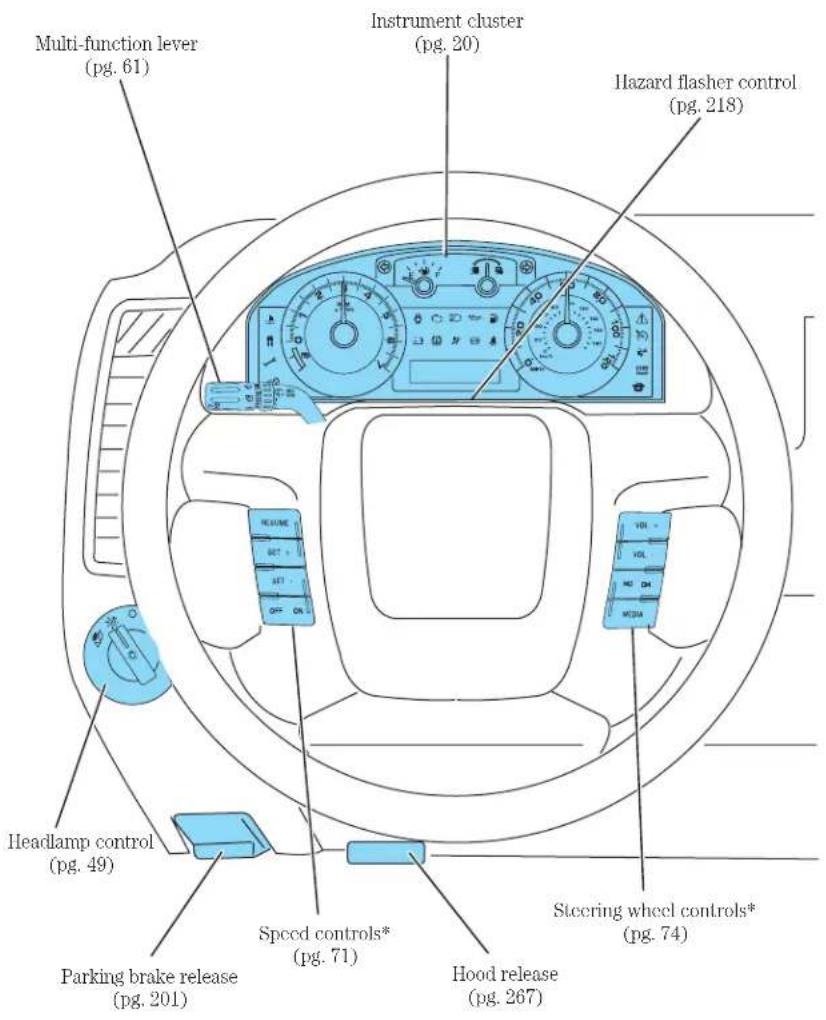
Multi-function lever (pg. 61) Instrument cluster (pg. 20) Hazard flasher control (pg. 218) Headlamp control (pg. 49) Speed controls* (pg. 71) Steering wheel controls* (pg. 74) Parking brake release (pg. 201) Hood release (pg. 267)* if equipped
Instrument Cluster

text_image
Climate controls (pg. 44) Audio system (pg. 27) Auxiliary power point (pg. 66) Electronic stability control (pg. 202) USB port* (pg. 37) Auxiliary input jack (pg. 35) *if equippedInstrument Cluster
WARNING LIGHTS AND CHIMES
text_image
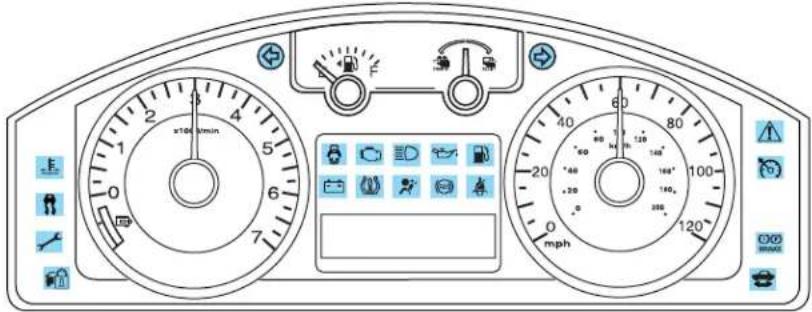
Front panel of a vehicle dashboard with controls, gauges, and display indicators in ChineseWarning lights and gauges can alert you to a safety hazard or a vehicle condition that may become serious enough to cause extensive repairs. A warning light may illuminate when a problem exists with one of your vehicle's functions. Many lights will illuminate when you start your vehicle to make sure the bulbs work. If any light remains on after starting the vehicle, refer to the respective system warning light for additional information.
Serviceenginesoon:The Service enginesoonindicator light
illuminates when the ignition is first turned to the on position to check

the bulb and to indicate whether the vehicle is ready for Inspection/Maintenance (I/M) testing. Normally, the "Service engine soon" light will stay on until the engine is cranked, then turn itself off if no malfunctions are present. However, if after 15 seconds the "Service engine soon"light blinks eight times, it means that the vehicle is not ready for I/M testing. See the ReadinessforInspection/Maintenance (I/M)testingin the MaintenanceandSpecificationschapter.
Solid illumination after the engine is started indicates the On Board Diagnostics System (OBD-II) has detected a malfunction. Refer to On boarddiagnostics(OBD-II) in the Maintenance and Specifications chapter. If the light is blinking, engine misfire is occurring which could damage your catalytic converter. Drive in a moderate fashion (avoid heavy acceleration and deceleration) and have your vehicle serviced immediately by your authorized dealer.
Instrument Cluster

WARNING: Under engine misfire conditions, excessive exhaust temperatures could damage the catalytic converter, the fuel
system, interior floor coverings or other vehicle components, possibly causing a fire.
Brakesystemwarninglight:To
confirm the brake system warning light is functional, it will momentarily illuminate when the ignition is turned to the on position
when the engine is not running, or in a position between on and start, or by applying the parking brake when the ignition is turned to the on position. If the brake system warning light does not illuminate at this time, seek service immediately from your authorized dealer. Illumination after releasing the parking brake indicates low brake fluid level or a brake system malfunction and the brake system should be inspected immediately by your authorized dealer.

BRAKE

WARNING: Driving a vehicle with the brake system warning light on is dangerous. A significant decrease in braking
performance may occur. It will take you longer to stop the vehicle. Have the vehicle checked by your authorized dealer. Driving extended distances with the parking brake engaged can cause brake failure and the risk of personal injury.
Anti-lockbrakesystem: If the
ABS light stays illuminated or continues to flash, a malfunction has
been detected, have the system
serviced immediately by your
authorized dealer. Normal braking is still functional unless the brake warning light also is illuminated.

Airbagreadiness: If this light fails to illuminate when the ignition is turned to on, continues to flash or remains on, have the system
serviced immediately by your authorized dealer. A chime will also sound when a malfunction in the supplemental restraint system has been detected.

Instrument Cluster
Seatbelt: Reminds you to fasten your seat belt. A Belt-Minder® chime will also sound to remind you to fasten your seat belt. Refer to the SeatingandSafetyRestraints chapter to activate/deactivate the Bo

Mastervehicleelectricalhazard warninglamp: Indicates Hybrid component fault/failure that will cause the vehicle to shutdown or fail to start.


WARNING: If the vehicle is still running, the vehicle may soon shutdown without further warning and should be stopped safely.
If this lamp is lit, stop the vehicle, shift to P (Park), turn the key to the off position, and attempt to restart the vehicle. If the fault remains, the vehicle may require refueling, jump starting, resetting of the shut-off switches, or service. For information regarding Lowvoltage [underhood]batteryonlyand Fuelpump/Highvoltageshut-off switchesplease refer to the RoadsideEmergencieschapter.
Readyindicatorlight: Illuminates once the vehicle has successfully started. Indicates the vehicle is ready to drive even when you don't hear the engine running.
Charging system: Illuminates when the 12V charging system is not working properly.
Engineoilpressure:lluminates when the oil pressure falls below the normal range, refer to Engineoil in the Maintenance and Specificationschapter.

Instrument Cluster
Engineormotorelectronic
coolanttemperature:Illuminates when the coolant temperature exceeds the threshold. When the light is flashing or remains on, stop the vehicle as soon as possible, switch off the engine and let cool. Refer to Enginecoolantandmotor/electronicscoolantin the Maintenance andSpecificationschapter.


WARNING: When the engine and radiator are hot, scalding coolant and steam may shoot out under pressure and cause as injury. Do not remove the cooling system cap when the engine radiator are hot.
AdvanceTrac®/Traction
Control™:Illuminates when the AdvanceTrac®/Traction Control™ is active. If the light remains on, have the system serviced immediately, refer to the Drivingchapter for more information.
Lowtirepressurewarning:
Illuminates when your tire pressure is low. If the light remains on at start up or while driving, the tire pressure should be checked. Refer to Inflating your tires in the Tires, Wheels and Loading chapter. When the ignition is first turned to on, the light will illuminate for three seconds to ensure the bulb is working. If the light does not turn on or begins to flash, have the system inspected by your authorized dealer. For more information on this system, refer to Tirepressuremonitoring system(TPMS)in the Tires,WheelsandLoadingchapter.
Lowfuel: Illuminates when the fuel level in the fuel tank is at or near empty (refer to Fuelgauge in this chapter).

Speedcontrol: Illuminates when the speed control is engaged. Turns off when the speed control system is disengaged.
Instrument Cluster
Anti-theftsystem: Flashes when the SecuriLock™ Passive Anti-theft System has been activated.

Throttlecontrol/Powertrain:
Illuminates when a powertrain fault has been detected. Contact your authorized dealer as soon as possible.

Doorajar: Illuminates when the ignition is in the on position and any door is open.

Turnsignal: Illuminates when the left or right turn signal or the hazard lights are turned on. If the indicators flash faster, check for a burned out bulb.

Highbeams: Illuminates when the high beam headlamps are turned on.

Key-in-ignitionwarningchime: Sounds when the key is left in the ignition in the off or accessory position and the driver's door is opened.
Headlampsonwarningchime: Sounds when the headlamps or parking lamps are on, the ignition is off (the key is not in the ignition) and the driver's door is opened.
Parkingbrakeonchime: Sounds when the parking brake is left on and the vehicle is driven. If the warning stays on after the park brake is off, contact your authorized dealer as soon as possible.
HEVEngineoffReminderChime: Sounds for 10 seconds when the PRNDL is in the P (Park) position and the Driver's door is ajar (open) while ignition is in the on position. Always turn your ignition key to off and remove key before leaving your vehicle. (The engine may be off when the vehicle is stopped, yet the key is on, and the engine can turn on at any time)
Messagecenteractivationchime: Sounds when a warning message (except PARKING BRAKE ENGAGED while parked) appears in the message center display for the first time.
GAUGES

text_image
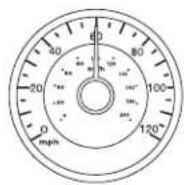
Front panel of a car dashboard with speedometer, control knobs, and navigation iconsSpeedometer: Indicates the current vehicle speed.
Batterygauge: Provides information about the vehicle's energy usage.
- ASSIST — Battery provides extra power to boost the vehicle's acceleration.
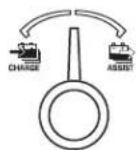
- CHARGE — Storing extra energy in the battery when coasting or slowing down.
Odometer: Registers the total miles (kilometers) of the vehicle.
Refer to Messagecenter in the DriverControls chapter on how to switch the display from Metric to English.
Instrument Cluster
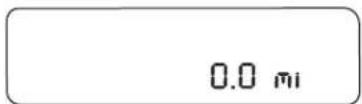
Tripodometer: Registers the miles (kilometers) of individual journeys. To reset, press and release the message center INFO button until TRIP A mode appears in the display. Press the control again to select the TRIP B feature. Press and hold the R
TRIP A XXX.X mi 0.0 mi
Tachometer: Indicates the engine speed in revolutions per minute. Driving with your tachometer pointer continuously at the top of the scale may damage the engine. The pointer will indicate engine RPMs when the engine is running and point at the EV symbol when the engine is off and the vehicle is

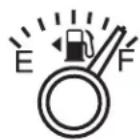
Fuelgauge:Indicates
approximately how much fuel is left in the fuel tank (when the ignition is in the on position). The fuel gauge may vary slightly when the vehicle is in motion or on a grade.
Refer to Fillingthetankin the Maintenance and Specifications chapter for more information.
Entertainment Systems
AUDIO SYSTEMS
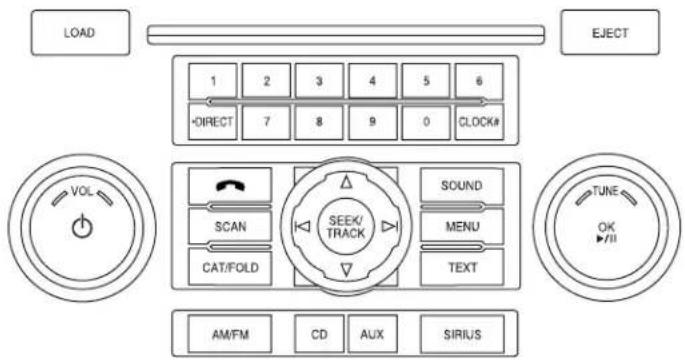
AM/FM/single CD or in-dash CD6/MP3 satellite compatible sound system
text_image
LOAD EJECT 1 2 3 4 5 6 -DIRECT 7 8 9 0 CLOCK# VOL SCAN CAT/FOLD SEEK/ TRACK SOUND MENU TEXT TUNE OK /II AM/FM CD AUX SIRIUS
WARNING: Driving while distracted can result in loss of vehicle control, accident and injury. Mazda strongly recommends that
drivers use extreme caution when using any device that may take their focus off the road. The driver's primary responsibility is the safe operation of their vehicle. Only use cell phones and other devices not essential to the driving task when it is safe to do so.
Accessorydelay: Your vehicle is equipped with accessory delay. With this feature, the radio and other electrical accessories may be used for up to ten minutes after the ignition is turned off or until either front door is opened.
Note: Your vehicle is equipped with a unique audio system. If your display shows six small circles in the display, your audio system is a CD6 system. If not, your system is a Single CD system.
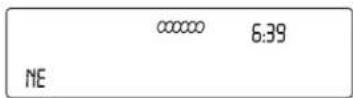
Settingtheclock
To set the time, press CLOCK. The display will read SET TIME. Use the memory preset numbers (0–9) to enter in the desired time-hours and minutes. The clock will then begin from that time.
Entertainment Systems
AM/FMRadio
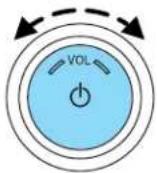
/VOL(Power/Volume):Press to turn the radio on/off. Turn the knob to increase/decrease volume.
If the volume is set above a certain level and the ignition is turned off, the volume will come back on at a nominal listening level when the ignition is turned back on.
AM/FM: Press repeatedly to select AM/FM1/FM2 frequency band.
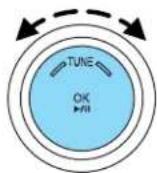
TUNE: Turn the knob to go up/down the frequency band in individual increments.

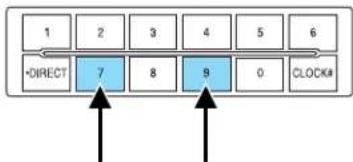
DIRECT: Press DIRECT and then select the desired radio frequency (i.e. 93.9) using the memory preset numbers (0–9).
SEEK/TRACK:Press
SEEK/TRACK to access the
previous/next strong radio station.

SCAN: Press for a brief sampling of all strong radio stations.
MEMORYPRESETS(0-9):When tuned to any station, press and hold a preset button until sound returns and PRESET # SAVED appears in the display. You can save up to 30 stations, 10 in AM, 10 in FM1 and FM2.
text_image
1 2 3 4 5 6 •DIRECT 7 8 9 0 CLOCK#Savingpresetsautomatically(Autoset)-Autoset allows you to set the strongest local radio stations without losing your original manually set preset stations for AM/FM1/FM2.
Entertainment Systems
Toactivatetheautosetfeature: Press MENU repeatedly until AUTO PRESET ON/OFF appears in the display. Use |← SEEK/TRACK→| toggle AUTO PRESET to ON, and either wait five seconds for the search to initiate or press OK to immediately initiate the search. If you press another control within those five seconds, the search will not initiate; the 10 strongest stations will be filled and the station stored in preset 1 will begin playing.
If there are fewer then 10 strong stations, the system will store the last one in the remaining presets.
RDSRadio
Available only in FM mode. This feature allows you to search RDS-equipped stations for a certain category of music format: CLASSIC, COUNTRY, JAZZ/RB, ROCK, etc.
Toactivate: Press MENU repeatedly until RDS (ON/OFF) appears in the display. Use ▶ SEEK/TRACK ▶ toggle RDS ON/OFF. When RDS is OFF, you will not be able to search for RDS equipped stations or view the station name or type.
CAT/FOLD(Category/Folder): This feature allows you to select from various music categories.
TochangeRDScategories: Press MENU repeatedly until RBDS ON/OFF appears in the display. Use ▲ /▼ toggle RDS to ON. Press CAT. PRESS UP OR DOWN TO CHANGE RDS CATEGORY will appear in the display. Press ▲ /▼ scroll through all possible categories. When the desired category appears in the display, press ◀ SEEK/TRACK ▶ find the next station playing that selection or press SCAN for a brief sampling of all stations playing that category of music.
CD/MP3Player
CD:Press to enter CD/MP3 mode. If a disc is already loaded into the system, CD/MP3 play will begin where it ended last. If no CD is loaded, NO DISC will appear in the display.
LOAD:
ForasingleCDsystem—This control is not operational. To load a CD, simply insert the disc, label side up, into the CD slot.
ForaCD6system-Press LOAD. When the display reads SELECT SLOT, choose the desired slot number using memory presets 1–6. When the display reads LOAD CD #, load the desired disc, label side up. If you do not choose a slot within five seconds, the system will choose for you. Once loaded, the first track will begin to play.
Entertainment Systems
Toautoloaduptosixdiscs-Press and hold LOAD until the display reads AUTOLOAD #. Load the desired disc, label side up. The system will prompt you to load discs for the remaining available slots. Insert the discs, one at a time, label side up, when prompted. Once loaded, the disc in preset #1 will begin to play.
Press the number preset buttons (1–6) to choose the disc you want to play.
EJECT:
ForasingleCDsystem-press EJECT to eject the CD.
ForaCD6system-press EJECT and select the desired CD slot by pressing the corresponding memory preset number. The display will read EJECTING #. When the system has ejected the CD, the display will read REMOVE CD #. Remove the CD. If you do not remove the CD, the system will reload the disc.
Toautoejectallloadeddiscs-Press and hold EJECT. The system will eject all discs and prompt you when to remove them.
▶ / Play/Pause: Press to
play/pause a track when playing a CD.
SEEK/TRACK:Press
SEEK/TRACK ▶ access the
previous/next track.

CAT(Category)/FOLD(Folder):
InMP3modeonly-Press CAT/FOLD and then press
SEEK/TRACK to access the previous/next folder.
SCAN:Press for a brief sampling of all tracks on the current disc or MP3folder.
DIRECT:
InCDmode-Press DIRECT. The display will read DIRECT TRACK MODE SELECT TRACK. Enter the desired track number using the memory preset buttons (0–9). The system will then begin playing that track.
Entertainment Systems
InMP3foldermode-Press DIRECT and the memory preset buttons (0–9) of the desired folder. The system will advance to that specific folder.
TEXT:
InMP3modeonly-Press TEXT repeatedly to view Album (AL), Folder (FL), Song (SO) and Artist (AR) in the display, if available.
InTEXTMODE—Sometimes the display requires additional text to be displayed. When the < / > indicator is active, press TEXT and then press SEEK/TRACK view the additional display text.
COMPRESSION: Press MENU repeatedly until COMPRESSION ON/OFF appears in the display. Use SEEK/TRACK toggle between ON/OFF. When COMPRESSION is ON, the system will bring the soft and loud CD passages together for a more consistent listening level.
SHUFFLE: Press MENU repeatedly until SHUFFLE ON/OFF appears in the display. Use ▶ SEEK/TRACK ▶ toggle between ON/OFF. If you wish to engage shuffle mode right away, press
SEEK/TRACK to begin random play. Otherwise, random play will begin when the current track is finished playing. The system will only shuffle the disc currently playing.
SatelliteRadio
SatelliteradioisavailableonlywithavalidSIRIUSradio subscription.Checkwithyourauthorizeddealerforavailability.
SIRIUS: Press to access satellite radio mode, if equipped. Press repeatedly to cycle through SAT1, SAT2 and SAT3 modes.
TUNE/OK: Turn the knob to go to the next / previous available SIRIUS satellite station.
Entertainment Systems
DIRECT: Press DIRECT then enter the desired channel (i.e. 002) using the memory preset buttons (0–9). If you only enter one digit, press OK and the system will go to that satellite channel. If you enter three digits, the system will automatically go to that channel, if available. You may cancel your entry by pressing DIRECT. If an invalid station number is entered, INVALID CHANNEL will appear in the display and the system will continue playing the current station.
SEEK/TRACK: Press
SEEK/TRACK to seek to
the previous/next channel. If a specific category is selected, (Jazz, Rock, News, etc.), press
SEEK/TRACK to seek to
the previous/next channel in the selected category. Press and hold SEEK/TRACK to last seek through the previous/next channels.
SCAN: Press SCAN for a brief sampling of all available SIRIUS satellite channels. If a specific category is selected, (Jazz, Rock, News, etc.) press SCAN for a brief sampling of all available SIRIUS satellite channels within the selected category.
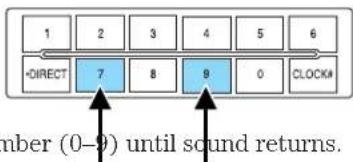
MEMORY PRESETS (0–9): There are 30 available presets, 10 each for SAT1, SAT2 and SAT3. To save satellite channels in your memory presets, tune to the desired channel then press and hold a memory pres
text_image
1 2 3 4 5 6 +DIRECT 7 8 9 0 CLOCK# Number (0-9) until sound returns.TEXT: Press and release to display the artist and song title. While in TEXT MODE, press again to scroll through the Artist (AR), Song (SO), Channel (CH) and Category (CA).
InTEXTMODE: Sometimes the display requires additional text to be displayed. When the < / > indicator is active, press TEXT and then press SEEK/TRACK view the additional display text.
CAT (Category) / FOLD (Folder): Press to toggle between turning the most recently selected satellite radio category on or off. The category icon (CAT) will illuminate in the display when a specific category is selected (the icon will not illuminate during CATEGORY ALL). If no category has ever been selected, NO CATEGORY SELECTED will display.
Note: Separate categories can be set for SAT1, SAT2 or SAT3. Refer to Satelliteradiomenu for further information on selecting a satellite radio category.
Entertainment Systems
SATELLITERADIOMENU: Press MENU when satellite radio mode is active to access. Press OK to enter into the satellite radio menu.
Press ▲ /No cycle through the following options:
- CATEGORY:Press OK to enter category mode. Press ▲ /▼ to scroll through the list of available SIRIUS channel Categories (Pop, Rock, News, etc.) Press OK when the desired category appears in the display. After a category is selected, press SEEK to search for that specific category of channels only (i.e. ROCK). You may also select CATEGORY ALL to seek all available SIRIUS categories and channels. Press OK to close and return to the main menu.
- SAVESONG: Press OK to save the currently playing song's title in the system's memory. (If you try to save something other than a song, CANT SAVE will appear in the display.) When the chosen song is playing on any satellite radio channel, the system will alert you with an audible prompt. Press OK while SONG ALERT is in the display and the system will take you to the channel playing the desired song. You can save up to 20 song titles. If you attempt to save more than 20 titles, the display will read REPLACE SONG? Press OK to access the saved titles and press ▲ /▼ cycle through the saved titles. When the song title appears in the display that you would like to replace, press OK. SONG REPLACED will appear in the display.
- DELETESONG: Press OK to delete a song from the system's memory. Press ▲ /▼ cycle through the saved songs. When the song appears in the display that you would like to delete, press OK. The song will appear in the display for confirmation. Press OK again and the display will read SONG DELETED. If you do not want to delete the currently listed song, press ▲ /▼ select either RETURN or CANCEL.
Note: If there are no songs presently saved, the display will read NO SONGS.
- DELETEALLSONGS: Press OK to delete all song's from the system's memory. The display will read ARE YOU SURE? Press OK to confirm deletion of all saved songs and the display will read ALL DELETED.
Note: If there are no songs presently saved, the display will read NO SONGS.
- ENABLEALERTS/DISABLEALERTS:Press OK to enable/disable the satellite alert status which alerts you when your selected songs are playing on a satellite radio channel. (The system default is disabled.)
Entertainment Systems
SONG ALERTS ENABLED/DISABLED will appear in the display. The menu listing will display the opposite state. For example, if you have chosen to enable the song alerts, the menu listing will read DISABLE as the alerts are currently on, so your other option is to turn them off.
SoundAdjustments
Press SOUND repeatedly to cycle through the following features:
BASS:Press |◀ SEEK/TRACK ▶ adjust the level of bass.
TREBLE:Press |◀ SEEK/TRACK ▶ adjust the level of treble.
BALANCE:Press |← SEEK/TRACK ▶ adjust the audio between the left (L) and right (R) speakers.
FADE:Press | SEEK/TRACK | adjust the audio between the back (B) and front (F) speakers.
SPEEDCOMPENSATEDVOLUME(ifequipped): With this feature on, radio volume automatically gets louder with increasing vehicle speed to compensate for road and wind noise.
The default setting is off.
Use ◀ SEEK/TRACK ▶ adjust between SPEED OFF and levels 1–7: Increasing the level from 1 (lowest setting) to 7 (highest setting) allows the radio volume to automatically change slightly with vehicle speed to compensate for road and wind noise.
Recommended level is 1–3; SPEED OFF turns the feature off and level 7 is the maximum setting.
ALLSEATS(Occupancymode, ifequipped): Press SOUND repeatedly to reach the Occupancy mode setting. Press
SEEK/TRACK to select and optimize sound for ALL SEATS, DRIVERS SEAT or REAR SEATS.
ExtraFeatures
AUX: Press to reach LINE IN (auxiliary audio mode).
For location and further information on auxiliary audio mode, refer to Auxiliaryinputjacklater in this chapter.
(Phone): This feature is not active.
Entertainment Systems
TUNE/OK: Your vehicle may be equipped with features which will require you to confirm commands by pressing OK.
Auxiliary input jack (Line in)
WARNING: Driving while distracted can result in loss of vehicle control, accident and injury. Mazda strongly recommends that drivers use extreme caution when using any device that may take their focus off the road. The driver's primary responsibility is the safe operation of their vehicle. Only use cell phones and other devices not essential to the driving task when it is safe to do so.
Your vehicle is equipped with an Auxiliary Input Jack (AIJ). The Auxiliary Input Jack provides a way to connect your portable music player to the in-vehicle audio system. This allows the audio from a portable music player to be played through the vehicle speakers with high fidelity. To achieve optimal performance, please observe the following instructions when attaching your portable music device to the audio system. If your vehicle is equipped with a navigation system, refer to Auxiliaryinputjacksection in the Audiofeatureschapter of your Navigationsystemsupplement.
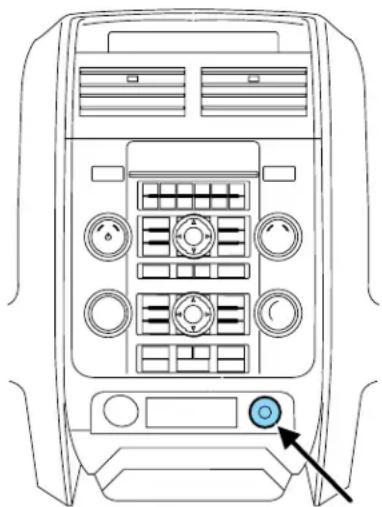
natural_image
Front view of a car air conditioner unit panel with control buttons and a dial indicator (no text or symbols)2009 Tribute Hybrid(thv) OwnersGuide, 1st Printing USA(fus)
Entertainment Systems
Requiredequipment:
- Any portable music player designed to be used with headphones
- An audio extension cable with stereo male 1/8 in. (3.5 mm) connectors at each end
Toplayyourportablemusicplayerusingtheauxiliaryinputjack:
- Begin with the vehicle parked and the radio turned off.
- Ensure that the battery in your portable music player is new or fully charged and that the device is turned off.
- Attach one end of the audio extension cable to the headphone output of your player and the other end of the audio extension cable to the AIJ in your vehicle.
- Turn the radio on, using either a tuned FM station or a CD loaded into the system. Adjust the volume to a comfortable listening level.
- Turn the portable music player on and adjust the volume to 1/2 the volume.
- Press AUX on the vehicle radio repeatedly until LINE, LINE IN or SYNC LINE IN appears in the display. You should hear audio from your portable music player although it may be low.
- Adjust the sound on your portable music player until it reaches the level of the FM station or CD by switching back and forth between the AUX and FM or CD controls.
Troubleshooting:
- Do not connect the audio input jack to a line level output. Line level outputs are intended for connection to a home stereo and are not compatible with the AIJ. The AIJ will only work correctly with devices that have a headphone output with a volume control.
- Do not set the portable music player's volume level higher than is necessary to match the volume of the CD or FM radio in your audio system as this will cause distortion and will reduce sound quality. Many portable music players have different output levels, so not all players should be set at the same levels. Some players will sound best at full volume and others will need to be set at a lower volume.
- If the music sounds distorted at lower listening levels, turn the portable music player volume down. If the problems persist, replace or recharge the batteries in the portable music player.
- The portable music player must be controlled in the same manner when it is used with headphones as the AIJ does not provide control (play, pause, etc.) over the attached portable music player.
Entertainment Systems
- For safety reasons, connecting or adjusting the settings on your portable music player should not be attempted while the vehicle is moving. Also, the portable music player should be stored in a secure location, such as the center console or the glove box, when the vehicle is in motion. The audio extension cable must be long enough to allow the portable music player to be safely stored while the vehicle is in motion.
USB port (if equipped)
WARNING: Driving while distracted can result in loss of vehicle control, accident and injury. Mazda strongly recommends that drivers use extreme caution when using any device that may take their focus off the road. The driver's primary responsibility is the safe operation of their vehicle. Only use cell phones and other devices not essential to the driving task when it is safe to do so.
Your vehicle may be equipped with a USB port located on the instrument panel. This feature allows you to plug in media playing devices, memory sticks, and also to charge devices if they support this feature. For further information on this feature, refer to Accessing and using your USB port in the SYNC supplement or Navigationsystem supplement.
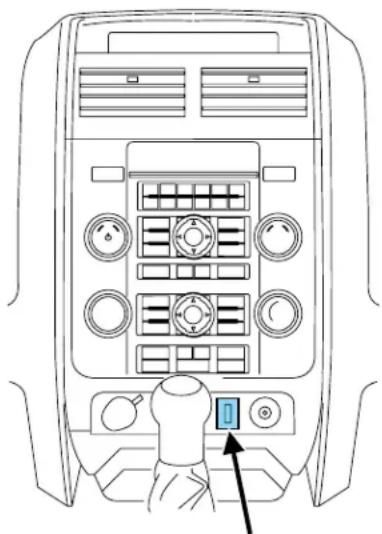
natural_image
Line drawing of a car air conditioner unit panel with control buttons and a hand pointing to the mode (no text or symbols)Entertainment Systems
GENERAL AUDIO INFORMATION
Radiofrequencies:
AM and FM frequencies are established by the Federal Communications Commission (FCC) and the Canadian Radio and Telecommunications Commission (CRTC). Those frequencies are:
AM: 530, 540–1700, 1710 kHz
FM: 87.7, 87.9–107.7, 107.9 MHz
Radioreceptionfactors:
There are three factors that can affect radio reception:
- Distance/strength: The further you travel from an FM station, the weaker the signal and the weaker the reception.
- Terrain: Hills, mountains, tall buildings, power lines, electric fences, traffic lights and thunderstorms can interfere with your reception.
- Station overload: When you pass a broadcast tower, a stronger signal may overtake a weaker one and play while the weak station frequency is displayed.
CD/CDplayercare
Do:
- Handle discs by their edges only. (Never touch the playing surface).
- Inspect discs before playing.
- Clean only with an approved CD cleaner.
• Wipe discs from the center out.
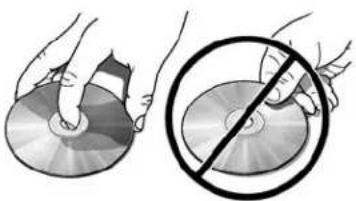
natural_image
Illustration of hands holding a CD and a disc with a prohibition symbol (no text or labels)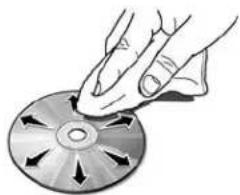
natural_image
Hand holding a CD or DVD disc with arrows indicating rotation (no text or symbols)Don't:
- Expose discs to direct sunlight or heat sources for extended periods of time.
- Clean using a circular motion.
38
2009TributeHybrid(thv) OwnersGuide,1stPrinting USA(fus)
Entertainment Systems
CDunitsaredesignedtoplaycommerciallypressed4.75in (12cm)audiocompactdiscsonly.Duetotechnical incompatibility,certainrecordableandre-recordablecompact discsmaynotfunctioncorrectlywhenusedinMazdaCDplayers.
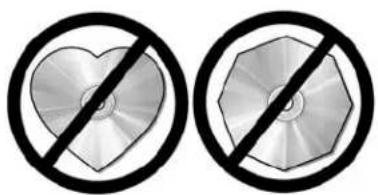
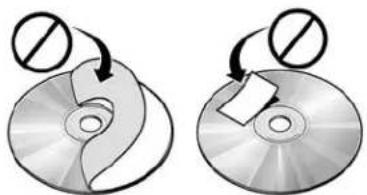
Donotuseanyirregularshaped CDsordiscswithascratch protectionfilmattached.
natural_image
Two circular icons with a heart symbol crossed out by a diagonal line, no text or symbols present.CDswithhomemadepaper (adhesive)labelsshouldnotbe insertedintotheCDplayeras thelabelmaypeelandcausethe CDtobecomejammed.Itis recommendedthathomemade CDsbeidentifiedwith permanentfelttipmarkerrather thanadhesivelabels.Ballpointpc contactyourauthorizeddealerfo
natural_image
Two circular discs with a disc marked by a prohibition symbol, shown from different angles (no text or labels)Audiosystemwarrantyandservice
Refer to the WarrantyGuide/CustomerInformationGuidefor audio system warranty information. If service is necessary, see your authorized Mazda dealership.
MP3trackandfolderstructure
Your MP3 system recognizes MP3 individual tracks and folder structure as follows:
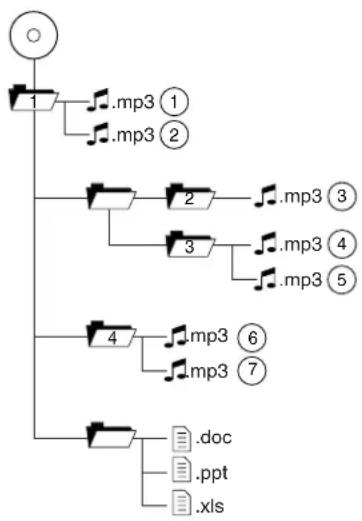
- There are two different modes for MP3 disc playback: MP3 track mode (system default) and MP3 folder mode. For more information on track and folder mode, refer to SampleMP3structure in the following section.
- MP3 track mode ignores any folder structure on the MP3 disc. The player numbers each MP3 track on the disc (noted by the .mp3 file extension) from T001 to a maximum of T255.
Note: The maximum number of playable MP3 files may be less depending on the structure of the CD and exact model of radio present.
Entertainment Systems
- MP3 folder mode represents a folder structure consisting of one level of folders. The CD player numbers all MP3 tracks on the disc (noted by the .mp3 file extension) and all folders containing MP3 files, from F001 (folder) T001 (track) to F253 T255.
- Creating discs with only one level of folders will help with navigation through the disc files.
SampleMP3structure
If you are burning your own MP3 discs, it is important to understand how the system will read the structures you create. While various files may be present, (files with extensions other than mp3), only files with the .mp3 extension will be played. Other files will be ignored by the system. This enables you to use the same MP3 disc for a variety of tasks on your work computer, home computer and your in vehicle system.
flowchart
graph TD
    Start(( )) --> A["1"]
    A --> B["2"]
    B --> C["3"]
    C --> D["4"]
    D --> E[".doc"]
    D --> F[".ppt"]
    D --> G["xls"]
In track mode, the system will display and play the structure as if it were only one level deep (all .mp3 files will be played, regardless of being in a specific folder). In folder mode, the system will only play the .mp3 files in the current folder.
Satellite radio information
Satelliteradiochannels:SIRIUS broadcasts a variety of music, news, sports, weather, traffic and entertainment satellite radio channels. For more information and a complete list of SIRIUS satellite radio channels, visit www.sirius.com in the United States, www.sirius-canada.ca in Canada, or call SIRIUS at 1-888-539-7474.
Entertainment Systems
Satelliteradioreceptionfactors: To receive the satellite signal, your vehicle has been equipped with a satellite radio antenna located on the roof of your vehicle. The vehicle roof provides the best location for an unobstructed, open view of the sky, a requirement of a satellite radio system. Like AM/FM, there are several factors that can affect satellite radio reception performance:
- Antenna obstructions: For optimal reception performance, keep the antenna clear of snow and ice build-up and keep luggage and other material as far away from the antenna as possible.
- Terrain: Hills, mountains, tall buildings, bridges, tunnels, freeway overpasses, parking garages, dense tree foliage and thunderstorms can interfere with your reception.
- Station overload: When you pass a ground based broadcast repeating tower, a stronger signal may overtake a weaker one and result in an audio mute.
Unlike AM/FM audible static, you will hear an audio mute when there is a satellite radio signal interference. Your radio display may display NO SIGNAL to indicate the interference.
SIRIUSsatelliteradioservice:SIRIUS Satellite Radio is a subscription based satellite radio service that broadcasts music, sports, news and entertainment programming. A service fee is required in order to receive SIRIUS service. Vehicles that are equipped with a factory installed SIRIUS Satellite Radio system include:
- Hardware and limited subscription term, which begins on the date of sale or lease of the vehicle.
- Use of online media player providing access to all SIRIUS music channels over the internet using any computer connected to the internet (U.S. customers only)
For information on extended subscription terms, contact SIRIUS at 1-888-539-7474.
Note: SIRIUS reserves the unrestricted right to change, rearrange, add or delete programming including canceling, moving or adding particular channels, and its prices, at any time, with or without notice to you. Mazda Motor Corporation shall not be responsible for any such programming changes.
SatelliteRadioElectronicSerialNumber(ESN):This 12-digit Satellite Serial Number is needed to activate, modify or track your satellite radio account. You will need this number when communicating with SIRIUS. While in Satellite Radio mode, you can view this number on the radio display by pressing the SIRIUS and Preset 1 buttons at the same time.
Entertainment Systems
| RadioDisplayConditionActionRequired | ||
| ACQUIRING Radio requires more than two seconds to produce audio for the selected channel. | No action required.This message should disappear shortly. | |
| SAT FAULT Internal module or system failure present. | If this message does not clear within a short period of time, or with an ignition key cycle,your receiver may have a fault. See your authorized dealer for service. | |
| INVALID CHNL Channel | no longer available. | This previously available channel is no longer available. Tune to another channel. If the channel was one of your presets, you may choose another channel for that preset button. |
| UNSUBSCRIBED Subscription not available for this channel. | Contact SIRIUS at 1-888-539-7474 to subscribe to the channel or tune to another channel. | |
| NO TEXT Artist information not available. | Artist information not available at this time on this channel. The system is working properly. | |
Entertainment Systems
| RadioDisplayConditionActionRequired | ||
| NO TEXT Song title information not available. | Song title information not available at this time on this channel. The system is working properly. | |
| NO TEXT Category information not available. | Category information not available at this time on this channel. The system is working properly. | |
| NO SIGNAL Loss of signal from the SIRIUS satellite or SIRIUS tower to the vehicle antenna. | You are in a location that is blocking the SIRIUS signal (i.e., tunnel, under an overpass, dense foliage, etc). The system is working properly. When you move into an open area, the signal should return. | |
| UPDATING Update of channel programming in progress. | No action required. The process may take up to three minutes. | |
| CALL SIRIUS 1-888-539-7474 | Satellite service has been deactivated by SIRIUS Satellite Radio. | Call SIRIUS at 1-888-539-7474 to re-activate or resolve subscription issues. |
NAVIGATION SYSTEM (IF EQUIPPED)
Your vehicle may be equipped with a navigation system. Refer to the Navigationsystemsupplement for further information.
Climate Controls
DUAL AUTOMATIC TEMPERATURE CONTROL

text_image
1 2 3 4 5 6 7 8 9 AUTO PASS TEMP A/C ECON 10 11 12 13 14- AUTO/Drivertemperature: Press to engage full automatic operation. The system will automatically determine fan speed, airflow distribution, A/C on or off, and outside or recirculated air, to heat or cool the vehicle to reach the desired temperature. Turn to increase/decrease the temperature on the driver side of the vehicle. The control also adjusts the passenger side temperature when PASS TEMP is disengaged. The recommended initial setting is between 72°F (22°C) and 75°F (24°C), then adjust for comfort. The driver side temperature setting will appear in the upper left corner of the display. The engine may run continuously to provide A/C operation unless ECON mode is selected. Selecting ECON mode affects A/C operation. Refer to ECON information later in this section.
- Reardefroster: Press to activate/deactivate the rear window defroster. Refer to Rearwindowdefrosterlater in this chapter for more information.
- Defrost: Distributes outside air through the windshield defroster vents and demister vents. Can be used to clear the windshield of fog and thin ice. The system will automatically provide outside air to reduce window fogging. On days where the outside temperature is approximately freezing or higher, the engine will run continuously in this mode. Press this button again to return to the previous air flow selection or press AUTO to return to full automatic control.
Climate Controls
- Defrost/Floor: Distributes air through the windshield defroster vents, demister vents, floor vents and rear seat floor vents. The system will automatically provide outside air to reduce window fogging. On days where the outside temperature is approximately freezing or higher, the engine will run continuously in this mode.
- Power/press to activate/deactivate the climate control system. When the system is off, outside air is shut out. Turn to manually increase/decrease the fan speed. The manual fan speed setting will appear on the left side of the display. Press AUTO to return to full automatic control.
- 🚗 Panel:Distributes air through the instrument panel vents.
- Panel/Floor: Distributes air through the instrument panel vents, demister vents, floor vents and rear seat floor vents.
- √ Floor: Distributes air through the demister vents, floor vents and rear seat floor vents.
- Passengertemperature: Press to engage/disengage separate passenger side temperature control. Turn to increase/decrease the temperature on the passenger side of the vehicle. The recommended initial setting is between 72°F (22°C) and 75°F (24°C), then adjust for comfort. The passenger side temperature setting will appear in the upper right corner of the display.
- 🚗 Passengerheatedseatcontrol(ifequipped):Press to activate/deactivate the passenger heated seat. See Heatedseatsin the SeatingandSafetyRestraintschapter.
- Recirculatedair: Press to activate/deactivate air recirculation in the vehicle. Recirculated air may reduce the amount of time needed to cool down the interior of the vehicle, may reduce the energy needed to keep the interior of the vehicle cool, and may also help reduce undesired outside odors from reaching the interior of the vehicle. Recirculated air is controlled automatically when AUTO is selected or can be engaged manually in any airflow mode except (defrost). Recirculated air may turn off automatically in some airflow modes to reduce window fogging potential. When the ignition switch is turned off and back on, the climate system will return to the recirculated air mode only if the A/C button LED is illuminated and the air distribution selection is either AUTO, (panel) or (panel/floor).
Climate Controls
-
ECON: Press to activate/deactivate economy air conditioning operation. ECON mode may provide improved fuel economy by allowing the gasoline engine to shut down even if air conditioning is requested. When the gas engine turns off, the A/C compressor does not operate to cool the cabin and comfort may be reduced. In ECON mode, when the gasoline engine is running, A/C operates as normal. To prioritize cooling comfort over fuel economy, deactivate ECON. ECON can not be selected in (defrost) or (floor/defrost).
-
A/C: Press to activate/deactivate air conditioning. Use with recirculated air to improve cooling performance and efficiency. Engages automatically in AUTO, (defrost) and (floor/defrost). Selecting ECON mode affects A/C operation. Refer to ECON information previously in this section.
-
☐ Driverheatedseatcontrol(ifequipped):Press to activate/adjective the driver heated seat. See Heatedseatsin the SeatingandSafetyRestraintschapter.
Outsidetemperature:The outside temperature will appear in the display and is labeled EXT TEMP.
Temperatureconversion: To switch between Fahrenheit and Celsius, refer to Setup menu in the Message center section of the Driver Controlschapter.
Operating tips
- To reduce fog build up on the windshield during humid weather, select (defrost) or (floor/defrost).
- To reduce humidity build up inside the vehicle, do not drive with the system OFF or with (recirculated air) engaged and A/C off.
- Do not put objects under the front seats that will interfere with the airflow to the back seats by blocking the air from the rear seat floor vents.
- Remove any snow, ice or leaves from the air intake area at the base of the windshield.
- To improve the A/C cool down, drive with the windows slightly open for 2-3 minutes after start up or until the vehicle has been “aired out.”
- If you find the comfort degradation too much during the gasoline engine off cycles when using A/C in ECON mode, try leaving the system in ECON mode and reducing the temperature setting 1 or 2 degrees at a time.
Climate Controls
Formaximumcoolingperformance:
•Automaticoperation:
- Press AUTO for full automatic operation.
- Do not override A/C or (recirculated air).
- Set the temperature to 60^ F ( 16^ C).
Make sure ECON mode is deactivated.
- Manualoperation:
- Select A/C.
- Select ↗ or ↘ .
- Select (recirculated air) to provide colder airflow.
- Set the temperature to 60^ F ( 16^ C).
- Set highest fan setting initially, then adjust to maintain comfort.
Make sure ECON mode is deactivated.
Toaidinsidewindowdefogging/demistingincoldweather:
- Select ↗.
- Select A/C.
- Adjust the temperature control to maintain comfort.
- Set the fan speed to the highest setting.
- Direct the outer instrument panel vents towards the side windows.
To increase airflow to the outer instrument panel vents, close the vents located in the middle of the instrument panel.
Climate Controls
REAR WINDOW DEFROSTER
The rear defroster control is located on the climate control panel and works to clear the rear window of fog and thin ice.
The vehicle must be on to operate the rear window defroster.
Press R to turn the rear window defroster on. An indicator light on the button will illuminate when active. The rear window defroster turns off automatically after approximately 15 minutes. If a low battery condition is detected or the ignition is turned off or to the accessory position, the rear window defroster will not function. To manually turn off the rear window defroster at any time, press R again.
If your vehicle is equipped with both rear defroster and heated mirrors, the same button will activate both. Refer to Heatedoutsidemirrors in the DriverControlschapter.
Donotuserazorbladesorothersharpobjectstocleantheinside oftherearwindowortoremovedecalsfromtheinsideorthe rearwindow.Thismaycausedamagetotheheatedgridlinesand willnotbecoveredbyyourwarranty.
Lights
HEADLAMP CONTROL
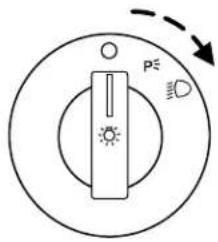
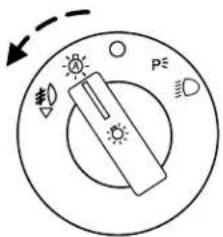
Rotate the headlamp control to the first position P ≤slant to turn on the parking lamps.
Rotate to the second position D to turn on the headlamps.
Rotate back to ○ to turn the headlamps off.
text_image
PSAutolamp control (if equipped)
The autolamp system provides light sensitive automatic on-off control of the exterior lights normally controlled by the headlamp control.
The autolamp system is factory programmed to keep the lights on for 20 seconds after the ignition switch is turned to off. This delay can be programmed, using the procedure listed below, to any value up to 180 seconds. If equipped, this
delay can also be programmed through the message center
- To turn autolamps on, rotate the control counterclockwise.
- To turn autolamps off, rotate the control clockwise to the off position.
Note: If the vehicle is equipped with autolamps it will have the headlampsonwithwindshieldwipersfeature. If the windshield wipers are turned on for a brief period of time, the exterior lamps will turn on with the headlamp control in the autolamp position.
text_image
P±Lights
Autolampdelaysystem(ifequipped)
If your vehicle is equipped with autolamps, you can set the delay time to keep the headlights on for up to three minutes after the key is turned off. The delay time is set to 20 seconds at the factory, but the delay time may be changed by following the steps below (Steps 1 through 6 must be done within 10 seconds):
- Turn the key to the off position.
- Rotate the headlamp control to the autolamp position.
- Rotate the headlamp control to the off position.
- Turn the key to the on position.
- Turn the key back to the off position.
- Turn the headlamp control to the autolamp position (the headlights should turn on).
- Turn the headlamp control to the off position when the desired delay time (up to 3 minutes) has been reached.
Fog lamp control (if equipped) #0
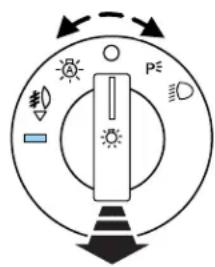
The headlamp control also operates the fog lamps. The fog lamps can be turned on when the headlamp
control is in the P≤, -A- or ≡D
positions and the high beams are not turned on.
Pull the headlamp control towards you to turn the fog lamps on. The fog lamp indicator light #0 will illuminate.
flowchart
graph TD
    A["1"] --> B["2"]
    B --> C["3"]
    C --> D["4"]
text_image
P€Lights
High beams ≡D
Push the lever toward the instrument panel to activate. Pull the lever towards you to deactivate.

text_image
Diagram of a handheld device with labeled ports and indicators, including a black arrow pointing upward.Flash to pass
Pull toward you slightly to activate and release to deactivate.

text_image
Diagram of a handheld device with labeled ports and a downward arrow indicating direction or flow.Daytime running lamps (DRL)
Turns the lowbeam headlamps on with a reduced output.
To activate:
• the ignition must be in the on position.
- the headlamp control must be in the off, parking lamps or autolamp position.
• the transmission is not in P (Park),

WARNING: Always remember to turn on your headlamps at dusk or during inclement weather. The Daytime Running Lamp) system does not activate the tail lamps and generally may not be adequate lighting during these conditions. Failure to activate headlamps under these conditions may result in a collision.
Lights
PANEL DIMMER CONTROL
Use to adjust the brightness of the instrument panel and all applicable switches in the vehicle during headlamp and parking lamp operation.
Move the control to the full upright position, past detent, to turn on the interior lamps.
Rotate to full down position (past detent) to prevent interior lamps from illuminating when the doors are opened.
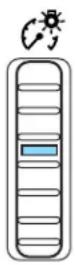
Note: If the battery is disconnected, discharged, or a new battery is installed, the dimmer switch requires re-calibration. Rotate the dimmer switch from the full dim position to the full Dome/ON position to reset. This will ensure that your displays are visible under all lighting conditions.
AIMING THE HEADLAMPS
The headlamps on your vehicle are properly aimed at the assembly plant. If your vehicle has been in an accident, the alignment of your headlamps should be checked by your authorized dealer.
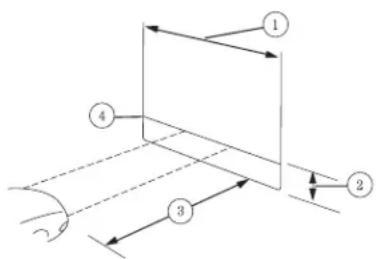
Vertical aim adjustment
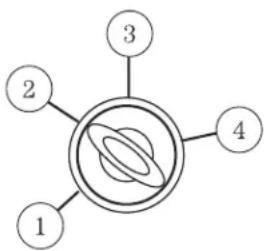
- Park the vehicle directly in front of a wall or screen on a level surface, approximately 25 feet (7.6 meters) away.
•(1) 8 feet (2.4 meters)
•(2) Center height of lamp to ground
• (3) 25 feet (7.6 meters)
•(4) Horizontal reference line
- Measure the height from the center of your headlamp to the ground and mark an 8 foot (2.4 meter) horizontal reference line on the vertical wall or screen at this height (a piece of masking tape works well). The center of the lamp is marked by a 3.0 mm circle on the headlamp lens.
text_image
1 2 3 4Lights
-
Turn on the low beam headlamps to illuminate the wall or screen and open the hood. Cover the left-hand headlamp with an opaque cloth.
-
On the wall or screen you will observe a light pattern with a distinct horizontal edge of high intensity light towards the right. If this edge is not at the horizontal reference line, the beam will need to be adjusted.

natural_image
Pure diagram of a symmetrical object with two circular holes, no text or symbols present- Locate the vertical adjuster on the headlamp, then turn the adjuster either clockwise (to adjust up) or counterclockwise (to adjust down) aligning the upper edge of the light pattern to the horizontal line.

natural_image
Technical line drawing of a mechanical component with an arrow pointing to a small blue component (no text or symbols present)-
Move the opaque cloth to cover the right-hand headlamp and repeat Steps 4 and 5 for the left-hand headlamp.
-
HORIZONTAL AIM IS NOT REQUIRED FOR THIS VEHICLE AND IS NON-ADJUSTABLE.
-
Close the hood and turn off the lamps.
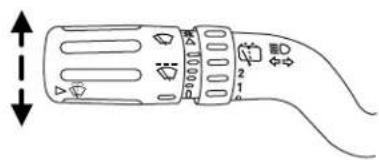
TURN SIGNAL CONTROL ⇔
- Push down to activate the left turn signal.
- Push up to activate the right turn signal.
natural_image
Line drawing of a handheld device with ports and buttons, no text or symbols presentLights
INTERIOR LAMPS
Dome lamps and map lamps
The front dome lamp is located overhead between the driver and passenger seats.
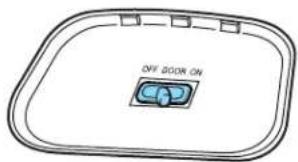
The dome lamp control has three positions:
- OFF: In this position, the lamp will not illuminate when the doors are open or when attempting to turn the dome lamp on by fully rotating the dimmer control located on the instrument panel.
text_image
OFF DOOR ON- DOOR: In this position, the dome lamp will illuminate only when a door is opened and will remain illuminated for 25 seconds after the door is shut.
- ON: In this position, the lamp will remain illuminated.
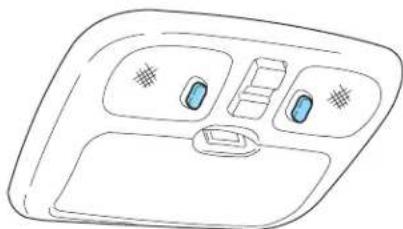
The map lamp controls (without moon roof) are located on the dome lamp. Press the button on either side of each map lamp to illuminate the lamps. Push the button again to turn off the lamps.

natural_image
Line drawing of a rectangular device with internal compartments and buttons (no text or symbols)For models equipped with a moon roof, the map lamps are located on the moon roof control panel. Press the button on either side of each map lamp to illuminate the lamps. Push the button again to turn off the lamps.
natural_image
Line drawing of a ceiling air conditioner unit with no text or symbolsThe map lamps will illuminate whenever a door is opened. After the door is shut, the lamps will remain illuminated for 25 seconds.
Cargo and dome lamp
Rear cargo lamp equipped with an ON/OFF/DOOR control will light when:
- the doors are closed and the control is in the ON position.
• the control is in the DOOR position and any door is open.

natural_image
Simple line drawing of a device with ports and internal grid patterns (no text or symbols)When the control is in the OFF position, it will not illuminate when you open the doors.
Interiorlightingbatterysaver
The interior lamps will automatically extinguish after 10 minutes when the ignition key is in the off/lock position, a door has been left open or the interior lamp controls are in the on position.
BULB REPLACEMENT
Headlamp condensation
Exterior lamps are vented to accommodate normal changes in pressure. Condensation can be a natural by-product of this design. When moist air enters the lamp assembly through the vents, condensation can occur when the temperature is cold. When normal condensation occurs, a thin film of mist can form on the interior of the lens. The thin mist eventually clears and exits through the vents during normal operation. Clearing time may take as long as 48 hours under dry weather conditions.
Examples of acceptable condensation are:
• Presence of thin mist (no streaks, drip marks or droplets)
- Fine mist covers less than 50% of the lens
Examples of unacceptable moisture (usually caused by a lamp water leak) are:
• Water puddle inside the lamp
- Large water droplets, drip marks or streaks present on the interior of the lens
Take your vehicle to dealer for service if any of the above conditions of unacceptable moisture are present.
Using the right bulbs
Replacement bulbs are specified in the chart below. Headlamp bulbs must be marked with an authorized "D.O.T." for North America to ensure lamp performance, light brightness and pattern and safe visibility.
Lights
Note: The correct bulbs will not damage the lamp assembly or void the lamp assembly warranty and will provide quality bulb burn time.
| FunctionNumberofbulbs | Tradenumber | |
| Headlamps (high and low beams) | 2 | H13 |
| Park/turn/sidemarker lamps (front) | 2 | 3157A (amber) |
| Rear stop/tail/sidemarker | 2 | 3157K / 4157K |
| Backup lamp 2 921 | ||
| Fog lamp (front) 2 9145 | ||
| Center High-mount stop lamp | 5 | W5WL |
| Rear license plate lamp | 2 | 168 |
| All replacement bulbs are clear in color except where noted. | ||
| To replace all instrument panel lights - see your authorized dealer | ||
Replacing interior bulbs
Check the operation of all bulbs frequently.
Replacing exterior bulbs
Check the operation of all the bulbs frequently.
Replacingheadlampbulbs
- Make sure that the headlamp control is in the off position.
- Open the hood.
- Reach over the front bolster.
- Remove the bulb by turning it counterclockwise and then pulling it straight out.
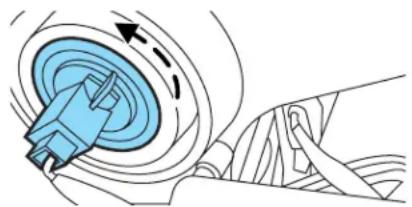
natural_image
Diagram of a mechanical component with motion arrows indicating rotational motion (no text or symbols)Lights
WARNING: Handling Halogen Bulbs: When a halogen bulb breaks, it is dangerous. These bulbs contain pressurized gas. If one is broken, it will explode and serious injuries could be caused by the flying glass. If the glass portion of the bulb is touched with bare hands, body oil could cause the bulb to overheat and explode when lit. Never touch the glass portion of the bulb with your bare hands and always wear eye protection when handling or working around halogen bulbs.
- Disconnect the electrical connector from the bulb.
WARNING:Children and Halogen Bulbs: Playing with a halogen bulb is dangerous. Serious injuries could be caused by dropping a halogen bulb or breaking in some other way. Always keep halogen bulbs out of the reach of children.
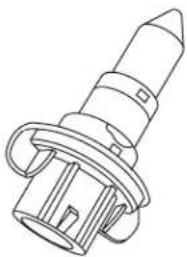
natural_image
Technical line drawing of a mechanical component with no visible text or symbols-
Connect the electrical connector on the new bulb.
-
Insert the glass end of the new bulb into the headlamp assembly. When the grooves in the plastic base are aligned, turn the new bulb clockwise to install.
Replacingfrontparkinglamp/turnsignalbulbs
For bulb replacement, see your authorized Mazda dealer.
Lights
Replacingtail/stop/turn/backuplampbulbs
The tail/stop/turn/sidemarker/backup lamp bulbs are located in the same portion of the tail lamp assembly, one just below the other. Follow the same steps to replace either bulb:
- Make sure the headlamp switch is in the off position and then open the liftgate to expose the lamp assembly screws.
- Remove the two screws from the lamp assembly.
- Carefully remove the lamp assembly away from the vehicle by pulling the assembly straight out to expose the bulb socket.
DO NOT TIP THE LAMP ASSEMBLY SIDEWAYS.
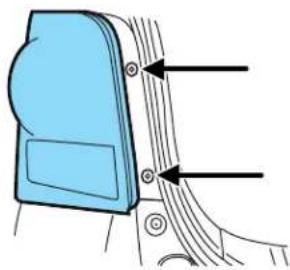
natural_image
Diagram of a blue car door with arrows pointing to the side panel (no text or symbols present)- Rotate the bulb socket counterclockwise and remove from lamp assembly.
- Pull bulb straight out of socket and push in the new bulb.
- Install the bulb socket into the lamp assembly and rotate clockwise.
- Carefully install the tail lamp assembly on the vehicle and secure with two screws.
Replacinglicenseplatelampbulbs
- Make sure the headlamp switch is in the off position.
- Depress the lever and carefully pry the license plate lamp assembly (located above the license plate) from the liftgate.
- Rotate the bulb socket counterclockwise and remove from lamp assembly.
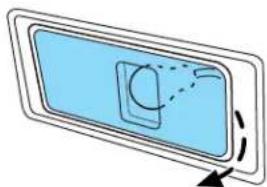
natural_image
Simple diagram of a rectangular panel with a circular cutout and dashed lines indicating rotation (no text or symbols)Lights
- Pull bulb straight out of socket and push in the new bulb.
- Install the bulb socket into the lamp assembly and rotate clockwise.
- To install, carefully press the lamp assembly into liftgate.
Replacinghigh-mountbrakelampbulbs
To remove the lamp assembly:
- Remove the two screws and move the lamp assembly away from the liftgate.
- Remove the bulb holder from the lamp assembly by depressing the snaps.
- Pull the bulb straight out of the socket and push in the new bulb.
To complete installation, follow the removal procedure in reverse order.
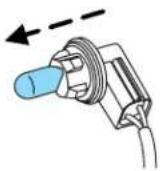

natural_image
Diagram of a car interior showing a blue dashboard and rear seats with an arrow indicating upward motion (no text or symbols)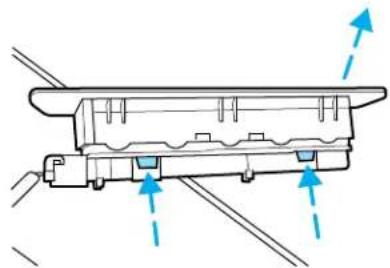
natural_image
Technical diagram of a mechanical component with blue directional arrows indicating force or movement (no text or symbols)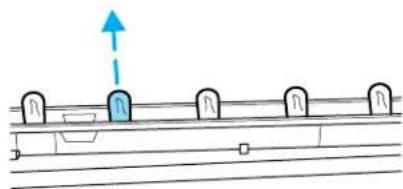
natural_image
Diagram of a mechanical assembly with rollers and a blue upward arrow (no text or symbols)Lights
Replacing foglampbulbs(ifequipped)
- Make sure the fog lamp switch is in the off position.
- From underneath the vehicle, carefully disconnect the electrical connector from the bulb.
- Remove the bulb from the lamp assembly by pulling out on the bulb while squeezing on the upper and lower snap clips at the same time.
Install the new bulb in reverse order.
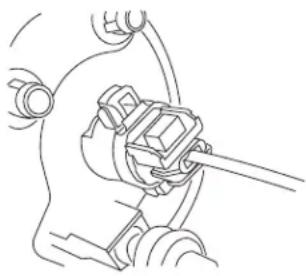
natural_image
Line drawing of a mechanical clamp or bracket assembly (no text or symbols)MULTI-FUNCTION LEVER
Windshieldwiper: Rotate the end of the control away from you to increase the speed of the wipers; rotate towards you to decrease the speed of the wipers.
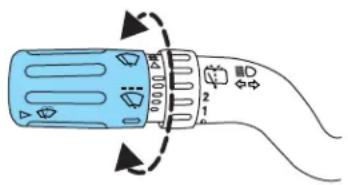
text_image
Diagram of a handheld device with labeled ports and directional arrows indicating rotation or movement.Note: Heavy ice and snow can jam the wiper blades and overheat the wiper motor. If this happens, the motor will automatically stop the operation of the blades for a short period of time. If this happens while driving, turn off the wiper switch, park off the right-of-way, and remove the snow and ice. After a short period of time, turn the switch on and the blades should operate normally. If they don't resume functioning, consult an authorized Mazda Dealer as soon as possible. Wait until the weather clears before trying to drive with the wipers inoperative.
Windshieldwasher: Push the end of the stalk:
- briefly: causes a single swipe of the wipers without washer fluid.
- a quick push and hold: the wipers will swipe three times with washer fluid.
- a long push and hold: the wipers and washer fluid will be activated for up to ten seconds.
Courtesywipefeature: One extra wipe will occur a few seconds after washing the front window to clear any excess washer fluid remaining on the windshield.
Note: Do not operate the washer when the washer reservoir is empty. This may cause the washer pump to overheat. Check the washer fluid level frequently. Do not operate the wipers when the windshield is dry. This may scratch the glass, damage the wiper blades and cause the wiper motor to burn out. Before operating the wiper on a dry windshield, always use the windshield washer. In freezing weather, be sure the wiper blades are not frozen to the windshield before operating the wipers.
Windshield wiper rainlamp feature (if equipped with Autolamp)
When the windshield wipers are turned on during daylight, and the headlamp control is in the autolamp position, the exterior lamps will turn on after a brief delay and will remain on until the wipers are turned off.
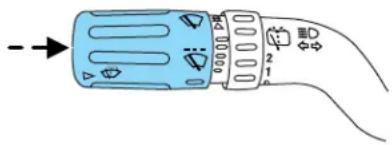
natural_image
Diagram of a handheld device with labeled parts and an arrow pointing to it (no text or symbols present)Driver Controls
Rear window wiper/washer controls

For rear wiper operation, rotate the rear window wiper and washer control to the desired position. Select:
INT 2 — Normal speed operation of rear wiper.
INT 1 — Intermittent operation of rear wiper.

text_image
Diagram showing a hand holding a device with labeled parts and directional arrows indicating rotation or movement.OFF — Rear wiper and washer off.
For rear wash cycle, rotate (and hold as desired) the rear wiper/washer control to either ☐ position.
From either position, the control will automatically return to the INT 2 or OFF position.
MANUAL TILT STEERING COLUMN
To adjust the steering wheel:
-
Pull down the steering column tilt lever.
-
Move the steering wheel up or down until you find the desired location.
-
Push the steering column tilt lever up. This will lock the steering wheel in position.
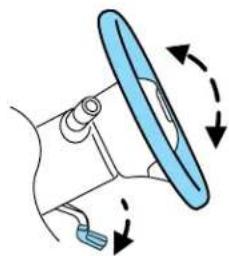
natural_image
Diagram of a mechanical device with rotating blue circular component and directional arrows indicating motion (no text or symbols)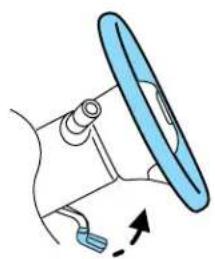
natural_image
Diagram of a hand holding a blue circular object with a scroll wheel and a small attached clip, no text or symbols present.Driver Controls

WARNING: Adjusting the steering wheel while the vehicle is moving is dangerous. Moving it can very easily cause the driver abruptly turn to the left or right. This can lead to loss of control or incident. Never adjust the steering wheel while the vehicle is
ILLUMINATED VISOR MIRROR
Lift the mirror cover to turn on the visor mirror lamps.
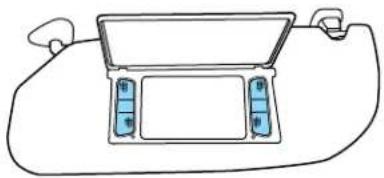
natural_image
Simple line drawing of a car rearview door with two blue buttons placed on the side (no text or symbols)CENTER CONSOLE
Your vehicle is equipped with a variety of console features. These include:
- Cupholders
- Utility compartment console lid has a CD holder, a business card holder and two pen holders. The utility compartment has a removable bin with coin holder slots, a sliding tray, a cell phone holder and CD holders
- Rear power point
- Rear cupholders
- Small storage trays

text_image
Technical diagram of a device with numbered components for identification
WARNING: Use only soft cups in the cupholders. Hard objects can injure you in a collision.
Driver Controls
The tray and inside bin can be removed to open up space to fit a laptop computer, MP3 players, CDs or handbags. To remove, open the console lid and pull the bin straight up and out from the console housing.
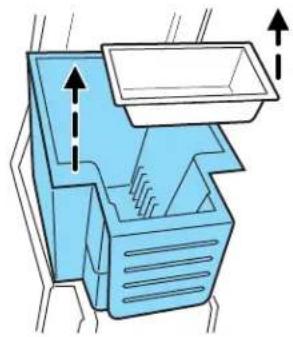
natural_image
Diagram of a blue plastic appliance with internal components and directional arrows indicating flow or movement (no text or symbols)The sliding tray and inside bin can be hooked on the side or rear of the console for extra storage.
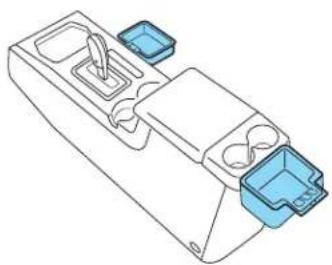
natural_image
Line drawing of a mechanical component with two blue plastic parts (no text or symbols)ELECTRONIC COMPASS
The compass heading is displayed as one of N, NE, E, SE, S, SW, W and NW in the center stack display.
The compass reading may be affected when you drive near large buildings, bridges, power lines and powerful broadcast antenna. Magnetic or metallic objects placed in, on or near the vehicle may also affect compass accuracy.
Usually, when something affects the compass readings, the compass will correct itself after a few days of operating your vehicle in normal conditions. If the compass still appears to be inaccurate, a manual calibration may be necessary. Refer to Compasszoneadjustment.
Most geographic areas (zones) have a magnetic north compass point that varies slightly from the northerly direction on maps. This variation is four degrees between adjacent zones and will become noticeable as the vehicle crosses multiple zones. A correct zone setting will eliminate this error. Refer to Compasscalibrationadjustment.
Driver Controls
Compass zone adjustment
- Determine which magnetic zone you are in for your geographic location by referring to the zone map.
- Turn ignition to the on position.
- Start the engine.
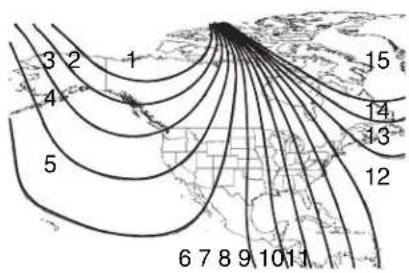
text_image
1 2 3 4 5 6 7 8 9 10 11 12 13 14 15- Press the SETUP control to select the Update Zone function and display the current ZONE XX in the center stack display.
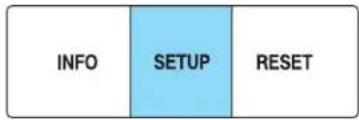
text_image
INFO SETUP RESET- Continue to press the RESET control until the correct zone appears in the center stack display.
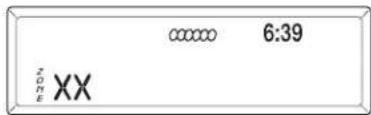
text_image
6:39 ZONE XX- The direction will display after the RESET control is released. The zone is now updated.
text_image
6:39 NECompass calibration adjustment
Perform compass calibration in an open area free from steel structures and high voltage lines. For optimum calibration, turn off all electrical accessories (heater/air conditioning, wipers, etc.) and make sure all vehicle doors are shut.
- Start the vehicle.
Driver Controls
- To calibrate, press and hold the RESET control for approximately ten seconds until CAL appears. Release the control.

text_image
c 6:39 a L-
Slowly drive the vehicle in a circle (less than 3 mph [5 km/h]) until the CAL display changes to the direction value. It may take up to five circles to complete calibration.
-
The compass is now calibrated.
text_image
6:39 NEAUXILIARY POWER POINT (12V)
Poweroutletsaredesignedforaccessoryplugsonly.Donotinsert anyotherobjectinthepoweroutletasthiswilldamagethe outletandblowthefuse.Donothanganytypeofaccessoryor accessorybracketfromtheplug.Improperuseofthepower outletcancausedamagenotcoveredbyyourwarranty.
The auxiliary power point is located in the instrument panel.
A second auxiliary power point is located on the rear side of the center console.
Do not use the power point for operating the cigarette lighter element (if equipped).
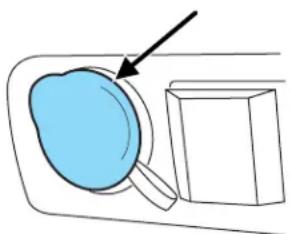
natural_image
Simple line drawing of a magnifying glass over a 3D block, with an arrow pointing to the magnified view (no text or symbols)To prevent the fuse from being blown, do not use the power
point(s) over the vehicle capacity of 12 VDC/180W. If the power point or cigar lighter socket is not working, a fuse may have blown. Refer to Fusesandrelaysin the RoadsideEmergencieschapter for information on checking and replacing fuses.
To have full capacity usage of your power point, the engine is required to be running to avoid unintentional discharge of the battery. To prevent the battery from being discharged:
- do not use the power point longer than necessary when the engine is not running,
Driver Controls
- do not leave battery chargers, video game adapters, computers and other devices plugged in overnight or when the vehicle is parked for extended periods.
Always keep the power point caps closed when not being used.
Cigar/Cigarettelighter(ifequipped)
Do not plug optional electrical accessories into the cigarette lighter socket.
Do not hold the lighter in with your hand while it is heating, this will damage the lighter element and socket. The lighter will be released from its heating position when it is ready to be used.
Note: Improper use of the lighter can cause damage not covered by your warranty, and can result in fire or serious injury.
Power point (110 VAC)
The 110 VAC power point outlet is used for powering electrical devices that require up to 150W. Exceeding the 150W limit will cause the power point to cut off the power temporarily to provide overload protection.
Note: The 110 VAC power point is equipped with a safety cap and a safety twist tab. They both provide protection from inserting any object into the power point other than the 110 VAC electrical device plug. The safety cap should always be in a closed position whenever the power point outlet is not in use.
The 110 VAC power point is located in the floor console in front of the gearshift.
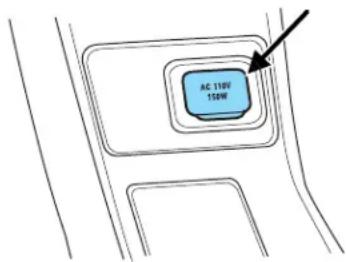
text_image
AC 110V 150WThe power outlet is not designed for the following electric appliances; they may not work properly:
• Cathode ray tube type televisions.
- Motor loads, such as vacuum cleaners, electric saws and other electric power tools, compressor-driven refrigerators, etc.
- Measuring devices, which process precise data, such as medical equipment, measuring equipment, etc.
- Other appliances requiring an extremely stable power supply: microcomputer-controlled electric blankets, touch sensor lamps, etc.
Driver Controls
Donotkeepelectricaldevicespluggedinthepowerpoint wheneverthedeviceisnotinuse.Itisnotrecommendedtouse anyextensioncordwiththe110VACpowerpoint,sinceitwill defeatthesafetyprotectiondesignprovidedbythecapandtwist tab.Itwillalsocausethepowerpointtooverloaddueto poweringmultipledevicesthatcanreachbeyondthe150Wload limit.
The power point can switch to a fault mode when it is overloaded, overheated, or shorted. For overloading and shorting conditions, unplug your device and turn the ignition key off then on. For an overheating condition, let the system cool off, then turn the ignition key off then on.
The 110 VAC power point can provide power whenever the vehicle ignition is in the run position and the power point green indicator light located in the top left corner is turned on. Refer to the indicator light code below for the power point status.
IndicatorlightCode
Green light is On — Power point is ready to supply power
Green light is Off — Power point power supply is off. Ignition is not in RUN position
Green light is blinking — Power point is in fault mode
POWER WINDOWS (IF EQUIPPED)
WARNING: Do not leave children unattended in the vehicle and do not let children play with the power windows. They may seriously injure themselves.
WARNING: When closing the power windows, you should verify they are free of obstructions and ensure that children and/or pets are not in the proximity of the window openings.
Press and pull the window switches to open and close windows.
- Push down (to the first detent) and hold the switch to open.
- Pull up and hold the switch to close.
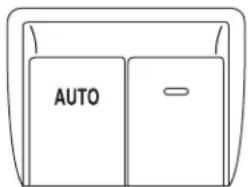
text_image
AUTODriver Controls
RearWindowBuffeting: When one or both of the rear windows are open, the vehicle may demonstrate a wind throb or buffeting noise; this noise can be alleviated by lowering a front window approximately two to three inches.
One touch down (AUTO)
Allows the driver's window to open fully without holding the control down. Push the switch completely down to the second detent and release quickly. The window will open fully. Momentarily press the switch to any position to stop the window operation.
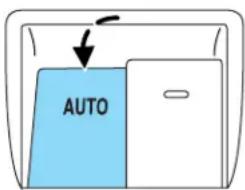
text_image
AUTOWindow lock
The window lock feature allows only the driver to operate the power windows.
To lock out all the window controls (except for the driver's) press the right side of the control. Press the left side to restore the window controls.
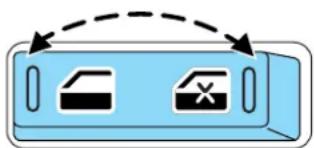
flowchart
graph TD
    A[" "] --> B[" "] --> C[" "] --> D[" "] --> E[" "] --> F[" "] --> G[" "] --> H[" "] --> I[" "] --> J[" "] --> K[" "] --> L[" "] --> M[" "] --> N[" "] --> O[" "] --> P[" "] --> Q[" "] --> R[" "] --> S[" "] --> T[" "] --> U[" "] --> V[" "] --> W[" "] --> X[" "] --> Y[" "] --> Z[" "] --> AA[" "] --> AB[" "] --> AC[" "] --> AD[" "] --> AE[" "] --> AF[" "] --> AG[" "] --> AH[" "] --> AI[" "] --> AJ[" "] --> AK[" "] --> AL[" "] --> AM[" "] --> AN[" "] --> AO[" "] --> AP[" "] --> AQ[" "] --> AR[" "] --> AS[" "] --> AT[" "] --> AU[" "] --> AV[" "] --> AW[" "] --> AX[" "] --> AY[" "]
    style A fill:#cce5ff,stroke:#333
    style B fill:#cce5ff,stroke:#333
    style C fill:#cce5ff,stroke:#333
    style D fill:#cce5ff,stroke:#333
    style E fill:#cce5ff,stroke:#333
    style F fill:#cce5ff,stroke:#333
    style G fill:#cce5ff,stroke:#333
    style H fill:#cce5ff,stroke:#333
    style I fill:#cce5ff,stroke:#333
    style J fill:#cce5ff,stroke:#333
    style K fill:#cce5ff,stroke:#333
    style L fill:#cce5ff,stroke:#333
    style M fill:#cce5ff,stroke:#333
    style N fill:#cce5ff,stroke:#333
    style O fill:#cce5ff,stroke:#333
    style P fill:#cce5ff,stroke:#333
    style Q fill:#cce5ff,stroke:#333
    style R fill:#cce5ff,stroke:#333
    style S fill:#cce5ff,stroke:#333
    style T fill:#cce5ff,stroke:#333
    style U fill:#cce5ff,stroke:#333
    style V fill:#cce5ff,stroke:#333
    style W fill:#cce5ff,stroke:#333
    style X fill:#cce5ff,stroke:#333
    style Y fill:#cce5ff,stroke:#333
    style Z fill:#cce5ff,stroke:#333
Accessorydelay
With accessory delay, the window switches, moon roof (if equipped) and audio system may be used for up to 10 minutes after the ignition switch is turned to the off position or until either front door is opened.
INTERIOR MIRROR
The interior rear view mirror has two pivot points on the support arm which lets you adjust the mirror UP or DOWN and from SIDE to SIDE.

WARNING: Do not adjust the mirror while the vehicle is in motion.
Driver Controls
Automatic dimming interior rear view mirror (if equipped)
Your vehicle may be equipped with an interior rear view mirror that has an auto-dimming function. The electronic day/night mirror will change from the normal (high reflective) state to the non-glare

natural_image
Simple line drawing of a rectangular object with a handle and rounded corners (no text or symbols)(darkened) state when bright lights (glare) reach the interior mirror. When the interior mirror detects bright light from behind the vehicle, it will automatically adjust (darken) to minimize glare.
The mirror will automatically return to the normal state whenever the vehicle is placed in R (Reverse) to ensure a bright clear view when backing up.
Donotblockthesensorsonthefrontandbackoftheinterior rearviewmirrorsincethismayimpairpropermirror performance.
Donotcleanthehousingorglassofanymirrorwithharsh abrasives,fuelorotherpetroleum-basedcleaningproducts.
EXTERIOR MIRRORS
Power side view mirrors

WARNING: Do not adjust the mirror while the vehicle is in motion.
To adjust your mirrors:
-
Rotate the control clockwise to adjust the right mirror and rotate the control counterclockwise to adjust the left mirror.
-
Move the control in the direction you wish to tilt the mirror.
-
Return to the center position to lock mirrors in place.
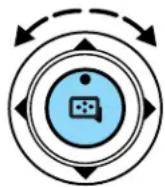
Fold-away mirrors
Fold the side mirrors in carefully when driving through a narrow space, like an automatic car wash.
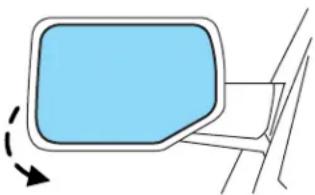
natural_image
Diagram of a blue rectangular object partially peeled off a wall, with an arrow indicating rotation (no text or symbols)Heated outside mirrors (if equipped)
Both mirrors are heated automatically to remove ice, mist and fog when the rear window defrost is activated.
Donotremoveicefromthe mirrorswithascraperor attempttoreadjustthemirror glassifitisfrozeninplace.
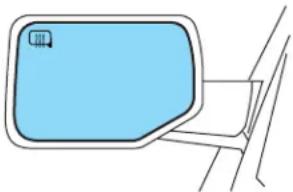
natural_image
Simple line drawing of a blue rectangular object partially enclosed by a white border, with no text or symbols present.These actions could cause damage to the glass and mirrors.
Donotcleanthehousingorglassofanymirrorwithharsh abrasives,fuelorotherpetroleum-basedcleaningproducts.
CRUISE CONTROL/SPEED CONTROL (IF EQUIPPED)
With cruise control/speed control set, you can maintain a set speed without keeping your foot on the accelerator pedal.

WARNING: Using cruise control in the following conditions could cause you to lose control of the vehicle:
• Heavyorunsteadytraffic
•Slipperyorwindingroads
- Similarrestrictionsthatrequireinconsistentspeed Don'tusecruisecontrolinthesesituations.
Driver Controls
Setting speed control
The controls for using your speed control are located on the steering wheel for your convenience.
- Press the ON control and release it.
- Accelerate to the desired speed.
- Press the SET + control and release it.
- Take your foot off the accelerator pedal.
- The indicator light 📋 on the instrument cluster will turn on.
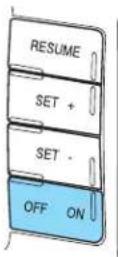
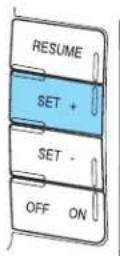
Note:
- Vehicle speed may vary momentarily when driving up and down a steep hill.
- If the vehicle speed increases above the set speed on a downhill, you may want to apply the brakes to reduce the speed.
- If the vehicle speed decreases more than 10 mph (16 km/h) below your set speed on an uphill, your speed control will disengage.
Disengagingspeedcontrol
To disengage the speed control:
- Depress the brake pedal
Disengaging the speed control will not erase previous set speed.
Driver Controls
Resumingassetspeed
Press the RESUME control and release it. This will automatically return the vehicle to the previously set speed.
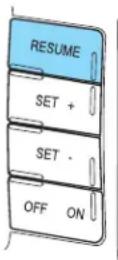
Increasespeedwhileusingspeedcontrol
There are three ways to set a higher speed:
- Press and hold the SET + control until you get to the desired speed, then release the control.
- Press and release the SET + control to operate the Tap-Up function. Each tap will increase the set speed by 1 mph (1.6 km/h).
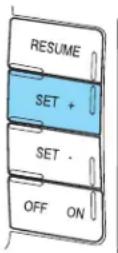
- Use the accelerator pedal to get to the desired speed. When the vehicle reaches that speed press and release the SET + control.
Reducingspeedwhileusingspeedcontrol
There are three ways to reduce a set speed:
- Press and hold the SET - control until you get to the desired speed, then release the control.
- Press and release the SET - control to operate the Tap-Down function. Each tap will decrease the set speed by 1 mph (1.6 km/h).

Driver Controls
- Depress the brake pedal until the desired vehicle speed is reached, press the SET + control.

Turningoffspeedcontrol
There are two ways to turn off the speed control:
- Press the speed control OFF control.
- Turn off the ignition.
Note: When you turn off the speed control or the ignition, your speed control set speed memory is erased.
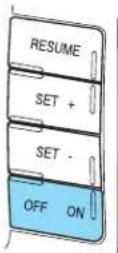
STEERING WHEEL CONTROLS (IF EQUIPPED)
These controls allow you to operate some audio control features.
Radio control features
Press MEDIA to select:
- AM, FM1, FM2, or CD
- SAT1, SAT2 or SAT3 (Satellite radio mode)
•LINE IN (Auxiliary input jack)

Driver Controls
InRadiomode:
- Press |◀◀ ▶▶▶| to access the next/previous preset station.
InCDmode:
- Press |◀◀ ▶▶▶ to listen to the next track on the disc.
InSatelliteradiomode:
- Press |◀◀ ▶▶▶ to advance through preset channels.
Inanymode:
- Press VOL + or VOL - to adjust the volume.
Navigationsystemhandsfree controlfeatures(ifequipped)
Press and hold the control briefly until the voice then appears on the navigation display to use the voice command feature.
Press to complete a voice command.
For further information on the navigation system, refer to the NavigationSystems supplement.

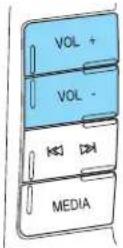
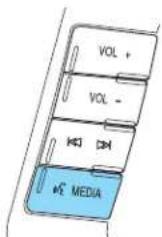
MOON ROOF (IF EQUIPPED)
You can move the glass panel of the moon roof back to open or tilt up (from the closed position) to ventilate the vehicle.

WARNING: Do not let children play with the moon roof or leave children unattended in the vehicle. They may seriously hurt selves.
Driver Controls
Toopenthemoonroof: The moon roof is equipped with an automatic, one-touch, opening, closing and venting feature. Press and release the rear portion of the control. To stop motion at any time during the one-touch operation, press the control a second time.
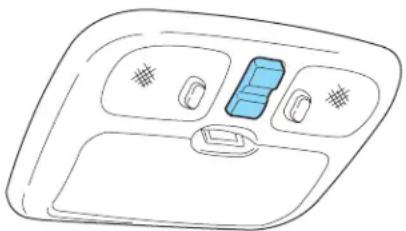
natural_image
Line drawing of a ceiling air conditioner unit with no text or symbols
WARNING: When closing the moon roof, you should verify that it is free of obstructions and ensure that children and/or pets are the proximity of the moon roof opening.
Toclosethemoonroof: The moon roof is equipped with an automatic, one-touch, closing feature. Press and release the front portion of the control. To stop motion at any time during the one-touch closing, press the control again.
Bounce-back: When an obstacle has been detected in the moon roof opening as the moon roof is closing, the moon roof will automatically open and stop at a prescribed position. This is known as “bounce-back”. If the ignition is turned off (without accessory delay being active) during bounce-back, the moon roof will move until the bounce-back position is reached.
Bounce-backoverride: To override bounce-back, press and hold the front portion of the control. For example: Bounce-back can be used to overcome the resistance of ice on the moon roof or seals. If during a bounce-back condition, the control is released to the neutral position, then held in the one-touch position within two seconds after the moon roof reaches the bounce-back position, themoonroofwilltravelwith nobounce-backprotection. If the control is released before the moon roof reaches fully closed or the ignition is turned off (without accessory delay being active), the moon roof will stop.
Tovent:
- The moon roof is equipped with an automatic, one-touch, vent feature. To tilt the moon roof into the vent position (when the glass panel is closed), press and release the front portion of the control.
- To close the moon roof from the vent position, press and hold the rear portion of the control until the glass panel stops moving.
The moon roof has a sliding shade that can be opened or closed when the glass panel is shut. To close the shade, pull it toward the front of the vehicle.
Driver Controls
Accessorydelay:
With accessory delay, the window switches, audio system, and moon roof (if equipped) may be used for up to 10 minutes after the ignition switch is turned off or until either front door is opened.
MESSAGE CENTER (IF EQUIPPED)
With the ignition in the on position, the message center, located on your instrument cluster, displays important vehicle information
throughaconstantmonitorof
vehiclesystems.You may select
display features on the message center for a display of status. The system will also notify you of potential vehicle problems with a display of system warnings followed by a long indicator chime.
XXXXXXXXXXXXXX XXXXXXXXXXXXXX
Selectable features
Reset
Press this control to select and reset functions shown in the INFO menu and SETUP menu.
| INFO | SETUP | RESET |
Infomenu
This control displays the following control displays:
• Odometer/Trip Odometer
• Distance to Empty (DTE)
• Average Fuel Economy (AFE) (if equipped)
- Instantaneous Fuel Economy (if equipped)
• Electric Energy
- Blank (odometer off)
Note: If equipped with a Navigation Screen, the Average Fuel Economy and Instantaneous Fuel Economy will display in that screen instead of the message center display.
Odometer/Tripodometer
Refer to Gaugesin the InstrumentClusterchapter.
| INFO | SETUP | RESET |
Driver Controls
Distancetoempty(DTE)
Selecting this function from the INFO menu will give you an estimate of how far you can drive with the fuel remaining in your tank under normal driving conditions.
Remember to turn the ignition off
when refueling your vehicle. Otherwise, the display will not show the addition of fuel for a few miles (kilometers). DTE will vary according to your driving habits.
XXX MILES TO E 0.0mi
Averagefueleconomy(AFE)(ifequipped)
Selecting this function from the INFO menu will display your average fuel economy in miles/gallon or liters/100 km.
XX.X AVE MPG 0.0 mi
If you calculate your average fuel economy by dividing miles traveled by gallons of fuel used (liters of fuel by used 100 kilometers traveled), your figure may be different than displayed for the following reasons:
- your vehicle was not perfectly level during fill-up
- differences in the automatic shut-off points on the fuel pumps at service stations
-
variations in top-off procedure from one fill-up to another
•rounding off the displayed values to the nearest 0.1 gallon (liter) -
Drive the vehicle at least 5 miles (8 km) with the speed control system engaged to display a stabilized average.
-
Record the highway fuel economy for future reference.
It is important to press the RESET control after setting the speed control to get accurate highway fuel economy readings.
To reset back to zero, press and hold the RESET button for two seconds.
Instantaneousfueleconomy(ifequipped)
Select this function from the INFO menu to display your instantaneous fuel economy. This will display your fuel economy as a bar graph ranging
from ▼ poor economy to ▲ excellent economy.
MPG ↓...↑ 0.0 mi
Driver Controls
Your vehicle must be moving to calculate instantaneous fuel economy. When your vehicle is not moving, this function shows ▼, one or no bars illuminated. Instantaneous fuel economy cannot be reset.
ElectricEnergy
Select this function from the INFO menu for the state of charge of the high voltage battery. For normal operation “ELECT ENERGY OK” will be displayed.
ELECT ENRGY OK
Setupmenu
Press this control for the following displays:
- Reset to English (if in another language)
- System Check
- Oil Life
- Units (English/Metric)
• Autolamp Delay (if equipped)
• Autolock (if equipped) - Autounlock (if equipped)
•Language
INFO
SETUP
RESET
ResettoEnglish(ifinanotherlanguage)
When entering the SETUP MENU and a non-English language has been selected, "PRESS RESET FOR ENGLISH" will be displayed to change back to English.
PRESS RESET FOR ENGLISH
Press the RESET control to change back to English.
Systemcheck
Selecting this function from the SETUP menu causes the message center to cycle through each of the systems being monitored. For each of the monitored systems, the message center will indicate either an OK message or a warning message for four seconds.
RESET FOR SYSTEM CHECK
Driver Controls
Pressing the RESET control cycles the message center through each of the systems being monitored. If you don't press any button, the system will cycle itself.
The sequence of the system check report is as follows:
- Oil life
- Electric drive
- Brake system
- Liftgate and glass
- DTE/Fuel level
Oillife
An oil change is required whenever indicated by the message center. USE ONLY RECOMMENDED ENGINE OILS.
To reset the oil monitoring system to 100% after each oil change (approximately 10,000 miles [16,000 km] or 12 months) perform the following:
- Press and release the SETUP control to display "OIL LIFE = XXX% HOLD RESET = NEW".
OIL LIFE XXX% HOLD RESET=NEW
- Press and hold the RESET control for two seconds and release. Oil life is set to 100% and “OIL LIFE SET TO 100%” is displayed.
OIL LIFE SET TO 100%
- While “OIL LIFE SET TO 100%” is displayed, if a lower oil life start value is desired, press and release the RESET control to reduce the start value. Each press of the RESET control reduces the value by 10%.
Note: Oil life start value of 100% equals 10,000 miles [16,000 km] or 12 months. For example, setting oil life start value to 60% sets the oil life start value to 6,000 miles (10,000 km) and 219 days.
Units(English/Metric)
- Select this function from the SETUP menu for the current units to be displayed.
- Press the RESET control to change the message display from English to Metric.
$$ \begin{array}{c} \text {UNITS} \ < \text {ENG} > \text {METRIC} \end{array} $$
Autolampdelay
This feature keeps your headlights on for up to three minutes after the ignition is switched off.
- To disable/enable the autolamp delay feature, select this function from the SETUP control for the current display mode.
$$ \begin{array}{l} \text { AUTOLAMP(SEC) } \ < 0 > 1 0 \quad 2 0 \end{array} $$
- Press the RESET control to select the new Autolamp delay values of 0, 10, 20, 30, 60, 90, 120 or 180 seconds.
Autolock
This feature automatically locks all vehicle doors when the vehicle is shifted into any gear, putting the vehicle in motion.
- To disable/enable the autolock feature, select this function from the SETUP control for the current display mode.
- Press the RESET control to turn the autolock ON or OFF.
$$ \begin{array}{l} \text { R U T O L O C K } \ < \text { O N } > \text { O F F } \end{array} $$
Autounlock
This feature automatically unlocks all vehicle doors when the driver's door is opened within 10 minutes of the ignition being turned off.
- To disable/enable the autounlock feature, select this function from the SETUP control for the current display mode.
$$ \begin{array}{c} \text { AUTOUNLOCK } \ < \text { ON } > \text { OFF } \end{array} $$
- Press the RESET control switch to turn the autounlock ON or OFF.
Driver Controls
Language
- Select this function from the SETUP menu for the current language to be displayed.
- Waiting four seconds or pressing the RESET control cycles the message center through each of
LANGUAGE = ENGLISH
Selectable languages are English, Spanish, or French.
- Press and hold the RESET control for two seconds to set the language choice.
Systemwarnings/information
System warnings alert you to possible problems or malfunctions in your vehicle's operating systems.
In the event of a multiple warning situation, the message center will cycle the display to show all warnings by displaying each one for four seconds.
The message center will display the last selected feature if there are no more warning messages. This allows you to use the full functionality of the message center after you acknowledge the warning by pressing the RESET control and clearing the warning message.
Warning messages that have been reset are divided into two categories:
- They will reappear on the display ten minutes from the reset.
- They will not reappear until an ignition off/on cycle has been completed if the fault condition still exists.
This acts as a reminder that these warning conditions still exist within the vehicle.
| WarningsStatus | |
| Driver door ajar Warning cannot be reset | |
| Passenger door ajar | |
| Rear left door ajar | |
| Rear right door ajar | |
Driver Controls
| WarningsStatus | |
| Stop safely now Warning returns | after 10 minutes if condition still exists |
| High engine temperature | |
| High motor temperature | |
| Park brake engaged | |
| XXX miles to E fuel level low | |
| Liftgate/Glass ajar Warning returns | as after the ignition key is turned from off to on. |
| Check fuel fill inlet | |
| Check brake system | |
| Brake fluid level low | |
| Regen brakes disabled | |
| Low tire pressure | |
| Tire pressure monitor fault | |
| Tire pressure sensor fault | |
| XX% oil life change soon | |
| Oil change required |
DRIVERDOORAJAR— Displayed when the driver's door is not completely closed.
PASSENGERDOORAJAR— Displayed when the passenger side door is not completely closed.
REARLEFTDOORAJAR— Displayed when the rear left door is not completely closed.
REARRIGHTDOORAJAR— Displayed when the rear right door is not completely closed.
STOPSAFELYNOW— Displayed when the Master electrical hazard warning lamp is illuminated indicating a Hybrid component failure. If this warning occurs, the vehicle will soon shutdown without further warning, stop the vehicle as soon as safely possible and contact your authorized dealer as soon as possible.
HIGHENGINETEMPERATURE— Displayed when the engine coolant is overheating. Engine coolant temperature warning lamp will illuminate indicating coolant temperature is high. Stop the vehicle as soon as safely possible, turn off the engine and let it cool. Check the coolant level. Refer to Enginecoolant in the Maintenance and Specifications chapter. If the warning stays on or continues to come on, contact your authorized dealer as soon as possible.
Driver Controls
WARNING: When the engine and radiator are hot, scalding coolant and steam may shoot out under pressure and cause serious injury. Do not remove the cooling system cap when the engine and radiator are hot.
HIGHMOTORTEMPERATURE— Displayed when the motor electronics are overheating. Stop the vehicle as soon as safely possible, turn off the engine and let it cool. Refer to Enginecoolantand motor/electronicscoolantin the MaintenanceandSpecifications chapter. If the warning stays on or continues to come on, contact your authorized dealer as soon as possible.
PARKBRAKEENGAGED— Displayed when the manual park brake is set, the engine is running and the vehicle is driven more than 3 mph (5 km/h). If the warning stays on after the park brake is released, contact your authorized dealer as soon as possible.
XXXMILESTOEFUELLEVELLOW— Displayed as an early reminder of a low fuel condition.
LIFTGATE/GLASSAJAR—Displayed when the liftgate or liftgate glass is not completely closed. Press RESET to reset display.
CHECKBRAKESYSTEM— Displayed when the braking system is not operating properly. If the warning stays on or continues to come on, contact your authorized dealer as soon as possible.
CHECKFUELFILLINLET— Displayed when the fuel fill inlet may not be properly closed. Refer to EasyFuel™“nocap”fuelsystemin the MaintenanceandSpecificationschapter.
BRAKEFLUIDLEVELLOW— Indicates the brake fluid level is low and the brake system should be inspected immediately. Refer to Brake fluid in the Maintenance and Specifications chapter.
REGENBRAKEDISABLED— Indicates the regenerative braking system is disabled at this moment. Please see your authorized dealer if this warning remains present over several days.
LOWTIREPRESSURE— Displayed when one or more tires on your vehicle have low tire pressure. Refer to Inflating your tires in the Tires, WheelsandLoadingchapter.
TIREPRESSUREMONITORFAULT— Displayed when the Tire Pressure Monitoring System is malfunctioning. If the warning stays on or continues to come on, have the system inspected by your authorized dealer.
Driver Controls
TIREPRESSURESENSORFAULT— Displayed when a tire pressure sensor is malfunctioning, or your spare tire is in use. For more information on how the system operates under these conditions, refer to TirePressureMonitoringSystem(TPMS)in the Tires,Wheelsand Loadingchapter. If the warning stays on or continues to come on, have the system inspected by your authorized dealer
OILLIFECHANGESOON— Displayed when the engine oil life remaining is 10% or less. When oil life left is between 10% and 0%, the XX% OIL LIFE CHANGE SOON message will be displayed.
OILCHANGEREQUIRED— Displayed when the oil life left reaches 0%, the OIL CHANGE REQUIRED message will be displayed.
LIFTGATE
- To open the liftgate window, unlock the liftgate (with the power door locks or the remote entry) and push the rightside control button under the license plate lamp shield.
- To open the liftgate, unlock the liftgate (with the power door locks or the remote entry) and push the middlecontrol button under the license plate lamp shield.
To lock the liftgate and the liftgate window, use the power door locks. Do not open the liftgate or liftgate glass in a garage or other enclosed area with a low ceiling. If the liftgate glass is raised and the liftgate is also opened, both liftgate and glass could be damaged against a low ceiling.
Do not leave the liftgate or liftgate glass open while driving. Doing so could cause serious damage to the liftgate and its components as well as allowing carbon monoxide to enter the vehicle.
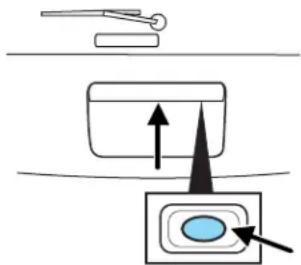
text_image
Diagram showing a mechanical setup with a lever and a component, including directional arrows and a blue oval object.WARNING: Make sure that the liftgate door and/or window are closed to prevent exhaust fumes from being drawn into the vehicle. Exhaust fumes contain carbon monoxide which can injure your lungs and cause drowsiness and even death. This will also prevent passengers and cargo from falling out. If you must drive with the liftgate door or window open, keep the vents open so outside air comes into the vehicle.
Driver Controls
CARGO AREA FEATURES
Cargo shade (if equipped)
If your vehicle has a cargo shade, you can use it to cover items in the cargo area of your vehicle.
To install the shade:
- Insert the ends of the cargo shade into the mounting features located behind the rear seat on the rear trim panels.
To operate the shade:
-
Grasp the rear edge of the cargo shade and pull rearward.
-
Secure both ends of the support rod into the retention slots located on the rear quarter trim panels.
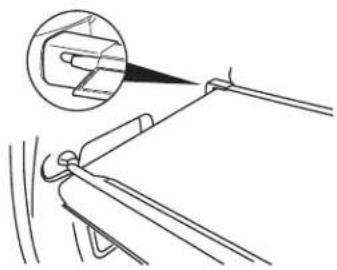
natural_image
Technical line drawing of a mechanical clamp or bracket assembly with an inset magnified detail (no text or symbols)
WARNING: Ensure that the posts are properly latched in mounting features. The cover may cause injury in a sudden stop incident if it is not securely installed.

WARNING: Do not place any objects on the cargo area shade. They may obstruct your vision or strike occupants of vehicle in use of a sudden stop or collision.
Driver Controls
LUGGAGE RACK
Your vehicle may be equipped with a roof rack. The maximum load for the roof rack is 100 lb (45 kg), evenly distributed on the cross-bars. If it is not possible to evenly distribute the load, position it in the center or as far forward on the cross-bars as possible.
Donotusethevehicle'sdoor handlesastiedownloops. Use thetie-downloopsonthe thumbwheelstosecureload.
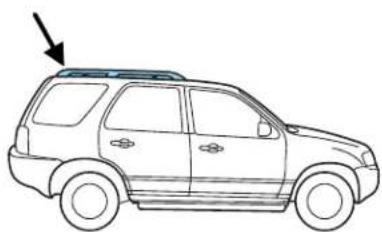
natural_image
Line drawing of a car with a pointing arrow (no text or symbols)Toadjustthecross-bar(ifequipped)position:
- Loosen the thumbwheel at both ends of the cross-bar (both cross-bars are adjustable).
- Slide the cross-bar to the desired location.
- Tighten the thumbwheel at both ends of the cross-bar.
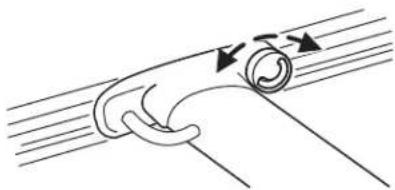
natural_image
Diagram of a curved pipe or tube with directional arrows indicating flow or movement (no text or symbols)Toremovethecross-barassembly(ifequipped)fromtheroofrack siderails:
- Loosen the thumbwheel at both ends of the cross-bar (both cross-bars are adjustable).

natural_image
Diagram of a curved pipe or tube with directional arrows indicating flow or movement (no text or symbols)Driver Controls
- Slide the cross-bar to the end of the rail.
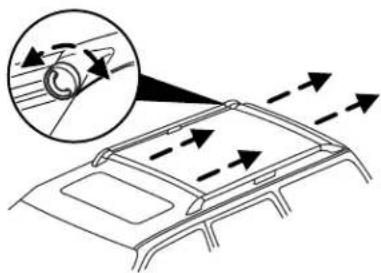
natural_image
Diagram of airflow or exhaust from a vehicle's side panel, showing airflow direction with arrows (no text or symbols)-
Use a long, flat object to depress the tongue in the endcaps on both sides of the cross-bar.
-
Slide the cross-bar assembly off the end of the rail.

natural_image
Diagram of a car seatbelt with arrows indicating airflow or movement (no text or symbols)Toreinstallthecross-barassembly(ifequipped)totheroofrack siderails:
-
Ensure that both cross-bar assemblies are installed with the F (front) arrow facing towards the front of the vehicle.
-
Use a long, flat object to depress the tongue in the endcaps on both sides of the cross-bar.
-
Slide the cross-bar assemblies over the end cap tongue and into the side rails.
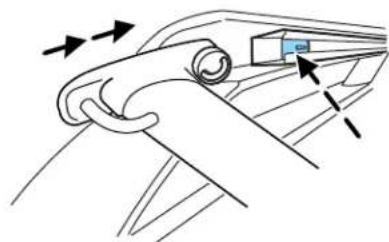
natural_image
Diagram of a car seatbelt mechanism with directional arrows indicating movement (no text or symbols)Driver Controls
- Tighten thumbwheel at both ends of the cross-bar.
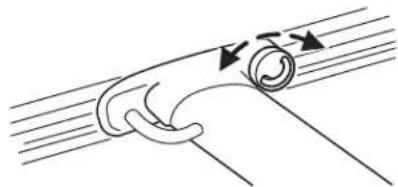
natural_image
Diagram of a curved pipe or tube with directional arrows indicating flow or movement (no text or symbols)Locks and Security
KEYS
Your vehicle is equipped with two Integrated Keyhead Transmitters (IKTs). The IKT functions as both a programmed ignition key that operates all the locks and starts the vehicle, and a remote keyless entry transmitter.
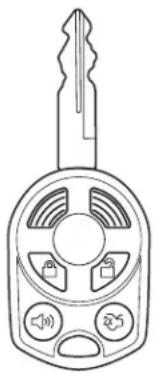
natural_image
Line drawing of a key with five buttons and a key inserted (no text or symbols)Your IKTs are programmed to your vehicle; using a non-programmed key will not permit your vehicle to start. If you lose your authorized dealer supplied IKTs, replacement IKTs are available through your authorized dealer. Standard SecuriLock ^™ keys without remote entry transmitter functionality can also be purchased from your authorized dealer if desired.
Always carry a spare key with you in case of an emergency.
For more information regarding programming replacement IKTs, refer to the SecuriLock™passiveanti-theftsystemsection later in this chapter.
Note: Your vehicle's IKTs were issued with a security label on them that provides important vehicle key cut information. It is recommended that you maintain the label in a safe place for future reference, such as the inside front cover of this Owner's Manual.
text_image
AVISO i-5601-0A Phone ID: 020308000022 1308X TA4T-15601-0A CAUTION! TO BE REMOVED BY CUSTOMER ONLY2009 Tribute Hybrid(thv) OwnersGuide, 1st Printing USA(fus)
Locks and Security
Recommended handling of the Integrated Keyhead Transmitter (IKT)
To avoid inadvertently activating the remote entry functions of your vehicle, it is recommended that the Integrated Keyhead Transmitter (IKT) be handled properly when starting and turning off your vehicle.
When inserting the IKT into the ignition cylinder, place your thumb on the center thumb rest of the IKT and forefinger on the logo badge on the opposite side.

natural_image
Line drawing of a hand holding a remote control device with buttons and dials (no text or symbols)To gain more leverage when rotating the IKT in the ignition lock cylinder, you can readjust the location of your thumb to grasp the IKT on the outer edge next to the ☑ control.
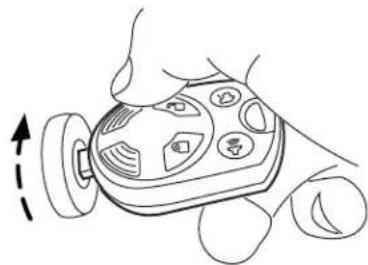
natural_image
Line drawing of a hand holding a handheld device with a scroll wheel and control buttons (no text or symbols)Likewise, when rotating the IKT to the off position in the ignition lock cylinder, the bottom edge of the IKT adjacent to the 🔒 control can be utilized.
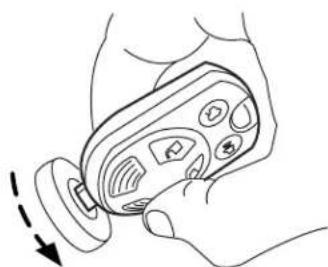
natural_image
Line drawing of a hand holding a handheld device with a circular button and control buttons (no text or symbols)Locks and Security
POWER DOOR LOCKS
- Press the 🔒 control to unlock all doors.
- Press the control to lock all doors.
Door key unlocking/locking
Unlockingthedoors
Turn the key in the door cylinder to unlock the driver's door only. All other doors will remain locked.
Lockingthedoors
Turn the key in the door cylinder to lock the driver's door only.
Autolock
The autolock feature will lock all the doors, liftgate and liftgate window when:
- all doors are closed,
• the ignition is in the on position, - you shift into any gear putting the vehicle in motion, and
• the vehicle attains a speed greater than 12 mph (20 km/h).
The autolock feature repeats when:
- any door is opened then closed while the ignition is in the on position and the vehicle speed is 9 mph (15 km/h) or lower, and
• the vehicle attains a speed greater than 12 mph (20 km/h).
Deactivating/activatingautolock
Your vehicle comes with the autolock feature enabled. There are two methods to enable/disable this feature:
•Through your authorized dealer, or
- Performing the power door lock control procedure.
Note: The autolock feature can be activated/deactivated independently of the autounlock feature.
Before following the activation or deactivation procedures, make sure that the anti-theft system is not armed, ignition is in the off position, and all vehicle doors, liftgate and liftgate window are closed.
Powerdoorunlock/lockprocedure
You must complete Steps 1-5 within 30 seconds or the procedure will have to be repeated. If the procedure needs to be repeated, you must wait 30 seconds.
Note: Alldoors must be closed and remain closed throughout the configuration process.
- The ignition must be off to begin sequence.
- Turn the ignition to the on position.
- Press the power door unlock control three times.
- Turn the ignition from the on to the off position.
- Press the power door unlock control three times.
- Turn the ignition back to the on position. The horn will chirp.
- Press the unlock control, then press the lock control. The horn will chirp once if autolock was deactivated or twice (one short and one long chirp) if autolock was activated.
- Turn the ignition to the off position. The horn will chirp once to confirm the procedure is complete.
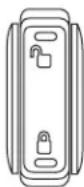
Autounlock
The autounlock feature will unlock all the doors when:
- the ignition is in the on position, all the doors are closed, and the vehicle has been in motion at a speed greater than 12 mph (20 km/h);
- the vehicle has then come to a stop and the ignition is turned to the off or accessory position; and
- the driver door is opened within 10 minutes of the ignition being transitioned to the off or accessory position.
Note: The doors will not autounlock if the vehicle has been electronically locked before the driver door is opened.
Locks and Security
Deactivating/activatingautounlock
Your vehicle comes with the autounlock feature activated. There are two methods to enable/disable this feature:
- Through your authorized dealer, or
- by using the power door unlock/lock sequence.
Note: The autounlock feature can be activated/deactivated independently of the autolock feature.
Powerdoorlockswitchautounlockenable/disableprocedure
Before starting, ensure the ignition is in the off position and all vehicle doors are closed. You must complete Steps 1–5 within 30 seconds or the procedure will have to be repeated. If the procedure needs to be repeated, wait a minimum of 30 seconds before beginning again.
- Place the key in the ignition and turn the ignition to the on position.
- Press the power door unlock control on the door panel three times.
- Turn the ignition from the on position to the off position.
- Press the power door unlock control on the door panel three times.
- Turn the ignition back to the on position. The horn will chirp one time to confirm programming mode has been entered and is active.
- To enable/disable the autounlock feature, press the lock control, then press the unlock control. The horn will chirp once if autounlock was deactivated or twice (one short and one long chirp) if autounlock was activated.
- Turn the ignition to the off position. The horn will chirp once to confirm the procedure is complete.
Smart unlocking feature
The smart unlocking feature helps prevent you from locking yourself out of the vehicle. With the key in any ignition position, the driver's door will automatically unlock if it is locked using the power lock control on the driver's door panel while the driver's door is open.
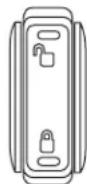
CHILDPROOF DOOR LOCKS
When these locks are set, the rear doors cannot be opened from the inside. The rear doors can be opened from the outside when the doors are unlocked.
The childproof locks are located on rear edge of each rear door and must be set separately for each door.
NOTE: Setting the lock for one door will not automatically set the lock for both doors so you must set each child lock on each door separately.
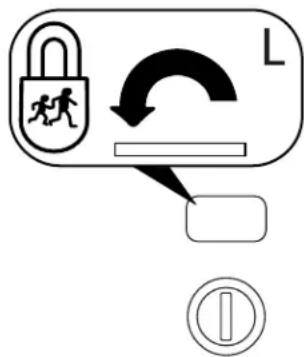
flowchart
graph TD
    A["Lock Icon"] --> B["Refresh Arrow"]
    B --> C["Document Icon"]
    C --> D["L"]
Insert the key and turn in the direction of arrow shown on the door to engage the child proof lock. Turn in the opposite direction to disengage childproof locks.
REMOTE ENTRY SYSTEM (IF EQUIPPED)
The Integrated Keyhead Transmitter (IKT) complies with part 15 of the FCC rules and with RSS-210 of Industry Canada. Operation is subject to the following two conditions: (1) This device may not cause harmful interference, and (2) This device must accept any interference received, including interference that may cause undesired operation.
Changesormodificationsnotexpresslyapprovedbytheparty responsibleforcompliancecouldvoidtheuser'sauthorityto operatetheequipment.
The typical operating range for your IKT is approximately 33 feet (10 meters). A decrease in operating range could be caused by:
- weather conditions,
•nearby radio towers, - structures around the vehicle, or
- other vehicles parked next to your vehicle.
Locks and Security
The IKT allows you to:
- remotely unlock the vehicle doors.
- remotely lock all the vehicle doors.
- remotely open the power liftgate glass.
- activate the personal alarm.
• operate the illuminated entry feature.
The remote entry lock/unlock feature operates in any ignition
position except while the key is held in the start position. The panic
feature operates with the key in the off position.
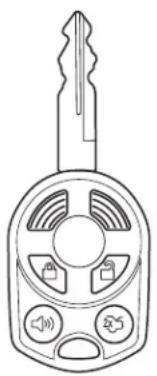
natural_image
Line drawing of a key with four buttons and speaker icons (no text or symbols)If there are problems with the remote entry system, make sure to take
ALLIntegratedKeyheadTransmitterswith you to the authorized dealer in order to aid in troubleshooting the problem.
Two step door unlocking
- Press and release to unlock the driver's door. Note: The interior lamps will illuminate if the lamp is in the DOOR position.
- Press ☐ and release again within three seconds to unlock the passenger doors, the liftgate and liftgate glass.
The battery saver feature will turn off the interior lamps 10 minutes after the ignition is turned to the off position.
Onestepdoorunlocking
If the one step door unlocking feature is activated, press 📋 and release once to unlock all of the doors, the liftgate and liftgate glass. Note: The interior lamps will illuminate (refer to Illuminatedentryinformation later in this section), if the control on the overhead lamp is in the DOOR position.
Locks and Security
Switchingfromtwosteptoonestepdoorunlocking
Unlocking can be switched between two step and one step door
unlocking by pressing and holding both 🔒 and buttons
simultaneously on the remote entry transmitter for approximately
4 seconds. The turn signal will flash twice to indicate that the vehicle has switched to one step unlocking. Repeat the procedure to switch back to two step unlocking.
Locking the doors
- Press and release to lock all the doors. Assuming all vehicle doors and the liftgate are properly closed and the park/turn lamps will flash once.
- Press 🔒 and release again within three seconds to confirm that all the doors and liftgate are closed and locked. Note: The doors will lock again and the horn will chirp once.
If any of the doors or the hood are not properly closed, the horn will chirp twice and park/turn lamps will not flash when the 📄 control is pressed.
Opening the liftgate glass (if equipped) 2x
Press twice within three seconds to open the liftgate glass.
Car finder
Press 📄 twice within three seconds. The horn will chirp and the turn lamps will flash. It is recommended that this method be used to locate your vehicle, rather than using the panic alarm.
Sounding a panic alarm
Press 📋 to activate the alarm. To deactivate the feature, press the control again, turn the ignition to the on or start position, or wait for the alarm to time out in approximately three minutes.
Note: The panic alarm will only operate when the ignition is in the off position.
Replacing the battery
The Integrated Keyhead Transmitter uses one coin type three-volt lithium battery CR2032 or equivalent.
Locks and Security
To replace the battery:
- Twist a thin coin in the slot of the IKT near the key ring in order to remove the battery cover.

text_image
CR2032 3V- Do not wipe off any grease on the battery terminals on the back surface of the circuit board.
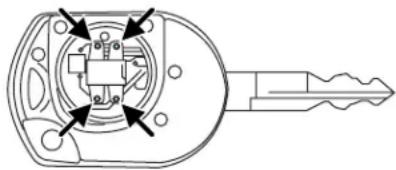
natural_image
Technical line drawing of a mechanical component with arrows indicating assembly or alignment (no text or symbols)- Remove the old battery. Note: Please refer to local regulations when disposing of transmitter batteries.
- Insert the new battery. Refer to the instructions inside the IKT for the correct orientation of the battery. Press the battery down to ensure that the battery is fully seated in the battery housing cavity.
- Snap the battery cover back onto the key.
Note: Replacement of the battery will not cause the IKT to become deprogrammed from your vehicle. The IKT should operate normally after battery replacement.
Replacing lost Integrated Keyhead Transmitters (IKTs)
If you would like to have your Integrated Keyhead Transmitters reprogrammed because you lost one, or would like to buy additional IKTs, you can either reprogram them yourself, or take allIKTsto your authorized dealer for reprogramming.
HowtoreprogramyourIntegratedKeyheadTransmitters(IKTs)
To program a new Integrated Keyhead Transmitter yourself, refer to Programmingsparekeys in the SecuriLock™passiveanti-theft section of this chapter. Note: At least two IKTs are required to perform this procedure yourself.
Locks and Security
Illuminated entry
The interior lamps and puddle lamps (if equipped) illuminate when the Integrated Keyhead Transmitter or the keyless entry system keypad is used to unlock the door(s).
The illuminated entry system will turn off the interior lights if:
• the ignition is turned to the on position, or
- the Integrated Keyhead Transmitter lock control is pressed, or
- the vehicle is locked using the keyless entry keypad (if equipped), or
• after 25 seconds of illumination.
The inside lights will not turn off if:
- they have been turned on with the dimmer control, or
- any door is open.
Illuminatedexit
- The interior lights will illuminate when the key is removed from the ignition.
The lamps automatically turn off after 25 seconds. The dome and cargo lamp controls must not be set to the off position for the illuminated exit system to operate.
Perimeter lamps illuminated entry
With the Integrated Keyhead Transmitter system, the following items will illuminate when the ☐ (unlock) control on the transmitter is pressed:
- Head lamps
- Park lamps
- Tail lamps
The lamps will automatically turn off:
- if the ignition switch is turned to the on position, or
• the IKT 🔒 control is pressed, or
• after 25 seconds of illumination.
Note: On some vehicles, the perimeter lamps illuminated entry feature will not activate in daylight conditions.
Deactivating/activatingperimeterlampsilluminatedentry
You may enable/disable this feature by having your vehicle serviced by your authorized dealer.
Locks and Security
You may also perform the following power door lock sequence to enable/disable the perimeter lamps feature. Note: Before starting, ensure the ignition is in the 1 (off) position and all vehicle doors are closed. You must complete Steps 1–5 within 30 seconds or the procedure will have to be repeated. If the procedure needs to be repeated, wait a minimum of 30 seconds before beginning again.
- The ignition must be off to begin the sequence.
- Place the key in the ignition and turn the ignition to the 3 (on) position.
- Press the power door unlock control on the door panel three times.
- Turn the ignition from the 3 (on) position to the 1 (off) position.

flowchart
graph TD
    A["1"] --> B["2"]
    C["3"] --> D["4"]
    E["5"] --> F["6"]
-
Press the power door unlock control on the door panel three times.
-
Turn the ignition back to the 3 (on) position. The horn will chirp one time to confirm programming mode has been entered and is active.
-
Press the power door unlock control twice within five seconds. Note: The horn will chirp once to indicate the perimeter lighting feature has been deactivated. The horn will chirp once and honk once (one short and one long) to indicate the perimeter lighting feature has been activated.
-
Turn the ignition to the 1 (off) position to exit the procedure. Note: The horn will chirp once to confirm the procedure is complete.
SecuriLock™ passive anti-theft system is an engine immobilization system. This system is designed to help prevent the engine from being started unless a codedIntegratedKeyheadTransmitter(IKT)
programmedtoyourvehicleis used. The use of the wrong type of coded key may lead to a "no-start" condition.
Locks and Security
Your vehicle comes with two coded Integrated Keyhead Transmitters; additional coded IKTs may be purchased from your authorized dealer. Standard SecuriLock™ keys without remote entry transmitter functionality can also be purchased from your authorized dealer if desired. The authorized dealer can program your spare IKTs to your vehicle or you can program the IKTs yourself. Refer to Programming sparekeys for instructions on how to program the coded key.
Note: The SecuriLock ^™ passive anti-theft system is not compatible with non-Mazda aftermarket remote start systems. Use of these systems may result in vehicle starting problems and a loss of security protection.
Note: Large metallic objects, electronic devices that are used to purchase gasoline or similar items, or a second coded key on the same key chain may cause vehicle starting issues. You need to prevent these objects from touching the coded IKT while starting the engine. These objects will not cause damage to the coded IKT, but may cause a momentary issue if they are too close to the IKT when starting the engine. If a problem occurs, turn the ignition off, remove all objects on the key chain away from the coded IKT and restart the engine.
Note: Donotleaveaduplicatecodedkeyinthevehicle. Always takeyourkeysandlockalldoorswhenleavingthevehicle.
Anti-theft indicator
The anti-theft indicator is located in the instrument panel cluster.
- When the ignition is in the off position, the indicator will flash once every two seconds to indicate the SecuriLock™ system is functioning as a theft deterrent.
- When the ignition is in the on position, the indicator will glow for three seconds to indicate normal system functionality.
If a problem occurs with the SecuriLock ^™ system, the indicator will flash rapidly or glow steadily when the ignition is in the on position. If this occurs, the vehicle will not start and should be taken to an authorized dealer for service.
Locks and Security
Automatic arming
The vehicle is armed immediately after switching the ignition to the off position.
The theft indicator will flash every two seconds to act as a theft deterrent when the vehicle is armed.

Automatic disarming
The vehicle is disarmed immediately after the ignition is turned to the on position.
The theft indicator will illuminate for three seconds and then go out. If the theft indicator stays on for an extended period of time or flashes rapidly, have the system serviced by your authorized dealer.
Replacement Integrated Keyless Transmitters (IKT) and coded keys
Note: Your vehicle comes equipped with two Integrated Keyhead Transmitters (IKTs). The IKT functions as both a programmed ignition key that operates all the locks and starts the vehicle, as well as a remote keyless entry transmitter. A maximum of eight coded keys can be programmed to your vehicle; only four of these eight keys can be IKTs with remote entry functionality.
If your IKTs or standard SecuriLock ^™ coded keys are lost or stolen and you don't have an extra coded key, you will need to have your vehicle towed to an authorized dealer. The key codes need to be erased from your vehicle and new coded keys will need to be programmed.
Replacing coded keys can be very costly. Store an extra programmed key away from the vehicle in a safe place to help prevent any inconveniences. Please visit an authorized dealer to purchase additional spare or replacement keys.
Programming spare keys
You can program your own Integrated Keyhead Transmitters or standard SecuriLock ^TM coded keys to your vehicle. This procedure will program both the engine immobilizer keycode and the remote entry transmitter portion of the IKT to your vehicle. Note: A maximum of eight coded keys can be programmed to your vehicle; only four of these eight can be IKTs with remote entry functionality.
Tips:
- Only use Integrated Keyhead Transmitters (IKTs) or standard SecuriLock™ keys.
- You must have two previously programmed coded keys (keys that already operate your vehicle's engine) and the new unprogrammed key(s) readily accessible.
- If two previously programmed coded keys are not available, you must take your vehicle to your authorized dealer to have the spare key(s) programmed.
Please read and understand the entire procedure before you begin.
- Insert the first previously programmed codedkey into the ignition.
-
Turn the ignition from the 1 (off) position to the 3 (on) position. Keep the ignition in the 3 (on) position for at least three seconds, but no more than 10 seconds.
-
Turn the ignition to the 1 (off) position and remove the first coded key from the ignition.
- Within 10 seconds of turning the ignition to the 1 (off) position, insert the second previously codedkey into the ignition.
- Turn the ignition from the 1 (off) position to the 3 (on) position. Keep the ignition in the 3 (on) position for at least three seconds, but no more than 10 seconds.
- Turn the ignition to the 1 (off) position and remove the second previously programmed codedkey from the ignition.
- Within 20 seconds of turning the ignition to the 1 (off) position and removing the previously programmed codedkey, insert the new unprogrammed key (new key/valet key) into the ignition.
- Turn the ignition from the 1 (off) position to the 3 (on) position. Keep the ignition in the 3 (on) position for at least six seconds.
- Remove the newly programmed codedkey from the ignition.
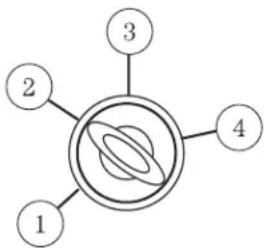
flowchart
graph TD
    A["1"] --> B["2"]
    C["3"] --> D["4"]
    E["5"] --> F["6"]
Locks and Security
If the key has been successfully programmed it will start the vehicle's engine and will operate the remote entry system (if the new key is an Integrated Keyhead Transmitter). The theft indicator light will illuminate for three seconds and then go out to indicate successful programming.
If the key was not successfully programmed, it will not start your vehicle's engine and/or will not operate the remote entry features. The theft indicator light may flash on and off. Wait 20 seconds and you may repeat Steps 1 through 8. If failure repeats, bring your vehicle to your authorized dealer to have the new key(s) programmed.
To program additional new unprogrammed key(s), wait 20 seconds and then repeat this procedure from Step 1.
Seating and Safety Restraints
FRONT SEATS
Notes:

WARNING:Reclining the seatback can cause an occupant to slide under the seat's seat belt, resulting in severe personal es in the event of a collision.

WARNING: Do not pile cargo higher than the seatbacks to reduce the risk of injury in a collision or sudden stop.

WARNING: Before returning the seatback to its original position, make sure that cargo or any objects are not trapped and the seatback. After returning the seatback to its original on, pull on the seatback to ensure that it has fully latched. Anched seat may become dangerous in the event of a sudden stop or on.
Adjustable head restraints
Your vehicle is equipped with front row outboard head restraints that are vertically adjustable.

WARNING: To minimize the risk of neck injury in the event of a crash, the driver and passenger occupants should not sit in or operate the vehicle, until the head restraint is placed in its position. The driver should never adjust the head restraint the vehicle is in motion.
The adjustable head restraints consist of :
- a trimmed energy absorbing foam and structure (1),
- two steel stems (2),
- a guide sleeve adjust/release button (3),
• and a guide sleeve unlock/remove button (4).

text_image
Diagram of a car seat assembly with numbered components for identificationSeating and Safety Restraints
To adjust the head restraint, do the following:
-
Adjust the seatback to an upright driving/riding position.
-
Raise the head restraint by pulling up on the head restraint.
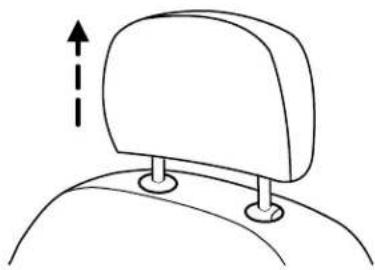
natural_image
Simple line drawing of a car head with a curved seat and two mounting points, no text or symbols present.- Lower the head restraint by pressing and holding the guide sleeve adjust/release button and pushing down on the head restraint.
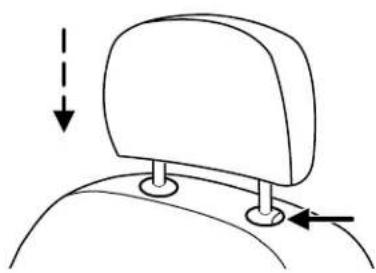
natural_image
Diagram of a car headrest with two mounting points and directional arrows indicating movement (no text or symbols)Properly adjust the head restraint so that the top of the head restraint is even with the top of your head and positioned as close as possible to the back of your head. For occupants of extremely tall stature, adjust the head restraint to its full up position.

WARNING: The adjustable head restraint is a safety device. Whenever possible it should be installed and properly adjusted the seat is occupied.
Seating and Safety Restraints
To remove the adjustable head restraint, do the following:
- Pull up the head restraint until it reaches the highest adjustment position.
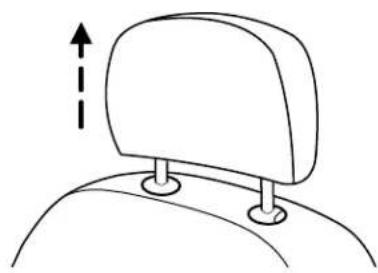
natural_image
Simple line drawing of a car head with a side-mounted seat and two mounting points, no text or symbols present.- Simultaneously press and hold both the adjust/release button and the unlock/remove button, then pull up on the head restraint.
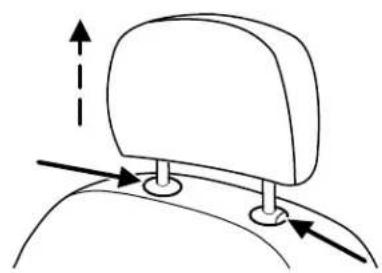
natural_image
Diagram of a car headrest with directional arrows indicating movement or force (no text or symbols)To reinstall the adjustable head restraint, do the following:
- Insert the two stems into the guide sleeve collars.
- Push the head restraint down until it locks.

natural_image
Diagram of a car head with a neck-mounted seat and two directional arrows indicating movement or force (no text or symbols)Properly adjust the head restraint so that the top of the head restraint is even with the top of your head and positioned as close as possible to the back of your head. For occupants of extremely tall stature, adjust the head restraint to its full up position.
Seating and Safety Restraints

WARNING: To minimize the risk of neck injury in the event of a crash, head restraints must be installed properly.
Adjusting the front manual seat (if equipped)
Lift handle to move seat forward or backward.
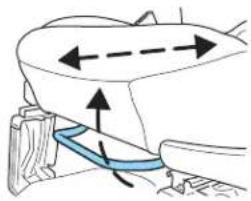
natural_image
Diagram of a mechanical component with arrows indicating direction (no text or symbols)Pull lever up to adjust seatback.
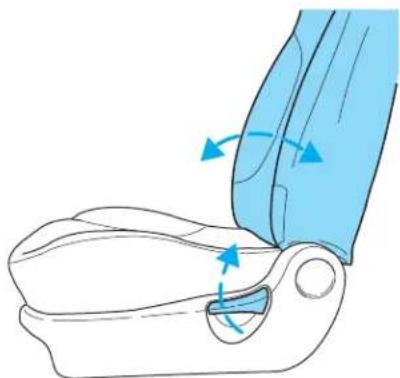
natural_image
Anatomical illustration of a human arm joint with blue arrows indicating force direction (no text or labels)Adjusting the front power seat (if equipped)

WARNING: Never adjust the driver's seat or seatback when the vehicle is moving. You could move out of position to control the e. Then a serious accident could occur. Sudden braking or a on could cause serious injury. Adjust the seat only when the e is stopped.

WARNING: Do not pile cargo higher than the seatbacks to reduce the risk of injuring people in a collision or sudden stop.
Seating and Safety Restraints

WARNING: Always drive and ride with your seatback upright, and the lap belt snug and low across the hips and the shoulder snug across the chest.

WARNING: Sitting in a reclined position while the vehicle is moving is dangerous because you don't get the full protection seat belts. During sudden braking or a collision, you can slide the lap belt and suffer serious internal injury, or in a rear end on you could fly up and out of the vehicle. For maximum action, sit well back and upright.

WARNING: Sitting improperly out of position or with the seat back reclined too far can take off weight from the seat cushion effect the decision of the passenger sensing system, resulting in his injury or death in a crash. Always sit upright against your back, with your feet on the floor.

WARNING: To reduce the risk of possible serious injury: Do not hang objects off seat back or stow objects in the seatback map t (if equipped) when a child is in the front passenger seat. Do pace objects underneath the front passenger seat or between the and the center console (if equipped). Check the “passenger airbag for “pass airbag off” indicator lamp for proper airbag status. Refer ontpassengersensingsystemsectionforadditionalls.Failuretofollowtheseinstructionsmayinterferewith ontpassengerseatsensingsystem.
The control is located on the outboard side of the seat cushion.
Move the front of the control up or down to raise or lower the front portion of the seat cushion.
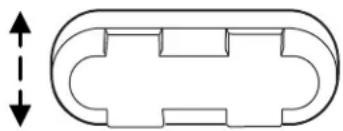
natural_image
Pure diagram of a symmetrical U-shaped object with internal cutouts, no text or symbols presentSeating and Safety Restraints
Move the rear of the control up or down to raise or lower the rear portion of the seat cushion.
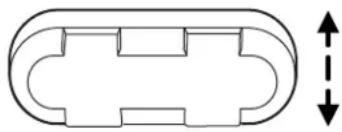
natural_image
Pure diagram of a symmetrical U-shaped object with internal cutouts and two vertical arrows indicating depth (no text or symbols)Move the control in the directions shown to move the seat forward, backward, up or down.
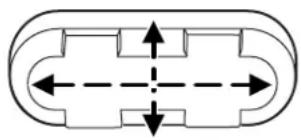
natural_image
Pure electrical circuit lines without any symbolsHeated seats (if equipped)
WARNING: Persons who are unable to feel pain to the skin because of advanced age, chronic illness, diabetes, spinal cord injury, medication, alcohol use, exhaustion, or other physical conditions, must exercise care when using the seat heater. The seat heater may cause burns even at low temperatures, especially if used for long periods of time. Do not place anything on the seat that insulates against heat, such as a blanket or cushion, because this may cause the seat heater to overheat. Do not puncture the seat with pins, needles, or other pointed objects because this may damage the heating element which may cause the seat heater to overheat. An overheated seat may cause serious personal injury.
Note: Do not do the following:
- Place heavy objects on the seat
- Operate the seat heater if water or any other liquid is spilled on the seat. Allow the seat to dry thoroughly.
Seating and Safety Restraints
To operate the heated seats:
- Push the button located on the instrument panel to activate.
- Push again to deactivate.
natural_image
Simple line drawing of a shopping cart with a circular hole and checkmark (no text or symbols)The heated seats will activate when the ignition is in the on position.
REAR SEATS
Head restraints
The purpose of these head restraints is to help limit head motion in the event of a rear collision. To properly adjust your head restraints, lift the head restraint so that it is located directly behind your head or as close to that position as possible.
The head restraints can be moved up and down. Lift the head restraint so that it is located directly or as close as possible behind your head.
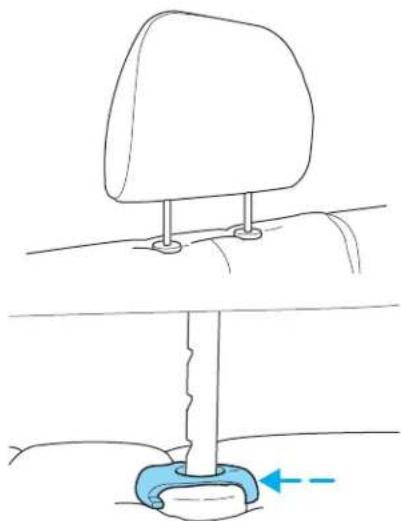
natural_image
Diagram of a car seatbelt mechanism with a blue arrow indicating left motion (no text or symbols)Push control to lower or remove head restraint.
Seating and Safety Restraints
Folding down rear seats
- Raise the rear seat head restraint and remove.
- Place the head restraint under the front seat for storage.
- Pull the seat release control.
natural_image
Simple line drawing of a chair seat with two legs and feet, no text or symbols present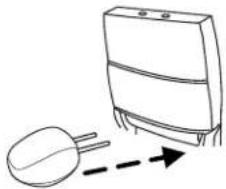
natural_image
Simple line drawing of a refrigerator with a bulb and arrow indicating direction (no text or symbols)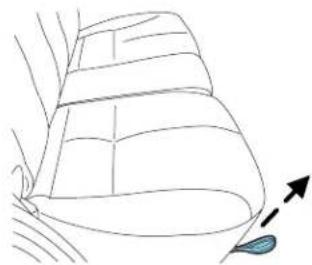
natural_image
Line drawing of a car seat with visible seatbelt and seat, no text or symbols presentNote: Make sure the floor is clear of all objects before folding the seat.
Seating and Safety Restraints
- Flip seat forward.
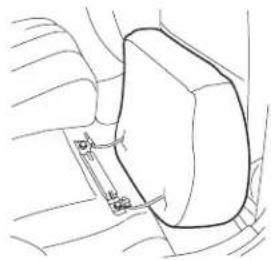
text_image
75mm 35mmAttach the seat belt web snap button to the quarter trim panel snap button. This will ensure that seat belt does not get caught by staying out of the seat back folding path.
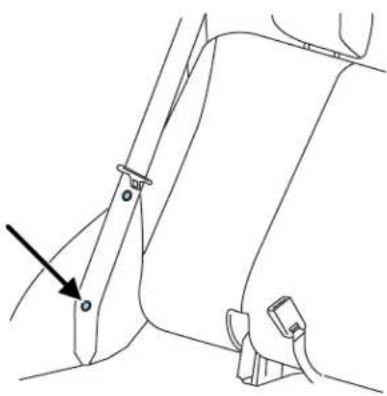
natural_image
Line drawing of a mechanical component with a highlighted section and arrow (no text or symbols)- To release seatback, pull the seatback release lever (on top of seat) toward the front seat. This is common for both 60% and 40% seatbacks.
Note: When the seatback release lever is pulled, slowly lower seatback to the flat position.
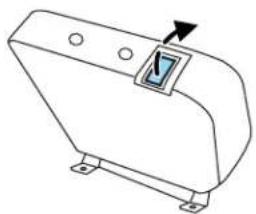
natural_image
Line drawing of a mechanical component with a highlighted button and mounting holes (no text or symbols)2009TributeHybrid(thv) OwnersGuide,1stPrinting USA(fus)
Seating and Safety Restraints
- Rotate seatback down into load floor position.

natural_image
Line drawing of a car interior showing seat and dashboard area with an arrow indicating direction (no text or symbols)Returningtherearseatstouprightposition
- Pull seatback up and into upright position making sure seatback locks into place and the red seat unlatched indicator on release paddle is not visible.
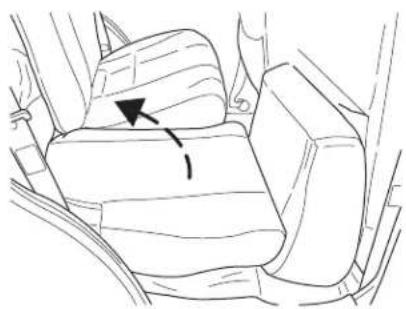
natural_image
Line drawing of a car interior showing seat, dashboard, and window (no text or symbols)- Rotate seat cushion down into the seating position making sure that the seat cushion is locked into place and that the seat belt buckles are exposed.
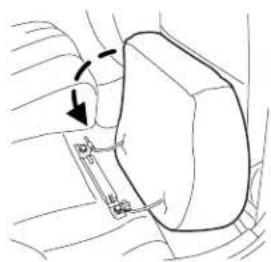
natural_image
Line drawing of a mechanical component with an arrow indicating rotation (no text or symbols)Seating and Safety Restraints

WARNING: Make sure seat belt buckle heads are through elastic holders on seat backs. Seat belt buckles may break if they applied underneath the seatback as the seatback is rotated down.

WARNING: Before returning the seatback to its original position, make sure that cargo or any objects are not trapped and the seatback. After returning the seatback to its original on, reinstall the head restraints, and pull on the seatback to be that it has fully latched. An unlatched seat may become nervous in the event of a sudden stop or collision.

WARNING: Remove the head restraint stored under front set and return it to the total position on the seatback. We to do so could result in total injury.
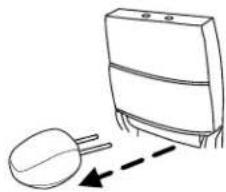
natural_image
Simple line drawing of a device with a bulb and a pointer, no text or symbols present- Unsnap the seat belt webbing from the quarter trim panel.
Toremovetherearcushion
- Lift the yellow tab to release the hinges.
- Pull the cushion to the outboard side of the vehicle.
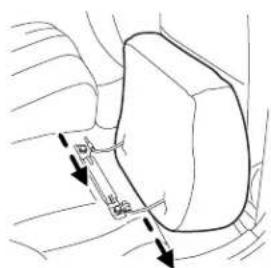
natural_image
Technical line drawing of a mechanical component with arrows indicating motion direction (no text or symbols)Seating and Safety Restraints
Toinstalltherearcushion
- Push the cushion to the inboard side of the vehicle.
- Make sure that the hinges are locked into place.
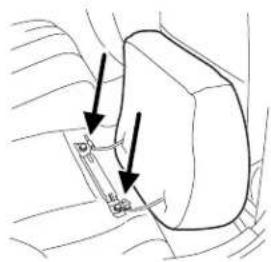
text_image
Technical diagram showing mechanical assembly with labeled components and directional arrows indicating motion or forceSAFETY RESTRAINTS
Personal Safety System®
The Personal Safety System ^® provides an improved overall level of frontal crash protection to front seat occupants and is designed to help further reduce the risk of airbag-related injuries. The system is able to analyze different occupant conditions and crash severity before activating the appropriate safety devices to help better protect a range of occupants in a variety of frontal crash situations.
Your vehicle's Personal Safety System®consists of:
- Driver and passenger dual-stage airbag supplemental restraints
- Front seat belts with pretensioners, energy management retractors, and seat belt usage sensors
• Front passenger sensing system - "Passenger airbag off" or "pass airbag off" indicator lamp
• Front crash severity sensor - Restraints Control Module (RCM) with impact and safing sensors
- Driver's seat position sensor
- Restraint system warning light and back-up tone
- The electrical wiring for the airbags, crash sensor(s), seat belt pretensioners, front seat belt usage sensors, driver seat position sensor, front passenger sensing system, and indicator lights
Seating and Safety Restraints
HowdoesthePersonalSafetySystem®work?
The Personal Safety System® can adapt the deployment strategy of your vehicle's safety devices according to crash severity and occupant conditions. A collection of crash and occupant sensors provides information to the Restraints control module (RCM). During a crash, the RCM may activate the seat belt pretensioners and/or both stages of the dual-stage airbag supplemental restraints based on crash severity and occupant conditions.
The fact that the pretensioners or airbags did not activate for both front seat occupants in a collision does not mean that something is wrong with the system. Rather, it means the Personal Safety System ^® determined the accident conditions (crash severity, belt usage, etc.) were not appropriate to activate these safety devices. Front airbags are designed to activate only in frontal and near-frontal collisions, not rollovers, side-impacts, or rear-impacts unless the collision causes sufficient longitudinal deceleration.
Dual-stageairbagsupplementalrestraints
The dual-stage airbag offers the capability to tailor the level of airbag inflation energy. A lower, less forceful energy level is provided for more common, moderate-severity impacts. A higher energy level is used for the most severe impacts. Refer to Airbagsupplementalrestraints section in this chapter.
Frontcrashseveritysensor
The front crash severity sensor enhances the ability to detect the severity of an impact. Positioned up front, it provides valuable information early in the crash event on the severity of the impact. This allows your Safety System to distinguish between different levels of crash severity and modify the deployment strategy of the dual-stage airbag and seat belt pretensioners.
Driver'sseatpositionsensor
The driver's seat position sensor allows your Safety System to tailor the deployment level of the driver airbag based on seat position. The system is designed to help protect smaller drivers sitting close to the driver airbag by providing a lower airbag output level.
Seating and Safety Restraints
Frontpassengersensingsystem
For airbags to do their job they must inflate with great force, and this force can pose a potentially deadly risk to occupants that are very close to the airbag when it begins to inflate. For some occupants, like infants in rear-facing child seats, this occurs because they are initially sitting very close to the airbag. For other occupants, this occurs when the occupant is not properly restrained by seat belts or child safety seats and they move forward during pre-crash braking. The most effective way to reduce the risk of unnecessary injuries is to make sure all occupants are properly restrained. Accident statistics suggest that children are much safer when properly restrained in the rear seating positions than in the front.
WARNING: Airbags can kill or injure a child in a child seat. NEVER place a rear-facing child seat in front of an active airbag. If you must use a forward-facing child seat in the front seat, move the seat all the way back.
WARNING: Always transport children 12 years old and under in the back seat and always properly use appropriate child restraints.
The front passenger sensing system can automatically turn off the passenger front airbag. The system is designed to help protect small (child size) occupants from airbag deployments when they are improperly seated or restrained in the front passenger seat contrary to proper child-seating or restraint usage recommendations. Even with this technology, parents are STRONGLY encouraged to always properly restrain children in the rear seat. The sensor also turns off the passenger front airbag and seat-mounted side airbag (if equipped) when the passenger seat is empty to prevent unnecessary replacement of airbag(s) after a collision.
When the front passenger seat is occupied and the sensing system has turned off the passenger's frontal airbag, the "pass airbag off" indicator will light and stay lit to remind you that the front passenger frontal airbag is off. See Frontpassengersensingsystemin the airbags section of this chapter.
Seating and Safety Restraints
Frontseatbeltusagesensors
The front seat belt usage sensors detect whether or not the driver and front outboard passenger seat belts are fastened. This information allows your Safety System to tailor the airbag deployment and seat belt pretensioner activation depending upon seat belt usage. Refer to Seat belt section in this chapter.
Frontseatbeltpretensioners
The seat belt pretensioners at the front outboard seating positions are designed to tighten the seat belts firmly against the occupant's body during frontal collisions, and in side collisions and rollovers when the vehicle is equipped with the Safety Canopy® system. This helps increase the effectiveness of the seat belts. In frontal collisions, the seat belt pretensioners can be activated alone or, if the collision is of sufficient severity, together with the front airbags.
Seatbeltenergymanagementretractors
The front and rear outboard seat belt energy management retractors, once initiated, allow webbing to be pulled out of the retractor in a gradual and controlled manner in response to the occupant's forward momentum. This helps reduce the risk of force-related injuries to the occupant's chest by limiting the load on the occupant. Refer to Energy management feature section in this chapter.
DeterminingifthePersonalSafetySystem®isoperational
The Safety System uses a warning light in the instrument cluster or a back-up tone to indicate the condition of the system. Refer to the Warninglightsandchimessection in the InstrumentClusterchapter. Routine maintenance of the Safety System is not required.
The Restraints control module (RCM) monitors its own internal circuits and the circuits for the airbag supplemental restraints, crash sensor(s), seat belt pretensioners, front seat belt buckle sensors, driver seat position sensor, and front passenger sensing system. In addition, the RCM also monitors the restraints warning light in the instrument cluster. A difficulty with the system is indicated by one or more of the following.
- The warning light will either flash or stay lit.
- The warning light will not illuminate immediately after ignition is turned on.
- A series of five beeps will be heard. The tone pattern will repeat periodically until the problem and warning light are repaired.
If any of these things happen, even intermittently, have the Safety System serviced at an authorized dealer immediately. Unless serviced, the system may not function properly in the event of a collision.
Seating and Safety Restraints
Safety restraints precautions

WARNING: Always drive and ride with your seatback upright and the lap belt snug and low across the hips and the shoulder snug across the chest.

WARNING: To reduce the risk of injury, make sure children sit where they can be properly restrained.

WARNING: Never let a passenger hold a child on his or her lap while the vehicle is moving. The passenger cannot protect the from injury in a collision.

WARNING: All occupants of the vehicle, including the driver, should always properly wear their seat belts, even when an air supplemental restraint system (SRS) is provided.

WARNING: It is extremely dangerous to ride in a cargo area, inside or outside of a vehicle. In a collision, people riding in areas are more likely to be seriously injured or killed. Do not people to ride in any area of your vehicle that is not equipped seats and seat belts. Be sure everyone in your vehicle is in a seat using a seat belt properly.

WARNING: In a rollover crash, an unbelted person is significantly more likely to die or be seriously injured than a person wearing a seat belt.

WARNING: Each seating position in your vehicle has a specific seat belt assembly which is made up of one buckle and one side that are designed to be used as a pair. 1) Use the shoulder belt to be outside shoulder only. Never wear the shoulder belt under the 2) Never swing the seat belt around your neck over the inside door. 3) Never use a single belt for more than one person.
Seating and Safety Restraints
WARNING: Placing a child, 12 years or younger, in the front seat is dangerous. The child could be hit by a deploying airbag and be seriously injured or even killed. A sleeping child is more likely to lean against the door and be hit by the side airbag (if equipped) in a moderate collision. Whenever possible, always secure a child, 12 years or younger, in the rear seat, with an appropriate child restraint system for the child's age and size. Never use a rear-facing child restraint system in the front seat with an airbag that could deploy.
WARNING: Front and rear seat occupants, including pregnant women, should wear seat belts for optimum protection in an accident.
Combination lap and shoulder belts
-
Insert the belt tongue into the proper buckle (the buckle closest to the direction the tongue is coming from) until you hear a snap and feel it latch. Make sure the tongue is securely fastened in the buckle.
-
To unfasten, push the release button and remove the tongue from the buckle.

natural_image
Diagram of a belt buckle being inserted into a cable, showing no text or symbols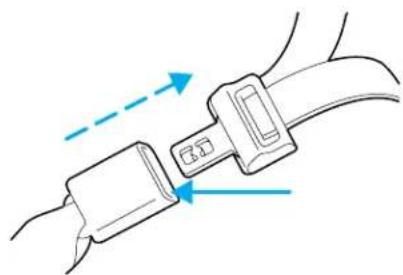
natural_image
Diagram of a belt buckle being inserted into a seatbelt, showing motion arrows (no text or symbols)Energy Management Feature
- This vehicle has a seat belt system with an energy management feature at the front and rear outboard seating positions to help further reduce the risk of injury in the event of a head-on collision.
Seating and Safety Restraints
- The front and rear outboard seat belt system has a retractor assembly that is designed to extend the seat belt webbing in a controlled manner. This helps reduce the belt force acting on the user's chest.
All seat belts in the vehicle are combination lap and shoulder belts. The passenger seat belts have two types of locking modes described below:
Vehicle sensitive mode
This is the normal retractor mode, which allows free shoulder belt length adjustment to your movements and locking in response to vehicle movement. For example, if the driver brakes suddenly or turns a corner sharply, or the vehicle receives an impact of approximately 5 mph (8 km/h) or more, the combination seat belts will lock to help reduce forward movement of the driver and passengers.
Automatic locking mode
Whentousetheautomaticlockingmode
In this mode, the shoulder belt is automatically pre-locked. The belt will still retract to remove any slack in the shoulder belt. The automatic locking mode is not available on the driver seat belt.
This mode should be used anytimea child safety seat (other than a belt-positioning booster) is installed. Children 12 years old and under should be properly restrained in the rear seat whenever possible. Refer to Safety restraints for children or Safety seats for children later in this chapter.
Howtousetheautomaticlockingmode
- Buckle the combination lap and shoulder belt.

natural_image
Illustration of a blue and white car seatbelt buckle with a downward arrow indicating force or motion (no text or symbols)Seating and Safety Restraints
- Grasp the shoulder portion and pull downward until the entire belt is pulled out.
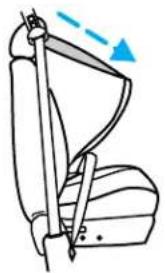
natural_image
Diagram of a seatbelt buckle with a blue arrow indicating direction (no text or symbols)- Allow the belt to retract. As the belt retracts, you will hear a clicking sound. This indicates the seat belt is now in the automatic locking mode.
Howtodisengagetheautomaticlockingmode
Disconnect the combination lap/shoulder belt and allow it to retract completely to disengage the automatic locking mode and activate the vehicle sensitive (emergency) locking mode.
WARNING: After a collision all seat belts should be checked for proper function. In addition, the automatic locking retractor function in all but the driver's seat must be checked by an authorized dealer to confirm the child restraint system functions properly.
WARNING: BELT AND RETRACTOR ASSEMBLY MUST BE REPLACED if the seat belt assembly "automatic locking retractor" feature or any other seat belt function is not operating properly when checked by an authorized dealer. Failure to replace the Belt and Retractor assembly could increase the risk of injury in collisions. The pretensioners in the front seats deploy with a related airbag and will only operate once and must be replaced to provide appropriate restraint in any future accident.
Seating and Safety Restraints
Seat belt height adjustment
Your vehicle has seat belt height adjustments at the front outboard seating positions. Adjust the height of the shoulder belt so the belt rests across the middle of your shoulder.
To adjust the shoulder belt height, squeeze and hold the buttons on the side and slide the height adjuster up or down. Release the buttons and pull down on the height adjuster to make sure it is locked in place.
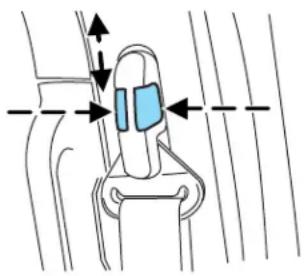
natural_image
Diagram of a car seatbelt buckle with directional arrows indicating movement (no text or symbols)
WARNING: Position the seat belt height adjusters so that the belt rests across the middle of your shoulder. Failure to adjust seat belt properly could reduce the effectiveness of the seat belt increase the risk of injury in a collision.
Seat belt pretensioner
Your vehicle is equipped with seat belt pretensioners at the driver and front passenger seating positions.
The seat belt pretensioners activate during frontal collisions, and in side collisions and rollovers. A seat belt pretensioner is a device which tightens the webbing of the lap and shoulder belts in such a way that they fit more snugly against the body.

WARNING: The driver and front passenger seat belt system (including retractors, buckles and height adjusters) must be used if the vehicle is involved in a collision that results in payment of front airbags, seat-mounted side airbags and Safety Boy®, and seat belt pretensioners.

WARNING: Failure to replace the seat belt assembly under the above conditions could result in severe personal injuries in the of a collision.
Seating and Safety Restraints
Seat belt extension assembly
If the seat belt is too short when fully extended, a 9 inch (23 cm) or 12 inch (31 cm) seat belt extension assembly can be added (part numbers 611C22-A and 611C22-B respectively). Seat belt extension assemblies can be obtained from your authorized Mazda dealership.
Use only extensions manufactured by the same supplier as the seat belt. Manufacturer identification is located at the end of the webbing on the label. Also, use the seat belt extension only if the seat belt is too short for you when fully extended.
When you are not using the extensions store them in another location so that no one will accidentally use them.
NOTE: Do not use extensions to change the fit of the shoulder belt across the torso.
Seat belt warning light and indicator chime
The seat belt warning light illuminates in the instrument cluster and a chime sounds to remind the occupants to fasten their seat belts.
Conditionsofoperation
| If...Then... | |
| The driver's seat belt is not buckled before the ignition switch is turned to the on position... | The seat belt warning light illuminates 1 minute and the warning chime sounds 6 seconds. |
| The driver's seat belt is buckled while the indicator light is illuminated and the warning chime is sounding... | The seat belt warning light and warning chime turn off. |
| The driver's seat belt is buckled before the ignition switch is turned to the on position... | The seat belt warning light and indicator chime remain off. |
Belt-Minder®
The Belt-Minder®feature is a supplemental warning to the seat belt warning function. This feature provides additional reminders by intermittently sounding a chime and illuminating the seat belt warning lamp in the instrument cluster when the driver's and front passenger's seat belt is unbuckled.
Seating and Safety Restraints
The Belt-Minder® feature uses information from the front passenger sensing system to determine if a front seat passenger is present and therefore potentially in need of a warning. To avoid activating the Belt-Minder® feature for objects placed in the front passenger seat, warnings will only be given to large front seat occupants as determined by the front passenger sensing system.
Both the driver's and passenger's seat belt usages are monitored and either may activate the Belt-Minder®feature. The warnings are the same for the driver and the front passenger. If the Belt-Minder®warnings have expired (warnings for approximately 5 minutes) for one occupant (driver or front passenger), the other occupant can still activate the Belt-Minder®feature.
| If...Then... | |
| The driver's and front passenger's seat belts are buckled before the ignition switch is turned to the on position or less than 1-2 minutes have elapsed since the ignition switch has been turned to on... | The Belt-Minder®feature will not activate. |
| The driver's or front passenger's seat belt is not buckled when the vehicle has reached at least 3 mph (5 km/h) and 1-2 minutes have elapsed since the ignition switch has been turned to on... | The Belt-Minder®feature is activated - the seat belt warning light illuminates and the warning chime sounds for 6 seconds every 30 seconds, repeating for approximately 5 minutes or until the seat belts are buckled. |
| The driver's or front passenger's seat belt becomes unbuckled for approximately 1 minute while the vehicle is traveling at least 3 mph (5 km/h) and more than 1-2 minutes have elapsed since the ignition switch has been turned to on... | The Belt-Minder®feature is activated - the seat belt warning light illuminates and the warning chime sounds for 6 seconds every 30 seconds, repeating for approximately 5 minutes or until the seat belts are buckled. |
Seating and Safety Restraints
The following are reasons most often given for not wearing seat belts (All statistics based on U.S. data):
| Reasonsgiven...Consider... | |
| "Crashes are rare events"36,700crashesoccureveryday.The more we drive, the more we are exposed to "rare"events, even for good drivers. 1in4ofuswillbe seriouslyinjuredinacrashduring ourlifetime. | |
| "I'm not going far" | 3 of 4 fatal crashes occur within 25 miles of home. |
| "Belts are uncomfortable"Seat belts are designed to enhance comfort. If you are uncomfortable - try different positions for the seat belt upper anchorage and seatback which should be as upright as possible; this can improve comfort. | |
| "I was in a hurry" | Prime time for an accident. Seat Belt Warning Chime reminds us to take a few seconds to buckle up. |
| "Seat belts don't work" | Seat belts, when used properly, reduceriskofdeathto front seat occupants by 45%incars,and by 60%inlighttrucks. |
| "Traffic is light" | Nearly 1 of 2 deaths occur in single-vehiclecrashes,many when no other vehicles are around. |
| "Belts wrinkle my clothes"Possibly, but a serious crash can do much more than wrinkle your clothes, particularly if you are unbelted. | |
| "The people I'm with don't wear belts" | Set the example, teen deaths occur 4 times more often in vehicles with TWO or MORE people. Children and younger brothers/sisters imitate behavior they see. |
Seating and Safety Restraints
| Reasonsgiven...Consider... | |
| "I have an airbag"Airbags offer greater protection when used with seat belts. Frontal airbags are not designed to inflate in rear and side crashes or rollovers. | |
| "I'd rather be thrown clear" | Not a good idea.People who are ejectedare40timesmorelikely toDIE.Seat belts help prevent ejection, WE CAN'T "PICK OUR CRASH". |

WARNING: Do not sit on top of a buckled seat belt or insert a latchplate into the buckle to avoid the Belt-Minder®chime. To do so may adversely affect the performance of the vehicle's air bag system and result in serious injury, ejection and death.
One-timedisable
If at any time the driver/front passenger quickly buckles then unbuckles the seat belt for that seating position, the Belt-Minder®is disabled for the current ignition cycle. The Belt-Minder®feature will enable during the same ignition cycle if the occupant buckles and remains buckled for approximately 30 seconds. Confirmation is not given for the one time disable.
Deactivating/activatingtheBelt-Minder®feature
The driver and front passenger Belt-Minder are deactivated/activated independently. Whendeactivating/activating oneseating position, donotbuckle the other position as this will terminate the process.
ReadSteps 1 - 4 thoroughlybeforeproceedingwiththe deactivation/activationprogrammingprocedure.
The driver and front passenger Belt-Minder® features can be deactivated/activated by performing the following procedure:
Before following the procedure, make sure that:
•The parking brake is set
•The gearshift is in P (Park)
• The ignition switch is in the off position
- The driver and front passenger seat belts are unbuckled
Seating and Safety Restraints
WARNING: While the design allows you to deactivate your Belt-Minder®, this system is designed to improve your chances of being safely belted and surviving an accident. We recommend you leave the Belt-Minder® system activated for yourself and others who may use the vehicle. To reduce the risk of injury, do not deactivate/activate the Belt-Minder® feature.
- Turn the ignition switch to the on position. DO NOT START THE ENGINE.
- Wait until the seat belt warning light turns off (Approximately 1 minute).
- Step 3 must be completed within 30 seconds after the seat belt warning light turns off.
- For the seating position being disabled, at a moderate speed, buckle then unbuckle the seat belt three times, ending in the unbuckled state.
- After Step 3, the seat belt warning light will be turned on for three seconds.
- Within approximately seven seconds of the light turning off, buckle then unbuckle the seat belt.
- This will disable the Belt-Minder® feature for that seating position if it is currently enabled. As confirmation, the seat belt warning light will flash four times per second for three seconds.
- This will enable the Belt-Minder® feature for that seating position if it is currently disabled. As confirmation, the seat belt warning light will flash four times per second for three seconds, followed by three seconds with the light off, then followed by the seat belt warning light flashing four times per second for three seconds again.
- After receiving confirmation, the deactivation/activation procedure is complete.
Seating and Safety Restraints
AIRBAG SUPPLEMENTAL RESTRAINT SYSTEM (SRS)
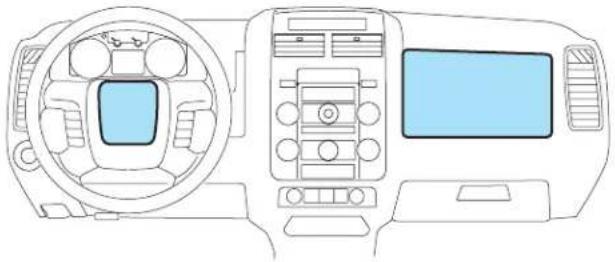
natural_image
Line drawing of a car dashboard and steering wheel (no text or symbols)Important supplemental restraint system (SRS) precautions
The supplemental restraint system is designed to work with the seat belt to help protect the driver and right front passenger from certain upper body injuries.

WARNING: Airbags DO NOT inflate slowly or gently and the risk of injury from a deploying airbag is greatest close to the trim covering the airbag module.

natural_image
Illustration of two blue figures seated in a chair, one with crossed arms and the other holding a baton (no text or symbols)WARNING: All occupants of the vehicle, including the driver, should always properly wear their seat belts, even when an air bag supplemental restraint system (SRS) is provided.
WARNING: When possible, all children 12 years old and under should be properly restrained in a rear seating position.
WARNING: National Highway Traffic Safety Administration (NHTSA) recommends a minimum distance of at least 10 inches (25 cm) between an occupant's chest and the driver airbag module.
Seating and Safety Restraints
WARNING: The driver should always hold onto only the rim of the steering wheel. Never place your arm over the airbag module or anywhere inside the rim as a deploying airbag can result in serious arm fractures or other injuries.
Steps you can take to properly position yourself away from the airbag:
- Move your seat to the rear as far as you can while still reaching the pedals comfortably.
- Recline the seat slightly (one or two notches) from the upright position.
WARNING: Do not put anything on or over the airbag module including hands or feet. Placing objects on or over the airbag inflation area may cause those objects to be propelled by the airbag into your face and torso causing serious injury.
WARNING: Do not attempt to service, repair, or modify the Airbag Supplemental Restraint Systems or its fuses. See your authorized Mazda dealership.
WARNING: Modifications to the front end of the vehicle, including frame, bumper, front end body structure, tow hooks, and snow plows may affect the performance of the airbag sensors increasing the risk of injury. Do not modify the front end of the vehicle.
WARNING: Additional equipment may affect the performance of the airbag sensors increasing the risk of injury. Consult your authorized Mazda dealership before installation of additional equipment.
Seating and Safety Restraints
Children and airbags
Children must always be properly restrained. Accident statistics suggest that children are safer when properly restrained in the rear seating positions than in the front seating position. Failure to follow these instructions may increase the risk of injury in a collision.
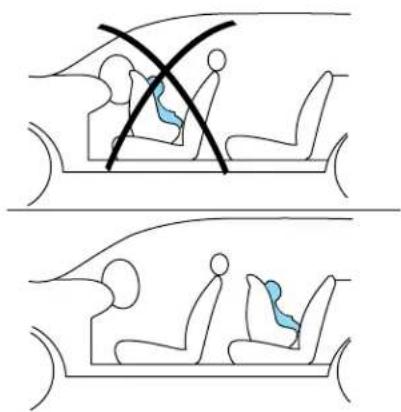
natural_image
Two-panel line drawing showing a person in a car with a blue object placed on the seat, separated by a black X mark (no text or symbols)
WARNING: Airbags can kill or injure a child in a child seat. NEVER place a rear-facing child seat in front of an active airbag. If you must use a forward-facing child seat in the front seat, move the seat all the way back.
How does the airbag supplemental restraint system work?
The airbag SRS is designed to activate when the vehicle sustains a longitudinal deceleration sufficient to cause the airbag sensors to close an electrical circuit that initiates airbag inflation. The fact that the airbags did not inflate in a collision does not mean that something is wrong with the system. Rather, it means the forces were not sufficient enough to cause activation. Front airbags are designed to inflate in frontal and near-frontal collisions, not rollover, side-impact, or rear-impacts unless the collision causes sufficient longitudinal deceleration.

natural_image
Top-down diagram of a car's side profile showing airflow direction arrows (no text or symbols)Seating and Safety Restraints
The airbags inflate and deflate rapidly upon activation. After airbag deployment, it is normal to notice a smoke-like, powdery residue or smell the burnt propellant. This may consist of cornstarch, talcum powder or sodium compounds which may irritate the skin and eyes, but none of the residue is toxic.
While the SRS is designed to help reduce serious injuries, contact with a deploying airbag may also cause abrasions, swelling or temporary hearing loss. Because airbags must inflate rapidly and with considerable force, there is the risk of death or serious injuries such as fractures, facial and eye injuries or internal injuries, particularly to occupants who are not properly restrained or are otherwise out of position at the time of airbag deployment. It is extremely important that occupants be properly restrained as far away from the airbag module as possible while maintaining vehicle control.
The SRS consists of:
- driver and passenger airbag modules (which include the inflators and airbags)
• one or more impact and safing sensors
• a readiness light and tone
• a diagnostic module
• and the electrical wiring which connects the components
The RCM (restraints control module) monitors its own internal circuits and the supplemental airbag electrical system wiring (including the impact sensors, the system wiring, the airbag system readiness light, the airbag back up power and the airbag ignitors).

WARNING: Several air bag system components get hot after inflation. Do not touch them after inflation.

WARNING: If the airbag has deployed, the airbag will not function again and must be replaced immediately. If the airbag is replaced, the unrepaired area will increase the risk of injury in a on.

natural_image
Line drawing of a human ear with a device attached, showing no text or symbolsSeating and Safety Restraints
Front passenger sensing system
The front passenger sensing system is designed to meet the regulatory requirements of Federal Motor Vehicle Safety Standard (FMVSS) 208 and is designed to disable (will not inflate) the front passenger's frontal airbag under certain conditions.
The front passenger sensing system works with sensors that are part of the front passenger's seat and seat belt. The sensors are designed to detect the presence of a properly seated occupant and determine if the front passenger's frontal airbag should be enabled (may inflate) or disabled (will not inflate).
The front passenger sensing system will disable (will not inflate) the front passenger's frontal airbag if:
- the front passenger seat is unoccupied, or has small/medium objects in the front seat,
- the system determines that an infant is present in a rear-facing infant seat that is installed according to the manufacturer's instructions,
- the system determines that a small child is present in a forward-facing child restraint that is installed according to the manufacturer's instructions,
- the system determines that a small child is present in a booster seat,
- a front passenger takes his/her weight off of the seat for a period of time,
For side airbag equipped vehicles, the front passenger sensing system will turn off the passenger seat side airbag if:
- the seat is empty and seat belt is unbuckled.
- a child or a small person occupies the front passenger seat and the child or small person is unbuckled.
The front passenger sensing system uses a "passenger airbag off" or
"pass airbag off" indicator which will illuminate and stay lit to remind you
that the front passenger frontal airbag is off. The indicator lamp is located in the center stack of the instrument panel just above the air vents.
PASSENGER AIRBAG OFF
Note: The indicator lamp will illuminate for a short period of time when the ignition is turned to the ON position to confirm it is functional.
When the front passenger seat is not occupied (empty seat) or in the event that the front passenger frontal airbag is enabled (may inflate), the indicator lamp will be unlit.
Seating and Safety Restraints
The front passenger sensing system is designed to disable (will not inflate) the front passenger's frontal airbag when a rear facing infant seat, a forward-facing child restraint, or a booster seat is detected.
- When the front passenger sensing system disables (will not inflate) the front passenger frontal airbag, the indicator lamp will illuminate and stay lit to remind you that the front passenger frontal airbag is disabled.
- If the child restraint has been installed and the indicator lamp is not lit, then turn the vehicle off, remove the child restraint from the vehicle and reinstall the restraint following the child restraint manufacturer's instructions.
The front passenger sensing system is designed to enable (may inflate) the front passenger's frontal airbag anytime the system senses that a person of adult size is sitting properly in the front passenger seat.
- When the front passenger sensing system enables the front passenger frontal airbag (may inflate), the indicator will be unlit and stay unlit.
If a person of adult size is sitting in the front passenger's seat, but the "passenger airbag off" or "pass airbag off" indicator lamp is lit, it is possible that the person isn't sitting properly in the seat. If this happens:
- Turn the vehicle off and ask the person to place the seatback in the full upright position.
- Have the person sit upright in the seat, centered on the seat cushion, with the person's legs comfortably extended.
- Restart the vehicle and have the person remain in this position for about two minutes. This will allow the system to detect that person and enable the passenger's frontal airbag.
- If the indicator lamp remains lit even after this, the person should be advised to ride in the rear seat, and the system should be taken promptly to an authorized dealer for repair before that seat is occupied again.
Seating and Safety Restraints
| Occupant | PassAirbagOff IndicatorLamp | PassengerAirbag |
| Empty seat Unlit Disabled | ||
| Small child in child safety seat or booster | Lit Disabled | |
| Small child with seat belt buckled or unbuckled | Lit Disabled | |
| Adult Unlit Enabled |

WARNING: Even with Advanced Restraints Systems, children 12 and under should be properly restrained in the back seat.
After all occupants have adjusted their seats and put on seat belts, it's very important that they continue to sit properly. A properly seated occupant sits upright, leaning against the seat back, and centered on the seat cushion, with their feet comfortably extended on the floor. Sitting improperly can increase the chance of injury in a crash event. For example, if an occupant slouches, lies down, turns sideways, sits forward, leans forward or sideways, or puts one or both feet up, the chance of injury during a crash is greatly increased.

WARNING: Sitting improperly out of position or with the seat back reclined too far can take off weight from the seat cushion effect the decision of the front passenger sensing system, resulting in an injury or death in a crash.
s sit upright against your seatback, with your feet on the floor.
The front passenger sensing system may detect small or medium objects placed on the seat cushion. For most objects that are in the front passenger seat, the passenger airbag will be disabled. Even though the passenger airbag is disabled, the "pass airbag off" lamp may or may not be illuminated according to the table below.
Seating and Safety Restraints
| Objects | PassAirbagOff IndicatorLamp | PassengerAirbag |
| Small (i.e. three-ring binder, small purse, bottled water) | Unlit Disabled | |
| Medium (i.e. heavy briefcase, fully packed luggage) | Lit Disabled | |
| Empty seat, or small to medium object with seat belt buckled | Lit Disabled |
If you think that the status of the passenger airbag off indicator lamp is incorrect, check for the following:
- Objects lodged underneath the seat
- Objects between the seat cushion and the center console (if equipped)
- Objects hanging off the seat back
- Objects stowed in the seatback map pocket (if equipped)
- Objects placed on the occupant's lap
• Cargo interference with the seat - Other passengers pushing or pulling on the seat
• Rear passenger feet and knees resting or pushing on the seat
The conditions listed above may cause the weight of a properly seated occupant to be incorrectly interpreted by the front passenger sensing system. The person in the front passenger seat may appear heavier or lighter due to the conditions described in the list above.
WARNING: To reduce the risk of possible serious injury: Do not stow heavy objects in seat back map pocket (if equipped) or hang objects off seat back if a child is in the front passenger seat. Do not place objects underneath the front passenger seat or between the seat and the center console (if equipped). Check the "passenger airbag off" or "pass airbag off" indicator lamp for proper airbag Status. Failure to follow these instructions may interfere with the front passenger seat sensing system.
Seating and Safety Restraints
In case there is a problem with the front passenger sensing system, the airbag readiness lamp in the instrument cluster will stay lit.

If the airbagreadinesslampislit, dothefollowing:
The driver and/or adult passengers should check for any objects that may be lodged underneath the front passenger seat or cargo interfering with the seat.
If objects are lodged and/or cargo is interfering with the seat; please take the following steps to remove the obstruction:
- Pull the vehicle over.
- Turn the vehicle off.
- Driver and/or adult passengers should check for any objects lodged underneath the front passenger seat or cargo interfering with the seat.
- Remove the obstruction(s) (if found).
- Restart the vehicle.
- Wait at least 2 minutes and verify that the airbag readiness lamp is no longer illuminated
- If the airbag readiness lamp remains illuminated, this may or may/not be a problem due to the front passenger sensing system.
DO NOT attempt to repair or service the system; take your vehicle immediately to an authorized Mazda dealer. Ask the front seat occupant to sit in a rear seat until the air bag system if checked by the authorized Mazda Dealer.
If it is necessary to modify an advanced front airbag system to accommodate a person with disabilities, contact the Mazda Customer Relationship Center at the phone number shown in the Customer Assistance chapter of this Owner's Manual.

WARNING: Any alteration/modification to the front passenger seat may affect the performance of the front passenger sensing n.
Seating and Safety Restraints
Determining if the system is operational
The SRS uses a readiness light in the instrument cluster or a tone to indicate the status of the system. Refer to Airbagreadinesssection in the InstrumentClusterchapter. Routine maintenance of the airbag is not required.
A difficulty with the system is indicated by one or more of the following:
- The readiness light will either flash or stay lit.
•The readiness light will not illuminate immediately after ignition is turned on. - A series of five beeps will be heard. The tone pattern will repeat periodically until the problem and/or light are repaired.
If any of these things happen, even intermittently, have the SRS serviced at an authorized dealer immediately. Unless serviced, the system may not function properly in the event of a collision.

Seat-mounted side airbag system (if equipped)

WARNING: Do not place objects or mount equipment on or near the airbag cover on the side of the seatbacks of the front seats or in front seat areas that may come into contact with a deploying airbag. Failure to follow these instructions may increase the risk of personal injury in the event of a collision.
WARNING: Do not use accessory seat covers. The use of accessory seat covers may prevent the deployment of the side airbags and increase the risk of injury in an accident.
WARNING: Do not lean your head on the door. The side airbag could injure you as it deploys from the side of the seatback.
WARNING: Do not attempt to service, repair, or modify the airbag SRS, its fuses or the seat cover on a seat containing an airbag. See an authorized dealer.
WARNING: All occupants of the vehicle should always wear their seat belts even when an airbag SRS is provided.
Seating and Safety Restraints
Howdoesthesideairbagsystemwork?
The design and development of the side airbag system included recommended testing procedures that were developed by a group of automotive safety experts known as the Side Airbag Technical Working Group. These recommended testing procedures help reduce the risk of injuries related to the deployment of side airbags.
The side airbag system consists of the following:
- An inflatable nylon bag (airbag) with a gas generator concealed behind the outboard bolster of the driver and front passenger seatbacks.

natural_image
Diagram of a car interior showing seatbelt and dashboard with blue directional arrows indicating movement (no text or symbols)- A special seat cover designed to allow airbag deployment.
- The same warning light, electronic control and diagnostic unit as used for the front airbags.
- Two crash sensors located on the lower portion of the b-pillar (one on each side of the vehicle).
Side airbags, in combination with seat belts, can help reduce the risk of severe injuries in the event of a significant side impact collision.
The side airbags are fitted on the outboard side of the seatbacks of the front seats. In certain lateral collisions, the airbag on the side affected by the collision will be inflated. If the front passenger sensing system detects an empty seat, the front passenger seat-mounted side airbag will be deactivated. The airbag was designed to inflate between the door panel and occupant to further enhance the protection provided occupants in side impact collisions.
The airbag SRS is designed to activate when the vehicle sustains lateral deceleration sufficient to cause the sensors to close an electrical circuit that initiates airbag inflation.
Seating and Safety Restraints
The fact that the airbags did not inflate in a collision does not mean that something is wrong with the system. Rather, it means the forces were not of the type sufficient to cause activation. Side airbags are designed to inflate in side-impact collisions, not roll-over, rear-impact, frontal or near-frontal collisions, unless the collision causes sufficient lateral deceleration.

WARNING: Several airbag system components get hot after inflation. Do not touch them after inflation.

WARNING: If the side airbag has deployed, the
airbag will not function again. The side airbag system (including the seat) must be inspected and serviced by an authorized dealer. If the airbag is not replaced, the unrepaired area will increase the risk of injury in a collision.
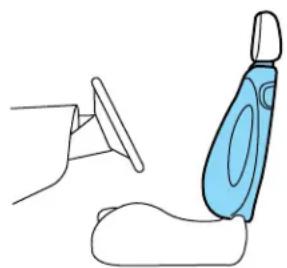
natural_image
Line drawing of a blue ergonomic seat mounted on a chair, with a hand pointing to the seat (no text or symbols)Determiningifthesystemisoperational
The SRS uses a readiness light in the instrument cluster or a tone to indicate the condition of the system. Refer to the Airbagreadiness section in the InstrumentClusterchapter. Routine maintenance of the side airbag is not required.
A difficulty with the system is indicated by one or more of the following:
- The readiness light (same light as for front airbag system) will either flash or stay lit.
- The readiness light will not illuminate immediately after ignition is turned on.
- A series of five beeps will be heard. The tone pattern will repeat periodically until the problem and/or light are repaired.
If any of these things happen, even intermittently, have the SRS serviced at your authorized dealer immediately. Unless serviced, the system may not function properly in the event of a collision.
Seating and Safety Restraints
Side-curtain airbag system (if equipped)

You can determine if you have a vehicle with a side-curtain airbag system by looking near the top of the trim between the windows and see an "SRS" label on the main pillars between the windows.

WARNING: Do not place objects or mount equipment near the headliner at the tail that may come into act with a deploying curtain airbags (if equipped). We to follow these instructions increase the risk of personal in the event of a collision.
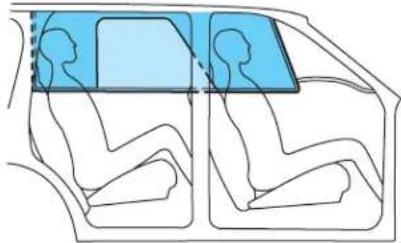
natural_image
Diagram of a car interior showing two seats with blue shading and two human figures inside (no text or symbols)
WARNING: Do not lean your head on the door or window glass. The side-curtain airbags (if equipped) could injure you as it ys from the headliner.

WARNING: Do not attempt to service, repair, or modify the side-curtain airbags (if equipped), fuses, the A, B, or C pillar or the headliner on a vehicle containing side-curtain airbags. See authorized Mazda dealer.

WARNING: All occupants of the vehicle including the driver should always wear their seat belts even when an airbag SRS and urtain airbags (if equipped) are provided.

WARNING: To reduce risk of injury, do not obstruct or place objects in the deployment path of the inflatable side-curtain g (if equipped).
Seating and Safety Restraints
Howdotheside-curtainairbags(ifequipped)work?
The design and development of the side air curtain system included recommended testing procedures that were developed by a group of automotive safety experts known as the Side Airbag Technical Working Group. These recommended testing procedures help reduce the risk of injuries related to the deployment of side airbags (including side air curtain systems).
The side-curtain airbags (if equipped) consists of the following:
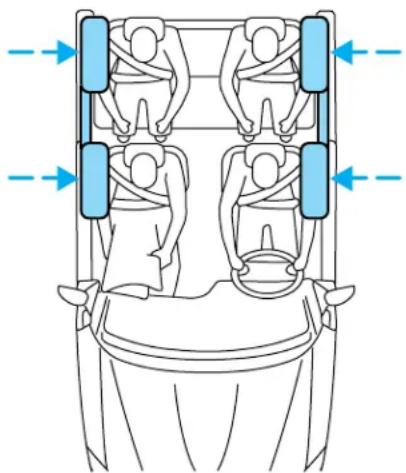
natural_image
Diagram of a medical or anatomical setup with four seated individuals and directional arrows indicating movement or force (no text or labels)- An inflatable nylon curtain with a gas generator concealed behind the headliner and above the doors (one on each side of vehicle).
- A headliner designed to flex open above the side doors to allow side-curtain airbag deployment.
- The same warning light, electronic control and diagnostic unit as used for the front airbags.
- Two crash sensors mounted at lower B-Pillar (one on each side).
- Two crash sensors located at the c-pillar behind the rear doors (one on each side).
- Rollover sensor in the restraints control module (RCM).
The side-curtain airbags (if equipped), in combination with seat belts, can help reduce the risk of severe injuries in the event of a significant side impact collision or rollover event.
Children 12 years old and under should always be properly restrained in the rear seats. The side-curtain airbags (if equipped) will not interfere with children restrained using a properly installed child or booster seat because it is designed to inflate downward from the headliner above the doors along the side window opening.
The side-curtain airbags (if equipped) are designed to activate when the vehicle sustains lateral deceleration sufficient to cause the RCM to initiate side-curtain airbag (if equipped) inflation or when a certain likelihood of a rollover event is detected by the rollover sensor.
Seating and Safety Restraints
The side-curtain airbags are mounted to roof side-rail sheet metal, behind the headliner, above the first and second row seats. In certain lateral collisions or rollover events, the side-curtain airbags will be activated, regardless of which seats are occupied. In certain rollover events, the side-curtain airbag (if equipped) on both sides of the vehicle will be inflated, regardless of which seats are occupied. The side-curtain airbags (if equipped) are designed to inflate between the side window area and occupants to further enhance protection provided in side impact collisions and rollover events.
The fact that the side-curtain airbags (if equipped) did not activate in a collision does not mean that there is a malfunction with the system. Rather, it means the forces were not of the type sufficient to cause activation. The side-curtain airbags (if equipped) are designed to inflate in certain side impact collisions or rollover events, not in rear impact, frontal or near-frontal collisions, unless the collision causes sufficient lateral deceleration or rollover likelihood.

WARNING:Several
side-curtain airbag (if
equipped) components get hot after inflation. Do not touch them after inflation.
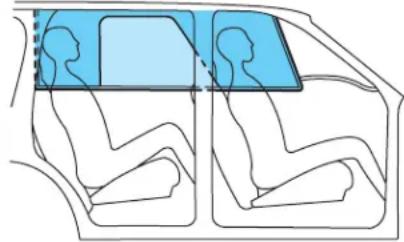
natural_image
Diagram of a car interior showing two seats with head and torso views, no text or symbols present
WARNING: If the side-curtain airbags (if equipped) have
deployed, the side-curtain airbags will not function again unless
replaced. The side-curtain airbags (including the A, B and C pillar trim) must be inspected and serviced by a authorized dealer in accordance with the vehicle workshop manual. If the side-curtain airbags are not replaced, the unrepaired area will increase the risk of injury in a collision.
Determiningiftheside-curtainairbagsareoperational
The SRS uses a readiness light in the instrument cluster or a tone to indicate the condition of the system. Refer to the Airbagreadiness section in the Instrumentclusterchapter. Routine maintenance of the airbag is not required.
Seating and Safety Restraints
A difficulty with the system is indicated by one or more of the following:
- The readiness light (same light as for front airbag system) will either flash or stay lit.
- The readiness light will not illuminate immediately after ignition is turned on.
- A series of five beep sounds will be heard. The tone pattern will repeat periodically until the problem and light are repaired.
If any of these things happen, even intermittently, have the SRS serviced at your authorized Mazda dealership immediately. Unless serviced, the system may not function properly in the event of a collision.
S.O.S. Post Crash Alert
The S.O.S Post Crash Alert automatically flashes the turn signal lamps and sounds the horn three times at four second intervals in the event of a serious impact that deploys an airbag (front, side, side curtain or Safety Canopy®) or the seat belt pretensioners.
The S.O.S. Post Crash Alert can be turned off when any one of the following actions are taken by the driver or any other person:
- pressing the hazard control button,
- or pressing the panic button on the remote key fob.
The feature will continue to operate until the vehicle runs out of power.
Disposal of airbags and airbag equipped vehicles (including pretensioners)
See your authorized dealer. Airbags MUST BE disposed of by qualified personnel.
SAFETY RESTRAINTS FOR CHILDREN
See the following sections for directions on how to properly use safety restraints for children. Also see Airbagsupplementalrestraintsystem (SRS) in this chapter for special instructions about using airbags.
Important child restraint precautions

WARNING: Always make sure your child is secured properly in a device that is appropriate for their height, age and weight.
Child safety restraints must be purchased separately from the vehicle. Failure to follow these instructions and guidelines may result in an increased risk of serious injury or death to your child.
Seating and Safety Restraints
WARNING: All children are shaped differently. The Recommendations for Safety Restraints are based on probable child height, age and weight thresholds from NHTSA and other safety organizations or are the minimum requirements of law. Mazda recommends checking with a NHTSA Certified Child Passenger Safety Technician (CPST) and your pediatrician to make sure your child seat is appropriate for your child, and is compatible with and properly installed in the vehicle. To locate a child seat fitting station and CPST contact the NIITSA toll free at 1-888-327-4236 or on the internet at http://www.nhtsa.dot.gov. Failure to properly restrain children in safety seats made especially for their height, age, and weight may result in an increased risk of serious injury or death to your child.
| RecommendationsforSafetyRestraintsforChildren | ||
| Childsize,height,weight,orage | Recommended restrainttype | |
| Infants or toddlers | Children weighing 40 lb (18 kg) or less (generally age four or younger) | Use a child safety seat (sometimes called an infant carrier, convertible seat, or toddler seat). |
| Small children | Children who have outgrown or no longer properly fit in a child safety seat (generally children who are less than 4 feet 9 inches (1.45 meters) tall, are greater than age four (4) and less than age twelve (12), and between 40 lbs (18 kg) and 80 lbs (36 kg) and upward to 100 lbs (45 kg) if recommended by your child restraint manufacturer) | Use a belt-positioning booster seat. |
Seating and Safety Restraints
| RecommendationsforSafetyRestraintsforChildren | ||
| Childsize,height,weight,orage | Recommended restrainttype | |
| Larger children | Children who have outgrown or no longer properly fit in a belt-positioning booster seat (generally children who are at least 4 feet 9 inches (1.45 meters) tall or greater than 80 lb (36 kg) or 100 lb (45 kg) if recommended by child restraint manufacturer) | Use a vehicle seat belt having the lap belt snug and low across the hips, shoulder belt centered across the shoulder and chest, and seatback upright. |
- You are required by law to properly use safety seats for infants and toddlers in the U.S. and Canada.
- Many states and provinces require that small children use approved booster seats until they reach age eight, a height of 4 ft 9 in (1.45 meters) tall, or 80 lb (36 kg). Check your local and state or provincial laws for specific requirements regarding the safety of children in your vehicle.
- When possible, always properly restrain children twelve (12) years of age and under in a rear seating position of your vehicle. Accident statistics suggest that children are safer when properly restrained in the rear seating positions than in a front seating position.
Seating and Safety Restraints
Recommendations for attaching child safety restraints for children
| Restraint Type | Child Weight | Useanyattachmentmethodasindicated belowby“X” | ||||
| LATCH (lower anchors andtop tether anchor) | LATCH (lower anchors only) | Seat belt and top tether anchor | Seatbelt andLATCH (lower anchors andtop tether anchor) | Seat belt only | ||
| Rear facing child seat | Up to 48 lb (21 kg) | X | X | |||
| Forward facing child seat | Up to 48 lb (21 kg) | X | X | X | ||
| Forward facing child seat | Over 48 lb (21 kg) | X | X | |||

WARNING: Air bags can kill or injure a child in a child seat.
NEVER place a rear-facing child seat in front of an active air
bag. If you must use a forward-facing child seat in the front seat, move the vehicle seat all the way back. When possible, all children age 12 and under should be properly restrained in a rear seating position. If all children cannot be seated and restrained properly in a rear seating position, properly restrain the largest child in the front seat.

WARNING: Always carefully follow the instructions and
warnings provided by the manufacturer of any child restraint to determine if the restraint device is appropriate for your child's size, height, weight, or age. Follow the child restraint manufacturer's instructions and warnings provided for installation and use in conjunction with the instructions and warnings provided by the vehicle manufacturer. A safety seat that is improperly installed or utilized, is inappropriate for your child's height, age, or weight or does not properly fit the child may increase the risk of serious injury or death.
Seating and Safety Restraints
WARNING: Never let a passenger hold a child on his or her lap while the vehicle is moving. The passenger cannot protect the child from injury in a collision, which may result in serious injury or death.
WARNING: Never use pillows, books, or towels to boost a child. They can slide around and increase the likelihood of injury or death in a collision.
WARNING: Always restrain an unoccupied child seat or booster seat. These objects may become projectiles in a collision or sudden stop, which may increase the risk of serious injury.
WARNING: Never place, or allow a child to place, the shoulder belt under a child's arm or behind the back because it reduces the protection for the upper part of the body and may increase the risk of injury or death in a collision.
WARNING: Do not leave children, unreliable adults, or pets unattended in your vehicle.
Transporting children
Always make sure your child is secured properly in a device that is appropriate for their age, height and weight. All children are shaped differently. The child height, age and weight thresholds provided are recommendations or the minimum requirements of law. The National Highway Traffic Safety Administration (NHTSA) provides education and training to ensure that all children ages 0 to 16 are properly restrained in the correct restraint system. Mazda recommends checking with a NHTSA Certified Child Passenger Safety Technician (CPST) and your pediatrician to make sure your seat is appropriate for your child and properly installed in the vehicle. To locate a child seat fitting station and CPST contact the NHTSA toll free at 1-888-327-4236 or on the internet at http://www.nhtsa.dot.gov.
Follow all the safety restraint and airbag precautions that apply to adult passengers in your vehicle.
Seating and Safety Restraints
If the child is the proper height, age, and weight (as specified by your child safety seat or booster manufacturer), fits the restraint and can be restrained properly, then restrain the child in the child safety seat or with the belt-positioning booster. Remember that child seats and belt-positioning boosters vary and may be designed to fit children of different heights, ages and weights. Children who are too large for child safety seats or belt-positioning boosters (as specified by your child safety seat manufacturer) should always properly wear seat belts.
SAFETY SEATS FOR CHILDREN
Infant and/or toddler seats
Use a safety seat that is recommended for the size and weight of the child.
When installing a child safety seat:
- Review and follow the information presented in the Airbag supplementalrestraintsystem (SRS)section in this chapter.
- Carefully follow all of the manufacturer's instructions included with the safety seat you put in your vehicle. If you do not install and use the safety seat properly, the child may be injured in a sudden stop or collision.
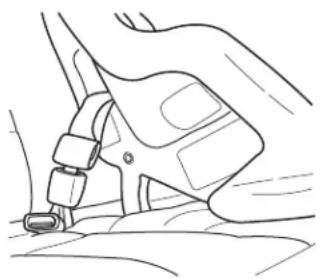
natural_image
Line drawing of a hand using a tool to adjust or install a component, no text or symbols presentAirbags can kill or injure a child in a child seat. NEVER place a rear-facing child seat in front of an active airbag. If you must use a forward-facing child seat in the front seat, move the vehicle seat all the way back.
Children 12 and under should be properly restrained in a rear seating position whenever possible. If all children cannot be seated and restrained properly in a rear seating position, properly restrain the largest child in the front seat.
Installing child safety seats with combination lap and shoulder belts
Therearseatheadrestraintsmustberemovedwhenusingachild seatthatutilizesthetoptetheranchor.
Check to make sure the child seat is properly secured before each use. Children 12 and under should be properly restrained in a rear seating position whenever possible. If all children cannot be seated and restrained properly in a rear seating position, properly restrain the largest child in the front seat.
When installing a child safety seat with combination lap/shoulder belts:
- Use the correct seat belt buckle for that seating position.
- Insert the belt tongue into the proper buckle until you hear a snap and feel it latch. Make sure the tongue is securely fastened in the buckle.
- Keep the buckle release button pointing up and away from the safety seat, with the tongue between the child seat and the release button, to help prevent accidental unbuckling.
- Place vehicle seat back in upright position.
- Put the seat belt in the automatic locking mode. Refer to step 5 below.
Perform the following steps when installing the child seat with combination lap/shoulder belts:
Note: Although the child seat illustrated is a forward facing child seat, the steps are the same for installing a rear facing child seat.
- Position the child safety seat in a seat with a combination lap and shoulder belt.
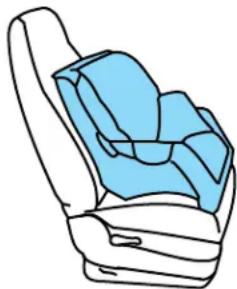
natural_image
Line drawing of a car seat with blue seating (no text or symbols)Seating and Safety Restraints
- Pull down on the shoulder belt and then grasp the shoulder belt and lap belt together.
- While holding the shoulder and lap belt portions together, route the tongue through the child seat according to the child seat manufacturer's instructions. Be sure the belt webbing is not twisted.
- Insert the belt tongue into the proper buckle (the buckle closest to the direction the tongue is coming from) for that seating position until you hear a snap and feel the latch engage. Make sure the tongue is latched securely by pulling on it.
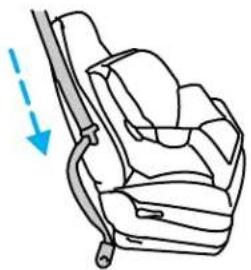
natural_image
Line drawing of a seatbelt with a blue arrow indicating downward motion (no text or symbols)
natural_image
Line drawing of a car seatbelt with a blue dashed arrow indicating direction (no text or symbols)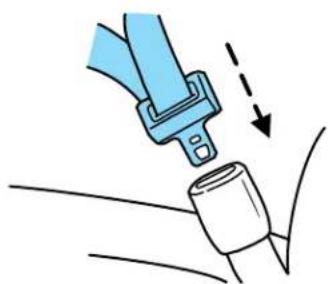
natural_image
Illustration of a blue belt buckle securing a white seatbelt, with a dashed arrow indicating the motion (no text or symbols)Seating and Safety Restraints
- To put the retractor in the automatic locking mode, grasp the shoulder portion of the belt and pull downward until all of the belt is pulled out.
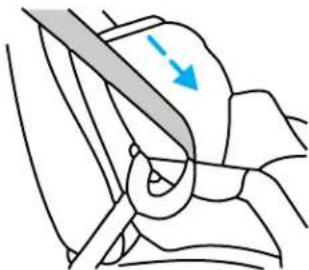
natural_image
Diagram of a car seatbelt mechanism with blue directional arrows indicating movement (no text or symbols)-
Allow the belt to retract to remove slack. The belt will click as it retracts to indicate it is in the automatic locking mode.
-
Try to pull the belt out of the retractor to make sure the retractor is in the automatic locking mode (you should not be able to pull more belt out). If the retractor is not locked, repeat Steps 5 and 6.
-
Remove remaining slack from the belt. Force the seat down with extra weight, e.g., by pressing down or kneeling on the child restraint while pulling up on the shoulder belt in order to force slack from the belt. This is necessary to remove the remaining slack that will exist once the additional weight of the child is added to the child restraint. It also helps to achieve seat to the vehicle. Sometimes, a additionally help to remove rema
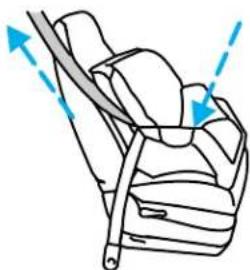
natural_image
Diagram of a car seatbelt with blue arrows indicating direction (no text or symbols)- Attach the tether strap (if the child seat is equipped). Refer to Attachingchildsafetyseats withtetherstrapslater in this chapter.
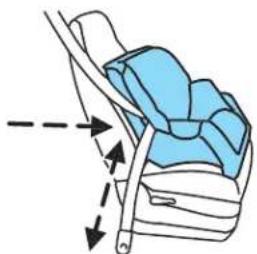
natural_image
Illustration of a blue fabric seatbelt buckle with arrows indicating force or movement (no text or symbols)Seating and Safety Restraints
- Before placing the child in the seat, forcibly move the seat forward and back to make sure the seat is securely held in place. To check this, grab the seat at the belt path and attempt to move it side to side and forward and back. There should be no more than one inch (2.5 cm) of movement for proper installation.
- Mazda recommends checking with a NHTSA Certified Child Passenger Safety Technician (CPST) to make certain the child restraint is properly installed.
Attaching child safety seats with LATCH (Lower Anchors and Tethers for CHildren) attachments
The LATCH system is composed of three vehicle anchor points: two (2) lower anchors located where the vehicle seat back and seat cushion meet (called the “seat bight”) and one (1) top tether anchor located behind that seating position.
LATCH compatible child safety seats have two rigid or webbing mounted attachments that connect to the two lower anchors at the LATCH equipped seating positions in your vehicle. This type of attachment method eliminates the need to use seat belts to attach the child seat, however the seat belt can still be used to attach the child seat. For forward-facing child seats, the top tether strap must also be attached to the proper top tether anchor, if a top tether strap has been provided with your child seat. Mazda Motor Corporation recommends the use of a child safety seat having a top tether strap. See Attachingchildsafety seatswithtetherstrapsand Recommendationsforattachingsafety restraintsforchildrenin this chapter for more information.
Your vehicle has LATCH lower anchors for child seat installation at the seating positions marked with the child seat symbol.
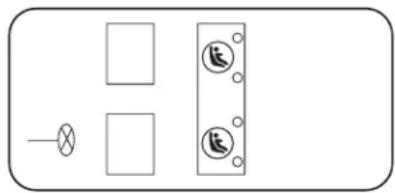
natural_image
Pure electrical circuit lines without any symbolsSeating and Safety Restraints
The LATCH anchors are located at the rear section of the rear seat between the cushion and seatback. Follow the child seat manufacturer's instructions to properly install a child seat with LATCH attachments.
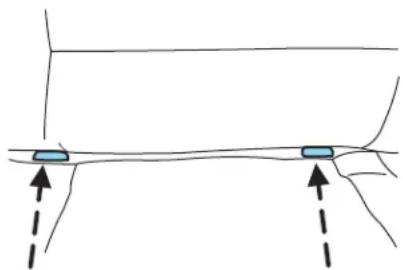
natural_image
Simple line drawing of a horizontal beam with two vertical supports and upward arrows indicating direction (no text or symbols)Follow the instructions on attaching child safety seats with tether straps. Refer to Attachingchildsafetyseatswithtetherstrapslater in this chapter.
Attach LATCH lower attachments of the child seat only to the anchors shown.

WARNING: Never attach two child safety seats to the same anchor. In a crash, one anchor may not be strong enough to hold child safety seat attachments and may break, causing serious or death.
Useofinboardloweranchorsfromtheoutboardseatingpositions (centerseatinguse)
The lower anchors at the center of the second row rear seat are spaced 400 mm (16 inches) apart. The standardized spacing for LATCH lower anchors is 280 mm (11 inches) center to center. A child seat with rigid LATCH attachments cannot be installed at the center seating position. LATCH compatible child seats (with attachments on belt webbing) can only be used at this seating position provided that the child seat manufacturer's instructions permit use with the anchor spacing stated. Do not attach a child seat to any lower anchor if an adjacent child seat is attached to that anchor.

WARNING: The standardized spacing for LATCH lower anchors is 280 mm (11 inches) center to center. Do not use LATCH anchors for the center seating position unless the child seat facturer's instructions permit and specify using anchors spaced at as far apart as those of this vehicle.
Seating and Safety Restraints
If you install a child seat with rigid LATCH attachments, and have attached the top tether strap to the proper top tether anchor, do not tighten the tether strap enough to lift the child seat off the vehicle seat cushion when the child is seated in it. Keep the tether strap just snug without lifting the front of the child seat. Keeping the child seat just touching the vehicle seat gives the best protection in a severe crash.
Each time you use the safety seat, check that the seat is properly attached to the lower anchors and tether anchor, if applicable. Tug the child seat from side to side and forward and back where it is secured to the vehicle. The seat should move less than one inch when you do this for a proper installation.
If the safety seat is not anchored properly, the risk of a child being injured in a crash greatly increases.
CombiningseatbeltandLATCHloweranchorsforattachingchild safetyseats
When used in combination, either the seat belt or the LATCH lower anchors may be attached first, provided a proper installation is achieved. Attach the tether strap afterward, if included with the child seat. Refer to Recommendationsforattachingsafetyrestraintsforchildrenin this chapter.
Attaching child safety seats with tether straps
Many forward-facing child safety seats include a tether strap which extends from the back of the child safety seat and hooks to an anchoring point called the top tether anchor. Tether straps are available as an accessory for many older safety seats. Contact the manufacturer of your child seat for information about ordering a tether strap, or to obtain a longer tether strap if the tether strap on your safety seat does not reach the appropriate top tether anchor in the vehicle.
The rear seating positions of your vehicle are equipped with built-in tether strap anchors located behind the seats on the roof panel in the cargo area.
Seating and Safety Restraints
The tether strap anchors in your vehicle are in the following positions (shown from top view):
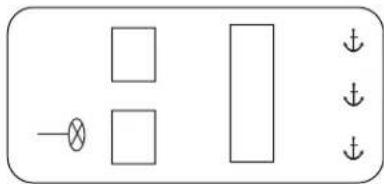
natural_image
Pure electrical circuit lines without any symbolsAttach the tether strap only to the appropriate tether anchor as shown. The tether strap may not work properly if attached somewhere other than the correct tether anchor.
Once the child safety seat has been installed, using either the seat belt or the lower anchors of the LATCH system, you can attach the top tether strap.
Perform the following steps to install a child safety seat with tether anchors:
- Route the child safety seat tether strap over the back of the seat.
For vehicles with adjustable head restraints, remove the head restraint first, place under the front seat for storage, and then route the tether strap over the top of the seatback.
- Locate the correct anchor for the selected seating position.
There are three tether anchors located on the headliner at the rear of the vehicle.
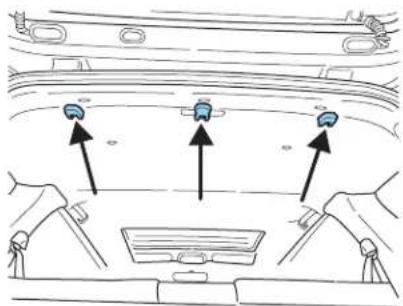
text_image
Diagram showing car interior with three labeled sensors or sensors above the dashboard, indicating detection or measurement points.Seating and Safety Restraints
- Clip the tether strap to the anchor as shown.
The arrow in the above graphic points toward the front of the vehicle.
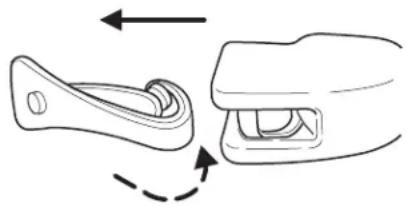
natural_image
Diagram showing two mechanical components with directional arrows indicating motion (no text or symbols)If the tether strap is clipped incorrectly, the child safety seat may not be retained properly in the event of a collision.
- Tighten the child safety seat tether strap according to the manufacturer's instructions.
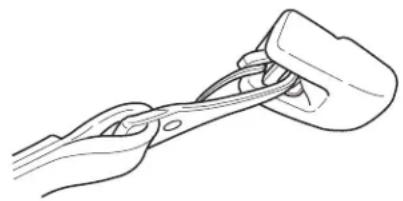
natural_image
Line drawing of a hand gripping a tool or object, no text or symbols presentIf the safety seat is not anchored properly, the risk of a child being injured in a collision greatly increases.
Child booster seats
The belt-positioning booster (booster seat) is used to improve the fit of the vehicle seat belt. Children outgrow a typical child seat (e.g., convertible or toddler seat) when they weigh about 40 lb (18 kg) and are around four (4) years of age. Consult your child safety seat owner manual for the weight, height, and age limits specific to your child safety seat. Keep your child in the child safety seat if it properly fits the child, remains appropriate for their weight, height and age AND if properly secured to the vehicle.
Although the lap/shoulder belt will provide some protection, children who have outgrown a typical child seat are still too small for lap/shoulder belts to fit properly, and wearing an improperly fitted vehicle seat belt could increase the risk of serious injury in a crash. To improve the fit of both the lap and shoulder belt on children who have outgrown child safety seats, Mazda Motor Corporation recommends use of a belt-positioning booster.
Seating and Safety Restraints
Booster seats position a child so that vehicle lap/shoulder seat belts fit better. They lift the child up so that the lap belt rests low across the hips and the knees bend comfortably at the edge of the cushion, while minimizing slouching. Booster seats may also make the shoulder belt fit better and more comfortably. Try to keep the belt near the middle of the shoulder and across the center of the chest. Moving the child closer (a few centimeters or inches) to the center of the vehicle, but remaining in the same seating position, may help provide a good shoulder belt fit.
Whenchildrenshoulduseboosterseats
Children need to use booster seats from the time they outgrow the toddler seat until they are big enough for the vehicle seat and lap/shoulder belt to fit properly. Generally this is when they reach a height of at least 4 feet 9 inches (1.45 meters) tall (around age eight to age twelve and between 40 lb (18 kg) and 80 lb (36 kg) or upward to 100 lb (45 kg) if recommended by your child restraint manufacturer). Many state and provincial laws require that children use approved booster seats until they reach age eight, a height of 4 feet 9 inches (1.45 meters) tall, or 80 lb (36 kg).
Booster seats should be used until you can answer YES to ALL of these questions when seated without a booster seat:
- Can the child sit all the way back against the vehicle seat back with knees bent comfortably at the edge of the seat cushion?
- Can the child sit without slouching?

text_image
Diagram showing two types of bicycle seat rules: one with a horizontal line and circle, and another with a circle crossed out.- Does the lap belt rest low across the hips?
- Is the shoulder belt centered on the shoulder and chest?
- Can the child stay seated like this for the whole trip?
Seating and Safety Restraints
Typesofboosterseats
There are generally two types of belt-positioning booster seats: backless and high back. Always use booster seats in conjunction with the vehicle lap/shoulder belt.
- Backless booster seats
If your backless booster seat has a removable shield, remove the shield. If a vehicle seating position has a low seat back or no head restraint, a backless booster seat may place your child's head (as measured at the tops of the ears) above the top of the seat. In this case, move the backless booster to another seating position with a higher seat back or head restraint using a high back booster seat.
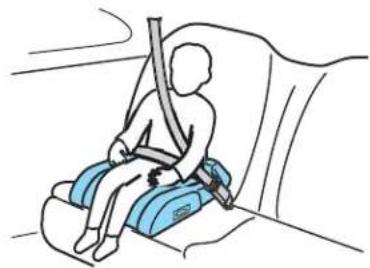
natural_image
Line drawing of a person seated in a seatbelt, no text or symbols present• High back booster seats
If, with a backless booster seat, you cannot find a seating position that adequately supports your child's head, a high back booster seat would be a better choice.
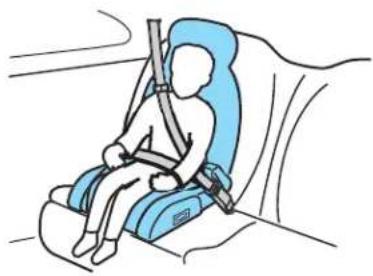
natural_image
Line drawing of a person seated in a blue car seat, no text or symbols presentSeating and Safety Restraints
Children and booster seats vary in size and shape. Choose a booster that keeps the lap belt low and snug across the hips, never up across the stomach, and lets you adjust the shoulder belt to cross the chest and rest snugly near the center of the shoulder. The drawings below compare the ideal fit (center) to a shoulder belt uncomfortably close to the neck and a shoulder belt that could slip off the shoulder. The drawings below also show how the lap belt should be low and snug across the child's hips.

If the booster seat slides on the vehicle seat, placing a rubberized mesh sold as shelf or carpet liner under the booster seat may improve this condition. Do not introduce any item thicker than this under the booster seat. Check with the booster seat manufacturer's instructions.
Theimportanceofshoulderbelts
Using a booster without a shoulder belt increases the risk of a child's head hitting a hard surface in a collision. For this reason, you should never use a booster seat with a lap belt only. It is generally best to use a booster seat with lap/shoulder belts in the back seat.
Seating and Safety Restraints
Move a child to a different seating location if the shoulder belt does not stay positioned on the shoulder during use.
Follow all instructions provided by the manufacturer of the booster seat.

WARNING: Never place, or allow a child to place, the shoulder belt under a child's arm or behind the back because it reduces
the protection for the upper part of the body and may increase the risk of injury or death in a collision.
Child restraint and seat belt maintenance
Inspect the vehicle seat belts and child safety seat systems periodically to make sure they work properly and are not damaged. Inspect the vehicle and child seat seat belts to make sure there are no nicks, tears or cuts. Replace if necessary. All vehicle seat belt assemblies, including retractors, buckles, front seat belt buckle assemblies, buckle support assemblies (slide bar-if equipped), shoulder belt height adjusters (if equipped), shoulder belt guide on seatback (if equipped), child safety seat LATCH and tether anchors, and attaching hardware, should be inspected after a collision. Refer to the child restraint manufacturer's instructions for additional inspection and maintenance information specific to the child restraint. Mazda Motor Corporation recommends that all seat belt assemblies in use in vehicles involved in a collision be replaced. However, if the collision was minor and an authorized dealer finds that the belts do not show damage and continue to operate properly, they do not need to be replaced. Seat belt assemblies not in use during a collision should also be inspected and replaced if either damage or improper operation is noted.
For proper care of soiled seat belts, refer to Interior in the Cleaning chapter.

WARNING: Failure to inspect and if necessary replace the seat belt assembly or child restraint system under the above
conditions could result in severe personal injuries in the event of a collision.
Tires, Wheels and Loading
NOTICE TO UTILITY VEHICLE AND TRUCK OWNERS
Utility vehicles and trucks handle differently than passenger cars in the various driving conditions that are encountered on streets, highways and off-road. Utility vehicles and trucks are not designed for cornering at speeds as high as passenger cars any more than low-slung sports cars are designed to perform satisfactorily under off-road conditions.
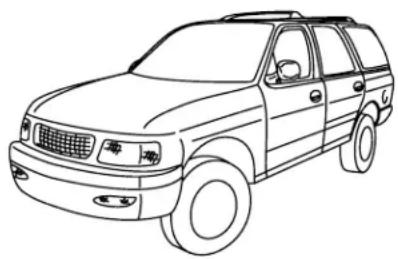
natural_image
Line drawing of a classic SUV (no text or symbols)WARNING: Utility vehicles have a significantly higher rollover rate than other types of vehicles. To reduce the risk of serious injury or death from a rollover or other crash you must:
- Avoidsharpturnsandabruptmaneuvers;
- Driveatsafespeedsfortheconditions;
- Keeptiresproperlyinflated;
- Neveroverloadorimproperlyloadyourvehicle;and
- Makesureeverypassengerisproperlyrestrained.
WARNING: In a rollover crash, an unbelted person is significantly more likely to die than a person wearing a seat belt. All occupants must wear seat belts and children/infants must use appropriate restraints to minimize the risk of injury or ejection.
Study your “Owner’s Manual” and any supplements for specific information about equipment features, instructions for safe driving and additional precautions to reduce the risk of an accident or serious injury.
Tires, Wheels and Loading
VEHICLE CHARACTERISTICS
4WD Systems (if equipped)
Your vehicle may be equipped with a Four Wheel Drive (4WD) system. With the 4WD option, power will be delivered to the front wheels and distributed to the rear wheels as needed. This increases traction which may enable you to safely drive over terrain and road conditions that a conventional two-wheel drive vehicle cannot. The 4WD system is active all the time and requires no input from the operator.
For 4WD vehicles, a spare tire of a different size other that the tire provided should never be used. A dissimilar spare tire size (other than the spare tire provided) or major dissimilar tire sized between the front and rear axles could cause the 4WD system to stop functioning and default to front wheel drive.

WARNING: Do not become overconfident in the ability of 4WD
vehicles. Although a 4WD vehicle may accelerate better than two-wheel drive vehicle in low traction situations, it won't stop any faster than two-wheel drive vehicles. Always drive at a safe speed.
How your vehicle differs from other vehicles
SUV and trucks can differ from some other vehicles in a few noticeable ways. Your vehicle may be:
- Higher – to allow higher load carrying capacity and to allow it to travel over rough terrain without getting hung up or damaging underbody components.
- Shorter – to give it the capability to approach inclines and drive over the crest of a hill without getting hung up or damaging underbody components. All other things held equal, a shorter wheelbase may make your vehicle
quicker to respond to steering inputs than a vehicle with a longer wheelbase.
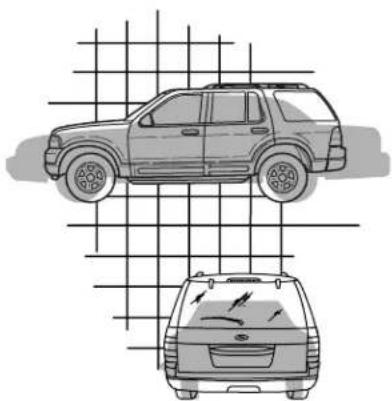
natural_image
Two SUVs viewed from the side of a grid, showing front and rear views with no visible text or symbols.Tires, Wheels and Loading
- Narrower — to provide greater maneuverability in tight spaces, particularly in off-road use.
As a result of the above dimensional differences, SUV's and trucks often will have a higher center of gravity and a greater difference in center of gravity between the loaded and unloaded condition.
These differences that make your vehicle so versatile also make it handle differently than an ordinary passenger car.
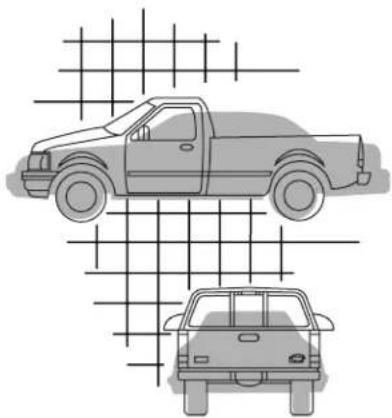
natural_image
Side-view technical illustration of a pickup truck and its front view, showing front and side views (no text or symbols)INFORMATION ABOUT UNIFORM TIRE QUALITY GRADING
Tire Quality Grades apply to new pneumatic passenger car tires. The Quality grades can be found where applicable on the tire sidewall between tread shoulder and maximum section width. For example:
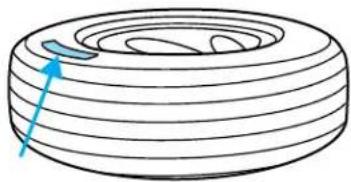
natural_image
Diagram of a tire with a blue arrow pointing to the wheel rim (no text or symbols)•Treadwear200TractionAATemperatureA
These Tire Quality Grades are determined by standards that the United States Department of Transportation has set.
Tire Quality Grades apply to new pneumatic passenger car tires. They do not apply to deep tread, winter-type snow tires, space-saver or temporary use spare tires, light truck or "LT" type tires, tires with nominal rim diameters of 10 to 12 inches or limited production tires as defined in Title 49 Code of Federal Regulations Part 575.104(c)(2).
U.S. Department of Transportation-Tirequality grades: The U.S. Department of Transportation requires Mazda Motor Corporation to give you the following information about tire grades exactly as the government has written it.
Tires, Wheels and Loading
Treadwear
The treadwear grade is a comparative rating based on the wear rate of the tire when tested under controlled conditions on a specified government test course. For example, a tire graded 150 would wear one and one-half (1½) times as well on the government course as a tire graded 100. The relative performance of tires depends upon the actual conditions of their use, however, and may depart significantly from the norm due to variations in driving habits, service practices, and differences in road characteristics and climate.
Traction AA A B C
The traction grades, from highest to lowest are AA, A, B, and C. The grades represent the tire's ability to stop on wet pavement as measured under controlled conditions on specified government test surfaces of asphalt and concrete. A tire marked C may have poor traction performance.

WARNING: The traction grade assigned to this tire is based on straight-ahead braking traction tests, and does not include eration, cornering, hydroplaning or peak traction characteristics.
Temperature A B C
The temperature grades are A (the highest), B and C, representing the tire's resistance to the generation of heat and its ability to dissipate heat when tested under controlled conditions on a specified indoor laboratory test wheel. Sustained high temperature can cause the material of the tire to degenerate and reduce tire life, and excessive temperature can lead to sudden tire failure. The grade C corresponds to a level of performance which all passenger car tires must meet under the Federal Motor Vehicle Safety Standard No. 139. Grades B and A represent higher levels of performance on the laboratory test wheel than the minimum required by law.

WARNING: The temperature grade for this tire is established for a tire that is properly inflated and not overloaded. Excessive, underinflation, or excessive loading, either separately or in inflation, can cause heat buildup and possible tire failure.
TIRES
Tires are designed to give many thousands of miles of service, but they must be maintained in order to get the maximum benefit from them.
Tires, Wheels and Loading
Glossary of tire terminology
- Tirelabel:A label showing the OE (Original Equipment) tire sizes, recommended inflation pressure and the maximum weight the vehicle can carry.
- TireIdentificationNumber(TIN): A number on the sidewall of each tire providing information about the tire brand and manufacturing plant, tire size and date of manufacture. Also referred to as DOT code.
- Inflationpressure: A measure of the amount of air in a tire.
- Standard load: A class of P-metric or Metric tires designed to carry a maximum load at 35 psi [37 psi (2.5 bar) for Metric tires]. Increasing the inflation pressure beyond this pressure will not increase the tire's load carrying capability.
- Extraload: A class of P-metric or Metric tires designed to carry a heavier maximum load at 41 psi [43 psi (2.9 bar) for Metric tires]. Increasing the inflation pressure beyond this pressure will not increase the tire's load carrying capability.
- kPa:Kilopascal, a metric unit of air pressure.
- PSI: Pounds per square inch, a standard unit of air pressure.
- Coldinflationpressure:The tire pressure when the vehicle has been stationary and out of direct sunlight for an hour or more and prior to the vehicle being driven for 1 mile (1.6 km).
- Recommendedinflationpressure:The cold inflation pressure found on the Safety Compliance Certification Label or Tire Label located on the B-Pillar or the edge of the driver's door.
- B-pillar: The structural member at the side of the vehicle behind the front door.
- Beadareaofthetire:Area of the tire next to the rim.
- Sidewallofthetire: Area between the bead area and the tread.
- Treadareaofthetire: Area of the perimeter of the tire that contacts the road when mounted on the vehicle.
- Rim: The metal support (wheel) for a tire or a tire and tube assembly upon which the tire beads are seated.
Tires, Wheels and Loading
INFLATING YOUR TIRES
Safe operation of your vehicle requires that your tires are properly inflated. Remember that a tire can lose up to half of its air pressure without appearing flat.
Every day before you drive, check your tires. If one looks lower than the others, use a tire gauge to check pressure of all tires and adjust if required.
At least once a month and before long trips, inspect each tire and check the tire pressure with a tire gauge (including spare, if equipped). Inflate all tires to the inflation pressure recommended by Mazda Motor Corporation.
You are strongly urged to buy a reliable tire pressure gauge, as automatic service station gauges may be inaccurate. Mazda recommends the use of a digital or dial-type tire pressure gauge rather than a stick-type tire pressure gauge.
Use the recommended cold inflation pressure for optimum tire performance and wear. Under-inflation or over-inflation may cause uneven treadwear patterns.
WARNING: Under-inflation is the most common cause of tire failures and may result in severe tire cracking, tread separation or "blowout", with unexpected loss of vehicle control and increased risk of injury. Under-inflation increases sidewall flexing and rolling resistance, resulting in heat buildup and internal damage to the tire. It also may result in unnecessary tire stress, irregular wear, loss of vehicle control and accidents. A tire can lose up to half of its air pressure and not appear to be flat!
Always inflate your tires to the Mazda recommended inflation pressure even if it is less than the maximum inflation pressure information found on the tire. The Mazda recommended tire inflation pressure is found on the Safety Compliance Certification Label or Tire Label which is located on the B-Pillar or the edge of the driver's door. Failure to follow the tire pressure recommendations can cause uneven treadwear patterns and adversely affect the way your vehicle handles.
MaximumPermissibleInflationPressureis the tire manufacturer's maximum permissible pressure and/or the pressure at which the maximum load can be carried by the tire. This pressure is normally higher than the manufacturer's recommended cold inflation pressure which can be found on the Safety Compliance Certification Label or Tire Label which is located on the B-Pillar or the edge of the driver's door.
Tires, Wheels and Loading
The cold inflation pressure should never be set lower than the recommended pressure on the Safety Compliance Certification Label or Tire Label.
When weather temperature changes occur, tire inflation pressures also change. A 10^ F ( 6^ C) temperature drop can cause a corresponding drop of 1 psi (7 kPa) in inflation pressure. Check your tire pressures frequently and adjust them to the proper pressure which can be found on the Safety Compliance Certification Label or Tire Label.
To check the pressure in your tire(s):
- Make sure the tires are cool, meaning they are not hot from driving even a mile.
If you are checking tire pressure when the tire is hot, (i.e. driven more than 1 mile [1.6 km]), never “bleed” or reduce air pressure. The tires are hot from driving and it is normal for pressures to increase above recommended cold pressures. A hot tire at or below recommended cold inflation pressure could be significantly under-inflated.
Note: If you have to drive a distance to get air for your tire(s), check and record the tire pressure first and add the appropriate air pressure when you get to the pump. It is normal for tires to heat up and the air pressure inside to go up as you drive.
- Remove the cap from the valve on one tire, then firmly press the tire gauge onto the valve and measure the pressure.
- Add enough air to reach the recommended air pressure.
Note: If you overfill the tire, release air by pushing on the metal stem in the center of the valve. Then recheck the pressure with your tire gauge.
- Replace the valve cap.
- Repeat this procedure for each tire, including the spare.
Note: Some spare tires operate at a higher inflation pressure than the other tires. For T-type/mini-spare tires (see the Dissimilarspare tire/wheelinformationsection for description): Store and maintain at 60 psi (4.15 bar). For Full Size and Dissimilar spare tires (see the Dissimilarspare tire/wheelinformationsection for description): Store and maintain at the higher of the front and rear inflation pressure as shown on the Tire Label.
- Visually inspect the tires to make sure there are no nails or other objects embedded that could poke a hole in the tire and cause an air leak.
- Check the sidewalls to make sure there are no gouges, cuts or bulges.
Tires, Wheels and Loading
TIRE CARE
Inspecting your tires
Periodically inspect the tire treads for uneven or excessive wear and remove objects such as stones, nails or glass that may be wedged in the tread grooves. Check for holes or cuts that may permit air leakage from the tire and make necessary repairs. Also inspect the tire sidewalls for cracking, cuts, bruises and other signs of damage or excessive wear. If internal damage to the tire is suspected, have the tire demounted and inspected in case it needs to be repaired or replaced. For your safety, tires that are damaged or show signs of excessive wear should not be used because they are more likely to blow out or fail.
Improper or inadequate vehicle maintenance can cause tires to wear abnormally. Inspect all your tires, including the spare, frequently, and replace them if one or more of the following conditions exist:
Tire wear
When the tread is worn down to 1/16th of an inch (2 mm), tires must be replaced to help prevent your vehicle from skidding and hydroplaning. Built-in treadwear indicators, or "wear bars", which look like narrow strips of smooth rubber across the tread will appear on the tire when the tread is worn down to 1/16th of an inch (2 mm). When the tire tread wears down to the same height as these “wear bars”, the tire is worn out and must be replaced.
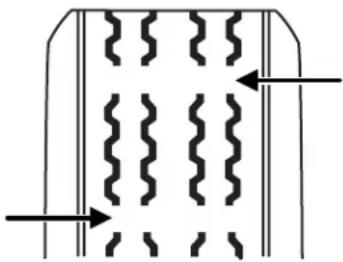
natural_image
Pure diagram of a heat exchanger or cooling unit with wavy internal lines and directional arrows (no text or symbols)Damage
Periodically inspect the tire treads and sidewalls for damage (such as bulges in the tread or sidewalls, cracks in the tread groove and separation in the tread or sidewall). If damage is observed or suspected have the tire inspected by a tire professional. Tires can be damaged during off-road use, so inspection after off-road use is also recommended.
Tires, Wheels and Loading

WARNING: Age
Tires degrade over time depending on many factors such as weather, storage conditions, and conditions of use (load, speed, inflation pressure, etc.) the tires experience throughout their lives. In general, tires should be replaced after 6 years regardless of tread wear. However, heat caused by hot climates or frequent high loading conditions can accelerate the aging process and may require tires to be replaced more frequently. You should replace your spare tire when you replace the road tires or after 6 years due to aging even if it has not been used.
U.S. DOT Tire Identification Number (TIN)
Both U.S. and Canada Federal regulations require tire manufacturers to place standardized information on the sidewall of all tires. This information identifies and describes the fundamental characteristics of the tire and also provides a U.S. DOT Tire Identification Number for safety standard certification and in case of a recall.
This begins with the letters “DOT” and indicates that the tire meets all federal standards. The next two numbers or letters are the plant code designating where it was manufactured, the next two are the tire size code and the last four numbers represent the week and year the tire was built. For example, the numbers 317 mean the 31st week of 1997. After 2000 the numbers go to four digits. For example, 2501 means the 25th week of 2001. The numbers in between are identification codes used for traceability. This information is used to contact customers if a tire defect requires a recall.
Tire Replacement Requirements
Your vehicle is equipped with tires designed to provide a safe ride and handling capability.
Tires, Wheels and Loading
WARNING: Only use replacement tires and wheels that are the same size, load index, speed rating and type (such as P-metric versus LT-metric or all-season versus all-terrain) as those originally provided by Mazda. The recommended tire and wheel size may be found on either the Safety Compliance Certification Label or the Tire Label which is located on the B-Pillar or edge of the driver's door. If this information is not found on these labels then you should consult your Mazda dealer. Use of any tire or wheel not recommended by Mazda can affect the safety and performance of your vehicle, which could result in an increased risk of loss of vehicle control, vehicle rollover, personal injury and death. Additionally the use of non-recommended tires and wheels could cause steering, suspension, axle or transfer case/power transfer unit failure. If you have questions regarding tire replacement, see an authorized dealer.
WARNING: When mounting replacement tires and wheels, you should not exceed the maximum pressure indicated on the sidewall of the tire to set the beads without additional precautions listed below. If the beads do not seat at the maximum pressure indicated, re-lubricate and try again. When inflating the tire for mounting pressures up to 20 psi greater than the maximum pressure on the tire sidewall, the following precautions must be taken to protect the person mounting the tire:
-
Makesurethatyouhavethecorrecttireandwheelsize.
-
Lubricatethetirebeadandwheelbeadseatareaagain.
-
Standataminimum of 12 feet away from the tire wheel assembly.
-
Usebotheyeandearprotection. Foramountingpressuremorethan20psigreaterthanthe maximumpressure,aMazdaDealerorothertireservice professionalshoulddothemounting. Alwaysinflatesteelcarcasstireswitharemoteairfillwiththe personinflatingstandingataminimumof12ft.awayfromthe tirewheelassembly.
Important: Remember to replace the valve stems when the road tires are replaced on your vehicle.
It is recommended that the two front tires or two rear tires generally be replaced as a pair.
Tires, Wheels and Loading
Note: The use of a different tire can effect the fuel economy of your vehicle.
The tire pressure monitoring sensors mounted in the wheels (originally installed on your vehicle) are not designed to be used in aftermarket wheels.
The use of wheels or tires not recommended by Mazda Motor Corporation may affect the operation of your Tire Pressure Monitoring System.
If the TPMS indicator is flashing, your TPMS is malfunctioning. Your replacement tire might be incompatible with your TPMS, or some component of the TPMS may be damaged.
Safety practices
Driving habits have a great deal to do with your tire mileage and safety.
- Observe posted speed limits
- Avoid fast starts, stops and turns
- Avoid potholes and objects on the road
- Do not run over curbs or hit the tire against a curb when parking
WARNING: If your vehicle is stuck in snow, mud, sand, etc., do not rapidly spin the tires; spinning the tires can tear the tire and cause an explosion. A tire can explode in as little as three to five seconds.
WARNING: Do not spin the wheels at over 35 mph (56 km/h). The tires may fail and injure a passenger or bystander.
Highwayhazards
No matter how carefully you drive there's always the possibility that you may eventually have a flat tire on the highway. Drive slowly to the closest safe area out of traffic. This may further damage the flat tire, but your safety is more important.
If you feel a sudden vibration or ride disturbance while driving, or you suspect your tire or vehicle has been damaged, immediately reduce your speed. Drive with caution until you can safely pull off the road. Stop and inspect the tires for damage. If a tire is under-inflated or damaged, deflate it, remove wheel and replace it with your spare tire and wheel. If you cannot detect a cause, have the vehicle towed to the nearest repair facility or tire dealer to have the vehicle inspected.
Tires, Wheels and Loading
Tire and wheel alignment
A bad jolt from hitting a curb or pothole can cause the front end of your vehicle to become misaligned or cause damage to your tires. If your vehicle seems to pull to one side when you're driving, the wheels may be out of alignment. Have an authorized dealer check the wheel alignment periodically.
Wheel misalignment in the front or the rear can cause uneven and rapid treadwear of your tires and should be corrected by an authorized dealer. Front wheel drive (FWD) vehicles and those with an independent rear suspension (if equipped) may require alignment of all four wheels.
The tires should also be balanced periodically. An unbalanced tire and wheel assembly may result in irregular tire wear.
Tire rotation
Rotating your tires at the recommended interval (as indicated in the Scheduledmaintenancesection of the Maintenance and Specificationschapter) will help your tires wear more evenly, providing better tire performance and longer tire life.
- Front Wheel Drive (FWD) vehicles (front tires at top of diagram)
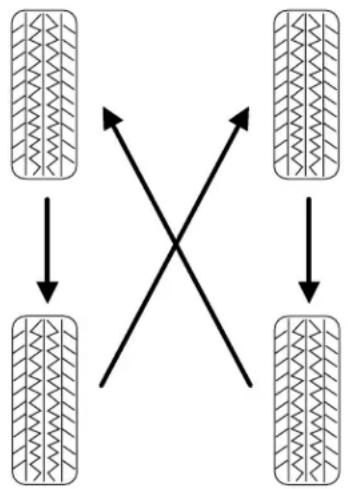
flowchart
graph TD
    A["Terr 1"] --> B["Terr 2"]
    C["Terr 3"] --> D["Terr 4"]
    E["Terr 5"] --> F["Terr 6"]
    G["Terr 7"] --> H["Terr 8"]
    I["Terr 9"] --> J["Terr 10"]
    K["Terr 11"] --> L["Terr 12"]
    M["Terr 13"] --> N["Terr 14"]
    O["Terr 15"] --> P["Terr 16"]
    Q["Terr 17"] --> R["Terr 18"]
    S["Terr 19"] --> T["Terr 20"]
    U["Terr 21"] --> V["Terr 22"]
    W["Terr 23"] --> X["Terr 24"]
    Y["Terr 25"] --> Z["Terr 26"]
Tires, Wheels and Loading
- Rear Wheel Drive (RWD) vehicles/Four Wheel Drive (4WD)/All Wheel Drive (AWD) vehicles (front tires at top of diagram)
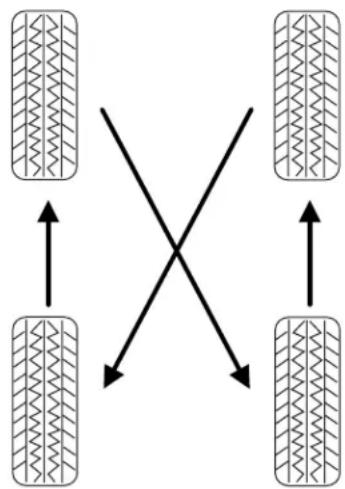
flowchart
graph TD
    A["Left Tire"] --> B["Right Triage"]
    C["Left Tire"] --> D["Right Triage"]
    E["Left Tire"] --> F["Right Triage"]
    G["Left Tire"] --> H["Right Triage"]
    I["Left Tire"] --> J["Right Triage"]
    K["Left Tire"] --> L["Right Triage"]
    M["Left Tire"] --> N["Right Triage"]
    O["Left Tire"] --> P["Right Triage"]
    Q["Left Tire"] --> R["Right Triage"]
    S["Left Tire"] --> T["Right Triage"]
    U["Left Tire"] --> V["Right Triage"]
    W["Left Tire"] --> X["Right Triage"]
    Y["Left Tire"] --> Z["Right Triage"]
    AA["Left Tire"] --> AB["Right Triage"]
    AC["Left Tire"] --> AD["Right Triage"]
    AE["Left Tire"] --> AF["Right Triage"]
    AG["Left Tire"] --> AH["Right Triage"]
    AI["Left Tire"] --> AJ["Right Triage"]
    AK["Left Tire"] --> AL["Right Triage"]
    AM["Left Tire"] --> AN["Right Triage"]
    AO["Left Tire"] --> AP["Right Triage"]
    AQ["Left Tire"] --> AR["Right Triage"]
    AS["Left Tire"] --> AT["Right Triage"]
    AU["Left Tire"] --> AV["Right Triage"]
    AW["Left Tire"] --> AX["Right Triage"]
    AY["Upward Arrow"] --> Z
    AZ["Downward Arrow"] --> AA
    BA["Cross-Arrow"] --> BB
    BC["Upward Arrow"] --> AF
    BD["Downward Arrow"] --> AA
    BE["Upward Arrow"] --> AF
    BF["Downward Arrow"] --> AA
Sometimes irregular tire wear can be corrected by rotating the tires.
Note: If your tires show uneven wear ask a qualified technician at a Mazda dealership to check for and correct any wheel misalignment, tire imbalance or mechanical problem involved before tire rotation.
Note: Your vehicle may be equipped with a dissimilar spare tire/wheel. A dissimilar spare tire/wheel is defined as a spare tire and/or wheel that is different in brand, size or appearance from the road tires and wheels. If you have a dissimilar spare tire/wheel it is intended for temporary use only and should not be used in a tire rotation.
Note: After having your tires rotated, inflation pressure must be checked and adjusted to the vehicle requirements.
INFORMATION CONTAINED ON THE TIRE SIDEWALL
Both U.S. and Canada Federal regulations require tire manufacturers to place standardized information on the sidewall of all tires. This information identifies and describes the fundamental characteristics of the tire and also provides a U.S. DOT Tire Identification Number for safety standard certification and in case of a recall.
Tires, Wheels and Loading
Information on "P" type tires
P215/65R15 95H is an example of a tire size, load index and speed rating. The definitions of these items are listed below. (Note that the tire size, load index and speed rating for your vehicle may be different from this example.)
- P: Indicates a tire, designated by the Tire and Rim Association (T&RA), that may be used for service on cars, SUVs, minivans and light trucks.
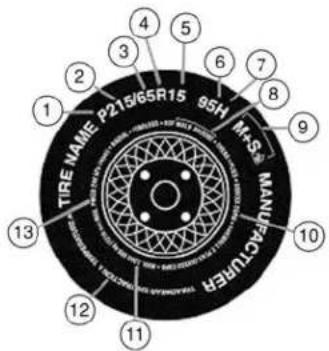
text_image
TIRE NAME P215/65R15 95H M+S MANUFACTUREP 13 12 11 10 9 8 7 6 5 4 3 2 1Note: If your tire size does not begin with a letter this may mean it is designated by either ETRTO
(European Tire and Rim Technical Organization) or JATMA (Japan Tire Manufacturing Association).
- 215: Indicates the nominal width of the tire in millimeters from sidewall edge to sidewall edge. In general, the larger the number, the wider the tire.
- 65: Indicates the aspect ratio which gives the tire's ratio of height to width.
- R: Indicates a "radial" type tire.
- 15: Indicates the wheel or rim diameter in inches. If you change your wheel size, you will have to purchase new tires to match the new wheel diameter.
- 95: Indicates the tire's load index. It is an index that relates to how much weight a tire can carry. You may find this information in your Owner's Manual. If not, contact a local tire dealer.
Note: You may not find this information on all tires because it is not required by federal law.
- H: Indicates the tire's speed rating. The speed rating denotes the speed at which a tire is designed to be driven for extended periods of time under a standard condition of load and inflation pressure. The tires on your vehicle may operate at different conditions for load and inflation pressure. These speed ratings may need to be adjusted for the difference in conditions. The ratings range from 81 mph (130 km/h) to 186 mph (299 km/h). These ratings are listed in the following chart.
Tires, Wheels and Loading
Note: You may not find this information on all tires because it is not required by federal law.
| LetterratingSpeedrating-mph(km/h) |
| M 81 mph (130 km/h) |
| N 87 mph (140 km/h) |
| Q 99 mph (159 km/h) |
| R 106 mph (171 km/h) |
| S 112 mph (180 km/h) |
| T 118 mph (190 km/h) |
| U 124 mph (200 km/h) |
| H 130 mph (210 km/h) |
| V 149 mph (240 km/h) |
| W 168 mph (270 km/h) |
| Y 186 mph (299 km/h) |
| Note:For tires with a maximum speed capability over 149 mph (240 km/h), tire manufacturers sometimes use the letters ZR. For those with a maximum speed capability over 186 mph (299 km/h), tire manufacturers always use the letters ZR. |
- U.S.DOTTireIdentificationNumber(TIN): This begins with the letters "DOT" and indicates that the tire meets all federal standards. The next two numbers or letters are the plant code designating where it was manufactured, the next two are the tire size code and the last four numbers represent the week and year the tire was built. For example, the numbers 317 mean the 31st week of 1997. After 2000 the numbers go to four digits. For example, 2501 means the 25th week of 2001. The numbers in between are identification codes used for traceability. This information is used to contact customers if a tire defect requires a recall.
- M+SorM/S:Mud and Snow, or AT:All Terrain, or AS:All Season.
- TirePlyCompositionandMaterialUsed:Indicates the number of plies or the number of layers of rubber-coated fabric in the tire tread and sidewall. Tire manufacturers also must indicate the ply materials in the tire and the sidewall, which include steel, nylon, polyester, and others.
Tires, Wheels and Loading
- MaximumLoad: Indicates the maximum load in kilograms and pounds that can be carried by the tire. Refer to the Safety Compliance Certification Label, which is located on the B-Pillar or the edge of the driver's door, for the correct tire pressure for your vehicle.
- Treadwear, Traction and Temperature Grades
- Treadwear: The treadwear grade is a comparative rating based on the wear rate of the tire when tested under controlled conditions on a specified government test course. For example, a tire graded 150 would wear one and one-half (1 12 ) times as well on the government course as a tire graded 100.
- Traction: The traction grades, from highest to lowest are AA, A, B, and C. The grades represent the tire's ability to stop on wet pavement as measured under controlled conditions on specified government test surfaces of asphalt and concrete. A tire marked C may have poor traction performance.
- Temperature: The temperature grades are A (the highest), B and C, representing the tire's resistance to the generation of heat and its ability to dissipate heat when tested under controlled conditions on a specified indoor laboratory test wheel.
- MaximumPermissibleInflationPressure: Indicates the tire manufacturers' maximum permissible pressure and/or the pressure at which the maximum load can be carried by the tire. This pressure is normally higher than the manufacturer's recommended cold inflation pressure which can be found on the Safety Compliance Certification Label or Tire Label which is located on the B-Pillar or the edge of the driver's door. The cold inflation pressure should never be set lower than the recommended pressure on the vehicle label.
The tire suppliers may have additional markings, notes or warnings such as standard load, radial tubeless, etc.
Tires, Wheels and Loading
Additional information contained on the tire sidewall for "LT" type tires
"LT" type tires have some additional information beyond those of "P" type tires; these differences are described below.
Note: Tire Quality Grades do not apply to this type of tire.
- LTIndicates a tire, designated by the Tire and Rim Association (T&RA), that is intended for service on light trucks.
- LoadRange/LoadInflation Limits: Indicates the tire's load-carrying capabilities and its inflation limits.
- MaximumLoadDuallb.(kg)atpsi(kPa)cold:Indicates the maximum load and tire pressure when the tire is used as a dual; defined as four tires on the rear axle (a total of six or more tires on the vehicle).
- MaximumLoadSinglelb.(kg)atpsi(kPa)cold:Indicates the maximum load and tire pressure when the tire is used as a single; defined as two tires (total) on the rear axle.
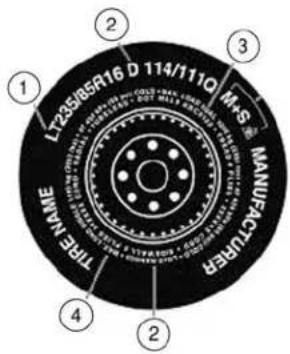
text_image
LT25R/SR16 D 114/111Q M+S MANUALCUTUREP 1 2 3 4 TIMETires, Wheels and Loading
Information on "T" type tires
“T” type tires have some additional information beyond those of “P” type tires; these differences are described below:
T145/80D16 is an example of a tire size.
Note: The temporary tire size for your vehicle may be different from this example. Tire Quality Grades do not apply to this type of tire.
- TIndicates a type of tire, designated by the Tire and Rim Association (T&RA), that is intended for temporary service on cars, SUVs, minivans and light trucks.
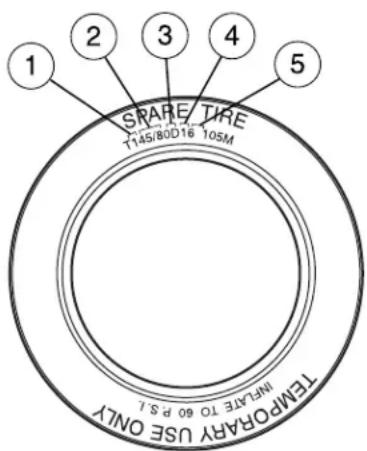
text_image
1 2 3 4 5 SPARE TIRE T145/80D16 105M TEMPORARY USE ONLY INITIATE TO 60 P.S.L.- 145: Indicates the nominal width of the tire in millimeters from sidewall edge to sidewall edge. In general, the larger the number, the wider the tire.
- 80: Indicates the aspect ratio which gives the tire's ratio of height to width. Numbers of 70 or lower indicate a short sidewall.
- D: Indicates a “diagonal” type tire. R: Indicates a “radial” type tire.
- 16: Indicates the wheel or rim diameter in inches. If you change your wheel size, you will have to purchase new tires to match the new wheel diameter.
Location of the tire label
You will find a Tire Label containing tire inflation pressure by tire size and other important information located on the B-Pillar or the edge of the driver's door. Refer to the payload description and graphic in the Vehicleloading—withandwithoutatrailersection.
Tires, Wheels and Loading
TIRE PRESSURE MONITORING SYSTEM (TPMS)
Each tire, including the spare (if provided), should be checked monthly when cold and inflated to the inflation pressure recommended by the vehicle manufacturer on the
vehicle placard or tire inflation pressure label. (If your vehicle has tires of a different size than the size indicated on the vehicle placard or tire inflation pressure label, you should determine the proper tire inflation pressure for those tires.)
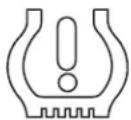
As an added safety feature, your vehicle has been equipped with a tire pressure monitoring system (TPMS) that illuminates a low tire pressure telltale when one or more of your tires is significantly under-inflated. Accordingly, when the low tire pressure telltale illuminates, you should stop and check your tires as soon as possible, and inflate them to the proper pressure. Driving on a significantly under-inflated tire causes the tire to overheat and can lead to tire failure. Under-inflation also reduces fuel efficiency and tire tread life, and may affect the vehicle's handling and stopping ability.
Please note that the TPMS is not a substitute for proper tire maintenance, and it is the driver's responsibility to maintain correct tire pressure, even if under-inflation has not reached the level to trigger illumination of the TPMS low tire pressure telltale.
Your vehicle has also been equipped with a TPMS malfunction indicator to indicate when the system is not operating properly. The TPMS malfunction indicator is combined with the low tire pressure telltale. When the system detects a malfunction, the telltale will flash for approximately one minute and then remain continuously illuminated. This sequence will continue upon subsequent vehicle start-ups as long as the malfunction exists.
When the malfunction indicator is illuminated, the system may not be able to detect or signal low tire pressure as intended. TPMS malfunctions may occur for a variety of reasons, including the installation of replacement or alternate tires or wheels on the vehicle that prevent the TPMS from functioning properly. Always check the TPMS malfunction telltale after replacing one or more tires or wheels on your vehicle to ensure that the replacement or alternate tires and wheels allow the TPMS to continue to function properly.
Tires, Wheels and Loading
The Tire Pressure Monitoring System complies with part 15 of the FCC rules and with RSS-210 of Industry Canada. Operation is subject to the following two conditions: (1) This device may not cause harmful interference, and (2) This device must accept any interference received, including interference that may cause undesired operation.
WARNING: The Tire Pressure Monitoring System is NOT a substitute for manually checking tire pressure. The tire pressure should be checked periodically (at least monthly) using a tire gauge, see Inflatingyourtiresinthischapter.Failuretoproperly maintainyourtirepressurecouldincreasetheriskoftire failure,lossofcontrol,vehiclerolloverandpersonalinjury.
ChangingtireswithTPMS
Eachroadtireisequipped with atirepressuresensorlocated insidethetire/wheelcavity. The pressuresensorisattached to thevalvestem. The pressure sensoriscoveredbythetire and isnotvisibleunlesssthetireis removed. Caremustbetaken whenchangingthetiretoavoid damagingthesensor. It is
recommended that you always have your tires serviced by an authorized dealer.
The tire pressure should be checked periodically (at least monthly) using an accurate tire gauge, refer to Inflatingyourtires in this chapter.
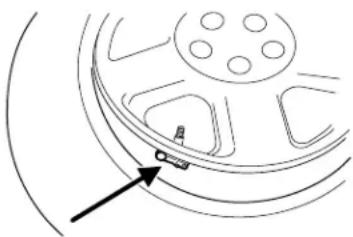
natural_image
Diagram of a car wheel rim with a key inserted, showing no text or symbolsTires, Wheels and Loading
Understanding your Tire Pressure Monitoring System (TPMS)
The Tire Pressure Monitoring System measures pressure in your four road tires and sends the tire pressure readings to your vehicle. The Low Tire Pressure Warning Lamp will turn ON if the tire pressure is significantly low. Once the light is illuminated, your tires are under inflated and need to be inflated to the manufacturer's recommended tire pressure. Even if the light turns ON and a short time later turns OFF, your tire pressure still needs to be checked. Visit www.checkmytires.org for additional information.
Whenyourtemporarysparetireisinstalled
When one of your road tires needs to be replaced with the temporary spare, the TPMS system will continue to identify an issue to remind you that the damaged road wheel/tire needs to be repaired and put back on your vehicle.
To restore the full functionality of the Tire Pressure Monitoring System, have the damaged road wheel/tire repaired and remounted on your vehicle. For additional information, refer to ChangingtireswithTPMS in this section.
Tires, Wheels and Loading
When you believe your system is not operating properly
The main function of the Tire Pressure Monitoring System is to warn you when your tires need air. It can also warn you in the event the system is no longer capable of functioning as intended. Please refer to the following chart for information concerning your Tire Pressure Monitoring System:
| LowTirePressure WarningLight | PossiblecauseC | CustomerActionRequired |
| Solid Warning Light Tire(s) under-inflated | 1. Check your tire pressure to ensure tires are properly inflated; refer to Inflating yourtiresin this chapter.2. After inflating your tires to the manufacturer's recommended inflation pressure as shown on the Tire Label (located on the edge of driver's door or the B-Pillar), the vehicle must be driven for at least two minutes over 20 mph (32 km/h) before the light will turn OFF. | |
| Spare tire in use Your temporary spare tire is in use. Repair the damaged road wheel/tire and reinstall it on the vehicle to restore system functionality. For a description on how the system functions, refer to Whenyourtemporary sparetireisinstalledin this section. | ||
| TPMS malfunction If your tires are properly inflated and your spare tire is not in use and the light remains ON, have the system inspected by your authorized dealer. | ||
Tires, Wheels and Loading
| LowTirePressure WarningLight | PossiblecauseC | CustomerActionRequired |
| Flashing Warning Light | Spare tire in use | Your temporary spare tire is in use. Repair the damaged road wheel and re-mount it on the vehicle to restore system functionality. For a description of how the system functions under these conditions, refer to Whenyourtemporaryspare tireisinstalledin this section. |
| TPMS malfunction | If your tires are properly inflated and your spare tire is not in use and the TPMS warning light still flashes, have the system inspected by your authorized dealer. |
Wheninflatingyourtires
When putting air into your tires (such as at a gas station or in your garage), the Tire Pressure Monitoring System may not respond immediately to the air added to your tires.
It may take up to two minutes of driving over 20 mph (32 km/h) for the light to turn OFF after you have filled your tires to the recommended inflation pressure.
Howtemperature affects your tire pressure
The Tire Pressure Monitoring System (TPMS) monitors tire pressure in each pneumatic tire. While driving in a normal manner, a typical passenger tire inflation pressure may increase approximately 2 to 4 psi (14 to 28 kPa) from a cold start situation. If the vehicle is stationary over night with the outside temperature significantly lower than the daytime temperature, the tire pressure may decrease approximately 3 psi (20.7 kPa) for a drop of 30^ F ( 16.6^ C) in ambient temperature. This lower pressure value may be detected by the TPMS as being significantly lower than the recommended inflation pressure and activate the TPMS warning for low tire pressure. If the low tire pressure warning light is ON, visually check each tire to verify that no tire is flat. (If one or more tires are flat, repair as necessary.) Check air pressure in the road tires. If any tire is under-inflated, carefully drive the vehicle to the nearest location where air can be added to the tires. Inflate all the tires to the recommended inflation pressure.
Tires, Wheels and Loading
SNOW TIRES AND CABLES

WARNING: Snow tires must be the same size, load index, speed rating as those originally provided by Mazda. Use of any tire or wheel not recommended by Mazda can affect the safety and performance of your vehicle, which could result in an increased risk of loss of vehicle control, vehicle rollover, personal injury and death. Additionally, the use of non-recommended tires and wheels could cause steering, suspension, axle or transfer case/power transfer unit failure.
The tires on your vehicle have all weather treads to provide traction in rain and snow. However, in some climates, you may need to use snow tires and cables. If you need to use cables, it is recommended that steel wheels (of the same size and specifications) be used, as cables may chip aluminum wheels.
Follow these guidelines when using snow tires and traction devices:
- SAE class "S" cables should ONLY be used on the front axle for P235/70R16 tires.
- Install cables securely, verifying that the cables do not touch any wiring, brake lines or fuel lines.
- Drive cautiously. If you hear the cables rub or bang against the vehicle, stop and retighten them. If this does not work, remove the cables to prevent vehicle damage.
- Avoid overloading your vehicle.
- Remove the cables when they are no longer needed.
- Do not use cables on dry roads.
- Do not exceed 30 mph (48 km/h) with tire cables on your vehicle. Consult your authorized dealer for information on other Mazda Motor Corporation approved methods of traction control.
VEHICLE LOADING – WITH AND WITHOUT A TRAILER
This section will guide you in the proper loading of your vehicle and/or trailer, to keep your loaded vehicle weight within its design rating capability, with or without a trailer. Properly loading your vehicle will provide maximum return of vehicle design performance. Before loading your vehicle, familiarize yourself with the following terms for determining your vehicle's weight ratings, with or without a trailer, from the vehicle's Tire Label or Safety Compliance Certification Label:
BaseCurbWeight- is the weight of the vehicle including a full tank of fuel and all standard equipment. It does not include passengers, cargo, or optional equipment.
Tires, Wheels and Loading
VehicleCurbWeight— is the weight of your new vehicle when you picked it up from your authorized dealer plus any aftermarket equipment.

text_image
PAYLOAD = + +Payload- is the combined weight of cargo and passengers that the vehicle is carrying. The maximum payload for your vehicle can be found on the Tire Label on the B-Pillar or the edge of the driver's door (vehicles exported outside the US and Canada may not have a Tire Label). Look for "THECOMBINEDWEIGHTOFOCCUPANTSAND CARGOSHOULDNEVEREXCEEDXXXkgORXXXlb."for maximum payload. The payload listed on the Tire Label is the maximum payload for the vehicle as built by the assembly plant. If any aftermarket or authorized-dealer installed equipment has been installed on the vehicle, the weight of the equipment must be subtracted from the payload listed on the Tire Label in order to determine the new payload.
WARNING: The appropriate loading capacity of your vehicle can be limited either by volume capacity (how much space is available) or by payload capacity (how much weight the vehicle should carry). Once you have reached the maximum payload of your vehicle, do not add more cargo, even if there is space available. Overloading or improperly loading your vehicle can contribute to loss of vehicle control and vehicle rollover.
Tires, Wheels and Loading
Exampleonly:
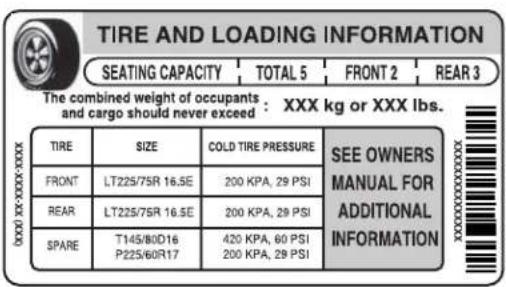
text_image
TIRE AND LOADING INFORMATION SEATING CAPACITY TOTAL 5 FRONT 2 REAR 3 The combined weight of occupants : XXX kg or XXX lbs. and cargo should never exceed TIRE SIZE COLD TIRE PRESSURE SEE OWNERS FRONT LT225/75R 16.5E 200 KPA, 29 PSI MANUAL FOR REAR LT225/75R 16.5E 200 KPA, 29 PSI ADDITIONAL SPARE T145/BOD16 420 KPA, 60 PSI INFORMATION P225/60R17 200 KPA, 29 PSI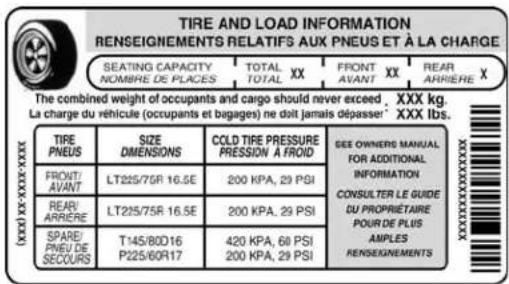
text_image
TIRE AND LOAD INFORMATION RENSEIGNEMENTS RELATIFS AUX PNEUS ET À LA CHARGE SEATING CAPACITY TOTAL XX FRONT XX REAR X NOMBRE DE PLACES TOTAL AVANT AVANT ARRIERE The combined weight of occupants and cargo should never exceed . XXX kg. La charge du véhicule (occupants et bagages) ne doit jamais dépasser' XXX lbs. TIRE SIZE COLD TIRE PRESSURE SEE OWNERS MANUAL PNEUS DIMENSIONS PRESSION À FROID FOR ADDITIONAL INFORMATION CONSULTER LE GUIDE DU PROPRIÉTAIRE POUR DE PLUS AMPLES RENSEIGNEMENTS FRONT/AVANT LT225/75R 16.5E 200 KPA, 29 PSI REAR ARRIÈRE LT225/75R 16.5E 200 KPA, 29 PSI SPARE/PNEU DE SECCOURS T145/80D16 420 KPA, 60 PSI P225/60R17 200 KPA, 29 PSI
text_image
CARGO = +CargoWeight– includes all weight added to the Base Curb Weight, including cargo and optional equipment. When towing, trailer tongue load or king pin weight is also part of cargo weight.
GAW(GrossAxleWeight)– is the total weight placed on each axle (front and rear) – including vehicle curb weight and all payload.
Tires, Wheels and Loading
GAWR(GrossAxleWeightRating)—is the maximum allowable weight that can be carried by a single axle (front or rear). These numbersareshownontheSafetyComplianceCertificationLabel locatedontheB-Pillarortheedgeofthedriver'sdoor. Thetotal loadoneachaxlemustneverexceeditsGAWR.
Note: For trailer towing information refer to Trailer towing found in this chapter or the RVandTrailerTowingGuideprovided by your authorized dealer.

text_image
GVW = + + + + +GVW(GrossVehicleWeight)—is the Vehicle Curb Weight + cargo + passengers.
GVWR(GrossVehicleWeight Rating)—is the maximum allowable weight of the fully loaded vehicle (including all options, equipment, passengers and cargo). TheGVWRisshownonthe SafetyComplianceCertification LabellocatedontheB-Pillaror theedgeofthedriver'sdoor. TheGVWmustneverexceedthe GVWR.

text_image
MFD. BY FORD MOTOR CO. IN U.S.A. FOR MAZDA MOTOR CORPORATION DATE: XX/XX GVWR: XXXXXLB/XXXXXKG FRONT GAWR: XXXXL REAR GAWR: XXXXXLB XXXXKG WITH XXXXKG WITH XXXX/XXXXXXXX TIRES XXXX/XXXXXXXX TIRES XXXX.XX RIMS XXXX.XX RIMS AT XXX KPA/XX PSI COLD AT XXX KPA/XX PSI COLD THIS VEHICLE CONFORMS TO ALL APPLICABLE FEDERAL MOTOR VEHICLE SAFETY AND THEFT PREVENTION STANDARDS IN EFFECT ON THE DATE OF MANUFACTURE SHOWN ABOVE. VIN: XXXXXXXXXXXXXXX TYPE: XXX EXT PNT: XX RC: XX DSO: WB 'BRK 'INT TR 'TP/PS 'R 'AXLE 'TR SPR 'XXXXX XXX X XX X XX X XX XXX XXXXXXXXXXXX XXX XXXX-XXXXXXXX-XXTires, Wheels and Loading
WARNING: Exceeding the Safety Compliance Certification Label vehicle weight rating limits could result in substandard vehicle handling or performance, engine, transmission and/or structural damage, serious damage to the vehicle, loss of control and personal injury.
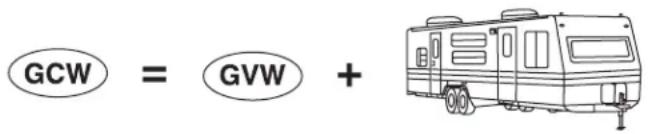
text_image
GCW = GVW +GCW(GrossCombinedWeight)- is the weight of the loaded vehicle (GVW) plus the weight of the fully loaded trailer.
GCWR(GrossCombinedWeightRating)—is the maximum allowable weight of the vehicle and the loaded trailer – including all cargo and passengers – that the vehicle can handle without risking damage. (Important: The towing vehicle's braking system is rated for operation at GVWR, not at GCWR.) Separate functional brakes should be used for safe control of towed vehicles and for trailers where the GCW of the towing vehicle plus the trailer exceed the GVWR of the towing vehicle. TheGCWmustneverexceedtheGCWR.
MaximumLoadedTrailerWeight– is the highest possible weight of a fully loaded trailer the vehicle can tow. It assumes a vehicle with only mandatory options, no cargo (internal or external), a tongue load of 10–15% (conventional trailer) or king pin weight of 15–25% (fifth wheel trailer), and driver only (150 lb. [68 kg]). Consultyourauthorized dealer(ortheRVandTrailerTowingGuideprovidedbyyourauthorizeddealer)formoredetailedinformation.
TongueLoaderFifthWheelKingPinWeight—refers to the amount of the weight that a trailer pushes down on a trailer hitch.
Examples: For a 5,000 lb. (2,268 kg) conventional trailer, multiply 5,000 by 0.10 and 0.15 to obtain a proper tongue load range of 500 to 750 lb. (227 to 340 kg). For an 11,500 lb. (5,216 kg) fifth wheel trailer, multiply by 0.15 and 0.25 to obtain a proper king pin load range of 1,725 to 2,875 lb. (782 to 1,304 kg)

WARNING: Do not exceed the GVWR or the GAWR specified on the Safety Compliance Certification Label.
Tires, Wheels and Loading
WARNING: Do not use replacement tires with lower load carrying capacities than the original tires because they may lower the vehicle's GVWR and GAWR limitations. Replacement tires with a higher limit than the original tires do not increase the GVWR and GAWR limitations.
WARNING: Exceeding any vehicle weight rating limitation could result in serious damage to the vehicle and/or personal injury.
Stepsfordeterminingthecorrectloadlimit:
- Locate the statement "The combined weight of occupants and cargo should never exceed XXX kg or XXX lb." on your vehicle's placard.
- Determine the combined weight of the driver and passengers that will be riding in your vehicle.
- Subtract the combined weight of the driver and passengers from XXX kg or XXX lb.
- The resulting figure equals the available amount of cargo and luggage load capacity. For example, if the "XXX" amount equals 1,400 lb. and there will be five 150 lb. passengers in your vehicle, the amount of available cargo and luggage load capacity is 650 lb. (1400-750 (5 x 150) = 650 lb.). In metric units (635-340 (5 x 68) = 295 kg.)
- Determine the combined weight of luggage and cargo being loaded on the vehicle. That weight may not safely exceed the available cargo and luggage load capacity calculated in Step 4.
- If your vehicle will be towing a trailer, load from your trailer will be transferred to your vehicle. Consult this manual to determine how this reduces the available cargo and luggage load capacity of your vehicle.
The following gives you a few examples on how to calculate the available amount of cargo and luggage load capacity:
- Another example for your vehicle with 1,400 lb. (635 kg) of cargo and luggage capacity. You decide to go golfing. Is there enough load capacity to carry you, 4 of your friends and all the golf bags? You and four friends average 220 lb. (99 kg) each and the golf bags weigh approximately 30 lb. (13.5 kg) each. The calculation would be: 1400 - (5 x 220) - (5 x 30) = 1400 - 1100 - 150 = 150 lb. Yes, you have enough load capacity in your vehicle to transport four friends and your golf bags. In metric units, the calculation would be: 635 kg - (5 x 99 kg) - (5 x 13.5 kg) = 635 - 495 - 67.5 = 72.5 kg.
Tires, Wheels and Loading
- A final example for your vehicle with 1,400 lb. (635 kg) of cargo and luggage capacity. You and one of your friends decide to pick up cement from the local home improvement store to finish that patio you have been planning for the past 2 years. Measuring the inside of the vehicle with the rear seat folded down, you have room for 12-100 lb. (45 kg) bags of cement. Do you have enough load capacity to transport the cement to your home? If you and your friend each weigh 220 lb. (99 kg), the calculation would be: 1400 - (2 x 220) - (12 x 100) = 1400 - 440 - 1200 = -240 lb. No, you do not have enough cargo capacity to carry that much weight. In metric units, the calculation would be: 635 kg - (2 x 99 kg) - (12 x 45 kg) = 635 - 198 - 540 = -103 kg. You will need to reduce the load weight by at least 240 lb. (104 kg). If you remove 3-100 lb. (45 kg) cement bags, then the load calculation would be:
1400 - (2 x 220) - (9 x 100) = 1400 - 440 - 900 = 60 lb. Now you have the load capacity to transport the cement and your friend home. In metric units, the calculation would be: 635 kg - (2 x 99 kg) - (9 x 45 kg) = 635 - 198 - 405 = 32 kg.
The above calculations also assume that the loads are positioned in your vehicle in a manner that does not overload the Front or the Rear Gross Axle Weight Rating specified for your vehicle on the Safety Compliance Certification Label found on the edge of the driver's door.
Special loading instructions for owners of pickup trucks and utility-type vehicles

WARNING: For important information regarding safe operation of this type of vehicle, see the Preparingtodriveyour
vehicle section in the Driving chapter of this Owner's Manual.

WARNING: Loaded vehicles may handle differently than unloaded vehicles. Extra precautions, such as slower speeds and used stopping distance, should be taken when driving a heavily d vehicle.
Your vehicle can haul more cargo and people than most passenger cars. Depending upon the type and placement of the load, hauling cargo and people may raise the center of gravity of the vehicle.
Tires, Wheels and Loading
TRAILER TOWING
Mazda strongly discourages towing with the Tribute Hybrid vehicle. Your vehicle is not equipped to tow. No towing packages or towing accessories are available through your dealer.
RECREATIONAL TOWING
An example of “recreational towing” is towing your vehicle behind a motorhome.
Your vehicle may be "flat-towed" (all wheels on the ground) by shifting the transmission into Neutral. This is permitted for Front Wheel Drive (FWD) or Four-Wheel Drive (4WD) vehicles. Your vehicle may be towed up to a speed of 75 mph (120 km/h) but you should always obey local speed limits.
Note: The Hybrid brake system is capable of providing full brake assist with the ignition off. This may cause the vehicle's 12-volt battery to become discharged when a portable braking system is used to activate the vehicle's brakes.
You also have the option of trailering the vehicle with its front wheels on a dolly (FWD only), or trailering with all four wheels off the ground.
For other towing requirements, refer to Wreckertowing in the Roadside Emergencies chapter.
Driving
STARTING
Positions of the ignition
- Off— locks the gearshift lever and allows key removal.
- Accessory— allows the electrical accessories such as the radio to operate while the vehicle is not running.
- On— all electrical circuits operational and warning lights will illuminate. This is the position the key is in when you're driving.
- Start—starts the engine, vehicle and electrical power systems.
Preparing to start your vehicle
Engine starting is controlled by the electronically-controlled Continuously Variable Transaxle (eCVT). For more information on starting the vehicle, refer to Startingthevehicle in this chapter.
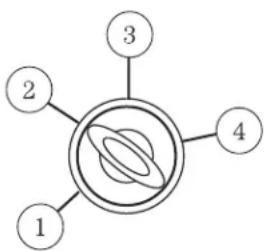
flowchart
graph TD
    A["1"] --> B["2"]
    B --> C["3"]
    C --> D["4"]

WARNING: Extended idling at high engine speeds can produce very high temperatures in the engine and exhaust system, ing the risk of fire or other damage.

WARNING: Do not park, idle, or drive your vehicle in dry grass or other dry ground cover. The emission system heats up the e compartment and exhaust system, which can start a fire.

WARNING: Do not start your vehicle in a closed garage or in other enclosed areas. Exhaust fumes can be toxic. Always open garage door before you start the engine. See Guardingagainstustfumesinthischapterformoreinstructions.

WARNING: If you smell exhaust fumes inside your vehicle, have your dealer inspect your vehicle immediately. Do not drive if you exhaust fumes.
Driving
Important safety precautions
A computer system controls the engine's idle revolutions per minute (RPM). When the engine starts, the idle RPM runs higher than normal in order to warm the engine. If the engine idle speed does not slow down automatically, have the vehicle checked.
Before starting the vehicle:
- Make sure all vehicle occupants have buckled their seat belts. For more information on seat belts and their proper usage, refer to the SeatingandSafetyRestraintschapter.
- Make sure vehicle accessories are off.
- Make sure the parking brake is set.
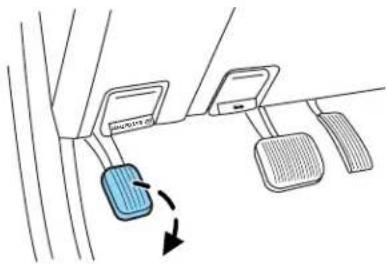
text_image
Diagram showing a blue component being lifted by a doorbell, with arrows indicating motion or force direction.- Make sure the gearshift lever is in P (Park).
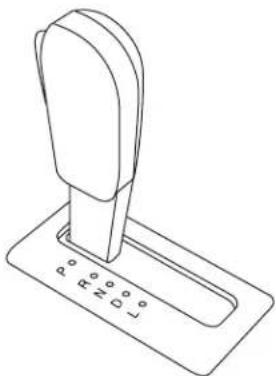
natural_image
Line drawing of a mechanical lever with labeled ports (no text or symbols beyond basic labels)Driving
- Turn the key to 3 (on) without turning the key to 4 (start).
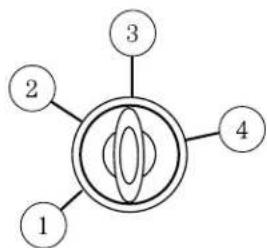
flowchart
graph TD
    A["1"] --> B["2"]
    B --> C["3"]
    C --> D["4"]
Some warning lights will briefly illuminate. See Warninglightsand chimesin the InstrumentClusterchapter for more information regarding the warning lights.
Starting the vehicle
- Turn the key to 3 (on) without turning the key to 4 (start). If there is difficulty in turning the key, rotate the steering wheel until the key turns freely. This condition may occur when:
• the front wheels are turned
- a front wheel is against the curb
-
Turn the key to 4 (start), then release the key as soon as the engine begins cranking. Your vehicle has a computer assisted cranking system that assists in starting the engine. After releasing the key from the 4 (start) position, the engine may continue cranking for up to 10 seconds or until the vehicle starts. Note: Cranking may be stopped at any time by turning the key to the off position.
-
After idling for a few seconds, apply the brake, shift into gear and drive.
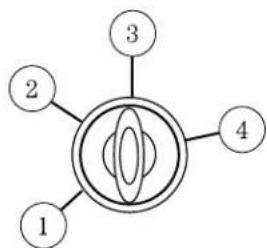
flowchart
graph TD
    A["1"] --> B["2"]
    B --> C["3"]
    C --> D["4"]
Note: After the vehicle has been started, a vehicle symbol (called the Ready Indicator Light) will appear in the instrument cluster to indicate the vehicle is on. This indicator will

remain on while the vehicle is on, whether the engine is running or not, to indicate the vehicle is capable of movement (using its electric motor, engine, or both).
Driving
Note: After starting the vehicle, the engine may stop running to conserve fuel after it is warmed-up and the high voltage battery is sufficiently charged.
Note: If the vehicle does not start, put the gearshift lever into P (Park), turn the ignition off, then attempt to start the vehicle again. If the vehicle still does not start, it may require refueling, jump starting, resetting of the fuel pump/high voltage shut-off switches or service. For information on jump starting the vehicle and resetting the fuel pump/high voltage shut-off switches, refer to the Jumpstartingyour vehiclesection and the Fuelpump/Highvoltageshut-offswitches section found in the RoadsideEmergencieschapter.
Guarding against exhaust fumes
Carbon monoxide is present in exhaust fumes. Take precautions to avoid its dangerous effects.

WARNING: If you smell exhaust fumes inside your vehicle, have your dealer inspect your vehicle immediately. Do not drive if you exhaust fumes.
Important ventilating information
If the engine is idling while the vehicle is stopped for a long period of time, open the windows at least one inch (2.5 cm) or adjust the heating or air conditioning to bring in fresh air.
ENGINE BLOCK/HIGH VOLTAGE BATTERY HEATER (IF EQUIPPED)
An engine block/high voltage battery heater warms the engine coolant and high voltage battery cells which aids in starting and allows the heater/defroster system to respond quickly. If your vehicle is equipped with this system, your equipment includes a heater element which is installed in your engine block and a wire harness which allows the user to connect the system to a grounded 120 volt a/c electrical source. The block heater system is most effective when outdoor temperatures reach below 0^ F ( -18^ C).

WARNING: Failure to follow engine block heater instructions could result in property damage or physical harm.
Driving

WARNING: To reduce the risk of electrical shock, do not use your heater with ungrounded electrical systems or two-pronged ter) adapters.
Prior to using the engine block heater, follow these recommendations for proper and safe operation:
- For your safety, use an outdoor extension cord that is product certified by Underwriter's Laboratory (UL) or Canadian Standards Association (CSA). Use only an extension cord that can be used outdoors, in cold temperatures, and is clearly marked "Suitable for Use with Outdoor Appliances." Never use an indoor extension cord outdoors; it could result in an electric shock or fire hazard.
- Use a 16 gauge outdoor extension cord, minimum.
- Use as short an extension cord as possible.
- Do not use multiple extension cords. Instead, use one extension cord which is long enough to reach from the engine block heater cord to the outlet without stretching.
- Make certain that the extension cord is in excellent condition (not patched or spliced). Store your extension cord indoors at temperatures above 32^ (0^) . Outdoor conditions can deteriorate extension cords over a period of time.
- To reduce the risk of electrical shock, do not use your heater with ungrounded electrical systems or two pronged (cheater) adapters. Also ensure that the block heater, especially the cord, is in good condition before use.
- Make sure that when in operation, the extension cord plug /engine block heater cord plug connection is free and clear of water in order to prevent possible shock or fire.
- Be sure that areas where the vehicle is parked are clean and clear of all combustibles such as petroleum products, dust, rags, paper and similar items.
- Be sure that the engine block heater, heater cord and extension cord are solidly connected. A poor connection can cause the cord to become very hot and may result in an electrical shock or fire. Be sure to check for heat anywhere in the electrical hookup once the system has been operating for approximately a half hour.
- Finally, have the engine block heater system checked during your fall tune-up to be sure it's in good working order.
Driving
Howtousetheengineblockheater
Ensure the receptacle terminals are clean and dry prior to use. To clean them, use a dry cloth.
Depending on the type of factory installed equipment, your engine block heater system may consume anywhere between 400 watts or 1000 watts of energy per hour. Your factory installed block heater system does not have a thermostat; however, maximum temperature is attained after approximately 3 hours of operation. Block heater operation longer than 3 hours will not improve system performance and will unnecessarily use additional electricity.
Make sure system is unplugged and properly stowed before driving the vehicle. While not in use, make sure the protective cover seals the prongs of the engine block heater cord plug.
BRAKES
Occasional brake noise is normal. If a metal-to-metal, continuous grinding or continuous squeal sound is present, the brake linings may be worn-out and should be inspected by an authorized dealer. If the vehicle has continuous vibration or shudder in the steering wheel while braking, the vehicle should be inspected by an authorized dealer.
Refer to Brakesystemwarning light in the InstrumentCluster chapter for information on the brake system warning light.

Under normal operating conditions, brake dust may accumulate on the wheels. Some brake dust is inevitable as brakes wear and does not contribute to brake noise. The use of modern friction materials with emphasis on improved performance and environmental considerations can lead to more dust than in the past. Brake dust can be cleaned by weekly washing with soapy water and a soft sponge. Heavier deposits can be removed with Mazda Wheel and Tire Cleaner (ZC-37-A).
Four-wheel anti-lock brake system (ABS)
Your vehicle is equipped with an Anti-lock Braking System (ABS). This system helps you maintain steering control during emergency stops by keeping the brakes from locking. Noise from the ABS pump motor and brake pedal pulsation may be observed during ABS braking and the brake pedal may suddenly travel a little farther as soon as ABS braking is done and normal brake operation resumes. These are normal characteristics of the ABS and should be no reason for concern.
Driving
UsingABS
When hard braking is required, apply continuous force on the brake pedal; do not pump the brake pedal since this will reduce the effectiveness of the ABS and will increase your vehicle's stopping distance. The ABS will be activated immediately, allowing you to retain steering control during hard braking and on slippery surfaces. However, the ABS does not decrease stopping distance.
ABSwarninglamp
The ABS lamp in the instrument cluster momentarily illuminates when the ignition is turned on. If the light does not illuminate during start up, remains on or flashes, the ABS may be disabled and may need
Even when the ABS is disabled, normal braking is still effective. If your BRAKE warning lamp illuminates with the parking brake released, have your brake system serviced immediately by an author

Regenerative Braking System (RBS)
Your vehicle uses a feature known as regenerative braking. This is used to simulate the engine braking of an internal combustion engine and assist the standard brake system while recovering some of the energy of motion and storing it in the battery to improve fuel economy. The standard brake system is designed to fully stop the car if regenerative braking is not available. During regenerative braking, the motor is spun as a generator to create electrical current. This recharges the high voltage battery and slows the vehicle. In effect, once the accelerator pedal is released, the motor changes from an energy user to an energy producer.
When the accelerator pedal is released or the brake pedal is applied, the brake controller automatically detects the amount of deceleration requested and optimizes how much of the deceleration will be produced by regenerative braking. The remaining portion is generated by standard friction braking. When the battery is almost fully charged, the amount of regenerative braking is limited to avoid overcharging, and the requested deceleration is produced by standard friction braking alone.
Driving
Regenerative braking does not take the place of the standard friction brakes; it only assists them. Regenerative braking has also been designed to interact with the anti-lock brake system (ABS). Regenerative braking is disabled when the ABS is activated or the battery is fully charged.
Parking brake
Apply the parking brake whenever the vehicle is parked. To set the parking brake, press the parking brake pedal down until the pedal stops.
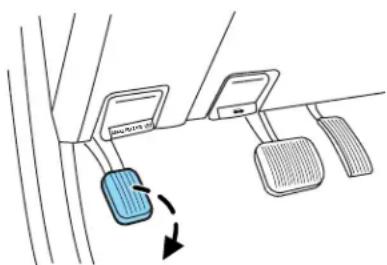
text_image
SALAWAR 100 →The BRAKE warning lamp in the instrument cluster illuminates and remains illuminated (when the ignition is turned on) until the parking brake is released.


WARNING: If the parking brake is fully released, but the brake warning lamp remains illuminated, the brakes may not be being properly. See your authorized dealer.

WARNING: Always set the parking brake fully and make sure that the gearshift is securely latched in P (Park).
The parking brake is not recommended to stop a moving vehicle. However, if the normal brakes fail, the parking brake can be used to stop your vehicle in an emergency. Since the parking brake applies only the rear brakes, the vehicle's stopping distance will increase greatly and the handling of your vehicle will be adversely affected.
Driving
Pull the release lever to release the brake. Driving with the parking brake on will cause the brakes to wear out quickly and reduce fuel economy.
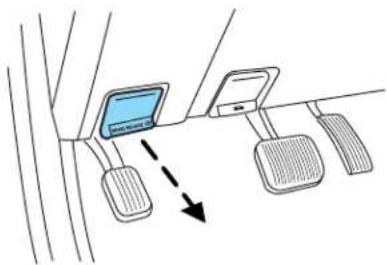
text_image
Diagram showing a device connected to three labeled ports with an arrow indicating direction or flow.ELECTRONIC STABILITY CONTROL (ESC) SYSTEM
WARNING: Vehicle modifications involving braking system, aftermarket roof racks, suspension, steering system, tire construction and/or wheel/tire size may change the handling characteristics of the vehicle and may adversely affect the performance of the AdvanceTrac® with RSC® system. In addition, installing any stereo loudspeakers may interfere with and adversely affect the AdvanceTrac® with RSC® system. Install any aftermarket stereo loudspeaker as far as possible from the front center console, the tunnel, and the front seats in order to minimize the risk of interfering with the AdvanceTrac® with RSC® sensors. Reducing the effectiveness of the AdvanceTrac® with RSC® system could lead to an increased risk of loss of vehicle control, vehicle rollover, personal injury and death.
WARNING: Remember that even advanced technology cannot defy the laws of physics. It's always possible to lose control of a vehicle due to inappropriate driver input for the conditions. Aggressive driving on any road condition can cause you to lose control of your vehicle increasing the risk of personal injury or property damage. Activation of the AdvanceTrac® with RSC® system is an indication that at least some of the tires have exceeded their ability to grip the road; this could reduce the operator's ability to control the vehicle, potentially resulting in a loss of vehicle control, vehicle rollover, personal injury and death. If your AdvanceTrac® with RSC® system activates, SLOW DOWN.
Driving
WARNING: If a failure has been detected within the AdvanceTrac® with RSC® system, the "sliding car" icon will illuminate steadily. Verify that the AdvanceTrac® with RSC® system is not manually disabled (push the AdvanceTrac® with RSC® "Off" button located on the center of the instrument panel). If the "sliding car" icon still illuminates steadily, have the system service by an authorized dealer immediately. Operating your vehicle with AdvanceTrac® with RSC® disabled could lead to an increased risk of loss of vehicle control, vehicle rollover, personal injury and death.
The AdvanceTrac® with RSC® system provides the following stability enhancement features for certain driving situations:
- Traction Control (TCS), which functions to help avoid drive-wheel spin and loss of traction.
- Electronic Stability Control (ESC), which functions to help avoid skids or lateral slides
- Roll Stability Control™ (RSC®), which functions to help avoid a vehicle roll-over.
The AdvanceTrac® with RSC® system automatically enables each time the engine is started. All features of the AdvanceTrac® with RSC® system (TCS, ESC, and RSC®) are active and monitor the vehicle from start-up. However, the system will only intervene if the driving situation requires it.
The AdvanceTrac® with RSC® system includes an AdvanceTrac® with RSC® "Off" button on the center of the instrument panel, and a "sliding car" icon in the instrument cluster. The "sliding car"
icon in the instrument cluster will illuminate temporarily during start-up as part of a normal system self-check, or during driving if a driving situation causes the AdvanceTrac® with RSC® system to operate. If the "sliding car" icon illuminates steadily, verify that the AdvanceTrac® with RSC® system is not manually disabled by pressing the AdvanceTrac® with RSC® "Off" button located on the center stack of the instrument panel. If the "sliding car" icon remains steadily illuminated, have the system serviced by an authorized dealer immediately.
Driving
When AdvanceTrac ^® with RSC ^® performs a normal system self-check, some drivers may notice a rumble, grunting, or grinding noise after startup and when driving off.
When an event occurs that activates AdvanceTrac ^® with RSC ^® you may experience the following:
• A slight deceleration of the vehicle
- The “sliding car” indicator light will flash.
- A vibration in the pedal when your foot is on the brake pedal
- If the driving condition is severe and your foot is not on the brake, the brake pedal may move as the systems applies higher brake forces. You may also hear a whoosh of air from under the instrument panel during this severe condition.
• The brake pedal may feel stiffer than usual.
TractionControl(TCS)
Traction Control is a driver aid feature that helps your vehicle maintain traction of the wheels, typically when driving on slippery and/or hilly road surfaces, by detecting and controlling wheel spin.
Excessive wheel spin is controlled in two ways, which may work separately or in tandem: Engine Traction Control and Brake Traction Control. Engine Traction Control works to limit drive-wheel spin by momentarily reducing engine power. Brake Traction Control works to limit wheel spin by momentarily applying the brakes to the wheel that is slipping. Traction Control is most active at low speeds.
During Traction Control events the “sliding car” icon 📁 in the instrument cluster will flash.
If the Traction Control system is activated excessively in a short period of time, the braking portion of the system may become temporarily disabled to allow the brakes to cool down. In this situation, Traction Control will use only engine power reduction or transfer to help control the wheels from over-spinning. When the brakes have cooled down, the system will regain all features. Anti-lock braking, RSC ^® , and ESC are not affected by this condition and will continue to function during the cool-down period.
The Engine Traction Control and Brake Traction Control system may be deactivated in certain situations. See the SwitchingOffAdvanceTrac® withRSC®section following.
Driving
ElectronicStabilityControl(ESC)
Electronic Stability Control (ESC) may enhance your vehicle's directional stability during adverse maneuvers, for example when cornering severely or avoiding objects in the roadway. ESC operates by applying brakes to one or more of the wheels individually and, if necessary, reducing engine power if the system detects that the vehicle is about to skid or slide laterally.
During Electronic Stability Control events the "sliding car" icon in the instrument cluster will flash.
Certain adverse driving maneuvers may activate the Electronic Stability Control system, which include but are not limited to:
• Taking a turn too fast
- Maneuvering quickly to avoid an accident, pedestrian or obstacle
- Driving over a patch of ice or other slippery surfaces
- Changing lanes on a snow-rutted road
- Entering a snow-free road from a snow-covered side street, or vice versa
- Entering a paved road from a gravel road, or vice versa
- Cornering while towing a heavily loaded trailer (refer to Trailer towing in the Tires, WheelsandLoadingchapter).
The Electronic Stability Control system may be deactivated in certain situations. See the Switching Off AdvanceTrac ^® with RSC ^® section following.
RollStabilityControl™(RSC®)
Roll Stability Control™ (RSC®) may help to maintain roll stability of the vehicle during adverse maneuvers. RSC® operates by detecting the vehicle's roll motion and the rate at which it changes and by applying the brakes to one or more wheels individually.
During an event that activates the Roll Stability Control™ (RSC®) the "sliding car" icon 📁 in the instrument cluster will flash.
Certain adverse driving maneuvers may activate the Roll Stability Control system, which include:
• Emergency lane-change
• Taking a turn too fast
- Quick maneuvering to avoid an accident, pedestrian or obstacle
Driving
The Roll Stability Control system may be deactivated in certain situations. See the Switching Off AdvanceTrac ^® with RSC ^® section following.
SwitchingOffAdvanceTrac®withRSC®
If the vehicle is stuck in snow, mud or sand, and seems to lose engine power, switching off certain features of the AdvanceTrac® with RSC® system may be beneficial because the wheels are allowed to spin. This will restore full engine power and will enhance momentum through the obstacle. To switch off the AdvanceTrac® with RSC® system press the AdvanceTrac® with RSC® "Off" button. Full features of the AdvanceTrac® with RSC® system can be restored by pressing the AdvanceTrac® with RSC® "Off" button again or by turning off and restarting the engine.
If you switch off the AdvanceTrac® with RSC® system, the sliding car" icon will illuminate steadily. Pressing the AdvanceTrac® with RSC® "Off" button again will turn off the "sliding car" icon .
In R (Reverse), ABS and the Engine and Brake Traction Control features will continue to function; however, ESC and RSC ^® are disabled.
| AdvanceTrac®withRSC®Features | ||||
| Button functions | “Sliding car” icon 📁 | RSC®ESC | Traction Control | |
| Default at start-up | Illuminated during bulb check | Enabled Enabled Enabled | ||
| Button pressed momentarily | Illuminated solid | Enabled Enabled Disabled | ||
| Button pressed again after deactivation | Not illuminated | Enabled Enabled Enabled | ||
STEERING
Your vehicle is equipped with an Electric Power-Assisted Steering (EPAS) system. There is no fluid reservoir to check or fill.
If your vehicle loses electrical power while you are driving (or if the ignition is turned off), you can steer the vehicle manually, but it takes more effort. Under extreme usage conditions, the steering effort may increase. This occurs to prevent overheating and permanent damage to
Driving
your steering system. If this should occur, you will neither lose the ability to steer the vehicle manually nor will it cause permanent damage. Typical steering and driving maneuvers will allow the system to cool and steering assist will return to normal.
If the steering wanders or pulls, check for:
- an improperly inflated tire
- uneven tire wear
- loose or worn suspension components
- loose or worn steering components
• improper steering alignment
A high crown in the road or high crosswinds may also make the steering seem to wander/pull.
PREPARING TO DRIVE

WARNING: Utility vehicles have a significantly higher rollover rate than other types of vehicles.

WARNING: In a rollover crash, an unbelted person is significantly more likely to die than a person wearing a seat belt.
Utility vehicles and trucks have larger tires and increased ground clearance, giving the vehicle a higher center of gravity than a passenger car.

WARNING: Vehicles with a higher center of gravity such as utility vehicles and trucks handle differently than vehicles with a center of gravity. Utility vehicles and trucks are not designed for riding at speeds as high as passenger cars any more than low-slung cars are designed to perform satisfactorily under off-road tions. Avoid sharp turns, excessive speed or abrupt maneuvers in vehicles. Failure to drive cautiously could result in an increased loss of vehicle control, vehicle rollover, personal injury and

WARNING: Loaded vehicles, with a higher center of gravity, may handle differently than unloaded vehicles. Do not overload vehicle and use extra precautions, such as driving at slower is, avoiding abrupt steering changes and allowing for increased distance, when driving a heavily loaded vehicle. Over-loading driving the vehicle improperly can deteriorate handling capability contribute to loss of vehicle control and vehicle rollover.
Driving
This vehicle is equipped with a brake-shift interlock feature that prevents the gearshift lever from being moved from P (Park) when the ignition is in the on position unless brake pedal is depressed.
If you cannot move the gearshift lever out of P (Park) with ignition in the on position and the brake pedal depressed, it is possible that a fuse has blown or the vehicle's brake lamps are not operating properly. Refer to Fusesandrelaysin the RoadsideEmergencieschapter.
If the fuse is not blown, perform the following procedure:
- Apply the parking brake.
- Using a screwdriver or similar tool, carefully pry out the small Brake Transmission Shift Interlock (BTSI) cover cap located to the right of the gearshift lever.
- Depress the brake pedal and then start the vehicle.
- Insert a screwdriver or similar tool straight down into the access hole and press downward while pulling the gearshift lever out of the P (Park) position and into the N (Neutral) position.
- Remove tool and reinstall BTSI cover cap.
- Release the parking brake and drive normally.

WARNING: Do not drive your vehicle until you verify that the brakelamps are working.

WARNING: Always set the parking brake fully and make sure the gearshift is latched in P (Park). Turn the ignition to the off on and remove the key whenever you leave your vehicle.
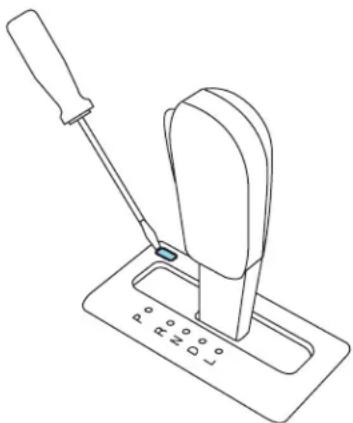
natural_image
Line drawing of a mechanical lever mechanism with no text or symbols
WARNING: If the parking brake is fully released, but the brake warning lamp remains illuminated, the brakes may not be being properly. Drive slowly and carefully to your authorized dealer
Understanding the gearshift positions of the electronically-controlled Continuously Variable Transmission (eCVT)
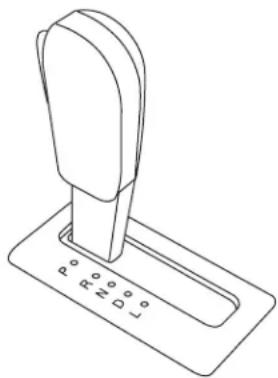
natural_image
Line drawing of a mechanical gear shift lever with no text or symbolsP(Park)
This position locks the transmission and prevents the front wheels from turning.
To put your vehicle in gear:
- Start the engine
- Release the parking brake
•Depress the brake pedal - Move the gearshift lever into the desired gear
To put your vehicle in P (Park):
- Come to a complete stop
- Move the gearshift lever and securely latch it in P (Park)
Driving

WARNING: Always set the parking brake fully and make sure the gearshift is latched in P (Park). Turn the ignition to the
LOCK position and remove the key whenever you leave your vehicle.
R(Reverse)
With the gearshift lever in R (Reverse), the vehicle will move backward. Always come to a complete stop before shifting into and out of R (Reverse).
N(Neutral)
With the gearshift lever in N (Neutral), the vehicle is free to roll; hold the brake pedal down while in this position. Because of the unique nature of the hybrid vehicle, the engine will not start in the N (Neutral) position.
The vehicle does not charge the high voltage battery in the N (Neutral) position. Do not idle the vehicle in N (Neutral) for extended periods as this will discharge your high voltage battery.
D(Drive)
The normal driving position for the best fuel economy.
L(Low)
- Provides maximum engine braking.
- The transmission may be shifted into L (Low) at any vehicle speed.

WARNING: When parking, do not use the gearshift in place of the parking brake. Always set the parking brake fully and make that the gearshift is securely latched in P (Park). Turn off the on whenever you leave your vehicle. Never leave your vehicle ended while it is running. If you do not take these precautions, vehicle may move unexpectedly and injure someone.
If your vehicle gets stuck in mud or snow
If your vehicle gets stuck in mud or snow, it may be rocked out by shifting between forward and reverse gears, stopping between shifts in a steady pattern. Press lightly on the accelerator in each gear.
Donotrockthevehicleiftheengineisnotatnormaloperating temperatureordamagetothetransmissionmayoccur.
Donotrockthevehicleformorethanaminiteordamagetothe transmissionandtiresmayoccur,ortheenginemayoverheat.
FOUR WHEEL DRIVE (4WD) SYSTEM (IF EQUIPPED)

WARNING: For important information regarding safe operation of this type of vehicle, see Preparingtodriveyourvehiclein chapter.
Your vehicle is equipped with an intelligent 4WD System that continuously monitors vehicle conditions and automatically adjusts the power distribution between the front and rear wheels. It combines transparent all-surface operation with highly capable four-wheel drive.
The 4WD system is always active and requires no driver input. It is capable of handling all road conditions, including street and highway driving as well as off-road and winter driving.
Driving off-road with truck and utility vehicles
4WD vehicles are specially equipped for driving on sand, snow, mud and rough terrain and have operating characteristics that are somewhat different from conventional vehicles, both on and off the road.
Howyourvehiclediffersfromothervehicles
Truck and utility vehicles can differ from some other vehicles. Your vehicle may be higher to allow it to travel over rough terrain without getting hung up or damaging underbody components.
The differences that make your vehicle so versatile also make it handle differently than an ordinary passenger car.
Maintain steering wheel control at all times, especially in rough terrain. Since sudden changes in terrain can result in abrupt steering wheel motion, make sure you grip the steering wheel from the outside. Do not grip the spokes.
Drive cautiously to avoid vehicle damage from concealed objects such as rocks and stumps.
You should either know the terrain or examine maps of the area before driving. Map out your route before driving in the area. To maintain steering and braking control of your vehicle, you must have all four wheels on the ground and they must be rolling, not sliding or spinning.
Basicoperatingprinciples
- Drive slower in strong crosswinds which can affect the normal steering characteristics of your vehicle.
- Be extremely careful when driving on pavement made slippery by loose sand, water, gravel, snow or ice.
Driving
If your vehicle goes off the edge of the pavement
- If your vehicle goes off the edge of the pavement, slow down, but avoid severe brake application, and ease the vehicle back onto the pavement only after reducing your speed. Do not turn the steering wheel too sharply while returning to the road surface.
- It may be safer to stay on the apron or shoulder of the road and slow down gradually before returning to the pavement. You may lose control if you do not slow down or if you turn the steering wheel too sharply or abruptly.
- It often may be less risky to strike small objects, such as highway reflectors, with minor damage to your vehicle rather than attempt a sudden return to the pavement which could cause the vehicle to slide sideways out of control or roll over. Remember, your safety and the safety of others should be your primary concern.
WARNING: Vehicles with a higher center of gravity such as utility and four-wheel drive vehicles handle differently than vehicles with a lower center of gravity. Utility and four-wheel drive vehicles are not designed for cornering at speeds as high as passenger cars any more than low-slung sports cars are designed to perform satisfactorily under off-road conditions. Avoid sharp turns, excessive speed and abrupt maneuvers in these vehicles. Failure to drive cautiously could result in an increased risk of loss of vehicle control, vehicle rollover, personal injury and death.
Ifyourvehiclegetsstuck
If your vehicle gets stuck in mud or snow it may be rocked out by shifting between forward and reverse gears, stopping between shifts, in a steady pattern. Press lightly on the accelerator in each gear.
Donotrockthevehicleiftheengineisnotatnormaloperating temperatureordamagetothetransmissionmayoccur.
Donotrockthevehicleformorethanafewminutesordamage tothetransmissionandtiresmayoccurortheenginemay overheat.
WARNING: Always set the parking brake fully and make sure the gearshift is latched in P (Park). Turn the ignition to the LOCK position and remove the key whenever you leave your vehicle.
Driving

WARNING: If the parking brake is fully released, but the brake warning lamp remains illuminated, the brakes may not be being properly. See your authorized dealer.

WARNING: Do not spin the wheels at over 35 mph (56 km/h). The tires may fail and injure a passenger or bystander.
Emergencymaneuvers
- In an unavoidable emergency situation where a sudden sharp turn must be made, remember to avoid “over-driving” your vehicle, i.e., turn the steering wheel only as rapidly and as far as required to avoid the emergency. Excessive steering will result in less vehicle control, not more. Additionally, smooth variations of the accelerator and/or brake pedal pressure should be utilized if changes in vehicle speed are required. Avoid abrupt steering, acceleration or braking which could result in an increased risk of loss of vehicle control, vehicle rollover and/or personal injury. Use all available road surface to return the vehicle to a safe direction of travel.
- In the event of an emergency stop, avoid skidding the tires and do not attempt any sharp steering wheel movements.

WARNING: Vehicles with a higher center of gravity such as utility and four-wheel drive vehicles handle differently than es with a lower center of gravity. Utility and four-wheel drives are not designed for cornering at speeds as high as passenger my more than low-slung sports cars are designed to perform factorily under off-road conditions. Avoid sharp turns, excessive and abrupt maneuvers in these vehicles. Failure to drive busly could result in an increased risk of loss of vehicle control, the rollover, personal injury and death.
- If the vehicle goes from one type of surface to another (i.e., from concrete to gravel) there will be a change in the way the vehicle responds to a maneuver (steering, acceleration or braking). Again, avoid these abrupt inputs.
Sand
When driving over sand, try to keep all four wheels on the most solid area of the trail. Avoid reducing the tire pressures and drive steadily through the terrain. Apply the accelerator slowly and avoid spinning the wheels.
Driving
Avoid excessive speed because vehicle momentum can work against you and cause the vehicle to become stuck to the point that assistance may be required from another vehicle. Remember, you may be able to back out the way you came if you proceed with caution.
Mudandwater
If you must drive through high water, drive slowly. Traction or brake capability may be limited.
When driving through water, determine the depth; avoid water higher than the bottom of the hubs (if possible) and proceed slowly. If the ignition system gets wet, the vehicle may stall.
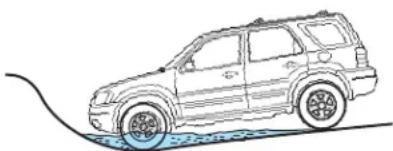
natural_image
Line drawing of a car with wheels and roof, no text or symbols presentOnce through water, always try the brakes. Wet brakes do not stop the vehicle as effectively as dry brakes. Drying can be improved by moving your vehicle slowly while applying light pressure on the brake pedal.
Be cautious of sudden changes in vehicle speed or direction when you are driving in mud. Even 4WD vehicles can lose traction in slick mud. As when you are driving over sand, apply the accelerator slowly and avoid spinning your wheels. If the vehicle does slide, steer in the direction of the slide until you regain control of the vehicle.
If the transmission, transfer case or front axle are submerged in water, their fluids should be checked and changed, if necessary.
Drivingthroughdeepwatermaydamagethetransmission.
If the front or rear axle is submerged in water, the axle lubricant should be replaced.
After driving through mud, clean off residue stuck to rotating driveshafts and tires. Excess mud stuck on tires and rotating driveshafts causes an imbalance that could damage drive components.
“Tread Lightly” is an educational program designed to increase public awareness of land-use regulations and responsibilities in our nation’s wilderness areas. Mazda Motor

Corporation joins the U.S. Forest Service and the Bureau of Land Management in encouraging you to help preserve our national forest and other public and private lands by “treading lightly.”
Driving
Drivingonhillyorslopingterrain
Although natural obstacles may make it necessary to travel diagonally up or down a hill or steep incline, you should always try to drive straight up or straight down. Avoiddrivingcrosswiseorturningonsteep
slopesorhills. A danger lies in losing traction, slipping sideways and possibly rolling over. Whenever driving on a hill, determine beforehand the route you will use. Do not drive over the crest of a hill without seeing what conditions are on the other side. Do not drive in reverse over a hill without the aid of an observer.
If you do stall out, do not try to turn around because you might roll over. It is better to back down to a safe location.
Apply just enough power to the wheels to climb the hill. Too much power will cause the tires to slip, spin or lose traction, resulting in loss of vehicle control.
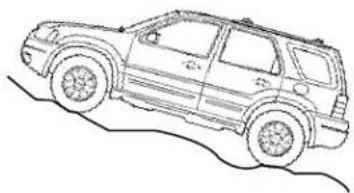
natural_image
Line drawing of a SUV in the side view, no text or symbols presentDescend a hill in the same gear you would use to climb up the hill to avoid excessive brake application and brake overheating. Do not descend in neutral; instead, disengage overdrive or manually shift to a lower gear. When descending a steep hill, avoid sudden hard braking as you could lose control. When you brake hard, the front wheels can't turn and if they aren't turning, you won't be
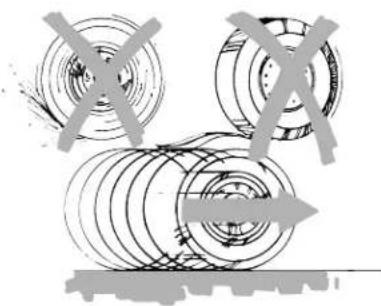
natural_image
Mechanical gear assembly diagram showing three circular components with cross-shaped cutouts (no text or labels)able to steer. The front wheels have to be turning in order to steer the vehicle. Rapid pumping of the brake pedal will help you slow the vehicle and still maintain steering control.
Since your vehicle has anti-lock brakes, apply the brakes steadily. Do not "pump" the brakes.
Driving
Drivingonsnowandice
4WD vehicles have advantages over 2WD vehicles in snow and ice but can skid like any other vehicle.
Should you start to slide while driving on snowy or icy roads, turn the steering wheel in the direction of the slide until you regain control.
Avoid sudden applications of power and quick changes of direction on snow and ice. Apply the accelerator slowly and steadily when starting from a full stop.
Avoid sudden braking as well. Although a 4WD vehicle may accelerate better than a two-wheel drive vehicle in snow and ice, it won't stop any faster, because as in other vehicles, braking occurs at all four wheels. Do not become overconfident as to road conditions.
Make sure you allow sufficient distance between you and other vehicles for stopping; drive slower than usual. Since your vehicle is equipped with a Four Wheel Anti-Lock Brake System (ABS), apply the brake steadily. Do not "pump" the brakes. Refer to the Brakessection of this chapter for additional information on the operation of the anti-lock brake system.
4WD vehicles should be driven with traction devices as referred to in Usingsnowtiresandtractiondevicesin the Tires, Wheelsand Loadingchapter.
MaintenanceandModifications
The suspension and steering systems on your vehicle have been designed and tested to provide durable load carrying capability and predictable performance whether loaded or empty. For this reason, Mazda Motor Corporation strongly recommends that you do not make modifications such as adding or removing parts (such as lift kits or stabilizer bars) or using replacement parts not equivalent to the original factory equipment.
Any modifications to a vehicle that raise the center of gravity can make it more likely the vehicle will roll over as a result of a loss of control. Mazda Motor Corporation recommends that caution be used with any vehicle equipped with a high load or device (such as ladder racks or pickup box cover).
Failure to maintain your vehicle properly may void the warranty, increase your repair cost, reduce vehicle performance and operational capabilities and adversely affect driver and passenger safety. Frequent inspection of vehicle chassis components is recommended if the vehicle is subjected to heavy off-road usage.
Driving
DRIVING THROUGH WATER
If driving through deep or standing water is unavoidable, proceed very slowly especially when the depth is not known. Never drive through water that is higher than the bottom of the wheel rims (for cars) or the bottom of the hubs (for trucks).
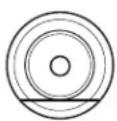
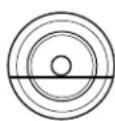
When driving through water, traction or brake capability may be limited. Also, water may enter your engine's air intake and severely damage your engine or your vehicle may stall. Drivingthroughdeepwaterwhere thetransmissionventtubeissubmergedmayallowwaterintothe transmissionandcauseinternaltransmissiondamage.
Oncethroughthewater,alwaysdrythebrakesbymovingyour vehicleslowlywhileapplyinglightpressureonthebrakepedal.
Wet brakes do not stop the vehicle as quickly as dry brakes.
Roadside Emergencies
HAZARD FLASHER CONTROL
The hazard flasher is located on the steering column, just behind the steering wheel. The hazard flashers will operate when the ignition is in any position or if the key is not in the ignition.
Push in the flasher control and all front and rear direction signals will flash. Press the flasher control again to turn them off. Use it when your vehicle is disabled and is creating a safety hazard for other motorists.

natural_image
Simple line drawing of a mechanical component with a downward arrow and triangular base (no text or symbols)Note: With extended use, the flasher may run down your low voltage (underhood) battery.
FUEL PUMP/HIGH VOLTAGE SHUT-OFF SWITCHES
The fuel pump shut-off switch stops the electric fuel pump from sending fuel to the engine and the high voltage shut-off switch shuts off power from the high voltage battery when your vehicle receives a substantial physical jolt.
After an accident, if the engine does not start, one or both of the switches may have been activated.
Roadside Emergencies
The fuel pump shut-off switch is located in the front passenger's footwell, behind a flip-up cover.
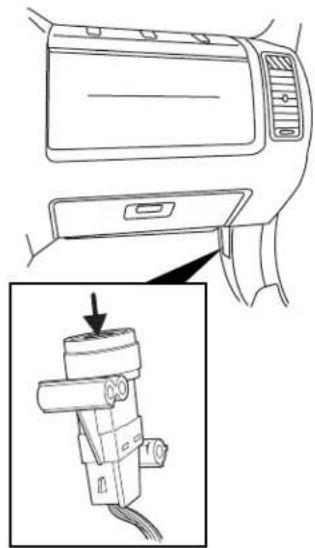
natural_image
Diagram showing a car interior with a close-up of the seatbelt device (no text or symbols present)The high voltage shut-off switch is located in the cargo area on the passenger side of the vehicle in the jack compartment, behind the jack access door. The switch is located behind the jack.
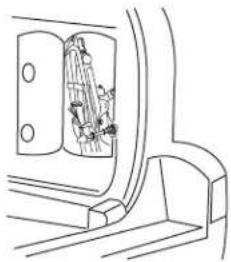
natural_image
Line drawing of a vehicle interior showing a door opening and a window with a vehicle inside (no text or symbols)2009TributeHybrid(thv) OwnersGuide,1stPrinting USA(fus)
Roadside Emergencies
To reset the switch(es):
- Turn the ignition to the off position.
- Check the fuel system for leaks.
- If no leaks are apparent, reset the switch by pushing in on the reset button. Both switches should be checked and reset.
- Turn the ignition to the on position.
- Wait a few seconds and return the key to the off position.
- Make another check for leaks.
If you see or smell fuel, do not reset the fuel pump shut-off or try to start your vehicle; you could injure yourself or others. Have all the passengers get out of the vehicle and call the local fire department or a towing service.
FUSES AND RELAYS
Fuses
If electrical components in the vehicle are not working, a fuse may have blown. Blown fuses are identified by a broken wire within the fuse. Check the appropriate fuses before replacing any electrical components.
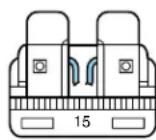
Note: Always replace a fuse with one that has the specified amperage rating. Using a fuse with a higher amperage rating can cause severe wire damage and could start a fire.
Roadside Emergencies
Standardfuseamperageratingandcolor
| COLOR | |||||
| Fuse rating | Mini fuses | Standard fuses | Maxi fuses | Cartridge maxi fuses | Fuselink cartridge |
| 2A Grey — — | — | ||||
| 3A Violet Violet — — | |||||
| 4A Pink Pink — — | |||||
| 5A Tan Tan — — | |||||
| 7.5A Brown Brown — — | |||||
| 10A | Red | Red | ——— | ||
| 15A Blue Blue — — | — | ||||
| 20A | Yellow | Yellow | Yellow | Blue | Blue |
| 25A | Natural | Natural | ——— | ||
| 30A | Green | Green | Green Pink Pink | ||
| 40A — | — Orange | Green | Green | ||
| 50A — | — Red | Red | Red | Red | |
| 60A — | — Blue | Yellow | Yellow | ||
| 70A — | — Tan — Brown | ||||
| 80A — | — Natural | Black | Black | ||
Passenger compartment fuse panel
The fuse panel is located on the right-hand side of the center console, by the instrument panel. Remove the panel cover to access the fuse cover. Press the tabs on the top and bottom of the fuse cover to remove.
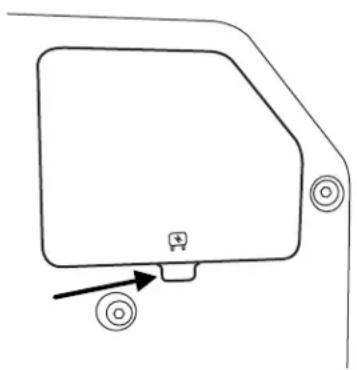
natural_image
Simple line drawing of a vehicle door frame with circular buttons and an arrow pointing to the side (no text or symbols)Roadside Emergencies
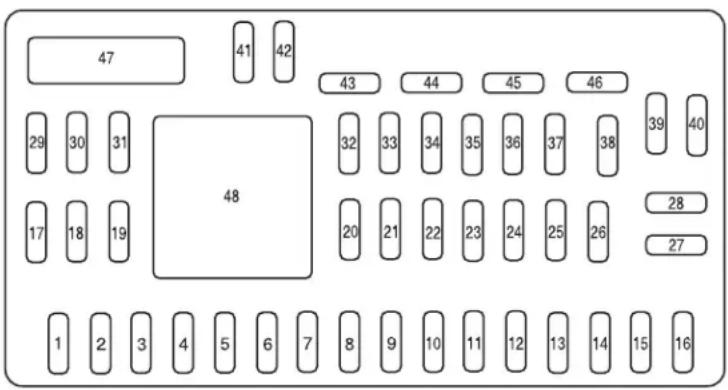
text_image
47 41 42 43 44 45 46 29 30 31 48 32 33 34 35 36 37 38 17 18 19 20 21 22 23 24 25 26 1 2 3 4 5 6 7 8 9 10 11 12 13 14 15 16 28 27The fuses are coded as follows:
| Fuse/Relay Location | FuseAmp Rating | ProtectedCircuits |
| 1 30A 110V inverter | ||
| 2 15A Brake On/Off switch | ||
| 3 15A Not used (spare) | ||
| 4 30A Moon roof | ||
| 5 10A Brake Shift Interlock (BSI),SPDJB | ||
| 6 20A Turn signals, Stop lamps | ||
| 7 10A Low beam headlamps (left) | ||
| 8 10A Low beam headlamps (right) | ||
| 9 15A Interior lights | ||
| 10 15A Backlighting | ||
| 11 10A Four wheel drive | ||
| 12 7.5A Power mirror switch | ||
| 13 5A Not used (spare) | ||
| 14 10A FCTM (radio buttons),Satellite radio, Front display module | ||
| 15 10A Climate control | ||
Roadside Emergencies
| Fuse/Relay Location | FuseAmp Rating | ProtectedCircuits |
| 16 15A Not used (spare) | ||
| 17 20A All lock motor feeds, Liftgate release, Liftglass release | ||
| 18 20A Heated seat | ||
| 19 25A Rear wiper | ||
| 20 15A Datalink | ||
| 21 15A Fog lamps | ||
| 22 15A Park lamps | ||
| 23 15A High beam headlamps | ||
| 24 20A Horn relay | ||
| 25 10A Demand lamps | ||
| 26 10A Instrument panel cluster | ||
| 27 20A Ignition switch | ||
| 28 5A Radio | ||
| 29 5A Instrument panel cluster | ||
| 30 5A Not used (spare) | ||
| 31 10A Restraints control module | ||
| 32 10A Not used (spare) | ||
| 33 10A Not used (spare) | ||
| 34 5A Not used (spare) | ||
| 35 10A Four wheel drive, EPAS (steering), 110V inverter module | ||
| 36 5A PATS transceiver | ||
| 37 10A Climate control | ||
| 38 20A Subwoofer/Amp (Audio-ophile radio) | ||
| 39 20A Radio, Radio amplifier (navigation) | ||
| 40 20A Front power point |
Roadside Emergencies
| Fuse/Relay Location | FuseAmp Rating | ProtectedCircuits |
| 41 15A Driver/passenger door | lock switches, Auto dimming mirror, Compass, Ambient lighting, Moon roof | |
| 42 10A Not used (spare) | ||
| 43 10A Rear wiper logic, Heated seats relay, Instrument cluster | ||
| 44 10A Not used (spare) | ||
| 45 5A Front wiper logic, Blower motor relay | ||
| 46 7.5A OCS (restraints), PADI (restraints) | ||
| 47 30A Circuit Breaker | Power windows | |
| 48 — Delayed accessory relay | ||
Power distribution box
The power distribution box is located in the engine compartment. The power distribution box contains high-current fuses that protect your vehicle's main electrical systems from overloads.

WARNING: Always disconnect the low voltage (underhood) battery before servicing high current fuses.

WARNING: To reduce risk of electrical shock, always replace the cover to the power distribution box before reconnecting the voltage (underhood) battery or refilling fluid reservoirs.
If the low voltage (underhood) battery has been disconnected and reconnected, refer to the Lowvoltage(underhood)batterysection of the MaintenanceandSpecificationschapter.
Roadside Emergencies
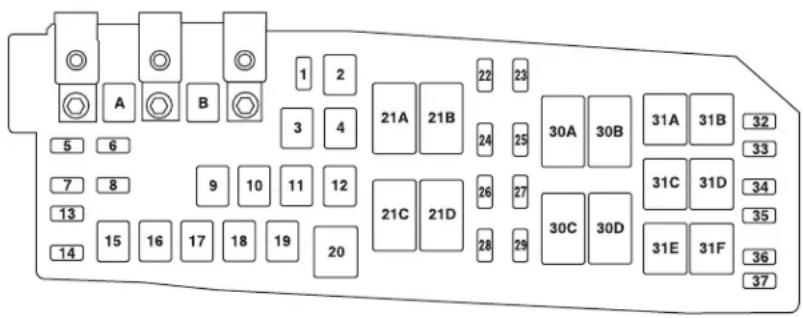
text_image
A B 1 2 3 4 21A 21B 22 23 24 25 30A 30B 31A 31B 32 33 7 8 9 10 11 12 21C 21D 26 27 30C 30D 31C 31D 34 13 14 15 16 17 18 19 20 28 29 31E 31F 35 36 37The fuses are coded as follows.
| Fuse/Relay Location | FuseAmp Rating | ProtectedCircuits |
| A 80A Midi Power steering control module | ||
| B 125A Midi SPDJB | ||
| 1 15A* Heated mirror | ||
| 2 30A** Rear defroster | ||
| 3 20A** Rear power point | ||
| 4 40A** Electric vacuum pump | ||
| 5 10A* Powertrain Control Module (PCM) | ||
| 6 — Not used | ||
| 7 15A* Liftgate latch | ||
| 8 5A* Traction battery control module | ||
| 9 50A** Brake control module | ||
| 10 30A** Front wipers | ||
| 11 — Not used | ||
| 12 40A** Blower motor | ||
| 13 | 10A* A/C clutch | |
| 14 | 10A* Heater/Coolant pump | |
Roadside Emergencies
| Fuse/Relay Location | FuseAmp Rating | ProtectedCircuits |
| 15 | 50A** Traction Battery Control Module (TBCM) | |
| 16 40A** Cooling fan 1 | ||
| 17 40A** Cooling fan 2 | ||
| 18 50A** Brake control module solenoid | ||
| 19 30A** Power seats | ||
| 20 — A/C clutch relay | ||
| 21A — Rear defroster relay | ||
| 21B — Ignition relay | ||
| 21C — Blower relay | ||
| 21D — PCM relay | ||
| 22 15A* Ignition coils | ||
| 23 15A* Fuel injectors | ||
| 24 10A* Transmission control module | ||
| 25 5A* Traction battery control module, Thermal expansion valve | ||
| 26 20A* Fuel pump, Traction battery control module | ||
| 27 10A* PCM (non-mil-malfunction indicator lamp) | ||
| 28 15A* Heated Exhaust Gas Oxygen (HEGO) sensor, PCM (mil-on — malfunction indicator lamp) | ||
| 29 15A* PCM power | ||
| 30A — Cooling fan 1 relay | ||
| 30B — Electric vacuum pump mechanical relay | ||
| 30C — Cooling fan main relay | ||
| 30D — Cooling fan 2 relay | ||
| 31A — Reverse lamp relay | ||
| 31B — Not used | ||
| 31C — Heater pump relay | ||
Roadside Emergencies
| Fuse/Relay Location | FuseAmp Rating | ProtectedCircuits |
| 31D — Coolant pump relay | ||
| 31E — Not used | ||
| 31F — Liftgate latch relay | ||
| 32 — A/C clutch diode | ||
| 33 — PCM diode | ||
| 34 — Not used | ||
| 35 10A* Run/start, Reverse lamps | ||
| 36 — Not used | ||
| 37 — Not used | ||
| * Mini fuse ** Cartridge fuse | ||
Auxiliary relay box
The relay box is located in the engine compartment on the radiator support bracket.
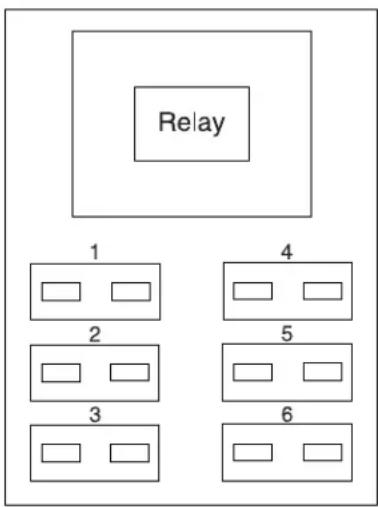
flowchart
graph TD
    A["Relay"] --> B["1"]
    A --> C["2"]
    A --> D["3"]
    A --> E["4"]
    A --> F["5"]
    A --> G["6"]
Roadside Emergencies
| Fuse/Relay location | Fuseamp rating | Description |
| Relay — | Electric vacuum pump (solid state) | |
| 1 — Not used | ||
| 2 — Not used | ||
| 3 — Not used | ||
| 4 5A* | Vacuum pump monitor | |
| 6 — Not used | ||
| * Mini fuses **Cartridge fuse | ||
CHANGING A FLAT TIRE
If you get a flat tire while driving:
• do not brake heavily.
- gradually decrease the vehicle's speed.
• hold the steering wheel firmly.
- slowly move to a safe place on the side of the road.
Your vehicle may be equipped with a conventional spare tire that is different in one or more of the following: type, brand, size, speed rating and tread design. If this is the case, this dissimilar spare tire is still rated for your vehicle loads (GAWR and GVWR). This temporary spare tire is not equipped with a Tire Pressure Monitor System (TPMS) sensor.
Note: The tire pressure monitoring system (TPMS) indicator light will illuminate when the spare is in use. To restore the full functionality of the TPMS system, all road wheels equipped with the tire pressure monitoring sensors must be mounted on the vehicle.
Have a flat tire serviced by an authorized dealer in order to prevent damage to the TPMS sensor, refer to TirePressureMonitoringSystem (TPMS) in the Tires, Wheels, and Loadingchapter. Replace the spare tire with a road tire as soon as possible. During repairing or replacing of the flat tire, have the authorized dealer inspect the TPMS sensor for damage.

WARNING: The use of tire sealants may damage your Tire Pressure Monitoring System and should not be used.
Roadside Emergencies
WARNING: Refer to TirePressureMonitoringSystem (TPMS) in the Tire, Wheels and Loading chapter for important information. If the tire pressure monitors sensor becomes damaged, it will no longer function.
Dissimilar spare tire/wheel information
WARNING: Failure to follow these guidelines could result in an increased risk of loss of vehicle control, injury or death.
If you have a dissimilar spare tire/wheel, then it is intended for temporary use only. This means that if you need to use it, you should replace it as soon as possible with a road tire/wheel that is the same size and type as the road tires and wheels that were originally provided by Mazda. If the dissimilar spare tire or wheel is damaged, it should be replaced rather than repaired.
A dissimilar spare tire/wheel is defined as a spare tire and/or wheel that is different in brand, size or appearance from the road tires and wheels and can be one of three types:
- T-type mini-spare: This spare tire begins with the letter "T" for tire size and may have "Temporary Use Only" molded in the sidewall
- Full-sized dissimilarspare with label on wheel: This spare tire has a label on the wheel that states: "THIS TIRE AND WHEEL FOR TEMPORARY USE ONLY"
When driving with one of the dissimilar spare tires listed above, donot:
• Exceed 50 mph (80 km/h)
- Load the vehicle beyond maximum vehicle load rating listed on the Safety Compliance Label
- Tow a trailer
- Use snow chains on the end of the vehicle with the dissimilar spare tire
- Use more than one dissimilar spare tire at a time
- Use commercial car washing equipment
- Try to repair the dissimilar spare tire
Roadside Emergencies
Use of one of the dissimilar spare tires listed above at any one wheel location can lead to impairment of the following:
- Handling, stability and braking performance
- Comfort and noise
• Ground clearance and parking at curbs - Winter weather driving capability
- Wet weather driving capability
3. Full-sizedissimilarsparewithoutlabelonwheel
When driving with the full-size dissimilar spare tire/wheel, donot:
• Exceed 70 mph (113 km/h)
- Use more than one dissimilar spare tire/wheel at a time
- Use commercial car washing equipment
- Use snow chains on the end of the vehicle with the dissimilar spare tire/wheel
The usage of a full-size dissimilar spare tire/wheel can lead to impairment of the following:
- Handling, stability and braking performance
- Comfort and noise
• Ground clearance and parking at curbs - Winter weather driving capability
- Wet weather driving capability
- All-Wheel driving capability (if applicable)
- Load leveling adjustment (if applicable)
When driving with the full-size dissimilar spare tire/wheel additional caution should be given to:
•Towing a trailer
- Driving vehicles equipped with a camper body
- Driving vehicles with a load on the cargo rack
Drive cautiously when using a full-size dissimilar spare tire/wheel and seek service as soon as possible.
Roadside Emergencies
Stoppingandsecuringthevehicle
- Park on a level surface, set the parking brake and activate the hazard flashers.
- Place gearshift lever in P (Park) and turn engine off.
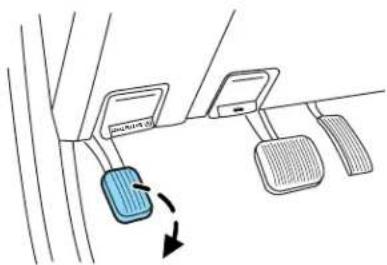
text_image
packets →Removingthejackandtools
The jack and tools are located in the right rear of the cargo area behind an access panel.
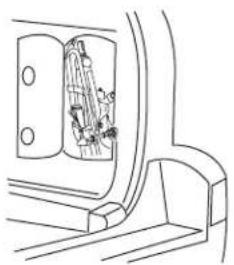
natural_image
Line drawing of a vehicle's seat with a door opening, showing interior components and no text or symbolsRoadside Emergencies
To remove jack from vehicle:
- Release the thumbscrew on the bracket.
- Release the retention clip on the upper part of the jack bracket.
- Dislodge the jack from the bracket and carefully guide jack down and out through trim opening, upper end out first.
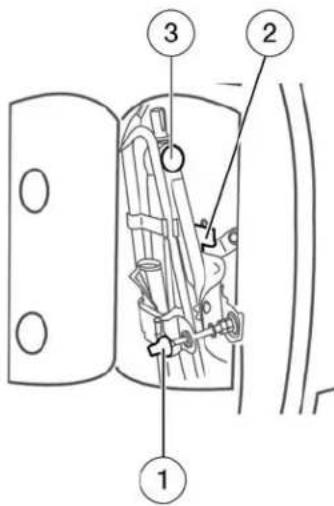
text_image
Technical diagram of a mechanical assembly with numbered components labeled 1, 2, and 3Remove the lug wrench from the jack in order to remove the spare tire from under the vehicle.
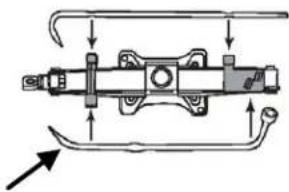
natural_image
Mechanical assembly diagram showing a shaft and housing with directional arrows indicating motion (no text or labels)Removingthesparetireorsparetireandtether(ifequipped)
- Insert the lug wrench through the access hole in the rear bumper.
- Turn the handle counterclockwise and lower the spare tire until it can be slid rearward and the cable is slack.
- Slide the retainer through the center of the wheel.
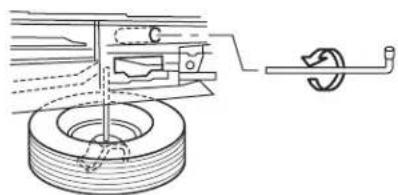
natural_image
Technical line drawing of a mechanical assembly with a coiled spring and shaft (no text or symbols)2009TributeHybrid(thv) OwnersGuide,1stPrinting USA(fus)
Roadside Emergencies
Ifequippedwithatether,performthefollowingadditionalsteps:
- Lift the spare tire on end to access tether attachment (1).

text_image
Technical diagram of a mechanical assembly with labeled parts 1 and 2, showing components like a central component and a tool.- Use the lug wrench to remove the lug nut from the spare tire tether.
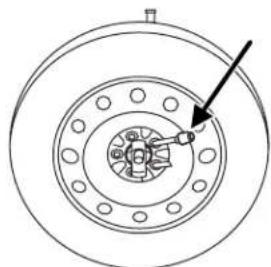
natural_image
Technical diagram of a mechanical assembly with concentric rings and a central component (no text or symbols)- If not replacing the spare or flat tire to the underbody storage area, raise winch up into the installed position.
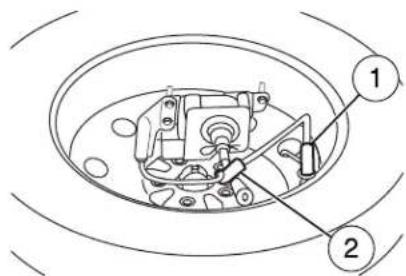
text_image
Technical diagram of a mechanical assembly with numbered parts labeled 1 and 2- Use the attached fastener strap (2) to tie the tether end to the winch actuator shaft (if equipped).
2009TributeHybrid(thv) OwnersGuide,1stPrinting USA(fus)
Roadside Emergencies
Tire change procedure

WARNING: When one of the front wheels is off the ground, the transmission alone will not prevent the vehicle from moving or ing off the jack, even if the vehicle is in P (Park).

WARNING: To help prevent the vehicle from moving when you change a tire, be sure the parking brake is set, then block (in directions) the wheel that is diagonally opposite (other side and of the vehicle) to the tire being changed.

WARNING: Changing a tire is dangerous if not done properly. If the vehicle slips off the jack, you or someone else could be easily injured. Be sure to follow the directions for changing a tire, ever get under a vehicle that is supported only by a jack.

WARNING: Do not attempt to change a tire on the side of the vehicle close to moving traffic. Pull far enough off the road to the danger of being hit when operating the jack or changing the
-
Block the diagonally opposite wheel.
-
Loosen each wheel lug nut one-half turn counterclockwise but do not remove them until the wheel is raised off the ground.
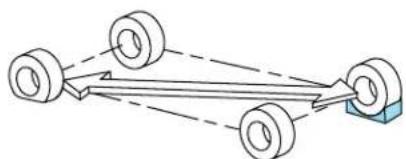
natural_image
Diagram of a vehicle suspension system with three wheels and a connecting rod (no text or labels)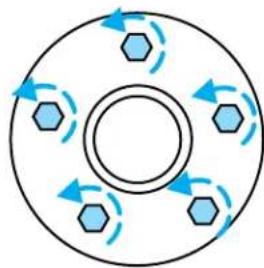
natural_image
Circular diagram with hexagonal nodes and directional arrows, no text or symbols presentRoadside Emergencies
STOP Before placing the jack under the vehicle, NOTE the jack locations:
- Front
View shown from rear of front tire. Position the jack directly below the protruding bolt.
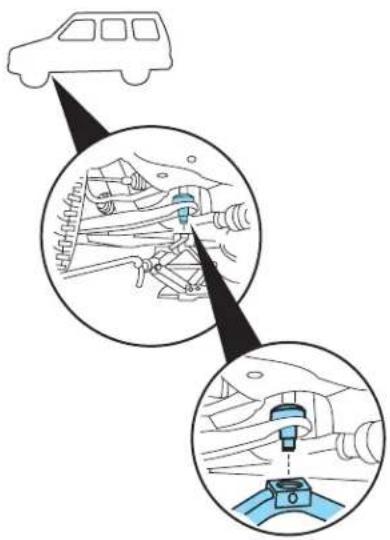
text_image
Diagram illustrating car safety inspection steps with labeled components and directional arrowsRoadside Emergencies
•Rear
View shown from forward of rear tire. Position jack directly below the stud on the rear trailing arm.
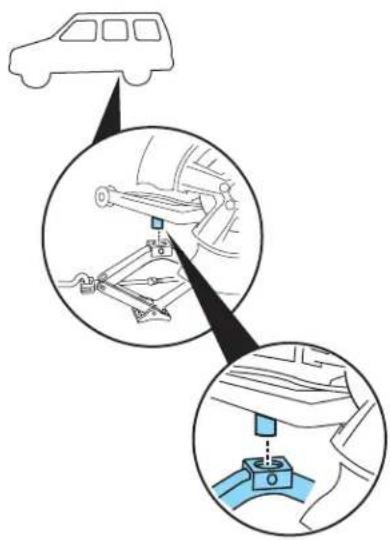
text_image
Diagram illustrating vehicle suspension system with labeled components and directional arrows- Position the jack according to the guides and turn the jack handle clockwise until the tire is a maximum of 1 inch (25 mm) off the ground.
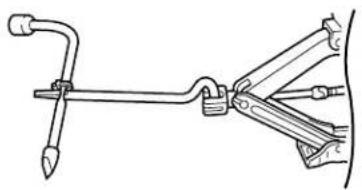
natural_image
Technical line drawing of a mechanical clamp or tool assembly (no text or symbols)Besuretoplacethejackaway fromtherearedgeoftherocker toavoiddamagingthereartire spoiler(pictured).
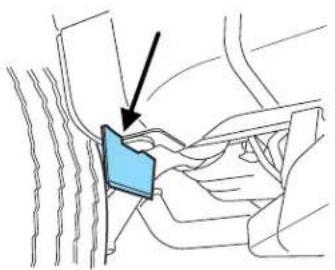
natural_image
Diagram of a car seatbelt with a blue clip and arrow indicating the angle (no text or symbols)2009TributeHybrid(thv) OwnersGuide,1stPrinting USA(fus)
Roadside Emergencies
Neverusethedifferentialsasa jackingpoint.

WARNING: To lessen the risk of personal injury, do under the vehicle while changing a tire. Do not start the engine when your vehicle is on the jack. The jack is only meant for changing the tire. Be sure any occupants are out of the vehicle and in a safe place.
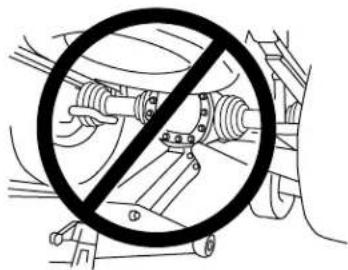
text_image
Diagram showing a prohibition symbol crossed out of a vehicle's mechanical components, indicating no movement or restriction.-
Remove the lug nuts with the lug nut wrench.
-
Replace the flat tire with the spare tire, making sure the valve stem is facing outward. Reinstall lug nuts until the wheel is snug against the hub. Do not fully tighten the lug nuts until the wheel has been lowered.
-
Lower the wheel by turning the jack handle counterclockwise.
-
Remove the jack and fully tighten the lug nuts in the order shown. Refer to Wheelugnut torquespecificationslater in this chapter for the proper lug nut torque specification.

flowchart
graph TD
    A["1"] --> B["2"]
    B --> C["3"]
    C --> D["4"]
    D --> E["5"]
    E --> A
    style A fill:#f9f,stroke:#333
    style B fill:#f9f,stroke:#333
    style C fill:#f9f,stroke:#333
    style D fill:#f9f,stroke:#333
    style E fill:#f9f,stroke:#333
Roadside Emergencies
Stowingthejackandtools
Make sure the jack is fully lowered and reclip the tools onto the jack.
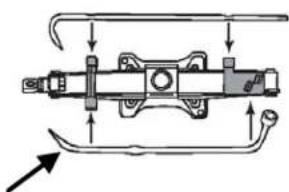
natural_image
Mechanical assembly diagram showing a shaft and housing with directional arrows indicating motion (no text or labels)Reinstall the jack and tools in the cargo area. To replace the jack in the vehicle,
• guide the jack bottom first in the trim opening and position in the bracket (3),
- secure the retention clip on the upper part of the jack (2), and
- close the thumbscrew (1).
Make sure the jack is fastened so it does not rattle when you drive.

text_image
Technical diagram of a mechanical assembly with numbered components labeled 1, 2, and 3Stowingtheflat/sparetire
Note: Failure to follow spare tire stowage instructions may result in failure of cable or loss of spare tire.
If you are stowing atire that requires reattaching it to the vehicle with aether, perform these steps first, then proceed with the steps following.
- Place tire on end with valve stem facing rearward, away from vehicle.
- Place tether into bolt holes in wheel and attach lug nut using lug wrench.
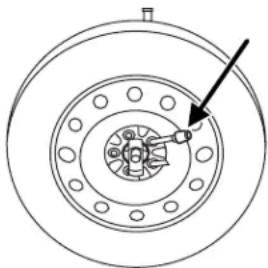
natural_image
Technical line drawing of a mechanical component with concentric rings and a central hub (no text or symbols)-
Lay the tire on the ground with the valve stem facing down. If your vehicle is equipped with aluminum wheels, remove the wheel ornament.
-
Slide the wheel partially under the vehicle and install the retainer through the center of the wheel.
-
Turn the jack handle clockwise until the tire is raised to its original position underneath the vehicle. The effort to turn the jack handle increases significantly as the tire contacts the frame. The spare tire carrier will ratchet when the tire is in the fully stowed position. The spare tire carrier has a built-in ratchet feature that will not allow you to overtighten. If the spare tire carrier ratchets with very little effort, take the vehicle to your authorized dealer for assistance at your earliest convenience. If your vehicleisequipped with atraler hitch, guidethetirewithonehand; keeptherearofthetire tiltedownuntilthetireclearsthebumper.
-
Check that the tire lies flat against the frame assembly. Push against the tire to make sure it is tightly seated under the vehicle. Loosen and retighten, if necessary. Failure to properly stow the spare tire may result in failure of the winch cable and loss of the spare tire. (Makesurethatthetiredoesnotcontactthebumper.)
-
Repeat this tightness check procedure (every six months, per scheduled maintenance information), when servicing the spare tire pressure or at any time that the spare tire is disturbed through service of other components.
Roadside Emergencies
WHEEL LUG NUT TORQUE SPECIFICATIONS
Retighten the lug nuts to the specified torque at 500 miles (800 km) after any wheel disturbance (tire rotation, changing a flat tire, wheel removal, etc.).
| BoltsizeWheellugnuttorque* | ||
| lb.ft.N•m | ||
| M12 x 1.5 100 135 | ||
| * Torque specifications are for nut and bolt threads free of dirt and rust. Use only Mazda recommended replacement fasteners. | ||
WARNING: When a wheel is installed, always remove any corrosion, dirt or foreign materials present on the mounting surfaces of the wheel or the surface of the wheel hub, brake drum or brake disc that contacts the wheel. Ensure that any fasteners that attach the rotor to the hub are secured so they do not interfere with the mounting surfaces of the wheel. Installing wheels without correct metal-to-metal contact at the wheel mounting surfaces can cause the wheel nuts to loosen and the wheel to come off while the vehicle is in motion, resulting in loss of control.
Note: Inspect the wheel pilot hole prior to installation. If there is visible corrosion in wheel pilot hole, remove loose particles by wiping with clean rag and apply grease. Apply grease only to the wheel pilot hole surface by smearing a "dime" (1 square cm) sized glob of grease around the wheel pilot surface (1) with end of finger. DO NOT apply grease to lugnut/stud holes or wheel-to-brake surfaces.
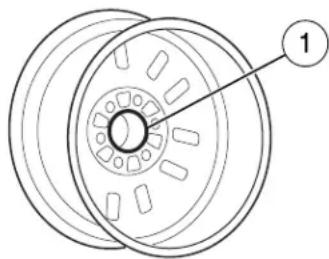
natural_image
Technical diagram of a mechanical component with concentric circular layers and a labeled section (1), no text or symbols present.RUNNING OUT OF FUEL
If you have run out of fuel and need to refill the vehicle with a portable fuel container, see Runningoutoffuelin the Maintenanceand Specificationschapter for proper fuel filling method using a portable fuel container and the included fuel filler funnel. Donotinsert the nozzle of portable fuel containers or any type of aftermarket funnels into
Roadside Emergencies
the Easy Fuel™ "no cap"fuel system as it can be damaged. You must use the included funnel in such circumstances.

WARNING: Do not insert the nozzle of portable fuel containers or aftermarket funnels into the Easy Fuel™ system. This could change the fuel system and its seal, and may cause fuel to run onto round instead of filling the tank, all of which could result in as personal injury.
JUMP STARTING
(LOW VOLTAGE [UNDERHOOD] BATTERY ONLY)
![MAZDA Tribute Hybrid (2009) - (LOW VOLTAGE [UNDERHOOD] BATTERY ONLY) - 1](/content/2026/05/1069112/images/8bc7abfa4698508564b69d11c45ffdd94c2a18e95d7a6dae78a081ed4bb19e53.jpg)
WARNING: The gases around the battery can explode if exposed to flames, sparks, or lit cigarettes. An explosion could in injury or vehicle damage.
![MAZDA Tribute Hybrid (2009) - (LOW VOLTAGE [UNDERHOOD] BATTERY ONLY) - 2](/content/2026/05/1069112/images/e28e45ec195e35619455c237b0c26b308ca0e6b38275dc999d61853e5fce9d4c.jpg)
WARNING: Batteries contain sulfuric acid which can burn skin, eyes and clothing, if contacted.
Donotattempttopush-startyourautomatictransmission vehicle.Automatictransmissionsdonothavepush-start capability.Attemptingtopush-startvehiclewithanautomatic transmissionmaycausetransmissiondamage.
Preparing your vehicle
If your low voltage (underhood) battery becomes disconnected or disabled for any reason, the vehicle controller must relearn the engine's operating characteristics in order to operate it at maximum efficiency. This relearning process occurs the first time the vehicle is driven after reconnecting the low voltage battery. If the learning procedure does not have time to complete during the drive, the engine will continue to operate for 3-5 seconds after you turn the ignition off to complete the relearning process. This is a normal condition and will not re-occur until the low voltage battery is disconnected again. The brake system must also be reset. Refer to Lowvoltage(underhood)batteryin the MaintenanceandSpecificationchapter for more information.
- Useonlya12-voltsupplytostartyourvehicle.
- Do not disconnect the battery of the disabled vehicle as this could damage the vehicle's electrical system.
Roadside Emergencies
- Park the booster vehicle close to the hood of the disabled vehicle making sure the two vehicles donottouch. Set the parking brake on both vehicles and stay clear of the engine cooling fan and other moving parts.
- Check all battery terminals and remove any excessive corrosion before you attach the battery cables. Ensure that vent caps are tight and level.
- Turn the heater fan on in both vehicles to protect from any electrical surges. Turn all other accessories off.
Connecting the jumper cables
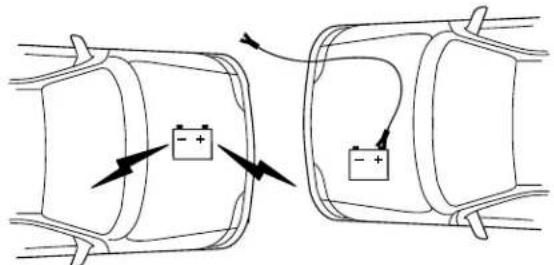
text_image
Diagram showing two battery charging scenarios with positive and negative charge carriers, illustrating electric field direction.- Connect the positive (+) jumper cable to the positive (+) terminal of the discharged battery.
Note: In the illustrations, lightningbolts are used to designate the assisting (boosting) battery.
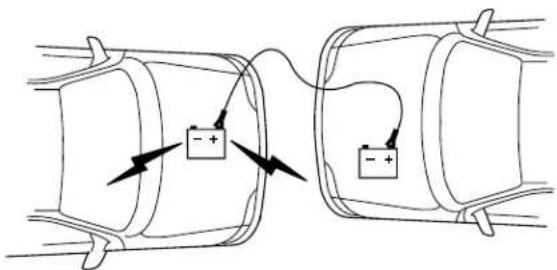
text_image
Diagram showing two cylindrical capacitor configurations with positive and negative terminals, connected by wires and arrows indicating current flow.- Connect the other end of the positive (+) cable to the positive (+) terminal of the assisting battery.
242
2009TributeHybrid(thv) OwnersGuide,1stPrinting USA(fus)
Roadside Emergencies
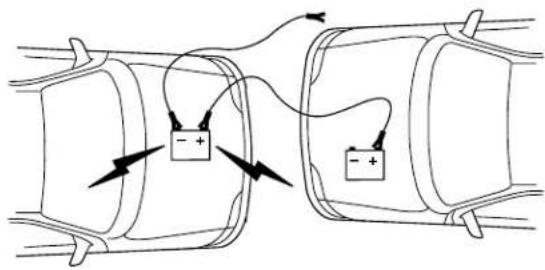
text_image
Diagram showing two connected cylindrical tanks with positive and negative charge indicators, indicating electrical or mechanical connections.- Connect the negative (-) cable to the negative (-) terminal of the assisting battery.
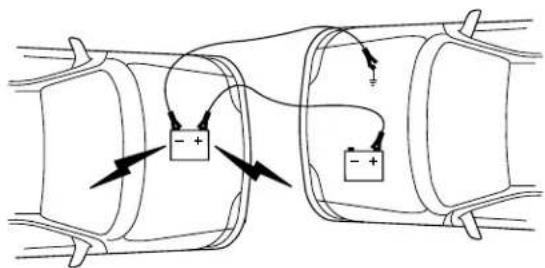
natural_image
Diagram of two cylindrical batteries connected in series with positive and negative charges, showing circuit connections (no text or symbols)- Make the final connection of the negative (-) cable to an exposed metal part of the stalled vehicle's engine, away from the battery and the carburetor/fuel injection system. Donotuse fuel lines, engine rocker covers or the intake manifold as groundingpoints.

WARNING: Do not connect the end of the second cable to the negative (-) terminal of the battery to be jumped. A spark may be an explosion of the gases that surround the battery.
- Ensure that the cables are clear of fan blades, belts, moving parts of both engines, or any fuel delivery system parts.
Roadside Emergencies
Jump starting
- Start the engine of the booster vehicle and run the engine at moderately increased speed.
- Start the engine of the disabled vehicle.
- Once the disabled vehicle has been started, run both engines for an additional three minutes before disconnecting the jumper cables.
Removing the jumper cables
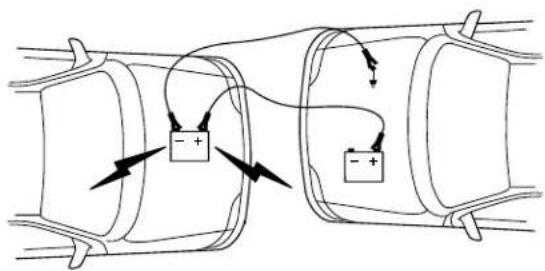
text_image
Diagram showing two cylindrical conductors with positive and negative charges, connected by wires and arrows indicating current flow.Removethejumpercablesinthereverseorderthattheywere connected.
- Remove the jumper cable from the groundmetal surface.
Note: In the illustrations, lightningbolts are used to designate the assisting (boosting) battery.
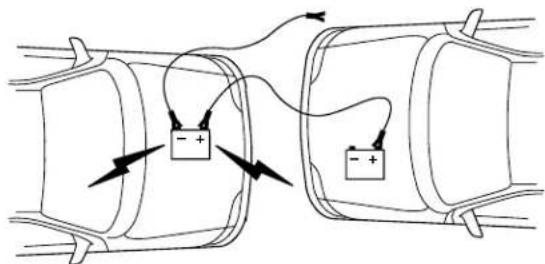
text_image
Diagram showing two cylindrical objects with positive charges and directional arrows indicating flow or movement, possibly illustrating electrostatic or electrical behavior.- Remove the jumper cable on the negative (-) connection of the booster vehicle's battery.
Roadside Emergencies
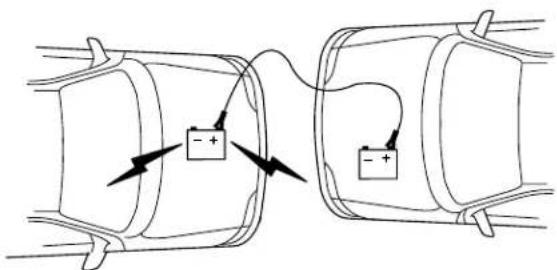
text_image
Diagram showing two cylindrical capacitor setups with positive and negative terminals, connected by wires and lightning bolts.- Remove the jumper cable from the positive (+) terminal of the booster vehicle's battery.
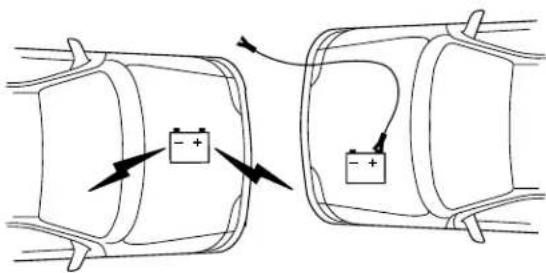
text_image
Diagram showing two battery charging scenarios with positive and negative charge indicators, illustrating charging behavior.- Remove the jumper cable from the positive (+) terminal of the disabled vehicle's battery.
After the disabled vehicle has been started and the jumper cables removed, allow it to idle for several minutes so the engine computer can relearn its idle conditions.
Roadside Emergencies
WRECKER TOWING
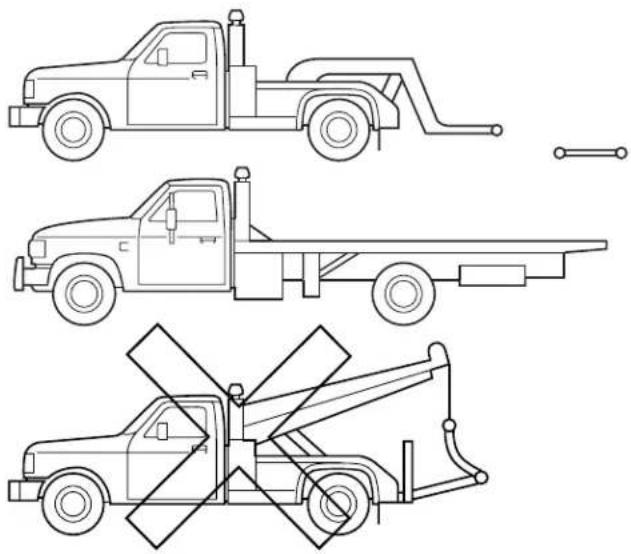
natural_image
Line drawings of three different types of flatbed utility trucks with no text or symbolsIf you need to have your vehicle towed, contact a professional towing service or, if you are a member of a roadside assistance program, your roadside assistance service provider.
It is recommended that your vehicle be towed with a wheel lift and dollies or flatbed equipment. Do not tow with a slingbelt. Mazda has not approved a slingbelt towing procedure.
On FWD vehicles, if your vehicle is to be towed from the front, ensure proper wheel lift equipment is used to raise the front wheels off the ground. The rear wheels can be left on the ground when towed in this fashion.
If your vehicle is to be towed from the rear using wheel lift equipment, it is required that the front wheels (drive wheels) be placed on a dolly to prevent damage to the transmission.
On 4WD vehicles, it is required that your vehicle be towed with a wheel lift and dollies or flatbed equipment with all the wheels off the ground to prevent damage to the automatic transmission, 4WD system or vehicle.
Roadside Emergencies
If the vehicle is bestowed by other means or incorrectly, vehicle damage may occur.
Emergency towing
In case of a roadside emergency with a disabled vehicle (without access to wheel dollies, car hauling trailer, or flatbed transport vehicle) your vehicle (regardless of transmission powertrain configuration) can be flat towed (all wheels on the ground) under the following conditions:
- Vehicle is facing forward so that it is being towed in a forward direction.
- Place the transmission in N (Neutral). Refer to Brake shift interlock in the Driving chapter for specific instructions if you cannot move the gear shift lever into N (Neutral).
• Maximum speed is not to exceed 35 mph (56 km/h).
• Maximum distance is 50 miles (80 km).
Customer Assistance
CUSTOMER ASSISTANCE (U.S.A. MAINLAND AND HAWAII)
Your complete and permanent satisfaction is our business. We are here to serve you. All Authorized Mazda Dealers have the knowledge and the tools to keep your Mazda vehicle in top condition.
If you have any questions or recommendations for improvement regarding the service of your Mazda vehicle or servicing by Authorized Mazda Dealer personnel, we recommend that you take the following steps:
STEP1: ContactYourAuthorizedMazdaDealer
Discuss the matter with an Authorized Mazda Dealer. This is the quickest and best way to address the issue. If your concern has not been resolved by the CUSTOMER RELATIONS, SALES, SERVICE, or PARTS MANAGER, then please contact the GENERAL MANAGER of the authorized dealer or the OWNER.
STEP2:ContactMazdaNorthAmericanOperations
If for any reason you feel the need for further assistance after contacting your authorized dealer management, you can reach Mazda North American Operations by one of the following ways:
Log on at: www.mazdaUSA.com.
Answers to many questions, including how to locate or contact a local Authorized Mazda Dealership in the U.S., can be found here.
By email at: www.mazdaUSA.com (Click on CONTACT US at the bottom of the home page).
By phone at: 1 (800) 222-5500
By letter at:
Attn: Customer Assistance
Mazda North American Operations
7755 Irvine Center Drive
Irvine, CA 92618–2922
P.O. Box 19734
Irvine, CA 92623–9734
Whatever way you contact us, please help us to serve you more efficiently and effectively by providing the following information:
- Your name, address, and telephone number
- Year and model of vehicle
- Vehicle Identification Number (17 digits, noted on your registration or title or located on the upper driver's side corner of the dash)
Customer Assistance
- Purchase date and current mileage
- Your authorized dealer's name and location
- Your question(s)
If you live outside the U.S.A., please contact your nearest Mazda Distributor.
STEP3:ContactBetterBusinessBureau(BBB)
Mazda North American Operations realizes that mutual agreement on some issues may not be possible. As a final step to ensure that your concerns are being fairly considered, Mazda North American Operations has agreed to participate in a dispute settlement program administered by the Better Business Bureau (BBB) system, at no cost to you the consumer.
BBB AUTO LINE works with consumers and the manufacturer in an attempt to reach a mutually acceptable resolution of any warranty related concerns. If the BBB is not able to facilitate a settlement they will provide an informal hearing before an arbitrator.
You are required to resort to BBB AUTO LINE before exercising rights or seeking remedies under the Federal Magnuson-Moss Warranty Act, 15 U.S.C. § 2301 et seq. To the extent permitted by the applicable state “Lemon Law”, you are also required to resort to BBB AUTO LINE before exercising any rights or seeking remedies under the “Lemon Law.” If you choose to seek remedies that are not created by the Magnuson-Moss Warranty Act or the applicable state “Lemon Law,” you are not required to first use BBB AUTO LINE.
The whole process normally takes 40 days or less. The arbitration decision is not binding on you or Mazda else you accept the decision. For more information about BBB AUTO LINE, including current eligibility standards, please call 1-800-955-5100 or visit the BBB website at www.lemonlaw.bbb.org.
Being truly committed to customer satisfaction is more than a phrase with Mazda. We hope to satisfy every customer directly, but if there is ever a question about our decision, Mazda believes in providing a fast, fair and free method such as the BBB AUTO LINE to ensure Mazda delivers on our commitment to do the right thing for our customers!
CUSTOMER ASSISTANCE (CANADA)
Your complete and permanent satisfaction is our business. We are here to serve you. All Authorized Mazda Dealers have the knowledge and the tools to keep your Mazda vehicle in top condition.
Customer Assistance
In our experience, any questions, problems or complaints regarding the operation of your Mazda or any other general service transactions are most effectively resolved by your authorized dealer. If the cause of your dissatisfaction cannot adequately be addressed by normal authorized dealer procedures, we recommend that you take the following steps:
STEP1: ContactYourAuthorizedMazdaDealer
Discuss the matter with a member of authorized dealer management. If the Service Manager has already reviewed your concerns, contact the owner of the authorized dealer or its General Manager.
STEP2:CalltheMazdaRegionalOffice
If you feel that you still require assistance, ask the authorized dealer Service Manager to arrange for you to meet the local Mazda Service Representative. If more expedient, contact Mazda Canada Inc. Regional Office nearest you for such arrangements.
STEP3:ContacttheMazdaCustomerRelationsDepartment
If still not substantially satisfied, contact the Customer Relations Department, Mazda Canada Inc., 55 Vogell Road, Richmond Hill, Ontario L4B 3K5 Canada TEL: 1 (800) 263-4680.
Provide the Department with the following information:
- Your name, address, and telephone number
- Year and model of vehicle
- Vehicle Identification Number (VIN). Refer to Vehicleidentification labelin the MaintenanceandSpecificationschapter of this manual for the location of the VIN.
- Purchase date.
- Present odometer reading.
- Your authorized dealer's name and location
- The nature of your problem and/or cause of dissatisfaction.
The Department, in cooperation with the local Mazda Service Representative, will review the case to determine if everything possible has been done to ensure your satisfaction.
Please recognize that the resolution of service problems in most cases requires the use of your authorized dealer's service facilities, personnel and equipment. We urge you to follow the above three steps in sequence therefore for most effective results.
Customer Assistance
Mediation/Arbitration Program
Occasionally a customer concern cannot be resolved through Mazda's Customer Satisfaction Program. If after exhausting procedures in this manual, your concern is still not resolved, you have another option.
Mazda Canada Inc. participates in an arbitration program administered by the Canadian Motor Vehicle Arbitration Plan (CAMVAP). CAMVAP will advise you about how your concern may be reviewed and resolved by an independent third party through binding arbitration.
Your complete satisfaction is the goal of Mazda Canada Inc. and our authorized dealers. Mazda's participation in CAMVAP makes a valuable contribution to our achieving that goal. There is no charge for using CAMVAP. CAMVAP results are fast, fair and final as the award is binding on both you and Mazda Canada Inc.
Canadian Motor Vehicle Arbitration Plan (CAMVAP)
For vehicles delivered to authorized Canadian dealerships. If a specific item of concern arises, where a solution cannot be reached between an owner, Mazda, and/or one of it's authorized dealers (that all parties cannot agree upon), the owner may wish to use the services offered by the Canadian Motor Vehicle Arbitration Plan (CAMVAP).
CAMVAP uses the services of Provincial Administrators to assist consumers in scheduling and preparing for their arbitration hearings. However, before you can proceed with CAMVAP you must follow your Mazda dispute resolution process as outlined previously.
CAMVAP is fully implemented in all provinces and territories. Consumers wishing to obtain further information about the Program can obtain an information booklet from their authorized dealer, the Provincial Administrator at 1 (800) 207-0685, or by contacting the Canadian Motor Vehicle Arbitration Office At:
235 Yorkland Boulevard, Suite 407
North York, Ontario
M2J 4Y8
http://camvap.ca
Customer Assistance
Regional Offices
| RegionalOfficesAreasCovered | |
| Mazda Canada Inc.Western Region8171 Ackroyd RoadSuite 2000Richmond, B.C.V6X 3K1(604) 303–5670 | Alberta,British Columbia,Manitoba,Saskatchewan,Yukon |
| Mazda Canada Inc.Central Region55 Vogell RoadRichmond Hill, Ontario.L4B 3K51 (800) 263–4680 | Ontario |
| Mazda Canada Inc.Quebec Region/Atlantic Region6111 Route TransCanadiennePointe Claire, QuebecH9R 5A5(514) 694–6390 | Quebec,New Brunswick,Nova Scotia,Prince Edward Island,Newfoundland |
CUSTOMER ASSISTANCE (PUERTO RICO & VIRGIN ISLANDS)
Your complete and permanent satisfaction is our business. That is why all Authorized Mazda Dealers have the knowledge and the tools to keep your Mazda vehicle in top condition.
If you have any questions or recommendations for improvement regarding the service of your Mazda vehicle or servicing by Authorized Mazda Dealer personnel, we recommend that you take the following steps:
STEP1
Discuss the matter with an Authorized Mazda Dealer. This is the quickest and best way to address the issue. If your concern has not been resolved by the CUSTOMER RELATIONS, SALES, SERVICE, or PARTS MANAGER, then please contact the GENERAL MANAGER of the authorized dealer or the OWNER.
Customer Assistance
STEP2
If, after following STEP 1, you feel the need for further assistance, please contact your area's Mazda representative (Indicated on the next page).
Please help us by providing the following information:
- Your name, address, and telephone number
- Year and model of vehicle
- Vehicle Identification Number (17 digits, noted on your registration or title or located on the upper driver's side corner of the dash)
- Purchase date and current mileage
- Your authorized dealer's name and location
- Your question(s)
If you would like to write a letter, please address it to the following, Attn: Customer Assistance
Plaza Motors Corp.
Mazda de Puerto Rico
P.O. Box 362722
San Juan, Puerto Rico
00936-2722
Tel: (787) 788-9300
This way, we can be sure to respond to you as efficiently as possible. That is our goal.
If you live outside the U.S.A., please contact your nearest Mazda Distributor.
IN CALIFORNIA (U.S. ONLY)
California Civil Code Section 1793.2(d) requires that, if a manufacturer or its representative is unable to repair a motor vehicle to conform to the vehicle's applicable express warranty after a reasonable number of attempts, the manufacturer shall be required to either replace the vehicle with one substantially identical or repurchase the vehicle and reimburse the buyer in an amount equal to the actual price paid or payable by the consumer (less a reasonable allowance for consumer use). The consumer has the right to choose whether to receive a refund or replacement vehicle.
Customer Assistance
California Civil Code Section 1793.22(b) presumes that the manufacturer has had a reasonable number of attempts to conform the vehicle to its applicable express warranties if, within the first 18 months of ownership of a new vehicle or the first 18,000 miles (29,000 km), whichever occurs first:
- Two or more repair attempts are made on the same nonconformity likely to cause death or serious bodily injury OR
- Four or more repair attempts are made on the same nonconformity (a defect or condition that substantially impairs the use, value or safety of the vehicle) OR
- The vehicle is out of service for repair of nonconformities for a total of more than 30 calendar days (not necessarily all at one time).
In the case of 1 or 2 above, the consumer must also notify the manufacturer of the need for the repair of the nonconformity at the following address:
Mazda North American Operations
7755, Irvine Center Drive
Irvine, CA 92618–2922
MAZDA IMPORTERS/DISTRIBUTORS
U.S.A(Importer/Distributor)
MazdaNorthAmericanOperations
7755 Irvine Center Drive
Irvine, CA 92618-2922
P.O. Box 19734
Irvine, CA 92623-9734
TEL: 1 (800) 222-5500 (in U.S.A.)
(949) 727–1990 (outside U.S.A.)
(Distributorineacharea)
CANADA
MazdaCanada, Inc.
55 Vogell Road
Richmond Hill, Ontario L4B 3K5 Canada
TEL: 1 (800) 263-4680 (in Canada)
(416) 609–9909 (outside Canada)
PUERTO RICO & VIRGIN ISLANDS
PlazaMotorsCorp.(MazdadePuertoRico)
P.O. Box 362722, San Juan, Puerto Rico 00936-2722
TEL: (787) 788-9300
254
2009TributeHybrid(thv)
OwnersGuide,1stPrinting
USA(fus)
Customer Assistance
GUAM
(d.b.a.TripleJ.Enterprises,Inc.)
P.O. Box 6066 Tamuning, Guam
TEL: (671) 646-9216
SAIPAN
PacificInternationalMarianas,Inc.
(d.b.a.MidwayMotors)
P.O. Box 887 Saipan, MP 96950
TEL: (670) 234-7524
TripleJSaipan, Inc.
(d.b.a.TripleJMotors)
Beach Road
Chalan LauLau
Saipan, MP 96950
TEL: (670) 235-4868
AMERICAN SAMOA
PolynesiaMotors, Inc.
P.O. Box 1120, Pago Pago, American Samoa 96799
TEL: (684) 699-1854
WARRANTIES FOR YOUR MAZDA
- New Vehicle Limited Warranty
•Safety Restraint System Limited Warranty
• Anti-perforation Limited Warranty - Federal Emission Control Warranty
- Emission Defect Warranty
- Emission Performance Warranty
- California Emission Control Warranty (if applicable)
- Replacement Parts and Accessories Limited Warranty
•Tire Warranty
NOTE: Detailed warranty information is provided with your Mazda portfolio.
Outside the United States
Government regulations in the United States require that automobiles meet specific emission regulations and safety standards. Therefore, vehicles built for use in the United States, may differ from those sold in other countries.
Customer Assistance
The differences may make it difficult or even impossible for your vehicle to receive satisfactory servicing in other countries. We strongly recommend that you NOT take your Mazda outside the United States. However, in the event that you are moving to Canada permanently, Mazda vehicles built for use in the United States could be eligible for exportation to Canada with specific vehicle modifications to comply with the Canadian Motor Vehicle Safety requirements.
Special Note: The above is applicable for permanent import/export situations and not related to travelers on vacation.
You may have the following problems if you do take your vehicle outside of the United States:
- Recommended fuel may be unavailable. Any kind of leaded fuel or low-octane fuel will affect vehicle performance and damage the emission controls and engine.
- Proper repair facilities, tools, testing equipment, and replacement parts may not be available.
Please refer to your manufacturers warranty booklet for more information.
Outside Canada
Government regulations in Canada require that automobiles meet specific emission regulations and safety standards. Therefore, vehicles built for use in Canada, may differ from those sold in other countries.
The differences may make it difficult or even impossible for your vehicle to receive satisfactory servicing in other countries. We strongly recommend that you NOT take your Mazda outside Canada. However, in the event that you are moving to the United States permanently, Mazda vehicles built for use in Canada could be eligible for exportation to the United States with specific vehicle modifications to comply with the United States Federal Motor Vehicle Safety requirements.
Special Note: The above is applicable for permanent import/export situations and not related to travelers on vacation.
You may have the following problems if you do take your vehicle outside of Canada:
- Recommended fuel may be unavailable. Any kind of leaded fuel or low-octane fuel will affect vehicle performance and damage the emission controls and engine.
- Proper repair facilities, tools, testing equipment, and replacement parts may not be available.
Please refer to your manufacturers warranty booklet for more information.
Customer Assistance
ADD-ON NON-GENUINE PARTS AND ACCESSORIES
Non-genuine parts and accessories for Mazda vehicles can be found in stores. These may fit your vehicle, but they are not approved by the manufacturer for use with Mazda vehicles. When you install non-genuine parts or accessories, they could affect your vehicle's performance or safety system; the manufacturer's warranty doesn't cover this. Before you install any non-genuine parts or accessories, consult an Authorized Mazda Dealer.
WARNING: Installation of Non-Genuine Parts or Accessories: Installation of non-genuine parts or accessories could be dangerous. Improperly designed parts or accessories could seriously affect your vehicle's performance or safety system. This could cause you to have an accident or increase your chances of injuries in an accident. Always consult an Authorized Mazda Dealer before you install non-genuine parts or accessories.
WARNING: Add-On Electrical and Electronic Equipment: Incorrectly choosing or installing improper add-on equipment or choosing an improper installer could be dangerous. Essential systems could be damaged, causing engine stalling, air-bag (SRS) activation, ABS inactivation, or a fire in the vehicle. Be very careful in choosing and installing add-on electrical equipment, such as mobile telephones, two-way radios, stereo systems, and car alarm systems.
Mazda assumes no responsibility for death, injury, or expenses that may result from the installation of add-on non-genuine parts or accessories.
SERVICE PUBLICATIONS
Factory-authorized Mazda service publications are available for owners who wish to do some of their own maintenance and repair.
When requesting any of our publications through an Authorized Mazda Dealer, refer to the chart below.
If they don't have what you need in stock, they can order it for you.
| PUBLICATION ORDER NUMBER | PUBLICATION DESCRIPTION |
| 9999 95 062B 09 WORKSHOP MANUAL | |
| 9999 95 038G 09 WIRING DIAGRAM | |
| 9999 95 014C 09 OWNER'S | MANUAL |
Customer Assistance
WORKSHOPMANUAL:
Covers recommended maintenance and repair procedures of the drive train, body and chassis.
WIRINGDIAGRAM:
Provides electrical schematics as well as component location for the entire electrical system.
OWNER'SMANUAL:
This booklet contains information regarding the proper care and operation of your vehicle. This is not a technician's manual.
PleasenotethatyourAuthorizedMazdaDealershiphastrained personnelandspecialservicetoolstocorrectlyandsafely maintainMazdavehicles.
REPORTING SAFETY DEFECTS (U.S. ONLY)
If you believe that your vehicle has a defect that could cause a crash, or could cause injury or death, you should immediately inform the National Highway Traffic Safety Administration (NHTSA) in addition to notifying Mazda Corporation.
If NHTSA receives similar complaints, it may open an investigation, and if it finds that a safety defect exists in a group of vehicles, it may order a recall and remedy campaign. However, NHTSA cannot become involved in individual problems between you, your dealer or Mazda Corporation.
To contact NHTSA, you may call the Vehicle Safety Hotline toll-free at 1-888-327-4236 (TTY: 1-800-424-9153); go to http://www.safercar.gov; or write to:
Administrator
1200 New Jersey Avenue, Southeast
Washington, D.C. 20590
You can also obtain other information about motor vehicle safety from http://www.safercar.gov.
REPORTING SAFETY DEFECTS (CANADA ONLY)
If you believe that your vehicle has a defect which could cause a crash or could cause injury or death, you should immediately inform Transport Canada, using their toll-free number: 1–800–333–0510.
Cleaning
WASHING THE EXTERIOR
Wash your vehicle regularly with cool or lukewarm water and a neutral pH shampoo.
- Never use strong household detergents or soap, such as dish washing or laundry liquid. These products can discolor and spot painted surfaces.
- Never wash a vehicle that is “hot to the touch” or during exposure to strong, direct sunlight.
- Always use a clean sponge or car wash mitt with plenty of water for best results.
- Dry the vehicle with a chamois or soft terry cloth towel in order to eliminate water spotting.
- It is especially important to wash the vehicle regularly during the winter months, as dirt and road salt are difficult to remove and cause damage to the vehicle.
- Immediately remove items such as gasoline, diesel fuel, bird droppings and insect deposits because they can cause damage to the vehicle's paintwork and trim over time.
- Remove any exterior accessories, such as antennas, before entering a car wash.
- Suntanlotionsandinsectrepellentscandamageanypainted surface;ifthesesubstancescomeincontactwithyourvehicle, washoffassoonaspossible.
- Use care when washing the vehicle to ensure water and soap arenot directed into the high voltage battery vent, located near the driversiderear window.
WAXING
Applying a premium paint sealant to your vehicle every six months will assist in reducing minor scratches and paint damage.
- Wash the vehicle first. Refer to Washing the exterior for more detailed information.
- Do not use waxes that contain abrasives; use a premium liquid wax.
- Do not allow paint sealant to come in contact with any non-body (low-gloss black) colored trim, such as grained door handles, roof racks, bumpers, side moldings, mirror housings or the windshield cowl area. The paint sealant will “gray” or stain the parts over time.
Cleaning
PAINT CHIPS
Your dealer has touch-up paint to match your vehicle's color. Touch-up paint can be used to repair minor scratches to painted surfaces.
- Remove particles such as bird droppings, tree sap, insect deposits, tar spots, road salt and industrial fallout before repairing paint chips.
- Always read the instructions before using the products.
ALUMINUM WHEELS AND COVERS
Aluminum wheel rims or covers are coated with a clearcoat paint finish. In order to maintain their shine:
- Clean with cool or lukewarm water and a neutral pH shampoo.
- Never apply any cleaning chemical to hot or warm wheel rims or covers.
- Some automatic car washes may cause damage to the finish on your wheel rims or covers. Chemical-strength cleaners, or cleaning chemicals, in combination with brush agitation to remove brake dust and dirt, could wear away the clearcoat finish over time.
- Do not use hydrofluoric acid-based or high caustic-based wheel cleaners, steel wool, fuels or strong household detergent.
- To remove tar and grease, use Extra Strength Tar and Road Oil Remover (0000–77–410E-01), available from your authorized Mazda dealer.
ENGINE
Engines are more efficient when they are clean because grease and dirt buildup keep the engine warmer than normal. When washing:
- Take care when using a power washer to clean the engine. The high-pressure fluid could penetrate the sealed parts and cause damage.
- Never spray the engine or other engine components with water. Water will damage the engine or other engine components.
- Spray Engine Shampoo and Degreaser (0000–77–410E-09), available at your authorized Mazda dealer, on all parts that require cleaning and pressure rinse clean.
Cleaning
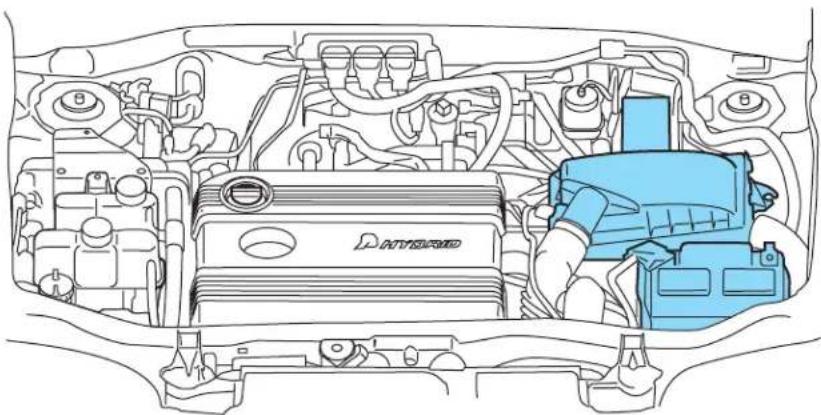
natural_image
Technical line drawing of a car engine bay with internal components and a blue component inserted (no text or symbols)- Cover the highlighted areas to prevent water damage when cleaning the engine. Note: As with all transmissions, be especially careful as water entry into the vents can damage internal parts.
- Never wash or rinse the engine while it is running; water in the running engine may cause internal damage.
PLASTIC (NON-PAINTED) EXTERIOR PARTS
Use only approved products to clean plastic parts. These products are available from your dealer.
- For routine cleaning, use cool or lukewarm water with a neutral pH shampoo.
- If tar or grease spots are present, use Extra Strength Tar and Road Oil Remover (0000-77-410E-01), available at your authorized Mazda dealer.
Cleaning
WINDOWS AND WIPER BLADES
The windshield, rear and side windows and the wiper blades should be cleaned regularly. If the wipers do not wipe properly, substances on the vehicle's glass or the wiper blades may be the cause. These may include hot wax treatments used by commercial car washes, water repellant coatings, tree sap, or other organic contamination; these contaminants may cause squeaking or chatter noise from the blades, and streaking and smearing of the windshield. To clean these items, follow these tips:
- The windshield, rear windows and side windows may be cleaned with a non-abrasive cleaner such as Ultra-Clear Spray Glass Cleaner (0000–77–400E-01 and 0000–77–400E-02), available from your authorized Mazda dealer.
- The wiper blades can be cleaned with isopropyl (rubbing) alcohol or a windshield washer concentrate. This washer fluid concentrate contains a special solution in addition to alcohol which helps to remove the hot wax deposited on the wiper blade and windshield from automated car wash facilities. Be sure to replace wiper blades when they appear worn or do not function properly.
- Do not use abrasives, as they may cause scratches.
- Do not use fuel, kerosene, or paint thinner to clean any parts.
INSTRUMENT PANEL / INTERIOR TRIM AND CLUSTER LENS
Clean the interior trim areas and instrument panel with a damp cloth, then with a clean, dry cloth, or use Mazda Deluxe Leather and Vinyl Cleaner (0000-77-430E-15).
- Avoid cleaners or polish that increase the gloss of the upper portion of the instrument panel. The dull finish in this area helps protect the driver from undesirable windshield reflection.
- Do not use household or glass cleaners, as these may damage the finish.

WARNING: Do not use chemical solvents or strong detergents when cleaning the steering wheel, instrument panel or interior areas to avoid contamination of the airbag systems.
- Be certain to wash or wipe your hands clean if you have been in contact with certain products such as insect repellent and suntan lotion in order to avoid possible damage to the interior painted surfaces.
Cleaning
INTERIOR
For fabric, carpets, cloth seats, seat belts and seats equipped with side air bags (if equipped):
- Remove dust and loose dirt with a vacuum cleaner.
- Remove light stains and soil with Upholstery Cleaner and Spot Remover (0000–77–430E-01), available at your authorized Mazda dealer.
- If grease or tar is present on the material, spot-clean the area first with Spot and Stain Remover (0000–77–410E-01), available at your authorized Mazda dealer.
- If a solvent ring forms on the fabric after spot cleaning, clean the entire area immediately (but do not oversaturate) or the ring will set.
- Do not use household cleaning products or glass cleaners, which can stain and discolor the fabric and affect the flame retardant abilities of the seat materials.
WARNING: Do not use chemical solvents or strong detergents when cleaning the seat where the side air bag (if equipped) is mounted. Such products may contaminate the side air bag system and affect performance of the air bag in a collision. The air bag may not function correctly and not provide any injury reduction benefits.
LEATHER SEATS (IF EQUIPPED)
Your leather seating surfaces have a clear, protective coating over the leather.
- To clean, use a soft cloth with Deluxe Leather and Vinyl Cleaner (0000-77-430E-15), available at your authorized Mazda dealer. Dry the area with a soft cloth.
- To help maintain its resiliency and color, use the Deluxe Leather Care Kit (0000-77-609E-03), available at your authorized Mazda dealer.
- Do not use household cleaning products, alcohol solutions, solvents or cleaners intended for rubber, vinyl and plastics, or oil/petroleum-based leather conditioners. These products may cause premature wearing of the clear, protective coating.
Cleaning
UNDERBODY
Flush the complete underside of your vehicle frequently. Keep body and door drain holes free from packed dirt.
MAZDA CAR CARE PRODUCTS
Your Mazda dealer has many quality products available to clean your vehicle and protect its finishes. These quality products have been specifically engineered to fulfill your automotive needs; they are custom designed to complement the style and appearance of your vehicle. Each product is made from high quality materials that meet or exceed rigid specifications. For best results, use these products or products of equivalent quality. These products are available at your authorized Mazda dealer.
Maintenance and Specifications
SERVICE RECOMMENDATIONS
To help you service your vehicle, we provide scheduled maintenance information which makes tracking routine service easy.
If your vehicle requires professional service, your authorized dealer can provide the necessary parts and service. Check your Warranty Guide/CustomerInformationGuideto find out which parts and services are covered.
Use only recommended fuels, lubricants, fluids and service parts conforming to specifications. Mazda parts are designed and built to provide the best performance in your vehicle.
PRECAUTIONS WHEN SERVICING YOUR VEHICLE
- Do not work on a hot engine.
- Make sure that nothing gets caught in moving parts.
- Do not work on a vehicle with the engine running in an enclosed space, unless you are sure you have enough ventilation.
- Keep all open flames and other burning (cigarettes) material away from the battery and all fuel related parts.
High Voltage Information

WARNING: Exposure to high voltage may result in severe personal injury or death. High voltage components must be ed by a trained service technician.
Your vehicle consists of various high voltage components and wiring. All of the high voltage power flows through specific wiring assemblies which are labeled as such and/or are covered with a solid orange convolute or orange stripe tape. Do not come in contact with these components.
The following are specific locations in the rear cargo area that consist of high voltage components and/or wiring.
Maintenance and Specifications
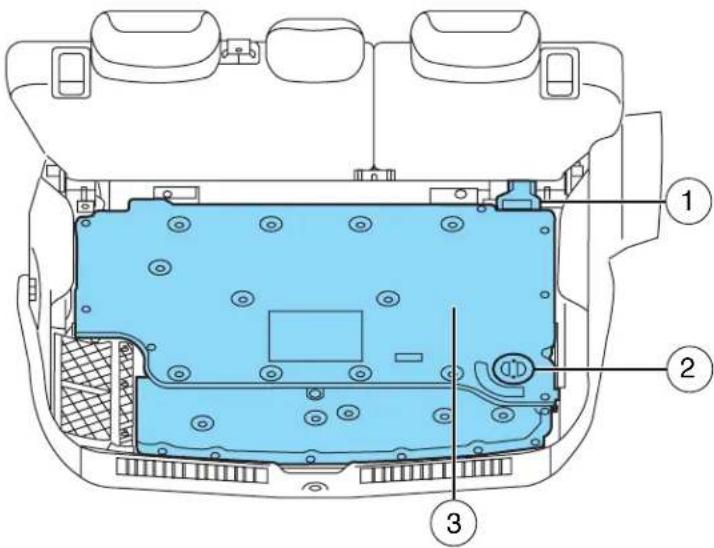
text_image
Technical diagram of a car rear panel with numbered components for identification- High voltage connector shield
- Service Disconnect
- High voltage battery case
Working with the engine off
- Set the parking brake and ensure the gearshift is securely latched in P (Park).
- Turn off the engine and remove the key.
- Block the wheels to prevent the vehicle from moving unexpectedly.
Maintenance and Specifications
Working with the engine on
- Set the parking brake and shift to P (Park).
- Block the wheels.

WARNING: To reduce the risk of vehicle damage and/or
personal burn injuries, do not start your engine with the air
cleaner removed and do not remove it while the engine is running.
OPENING THE HOOD
- Inside the vehicle, pull the hood release handle located under the bottom of the instrument panel.
- At the front of the vehicle, lift up on the auxiliary latch handle located in the center between the hood and the grille.
- Lift the hood open and secure it with the prop rod.
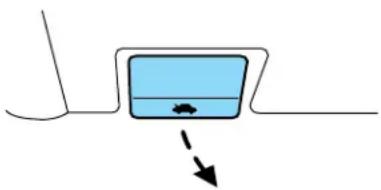
natural_image
Simple diagram showing a blue container with a black arrow pointing downward, no text or symbols present.Maintenance and Specifications
IDENTIFYING COMPONENTS IN THE ENGINE COMPARTMENT
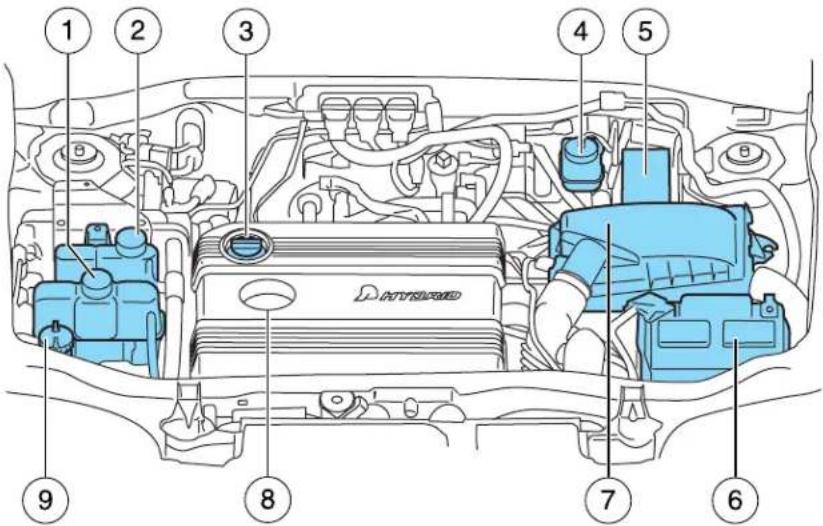
text_image
Diagram of a car engine bay with numbered components for identification- Engine coolant reservoir
- Motor/Electronics (M/E) coolant reservoir
- Engine oil filler cap
- Brake fluid reservoir
- Power distribution box
- Low voltage (underhood) battery
- Engine air filter assembly
- Engine oil dipstick
- Windshield washer fluid reservoir
Maintenance and Specifications
WINDSHIELD WASHER FLUID

Add fluid to fill the reservoir if the level is low. In very cold weather, do not fill the reservoir completely.
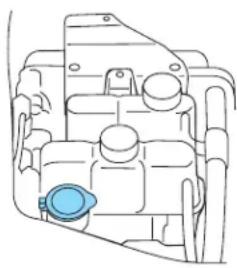
natural_image
Technical line drawing of a mechanical component with no visible text or symbolsOnly use a washer fluid that meets Mazda specifications. Do not use any special washer fluid such as windshield water repellent type fluid or bug wash. They may cause squeaking, chatter noise, streaking and smearing. Refer to the Maintenanceproductspecificationsandcapacities section in this chapter.
State or local regulations on volatile organic compounds may restrict the use of methanol, a common windshield washer antifreeze additive. Washer fluids containing non-methanol antifreeze agents should be used only if they provide cold weather protection without damaging the vehicle's paint finish, wiper blades or washer system.
WARNING: If you operate your vehicle in temperatures below 40^ F ( 5^ C), use washer fluid with antifreeze protection. Failure to use washer fluid with antifreeze protection in cold weather could result in impaired windshield vision and increase the risk of injury or accident.
Note: Do not put washer fluid in the engine coolant reservoir. Washer fluid placed in the cooling system may harm engine and cooling system components.
Checking and adding washer fluid for the liftgate
Washer fluid for the liftgate is supplied by the same reservoir as the windshield.
Maintenance and Specifications
CHANGING THE WIPER BLADES
- Pull the wiper blade and arm away from the glass. Turn the blade at a right angle to the arm.
- Squeeze the locking tabs to release the blade from the arm and pull the blade away from the arm to remove it.
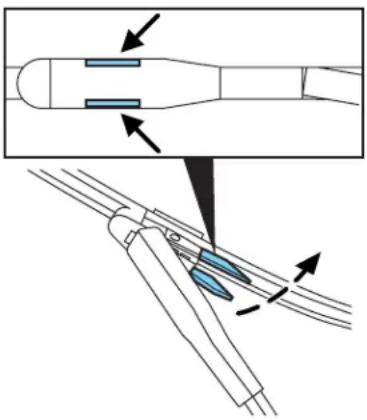
natural_image
Diagram showing a mechanical component with arrows indicating motion or force direction, no text or symbols present.- Attach the new blade to the arm and snap it into place.
Replace wiper blades at least once per year for optimum performance.
Poor wiper quality can be improved by cleaning the wiper blades and the windshield, refer to Windowsandwiperblades in the Cleaning chapter.
To prolong the life of the wiper blades, it is highly recommended to scrape off the ice on the windshield before turning on the wipers. The layer of ice has many sharp edges and can damage the micro edge of the wiper rubber element.
Maintenance and Specifications
Changing rear window wiper blade
The rear wiper arm is designed without a service position. This reduces the risk of damage to the blade in an automatic car wash.
To replace the wiper blade:
- Grab the wiper arm with one hand close to the arm/blade joint and pull it as far away from the glass as possible. Do not use excessive force because it can break the wiper arm at the heel. Hold it there until the next step.
- Grab the primary structure of the blade with the other hand close to the arm/blade joint.
- Grip tightly and push on the arm/blade joint from beneath and separate the blade from the arm.
- Attach the new wiper to the wiper arm and press it into place until a click is heard.
If you find this procedure too difficult, please see your dealer.
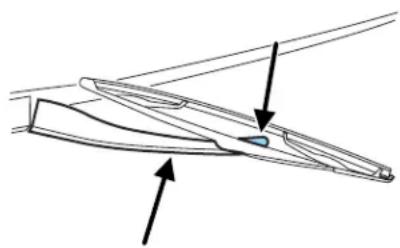
natural_image
Technical line drawing of a mechanical component with two arrows indicating direction (no text or symbols)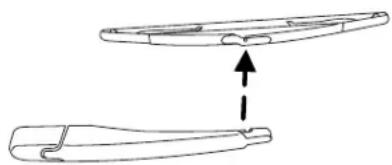
natural_image
Diagram showing two mechanical components with an upward arrow indicating motion (no text or symbols)ENGINE OIL
Checking the engine oil
Refer to the scheduled maintenance information for the appropriate intervals for checking the engine oil.
- Make sure the vehicle is on level ground.
- Turn the engine off and wait 15 minutes for the oil to drain into the oil pan.
- Set the parking brake and ensure the gearshift is securely latched in P (Park).
- Open the hood. Protect yourself from engine heat.
Maintenance and Specifications
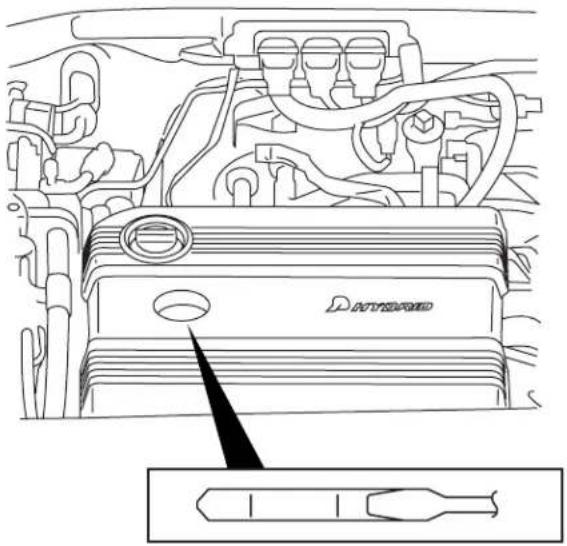
natural_image
Technical line drawing of a mechanical engine bay with a highlighted component (no text or symbols)- Locate and carefully remove the engine oil level dipstick.
- Wipe the dipstick clean. Insert the dipstick fully, then remove it again.
- If the oil level is within the lower and upper holes/lines, the oil level is acceptable. DONOTADDOIL.
- If the oil level is below the lower hole/line, engine oil must be added to raise the level within the normal operating range.
- If required, add engine oil to the engine. Refer to Adding engine oil in this chapter.
-
Donotoverfilltheenginewithoil.Oillevelsabovetheupper hole/linemaycauseengine damage.If the engine is overfilled, some oil must be removed from the engine by an authorized dealer.
-
Put the dipstick back in and ensure it is fully seated.
Adding engine oil
- Check the engine oil. For instructions, refer to Checkingtheengine oilin this chapter.
Maintenance and Specifications
- If the engine oil level is not within the normal range, add only certified engine oil of the recommended viscosity. Remove the engine oil filler cap and use a funnel to pour the engine oil into the opening.
- Recheck the engine oil level. Make sure the oil level is not above the full mark on the engine oil level dipstick.
- Install the dipstick and ensure it is fully seated.
- Fully install the engine oil filler cap by turning the filler cap clockwise 1/4 of a turn until it is seated.
Toavoidpossibleoilloss,DONOToperatethevehiclewiththe engineoilleveldipstickand/ortheengineoilfillercapremoved.
Engine oil and filter recommendations
Look for this certification trademark.

text_image
AMERICAN PETROLEUM INSTITUTE FOR GASOLINE ENGINES CERTIFIEDUseSAE5W-20engineoil
Only use oils “Certified For Gasoline Engines” by the American Petroleum Institute (API). An oil with this trademark symbol conforms to the current engine and emission system protection standards and fuel economy requirements of the International Lubricant Standardization and Approval Committee (ILSAC), comprised of U.S. and Japanese automobile manufacturers.
To protect your engine and engine's warranty, use Mazda SAE 5W-20 or an equivalent SAE 5W-20 oil meeting Mazda specification WSS-M2C930-A. SAE5W-20oilprovidesoptimumfueleconomyand durabilityperformancemeetingallrequirementsforyour vehicle'sengine.
Maintenance and Specifications
Do not use supplemental engine oil additives, cleaners or other engine treatments. They are unnecessary and could lead to engine damage that is not covered by Mazda warranty.
Change your engine oil and filter according to the appropriate schedule listed in scheduled maintenance information.
When changing the oil filter on the 2.3L engine, you must also replace the filter cap O-ring. The oil filter drain plug O-ring must also be replaced whenever the oil filter drain plug is removed. Reuse of the O-rings may cause engine oil leakage and may result in severe engine damage. The customer warranty may be void for any damage to the engine if the O-rings are not replaced.
Mazda production and Mazda replacement oil filters are designed for added engine protection and long life. If a replacement oil filter is used that does not meet Mazda material and design specifications, start-up engine noises or knock may be experienced.
It is recommended you use the appropriate Mazda oil filter or another with equivalent performance for your engine application.
LOW VOLTAGE (UNDERHOOD) BATTERY

Your vehicle is equipped with a Mazda maintenance-free battery which normally does not require additional water during its life of service.
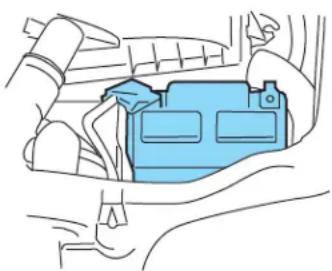
natural_image
Line drawing of a car interior showing a blue battery cover and hand positioning (no text or symbols)If your battery has a cover/shield, makes sure it is reinstalled after the battery has been cleaned or replaced.
For longer, trouble-free operation, keep the top of the battery clean and dry. Also, make certain the battery cables are always tightly fastened to the battery terminals.
If you see any corrosion on the battery or terminals, remove the cables from the terminals and clean with a wire brush. You can neutralize the acid with a solution of baking soda and water.
Maintenance and Specifications
Note: Electricalorelectronicaccessoriesorcomponentsaddedto thevehiclebythedealerortheowner(e.g.spotlights,electric winch,etc.)mayadverselyaffectvehicleperformanceand durability.

WARNING: Batteries normally produce explosive gases which can cause personal injury. Therefore, do not allow flames, sparks or lighted substances to come near the battery. When working near the battery, always shield your face and protect your eyes. Always provide proper ventilation.

WARNING: When lifting a plastic-cased battery, excessive pressure on the end walls could cause acid to flow through the vent caps, resulting in personal injury and/or damage to the vehicle or battery. Lift the battery with a battery carrier or with your hands on opposite corners.

WARNING: Keep batteries out of reach of children. Batteries contain sulfuric acid. Avoid contact with skin, eyes or clothing Shield your eyes when working near the battery to protect against possible splashing of acid solution. In case of acid contact with skin or eyes, flush immediately with water for a minimum of 15 minutes and get prompt medical attention. If acid is swallowed, call a physician immediately.

WARNING: Battery posts, terminals and related accessories contain lead and lead compounds. Wash hands after handling.
If the battery is disconnected, the Regenerative Braking System will need to relearn the initial brake pedal position. After reconnecting the battery, slowly depress and release the brake pedal one time.
Because your vehicle's engine is electronically controlled by a computer, some control conditions are maintained by power from the battery. When the battery is disconnected or a new battery is installed, the engine must relearn its idle and fuel trim strategy for optimum driveability and performance. To begin this process:
- With the vehicle at a complete stop, set the parking brake.
- Put the gearshift in P (Park), turn off all accessories and start the engine.
Maintenance and Specifications
- Run the engine until it reaches normal operating temperature.
- Allow the engine to idle for at least one minute.
- Turn the A/C on and allow the engine to idle for at least one minute.
- Drive the vehicle to complete the relearning process.
- The vehicle may need to be driven 10 miles (16 km) or more to relearn the idle and fuel trim strategy.
- If you donot allow the engine to relearn its idle trim, the idle quality of your vehicle may be adversely affected until the idle trim is eventually relearned.
If the battery has been disconnected or a new battery has been installed, the clock and the preset radio stations must be reset once the battery is reconnected.
- Always dispose of automotive batteries in a responsible manner. Follow your local authorized standards for disposal. Call your local authorized recycling center to find out more about recycling automotive batteries.
flowchart
graph TD
    A["LEAD"] --> B["RETURN"]
    B --> C["RECYCLE"]
    C --> A
Low and high voltage battery – storage
Your vehicle must be started and run for a minimum of 10 minutes once a month in order to maintain the high voltage battery charge. This will maintain the high voltage battery but it is not enough to maintain the low voltage (underhood) battery and additional low voltage (underhood) battery charging may be required after 60 days.
If your vehicle is to be stored for 30 days or longer, the low voltage (underhood) battery negative terminal must be disconnected. Failure to do this could damage your vehicle's batteries.
Maintenance and Specifications
ENGINE COOLANT AND MOTOR/ELECTRONICS COOLANT
Your vehicle is equipped with two separate coolant systems. One is for engine cooling and the other is for various electric motors and other components that are specific to the hybrid operating systems.
Checking engine coolant
The concentration and level of engine coolant should be checked at the intervals listed in scheduled maintenance information. The coolant concentration should be maintained at 50/50 coolant and distilled water, which equates to a freeze point of -34^ ( -36^ ). Coolant concentration testing is possible with a hydrometer or antifreeze tester (such as the Rotunda Battery and Antifreeze Tester, 014–R1060). The level of coolant should be maintained at the "FULL COLD" level or within the "COLD FILL RANGE" in the coolant reservoir. If the level falls below, add coolant per the instructions in the Addingenginecoolant section. When the engine is cold, check the level of engine coolant in the reservoir.

text_image
COLD FILL RANGEMaintenance and Specifications
Checkingmotor/electronics(M/E)coolant
The M/E coolant reservoir is located behind the engine coolant reservoir. Refer to the following engine coolant sections for all information, instructions and warnings related to cooling systems. The two systems use the same coolant and operate similarly, with the Motor and Electronics system generally operating at a lower temperature and pressure. The fluid levels in both reservoirs need to be maintained. When the engine is cold, check the level of M/E coolant in the reservoir.
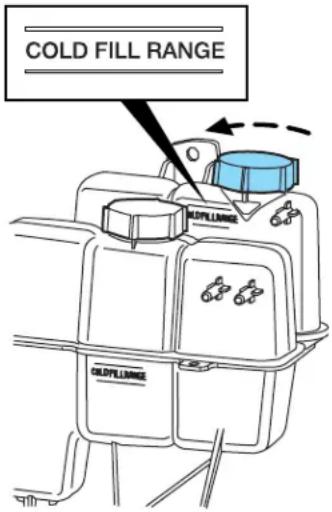
text_image
COLD FILL RANGE SUPPLANGE SUPPLANGEFactoryfillandcoolantspecifications
Your vehicle was factory-filled with a 50/50 engine coolant and water concentration. If the concentration of coolant falls below 40% or above 60%, the engine parts could become damaged or not work properly. A
50–50mixtureofcoolantandwaterprovidesthefollowing:
- Freezeprotectiondownto-34°F(-36°C).
• Boilingprotectionupto265°F(129°C). - Protectionagainstrustandotherformsofcorrosion.
- Enablescalibratedgaugestoworkproperly.
Commoninstructionsforcoolingsystems
- The engine coolant should be at the “FULL COLD” level or within the “COLD FILL RANGE” as listed on the engine coolant reservoir (depending upon application).
- Refer to the scheduled maintenance information for service interval schedules.
- Be sure to read and understand Precautionswhenservicingyour vehicle in this chapter.
Maintenance and Specifications
If the engine coolant has not been checked at the recommended interval, the engine coolant reservoir may become low or empty. If the reservoir is low or empty, add engine coolant to the reservoir. Refer to Adding enginecoolant in this chapter.
Note: Automotive fluids are not interchangeable; do not use engine coolant, antifreeze or windshield washer fluid outside of its specified function and vehicle location.
Adding engine coolant
UseonlyMazdaGenuineEngineCoolantorapremiumengine coolantthatmeetsaMazdaspecification.
- DONOTUSEExtendedLifeEngineCoolant(orangeincolor).
- DONOTUSEaDEX-COOL® enginecoolantoranequivalent enginecoolant.
• DONOTUSEalcoholormethanolantifreezeoranyengine coolantsmixedwithalcoholormethanolantifreeze. - DONOTUSEsupplementalcoolantadditivesinyourvehicle. Theseadditivesmayharmyourengine'scoolingsystem.
- DONOTMIXdifferentcolorsortypesofcoolantinyour vehicle.Makesurethecorrectcoolantisused.
- DONOTMIXrecycledcoolantandconventionalcoolant togetherinyourvehicle.Mixingofenginecoolantsmayharm yourengine'scoolingsystem.
- The useofanimpropercoolantmayharmengineandcooling systemcomponentsandmayvoidthewarrantyofyourvehicle's enginecoolingsystem.Ifyouareunsurewhichtypeofcoolant yourvehiclerequires,contactyourlocalauthorizeddealer.

WARNING: Do not put engine coolant in the windshield washer fluid reservoir. If engine coolant is sprayed onto the windshield, ld make it difficult to see through the windshield.
When adding coolant, make sure it is a 50/50 mixture of engine coolant and distilled water. Add the mixture to the coolant reservoir, whenthe engineiscool, until the appropriate fill level is obtained.
- NEVERincreasethecoolantconcentrationabove60%.
- NEVERdecreasethecoolantconcentrationbelow40%.
- Enginecoolantconcentrationsabove60% or below40% will decrease the freezeprotection characteristics of the engine coolant and may cause engineered damage.
Maintenance and Specifications
A large amount of water without engine coolant may be added, in case of emergency, to reach a vehicle service location. In this instance, the cooling system must be drained and refilled with a 50/50 mixture of engine coolant and distilled water as soon as possible. Water alone (without engine coolant) can cause engine damage from corrosion, overheating or freezing.
For vehicles with overflow coolant systems with a non-pressurized cap on the coolant recovery system, add coolant to the coolant recovery reservoir when the engine is cool. Add the proper mixture of coolant and water to the "COLD FILL RANGE". For all other vehicles, which have a coolant degas system with a pressurized cap, or if it is necessary to remove the coolant pressure relief cap on the radiator of a vehicle with an overflow system, follow these steps to add engine coolant.
- Before you begin, turn the engine off and let it cool.
- When the engine is cool, wrap a thick cloth around the coolant pressure relief cap on the coolant reservoir (an opaque plastic bottle). Slowly turn cap counterclockwise (left) until pressure begins to release.
- Step back while the pressure releases.
- When you are sure that all the pressure has been released, use the cloth to turn it counterclockwise and remove the cap.
- Fill the coolant reservoir slowly with the proper coolant mixture (see above), to within the "COLD FILL RANGE" or the "FULL COLD" level on the reservoir. If you removed the radiator cap in an overflow system, fill the radiator until the coolant is visible and radiator is almost full.
- Replace the cap. Turn until tightly installed. Cap must be tightly installed to prevent coolant loss.
After any coolant has been added, check the coolant concentration. Refer to the Checkingenginecoolantsection. If the concentration is not 50/50 (protection to -34^ F [-36^ C]), drain some coolant and adjust the concentration. It may take several drains and additions to obtain a 50/50 coolant concentration.
Whenever coolant has been added, the coolant level in the coolant reservoir should be checked the next few times you drive the vehicle. If necessary, add enough 50/50 concentration of engine coolant and distilled water to bring the liquid level to the proper level.
If you have to add more than 1.0 quart (1.0 liter) of engine coolant per month, have your authorized dealer check the engine cooling system.
Maintenance and Specifications
Your cooling system may have a leak. Operating an engine with a low level of coolant can result in engine overheating and possible engine damage.
Recycled engine coolant
Mazda Motor Corporation does NOT recommend the use of recycled engine coolant in vehicles originally equipped with Mazda Premium Gold Engine Coolant since a Mazda-approved recycling process is not yet available.

Used engine coolant should be disposed of in an appropriate
manner. Follow your community's regulations and standards for recycling and disposing of automotive fluids.
Coolant refill capacity
To find out how much fluid your vehicle's cooling system can hold, refer to Maintenanceproductspecificationsandcapacitiesin this chapter.
Fill your engine coolant reservoir as outlined in Addingenginecoolant in this section.
Severe climates
If you drive in extremely cold climates (less than -34^ [-36°C]):
- Itmaybenecessarytoincreasethecoolantconcentration above50%.
- NEVERincreasethecoolantconcentrationabove60%.
- Increased engine coolant concentrations above 60% will decrease the overheat protection characteristics of the engine coolant and may cause engineered damage.
- Refertothechartonthecoolantcontainertoensurethe coolantconcentrationinyourvehiclewillprovideadequate freezeprotectionatthetemperaturesinwhichyoudriveinthe wintermonths.
If you drive in extremely hot climates:
- Itisstillnecessary to maintain the coolant concentration above 40% .
- NEVERdecreasethecoolantconcentrationbelow40%.
- Decreasedenginecoolantconcentrationsbelow 40% will decreasethecorrosionprotectioncharacteristicsoftheengine coolantandmaycauseenginedamage.
Maintenance and Specifications
- Decreasedenginecoolantconcentrationsbelow 40% will decreasethefreezeprotectioncharacteristicsoftheengine coolantandmaycauseenginedamage.
- Refertothechartonthecoolantcontainertoensurethe coolantconcentrationinyourvehiclewillprovideadequate protectionatthetemperaturesinwhichyoudrive.
Vehicles driven year-round in non-extreme climates should use a 50/50 mixture of engine coolant and distilled water for optimum cooling system and engine protection.
FUEL FILTER
Your vehicle is equipped with a lifetime fuel filter that is integrated with the fuel tank. Regular maintenance or replacement is not needed.
WHAT YOU SHOULD KNOW ABOUT AUTOMOTIVE FUELS

Important safety precautions

WARNING: Do not overfill the fuel tank. The pressure in an overfilled tank may cause leakage and lead to fuel spray and fire.

WARNING: The fuel system may be under pressure. If you hear a hissing sound near the fuel filler door (Easy Fuel™ "no cap" system), do not refuel until the sound stops. Otherwise, fuel may out, which could cause serious personal injury.

WARNING: Automotive fuels can cause serious injury or death if misused or mishandled.

WARNING: Gasoline may contain benzene, which is a cancer-causing agent.
Maintenance and Specifications
Observe the following guidelines when handling automotive fuel:
- Extinguish all smoking materials and any open flames before refueling your vehicle.
• Always turn off the vehicle before refueling. - Automotive fuels can be harmful or fatal if swallowed. Fuel such as gasoline is highly toxic and if swallowed can cause death or permanent injury. If fuel is swallowed, call a physician immediately, even if no symptoms are immediately apparent. The toxic effects of fuel may not be visible for hours.
- Avoid inhaling fuel vapors. Inhaling too much fuel vapor of any kind can lead to eye and respiratory tract irritation. In severe cases, excessive or prolonged breathing of fuel vapor can cause serious illness and permanent injury.
- Avoid getting fuel liquid in your eyes. If fuel is splashed in the eyes, remove contact lenses (if worn), flush with water for 15 minutes and seek medical attention. Failure to seek proper medical attention could lead to permanent injury.
- Fuels can also be harmful if absorbed through the skin. If fuel is splashed on the skin and/or clothing, promptly remove contaminated clothing and wash skin thoroughly with soap and water. Repeated or prolonged skin contact with fuel liquid or vapor causes skin irritation.
- Be particularly careful if you are taking “Antabuse” or other forms of disulfiram for the treatment of alcoholism. Breathing gasoline vapors, or skin contact could cause an adverse reaction. In sensitive individuals, serious personal injury or sickness may result. If fuel is splashed on the skin, promptly wash skin thoroughly with soap and water. Consult a physician immediately if you experience an adverse reaction.

WARNING: When refueling always shut the engine off and
smoke while refueling. Fuel vapor is extremely hazardous under certain conditions. Care should be taken to avoid inhaling excess fumes.

WARNING: The flow of fuel through a fuel pump nozzle can
produce static electricity, which can cause a fire if fuel is
pumped into an ungrounded fuel container.
Maintenance and Specifications
Refueling

WARNING: Fuel vapor burns violently and a fuel fire can cause severe injuries. To help avoid injuries to you and others:
- Readandfollowalltheinstructionsonthepumpisland;
- Turnoffyourenginewhenyouarerefueling;
- Donotsmokeifyouarenearfuelorrefuelingyourvehicle;
- Keepsparks, flames and smoking materials away from fuel;
- Stayoutsideyourvehicleanddonotleavethefuelpump unattendedwhenrefuelingyourvehicle—thisisagainstthe lawinsomeplaces;
- Keepchildrenawayfromthefuelpump;neverletchildren pumpfuel.
Use the following guidelines to avoid electrostatic charge build-up when filling an ungrounded fuel container:
- Place approved fuel container on the ground.
- DO NOT fill a fuel container while it is in the vehicle (including the cargo area).
- Keep the fuel pump nozzle in contact with the fuel container while filling.
- DO NOT use a device that would hold the fuel pump handle in the fill position.
Easy Fuel™ "no cap" fuel system
Your fuel tank is equipped with an Easy Fuel ^™ “no cap” fuel filler system. This allows you to simply open the fuel filler door and insert the fuel filler nozzle into the fuel system. The Easy Fuel ^™ system is self-sealing and protected against dust, dirt, water and snow/ice.
When fueling your vehicle:
- Turn the engine off.
- Open the fuel filler door.
- Slowly insert the fuel filler nozzle fully into the fuel system. Pump fuel as normal.
Maintenance and Specifications
- After you are done pumping fuel, slowly remove the fuel filler nozzle—allow about five seconds after pumping fuel before removing the fuel filler nozzle. This allows residual fuel to drain back into the fuel tank and not spill onto the vehicle.
If the Check Fuel Fill Inlet lamp or Check Fuel Fill Inlet message comes on, the fuel fill inlet may not have properly closed. The inlet may have stuck open or debris may be preventing the inlet from fully closing. At the next opportunity, safely pull off the road, turn off the engine, open the fuel filler door and remove any visible debris from the fuel fill opening. Insert either the fuel fill nozzle or the fuel fill funnel (see Refillingwithaportablefuelcontainerfor funnel location) provided with the vehicle several times to dislodge any debris and/or allow the inlet to close properly. If this action corrects the problem, the Check Fuel Fill Inlet lamp or Check Fuel Fill Inlet message may not reset immediately. It may take several driving cycles for the Check Fuel Fill Inlet lamp or Check Fuel Fill Inlet message to turn off. A driving cycle consists of an engine start-up (after four or more hours with the engine off) followed by city/highway driving. Continuing to drive with the Check Fuel Fill Inlet lamp or Check Fuel Fill Inlet message on may cause the Service Engine Soon lamp to turn on as well.
WARNING: The fuel system may be under pressure. If you hear a hissing sound near the fuel filler door (Easy Fuel™ "no cap" fuel system), do not refuel until the sound stops. Otherwise, fuel may spray out, which could cause serious personal injury.
Choosing the right fuel
Use only UNLEADED fuel or UNLEADED fuel blended with a maximum of 10% ethanol. Do not use fuel ethanol (E85), diesel, methanol, leaded fuel or any other fuel. The use of leaded fuel is prohibited by law and could damage your vehicle.
Your vehicle was not designed to use fuel or fuel additives with metallic compounds, including manganese-based additives.
Note: Use of any fuel other than those recommended may cause powertrain damage, a loss of vehicle performance, and repairs may not be covered under warranty.
Maintenance and Specifications
Octane recommendations
Your vehicle is designed to use "Regular" unleaded gasoline with a pump (R+M)/2 octane rating of 87.
We do not recommend the use of gasolines labeled as "Regular" in
high altitude areas that are sold with octane ratings less than 87.

Do not be concerned if your engine sometimes knocks lightly. However, if it knocks heavily under most driving conditions while you are using fuel with the recommended octane rating, see your authorized dealer to prevent any engine damage.
Fuel quality
If you are experiencing starting, rough idle or hesitation driveability problems, try a different brand of unleaded gasoline. “Premium” unleaded gasoline is not recommended for vehicles designed to use “Regular” unleaded gasoline because it may cause these problems to become more pronounced. If the problems persist, see your authorized dealer.
Do not add aftermarket fuel additive products to your fuel tank. It should not be necessary to add any aftermarket products to your fuel tank if you continue to use high quality fuel of the recommended octane rating. These products have not been approved for your engine and could cause damage to the fuel system. Repairs to correct the effects of using an aftermarket product in your fuel may not be covered by your warranty.
Many of the world's automakers approved the World-Wide Fuel Charter that recommends gasoline specifications to provide improved performance and emission control system protection for your vehicle. Gasolines that meet the World-Wide Fuel Charter should be used when available. Ask your fuel supplier about gasolines that meet the World-Wide Fuel Charter.
Cleaner air
Mazda endorses the use of reformulated “cleaner-burning” gasolines to improve air quality, per the recommendations in the Choosingtheright fuelsection.
Running out of fuel
Avoid running out of fuel because this situation may have an adverse effect on powertrain components.
Maintenance and Specifications
If you have run out of fuel:
- You may need to cycle the ignition from off to on several times after refueling to allow the fuel system to pump the fuel from the tank to the engine. On restarting, cranking time will take a few seconds longer than normal.
- Normally, adding 1 gallon (3.8L) of fuel is enough to restart the engine. If the vehicle is out of fuel and on a steep grade, more than 1 gallon (3.8L) may be required.
- The Serviceenginesoon 📋 indicator may come on. For more information on the “service engine soon” indicator, refer to Warning lightsandchimesin the InstrumentClusterchapter.
Refillingwithaportablefuelcontainer
With the Easy Fuel ^™ “no cap” fuel system, use the following directions when filling from a portable fuel container:
WARNING: Do not insert the nozzle of portable fuel containers or aftermarket funnels into the Easy Fuel™ system. This could damage the fuel system and its seal, and may cause fuel to run onto the ground instead of filling the tank, which could result in serious personal injury.
WARNING: Do not try to pry open or push open the Easy Fuel™ system with foreign objects. This could damage the fuel system and its seal and cause injury to you or others.
When filling the vehicle's fuel tank from a portable fuel container, use the included funnel.
- Locate the white plastic funnel. It is attached to the inside of the rear passenger side cargo compartment access door.
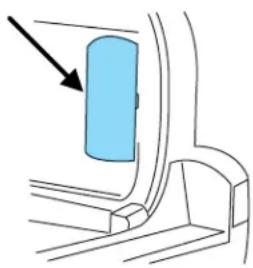
natural_image
Diagram of a car interior showing a blue rectangular object and an arrow pointing to it (no text or symbols present)Maintenance and Specifications
- Slowly insert the funnel into the Easy Fuel ^TM system.
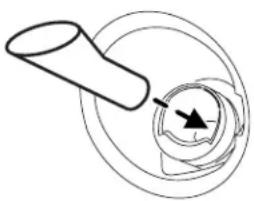
natural_image
Pure diagram of a mechanical component with no text, numbers, or symbols-
Fill the vehicle with fuel from the portable fuel container.
-
When done, clean the funnel or properly dispose of it. Extra funnels can be purchased from your authorized dealer if you choose to dispose of the funnel. Donotuse aftermarket funnels; they will not work with the Easy Fuel™ system and can damage it. The included funnel has been specially designed to work safely with your vehicle.
ESSENTIALS OF GOOD FUEL ECONOMY
Measuring techniques
Your best source of information about actual fuel economy is you, the driver. You must gather information as accurately and consistently as possible. Fuel expense, frequency of fill-ups or fuel gauge readings are NOT accurate as a measure of fuel economy. We do not recommend taking fuel economy measurements during the first 1,000 miles (1,600 km) of driving (engine break-in period). You will get a more accurate measurement after 2,000 miles–3,000 miles (3,000 km–5,000 km).
Filling the tank
When the fuel gauge indicates empty, there is still a small reserve of fuel in the fuel system. When refueling your vehicle after the fuel gauge indicates empty, you might not be able to refuel the full amount of the advertised capacity of the fuel tank due to the empty reserve still present in the tank. The amount of usable fuel in the empty reserve varies and should not be relied upon to increase driving range.
For consistent results when filling the fuel tank:
- Turn the engine/ignition switch to the off position prior to refueling; an error in the reading will result if the engine is left running.
- Allow no more than two automatic click-offs when filling.
Maintenance and Specifications
- Always use fuel with the recommended octane rating.
- Use a known quality gasoline, preferably a national brand.
Your results will be most accurate if your filling method is consistent.
Calculating fuel economy
- Fill the fuel tank completely and record the initial odometer reading (in miles or kilometers).
- Each time you fill the tank, record the amount of fuel added (in gallons or liters).
- After at least three to five tank fill-ups, fill the fuel tank and record the current odometer reading.
- Subtract your initial odometer reading from the current odometer reading.
- Follow one of the simple calculations in order to determine fuel economy:
Calculation 1: Dividetotalmilestraveledbytotalgallonsused.
Calculation 2: Multiplylitersusedby100,thendividebytotal kilometerstraveled.
Keep a record for at least one month and record the type of driving (city or highway). This will provide an accurate estimate of the vehicle's fuel economy under current driving conditions. Additionally, keeping records during summer and winter will show how temperature impacts fuel economy. In general, very hot or very cold temperatures give lower fuel economy.
Driving style — good driving and fuel economy habits
Since it is able to operate in electric mode and to collect braking energy, your hybrid vehicle will get better fuel economy in city driving than on the highway. This is contrary to conventional vehicles. However, many of the same actions that improve fuel economy in a conventional vehicle will also improve fuel economy in this vehicle.
Give consideration to the lists that follow and you may be able to improve your fuel economy.
Habits
- Avoid aggressive driving. Quick acceleration and deceleration decrease fuel economy.
- Drive at a smooth, constant speed. Excessive variation in pedal input causes more operating mode changes and reduces efficiency.
Maintenance and Specifications
- Drive at reasonable speeds. Traveling at 60 mph [96 km/h] uses approximately 20% less fuel than traveling at 70 mph [112 km/h]).
- Minimize A/C and defroster usage. Selecting defrost, or defrost/floor mode on the climate control system will force the engine to run continuously, which reduces fuel economy. Selecting AUTO will typically force the engine to run continuously, unless ECON is selected. ECON will allow the engine to shut down for a period of time, even when air conditioning is requested.
- Minimize temperature extremes when the vehicle is parked, for example by storing in a garage to avoid extreme cold in winter and extreme sun loads in summer. The high voltage battery operates more efficiently in moderate temperatures.
- Combine errands. Your vehicle is more fuel efficient when the engine is warm. Driving to your farthest destination first will warm the engine more quickly and may improve fuel economy for the rest of the trip.
Maintenance
- Keep tires properly inflated and use only recommended size.
- Keep wheels properly aligned.
- Use recommended engine oil. Refer to Lubricantspecifications in this chapter.
- Perform all regularly scheduled maintenance items. Follow the recommended maintenance schedule and owner maintenance checks found in scheduledmaintenanceinformation.
Conditions
- Heavily loading a vehicle or towing a trailer may reduce fuel economy at any speed.
- Carrying unnecessary weight may reduce fuel economy (approximately 1 mpg [0.4 km/L] is lost for every 300 lb [136 kg] of weight carried).
- Adding certain accessories to your vehicle (for example; bug deflectors, rollbars/light bars, running boards, ski/luggage racks, flags) may reduce fuel economy.
- Using fuel blended with alcohol may lower fuel economy.
- Driving on flat terrain offers improved fuel economy as compared to driving on mountainous terrain.
- Close windows for high speed driving.
Maintenance and Specifications
EPA fuel economy estimates
Every new vehicle should have a window sticker containing EPA fuel economy estimates. Contact your authorized dealer if the window sticker is not supplied with your vehicle. The EPA fuel economy estimates should be your guide for the fuel economy comparisons with other vehicles. Your fuel economy may vary depending upon the method of operation and conditions.
Your vehicle is equipped with various emission control components and a catalytic converter which will enable your vehicle to comply with applicable exhaust emission standards. To make sure that the catalytic converter and other emission control components continue to work properly:
- Use only the specified fuel listed.
- Avoid running out of fuel.
- Do not turn off the ignition while your vehicle is moving, especially at high speeds.
- Have the items listed in scheduled maintenance information performed according to the specified schedule.
The scheduled maintenance items listed in scheduled maintenance information are essential to the life and performance of your vehicle and to its emissions system.
If other than Mazda or Mazda-authorized parts are used for maintenance replacements or for service of components affecting emission control, such non-Mazda parts should be equivalent to genuine Mazda Motor Corporation parts in performance and durability.

WARNING: Do not park, idle, or drive your vehicle in dry grass or other dry ground cover. The emission system heats up the compartment and exhaust system, which can start a fire.
Illumination of the Serviceenginesoon 📄 indicator, charging system warning light or the temperature warning light, fluid leaks, strange odors, smoke or loss of engine power could indicate that the emission control system is not working properly.
An improperly operating or damaged exhaust system may allow exhaust to enter the vehicle. Have a damaged or improperly operating exhaust system inspected and repaired immediately.
Maintenance and Specifications

WARNING: Exhaust leaks may result in entry of harmful and potentially lethal fumes into the passenger compartment.
Do not make any unauthorized changes to your vehicle or engine. By law, vehicle owners and anyone who manufactures, repairs, services, sells, leases, trades vehicles, or supervises a fleet of vehicles are not permitted to intentionally remove an emission control device or prevent it from working. Information about your vehicle's emission system is on the Vehicle Emission Control Information Decal located on or near the engine. This decal also lists engine displacement.
Please consult your WarrantyGuide/CustomerInformationGuide for complete emission warranty information.
On board diagnostics (OBD-II)
Your vehicle is equipped with a computer that monitors the engine's emission control system. This system is commonly known as the On Board Diagnostics System (OBD-II). The OBD-II system protects the environment by ensuring that your vehicle continues to meet government emission standards. The OBD-II system also assists your authorized dealer in properly servicing your vehicle. When the Service enginesoon 📋 indicator illuminates, the OBD-II system has detected a malfunction. Temporary malfunctions may cause the Serviceengine soon 📋 indicator to illuminate. Examples are:
- The vehicle has run out of fuel—the engine may misfire or run poorly.
- Poor fuel quality or water in the fuel—the engine may misfire or run poorly.
- The fuel fill inlet may not have been properly closed. See Easy Fuel™"nocap"fuelsystemin this chapter.
- Driving through deep water—the electrical system may be wet.
These temporary malfunctions can be corrected by filling the fuel tank with good quality fuel, properly closing the fuel fill inlet or letting the electrical system dry out. After three driving cycles without these or any other temporary malfunctions present, the Serviceenginesoon indicator should stay off the next time the engine is started. A driving cycle consists of a cold engine startup followed by mixed city/highway driving. No additional vehicle service is required.
If the Serviceenginesoon 📄 indicator remains on, have your vehicle serviced at the first available opportunity. Although some malfunctions
Maintenance and Specifications
detected by the OBD-II may not have symptoms that are apparent, continued driving with the Serviceenginesoon indicator on can result in increased emissions, lower fuel economy, reduced engine and transmission smoothness, and lead to more costly repairs.
Readiness for Inspection/Maintenance (I/M) testing
Some state/provincial and local governments may have Inspection/Maintenance (I/M) programs to inspect the emission control equipment on your vehicle. Failure to pass this inspection could prevent you from getting a vehicle registration. Your vehicle may not pass the I/M test if the Serviceenginesoon indicator is on or not working properly (bulb is burned out), or if the OBD-II system has determined that some of the emission control systems have not been properly checked. In this case, the vehicle is considered not ready for I/M testing.
If the Serviceenginesoon 📋 indicator is on or the bulb does not work, the vehicle may need to be serviced. Refer to the On board diagnostics (OBD-II) description in this chapter.
If the vehicle's engine or transmission has just been serviced, or the battery has recently run down or been replaced, the OBD-II system may indicate that the vehicle is not ready for I/M testing. To determine if the vehicle is ready for I/M testing, turn the ignition key to the on position for 15 seconds without cranking the engine. If the Serviceengine soon indicator blinks eight times, it means that the vehicle is not ready for I/M testing; if the Serviceenginesoon indicator stays on solid, it means that the vehicle is ready for I/M testing.
The OBD-II system is designed to check the emission control system during normal driving. A complete check may take several days. If the vehicle is not ready for I/M testing, the following driving cycle consisting of mixed city and highway driving may be performed:
15 minutes of steady driving on an expressway/highway followed by 20 minutes of stop-and-go driving with at least four 30-second idle periods.
Allow the vehicle to sit for at least eight hours without starting the engine. Then, start the engine and complete the above driving cycle. The engine must warm up to its normal operating temperature. Once started, do not turn off the engine until the above driving cycle is complete. If the vehicle is still not ready for I/M testing, the above driving cycle will have to be repeated.
Maintenance and Specifications
BRAKE FLUID
The fluid level will drop slowly as the brakes wear, and will rise when the brake components are replaced.
Check fluid levels with the ignition in the RUN position. Fluid levels between the "MIN" and "MAX" lines are within the normal operating range; there is no need to add fluid.
If the fluid levels are outside of the normal operating range the performance of your brake system could be compromised; seek service from your authorized dealer immediately.
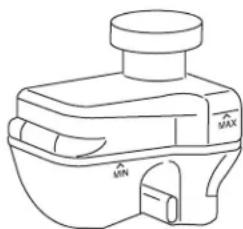
natural_image
Line drawing of a mechanical device with labeled parts (MAX, MIN) and no readable text or symbols.TRANSMISSION FLUID
Checking electronically controlled continuously variable transmission (eCVT)
Refer to your scheduled maintenance information chapter for scheduled intervals for fluid checks and changes. Your transmission does not consume fluid. It is designed to be filled for life. However, the fluid level should be checked if you notice some sign of fluid leakage.
Automatictransmissionfluidexpandswhenwarmed.Toobtainan accuratefluidcheck,drivethevehicleuntilitiswarmedup (approximately20miles[30km]).Ifyourvehiclehasbeen operatedforanextendedperiodathighspeeds,incitytraffic duringhotweatherorpullingatrailer,thevehicleshouldbe turnedoffforabout30minutestoallowfluidtocoolbefore checking.
- Drive the vehicle 20 miles (30 km) or until it reaches normal operating temperature.
- Park the vehicle on a level surface and engage the parking brake.
Maintenance and Specifications
- With the parking brake engaged and your foot on the brake pedal, turn the key to the ACCESSORY position but do not start the engine. Turn the wheel to the left to gain access to the check plug.
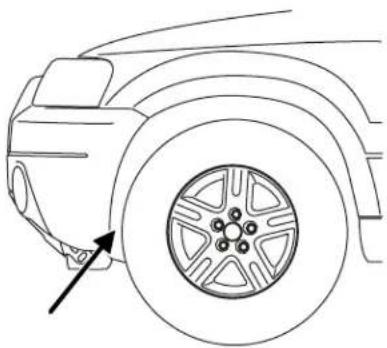
natural_image
Line drawing of a car wheel and rear bumper with an arrow pointing to the side wheel (no text or symbols)-
Latch the gearshift lever in P (Park) and make sure that the engine is OFF by placing the ignition in the Lock position.
-
Remove the check plug from the side of the transmission.

natural_image
Mechanical assembly diagram showing a hand operating a valve with a magnified inset highlighting the component (no text or symbols present)Maintenance and Specifications
- Be sure the engine has been stopped for at least 3 minutes before performing the fluid level check.
- The fluid level should be within 1/4 inch (6 mm) of the plug threads.
- Replace the check plug.
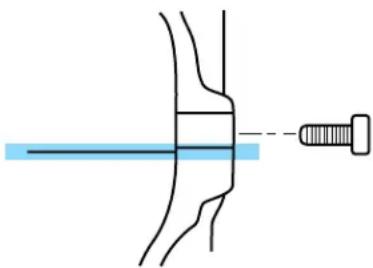
natural_image
Diagram of a medical or surgical procedure showing a needle inserted into a body with a screw attached (no text or labels)AdjustingeCVTfluidlevels
Before adding any fluid, make sure the correct type is used. The type of fluid used is indicated in the Maintenanceproductspecificationsand capacitiessection in this chapter.
Useofanon-approvedfluidmaycauseinternaltransmission componentdamage.
If the fluid level is low, add fluid through the check port until the level is correct and fluid begins to run out of the transmission. If an overfill occurs, excess fluid should be removed by allowing the fluid to run out of the check port.
Aseriousouverfillconditionoftransmissionfluidmaycause damage.
Do not use supplemental transmission fluid additives, treatments or cleaning agents. The use of these materials may affect transmission operation and result in damage to internal transmission components.
Maintenance and Specifications
AIR FILTER
Refer to scheduled maintenance information for the appropriate intervals for changing the air filter element.
When changing the air filter element, use only the Mazda air filter element listed. Refer to Mazdapartnumbers in this chapter.

WARNING: To reduce the risk of vehicle damage and/or personal burn injuries do not start your engine with the air or removed and do not remove it while the engine is running.
Changing the air filter element
-
Release the clamps that secure the air filter housing cover.
-
Carefully separate the two halves of the air filter housing.
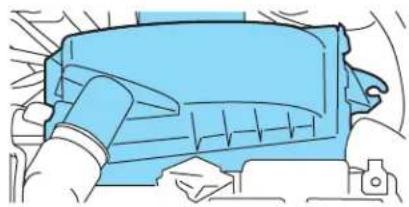
natural_image
Illustration of a blue mechanical component with hands operating it, no visible text or symbols- Remove the air filter element from the air filter housing.
- Wipe the air filter housing and cover clean to remove any dirt or debris and to ensure good sealing.
- Install a new air filter element. Be careful not to crimp the filter element edges between the air filter housing and cover. This could cause filter damage and allow unfiltered air to enter the engine if not properly seated.
- Replace the air filter housing cover and secure the clamps.
Note: Failure to use the correct air filter element may result in severe engine damage. The customer warranty may be voided for any damage to the engine if the correct air filter element is not used.
Maintenance and Specifications
HIGH VOLTAGE BATTERY COOLING FILTER (REAR A/C) MAINTENANCE
The high voltage battery has a dedicated A/C cooling system which includes an air filter.
Refer to the scheduled maintenance information for the appropriate intervals for air filter.
When changing the air filter element, use only the Mazda air filter element listed. Refer to Mazdapartnumbers in this chapter.
Changing the high voltage battery air filter element
- Remove access panel located in the rear cargo area on the driver's side trim panel to expose the filter cover.

natural_image
Diagram of a car interior showing a blue car seatbelt with a circular arrow indicating rotation (no text or symbols)- Push the tabs (located on each side of filter cover) while pulling gently to remove filter cover. Remove the old filter.
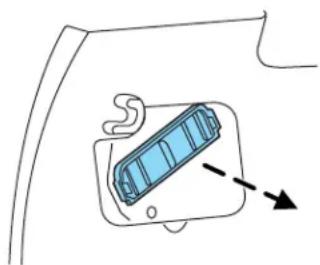
natural_image
Diagram of a car door handle with a blue battery inside, showing no text or symbols- Install new filter and filter cover (note arrows indicating top side). The arrow on the filter cover and the arrow on the filter both point in the same direction (upward).
- Re-install the access panel into the trim panel.
MAINTENANCE PRODUCT SPECIFICATIONS AND CAPACITIES
| ItemCapacity | MazdaPartNameorequivalent | Application | |
| Brake fluid | Between MIN and MAX lines on reservoir | High Performance DOT 3 Motor Vehicle Brake Fluid | Brake fluid reservoir |
| Engine coolant 7.4 quarts (7.0L) | Mazda Premium Engine Coolant1 | Cooling systems | |
| Motor/Electronics (M/E) Coolant | 3.7 quarts (3.5L) | ||
| Engine oil 5.0 quarts (4.73L) SAE 5W-20 Motor Oil Engine | |||
| Automatic eCVT transmission fluid | 5.3 quarts (5.0L)2 | MERCON®VATF3 | Transmission |
| Rear axle fluid (4WD) 2.96 pints (1.4L)4 | API service GL-5 SAE 80W-905 | Rear axle | |
| Power Transfer Unit fluid (4WD)6 | 12 ounces (0.35L) | API service GL-5 SAE 75W-140 Synthetic Lubricant | Power transfer unit |
| Windshield washer fluid 2.7 quarts (2.6L) | Ultra-clear Windshield Washer Concentrate | Washer fluid reservoir | |
| Fuel tank 15 gallons (56.8L) — All | |||
^1 Add the coolant type originally equipped in your vehicle. Refer to Adding engine coolant in this chapter. ^2 Indicates only approximate dry-fill capacity.
^3 Using any transmission fluid other than those that meet the recommended specification may cause internal transaxle damage. Do not use MERCON ^ CVT (blue) ATF. This vehicle uses only MERCON ^ V ATF.
^4 Fill to 1/4 inch to 9/16 inch (6mm to 14mm) below bottom of fill hole.
^5 4WD vehicles exposed for prolonged periods to temperatures less than -40^ C ( -40^ F) should change out the rear axle fluid to SAE 75W-140 axle lubricant.
^6 The Power Transfer Unit is lubricated for life with synthetic lube. Lubricant levels are not to be checked or changed unless a leak is suspected or repair required. Replace Power Transfer Unit lubricant with specified synthetic lubricant anytime the unit is submerged in water.
Maintenance and Specifications
ENGINE DATA
| Engine2.5LI4engine | |
| Cubic inches 152 | |
| Required fuel 87 octane | |
| Firing order 1-3-4-2 | |
| Ignition system Coil on plug | |
| Spark plug gap 0.049–0.053 inch (1.25–1.35mm) | |
| Compression ratio 12.3:1 | |
Engine drivebelt routing
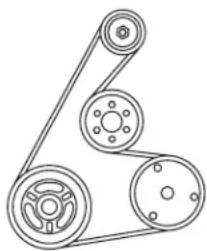
natural_image
Technical line drawing of a belt drive system with pulleys and wheels (no text or symbols)•2.5L I4 Engine
HIGH VOLTAGE BATTERY DATA
| HighVoltageBattery | |
| Battery chemistry Nickel metal hydride | |
| Nominal voltage 330 volts | |
| Battery system capacity 6 amp-hours | |
Maintenance and Specifications
IDENTIFYING YOUR VEHICLE
Safety Compliance Certification Label
The National Highway Traffic Safety Administration Regulations require that a Safety Compliance Certification Label be affixed to a vehicle and prescribe where the Safety Compliance Certification Label may be located. The Safety Compliance Certification Label is located on the structure (B-Pillar) by the trailing edge of the driver's door or the edge of the driver's door.
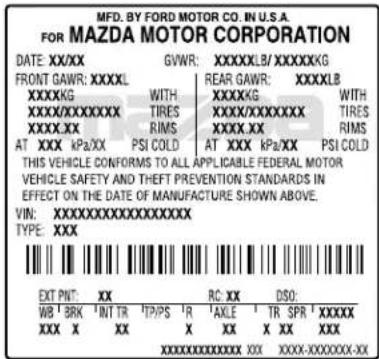
text_image
MFD. BY FORD MOTOR CO. IN U.S.A. FOR MAZDA MOTOR CORPORATION DATE: XX/XX GVWR: XXXXXLB/XXXXXKG FRONT GAWR: XXXXL REAR GAWR: XXXXLB XXXXKG WITH XXXXKG WITH XXXX/XXXXXXXX TIRES XXXX/XXXXXXXX TIRES XXXX.xx RIMS XXXX.xx RIMS AT XXX KPa/XX PSI COLD AT XXX KPa/XX PSI COLD THIS VEHICLE CONFORMS TO ALL APPLICABLE FEDERAL MOTOR VEHICLE SAFETY AND THEFT PREVENTION STANDARDS IN EFFECT ON THE DATE OF MANUFACTURE SHOWN ABOVE. VIN: XXXXXXXXXXXXXXX TYPE: XXX EXT PNT: XX RC: XX DSO: WB 3 BRK INT TR TP/PS R AXLE TR SPR 1 XXXXX XXX X XX X XX X XX XXX XXXXXXXXXXXX XXX XXX-XXXXXXXX-XXVehicle identification number (VIN)
The vehicle identification number is located on the driver side instrument panel.
Please note that in the graphic, XXXX is representative of your vehicle identification number.
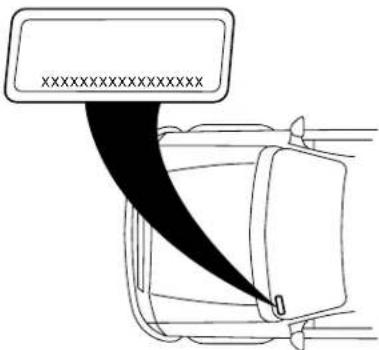
text_image
XXXXXXXXXXXXXXMaintenance and Specifications
The Vehicle Identification Number (VIN) contains the following information:
- World manufacturer identifier
- Brake system / Gross Vehicle Weight Rating (GVWR) / Restraint System
- Vehicle line, series, body type
- Engine type
- Check digit
- Model year
- Assembly plant
- Production sequence number
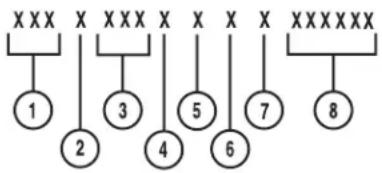
You can find a transmission code on the Safety Compliance Certification Label. The following table tells you which transmission each code represents.
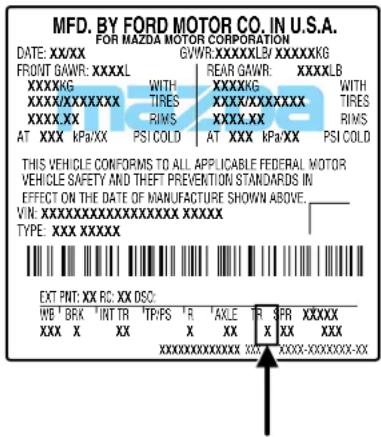
text_image
MFD. BY FORD MOTOR CO. IN U.S.A. FOR MAZDA MOTOR CORPORATION DATE: XX/XX GVWR:XXXXXXLB/XXXXXXKB FRONT GAWR: XXXXL REAR GAWR: XXXXXLB XXXXXKG WITH XXXXXKG WITH XXXX/XXXXXXXX TIRES XXXX/XXXXXXXX TIRES XXXXXX RIMS XXXXX.XX RIMS AT XXX kPa/XX PSI COLD AT XXX kPa/XX PSI COLD THIS VEHICLE CONFORMS TO ALL APPLICABLE FEDERAL MOTOR VEHICLE SAFETY AND THEFT PREVENTION STANDARDS IN EFFECT ON THE DATE OF MANUFACTURE SHOWN ABOVE. VIN:XXXXXXXXXXXXXXXXXXXX TYPE: XXX XXXXXX EXT PNT: XX RC: XX DSO: WB ' BRK ' INT TR ' TP/PS ' R ' AXLE TR ' PR XXXXX XXX X XX X XX X XX XXX XXXXXXXXXXXX XXX XXXX-XXXXXXXX-XX| DescriptionCode | |
| Electronically controlled continuously variable transmission, eCVT | H |
Accessories
CELL PHONES
Use of cell phones and other devices by driver:
WARNING: Use of any electrical devices such as cell phones, computers, portable radios, vehicle navigation or other devices by the driver while the vehicle is moving is dangerous. Dialing a number on a cell phone while driving also ties-up the driver's hands. Use of these devices will cause the driver to be distracted and could lead to a serious accident. If a passenger is unable to use the device, pull off the right-of-way to a safe area before use. If use of a cell phone is necessary despite this warning, use a hands-free system to at least allow the hands free to drive the vehicle. Never use a cell phone or other electrical device while the vehicle is moving and, instead, concentrate on the full-time job of driving. In addition, the gasoline distributors are warning against using cell phones during refueling procedures, due to their increased concern about static electricity fires in the self-service pump environment.
Service Maintenance Section
GENERAL MAINTENANCE INFORMATION
Why maintain your vehicle?
This guide describes the scheduled maintenance required for your vehicle. Carefully following this schedule helps protect against major repair expenses resulting from neglect or inadequate maintenance and may also help to increase the value of your vehicle when you sell or trade it.
It is your responsibility to see that all scheduled maintenance is performed and that the materials used meet Mazda engineering specifications. Failure to perform scheduled maintenance specific in this guide will invalidate warranty coverage on parts affected by the lack of maintenance. Be sure receipts for completed maintenance are kept with the vehicle and confirmation of the work performed is always recorded in this guide.
Your Mazda dealer, or Mazda Quality Care Center has factory trained technicians who can perform the required maintenance using genuine Mazda parts. They are committed to meeting your service needs and to assuring your continuing satisfaction.
Protecting your investment
Maintenance is an investment that will pay dividends in the form of improved reliability, durability and resale value. To ensure the proper performance of your vehicle and its emission control systems, it is imperative that scheduled maintenance be completed at the designated intervals.
Your vehicle is very sophisticated and built with multiple complex performance systems. Every manufacturer develops these systems using different specifications and performance features. That's why it's important to rely upon your Mazda dealership to properly diagnose and repair your vehicle.
Mazda Motor Corporation has recommended maintenance intervals for various parts and component systems based upon engineering testing. Mazda Motor Corporation relies upon this testing to determine the most appropriate mileage for replacement of oils and fluids to protect your vehicle at the lowest overall cost to you and recommends against maintenance schedules that deviate from the scheduled maintenance information.
Service Maintenance Section
Mazda strongly recommends the use of genuine Mazda replacement parts. Parts other than Mazda or Mazda authorized remanufactured parts that are used for maintenance replacement or for the service of components affecting emission control must be equivalent to genuine Mazda Motor Corporation parts in performance and durability. It is the owner's responsibility to determine the equivalency of such parts. Please consult your WarrantyGuidefor complete warranty information.
Non-Mazda approved chemicals or additives are not required for factory recommended maintenance. In fact, Mazda Motor Corporation recommends against the use of such additive products unless specifically recommended by Mazda for a particular application.
Oil, fluids and flushing
In many cases, fluid discoloration is a normal operating characteristic and, by itself, does not necessarily indicate a concern or that the fluid needs to be changed. However, discolored fluids that also show signs of overheating and/or foreign material contamination should be inspected immediately by a qualified expert such as the factory-trained technicians at your Mazda Dealership. Your vehicle's oils and fluids should be changed at the specified intervals or in conjunction with a repair. Flushing is a viable way to change fluid for many vehicle sub-systems during scheduled maintenance. It is critical that systems are flushed only with new fluid that is the same as that required to fill and operate the system, or using a Mazda-approved flushing chemical.
EngineEmissionslabel
Emissions information appears on the Engine Emissions label on the underside of the hood. This decal identifies engine displacement and provides certain engine specifications.
Any modification of the emissions control system could create liability under federal law (U.S.) if made prior to sale and registration, under the laws of some states if made thereafter. Further, federal law prohibits vehicle manufacturers, dealers and other persons engaged in the business of repairing, servicing, selling, leasing or trading motor vehicles as well as fleet operations from knowingly removing or rendering an emissions control system inoperative after sale and delivery to an ultimate purchaser. In Canada, modifications of the emissions control system could create liability under applicable federal or provincial laws.
Genuine Mazda Parts and Service
When planning your maintenance services, consider your Mazda dealership for all your vehicle's needs.
Service Maintenance Section
Getthemostfromyourserviceandmaintenancevisits
There are a lot of reasons why visiting your Mazda Dealership for all your service needs is a great way to help keep your vehicle running great.
Convenience
Many Dealerships have extended evening and Saturday hours to make your service visit more convenient. How's that for quality service?
Factory-trainedTechnicians
Mazda service technicians participate in extensive factory-sponsored certification training to help them become experts on the operation of your vehicle. Ask your Dealership about the training and certification their technicians have received.
FactoryAuthorizedSystemsChecks
In the event your vehicle experiences a component related concern, please contact your Mazda dealership. The Mazda Motor Corporation Trained Technicians who work at Mazda dealerships are specifically trained to understand your vehicle.
A proper repair begins with a thorough system check. Factory Authorized Systems Checks can ONLY be found at a Mazda dealership. In some circumstances, the Technician may need to request your authorization to perform additional operations to determine the final diagnosis. The Technician's goal is to ensure that your vehicle is fixed right the first time, at the best value to you.
The following list represents several of the Factory Authorized Systems Checks available at participating Mazda Dealerships:
• Climate Control
- Check Engine Light
- All Wheel Drive/Four-Wheel Drive
• Automatic Transmission
•Engine Cooling/Cabin Heating
- Suspension/Steering
- Charge/Start/Battery
- Wheel Alignment
- Brakes
Service Maintenance Section
And when your vehicle needs replacement parts, insist that only parts meeting Mazda Motor Corporation's specifications are used. Genuine Mazda branded parts meet these specifications. You can find them at your Mazda Dealership. Look for the following brand logos to ensure the parts installed on your vehicle meet Mazda Motor Corporation Specifications.
GenuineMazdaReplacementParts
Mazda dealerships stock Mazda branded replacement parts. These parts meet or exceed Mazda Motor Corporation's specifications, and we stand behind them. Maintenance parts installed at your Mazda dealership carry a nationwide, 12 months, 12,000 mile parts and labor limited warranty. Your dealer can give you details.
ValueShoppingforYourVehicle'sMaintenanceNeeds
Your dealership recognizes the competitive landscape of maintenance and light repair automotive services. With factory-trained technicians, and one-stop service from routine maintenance like oil changes and tire rotations to repairs like brake service, check out the value your Mazda dealers can offer.
WHICH MAINTENANCE SCHEDULE SHOULD YOU FOLLOW?
Owner Checks and Services
RefertoMileageIntervalsforAdditionalChecksandServices
Certain basic maintenance checks and inspections should be performed by the owner or a service technician at the intervals indicated. Service information and supporting specifications are provided in this Owner's Manual.
Any adverse condition should be brought to the attention of your dealer or qualified service technician as soon as possible for the proper service advice. The owner maintenance service checks are generally not covered by warranties so you may be charged for labor, parts or lubricants used.
MaximumOilChangelInterval

12months, 10,000miles (16,000km) or 200hoursofengineoperation.
MazdaPremiumGoldEngineCoolantchangeinterval

6yearsor100,000miles(160,000km)-changeMazdaPremiumGoldEngineCoolant (whichevercomesfirst) Afterinitialchange-changeMazdaPremiumGoldEngineCoolantevery3yearsor50,000miles(80,000km).
Service Maintenance Section
Checkeverymonth
☐ Checkfunctionofallinteriorandexteriorlights
□ Checkfiresforwearandcorrectairpressure,includingsparetire
□ Checkwindshieldwasherfluidlevel
Checkengineoillevel
Check every six months
☐ Checklap/shoulderbeltsandseatlatchesforwearandfunction
☐ Checkthatexternallymountedsparetireisproperlystowed(tight)
□ Checkparkingbrakeforproperoperation
☐ Checksafetywaminglamps(brake,ABS,airbag,seatbelt)foroperation
☐ Checkcoolingsystemfluidlevelandcoolantstrength
☐ Checklowvoltage(underhood)batteryconnectionsandcleanifnecessary
☐ Checkwasherspray, wiperoperation and clean all wiper blades (replace as necessary)
☐ Checkandlubricateallhinges, latchesandoutsidelocks. Inspectforcorrectoperation
□ Checkandlubricatedoorrubberweatherstrips.Inspectforexcessivewear
□ Checkandcleanbodyanddoordrainholes.Inspectforclogsandobstructions
Multi-point Inspection
In order to keep your vehicle running right, it is important that you have the systems on your vehicle checked regularly. This can help identify any potential issue before there are any problems. Mazda Motor Corporation suggests the following multi-point inspection to be performed at every scheduled maintenance as the way to ensure your vehicle keeps running right.
Multi-pointinspection-Recommendedateveryvisit
☐ Checkandtopupfluidlevels:brake,enginecoolantrecoveryreservoir,motor/electronicsreservoirandwindowwasher.
□ Inspecttiresforwearandcorrectairpressure.
☐ Checkexhaustsystemforleaks,damage,loosepartsandforeignmaterials.
☐ Checklowvoltage(underhood)batteryperformance.
☐ Checkoperationofhorn,exteriorlamps,turnsignalsandhazardwarninglights.
□ Checkradiator, coolers and heater and air conditioning hoses.
□ Inspectwindshieldwashersprayandwiperoperation.
☐ Checkwindshieldforcracks, chipsandpitting.
Inspectforoilandfluidleaks.
□ Inspectengineaircleanerfilterandelements.
□ Inspecthalf-shaftdustboots.
☐ Checkshocks, strutsandothersuspensioncomponentsforleaksanddamage.
Service Maintenance Section
NORMAL SCHEDULED MAINTENANCE AND LOG
The following section contains the “Normal Schedule”. This schedule is presented at specific mileage (kilometer) intervals with exceptions noted.
ADDITIONAL INFORMATION AVAILABLE ON THE WEB
To learn more about the importance of routine and dealer-performed maintenance on your vehicle, please visit the Mazda Customer Service Web site. You'll also find important warranty information, customer assistance, technical expertise, frequently asked questions and much more. The Web site location is: www.genuineservice.com.
Then go to the vehicles and services pick at the Web site.
U.S. AND CANADIAN SCHEDULE
text_image
5,000miles(8,000km) □ Inspecttiresforwearandmeasuretreoddepth □ Rotatofires DEALER VALIDATION: RO#: P&A C ODE: DATE: M ILEAGE:
text_image
10,000miles(16,000km) Changeengineoilandreplaceoilfilter Inspecttiresforwearandmeasurethreaddepth Rotatetires Inspectwheelendsforendplayandnoise InspecthighvoltagebatteryA/Cfilter,replaceifnecessary DEALER VALIDATION: RO#: P&A C ODE: DATE: M ILEAGE:Service Maintenance Section
20,000miles(32,000km)
| ChangeengineoilandreplaceoilfilterInspecttiresforwearandmeasuretreaddepthRotatetiresInspectwheelendsforendplayandnoiseInspectbrakepods,shoes,rotors,drums,brakelinesandhosesandparkingbrakeInspectengineandMotor/electronicscoolingsystemandhosesInspectsteeringlinkage,suspensionand,ifequipped,half-shafts,driveshaftandbelljointsInspectexhaustsystemandheatshieldsReplacehighvoltagebatteryA/Cfilter | DEALER VALIDATION:RO#: P&AC ODE:DATE: M ILEAGE: | ||
30,000miles(48,000km)
| ChangeengineoilandreplaceoilfilterInspecttiresforwearandmeasuretreaddepthRotatetiresInspectwheelondsforendplayandnoiseInspecthighvoltagebatteryA/Cfilter,replaceifnecessaryReplaceengineairfilter | ||
| DEALER VALIDATION: | ||
| RO#: P&A C | ODE: | |
| DATE: | M ILEAGE: | |
40,000miles(64,000km)
| ChangeengineoilandreplaceoilfilterInspecttiresforwearandmeasuretreaddepthRotatetiresInspectwheelendsforendplayandnoiseInspectbrakepods,shoes,rotors,drums,brakelinesand hosesandparkingbrakeInspectengineandMotor/electronicscoolingsystemand hosesInspectsteeringlinkage,suspensionand,ifequipped,half-shafts,driveshaftandbelljointsInspectexhaustsystemandheatshieldsReplacehighvoltagebatteryA/Cfilter | DEALER VALIDATION:RO#: P&A C ODE:DATE: M ILEAGE: | ||
Service Maintenance Section
50,000miles(80,000km)
| ChangeengineoilandreplaceoilfilterInspecttiresforwearandmeasuretreaddepthRotatetiresInspectwheelendsforendplayandnoiseInspecthighvoltagebatteryA/Cfilter,replaceifnecessary | ||
| DEALER VALIDATION: | ||
| RO#: P&A C | ODE: | |
| DATE: M | ILEAGE: | |
60,000miles(96,000km)
| ChangeengineoilandreplaceoilfilterInspecttiresforwearandmeasuretreaddepthRotatetirosInspectwheelendsfarendplayandnoiseInspectbrakepads,shoes,rotors,drums,brakelinesandhosesandparkingbrakeInspectengineandMotor/electronicscoolingsystemandhosesInspectsteeringlinkage,suspensionand,ifequipped,half-shafts,driveshaftandballjointsInspectexhaustsystemandheatshieldsReplacehighvoltagebatteryA/CfilterReplaceengineairfilter | DEALER VALIDATION:RO#: P&A C ODE:DATE: M ILEAGE: |
70,000miles(112,000km)
| ChangeengineoilandreplaceoilfilterInspecttiresforwearandmeasuretreaddepthRotatetiresInspectwheelendsforendplayandnoiseInspecthighvoltagebatteryA/Cfilter,replaceifnecessary | DEALER VALIDATION: | ||
| RO#: P&A C | ODE: | ||
| DATE: | M | ILEAGE: | |
Service Maintenance Section
80,000miles(128,000km)
| ChangeengineoilandreplaceoilfilterInspecttiresforwearandmeasuretreaddepthRotatetiresInspectwheelendsforendplayandnoiseInspectbrakepods,shoes,rotors,drums,brakelinesandhosesandparkingbrakeInspectengineandMotor/electronicscoolingsystemandhosesInspectsteeringlinkage,suspensionand,ifequipped,half-shafts,driveshaftandbelljointsInspectexhaustsystemandheatshieldsReplacehighvoltagebatteryA/Cfilter | DEALER VALIDATION:RO#: P&A CODE:DATE: M ILEAGE: | ||
90,000miles(144,000km)
| ChangeengineoilandreplaceoilfilterInspecttiresforwearandmeasuretreaddepthRotatetiresInspectwheelondsforendplayandnoiseInspecthighvoltagebatteryA/Cfilter,replaceifnecessaryReplaceengineairfilter | ||
| DEALER VALIDATION: | ||
| RO#: P&A C | ODE: | |
| DATE: | M ILEAGE: | |
100,000miles(160,000km)
| ChangeengineoilandreplaceoilfilterInspecttiresforwearandmeasuretreaddepthRotatetiresInspectwheelendsforendplayandnoiseInspectbrakepads,shoes,rotors,drums,brakelinesand hosesandparkingbrakeInspectengineandMotor/electronicscoolingsystemand hosesInspectsteeringlinkage,suspensionand,ifequipped,half-shafts,driveshaftandbelljointsInspectexhaustsystemandheatshieldsReplacehighvoltagebatteryA/CfilterReplaceenginecoolantandMotor/electronicscoolant (see MazdaPremiumGoldCoolantChangeRecord)InspectaccessorydrivebeltReplacesparkplugs | DEALER VALIDATION:RO#: P&A C ODE:DATE: M ILEAGE: | ||
Service Maintenance Section
110,000miles(176,000km)
| ChangeengineoilandreplaceoilfilterInspecttiresforwearandmeasuretreaddepthRotatetiresInspectwheelendsforendplayandnoiseInspecthighvoltagebatteryA/Cfilter,replaceifnecessary | ||
| DEALER VALIDATION: | ||
| RO#: P&A C | ODE: | |
| DATE: M | ILEAGE: | |
120,000miles(192,000km)
| ChangeengineoilandreplaceoilfilterInspecttiresforwearandmeasuretreaddepthRotatetirosInspectwheelendsfarendplayandnoiseInspectbrakepads,shoes,rotors,drums,brakelinesandhosesandparkingbrakeInspectengineandMotor/electronicscoolingsystemandhosesInspectsteeringlinkage,suspensionand,ifequipped,half-shafts,driveshaftandballjointsInspectexhaustsystemandheatshieldsReplacehighvoltagebatteryA/CfilterReplaceengineairfilter | DEALER VALIDATION:RO#: P&A C ODE:DATE: M ILEAGE: |
130,000miles(208,000km)
| ChangeengineoilandreplaceoilfilterInspecttiresforwearandmeasuretreaddepthRotatetiresInspectwheelendsforendplayandnoiseInspecthighvoltagebatteryA/Cfilter,replaceifnecessary | DEALER VALIDATION: | ||
| RO#: P&A C | ODE: | ||
| DATE: | M | ILEAGE: | |
Service Maintenance Section
140,000miles(224,000km)
| ChangeengineoilandreplaceoilfilterInspecttiresforwearandmeasuretreaddepthRotatetiresInspectwheelendsforendplayandnoiseInspectbrakepods,shoes,rotors,drums,brakelinesandhosesandparkingbrakeInspectengineandMotor/electronicscoolingsystemandhosesInspectsteeringlinkage,suspensionand,ifequipped,half-shafts,driveshaftandbelljointsInspectexhaustsystemandheatshieldsReplacehighvoltagebatteryA/Cfilter | DEALER VALIDATION:RO#: P&AC ODE:DATE: M ILEAGE: | ||
150,000miles(240,000km)
| ChangeengineoilandreplaceoilfilterInspecttiresforwearandmeasuretreaddepthRotatetiresInspectwheelondsforendplayandnoiseInspecthighvoltagebatteryA/CliterReplaceengineairfilterReplaceenginecoolantandMotor/electronicscoolant(seeMazdaPremiumGoldCoolantChangeRecord)Replaceaccessorydrivebelt(ifnotreplacedinthelast100,000miles)InspectPCVvalveforflowandreplace,ifrequiredReplacerearaxlelubricant(4WDvehiclesonly) | DEALER VALIDATION:RO#: P&AC ODE:DATE: M ILEAGE: |
SPECIAL OPERATING CONDITIONS
Towingatrailerorusingacamperorcar-topcarrier
| Every5,000miles,6monthsor200 hoursofengineoperation(whichevercomesfirst)Every5,000miles | ChangeengineoilandreplacefilterInspecttiresandrotateInspectwheelendsforendplayandnoise |
Service Maintenance Section
ExtensiveIdlingand/orLowSpeedDrivingforLongDistancesasinHeavy CommercialUseSuchasDelivery, Taxi, PatrolVehicleorLivery.This operatingconditionisforExtensiveMaximumA/CorHeaterOperation withengineonintheabovelistedusage.
Every5,000miles,6monthsor
200 hoursofengineoperation (whichevercomesfirst)
Changeengineoilandreplacefilter
Every5,000milesInspecttiresandrotate
Inspectwheelendsforendplayandnoise
Every60,000milesReplacesparkplugs
AsrequiredReplacecabinairfilter, ifequipped
Operating industry conditions such as unpaved or dysty roads
Every5,000miles,6monthsor
200 hoursofengineoperation (whichevercomesfirst)
Changeengineoilandreplacefilter
Inspecttiresandrotate
Inspectwheelendsforendplayandnoise
AsrequiredReplacecabinairfilter, ifequipped
Replaceengineairfilter
ReplacehighvoltagebatteryA/Cairfilter
Off-roadoperation
Every5,000miles,6monthsor
200 hoursofengineoperation (whichevercomesfirst)
Changeengineoilandreplacefilter
Inspecttiresandrotate
Inspectwheelendsforendplayandnoise
AsrequiredReplacecabinairfilter, ifequipped
Replaceengineairfilter
ReplacehighvoltagebatteryA/Cfilter
Service Maintenance Section
Special Operating Conditions Log
| DEALER VALIDATION:RO#: P&AC ODE:DATE: M ILEAGE: | DEALER VALIDATION:RO#: P&AC ODE:DATE: M ILEAGE: |
| DEALER VALIDATION:RO#: P&AC ODE:DATE: M ILEAGE: | DEALER VALIDATION:RO#: P&AC ODE:DATE: M ILEAGE: |
| DEALER VALIDATION:RO#: P&AC ODE:DATE: M ILEAGE: | DEALER VALIDATION:RO#: P&AC ODE:DATE: M ILEAGE: |
| DEALER VALIDATION:RO#: P&ACODE:DATE: M ILEAGE: | DEALER VALIDATION:RO#: P&AC ODE:DATE: M ILEAGE: |
| DEALER VALIDATION:RO#: P&AC ODE:DATE: M ILEAGE: | DEALER VALIDATION:RO#: P&AC ODE:DATE: M ILEAGE: |
Service Maintenance Section
Special Operating Conditions Log
| DEALER VALIDATION:RO#: P&AC ODE:DATE: M ILEAGE: | DEALER VALIDATION:RO#: P&AC ODE:DATE: M ILEAGE: |
| DEALER VALIDATION:RO#: P&AC ODE:DATE: M ILEAGE: | DEALER VALIDATION:RO#: P&AC ODE:DATE: M ILEAGE: |
| DEALER VALIDATION:RO#: P&AC ODE:DATE: M ILEAGE: | DEALER VALIDATION:RO#: P&AC ODE:DATE: M ILEAGE: |
| DEALER VALIDATION:RO#: P&ACODE:DATE: M ILEAGE: | DEALER VALIDATION:RO#: P&AC ODE:DATE: M ILEAGE: |
| DEALER VALIDATION:RO#: P&AC ODE:DATE: M ILEAGE: | DEALER VALIDATION:RO#: P&AC ODE:DATE: M ILEAGE: |
| DEALER VALIDATION:RO#: P&AC ODE:DATE: M ILEAGE: | DEILER VALIDATION:RO#: P&AC ODE:DATE: M ILEAGE: |
Service Maintenance Section
MAZDA PREMIUM GOLD ENGINE COOLANT CHANGE RECORD
MazdaPremiumGoldEngineCoolant
| 6yearsor100,000miles(160,000km) (whichevercomesfirst)-changeMazdaPremiumGoldEngineCoolantand motor/electricalcoolant. |
| Afterinitialchange-changeMazdaPremiumGoldEngineCoolantevery3yearsor50,000miles(80,000km) |
| Currentmileagegoeshere=>Add50,000milestothecurrentmiles+50,000Nextchangedueatthismileage=>OrToday'sdategoeshere=>Add3years+00/00/03Dateofnextchange=>whichevercomesfirst | DealerStampP&ACODER.O.# |
| Currentmileagegoeshere=>Add50,000milestothecurrentmiles+50,000Nextchangedueatthismileage=>OrToday'sdategoeshere=>Add3years+00/00/03Dateofnextchange=>whichevercomesfirst | DealerStampP&ACODER.O.# |
| Currentmileagegoeshere=>Add50,000milestothecurrentmiles+50,000Nextchangedueatthismileage=>OrToday'sdategoeshere=>Add3years+00/00/03Dateofnextchange=>whichevercomesfirst | DealerStampP&ACODER.O.# |
Service Maintenance Section
| Currentmileagegoeshere=>Add50,000milestothecurrentmiles+50,000Nextchangedueatthismileage=>OrToday'sdategoeshere=>Add3years+00/00/03Dateofnextchange=>whichevercomesfirst | DealerStampP&ACODER.O.# |
Index
A
Accessory delay 69
Air cleaner filter .....297–298
Air conditioning
automatic temperature
control system ....44
Airbag supplemental restraint
system 130, 139, 142
and child safety seats .....132
description .....130, 139, 142
disposal 145
driver airbag .....132, 140, 143
indicator light .....139, 141, 144
operation .....132, 140, 143
passenger airbag .....132, 140, 143
side airbag 139
All Wheel Drive (AWD),
driving off road 211
Ambulance packages .....15
AM/FM 27
Anti-lock brake system
(see Brakes)....199–200
Anti-theft system 100
Audio system (see Radio) .....27
Automatic transaxle
fluid, adding 294
fluid, checking 294
Automatic transmission
driving an automatic
overdrive 209
fluid, refill capacities .....299
fluid, specification .....299
Auxiliary input jack (Line in) ....35
Auxiliary power point .....66
Axle
lubricant specifications .....299
refill capacities ....299
B
Battery 274
acid, treating emergencies .....274
jumping a disabled battery ....241
maintenance-free 274
servicing 274
Belt-Minder ^® 125
Booster seats 159
Brakes 199
anti-lock 199–200
anti-lock brake system (ABS)
warning light 200
fluid, checking and adding ....294
fluid, refill capacities .....299
fluid, specifications .....299
lubricant specifications .....299
parking 201
shift interlock ....208
Bulbs 55
C
Capacities for refilling fluids ....299
Cargo area shade 86
CD 27
Cell phone warning ....303
Child safety seats ....150
attaching with tether straps ..156
in front seat ....151
in rear seat ....151
LATCH 154
recommendations ....148
Child safety seats - booster
seats 159
Cleaning your vehicle
engine compartment .....260
Index
instrument panel 262
interior 263
Mazda car care products .....264
plastic parts 261
washing 259
waxing 259
wheels 260
wiper blades 262
Climate control (see Air conditioning or Heating) .....44
Clock 27
Compass, electronic ....64
calibration 65
set zone adjustment .....65
Console 63
Controls
power seat 108
steering column 74
Coolant
checking and adding .....277–278
refill capacities ......281, 299
specifications 299
Cruise control 71
Cruise control
(see Speed control) .....71
Customer Assistance .....248–249, 252
D
Daytime running lamps
(see Lamps) 51
Dipstick
automatic transmission
fluid 294
engine oil 271
Driving under special
conditions ......210, 212, 215
sand 213
snow and ice 216
through water ......214, 217
E
Electronic message center .....77
Electronic stability control .....202
Emergencies, roadside
jump-starting 241
running out of fuel .....240, 286
Emission control system .....291
Engine 300
cleaning 260
idle speed control 274
lubrication specifications .....299
refill capacities ......299
service points .....268-269
Engine block heater ....197
Engine oil 271
checking and adding .....271
dipstick 271
filter, specifications .....273
recommendations 273
refill capacities 299
specifications 299
Event data recording .....14
Exhaust fumes ....197
F
Fluid capacities ....299
Fog lamps ....50
Four-Wheel Drive vehicles
driving off road 211
preparing to drive your
vehicle 207
Index
Fuel 282
calculating fuel economy 78,288
cap 284
capacity 299
choosing the right fuel .....285
comparisons with EPA fuel economy estimates ....291
detergent in fuel 286
filler funnel 286
filling your vehicle with fuel 282, 284, 288
filter, specifications .....282
fuel pump/high voltage shut-off switches .....218
improving fuel economy .....288
octane rating .....286, 300 quality .....286
running out of fuel .....240, 286
safety information relating to automotive fuels ....282
Fuses 220-221
G
Gas cap (see Fuel cap) .....284
Gas mileage (see Fuel economy) ......288
Gauges 25
H
Hazard flashers ......218
Head restraints ....111
Headlamps ....49 aiming ....52
bulb specifications ....55
daytime running lights ....51
flash to pass ....51
high beam 51
replacing bulbs ....56
turning on and off ....49
Heating heating and air conditioning system ....44
Hood 267
I
Ignition 194,300
Illuminated visor mirror .....63
Infant seats (see Safety seats) ....150
Inspection/maintenance (I/M) testing 293
Instrument panel cleaning ....262 cluster ....20
lighting up panel and interior ....52 location of components ....20
J
Jump-starting your vehicle .....241
K
Keyless entry system autolock ....92–93
Keys ....90, 102 positions of the ignition .....194
L
Lamps bulb replacement specifications chart ....55 daytime running light ....51 fog lamps ....50 headlamps ....49
Index
headlamps, flash to pass .....51
instrument panel, dimming .....52
interior lamps ....54–56
replacing bulbs ....56
LATCH anchors ....154
Liftgate 85,97
Lights, warning and indicator ....20
anti-lock brakes (ABS) .....200
Load limits 186
Loading instructions .....192
Locks autolock ....92–93
childproof 95
doors 92
Lubricant specifications .....299
Lug nuts 240
Luggage rack 87
M
Manual transmission
fluid capacities 299
lubricant specifications .....299
Message center 77
english/metric button .....81
system check button .....79
warning messages ....82
Mirrors 69-70
automatic dimming rearview
mirror 70
fold away 71
heated 71
side view mirrors (power) .....70
Moon roof 75
Motorcraft parts ......282
N
Navigation system ....43
0
Octane rating 286
Oil (see Engine oil) ......271
P
Parking brake 201
Passenger Occupant
Classification Sensor ....118
Power distribution box
(see Fuses) 224
Power door locks ....92
Power mirrors 70
Power point 66
Power Seats 108
Power steering ....206
Power Windows 68
Preparing to drive your
vehicle 207
R
Radio 27
Recommendations for
attaching safety restraints for
children 148
Relays 220
Remote entry system .....95–96
illuminated entry 99
locking/unlocking doors .....96–97
opening the trunk .....97
panic alarm 97
replacement/additional
transmitters 98
replacing the batteries .....97
Roof rack 87
Index
S
Safety Canopy 140
Safety defects, reporting .....258
Safety restraints .....116, 120–124
Belt-Minder ^ ......125
extension assembly .....125
for adults 121-123
for children 145
Occupant Classification
Sensor 118
warning light and chime .....125
Safety restraints - LATCH
anchors 154
Safety seats for children .....150
Safety Compliance
Certification Label ....301
Satellite Radio (if equipped) .....27
Satellite Radio Information .....40
Scheduled Maintenance
Guide 304
General Maintenance
Information 304
Normal Scheduled
Maintenance and Log ......309
Special Operating
Conditions 314
What Maintenance Schedule
Should You Follow? ......307
Seat belts (see Safety
restraints) .....116, 120–124
Seats 105
child safety seats 150
heated 110
SecuriLock passive anti-theft
system 100
Servicing your vehicle .....265
Setting the clock 27
Side-curtain airbags system
(if equipped) 142–143
Snowplowing 15
Spark plugs, specifications .....300
Special notice
ambulance conversions .....15
utility-type vehicles .....15
Specification chart,
lubricants 299
Speed control 71
Starting your vehicle .....194–196
jump starting 241
Steering wheel
controls 74
tilting 62
Stereo
CD-MP3 27
T
Tilt steering wheel 62
Tire Pressure Monitoring
System (TPMS)
Tires, Wheels and Loading ....181
Tires 165-166
alignment 174
care 170
changing 231, 234
checking the pressure .....170
inflating 168
label 180
replacing ....171
rotating 174
safety practices ....173
sidewall information .....175
snow tires and chains .....186
spare tire 229, 231
terminology 167
tire grades 166
Index
treadwear 166, 170
Towing ....193
recreational towing ....193
trailer towing ....193
wrecker ....246
Transmission ....208 brake-shift interlock (BSI) ....208 fluid, checking and adding (automatic) ....294 fluid, refill capacities ....299 lubricant specifications ....299
Turn signal 53
U
USB port 37
V
Vehicle Identification Number (VIN) 301
Vehicle loading ....186
Ventilating your vehicle .....197
W
Warning lights (see Lights) .....20
Washer fluid 269
Water, Driving through .....217
Windows
power 68
rear wiper/washer 62
Windshield washer fluid and wipers ....61 checking and adding fluid ....269 liftgate reservoir ....269 replacing wiper blades ...270–271
Wrecker towing 246