MC-500 - Multicooker Tesler - Free user manual and instructions
Find the device manual for free MC-500 Tesler in PDF.


| Product Type | Multicooker |
| Brand | Tesler |
| Model | MC-500 |
| Capacity | 5 liters |
| Dimensions (W x D x H) | 29 x 27 x 25 cm |
| Weight | 4.5 kg |
| Power Source | AC 220-240 V, 50/60 Hz |
| Power Consumption | 700 W |
| Display Type | LED |
| Preset Programs | Rice, Steam, Slow Cook, Saute, Soup, Porridge, Yogurt, Keep Warm |
| Timer | Up to 24 hours delay timer |
| Inner Pot Coating | Non-stick |
| Safety Features | Overheat protection, automatic shut-off, cool-touch handles |
| Cleaning | Removable inner pot and steam valve, hand wash recommended |
| Spare Parts Available | Inner pot, steam basket, measuring cup, spoon, power cord |
| Warranty | 1 year limited |
Frequently Asked Questions - MC-500 Tesler
User questions about MC-500 Tesler
0 question about this device. Answer the ones you know or ask your own.
Ask a new question about this device
Download the instructions for your Multicooker in PDF format for free! Find your manual MC-500 - Tesler and take your electronic device back in hand. On this page are published all the documents necessary for the use of your device. MC-500 by Tesler.
USER MANUAL MC-500 Tesler
to download latest UPDATES of USB PC Link Driver MusicMatch Jukebox softwares and FAQs.
natural_image
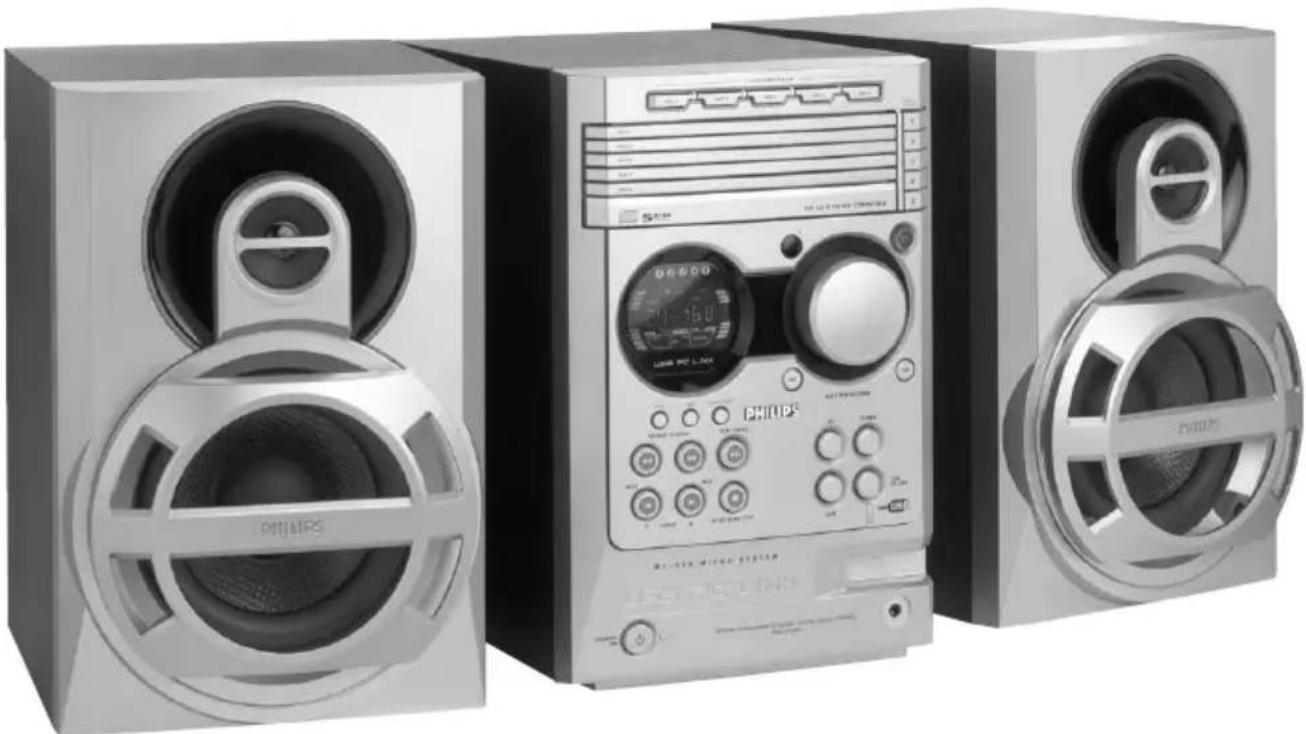
Three Philips audio/video audio equipment units with speaker stands and control panels (no visible text or symbols)Important notes for users in the U.K.
Mains plug
This apparatus is fitted with an approved 13
Amp plug. To change a fuse in this type of plug proceed as follows:
1 Remove fuse cover and fuse.
2 Fix new fuse which should be a BS1362 5 Amp, A.S.T.A. or BSI approved type.
3 Refit the fuse cover.
If the fitted plug is not suitable for your socket outlets, it should be cut off and an appropriate plug fitted in its place.
If the mains plug contains a fuse, this should have a value of 5 Amp. If a plug without a fuse is used, the fuse at the distribution board should not be greater than 5 Amp.
Note: The severed plug must be disposed of to avoid a possible shock hazard should it be inserted into a 13 Amp socket elsewhere.
How to connect a plug
The wires in the mains lead are coloured with the following code: blue = neutral (N), brown = live (L).
●As these colours may not correspond with the colour markings identifying the terminals in your plug, proceed as follows:
- Connect the blue wire to the terminal marked N or coloured black.
- Connect the brown wire to the terminal marked L or coloured red.
- Do not connect either wire to the earth terminal in the plug, marked E (or 12 ) or coloured green (or green and yellow).
Before replacing the plug cover, make certain that the cord grip is clamped over the sheath of the lead - not simply over the two wires.
Copyright in the U.K.
Recording and playback of material may require consent. See Copyright Act 1956 and The Performer's Protection Acts 1958 to 1972.
Italia
Philips Consumer Electronics
Philips, Glaslaan 2
5616 JB Eindhoven, The Netherlands
Norge
Use of controls or adjustments or performance of procedures other than herein may result in hazardous radiation exposure or other unsafe operation.
VAROITUS
natural_image
Product line setup including CD, remote control, and cable components (no text or symbols visible)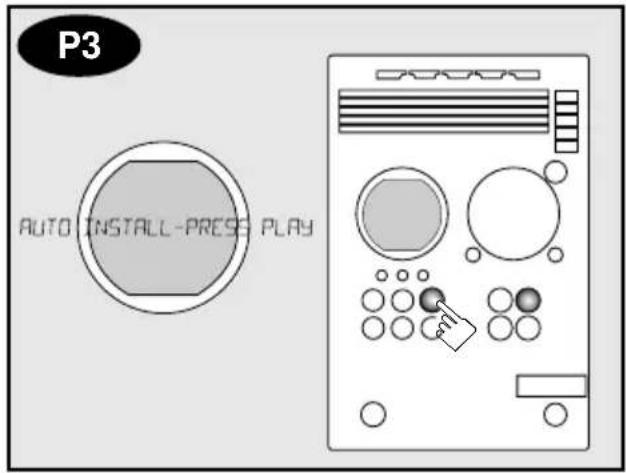
DK
Tested To Comply With FCC Standards
FOR HOME OR OFFICE USE
Energy Star
As an ENERGY STAR®
Partner, Philips has
determined that this
product meets the ENERGY STAR®
guidelines for energy efficiency.

English 6
Français 26
Español 46
Deutsch---- 66
Nederlands 86
Italiano---- 106
Svenska 126
Dansk 146
Suomi 166
Português 186
Ελληνικά----206
General Information
Supplied accessories 7
Environmental information 7
Care and safety information 7
Functional Overview
Main unit and remote control 8–9
Control buttons available on the remote only 9
Connections
Step 1: Connecting FM/AM antennas..... 10
Step 2: Connecting the speakers ..... 11
Step 3: Connecting to PC ...... 11
Step 4: Connecting the AC power cord..... 11
Step 5: Inserting batteries into the remote control .... 11
Using the remote control to operate the system 11
USB PC Link
Quick Setup Guide 12
PC system requirement 12
Install MusicMatch software.... 12
Enable digital CD audio output 13
Connecting USB PC Link 13
Basic Operations
Switching on/off 14
Switching to active mode 14
Switching to Eco Power standby mode.... 14
Switching to standby mode (view clock) . 14
Demonstration mode.... 14
Setting the clock 14
Selecting different display mode 15
Dim mode 15
Clock display mode.... 15
Volume control 15
Sound control 15
MAX sound.... 15
Digital Sound Control 15
Virtual Environment Control.... 15
Disc Operations
Playable discs 16
Loading discs 16
Basic playback controls 16–17
Repeat and Shuffle.... 17
Repeat play.... 17
Random play 17
Programming the disc tracks 17
Checking the programme.... 18
Playing a disc without clearing the programme 18
Clearing the programme 18
Tuner Operations
Tuning to radio stations 19
Presetting radio stations.... 19
Using the Plug and Play 19
Automatic presetting.... 19
Manual presetting 19
Selecting a preset radio station.... 20
Deleting a preset radio station 20
RDS 20
Scrolling through RDS information 20
Setting the RDS clock 20
NEWS 21
Switching on NEWS function 21
Timer Operations
Timer setting 22
Activating/Deactivating the timer 22
Checking the timer setting.... 22
Temporarily deactivating the wake up timer 23
Sleep timer setting 23
Other Connection
Listening to an external source 23
Specifications 24
Troubleshooting 25
This product complies with the radio interference requirements of the European Community.
Refer to the type plate on the rear or bottom of the system for identification and supply ratings.
For users in the U.K.: please follow the instructions on page 2.
Supplied accessories (page 3 - P1)
- USB PC LINK software installer CD-ROM
- USB cable
– Remote control and two AA batteries - AM loop antenna
- FM wire antenna
- AC power cord
Environmental information
All unnecessary packaging has been omitted. We have tried to make the packaging easy to separate into three materials: cardboard (box), polystyrene foam (buffer) and polyethylene (bags, protective foam sheet).
Your system consists of materials which can be recycled and reused if disassembled by a specialised company. Please observe the local regulations regarding the disposal of packaging materials, exhausted batteries and old equipment.
Care and safety information
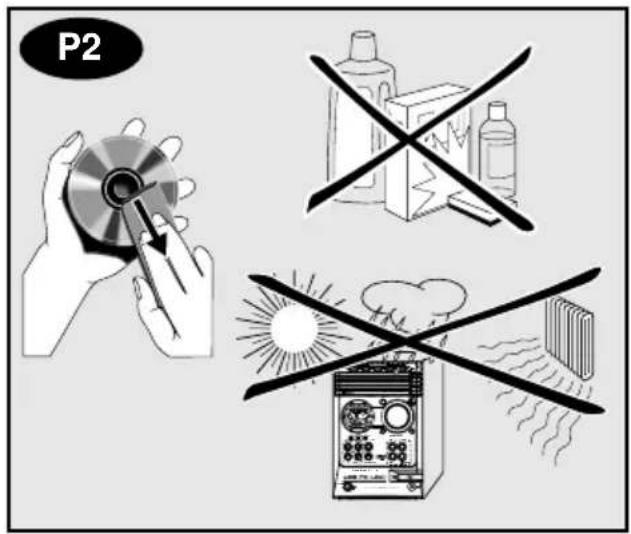
(page 3 - P2)
Avoid high temperatures, moisture, water and dust
- Do not expose the system, batteries or discs to humidity, rain, sand or excessive heat (caused by heating equipment or direct sunlight). Always keep the disc tray closed to avoid dust on the lens.
Avoid condensation problem
– The lens may cloud over when the system is suddenly moved from cold to warm surroundings, making it impossible to play a disc. Leave the system in the warm environment until the moisture evaporates.
Do not block the vents
- In a cabinet, allows about 10cm (4 inches) of free space all around the system for adequate ventilation.
Care of disc
- To clean a CD, wipe it in a straight line from the centre towards the edge using a soft, lint-free cloth. A cleaning agent may damage the disc! - Write only on the printed side of a CDR(W) and only with a soft felt-tipped pen. - Handle the disc by its edge, do not touch the surface.
Care of the cabinet
– Use a soft cloth slightly moistened with a mild detergent solution. Do not use a solution containing alcohol, spirits, ammonia or abrasives.
Finding a suitable location
- Place the system on a flat, hard, and stable surface.
Built-in safety circuit
- Under extreme conditions, this system may switch to standby mode automatically. If this happens, let the system cool down before reusing it.
Power saving
- This system is designed to use less than 1W of electricity when switches to Eco Power standby. Disconnect the AC power cord from the power outlet when not in use.
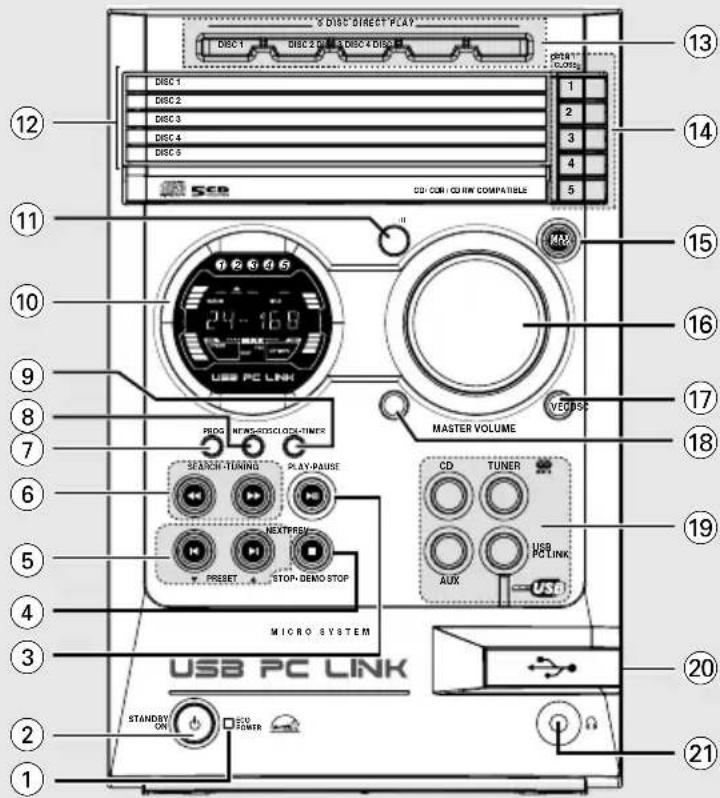
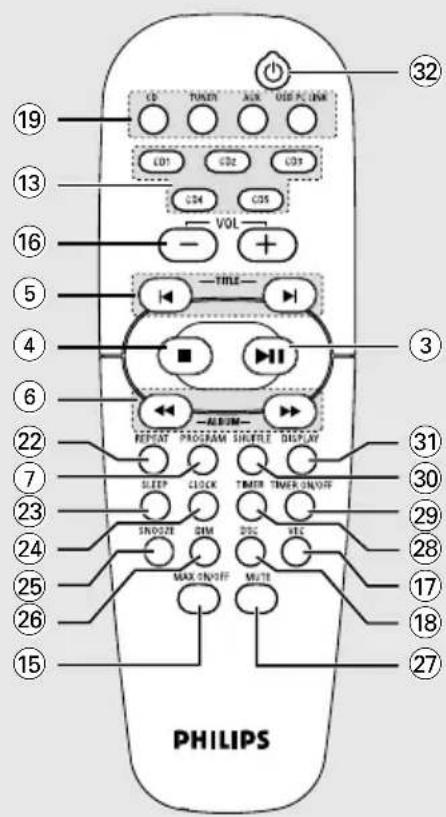
Main unit and remote control
① ECO POWER indicator
– Lights up when the system is in Eco Power standby mode.
② STANDBY ON ⏻
- Switches to Eco Power standby mode or turns on the system.
- *Switches to standby mode.
③ PLAY·PAUSE ▶ II
- CD: starts/pauses playback.
- USB PC LINK: starts/pauses playback.
(only on the main unit)
- TUNER: *enters Plug & Play mode and/or starts preset radio station installation.
④ STOP·DEMO STOP ■
- Exits an operation.
- CD: stops playback or clears a programme.
- TUNER: *erases a preset radio station.
- USB PC LINK: stops playback.
(only on the main unit)
- *Turns on/off the demonstration mode.
⑤ PREV ◀ / NEXT ▶ (▼ PRESET ▲)
- CD: selects a track.
- TUNER: selects a preset radio station.
- CLOCK: sets the minutes.
- USB PC LINK: selects a track from the playlist.
⑥ ◀◀SEARCH·TUNING ▶▶
- CD: *searches backward/forward.
– TUNER: tunes the radio frequency up/down. - CLOCK: sets the hours.
- USB PC LINK: *searches backward/forward.
⑦ PROG (PROGRAM)
- CD: starts or confirms tracks programming.
- TUNER: starts *automatic/manual preset programming.
- CLOCK: selects 12- or 24-hour clock display.
⑧ NEWS·RDS
- In tuner mode, selects RDS information.
– In other modes, turns on/off news.
⑨ CLOCK·TIMER
- *Enters clock or timer setting mode.
– Switches to clock display mode.
⑩ Display screen
⑪ iR
- Point the remote control towards this sensor.
⑫ Disc trays (1\~5)
⑬ 5 DISC DIRECT PLAY 1\~5 (CD 1\~5)
– Selects a disc tray to playback.
⑭ OPEN/CLOSE ▲ 1\~5
- Opens/closes the individual disc tray.
⑮ MAX SOUND (MAX ON/OFF)
- Turns on/off the optimal mix of various sound features.
⑯ MASTERVOLUME (VOL + -)
- Adjusts the volume level.
⑰ VEC
- Selects different type of environment-based equaliser settings (HALL, CINEMA, CONCERT or CYBER).
⑱ DSC
– Selects different type of preset sound equaliser settings (OPTIMAL, JAZZ, ROCK or POP).
⑲ CD / TUNER / AUX / USB PC LINK
– Selects the relevant active mode.
- CD: toggles between DISC 1\~5.
- TUNER: toggles between FM and MW band.
- AUX: toggles between AUX and CDR mode.
⑳ Connect the USB cable between the system and PC's USB port.
②1
– Plug in the headphones jack. The speakers output will be cancelled.
Control buttons available on the remote only
22 REPEAT
– Repeats a track/disc/all discs/all programmed tracks.
23 SLEEP
- Sets the sleep timer function.
24 CLOCK
- *Enters clock setting mode.
- Switches to clock display mode.
25 SNOOZE
- Temporarily deactivate the wake up timer.
26 DIM
- Selects different levels of brightness for display panel.
27 MUTE
- Mutes or restores the volume.
28 TIMER
- *Enters timer setting mode.
– Displays the timer setting.
⑲ TIMER ON/OFF
- Turns on/off the timer function.
③0 SHUFFLE
– Turns on/off the random play mode.
③1 DISPLAY
– Displays disc remaining playback time.
③2
– Switches to Eco Power standby mode.
- *Switches to standby mode.
flowchart
graph TD
    A["Speaker (right)"] --> B["AM loop antenna"]
    B --> C["FM wire antenna"]
    C --> D["Speaker (left)"]
    D --> E["AC power cord"]
    E --> F["Refer to page 3 - P5"]
    style A fill:#f9f,stroke:#333
    style B fill:#ccf,stroke:#333
    style C fill:#cfc,stroke:#333
    style D fill:#fcc,stroke:#333
    style E fill:#cff,stroke:#333
    style F fill:#ffc,stroke:#333
WARNING!
- Use only the supplied speakers. The combination of the main unit and speakers provide the best sound. Using other speakers can damage the unit and sound quality will be negatively affected.
- Never make or change connections with the power switched on.
- Connect the AC power cord to the power outlet only after you have finished hooking up everything.
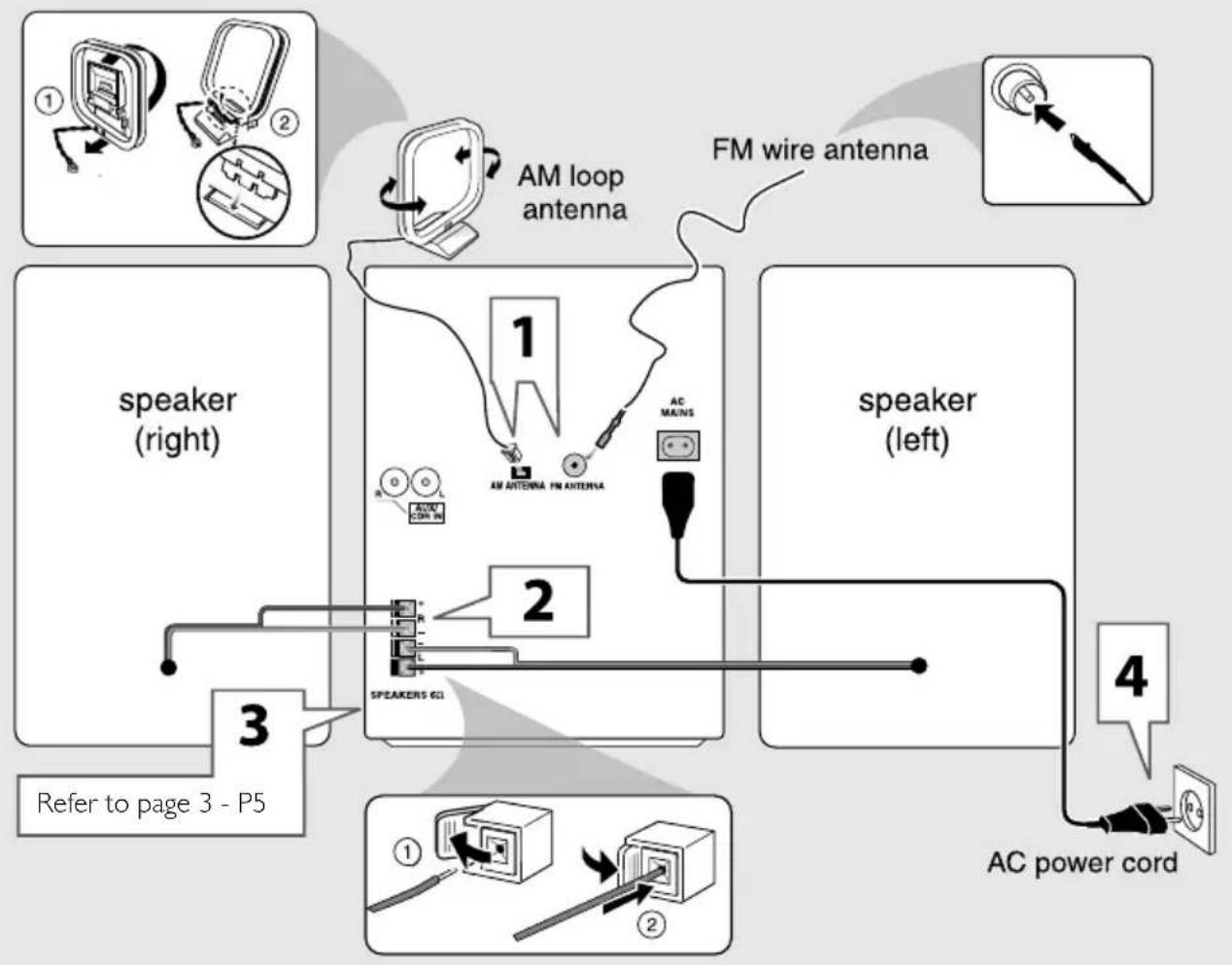
Step 1: Connecting FM/AM antennas
- Place the AM loop antenna on a shelf or attach it to a stand or wall.
- Extend the FM antenna and fix its ends to the wall.
- Adjust the position of the antennas for optimal reception.
- Position the antennas as far as possible from a TV, VCR or other radiation source to prevent unwanted noise.
- For better FM stereo reception, connect external FM antenna.
Step 2: Connecting the speakers
Connect the speaker wires to the SPEAKERS terminals, right speaker to "R" and left speaker to "L", coloured (marked) wire to "+" and black (unmarked) wire to "—". Fully insert the stripped portion of the speaker wire into the terminal as shown.
Notes:
- Ensure that the speaker cables are correctly connected. Improper connections may damage the system due to short-circuit. - Do not connect more than one speaker to any one pair of + / - speaker terminals.
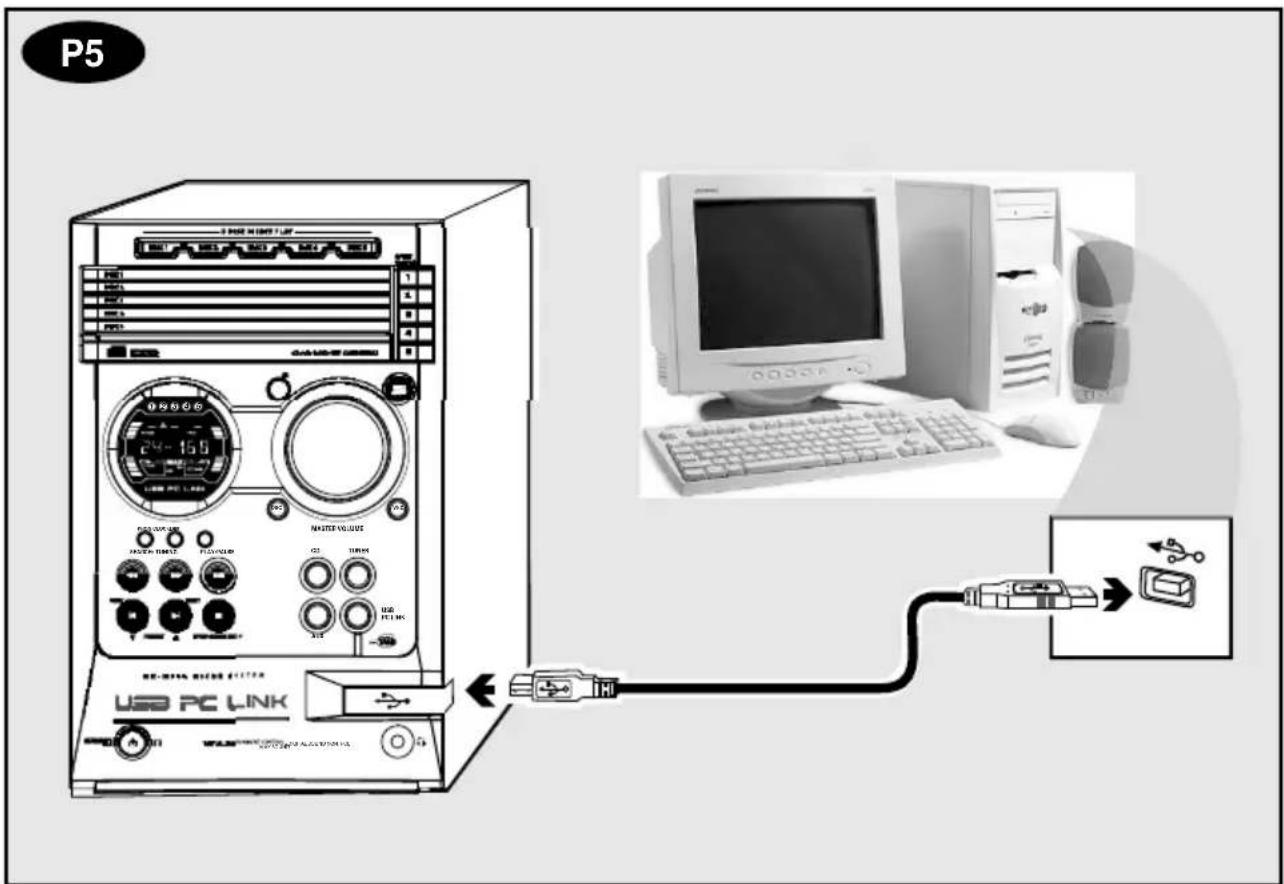
Step 3: Connecting to PC
(page 3 - P5)
Use the supplied USB cable to connect the system to your personal computer's USB port. After installed the USB PC LINK application software onto your PC, you are able to playback your music collection via the system (refer to "USB PC Link").
Step 4: Connecting the AC power cord
"AUTO INSTALL - PRESS PLAY" may appear on the display panel when the AC power cord is plugged into the power outlet for the first time. Press ▶ II on the main unit to store all available radio stations (page 3 - P3) or press ■ to exit (refer to "Tuner Operations").
Step 5: Inserting batteries into the remote control
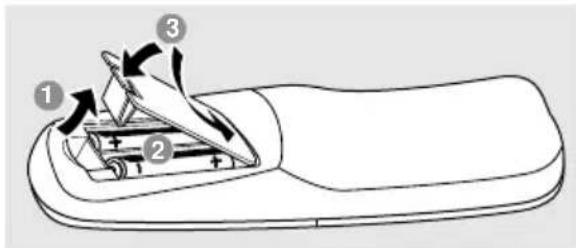
① Open the battery compartment cover.
② Insert two batteries type R06 or AA, following the indications (+ -) inside the compartment.
3 Close the cover.
Using the remote control to operate the system
Aim the remote control directly at the remote sensor (iR) on the main unit.
② Select the source you wish to control by pressing one of the source select keys on the remote control (for example CD, TUNER).
3 Then select the desired function (for example ▶II, ◀, ▶I).
CAUTION!
- Remove batteries if they are exhausted or will not be used for a long time. - Do not use old and new or different types of batteries in combination. - Batteries contain chemical substances, so they should be disposed of properly.
Quick Setup Guide
PC system requirement
- Windows 98/ ME/ 2000/ XP
- Intel Pentium MMXX200 or higher
- CD-ROM drive
- USB port
- Free hard disk space : 15 MB for the software
Install MusicMatch software
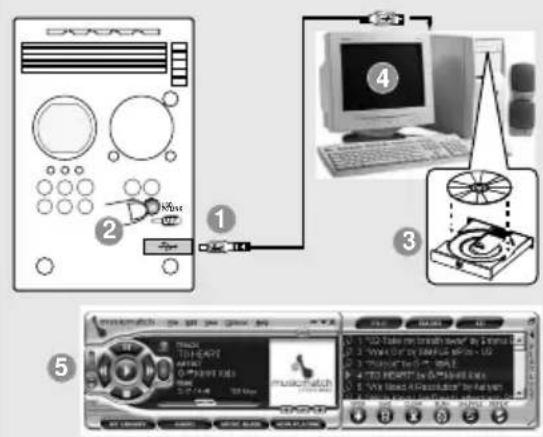
① Use the supplied USB cable to connect the audio system to your personal computer's USB port.
2 Press USB PC LINK.
3 Turn on the PC and insert the USB PC LINK installer disc (which comes with this product) onto the PC's CD-ROM drive.
This application software can also be downloaded from "http://www.audio.philips.com".
IMPORTANT!
Please use this customised MusicMatch software for your USB PC Link application. Remember to un-install all other MusicMatch jukebox software first from your PC system (if available).
4 The installation guide will appear automatically. If it does not, go to the CD-ROM drive in Windows Explorer and double click on the "USBPCLINK.exe". Then perform the following steps:
- First, select your desired language from the list.
- Then, select "installer driver" and follow by "installer MusicMatch jukebox".
- Select other options (Tutorial, Free goodies, FAQ).
Note:
- You are advised to read the MusicMatch tutorial before using it for the first time. Make sure the mute function on the PC is deactivated in order to ensure sound output from the Audio System. For optimum performance, the equaliser function in MusicMatch should be set to a low level.
5 Launch the "MUSICMATCH JUKEBOX" and choose to do one of the followings:
To create a "Playlist"
Select "Open" button on the MusicMatch Jukebox and simply drag/drop the music tracks from anywhere on your PC into the "Playlist" window. Remember to save this "Playlist" for future use.
To create a music library
A music library of all stored music files available on your PC can be setup by simply select "add" function on the MusicMatch Jukebox. Once created, you may then choose to drag/drop any music tracks from this library to a "Playlist" for music playback.
Note:
- It is not possible to create a playlist from the system's 5 CD changer. If you encounter problem using USB PC LINK, please refer to the FAQ (Frequently Asked Questions) stored in your USB PC LINK installer disc or visit "www.audio.philips.com" for latest update on FAQ.
Enable digital CD audio output
Before playing the CD through your PC's CD-ROM drive, it is necessary to configure your PC's hardware as follows:
For Windows ME/ 2000/ XP
① Enter the system control panel menu and select:
"SYSTEM → HARDWARE → DEVICE MANAGER → CD-ROM DRIVES → ACTION–PROPERTIES → PROPERTIES".
OR
For Windows 98
Enter the system control panel menu and select: "MULTIMEDIA" and "CD MUSIC".
2 Check the 'Enable digital CD audio for this CD-ROM device' setting option is selected (enabled).
Note:
- You may need to refer to your PC's manual for correct configuration.
Connecting to USB PC Link
USB PC LINK allows you to playback your music collection from the PC via the powerful amplifier and speakers of this system.
IMPORTANT!
Make sure the MusicMatch software has been installed. Refer to "Quick Setup Guide" for USB PC Link.
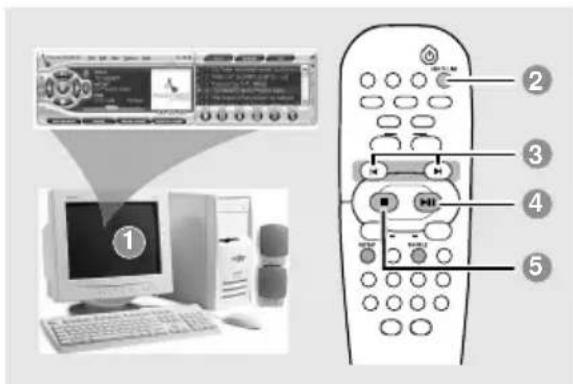
①Turn on your computer and launch the "MUSICMATCH JUKEBOX".
→ The volume level of PC should not be put into mute.
2 Press USB PC LINK.
→ If the audio streaming is detected, "CONNECTING" is displayed and the USB indicator will be flashing.
→ If "NO CONNECTION" is displayed, check the connection between your PC and micro system.
3 Press ◀ or ▶ until the desired track in the playlist is highlighted.
4 Press ▶ II to start playback.
→ The track information will appear on the display. The display only supports English characters.
During playback,
- Press SHUFFLE to play all available tracks in the playlist in random order.
- Press REPEAT to repeat playback of all the tracks in the playlist.
5 To exit, select another active mode or press ■.
Basic Operations
Switching on/off
- Press CD, TUNER, AUX or USB PC LINK.
- Press ⏻.
→ ECO POWER button lights up.
→ The display screen will go blank.
- Press and hold ⏻.
→ The clock is displayed.
→ While in standby mode, pressing
CLOCK•TIMER button will switch the system to Eco Power standby mode.
Note:
- Before switching the system to Eco Power standby or standby mode, make sure the demonstration mode has been deactivated.
Demonstration mode
If the demonstration mode is active, whenever you switch the system to Eco Power standby or standby mode, it will begin showing the various features offered by the system.
To activate the demonstration
- In Eco Power standby/standby mode, press and hold ■ on the main unit until "DEMO ON" is displayed.
To deactivate the demonstration
- Press and hold ■ on the main unit until "DEMO OFF" is displayed.
Setting the clock
The clock can be set in either 12-hour or 24-hour mode ("11:59 PM" or "23:59" for example).
$$ (0 0: 0 0 / 1 2: 0 0 \mathrm{AM}) $$
$$ (0 0: 0 0 / 1 2: 0 0 \mathrm{AM}) $$
$$ (0 0: 0 0 \rightleftarrows 1 2: 0 0 \mathrm{AM}) $$
,
1 Press and hold CLOCK on the remote until the time flashing on the display. OR
Press and hold CLOCK·TIMER on the main unit until "SELECT CLOCK OR TIMER" is displayed. Then press ▶ to change the display to "CLOCK" and press CLOCK·TIMER again to confirm.
2 Press PROGRAM (PROG) repeatedly to change between 12-hour and 24-hour clock mode.
3 Press ◀◀ or ▶▶ repeatedly to set the hour.
4 Press ◀ or ▶ repeatedly to set the minute.
5 Press CLOCK (or CLOCK·TIMER) to store the setting.
→ The clock will start working.
Notes:
- The clock setting will be erased when the system is disconnected from the power supply.
- The system will exit clock setting mode if no button is pressed within 90 seconds.
- To set the clock automatically through the time information in the RDS signal, refer to "Tuner Operations - Setting the RDS clock".
Selecting different display mode
Dim mode
You can select the desired brightness for the display panel.
- In any active mode, press DIM repeatedly to select DIM 1, DIM 2, DIM 3 or DIM OFF display mode.
→ DIM is shown, except for DIM OFF mode.
| DIM mode button display Spectrum illumination brightness analyzer | |||
| DIM OFF on full on | |||
| DIM 1 on full off | |||
| DIM 2 on half on | |||
| DIM 3 off half off | |||
Note:
- Pressing DIM button in standby mode will toggle between half and full brightness.
Clock display mode
You can choose to show the clock display only.
- Press CLOCK·TIMER (or CLOCK on remote).
→ In any active mode, pressing the button again will resume normal display.
Note:
- If you pressed any buttons in clock display mode, the display will briefly show the information related to the selected mode.
Volume control
- Adjust MASTERVOLUME (or press
VOL +/− on remote) to increase or decrease the sound level.
→ "VOL MUTE" is the minimum volume level and "☐ √B" is the maximum volume level.
To switch off the volume temporarily
- Press MUTE on the remote.
→ Playback will continue without sound and "MUTE" is displayed.
→ To restore the volume, press MUTE again or increase the volume level.
Sound control
You are only able to select one of the sound controls at a time : MAX sound, DSC or VEC.
MAX sound
MAX sound provides the best mixture of various sound features (DSC, VEC for example).
- Press MAX SOUND (or MAX ON/OFF on remote).
→ If activated, MAX is shown and the MAX SOUND button lights up. All other sound effects (DSC orVEC) will be switched off automatically
Digital Sound Control
DSC provides a different type of preset sound equaliser setting.
- Press DSC repeatedly to select : OPTIMAL, JAZZ, ROCK or POP.
Virtual Environment Control
VEC provides a different type of environment-based equaliser setting.
- Press VEC repeatedly to select : HALL, CINEMA, CONCERT or CYBER.
IMPORTANT!
- This system is designed for regular discs. Therefore, do not use any accessories such as disc stabiliser rings or disc treatment sheets, etc., as offered on the market, because they may jam the changer mechanism.
- Do not load more than one disc onto each tray.
playable discs
This system is able to play :
– All pre-recorded audio CDs
– All finalised audio CDR and audio CDRW discs



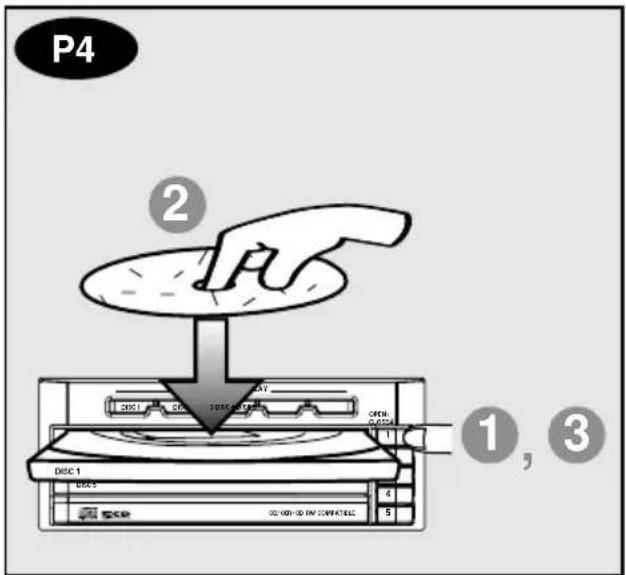
Loading discs (page 3 - P4)
Press OPEN/CLOSE ▲ 1 button to open disc tray 1.
2 Load a disc with the label side facing up. For double-sided discs, load the side you want to play facing up.
3 Press OPEN/CLOSE ▲ 1 button again to close the disc tray.
→ "READING" is displayed. The selected disc tray, total number of tracks and the playing time will appear on the display.
4 Repeat steps 1\~3 for loading discs onto the disc trays 2\~5.
Notes:
- To ensure good system performance, wait until the disc trays completely read the disc(s) before proceeding.
- Only one tray can be opened at each time. If you open the second tray before closing the first tray, the first tray will automatically close before the second tray opens.
Basic playback controls
Load discs (page 3 - P4).
To play all discs on the disc trays
- Press ▶ II. OR
In stop mode, press CD to select a disc tray to begin, then press ▶ II.
→ All the available discs will play once, then stop.
To play the selected disc only
- Press one of the 5 DISC DIRECT PLAY (DISC 1\~5) buttons (or CD 1\~5 on remote).
→ The selected disc will play once, then stop.
To select a desired track
- Press ◀ or ▶I repeatedly until the desired track is displayed.
→ To skip to the beginning of the current track during playback, press ◀ once.
→ During random play (shuffle mode), pressing ◀ will cause the player to skip only to the beginning of the current track.
To search for a particular passage during playback
- Press and hold ◀◀ or ▶▶ and release it when the desired passage is located.
→ During searching, the volume will be reduced.
To replace discs without interrupting playback
- Press OPEN/CLOSE ▲ buttons of the inactive disc trays (refer to “Loading discs”).
For example, if currently disc tray 1 is playing, you can replace the discs on disc tray 2\~5.
To check the disc remaining playing time
- Press DISPLAY on the remote.
→ During random play or programme play, the total remaining time will not be shown.
→ To restore the display for elapsed playing time, repeat the above.
To interrupt playback
- Press ▶ II.
→ To resume normal playback, repeat the above.
To stop playback
- Press ■.
→ If the system remains in stop mode for 30 minutes, it will switch to Eco Power standby mode.
Repeat and Shuffle
You can select and change the various play modes before or during playback.
Repeat play
1 Press REPEAT on the remote repeatedly to select :
| TRK REP | REP DISC | REP DISC ALL | TRK REP PROG | REP PROG ALL |
| A | B | C | D | E |
Ⓐ – to repeat playback of the current track.
(B) – to repeat playback of the current disc.
© – to repeat playback of all available discs.
(D) – to repeat playback of the current programmed track (only if the programme mode is active)
(E) – to repeat playback of all the programmed tracks (only if the programme mode is active)
2 To resume normal playback, press REPEAT until "OFF" is displayed.
Random play
- Press SHUFFLE on the remote to turn on/off the shuffling mode.
→ If activated, SHUF is shown and the repeat mode (if any) will be cancelled.
→ All the available discs or programmed tracks (if programme is active) will be played in random order.
Note:
- Pressing the OPEN/CLOSE button will cancel all repeat and shuffling modes.
Programming the disc tracks
Programming tracks is possible when playback is stopped. Up to 40 tracks can be stored in the memory in any order.
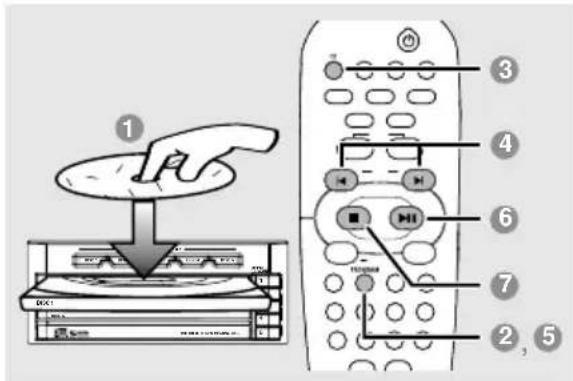
1 Load the desired discs on the disc trays (refer to "Loading discs").
2 Press PROGRAM (PROG) to start programming.
→ PROG starts flashing.
3 Press CD or one of the DISC 1\~5 buttons to select a disc.
4 Press ◀ or ▶I repeatedly to select the desired track.
5 Press PROGRAM (PROG) to store.
- Repeat steps 3–5 to select other discs and store the tracks.
→ Skip step 3 if you are selecting tracks from the same disc.
→ If you attempt to programme more than 40 tracks, "PROGRAM FULL" is displayed.
6 To start programme play, press ▶ II.
⑦To stop playback or to end the programming, press ■ once.
→ PROG stays and the programme mode remains active.
Notes:
- If the total playing time reached 100 minutes or if one of the programmed tracks has a number greater than 30, then "----" is displayed instead of the total playing time.
- The system will exit programming mode if no button is pressed within 20 seconds.
Checking the programme
Stop playback, then press ◀ or ▶I repeatedly.
2 Press ■ to exit.
OR
Press ▶ II to start playback from the current programmed track
Playing a disc without clearing the programme
- Press one of the CD 1\~5 buttons on the remote to select a disc for playback. → After the selected disc has been played, the programme mode will resume.
Clearing the programme
- Stop playback, then press ■ to clear the programme. OR
Press the OPEN/CLOSE ▲ button of the programmed disc tray.
→ PROG disappears and "PROGRAM [LCAREO]" is displayed.
Note: - The programme will be erased if the system is disconnected from the power supply.
IMPORTANT!
Make sure the FM and MW antennas are connected.
Tuning to radio stations
1 Press TUNER to enter tuner mode. To select another waveband (FM or MW), press TUNER again.
2 Press and hold ◀◀ or ▶▶ until the frequency indication starts to change, then release.
→ The system automatically tunes to the next strong signal radio reception.
→ lights up for FM stereo reception.
→ RDS lights up for RDS station (in FM band only).
For tuning to a weak signal station
- Press ◀◀ or ▶▶ briefly and repeatedly until an optimal reception is found.
Presetting radio stations
You can store up to 40 preset radio stations in the memory, starting from FM and followed by MW bands.
Notes:
- The system will exit presetting mode if no button is pressed within 20 seconds.
- If no stereo frequency is detected during Plug and Play, "CHECK ANTENNA" is displayed.
Using the Plug and Play (page 3 - P3)
Plug and Play allows you to store all available radio stations automatically.
Connect the system to the power supply, "AUTO INSTALL - PRESS PLAY" is displayed. OR
In Eco Power standby/standby mode, press and hold ▶■ on the main unit until "AUTO INSTALL - PRESS PLAY" is displayed.
2 Press ▶II on the main unit to start installation.
→ "INSTALL TUNER" is displayed.
→ All previously stored radio stations will be replaced.
→ Once completed, the last tuned radio station (or the first available RDS station) will be played.
3 If the first preset is a RDS station, it will proceed to set the RDS clock.
→ "INSTALL" is displayed, followed by "TIME" and "SEARCH RDS TIME".
→ When RDS time is read, "RDS TIME" is displayed and the current time will be stored.
→ If RDS station does not transmit RDS time within 90 seconds, "NO RDS TIME" is displayed and the programme will exit automatically.
Automatic presetting
You can start the automatic presetting from a selected preset number.
In tuner mode, press ◀ or ▶ to select a preset number.
2 Press and hold PROGRAM (PROG) until "RUTO" is displayed.
→ If a radio station has been stored in one of the presets, it will not be stored again under another preset number.
→ If no preset number is selected, automatic preset will begin from preset (1) and all your former presets will be overridden.
Manual presetting
You can choose to store only the favourite radio stations.
①Tune to your desired radio station (refer to "Tuning to radio stations").
2 Press PROGRAM (PROG).
→ The preset number starts flashing. If you want to store the radio station in another preset number, press ◀ or ▶.
3 Press PROGRAM (PROG) again to store.
- Repeat steps 1–3 to store other radio stations.
Selecting a preset radio station
• In tuner mode, press ◀ or ▶I.
→ The preset number, radio frequency, and waveband are displayed.
Deleting a preset radio station
- Press and hold ■ until "PRESET DELETED" is displayed.
→ The current preset radio station will be deleted.
→ All other preset radio stations with higher numbers are decreased by one.
RDS
RDS (Radio Data System) is a service that allows FM stations to show additional information. If you are receiving a RDS station, RDS and the station name are displayed.
Scrolling through RDS information
- Tuned to a RDS radio station from FM band, then press NEWS·RDS repeatedly to select the following information (if available):
- Station name
- Programme type (for example: News, Affairs, Sport, etc.)
– Radio text messages
– Frequency
Setting the RDS clock
Some RDS radio station may be transmitting a real clock time at an interval of every minute. It is possible to set the clock by using a time signal which is broadcast together with the RDS signal.
Tuned to a RDS station from FM band (refer to “Tuning to radio stations”).
2 Press and hold CLOCK·TIMER on the main unit until "SELECT CLOCK OR TIMER" is displayed. Then press ▶ to change the display to "CLOCK" and press CLOCK·TIMER again to confirm.
3 Press NEWS·RDS.
→ "SEARCH RBS TIME" is displayed.
→ When RDS time is read, the current time will be stored.
→ If the RDS station does not transmit RDS time within 90 seconds, "NO RDS TIME" is displayed.
Note:
- Some RDS radio station may be transmitting a real time clock at a minute interval. The accuracy of the transmitted time depends on the transmitting RDS radio station.
NEWS
You may set up the tuner in such a way that listening to CD or external source is interrupted by the NEWS of a RDS station. This only works if the RDS station broadcasts a NEWS signal while sending the news.
IMPORTANT!
You can activate NEW S function from any source mode except TUNER.
Switching on NEW S function
In any active mode, press NEWS·RDS until "NEWS" is displayed.
→ NEWS is shown.
→ The system will scan the radio stations stored in the first five (5) preset and wait for the News Programme Type data to be available in any of these RDS stations.
→ While searching NEWS in progress, the current active mode remains uninterrupted.
2 When NEWS transmission is detected, the system will switch to Tuner mode.
→ NEWS starts flashing.
- If no RDS station is detected in the first five presets, the system will exit NEWS function.
→ "NO ROS NEWS" is displayed.
Notes:
- You have to exit Tuner mode before selecting NEWS function.
- Before you activate the NEWS feature, ensure that the first five presets have RDS stations.
– The NEWS works only once for each activation.
To cancel NEWS function
- Press NEWS·RDS again or switch the system to tuner mode.
OR
During news bulletin, press any other available source keys to execute the relevant source mode.
Timer setting
The system can switch on to CD, TUNER or USB PC LINK mode automatically at a preset time, serving as an alarm to wake you up.
IMPORTANT!
- Before setting the timer, ensure that the clock is set correctly.
- The volume of the timer will increase gradually to the last tuned volume level. If the last tuned volume level is too low, the set will then increase to a predetermined minimum audible level.
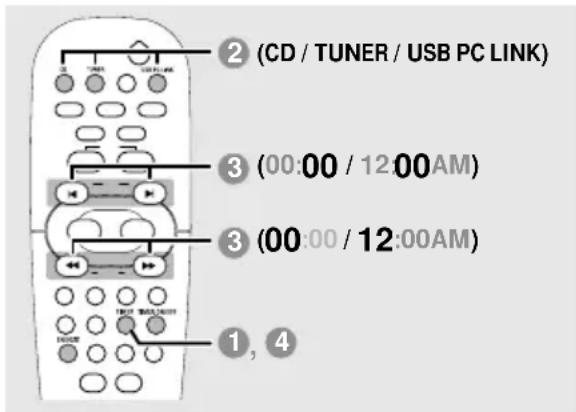
① Press and hold TIMER on the remote until ④ icon starts flashing. OR
Press and hold CLOCK·TIMER on the main unit until "SELECT CLOCK OR TIMER" is displayed. Then press ▶ to change the display to "TIMER" and press CLOCK·TIMER again to confirm.
2 Press CD or TUNER or USB PC LINK to select the wake-up source.
$$ \begin{array}{l} \mathrm{CD} \rightarrow {} ^ {\prime \prime} [ ] \times x: x x ^ {\prime \prime} \ \text { TUNER } \rightarrow \text {"TUXX:XX"} \ \text { USB PC LINK } \rightarrow \text {"USB XX:XX"} \ \end{array} $$
3 Press ◀◀ or ▶▶ (for hours) and ◀◀ or ▶▶ (for minutes) repeatedly to set the wake up time.
4 Press TIMER (or CLOCK•TIMER) to store the setting.
→ The timer will always be switched on after it has been set.
→ ☑on remains on the display. It indicates the timer is activated.
- At the preset time, the selected sound source will be played for 30 minutes before it switches to Eco Power standby mode (if no button is being pressed within the time frame).
→ CD – playing the first track of the last selected disc or programmed track (if programme mode is active). If the last selected disc tray is empty, it will switch to the next available disc. If all the disc trays are not available, it will switch to Tuner mode.
→ TUNER – playing the last tuned radio station.
→ USB PC LINK – playing the last selected playlist. If the connection fails, it will switch to Tuner mode. Refer to "USB PC Link" for proper connection and setup before use.
Activating/Deactivating the timer
- Press TIMER ON/OFF on the remote to turn off the timer or turn on to the last setting again.
→ If activated, the timer information will display for a few seconds, then the system resumes to the last active source or stays in standby mode.
→ If deactivated, "OFF" is displayed.
Note:
- The system will exit timer setting mode if no button is pressed within 90 seconds.
Checking the timer setting
- Press TIMER on the remote.
→ The timer information will display for a few seconds, then the system resumes to the last active source or stays in standby mode.
Temporarily deactivating the wake up timer
You are only able to activate the Snooze function within 30 minutes after the timer wake up from Standby mode.
After timer wake up, press SNOOZE on the remote.
→ The system will switch to standby mode for five minutes. After that, it resumes the timer last selected source again.
2 To cancel the snooze function, press SNOOZE again.
Sleep timer setting
The sleep timer turns the system to Eco Power standby mode at a preselected time.
Press SLEEP repeatedly until it reaches the desired preset turn-off time.
→ The selections are as follows (time in minutes):
$$ \begin{array}{l}1 5 \rightarrow 3 0 \rightarrow 4 5 \rightarrow 6 0 \rightarrow 9 0 \rightarrow 1 2 0 \rightarrow\O F F \rightarrow 1 5 \dots\end{array} $$
→ SLEEP is shown, except for "OFF" mode.
→ To view or change the setting, repeat the above.
2 Before the system switches to Eco Power standby mode, a countdown of 10 seconds is displayed.
$$ \begin{array}{l}\text {"SLEEP 10"} \rightarrow \text {"SLEEP 9"...."} \rightarrow \text {"SLEEP 1"}\\rightarrow \text {"SLEEP"}\end{array} $$
To cancel the sleep timer
- Press SLEEP repeatedly until "OFF" is displayed, or press the STANDBY ON ⏻ button.
Listening to an external source
You can listen to the sound of the connected external device through your system's speakers.
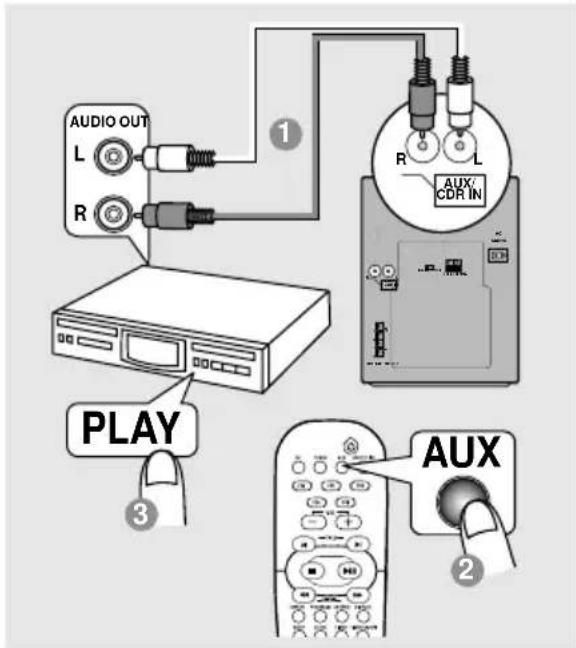
Use the red/white audio cables to connect the system's AUX/CDR IN (R/L) terminals to the AUDIO OUT terminals on the other audio/visual device (such as a TV, VCR, Laser Disc player, DVD player or CD recorder) → If the connecting device has only a single audio out terminal, connect it to the AUX/CDR IN left terminal. Alternatively, you can use a "single to double" cinch cable, but the output sounds still remain mono.
2 Press AUX repeatedly.
→ Select "RUX" when connecting to a TV, VCR or Laser Disc player.
→ Select "PUK/COR" when connecting to a CD recorder or DVD player.
3 Press PLAY on the connected device to start playback.
Notes:
- All the sound control features (DSC, VEC for example) are available for selection.
- Always refer to the owner's manual of the other equipment for complete connection and use details.
AMPLIFIER
| Output power 2 × 100 W MPO |
| 2 × 50 W RMS(1) |
| Signal-to-noise ratio ≥ 75 dBA (IEC) |
| Frequency response 50 – 20000 Hz, -3 dB |
| Input sensitivity |
| AUX In / CDR In 500 mV / 1V |
| Output |
| Speakers ≥ 6 Ω |
| Headphones 32 Ω – 1000 Ω |
| (1) (6 Ω, 60 Hz – 12.5 kHz, 10% THD) |
DISC PLAYER
| Programmable tracks 40 |
| Frequency response 20 – 20000 Hz, -3 dB |
| Signal-to-noise ratio ≥ 76 dBA |
| Channel separation ≥ 60 dB (1 kHz) |
USB
| Frequency response 20 – 20000 Hz, -3 dB |
| Signal-to-noise ratio ≥ 75 dBA |
| Channel separation ≥ 40 dB (1 kHz) |
| Total harmonic distortion < 0.3% (1 kHz) |
TUNER
| FM wave range 87.5 – 108 MHz | |
| MW wave range 531 – 1602 kHz | |
| Number of presets | 40 |
| Antenna | |
| FM | 75 Ω wire |
| AM | Loop antenna |
SPEAKERS
| System | 2 way, Bass reflex |
| Impedance | 6 Ω |
| Woofer | 1 × 5.25" |
| Tweeter | 1 × 2" Ferrofluid cooled |
| Dimensions (w × h × d) | 180 × 268 × 225 (mm) |
| Weight | 2.5 kg each |
GENERAL
| Material/finish | Polystyrene/Metal |
| AC Power | 220 – 230 V / 50 Hz |
| Power Consumption | |
| Active | 80 W |
| Standby | < 15 W |
| Eco Power Standby | < 0.5 W |
| Dimensions (w x h x d) | 175 x 268 x 316 (mm) |
| Weight (without speakers) | 4.7 kg |
Specifications and external appearance are subject to change without notice.
WARNING
Under no circumstances should you try to repair the system yourself, as this will invalidate the warranty. Do not open the system as there is a risk of electric shock.
If a fault occurs, first check the points listed below before taking the system for repair. If you are unable to remedy a problem by following these hints, consult your dealer or Philips for help.
| Problem | Solution |
| When in USB PC LINK mode, “NO CONNECTION” is displayed. | Check the connection between your PC and the system and the initial setup required, see “Connections” and “USB PC Link”.Make sure the connected PC is turned on. |
| Radio reception is poor. | If the signal is too weak, adjust the antenna or connect an external antenna for better reception.Increase the distance between the system and your TV or VCR. |
| “NO DISC” is displayed or the disc cannot be played. | Insert a disc.Load in the disc with label facing right.Replace or clean the disc, see “Care and safety information”. |
| “DISC NOT FINALIZED” is displayed. | Use a finalised CD-R(W) or a correct format disc. |
| The system does not react when buttons are pressed. | Remove and reconnect the AC power cord and switch on the system again. |
| Sound cannot be heard or is of poor quality. | Adjust the volume.Disconnect the headphones.Check that the speakers are connected correctly.Check that the AC power cord is connected properly.When in USB PC LINK mode, check that the PC’s volume is not put into mute.When playing CD from PC's CD drive, refer to “USB PC Link - Enable digital CD audio output”. |
| The remote control does not function properly. | Select the source (CD or TUNER, for example) before pressing the function button (▶II,|◀◀, ▶▶I).Reduce the distance between the remote control and the system.Replace the battery.Point the remote control directly toward the IR sensor. |
| The timer is not working. | Set the clock correctly.Press TIMER ON/OFF to switch on the timer. |
| The system displays features automatically and buttons start flashing. | Press and hold DEMO STOP on the main unit to switch off the demonstration mode. |
Refer to the FAQ (Frequently Asked Questions) on the supplied CD-ROM or visit our website "www.audio.philips.com" for latest update on FAQ.