
DeLuxe Mokka Nevada XL - Tent Outwell - Free user manual and instructions
Find the device manual for free DeLuxe Mokka Nevada XL Outwell in PDF.


| Product Type | Tent |
| Brand | Outwell |
| Model | DeLuxe Mokka Nevada XL |
| Dimensions (L x W x H) | 590 x 340 x 210 cm |
| Packed Size | 85 x 40 x 40 cm |
| Weight | 24.5 kg |
| Capacity | 6 persons |
| Number of Rooms | 3 (1 main, 2 bedrooms) |
| Outer Material | Polyester 190T, PU coated, waterproof |
| Inner Material | Breathable polyester |
| Floor Material | Polyethylene, welded seams |
| Poles | Steel, 19 mm diameter |
| Waterproof Rating | 3000 mm |
| Setup Type | Pole sleeve and clip combination |
| Features | Large living area, three bedrooms, multiple windows, ventilation flaps, storage pockets, lantern hook |
| Care & Cleaning | Clean with mild soap and water, dry thoroughly before storage, avoid prolonged sun exposure |
| Safety | Do not use open flames inside, ensure adequate ventilation, keep guy lines taut |
| Spare Parts Availability | Contact Outwell customer service or authorized dealers for replacement poles, pegs, and repair kits |
| Reparability | Repairable with standard tent repair kits; professional repair recommended for major damage |
Frequently Asked Questions - DeLuxe Mokka Nevada XL Outwell
User questions about DeLuxe Mokka Nevada XL Outwell
0 question about this device. Answer the ones you know or ask your own.
Ask a new question about this device
Download the instructions for your Tent in PDF format for free! Find your manual DeLuxe Mokka Nevada XL - Outwell and take your electronic device back in hand. On this page are published all the documents necessary for the use of your device. DeLuxe Mokka Nevada XL by Outwell.
USER MANUAL DeLuxe Mokka Nevada XL Outwell
Congratulations on your new innovative Outwell® Tent designed and created to accompany you out into the great outdoors.
Select the campsite and position the tent
Open the bag and as you take out the tent look at the way it has been packed. This will help you when you come to repack it.
When selecting your campsite, the ideal place would be an area as even and clean of rocks, branches and other sharp objects as possible.
Spread out the tent and place it with the door in the desired direction, avoid placing the tent directly under trees, and position it with the end into the wind direction, for best results in windy conditions.
Assemble and raise the tent
Assemble all of the poles by interlocking shock-corded poles. Before setting-up the tent you should open the doors to get air into the tent - this will help you set-up the tent more easily.
Push in the poles in their pole sleeves marked with matching colours - the two longest in the middle, the shorter poles at the rear and front.
The tent can now be raised. Peg down the two rear corners in order to hold the tent in place before raising it.
① Place one end of the poles down over the metal pin fastened in the ring. Go to the opposite end of the pole and gradually apply pressure to the pole forming an arch until you are able to insert the other pole end over the pin.
② Clamp the hooks on the tent onto the poles.
③ Position the Wind Stabilizer System* by restraining the Velcro on the tent onto the poles and pegging the attached guylines down. Make sure that all doors are closed before pegging down the tent.
Now peg the tent down by using guylines at back and front first using the Easy Pegging System* (for instructions see the sewn-in in the peg bag). Pull the tent out at the corners and peg it down through the straps. The remaining straps and guylines can now be adjusted and pegged down.
Take the longer one of the remaining poles, insert it inside the tent in the pockets below the roof and wrap the Velcros around it. Then put the shorter pole through the sleeve on the rain-safe side door and fasten its ends in the plastic cups besides the main poles.
Finally secure the tent against strong winds with the pre-attached guylines and luminous pegs using the Easy Pegging System. Use a mallet to secure the pegs in the ground but be careful of your hands and feet when hitting the peg.
When packing down the tent the doors should be open to get the air out of the tent and make the packing easier.
Please turn over for more info and tips on maintenance or go to outwell.com to watch the the set-up film.
-
Aufbauanleitung
natural_image
Illustration of a hand holding a tool with a screwdriver inserted, no text or symbols present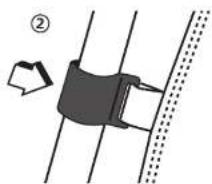
natural_image
Diagram of a mechanical clamp or bracket with a dotted line indicating a reference, no text or symbols present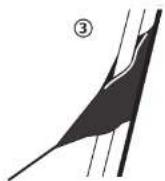
*Patent pending, zum Patent angemeldet, Patentanmeldt, Brevet en instance, Patent aangevraagd
DeLuxe
COLLECTION
Innovative Family Camping
[NO TEXT]
Cleaning
and maintenance tips
Get the most out of your camping trip by having a trial run, putting up and taking down your new tent in order to know it before you use it for the first time.
Under certain weather conditions, condensation can occur on the inside surfaces of your tent. To help prevent this you must remove wet clothes etc., increase ventilation or erect your tent on an Outwell® Footprint.
Condensation should not be confused with leakage.
The flysheet is made of waterproof material. To prevent water from seeping through the flysheet avoid touching the inside surface in rainy weather conditions.
When erecting your tent, do not secure it too tightly, otherwise it will not be able to adapt to varying wind and weather conditions.
If strong winds are expected, replace the normal tent pegs with storm pegs. Do not use guylines to pull out the tent pegs. For stony or hard ground stronger U-form pegs are recommended.
Insecticides must not be sprayed in or on the tent as they may damage the fabric and coating!
When taking down and packing the tent, it must be completely dry to avoid mildew/rotting. We recommend that after use all metal poles be lightly greased with a noracidic oil.
Remove dirt from the tent with a soft sponge and pure water. Never wash the tent in a washing machine and never have it dry-cleaned.
Store the tent in a dry place.
Even though we have used special waterproof thread for all seams, we recommend that you use a seam sealer or a waterproof spray at regular intervals for all seams around the zips and toggles. these seams are some of the weaker points on your tent as there can be a lot of tension around them.
Please note that the tape may come off after prolonged exposure to the sun. If this happens you can repair your tent by removing loose tape and use a seam sealer and waterproof spray to re-seal seams.
Be aware that (UV) ultraviolet rays will damage your tent if you expose it to direct sunlight for longer periods of time. Outtex® fabric used on Outwell® tents increases the lifetime of the tent.
If your tent has a mud valance never use it to adjust the tent or use the mud valance to pull the tent pegs out. The mud valance is one of the weaker points on the tent as it is only designed to keep wind and water out of the living and storage area.
Taking down your tent
When detachable take out the groundsheet and clean it if necessary with a sponge and water. Clean dirty floors the same way. (Allow it to dry before packing the tent).
If the inner tent is wet or dirty, take it out and clean it, the tent can be packed down with or without the inner tent inside.
Then start to unpeg the tent and the guyines. Gently remove the poles from the pins and then gently push the poles through the sleeves. Do not pull the poles through!
You are now ready to fold the tent. Try to fold it so you have all metal pins/rings at one side (to prevent them from making holes in the flysheet).
When you have folded the tent, measure it with the carrybag to make sure it is not too wide. You should now be able to roll the tent round the poles in their pole bag and fit it into the Outwell carrybag.
Best regards
THE OUTWELL TEAM
Outwell Wind Stabilizer System
* Testing and determination of Outwell Wind Stabilizer System (OWS System) performance and matching Beaufort ratings is based on the knowledge and technique available to Outwell at the time of testing. Outwell is not responsible for a subsequent development may show that Outwell's knowledge and technique is flawed or incorrect. The ratings to this tent are obtained by erecting and testing similar tents at the facilities of Oase Outdoors ApS. The ratings are therefore so guarantee for the properties of the operations such as weather conditions, inadequate pegs, sun, rain, temperature, other weather conditions, defective or incorrect erection of the tent and normal wear and tear can lead to a performance of the tent that differs from the specified ratings.
Patent Pending
-
The Ground Truth image displays a single, solid horizontal line, which is a stylistic or background element (like a ruled paper line). According to Rule 2, such lines must be ignored by the OCR result. The provided OCR content is "\_\_\_\_", which consists of underscores. Underscores are not equivalent to a solid line and are not permitted under the “Stylistic/Background Lines (Ignore)” rule. Outputting underscores for a stylistic line is incorrect because it misinterprets the line as a fill-in-the-blank placeholder. Therefore, the OCR result is inconsistent with the Ground Truth.
- -
- Aufbauanleitung
- [NO TEXT]
- Cleaning
- and maintenance tips
- Condensation should not be confused with leakage.
- Insecticides must not be sprayed in or on the tent as they may damage the fabric and coating!
- Store the tent in a dry place.
- Taking down your tent
- Best regards
- THE OUTWELL TEAM
- Outwell Wind Stabilizer System
- Patent Pending
- The Ground Truth image displays a single, solid horizontal line, which is a stylistic or background element (like a ruled paper line). According to Rule 2, such lines must be ignored by the OCR result. The provided OCR content is "\_\_\_\_", which consists of underscores. Underscores are not equivalent to a solid line and are not permitted under the “Stylistic/Background Lines (Ignore)” rule. Outputting underscores for a stylistic line is incorrect because it misinterprets the line as a fill-in-the-blank placeholder. Therefore, the OCR result is inconsistent with the Ground Truth.
Brand : Outwell
Model : DeLuxe Mokka Nevada XL
Category : Tent