
CSUB10N - Subwoofer Origin Acoustics - Free user manual and instructions
Find the device manual for free CSUB10N Origin Acoustics in PDF.


| Product Type | In-Wall Subwoofer |
| Brand | Origin Acoustics |
| Model | CSUB10N (Baffle) / CSUB10NCE (Enclosure) |
| Woofer Size | 10 inches (254 mm) |
| Cone Material | Aluminum |
| Frequency Response | 30 Hz - 250 Hz |
| Impedance | 8 ohms |
| Power Handling (RMS) | 100 - 500 watts |
| Sensitivity | 88 dB |
| Amplifier Requirements | Origin SubA150 or SubA500 |
| Cutout Dimensions | 10.55 x 10.55 in (268 x 268 mm) |
| Enclosure Dimensions | 3.5 x 13 x 44 in (88 x 330 x 1120 mm) |
| Grille Dimensions | 14.15 x 14.15 in (360 x 360 mm) |
| Installation Type | New construction only (two parts) |
| Color | White (paintable grille) |
| Included (Enclosure - CSUB10NCE) | Enclosure, placeholder, 2 mounting brackets, suspension cable, 8 bracket screws |
| Included (Baffle - CSUB10N) | Baffle with 10" woofer, grille, 4 mounting screws, hex-drive |
| Warranty | Limited Lifetime (original purchaser from authorized dealer) |
| Contact | (844) 674-4461 / techsupport@originacoustics.com |
| Tools Required | Screwdriver, speaker wire, tape measure, hex-drive |
| Special Features | Suspension cable height adjustment, paintable grille, aluminum woofer |
Frequently Asked Questions - CSUB10N Origin Acoustics
User questions about CSUB10N Origin Acoustics
0 question about this device. Answer the ones you know or ask your own.
Ask a new question about this device
Download the instructions for your Subwoofer in PDF format for free! Find your manual CSUB10N - Origin Acoustics and take your electronic device back in hand. On this page are published all the documents necessary for the use of your device. CSUB10N by Origin Acoustics.
USER MANUAL CSUB10N Origin Acoustics
ORIGIN®
ACOUSTICS
Installation Manual
10” IN-WALL SUBWOOFER
Model:
CSUB10N
CSUB10NCE
Introduction 1
Installation Requirements and Recommendations 1
CSUB10NCE: What's Included 1
Required Tools/Items 2
Location 2
Amplifier 2
Enclosure Installation...3
1) Installing the Wire 3
2) Installing the Enclosure 4
3) Attach the Wire to the Enclosure 5.
4) Drywall 5
Baffle Instruction 6
Installation Requirements and Recommendations 6
CSUB10N: What's Included 6
Required Tools/Items 7
Baffle Installation 8
1) Installing the Subwoofer Baffle 8
2) Painting the Grille 9
3) Mounting the Grille....9
4) Making Amplifier Adjustments....10
Specifications 12
Technical Assistance 13
Warranty 14
Limited Lifetime Warranty....14
Requirements and Warranty Coverage....15
Return Process....15
Introduction
Thank you for purchasing the CSUB10NCE In-Wall Subwoofer. At Origin Acoustics, we take pride in providing you with a high quality product. All of Origin Acoustics' subwoofers are designed to have excellent sound quality, longevity, and a simple installation process.
This subwoofer is designed for new construction installations only. For your installation convenience, it's sold in two parts: the CSUB10NCE enclosure that's installed before the drywall, and the CSUB10N that's installed after the drywall.
This instruction booklet covers the necessary information for a smooth installation of your Composer Subwoofer enclosure (CSUB-10NCE), including: the tools you will need, step-by-step instructions for installation, and all warranty information. The instructions for the baffle (CSUB10N) aren't included in this manual, but can be found with the baffle or online at www.originacoustics.com. If for any reason you experience problems or if you have installation questions please call us at (844) 674-4461. Hours of operation are 8:00am to 5:00pm (Pacific Time), Monday through Friday.
Installation Requirements and Recommendations
CSUB10NCE: What's Included
(CSUB10N Baffle sold separately)
- Enclosure
- Subwoofer baffle placeholder
- New Construction mounting system
- Mounting brackets x2
- Mounting suspension cable
- Mounting bracket screws x8
Required Tools/Items
- Screwdriver
- Speaker wire
- Tape measure
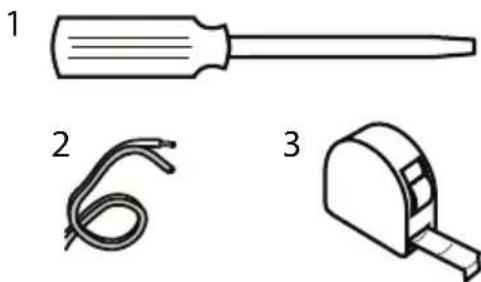
Figure 2.1: Tools
Speaker Wire Recommendations
For this setup, use a multi-stranded wiring designed for amplifier to speaker connections. The gauge of wire used can have an impact on the performance of your speakers, and we recommend choosing the largest wire size that is practical for your installation. Which gauge to select depends on the length of wire to be used on any particular speaker. In general the shorter the run the
smaller the wire size you can use, however you can never go wrong by using a thicker gauge.
| Wire Length Recommended Gauge | |
| Feet Meter | |
| 0-100 0-30 18 | |
| 50-150 15-45 16 | |
| 100+ 30+ 14 | |
Location
The location of your subwoofer(s) will have a large impact on sound quality. For best results, install the subwoofer so the bottom is close to the ground and in either corner in the front of the room. If you're installing two subwoofers in the room, the best option is one in each corner in the front.
Amplifier
This subwoofer has been designed to work with an Origin Subwoofer amplifier, either the SubA150 or the SubA500.
Enclosure Installation
1) Installing the Wire
Strip 1/4 to 1/2 inches (6 to 12 mm) of the insulation off both ends of the wire. To avoid stray strands, twist them at the end.
Connect the wire to the amplifier, but don't plug in the amplifier AC just yet. Route the wire through the walls to the subwoofer location.
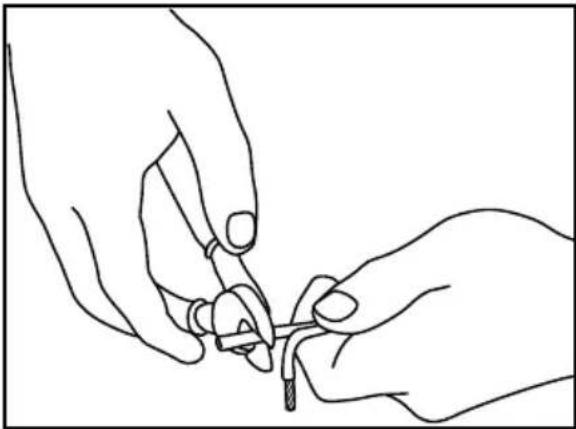
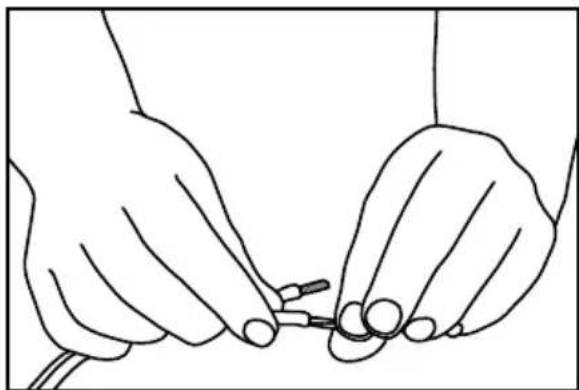
Figure 3.1: Installing the Wire
About Speaker Wire
You will need a wire that has at least two conductors; one that can be identified as the positive and the other as the negative. All two conductor wires have some means of identifying which conductor is which, but at times this identification may be subtle. It’s crucial that you keep track of which wire you use for positive (+) and negative (-). Typically if the wires are colored red and black or copper and silver, but sometimes other colors or patterns are used. You can choose whichever color of wire you want to be positive and negative as long as you remain consistent throughout the install.
2) Installing the Enclosure
Using the 8 provided screws, attach the two mounting brackets to the studs so that they are facing each other. Once everything's installed, the distance between the bottom of the subwoofer and the bottom of the bracket will be about 49". So when you know how far off the floor the subwoofer should be, add that number to 49", and install the brackets at that height. For example, if you want the subwoofer to be about a foot off the floor, install the bottom of the brackets about 61" (49" + 12") off the floor.
Insert the ends of the suspension cable into the mounting brackets. Hang the enclosure from the suspension cable. There are several ends on one side of the suspension cable so that you can adjust the height of the enclosure.
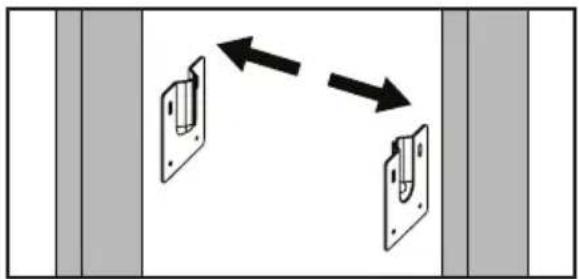
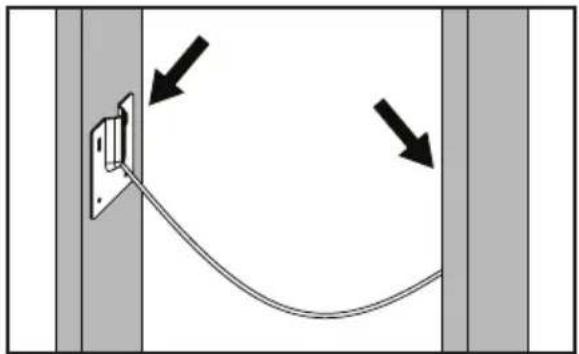
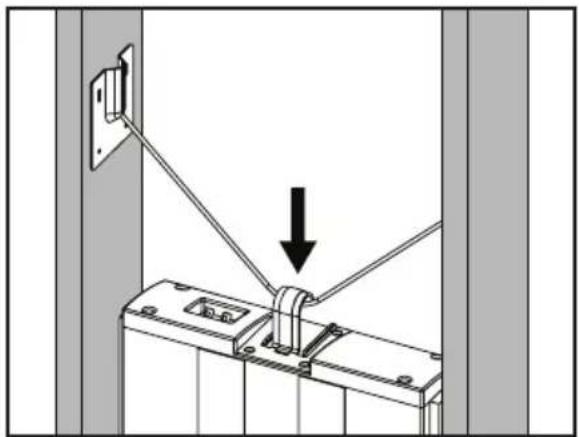
Figure 4.1: Suspension Install
3) Attach the Wire to the Enclosure
Depending on how you ran the wires to the subwoofer location, the wires can be attached to the connectors at the top or bottom of the enclosure. Push on the end of the connector and insert the wire.
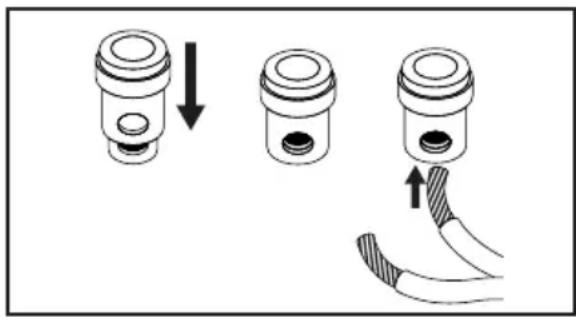
Figure 5.1: Connecting Wire
4) Drywall
The drywall is now ready to go up. The placeholder plate should not be removed until the subwoofer is installed. Install the drywall to the edge of the plate, but do not tape or mud the gap. The gap should not be larger than 1/8 ” (3mm).
The drywall screws should be no further apart than 12", or 8" along the edge.
Thank you for purchasing the CSUB10N In-Wall Subwoofer. At Origin Acoustics, we take pride in providing you with a high quality product. All of Origin Acoustics' subwoofers are designed to have excellent sound quality, longevity, and a simple installation process.
This subwoofer is designed for new construction installations only. For your installation convenience, it's sold in two parts: the CSUB10NCE enclosure that's installed before the drywall, and the CSUB10N baffle that's installed after the drywall.
This instruction booklet covers the necessary information for a smooth installation of your Composer Subwoofer baffle (CSUB10N), including: the tools you will need, step-by-step instructions for installation, troubleshooting tips for any errors that may occur, and all warranty information. This manual assumes you’ve already installed the enclosure, and doesn’t cover those installation steps. The instructions for the enclosure (CSUB10NCE) can be found with the enclosure or online at www.originacoustics.com. If for any reason you experience problems or if you have installation questions please call us at (844) 674-4461. Hours of operation are 8:00am to 5:00pm (Pacific Time), Monday through Friday.
Installation Requirements and Recommendations
CSUB10000N: What's Included
- Baffle with 10" aluminum woofer
- Grille
- Screws (x4)
- Hex-drive
Required Tools/Items
- Screwdriver that can hold hex-wrench
1

Figure 7.1: Tools
Optional Tools/Items
- Can of spray paint
- Can of compressed air
For painting the grille
For painting the grille
1) Installing the Subwoofer Baffle
When you're ready to install the baffle, start by removing the placeholder plate.
Connect the speaker wires from the enclosure to the woofer terminals. Note that the terminals are sized differently to assure that they get connected to the proper woofer terminals.
Insert the baffle into the enclosure. Make sure it's right-side-up by keeping an eye on the orientation of the logo. Use the four screws to firmly attach the baffle to the enclosure, but do not overtighten.
We recommend testing the system at this time to ensure the subwoofer is installed and working properly.
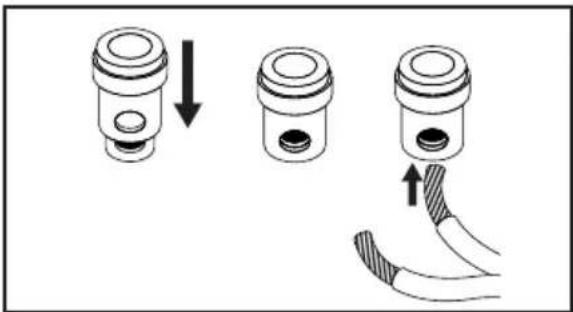
Figure 8.1: Connecting Wire
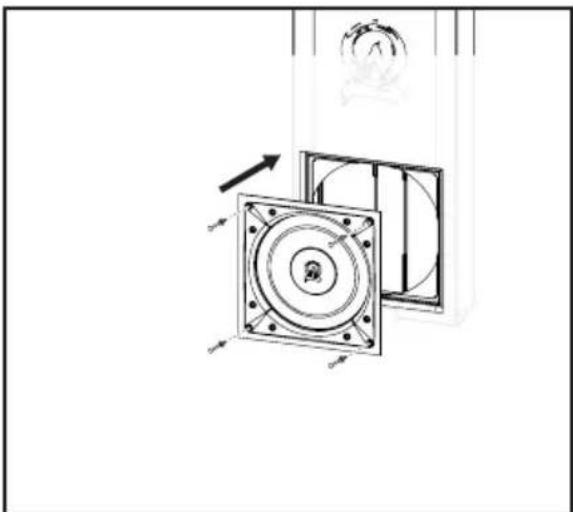
Figure 8.2: Inserting the Baffle
2) Painting the Grille
In some situations the sub-woofer may look better if the color matched the walls, ceiling, or trim in the room. This can be accomplished by painting the grille. The grille must be painted with spray paint. Most hardware stores will mix a can of paint to match the color you need.
Before painting, carefully remove the thin cloth on the underside of the grille. Lightly spray the front of the grille with the paint from a distance, being careful not to plug any of the holes. Diluting the paint with paint thinner will lessen the risk of filling any holes. If a hole is plugged, use a can of compressed air to open it. Once the paint is dry, put the cloth back on the grille.
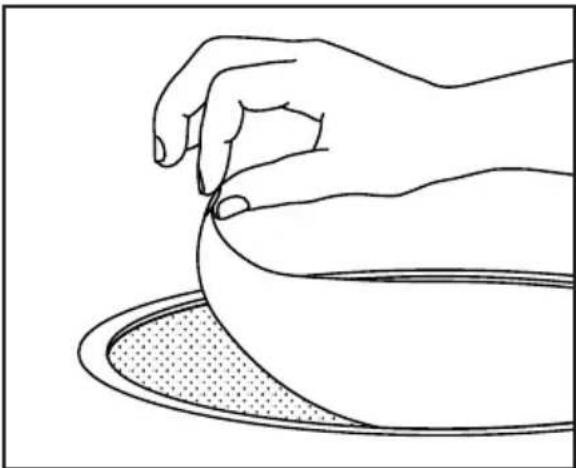
Figure 9.1: Remove Cloth
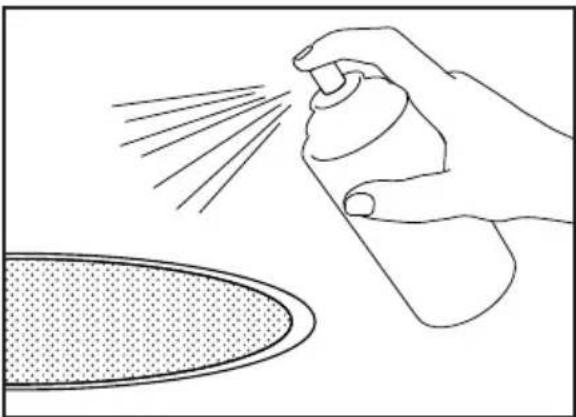
Figure 9.2: Spray Grille
3) Mounting the Grille
Fit the grille over the subwoofer and press into place.
4) Making Amplifier Adjustments
- “Crossover” should be the first adjustment you set. But you can always come back and fine tune this later.
- If you are using the LFE output from a home theater receiver, set the crossover frequency on the subwoofer amp as high as you can since you will be controlling this on the receiver's set-up routine.
- For most applications you can simply set the subwoofer amplifier's crossover frequency to 80Hz (straight-up on our SubA150 amp). When using an LFE output, set it to 80Hz.
- If your front speakers are small you may want to try setting the crossover closer to 100Hz (about 1 o'clock on our SubA150 amp).
- “Phase” adjustment should come next. This adjustment can have a subtle effect but it is definitely worth doing. You won’t need to sweat getting it exact; the important thing is to avoid getting it really wrong.
- When tuning by ear:
a. If you are using a home theater receiver, during setup there will be section asking you to enter the distance from the listener to the speakers. You should do this before proceeding. If you are using a receiver that does not have this feature, don't worry, the following steps will still get everything right.
b. For source material, a test CD with a 80Hz or 100Hz test tone (either sine wave or 1/3 octave pink noise) is best but anything with constant bass can also work
CSUB10N & CSUB10NCE INSTALLATION MANUAL
well.
c. Set the volume so that the bass level sounds approximately right to slightly bass heavy.
d. You will want to be in the critical listening area. Have a helper adjust the phase control until the bass level sounds the loudest. If you are using music or video tracks for this test, listen for the mid-bass level as the low bass will be unaffected. At this stage you're listening for the loudest bass, not the best.
- When tuning by measurement. You will use the same method as above except:
e. replace your your ear with an SPL meter. An inexpensive SPL meter works fine or you can download a free app for use on your phone.
f. Sorry, but the music CD with constant bass won't work here. You will need to use a test CD.
- "Volume" will complete your subwoofer amplifier set-up.
- When tuning by ear. Play some source material that has bass content you are familiar with. Simply adjust the volume until the bass level sounds in balance with the rest of the sound. Try several music and video tracks paying special attention to deep male vocals with an ear towards making them sound natural. Be sure to try several locations in the listening area and adjust to get the best average.
- You shouldn't attempt tuning by measurement unless you have the sophisticated equipment that can measure full bandwidth and you know what you're doing.
| Model Number (Enclosure) CSUB10NCE | |
| Model Number (Baffle) CSUB10N | |
| Part Number (Enclosure) CSUB10000NCE | |
| Part Number (Baffle) CSUB1000AN | |
| Woofer Cone Material Aluminum | |
| Woofer Diameter 10” (254mm) | |
| Frequency Response 30Hz-250Hz | |
| Impedance 8Ω | |
| Power Handling 100-500 watts | |
| Sensitivity 88dB | |
| Amplifier Requirements SUBA500, SUBA150 | |
| Cutout Dimensions 10.55x 10.55” (268 x 268mm) | |
| Dimensions (Enclosure) | 3.5 x 13 x 44” (88 x 330 x 1120mm) |
| Dimensions (Enclosure) w/Grille | 14.15 x 14.15” (360 x 360mm) |
| Dimensions (Baffle) | 3.5 x 13 x 44” (88 x 330 x 1120mm) |
| Dimensions (Baffle) w/ Grille | 3.5 x 13 x 44” (88 x 330 x 1120mm) |
| Dimensions (Grille) 14.15 x 14.15” (360 x 360mm) | |
Technical Assistance
If you have any questions or concerns about installing or using this product, you can reach us through one of the following methods:
Phone: (844) 674-4461
Hours of operation: 8:00am - 5:00pm (Pacific Time), Mon - Fri
Email: techsupport@originacoustics.com
If you are having technical trouble, please include the model number and briefly explain what steps you took to resolve the problem in your email, or be prepared to answer these questions over the phone. If you are considering returning the product, it's required that you contact Origin Acoustics prior to any return attempts. This way we can determine if the issue can be resolved without returning the product, or if needed we can provide instructions and support for the return process.
Limited Lifetime Warranty
Origin Acoustics warrants to the original retail purchaser only that this Origin Acoustics product will be free from defects in materials and workmanship, provided the speaker was purchased from an Origin Acoustics authorized dealer.
If the product is determined to be defective, it will be repaired or replaced at Origin Acoustics' discretion. If the product must be replaced yet it is no longer manufactured, it will be replaced with a model of equal to or greater value that is the most similar to the original. If this is the case, installing the replacement model may require mounting modifications; Origin Acoustics will not be responsible for any such related costs.
Requirements and Warranty Coverage
This warranty may not be valid if the product was purchased through an unauthorized dealer. This warranty only applies to the individual that made the original purchase, and it cannot be applied to other purchases. The purchaser must be prepared to provide proof of purchase (receipt). This warranty will not be valid if the identifying number or serial number has been removed, defaced, or altered.
This warranty does not cover the following:
- Accidental damage
• Damage caused by abuse or misuse - Damage caused by attempted repairs/modifications by anyone other than Origin Acoustics or an authorized dealer
- Damage caused by improper installation
• Normal wear, maintenance, and environmental issues - Damage caused by voltage inputs in excess of the rated maximum of the unit
• Damage inflicted during the return shipment
Return Process
Before making any return attempts, it is required that you first contact Origin Acoustics. Return product to Origin Acoustics or your dealer, either in person or by mail. It’s preferable if the product is returned in the original packaging. If this isn’t possible, the customer is responsible for insuring the shipment for the full value of the product.
This warranty is in lieu of all other expressed or implied warranties. Some states do not allow limitations on implied warranties, so this may not apply depending on the customer's location. (For more information, see Magnuson-Moss Warranty Act.)
©2016 Origin Acoustics. All copyrighted, trademarked and patented elements mentioned herein are the sole property of Origin Acoustics.




- INSTALLATION MANUAL
- 10” IN-WALL SUBWOOFER
- INTRODUCTION 1
- INSTALLATION REQUIREMENTS AND RECOMMENDATIONS 1
- ENCLOSURE INSTALLATION...3
- BAFFLE INSTRUCTION 6
- INSTALLATION REQUIREMENTS AND RECOMMENDATIONS 6
- BAFFLE INSTALLATION 8
- SPECIFICATIONS 12
- TECHNICAL ASSISTANCE 13
- WARRANTY 14
- INTRODUCTION
- INSTALLATION REQUIREMENTS AND RECOMMENDATIONS
- CSUB10NCE: WHAT'S INCLUDED
- REQUIRED TOOLS/ITEMS
- SPEAKER WIRE RECOMMENDATIONS
- LOCATION
- AMPLIFIER
- ENCLOSURE INSTALLATION
- INSTALLING THE WIRE
- ABOUT SPEAKER WIRE
- INSTALLING THE ENCLOSURE
- ATTACH THE WIRE TO THE ENCLOSURE
- DRYWALL
- CSUB10000N: WHAT'S INCLUDED
- OPTIONAL TOOLS/ITEMS
- INSTALLING THE SUBWOOFER BAFFLE
- PAINTING THE GRILLE
- MOUNTING THE GRILLE
- MAKING AMPLIFIER ADJUSTMENTS
- CSUB10N & CSUB10NCE INSTALLATION MANUAL
- TECHNICAL ASSISTANCE
- LIMITED LIFETIME WARRANTY
- REQUIREMENTS AND WARRANTY COVERAGE
- RETURN PROCESS
Brand : Origin Acoustics
Model : CSUB10N
Category : Subwoofer