Lublin 1957 - Uncategorized Xaoc - Free user manual and instructions
Find the device manual for free Lublin 1957 Xaoc in PDF.


| Product Type | Retro Audio Device |
| Brand | Xaoc |
| Model | Lublin 1957 |
| Dimensions (W x H x D) | 300 x 200 x 150 mm |
| Weight | 2.3 kg |
| Power Supply | 220-240V AC, 50/60 Hz |
| Power Consumption | 20 W |
| Inputs | Antenna, Auxiliary (3.5 mm) |
| Outputs | Speaker, Headphone (3.5 mm) |
| Frequency Range | FM 87.5-108 MHz, AM 530-1600 kHz |
| Main Functions | AM/FM Radio, Volume Control, Tuning |
| Material | Wood, Plastic, Metal |
| Color | Vintage Beige |
| Display | Analog Tuning Dial |
| Speaker | Built-in, 5W |
| Cleaning | Wipe with dry cloth, avoid liquids |
| Safety | Do not expose to moisture, unplug during storms |
| Repairability | Replaceable fuse, serviceable by professional |
| Included Accessories | Power cord, user manual |
Frequently Asked Questions - Lublin 1957 Xaoc
User questions about Lublin 1957 Xaoc
0 question about this device. Answer the ones you know or ask your own.
Ask a new question about this device
Download the instructions for your Uncategorized in PDF format for free! Find your manual Lublin 1957 - Xaoc and take your electronic device back in hand. On this page are published all the documents necessary for the use of your device. Lublin 1957 by Xaoc.
USER MANUAL Lublin 1957 Xaoc
LUBLIN
DUAL PINGABLE VOLTAGE CONTROLLED AMPLIFIER
Model of 1957
Dual voltage-controlled amplifier · High quality, low noise and distortion, DC-coupled signal path · Ping inputs for emulating vactrol response · Three variants of ping response · Exponential CV response with adjustable sensitivity · Gain limiting circuit for protection against signal clipping

XAOC DEVICES SP. Z O. O.
WORKING CLASS ELECTRONICS
MADE IN THE EUROPEAN UNION
WWW.XAOCDEVICES.COM
MODULE OVERVIEW
Salut! Thank you for purchasing this XaoC Devices product. Lublin ['lublin] is a dual, DC-coupled, high-quality VCA module with exponential control characteristics. It features a gain control circuit that prevents distortion from excessive amplification, which is common with traditional VCAs.
Besides audio and CV inputs, it features additional pinging inputs that use an elaborate analog circuit to model the dynamic behavior of vactrols, allowing you to trigger a carefully crafted gain response that mimics the natural decay of plucked and struck acoustic instruments.
Note that despite this emulation, Lublin is not a lowpass gate type module as it retains the full frequency bandwidth when reducing gain. Unlike many modules that use vactrols, Lublin's dynamic profile can be varied within a wide range.
INSTALLATION
The module requires 6hp worth of free space in the Eurorack cabinet. The ribbon-type power cable must be plugged into the bus board, paying close attention to polarity orientation. The red stripe indicates the negative 12V rail and is supposed to match the arrowhead, -12v, or red stripe marks on both the unit and the bus board.
The module itself is secured against reversed power connection; however, reversing the 16-pin header MAY CAUSE SERIOUS DAMAGE to other components of your system because it will short-circuit the +12V and +5V power rails.
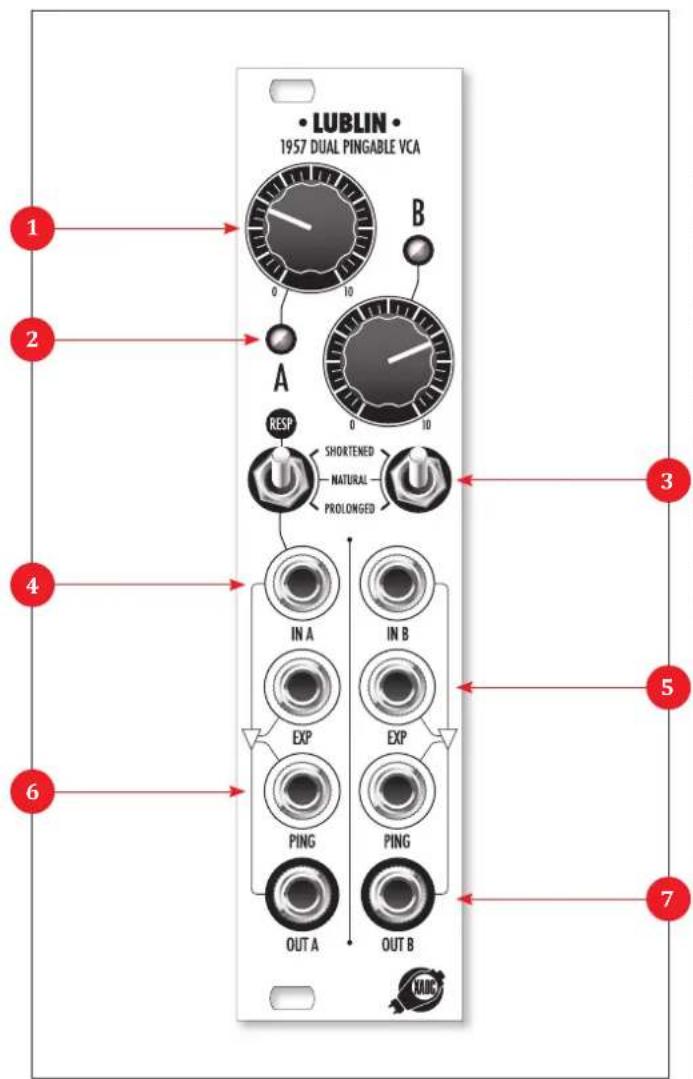
fig. 1: LUBLIN FRONT PANEL LAYOUT AND CONTROLS
The module should be fastened by mounting the supplied screws before powering up. To better understand the device, we strongly advise reading through the entire manual before using the module.
MODULE OVERVIEW
Lublin consists of two entirely independent VCA channels behind a 6hp front panel (fig. 1) featuring for each of its channels: a VOLUME potentiometer ①, signal level indicator ②, RESP response switch ③, and a group of jacks.
The signal inputs labeled IN ④ accept all modular signal levels and are DC-coupled. The exponential CV control inputs labeled EXP ⑤ accept positive control voltages in the range of 0V to +8V or 0V to +10V, depending on how the VOLUME knobs are set. These inputs are internally normalized to 8V unless you also use the PING inputs ⑥. The PING inputs react to any trigger signals that are at least 4ms long.
The processed signal is available at the OUT A and OUT B jacks ⑦.
Lublin is designed with intelligent normalization offering great flexibility. When nothing is plugged into the EXP or PING jacks, the potentiometers simply control the input signal attenuation from -90dB to 0dB. With control voltage patched into the EXP inputs, the potentiometers act as attenuators to
CONTROL RESPONSE
line
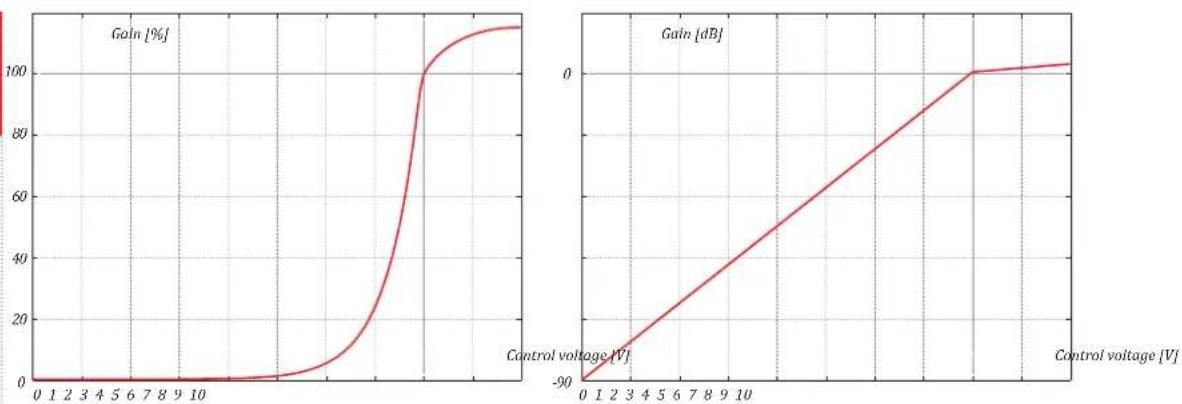
| Control voltage [V] | Gain [%] | Gain [dB] | |---|---|---| | 0 | 0 | -90 | | 1 | ~5 | -80 | | 2 | ~10 | -70 | | 3 | ~15 | -60 | | 4 | ~20 | -50 | | 5 | ~30 | -40 | | 6 | ~45 | -30 | | 7 | ~65 | -20 | | 8 | ~85 | -10 | | 9 | ~95 | 0 | | 10 | ~100 | 0 | | >10 | ~100 | 0 |fig. 2: CV RESPONSE OF LUBLIN IN LINEAR (LEFT) AND dB SCALE (RIGHT)
this CV, allowing you to adjust its impact. Note that a CV of zero or negative value will always shut the VCA down, regardless of the knob position. Similarly, turning the potentiometers all the way down will not let any CV open the VCA. However, in both situations, it is still possible to open the VCA briefly via the PING inputs.
Lublin features a CV saturation circuit that tempers the gain controls, making it quite difficult to open beyond 0dB. Thus it is nearly impossible to distort the signal with too much gain.
For this reason, there is no soft-clipping or saturation in the signal path, allowing for maximum range of linear operation without any shade of distortion. In other words, if your output signal is clipped, it means it was already clipped before it entered Lublin.
The CV saturation level can be adjusted using a trimmer at the back of the module, which sets the overall and maximum gain in a reasonable range. All factory units are calibrated to 0dB. Please note that adjusting it significantly above 0dB introduces a risk of distortion.
Trigger signals patched into the PING inputs start a short envelope in the corresponding channel. This envelope is not attenuated by the volume potentiometers; hence it always opens the VCA to 100%, i.e., 0dB. When CV is present at the EXP input and is already opening the VCA, the pinged envelope rides on top, but the 0dB limit makes the sum less dynamic.
When the PING inputs are used without patched, the potentiometers allow you to adjust the tail of the pinged response and dial in the appropriate decay length. Together with the selection between NATURAL, SHORTENED, and PROLONGED envelopes, this control offers a broad range of dynamic profiles from short and clicky through plucked and bell-like up to long, compressed, and boomy.
THE CONTROL RESPONSE
The two individual VCA cores of Lublin, based on the legendary Blackmer Cell implemented in high-quality integrated circuits, are intrinsically exponential in their response to control voltage, wherein each 1V change of CV yields an equal change of gain in the dB scale (see Fig. 2). Remember that dB is a relative scale corresponding to human sensitivity to loudness change. The 0dB point on this scale is equivalent to a gain factor of 1 or 100% (there is no change in signal amplitude compared to the input signal). The -90dB point represents extreme attenuation, down to a practically inaudible level.
Exponential VCAs offer a more "dynamic" sound than linear VCAs, with more precise control over the quiet end of the range. On the other hand, an already exponential envelope driving an exponential VCA yields hyper-exponential decays, which are perceived as short and "spiky". It is always recommended to carefully select an appropriate envelope shape for a given VCA. For example, XaoC Devices Zadar has a continuously adjustable envelope response shape, making it an ideal partner for Lublin.
Since the potentiometer acts as a scaling factor, its position determines the slope of the response (in dB/V) thus allowing Lublin to adapt to envelopes exceeding the A-100 standard of 8V amplitude by simply turning the knob slightly down.
The plateau of the curve illustrates how the gain constraint works. It deliberately does not allow Lublin to amplify the signal above the 0dB point regardless of the level of CV driving it. The sonic effect is very similar to a brickwall limiter, without any of the artifacts of a real limiter, such as transient ripples and distorting the peaks of the waveform.
THE PING INPUTS
Lublin's PING inputs accept trigger gate signals. Each incoming impulse starts an internal envelope that is directly tied to the VCA core (bypassing the potentiometer).
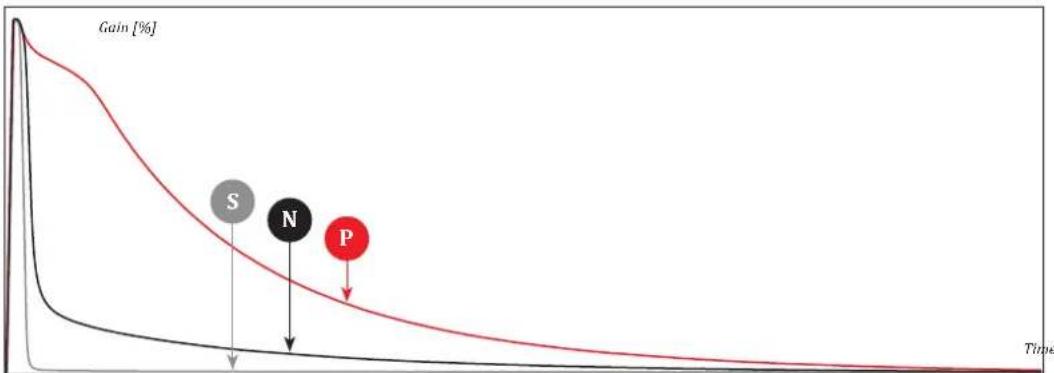
The envelope (fig. 3) consists of a short attack phase instantly followed by three precisely formed decay segments which model the dynamic behavior of classic vactrol elements (consisting of an LED and a photoresistor) used in vintage synthesizers. This envelope has a breakpoint selectable with the 3-position switch. Depending on the selection, the behavior of different vintage and modern vactrol-based VCAs can be emulated.
If the PING input is used with no e patched, the internal normalization of the potentiometers allows you to adjust the time of the audible portion of the envelope decay. Since the tail is exponential, any small offset added to the envelope voltage results in shifting the end of the tail above or below the threshold of hearing so that a longer or shorter part of the sound becomes audible.
With external CV patched, the VCA is opened by the sum of this voltage (scaled by the potentiometer) and the pinging envelope (not scaled by the potentiometer). This means that the envelope offers additional short dynamic bumps that ride on top of the external control. However, the general limiting mechanism does not allow the VCA to open above 0dB. Therefore, the more the VCA is being opened by CV, the less pronounced the additional pinging is.
SIGNAL LEVEL INDICATORS
Each Lublin channel is equipped with a multi-color HED signal level indicator. The indicator employs a PPM (peak detection) method with an appropriate discharge time constant, allowing for easier observation of short transients.
Output levels from silence up to the normal 10Vpp level are shown by the LEDs gradually lighting green. Exceeding 10Vpp is indicated by the color turning yellow, and finally, red whenever levels above 16Vpp are reached. Note that this is never an indication of any distortion caused by Lublin because the maximum gain is squashed above 0dB (unless you adjust the trimmer at the back). Hence, a hot output signal means that the input signal is already hot.
ernal CV
PATCH IDEAS
- Use the PROLONGED setting to synthesize a boomy, compressed bass drum sound. Patch a low frequency (but audible!) sine or triangle wave to the IN jack and a rhythmic gate or trigger to the PING input. For consistent attack without annoying clicks, use the same trigger to sync/reset your oscillator.
- You can easily modulate the length of your pinged sounds. Patch a source of continuous audio signal
fig. 3: PINGING ENVELOPE (THREE SHAPE SETTINGS: NATURAL, SHORTENED, AND PROLONGED)
line
| Time Point | Gain [%] | | ---------- | -------- | | S | High | | N | Medium | | P | Low |to the IN jack. Patch a gate or trigger to the PING input and a slow LFO signal to the EXP input. Set the volume knob to minimum and open it slowly so that only a small fraction of the CV is added to the stream of ping envelopes.
- Patch a CV offset into the IN jack. Pinging the VCA will produce CV shaped by the ping envelope, which can be useful for modulating other mod-
ules. Adding another CV to the EXP input and adjusting the knob allows you to modulate the envelope length, as above.
ACCESSORY
Our Coal Mine black panels are available for all Xaoc Devices modules. Sold separately. Ask your favorite retailer.
TECHNICAL SPECIFICATION
| WIDTH DEPTH TOTAL CURRENT DRAW REV. POWER PROTECT. | |||
| 6hp 33mm | +40mA | protected | |
| -20mA | |||
| INPUTS OUTPUTS | |||
| IN A, B | 0 to 20Vpp | OUT A, B | 0 to 20Vpp |
| EXPO (exponential) | 0 to 8V | ||
| PING | any gate or trig(5V or more, t>4ms) | ||
| FREQUENCY RESPONSE LINEARITY | |
| 0 to 20kHz (+/- 0.5dB), 0 to 60kHz (-3dB) 0.3% |
ALL RIGHTS RESERVED. CONTENT COPYRIGHT ©2024 XAOC DEVICES. COPYING, DISTRIBUTION, OR COMMERCIAL USE IN ANY WAY IS STRICTLY PROHIBITED AND REQUIRES WRITTEN PERMISSION FROM XAOC DEVICES. SPECIFICATIONS ARE SUBJECT TO CHANGE WITHOUT PRIOR NOTICE. EDITING BY BRYAN NOLL. WARRANTY TERMS: XAOC DEVICES WARRANTS THIS PRODUCT TO BE FREE OF DEFECTS IN MATERIALS OR WORKMANSHIP AND TO CONFORM WITH THE SPECIFICATIONS AT THE TIME OF SHIPMENT FOR ONE YEAR FROM THE DATE OF PURCHASE. DURING THAT PERIOD, ANY MALFUNCTIONING OR DAMAGED UNITS WILL BE REPAIRED, SERVICED, AND CALIBRATED ON A RETURN-TO-FACTORY BASIS. THIS WARRANTY DOES NOT COVER ANY PROBLEMS RESULTING FROM DAMAGES DURING SHIPPING, INCORRECT INSTALLATION OR POWER SUPPLY, IMPROPER WORKING ENVIRONMENT, ABISIVE TREATMENT, OR ANY OTHER ORVIOS USER-INFLECTED FAULT. LEGACY SUPPORT: IF SOMETHING GOES WRONG WITH AXAOC PRODUCT AFTER THE WARRANTY PERIOD IS OVER, THERE IS NO NEED TO WORRY, AS WE ARE STILL HAPPY TO HELP! THIS APPLIES TO ANY DEVICE, WHEREVER AND WHENEVER ORIGINALLY ACQUIRED. HOWEVER, IN SPECIFIC CASES, WE RESERVE THE RIGHT TO CHARGE FOR LABOR, PARTS, AND TRANSIT EXPENSES WHERE APPLICABLE. RETURN POLICY: THE DEVICE INTENDED FOR REPAIR OR REPLACEMENT UNDER WARRANTY NEEDS TO BE SHIPPED IN THE ORIGINAL PACKAGING ONLY AND MUST INCLUDE A COMPLETED RMA FORM. XAOC DEVICES CAN NOT TAKE ANY RESPONSIBILITY FOR DAMAGES CAUSED DURING TRANSPORT. SO BEFORE SENDING US ANYTHING, PLEASE CONTACT US AT SUPPORT@XAOCDEVICES.COM. NOTE THAT ANY UNSOLICITED PARCEL WILL BE REJECTED AND RETURNED! GENERAL INQUIRIES: FOR USER FEEDBACK SUGGESTIONS, DISTRIBUTION TERMS, AND JOB POSITIONS, FEEL FREE TO CONTACT XAOC DEVICES AT INFO@XAOCDEVICES.COM. PLEASE VISIT XAOCDEVICES.COM FOR INFORMATION ABOUT THE CURRENT PRODUCT LINE, USER MANUALS AND FIRMWARE UPDATES.
Brand : Xaoc
Model : Lublin 1957
Category : Uncategorized