RC519W1 - Freezer Fisher & Paykel - Free user manual and instructions
Find the device manual for free RC519W1 Fisher & Paykel in PDF.


| Product Type | Freezer |
| Brand | Fisher & Paykel |
| Model | RC519W1 |
| Total Capacity | 519 L |
| Dimensions (H x W x D) | 850 x 1500 x 600 mm |
| Weight | 62 kg |
| Power Supply | 220-240 V, 50 Hz, 1.5 A |
| Energy Consumption | Approx. 400 kWh/year |
| Defrost Type | Manual defrost |
| Temperature Control | Mechanical thermostat |
| Temperature Range | -24°C to -12°C |
| Interior Light | Yes |
| Lockable Lid | Yes (with key) |
| Wheels for Mobility | Yes |
| Climate Class | SN-T (10°C to 38°C) |
| Refrigerant | R600a |
| Noise Level | < 40 dB(A) |
| Cleaning | Unplug and wipe with mild detergent |
| Spare Parts Availability | Authorized service centers (contact Fisher & Paykel) |
| Repair Rating | Modular design, DIY-friendly with official guide |
Frequently Asked Questions - RC519W1 Fisher & Paykel
User questions about RC519W1 Fisher & Paykel
0 question about this device. Answer the ones you know or ask your own.
Ask a new question about this device
Download the instructions for your Freezer in PDF format for free! Find your manual RC519W1 - Fisher & Paykel and take your electronic device back in hand. On this page are published all the documents necessary for the use of your device. RC519W1 by Fisher & Paykel.
USER MANUAL RC519W1 Fisher & Paykel
INSTALLATION INSTRUCTIONS USER GUIDE
Chest Freezer
RC143, RC201, RC376, RC519 and RC719 models
NZ AU
Fisher&Paykel
Introduction 3
Safety and warnings 4
Installation instructions 7
Moving or storing your appliance 10
Chest freezer operating instructions 11
Chest freezer special features 12
Chest freezer cleaning and care instructions 13
Storing food in your chest freezer 15
Troubleshooting 17
Manufacturer's Warranty 19
Customer Care 21
IMPORTANT!
SAVE THESE INSTRUCTIONS
The models shown in this user guide may not be available in all markets and are subject to change at any time. For current details about model and specification availability in your country, please go to our website www.fisherpaykel.com or contact your local Fisher & Paykel dealer.
Registration
Register your product with us so we can provide you with the best service possible.
To register your product visit our website: www.fisherpaykel.com
Thank you for buying a Fisher & Paykel chest freezer.
At Fisher & Paykel we are very proud of this appliance. This appliance combines size and storage space with the latest features and functions.
We hope you enjoy your new appliance.
natural_image
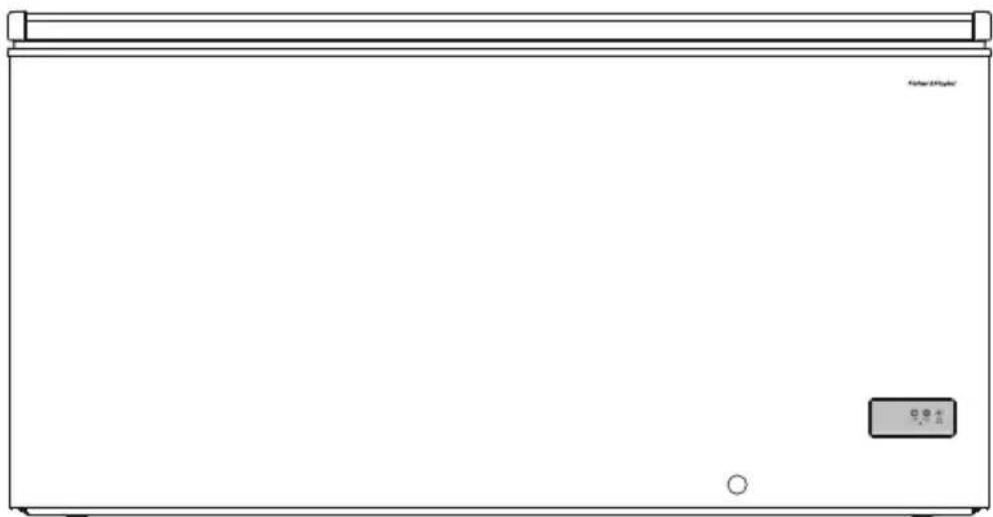
Front view of a white appliance panel with a small indicator button and 'Fisher 400' label (no other text or symbols)RC519 chest freezer
The diagram above shows an example of one of the models covered in this book.
WARNING!

Electric Shock Hazard
Read and follow the safety and warnings outlined in this user guide before operating this appliance.
Failure to do so can result in death, electric shock, fire or injury to persons.

R600a
This appliance contains flammable refrigerant isobutane (R600a).
Use this appliance only for the intended purpose as described in the user guide.
IMPORTANT SAFETY INSTRUCTIONS:
WARNING!
When using this appliance always exercise basic safety precautions including the following:
- This appliance can be used by children aged from 8 years and above and persons with reduced physical, sensory or mental capabilities or lack of experience and knowledge if they have been given supervision or instruction concerning use of the appliance in a safe way and understand the hazards involved.
• Children should be supervised to ensure that they do not play with the appliance.
• Cleaning and user maintenance shall not be made by children without supervision. - The manufacturer's installation instructions must be followed when installing the appliance.
- WARNING: Do not use mechanical devices or other means to accelerate the defrosting process, other than those recommended by the manufacturer.
- WARNING: Do not damage the refrigerant circuit.
- In case of damage to the refrigerant circuit, ventilate the area by opening all windows. Do not operate electrical equipment or any other equipment that may produce arcs, sparks or flames in the area. Contact your Fisher & Paykel trained and supported service technician immediately to arrange for the appliance to be repaired.
- It is hazardous for anyone other than an authorised service person to service this appliance. In Queensland the authorised service person must hold a gas work licence or authorisation for hydrocarbon refrigerants to carry out service or repairs which involve removal of covers.
Electrical
- This appliance must be installed in accordance with the installation instructions before use.
- To allow disconnection of the appliance from the supply after installation, incorporate a switch in the fixed wiring in accordance with the wiring rules.
- Never unplug your appliance by pulling on the power cord. Always grip the plug firmly and pull straight out from the outlet.
- Do not plug in any other appliance at the same power point as your chest freezer or use extension cords or double adapters.
- Repair or replace immediately all electric service cords that have become frayed or otherwise damaged. Do not use a cord that shows cracks or abrasion along its length or at either the plug or appliance end.
- If the power supply cord is damaged, it must only be replaced by your Fisher & Paykel trained and supported service technician because special purpose tools are required.
- When moving your appliance away from the wall, be careful not to roll over or damage the power cord.
- WARNING: Do not use electrical appliances inside the food storage compartments of the appliance, unless they are of the type recommended by the manufacturer.
IMPORTANT!
Your appliance is designed to operate for many years without the need for service checks. However, if your appliance is malfunctioning, have it attended to by your Fisher & Paykel trained and supported service technician as soon as possible. All electrical repairs must be carried out by an adequately trained service technician or qualified electrician.
Cleaning
- Many commercially available cleaning products contain solvents that may attack the plastic components of your appliance and cause them to crack.
- Avoid using anti-bacterial cleaning products on either the interior or exterior of the cabinet as they may cause rusting of metal components and cracking of plastic components.
- Please refer to the ‘Chest freezer cleaning and care instructions’ section of this user guide for further information.
Disposal
• Extreme care must be taken when disposing of your old appliance to avoid hazards:
- The flammable refrigerant gas must be safely removed.
- The thermal insulation foam in this appliance contains flammable insulation blowing gases, any exposed foam may be highly flammable and must be carefully treated during disposal.
- The lid should be removed and the freezer baskets left in place so that children may not easily climb inside.
- Your Fisher & Paykel trained and supported service technician will be able to give advice on environmentally friendly methods of disposing of your old appliance or freezer.
Storing food and drinks
- Do not store explosive substances such as aerosol cans with a flammable propellant in this appliance.
- Never store volatile or flammable materials in your appliance as they may explode.
- Never freeze liquids in glass containers. Liquid expands during freezing, which may cause the container to explode.
- Never freeze carbonated drinks. They may explode.
- Do not consume food if it is too cold. Food removed from the freezer may be cold enough to cause damage when brought into contact with bare skin, eg frozen ice cubes.
Power failure — food safety
- Do not refreeze frozen foods that have thawed completely. The food may be dangerous to eat. Follow the recommendations below if you discover food in your freezer has thawed:
- Ice crystals still visible on food—food may be refrozen but should be stored for a shorter period than recommended.
- Food thawed but still refrigerator cold (0 - 5°C)—refreezing generally not recommended. Fruits and some cooked food can be refrozen but use as soon as possible. Meat, fish, poultry—use immediately or cook then refreeze. Vegetables—discard as they usually go limp and soggy.
- Food thawed and warmer than 5^ C — discard all food.
INSTALLATION INSTRUCTIONS
Please follow the installation steps below to ensure your appliance operates correctly.
1. Power
- The appliance must be installed so the plug is accessible.
- To ensure that the appliance is not accidentally switched off, connect your chest freezer to its own power point. Do not plug in any other appliance at this power point or use extension cords and double adaptors, as the combined weight of both power cords can pull the double adaptor from a wall outlet socket.
- For power requirements, refer to the information on the serial plate located externally on the back of the appliance.
- It is essential that the appliance is properly grounded (earthed).
2. Location
- Your appliance should not be located in direct sunlight or next to any heat generating appliance such as a cooktop, oven or dishwasher.
- Your appliance is designed for freestanding installation only. It should not be recessed or integrated.
- Ensure flooring is strong enough to support the product fully loaded.
3. Installation
Ⓐ Ensure flooring is level.
⑧ Plug the appliance into the power point and switch on.
© Push the appliance into its final position making sure there is the correct air gap between the product and any surrounding cabinetry or walls. See minimum clearance in cabinetry dimensions table.
(D) Check if the product is rocking or unstable. If unstable;
• Measure the gap under the side that has come off the floor.
- Obtain some solid packaging material (hardwood, plastic, etc) which fits firmly into the gap.
Note: do not use metallic materials that may corrode, stain and/or damage floor coverings.
E Pull the product out of position.
- Place the packaging material in the location diagonally opposite the side that lifts off the floor.
- Make sure the packaging material stays in place when the product is pushed back into position.
(F) Push the product back into position checking alignment and lid closing action are satisfactory.
- Check that the product is stable. If not, repeat 3 ^D and 3 ^E .
IMPORTANT!
When moving the chest freezer never tilt it on an angle more than 45^ . This could damage the compressor and sealed system.
INSTALLATION INSTRUCTIONS
- Product and cabinetry dimensions
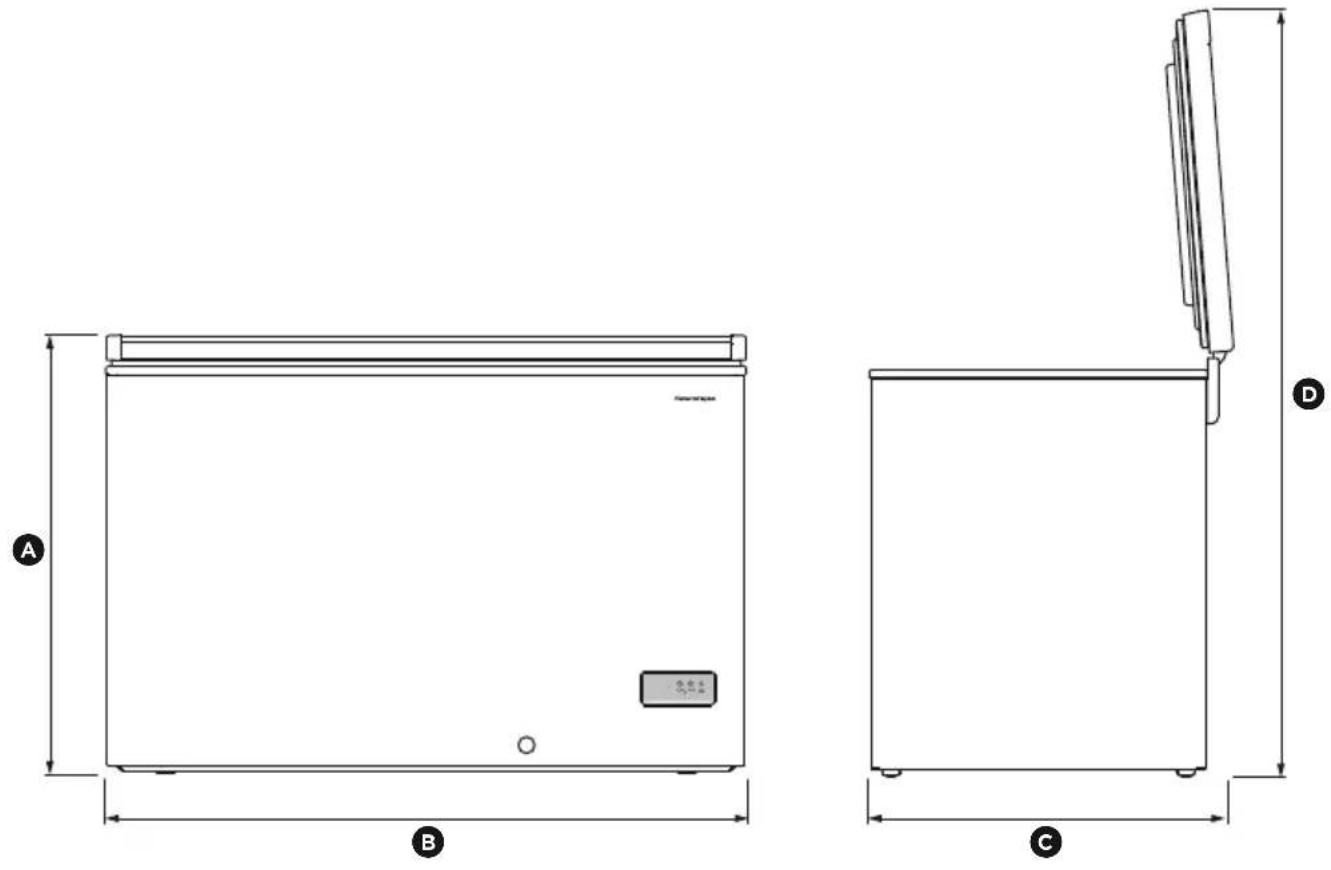
RC143 RC201 RC376 RC519 RC719
| PRODUCT DIMENSIONS | mm | |||||
| A | Overall height of product (when lid closed) | 847 | 847 847 847 | 847 | ||
| B | Overall width of product 720 | 940 | 1240 | 1650 | 1860 | |
| C | Overall depth of product (including hinges) | 555 | 555 | 695 | 695 | 805 |
| D | Overall height of product (when lid open) | 1345 | 1345 | 1480 | 1480 | 1595 |
| MINIMUM CLEARANCES | mm | |||||
| Top clearance (when lid open) | 150 | 150 | 150 | 150 | 150 | |
| Side clearance | 100 | 100 | 100 | 100 | 100 | |
| Rear clearance | 100 | 100 | 100 | 100 | 100 | |
Before placing food in the freezer compartment
- Remove all external and internal packaging.
- Clean the inside of the appliance with a mix of warm water and a small amount of liquid detergent, and a soft cloth to remove manufacturing and transportation dust.
- Allow the freezer to run empty for 2 - 3 hours to allow the compartment to cool to the appropriate temperature.
- The appliance may have an odour on its initial operation, but this will go when the freezer has cooled sufficiently.
Energy efficiency
For the most energy efficient use of your appliance:
- Ensure your appliance has adequate ventilation.
- Do not cover your appliance with any material that will prevent air from flowing around the cabinet sides.
- Ensure you vacuum around the appliance to remove dust and possible pet hair accumulation. Keep the appliance and its cabinetry free of dust by wiping down with a dry, lint-free cloth (refer to the ‘Chest freezer cleaning and care instructions’ section).
• Cool hot foods down before placing them in the appliance. - Do not overfill the compartment.
- Keep lid openings to a minimum.
- Select a temperature setting that isn't too cold.
- Check your lid seals for leaks.
If your appliance is turned off for any reason, wait 10 minutes before turning it back on. This will allow the refrigeration system pressure to equalise before restarting.
Moving your appliance
• Turn off the appliance and unplug from the power point. Remove all food.
- Ease the appliance out of its position. Tuck the power cord away, tape the bins in place and tape the lid shut.
- Relocate and install. If the appliance has been left on its side for any length of time, leave it standing upright for at least 2 - 3 hours before turning on.
Storing your appliance
- When storing your cleaned appliance, leave the lid open. This allows air to circulate and prevents the build-up of bacteria and moulds.
- Before using again, clean well using a mixture of warm water and a small amount of liquid dishwashing detergent. Rinse with clean water and dry with a soft lint-free cloth.
Holiday time
• We recommend you leave your appliance operating while you are on holiday.
Temperature control
- On start up the freezer will be set to its factory setting of -18^ . At this temperature the food will keep for the length specified in the freezer storage guide. Refer to 'Storing food in your chest freezer' section for specific guidelines.
- The compartment temperature is accurately and independently controlled and does not change with the surrounding temperature or humidity.
- If you wish to alter the temperature of your freezer this can be easily done by using the control panel located externally on the front-right of the appliance.
External control panel to adjust temperature
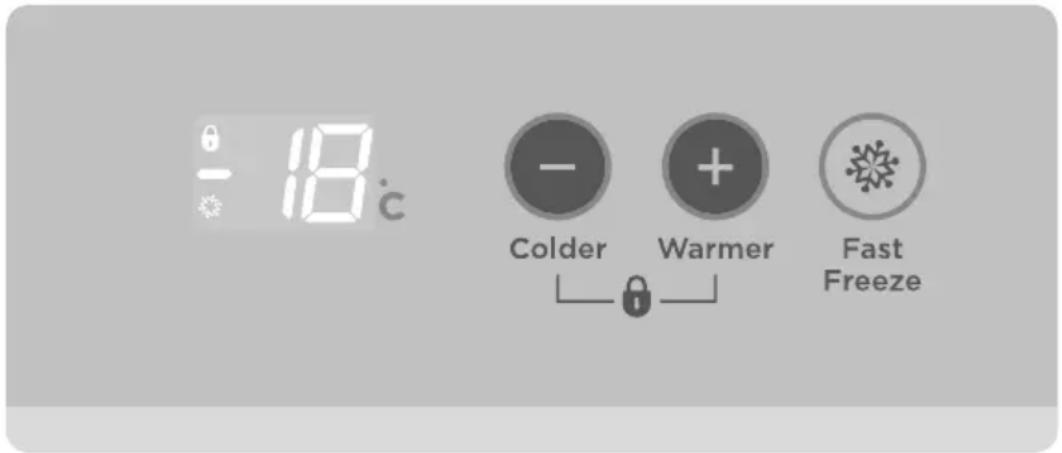
EXTERNAL DISPLAY FEATURES
| + and - | Temperature adjustment | Temperature will change on screen when +or - buttons are pressed. |
 | Fast freeze | icon will illuminate on screen when ‘Fast Freeze’ is activated. |
 | Key lock | icon will illuminate on screen when key lock is activated. |
Temperature adjustment
- To adjust the temperature warmer by 1^ C press the + button once.
- To adjust the temperature colder by 1°C press the—button once.
• The temperature range is -12^ to -26^ .
Normal operating sounds
Chest freezers can produce sounds somewhat different to other refrigerator and freezer appliances.
Normal operating sounds include:
- Boiling water, gurgling sounds or slight vibrations. These are the result of the refrigerant circulating through the cooling coils.
-
A clicking sound from the thermostat cycling on and off.
• Other sounds may be heard for the following reasons: -
Cabinet not level.
- Bottles or jars rattling on shelves.
Fast freeze
We have created the ‘Fast Freeze’ feature to help you get the best possible results when freezing fresh food. ‘Fast Freeze’ boosts the freezing speed by dropping the freezer to its coldest temperature for 56 hours, which helps to ensure vital freshness, texture and taste are retained during the freezing process.
- To activate, press the button on the external display. The icon will illuminate on the LED screen when the function is activated.
- To deactivate before the 56 hours has elapsed, press the button again. When 'Fast Freeze' is deactivated the icon will no longer be illuminated.
- For best results we recommend that you activate the function before it is required. Alternatively, activate it when placing food into the freezer.
Key lock
Key lock allows you to disable the buttons on the external control panel. This will ensure that any settings will not be accidentally activated or adjusted.
• To activate key lock press and hold the - and + buttons for 4 seconds.
• The icon will illuminate on the LED screen when the function is activated.
- Key lock will not automatically deactivate. To manually deactivate, press and hold the - and + buttons for 4 seconds.
• The icon will no longer be illuminated.
Energy saving
• The display screen will automatically turn off when inactive for 30 seconds to save energy.
- Press any button to illuminate the panel.
Freezer baskets
• The baskets supplied with your freezer are removable.
- They may be stacked on top of each other by folding the handles downwards. Ensure that packages do not protrude above the top of each basket, and for ease of lifting make sure they are not loaded with a lot of heavy food.
- We recommend that foods requiring longer storage should be kept at the bottom of the freezer.
WARNING!
To avoid electric shock always unplug your freezer before cleaning. Ignoring this warning may result in death or injury.
Exterior
Clean all exterior surfaces with a mix of warm water and liquid dishwashing detergent, and a soft cloth. If necessary, clean the lid gasket and the recessed handle with an old toothbrush, warm water and liquid dishwashing detergent.
Cabinet surround
- To maximise operating efficiency regularly vacuum the flooring around your appliance.
- Cleaning behind the appliance is required once or twice a year. More frequent cleaning may be necessary for dusty homes or those with pets shedding hair.
• To do this switch off and unplug the appliance and pull the appliance out from the wall. - Vacuum the flooring behind your appliance to remove dust accumulation. Use a dry lint-free cloth to clean the appliance walls and surrounding cabinetry.
• After cleaning, plug in and switch on. Push the appliance into position.
Interior
- It is important to keep the interior of the freezer clean to help prevent food from becoming contaminated during storage.
- The amount and types of food stored determines how often cleaning should be carried out.
- Remove the baskets from the freezer. Wash in warm water and detergent; rinse in clean water and dry before replacing.
- Wipe over the interior surfaces with warm water and liquid dishwashing detergent. Alternatively you can use 1tsp baking soda dissolved in 500ml of warm water. Rinse with clean water. Use a toothbrush for the lid gasket.
- To help remove “old stale freezer” smells add a few drops of vanilla essence or vinegar to the water before cleaning.
- Do not use harsh, abrasive cloths on any part of the appliance.
IMPORTANT!
Many commercially available cleaning products contain solvents that may attack the plastic components of your appliance and cause them to crack. It is important to use only warm water and a small amount of liquid dishwashing detergent on any components inside and outside your appliance. Avoid using anti-bacterial cleaning products on either the interior or exterior of the cabinet as they may cause rusting of metal components and cracking of plastic components.
- Frost forms faster on the top edge of the freezer compartment in climates of high humidity as this is the area of first contact to the warm moist air when the lid is open.
- Your chest freezer is designed with a flexible lid seal to keep warm air out of the freezer. Sometimes immediately after closing your chest freezer, you may notice the lid is difficult to re-open. This is normal. Wait a few minutes and try again.
It is recommended that your freezer be defrosted when the frost is greater than 6mm thick using the plastic scraper provided.
Defrosting your chest freezer
① Remove all frozen food and wrap it in several layers of paper. Place in a refrigerator or a cool environment, eg insulated bin.
② Switch the power off at the wall.
③ Remove the drain plug from the inside of the freezer.
④ Place a shallow tray beneath the outer drain plug. Pull out the drain plug. This will let the water flow out into the tray. Pour approximately 1L of warm water down the drain to clear it of possible residual ice.
Note: monitor the tray under the drain to avoid overflow. While defrosting, leave the freezer lid open. If you wish to reduce the defrosting time, place containers of hot water in the freezer and close the lid.
⑤ Use the plastic scraper supplied or a plastic spatula to remove any loose ice.
⑥ Empty out the tray of water. Wipe out the defrosted freezer. Use a mix of 500ml water with 1tsp of baking soda or a small amount of liquid dishwashing detergent and warm water. Rinse with clean water and dry.
⑦ Carefully clean the drain. Replace the internal and external drain plugs.
⑧ Switch the freezer on. Close the lid and leave running for 15 minutes before replacing the frozen food.
IMPORTANT!
- DO NOT use knives or any other sharp instrument to remove the ice as the freezer surface may become irreversibly damaged.
- DO NOT use harsh abrasive cloths and cleaners, or highly perfumed strong smelling cleaners or solvents on either the interior or exterior of the freezer.
IMPORTANT!
Your appliance is designed to operate for many years without the need for frequent service checks. However, if your appliance is malfunctioning, have it attended to by your Fisher & Paykel trained and supported service technician as soon as possible. All electrical repairs must be carried out by an adequately trained service technician or qualified electrician.
The use of temperatures of -18^ or colder to store food means that the food can be kept for longer periods than when refrigeration temperatures are used. This is because the growth of bacteria, moulds and yeasts are stopped, and chemical and physical reactions are severely restricted at such low temperatures.
Frozen food care
For best results:
- Choose only high quality foods that freeze well.
- Store at -18°C or colder. Take care to maintain this low storage temperature, eg try to avoid opening the freezer door unnecessarily. If your ice cream is soft you are running your freezer too warm.
- Leave space at the top of containers or plastic bags containing liquids or semi-solid foods. These expand as they freeze. Usually 20 - 50mm head space is recommended. Seal. Ideally, remove all the air from the package after food is frozen.
- Packages or containers of solid foods should have the air removed from them and be sealed tightly before freezing.
- Use the 'Fast Freeze' function when freezing fresh food. This helps to speed up the freezing process, giving optimum freezing results. It is recommended that the function is activated approximately 2 hours before required.
- Freeze immediately or as quickly as possible. Freeze only small quantities of food at any one time. For best results we recommend that only 1kg of food be frozen per 25L of freezer storage volume at any one time. For faster freezing we recommend that fresh food is placed at the top of the freezer compartment close to the air vent.
- Thaw foods preferably in a refrigerator, or using a microwave oven or multifunction oven.
- Keep a constant turnover of food. Use older items of food first and do not exceed recommended storage times.
- Use good quality freezer proof packaging to maintain food quality.
• If food is only covered in plastic film place inside a freezer-proof plastic bag.
Recommended freezer storage times
These times should not be exceeded.
| MONTHS TYPE OF FOOD STORED | |
| 1 Bacon, casseroles, milk | |
| 2 Bread, ice cream, sausages, pies—(meat and fruit), prepared shellfish, oily fish | |
| 3 Non-oily fish, shellfish, pizza, scones and muffins | |
| 4 Ham, cakes, biscuits, beef and lamb chops, poultry pieces | |
| 6 | Butter, vegetables (blanched), eggs whole and yolks, cooked crayfish, minced meat (raw), pork (raw) |
| 12 Fruit (dry or in syrup), egg whites, beef (raw), whole chicken, lamb (raw), fruit cakes | |
Meat, poultry and game
- Do not try to freeze more than 1kg of meat per 25L of freezer storage volume at any one time. Meat must be frozen quickly in order to maintain its texture.
- Do not stuff poultry before freezing.
- Red meat can be cooked from frozen, or from the partly or completely thawed states. Remember to allow extra cooking time if cooking from frozen.
• Always thaw poultry completely before cooking.
Fish
- Fish is best frozen commercially. If, however, you do want to freeze fish at home, make sure the fish is very fresh and of high quality.
- Clean, scale and preferably leave whole. All fish should be wrapped in two layers of packaging as depending on the type of fish, odours and flavours can be readily transferred either to or from it. Seal well.
- For best results, cook from either the frozen or partly thawed state.
Fruit
- Choose high quality, mature, and ready to eat fruit. Preferably select varieties recommended for freezing.
- Avoid unripe and over-ripe fruit.
- The way fruit is packed depends on how it is to be used. Fruits packed in syrup are ideal for desserts, whereas fruits packed without sugar are better used for cooking. Most fruits can be stored for 8 - 12 months.
Vegetables
- Most vegetables freeze well, although ‘salad’ vegetables lose their crispness. Other vegetables, eg celery, onion and tomatoes, should only be used in cooked dishes as they soften on freezing.
- Freeze only high quality, mature, ready-to-eat vegetables.
- Sort and discard any vegetables that are damaged.
- It is necessary to blanch most raw vegetables prior to freezing.
- Blanching involves a short cooking period during which vegetable enzymes are destroyed. If these enzymes are not destroyed they cause undesirable physical and chemical changes during freezer storage.
- Vegetables can be blanched in boiling water, steam or microwave oven. If using boiling water, boil vegetables for 2 – 4 minutes and cool quickly.
• In general, frozen vegetables are best cooked from their frozen state.
Prepared and cooked foods
- Most cooked foods can be frozen but it is not recommended to freeze the following: Cooked egg white, custards, cream fillings and milk puddings, gelatine or jelly-like dishes, mayonnaise and similar salad dressings, meringue toppings. These tend to separate on thawing.
If there is a problem with your appliance, please check the following points before contacting your local Fisher & Paykel trained and supported service technician or the Customer Care Centre.
Product parts and accessories can be purchased through Fisher & Paykel Customer Care Centre or online at www.fisherpaykel.com (this service is available to selected markets only).
Fault codes
In the unlikely event of a fault, a fault code will be displayed on the control panel. Please take note of the fault code and contact our Customer Care Centre.
| PROBLEM POSSIBLE CAUSES WHAT TO DO | ||
| Appliance does not operate. | No electricity at power outlet. | Check that the plug is correctly connected and power switched on. |
| Check another appliance at the same outlet. | ||
| Check house fuse. | ||
| Motor operates for long periods. | Hot weather. Minimise lid openings to allow | |
| Frequent lid openings. | temperature to stabilise. | |
| Large amount of food recently added. | ||
| Temperature control set too low. | Refer to the ‘Temperature Control’ section. | |
| Not sealing properly. Check that cabinet is level and gasket seals are clean. | ||
| Storage compartments too warm. | Temperature setting not correct. | Refer to the ‘Temperature Control’ section. |
| Frequent openings. Minimise openings to allow | ||
| Large amount of food recently added. | temperature to stabilise. | |
| Unfamiliar noises. | Cabinet not stable or level. Refer to the ‘Installation Instructions’ section. | |
| Exterior of cabinet is warm. | This is normal. | |
| Condensation on outside of appliance. | Not unusual during periods of high humidity. | Wipe dry. |
| Appliance operating inefficiently. | Accumulation of dust on or behind the compartment cover. | Refer to the ‘Chest freezer cleaning and care instructions’ section. If problem persists please contact Customer Care. |
| Ice buildup inside freezer compartment. | Freezer lid not closing tightly. | Rearrange items in freezer so lid can close tightly. |
| Check and clean lid gasket seal. | ||
| Defrost freezer if ice build up is more than 6mm deep. | ||
| Light not working. | Bulb blown. If your bulb should need replacing contact the Customer Care Centre or your Fisher & Paykel trained and supported service technician. | |
| Freezer not working. Check that the appliance is turned on at the wall. | ||
You automatically receive a 2 year Manufacturer's Warranty with the purchase of this appliance covering parts and labour for servicing within New Zealand and Australia.
Fisher & Paykel undertakes to:
Repair or, at its option, replace without cost to the owner either for material or labour any part of the product, the serial number of which appears on the product, which is found to be defective within TWO YEARS of the date of purchase.
Note: this Manufacturer's Warranty is an extra benefit and does not affect your legal rights.
This Manufacturer's Warranty DOES NOT cover
A Service calls which are not related to any defect in the product. The cost of a service call will be charged if the problem is not found to be a product fault. For example:
① Correcting the installation of the product.
② Instructing you how to use the product.
③ Replacing house fuses or correcting house wiring or plumbing.
④ Correcting fault(s) caused by the user.
⑤ Noise or vibration that is considered normal, eg drain/fan sounds, refrigeration noises or user warning beeps.
⑥ Correcting damage caused by pests, eg rats, cockroaches, etc.
⑦ Replacement light bulbs.
⑧ Defects caused by factors other than:
① Normal domestic use; or
② Use in accordance with the product's user guide.
© Defects to the product caused by accident, neglect, misuse or ‘act of God’.
The cost of repairs carried out other than by a Fisher & Paykel trained and supported service technician or the cost of correcting such repairs.
E Normal recommended maintenance as set out in the product's user guide.
⑤ Repairs when the appliance has been dismantled, repaired or serviced by other than a Fisher & Paykel trained and supported service technician or the selling dealer.
© Pick-up and delivery.
Transportation or travelling costs involved in the repair when the product is installed outside the Fisher & Paykel trained and supported service technician's normal service area.
① Filter replacement except in the case of faulty parts or materials within the filter cartridge.
① Damage (including water damage) caused by faulty installation or plumbing.
Nothing in this Manufacturer's Warranty is intended to, or does limit, any rights you may have under law to recover the costs of inspecting or returning the goods to us.
This product has been designed for use in a normal domestic (residential) environment. This product is not designed for any commercial use (whatsoever). Any commercial use by a customer will affect this product's Manufacturer's Warranty.
Service under this Manufacturer's Warranty must be provided by a Fisher & Paykel trained and supported service technician (refer to the ‘Customer Care’ section at the back of this book). Such service shall be provided during normal business hours. This Manufacturer's Warranty certificate should be shown when making any claim.
For Australian Customers
This Manufacturer's Warranty is an extra benefit and does not affect your legal rights. Our goods come with guarantees that cannot be excluded under the Australian Consumer Law. You are entitled to a replacement or refund for a major failure and compensation for any other reasonably foreseeable loss or damage. You are also entitled to have the goods repaired or replaced if the goods fail to be of acceptable quality and the failure does not amount to a major failure.
Please keep this user guide in a safe place.
Complete and keep for safe reference:
Model
Serial No. ____
Purchase Date ____
Purchaser ____
Dealer ____
Suburb
Town ____
Country ____
Before you call for service or assistance...
Check the things you can do yourself. Refer to the installation instructions and your user guide and check that:
① Your product is correctly installed.
② You are familiar with its normal operation.
③ You have read the ‘Troubleshooting’ section at the back of the book.
If after checking these points you still need assistance or parts, please refer to your nearest Fisher & Paykel trained and supported service technician, Customer Care, or contact us through our website www.fisherpaykel.com.
In New Zealand if you need assistance...\*
Call the Fisher & Paykel Customer Care Centre and talk to one of our Customer Care Consultants.
Toll Free: 0800 FP CARE or 0800 372 273
Fax: (09) 273 0656
Website: www.fisherpaykel.com
Postal address: Fisher & Paykel Appliances Ltd, PO Box 58550, Botany, Auckland 2163
If you need service...*
Fisher & Paykel has a network of Fisher & Paykel trained and supported service technicians that can carry out any service necessary on your appliance. Our Customer Care Centre can recommend a Fisher & Paykel trained and supported service technician in your area.
In Australia if you need assistance...\*
Call the Fisher & Paykel Customer Care Centre and talk to one of our Customer Care Consultants.
Toll Free: 1300 650 590
Fax: (07) 3826 9298
Website: www.fisherpaykel.com
Postal address: Fisher & Paykel Appliances Australia Pty Ltd, PO Box 798, Cleveland QLD 4163
If you need service...*
Fisher & Paykel has a network of Fisher & Paykel trained and supported service technicians that can carry out any service necessary on your appliance. Our Customer Care Centre can recommend a Fisher & Paykel trained and supported service technician in your area.
*If you call, write or contact us via our website please provide: your name and address, model number, serial number, date of purchase and a complete description of the problem. This information is needed in order to better respond to your request for assistance.
Product details can be found on the serial plate located externally on the back of the appliance.
Registration
Register your product with us so we can provide you with the best service possible.
To register your product visit our website: www.fisherpaykel.com
www.fisherpaykel.com
© Fisher & Paykel Appliances 2016. All rights reserved.
The product specifications in this booklet apply to the specific products and models described at the date of issue. Under our policy of continuous product improvement, these specifications may change at any time. You should therefore check with your dealer to ensure this booklet correctly describes the product currently available.
NZ AU