CopyCentre 175 - Photocopier XEROX - Free user manual and instructions
Find the device manual for free CopyCentre 175 XEROX in PDF.


| Product Type | Multifunction Copier |
| Functions | Copy, Print, Scan (optional) |
| Copy Speed | Up to 17 ppm |
| Resolution | 600 x 600 dpi |
| Paper Capacity | Standard 500 sheets, optional up to 1,500 |
| Paper Sizes | Up to A3 |
| Warm-up Time | Approx. 30 seconds |
| Dimensions (W x D x H) | 640 x 584 x 460 mm |
| Weight | Approx. 35 kg |
| Power Supply | 110-127V/220-240V, 50/60 Hz |
| Power Consumption | Max 1.2 kW, Standby <50 W |
| Monthly Duty Cycle | Up to 15,000 pages |
| Consumables | Toner cartridge (3,800 pages), Drum unit (10,000 pages) |
| Maintenance | Clean glass and rollers regularly; replace consumables as needed |
| Safety Features | Auto power-off, energy saver mode, safety interlock |
| Repairability | Common parts (toner, drum, fuser) available from Xerox or third-party suppliers |
| Included Accessories | Power cord, user manual CD, starter toner |
| Languages Supported | English, French, Spanish, German, Italian (via firmware) |
Frequently Asked Questions - CopyCentre 175 XEROX
User questions about CopyCentre 175 XEROX
0 question about this device. Answer the ones you know or ask your own.
Ask a new question about this device
Download the instructions for your Photocopier in PDF format for free! Find your manual CopyCentre 175 - XEROX and take your electronic device back in hand. On this page are published all the documents necessary for the use of your device. CopyCentre 175 by XEROX.
USER MANUAL CopyCentre 175 XEROX
Quick Reference Guide
604P17528
MAXIMIZE YOUR PRODUCTIVITY...
...by taking advantage of all the capabilities of your device. A Training and Information CD was supplied with your product. The CD provides animated tutorials and interactive screens. When installed on your network it will always be available to everyone, or load it on your hard drive for easy access.
Prepared by:
The Document Company Xerox
GKLS European Operations
Bessemer Road
Welwyn Garden City
Hertfordshire
AL7 1HE
ENGLAND
©2004 by Xerox Corporation. All rights reserved.
Copyright protection claimed includes all forms and matters of copyrighted material and information now allowed by statutory or judicial law or hereinafter granted, including without limitations, material generated from the software programs which are displayed on the screen, such as icons, screen displays, looks etc.
Xerox ^® , The Document Company ^® , the digital X ^® and all Xerox products mentioned in this publication are trademarks of Xerox Corporation. Product names and trademarks of other companies are hereby acknowledged.
The information in this document is correct at the time of publication. Xerox reserves the right at any time to change the information without notice. Changes and technical updates will be added in subsequent editions of the documentation. For the latest information go to www.xerox.com.
Contents
1 Welcome....1-1
Introduction 1-2
Additional Resources 1-3
System Administration CD (CD1)....1-3
Training and Information CD (CD2) 1-3
Utilities CD (CD3)....1-3
Conventions 1-4
Overview of Features at the Machine....1-6
Overview of Features at the Workstation 1-8
Safety 1-9
Introduction 1-9
Safety Notes....1-9
Environmental Compliance....1-11
ENERGY STAR 1-11
Environmental ChoiceM 1-11
Product Recycling and Disposal 1-11
Regulatory Information....1-12
FCC Part 15 1-12
ICES-003....1-12
US Regulatory Information for the Fax Kit option....1-12
Canadian Regulatory Information for the Fax Kit option 1-14
Illegal Copying....1-15
2 Product Overview ......2-1
Introduction 2-2
CopyCentre C165/C175....2-3
WorkCentre M165/M175 2-5
WorkCentre Pro 165/175....2-7
3 Getting Started....3-1
Control Panel Overview....3-2
Power On or Off 3-3
Loading Paper 3-4
Making Copies.... 3-5
Sending an Embedded Fax 3-6
Sending a Server Fax 3-7
Sending an Internet Fax 3-8
Scanning a Document to a File....3-9
Sending an E-mail 3-10
Printing from a PC 3-11
Printing with Internet Services 3-12
Logging On / Logging Off 3-13
Customizing your Machine 3-14
Further Assistance ....3-15
4 Copy 4-1
Copy 4-2
Basic Copying 4-3
Output 4-4
2-Sided....4-6
Reduce/Enlarge 4-8
Paper Supply 4-10
Image Adjustment....4-12
Image Quality.... 4-13
More Image Quality....4-14
Bound Originals 4-15
Edge Erase 4-16
Original Input....4-17
Image Shift....4-18
Output Format 4-19
Transparencies 4-20
Booklet Creation 4-21
Multi-Up 4-22
Invert Image 4-23
Covers....4-24
Job Assembly....4-26
Build Job 4-26
Sample Set 4-28
Stored Programming....4-29
Inserts 4-30
5 Fax....5-1
Fax 5-2
Basic Faxing - Embedded Fax 5-3
Dialing Options....5-4
Resolution 5-7
Sides Scanned 5-8
Image Adjustment....5-9
Image Quality 5-10
Original Input....5-11
Bound Originals....5-12
Added Fax Features....5-13
Fax Sending Features....5-13
Fax Reports....5-19
Mailboxes 5-20
Comment Setup 5-21
Advanced Fax Features 5-21
Dial Directory Setup 5-24
Basic Faxing - Server Fax 5-25
Dialing Options....5-26
Resolution 5-27
Sides Scanned 5-28
More Fax Features 5-29
Image Quality 5-30
More Image Quality....5-31
Original Input....5-32
Delayed Send....5-33
Authentication Mode....5-34
6 Internet Fax 6-1
Internet Fax....6-2
Send: 6-3
Entering an E-mail Address for Internet Fax 6-4
Image Adjustment....6-6
Image Quality 6-7
More Image Quality....6-8
Sides Scanned 6-9
Resolution 6-10
Original Input....6-11
Output Format 6-12
Document Format 6-13
Acknowledgment Report 6-14
Reply To....6-14
Message Body 6-15
Authentication Mode 6-16
7 Network Scanning.... 7-1
Scan 7-2
Scanning Resources....7-2
Network Scanning....7-3
Repositories 7-4
Template Overview 7-4
Template Destinations 7-5
Destination Details 7-6
Image Adjustment....7-7
Image Quality....7-8
More Image Quality....7-9
Sides Scanned....7-10
Edge Erase 7-11
Original Input....7-12
Resolution 7-13
Output Format 7-14
Document Name 7-14
If File Already Exists 7-15
Document Format 7-16
Document Management Fields 7-17
Add File Destination....7-17
Refresh Destinations 7-18
Authentication Mode 7-19
8 E-mail 8-1
E-mail 8-2
Send: 8-3
Address List 8-4
Entering an E-mail Address 8-4
Image Adjustment....8-6
Image Quality.... 8-7
More Image Quality....8-8
Sides Scanned....8-9
Edge Erase 8-10
Original Input....8-11
Resolution 8-12
Output Format 8-13
Document Format 8-14
Reply To....8-15
Message Body 8-15
Secure Send 8-16
Authentication Mode....8-17
9 Print....9-1
Introduction to Print....9-2
Print Driver Features....9-3
Control Options 9-3
Print Drivers....9-4
Paper/Output....9-4
Advanced 9-5
Image Options....9-5
Layout/Watermark....9-6
10 Maintenance....10-1
Consumables....10-2
Customer Replaceable Units 10-2
Staple Cartridges 10-3
Cleaning the Machine ....10-4
Further Assistance....10-5
11 Troubleshooting ....11-1
General....11-2
Fault Clearance 11-3
Paper jams 11-3
Document jams 11-3
Xerox Welcome and Support Center....11-4
Locating the serial number....11-4
Troubleshooting Tips 11-5
Power 11-5
Document Handler 11-5
Paper Handling 11-6
Finisher 11-7
Output Quality 11-8
Fax 11-11
Fault Messages will not clear 11-11
12 Index 12-1
1 Welcome
Introduction 1-2
Additional Resources....1-3
▶ Conventions....1-4
Overview of Features at the Machine ......1-6
Overview of Features at the Workstation......1-8
Safety 1-9
Environmental Compliance.... 1-11
Regulatory Information 1-12
▶ Illegal Copying ...... 1-15
Introduction
Welcome to your new Xerox machine.
This Quick Reference Guide provides you with an overview of the features and options that may be available on your machine. To help you familiarize yourself with your new machine please refer to:
Chapter 2 Product Overview
Chapter 3 Getting Started
Further chapters within this guide offer additional information on the features and options available.
For additional assistance at the machine press the Help button. If your machine is connected to the network, use the CentreWare Help system or click on the Help button in the Print Driver.
NOTE: The graphic representations of the touch screen displayed throughout this Quick Reference Guide are based on a fully configured WorkCentre Pro. The appearance of the touch screens may differ slightly on other configurations. However, feature descriptions and functionality as described remain the same.
Additional Resources
System Administration CD (CD1)
Contained in the CD Pack delivered with your machine, the System Administration CD (CD1) offers detailed information on configuring your machine for network printing and instructions on installing any of the optional features.
The System Administration CD (CD1) is intended for System/Machine Administrators.
Training and Information CD (CD2)
For detailed information on any of the features or functions available on your machine, please refer to the Training and Information CD (CD2), contained in the CD Pack delivered with your machine.
The Training and Information CD is intended for all users, including Machine Administrators. It contains comprehensive information about your new product including interactive how-to's and tutorials. To ensure maximum productivity is gained from your machine, please copy the program contained on the CD onto your network so that all users have access.
Utilities CD (CD3)
Contained in the CD pack the Utilities CD (CD3) contains a utility for upgrading to new versions of software on the machine.
This CD is not required during installation.
Conventions
Throughout this Guide, you will find that some terms are used interchangeably:
➢ Paper is synonymous with media.
Document is synonymous with original.
➢ CopyCentre/WorkCentre/WorkCentrePro is synonymous with the machine.
The following pages offer further information about the conventions used within this Guide.
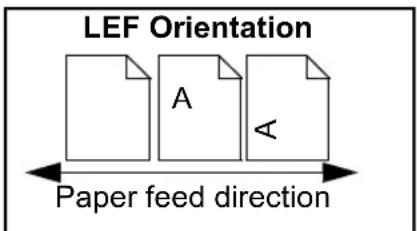
Orientation
Orientation refers to the direction of images on the page. When the image is upright, the paper (or other media) can be one of two ways:
Long Edge Feed (LEF) / Portrait
When observed from the front of the machine, paper or originals with the long edges to the left and right of the paper tray or document handler.
Short Edge Feed (SEF) / Landscape When observed from the front of the machine, paper or originals with the short edges to the left and right of the paper tray or document handler.
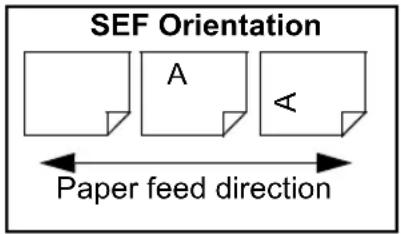
flowchart
graph TD
    A["Document Shape A"] --> B["Arrow"]
    C["Document Shape C"] <--_D["Arrow"]
    style A fill:#f9f,stroke:#333
    style C fill:#f9f,stroke:#333
    style B fill:#ccf,stroke:#333
    note right of A: Paper feed direction
Italic typeface
The Italic typeface is used to emphasise a word or phrase. In addition, references to other publications are displayed in Italic typeface. For example:
- For more information refer to the System Administration CD (CD1), contained in the CD Pack delivered with your machine.
Bracket text typeface:
The [Bracket Text] typeface is used to emphasise the selection of a feature mode or button. For example:
Select [Machine Details].
Notes
Notes are statements that provide additional information. For example:
NOTE: Originals must be loaded in the Document Handler when using this feature.
Hints
Hints help users to perform a task. For example:

HINT: This option is useful for saving toner (dry ink) consumption for images with a dark background and white text.
Specification note
Offers more in-depth specification information relating to the machine. For example:
i Tray 2 holds 500 sheets of 20lb, substance 20 paper. Weight ranges from 16 - 53lb, substance 16 - 53. Sizes range from 8.5" x 5.5" SEF to 11" x 17" SEF.
Cautions
Cautions are statements that suggest mechanical damage as a result of an action. For example:

CAUTION: Use of controls or adjustments or performance of procedures other than those specified herein may result in hazardous radiation exposure.
Warnings
Warnings are statements that alert users to the possibility of personal injury. For example:

NING: This product must be connected to a protective earthing circuit.
Overview of Features at the Machine
Using the powerful features available on your machine you can:
Scan Once and Print Many
When making copies your machine only has to scan a document once regardless of the number of copies needed. This reduces the risk of jams and damage to originals.
Perform Different Tasks Simultaneously
Your machine performs different tasks simultaneously. A job can be added to the job queue by scanning it, even while the machine is printing another job.
Make Copies Look Like Originals
Your machine allows the reproduction of high quality images, especially photographs, graphics, text, or a combination. Compare your output to that from other copiers and see the difference.
Customize Image Size and Placement
You can manipulate the appearance of the image on the output stock.
- Shift the image to create margins for binding.
- Automatically reduce, enlarge, or center your images.
- Print multiple reduced images on a single page.
Use Digital Features to Simplify your Work Process
Use the Build Job feature to divide a copy or embedded fax job into different segments and apply different settings to each of the segments. This allows you to:
- Combine originals from the Document Glass and the Document Handler into a single job.
- Create a single job, using different programming features for each original.
- Feed more than the maximum number of originals through the Document Handler without reprogramming.
Use the Transparency feature to produce transparencies with transparency separators in one step.
Use the Booklet Creation feature to automatically sequence and reduce or enlarge the images when making booklets.
Use the Covers feature to automatically add covers to your documents.
Use the Mixed Size Originals feature to copy mixed size originals simultaneously. Produces copies on uniform size paper or mixed size paper.
Be Environmentally Friendly
This product complies with a variety of international standards for environmental protection and is compatible with most recycled paper.
Scan Documents to Create Electronic Files (Optional)
This feature, available on the WorkCentre Pro configuration, allows you to create electronic files from your originals which can be:
- Filed on the server.
- Routed over the network to your desktop.
- Distributed through an e-mail system.
- Automatically placed into a Document Management Application.
- Converted into an electronic digital document which can be edited, managed, shared and distributed, using a wide variety of software applications.
Fax Documents (Optional)
The optional Embedded Fax service is a walk up feature that enables you to transmit and receive hard copy faxes using a telephone network.
The optional Server Fax service is a walk up feature available only on the WorkCentre Pro configuration. When enabled you will be able to scan your documents and send them to any type of fax machine that is connected to a telephone network, via your fax server.
NOTE: Both Embedded and Server Fax can be installed on the WorkCentrePro at the same time, however only one service can be enabled for use.
The optional Internet Fax service, available only on the WorkCentre Pro configuration, allows users to transmit and receive documents as an e-mail attachment. This type of fax travels over the internet or intranet.
Overview of Features at the Workstation
If your machine is connected to a network you can use the following features.
Contact your System Administrator to get connected.
CentreWare Print Drivers
The Print Driver extends the productivity power of your machine to your desktop. Options include:
• 1-sided or 2-sided
- Collated and stapled sets depending on the finisher options available on the machine
- Resolutions up to 1200x1200 dpi
- Add standard or customized watermarks
- Printing multiple images on one page
CentreWare Tools
The CentreWare software suite also offers optional User Management Tools and Network Scanning tools.
CentreWare Internet Services
A 'built in' web Home Page which allows print-ready files to be sent via the World Wide Web. This feature is accessed via Internet Services.
Safety
Introduction
Your Xerox product and supplies have been designed and tested to meet strict safety requirements. These include safety agency approval and compliance to established environmental standards. Please read the following instructions carefully before operating the product and refer to them as needed to ensure the continued safe operation of your product.
The safety testing and performance of this product have been verified using Xerox materials only.
Follow all warnings and instructions marked on, or supplied with the product.

This WARNING mark alerts users to the possibility of personal injury.

This WARNING mark alerts users to heated surfaces.
Safety Notes

WARNING: This product must be connected to a protective earthing circuit.
This product is equipped with a 3-wire type plug, provided with a protective earthing pin. This plug will fit only into an earthed power outlet. This is a safety feature. To avoid risk of electric shock, contact your electrician to replace the receptacle if you are unable to insert the plug into the outlet. Never use an earthed adapter plug to connect the product to a power source receptacle that lacks an earth connection terminal.
This product should be operated from the type of power source indicated on the marking label. If you are not sure of the type of power available, consult your local power company.
The Disconnect Device for this product is the power cord. To remove all electrical power to the product, disconnect the power cord from the power receptacle.

Do not put your hands into the fuser area, located just inside the exit tray area, as you may be burned.
Do not use pressurized air-spray cleaning aids on or in this equipment. Some pressurized air-spray containers contain explosive mixtures and are not suitable for use in electrical applications. Use of such cleaners can result in a risk of explosion and fire.
If you need additional safety information concerning the product or Xerox supplied materials please call the following number:
+44 (0) 1707 353434
Laser Safety
This product complies with safety standards and is certified as a Class 1 Laser product under the US Department of Health and Human Services (DHSS) Radiation Performance Standard according to the Radiation Control for Health and Safety Act of 1968. This product does not emit hazardous laser radiation.

CAUTION: Use of controls or adjustments or performance of procedures other than those specified herein may result in hazardous exposure of laser light.
Since radiation emitted inside this product is completely confined within the protective housing and external covers, the laser beam cannot escape from the machine during any phase of the user operation.
The Center for Devices and Radiological Health (CDRH) of the US Food and Drug Administration implemented regulations for laser products on August 1 1976. These regulations apply to laser products marketed in the United States. The label on the machine indicates compliance with CDRH regulations and must be attached to laser products marketed in the United States.
This product contains laser warning labels. These labels are intended for use by Xerox Service Representatives and are placed on or near panels or shields that require special tools for removal. Do not remove any of the panels. There are no operator serviceable areas inside these covers.
Safety Standards
This Xerox product is safety certified by Underwriters Laboratories Incorporated. Standard UL1950/CSA 22.2 No.950 3rd EDITION.
Environmental Compliance
ENERGY STAR

As an ENERGY STAR partner, Xerox Corporation has determined that this product meets the ENERGY STAR guidelines for energy efficiency. ENERGY STAR and the ENERGY STAR mark are registered U.S. marks.
Products that carry the ENERGY STAR label are designed to be energy efficient and help protect the environment.
Your machine will be delivered with the timer for switching to Low Power Mode from the last copy/print out, set at 15 minutes. The time to switch to power save (auto off/sleep) mode is set at 60 minutes from the last copy/print out. A more detailed description of these modes, together with instructions on changing the default times to suit your work pattern, can be found in Tutorials, Machine Administration, Change Default Settings, Set (Power Save) Duration Times of the Training and Information CD (CD2).
Environmental Choice ^M

Terra Choice Environmental Services, Inc., of Canada has verified that this Xerox product conforms to all applicable Environmental Choice ^M EcoLogo ^M requirements for minimized impact to the environment.
Product Recycling and Disposal
Xerox operates a worldwide equipment takeback and reuse/recycle program.
Contact your Xerox sales representative (1-800-ASK-XEROX) to determine whether this Xerox product is part of the program. For more information about Xerox environmental programs, visit www.xerox.com/environment.
If you are managing the disposal of your Xerox product, please note that the product contains lead, mercury and other materials whose disposal may be regulated due to environmental considerations. The presence of lead and mercury is fully consistent with global regulations applicable at the time that the product was placed on the market. For recycling and disposal information, contact your local authorities. In the United States, you may also refer to the Electronic Industries Alliance web site: www.eiae.org.
Regulatory Information
FCC Part 15
This equipment has been tested and found to comply with the limits for a Class A digital device, pursuant to Part 15 of the FCC Rules. These limits are designed to provide reasonable protection against harmful interference when the equipment is operated in a commercial environment. This equipment generates, uses and can radiate radio frequency energy and, if not installed and used in accordance with the instruction manual, may cause harmful interference to radio communications.
Operation of this equipment in a residential area is likely to cause harmful interference in which case the user will be required to correct the interferences at their own expense.
Changes or modifications to this equipment not specifically approved by the Xerox Corporation may void the user's authority to operate this equipment.

WARNING: Shielded cables must be used with this equipment to maintain compliance with FCC regulations.
ICES-003
This Class A digital apparatus complies with Canadian ICES-003.
US Regulatory Information for the Fax Kit option
Fax Send Header Requirements: The Telephone Consumer Protection Act of 1991 makes it unlawful for any person to use a computer or other electronic device, including FAX machines, to send any message unless such message clearly contains in a margin at the top or bottom of each transmitted page or on the first page of the transmission, the date and time it is sent and an identification of the business or other entity, or other individual sending the message and the telephone number of the sending machine or such business, other entity, or individual. (The telephone number provided may not be a 900 number or any other number for which charges exceed local or long-distance transmission charges.) The country location, telephone number identifying the machine, the header text information (business name), the send and receive behavior and dial type must be entered when installing the Embedded Fax kit option. Refer to the System Administration CD (CD1) for further information on installing Embedded Fax and the Training and Information CD (CD2) for information about the Transmit Header Print feature.
Data Coupler Information: This equipment complies with Part 68 of the FCC rules and the requirements adopted by the Administrative Council for Terminal Attachments (ACTA). A label is fixed to the safety cover of the fax kit that contains, among other information, a product identifier in the format US:AAAEQ##TXXXX. If requested, this number must be provided to the telephone company.
A FCC compliant telephone cord and modular plug is provided with this equipment. It is designed to be connected to the telephone network or premises wiring using a compatible modular jack that is Part 68 compliant.
You may safely connect the machine to the following standard modular jack: USOC RJ-11C using the compliant telephone line cord (with modular plugs) provided with the installation kit. See installation instructions for details.
To order the correct service from the local telephone company please quote the codes listed below: Facility Interface Code (FIC), Service Order Code (SOC), USOC Jack code and Ringer Equivalence Number (REN).
FIC SOCUSOC Jack REN
02LS2 9.0FRJ-11C 0.3

WARNING: Ask your local telephone company for the modular jack type installed on your line. Connecting this machine to an unauthorized jack can damage telephone company equipment. You, not Xerox, assume all responsibility and/or liability for any damage caused by the connection of this machine to an unauthorized jack.
The REN is used to determine the number of devices that may be connected to a telephone line. Excessive RENs on a telephone line may result in the devices not ringing in response to an incoming call. In most but not all areas, the sum of RENs should not exceed five (5.0). To be certain of the number of devices that may be connected to a line, as determined by the total RENs, contact the local telephone company. The REN for this product is part of the product identifier that has the format US:AAAEQ##TXXXX. The digits represented by ## are the REN without a decimal point (e.g., 02 is a REN of 0.2).
If this Xerox equipment causes harm to the telephone network, the telephone company will notify you in advance that temporary discontinuance of service may be required. But if advance notice isn't practical, the telephone company will notify the customer as soon as possible. Also, you will be advised of your right to file a complaint with the FCC if you believe it is necessary.
The telephone company may make changes in its facilities, equipment, operations or procedures that could affect the operation of the equipment. If this happens the telephone company will provide advance notice in order for you to make necessary modifications to maintain uninterrupted service.
If trouble is experienced with this Xerox equipment, for repair or warranty information, please contact the Xerox Welcome Center telephone number 800-821-2797. If the equipment is causing harm to the telephone network, the telephone company may request that you disconnect the equipment until the problem is resolved.
Repairs to the machine should be made only by a Xerox representative or an authorized Xerox service agency. This applies at any time during or after the service warranty period. If unauthorized repair is performed, the remainder of the warranty period is null and void.
This equipment must not be used on party lines. Connection to party line service is subject to state tariffs. Contact the state public utility commission, public service commission or corporation commission for information.
If your office has specially wired alarm equipment connected to the telephone line, ensure the installation of this Xerox equipment does not disable your alarm equipment. If you have questions about what will disable alarm equipment, consult your telephone company or a qualified installer.
Canadian Regulatory Information for the Fax Kit option
This product meets the applicable Industry Canada technical specifications. 'The Ringer Equivalence Number (REN) is an indication of the maximum number of devices allowed to be connected to a telephone interface. The termination on an interface may consist of any combination of devices subject only to the requirement that the sum of the RENs of all the devices does not exceed five. The Canadian REN value of this equipment is 0.3.
Repairs to certified equipment should be made by an authorized Canadian maintenance facility designated by the supplier. Any repairs or alterations made by the user to this equipment, or equipment malfunctions, may give the telecommunications company cause to request the user to disconnect the equipment.
Users should ensure for their own protection the electrical ground connections of the power utility, telephone lines and internal metallic water pipe system, if present, are connected together. This precaution may be particularly important in rural areas.

CAUTION: Users should not attempt to make such connections themselves, but should contact the appropriate electric inspection authority or electrician, as appropriate.
Illegal Copying
Congress, by statute, has forbidden the copying of the following subjects under certain circumstances. Penalties of fine or imprisonment may be imposed on those guilty of making such copies.
➢ Obligations or Securities of the United States Government, such as:
Certificates of Indebtedness
Coupons from Bonds
Silver Certificates
United States Bonds
Federal Reserve Notes
Certificates of Deposit
National Bank currency
Federal Reserve Bank Notes
Gold Certificates
Treasure Notes
Fractional Notes
Paper money
Bonds and obligations of certain agencies of the government, such as FHA
Bonds (US Savings Bonds may be photographed only for publicity purposes in connection with the campaign for the sale of such bonds.)
Internal Revenue Stamps (If it is necessary to copy a legal document on which there is a cancelled revenue stamp, this may be done provided the reproduction of the document is performed for lawful purposes.)
Postage Stamps, canceled or uncanceled (For philatelic purposes, postage stamps may be photographed provided the reproduction is black and white and less than 3/4 or more than
1 1/2 times the linear dimensions of the original.)
Postal Money Orders
Bills, checks, or drafts for money drawn by or on authorized officers of the United States
Stamps and other representatives of value, of whatever denomination, which may be or have been issued under any Act of Congress
Adjusted compensation Certificates for veterans of the World Wars
➢ Obligations or Securities of any foreign government, bank, or corporation
Copyrighted material (unless permission of the copyright owner has been obtained or the copying falls within the “fair use” or library reproduction provisions of the copyright law). Further information of these provisions may be obtained from the Copyright Office, Library of Congress, Washington, DC 20559 (circular R21)
➢ Certificates of Citizenship or Naturalization. (Foreign naturalization certificates may be photographed.)
Passports (Foreign passports may be photographed.)
Immigration papers
Draft Registration cards
➢ Selective Service Induction papers which bear any of the following information:
Registrant's earnings or income
Registrant's dependency status
Registrant's court record
Registrant's previous military service
Registrant's physical or mental condition
NOTE: Exception: US Army and Navy discharge certificates may be photographed.
Badges, identification cards, passes or insignias carried by military or Naval personnel, or by members of the various Federal Departments and Bureaus, such as the FBI and Treasury (unless the photograph is ordered by the head of such Department or Bureau)

WARNING: Copying of the following is also prohibited in certain states: automobile licences, driver's licenses, and automobile Certificates of Title. This list is not all-inclusive. In case of doubt, consult your attorney.
2 Product Overview
Introduction 2-2
▶ CopyCentre C165/175 2-3
WorkCentre M165/M175....2-5
▶ WorkCentre Pro 165/175 ......2-7
Introduction
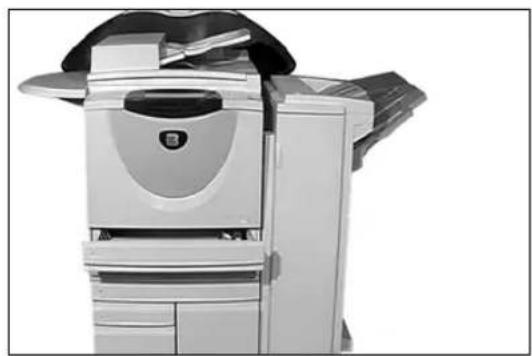
Your new machine is not simply a conventional copier, it is a digital device capable of copying, faxing, printing and scanning, dependent on your configuration. There are three machine configurations which are available at a speed of 65 or 75 copies/ prints a minute.
All three configurations are fully upgradable so as to meet any future requirements you may have. Please contact your local Xerox representative for further information.
CopyCentre C165/175 - A stand-alone copier which offers the copying functionality available on conventional copiers, combined with the added feature capabilities of the digital copier technology.
WorkCentre M165/M175 - A multi-functional digital copier and printer.
WorkCentre Pro 165/175 - An advanced multi-functional device offering a high specification of features and functions.
For further assistance in identifying your machine and the additional options available please refer to the following pages.
NOTE: All features and functions described within this Quick Reference Guide relate to a fully configured WorkCentre Pro 165/175 and may not be available to your machine. If you require further information on any of the optional components, or information on any of the other machine configurations please contact your local Xerox representative.
CopyCentre C165/175
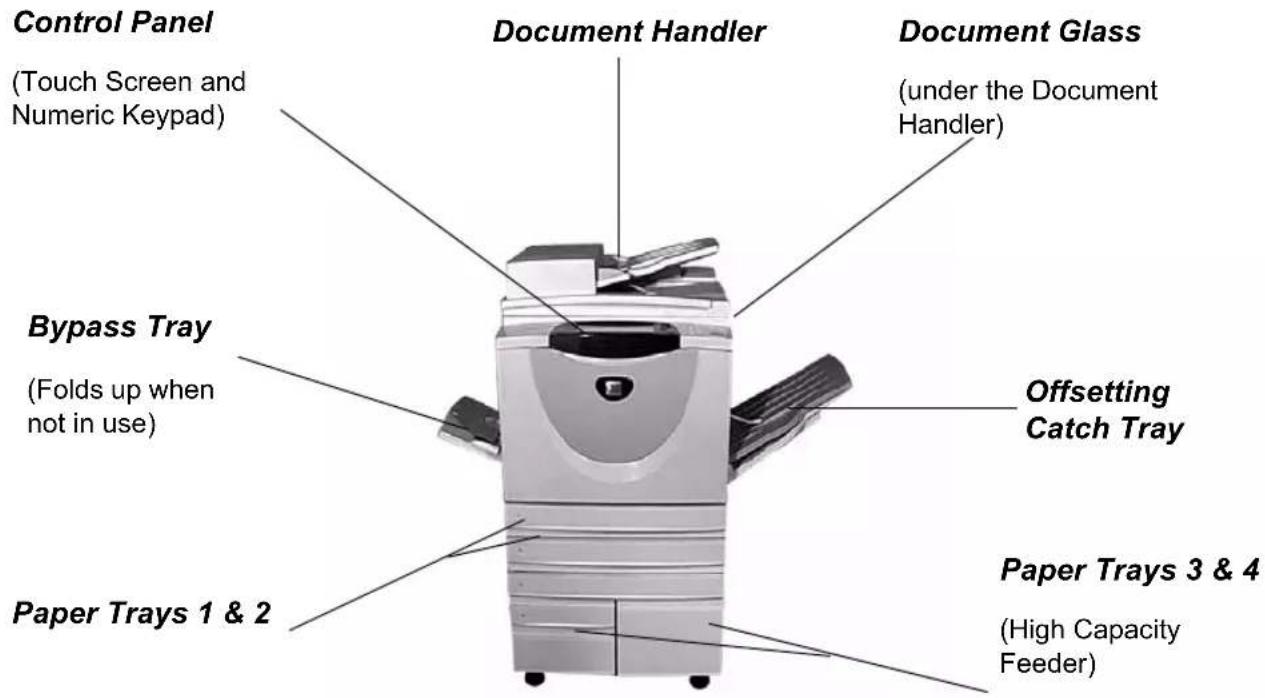
The following options are available for the CopyCentre.
Offset Catch Tray Delivers output either face up or face down, collated or uncollated. Each set or stack will be offset from the previous to enable easy separation. Fitted instead of a finisher.
Finisher There are 3 finishers available: the Office Finisher, Advanced Office Finisher and the Professional Finisher. All finishers deliver output to the Top Tray by default when scanning from the document glass, or to the Stacker to collate, stack, staple and, if available, hole punch your chosen output. In addition a walk-up off-line stapler is also available. The Professional Finisher can also fold and staple output to produce booklets.
Your chosen finisher is fitted instead of the Offset Catch Tray.
Hole Punch This option is available if your machine is equipped with any of the three finishers. The kits available are 2 hole or 3 hole long edge feed or 2 hole short edge feed for legal size paper. Each sheet is punched individually, so there is no limit to the number of sheets in the set. Additional Hole Punch kits can be purchased as an option.
Foreign Interface Device Enables the attachment of a third party access and accounting device, such as a card or coin operator.
Fax Line 1 Provides a single telephone line connection.
Fax Line 2 Provides a second telephone line. Once installed enables your machine to send and receive faxes at the same time.
256MB Additional temporary storage area for scanned information. Electronic Pre- Collation (EPC) Memory
WorkCentre M165/M175
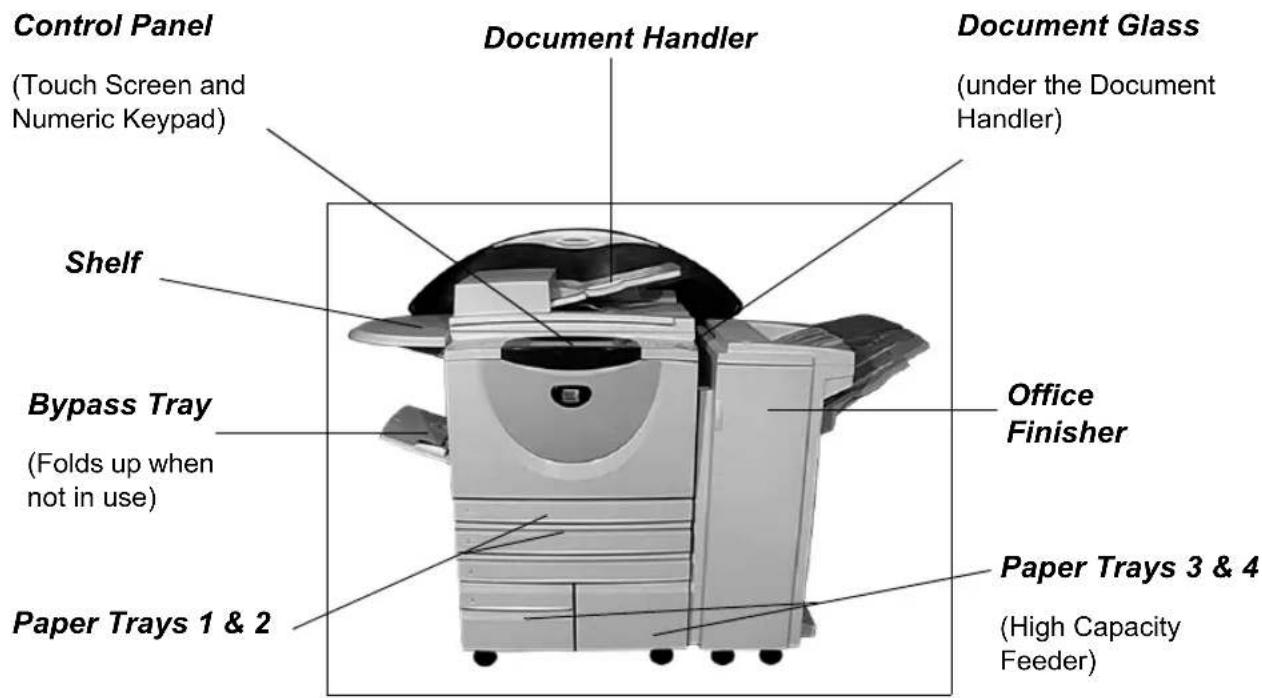
The following options are available for the WorkCentre:
Offset Catch Tray Delivers output either face up or face down, collated or uncollated. Each set or stack will be offset from the previous to enable easy separation. Fitted instead of a finisher.
Finisher There are 3 finishers available: the Office Finisher, Advanced Office Finisher and the Professional Finisher. All finishers deliver output to the Top Tray by default when scanning from the document glass, or to the Stacker to collate, stack, staple and, if available, hole punch your chosen output. In addition a walk-up off-line stapler is also available. The Professional Finisher can also fold and staple output to produce booklets.
Your chosen finisher is fitted instead of the Offset Catch Tray.
Hole Punch This option is available if your machine is equipped with any of the three finishers. The kits available are 2 hole or 3 hole long edge feed or 2 hole short edge feed for legal size paper. Each sheet is punched individually, so there is no limit to the number of sheets in the set. Additional Hole Punch kits can be purchased as an option.
Foreign Interface Device Enables the attachment of a third party access and accounting device, such as a card or coin operator.
Fax Line 1 Provides a single telephone line connection.
Fax Line 2 Provides a second telephone line. Once installed enables your machine to send and receive faxes at the same time.
E-mail Enables the creation of an electronic image file by scanning an original hard copy document. The scanned image is sent as an e-mail attachment to the specified recipient(s).
Ad Hoc E-mail Offers a reduced selection of E-mail options.
Image Overwrite Security A security feature which provides On Demand Image Overwrite and Immediate Image Overwrite. Both features offer customers the ability to overwrite the machine's hard disk to protect classified or private information.
256MB Additional temporary storage area for scanned information. Electronic Pre- Collation (EPC) Memory
WorkCentre Pro 165/175
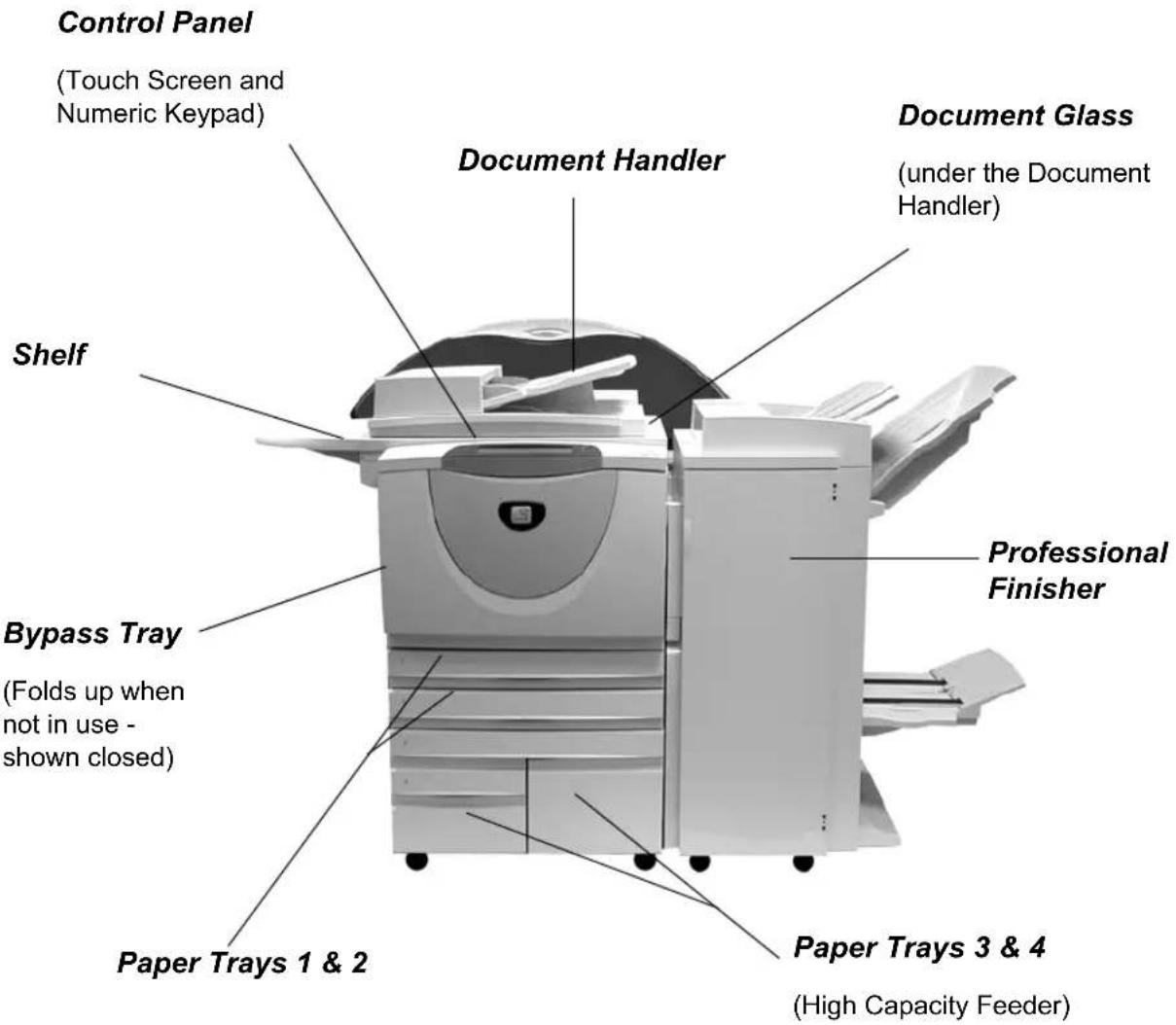
The following options are available for the WorkCentre Pro:
Offset Catch Tray Delivers output either face up or face down, collated or uncollated. Each set or stack will be offset from the previous to enable easy separation. Fitted instead of a finisher.
Finisher There are 3 finishers available: the Office Finisher, Advanced Office Finisher and the Professional Finisher. All finishers deliver output to the Top Tray by default when scanning from the document glass, or to the Stacker to collate, stack, staple and, if available, hole punch your chosen output. In addition a walk-up off-line stapler is also available. The Professional Finisher can also fold and staple output to produce booklets.
Your chosen finisher is fitted instead of the Offset Catch Tray.
| Hole Punch | This option is available if your machine is equipped with any of the three finishers. The kits available are 2 hole or 3 hole long edge feed or 2 hole short edge feed for legal size paper. Each sheet is punched individually, so there is no limit to the number of sheets in the set. Additional Hole Punch kits can be purchased as an option. |
| Foreign Interface Device | Enables the attachment of a third party access and accounting device, such as a card or coin operator. |
| Fax Line 1 | Provides a single telephone line connection. |
| Fax Line 2 | Provides a second telephone line. Once installed enables your machine to send and receive faxes at the same time. |
| Server Fax | Enables users to send and receive hard copy faxes on a machine without a dedicated telephone line via a third party fax server. |
| Internet Fax | Allows users to send or receive faxes over the internet or intranet. |
| Network Scanning | Used to scan an original document and convert it into an electronic file. The file can be distributed and archived in a variety of ways. The final destination of the electronic file will depend on the scan path chosen by the user. |
| Enables the creation of an electronic image file by scanning an original hard copy document. The scanned image is sent as an e-mail attachment to the specified recipient(s). | |
| Network Accounting | Enables the tracking of machine usage for print, copy and scan jobs from multiple machines over the network. |
| Image Overwrite Security | A security option which provides On Demand Image Overwrite and Immediate Image Overwrite features. Both features offer customers the ability to overwrite the machine's hard disk to protect classified or private information. |
| B (Universal Serial Bus) Printer Port | Used for printing directly from a PC connected via a USB cable. |
| 256MB Electronic Pre-Collation PC) Memory | Additional temporary storage area for scanned information. |
3 Getting Started
▶ Control Panel Overview ......3-2
Power On or Off....3-3
Loading Paper 3-4
Making Copies 3-5
➢ Sending an Embedded Fax ......3-6
➢ Sending a Server Fax 3-7
➢ Sending an Internet Fax ......3-8
➢ Scanning a Document to a File....3-9
➢ Sending an E-mail 3-10
➢ Printing from a PC 3-11
➢ Printing with Internet Services ......3-12
Logging On / Logging Off....3-13
Customizing your Machine....3-14
➢ Further Assistance 3-15
Control Panel Overview
NOTE: The Touch Screen displayed is for a fully configured WorkCentre Pro configuration.

Access
Accesses Tools, used to adjust the defaults of the machine.

Clear All
Resets all the features to their default settings.

Interrupt
Temporarily stops the current job to allow a priority job to be run.

Pause
Temporarily stops the current job.
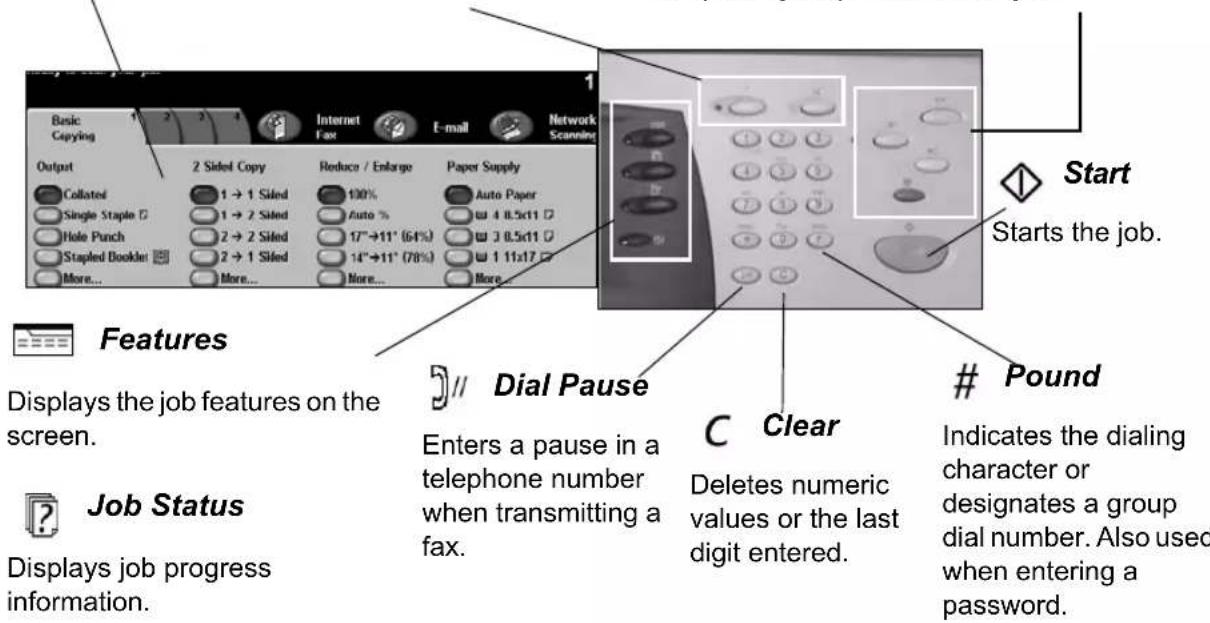

Machine Status
Displays the current status of the machine.
Power On or Off
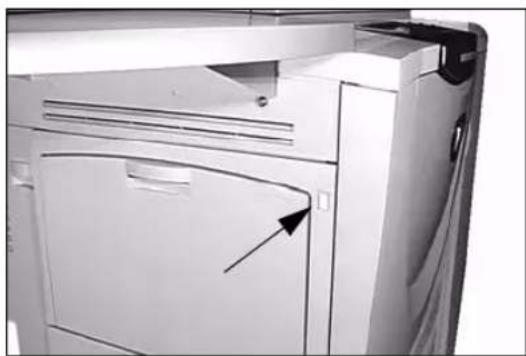
1 To power ON:
➢ Press the ON/OFF switch. The powering up process takes less than 3 minutes.
NOTE: Certain functions of the machine, e.g. copying, will be available before other functions e.g. printing.
natural_image
Close-up of a white electronic device casing with a black arrow pointing to a component (no visible text or symbols)2 To power OFF:
➢ Press the ON/OFF switch. A confirmation screen will appear asking you to select a power down option.
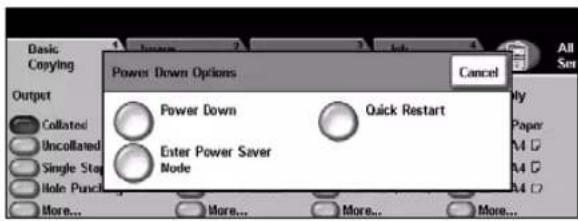
3 If Power Off is selected the Power Off Confirmation screen displays a warning that data may be lost if the machine is powered off.
NOTE: When the machine is powered off, any jobs in the job queue will be deleted. However, print jobs will be restored at power on.
➢ Touch the Confirm button to Power Off the machine.
NOTE: The machine remains on for approximately 45 seconds before the power is terminated.
If Enter Power Save is selected the machine will immediately enter the Power Saver Mode appropriate to its configuration. If there are any jobs in the queue, a second pop-up screen is displayed.
To re-activate the machine when in this mode, touch a button on the touch screen or control panel.
If Quick Restart is selected and confirmed then the machine will restart. A pop-up screen will appear warning that any jobs in the queue will be deleted.
If Cancel is selected then the power down options will be cancelled and the machine will be available for use.
Loading Paper
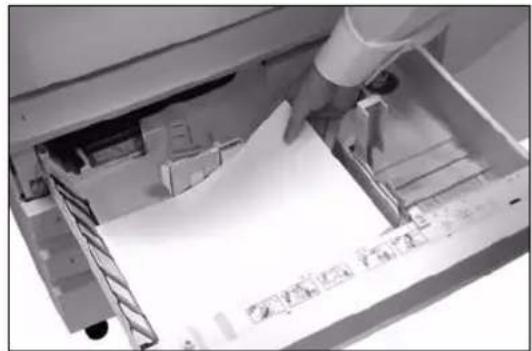
1 > Open the required paper tray. NOTE: Paper trays 1 and 2 are fully adjustable for all stock sizes between 8.5" x 5.5" to 11" x 17". Paper trays 3 and 4 are dedicated paper trays which can be adjusted to hold either 8.5" x 11" or A4 long edge feed paper only.
natural_image
Exterior view of a modern office building (no signage)2 ➢ Load paper. Paper must not be loaded above the fill line. ➢ Close the tray.
NOTE: For paper trays 1 and 2, ensure the guides are just touching the paper, otherwise the size automatically detected may be incorrect.
natural_image
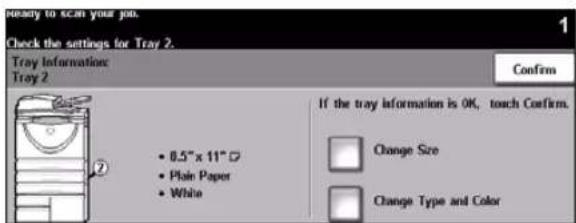
Close-up of a hand pressing down on paper inside a printer or printer case (no visible text or symbols)3 > Select [Confirm] OR select [Change Size] and/or [Change Type and Color] to reprogram the tray if the paper size, type or color has changed.
NOTE: Make sure the Size, Type and Color are all correct. For standard copy paper the following should apply: Size - 8.5" x11" Type - Plain paper Color - White
NOTE: This product does not support printing onto envelopes
Making Copies
1
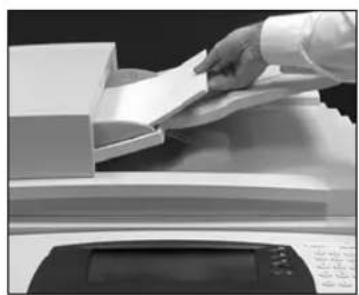
Load the documents either in the Document Handler or on the Document Glass.
NOTE: Documents in the handler are only scanned once.
natural_image
Person handling a document or folder on a printer (no visible text or symbols)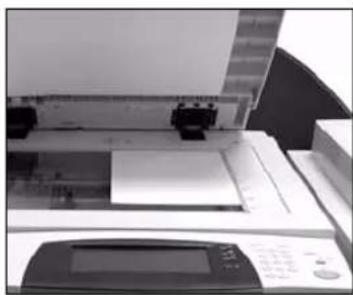
natural_image
Close-up of a printer printer with paper and print (no visible text or symbols)2
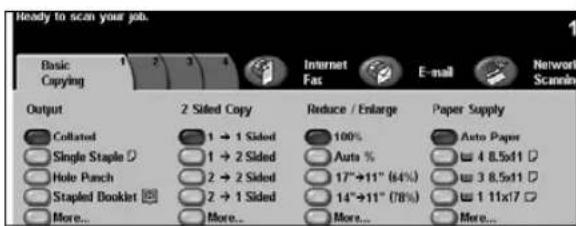
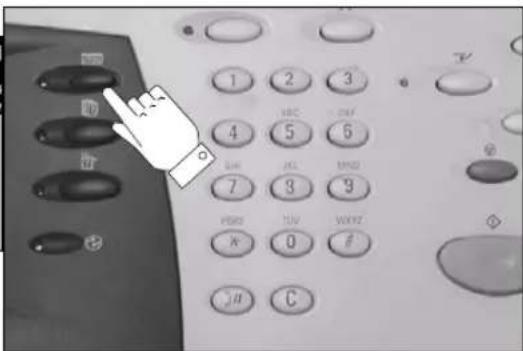
Access the Basic Copy screen - if necessary select the Features button on the control panel.
3
Select the required features on the touch screen.
➢ Press Start.
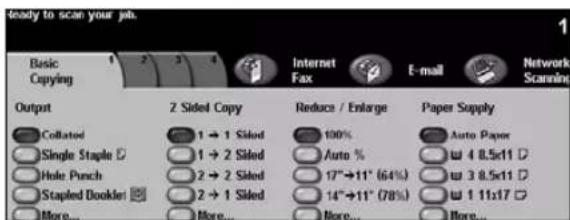
Copy features include...
Producing stapled or hole punched sets, if there is a Finisher available
➢ Image Quality adjustment
Auto Reduce/Enlarge
- Copying mixed size originals
➢ Adding printed or blank dividers into transparency sets
Arranging multiple images on a page
- Adding printed or blank covers
➢ Inserting printed or blank colored sheets
Image Shift
➢ Erasing edges and borders
Build Job to apply different programming within a stack of documents
Storing the programming for frequently run jobs
Creating booklets
Sending an Embedded Fax
Embedded Fax is an optional walk up fax feature on your machine. If the Basic Fax screen matches that displayed in step 2 then Embedded Fax is enabled. Please contact your System Administrator for further assistance.
NOTE: Both Embedded and Server Fax can be installed on the WorkCentre Pro at the same time, however only one service can be enabled for use.
1
Load the documents either in the Document Handler or on the Document Glass.
NOTE: Documents in the handler are only scanned once.
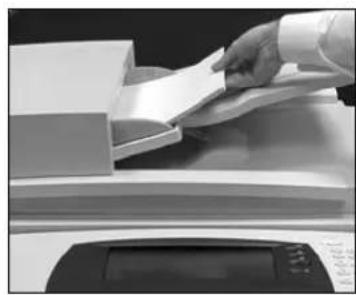
natural_image
Person using a scanner to press documents (no visible text or symbols)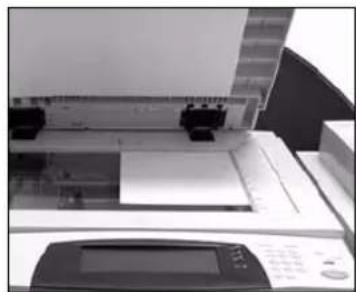
natural_image
Close-up of a printer with paper sheets and a digital display (no visible text or symbols)2
Select [Fax].
NOTE: You may need to select [All Services] first to access the fax option.
Enter the telephone number.
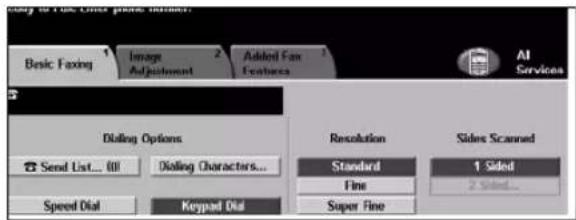
3
Select the required features on the touch screen.
➢ Press Start.
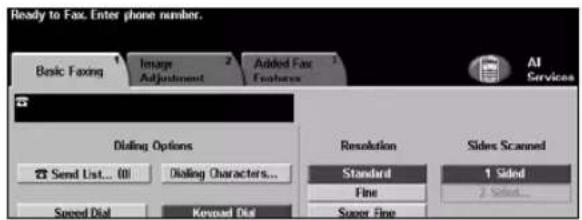
Fax features include...
Adjusting the Resolution
➢ Faxing double sided originals
▶ Programming the size of the originals being scanned
➢ Image Quality adjustment
➢ Delaying the start time of a fax
- Adding a Cover Letter
- Sending to more than one recipient
➢ Mailbox storage and polling to and from your machine
Setting the transmission speed
Sending a Server Fax
Server Fax is an optional feature which is only available on the WorkCentre Pro configuration. If the Basic Fax screen matches that displayed in step 2 then Server Fax is enabled. Please contact your System Administrator for further assistance.
NOTE: Both Embedded and Server Fax can be installed on the WorkCentre Pro at the same time, however only one service can be enabled for use.
1
Load the documents either in the Document Handler or on the Document Glass.
NOTE: Documents in the handler are only scanned once.
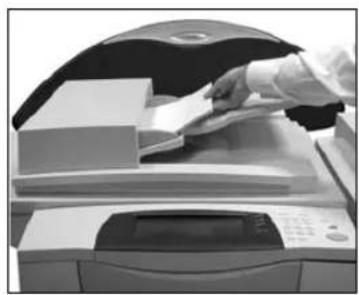
natural_image
Person in lab coat handling documents near a printer (no visible text or symbols)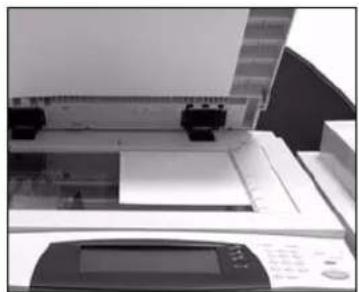
natural_image
Close-up of a printer with paper sheets and a digital display (no visible text or symbols)2
Select [Fax].
NOTE: You may need to select [All Services] first to access the fax option.
Enter the telephone number.
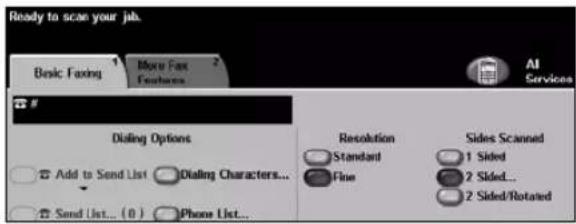
3
Select the required features on the touch screen.
➢ Press Start.
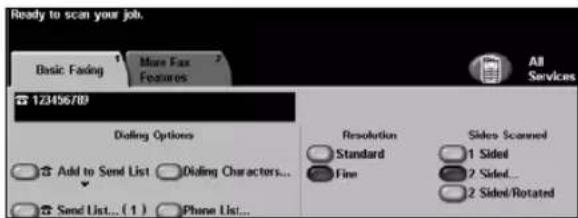
Fax features include...
Adjusting the Resolution
➢ Faxing double sided originals
- Programming the size of the originals being scanned
➢ Image Quality adjustment
▶ Delaying the start time of a fax
Sending an Internet Fax
Internet Fax is an optional feature which is only available on the WorkCentre Pro configuration. Please contact your System Administrator for further assistance.
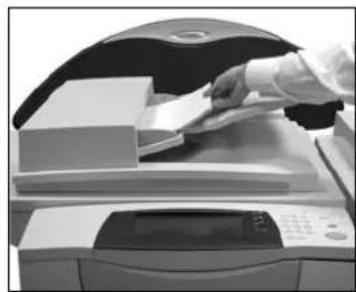
1
➢ Load the documents either in the Document Handler or on the Document Glass.
NOTE: Documents in the handler are only scanned once.
natural_image
Person in lab coat handling documents at a printer (no visible text or symbols)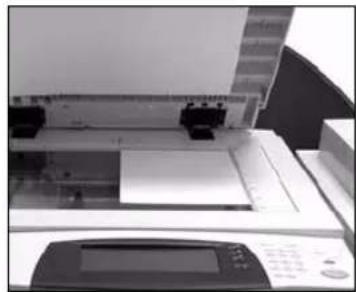
natural_image
Close-up of a printer with paper sheets and a digital display (no visible text or symbols)2
Select [Internet Fax].
NOTE: You may need to select [All Services] first to access the Internet Fax option.
➢ Select [To..], enter the recipient E-mail details and select [Save].
➢ Select [Edit Subject], enter a subject and select [Save].
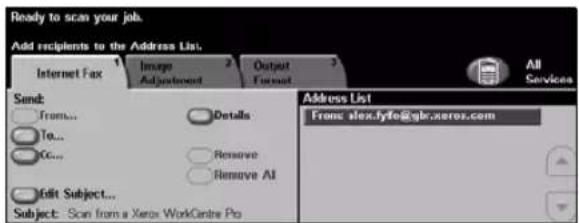
3
Select the required features on the touch screen.
Press Start.
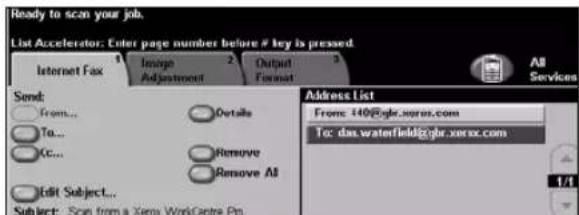
Internet Fax features include...
Setting up a Public or Internal Address Book
Adjusting the Resolution
➢ Scanning double sided originals
➢ Programming the size of the originals being scanned
➢ Image Quality adjustment
Changing the default file format setting
Scanning a Document to a File
Network Scanning is only available on the WorkCentre Pro configuration. Please contact your System Administrator for further assistance.
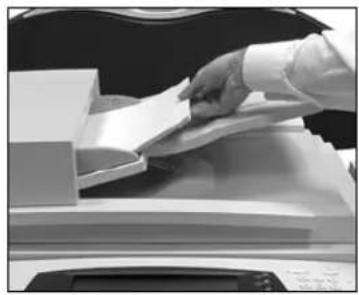
1
Load the documents either in the Document Handler or on the Document Glass.
NOTE: Documents in the handler are only scanned once.
natural_image
Close-up of a hand holding a sheet of paper over a printer (no visible text or symbols)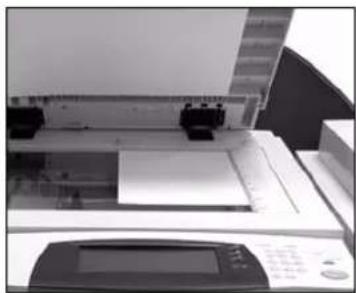
natural_image
Close-up of a printer with paper and a digital display (no visible text or symbols)2
Select [Network Scanning].
NOTE: You may need to select [All Services] first to access the Network Scanning option.
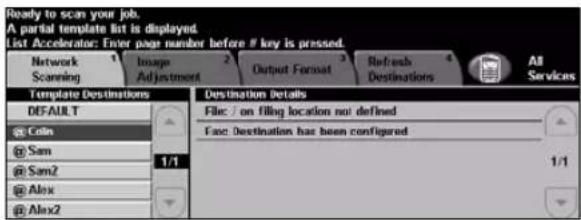
3
Select the template required.
Select the required features on the touch screen.
➢ Press Start.
On completion access your job at your workstation.
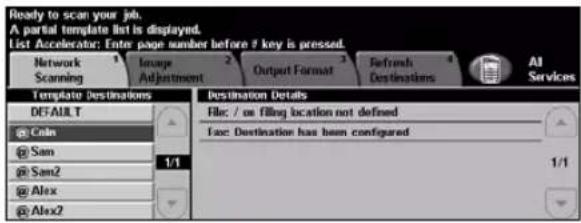
Network Scanning features include...
Adjusting the image output requirements
Adjusting the Resolution
➢ Scanning double sided originals
- Programming the size of the originals being scanned
Changing the destination for the scanned image
Sending an E-mail
E-mail is an optional feature which is only available on the WorkCentre and WorkCentre Pro configuration. Please contact your System Administrator for further assistance.
NOTE: E-mail is only supported on the WorkCentre via the Ad Hoc E-mail options kit. Limited e-mail options will be available.
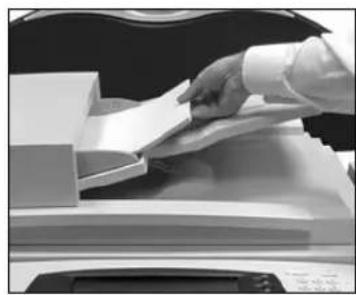
1
Load the documents either in the Document Handler or on the Document Glass.
NOTE: Documents in the handler are only scanned once.
natural_image
Close-up of a hand handling a document or paper over a printer (no visible text or symbols)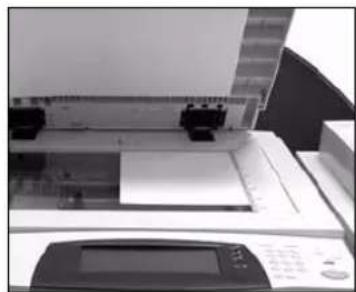
natural_image
Close-up of a printer with paper sheets and a digital display (no visible text or symbols)2
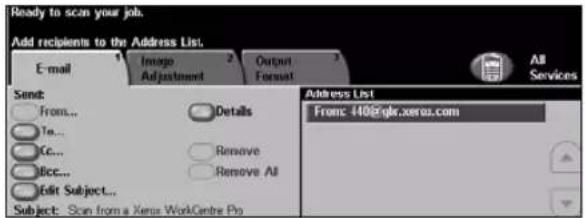
Select [E-mail].
NOTE: You may need to select [All Services] first to access the e-mail option.
3
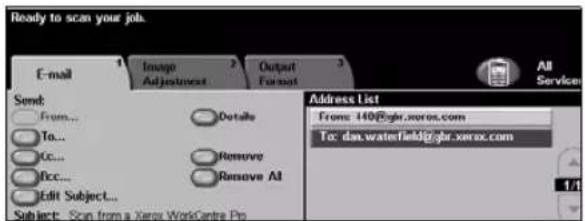
➢ Select [To], enter the recipient mail details and select [Enter].
➢ Select [Edit Subject], enter a subject and select [Save].
Select the required features on the touch screen.
➢ Press Start.
E-mail features include...
Setting up a Public or Internal Address Book
Adjusting the Resolution
➢ Scanning double sided originals
- Programming the size of the originals being scanned
➢ Image Quality adjustment
Printing from a PC
If your machine is connected to a network, documents can be printed directly from your PC using the CentreWare print driver supplied. The print driver must be loaded on each PC which uses the machine for printing.
1
Select [Print] in your application.
Select your machine as the printer.
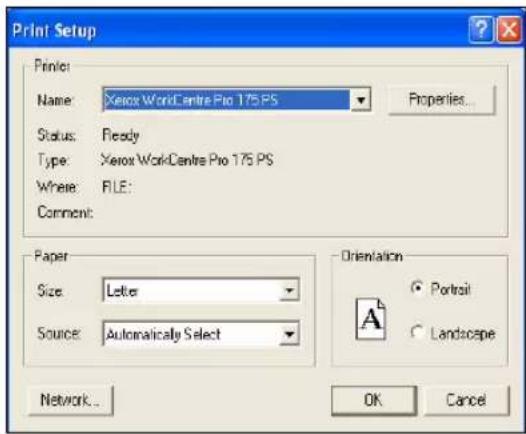
2
➢ Select [Properties], make your selections and click [OK].
➢ Click [OK] to print your document.
NOTE: Instructions may vary depending on the application being used.
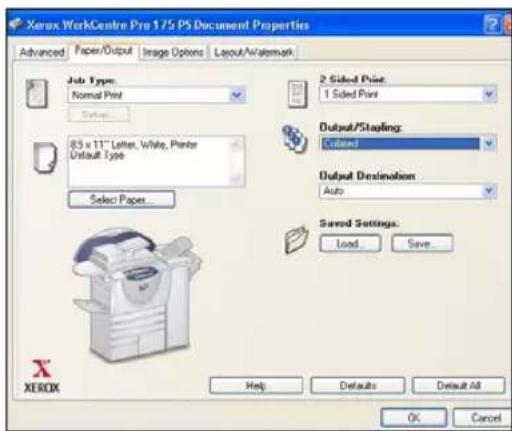
Print features include...
➢ Printing 1 or 2 sided
Producing stapled or hole-punched sets if available
Changing the printing Resolution
➢ Adding a Banner Sheet
➢ Adding a front cover
Adjusting the Image Quality
➢ Adding a Watermark
Printing with Internet Services
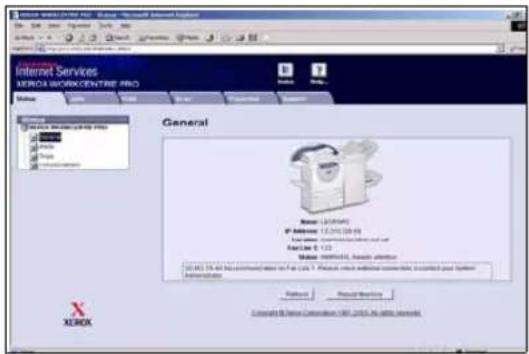
Printing with Internet Services is available on the WorkCentre Pro, and on the WorkCentre if the postscript option is installed. Internet Services uses a Web User Interface embedded in the machine to communicate between the HTTP server and the machine. This option is only available when the machine is connected to a network.
1
Open your Web Browser, then enter: http:// and the printer TCP/IP address.
➢ Press the Enter key on your workstation keyboard.
The default Status window will be displayed.
2
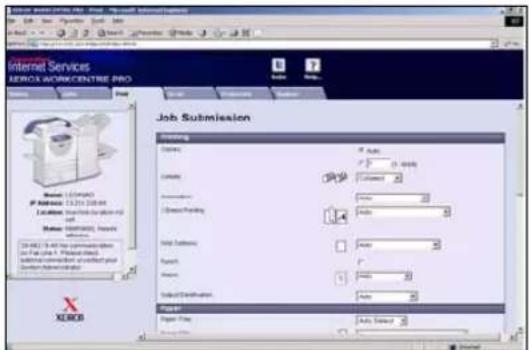
➢ Click on [Print] and make your selections.
Use the scroll bar on the right to move to the bottom of the page.
3
➢ Click on [Browse] and locate the file to be printed.
➢ Click on [Submit Job].
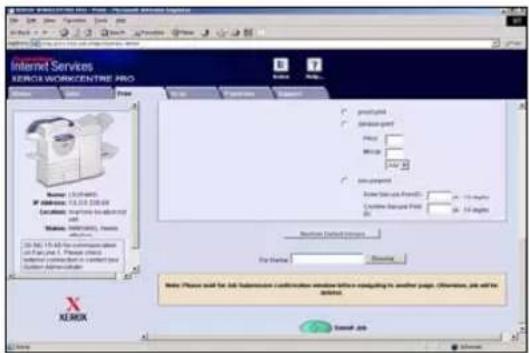
Internet Services features include...
➢ Creating, modifying and deleting scan templates if Network Scanning is available
➢ Promoting, deleting or releasing a job in the Print Queue
- Reviewing the status of your machine
Logging On / Logging Off
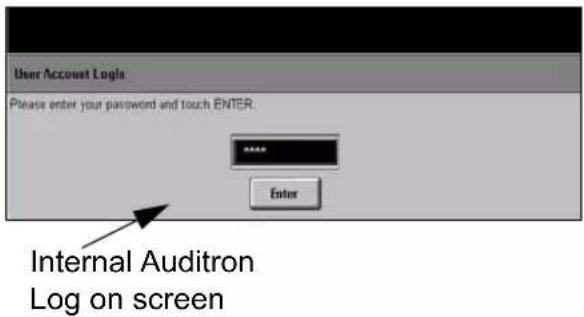
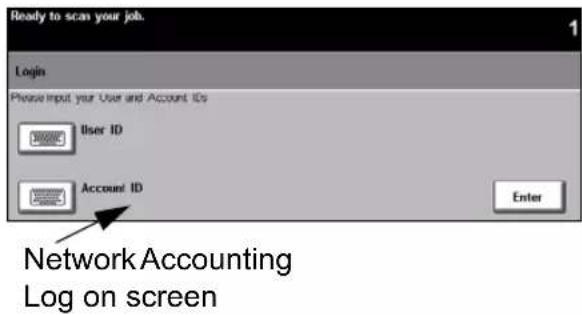
If the Internal Auditor on or the optional Network Accounting has been enabled, a valid User Number needs to be entered in order to access the machine functions. The Internal Auditor automatically tracks Copy jobs for billing purposes, as well as preventing unauthorized access to the machine. Network Accounting is used to track jobs completed over the network. Contact your System and/or Auditor Administration for further assistance.
1
To Log On when the Internal Auditron has been enabled, use the keypad to enter a 4 digit password and then select [Enter].
To Log On when Network Accounting has been enabled, enter a valid User ID and Account ID and select [Enter].
2
Complete your job
3
To Log Off:
➢ Press Access 🔒 on the control panel.
Select [Logout] on the touch screen.
Customizing your Machine
Your machine can be customized to suit your working environment and practices. The System Management Tools enable your System or Machine Administrator to setup, customize and maintain the machine.
After your machine is installed, it is recommended that the settings and options are customized to fully meet the requirements of the Users. Please discuss your requirements with your System or Machine Administrator to ensure you get optimum performance from your machine.
The Tools facility is accessed using the Access 🔗 button on the Control Panel. Some of the settings within Tools are critical to the operation of the machine, therefore the screens are password protected so they cannot be accidentally changed or corrupted.
Full instructions for accessing and customizing the System Management Tools are located in the Training and Information CD (CD2), contained in the CD Pack delivered with your machine.
System Management Tools include...
System Settings
Screen Defaults
Access and Accounting
➢ Feature Defaults
Connectivity and Network Setup
Consumables Management
Machine Tests
Power Saver Administration
Fax Setups
Further Assistance
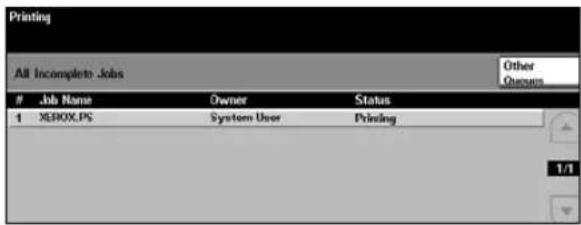
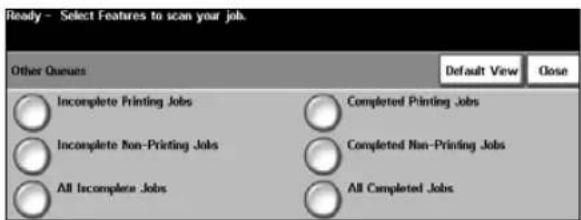
1 Access the Job Queue:
➢ Press the Job Status button on the control panel. The All Incomplete Jobs queue will displayed.
➢ Review the status of the job.
Select [Other Queues] to access and review the other queues available.
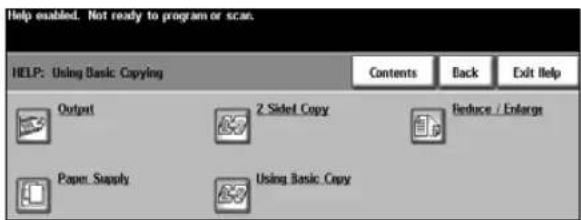
2 Access the on-line Help
? Press Help at any time to access the on-line help screens.
- Messages, screen instructions and animated graphics provide additional information.
3 For additional Help If you need any additional he
If you need any additional help on using your machine you can:
➢ Refer to the Training and Information CD (CD2), contained in the CD Pack delivered with your machine.
Contact your System and/or Machine Administrator.
Visit our Customer Web Site at www.xerox.com or contact the Xerox Welcome and Support Center quoting the machine serial number.
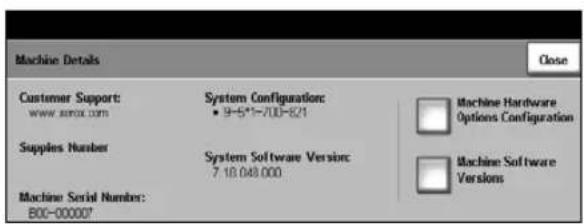
➢ Press the Machine Status button on the control panel.
Select [Machine Details] to display the machine serial number.
NOTE: The serial number can also be found on a metal plate inside the front door.
4 Copy
▶ Copy 4-2
Basic Copying 4-3
➢ Image Adjustment....4-12
Output Format....4-19
➢ Job Assembly 4-26
Copy
The Copy feature is standard on your machine.
Access to the Copy features is gained using the Features button on the control panel. Depending on the options enabled and how your machine has been configured, you may have to select All Services in the top right-hand corner first. This chapter contains information about the options available within Copy.
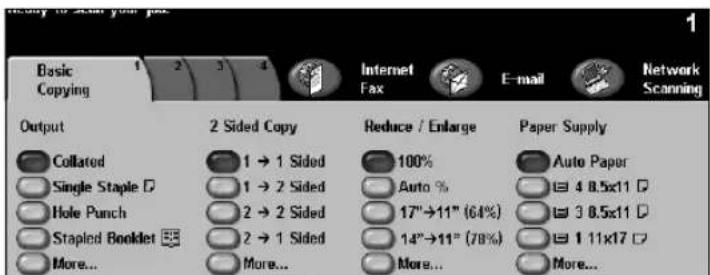
The tabs available for selecting the Copy features are:
Basic Copying
Image Adjustment
Output Format
Job Assembly

HINT: If the 'More Copy Features' tab is displaying, this can be selected to display all the Copy feature tabs available.
Basic Copying
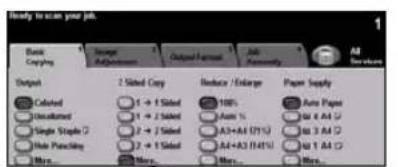
The Basic Copying tab is the default Copy screen. Use the Basic Copying tab to select the standard features for a copy job.
Depending on the options enabled and how your machine has been configured, you may have to select the All Services button in the right-hand corner to access Copy.
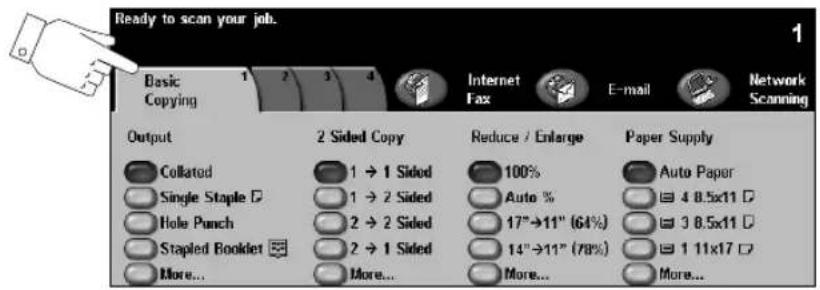
Touch any of the top level buttons to select a feature. Multiple options can be selected for each copy job if required.
To view all the options for a feature, select More....
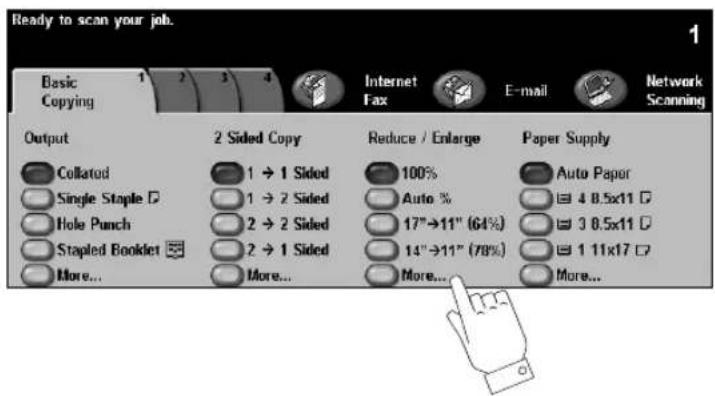
Most feature screens include three buttons to confirm or cancel your choices.
The Undo button resets the current screen to the values that were displayed when the screen was opened.
The Cancel button resets the screen and returns to the previous screen.
The Save button saves the selections made and returns to the previous screen.
Output
Output is used to select the finishing requirements for the job. The options will depend on the finishing output device installed.
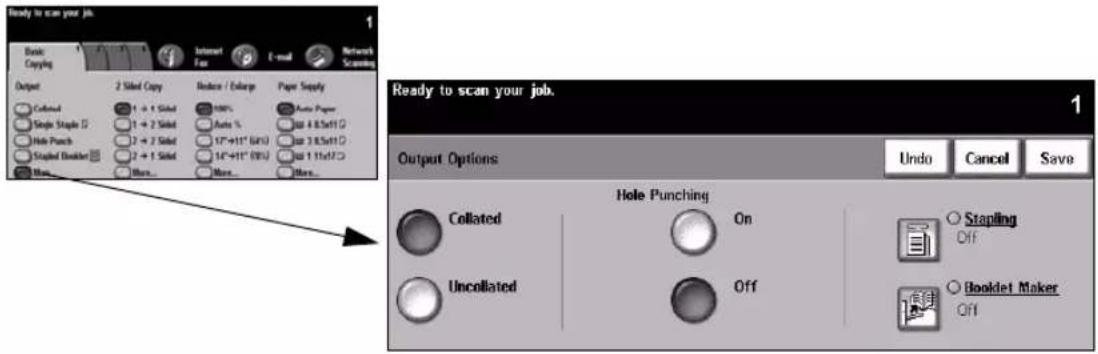
Options:
Collated Select Collated for output stacked in sets to match the sequence of the originals.
Uncollated Select Uncollated for output sorted into stacks of individual pages.

Hole Punched This option is available if your machine is equipped with a finisher and a 2 Hole or 3 Hole Punch. Each sheet is punched individually, so there is no limit to the number of sheets in the set. Additional Hole Punch kits can be purchased as an option.
① Hole punching can only be selected for 8.5 x 11" long edge feed, and 11 x 17" paper.
NOTE: Some stapling options can be used in conjunction with the Hole Punch.
Stapling
The Stapling options are as follows:
| NO STAPLES | The output will not be stapled. |
| SINGLE STAPLE | Use this option to add a single staple to your output. |
| DOUBLE STAPLE | Use this option to add 2 staples to your output. |
| MULTI-STAPLE | Use this option to add 3 or 4 staples to your output, depending on the size of the paper being used. Multiple staples can be added to the Left or Right side of your output.This option is only available on the Advanced Office Finisher and the Professional Finisher. |
Collated and uncollated stapled sets will be delivered offset.
① Staples 2 - 50 sheets of 20lb, substance 20 paper. The maximum number of sheets is 20 when stapling heavyweight paper.
Off-line This function is also available on all 3 finishers. Instructions for each finisher are as follows:
| OFFICE FINISHER | Press and release the button on the top of the finisher. The green light will illuminate, if the light is flashing the stapler is unavailable. The Output Tray lowers to provide access to the stapler and bin 1. Hold your documents and place them into bin 1, for extra support move the rear bin 1 guide to the edge of your documents.Slide the documents forward until you hear the click of the staple being inserted to the front corner of the documents. |
| ADVANCED OFFICE FINISHER AND PROFESSIONAL FINISHER | Press and release the button on the top of the finisher. The green light will illuminate, if the light is flashing the stapler is unavailable. The Output Tray lowers to provide access to the stapler.With your documents face down and the top to the front of the machine, slide them into the stapler and towards the front of the machine.When you hear a click a single staple will be inserted in the top left hand corner of your documents. |
① Staples 2 - 40 sheets of 20lb, substance 20 paper. The maximum number of sheets is 20 when stapling heavyweight paper.
Booklet Maker

If your machine is fitted with the Professional Finisher the Booklet Maker option can be used to fold and staple (saddle stitch) your output to produce booklets. The Booklet Maker options are as follows:
| OFF | The Booklet Maker option is switched off. |
| FOLDED AND STAPLED | Use this option to fold and staple your booklet. The Professional Finisher will place 2 staples on the spine of the booklet. |
| FOLDED ONLY | Use this option to fold your booklet output. |
① The paper sizes that can be used are A3, 11" x 17", A4, 8.5" x 11", 8.5" x 13" and 8.5" x 14".
All paper must be loaded short edge feed in the paper tray.
The media types that can be used are Plain Paper, Bond, Index and Cover.
If using the Folded and Stapled option, the maximum number of 20lb, substance 20 bond sheets is 15.
If using the Folded Only option, the maximum number of 20lb, substance 20 bond sheets is 5. The maximum number of sheets for both options is reduced when using heavier weight paper.
2-Sided
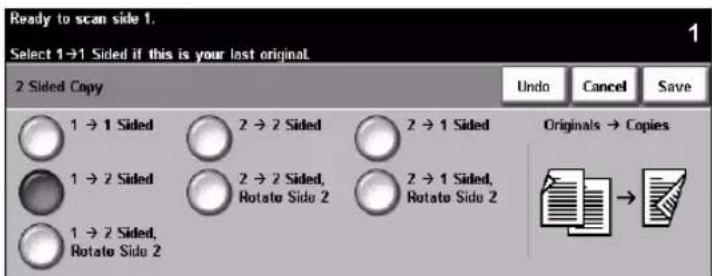
Double-sided copies, ranging in size from 8.5" x 5.5" to 11" x 17" can be made automatically from one or two-sided originals.
Options:
1→1 S i d e d Use this option for 1 sided originals when 1 sided copies are required.

1→2 S i d e d Use this option for 1 sided originals when 2 sided copies are required.

1 Sided, This option produces 2 sided copies from 1 sided originals and rotates every second side image. Use this option to create documents which can be read in a "head to toe" manner, for example a calendar.

2→2 S i d e d Use this option for 2 sided originals when 2 sided copies are required.

2-2-Sided, This option produces 2 sided copies from 2 sided originals and rotates every second side image. The "read" orientation for this option varies depending on the input originals. For example, if "head to head" orientation originals are scanned, the output will be "head to toe". If "head to toe" orientation originals are scanned the output produced will be "head to head".
2→1 S i d e d Use this option for 2 sided originals when 1 sided copies are required.

2→Sided, This option produces 1 sided copies from 2 sided originals and rotates every second side image. It should be used for "head to toe" orientation or calendar style originals, to ensure the output images are all in the same orientation.

Reduce/Enlarge
The Reduce / Enlarge option provides a variety of reduction and enlargement options. Originals placed on the Document Glass or sent to the machine electronically can be reduced or enlarged between 25% and 400%. Originals fed through the Document Handler can be reduced or enlarged between 25% and 200%.
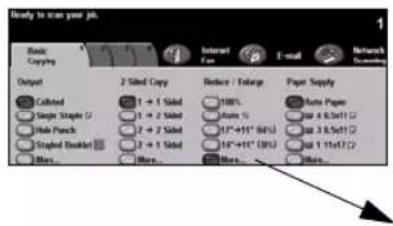

Options:
Normal Use this option to proportionately reduce or enlarge the output image in both directions by the % selected.

Normal options are as follows:
| 100% | Produces an image on the copies the same size as the image on the original. |
| AUTO % | Proportionally reduces or enlarges the image on the copies based on the size of the original and the size of the selected output paper. |
| % SET 25 - 200 / 400 | Use this option to select the percentage of reduction or enlargement required using the keypad on the control panel. To use the keypad, select the box displaying the current reduce/enlarge percentage.NOTE: 200% will be displayed when using the Document Handler and 400% when using the Document Glass.The scroll buttons can also be used to adjust the reduce/enlarge percentage, in 1% increments. |
| PRESET OPTIONS | The most commonly used reduce/enlarge percentages have been provided as preset options. These preset options can be customized to meet individual needs. |
Custom Use this option to adjust the height (Y) and the width (X) dimensions for reduction or enlargement of each dimension independently.

NOTE: Output will NOT be reduced or enlarged proportionally.
Custom options are as follows:
| 100% | Produces an image on the copies the same size as the image on the original. |
| AUTO % | Automatically fits the image of the original onto the paper selected. |
| X50% Y100% | Enables you to customize the width (x) and height (y) reduction or enlargement to suit your own requirements. A percentage can also be entered by touching the X or Y box and using the keypad. |
Paper Supply
Use the Paper Supply options to select Auto Paper or a paper tray for the copy job.
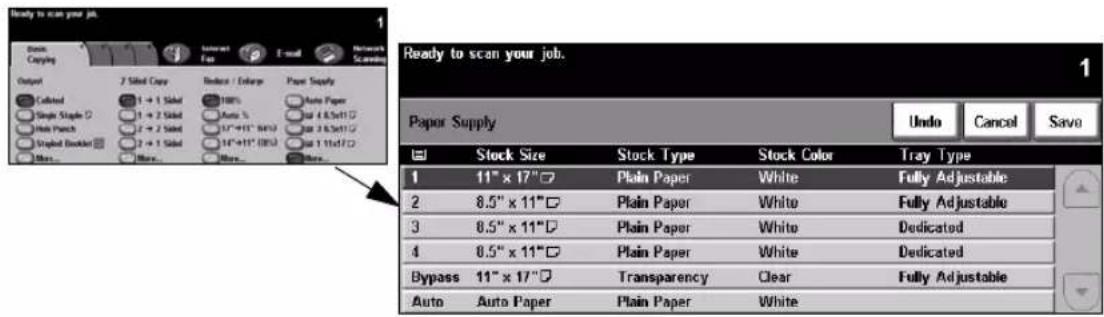
Options:
Auto Paper With this option selected the machine chooses the correct paper for the copy job based on the size of the originals being scanned.
Tray 1 Use this option to select the paper loaded in Tray 1.
(i) Tray 1 holds 550 sheets of 20lb, substance 20 paper. Weight ranges from 16 - 53lb, substance 16 - 53. Sizes range from 8.5" x 5.5"SEF to 11" x 17"SEF. Most stocks can be used (for example pre-formatted paper, letterhead), except for transparencies, labels and envelopes.
Tray 2 Use this option to select the paper loaded in Tray 2.
(i) Tray 2 holds 550 sheets of 20lb, substance 20 paper. Weight ranges from 16 - 53lb, substance 16 - 53. Sizes range from 8.5" x 5.5"SEF to 11" x 17"SEF. Most stocks can be used (for example pre-formatted paper, letterhead), except for transparencies, labels and envelopes.
Tray 3 (Optional) Use this option to select the paper loaded in Tray 3.
(i) Tray 3 holds 2000 sheets of 20lb, substance 20 paper. Weight ranges from 16 - 53lb, substance 16 - 53. The tray can be adjusted to hold either 8.5" x 11" or A4 LEF size paper.
Tray 4 (Optional) Use this option to select the paper loaded in Tray 4.
(i) Tray 4 holds 1600 sheets of 20lb, substance 20 paper. Weight ranges from 16 - 53lb, substance 16 - 53. The tray can be adjusted to hold either 8.5" x 11" or A4 LEF size paper.
Bypass Tray Use this option when feeding individual types of stock, for example letterhead or labels for one-off jobs.
The Bypass Tray holds 100 sheets of 20lb paper, substance 20. Weight ranges from 16 - 80lb (US Cover), substance 16 - 80. Sizes range from 4.25" x 5.5"SEF to 11" x 17"SEF. Most stocks can be used (for example transparencies, tabbed stock, letterhead), except for envelopes.
Image Adjustment
The Image Adjustment tab provides copy features used for adjusting the appearance of the copy output.
NOTE: If the 'More Copy Features' tab is displaying, this must be selected to access the Image Adjustment tab.
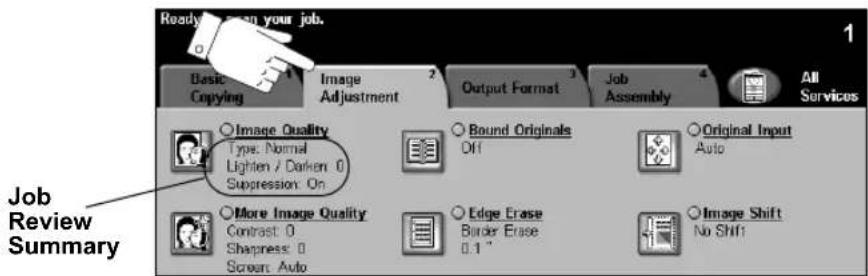
Touch any of the top level buttons to select a feature. To view all the options for a feature, select the feature required. Multiple options can be selected for each copy job if required.
The text next to the feature button, called a Job Review Summary, reflects the current settings for that feature. A checked box indicates that this feature has been modified from its initial default settings.
Most feature screens include three buttons to confirm or cancel your choices.
The Undo button resets the current screen to the values that were displayed when the screen was opened.
The Cancel button resets the screen and returns to the previous screen.
The Save button saves the selections made and returns to the previous screen
Image Quality
Use this feature to enhance the quality of your output.
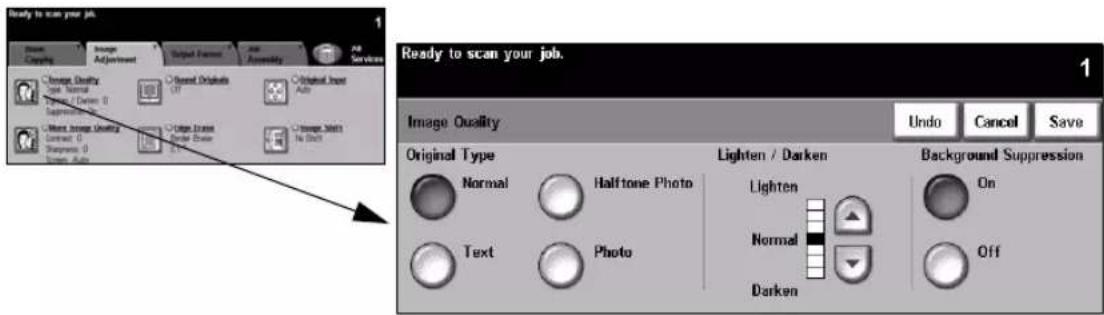
Options:
Original Type

Use this option to enhance the copy quality of the output based on the type of original being scanned.
Original Type options are as follows:
| NORMAL | This is the standard setting and can be used for most originals. |
| TEXT | Use for originals containing text or line art. |
| HALFTONE PHOTO | Use for high quality lithographic images or continuous tone photos with text and/or graphics. |
| PHOTO | Use for continuous tone photographs or high quality printed half-tone originals. |
Lighten / Darken
Adjusts the lightness or darkness of the output. To darken the output, select the down scroll button. To lighten the output, select the up scroll button.
Background Suppression
Use to automatically reduce or eliminate the dark background resulting from copying colored paper or newspaper originals.
NOTE: Background Suppression is disabled if the Original Type is Photo.
More Image Quality
Use this feature in addition to the settings selected using the Image Quality option, to further enhance the quality of your output.
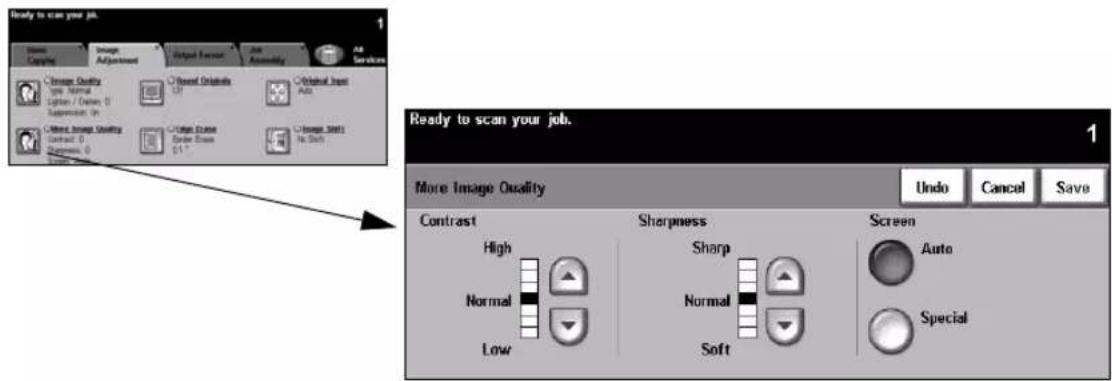
Options:
Contrast This option controls the differences between the image densities within the copy. Select a lower setting to improve the copy quality of pictures. Select a higher setting to produce more vivid blacks and whites for sharper text and lines.
Sharpness This option controls the balance between sharp text and moiré (patterns within the image). Use the scroll buttons to adjust the sharpness values from sharper to softer, based on the quality of the input images.
Screen

This option is preset at the factory to be on with Normal, Text and Halftone Photo Original Type options.
Screen options are as follows:
| AUTO | Eliminates the risk of blotches or small areas that have a different texture or pattern appearance than the surrounding area, but produces a slightly grainier picture than if Special is used. |
| SPECIAL | Enhances continuous tone photographs or high frequency halftone images. It is used to create smoother, less grainy output for continuous tone and high quality halftone images, but the risk of blotchy copy quality defects is higher. |
Bound Originals
This feature is used to copy pages from bound documents onto separate single-sided or double-sided pages.
The bound original is placed face down on the Document Glass with the spine of the book lined up with the marker on the rear edge of the glass. Align the top of the bound original against the rear edge of the document glass. Do not close the Document Handler during the copying process if Auto Reduce/Enlarge is selected.
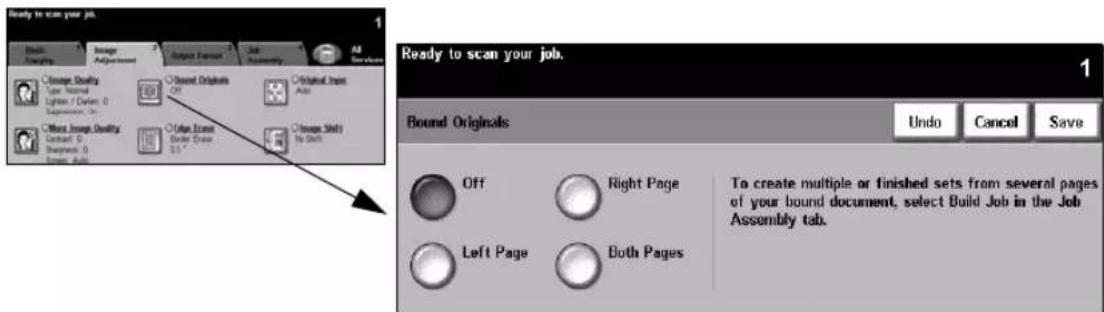

HINT: If necessary, apply a little pressure to the centre of the book to flatten it during scanning.
Options:
Off The feature is switched off.
Right Page Copies only the page on the right when looking at the open book, face up.

Left Page Copies only the page on the left when looking at the open book, face up.

Both Pages Copies both pages of an open book and places each page on a separate sheet of paper.
Binding Erase

Erases a specified area from the centre of the book to eliminate unwanted marks caused by scanning the binding. When Left Page or Right Page is selected, between 0 and 1.0 inch can be erased. When Both Pages is selected, between 0 and 2.0 inches can be erased.
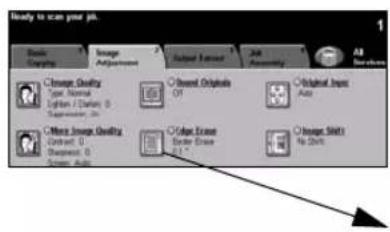
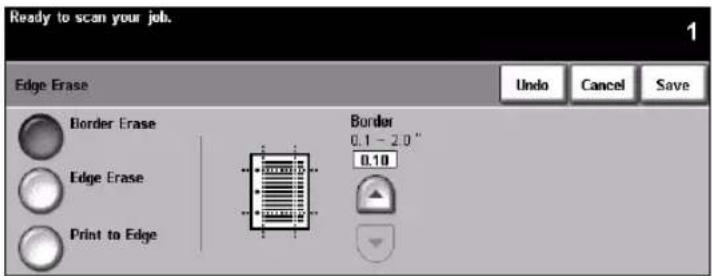
Edge Erase
Use this feature to "refresh" the quality of an original that has become torn or frayed at the edges, or that has hole punch, staple or other marks.
Options:
Border Erase
Erases equal amounts on all edges of the copies. Up to 2.0 inches in 0.05in. increments can be erased.

Edge Erase
Use to erase a specific amount from a specific edge of the copy. Up to 2.0 inches in 0.05in. increments can be erased from each edge.

Print to Edge Use this option to print to the edge of the output stock.

NOTE: This option may reduce the ability of the system to clean itself and can cause defects on the output if used excessively.
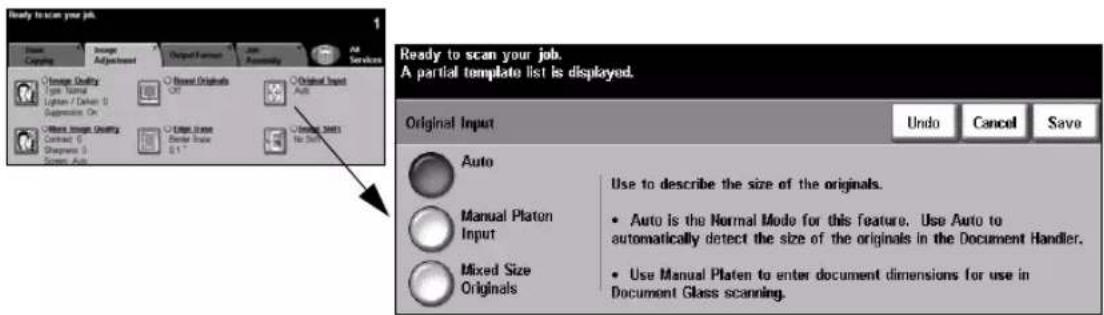
Original Input
Use this option to program the size of the originals being scanned or enable the machine to recognize the size of the originals.
Options:
Auto

Use this option to allow the machine to recognize the size of the originals being fed through the Document Handler.
NOTE: When originals are scanned using the document glass and an Auto feature such as Auto Paper, Auto% or Auto Centre is selected, the machine will scan the original twice.
Manual Platen Input

Use this option to specify the dimensions of the document scanning region when scanning from the document glass. There are several dimensions that correspond to common document sizes and orientations.
Select a standard size or use Custom to manually adjust the scanning dimensions.
Mixed Size Originals

Use this feature to copy a document containing mixed size originals. The originals must be the same width, for example 8.5x11inch long edge feed and 11x17inch short edge feed. Load documents in the Document Handler when using this feature.
Image Shift
This feature enables the position of the image on the page to be adjusted.
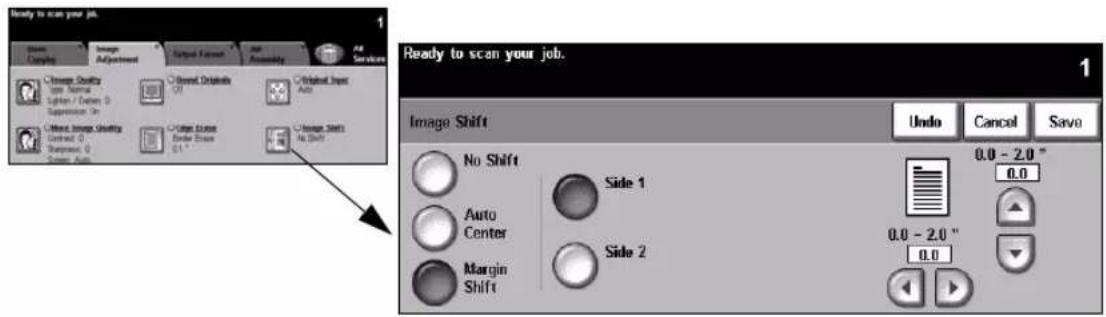
Options:
No Shift The image position is not adjusted.

Auto Center Use to automatically center the scanned image on the output paper.
Margin Shift Use to create a binding edge for the document. The image can be adjusted up or down on the page and/or shifted to the right or left. Use the scroll buttons to adjust the amount of shift. The image can be shifted between 0.0 and 2.0 inches, in 0.05in. increments.
Margin Shift options are as follows:
| SIDE 1 | Shifts the image on Side 1. |
| SIDE 2 | Shifts the image on Side 2. The shift on Side 2 can be set to mirror the shift on Side 1 or adjusted independently. |
Output Format
The Output Format tab is used to produce different options for the finished output.
NOTE: If the 'More Copy Features' tab is displaying, this must be selected to access the Output Format tab.
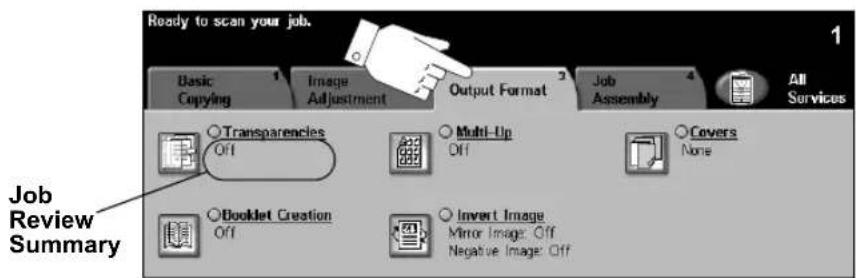
Touch any of the top level buttons to select a feature. To view all the options for a feature, select the feature required. Multiple options can be selected for each copy job if required.
The text next to the feature button, called a Job Review Summary, reflects the current settings for that feature. A checked box indicates that this feature has been modified from its initial default settings.
Most feature screens include three buttons to confirm or cancel your choices.
The Undo button resets the current screen to the values that were displayed when the screen was opened.
The Cancel button resets the screen and returns to the previous screen.
The Save button saves the selections made and returns to the previous screen.
Transparencies
Use this feature to add either a blank or printed divider between each transparency within a set. Always load transparencies in the Bypass Tray. Transparency jobs will be delivered single-sided and collated with no finishing.
The quantity can only be set to one for this feature.
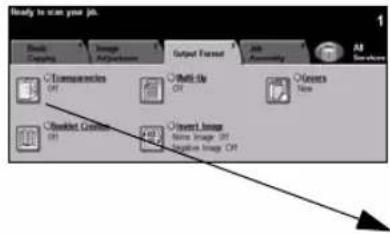
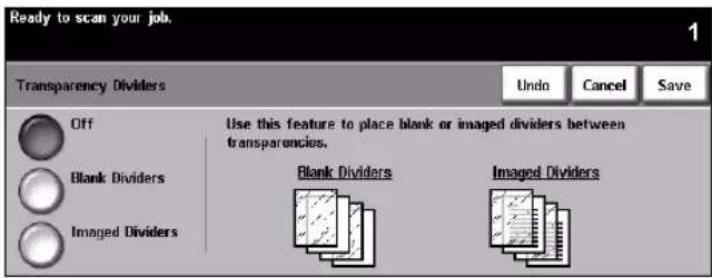
Options:
Off The feature is switched off.

Blank Dividers Use this option to place a blank sheet between each transparency.

Imaged Dividers Use this option to place the same image on the divider sheet as printed on the transparency.

Booklet Creation
Use this feature to create multipage booklets from a sequential set of either single-sided or double-sided originals. The machine produces 2 sided output automatically, which when folded produces a booklet with all the pages in the correct location. The machine will also reduce and correctly position each image to fit on the selected paper.
NOTE: Your originals should be loaded Long Edge Feed (LEF) in the Document Handler with the output paper loaded Short Edge Feed (SEF) in the paper tray.
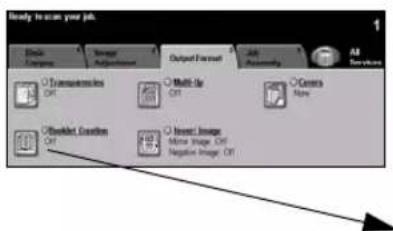
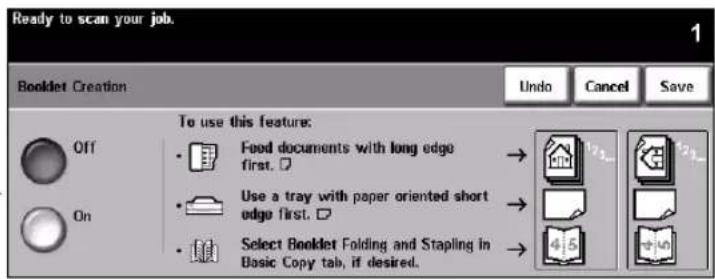
Options:
Off The feature is switched off.

On Use this option to enable the Booklet Creation feature. Booklet Creation On options are as follows:

| 1 SIDED ORIGINALS | Select this option if the originals are single-sided. |
| 2 SIDED ORIGINALS | Select this option if the originals are double-sided. |
A cover can be inserted onto the booklet automatically by selecting the Covers option from the Output Format tab. Refer to page 4-24 for more information.
If your machine is fitted with the Professional Finisher, you can use the booklet maker feature to fold and if required, staple (saddle stitch) your booklet output. For more information, refer to "Output" on page 4-4.
Multi-Up
This feature is used to create documents with multiple images on each page. It is ideal for creating handouts, storyboards or documents used for archival purposes.
NOTE: Originals must be loaded in the Document Handler when using this feature.
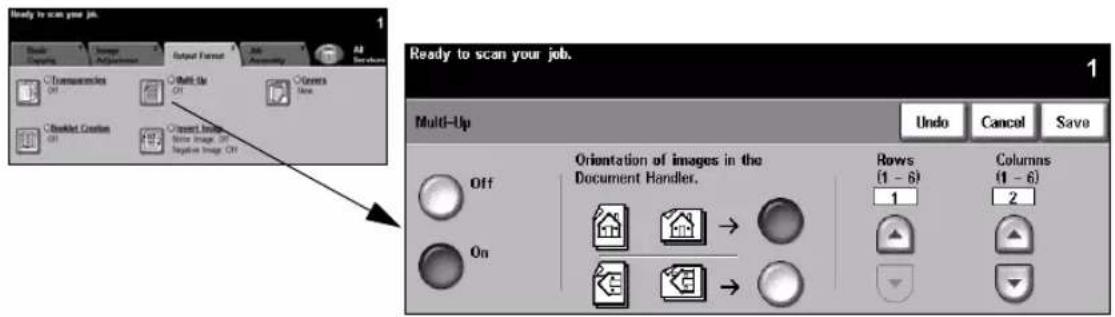
Off The feature is switched off.
On Use to enable the Multi-Up feature.

Multi-Up On options are as follows:
| ORIENTATION | Use to select the image and load orientation of the input originals. |
| Rows | Selects the required number of Rows, between 1 and 6. |
| COLUMNS | Selects the required number of Columns, between 1 and 6. |
NOTE: The number of images will be limited by the minimum reduction value of 25% and the size of the selected output.
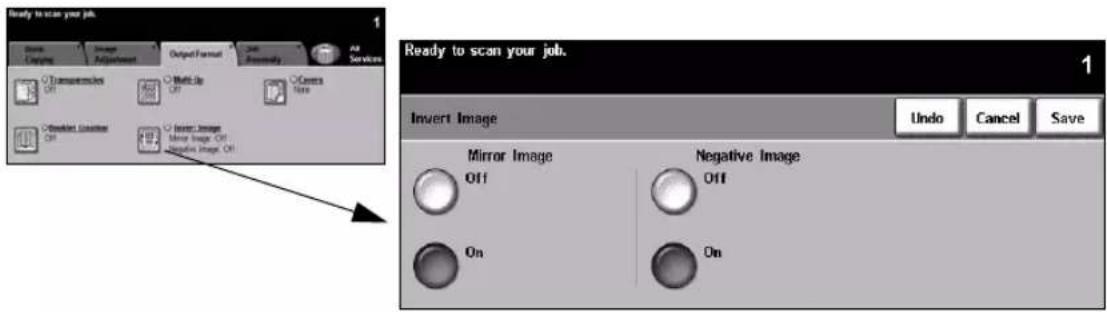
Invert Image
This feature enables Mirror Image or Negative Image copies to be produced.
Options:
Mirror Image

Use this option to change the direction of the original image, creating a mirror of the original. This option is primarily used to change the position of a graphic.
Negative Image

Use Negative Image to create copies that are the opposite of the original document, the white areas become black and the black areas become white.

HINT: This option is useful for saving toner (dry ink) consumption for images with a dark background and white text.
Covers
Use this feature to automatically add covers to your copied set using stock taken from a different tray than the copies.

HINT: Covers and Inserts can be selected in the same job.
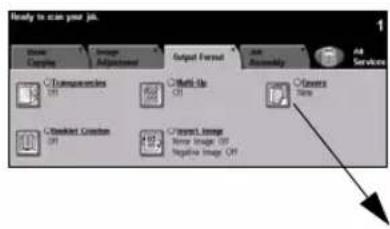
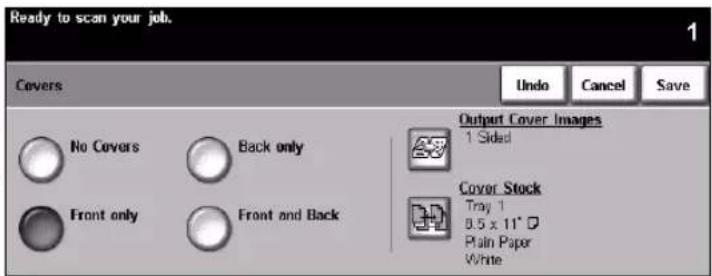
Options:
No Covers The feature is switched off.
Front Only Use this option to add a front cover to the copies.

Back Only Use this option to add a back cover to the copies.

Front and Back Use this option to add both a front and back cover to the copies.

Output Cover Images Use this option to select the imaging requirements for the covers. Output Cover Images options are as follows:
| BLANK COVER | Adds Blank covers to the copies. |
| 1 SIDED | Places the first original in the job as the front cover image, and the last image as the image on the inside back cover of the document. |
| 2 SIDED | Places the first two images of the original set on the front and back of the front cover. The back cover will use the last two images in the job. |
| 2 SIDED, ROTATE SIDE 2 | Produces 2 sided covers with the second side rotated to enable a “head to toe” style output. |
Cover Stock Use this option to select the tray required for the cover stock.

Job Assembly
The Job Assembly tab is used to combine multiple documents into a single job, produce a sample set of a job or for storing the programming of up to 10 jobs.
NOTE: If the 'More Copy Features' tab is displaying, this must be selected to access the Job Assembly tab.
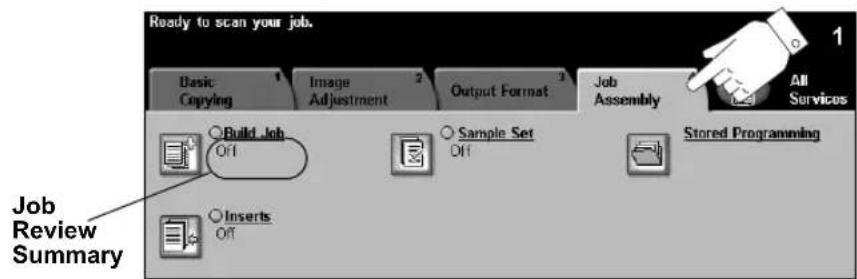
Touch any of the top level buttons to select a feature. To view all the options for a feature, select the feature required. Multiple options can be selected for each copy job if required.
The text next to the feature button, called a Job Review Summary, reflects the current settings for that feature. A checked box indicates that this feature has been modified from its initial default settings.
Most feature screens include three buttons to confirm or cancel your choices.
The Undo button resets the current screen to the values that were displayed when the screen was opened.
The Cancel button resets the screen and returns to the previous screen.
The Save button saves the selections made and returns to the previous screen.
Build Job
Use this feature to build a job that requires different settings for each page. For example, if a set of documents consists of some pages with text and some with photos, the appropriate setting for each original can be applied and the job can still be completed as a single job. This feature is also useful if your job has more than 70 pages, which exceeds the maximum capacity of the Document Handler.

HINT: Quantity, Stapling and Collation options can be adjusted at any time and will assume the values of the last job segment.
To use Build Job, split the job into programming and scanning segments. Select the Build Job option and select On. Program and scan the first segment. Continue to program and load segments until the whole job has been scanned. When the entire job has been scanned, select Build Job Controls and select End Build Job. The job is processed and printed as a single job.
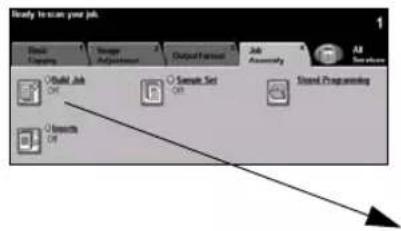
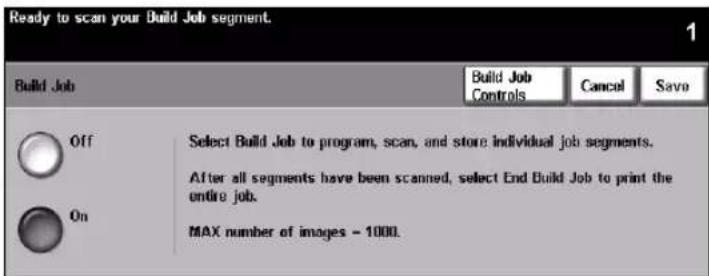
Options:
Off The feature is switched off.
On Use to enable the Build Job feature.

Build Job Provides options which can be selected when using Build Job.
Controls Build Job Controls options are as follows:
| END BUILD JOB | Select this option after the last segment of the job has been scanned. The job will be sent to print. |
| SAMPLE LAST SEGMENT | Select to see a proof of the last segment scanned. |
| DELETE LAST SEGMENT | Use to delete the last segment scanned. |
| CANCEL SAMPLE PRINTING | Use to stop and cancel the sample segment that is currently printing. |
| DELETE ALL SEGMENTS | Use to delete the current job and return to the main Build Job screen. |
Sample Set
This feature is used to review the output to ensure that it is exactly what is required prior to printing a large quantity.
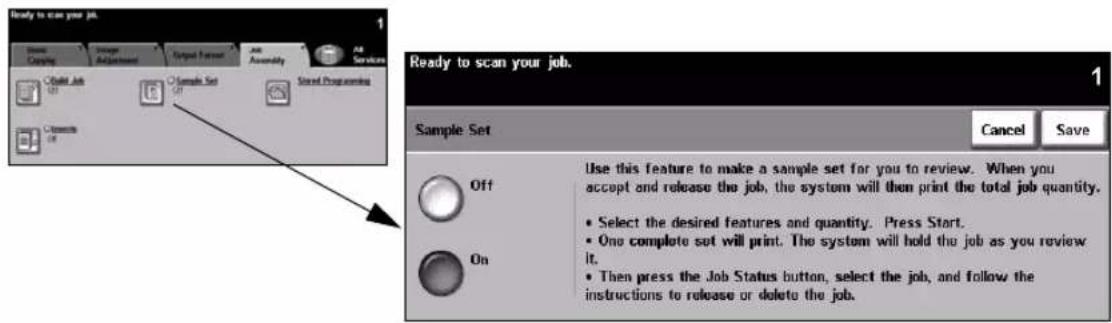
Options:
Off The feature is switched off.

On
Use to enable the Sample Set feature. One complete set of the job will be printed. To print the remainder of the job, press the Job Status button and select your job in the queue.
If the output is acceptable, select Release, the job will be completed.
If the output was not acceptable or the job is no longer required, select Delete to delete the job from the queue. Reprogram and rescan the entire job.
Stored Programming
Use this feature to program up to 10 commonly used programming sequences. For example, combinations of selections such as Edge Erase and Bound Originals.
The machine stores only the programming features for the job, NOT the images. Each time a stored job is used the images must be scanned.
To use this feature, use the up and down scroll buttons on the scrolling list to select the required storage location, then select a function button - Store or Recall Programming.
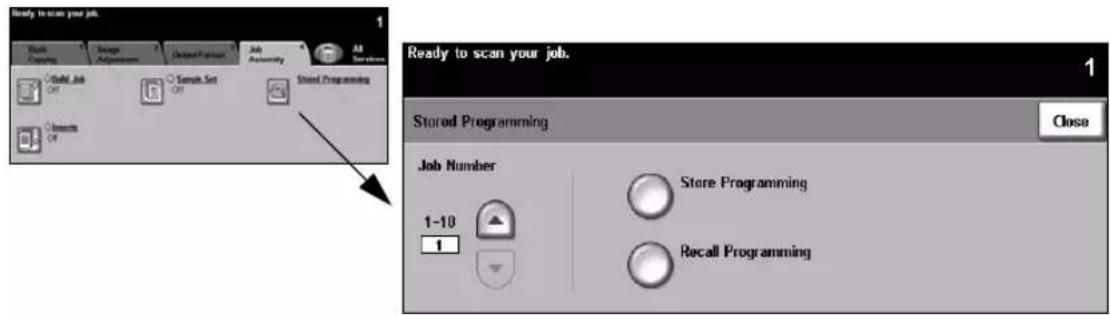
Options:
Job Number Use to scroll to a job number between 1 and 10.
Store Use this option to store the current programming selections. If a job has already been stored under the selected Job Number, a confirmation pop-up screen appears. If Confirm is selected, the new programming will be stored.
Recall Use this option to retrieve programming that has been stored under a specified job programming number. First select a Job Number, then select Recall Programming. The recalled programming will overwrite the current copy programming. After being recalled, the selection can be modified further and re-stored if required.

Inserts
Use this feature to add up to two additional stock types to your job. For example, you can separate sections using blank sheets or tab stock, or print the first page of each section on different colored stock to separate chapters.
A combination of standard size media, tab stock, card or colored paper can be used for the inserts. Load your insert stock into one of the paper trays. If two different insert stocks are required, load them in different paper trays. The recommendation is to use trays 1 and 2 for your insert stocks.
To prepare your document for programming the inserts, identify the page number where the insert is required by counting through the pages. If you require blank inserts, add blank sheets to your document where the inserts are to be placed. A maximum of 40 insert sheets can be added to a document.

HINT: Inserts and Covers can be selected in the same job.
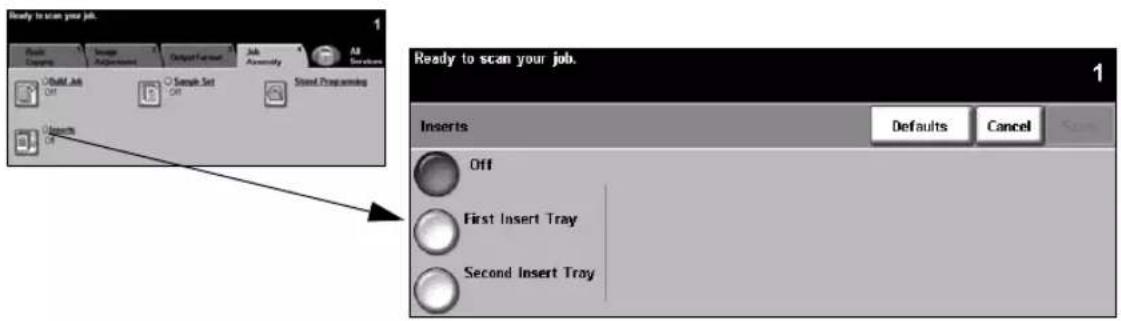
NOTE: This feature is not available with the Auto Paper option, a paper tray must be selected. This feature is also not available with 1-2 or 2-1 copying.
Options:
Off The feature is switched off.
First Insert Tray
Use this option to program all the inserts which require the first stock you have loaded.
Select the First Insert Tray option. Using the up/down arrow keys, enter the page number of the first insert and select Add Insert. The page number displays in the Insert Page as Side window. If a page number is entered incorrectly, use the Delete Last Insert option to remove it from the window. Continue entering page numbers until all the inserts requiring the first stock have been programmed.
Select the paper tray containing the first stock using the Insert Tray option on the right of the screen.
Second Insert Tray

If a second stock is required, use this option to program the inserts requiring a different stock.
Select the Second Insert Tray option. Using the up/down arrow keys, enter the page number of the first insert and select Add Insert. The page number displays in the Insert Page as Side window. If a page number is entered incorrectly, use the Delete Last Insert option to remove it from the window. Continue entering page numbers until all the inserts requiring the second stock have been programmed.
Select the paper tray containing the second stock using the Insert Tray option on the right of the screen.
5 Fax
➢ Fax....5-2
Basic Faxing - Embedded Fax....5-3
➢ Image Adjustment....5-9
➢ Added Fax Features ....5-13
Basic Faxing - Server Fax....5-25
➢ More Fax Features ....5-29
▶ Authentication Mode 5-34
Fax
Fax is an optional feature which may not be available on your machine. There are two types of Fax service - Embedded Fax and Server Fax. Although both Fax services can be installed, only one fax service can be enabled. Your System Administrator will set up the default fax service. This chapter contains information about the options available within both fax services.
NOTE: Embedded Fax is the default service when both fax services are installed.
Embedded Fax
Once enabled on your machine, you will be able to transmit and receive hard copy fax jobs over the telephone network directly to and from another fax machine. Your images are sent from your machine directly to the fax number entered. This type of fax travels over normal telephone lines and will therefore be charged at telephone rates. If the Basic Faxing screen looks like the one shown below, with the Superfine option shown, then Embedded Fax is enabled.
NOTE: An optional 2 line fax kit with more memory is available to replace the single line fax if required.
For information about the Embedded Fax options available please refer to page 5-3.
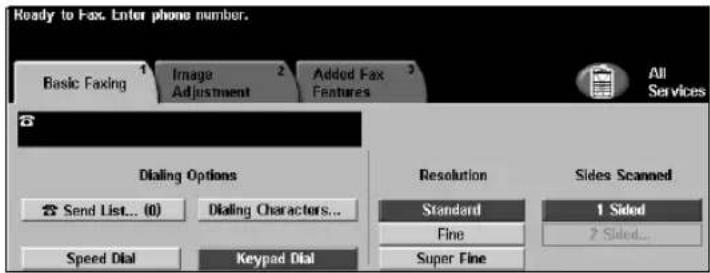
Server Fax
Available only on the WorkCentre Pro configuration. Once enabled on your machine, you will be able to transmit and receive hard copy faxes without a dedicated telephone line on the machine. Your images are sent from your machine to a Third Party fax server which forwards them on to the fax number you entered. This type of fax travels over normal telephone lines and will therefore be charged at telephone rates. If the Basic Faxing screen looks like the one shown below then Server Fax is enabled.
For more information about the Server Fax options available please refer to page 5-25.
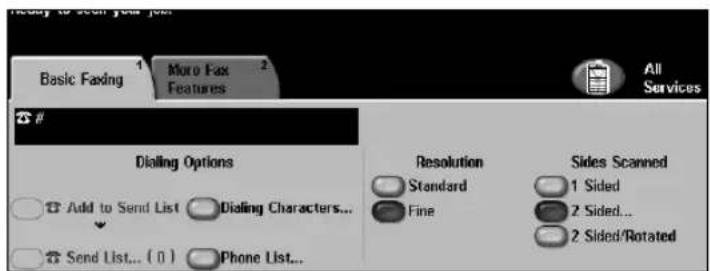
Basic Faxing - Embedded Fax
The Basic Faxing tab is the default Embedded Fax screen. Use the options available on this screen to enter the recipient telephone number and to select the standard features for your fax job.
Access to the Basic Faxing features is gained using the Features button on the control panel.
Depending on the options enabled and how your machine has been configured, you may have to select All Services in the top right-hand corner first.
The tabs available for selecting Fax features are:
Basic Faxing
Image Adjustment
➢ Added Fax Features

HINT: If the 'More Fax Features' tab is displaying, this can be selected to display all the Fax feature tabs available.
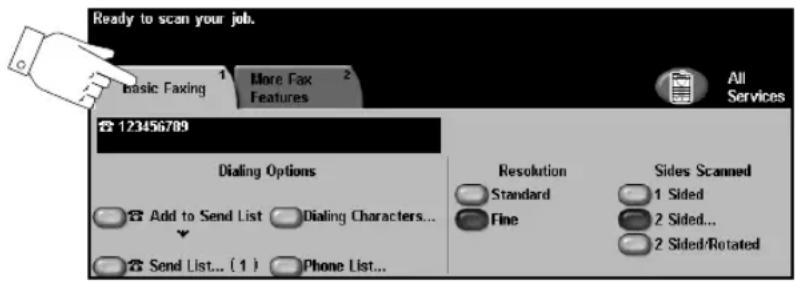
Touch any of the top level buttons to select a feature. Multiple options can be selected for each fax job if required.
Most feature screens include three buttons to confirm or cancel your choices.
The Undo button resets the current screen to the default values that were displayed when the screen was opened.
The Cancel button resets the screen and returns to the previous screen.
The Save button saves the selections made and returns to the previous screen.
Dialing Options
Use the Dialing Options to enter the destination fax number or numbers for the fax job. Individual fax numbers can be entered using the keypad, using the Speed Dial function or selected from the Directory.
The Directory is a listing of Individual or Group numbers which have been previously setup and stored. The Directory is accessible when the Send List option is selected. Individual numbers can also be accessed from the Directory using the Speed Dial function.
To send a fax to multiple destinations, the Send List option is used. Destination numbers for the fax can be added to the Current Send List using any of the dialing methods available.
Special dialing characters can also be added to your fax number using the Dialing Characters option.
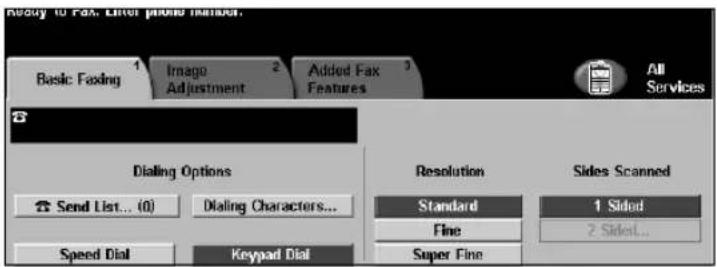
Options:
Keypad Dial There are many ways to enter a fax number, but the simplest method is to manually enter the number using the numeric Keypad. The number entered appears in the fax window. If a pause is required, press the Dial Pause // button on the Control Panel. If an incorrect entry is made, use the C button to delete the number and then enter the correct number.
Use the Keypad Dial option to return to using the Keypad to enter fax numbers after using alternative methods.
Speed Dial Speed Dial numbers are automatically created when a fax number is stored in the Individual Directory. Using the Speed Dial number saves time typing the complete fax destination number. To use Speed Dial, select the Speed Dial option and enter the 3 digit Speed Dial number required.
To find out the Speed Dial number for an entry in the Individual Directory, select the Send List option and scroll through the Individual Directory to view the numbers assigned.
Send List The Send List is used when the fax is being sent to multiple destinations. Fax numbers can be entered into the Send List manually using the keypad, using Speed Dial or by using the Directory.
The Directory stores and displays the fax recipient details. Information includes the recipient's name, fax number and transmission preferences, for example the resolution and communication mode. Individual and Group entries are stored in the Directory.
The Group Directory allows a combination of specific individual names and numbers to be stored within a group. Group members must first be programmed into the Individual Directory and then added to a Group. When sending a fax to a Group, simply enter the group number assigned or select the Group from the directory, and each individual within the Group will receive the document.

HINT: When Individual Directory numbers are deleted from the Directory they will also be deleted from any Groups they have been assigned to.
The Current Send List displays a list of all the recipients for the fax. The list holds up to 20 or 100 entries, depending on the memory installed.
Speed Dial number saves time typing the complete fax destination number.
Dialing Dialing characters are special characters used for entering fax numbers. They are Characters entered as part of the telephone number:
| BEGIN DTMF [*] | Starts a sequence of DTMF (Dual Tone Multi-frequency) characters. |
| END DTMF [#] | Ends a sequence of DTMF (Dual Tone Multi-frequency) characters. |
| WAIT FOR DIAL TONE [=] | Suspends dialing until an expected network dial tone is detected. Can also be used to detect a specific tone when accessing an outside line or other services. |
| PULSE TO TONE SWITCH [:] | Used to switch from pulse dialing to DTMF (tone or one-touch) dialing. After switching from pulse to tone, you cannot switch back to the original mode during the fax procedure. |
| READABILITY DIGITS [( )] | Identifies the different components of the fax number, for example the dialing code (1234) 56789. |
| START MAILBOX SIGNALLING [!] | Pauses regular fax dialing and starts DTMF (Dual Tone Multi-frequency) procedure for the fax mailbox. |
| PAUSE [,] | Gives the machine time to switch from an inside line to an outside line during automatic dialing. For additional pause time, add multiple pauses. For charge code numbers, enter a pause after the fax number but before the charge code number. |
| PRIVATE DATA DELIMITER [/] | Protects confidential information, For example, if a special charge code or credit card number is required for a call. The / character should be selected before and after entering confidential numbers. The numbers and characters entered between this character will appear as asterisks (*). |
| LINE SELECTION IDENTIFIER [<1>] | Used to select Line 1 to dial the number. Selecting this character temporarily overwrites the fax settings and is for the current job only. |
| LINE SELECTION IDENTIFIER [<2>] | Used to select Line 2 (if installed) to dial the number. If a second line is not installed then this option will not be available. Selecting this character temporarily overwrites the fax settings and is for the current job only. |
Chain Dialing This feature allows users to create a single fax recipient by adding two or more fax numbers together. For example, an area code may be stored separately to the telephone number, Chain Dialing combines these entries into a single fax number. Chain Dialing is accessed from the Send List.
Resolution
The Resolution affects the appearance of the fax at the receiving fax terminal. A higher resolution produces better quality for photos. However, a lower resolution reduces communication time.
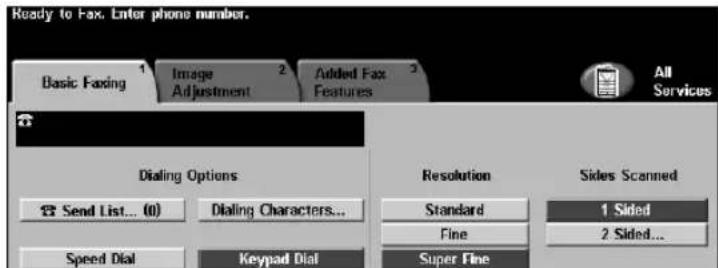
Options:
Standard 200 x 100 dpi - Recommended for text documents. It requires less communication time, but does not produce the best image quality for graphics and photos.
Fine 200 x 200 dpi - Recommended for line art and photos. This is the default resolution and the best choice in most cases.
SuperFine 600 x 600 dpi - Recommended for photos and halftones, or images that have gray tones. It requires more communication time, but produces the best image quality.
NOTE: Manufacturer's definitions of Superfine may vary.
Sides Scanned
This is used to specify whether the originals are single-sided or double-sided. For 2-sided originals the orientation can also be programmed.
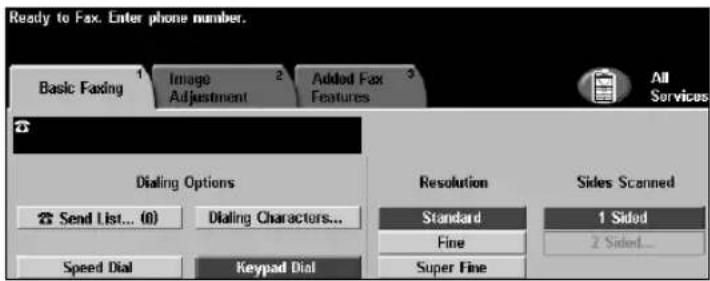
Options:
1 Sided Use this option for originals that are printed on one side only.
2 Sided Use this option for originals that are printed on both sides.
Image Adjustment
The Image Adjustment tab provides further features that can be applied to your fax job.
NOTE: If the 'More Fax Features' tab is displaying, this must be selected to access the Image Adjustment tab.
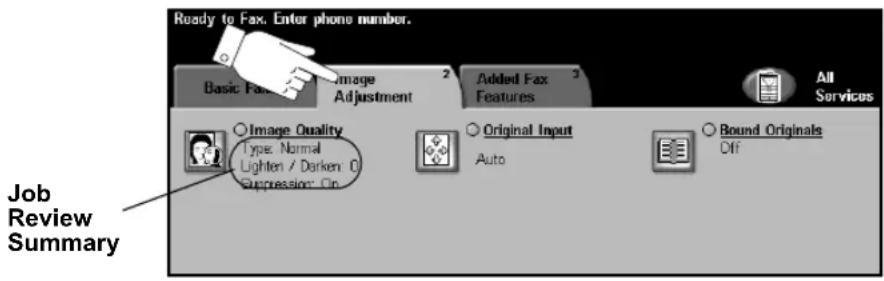
Touch any of the top level buttons to select a feature. To view all the options for a feature, select the feature required. Multiple options can be selected for each fax job if required.
The text next to the feature button, called a Job Review Summary, reflects the current settings for that feature. A checked box indicates that this feature has been modified from its initial default settings.
Most feature screens include three buttons to confirm or cancel your choices.
The Undo button resets the current screen to the default values that were displayed when the screen was opened.
The Cancel button resets the screen and returns to the previous screen.
The Save button saves the selections made and returns to the previous screen.
Image Quality
Use this feature to enhance the quality of the outgoing fax.
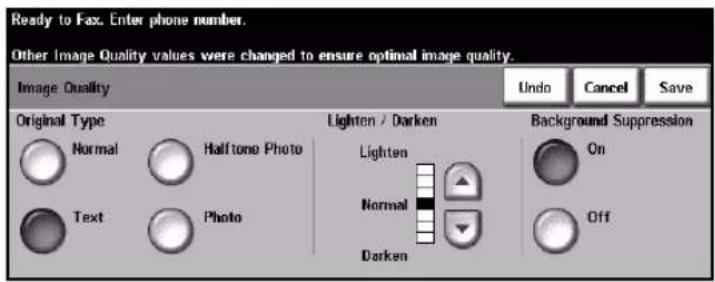
Options:
Original Type

Use this option to enhance the quality of the fax based on the type of original being scanned.
Original Type options are as follows:
| NORMAL | This is the standard setting and can be used for most originals. |
| TEXT | Use for originals containing text or line art. |
| HALFTONE PHOTO | Use for high quality lithographic images or continuous tone photos with text and/or graphics. |
| PHOTO | Use for continuous tone photographs or high quality printed half-tone originals. |
Lighten / Darken Adjusts the lightness or darkness of the fax. To darken the fax, select the down scroll button. To lighten the fax, select the up scroll button.
Background Suppression
Use to automatically reduce or eliminate the dark background resulting from scanning colored paper or newspaper originals.

NOTE: Background Suppression is disabled if the Original Type is Photo.
Original Input
This feature enables users to specify the size of the original document when scanning from the Document Glass or Document Handler. The machine uses this information to calculate the size of your original and the scanned image.
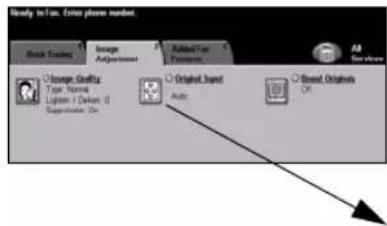
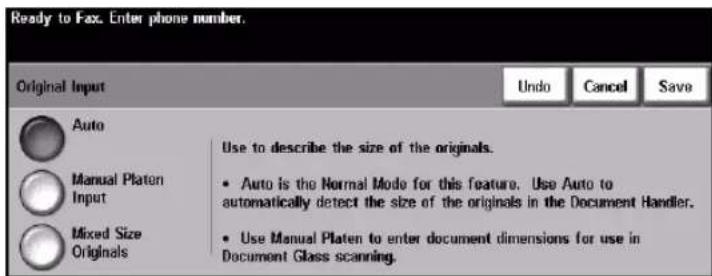
Options:
Auto
This is the default option. Auto automatically detects the size of the originals in the Document Handler.
Manual Platen Input
Use this option to specify the dimensions of the document scanning region when scanning from the Document Glass. There are several pre-set dimensions that correspond to common document sizes and orientations.

Mixed Size Originals+
Use this feature to scan a document containing mixed size originals. The originals must be the same width, for example 8.5x11inch long edge feed and 11x17inch short edge feed. Load documents in the Document Handler when using this feature.

Bound Originals
Use this option to program which page or pages of a bound document are to be scanned and faxed.
The bound original is placed face down on the Document Glass with the spine of the book lined up with the marker on the rear edge of the glass. Align the top of the bound original against the rear edge of the document glass. Do not close the document handler during the faxing process.

HINT: If necessary, apply a little pressure to the centre of the book to flatten it during scanning.
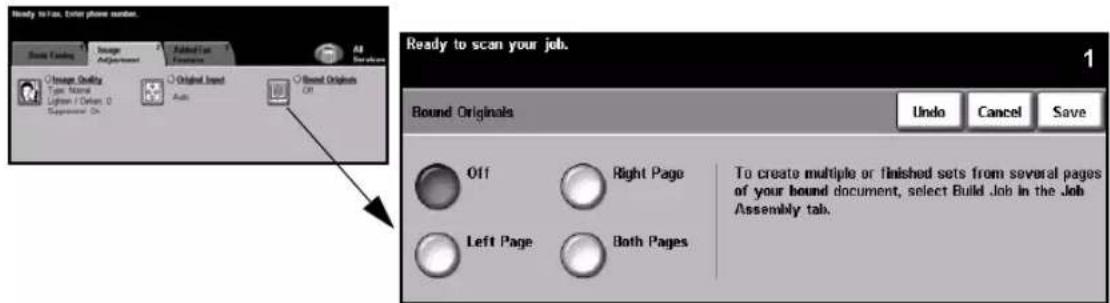
Options:
Off The feature is switched off.
Right Page Faxes only the page on the right when looking at the open book, face up.

Left Page Faxes only the page on the left when looking at the open book, face up.

Both Pages Faxes both pages of an open book, in left to right order when looking at the open book face up. Each page is placed on a separate sheet of paper.
Binding Erase Erases a specified area from the centre of the book to eliminate unwanted marks caused by scanning the binding area. Up to 1.0 inch can be erased.
Added Fax Features
The Added Fax Features tab provides further fax features which can be used when transmitting faxes.
NOTE: If the 'More Fax Features' tab is displaying, this must be selected to access the Added Fax Features tab.
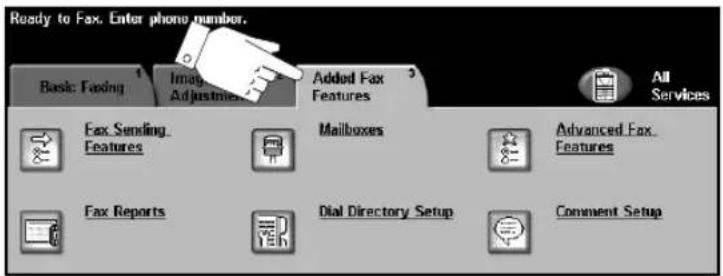
Touch any of the top level buttons to select a feature. To view all the options for a feature, select the feature required. Multiple options can be selected for each fax job if required.
Most feature screens include three buttons to confirm or cancel your choices.
The Undo button resets the current screen to the default values that were displayed when the screen was opened.
The Cancel button resets the screen and returns to the previous screen.
The Save button saves the selections made and returns to the previous screen.
Fax Sending Features
Select this feature to access the options which enable you to apply additional transmission features to your fax job.
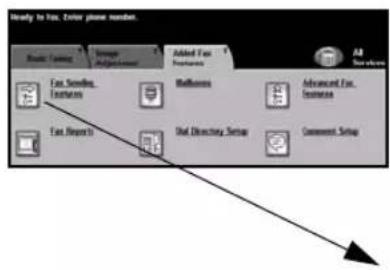
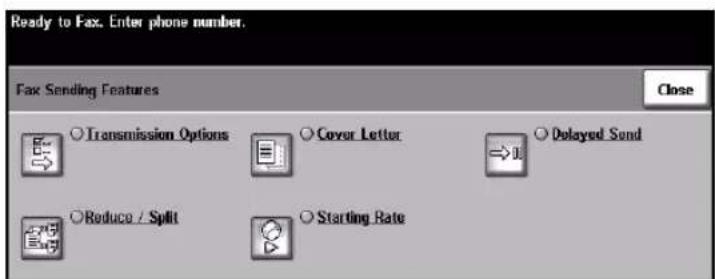
Transmission Options
Allows transmission information to be included with your fax job.
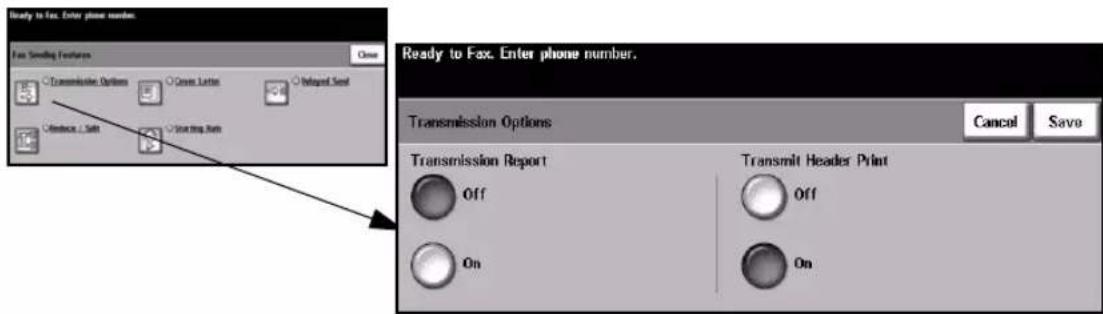
Options:
Transmission Report
This report contains details about the fax together with a reduced copy of the image from the first page. When sending a fax to multiple recipients, a Transmission Report will be printed listing all of the recipients.
Transmit Header Print

Prints partial or full details of the transmission in the header of each page of your fax job.
Partial header details include:
- the sending fax machine's telephone number
• the date and time the fax was sent - the page number.
Full header details include:
- the sending fax machine's telephone number and name
• the date and time the fax was sent - the page number.
NOTE: The machine telephone number and name are set up when Embedded Fax is installed. The time is displayed as a 12 or 24 hour clock, depending on the system settings.
Reduce/Split
Use this option to choose how your faxed document is printed if your document paper size is larger than the receiving machines capability.
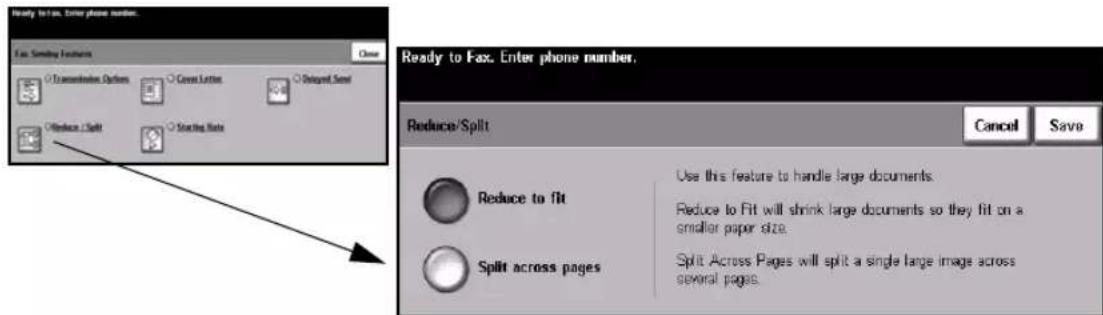
Options:
Reduce to fit Reduces the faxed document to fit the paper size of the receiving fax machine.

Split across pages

If this option is selected the receiving fax machine will either split the faxed document into two equal parts, or print the majority of the image on to one page and the remainder on the next page.
NOTE: This option cannot be used with the Standard Resolution setting. Due to print margins, some of the image may be lost around the edges when using the Split feature.
Cover Letter
Use this option to add a cover letter to your fax job. Users can add text in the 'To', 'From' and 'Comment' fields.
NOTE: The Cover Letter title is added automatically.
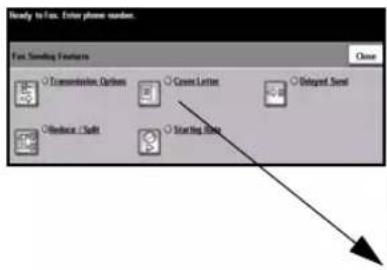
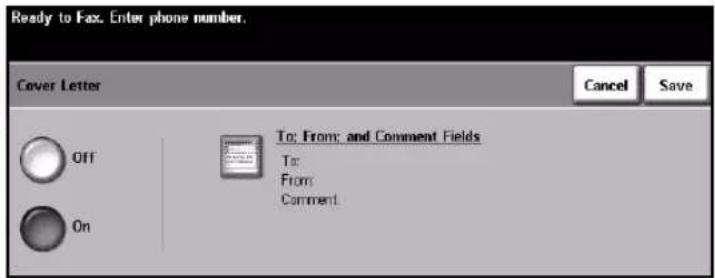
Options:
To: Displays the recipient's fax number or name. Select the keyboard button to amend the recipient's name.
From: Displays the sending machines local name. Select the keyboard button to amend the sender's name.
Comment: Use the up/down buttons to move through the list. The selected Comment will be displayed in the Comment area on the Cover Letter. Selecting No Comment will leave the Comment text region blank.

HINT: Only one Comment can be selected at a time.
NOTE: For more information about setting up a Comment please refer to page 5-21.
Starting Rate
Use this option to set the transmission speed of your fax job.
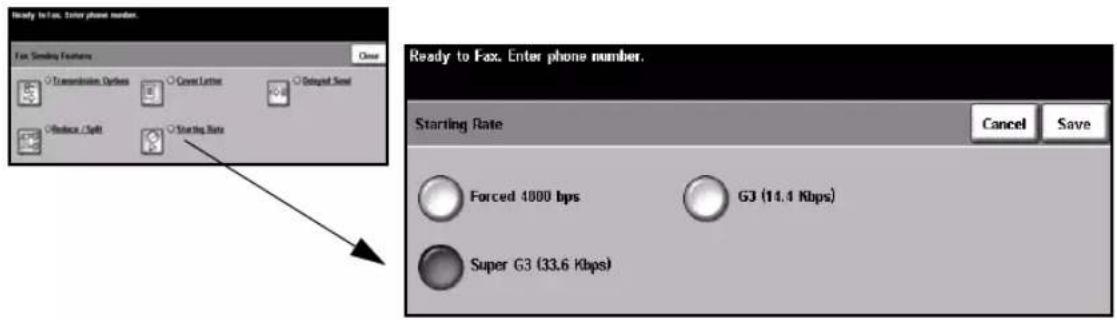
Options:
Forced 4800 bps

Used in areas of low quality communication, when experiencing telephone noise or when fax communications are susceptible to errors.
Super G3 (33.6 Kbps

Determines the communication mode to be used based on the maximum capabilities of the remote machine. The initial transmission speed will be 33,600 Bits per second.
G3 (14.4 Kbps)
Selects the communications mode based on the maximum capabilities of the remote machine. The initial transmission speed will be 14,400 Bits per second.
Delayed Send
Use Delayed Send to specify a time at which to send a fax. The time can be set between 15 minutes and 23 hours 59 minutes. This feature is very useful when transmitting faxes during off-peak hours or when sending to another country or time zone.
A 12 or 24 hour clock can be set. If the 12 hour clock is set, you must also select either the AM or PM button.
NOTE: Batch Send is a feature, which is set up by your System Administrator. It allows multiple fax jobs to be sent to the same destination during the same transmission session. If sending a fax job that has the same destination as a job already held as a Delayed Send job, a pop-up window will be displayed on the touch screen asking you whether to send your fax now or add it to the job being sent at a later time. Select the option required to complete your job.
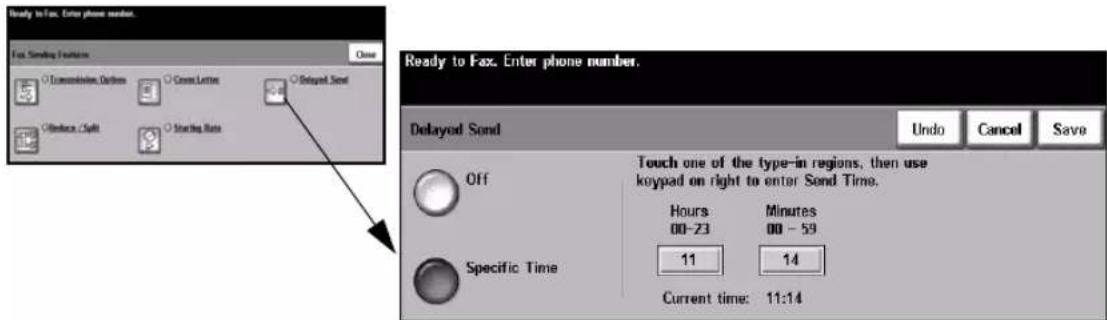
Options:
Off The feature is switched off.

Specific Time Enables users to enter the actual time the fax is to be sent.
Fax Reports
This feature enables you to obtain hard copy information about the status of the fax feature on your machine.
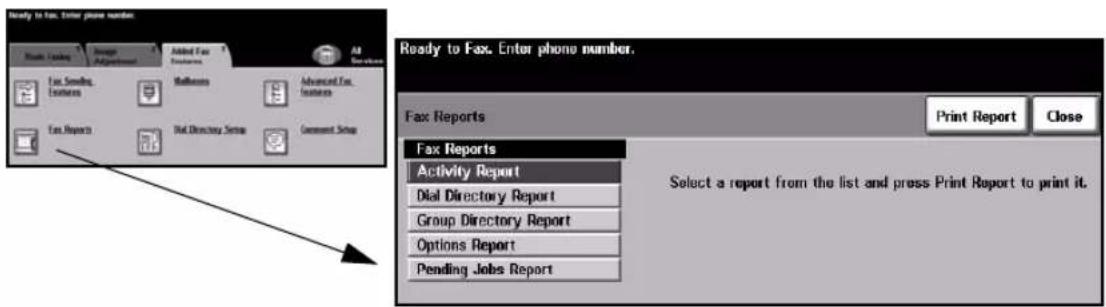
Options:
Fax Reports options are as follows:
| ACTIVITY REPORT | Displays the last 50 fax activities completed on the machine. |
| DIAL DIRECTORY REPORT | Lists all the numbers stored in the Dial Directory. |
| GROUP DIRECTORY REPORT | Lists all the numbers stored within each group within the Group Directory. |
| OPTIONS REPORT | Provides the machine configuration, firmware level and options. |
| PENDING JOBS REPORT | Displays the fax jobs in the machine’s memory waiting to be sent or printed. This report also gives a percentage of available memory on the machine. |
Mailboxes
Enabled by your System Administrator, this option allows you to store documents in a mailbox. The mailbox can be located on the same machine you are using (local mailbox), or sent to a mailbox on a remote machine (remote mailbox). Documents held within the mailbox are recognized as stored for polling, printing or deleting by the user. To access a mailbox you must enter the 3 digit mailbox number and 4 digit mailbox passcode. Please contact your System Administrator for further assistance.
NOTE: The storage time for faxes is set up by your System Administrator.
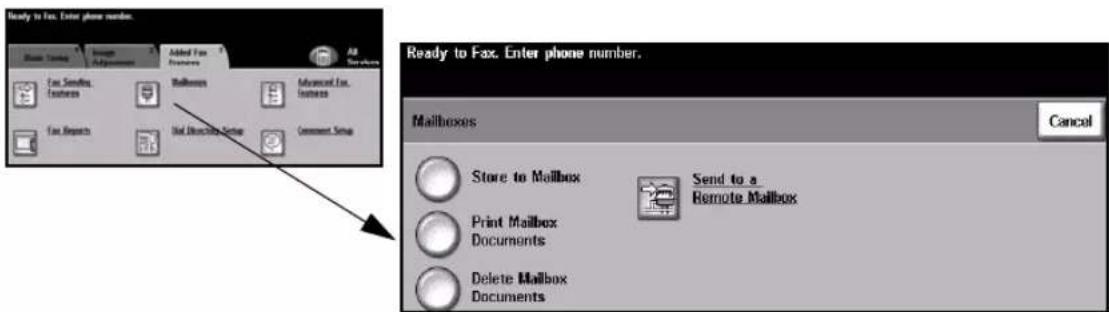
Options:
Store to Mailbox

Allows users to scan and store fax documents for polling. Documents are stored in your mailbox and automatically sent to a remote fax machine when requested.
Print Mailbox Documents

Allows you to print a hard copy of the documents stored in a mailbox.
Delete Mailbox Documents
Allows you to delete all the documents stored within a mailbox.
NOTE: If the Delete Mailbox Documents or Print Mailbox Documents button is selected then both received and stored documents within the selected mailbox will be printed or deleted.
Send to a Remote Mailbox

Allows you to send a fax document directly to an individual's private mailbox on a remote machine.
NOTE: This feature will only be available when the remote machine has mailbox capability and when the user sending the document knows the mailbox number of the recipient.
Comment Setup
This feature allows you to create, modify or delete comments that you want to appear on the fax Cover Letter. Up to 10 comments can be stored on the machine. To add or modify a comment select a numbered comment box from the comment list and select Edit. Using the keyboard enter the comment you wish to store or modify the existing comment. A maximum of 30 characters can be entered. To delete a comment, select the comment box from the list and select Delete.
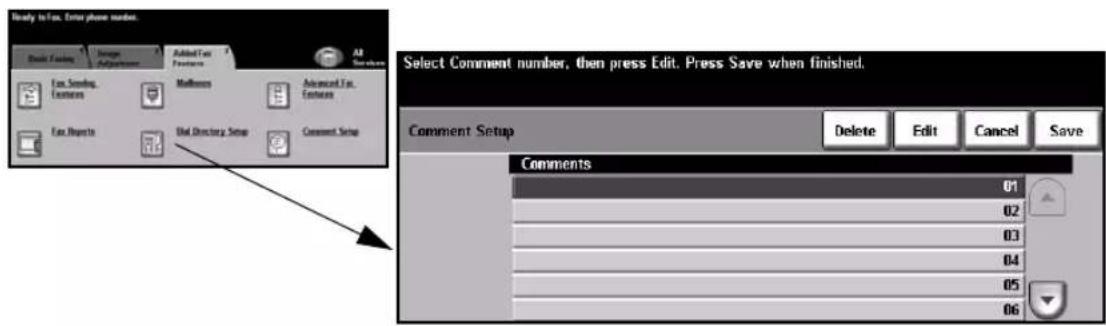
Advanced Fax Features
Offers advanced features which enable you to transmit large, complex jobs; scan and store fax jobs for retrieval by another fax machine, or poll another fax machine.
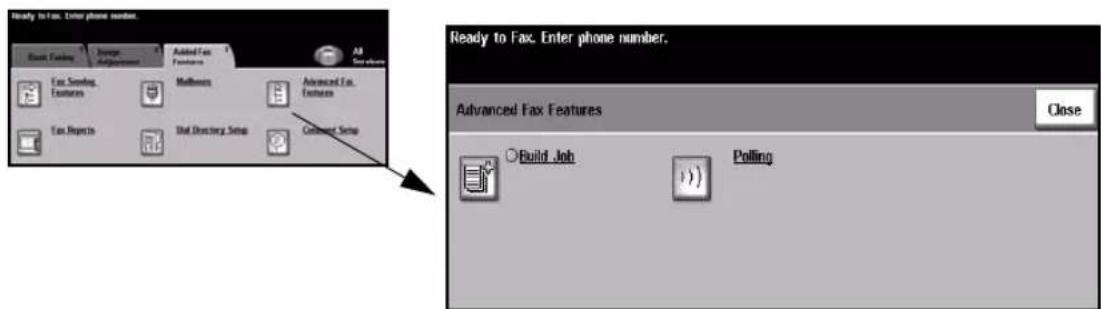
Build Job
Use this feature to build a job that requires different settings for each page. For example, if a set of documents consists of some pages with text and some with photos, the appropriate setting for each original can be applied and the job can still be completed as a single job. This feature is also useful if your fax job has more than 70 pages, which exceeds the maximum capacity of the Document Handler.
To use Build Job, split the job into programming and scanning segments. Select the Build Job option and select On. Program and scan the first segment. Continue to program and load segments until the whole job has been scanned. When the entire job has been scanned, select Build Job Controls and select End Build Job. The job is processed and transmitted as a single job.
NOTE: The destination fax number must be entered prior to using Build Job.
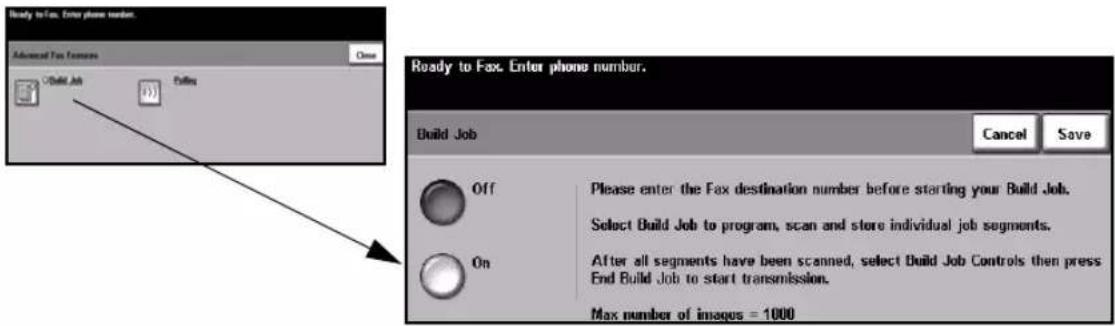
Options:
Off The feature is switched off.

On Use to enable the Build Job feature.

Build Job Offers options which can be selected when using Build Job.
Controls
Build Job Controls options are as follows:
| END BUILD JOB | Select this option after the last segment of the job has been scanned. The job will be sent to print. |
| DELETE LAST SEGMENT | Use to delete the last segment scanned. |
| DELETE ALL SEGMENTS | Use to delete the current job and return to the main Build Job screen. |
Polling
Polling enables you to store fax documents into the machine's memory for retrieval by another remote fax machine, or poll a remote fax machine or mailbox.
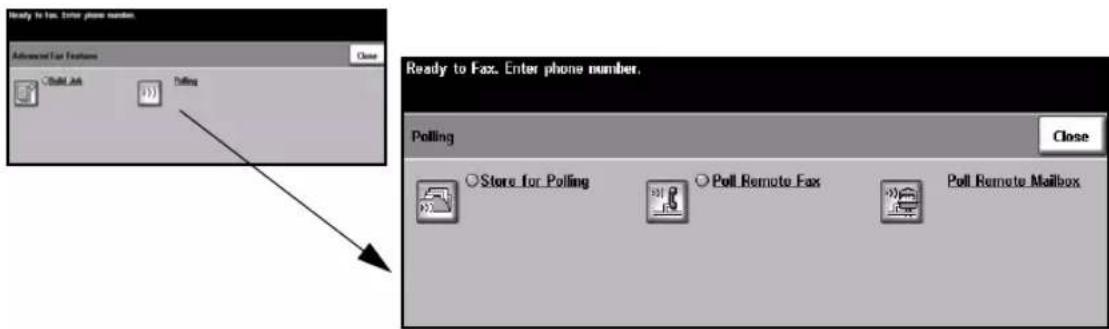
Options:
Store for Polling

This option allows users to scan documents and store them. When remote
machines poll the device, they are able to retrieve the scanned document(s).
Passcodes can be set up to control which machines have access to the documents stored.
Poll Remote Fax

This option allows users to set up their machine to contact a remote fax machine to locate and receive faxes stored by the remote machine.
Poll Remote
Mailbox

This option allows users to set up their machine to contact a remote mailbox which
is set up on a remote fax machine. When contact has been made the remote
machine sends the faxes stored within the mailbox.
Dial Directory Setup
Use this feature to store destination names, fax numbers and transmission settings in your machine. Entries stored here will be available for selection within the Send List feature on the Basic Faxing tab.
Dialing Groups can also be set up, comprising of many individual entries.
HINT: This feature saves time when sending faxes to frequently used destinations.

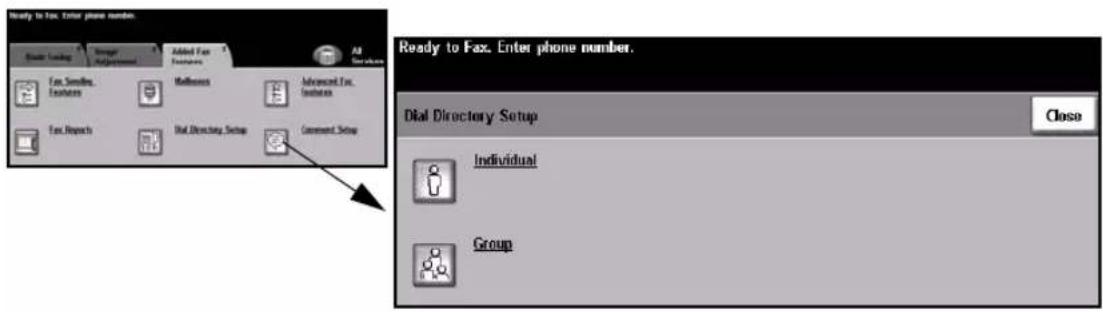
Options:
Individual Use this option to set up individual fax destination names, numbers and settings.

Group
Use this option to set up a group of directory locations under one number. Using a Group Dial Directory means that you only have to enter one group number to send to multiple destinations.

NOTE: A new Group Dial List must be created using those destinations already stored as an Individual Directory or Group Directory list.
The Basic Faxing tab is the default Server Fax screen. Use the options available on this screen to enter the recipient telephone number and to select the standard features for a fax job.
Access to the Basic Faxing features is gained using the Features button on the control panel.
Depending on the options enabled and how your machine has been configured, you may have to select All Services in the top right-hand corner first.
The tabs available for selecting Fax features are:
Basic Faxing
▶ More Fax Features
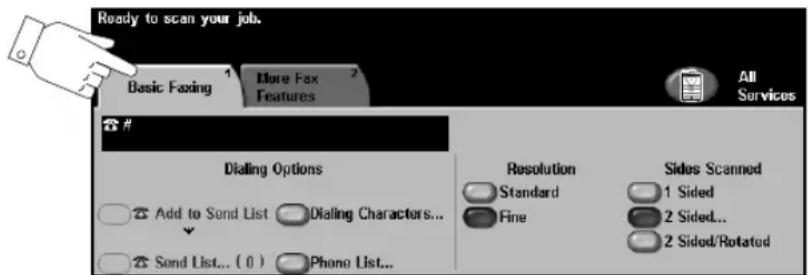
Touch any of the top level buttons to select a feature. Multiple options can be selected for each fax job if required.
Most feature screens include three buttons to confirm or cancel your choices.
The Undo button resets the current screen to the default values that were displayed when the screen was opened.
The Cancel button resets the screen and returns to the previous screen.
The Save button saves the selections made and returns to the previous screen.
Dialing Options
The Dialing Options area contains a window where the telephone number entered is displayed. Once it is displayed, it can be added to a list of destination telephone numbers, a special character can be added, or a list of up to 30 stored telephone numbers can be accessed.
There are two methods of entering a phone number - Manually using the keypad or by selecting a number already stored in the Phone List.
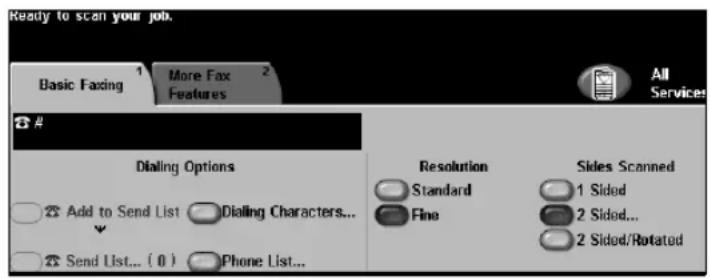
Options:
Add to Send List

Used when you want to send a fax to more than one destination. Enter the number using the keypad or select the Phone List button and select a stored number. Then select the Add to Send List button. Continue to add numbers until all the locations have been entered.
Send List

The Send List is used when the fax is being sent to multiple destinations. The fax job will be sent to every destination displayed in the Send List. Numbers can be entered into the Send List manually using the keypad, or by using the Phone List option. The number of destinations currently in the Send List is shown in brackets on the Send List button.
Select the Send List button to view or delete destination fax numbers.
Dialing Dialing characters are special characters used for entering fax numbers and are Characters entered as part of the telephone number:
| DIAL PAUSE [,] | Allows the machine enough time to switch from an inside line to an outside line. The delay depends on the fax server. |
| LONG PAUSE [I] | This pause is used if a longer period is required to gain a dial tone. |
| GROUP DIAL [\] | Indicates that an identifier for a previously set up group is about to be entered. |
| MASK DATA [/] | Used to hide information on printed reports. Characters entered between two forward slash symbols will appear as asterisks. |
| PASSWORD CHECK SWITCH [S] | Used for remote terminal identification. This character verifies that the correct number has been dialed. |
| PULSE-TO-TONE SWITCH [:] | Use to switch from Pulse dialing to Tone dialing. |
| WAIT FOR NETWORK TONE DETECTION [W] | Use to suspend dialing until an expected network tone is detected. |
| LOCAL ID [+] CHARACTER CHECK [+] | Required as part of some international telephone numbers (in place of 00). |
| LOCAL ID [SPACE] CHARACTER CHECK [] | Used to improve readability. For example, adding spaces to a telephone number as 1 234 5678 instead of 12345678. |
Phone List

The Phone List can store up to 30 fax numbers. Enter the fax number and select Phone List. Select an empty number and then select Enter Number In Phone List, the number will be stored. Fax numbers in the Phone List can be selected to add to the Send List. Entries displayed in the Phone List will not be deleted once a fax job has been completed.
To delete an entry from the Phone List, select the number requiring deletion and select the Delete Phone List Number button. A confirmation message displays.
Resolution
The Resolution affects the appearance of the fax at the receiving fax terminal. A higher resolution yields better quality for photos. A lower resolution reduces communication time.
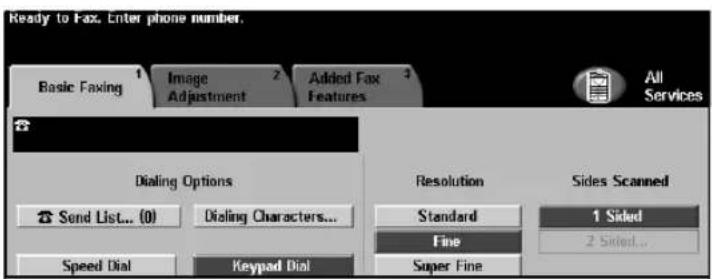
Options:
Standard 200 x 100 dpi - Recommend for text documents. It requires less communication time, but does not produce the best image quality for graphics and photos.
Fine 200 x 200 dpi - Recommended for line art and photos. This is the default resolution and the best choice in most cases.
Sides Scanned
This is used to specify whether the originals are single-sided or double-sided. For 2-sided originals the orientation can also be programmed.
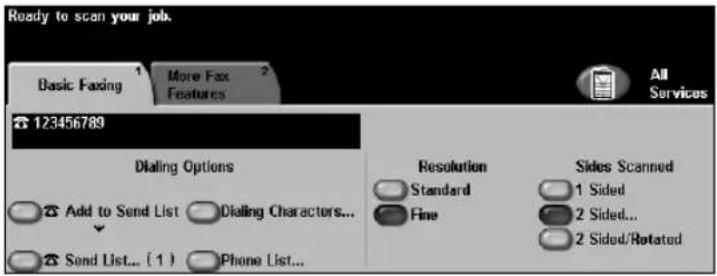
Options:
1 Sided Use this option for originals that are printed on 1 side only.

2 Sided Use this option for originals that are printed on both sides.

2 Sided/ Rotated Use this option for double-sided originals which are in the "head to toe" orientation.

More Fax Features
Fax
The More Fax Features tab provides additional fax features which can be used with your fax job.
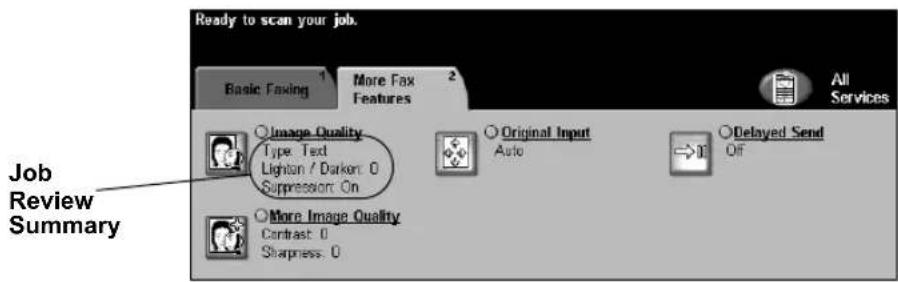
Touch any of the top level buttons to select a feature. To view all the options for a feature, select the feature required. Multiple options can be selected for each fax job if required.
The text next to the feature button, called a Job Review Summary, reflects the current settings for that feature. A checked box indicates that this feature has been modified from its initial default settings.
Most feature screens include three buttons to confirm or cancel your choices.
The Undo button resets the current screen to the default values that were displayed when the screen was opened.
The Cancel button resets the screen and returns to the previous screen.
The Save button saves the selections made and returns to the previous screen.
Image Quality
Use this feature to enhance the quality of the outgoing fax.
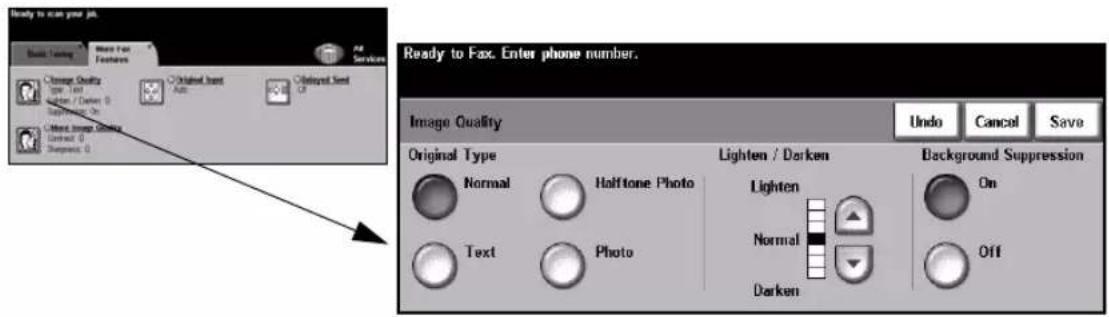
Options:
Original Type

Use this option to enhance the quality of the fax based on the type of original being scanned.
Original Type options are as follows:
| NORMAL | This is the standard setting and can be used for most originals. |
| TEXT | Use for originals containing text or line art. |
| HALFTONE PHOTO | Use for high quality lithographic images or continuous tone photos with text and/or graphics. |
| PHOTO | Use for continuous tone photographs or high quality printed half-tone originals. |
Lighten / Darken
Adjusts the lightness or darkness of the fax. To darken the fax, select the down scroll button. To lighten the fax, select the up scroll button.
Background Suppression
This option automatically reduces or eliminates the dark background resulting from colored paper or newspaper originals.

NOTE: Background Suppression is disabled if the Original Type is Photo.
More Image Quality
Use this feature in addition to the settings selected using the Image Quality option, to further enhance the quality of your output.
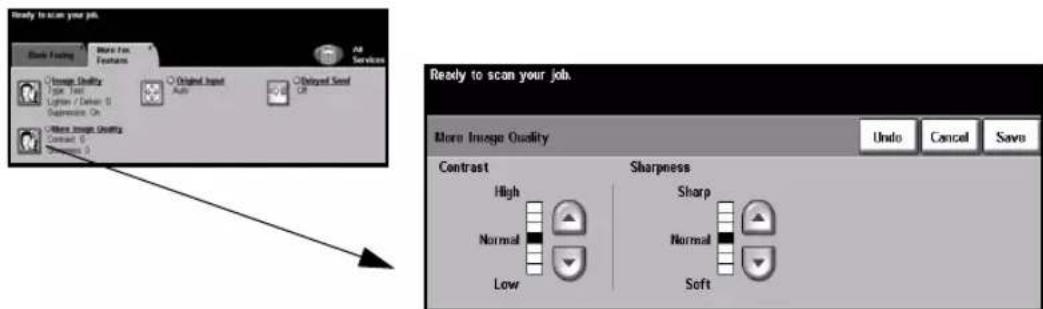
Options:
Contrast Adjusts the difference between the image densities within the scanned image.
Sharpness Increasing sharpness improves the sharpness of text; decreasing sharpness reduces the moiré effect (wavy patterns) which sometimes affects halftone images.
Original Input
Use this option to program the size of the originals being scanned or enable the machine to recognize the size of the originals automatically.
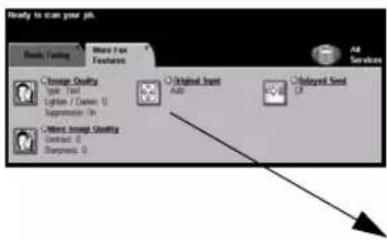
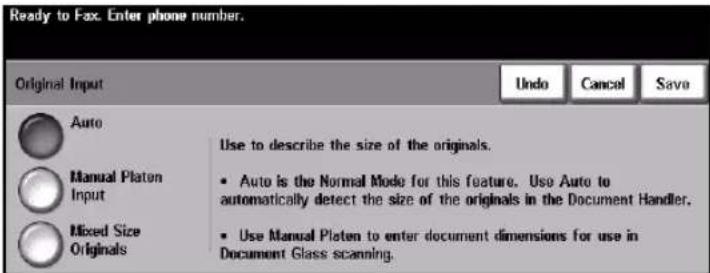
Options:
Auto

Use this option to enable the machine to recognize the size of the originals being fed through the Document Handler.
Manual Platen Input
Use this option to specify the dimensions of the document scanning region when scanning from the document glass. There are several dimensions that correspond to common document sizes and orientations.
Select a standard size or use Custom to manually adjust the scanning dimensions.
Mixed Size Originals

Use this feature to scan a document containing mixed size originals. The originals must be the same width, for example 8.5"x11" long edge feed and 11"x17" short edge feed. Load documents in the Document Handler when using this feature.
Delayed Send
Use Delayed Send to specify a time, within the next 24 hours, at which to send a fax. This feature can be used to transmit faxes during off-peak hours or is useful when sending to another country or time zone. The time to send is added to the job information sent to the fax server with the scanned image. The Third Party Fax Server retains the fax for sending at the specified time.
This feature can be set as a 12 or 24 hour clock. If the 12 hour clock is set, you must also select either the AM or PM button.
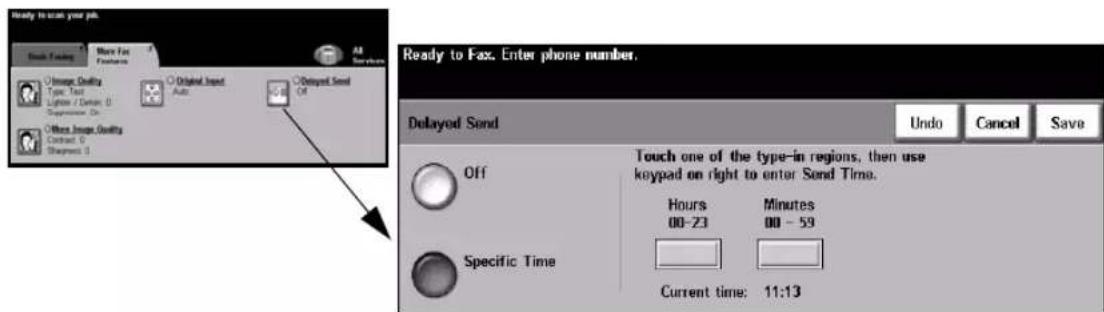
Options:
Off The feature is switched off.

Specific Time Enables users to enter the actual time the fax is to be sent.

Authentication Mode
Authentication is a useful network security management tool - limiting, restricting and monitoring access to the network via the machine. Authentication can be set up by the System Administrator to restrict access to the features within E-mail, Network Scanning, Server Fax and Internet Fax.
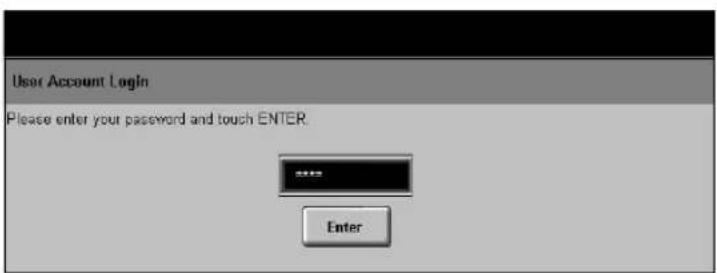
There are two authentication modes available:
Network Authentication Access Requires your network login name and password. If you do not have a network account on the local network you will not be authenticated using this mode. Guest Access Requires a generic passcode that is set up by the System Administrator. You will need to obtain the passcode from the System Administrator. Contact your System Administrator for further assistance.
6 Internet Fax
▶ Internet Fax....6-2
➢ Image Adjustment....6-6
Output Format....6-12
▶ Authentication Mode ...... 6-16
Internet Fax
Internet Fax is an optional feature which is only available on the WorkCentre Pro configuration. This chapter contains information about the options available within Internet Fax.
Internet Fax allows you to send your scanned images as an e-mail attachment to a specified recipient or recipients. This type of fax travels over the internet or intranet. The basic Internet Fax screen allows you to enter the SMTP (Simple Mail Transfer Protocol) e-mail addresses for your fax. You can also use this screen to add and remove recipients and edit the subject line.
NOTE: An SMTP compliant e-mail address format must be used. For example, anyone@anycompany.com.
Access to the Internet Fax features is gained using the Features button on the control panel.
Depending on the options enabled and how your machine has been configured, you may have to select All Services in the top right-hand corner first.
The tabs available for selecting the Internet Fax features are:
Internet Fax
➢ Image Adjustment
Output Format
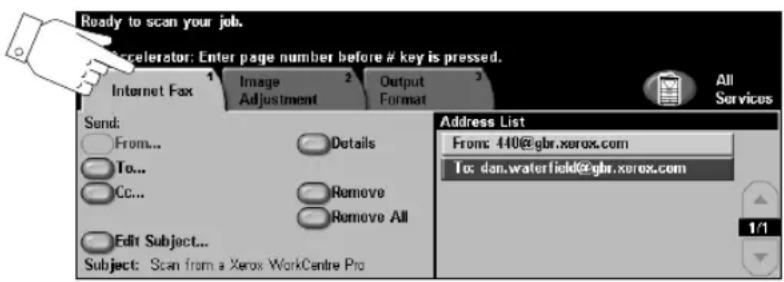
Touch any of the top level buttons to select a feature. Multiple options can be selected for each fax job if required.
Most feature screens include three buttons to confirm or cancel your choices.
The Undo button resets the current screen to the default values that were displayed when the screen was opened.
The Cancel button resets the screen and returns to the previous screen.
The Save button saves the selections made and returns to the previous screen.
Send:
Use the Send options to enter recipient information.
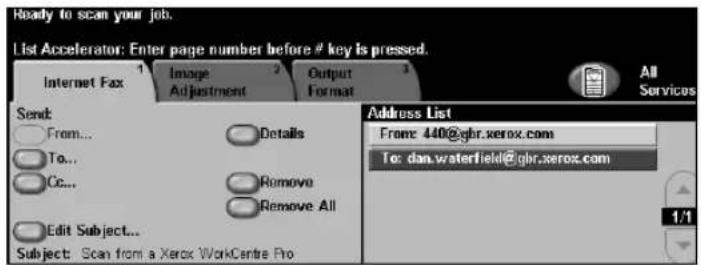
Options:
From This option provides information about the sender and is pre-set by the system or the System Administrator and cannot be changed.
NOTE: If Internet Fax is accessed via Authentication Mode the information contained will be linked with the login name.
To Use this option to enter the e-mail address of the required recipient.
Cc Use this option to enter the e-mail address of the required recipient you wish to be copied on the e-mail job.
Edit Subject Use this option to edit the default e-mail subject. The subject is the title of the e-mail and not the text contained within the e-mail. The subject line can contain up to 248 characters and is displayed on the touch screen under the Edit Subject button.
Details Use this option to view the details of the selected recipient. The information displayed is determined by how the address was originally added to the Address List - from either the Internal or Public Address Book, or entered manually.
Remove Use this option to delete the selected address from the Address List.
Remove All Use this option to delete all the addresses from the Address List. A confirmation pop-up message will be displayed.
Address List Displays all the recipient addresses entered for the current Internet Fax job. Up to 128 recipient's addresses can be entered in the list.
Scroll Buttons Use the Scroll Buttons located to the right of the Address List to move through the list.
Entering an E-mail Address for Internet Fax
E-mail addresses can be entered in one of two ways - manually or via an address book.
NOTE: When entering e-mail details you can change the keypad to show upper or lower case, accented characters or numbers by selecting the appropriate button. Use the Back button to delete the previously entered character.
Manually
If you already know the full SMTP e-mail address of your recipient, or if you know that the recipient is not in any of the configured address books, you can use the keypad on the touch screen to enter an e-mail address in the To... or Cc... fields. Your machine will check that an SMTP address has been entered. If it is not an SMTP address, your machine will search the address book for a matching entry.
The entered e-mail address will be shown in the Address List.
Selecting the details for a manually entered e-mail address will only display the e-mail address, no other details are available.
Address Books
Address books contain a list of e-mail addresses and details that are relevant to your company and/or you. If configured, your machine is able to support two types of e-mail address books - Public and Internal. When an entry is made in To or Cc the Address Book displays search results for one or both configured address books.
Use the keypad on the touch screen to enter the e-mail recipient's name. As with most search facilities you do not need to enter the full name and can search the address book on the first few letters.
When you have entered the required e-mail search criteria select the Enter button. If there are no matching entries select the Change Address Book button to search the other address book.
NOTE: The Change Address Book button will only be displayed if both the address books have been configured.
If one or more matches are found based on the search criteria, the matches are displayed on the touch screen. Use the up and down scroll bars to locate the required recipient. Highlight the recipient in the list and select the Add button. Continue this process until you have added all the required recipients and on completion select Done. The entered e-mail address will be shown in the Address List.
Address Book Types
If configured there are two different types of address book on your machine, Public and Internal.
Public Address Book
The Public Address Book stores external company addresses on the machine. The address book contains a list of user names and their e-mail addresses.
The file must be a CSV (Comma Separated Value) format for your machine to be able to read the file contents. The completed file is imported to the machine via CentreWare Internet Services. Your machine will not allow the import of a Public Address Book file that does not end with the .CSV file extension.
A valid CSV file is in the format: Name, SMTP e-mail address. For example the following are both valid CSV format file entries:
Smith, smith@company.com
"Smith, John", john.smith@company.com
The order in which the entries are sorted in the CSV file determines the order displayed in the Public Address Book at your machine.
Internal Address Book
Otherwise known as the LDAP (Lightweight Directory Access Protocol), the Internal Address Book stores internal company addresses on the company network. The System Administrator creates the Internal Address Book.
The display of the search results is defined by the LDAP. For example, the LDAP server can return a search query "And" as "Andrew Smith" when the result "Andrews, James" may have been expected. The lastname, firstname or firstname, lastname display is controlled by the LDAP server and not your machine.
If you have successfully logged in via Authentication mode, your machine will automatically attempt to match your login name to your e-mail address. Your name will then be entered into the From e-mail address field. You will not be able to change this.
Image Adjustment
The Image Adjustment tab is used to temporarily program features to enhance the appearance and style of the scanned Internet Fax image.
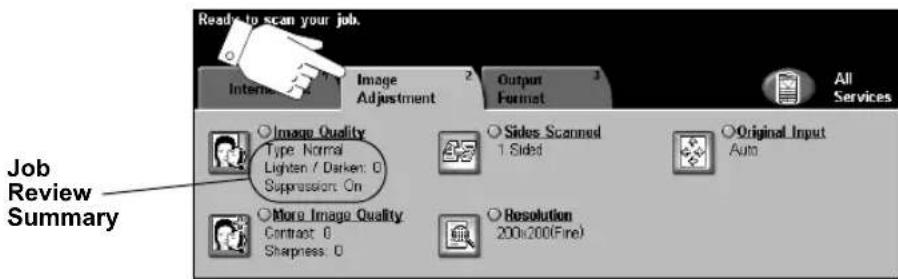
Touch any of the top level buttons to select a feature. To view all the options for a feature, select the feature required. Multiple options can be selected for each fax job if required.
The text next to the feature button, called a Job Review Summary, reflects the current settings for that feature. A checked box indicates that this feature has been modified from its initial default settings.
Most feature screens include three buttons to confirm or cancel your choices.
The Undo button resets the current screen to the default values that were displayed when the screen was opened.
The Cancel button resets the screen and returns to the previous screen.
The Save button saves the selections made and returns to the previous screen.
Image Quality
Use this feature to enhance the quality of your scanned originals.
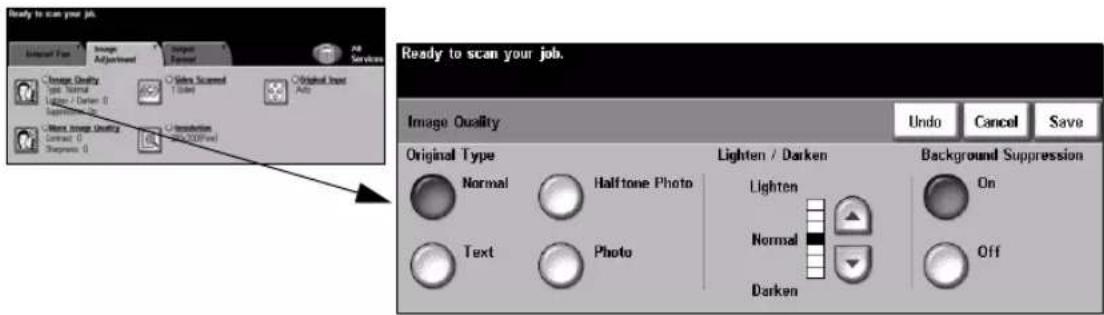
Options:
Original Type

Use this option to enhance the quality of the output based on the type of original being scanned.
Original Type options are as follows:
| NORMAL | This is the standard setting and can be used for most originals. |
| TEXT | Use for originals containing text or line art. |
| HALFTONE PHOTO | Use for high quality lithographic images or continuous tone photos with text and/or graphics. |
| PHOTO | Use for continuous tone photographs or high quality printed half-tone originals. |
Lighten / Darken
This option provides controls to adjust the lightness or darkness of the output. To darken the output, press the down scroll button. To lighten the output, press the up scroll button.
Background Suppression
This option automatically reduces or eliminates the dark background resulting from colored paper or newspaper originals.

NOTE: Background Suppression is disabled if the Original Type is Photo.
More Image Quality
Use this feature in addition to the settings selected using the Image Quality option, to further enhance the quality of your output.
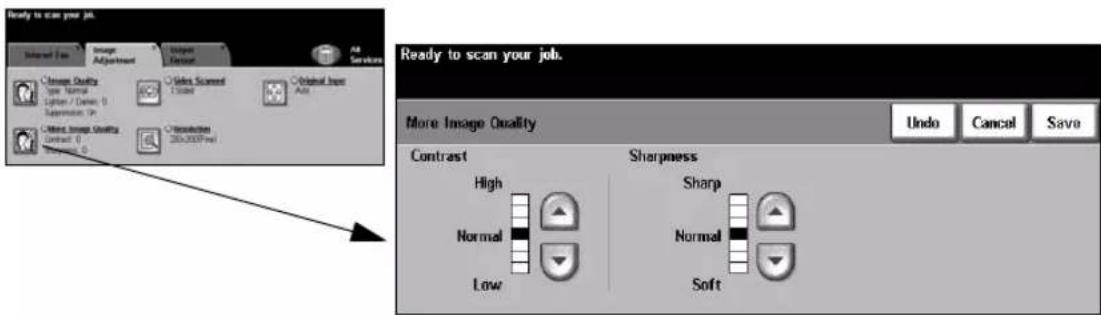
Options:
Contrast This option controls the differences between the image densities within the output. Select a lower setting to improve the image quality of pictures. Select a higher setting to produce more vivid blacks and whites for sharper text and lines.
Sharpness This option controls the balance between sharp text and moiré (wavy patterns within the image). Use the scroll buttons to adjust the sharpness values from sharper to softer, based on the quality of the input images.
Sides Scanned
This feature is used to specify whether the originals are single-sided or double-sided. For 2-sided originals the orientation can also be programmed.
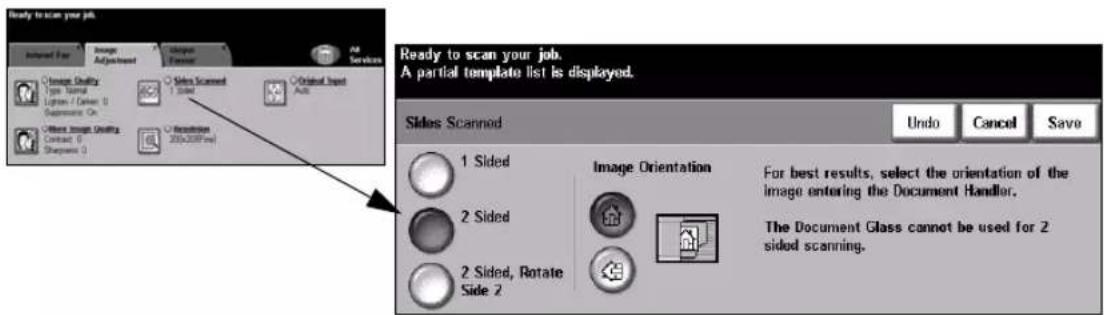
Options:
1 Sided Use this option for originals that are printed on 1 side only.
2 Sided Use this option for originals that are printed on both sides.
2 Sided, Rotate Use this option for originals that are printed on both sides and the second side has been rotated. For example, if you are scanning a calendar which uses a "head to toe" format.

Resolution
Resolution affects the appearance of the scanned image. The higher the scanning resolution the better the image quality.
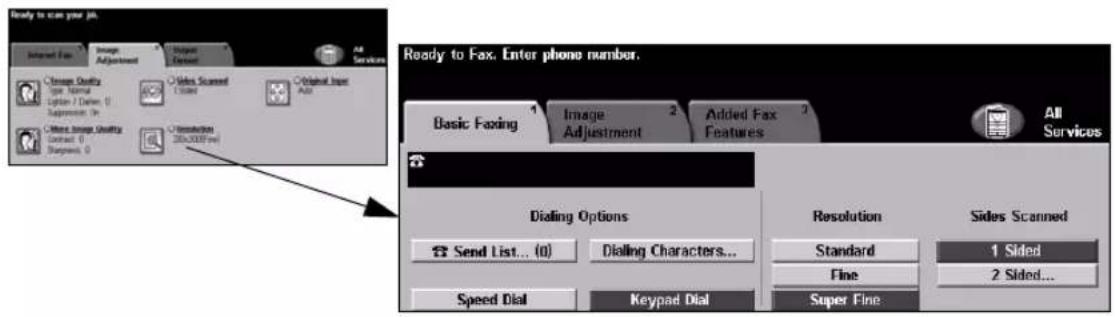
Options:
200x100 Produces the smallest image file size and is only recommended for use with simple (Standard) text documents.
NOTE: 200x100 is disabled if the Document Format is PDF.
200x200 (Fine) Recommended for use with average quality text documents and line art. Does not produce the best image quality for photos and graphics.

300x300 Recommended for use with high quality text documents that are destined to pass through Optical Character Recognition (OCR) applications. Also recommended for high quality line art or medium quality photos and graphics.
400x400 (Non-standard) Recommended for average quality photos and graphics. It produces a smaller file size than the 600 x 600 resolution.
600x600 (Non-Recommended for use with high quality photos and graphics. It produces the Standard) largest image file size, but delivers the best image quality.

Original Input
Use this option to program the size of the originals being scanned or program the machine to determine the size of the originals automatically.
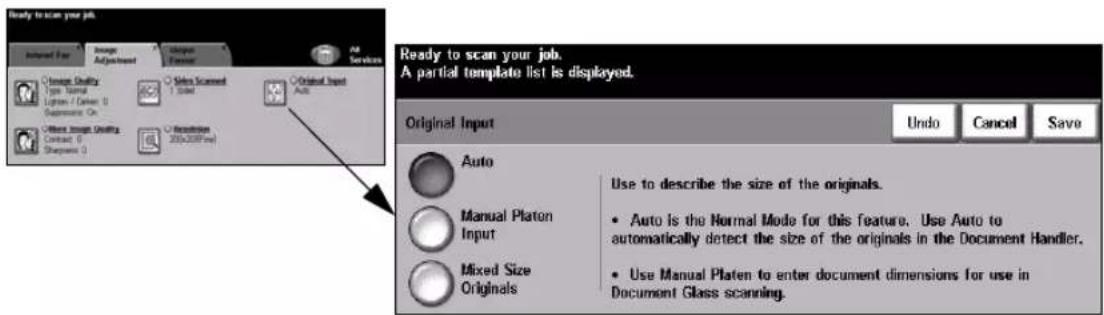
Options:
Auto
Use this option to allow the machine to automatically determine the size of the originals being fed through the document handler.

Manual Platen Input
Use this option to specify the dimensions of the document scanning region when scanning from the document glass. There are several dimensions that correspond to common document sizes and orientations.

Select a standard size or use Custom to manually adjust the scanning dimensions.
Mixed Size Originals
Use this feature to scan a document containing mixed size originals. The originals must be the same width, for example 8.5x11inch long edge feed and 11x17inch short edge feed. Load documents in the Document Handler when using this feature.

Output Format
Use this feature to temporarily change the settings required for the scanned image.
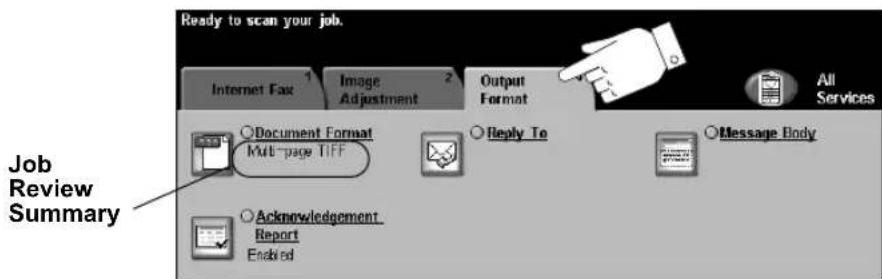
Touch any of the top level buttons to select a feature. To view all the options for a feature, select the feature required. Multiple options can be selected for each fax job if required.
The text next to the feature button, called a Job Review Summary, reflects the current settings for that feature. A checked box indicates that this feature has been modified from its initial default settings.
Most feature screens include three buttons to confirm or cancel your choices.
The Undo button resets the current screen to the default values that were displayed when the screen was opened.
The Cancel button resets the screen and returns to the previous screen.
The Save button saves the selections made and returns to the previous screen.
Document Format
Use the Document Format option when your job is to be sent with a different file format than that set as the default.
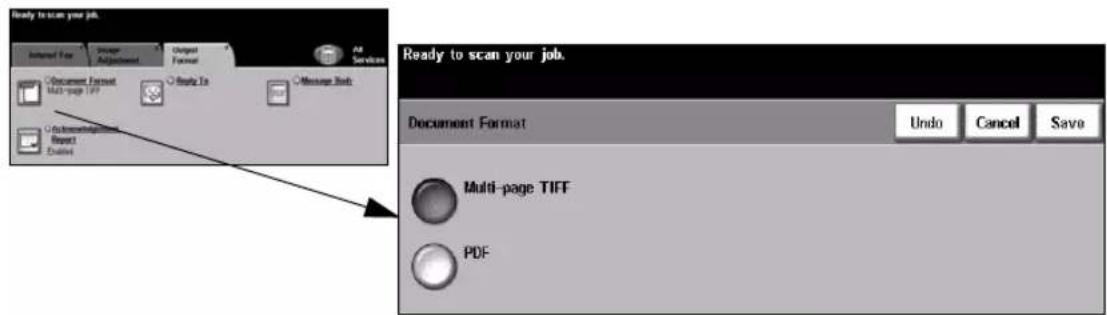
Options:
Multi-page Tiff

Multi-Page Tagged-Image File Format. One TIFF file containing several pages of scanned images.

Portable Document Format. Given the right software the recipient of the scanned image can view, print or edit the file, no matter what their computer platform.
Acknowledgment Report
Use this feature to print a report containing the delivery status of your job. The report will include the number of successful, failed and unconfirmed recipients.
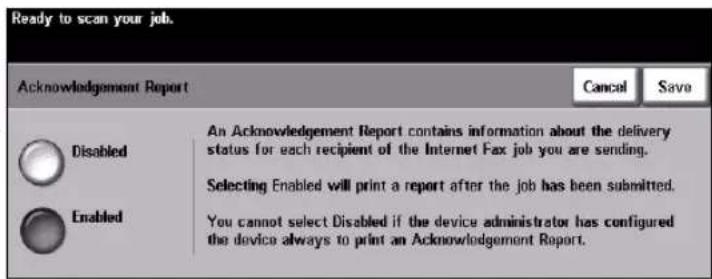
Options:
Disabled Use this option to switch the feature off.

NOTE: If the default setting for this feature is already Enabled you will not be able to disable this feature.
Enabled Use this option to print a status report after the job has been sent.

Reply To
Use the Reply To feature to alter the default address to which replies to your Internet Fax job can be sent.
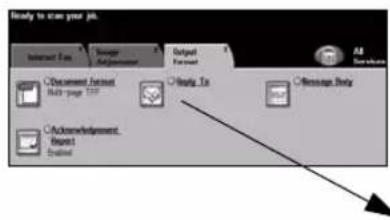
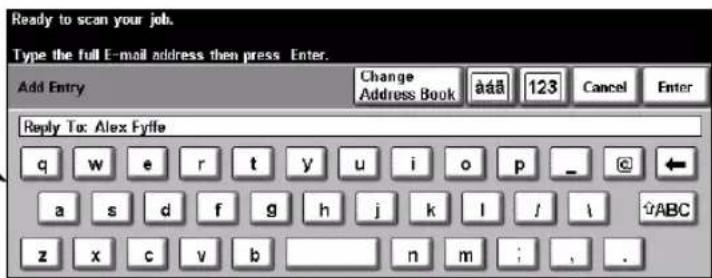
Message Body
Use this feature to edit the default e-mail message being transmitted with the job. The message body is the text contained within the e-mail and not the e-mail subject line. The message entered will only be available for the current job.
NOTE: The default message is set up by your System Administrator.
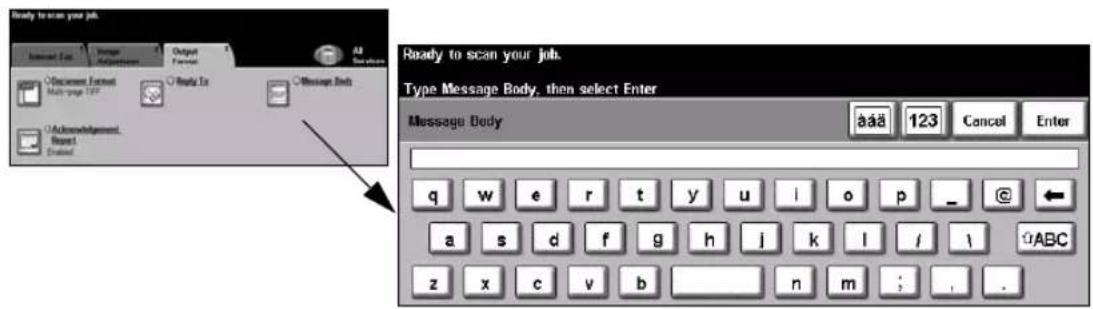
Authentication Mode
Authentication is a useful network security management tool - limiting, restricting and monitoring access to the network via the machine. Authentication can be set up by the System Administrator to restrict access to the features within Scan to E-mail, Network Scanning, Server Fax and Internet Fax.
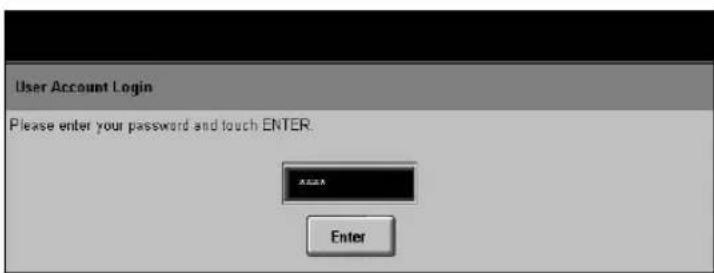
There are two authentication modes available:
Network Requires your network login name and password. If you do not have a network authentication account on the local network you will not be authenticated using this mode. Access
Guest Access Requires a generic passcode that is set up by the System Administrator. You will need to obtain the passcode from the System Administrator. Contact your System Administrator for further assistance.
7 Network Scanning
▶ Scan....7-2
▶ Network Scanning....7-3
➢ Image Adjustment....7-7
Output Format....7-14
➢ Refresh Destinations ...... 7-18
▶ Authentication Mode 7-19
Scan
Network Scanning is an optional feature which is only available on the WorkCentre Pro configuration. If Network Scanning has been enabled, an electronic file can be created from a hard copy original. The scanned document is converted to an electronic file and stored electronically. The electronic file can be filed, faxed, or distributed through e-mail.
This chapter contains information about the options available within Network Scanning.
Scanning Resources
There are other sources of information available:
CentreWare Network Scanning Services
Enables the installation, set up and management of Network Scanning Services on the network. Network Scanning Services is composed of several different elements that work together to create and deliver the scanned document to its final destination. Refer to the CentreWare Network Scanning Services Pack delivered with the Scanning Services Kit.
CentreWare Internet Services
Internet Services is the embedded HTTP server application that is available on network enabled models. Internet Services enables you to access printing and scanning features, view status, manage jobs, and perform machine management tasks using a browser application over the Internet or intranet. To access Internet Services open your web browser and enter the machine's IP Address in the Address or Location field.
Resources Provided on the World Wide Web
| WEB SITE | GENERAL CONTENTS |
| www.xerox.com This is a source of general solution overview and options for upgrade. | |
| www.centreware.com | Contains CentreWare general information with links to the latest drivers and utilities. |
Network Scanning
Access to the Network Scanning features is gained using the Features button on the control panel.
Depending on the options enabled and how your machine has been configured, you may have to select All Services in the top right-hand corner first.
Use the Network Scanning tab on the touch screen to select the standard features for a scan job.
The tabs available for selecting Network Scanning features are:
Network Scanning
Image Adjustment
Output Format
Refresh Destinations
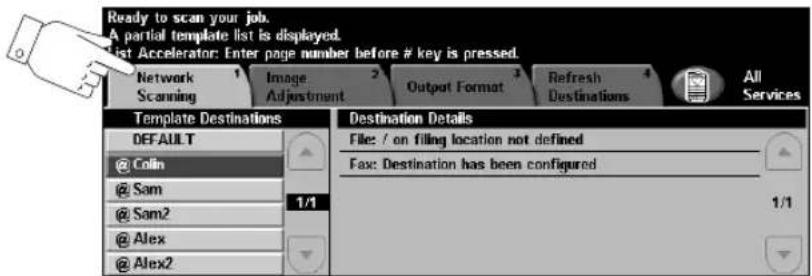
Touch any of the top level buttons to select a feature. Multiple options can be selected for each scan job if required.
Most feature screens include three buttons to confirm or cancel your choices.
The Undo button resets the current screen to the default values that were displayed when the screen was opened.
The Cancel button resets the screen and returns to the previous screen.
The Save button saves the selections made and returns to the previous screen.
Repositories
Repositories are directories or filing locations set up on a server where your scanned files are held. Before you can use Network Scanning your System Administrator must set up the repositories available to your machine. The repositories are defined in the template and cannot be changed at the machine. Up to 5 repositories (1 default and 4 additional) can be defined.
Template Overview
Successful network scanning requires selecting a template at your machine. Templates contain pre-selected options which will be applied to the scanned original, for example, information about the final destination of your job (the repository) and the image quality settings are defined within the template, along with the template name.
Making Templates
Templates can be created or changed using CentreWare Scan Services or CentreWare Internet Services. Contact your System Administrator for further information.

HINT: Template names are limited to 20 characters. Template names containing more than 20 characters will be shortened to the first 20 characters. Remember this when searching for existing templates or assigning template names.
Selecting a template
Select a template based on where the file is required to be sent. Normally, the System Administrator will have established a template for use by each user.
Changing Preprogrammed Template Selections
After a template is selected, most of the preprogrammed settings can be temporarily changed such as sides scanned, image quality and resolution.
The output destination assigned to the template cannot be changed at the machine.
Template Destinations
The Template Destination lists the templates stored on the machine. On installation the factory default template 'DEFAULT', in upper case, will be displayed in the Template Destination list. The default template appears at the top of the list and is selected automatically. All other templates follow in alpha-numeric order. There is a maximum limit of 250 templates.
Template operations can be performed either from CentreWare Internet Services or CentreWare Scan Services.
Template names starting with the @ symbol have been created using the CentreWare Internet Services.
Templates without the @ symbol are templates that have been created using CentreWare Network Scanning Software.

HINT: A default template can also be created using CentreWare Network Scanning Software. The word 'default' will be displayed in lower case.
Scrolling Use the Scroll Buttons located to the right of the Template List to move through the through the list one page at a time and select a Template. Template List To quickly get to a specific page in the Template list, use the keypad to identify the page number then select the hash (#) key. The counter will display the page location.
Destination Details
The Destination Details section on the right side of the screen displays information about the selected template. Each time you select another template file, this area will update to display information associated with the selected template.
NOTE: Any changes made to the template at the machine are temporary. Permanent changes must be made with the same utility that created the template.
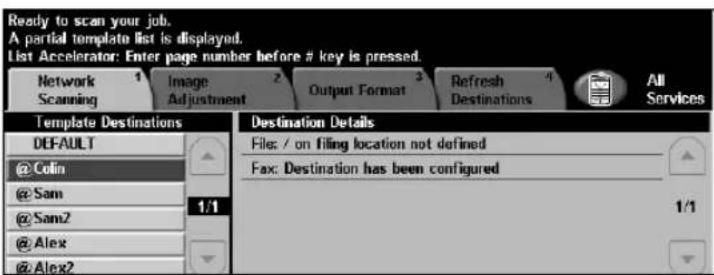
Image Adjustment
The Image Adjustment tab is used to program features relating to the scanned images.
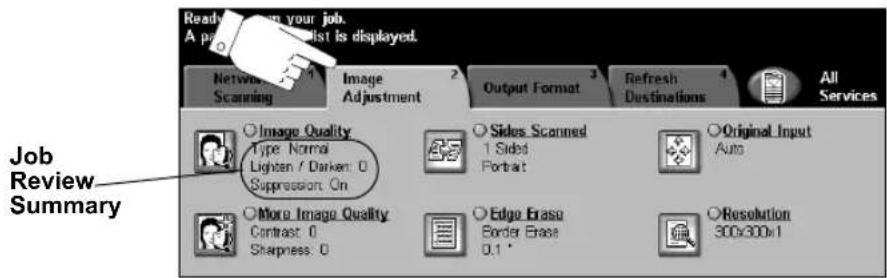
Touch any of the top level buttons to select a feature. To view all the options for a feature, select the feature required. Multiple options can be selected for each scan job if required.
Most feature screens include three buttons to confirm or cancel your choices.
The Undo button resets the current screen to the default values that were displayed when the screen was opened.
The Cancel button resets the screen and returns to the previous screen.
The Save button saves the selections made and returns to the previous screen.
Image Quality
Use this feature to enhance the quality of your scanned originals.
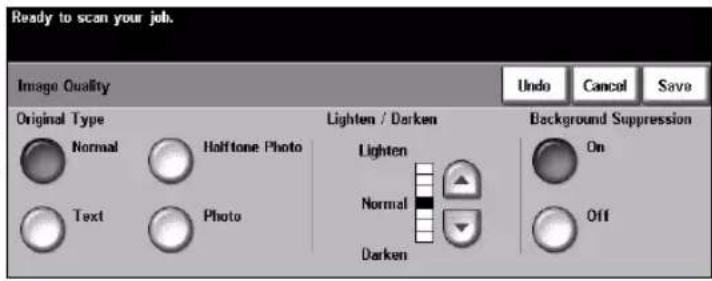
Options:
Original Type

Use this option to enhance the quality of the output based on the type of original being scanned.
Original Type options are as follows:
| NORMAL | This is the standard setting and can be used for most originals. |
| TEXT | Use for originals containing text or line art. |
| HALFTONE PHOTO | Use for high quality lithographic images or continuous tone photos with text and/or graphics. |
| PHOTO | Use for continuous tone photographs or high quality printed half-tone originals. |
Lighten / Darken
Adjusts the lightness or darkness of the output. To darken the output, select the down scroll button. To lighten the output, select the up scroll button.
Background Suppression
This option automatically reduces or eliminates the dark background resulting from colored paper or newspaper originals.
NOTE: Background Suppression is disabled if the Original Type is Photo.
More Image Quality
Use this feature in addition to the settings selected using the Image Quality option, to further enhance the quality of your output.
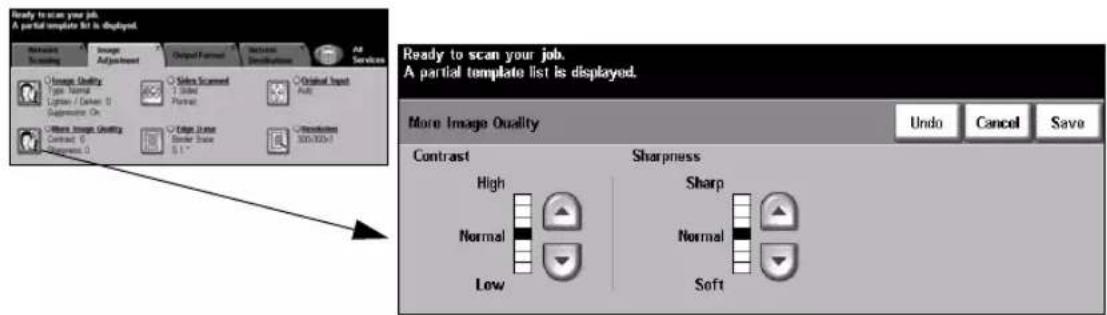
Options:
Contrast This option controls the differences between the image densities within the output. Select a lower setting to improve the image quality of pictures. Select a higher setting to produce more vivid blacks and whites for sharper text and lines.
Sharpness This option controls the balance between sharp text and moiré (wavy patterns within the image). Use the scroll buttons to adjust the sharpness values from sharper to softer, based on the quality of the input images.
Sides Scanned
This is used to specify whether the originals are single-sided or double-sided. For 2-sided originals the orientation can also be programmed.
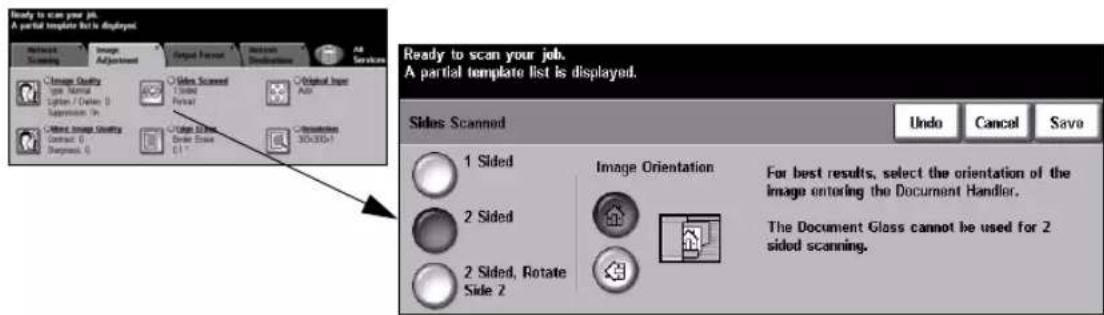
Options:
1 Sided Use this option for originals that are printed on 1 side only.

2 Sided Use this option for originals that are printed on both sides.
2 Sided, Rotate Use this option for originals that are printed on both sides and the second side has been rotated. For example, if you are scanning a calendar which uses a "head to toe" format.
Image Use this option to identify the image orientation before scanning. Orientation

Edge Erase
Use this feature to “refresh” the quality of an original that has become torn or frayed at the edges, or that has hole punch, staple or other marks.
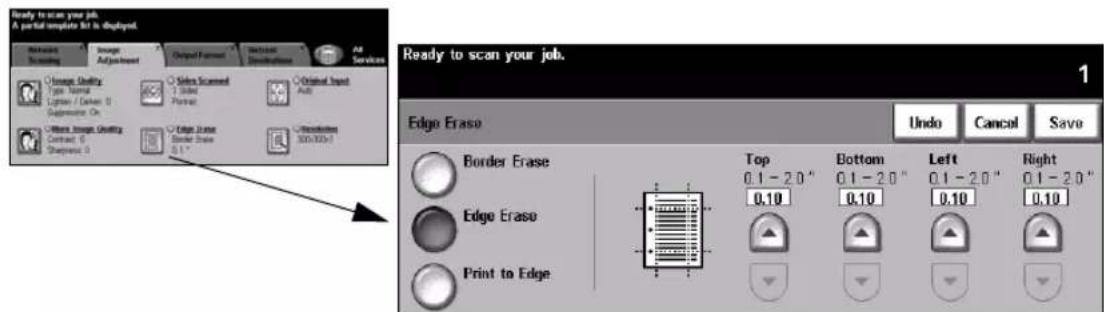
Options:
Border Erase
Erases equal amounts on all edges of your output image. Up to 2.0 inches in 0.05 in. increments can be erased.

Edge Erase
Use to erase a specific amount from a specific edge of the image. Up to 2.0 inches in 0.05 in. increments can be erased from each edge.

Scan to Edge Use this option to produce an edge to edge scan of the original.

Original Input
Use this option to program the size of the originals being scanned or enable the machine to recognize the size of the originals.
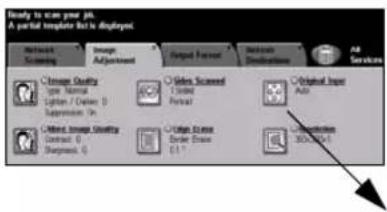
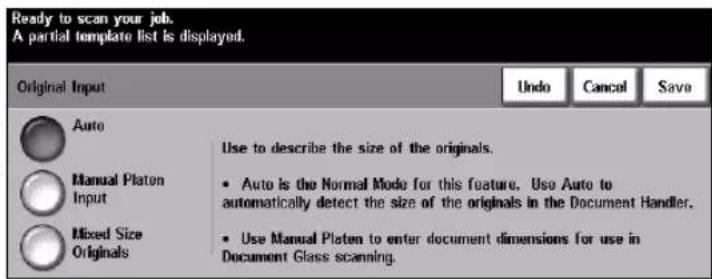
Options:
Auto

Use this option to allow the machine to determine the size of the originals being fed through the document handler.
Manual Platen Input

Use this option to specify the dimensions of the document scanning region when scanning from the document glass. There are several dimensions that correspond to common document sizes and orientations.
Select a standard size or use Custom to manually adjust the scanning dimensions. Use this option to scan the image to the edges of the original.
Mixed Size Originals

Use this feature to scan a document containing mixed size originals. The originals must be the same width, for example 8.5x11inch long edge feed and 11x17inch short edge feed. Load documents in the Document Handler when using this feature.
Resolution
Resolution affects the appearance of the scanned image. The higher the scanning resolution the better the image quality.
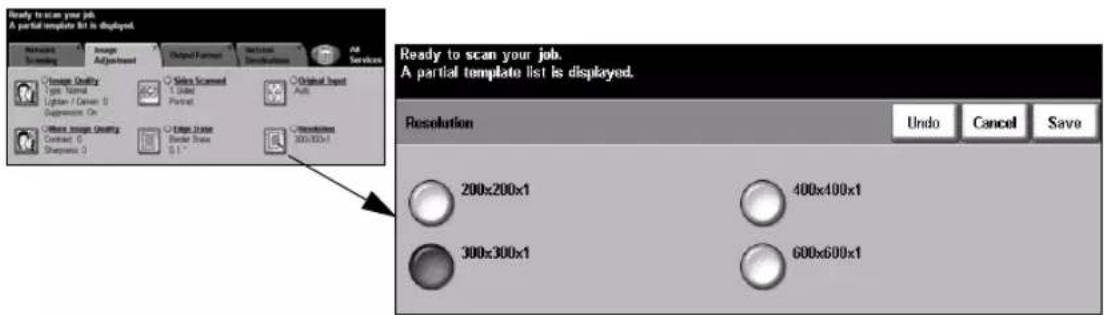
Options:
200x200x1 Recommended for use with average quality text documents and line art. Does not produce the best image quality for photos and graphics.

300x300x1 Recommended for use with high quality text documents, that are destined to pass through OCR applications. Also recommended for high quality line art or medium quality photos and graphics. This is the default resolution and the best choice in most cases.

400x400x1 Recommended for average quality photos and graphics. It produces a smaller file size than the 600 x 600 resolution.

600x600x1 Recommended for use with high quality photos and graphics. It produces the largest image file size, but delivers the best image quality.

Output Format
Use the features available to temporarily change the format of the scanned image file at the destination server.
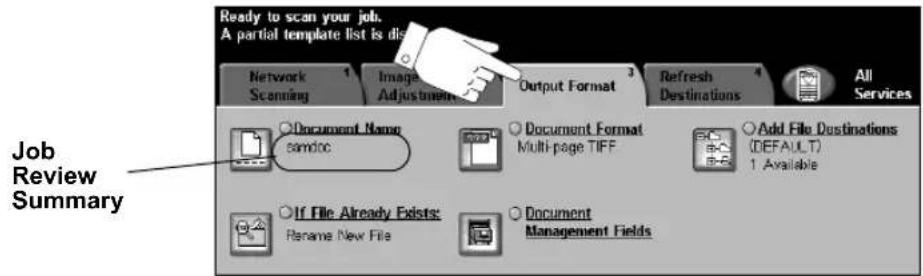
Touch any of the top level buttons to select a feature. To view all the options for a feature, select the feature required. Multiple options can be selected for each scan job if required.
The text next to the feature button, called a Job Review Summary, reflects the current settings for that feature. A checked box indicates that this feature has been modified from its initial default settings.
Most feature screens include three buttons to confirm or cancel your choices.
The Undo button resets the current screen to the default values that were displayed when the screen was opened.
The Cancel button resets the screen and returns to the previous screen.
The Save button saves the selections made and returns to the previous screen.
Document Name
Use Document Name to specify the name of the folder that you want your scanned image stored to. This option only applies to the folder name.

If File Already Exists
Use this option to tell the machine what to do when the document destination folder already contains a document with the same name as your current scan job.
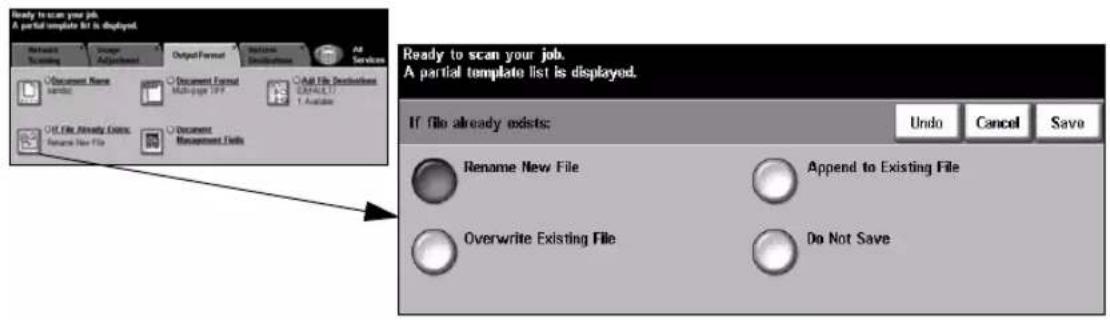
Options:
Rename New Use this option when you want the machine to name the new file (or folder) with a File unique name.
Append to Use this option to add the newly created scanned image file to an existing document Existing File with the same name as the document being scanned.

NOTE: This option is not available with Multi-Page Tiff and PDF file format options.
Overwrite Use this option to replace the existing file that has the same filename as the newly Existing file created scanned image file.

Do Not Save Use this option to abort the scanning operation if a file with the same name as the newly created scanned image file is detected.

Document Format
Use this feature to temporarily change the file type of the scanned image file at the destination server. The default setting is the same as the value entered in the selected template.
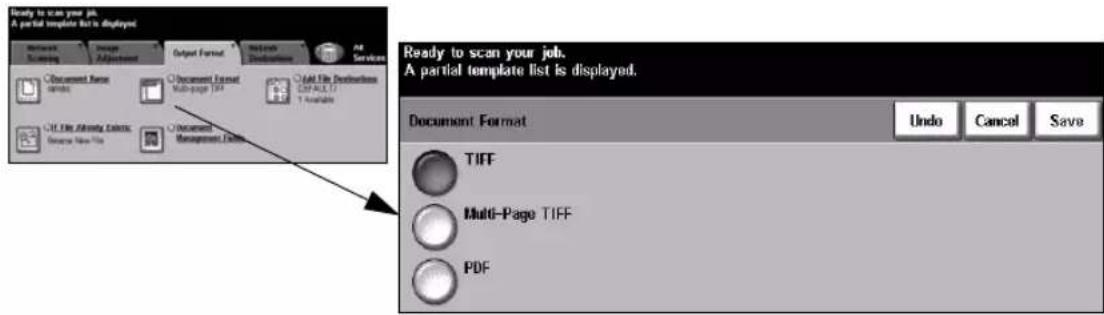
Options:
Tiff Tagged-Image File Format. A graphic file that can be opened in a variety of graphic software packages across a variety of computer platforms.

Multi-Page Tiff Multi-Page Tagged-Image File Format. One TIFF file containing several pages of scanned images.

Image Only PDF Image Only Portable Document Format. Given the right software the recipient of the scanned image can view, print or edit the file, no matter what their computer platform.
Document Management Fields
Document Management Fields allows you to enter information into the template from your machine which is unique to your scanning requirements. These fields must be enabled when creating the template at the Web UI.
NOTE: If your selected template does not contain any enabled fields the Document Management Fields button will not be available.
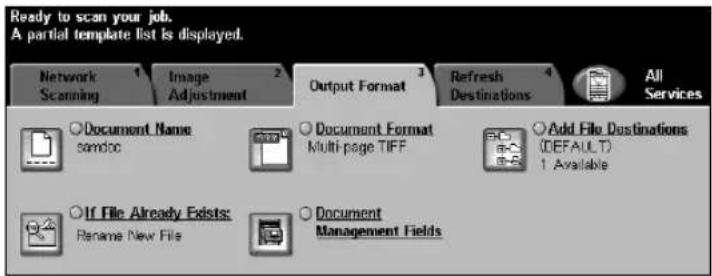
Add File Destination
Use this feature to add additional file destinations to any template. A maximum of 5 file destinations can be added to a template. If the selected template contains 1 destination you can add an additional 4 destinations using this feature, however if the selected template contains 5 destinations the Add File Destination button will not be available.
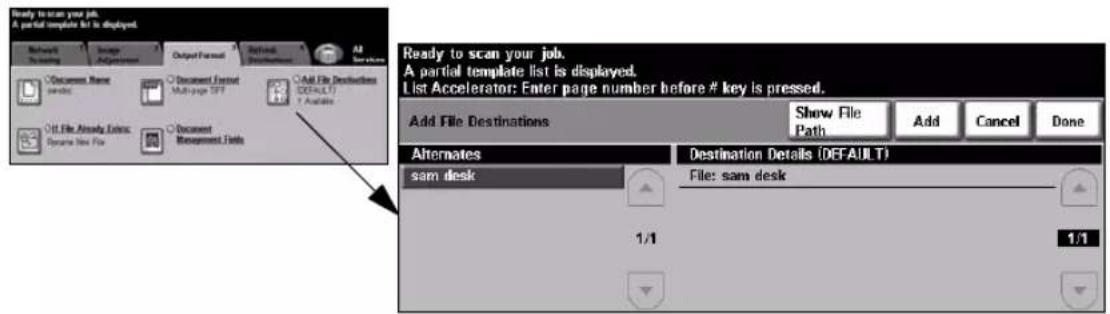
Refresh Destinations
Select the Refresh Destinations tab to access the Update Template List feature.
Touch the Update Template List button if the template has been recently created or modified. The system automatically updates the Template List.
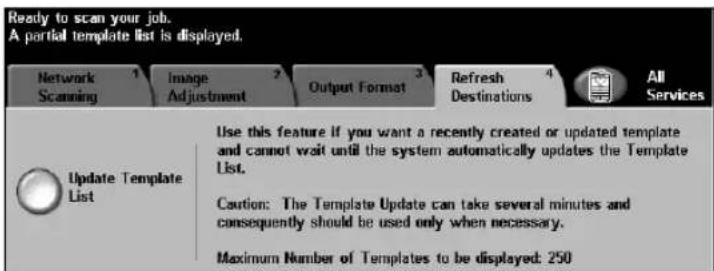
Authentication Mode
Authentication is a useful network security management tool - limiting, restricting and monitoring access to the network via the machine. Authentication can be set up by the System Administrator to restrict access to the features within E-mail, Network Scanning, Server Fax and Internet Fax.
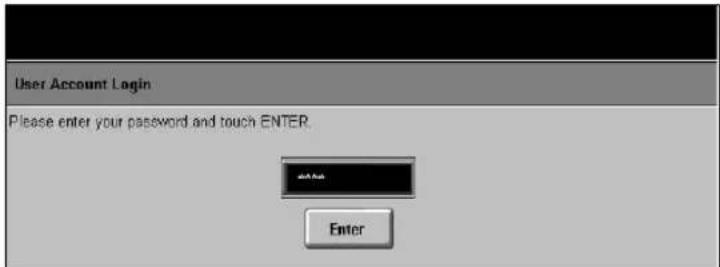
There are two authentication modes available:
Network Requires your network login name and password. If you do not have a network Authentication account on the local network you will not be authenticated using this mode. Access
Guest Access Requires a generic passcode that is set up by the System Administrator. You will need to obtain the passcode from the System Administrator. Contact your System Administrator for further assistance.
8 E - m a i l
E-mail....8-2
➢ Image Adjustment....8-6
Output Format....8-13
▶ Authentication Mode 8-17
E-mail is an optional feature which is only available on the WorkCentre and WorkCentre Pro. This chapter contains information about the options available within E-mail.
NOTE: E-mail is only supported on the WorkCentre via the Ad Hoc E-mail options kit. Limited e-mail options will be available.
When enabled, scanned images can be sent as an e-mail attachment to a specified e-mail recipient or recipients. To use scan to e-mail you must enter an SMTP (Simple Mail Transfer Protocol) e-mail address, for example, anyone@anycompany.com.
Access to the E-mail features is gained using the Features button on the control panel. Use the E-mail tab to add and remove recipients and edit the subject line.
Depending on the options enabled and how your machine has been configured, you may have to select the All Services button in the top right-hand corner to access E-mail.
The tabs available for selecting E-mail features are:
E-mail
Image Adjustment
Output Format
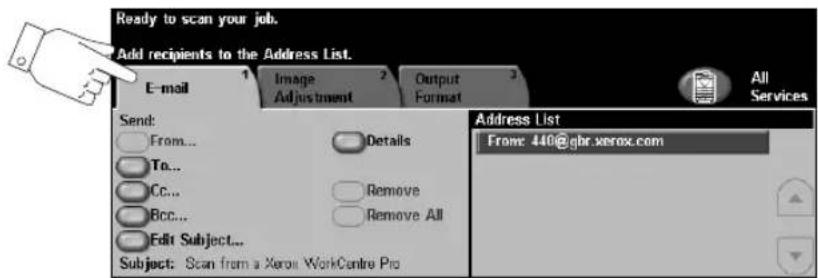
Touch any of the top level buttons to select a feature. Multiple options can be selected for each e-mail job if required.
Most feature screens include three buttons to confirm or cancel your choices.
The Undo button resets the current screen to the default values that were displayed when the screen was opened.
The Cancel button resets the screen and returns to the previous screen.
The Save button saves the selections made and returns to the previous screen.
Send:
Use the Send options to enter recipient information.
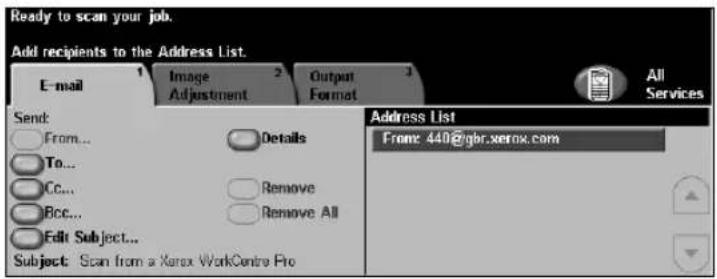
Options:
From This option provides information about the sender and is pre-set by the system or the System Administrator and cannot be changed.
NOTE: If E-mail is accessed via Authentication Mode the information contained will be linked with the login name.
To Use this option to enter the e-mail address of the recipient.
Cc Use this option to enter the e-mail address of the recipient you wish to be copied on the e-mail job.
Bcc Use this option to enter the e-mail address of the recipient you wish to be copied on the e-mail job, without their name being displayed on the e-mail.
Edit Subject Use this option to edit the default e-mail subject. The subject is the title of the e-mail and not the text contained within the e-mail. The subject line can contain up to 248 characters and is displayed on the touch screen under the Edit Subject button.
Details Use this option to view the details of the selected recipient. The information displayed is determined by how the address was originally added to the Address List - from either the Internal or Public Address Book, or entered manually.
Remove Use this option to delete the selected address from the Address List.
Remove All Use this option to delete all the addresses from the Address List. A confirmation pop-up message will be displayed.
Scroll Buttons Use the Scroll Buttons located to the right of the Address List to move through the list.
Address List
Displays all the recipient addresses entered for the current scan to e-mail job. Up to 128 recipients addresses can be entered in the list.
Entering an E-mail Address
The e-mail address can be entered in one of two ways - manually or via an address book.
NOTE: When entering e-mail details you can change the keypad to show upper or lower case, accented characters or numbers by selecting the appropriate button. Use the Back button to delete the previously entered character.
Manually
If you already know the full SMTP e-mail address of your recipient, or if you know that the recipient is not in any of the configured address books, you can use the keypad on the touch screen to enter an e-mail address in the To... or Cc... fields. Your machine will check that an SMTP address has been entered. If it is not an SMTP address, your machine will search the address book for a matching entry.
The entered e-mail address will be shown in the Address List.
Selecting the details for a manually entered e-mail address will only display the e-mail address, no other details are available.
Address Books
Address books contain a list of e-mail addresses and details that are relevant to your company and/or you. If configured, your machine is able to support two types of e-mail address books - Public and Internal. When an entry is made in To, From or Cc the Address Book displays search results for one or both configured address books.
NOTE: The Internal Address Book (LDAP) is not available on the WorkCentre configuration.
Use the keypad on the touch screen to enter the e-mail recipient's name. As with most search facilities you do not need to enter the full name and can search the address book on the first few letters.
When you have entered the e-mail search criteria, select the Enter button. If there are no matching entries, select the Change Address Book button to search the other address book.
NOTE: The Change Address Book button will only be displayed if both the address books have been configured.
If one or more matches are found based on the search criteria, the matches are displayed on the touch screen. Use the up and down scroll bars to locate the recipient. Highlight the recipient in the list and select the Add button.
Continue this process until you have added all the required recipients and on completion select Done. The entered e-mail addresses will be shown in the Address List.
Address Book Types
If configured there are two different types of address book on your machine, Public and Internal.
Public Address Book
The Public Address Book stores external company addresses on the machine. The address book contains a list of user names and their e-mail addresses.
The file must be a .CSV (Comma Separated Value) format for your machine to be able to read the file contents. The completed file is imported to the machine via CentreWare Internet Services. Your machine will not allow the import of a Public Address Book file that does not end with the .CSV file extension.
A valid CSV file is in the format: Name, SMTP e-mail address. For example the following are both valid CSV format file entries:
Smith, smith@company.com
"Smith, John", john.smith@company.com
The order in which the entries are sorted in the CSV file determines the order displayed in the Public Address Book at your machine.
Internal Address Book
Otherwise known as the LDAP (Lightweight Directory Access Protocol), the Internal Address Book stores internal company addresses on the company network. The System Administrator creates the Internal Address Book.
The display of the search results is defined by the LDAP. For example, the LDAP server can return a search query "And" as "Andrew Smith" when the result "Andrews, James" may have been expected. The lastname, firstname or firstname, lastname display is controlled by the LDAP server and not your machine.
If you have successfully logged in via Authentication mode, your machine will automatically attempt to match your login name to your e-mail address. Your name will then be entered into the From e-mail address field. You will not be able to change this.
NOTE: The Internal Address Book (LDAP) is not available on the WorkCentre configuration.
Image Adjustment
The Image Adjustment tab is used to temporarily programme features to enhance the appearance and style of the scanned e-mail image.
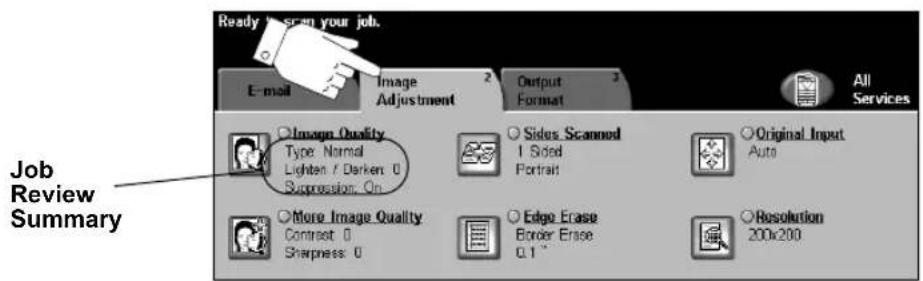
Touch any of the top level buttons to select a feature. To view all the options for a feature, select the feature required. Multiple options can be selected for each e-mail job if required.
The text next to the feature button, called a Job Review Summary, reflects the current settings for that feature. If the round indicator next to the feature name is activated, it shows that this feature has been modified from its initial default settings.
Most feature screens include three buttons to confirm or cancel your choices.
The Undo button resets the current screen to the default values that were displayed when the screen was opened.
The Cancel button resets the screen and returns to the previous screen.
The Save button saves the selections made and returns to the previous screen.
Image Quality
Use this feature to enhance the quality of your scanned originals.
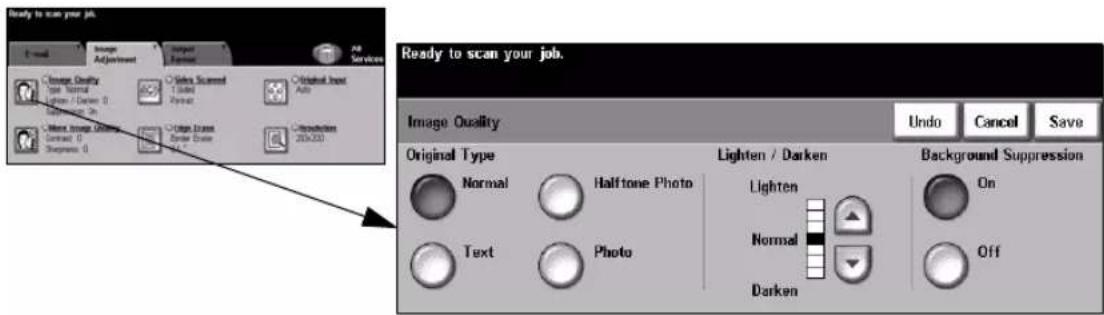
Options:
Original Type
Use this option to enhance the quality of the output based on the type of original being scanned.
Original Type options are as follows:
| NORMAL | This is the standard setting and can be used for most originals. |
| TEXT | Use for originals containing text or line art. |
| HALFTONE PHOTO | Use for high quality lithographic images or continuous tone photos with text and/or graphics. |
| PHOTO | Use for continuous tone photographs or high quality printed half-tone originals. |
Lighten / Darken
Adjusts the lightness or darkness of the output. To darken the output, press the down scroll button. To lighten the output, press the up scroll button.
Background Suppression
This option automatically reduces or eliminates the dark background resulting from colored paper or newspaper originals.
NOTE: Background Suppression is disabled if the Original Type is Photo.
More Image Quality
Use this feature in addition to the settings selected using the Image Quality option, to further enhance the quality of your output.
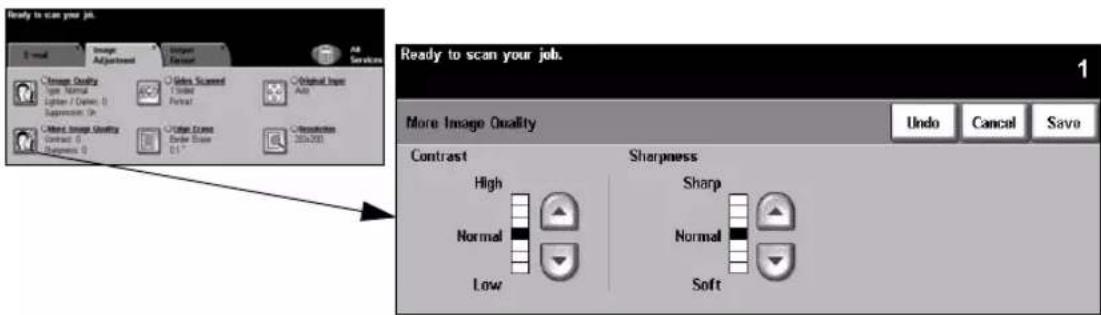
Options:
Contrast This option controls the differences between the image densities within the output. Select a lower setting to improve the image quality of pictures. Select a higher setting to produce more vivid blacks and whites for sharper text and lines.
Sharpness This option controls the balance between sharp text and moiré (wavy patterns within the image). Use the scroll buttons to adjust the sharpness values from sharper to softer, based on the quality of the input images.
Sides Scanned
This is used to specify whether the originals are single-sided or double-sided. For 2-sided originals the orientation can also be programmed.
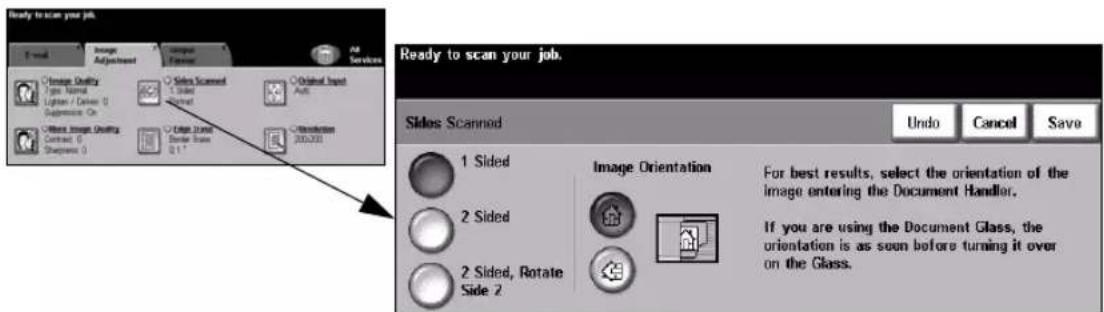
Options:
1 Sided Use this option for originals that are printed on 1 side only.

2 Sided Use this option for originals that are printed on both sides.

2 Sided, Rotate Use this option for originals that are printed on both sides and the second side has been rotated. For example, if you are scanning a calendar which uses a "head to toe" format.

Image Use this option to identify the image orientation before scanning. Orientation

Edge Erase
Use this feature to “refresh” the quality of an original that has become torn or frayed at the edges, or that has hole punch, staple or other marks.
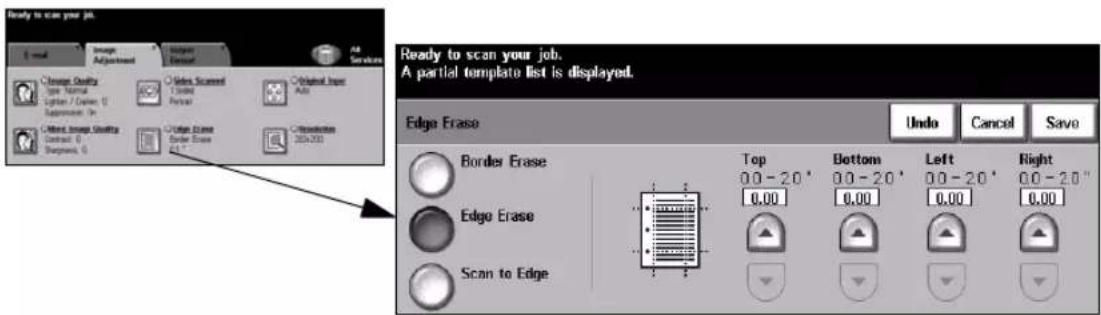
Options:
Border Erase
Erases equal amounts on all edges of your output image. Up to 2.0 inches in 0.05 in. increments can be erased.

Edge Erase
Use to erase a specific amount from a specific edge of the image. Up to 2.0 inches in 0.05 in. increments can be erased from each edge.

Scan to Edge Use this option to produce an edge to edge scan of the original.

Original Input
Use this option to programme the size of the originals being scanned or enable the machine to recognize the size of the originals automatically.
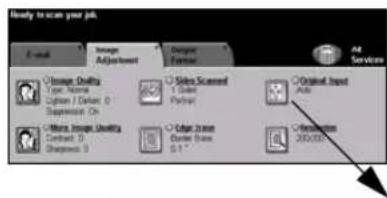
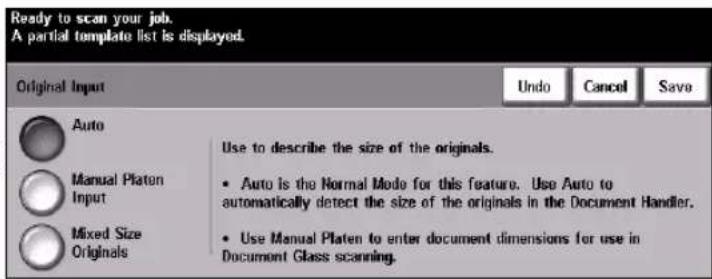
Options:
Auto
Use this option to allow the machine to recognize the size of the originals being fed through the document handler.

Manual Platen Input
Use this option to specify the dimensions of the document scanning region when scanning from the document glass. There are several dimensions that correspond to common document sizes and orientations.

Select a standard size or use Custom to manually adjust the scanning dimensions.
Mixed Size Originals
Use this feature to scan a document containing mixed size originals. The originals must be the same width, for example 8.5x11inch long edge feed and 11x17inch short edge feed. Load documents in the Document Handler when using this feature.

Resolution
Resolution affects the appearance of the scanned image. The higher the scanning resolution the better the image quality.
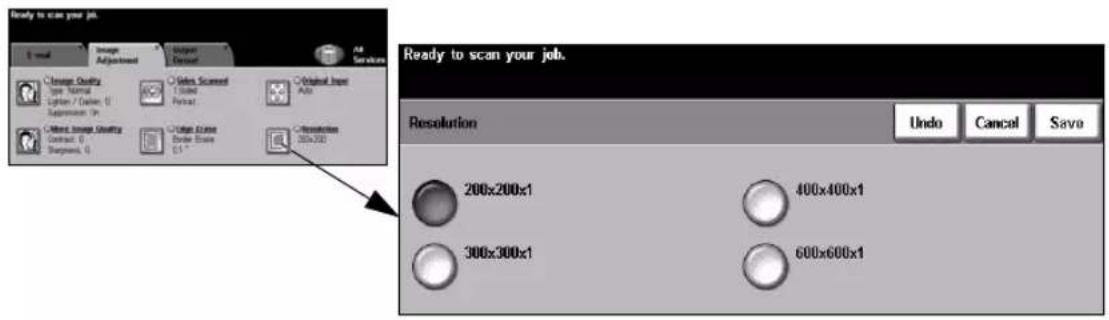
Options:
200x200x1

Recommended for use with average quality text documents and line art. Does not produce the best image quality for photos and graphics. This is the default option.
300x300x1

Recommended for use with high quality text documents, that are destined to pass through Optical Character Recognition (OCR) applications. Also recommended for high quality line art or medium quality photos and graphics.
400x400x1

Recommended for average quality photos and graphics. It produces a smaller file size than the 600 x 600 resolution.
600x600x1

Recommended for use with high quality photos and graphics. It produces the largest image file size, but delivers the best image quality.
Output Format
Use this feature to change the Reply To e-mail address and to identify the file format required for the e-mail scanned image.
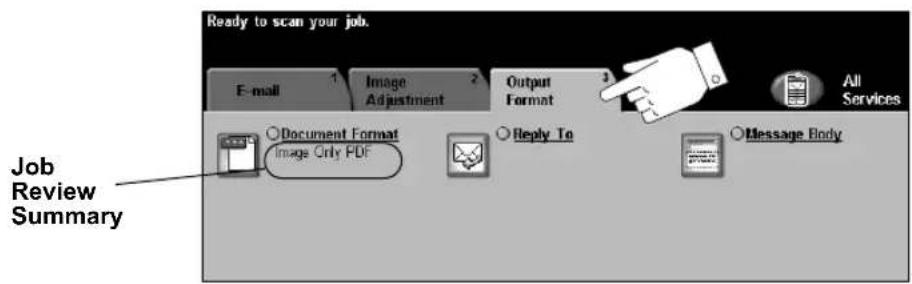
Touch any of the top level buttons to select a feature. To view all the options for a feature, select the feature required. Multiple options can be selected for each e-mail job if required.
The text next to the feature button, called a Job Review Summary, reflects the current settings for that feature. A checked box indicates that this feature has been modified from its initial default settings.
Most feature screens include three buttons to confirm or cancel your choices.
The Undo button resets the current screen to the default values that were displayed when the screen was opened.
The Cancel button resets the screen and returns to the previous screen.
The Save button saves the selections made and returns to the previous screen.
Document Format
Use the Document Format option when the job is to be sent with a different file format than that set as the template default.
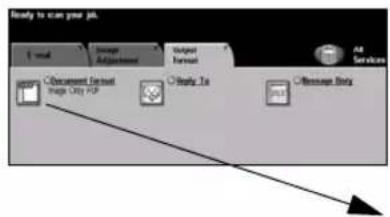
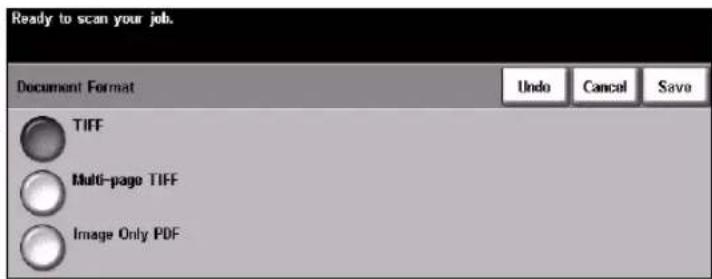
Options:
Tiff Tagged-Image File Format. A graphic file that can be opened in a variety of graphic software packages across a variety of computer platforms.

Multi-page Tiff Multi-Page Tagged-Image File Format. One TIFF file containing several pages of scanned images.

Image Only PDF Image Only Portable Document Format. Given the right software the recipient of the scanned image can view, print or edit the file, no matter what their computer platform.
Reply To
Use the Reply To feature to alter the default address to which replies to an e-mail job can be sent.
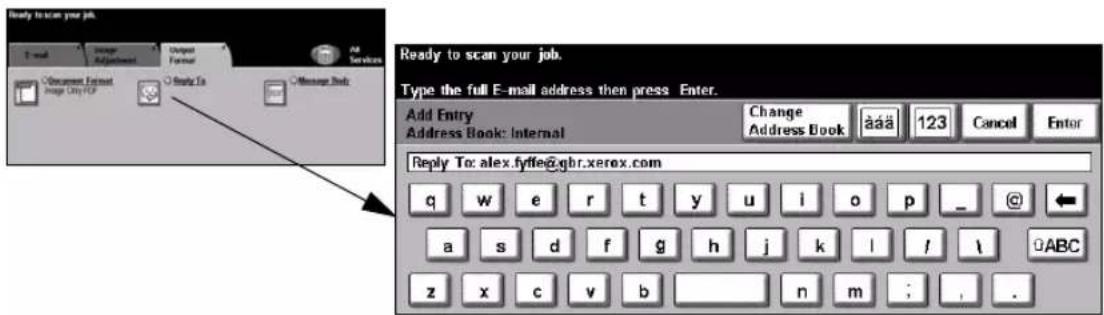
Message Body
Use this feature to edit the default e-mail message. The message body is the text contained within the e-mail and not the e-mail subject line.
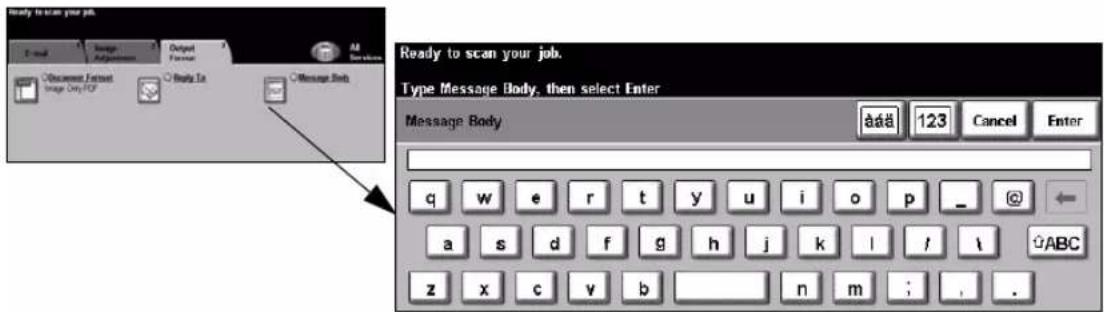
Secure Send
This feature enables secure sending of your e-mails using a third party secure e-mail server solution. The secure e-mail server ensures that the e-mail transmission cannot be intercepted by an unauthorised recipient. This feature will only be available if the following conditions apply:
- E-mail is installed and enabled. - Network Authentication is configured and enabled.
- Your machine is connected to a third party secure e-mail server solution.
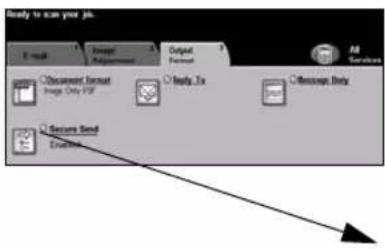
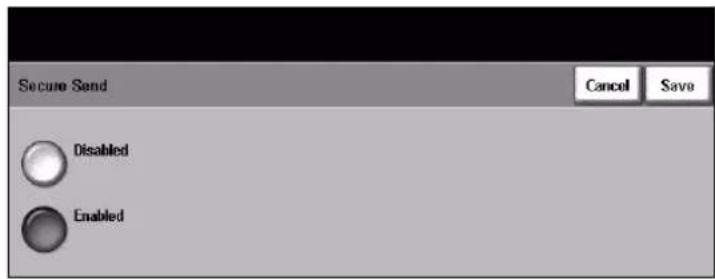
Options:
Disabled The feature is switched off.

Enabled Use this option to enable the Secure Send feature.
Authentication Mode
Authentication is a useful network security management tool - limiting, restricting and monitoring access to the network via the machine. Authentication can be set up by the System Administrator to restrict access to the features within E-mail, Network Scanning, Server Fax and Internet Fax.
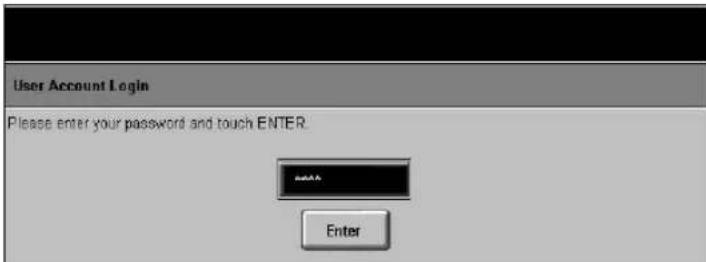
There are two authentication modes available:
Network Requires your network login name and password. If you do not have a network authentication account on the local network you will not be authenticated using this mode. Access
Guest Access Requires a generic passcode that is set up by the System Administrator. You will need to obtain the passcode from the System Administrator. Contact your System Administrator for further assistance.
9 Print
▶ Introduction to Print....9-2
▶ Print Driver Features....9-3
▶ Print Drivers ......9-4
Introduction to Print
The Xerox WorkCentre and WorkCentre Pro printer produces high quality prints from electronic documents. Simply access the printer from your PC application as normal. A print driver converts the code within the electronic document into a language that the printer can understand. Although generic print drivers can be used on this printer they will not enable all the features. It is therefore advisable to use the print drivers that accompany this printer.
NOTE: More detailed information about printing is contained either in the print driver screens or in the electronic user guides that accompany the print drivers.
To access the many print drivers which can be used with your machine please refer to the CentreWare Print and Fax Services CD or you can download the latest versions from the Xerox website at www.xerox.com.
The following pages contain an overview of the Windows Postscript print driver options for the WorkCentre Pro. The PCL print driver screens are similar to those shown but a reduced selection of options is available.
NOTE: The WorkCentre will not support the PostScript print drivers unless the PostScript configuration is purchased.
Print Driver Features
Control Options
There are a number of options which appear on all of the printer driver screens:
OK Saves all the new settings and closes the driver or dialog. These new settings remain in effect until changed or until the software application is closed and the printer driver options revert to the default settings.
Cancel Closes the dialog and returns all settings in the tabs to the values that were in place before the dialog was opened. Any changes made are lost.
Apply Saves all the changes made without closing the driver.
Defaults Resets the current tab and all its settings to the system default values. The action of this button applies only to the current tab. All other tabs remain unchanged.
Default All Resets options to default system values on the Paper Output, Layout, and Image Options tabs. Other features and tabs may not have specific default settings and will not be affected by this button.
Help Select Help in the bottom right of the printer driver screen or [F1] on the PC keyboard for information on the displayed printer driver screen.
If the tip of the mouse pointer is rested on top of a control, Microsoft Windows will display a brief Help Tip about that control. If the right mouse button selects a control, the Help system provides more detailed information.
Print Drivers
NOTE: The following provides an overview of the features available on the WorkCentre Pro Postscript Print Driver - the appearance of other print drivers may vary. For more information about a specific feature, please refer to the on-line Help facility provided as part of the Print Driver software.
Paper/Output
Used to select options such as the job type and the output requirements. The choices available are based on the options enabled on your machine. Simply click on the arrow scroll button for the option or click on the option icon to change any of the choices displayed.
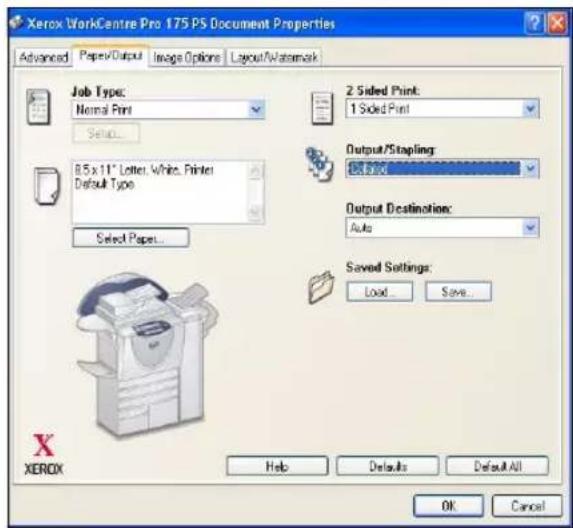
Advanced
Select this tab to access the postscript options and advanced programming features for your print job. Use the scroll arrows to move through the options. Clicking on a plus symbol will display further choices.
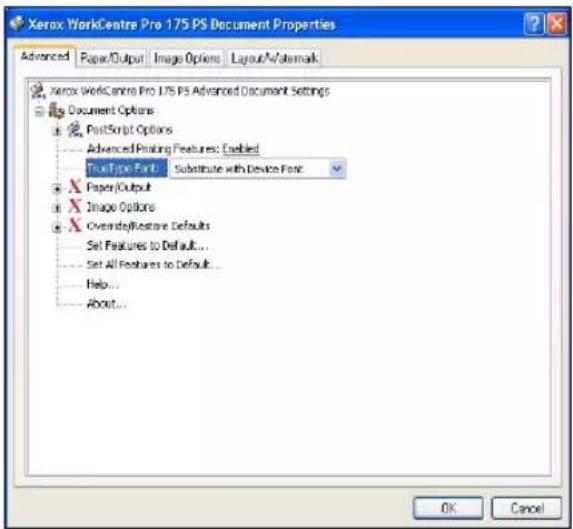
Image Options
Use the options available in this tab to modify the appearance of your print job. This feature can also be used to set the margins.
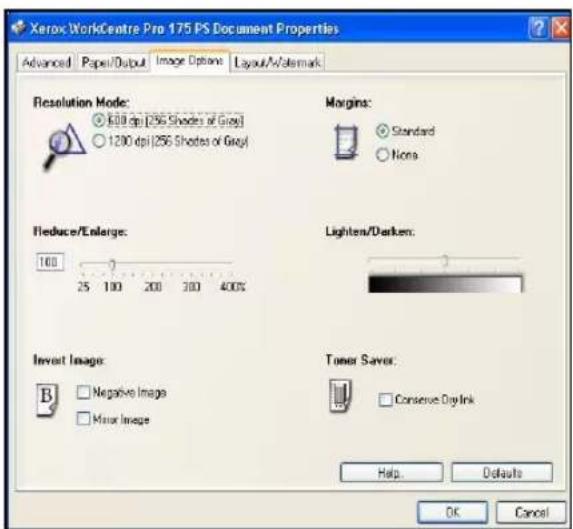
Layout/Watermark
Used to change the layout of a document and add watermarks. Documents can be printed 1 Up, 2 Up and so on, up to 16 Up. Booklets can also be created. Use the Watermark option to display, for example, the word DRAFT or CONFIDENTIAL across each page. This feature also adjusts the size and location of the watermark.
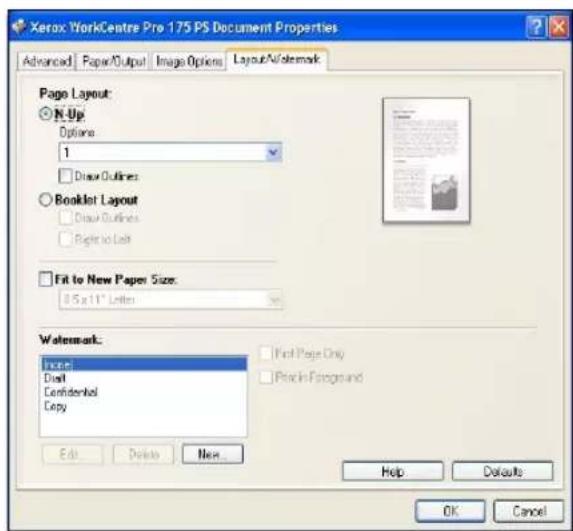
10Maintenance
Consumables....10-2
➢ Cleaning the Machine 10-4
➢ Further Assistance 10-5
Consumables
Consumables are items on the machine that need replenishing or replacing, such as paper, staples, and customer replaceable units. To place an order for Xerox consumables, please contact your local Xerox Representative giving your Company Name, product number and the machine serial number.

HINT: For information about locating the serial number, please refer to "Locating the serial number" on page 11-4.
To find out more information about each consumable please refer to the Maintenance section of the Training and Information CD (CD2), contained in the CD Pack delivered with your machine.

CAUTION: When replacing consumables, DO NOT remove the covers or guards that are fastened with screws. You cannot maintain or service any of the parts that are behind these covers and guards. Do NOT attempt any maintenance procedure that is NOT specifically described in the documentation supplied with your machine.
Customer Replaceable Units
There are 5 replaceable units on the machine:
Xerographic Module
Toner (Dry Ink) Cartridge
Fuser Module and Ozone Filter
Document Handler Feed Roll
Waste Toner (Dry Ink) Bottle
The machine will display a message on the Touch Screen when any of the above need to be reordered. This message is a warning that the unit is nearing the end of its life.
Only replace the unit when a message actually instructs you to do so.
To replace a Replaceable Unit, follow the instructions on the User Interface or refer to the Maintenance section of the Training and Information CD (CD2), contained in the CD Pack delivered with your machine.

CAUTION: When replacing consumables, DO NOT remove the covers or guards that are fastened with screws. You cannot maintain or service any of the parts that are behind these covers and guards. Do NOT attempt any maintenance procedure that is NOT specifically described in the documentation supplied with your machine.
Staple Cartridges
If your machine is equipped with one of the 3 finishers you will be required to replace the staple cartridge or cartridges when the machine displays a message instructing you to do so.
The Office Finisher, Advanced Office Finisher and Professional Finisher all contain a main staple cartridge which holds 5,000 staples. The Professional Finisher has 2 additional staple cartridges located within the Booklet Maker, each of these cartridges contains a maximum of 2000 staples.
To replace a staple cartridge, follow the instructions on the User Interface or refer to the Maintenance section of the Training and Information CD (CD2), contained in the CD Pack delivered with your machine.
HINT: To place an order for any Xerox consumables, please contact your local Xerox Representative giving your Company Name, product number and the machine serial number.

CAUTION: When replacing consumables, DO NOT remove the covers or guards that are fastened with screws. You cannot maintain or service any of the parts that are behind these covers and guards. Do NOT attempt any maintenance procedure that is NOT specifically described in the documentation supplied with your machine.
Cleaning the Machine

WARNING: When cleaning the machine do NOT use organic or strong chemical solvents or aerosol cleaners. Do NOT pour fluids directly onto any area. Use supplies and cleaning materials only as directed in this documentation. Keep all cleaning materials out of the reach of children.

WARNING: Do not use pressurized air-spray cleaning aids on or in this equipment. Some pressurized air-spray containers contain explosive mixtures and are not suitable for use in electrical applications. Use of such cleaners can result in a risk of explosion and fire.
1 Document Glass and Constant Velocity Transport Glass
Apply Xerox Cleaning Fluid or Xerox Anti-Static Cleaner, to a to a lint-free cloth. Liquid should never be poured directly onto the glass.
Wipe clean the entire glass area.
Wipe away any residue with a clean cloth or paper towel.
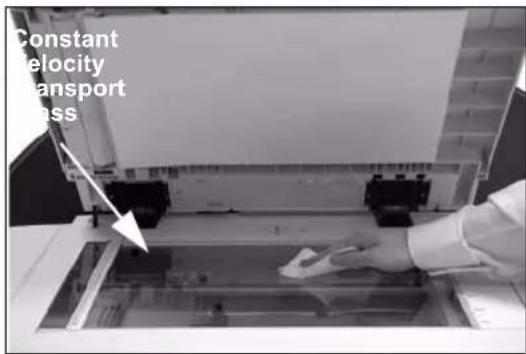
NOTE: Spots or marks on the glass will be reproduced on the prints when copying from the document glass. Spots on the document handler scanner will show up as streaks on the prints when copying from the Document Handler.
2 Touch Screen ➢ Use a soft, lint-
Use a soft, lint-free cloth, lightly dampened with water.
- Wipe clean the entire area, including the touch screen.
Remove any residue with a clean cloth or paper towel.
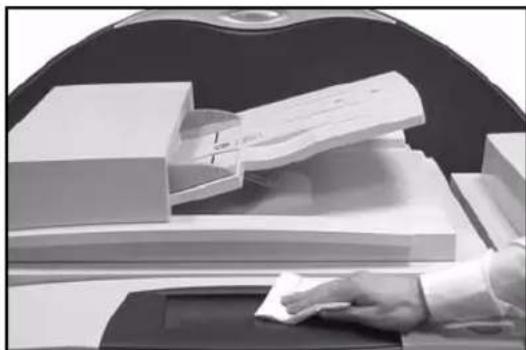
natural_image
Person using a computer to interact with a mechanical device (no visible text or symbols)For more information about maintaining other areas of your machine please refer to the Training and Information CD (CD2), contained in the CD Pack delivered with your machine.
Further Assistance
For any additional help visit our customer web site at www.xerox.com or contact the Xerox Welcome and Support Center quoting the machine serial number.
1
➢ Press the Machine Status button on the control panel.
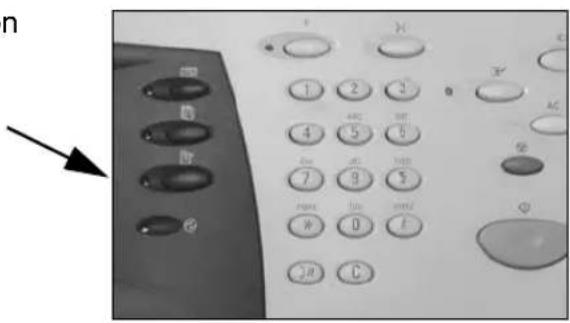
2
The Machine Information screen will be displayed.
Select [Machine Details].
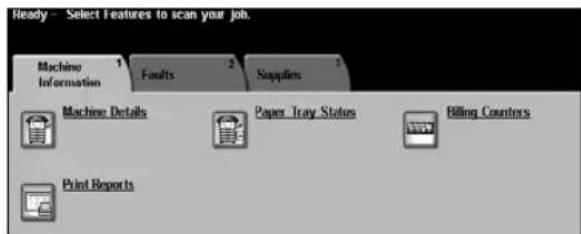
3
The Customer Support Number for the Welcome and Support Center and the Machine Serial Number for your machine will be displayed.
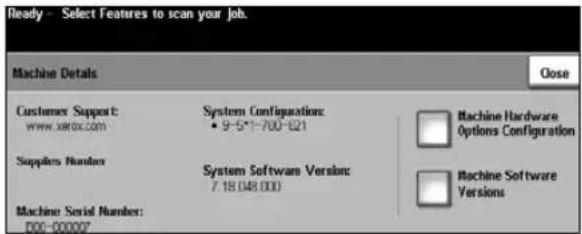
11Troubleshooting
➢ General 11-2
▶ Fault Clearance 11-3
Xerox Welcome and Support Center ..... 11-4
➢ Troubleshooting Tips...... 11-5
General
A variety of situations can affect the quality of your output. For optimal performance, ensure the following guidelines are followed:
- Do not position the machine in direct sunlight or near a heat source such as a radiator.
- Avoid sudden changes in the environment surrounding the machine. When a change occurs, allow the machine at least two hours to adjust to its new environment, depending on the extent of the change.
- Follow routine maintenance schedules for cleaning areas such as the Document Glass and Touch Screen.
- Always set the Edge Guides in the paper trays to the size of the media in the tray and ensure the screen is displaying the correct size.
- Ensure paper clips and paper debris do not contaminate the machine.
NOTE: For additional Troubleshooting information please refer to the Training and Information CD (CD2) or the System Administration CD (CD1).
Fault Clearance
1
When a fault occurs, a fault screen is displayed which provides recovery instructions.
➢ Follow these instructions to clear the fault.
NOTE: Any jammed sheets will automatically be reprinted.
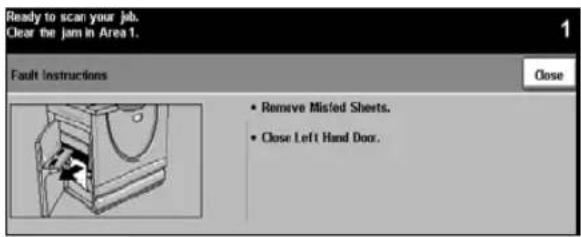
2
Paper jams
The fault screen will indicate the location of the jam.
Use the green handles and knobs indicated in the instructions displayed to remove the jammed paper.
➢ Ensure that all jam clearance handles and levers are returned to their correct positions. The red flashes behind the jam clearance handles and levers should not be visible.
NOTE: Any printed sheets removed will automatically be reprinted once the paper jam is cleared.
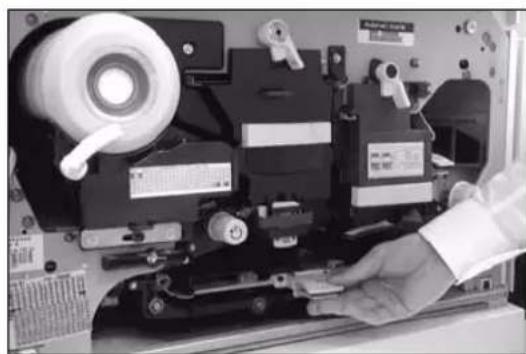
natural_image
Close-up of a hand operating a mechanical device with rollers and control buttons (no visible text or symbols)3
Document jams
Remove all the documents from the document handler and document glass as instructed.
➢ Re-order the documents as at the start of the job and reload. The documents will be recycled automatically to recover the job.
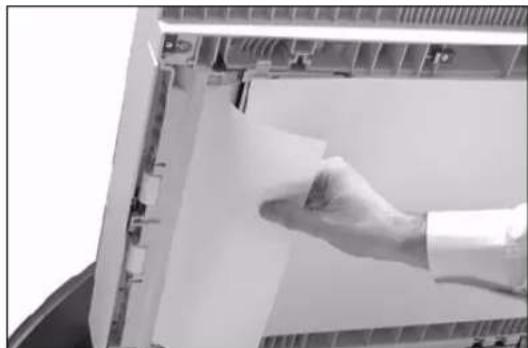
natural_image
Close-up of a hand inserting a card into a device frame (no visible text or symbols)If you are unable to clear the fault, refer to the next section to contact your local Xerox Welcome and Support Center for assistance.
NOTE: For additional Troubleshooting information please refer to the Training and Information CD (CD2) or the System Administration CD (CD1).
Xerox Welcome and Support Center
If a fault cannot be resolved by following the touch screen instructions, check the Troubleshooting Tips in the next section - they may help to solve the problem quickly. If the difficulty persists, contact the Xerox Welcome and Support Center. The Welcome and Support Center will want to know the following information: The nature of the problem, the Machine Serial number, the fault code (if any) plus the name and location of your company.
Locating the serial number
1 > Press the Machine Status button on the control panel.
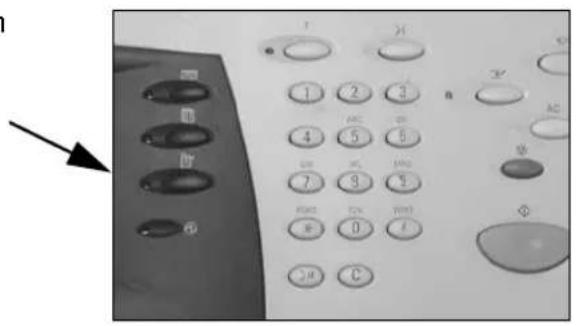
2 The Machine Information screen will be displayed. Select [Machine Details].
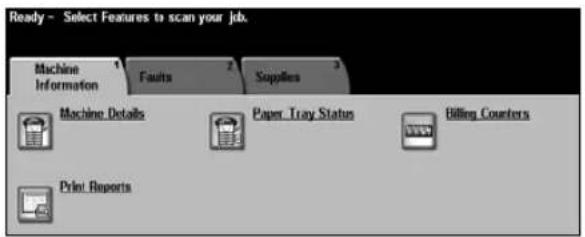
3 The Customer Support Number for the Welcome and Support Center and Machine Serial Number will be displayed.
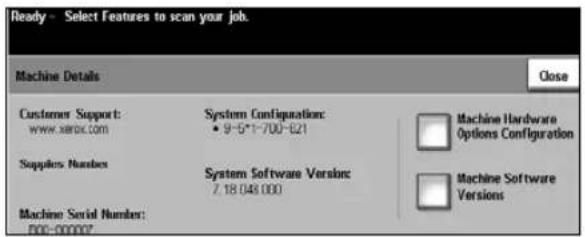
NOTE: The serial number can also be found on a metal plate inside the front door.
Troubleshooting Tips
For additional Troubleshooting information please refer to the Training and Information CD (CD2), the System Administration CD (CD1) or www.xerox.com.
Power
The machine will not power on:
➢ Check to see that the machine is not in Low Power Mode as indicated by the green light on the control panel. Touch the User Interface screen to re-activate.
➢ Press the ON/OFF button.
➢ Check to see if the power cord is correctly installed.

CAUTION: Use only the ON/OFF switch to re-boot your machine. Damage may occur to your machine if power is removed by other means.
Document Handler
Documents will not feed through the Document Handler
➢ Ensure that all staples or paper clips have been removed from the originals.
➢ Ensure the Document Handler is not overloaded. The Document Handler can hold 70 sheets of 20lbpaper. Use Build Job if you have more originals than this.
➢ Check to see if the document set is fully inserted into the Document Handler.
➢ Ensure that the edge guides are adjusted to touch the sides of the originals.
➢ Ensure that the Document Feed Roll is installed correctly. Open the top cover and push feed roll down into position
➢ Check for obstructions or paper debris in the Document Handler.
➢ Ensure that the Document Handler cover is closed.
➢ Check that the machine is Ready to Copy as indicated by a message on the touch screen.
Paper Handling
Repeated paper jams, misfeeds or multisheet feeds
➢ Ensure that the correct paper size is displayed on the Touch Screen.
➢ Ensure that the paper tray is not filled above the MAX line.
➢ Ensure that the edge guides are adjusted to touch the sides of the paper.
➢ Flip the paper over in the paper tray, 'fanning' the edges of the paper to separate the pages before reloading.
If the fault persists, remove the paper from the tray and load fresh paper, 'fanning' the edges of the paper first to separate the pages.
If the problem is not resolved, check for obstructions where paper enters the machine.
Paper Jams inside the machine
➢ Check the Paper Path for obstructions.
➢ Ensure all the handles and levers are in the correct (home) position. The red flashes behind the jam clearance handles and levers should not be visible. For further assistance please refer to the graphic below.
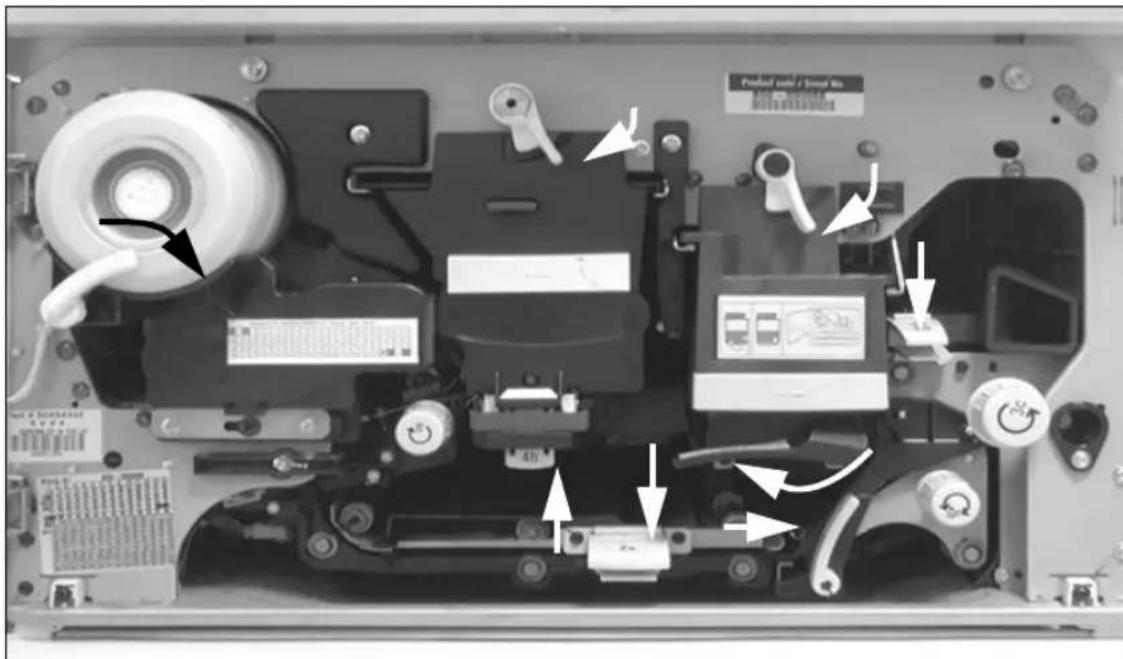
➢ Flip the paper over in the paper tray.
Check the paper tray Edge Guides to see if they are against the edges of the paper.
➢ Check that the Touch Screen is displaying the correct size for the paper in use.
Load fresh paper.
Repeated Check Tray Messages on the Touch Screen and the paper is loaded in the tray
Adjust the edge guides against the stack of paper in the tray.
If the edge guides were not set against the paper stock in the tray when Start was selected, delete the job in the job queue and begin again.
Paper Curls
Load the paper in the paper trays with the seam side of the paper up. Load the paper in the Bypass Tray with the seam side down.
The seam refers to the side of a ream of paper with a split in the wrapping. It may also be referred to as arrow side first.
➢ Load non-standard media in the Bypass Tray.
If the paper curls excessively, flip the paper over in the applicable paper tray.
Finisher
The Finisher does not stack the output correctly
- Unload the finisher tray frequently.
➢ Do not remove stapled sets while the finisher is compiling.
➢ Check the paper tray guides are locked into position against the paper.
When using large paper, remove any output contained in the stacker tray.
Load the paper in the paper trays with the seam side of the paper up. Load the paper in the Bypass Tray with the seam side down.
The seam refers to the side of a ream of paper with a split in the wrapping. It may also be referred to as arrow side first.
➢ Load non-standard media in the Bypass Tray.
If the paper curls excessively, flip the paper over in the applicable paper tray.
➢ Check the correct paper size has been selected for the paper loaded in the tray.
The Finisher does not staple or hole punch correctly
For incorrect stapling, use less than 50 sheets of paper if the paper is heavier than 20 lb.
The maximum number of sheets is 20 when stapling heavyweight paper.
➢ Check the correct option has been selected on the Touch Screen.
➢ Check the Touch Screen for a fault message indicating no staples. Replace the staple cartridge.
When using large paper, remove any output contained in the stacker tray.
➢ Check that the Chad Bin is not full. The Chad Bin collects waste from the hole punch. Refer to the Information and Training (CD2) for instructions.
➢ Check the correct paper size has been selected for the paper loaded in the tray.
➢ Check the paper tray guides are locked into position against the paper.
Output Quality
Stray marks or black marks from hole punched originals are not removed
➢ Use the Edge Erase to erase the edge with the drilled holes.
➢ Copy from the document glass with the Document Cover down.
Images are out of sequence or upside down when the Booklet Creation Feature is used
➢ Ensure that the originals are in the correct sequence.
➢ Feed LEF originals to SEF orientated paper stock.
➢ Enable the display options for Booklet Creation and ensure that the correct sequence is selected (i.e. Left to Right or Right to Left).
The output is blank
➢ Ensure the originals are loaded either face up in the Document Handler or face down on the Document Glass in the top right position.
Streaks, lines, spots, or black, solid, or dotted lines on the prints
Clean the Document Glass and, if using the Document Handler, also clean the Constant Velocity Transport Glass (the thin strip of glass to the left of the document glass), especially near the plastic ramp on the glass.
Clean the white underside of the Document Handler/Document Cover.
Clean the Document Handler roller - for instructions refer to the Training and Information (CD2) delivered with your machine.
➢ Clean the halo guide. Refer to the Information and Training (CD2) for instructions.
Clean the Charge Scorotron and Transfer Corotron. Refer to the Information and Training (CD2) for instructions.
➢ Check the paper tray guides are against the paper stack.
➢ Run the job from the Document Glass.
➢ Check the quality of the original. Use Border Erase or Edge Erase to remove lines from the edges of the document.
▶ Turn on Background Suppression.
Load fresh paper.
Do not use heavily embossed paper.
Image Loss
When copying a document from a larger paper size to a smaller size, use Auto% to reduce the image onto the smaller size.
➢ Use reduction i.e., copy at 90% instead of 100%.
➢ Select [Auto Center] and run the job again.
If scanning from the Document Glass, select [Manual Platen Input] and define the document size. Register the document in the right rear corner and copy with the cover down.
Do not use heavily embossed paper.
Blurred images on output
Load fresh paper.
If copying from the Document Glass, check the quality of the originals, set the input to Manual Platen Input, close the cover and try again. Ensure that the original is entirely flat against the Document Glass.
Clean the Charge Scorotron and Transfer Corotron. For instructions, refer to the Training and Information (CD2) delivered with your machine.
Clean the Document Glass and if using the Document Handler also clean the Constant Velocity Transport Glass (the thin strip of glass to the left of the document glass), especially near the plastic ramp on the glass. Refer to "Document Glass and Constant Velocity Transport Glass" on page 10-4.
Missing characters on output
Load fresh paper.
- Try using a smoother paper.
➢ Select darken if the original is light or the font is colored.
Gloss variations (coining)
➢ Check the quality of the original.
If the original has large areas of solid density, adjust the contrast.
Ghosting
➢ Check the quality of the original.
Clean the Document Glass, if it is being used.
Rotate the original 180 degrees and try the job again.
The machine cannot sense the size of the original on the glass
➢ Select [Original Input] in the Image Adjustment Tab and enter the size.
➢ Rescan the original, leaving the cover raised.
Jobs scan but do not print
Some jobs require image processing before printing. This may take as long as 2 seconds per page.
➢ Check the Job Status queue to determine if a job is processing. There may be a job in the queue with a status of paused. Delete this job if it remains in the state over 3 minutes.
This may possibly be a result of an incorrect feature combination. The software may need to be reset. Contact your System Administrator.
Output does not reflect the selections made on the Touch Screen
➢ Press Clear All between jobs.
If a Save button displays on the touch screen, ensure Save is selected after each selection.
Fax
The image is reduced on a transmission
➢ Confirm the original size of the documents. Documents may be reduced on the available paper supply at the receiving fax machine.
The machine does not answer incoming calls
➢ Change the Automatic Answer Delay setting to 0 seconds. Refer to the Training and Information CD (CD2) for further assistance.
The machine answers calls but does not accept incoming data
If the job contains several graphics, the machine may not have enough memory. The machine will not answer if memory is low.
➢ Remove stored documents and jobs and wait for existing jobs to complete. This will increase the available memory.
Fault Messages will not clear
There may be occasions when a fault is cleared but the message will not clear. Reboot your machine by powering OFF and ON using the ON/OFF switch at the side of the machine.

CAUTION: Wait approximately 20 seconds before turning the machine back ON. Any incomplete jobs in the queue will be lost.

CAUTION: Use only the ON/OFF switch to reboot your machine. Damage may occur to your machine if power is removed by other means.
12Index
Numerics
2-Sided
Copy 4-6
A
Acknowledgment Report Internet Fax 6-14
Add File Destination Network Scanning 7-17
Added Fax Features Embedded Fax 5-13
Additional Resources 1-3
Address List E-mail 8-4
Advanced Print 9-5
Advanced Fax Features Embedded Fax 5-21
Authentication Mode E-mail 8-17 Internet Fax 6-16 Network Scanning 7-19 Server Fax 5-34
B
Basic Copying 4-3
Basic Faxing Embedded Fax 5-3 Server Fax 5-25
Booklet Creation Copy 4-21
Bound Originals
Copy 4-15
Embedded Fax 5-12
Build Job
Copy 4-26
Embedded Fax 5-22
C
Cleaning the Machine 10-4
Comment Setup Embedded Fax 5-21
Constant Velocity Transport Glass 10-4
Control Options Print 9-3
Control Panel Overview 3-2
Conventions 1-4
Copy 4-2 Basic Copying 4-3
CopyCentre Overview 2-3
Cover Letter Embedded Fax 5-16
Covers Copy 4-24
Customer Replaceable Units 10-2
D
Delayed Send Embedded Fax 5-18 Server Fax 5-33
Destination Details Network Scanning 7-6
Dial Directory Setup Embedded Fax 5-24
Dialing Options
Server Fax 5-26
Dialling Options
Embedded Fax 5-4
Document Format
E-mail 8-14
Internet Fax 6-13
Network Scanning 7-16
Document Glass
Constant Velocity Transport Glass 10-4
Document Handler
Troubleshooting Tips 11-5
Document Management Fields
Network Scanning 7-17
Document Name
Network Scanning 7-14
E
Edge Erase
Copy 4-16
E-mail 8-10
Network Scanning 7-11
E-mail 3-10, 8-2
ENERGY STAR 1-11
Entering an Address
E-mail 8-4
Entering an E-mail Address
Internet Fax 6-4
Environmental Choice 1-11
Environmental Compliance 1-11
F
Fault Clearance
Troubleshooting 11-3
Fault Messages will not clear
Troubleshooting Tips 11-11
Fax 5-2
Troubleshooting Tips 11-11
Fax Kit Regulatory Information
Canadian 1-14
US 1-12
Fax Reports
Embedded Fax 5-19
Fax Sending Features
Embedded Fax 5-13
FCC Part 15 1-12
Finisher
Hole Punched 4-4
Off-line Stapling 4-5
Stapling 4-5
Troubleshooting Tips 11-7
Further Assistance 3-15, 10-5
G
General 11-2
Troubleshooting 11-2
H
Hole Punched Output 4-4
|
ICES-003 1-12
If File Already Exists
Network Scanning 7-15
Illegal Copying 1-15
Image Adjustment
Copy 4-12
E-mail 8-6
Embedded Fax 5-9
Internet Fax 6-6
Network Scanning 7-7
Image Options
Print 9-5
Image Quality
Copy 4-13
E-mail 8-7
Embedded Fax 5-10
Internet Fax 6-7
Network Scanning 7-8
Server Fax 5-30
Image Shift
Copy 4-18
Internet Fax 6-2
Introduction to Print 9-2
Introduction to your machine 2-2
Invert Image
Copy 4-23
J
Job Assembly
Copy 4-26
L
Layout/Watermark
Print 9-6
Loading Paper 3-4
Locating the serial number 11-4
Logging On / Off 3-13
M
Machine Features Overview 1-6
Mailboxes
Embedded Fax 5-20
Maintenance
Power On or Off 3-3
Making Copies 3-5
Message Body
E-mail 8-15
Internet Fax 6-15
More Fax Features
Server Fax 5-29
More Image Quality
Copy 4-14
E-mail 8-8
Internet Fax 6-8
Network Scanning 7-9
Server Fax 5-31
Multi-up
Copy 4-22
N
Network Scanning 7-3
0
Off-line Stapling 4-5
Original Input
Copy 4-17
E-mail 8-11
Embedded Fax 5-11
Internet Fax 6-11
Network Scanning 7-12
Server Fax 5-32
Output
Copy 4-4
Hole Punched 4-4
Off-line Stapling 4-5
Stapling 4-5
Output Format
Copy 4-19
E-mail 8-13
Internet Fax 6-12
Network Scanning 7-14
Output Quality
Troubleshooting Tips 11-8
P
Paper Handling
Troubleshooting Tips 11-6
Paper Supply
Copy 4-10
Paper/Output
Print 9-4
Polling
Embedded Fax 5-23
Power
Troubleshooting Tips 11-5
Power On or Off 3-3
Print Driver Features 9-3
Print Drivers 9-4
Printing from a PC 3-11
Printing with Internet Services 3-12
R
Reduce/Enlarge
Copy 4-8
Reduce/Split
Embedded Fax 5-15
Refresh Destinations
Network Scanning 7-18
Regulatory Information 1-12
Reply To
E-mail 8-15
Internet Fax 6-14
Repositories
Network Scanning 7-4
Resolution
E-mail 8-12
Embedded Fax 5-7
Internet Fax 6-10
Network Scanning 7-13
Server Fax 5-27
s
Safety 1-9
Safety Introduction 1-9
Safety Notes 1-9
Sample Set
Copy 4-28
Scan 7-2
Scanning a Document to a File 3-9
Scanning Resources Network Scanning 7-2
Secure Send E-mail 8-16
Send E-mail 8-3 Internet Fax 6-3
Sending a Server Fax 3-7
Sending an E-mail 3-10
Sending an Embedded Fax 3-6
Sending an Internet Fax 3-8
Sides Scanned E-mail 8-9
Embedded Fax 5-8
Internet Fax 6-9
Network Scanning 7-10
Server Fax 5-28
Stapled Output 4-5
Starting Rate Embedded Fax 5-17
Stored Programming Copy 4-29
System Administration CD Additional Resources 1-3
T
Template Destinations Network Scanning 7-5
Template Overview Network Scanning 7-4
Training and Information CD Additional Resources 1-3
Transmission Options Embedded Fax 5-14
Transparencies Copy 4-20
Troubleshooting Tips 11-5
U
Utilities CD Additional Resources 1-3
W
WorkCentre Overview 2-5 WorkCentre Pro Overview 2-7 Workstation Features Overview 1-8
X
Xerox Welcome and Support Center 11-4