Off-Axis Guider - Optical accessory CELESTRON - Free user manual and instructions
Find the device manual for free Off-Axis Guider CELESTRON in PDF.


User questions about Off-Axis Guider CELESTRON
0 question about this device. Answer the ones you know or ask your own.
Ask a new question about this device
Download the instructions for your Optical accessory in PDF format for free! Find your manual Off-Axis Guider - CELESTRON and take your electronic device back in hand. On this page are published all the documents necessary for the use of your device. Off-Axis Guider by CELESTRON.
USER MANUAL Off-Axis Guider CELESTRON
natural_image
Close-up of a black mechanical clamp or fitting with threaded connectors and a central cylindrical component (no visible text or symbols)INSTRUCTION MANUAL
MODEL#93648
INTRODUCTION
Your Celestron Off-Axis Guider (OAG) allows you to take accurate, long exposure astroimages when used with an autoguider. Since the autoguider and imaging camera share the same telescope, you will achieve tracking accuracy greater than you would with a separate guide scope.
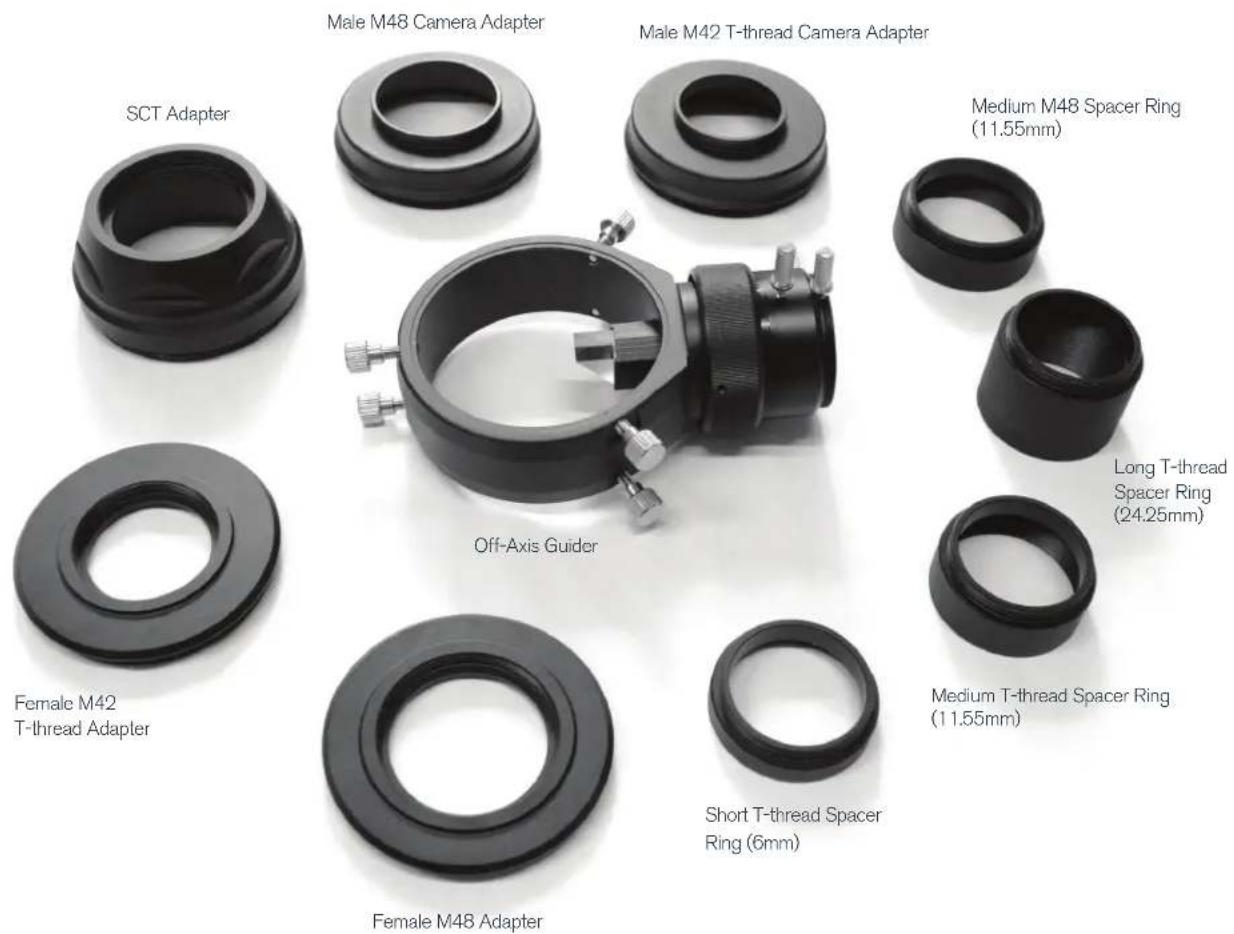
PARTS LIST
text_image
SCT Adapter Male M48 Camera Adapter Male M42 T-thread Camera Adapter Off-Axis Guider Medium M48 Spacer Ring (11.55mm) Long T-thread Spacer Ring (24.25mm) Short T-thread Spacer Ring (6mm) Medium T-thread Spacer Ring (11.55mm) Female M42 T-Thread Adapter Female M48 AdapterFig. 1
SYSTEM REQUIREMENTS
The Off-Axis Guider (OAG) requires a telescope, imaging camera, autoguider, and a mount tracking equatorially with autoguiding capability. You should already be familiar with these items before using the Off-Axis Guider.
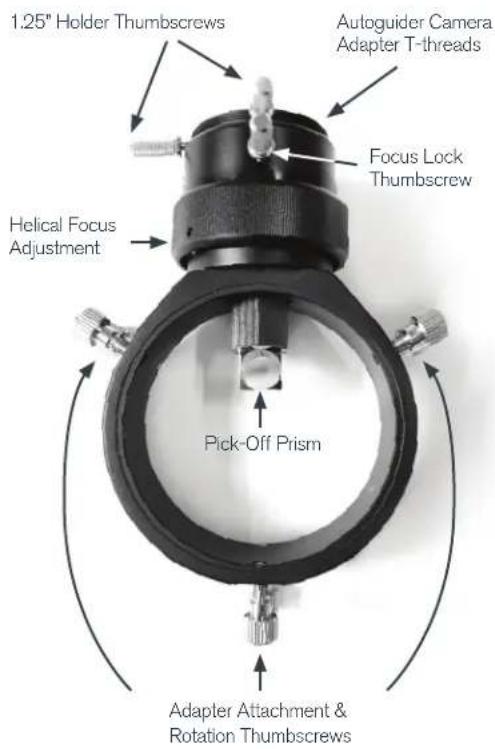
Refer to Figure 2 to familiarize yourself with the OAG.
TELESCOPE
To attach the front of the OAG to the telescope, the telescope must have M42 T-threads, M48 threads, or 2" Schmidt-Cassegrain style threads. If your telescope has a 2" visual back, you will need to provide a camera adapter to attach the telescope to the Off-Axis Guider. Camera adapters are commonly available that adapt from 2" to M42 T-thread (also called T2).
Note that because the OAG consumes a significant amount of inward focus travel, some telescopes will not be able to reach focus with this accessory. Most Newtonian reflectors and some refractors do not have enough inward focus travel to accommodate the Off-Axis Guider. Refractors designed for astroimaging typically have plenty of focus travel, as do most catadioptric telescopes such as the Schmidt-Cassegrain or EdgeHD.
OAG BACKFOCUS
You may need to configure the OAG to your particular telescope, camera, and autoguider combination. The measurements listed below refer to the actual length the part consumes when installed on the telescope.
OAG Body: 29mm
SCT Adaper:25.3mm
Male M42 and M48 camera adapters: 12.5mm
Female M42 and M48 telescope adapters: 4.5mm
Short T-thread Spacer Ring: 6mm
Medium T-thread Spacer Ring: 11.55mm
Long T-thread Spacer Ring: 24.25mm
Medium M48 Spacer Ring: 11.55mm
IMAGING CAMERA
A CCD camera or specialized astroimaging camera should have female T-threads or 48mm threads. It will attach to one of the two camera adapters included with the OAG.
DSLR cameras require a T-ring specific to the make and model of the camera. Canon and Nikon T-rings are available from Celestron. Full frame DSLR cameras should use a wide T-ring with 48mm threads to fully illuminate the sensor's field of view.
text_image
1.25" Holder Thumbscrews Autoguider Camera Adapter T-threads Focus Lock Thumbscrew Helical Focus Adjustment Pick-Off Prism Adapter Attachment & Rotation ThumbscrewsFig. 2
CONFIGURING THE OFF-AXIS GUIDER
The included adapters allow you to use the Off-Axis Guider with popular combinations of autoguiders, imaging cameras, and telescopes. Some telescopes, like the EdgeHD series, require a specific backfocus distance to the detector on the imaging camera. For this reason, the Spacer Rings must be used to achieve the correct distance.
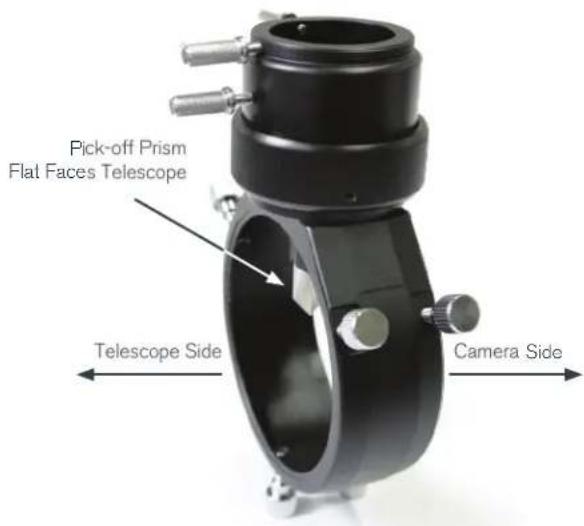
Always position the OAG so that the flat side of the pick-off prism faces the telescope (Figure 3).
The imaging camera and autoguider must be parfocal to one another. That means the optical distance from the telescope to the autoguider sensor and camera sensor must be the same. To achieve this, a set of three T-thread Spacer Rings and one 48mm Spacer Ring (for full frame cameras) have been provided. In addition to the Spacer Rings, the Off-Axis Guider also features a helical focuser with 8mm of focus travel to allow the autoguider to reach focus.
text_image
Pick-off Prism Flat Faces Telescope Telescope Side Camera SideFig. 3
flowchart
graph TD
    A["Antoguider with T-threads"] --> B["Short 6mm T-thread Spacer"]
    B --> C["Adapler Plate"]
    C --> D["Off-Axis Guider"]
    D --> E["SCT Adapter"]
    E --> F["Male M42 T-thread"]
    F --> G["Medium 11.55mm T-thread Spacer"]
    G --> H["Nightscape Nosepiece"]
    H --> I["Nightscape CCD Camera"]
    J["Autoguider with 1.25" Nosepiece"] --> K["DSL R T-Ring"]
    K --> L["DSL R Camera"]
    L --> M["OR"]
    M --> N["Nightscape CCD Camera"]
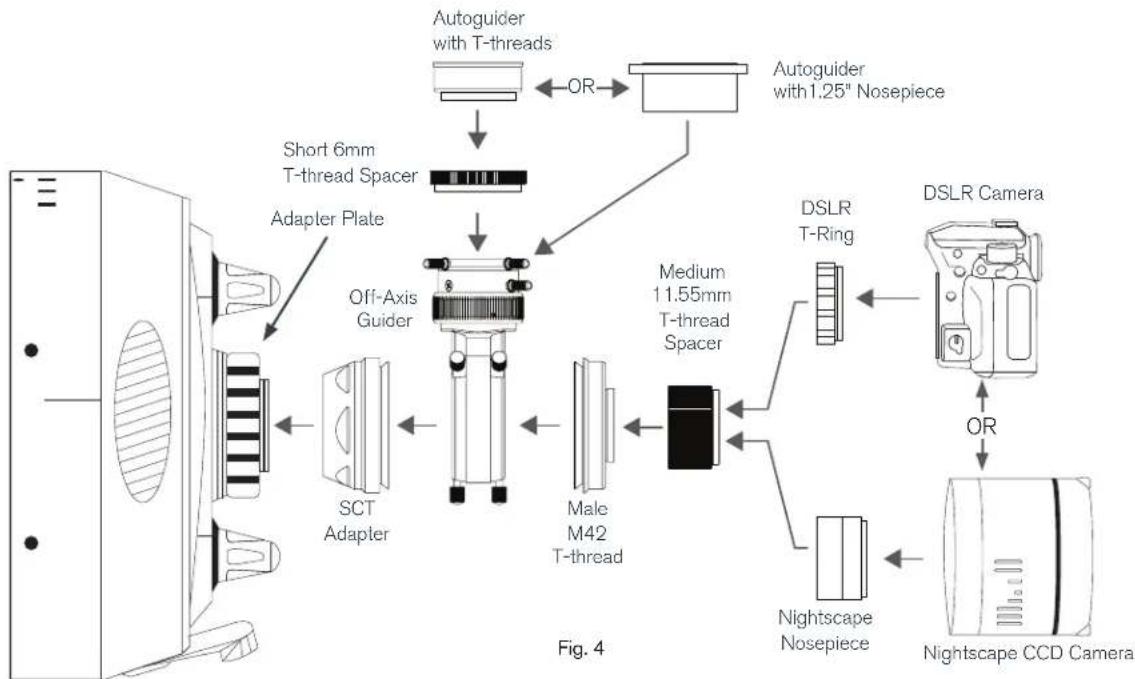
CONFIGURATION FOR SCHMIDT-CASSEGRAIN, OR EDGEHD 800 TELESCOPES WITH NIGHTSCAPE OR APS-C DSLR
Refer to Figure 4 for the recommended adapter configuration. Your camera sensor should be 133mm away from the Rear Adapter Plate of the EdgeHD 800 telescope. This configuration assumes a camera with 55mm of backfocus to the sensor, which includes
Celestron Nightscape CCD cameras and most DSLRs. If you are using a CCD camera with a different backfocus, you need to determine the distance needed from the OAG to camera to reach 133mm total.
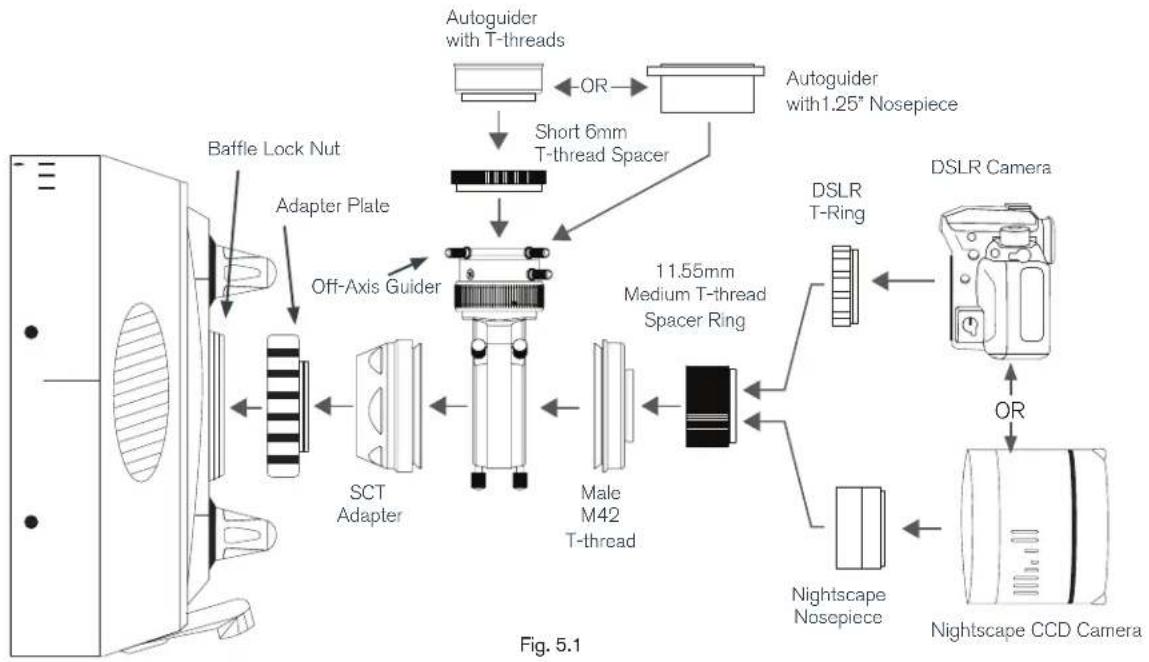
CONFIGURATION FOR EDGEHD 925, 1100 AND 1400 TELESCOPES WITH NIGHTSCAPE, DSLR, OR FULL FRAME DSLR OR CCD CAMERAS
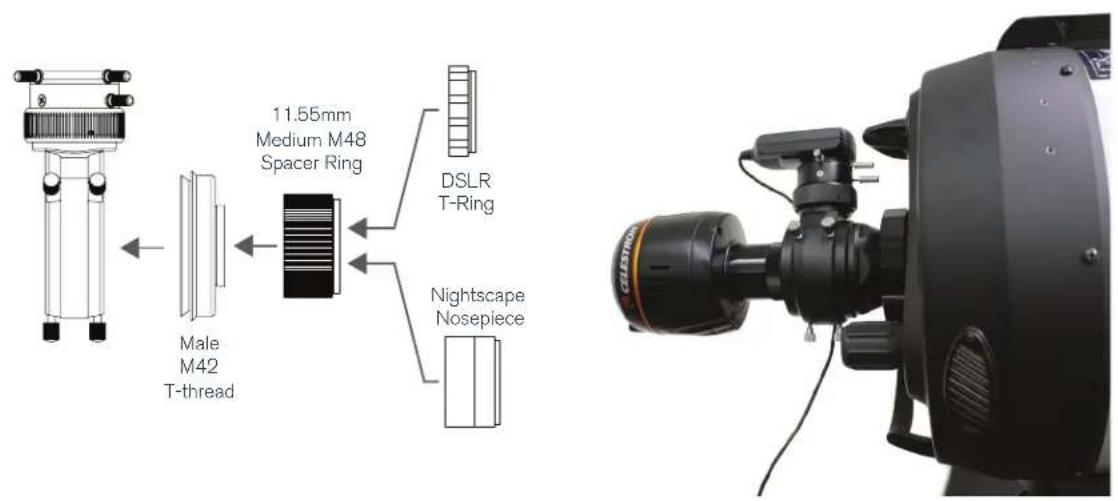
Refer to Figure 5.1 for APS-C sized camera sensors, such as Celestron Nightscape, Canon Rebels, or other CCD cameras. Refer to Figure 5.2 for full frame (35mm format) cameras such as the Canon 5D or large format CCD cameras.
Your camera sensor should be 146mm away from the Baffle Lock Nut of the EdgeHD telescope. This configuration assumes a camera with 55mm of backfocus to the sensor, which includes Celestron Nightscape CCD cameras and most DSLRs.
If you are using a CCD camera with a different backfocus, you need to determine the spacing required to achieve a total distance of 146mm from the EdgeHD's Baffle Lock Nut to your imaging camera sensor.
Figure 6 shows a setup configured with the EdgeHD 1100 with the Nightscape CCD camera as an imager and webcam style autoguider.
flowchart
graph TD
    A["Baffle Lock Nut"] --> B["Adapter Plate"]
    B --> C["Off-Axis Guider"]
    C --> D["SCT Adapter"]
    D --> E["11.55mm Medium T-thread Spacer Ring"]
    E --> F["Male M42 T-thread"]
    F --> G["Nightscape Nosepiece"]
    G --> H["Nightscape CCD Camera"]
    I["Autoguider with T-threads"] --> J["Short 6mm T-thread Spacer"]
    K["Autoguider with 1.25" Nosepiece"] --> L["DSL R T-Ring"]
    M["DSL R Camera"] --> N["Nightscape CCD Camera"]
    O["OR"] --> P["OR"]
text_image
11.55mm Medium M48 Spacer Ring Male M42 T-thread DSL R T-Ring Nightscape NosepieceFig. 5.2 Fig. 6
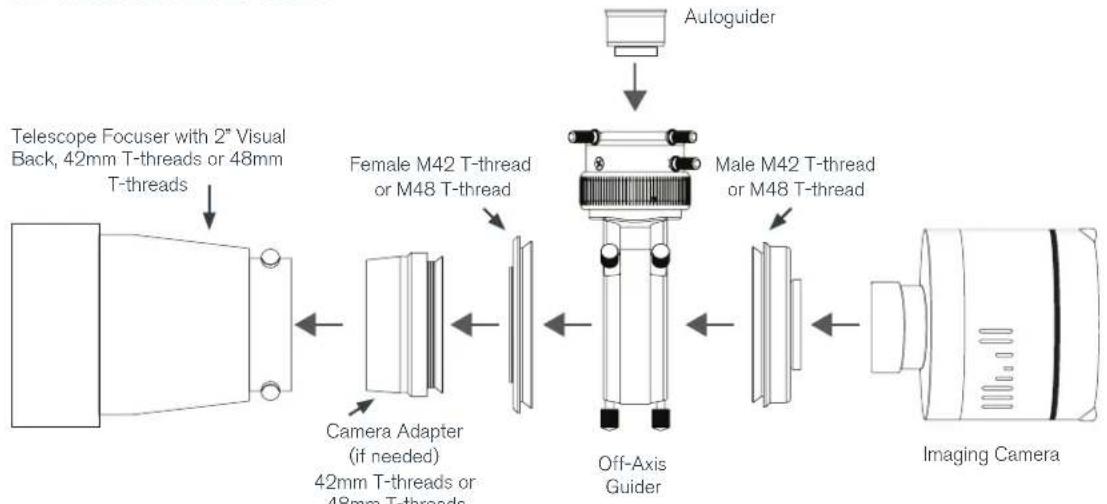
CONFIGURATION FOR OTHER TELESCOPES, USING A CAMERA ADAPTER
Refer to Figure 7 as a possible configuration that uses a camera adapter. Any telescope with a camera adapter that uses T-threads or 48mm threads can attach to the OAG using the supplied female M42 or M48 adapters. Note that you need to supply the camera adapter if your telescope does not already have threads build into the focuser.
flowchart
graph LR
A["Telescope Focuser with 2" Visual Back, 42mm T-threads or 48mm T-threads"] --> B["Camera Adapter (if needed)<br>42mm T-threads or 48mm T-threads"]
B --> C["Female M42 T-thread or M48 T-thread"]
C --> D["Off-Axis Guider"]
D --> E["Male M42 T-thread or M48 T-thread"]
E --> F["Imaging Camera"]
G["Auloguider"] --> H["End"]
Fig. 7
ATTACHING THE AUTOGUIDER
The OAG can attach to your autoguider using either the T-threads or the 1.25" holder. If the T-threads are used, remove the two 1.25" holder thumbscrews (Figure 2). Autoguiders like the Lodestar or ST-i fit into the 1.25" holder, and others like the StarShoot AutoGuider thread directly to the T-threads. Use caution when inserting an autoguider like the Lodestar. The pick-off prism holder can collide with the front optical window if the autoguider is pushed in all the way.
ADJUSTING THE PRISM HEIGHT
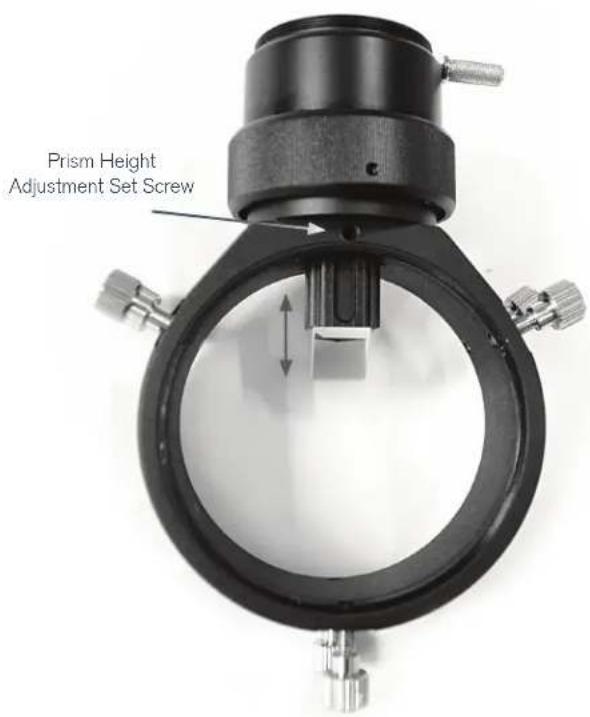
The prism height can be adjusted to better illuminate the field of view of your autoguider. The smaller the imaging sensor size is for in your camera, the further "downward" the prism can be set without interfering with the sensor. This adjustment is normally not necessary unless the pick-off prism is obstructing your imaging camera's sensor, or if you are using the smaller 42mm telescope adapter which will limit the illumination to the pick-off prism.
Loosen the 2mm socket head screw using an Allen wrench (not included), and slide the prism housing up or down as needed before tightening the screw (Figure 8).
Note: Use caution with this adjustment. Do not touch the prism. Note that when loosening the set screw, the prism housing is not captive and can slide off.
text_image
Prism Height Adjustment Set ScrewFig. 8
FOCUSING
Always start by focusing the imaging camera with your telescope. Then, proceed to focus the autoguider using the helical focus adjustment. The first time you use the OAG, you may need to locate a guide star visually with a 1.25" eyepiece. The Moon or a bright star cluster are good targets to start with so you can clearly see something on the camera side and guider side.
If the imaging camera does not reach focus, determine if you need more inward or outward focus travel. The OAG consumes a significant amount of focus travel, so some telescopes may not be able to reach far enough inward focus travel (see System Requirements).
If the autoguider does not reach focus, determine if you need to add a T-thread spacer ring to move the autoguider outward, or if you need more focus travel inward. If more inward travel is needed, additional spacing will need to be added between the imaging camera and OAG.
Tighten the Focus Lock Thumbscrew (Figure 2) when the autoguider is focused.
FINDING A GUIDE STAR AND ROTATING THE OAG
Finding a guide star can be challenging, depending on the telescope used and the area of sky you are imaging in. Fortunately, you can rotate the OAG 360° to find a guide star. While carefully supporting the OAG and camera with your hand, carefully and slightly loosen the 3 thumbscrews that secure the front of the OAG to the telescope and rotate the OAG as needed to locate a guide star in your autoguider. Firmly tighten the 3 thumbscrews on the telescope side. If needed, make a similar adjustment to the camera side: loosen the 3 thumbscrews on the camera side and rotate your imaging camera to the desired orientation, then firmly tighten the screws again.
WARRANTY
Your Off-Axis Guider has a two year limited warranty.
Please see the Celestron website for detailed warranty information at www.celestron.com.
This product is designed and intended for use by those 14 years of age and older.

CELESTRON
2835 Columbia Street • Torrance, CA 90503 U.S.A.
Telephone: 1(800) 421-9649 • Printed in China 2013
© 2013 Celestron • All rights reserved. • www.celestron.com