
µchiller 3 - Cooler Carel - Free user manual and instructions
Find the device manual for free µchiller 3 Carel in PDF.


| Product Type | Electronic controller for chillers and heat pumps |
| Brand | Carel |
| Model | µchiller 3 |
| Power Supply | 22 to 38 Vdc or 24 Vac ±15% 50/60 Hz, max 14 W |
| Mounting | DIN rail (DIN 43880 and CEI EN 50022) |
| Display | pLD: 4 digits + decimal point; pGD0: 4 rows x 20 characters |
| Analog Inputs | 10 inputs: NTC (B5, B6, B7, B9, B10), 0-5 V ratiometric (B3, B4), 4-20 mA (B8), configurable NTC/0-5 V (B1, B2) |
| Analog Outputs | 4 x 0-10 Vdc (Y1, Y2, Y5, Y6); 2 x PWM (Y3, Y4) |
| Digital Outputs | 14 electromechanical relays, 5 A resistive max |
| Main Functions | Temperature control, defrost management, fan speed control, alarm management, time bands, pump management, compressor rotation, pumpdown, part-winding start, tandem/trio compressor management, electronic expansion valve control |
| Applications | Air-air, air-water, water-water chillers/heat pumps, condensing units (air-cooled and water-cooled) |
| Access Levels | Free (set point, ON/OFF), User (password 22), Manufacturer (password 66) |
| Communication Protocols | CAREL, Modbus, LonWorks, RS232, GSM modem |
| Protection Class | IP20 (IP00 without case) |
| Operating Conditions | -10°C to 55°C, 90% RH non-condensing |
| Storage Conditions | -20°C to 70°C, 90% RH non-condensing |
| Safety | Disconnect power before servicing; WEEE directive 2002/96/EC |
| Maintenance | Service and maintenance must be performed by qualified personnel |
| Spare Parts | Connector kits (MCH3CON000/001), cable kit (MCH300CAB0), programming key (MCH300KYA0), clock board (PCO100CLK0), serial boards (PCOS004850, PCO100MDM0, PCO10001F0) |
| Repairability | Modular design; connectors and boards replaceable individually |
Frequently Asked Questions - µchiller 3 Carel
User questions about µchiller 3 Carel
0 question about this device. Answer the ones you know or ask your own.
Ask a new question about this device
Download the instructions for your Cooler in PDF format for free! Find your manual µchiller 3 - Carel and take your electronic device back in hand. On this page are published all the documents necessary for the use of your device. µchiller 3 by Carel.
USER MANUAL µchiller 3 Carel
We wish to save you time and money!
We can assure you that the thorough reading of this manual will guarantee correct installation and safe use of the product described.
IMPORTANT WARNINGS

BEFORE INSTALLING OR HANDLING THE DEVICE PLEASE CAREFULLY READ AND FOLLOW THE INSTRUCTIONS DESCRIBED IN THIS MANUAL.
This device has been manufactured to operate risk-free for its specific purpose, as long as:
it is installed, operated and maintained according to the instructions contained in this manual;
the environmental conditions and the voltage of the power supply correspond to those specified.
All other uses and modifications made to the device that are not authorised by the manufacturer are considered incorrect.
Liability for injury or damage caused by the incorrect use of the device lies exclusively with the user.
Please note that this unit contains powered electrical devices and therefore all service and maintenance operations must be performed by specialist and qualified personnel who are aware of the necessary precautions.
Disconnect the unit from the mains power supply before accessing any internal parts.
INFORMATION FOR USERS ON THE CORRECT HANDLING OF WASTE ELECTRICAL AND ELECTRONIC EQUIPMENT (WEEE)
In reference to European Union directive 2002/96/EC issued on 27 January 2003 and the related national legislation, please note that:
- WEEE cannot be disposed of as municipal waste and such waste must be collected and disposed of separately;
- The public or private waste collection systems defined by local legislation must be used. In addition, the equipment can be returned to the distributor at the end of its working life when buying new equipment.
- The equipment may contain hazardous substances: the improper use or incorrect disposal of such may have negative effects on human health and on the environment;
- The symbol (crossed-out wheeled bin) shown on the product or on the packaging and on the instruction sheet indicates that the equipment has been introduced onto the market after 13 August 2005 and that it must be disposed of separately;
- In the event of illegal disposal of electrical and electronic waste, the penalties are specified by local waste disposal legislation.
CONTENTS
1. INTRODUCTION....5
1.1 General description .... 5
1.2 User interface 5
1.3 Programming procedure....6
2. PGDO TERMINAL 6
2.1 Passwords and levels of access....6
2.2 Type of connectors....6
3. APPLICATIONS....7
3.1 AIR/AIR units, single circuit 7
3.2 AIR/AIR units, two circuits 7
3.3 AIR/AIR units, two circuits, 1 condenser fan circuit ....8
3.4 AIR/AIR heat pumps, single circuit 8
3.5 AIR/AIR heat pumps, two circuits 9
3.6 AIR/AIR heat pumps, two circuits, 1 condenser fan circuit ....9
3.7 AIR/AIR chillers, single circuit....10
3.8 AIR/AIR chillers, two circuits, 2 condenser fan circuits and 2 evaporators 10
3.9 AIR/WATER chillers, two circuits, 1 condenser fan circuit....11
3.10 AIR/WATER heat pumps, single circuit 11
3.11 AIR/WATER heat pumps, 2 condenser fan circuits .... 12
3.12 AIR/WATER heat pumps, two circuits, 1 condenser fan circuit .... 12
3.13 WATER/WATER chillers, single circuit.... 13
3.14 WATER/WATER chillers, two circuits.... 13
3.15 WATER/WATER chillers, two circuits, 2 evaporators....14
3.16 WATER/WATER heat pumps with reversal on the refrigerant circuit, single circuit.... 14
3.17 WATER/WATER heat pumps with reversal on the refrigerant circuit, two circuits.... 15
3.18 WATER/WATER heat pumps with reversal on the refrigerant circuit, two circuits, 1 evaporator.... 15
3.19 WATER/WATER heat pumps with reversal on the water circuit, single circuit 16
3.20 WATER/WATER heat pumps with reversal on the water circuit, two circuits, H02=1 and H21=4 16
3.21 WATER/WATER heat pumps with reversal on the water circuit, two circuits, 1 evaporator H02= 1 and H21= 4 ...... 17
3.22 Air-cooled condensing unit without reverse cycle, single circuit 17
3.23 Air-cooled condensing unit without reverse cycle, two circuits 18
3.24 Reverse-cycle air-cooled condensing unit, single circuit 18
3.25 Reverse-cycle air-cooled condensing unit, two circuits with condenser fan circuit 19
3.26 Water-cooled condensing unit without reverse cycle, single circuit 19
3.27 Water-cooled condensing unit without reverse cycle, two circuits 20
3.28 Reverse-cycle water-cooled condensing unit, single circuit.... 20
3.29 Reverse-cycle water-cooled condensing unit, two circuits....21
4. PARAMETERS 22
4.1 Menu layout....22
4.2 List of parameters with the pLD user interface 23
4.3 List of parameters with the pGD user interface....25
5. CONNECTIONS 41
6. DESCRIPTION OF THE MAIN FUNCTIONS....43
6.1 Control set point 43
6.2 Inlet-room temperature control 44
7. DESCRIPTION OF OPERATION....45
7.1 Outlet temperature control 45
7.2 Differential Temperature Control 47
7.3 Condensing unit control 47
7.4 Compressor rotation....49
7.5 TANDEM - TRIO compressor rotation 50
7.6 Compressor safety times....50
7.7 Pumpdown management....52
7.8 Main pump management....53
7.9 Pump rotation 53
7.10 Electric heaters....54
7.11 Selecting the operating mode....55
7.12 ON/OFF time bands 55
7.13 Antifreeze control....56
7.14 Condenser - evaporator control 57
7.15 Prevent function....59
7.16 Low noise function....59
7.17 Start with hot condenser....59
7.18 Defrost control in air/water – Air/air units....60
7.19 Types of defrost....60
7.20 Defrosting a circuit with time / temperature control....61
7.21 Defrosting a circuit with control from external contact 62
7.22 Manual defrost....63
7.23 Defrost control ON REVERSE-CYCLE water/water units....63
7.24 Activating a defrost cycle....63
7.25 Running a defrost 63
7.26 Ending a defrost cycle 63
8. MAP OF OUTPUTS 64
8.1 Air / air units....64
8.2 Air / water units....66
8.3 Water / water units....68
8.4 Air-cooled condensing units 71
9. ALARMS....73
9.1 Table of alarms....73
9.2 Type of alarm reset....76
9.3 Alarm log 76
9.4 Flow switch alarm....76
9.5 Circulating pump thermal overload alarm....77
9.6 Condenser fan thermal overload alarm 77
9.7 Antifreeze alarm 77
10. CONNECTIONS, ACCESSORIES AND OPTIONS 78
- CODES....78
- TECHNICAL SPECIFICATIONS....78
1. Introduction
1.1 General description
The C^3 is a new compact CAREL electronic controller, measuring the size of a normal thermostat, for the complete management of chillers and heat pumps: it can control air-air, air-water, water-water and condensing units.
Main functions
- Temperature control for air/air units, air/water-cooled chillers/heat pumps, with two circuits and up to 6 steps, with and without reversal on the water/refrigerant circuit;
• condenser control in two circuits with up to 6 steps on air/water-cooled units, with and without reversal on the water/refrigerant circuit;
• defrost management by time and/or by temperature or pressure; - fan speed control;
• complete alarm management;
• time band management;
Advanced functions
- sliding defrost
- functions to prevent high condensing pressure/temperature, low evaporator pressure/temperature, antifreeze
• control
• management of tandem, trio and semi-hermetic compressors - pump-down
- part-winding start
Driver functions
• Electronic expansion valve management.
Devices controlled
- Compressor;
- condenser fans;
• evaporator fan (air-source units) - reversing valve;
- outlet fan (air-air);
- antifreeze heater;
- support heaters;
- alarm signal device;
• water pumps for the evaporator and/or condenser (water-source units);
Programming
CAREL offers the possibility to configure all the unit parameters not only from the keypad on the front panel, but also using a hardware key or via a serial line.
1.2 User interface
pLD large terminal
The display has 4 digits plus decimal point. In normal operation, the value shown on the display corresponds to the temperature read by the control probe, for example the evaporator water inlet temperature (on water chillers) or alternatively the room temperature, on direct expansion units.
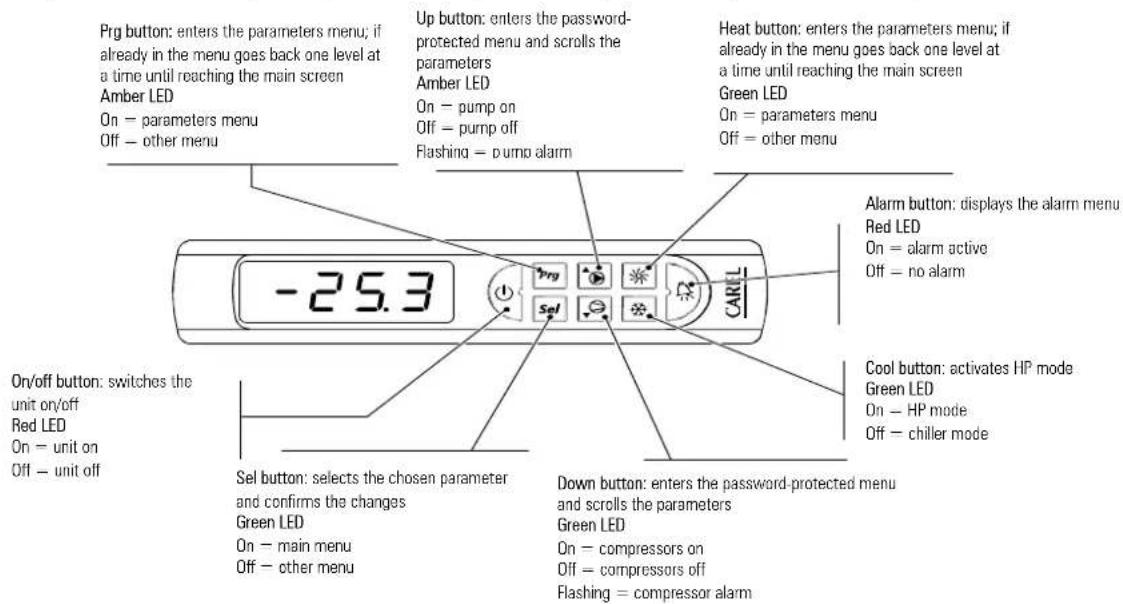
Fig. 1.a
1.3 Programming procedure
1) press up or down
2) press Sel
3) enter the password using up or down
4) press Sel to confirm
If the password is correct, the parameters menu automatically appears; if the password is wrong, the value 0 is displayed.
Repeat the operation by repeating the procedure or press Prg to exit.
2. pGD0 terminal
The display covers 4 rows by 20 characters. In normal operation, the display shows the evaporator inlet and outlet temperatures, the unit status (ON/OFF) and the mode (cooling/heating).
The up and down buttons can be used to immediately enter in the user menu, set point, ON/OFF and COOLING/HEATING mode.
Entering the password in the screen following is possible enter in programming of all the parameters.
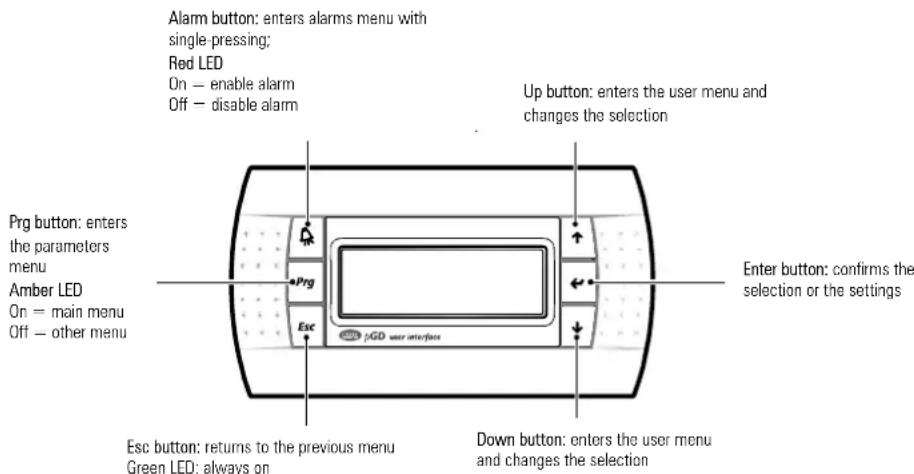
Fig. 1.b
2.1 Passwords and levels of access
The user interface has the parameters organised into three distinct levels of access, each of which containing a different number of visible parameters: free access: access to the screens displaying the inputs and outputs, unit on/off, set point, enter password to access the protected parameters. user level: (password 22), all the free access parameters plus the main control parameters, maintenance parameters, alarms. manufacturer level: (password 66), complete access to the unit configuration parameters, from the type of devices controlled to the definition of the control parameters.
The parameters are organised by uniform groups accessible from specific sliding menus.
The following diagram shows the method for accessing the various groups of parameters and their layout.
From inside a group of parameters, pressing [Esc] moves the cursor to the sliding menu for selecting the parameters, pressing [Prog] moves to the main menu.
2.2 Type of connectors
The connectors and the cables can be purchased separately from CAREL (MCH3CON**) or directly from the manufacturers, Molex and Phoenix. For the crimping of the contacts use the special Molex tool code 69008-0724.
Mini-fit terminals
| Number of connectors | Molex code of the connector | Number of pins | Molex code of the contact | Cable cross-section allowed in AWG | Cable cross-section allowed in mm2 |
| 2 | 39-01-2140 | 14 | 39-00-003839-00-0046 | AWG18 to 24AWG22 to 28 | 1.00 to 0.210.5 to 0.10 |
| 1 | 39-01-2060 | 6 | |||
| 1 | 39-01-2080 | 8 | |||
| 1 | 39-01-2100 | 10 | |||
| 1 | 39-01-2100 | 10 | 39-00-0077 | AWG16 | 1.50 |
| 2 | 39-01-2120 | 12 | 39-00-0077 | AWG16 | 1.50 |
Plug-in terminals
| Number of connectors | Phoenix code of the connector | Number of pins | Cable cross-section allowed in AWG | Cable cross-section allowed in mm2 |
| 2 MC 1,5/3-ST-3,81 3 | AWG18-24 | 1.00 | to 0.21 | |
| 1 MC 1,5/2-ST-3,81 2 | AWG18-24 | 1.00 | to 0.21 |
3. Applications
3.1 AIR/AIR units, single circuit
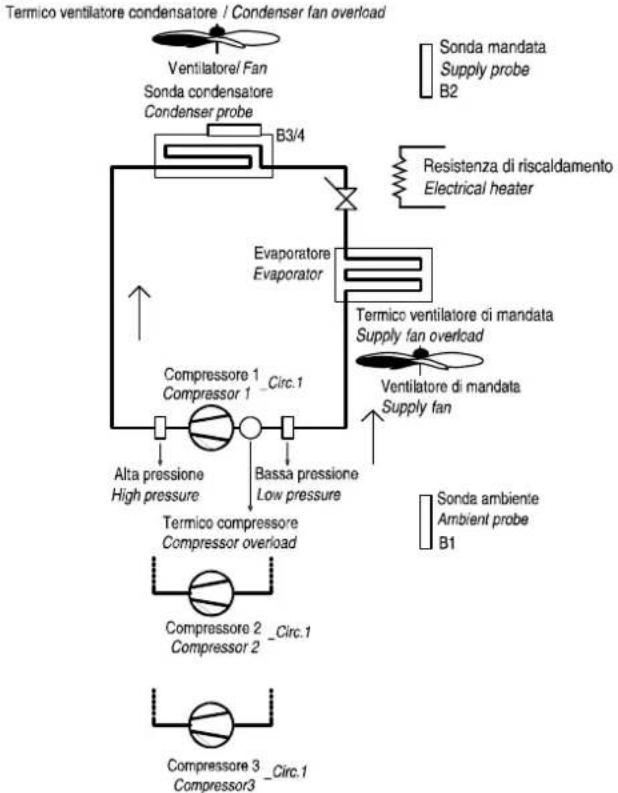
flowchart
graph TD
    A["Termico ventilatore condensatore / Condenser fan overload"] --> B["Ventilatore/ Fan"]
    B --> C["Sonda condensatore Condenser probe"]
    C --> D["B3/4"]
    D --> E["Evaporatore Evaporator"]
    E --> F["Compressor 1 Circ.1"]
    F --> G["Alta pressione High pressure"]
    F --> H["Bassa pressione Low pressure"]
    F --> I["Termico compressore Compressor overload"]
    I --> J["Compressor 2 Circ.1 Compressor 2"]
    J --> K["Compressor 3 Circ.1 Compressor3"]
    K --> L["Sonda ambient Probe B1"]
    D --> M["Sonda mandata Supply probe B2"]
    E --> N["Resistenza di riscaldamento Electrical heater"]
    E --> O["Termico ventilatore di mandata Supply fan overload"]
    O --> P["Ventilatore di mandata Supply fan"]
Fig. 3.a.a
3.2 AIR/AIR units, two circuits
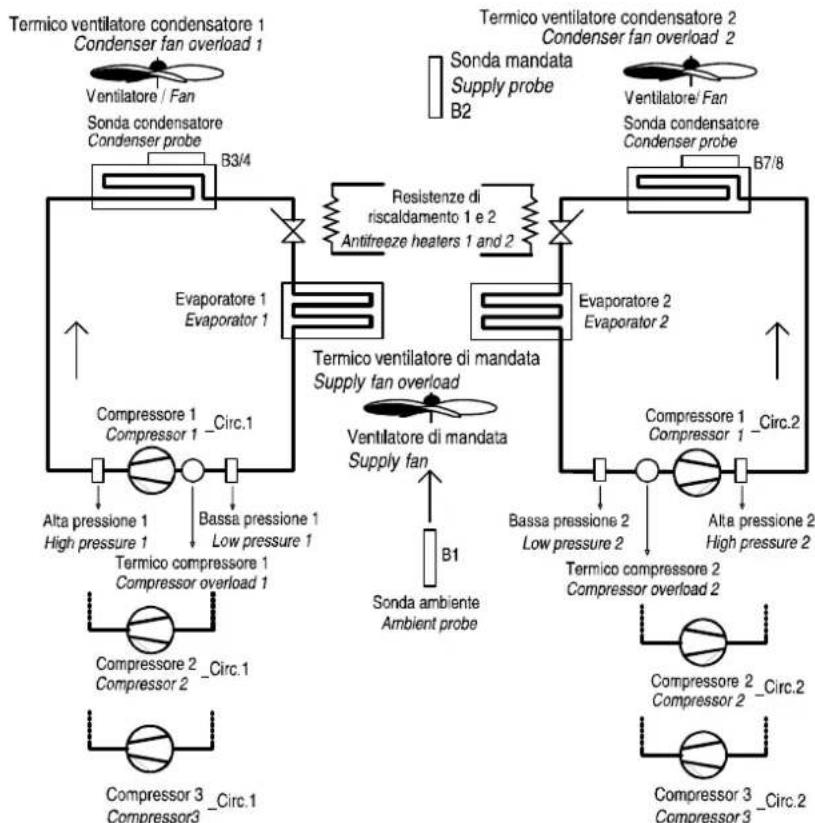
flowchart
graph TD
    A["Termico ventilatore condensatore 1\nCondenser fan overload 1"] --> B["Ventilatore / Fan"]
    B --> C["Sonda condensatore\nCondenser probe"]
    C --> D["B3/4"]
    D --> E["Resistenze di riscaldamento 1 e 2\nAntifreeze heaters 1 and 2"]
    E --> F["Termico ventilatore condensatore 2\nCondenser fan overload 2"]
    F --> G["Sonda mandata\nSupply probe B2"]
    G --> H["B7/8"]
    H --> I["Ventilatore / Fan"]
    I --> J["Sonda condensatore\nCondenser probe"]
    J --> K["B7/8"]
    K --> L["Evaporatore 1\nEvaporator 1"]
    L --> M["Termico ventilatore di mandata\nSupply fan overload"]
    M --> N["Termico compressore 1\nCompressor 1 - Circ.1"]
    N --> O["Alta pressione 1\nHigh pressure 1"]
    N --> P["Bassa pressione 1\nLow pressure 1"]
    N --> Q["Termico compressore 1\nCompressor overload 1"]
    Q --> R["Compressor 2_Circ.1"]
    R --> S["Compressor 3_Circ.1"]
    S --> T["Compressor 3 Compressor3"]
    T --> U["B1"]
    U --> V["Sonda ambiente Ambient probe"]
    V --> W["Bassa pressione 2\nLow pressure 2"]
    V --> X["Termico compressore 2\nCompressor overload 2"]
    X --> Y["Compressor 2_Circ.2"]
    Y --> Z["Alta pressione 2\nHigh pressure 2"]
    Y --> AA["Compressor 3_Circ.2"]
Fig. 3.a.b
3.3 AIR/AIR units, two circuits, 1 condenser fan circuit
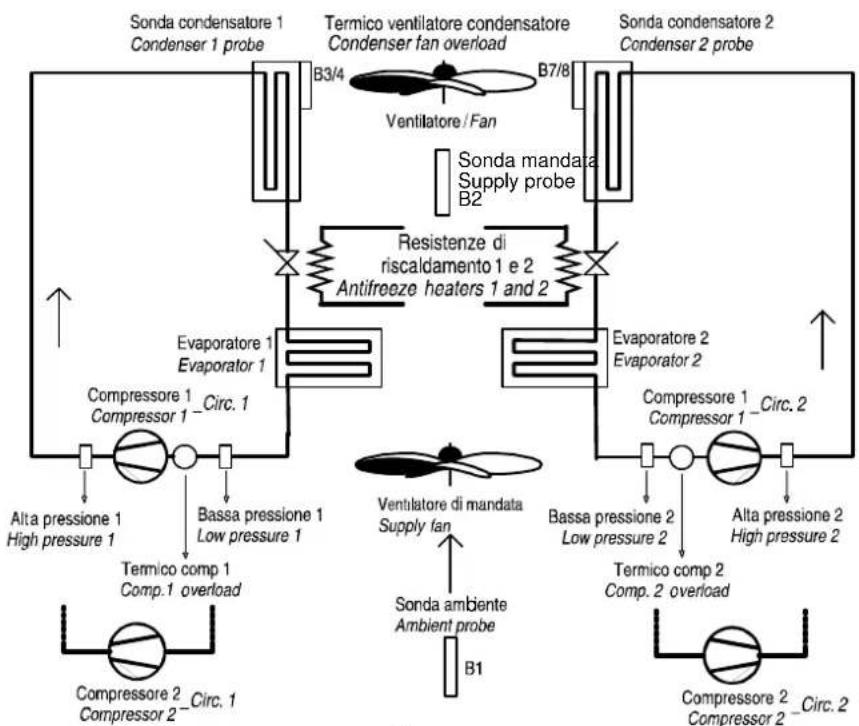
flowchart
graph TD
    A["Sonda condensatore 1 Condenser 1 probe"] --> B["Termico ventilatore condensatore Condenser fan overload"]
    B --> C["Sonda condensatore 2 Condenser 2 probe"]
    C --> D["Condenser fan overload"]
    D --> E["B3/4"]
    D --> F["B7/8"]
    E --> G["Ventilatore / Fan"]
    F --> H["Sonda mandata Supply probe B2"]
    G --> I["Resistenze di riscaldamento 1 e 2 Antifreeze heaters 1 and 2"]
    H --> I
    I --> J["Evaporatore 1 Evaporator 1"]
    J --> K["Compressor 1_Circ. 1"]
    K --> L["Compressor 1_Circ. 1"]
    L --> M["Alta pressione 1 High pressure 1"]
    L --> N["Bassa pressione 1 Low pressure 1"]
    N --> O["Termico comp 1 Comp. 1 overload"]
    O --> P["Compressor 2_Circ. 1 Compressor 2"]
    P --> Q["Compressor 2_Circ. 1"]
    Q --> R["Alta pressione 2 High pressure 2"]
    R --> S["Termico comp 2 Comp. 2 overload"]
    S --> T["Compressor 2_Circ. 2 Compressor 2"]
    T --> U["B1"]
    U --> V["Sonda ambiente Ambient probe"]
    V --> W["Ventilatore di mandata Supply fan"]
    W --> X["Compressor 1 Compressor 1"]
    X --> Y["Bassa pressione 2 Low pressure 2"]
    Y --> Z["Compressor 1_Circ. 2"]
    Z --> AA["Alta pressione 2 High pressure 2"]
    AA --> AB["Termico comp 2 Compressor 2"]
Fig. 3.a.c
3.4 AIR/AIR heat pumps, single circuit
Termico ventilatore condensatore / Condenser fan overload
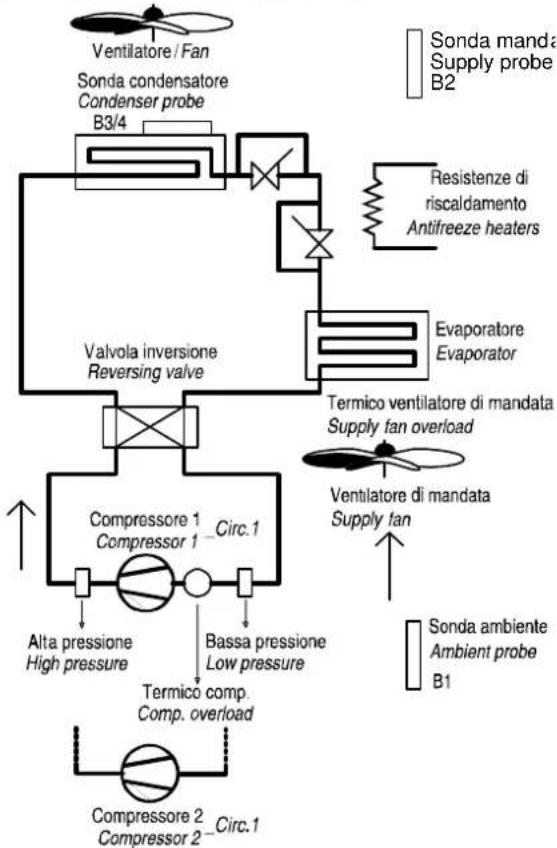
flowchart
graph TD
    A["Ventilatore / Fan"] --> B["Sonda condensatore Condenser probe B3/4"]
    B --> C["Valvola inversione Reversing valve"]
    C --> D["Compressor 1 Circ. 1"]
    D --> E["Alta pressione High pressure"]
    D --> F["Bassa pressione Low pressure"]
    D --> G["Termico comp. Comp. overload"]
    G --> H["Compressor 2 Circ. 1"]
    H --> I["Compressor 2"]
    I --> J["Valvola inversione Reversing valve"]
    J --> K["Resistenze di riscaldamento Antifreeze heaters"]
    K --> L["Sonda manda Supply probe B2"]
    L --> M["Evaporatore Evaporator"]
    M --> N["Termico ventilatore di mandata Supply fan overload"]
    N --> O["Ventilatore di mandata Supply fan"]
    O --> P["Sonda ambiente Ambient probe B1"]
Fig. 3.a.d
3.5 AIR/AIR heat pumps, two circuits
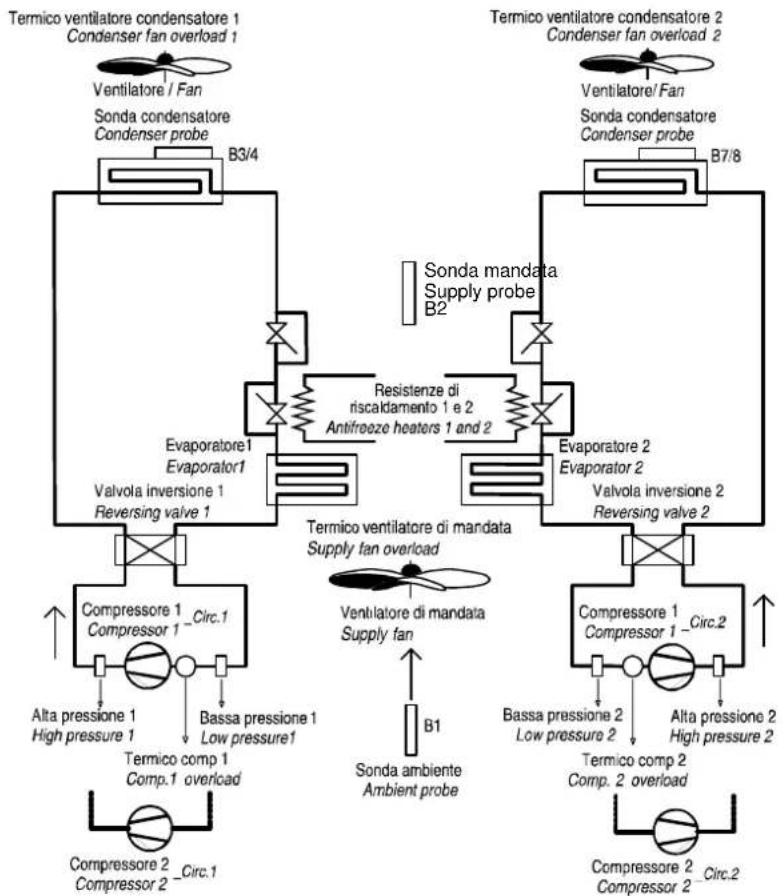
flowchart
graph TD
    A["Termico ventilatore condensatore 1\nCondenser fan overload 1"] --> B["Sonda condensatore\nCondenser probe"]
    B --> C["B3/4"]
    C --> D["Valvola inversione 1\nReversing valve 1"]
    D --> E["Compressor 1_Circ.1"]
    E --> F["Alta pressione 1\nHigh pressure 1"]
    E --> G["Bassa pressione 1\nLow pressure 1"]
    E --> H["Termico comp 1\nComp. 1 overload"]
    H --> I["Compressor 2_Circ.1"]
    I --> J["Valvola inversione 2\nReversing valve 2"]
    J --> K["Resistenze di riscaldamento 1 e 2\nAntifreeze heaters 1 and 2"]
    K --> L["Valvola inversione 1\nReversing valve 1"]
    L --> M["Compressor 1_Circ.1"]
    M --> N["B1"]
    N --> O["Sonda ambiente Ambient probe"]
    O --> P["Valvola inversione 2\nReversing valve 2"]
    P --> Q["Resistenze di riscaldamento 1 e 2\nAntifreeze heaters 1 and 2"]
    Q --> R["Valvola inversione 1\nReversing valve 1"]
    R --> S["Compressor 1_Circ.2"]
    S --> T["Bassa pressione 2\nLow pressure 2"]
    S --> U["Alta pressione 2\nHigh pressure 2"]
    S --> V["Termico comp 2\nComp. 2 overload"]
    V --> W["Compressor 2_Circ.2"]
    W --> X["B7/8"]
    X --> Y["Valvola inversione 2\nReversing valve 2"]
    Y --> Z["Resistenze di riscaldamento 1 e 2\nAntifreeze heaters 1 and 2"]
    Z --> AA["Valvola inversione 1\nReversing valve 1"]
    AA --> AB["Sonda mandata Supply probe B2"]
    AB --> AC["Valvola inversione 1\nReversing valve 1"]
    AC --> AD["Sonda mandata Supply probe B2"]
Fig. 3.a.e
3.6 AIR/AIR heat pumps, two circuits, 1 condenser fan circuit
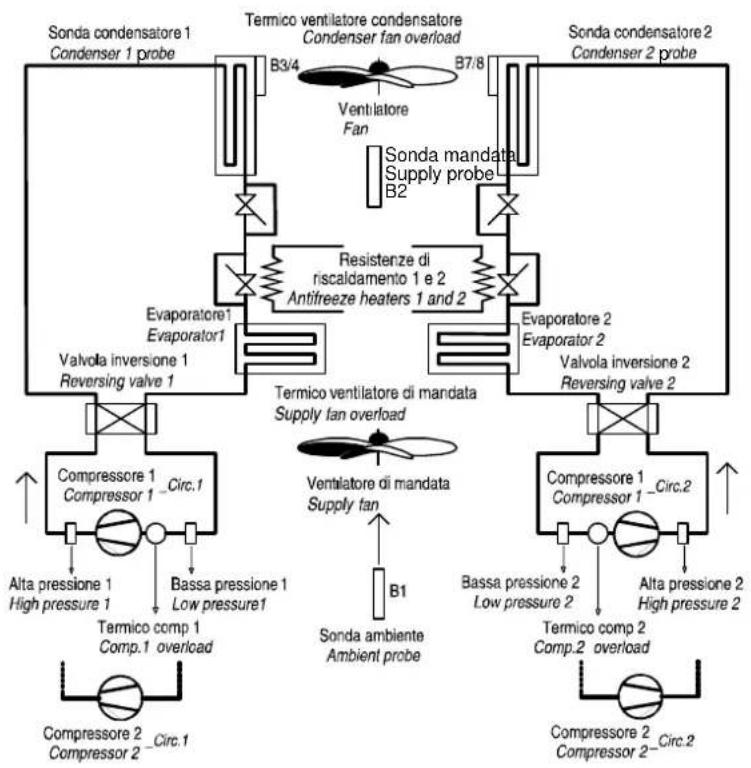
flowchart
graph TD
    A["Sonda condensatore 1\nCondenser 1 probe"] --> B["B3/4"]
    B --> C["Ventilatore Fan"]
    C --> D["Sonda mandata\nSupply probe\nB2"]
    D --> E["Resistenze di riscaldamento 1 e 2\nAntifreeze heaters 1 and 2"]
    E --> F["Evaporatore 1\nEvaporator 1"]
    F --> G["Valvola inversione 1\nReversing valve 1"]
    G --> H["Compressor 1\nCompressor 1 - Circ.1"]
    H --> I["Alta pressione 1\nHigh pressure 1"]
    H --> J["Bassa pressione 1\nLow pressure 1"]
    H --> K["Termico comp 1\nComp. 1 overload"]
    K --> L["Compressor 2\nCompressor 2 - Circ.1"]
    L --> M["B1"]
    M --> N["Sonda ambiente\nAmbient probe"]
    N --> O["Compressor 1\nCompressor 1 - Circ.2"]
    O --> P["Bassa pressione 2\nLow pressure 2"]
    O --> Q["Alta pressione 2\nHigh pressure 2"]
    O --> R["Termico comp 2\nComp. 2 overload"]
    R --> S["Compressor 2\nCompressor 2 - Circ.2"]
Fig. 3.a.f
+030220431 rel 1.7 03/06/2014 9
3.7 AIR/WATER chillers, single circuit
Termico ventilatore condensatore / Condenser fan overload
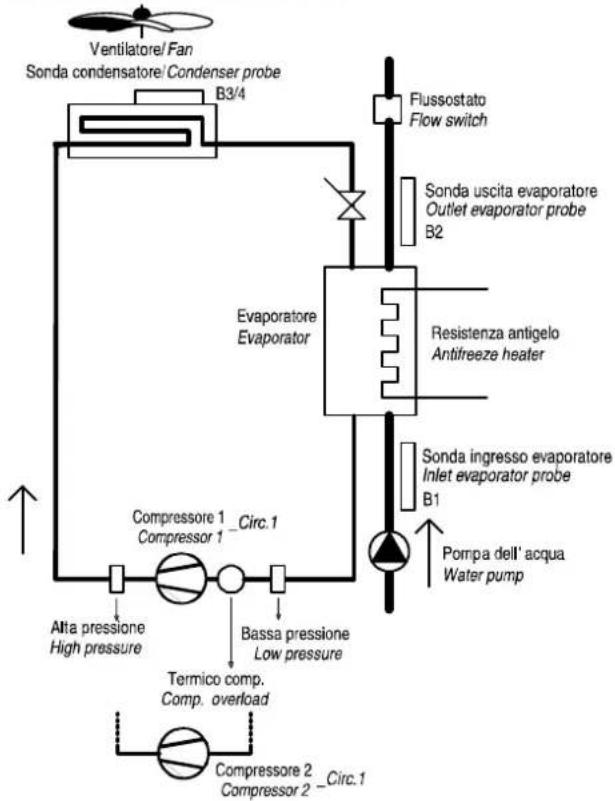
flowchart
graph TD
    A["Ventilatore/Fan"] --> B["Sonda condensatore/Condenser probe B3/4"]
    B --> C["Flussostato Flow switch"]
    C --> D["Sonda uscita evaporatore Outlet evaporator probe B2"]
    D --> E["Evaporatore Evaporator"]
    E --> F["Resistenza antigelo Antifreeze heater"]
    F --> G["Sonda ingresso evaporatore Inlet evaporator probe B1"]
    G --> H["Pompa dell'acqua Water pump"]
    H --> I["Compressor 1 - Circ.1 Compressor 1"]
    I --> J["Alta pressione High pressure"]
    I --> K["Bassa pressione Low pressure"]
    K --> L["Termico comp. Comp. overload"]
    L --> M["Compressor 2 - Circ.1 Compressor 2"]
Fig. 3.a.g
3.8 AIR/WATER chillers, two circuits, 2 condenser fan circuits and 2 evaporators
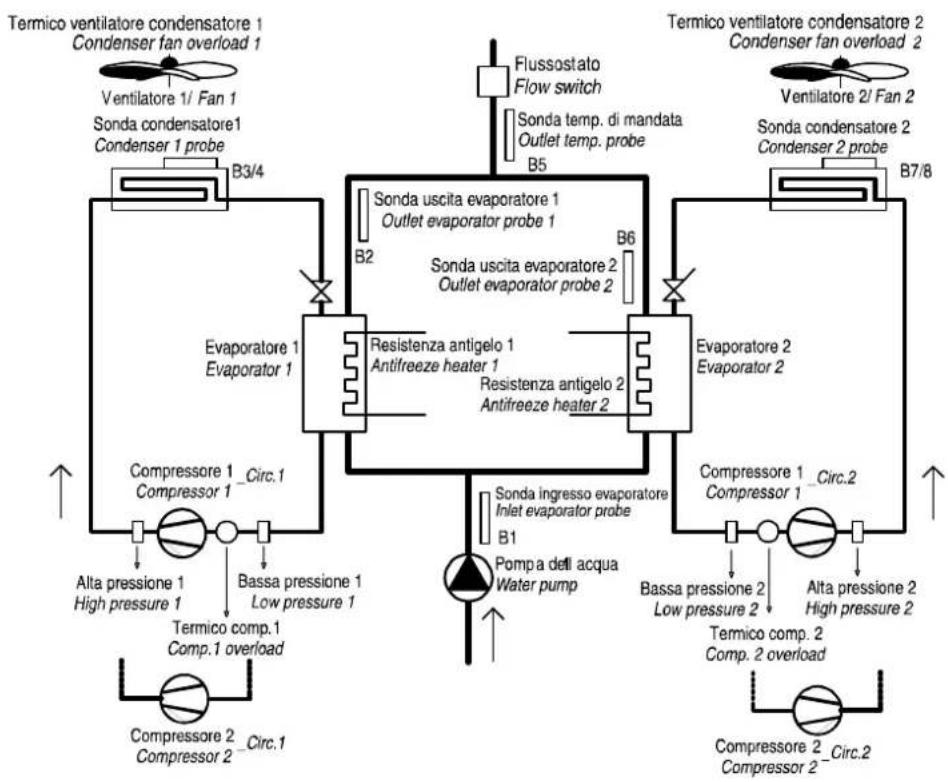
flowchart
graph TD
    A["Termico ventilatore condensatore 1\nCondenser fan overload 1"] --> B["Sonda condensatore1\nCondenser 1 probe"]
    B --> C["B3/4"]
    C --> D["Evaporatore 1\nEvaporator 1"]
    D --> E["Resistenza antigelo 1\nAntifreeze heater 1"]
    D --> F["Resistenza antigelo 2\nAntifreeze heater 2"]
    D --> G["Evaporatore 2\nEvaporator 2"]
    G --> H["Compressor 1_Circ.1"]
    H --> I["Alta pressione 1\nHigh pressure 1"]
    H --> J["Bassa pressione 1\nLow pressure 1"]
    H --> K["Termico comp.1\nComp.1 overload"]
    K --> L["Compressor 2_Circ.1"]
    L --> M["Flussostato\nFlow switch"]
    M --> N["Sonda temp. di mandata\nOutlet temp. probe\nB5"]
    N --> O["Sonda uscita evaporatore 1\nOutlet evaporator probe 1"]
    N --> P["Sonda uscita evaporatore 2\nOutlet evaporator probe 2"]
    P --> Q["Compressor 1_Circ.1"]
    Q --> R["B1"]
    R --> S["Pompa dell'acqua\nWater pump"]
    S --> T["Compressor 2_Circ.2"]
    T --> U["Bassia pressione 2\nLow pressure 2"]
    T --> V["Alta pressione 2\nHigh pressure 2"]
    V --> W["Termico comp. 2\nComp. 2 overload"]
    W --> X["Compressor 2_Circ.2"]
    X --> Y["B7/8"]
    Y --> Z["Compressor 1_Circ.2"]
    Z --> AA["Bassa pressione 2\nLow pressure 2"]
    Z --> AB["Alta pressione 2\nHigh pressure 2"]
    AB --> AC["Termico ventilatore condensatore 2\nCondenser fan overload 2"]
Fig. 3.a.h
3.9 AIR/WATER chillers, two circuits, 1 condenser fan circuit
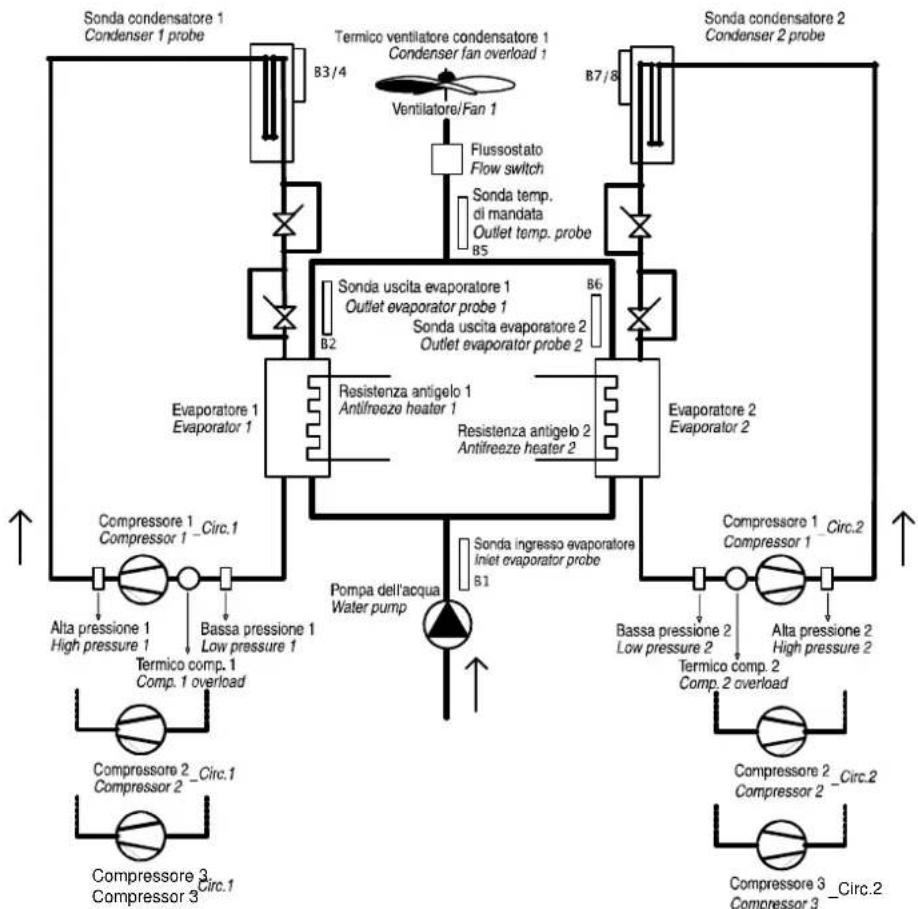
flowchart
graph TD
    A["Sonda condensatore 1 Condenser 1 probe"] --> B["Termico ventilatore condensatore 1 Condenser fan overload 1"]
    B --> C["Ventilatore/Fan 1"]
    C --> D["Flussostato Flow switch"]
    D --> E["Sonda temp. di mandata Outlet temp. probe B5"]
    E --> F["Sonda uscita evaporatore 1 Outlet evaporator probe 1"]
    F --> G["Sonda uscita evaporatore 2 Outlet evaporator probe 2"]
    G --> H["Evaporatore 1 Evaporator 1"]
    H --> I["Resistenza antigelo 1 Antifreeze heater 1"]
    I --> J["Resistenza antigelo 2 Antifreeze heater 2"]
    J --> K["Evaporatore 2 Evaporator 2"]
    K --> L["Compressor 1 Circ.1 Compressor 1"]
    L --> M["Alta pressione 1 High pressure 1"]
    M --> N["Bassa pressione 1 Low pressure 1"]
    N --> O["Termico comp. 1 Comp. 1 overload"]
    O --> P["Compressor 2 Circ.1 Compressor 2"]
    P --> Q["Compressor 3 Circ.1 Compressor 3"]
    Q --> R["Compressor 3 Compressor 3"]
    R --> S["Pompa dell'acqua Water pump"]
    S --> T["Sonda ingresso evaporatore Inlet evaporator probe B1"]
    T --> U["Sonda uscita evaporatore 1 Outlet evaporator probe 1"]
    U --> V["Sonda condensatore 2 Condenser 2 probe"]
    V --> W["Compressor 1 Circ.2 Compressor 1"]
    W --> X["Bassa pressione 2 Low pressure 2"]
    X --> Y["Alta pressione 2 High pressure 2"]
    Y --> Z["Termico comp. 2 Comp. 2 overload"]
    Z --> AA["Compressor 2 Circ.2 Compressor 2"]
    AA --> AB["Compressor 3 Circ.2 Compressor 3"]
Fig. 3.a.i
3.10 AIR/WATER heat pumps, single circuit
Fig. 3.a.l.
3.11 AIR/WATER heat pumps, 2 condenser fan circuits
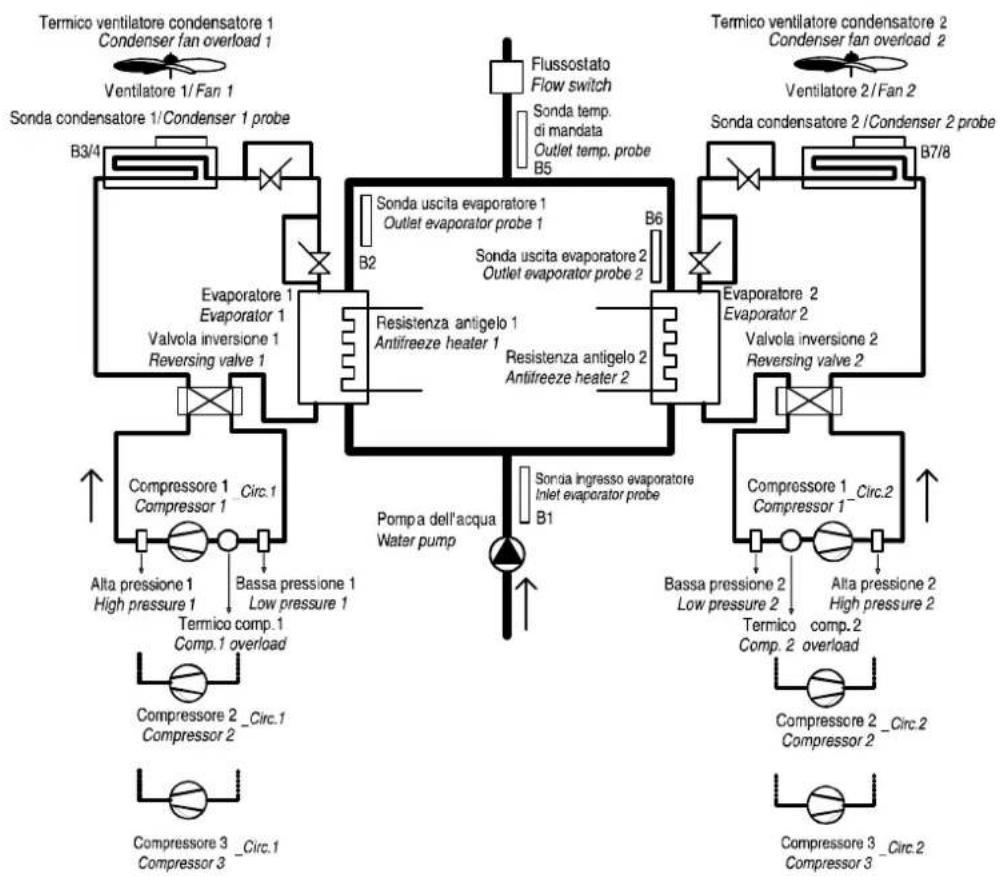
flowchart
graph TD
    A["Termico ventilatore condensatore 1\nCondenser fan overload 1"] --> B["Sonda condensatore 1/Condenser 1 probe"]
    B --> C["B3/4"]
    C --> D["Evaporatore 1\nEvaporator 1\nValvola inversionione 1\nReversing valve 1"]
    D --> E["Compressor 1"]
    E --> F["Alta pressione 1\nHigh pressure 1"]
    F --> G["Bassa pressione 1\nLow pressure 1"]
    G --> H["Termico comp. 1\nComp. 1 overload"]
    H --> I["Compressor 2_Circ.1\nCompressor 2"]
    I --> J["Compressor 3_Circ.1\nCompressor 3"]
    J --> K["Flussostato Flow switch"]
    K --> L["Sonda temp. di mandata\nOutlet temp. probe B5"]
    L --> M["Sonda uscita evaporatore 1\nOutlet evaporator probe 1"]
    M --> N["Sonda uscita evaporatore 2\nOutlet evaporator probe 2"]
    N --> O["Resistenza antigelo 1\nAntifreeze heater 1"]
    O --> P["Resistenza antigelo 2\nAntifreeze heater 2"]
    P --> Q["Pompa dell'acqua Water pump"]
    Q --> R["Sonda ingresso evaporatore Inlet evaporator probe B1"]
    R --> S["Compressor 1_Circ.2\nCompressor 1"]
    S --> T["Bassa pressione 2\nLow pressure 2"]
    T --> U["Alta pressione 2\nHigh pressure 2"]
    U --> V["Compressor 2_Circ.2\nCompressor 2"]
    V --> W["Compressor 3_Circ.2\nCompressor 3"]
    W --> X["Compressor 3_Circ.1\nCompressor 3"]
    X --> Y["Compressor 2_Circ.1\nCompressor 2"]
    Y --> Z["Compressor 2_Circ.2\nCompressor 2"]
    Z --> AA["Compressor 2_Circ.2\nCompressor 2"]
    AA --> AB["Compressor 2_Circ.2\nCompressor 2"]
    AB --> AC["Compressor 2_Circ.2\nCompressor 2"]
    AC --> AD["Compressor 2_Circ.2\nCompressor 2"]
    AD --> AE["Compressor 2_Circ.2\nCompressor 2"]
    AE --> AF["Compressor 2_Circ.2\nCompressor 2"]
    AF --> AG["Compressor 2_Circ.2\nCompressor 2"]
    AG --> AH["Compressor 2_Circ.2\nCompressor 2"]
    AH --> AI["Compressor 2_Circ.2\nCompressor 2"]
    AI --> AJ["Compressor 2_Circ.2\nCompressor 2"]
    AJ --> AK["Compressor 2_Circ.2\nCompressor 2"]
    AK --> AL["Compressor 2_Circ.2\nCompressor 2"]
    AL --> AM["Compressor 2_Circ.2\nCompressor 2"]
    AM --> AN["Compressor 2_Circ.2\nCompressor 2"]
Fig. 3.a.m.
3.12 AIR/WATER heat pumps, two circuits, 1 condenser fan circuit
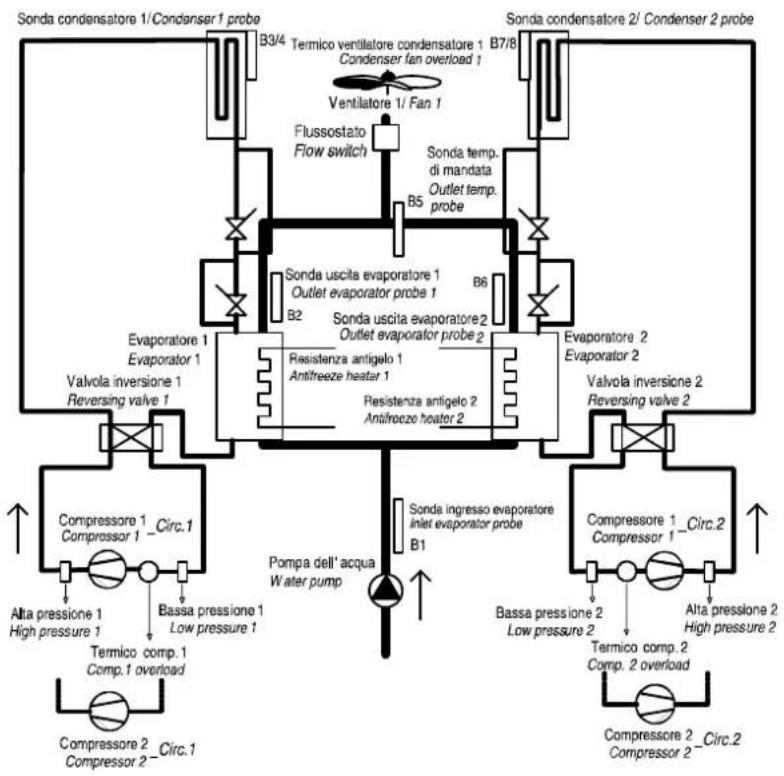
flowchart
graph TD
    A["Sonda condensatore 1/Condenser1 probe"] --> B["B3/4 Termico ventilatore condensatore 1 B7/8 Condenser fan overload"]
    B --> C["Flussostato Flow switch"]
    C --> D["Sonda temp. di mandata Outlet temp. probe"]
    D --> E["B5"]
    E --> F["Sonda uscita evaporatore 1 Outlet evaporator probe 1"]
    F --> G["B2"]
    G --> H["Sonda uscita evaporatore 2 Outlet evaporator probe 2"]
    H --> I["B6"]
    I --> J["Resistenza antigelo 1 Antifreeze heater 1"]
    J --> K["Resistenza antigelo 2 Antifreeze heater 2"]
    K --> L["Valvola inversione 1 Reversing valve 1"]
    L --> M["Compressor 1 Compressor 1 - Circ.1"]
    M --> N["Alta pressione 1 High pressure 1"]
    M --> O["Bassa pressione 1 Low pressure 1"]
    M --> P["Termico comp. 1 Comp. 1 overload"]
    P --> Q["Compressor 2 Compressor 2 - Circ.1"]
    Q --> R["Pompa dell'acqua Water pump"]
    R --> S["Sonda ingresso evaporatore inlet evaporator probe B1"]
    S --> T["Compressor 1 Compressor 1 - Circ.2"]
    T --> U["Bassa pressione 2 Low pressure 2"]
    T --> V["Alta pressione 2 High pressure 2"]
    V --> W["Termico comp. 2 Comp. 2 overload"]
    W --> X["Compressor 2 Compressor 2 - Circ.2"]
Fig. 3.a.n
3.13 WATER/WATER chillers, single circuit
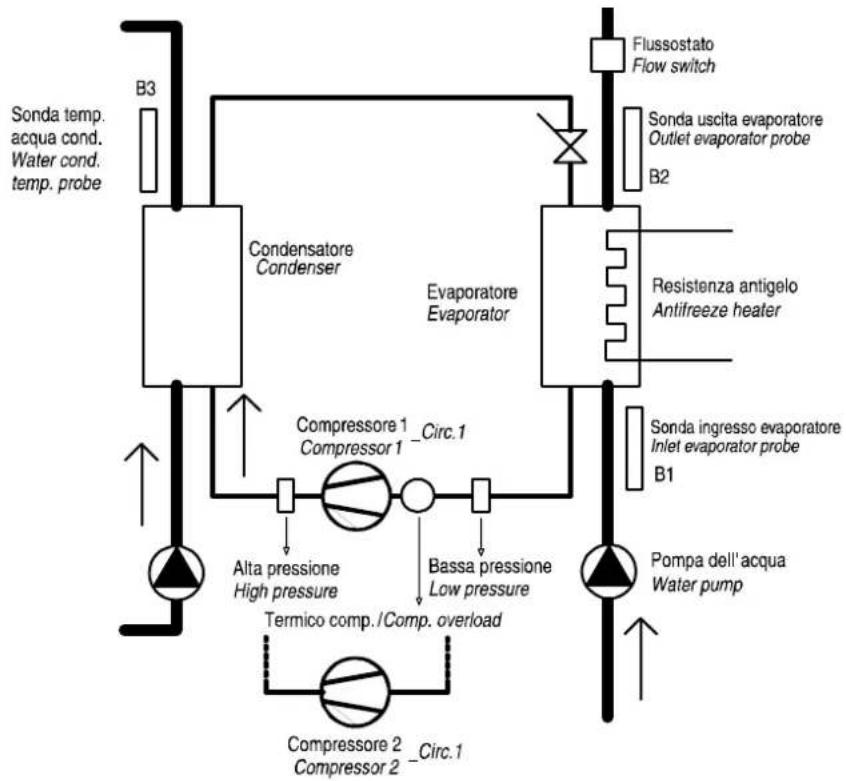
flowchart
graph TD
    A["Sonda temp. acqua cond. Water cond. temp. probe"] --> B["Condensatore Condenser"]
    B --> C["Avaporatore Evaporator"]
    C --> D["Flussostato Flow switch"]
    D --> E["Sonda uscita evaporatore Outlet evaporator probe B2"]
    C --> F["Resistenza antigelo Antifreeze heater"]
    F --> G["Sonda ingresso evaporatore Inlet evaporator probe B1"]
    G --> H["Pompa dell'acqua Water pump"]
    B --> I["Compressor 1_Circ.1 Compressor 1"]
    I --> J["Alta pressione High pressure Termico comp./Comp. overload"]
    I --> K["Bassa pressione Low pressure"]
    I --> L["Compressor 2_Circ.1 Compressor 2"]
Fig. 3.a.o.
3.14 WATER/WATER chillers, two circuits
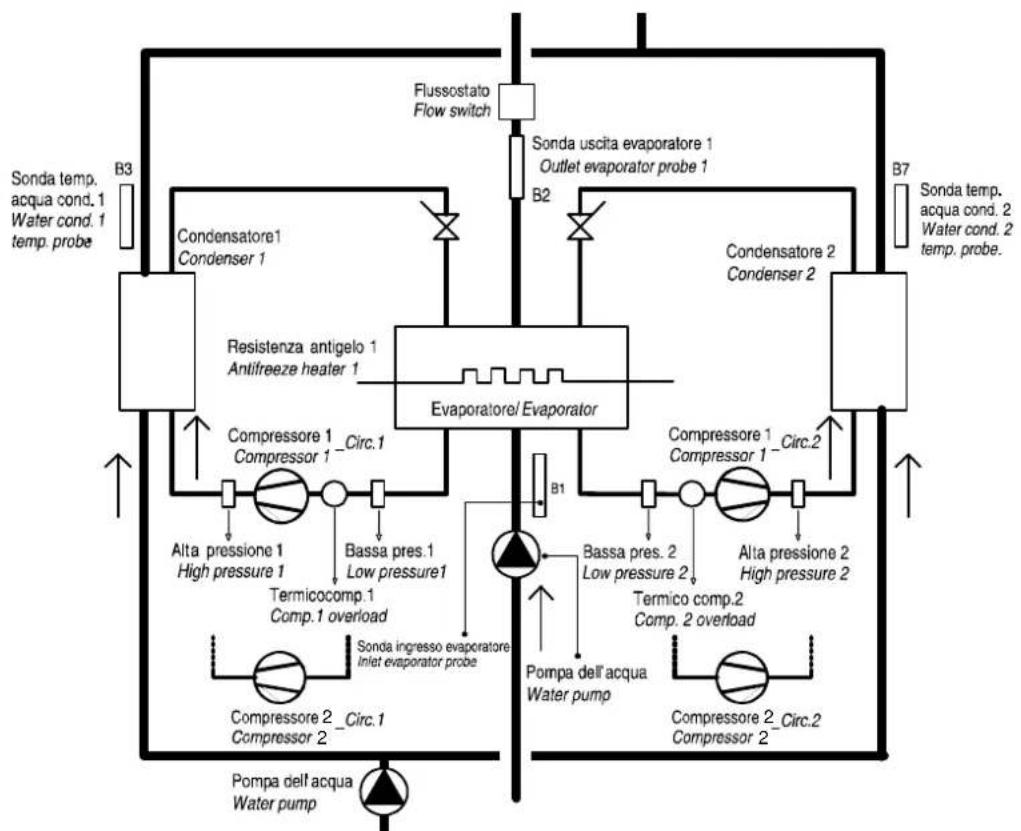
flowchart
graph TD
    A["Sonda temp. acqua cond. 1 Water cond. 1 temp. probe"] --> B["Condensatore1 Condenser 1"]
    B --> C["Resistenza antigelo 1 Antifreeze heater 1"]
    C --> D["Evaporatore/Evaporator"]
    D --> E["Compressor 1 Circ.1"]
    E --> F["Alta pressione 1 High pressure 1"]
    E --> G["Bassa pres.1 Low pressure1"]
    G --> H["Termicocomp.1 Comp.1 overload"]
    H --> I["Compressor 2_Circ.1 Compressor 2"]
    I --> J["Pompa dell'acqua Water pump"]
    D --> K["Flussostato Flow switch"]
    K --> L["Sonda uscita evaporatore 1 Outlet evaporator probe 1"]
    L --> M["B2"]
    M --> N["Condensatore 2 Condenser 2"]
    N --> O["B7"]
    O --> P["Sonda temp. acqua cond. 2 Water cond. 2 temp. probe."]
    D --> Q["Compressor 1 Compressor 1 - Circ.2"]
    Q --> R["B1"]
    R --> S["Bassa pres. 2 Low pressure 2"]
    S --> T["Termico comp.2 Comp. 2 overload"]
    T --> U["Pompa dell'acqua Water pump"]
    Q --> V["Compressor 1 Compressor 1 - Circ.2"]
    V --> W["Alta pressione 2 High pressure 2"]
Fig. 3.a.p.
3.15 WATER/WATER chillers, two circuits, 2 evaporators
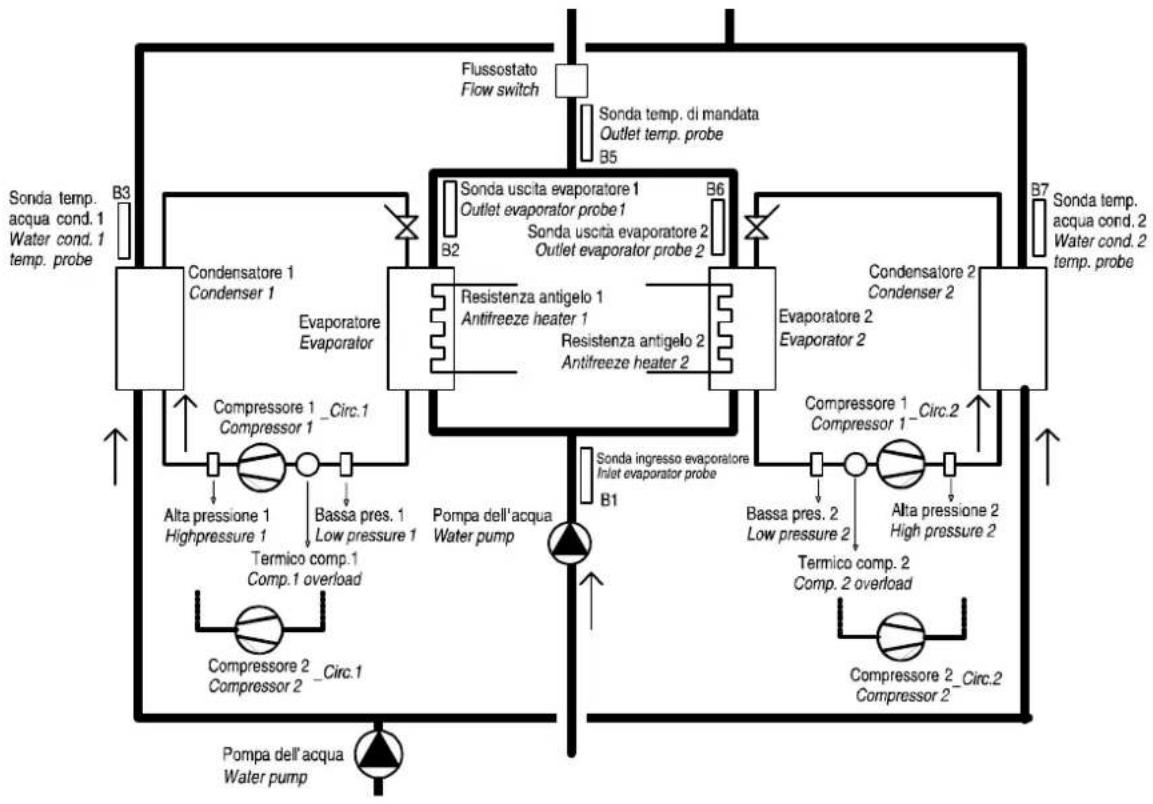
flowchart
graph TD
    A["Sonda temp. acqua cond. 1\nWater cond. 1\ntemp. probe"] --> B["Condensatore 1\nCondenser 1"]
    B --> C["Compressor 1_Circ.1"]
    C --> D["Alta pressione 1\nHigh pressure 1"]
    D --> E["Bassa pres. 1\nLow pressure 1"]
    E --> F["Termico comp.1\nComp.1 overload"]
    F --> G["Compressor 2_Circ.1"]
    G --> H["Pompa dell'acqua\nWater pump"]
    H --> I["Flussostato Flow switch"]
    I --> J["Sonda temp. di mandata\nOutlet temp. probe\nB5"]
    J --> K["Sonda uscita evaporatore 1\nOutlet evaporator probe 1"]
    K --> L["Sonda uscita evaporatore 2\nOutlet evaporator probe 2"]
    L --> M["Resistenza antigelo 1\nAntifreeze heater 1"]
    M --> N["Resistenza antigelo 2\nAntifreeze heater 2"]
    N --> O["Condensatore 2\nCondenser 2"]
    O --> P["Compressor 1_Circ.2"]
    P --> Q["Bassa pres. 2\nLow pressure 2"]
    Q --> R["Alta pressione 2\nHigh pressure 2"]
    R --> S["Termico comp. 2\nComp. 2 overload"]
    S --> T["Compressor 2_Circ.2\nCompressor 2^-"]
Fig. 3.a.q.
3.16 WATER/WATER heat pumps with reversal on the refrigerant circuit, single circuit
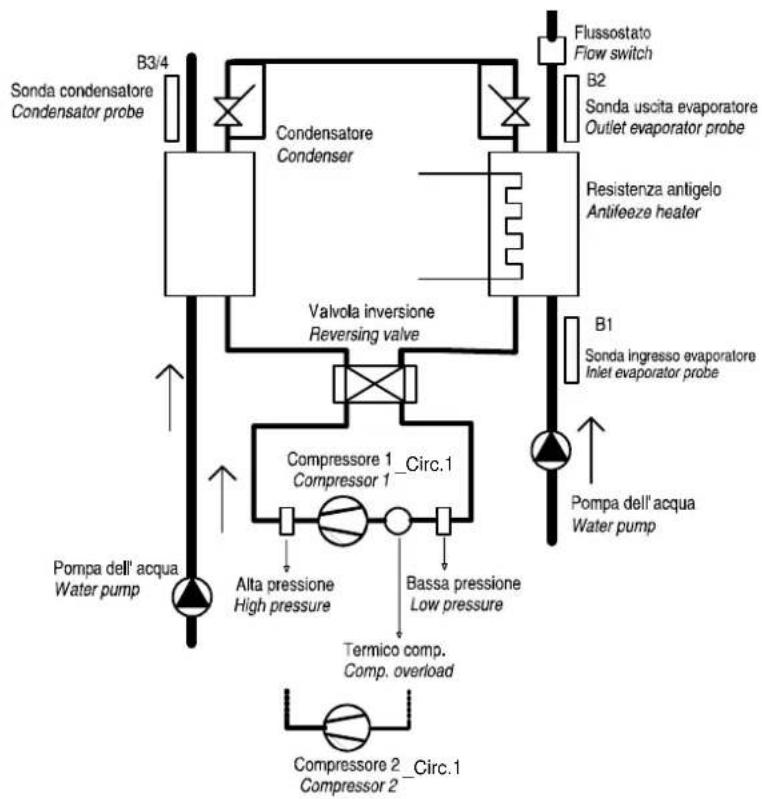
flowchart
graph TD
    A["Sonda condensatore Condenser probe"] --> B["Condensatore Condenser"]
    B --> C["Valvola inversione Reversing valve"]
    C --> D["Compressor 1_Circ.1 Compressor 1"]
    D --> E["Alta pressione High pressure"]
    D --> F["Bassa pressione Low pressure"]
    F --> G["Termico comp. Comp. overload"]
    G --> H["Compressor 2_Circ.1 Compressor 2"]
    H --> I["Pompa dell'acqua Water pump"]
    J["Flussostato Flow switch"] --> K["B2 Sonda uscita evaporatore Outlet evaporator probe"]
    L["Resistenza antigelo Antifeeze heater"] --> M["B1 Sonda ingresso evaporatore Inlet evaporator probe"]
    N["Pompa dell'acqua Water pump"] --> O["Pompa dell'acqua Water pump"]
Fig. 3.a.r.
3.17 WATER/WATER heat pumps with reversal on the refrigerant circuit, two circuits
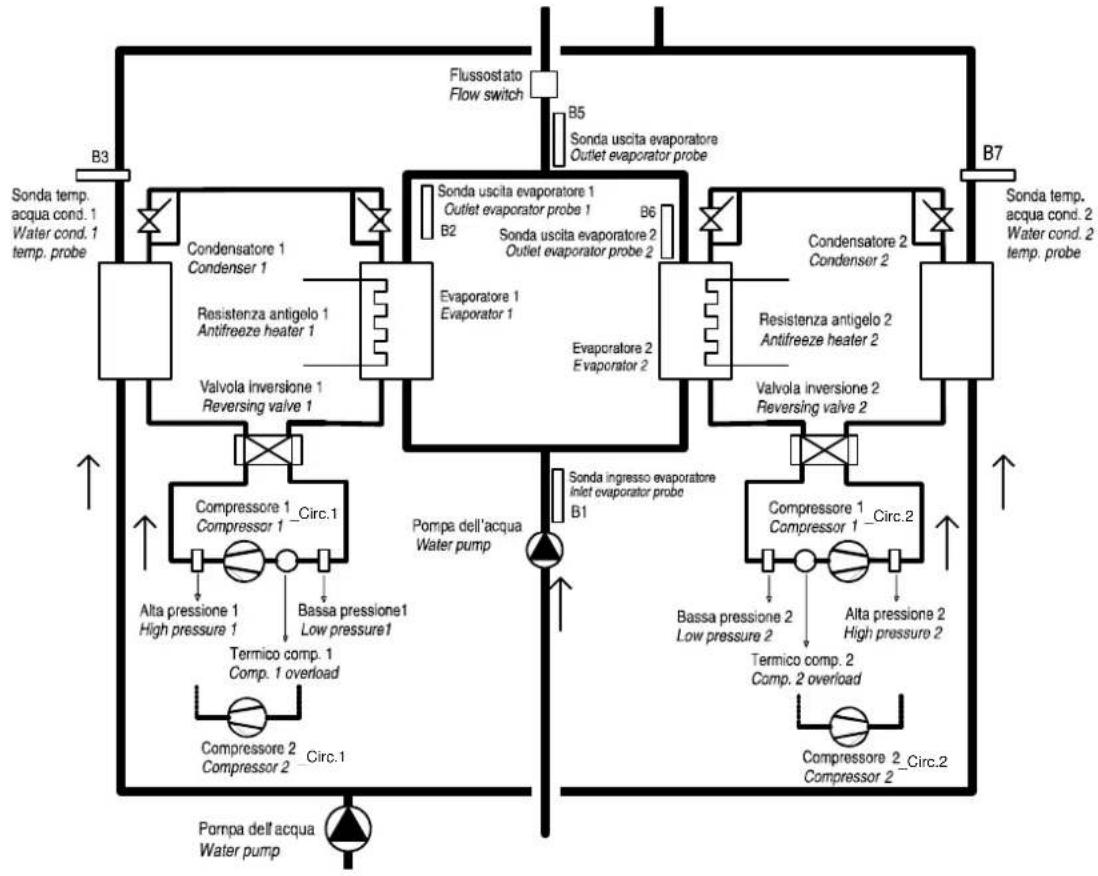
flowchart
graph TD
    A["Sonda temp. acqua cond. 1 Water cond. 1 temp. probe"] --> B["Condensatore 1 Condenser 1"]
    B --> C["Resistenza antigelo 1 Antifreeze heater 1"]
    C --> D["Valvola inversione 1 Reversing valve 1"]
    D --> E["Compressor 1_Circ.1"]
    E --> F["Alta pressione 1 High pressure 1"]
    E --> G["Bassa pressione 1 Low pressure 1"]
    G --> H["Termico comp. 1 Comp. 1 overload"]
    H --> I["Compressor 2_Circ.1"]
    I --> J["Pompa dell'acqua Water pump"]
    K["Flussostato Flow switch"] --> L["Sonda uscita evaporatore Outlet evaporator probe"]
    L --> M["Sonda uscita evaporatore 1 Outlet evaporator probe 1"]
    M --> N["Sonda uscita evaporatore 2 Outlet evaporator probe 2"]
    N --> O["Evaporatore 1 Evaporator 1"]
    O --> P["Valvola inversione 2 Reversing valve 2"]
    P --> Q["Sonda ingresso evaporatore inlet evaporator probe B1"]
    Q --> R["Compressor 1_Circ.2"]
    R --> S["Bassa pressione 2 Low pressure 2"]
    R --> T["Alta pressione 2 High pressure 2"]
    T --> U["Termico comp. 2 Comp. 2 overload"]
    U --> V["Compressor 2_Circ.2 Compressor 2"]
    V --> W["Pompa dell'acqua Water pump"]
    X["Sonda temp. acqua cond. 2 Water cond. 2 temp. probe"] --> Y["Sonda temp. acqua cond. 1 Water cond. 1 temp. probe"]
    Z["Sonda temp. acqua cond. 2 Water cond. 2 temp. probe"] --> AA["Sonda temp. acqua cond. 1 Water cond. 1 temp. probe"]
Fig. 3.a.s.
3.18 WATER/WATER heat pumps with reversal on the refrigerant circuit, two circuits, 1 evaporator
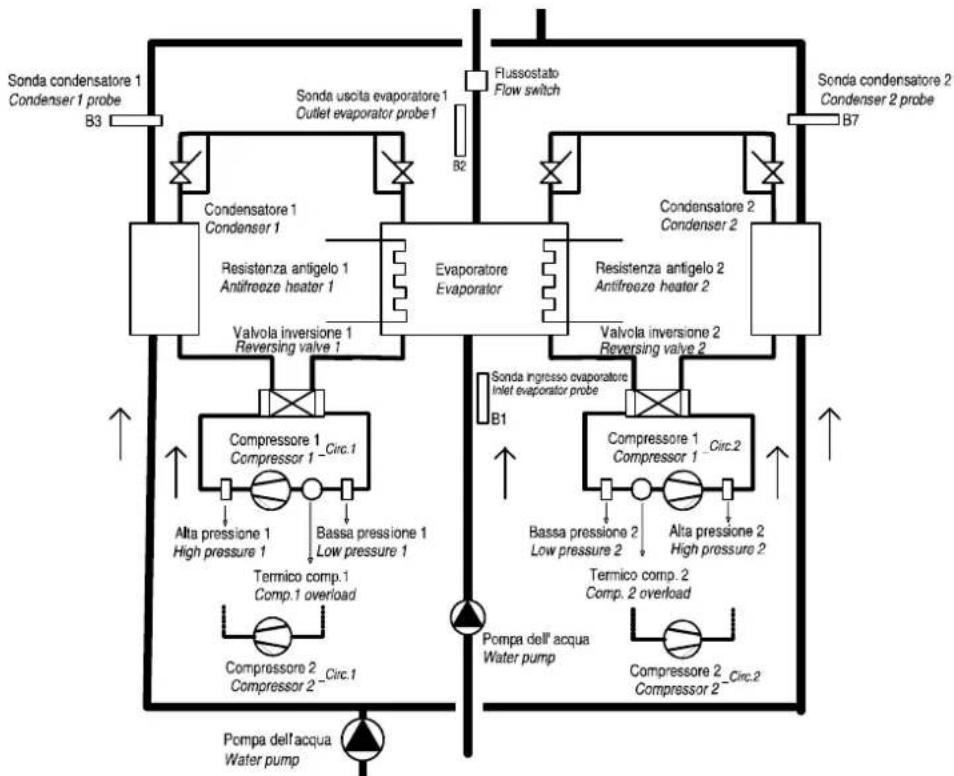
flowchart
graph TD
    A["Sonda condensatore 1\nCondenser 1 probe\nB3"] --> B["Condensatore 1\nCondenser 1"]
    B --> C["Resistenza antigelo 1\nAntifreeze heater 1"]
    C --> D["Valvola inversione 1\nReversing valve 1"]
    D --> E["Compressor 1_Circ.1"]
    E --> F["Alta pressione 1\nHigh pressure 1"]
    E --> G["Bassa pressione 1\nLow pressure 1"]
    E --> H["Termico comp.1\nComp. 1 overload"]
    H --> I["Compressor 2_Circ.1"]
    I --> J["Pompa dell'acqua\nWater pump"]
    K["Sonda uscita evaporatore 1\nOutlet evaporator probe 1"] --> L["Flussostato\nFlow switch"]
    L --> M["Condensatore 2\nCondenser 2"]
    M --> N["Resistenza antigelo 2\nAntifreeze heater 2"]
    N --> O["Valvola inversione 2\nReversing valve 2"]
    O --> P["Compressor 1_Circ.2"]
    P --> Q["Bassa pressione 2\nLow pressure 2"]
    P --> R["Alta pressione 2\nHigh pressure 2"]
    P --> S["Termico comp. 2\nComp. 2 overload"]
    S --> T["Compressor 2_Circ.2\nCompressor 2^-"]
Fig. 3.a.t.
3.19 WATER/WATER heat pumps with reversal on the water circuit, single circuit
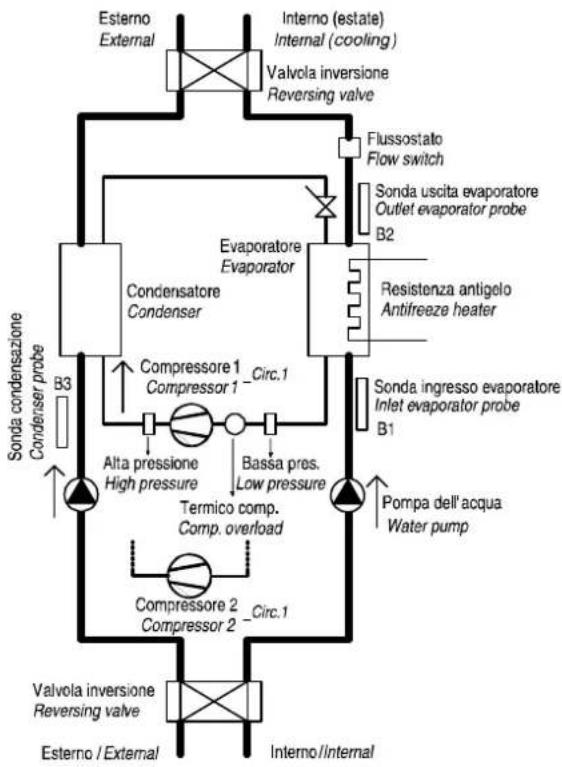
flowchart
graph TD
    A["Esterno External"] --> B["Condenser"]
    B --> C["Compressor 1 - Circ.1"]
    C --> D["Valvola inversione Reversing valve"]
    D --> E["Valvola inversione Reversing valve"]
    E --> F["Valvola / External"]
    G["Condenser probe B3"] --> H["Compressor 1 - Circ.1"]
    H --> I["Alta pressione High pressure"]
    I --> J["Bassa pres. Low pressure"]
    J --> K["Termico comp. Comp. overload"]
    K --> L["Compressor 2 - Circ.1"]
    L --> M["Pompa dell'acqua Water pump"]
    N["Flussostato Flow switch"] --> O["Sonda uscita evaporatore Outlet evaporator probe B2"]
    O --> P["Resistenza antigelo Antifreeze heater"]
    Q["Sonda condensazione Condenser"] --> R["Condensatore Condenser"]
    S["Sonda ingresso evaporatore Inlet evaporator probe B1"] --> T["Resistenza antigelo Antifreeze heater"]
    U["Valvola inverseine Reversing valve"] --> V["Valvola inversione Reversing valve"]
    W["Interno (estate) Internal (cooling)"] --> X["Valvola inversione Reversing valve"]
Fig. 3.a.u.
3.20 WATER/WATER heat pumps with reversal on the water circuit, two circuits, H02=1 and H21=4
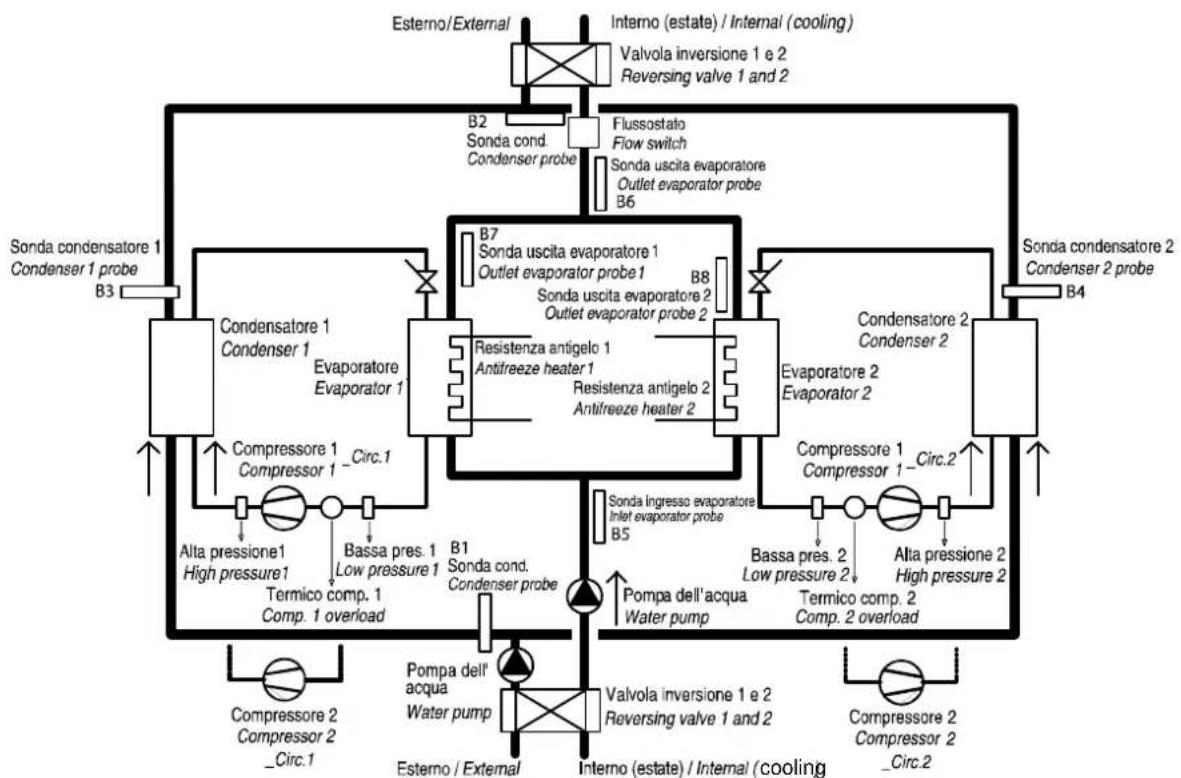
flowchart
graph TD
    A["Condensatore 1"] --> B["Condenser 1"]
    B --> C["Compressor 1 - Circ.1"]
    C --> D["Alta pressione1 High pressure1 Termico comp. 1 Comp. 1 overload"]
    D --> E["Compressor 2 Compressor 2 _Circ.1"]
    F["Condensatore 2"] --> G["Condenser 2"]
    G --> H["Compressor 1 - Circ.2"]
    H --> I["Bassa pres. 2 Low pressure 2 Termico comp. 2 Comp. 2 overload"]
    I --> J["Pompa dell'acqua Water pump"]
    J --> K["Valvola inversionione 1 e 2 Reversing valve 1 and 2"]
    K --> L["Externo / External"]
    M["Sonda condensatore 1"] --> N["Condenser 1 probe B3"]
    O["Sonda uscita evaporatore 1"] --> P["Outlet evaporator probe 1"]
    Q["Sonda condensatore 2"] --> R["Condenser 2 probe B4"]
    S["Sonda condensatore 1"] --> T["Condenser 1 probe B2"]
    U["Sonda condensatore 2"] --> V["Condenser 2 probe B6"]
    W["Bassas pres. 1 Low pressure 1"] --> X["Sonda cond. Condenser probe"]
    Y["Bassas pres. 2 Low pressure 2"] --> Z["Sonda ingresso evaporatore Inlet evaporator probe B5"]
    AA["Bassas pres. 2 Low pressure 2"] --> AB["Bassa pres. 2 Low pressure 2"]
    AC["Bassas pres. 2 Low pressure 2"] --> AD["Alta pressione 2 High pressure 2"]
    AE["Bassas pres. 2 Low pressure 2"] --> AF["Alta pressione 2 High pressure 2"]
Fig. 3.a.v.
3.21 WATER/WATER heat pumps with reversal on the water circuit, two circuits, 1 evaporator H02=1 and H21=4
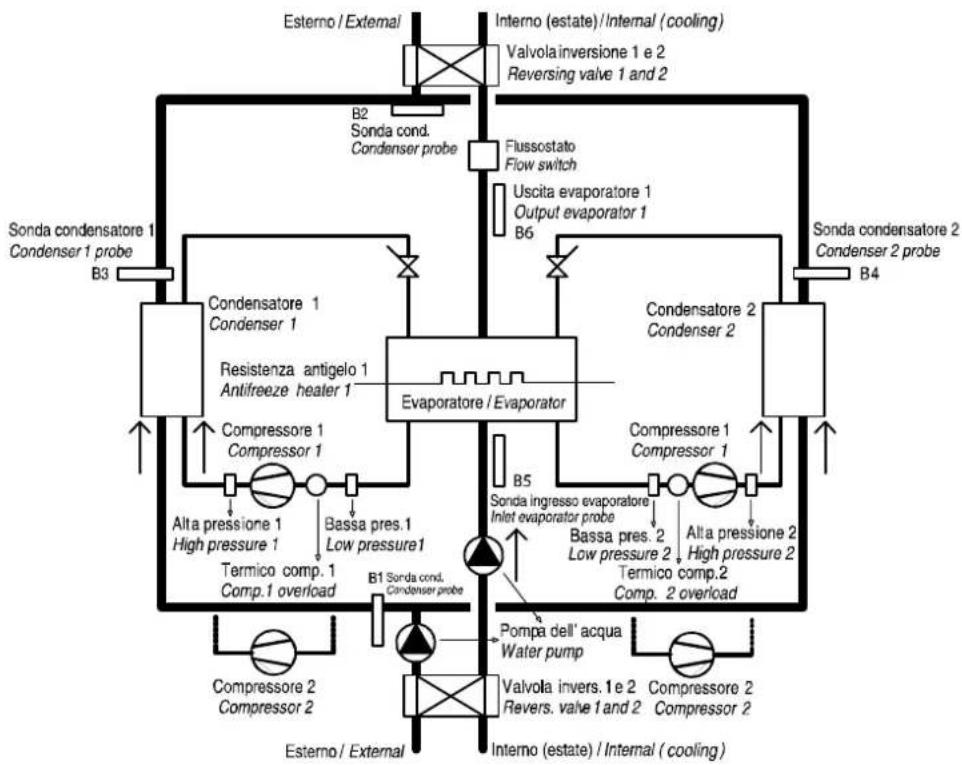
flowchart
graph TD
    A["Condensatore 1"] --> B["Resistenza antigelo 1"]
    B --> C["Condenser 1"]
    C --> D["Evaporatore / Evaporator"]
    D --> E["Compressor 1"]
    E --> F["Alta pressione 1"]
    F --> G["High pressure 1"]
    G --> H["Termico comp. 1"]
    H --> I["Comp. 1 overload"]
    I --> J["Compressor 2"]
    J --> K["Valvola invers. 1 e 2"]
    K --> L["Revers. valve 1 and 2"]
    L --> M["Compressor 2"]
    M --> N["Externo / External"]
    N --> O["Condensatore 2"]
    O --> P["Condenser 2"]
    P --> Q["Flussostato Flow switch"]
    Q --> R["Uscita evaporatore 1"]
    R --> S["Output evaporator 1"]
    S --> T["B6"]
    T --> U["Sonda condensatore 2"]
    U --> V["Condenser 2 probe"]
    V --> W["B4"]
    W --> X["Sonda condensatore 2 Condenser 1 probe"]
    X --> Y["B3"]
    Y --> Z["Sonda condensatore 1 Condenser 1 probe"]
    Z --> AA["Condensatore 1"]
    AA --> AB["Resistenza antigelo 1 Antifreeze heater 1"]
    AB --> AC["Compressor 1"]
    AC --> AD["Alta pressione 1"]
    AD --> AE["Bassa pres. 1 Low pressure 1"]
    AE --> AF["Termico comp. 1"]
    AF --> AG["Comp. 1 overload"]
    AG --> AH["B1 Sonda cond. Condenser probe"]
    AH --> AI["Pompa dell'acqua Water pump"]
    AI --> AJ["Valvola invers. 1 e 2 Revers. valve 1 and 2"]
    AJ --> AK["Compressor 2"]
    AK --> AL["Externo / External"]
    AL --> AM["Condensatore 2 Condenser 2"]
    AM --> AN["Sonda condensatore 2 Condenser 2 probe"]
    AN --> AO["Sonda condensatore 1 Condenser 1 probe"]
    AO --> AP["B5"]
    AP --> AQ["Sonda ingresso evaporatore Inlet evaporator probe"]
    AQ --> AR["Bassa pres. 2 Low pressure 2"]
    AR --> AS["Alta pressione 2 High pressure 2"]
    AS --> AT["Termico comp. 2 Comp. 2 overload"]
Fig. 3.a.z.
3.22 Air-cooled condensing unit without reverse cycle, single circuit
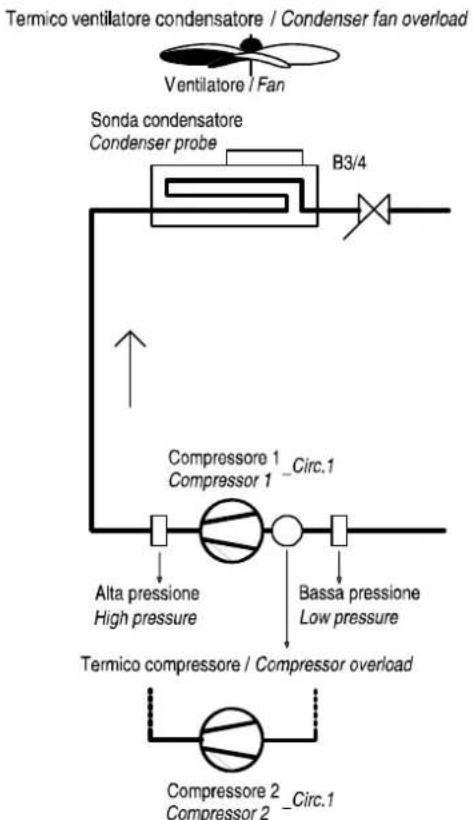
flowchart
graph TD
    A["Termico ventilatore condensatore / Condenser fan overload"] --> B["Ventilatore / Fan"]
    B --> C["Sonda condensatore Condenser probe"]
    C --> D["B3/4"]
    D --> E["Compressor 1_Circ.1 Compressor 1"]
    E --> F["Alta pressione High pressure"]
    E --> G["Bassa pressione Low pressure"]
    E --> H["Termico compressore / Compressor overload"]
    H --> I["Compressor 2_Circ.1 Compressor 2"]
Fig. 3.b.a.
3.23 Air-cooled condensing unit without reverse cycle, two circuits
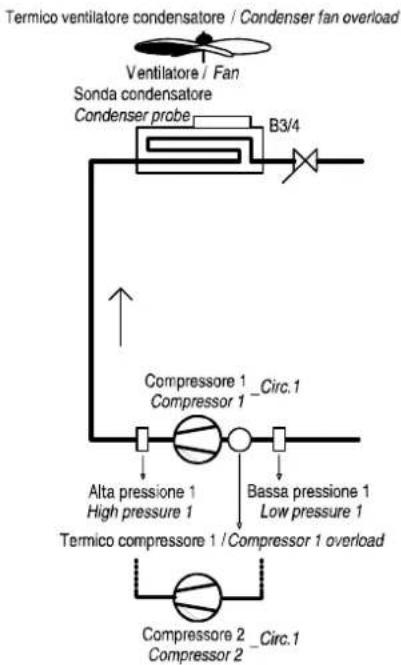
flowchart
graph TD
    A["Termico ventilatore condensatore / Condenser fan overload"] --> B["Sonda condensatore"]
    B --> C["Condenser probe"]
    C --> D["B3/4"]
    D --> E["Compressor 1_Circ.1"]
    E --> F["Alta pressione 1"]
    E --> G["Bassa pressione 1"]
    E --> H["Low pressure 1"]
    E --> I["Termico compressore 1 / Compressor 1 overload"]
    I --> J["Compressor 2_Circ.1"]
    J --> K["Compressor 2"]
    style A fill:#f9f,stroke:#333
    style B fill:#ccf,stroke:#333
    style C fill:#cfc,stroke:#333
    style D fill:#fcc,stroke:#333
    style E fill:#cff,stroke:#333
    style F fill:#ffc,stroke:#333
    style G fill:#ffc,stroke:#333
    style H fill:#ffc,stroke:#333
    style I fill:#ffc,stroke:#333
    style J fill:#cfc,stroke:#333
    style K fill:#cfc,stroke:#333

flowchart
graph TD
    A["Termico ventilatore condensatore / Condenser fan overload"] --> B["Sonda condensatore"]
    B --> C["Condenser probe"]
    C --> D["B7/B"]
    D --> E["Compressor 1 - Circ.2 Compressor 1"]
    E --> F["Alta pressione 2 - High pressure 2"]
    E --> G["Bassa pressione 2 - Low pressure 2"]
    E --> H["Termico compressore 2 / Compressor 2 overload"]
    H --> I["Compressor 2 - Circ.2 Compressor 2"]
Fig. 3.b.b.
3.24 Reverse-cycle air-cooled condensing unit, single circuit
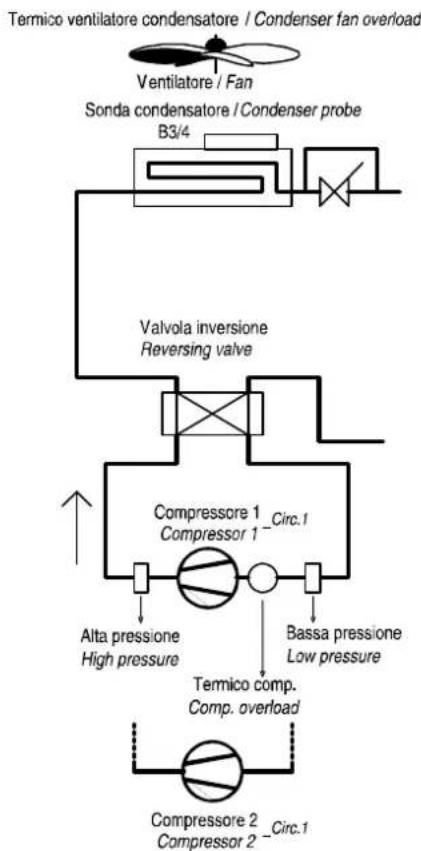
flowchart
graph TD
    A["Termico ventilatore condensatore / Condenser fan overload"] --> B["Sonda condensatore / Condenser probe"]
    B --> C["Valvola inversione Reversing valve"]
    C --> D["Compressor 1 Compressor 1 Circ.1"]
    D --> E["Alta pressione High pressure"]
    D --> F["Bassa pressione Low pressure"]
    D --> G["Termico comp. Comp. overload"]
    G --> H["Compressor 2 Compressor 2 Circ.1"]
    H --> I["Bassar component"]
    J["Ventilatore / Fan"] --> B
Fig. 3.b.c.
3.25 Reverse-cycle air-cooled condensing unit, two circuits with condenser fan circuit
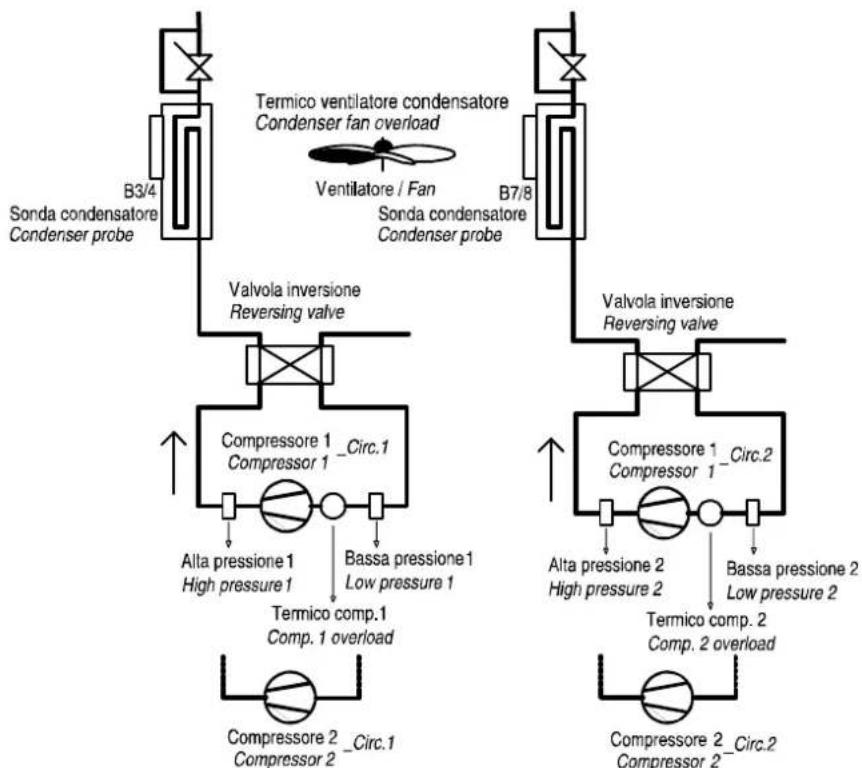
flowchart
graph TD
    A["Sonda condensatore Condenser probe"] --> B["B3/4"]
    B --> C["Valvola inversione Reversing valve"]
    C --> D["Compressor 1_Circ.1"]
    D --> E["Alta pressione 1 High pressure 1"]
    D --> F["Bassa pressione 1 Low pressure 1"]
    D --> G["Termico comp.1 Comp. 1 overload"]
    G --> H["Compressor 2_Circ.1"]
    H --> I["Valvola inversione Reversing valve"]
    I --> J["Compressor 1_Circ.2"]
    J --> K["Alta pressione 2 High pressure 2"]
    J --> L["Bassa pressione 2 Low pressure 2"]
    J --> M["Termico comp. 2 Comp. 2 overload"]
    M --> N["Compressor 2_Circ.2"]
    N --> O["Valvola inversione Reversing valve"]
    O --> P["Valvolatore / Fan"]
    P --> Q["Ventilatore / Fan Condenser fan overload"]
Fig. 3.b.d.
3.26 Water-cooled condensing unit without reverse cycle, single circuit
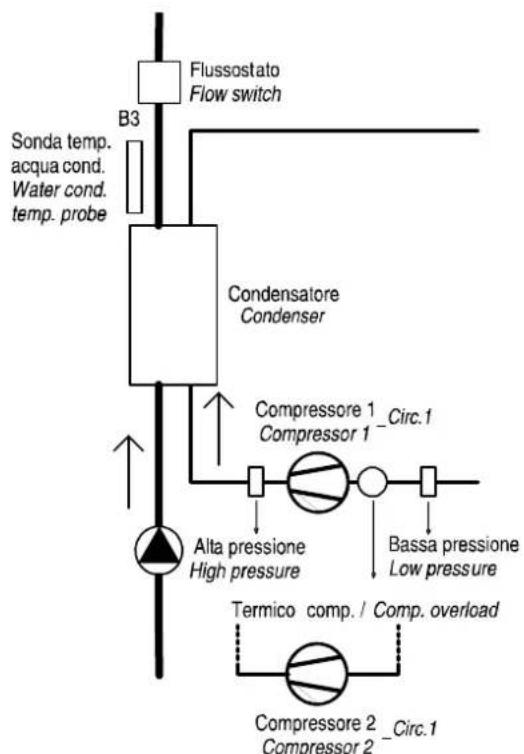
flowchart
graph TD
    A["Condensatore Condenser"] --> B["Compressor 1_Circ.1"]
    A --> C["Compressor 2_Circ.1"]
    B --> D["Bassa pressione Low pressure"]
    C --> E["Compressor 2_Circ.1"]
    F["Sonda temp. acqua cond. Water cond. temp. probe"] --> G["Flussostato Flow switch"]
    H["Alta pressione High pressure"] --> I["Compressor 1"]
    style A fill:#f9f,stroke:#333
    style B fill:#ccf,stroke:#333
    style C fill:#cfc,stroke:#333
    style D fill:#fcc,stroke:#333
    style E fill:#cff,stroke:#333
    style F fill:#ffc,stroke:#333
    style G fill:#fcc,stroke:#333
    style H fill:#ffc,stroke:#333
Fig. 3.b.e.
3.27 Water-cooled condensing unit without reverse cycle, two circuits
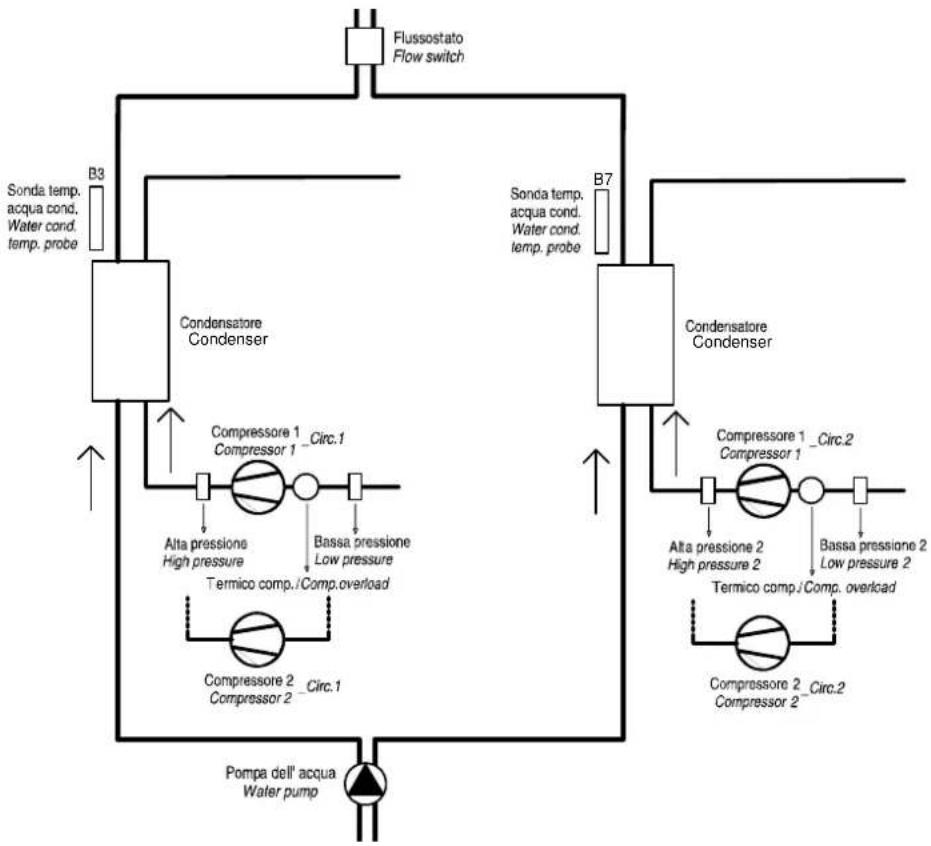
flowchart
graph TD
    A["Flussostato Flow switch"] --> B["Condensatore Condenser"]
    B --> C["Compressor 1_Circ.1"]
    B --> D["Compressor 2_Circ.1"]
    B --> E["Pompa dell'acqua Water pump"]
    F["Sonda temp. acqua cond. Water cond. temp. probe"] --> B
    G["Sonda temp. acqua cond. Water cond. temp. probe"] --> B
    H["B3"] --> B
    I["B7"] --> B
    J["Alta pressione High pressure Termico comp./Comp.overload"] --> B
    K["Bassa pressione Low pressure"] --> B
    L["Compressor 1_Circ.2"] --> M["Compressor 1"]
    N["Compressor 2_Circ.2"] --> O["Compressor 1"]
    P["Alta pressione 2 High pressure Termico comp./Comp.overload"] --> M
    Q["Bassa pressione 2 Low pressure"] --> M
Fig. 3.b.f.
3.28 Reverse-cycle water-cooled condensing unit, single circuit
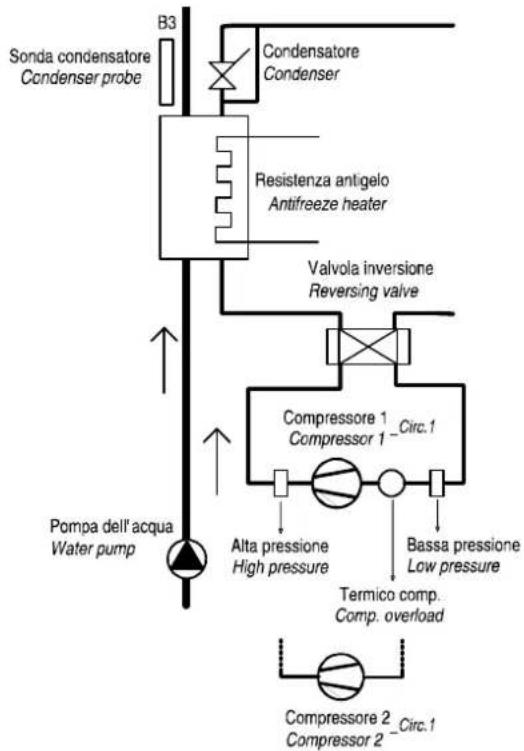
flowchart
graph TD
    A["Sonda condensatore Condenser probe"] --> B["Condensatore Condenser"]
    B --> C["Resistenza antigelo Antifreeze heater"]
    C --> D["Valvola inversione Reversing valve"]
    D --> E["Compressor 1_Circ.1"]
    E --> F["Alta pressione High pressure"]
    E --> G["Bassa pressione Low pressure"]
    E --> H["Termico comp. Comp. overload"]
    H --> I["Compressor 2_Circ.1"]
    I --> J["Pompa dell'acqua Water pump"]
    J --> K["Bassera flow path"]
Fig. 3.b.g.
3.29 Reverse-cycle water-cooled condensing unit, two circuits
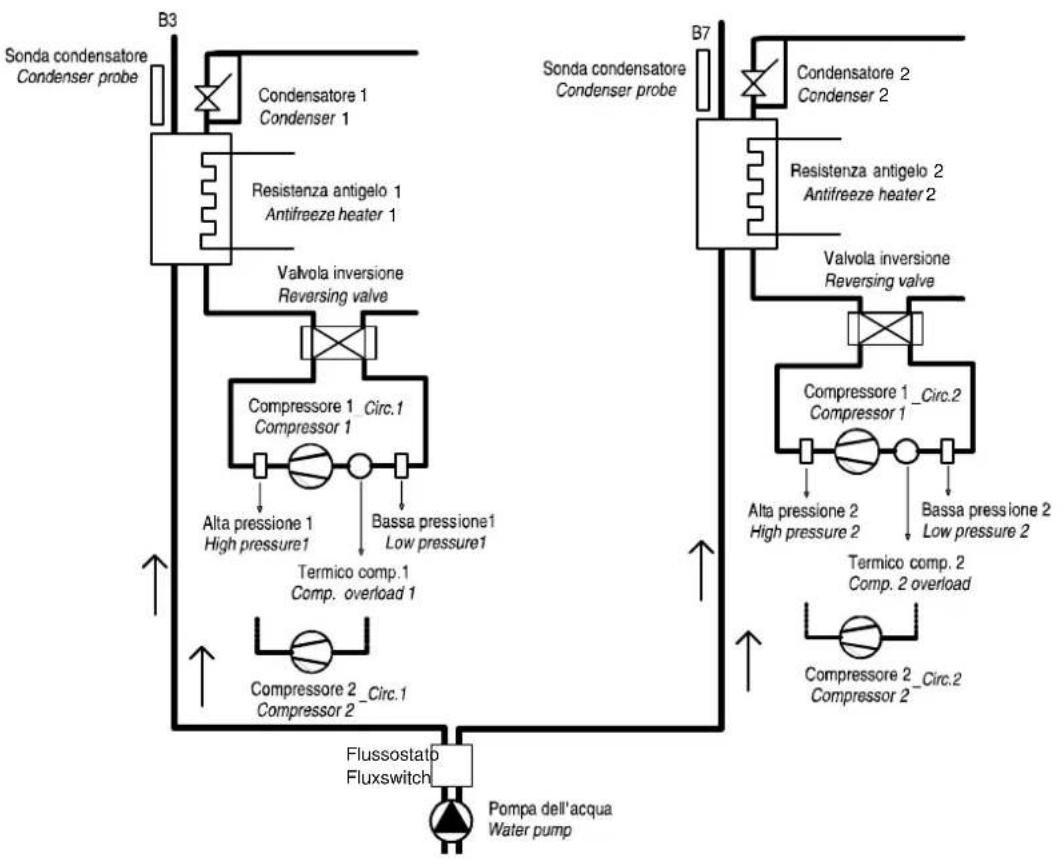
flowchart
graph TD
    A["Sonda condensatore Condenser probe"] --> B["Condensatore 1 Condenser 1"]
    B --> C["Resistenza antigelo 1 Antifreeze heater 1"]
    C --> D["Valvola inversione Reversing valve"]
    D --> E["Compressor 1 Circ.1 Compressor 1"]
    E --> F["Alta pressione 1 High pressure1"]
    E --> G["Bassa pressione1 Low pressure1"]
    E --> H["Termico comp.1 Comp. overload 1"]
    H --> I["Compressor 2 Circ.1 Compressor 2"]
    I --> J["Flussostatb Fluxswitch"]
    J --> K["Pompa dell'acqua Water pump"]
    L["Sonda condensatore Condenser probe"] --> M["Condensatore 2 Condenser 2"]
    M --> N["Resistenza antigelo 2 Antifreeze heater 2"]
    N --> O["Valvola inversione Reversing valve"]
    O --> P["Compressor 1 Circ.2 Compressor 1"]
    P --> Q["Alta pressione 2 High pressure 2"]
    P --> R["Bassa pressione 2 Low pressure 2"]
    P --> S["Termico comp. 2 Comp. 2 overload"]
    S --> T["Compressor 2 Circ.2 Compressor 2"]
Fig. 3.b.h.
4. Parameters
4.1 Menu layout
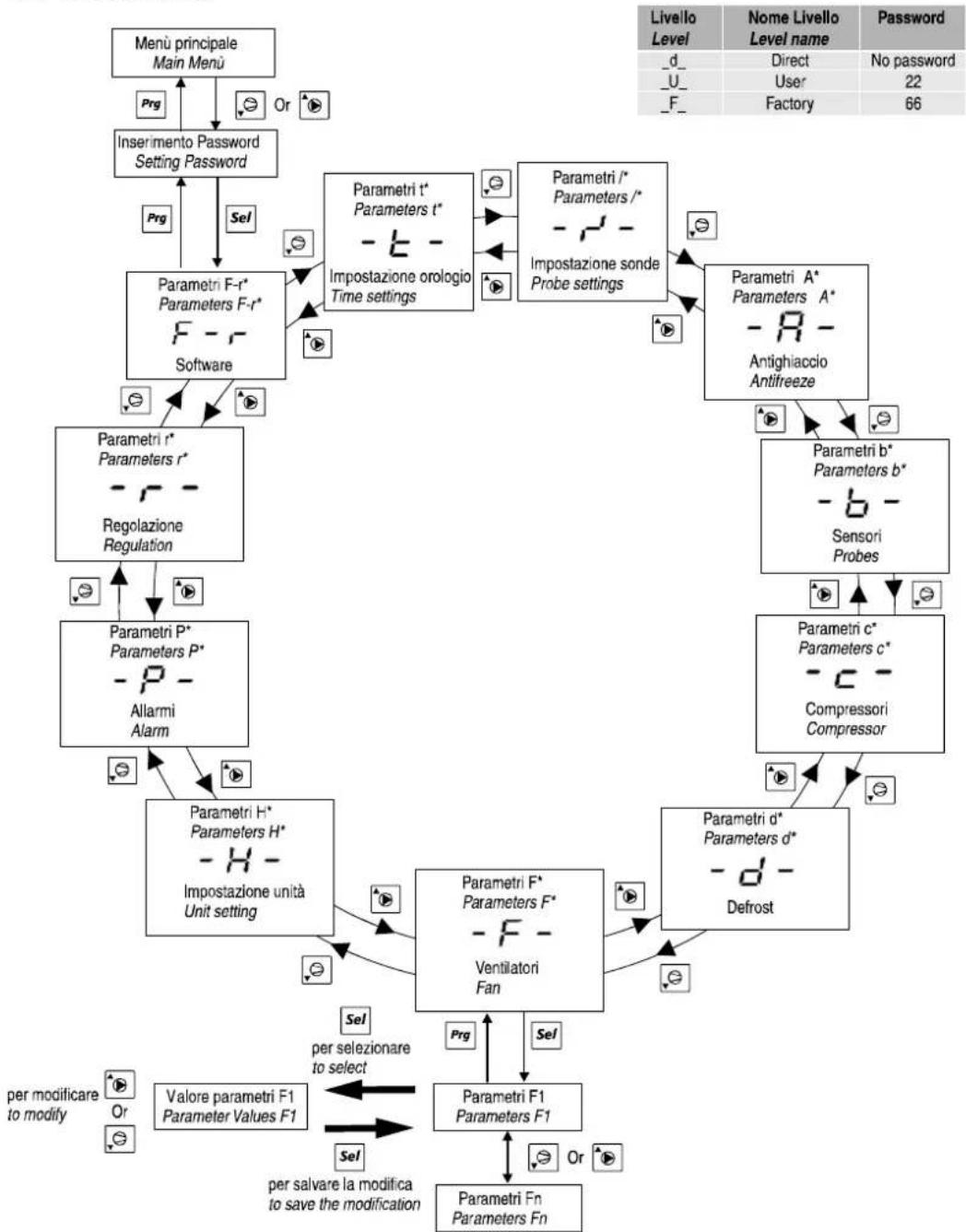
flowchart
graph TD
    A["Menù principale Main Menù"] --> B["Inserimento Password Setting Password"]
    B --> C["Parametri F-r* Parameters F-r* Software"]
    C --> D["Regolazione Regulation"]
    D --> E["Parametri P* Parameters P* Allarmi Alarm"]
    E --> F["Impostazione unità Unit setting"]
    F --> G["Ventilatori Fan"]
    G --> H["Valore parametri F1 Parameter Values F1"]
    H --> I["Per modificare to modify"]
    I --> J["Sel per selezionare to select"]
    J --> K["Per salvare la modifica to save the modification"]
    K --> L["Valore parametri F1 Parameters F1"]
    L --> M["Sel or Or"]
    M --> N["Parametri Fn Parameters Fn"]
    N --> O["Defrost"]
    O --> P["Compressor Compressor"]
    P --> Q["Sensori Probes"]
    Q --> R["Parameters b* Parameters b* Sensori"]
    R --> S["Antighiaccio Antifreeze"]
    S --> T["Parameters A* Parameters A* Software"]
    T --> U["Impostazione sonde Probe settings"]
    U --> V["Impostazione orologio Time settings"]
    V --> W["Parameters t* Parameters t* Regolazione Regulation"]
    W --> X["Parametri r* Parameters r* Software"]
    X --> Y["Inserimento Password Setting Password"]
    Y --> Z["Sel or Or"]
Fig. 4.a
- / - Probe configuration
- A - Antifreeze
- B - Input - Output
- C - Compressors
-d-Defrost
-F-Condenser
- H - Unit configuration
- P - Alarm configuration
- r - Control parameters
F-r Software version
- t - Clock
EVD Electronic valve driver
The various functions of the units are described below, with specific references to the parameters in the table according to the program menu codes.
4.2 List of parameters with the pLD user interface
| pLD Extended description Min/max limits Unit of measure Default Access | |||||
| /* parameters: probe settings | |||||
| /1 Calibration offset for analogue input B1 -9.9 to 9.9 °C/bar 0 | user | ||||
| /2 Calibration offset for analogue input B2 -9.9 to 9.9 °C/bar 0 | user | ||||
| /3 | Calibration offset for analogue input B3 | -9.9 to 9.9 | bar | 0 | user |
| /4 | Calibration offset for analogue input B4 | -9.9 to 9.9 | bar | 0 | user |
| /5 | Calibration offset for analogue input B5 | -9.9 to 9.9 | °C | 0 | user |
| /6 | Calibration offset for analogue input B6 | -9.9 to 9.9 | °C | 0 | user |
| /7 | Calibration offset for analogue input B7 | -9.9 to 9.9 | °C | 0 | user |
| /8 | Calibration offset for analogue input B8 | -9.9 to 9.9 | %/°C | 0 | user |
| /9 | Calibration offset for analogue input B9 | -9.9 to 9.9 | °C | 0 | user |
| /10 | Calibration offset for analogue input B10 | -9.9 to 9.9 | °C | 0 | user |
| A* parameters: antifreeze | |||||
| A1 | Antifreeze alarm set point (chiller units)low room temperature (air/air units) | -99.9 to 99.9 | °C | 3.0 | user |
| A2 | Antifreeze alarm differential (chiller units)Low room temperature (air/air units) | -99.9 to 99.9 | °C | 1.0 | user |
| A3 | Antifreeze heater set point | -99.9 to 99.9 | °C | 5.0 | user |
| A4 | Antifreeze heater differential | -99.9 to 99.9 | °C | 1.0 | user |
| A5 | Support heater set point in cooling mode | -99.9 to 99.9 | °C | 30.0 | user |
| A6 | Heater differential support in cooling mode | -99.9 to 99.9 | °C | 1.0 | user |
| A7 | Support heater 1 set point in heating mode | 15.0 to 50.0 | °C | 25.0 | user |
| A8 | Support heater 1 differential in heating mode | 0.0 to 10.0 | °C | 5.0 | user |
| A9 | Support heater 2 set point in heating mode | 15.0 to 50.0 | °C | 24.0 | user |
| A10 | Support heater 2 differential in heating mode | 0.0 to 10.0 | °C | 5.0 | user |
| A11 | Support heater activation delay in heating | 0 to 60 | min | 15 | user |
| A12 | Device start-up mode in antifreeze with unit off | DISABLEDHEAT & PUMP ONHEAT & UNIT ONHEATER ONLY ON | DISABLED | user | |
| b* parameters: sensors | |||||
| B1 | Value of analogue input B1 | -99.9 to 99.9 | °C/bar | ||
| B2 | Value of analogue input B2 | -99.9 to 99.9 | °C/bar | ||
| B3 | Value of analogue input B3 | -99.9 to 99.9 | bar | ||
| B4 | Value of analogue input B4 | -99.9 to 99.9 | bar | ||
| B5 | Value of analogue input B5 | -99.9 to 99.9 | °C | ||
| B6 | Value of analogue input B6 | -99.9 to 99.9 | °C | ||
| B7 | Value of analogue input B7 | -99.9 to 99.9 | °C | ||
| B8 | Value of analogue input B8 | -99.9 to 99.9 | %/°C | ||
| B9 | Value of analogue input B9 | -99.9 to 99.9 | °C | ||
| B10 | Value of analogue input B10 | -99.9 to 99.9 | °C | ||
| B11 | Status of digital input 1 | ||||
| B12 | Status of digital input 2 | ||||
| B14 | Status of digital input 4 | ||||
| B15 | Status of digital input 5 | ||||
| B16 | Status of digital input 6 | ||||
| B17 | Status of digital input 7 | ||||
| B18 | Status of digital input 8 | ||||
| B19 | Status of digital input 9 | ||||
| B20 | Status of digital input 10 | ||||
| B21 | Status of digital input 11 | ||||
| B22 | Status of digital input 12 | ||||
| B23 | Status of digital input 13 | ||||
| B24 | Status of digital input 14 | ||||
| B25 | Status of digital input 15 | ||||
| B26 | Status of digital input 16 | ||||
| B27 | Status of digital input 17 | ||||
| B28 | Status of digital input 18 | ||||
| B29 | Status of digital output 1 | ||||
| B30 | Status of digital output 2 | ||||
| B31 | Status of digital output 3 | ||||
| B32 | Status of digital output 4 | ||||
| B33 | Status of digital output 5 | ||||
| B34 | Status of digital output 6 | ||||
| B35 | Status of digital output 7 | ||||
| B36 | Status of digital output 8 | ||||
| B37 | Status of digital output 9 | ||||
| B38 | Status of digital output 10 | ||||
| B39 | Status of digital output 11 | ||||
| B40 | Status of digital output 12 | ||||
| B41 | Status of digital output 13 | direct | |||
| B42 | Status of digital output 14 | ||||
| B43 | Status of analogue output 1 | 0.0 | V | ||
| B44 | Status of analogue output 2 | 0.0 | V | ||
| B45 | Status of analogue output 5 | 0.0 | V | ||
| c* parameters: compressors | |||||
| c1 | Condenser pump operating hours x 1000 | 0 to 999 | h | ||
| c2 | Condenser pump operating hours | 0 to 999 | h | ||
| c3 | Evaporator pump / main fan operating hours x 1000 | 0 to 999 | h | ||
| c4 | Evaporator pump / main fan operating hours | 0 to 999 | h | ||
| c5 | Evaporator pump 2 operating hours x 1000 | 0 to 999 | h | ||
| c6 | Evaporator pump 2 operating hours | 0 to 999 | h | ||
| c7 | Compressor 1 operating hours circuit 1 x 1000 | 0 to 999 | h | ||
| c8 | Compressor 1 operating hours circuit 1 | 0 to 999 | h | ||
| c9 | Compressor 2 operating hours circuit 1 x 1000 | 0 to 999 | h | ||
| c10 | Compressor 2 operating hours circuit 1 | 0 to 999 | h | ||
μC3
| pLD Extended description Min/max limits Unit of measure Default Access | ||||
| c11 Compressor 3 operating hours circuit 1 x 1000 0 to 999 h | ||||
| c12 Compressor 3 operating hours circuit 1 0 to 999 h | ||||
| c13 Compressor 1 operating hours circuit 2 x 1000 0 to 999 h | ||||
| c14 Compressor 1 operating hours circuit 2 0 to 999 h | ||||
| c15 Compressor 2 operating hours circuit 2 x 1000 0 to 999 h | ||||
| c16 Compressor 2 operating hours circuit 2 0 to 999 h | ||||
| c17 Compressor 3 operating hours circuit 2 x 1000 0 to 999 h | ||||
| c18 Compressor 3 operating hours circuit 2 0 to 999 h | ||||
| c19 Manually force compressor 1 circuit 1 N/Y N user | ||||
| c20 Manually force compressor 2 circuit 1 N/Y N user | ||||
| c21 Manually force compressor 3 circuit 1 N/Y N user | ||||
| c22 Manually force compressor 1 circuit 2 N/Y N user | ||||
| c23 Manually force compressor 2 circuit 2 N/Y N user | ||||
| c24 Manually force compressor 3 circuit 2 N/Y N user |
d* parameters: defrost
| d1 | Start defrost threshold | -99.9 to 99.9 | °C/bar | 2.0 | user |
| d2 | End defrost threshold | -99.9 to 99.9 | °C/bar | 12.0 | user |
| d3 | Enable sliding defrost function | N / Y N user | |||
| d4 | Minim. set point to start defrost accessible with sliding defrost function | 0.0 to 99.9 | °C/bar | 0.5 | user |
| d5 | Outside temperature threshold to start sliding defrost action | -99.9 to 99.9 | °C | 0.0 | user |
| d6 | Outside temperature threshold for maximum sliding defrost action | -99.9 to 99.9 | °C | 0.0 | user |
F* parameters: fans
| F1 | Start hour for low-noise operation | 0 to 23 | h | 0 | user |
| F2 | Start minutes for low-noise operation | 0 to 59 | min | 0 | user |
| F3 | End hour for low-noise operation | 0 to 23 | h | 0 | user |
| F4 | End minutes for low-noise operation | 0 to 59 | min | 0 | user |
| F5 | Low-noise set point in cooling | 0.0 to 99.9 | °C/bar | 0.0 | user |
| F6 | Low-noise set point in heating | 0.0 to 99.9 | °C/bar | 0.0 | user |
H* parameters: unit configuration
| H1 | Enable unit ON/OFF from digital input | N/Y N user | |||
| H2 | Enable cooling/heating selection from digital input | N/Y | N | user | |
| H3 | Enable unit ON/OFF from supervisor | N/Y N user | |||
| H4 | Enable cooling/heating selection from supervisor | N/Y | N | user | |
| H5 | Select type of serial protocol for supervisory network | CARELMODBUSLONWORKSRs232MODEM ANALOGUE.GSM MODEM | CAREL | user | |
| H6 | Serial port communication speed for supervisory network 1200 (RS485/RS422) | 2400 (RS485/RS422)4800 (RS485/RS422)9600 (RS485/RS422)19200 (ONLY RS485) | 19200 (ONLY RS485) | user | |
| H7 | Serial identification number for supervisory network | 0 to 200 | 1 | user |
P* parameters: alarms
| P1 | Evaporator flow switch alarm delay at start-up | 0 to 999 | s | 15 | user |
| P2 | Evaporator flow switch alarm delay in steady operation | 0 to 999 | s | 3 | user |
| P3 | Condenser flow switch alarm delay at start-up | 0 to 999 | s | 15 | user |
| P4 | Condenser flow switch alarm delay in steady operation | 0 to 999 | s | 3 | user |
r* parameters: control
| r1 | Active set point | °C | direct | ||
| r2 | Current outside temperature compensation value (B7) | °C | direct | ||
| r3 | Current set point from analogue input B8 | °C | |||
| r4 | Cooling set point | -99.9 to 99.9 | °C | 12.0 | direct |
| r5 | Heating set point | -99.9 to 99.9 | °C | 45.0 | direct |
| r6 | Minimum set point value from probe B8 (cooling) | -99.9 to 99.9 | °C | 7.0 | direct |
| r7 | Maximum set point value from probe B8 (cooling) | -99.9 to 99.9 | °C | 17.0 | direct |
| r8 | Minimum set point value from probe B8 (heating) | -99.9 to 99.9 | °C | 40.0 | direct |
| r9 | Maximum set point value from probe B8 (heating) | -99.9 to 99.9 | °C | 50.0 | |
| r10 | Temperature control band | 0 to 99.9 | °C | 3.0 | user |
| r11 | Enable set point compensation | N/Y N user | |||
| r12 | Maximum compensation value | -99.9 to 99.9 | °C | 5.0 | user |
| r13 | Minimum outside temperature for compensation in cooling | -99.9 to 99.9 | °C | 25.0 | user |
| r14 | Maximum outside temperature for compensation in cooling | -99.9 to 99.9 | °C | 35.0 | user |
| r15 | Minimum outside temperature for compensation in heating | -99.9 to 99.9 | °C | 10.0 | user |
| r16 | Maximum outside temperature for compensation in heating | -99.9 to 99.9 | °C | 0.0 | user |
| r17 | Outside temperature set point limit | -99.9 to 99.9 | °C | -10.0 | user |
| r18 | Outside temperature differential limit | -9.9 to 9.9 | °C | 2.0 | user |
F-r* parameters: software
| F1 | Software version, first digit | direct | |||
| F1 | Software version, second digit | ||||
| F3 | Software version day | ||||
| F4 | Software version month | ||||
| F5 | Software version year |
t* parameters: clock setting
| t1 | Hour setting | 0 to 23 | h | ||
| t2 | Minutes setting | 0 to 59 | min | ||
| t3 | Day setting | 1 to 31 | day | ||
| t4 | Month setting | 1 to 12 | month | ||
| t5 | Year setting | 0 to 99 | year |
4.3 List of parameters with the pGD user interface
| Menu description Extended description Min/max limits | Unit of measure | Default | Access | Ana/Int/Dig | Supervisor address | R/R-W | ||
| Hour | System hours | h | I | N | ||||
| Minutes | System minutes | m | INT | 76 | R | |||
| Day | System day | |||||||
| Month | System month | |||||||
| Year | System year | |||||||
| In. air.t.In. evap.t.In. cond.t.In. diff.t. | Ambient air temperature (air/air units)Evaporator water inlet temperatureCondenser water inlet temperature (water/water units)Differential between evaporator inlet temperature and outside temperature | °C | ||||||
| Air outlet temperature (air/air units)Evaporator water outlet temperatureCondenser water outlet temperature (water/water units)Differential between evaporator outlet temperature and outside temperature | °C | |||||||
| Ext.control | External temp. control request percentage (condensing units) | % | INT | 51 | R | |||
| Unit status | UNIT ONOFF FROM ALARMOFF FROM SUPERV.OFF FROM BANDSOFF FROM DIG.IN.OFF FROM BUTTONANTIFREEZE PROBEP/LOAD PREVENT HPDEFROST CIRC.1DEFROST CIRC.2 | INT | 50 | R | ||||
| CHHP | Active operating mode (chiller/heat pump) | DIG | 46 | R | ||||
| On/Off unit | Unit ON/OFF from panel | UNIT OFFUNIT ON | ||||||
| Running mode | Cooling/Heating from panel | COOLINGHEATING | ||||||
| Insert password | User / Manufacturer access password | 0 to 9999 | ||||||
| Current language:ENGLISHpress [→]for change | Select pGD user interface language | ITALIANOENGLISHESPAÑOL | ENGLISH | |||||
| Probe offset B1: | Calibration offset for analogue input B1 | -9.9 to 9.9 | °C/bar | 0 | user | |||
| Probe offset B2: | Calibration offset for analogue input B2 | -9.9 to 9.9 | °C/bar | 0 | user | |||
| Probe offset B3: | Calibration offset for analogue input B3 | -9.9 to 9.9 | bar | 0 | user | |||
| Probe offset B4: | Calibration offset for analogue input B4 | -9.9 to 9.9 | bar | 0 | user | |||
| Probe offset B5: | Calibration offset for analogue input B5 | -9.9 to 9.9 | °C | 0 | user | |||
| Probe offset B6: | Calibration offset for analogue input B6 | -9.9 to 9.9 | °C | 0 | user | |||
| Probe offset B7: | Calibration offset for analogue input B7 | -9.9 to 9.9 | °C | 0 | user | |||
| Probe offset B8: | Calibration offset for analogue input B8 | -9.9 to 9.9 | %/°C | 0 | user | |||
| Probe offset B9: | Calibration offset for analogue input B9 | -9.9 to 9.9 | °C | 0 | user | |||
| Probe offset B10: | Calibration offset for analogue input B10 | -9.9 to 9.9 | °C | 0 | user | |||
| Enable probeB1: Tank temp.B1: T.condens.1B1: P.evapor.1B1: T.in.cond | Enable analogue input B1Boiler temperatureCondensing temperature 1Evaporation pressure 1Condenser inlet temperature (water/water units) | N/Y | N | manufacturer | DIG | 11 | RW | |
| Enable probeB2: Not usedB2: T.condens.2B2: P.evapor.2B2: T.out.cond | Enable analogue input B2Condensing temperature 2Evaporation pressure 2Condenser outlet temperature (water/water units) | N/Y | N | manufacturer | DIG | 12 | RW | |
| Enable probeB3: P.condens.1 | Enable analogue input B3Condensing pressure 1 | N/Y | N | manufacturer | DIG | 13 | RW | |
| Enable probeB4: P.condens.2 | Enable analogue input B4Condensing pressure 2 | N/Y | N | manufacturer | DIG | 14 | RW | |
| Enable probeB5: Room temp.B5: T.in.evapB5: Not used | Enable analogue input B5Room temperature (air/air units)Evaporator water inlet temperature (chiller units) | N/Y | Y | manufacturer | DIG | 15 | RW | |
| Enable probeB6: T.out.airB6: T.out.waterB6: Not used | Enable analogue input B6Evaporator air outlet temperatureEvaporator water outlet temperature | N/Y | Y | manufacturer | DIG | 16 | RW | |
| Enable probeB7: External temp. | Enable analogue input B7Outside air temperature | N/Y | N | manufacturer | DIG | 17 | RW | |
| Enable probeB8: External setB8: Ext.contr. | Enable analogue input B8External set pointExternal control unit (condensing units) | N/Y | N | manufacturer | DIG | 18 | RW | |
| Enable probeB9: T.out.ev.1B9: Not used | Enable analogue input B9Evaporator 1 outlet temperature | N/Y | N | manufacturer | DIG | 19 | RW | |
| Enable probeB10: T.out.ev.2B10: Not used | Enable analogue input B10Evaporator 2 outlet temperature | N/Y | N | manufacturer | DIG | 20 | RW | |
μC3
| Menu description Extended description Min/max limits | Unit of measure | Default | Access | Ana/nt/Dig | Supervisor address | R/R-W | ||
| B1 probe config. Min.value | Minimum end scale configuration for analogue input B1 | -30.0 to 150.0 | bar | -0.5 | manufacturer | |||
| B1 probe config. Max value | Maximum end scale configuration for analogue input B1 0.0 to 150.0 bar | 7.0 manufacturer | ||||||
| B2 probe config. Min.value | Minimum end scale configuration for analogue input B2 | -30.0 to 150.0 | bar | -0.5 | manufacturer | |||
| B2 probe config. Max value | Maximum end scale configuration for analogue input B2 0.0 to 150.0 bar | 7.0 manufacturer | ||||||
| B3 probe config. Min.value | Minimum end scale configuration for analogue input B3 | -30.0 to 150.0 | bar | 0.0 | manufacturer | |||
| B3 probe config. Max value | Maximum end scale configuration for analogue input B3 0.0 to 150.0 bar | 30.0 manufacturer | ||||||
| B4 probe config. Min.value | Minimum end scale configuration for analogue input B4 | -30.0 to 150.0 | bar | 0.0 | manufacturer | |||
| B4 probe config. Max value | Maximum end scale configuration for analogue input B4 0.0 to 150.0 bar | 30.0 manufacturer | ||||||
| B8 probe config. Min.value | Minimum end scale configuration for analogue input B8 | -30.0 to 150.0 | %/°C | 0.0 | manufacturer | |||
| B8 probe config. Max value | Maximum end scale configuration for analogue input B8 | 0.0 to 150.0 | %/°C | 100.0 | manufacturer | |||
| Analog inputs 1 & 2 configuration | Configuration of analogue inputs B1 and B2 | BOILER TEMP. CONDENSE TEMP. EVAP, PRESS. | BOILER TEMPERAT URE | manufacturer | INT | 1 | RW | |
| Reciprocating comp. | Type of semi-hermetic compressors controlled | PART LOAD ONLY WITH PUMP DOWN WITH PARTWINDING | PART LOAD ONLY. | manufacturer | ||||
| Maximum time | Maximum pumpdown duration | 1 to 999 | s | 60 | manufacturer | INT | 2 | RW |
| PW time | Part-winding time | 1 to 999 | ms | 1 | manufacturer | INT | 3 | RW |
| Pump down config. End from: | Select end pumpdown mode | PRESS. SWITCH PRESSURE PROBE | PRESS. SWITCH | user | ||||
| End set: | End pumpdown pressure (from low pressure transducer) | -99.9 to 99.9 | bar | 0.0 | user | ANA | 3 | RW |
| Unload enabled | Enable compressor capacity control | N/Y | N | manufacturer | ||||
| Type: | Configure compressor capacity-control relay operating logic | N.C. N.O. | N.C. | manufacturer | ||||
| Unload time | Compressor capacity control deactivation delay | 1 to 999 | s | 5 | manufacturer | INT | 4 | RW |
| Compressors min. time ON | Minimum compressor on time | 0 to 9999 | s | 60 | manufacturer | INT | 5 | RW |
| Compressors min. time OFF | Minimum compressor off time | 0 to 9999 | s | 360 | manufacturer | INT | 6 | RW |
| Time between diff. comp.starts | Minimum time between starts of different compressors | 0 to 9999 | s | 10 | manufacturer | INT | 7 | RW |
| Time between same comp.starts | Minimum time between starts of the same compressor | 0 to 9999 | s | 450 | manufacturer | INT | 8 | RW |
| Min.time between pump/fan and compressors starting | Delay between start of pump/main fan and compressors | 0 to 999 | s | 5 | manufacturer | INT | 107 | |
| Delay OFF main pump/fan | Delay for stopping the pump/main fan | 0 to 999 | s | 5 | manufacturer | INT | 108 | |
| Hour meter Cond.pump | Condenser pump operating hours x 1000 | 0 to 999 | h | INT | 62 | R | ||
| Hour meter Cond.pump | Condenser pump operating hours | 0 to 999 | h | INT | 63 | R | ||
| Hour meter Main pump Main fan | Evaporator pump / main fan operating hours x 1000 | 0 to 999 | h | INT | 58 | |||
| Hour meter Main pump Main fan | Evaporator pump / main fan operating hours | 0 to 999 | h | INT | 59 | |||
| Hour meter Main pump 2 | Evaporator pump 2 operating hours x 1000 | 0 to 999 | h | INT | 60 | |||
| Hour meter Main pump 2 | Evaporator pump 2 operating hours | 0 to 999 | h | INT | 61 | |||
| Hour meter Comp.1 circ.1 | Compressor 1 operating hours circuit 1 x 1000 | 0 to 999 | h | INT | 64 | |||
| Hour meter Comp.1 circ.1 | Compressor 1 operating hours circuit 1 | 0 to 999 | h | INT | 65 | |||
| Hour meter Comp.2 circ.1 | Compressor 2 operating hours circuit 1 x 1000 | 0 to 999 | h | INT | 66 | |||
| Hour meter Comp.2 circ.1 | Compressor 2 operating hours circuit 1 | 0 to 999 | h | INT | 67 | |||
| Hour meter Comp.3 circ.1 | Compressor 3 operating hours circuit 1 x 1000 | 0 to 999 | h | INT | 68 | |||
| Hour meter Comp.3 circ.1 | Compressor 3 operating hours circuit 1 | 0 to 999 | h | INT | 69 | |||
| Hour meter Comp.1 circ.2 | Compressor 1 operating hours circuit 2 x 1000 | 0 to 999 | h | INT | 70 | |||
| Hour meter Comp.1 circ.2 | Compressor 1 operating hours circuit 2 | 0 to 999 | h | INT | 71 | |||
| Hour meter Comp.2 circ.2 | Compressor 2 operating hours circuit 2 x 1000 | 0 to 999 | h | INT | 72 | |||
μC3
| Menu description Extended description Min/max limits | Unit of measure | Default | Access | Ana/nt/Dig | Supervisor address | R/R-W | ||
| Hour meter Comp.2 circ.2 | Compressor 2 operating hours circuit 2 0 to 999 h INT 73 | |||||||
| Hour meter Comp.3 circ.2 | Compressor 3 operating hours circuit 2 x 1000 0 to 999 h INT 74 | |||||||
| Hour meter Comp.3 circ.2 | Compressor 3 operating hours circuit 2 0 to 999 h INT 75 | |||||||
| Pump/Fan hour meter Threshold | Pump/main fan operating hour threshold alarm x 1000 | 0 to 999 | h | 10 | user | |||
| Reset | Reset pump/main fan operating hours | 0 to 1 | user | |||||
| Evaporator pump / main fan operating hours x 1000 | 0 to 999 | h | user | INT | 58 | R | ||
| Evaporator main pump fan operating hours | 0 to 999 | h | user | INT | 59 | R | ||
| Pump 2 hour meter Threshold | Pump 2 operating hour threshold alarm x 1000 | 0 to 999 | h | 10 | user | |||
| Reset | Reset pump 2 operating hours | 0 to 1 | user | |||||
| Evaporator pump 2 operating hours x 1000 | 0 to 999 | h | user | INT | 60 | R | ||
| Evaporator pump 2 operating hours | 0 to 999 | h | user | INT | 61 | R | ||
| Condenser pump hour meter Threshold | Condenser pump operating hour threshold alarm x 1000 | 0 to 999 | h | 10 | user | |||
| Reset | Reset condenser pump operating hours | 0 to 1 | user | |||||
| Condenser pump operating hours x 1000 | 0 to 999 | h | user | INT | 62 | R | ||
| Condenser pump operating hours | 0 to 999 | h | user | INT | 63 | R | ||
| Comp.1 circ.1 hour meter Threshold | Operating hour threshold alarm, compressor 1 circuit 1 x 1000 | 0 to 999 | h | 10 | user | |||
| Reset | Reset compressor 1 operating hours circuit 1 | 0 to 1 | user | |||||
| Compressor 1 operating hours circuit 1 x 1000 | 0 to 999 | h | user | INT | 64 | R | ||
| Compressor 1 operating hours circuit 1 | 0 to 999 | h | user | INT | 65 | R | ||
| Comp.2 circ.1 hour meter Threshold | Operating hour threshold alarm, compressor 2 circuit 1 x 1000 | 0 to 999 | h | 10 | user | |||
| Reset | Reset compressor 2 operating hours circuit 1 | 0 to 1 | user | |||||
| Compressor 2 operating hours circuit 1 x 1000 | 0 to 999 | h | user | INT | 66 | R | ||
| Compressor 2 operating hours circuit 1 | 0 to 999 | h | user | INT | 67 | R | ||
| Comp.3 circ.1 hour meter Threshold | Operating hour threshold alarm, compressor 3 circuit 1 x 1000 | 0 to 999 | h | 10 | user | |||
| Reset | Reset compressor 3 operating hours circuit 1 | 0 to 1 | user | |||||
| Compressor 3 operating hours circuit 1 x 1000 0 to 999 h user INT 68 R | ||||||||
| Compressor 3 operating hours circuit 1 | 0 to 999 | h | user | INT | 69 | R | ||
| Comp.1 circ.2 hour meter Threshold | Operating hour threshold alarm, compressor 1 circuit 2 x 1000 | 0 to 999 | h | 10 | user | |||
| Reset | Reset compressor 1 operating hours circuit 2 | 0 to 1 | user | |||||
| Compressor 1 operating hours circuit 2 x 1000 | 0 to 999 | h | user | INT | 70 | R | ||
| Compressor 1 operating hours circuit 2 | 0 to 999 | h | user | INT | 71 | R | ||
| Comp.2 circ.2 hour meter Threshold | Operating hour threshold alarm, compressor 2 circuit 2 x 1000 | 0 to 999 | h | 10 | user | |||
| Reset | Reset compressor 2 operating hours circuit 2 | 0 to 1 | user | |||||
| Compressor 2 operating hours circuit 2 x 1000 0 to 999 h user INT 72 R | ||||||||
| Compressor 2 operating hours circuit 2 | 0 to 999 | h | user | INT | 73 | R | ||
| Comp.3 circ.2 hour meter Threshold | Operating hour threshold alarm, compressor 3 circuit 2 x 1000 | 0 to 999 | h | 10 | user | |||
| Reset | Reset compressor 3 operating hours circuit 2 | 0 to 1 | user | |||||
| Compressor 3 operating hours circuit 2 x 1000 | 0 to 999 | h | user | INT | 74 | R | ||
| Compressor 3 operating hours circuit 2 | 0 to 999 | h | user | INT | 75 | R | ||
| Rotation time with tandem/trio compressors: | Tandem/trio compressor rotation delay in part load operation | 1 to 180 | min | 20 | user | |||
| Compressors enabled C1/1 | Enable operation of compressor 1 circuit 1 | N/Y | Y | user | DIG | 5 | RW | |
| Compressors enabled C2/1 | Enable operation of compressor 2 circuit 1 | N/Y | Y | user | DIG | 6 | RW | |
| Compressors enabled C3/1 | Enable operation of compressor 3 circuit 1 | N/Y | Y | user | DIG | 7 | RW | |
| Compressors enabled C1/2 | Enable operation of compressor 1 circuit 2 | N/Y | Y | user | DIG | 8 | RW | |
| Compressors enabled C2/2 | Enable operation of compressor 2 circuit 2 | N/Y | Y | user | DIG | 9 | RW | |
| Compressors enabled C3/2 | Enable operation of compressor 3 circuit 2 | N/Y | Y | user | DIG | 10 | RW | |
μC3
| Menu description Extended description Min/max limits | Unit of measure | Default | Access | Ana/nt/Dig | Supervisor address | R/R-W | ||
| 1-2 analog inputs:Tank temp.T.conders.1P.evapor.1T.in.cond | Value of analogue input B1Boiler temperatureCondensing temperature 1Evaporation pressure 1Condenser inlet temperature (water/water units) | 99.9 to 99.9 °C/bar ANA | 43 R | |||||
| 1-2 analog inputs:Not usedT.conders.2P.evapor.2T.out.cond | Value of analogue input B2Condensing temperature 2Evaporation pressure 2Condenser outlet temperature (water/water units) | 99.9 to 99.9 °C/bar ANA | 44 R | |||||
| 3-4 analog inputs:P.conders.1 | Value of analogue input B3Condensing pressure 1 | -99.9 to 99.9 bar ANA | 45 R | |||||
| 3-4 analog inputs:P.conders.2 | Value of analogue input B4Condensing pressure 2 | -99.9 to 99.9 bar ANA | 46 R | |||||
| 5-6 analog inputs:Room temp.T.in.evap.Not used | Value of analogue input B5Room temperature (air/air units)Evaporator water inlet temperature | -99.9 to 99.9 °C ANA | 47 R | |||||
| 5-6 analog inputs:T.out airT.out.evap.Not used | Value of analogue input B6Air outlet temperature (air/air units)Evaporator water outlet temperature | -99.9 to 99.9 °C ANA | 48 R | |||||
| 7-8 analog inputs:Ext.temp. | Value of analogue input B7Outside air temperature | -99.9 to 99.9 °C ANA | 49 R | |||||
| 7-8 analog inputs:External setExt.contr. | Value of analogue input B8External set pointExternal control value (condensing units) | -99.9 to 99.9 %/°C ANA | 50 R | |||||
| 9-10 analog inputs:T.out.ev.1Not used | Value of analogue input B9Evaporator 1 water outlet temperature | -99.9 to 99.9 °C ANA | 51 R | |||||
| 9-10 analog inputs:T.out.ev.2Not used | Value of analogue input B10Evaporator 2 water outlet temperature | -99.9 to 99.9 °C ANA | 52 R | |||||
| 1-3 dig.inputs:Serious alarmRemote On/Off | Status of digital input 1Serious alarm from digital inputON/OFF from digital input (condensing units with control from digital inputs) | DI | ||||||
| 1-3 dig.inputs:Air flow stateEvap.flow stateControl step 1Not used | Status of digital input 2Air flow switch (air/air units)Evaporator water flow switchCondensing unit digital control 1 | DI | ||||||
| 1-3 dig.inputs:Remote On/OffControl step 2 | Status of digital input 3Remote On/OffCondensing unit digital control 2 | DI | ||||||
| 4-6 dig.inputs:Overload main fanOverload ev.pumpNot used | Status of digital input 4Main fan thermal overloadEvaporator pump 1 thermal overloadCondensing unit digital control 3 | DI | ||||||
| 4-6 dig.inputs:Pressost.L.press.1 | Status of digital input 5Low pressure switch circuit 1 | DI | ||||||
| 4-6 dig.inputs:Pressost.H.press.1 | Status of digital input 6High pressure switch circuit 1 | DI | ||||||
| 7-9 dig.inputs:Over.comp.1 circ.1 | Status of digital input 7Compressor 1 thermal overload circuit 1 | DI | ||||||
| 7-9 dig.inputs:Over.comp.2 circ.1 | Status of digital input 8Compressor 2 thermal overload circuit 1 | DI | ||||||
| 7-9 dig.inputs:Over.fan 1 Circ.1Overload cond.pump | Status of digital input 9Condenser fan 1 thermal overload circuit 1Condenser pump thermal overload | DI | ||||||
| 10-12 dig.inputs:Pressost.L.press.2 | Status of digital input 10Low pressure switch circuit 2 | DI | ||||||
| 10-12 dig.inputs:Pressost.H.press.2 | Status of digital input 11High pressure switch circuit 2 | DI | ||||||
| 10-12 dig.inputs:Over.comp.1 circ.2 | Status of digital input 12Compressor 1 thermal overload circuit 2 | DI | ||||||
| 13-15 dig.inputs:Over.comp.2 circ.2 | Status of digital input 13Compressor 2 thermal overload circuit 2 | DI | ||||||
| 13-15 dig.inputs:Over.fan 2 Circ.1Over.fan 1 Circ.2Cond. flow state | Status of digital input 14Condenser fan 2 thermal overload circuit 1 (1 condenser)Condenser fan 1 thermal overload circuit 2 (2 condensers)Condenser water flow switch(water/water units) | DI | ||||||
| 13-15 dig.inputs:Not usedSummer/Winter | Status of digital input 15Select cooling/heating from digital input | DI | ||||||
μC3
| Menu description Extended description Min/max limits | Unit of measure | Default | Access | Ana/Int/Dig | Supervisor address | R/R-W | ||
| 16-18 dig.inputs:Not usedOver.fan 2 Circ.1Over.comp.3 circ.1 | Status of digital input 16Condenser fan 2 thermal overload circuit 1 (2 condensers, 4 fans)Compressor 3 thermal overload circuit 1 (units with trio compressors) | |||||||
| 16-18 dig.inputs:Not usedOver.fan 2 Circ.2Over.comp.3 circ.2 | Status of digital input 17Condenser fan 2 thermal overload circuit 2 (2 condensers, 4 fans)Compressor 3 thermal overload circuit 2 (units with trio compressors) | |||||||
| 16-18 dig.inputs:Not usedOverload pump 2Control step 4 | Status of digital input 18Evaporator pump 2 thermal overloadCondensing unit digital control 4 | |||||||
| 1-3 dig.outputs:Comp.1 circ.1Winding A comp.1 | Status of digital output 1Compressor 1 circuit 1Winding A compressor 1 | |||||||
| 1-3 dig.outputs:Comp.2 circ.1Unload comp.1Winding B comp.1 | Status of digital output 2Compressor 2 circuit 1Compressor 1 capacity controlWinding B compressor 1 | |||||||
| 1-3 dig.outputs:Not usedCond.fan 2 circ.1Comp.3 circ.1Solenoid circ.1Unload comp.1 | Status of digital output 3Fan 2 circuit 1Compressor 3 circuit 1Liquid solenoid circuit 1Compressor 1 capacity control (if Part-Winding enabled) | |||||||
| 4-6 dig.outputs:Cond.fan 1 circ.1Not usedDefrost res.circ.1 | Status of digital output 4Fan 1 circuit 1Defrost heater circuit 1 | |||||||
| 4-6 dig.outputs:Main fanEvaporator pumpNot used | Status of digital output 5Main fan (air/air units)Evaporator pump 1 | |||||||
| 4-6 dig.outputs:Comp.1 circ.2Winding A comp.2 | Status of digital output 6Compressor 1 circuit 2Winding A compressor 2 | |||||||
| 7-9 dig.outputs:Comp.2 circ.2Unload comp.2Winding B comp.2 | Status of digital output 7Compressor 2 circuit 2Compressor 2 capacity controlWinding B compressor 2 | |||||||
| 7-9 dig.outputs:Not usedEvaporator pump 2Cond.fan 2 circ.2Comp.3 circ.2Solenoid circ.2Unload comp.2 | Status of digital output 8Evaporator pump 2Fan 2 circuit 2Compressor 3 circuit 2Liquid solenoid circuit 2Compressor 2 capacity control (if Part-Winding enabled) | |||||||
| 7-9 dig.outputs:Cond.fan 2 circ.1Cond.fan 1 circ.2Not usedDefrost res.circ.2 | Status of digital output 9Fan 2 circuit 1 (single condenser)Fan 1 circuit 2 (2 condensers)Defrost heater circuit 2 | |||||||
| 10-12 dig.outputs:General alarm | Status of digital output 10Generic alarm | |||||||
| 10-12 dig.outputs:Antifreeze heater1Not used | Status of digital output 11Heater 1 | |||||||
| 10-12 dig.outputs:Antifreeze heater2Not used | Status of digital output 12Heater 2 | |||||||
| 13-14 dig.outputs:Not usedValve 4way circ.1Water inv.valve | Status of digital output 134-way valve for reversing the refrigerant circuit in circuit 14-way valve for reversing the water circuit (water/water units) | |||||||
| 13-14 dig.outputs:Not usedValve 4way circ.2Condenser pump | Status of digital output 144-way valve for reversing the refrigerant circuit in circuit 2Condenser pump (water/water units) | |||||||
| Analog outputs:Fan circuit 1 | Status of analogue output 1Condenser fans circuit 1 | V | ||||||
| Analog outputs:Fan circuit 2 | Status of analogue output 2Condenser fans circuit 2 | V | ||||||
| Analog outputs:Evap.pump 2 | Status of analogue output 5Evaporator pump 2 | V | ||||||
| Driver1 mode: Active operating mode circuit 1 | COOLINGHEATINGDEFROST | direct | INT | 105 | ||||
| EEV Mode | Activate manual control, driver 1 (reading) | 0 to 1 | DIG | 160 | RW | |||
| EEV Position | Read position of valve 1 | 0 to 9999 | INT | 97 | R | |||
| Power request | Read capacity request for driver 1 | 0 to 100 | % | INT | 101 | R | ||
μC3
| Menu description Extended description Min/max limits | Unit of measure | Default | Access | Ana/nt/Dig | Supervisor address | R/R-W | ||
| Driver2 mode: Active operating mode circuit 1 COOLING | HEATINGDEFROST | INT | 105 | |||||
| EEV Mode Activate manual control, driver 2 (reading) 0 to 1 DIG 161 R | W | |||||||
| EEV Position Read position of valve 2 0 to 9999 INT 98 R | ||||||||
| Power request | Read capacity request for driver 2 | 0 to 100 | % | INT | 102 | R | ||
| Driver3 mode: Active operating mode circuit 2 COOLING | HEATINGDEFROST | INT | 106 | |||||
| EEV Mode Activate manual control, driver 3 (reading) 0 to 1 DIG 162 R | W | |||||||
| EEV Position Read position of valve 3 0 to 9999 INT 99 R | ||||||||
| Power request | Read capacity request for driver 3 | 0 to 100 | % | INT | 103 | R | ||
| Driver4 mode: Active operating mode circuit 2 COOLING | HEATINGDEFROST | INT | 106 | |||||
| EEV Mode Activate manual control, driver 4 (reading) 0 to 1 DIG 163 R | W | |||||||
| EEV Position Read position of valve 4 0 to 9999 INT 100 R | ||||||||
| Power request | Read capacity request for driver 4 | 0 to 100 | % | INT | 104 | R | ||
| Driver 1 | Type of gas used | NoneR22R134aR404aR407cR410aR507cR290R600R600aR717R744 | INT | 81 | W | |||
| SuperHeat | SuperHeat measured by driver 1 | -999.9 to 999.9 | °C | ANA | 60 | R | ||
| Saturated Temp. | Saturation temperature measured by driver 1 | -999.9 to 999.9 | °C | ANA | 64 | R | ||
| Suction Temp. | Suction temperature measured by driver 1 | -999.9 to 999.9 | °C | ANA | 68 | R | ||
| Driver 2 | Display type of gas used in the refrigerant circuit | See Driver 1 | INT | 81 | RW | |||
| Superheat | Superheat measured by driver 2 | -999.9 to 999.9 | °C | ANA | 61 | R | ||
| Saturated Temp. | Saturation temperature measured by driver 2 | -999.9 to 999.9 | °C | ANA | 65 | R | ||
| Suction Temp. | Suction temperature measured by driver 2 | -999.9 to 999.9 | °C | ANA | 69 | R | ||
| Driver 3 | Display type of gas used in the refrigerant circuit | See Driver 1 | INT | 81 | RW | |||
| SuperHeat | SuperHeat measured by driver 3 | -999.9 to 999.9 | °C | ANA | 62 | R | ||
| Saturated Temp. | Saturation temperature measured by driver 3 | -999.9 to 999.9 | °C | ANA | 66 | R | ||
| Suction Temp. | Suction temperature measured by driver 3 | -999.9 to 999.9 | °C | ANA | 70 | R | ||
| Driver 4 | Display type of gas used in the refrigerant circuit | See Driver 1 | INT | 81 | RW | |||
| SuperHeat | SuperHeat measured by driver 4 | -999.9 to 999.9 | °C | ANA | 63 | R | ||
| Saturated Temp. | Saturation temperature measured by driver 4 | -999.9 to 999.9 | °C | ANA | 67 | R | ||
| Suction Temp. | Suction temperature measured by driver 4 | -999.9 to 999.9 | °C | ANA | 71 | R | ||
| Driver 1 | Display type of gas used in the refrigerant circuit | NoneR22R134aR404aR407cR410aR507cR290R600R600aR717R744 | INT | 81 | W | |||
| Evap.press. | Evaporation pressure measured by driver 1 | -99.9 to 99.9 | barg | ANA | 64 | R | ||
| Evap.temp. | Evaporation temperature measured by driver 1 | -99.9 to 99.9 | °C | ANA | 72 | R | ||
| Cond.temp. | Condensing temperature measured by driver 1 | -99.9 to 99.9 | °C | ANA | 76 | R | ||
| Driver 2 | Display type of gas used in the refrigerant circuit | See Driver 1 | INT | 81 | RW | |||
| Evap.press. | Evaporation pressure measured by driver 2 | -99.9 to 99.9 | barg | ANA | 65 | R | ||
| Evap.temp. | Evaporation temperature measured by driver 2 | -99.9 to 99.9 | °C | ANA | 73 | R | ||
| Cond.temp. | Condensing temperature measured by driver 2 | -99.9 to 99.9 | °C | ANA | 77 | R | ||
| Driver 3 | Display type of gas used in the refrigerant circuit | See Driver 1 | INT | 81 | RW | |||
| Evap.press. | Evaporation pressure measured by driver 3 | -99.9 to 99.9 | barg | ANA | 66 | R | ||
| Evap.temp. | Evaporation temperature measured by driver 3 | -99.9 to 99.9 | °C | ANA | 74 | R | ||
| Cond.temp. | Condensing temperature measured by driver 3 | -99.9 to 99.9 | °C | ANA | 78 | R | ||
| Driver 4 | Display type of gas used in the refrigerant circuit | See Driver 1 | INT | 81 | RW | |||
| Evap.press. | Evaporation pressure measured by driver 4 | -99.9 to 99.9 | barg | ANA | 67 | R | ||
| Evap.temp. | Evaporation temperature measured by driver 4 | -99.9 to 99.9 | °C | ANA | 75 | R | ||
| Cond.temp. | Condensing temperature measured by driver 4 | -99.9 to 99.9 | °C | ANA | 79 | R | ||
| EVD1 version Firmware version H driver 1 | 0 to 999 | |||||||
| EVD1 version Firmware version L driver 1 | 0 to 999 | |||||||
| EVD2 version Firmware version H driver 2 | 0 to 999 | |||||||
| EVD2 version Firmware version L driver 2 | 0 to 999 | |||||||
| EVD3 version Firmware version H driver 3 | 0 to 999 | |||||||
| EVD3 version Firmware version L driver 3 | 0 to 999 | |||||||
| EVD4 version Firmware version H driver 4 | 0 to 999 | |||||||
| EVD4 version Firmware version L driver 4 | 0 to 999 | |||||||
| AntifreezeLow room temperaturealarm Setpoint | Antifreeze alarm set point (chiller units)low room temperature (air/air units) | -99.9 to 99.9 | °C | 3.0 | user | ANA | 13 | RW |
μC3
| Menu description Extended description Min/max limits | Unit of measure | Default | Access | Ana/nt/Dig | Supervisor address | R/R-W | |
| AntifreezeLow room temperature alarm Diff. | Antifreeze alarm differential (chiller units)Low room temperature (air/air units) | -99.9 to 99.9 °C 1.0 user ANA 14 R | W | ||||
| Antifreeze alarmLow room temperature setpoint limitsLow | Minimum set point limit antifreeze/low room temperature -99.9 to 99.9 °C 0.0 manufacture | 1 | 5 | ||||
| Antifreeze alarmLow room temperature setpoint limits High | Maximum set point limit antifreeze/low room temperature -99.9 to 99.9 °C 12.0 manufacture | 1 | |||||
| Antifreeze alarmReset | Type of antifreeze alarm reset MANUALAUTOMATIC | MANUAL | user | ||||
| Antifreeze alarmDelay | Antifreeze alarm delay when starting (manual reset) | 0 to 540 | min | 0 | user | INT | 9 |
| Antifreezeheaters Setpoint | Antifreeze heater set point | -99.9 to 99.9 | 5.0 user ANA 15 R | ||||
| Antifreezeheaters Diff. | Antifreeze heater differential | -99.9 to 99.9 | 1.0 user ANA 16 R | ||||
| Auxiliary heater in cooling mode Setpoint | Support heater set point in cooling mode | -99.9 to 99.9 | 30.0 | user | ANA | 17 | |
| Auxiliary heater in cooling mode Diff. | Heater differential support in cooling mode | -99.9 to 99.9 | 1.0 | user | ANA | 18 | |
| Auxiliary heater in heating mode Setpoint | Support heater 1 set point in heating mode | 15.0 to 50.0 | 25.0 | user | ANA | 19 | |
| Auxiliary heater in heating mode Diff. | Support heater 1 differential in heating mode | 0.0 to 10.0 | 5.0 | user | ANA | 20 | |
| Auxiliary heater in heating mode (2)Setpoint | Support heater 2 set point in heating mode | 15.0 to 50.0 | 24.0 | user | ANA | 21 | |
| Auxiliary heater in heating mode (2) Diff. | Support heater 2 differential in heating mode | 0.0 to 10.0 | 5.0 | user | ANA | 22 | |
| Aux.heater HP mode enable by tank Setpoint | Boiler temperature set point to enable support heater | -3.0 to 50.0 | °C 10.0 user | ||||
| Aux.heater HP mode enable by tank Diff. | Boiler temperature differential to enable support heater | 0.0 to 10.0 | °C | 2.0 | user | ||
| Aux.heater HP mode enable by ext.temp.Setpoint | Outside air set point to enable support heater | -30.0 to 30.0 | °C | -7.0 | user | ||
| Aux.heater HP mode enable by ext.temp. Diff. | Outside air differential to enable support heater | 0.0 to 10.0 | °C | 2.0 | user | ||
| Auxiliary heater activation delay on heating mode | Support heater 2 differential in heating mode | 0 to 60 | min | 15 | user | INT | 10 |
| AntifreezeProbe: | Select probe for cooling support control in air/air units | OUTLET TEMP. ROOM TEMP. | OUTLET TEMP. | user | |||
| Automatic turn ON in antifreeze | Device start-up mode in antifreeze with unit off | DISABLED ON RES & PUMP ON RES & UNIT ONLY RESISTANCE ON | DISABLED | user | INT | 11 R | |
| Defrost config.Start/End: | Select values for the start and end defrost control | TEMPERATURE PRESSURE EXTERNAL CONTACT PRESSURE/TEMP. | TEMPERATURE | user | INT | 12 R | |
| Defrost config.Type: | Type of defrost between circuits | SIMULTANEOUS SEPARATE | SIMULTANEOUS | user | |||
| Defrost end by threshold | Select end defrost mode | TIME TEMP/PRESSURE | TIME | user | |||
| Defrost Delay | Defrost activation delay | 1 to 32000 | s | 1800 | user | INT | 13 |
| Defrost Start | Start defrost threshold | -99.0 to 99.9 | °C/bar | 2.0 | user | ANA | 5 |
| Defrost End | End defrost threshold | -99.0 to 99.9 | °C/bar | 12.0 | user | ANA | 6 |
| Defrost Max.time | Maximum defrost duration | 0 to 32000 | s | 300 | user | INT | 14 |
| Defrost Min.time | Minimum defrost duration | 0 to 32000 | s | 0 | user | INT | 15 |
| Delay between defrost same circuit | Delay between defrosts in the same circuit | 0 to 32000 | s | 0 | user | INT | 16 |
| Delay between defrost differ.circ. | Delay between defrosts in different circuits | 0 to 32000 | s | 0 | user | INT | 17 |
| Defrost Compressor force OFF on start/end defrost | Forced compressor off time at start and end defrost | 0 to 999 | s | 60 | manufacturer | INT | 18 R |
| Defrost Reversal cycle delay | Delay in reversing refrigerating cycle for defrost | 0 to 999 | s | 30 | manufacturer | INT | 19 R |
| Sliding defrost Enable: | Enable sliding defrost function | N / Y | N | user | |||
| Sliding defrost Defrost start min.Set point | Minimum set point to start defrost accessible with sliding defrost function | 0.0 to 99.9 | °C/bar | 0.5 user ANA 23 R |
μC3
| Menu description Extended description Min/max limits | Unit of measure | Default | Access | Ana/nt/Dig | Supervisor address | R/R-W | ||
| Sliding defrost External temperature Start | Outside temperature threshold to start sliding defrost action | 99.9 to 99.9 | °C | 0.0 | user | |||
| Sliding defrost External temperature End | Outside temperature threshold for maximum sliding defrost action -99.9 to 99.9 °C 0.0 user | |||||||
| Manual defrost Enable manual defrost operation DISABLED | ENABLED | DISABLED | user | |||||
| Circuit 1: Request forced defrost in circuit 1 OFF | START | OFF | user | |||||
| Circuit 2: Request forced defrost in circuit 2 OFF | START | OFF | user | |||||
| Transducer high pressure alarm Se point | High pressure alarm set point from transducer | 0 to 99.9 | bar | 21.0 | manufacture | ANA | 24 | RW |
| Transducer high pressure alarm Diff. | High pressure alarm differential from transducer | 0 to 99.9 | bar | 2.0 | manufacture | ANA | 25 | RW |
| Low pressure alarm Summer set | Low pressure alarm set point from transducer (cooling) | 0 to 99.9 | bar | 2.0 | manufacture | |||
| Low pressure alarm Winter set | Low pressure alarm set point from transducer (heating) | 0 to 99.9 | bar | 0.5 | manufacture | |||
| Low pressure alarm Defrost set | Low pressure alarm set point from transducer (defrost) | 0 to 99.9 | bar | 1.0 | manufacture | |||
| LP delay switch-on Summer | Low pressure alarm delay when starting the compressors (cooling) | 0 to 999 | s | 40 | user | INT | 20 | RW |
| LP delay switch-on Winter | Low pressure alarm delay when starting the compressors (heating) | 0 to 999 | s | 40 | user | INT | 21 | RW |
| LP delay switch-on Defrost | Low pressure delay when starting the compressors (defrost) | 0 to 999 | s | 40 | user | INT | 22 | RW |
| Low pressure alarm Regime delay | Low pressure alarm delay in steady operation | 0 to 999 | s | 0.0 | user | INT | 23 | RW |
| Low pressure alarm Diff. | Low pressure alarm differential from transducer | 0 to 99.9 | bar | 2.0 | user | |||
| Evaporator flow alarm Start delay | Evaporator flow switch alarm delay at start-up | 0 to 999 | s | 15 | user | INT | 24 | RW |
| Evaporator flow alarm Regime delay | Evaporator flow switch alarm delay in steady operation | 0 to 999 | s | 3 | user | INT | 25 | RW |
| Condenser flow alarm Start delay | Condenser flow switch alarm delay at start-up | 0 to 999 | s | 15 | user | INT | 26 | RW |
| Condenser flow alarm Regime delay | Condenser flow switch alarm delay in steady operation | 0 to 999 | s | 3 | user | INT | 27 | RW |
| Automatic alarms reset Events n. | Number of alarm events to switch from automatic to manual reset | 0 to 4 | 1 | user | INT | 28 | RW | |
| Automatic alarms reset Time | Period of repeated alarm events to switch from automatic to manual reset | 1 to 99 | min | 60 | user | INT | 29 | RW |
| Alarms reset selection Comp.overload | Select type of compressor thermal overload alarm reset | 0 to 1 | 0 | user | ||||
| Alarms reset selection Fans overload | Select type of fan thermal overload alarm reset | 0 to 1 | 0 | user | ||||
| Alarms reset selection Low pressure | Select type of low pressure alarm reset | 0 to 1 | 0 | user | ||||
| Alarms reset selection High pressure | Select type of high pressure alarm reset | 0 to 1 | 0 | user | ||||
| Configuration | Configure type of unit | AIR/AIR CHILLER AIR/AIR CHILLER+HEAT P. WATER/AIR CHILLER WATER/AIR CHILLER+HEAT P. WATER/WATER CHILLER WATER/WATER CHILLER+HEAT P. WATER/AIR CONDENSING WATER/AIR CONDENSING+HEAT P. | AIR/AIR CHILLER | manufacture | ||||
| Type of condensing unit control | ANALOGUE CONTROL DIGITAL CONTROL | ANALOGUE CONTROL | manufacture | |||||
| Inv.selection: | Select type of reverse cycle for water/water units | WATER GAS | WATER | manufacture | ||||
μC3
| Menu description Extended description Min/max limits | Unit of measure | Default | Access | Ana/nt/Dig | Supervisor address | R/R-W | ||
| Comp./circuits number: | Total number of compressors / number of refrigerant circuits on unit 1/1 | 2/13/12/24/26/2 | 1/1 manufacture | |||||
| Rotation Select type of compressor / refrigerant circuit rotation L.I.F.O. | F.I.F.O.TIME | L.I.F.O. manufacture | INT | 30 R | W | |||
| Evaporator number: | Select number of evaporators 1 | 2 | 1 manufacture | |||||
| Remote compressor control management Type | Select type of condensing unit control from analogue input STEPS | PROPORTIONAL | STEPS manufacture | |||||
| EVD400 drivers number: | Number of EVD400 drivers connected | 0 to 4 | 0 manufacture | INT | 31 R | W | ||
| Reversal cycle valve logic | 4-way valve operating logic for the reversal of the refrigerant/water circuit | N.C.N.O. | N.O. | manufacture | DIG | 4 | RW | |
| Pumps number: | Number of evaporator pumps 1 to 2 | 1 manufacture | ||||||
| Rotation type | Select type of evaporator pump rotation | STARTS TIME | STARTS | manufacture | ||||
| Pumps/Fan running mode | Evaporator pump/main fan operating mode | ALWAYS OFF ALWAYS ON ON WITH COMP.ON ON/OFF BURST | ALWAYS ON | manufacture | INT | 32 R | W | |
| Condenser pump running mode | Condenser pump operating mode | ALWAYS OFF ALWAYS ON ON WITH COMP.ON | ALWAYS ON | manufacture | ||||
| Pumps/Fan burst running Time ON: | ON time in burst operation | 0 to 9999 | s | 60 | user | INT | 33 | RW |
| Pumps/Fan burst running Time OFF: | OFF time in burst operation | 0 to 9999 | s | 60 | user | INT | 34 | RW |
| Pump rotation every (hours): | Operating hour threshold for the rotation of the evaporator pumps | 0 to 9999 | h | 12 | user | INT | 35 | RW |
| Enable on/off by digital input | Enable unit ON/OFF from digital input | N/Y | N | user | ||||
| Enable sum/win by digital input | Enable cooling/heating selection from digital input | N/Y | N | user | ||||
| Enable on/off by supervisor | Enable unit ON/OFF from supervisor | N/Y | N | user | INT | 55 | RW | |
| Enable sum/win by supervisor | Enable cooling/heating selection from supervisor | N/Y | N | user | INT | 45 | RW | |
| Auto reversRunning mode delay (summer/winter) | Force-off time device for change working mode (CH-HP) | 0 to 999 | s | 0 | user | INT | 36 | RW |
| Supervisor protocol type | Select type of serial protocol for supervisory network | CAREL MODBUS LONWORKS Rs232 MODEM ANALOGUE GSM MODEM | CAREL | user | ||||
| Supervisor baud rate | Serial port communication speed for supervisory network | 1200 (RS485/RS422)2400 (RS485/RS422)4800 (RS485/RS422)9600 (RS485/RS422)19200 (ONLY RS485) | 19200(ONLY RS485) | user | ||||
| Supervisor Ident N.: | Serial identification number for supervisory network | 0 to 200 | 1 | user | ||||
| Max phone n.: | Phone book capacity (number of telephone numbers saved) | 1 to 4 | 1 | user | ||||
| Phone book number: | Active telephone number in phone book | 1 to 4 | user | |||||
| Digits that make up the telephone number | 0123456789#*,@^ | user | ||||||
| Modem password: | Modem password | 0 to 9999 | 0 | user | ||||
| Modem rings: | Number of rings | 0 to 9 | 3 | user | ||||
| Modem type: | Type of modem | Tone Pulse | Tone | user | ||||
μC3
| Menu description Extended description Min/max limits | Unit of measure | Default | Access | Ana/nt/Dig | Supervisor address | R/R-W | ||
| SMS send test: Send test SMS (an SMS is sent with a test message) N/Y user | ||||||||
| SMS send enable: Enable send SMS in response to an alarm N/Y | Y | user | ||||||
| EXTERNAL MODEM GSM MODEM Status: | Status of the modem Ext. modem standby | Initialisation Search GSM network Modem standby Modem alarm Init. error Enable PIN GSM network not found SMS saturation Send SMS... Modem connected... Modem calling... | ||||||
| Field: | Percentage of signal reception for the GSM modem | 0 to 100 | % | |||||
| Temporary modem error | Temp. error | |||||||
| Permanent modem error | Perm. error | |||||||
| Time next call | Waiting time for new call after failed attempt | 0 | s | 0 | ||||
| Language mask visualization on start | Enable display of change language screen when starting unit | N/Y | Y | user | ||||
| Reset event SMS | Delete list of SMS messages sent or to be sent | N/Y | N | manufacturer | ||||
| Restore default values | Start board memory delete procedure and restore default values | N/Y | N | manufacturer | ||||
| Condensation Regulation type | Type of condenser control | CIRC.ON/OFF STATUS PRESSURE TEMPERATURE | PRESSURE | manufacturer | INT | 37 | RW | |
| Condensation Condenser number | Number of condensers installed | 12 | 1 manufacture | DIG | 3 | RW | ||
| Condensation Devices type | Type of condensing devices controlled | INVERTER FANS | INVERTER | manufacturer | DIG | 21 | RW | |
| Condensation Fans number | Total number of fans installed | 1 to 4 | 1 manufacture | |||||
| Fans type Frequency | Frequency of power supply for fan control by inverter | 5060 | Hz | 50 | manufacturer | |||
| Cond.fan forcing time on start | Forcing time when starting the condenser (temperature control) | 0 to 999 | s | 0 | manufacturer | INT | 38 | RW |
| PWM Phase cut Triac max.: | Maximum voltage threshold for Triac | 0 to 100 % 75 manufacture | ||||||
| PWM Phase cut Triac min.: | Minimum voltage threshold for Triac | 0 to 100 % 25 manufacture | ||||||
| PWM Phase cut Range wave: | Amplitude impulse for phase control | 0.0 to 10.0 | ms | 2.5 | manufacturer | |||
| Fan parameters summer Setpoint | Condensing set point (cooling) | 0.0 to 99.9 | °C/bar | 14.0 | user | ANA | 11 | RW |
| Fan parameters summer Diff. | Condenser differential (cooling) | -99.9 to 99.9 | °C/bar | 2.0 | user | ANA | 12 | RW |
| Fan parameters winter Setpoint | Evaporation set point (heating) | 0.0 to 99.9 | °C/bar | 14.0 | user | |||
| Fan parameters winter Diff. | Evaporation differential (heating) | -99.9 to 99.9 | °C/bar | 2.0 | user | |||
| Fan minimum speed diff. | Differential for fan operation at minimum speed | -99.9 to 99.9 | °C/bar | 5.0 | user | |||
| Inverter Max.speed | Maximum fan speed with inverter | 0.0 to 10.0 | V | 10.0 | manufacturer | |||
| Inverter Min.speed | Minimum fan speed with inverter | 0.0 to 10.0 | V | 0.0 | manufacturer | |||
| Inverter Speed-up time | Speed-up time with inverter | 0 to 999 | s | 30 | manufacturer | INT | 39 | RW |
| HP prevent Enabled | Enable high pressure prevent | N/Y | N | manufacturer | ||||
| HP prevent Probe | Select the prevent probe | PRESSURE TEMPERATURE | PRESSURE | manufacturer | ||||
| HP prevent (cooling model) Setpoint | High pressure prevent set point (cooling) | -99.9 to 99.9 | °C/bar | 20.0 | user | |||
| HP prevent (cooling mode) Diff. | High pressure prevent differential (cooling) | 0 to 99.9 | °C/bar | 2.0 | user | |||
| LP prevent (heating mode) Setpoint | Low pressure prevent set point (heating) | -99.9 to 99.9 | °C/bar | 3.0 | user | |||
| LP prevent (heating mode) Diff. | Low pressure prevent differential (heating) | 0 to 99.9 | °C/bar | 2.0 | user | |||
μC3
| Menu description Extended description Min/max limits | Unit of measure | Default | Access | Ana/nt/Dig | Supervisor address | R/R-W | ||
| Fan run with condensation probe fault | Condenser operating mode in the event of probe fault FORCE OFF | FORCE ON WITH COMP ON | FORCE ON WITH COMP ON | user | INT | 40 | WR | |
| Prevent output delay | Delay to exit the prevent function 0 to 999 s 0 user INT 41 R | W | ||||||
| Low-noise Start hour | Start hour for low-noise operation | 0 | 0 | 23 | ||||
| Low-noise Start hour | Start minutes for low-noise operation | 0 to 59 min 0 user | ||||||
| Low-noise End hour | End hour for low-noise operation | 0 to 23 h 0 user | ||||||
| Low-noise End hour | End minutes for low-noise operation | 0 to 59 min 0 user | ||||||
| Low-noise Setpoint Summer | Low-noise set point in cooling | 0.0 to 99.9 | °C/bar | 0.0 | user | |||
| Low-noise Setpoint Winter | Low-noise set point in heating | 0.0 to 99.9 | °C/bar | 0.0 | user | |||
| Actual setpoint | Active set point | °C | direct | ANA | 57 | R | ||
| Compens.B7 | Current outside temperature compensation value (B7) | °C | direct | ANA | 58 | R | ||
| Ext.set.B8 | Current set point from analogue input B8 | °C | ANA | 59 | R | |||
| Summer setpoint | Cooling set point | -99.9 to 99.9 | °C | 12.0 | direct | ANA | 1 | RW |
| Winter setpoint | Heating set point | -99.9 to 99.9 | °C | 45.0 | direct | ANA | 2 | RW |
| BB external setpoint Summer min | Minimum set point value from probe BB (cooling) | -99.9 to 99.9 | °C | 7.0 | direct | |||
| BB external setpoint Summer max | Maximum set point value from probe BB (cooling) | -99.9 to 99.9 | °C | 17.0 | direct | |||
| BB external setpoint Winter min | Minimum set point value from probe BB (heating) | -99.9 to 99.9 | °C | 40.0 | direct | |||
| BB external setpoint Winter max | Maximum set point value from probe BB (heating) | -99.9 to 99.9 | °C | 50.0 | ||||
| Temperature regulation band | Temperature control band | 0 to 99.9 | °C | 3.0 | user | ANA | 4 | RW |
| Summer temperature setpoint limits Low | Minimum limit for setting the set point in cooling | -99.9 to 99.9 | °C | -12.2 | user | ANA | 7 | RW |
| Summer temperature setpoint limits High | Maximum limit for setting the set point in cooling | -99.9 to 99.9 | °C | 48.9 | user | ANA | 8 | RW |
| Winter temperature setpoint limits Low | Minimum limit for setting the set point in heating | -99.9 to 99.9 | °C | 10.0 | user | ANA | 9 | RW |
| Winter temperature setpoint limits High | Maximum limit for setting the set point in heating | -99.9 to 99.9 | °C | 93.0 | user | ANA | 10 | RW |
| Setpoint compensation enabled | Enable set point compensation | N/Y | N | user | ||||
| Maximum compensation | Maximum compensation value | -99.9 to 99.9 | °C | 5.0 | user | ANA | 26 | RW |
| Summer compens. Start temp. | Minimum outside temperature for compensation in cooling | -99.9 to 99.9 | °C | 25.0 | user | ANA | 27 | RW |
| Summer compens. End temp. | Maximum outside temperature for compensation in cooling | -99.9 to 99.9 | °C | 35.0 | user | ANA | 28 | RW |
| Winter compens. Start temp. | Minimum outside temperature for compensation in heating | -99.9 to 99.9 | °C | 10.0 | user | ANA | 29 | RW |
| Winter compens. End temp. | Maximum outside temperature for compensation in heating | -99.9 to 99.9 | °C | 0.0 | user | ANA | 30 | RW |
| Temperature regulation type | Type of temperature control | INLET (PROP.) OUTLET (DEAD ZONE) | INLET (PROP.) | manufacturer | ||||
| Inlet Regulation Type | Proportional or proportional + integral inlet control | P P=1 | P manufacture | |||||
| Inlet Regulation Integratio | Integral time for proportional + integral control | 0 to 9999 | s | 600 | manufacturer | INT | 42 R | W |
| Outlet regulation Max.time ON | Maximum time between starts with outlet control | 0 to 9999 | s | 20 | manufacturer | INT | 43 R | W |
| Outlet regulation Min.time ON | Minimum time between starts with outlet control | 0 to 9999 | s | 20 | manufacturer | INT | 44 R | W |
| Outlet regulation Max.time OFF | Maximum time between stops with outlet control | 0 to 9999 | s | 10 | manufacturer | INT | 45 R | W |
| Outlet regulation Min.time OFF | Minimum time between stops with outlet control | 0 to 9999 | s | 10 | manufacturer | INT | 46 R | W |
μC3
| Menu description Extended description Min/max limits | Unit of measure | Default | Access | Ana/nt/Dig | Supervisor address | R/R-W | ||
| Outlet regulation Request time variation differential | Differential for calculating the time between steps with outlet control | 99.9 to 99.9 | °C | 2.0 | manufacturer | ANA | 31 R | W |
| Temperature regulation type | Select reference value for temperature control CONTROL PROBE | OUTSIDE TEMP. CONTROL | CONTROL PROBE | manufacturer | INT | 47 R | W | |
| Force OFF outlet regulation Summer | Forced shutdown threshold with outlet control (cooling) -99.9 to 99.9 °C | 5.0 manufacture | 1 | ANA | 32 R | W | ||
| Force OFF outlet regulation Winter | Forced shutdown threshold with outlet control (heating) -99.9 to 99.9 °C | 47.0 manufacture | 1 | |||||
| External temp.limit Setpoint | Outside temperature set point limit | -99.9 to 99.9 | °C | -10.0 | user | ANA | 33 | RW |
| External temp.limit Differential | Outside temperature differential limit | -9.9 to 9.9 | °C | 2.0 | user | ANA | 34 | RW |
| Clock config. Hour | Hour setting | 0 to 23 | h | INT | 49 | RW | ||
| Clock config. Hour | Minutes setting | 0 to 59 | min | INT | 48 | RW | ||
| Clock config. Date | Day setting 1 to 31 day | |||||||
| Clock config. Date | Month setting | 1 to 12 | month | |||||
| Clock config. Date | Year setting | 0 to 99 | year | |||||
| Time-zones On-off unit | Enable unit ON-OFF time bands | 0 to 1 | 0 | user | ||||
| Time-zones Temp.setpoint | Enable set point time bands | 0 to 1 | 0 | user | ||||
| On-off unit F1-1 ON | Band 1. First on hour in the day | 0 to 23 | h | 0 | user | |||
| On-off unit F1-1 ON | Band 1. First on minutes in the day | 0 to 59 | min | 0 | user | |||
| On-off unit F1-1 OFF | Band 1. First off hour in the day | 0 to 23 | h | 0 | user | |||
| On-off unit F1-1 OFF | Band 1. First off minutes in the day | 0 to 59 | min | 0 | user | |||
| On-off unit F1-2 ON | Band 1. Second on hour in the day | 0 to 23 | h | 0 | user | |||
| On-off unit F1-2 ON | Band 1. Second on minutes in the day | 0 to 59 | min | 0 | user | |||
| On-off unit F1-2 OFF | Band 1. Second off hour in the day | 0 to 23 | h | 0 | user | |||
| On-off unit F1-2 OFF | Band 1. Second off minutes in the day | 0 to 59 | min | 0 | user | |||
| On-off unit F2 ON | Band 2. On hour in the day | 0 to 23 | h | 0 | user | |||
| On-off unit F2 ON | Band 2. On minutes in the day | 0 to 59 | min | 0 | user | |||
| On-off unit F2 OFF | Band 2. Off hour in the day | 0 to 23 | h | 0 | user | |||
| On-off unit F2 OFF | Band 2. Off minutes in the day | 0 to 59 | min | 0 | user | |||
| On-off unit Lun: | Select band F1, F2, F3 or F4 for Monday F1 | F2F3F4 | 0 | user | ||||
| On-off unit Tue: | Select band F1, F2, F3 or F4 for Tuesday | F1,F2,F3,F4 | 0 | user | ||||
| On-off unit Wed: | Select band F1, F2, F3 or F4 for Wednesday | F1, F2, F3, F4 | 0 | user | ||||
| On-off unit Thu: | Select band F1, F2, F3 or F4 for Thursday | F1, F2, F3, F4 | 0 | user | ||||
| On-off unit Fri: | Select band F1, F2, F3 or F4 for Friday | F1, F2, F3, F4 | 0 | user | ||||
| On-off unit Sat: | Select band F1, F2, F3 or F4 for Saturday | F1, F2, F3, F4 | 0 | user | ||||
| On-off unit Sun: | Select band F1, F2, F3 or F4 for Sunday | F1, F2, F3, F4 | 0 | user | ||||
| Setpoint temp. Start Time-Z 1 | Start hour for set point band 1 | 0 to 23 | h | 0 | user | |||
| Setpoint temp. Start Time-Z 1 | Start minutes for set point band 1 | 0 to 59 | min | 0 | user | |||
| Setpoint temp. Summer | Cooling set point in band 1 | -99.9 to 99.9 | °C | 0 | user | ANA | 35 | RW |
| Setpoint temp. Winter | Heating set point in band 1 | -99.9 to 99.9 | °C | 0 | user | ANA | 36 | RW |
| Setpoint temp. Start Time-Z 2 | Start hour for set point band 2 | 0 to 23 | h | 0 | user | |||
| Setpoint temp. Start Time-Z 2 | Start minutes for set point band 2 | 0 to 59 | min | 0 | user | |||
| Setpoint temp. Summer | Cooling set point in band 2 | -99.9 to 99.9 | °C | 0 | user | ANA | 37 | RW |
μC3
| Menu description Extended description Min/max limits | Unit of measure | Default | Access | Ana/1 nt/Dig | Supervisor address | R/R-W | ||
| Setpoint temp.Winter | Heating set point in band 2 -99.9 to 99.9 °C 0 user ANA 38 R | W | ||||||
| Setpoint temp.Start Time-Z 3 | Start hour for set point band 3 0 to 23 h 0 user | |||||||
| Setpoint temp.Start Time-Z 3 | Start minutes for set point band 3 0 to 59 min 0 user | |||||||
| Setpoint temp.Summer | Cooling set point in band 3 -99.9 to 99.9 °C 0 user ANA 39 R | W | ||||||
| Setpoint temp.Winter | Heating set point in band 3 -99.9 to 99.9 °C 0 user ANA 40 R | W | ||||||
| Setpoint temp.Start Time-Z 4 | Start hour for set point band 4 0 to 23 h 0 user | |||||||
| Setpoint temp.Start Time-Z 4 | Start minutes for set point band 4 0 to 59 min 0 user | |||||||
| Setpoint temp.Summer | Cooling set point in band 4 -99.9 to 99.9 °C 0 user ANA 41 R | W | ||||||
| Setpoint temp.Winter | Heating set point in band 4 -99.9 to 99.9 °C 0 user ANA 42 R | W | ||||||
| Enable clock board | Enable control of the clock board | N/Y | N | manufacture: | ||||
| EVD type | Type of EVD 400 driver connected to the uChiller3 board | EVD400 pLAN | EVD400 pLAN | manufacture: | INT | 78 R | W | |
| EVD probes type | Type of probes connected to the driver | Not selectedSHeat NTC P(4 20)mASHeat NTC-P(rat)SHeat NTC-NTCSHeat Pt1000-PSHeat NTCht-P(rat)PID PressPID NTCPID NTC HTPID Pt1000 | Not selected | manufacture: | INT | 79 R | W | |
| PID direction | Direction of PID control (direct or reverse) DIR | REV | DIR manufacture | DIG | 164 | RW | ||
| step | Maximum number of steps displayed for the type of valve selected | manufacture: | ||||||
| Valve type | Type of valve selectable | Not selectedALCO EX5ALCO EX6ALCO EX7ALCO EX8SPORLAN 0.5-20tonsSPORLAN 25-30tonsSPORLAN 50-250tonsCAREL E2V**PCAREL E2V**ADANFOSS ETS50 AST-gDANFOSS ETS100 AST-gCUSTOM | Not selected | manufacture: | INT | 80 R | W | |
| Bi flow valve: | Enable bi-directional valve (chiller/heat pump operation on the same valve/driver) | N/Y | N | manufacture: | DIG | 165 | RW | |
| Refrigerant | Set type of gas used | ----R22R134aR404aR407cR410aR507cR290R600R600aR717R744 | ---- | manufacture: | INT | 81 R | W | |
| Custom valve config.Minimum steps | Minimum number of steps for custom valve | 0 to 8100 | 0 | manufacture: | ||||
| Custom valve config.Maximum steps | Maximum number of steps for custom valve | 0 to 8100 | 0 | manufacture: | ||||
| Custom valve config.Closing steps | Total number of steps for custom valve | 0 to 8100 | 0 | manufacture: | ||||
| Custom valve config.Opening EXTRAs | Use extra opening step on custom valve | N/Y | N | manufacture: | DIG | 166 | RW | |
| Custom valve config.Closing EXTRAs | Use extra closing step on custom valve | N/Y | N | manufacture: | DIG | 167 | RW | |
| Custom valve config.Phase current | Operating current of the custom valve | 0 to 1000 | mA | 0 | manufacture: | |||
| Custom valve config.Still current | Holding current of the custom valve | 0 to 1000 | mA | 0 | manufacture: | |||
| Custom valve config.Step rate | Impulse frequency of the custom valve | 32 to 501 | Hz | 0 | manufacture: | |||
| Custom valve config.Duty-cycle | Duty cycle of the custom valve | 0 to 100 | % | 0 | manufacture: | |||
| EEV stand-by stepsEEV position with0% power demand | Position valve with capacity request equal to 0% | 0 to 8100 | 0 | manufacture: | INT | 82 R | W | |
μC3
| Menu description Extended description Min/max limits | Unit of measure | Default | Access | Ana/nt/Dig | Supervisor address | R/R-W | |
| S1 probe limits pressure limitsMin value | Minimum end scale of pressure probe S1 -9.9 to 99.9 barg -1.0 manufacture | ANA | 80 R | W | |||
| S1 probe limits pressure limitsMax value | Maximum end scale of pressure probe S1 0.0 to 99.9 barg 9.3 manufacture | ANA | 81 R | W | |||
| Alarms delayLow SuperHeat | Low SuperHeat alarm delay 0 to 3600 s 120 manufacture | INT | 83 R | W | |||
| Alarms delayHigh SuperHeat | High SuperHeat alarm delay | 0 to 500 | min | 20 | manufacture: | INT | 84 R |
| Alarms delayLOP | LOP alarm delay | 0 to 3600 s 120 manufacture | INT | 85 R | W | ||
| Alarms delayMOP | MOP alarm delay | 0 to 3600 s 0 manufacture | INT | 86 R | W | ||
| Alarms delayDelay probe error | Probe alarm signal delay | 0 to 999 | s | 10 | manufacture: | INT | 87 R |
| CH-Circuit/EEV RatioAuto | Percentage of EEV opening from autosetup | % | manufacture: | ||||
| CH-Circuit/EEV Ratio | Settable percentage of EEV opening in chiller mode | 0 to 100 | % | manufacture: | |||
| CH-Proportional gainAuto | Proportional gain from autosetup | manufacture: | |||||
| CH-Proportional gain | Settable proportional gain in chiller mode | 0 to 99.9 | manufacture: | ||||
| CH-Integral timeAuto | Integral time from autosetup in chiller mode | s | manufacture: | ||||
| CH-Integral time | Settable integral time in chiller mode | 0 to 999 | s | manufacture: | |||
| CH-SuperHeat set C1Auto | SuperHeat set point from autosetup | °C | manufacture: | ||||
| CH-SuperHeat set C1 | Settable SuperHeat set point in chiller mode circuit 1 | 2.0 to 50.0 | °C | manufacture: | |||
| CH-Low SuperHeat C1Auto | Low SuperHeat from autosetup | °C | manufacture: | ||||
| CH-Low SuperHeat C1 | Settable low SuperHeat in chiller mode circuit 1 | -4.0 to 21.0 | °C | manufacture: | |||
| CH-SuperHeat set C2Auto | SuperHeat set point from autosetup | °C | manufacture: | ||||
| CH-SuperHeat set C2 | Settable SuperHeat set point in chiller mode circuit 2 | 2.0 to 50.0 | °C | manufacture: | |||
| CH-Low SuperHeat C2Auto | Low SuperHeat from autosetup | °C | manufacture: | ||||
| CH-Low SuperHeat C2 | Settable low SuperHeat in chiller mode circuit 2 | -4.0 to 21.0 | °C | manufacture: | |||
| HP-Circuit/EEV RatioAuto | Percentage of EEV opening from autosetup | % | manufacture: | ||||
| HP-Circuit/EEV Ratio | Settable percentage of EEV opening in heat pump mode | 0 to 100 | % | manufacture: | |||
| HP-Proportional gainAuto | Proportional gain from autosetup | manufacture: | |||||
| HP-Proportional gain | Settable proportional gain in heat pump mode | 0 to 99.9 | manufacture: | ||||
| HP-Integral timeAuto | Integral time from autosetup in heat pump mode | s | manufacture: | ||||
| HP-Integral time | Settable integral time in heat pump mode | 0 to 999 | s | manufacture: | |||
| HP-SuperHeat set C1Auto | SuperHeat set point from autosetup | °C | manufacture: | ||||
| HP-SuperHeat set C1 | Settable SuperHeat set point in heat pump mode circuit 1 | 2.0 to 50.0 | °C | manufacture: | |||
| HP-Low SuperHeat C1Auto | Low SuperHeat from autosetup | °C | manufacture: | ||||
| HP-Low SuperHeat C1 | Settable low SuperHeat in heat pump mode circuit 1 | -4.0 to 21.0 | °C | manufacture: | |||
| HP-SuperHeat set C2Auto | SuperHeat set point from autosetup | °C | manufacture: | ||||
| HP-SuperHeat set C2 | Settable SuperHeat set point in heat pump mode circuit 2 | 2.0 to 50.0 | °C | manufacture: | |||
| HP-Low SuperHeat C2Auto | Low SuperHeat from autosetup | °C | manufacture: | ||||
| HP-Low SuperHeat C2 | Settable low SuperHeat in heat pump mode circuit 2 | -4.0 to 21.0 | °C | manufacture: | |||
| DF-Circuit/EEV RatioAuto | Percentage of EEV opening from autosetup | % | manufacture: | ||||
| DF-Circuit/EEV Ratio | Settable percentage of EEV opening in defrost mode | 0 to 100 | % | manufacture: | |||
| DF-Proportional gainAuto | Proportional gain from autosetup | manufacture: | |||||
| DF-Proportional gain | Settable proportional gain in defrost mode | 0 to 99.9 | manufacture: | ||||
| DF-Integral timeAuto | Integral time from autosetup in defrost mode | s | manufacture: | ||||
| DF-Integral time | Settable integral time in defrost mode | 0 to 999 | s | manufacture: | |||
| DF-SuperHeat set C1Auto | SuperHeat set point from autosetup | °C | manufacture: | ||||
| DF-SuperHeat set C1 | Settable SuperHeat set point in defrost mode circuit 1 | 2.0 to 50.0 | °C | manufacture: | |||
| DF-Low SuperHeat C1Auto | Low SuperHeat from autosetup | °C | manufacture: | ||||
| DF-Low SuperHeat C1 | Settable low SuperHeat in defrost mode circuit 1 | -4.0 to 21.0 | °C | manufacture: |
μC3
| Menu description Extended description Min/max limits | Unit of measure | Default | Access | Ana/nt/Dig | Supervisor address | R/R-W | ||
| DF-SuperHeat set C2 Auto | SuperHeat set point from autosetup °C manufacture | |||||||
| DF-SuperHeat set C2 | Settable SuperHeat set point in defrost mode circuit 2 | 2.0 to 50.0 | °C | manufacture: | ||||
| DF-Low SuperHeat C2 Auto | Low SuperHeat from autosetup °C manufacture | |||||||
| DF-Low SuperHeat C2 | Settable low SuperHeat in defrost mode circuit 2 | -4.0 to 21.0 | °C | manufacture: | ||||
| SHeat dead zone +/- Auto | SuperHeat dead zone from autosetup °C manufacture | |||||||
| SHeat dead zone +/- Settable SuperHeat dead zone 0.0 to 9.9 °C manufacture | ||||||||
| Derivative time Auto | Derivative time from autosetup | s | manufacture: | |||||
| Derivative time | Settable derivative time | 0 to 999 | s | manufacture: | ||||
| Low SHeat int.time Auto | Low SuperHeat integral time from autosetup | s | manufacture: | |||||
| Low SHeat int.time | Settable integral time low SuperHeat | 0.0 to 30.0 | s | manufacture: | ||||
| LOP integral time Auto | LOP integral time from autosetup | s | manufacture: | |||||
| LOP integral time | Settable LOP integral time | 0.0 to 25.5 | s | manufacture: | ||||
| MOP integral time Auto | MOP integral time from autosetup | s | manufacture: | |||||
| MOP integral time | Settable MOP integral time | 0.0 to 25.5 | s | manufacture: | ||||
| MOP startup delay Auto | Start MOP delay from autosetup | s | manufacture: | |||||
| MOP startup delay | Settable start MOP delay | 0 to 500 | s | manufacture: | ||||
| Dynamic proportional gain? | Select dynamic proportional control mode | 0 to 1 | manufacture: | DIG | 168 | RW | ||
| Blocked valve check Auto | EEV stop control from autosetup | s | manufacture: | |||||
| Blocked valve check | Settable EEV stop control | 0 to 999 | s | manufacture: | ||||
| Hi TCond.protection Auto | High condensing temperature alarm from autosetup | °C | manufacture: | |||||
| Hi TCond.protection | Settable high condensing temperature alarm | 0.0 to 99.9 | °C | manufacture: | ||||
| Hi TCond.int.time Auto | Condensing temperature integral time from autosetup | s | manufacture: | |||||
| Hi TCond.int.time | Settable condensing temperature integral time | 0.0 to 25.5 | s | manufacture: | ||||
| Manual mng.driverer 1 EEV Mode | Driver 1 management mode (automatic or manual) | AUTO MAN. | manufacture: | DIG | 160 | RW | ||
| Manual mng.driverer 1 Requested steps | Settable steps required with manual management on driver 1 | 0 to 8100 | manufacture: | |||||
| Manual mng.driverer 1 EEV Position | Current position read for valve 1 | manufacture: | INT | 97 | R | |||
| Manual mng.driverer 2 EEV Mode | Driver 2 management mode (automatic or manual) | AUTO MAN. | manufacture: | DIG | 161 | RW | ||
| Manual mng.driverer 2 Requested steps | Settable steps required with manual management on driver 2 | 0 to 8100 | manufacture: | |||||
| Manual mng.driverer 2 EEV Position | Current position read for valve 2 | manufacture: | INT | 98 | R | |||
| Manual mng.driverer 3 EEV Mode | Driver 3 management mode (automatic or manual) | AUTO MAN. | manufacture: | DIG | 162 | RW | ||
| Manual mng.driverer 3 Requested steps | Settable steps required with manual management on driver 3 | 0 to 8100 | manufacture: | |||||
| Manual mng.driverer 3 EEV Position | Current position read for valve 3 | manufacture: | INT | 99 | R | |||
| Manual mng.driverer 4 EEV Mode | Driver 4 management mode (automatic or manual) | AUTO MAN. | manufacture: | DIG | 163 | RW | ||
| Manual mng.driverer 4 Requested steps | Settable steps required with manual management on driver 4 | 0 to 8100 | manufacture: | |||||
| Manual mng.driverer 4 EEV Position | Current position read for valve 4 | manufacture: | INT | 100 | R | |||
| Driver 1 status System waiting for | Go ahead active, driver 1 status | NO FAULT VALVE NOT CLOSED BATT.CHARGING EEPROM ERROR | manufacture: | INT | 93 | RW | ||
| Go ahead? Ignore driver 1 status | 0 to 1 | manufacture | DIG | 169 | RW | |||
| Driver 2 status System waiting for | Go ahead active, driver 2 status | NO FAULT VALVE NOT CLOSED BATT.CHARGING EEPROM ERROR | manufacture: | INT | 94 | RW | ||
| Go ahead? Ignore driver 2 status | 0 to 1 | manufacture | DIG | 170 | RW | |||
| Driver 3 status System waiting for | Go ahead active, driver 3 status | NO FAULT VALVE NOT CLOSED BATT.CHARGING EEPROM ERROR | manufacture: | INT | 95 | RW | ||
| Go ahead? Ignore driver 3 status | 0 to 1 | manufacture | DIG | 171 | RW | |||
μC3
| Menu description Extended description Min/max limits | Unit of measure | Default | Access | Ana/Int/Dig | Supervisor address | R / R-W | ||
| Driver 4 status System waiting for | Go ahead active, driver 4 status NO FAULT | VALVE NOT CLOSEDBATT. CHARGINGEEPROM ERROR | manufacture: | INT | 96 R | W | ||
| Go ahead? Ignore driver 4 status 0 to 1 manufacture | I | DIG | 172 R | W | ||||
| Drv 1 probes offset S1 | Probe S1 offset, driver 1 -9.9 to 9.9 °C/barg manufacture | I | ||||||
| Drv 1 probes offset S2 | Probe S2 offset, driver 1 -9.9 to 9.9 °C/barg manufacture | I | ||||||
| Drv 1 probes offset S3 | Probe S3 offset, driver 1 -9.9 to 9.9 °C/barg manufacture | I | ||||||
| Drv 2 probes offset S1 | Probe S1 offset, driver 2 -9.9 to 9.9 °C/barg manufacture | I | ||||||
| Drv 2 probes offset S2 | Probe S2 offset, driver 2 -9.9 to 9.9 °C/barg manufacture | I | ||||||
| Drv 2 probes offset S3 | Probe S3 offset, driver 2 -9.9 to 9.9 °C/barg manufacture | I | ||||||
| Drv 3 probes offset S1 | Probe S1 offset, driver 3 -9.9 to 9.9 °C/barg manufacture | I | ||||||
| Drv 3 probes offset S2 | Probe S2 offset, driver 3 -9.9 to 9.9 °C/barg manufacture | I | ||||||
| Drv 3 probes offset S3 | Probe S3 offset, driver 3 -9.9 to 9.9 °C/barg manufacture | I | ||||||
| Drv 4 probes offset S1 | Probe S1 offset, driver 4 -9.9 to 9.9 °C/barg manufacture | I | ||||||
| Drv 4 probes offset S2 | Probe S2 offset, driver 4 -9.9 to 9.9 °C/barg manufacture | I | ||||||
| Drv 5 probes offset S3 | Probe S3 offset, driver 4 -9.9 to 9.9 °C/barg manufacture | I | ||||||
| Circuit/EEV Ratio for startup opening | Valve opening percentage when starting 0 to 100 % manufacture | I | INT | 88 R | W | |||
| Compressor or Unit | Type of compressor/unit Not selected | RECIPROCATINGSCREWSCROLLQUICK CASE/COLD RM.CASE/COLD ROOM | manufacture: | INT | 89 R | W | ||
| Capacity control | Type of capacity-control (if present) | Not selectedNO/STEPSLOW CONTINUOUSFAST CONTINUOUS | manufacture: | INT | 90 R | W | ||
| Evaporator type Cool | Type of evaporator used in chiller mode | Not selectedFINSPLATES/TUBESFAST FINNEDSLOW FINNED | manufacture: | INT | 91 R | W | ||
| Evaporator type Heat | Type of evaporator used in heat pump mode | Not selectedFINSPLATES/TUBESFAST FINNEDSLOW FINNED | manufacture: | INT | 92 R | W | ||
| Minimum saturated temp Cool mode | Minimum saturated temperature in chiller mode | -70.0 to 50.0 | °C | manufacturer: | ANA | 82 R | W | |
| Minimum saturated temp Heat mode | Minimum saturated temperature in heat pump mode | -70.0 to 50.0 | °C | manufacturer: | ANA | 83 R | W | |
| Minimum saturated temp Defr.Mode | Minimum saturated temperature in defrost mode | -70.0 to 50.0 | °C | manufacturer: | ANA | 84 R | W | |
| Maximum saturated temp Cool mode | Maximum saturated temperature in chiller mode | -50.0 to 90.0 | °C | manufacturer: | ANA | 85 R | W | |
| Maximum saturated temp Heat mode | Maximum saturated temperature in heat pump mode | -50.0 to 90.0 | °C | manufacturer: | ANA | 86 R | W | |
| Maximum saturated temp Defr.Mode | Maximum saturated temperature in defrost mode | -50.0 to 90.0 | °C | manufacturer: | ANA | 87 R | W | |
| High SuperHeat alarm threshold Auto | Current high SuperHeat alarm threshold | °C | manufacturer: | |||||
| High SuperHeat alarm threshold | Settable high SuperHeat alarm threshold | 0.0 to 100.0 | °C | manufacturer: | ANA | 88 R | W | |
5. Connections
Assembly instructions
Maximum NTC/ratiometric probe connection cable length: 10 m
Maximum digital input connection cable length: 10 m
Maximum power output connection cable length: 5 m
Maximum fan control output connection cable length: 5 m
Maximum power cable length: 3 m
Power supply
A Class II safety transformer with a minimum rating of 50 VA must be used in the installation to supply just one chiller ^3 . The power supply to the chiller ^3P controller (or chiller ^3 controllers) should be separated from the power supply to the other electrical devices (contactors and other electromechanical components) inside the electrical panel. If the secondary of the transformer is earthed, make sure that the earth wire is connected to terminal G0. This is true for all the devices connected to the chiller ^3P .
IMPORTANT
A fuse must be fitted in series with the power supply, with the following characteristics: 250 Vac 2 A slow-blow (2 AT).
\*Direct current connection
Warning, for DC power supply, follow the instructions as shown in the following figure:
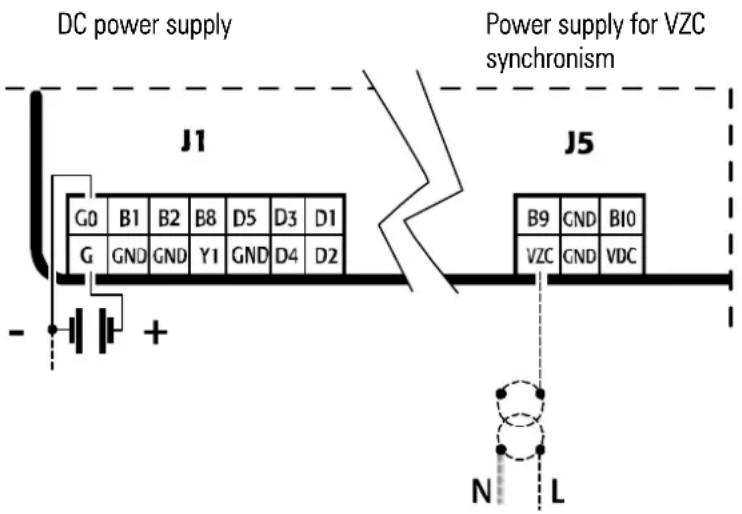
flowchart
graph TD
    A["DC power supply"] --> B["J1"]
    B --> C["Power supply for VZC synchronism"]
    C --> D["J5"]
    D --> E["N"]
    D --> F["L"]
    subgraph J1
        G0["G0"] & G1["B1"] & GND["GND"] & B2["B2"] & B8["B8"] & D5["D5"] & D3["D3"] & D1["D1"]
        G0 --> GND
        GND --> Y1["Y1"] & GND
        Y1 --> GND
        GND --> D4["D4"] & D2["D2"]
    end
    subgraph J5
        B9["B9"] & GND["GND"] & B10["B10"] & VZC["VZC"] & GND["VND"]
        B9 --> VDC["VDC"]
    end
Fig. 5.a
WARNINGS
- when programming the parameters with the key, the controller must be disconnected from the power supply and any other devices;
- the 24 Vdc available at the Vdc terminal can be used to supply an 4 to 20mA active probe; the maximum current is 100mA . The 5 Vdc available at the 5VR terminals can be used to supply to the 0 to 5V active ratiometric probes; the maximum total current is 50mA ;
- for applications subject to strong vibrations (1.5 mm pk-pk 10/55 Hz), secure the cables connected to the chiller ^3 using clamps placed around 3 cm from the connectors;
- for operation in domestic environments, shielded cables must be used (one wire + shield) for the tLAN connections (EN 55014-1);
- if a single power transformer is used for the chiller ^3 and the options, to avoid damaging the controller, all the G0 pins on the various controllers or the boards must be connected to the same terminal on the secondary, and all the G pins to the other terminal on the secondary, resetting the polarity of G and G0 for all the terminals;
- the system made up of the control board and the other optional boards represents a control device to be incorporated into class I or class II appliances.
Example of connection, as proposed by the default configuration.
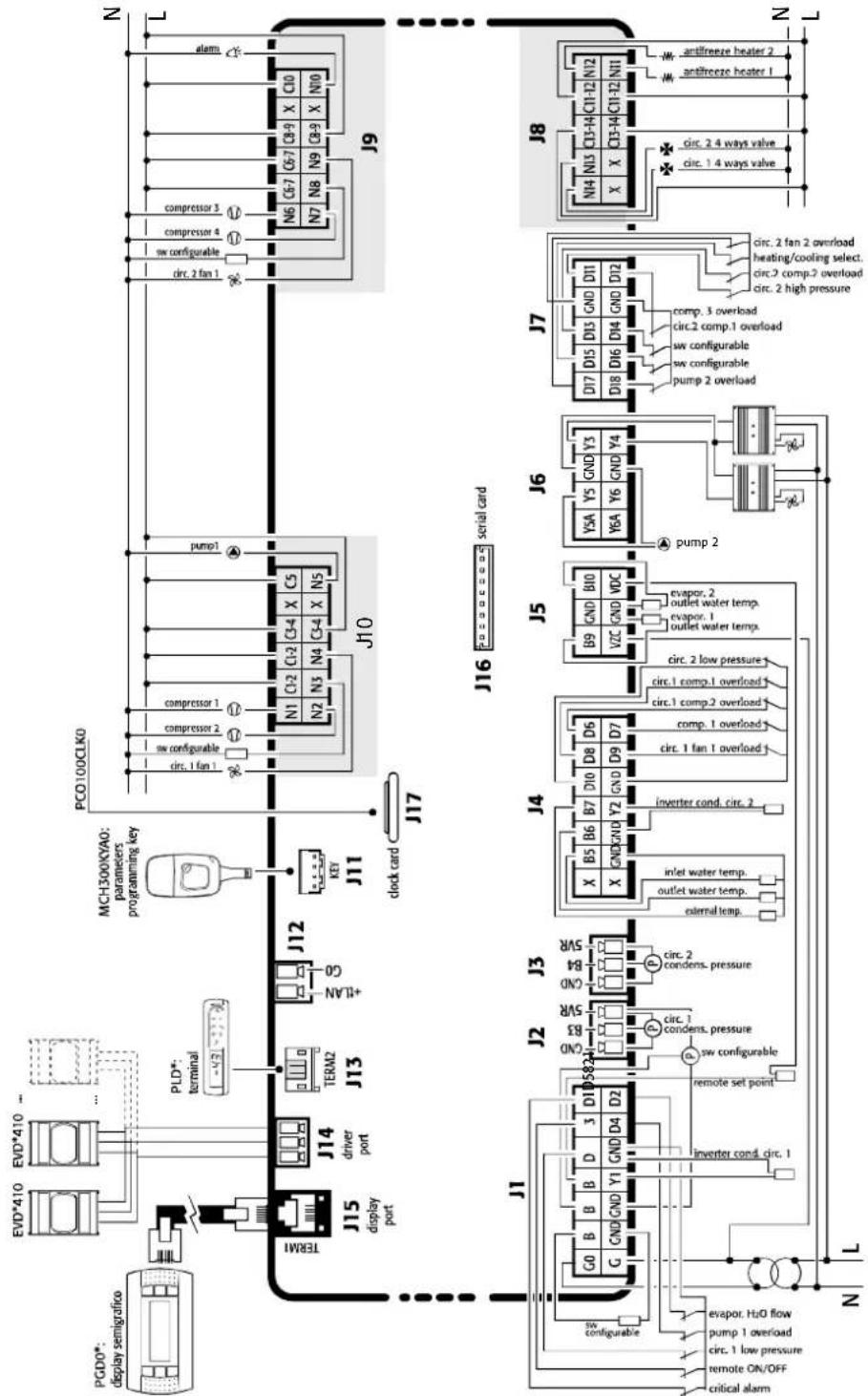
flowchart
graph TD
    subgraph PCO_100CLKD
        A["PCO 100CLKD"] --> B["PCO 100CLKD"]
        B --> C["PCO 100CLKD"]
        C --> D["PCO 100CLKD"]
        D --> E["PCO 100CLKD"]
        E --> F["PCO 100CLKD"]
        F --> G["PCO 100CLKD"]
        G --> H["PCO 100CLKD"]
        H --> I["PCO 100CLKD"]
        I --> J["PCO 100CLKD"]
        J --> K["PCO 100CLKD"]
        K --> L["PCO 100CLKD"]
        L --> M["PCO 100CLKD"]
        M --> N["PCO 100CLKD"]
        N --> O["PCO 100CLKD"]
        O --> P["PCO 100CLKD"]
        P --> Q["PCO 100CLKD"]
        Q --> R["PCO 100CLKD"]
        R --> S["PCO 100CLKD"]
        S --> T["PCO 100CLKD"]
        T --> U["PCO 100CLKD"]
        U --> V["PCO 100CLKD"]
        V --> W["PCO 100CLKD"]
        W --> X["PCO 100CLKD"]
        X --> Y["PCO 100CLKD"]
        Y --> Z["PCO 100CLKD"]
        Z --> AA["PCO 100CLKD"]
        AA --> AB["PCO 100CLKD"]
        AB --> AC["PCO 100CLKD"]
        AC --> AD["PCO 100CLKD"]
        AD --> AE["PCO 100CLKD"]
        AE --> AF["PCO 100CLKD"]
        AF --> AG["PCO 100CLKD"]
        AG --> AH["PCO 100CLKD"]
        AH --> AI["PCO 100CLKD"]
        AI --> AJ["PCO 100CLKD"]
        AJ --> AK["PCO 100CLKD"]
        AK --> AL["PCO 100CLKD"]
        AL --> AM["PCO 100CLKD"]
        AM --> AN["PCO 100CLKD"]
        AN --> AO["PCO 100CLKD"]
        AO --> AP["PCO 100CLKD"]
        AP --> AQ["PCO 100CLKD"]
        AQ --> AR["PCO 100CLKD"]
        AR --> AS["PCO 100CLKD"]
        AS --> AT["PCO 100CLKD"]
        AT --> AU["PCO 100CLKD"]
        AU --> AV["PCO 100CLKD"]
        AV --> AW["PCO 100CLKD"]
        AW --> AX["PCO 100CLKD"]
        AX --> AY["PCO 100CLKD"]
        AY --> AZ["PCO 100CLKD"]
        AZ --> BA["PCO 100CLKD"]
        BA --> BB["PCO 100CLKD"]
        BB --> BC["PCO 100CLKD"]
        BC --> BD["PCO 100CLKD"]
        BD --> BE["PCO 100CLKD"]
        BE --> BF["PCO 100CLKD"]
        BF --> BG["PCO 100CLKD"]
        BG --> BH["PCO 100CLKD"]
        BH --> BI["PCO 100CLKD"]
        BI --> BJ["PCO 100CLKD"]
        BJ --> BK["PCO 100CLKD"]
        BK --> BL["PCO 100CLKD"]
        BL --> BM["PCO 100CLKD"]
        BM --> BN["PCO 100CLKD"]
        BN --> BO["PCO 100CLKD"]
        BO --> BP["PCO 100CLKD"]
        BP --> BQ["PCO 100CLKD"]
        BQ --> BR["PCO 100CLKD"]
        BR --> BS["PCO 100CLKD"]
        BS --> BT["PCO 100CLKD"]
        BT --> BU["PCO 100CLKD"]
        BU --> BV["PCO 100CLKD"]
        BV --> BW["PCO 100CLKD"]
        BW --> BX["PCO 100CLKD"]
        BX --> BY["PCO 100CLKD"]
        BY --> BZ["PCO 100CLKD"]
        BZ --> CA["PCO 100CLKD"]
        CA --> CB["PCO 100CLKD"]
        CB --> CC["PCO 100CLKD"]
        CC --> CD["PCO 100CLKD"]
        CD --> CE["PCO 100CLKD"]
        CE --> CF["PCO 100CLKD"]
        CF --> CG["PCO 100CLKD"]
        CG --> CH["MCH33KKYAO: parameters programming key"]
        CH --> CI["MCH33KKYAO: parameters programming key"]
    end

    subgraph PCO_14
        CJ["MCH33KKYAO: parameters programming key"] --> CK["CNCLN+"]
    end

    subgraph PCO_24
        CR["MCH33KKYAO: parameters programming key"] --> CS["CNCLN+"]
    end

    subgraph PCO_34
        CT["MCH33KKYAO: parameters programming key"] --> CU["CNCLN+"]
    end

    subgraph PCO_44
        DV["MCH33KKYAO: parameters programming key"] --> DW["CNCLN+"]
    end

    subgraph PCO_54
        DU["MCH33KKYAO: parameters programming key"] --> DW
    end

    subgraph PCO_64
        DV2["MCH33KKYAO: parameters programming key"] --> DW
    end

    subgraph PCO_74
        DV2M2["MCH33KKYAO: parameters programming key"] --> DW
    end

    subgraph PCO_84
        DV2M2M2["MCH33KKYAO: parameters programming key"] --> DW
    end

    subgraph PCO_94
        DV2M2M2M2["MCH33KKYAO: parameters programming key"] --> DW
    end

    subgraph PCO_16
        DV2M2M2M2["MCH33KKYAO: parameters programming key"] --> DW
    end

    subgraph PCO_24
        DV2M2M2M2M2["MCH33KKYAO: parameters programming key"] --> DW
    end

    subgraph PCO_34
        DV2M2M2M2M2["MCH33KKYAO: parameters programming key"] --> DW
    end

    subgraph PCO_44
        DV2M2M2M2M2M2["MCH33KKYAO: parameters programming key"] --> DW
    end

    subgraph PCO_54
        DV2M2M2M2M2M2["MCH33KKYAO: parameters programming key"] --> DW
    end

    subgraph PCO_64
        DV2M2M2M2M2M2M2["MCH33KKYAO: parameters programming key"] --> DW
    end

    subgraph PCO_74
        DV2M2M2M2M2M2M2["MCH33KKYAO: parameters programming key"] --> DW
    end

    subgraph PCO_84
        DV2M2M2M2M2M2M2["MCH33KKYAO: parameters programming key"] --> DW
    end

    subgraph PCO_94
        DV2M2M2M2M2M2M2["MCH33KKYAO: parameters programming key"] --> DW
    end

    subgraph PCO_16
        DV2M2M2M2M2M2M2["MCH33KKYAO: parameters programming key"] --> DW
    end

    subgraph PCO_24
        DV2M2M2M2M2M2M2["MCH33KKYAO: parameters programming key"] --> DW
    end

    subgraph PCO_34
        DV2M2M2M2M2M2M2["MCH33KKYAO: parameters programming key"] --> DW
    end

    subgraph PCO_44
        DV2M2M2M2M2M2M2["MCH33KKYAO: parameters programming key"] --> DW
    end

    subgraph PCO_54
        DV2M2M2M2M2M2M2["MCH33KKYAO: parameters programming key"] --> DW
    end

    subgraph PCO_64
        DV2M2M2M2M2M2M2["MCH33KKYAO: parameters programming key"] --> DW
    end

    subgraph PCO_74
        DV2M2M2M2M2M2M2["MCH33kYAO: parameters programming key"] --> DW
    end

    subgraph PCO_84
        DV2M2M2M2M2M2M2["MCH33kYAO: parameters programming key"] --> DW
    end

    subgraph PCO_94
        DV2M2M2M2M2M2M2["MCH33kYAO: parameters programming key"] --> DW
    end

    subgraph PCO_16
        DV2M2M2M2M2M2M2["MCH33kYAO: parameters programming key"] --> DW
    end

    subgraph PCO_24
        DV2M2M2M2M2M2M2["MCH33kYAO: parameters programming key"] --> DW
    end

    subgraph PCO_34
        DV2M2M2M2M2M2M2["MCH33kYAO: parameters programming key"] --> DW
    end

    subgraph PCO_44
        DV2M2M2M2M2M2M2["MCH33kYAO: parameters programming key"] --> DW
    end

    subgraph PCO_54
        DV2M2M2M2M2M2M2["MCH33kYAO: parameters programming key"] --> DW
    end

    subgraph PCO_64
        DV2M2M2M2M2M2M2["MCH33kYAO: parameters programming key"] --> DW
    end

    subgraph PCO_74
        DV2M2M2M2M2mUMBZLWZLWZLWZLWZLWZLWZLWZLWZLWZLWZLWZLWZLWZLWZLWZLWZLWZLWZLWZLWZLWZLWZLWZLWZLWZLWZLWZLWZLWZLWZLWZLWZLWZLWZZLWZZLWZZLWZZLWZZLWZZLWZZLWZZLWZZLWZZLWZZLWZZLWZZLWZZLWZZLWZZLWZZLWZZLWZZLWZZLWZZLWZZLWZZLWZZLWZZLWZZLWZZLWZZLWZZLWZZLWZZLWZZLWZZLWZZ LRR_RR_RR_RR_RR_RR_RR_RR_RR_RR_RR_RR_RR_RR_RR_RR_RR_RR_RR_RR_RR_RR_RR_RR_RR_RR_RR_RR_RR_RR_RR_RR_RR_RR_RR_RR_RR_RR_RR_RR_RR_RR_RR_RR_RR_RR_RR_RR_RR_RR_RR-RR-RR-RR-RR-RR-RR-RR-RR-RR-RR-RR-RR-RR-RR-RR-RR-RR-RR-RR-RR-RR-RR-RR-RR-RR-RR-RR-RR-RR-RR-RR-RR-RR-RR-RR-RR-RR-RR-RR-RR-RR-RR-RR-RR-RR-RR-RR-RR-RR-RR-RR_RR_RR_RR_RR_RR_RR_RR_RR_RR_RR_RR_RR_RR_RR_RR_RR_RR_RR_RR_RR_RR_RR_RR_RR_RR_RR_RR_RR_RR_RR_RR_RR_RR_RR_RR_RR_RR_RR_RR_RR_RR_RR_RR_RR_RR_RR_RR_RR_RR_RR-RR_RR-RR-RR-RR-RR-RR-RR-RR-RR-RR-RR-RR-RR-RR-RR-RR-RR-RR-RR-RR-RR-RR-RR-RR-RR-RR-RR-RR-RR-RR-RR-RR-RR-RR-RR-RR-RR-RR-RR-RR-RR-RR-RR-RR-RR-RR-RR-RR-RR-RR-RR-LLR_LLR_LLR_LLR_LLR_LLR_LLR_LLR_LLR_LLR_LLR_LLR_LLR_LLR_LLR_LLR_LLR_LLR_LLR_LLR_LLR_LLR_LLR_LLR_LLR_LLR_LLR_LLR_LLR_LLR_LLR_LLR_LLR_LLR_LLR_LLR_LLR_LLR_LLR_LLR_LLR_LLR_LLR_LLR_LLR_LLR_LLR_LLR_LLR_LLR_LLR_TLR_LLR_TLR_LLR_TLR_LLR_TLR_LLR_TLR_LLR_TLR_TLR_TLR_TLR_TLR_TLR_TLR_TLR_TLR_TLR_TLR_TLR_TLR_TLR_TLR_TLR_TLR_TLR_TLR_TLR_TLR_TLR_TLR_TLR_TLR_TLR_TLR_TLR_TLR_TLR_TLR_TLR_TLR_TLR_TLR_TLR_TLR_TLR_TLR_TLR_TLR_TLR_TLR_TLR_TLR_TLR_TLR_TLR_TLR_TLR_HA Flow pump_circ.1 low pressure_dcc.1 low pressure_dcc.1 low pressure_dcc.1 low pressure_dcc.1 low pressure_dcc.1 low pressure_dcc.1 low pressure_dcc.1 low pressure_dcc.1 low pressure_dcc.1 low pressure_dcc.1 low pressure_dcc.1 low pressure_dcc.1 low pressure_dcc.1 low pressure_dcc.1 low pressure_dcc.1 low pressure_dcc.1 low pressure_dcc.1 low Pressure_dcc.1 low Pressure_dcc.1 low Pressure_dcc.1 low Pressure_dcc.1 low Pressure_dcc.1 low Pressure_dcc.1 low Pressure_dcc.1 low Pressure_dcc.1 low Pressure_dcc.1 low Pressure_dcc.1 low Pressure_dcc.1 low Pressure_dcc.1 low Pressure_dcc.1 low Pressure_dcc.1 low Pressure_dcc.1 low Pressure_dcc.1 low Pressure_dcc. (sw Congd.) dcc. (sw Congd.) dcc. (sw Congd.) dcc. (sw Congd.) dcc. (sw Congd.) dcc. (sw Congd.) dcc. (sw Congd.) dcc. (sw Congd.) dcc. (sw Congd.) dcc. (sw Congd.) dcc. (sw Congd.) dcc. (sw Congd.) dcc. (sw Congd.) dcc. (SW) dcc. (SW) dcc. (SW) dcc. (SW) dcc. (SW) dcc. (SW) dcc. (SW) dcc. (SW) dcc. (SW) dcc. (SW) dcc. (SW) dcc. (SW) dcc. (SW) dcc. (SW) dcc. (SW) dcc. (SW) dcc. (SW) dcc. DSS DSS DSS DSS DSS DSS DSS DSS DSS DSS DSS DSS DSS DSS DSS DSS DSS DSS DSS DSS DSS DSS DSS DSS DSS DSS DSS DSS DSS DSS DSS DSS DSS DSS DSS DSS DSS DSS DSS DSS DSS DSS DSS DSS DSS DSS DSS DSS DSS DSS DFF DFF DFF DFF DFF DFF DFF DFF DFF DFF DFF DFF DFF DFF DFF DFF DFF DFF DFF DFF DFF DFF DFF DFF DFF DFF DFF DFF DFF DFF DFF DFF DFF DFF DFF DFF DFF DFF DFF DFF DFF DFF DFF DFF DFF DFF DFF DFF DFF DFF DPP EWRER CONC Cond. csc cond cond cond cond cond cond cond cond cond cond cond cond cond cond cond cond cond cond cond cond cond cond cond cond cond cond cond cond cond cond cond cond cond cond cond cond cond cond cond cond cond cond cond cond cond cond cond cond cond cond cond cond cond cond cond cond cond cond cond cond cond cond cond cond cond cond cond cond cond cond cond cond cond cond cond cond cond cond cond cond cond cond cond cond cond cond cond cond cond cond cond cond cond cond cond cond cond cond cond cond Cond Cond Cond Cond Cond Cond Cond Cond Cond Cond Cond Cond Cond Cond Cond Cond Cond Cond Cond Cond Cond Cond Cond Cond Cond Cond Cond Cond Cond Cond Cond Cond Cond Cond Cond Cond Cond Cond Cond Cond Cond Cond Cond Cond Cond Cond Cond Cond Cond Cond Cond Cond Cond Cond Cond Cond Cond Cond Cond Cond Cond Cond Cond Cond Cond Cond Cond Cond Cond Cond Cond Cond Cond Cond Cond Cond Cond Cond Cond Cond Cond Cond Cond Cond Cond Cond Cond Cond Cond Cond Cond Cond Cond Cond Cond Cond Cond Cond Cond CondCondCondCondCondCondCondCondCondCondCondCondCondCondCondCondCondCondCondCondCondCondCondCondCondCondCondCondCondCondCondCondCondCondCondCondCondCondCondCondCondCondCondCondCondCondCondCondCondCondCondCondCondCondCondCondCondCondCondCondCondCondCondCondCondCondCondCondCondCondCondCondCondCondCondCondCondCondCondCondCondCondCondCondCondCondCondCondCondCondCondCondCondCondCondCondCondCondCondCondCondConcConcConcConcConcConcConcConcConcConcConcConcConcConcConcConcConcConcConcConcConcConcConcConcConcConcConcConcConcConcConcConcConcConcConcConcConcConcConcConcConcConcConcConcConcConcConcConcConcConcConCnCnCnCnCnCnCnCnCnCnCnCnCnCnCnCnCnCnCnCnCnCnCnCnCnCnCnCnCnCnCnCnCnCnCnCnCnCnCnCnCnCnCnCnCnCnCnCnCnCnCmCnCnCnCnCnCnCnCnCnCnCnCnCnCnCnCnCnCnCnCnCnCnCnCnCnCnCnCnCnCnCnCnCnCnCnCnCnCnCnCnCnCnCnCnCnCnCnCnCnC n C n C n C n C n C n C n C n C n C n C n C n C n C n C n C n C n C n C n C n C n C n C n C n C n C n C n C n C n C n C n C n C n C n C n C n C n C n C n C n C n C n C n C n C n C n C n C n C n C n C n/C n C n C n C n C n C n C n C n C n C n C n C n C n C n C n C n C n C n C n C n C n C n C n C n C n C n C n C n C n C n C n C n C n C n C n C n C n C n C n C n C n C n C n C n C n C n C n C n C n C n-C o l l l l l l l l l l l l l l l l l l l l l l l l l l l l l l l l l l l l l l l l l l l l l l l l l l l l l l l l l l l l l l l l l l l l l l l l l l l l l l l l l l l l l l l l l l l l l l l l l l l l |

    subgraph PCOLCKDL
            CX["X"] --> CPOLCKDL
            CPU["X"] --> CPU.KX["X"] & CPU.LX["X"] & CPU.MX["X"] & CPU.MX.X["X"] & CPU.MX.DX["X"] & CPU.MX.RX["X"] & CPU.MX.DX.XX["X"] & CPU.MX.DX.YX["X"] & CPU.MX.DX.ZX["X"] & CPU.MX.DX.ZX.XX["X"] & CPU.MX.DX.ZX.YX["X"] & CPU.MX.DX.ZX.ZX["X"] & CPU.MX.DX.ZX.DX.ZX.YX["X"] & CPU.MX.DX.ZX.DX.ZX.ZX["Y"] & CPU.MX.DX.ZX.DX.ZX.ZX["Y"] & CPU.MX.DX.ZX.DX.ZX.ZX["Y"] & CPU.MX.DX.ZX.DX.ZX.ZX["Y"] & CPU.MX.DX.ZX.DX.ZX.ZX["Y"] & CPU.MX.DX.ZX.Dx Zx Zx Zx Zx Zx Zx Zx Zx Zx Zx Zx Zx Zx Zx Zx Zx Zx Zx Zx Zx Zx Zx Zx Zx Zx Zx Zx Zx Zx Zx Zx Zx Zx Zx Zx Zx Zx Zx Zx Zx Zx Zx Zx Zx Zx Zx Zx Zx Zx Zx B x B x B x B x B x B x B x B x B x B x B x B x B x B x B x B x B x B x B x B x B x B x B x B x B x B x B x B x B x B x B x B x B x B x B x B x B x B x B x B x B x B x B x B x B x B x B x B x B x B x B y z z z z z z z z z z z z z z z z z z z z z z z z z z z z z z z z z z z z z z z z z z z z z z z z z z z z z z z z z z z z z z z z z z z z z z z z z z z z z z z z z z z z z z z z z z z z z z z z z z z z |

    subgraph PCOLCKDL
            JCP["JCP"] --> JCP.KX["JCP"] = JCP.KX.KP["JCP"] = JCP.KX.KT["JCP"] = JCP.KX.KT.KP["KP"] = JCP.KX.KT.KP.KP = JCP.KX.KT.KP.KP = JCP.KX.KT.KP.KP = JCP.KX.KT.KP.KP = JCP.KX.KT.KP.KP = JCP.KX.KT.KP.KP = JCP.KX.KT.KP.KP = JCP.KX.KT.KP.KP = JCP.KX.KT.KP.KP = JCP.KX.KT.KP.KP["JCP,KT"] = JCP.KX.KT.KP.KP = JCP.KX.KT.KP.KP = JCP.KX.KT.KP.KP = JCP.KX.KT.KP.KP = JCP.KX.KT.KP.KP = JCP.KX.KT.KP.KP = JCP.KX.KT.KP.KP = JCP.KX.KT.KP.KP = JCP.KX.KT.KP.KS["JCP,KT"] = JCP.KX.KT.KP.KP = JCP.KX.KT.KP.KP = JCP.KX.KT.KP.KP = JCP.KX.KT.KP.KP = JCP.KX.KT.KP.KP = JCP.KX.KT.KP.KP = JCP.KX.KT.KP.KP = JCP.KX.KT.KP.KP = JCP.KX .KPI["JCP,KT"] = JCP .KPI KPI KPI KPI KPI KPI KPI KPI KPI KPI KPI KPI KPI KPI KPI KPI KPI KPI KPI KPI KPI KPI KPI KPI KPI KPI KPI KPI KPI KPI KPI KPI KPI KPI KPI KPI KPI KPI KPI KPI KPI KPI KPI KPI KPI KPI KPI KPI KPI KPI KPI LTR LTR LTR LTR LTR LTR LTR LTR LTR LTR LTR LTR LTR LTR LTR LTR LTR LTR LTR LTR LTR LTR LTR LTR LTR LTR LTR LTR LTR LTR LTR LTR LTR LTR LTR LTR LTR LTR LTR LTR LTR LTR LTR LTR LTR LTR LTR LTR LTR LTR LTH LTH LTH LTH LTH LTH LTH LTH LTH LTH LTH LTH LTH LTH LTH LTH LTH LTH LTH LTH LTH LTH LTH LTH LTH LTH LTH LTH LTH LTH LTH LTH LTH LTH LTH LTH LTH LTH LTH LTH LTH LTH LTH LTH LTH LTH LTH LTH LTH LTH LITH LTH LTH LTH LTH LTH LTH LTH LTH LTH LTH LTH LTH LTH LTH LTH LTH LTH LTH LTH LTH LTH LTH LTH LTH LTH LTH LTH LTH LTH LTH LTH LTH LTH LTH LTH<nl>
Assembly for the version without the plastic case
The chiller ^3 should be installed on a 0.5 to 2 mm thick metal panel using the special spacers.
The electrical damage that occurs to electronic components is almost always due to electrostatic discharges caused by the operator. Consequently, suitable precautions must be taken when handling these components, in particular:
- before handling any electronic component or board, touch an earthed object (avoiding contact with a component is not sufficient, as a 10,000 V discharge, a voltage that can easily be reached by static electricity, creates an arc of around 1 cm);
- the materials must remain as long as possible inside their original packages. If necessary, remove the board from the packing and then place the product in antistatic packaging without touching the rear of the board;
• always avoid using plastic, polystyrene or non-antistatic materials;
• always avoid passing the board between operators (to avoid the phenomena of electrostatic induction and consequent discharges). - special care must be taken when fitting the optional boards on the main board, so as to avoid causing irreparable damage to the boards. Consequently, it is recommended to first secure the connection cables to the optional boards (using the plug-in terminals), and then insert the boards in the corresponding slots and finally secure the connection cables using cable clamps.
DRIVER ADRESSING IN pLAN NETWORK
The addressing of the EVD400 driver units that can be connected to the pLAN network must be set as following:
ADDRESS 2 -- > Circuit 1 Chiller Driver or Circuit 1 Bidirectional Driver
ADDRESS 3 -- > Circuit 1 Heat Pump Driver
ADDRESS 4 -- > Circuit 2 Chiller Driver or Circuit 2 Bidirectional Driver
ADDRESS 5 -- > Circuit 2 Heat Pump Driver
The driver should be configured using the serial addressing tool EVD4_UI Address that can be downloaded from CAREL website http://ksa.carel.com/.
For further details on the use of the Driver and its configuration please refer to the manual code +030220225.pdf (EVD4 - User manual)
6. Description of the main functions
6.1 Control set point
Inputs used
- Outside air temperature [B7]
- External set point [B8]
- Select cooling/heating from digital input [B25]
Parameters used
• Active operating mode (chiller/heat pump) [main]
- Cooling set point [r4]
- Heating set point [r5]
- Enable analogue probe 8 - External set point [-/-]
• Minimum set point value from probe B8 (cooling) [r6]
• Maximum set point value from probe B8 (cooling) [r7]
• Minimum set point value from probe B8 (heating) [r8]
• Maximum set point value from probe B8 (heating) [r9]
- Enable control of the clock board [t6]
- Enable set point time bands [-t-]
- Cooling set point in band 1 [-t-]
- Heating set point in band 1 [-t-]
- Cooling set point in band 2 [-t-]
- Heating set point in band 2 [-t-]
- Cooling set point in band 3 [-t-]
- Heating set point in band 3 [-t-]
- Cooling set point in band 4 [-t-]
- Heating set point in band 4 [-t-]
- Enable set point compensation [r11]
- Enable analogue probe 7 for outside air temperature [-/-]
• Maximum compensation value [r12]
• Minimum outside temperature for compensation in cooling [r13]
• Maximum outside temperature for compensation in cooling [r14]
• Minimum outside temperature for compensation in heating [r15]
• Maximum outside temperature for compensation in heating [r16]
Outputs used
Setting the control set point from the screen
The control set point can be set from the screen on the user interface.
Two distinct values need to be set, respectively for cooling and heating operation, if the unit features operation in chiller or heat pump mode.
Setting the remote analogue input set point
When enabling control of input B8 for the management of the remote set point, the setting made on the screen can be replaced with a set point calculated based on the 4 to 20 mA signal at the input to the board.
The lower and upper limits must be set for calculating the remote set point in cooling and/or heating operation.
Based on the 4 to 20 mA input signal, linear conversion will be performed between the end values set.
Remote set point for analogue input B8
The limits for calculating the remote set point will be the minimum and maximum values set for the corresponding password-protected parameter on set point screen.
MaxSTP Maximum remote set point limit
MinSTP Minimum remote set point limit
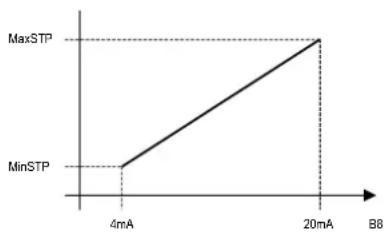
line
| B8 | MinSTP | MaxSTP | |---|---|---| | 4mA | 0 | 0 | | 20mA | 1 | 1 |Fig. 6.a
Time bands for varying the set point
By enabling control of the clock board, the management of 4 daily set point time bands can be configured.
Each time band features the start and end time and the associated set point.
When the time band starts, the active set point is replaced by the value set for the active time band, irrespective of whether the analogue input for the remote set point is activated.
Set point compensation for outside air temperature
The working set point can be adjusted according to the outside air temperature.
Normally this function is used in installations where greater priority is given to comfort; for example, in a shop where people enter and exit frequently, an excessive temperature difference between the inside and outside may be annoying to users and negative to their health.
This function increases or decreases the unit set point according to the outside temperature measured, adding an offset to set point set as described above that is directly proportional to the difference between the minimum and maximum limits.
The parameters for setting the operating limits are different for cooling and heating operation, without any restrictions regarding the setting of the limits for calculating the compensation offset.
6.1.1 Minimum outside temperature limit
Inputs used
- Outside air temperature [B7]
Parameters used
- Enable analogue probe 7 Outside air temperature [-/-]
- Outside temperature set point limit [r17]
- Outside temperature differential limit [r18]
Outputs used
- Compressor 1 circuit 1 [B29]
Winding A compressor 1 - Compressor 2 circuit 1 [B30]
Winding B compressor 1 - Compressor 3 circuit 1 [B31]
- Compressor 1 circuit 2. Winding A compressor 2 [B34]
- Compressor 2 circuit 2. Winding B compressor 2 [B35]
- Compressor 3 circuit 2 [B36]
If the probe for measuring the outside air temperature is enabled, a temperature threshold is activated below which the compressors are forced off. Temperature control only starts again when the outside air temperature is above the set point + a differential.
On units in chiller operation, this is done to prevent the operation of the unit in ambient conditions that would cause an excessively low condensing pressure.
On units in heat pump operation, this is done to prevent the operation of the unit in ambient conditions that would cause the rapid formation of frost on the outdoor exchanger. To disable the function, simply set the value of the control differential to 0.
6.2 Inlet-room temperature control
Inputs used
- Room temperature (air/air units) [B5]
Evaporator water inlet temperature
Parameters used
• Active operating mode (chiller/heat pump) [main]
- Configure type of unit [-H-]
• Total number of compressors / number of refrigerant circuits on unit [-H-]
- Enable compressor capacity control [-c-]
- Type of temperature control [-r-]
• Active set point [r1]
- Temperature control band [r10]
- Proportional or proportional + integral · Inlet control [-r-]
- Integral time for proportional + integral control [-r-]
Outputs used
- Liquid solenoid circuit 1 [B31]
- Liquid solenoid circuit 2 [B36]
- Compressor 1 circuit 1. Winding A compressor 1 [B29]
- Compressor 2 circuit 1. Compressor 1 capacity control. Winding B compressor 1 [B30]
- Compressor 3 circuit 1. Compressor 1 capacity control (if Part-Winding enabled) [B31]
- Compressor 1 circuit 2. Winding A compressor 2 [B34]
- Compressor 2 circuit 2. Compressor 2 capacity control [B35]
Winding B compressor 2 - Compressor 3 circuit 2. Compressor 2 capacity control (if Part-Winding enabled) [B36]
7. Description of operation
Temperature control proportional to the reading of the evaporator inlet probe
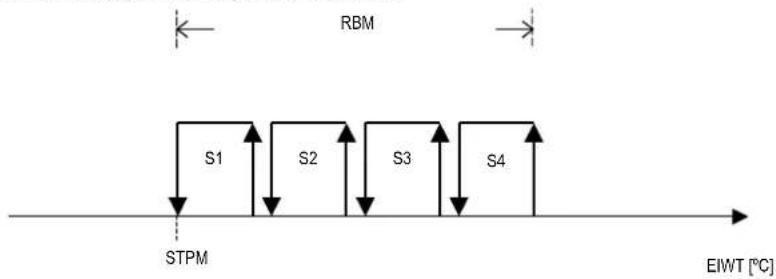
flowchart
graph TD
    A["STPM"] --> B["S1"]
    B --> C["S2"]
    C --> D["S3"]
    D --> E["S4"]
    style A fill:#f9f,stroke:#333
    style B fill:#ccf,stroke:#333
    style C fill:#ccf,stroke:#333
    style D fill:#ccf,stroke:#333
    style E fill:#ccf,stroke:#333
    note right of A "RBM"
    note right of E "EIWT["°C"]"
Fig. 7.a
STPM Control set point
RBM Control band
EIWT Evaporator water inlet temperature
S 1...4 Control steps
The temperature control depends on the values measured by the temperature probe located at the evaporator inlet (air/water – water/water units), or by the room probe (air/air units), and follows proportional logic.
Depending on the total number of compressors configured and the number of load steps per compressor, the control band set will be divided into a number of steps of the same amplitude.
When the various thresholds are exceeded, a compressor or load step will be activated.
The following relationships are applied to determine of the activation thresholds:
Total number of control steps = Number of compressors + (Number of compressors * Number load steps/compressor).
Proportional step amplitude = Proportional control band / Total number of control steps
Step activation threshold = Control set point + (Proportional step amplitude * Progressive step [1,2,3,...]).
EXAMPLE OF TEMPERATURE CONTROL ON CHILLER UNITS WITH 4 COMPRESSORS
Semi-hermetic compressors with proportional control
![C1 C2 C4C3 STPM EIWT [°C]RBM](/content/2026/05/1058229/images/1397ca5babc3413e3c9e4e7cb66f855837e4e7df8bba25da5ccb4c6074e0cd51.jpg)
Fig. 7.b
STPM Control set point
RBM Control band
EIWT Evaporator water inlet temperature
C 1...4 Compressor steps
7.1 Outlet temperature control
Inputs used
- Evaporator water outlet temperature [B6]
Parameters used
• Active operating mode (chiller/heat pump) [main]
- Configure type of unit [-H-]
• Total number of compressors / number of refrigerant circuits on unit [-H-]
- Enable compressor capacity control [-c-]
- Type of temperature control [-r-]
• Active set point [r1]
• Temperature control band [r10]
• Maximum time between starts with outlet control [-r-]
- Minimum time between starts with outlet control [-r-]
• Maximum time between stops with outlet control [-r-]
• Minimum time between stops with outlet control [-r-]
- Differential for calculating the time between steps with outlet control [-r-]
- Forced shutdown threshold with outlet control (cooling) [-r-]
- Forced shutdown threshold with outlet control (heating) [-r-]
Outputs used
- Liquid solenoid circuit 1 [B31]
- Liquid solenoid circuit 2 [B36]
- Compressor 1 circuit 1 Winding A compressor 1 [B29]
- Compressor 2 circuit 1 Compressor 1 capacity control Winding B compressor 1 [B30]
- Compressor 3 circuit 1 Compressor 1 capacity control (if Part-Winding enabled) [B31]
- Compressor 1 circuit 2 Winding A compressor 2 [B34]
- Compressor 2 circuit 2 Compressor 2 capacity control Winding B compressor 2 [B35]
- Compressor 3 circuit 2 Compressor 2 capacity control (if Part-Winding enabled) [B36]
EXAMPLE OF CONTROL IN THE DEAD ZONE ON CHILLER UNITS
Temperature control with dead zone based on the reading of the outlet probe
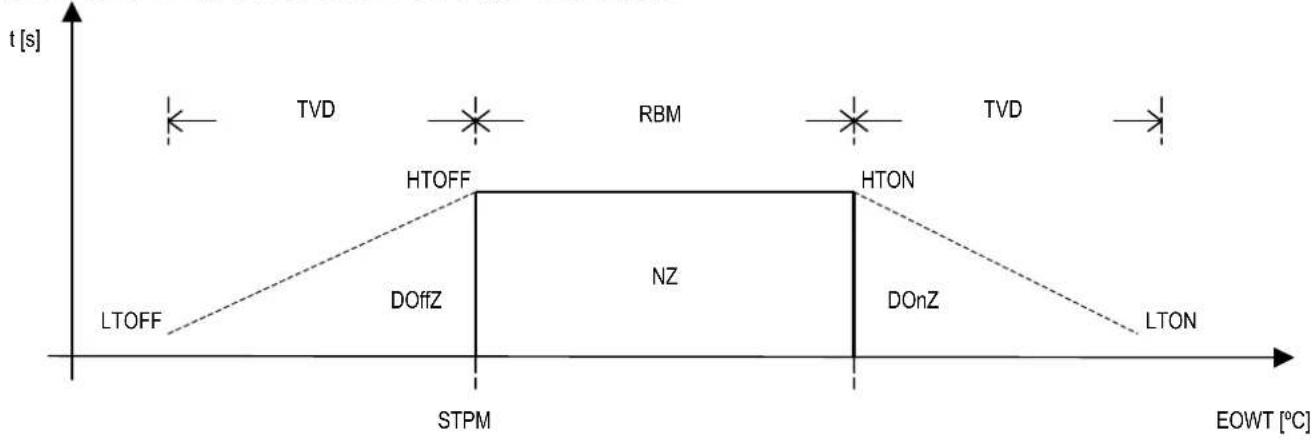
line
| EOWT [°C] | t [s] | | --------- | ----- | | TVD | ↑ | | RBM | ↑ | | HTOFF | ↑ | | HTON | ↑ | | LTOFF | ↓ | | DOffZ | ↓ | | NZ | □ | | DOnZ | ↓ | | LTON | ↓ |Fig. 7.c
STPM Control set point
RBM Control band
NZ Dead zone
TVD Time variation differential for activation/deactivation steps
EOWT Evaporator water outlet temperature
t Time
DonZ Device start zone
HTON Maximum time delay for activation of steps
LTON Minimum time delay for activation for steps
DoffZ Device stop zone
HTOFF Maximum time delay for deactivation of steps
LTOFF Minimum time delay for deactivation for steps
Temperature control is based on the temperature measured by probe B6 on units with one or two evaporators; in the latter the water temperature of mixture is used.
A temperature dead band is identified based on the set point and band.
Temperature values between the set point and set point + band (STPM < Temperature < STPM + RBM) will not switch any compressors On/Off.
Temperature values above set point + band (Temperature > STPM + RBM) will activate the compressors
Temperature values below the set point (Temperature < STPM) will deactivate the compressors
The compressor start/stop procedures are controlled by variable delay times.
With a differential set for calculating the delay time, the activation/deactivation of the devices is modulated according to the temperature measured.
Setting to 0 the minimum delay times upon an increase and/or decrease in the demand, disables the corresponding calculation functions.
A temperature threshold is envisaged, for both cooling operation and heating operation, below/above which the devices installed will in any case be stopped, in order to avoid excessive cooling/heating output produced by the unit.
7.2 Differential Temperature Control
Inputs used
• Evaporator inlet temperature
• Evaporator outlet temperature
• Outside air temperature
• Room temperature (acqua terminal)
Parameters used
- Type of unit
• Total number of compressors
• Number of load steps
• Type of temperature control
• Proportional band for inlet control or Dead zone for outlet control
• Temperature difference (delta) between reference and controlled value.
Outputs used
- Liquid solenoid
- Compressor start relay
- Compressor capacity control relay
Description of operation
The temperature control differential is based on the difference between a reference temperature and a controlled temperature.
calculated = Reference temperature - Controlled temperature
The value calculated in this way is compared against the rated value.
Depending on the unit operating mode, cooling or heating, the following situations may occur.
| Cooling | Heating | |
| calculated ≥ rated | --- | Compressors On |
| calculated ≤ rated | Compressors On | --- |
The purpose of this function is to maintain a constant temperature difference between two components in a system, with different thermal inertia, by acting on only one of the values measured.
The controlled temperature is defined as the component with the lower thermal inertia.
The reference temperature is defined as the component with the higher thermal inertia.
As the unit can operate in cooling or heating mode as selected from the screen on the user interface or by the digital input, if the reference temperature equals or exceeds the controlled temperature (i.e. opposite to the unit operating mode), the operation of the controller switches from error correction to amplification; consequently, the application of this type of control is designed for systems in which the variation in controlled values occurs within certain limits dictated by the operating mode of the active unit.
Control is proportional, according to the control band set.
The proportional control band is divided into a number of uniform steps, equal to the total number of compressors and load steps installed (as for inlet temperature control). The control set point is the rated temperature difference set.
The value controlled is the difference calculated between the reference temperature and the controlled temperature.
To select this type of control, a special parameter is provided that indicates which signal is used by the temperature control functions:
• Evaporator inlet-outlet control probe
- Reference temperature—Controlled temperature
7.3 Condensing unit control
Inputs used
- External control value (condensing units) [B8]
- Condensing unit digital control 1 [B12]
- Condensing unit digital control 2 [B13]
- Condensing unit digital control 3 [B14]
- Condensing unit digital control 4 [B28]
Parameters used
- Configure type of unit [-H-]
- Type of condensing unit control [-H-]
- Select proportional or step condensing unit control [-H-]
Outputs used
- Compressor 1 circuit 1. Winding A compressor 1 [B29]
- Compressor 2 circuit 1. Compressor 1 capacity control. [B30]
Winding B compressor 1
- Compressor 3 circuit 1. Liquid solenoid circuit 1. Compressor 1 capacity control (if Part-Winding enabled) [B31]
- Compressor 1 circuit 2. Winding A compressor 2 [B34]
- Compressor 2 circuit 2. Compressor 2 capacity control [B35] Winding B compressor 2
- Compressor 3 circuit 2. Liquid solenoid circuit 2 Compressor 2 capacity control (if Part-Winding enabled) [B36]
Description of operation
Condensing unit control involves the devices being called by a proportional voltage or current signal supplied by an external controller, or alternatively a series of electromechanical contacts via digital input. As the compressors are called by an external controller, the corresponding control probes and parameters are not used.
Control with analogue input
The signal acquired by analogue input B8 is 4 to 20mA.
There are two control modes: proportional or steps, these can be selected via the dedicated user parameter.
Proportional control
Below is a description of the operation of proportional control when a 4 to 20 mA analogue input is used.
The compressor requests depend on the analogue input B8, with continuous variation of the input signal, the board calculates the number of steps required based on the value of the signal:
Analogue input 4mA 0% request (no compressor on)
Analogue input 20mA 100% request (all the compressors on)
EXAMPLE OF CONTROL ON A UNIT WITH 6 HERMETIC COMPRESSORS:
Condensing units with proportional control
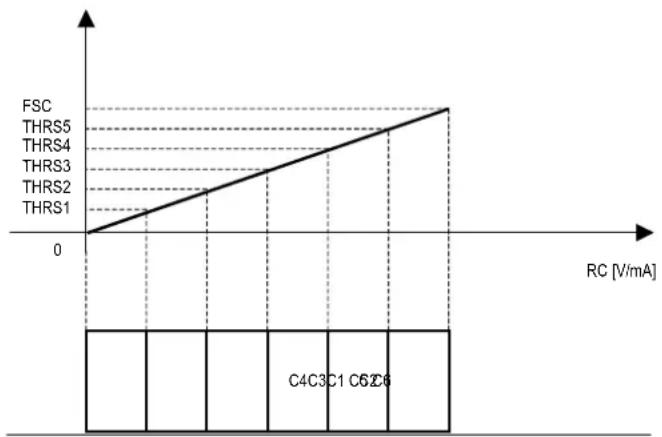
line
| RC [V/mA] | FSC | |---|---| | 0 | 0 | | C4C3 | | | C1 | | | C6Z0 | | | THRS1 | | | THRS2 | | | THRS3 | | | THRS4 | | | THRS5 | |Fig. 7.d
FSC Analogue input end scale
THR S1...5 Activation threshold for step 1 to 5
RC Remote control signal
C 1...6 Compressor steps
Total number of compressors = 6
Number of load steps per compressor = 0
Total number of steps = Total number of compressors + ( Total number of compressors * Number of load steps per compressor ) = 6 + 6 * 0 = 6 Amplitude of each step = Operating current range / Total number of steps = ( 20 - 4 ) / 6 = 2.666 mA
If the analogue input B8 measures 9.35 mA, two steps will be requested, therefore two compressors will be activated.
Two safety thresholds are calculated for the total activation or deactivation of the compressors, if exceeded.
These thresholds are calculated according to the following relationships.
Forced shutdown threshold = (Amplitude of each step / 2) + Analogue input lower end scale = (2.666 / 2) + 4 = 1.333 mA → 5.3 mA
Forced start threshold = Analogue input upper end scale - Forced shutdown threshold = 20 - 1.333 = 18.667 mA → 18.6 mA
If the reading of the analogue input B8 is less than the value of the forced shutdown threshold calculated, the devices will be stopped unconditionally.
If the reading of the analogue input B8 is greater than the value of the forced start threshold calculated, the devices will be started unconditionally.
Stepped control
Below is a description of the operation of stepped control steps when a 4 to 20 mA analogue input is used.
The compressor requests depend on the analogue input B8, using a current divider or equivalent circuit to supply precise signals that correspond to the activation or deactivation of the compressors and the relative load steps.
Analogue input 4 mA 100% request (all compressors on)
Analogue input 20 mA 0% request (no compressor on)
EXAMPLE OF CONTROL ON A UNIT WITH 6 HERMETIC COMPRESSORS:
Condensing units with stepped control
![C5 C6 C4 C3 C1C2 THRS1THRS5 THRS4 THRS3 THRS20 RC [V/mA] FSC](/content/2026/05/1058229/images/018263907b5b3ed2629018d36dd2b37cf809204e6a956982177ed23a5bcdb1c2.jpg)
Fig. 7.e
FSC Analogue input end scale
THR S1...5 Activation threshold for step 1 to 5
RC Remote control signal
C 1...6 Compressor steps
Total number of compressors = 6
Number of load steps per compressor = 0
Total number of steps = Total number of compressors + ( Total number of compressors * Number of load steps per compressor ) = 6 + 6 * 0 = 6
Amplitude of each step = Operating current range / Total number of steps = (20 - 4) / 6 = 2.666 mA.
If analogue input B8 measures 14.65 mA, two steps will be required, and consequently two compressors will be started.
Control with digital inputs
A number of digital inputs equal to the number of compressors installed on the unit are provided to start the devices.
There is no direct correspondence between the digital input and the compressor on, however the number of inputs closed at the same time will determine the number of compressors that are on. The compressor activation sequence is in any case defined according to rotation, as enabled by the corresponding parameter.
Only in the case of units with six compressors in two refrigerant circuits, in trio configuration, is there an exception to the compressor control mode; digital inputs 4 and 18 activate two load steps in response to just one input signal.
Considering this characteristic, the cooling capacity of the unit can still be modulated by uniformly increasing the capacity one step at a time; the digital inputs must be switched in such a way as to ensure that the difference in the number of requests between two consecutive input control sequences is equal to one step.
7.4 Compressor rotation
Inputs used
| Compressor 1 thermal overload circuit 1 | [B17] |
| Compressor 2 thermal overload circuit 1 | [B18] |
| Compressor 3 thermal overload circuit 1 (units with trio compressors) | [B26] |
| Compressor 1 thermal overload circuit 2 | [B22] |
| Compressor 2 thermal overload circuit 2 | [B23] |
| Compressor 3 thermal overload circuit 2 (units with trio compressors) | [B27] |
Parameters used
| Configure type of unit | [-H-] |
| Type of semi-hermetic compressors controlled | [-c-] |
| Total number of compressors / number of refrigerant circuits on unit | [-H-] |
| Enable compressor capacity control | [-c-] |
| Select type of compressor / refrigerant circuit rotation | [-H-] |
| Enable operation of compressor 1 circuit 1 | [-c-] |
| Enable operation of compressor 2 circuit 1 | [-c-] |
| Enable operation of compressor 3 circuit 1 | [-c-] |
| Enable operation of compressor 1 circuit 2 | [-c-] |
| Enable operation of compressor 2 circuit 2 | [-c-] |
| Enable operation of compressor 3 circuit 2 | [-c-] |
| Manually force compressor 1 circuit 1 | [-c-] |
| Manually force compressor 2 circuit 1 | [-c-] |
| Manually force compressor 3 circuit 1 | [-c-] |
| Manually force compressor 1 circuit 2 | [-c-] |
| Manually force compressor 2 circuit 2 | [-c-] |
| Manually force compressor 3 circuit 2 | [-c-] |
Outputs used
| Liquid solenoid circuit 1 | [B31] |
| Liquid solenoid circuit 2 | [B36] |
| Compressor 1 circuit 1 | [B29] |
| Winding A compressor 1 | |
| Compressor 2 circuit 1. Compressor 1 capacity control | [B30] |
| Winding B compressor 1 |
- Compressor 3 circuit 1 [B31]
Compressor 1 capacity control (if Part-Winding enabled) - Compressor 1 circuit 2. Winding A compressor 2 [B34]
- Compressor 2 circuit 2. Compressor 2 capacity control Winding B compressor 2 [B35]
- Compressor 3 circuit 2 [B36]
Compressor 2 capacity control (if Part-Winding enabled)
The compressor calls are rotated so as to balance out the number of operating hours and starts of the devices.
There are three different types of rotation available:
• L.I.F.O.
• F.I.F.O.
- By time
- L.I.F.O. - F.I.F.O. - By time
Rotation is only performed between the compressors, and not between the capacity steps.
LIFO rotation
The first compressor to start will be the last to stop. The device activation sequence on a unit with 4 compressors is: C1, C2, C3, C4
The device deactivation sequence on a unit with 4 compressors is: C4, C3, C2, C1
FIFO rotation
The first compressor to start will be the first to stop. The device activation sequence on a unit with 4 compressors is: C1, C2, C3, C4.
The device deactivation sequence on a unit with 4 compressors is: C1, C2, C3, C4
Rotation by time
This type of rotation is based on the count of the device operating hours. The compressor with the least number of operating hours will always start first. The active compressor with the highest number of operating hours will always stop first.
The activation of one or more than one alarm that causes one or more compressors to shutdown requires the activation of an equivalent number of devices, from those available, so as to make up for the variation in active cooling capacity.
7.5 TANDEM - TRIO compressor rotation
Rotation between circuits
In the units with tandem or trio compressors in two refrigerant circuits, the circuit rotation described is incorporated into the rotation between compressors, for the purpose of balancing the quantity of oil in each.
Whenever the unit is started, and the compressors are completely off, rotation is performed that involves the alternating start-up of the two circuits.
Force tandem - trio compressors in FIFO rotation
For these types of compressors, the aim is to avoid the operation of circuits at part load for excessive periods (affecting the operation of the compressors that are off).
A maximum part load operating time has been introduced, after which the active compressor is stopped, and the demand is transferred to another compressor in the same circuit.
If no compressors are available when the exchange in condition occurs, the operation of the circuit remains unchanged.
The activation of an alarm on the compressor being forced on will involve a return to the previous operating conditions.
The count time for forcing the compressor on is reset whenever an alarm occurs in the circuit.
7.6 Compressor safety times
Inputs used
- Compressor 1 thermal overload circuit 1 [B17]
- Compressor 2 thermal overload circuit 1 [B18]
- Compressor 3 thermal overload circuit 1 (units with trio compressors) [B26]
- Compressor 1 thermal overload circuit 2 [B22]
- Compressor 2 thermal overload circuit 2 [B23]
- Compressor 3 thermal overload circuit 2 (units with trio compressors) [B27]
Parameters used
- Minimum compressor on time [-c-]
- Minimum compressor off time [-c-]
- Minimum time between starts of different compressors [-c-]
- Minimum time between starts of the same compressor [-c-]
Outputs used
- Liquid solenoid circuit 1 [B31]
- Liquid solenoid circuit 2 [B36]
- Compressor 1 circuit 1. Winding A compressor 1 [B29]
- Compressor 2 circuit 1. Compressor 1 capacity control [B30] Winding B compressor 1
- Compressor 3 circuit 1. [B31]
Compressor 1 capacity control (if Part-Winding enabled) - Compressor 1 circuit 2. Winding A compressor 2 [B34]
- Compressor 2 circuit 2. Compressor 2 capacity control [B35]
Winding B compressor 2 - Compressor 3 circuit 2. [B36]
Compressor 2 capacity control (if Part-Winding enabled)
Minimum compressor on time
This defines a guaranteed minimum ON time for the compressors; once activated, the compressors will operate for this time, irrespective of the temperature control request status. Only the activation of a protector will cause the device to shutdown earlier.
CREQ Compressor request
CMP Compressor status
MONT Minimum compressor on time
t Time
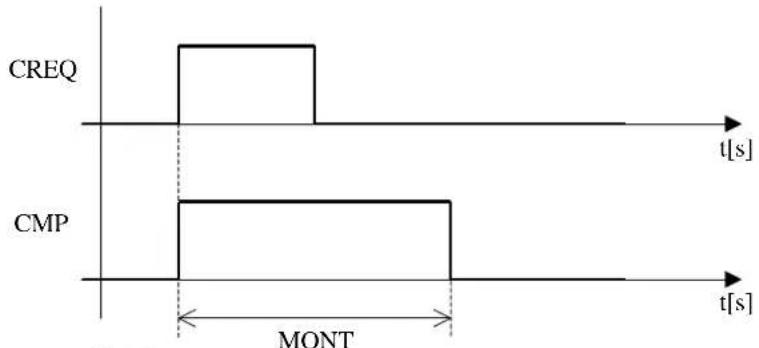
line
| Signal | Time (s) | |--------|----------| | CREQ | 0 | | CMP | 0 |Fig. 7.f
Minimum compressor off time
This defines the minimum guaranteed OFF time for the compressors, in response to any shutdown signal due to the temperature conditions or an alarm. Even if called to start, a compressor cannot be switched on before this time elapses.
CREQ Compressor request
CMP Compressor status
MOFFT Minimum compressor off time
t Time
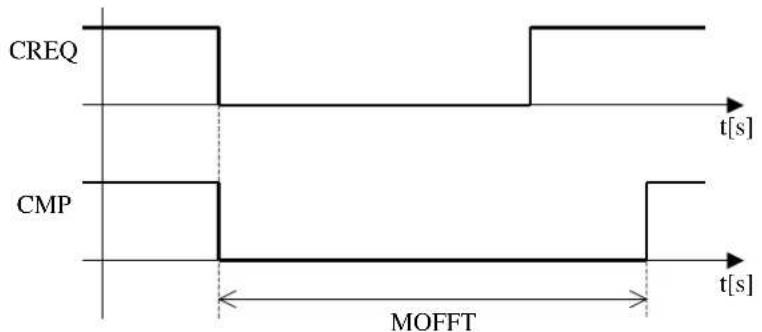
other
| Signal | Time (s) | |--------|----------| | CREQ | 0 | | CMP | 0 |Fig. 7.g
Minimum time between starts of different compressors
This defines the minimum guaranteed time between the starts of two different compressors; this prevents simultaneous starts of multiple devices
C1REQ Compressor 1 request
C2REQ Compressor 2 request
CMP1 Compressor 1 status
CMP2 Compressor 2 status
CMPST Minimum time between starts of different compressors
t Time
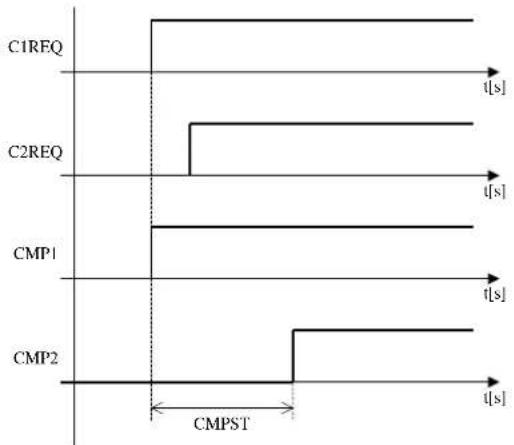
other
| Signal | Time (s) | |--------|----------| | C1REQ | 0 | | C2REQ | t[s] | | CMP1 | 0 | | CMP2 | t[s] |Fig. 7.h
Minimum time between starts of the same compressor
This defines the minimum guaranteed time between two successive starts of the same compressor.
Even if called to start, the compressor will not be able to switch on before this times elapses.
Setting this parameter suitably can limit the number of starts/hour according to the specific instructions of the manufacturer of the compressor.
CREQ Compressor request
CMP Compressor status
CST Minimum time between starts of the same compressor
t Time
![CREQ CMP t[s] CST t[s]](/content/2026/05/1058229/images/8bdaedfe51a2fefbc0006f462205a026bf5892af4472214a884e66261adfbc32.jpg)
Fig. 7.i
7.7 Pumpdown management
Inputs used
| Low pressure switch circuit 1 | [B15] |
| Low pressure switch circuit 2 | [B20] |
| Evaporation pressure 1 | [B1] |
| Evaporation pressure 2 | [B2] |
| ON/OFF from digital input (air/air units and chillers) | [B13] |
Parameters used
| Type of semi-hermetic compressors controlled | [-c-] |
| Maximum pumpdown duration | [-c-] |
| Select end pumpdown mode | [-c-] |
| End pumpdown pressure from probe | [-c-] |
| Unit ON/OFF from panel | [main] |
| Unit ON/OFF from supervisor | [] |
Outputs used
| Liquid solenoid circuit 1 | [B31] |
| Liquid solenoid circuit 2 | [B36] |
| Winding A compressor 1 | [B29] |
| Winding B compressor 1 | [B30] |
| Winding A compressor 2 | [B34] |
| Winding B compressor 2 | [B35] |
The pumpdown procedure is performed for the purpose of completely emptying the residual freon from the evaporator in a refrigerant circuit during shutdown.
The following conditions can cause a refrigerant circuit to shutdown:
Remote ON/OFF: unit shutdown from remote contact
ON/OFF from keypad: unit shutdown from display with specific procedure
ON/OFF from supervisor: unit shutdown on signal from supervisory system
Thermostat: circuit shutdown when temperature set point reached
The pumpdown procedure involves the operation of a certain circuit with the liquid solenoid valve de-energised (closed).
The pumpdown procedure ends when:
- the low pressure transducer is activated, according to the set end pumpdown threshold
• the low pressure switch is activated
• the maximum time limit is reached
During the pumpdown procedure, the low pressure alarm, both from transducer and from pressure switch, is disabled.
| CMPR | Compressor | request |
| PDS | Pumpdown | status |
| LP | Low | pressure |
| CMPS | Compressor | status |
| LPSTOP End due to low pressure | ||
| TIMESTOP End on reaching maximum time t [s] Time | ||
![CMPR PDS LP CMPS t [s] t [s] t [s] t [s] LP STOP TIMESTOP](/content/2026/05/1058229/images/601d87c0fad85835dc3cee05975259323f6754be7d4289337492186e58327a21.jpg)
7.8 Main pump management
Inputs used
- Evaporator water flow switch [B12]
• Evaporator pump 1 thermal overload [B14] - Evaporator pump 2 thermal overload [B28]
Parameters used
- Number of evaporator pumps [-H-]
- Evaporator pump/main fan operating mode [-H-]
- Delay between start of pump/main fan and compressors [-c-]
- Delay for stopping the pump/main fan [-c-]
- ON time in burst operation [-H-]
- OFF time in burst operation [-H-]
Outputs used
- Evaporator pump 1 [B33]
- Evaporator pump 2 [B36]
The main circulating pump can be managed in four different operating modes:
- Always on: the pump is activated when the unit is started and remains active while the unit is operating; if there are two pumps, the devices will be rotated according to the specific settings
- On according to the status of the compressor: the pump is on according to the compressor call status; consequently, when the set point has been reached, the circulating pump and compressors, excepting in the case of safety times, are off
- Burst operation: normally the circulating pump is off, and is activated periodically for a set time; the unit temperature conditions are constantly monitored and the compressors are started if necessary; when the control set point is reached the pump is switched off
• Always off: the main circulating pump is not managed, whatever the operating conditions of the unit
Two safety times are observed, respectively a compressor activation delay after the circulating pump starts, and pump shutdown delay after the compressors stop when having reached the control set point or the unit is shutdown.
7.9 Pump rotation
Inputs used
- Evaporator water flow switch [B12]
- Evaporator pump 1 thermal overload [B14]
- Evaporator pump 2 thermal overload [B28]
Parameters used
• Number of evaporator pumps [-H-]
- Select type of evaporator pump rotation [-H-]
- Operating hour threshold for the rotation of the evaporator pumps [-H-]
Outputs used
- Evaporator pump 1 [B33]
- Evaporator pump 2 [B36]
If there are two circulating pumps on the unit, the operation of these can be rotated in the following modes:
• Rotation at start: when the unit is started, the operation of the pumps is rotated, so as to balance the number of starts-stops of the devices
- Rotation by time: a rotation time is established (expressed in hours), which when reached the devices are rotated, so as to balance the number of operating hours of the devices.
Control of the second circulating pump in any case involves forced rotation in the event of an alarm event of one of the devices, to ensure maximum continuity of operation.
Pump thermal overload alarm
If a thermal overload alarm is activated on the active circulating pump, the pump is stopped and the devices are rotated.
A further activation of the thermal overload alarm on the active reserve pump causes the total shutdown of the unit due to no other pump being available on power-up, and a new rotation is forced.
Evaporator flow switch alarm
The activation of the evaporator flow switch alarm forces the rotation of the devices and the activation of the reserve pump; in this condition, the alarm signal delay time in steady operation is re-activated, after which, with the alarm active, the unit is switched off.
Evaporator flow switch alarm/intervention
The evaporator flow switch intervention generates the EVAPORATOR FLOW SWITCH ALARM respecting the following time:
• Evaporator flow switch alarm delay at start-up
• Evaporator flow switch alarm delay in steady operation
If there are 2 evaporator pumps, the intervention of the flow switch causes the startup of the backup pump. If after the "Evaporator flow switch alarm delay at start-up" the flow switch signal is still present, the EVAPORATOR FLOW SWITCH ALARM occurs and the unit is turned off.
The compressors, after the startup of the backup pump, remain still ON for a delay time in steady operation.
7.10 Electric heaters
Inputs used
• Room temperature (air/air units) Evaporator water inlet temperature [B5]
• Air outlet temperature (air/air units) Evaporator water outlet temperature [B6]
- Evaporator 1 water outlet temperature [B9]
- Evaporator 2 water outlet temperature [B10]
- Outside air temperature [B7]
- Boiler temperature [B1]
Parameters used
- Select number of evaporators [-H-]
- Type of temperature control [-r-]
- Enable analogue probe 7 Outside air temperature [-/-]
- Enable analogue probe 1 Boiler temperature [-/-]
- Configuration of analogue inputs 1 and 2 [-/-]
- Antifreeze heater set point [A3]
- Antifreeze heater differential [A4]
• Support heater set point in cooling mode [A5]
• Support heater differential in cooling mode [A6]
• Support heater set point 1 in heating mode [A7]
• Support heater differential 1 in heating mode [A8]
• Support heater set point 2 in heating mode [A9]
• Support heater differential 1 in heating mode [A10] - Delay in activation of the support heater in heating mode [A11]
- Select probe for cooling support control in air/air units [-A-]
- Outside air set point to enable support heater [-A-]
- Outside air differential to enable support heater [-A-]
- Boiler temperature set point to enable support heater [-A-]
- Boiler temperature differential to enable support heater [-A-]
• Active operating mode (chiller/heat pump) [main]
Outputs used
- Status of digital output 11. Heater 1 [B39]
- Status of digital output 12. Heater 2 [B40]
Antifreeze heater
To prevent the activation of the antifreeze protection one or more electric heaters are used, immersed in the flow of water at the evaporator and controlled based on by a set point and differential. The activation of the antifreeze heater causes the total shutdown of the compressors, or in any case disables the cooling devices, until the temperature returns above the heater set point + differential.
Support heater in cooling
To prevent the activation of the minimum room temperature limit protection in air/air units, an electric heater is activated, immersed in the main air flow, controlled based on a set point and differential.
The activation of the support heater in cooling causes the total shutdown of the compressors, or in any case disables the cooling devices, until the temperature returns above the heater set point + differential.
SUPPORT HEATERS IN HEATING
Heating support function on water/air – water/water units
In units operating in heating mode with reversal on the refrigerant circuit, electric heaters (used in cooling mode as evaporator antifreeze heaters) are used to support the heating function, if the operation of the unit cannot satisfy the thermal load of the installation. These heaters are controlled based on the unit temperature control probe (inlet or outlet, according to the setting made), while two separate set points and differentials are set for the activation of the devices. In the event of control based on the temperature measured at the evaporator outlet, in units with one and two evaporators, the heaters will be controlled based on the values measured by analogue input B6.
Heating support function on air/air units
In units operating in heating mode with reversal on the refrigerant circuit, electric heaters are used to support the heating function, if the operation of the unit cannot satisfy the thermal load of the installation.
The user can set whether the heater is activated based on the room temperature or the outlet temperature.
The support heaters are managed by setting an activation delay time, calculated from when the circulating pump starts, so as to give the unit time to reach steady operation. Enabling the control set point compensation function will also cause the compensation of the heater set point, according to the same temperature difference calculated.
Boiler function
If the reading of analogue input B1 is enabled and configured as the boiler temperature, the operation of the heaters can be managed based on the outside temperature conditions and the water temperature in the storage cylinder.
Once having set a control set point and differential for both readings, the support heaters will be activated based on the control temperature measured (inlet or outlet, according to the specific setting) in reference to specific set points and differentials, only if the outside temperature conditions and boiler conditions allow.
7.11 Selecting the operating mode
Inputs used
- Select cooling/heating from digital input [B25]
Parameters used
- Configure type of unit [-H-]
- Cooling/Heating from panel [main]
- Enable cooling/heating selection from digital input [H2]
- Enable cooling/heating selection from supervisor [H4]
- Select cooling/heating from supervisor
- Logic of the 4-way reversing valve [-H-]
- Force devices OFF for automatic reversal of the refrigerant circuit [-H-]
Outputs used
• 4-way valve for reversing the refrigerant circuit in circuit 1 [B41]
• 4-way valve for reversing the refrigerant circuit in circuit 2 [B42]
In general, if the unit configured features operation in both chiller mode (cooling) and heat pump mode (heating), the operating mode can be changed with the unit on or off, depending on the type of selection.
There are three different ways to change the operating mode:
Keypad: a parameter is set on the menu. The operating mode can only be changed if the unit is off and the circulating pump has stopped
Supervisor: this can be enabled, with a switching signal received from the supervisor serial network. The operating mode can only be changed if the unit is off and the circulating pump has stopped
Digital input: this can be enabled, with the switching of the enabled digital input, by an external controller. A delay must be set for switching the reversing valves in the refrigerant circuit, if equal to zero the mode is switched immediately, otherwise the unit is switched off according to the procedure shown in the figure
Switching Cooling-heating from digital input
SWDIN Status of the digital input for Cooling-heating selection
USTAT Unit operating status
4WAY Operating status of 4 way reversing valves
(possibly depending on the operating logic)
SWD Cooling-heating switching delay
t[s] Time
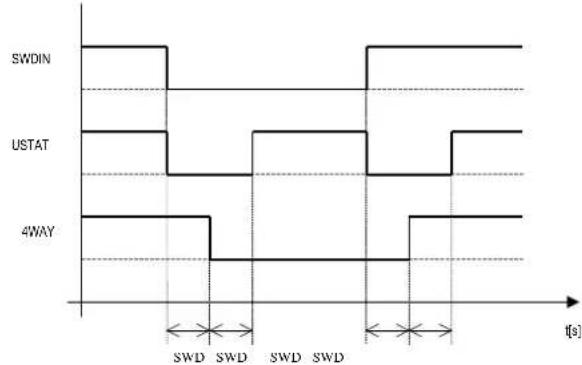
line
| Signal | Time Segment Start (s) | Time Segment End (s) | |--------|--------------------------|------------------------| | SWDIN | 0 | 1 | | USTAT | 1 | 2 | | 4WAY | 2 | 3 |Fig. 7.m
The keypad and supervisor have equal priority in setting the operating mode, the most recent variation determines the actual status; if enabled, the digital input has absolute priority over the other two.
7.12 ON/OFF time bands
Inputs used
- System hours [main]
- System minutes [main]
- System day [main]
- System month [main]
- System year [main]
Parameters used
- Enable control of the clock board [t6]
- Hour setting [t1]
- Minutes setting [t2]
- Day setting [t3]
• Month setting [t4]
• Year setting [t5] - Enable unit ON-OFF time bands [-t-]
- Enable set point time bands [-t-]
- Configure time band parameters – day [-t-]
Outputs used
ON-OFF time bands
If control of the clock board is enabled, and the board is fitted and operating, the program can control 4 different types of time band, with separate application on each day of the week.
The time bands set only take effect if the unit has been switched on from the button.
Band 1
Four values are set, respectively the start and end times for two periods, within which the unit is on.
| OFF | ON | OFF | ON | OFF |
Band 2
Two values are set, respectively the start and end time band, within which the unit is on.
| OFF | ON | OFF |
Band 3
The unit is forced ON without time limits
Band 4
The unit is forced OFF without time limits
Set point time bands
If control of the clock board is enabled, and the board is fitted and operating, the program can control 4 different types of time band with changes in the set point, applied on each day of the week.
A different cooling and heating set point must be set for each period (total of 8 parameters) plus the start and end times of the bands.
Setting the same start and end times is equivalent to disabling the function for that period of time.
7.13 Antifreeze control
Inputs used
| Evaporator water outlet temperature | [B6] |
| Evaporator 1 water outlet temperature | [B9] |
| Evaporator 2 water outlet temperature | [B10] |
Parameters used
| Enable analogue probe 6. Evaporator water outlet temperature | [-/-] |
| Antifreeze alarm set point (chiller units) | [A1] |
| Antifreeze alarm differential (chiller units) | [A2] |
| Minimum antifreeze/low room temperature set point limit | [-A-] |
| Maximum antifreeze/low room temperature set point limit | [-A-] |
| Type of antifreeze alarm reset | [-A-] |
| Antifreeze alarm delay when starting (manual reset) | [-A-] |
| Device start mode in antifreeze with unit off | [A12] |
Outputs used
| • Generic alarm | [B38] |
General information
The antifreeze function is based on the reading made by the temperature probes located on the evaporator outlet.
The function is different for units with one or two water circuits, with the antifreeze control based on the readings of the following inputs respectively:
• B6 single circuit units
• B9-B10 two circuit units
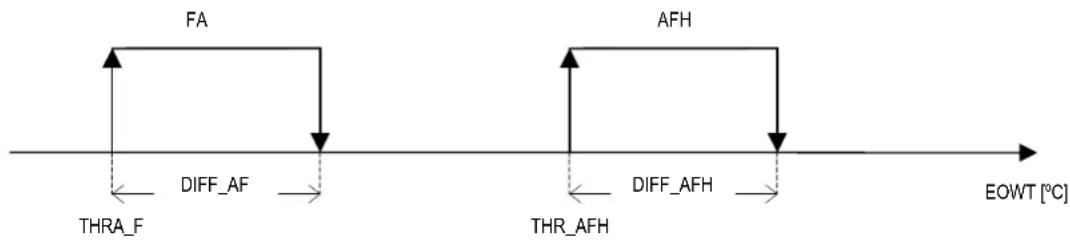
flowchart
graph LR
    A["FA"] --> B["THRA_F"]
    B --> C["DIFF_AF"]
    C --> D["AFH"]
    D --> E["THR_AFH"]
    E --> F["DIFF_AFH"]
    F --> G["EOWT [°C"]]
Fig. 7.n
THRA F Antifreeze alarm set point
DIFF AF Antifreeze alarm differential
FA Antifreeze alarm
THR AFH Antifreeze heater set point
DIFF AFH Antifreeze heater differential
AFH Antifreeze heater
EOWT Evaporator water outlet temperature
Antifreeze alarm
See the antifreeze alarm in the chapter on the alarms.
+030220431 rel 1.7 03/06/2014 56
7.14 Condenser - evaporator control
Inputs used
- Condensing temperature 1 [B1]
- Condensing temperature 2 [B2]
- Outside air temperature [B7]
- Condensing pressure 1 [B3]
- Condensing pressure 2 [B4]
Parameters used
- Type of condenser control [-F-]
- Number of condensers installed [-F-]
- Type of condensing devices controlled [-F-]
- Total number of fans installed [-F-]
- Forcing time when starting the condenser (control by temperature) [-F-]
• Maximum voltage threshold for Triac [-F-] - Minimum voltage threshold for Triac [-F-]
- Amplitude impulse for phase control [-F-]
- Condenser control set point (cooling) [-F-]
- Condenser differential (cooling) [-F-]
- Evaporator set point (heating) [-F-]
- Evaporator differential (heating) [-F-]
- Fan operation differential at minimum speed [-F-]
• Maximum fan speed with inverter [-F-] - Minimum fan speed with inverter [-F-]
- Speed-up time with inverter [-F-]
- Enable high pressure prevent [-F-]
[-F-] [-F-]
- High pressure prevent set point(cooling) [-F-]
- High pressure prevent differential(cooling) [-F-]
- Low pressure prevent set point(heating) [-F-]
- Low pressure prevent differential(heating) [-F-]
- Condenser operating mode in the event of probe fault [-F-]
- End prevent delay [-F-]
- Start hour for low-noise operation [F1]
- Start minutes for low-noise operation [F2]
- End hour for low-noise operation [F3]
- End minutes for low-noise operation [F4]
- Low-noise set point in cooling [F5]
- Low-noise set point in heating [F6]
- Enable control of the clock board [t6]
• Active operating mode (chiller/heat pump) [main]
Outputs used
- Fan 1 circuit 1 [B32]
- Fan 2 circuit 1 [B31]
- Fan 2 circuit 1 (1 condenser) [B37]
- Fan 1 circuit 2 (2 condensers) [B37]
- Fan 2 circuit 2 [B36]
- Status of analogue output 1 Condenser fans circuit 1 [B43]
- Status of analogue output 2 [B44]
Condenser fans circuit 2
Condenser-evaporator on/off linked to compressor operation
The operation of the fans will be slaved exclusively to the operation of the compressors:
Compressor off = fan off
Compressor on = fan on
No pressure or temperature transducers need to be installed
On/off condenser-evaporator operation linked to the pressure or temperature sensor reading
The operation of the fans will be slaved to the operation of the compressors and the value read by the pressure or temperature sensors, according to a set point and band, with proportional control.
In cooling operation, when the pressure/temperature is less than or equal to the set point, all the fans will be off; when the pressure/temperature rises to the set point + band, all the fans will be on.
In heating operation, when the pressure/temperature is greater than or equal to the set point, all the fans will be off; when the pressure/temperature falls to the set point - band, all the fans will be on.
The control band is divided into a uniform number of steps, equal to the number of fans installed for the circuit in question.
Single or separate condensers/evaporators can be chosen; with single coils, the fans will be controlled by the higher/lower pressure/temperature, with the second separate coil, each pressure sensor/temperature controls its own fan or group of fans.
Modulating condenser-evaporator operation linked to the pressure or temperature sensor reading
The fans will be controlled by a 0 to 10 V or PWM analogue output, in proportion to the request from the pressure / temperature sensors.
Single or separate condensers/evaporators can be chosen; with single coils, the fans will be controlled by the higher/lower pressure/temperature, with the second separate coil, each pressure sensor/temperature controls its own fan or group of fans.
Condenser fan control in chiller operation
Fig. 7.0 Condenser control devices and alarms
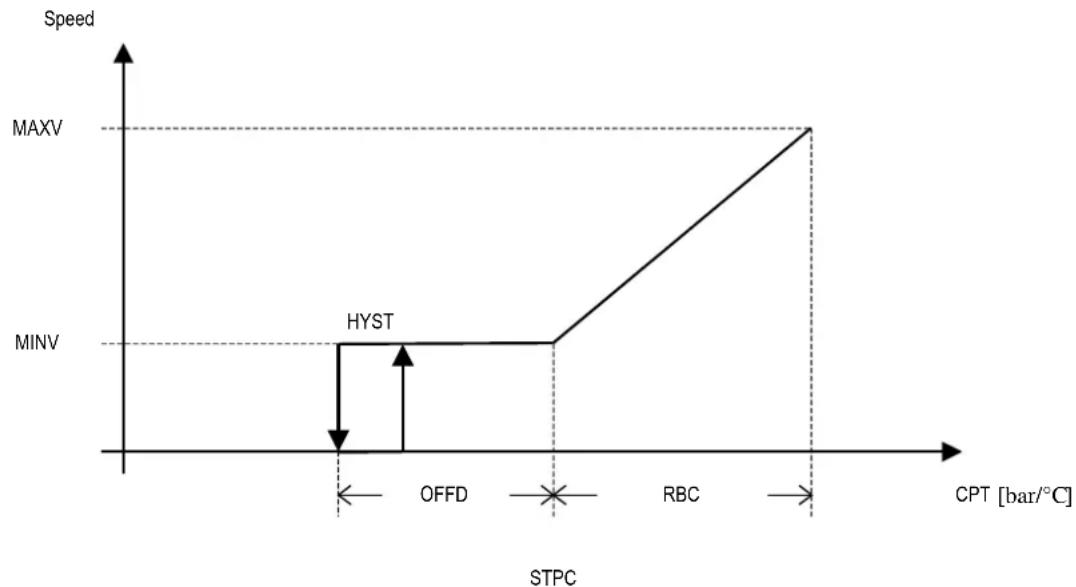
line
| CPT [bar/°C] | Speed | | ------------ | ----- | | OFFD | MINV | | ON/OFFD | HYST | | RBC | MAXV |STPC Condenser control set point
RBC Condenser control band
OFFD Deactivation differential
HYST Deactivation hysteresis (0.5bar/1°C)
MINV Minimum fan speed threshold
MAXV Maximum fan speed threshold
CPT Condensing pressure / temperature
With reference to the previous graph:
o pressure/temperature values between STPC and STPC+RBC cause the modulation of the condenser fan speed with proportional control between the minimum and maximum voltage set
o pressure/temperature values between STPC and STPC-OFFD cause the operation of the condenser fans at the minimum speed set
o pressure/temperature values below STPC-OFFD cause the total shutdown of the fans and the analogue output signal is set to 0 Volt. A fixed hysteresis of 0.5 bar or 1.0°C is featured to prevent swings in the controlled value around the threshold STPC-OFFD from causing repeated starts and stops of the controlled devices.
In the activation phase with increasing pressure/temperature, as soon as the value exceeds the threshold STPC-OFFD, the fan is operated at maximum speed for a period equal to the set speed-up time.
If condenser control is based on the condenser temperature reading, when the liquid solenoid valve opens (refrigerant circuit activated), if the outside air temperature is above STPC-OFFD, the fan is operated at maximum speed for a period equal to the set speed-up time.
This function aims to prevent high pressure in the refrigerant circuit when starting the compressors, caused by an incorrect measurement of the condenser temperature due to the thermal inertia of the control probe.
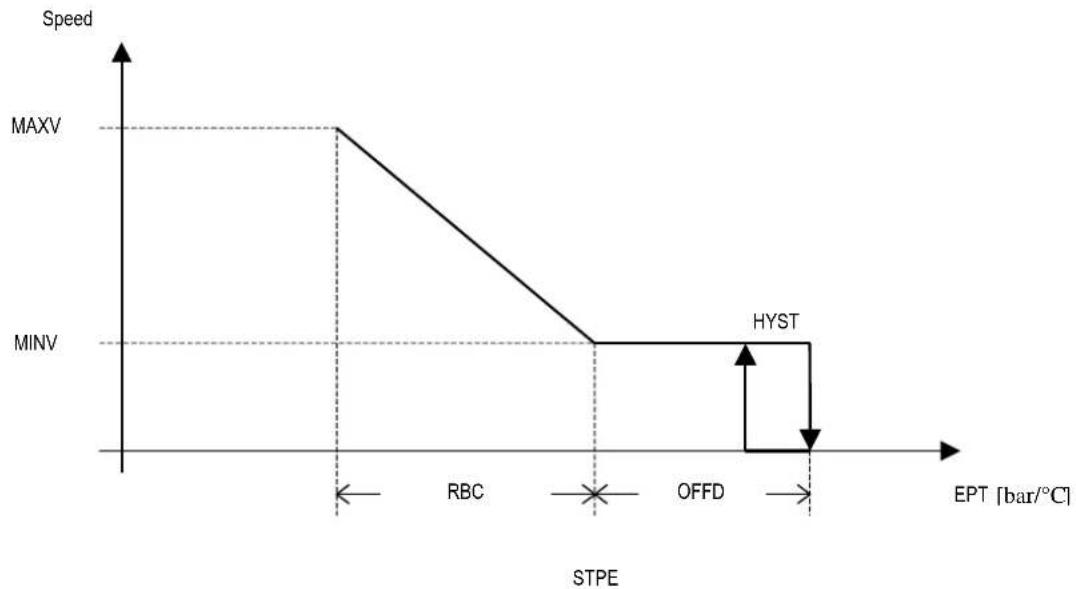
line
| EPT [bar/°C] | Speed | | :--- | :--- | | RBC | MAXV | | OFFD | MINV | | HYST | (indicated by arrow) |Fig. 7.p Condenser control devices and alarms
STPC Evaporator control set point RBC Evaporator control band OFFD Deactivation differential HYST Deactivation hysteresis (0.5bar/1°C) MINV Minimum fan speed threshold MAXV Maximum fan speed threshold CPT Evaporation pressure / temperature
In heat pump operation, the previous observations concerning cooling operation are still valid; the function simply operates in the diametrically opposite manner, given the different unit operating mode.
7.15 Prevent function
This function can be enabled in the manufacturer branch, and prevents the circuits from being shutdown due to a high pressure alarm. When the compressors are on, once reaching the set threshold, the capacity of the compressor is controlled until the pressure returns below or above the set point by a set differential, in cooling or heating mode respectively.
When the compressors are off, once having reached the set threshold, the fans are started at maximum speed until the pressure returns to acceptable values for the operation of the unit.
In units with tandem or trio hermetic compressors, the prevent function stops one of the active compressors, performing a rotation so as to shutdown a different device each time.
The compressor shutdown procedure is repeated whenever the pressure/temperature exceeds the set prevent threshold, or alternatively waits a fixed time of 10 seconds with high/low pressure before repeating the shutdown. The procedure stops when reaching the minimum number of devices on per circuit. In units with capacity-controlled semi-hermetic compressors, the prevent function activates the load steps, with the aim of preventing the compressor from shutting down.
7.16 Low noise function
This function is used to reduce the noise generated by the unit, due to the condenser/evaporator fans, at specific times.
Once the start and end times have been defined for the Low Noise function, the unit control set point will be modified in such period by a set value.
A set point is defined for cooling operation and another for heating operation, applied according to the set time band, in relation to the operating mode that is active on the unit.
Setting the same start and end times disables the function.
7.17 Start with hot condenser
This function only applies to air/water units in cooling operation with condenser control based on the temperature of the coil.
When activating a refrigerant circuit, if the temperature measured at the condenser is above 20.0^ C (when starting, the condenser temperature corresponds to the outside air temperature), the condenser fans are forced on at the maximum speed for a time equal to the set forcing time when starting.
7.18 Defrost control in air/water - Air/air units
Inputs used
- Condensing temperature 1 [B1]
- Condensing temperature 2 [B2]
- Outside air temperature [B7]
- Condensing pressure 1 [B3]
- Condensing pressure 2 [B4]
Parameters used
- Select values for start and end defrost control [-d-]
- Type of defrost between circuits [-d-]
- Select end defrost mode [-d-]
- Start defrost threshold [d1]
• End defrost threshold [d2] - Defrost activation delay [-d-]
• Maximum defrost duration [-d-] - Minimum defrost duration [-d-]
- Delay between defrosts on same circuit [-d-]
- Delay between defrosts on different circuits [-d-]
- Forced compressor off time at start and end defrost [-d-]
- Delay in reversing refrigerant circuit for defrost [-d-]
- Enable sliding defrost function [d3]
• Minimum start defrost set point allowed with sliding defrost function [d4]
• Outside temperature threshold to start sliding defrost action [d5]
• Outside temperature threshold for maximum sliding defrost action [d6] - Enable manual defrost actuator [-d-]
- Manual defrost on circuit 1 [-d-]
- Manual defrost on circuit 2 [-d-]
Outputs used
- Compressor 1 circuit 1 [B29] Winding A compressor 1
- Compressor 2 circuit 1 [B30] Winding B compressor 1
- Compressor 3 circuit 1 [B31]
- Compressor 1 circuit 2 [B34] Winding A compressor 2
- Compressor 2 circuit 2 Winding B compressor 2 [B35]
- Compressor 3 circuit 2 [B36]
- 4-way reversing valve circuit 1 [B41]
- 4-way reversing valve circuit 2 [B42]
- Fan 1 circuit 1 [B32]
- Fan 2 circuit 1 [B31]
- Fan 2 circuit 1 (single condenser) [B37]
- Fan 1 circuit 2 (2 condensers) [B37]
- Fan 2 circuit 2 [B36]
- Analogue output 1 status Condenser fans circuit 1 [B43]
- Analogue output 2 status Condenser fans circuit 2 [B44]
7.19 Types of defrost
Simultaneous
Only one circuit needs a defrost request (temperature/pressure below the start defrost threshold) for all the circuits to be forced to defrost. The circuits which do not require defrosting (temperature/pressure above the end defrost threshold) stop and go to standby; as soon as all the circuits end their defrost cycle the compressors can start again in heat pump operation.
Separate
The circuits are defrosted separately by the circuits. The first circuit that requires defrosting starts the procedure, while the others wait for the end defrost (heat pump operation) before reversing the cycle and sequentially performing the defrost.
7.20 Defrosting a circuit with time / temperature control
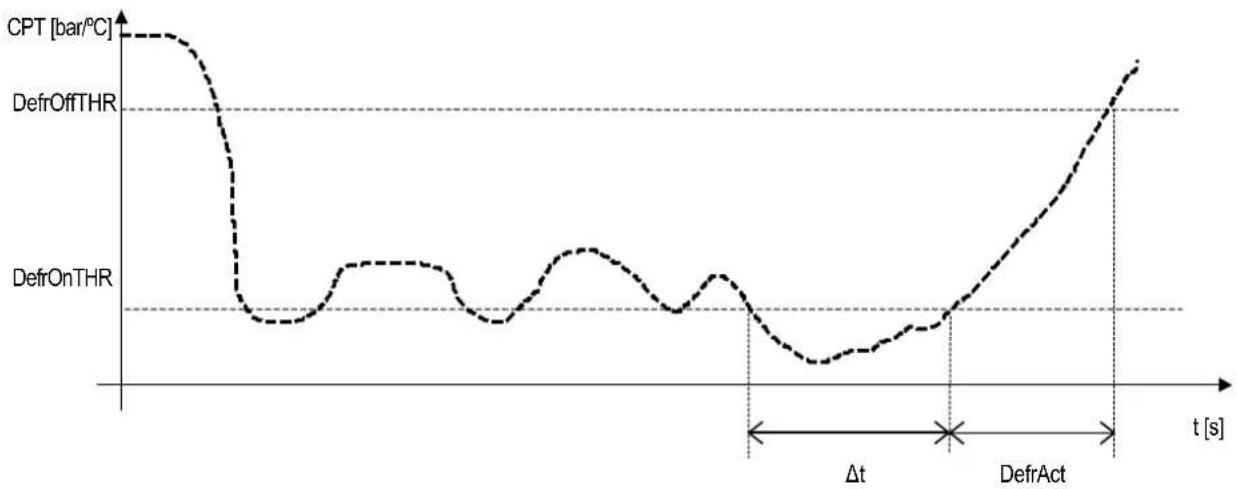
line
| t [s] | CPT [bar/°C] | |-------|--------------| | 0 | 1 | | Δt | 0 | | DefrAct | 0 |DefrOffTHR End defrost threshold
DefrOnTHR Start defrost threshold
CPT Condensing pressure/temperature
☐t Duration of the pressure/temperature inside the defrost activation zone
DefrAct Defrost active
t Time
Fig. 7-1 Defrost control
7.20.1 Description of operation
If the temperature/pressure of a coil remains continuously below the start defrost threshold for the defrost delay time set, the circuit in question will start a defrost cycle:
• the compressor/compressors in the circuit stop for a set time
• the refrigerant circuit is reversed using the 4-way valve after a set delay
- the fan in question is switched off (if the pressure probes are present, the high condensing pressure prevention function will be active)
If the compressor off time at start and end defrost is set to 0, then the 4-way reversing valve is switched with the compressors on.
The circuit exits the defrost cycle if the temperature/pressure exceeds the end defrost threshold, or after a maximum time, if the defrost cycle exceeds the maximum set threshold time.
7.20.2 Start defrost threshold automatic (sliding defrost)
In the event of very low outside temperatures, the pressure or temperature of the evaporator (outdoor exchanger) may fall below the start defrost threshold, even when there is no actual frost on the heat exchanger. In this case, a procedure has been implemented for automatically calculating the start defrost threshold, based on the outside air temperature probe reading.
The purpose of this function is to avoid unneeded defrosts due to outside conditions that are nonetheless favourable for heat pump operation, despite the low air temperature.
The user can thus set, in addition to the start defrost set point, an even lower threshold can be set that corresponds to the minimum temperature or pressure value for performing the defrost, thus avoiding the unit stopping due to low pressure. Within this interval, the start defrost threshold varies depending on the outside temperature, compensated proportionally. In this case too, a start compensation threshold and a limit threshold (minimum allowed) are used to lower the start defrost threshold within acceptable values and according to a certain proportionality.
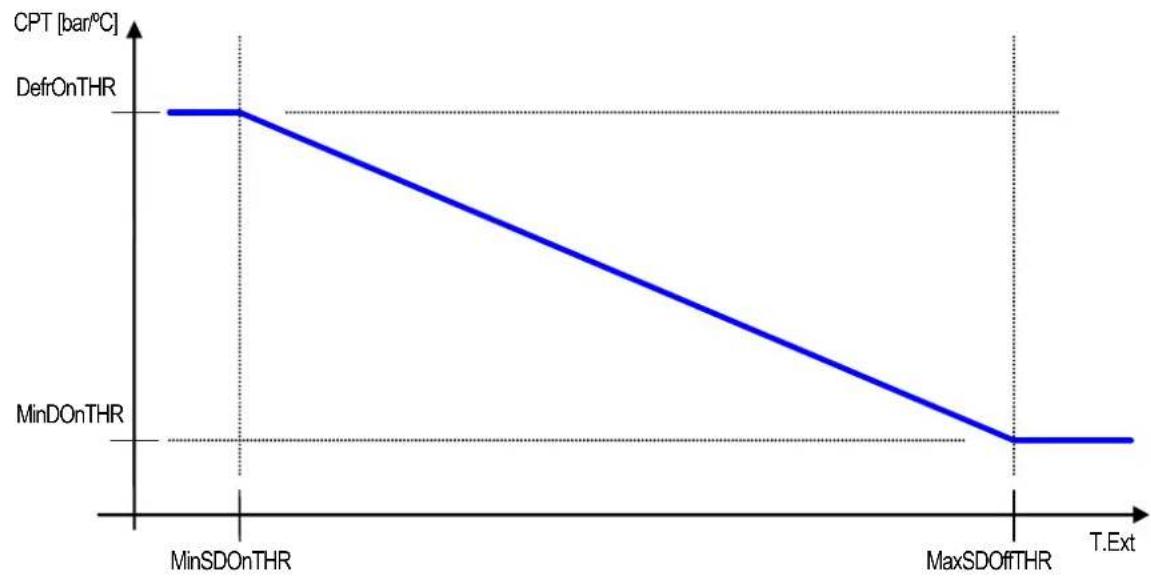
line
| T.Ext | CPT [bar/°C] | | ------------ | ------------ | | MinSDOnTHR | MaxDOnTHR | | MaxSDOffTHR | MinDOnTHR |Fig. 7-2 Sliding defrost
CPT Condensing pressure/temperature T.Ext Outside temperature
DefrOnTHR Start defrost threshold
MinDOnTHR Minimum start defrost threshold
MinSDOnTHR Sliding Defrost start threshold
MaxSDOffTHR Sliding Defrost limit threshold
7.20.3 Start and end defrost mode
Two distinct start and end defrost modes can be defined by suitably combining the settings of two parameters.
In particular, the values that determine the start and end defrost can be selected:
o Start-end by temperature: condenser temperature probe readings
o Start-end by pressure: condensing pressure probe readings
Start by pressure – end by temperature: condenser temperature probe reading for start defrost and fan control throughout the defrost phase, condenser temperature probe reading to end the procedure
The end defrost can also be selected as follows:
o Time : the defrost only ends when reaching the maximum time
o Pressure/temperature : the defrost ends when reaching the set end defrost thresholds, or alternatively after the maximum time
7.20.4 Dripping
The coil dripping phase is the period in which, with the refrigerant circuit in heating mode and the compressors off, the heat of the accumulated on the exchanger is exploited to remove any condensate.
This phase occurs at the end of the defrost cycle, from when the compressors stop to when the 4-way reversing valve switches to heat pump mode.
7.21 Defrosting a circuit with control from external contact
The activation / deactivation of the defrost cycle depends on the status an external contact, controlled by a differential pressure switch or outside temperature thermostat for the circuit in question.
For this purpose, the analogue input used to measure the temperature of the condenser coil will be used as a digital input for reading of the status of the pressure switch.
A voltage-free contact is thus required, which, if open, starts the defrost procedure, vice-versa if closed.
For this type of procedure the duration is also monitored and compared against the maximum time set.
7.22 Manual defrost
A circuit can also be defrosted manually using of a specific parameter with manufacturer password protection.
Based on the type of defrost configured (simultaneous or separate), the circuits can be defrosted at the same time or separately.
The manual defrost follows the settings of the normal defrost, as described in the previous paragraphs.
7.23 Defrost control ON REVERSE-CYCLE water/water units
Inputs used
| Condensing temperature 1 | [B1] |
| Condensing temperature 2 | [B2] |
| Outside air temperature | [B7] |
| Condensing pressure 1 | [B3] |
| Condensing pressure 2 | [B4] |
Parameters used
| Select values for start and end defrost control | [-d-] |
| Type of defrost between circuits | [-d-] |
| Select end defrost mode | [-d-] |
| Start defrost threshold | [d1] |
| End defrost threshold | [d2] |
| Defrost activation delay | [-d-] |
| Maximum defrost duration | [-d-] |
| Minimum defrost duration | [-d-] |
| Delay between defrosts on same circuit | [-d-] |
| Delay between defrosts on different circuits | [-d-] |
| Enable sliding defrost function | [d3] |
| Minimum start defrost set point allowed with sliding defrost function | [d4] |
| Outside temperature threshold to start sliding defrost action | [d5] |
| Outside temperature threshold for maximum sliding defrost action | [d6] |
| Enable manual defrost actuator | [-d-] |
| Manual defrost on circuit 1 | [-d-] |
| Manual defrost on circuit 2 | [-d-] |
Outputs used
| Defrost heater circuit 1 | [B32] |
| Defrost heater circuit 2 | [B37] |
Operation
On reverse-cycle water/water units, the defrost is performed using electric heaters immersed in the flow of water in the cooling coil.
7.24 Activating a defrost cycle
A configuration parameter is available for setting the measurement used to control the activation of the defrost, temperature or pressure; the threshold below which the defrost procedure starts then needs to be set.
The temperature or pressure must remain below this threshold for a continuous time equal to set defrost activation delay before the procedure can start.
In the event of consecutive defrosts on the same refrigerant circuit, the times between defrosts on the same circuit and between different circuits are also monitored, the latter applied only in the event of separate defrosts.
7.25 Running a defrost
The defrost phase is performed by switching off the compressors and activating the defrost heaters with the circulating pump on. The duration of the defrost cycle is monitored from the activation of the heaters and compared against the minimum threshold set; irrespective of pressure or temperature values measured, the defrost cannot end before the set time.
7.26 Ending a defrost cycle
Two parameters are available for setting the type of measurement controlled and the end defrost mode.
Based on the selection, pressure or temperature, a threshold must be set above which the defrost procedure ends.
The end defrost can be selected by maximum time or maximum time and temperature/pressure; in the latter mode the duration of the defrost cycle is monitored and compared against the maximum value set, once the maximum time threshold is exceeded the defrost ends immediately.
8. Map of outputs
8.1 Air / air units
8.1.1 Cooling only
DIGITAL INPUTS
| ID 1 Serious alarm |
| ID 2 Air flow switch |
| ID 3 Remote ON/OFF |
| ID 4 Main fan thermal overload |
| ID 5 Low pressure switch circuit 1 |
| ID 6 High pressure switch circuit 1 |
| ID 7 Compressor 1 thermal overload circuit 1 |
| ID 8 Compressor 2 thermal overload circuit 1 |
| ID 9 Condenser fan 1 thermal overload circuit 1 |
| ID10 Low pressure switch circuit 2 |
| ID11 High pressure switch circuit 2 |
| ID12 Compressor 1 thermal overload circuit 2 |
| ID13 Compressor 2 thermal overload circuit 2 |
| ID14 Condenser fan 1 thermal overload circuit 2 |
| ID15 |
| ID16 Compressor 3 thermal overload circuit 1 / Condenser fan 2 thermal overload circuit 1 |
| ID17 Compressor 3 thermal overload circuit 2 / Condenser fan 2 thermal overload circuit 2 |
| ID18 |
ANALOGUE INPUTS
| B1 Condensing temperature circuit 1/ Evaporation pressure circuit 1/ External water storage temperature | |
| B2 Condensing temperature circuit 2 / Evaporation pressure circuit 2 | |
| B3 Condensing pressure circuit 1 | |
| B4 Condensing pressure circuit 2 | |
| B5 | Room temperature |
| B6 Air outlet temp. | |
| B7 | Outside temperature |
| B8 Remote set point | |
| B9 | |
| B10 | |
DIGITAL OUTPUTS
| NO1 Compressor 1 circuit 1 / Winding A compressor 1 circuit 1 | |
| NO2 Compressor 2 circuit 1 / Winding B compressor 1 circuit 1 / Part load compressor 1 circuit 1 | |
| NO3 Liquid solenoid circuit 1 / Compressor 3 circuit 1/ Part load compressor 1 circuit 1 / Condenser fan 2 circuit 1 | |
| NO 4 Condenser fan 1 circuit 1 | |
| NO 5 Circulating fan | |
| NO 6 Compressor 1 circuit 2 / Winding A compressor 1 circuit 2 | |
| NO 7 Compressor 2 circuit 2 / Winding B compressor 1 circuit 2 / Compressor 1 capacity control circuit 2 | |
| NO 8 Liquid solenoid circuit 2 / Compressor 3 circuit 2/ Compressor 1 capacity control circuit 2 / Condenser fan 2 circuit 2 | |
| NO 9 Condenser fan 1 circuit 2 / Condenser fan 2 circuit 1 | |
| NO10 General alarm | |
| NO11 Antifreeze heater circuit 1 | |
| NO12 Antifreeze heater circuit 2 | |
| NO13 | |
| NO14 | |
ANALOGUE OUTPUTS
| Y1 0 to 10 V condenser fan inverter circuit 1 | |
| Y2 0 to 10 V condenser fan inverter circuit 2 | |
| Y3 PWM condenser fan inverter circuit 1 | |
| Y4 PWM condenser fan inverter circuit 2 | |
| Y5 | |
| Y6 | |
Important:
If using a single condenser, with 2 fans configured and 3 compressors configured, in the event of step control, the dedicated outputs will be number 4 and number 9.
8.1.2 Cooling + Heat pump
DIGITAL INPUTS
| ID 1 Serious alarm |
| ID 2 Air flow switch |
| ID 3 Remote ON/OFF |
| ID 4 Main fan thermal overload |
| ID 5 Low pressure switch circuit 1 |
| ID 6 High pressure switch circuit 1 |
| ID 7 Compressor 1 thermal overload circuit 1 |
| ID 8 Compressor 2 thermal overload circuit 1 |
| ID 9 Condenser fan 1 thermal overload circuit 1 |
| ID10 Low pressure switch circuit 2 |
| ID11 High pressure switch circuit 2 |
| ID12 Compressor 1 thermal overload circuit 2 |
| ID13 Compressor 2 thermal overload circuit 2 |
| ID14 Condenser fan 1 thermal overload circuit 2 |
| ID15 |
| ID16 Compressor 3 thermal overload circuit 1 / Condenser fan 2 thermal overload circuit 1 |
| ID17 Compressor 3 thermal overload circuit 2 / Condenser fan 2 thermal overload circuit 2 |
| ID18 |
ANALOGUE INPUTS
| B1 Condensing temperature circuit 1/ Evaporation pressure circuit 1/ External water storage temperature | |
| B2 Condensing temperature circuit 2 / Evaporation pressure circuit 2 | |
| B3 Condensing pressure circuit 1 | |
| B4 Condensing pressure circuit 2 | |
| B5 | Room temperature |
| B6 Air outlet temp. | |
| B7 | Outside temperature |
| B8 Remote set point | |
| B9 | |
| B10 | |
DIGITAL OUTPUTS
| NO1 Compressor 1 circuit 1 / Winding A compressor 1 circuit 1 |
| NO2 Compressor 2 circuit 1 / Winding B compressor 1 circuit 1 / Part load compressor 1 circuit 1 |
| NO3 Liquid solenoid circuit 1 / Compressor 3 circuit 1/ Part load compressor 1 circuit 1 (if PART-WINDING enabled) / condenser fan 2 circuit 1 |
| NO 4 Condenser fan 1 circuit 1 |
| NO 5 Circulating fan |
| NO 6 Compressor 1 circuit 2 / Winding A compressor 1 circuit 2 |
| NO 7 Compressor 2 circuit 2 / Winding B compressor 1 circuit 2 / Compressor 1 capacity control circuit 2 |
| NO 8 Liquid solenoid circuit 2 / Compressor 3 circuit 2/ Compressor 1 capacity control circuit 2 Condenser fan 2 circuit 2 |
| NO 9 Condenser fan 1 circuit 2/ Condenser fan 2 circuit 1 |
| NO10 General alarm |
| NO11 Antifreeze heater circuit 1 |
| NO12 Antifreeze heater circuit 2/ Support heater in heating operation |
| NO13 4-way valve circuit 1 |
| NO14 4-way valve circuit 2 |
ANALOGUE OUTPUTS
| Y1 0 to 10 V condenser fan inverter circuit 1 |
| Y2 0 to 10 V condenser fan inverter circuit 2 |
| Y3 PWM condenser fan inverter circuit 1 |
| Y4 PWM condenser fan inverter circuit 2 |
| Y5 |
| Y6 |
Important:
If using a single condenser, with 2 fans configured and 3 compressors configured, in the event of step control, the dedicated outputs will be number 4 and number 9.
8.2 Air / water units
8.2.1 Cooling only
DIGITAL INPUTS
| ID 1 Serious alarm |
| ID 2 Evaporator flow switch |
| ID 3 Remote ON/OFF |
| ID 4 Main pump thermal overload |
| ID 5 Low pressure switch circuit 1 |
| ID 6 High pressure switch circuit 1 |
| ID 7 Compressor 1 thermal overload circuit 1 |
| ID 8 Compressor 2 thermal overload circuit 1 |
| ID 9 Condenser fan 1 thermal overload circuit 1 |
| ID10 Low pressure switch circuit 2 |
| ID11 High pressure switch circuit 2 |
| ID12 Compressor 1 thermal overload circuit 2 |
| ID13 Compressor 2 thermal overload circuit 2 |
| ID14 Condenser fan 1 thermal overload circuit 2 |
| ID15 |
| ID16 Compressor 3 thermal overload circuit 1 / Condenser fan 2 thermal overload circuit 1 |
| ID17 Compressor 3 thermal overload circuit 2 /Condenser fan 2 thermal overload circuit 2 |
| ID18 Evaporator pump 2 thermal overload |
ANALOGUE INPUTS
| B1 Condensing temperature circuit 1/Evaporation pressure circuit 1/External water storage temperature | |
| B2 Condensing temperature circuit 2 /Evaporation pressure circuit 2 | |
| B3 Condensing pressure circuit 1 | |
| B4 Condensing pressure circuit 2 | |
| B5 Evaporator water inlet temperature | |
| B6 Water outlet temperature | |
| B7 | Outside temperature |
| B8 Remote set point | |
| B9 Evaporator 1 water outlet temperature | |
| B10 Evaporator 2 water outlet temperature | |
DIGITAL OUTPUTS
| NO1 Compressor 1 circuit 1 / Winding A compressor 1 circuit 1 |
| NO2 Compressor 2 circuit 1 / Winding B compressor 1 circuit 1 / Part load compressor 1 circuit 1 |
| NO3 Liquid solenoid circuit 1 / Compressor 3 circuit 1/ Part load compressor 1 circuit 1 / Condenser fan 2 circuit 1 |
| NO 4 Condenser fan 1 circuit 1 |
| NO 5 Pump |
| NO 6 Compressor 1 circuit 2 / Winding A compressor 1 circuit 2 |
| NO 7 Compressor 2 circuit 2 / Winding B compressor 1 circuit 2 / Compressor 1 capacity control circuit 2 |
| NO 8 Liquid solenoid circuit 2 / Compressor 3 circuit 2/ Compressor 1 capacity control circuit 2 / Condenser fan 2 circuit 2 |
| NO 9 Condenser fan 1 circuit 2/ Condenser fan 2 circuit 1 |
| NO10 General alarm |
| NO11 Antifreeze heater circuit 1 |
| NO12 Antifreeze heater circuit 2 |
| NO13 |
| NO14 |
ANALOGUE OUTPUTS
| Y1 0 to 10 V condenser fan inverter circuit 1 | |
| Y2 0 to 10 V condenser fan inverter circuit 2 | |
| Y3 PWM condenser fan inverter circuit 1 | |
| Y4 PWM condenser fan inverter circuit 2 | |
| Y5 | Pump 2 |
| Y6 | |
Important:
If using a single condenser, with 2 fans configured and 3 compressors configured, in the event of step control, the dedicated outputs will be number 4 and number 9.
DIGITAL INPUTS
| ID 1 Serious alarm | |
| ID 2 Evaporator flow switch | |
| ID 3 Remote ON/OFF | |
| ID 4 Main pump thermal overload | |
| ID 5 Low pressure switch circuit 1 | |
| ID 6 High pressure switch circuit 1 | |
| ID 7 Compressor 1 thermal overload circuit 1 | |
| ID 8 Compressor 2 thermal overload circuit 1 | |
| ID 9 Condenser fan 1 thermal overload circuit 1 | |
| ID10 Low pressure switch circuit 2 | |
| ID11 High pressure switch circuit 2 | |
| ID12 Compressor 1 thermal overload circuit 2 | |
| ID13 Compressor 2 thermal overload circuit 2 | |
| ID14 Condenser fan 1 thermal overload circuit 2 | |
| ID15 Select cooling/heating | |
| ID16 Compressor 3 thermal overload circuit 1 / Condenser fan 2 thermal overload circuit 1 | |
| ID17 Compressor 3 thermal overload circuit 2 /Condenser fan 2 thermal overload circuit 2 | |
| ID18 Evaporator pump 2 thermal overload |
ANALOGUE INPUTS
| B1 Condensing temperature circuit 1/Evaporation pressure circuit 1/External water storage temperature | |
| B2 Condensing temperature circuit 2 /Evaporation pressure circuit 2 | |
| B3 Condensing pressure circuit 1 | |
| B4 Condensing pressure circuit 2 | |
| B5 Evaporator water inlet temperature | |
| B6 Water outlet temperature | |
| B7 | Outside temperature |
| B8 Remote set point | |
| B9 Evaporator 1 water outlet temperature | |
| B10 Evaporator 2 water outlet temperature | |
DIGITAL OUTPUTS
| NO1 Compressor 1 circuit 1 / Winding A compressor 1 circuit 1 |
| NO2 Compressor 2 circuit 1 / Winding B compressor 1 circuit 1 / Part load compressor 1 circuit 1 |
| NO3 Liquid solenoid circuit 1 / Compressor 3 circuit 1/ Part load compressor 1 circuit 1 condenser fan 2 circuit 1 |
| NO 4 Condenser fan 1 circuit 1 |
| NO 5 Pump |
| NO 6 Compressor 1 circuit 2 / Winding A compressor 1 circuit 2 |
| NO 7 Compressor 2 circuit 2 / Winding B compressor 1 circuit 2 / Compressor 1 capacity control circuit 2 |
| NO 8 Liquid solenoid circuit 2 / Compressor 3 circuit 2/ Compressor 1 capacity control circuit 2Condenser fan 2 circuit 2 / Pump 2 |
| NO 9 Condenser fan 1 circuit 2 / Condenser fan 2 circuit 1 |
| NO10 General alarm |
| NO11 Antifreeze heater circuit 1 |
| NO12 Antifreeze heater circuit 2 / Support heater in heating operation |
| NO13 4-way valve circuit 1 |
| NO14 4-way valve circuit 2 |
ANALOGUE OUTPUTS
| Y1 0 to 10 V condenser fan inverter circuit 1 | |
| Y2 0 to 10 V condenser fan inverter circuit 2 | |
| Y3 PWM condenser fan inverter circuit 1 | |
| Y4 PWM condenser fan inverter circuit 2 | |
| Y5 | Pump 2 |
| Y6 | |
Important:
If using a single condenser, with 2 fans configured and 3 compressors configured, in the event of step control, the dedicated outputs will be number 4 and number 9.
8.3 Water / water units
8.3.1 Cooling only
DIGITAL INPUTS
| ID 1 Serious alarm |
| ID 2 Evaporator flow switch |
| ID 3 Remote ON/OFF |
| ID 4 Main pump thermal overload |
| ID 5 Low pressure switch circuit 1 |
| ID 6 High pressure switch circuit 1 |
| ID 7 Compressor 1 thermal overload circuit 1 |
| ID 8 Compressor 2 thermal overload circuit 1 |
| ID 9 Condenser pump thermal overload |
| ID10 Low pressure switch circuit 2 |
| ID11 High pressure switch circuit 2 |
| ID12 Compressor 1 thermal overload circuit 2 |
| ID13 Compressor 2 thermal overload circuit 2 |
| ID14 Condenser flow switch |
| ID15 |
| ID16 Compressor 3 thermal overload circuit 1 |
| ID17 Compressor 3 thermal overload circuit 2 |
| ID18 Evaporator pump 2 thermal overload |
ANALOGUE INPUTS
| B1 Condensing temperature circuit 1/Evaporation pressure circuit 1 | |
| B2 Condensing temperature circuit 2 /Evaporation pressure circuit 2 | |
| B3 Condensing pressure circuit 1 | |
| B4 Condensing pressure circuit 2 | |
| B5 Evaporator water inlet temperature | |
| B6 Water outlet temperature | |
| B7 | Outside temperature |
| B8 Remote set point | |
| B9 Evaporator 1 water outlet temperature | |
| B10 Evaporator 2 water outlet temperature | |
DIGITAL OUTPUTS
| NO1 Compressor 1 circuit 1 / Winding A compressor 1 circuit 1 | |
| NO2 Compressor 2 circuit 1 / Winding B compressor 1 circuit 1 / Part load compressor 1 circuit 1 | |
| NO3 Liquid solenoid circuit 1 / Compressor 3 circuit 1/ Part load compressor 1 circuit 1 | |
| NO 4 | |
| NO 5 Pump | |
| NO 6 Compressor 1 circuit 2 / Winding A compressor 1 circuit 2 | |
| NO 7 Compressor 2 circuit 2 / Winding B compressor 1 circuit 2 / Compressor 1 capacity control circuit 2 | |
| NO 8 Liquid solenoid circuit 2 / Compressor 3 circuit 2 / Compressor 1 capacity control circuit 2 / Pump 2 | |
| NO 9 | |
| NO10 General alarm | |
| NO11 Antifreeze heater circuit 1 | |
| NO12 Antifreeze heater circuit 2 | |
| NO13 | |
| NO14 Condenser pump | |
ANALOGUE OUTPUTS
| Y1 | |
| Y2 | |
| Y3 | |
| Y4 | |
| Y5 | Pump 2 |
| Y6 |
DIGITAL INPUTS
| ID 1 Serious alarm | |
| ID 2 Evaporator flow switch | |
| ID 3 Remote ON/OFF | |
| ID 4 Main pump thermal overload | |
| ID 5 Low pressure switch circuit 1 | |
| ID 6 High pressure switch circuit 1 | |
| ID 7 Compressor 1 thermal overload circuit 1 | |
| ID 8 Compressor 2 thermal overload circuit 1 | |
| ID 9 Condenser pump thermal overload | |
| ID10 Low pressure switch circuit 2 | |
| ID11 High pressure switch circuit 2 | |
| ID12 Compressor 1 thermal overload circuit 2 | |
| ID13 Compressor 2 thermal overload circuit 2 | |
| ID14 Condenser flow switch | |
| ID15 Cooling/ heating selection | |
| ID16 Compressor 3 thermal overload circuit 1 | |
| ID17 Compressor 3 thermal overload circuit 2 | |
| ID18 Evaporator pump 2 thermal overload |
ANALOGUE INPUTS
| B1 Condenser inlet temperature | ||
| B2 | Condenser outlet temperature | |
| B3 Condensing pressure circuit 1 | ||
| B4 Condensing pressure circuit 2 | ||
| B5 Evaporator water inlet temperature | ||
| B6 Water outlet temperature | ||
| B7 | Outside temperature | |
| B8 Remote set point | ||
| B9 Evaporator 1 water outlet temperature | ||
| B10 Evaporator 2 water outlet temperature | ||
DIGITAL OUTPUTS
| NO1 Compressor 1 circuit 1 /Winding A compressor 1 circuit 1 | |
| NO2 Compressor 2 circuit 1 / Winding B compressor 1 circuit 1 /Part load compressor 1 circuit 1 | |
| NO3 Liquid solenoid circuit 1 / Compressor 3 circuit 1Part load compressor 1 circuit 1 | |
| NO 4 | |
| NO 5 Pump | |
| NO 6 Compressor 1 circuit 2 / Winding A compressor 1 circuit 2 | |
| NO 7 Compressor 2 circuit 2 / Winding B compressor 1 circuit 2 /Compressor 1 capacity control circuit 2 | |
| NO 8 Liquid solenoid circuit 2 / Compressor 3 circuit 2/Compressor 1 capacity control circuit 2 / Pump 2 | |
| NO 9 | |
| NO10 General alarm | |
| NO11 Antifreeze heater circuit 1 | |
| NO12 Antifreeze heater circuit 2 / Support heater in heating operation | |
| NO13 Reversing valve | |
| NO14 Condenser pump | |
ANALOGUE OUTPUTS
| Y1 | |
| Y2 | |
| Y3 | |
| Y4 | |
| Y5 | Pump 2 |
| Y6 |
DIGITAL INPUTS
| ID 1 Serious alarm | |
| ID 2 Evaporator flow switch | |
| ID 3 Remote ON/OFF | |
| ID 4 Main pump thermal overload | |
| ID 5 Low pressure switch circuit 1 | |
| ID 6 High pressure switch circuit 1 | |
| ID 7 Compressor 1 thermal overload circuit 1 | |
| ID 8 Compressor 2 thermal overload circuit 1 | |
| ID 9 Condenser pump thermal overload | |
| ID10 Low pressure switch circuit 2 | |
| ID11 High pressure switch circuit 2 | |
| ID12 Compressor 1 thermal overload circuit 2 | |
| ID13 Compressor 2 thermal overload circuit 2 | |
| ID14 Condenser flow switch | |
| ID15 Cooling/ heating selection | |
| ID16 Compressor 3 thermal overload circuit 1 | |
| ID17 Compressor 3 thermal overload circuit 2 | |
| ID18 Evaporator pump 2 thermal overload |
ANALOGUE INPUTS
| B1 Condensing temperature circuit 1/Evaporation pressure circuit 1 | |
| B2 Condensing temperature circuit 2 /Evaporation pressure circuit 2 | |
| B3 Condensing pressure circuit 1 | |
| B4 Condensing pressure circuit 2 | |
| B5 Evaporator water inlet temperature | |
| B6 Water outlet temperature | |
| B7 | Outside temperature |
| B8 Remote set point | |
| B9 Evaporator 1 water outlet temperature | |
| B10 Evaporator 2 water outlet temperature | |
DIGITAL OUTPUTS
| NO1 Compressor 1 circuit 1 / Winding A compressor 1 circuit 1 | |
| NO2 Compressor 2 circuit 1 / Winding B compressor 1 circuit 1 / Part load compressor 1 circuit 1 | |
| NO3 Liquid solenoid circuit 1 / Compressor 3 circuit 1 Part load compressor 1 circuit 1 | |
| NO 4 Defrost heater circuit 1 | |
| NO 5 Pump | |
| NO 6 Compressor 1 circuit 2 / Winding A compressor 1 circuit 2 | |
| NO 7 Compressor 2 circuit 2 / Winding B compressor 1 circuit 2 / Compressor 1 capacity control circuit 2 | |
| NO 8 Liquid solenoid circuit 2 /Compressor 3 circuit 2/ Compressor 1 capacity control circuit 2 Pump 2 | |
| NO 9 Defrost heater circuit 2 | |
| NO10 General alarm | |
| NO11 Antifreeze heater circuit 1 | |
| NO12 Antifreeze heater circuit 2 / Support heater in heating operation | |
| NO13 Reversing valve | |
| NO14 Condenser pump | |
ANALOGUE OUTPUTS
| Y1 | |
| Y2 | |
| Y3 | |
| Y4 | |
| Y5 | Pump 2 |
| Y6 |
8.4 Air-cooled condensing units
8.4.1 Cooling only
DIGITAL INPUTS
| ID 1 | Serious alarm / Remote ON/OFF (with digital controls). Serious alarm (with analogue control) |
| ID 2 Compressor 1 control (with digital controls) Not used (with analogue control) | |
| ID 3 | Compressor 2 control (with digital controls) Remote ON/OFF (with analogue control) |
| ID 4 Compressor 3 control (with tandem circuits and with digital controls)Compressor 3 and 4 control (with trio circuits and with digital controls)Not used (with analogue control) | |
| ID 5 Low pressure switch circuit 1 | |
| ID 6 High pressure switch circuit 1 | |
| ID 7 Compressor 1 thermal overload circuit 1 | |
| ID 8 Compressor 2 thermal overload circuit 1 | |
| ID 9 Condenser fan 1 thermal overload circuit 1 | |
| ID10 Low pressure switch circuit 2 | |
| ID11 High pressure switch circuit 2 | |
| ID12 Compressor 1 thermal overload circuit 2 | |
| ID13 Compressor 2 thermal overload circuit 2 | |
| ID14 Condenser fan 1 thermal overload circuit 2 | |
| ID15 | |
| ID16 Compressor 3 thermal overload circuit 1 / Condenser fan 2 thermal overload circuit 1 | |
| ID17 Compressor 3 thermal overload circuit 2 / Condenser fan 2 thermal overload circuit 2 | |
| ID18 Compressor 4 control (with tandem circuits and with digital controls)Compressor 5 and 6 control (with trio circuits and with digital controls)Not used (with analogue control) | |
ANALOGUE INPUTS
| B1 Condensing temperature circuit 1/Evaporation pressure circuit 1 | |
| B2 Condensing temperature circuit 2 /Evaporation pressure circuit 2 | |
| B3 Condensing pressure circuit 1 | |
| B4 Condensing pressure circuit 2 | |
| B5 | |
| B6 | |
| B7 | Outside temperature |
| B8 Remote set point | |
| B9 | |
| B10 | |
DIGITAL OUTPUTS
| NO1 Compressor 1 circuit 1 / Winding A compressor 1 circuit 1 | |
| NO2 Compressor 2 circuit 1 / Winding B compressor 1 circuit 1 / Part load compressor 1 circuit 1 | |
| NO3 Liquid solenoid circuit 1 / Compressor 3 circuit 1/ Part load compressor 1 circuit 1 / Condenser fan 2 circuit 1 | |
| NO 4 Condenser fan 1 circuit 1 | |
| NO 5 | |
| NO 6 Compressor 1 circuit 2 / Winding A compressor 1 circuit 2 | |
| NO 7 Compressor 2 circuit 2 / Winding B compressor 1 circuit 2 / Compressor 1 capacity control circuit 2 | |
| NO 8 Liquid solenoid circuit 2 / Compressor 3 circuit 2/ Compressor 1 capacity control circuit 2 / Condenser fan 2 circuit 2 | |
| NO 9 Condenser fan 1 circuit 2 / Condenser fan 2 circuit 1 | |
| NO10 | General alarm |
| NO11 | |
| NO12 | |
| NO13 | |
| NO14 | |
ANALOGUE OUTPUTS
| Y1 0 to 10 V condenser fan inverter circuit 1 |
| Y2 0 to 10 V condenser fan inverter circuit 2 |
| Y3 PWM condenser fan inverter circuit 1 |
| Y4 PWM condenser fan inverter circuit 2 |
| Y5 |
| Y6 |
Important:
If using a single condenser, with 2 fans configured and 3 compressors configured, in the event of step control, the dedicated outputs will be number 4 and number 9.
+030220431 rel 1.7 03/06/2014 71
8.4.2 Cooling + Heat pump
DIGITAL INPUTS
| ID 1 | Serious alarm / Remote ON/OFF (with digital controls) Serious alarm (with analogue control) |
| ID 2 Compressor 1 control (with digital controls) Not used (with analogue control) | |
| ID 3 Compressor 2 control (with digital controls) Remote ON/OFF (with analogue control) | |
| ID 4 Compressor 3 control (with tandem circuits and with digital controls)Compressor 3 and 4 control (with trio circuits and with digital controls)Not used (with analogue control) | |
| ID 5 Low pressure switch circuit 1 | |
| ID 6 High pressure switch circuit 1 | |
| ID 7 Compressor 1 thermal overload circuit 1 | |
| ID 8 Compressor 2 thermal overload circuit 1 | |
| ID 9 Condenser fan 1 thermal overload circuit 1 | |
| ID10 Low pressure switch circuit 2 | |
| ID11 High pressure switch circuit 2 | |
| ID12 Compressor 1 thermal overload circuit 2 | |
| ID13 Compressor 2 thermal overload circuit 2 | |
| ID14 Condenser fan 1 thermal overload circuit 2 | |
| ID15 Cooling / heating selection | |
| ID16 Compressor 3 thermal overload circuit 1 / Condenser fan 2 thermal overload circuit 1 | |
| ID17 Compressor 3 thermal overload circuit 2 /Condenser fan 2 thermal overload circuit 2 | |
| ID18 Compressor 4 control (with tandem circuits and with digital controls)Compressor 5 and 6 control (with trio circuits and with digital controls)Not used (with analogue control) | |
ANALOGUE INPUTS
| B1 Condensing temperature circuit 1/Evaporation pressure circuit 1 | |
| B2 Condensing temperature circuit 2 /Evaporation pressure circuit 2 | |
| B3 Condensing pressure circuit 1 | |
| B4 Condensing pressure circuit 2 | |
| B5 | |
| B6 | |
| B7 | Outside temperature |
| B8 Remote set pointl | |
| B9 | |
| B10 | |
DIGITAL OUTPUTS
| NO1 Compressor 1 circuit 1 / Winding A compressor 1 circuit 1 | |
| NO2 Compressor 2 circuit 1 / Winding B compressor 1 circuit 1 / Part load compressor 1 circuit 1 | |
| NO3 Liquid solenoid circuit 1 / Compressor 3 circuit 1 / Part load compressor 1 circuit 1 condenser fan 2 circuit 1 | |
| NO 4 Condenser fan 1 circuit 1 | |
| NO 5 | |
| NO 6 Compressor 1 circuit 2 / Winding A compressor 1 circuit 2 | |
| NO 7 Compressor 2 circuit 2 / Winding B compressor 1 circuit 2 / Compressor 1 capacity control circuit 2 | |
| NO 8 Liquid solenoid circuit 2 / Compressor 3 circuit 2 / Compressor 1 capacity control circuit 2 Condenser fan 2 circuit 2 | |
| NO 9 Condenser fan 1 circuit 2 / Condenser fan 2 circuit 1 | |
| NO10 General alarm | |
| NO11 | |
| NO12 | |
| NO13 4-way valve circuit 1 | |
| NO14 4-way valve circuit 2 | |
ANALOGUE OUTPUTS
| Y1 0 to 10 V condenser fan inverter circuit 1 | |
| Y2 0 to 10 V condenser fan inverter circuit 2 | |
| Y3 PWM condenser fan inverter circuit 1 | |
| Y4 PWM condenser fan inverter circuit 2 | |
| Y5 | |
| Y6 | |
Important:
If using a single condenser, with 2 fans configured and 3 compressors configured, in the event of step control, the dedicated outputs will be number 4 and number 9.
Note
Part Winding management has been added to all unit configurations, together with the management of semi hermetic compressors with a single unloader valve.
9. ALARMS
9.1 Table of alarms
The following table describes all the alarms managed by the unit, indicating the type of devices disabled for each.
Code: this is the alarm ID code, which is shown cyclically on the PLD display
Description: this is the description of the type of alarm activated, as shown in the alarm log on the PGDO display
Type: this indicates the source of the alarm
DIN = digital input
AIN = analogue input
SYS = system
DRV = electronic expansion valve driver
Reset: this indicates the type of reset featured for the alarm
A = automatic
M = manual
S = selectable
| Code | Description | Type | Reset | Delay | Pump/ Fan | C compressors | Notes | |
| A001 Antifreeze alarm 1 DIN M / X X | X | |||||||
| A002 | Antifreeze alarm 2 | AIN | S | / | X | |||
| A003 Evaporator pump thermal overload | DIN M / | X | ^1 | X | X^*1 | ^1 If alarm on all the pumps | ||
| A004 | Condenser pump thermal overload | DIN | M | / | X | X | X | |
| A005 Evaporator flow switch alarm | DIN M | Start Steady operation | X^*1 | X | X^*1 | ^1 If alarm on all the pumps | ||
| A006 Condenser flow switch alarm | DIN M | Start Steady operation | X | X | X | Total unit shutdown due to serious alarm | ||
| A007 | Main fan thermal overload | DIN | M | / | ||||
| A008 Evaporator pump 2 thermal overload | DIN M / | X | ^1 | X | X^*1 | ^1 If alarm on all the pumps | ||
| A009 Low pressure circ.1 (Pressure switch) | DIN S | Start Steady operation | X | |||||
| A010 Low pressure circ. 2 (Pressure switch) | DIN S | Start Steady operation | X | |||||
| A011 | High pressure circ.1 (Pressure switch) | DIN | S | / | X | |||
| A012 | High pressure circ. 2 (Pressure switch) | DIN | S | / | X | |||
| A013 | Compressor 1 thermal overload circuit 1 | DIN | S | / | X | |||
| A014 | Compressor 2 thermal overload circuit 1 | DIN | S | / | X | |||
| A015 | Compressor 3 thermal overload circuit 1 | DIN | S | / | X | |||
| A016 | Compressor 1 thermal overload circuit 2 | DIN | S | / | X | |||
| A017 | Compressor 2 thermal overload circuit 2 | DIN | S | / | X | |||
| A018 | Compressor 3 thermal overload circuit 2 | DIN | S | / | X | |||
| A019 | Fan 1 thermal overload circuit 1 | DIN | S | / | X^*1 | X | ^1 If alarm on all the fans | |
| A020 | Fan 2 thermal overload circuit 1 | DIN | S | / | X^*1 | X | ^1 If alarm on all the fans | |
| A021 | Fan 1 thermal overload circuit 2 | DIN | S | / | X^*1 | X | ^1 If alarm on all the fans | |
| A022 | Fan 2 thermal overload circuit 2 | DIN | S | / | X^*1 | X | ^1 If alarm on all the fans | |
| A023 | High pressure circ. 1 (Transducer) | AIN | M | / | X | X^*1 | ^1 If high pressure prevent disabled | |
| A024 | High pressure circ. 2 (Transducer) | AIN | M | / | X | X^*1 | ^1 If high pressure prevent disabled | |
| A025 | Probe B1 faulty or disconnected | AIN | M | 60s | X^*1 | X^*1 | ^1 Operating mode can be configured if used as condensing temperature | |
| A026 | Probe B2 faulty or disconnected | AIN | M | 60s | X^*1 | X^*1 | ^1 Operating mode can be configured if used as condensing temperature | |
| A027 | Probe B3 faulty or disconnected | AIN | M | 60s | X^*1 | ^1 Operating mode can be configured | ||
| A028 | Probe B4 faulty or disconnected | AIN | M | 60s | X^*1 | ^1 Operating mode can be configured | ||
| A029 | Probe B5 faulty or disconnected | AIN | M | 60s | X | X | X | |
| A030 | Probe B6 faulty or disconnected | AIN | M | 60s | X | X | X | |
| A031 | Probe B7 faulty or disconnected | AIN | M | 60s | X^*1 | X^*1 | ||
| A032 | Probe B8 faulty or disconnected | AIN | M | 60s | X^*1 | X^*1 | ^1 In condensing units if used as control input | |
| A033 | Probe B9 faulty or disconnected | AIN | M | 60s | ||||
| A034 | Probe B10 faulty or disconnected | AIN | M | 60s | ||||
| A035 | Fan/main pump operating hour threshold | SYS | M | / | ||||
| A036 | Compressor 1 operating hour threshold circuit 1 | SYS | M | / | ||||
| A037 | Compressor 2 operating hour threshold circuit 1 | SYS | M | / | ||||
| A038 | Compressor 3 operating hour threshold circuit 1 | SYS | M | / | ||||
| A039 | Compressor 1 operating hour threshold circuit 2 | SYS | M | / | ||||
| A040 | Compressor 2 operating hour threshold circuit 2 | SYS | M | / | ||||
| A041 | Compressor 3 operating hour threshold circuit 2 | SYS | M | / | ||||
μC3
| A042 | Main pump 2 operating hour threshold SYS M / | |||||||
| A043 | Clock board broken or not connected SYS S 5m (approx.) | Disables all the functions relating to the system clock | ||||||
| A044 | Low pressure circ. 1 (Transducer) AIN S | Start(*) Steady operation | X | X | (*)Different delays and thresholds for chiller-heat pump-defrost | |||
| A045 | Low pressure circ. 2 (Transducer) AIN S | Start(*) Steady operation | X | X | (*)Different delays and thresholds for chiller-heat pump-defrost | |||
| A046 | Low room temperature alarm AIN M | |||||||
| A047 | Condenser pump operating hour threshold | SYS | M | |||||
| A048 | Serious alarm from digital input | DIN | M | / | X | X | X | |
| A059 | Test SMS on alarm sent successfully | SYS | M | |||||
| A060 | Driver 1 EEPROM error | DRV M / | X | X | Prevents the corresponding circuit from starting | |||
| A061 | Driver 2 EEPROM error | DRV M / | X | X | Prevents the corresponding circuit from starting | |||
| A062 | Driver 3 EEPROM error | DRV M / | X | X | Prevents the corresponding circuit from starting | |||
| A063 | Driver 4 EEPROM error | DRV M / | X | X | Prevents the corresponding circuit from starting | |||
| A064 | Driver 1 EEV motor error | DRV M 10s | X | Prevents the corresponding circuit from starting | ||||
| A065 | Driver 2 EEV motor error | DRV M 10s | X | Prevents the corresponding circuit from starting | ||||
| A066 | Driver 3 EEV motor error | DRV M 10s | X | Prevents the corresponding circuit from starting | ||||
| A067 | Driver 4 EEV motor error | DRV M 10s | X | Prevents the corresponding circuit from starting | ||||
| A068 | Driver 1 MOP timeout | DRV | M | Settable | X | Stops the corresponding circuit | ||
| A069 | Driver 2 MOP timeout | DRV | M | Settable | X | Stops the corresponding circuit | ||
| A070 | Driver 3 MOP timeout | DRV | M | Settable | X | Stops the corresponding circuit | ||
| A071 | Driver 4 MOP timeout | DRV | M | Settable | X | Stops the corresponding circuit | ||
| A072 | Driver 1 LOP timeout | DRV | M | Settable | X | Stops the corresponding circuit | ||
| A073 | Driver 2 LOP timeout | DRV | M | Settable | X | Stops the corresponding circuit | ||
| A074 | Driver 3 LOP timeout | DRV | M | Settable | X | Stops the corresponding circuit | ||
| A075 | Driver 4 LOP timeout | DRV | M | Settable | X | Stops the corresponding circuit | ||
| A076 | Driver 1 low superheat | DRV | M | Settable | X | Stops the corresponding circuit | ||
| A077 | Driver 2 low superheat | DRV | M | Settable | X | Stops the corresponding circuit | ||
| A078 | Driver 3 low superheat | DRV | M | Settable | X | Stops the corresponding circuit | ||
| A079 | Driver 4 low superheat | DRV | M | Settable | X | Stops the corresponding circuit | ||
| A080 | Driver 1 EEV not closed when power OFF | DRV M / | X | Prevents the corresponding circuit from starting | ||||
| A081 | Driver 2 EEV not closed when power OFF | DRV M / | X | Prevents the corresponding circuit from starting | ||||
| A082 | Driver 3 EEV not closed when power OFF | DRV M / | X | Prevents the corresponding circuit from starting | ||||
| A083 | Driver 4 EEV not closed when power OFF | DRV M / | X | Prevents the corresponding circuit from starting | ||||
| A084 | Driver 1 high superheat | DRV | M | Settable | X | Stops the corresponding circuit | ||
| A085 | Driver 2 high superheat | DRV | M | Settable | X | Stops the corresponding circuit | ||
| A086 | Driver 3 high superheat | DRV | M | Settable | X | Stops the corresponding circuit | ||
| A087 | Driver 4 high superheat | DRV | M | Settable | X | Stops the corresponding circuit | ||
| A088 | Driver 1 probe S1 fault | DRV | M | / | X | Stops the corresponding circuit | ||
| A089 | Driver 2 probe S1 fault | DRV | M | / | X | Stops the corresponding circuit | ||
| A090 | Driver 3 probe S1 fault | DRV | M | / | X | Stops the corresponding circuit | ||
| A091 | Driver 4 probe S1 fault | DRV | M | / | X | Stops the corresponding circuit | ||
| A092 | Driver 1 probe S2 fault | DRV | M | / | X | Stops the corresponding circuit | ||
| A093 | Driver 2 probe S2 fault | DRV | M | / | X | Stops the corresponding circuit | ||
| A094 | Driver 3 probe S2 fault | DRV | M | / | X | Stops the corresponding circuit | ||
| A095 | Driver 4 probe S2 fault | DRV | M | / | X | Stops the corresponding circuit | ||
| A096 | Driver 1 probe S3 fault | DRV | M | / | X | Stops the corresponding circuit | ||
| A097 | Driver 2 probe S3 fault | DRV | M | / | X | Stops the corresponding circuit | ||
| A098 | Driver 3 probe S3 fault | DRV | M | / | X | Stops the corresponding circuit | ||
| A099 | Driver 4 probe S3 fault | DRV | M | / | X | |||
| A100 | Driver 1 Go Ahead request | DRV | M / | X | Prevents the corresponding circuit from starting | |||
| A101 | Driver 2 Go Ahead request | DRV | M / | X | Prevents the corresponding circuit from starting | |||
| A102 | Driver 3 Go Ahead request | DRV | M / | X | Prevents the corresponding circuit from starting | |||
| A103 | Driver 4 Go Ahead request | DRV | M / | X | Prevents the corresponding circuit from starting | |||
| A104 | Driver 1 LAN disconnected | SYS | M | 30s | X | X | Stops the corresponding circuit | |
| A105 | Driver 2 LAN disconnected | SYS | M | 30s | X | X | Stops the corresponding circuit | |
| A106 | Driver 3 LAN disconnected | SYS | M | 30s | X | X | Stops the corresponding circuit |
μC3
| A107 Driver 4 LAN disconnected SYS M 30s X X | Stops the corresponding circuit | ||||
| A108 Driver 1 autosetup not completed SYS M / | |||||
| A109 Driver 2 autosetup not completed SYS M / | |||||
| A110 Driver 3 autosetup not completed SYS M / | |||||
| A111 Driver 4 autosetup not completed SYS M / |
9.2 Type of alarm reset
The reset mode can be set for some of the alarms listed in the table, choosing between automatic and manual:
o Compressor thermal overload
o Fan thermal overload
o Low pressure from transducer and/or pressure switch
o High pressure from transducer and/or pressure switch
If automatic reset is selected, a maximum number of events with automatic reset and maximum period of validity can be set, with the time counted from the activation of the first alarm.
If after this period the maximum number of repeats of a certain event is not reached, the timer is reset and the next alarm will start a new count.
If the maximum number N of repeats set is reached within the set time, then the next event (N+1) will be with manual reset, requiring the operator to intervene to restore the operation of the unit.
If manual reset is set, then each alarm event requires the intervention of the operator to restore the operation of the unit.
9.3 Alarm log
The alarm log is included to save the fundamental unit operating values in response to certain events.
9.4 Flow switch alarm
Inputs used
- Air flow switch (air/air units) [B12]
Evaporator water flow switch
Parameters used
• Number of evaporator pumps [-H-]
- Evaporator flow switch alarm delay at start-up [P1]
• Evaporator flow switch alarm delay in steady operation [P2]
Outputs used
- Evaporator pump 1 [B33]
- Evaporator pump 2 [B36]
- Generic alarm [B38]
The evaporator flow switch alarm disables the operation of the unit if there is no water or air in the main exchanger, so as to prevent dangerous operating conditions with the compressors on and no water or air flow.
In Air/water or Water/water units, if control of the second circulating pump is enabled, as the flow switch alarm will cause the rotation of the pump in operation, the program will attempt to recover the situation by starting the reserve device.
The alarm management features two delay times before activation:
- when the water circuit is first started
- when the unit is in steady operation
The activation of the reserve pump to restore an alarm situation resets the delay in steady operation, after which any new alarm condition will cause the unit to shut down due to a serious water flow problem.
In general, with the reserve circulating pump enabled, the flow switch alarm can be activated two times in a row, after which the unit is switched off due to the alarm.
9.5 Circulating pump thermal overload alarm
Inputs used
- Evaporator pump 1 thermal overload [B14]
- Evaporator pump 2 thermal overload [B28]
Parameters used
- Number evaporator pumps [-H-]
Outputs used
- Evaporator pump 1 [B33]
- Evaporator pump 2 [B36]
- Generic alarm [B38]
The circulating pump thermal overload alarm disables the operation of the device, causing the unit to shutdown immediately, so as to prevent dangerous operating conditions with the compressors on and no water flow.
If control of the second circulating pump is enabled, as the thermal alarm will cause the rotation of the pump in operation, the program will attempt to recover the situation by starting the reserve device. Should there also be a thermal overload alarm on this device too, the unit will shutdown immediately.
In general, if in response to a thermal overload alarm a different pump cannot be started as support, the unit is switched off.
9.6 Condenser fan thermal overload alarm
Inputs used
- Condenser fan 1 thermal overload circuit 1 [B19]
- Condenser fan 2 thermal overload circuit 1 (1 condenser) [B24]
• Condenser fan 2 thermal overload circuit 1 (2 condensers, 4 fans) [B26] - Condenser fan 1 thermal overload circuit 2 (2 condensers) [B24]
- Condenser fan 2 thermal overload circuit 2 (2 condensers, 4 fans) [B27]
Parameters used
• Number of condensers installed [-F-]
- Total number of fans installed [-F-]
Outputs used
- Fan 1 circuit 1 [B32]
- Fan 2 circuit 1 [B31]
- Fan 2 circuit 1 (single condenser) [B37]
- Fan 1 circuit 2 (2 condensers) [B37]
- Fan 2 circuit 2 [B36]
The purpose of an individual thermal overload alarm is to prevent the operation of the corresponding device.
The alarm affects the operation of the refrigerant circuit in different ways.
In general, if in a certain refrigerant circuit, due to one or more alarms the condenser fans are no longer available, then the compressors are also switched off, thus stopping the circuit, so as to avoid dangerous situations of high pressure in the condenser.
9.7 Antifreeze alarm
The activation of the antifreeze alarm is based on a set point and differential; if the water temperature falls below the set point, the compressors are stopped immediately, while the pump remains on to prevent the formation of ice.
The devices can only be restarted if the water temperature rises above the alarm set point + differential.
The set point for the antifreeze alarm is limited by minimum and maximum values, protected by manufacturer password, so as to prevent the values being set at dangerous extreme unit operating conditions.
The alarm reset can be defined as manual or automatic:
Manual reset: the activation of the antifreeze protection is delayed by a set time (in minutes) from when the unit starts, to allow the unit time to move the water and reach steady operation; the alarm causes the devices to shutdown as described and requires the operator to reset the unit from the user terminal; the unit will only restart if the temperature has returned above the alarm set point + differential.
Automatic reset: the activation of the antifreeze protection causes the devices to shutdown as described, and does not require any action by the operator to reset the operation of the unit; as soon as the temperature rises above the alarm set point + differential, the unit will restart automatically.
A start-up configuration can be defined for the devices in the event of antifreeze alarms when the unit is off.
This function applies only to air/water and water/water units, with the following options:
DISABLED: the function is disabled, consequently no load switches in response to an antifreeze alarm
HEAT & PUMP ON: in response to an antifreeze alarm, the antifreeze heater and the circulating pump are started
HEAT & UNIT ON: in response to an antifreeze alarm, the antifreeze heater and the entire unit are started in heat pump mode, if operation in heating mode is featured
HEATER ONLY ON: in response to an antifreeze alarm, the antifreeze heater/heaters are started.
10. Connections, accessories and options
Dimensioni (mm) / Dimensions (mm)
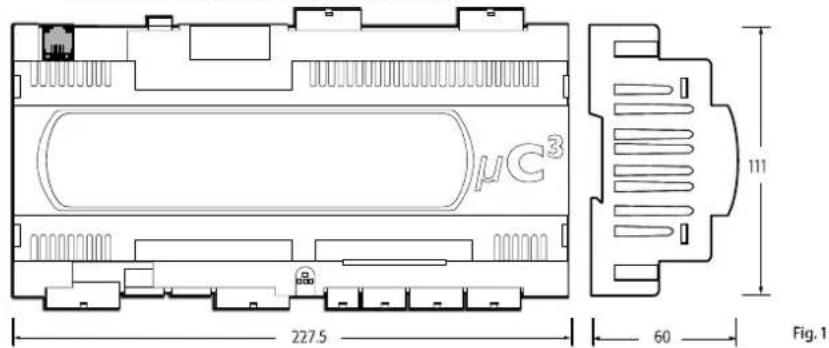
| μC3 in plastic case, complete (single package) | MCH3010020 |
| μC3 without plastic case (multiple packs of 18 boards) | MCH3010001 |
| μC3 connector kit (single package) | MCH3CON000 |
| μC3 connector kit (multiple packs of 18 boards) | MCH3CON001 |
| μC3 cable kit 2 m (single package) | MCH300CAB0 |
| parameter programming key with external power supply | MCH300KYA0 |
| clock board PCO100CLK0 | |
| optically-isolated RS485 serial board PCOS004850 | |
| RS232 serial board for modems PCO100MDM0 | |
| LON FTT10 STD serial board with LonMark chiller profile | PCO10001F0 |
| 120x32 semi-graphic terminal, panel installation | PGD0000F00 |
12. Technical specifications
| Plastic case material technopolymer | |
| flame retardancy | V0 (UL94) and 960°C (IEC 695) |
| ball pressure test | 125°C |
| resistance to creeping current | ≥250 V |
| colour | grey RAL7035 |
| type of assembly | mounted on DIN rail, as per DIN 43880 and CEI EN 50022 standards |
Electrical specifications
Power supply (controller with standard terminal connected): 22 to 38 Vdc or 24 Vac ±15% 50/60 Hz - Maximum power input P=14 W.
Analogue inputs
| analogue conversion | 10-bit A/D converter, built-in CPU |
| type | 5 inputs: B5, B6, B7, B9 and B10; CAREL NTC temperature sensors (-50T90°C; R/T 10 kΩ 25°C)2 inputs: B3 and B4; sensors with 0 to 5 Vdc ratiometric signal1 input: B8; sensor with 4 to 20 mA current signal2 inputs: B1 and B2; NTC or 0 to 5 V, can be configured by software |
| maximum number | 10 |
| input time constant | 1 s |
| internal resistance of 4 to 20 mA inputs | 100 Ω |
Analogue outputs
| type and max. no. | 4 x 0 to 10 Vdc outputs (Y1, Y2, Y5 and Y6);2 PWM phase control outputs (Y3 and Y4) with a 5 V impulse of programmable duration; |
| resolution 8 bit | |
| maximum load | 1 kΩ (10 mA) for 0 to 10 V and 470 Ω (10 mA) for PWM |
Digital outputs
| maximum number | 14 (electromechanical relays) | |
| N5 Signal relay 1: C5N6, N7, N8, N9 GROUP B:N10 Signal relay 2: C10 | N1, N2, N3, N4 | GROUP A: C1-2, C3-4 |
| C6-7, C8-9 | ||
| N11, N12, N13, N14 | GROUP C: C11-12, C13-14 | |
| current limits max current 2 | A for each relayoutput, extendable to 3A for a single output |
Some outputs are grouped in twos, with two common terminals so as to ensure easy assembly of the common pins. Make sure that the current running through the common terminals does not exceed the rated current of each individual terminal, that is: 6 A for the Mini-fit terminals.
| Type of relay | 1250 VA, 250Vac, 5 A resistive |
| EN approval | EN60730: 3 A resistive, 2 A inductive, 3(2) A (100,000 cycles) |
| UL approval | UL: 3 A resistive, 1 A FLA, 6 A LRA, 250 Vac, =0.4 , C300 (30,000 cycles) |
All the relays must have the common in the same group [C1-2, C3-4], [C6-7, C8-9], [C11-12, C13-C14] connected together externally.
Power
| G(+), G0(-) | Power supply to μchiller3 + 24 Vdc/Vac |
| VDC | Power output for 24 Vdc active probes |
| 5VR | Power output for 5 Vdc ratiometric probes |
| VZC | 24 Vac zero crossing for the PWM phase control analogue outputs |
The use of some inputs/outputs depends on the configuration of the parameters.
Other specifications
| storage conditions | -20T70, 90 % RH non-condensing |
| operating conditions | -10T55, 90 % RH non-condensing |
| index of protection | IP20 or IP00 (version without plastic case) |
| environmental pollution | normal |
| class of protection against electric shock | to be integrated in Class I and/or II appliances |
| PTI of the insulating materials | 250 V |
| period of stress across the insulating parts | long |
| type of action | 1C |
| type of disconnection or microswitching | microswitching |
| category of resistance to heat and fire | category D (UL94 - V0) |
| immunity against voltage surges | category 1 |
| no. of automatic operating cycles | 100,000 (EN 60730-1); 30,000 (UL 873) |
| software class and structure | Class A |
The device is not designed to be he-held.
WARNINGS
- when programming the parameters with the key, the controller must be disconnected from the power supply and any other devices;
- the 24 Vdc available at the Vdc terminal can be used to supply an 4 to 20mA active probe; the maximum current is 100mA . The 5 Vdc available at the 5VR terminals can be used to supply to the 0 to 5V active ratiometric probes; the maximum total current is 50mA ;
- for applications subject to strong vibrations (1.5 mm pk-pk 10/55 Hz), secure the cables connected to the chiller3 using clamps placed around 3 cm from the connectors;
- for operation in domestic environments, shielded cables must be used (one wire + shield) for the tLAN connections (EN 55014-1);
- If a single power transformer is used for the chiller3 and the options, to avoid damaging the controller, all the G0 pins on the various controllers or the boards must be connected to the same terminal on the secondary, and all the G pins to the other terminal on the secondary, resetting the polarity of G and G0 for all the terminals;
- the system made up of the control board and the other optional boards represents a control device to be incorporated into class I or class II appliances.
CAREL
CAREL HQs
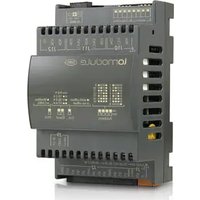
- IMPORTANT WARNINGS
- CONTENTS
- INTRODUCTION....5
- PGDO TERMINAL 6
- APPLICATIONS....7
- PARAMETERS 22
- CONNECTIONS 41
- DESCRIPTION OF THE MAIN FUNCTIONS....43
- DESCRIPTION OF OPERATION....45
- MAP OF OUTPUTS 64
- ALARMS....73
- CONNECTIONS, ACCESSORIES AND OPTIONS 78
- Introduction
- General description
- Main functions
- Advanced functions
- Driver functions
- Devices controlled
- Programming
- User interface
- pLD large terminal
- Programming procedure
- pGD0 terminal
- Passwords and levels of access
- Type of connectors
- Applications
- AIR/AIR units, single circuit
- AIR/AIR units, two circuits
- AIR/AIR units, two circuits, 1 condenser fan circuit
- AIR/AIR heat pumps, single circuit
- AIR/AIR heat pumps, two circuits
- AIR/AIR heat pumps, two circuits, 1 condenser fan circuit
- AIR/WATER chillers, single circuit
- AIR/WATER chillers, two circuits, 2 condenser fan circuits and 2 evaporators
- AIR/WATER chillers, two circuits, 1 condenser fan circuit
- AIR/WATER heat pumps, single circuit
- AIR/WATER heat pumps, 2 condenser fan circuits
- AIR/WATER heat pumps, two circuits, 1 condenser fan circuit
- WATER/WATER chillers, single circuit
- WATER/WATER chillers, two circuits
- WATER/WATER chillers, two circuits, 2 evaporators
- WATER/WATER heat pumps with reversal on the refrigerant circuit, single circuit
- WATER/WATER heat pumps with reversal on the refrigerant circuit, two circuits
- WATER/WATER heat pumps with reversal on the refrigerant circuit, two circuits, 1 evaporator
- WATER/WATER heat pumps with reversal on the water circuit, single circuit
- WATER/WATER heat pumps with reversal on the water circuit, two circuits, H02=1 and H21=4
- WATER/WATER heat pumps with reversal on the water circuit, two circuits, 1 evaporator H02=1 and H21=4
- Air-cooled condensing unit without reverse cycle, single circuit
- Air-cooled condensing unit without reverse cycle, two circuits
- Reverse-cycle air-cooled condensing unit, single circuit
- Reverse-cycle air-cooled condensing unit, two circuits with condenser fan circuit
- Water-cooled condensing unit without reverse cycle, single circuit
- Water-cooled condensing unit without reverse cycle, two circuits
- Reverse-cycle water-cooled condensing unit, single circuit
- Reverse-cycle water-cooled condensing unit, two circuits
- Parameters
- Menu layout
- Connections
- Assembly instructions
- Power supply
- IMPORTANT
- \*Direct current connection
- WARNINGS
- Assembly for the version without the plastic case
- DRIVER ADRESSING IN pLAN NETWORK
- Description of the main functions
- Control set point
- Inputs used
- Parameters used
- Outputs used
- Setting the control set point from the screen
- Setting the remote analogue input set point
- Remote set point for analogue input B8
- Time bands for varying the set point
- Set point compensation for outside air temperature
- Minimum outside temperature limit
- Inlet-room temperature control
- Description of operation
- EXAMPLE OF TEMPERATURE CONTROL ON CHILLER UNITS WITH 4 COMPRESSORS
- Outlet temperature control
- EXAMPLE OF CONTROL IN THE DEAD ZONE ON CHILLER UNITS
- Differential Temperature Control
- Description of operation
- Condensing unit control
- Control with analogue input
- Proportional control
- EXAMPLE OF CONTROL ON A UNIT WITH 6 HERMETIC COMPRESSORS:
- Stepped control
- Control with digital inputs
- Compressor rotation
- LIFO rotation
- FIFO rotation
- Rotation by time
- TANDEM - TRIO compressor rotation
- Rotation between circuits
- Force tandem - trio compressors in FIFO rotation
- Compressor safety times
- Minimum compressor on time
- Minimum compressor off time
- Minimum time between starts of different compressors
- Minimum time between starts of the same compressor
- Pumpdown management
- Main pump management
- Pump rotation
- Pump thermal overload alarm
- Evaporator flow switch alarm
- Evaporator flow switch alarm/intervention
- Electric heaters
- Antifreeze heater
- Support heater in cooling
- SUPPORT HEATERS IN HEATING
- Heating support function on water/air – water/water units
- Heating support function on air/air units
- Boiler function
- Selecting the operating mode
- Switching Cooling-heating from digital input
- ON/OFF time bands
- ON-OFF time bands
- Band 1
- Band 2
- Band 3
- Band 4
- Set point time bands
- Antifreeze control
- General information
- Antifreeze alarm
- Condenser - evaporator control
- On/off condenser-evaporator operation linked to the pressure or temperature sensor reading
- Modulating condenser-evaporator operation linked to the pressure or temperature sensor reading
- With reference to the previous graph:
- Prevent function
- Low noise function
- Start with hot condenser
- Defrost control in air/water - Air/air units
- Types of defrost
- Simultaneous
- Separate
- Defrosting a circuit with time / temperature control
- Description of operation
- Start defrost threshold automatic (sliding defrost)
- Start and end defrost mode
- Dripping
- Defrosting a circuit with control from external contact
- Manual defrost
- Defrost control ON REVERSE-CYCLE water/water units
- Operation
- Activating a defrost cycle
- Running a defrost
- Ending a defrost cycle
- Map of outputs
- Air / air units
- Cooling + Heat pump
- Important:
- Air / water units
- Cooling only
- Water / water units
- Cooling only
- Air-cooled condensing units
- Cooling only
- Cooling + Heat pump
- Note
- ALARMS
- Table of alarms
- Type of alarm reset
- Alarm log
- Flow switch alarm
- Circulating pump thermal overload alarm
- Condenser fan thermal overload alarm
- Antifreeze alarm
- Connections, accessories and options
- Technical specifications
- CAREL
Brand : Carel
Model : µchiller 3
Category : Cooler