SmartOffice T300 - To scan PLUSTEK - Free user manual and instructions
Find the device manual for free SmartOffice T300 PLUSTEK in PDF.


User questions about SmartOffice T300 PLUSTEK
0 question about this device. Answer the ones you know or ask your own.
Ask a new question about this device
Download the instructions for your To scan in PDF format for free! Find your manual SmartOffice T300 - PLUSTEK and take your electronic device back in hand. On this page are published all the documents necessary for the use of your device. SmartOffice T300 by PLUSTEK.
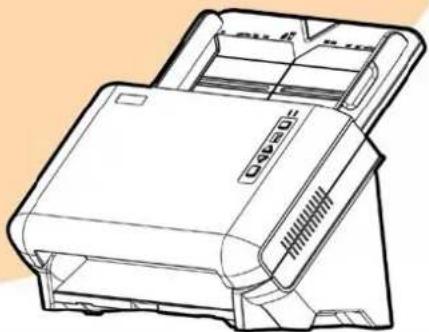
USER MANUAL SmartOffice T300 PLUSTEK
Scanner User's Guide
plustek
natural_image
Line drawing of a printer with visible internal structure and base plate (no text or symbols)Smart Office
√ Installation
√ Usage & Maintenance
Trademarks
© 2019 Plustek Inc. All rights are reserved. No portion of this document may be reproduced without permission.
All trademarks and brand names mentioned in this publication are property of their respective owners.
Liability
While all efforts have been made to ensure the accuracy of all contents in this manual, we assume no liability for errors or omissions or by statements of any kind in this manual, whether such errors are omissions or statements resulting from negligence, accidents, or any other cause. The contents of this manual are subject to change without notice. We will not shoulder any legal liability, if users failed to follow the operation instructions in this manual.
Copyright
The scanning of certain documents, for example checks, bank notes, I.D. cards, government bonds, or public documents, may be prohibited by law and/or subject to criminal prosecution. We recommend you to be responsible and respectful of the copyrights laws when you are scanning books, magazines, journals and other materials.
Environmental Information
Recycle or disposal at end-of-life information, please ask local distributors or suppliers for recycle and disposal information. The product is designed and produced to achieve sustainable environmental improvement. We strive to produce products in compliance with global environmental standards. Please consult your local authorities for proper disposal.
The product packaging is recyclable.
Attention for recycling (For EU country only)
Protect your environment! This product should not be thrown into the household waste container. Please give it to the free collecting center in your community.
Screen Examples in This Manual
The screen shots in this guide were made with Windows 7. If you are using Windows XP / Vista / 8 / 10, your screen will look somewhat different but functions the same.
Table of Contents
INTRODUCTION....1
How to Use This Guide....1
Conventions of This Guide 2
A Note about Icons....2
Safety Precautions....2
Minimum System Requirements....3
Box Contents 4
The Scanner Overview 5
LED Indicator 7
CHAPTER I. INSTALLING THE SCANNER....8
Software Installation Requirements 8
Hardware Requirements....8
Installing and Setting up the Scanner....9
Step 1. Install the Paper Chute.... 10
Step 2. Connecting the Scanner to Your Computer.... 11
Step 3. Installing the Software....12
Step 4. Testing the Scanner....13
Installing Additional Software....14
CHAPTER II. SCANNING.... 15
Preparing Documents....15
Checking Document Conditions.... 15
Loosening Documents....17
Placing Documents....17
Scanning Documents....19
Scanning via TWAIN Interface 19
Scanning from the Scanner's Front Panel....21
Scanning from the On-screen DocAction's Execute Menu 22
Scanning from the Icon in the Left Side of the DocAction Window....23
CHAPTER III. CARE AND MAINTENANCE 24
Cleaning the Scanner 24
Cleaning Materials....24
Cleaning the ADF 25
Replacing Consumables 27
Replacing the Pad Module 27
Replacing the Feed Roller....28
Calibrating the Scanner 31
Power Save 32
CHAPTER IV. TROUBLESHOOTING.... 33
Scanner Connection 33
Clearing Paper Jams 34
APPENDIX A: SPECIFICATIONS.... 35
APPENDIX B: CUSTOMER SERVICE AND WARRANTY.... 36
Service & Support Information....36
Statement of Limited Warranty 37
FCC Radio Frequency Statement....38
INTRODUCTION
Thank you for choosing us as your scanner supplier. Your new scanner will improve the professionalism of your day-to-day computing tasks by allowing you to input images and electronic text into your computer system. You can easily scan single-sided or double-sided documents with your scanner.
Like all of our products, your new scanner is thoroughly tested and backed by our reputation for unsurpassed dependability and customer satisfaction. We hope you will continue to turn to us for additional quality products as your computing needs and interests grow.
How to Use This Guide
This User's Guide provides instructions and illustrations on how to install and operate your scanner. This guide assumes the user is familiar with Microsoft Windows. If this is not the case, we suggest you learn more about Microsoft Windows by referring to your Microsoft Windows manual before using your scanner.
The Introduction section of this manual describes the box contents and minimum computer requirements to use this scanner. Before you start installing your scanner, check the box contents to make sure all parts are included. If any items are damaged or missing, please contact the vendor where you purchased your scanner or our customer service directly.
Chapter I describes how to install scanner's software and connect the scanner to your computer. Note: The scanner connects to your computer through the Universal Serial Bus (USB). If your computer does not support USB technology, you will need to purchase a USB interface card to add USB capabilities to your computer, or buy and install USB connectors if your motherboard has USB capabilities. This guide assumes that your computer is USB-ready and has a free USB port.
Chapter II describes how to use your scanner.
Chapter III describes how to maintain and clean your scanner.
Chapter IV contains technical support information that can help you solve simple problems.
Appendix A contains the specifications of the scanner you purchased.
Appendix B contains our customer service, the limited warranty agreement and FCC statement concerning the product.
CONVENTIONS OF THIS GUIDE
Bold —Represents commands or contents on your computer screen.
ALL CAPS — Important note or first use of an important term in a chapter.
Italic — Represents buttons on your scanner OR important notes.
A Note about Icons
This guide uses the following icons to point out information that deserves special attention.

Warning

Attention

Information
A procedure that must be followed carefully to prevent injury, or accidents.
Instructions that are important to remember and may prevent mistakes.
Optional tips for your reference.
SAFETY PRECAUTIONS

Warning
Before using this device, please read the following important information to eliminate or reduce any possibility of causing damage and personal injury.
- Usage, the product is for indoor use in dry locations. Moisture condensation may occur inside this device and cause malfunction at these conditions:
■ when this device is moved directly from a cold to a warm location;
■ after a cold room is heated;
■ when this device is placed in a damp room.
To avoid the moisture condensation, you are recommended to follow the procedure:
i. Seal this device in a plastic bag for it to adapt to room conditions.
ii. Wait for 1-2 hours before removing this device from the bag.
-
Do use the AC adapter and USB cable provided with the scanner. Use of other AC adapter and cables may lead to malfunction.
-
Keep the space around the AC adapter clear in case you need to quickly unplug the AC adapter during emergencies.
-
Damaged wire could cause fire or electrical shock. Keep the power cord straight and without being twisted, bended, or scraped.
- Unplug this device if you don't need to use for a certain period of time, such as, during night or long weekend, to avoid any risks of causing fire.
- Do not attempt to disassemble the scanner. There is danger of an electrical shock and opening your scanner will void your warranty.
- Be sure not to bump or knock the scanner glass as it is fragile and could break.
- Do not subject the scanner to excessive vibration. It may damage the internal components.
MINIMUM SYSTEM REQUIREMENTS ^1
● PC with Intel Pentium ^® IV 3.2 GHz processor or compatible
1 GB RAM
● Available USB 2.0 port
DVD-ROM Drive
● 800 MB Free Hard Disk Space
● Video card that supports 16-bit color or greater
- Operating System: Windows XP, Windows Vista, Windows 7, Windows 8, Windows 10

For longer documents/higher resolutions: Systems with Pentium ^® IV 3.2 GHz or higher processor (or its compatible), 3 GB RAM and 1GB free hard disk space are recommended for optimal performance.
Box CONTENTS ^2
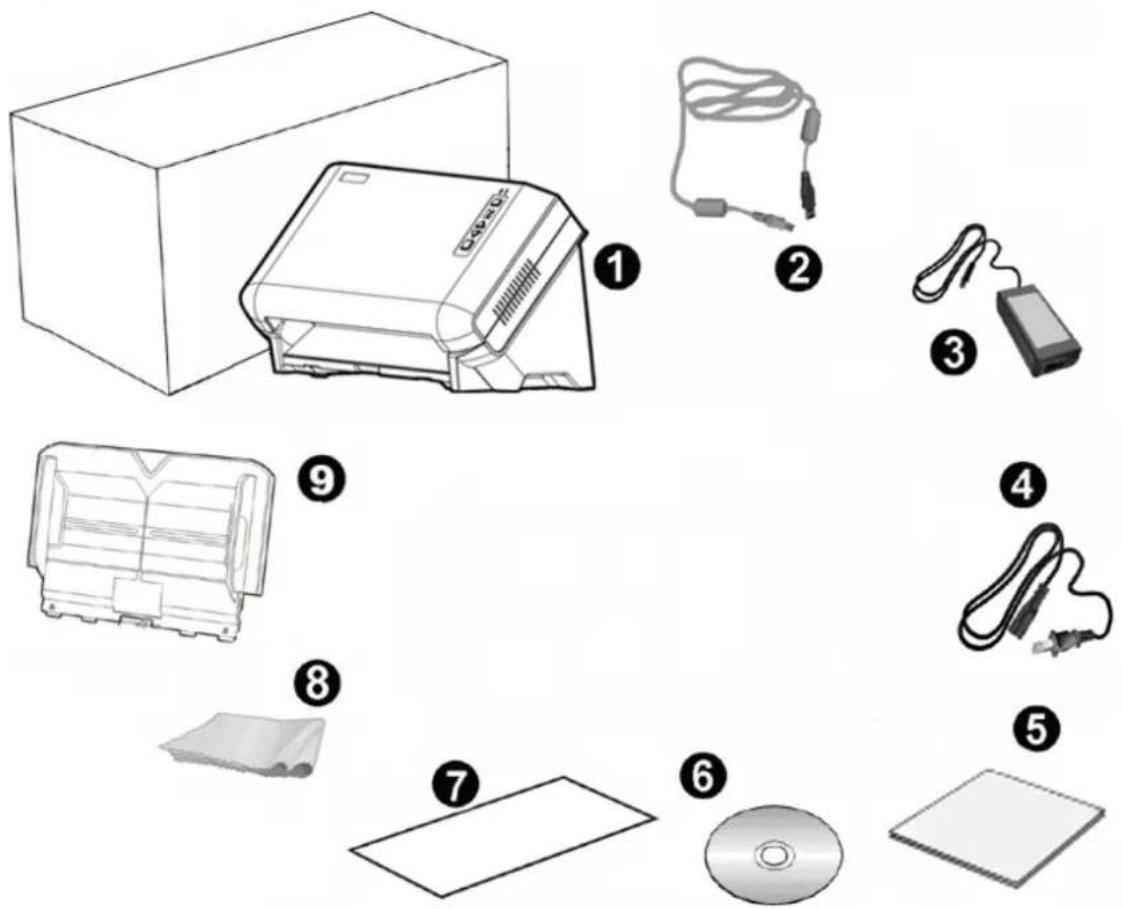
- Scanner
- USB Cable
- AC Adapter
- Power Cable
- Quick Guide
- Setup/Application DVD-ROM
- Calibration Sheet
- Cleansing Cloth
- Paper Chute
THE SCANNER OVERVIEW

text_image
Technical diagram of a printer with numbered parts labeled 1 to 6- PAPER CHUTE—Helps keep the paper in place. Install the paper chute before using the scanner.
- PAPER WIDTH SLIDER—Adjusts the paper width slider for the paper size you are using.
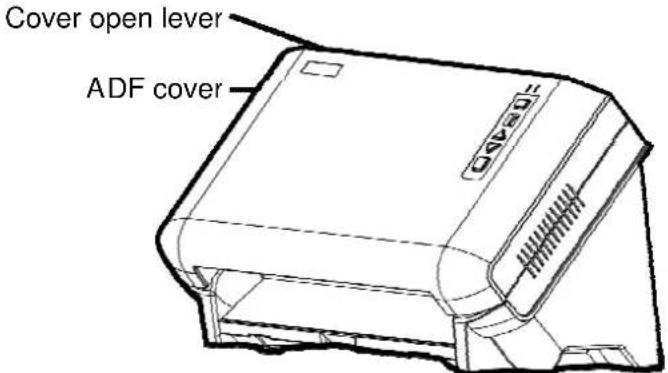
- COVER OPEN LEVER—Opens the ADF cover. Pull it to open the ADF cover when you need to clear paper jam or clean the scanner.
- STACKER—Keeps the paper in place. Extend it in case of longer paper.
- ADF (AUTOMATIC DOCUMENT FEEDER)—Automatically feeds a stack of documents for scanning.
- PAPER CHUTE EXTENSION—Extends to hold longer paper.
text_image
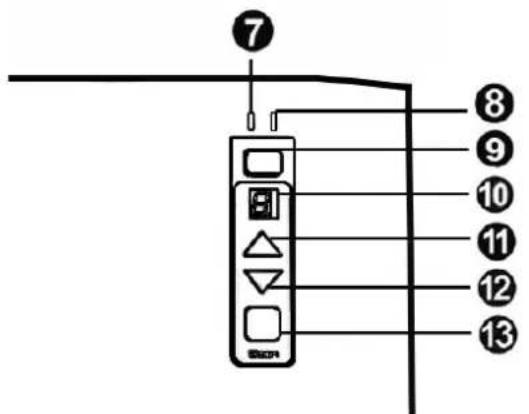
⑦ ⑧ ⑨ ⑩ ⑪ ⑫ ⑫ ⑫ ⑬ ⑬-
WARNING LED—Indicates the scanner error status.
-
POWER / POWER SAVING LED—Indicates the scanner status.
-
POWER SAVING BUTTON—Press about 1 second to enter the standby mode and you may press this button again to wake up the scanner from power saving.
-
FUNCTION NUMBER DISPLAY—Indicates the number of the predefined scanning task selected by the up or down button.
-
UP BUTTON—Press to move forward the scanning task number indicated in the function number display.
-
DOWN BUTTON—Press to move backward the scanning task number indicated in the function number display.
-
SCAN BUTTON—Press to perform a predefined scanning task selected by the up or down button.
text_image
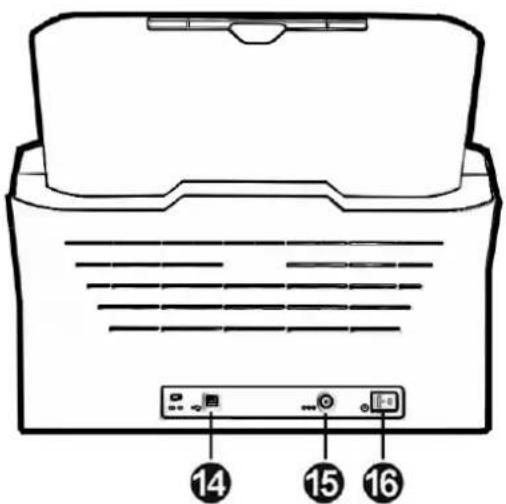
Diagram of a printer front panel with labeled ports 14, 15, and 16 pointing to the back panel.-
USB PORT—Connects the scanner to a USB port on your computer by the included USB cable.
-
POWER RECEPTOR—Connects the scanner to a standard AC power outlet by the included AC adapter.
-
POWER SWITCH—Use this to turn the scanner ON or OFF.
LED INDICATOR
The Power/Power Saving LED and Warning LED indicate different scanner status.
| Indicator | Warning LED | Power / Power Saving LED | Function Number Display | Status | |
| Power On | Off | Blue | On | The scanner is turned on, ready to scan images. | |
| Power Off | Off | Off | Off | The scanner is off, either because the power is not turned on, or because the AC adapter is not properly plugged into an AC power outlet. | |
| Cover Open | Red | Blinking Blue | On The | ADF cover is opened. | |
| Cover Close | Off Blue On The ADF cover is closed. | ||||
| Power Save | Off Orange Off The scanner is in standby mode. | ||||
| Hardware Error | Blinking Red | Off | A1 SDRAM failure. | An internal component of the scanner may have malfunctioned. | |
| A2 SRAM failure. | |||||
| A3 | Flash ROM failure. | ||||
| A4 | USB controller failure. | ||||
| Operation Error | Blinking Red | Blue | E1 ADF missing feed. | ||
| E2 ADF paper jam. | |||||
| E3 | ADF multi-feed. *Ultrasonic paper-feeding detection function is enabled. | ||||
CHAPTER I. INSTALLING THE SCANNER
Before installing your scanner, please verify that you have all of the proper components. A list of the package contents is provided in the "Box Contents" section of this guide.
SOFTWARE INSTALLATION REQUIREMENTS
Your scanner comes with the OCR software (ABBYY FineReader Sprint), the scanner's driver and DocAction. All of these software applications use approximately 800 megabytes of hard disk space after they are installed into your computer. To ensure ample room for the installation, as well as for scanning and saving images, a minimum of 1 GB of hard disk space is recommended.

Information
The availability of the bundled application programs may vary depending on the scanner model you purchase.
This USB scanner can only operate under the Microsoft Windows XP / Vista / 7 / 8 / 10 operating system.
HARDWARE REQUIREMENTS
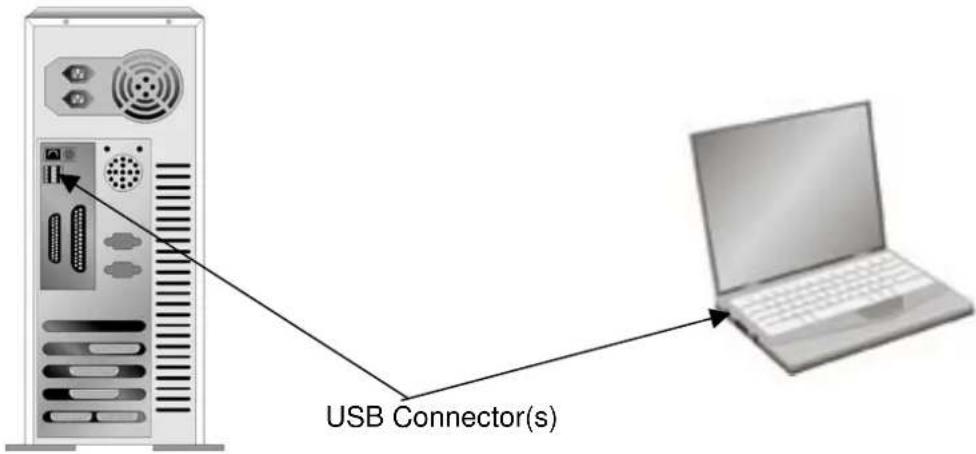
This scanner connects to your computer through the Universal Serial Bus (USB) which supports HOT PLUG AND PLAY. To determine whether your computer is USB-capable, you must check the rear of your PC to locate a USB jack that looks like the picture below. If you are having trouble in locating the USB port on your computer, please refer to the hardware manual that came with your computer.
Upon examination, you should find one or two rectangular USB ports, which usually appear as shown below.
text_image
USB Connector(s)If you don't find such USB ports on your computer, then you need to purchase a certified USB interface card to add USB capabilities to your computer.
INSTALLING AND SETTING UP THE SCANNER
Please follow the step-by-step procedures described below to install the Plustek scanner.

Choose a Proper Site First!
● Always place your scanner on a level smooth and strong surface before proceeding the scanner setup or any scanning task.
Tilted or uneven surface may cause paper-feeding errors, scanner damage or personal injury.
- Avoid using the scanner in a dusty environment. Dust particles and other foreign objects may damage the unit.
Step 1. Install the Paper Chute
- Open the ADF cover by pulling the lever, and get the paper chute ready.
text_image
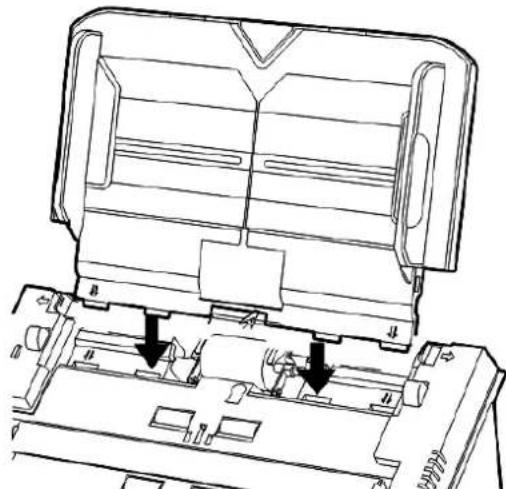
Cover open lever ADF cover- Install the paper chute by aligning and inserting the tabs of the paper chute into their slots on the scanner.
natural_image
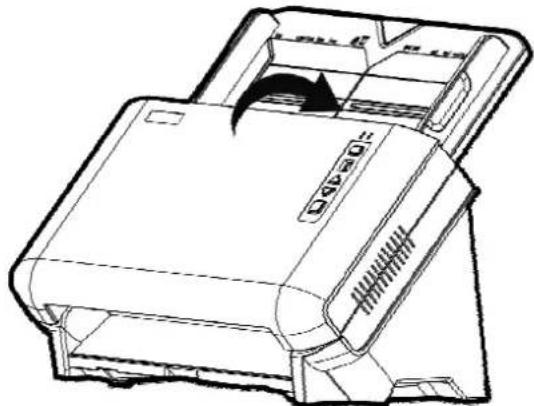
Technical line drawing of a mechanical device with internal components and directional arrows indicating assembly (no text or symbols)- Close the ADF cover by pushing it back down until it snaps back into place.
natural_image
Line drawing of a printer with front panel and side cover (no text or symbols)Step 2. Connecting the Scanner to Your Computer
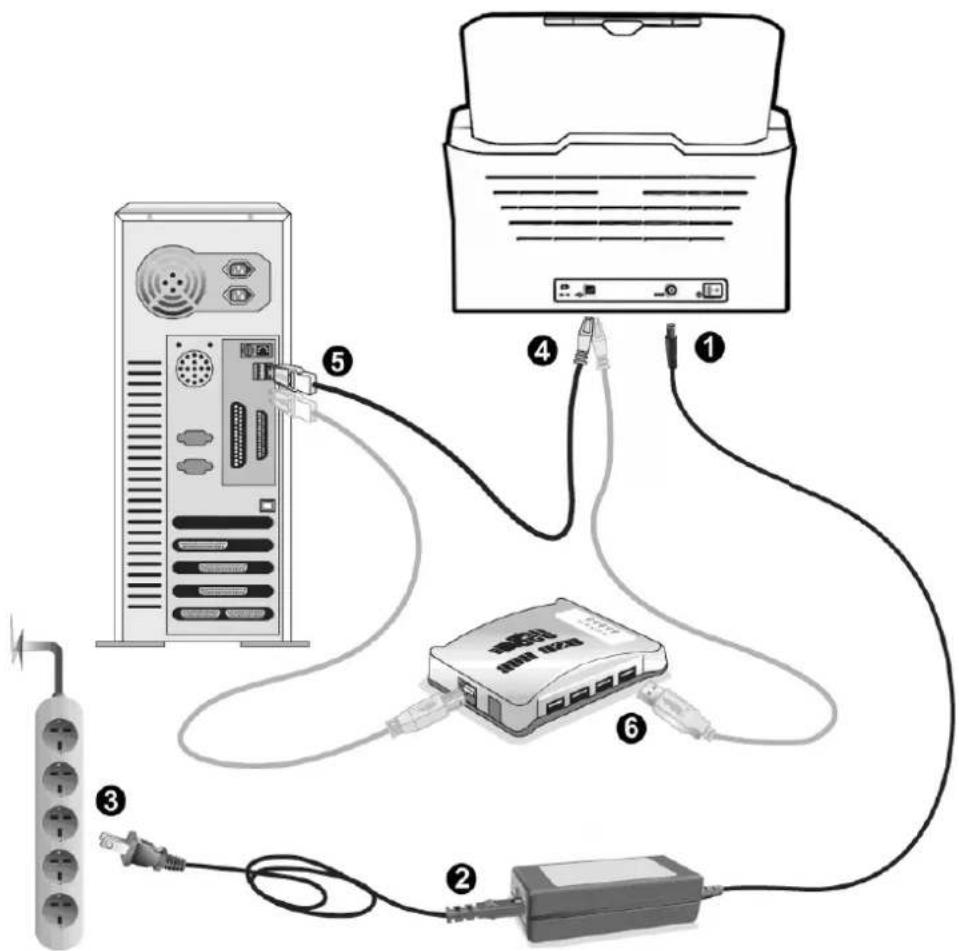
text_image
Diagram showing connections between a server, printer, network device, and power plug with labeled components
Attention
Please make sure the scanner is turned OFF before you plug or unplug the scanner power adapter.
- Plug the AC adapter into the scanner's power receptor :
- Attach the power cable to the AC adapter.
- Plug the other end of the power cable into a standard AC power outlet.
- Plug the square end of the included USB cable to the USB port 🔍 at the rear of the scanner.
- Plug the rectangular end of the USB cable to an available USB port on your computer.
- If you plan to connect your scanner to a USB hub ^3 , make sure that the hub is connected to the USB port in your computer. Next, connect the scanner to the USB hub.
Step 3. Installing the Software
- Switch on the scanner power from the rear of the scanner.
- If the USB components on your computer are functioning correctly, they will automatically detect the scanner causing the Add New Hardware Wizard or Found New Hardware Wizard to be launched.

If your computer is off when the scanner is connected, the "Add New Hardware Wizard" message will not be displayed until the computer is on and Windows starts.
- For Windows XP:
a. Insert the Setup/Application DVD-ROM, included with your scanner, into your DVD-ROM drive.
b. Select Install the software automatically recommended and click the Next button.
c. Click the Next button in the window that appears. Afterwards, please skip to procedure 7.
- For Windows Vista:
a. Select "Locate and install driver software (recommended)" when the "Found New Hardware" window is displayed.
b. Click on the Continue button when the "User Account Control" dialog pops up.
c. Insert the Setup/Application DVD-ROM, included with your scanner, into your DVD-ROM drive when the system prompts you "Insert the disc that came with your USB Scanner", and click on the Next button. Afterwards, please skip to procedure 8.
- For Windows 7:
When the Setup/Application DVD is for several scanner models
a. Insert the Setup/Application DVD-ROM, included with your scanner, into your DVD-ROM drive. Click Run install.exe in the AutoPlay window.
b. Click on the Yes button if the User Account Control dialog pops up. Follow the instructions in the pop-up installation message.
c. In the Device Manager window, right-click on this scanner under Other devices and select Update Driver Software from the pop-up menu. Click Browse my computer for driver software in the window that appears, and click the Browse button.
d. In the Browse For Folder window, select the folder or the DVD-ROM drive that contains this scanner's driver and click the OK button to return to the previous screen. Click the Next button and click Install this driver software anyway if the Windows Security window appears. Afterwards, please skip to procedure 9.
When the Setup/Application DVD is for one scanner model
a. Insert the Setup/Application DVD-ROM, included with your scanner, into your DVD-ROM drive. Click Run install.exe in the AutoPlay window.
b. Click on the Yes button if the User Account Control dialog pops up. Afterwards, please skip to procedure 9.
- For Windows 8 & Windows 10:
a. Insert the Setup/Application DVD-ROM, included with your scanner, into your DVD-ROM drive. Click on the pop-up notification, then click Run install.exe in the pop-up window. If you miss the pop-up notification, please eject and re-insert the Setup/Application DVD-ROM.
b. Click on the Yes button if the User Account Control dialog pops up. Afterwards, please skip to procedure 9.
- During the process of the installation, a message “Windows can’t verify the publisher of this driver software” might be prompted. Please ignore it, and click on Install this driver software anyway to continue the installation without any misgiving at your scanner functioning.
- When the system completes the installation, click the Finish button.
- Follow the on-screen instructions to install all software that your new scanner requires. If the pop-up wizard window appears click Next, and click Install this driver software anyway in the Windows Security window then click Finish in the wizard window.
- After the software is installed, close all open applications and click the Finish button to restart your computer.

Attention
Save the Setup/Application DVD in case you need to reinstall the driver and software in the future.
Step 4. Testing the Scanner
The following describes how you can check if the scanner is properly functioning with your computer and the scanning software. Before testing your scanner, double check to make sure that all connections are securely fastened.
To test the ADF scanning:
- Load a document headfirst and face down into the ADF with the text side facing the paper chute.
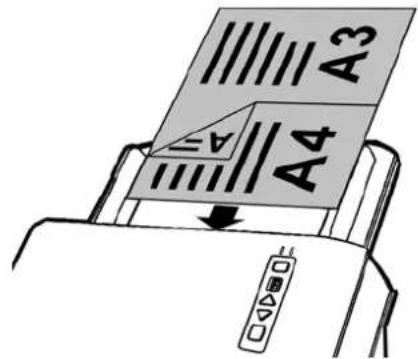
text_image
A3 A4- Double-click the icon

in the Windows system tray.
-
Within the "Button Configuration" window, select a task number by clicking on the icon. Select the desired function from the drop-down list of Button Template and adjust button settings. Select ADF (Front Side) as the Scan Type. Click OK to exit the "Button Configuration" window.
-
Right-click the icon in the Windows system tray, and then choose Execute in the pop-up menu that opens. Click the desired button function item in the pop-up menu.
-
The document in the ADF paper chute should be now loaded into the ADF and scanned. The scanner starts to scan immediately and carry out the corresponding action according to settings you have set up in the "Button Configuration" window.
INSTALLING ADDITIONAL SOFTWARE
Your scanner is TWAIN compliant and functions with virtually all available TWAIN compatible software. If you purchase additional software to be used with your scanner, please make sure that it conforms to the TWAIN standard.
CHAPTER II. SCANNING
Your scanner needs to be driven by certain type of software program. Since all documents or images (whether text or pictures) that are acquired from the scanner are treated by your computer as images, most scanning will probably be done from an image-editing program where you can view, edit, save and output the scanned images.
What about scanning text documents and editing them in a word processor? This is the role of Optical Character Recognition (OCR) software. OCR software converts the image files that are created from scanning text documents into text files that can be viewed, edited and saved by word processors. An OCR program has also been bundled on the included Setup/Application DVD-ROM, and if you wish to use the scanner in this way you should install the OCR software that is included.
The DocAction program, seamlessly integrating the operation of your scanner with your computer and other peripherals, provides a quick and convenient way to perform various scanning functions. With DocAction, you don't need to adjust settings every time you scan. Simply press any button on the scanner's front panel or click any scanning menu item of DocAction on the screen. The scanner starts to scan your paper documents and transfer them to your assigned destination. The destination can be a printer, your E-mail program, files on your disk drives, an image-editing program, etc.
Please refer to the online help of each program to guide you through any questions you may have while scanning within that program.
This chapter describes three important steps of scanner operations. Read them thoroughly and follow the instructions to ensure correct use and optimal scanner performance.
Step 1. Preparing Documents
Step 2. Placing Documents
Step 3. Scanning Documents
PREPARING DOCUMENTS
Proper document preparation prior to the scan can prevent paper feed errors and damages to the scanner.
■ Checking Document Conditions
■ Loosening Documents
Checking Document Conditions
Make sure the size and ream weight of your documents are acceptable by the scanner. Refer to “Appendix A: Specifications3F” of this guide for more information.
To scan multiple documents in a batch from the ADF can increase your work efficiency and make large scanning tasks easier. The ADF of this scanner accepts a variety of paper and stationery you may use in your daily work or personal life, such as:
Normal paper whose size and ream weight meet the requirements stated in "Appendix A: Specifications3F" of this guide.
Notched paper
■ Coated paper (e.g., brochure)

To prevent paper feeding errors and damages to the ADF unit, strictly follow the instructions below:
- Remove all small objects e.g., paper clips, pins, staples or any other fasteners attached, before loading the paper into the ADF.
● Make sure the paper is completely flat with no creased or curled corners. - Avoid scanning documents with pencil lead and newspaper clippings as they will make the ADF exposure glass and the inner ADF dirty. If you have to scan such paper, clean the scanner frequently (refer to “Chapter III. Care and Maintenance” of this guide for more information).
- The paper for each batch scanned by ADF can be of the same or different weights. However, make sure the length of each scan batch is the same.
However, don't use the ADF to scan documents if they meet any of the following conditions:
■ Paper lighter than 50 g/m ^2 (14 lb.) or heavier than 105 g/m ^2 (28 lb.)
■ Paper with clips or staples attached
■ Paper with inconsistent thickness, e.g., envelops
■ Paper with wrinkles, curls, folds, or tears
■ Paper with an odd (non-rectangular) shape
■ Paper with static electricity
■ Tracing paper
■ Carbon paper, pressure sensitive paper, carbonless paper
■ Items other than paper, e.g., cloth, metal foil.

● DO NOT use the ADF to scamphotographic
Attention
sheets or particularly valuable document originals; wrinkles or other damages can happen in case of paper feeding errors.
- DO NOT place paper with wet ink or correction fluid into the ADF. Wait few minutes for it to get dry.
Loosening Documents
Before loading documents into the ADF, loosen them as follows:
- Fan the documents so that no two pages are sticking together. Make sure to remove static electricity from paper.

natural_image
Illustration showing two hands holding a blank sheet and folding a folded paper fan (no text or symbols)- Hold the documents upside down with both hands, and then gently push them onto a flat surface to align the edges of all documents.

text_image
ZXThis will allow documents being fed into the ADF one at a time and prevent paper-feeding errors.
PLACING DOCUMENTS
- Load the documents face down toward the center of the ADF paper chute and all the way into the ADF until touching the bottom.
For single-sided scans, load the documents face down so that the side to be scanned faces towards the paper chute.
For double-sided scans, load the desired page order of documents face down so that the side to be scanned faces towards the paper chute.
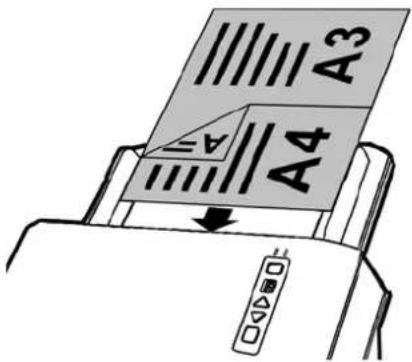
text_image
A3 A4- If you need to scan longer documents, pull out the paper chute extension and stacker to provide further support for the documents.
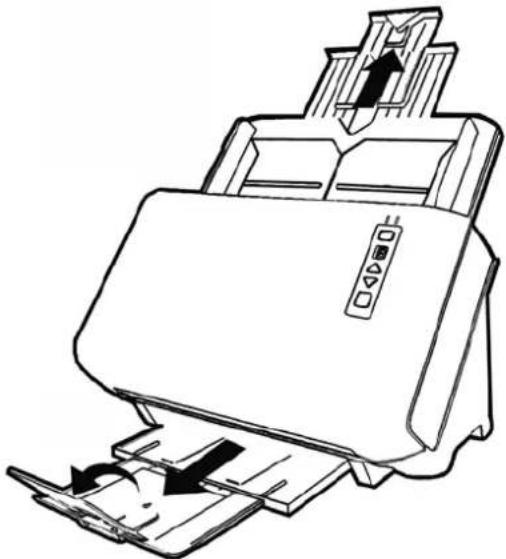
natural_image
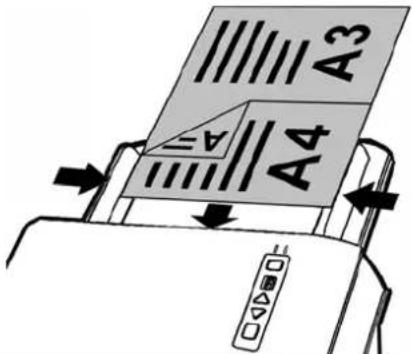
Line drawing of a printer with paper feed and paper roll, showing internal structure and page loading (no text or symbols)- Adjust the paper width slider for the paper size you are using. The paper width slider should be gently touching both sides of the documents.
text_image
A3 A4
● DO NOT load more than 100 sheets of paper (70 g/m ^2 , 18 lb.) to the ADF.
● Paper scanned from the ADF must be a minimum of 5.08 x 5.08 cm (2" x 2", W x L).
- Make sure there are no gaps between the document stack and the paper-width slider; otherwise, the scanned images can be skewed.
- Although the documents should be loaded firmly in place ensuring optimum scanning accuracy, they should never be wedged in so tightly that the process of feeding them through the scanner is strained.
- Do not load additional paper into the ADF while the unit is feeding and scanning.
SCANNING DOCUMENTS
There are different ways to operate the scanner:
- By acquiring images from the scanner through our TWAIN interface within any TWAIN-compliant application programs.
- By scanning from the buttons on the scanner front panel.
- By scanning from DocAction's Execute menu on the screen.
- By scanning from the icon in the left side of the DocAction window.
The TWAIN interface and DocAction software is automatically installed to your system along with the scanner driver.

Before you start scanning, check the following:
● The power of both your computer and scanner is turned on.
- The icon appears on the Windows system tray.
● Paper is appropriately loaded into the ADF.
Scanning via TWAIN Interface
The TWAIN program is a very important piece of software that comes with your scanner. This program acts as an interface between the scanner hardware and the image-editing software you are using to view and edit images. The TWAIN program allows you to adjust a number of settings to define the quality of the scanned image.
The following describes how you may use your TWAIN compatible program to scan via the TWAIN interface. When you get familiar with the scanning, you may alternatively use other TWAIN compatible scanning program or image-editing application to do your scanning projects.
Select the Scan Source:
If you have more than one scanner or other imaging devices installed on your computer, you need to set this scanner as the default scanning source before you
acquire TWAIN program. Please refer to your TWAIN compatible program manual for more information about the settings.
Scan within your TWAIN compatible program:
- Launch your TWAIN compatible program.
-
Open the TWAIN window within your TWAIN compatible program. Please refer to your TWAIN compatible program manual for detailed information.
-
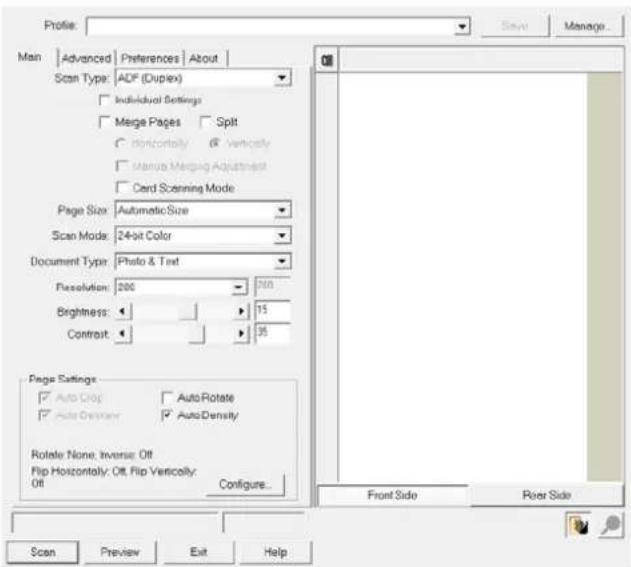
In the TWAIN window that opens, select ADF (Front Side) as the Scan Type if you want to scan single-sided documents, or select ADF (Duplex) to scan double-sided documents.
text_image
Profile: Main | Advanced | Preferences | About | Scan Type: ADF (Duplex) Individual Settings Merge Pages Split Horizontally Vertically Manua Margin Adjustment Card Scanning Mode Page Size: Automatic Size Scan Mode: 24-bit Color Document Type: Photo & Text Resolution: 200 510 Brightness: 15 Contrast: 95 Page Settings Auto Crop AutoRotate Auto Rotation AutoDensity Rotate: None, Inverse: Off Flip Horizontally: Off, Flip Vertically: Off Configure... Front Side Page Side Scan Preview Exit Help- Adjust the scanning settings. For ADF (Duplex) scan, you can tailor settings individually for front and rear sides of the documents. Click Front Side button to adjust the scanning settings of document front side and then click Rear Side button to adjust the scanning settings of document rear side.
You can enable the function of Merge Pages only when you select ADF (Duplex) as Scan type and Automatic Size as Page Size to output the scan images of both front and rear sides in one image. After the function of Merge Pages is enabled, you can make the selection of Horizontally to generate both front and rear image data horizontally in a joined image (the rear image will be placed at the right side next to the front image), or make the selection of Vertically to generate both front and rear image data vertically in a joined image (the rear image will be placed below the front image).
-
Load one page of the document and click the Preview button. The scanned image should appear in the Preview Window. To define the margins and crop out sections of the image you don't want scanned, use the mouse to click and drag the corners or sides of the scan area borders. Adjust the scan settings again if the preview image doesn't satisfy your needs.
-
Load all pages of the document and click the Scan button.
-
When the scan finishes, click the Exit button to close the TWAIN window. The scanned images are displayed in your TWAIN compatible program, and you may perform the image editing tasks.
Click the Help button within the TWAIN window for more information about the settings.
Scanning from the Scanner's Front Panel
To complete your scanning projects by using the scanner buttons is very easy and convenient. The number of scanning task displayed on the scanner's front panel is configured through DocAction. DocAction offers you quick access to the most frequently-used scanning functions. They are especially useful when you need to repeatedly scan with the same settings and send images to the same destination. Before performing your first scan via scanner buttons, you are recommended to configure the button settings to your needs and preferences first.
Scan from the Scanner Buttons
- Place the document or images onto the scanner. (Refer to "Chapter II. Scanning" of the Scanner User's Guide for more information in placing paper into the ADF properly.)
- Check current button settings by viewing the Button Configuration window. If needed, you may also modify settings to meet your current needs. (Refer to "View Button Settings" and "Configure Button Settings" below for more information.)
- Press the UP or DOWN button to select the desired task.
- Press the Scan button.
The scanner starts to scan immediately and carry out the corresponding action according to settings you have set up in the Button Configuration window.

Attention
Place only text documents for OCR purposes. Do not scan a photo using the OCR button.
Configure Button Settings
Within the “Button Configuration” window, you can find a row of icons running through the left side of the window. Each icon represents a scanning task, and the number underneath corresponds to the function number displayed on the scanner front panel. Nine frequently-used scanning tasks are pre-configured for your convenience to start scanning immediately. You may, however, customize the settings of every nine tasks to best meet your needs and preferences. Follow the steps described below:
-
Do one of the following to open the Button Configuration window:
-
Double-click the icon in the Windows system tray.
-
Right-click the icon in the Windows system tray, and then choose Button Configuration... in the pop-up menu that opens.
-
Select a task number by clicking on the icon.
- Select the desired function from the drop-down list of Button Template and adjust button settings.
Click the Help button within the Button Configuration window for more information about the settings.
View Button Settings
There are 2 ways to view the button settings:
- Double-click the icon in the Windows system tray.
- Right-click the icon in the Windows system tray, and then choose Button Configuration... in the pop-up menu that opens.
Scanning from the On-screen DocAction's Execute Menu
You may also use DocAction's on-screen Execute menu to perform the same scanning tasks. The DocAction program provides a quick and convenient way to perform various scanning functions. Follow the steps described below:
- Place the document or images onto the scanner.
- Check current button settings by viewing the Button Configuration window. If needed, you may also modify settings to meet your current needs.
- Right-click the icon 📄 in the Windows system tray, and then choose Execute in the pop-up menu that opens.
- Click the desired button function item in the pop-up menu.
The scanner starts to scan immediately and carry out the corresponding action according to settings you have set up in the Button Configuration window.
Scanning from the Icon in the Left Side of the DocAction Window
You can perform scanning task by double-clicking the icon in the left side of the DocAction window. Follow the steps described below:
- Place the document or images onto the scanner.
- Check current button settings by viewing the Button Configuration window. If needed, you may also modify settings to meet your current needs.
- Double-clicking the desired icon in the left side of the DocAction window.
The scanner starts to scan immediately and carry out the corresponding action according to settings you have set up in the Button Configuration window.
CHAPTER III. CARE AND MAINTENANCE
Your scanner is designed to be maintenance-free. However, constant care and maintenance can keep your scanner working smoothly.
CLEANING THE SCANNER
Paper powder, dust, ink and toner from paper being scanned may make the inner ADF dirty, which leads to poor image quality or document-feeding errors. How often to clean your scanner depends on the type of paper and number of pages being scanned.
Perform the following procedures to clean the scanner surface and the ADF unit. Gently wipe locations described herein. Do not rub too hard.

- Before cleaning the scanner, turn off the scanner and disconnect the scanner's power cable and USB cable, and then wait a few minutes for the glass and/or the inner ADF to cool to ambient temperature.
- Wash your hands with soap and water after cleaning the scanner.
Cleaning Materials
Have the following cleaning materials ready to clean the scanner:
■ soft, dry, lint-free cloth (or a cotton swab)
■ non-abrasive cleaner—Isopropyl alcohol (95%). DO NOT use water.

- Alternatively you can use glass cleaner or neutral detergent for windows cleaning to clean the scanner glass.
● However, DO NOT use either of them to clean the ADF feed roller or pad module.
Use of other cleaning materials could damage your scanner.
Cleaning the ADF
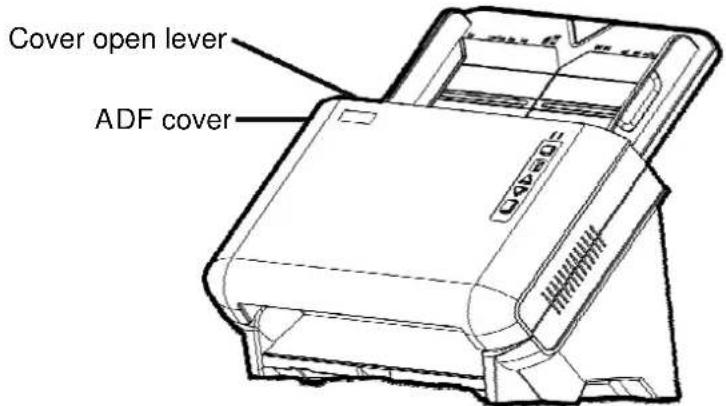
- Open the ADF cover by pulling the lever.

text_image
Cover open lever ADF cover- Gently wipe the following areas with the cloth dampened with the cleaner. Be careful NOT to scratch their surfaces.
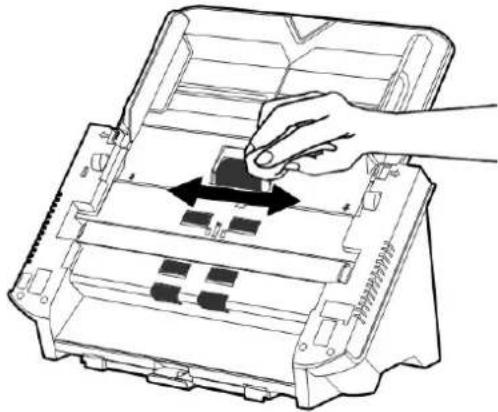
Clean Feed Roller:
Wipe the Feed Roller from side to side and then rotate it. Repeat this until its entire surface is cleaned.
natural_image
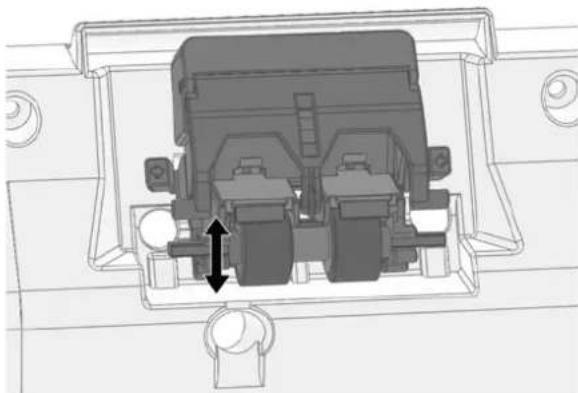
Line drawing of a hand inserting a component into a device casing (no text or symbols)Clean Pad Module:
Wipe the Pad Module (in the direction of arrow shown in below picture).
natural_image
Technical diagram of a mechanical assembly with internal components and mounting holes (no text or labels)Clean ADF Glass:
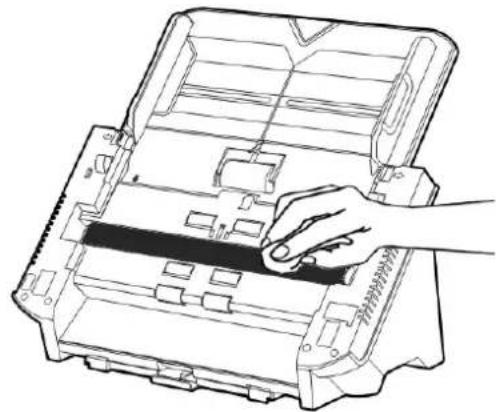
natural_image
Line drawing of a hand inserting a component into a device casing (no text or symbols)
Do not spray cleaner directly onto the scanner glass. Excess liquid residue may fog or damage the scanner.
- Wait for cleaned areas to dry completely.
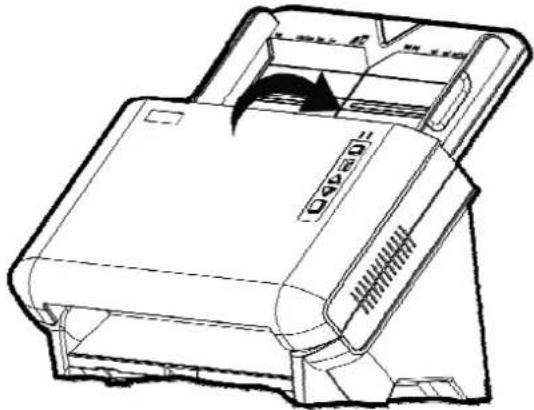
- Close the ADF cover by pushing it back down until it snaps back into place.

natural_image
Line drawing of a printer with paper filter and cover (no text or symbols)REPLACING CONSUMABLES
As a guideline, it is recommended to replace the pad module every 100000 sheets of scans, and it is recommended to replace the feed roller every 300000 sheets of scans. The Counter Utility program automatically counts the number of sheets scanned by your scanner and how many times the consumables are used. After replacing consumables, please reset the counter to 0. From the Windows START menu, point to All Programs > Your Scanner Model Name, and then click Scanner Utility. (For Windows 8.1 users: Point your mouse cursor to the upper or lower right corner of your screen to open the Charm bar. Click on the Start charm, then click on the downwards arrow button in the lower left corner of the screen. The Apps screen will be shown. Move your cursor to the right edge of the screen to scroll right until you find Your scanner model name, and then click on Scanner Utility.) The Scanner Utility window opens. Find the Counter Utility section. Refer to the online help of Scanner Utility to explorer more about Counter Utility.
Replacing the Pad Module
- Open the ADF cover by pulling the cover open lever.

text_image
Cover open lever ADF cover- Remove the pad module by pinching both sides of the pad module and pull it out.

natural_image
Technical diagram of an electrical switch or motor assembly with no visible text or symbols-
Install the new pad module by inserting the tabs on the module onto their slots on the scanner.
-
Close the ADF cover by pushing it back down until it snaps back into place.
natural_image
Line drawing of a printer with paper filter and cover (no text or symbols)Replacing the Feed Roller
- Open the ADF cover by pulling the cover open lever.
text_image
Cover open lever ADF cover- Remove the paper chute by pinching both sides of the handles on the paper chute to remove it.

natural_image
Diagram of a printer's front panel with two hand gestures and a close-up of the lid (no text or symbols)- Remove the feed roller by pinching both sides of the feed roller and pull it out.

natural_image
Three-step diagram showing a cylindrical mechanical device with directional arrows indicating motion, no text or symbols present.- Install the new feed roller by aligning and inserting the feed roller onto the roller pitman on the scanner.
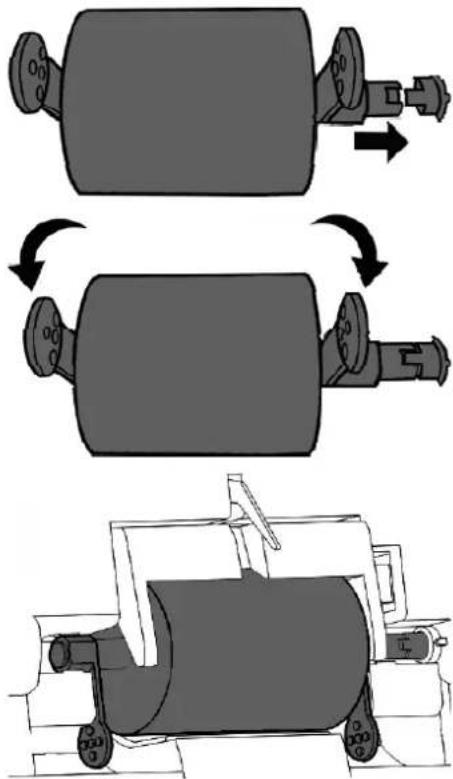
natural_image
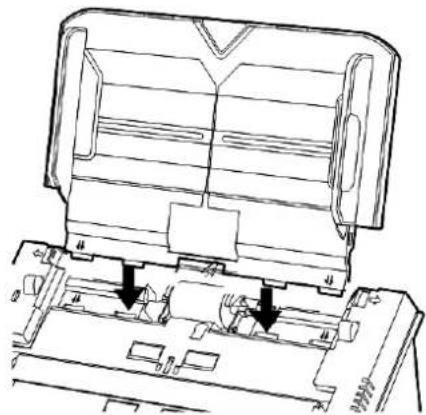
Three-step diagram showing a cylindrical device being processed, with arrows indicating motion direction (no text or symbols)- Install the paper chute by aligning and inserting the tabs of the paper chute into their slots on the scanner.
natural_image
Technical line drawing of a mechanical device with internal components and directional arrows indicating assembly or movement (no text or symbols)- Close the ADF cover by pushing it back down until it snaps back into place.

natural_image
Line drawing of a printer with paper filter and cover (no text or symbols)CALIBRATING THE SCANNER
Calibrate the scanner if colors appear in areas that should be white, or colors of the scanned image and the original vary a lot. This allows you to adjust and compensate for variations that can occur in the optical component over time by its nature.
The following describes how to calibrate the scanner:
- The Calibration Sheet, marked with an arrow on either edge at both sides, is used specially for ADF Scanning calibration.
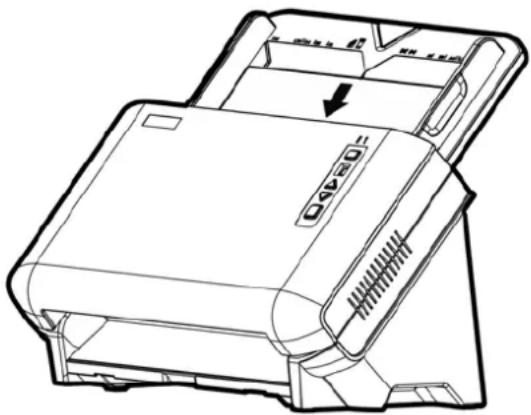
- Insert the special calibration sheet into the ADF of the scanner, with an arrow toward the scanner buttons.
natural_image
Line drawing of a printer with a paper feeding into a slot, showing internal structure and no text or symbols.
Attention
- Please insert the special calibration sheet included with the scanner. Alternatively you may also use any plain white sheet of paper sized in Letter / A4 instead; however, the calibration effect may be less good than the special calibration sheet.
-
Save the Calibration Sheet in case you need to calibrate the scanner in the future.
-
Click Start > All Programs > Your scanner model name > Calibration Wizard. (For Windows 8.1 users: Point your mouse cursor to the upper or lower right corner of your screen to open the Charm bar. Click on the Start charm, then click on the downwards arrow button in the lower left corner of the screen. The Apps screen will be shown. Move your cursor to the right edge of the screen to scroll right until you find Your scanner model name, and then click on Calibration Wizard.)
-
Click Next from the Calibration Wizard that pops up and then click Calibrate Now....
-
Click on the Start button to begin the calibration process.
-
The scanner pulls the calibration sheet through the scanner, which completes this scanner calibration. After the calibration is complete, click OK and then click Finish.
POWER SAVE
To save power consumption, when the scanning process is finished, the scanner light source will turn itself off and the scanner will enter a lower-power mode without delay time.

- The scanner will enter the standby mode after it is idle for 10 minutes. Simply press any scanner button on the scanner panel and the scanner will return back to the normal status.
- From the Windows START menu, point to All Programs > Your Scanner Model Name, and then click Scanner Utility. (For Windows 8.1 users: Point your mouse cursor to the upper or lower right corner of your screen to open the Charm bar. Click on the Start charm, then click on the downwards arrow button in the lower left corner of the screen. The Apps screen will be shown. Move your cursor to the right edge of the screen to scroll right until you find Your scanner model name, and then click on Scanner Utility.) Refer to the online help of Scanner Utility to explore more about standby mode.
CHAPTER IV. TROUBLESHOOTING
If you encounter problems with your scanner, please review the installation and scanning instructions contained in this guide.
Before you ask for customer service or repair, please refer to the information in this chapter and consult our FAQ (Frequently Asked Questions) in which you can find useful self troubleshooting information. From the Windows START menu, point to All Programs > Your Scanner Model Name, and then click FAQ. (For Windows 8.1 users: Point your mouse cursor to the upper or lower right corner of your screen to open the Charm bar. Click on the Start charm, then click on the downwards arrow button in the lower left corner of the screen. The Apps screen will be shown. Move your cursor to the right edge of the screen to scroll right until you find Your scanner model name, and then click on FAQ.)
SCANNER CONNECTION
The first step to take when troubleshooting connection problems with your scanner is to check all physical connections. The icon 📄, located on the Windows system tray, indicates if the scanner software is properly launched and the scanner and computer are communicating with each other.
| Appearance Status | |
 | The program has been successfully launched, the scanner is connected with the computer and the scanner connection is activated, ready to scan images. |
 | The scanner is not connected with the computer, the scanner connection is not activated or the scanner power is not switched on. Or, the scanner is in standby mode. |
| No Display | You have chosen to terminate the program, no matter the scanner is connected or disconnected with the computer. |
CLEARING PAPER JAMS
If a paper jam in the ADF happens, please perform the following steps:
- Remove any unjammed documents still loaded into the ADF.
- Open the ADF cover by pulling the cover open lever.

text_image
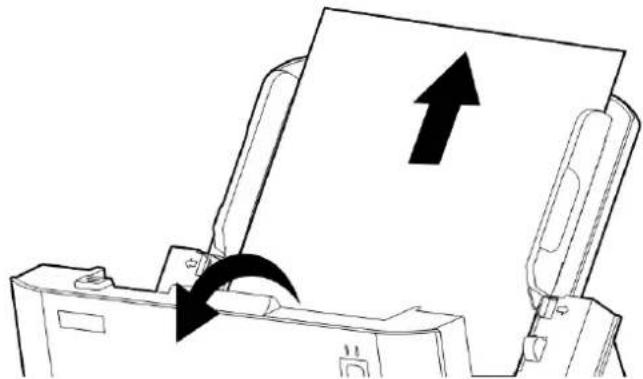
Cover open lever ADF cover- Gently but firmly pull the jammed documents out of the ADF. Try to avoid creasing or wrinkling the documents.
natural_image
Diagram of a printer printer with an arrow indicating the paper's direction (no text or symbols present)
Attention
Do not try to pull jammed or half-scanned documents out of the ADF without first opening the ADF cover. Doing so may permanently damage the ADF.
- Close the ADF cover by pushing it back down until it snaps back into place.

natural_image
Line drawing of a printer with paper filter and cover (no text or symbols)APPENDIX A: SPECIFICATIONS ^4
| Image Sensor CIS Sensor | x 2 |
| Light Source LED | |
| Optical Resolution 600 dpi | |
| Hardware Resolution 600 | x 600 dpi |
| Scan Modes | Color: Input 48-bit, Output 24-bitGrayscale: Input 16-bit, Output 8-bitBlack & White: 1-bit |
| ADF Capacity | 1. 50 sheets (A4/ Letter, 70 g/m2 or 18 Lbs), Max.thickness under 10 mm (0.4")2. 25 sheets (A3, 70 g/m2 or 18 Lbs)Note: Maximum ADF capacity varies, depending upon paper weight. |
| Scanning Speed (ADF) | 20 ppm/ 40 ipm (Color/ Grayscale/ B&W mode, 300 dpi, A4 Landscape)20 ppm/ 40 ipm (Color/ Grayscale/ B&W mode, 200 dpi, A4 Landscape)Note: Results may vary depending upon your scanning application, computer processor and system memory. |
| Scanning Area (W x L) | Max: 297 x 5080 mm (11.69" x 200")Min: 13.2 x 13.2 mm (0.52" x 0.52") |
| Acceptable Paper Sizes (W x L) | Max: 305 x 5080 mm (12" x 200")Min: 50.8 x 63.5 mm (2" x 2.5") |
| Acceptable Paper Weight (Thickness) | 40 to 220 g/m2 (10 to 58 Lbs) |
| Multi-feed Detection With ultrasonic technology | |
| Daily Duty Scan (Sheets) | 4,000 |
| Roller Lifetime (Scans) | 300,000 |
| Pad Lifetime (Scans) | 100,000 |
| Action Button | 4 Buttons: Up, Down, Scan, Standby9 function keys: all customizable. |
| Power Supply 24 Vdc/ 2.7 | A |
| Interface | USB 2.0 |
| Net Weight 6.57 Kgs (14.48 Lbs) | |
| Dimensions (W x D x H) | 436 x 262 x 266 mm (17.16" x 10.31" x 10.47") |
| Protocol | TWAIN Compliant |
APPENDIX B:
CUSTOMER SERVICE AND WARRANTY
Visit our website www.plustek.com for more customer service information. For further assistance, visit our website or call our customer support phone number listed on the website. One of our representatives will be happy to assist you from Monday through Friday in office working hours.
To avoid delays, please have the following information available before calling:
■ Scanner name and model number
■ Scanner serial number (Located at the bottom of the scanner)
■ Scanner DVD version and part number
■ A detailed description of the problem
■ Your computer manufacturer and its model number
■ The speed of your CPU
■ Your current operating system and BIOS (optional)
■ Name of software package(s), version or release number and manufacturer of the software
■ Other USB devices installed
SERVICE & SUPPORT INFORMATION
Where appropriate, the period of availability of spare parts and the possibilities of upgrading products information. Please ask local distributors and suppliers for spare parts information and product upgrade information.
Information requested by relevant Implementing Measure. Please ask local distributors and suppliers for the related information of Implementing Measure test report.
Do not dispose anything of products before you ask local distributors and suppliers to get correct information for decreases of environmental impact with right methods and procedures.
If you want to disposals the product and/or an accessory, please ask local distributors and suppliers to get the contact information of nearest disposal manufactures.
If you have any maintenance inquiry, please ask local distributors and suppliers to get the contact information of nearest maintenance center in order to extend the product usage life time.
If you want to maintain and clearance the product, please ask local distributors and suppliers to get the right information of nearest stores.
STATEMENT OF LIMITED WARRANTY
This Statement of Limited Warranty applies only to the options you originally purchase for your use, and not for resale, from an authorized reseller.
The manufacturer warranty includes all parts and labor, and is not valid without the receipt of original purchase. To obtain warranty service, you may contact the authorized dealer or distributor, or visit our website to check out the available service information, or send a request via E-mail for further help.
If you transfer this product to another user, warranty service is available to that user for the remainder of the warranty period. You should give your proof of purchase and this statement to that user.
We warrant that this machine will be in good working order and will conform to its functional descriptions in the documentation provided. Upon provision of proof of purchase, replacement parts assume the remaining warranty of the parts they replace.
Before presenting this product for warranty service, you must remove all programs, data and removable storage media. Products returned without guides and software will be replaced without guides and software.
This Limited Warranty service does not provide for carry-in exchange when the problem results from accident, disaster, vandalism, misuse, abuse, unsuitable environment, program modification, another machine or non-vendor modification for this product.
If this product is an optional feature, this Limited Warranty applies only when the feature is used in a machine for which it was designed.
If you have any questions about your Limited Warranty, contact the approved retailer from whom you bought the product or the manufacturer.
THIS LIMITED WARRANTY REPLACES ALL OTHER WARRANTIES, EXPRESS OR IMPLIED, INCLUDING, BUT NOT LIMITED TO, THE IMPLIED WARRANTIES OF MERCHANTABILITY AND FITNESS FOR A PARTICULAR PURPOSE. HOWEVER, SOME LAWS DO NOT ALLOW THE EXCLUSION OF IMPLIED WARRANTIES. IF THESE LAWS APPLY, THEN ALL EXPRESS AND IMPLIED WARRANTIES ARE LIMITED IN DURATION TO THE WARRANTY PERIOD. NO OTHER WARRANTIES APPLY AFTER THAT PERIOD.
Some jurisdictions do not allow limitations on how long an implied warranty lasts, so the above limitation may not apply.
Under no circumstances are we liable for any of the following:
- Third party claims against you for losses or damages.
- Loss of, or damage to, your records or data; or
- Economic consequential damages (including lost profits or savings) or incidental damages, even if we are informed of their possibility.
Some jurisdictions do not allow the exclusion or limitations of incidental or consequential damages, so the above limitation or exclusion may not apply to you.
This Limited Warranty gives you specific legal rights, and you may also have other rights that vary from jurisdiction to jurisdiction.
FCC RADIO FREQUENCY STATEMENT
This is a Class A product. In a domestic environment this product may cause radio interference in which case the user may be required to take adequate measures.
This equipment generates, uses and can radiate radio frequency energy and, if not installed and used in accordance with the instructions, may cause harmful interference to radio communications. However, there is no guarantee that interference will not occur in a particular television reception (which can be determined by turning the equipment off and on), the user is encouraged to try to correct the interference by one or more of the following measures:
■ Reorient or relocate the receiving antenna.
■ Increase the separation between the equipment and receiver.
■ Connect the equipment to an outlet on a circuit different from that which the receiver is connected.
■ Shielded interconnect cables and shielded power cord which are supplied with this equipment must be employed with this equipment to ensure compliance with the pertinent RF emission limits governing this device.
- Consult the dealer or an experienced radio/TV technician for help if the conditions persist.
- Changes or modifications not expressly approved by the manufacturer or authorized service center could void the user's authority to operate this equipment.
This device complies with Part 15 of the FCC Rules. Operation is subject to the following two conditions: (1) this device may not cause harmful interference, and (2) this device must accept any interference received, including interference that may cause undesired operation.