SlimFit TX-T2782 - Television SAMSUNG - Free user manual and instructions
Find the device manual for free SlimFit TX-T2782 SAMSUNG in PDF.


User questions about SlimFit TX-T2782 SAMSUNG
0 question about this device. Answer the ones you know or ask your own.
Ask a new question about this device
Download the instructions for your Television in PDF format for free! Find your manual SlimFit TX-T2782 - SAMSUNG and take your electronic device back in hand. On this page are published all the documents necessary for the use of your device. SlimFit TX-T2782 by SAMSUNG.
USER MANUAL SlimFit TX-T2782 SAMSUNG
Owner's Instructions
Register your product at www.samsung.com/global/register Record your Model and Serial number here for future reference.
- Model ____ - Serial No. ____
Contents
General Information
◆ Accessories ...... 3
◆ Viewing the Control Panel 3
◆ Viewing the Connection Panel 4
◆ Remote Control 5
Connection
◆ Connecting VHF and UHF Antennas 6
◆ Connecting Cable TV 6
◆ Connecting a VCR 7
◆ Connecting a Camcorder 7
◆ Connecting a DVD Player/Set-Top Box 8
◆ Connecting an Amplifier/DVD Home Theater - Analog ..... 8
Operation
◆ Plug & Play Feature 9
◆ Memorizing the Channels 10
◆ To Select the Source.... 11
◆ To Edit the Input Source Name 11
Picture Control
◆ Using Automatic Picture Settings.... 11
◆ Changing the Screen Size 12
◆ Digital Noise Reduction 12
◆ Tilt (TX-T2781/TX-T2782 only) 13
Sound Control
◆ Using Automatic Sound Settings 13
◆ Customizing the Sound 13
◆ Choosing a Multi-Channel Sound (MTS) Track - Digital ..... 14
◆ Choosing a Multi-Channel Sound (MTS) Track - Analog ..... 14
◆ Automatic Volume Control 14
◆ Using Pseudo Stereo 15
◆ Using Turbo Plus 15
Channel Control
◆ Clearing Scrambled Channels - Digital 15
◆ Adding and Erasing Channels - Analog 15
◆ Adding and Erasing Channels - Digital 16
◆ Fine Tuning Analog Channels - Analog 16
◆ Labeling Channels - Analog 16
◆ Checking the Digital-Signal Strength - Digital 17
◆ Using the R.Surf Feature 17
Function Description
◆ Selecting a Menu Language ...... 17
Setting the Time 18
◆ Viewing Closed Captions
(On-Screen Text Messages) - Digital 19
◆ Viewing Closed Captions
(On-Screen Text Messages) - Analog 19
Setting the Blue Screen Mode 20
Setting the On/Off Melody 20
◆ Using the V-Chip 20
◆ Upgrading the Software 23
Appendix
◆ Identifying Problems 23
◆ Specifications

Press
Symbols

Important

Note

One-Touch Button
Important Warranty Information Regarding Television Format Viewing
Standard screen format televisions(4:3, the aspect ratio of the screen width to height) are primarily designed to view standard format full-motion video. The images displayed on them should primarily be in the standard 4:3 ratio format and constantly moving. Displaying stationary graphics and images on screen, such as the dark top and bottom letterbox bars(wide screen pictures), should be limited to no more than 15% of the total television viewing per week.
Wide screen format televisions(16:9, the aspect ratio of the screen width to height) are primarily designed to view wide screen format full-motion video. The images displayed on them should primarily be in the wide screen 16:9 ratio format, or expanded to fill the screen if your model offers this feature, and constantly moving. Displaying stationary graphics and images on screen, such as the dark sidebars on non-expanded standard format television video and programming, should be limited to no more than 15% of the total television viewing per week.
Additionally, viewing other stationary images and text such as stock market reports, video game displays, station logos, web sites or computer graphics and patterns, should be limited as described above for all televisions. Displaying any stationary images that exceed the above guidelines can cause uneven aging of picture tubes(CRTs) that leave subtle, but permanent burned-in ghost images in the television picture. To avoid this, vary the programming and images, and primarily display full screen moving images, not stationary patterns or dark bars. On television models that offer picture sizing features, use these controls to view the different formats as a full screen picture.
Be careful in the selection and duration of television formats used for viewing. Uneven CRT aging as a result of format selection and use, as well as other burned-in images, is not covered by your Samsung limited warranty.
Accessories
Please make sure the following items are included with your TV. If any items are missing, contact your dealer.

Remote Control (AA59-00405B)/AAA Batteries

Owner's Instructions/
Safety Guide Manual

Warranty Cards/Registration Card
Viewing the Control Panel
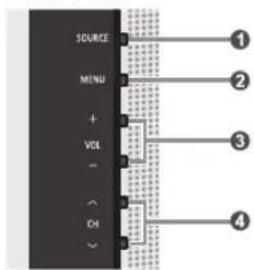
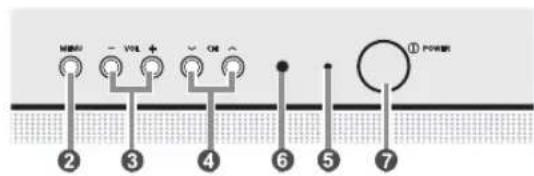
You can control your TV's basic features, including the on-screen menu. To use the more advanced features, you must use the remote control.
TX-T2781
text_image
SOURCE MENU + VOL - < CH ~ ① ② ③ ④
TX-T2782

text_image
POWER 6 5 7 MENU - VOL + × ON ↗ 2 3 4TX-T2082
text_image
MENI VOL + ON ① POWER ② ③ ④ ⑥ ⑤ ⑦The product color and shape may vary depending on the model.
① SOURCE
Toggles between all the available input sources (TV, AV1, AV2, Component). In the on-screen menu, use this button as you would use the ENTER button on the remote control.
② MENU
Press to see an on-screen menu of your TV's features.
③ + VOL -
Press to increase or decrease the volume. In the on-screen menu, use the + VOL – buttons as you would use the ◀ and ▶ buttons on the remote control.
4 CH
Press to change channels. In the on-screen menu, use the ⚗CH buttons as you would use the ▲ and ▼ buttons on the remote control.
⑤ Power Indicator
Lights up when you turn the power off. - Power Off: Red - Power On: Off
6 Remote Control Sensor
Aim the remote control towards this spot on the TV.
7 POWER
Press to turn the TV on and off.
Viewing the Connection Panel
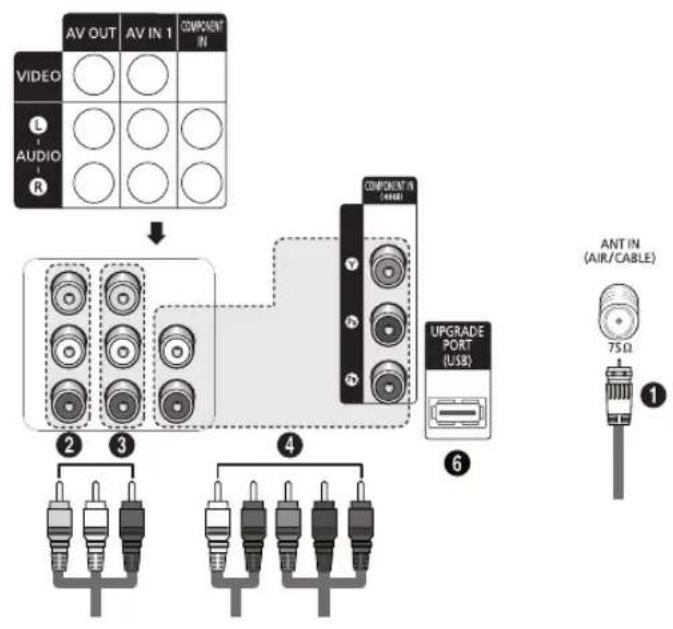
Use the rear panel jacks to connect A/V components that will be connected continuously, such as VCR or DVD players.
flowchart
graph TD
    A["VIDEO"] --> B["AV OUT"]
    A --> C["AV IN 1"]
    A --> D["COMPONENT IN"]
    B --> E["Component IN (4460)"]
    C --> E
    D --> E
    E --> F["UPGRADE PORT (USB)"]
    F --> G["ANT IN (AIR/CABLE)"]
    style A fill:#f9f,stroke:#333
    style G fill:#ccf,stroke:#333
The product color and shape may vary depending on the model.
Side of the TVRear of the TV
TX-T2781/TX-T2782
text_image
AV IN 2 VIDEO AUDIO 3TX-T2082

text_image
AV In 2 VDDI Service ID AUDIO ③ ⑤① ANT IN (AIR/CABLE)
Connect to an antenna(air) or cable TV system.
② AV OUT
Connect to the audio/video input jacks of a recording VCR.
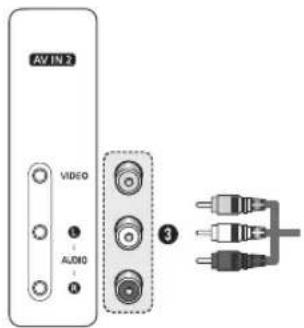
③ AV IN 1 / AV IN 2
Video and audio inputs for external devices, such as a camcorder or VCR.
④ COMPONENT IN
Connect Component video/audio.
⑤ Headphone
Connect a set of external headphones to this jack for private listening.
⑥ UPGRADE PORT (USB)
Connect for service and software upgrade.
Remote Control
You can use the remote control up to a distance of about 23 feet from the TV. When using the remote control, always point it directly at the TV.
This is a special remote control for the visually impaired, and has Braille points on the POWER, Channel, and Volume buttons.
◆ The performance of the remote control may be affected by bright light.
1 POWER
Turns the TV on and off.
② NUMERIC BUTTONS
Press to directly select a channel.
3 -
Press to select additional channels being broadcast by the same station. For example, to select channel "54-3", press "54", then press “-” and "3".
④ VOL +, VOL -
Press to increase or decrease the volume.
⑤ MENU
Displays the main on-screen menu.
6 UP ▲/DOWN ▼/LEFT ◀/RIGHT ▶/ENTER
Use to select on-screen menu items and change menu values.
7 S.MODE
Press to select the sound mode.
8 P.MODE
Press to select the picture mode.
9 AUTO PROG.
Press to automatically store selected Air/Cable channels.
10 ADD/DEL
Use to store and delete channels to/from memory.
11 PRE-CH
Tunes to the previous channel.
⑫ SOURCE
Press to display all of the available video sources.
13 INFO
Press to display information on the TV screen.
14 TV/DTV
Press to switch between TV (Analog) and DTV (Digital) mode.
⑮ CH /CH
Press to change channels.
16 EXIT
Press to exit from the menu.
17 MUTE
Press to temporarily cut off the sound.
18 P.SIZE
Press to change the screen size.
19 SLEEP
Press to select a preset time interval for automatic shut off.
20 MTS
Press to choose stereo, mono or Separate Audio Program(SAP broadcast).
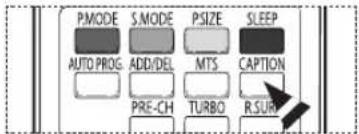
21 CAPTION
Controls the caption decoder.
22 R.SURF
Press to automatically return to a preferred channel after a user-preset time delay.
23 TURBO
Press to select Turbo sound.

text_image
POWER INFO SOURCE 1 2 3 4 5 6 7 8 9 - 0 TVDTV VOL CH + MUTE - MENU EXIT ENTER PMODE S MODE P SIZE SLEEP AUTO PROG ADG DEL MTS CAPITRUN PRE-CH TURBO R SURF SAMSUNGInstalling Batteries in the Remote Control
1 Lift the cover at the back of the remote control upward as shown in the figure.
2 Install two AAA size batteries.
Make sure to match the + and - ends of the batteries with the diagram inside the compartment.
◆ Do not mix battery types, i.e. alkaline and manganese.
3 Replace the cover.
Remove the batteries and store them in a cool and dry place if you won't be using the remote control for a long time. The remote control can be used up to about 23 feet from the TV. (Assuming typical TV usage, the batteries last for about one year.)

natural_image
Technical line drawing of a mechanical component with labeled parts and an arrow indicating rotation (no text or symbols present)Connecting VHF and UHF Antennas
Antennas with 300 Ω Flat Twin Leads
If you are using an off-air antenna(such as a roof antenna or "rabbit ears") that has 300 Ω twin flat leads, follow the directions below.
1 Place the wires from the twin leads under the screws on a 300-75 Ω adapter(not supplied). Use a screwdriver to tighten the screws.
2 Plug the adaptor into the ANT IN (AIR/CABLE) terminal on the back of the TV.
Antennas with 75 Ω Round Leads
1 Plug the antenna lead into the ANT IN (AIR/CABLE) terminal on the back of the TV.

text_image
1 ANT IN (AIR/CABLE) 2 75 Ω
Separate VHF and UHF Antennas
If you have two separate antennas for your TV(one VHF and one UHF), you must combine the two antenna signals before connecting the antennas to the TV. This procedure requires an optional combiner-adaptor(available at most electronics shops).
1 Connect both antenna leads to the combiner.
2 Plug the combiner into the ANT IN (AIR/CABLE) terminal on the back of the TV.

text_image
1 2 ANT IN (AIR/CABLE) 75ΩConnecting Cable TV
Cable without a Cable Box
1 Plug the incoming cable into the ANT IN (AIR/CABLE) terminal on the back of the TV. ➢ Because this TV is cable-ready, you do not need a cable box to view unscrambled cable channels.
Connecting to a Cable Box that Descrambles All Channels
1 Find the cable that is connected to the ANT OUT terminal on your cable box.
➢ This terminal might be labeled "ANT OUT", "VHF OUT" or simply, "OUT".
2 Connect the other end of this cable to the ANT IN (AIR/CABLE) terminal on the back of the TV.

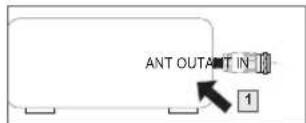
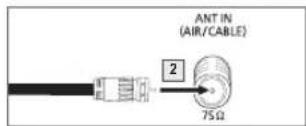
Connecting to a Cable Box that Descrambles Some Channels
If your cable box descrambles only some channels(such as premium channels), follow the instructions below. You will need a two-way splitter, an RF (A/B) switch, and four lengths of Antenna cable. (These items are available at most electronics stores.)

text_image
IN CABLE Cable Box
flowchart
graph LR
    A["Incoming cable"] --> B["Splitter"]
    B --> C["Cable Box"]
    C --> D["RF (A/B) Switch"]
    D --> E["TV Rear"]
    F["ANT IN AIR/CABLE"] --> G["6"]
    G --> H["5"]
    H --> I["3"]
    I --> J["4"]
    J --> K["6"]
    K --> L["75Ω"]
1 Find and disconnect the cable that is connected to the ANT IN terminal on your cable box.
➢ This terminal might be labeled "ANT IN", "VHF IN" or simply, "IN".
2 Connect this cable to a two-way splitter.
3 Connect an Antenna cable between an OUT terminal on the splitter and the IN terminal on the cable box.
4 Connect an Antenna cable between the ANT OUT terminal on the cable box and the B-IN terminal on the RF(A/B) switch.
5 Connect another cable between the other OUT terminal on the splitter and the A-IN terminal on the RF (A/B) switch.
6 Connect the last Antenna cable between the OUT terminal on the RF (A/B) switch and the ANT IN (AIR/CABLE) terminal on the back of the TV.
After you have made this connection, set the A/B switch to the "A" position for normal viewing. Set the A/B switch to the "B" position to view scrambled channels. (When you set the A/B switch to "B", you will need to tune your TV to the cable box's output channel, which is usually channel 3 or 4.)
Video Connection
These instructions assume that you have already connected your TV to an antenna or a cable TV system(according to the instructions on page 6). Skip step 1 if you have not yet connected to an antenna or a cable system.
◆ Each VCR has a different back panel configuration.
When connecting a VCR, match the color of the connection terminal to the cable.
1 Unplug the cable or antenna from the back of the TV.
2 Connect the cable or antenna to the ANT IN terminal on the back of the VCR.
3 Connect an Antenna cable between the ANT OUT terminal on the VCR and the ANT IN (AIR/CABLE) terminal on the TV.
4 Connect a Video Cable between the VIDEO OUT jack on the VCR and the AV IN 1 [VIDEO] jack on the TV.
5 Connect Audio Cables between the AUDIO OUT jacks on the VCR and the AV IN 1 [L-AUDIO-R] jacks on the TV.
If you have a "mono" (non-stereo) VCR, use a Y-connector(not supplied) to hook up to the right and left audio input jacks of the TV. If your VCR is stereo, you must connect two cables.
Also, you can connect to AV IN 2 on the side panel of TV.

flowchart
graph TD
    A["VCR"] --> B["2"]
    A --> C["3"]
    A --> D["4"]
    A --> E["5"]
    A --> F["Antenna cable(Not supplied)"]
    G["Rear of the TV"] --> H["60 VCR"]
    G --> I["70 VCR"]
    G --> J["80 VCR"]
    G --> K["90 VCR"]
    G --> L["100 VCR"]
    M["Audio Cable (Not supplied)"] --> N["Video Cable(Not supplied) 4"]
    O["Antenna cable(Not supplied)"] --> P["Video Cable(Not supplied) 4"]
Connecting a Camcorder
The side panel jacks on your TV make it easy to connect a camcorder to your TV. They allow you to view the camcorder tapes without using a VCR.
◆ Each Camcorder has a different back panel configuration. ◆ When connecting a Camcorder, match the color of the connection terminal to the cable.
1 Connect a Video Cable between the AV IN 2 [VIDEO] jack on the TV and the VIDEO OUT jack on the camcorder.
2 Connect Audio Cables between the AV IN 2 [L-AUDIO-R] jacks on the TV and the AUDIO OUT jacks on the camcorder.

flowchart
graph LR
    A["Camcorder"] --> B["Monitor"]
    A --> C["Audio Cable"]
    B --> D["1 Video Cable(Not supplied)"]
    C --> E["2 Audio Cable(Not supplied)"]
    D --> F["Side of the TV"]
    E --> F
Connecting a DVD Player/Set-Top Box
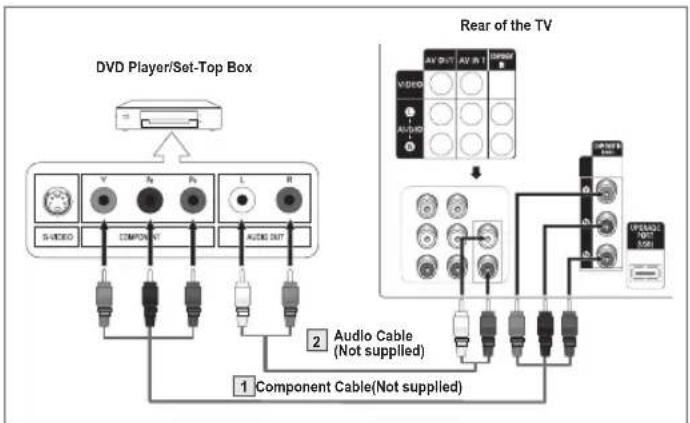
The rear panel jacks on your TV make it easy to connect a DVD player/Set-Top Box.

◆ Each DVD Player/Set-Top Box has a different back panel configuration.
When connecting a DVD Player/Set-Top Box, match the color of the connection terminal to the cable.
1 Connect Component Cables between the COMPONENT IN [Y, PB, PR] jacks on the TV and the COMPONENT OUT [Y, PB, PR] jacks on the DVD Player/Set-Top Box.
2 Connect Audio Cables between the COMPONENT IN [L-AUDIO-R] jacks on the TV and the AUDIO OUT jacks on the DVD Player/Set-Top Box.
Component video separates the video into Y(Luminance (brightness)), P_B(Blue) , and P_R(Red) for enhanced video quality. Be sure to match the component video and audio connections.
For example, if connecting the video cable to COMPONENT IN, connect the audio cable to COMPONENT IN also.
This product is an SD-grade DTV and must be connected in the resolution of 480i.
If this product is connected in the resolution of 480p, 720p or 1080i, the screen may be displayed abnormally or may not be displayed at all.
flowchart
graph TD
    A["DVD Player/Set-Top Box"] --> B["Component Cable (Not supplied)"]
    A --> C["Component Cable (Not supplied)"]
    A --> D["Audio Cable (Not supplied)"]
    A --> E["Audio Cable"]
    F["Rear of the TV"] --> G["TV 1200"]
    F --> H["TV 1201"]
    F --> I["TV 1202"]
    F --> J["TV 1203"]
    F --> K["TV 1204"]
    F --> L["TV 1205"]
    F --> M["TV 1206"]
    F --> N["TV 1207"]
    F --> O["TV 1208"]
    F --> P["TV 1209"]
    F --> Q["TV 1210"]
Connecting an Amplifier/DVD Home Theater - Analog

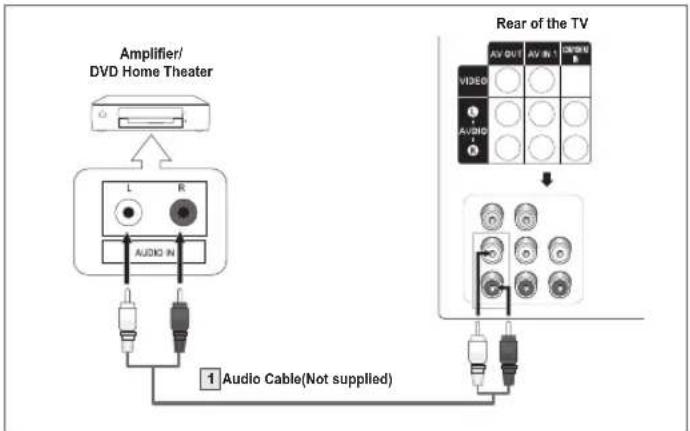
◆ Each Amplifier/DVD Home Theater has a different back panel configuration.
When connecting an Amplifier/DVD Home Theater, match the color of the connection terminal to the cable.
1 Connect Audio Cables between the AV OUT [L-AUDIO-R] on the TV and AUDIO IN on the Amplifier/DVD Home Theater.
When an audio amplifier is connected to the AUDIO OUT [L-AUDIO-R] terminals: Decrease the volume of the TV, and adjust the volume level with the Amplifier's volume control.
flowchart
graph TD
    A["Amplifier/ DVD Home Theater"] --> B["L"]
    A --> C["R"]
    B --> D["AUDIO IN"]
    C --> D
    D --> E["1 Audio Cable(Not supplied)"]
    F["Rear of the TV"] --> G["AV OUT AV IN COLD"]
    G --> H["VIDEO"]
    G --> I["AUDIO"]
    G --> J["Ground"]
Plug & Play Feature
When the TV is initially powered on, basic settings proceed automatically and subsequently:
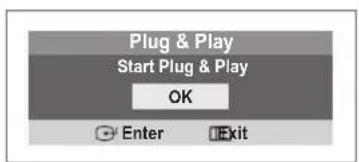
1 Press the POWER button on the remote control.
The message Start Plug & Play is displayed. Press the ENTER button, then the Language menu is displayed.
2 Press the ▲ or ▼ button to select the desired language, then press the ENTER button.
The message Select Home Mode when installing this TV at home. is displayed.
3 Press the ◀ or ▶ button to select Shop or Home, then press the ENTER button.
The Check antenna input. menu is displayed.
The default selection is Home.
We recommend setting the TV to Home mode for the best picture in your home environment.
◆ Shop mode is only intended for use in retail environments.
If the unit is accidentally set to Shop mode and you want to return to Dynamic (Home) mode, press the Volume button and then hold down the MENU button for five seconds on the TV panel.
4 Make sure that an antenna is connected to the TV.
Press the ENTER button, then the Antenna menu is displayed.
5 Press the ▲ or ▼ button to select the desired connection.
Press the ENTER button to memorize the channels of the selected connection.
6 Press the ENTER button to start.
First analog, then digital channels will be memorized.
When selecting Cable TV:
7 Press the ▲ or ▼ button to select Cable, then press the ENTER button.
The Cable System menu is displayed.
8 Press the ▲/▼/◄/► buttons to select the cable system for analog and digital channels respectively, then press the ENTER button.
9 Press the ENTER button to start. The TV begins memorizing all available channels. Press the ENTER button to stop.
After all available channels are stored, the Clock Set menu is displayed.
When you select Cable or Air+Cable, it also executes "Clearing Scrambled Channels" simultaneously. See page 15.
10 Press the ◀ or ▶ button to move to the hour or minute.
Set the clock by pressing the ▲ or ▼ button, then press the ENTER button.
11 The message Enjoy your watching. is displayed.
When you have finished, press the ENTER button.
Even if the ENTER button is not pressed, the message will automatically disappear after several seconds.
If you want to reset this feature...
1 Press the MENU button to display the menu.
Press the ▲ or ▼ button to select Setup, then press the ENTER button.
2 Press the ENTER button to select Plug & Play.
For further details on setting up options, refer to the top of this page.
The Plug & Play feature is only available in TV and DTV mode.
text_image
Plug & Play Start Plug & Play OK Enter Exit
text_image
Plug & Play Language English Español Français Move Enter Skip
text_image
Plug & Play Select Home Mode when installing this TV at home. Shop Home Move Enter Skip
text_image
Plug & Play Auto Program Air Cable Air+Cable Move Enter Skip
text_image
Plug & Play Auto Program Cable System Start Analog STD HRC IRC Digital STD HRC IRC Move Enter Skip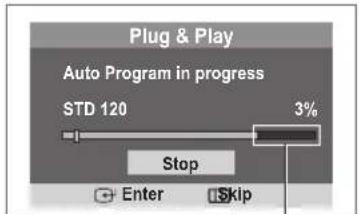
text_image
Plug & Play Auto Program in progress STD 120 3% Stop Enter SkipScrambled Channels Searched

text_image
Plug & Play Clock Set -- : -- am Move Enter Skip
text_image
Enjoy your watching. OKMemorizing the Channels
Your TV can memorize and store all of the available channels for both air and cable channels. After the available channels are memorized, use the CH and CH button to scan through the channels. This eliminates the need to change channels by entering the channel digits. There are three steps for memorizing channels: selecting a broadcast source, memorizing the channels(automatic) and adding or deleting channels(manual).
Selecting the Video Signal-source
Before your television can begin memorizing the available channels, you must specify the type of signal source that is connected to the TV(i.e. an air or a cable system).
1 Press the MENU button to display the menu.
Press the ▲ or ▼ button to select Channel, then press the ENTER button.
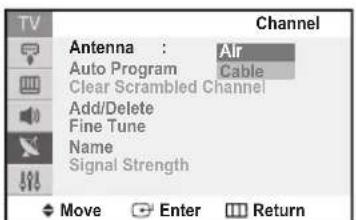
2 Press the ENTER button select Antenna.
Press the ▲ or ▼ button to select Air or Cable, then press the ENTER button.
Storing Channels in Memory (Automatic Method)
3 Press the ▲ or ▼ button to select Auto Program, then press the ENTER button.
4 Press the ▲ or ▼ button to select the antenna connection, then press the ENTER button.
5 Press the ENTER button to start.
First analog, then digital channels will be memorized.
When selecting Cable TV:
7 Press the ▲ or ▼ button to select Cable, then press the ENTER button.
The Cable System menu is displayed.
8 Press the ▲/▼/◄/► buttons to select the cable system for analog and digital channels respectively, then press the ENTER button.
➢ STD, HRC, and IRC identify various types of cable TV systems. Contact your local cable company to identify the type of cable system that exists in your particular area.
At this point the signal source has been selected.
9 Press the ENTER button to start.
The TV begins memorizing all available channels.
Press the ENTER button to stop.
When you select Cable or Air+Cable it also executes "Clearing Scrambled Channels" simultaneously. See page 15.
This TV can receive Digital HD (High Definition) signals, but converts them to SD (Standard Definition) for viewing.

You can also press the AUTO PROG. button on the remote control to bring up the Auto Program menu.
text_image
TV Antenna : Air Auto Program Cable Clear Scrambled Channel Add/Delete Fine Tune Name Signal Strength Move Enter Return
text_image
Channel Antenna : Air Auto Program Clear Scrambled Channel Add/Delete Fine Tune Name Signal Strength Move Enter Return
text_image
Auto Program Air Cable Air+Cable Move Enter Return
text_image
Auto Program Cable System Start Analog STD HRC IPC Digital STD HRC IPC Move Enter Return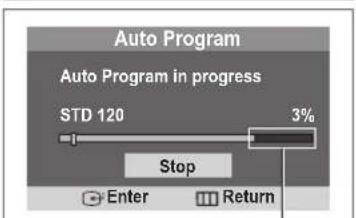
text_image
Auto Program Auto Program in progress STD 120 3% Stop Enter ReturnScrambled Channels Searched

text_image
PMODE S.MODE PSIZE SLEEP AUTO PROG ADD/DEL MTS CAPTION CH TURBO R.SURFTo Select the Source
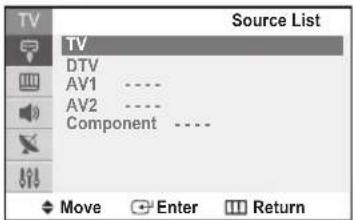
Use to select TV or other external input sources such as DVD players, VCRs, etc. connected to the TV.
1 Press the MENU button to display the menu. Press the ENTER button to select Input.
2 Press the ENTER button to select Source List.
Press the ▲ or ▼ button to select signal source, then press the ENTER button.
➢ You can choose between the following sets of jacks: TV, AV1, or Component on the TV's rear panel and AV2 on the TV's side panel.

Press the SOURCE button on the remote control to view an external signal source.
◆ In TV(Analog) mode: TV → AV1 → AV2 → Component
◆ In DTV(Digital) mode: DTV → AV1 → AV2 → Component
To check the input signals displayed, press the INFO button on the remote control.
text_image
Source List TV DTV AV1 ---- AV2 ---- Component ---- Move Enter Return
text_image
POWER INFO SOURCETo Edit the Input Source Name
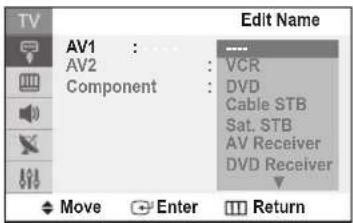
Name the external device connected to the input jacks to make your input source selection easier.
1 Press the MENU button to display the menu.
Press the ENTER button to select Input. Press the ▲ or ▼ button to select Edit Name, then press the ENTER button.
2 Press the ▲ or ▼ button to select AV1, AV2, or Component input jack, then press the ENTER button.
3 Press the ▲ or ▼ button to select VCR, DVD, Cable STB, Sat. STB, AV Receiver, DVD Receiver, Game, Camcorder, or DVD Combo input source, then press the ENTER button.
Press the EXIT button to exit.
text_image
TV Edit Name AV1 : ...... AV2 : VCR Component : DVD Cable STB Sat. STB AV Receiver DVD Receiver Move Enter ReturnUsing Automatic Picture Settings
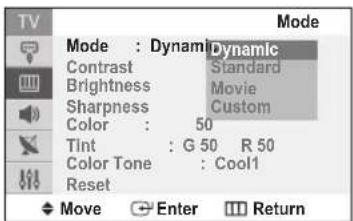
Your TV has four automatic picture settings ("Dynamic", "Standard", "Movie", "Custom") that are preset at the factory. You can activate a Picture Setting by making a selection from the menu.
1 Press the MENU button to display the menu.
Press the ▲ or ▼ button to select Picture, then press the ENTER button.
2 Press the ENTER button to select Mode.
Press the ENTER button again. Press the ▲ or ▼ button to select the Dynamic, Standard, Movie, or Custom picture setting, then press the ENTER button.
- Choose Dynamic for viewing the TV during the day or when there is bright light in the room.
- Choose Standard for general TV watching mode.
- Choose Movie when watching movies.
- Choose Custom if you want to adjust the settings according to personal preference.

Press the P.MODE button on the remote control to select one of the standard picture settings.
text_image
Mode Dynamic Contrast Standard Brightness Movie Sharpness Custom Color : 50 Tint : G 50 R 50 Color Tone : Cool1 Reset Move Enter Return
text_image
PMODE S.MODE PSIZE SLEEP AUTO PROX MODEL MTS CAPTION PRE-CH TURBO R.SURFContinued...
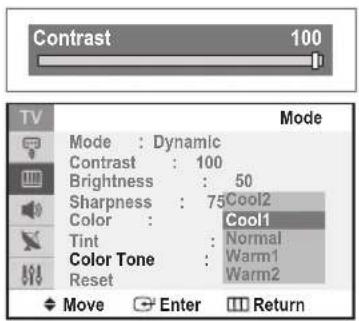
3 Press the ▲ or ▼ button to select Contrast, Brightness, Sharpness, Color, or Tint, then press the ENTER button.
4 Press the ◀ or ▶ button to decrease or increase the value of a particular item. ➤ You can not adjust the Tint in DTV, AV, or Component mode.
5 Press the ENTER button to return to Mode.
6 Press the ▲ or ▼ button to select Color Tone, then press the ENTER button.
7 Press the ▲ or ▼ button to select Cool2, Cool1, Normal, Warm1, or Warm2, then press the ENTER button.
Resetting the Picture Settings to the Factory Defaults
8 Press the ▲ or ▼ button to select Reset, then press the ENTER button.
Press the EXIT button to exit. ➢ Each picture mode can be reset.
text_image
Contrast 100 TV Mode Mode : Dynamic Contrast : 100 Brightness : 50 Sharpness : 75Cool2 Color : Cool1 Tint : Normal Color Tone : Warm1 Reset : Warm2 Move Enter ReturnChanging the Screen Size
You can select the picture size which best corresponds to your viewing requirements.
1 Press the MENU button to display the menu.
Press the ▲ or ▼ button to select Picture, then press the ENTER button.
2 Press the ▲ or ▼ button to select Size, then press the ENTER button.
3 Press the ▲ or ▼ button to select the screen format you want, then press the ENTER button.
Press the EXIT button to exit.
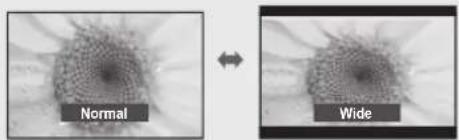
- Normal: Sets the picture to 4:3 normal mode.
- Zoom: Magnifies the size of the picture on the screen.
- Wide: Sets the picture to 16:9 wide mode.

text_image
TV Mode : Dynamic Size : Normal Normal Digital NR Zoom Tilt : 0 Move Enter Return
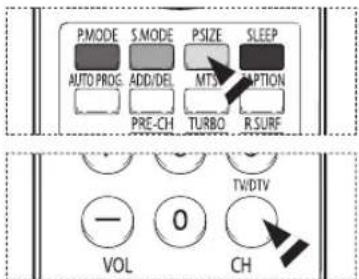
Press the P.SIZE button on the remote control repeatedly to change the picture size.
text_image
P.MODE S.MODE PSIZE SLEEP AUTO PROG ADD/DEL MTS CAPTION PRE-CH TURBO R.SURF TW/DTV VOL 0 CHChanging the screen size is determined by the TV signal type being viewed. Analog and Digital signals display different screen sizes.
◆ Analog TV Mode: Switching between Normal and Zoom is possible. The TV must be connected to Analog Air/Cable, or to an external device via Composite, S-Video or Component to view these screen sizes.
◆ Digital TV Mode: Switching between Normal and Wide is possible. The TV must be connected to Digital Air/Cable to view these screen sizes
To identify whether the current mode is TV Mode or DTV Mode, press the INFO button on the remote control. To switch between Analog and Digital Air/Cable mode, press the TV/DTV button on the remote.
Analog TV Mode

text_image
Normal ZoomDigital TV Mode
text_image
Normal WideDigital Noise Reduction
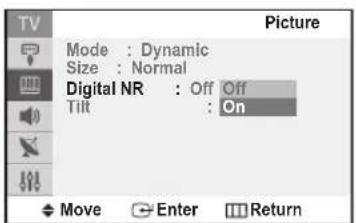
If the signal received by the television is weak, you can activate this feature to reduce any static and ghosting that may appear on the screen.
1 Press the MENU button to display the menu.
Press the ▲ or ▼ button to select Picture, then press the ENTER button.
2 Press the ▲ or ▼ button to select Digital NR, then press the ENTER button.
3 Press the ▲ or ▼ button to select Off or On, then press the ENTER button.
Press the EXIT button to exit.
text_image
Picture Mode : Dynamic Size : Normal Digital NR : Off Off Tilt : On Move Enter ReturnTilt (TX-T2781/TX-T2782 only)
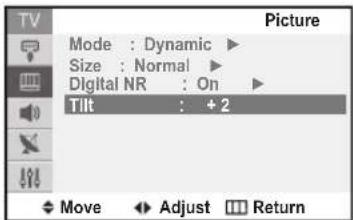
Due to the Earth's magnetic field there may be some minor image tilt depending on the TV's location. When this occurs, follow the steps below.
1 Press the MENU button to display the menu.
Press the ▲ or ▼ button to select Picture, then press the ENTER button.
2 Press the ▲ or ▼ button to select Tilt, then press the ENTER button.
3 Press the ◀ or ▶ button to adjust screen tilt.
Press the EXIT button to exit.
text_image
Picture Mode : Dynamic ▶ Size : Normal ▶ Digital NR : On ▶ Tilt : +2 Move Adjust ReturnUsing Automatic Sound Settings
Your TV has automatic sound settings ("Standard", "Music", "Movie", "Speech", and "Custom") that are preset at the factory. Or, you can select "Custom", which automatically recalls your personalized sound settings.
1 Press the MENU button to display the menu.
Press the ▲ or ▼ button to select Sound, then press the ENTER button.
2 Press the ENTER button to select Mode. Press the ▲ or ▼ button to select Standard, Music, Movie, Speech, or Custom sound setting, then press the ENTER button.
Press the EXIT button to exit.

text_image
TV Sound Mode : DynamicStandard Equalizer Music MTS : Movie Auto Volume Speech Pseudo Stereo Custom Turbo Plus : Off Move Enter Return- Choose Standard for the standard factory settings.
- Choose Music when watching music videos or concerts.
- Choose Movie when watching movies.
- Choose Speech when watching a show that is mostly dialog (i.e., news).
- Choose Custom to recall your personalized settings (see "Customizing the Sound").

Press the S.MODE button on the remote control repeatedly to select one of the standard sound settings.

text_image
P.MODE S.MODE PSIZE SLEEP AUTO.PROG ADD/DADD MITS CAPTION PRE-CH TURBO R.SURFCustomizing the Sound
The sound settings can be adjusted to suit your personal preference. (Alternatively, you can use one of the "automatic" settings.)
1 Press the MENU button to display the menu.
Press the ▲ or ▼ button to select Sound, then press the ENTER button.
2 Press the ▲ or ▼ button to select Equalizer, then press the ENTER button.
3 Press the ◀ or ▶ button to select a particular frequency to adjust.
Press the ▲ or ▼ button to increase or decrease the level of the particular frequency, then press the ENTER button.

text_image
Equalizer Move Adjust ReturnPress the EXIT button to exit.
R/L Sound Balance Adjustment:
To adjust the sound balance of the R/L speakers.
◆ Bandwidth Adjustment(100, 300, 1K, 3K, 10K):
To adjust the level of different bandwidth frequencies.
If you make any changes to the equalizer settings, the sound mode is automatically switched to the Custom.
Choosing a Multi-Channel Sound (MTS) Track - Digital
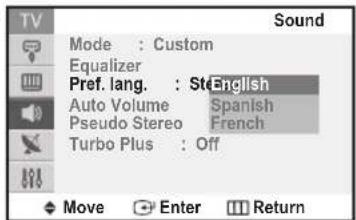
The digital-TV transmission system is capable of simultaneous transmission of many audio tracks (for example, simultaneous translations of the program into foreign languages). The availability of these additional “multitracks” depends upon the program.
1 Press the MENU button to display the menu.
Press the ▲ or ▼ button to select Sound, then press the ENTER button.
2 Press the ▲ or ▼ button to select Pref. lang., then press the ENTER button.
3 Press the ▲ or ▼ button to choose the language (English, Spanish, or French) you want, then press the ENTER button.
Press the EXIT button to exit.

Press the MTS button on the remote control to listen in a language other than the preferred language.
text_image
Sound Mode : Custom Equalizer Pref. lang. : St. English Auto Volume Spanish Pseudo Stereo French Turbo Plus : Off Move Enter Return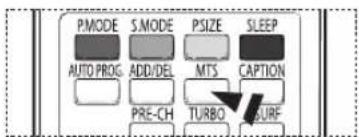
text_image
PMODE S MODE PSIZE SLEEP AUTO PROG ADD/DEL MTS CAPTION PRE-CH TURBO SURFChoosing a Multi-Channel Sound (MTS) Track - Analog
1 Press the MENU button to display the menu.
Press the ▲ or ▼ button to select Sound, then press the ENTER button.
2 Press the ▲ or ▼ button to select MTS, then press the ENTER button.
3 Press the ▲ or ▼ button to select a setting you want, then press the ENTER button.
Press the EXIT button to exit.
- Choose Mono for channels that are broadcasting in mono, or if you are having difficulty receiving a stereo signal.
- Choose Stereo for channels that are broadcasting in stereo.
- Choose SAP to listen to the Separate Audio Program, which is usually a foreign language translation.

text_image
TV Mode : Custom Equalizer MTS : Stereo Mono Auto Volume Stereo Pseudo Stereo SAP Turbo Plus : Off Move Enter Return
text_image
PMODE S.MODE PSIZE SLEEP AUTO PROG ADD/DEL MTS CAPTION PRE-CH TURBO SURF
Press the MTS button on the remote control repeatedly to select Mono, Stereo, or SAP.
Automatic Volume Control
Reduces the differences in volume level among broadcasters.
1 Press the MENU button to display the menu.
Press the ▲ or ▼ button to select Sound, then press the ENTER button.
2 Press the ▲ or ▼ button to select Auto Volume, then press the ENTER button.
3 Press the ▲ or ▼ button to select On or Off, then press the ENTER button.
Press the EXIT button to exit.

text_image
TV Sound Mode : Custom Equalizer MTS : Stereo Auto Volume : Off Pseudo Stereo : On Turbo Plus : Off Move Enter ReturnUsing Pseudo Stereo
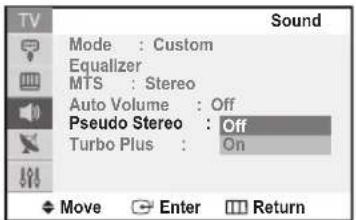
"Pseudo Stereo" converts a mono sound signal into two identical left and right channels. Once the "Pseudo Stereo" is set to "On" or "Off", the setting is applied to sound effects such as "Standard", "Music", "Movie", and "Speech".
1 Press the MENU button to display the menu.
Press the ▲ or ▼ button to select Sound, then press the ENTER button.
2 Press the ▲ or ▼ button to select Pseudo Stereo, then press the ENTER button.
3 Press the ▲ or ▼ button to select On or Off, then press the ENTER button.
Press the EXIT button to exit.
text_image
Sound Mode : Custom Equalizer MTS : Stereo Auto Volume : Off Pseudo Stereo : Off Turbo Plus : OnUsing Turbo Plus
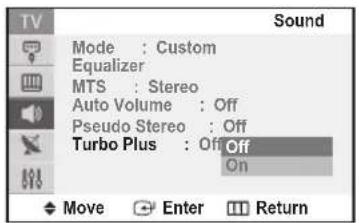
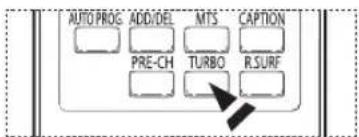
"Turbo Plus" emphasizes the bass and treble frequencies to add fullness to the sound.
1 Press the MENU button to display the menu.
Press the ▲ or ▼ button to select Sound, then press the ENTER button.
2 Press the ▲ or ▼ button to select Turbo Plus, then press the ENTER button.
3 Press the ▲ or ▼ button to select On or Off, then press the ENTER button.
Press the EXIT button to exit.
text_image
Sound Mode : Custom Equalizer MTS : Stereo Auto Volume : Off Pseudo Stereo : Off Turbo Plus : Off Off On Move Enter Return
Press the TURBO button on the remote control repeatedly to select On or Off.
text_image
AUTO PROG ADDI/DEL MTS CAPTION PRE-CH TURBO R.SURFClearing Scrambled Channels - Digital
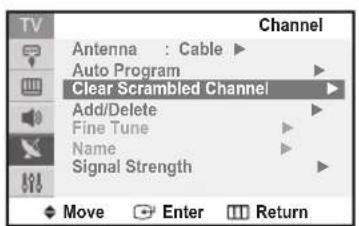
The Clear Scrambled Channel function is used to filter out scrambled channels after Auto Program is completed.
It removes the scrambled channels from the list by tuning the digital cable channels. This process may take up to 20\~30 minutes.
1 Press the MENU button to display the menu.
Press the ▲ or ▼ button to select Channel, then press the ENTER button.
2 Press the ▲ or ▼ button to select Clear Scrambled Channel, then press the ENTER button. It searches scrambled channels, which are to be removed from the list.
To stop searching scrambled channels;
Press the ▼ button to select Stop, then press the ENTER button.
Press the ◀ button to select Yes, then press the ENTER button.
3 When the scrambled channel searching is completed, press the ENTER button. Press the EXIT button to exit.
text_image
Channel Antenna : Cable ▶ Auto Program ▶ Clear Scrambled Channel ▶ Add/Delete ▶ Fine Tune ▶ Name ▶ Signal Strength ▶ Move Enter Return
text_image
Clear Scrambled Channel Removing Scrambled Channel. DTV STD 50-1 60% Stop Enter ReturnAdding and Erasing Channels - Analog
You can add or delete a channel to display the channels you want.
1 Press the MENU button to display the menu.
Press the ▲ or ▼ button to select Channel, then press the ENTER button.
2 Press the ▲ or ▼ button to select Add/Delete, then press the ENTER button.
3 Press the ▲ or ▼ button to select the desired channel, then press the ENTER button.
4 Press the ▲ or ▼ button to select Deleted or Added, then press the ENTER button.
Press the EXIT button to exit.

Press the ADD/DEL button on the remote control. Press the CH ∧ and CH ∨ button to select the channel to be added or deleted, then press the ENTER button.

text_image
Add/Delete ▲ More Air 2 : Deleted Air 3 : Added Air 4 : Deleted Air 5 : Deleted Air 6 : Deleted ▼ More ◆ Move Enter Return
text_image
PMODE S.MODE PSIZE SLEEP AUTO PROG ADD/DEL MTS CAPTION PRE-CH RUBO R.SURFAdding and Erasing Channels - Digital
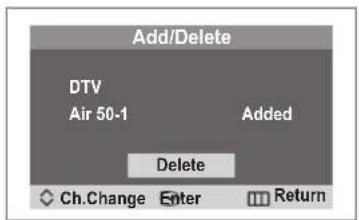
You can add or delete a DTV channel to display the DTV channels you want.
1 Press the MENU button to display the menu.
Press the ▲ or ▼ button to select Channel, then press the ENTER button.
2 Press the ▲ or ▼ button to select Add/Delete, then press the ENTER button.
3 Press the CH ∧ or CH ∨ button to select the desired channel, then press the ENTER button and select Delete or Add.
Press the EXIT button to exit.

Press the ADD/DEL button on the remote control. Press the CH ▲ and CH ▼ button to select the channel to be added or deleted, then press the ENTER button.
text_image
Add/Delete DTV Air 50-1 Added Delete Ch.Change Enter Return
text_image
PMODE S.MODE PSIZE SLEEP AUTO PROG ADD/DEL MTS CAPTION PRE-CH R/SURFFine Tuning Analog Channels - Analog
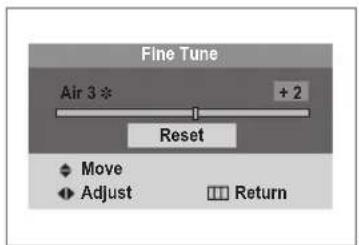
Use fine tuning to manually adjust a particular channel for optimal reception.
1 Press the MENU button to display the menu.
Press the ▲ or ▼ button to select Channel, then press the ENTER button.
2 Press the ▲ or ▼ button to select Fine Tune, then press the ENTER button.
3 Press the ◀ or ▶ button to adjust the fine tuning.
4 To store the fine tuning setting in the TV's memory, press the ENTER button. To reset the fine tuning setting, press the ▼ button to select Reset, then press the ENTER button.
Press the EXIT button to exit.
▶ Only analog TV channels can be fine tuned.
◆ “*” will appear next to the number of fine-tuned channels.
text_image
Fine Tune Air 3 * + 2 Reset Move Adjust ReturnLabeling Channels - Analog
Channels can be labeled so that their call letters appear whenever the channel is selected.
1 Press the MENU button to display the menu.
Press the ▲ or ▼ button to select Channel, then press the ENTER button.
Press the ▲ or ▼ button to select Name, then press the ENTER button.
2 Press the ▲ or ▼ button to select the channel to be assigned a new name, then press the ENTER button.
3 Press the ▲ or ▼ button to select a letter, a number or a blank(Results in this sequence: A\~Z, 0\~9, blank, *, -). Press the ▶ button to switch to the next field, which will be selected. Select a second letter or digit by pressing the ▲ or ▼ button, as above. Repeat the process to select the last two digits. When you have finished, press the ENTER button to assign the new name.
Press the EXIT button to exit.
The names of digital broadcasting channels are automatically assigned and thus cannot be assigned by users.
If you add or delete the TV channel, the corresponding label information will also be added or deleted.

text_image
Name ▲ More Air 2 : A Air 3 : ---- Air 4 : ---- Air 5 : ---- Air 6 : ---- ▼ More ◆ Move ◆ Adjust □ ReturnChecking the Digital-Signal Strength - Digital
Unlike analog channels, which can vary in reception quality from "snowy" to clear, digital(HDTV) channels have either perfect reception quality or you will not receive them at all. So, unlike analog channels, you cannot fine tune a digital channel. You can, however, adjust your antenna to improve the reception of available digital channels.
1 Press the MENU button to display the menu.
Press the ▲ or ▼ button to select Channel, then press the ENTER button.
2 Press the ▲ or ▼ button to select Signal Strength, then press the ENTER button. If the signal strength meter indicates that the signal is weak, physically adjust your antenna to increase the signal strength. Continue to adjust the antenna until you find the best position with the strongest signal.
Press the EXIT button to exit.
You can also press the ENTER button to select OK, then press the EXIT button to exit.

bar
Signal Strength | Category | Signal Strength | |---|---| | 1 | 3.0 | | 2 | 4.0 | | 3 | 5.0 | | 4 | 6.0 | | 5 | 7.0 | | 6 | 8.0 | | 7 | 9.0 | | 8 | 10.0 | | 9 | 11.0 | | 10 | 12.0 | | 11 | 13.0 | | 12 | 14.0 | | 13 | 15.0 | | 14 | 16.0 | | 15 | 17.0 | | 16 | 18.0 | | 17 | 19.0 | | 18 | 20.0 | | 19 | 21.0 | | 20 | 22.0 | | 21 | 23.0 | | 22 | 24.0 | | 23 | 25.0 | | 24 | 26.0 | | 25 | 27.0 | | 26 | 28.0 | | 27 | 29.0 | | 28 | 30.0 | OKUsing the R.Surf Feature
This feature allows you to set the TV to return to a particular channel after a certain amount of time. For example, you may be watching a channel when commercials start. You can set the R.Surf to "5 minutes", then switch channels. After 5 minutes, the TV will return to the original channel. To use the R.Surf feature:
1 While you are watching the channel to which you want to return, press the R.SURF button. The Surf Off is displayed.
2 Press the R.SURF button again to set the timer in thirty second intervals, up to five minutes.
The time will start decreasing while you are setting up the timer, and will reset after 5 minutes has passed or you turn it off.
3 The time you set will begin counting down on the screen.
When the time runs out, the TV will return to the channel you were watching when you set the timer.

text_image
AUTO PROG. ADD/DEL MTS CAPTION PRE-CH TURBO R.SURF
text_image
Surf 00:29Selecting a Menu Language
1 Press the MENU button to display the menu.
Press the ▲ or ▼ button to select Setup, then press the ENTER button.
2 Press the ▲ or ▼ button to select Language, then press the ENTER button.
3 Press the ▲ or ▼ button to select the appropriate language: English, Español or Français, then press the ENTER button.
Press the EXIT button to exit.

text_image
Language English Español Français Move Enter ReturnSetting the Time
Setting the clock is necessary in order to use the various timer features of the TV. Also, you can check the time while watching the TV. (Just press the INFO button.)
1 Press the MENU button to display the menu. Press the ▲ or ▼ button to select Setup, then press the ENTER button. Press the ▲ or ▼ button to select Time, then press the ENTER button.
2 Press the ENTER button to select Clock.
3 Press the ◀ or ▶ button to move to the hour or minute.
Set the clock by pressing the ▲ or ▼ button, then press the ENTER button.
Press the EXIT button to exit.
The current time will appear every time you press the INFO button.
Setting the Sleep Timer
The Sleep Timer automatically shuts off the TV after a preset time(from 30 to 180 minutes).
1 Press the MENU button to display the menu. Press the ▲ or ▼ button to select Setup, then press the ENTER button. Press the ▲ or ▼ button to select Time, then press the ENTER button.
2 Press the ▲ or ▼ button to select Sleep Timer, then press the ENTER button.
3 Press the ▲ or ▼ button to select the minutes.
To cancel the set sleep timer:
Press the ▲ or ▼ button to select Off, then press the ENTER button.
Press the EXIT button to exit.

Press the SLEEP button on the remote control until the appropriate time interval appears (any of the preset values from 30 min to 180 min).
Setting the On/Off Timer
Use this feature to set the TV to turn on or off at a desired time. You must set the clock first.
1 Press the MENU button to display the menu. Press the ▲ or ▼ button to select Setup, then press the ENTER button. Press the ▲ or ▼ button to select Time, then press the ENTER button.
2 Press the ▲ or ▼ button to select On Timer, then press the ENTER button.
3 Press the ▲ or ▼ button to set the hour, then press the ▶ button to move to the next step. Set other items using the same method as above.
When finished, press the MENU button to return.
4 Press the ▲ or ▼ button to select Off Timer, then press the ENTER button.
5 Press the ▲ or ▼ button to set the hour, then press the ▶ button to move to the next step. Set other items using the same method as above.
When finished, press the MENU button to return.
Auto Power Off
When you set the timer "On", the TV will eventually turn off if no controls are operated for 3 hours after the TV was turned on by timer. This function is only available in timer "On" mode and prevents overheating, which may occur if a TV is on for too long time.
Setting the Preferred Option
The preferred TV source, antenna, channel and volume can be set for when the timer automatically turns on the TV.
6 Press the ▲ or ▼ button to select On Timer Source, then press the ENTER button. Press the ▲ or ▼ button to select TV or DTV, then press the ENTER button.
7 Press the ▲ or ▼ button to select On Timer Antenna, then press the ENTER button. Press the ▲ or ▼ button to select Air or Cable, then press the ENTER button.
8 Press the ▲ or ▼ button to select On Timer Channel or On Timer Volume. Press the ◀ or ▶ button to select the desired channel or adjust volume level.
Press the EXIT button to exit.

text_image
TV Clock 12 : 00 am Sleep Timer : Off ▶ On Timer --: -- am Off Off Timer --: -- am Off On Timer Source : TV ▶ On Timer Antenna : Air ▶ On Timer Channel : 3 On Timer Volume : 10 Move Adjust Return
text_image
Time Clock 09 : 30 am Sleep Timer : Off On Timer --: 30 Off Timer --: 60 On Timer Source 90 On Timer Antenna 120 On Timer Channel 150 On Timer Volume 180 Move Enter Return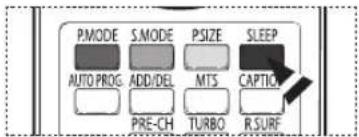
text_image
P.MODE S.MODE PSIZE SLEEP AUTO PROG ADD/DEL MTS CAPTIC PRE-CH TURBO R.SURE
text_image
TV Clock 09 : 30 am Sleep Timer : Off ▶ On Timer 12 : 00 am Off Off Timer --: - am Off On Timer Source : TV ▶ On Timer Antenna : Air ▶ On Timer Channel : 3 On Timer Volume : 10 Move Adjust Return
text_image
TV Clock 09 : 30 am Sleep Timer : Off ▶ On Timer 06 : 30 am On Off Timer 11 : 00 pm On On Timer Source : TV ▶ On Timer Antenna : Air ▶ On Timer Channel : 3 On Timer Volume : 10 Move Adjust Return
text_image
TV Clock 09 : 30 am Sleep Timer : Off On Timer 06 : 30 am On Off Timer 11 : 00 pm On On Timer Source : TV On Timer Antenna : DTV On Timer Channel : 3 On Timer Volume : 10 Move Enter ReturnViewing Closed Captions(On-Screen Text Messages) - Digital
The Digital Captions function operates on digital channels.
1 Press the MENU button to display the menu.
Press the ▲ or ▼ button to select Setup, then press the ENTER button.
2 Press the ▲ or ▼ button to select Caption, then press the ENTER button.
3 Press the ENTER button to select Caption. Press the ▲ or ▼ button to select On, then press the ENTER button.
4 Press the ▲ or ▼ button to select Mode, then press the ENTER button.
Press the ▲ or ▼ button to select the submenu (Default, Service1\~Service6, CC1\~CC4, or Text1\~Text4) you want, then press the ENTER button.
5 Press the ▲ or ▼ button to select Options, then press the ENTER button.
6 Press the ENTER button to select Size. Press the ▲ or ▼ button to select the desired caption option, then press the ENTER button. Press the ▲ or ▼ button to select the desired sub-menu options(see options below), then press the ENTER button.
Press the EXIT button to exit.

text_image
Caption Caption : On Default Mode : Service1 Options Service2 Service3 Service4 Service5 Service6 CC1 Move Enter Return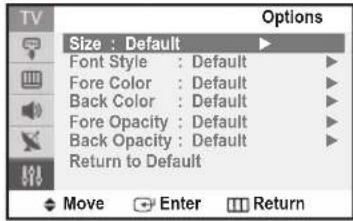
text_image
TV Size : Default Font Style : Default Fore Color : Default Back Color : Default Fore Opacity : Default Back Opacity : Default Return to Default Move Enter ReturnThe availability of captions depends on the program being broadcast.
◆ Default means to follow the standard set by the broadcaster.
◆ Fore(Foreground) and Back cannot be set to have the same color.
◆ Fore Opacity and Back Opacity cannot be both set to Transparent.
- Size: This option consists of Default, Small, Standard, and Large. The default is Standard.
- Font Style: This option consists of Default, Style0 \~ Style7. You can change the font you want.
The default is Style0.
- Fore Color: This option consists of Default, White, Black, Red, Green, Blue, Yellow, Magenta, and Cyan. You can change the color of the letter. The default is White.
- Back Color: This option consists of Default, White, Black, Red, Green, Blue, Yellow, Magenta, and Cyan. You can change the background color of the caption. The default is Black.
- Fore Opacity: This option consists of Default, Solid, Flashing, Translucent, and Transparent.
You can change the opacity of the letter
- Back Opacity: This option consists of Default, Solid, Flashing, Translucent, and Transparent.
You can change the background opacity of the caption.
- Return to Default: This option sets each of Size, Font Style, Fore Color, Back Color, Fore Opacity, and Back Opacity to its factory default.

You can also press the CAPTION button on the remote control to select Captions On or Off.

text_image
PMODE S.MODE PSIZE SLEEP AUTO PROG ADD/DEL MTS CAPTION PRE-CH TURBO R.SURVViewing Closed Captions(On-Screen Text Messages) - Analog
The Analog Caption function operates in either analog TV channel mode or external signal mode. (Depending on the broadcasting signal, the Analog Caption function may operate on digital channels.)
1 Press the MENU button to display the menu.
Press the ▲ or ▼ button to select Setup, then press the ENTER button.
2 Press the ▲ or ▼ button to select Caption, then press the ENTER button.
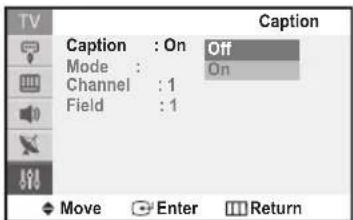
3 Press the ENTER button to select Caption.
Press the ▲ or ▼ button to select On, then press the ENTER button.
Misspellings and unusual characters sometimes occur during closed caption transmissions, especially those of live events. There may be a small delay before captions appear when you change channels. These are not malfunctions of the TV.
text_image
Caption Caption : On Off Mode : On Channel : 1 Field : 1 Move Enter Return4 Press the ▲ or ▼ button to select Mode, then press the ENTER button.
Press the ▲ or ▼ button to select the Caption or Text, then press the ENTER button.
In Caption mode, captions appear at the bottom of the screen, and they usually cover only a small portion of the picture.
In Text mode, information unrelated to the program, such as news or weather, is displayed. Text often covers a large portion of the screen.
5 Depending on the particular broadcast, it might be necessary to make changes to Channel and Field. Press the ▲ or ▼ button to select Channel or Field, then press the ENTER button. Press the ▲ or ▼ button to select 1 or 2, then press the ENTER button.
Different channels and fields display different information: Field 2 carries additional information that supplements the information in Field 1. (For example, Channel 1 may have subtitles in English, while Channel 2 has subtitles in Spanish.)
Press the EXIT button to exit.

You can also press the CAPTION button on the remote control to select Captions On or Off.
text_image
P.MODE S.MODE PSIZE SLEEP AUTO PROG ADD/DEL MTS CAPTION PRE-CH TURBO R.SURVSetting the Blue Screen Mode
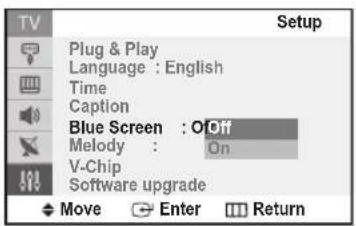
If no signal is being received or the signal is very weak, a blue screen automatically replaces the noisy picture background. If you wish to continue viewing the poor picture, you must set the "Blue Screen" mode to "Off".
1 Press the MENU button to display the menu.
Press the ▲ or ▼ button to select Setup, then press the ENTER button.
2 Press the ▲ or ▼ button to select Blue Screen, then press the ENTER button. Press the ▲ or ▼ button to select On or Off, then press the ENTER button.
Press the EXIT button to exit.
text_image
Setup Plug & Play Language : English Time Caption Blue Screen : Off Melody : On V-Chip Software upgrade Move Enter ReturnSetting the On/Off Melody
A melody sound can be set to come on when the TV is powered On or Off.
1 Press the MENU button to display the menu.
Press the ▲ or ▼ button to select Setup, then press the ENTER button.
2 Press the ▲ or ▼ button to select Melody, then press the ENTER button. Press the ▲ or ▼ button to select On or Off, then press the ENTER button.
Press the EXIT button to exit.

text_image
Setup Plug & Play Language : English Time Caption Blue Screen : Off Melody : On Off V-Chip On Software upgrade Move Enter ReturnTRADEMARK & LABEL LICENSE NOTICE
DOLBY Manufactured under license from Dolby Laboratories. Dolby and the double-D DIGITAL symbol are trademarks of Dolby Laboratories.
Using the V-Chip
U.S.A Only
This product is covered by the following U.S. patents : US4,930,158 US4,930,160
The V-Chip feature automatically locks out programs that are deemed inappropriate for children. The user must enter a PIN(Personal ID number) before any of the V-Chip restrictions are set up or changed.
How to Enable/Disable the V-Chip
1 Press the MENU button to display the menu. Press the ▲ or ▼ button to select Setup, then press the ENTER button.
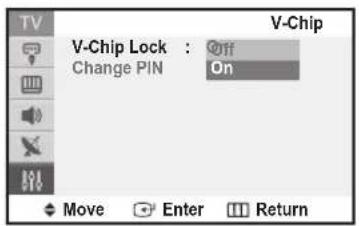
2 Press the ▲ or ▼ button to select V-Chip, then press the ENTER button. The message Enter PIN will appear. Enter your 4 digit PIN. ➢ The default PIN of a new TV set is "0-0-0-0".
3 The V-Chip screen will appear. To enable the V-Chip feature, press the ENTER button so that the V-Chip Lock field is On. (Pressing the ▲ or ▼ button will alternate between On and Off.)
text_image
V-Chip V-Chip Lock : Off Change PIN On Move Enter ReturnContinued...
Setting Up Your Personal ID Number(PIN)
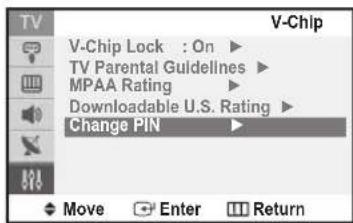
4 Press the ▲ or ▼ button to select Change PIN, then press the ENTER button.
5 The Enter New PIN screen will appear. Choose any 4 digits for your PIN and enter them. As soon as the 4 digits are entered, the Confirm New PIN screen appears. Re-enter the same 4 digits. When the Confirm screen disappears, your PIN has been memorized.
If you forget the PIN, press the remote control buttons in the following sequence, which resets the pin to 0-0-0-0 : Power Off → MUTE → 8 → 2 → 4 → Power On.
How to Set up Restrictions Using the 'TV Parental Guidelines'
First, set up a personal identification number(PIN), and enable the V-Chip. (See previous section.)
Parental restrictions can be set up using either of two methods: The TV guidelines or the MPAA rating.
6 Press the ▲ or ▼ button to select TV Parental Guidelines, then press the ENTER button.
7 Press the ▲ or ▼ button to select one of the six aged based categories:
• TV-Y: Young children.
• TV-Y7: Children 7 and over.
• TV-G: General audience.
• TV-PG: Parental guidance.
• TV-14: Viewers 14 and over.
• TV-MA: Mature audience.
8 Press the ▶ button. Press the ▲ or ▼ button to select B or U. (U: Unblocked, B: Blocked) Press the MENU button to save. To select a different TV-Rating, press the ▲ or ▼ button and then repeat the process.
The TV-Y, TV-Y7, TV-G, TV-PG, TV-14 and TV-MA have additional options. See the next step to change any of the following sub-ratings.
- FV: Fantasy violence.
• D: Sexually suggestive dialog.
L: Adult language.
- S: Sexual situation.
♦ V: Violence.
text_image
V-Chip V-Chip Lock : On ▶ TV Parental Guidelines ▶ MPAA Rating ▶ Downloadable U.S. Rating ▶ Change PIN ▶ Move Enter Return
text_image
V-Chip V-Chip Lock : On ▶ TV Parental Guidelines ▶ MPAA Rating ▶ Canadian English ▶ Canadian French ▶ Downloadable U.S. Rating ▶ Change PIN ▶ Move Enter Return
text_image
TV Parental Guidelines ALL FV S L D TV-Y B TV-Y7 B B TV-G U TV-PG U U U U U TV-14 U U U U U TV-MA U U U U B: Blocked U: Unblocked Move Adjust ReturnThe V-Chip will automatically block certain categories that are "more restrictive". For example, if you block TV-Y category, then TV-Y7 will automatically be blocked. Similarly, if you block the TV-G category, then all the categories in the "young adult" group will be blocked (TV-G, TV-PG, TV-14, and TV-MA). The sub-ratings (D, L, S, V) work together similarly. (See next section.)
9 How to set the FV, V, S, L, and D sub-ratings. First, select one of these TV-Ratings: TV-Y, TV-Y7, TV-G, TV-PG, TV-14, or TV-MA (See Step 7), and press the ▶ button. The B will be displayed for each sub-rating. While B is selected, press the ▶ button to go to a sub rating. Press the ▲ or ▼ to block the sub rating. Press the MENU button to save. To select a different TV-Rating, press the ▲ or ▼ button and then repeat the process.
The V-chip will automatically block certain categories that are "more restrictive". For example, if you block L sub-rating in TV-PG, then the L sub-ratings in TV-14 and TV-MA will automatically be blocked.
These categories consist of two separate groups: TV-Y and TV-Y7 (young children through age 7), and TV-G through TV-MA (everybody else). The restrictions for these two groups work independently: If a household includes very young children as well as young adults, the TV guidelines must be set up separately for each age group.
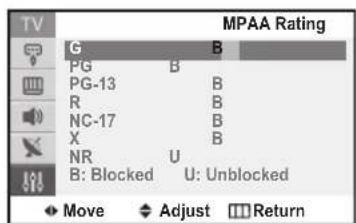
How to Set up Restrictions Using the MPAA Ratings: G, PG, PG-13, R, NC-17, X, NR
The MPAA rating system uses the Motion Picture Association of America (MPAA) system, and its main application is for movies. When the V-Chip lock is on, the TV will automatically block any programs that are coded with objectionable ratings (either MPAA or TV-Ratings).
10 Press the ▲ or ▼ button to select MPAA Rating, then press the ENTER button.
11 Press the ▲ or ▼ button to select an appropriate restriction. Press the ▶ button, then press the ▲ or ▼ button to select B or U (U: Unblocked, B: Blocked). Press the MENU button to save.
• G: General audience(no restriction).
♦ PG: Parental guidance suggested.
♦ PG-13: Parents strongly cautioned
- R: Restricted. Children under 17 should be accompanied by an adult.
- NC-17: No children under age 17.
- X: Adults only.
- NR: Not rated.
text_image
MPAA Rating G B PG B PG-13 B R B NC-17 B X B NR U B: Blocked U: Unblocked Move Adjust ReturnThe V-Chip will automatically block any category that is "more restrictive". For example, if you block the PG-13 category, then R, NC-17, and X will automatically be blocked also.
Continued...
How to Set up Restrictions Using the 'Canadian English' (for Canada Models)
12 Press the ▲ or ▼ button to select Canadian English, then press the ENTER button.
13 Press the ▲ or ▼ button to select an appropriate restriction. Press the ▶ button.
Press the ▲ or ▼ button to select B or U (U: Unblocked, B: Blocked). Press the MENU button to save.
E: Exempt programming includes...news, sports, documentaries and other information programming, talk shows, music videos, and variety programming.
• C: Programming intended for children under age 8.
C8+: Programming generally considered acceptable for children 8 years and over to watch on their own.
- G: General programming, suitable for all audiences.
- PG: Parental guidance.
14+: Programming contains themes or content which may not be suitable for viewers under the age of 14.
- 18+: Adult programming.

text_image
Canadian English E B C U C8+ U G U PG U 14+ U 18+ U B: Blocked U: Unblocked Move Adjust ReturnThe V-Chip will automatically block any category that is "more restrictive". For example, if you block G category, then PG, 14+, and 18+ will automatically be blocked also.
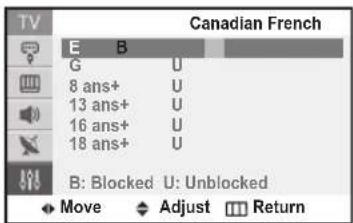
How to Set up Restrictions Using the 'Canadian French' (for Canada Models)
14 Press the ▲ or ▼ button to select Canadian French, then press the ENTER button.
15 Press the ▲ or ▼ button to select a appropriate restriction. Press the ▶ button. Press the ▲ or ▼ button to select B or U (U: Unblocked, B: Blocked). Press the MENU button to save.
- E: Exempt programming includes...news, sports, documentaries and other information programming, talk shows, music videos, and variety programming.
G: General. - 8 ans+: Not recommended for young children.
- 13 ans+: Programming may not be suitable for children under the age of 13.
◆ 16 ans+: Programming is not suitable for children under the age of 16. - 18 ans+: Programming restricted to adults.
text_image
TV Canadian French E B G U 8 ans+ U 13 ans+ U 16 ans+ U 18 ans+ U B: Blocked U: Unblocked Move Adjust ReturnThe V-Chip will automatically block any category that is "more restrictive". For example, if you block 8 ans+ category, then 13 ans+, 16 ans+, and 18 ans+ will automatically be blocked also.
Using the V-Chip for Digital channels
Parental restriction information can be used while watching DTV channels.
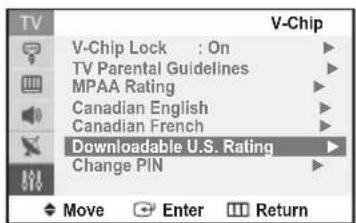
16 Press the ▲ or ▼ button to select Downloadable U.S. Rating, then press the ENTER button.
If information is not downloaded from the broadcasting station, the Downloadable U.S. Rating menu is deactivated.
◆ Parental restriction information is automatically downloaded while watching DTV channels. It may take several seconds.
The Downloadable U.S. Rating menu is available for use after information is downloaded from the broadcasting station. However, depending on the information from the broadcasting station, it may not be available for use.
17 Press the ▲ or ▼ button to select an appropriate restriction. Press the ENTER button to activate the restriction selected. The Lock symbol is indicated.
Press the EXIT button to exit.
Allow All: Press to unlock all TV ratings. Block All: Press to lock all TV ratings.
◆ Parental restriction levels differ depending on the broadcasting station.
◆ The default menu name and Downloadable US rating changes depending on the downloaded information.
Even if you set the On-screen display to your desired language, the Downloadable U.S. Rating menu will appear in English only.
◆ The rating will automatically block certain categories that are more restrictive.
The rating titles (for example: Humor Level...etc) and TV ratings (for example: NV, MV, V...etc) may differ depending on the broadcasting station.
text_image
V-Chip V-Chip Lock : On TV Parental Guidelines MPAA Rating Canadian English Canadian French Downloadable U.S. Rating Change PIN Move Enter Return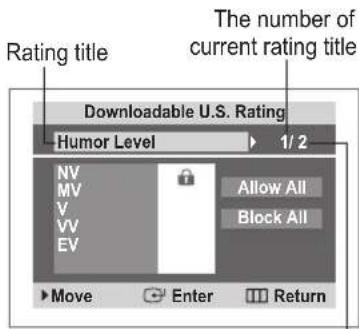
text_image
The number of current rating title Downloadable U.S. Rating Humor Level 1/2 NV MV V VV EV Allow All Block All Move Enter ReturnThe number of all rating title
Upgrading the Software
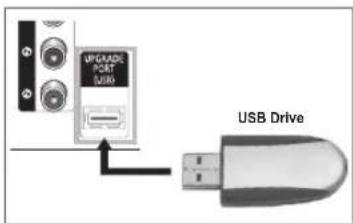
Samsung may offer upgrades for your TV's firmware in the future. Please contact the Samsung call center at 1-800-SAMSUNG to receive information about downloading upgrades and using a USB drive. Upgrades will be possible by connecting a USB drive to the USB port located on the back of your TV.
1 Insert a USB drive containing the firmware upgrade into the USB Upgrade Port on the back of the TV.
2 Press the MENU button to display the menu.
Press the ▲ or ▼ button to select Setup, then press the ENTER button.
3 Press the ▲ or ▼ button to select Software upgrade, then press the ENTER button.
4 Press the ▲ or ▼ button to select USB Upgrade, then press the ENTER button.
The message Scanning for USB... It may take up to 30 seconds. is displayed.
Please be careful to not disconnect the power or remove the USB drive while upgrades are being applied.
The TV will shut off and turn on automatically after completing the firmware upgrade.
Please check the firmware version after the upgrades are complete.
The firmware and upgrade process may be different by country and region.
text_image
UPGRADE ADC (USB) USB Drive
text_image
TV Software upgrade USB Upgrade Move Enter Return
text_image
USB Upgrade Scanning for USB... It may take up to 30 seconds.Identifying Problems
If the TV seems to have a problem, first try this list of possible problems and solutions. If none of these troubleshooting tips apply, call your nearest Samsung service center.
| Problem Possible Solution | |
| Poor picture quality. Try another channel. | Adjust the antenna.Check all wire connections. |
| Poor sound quality. Try another channel. | Adjust the antenna. |
| No picture or sound. Try another channel. | Press the SOURCE button.Make sure the TV is plugged in.Check the antenna connections.Make sure the MUTE button is off. |
| No sound or sound is too low at maximum volume. | First, check the volume of units connected to your TV (digital broadcasting receiver, DVD, cable broadcasting receiver, VCR, etc.). Then, adjust the TV volume accordingly. |
| Picture rolls vertically. Check all connections. | |
| The TV operates erratically. Unplug the TV for 30 seconds, then try operating it again. | |
| The TV won't turn on. | Make sure the wall outlet is working. |
| Remote control malfunctions Replace the remote control batteries.Clean the upper edge of the remote control(transmission window).Check the battery terminals.Press the TV/DTV button to put your remote control in the "TV" mode.Make sure the remote has batteries.Check that the "+" and "-" ends of the batteries are inserted correctly. | |
| Digital broadcasting screen problem. Please check the digital signal strength and input antenna. | |
| The image is too light or too dark. Adjust the Brightness and Contrast.Adjust the Fine tuning. | |
| The visual qualities of digital channels vary. | The visual qualities of digital channels may vary depending on the original production method(analog or digital).- If the original production method is digital: High visual quality program.- If the original production method is analog: The digital program displayed on the screen is originally an analog program which has been converted to digital. The visual quality is of an SD(Standard Definition) grade. |
| Although the TV caption shows HD, the visual quality is not satisfactory. | The HD(High Definition) caption that appears when switching channels or when pressing the Information button on the remote control means the selected channel is a digital channel. If the broadcasting station converts an analog signal into digital and transmits the signal, the visual quality may not be perfect. |
Specifications
| Model Name TX-T2781 TX-T2782 TX-T2082 | ||||
| Screen Size (Diagonal) 27 inches 20 inches | ||||
| Sound Output 5W X 2 | ||||
| Dimensions (WxHxD) Body | 30.35 x 23.34x 16.53 inches / 771 x 593 x 420 mm | 31.33 x 23.34 x 16.57 inches / 796 x 593 x 421 mm | 23.77 x 18.58 x 14.19 inches / 604 x 472 x 360.5 mm | |
| Weight | 90.38 lbs / 41 Kg 94.79 lbs / 43 Kg 44.09 lbs / 20 Kg | |||
| Environmental Considerations | Operating Temperature Operating Humidity Storage Temperature Storage Humidity | 50 °F to 104 °F (10 °C to 40 °C) 10% to 80%, non-condensing -4 °F to 113 °F (-20 °C to 45 °C) 5% to 95%, non-condensing | ||
Design and specifications are subject to change without prior notice.
◆ For the power supply, refer to the label attached to the product.
Contact SAMSUNG WORLD-WIDE
If you have any questions or comments relating to Samsung products, please contact the SAMSUNG customer care center.
| Country | Customer Care Center 📞 | Web Site | Address |
| CANADA 1-800-SAMSUNG (7267864) www.samsung.com/ca | Samsung Electronics Canada Inc., Customer Service55 Standish Court Mississauga, Ontario L5R 4B2Canada | ||
| Samsung Electronique Canada Inc., Service à la Clientèle55 Standish Court Mississauga, Ontario L5R 4B2Canada | |||
| U.S.A 1-800-SAMSUNG (7267864) www.samsung.com | Samsung Electronics America, Inc.105 Challenger RoadRidgefield Park, NJ 07660-0511 | ||