UA50HU7000J - Television SAMSUNG - Free user manual and instructions
Find the device manual for free UA50HU7000J SAMSUNG in PDF.


User questions about UA50HU7000J SAMSUNG
0 question about this device. Answer the ones you know or ask your own.
Ask a new question about this device
Download the instructions for your Television in PDF format for free! Find your manual UA50HU7000J - SAMSUNG and take your electronic device back in hand. On this page are published all the documents necessary for the use of your device. UA50HU7000J by SAMSUNG.
USER MANUAL UA50HU7000J SAMSUNG
Thank you for purchasing this Samsung product. To receive more complete service, please register your product at
www.samsung.com/register
Model____ Serial No.____
Contents
Quick Guide
Using the Smart TV
Using Voice Interaction / Voice Control (Not supported for H5500/H6800/H6088 series)
Using Motion Control
Using the Samsung Smart Control (Not supported for H5500/H6800/H6088 series)
Using the Soccer Mode/Football Mode
Using the Multi-Link Screen (Only for 7 series)
Editing channels
Connecting Antenna and External devices
Antenna Connection
Video Device Connection
13 HDMI Connection
14 Component Connection
15 External Input Connection
TV Audio through the External Speakers
16 HDMI (ARC) Connection
17 Digital Audio (Optical) Connection
18 Audio Output Connection
Connecting to a Computer
20 Connecting via HDMI Port
21 Connecting with the HDMI (DVI) Port
22 Connecting via Samsung Link
22 Connecting via Home Network (DLNA)
Connecting with a Mobile Device
24 Mobile Device Screen on TV (Screen Mirroring
24 Connecting Mobile Devices without a Wireless Router (Wi-Fi Direct)
24 Connecting via Smart View 2.0
25 Connecting via Samsung Link
25 Connecting via Home Network (DLNA)
26 Name of TV on Network
Input Signal Selection
Using Remote and Peripheral Devices
Inserting Batteries into Samsung Smart Control (Not supported for H5500/H6800/H6088 series)
27 When you see this alarm icon on the screen...
Pairing Samsung Smart Control (Not supported for H5500/H6800/H6088 series)
28 Reconnecting Samsung Smart Control
Using the Samsung Smart Control (Not supported for H5500/H6800/H6088 series)
29 Button Functions
32 Using the TV by Moving the Samsung Smart Control
33 Using the TV with the Touchpad
35 Displaying the Remote Control on the Screen (virtual remote control)
Controlling External Devices with the TV Remote (Universal Remote Setup) (Not support for H5500/H6088 series)
37 Setting Up the Universal Remote Control
38 Controlling External Devices with the TV Remote
39 Universal Remote Features
Controlling the TV with a Keyboard
40 Connecting a Keyboard
41 Using the Keyboard
Controlling the TV with a Mouse
42 Connecting a Mouse
43 Using the Mouse
Entering Text Using QWERTY
44 Using Additional Functions
Internet Connection
Establishing a Wired Internet Connection
45 Connecting a LAN Cable
46 Connecting to a Wired Internet Network Automatically
46 Connecting to a Wired Internet Network Manually
Establishing a Wireless Internet Connection
48 Connecting to a Wireless Internet Network Automatically
49 Connecting to a Wireless Internet Network Manually
50 Connecting to a Wireless Internet Network with WPS
Troubleshooting Internet Connectivity Issues
51 Troubleshooting Wired Internet Connectivity Issues
52 Troubleshooting Wireless Internet Connectivity Issues
Checking the Internet Connection Status
Smart Features
Using Multiple Functions in a Single Screen (Multi-Link Screen) (Only for 7 series)
54 Launching Multi-Link Screen
54 Using Multi-Link Screen
54 Selecting a Feature
54 Changing the Channel/Volume
55 Selecting the Audio-Source Screen
Smart Hub
56 Testing Smart Hub connections
57 Opening the Home Screen
58 Moving to the Panel Screen
58 Using the Smart Hub Tutorial
58 Resetting Smart Hub
Using Smart Hub with Samsung Account
59 Creating a Samsung Account
61 Signing into Samsung Account
62 Linking My Samsung and App Accounts
63 Changing and Adding Information to Samsung Account
63 Deleting All Samsung Accounts from the TV
Using the NewsON Panel
64 News
64 Weather
Using SAMSUNG APPS Panel
66 Using Pop-Up Menu Functions
67 Installing an App
68 Default Apps
68 Rearranging Apps on the SAMSUNG APPS Screen
69 Removing an App from the TV
69 Rating/Reviewing an App
70 Updating an App
70 SAMSUNG APPS Features
Using MOVIES & TV SHOWS Panel
73 Watching a Movie / TV Programme
73 Registering Content to Favourites
Playing Photos, Videos, and Music (MULTIMEDIA)
75 Playing Media Content from a USB Device
76 Playing Multimedia Content Saved in a Computer / Mobile Device
78 Playing Media Content from a Storage Service
79 Buttons and Functions Available while Viewing Photos
80 Buttons and Functions Available while Watching Video
82 Buttons and Functions Available while Playing Music
83 Functions on the Media Content List Screen
Controlling the TV with Your Voice (Voice Interaction / Voice Control) (Not supported for H5500/H6800/H6088 series)
84 Enabling Voice Control
86 Using Voice Control Interactively
Controlling the TV using Motions (Motion Control)
87 Testing Ambient Illumination Using the TV Camera
88 Activating Motion Control
92 Motion Control Screen Layout
Signing in with Face Recognition (Not supported for H5500/H6088 series)
95 Registering Your Face to Your Samsung Account
96 Changing Login Method to Face Recognition
96 Signing in Samsung Account with Your Face
TV Viewing and Recording Features
Digital Broadcast Information at a Glance
97 Using the Guide
98 Checking the Current Programme Info
98 Change the Broadcast Signal
98 Digital Signal Info and Strength
Recording Programmes
99 Creating a USB Recording Device
101 Recording Programmes
102 Buttons and Functions Available While Recording a Programme
103 Managing the Schedule Recording List
104 Viewing Recorded Programmes
107 Managing Recorded Files
Setting Up a Schedule Viewing
108 Setting Up Schedule Viewing
109 Managing the Schedule Viewing List
Using Timeshift
Using the Channel List
Registering, Removing, and Editing Channels
112 Registering and Removing Channels
113 Editing Registered Channels
113 Enabling/Disabling Password Protection on Channels
113 Locking/ Unlocking Channels
Creating a Personal Favourites List
114 Registering a Channel as Favourites
115 Viewing Favourites List Channels Only
115 Editing a Favourites List
Watching Sports with Added Realism (Soccer Mode/Football Mode)
118 Enabling Soccer Mode/Football Mode
118 Extracting Highlights Automatically
119 Functions Available in Soccer Mode/Football Mode
121 Viewing a Sports Event Recorded in Soccer Mode/ Football Mode
TV-Viewing Support Features
121 Showing Subtitles
121 Subtitle Options
122 PIP Broadcast Viewing
123 Scanning for Available Channels
124 Selecting the Broadcast Audio Options
124 Audio Description
Using the Channel Settings
125 Manual Tuning
126 Fine-Tuning the Screen
127 Clear Scrambled Channel
127 Digital Text
Picture and Sound Settings
Changing the Picture Mode and Adjusting the Picture Quality
128 Choosing the Right Picture Mode for the Viewing Environment
129 Adjusting the Picture Quality for Each Picture Mode
130 Fine-Tuning Each Picture Mode (Advanced Settings)
132 Adjusting the Picture for Easier Viewing (Picture Options)
Viewing in 3D (Not supported for H6088 series)
134 Starting 3D
135 Changing the 3D Mode
136 Adjusting the 3D Effect
Picture Support Functions
137 PIP Broadcast Viewing
138 Changing the Picture Size and Position
139 Listening to Audio Only with the Screen Turned Off (Picture Off)
139 Resetting the Picture Mode Settings
Changing the Sound Mode and Using Sound Effects
140 Choosing the Right Sound Mode for the Environment
141 Using Sound Effects
Sound Support Functions
142 Selecting Speakers
142 Designating the TV's Installation Type
142 Listening to TV Sound through Samsung Bluetooth Audio
143 Enabling the Sound (Additional Settings)
144 Listening to 3D Audio in 3D Mode (Not supported for H6088 series)
144 Resetting All Sound Settings
General
Setting the Time and Using the Timer
145 Setting the Current Time
146 Using the Timers
Using the Screen Burn Protection and Energy Saving Features
148 Preventing Screen Burn
148 Using Energy Saving Features
Using Anynet+ (HDMI-CEC)
149 Setting Up Anynet+ (HDMI-CEC)
150 Using Anynet+ (HDMI-CEC)
Using the e-Manual
151 Launching the e-Manual
151 Additional e-Manual Features
152 Updating the e-Manual to the Latest Version
Updating the Software
153 Updating Software over the Internet
153 Updating Software using a USB connection
154 Enabling Automatic Software Updates
Protecting the TV from Hacking and malicious code
154 Checking the TV and Connected Storage Media
155 Automatically Scanning when the TV is Powered On
155 Automatically Adding malicious code to the Blocked List
Using Other Functions
156 Enabling Voice Guide for the Visually Impaired (Not support for H6088 series)
157 Enabling the High Contrast
157 Adjusting the Menu Transparency
158 Expanding the Smart Hub's Focus Area
158 Changing the Menu Language
158 Checking Notifications
158 Setting Up a Password
159 Enabling Game Mode
159 Enjoying Rich Colours and Superior Picture Quality (BD Wise)
160 Enabling/Disabling Sound Feedback
160 Locking/Unlocking the Panel Keys
160 Showing/Hiding the Samsung Logo while Booting
160 Enabling the TV to Boot Faster (Not support for H6400/H6088 series)
161 Registering the TV as a DivX-Certified Device (Watching Paid DivX Movies)
162 Restoring the TV to the Factory Settings
162 Turning the TV into a Display Model (for retail stores)
Troubleshooting
Getting Support
163 Support through Remote Management
165 Finding the Information You Need for Service
There is a problem with the screen
165 Testing the Picture
I can't hear the sound clearly
168 Testing the Sound
I can't see 3D images clearly.
169 Testing 3D Picture Quality
There is a problem with the broadcast.
The computer won't connect.
I can't connect to the Internet.
The Schedule Recording/Timeshift function isn't working.
Anynet+ (HDMI-CEC) isn't working.
I am having trouble launching/using apps.
My file won't play.
I want to reset the TV.
Other Issues
Before Using the Recording and Timeshift Functions
176 Before Using the Recording and Timer Recording Functions
177 Before the Using Timeshift Function
Read After Installing the TV
196 Picture Sizes and Input Signals
196 Installing an Anti-Theft Kensington Lock
197 Read Before Setting Up a Wireless Internet Connection
Read Before Connecting a Computer (Supported Resolutions)
198 IBM
198 MAC
199 VESA DMT
Licence
Glossary
Notes and Precautions
Before Using 3D Viewing Mode
178 3D Precautions
181 Supported Resolutions for each 3D Mode
S-Recommendation Disclaimer
182 S Recommendation with Voice Interaction
182 S Recommendation
Read Before Using Voice, Motion, or Face Recognition
184 Voice, Motion, and Face Recognition Precautions
186 Requirements for Using Voice, Motion, or Face Recognition
Read Before Using SAMSUNG APPS
Web Browser Restrictions
Read Before Playing Photo, Video, or Music Files
191 Photo, Video, and Music File Use Limitations
191 Sending Files between Storage Devices Table
192 Supported External Subtitles
192 Supported Internal Subtitles
193 Supported Image Formats and Resolutions
193 Supported Music Formats and Codecs
194 Supported Video Codecs
Using the Smart TV
The pictures may vary depending on the models.
The pictures may vary depending on the models.

Using Smart Hub
Go to Smart Hub > Apps and download applications from Samsung Smart TV.
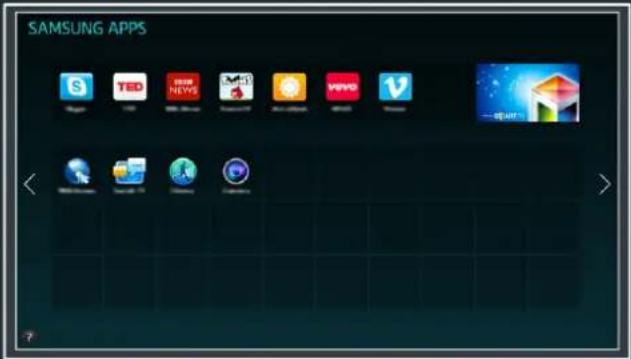
For more information, refer to "Smart Hub".
The pictures may vary depending on the models.
Using Voice Interaction / Voice Control (Not supported for H5500/H6800/H6088 series)

Setting up Voice Interaction / Voice Control
Set up the desired value via MENU > System > Voice Interaction / Voice Control.
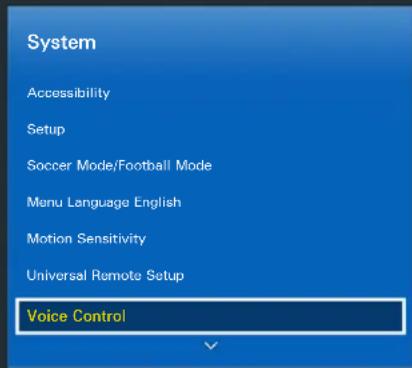

The pictures may vary depending on the models.
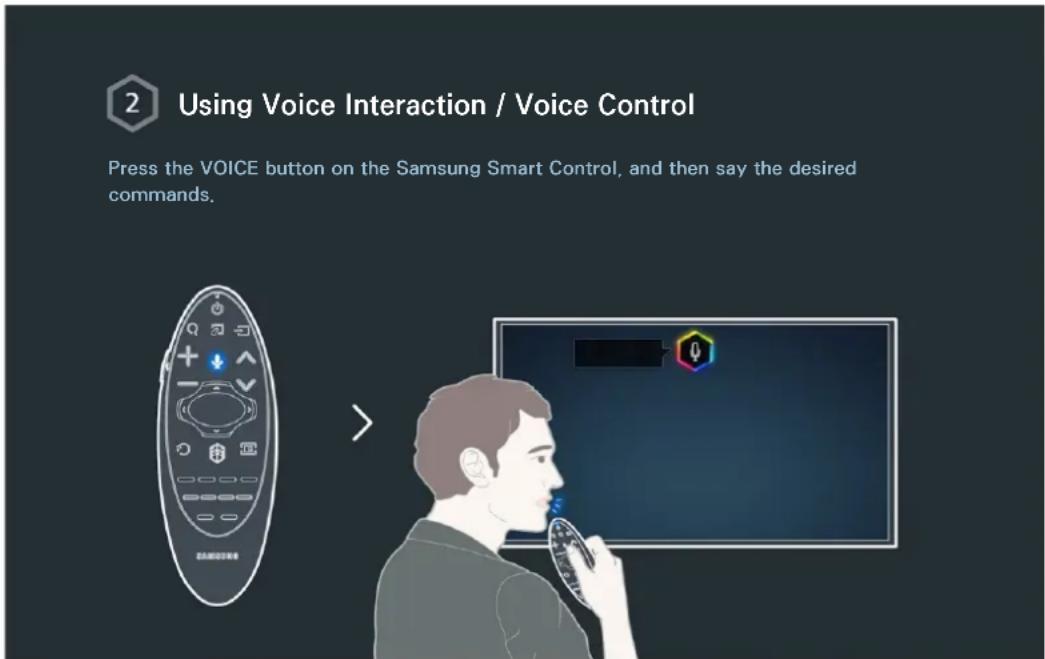
For more information, refer to "Controlling the TV with Your Voice (Voice Interaction / Voice Control) (Not supported for H5500/H6800/H6088 series)".
The pictures may vary depending on the models.
Using Motion Control
Please buy the Samsung camera by your own.
Availability depends on the specific model and area.
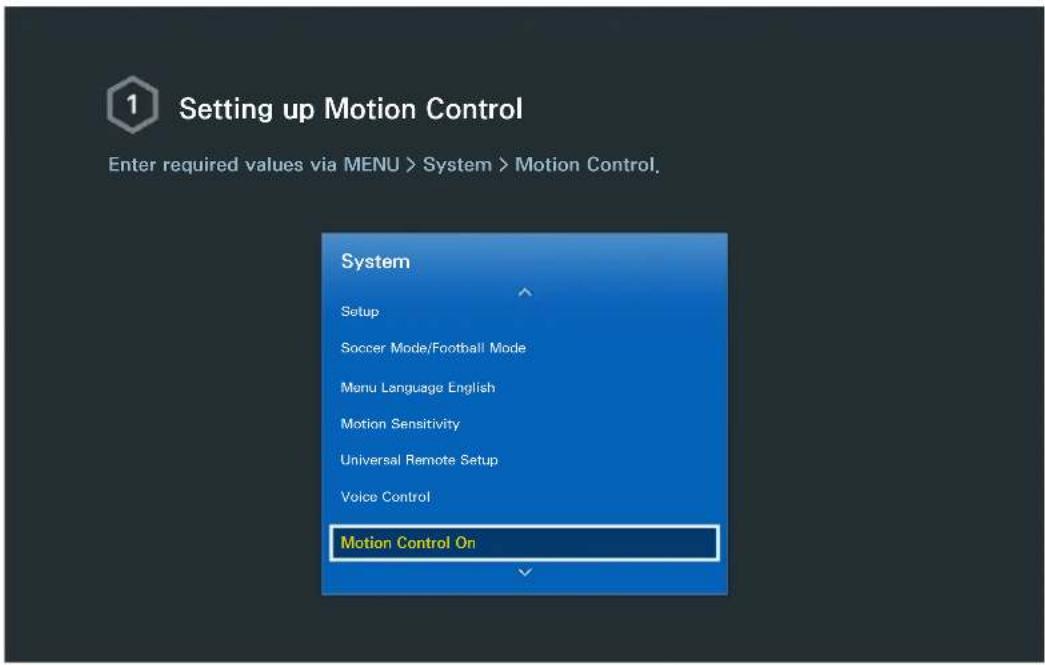
The pictures may vary depending on the models.
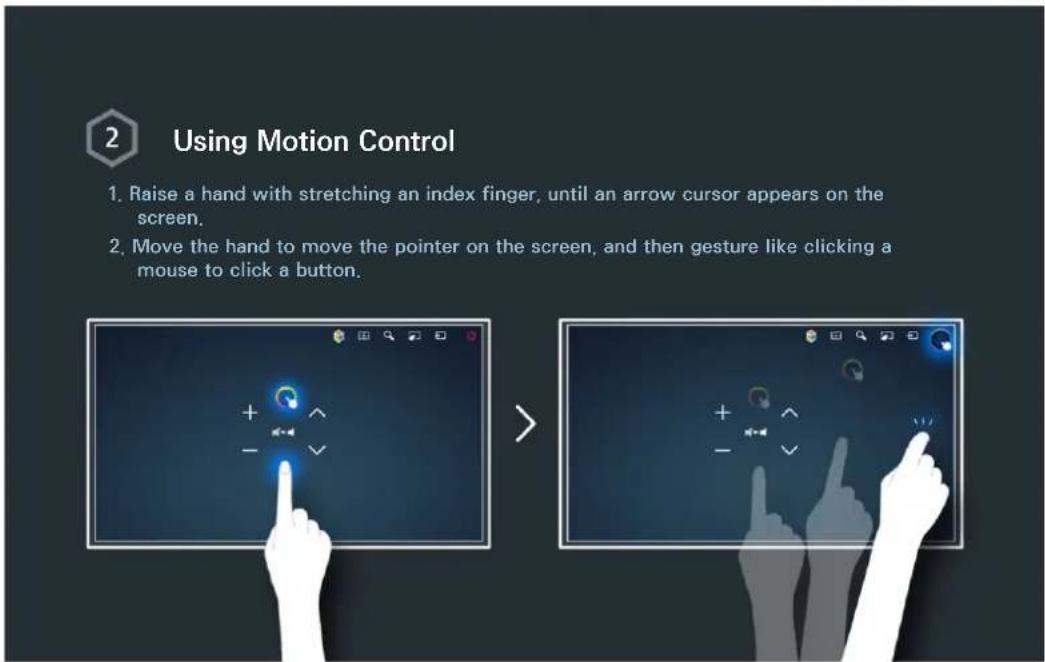
A TV camera (sold separately) needs to be connected in order to use Motion Control.
For more information, refer to "Controlling the TV using Motions (Motion Control)".
The pictures may vary depending on the models.
Using the Samsung Smart Control (Not supported for H5500/H6800/H6088 series)

Connecting the TV
Pair the Samsung Smart Control by pressing the RETURN button and GUIDE button simultaneously for 3 seconds.
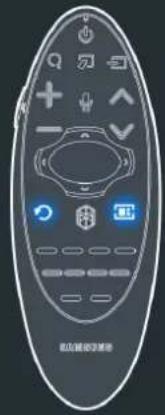

The pictures may vary depending on the models.

Setting the Samsung Smart Control
Set the Smart Control Settings via MENU > System > Smart Control Settings
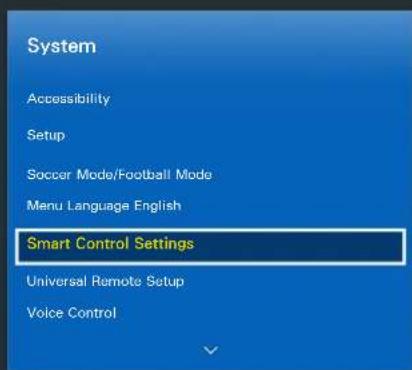

The pictures may vary depending on the models.
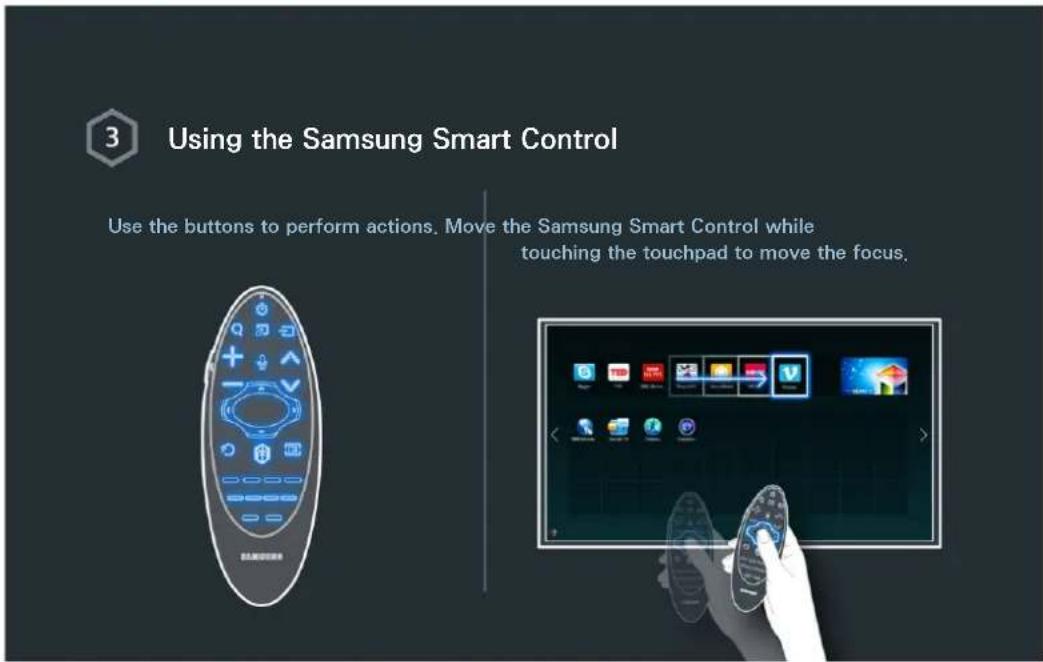
For more information, refer to "Using the Samsung Smart Control (Not supported for H5500/H6800/H6088 series)".
The pictures may vary depending on the models.
Using the Soccer Mode/Football Mode

Activating Soccer Mode/Football Mode
To record the sports game, connect the USB device to the TV and go to MENU > System > Soccer Mode/Football Mode. Set Soccer Mode/Football Mode to On,
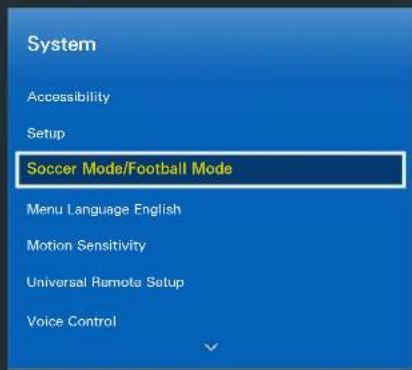

the pictures may vary depending on the models.

Using Soccer Mode/Football Mode
Press Enter ☐ or Touchpad while watching a sports game and then press the desired button on the screen. Record, use social media, zoom, and save and view highlights.
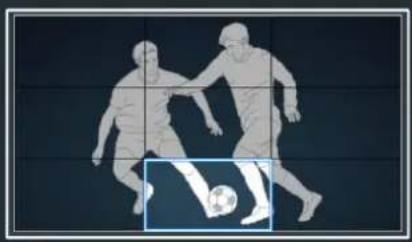
natural_image
Two soccer players in action, one blocking the ball while the other assists (no text or symbols visible)

natural_image
Silhouette of soccer players in action against a dark blue background, with a soccer ball and running figure inset (no text or symbols)
or more information, refer to "Watching Sports with Added Realism (Soccer Mode/Football Mode)".

the pictures may vary depending on the models.
Using the Multi-Link Screen (Only for 7 series)
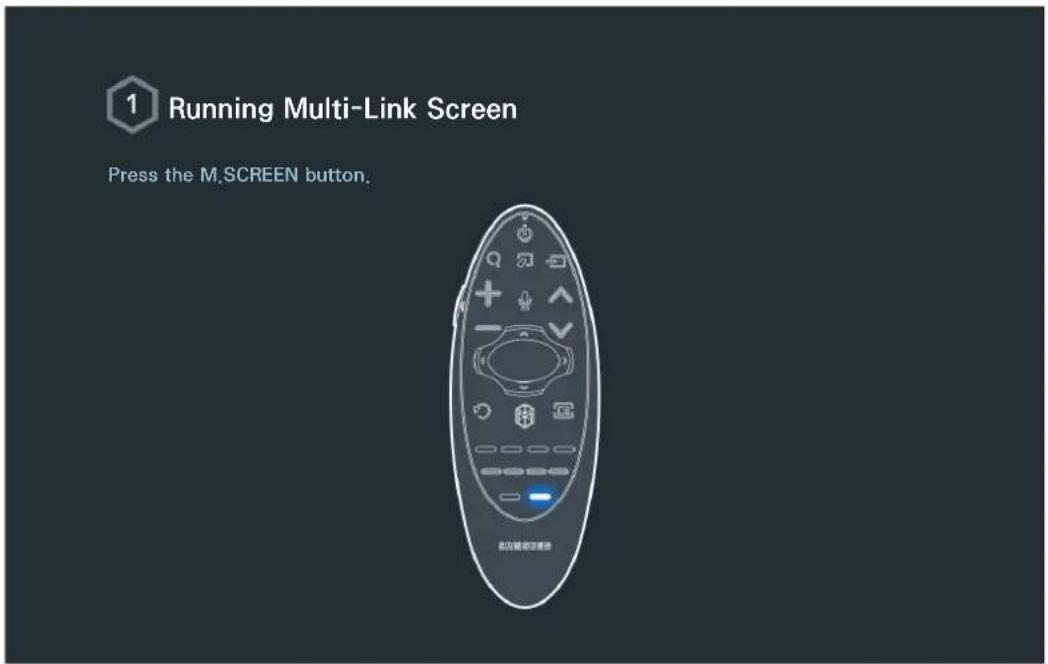
The pictures may vary depending on the models.
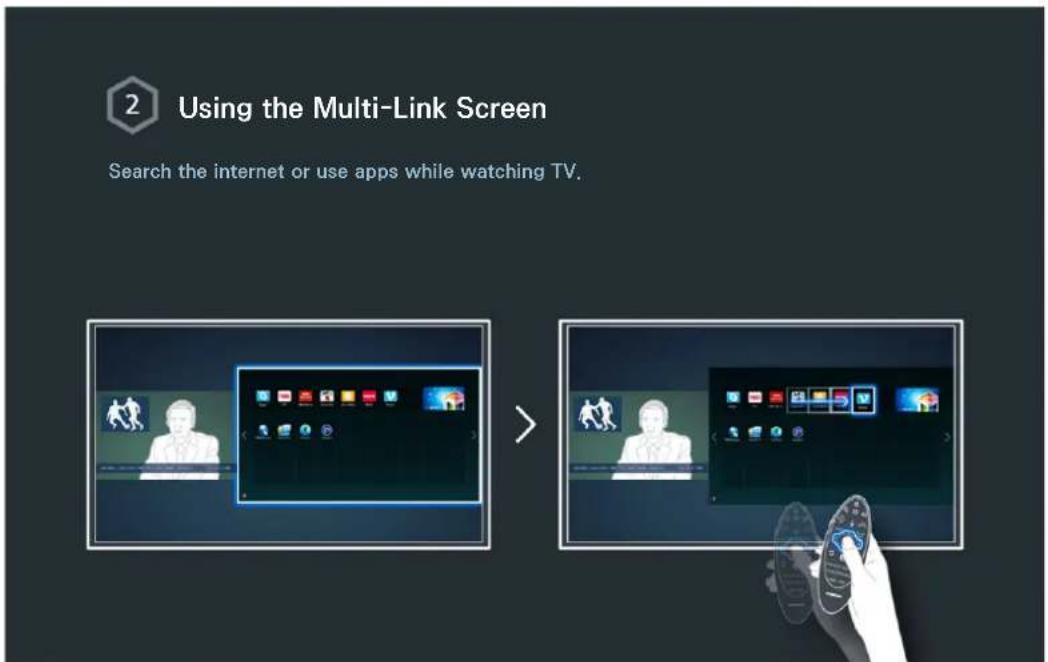
For more information, refer to "Using Multiple Functions in a Single Screen (Multi-Link Screen) (Only for 7 series)".
The pictures may vary depending on the models.
Editing channels
Availability depends on the specific model and area.
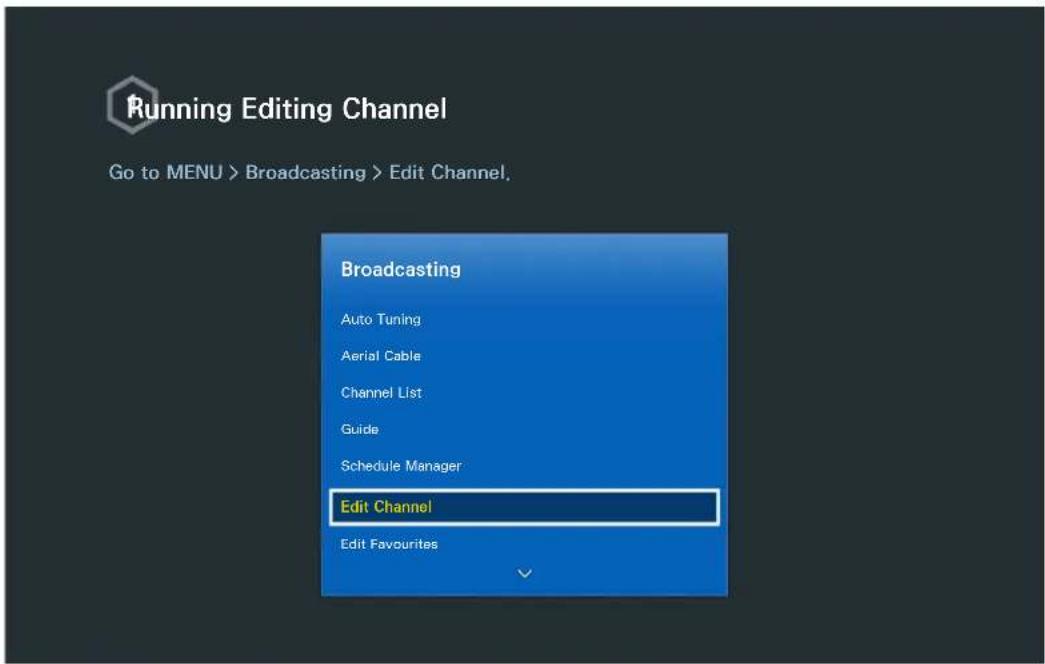
The pictures may vary depending on the models.
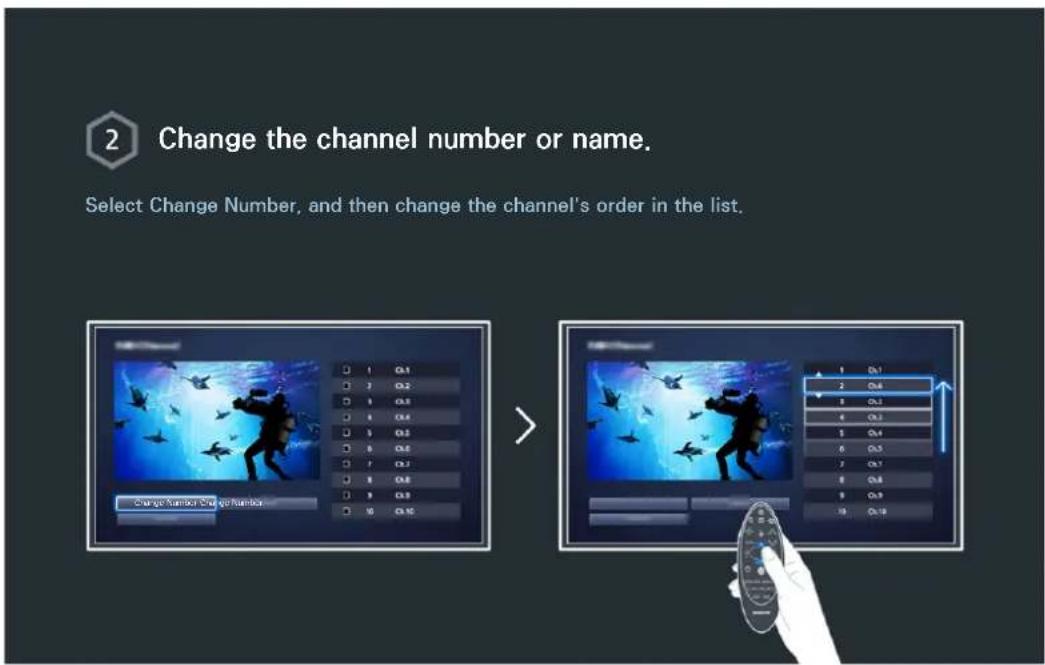
The pictures may vary depending on the models.

Sorting the channel list
- Select a digital channel in the list and then select Options > Sorting.
- Select a desired method for sorting the list.
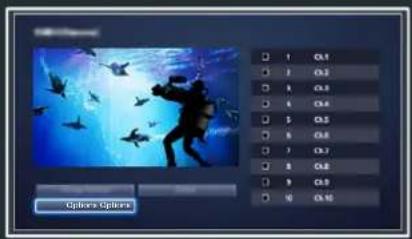
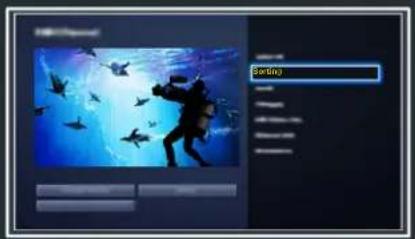

the pictures may vary depending on the models.
Antenna Connection
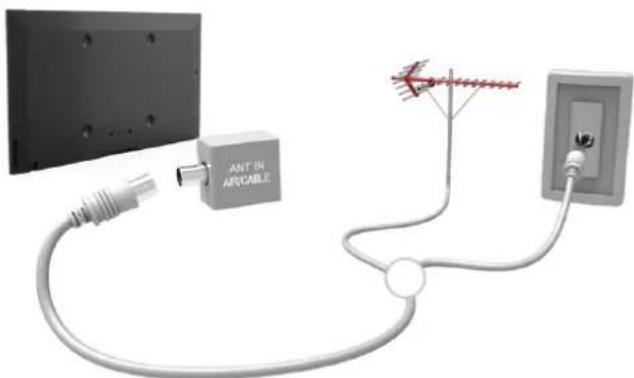
Before connecting any external devices and cables to the TV, first verify the model number. A sticker containing the model number is attached to the back of the TV. The connection method varies depending on the model.
An aerial must be connected to the TV in order to receive broadcast signals.
An aerial connection is not necessary when a cable box or satellite receiver is used.
Connect the correct aerial cable according to your viewing environment to the TV's aerial connector, as shown in the diagram.
natural_image
Diagram of an antenna in an arcable device connected to a mounted antenna with antenna array (no text or symbols visible)Video Device Connection
Your TV has a variety of connectors for video input from external devices such as cable boxes, Blu-ray players, DVD players, camcorders, and gaming consoles. Below is a list of featured connectors shown in descending order of picture quality.
• HDMI
- Component
- External Input
Connect a video device to the TV via an HDMI connector for the best picture quality. If the device does not have an HDMI connector, try a component connector to get the next best picture quality.
The number of connectors and their names and locations may vary depending on the model.
Refer to the external device's operating manual when connecting it to the TV. The number of external device connectors and their names and locations may vary depending on the manufacturer.
HDMI Connection
Before connecting any external device or cable to the TV, first verify the TV's model number. A sticker containing the model number is attached to the back of the TV. The connection method varies depending on the model.
The following types of HDMI cables are recommended:
• High-Speed HDMI Cable
• High-Speed HDMI Cable with Ethernet
HDMI cables have certain requirements:
Use an HDMI cable with a thickness of 14 mm or less.
Using a non-certified HDMI cable may result in a blank screen or a connection error.
Some HDMI cables and devices may not be compatible with the TV due to different HDMI specifications.
This TV does not support HDMI Ethernet Channel. Ethernet is a LAN (Local Area Network) built with coaxial cables standardized by the IEEE.
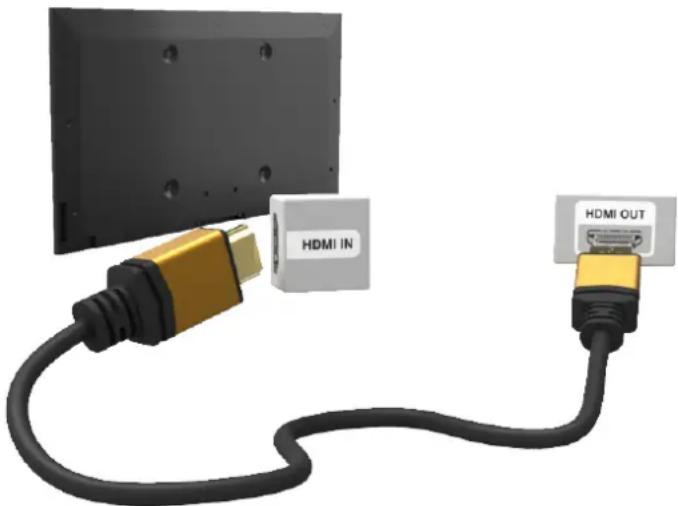
Refer to the diagram and connect the HDMI cable to the video device's HDMI output connector and the TV's HDMI input connector.
The number of connectors and their names and locations may vary depending on the model.
natural_image
3D diagram of a HDMI cable with gold connector and two labeled connectors (HDMI IN and HDMI OUT), no text or symbols present.Once the connection has been made, you will be able to select the connected external device using the SOURCE button.
Component Connection
Before connecting any external devices and cables to the TV, first verify the model number of the TV you purchased. A sticker containing the model number is attached to the back of the TV. The connection method varies depending on the model.
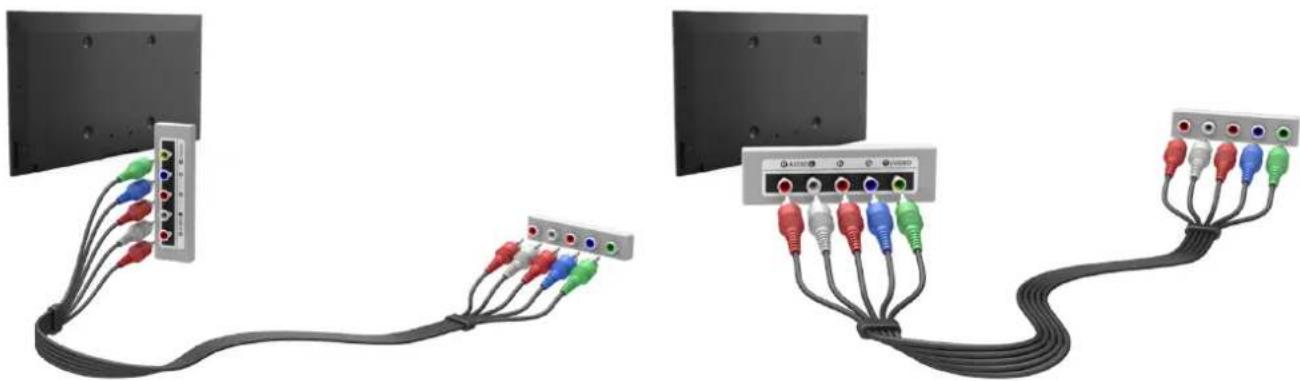
Refer to the diagram and connect the Component cable to the TV's component input connectors and the device's component output connectors.
Make sure the cable colours match the connector colours.
natural_image
Two cables showing connected audio equipment with colored wires (no text or symbols visible)Once the connection has been made, you will be able to select the connected external device using the SOURCE button.
External Input Connection
Before connecting any external device or cable to the TV, first verify the TV's model number. A sticker containing the model number is attached to the back of the TV. The connection method varies depending on the model.
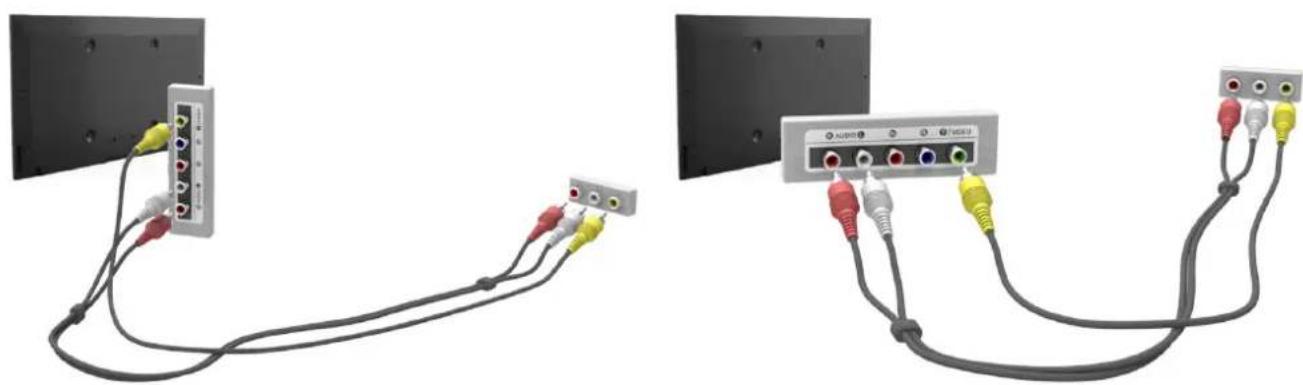
Refer to the diagram and connect the AV cable to the TV's AV input connectors and the device's AV output connectors.
If you are using the TV's AV input connectors, connect the video cable to the Y connector. Some models feature a video connector as well. In this case, connect the cable to the video connector.
natural_image
Two cables showing audio equipment connections (no text or symbols visible)Once the connection has been made, you will be able to select the connected external device using the SOURCE button.
TV Audio through the External Speakers
Your TV has a variety of connectors for audio input from devices such as Blu-ray players and DVD players and for audio output to such devices as amplifiers. The connectors are listed below.
• ARC (Audio Return Channel)
• Digital Audio (Optical)
There are several issues to bear in mind when using audio input:
- For better audio quality, it is a good idea to use an AV receiver.
- The number of connectors and their names and locations may vary depending on the model.
- Refer to the external device's operating manual when connecting it to the TV. The number of external device connectors and their names and locations may vary depending on the manufacturer.
HDMI (ARC) Connection
Some models may not support ARC.
Before connecting any external devices and cables to the TV, first verify the model number of the TV you purchased. A sticker showing the model number is attached to the back of the TV. The connection method varies depending on the model.
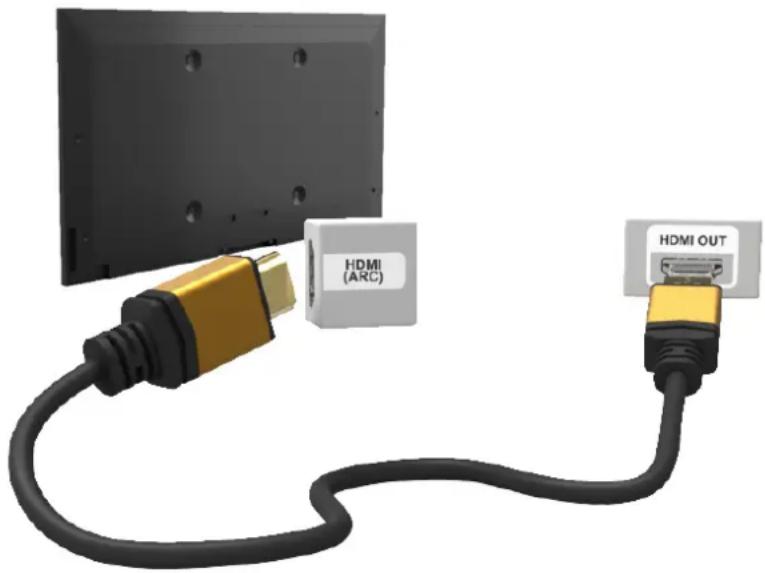
ARC (Audio Return Channel) enables digital sound output using just an HDMI cable. However, ARC is only available through the HDMI (ARC) port and only when the TV is connected to an ARC-enabled AV receiver.
The number of connectors and their names and locations may vary depending on the model.
Connect an HDMI cable to the TV's HDMI (ARC) connector and the device's HDMI output connector.
Once the connection has been made, you will be able to select the connected external device using the SOURCE button.
Digital Audio (Optical) Connection
Before connecting any external device or cable to the TV, first verify the TV's model number. A sticker showing the model number is attached to the back of the TV. The connection method varies depending on the model.
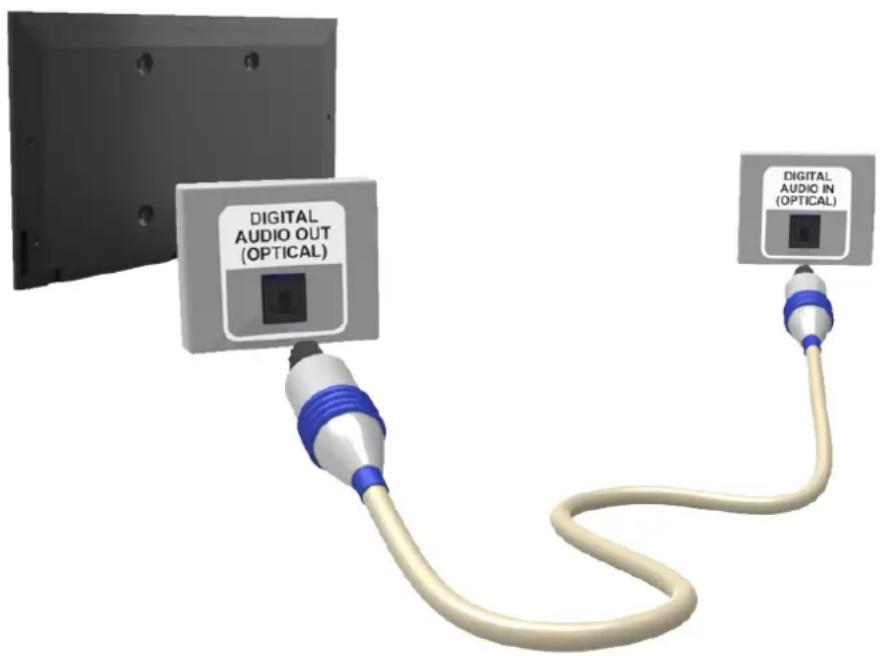
Connecting an AV receiver to the TV via a digital audio (optical) connector lets you listen to digital audio.
Connecting a device using an optical cable does not automatically turn off the TV speakers. To turn off the TV's speakers, set TV Sound Output (MENU > Sound > Speaker Settings > TV Sound Output) to something other than TV Speaker.
Adjust the audio device's volume using its remote control.
An unusual noise coming from the audio device while you are using it may indicate a problem with the audio device itself. If this occurs, ask for assistance from the audio device manufacturer.
Digital audio is only available with 5.1-channel broadcasts.
Refer to the diagram and connect the optical cable to the TV's digital audio output connector and the device's digital audio input connector.
Audio Output Connection
Availability depends on the specific model.
Before connecting any external device or cable to the TV, first verify the TV's model number. A sticker containing the model number is attached to the back of the TV. The connection method varies depending on the model.
The connectors names and locations may vary depending on the model.
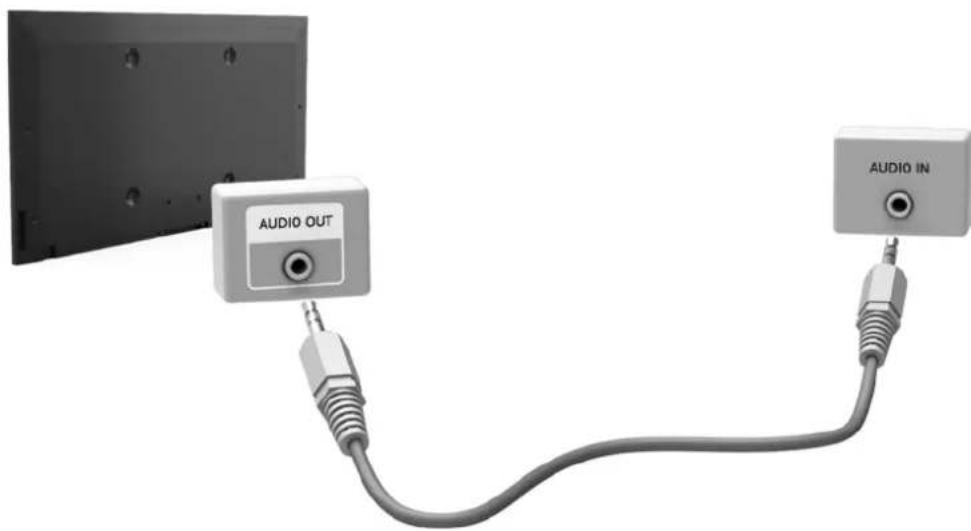
Refer to the diagram and connect the audio cable to the TV's audio output connector and the device's audio input connector.
natural_image
Close-up of two audio equipment connectors, one labeled 'AUDIO OUT' and the other 'AUDIO IN', connected by a cable (no additional text or symbols visible)Connecting to a Computer
You can directly connect a computer to the TV or to the network to view the computer screen or content on the TV. Connect the computer to the TV as follows.
- Connecting via HDMI Port
You can connect the computer to the TV using the HDMI cable to display the computer screen on the TV.
• Connecting with the HDMI (DVI) Port
You can connect a computer to the TV by connecting the computer's DVI port to the TV's HDMI port with the DVI to HDMI cable to display the computer screen on the TV.
• Connecting via Samsung Link
Quickly access the photo, video and music files saved on a computer on which Samsung Link software is installed, even if you do not connect the TV directly to the computer.
- Connecting via Home Network (DLNA)
Quickly access the photo, video and music files saved on a computer by connecting the TV and the computer to the same router or AP.
Connecting via HDMI Port
Before connecting any external device or cable to the TV, first verify the TV's model number. A sticker showing the model number is attached to the back of the TV. The connection method varies depending on the model.
For HDMI connection, one of the following HDMI cable types is recommended:
• High-Speed HDMI Cable
• High-Speed HDMI Cable with Ethernet
Use an HDMI cable with a thickness of 14 mm or less. Using a non-certified HDMI cable may result in a blank screen or a connection error.
Some HDMI cables and devices may not be compatible with the TV due to different HDMI specifications.
This TV does not support HDMI Ethernet Channel. Ethernet is a LAN (Local Area Network) built on coaxial cables standardized by the IEEE.
Some computers do not support HDMI interface, depending on its graphics adapter specifications. In this case, use a DVI-to-HDMI cable to connect the computer to the TV.
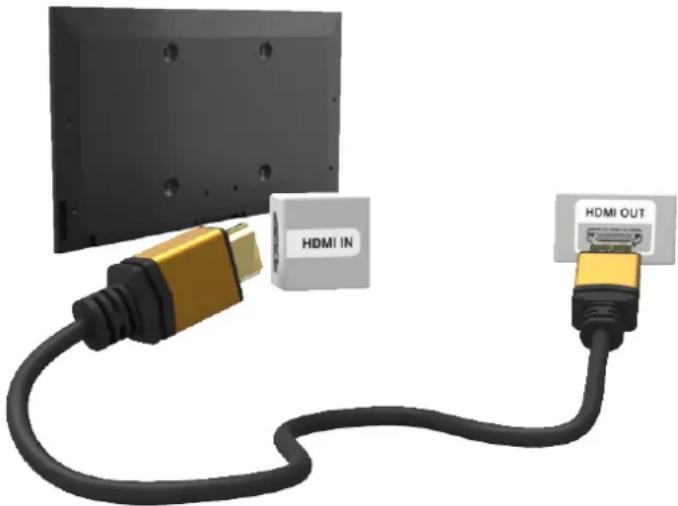
Refer to the diagram and connect the HDMI cable to the external video device's HDMI output connector and the TV's HDMI input connector.
Once the connection has been made, you will be able to select the connected external device using the SOURCE button.
Connecting with the HDMI (DVI) Port
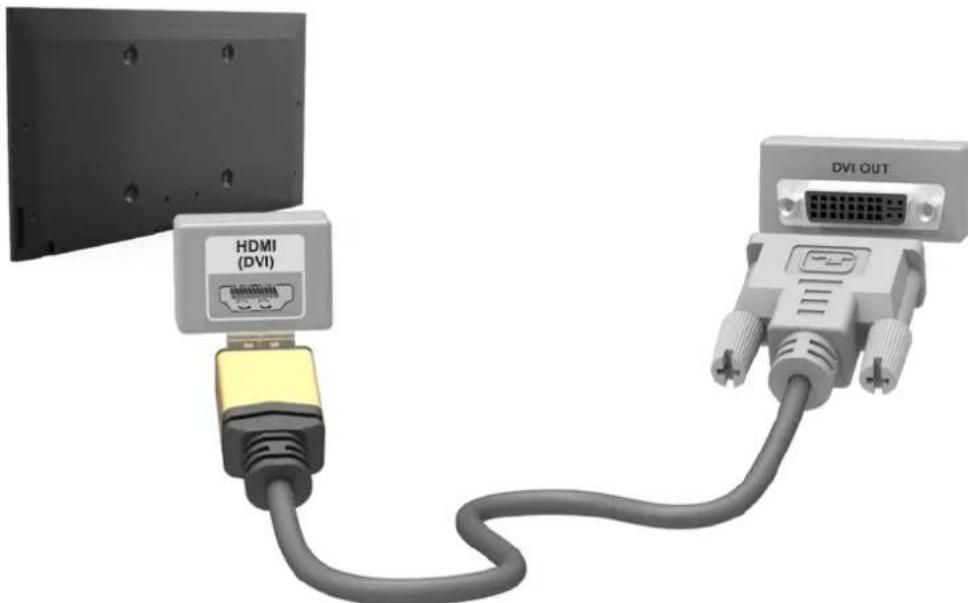
If the graphics adapter of your computer does not support HDMI interface, connect the computer to the TV with the DVI (Digital Visual Interactive) to HDMI cable. However, DVI-to-HDMI connection is supported by the HDMI port for DVI only and does not support audio signal transmission. To listen to sound, connect the audio cable to the speakers.
For information on resolutions supported by the TV, refer to "Read Before Connecting a Computer (Supported Resolutions)".
Refer to the diagram and connect the DVI-to-HDMI cable to the TV's HDMI (DVI) port and the computer's DVI output port.
natural_image
Close-up of a HDMI (DVI) cable connector with two DVI OUT connectors, shown in connection to a black panel (no text or symbols on the diagram itself)When the connection is established, press the SOURCE button to choose an external device connected to the TV.
Connecting via Samsung Link
Quickly access photo, video and music files saved on a computer with Samsung Link software installed. Also use Samsung Link to play and view the content of a computer that has been registered to Samsung Link under your Samsung account, even if the computer and the TV are not connected to the same router or AP.
- Visit the Samsung content and service portal (http://link.samsung.com) on a computer and sign in your Samsung account.
To install Samsung Link desktop software, you will need to first sign in your Samsung account. If you don't have a Samsung account, create one first.
-
Install Samsung Link desktop software. When the installation is complete, the computer will be registered to Samsung Link.
-
Specify the folder you wish to link to the TV. You can view and play photo, video and music files contained in the specified folder on the TV screen.
For more information on using Samsung Link desktop software, refer to the software's Help section.
Connecting via Home Network (DLNA)
Quickly access and view/play photo, video and music files from a computer on the TV screen.
- Connect the TV and the computer to the same router or AP. A home network will be configured once the two connections are established.
Home Network (DLNA) enables content-sharing between the TV, computers and mobile devices connected to the same wired or wireless router.
-
From the computer, select [Control Panel] > [Network and Internet] > [Network and Sharing Centre] > [Change advanced sharing settings] and select [Choose media streaming options...] to activate media streaming.
-
From the list, set TV to [Allowed].
-
Launch Windows Media Player from the computer, select [Settings] > [Library Management] and then add the location where the photo, video and music files are saved to view/play the files on the TV screen.
It will be possible to view/play on the screen files moved to Windows Media Player's default folder.
As long as File Sharing is activated, unauthorized access may be allowed. Disable File Sharing if data access is not required.
Connecting with a Mobile Device
Connect mobile device such as a smartphone or tablet to the TV directly or indirectly over a shared network and display the mobile device screen or content on the TV screen. Connect the mobile device to the TV as follows.
• Mobile Device Screen on TV (Screen Mirroring)
Wirelessly connect the TV to the mobile device with the mirroring function to view the mobile device's screen on the TV.
This option is available only with mobile devices that support mirroring.
- Connecting Mobile Devices without a Wireless Router (Wi-Fi Direct)
Wi-Fi Direct enables you to connect the TV to a mobile device without a router or AP. Quickly access and play photo, video and music files from a connected mobile device on the TV screen.
This option is available only with mobile devices that support Wi-Fi Direct.
- Connecting via Samsung Link
Samsung Link enables you to play photo, video and music files from a Samsung Link-enabled mobile device without having to manually connect the device to the TV.
- Connecting via Home Network (DLNA)
View/play on the TV photo, video and music files from a mobile device connected to the same router or AP as the TV.
Mobile Device Screen on TV (Screen Mirroring
MENU > Network > Screen Mirroring
Screen Mirroring lets you display a mobile device's screen on your TV wirelessly.
Screen Mirroring is only available with mobile devices that support AllShare Cast. For more information, visit the mobile device manufacturer's website.
Poor network conditions can cause video and/or audio interruptions while using Screen Mirroring.
- Run Screen Mirroring. Alternatively, press SOURCE and then choose Screen Mirroring from the list.
- Launch Screen Mirroring on your mobile device. The device automatically scans for the TV and displays it in a list.
- Select the TV.
If the connection fails, try again after turning the TV and the mobile device off and then turning them back on again.
Connecting Mobile Devices without a Wireless Router (Wi-Fi Direct)
MENU > Network > Wi-Fi Direct Try Now
Wi-Fi Direct lets you connect mobile devices directly to your TV using wireless technology. After connecting a device to the TV using Wi-Fi Direct, it will be possible to view/play video, photo, and music files from the device on the TV.
The mobile device must support Wi-Fi Direct. Make sure the mobile device you intend to use supports Wi-Fi Direct.
- Enable Wi-Fi Direct on the mobile device and then launch Wi-Fi Direct. The TV automatically scans for and displays a list of available devices. The TV's name also appears on the mobile device.
- Select the device from the list to initiate a connection. If a connection request is made by the TV, a permission message appears on the mobile device and vice versa.
- Allow the connection. This completes the connection process.
Connecting via Smart View 2.0
By installing and running the Smart View 2.0 app on the mobile device, you can view the device screen on the TV, or play the device's multimedia content (videos, photos, and music) on the TV.
Go to Google Play, and search for and install Smart View 2.0 on your mobile device. Smart View 2.0 is a cross-platform multi-screen app that enables you to load the TV screen on a mobile device, share multimedia contents between two devices, and control the TV remotely. For more information, refer to the Smart View 2.0 manual.
Connecting via Samsung Link
Samsung Link enables you to view/play photo, video and music files from a Samsung Link-enabled mobile device with ease. Also use Samsung Link to play and view the content of a mobile device that has been registered to Samsung Link under your Samsung account, even if the mobile device and the TV are not connected to the same router or AP.
- Run the Samsung Link app on the mobile device and then sign in with your Samsung account.
To use Samsung Link, you have to sign in with a Samsung account. If you don't have a Samsung account, create one first.
- Quickly access and play photo, video and music files from the mobile device running Samsung Link app under your Samsung account.
For more information on using the Samsung Link app, refer to the Help section of the manual.
Connecting via Home Network (DLNA)
View/play photo, video and music files from a mobile device on the TV.
- Connect both the TV and the mobile device to the same router or AP. A home network will be configured once the connections are established.
Home Network (DLNA) enables content-sharing between the TV, computers and mobile devices connected to the same wired or wireless router.
- Enable File Sharing on the mobile device. The mobile device's shared content can be viewed/played on the TV.
As long as File Sharing is activated, unauthorized access may be allowed. Disable File Sharing if data access is not required.
Name of TV on Network
MENU > Network > Device Name Try Now
Choose or enter a TV name to be displayed on the network.
-
Select Device Name from the Network menu. A list will appear.
-
Choose a name from the list. Alternatively, select User Input to enter a name manually. You can view the specified TV name on the network.
Input Signal Selection
You can select a connected external device using the SOURCE button.
For example, to switch to a gaming console connected to the second HDMI connector, press SOURCE. From the Source list, select HDMI2 to change the input signal to HDMI mode. Connector names may vary depending on the model.
The following options are available in the Source screen:
- Options
Select a port connected to an external device, and press and hold the Touchpad. The following functions are available:
Available options for each connector may vary.
- Edit Name: Rename devices connected to the TV for easier identification of external sources. For example, you can designate a computer connected to the TV via an HDMI-DVI cable as DVI PC. Alternatively, simply designate a computer connected to the TV via an HDMI cable as PC. You can also designate an AV device connected to the TV via an HDMI-DVI cable as DVI Devices.
- Information: View detailed information about the connected devices.
- Anynet+ (HDMI-CEC): Displays a list of Anynet+ (HDMI-CEC)-compliant devices that are connected to the TV.
This option is only available with Anynet+ (HDMI-CEC) set to On.
– Device Format: Formats USB recording devices connected to the TV.
This option is only available when a USB device has been selected.
- Disconnect USB Device: Used to safely remove a USB device connected to the TV.
This option is only available when a USB device has been selected.
• Universal remote setup (Not supported for 5 series and H6088 series.)
Select Universal remote setup on the screen to configure the universal remote function. By configuring a universal remote control, you can control cable boxes, Blu-ray players, home theatres, and other external devices using a single remote control.
Inserting Batteries into Samsung Smart Control (Not supported for H5500/H6800/H6088 series)
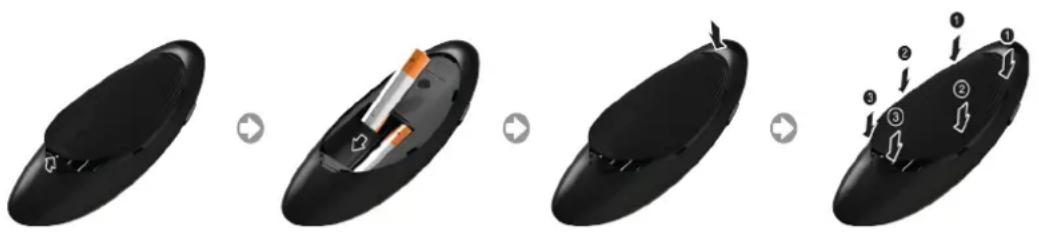
To use Samsung Smart Control, first refer to the figure below and insert batteries into the unit.
natural_image
Four-step diagram showing a device being processed into a black remote control case, with arrows indicating motion (no text or symbols)- Gently pull on the battery cover's notch and then remove the cover completely once it comes loose.
- Insert 2 AA alkaline batteries, making sure to align the positive and negative polarities correctly.
- Place the battery cover on the remote control and insert the top part of the cover into the remote control.
- Press the catches on both sides of the battery cover in the order shown so that the cover is completely attached to the remote control.
When you see this alarm icon on the screen...
Following alarm icon indicates Samsung Smart Control's batteries are low. If the alarm icon pops up, replace the batteries. Samsung recommends using alkaline batteries for a longer operating life.
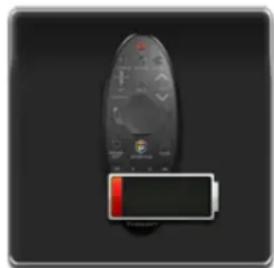
natural_image
Black remote control with a battery icon at the bottom (no text or symbols visible)Pairing Samsung Smart Control (Not supported for H5500/H6800/H6088 series)
To control the TV with Samsung Smart Control, you need to pair Samsung Smart Control to the TV via Bluetooth.
Samsung Smart Control can only be paired to a single TV.
- Point Samsung Smart Control at the remote control sensor of the TV and press the TV button to turn the TV on,
Remote control receiver's location may vary depending on the model.
- The Bluetooth icon will appear on the screen as shown below. The TV will then attempt to connect to the Samsung Smart Control unit automatically.

flowchart
graph LR
    A["..."] --> B["..."]
    B --> C["..."]
    C --> D["..."]
    D --> E["..."]
    E --> F["..."]
    F --> G["..."]
    G --> H["..."]
    H --> I["..."]
    I --> J["..."]
    J --> K["..."]
    K --> L["..."]
    L --> M["..."]
    M --> N["..."]
    N --> O["..."]
    O --> P["..."]
    P --> Q["..."]
    Q --> R["..."]
    R --> S["..."]
    S --> T["..."]
    T --> U["..."]
    U --> V["..."]
    V --> W["..."]
    W --> X["..."]
    X --> Y["..."]
    Y --> Z["..."]
Reconnecting Samsung Smart Control
If the Samsung Smart Control stops operating or works abnormally, replace the batteries as this may be due to insufficient battery power.
If the problem persists, the Samsung Smart Control restore pairing with the TV.
- Press RETURN button and GUIDE button simultaneously for 3 seconds.
You have to control Samsung Smart Control apart from TV within 30cm \~ 40cm. But, you must place Samsung Smart Control toward to TV's remote control receiver.
- Connection image is appeared on the screen. And then, Samsung Smart Control is connecting to TV automatically.
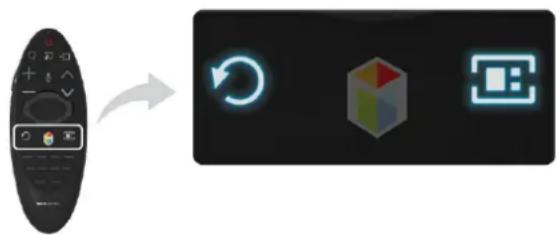
flowchart
graph LR
    A["Remote Control"] --> B["Change in Refresh Icon"]
    B --> C["Delete Icon"]
Using the Samsung Smart Control (Not supported for H5500/H6800/H6088 series)
Samsung Smart Control makes it even easier and more convenient to use the TV. Pressing the KEYPAD button displays a virtual remote control that allows you to easily enter digits, control content, and activate functions on the screen.
We recommend using Samsung Smart Control at a distance of less than 6m. Effective range may vary depending on wireless network conditions.
Button Functions
For details, refer to the Samsung Smart Control section of the TV manual.
Samsung Smart Controls may vary depending on the specific model.
LED 6 Series (Not supported for H6800/H6088 series)
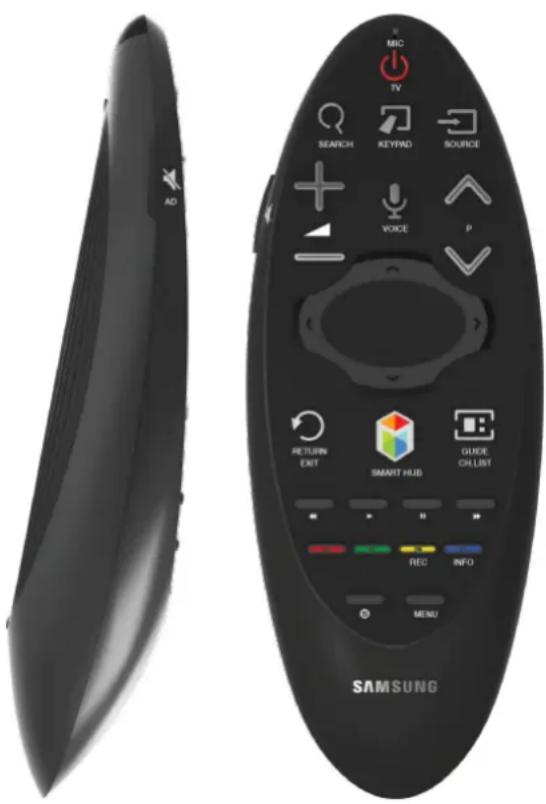
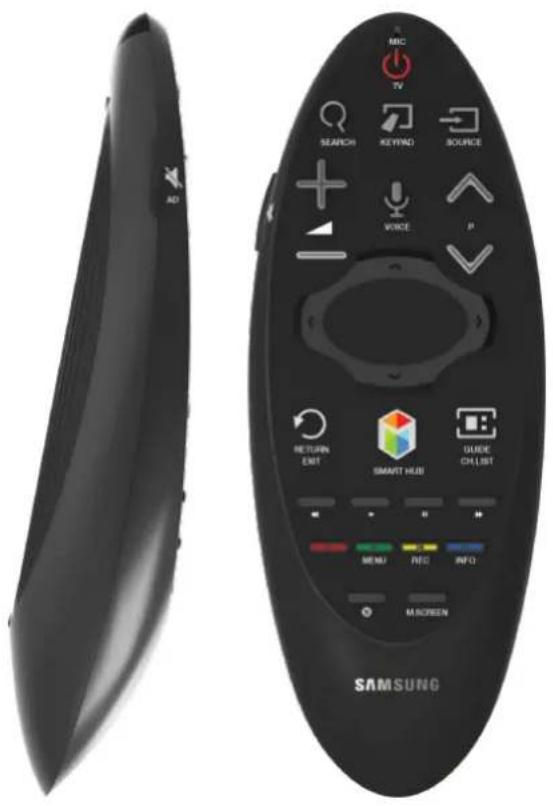
natural_image
Side view of a Samsung remote control with labeled buttons and navigation icons (no readable text beyond branding)Colours and shape may vary depending on the model.
| Button Description | |
| TV | Turns the TV on/off. |
| SEARCH | Press this button to use the search window, Available with various services. |
| KEYPAD | With the virtual remote control on the screen, you can easily enter digits, control content, and use functions. |
| SOURCE | Changes the source. |
| + ▲ - | Changes the volume. |
| VOICE | Starts voice recognition. When the microphone icon appears on the screen, say a voice command into the microphone. Say "Help" to learn about basic usage and voice commands.Say a voice command 10cm to 15cm from the microphone and at an appropriate volume. |
| ◀ | Turns the sound on/off. |
| ^P ∨ | Changes the channel. |
| ^. ∨, <, > | Moves the pointer or focus. |
| Touchpad | Place a finger on the touch pad and move the Samsung Smart Control. The pointer on the screen moves in the direction and as much as the Samsung Smart Control is moved. Tap on the touchpad to run the focused item. |
| ◀, ▶, ll, ▶ | Controls for when viewing/playing a video, photo or music file or watching a recorded programme. You can also use the buttons to control content from an external device. |
| A, B, C, D | Use these colour buttons to access additional options specific to the feature in use. |
| RETURN / EXIT Returns to the previous menu. | |
| SMART HUB | Launches Smart Hub. Pressing SMART HUB while an application is running terminates the application. |
| GUIDE / CH,LIST | Displays the digital channel broadcasting schedule. |
| ◎ | Enable Soccer Mode/Football Mode for an optimal sports viewing experience. |
| MENU | Displays a menu on the screen.Availability depends on the specific Samsung Smart Control. |
| M.SCREEN | You can split the TV screen and use various functions such as watching TV, surfing the web, watching video, and so on.Availability depends on the specific Samsung Smart Control. |
Additional Functions
Press and hold the following buttons for 1 second to use additional functions.
| Button Description | |
| GUIDE / CH,LIST | Press and hold to launch the CH,LIST. |
| RETURN / EXIT | Press and hold this button to exit all currently running applications |
| Press and hold while watching a programme to open Accessibility Shortcuts. | |
| B | Displays a menu on the screen.Availability depends on the specific Samsung Smart Control. |
| C | Press and hold to record the broadcast.Availability depends on the specific model and area. |
| D | Press and hold to view information about the current digital channel or media file. |
Using the TV by Moving the Samsung Smart Control
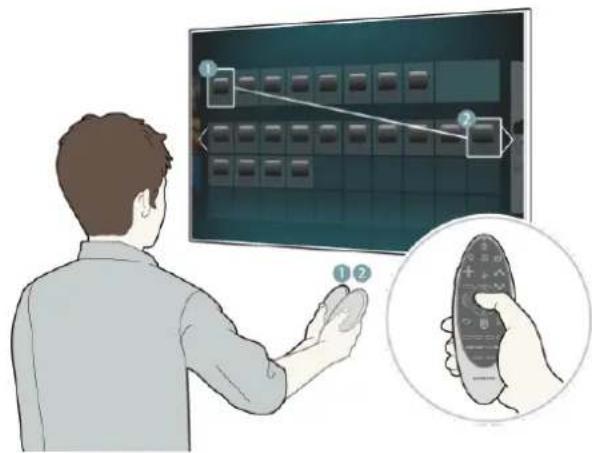
The Samsung Smart Control has a motion sensor (gyro sensor) that allows you to easily control the TV by holding and moving the Samsung Smart Control.
After Placing a finger on the touchpad, a pointer appears on the screen. Hold and move the Samsung Smart Control. The pointer moves the same way the Samsung Smart Control is moved. It's also possible to scroll up and down on scrollable screens.
If you remove the finger from touchpad, the screen pointer disappears.
If the Voice Guide is set to On, the Samsung Smart Control's motion sensor(gyro sensor) does not work. To use the Samsung Smart Control's motion sensor, set the Voice Guide to Off.
Using the TV with the Touchpad
Navigate to the Support menu and select the Smart Control Tutorial option to learn how to use the touchpad according to the instructions on the screen.
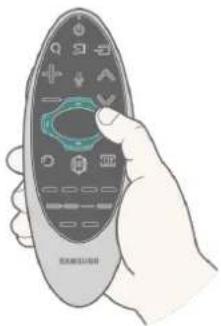
Moving the Focus/Pointer
natural_image
Illustration of a hand holding a remote control with icons on the screen (no text or symbols visible)Press the directional buttons (up, down, left, and right) to move the pointer or focus in the direction.
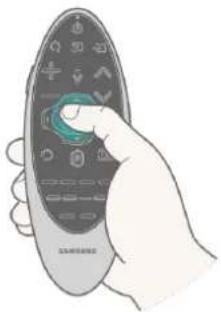
Menu Access & Item Selection
natural_image
Illustration of a hand holding a remote control with icons on the screen (no text or symbols visible)Tap on the touchpad. This lets you access a TV menu or select an item.
Displaying the Channel List
Press and hold the touchpad while watching TV to bring up the Channel List on the screen.
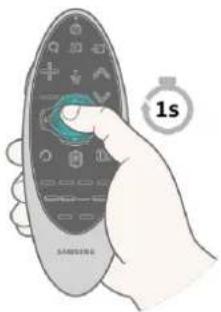
Displaying the Context-sensitive Menu on Smart Hub
natural_image
Illustration of a hand holding a Samsung remote control with a stopwatch icon (no text or symbols on the device itself)Tap and hold on the touch pad from the Smart Hub screen. The Options menu available to the selected item appears.
The Options menu depends on the context.
Moving to the Smart Hub panel
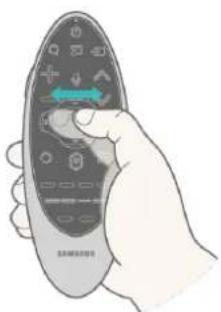
natural_image
Illustration of a hand holding a remote control with icons and a green arrow indicating navigation (no text or symbols)On the Smart Hub screen, drag left or right on the touchpad. This transits the screen by panel.
Scrolling on the Web Browser
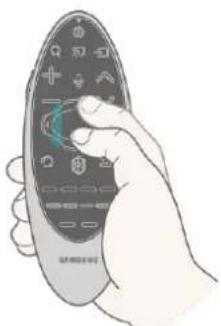
natural_image
Illustration of a hand holding a remote control with icons (no text or symbols)Drag up/down on the touchpad in the web browser screen. This scrolls through the web screen.
Displaying the Remote Control on the Screen (virtual remote control)
Press the KEYPAD button to display the virtual remote control on the screen. You can easily enter digits, control content, and use TV buttons with the virtual remote control.
The virtual remote control buttons may vary depending on the TV's current status,
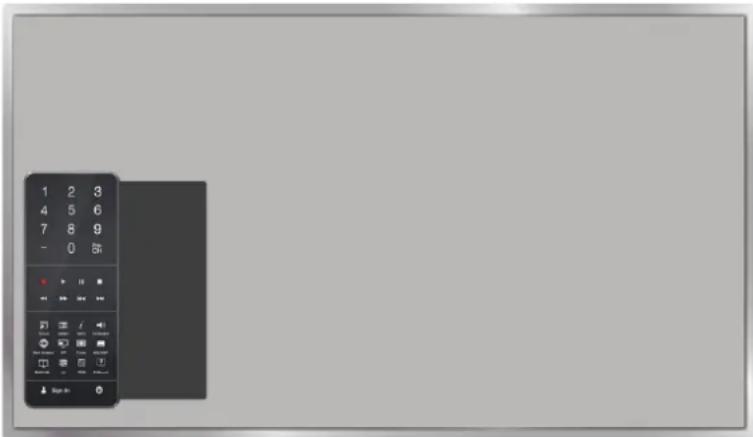
| Button Description | |
| 1 2 34 5 67 8 9- 0 Pre-CH | You can directly enter the channel number to switch to that channel. Select Pre-CH to return to the previous channel. |
| ● ▶ II □◀ ▶ ▶ ▶ ▶ | Controls the item when you are playing a video, photo or music file or watching a recorded programme. You can also use the buttons to control the content on an external device. |
| TOOLS | Use frequently used functions while watching TV. In addition, you can use additional functions that may vary depending on the currently running function. |
| INFO | Shows the information about the current digital broadcast programme or content. |
| MENU | Displays the menu on the screen. |
| Speaker Settings | Select the speakers which you want to use to listen to the TV's sound. To set this option, external speakers must be connected to the TV. |
| PIP | Display the video from an external device or computer on the main screen and the TV as a picture-in-picture. |
| 3D | Turn the 3D effect on or off. |
| Multi-Link Screen | You can split the TV screen and use various functions such as watching TV, surfing the web, watching video, and so on. Availability depends on the specific model and area. |
| AD/SUBT | Turns the audio description on and off (not available in some locations). / Displays digital subtitles. |
| P.SIZE | Change the picture size. |
| Web Browser | Launch the Web Browser. |
| DUAL | Change the audio output type. |
| e-Manual | Launch the e-manual. |
| Sign In / Sign Out Log in or out of your Samsung account. | |
 | Move to the right / Move to the left: You can move the virtual remote control on the screen.Large size / Standard Size: You can resize the virtual remote control on the screen.Alternatively, navigate to the MENU > System > Smart Control Settings menu and select and set the Onscreen Remote Size option.Touch Sensitivity: You can change the touchpad sensitivity.Alternatively, navigate to the MENU > System > Smart Control Settings menu and select and set the Touch Sensitivity option.Universal Remote Setup: Moves to the Universal Remote Setup screen.Cancel: Close the popup menu. |
Controlling External Devices with the TV Remote (Universal Remote Setup) (Not support for H5500/H6088 series)
MENU > System > Universal Remote Setup
Availability depends on the specific model and area.
The universal remote control feature lets you control cable boxes, Blu-ray players, home theatres, and other external devices connected to the TV using the TV's remote control. In order to use the TV's remote control as a universal remote, you must first connect the IR extension cable (included).
You can also use the Anynet+ (HDMI-CEC) function to operate some external Samsung devices with your TV's remote control without any additional setup. Refer to the "Using Anynet+ (HDMI-CEC)" section for more information.
Certain external devices connected to the TV may not support the universal remote feature.
Setting Up the Universal Remote Control
Before connecting any external devices and cables to the TV, first verify the model number of the purchased TV. A sticker containing the model number is attached to the back of the TV. The connection method varies depending on the model.
To use the TV remote as a universal remote, connect the IR extension cable (included) to the TV and position it within 10 cm of the external device's remote control receiver.
The colour and design of the IR extension cable may vary depending on the model.
When you connect the cable, you have to match the cable's colour and socket's colour.
Connect the IR extension cable to the TV's IR output connector as shown in the diagram and place the transmitter end within 10 cm of the external device's receiver pointing in the direction of the remote receiver. However, there must be no obstacles between the IR extension cable and the external device. The presence of obstacles interferes with the transmission of the remote control signal.
When you use an external device registered with the Universal Remote Control on the Samsung Smart Control, you can use the external device without connecting an IR extension cable. However, if you want to use an external device using Motion Control or Voice Interaction / Voice Control, be sure to connect an IR extension cable.
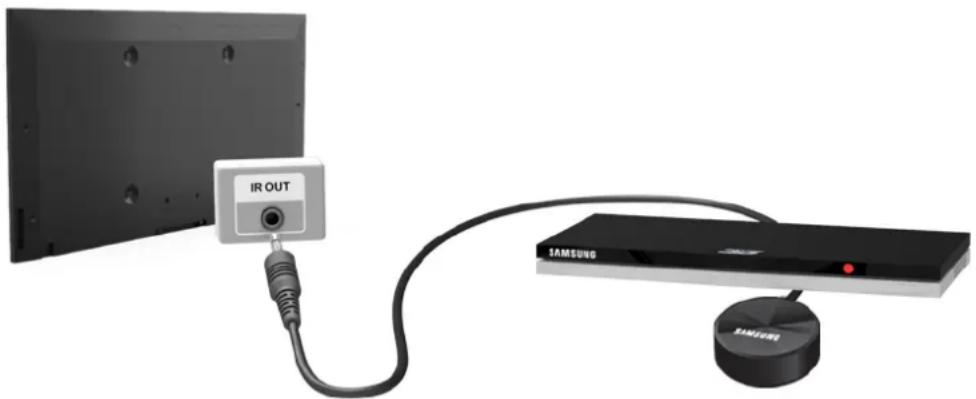
natural_image
Diagram showing an IR output device connected to a Samsung TV cable, with no visible text or symbols on the device itself.Controlling External Devices with the TV Remote
External Device Registration
- Turn on the external device to set up the universal remote function for, and bring up the Source screen.
- Select 📄 Universal remote setup from the top of the screen. This initiates the universal remote setup process.
- Follow the onscreen instructions and register the external device.
Using the TV Remote
Registering an external device to the TV remote also registers the connector through which the device is connected. Accordingly, simply selecting the external device using the SOURCE button makes it possible to control the device using the TV's remote.
Universal Remote Features
Changing the Input Connector
- Press SOURCE to bring up the Source screen.
- Select 📄 Universal remote setup from the top of the screen. This initiates the universal remote setup process.
- From the Universal remote setup screen, select a registered external device, and then select Source Setup. Change the TV's input connector that the external device is connected to.
Renaming an External Device
- Press SOURCE to bring up the Source screen.
- Select 📄 Universal remote setup from the top of the screen. This initiates the universal remote setup process.
- From the Universal remote setup screen, select a registered external device, and then select Rename. Rename the registered external device (up to 15 characters long).
Unregistering an External Device
- Press SOURCE to bring up the Source screen,
- Select 📄 Universal remote setup from the top of the screen. This initiates the universal remote setup process.
- From the Universal remote setup screen, select a registered external device, and then select Delete. Remove the registered external device.
Controlling the TV with a Keyboard
MENU > System > Device Manager > Keyboard Settings Try Now
You can use a keyboard to control the TV.
Certain models do not support USB HID class keyboards.
Connecting a Keyboard
Connecting a USB Keyboard
Plug the keyboard cable into the TV's USB port. A connection message appears on the screen.
Connecting a Bluetooth Keyboard (Not support for H6088 series)
Availability depends on the specific model.
- Place the Bluetooth keyboard into the standby status.
Refer to the keyboard manual for information on putting the keyboard into the standby status.
- Select MENU > System > Device Manager > Keyboard Settings > Add Bluetooth Keyboard. The Add Bluetooth Keyboard screen will appear and automatically scan for available keyboards.
If your keyboard was not detected, position the keyboard close to the TV and then select Refresh. This initiates a scan for available keyboards again.
-
Select the Bluetooth keyboard from the scan list and then select Pair and connect. A number appears on the screen.
-
Enter the number on the Bluetooth keyboard.
Select Yes to change the keyboard's options or No to leave them as they are.
Using the Keyboard
Use the following remote features with the USB or Bluetooth keyboard connected to the TV.
- Arrow Keys (moving the focus), Windows Key (MENU Button), Menu List Key (TOOLS Button), Enter Key (Select/run item), ESC (RETURN Button), Number Keys (Number Buttons)
- F1 (A), F2 (B), F3 (C), F4 (D), F5 (F), F6 (SOURCE Button), F7 (CH.LIST Button), F8 (MUTE Button), F9/F10 (Volume Buttons), F11 / F12 (Channel Buttons)
• Page Up/Page Down: Scroll web browser pages up/down. - Holding down the Enter key: On the Smart Hub screen, navigate to an item and hold down the Enter key to display the Options menu.
The Options menu depends on the context.
Changing Keyboards Try Now
Availability depends on the specific model.
Select MENU > System > Device Manager > Keyboard Settings > Select Keyboard. Designate which keyboard to use.
Only one keyboard can be used at a time.
Input Languages, Keyboard Type, and Switch Language Key Try Now
Select MENU > System > Device Manager > Keyboard Settings > Keyboard Options. The following options are available:
- Keyboard Language
If the keyboard supports multiple languages, choose which language you want to use from the list.
- Keyboard type
Specify the type of language selected under Keyboard Language.
The Keyboard type list varies depending on which language was selected under Keyboard Language.
- Switch Input Language
If the keyboard supports multiple languages, choose from the list which key to use to switch between languages.
Controlling the TV with a Mouse
MENU > System > Device Manager > Mouse Settings Try Now
This TV can be operated with ease using a mouse instead of a remote control.
Certain models do not support USB HID class mice.
Connecting a Mouse
Connecting a USB Mouse
Plug the mouse cable into the TV's USB port. A connection message appears on the screen.
Connecting a Bluetooth Mouse (Not support for H6088 series)
Availability depends on the specific model.
- Place the Bluetooth mouse in standby status.
Refer to the mouse manual for information on putting the mouse in standby status.
-
Select MENU > System > Device Manager > Mouse Settings > Add Bluetooth Mouse. The Add Bluetooth Mouse screen will appear and automatically scan for available mice.
-
Select the Bluetooth mouse from the scanned list, and then select Pair and connect. This pairs the Bluetooth mouse with the TV.
Using the Mouse
Once a USB or Bluetooth mouse is connected to the TV, a pointer will appear on the TV's screen. You can use this pointer to control the TV as you would a computer.
- Selecting and Running an Item
Left-click on the mouse.
- Displaying the Volume, Mute, and Channel Buttons
Select the volume/channel icon on the screen while watching TV. Use the onscreen buttons to adjust the volume or switch the channel.
Select the volume/channel icon again to hide the buttons.
• Showing Tools Buttons
Right-clicking shows the Tools buttons on the screen so that you can easily use the TV functions.
The Tools buttons may vary depending on the function.
- Displaying the Context-sensitive Menu on Smart Hub
On the Smart Hub screen, navigate to an item, and hold down the left mouse button for 1 second. The Options menu available to the selected item appears.
The Options menu depends on the context.
- Scrolling the TV Menu or Screen
Move the mouse wheel up or down. This scrolls the TV menu or screen up/down.
- Exiting the TV Menu or Feature
Click on the X button. This closes the menu.
The X button appears when a mouse is being used. Left-clicking once while using a feature displays the X button.
Changing Mice Try Now
Select MENU > System > Device Manager > Mouse Settings > Select Mouse. Designate which mouse to use.
Only one mouse may be used at a time.
Changing Mouse Buttons and Pointer Speed Try Now
Select MENU > System > Device Manager > Mouse Settings > Mouse Options. The following options are available:
- Primary Button
Choose which (left or right) button to use to select and run items.
- Pointer Speed
Adjust the movement speed of the pointer that appears on the screen.
Entering Text Using QWERTY
A QWERTY keypad appears when you need to enter text (entering the network password, logging into your Samsung account, etc.), allowing you to enter text using your remote control.
Using Additional Functions
Select on the QWERTY keyboard screen. The following options are available:
- Recommend text
Enable/disable the Recommended Text feature Enabling the Recommend text feature allows you to quickly enter text starting with the characters you typed in by displaying recommended words. To enter the word "Internet," for example, all you have to do is enter "In" and select the word "Internet" from the list of recommended words. The word is memorized so that you can enter the same text again more easily.
- Reset recommended text data
Delete both the recommended words and the memorised words to clear the list.
• Predict Next Letter
Enable/disable the Text Prediction feature. Enabling the Text Prediction feature eliminates the need to find and select individual character keys. To enter the word "Internet," for example, select "I". A predicted word will then appear next to the I key. Simply select the predicted word to enter "Internet".
This feature is limited to words that have previously been added to the dictionary.
• Accented Character Preview
Enable/disable the Show Accented Letters feature. An accented letter is a letter such as or with a diacritical mark above it. Enable the Show Accented Letters feature to enter these kinds of letters.
This is available only with a language that uses diacritical letters.
Establishing a Wired Internet Connection
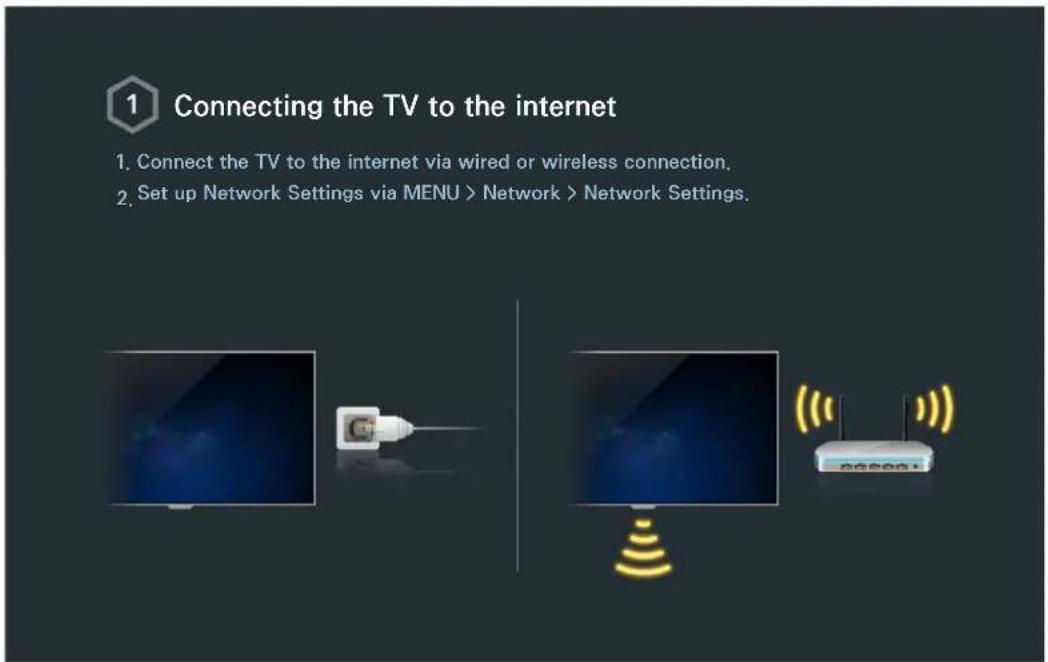
Connecting the TV to the Internet gives you access to online services and SMART features, and lets you update the TV's software quickly and easily through the Internet.
Connecting a LAN Cable
Use a LAN cable.
The TV will not be able to connect to the Internet if the network speed is below 10Mbps.
Use Cat 7 LAN cables to link your TV to the Internet Access Points.
There are three ways to connect the TV to the Internet. Refer to the diagrams and connect the LAN cable to the LAN connector on the back of the TV.
- External Modem
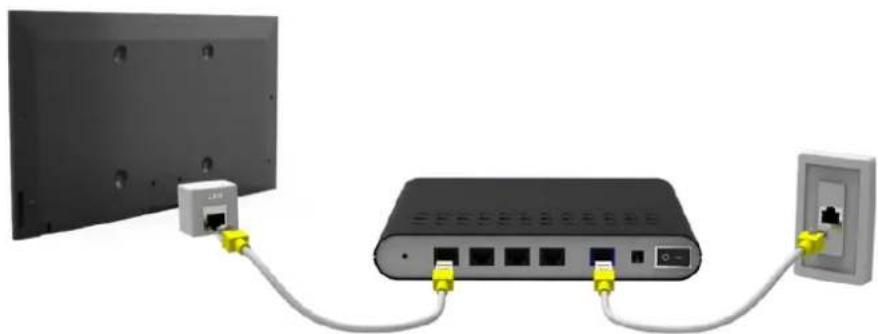
natural_image
3D diagram of a network device with two connected ports, one showing a router and the other a switch (no text or symbols visible)- ① IP Router + ② External Modem
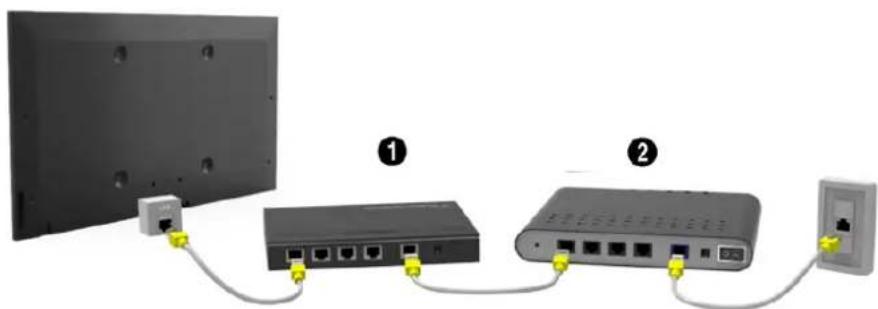
natural_image
Three connected network devices (TV, WiFi, and USB) shown with yellow connectors, no text or symbols present.• Wall-mounted LAN Outlet
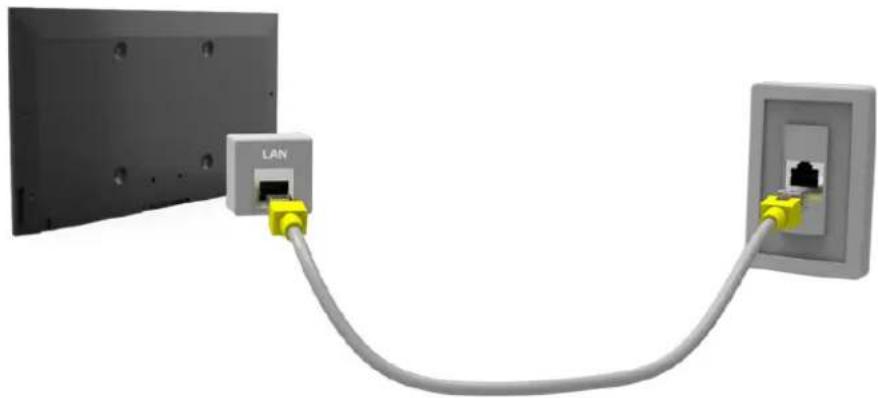
natural_image
3D diagram of two network switches connected by a cable, one showing a LAN port and the other a socket (no text or symbols present)Connecting to a Wired Internet Network Automatically
MENU > Network > Network Settings Try Now
Automatically connect to an available network.
- Set the Network Type to Wired, and then select Connect.
- The TV attempts to connect to an available network. Once successful, you will see a confirmation message. Select OK. If the attempt fails, try again, or connect manually.
Connecting to a Wired Internet Network Manually
MENU > Network > Network Settings
With networks that require a static IP address, you will need to enter the IP address, subnet mask, gateway, and DNS values manually to connect to the network. To get these values, contact your Internet Service Provider (ISP).
Refer to the "Dynamic versus Static IP Addresses" section for more information on dynamic IP and static IP addresses.
- Set the Network Type to Wired, and then select Connect.
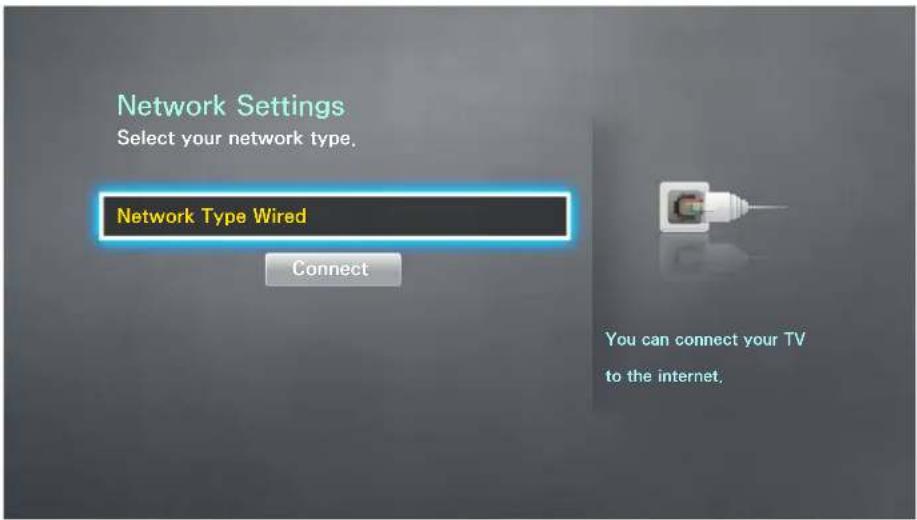
- Select Stop when the TV attempts to connect to the network. Once the network connection has been interrupted, select IP Settings.
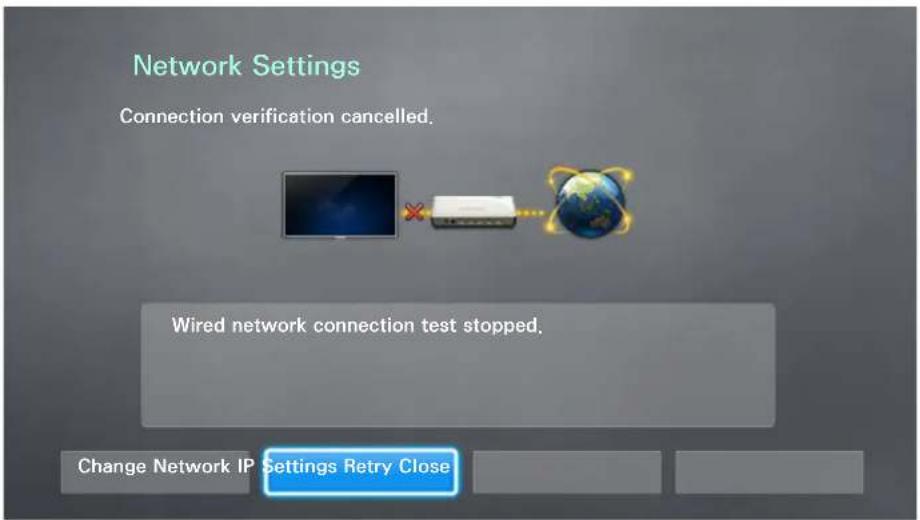
- In the IP Settings screen, set the IP setting to Enter manually, enter the IP Address, Subnet Mask, Gateway, and DNS Server values, and then select OK.
- Use one of the following methods to enter the numerical values.
Set the numbers using the ▲ and ▼ buttons.
Using Samsung Smart Control: Press KEYPAD button and enter the numbers directly. Or use the pointer fix the focus, then tap on the touchpad, enter the numbers from the popup menu. Using the remote control (only for H5500/H6800/H6088 series): Enter the numbers directly using numerical button.
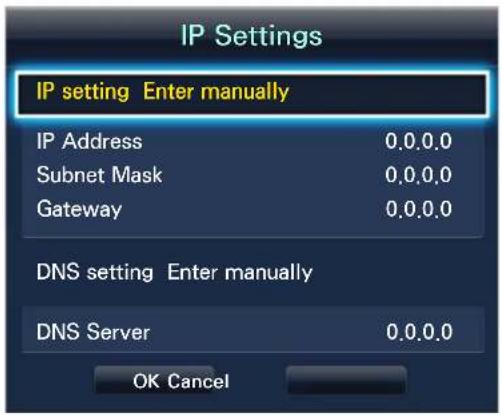
- The TV attempts to connect to the network again using the specified settings. A confirmation message appears once a connection is established. Select OK.
The network connection speed may differ depending on the DNS server settings.
For details on the DNS server settings, contact your Internet service provider (ISP).
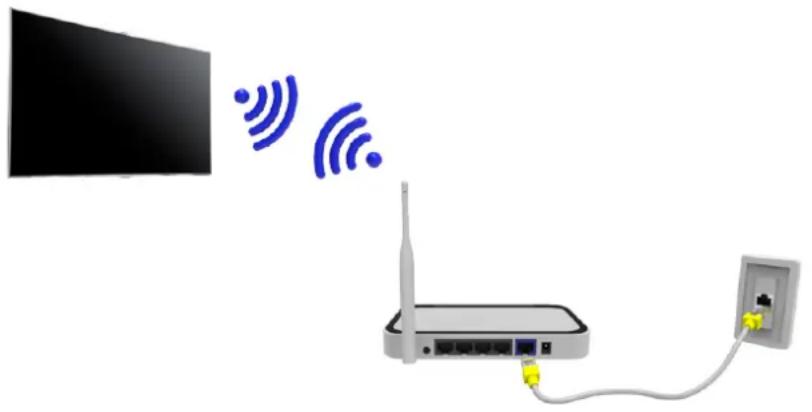
Establishing a Wireless Internet Connection
Connecting the TV to the Internet gives you access to online services and SMART features, and lets you update the TV's software quickly and easily through the Internet.
natural_image
Illustration of a remote network device with a monitor and wireless signal waves (no text or symbols)Connecting to a Wireless Internet Network Automatically
MENU > Network > Network Settings
Connect the TV to the Internet via a wireless router. Make sure you have the wireless router's SSID (name) and security key settings before attempting to connect. The security key can be found on the wireless router's configuration screen.
- On the Network Settings screen, set Network Type to Wireless. The TV automatically displays a list of available wireless networks.
- Select a network (SSID). If the network you want doesn't appear in the list, select Add Network, and enter the network's SSID manually.
- Enter the security key and select Done. If the selected network is not security-enabled, the TV attempts to connect right away.
- A network connection will be attempted. Once a connection is established, the TV displays a confirmation message. Select OK. If the attempt fails, try again, or connect manually.
Connecting to a Wireless Internet Network Manually
MENU > Network > Network Settings
With networks that require a static IP address, you will need to enter the IP address, subnet mask, gateway and DNS values manually to connect to the network. To get the IP address, subnet mask, gateway and DNS values, contact your Internet Service Provider (ISP).
Refer to the "Dynamic versus Static IP Addresses" section for more information on dynamic IP and static IP addresses.
- Setting the Network Type to Wireless automatically displays a list of available wireless networks.
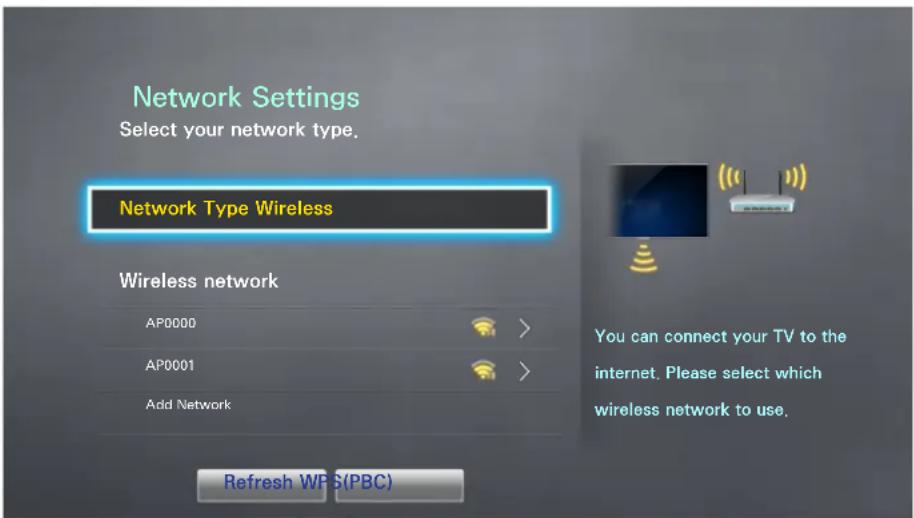
- Select the network (SSID) you want to connect to. If the wireless router doesn't appear in the list, select Add Network, and enter the network's SSID manually.
- Enter the security key and select OK. If the selected network is not security-enabled, the TV attempts to connect right away.
- Select Stop when the TV attempts to connect to the network. Once the network connection has been interrupted, select IP Settings.
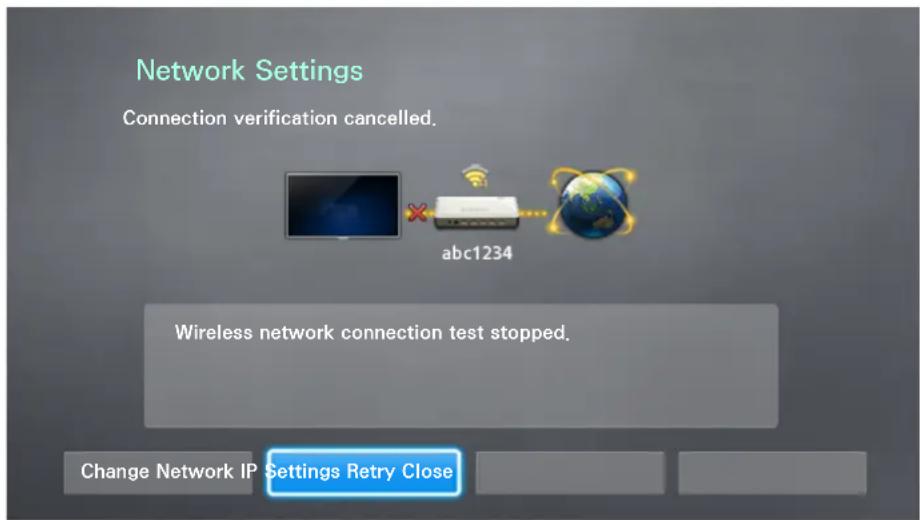
- In the IP Settings screen, set the IP setting to Enter manually, enter the IP Address, Subnet Mask, Gateway, and DNS Server values, and then select OK.
- Use one of the following methods to enter the numerical values.
Set the numbers using the ▲ and ▼ buttons.
Using Samsung Smart Control: Press KEYPAD button and enter the numbers directly. Or use the pointer fix the focus, then tap on the touchpad, enter the numbers from the popup menu.
Using the remote control (only for H5500/H6800/H6088 series) : Enter the numbers directly using numerical button.
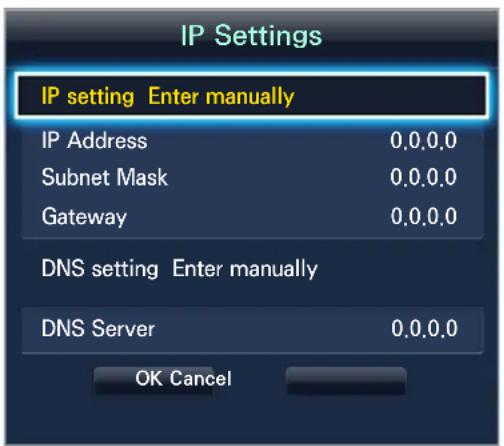
- The TV attempts to connect to the network again using the specified settings. A confirmation message appears once a connection is established. Select OK.
The network connection speed may differ depending on the DNS server settings.
For details on the DNS server settings, contact the Internet service provider (ISP).
Connecting to a Wireless Internet Network with WPS
MENU > Network > Network Settings
With wireless routers that support WPS (Wi-Fi Protected Setup) or PBC (Push Button Configuration), it's possible to press a button on the router to connect the TV to the Internet.
This functionality is not available with wireless routers that do not support WPS. Check to see if your wireless router supports WPS.
- Setting the Network Type to Wireless automatically displays a list of available wireless networks.
- Select WPS(PBC) and then press the WPS or PBC button located on the wireless router within two minutes.
- The TV exchanges the network name (SSID) and security key automatically and then attempts to connect to the Internet. A confirmation message appears once a connection is established. Select OK.
Troubleshooting Internet Connectivity Issues
If you are not able to connect the TV to the Internet, read the information below.
Troubleshooting Wired Internet Connectivity Issues
No network cable found
Make sure the network cable is plugged in. If it is connected, make sure the router is turned on. If it is on, try turning it off and on again.
IP auto setting failed
Do the following or configure the IP Settings manually.
- Ensure that the DHCP server is enabled on the router and reset the router.
- If this does not work, contact your Internet Service Provider for more information.
Unable to connect to the network
Do the following:
- Check all IP Settings.
- Ensure that the DHCP server is enabled on the router. Then, unplug the router and plug it back in.
- If this does not work, contact your Internet Service Provider for more information,
Connected to a local network, but not to the Internet
- Make sure that the Internet LAN cable is connected to the router's external LAN port.
- Check the DNS values in the IP Settings.
- If the problem persists, contact your Internet Service Provider.
Network setup is complete, but unable to connect to the Internet
If the problem persists, contact your Internet Service Provider.
Troubleshooting Wireless Internet Connectivity Issues
Wireless network connection failed
Selected wireless router not found. Go to Network Settings and select the correct router.
Unable to connect to a wireless router
Check the following:
- Check if the router is turned on. If it is, turn it off and on again.
- Enter the correct security key if required.
IP auto setting failed
Do the following or configure the IP Settings manually.
- Make sure that the DHCP server is enabled on the router. Then, unplug the router and plug it back in.
- Enter the correct security key if required.
- If this does not work, contact your Internet Service Provider for more information.
Unable to connect to the network
Do the following:
- Check all IP Settings.
- Enter the correct security key if required.
- If this does not work, contact your Internet Service Provider for more information.
Connected to a local network, but not to the Internet
- Make sure that the Internet LAN cable is connected to the router's external LAN port.
- Check the DNS values in the IP Settings.
- If the problem persists, contact your Internet Service Provider.
Network setup is complete, but unable to connect to the Internet
If the problem persists, contact your Internet Service Provider.
Checking the Internet Connection Status
MENU > Network > Network Status Try Now
Network
Network Status
Network Settings
Wi-Fi Direct
Multimedia device settings
Screen Mirroring
Device Name [TV]Samsung LE...
Actual menu screen may differ depending on the TV model.
View the current network and Internet status.
Using Multiple Functions in a Single Screen (Multi-Link Screen) (Only for 7 series)
Availability depends on the specific model.
This allows you to search the Web, use apps, and much more while watching TV.
Before using Multi-Link Screen, make sure the TV is connected to the Internet. Using Multi-Link Screen requires an Internet connection.
Launching Multi-Link Screen
Picture > Open Multi-Link Screen
From the Picture menu, select Open Multi-Link Screen.
Press M.SCREEN on the Samsung Smart Control to launch Multi-Link Screen.
Using Multi-Link Screen
UHD and FHD contents and channels cannot be viewed simultaneously.
Launching Smart Hub while using Multi-Link Screen automatically terminates Multi-Link Screen.
Certain TV features and apps may not be supported by Multi-Link Screen. If this is the case, exit from Multi-Link Screen and then use the feature.
Selecting a Feature
-
Press the Samsung Smart Control's M.SCREEN button while Multi-Link Screen is running. The Options menu appears.
-
Select a feature from the Options menu. This initializes the selected feature.
Features supported by Multi-Link Screen vary depending on the country.
Changing the Channel/Volume
-
Place the pointer or focus over the screen for which you want to change the channel or adjust the volume.
-
Use the channel buttons to change the channel or the volume buttons to adjust the volume. This changes the selected screen's channel/volume.
Selecting the Audio-Source Screen
It's possible to listen to audio from one screen through the speakers.
- Press the Samsung Smart Control's M.SCREEN button while Multi-Link Screen is running. The Options menu appears.
- Select Settings from the Options.
- Select Speaker Settings from the Settings menu.
- Select a screen for TV Speaker.
Select Auto to listen to audio from the screen with the pointer or focus placed at the top.
Smart Hub
MENU > Smart Hub > Open Smart Hub
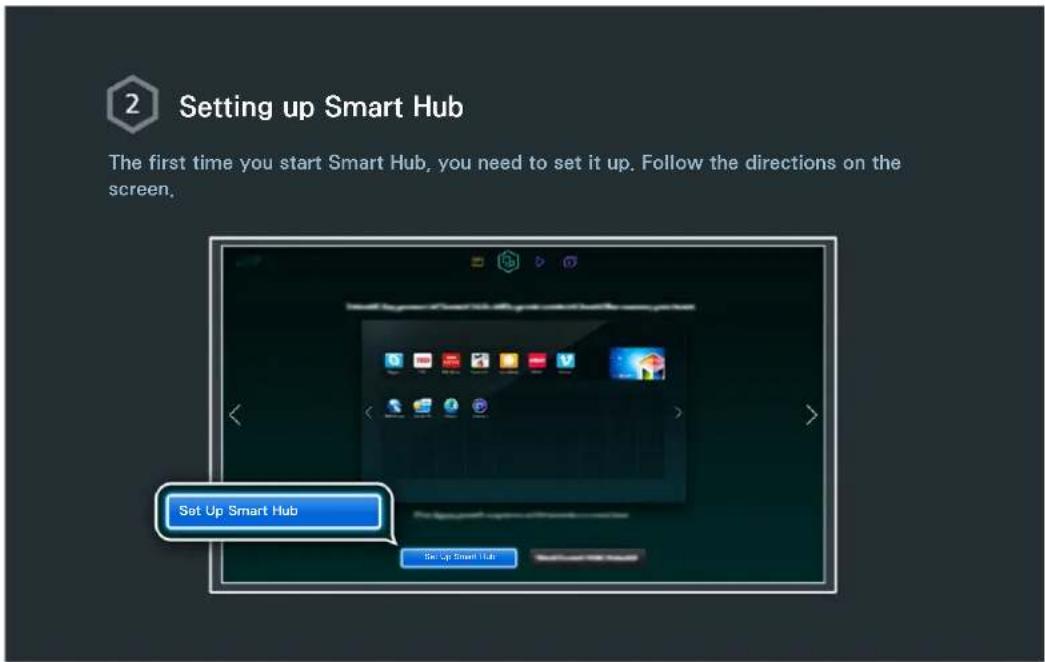
With Smart Hub, you can surf the web, download apps, and stay in touch with family and friends through social networking services. In addition, you can use photo, video, and music files stored on external storage devices.
Some Smart Hub services are paid services. To purchase such a service, the service provider account or Samsung Apps TV account (Samsung account) is required.
Make sure the TV is connected to the Internet. The TV must be connected to the Internet in order to use Smart Hub.
Some features of Smart Hub require an Internet connection and may not be available depending on the service provider, language, or region.
To use Smart Hub, you must agree to the end user agreement and privacy policy. Otherwise, you will not be able to access the features and services related to them. You can view the entire content of the Terms & Policy by navigating to MENU > Smart Hub > Terms & Policy. If you don't wish to use Smart Hub anymore, you can withdraw the agreement. Try Now
Testing Smart Hub connections
Support > Self Diagnosis > Smart Hub Connection Test
Availability depends on the specific model and area.
If Smart Hub is not functioning, navigate to Support > Self Diagnosis > Smart Hub Connection Test. Diagnose the problem by checking the internet connection, your ISP, the Samsung server and the Samsung Apps panels.
After completing the test, if Smart Hub continues to have problems, contact your Internet Service Provider or a Samsung Contact Centre.
Opening the Home Screen
Press (Smart Hub icon) while watching TV to open the Home Screen.
On the Home Screen, search through favourites apps, channels or sources and access previously run or frequently used functions.
You can configure the TV to automatically open the Home Screen when it turns on. Navigate to Smart Hub > Home Screen Settings, and set Auto Start to On.
Setting your favourite item
- Press (Smart Hub icon) while watching TV to open the Home Screen, and move to a desired item.
- Press and hold the touchpad. The Options menu appears.
- In the Options menu, select Add to Favourites to add the selected item to the favourite list, which will move top of the list.
To delete a favourite item, select it and tap and hold the touchpad to display the context menu. Then, select Remove from Favourites.
Deleting browsing history
- Press (Smart Hub icon) while watching TV to open the Home Screen, and select Clear All. You will be asked to confirm your selection.
- Select OK on the screen. Your browsing history is deleted completely.
However, the Favorites list items will not be deleted.
You can also delete your browsing history by selecting Clear All in the Smart Hub > Home Screen Settings menu.
Moving to the Panel Screen
Press the button then tap on the Touchpad or Enter button to open the Smart Hub, and select the panel icon. You will move to the panel screen. For each service panel, the following functions are available.
NewsON
NewsON provides a real-world service that informs users of news and weather-related information in one place without the need for a newspaper, smartphone, or computer.
Usability depends on the specific model and local region.
• SAMSUNG APPS
You can enjoy variety of free and paid news, sports, weather, and gaming apps on the TV as you would on a smart phone or tablet.
• MOVIES & TV SHOWS
You can directly purchase and view a movie or TV programme through the app provided by Smart Hub without connecting an external video source such as a DVD or Blu-ray player.
Usability depends on the specific model and local region.
• MULTIMEDIA
You can play back photo, video, and music files from an external storage device or watch recorded videos.
Using the Smart Hub Tutorial
MENU > Support > Smart Hub Tutorial
From the Support menu, select Smart Hub Tutorial. This will familiarize yourself with the basics of Smart Hub and panels.
Resetting Smart Hub
MENU > Smart Hub > Reset Smart Hub Try Now
Reset all saved information relating to Samsung accounts and licked service accounts, as well as Smart Hub service agreements and applications.
Using Smart Hub with Samsung Account
Samsung Account
Log In
Edit profile
Link Service Accounts
Remove Account from TV
Create Account
Terms and Conditions, Privacy Policy
Actual menu screen may differ depending on the TV model.
Creating a Samsung Account
MENU > Smart Hub > Samsung Account
Some Smart Hub services are paid services. To purchase such a service, the service provider account or Samsung Apps TV account (Samsung account) is required.
You can create a Samsung Account using your email address.
To create a Samsung Account, you must agree to the Samsung Account end user agreement and privacy policy. Otherwise, you cannot create a Samsung Account. You can view the entire content of the agreement by navigating to MENU > Smart Hub > Samsung Account > Terms and Conditions, Privacy Policy. If you don't wish to use a Samsung Account anymore, you can withdraw the agreement.
Alternatively, you can create a Samsung Account at http://content.samsung.com. You can use one ID for both the TV and the website.
Creating a Samsung Account using Sign Up Samsung Account Menu
- Navigate to MENU > Smart Hub > Samsung Account > Create Account and select Create a Samsung account.
- Agree to use a Samsung Account and select Next.
- Create a Samsung Account according to the instructions on the Create Account screen. Once a Samsung Account is created, you will be automatically logged in to Smart Hub.
Creating a Samsung Account using a Facebook Account
(May not be available, depending on your regions and country.)
A Facebook user can easily obtain necessary information from Facebook and create a Samsung Account.
- Navigate to MENU > Smart Hub > Samsung Account and select Log In.
- Select + and select the Create with Facebook.
- Enter your Facebook ID and password and select Sign In.
- Agree to use a Samsung Account and select Next.
- Create a Samsung Account according to the instructions on the Create Account screen. Once a Samsung Account is created, you will be automatically signed in.
If you create a Samsung Account using your Facebook account, they are automatically linked.
Signing into Samsung Account
MENU > Smart Hub > Samsung Account > Log In
Logging into and Saving a Samsung Account
If you haven't logged into your Samsung Account on the TV, you must save your Samsung Account on the TV.
- Navigate to MENU > Smart Hub > Samsung Account and select Log In.
- Select ⊕ and select Sign In.
- Enter your ID and password and then select Sign In.
Check the Sign me in automatically option if you wish to log into Smart Hub automatically.
If you forgot your password, select Reset password to receive password reset instructions via email.
-
Select an image to be used as the profile picture. The Samsung Account has been saved on the TV.
-
Select Done to log into your Samsung Account.
Easily Logging Into Your Samsung Account Saved on the TV
- Navigate to MENU > Smart Hub > Samsung Account and select Log In.
- Choose your Samsung Account on the Sign In screen and select Sign In.
- Using the login method configured for the selected Samsung Account, log into your Samsung Account.
Linking My Samsung and App Accounts
MENU > Smart Hub > Samsung Account > Link Service Accounts
Linking your Samsung Account to accounts of apps installed on the TV lets you automatically log into your linked app accounts when you log into your Samsung Account. For example, you can download the Facebook app and link your Facebook account to your Samsung Account. In this case, logging into your Samsung Account then automatically logs you into your Facebook account as well.
To use Link Service Accounts, you must first log into your Samsung Account.
Linking an App Account
- Navigate to MENU > Smart Hub > Samsung Account and select Link Service Accounts. A list of apps that can be linked to your Samsung Account is shown.
- Select an app from the list. The Link to other accounts window appears on the screen.
- Enter the current ID and password of the app to log in. When the login is complete, the app account is linked to the Samsung Account.
Disconnecting a Linked Account
- Navigate to MENU > Smart Hub > Samsung Account, select Link Service Accounts. Select an app to unlink.
- A confirmation dialog box appears. Select Yes to unlink the app.
Changing and Adding Information to Samsung Account
MENU > Smart Hub > Samsung Account
Using the Samsung Account menu, you can manage your Samsung Account.
To change the account information, you must be logged into your Samsung Account.
- Navigate to MENU > Smart Hub > Samsung Account and select Edit profile.
- Enter the password and then select Done. The edit profile screen appears.
The profile editing screen provides the following features.
• Changing Profile Image
If you select Edit Profile Picture on the login screen, you can change the profile image.
• Registering Your Face to Samsung Account
If you select Register face on the login screen, you can register your face to your Samsung Account. The registered face is used by the Sign-in Method.
This is available only if the optional TV camera is connected to the TV.
- Choosing a Samsung Account Login Method for TV
Select Sign-in Method on the login screen and choose a login method. You can determine how to log into the TV with the saved Samsung Account.
- Setting Auto Login
Check the Sign me in automatically option if you wish to log into Smart Hub automatically
- Entering Basic User Information
You can enter your given name, surname, and date of birth.
• Receiving e-mail about Samsung services
You can determine whether to receive e-mail about Samsung services. Containing the latest information.
Deleting All Samsung Accounts from the TV
MENU > Smart Hub > Samsung Account > Remove Accounts from TV
Navigate to MENU > Smart Hub > Samsung Account and select Remove Accounts from TV. The account and password information saved on the TV is deleted, and the account information of any linked apps are also deleted.
To delete your account information, you must be signed in with your Samsung Account.
Using the NewsON Panel
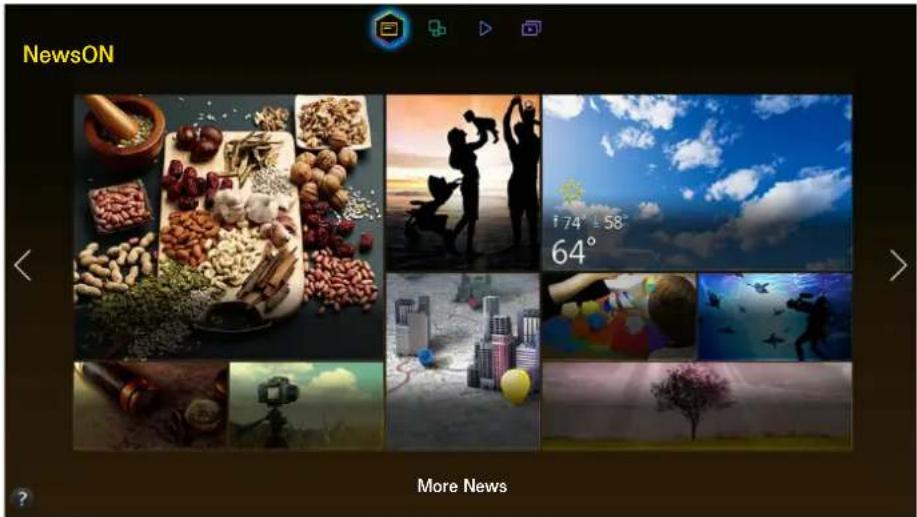
Actual menu screen may differ depending on the TV model.
This service or some of functions of it may be not available in some countries or region.
NewsON provides a real-world service that informs users of news and weather-related information in one place without the need for a newspaper, smartphone, or computer.
NewsON users can find daily information on a wide variety of topics in a smart and convenient way. Updated in real time, NewsON informs users of the latest headlines, top stories, popular issues, and weather forecasts.
News
News articles are updated in real time. Simply select an article on the screen. The selected article will be displayed on the screen in details.
For longer articles, press the touchpad^ or √, or press the ▲ or ▼ button on the remote control to scroll the screen.
To move to a different article, press the touchpad to the< or >, or press the ◀ or ▶ button on the remote control.
Weather
Weather information is provided for major cities of the user's country. Select a weather-related item on the screen. The selected item will be displayed in details.
Using SAMSUNG APPS Panel
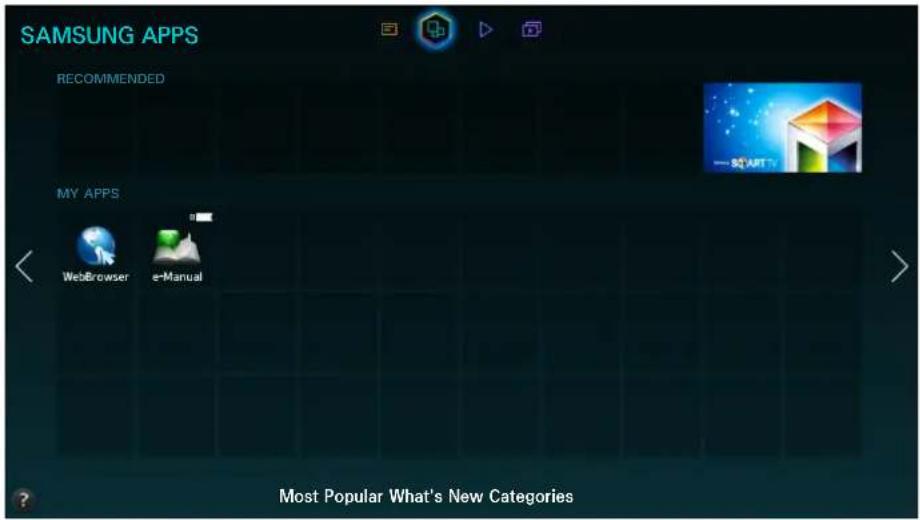
Actual menu screen may differ depending on the TV model.
This service or some of functions of it may be not available in some countries or region.
Smart Hub offers a variety of free and paid news, sports, weather, and gaming content you can install directly on your TV the same way as you would on a smartphone or tablet.
Before you use SAMSUNG APPS, make sure the TV is connected to the Internet. Your TV must be connected to the Internet in order to use SAMSUNG APPS.
Launching Smart Hub for the first time installs the default apps automatically. The default apps may differ depending on the region.
Using Pop-Up Menu Functions
Move the focus to an app and press and hold the Enter← or Touchpad. You can use the following functions:
- Move
Relocates the selected app. - Delete
Removes the selected app.
- Delete Multiple
Removes multiple apps at once.
- View Details
Move to the detailed information of the selected app.
- Change view
You can change view mode sort by Custom view or Most Played.
- Lock/Unlock
You can lock or unlock a selected app from the screen.
- Update Apps
You can update the selected app.
Installing an App
When the TV's internal memory is insufficient, you can install an app on a USB device.
Only when the USB device is connected are the app icons installed on the USB viewable on the SAMSUNG APPS screen. You can use an app installed on a USB device only when the USB device is connected to the TV. If the USB device is disconnected while the app is running, the app is terminated.
The app installed on the USB device is not available on a different TV, or a PC.
Quick Installation
- On the SAMSUNG APPS screen, select Most Popular, What's New, or Categories.
The Most Popular and What's New show the most popular and newest Samsung Apps. To view the entire app list, select Categories. You can view all Samsung Apps classified by genre.
-
Move the focus to an app and press and hold the Enter or Touchpad. A pop-up menu appears.
-
On the pop-up menu on the screen, select Download.
You must purchase paid apps with App Cash to install it. Visit the Samsung Apps TV website at http://tv.samsungapps.com to replenish your account with App Cash before purchasing paid apps.
While an app is being installed, the progress bar appears at the bottom of the app icon so that you can easily figure out the installation progress.
- The selected app is installed on the TV.
You can view installed apps on the SAMSUNG APPS screen.
Installing an App from the Detailed App Information Screen
- On the SAMSUNG APPS screen, select Most Popular, What's New, or Categories.
The Most Popular and What's New show the most popular and the newest Samsung apps. To view the entire app list, select Categories. You can view all Samsung Apps by category.
-
Select an app from the list. Detailed information about your selection appears on the screen.
-
Select Download on the detailed information screen to install the selected app on the TV.
You must purchase paid apps with App Cash to install it. Visit the Samsung Apps TV website at http://tv.samsungapps.com to replenish your account with App Cash before purchasing paid apps.
When an app is being installed, a progress bar appears underneath the app icon.
- When the installation is complete, the Download button turns to Play.
You can view installed apps on the SAMSUNG APPS screen.
Launching an App
Select an app on the SAMSUNG APPS screen to launch it.
The icons indicate the following:
• 📋: The app supports motion control.
• 0 : The app supports voice control.
• : The app is installed on a USB device.
• 📞: The app supports a pointer that can move by the Samsung Smart Control.
Default Apps
e-Manual
The embedded e-manual contains TV's information.
WebBrowser
WebBrowser is an Internet browsing app. Using WebBrowser, you can surf the Internet on the TV in the same manner as you would using a PC even while watching a TV programme on PIP. Use a keyboard and mouse for a more convenient web browsing experience.
The browsing page may differ from that on a PC.
Rearranging Apps on the SAMSUNG APPS Screen
- On the SAMSUNG APPS screen, move to the app you wish to change the order.
- Press and hold the Enter ↩ or Touchpad. A pop-up menu appears.
- On the pop-up menu, select Move.
- Move an app to a desired location and select the app again.
Removing an App from the TV
Note that if an app is removed, the data related to the app is also deleted.
Removing an App
- On the SAMSUNG APPS screen, move to the app you wish to remove.
- Press and hold the Enter ↩ or Touchpad. A pop-up menu appears.
- On the pop-up menu on the screen, select Delete. A removal confirmation window appears. Select OK. The selected app is removed.
Removing an app with your Samsung Account removes the app from the account only. The app will remain for all other accounts.
Removing an app without logging into a Samsung Account removes the app from the TV.
Removing Multiple Apps
- On the SAMSUNG APPS screen, move to the app you wish to remove.
- Press and hold the Enter ↩ or Touchpad. A pop-up menu appears.
- On the pop-up menu on the screen, select Delete Multiple. A check box appears on the app icons.
- Select all the apps you wish to remove and then select Delete. A removal confirmation window appears. Select Yes. Selected apps are removed.
If you remove an app with your Samsung Account, the app is just removed from your account, but not from other accounts or before you log in.
Rating/Reviewing an App
On the detailed app information screen, you can rate the app or send a review to the app developer.
To rate or review an app, you must log into your Samsung Account. You can only rate or review apps that you have purchased or downloaded with your Samsung Account.
Updating an App
- On the SAMSUNG APPS screen, move to the app you wish to update.
- Press and hold the Enter ↩ or Touchpad. A pop-up menu appears.
- On the pop-up menu on the screen, select Update Apps. A popup window appears.
- Select all the apps you wish to update and then select Update. All the selected apps are updated to the latest versions.
Setting Auto App Update
MENU > Smart Hub > Apps Settings
To update apps automatically, navigate to MENU > Smart Hub > Apps Settings and set Auto update to On. The apps installed on the TV are automatically updated as updates become available.
SAMSUNG APPS Features
MENU > Smart Hub > Apps Settings
You can configure the features related to the apps installed on your TV.
Enabling Automatic Tickers
You can configure selected tickers to display automatically when the TV is turned on. Ticker Service enables you to use other services while watching TV. You can receive news, stock, and weather information and more in real-time while watching TV.
To use this feature, make sure that an app supporting the Auto Ticker function is installed on the TV.
- Navigate to MENU > Smart Hub > Apps Settings and select Auto Ticker. A list of installed apps that support Ticker Autorun appears.
- From the list, select apps you wish to run automatically when the TV is turned on.
Setting Push Notification
Push notification function enables apps installed on the TV to send alerts and messages to the user.
- Navigate to MENU > Smart Hub > Apps Settings > Push Notification Settings and set the Push Notification to On.
- Set the Push Notification setting of apps you wish to receive push notifications from to On. Push notification function of the selected apps is activated.
The Push Notification app list only shows installed apps that support Push Notification Settings.
Using an App while Watching TV
If an app linked to a channel is installed on the TV, you can view programme information and use related services offered by the app while watching TV.
Navigate to MENU > Smart Hub > Apps Settings and set Channel-Bound Apps to On.
This feature is only available with apps supporting Channel-Bound Apps installed on the TV.
Using SyncPlus while Watching TV
Availability depends on the specific model and area.
SyncPlus is a broadcast-based advertisement and content linking service that lets viewers quickly and easily access additional information about the programme or advertisement playing on the TV.
Using MOVIES & TV SHOWS Panel
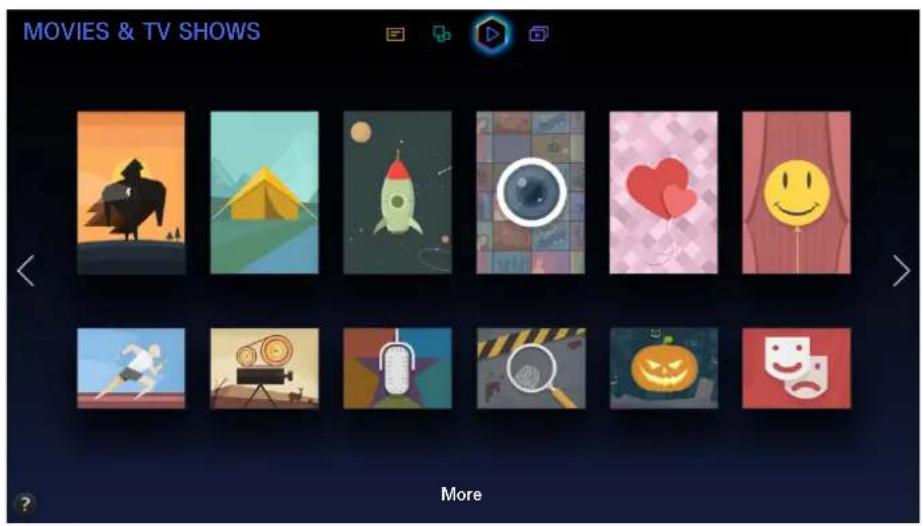
Actual menu screen may differ depending on the TV model.
This service or some of functions of it may be not available in some countries or region.
Use this feature to purchase and view movies and TV programmes recommended by MOVIES & TV SHOWS without having to use an external device such as a DVD player or a Blu-ray player. MOVIES & TV SHOWS provides an easy access to a collection of movies and TV programmes available in Smart Hub.
Not all the MOVIES & TV SHOWS options may be available depending on the content you are trying to access or your region.
Before you use MOVIES & TV SHOWS, make sure the TV is connected to the Internet. The TV must be connected to the Internet in order to use MOVIES & TV SHOWS.
Watching a Movie / TV Programme
If you are using MOVIES & TV SHOWS for the first time or have not logged into your Samsung Account, new and popular movies & TV shows will be shown in the MOVIES & TV SHOWS list. To view a customized recommendation list in MOVIES & TV SHOWS, first log into your Samsung Account. You can view a list of frequently played content on MOVIES & TV SHOWS screen in addition to the default recommended content list.
-
On MOVIES & TV SHOWS screen, select a movie or TV programme you wish to watch. Detailed information about your selection appears on the screen.
-
On the detailed information screen, select an app to play the content. This launches the selected app and displays detailed information about the content.
If the selected app is not installed, a popup window will appear. From the popup window, move to the detailed app information page or install the app.
- You can play the content in the detailed information of the content.
If the selected content is free, you can instantly watch the content. If the content is a paid content, you must first purchase the content in the app (In-App Purchase).
The purchasing procedures on the app may differ depending on the app. You may need to log into the app or enter payment information.
Registering Content to Favourites
-
On MOVIES & TV SHOWS screen, select a movie or TV programme that you wish to register to Favourites. Detailed information about your selection appears on the screen.
-
Select button on the detailed information screen. The content is added to the Favourites.
Select Favourites at the lower part of the MOVIES & TV SHOWS screen to view your favourites content list.
Select the button at the top of the content list in each menu to register multiple items to Favourites at once.
Playing Photos, Videos, and Music (MULTIMEDIA)
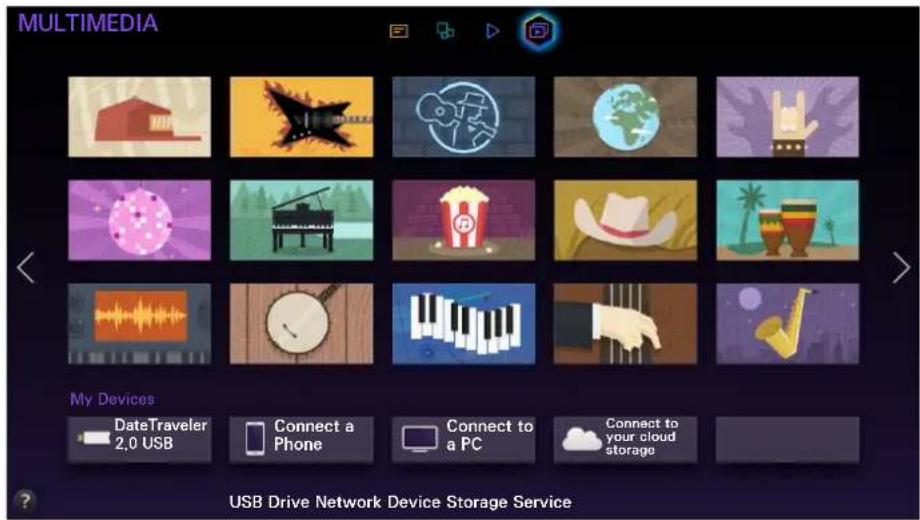
Actual menu screen may differ depending on the TV model.
This service or some of functions of it may be not available in some countries or region.
You can play media content saved on a USB device, smartphone, camera, computer, or storage service on the TV.
You cannot play media content if the content or the storage device are not supported by the TV. For more information, refer to "Read Before Playing Photo, Video, or Music Files".
Backup important files before connecting a USB device. Samsung shall not be held responsible for damaged or lost files.
Playing Media Content from a USB Device
- Press the button then tap on the Touchpad or Enter button, and select USB Drive in the MULTIMEDIA panel. USB devices connected to the TV are listed.
- Select the device you wish to access. Folders and files of the selected USB device are listed.
- Select the media content you wish to play. This plays the selected content.
Alternatively, move to the media content to play and press the ▶ button to play the content.
If you connect a USB device to the TV while watching the TV, a popup window appears on the screen so that you can easily navigate the folders and files of the USB device.
Alternatively, if you select a USB device on the Source screen, a popup window appears on the screen so that you can easily navigate the folders and files of the USB device.
Safely Removing a USB Device
- Press the SOURCE button. The Source screen appears.
- Navigate the USB device you wish to remove, and press and hold the Touchpad. An options window appears.
- Select Disconnect USB Device from the list.
Playing Multimedia Content Saved in a Computer / Mobile Device
To view a guide about the PC connection, select Connecting to PC under Network Device.
To view a guide about a Smartphone or tablet connection, select Connect to a Phone under Network Device.
Allowing Connection with a Computer/Mobile Device
To play multimedia content in a computer or mobile device on the TV, you need to allow the connection with the computer on the TV.
You can connect to a computer or mobile device on any DLNA DMC device. DLNA DMC function enables users to connect a mobile device to the TV, search for multimedia content and control play operations on the TV.
-
Press the button then tap on the Touchpad or Enter button, and select Network Device in the MULTIMEDIA panel. Devices connected to the TV are listed.
-
Select Options and then Multimedia device settings. Devices connected to the TV are listed.
Alternatively, select Multimedia device settings from the Network menu to see the list of the devices connected to the TV.
- Allow connection with the desired device you wish to connect to the TV. You can only play media files from devices that have been allowed to connect to the TV.
If a computer or mobile device requests the multimedia content play, the connection allowance confirmation window appears on the TV so that you can easily connect the computer or mobile device.
When Connected through Home Network (DLNA)
To connect a computer through home network (DLNA).
To connect a mobile device through home network (DLNA) section.
You may experience compatibility issues when attempting to play media files via a third-party DLNA server.
However, the content shared by a computer of a mobile device may not play depending on the encoding type and file format of the content. In addition, some functions may not be available.
The multimedia content may not smoothly play depending on the network status. If this is the case, use a USB storage device.
-
Press the 📋 button then tap on the Touchpad or Enter button, and select Network Device in the MULTIMEDIA panel. Devices connected to the TV are listed.
-
Select a device connected via the home network (DLNA). Folders and files shared by the selected device will be listed.
-
Select a media content you wish to play from the list. This plays the selected content.
Alternatively, move to the media content and press ▶ to play.
When Connected through Samsung Link
To connect a computer through Samsung Link.
To connect a mobile device through Samsung Link.
However, the content shared by a computer of a mobile device may not play depending on the encoding type and file format of the content. In addition, some functions may not be available.
The multimedia content may not smoothly play depending on the network status. If this is the case, use a USB storage device.
-
Navigate to MENU > Smart Hub > Samsung Account menu and select Log In to sign in with your the Samsung Account.
-
Press the 📋 button then tap on the Touchpad or Enter button, and select Network Device in the MULTIMEDIA panel. Devices connected to the TV are listed.
-
Select a device connected via Samsung Link. Folders and files shared by the selected device will be listed.
-
Select a media content you wish to play from the list. This plays the selected content.
Alternatively, move to the media content and press ▶ to play.
Playing Media Content from a Storage Service
Storage services store user content such as photo, video, and music files on a server so that they can be viewed/played on the TV over the Internet. It's also possible to view your media content saved on Storage services such as Dropbox and SkyDrive from the TV.
To play content from a Storage service, you must log into your Samsung Account and link it to the Storage service account.
- Navigate to MENU > Smart Hub > Samsung Account menu and select Log In to sign into your Samsung Account.
- Press the 📋 button then tap on the Touchpad or Enter button, and select Storage Service in the MULTIMEDIA panel. Storage services linked to your Samsung Account appears.
- Select a Storage service. Folders and files found in the selected Storage service are listed.
- Select the media content you wish to play from the list. This plays the selected content.
Alternatively, move to the media content and press ▶ to play.
Buttons and Functions Available while Viewing Photos
Press Enter ↩ or Touchpad to access the following buttons. Pressing RETURN hides the playback buttons.
- Pause / Play
Start or stop the slide show. The slide show feature displays all the photos contained in the selected folder, one photo at a time.
- Previous / Next
View the previous/next photo in the queue.
- Share
Availability depends on the specific model and area.
you can upload your music files to your Sina Weibo account.
- Settings
| Function Description | |
| Slideshow Settings | Speed: Set the slide show speed.Effects: Apply transition effects to the slide show. |
| Rotate | Rotate the photo. |
| Zoom | Zoom in by up to a factor of 4. |
| Picture Mode | Change Picture Mode. |
| Background Music | Listen to background music while viewing photos.The music file must be located on the same device as the photo files.A mini player appears on the screen when background music is played. Use the mini player to pause the music or play a different music file. |
| Sound Mode | Change Sound Mode.This option is supported only when background music is playing. |
| Select Speakers | Choose speakers for the background music. |
| Send | This function is the same as the "Copy" function of a computer. Use this function to send the current photo to another storage device.For information on storage devices supported by this feature, refer to "Sending Files between Storage Devices Table". |
| Information | View detailed information about the current photo. |
Buttons and Functions Available while Watching Video
Press Enter ↩ or Touchpad to access the following buttons. Pressing RETURN hides the playback buttons.
- Pause / Play
Pause or play the video.
When the video is paused, you can use the following functions. However, audio will not be heard while the video is paused.
- Step: Press Ⅱ to scan the paused video one frame at a time.
- Slow Motion: Select the ▶ button to play the video at reduced speed (1/8, 1/4, 1/2).
- Rewind / Fast forward
Rewind or Fast forward the video. Repeatedly select the button to make the rewind/fast forward speed faster by up to 3 times. To restore normal playback speed, select.
- Previous / Next
Select twice to play the previous video. Selecting once reloads the current video from the beginning.
To play the next video, select the▶ button.
- Snapshot
Availability depends on the specific model and area,
you can capture your video picture and upload to your Sina Weibo account
- Save
Save the picture you captured.
- Capture
Capture the picture during video is playing.
- Share
You can capture your video picture and upload to your Sina Weibo account
You must log in your Samsung Account and link your Sina Weibo account.
| Function Description | |
| Select Scene | Thumbnails: Select a scene and play the video from the scene. ✓ Thumbnails is not available when 1) the thumbnail of the video is not extracted yet, 2) the video contains audio only or 3) the video play time is shorter than 60 seconds. Chapter Titles: Select and play another video in the same folder. Time Bar: You can use the <, > buttons to scan through the video in 1-minute intervals or enter a specific time value to jump to that point in the video. |
| Subtitles | Control the subtitle of the video. This option works only when the video supports subtitles display. Language: Turn the subtitles on or off. Sync: When the video and the subtitles are not synchronized, you can adjust the synchronization. Reset Sync: Reset the subtitle synchronization adjustment to 0. Size: Choose the font size for the subtitles. Encoding: If the subtitles are broken, you can change the encoding language. |
| Repeat | Set the repeat mode. Repeat One repeats the current programme only. Repeat All repeats all programmes contained in the folder. |
| Rotate | Rotate the video. |
| Picture Size | Change the picture size. However, the supported picture size is determined by the video content. |
| Picture Mode | Change the Picture Mode setting. |
| Sound Mode | Change the Sound Mode setting. |
| Select Speakers | Choose a speaker to play the audio. |
| Audio Language | Choose a desired audio language. This option works only when the video supports multi-track sound. |
| Information | View detailed information about the video. |
Buttons and Functions Available while Playing Music
Press Enter ↩ or Touchpad to access the following buttons. Pressing RETURN hides the playback buttons.
- Pause / Play
Pause or resume the music.
- Rewind / Fast forward
Rewind or fast forward the music. Repeatedly select the button to rewind/fast forward faster by up to a factor of 3. To restore normal playback speed, select.
- Previous / Next
Select ◀ twice to play the previous music file. Selecting ◀ once reloads the current music file from the beginning.
To play the next music file, select the▶ button.
- Repeat
Set the repeat mode. Repeat One repeats the current music file only. Repeat All repeats all music files contained in the folder.
- Shuffle
Play the music files in order or randomly.
- Select Speakers
Choose a speaker to play the audio.
- Sound Mode
Change the Sound Mode setting.
- Share
(May not be available, depending on your regions and country.)
you can upload your music files to your Sina Weibo account.
You must log in your Samsung Account and link your Sina Weibo account.
Functions on the Media Content List Screen
The media content screen for the selected storage device includes the following functions.
- Filter
Use this option to filter the list to see only the photo, video, or music files contained in the storage device.
- Sort By
Sort the list by content type.
This function is not available when Filter is set to All.
- Options
This function is not available when Filter is set to All.
| Function Description | |
| Slide Show | Start the slide show.This option is available for photo files. |
| Play Selected | Play only the selected content. |
| Send | This function is the same as the "Copy" function of a computer. Use this function to send the media content to another storage device.For information on storage devices supported by this feature, refer to "Sending Files between Storage Devices Table". |
| Encoding | If the media content's title is being displayed incorrectly, you can change the encoding method.This function is available only for music files. |
| Rename Playlist | Rename your playlist.This function is available only when the media content is music. |
| Delete Playlist | Delete a playlist that you have created.This function is available only for music files. |
| Add to Playlist | Add a file to an existing playlist or create a new playlist.This function is available only for music files. |
| Index | If the content list is too long to navigate efficiently, select a letter to quickly skip to that section of the list. |
Controlling the TV with Your Voice (Voice Interaction / Voice Control) (Not supported for H5500/H6800/H6088 series)
Availability depends on the specific model.
MENU > System > Voice Interaction / Voice Control
You can access and select certain menu options and functions using voice commands. For more effective voice recognition, speak slowly and clearly in the language specified in the System > Voice Interaction / Voice Control > Language option.
Voice Control is classified into two: interactive voice control that enables conversational instructions, and imperative voice control where only pre-defined instructions are used. Smart Hub setup, and time settings, as well as the user's agreement on the use terms. Trying the interactive voice control without completing any of these requirements will display a notification popup. Follow the onscreen instructions and complete the necessary settings. The imperative voice control is available regardless of the interactive voice control settings. Use only "pre-defined commands" in the imperative voice control mode.
Please read through the instructions before using Voice Control. For more information, refer to "Read Before Using Voice, Motion, or Face Recognition".
Enabling Voice Control
- Press the VOICE button on the Samsung Smart Control. The microphone icon appears on the screen when Voice Control is enabled.
- Say a command. You can use Voice Control to operate the TV when you are watching the TV or other videos.
Say the command from 10cm to 15cm away from the microphone on the Samsung Smart Control. Voice commands may not be recognized properly if you speak too softly or loudly. The optimal volume for voice commands is between 75 dB and 80dB.
Using the Voice Control Tutorial Try Now
MENU > Support > Voice Recognition Tutorial
This lets you familiarize yourself with the basics of using Voice Control. Run Voice Recognition Tutorial from the Support menu, or run Voice Control and say "Tutorial".
Learning Voice Control Basics
- Moving the focus
Say "Focus left", "Focus right", "Focus up", or "Focus down" to move the focus. However, these commands can only be used in situations when the focus can be moved.
- Selecting an item
Say "Select" to confirm the selection.
• All Voice Commands
Say "Help" to display the complete list of voice commands, organized by category.
• Deactivating Voice Control
Say "Close Voice Recognition", or press VOICE button. This terminates Voice Control.
The TV recognizes predefined voice commands only, and the voice commands may differ from the manual depending on the version.
Changing Voice Control Language Try Now
MENU > System > Voice Interaction / Voice Control > Language
Navigate to MENU > System > Voice Interaction / Voice Control > Language, and select a preferred language from the list. Now you can use Voice Control in the specified language.
Interactive Voice Control is not available in some languages. If this is the case, choose a different language.
Using Voice Control Interactively
Availability depends on the specific model.
Voice Control allows you to set up Timer Recording/Viewing, access VODs, search and launch applications, and execute various other commands using voice commands and without having to remember specific commands or keywords. Saying "Turn off the TV in 30 minutes", for example, instructs the TV to turn off after 30 minutes (Sleep Timer).
Activate Voice Control and say a command. See the examples below:
- When you don't know which channel a specific programme is on:
"Show me ***** (programme title)"
- When you want to find a specific programme or content item:
"Find me *** (programme title) / (content title)"
- When you want to reserve and record a programme:
"Remind me to watch *** (Title)." / "Set up a timer to record *** (Title)." / "Record *** (Title)."
- When you want to know various daily information:
"Today (date) Seoul (locale) weather"
- When you want programme recommendations:
"Give me recommendations for this evening." / "What should I watch today?"
- When you want to operate the TV:
"Adjust the volume to 10" / "Change to channel ** (channel number)."
- When you play an app for the camera, such as skype, or for fitness:
"Camera" / "Fitness" / "Skype"
- When you log in or out of the Samsung Account:
"Sign In *** (User name)" / "Sign Out *** (User name)"
Enabling/Disabling TV Voice
Availability depends on the specific model.
Enable/disable the TV's voice responses to your Voice Control commands. Navigate to System > Voice Interaction menu and select Use TV Voice.
Enabling TV Voice in Selected Voice Gender
Availability depends on the specific model.
Navigate to MENU > System > Voice Interaction > Recognise Voice Gender, and select a voice gender. Enjoy the TV voice in the selected voice gender.
Controlling the TV using Motions (Motion Control)
Availability depends on the specific model and area.
Please buy the Samsung camera by your own.
MENU > System > Motion Control
It's possible to use motion commands to change channels, adjust the volume, and control the pointer while searching the web using Smart Hub. A TV camera (sold separately) needs to be connected in order to use Motion Control.
The optional TV camera must be connected to the dedicated USB port at the back of the TV. No other USB port is available for this purpose.
Please note, that not all apps support Motion Control.
Please read through the instructions before using it. For more information, refer to "Read Before Using Voice, Motion, or Face Recognition".
Motion Control is not available while Voice Control is activated.
Testing Ambient Illumination Using the TV Camera
MENU > System > Motion Control > Motion Control Environment Test
Run this test before using Motion Control to ensure proper functionality.
- Initiate the Motion Control Environment Test, and select Start 1.5m to 4m away from the TV. If the TV reflects light onto the screen, the motion may not be properly recognized by the TV.
- Follow the onscreen instructions, and spread out only the index finger before raising your hand toward the TV camera. A pointer appears on the screen when the TV recognizes the action. If the recognition fails, try again.
Checking Illumination (Motion Control Environment Check)
MENU > Support > Self Diagnosis > Motion Control Environment Check
Navigate to MENU > Support > Self Diagnosis menu and select Motion Control Environment Check.
This function measures the illumination levels around the built-in camera and microphone of the TV to check if they are suitable for motion control use.
Activating Motion Control
MENU > System > Motion Control > Motion Control
To activate Motion Control, spread your index finger and then raise your hand towards the TV camera. When your hand is successfully recognized by the TV camera, Motion Control is activated and a pointer appears on the screen.
If Motion Control is activated, a popup window appears and guides you through basic use of Motion Control.
Moving your hand out of the range of the TV camera deactivates Motion Control. To reactivate Motion Control, simply raise your hand towards the TV camera within 3 seconds.
The recognition may be terminated if the index finger does not fully spread out or is moved too fast.
Using Motion Control Tutorial
MENU > Support > Motion Control Tutorial
This lets you familiarize yourself with the basics of using Motion Control. From the Support menu, run Motion Control Tutorial.
If Motion Control is activated, a popup window appears and guides you through basic use of Motion Control.
Learning Motion Control Basics
The following basic motion control commands are available:
- Moving the pointer

Moving your hand moves the pointer accordingly.
- Selecting an item

Fold and then spread your index finger as if clicking on a mouse. You can select a TV menu or run a function. Keeping your index finger folded is like holding down the remote control button.
• Returning to the previous menu

Make a circle with your hand in the counterclockwise direction to return to the previous menu.
- Moving to the Smart Hub panel

natural_image
Illustration of two hands pointing with index fingers, one with a blue curved arrow indicating rotation (no text or symbols)Move your hand from left to right or from right to left as you would turn a book page. You can directly move from Smart Hub to another panel screen.
• Displaying Smart Hub's context menu

Fold your index finger for 1 second and then spread it out. This displays the selected item's context menu.
The screen's option menu differs depending on the selected lists.
Showing and Hiding Animated Motion Guide
Navigate to MENU > System > Motion Control, and select Animated Motion Guide from the menu. Now you can display an animated guide when Motion Control is activated.
Adjusting Pointer Speed
Navigate to MENU > System > Motion Control > Pointer Speed, and select a pointer speed.
Motion Control Screen Layout
Motion Control Layout on the TV Screen
Activating Motion Control while watching the TV displays the following icons on the screen:
Icons appearing on the screen may vary depending on the model.
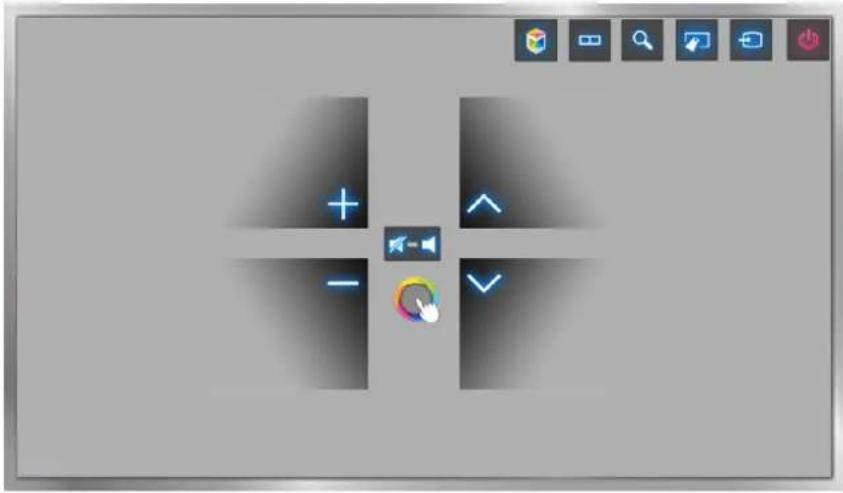
natural_image
Pure graphical interface with control buttons and navigation icons, no text or symbols present| Icon Description | |
 | Adjusts the volume. |
 | Mutes or unmutes the TV. |
 | Changes the channel. |
 | Launches Smart Hub. |
 | You can split the TV screen and use variable functions such as watching the TV, surfing the web and watching the video and so on. Availability depends on the model. |
 | Press this button to search for information through the search window in various services. You can easily view channels and content that you have viewed with the recent viewing history. |
 | The virtual remote control appears. |
 | Changes the source. |
 | Turns the TV off. |
Motion Control Layout on the Smart Hub Screen
Activating Motion Control while using Smart Hub displays the following icons on the screen:
Icons appearing on the screen may vary depending on the model.
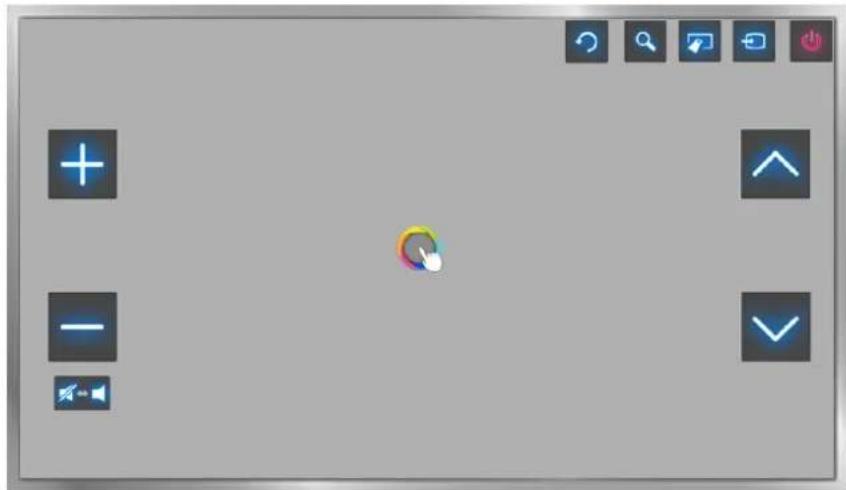
natural_image
User interface toolbar with navigation and action buttons (no text or symbols)| Icon Description | |
 | Adjusts the volume. |
 | Mutes or unmutes the TV. |
 | Changes the channel. |
 | Returns to the previous menu. |
 | Press this button to search for information through the search window in various services. You can easily view channels and content that you have viewed with the recent viewing history. |
 | The virtual remote control appears. |
 | Changes the source. |
 | Turns the TV off. |
Displaying Hidden Icons When Using Smart Hub
When using Motion Control with Smart Hub, the icons will disappear automatically after 2 seconds of inactivity. To display the hidden icons, move the pointer to one of the three edges shown below (marked in blue) and then hold it there for 1 second. The icons will reappear on the screen.
Icons appearing on the screen may vary depending on the model.
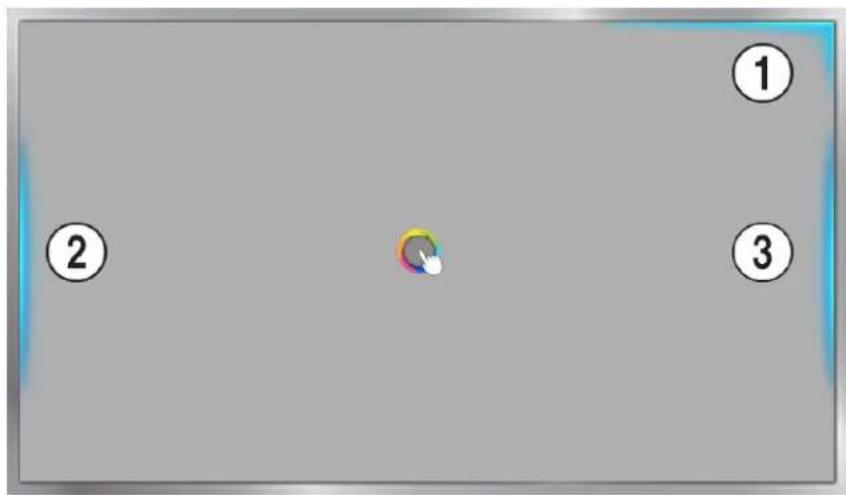
| Icon Description | |
| 1 |  |
| 2 |  |
| 3 |  |
Signing in with Face Recognition (Not supported for H5500/H6088 series)
Availability depends on the specific model and area.
Users can register their faces using the TV camera, and sign in with their Samsung accounts through Face Recognition. One face may be registered per account. Depending on the ambient illumination level and/or shadows over the face, the TV may have difficulty recognizing the user's face.
Please read through the instructions before using Face Recognition. For more information, refer to "Read Before Using Voice, Motion, or Face Recognition".
To enable Face Recognition, first connect the optional TV camera to the TV.
The optional TV camera must be connected to the dedicated USB port at the back of the TV. No other USB port is available for this purpose.
Registering Your Face to Your Samsung Account
Register your face to your Samsung Account to allow the TV to recognize you by your face. Create a new account if you do not already have one.
First, you must sign in with your Samsung Account.
- Navigate to Edit profile (MENU > Smart Hub > Samsung Account > Edit profile) and select Register face in the account information screen.
To register your face using the Virtual Remote panel, press KEYPAD to select your active Samsung Account and then select Edit profile.
-
Read the information displayed in the popup window, select OK, and then enter the account password.
-
On the face registration screen, align your face with the dotted red line displayed on the screen. The dotted line will turn green once your face is recognized. Select Take picture.
Your entire face must be visible to the camera. Make sure the face is brightly lit. Shadows prevent the camera from recognizing your face accurately.
Keep your expression as neutral as possible. In addition, keep your mouth closed but at the same time as neutral as possible.
Check the box to add password entry to the sign-in process using Facial Recognition for additional security. Select Try Again to try again.
- On the Samsung Account information screen, select Done. This completes the face registration process.
Changing Login Method to Face Recognition
To sign in with your Samsung Account using face recognition, navigate to Edit profile (MENU > Smart Hub > Samsung Account > Edit profile) and change the login method.
First, you must sign in with your Samsung Account.
- Navigate to MENU > Smart Hub > Samsung Account and select Edit profile.
To register your face using the Virtual Remote panel, press KEYPAD to select your active Samsung Account and then select Edit profile.
- Enter the password in the password input box and then select Done. The edit profile screen appears.
- Select Sign-in Method and change the login method to Face Recognition.
- Select Done.
Signing in Samsung Account with Your Face
- Navigate to MENU > Smart Hub > Samsung Account and select Log In.
Press KEYPAD on Samsung Smart Control, and select Sign In to access the Sign In screen.
- Choose your Samsung Account in the login screen.
- Face towards the TV camera. If you have set the login method to face recognition, the TV will automatically match your face with your Samsung Account. If recognition fails, try again.
Password entry is required when logging into accounts that have been configured to require password entry during face registration.
The user's entire face must be visible to the camera. Make sure the face is brightly lit. Shadows prevent the camera from recognizing your face accurately.
Keep your expression as neutral as possible. In addition, keep your mouth closed but at the same time as neutral as possible.
Even if more than one registered face matches your face, the TV signs you in with the matching face's account.
Digital Broadcast Information at a Glance
MENU > Broadcasting > Guide Try Now
The Guide provides an overview of each digital channel's programme lineup. You can check the programme schedules and set up a Schedule Viewing or Schedule Recording.
Press GUIDE to launch the guide.
The information in the Guide is for digital channels only. Analogue channels are not supported.
Using the Guide
Move to the programme schedule and then press and hold the Enter or Touchpad. The following options are available:
• Changing the Channel List
If you select Channel Filter, you can change the channels displayed in the channel lists.
- Moving to the Schedule Manager
You can move to the Schedule Manager screen.
- Adding Favourites
Click Edit Favourites Channels to add the selected programme to the Favourites.
• Viewing Detailed Information
View detailed information about the selected programme. The programme information may vary depending on the type of incoming signal and may not be available at all for certain programmes.
- Select a current programme on another channel and select View Details to Watch or Record the programme.
- Select an upcoming programme and select View Details for Schedule Viewing or Schedule Recording.
Checking the Current Programme Info
While watching TV, select INFO to view information about the current programme.
In order to view the programme info, you must first set the TV's clock. Set the Clock (MENU > System > Time > Clock).
The programme information may vary depending on the type of incoming signal and may not be available at all for certain programmes.
In addition, select right button to view information about the next programme, and press Enter or Touchpad, to set up a Schedule Viewing or Schedule Recording for the upcoming programme.
Change the Broadcast Signal
MENU > Broadcasting > Aerial Try Now
Choose your preferred method of receiving digital broadcasts.
Digital Signal Info and Strength
MENU > Support > Self Diagnosis > Signal Information Try Now
Select MENU > Support > Self Diagnosis > Signal Information. Displays the digital channel's signal information and strength.
If your TV is attached to a separate, over-the-air antenna, you can use the signal strength information to adjust the antenna for increased signal strength and improved HD channel reception.
This is only available for digital channels.
Recording Programmes
Availability depends on the specific model and area.
You can record current and upcoming programmes using a USB device instead of a video recorder.
However, this is only available for digital channels. The 🎨 icon appears next to programmes and channels for which a Schedule Recording has been set.
We recommend a USB hard disk drive with a minimum speed of 5,400rpm for TV recording. USB memory sticks are not supported.
Read all precautions before using recording.
Creating a USB Recording Device
The first time to record programmes on a USB device connected to the TV, the device must first be formatted for the TV.
Formatting a USB device erases all data contained on the device. Back up the data before proceeding. Samsung will not be held responsible for damaged or lost files.
- Press the REC button, A popup window appears.
- Select OK. This will bring up a popup menu, choose the USB device need to be formatted, Press OK.
- Once formatting is complete, the USB device is tested to see if it has been properly formatted. You will be able to start using the device after the test is completed. If the device fails the test, it means that this device cannot be used to record TV.
Managing USB Recording Devices
You can use the following to manage USB recording devices.
- Press then tap on the Touchpad or Enter button to launch Smart Hub and then choose USB Drive from the bottom of the MULTIMEDIA screen. A list of connected devices appears.
- Select a USB recording device from the list. The list of recordings contained on the device appears.
- Select Options from the top of the screen and then Manage Devices. The Manage Devices screen appears.
The following options are available from the Manage Devices screen:
- Format Device: Formats the USB device for TV recordings.
- Check Device: Tests the USB device for TV-recording compatibility.
- Device Performance Test: Tests the performance of the USB device. This test tells you whether the USB device can be used for TV recordings.
- Default Recording Device: If there are multiple USB recording devices connected to the TV, use this option to specify the default device.
Recording Programmes
You can record current and upcoming programmes.
Instant Recording
Press the REC button to begin recording the current programme right away.
The Instant and Schedule Recording options from the Guide
Select a current programme from the Guide and then select INFO.
You can instantly start recording the programme. Alternatively, select a programme that will air in the future.
The Instant and Schedule Recording options from the Programme Info
Select INFO to display information about the current programme. In the information screen, select a programme that is currently airing to start recording it right away. Alternatively, press, > button and select a programme that will air in the future to record it.
The Schedule Recording option on a Specified Date and Time
- Select MENU > Broadcasting > Schedule Manager.
- Select Schedule from the Schedule Manager to bring up a popup menu. Select Schedule Recording.
- Specify the Aerial, Channel, Repeat, Start Time, and End Time options for the programme you want to record, and then select OK to finish.
Buttons and Functions Available While Recording a Programme
Press Enter ☐ or Touchpad while recording a programme. The following buttons will appear as well as the recording progress bar.
• Information
This displays detailed information about the programme being recorded.
The programme information may differ depending on the broadcasting signal and may not be available at all for certain programmes.
- Recording Time
You can select the recording time.
- Stop Recording
You can stop recording.
- Rewind / Fast forward
Pressing these buttons decreases or increases playback by up to 5 times. To restore normal playback speed, select Play.
Fast forward cannot be used while watching the Current Programme.
- Pause / Play
Pause/resume video.
- Channel List
You can view the channel list.
- Tools
You can launch the Tools menu. The Tools menu provides functions that you can use while watching a recorded programme.
Managing the Schedule Recording List
MENU > Broadcasting > Schedule Manager
You can change the settings of scheduled recording sessions or cancel scheduled sessions altogether.
Deleting Schedule Recording Sessions
You can delete scheduled recording sessions.
- Select MENU > Broadcasting > Schedule Manager.
- Select a session from the Schedule Manager. A popup window appears.
- Select Delete. This cancels the selected recording session.
Editing Schedule Recording Sessions
You can change the settings of scheduled recording sessions.
- Select MENU > Broadcasting > Schedule Manager.
- Select a session from the Schedule Manager. A popup window appears.
- Select Edit and change the settings of the selected session.
- Once finished, select OK. This applies the changes you made to the selected recording session.
Viewing Recorded Programmes
> MULTIMEDIA > USB Drive
Recorded broadcasts can be viewed using the USB Drive option at the bottom of the MULTIMEDIA screen.
- Press to launch Smart Hub and then choose Recorded TV from the bottom of the On TV screen or USB Drive from the bottom of the MULTIMEDIA screen.
- Select a USB recording device. A list of recordings appears.
- Select a recording file from the list or select to play the selected file.
Available Buttons and Features while Playing Recordings
Press Enter ☐ or Touchpad. Playback controls will appear. To hide the controls, press Return.
Buttons that appear are different depending on the file being played.
- Zoom
You can pause the current file (recorded programme) and zoom in on one of 9 different sections of the screen.
You can only use this function for programmes recorded in Soccer Mode/Football Mode.
- Stop
Stop playback of the file (recorded programme).
- Pause / Play
Pause the file (recorded broadcast) or resume if already paused.
When the video is paused, you can use the following functions. However, audio will not be heard while the video is paused.
- Step: Press Ⅱ to scan the paused video one frame at a time.
- Slow Motion: The ➤ button plays the video back at 1/4 the normal speed.
- Rewind / Fast forward
Rewind or Fast forward the recording file (recorded programme). Repeatedly select the button to make the rewind/fast forward speed faster by up to 5 times. To restore normal playback speed, press the ▶ button.
Fast forward cannot be used while watching the Current Programme.
- Previous / Next
To play the previous file (recorded programme), press twice. Selecting once reloads the current video from the beginning.
To play the next file (recorded programme), press
- Highlight Player
Select Highlight Player to view highlights from the current recording.
This feature is only available for programmes that were recorded in Soccer Mode/Football Mode and along with highlight data have been saved.
Live TV
This function enables the PIP feature so that you can watch a live programme through PIP.
Channels cannot be changed.
You can only use this function for programmes recorded in Soccer Mode/Football Mode.
| Function Description | |
| Search | Search Scene: This will take you to a scene in the video. Search Scene cannot be used if 1) the extraction of the thumbnails from the file (Recorded broadcast) being played back is not finished, 2) playing back a file with audio only (recorded broadcast), or 3) the duration of the recorded file (recorded broadcast) is less than 60 seconds. Search Titles: Select and play a different file located in the same folder. Search Time Bar: Press <, > button to scan through the file in 1-minute increments or enter a specific time value to jump to that point in the video. |
| Subtitle Settings | Subtitle: Turn the subtitles On or Off. Subtitle Language: Used to change the language. This option works only when the video supports subtitles display. |
| Repeat Mode | This changes the repeat mode. Choose Repeat One to repeat playing the current file and Repeat All to repeat playing all files contained in the same folder. |
| Picture Size | Used to change the size of the screen. The supported picture sizes vary depending on the video. |
| Picture Mode | Change the Picture Mode setting. |
| Sound Mode | Used to change the Sound Mode. |
| Select Speakers | Choose a speaker to play the audio. |
| Audio Language | Choose a desired audio language. This option works only when the video supports multi-track sound. |
| Information | Displays detailed information about the current file. |
Managing Recorded Files
Availability depends on the specific model and area.
> MULTIMEDIA > USB Drive
Select USB Drive at the bottom of the MULTIMEDIA screen to lock/unlock, rename, delete, and generally manage the recording files.
- Press 📋 to launch Smart Hub and then choose USB Drive from the bottom of the MULTIMEDIA screen.
- Select a USB recording device. A list of recordings appears.
Saved File List Features
- Sorting the Saved File List
Sorting with Sort By: Select Sort By at the top of the screen and then select a viewing mode. The list is sorted based on the selected viewing mode.
Sorting with Filter: Select Filter at the top of the screen and then select a filter. The list is refreshed to only show files that match the selected filter.
- Options
| Function Description | |
| Play Selected | Select files from the file list and then select Play. You can create a playlist. |
| Lock | You can lock files that are inappropriate for children. Select the files and then select Lock. This locks all the selected files. |
| Unlock | Use this option to unlock any locked files. Select the files and then select Unlock. This unlocks all selected files. |
| Delete | Deletes recording files. Select the files and then select Delete. This deletes all selected files. |
| Rename | Renames the file. Enter the new name using the keypad and then select Done to finish. The new name can be up to 29 characters long. |
| Index | When navigating a large number of media items, select a character. Media items starting with that character appear. |
| Manage Devices | Used to manage USB recording devices connected to the TV. |
Setting Up a Schedule Viewing
Configure the TV to show a specific channel or programme at a specific time and date. The Licon appears next to programmes that have been configured for a Schedule Viewing.
To set up a Schedule Viewing, you must first set the TV's clock. Go to Clock (MENU > System > Time > Clock).
Setting Up Schedule Viewing
Digital Channel Schedule Viewing
You can set up Schedule Viewing for programmes on digital channels on the following screens:
• The Guide Screen
Select an upcoming programme from the Guide to set up a Schedule Viewing for it.
• The Programme Info Screen
Select INFO to display information about the current programme. From the programme information screen, select right button to view information about the next programme, and press Enter ☐ or Touchpad, to set up a Schedule Viewing or Schedule Recording for the upcoming programme.
Analogue Channel Schedule Viewing
MENU > Broadcasting > Schedule Manager Try Now
The Schedule Viewing function for programmes on analogue channels can be set up by specifying the time and date.
- Select MENU > Broadcasting > Schedule Manager.
- Select Schedule from the Schedule Manager to bring up a popup menu. Select Schedule Viewing.
- Specify the Aerial, Channel, Repeat, and Start Time options for the programme you want to watch and then select OK to finish.
Managing the Schedule Viewing List
MENU > Broadcasting > Schedule Manager
You can change the settings of Schedule Viewing sessions or cancel scheduled sessions altogether.
Deleting Schedule Viewing Sessions
You can delete Schedule Viewing sessions.
- Select MENU > Broadcasting > Schedule Manager.
- Select a session from the Schedule Manager. A popup window appears.
- Select Delete. This cancels the selected viewing session.
Editing Schedule Viewing Sessions
- You can change the settings of Schedule Viewing sessions. Select MENU > Broadcasting > Schedule Manager.
- Select a session from the Schedule Manager. A popup window appears.
- Select Edit and change the settings of the selected session.
- Once finished, select OK. This applies the changes you made to the selected recording session.
Using Timeshift
Availability depends on the specific model and area.
Timeshift lets you pause and rewind live TV as you operate a DVD. Timeshift is only available for digital channels and activating Timeshift disables the Broadcasting option.
Timeshift requirements:
- A USB recording device must be connected to the TV in order to use Timeshift.
- We recommend a USB hard disk drive with a minimum speed of 5,400rpm for use with the TV's Timeshift feature. USB memory sticks are not supported.
- Read all precautions before using the Timeshift function.
Press ▶ while watching TV to activate the Timeshift function. This activates Timeshift and displays a progress bar and the following buttons at the top of the screen:
• Information
Displays detailed information about the current programme.
The programme information may vary depending on the type of incoming signal and may not be available at all for certain programmes.
This button is only available while watching a live programme.
- Go to Live TV / Stop Timeshift
Watches the live TV or Exits the Timeshift. / You can watch the current programme by selecting this button while watching a recorded programme.
- Pause
Pauses the screen.
The following features are available while paused. However, audio is not supported while the video is paused.
- Step: ▪ Scans the paused video one frame at a time.
- Slow Playback: Select ◀ / ▶ to play the video back at 1/4 the normal speed.
- Rewind / Fast forward
Slows down or speeds up playback by a factor of up to 5. To restore the normal playback speed, press ▶.
Fast forward cannot be used while watching the Current Programme.
- Channel List
Displays the channel list.
- Tools
You can launch the Tools menu. Open the Tools menu to access the context menus available in Timeshift mode.
Using the Channel List
MENU > Broadcasting > Channel List Try Now
Launch the Channel List while watching TV to change channels or to see what's on other channels. Press and hold the Enter 📋 or Touchpad. To launch the Channel List.
Select a channel from the Channel List to jump to it right away. To quickly scroll through the list, use the channel up/down buttons. This moves the focus one page at a time.
The Channel List screen contains the following icons:
- A : An analogue channel
- ♥ : A favourites channel
- : A locked channel
- Using Options
Press < button to select Options. The following options are available:
| Function Description | |
| Aerial | Choose between Terrestrial, Cable. |
| Category | If you select a Category, its channels appear in the list among the TV's channels. |
| Sorting | Sort the list by Channel Number or by Name. (Digital channels only) |
| Edit Favourites | Designate favourites channels. |
• Changing to Favourites
Press > button to select Favourites 1 through Favourites 5. This shows the selected list's channels. However, a Favourites list can only be selected if it contains at least one favourites channel. If you haven't created a Favourites list yet, you need to create one first.
Registering, Removing, and Editing Channels
MENU > Broadcasting > Edit Channel Try Now
Remove channels from the index of channel restore removed channels, and rename analogue channels. The Edit Channel screen icons indicate the following:
• A : An analogue channel
• ♥ : A favourites channel
• : A locked channel
Registering and Removing Channels
MENU > Broadcasting > Edit Channel
Removing Registered Channels
Remove registered channels from the index. Removing channels appearing in the Recently Viewed or Most Viewed list clears the channels from the list only and does not remove them from the index.
- Select the channels you want to remove. Unselect channels by choosing them again. To select all the channels, select Options from the bottom of the screen and then select Select All from the list.
- Once you have made your selection, select Delete from the bottom of the screen to remove the selected channels.
Editing Registered Channels
MENU > Broadcasting > Edit Channel
Select Options at the bottom of the screen to access the following options. However, the available options may vary depending on the broadcast signal.
- Select All
Selects all channels displayed in the Edit Channel screen.
- Deselect All
Deselect all selected channels.
- Sorting
(Digital channels only)
Change the list ordered by Channel Name or Number.
- Aerial
Choose between Terrestrial, Cable.
Category
If you select a Category, its channels appear in the list among the TV's channels.
- Edit Favourites
Organize favourites lists to find favourite channels and switch between channels more easily.
- Channel Info
Check the information of the channel.
• Information
View detailed information about the current programme.
Enabling/Disabling Password Protection on Channels
MENU > Broadcasting > Edit Channel
You can lock channels you don't want your children to view.
To enable password protection, set Channel Lock to On. First, navigate to MENU > Broadcasting > Channel Lock and set it to On. Try Now
Locking/ Unlocking Channels
Select channels from the Edit Channel screen and then select Lock or Unlock at the bottom of the screen. When the password entry window appears, enter the password. This locks or unlocks the selected channels.
Creating a Personal Favourites List
MENU > Broadcasting > Edit Favourites Try Now
You can designate frequently watched channels as favourites. Favourites channels are highlighted in the Edit Channel and Channel List screens with the ♥ symbol. You can create up to 5 favourites channel lists.
Registering a Channel as Favourites
MENU > Broadcasting > Edit Favourites
Registering the Current Channel as a Favourites
Add the current channel to a Favourites list.
- Select TOOLS while watching TV to display a list of options. Select Edit Favourites from the list.
Using Samsung Smart Control: press the KEYPAD button and select TOOLS.
-
From the popup window, select all the Favourites lists you want to add the current channel to and then select OK.
-
This adds the current channel to the selected Favourites list(s). Select OK.
Registering Multiple Channels as Favourites
It's possible to register multiple channels as favourites at the same time.
-
Select MENU > Broadcasting > Edit Favourites.
-
Select Category from the bottom of the screen to change the channel list to the one containing that channels you want to register.
Recently Viewed and Most Viewed are only available if they contain channels.
-
Select the channels from the list in the middle of the screen.
-
Select Change Fav, and then change the Favourites 1 to the Favourites 5 you want to use.
-
Select Add.
Viewing Favourites List Channels Only
It's possible to flip through Favourites list channels using only the channel up/down buttons.
A Favourites list can only be selected if it contains at least one favourites channel.
- Run Channel List. (MENU > Broadcasting > Channel List).
- Press > button to select Favourites 1 through Favourites 5.
- Choose a channel from the selected Favourites list. This changes the channels and Channel List changes to the selected Favourites channel.
Editing a Favourites List
MENU > Broadcasting > Edit Favourites
You can rename and edit Favourites lists.
Edit Favourites Features
Select Options from the bottom of the Edit Favourites screen to access the following options:
• Copy to Favourites
Copy channels from one favourites channels list to another.
This can only be used when the focus has selected a channel registered to a Favourites list.
- Rename Favourites
Rename an existing favourites channels list.
This can only be used when the focus has selected a channel registered to a Favourites list,
- Sorting
Change the list ordered by Channel Name or Number. This function is not available on analogue channel.
- Aerial
Choose between Terrestrial and Cable.
- Edit Channel
You can manage the channels saved on the TV.
• Information
View detailed information about the current programme.
Removing Registered Channels from a Favourites List
Remove channels from a favourites channels list.
- Select Change Fav. at the bottom of the screen and then change the Favourites list to the Favourites list you want to use.
- Select the channels you want to remove from the selected Favourites list.
- Select Delete.
Rearranging a Favourites List
Rearrange the order of the channels in a Favourites Channels List.
- Select Change Fav. at the bottom of the screen and then change the Favourites list to the Favourites list you want to use.
- From the selected Favourites list, select the channels you want to rearrange.
- Select Change order from the bottom of the screen and then rearrange the selected channels. Press Enter or Touchpad to finish.
Renaming a Favourites List
Rename an existing favourites channels list.
- Select Change Fav. at the bottom of the screen and then change the Favourites list to the Favourites list you want to use.
- From the selected Favourites list, select the channels you want to rename.
- Select Options. A list appears.
- Select Rename Favourites from the list. A popup window appears. Rename the list in the popup window. The new name can be up to 20 characters long.
Copying a Favourites List to a Different Favourites List
Copy channels from one favourites channels list to another.
- Select Change Fav, and then change the Favourites list on the side of the screen to the Favourites list you want to use.
- From the Favourites list displayed on the side of the screen, select all the channels you want to copy.
- Select Options. A list appears.
- Select Copy to Favourites from the list. A popup window appears.
- From the popup window that appears on the screen, select the Favourites lists you want to copy the selected channels to. This copies the selected channels to the selected Favourites lists.
Copy to Favourites is only available when there are channels in the Favourites list.
Watching Sports with Added Realism (Soccer Mode/Football Mode)
Availability depends on the specific model and area.
MENU > System > Soccer Mode/Football Mode
Soccer Mode/Football Mode enables optimal picture and sound settings for sports events, making them appear and sound as if you were actually there. In addition, it will be possible to use video recording and time shift functions at the same time while watching a sports event and manually or automatically designated highlight scenes if a recording device is connected to the TV when you are using Soccer Mode/Football Mode.
For more information about recording a programme and using a recording device, refer to the "Recording Programmes" section.
For more information about the "Time Shift" feature, refer to the "Using Timeshift" section.
Enabling Soccer Mode/Football Mode
MENU > System > Soccer Mode/Football Mode > Soccer Mode/Football Mode
Select System > Soccer Mode/Football Mode and then set Soccer Mode/Football Mode to On. Picture and sound settings of the TV are automatically optimized for sports events.
Enabling Soccer Mode/Football Mode changes the Picture Mode to Stadium and the Sound Mode to Stadium, and disables some Picture and Sound menus.
Press ☑ while watching TV to activate/deactivate Soccer Mode/Football Mode. If ☑ is not available, then use Tools to activate/deactivate Soccer Mode/Football Mode.
Extracting Highlights Automatically
MENU > System > Soccer Mode/Football Mode > Auto Highlights
Select MENU > System > Soccer Mode/Football Mode and set the Auto Highlights to On. You can set the TV to automatically save highlights without user intervention.
However, Auto Highlights is not available with these TV operations:
• Recording two channels simultaneously
• While Auto Description is active
- Switching the input signal using the SOURCE button
- When 3D mode is active
- When Voice Guide is set to On
The Auto Highlights performance depends on the signal characteristics.
It is advisable to use Auto Highlights only while watching a Soccer/Football game. Using this for other sporting events may display irrelevant picture frames.
Functions Available in Soccer Mode/Football Mode
Press Enter ↩ or Touchpad. The following buttons will appear.
- Zoom
You can pause the current video and zoom in on one of 9 different sections of the screen. Pan the zoomed-in image using ∧, ∨, ⟨,⟩ buttons.
You cannot use this function when watching a 3D channel or when PIP or MULTIMEDIA is active,
- Manual Highlight
Pressing this button saves 10 seconds of video leading up to that point and 10 seconds of video that follows as a highlight.
This function can also be accessed using the B button.
Available only while recording is in progress.
Also possible to configure the TV to automatically save highlights without user intervention. Select System > Soccer Mode/Football Mode and then set Auto Highlights to On.
- Stop Recording / Go to Live TV
Use this button while watching a live programme to stop recording it. Use while watching a recorded programme to watch a live programme.
Available only when recording is in progress.
- Record
Start recording the sports event being watched.
Available only with the recording function supported.
- Rewind
Rewind the current video. Select repeatedly to increase the rewind speed by up to 5 times.
Available only when recording is in progress.
- Pause / Play
Pause/resume video.
Available only when recording is in progress.
- Fast forward
Fast forward the current video. Select repeatedly to increase the fast forward speed by up to 5 times.
Available only when recording is in progress.
- Highlights Player
Use Highlights Player to view manually or automatically saved highlight segments of the recording.
Available only when recording is in progress.
However, Highlights Player is not available with these TV operations:
• Recording two channels simultaneously.
• While Audio Description is active.
- Switching the input signal using the SOURCE button.
- When 3D mode is active.
- When Voice Guide is set to On.
• Watch Live TV at the same time
Select while viewing a recorded programme to watch live TV on a PIP window. Press once more to exit PIP mode.
Available only when recording is in progress or watching a recorded programme.
However, Watch Live TV at the same time is not available with these TV operations:
• Recording two channels simultaneously
• While Audio Description is active
- Switching the input signal using the SOURCE button.
- When 3D mode is active.
- When Voice Guide is set to On.
• Information
Displays detailed information about the current programme.
Available only when recording is in progress.
- Go to Social TV
Used to launch an SNS app.
Viewing a Sports Event Recorded in Soccer Mode/Football Mode
View recorded sports events using the Recorded TV option in the USB Drive option in the MULTIMEDIA screen.
TV-Viewing Support Features
Showing Subtitles
MENU > System > Accessibility > Subtitle Try Now
Show subtitles. Subtitles will be displayed when watching a broadcast that supports subtitles. Switches subtitles On or Off.
Press and hold the 🔊 button on the Samsung Smart Control to turn on or off Subtitle.
DVD subtitles are only available if the DVD player is connected to an external input connector.
- Subtitle Mode
Set the subtitle mode.
- Subtitle Language
Set the subtitle language.
The TV cannot control or modify DVD or Blu-ray subtitles. To control DVD or Blu-ray subtitles, use the subtitle feature of the DVD or Blu-ray player and the player's remote control.
Subtitle Options
MENU > System > Accessibility > Subtitle
Select a subtitle mode. The list of modes may vary depending on the broadcast.
- Primary Subtitle
Set the primary subtitle language.
• Secondary Subtitle
Set the secondary subtitle language.
PIP Broadcast Viewing
MENU > Picture > PIP Try Now
Use the PIP (Picture-In-Picture) function to watch TV in a small window while also watching images from an external source such as a DVD player, a Blu-ray player, or a computer in the background.
Select MENU > Picture > PIP to display the PIP settings window. This settings window contains the following options:
- PIP
Activates/deactivates PIP.
- Aerial
Select the PIP sub-picture broadcast signal.
- Channel
Select the PIP sub-picture channel.
- Size
Select the PIP sub-picture size.
- Position
Select the PIP sub-picture position.
- Sound Select
Select the audio source.
PIP restrictions:
- PIP cannot be used while Smart Hub or 3D is active.
- Turning off the TV automatically disables PIP.
- Playing a game or using the karaoke feature on the main screen can result in lower PIP picture quality.
- For PIP to work, the main screen's source must be Component or HDMI and the input resolution must be less than Full HD (FHD - 1080p). The sub picture supports TV source only.
Scanning for Available Channels
MENU > Broadcasting > Auto Tuning Try Now
Automatically scans and indexes all channels received through the TV's antenna input connector.
If there are saved channels, this feature deletes the existing list and then saves the newly scanned channels.
If the TV is connected to a cable box, you do not need to do this.
-
Select MENU > Broadcasting > Auto Tuning.
-
Select Start when prompted. This initiates the Auto Programme function. The process can take up to 30 minutes to complete.
- Auto Tuning
Scans for channels automatically and stores them in the TV's memory.
Selecting the Broadcast Audio Options
MENU > Broadcasting > Audio Options Try Now
- Audio Language
(Digital channels only)
Change the default value for audio languages.
Primary audio: Set the primary audio language.
Secondary audio: Set the secondary audio language.
The available language may differ depending on the broadcast.
- Audio Format
(Digital channels only)
Change a desired audio format. The supported audio format may vary depending on the broadcast programme.
Audio Description
MENU > System > Accessibility > Audio Description Try Now
(Not available in all locations) (Digital channels only)
This function handles the Audio Stream for the AD (Audio Description) which is sent along with the Main audio from the broadcaster.
Audio Description: Turn the audio description function on or off.
Volume: Adjust the audio description volume.
Using the Channel Settings
MENU > Broadcasting > Channel Settings Try Now
Manual Tuning
MENU > Broadcasting > Channel Settings > Manual Tuning Try Now
Scans for a channel manually and stores in the TV.
If a channel is locked using the Channel Lock function, the PIN input window appears.
This function depends on the country and region.
When Aerial Source is set to Terrestrial or Cable
• Digital Channel Tuning
Scans for a digital channel.
- Select the New.
When selecting Aerial → Terrestrial: Channel, Frequency
When selecting Aerial → Cable: Frequency, Modulation, Symbol Rate
- Select the Search. When scanning has finished, a channel is updated in the channel list.
• Analogue Channel Tuning
Scans for an analogue channel.
- Select the New.
- Set the Programme, Colour System, Sound System, Channel and Search.
- Select the Store. When scanning has finished, a channel is updated in the channel list.
Channel mode
• P (programme mode)
When tuning is complete, the broadcasting stations in your area have been assigned to position numbers from P0 to P99. You can select a channel by entering the position number in this mode.
• C (aerial channel mode) / S or Z (cable channel mode)
These two modes allow you to select a channel by entering the assigned number for each aerial broadcasting station or cable channel.
Fine-Tuning the Screen
MENU > Broadcasting > Channel Settings > Fine Tune Try Now
Available for analogue broadcasts only.
Analogue pictures can become shaky and full of noise. If this happens, you can fine-tune the signal and/or reduce noise to clear up the picture.
- Select MENU > Broadcasting > Fine Tune. An adjustment bar appears on the screen.
- Make adjustments using the Samsung Smart Control until the picture clears up and then select Save or Close. Select Reset to reset the Fine-Tune operation.
Clear Scrambled Channel
(May not be available, depending on your regions and country.)
MENU > Broadcasting > Channel Settings > Clear Scrambled Channel
Remove scrambled channels(pay-per-view channels) from channel list. To remove pay-per-view channels, run this function.
Digital Text
(May not be available, depending on your regions and country.)
MENU > Broadcasting > Channel Settings > Digital Text
If the programme broadcasts with digital text, this feature is enabled. MHEG (Multimedia and Hypermedia Information Coding Experts Group): An International standard for data encoding systems used in multimedia and hypermedia. This is at a higher level than the MPEG system which includes data-linking hypermedia such as still images, character service, animation, graphic and video files as well as multimedia data. MHEG is user runtime interaction technology and is being applied to various fields including VOD (Video-On-Demand), ITV (Interactive TV), EC (Electronic Commerce), teleeducation, tele-conferencing, digital libraries and network games.
If the programme broadcasts with digital text, when Digital Text set to Enable, A, B, C, D will be used as function key for Digital Text. If you want to use A, B, C, D as function key for Soccer/Football Mode, you need to set Digital Text to Disable.
Changing the Picture Mode and Adjusting the Picture Quality
Choosing the Right Picture Mode for the Viewing Environment
MENU > Picture > Picture Mode Try Now
The following picture modes utilize different contrast and brightness settings to provide the best viewing experience for the environment.
When a PC is connected to the TV, Standard and Entertain modes are only available.
• Dynamic
If the ambient lighting is too bright and makes the screen blurry, use this mode to make the picture clearer.
- Standard
This is the default mode suitable for most environments.
Natural
This mode is useful for reducing eye strain.
- Movie
Appropriate for darkened rooms, for watching movies, and when experiencing eye fatigue. Darkens the screen and reduces glare.
- Entertain
Sharpens images for a more dynamic viewing experience.
When a PC is connected to the TV, Entertain mode is available.
If Entertain mode is not available, set Edit Name to DVI PC or PC.
Adjusting the Picture Quality for Each Picture Mode
MENU > Picture > Backlight, Contrast, Brightness, Sharpness, Colour or Tint (G/R)
Select one of the settings to display its slide bar. Change the adjustment value using . Change the item using , . Adjusted values are applied to the current source and picture mode.
The Colour and Tint (G/R) settings cannot be adjusted when the TV is connected to a computer via an HDMI-DVI cable.
Choose a Picture Mode and then adjust the settings.
- Backlight Try Now
Adjusts the brightness of individual pixels. Decreasing the brightness reduces power consumption.
- Contrast Try Now
Adjusts the screen contrast.
- Brightness Try Now
Adjusts the overall brightness.
- Sharpness Try Now
Sharpens or dulls the edges of objects.
- Colour Try Now
Adjusts the overall colour saturation.
- Tint (G/R) Try Now
Adjusts the ratio of green to red. Increase the green value to saturate the greens and the red value to saturate the reds.
Adjusted values are saved by the TV for the current source and picture mode, and remain in effect each time the source and picture mode are selected. Consequently, the TV can have different picture settings for each external source.
Applying the Current Picture Settings to Other Input Sources
MENU > Picture > Apply Picture Mode Try Now
You can apply the picture quality setting that you configured for the TV to all external devices connected to the TV or to the current source only.
To apply the setting to all external devices connected to the TV, select All Sources. To apply the setting to the current input only, select Current Source.
Fine-Tuning Each Picture Mode (Advanced Settings)
MENU > Picture > Advanced Settings Try Now
Select MENU > Picture > Advanced Settings to fine-tune how images are displayed on the TV screen for each Picture Mode.
Advanced Settings is only available when the Picture Mode is set to Standard or Movie.
When the TV is connected to a computer via an HDMI-DVI cable, only White Balance and Gamma can be adjusted.
Choose a Picture Mode and then adjust the settings.
• Dynamic Contrast Try Now
Automatically adjusts the screen contrast. Use this option to achieve the optimal contrast setting.
- Black Tone Try Now
Adjusts the black colour depth.
- Flesh Tone Try Now
Darkens or lightens skin tones.
• RGB Only Mode Try Now
Adjusts the red, green, and blue levels individually.
• Colour Space Try Now
Adjusts the range of colours that can be displayed on screen. Auto automatically adjusts the colour space depending on the input signal. Native applies a range that is wider than the input signal. Custom allows you to adjust the colour space manually.
• White Balance Try Now
Adjust the colour temperature of the picture to make white objects look white, and the overall picture appear natural.
2 Point: Adjust each of the 3 colour's luminosity with the offset menu and the brightness with the gain menu. To restore the default values, select Reset.
10 Point: Adjust the white balance by adjusting the brightness of each of the 10 sections of red, green, and blue colours of the input signal. To choose a section, select a desired section in Level field.
You can use the 10 Point function only when the Picture Mode is set to Movie. Some external devices may not support this,
- Gamma Try Now
Adjusts the primary colour intensity.
• Motion Lighting Try Now
Adjusts the brightness in response to on-screen movements to reduce power consumption.
This feature is only available when the Picture Mode is set to Standard and is not available in 3D mode.
Adjusting the Contrast, Brightness, and other picture quality settings deactivates the feature.
Adjusting the Picture for Easier Viewing (Picture Options)
MENU > Picture > Picture Options Try Now
Select MENU > Picture > Picture Options to make additional adjustments for an easier viewing experience.
When the TV is connected to a computer via an HDMI-DVI cable, only Colour Tone can be adjusted.
Choose a Picture Mode and then adjust the settings.
• Colour Tone Try Now
Adjusts the colour tone. The setting is applied on an individual Picture Mode basis. When a Picture Mode is changed, the corresponding setting will be applied automatically.
If the Picture Mode is set to Dynamic, you will only be able to choose Cool or Standard.
• Digital Clean View Try Now
Reduces static and ghosting caused by a weak signal. Selecting Auto Visualisation displays the signal strength at the bottom the screen. Green indicates the best possible signal.
Auto Visualisation is available for analogue channels only.
• MPEG Noise Filter Try Now
Reduces MPEG noise and improves video quality.
• HDMI Black Level Try Now
Some external devices connected to the TV via an HDMI cable can have issues, such as low black level, low contrast, and dull colours. Use HDMI Black Level to adjust the black level to compensate.
This is only available when using an external device connected to the TV via an HDMI connector.
• Film Mode Try Now
Optimizes the picture quality for movies. Select this mode for watching movies.
This feature is only available when watching TV or when the input signal is AV, Component (480i, 1080i), or HDMI (1080i).
• Motion Plus Try Now
Availability depends on the specific model.
Removes blurring and judder from scenes with rapid movement. If you select Custom, you can configure Blur Reduction and Judder Reduction manually and set LED Clear Motion on for a sharper LED image.
The Info screen on your TV displays the resolution and frequency of the incoming signal (60Hz), but not the frequency the TV is generating for the image it is displaying by using Motion Plus function.
If noise occurs on the screen, please set up the Motion Plus to Off. If Motion Plus is Custom, you can set up the Blur Reduction, Judder Reduction, LED Clear Motion and Reset manually.
Blur Reduction: Adjusts the blur reduction level from video sources.
Judder Reduction: Adjusts the judder reduction level from video sources when playing films.
LED Clear Motion: Removes drag from fast scenes with a lot of movement to provide a clear picture.
Reset: Reset the custom settings to the factory defaults.
If you have Motion Plus on, and then bring up the INFO screen, the INFO screen displays the resolution and frequency of the incoming video signal (60Hz). This frequency is not the same as the frequency of the picture the TV is displaying when Motion Plus is on
- Analogue Clean View
This function reduces diagonal noise in the picture caused by signal crosstalk (interference). If your TV picture displays diagonal noise or distortion when you watch, turn on this function.
- Black Optimiser
In Movie mode, this feature dims the top and bottom areas of the video image to provide a more immersive viewing experience.
Availability depends on the specific model and area.
Viewing in 3D (Not supported for H6088 series)
Availability depends on the specific model.
MENU > Picture > 3D Try Now
The 3D option lets you view 3D media content and broadcasts. You will need to wear Samsung 3D Active Glasses to play 3D content. IR-type Samsung 3D Active Glasses and third-party 3D glasses are not supported.
Carefully read the health and safety information concerning 3D viewing before viewing 3D content. Refer to the "3D Precautions" section for more information.
Whether 3D video is displayed in true HD is usually determined by the quality of the content.
Starting 3D
- Play 3D content or turn on a channel that's showing a 3D broadcast.
- Put the Samsung 3D glasses on and then select 3D. 3D viewing is enabled.
The ideal viewing distance is three times the height of the screen or more. 3D images may not appear if you do not adhere to the recommended viewing angle or distance.
The 3D feature may not work properly if there is another 3D product or an electronic device running nearby. If there is a problem, keep other electronic devices as far away as possible from the 3D Active Glasses.
The left and right 3D images may initially overlap when the TV is turned on. It takes a moment for the display to optimize for the overlapping to go away.
There are several restrictions when using 3D TV:
- Launching Smart Hub automatically disables 3D mode.
- PIP cannot be used.
• Certain Picture options are disabled.
Changing the 3D Mode
MENU > Picture > 3D > 3D Mode
-
Launch 3D and then select 3D Mode under MENU > Picture > 3D.
-
Choose from the 3D modes that appear on the screen. Supported 3D Mode may vary depending on the 3D content.
3D Mode is automatically configured for most 3D content.
The following 3D Mode is available. However, mode availability may vary depending on the 3D content's format.
The supported resolutions vary for each mode. Refer to the "Supported Resolutions for each 3D Mode" section for more information.
• Off (Off)
Deactivates 3D viewing.
• (Normal)
Converts normal images to 3D images.
Some formats do not support this mode.
• (L/R)
Splits a single image into left and right overlapping images to create the 3D effect.
• (T/B)
Splits a single image into top and bottom overlapping images to create the 3D effect.
Adjusting the 3D Effect
MENU > Picture > 3D
Configure the viewpoint, depth, and other 3D settings for a custom viewing experience.
- Adjusting the 3D perspective
Select MENU > Picture > 3D > 3D Perspective. Use the adjustment bar shown on the screen to adjust the perspective.
- Adjusting the 3D Depth
Select MENU > Picture > 3D > Depth. Use the adjustment bar shown on the screen to adjust the depth.
This option cannot be used if 3D mode is set to 📄/R) or 📃).
• Reversing the Left/Right 3D Images
Select MENU > Picture > 3D > L/R Change. This option is used to reverse the left and right images.
• Displaying 3D Content in 2D
Select MENU > Picture > 3D > 3D → 2D. This option is used to enable 2D viewing of 3D content.
This function is not available if 3D mode is set to Normal) or (if).
- Adjust the brightness in 3D mode
Availability depends on the specific model,
Select MENU > Picture > 3D > 3D Light Control. This option is used to adjust the brightness in 3D mode
Picture Support Functions
PIP Broadcast Viewing
MENU > Picture > PIP
Use the PIP ("Picture-In-Picture") function to watch TV in a small window while also watching content from a DVD player, Blu-ray player, computer, or a different external device in the background.
Select MENU > Picture > PIP to display the PIP settings window. This settings window contains the following options:
- PIP
Activates/deactivates PIP.
- Aerial
Select the PIP sub-picture broadcast signal.
- Channel
Select the PIP sub-picture channel.
- Size
Select the PIP sub-picture size.
- Position
Select the PIP sub-picture position.
- Sound Select
Select the audio source.
PIP restrictions:
- PIP cannot be used while Smart Hub or 3D is active.
- Turning off the TV automatically disables PIP.
- Playing a game or using the karaoke feature on the main screen can result in lower PIP picture quality.
- For PIP to work, the main screen's source must be Component or HDMI and the input resolution must be less than Full HD (FHD - 1080p). The sub picture supports TV signal only.
Changing the Picture Size and Position
Choosing the Right Screen Size
MENU > Picture > Picture Size > Picture Size Try Now
Most TV programmes and videos are displayed in full screen, but some programmes and videos are larger or smaller. Change the screen size for such programmes and videos so that the picture fits the screen better.
Supported screen sizes vary depending on the input signal. Refer to the "Picture Sizes and Input Signals" section for more information about supported screen sizes.
- Auto Wide
Automatically adjusts the picture size to the 16:9 aspect ratios.
Availability depends on the specific model and area.
16:9
Set the picture to the 16:9 wide-screen format.
- Wide Zoom
Magnifies the picture size more than 4:3. A magnified picture can be moved up and down.
- Zoom
Magnifies the 16:9 wide pictures vertically to fit the screen size. A magnified picture can be moved up and down.
Zoom is not available when Picture Size set to Wide Zoom.
4:3
Sets the picture to basic 4:3 mode.
Do not leave the TV in 4:3 mode for an extended period. The dark borders displayed on the left and right / top and bottom of the screen may cause image retention. This phenomenon can appear on LED and PDP TVs. (Screen burn - this phenomenon can appear on PDP TVs.) This is not covered by the warranty.
- Screen Fit
Displays the full image without any cutoff.
- Smart View 1
Reduces a 16:9 picture by 50%.
- Smart View 2
Reduces a 16:9 picture by 25%.
Adjusting the Screen Position
MENU > Picture > Picture Size > Zoom/Position or Position
Adjusts the screen position.
This option is only available with Picture Size set to Wide Zoom, Zoom, or Screen Fit. When the TV is tuned to a digital channel, the screen position cannot be adjusted if the Picture Size is set to Screen Fit.
- To adjust the screen's position, select Picture > Picture Size > Zoom/Position or Position. A popup window appears.
- Select Zoom or Position again from the popup window.
- Adjust the screen. Once done, select Zoom or Position and then Close. Select Reset to reset the screen position.
Listening to Audio Only with the Screen Turned Off (Picture Off)
MENU > Picture > Picture Off Try Now
Turns off the screen and plays audio through the speakers only. To turn the screen back on, press any button other than the TV and VOLUME buttons.
Using Samsung Smart Control: press the VOICE button also can't turn the screen back on.
Resetting the Picture Mode Settings
MENU > Picture > Reset Picture Try Now
Use this option to reset the current Picture Mode to its factory settings. This does not affect the settings of other Picture Modes.
Changing the Sound Mode and Using Sound Effects
Choosing the Right Sound Mode for the Environment
MENU > Sound > Sound Mode Try Now
Sound modes apply preset adjustments to the sound output, optimized for different viewing and listening circumstances.
The sound modes cannot be used when you are listening to audio through external speakers.
- Standard
This is the normal sound mode.
Music
This mode emphasizes normal music instead of voice.
- Movie
This mode is calibrated to provide the best sound for movies.
- Clear Voice
This mode emphasizes voice.
- Amplify
This mode increases the overall intensity of high-frequency sounds for a better listening experience. It is designed for hearing-impaired listeners.
- Stadium
Setting Soccer Mode/Football Mode (MENU > System > Soccer Mode/Football Mode) to On automatically configures Sound Mode to Stadium for a more realistic viewing experience.
Stadium cannot be selected by the user.
Using Sound Effects
MENU > Sound > Sound Effect Try Now
Use sound effects to alter how the TV projects sound.
Restrictions:
• Sound effects can only be used with the Sound Mode set to Standard.
• Sound effects cannot be used when you are listening to audio through external speakers.
Choose a Sound Effect and then adjust the settings.
• DTS TruSurround Try Now
Produces sound that will make you feel like you are sitting in a movie theatre or concert hall.
• DTS TruDialog Try Now
Increases voice intensity to make dialog clearer.
• Equaliser Try Now
Lets you adjust the speaker balance and make bandwidth adjustments. Select Reset to reset the settings.
Sound Support Functions
Selecting Speakers
MENU > Sound > Speaker Settings > TV Sound Output
This lets you choose which speakers the TV uses for audio output. To listen to the audio through the speakers of a connected receiver or home theatre only, select Receiver or Audio Out. To listen to audio through the TV's speakers and the speakers of a connected AV receiver or home theatre simultaneously, select TV Speaker. If this causes an echo effect, choose any speaker option other than TV Speaker to mute the TV speakers, or turn off the receiver or home theatre.
Using external speakers alone disables the volume button and the mute function. In addition, certain Sound options will also be disabled.
Designating the TV's Installation Type
MENU > Sound > Speaker Settings > TV Installation Type
Specify the TV's installation type. Choose between Wall Mount and Stand to optimize the TV's sound automatically.
Listening to TV Sound through Samsung Bluetooth Audio
Availability depends on the specific model.
MENU > Sound > Speaker Settings > SoundShare Settings
Connect the TV to a Samsung audio device for a richer, clearer sound.
This option is only available for Samsung audio devices that support SoundShare.
Pair the Samsung audio device using the TV's Bluetooth function. Refer to the Samsung audio device's operating manual for more information on pairing.
• Samsung Audio Device List
Displays a list of paired Samsung audio devices. Select a device to display its menu options. You can activate/deactivate the audio device or remove it from the list.
- Add New Device
Enables/disables SoundShare. The connection signals from new devices are ignored if Add New Device is set to Off.
When listening to TV audio through a Samsung audio device, certain types of content may produce video-to-audio synching issues.
Enabling the Sound (Additional Settings)
MENU > Sound > Additional Settings Try Now
Configure additional settings for optimum audio output.
• DTV Audio Level Try Now
(Digital channels only)
The TV cannot freely control the volume of the digital audio that it sends to the AV receiver. Use this to set the digital audio volume at a comfortable level.
According to the type of broadcast signal, MPEG / HE-AAC can be adjusted between -10dB and 0dB.
To increase or decrease the volume, adjust between the range 0 and -10 respectively.
• Audio Format, Audio Delay
This Smart TV is SPDIF-enabled. The Sony Philips Digital Interface (SPDIF) provides digital audio output to speakers and various digital devices, including A/V Receivers and home theatres.
Audio Format Try Now
Selects the Digital Audio output (SPDIF) format. The available Digital Audio output (SPDIF) formats may vary depending on the input source.
Audio Delay Try Now
This setting helps correct timing mismatches between the audio and video tracks when you are watching TV and listening to audio through a digital audio device. Enabling the feature displays a slide bar that you can use to adjust the delay by up to 250ms.
• Dolby Digital Comp Try Now
Some digital TV programmes provide 5.1-channel Dolby audio. This TV converts Dolby audio to stereo audio so that it can play the sound through the TV's speakers. There are two methods to choose from. RF is for better sound at lower volumes, and Line is for higher volumes.
• Auto Volume Try Now
When you change channels, video sources, or content, Auto Volume automatically adjusts the TV's volume level so that the volume level remains the same for all sources. For example, if you switch from a streaming video application to a Blu-ray player or a favourite TV channel, Auto Volume can modify the volume up to 12db to equalise the sound.
The Auto Volume function has two settings: Normal and Night. Normal applies a normal level of volume adjustment. Night applies a slightly lower volume level and is ideal for late-night TV viewing. If you want to use the volume control of a connected source device to control the sound, deactivate the Auto Volume function. When you use the Auto Volume function with a source device, the device's volume control may not function properly.
Listening to 3D Audio in 3D Mode (Not supported for H6088 series)
Availability depends on the specific model.
MENU > Sound > 3D Audio
3D audio technology provides immersive sound that matches the pop-up effect of 3D video by using perspective in the audio depth control.
Only available in 3D mode.
Resetting All Sound Settings
MENU > Sound > Reset Sound Try Now
Use to reset all sound settings to the factory defaults.
Setting the Time and Using the Timer
Setting the Current Time
MENU > System > Time > Clock Try Now
Set the clock manually or automatically. Once the clock has been set, you can select the INFO button to check the current time.
The clock must be reset every time the power is disconnected.
Setting the Clock using Digital Broadcast Info
MENU > System > Time > Clock > Clock Mode Try Now
Set Clock Mode to Auto. The TV automatically downloads the correct time from a digital channel. To enable this option, the TV's Antenna jack must be connected to either an antenna or a cable output and must be receiving digital broadcasts. The accuracy of the time information received may vary depending on the channel and signal. If your TV is connected to a set-top-box or satellite box using HDMI or Component connections, you must set the time manually.
If the Clock is Wrong in Auto Mode...
MENU > System > Time > Clock > Time Offset Try Now
If the time set automatically is incorrect, you can offset the clock in 1-hour increments by as much as -/+ 12 hours. Select MENU > System > Time > Clock > Time Offset and offset the clock to the correct time.
Time Offset adjusts the time through network connections and is only available if the Clock is set to Auto and the TV is connected to the Internet though a local area network,
Time Offset will adjust the time if the TV fails to receive time information through normal digital broadcast signals.
Setting the Clock Manually
Manually enter the time. Set Clock Mode to Manual and then select Clock Set to enter the current time and date.
Clock Set: Set the current Date and Time.
Time Zone: Select your time zone.
This function is only available when the Clock Mode is set to Auto.
Using the Timers
Using the Sleep Timer
MENU > System > Time > Sleep Timer Try Now
This automatically shuts off the TV after a preconfigured period of time. Select System > Time > Sleep
Timer. You can set the timer up to 180 minutes in 30-minute increments.
Turning On the TV using On Timer
MENU > System > Time > On Timer Try Now
Set the On Timer so that the TV turns on automatically at a chosen time. Select System > Time > On Timer. The timer configuration window appears. Configure the following settings:
The On Timer is only available if the Clock has been set.
- Setup
Specify the dates and the duration. Use Manual to specify the days of the week.
• Time
Set the time that the TV turns on automatically.
Volume
Specify the volume when the TV turns on.
- Source
Select the signal source from the list. Specify the channel or source to be displayed when the TV turns on. To specify a USB device, a USB device must first be connected to the TV. To play media from an HDMI or Component source such as a DVD player or Blu-ray player, the device must already be turned on, and playing the media when the TV is turned on.
- Aerial
Set the Source to TV to select a broadcast signal.
- Channel
Set the Source to TV to select a channel.
- Music / Photo
Set the Source to USB to choose a USB folder that contains music or photo files. Selecting both music and image files plays the music files and displays the images at the same time.
Restrictions:
- This feature will not function properly if the selected USB device does not contain media files or a folder has not been specified.
- The slideshow will not start if there is only one image file on the USB device.
- Folders with long names cannot be selected.
• Always use different folder names for multiple USB devices. - Use a USB memory stick or multi-card reader. The On Timer may not work with certain battery-powered USB devices, MP3 players, or PMPs because the TV may take too long to recognize the device.
Turning Off the TV Using Off Timer
MENU > System > Time > Off Timer Try Now
Set the Off Timer to turn the TV off automatically at a specific time. Select System > Time > Off Timer. The timer configuration window appears. Configure the following settings:
The Off Timer is only available if the Clock has been set.
- Setup
Specify the dates and the duration. Use Manual to specify the days of the week.
• Time
Set the time that the TV turns off automatically.
Using the Screen Burn Protection and Energy Saving Features
Preventing Screen Burn
MENU > System > Auto Protection Time Try Now
Still images can leave burned-in after-images on the screen if left for a long time. Use Screen Burn Protection to protect the screen. Select System > Auto Protection Time and then choose a time setting from the list. If a still image is shown on the screen for longer than the time you selected, the TV will automatically activate Screen Burn Protection to prevent burned-in after-images that may damage the screen.
Using Energy Saving Features
MENU > System > Eco Solution Try Now
Eco Solution adjusts the TV's brightness level and prevents overheating to reduce overall power consumption.
• Energy Saving Try Now
Select a brightness setting from the list to reduce the TV's power consumption.
- Eco Sensor Try Now
Automatically adjusts the TV's brightness level based on the ambient light level to reduce the TV's power consumption. If the Eco Sensor has adjusted the screen's brightness level, you can manually adjust the screen's minimum brightness level by adjusting the Min. Backlight. Changing the Picture menu's Backlight setting while Eco Sensor is running automatically disables Eco Sensor.
• No Signal Power Off Try Now
Select a time from the list. If no signal is received for the specified duration, the TV automatically cuts off the power to reduce power consumption.
• Auto Power Off Try Now
If the TV remains turned on for four hours without any user input, the TV will automatically turn off to prevent overheating.
Using Anynet+ (HDMI-CEC)
Use Anynet+ (HDMI-CEC) to control all external devices that support HDMI-CEC using just the TV's remote control. Note that Anynet+ (HDMI-CEC) only works with the TV's remote control and not with the panel keys.
You can configure the TV's universal remote function to control third-party cable boxes, Blu-ray players, and home theatres that do not support HDMI-CEC using the TV's remote control. Refer to the "Controlling External Devices with the TV Remote (Universal Remote Setup) (Not support for H5500/H6088 series)" section for more information.
Anynet+ Requirements:
- Anynet+ cannot be used to control external devices that do not support HDMI-CEC.
- Anynet+ devices must be connected to the TV using an HDMI cable. Some HDMI cables may not support Anynet+ (HDMI-CEC). In this case, you will need to replace the HDMI cable.
- The TV remote control may not function under certain circumstances. If this occurs select the Anynet+ device again.
- Anynet+ (HDMI-CEC) only works with external devices that support HDMI-CEC and only when those devices are either in standby mode or turned on.
- Anynet+ (HDMI-CEC) can control up to 12 compatible external devices (up to 3 of the same type). With home theatre systems, however, the number of systems that can be controlled is limited to one.
- To listen to 5.1-channel audio from an external device, connect the device to the TV via an HDMI cable and the device's digital audio output connector directly to the home theatre system.
- A home theatre system that has been connected to the TV using an HDMI cable and an optical cable supports 2-channel audio only. 5.1-channel audio is, however, available for digital broadcasts with 5.1-channel audio.
Setting Up Anynet+ (HDMI-CEC)
MENU > System > Anynet+ (HDMI-CEC) Try Now
• Anynet+ (HDMI-CEC) Try Now
Enables/disables Anynet+ (HDMI-CEC). Set to Off to disable all Anynet+ related features. Set to On to enable all Anynet+ (HDMI-CEC) related features.
• Auto Turn Off Try Now
When set to Yes, turns off Anynet+ (HDMI-CEC) compatible external devices when the TV is turned off.
Some Anynet+ (HDMI-CEC) compatible devices do not support this feature.
• Search for Devices
Search for Anynet+ (HDMI-CEC) compatible devices.
Using Anynet+ (HDMI-CEC)
Selecting an External Device
- Select TOOLS. The Tools list appears.
Using Samsung Smart Control: press the KEYPAD button and select TOOLS.
-
Select Anynet+ (HDMI-CEC) from the list. The Select Device screen appears.
-
Select a device and wait for the switch to take place. This process may take up to 2 minutes to complete and cannot be cancelled once started.
Accessing the External Device's Menu
Once the TV has switched over to the selected device, you can access the device's menu using the TV's remote control.
Select TOOLS. When the Tools list appears, select Anynet+ (HDMI-CEC). The following list appears, though it may differ based on the external device:
• Anynet+ (HDMI-CEC)
Displays a list of HDMI-CEC-compliant devices connected to the TV. Select View TV to exit Anynet+ (HDMI-CEC), and start watching TV. To switch to the screen of an external device, simply select that respective device.
• (Connected Device) Menu
Display the menu of the connected device. If the target device is a DVD player, the DVD menu is shown.
• (Connected Device) Tools
Displays a list of frequently-used functions available for the device. If the target device is a DVD player, the DVD playback menu is shown.
Some external devices may not support this option.
• (Connected Device) Title Menu
Display the connected device's title menu. If the target device is a DVD player, the DVD title menu is shown.
Some external devices may not support this option.
Using the e-Manual
Launching the e-Manual
MENU > Support > e-Manual
The embedded e-manual contains information.
You can also download a copy of the e-manual from Samsung's website, and read it on your computer or print it out.
Yellow words indicate a menu item; white bold words indicate remote control buttons. Arrows are used to indicate the menu path. (Example: MENU > Picture > Picture Mode)
- Select e-Manual. The e-Manual loads.
- Select a category from the side of the screen. Once a selection has been made, the contents of the selected category appear.
- Select an item from the list. This opens the e-manual on the corresponding page.
If a description doesn't fit on a single screen...
You can press ▲ or ▼ buttons on the remote control to scroll pages.
Additional e-Manual Features
Loading Pages using Keywords
Select Search from the side of the screen to bring up the search screen. Enter a search term and then select Done. Select an item from the search results to load the corresponding page.
Loading Pages from the Index Page
Select Index from the side of the screen to bring up the index screen. Select a keyword from the list to navigate to the relevant page.
Using History to Load Previously Read Pages
Select Opened page from the side of the screen. A list of previously read pages is shown. Select a page. The e-Manual jumps to the selected page.
Accessing the Menu from the e-Manual (Try Now)
Select 📋 (Try Now) on a feature-description to directly move to the corresponding menu and try out the feature.
If you want to read an e-Manual entry on a specific screen menu feature,
Using Samsung Smart Control: press the KEYPAD button and select e-Manual.
Using the remote control (only for H5500/H6800/H6088 series): Press the E-MANUAL button.
Certain menu options cannot be used.
Loading Reference Pages
Select (Link) from the side of a feature-description page to access the corresponding reference page.
Updating the e-Manual to the Latest Version
You can update the e-Manual in the same way as updating apps.
- Press then tap on the Touchpad or Enter button to load the SAMSUNG APPS screen.
- Press and hold the Enter ↩ or Touchpad. The Options menu appears.
- From the Options menu on the screen, select Update Apps. A popup window appears.
Update Apps is shown on the screen only when an update is required.
- Select e-Manual in the popup window and then select Update. You can update the e-manual to the latest version.
Updating the Software
MENU > Support > Software Update Try Now
Check your TV's software version and upgrade it if necessary.
If the TV is connected to the Internet, TV is set to update software automatically. If you don't want to update it automatically, set Auto update (Software Update > Auto update) to Off.
Updating Software over the Internet
MENU > Support > Software Update > Update now Try Now
Select MENU > Support > Software Update > Update now. An online upgrade downloads and installs the upgrade software directly from the Internet.
This option requires an Internet connection.
DO NOT turn off the TV's power until the upgrade is complete. The TV will turn off and on automatically after completing the software upgrade. All video and audio settings return to the default settings after a software upgrade.
Updating Software using a USB connection
MENU > Support > Software Update > Update now
- Visit Samsung's website on a computer and download the update package to a USB device.
Save the update package in the USB device's top-level folder. Otherwise, the TV will not be able to locate the update package.
-
Connect the USB device with the update package to the TV.
-
Select MENU > Support > Software Update > Update now. The software is updated using the update package on the USB device.
DO NOT turn off the TV's power until the upgrade is complete. The TV will turn off and on automatically after completing the software upgrade. All video and audio settings return to the default settings after a software upgrade.
Enabling Automatic Software Updates
MENU > Support > Software Update > Auto update Try Now
If the TV is connected to the Internet, the Auto update option upgrades the TV's software while it is in Standby Mode. In Standby Mode, the TV appears to be turned off, but still has access to the Internet. This allows the TV to upgrade itself automatically while it is not in use.
This option requires an Internet connection.
Because the TV's internal processes are operating, the screen may emit a faint glow, and this may continue for more than 1 hour until the software download is complete.
If you agree to the Smart Hub terms and conditions, Auto update will be set to On, If you don't want the TV's software updated automatically, set Auto update (MENU > Support > Software Update > Auto update) to Off.
- Select MENU > Support > Software Update > Auto update.
- Specify when you want the upgrade to take place. The TV will connect to the server at the specified time, download the update package, and upgrade its own software.
Protecting the TV from Hacking and malicious code
MENU > System > Smart Security Try Now
When the TV is connected to the Internet, it is vulnerable to hacks and malicious code. Smart Security protects the TV and storage media connected to the TV from such threats.
Navigate to MENU > System > Smart Security and set Smart Security to On.
Checking the TV and Connected Storage Media
MENU > System > Smart Security > Scan
Navigate to MENU > System > Smart Security and select Scan. This scans the TV and connected media for the presence of malicious code. If no malicious code is detected, a notification window appears on the screen.
If malicious code is detected...
If malicious code was found, the results of the scan will appear on the screen. This result window displays all malicious code found, and provides options to either quarantine the code or allow them to continue.
- Select all malicious code to quarantine or allow.
- Select Block or Allow. This moves the selected malicious code to the Isolated List or Allowed List.
The Isolated List displays all blocked malicious code. You can also relocate codes from this list to the Allowed List.
The Allowed List displays all allowed malicious code. You can also relocate codes from this list to the Isolated List.
Automatically Scanning when the TV is Powered On
MENU > System > Smart Security > Settings > Auto Scan
Navigate to MENU > System > Smart Security > Settings and then set Auto Scan to On. This automatically scans the TV and connected storage media when the TV is powered on.
Automatically Adding malicious code to the Blocked List
MENU > System > Smart Security > Settings > Move to Isolated List automatically
Navigate to MENU > System > Smart Security > Settings and set Move to Isolated List automatically to On. Malicious code found during the scanning process is automatically added to the Blocked List.
Using Other Functions
Enabling Voice Guide for the Visually Impaired (Not support for H6088 series)
Availability depends on the specific model.
MENU > System > Accessibility > Voice Guide
Voice Guide provides guiding information in voice to aid the visually impaired to use the TV more conveniently. Enabling this option provides voice guide regarding focus change, channel change, volume change, and various other TV statues.
Navigate to MENU > System > Accessibility > Voice Guide and set Voice Guide to On.
Press and hold the MUTE button on the Samsung Smart Control to open Accessibility Shortcuts, contains Voice Guide item.
The Voice Guide is only provided in the language set in the Menu Language(MENU > System > Menu Language). However, some of the languages are not supported by Voice Guide even though they are listed in the Menu Language screen. If this is the case, choose a different language.
To change the speaker's gender for the Voice Guide option, navigate to MENU > System > Voice Interaction / Voice Control > Use TV Voice and change the Recognise Voice Gender option.
If the Voice Guide is set to On, the Samsung Smart Control's motion sensor(gyro sensor) does not work. To use the Samsung Smart Control's motion sensor, set the Voice Guide to Off.
The Voice Guide will give information for the following functions on the TV.
Some sub-functions or function menus may not provide Voice Guide. In this case, the TV will tell you that Voice Guide is not provided.
- Change Channels
- Changing TV Volume
• Programme Info Window (Information) - CH List
- Source
- Guide
- Voice Control
- TV' menu
Changing the Volume, Speed and Level of Voice Guide
Navigate to MENU > System > Accessibility and then select Voice Guide. Using the following functions, you can configure the Voice Guide feature's volume, speed, pitch and description level settings.
Volume
Change the Voice Guide option's volume level.
The Voice Guide volume may vary depending on the TV volume setting.
- Speed
Change the Voice Guide option's tempo.
- Pitch
Adjust the pitch of the Voice Guide
• Description Level
Adjust the level of information provided by Voice Guide.
Enabling the High Contrast
MENU > System > Accessibility > High Contrast Try Now
Navigate to MENU > System > Accessibility and set the High Contrast option to On. This option changes major service screens to white text on black background or change the transparent TV menus to opaque so that text can be more easily read.
Press and hold the MUTE button on the Samsung Smart Control to turn on or off High Contrast.
Adjusting the Menu Transparency
MENU > System > Accessibility > Menu Transparency Try Now
Navigate to MENU > System > Accessibility and adjust the opacity level. Adjust the menu's transparency.
When the High Contrast (MENU > System > Accessibility > High Contrast) setting is set to On, menu display is automatically set to opaque and you cannot change the Menu Transparency settings.
Expanding the Smart Hub's Focus Area
MENU > System > Accessibility > Enlarge Try Now
Navigate to MENU > System > Accessibility and set Enlarge to On. This zooms in the focused item when you use Smart Hub.
Press and hold the MUTE button on the Samsung Smart Control to turn on or off Enlarge.
Changing the Menu Language
MENU > System > Menu Language Try Now
Select MENU > System > Menu Language and then choose a language from the list. Use this option to change the menu language.
Checking Notifications
Select Notifications from the System menu to view the list of event messages generated by the TV. Notifications appear on the screen when events such as an update release for an app or Samsung Account login/logout occurs. Try Now
Select Delete All to delete all notifications.
Select Service Notice to check the SMART TV service notifications in a web browser.
Setting Up a Password
MENU > System > Change PIN Try Now
Set a PIN (Personal Identification Number) to lock channels, reset the TV, and change the TV settings.
- Select MENU > System > Change PIN. The PIN input window appears.
- Enter a PIN. The default PIN is 0000. (For France, Italy: "1-1-1-1")
- Enter a new PIN and then enter it again to confirm it. The PIN change is complete.
If you forget your PIN, you can reset it using the Samsung Smart Control. With the TV turned on, press the following buttons on the remote to reset the PIN to 0000: MUTE → + → RETURN → — → RETURN → + → RETURN. + is the Volume Up button. — is the Volume Down button. The MUTE button is on the left side of the remote.
Enabling Game Mode
MENU > System > General > Game Mode Try Now
Game Mode optimizes the TV's settings for playing video games on a gaming console such as PlayStation™ or Xbox™.
Requirements:
• Game Mode cannot be used for normal TV viewing.
- Connect the gaming console before enabling Game Mode. Otherwise, the picture quality may suffer.
• The screen may shake a little.
- Enabling Game Mode automatically sets the Picture Mode to Standard and the Sound Mode to Movie.
- To use a different external device, first disconnect the game console and disable Game Mode.
Enjoying Rich Colours and Superior Picture Quality (BD Wise)
Availability depends on the specific model.
MENU > System > General > BD Wise Try Now
Connecting a Samsung DVD player, Blu-ray player, or home theatre system that supports BD Wise enables the richest colours and best possible picture quality. Enabling BD Wise automatically optimizes the TV's resolution.
This feature is only available when the external device is connected via an HDMI cable.
Enabling/Disabling Sound Feedback
MENU > System > General > Sound Feedback Try Now
Sound Feedback provides audio cues as you navigate through menus and select menu options.
Locking/Unlocking the Panel Keys
MENU > System > General > Panel Lock Try Now
Use to lock and unlock the TV's front panel buttons.
Showing/Hiding the Samsung Logo while Booting
MENU > System > General > Boot Logo Try Now
Use to enable or disable the Samsung logo display that appears when the TV starts up.
Enabling the TV to Boot Faster (Not support for H6400/H6088 series)
Availability depends on the specific model.
MENU > System > General > Samsung Instant On
Enable or disable the functionality that enables your TV to turn on quickly.
Registering the TV as a DivX-Certified Device (Watching Paid DivX Movies)
MENU > System > DivX® Video On Demand Try Now
Viewing DivX® DRM-protected DivX movies on the TV first requires registration of the TV as a DivX-certified device.
DRM ("Digital rights management") Digital Rights Management is a digital security measure designed to protect copyright.
You can watch personally-created and free DivX content without registering the TV.
Visit the DivX website (http://www.divx.com) and log into your user account before registering the TV as a DivX-certified device. If you do not have an account, please create one.
- Select MENU > System > DivX® Video On Demand. A window with a registration code appears on the screen.
- Visit the DivX website on a computer and click [Register Your Device] under [Support] from the top menu.
- Enter the registration code shown on the TV's screen in the [Enter your registration code] field.
- Enter the TV's name in the [Name your device] field and then select [NEXT].
- Click [DOWNLOAD] and save the [device_name.divx] file.
- Transfer the [device_name.divx] file from the computer onto a USB device and then plug the USB device into the TV.
- Play the [device_name.divx] file on the TV to register the TV as a DivX-certified device.
Restoring the TV to the Factory Settings
MENU > Support > Self Diagnosis > Reset Try Now
This option restores all TV settings (excluding the Internet) to the factory defaults.
- Select MENU > Support > Self Diagnosis > Reset. The Security PIN entry window appears on the screen.
- Enter the Security PIN and then select Yes. All settings are then reset. The TV turns off and on again automatically, and then displays the Setup screen.
For more information on Setup, refer to the user manual that came with the TV.
Turning the TV into a Display Model (for retail stores)
MENU > Support > Use Mode Try Now
Select MENU > Support > Use Mode > Store Demo. This turns the TV into a display model for use in a retail environment.
For all other uses, select Home Use.
Store Demo should be used in retail environments only. With Store Demo, certain functions are disabled and the TV automatically resets itself after a certain amount of time.
Getting Support
The TV has several built-in systems designed for user and TV system support.
Support through Remote Management
MENU > Support > Remote Management Try Now
If you need assistance with your TV, you can use this feature to let Samsung Electronics diagnose your TV remotely. You will need to read and agree to the service agreement before using this feature. A Samsung Electronics technician will then diagnose, repair, and update your TV remotely.
This option requires an Internet connection.
What Does Remote Service Do?
Samsung Remote Support service offers you one-on-one support with a Samsung Technician who can remotely.
- Diagnose your TV
- Adjust the TV settings for you
• Perform a factory reset your TV
• Install recommended firmware updates
How Does it Work?
Having a Samsung Tech remotely service your TV is easy.
natural_image
Illustration of a laptop displaying a profile with a call-to-action button and a telephone handset nearby (no text or symbols)Call the Samsung Contact Centre and ask for remote support.
Open the menu on your TV and go to the Support section.

Select Remote Management, and then read and agree to the service agreements. When the PIN screen appears, provide the PIN number to the agent.

The agent accesses your TV.
Finding the Information You Need for Service
MENU > Support > Contact Samsung Try Now
Use this option to find the support service website's address and contact number, your TV's model number, your TV's software version, the Smart Hub info, and other information you need to receive the service support.
Press A to view the open source licence.
There is a problem with the screen
Testing the Picture
MENU > Support > Self Diagnosis > Picture Test Try Now
Before you review the list of problems and solutions below, run the Picture Test to determine if the problem is caused by the TV. The Picture Test displays a high definition picture you can examine for flaws or faults. If the test picture does not appear or there is noise or distortion, the TV may have a problem. Contact Samsung's Call Centre for assistance. If the test picture is displayed properly, there may be a problem with an external device. Please check the connections. If the problem persists, check the signal strength or refer to the external device's user manual.
If the test picture does not appear or there is noise or distortion, the TV may have a problem. Contact Samsung's Call Centre for assistance.
If the test picture is displayed properly, there may be a problem with the external device. Please check the connections. If the problem persists, check the signal strength or refer to the external device's user manual.
| The Problem Try this! | |
| Flickering and Dimming | If your Samsung Television is flickering or dimming sporadically, you may need to disable some of the energy efficiency features. DisableEnergy Saving (MENU > System > Eco Solution > Energy Saving) or Eco Sensor (MENU > System > Eco Solution > Eco Sensor). |
| Component Connections/Screen Colour | If the colour on your Samsung television screen is not correct or the black and white colours are off, runPicture Test (MENU > Support > Self Diagnosis > Picture Test).If the test results indicate that the problem is not caused by the TV, do the following:Confirm that the TV's video input connectors are connected to the correct external device video output connectors.Check the other connections as well. If the TV is connected to an external device via a component cable, confirm that the Pb, Pr, and Y jacks are plugged into their proper connectors. |
| Screen Brightness | If the colours on your Samsung TV are correct but just a little too dark or bright, try adjusting the following settings first.Go to thePicture menu and adjust theContrast, Brightness, Sharpness, Colour, and Tint (G/R) settings. |
| Motion Plus/Blur | If you notice ghosting or blurring on the screen, use theMotion Plusoption (MENU >Picture > Picture Options > Motion Plus) to resolve the issue. |
| Unwanted Powering Off | If your Samsung TV appears to turn off by itself, try disabling some of the TV's energy efficiency features. See ifSleep Timer (MENU > System > Time > Sleep Timer) has been enabled. TheSleep Timer automatically turns the TV off after a specified period of time. If the Sleep Timer has not been enabled, see ifNo Signal Power Off (MENU > System > Eco Solution > No Signal Power Off) or Auto Power Off (MENU > System > Eco Solution > Auto Power Off) has been enabled and disable them. |
| Problems Powering On | When the TV is turned on, the remote control receiver flashes 5 times before the screen turns on.If you are having problems powering on your Samsung television, there are a number of things to check before calling the service department. Confirm that the TV's power cord is connected correctly at both ends and that the remote control is operating normally. Make sure that the antenna cable or cable TV cable is firmly connected. If you have a cable/satellite box confirm that it is plugged in and turned on. |
| Unable to find a Channel | Launch Setup (MENU > System > Setup) or Auto Tuning (MENU > Broadcasting > Auto Tuning).If your TV is not connected to a cable box or satellite box, run Setup (MENU > System > Setup) or Auto Tuning (MENU > Broadcasting > Auto Tuning). |
The Problem Try this!
| The TV image does not look as good as it did in the store. | Store displays are all tuned to digital, HD (high definition) channels.If you have an analogue cable/set top box, upgrade to a digital set top box. Use HDMI or Component cables to deliver HD (high definition) picture quality.Many HD channels are upscaled from SD (Standard Definition) content. Look for a channel that is broadcasting true HD content.Cable/Satellite Subscribers: Try HD channels from the channel lineup.Terrestrial/Cable Aerial Connection: Try HD channels after running the Auto Tuning function.Adjust the cable/satellite box's video output resolution to 1080i or 720p. |
| The picture is distorted. | The compression of video content may cause picture distortions, especially in fast moving pictures from sports programmes and action movies.A weak or bad quality signal can cause picture distortions. This is not an issue with the TV.Mobile phones used close to the TV (within 1 m) may cause noise in analogue and digital channels. |
| The colour is wrong or missing. | If you're using a Component connection, make sure that the Component cables are connected to the correct jacks. Incorrect or loose connections may cause colour problems or a blank screen. |
| The colour is poor or the picture is not bright enough. | Go to thePicture menu and then adjust thePicture Mode,Brightness,Sharpness, andColoursettings.See ifEnergy Saving (MENU > System > Eco Sensor > Energy Saving) has been enabled.Try resetting the picture.(MENU > Picture > Reset Picture) |
| There is a dotted line on the edge of the screen. | If thePicture Sizehas been set toScreen Fit, change the setting to16:9.Change the cable/satellite box resolution. |
| The picture is black and white. | If you are using AV composite input, connect the video cable (yellow) to the TV's green component jack. |
| The colour is wrong or missing. | If you are using a Component connection, make sure that the Component cables are connected to the correct jacks. Incorrect or loose connections may cause colour problems or a blank screen. |
| When changing channels, the picture freezes or is distorted or delayed. | If the TV is connected to a cable box, try to reset the box. (Disconnect and then reconnect the AC cord and wait until the cable box reboots. It may take up to 20 minutes.)Set the output resolution of the cable box to 1080i or 720p. |
I can't hear the sound clearly
Testing the Sound
MENU > Support > Self Diagnosis > Sound Test Try Now
Before you review the list of problems and solutions below, make sure that the Speaker Select menu item is set to TV Speaker, and then listen to the speakers again. If the TV still does not play audio, run the Sound Test, The Sound Test uses a built-in melody to check for sound problems. If the TV does not play sound during the Sound Test, or the sound is distorted, there may be a problem with the TV. Contact Samsung's Call Centre for assistance. If the TV plays the Sound Test melody without distortion, there may be a problem with an external device. Please check the connections. If the problem persists, refer to the external device's user manual.
If you can't hear the melody or there is a problem, make sure MENU > Sound > Speaker Settings > TV Sound Output is set to TV Speaker and then try again. If the problem persists, there may be a problem with the TV. Contact Samsung's Call Centre for assistance.
If the melody is played, there may be a problem with the external device. Please check the connections. If the problem persists, refer to the external device's user manual.
| The Problem Try this! | |
| There is no sound or the sound is too low at maximum volume. | Check the volume control of the device (cable/satellite box, DVD, Blu-ray, etc.) connected to your TV. |
| The picture is good but there is no sound. | Set MENU > Sound > Speaker Settings > TV Sound Output to TV Speaker.If you are using an external device, check the device's audio output option. (For example, you may need to change your cable box's audio option to HDMI if the box connected to your TV is using an HDMI cable.)If you are using a DVI - HDMI cable, a separate audio cable is required.If your TV has a headphone jack, make sure there is nothing plugged into it.Reboot the connected device by disconnecting and then reconnecting the device's power cable. |
| The speakers are making an odd sound. | Make sure that the audio cable is connected to the correct audio output connector on the external device.For antenna or cable connections, check the signal information. A low signal level may cause sound distortions.Run Sound Test (MENU > Support > Self Diagnosis > Sound Test). |
I can't see 3D images clearly.
Testing 3D Picture Quality
Availability depends on the specific model.
MENU > Support > Self Diagnosis > 3D Picture Test
If you have not paired your 3D glasses with the TV, pair them first. To test 3D picture quality, the TV and the 3D glasses must have been paired.
Put on the 3D glasses, navigate to MENU > Support > Self Diagnosis and select 3D Picture Test. The 3D Picture Test displays a high definition picture to examine the 3D screen for flaws or faults. If the test fails to identify a problem, there may be a problem with an external device or the signal strength.
If the test picture does not appear or there is noise or distortion, the TV may have a problem. Contact Samsung's Call Centre for assistance.
If the test picture is displayed properly, there may be a problem with the external device. Please check the connections. If the problem persists, check the signal strength or refer to the external device's user manual.
The Problem Try this!
| The 3D glasses are not working correctly. | Make sure the glasses are powered on.The 3D feature may not work properly if there is another 3D product or an electronic device running nearby.If there is a problem, keep other electronic devices as far away as possible from the 3D Active Glasses. |
| I can't see 3D images clearly. | The ideal viewing distance is three times or more the height of the screen.We also recommend watching 3D content with your eyes level with the screen. |
| The batteries in the 3D glasses are flat. | Turn off the 3D glasses when they are not in use. If you leave the 3D glasses on, the battery lifespan is shortened. |
There is a problem with the broadcast.
| The Problem Try this! | |
| The TV is not receiving all channels. | If your TV is not connected to a cable box or satellite box:Confirm that the coaxial cable is securely connected to the TV.If you are using an antenna, verify it is positioned correctly and the all the connections are secure.Run Setup (MENU > System > Setup) or Auto Tuning (MENU > Broadcasting > Auto Tuning). |
| There are no captions with digital channels. | Go to Subtitle (MENU > System > Accessibility > Subtitle) and change the Subtitle Mode.Some channels may not have caption data. |
| The picture is distorted. | The compression of the video content may cause picture distortions. This is especially true with fast moving pictures from sports programmes and action movies.A weak signal can cause picture distortions. This is not a problem with the TV. |
The computer won't connect.
| The Problem Try this! | |
| The "Mode Not Supported" message appears. | Set your PC's output resolution so it matches a resolution supported by the TV. |
| The video is OK but there is no audio. | If you are using an HDMI connection, check the audio output setting on your PC.If you are using a DVI to HDMI cable, a separate audio cable is required. |
I can't connect to the Internet.
| The Problem Try this! | |
| The wireless network connection failed. | Make sure the TV is connected to a wireless IP router. |
| The software update over the Internet has failed. | Check the network connection status.If the TV is not connected to a network, connect to a network.The upgrade stops if you already have the latest software version. |
The Schedule Recording/Timeshift function isn't working.
| The Problem Try this! | |
| The TV cannot recognise the USB device or the Format Device, Check Device and Device Performance Test functions fail. | Refer to the USB device's manual and see if data can be stored on it.Check if the USB device is in a locked state.Check if the USB device was formatted when it was connected to a computer. Formatting a USB device after connecting it to the TV may result in a formatting failure. If Device Performance Test or Format Device has failed, there may be a problem with the USB device or its specifications. Try using a different USB device. |
| There is a message saying I need to format the USB Drive. | Check if the USB device is in a locked state.Use the USB recovery function to recover the USB device. |
| Schedule Recording cannot be used. | Check if there is a USB device connected to the TV.Check if the channel is a digital channel that can be recorded. Recording will automatically stop if the signal becomes too weak. The Timeshift function will not work if there isn't enough storage space on the USB device. |
| I get a performance test failure message and then Schedule Recording and the Timeshift operation stops working. | This problem can occur when using a low-performance USB Drive that does not support recording. A USB hard drive with a speed of 5,400rpm or above is recommended. A USB memory stick is not supported. |
Anynet+ (HDMI-CEC) isn't working.
The Problem Try this!
| Anynet+ does not work. | Confirm that the device is an Anynet+ device. The Anynet+ system supports Anynet+ devices only.Check if the power cord of the Anynet+ device is properly connected.Check the cable connections of the Anynet+ device.Go to System and see if Anynet+ (HDMI-CEC) has been set to On.Check whether the TV remote control is in TV mode.Check whether the remote control is Anynet+ compatible.Anynet+ may not function when certain functions are operational. (Channel Search, Smart Hub, set up, etc.)If you have disconnected and then reconnected the HDMI cable, scan for devices again or turn your TV off and on. |
| I want to start Anynet+. | Check if the Anynet+ device is properly connected to the TV and then navigate to the System menu to see if Anynet+ (HDMI-CEC) is set to On.Once verified, select TOOLS button. A list appears. Select Anynet+ (HDMI-CEC) from the list and then a device. |
| I want to exit Anynet+. | Select View TV from the Anynet+ menu.Select a non-Anynet+ device from the Source list. |
| The message "Connecting to Anynet+ device..." or "Disconnecting from Anynet+ device" appears on the screen. | You cannot use the remote control when you are configuring Anynet+ or switching to a viewing mode. Use the remote control after the TV has completed the Anynet+ configuration or has switched to a viewing mode. |
| The Anynet+ device won't play. | You cannot use the play function when Setup is in progress. |
| The connected device is not displayed. | Check whether the device supports Anynet+.Check whether the HDMI cable is properly connected.Go to System and see if Anynet+ (HDMI-CEC) has been set to On.Scan for Anynet+ devices again.Anynet+ devices must be connected to the TV using an HDMI cable. Make sure the device is connected to your TV with an HDMI cable. Some HDMI cables may not support Anynet+.If the connection is terminated because there has been a power failure or the HDMI cable has been disconnected, please scan for the device again. |
| The TV audio is not being played through the receiver. | Connect an optical cable to the TV and the receiver.ARC enables digital sound to be outputted via the HDMI (ARC) port.However, ARC is only available when the TV is connected to an audio receiver that supports ARC. |
I am having trouble launching/using apps.
| The Problem Try this! | |
| I launched an app, but it's in English. How can I change the language? | Languages supported by the app may be different from the user interface language. The ability to change the language depends on the service provider. |
| My application is not working. | Check with the service provider.Refer to the help section on the application service provider's website. |
My file won't play.
| The Problem Try this! | |
| Some files can't be played. | This problem may occur with high-bitrate files. Most files can be played back, but you might experience problems with high-bitrate files. |
I want to reset the TV.
| Reset Path Description | ||
| Reset Settings | MENU > Support > Self Diagnosis > Reset | Reset Picture, Sound, Channel, Smart Hub, and all other settings except for the network settings to their factory default settings. |
| Resetting Smart Hub | MENU > Smart Hub > Reset Smart Hub | Reset all saved information relating to Samsung accounts and linked service accounts, as well as Smart Hub service agreements and applications. |
The Problem Try this!
| The TV is hot. | Watching TV for an extended period of time causes the panel to generate heat. The heat from the panel is dissipated through internal vents running along the top of the TV. The bottom, however, may feel hot to the touch after extended use. Children watching TV need constant adult supervision to prevent them from touching the TV. This heat, however, is not a defect and does not affect the TV's functionality. |
| The picture won't display in full screen. | HD channels will have black bars on either side of the screen when displaying upscaled SD (4:3) content.Black bars will appear at the top and bottom of the screen when you watch movies that have aspect ratios different from your TV.Adjust the picture size options on your external device or set the TV to full screen. |
| The "Mode Not Supported" message appears. | The output resolution of the attached device is not supported by the TV. Check the supported resolutions of the TV and adjust the external device's output resolution accordingly. |
| The Subtitle item in the TV menu is grayed out. | You cannot select the Subtitle menu if you have selected a source connected to the TV via HDMI or Component connections. To view subtitle, turn on the external device's subtitle function. |
| The TV smells of plastic. | This smell is normal and will dissipate over time. |
| The Signal Information option under Self Diagnosis isn't activated. | Verify that the current channel is a digital channel.The Signal Information is only available for digital channels. |
| The TV is tilted to the side. | Remove the base stand from the TV and reassemble it. |
| The Broadcasting option has been deactivated. | Broadcasting is only available when the Source is set to TV.The Broadcasting menu cannot be accessed while watching TV using a cable box or satellite receiver.Certain Broadcasting menus cannot be accessed while recording or while the TimeShift operation is in progress. |
| The settings are lost after 5 minutes or every time the TV is turned off. | If the Use Mode is set to Store Demo, the TV's audio and video settings are automatically reset every 5 minutes.Change the Use Mode (MENU > Support > Use Mode) to Home Use. |
| There is an intermittent loss of audio or video. | Check the cable connections and reconnect them.Loss of audio or video can be caused by using overly rigid or thick cables.Make sure the cables are flexible enough for long term use. If you are mounting the TV to a wall, we recommend using cables with 90-degree connectors. |
| There are small particles on the TV's bezel. | This is part of the product's design and is not a defect. |
| The PIP menu is not available. | PIP functionality is only available when you are using an HDMI or Component source. |
| The Problem Try this! | |
| A POP (TV's internal banner ad) appears on the screen. | Change the Use Mode (MENU > Support > Use Mode) to Home Use. |
| The TV is making a popping noise. | The expansion and contraction of the TV's outer casing may cause a popping noise. This does not indicate a product malfunction. The TV is safe to use. |
| The TV is making a humming noise. | Your TV utilizes high-speed switching circuits and high levels of electrical current. Depending on the TV's brightness level, the TV may seem slightly noisier than a conventional TV.Your TV has undergone strict quality control procedures that meet our demanding performance and reliability requirements.Some noise coming from the TV is considered normal and is not an acceptable cause for an exchange or refund. |
Before Using the Recording and Timeshift Functions
Availability depends on the specific model and area.
Before Using the Recording and Timer Recording Functions
- To set up a Timer Recording, you must first set the TV's clock. Set the Clock (MENU > System > Time > Clock).
- Recordings are DRM-protected and therefore cannot be played back on a computer or on a different TV. In addition, these files cannot be played back on your TV if its video circuit has been replaced.
- A USB hard drive with a speed of 5,400rpm or above is recommended. However, RAID-type USB hard drives are not supported.
• USB memory sticks are not supported. - The total recording capacity may vary depending on the amount of available hard drive space and the recording quality level.
- Timer Recording requires at least 100MB of free space on the USB storage device. Recording will stop if the available storage space falls below 50MB while recording is in progress.
- If the available storage space falls below 500MB while both the Timer Recording and Timeshift functions are in progress, only the recording will stop.
• The maximum recording time is 360 minutes. - A video is played according to the TV settings.
- If the input signal is changed while recording is in progress, the screen will go blank until the change is made. In this case, recording will resume, but ●will not be available.
- Device Performance Test must be performed on the USB storage device connected to the TV before a recording can be made. To perform the Device Performance Test, select USB Drive in the MULTIMEDIA panel and then select the recording device. When you make a recording on the Guide or Programme Info screen, if the USB storage device has failed in the Device Performance Test, the Format Device and Device Performance Test are performed again.
- When using the Record or Timer Recording function, the actual recording may start a second or two later than the specified time.
- If the Timer Recording function is operating while a recording is being made on an HDMI-CEC external device, the priority is given to the Timer Recording.
- onnecting a recording device to the TV automatically deletes abnormally saved recording files.
- If the Off Timer or Auto Power Off has been set, the TV will override these settings, continue to record, and turn off after the recording has ended.
Before the Using Timeshift Function
- A USB hard drive with a speed of 5,400rpm or above is recommended. However, RAID-type USB hard drives are not supported.
• USB memory sticks or flash drives are not supported. - The total recording capacity may vary depending on the amount of available hard drive space and the recording quality level.
- If the available storage space falls below 500MB while both the Timer Recording and Timeshift functions are in progress, only the recording will stop.
- The maximum amount of time available for the Timeshift function is 90 minutes.
- The Timeshift function is not available for locked channels.
- A time-shifted video is played according to the TV settings.
- Before the Timeshift function can be used, the Device Performance Test must be performed on the USB storage device connected to the TV. To perform the Device Performance Test, select USB Drive in the MULTIMEDIA panel and then select the recording device.
- The Timeshift function may be terminated automatically once it reaches its maximum capacity.
- The Timeshift function requires at least 1.5GB of free space available on the USB storage device.
- Launching an app, switching to an analog channel, or changing the TV to a mode that does not support the Timeshift function automatically terminates the Timeshift function. The Timeshift operation will resume if the TV is changed back to a digital channel again.
Before Using 3D Viewing Mode
Availability depends on the specific model and area.
3D Precautions
Warning
- In 3D viewing mode, the screen may flicker under fluorescent lighting (50Hz \~ 60Hz) or three-wave lighting.
If this occurs, turn off the lighting or adjust it to a low level.
- When you switch the picture mode from 3D view, the 3D view mode turns off, and the 3D glasses no longer provide a 3D view.
When you turn off 3D mode, the 3D glasses also turn off in a few moments.
- If you are watching TV with 3D glasses and you lie on your side, the picture may look darker or may not be visible.
- If the 3D glasses are defective or damaged, they cannot be repaired and need to be exchanged for a new pair. The repair service is free of charge within the warranty period. Note that the warranty does not cover damage caused by the user.
- The actual 3D effect may be experienced differently depending on the viewer. The 3D effect may not be experienced by persons who has a large difference of vision between the left and right eyes.
• In 3D viewing mode, watch TV within the recommended distance.
The 3D functionality of the glasses may not work properly if you move out of the recommended range for about 3 seconds or more.
If you stay outside the recommended range, the 3D glasses lose wireless wireless communications with the TV. If this occurs, the 3D display turns off and, a few seconds later the glasses turn off.
- The 3D glasses may not work properly if there are any nearby active 3D devices or electronic or wireless communication devices (for example, a device that uses the 2.4GHz frequency range such as a microwave or AP). If this occurs, move the devices away from the 3D glasses.
- The Samsung Multi View 3D Glasses may not work properly near metal objects or near an electromagnetic field. If this occurs, move the metal objects or the electromagnetic device away from the 3D glasses.
- The vividness of the image may degraded if you watch a 3D movie in a location exposed to direct sunlight or illumination.
- The temples of the 3D glasses do not fold. Do not attempt to fold the temples. You can damage the 3D glasses.
- When watching 3D content for an extended period of time without averting your eyes, the 3D glasses may turn off automatically (applicable to the SSG-3570 only).
- Take off the 3D glasses and put them on again if they do not work in 3D viewing mode first (applicable to the SSG-3570 only).
Caution
3D Health and Safety Information Users are required to read the following information before using 3D.
- A supervising adult should check on any children watching 3D TV regularly. Children experiencing eye fatigue, headaches, dizziness, and/or nausea while viewing 3D TV should stop watching immediately.
- Do not use the 3D glasses for any purpose other than their intended purpose. Do not use them as general eyeglasses, sunglasses, or protective goggles.
- Some users may feel dizzy, nauseous, or experience headaches in the 3D or Samsung Multi View function. If you experience any of these symptoms, stop watching the 3D item, remove the 3D glasses, and rest.
- An extended period of watching TV in 3D viewing mode may cause eye fatigue. In this case, stop watching 3D immediately, take off the 3D glasses, and allow your eyes to rest.
- Do not use the 3D function or 3D glasses while walking or moving around. Using 3D mode or wearing 3D glasses while moving around may result in injury due to walking into objects, tripping and/or falling.
- Wearing the 3D glasses and lying on your side while watching TV may damage the temples of the 3D glasses.
- The temples of the 3D glasses are unfolded. This may damage the 3D glasses.
- Because the 3D glasses react to acceleration, repeatedly shaking the 3D glasses may consume the battery faster than normal (applicable to the SSG-3570 only).
Safety Precautions
The following information is designed to ensure the user's safety and prevent property damage. Read the information carefully.
- Do not expose the product to direct sunlight or a hot or humid environment. Failure to do so may result in fire or a product malfunction.
- Do not apply force to the lenses of the 3D glasses. Do not drop or bend the product. This may result in a product malfunction.
- Keep the 3D glasses and accessories out of the reach of children so that they do not swallow them. If they swallow them, consult a doctor immediately.
- Do not spray water or detergent directly onto the product to clean it. This may result in fire, electric shock, damage to the exterior, and/or the removal of the markings.
- Do not apply chemicals containing alcohol, solvent, or surfactant such as wax, benzene, thinner, pesticide, air freshener, lubricant, or cleaner to the product. These chemicals may cause the product's exterior to become discoloured or cracked, or labels or instructions to be removed. Use only a soft cloth made from superfine fibers or cotton flannels for cleaning the product as the surface or the lenses can easily crack. Because the product is easily scratched by a foreign substance, make sure to dust off the cloth before using it.
- Do not sleep while wearing the 3D glasses. Wearing the 3D glasses while sleeping may damage them.
- Do not disassemble, repair, or modify the 3D glasses yourself. Do not use a product that is damaged.
- Take care that you do not injure your eyes with the edges of the frame of the 3D glasses when wearing them.
- Put the 3D glasses on and take them off with both hands.
- Use only approved batteries, and make sure to insert the batteries in the correct polarities. If the batteries are inserted in the wrong polarities, the batteries may explode or leak internally, which may result in fire, injury, or contaminate the environment (applicable to the SSG-5100 only).
- Keep old batteries out of the reach of children to prevent children from swallowing them. If they swallow them, consult a doctor immediately (applicable to the SSG-5100 only).
Supported Resolutions for each 3D Mode
Availability depends on the specific model and area.
These specifications apply to the 16:9 display ratio only.
HDMI
• 3D Mode: (L/R), (T/B)
| Resolution Frequency (Hz) | |
| 1280 x 720p 50 / 59.94 / 60 | |
| 1920 x 1080i 50 / 59.94 / 60 | |
| 1920 x 1080p 23.98 / 24 / 25 / 29.97 / 30 / 50 / 59.94 / 60 |
| Resolution Frequency (Hz) | |
| 1280 x 720p 50 / 59.94 / 60 | |
| 1920 x 1080i 50 / 59.94 / 60 | |
| 1920 x 1080p 23.98 / 24 / 25 / 29.97 / 30 |
S-Recommendation Disclaimer
S Recommendation with Voice Interaction
Recommendation given to common speech commands
Voice Interaction limited to the official language of the country of purchase. Performance may vary based on content availability, clarity and volume of your voice, and ambient noise levels. Strong regional accents may not be recognized.
Certain Samsung Smart TV features may not be available without express consent to the collection and use of personal information.
Certain features within S Recommendation require internet access and may not be available based on service provider, language, dialect and region.
Visit www.samsung.com for more information about service operator compatibility.
Actual remote control may differ from image shown.
S Recommendation
Content recommendations to fit your TV viewing preferences
Certain Samsung Smart TV features may not be available without express consent to the collection and use of personal information.
Certain features within S Recommendation require internet access and may not be available based on service provider, language, dialect and region.
Visit www.samsung.com for more information about service operator compatibility.
Actual remote control may differ from image shown.
Component
| Resolution Frequency (Hz) | |
| 1280 x 720p 50 / 59.94 / 60 | |
| 1920 x 1080i 50 / 59.94 / 60 | |
| 1920 x 1080p 23.98 / 24 / 25 / 29.97 / 30 / 50 / 59.94 / 60 |
Digital Channel
| Resolution Frequency (Hz) | |
| 1280 x 720p 50 / 59.94 / 60 | |
| 1920 x 1080i 50 / 59.94 / 60 | |
| 1920 x 1080p 25 |
Videos/Photos
Refer to the "Read Before Playing Photo, Video, or Music Files" section.
Computer via HDMI Cable
The optimal resolution for computers connected to the TV via an HDMI cable is 1920 x 1080. If you select another resolution, the TV may not display 3D images correctly and may not be able to display the computer video in full screen.
Read Before Using Voice, Motion, or Face Recognition
Availability depends on the specific model and area.
Voice, Motion, and Face Recognition Precautions
Face Recognition
- This product saves thumbnail images of users' faces for use during the Face Login.
- Logging into the Smart Hub via Face Recognition may be less secure than logging in using an ID and password.
Using the TV Camera
- Under some circumstances and under certain legal conditions, the use/misuse of the TV camera may result in illegal actions. There may be obligations under local privacy laws regarding the protection of individuals concerning personal data and on the free movement of such data, and possibly other laws including criminal laws regulating camera surveillance both in the workplace and elsewhere.
- By using the TV camera, users agree that it will not be used (i) in locations where cameras are generally prohibited (such as bathrooms, locker rooms or changing rooms), (ii) in any manner that will result in an invasion of a person's privacy, or (iii) in violation of any applicable laws, regulations or statutes.
• If you are using a camera, first check the back for a sticker. - Remove the sticker cover before adjusting the angle of the TV camera.
- When you are no longer using the camera, rotate the lens downward and secure it in place. This prevents any inadvertent or unintentional camera operation,
Motion Control
- Motion Control uses the camera. For Motion Control to work, you must be within the camera's recognition range. The camera's recognition range varies depending on the ambient light level and other factors.
- Run the Motion Control Environment Test before using Motion Control to determine the camera's recognition range.
- You may experience physical fatigue when using Motion Control for extended periods
Voice Control
- Voice Control does not support signs such as the minus (−) symbol and special characters, neither a word nor sentence that contains numbers or signs. It may be not available for certain languages or dialects, or in some areas. It also differs in performance depending on the selected language, pronunciation, voice sound level, and ambient noise.
- Voice Text Input requires that you agree to any third-party app's voice privacy policy and that you provide Samsung with the your MAC address and other private information.
- Voice Text Input lets you enter text using voice commands instead of a mouse, keyboard, or remote control. This feature is particularly useful for searching, browsing the web, and using applications.
- You must agree to the following privacy notices before using Interactive Voice Control:
– Voice Recognition Privacy Notice and Nuance Privacy Notice
Requirements for Using Voice, Motion, or Face Recognition
Requirements for Using Voice Recognition
- The voice recognition rate varies depending on the volume/tone, pronunciation, and ambient sound environment (TV sound and ambient noise).
Requirements for Using Motion Recognition
- You should be located between 1.5m and 4m from the camera. The actual recognition range may vary depending on the camera angle and other factors.
- Motion Control relies on the TV camera and therefore will not function if the camera is pointed up or down. Adjust the camera's angle using the wheel on the back of the camera. Do not point the camera directly at the sun or any other light source or obstruct its view.
- For the camera to recognize movement, you has to stand out from the background.
- The appropriate ambient brightness is 50 to 500 lux. (100 Lux: Bathroom, 400 Lux: Living Room)
- Avoid direct sunlight when using Motion Control.
- Run the Motion Control Environment Test to assess the camera's recognition range before using Motion Control.
Requirements for using Face Recognition
- You should be located between 1.5m and 4m from the camera. The actual recognition range may vary depending on the camera angle and other factors.
- The appropriate ambient brightness is 50 to 500 lux. (100 Lux: Bathroom, 400 Lux: Living Room)
- Face Recognition can recognize up to 5 different users at a time.
-
The TV may have difficulty recognizing twins and people with similar faces as two different individuals.
• Note the following when using Face Recognition: -
Do not cover your face with a hat, a pair of sunglasses, or your hair.
- Your entire face must be visible to the camera. Avoid shadows over your face. Shadows prevent the camera from recognizing your face accurately.
- Keep your expression as neutral as possible. In addition, keep your mouth closed and as neutral as possible.
- When you log into your Samsung account, your facial expression must be the same as the facial expression you had when you registered. Facial expression you had during the registration process.
Read Before Using SAMSUNG APPS
- Due to the product characteristics featured on the Samsung Smart Hub, as well as limitations in available content, certain features, applications, and services may not be available on all devices or in all territories. Some Smart Hub features may also require additional peripheral devices or membership fees. Visit http://www.samsung.com for more information on specific device information and content availability. Services and content availability are subject to change without prior notice.
- Samsung Electronics takes no legal responsibility whatsoever for any interruption of app services caused by the service provider for any reason.
- Application services may be provided in English only and available content may vary depending on the area.
- For more information about applications, visit the applicable service provider's website.
- An unstable Internet connection may cause delays or interruptions. In addition, applications may terminate automatically depending on the network environment. If this occurs, check your Internet connection and try again.
- Application services and updates may become unavailable.
- Application content is subject to change by the service provider without prior notice.
- Specific services may vary depending on the version of the application installed on the TV.
- An application's functionality may change in future versions of the application. If this occurs, run the application's tutorial or visit the service provider's website.
- Depending on the service provider's policies, certain applications may not support multitasking.
Web Browser Restrictions
- Select Web Browser. The browsing screen may differ from the one on your computer.
- The web browser is not compatible with Java applications.
- You cannot download files. If you attempt to download a file, you will receive an error message instead.
- The web browser may not be able to access certain websites.
- Playing Flash videos may be restricted.
• E-commerce for online purchases is not supported. - With websites that have scrollable windows, scrolling a window can result in corrupted characters.
• ActiveX is not supported. - Certain options are not accessible in Link Browsing mode. (Switch to Pointer Browsing to activate those options.)
- Only a limited number of fonts are supported. Certain symbols and characters may not be displayed properly.
- The response to remote commands and the resulting on-screen display may be delayed while a webpage is loading.
- Loading a webpage may be delayed or suspended completely with certain operating systems.
- The copy and paste operations are not supported.
- When composing an email or a simple message, certain functions such as the font size and colour selection may not be available.
- There is a limit to the number of bookmarks and the size of the log file that can be saved.
-
The number of windows that can be opened concurrently varies depending on the search conditions and the TV model.
-
The web browsing speed will vary depending on the network environment.
- Playing embedded video automatically disables PIP. Video playback may not commence after PIP is disabled. In this case, you will have to reload the page.
- The web browser supports .mp3 audio files only.
- The web browser supports a specific file format for importing and exporting bookmarks. (Compatible Format: Netscape-bookmark file- 1)
- The folder tree information is not included when importing and exporting bookmarks.
- Exporting bookmarks to a USB device connected to the TV saves the bookmarks under a folder named "Samsung SmartTV Bookmark".
- If the Clock (MENU > System > Time > Clock) has not been set, the browsing history will not be saved.
- The browsing history is saved from latest to oldest, with the oldest entries being overwritten first.
- Depending on the types of video/audio codecs supported, it might not be possible to play certain video and audio files while playing Flash content.
- Video sources from PC-optimized streaming service providers may not play properly on our proprietary web browser.
• Using the on-screen QWERTY keyboard automatically disables PIP. (Except when entering a URL.)
Read Before Playing Photo, Video, or Music Files
Photo, Video, and Music File Use Limitations
- The TV supports MSC (Mass Storage Class) USB devices only. MSC is a class designation for mass USB Drives. Types of MSC devices include external hard drives, flash card readers, and digital cameras. (USB hubs are not supported.) These kinds of devices must be connected directly to the TV's USB port. The TV may not be able to recognize the USB device or read the files on the device if it is connected to the TV via a USB extension cable. Do not disconnect the USB device while transferring files.
- When connecting an external hard drive, use the USB (HDD) port. We recommend that you use an external hard drive with its own power adapter.
- Certain digital cameras and audio devices may not be compatible with the TV.
- If there are multiple USB devices connected to the TV, the TV might not be able to recognize some or all the devices. USB devices that use high-power input (500mA or 5V) may not be supported.
- The TV supports the FAT, exFAT, and NTFS file systems.
- After sorting files in the Folder view mode, the TV can display up to 1000 files per folder. If the USB device contains more than 8,000 files and folders, however, some files and folders might not be accessible.
- The PTP (pier to pier) connection mode is available only for digital cameras. If you connect a smartphone or tablet to the TV using PTP mode, the TV will not recognize it.
Sending Files between Storage Devices Table
| Storage device containing media content Target device | |
| USB Device | DLNA Device, SugarSync, Dropbox, SkyDrive, Ndrive.Mobile Device |
| Camera DLNA Device | |
| DLNA Device USB Device | |
| SugarSync, Dropbox, SkyDrive, Ndrive USB Device | |
| Mobile Device USB Device | |
Supported External Subtitles
Certain files, depending on how they were encoded, may not play on the TV.
| Name Format | |
| MPEG-4 Timed text .ttxt | |
| SAMI .smi | |
| SubRip .srt | |
| SubViewer .sub | |
| Micro DVD .sub or .txt | |
| SubStation Alpha .ssa | |
| Advanced SubStation Alpha .ass | |
| Powerdivx .psb |
Supported Internal Subtitles
Certain files, depending on how they were encoded, may not play on the TV.
| Name Container | |
| Xsub AVI | |
| SubStation Alpha MKV | |
| Advanced SubStation Alpha MKV | |
| SubRip MKV | |
| MPEG-4 Timed text MP4 |
Supported Image Formats and Resolutions
Certain files, depending on how they were encoded, may not play on the TV.
| File Extension Format Resolution | ||
| *.jpg*.jpeg | JPEG 15360x8640 | |
| *.png PNG 4096x4096 | ||
| *.bmp BMP 4096x4096 | ||
| *.mpo MPO 15360x8640 | ||
Supported Music Formats and Codecs
Certain files, depending on how they were encoded, may not play on the TV.
| File Extension | Format Codec Note | ||
| *.mp3 | MPEG | MPEG1 Audio Layer 3 | |
| *.m4a *.mpa *.aac | MPEG4 | AAC | |
| *.flac | FLAC | FLAC | Supports up to 2 channels |
| *.ogg | OGG | Vorbis | Supports up to 2 channels |
| *.wma | WMA | WMA | Supports up to 10 Pro 5.1 channelsWMA lossless audio is not supportedSupports up to the M2 profile |
| *.wav | wav | wav | |
| *.mid *.midi | midi | midi | Supports type 0 and type 1 |
| *.ape | ape | ape | |
Supported Video Codecs
Certain files, depending on how they were encoded, may not play on the TV.
| File Format | Container Video Codecs Resolution | Frame Rate (fps) | Bitrate (Mbps) | Audio Codec | ||
| *.avi*.mkv*.asf*.wmv*.mp4*.mov*.3gp*.vro*.mpg*.mpeg*.ts*.tp*.trp*.mov*.flv*.vob*.svi*.m2ts*.mts*.divx | AVIMKVASFMP43GPMOVFLVVROVOBPSTSVAF | Motion JPEG 1280x720 30 | 30 | AC3LPCMADPCM(IMA, MS)AACHE-AACWMADD+MPEG(MP3)DTS(Core, LBR)G.711(A-Law, μ-Law) | ||
| HEVC(H.265) | 1920x1080 | FHD: MAX 30 HD: MAX 60 | ||||
| H.264 BP / MP / HP | ||||||
| Divx 3.11 / 4 / 5 / 6 | ||||||
| MPEG4 SP/ASP | ||||||
| Window Media Video v9(VC1) | ||||||
| MVC | ||||||
| MPEG2 | ||||||
| MPEG1 | ||||||
| Microsoft MPEG-4 v1, v2, v3 | 720 | |||||
| H.263 Sorrenson 1280x720 | ||||||
| Window Media Video v7(WMV1),v8(WMV2) | ||||||
| VP6 | ||||||
| *.webm | WebM | VP8 | 1920x1080 | 6~30 | 20 | Vorbis |
| *.rmvb | RMVB | RV8/9/10 (RV30/40) | 1920x1080 | 6~30 | 20 | RealAudio 6 |
Other Restrictions
- Codecs may not function properly if there is a problem with the content data.
- Video content does not play or does not play correctly if there is an error in the content or container.
- Sound or video may not work if they have standard bit rates/frame rates above the TV's compatibility ratings.
- If the Index Table is wrong, the Seek (Jump) function does not work.
- When playing video over a network connection, the video may not play smoothly because of data transmission speeds.
- Some USB/digital camera devices may not be compatible with the player.
Video Decoders
• Supports up to H.264, Level 4.1 (does not support FMO/ASO/RS)
• VC1 AP L4 is not supported.
• All video codecs excluding WMV v7, v8, MSMPEG4 v3, MVC, and VP6:
Below 1280x720: 60 frame max
Above 1280x720: 30 frame max
• GMC 2 or above is not supported.
• Supports SVAF top/bottom and left/right only.
• Supports Blu-ray/DVD MVC specs only.
Audio Decoders
- WMA 10 Pro supports up to 5.1 channels. Supports up to the M2 profile.
• WMA lossless audio is not supported.
• QCELP and AMR NB/WB are not supported.
• Vorbis is supported for up to 2 channels.
• DD+ is supported for up to 5.1 channels.
Read After Installing the TV
Picture Sizes and Input Signals
| Picture Size Input Signal | |
| Auto Wide | ATV, EXT, AV, DTV (576i/p, 720p), DTV (1080i, 1080p) |
| 16:9 | ATV, EXT, AV, DTV (576i/p, 720p, 1080i, 1080p), Component (480i/p, 576i/p, 720p, 1080i, 1080p), HDMI (480i/p, 576i/p, 720p, 1080i, 1080p) |
| Wide Zoom, Zoom | ATV, EXT, AV, DTV (576i/p, 720p, 1080i, 1080p), Component (480i/p, 576i/p, 720p, 1080i, 1080p), HDMI (480i/p, 576i/p, 720p, 1080i) |
| 4:3 | ATV, EXT, AV, DTV (576i/p, 720p, 1080i, 1080p), Component (480i/p, 576i/p, 720p, 1080i, 1080p), HDMI (480i/p, 576i/p, 720p, 1080i), 1080p) |
| Smart View 1 | HDMI (480i/p, 576i/p, 720p, 1080i, 1080p) |
| Smart View 2 | DTV (576i/p, 720p, 1080i, 1080p), HDMI (480i/p, 576i/p, 720p, 1080i, 1080p) |
| Screen Fit | DTV (1080i, 1080p), Component (1080i, 1080p), HDMI (720p, 1080i, 1080p) |
The Picture Size setting is applied to the current source. The applied Picture Size will remain in effect whenever you select that source unless you change it.
The Size option is not available for images in the UHD resolution because the supported screen size is fixed.
Installing an Anti-Theft Kensington Lock
A Kensington Lock is a physical device that can be used to protect the TV against theft. Look for the Kensington slot on the back of the TV. The slot has aicon next to it. To use the lock, wrap the lock cable around an object that is too heavy to carry and then thread it through the TV's Kensington slot. The lock is sold separately.
The method of using a Kensington Lock may differ for each TV model. Refer to the Kensington Lock manual for more information.
Read Before Setting Up a Wireless Internet Connection
Wireless Internet Precautions
- This TV supports the IEEE 802.11a/b/g /n communication protocols. Samsung recommends using IEEE 802.11n. Video files stored on a device connected to the TV via DLNA may not play back smoothly.
- To use wireless Internet, the TV must be connected to a wireless router or modem. If the wireless router supports DHCP, the TV can use a DHCP or static IP address to connect to the wireless network.
- Select a channel that is not currently in use for the wireless router. If the channel set for the wireless router is currently being used by another device, the result is usually interference and/or a communications failure.
- Most wireless networks have an optional security system. To enable a wireless network's security system, you need to create a security key using characters and numbers. This security key is then needed to connect to a security-enabled AP.
Wireless Security Protocols
The TV only supports the following wireless network security protocols and is unable to connect to non-certified wireless routers:
• Authentication Modes: WEP, WPAPSK, WPA2PSK
• Encryption Types: WEP, TKIP, AES
In compliance with the newest Wi-Fi certification specifications, Samsung TVs do not support WEP or TKIP security encryption in networks running in the 802.11n mode.
If the wireless router supports WPS (Wi-Fi Protected Setup), you can connect the TV to your network using PBC (Push Button Configuration) or a PIN (Personal Identification Number). WPS automatically configures the SSID and WPA key settings.
Read Before Connecting a Computer (Supported Resolutions)
When you connect your TV to a computer, set the computer's video card to one of the standard resolutions listed in the tables below or on the next page. The TV will automatically adjust to the resolution you choose. Note that the optimal and recommended resolution is 1920 x1080.
Choosing a resolution not included in the tables can result in a blank screen or just the power indicator turning on. Refer to the user manual of your graphics card for compatible resolutions.
IBM
| Resolution(DotsxLines) | Display Format | Horizontal Frequency(KHz) | Vertical Frequency(Hz) | Clock Frequency(MHz) | Polarity(Horizontal/Vertical) |
| 720x400 70Hz | 31,469 70,087 28,322 | -/+ |
MAC
| Resolution(DotsxLines) | Display Format | Horizontal Frequency(KHz) | Vertical Frequency(Hz) | Clock Frequency(MHz) | Polarity(Horizontal/Vertical) |
| 640x480 67Hz | 35.000 66.667 30.240 | -/- | |||
| 832x624 75Hz | 49.726 74.551 57.284 | -/- | |||
| 1152x870 75Hz | 68.681 75.062 100.000 | -/- |
VESA DMT
| Resolution(DotsxLines) | Display Format | Horizontal Frequency(KHz) | Vertical Frequency(Hz) | Clock Frequency(MHz) | Polarity(Horizontal/Vertical) |
| 640x480 60Hz 31.469 59.940 25.175 | -/- | ||||
| 640x480 72Hz 37.861 72.809 31.500 | -/- | ||||
| 640x480 75Hz 37.500 75.000 31.500 | -/- | ||||
| 800x600 60Hz 37.879 60.317 40.000 | +/+ | ||||
| 800x600 72Hz 48.077 72.188 50.000 | +/+ | ||||
| 800x600 75Hz 46.875 75.000 49.500 | +/+ | ||||
| 1024x768 60Hz 48.363 60.004 65.000 | -/- | ||||
| 1024x768 70Hz 56.476 70.069 75.000 | -/- | ||||
| 1024x768 75Hz 60.023 75.029 78.750 | +/+ | ||||
| 1152x864 75Hz 67.500 75.000 108.000 | +/+ | ||||
| 1280x720 60Hz 45.000 60.000 74.250 | +/+ | ||||
| 1280x800 60Hz 49.702 59.810 83.500 | -/+ | ||||
| 1280x1024 60Hz 63.981 60.020 108.000 | +/+ | ||||
| 1280x1024 75Hz 79.976 75.025 135.000 | +/+ | ||||
| 1366x768 60Hz 47.712 59.790 85.500 | +/+ | ||||
| 1440x900 60Hz 55.935 59.887 106.500 | -/+ | ||||
| 1600x900RB 60Hz 60.000 60.000 108.000 | +/+ | ||||
| 1680x1050 60Hz 65.290 59.954 146.250 | -/+ | ||||
| 1920x1080 60Hz 67.500 60.000 148.500 | +/+ |
Licence
DIVX HD
DivX Certified® to play DivX® video up to HD 1080p, including premium content.
ABOUT DIVX VIDEO: DivX® is a digital video format created by DivX, LLC, a subsidiary of Rovi Corporation. This is an official DivX Certified® device that has passed rigorous testing to verify that it plays DivX video. Visit divx.com for more information and software tools to convert your files into DivX videos.
ABOUT DIVX VIDEO-ON-DEMAND: This DivX Certified® device must be registered in order to play purchased DivX Video-on-Demand (VOD) movies. To obtain your registration code, locate the DivX VOD section in your device setup menu. Go to vod.divx.com for more information on how to complete your registration.
DivX®, DivX Certified® and associated logos are trademarks of Rovi Corporation or its subsidiaries and are used under license.
Covered by one or more of the following U.S. patents: 7,295,673; 7,460,668; 7,515,710; 7,519,274

dts®
Premium Sound | 5.1
Manufactured under a licence from U.S. Patent No's: 5,956,674, 5,974,380, 5,978,762, 6,487,535, 6,226,616, 7,212,872, 7,003,467, 7,272,567, 7,668,723, 7,392,195, 7,930,184, 7,333,929 and 7,548,853. DTS, the Symbol, and DTS and the Symbol together are registered trademarks & DTS Premium Sound | 5.1 is a trademark of DTS, Inc. ©2012 DTS, Inc. All Rights Reserved.

dts
Studio Sound
Manufactured under a licence from U.S. Patent No's: 6,285,767, 8,027,477, 5,319,713, 5,333,201, 5,638,452, 5,771,295, 5,970,152, 5,912,976, 7,200,236, 7,492,907, 8,050,434, 7,720,240, 7,031,474, 7,907,736 and 7,764,802. DTS, the Symbol, and DTS and the Symbol together are registered trademarks & DTS Studio Sound is a trademark of DTS, Inc. ☐2012 DTS, Inc. All Rights Reserved.
This product was manufactured under a licence from Dolby Laboratories, "Dolby" and the double-D symbol are trademarks of Dolby Laboratories.
HDMI
The terms HDMI and HDMI High-Definition Multimedia Interface, and the HDMI Logo are trademarks or registered trademarks of HDMI Licensing LLC in the United States and other countries.
Open Source Licence Notice
With products that use open source content, the open source licence can be checked from the product menu.

Glossary
• 480i/480p/720p/1080i/1080p
Generally refers to the number of effective scanning lines that determines the screen's resolution. There are two scanning methods: interlaced and progressive.
- Scanning
Sequential projection of pixels to form images. The higher the number of pixels, the clearer and more vivid the images.
- Progressive
A sequential scanning method that scans every line, one after another.
- Interlaced
A staggered scanning method that scans every other line until the end of the screen and then fills in the remaining lines.
Example) If the number of horizontal scan lines is 480i
Scans 240 lines from start to finish and then scans the remaining 240 lines for a total of 480 lines.
* General differences between 480i and 480p are as follows:
| 480i 480p | ||
| Horizontal Frequency | 15.75Khz 31.5Khz | |
| FPS 30 60 | ||
| Lines on Screen | 480 480 |
• ARC (Audio Return Channel)
Generally, a separate RCA or optical cable needs to be connected in order for the TV audio to be heard through an AV receiver. With receivers that support ARC, however, digital audio can be transmitted via the HDMI cable only.
• DVI (Digital Visual Interface)
Connecting the TV's DVI connector to a computer's DVI connector via an HDMI-to-DVI cable lets you use the TV as a computer monitor. However, HDMI-to-DVI cables deliver video signals only. You must connect a set of speakers to the computer using a separate cable to hear the computer's audio.
• HDMI (High Definition Multimedia Interface)
HDMI is a method of transmitting both video and audio signals via a single cable.
• Dynamic versus Static IP Addresses
If the network requires a dynamic IP address, use an ADSL modem or router that supports the Dynamic Host Configuration Protocol (DHCP). Modems and routers that support DHCP automatically provide the IP address, subnet mask, gateway and DNS values the TV needs to access the Internet, so they do not have to be entered manually. Most home networks use a dynamic IP address.
If the network requires a static IP address, enter the IP address, subnet mask, gateway, and DNS values manually when setting up the network connection. To get the IP address, subnet mask, gateway and DNS values, contact your Internet Service Provider (ISP).
If the network requires a static IP address, use an ADSL modem that supports DHCP. ADSL modems that support DHCP also allow static IP addresses.
- Ethernet
Ethernet is a LAN (Local Area Network) that uses coaxial cables standardized by the IEEE.
- Component Connection
Component connections are mostly used for game consoles and transmit the video signal by splitting it into a luminance signal (Y) and two colour signals (Pb and Pr). The connector is marked as [Component IN]_(Pr, Pb, Y) on the back of the TV. On some devices, it is sometimes marked as Cr, Cb, Y. Cb and Cr are the digital conversions of the Pb and Pr signals.
The connectors are normally colour-coded red (R), blue (B), and green (G) and offer the best picture quality possible for an analogue connection.